
INTRODUCTION TO GEODA
Richard W Wamalwa1 - MSc., MBA(Finance), BSc.
1Directorate of Academic Quality Assurance,
JKUAT
RM 610-Environmental, Spatial, GIS, 2011
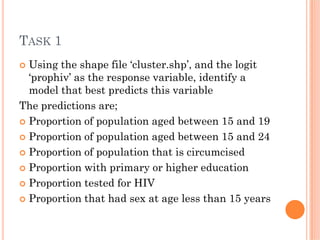
TASK 1
Using the shape file ‘cluster.shp’, and the logit
‘prophiv’ as the response variable, identify a
model that best predicts this variable
The predictions are;
Proportion of population aged between 15 and 19
Proportion of population aged between 15 and 24
Proportion of population that is circumcised
Proportion with primary or higher education
Proportion tested for HIV
Proportion that had sex at age less than 15 years
TASK 2
District level HIV prevalence data
Use the 6 variables in slide 2 to explain the HIV
prevalence at cluster level in Kenya based on the
data in the shapefile data1.shp provided. A
spatial polygon shapefile
ke_district_boundaries.shp is also provided.
Identify the best possible regression model (OLS,
spatial error or spatial lag) that best suits this
data.
Produce maps of slide 2 prevalence, and each of
the variable given in Table 1 [Taking ecological
fallacy problem into consideration]

Introduction to geo da

  • 1.
    INTRODUCTION TO GEODA RichardW Wamalwa1 - MSc., MBA(Finance), BSc. 1Directorate of Academic Quality Assurance, JKUAT RM 610-Environmental, Spatial, GIS, 2011
  • 2.
    TASK 1 Using theshape file ‘cluster.shp’, and the logit ‘prophiv’ as the response variable, identify a model that best predicts this variable The predictions are; Proportion of population aged between 15 and 19 Proportion of population aged between 15 and 24 Proportion of population that is circumcised Proportion with primary or higher education Proportion tested for HIV Proportion that had sex at age less than 15 years
  • 3.
    TASK 2 District levelHIV prevalence data Use the 6 variables in slide 2 to explain the HIV prevalence at cluster level in Kenya based on the data in the shapefile data1.shp provided. A spatial polygon shapefile ke_district_boundaries.shp is also provided. Identify the best possible regression model (OLS, spatial error or spatial lag) that best suits this data. Produce maps of slide 2 prevalence, and each of the variable given in Table 1 [Taking ecological fallacy problem into consideration]