Chap 1
Financial Institution
Market & Services
Introduction
The Indian Financial System, 2e -- Pathak
Copyright©
2008
Dorling
Kindersley
India
Pvt.
Ltd
Topics to be Covered
 Meaning
 – Structure
 - Functions
 - Components of financial system
 - Financial system and economic development
 - Reforms in Financial Sector in India
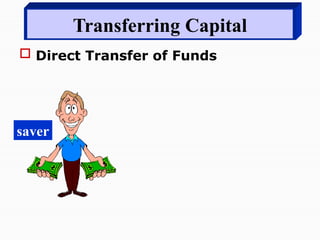
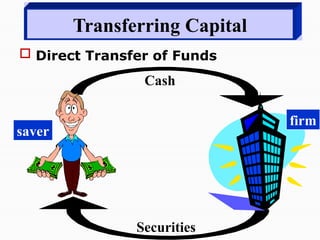
Transferring Capital
 Direct Transfer of Funds
saver
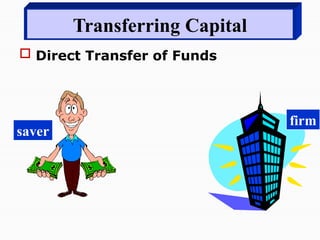
Transferring Capital
 Direct Transfer of Funds
saver
firm
Cash
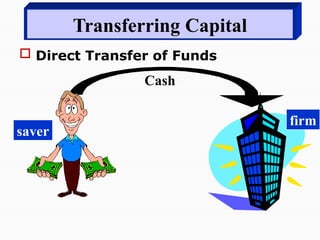
Transferring Capital
 Direct Transfer of Funds
saver
firm
Cash
Securities
Transferring Capital
 Direct Transfer of Funds
saver
firm
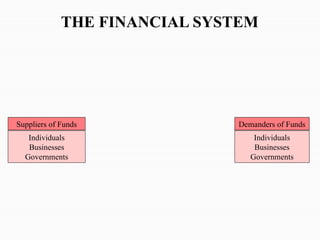
Suppliers of Funds
Individuals
Businesses
Governments
Demanders of Funds
Individuals
Businesses
Governments
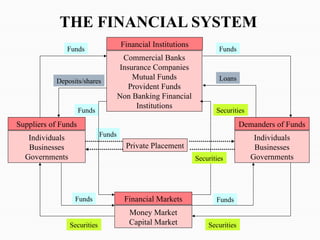
THE FINANCIAL SYSTEM
Suppliers of Funds
Individuals
Businesses
Governments
Demanders of Funds
Individuals
Businesses
Governments
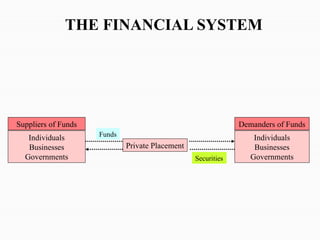
THE FINANCIAL SYSTEM
Private Placement
Funds
Securities
The Indian Financial System, 2e -- Pathak
Copyright©
2008
Dorling
Kindersley
India
Pvt.
Ltd
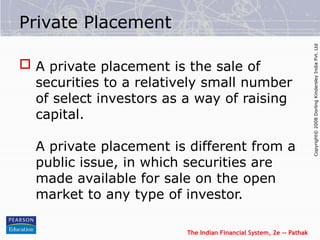
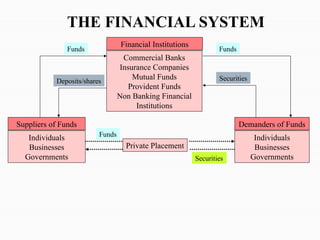
Private Placement
 A private placement is the sale of
securities to a relatively small number
of select investors as a way of raising
capital.
A private placement is different from a
public issue, in which securities are
made available for sale on the open
market to any type of investor.
Transferring Capital
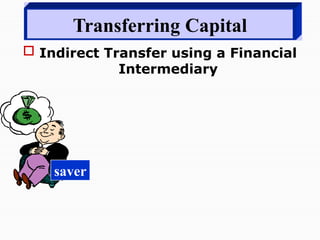
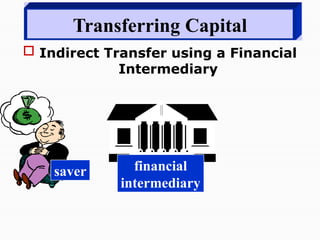
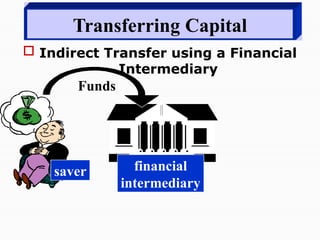
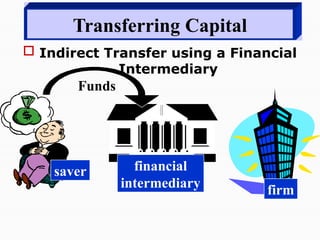
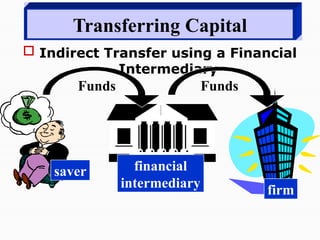
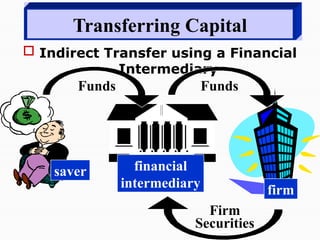
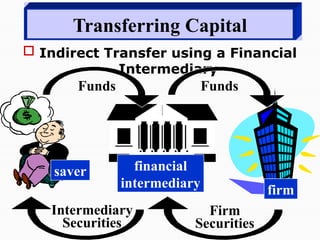
 Indirect Transfer using a Financial
Intermediary
saver
Transferring Capital
 Indirect Transfer using a Financial
Intermediary
financial
intermediary
saver
Funds
Transferring Capital
 Indirect Transfer using a Financial
Intermediary
financial
intermediary
saver
Funds
Transferring Capital
 Indirect Transfer using a Financial
Intermediary
financial
intermediary firm
saver
Funds
Transferring Capital
 Indirect Transfer using a Financial
Intermediary
Funds
financial
intermediary firm
saver
Funds
Transferring Capital
 Indirect Transfer using a Financial
Intermediary
Funds
financial
intermediary firm
saver
Firm
Securities
Funds
Transferring Capital
 Indirect Transfer using a Financial
Intermediary
Intermediary
Securities
Funds
Firm
Securities
financial
intermediary firm
saver
Financial Institutions
Commercial Banks
Insurance Companies
Mutual Funds
Provident Funds
Non Banking Financial
Institutions
Suppliers of Funds
Individuals
Businesses
Governments
Demanders of Funds
Individuals
Businesses
Governments
Funds
Deposits/shares
Funds
Securities
THE FINANCIAL SYSTEM
Private Placement
Funds
Securities
The Indian Financial System, 2e -- Pathak
Copyright©
2008
Dorling
Kindersley
India
Pvt.
Ltd
Financial Intermediate
 A financial intermediary is an entity
that acts as the middleman between
two parties in a financial transaction,
such as a commercial
bank, investment banks, mutual
funds and pension funds.
Transferring Capital
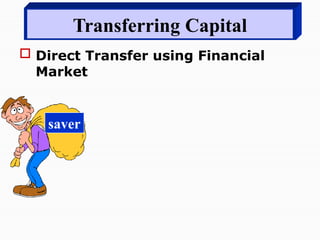
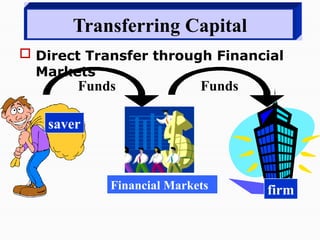
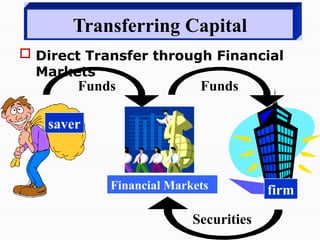
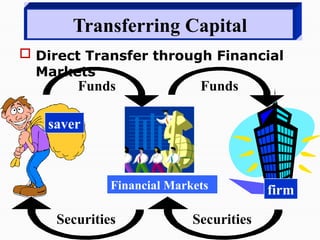
 Direct Transfer using Financial
Market
saver
Transferring Capital
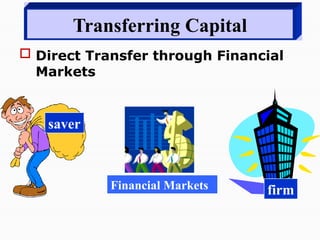
 Direct Transfer through Financial
Markets
saver
firm
Financial Markets
Funds
Transferring Capital
 Direct Transfer through Financial
Markets
saver
firm
Financial Markets
Funds
Transferring Capital
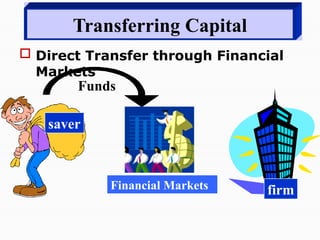
 Direct Transfer through Financial
Markets
Funds
saver
firm
Financial Markets
Funds
Transferring Capital
 Direct Transfer through Financial
Markets
Funds
Securities
saver
firm
Financial Markets
Funds
Transferring Capital
 Direct Transfer through Financial
Markets
Securities
Funds
Securities
saver
firm
Financial Markets
Financial Institutions
Commercial Banks
Insurance Companies
Mutual Funds
Provident Funds
Non Banking Financial
Institutions
Suppliers of Funds
Individuals
Businesses
Governments
Financial Markets
Money Market
Capital Market
Demanders of Funds
Individuals
Businesses
Governments
Private Placement
Funds
Deposits/shares
Funds
Securities
Funds
Loans
Securities
Funds
Securities
THE FINANCIAL SYSTEM
Funds
Financial Institutions
Commercial Banks
Insurance Companies
Mutual Funds
Provident Funds
Non Banking Financial
Institutions
Suppliers of Funds
Individuals
Businesses
Governments
Financial Markets
Money Market
Capital Market
Demanders of Funds
Individuals
Businesses
Governments
Private Placement
Funds
Deposits/shares
Funds
Securities
Funds
Loans
Funds
Securities
Funds Securities
Funds
Securities
THE FINANCIAL SYSTEM
The Indian Financial System, 2e -- Pathak
Copyright©
2008
Dorling
Kindersley
India
Pvt.
Ltd
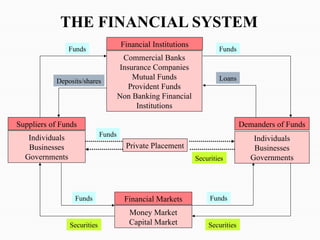
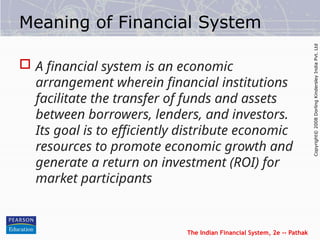
Meaning of Financial System
 A financial system is an economic
arrangement wherein financial institutions
facilitate the transfer of funds and assets
between borrowers, lenders, and investors.
Its goal is to efficiently distribute economic
resources to promote economic growth and
generate a return on investment (ROI) for
market participants
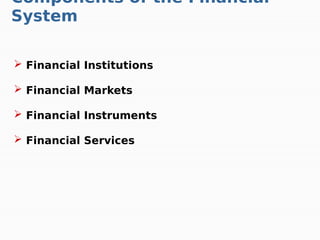
 Financial Institutions
 Financial Markets
 Financial Instruments
 Financial Services
Components of the Financial
System
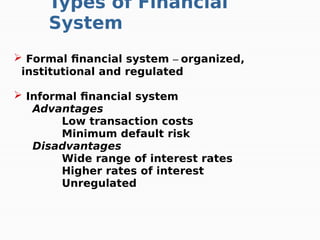
 Formal financial system – organized,
institutional and regulated
 Informal financial system
Advantages
Low transaction costs
Minimum default risk
Disadvantages
Wide range of interest rates
Higher rates of interest
Unregulated
Types of Financial
System
The Indian Financial System, 2e -- Pathak
Copyright©
2008
Dorling
Kindersley
India
Pvt.
Ltd
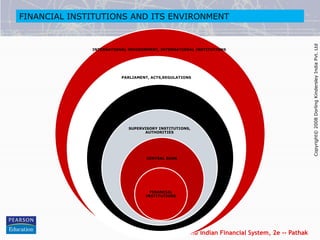
FINANCIAL INSTITUTIONS AND ITS ENVIRONMENT
INTERNATIONAL ENVIRONMENT, INTERNATIONAL INSTITUTIONS
PARLIAMENT, ACTS,REGULATIONS
STATE BUDGET
SUPERVISORY INSTITUTIONS,
AUTHORITIES
CENTRAL BANK
FINANCIAL
INSTITUTIONS
The Indian Financial System, 2e -- Pathak
Copyright©
2008
Dorling
Kindersley
India
Pvt.
Ltd
Financial Institutions
Financial Markets
Types
 Money Market – A market for short-term debt
instruments
 Capital Market – A market for long-term equity
and debt instruments
Segments
 Primary Market – A market for new issues
 Secondary Market – A market for trading
outstanding issues
Financial Instruments
Types
 Primary
 Secondary
Distinct Features
 Marketable
 Tradable
 Tailor-made
Financial Services
Major Categories
Funds intermediation
Payments mechanism
Provision of liquidity
Risk management
Financial engineering- Financial engineers use various
mathematical tools in order to create new investment strategies. The
new products created by financial engineers can serve as solutions
to problems or as ways to maximize returns from potential
investment opportunities.
Mobilise and allocate savings
Monitor corporate performance
Provide payment and settlement systems
Optimum allocation of risk bearing and
reduction
Disseminate price related information
Offer portfolio adjustment facility
Lower the cost of transactions
Promote the process of financial deepening
and broadening
Functions of Financial
System
Key Elements of a Well-
functioning Financial System
A strong legal and regulatory
environment
Stable money
Sound public finances and public debt
management
A central bank
Sound banking system
Information system
Well-functioning securities market
The Indian Financial System, 2e -- Pathak
Copyright©
2008
Dorling
Kindersley
India
Pvt.
Ltd
Role of Financial System in
economic Development
 Saving –Investment Relationship
 Growth in the capital market
 Foreign Exchange Securities
 Govt securities.
 Trade Development
 Economic Growth
 Balance Economic Development.
The Indian Financial System, 2e -- Pathak
Copyright©
2008
Dorling
Kindersley
India
Pvt.
Ltd
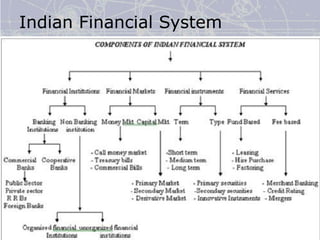
Indian Financial System
The Indian Financial System, 2e -- Pathak
Copyright©
2008
Dorling
Kindersley
India
Pvt.
Ltd
Lehman Bank Collapse
The Indian Financial System, 2e -- Pathak
Copyright©
2008
Dorling
Kindersley
India
Pvt.
Ltd
Financial System and Economic
Development
 https://www.drishtiias.com/daily-updat
es/daily-news-editorials/sri-lanka-s-cri
sis
 https://www.youtube.com/watch?v=0
1xYpDhYwGg
The Indian Financial System, 2e -- Pathak
Copyright©
2008
Dorling
Kindersley
India
Pvt.
Ltd
Reforms in Indian Financial
System
 Reforms in Stock Market
 Reforms in Banking Sector
 Reforms in Insolvency and Bankruptcy
code.
The Indian Financial System, 2e -- Pathak
Copyright©
2008
Dorling
Kindersley
India
Pvt.
Ltd
Stock Market
 The Securities and Exchange Board of
India (SEBI) that was created in 1988,
acquired legal standing in 1993.
 In November 1994, the National Stock
Exchange (NSE), opened for business. This
was India’s second stock exchange, the
first one being the Bombay Stock
Exchange (BSE)
The Indian Financial System, 2e -- Pathak
Copyright©
2008
Dorling
Kindersley
India
Pvt.
Ltd
-Contd-
 Also in 1994, all exchanges in India
switched from floor trading to
anonymous electronic trading.
 Also in 1996, dematerialisation of shares
took place. Today nearly all equity
settlement takes place at the depository.
The Indian Financial System, 2e -- Pathak
Copyright©
2008
Dorling
Kindersley
India
Pvt.
Ltd
-Contd-
 In 2000 and 2001, equity derivatives
trading started with index derivatives and
derivatives on some individual stocks.
The Indian Financial System, 2e -- Pathak
Copyright©
2008
Dorling
Kindersley
India
Pvt.
Ltd
Brain at Work
Statement : Government has spoiled many top
ranking financial institutions by appointing
bureaucrats as Directors of these institutions.
The Indian Financial System, 2e -- Pathak
Copyright©
2008
Dorling
Kindersley
India
Pvt.
Ltd
Conclusions
1. Government should appoint Directors of the
financial institutes taking into consideration
the expertise of the person in the area of
finance.
2. The Director of the financial institute should
have expertise commensurate with the
financial work carried out by the institute.
The Indian Financial System, 2e -- Pathak
Copyright©
2008
Dorling
Kindersley
India
Pvt.
Ltd
Options
 Only I follows
 Only II follows
 Either I or II follows
 Neither I or II follows
 Both I and II follows
The Indian Financial System, 2e -- Pathak
Copyright©
2008
Dorling
Kindersley
India
Pvt.
Ltd
Ans
 Both I & II follows.
The Indian Financial System, 2e -- Pathak
Copyright©
2008
Dorling
Kindersley
India
Pvt.
Ltd
Brain at Work
 Statements: The
Government run
company had asked
its employees to
declare their income
and assets but it has
been strongly
resisted by
employees union and
no employee is going
to declare his
income.
CONCLUSION
1.The employees of this
company do not seem to
have any additional
undisclosed income
besides their salary.
2.The employees union
wants all senior officers
to declare their income
first.
The Indian Financial System, 2e -- Pathak
Copyright©
2008
Dorling
Kindersley
India
Pvt.
Ltd
Options
 Only I follows
 Only II follows
 Either I or II follows
 Neither I or II follows
 Both I and II follows
The Indian Financial System, 2e -- Pathak
Copyright©
2008
Dorling
Kindersley
India
Pvt.
Ltd
Ans
 Neither I nor II follows.
The Indian Financial System, 2e -- Pathak
Copyright©
2008
Dorling
Kindersley
India
Pvt.
Ltd
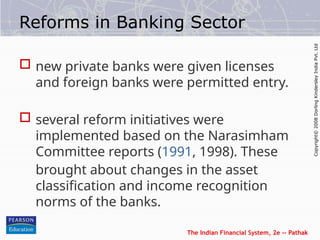
Reforms in Banking Sector
 new private banks were given licenses
and foreign banks were permitted entry.
 several reform initiatives were
implemented based on the Narasimham
Committee reports (1991, 1998). These
brought about changes in the asset
classification and income recognition
norms of the banks.
The Indian Financial System, 2e -- Pathak
Copyright©
2008
Dorling
Kindersley
India
Pvt.
Ltd
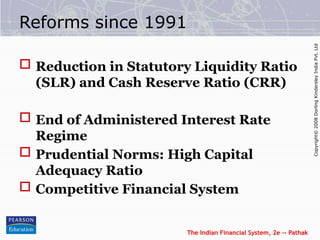
Reforms since 1991
 Reduction in Statutory Liquidity Ratio
(SLR) and Cash Reserve Ratio (CRR)
 End of Administered Interest Rate
Regime
 Prudential Norms: High Capital
Adequacy Ratio
 Competitive Financial System
The Indian Financial System, 2e -- Pathak
Copyright©
2008
Dorling
Kindersley
India
Pvt.
Ltd
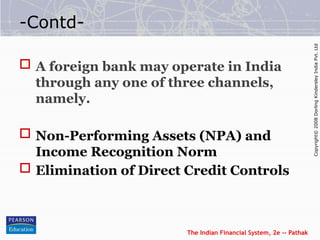
-Contd-
 A foreign bank may operate in India
through any one of three channels,
namely.
 Non-Performing Assets (NPA) and
Income Recognition Norm
 Elimination of Direct Credit Controls
The Indian Financial System, 2e -- Pathak
Copyright©
2008
Dorling
Kindersley
India
Pvt.
Ltd
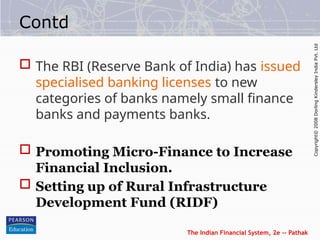
Contd
 The RBI (Reserve Bank of India) has issued
specialised banking licenses to new
categories of banks namely small finance
banks and payments banks.
 Promoting Micro-Finance to Increase
Financial Inclusion.
 Setting up of Rural Infrastructure
Development Fund (RIDF)
The Indian Financial System, 2e -- Pathak
Copyright©
2008
Dorling
Kindersley
India
Pvt.
Ltd
Insolvency and Bankruptcy
Reforms
 The Insolvency and Bankruptcy Act (IBC)
was enacted in 2016. It is a landmark law
in that for the first time, there is a
proposal to create a well-defined,
comprehensive framework for resolving
insolvencies and bankruptcies in non-
financial firms.
The Indian Financial System, 2e -- Pathak
Copyright©
2008
Dorling
Kindersley
India
Pvt.
Ltd
-Contd-
 The law also made the National Company
Law Tribunal (NCLT) the adjudicating
authority for bankruptcy resolution.

Introduction to Financial System framewok.pptx

  • 1.
    Chap 1 Financial Institution Market& Services Introduction
  • 2.
    The Indian FinancialSystem, 2e -- Pathak Copyright© 2008 Dorling Kindersley India Pvt. Ltd Topics to be Covered  Meaning  – Structure  - Functions  - Components of financial system  - Financial system and economic development  - Reforms in Financial Sector in India
  • 3.
    Transferring Capital  DirectTransfer of Funds saver
  • 4.
    Transferring Capital  DirectTransfer of Funds saver firm
  • 5.
    Cash Transferring Capital  DirectTransfer of Funds saver firm
  • 6.
  • 7.
    Suppliers of Funds Individuals Businesses Governments Demandersof Funds Individuals Businesses Governments THE FINANCIAL SYSTEM
  • 8.
    Suppliers of Funds Individuals Businesses Governments Demandersof Funds Individuals Businesses Governments THE FINANCIAL SYSTEM Private Placement Funds Securities
  • 9.
    The Indian FinancialSystem, 2e -- Pathak Copyright© 2008 Dorling Kindersley India Pvt. Ltd Private Placement  A private placement is the sale of securities to a relatively small number of select investors as a way of raising capital. A private placement is different from a public issue, in which securities are made available for sale on the open market to any type of investor.
  • 10.
    Transferring Capital  IndirectTransfer using a Financial Intermediary saver
  • 11.
    Transferring Capital  IndirectTransfer using a Financial Intermediary financial intermediary saver
  • 12.
    Funds Transferring Capital  IndirectTransfer using a Financial Intermediary financial intermediary saver
  • 13.
    Funds Transferring Capital  IndirectTransfer using a Financial Intermediary financial intermediary firm saver
  • 14.
    Funds Transferring Capital  IndirectTransfer using a Financial Intermediary Funds financial intermediary firm saver
  • 15.
    Funds Transferring Capital  IndirectTransfer using a Financial Intermediary Funds financial intermediary firm saver Firm Securities
  • 16.
    Funds Transferring Capital  IndirectTransfer using a Financial Intermediary Intermediary Securities Funds Firm Securities financial intermediary firm saver
  • 17.
    Financial Institutions Commercial Banks InsuranceCompanies Mutual Funds Provident Funds Non Banking Financial Institutions Suppliers of Funds Individuals Businesses Governments Demanders of Funds Individuals Businesses Governments Funds Deposits/shares Funds Securities THE FINANCIAL SYSTEM Private Placement Funds Securities
  • 18.
    The Indian FinancialSystem, 2e -- Pathak Copyright© 2008 Dorling Kindersley India Pvt. Ltd Financial Intermediate  A financial intermediary is an entity that acts as the middleman between two parties in a financial transaction, such as a commercial bank, investment banks, mutual funds and pension funds.
  • 19.
    Transferring Capital  DirectTransfer using Financial Market saver
  • 20.
    Transferring Capital  DirectTransfer through Financial Markets saver firm Financial Markets
  • 21.
    Funds Transferring Capital  DirectTransfer through Financial Markets saver firm Financial Markets
  • 22.
    Funds Transferring Capital  DirectTransfer through Financial Markets Funds saver firm Financial Markets
  • 23.
    Funds Transferring Capital  DirectTransfer through Financial Markets Funds Securities saver firm Financial Markets
  • 24.
    Funds Transferring Capital  DirectTransfer through Financial Markets Securities Funds Securities saver firm Financial Markets
  • 25.
    Financial Institutions Commercial Banks InsuranceCompanies Mutual Funds Provident Funds Non Banking Financial Institutions Suppliers of Funds Individuals Businesses Governments Financial Markets Money Market Capital Market Demanders of Funds Individuals Businesses Governments Private Placement Funds Deposits/shares Funds Securities Funds Loans Securities Funds Securities THE FINANCIAL SYSTEM Funds
  • 26.
    Financial Institutions Commercial Banks InsuranceCompanies Mutual Funds Provident Funds Non Banking Financial Institutions Suppliers of Funds Individuals Businesses Governments Financial Markets Money Market Capital Market Demanders of Funds Individuals Businesses Governments Private Placement Funds Deposits/shares Funds Securities Funds Loans Funds Securities Funds Securities Funds Securities THE FINANCIAL SYSTEM
  • 27.
    The Indian FinancialSystem, 2e -- Pathak Copyright© 2008 Dorling Kindersley India Pvt. Ltd Meaning of Financial System  A financial system is an economic arrangement wherein financial institutions facilitate the transfer of funds and assets between borrowers, lenders, and investors. Its goal is to efficiently distribute economic resources to promote economic growth and generate a return on investment (ROI) for market participants
  • 28.
     Financial Institutions Financial Markets  Financial Instruments  Financial Services Components of the Financial System
  • 29.
     Formal financialsystem – organized, institutional and regulated  Informal financial system Advantages Low transaction costs Minimum default risk Disadvantages Wide range of interest rates Higher rates of interest Unregulated Types of Financial System
  • 30.
    The Indian FinancialSystem, 2e -- Pathak Copyright© 2008 Dorling Kindersley India Pvt. Ltd FINANCIAL INSTITUTIONS AND ITS ENVIRONMENT INTERNATIONAL ENVIRONMENT, INTERNATIONAL INSTITUTIONS PARLIAMENT, ACTS,REGULATIONS STATE BUDGET SUPERVISORY INSTITUTIONS, AUTHORITIES CENTRAL BANK FINANCIAL INSTITUTIONS
  • 31.
    The Indian FinancialSystem, 2e -- Pathak Copyright© 2008 Dorling Kindersley India Pvt. Ltd Financial Institutions
  • 32.
    Financial Markets Types  MoneyMarket – A market for short-term debt instruments  Capital Market – A market for long-term equity and debt instruments Segments  Primary Market – A market for new issues  Secondary Market – A market for trading outstanding issues
  • 33.
    Financial Instruments Types  Primary Secondary Distinct Features  Marketable  Tradable  Tailor-made
  • 34.
    Financial Services Major Categories Fundsintermediation Payments mechanism Provision of liquidity Risk management Financial engineering- Financial engineers use various mathematical tools in order to create new investment strategies. The new products created by financial engineers can serve as solutions to problems or as ways to maximize returns from potential investment opportunities.
  • 35.
    Mobilise and allocatesavings Monitor corporate performance Provide payment and settlement systems Optimum allocation of risk bearing and reduction Disseminate price related information Offer portfolio adjustment facility Lower the cost of transactions Promote the process of financial deepening and broadening Functions of Financial System
  • 36.
    Key Elements ofa Well- functioning Financial System A strong legal and regulatory environment Stable money Sound public finances and public debt management A central bank Sound banking system Information system Well-functioning securities market
  • 37.
    The Indian FinancialSystem, 2e -- Pathak Copyright© 2008 Dorling Kindersley India Pvt. Ltd Role of Financial System in economic Development  Saving –Investment Relationship  Growth in the capital market  Foreign Exchange Securities  Govt securities.  Trade Development  Economic Growth  Balance Economic Development.
  • 38.
    The Indian FinancialSystem, 2e -- Pathak Copyright© 2008 Dorling Kindersley India Pvt. Ltd Indian Financial System
  • 39.
    The Indian FinancialSystem, 2e -- Pathak Copyright© 2008 Dorling Kindersley India Pvt. Ltd Lehman Bank Collapse
  • 40.
    The Indian FinancialSystem, 2e -- Pathak Copyright© 2008 Dorling Kindersley India Pvt. Ltd Financial System and Economic Development  https://www.drishtiias.com/daily-updat es/daily-news-editorials/sri-lanka-s-cri sis  https://www.youtube.com/watch?v=0 1xYpDhYwGg
  • 41.
    The Indian FinancialSystem, 2e -- Pathak Copyright© 2008 Dorling Kindersley India Pvt. Ltd Reforms in Indian Financial System  Reforms in Stock Market  Reforms in Banking Sector  Reforms in Insolvency and Bankruptcy code.
  • 42.
    The Indian FinancialSystem, 2e -- Pathak Copyright© 2008 Dorling Kindersley India Pvt. Ltd Stock Market  The Securities and Exchange Board of India (SEBI) that was created in 1988, acquired legal standing in 1993.  In November 1994, the National Stock Exchange (NSE), opened for business. This was India’s second stock exchange, the first one being the Bombay Stock Exchange (BSE)
  • 43.
    The Indian FinancialSystem, 2e -- Pathak Copyright© 2008 Dorling Kindersley India Pvt. Ltd -Contd-  Also in 1994, all exchanges in India switched from floor trading to anonymous electronic trading.  Also in 1996, dematerialisation of shares took place. Today nearly all equity settlement takes place at the depository.
  • 44.
    The Indian FinancialSystem, 2e -- Pathak Copyright© 2008 Dorling Kindersley India Pvt. Ltd -Contd-  In 2000 and 2001, equity derivatives trading started with index derivatives and derivatives on some individual stocks.
  • 45.
    The Indian FinancialSystem, 2e -- Pathak Copyright© 2008 Dorling Kindersley India Pvt. Ltd Brain at Work Statement : Government has spoiled many top ranking financial institutions by appointing bureaucrats as Directors of these institutions.
  • 46.
    The Indian FinancialSystem, 2e -- Pathak Copyright© 2008 Dorling Kindersley India Pvt. Ltd Conclusions 1. Government should appoint Directors of the financial institutes taking into consideration the expertise of the person in the area of finance. 2. The Director of the financial institute should have expertise commensurate with the financial work carried out by the institute.
  • 47.
    The Indian FinancialSystem, 2e -- Pathak Copyright© 2008 Dorling Kindersley India Pvt. Ltd Options  Only I follows  Only II follows  Either I or II follows  Neither I or II follows  Both I and II follows
  • 48.
    The Indian FinancialSystem, 2e -- Pathak Copyright© 2008 Dorling Kindersley India Pvt. Ltd Ans  Both I & II follows.
  • 49.
    The Indian FinancialSystem, 2e -- Pathak Copyright© 2008 Dorling Kindersley India Pvt. Ltd Brain at Work  Statements: The Government run company had asked its employees to declare their income and assets but it has been strongly resisted by employees union and no employee is going to declare his income. CONCLUSION 1.The employees of this company do not seem to have any additional undisclosed income besides their salary. 2.The employees union wants all senior officers to declare their income first.
  • 50.
    The Indian FinancialSystem, 2e -- Pathak Copyright© 2008 Dorling Kindersley India Pvt. Ltd Options  Only I follows  Only II follows  Either I or II follows  Neither I or II follows  Both I and II follows
  • 51.
    The Indian FinancialSystem, 2e -- Pathak Copyright© 2008 Dorling Kindersley India Pvt. Ltd Ans  Neither I nor II follows.
  • 52.
    The Indian FinancialSystem, 2e -- Pathak Copyright© 2008 Dorling Kindersley India Pvt. Ltd Reforms in Banking Sector  new private banks were given licenses and foreign banks were permitted entry.  several reform initiatives were implemented based on the Narasimham Committee reports (1991, 1998). These brought about changes in the asset classification and income recognition norms of the banks.
  • 53.
    The Indian FinancialSystem, 2e -- Pathak Copyright© 2008 Dorling Kindersley India Pvt. Ltd Reforms since 1991  Reduction in Statutory Liquidity Ratio (SLR) and Cash Reserve Ratio (CRR)  End of Administered Interest Rate Regime  Prudential Norms: High Capital Adequacy Ratio  Competitive Financial System
  • 54.
    The Indian FinancialSystem, 2e -- Pathak Copyright© 2008 Dorling Kindersley India Pvt. Ltd -Contd-  A foreign bank may operate in India through any one of three channels, namely.  Non-Performing Assets (NPA) and Income Recognition Norm  Elimination of Direct Credit Controls
  • 55.
    The Indian FinancialSystem, 2e -- Pathak Copyright© 2008 Dorling Kindersley India Pvt. Ltd Contd  The RBI (Reserve Bank of India) has issued specialised banking licenses to new categories of banks namely small finance banks and payments banks.  Promoting Micro-Finance to Increase Financial Inclusion.  Setting up of Rural Infrastructure Development Fund (RIDF)
  • 56.
    The Indian FinancialSystem, 2e -- Pathak Copyright© 2008 Dorling Kindersley India Pvt. Ltd Insolvency and Bankruptcy Reforms  The Insolvency and Bankruptcy Act (IBC) was enacted in 2016. It is a landmark law in that for the first time, there is a proposal to create a well-defined, comprehensive framework for resolving insolvencies and bankruptcies in non- financial firms.
  • 57.
    The Indian FinancialSystem, 2e -- Pathak Copyright© 2008 Dorling Kindersley India Pvt. Ltd -Contd-  The law also made the National Company Law Tribunal (NCLT) the adjudicating authority for bankruptcy resolution.