Module Introduction:
Environmental Assessment
and Sustainability.
Nasasira Boeres
VICTORIA UNIVERSITY
Welcome to Environmental
Assessment and Sustainability,
a crucial module for understanding the complex relationships between human activities, the
environment, and societal well-being. This module explores the concepts, principles, and
practices of environmental assessment and sustainability, equipping you with the knowledge
and skills to address the challenges of sustainable development.
•What is Environmental Assessment (EA)?
Environmental Assessment (EA) is a systematic process used to identify, predict, and mitigate
the potential environmental impacts of proposed projects, policies, or programs.
•EA aims to:1. Identify potential environmental risks and opportunities
•2. Assess the significance of environmental impacts
•3. Develop strategies to minimize adverse effects
•4. Monitor and evaluate implementation
•EA is an essential tool for:
•1. Promoting sustainable development
•2. Protecting human health and well-being
•3. Conserving natural resources4. Supporting informed decision-making
•What is Sustainability? Sustainability refers to meeting the needs of the present without
compromising the ability of future generations to meet their own needs. Sustainability
encompasses three interconnected pillars:
Fundamental Approach to
Environmental Impact Assessment (EIA)
BASIC CONCEPTS OF EIA :
• EIA is an activity designed to identify and predict the
impact of a project on bio-geo-physico-chemical
environment and on human health so as to
recommend appropriate legislative measures,
programs, and operational procedures to minimize
the impact.
BASIC CONCEPTS OF EIA
• EIA is an exercise to be carried out before any
project or major activity is undertaken to
ensure that it will not in any away harm the
environment on a short-term or long-term
basis.
• Any developmental activity requires EIA to be
done before executed to know the effect of a
proposed development on the environment.
EIA: Purpose
• To provide information for decision-making on
the environmental consequences of proposed
actions;
and
• To promote environmentally sound and
sustainable development through the
identification of appropriate enhancement
and mitigation measures.
Sustainable development
‘development that meets the needs of today’s
generation without compromising those of
future generations’
Why EIA is important
• Reducing the burden of environmental impacts is
necessary if development is to become
sustainable.
• These impacts are more complex, larger in scale
and further reaching in their potential
consequences than thirty years ago when EIA
was first introduced.
• As a result, EIA has become of ever increasing
importance as a tool for development decision-
making.
Why EIA is important
• In practice, EIA is applied primarily to prevent
or minimise the adverse effects of major
development proposals, such as a power
station, dams and reservoirs, industrial
complexes, etc.
• This process is also used as a planning tool to
promote sustainable development by
integrating environmental considerations into
a wide range of proposed actions.
What are the aims and objectives of EIA?
The aims and objectives of EIA can be divided into two
categories.
• The immediate aim and ultimate (long term) aim
• The immediate aim of EIA is to inform the process of
decision-making by identifying the potentially significant
environmental effects and risks of development proposals.
• The ultimate (long term) aim of EIA is to promote
sustainable development by ensuring that development
proposals do not undermine critical resource and ecological
functions or the well being, lifestyle and livelihood of the
communities and peoples who depend on them.
Immediate objectives of EIA are
To
• improve the environmental design of the
proposal;
• ensure that resources are used appropriately and
efficiently;
• identify appropriate measures for mitigating the
potential impacts of the proposal; and
• facilitate informed decision making, including
setting the environmental terms and conditions
for implementing the proposal.
Long term objectives of EIA are
To:
• protect human health and safety;
• avoid irreversible changes and serious damage
to the environment;
• safeguard valued resources, natural areas and
ecosystem components;
and
• enhance the social aspects of the proposal.
Limitations of EIA
• EIA is also a way of ensuring that environmental factors are
considered in decision-making process along with the
traditional economic and technical factors.
• Importantly EIA requires the scientific (technical) and value
issues to be dealt with in a single assessment process.
• This helps in the proper consideration of all advantages and
disadvantages of a proposal.
• Environmental considerations may, therefore, be set aside in
favour of what are felt to be more important considerations.
• Alternatively, predicted adverse effects on the environment
might lead to strict conditions being imposed to avoid these
effects or remedy any adverse effects, or perhaps lead to the
complete abandonment of a proposal.
Limitations of EIA
• However, it is most important to recognise that EIA
cannot be regarded as a means of introducing an
environmental “veto” power into administrative
decision-making processes.
• Decisions that are unsatisfactory from an
environmental point of view can still be made, but
with full knowledge of the environmental
consequences.
• The final decision about a proposal depends upon
the likely severity of the adverse effects, balanced
against other expected benefits.
Limitations of EIA
• In other words, EIA is an administrative process that identifies
the potential environmental effects of undertaking a
proposal, and presents these environmental effects alongside
the other advantages and disadvantages of the proposal to
the decision-makers.
• In the vast majority of EIA procedures this means that the
outcome of the EIA process provides advice to the decision-
makers – it does not provide a final decision.
• So, by itself, the EIA procedures cannot be expected to stop a
proposal – although this is an outcome that some members of
the general community and environment groups may expect.
Principles of EIA administration and practice
• EIA is one of a number of policy tools that are used to evaluate
project proposals.
• It is also a relatively recent development when compared to use of
economic appraisal methods.
• A number of factors led to the introduction of EIA in different
countries, including public concern about the quality of the
environment and the increasing effects of new technologies and
ever-larger development schemes.
• In addition, then available economic appraisal techniques, such as
benefit cost analysis, did not take account of the environmental and
social impacts of major projects.
• Today, EIA is applied in more than 100 countries, and by all
development banks and most international aid agencies.
• EIA has also evolved significantly, driven by improvements in law,
procedure and methodology.
Principles of EIA administration and practice
• To date, EIA has been applied primarily at the
project-level.
• This ‘first generation’ process is now complemented
by SEA (Sustainable Environmental Assessment) of
policies, plans and programmes, and both EIA and
SEA are being adapted to bring a greater measure of
‘sustainability assurance’ to development decision
making.
• These trends have brought new perspectives on
what constitutes EIA good practice and effective
performance.
Principles of EIA administration and practice
Three core values on which the EIA process is based:
• Integrity– the EIA process should meet
internationally accepted requirements and standards
of practice;
• Utility– the EIA process should provide the
information which is sufficient and relevant for
decision-making; and
• Sustainability– the EIA process should result in the
implementation of environmental safeguards which
are sufficient to mitigate serious adverse effects and
avoid irreversible loss of resource and ecosystem
functions.
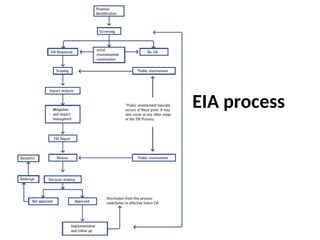
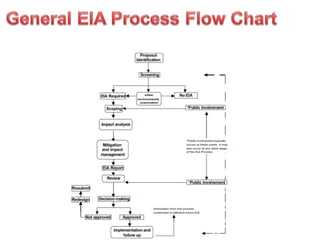
EIA process
• The particular components, stages and activities of an EIA process
will depend upon the requirements of the country or donor.
• However, most EIA processes have a common structure
• The application of the main stages is a basic standard of good
practice.
• Typically, the EIA process begins with screening to ensure time
and resources are directed at the proposals that matter
environmentally.
• It should end with some form of follow up on the implementation
of the decisions and actions taken as a result of an EIA report.
EIA process
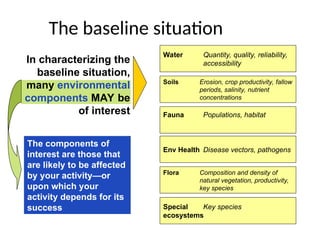
The baseline situation
In characterizing the
baseline situation,
many environmental
components MAY be
of interest
Water Quantity, quality, reliability,
accessibility
Soils Erosion, crop productivity, fallow
periods, salinity, nutrient
concentrations
Flora Composition and density of
natural vegetation, productivity,
key species
Fauna Populations, habitat
Special Key species
ecosystems
Env Health Disease vectors, pathogens
The components of
interest are those that
are likely to be affected
by your activity—or
upon which your
activity depends for its
success
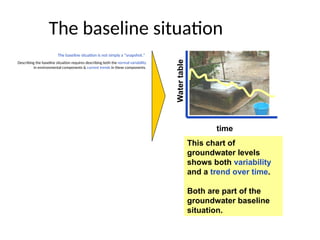
The baseline situation
The baseline situation is not simply a “snapshot.”
Describing the baseline situation requires describing both the normal variability
in environmental components & current trends in these components.
time
Water
table
This chart of
groundwater levels
shows both variability
and a trend over time.
Both are part of the
groundwater baseline
situation.
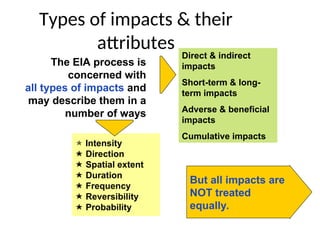
Types of impacts & their
attributes Direct & indirect
impacts
Short-term & long-
term impacts
Adverse & beneficial
impacts
Cumulative impacts
The EIA process is
concerned with
all types of impacts and
may describe them in a
number of ways
 Intensity
 Direction
 Spatial extent
 Duration
 Frequency
 Reversibility
 Probability
But all impacts are
NOT treated
equally.
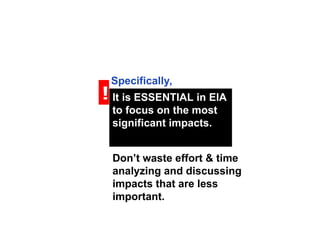
! It is ESSENTIAL in EIA
to focus on the most
significant impacts.
Don’t waste effort & time
analyzing and discussing
impacts that are less
important.
Specifically,
27
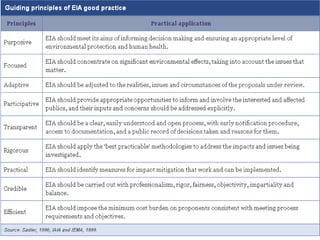
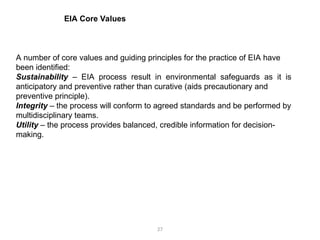
A number of core values and guiding principles for the practice of EIA have
been identified:
Sustainability – EIA process result in environmental safeguards as it is
anticipatory and preventive rather than curative (aids precautionary and
preventive principle).
Integrity – the process will conform to agreed standards and be performed by
multidisciplinary teams.
Utility – the process provides balanced, credible information for decision-
making.
EIA Core Values
28
Key Guiding Principles for EIA
Continuity - as an integral part of planning, designing and implementation cycle
of and development initiative, EIA should run continuously and throughout
project cycle.
Participatory - EIA provides a framework for stakeholders and all interested
parties to participate in decision-making.
Transparency – EIA facilitates dialogue, predictions and responses in a forum
where proponents, decision-makers, experts and the public interact in an open
and accessible way in considering the potential impacts of a project on local
community, natural resources and environmental quality. All assessment
decisions and their basis, should be open and accessible.
Credibility – assessments are undertaken with professionalism and objectivity,
using multidisciplinary skills.
Certainty – the process and timing of assessment must be agreed in advance
and followed by all participants.
29
Cost-effectiveness – the assessment process and its outcomes
will ensure environmental protection at the least cost to society. It
ensures fair and equitable distribution of project costs and benefit. As a
minimum, local people in a project area must not be worse-off than they
were before a project was implemented.
Flexibility – the assessment should be able to adapt to deal efficiently
and effectively with any proposal or decision- making situation.
Practicality – the information and outputs are readily usable for
planning, designing and in decision-making.
Accountability – decision-makers are responsible to all parties for
decision and actions under the assessment process.
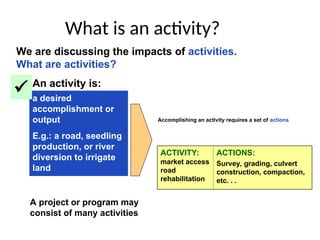
What is an activity?
ACTIVITY:
market access
road
rehabilitation
ACTIONS:
Survey, grading, culvert
construction, compaction,
etc. . .
a desired
accomplishment or
output
E.g.: a road, seedling
production, or river
diversion to irrigate
land
An activity is:

Accomplishing an activity requires a set of actions
We are discussing the impacts of activities.
What are activities?
A project or program may
consist of many activities
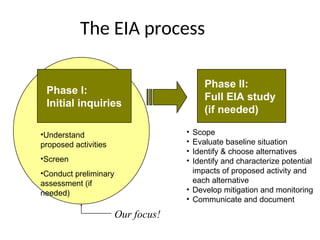
The EIA process
• Scope
• Evaluate baseline situation
• Identify & choose alternatives
• Identify and characterize potential
impacts of proposed activity and
each alternative
• Develop mitigation and monitoring
• Communicate and document
Phase I:
Initial inquiries
Phase II:
Full EIA study
(if needed)
Our focus!
•Understand
proposed activities
•Screen
•Conduct preliminary
assessment (if
needed)
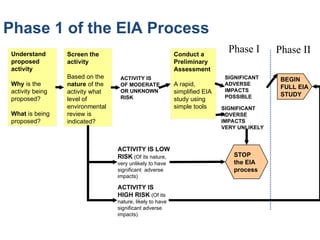
Phase 1 of the EIA Process
Screen the
activity
Based on the
nature of the
activity what
level of
environmental
review is
indicated?
Conduct a
Preliminary
Assessment
A rapid,
simplified EIA
study using
simple tools
ACTIVITY IS
OF MODERATE
OR UNKNOWN
RISK
SIGNIFICANT
ADVERSE
IMPACTS
POSSIBLE
SIGNIFICANT
ADVERSE
IMPACTS
VERY UNLIKELY
ACTIVITY IS LOW
RISK (Of its nature,
very unlikely to have
significant adverse
impacts)
ACTIVITY IS
HIGH RISK (Of its
nature, likely to have
significant adverse
impacts)
Phase II
Phase I
Understand
proposed
activity
Why is the
activity being
proposed?
What is being
proposed?
BEGIN
FULL EIA
STUDY
STOP
the EIA
process
Phase 1 of the EIA process:
Understand the proposed
activity
Understand
the proposed
activities
Why is the
activity being
proposed?
What is being
proposed?
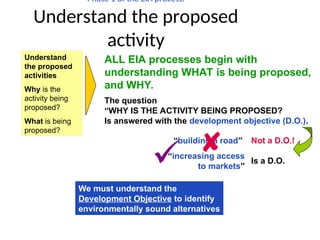
ALL EIA processes begin with
understanding WHAT is being proposed,
and WHY.
The question
“WHY IS THE ACTIVITY BEING PROPOSED?
Is answered with the development objective (D.O.).
“building a road”
“increasing access
to markets”
We must understand the
Development Objective to identify
environmentally sound alternatives


Not a D.O.!
Is a D.O.
Phase 1 of the EIA process:
Understand the proposed
activity
Understand
the proposed
activities
Why is the
activity being
proposed?
What is being
proposed?
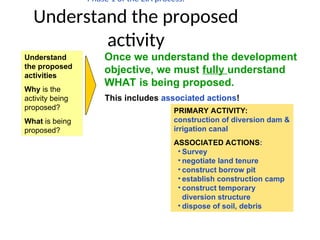
Once we understand the development
objective, we must fully understand
WHAT is being proposed.
This includes associated actions!
PRIMARY ACTIVITY:
construction of diversion dam &
irrigation canal
ASSOCIATED ACTIONS:
• Survey
• negotiate land tenure
• construct borrow pit
• establish construction camp
• construct temporary
diversion structure
• dispose of soil, debris
Phase 1 of the EIA process:
Screen the activity
Screen each
activity
Based on the
nature of the
activity, what
level of
environmental
analysis is
indicated?
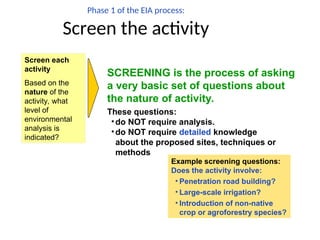
SCREENING is the process of asking
a very basic set of questions about
the nature of activity.
These questions:
•do NOT require analysis.
•do NOT require detailed knowledge
about the proposed sites, techniques or
methods
Example screening questions:
Does the activity involve:
• Penetration road building?
• Large-scale irrigation?
• Introduction of non-native
crop or agroforestry species?
Phase 1 of the EIA process:
Screen the activity
Screen each
activity
Based on the
nature of the
activity, what
level of
environmental
analysis is
indicated?
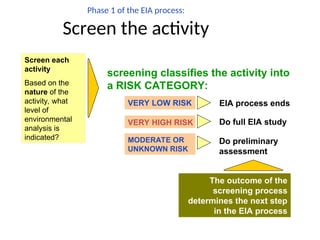
screening classifies the activity into
a RISK CATEGORY:
VERY LOW RISK
VERY HIGH RISK
MODERATE OR
UNKNOWN RISK
EIA process ends
Do full EIA study
Do preliminary
assessment
The outcome of the
screening process
determines the next step
in the EIA process
Phase 1 of the EIA process:
Screen the activity
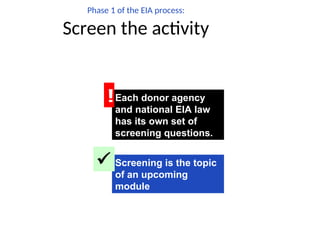
Each donor agency
and national EIA law
has its own set of
screening questions.
!
Screening is the topic
of an upcoming
module

Phase 1 of the EIA process:
The Preliminary Assessment
Conduct a
Preliminary
Assessment
A rapid,
simplified EIA
study using
simple tools
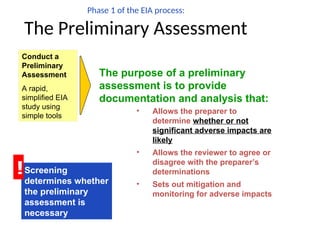
The purpose of a preliminary
assessment is to provide
documentation and analysis that:
Screening
determines whether
the preliminary
assessment is
necessary
!
• Allows the preparer to
determine whether or not
significant adverse impacts are
likely
• Allows the reviewer to agree or
disagree with the preparer’s
determinations
• Sets out mitigation and
monitoring for adverse impacts
Phase 1 of the EIA process:
The Preliminary Assessment
Typical Preliminary
Assessment outline
1. Background (Development
objective, list of activities)
2. Description of the baseline
situation
3. Evaluation of potential
environmental impacts
4. Mitigation & monitoring
5. Recommended Findings
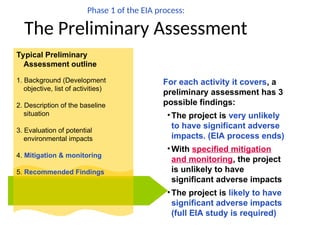
For each activity it covers, a
preliminary assessment has 3
possible findings:
•The project is very unlikely
to have significant adverse
impacts. (EIA process ends)
•With specified mitigation
and monitoring, the project
is unlikely to have
significant adverse impacts
•The project is likely to have
significant adverse impacts
(full EIA study is required)
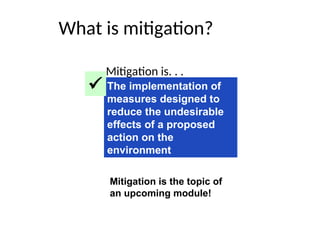
What is mitigation?
Mitigation is. . .
The implementation of
measures designed to
reduce the undesirable
effects of a proposed
action on the
environment

Mitigation is the topic of
an upcoming module!
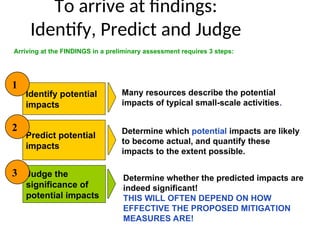
To arrive at findings:
Identify, Predict and Judge
Identify potential
impacts
Judge the
significance of
potential impacts
Predict potential
impacts
Arriving at the FINDINGS in a preliminary assessment requires 3 steps:
Many resources describe the potential
impacts of typical small-scale activities.
Determine which potential impacts are likely
to become actual, and quantify these
impacts to the extent possible.
1
2
3 Determine whether the predicted impacts are
indeed significant!
THIS WILL OFTEN DEPEND ON HOW
EFFECTIVE THE PROPOSED MITIGATION
MEASURES ARE!
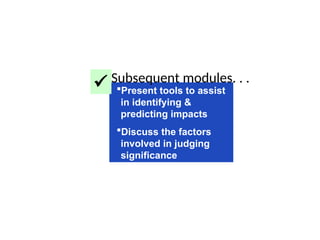
Present tools to assist
in identifying &
predicting impacts
Discuss the factors
involved in judging
significance
 Subsequent modules. . .
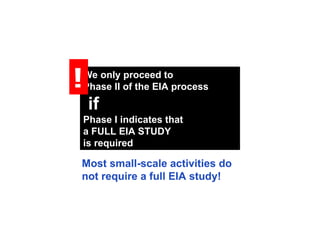
We only proceed to
Phase II of the EIA process
if
Phase I indicates that
a FULL EIA STUDY
is required
!
Most small-scale activities do
not require a full EIA study!
Phase 2 of the EIA process:
The Full EIA study
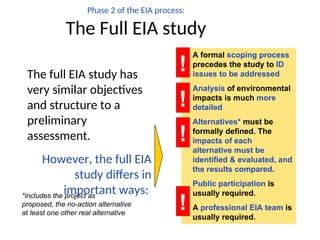
The full EIA study has
very similar objectives
and structure to a
preliminary
assessment.
However, the full EIA
study differs in
important ways:
A formal scoping process
precedes the study to ID
issues to be addressed
Analysis of environmental
impacts is much more
detailed
Alternatives* must be
formally defined. The
impacts of each
alternative must be
identified & evaluated, and
the results compared.
Public participation is
usually required.
A professional EIA team is
usually required.
!
!
!
*includes the project as
proposed, the no-action alternative
at least one other real alternative
!
Phase 2 of the EIA process:
The Full EIA study
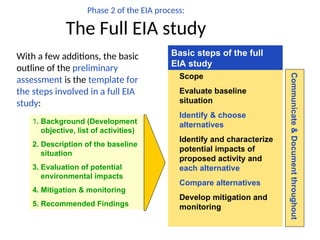
With a few additions, the basic
outline of the preliminary
assessment is the template for
the steps involved in a full EIA
study:
Scope
Evaluate baseline
situation
Identify & choose
alternatives
Identify and characterize
potential impacts of
proposed activity and
each alternative
Compare alternatives
Develop mitigation and
monitoring
1. Background (Development
objective, list of activities)
2. Description of the baseline
situation
3. Evaluation of potential
environmental impacts
4. Mitigation & monitoring
5. Recommended Findings
Basic steps of the full
EIA study
Communicate
&
Document
throughout
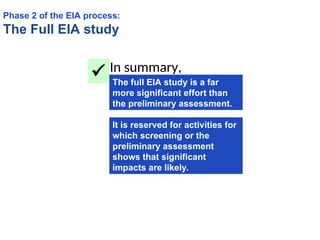
In summary,
The full EIA study is a far
more significant effort than
the preliminary assessment.

It is reserved for activities for
which screening or the
preliminary assessment
shows that significant
impacts are likely.
Phase 2 of the EIA process:
The Full EIA study
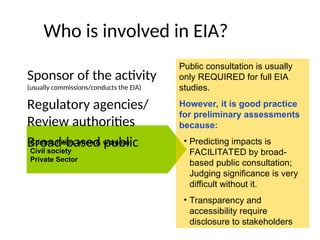
Who is involved in EIA?
Sponsor of the activity
(usually commissions/conducts the EIA)
Regulatory agencies/
Review authorities
Broad-based public
Public consultation is usually
only REQUIRED for full EIA
studies.
However, it is good practice
for preliminary assessments
because:
• Predicting impacts is
FACILITATED by broad-
based public consultation;
Judging significance is very
difficult without it.
• Transparency and
accessibility require
disclosure to stakeholders
Communities (men & women)
Civil society
Private Sector
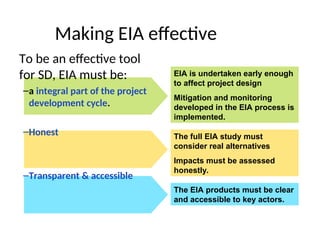
EIA is undertaken early enough
to affect project design
Mitigation and monitoring
developed in the EIA process is
implemented.
Making EIA effective
To be an effective tool
for SD, EIA must be:
–a integral part of the project
development cycle.
–Honest
–Transparent & accessible
The full EIA study must
consider real alternatives
Impacts must be assessed
honestly.
The EIA products must be clear
and accessible to key actors.
49
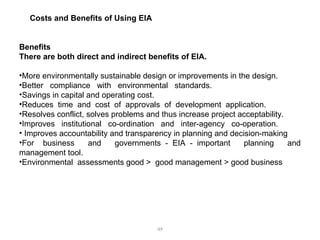
Costs and Benefits of Using EIA
Benefits
There are both direct and indirect benefits of EIA.
•More environmentally sustainable design or improvements in the design.
•Better compliance with environmental standards.
•Savings in capital and operating cost.
•Reduces time and cost of approvals of development application.
•Resolves conflict, solves problems and thus increase project acceptability.
•Improves institutional co-ordination and inter-agency co-operation.
• Improves accountability and transparency in planning and decision-making
•For business and governments - EIA - important planning and
management tool.
•Environmental assessments good > good management > good business
50
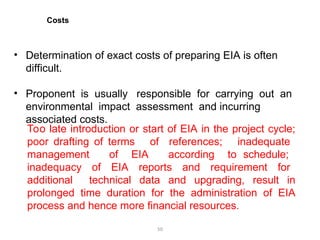
Costs
• Determination of exact costs of preparing EIA is often
difficult.
• Proponent is usually responsible for carrying out an
environmental impact assessment and incurring
associated costs.
Too late introduction or start of EIA in the project cycle;
poor drafting of terms of references; inadequate
management of EIA according to schedule;
inadequacy of EIA reports and requirement for
additional technical data and upgrading, result in
prolonged time duration for the administration of EIA
process and hence more financial resources.
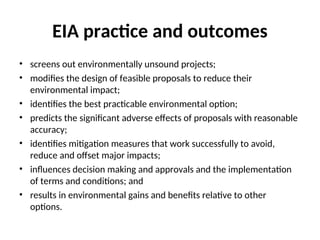
EIA practice and outcomes
• screens out environmentally unsound projects;
• modifies the design of feasible proposals to reduce their
environmental impact;
• identifies the best practicable environmental option;
• predicts the significant adverse effects of proposals with reasonable
accuracy;
• identifies mitigation measures that work successfully to avoid,
reduce and offset major impacts;
• influences decision making and approvals and the implementation
of terms and conditions; and
• results in environmental gains and benefits relative to other
options.
Deficiencies of EIA practice
• Technical shortcomings, expressed by the poor quality of many EIA reports.
The accuracy of impact predictions, the utility of mitigation and
management measures, and the relevance of reports for decision-making
often fall short of internationally accepted standards.
• Procedural limitations, including inconsistencies in process administration
and guidance. Time delays and costs of applying EA remain a serious
concern for project proponents. Affected communities are more
concerned with the lack of quality control of EIA studies or enforcement of
mitigation measures.
• Structural issues, stemming from the application of EIA as a separate
process, unrelated to the project cycle or the larger context of decision
making.
• In order to be effective, EIA requires a coherent policy-planning framework
and systematic follow up procedures.
Costs and benefits of EIA
• Although there are costs associated with undertaking EIA,
experience has shown that the potential savings over the life
of a project can repay the investment many times over.
• The savings can be economic (e.g. identification of least cost
alternative) as well as environmental (e.g. impact reduction,
maintaining other resource use opportunities).
• Generally the earlier EIA process is introduced in the project
cycle, the greater the potential returns.
• When EIA is integrated into the project preparation phase,
environmental design considerations can be introduced in the
first place rather than the proposal having to be modified
later.
Costs and benefits of EIA
Benefits
• The benefits of EIA can be direct, such as the
improved design or location of a project, or indirect,
such as better quality EIA work or raised
environmental awareness of the personnel involved
in the project.
• In these cases, there will be with flow-on effects in
their future work. As mentioned above, these
potential gains from EIA increase the earlier the
process is applied in the design process.
Costs and benefits of EIA
In general the benefits of EIA include:
• Better environmental planning and design of a proposal. Carrying out an EIA entails
an analysis of alternatives in the design and location of projects. This can result in
the selection of an improved technology, which lowers waste outputs or an
environmentally optimum location for a project. A well-designed project can
minimise risks and impacts on the environment and people, and thereby avoid
associated costs of remedial treatment or compensation for damage.
• Ensuring compliance with environmental standards. Compliance with
environmental standards reduces damage to the environment and disruption to
communities. It also avoids the likelihood of penalties, fines and loss of trust and
credibility.
• Savings in capital and operating costs. EIA can avoid the undue costs of
unanticipated impacts. These can escalate if environmental problems have not
been considered from the start of proposal design and require rectification later.
An ‘anticipate and avoid’ approach is much cheaper than ‘react and cure’.
Generally, changes which must be made late in the project cycle are the most
expensive.
• Reduced time and costs of approvals of development applications. If all
environmental concerns have been taken into account properly before submission
for project approval, then it is unlikely that delays will occur as a result of decision-
makers asking for additional information or alterations to mitigation measures.
Increased project acceptance by the public.
Costs and benefits of EIA
Costs
• It can be difficult to determine the exact costs of an EIA
because major projects typically require a large number of
investigations and reports, often for closely related purposes
(e.g. engineering feasibility studies of hydrology and surface
materials).
• The World Bank notes that the cost of preparing an EIA rarely
exceeds one per cent of the project costs and this percentage
can be reduced further if local personnel are used to do most
of the work.
• For Bank projects, the relative cost of an EIA typically ranges
from only 0.06 per cent to 0.10 per cent of total project costs.
• The total cost of an EIA might range from a few thousand
dollars for a very small project, to over a million dollars for a
large and complex project, which has a significant
environmental impact and requires extensive data collection
and analysis.
Costs and benefits of EIA
Costs
Although many proponents complain that EIA
causes excessive delays in projects, many of
these are caused by poor administration of the
process rather than by the process itself.
These occur when:
– the EIA is commenced too late in the project cycle;
– the terms of reference are poorly drafted;.
– the EIA is not managed to a schedule;
– the technical and consultative components of EIA are inadequate; and
– the EIA report is incomplete or deficient as a basis for decision making.
Thank you

Introduction to Environmental Impact Assessment.ppt

  • 1.
    Module Introduction: Environmental Assessment andSustainability. Nasasira Boeres VICTORIA UNIVERSITY
  • 2.
    Welcome to Environmental Assessmentand Sustainability, a crucial module for understanding the complex relationships between human activities, the environment, and societal well-being. This module explores the concepts, principles, and practices of environmental assessment and sustainability, equipping you with the knowledge and skills to address the challenges of sustainable development. •What is Environmental Assessment (EA)? Environmental Assessment (EA) is a systematic process used to identify, predict, and mitigate the potential environmental impacts of proposed projects, policies, or programs. •EA aims to:1. Identify potential environmental risks and opportunities •2. Assess the significance of environmental impacts •3. Develop strategies to minimize adverse effects •4. Monitor and evaluate implementation •EA is an essential tool for: •1. Promoting sustainable development •2. Protecting human health and well-being •3. Conserving natural resources4. Supporting informed decision-making •What is Sustainability? Sustainability refers to meeting the needs of the present without compromising the ability of future generations to meet their own needs. Sustainability encompasses three interconnected pillars:
  • 3.
    Fundamental Approach to EnvironmentalImpact Assessment (EIA) BASIC CONCEPTS OF EIA : • EIA is an activity designed to identify and predict the impact of a project on bio-geo-physico-chemical environment and on human health so as to recommend appropriate legislative measures, programs, and operational procedures to minimize the impact.
  • 4.
    BASIC CONCEPTS OFEIA • EIA is an exercise to be carried out before any project or major activity is undertaken to ensure that it will not in any away harm the environment on a short-term or long-term basis. • Any developmental activity requires EIA to be done before executed to know the effect of a proposed development on the environment.
  • 5.
    EIA: Purpose • Toprovide information for decision-making on the environmental consequences of proposed actions; and • To promote environmentally sound and sustainable development through the identification of appropriate enhancement and mitigation measures.
  • 6.
    Sustainable development ‘development thatmeets the needs of today’s generation without compromising those of future generations’
  • 7.
    Why EIA isimportant • Reducing the burden of environmental impacts is necessary if development is to become sustainable. • These impacts are more complex, larger in scale and further reaching in their potential consequences than thirty years ago when EIA was first introduced. • As a result, EIA has become of ever increasing importance as a tool for development decision- making.
  • 8.
    Why EIA isimportant • In practice, EIA is applied primarily to prevent or minimise the adverse effects of major development proposals, such as a power station, dams and reservoirs, industrial complexes, etc. • This process is also used as a planning tool to promote sustainable development by integrating environmental considerations into a wide range of proposed actions.
  • 9.
    What are theaims and objectives of EIA? The aims and objectives of EIA can be divided into two categories. • The immediate aim and ultimate (long term) aim • The immediate aim of EIA is to inform the process of decision-making by identifying the potentially significant environmental effects and risks of development proposals. • The ultimate (long term) aim of EIA is to promote sustainable development by ensuring that development proposals do not undermine critical resource and ecological functions or the well being, lifestyle and livelihood of the communities and peoples who depend on them.
  • 10.
    Immediate objectives ofEIA are To • improve the environmental design of the proposal; • ensure that resources are used appropriately and efficiently; • identify appropriate measures for mitigating the potential impacts of the proposal; and • facilitate informed decision making, including setting the environmental terms and conditions for implementing the proposal.
  • 11.
    Long term objectivesof EIA are To: • protect human health and safety; • avoid irreversible changes and serious damage to the environment; • safeguard valued resources, natural areas and ecosystem components; and • enhance the social aspects of the proposal.
  • 12.
    Limitations of EIA •EIA is also a way of ensuring that environmental factors are considered in decision-making process along with the traditional economic and technical factors. • Importantly EIA requires the scientific (technical) and value issues to be dealt with in a single assessment process. • This helps in the proper consideration of all advantages and disadvantages of a proposal. • Environmental considerations may, therefore, be set aside in favour of what are felt to be more important considerations. • Alternatively, predicted adverse effects on the environment might lead to strict conditions being imposed to avoid these effects or remedy any adverse effects, or perhaps lead to the complete abandonment of a proposal.
  • 13.
    Limitations of EIA •However, it is most important to recognise that EIA cannot be regarded as a means of introducing an environmental “veto” power into administrative decision-making processes. • Decisions that are unsatisfactory from an environmental point of view can still be made, but with full knowledge of the environmental consequences. • The final decision about a proposal depends upon the likely severity of the adverse effects, balanced against other expected benefits.
  • 14.
    Limitations of EIA •In other words, EIA is an administrative process that identifies the potential environmental effects of undertaking a proposal, and presents these environmental effects alongside the other advantages and disadvantages of the proposal to the decision-makers. • In the vast majority of EIA procedures this means that the outcome of the EIA process provides advice to the decision- makers – it does not provide a final decision. • So, by itself, the EIA procedures cannot be expected to stop a proposal – although this is an outcome that some members of the general community and environment groups may expect.
  • 15.
    Principles of EIAadministration and practice • EIA is one of a number of policy tools that are used to evaluate project proposals. • It is also a relatively recent development when compared to use of economic appraisal methods. • A number of factors led to the introduction of EIA in different countries, including public concern about the quality of the environment and the increasing effects of new technologies and ever-larger development schemes. • In addition, then available economic appraisal techniques, such as benefit cost analysis, did not take account of the environmental and social impacts of major projects. • Today, EIA is applied in more than 100 countries, and by all development banks and most international aid agencies. • EIA has also evolved significantly, driven by improvements in law, procedure and methodology.
  • 17.
    Principles of EIAadministration and practice • To date, EIA has been applied primarily at the project-level. • This ‘first generation’ process is now complemented by SEA (Sustainable Environmental Assessment) of policies, plans and programmes, and both EIA and SEA are being adapted to bring a greater measure of ‘sustainability assurance’ to development decision making. • These trends have brought new perspectives on what constitutes EIA good practice and effective performance.
  • 18.
    Principles of EIAadministration and practice Three core values on which the EIA process is based: • Integrity– the EIA process should meet internationally accepted requirements and standards of practice; • Utility– the EIA process should provide the information which is sufficient and relevant for decision-making; and • Sustainability– the EIA process should result in the implementation of environmental safeguards which are sufficient to mitigate serious adverse effects and avoid irreversible loss of resource and ecosystem functions.
  • 20.
    EIA process • Theparticular components, stages and activities of an EIA process will depend upon the requirements of the country or donor. • However, most EIA processes have a common structure • The application of the main stages is a basic standard of good practice. • Typically, the EIA process begins with screening to ensure time and resources are directed at the proposals that matter environmentally. • It should end with some form of follow up on the implementation of the decisions and actions taken as a result of an EIA report.
  • 21.
  • 22.
    The baseline situation Incharacterizing the baseline situation, many environmental components MAY be of interest Water Quantity, quality, reliability, accessibility Soils Erosion, crop productivity, fallow periods, salinity, nutrient concentrations Flora Composition and density of natural vegetation, productivity, key species Fauna Populations, habitat Special Key species ecosystems Env Health Disease vectors, pathogens The components of interest are those that are likely to be affected by your activity—or upon which your activity depends for its success
  • 23.
    The baseline situation Thebaseline situation is not simply a “snapshot.” Describing the baseline situation requires describing both the normal variability in environmental components & current trends in these components. time Water table This chart of groundwater levels shows both variability and a trend over time. Both are part of the groundwater baseline situation.
  • 24.
    Types of impacts& their attributes Direct & indirect impacts Short-term & long- term impacts Adverse & beneficial impacts Cumulative impacts The EIA process is concerned with all types of impacts and may describe them in a number of ways  Intensity  Direction  Spatial extent  Duration  Frequency  Reversibility  Probability But all impacts are NOT treated equally.
  • 25.
    ! It isESSENTIAL in EIA to focus on the most significant impacts. Don’t waste effort & time analyzing and discussing impacts that are less important. Specifically,
  • 27.
    27 A number ofcore values and guiding principles for the practice of EIA have been identified: Sustainability – EIA process result in environmental safeguards as it is anticipatory and preventive rather than curative (aids precautionary and preventive principle). Integrity – the process will conform to agreed standards and be performed by multidisciplinary teams. Utility – the process provides balanced, credible information for decision- making. EIA Core Values
  • 28.
    28 Key Guiding Principlesfor EIA Continuity - as an integral part of planning, designing and implementation cycle of and development initiative, EIA should run continuously and throughout project cycle. Participatory - EIA provides a framework for stakeholders and all interested parties to participate in decision-making. Transparency – EIA facilitates dialogue, predictions and responses in a forum where proponents, decision-makers, experts and the public interact in an open and accessible way in considering the potential impacts of a project on local community, natural resources and environmental quality. All assessment decisions and their basis, should be open and accessible. Credibility – assessments are undertaken with professionalism and objectivity, using multidisciplinary skills. Certainty – the process and timing of assessment must be agreed in advance and followed by all participants.
  • 29.
    29 Cost-effectiveness – theassessment process and its outcomes will ensure environmental protection at the least cost to society. It ensures fair and equitable distribution of project costs and benefit. As a minimum, local people in a project area must not be worse-off than they were before a project was implemented. Flexibility – the assessment should be able to adapt to deal efficiently and effectively with any proposal or decision- making situation. Practicality – the information and outputs are readily usable for planning, designing and in decision-making. Accountability – decision-makers are responsible to all parties for decision and actions under the assessment process.
  • 30.
    What is anactivity? ACTIVITY: market access road rehabilitation ACTIONS: Survey, grading, culvert construction, compaction, etc. . . a desired accomplishment or output E.g.: a road, seedling production, or river diversion to irrigate land An activity is:  Accomplishing an activity requires a set of actions We are discussing the impacts of activities. What are activities? A project or program may consist of many activities
  • 31.
    The EIA process •Scope • Evaluate baseline situation • Identify & choose alternatives • Identify and characterize potential impacts of proposed activity and each alternative • Develop mitigation and monitoring • Communicate and document Phase I: Initial inquiries Phase II: Full EIA study (if needed) Our focus! •Understand proposed activities •Screen •Conduct preliminary assessment (if needed)
  • 32.
    Phase 1 ofthe EIA Process Screen the activity Based on the nature of the activity what level of environmental review is indicated? Conduct a Preliminary Assessment A rapid, simplified EIA study using simple tools ACTIVITY IS OF MODERATE OR UNKNOWN RISK SIGNIFICANT ADVERSE IMPACTS POSSIBLE SIGNIFICANT ADVERSE IMPACTS VERY UNLIKELY ACTIVITY IS LOW RISK (Of its nature, very unlikely to have significant adverse impacts) ACTIVITY IS HIGH RISK (Of its nature, likely to have significant adverse impacts) Phase II Phase I Understand proposed activity Why is the activity being proposed? What is being proposed? BEGIN FULL EIA STUDY STOP the EIA process
  • 33.
    Phase 1 ofthe EIA process: Understand the proposed activity Understand the proposed activities Why is the activity being proposed? What is being proposed? ALL EIA processes begin with understanding WHAT is being proposed, and WHY. The question “WHY IS THE ACTIVITY BEING PROPOSED? Is answered with the development objective (D.O.). “building a road” “increasing access to markets” We must understand the Development Objective to identify environmentally sound alternatives   Not a D.O.! Is a D.O.
  • 34.
    Phase 1 ofthe EIA process: Understand the proposed activity Understand the proposed activities Why is the activity being proposed? What is being proposed? Once we understand the development objective, we must fully understand WHAT is being proposed. This includes associated actions! PRIMARY ACTIVITY: construction of diversion dam & irrigation canal ASSOCIATED ACTIONS: • Survey • negotiate land tenure • construct borrow pit • establish construction camp • construct temporary diversion structure • dispose of soil, debris
  • 35.
    Phase 1 ofthe EIA process: Screen the activity Screen each activity Based on the nature of the activity, what level of environmental analysis is indicated? SCREENING is the process of asking a very basic set of questions about the nature of activity. These questions: •do NOT require analysis. •do NOT require detailed knowledge about the proposed sites, techniques or methods Example screening questions: Does the activity involve: • Penetration road building? • Large-scale irrigation? • Introduction of non-native crop or agroforestry species?
  • 36.
    Phase 1 ofthe EIA process: Screen the activity Screen each activity Based on the nature of the activity, what level of environmental analysis is indicated? screening classifies the activity into a RISK CATEGORY: VERY LOW RISK VERY HIGH RISK MODERATE OR UNKNOWN RISK EIA process ends Do full EIA study Do preliminary assessment The outcome of the screening process determines the next step in the EIA process
  • 37.
    Phase 1 ofthe EIA process: Screen the activity Each donor agency and national EIA law has its own set of screening questions. ! Screening is the topic of an upcoming module 
  • 38.
    Phase 1 ofthe EIA process: The Preliminary Assessment Conduct a Preliminary Assessment A rapid, simplified EIA study using simple tools The purpose of a preliminary assessment is to provide documentation and analysis that: Screening determines whether the preliminary assessment is necessary ! • Allows the preparer to determine whether or not significant adverse impacts are likely • Allows the reviewer to agree or disagree with the preparer’s determinations • Sets out mitigation and monitoring for adverse impacts
  • 39.
    Phase 1 ofthe EIA process: The Preliminary Assessment Typical Preliminary Assessment outline 1. Background (Development objective, list of activities) 2. Description of the baseline situation 3. Evaluation of potential environmental impacts 4. Mitigation & monitoring 5. Recommended Findings For each activity it covers, a preliminary assessment has 3 possible findings: •The project is very unlikely to have significant adverse impacts. (EIA process ends) •With specified mitigation and monitoring, the project is unlikely to have significant adverse impacts •The project is likely to have significant adverse impacts (full EIA study is required)
  • 40.
    What is mitigation? Mitigationis. . . The implementation of measures designed to reduce the undesirable effects of a proposed action on the environment  Mitigation is the topic of an upcoming module!
  • 41.
    To arrive atfindings: Identify, Predict and Judge Identify potential impacts Judge the significance of potential impacts Predict potential impacts Arriving at the FINDINGS in a preliminary assessment requires 3 steps: Many resources describe the potential impacts of typical small-scale activities. Determine which potential impacts are likely to become actual, and quantify these impacts to the extent possible. 1 2 3 Determine whether the predicted impacts are indeed significant! THIS WILL OFTEN DEPEND ON HOW EFFECTIVE THE PROPOSED MITIGATION MEASURES ARE!
  • 42.
    Present tools toassist in identifying & predicting impacts Discuss the factors involved in judging significance  Subsequent modules. . .
  • 43.
    We only proceedto Phase II of the EIA process if Phase I indicates that a FULL EIA STUDY is required ! Most small-scale activities do not require a full EIA study!
  • 44.
    Phase 2 ofthe EIA process: The Full EIA study The full EIA study has very similar objectives and structure to a preliminary assessment. However, the full EIA study differs in important ways: A formal scoping process precedes the study to ID issues to be addressed Analysis of environmental impacts is much more detailed Alternatives* must be formally defined. The impacts of each alternative must be identified & evaluated, and the results compared. Public participation is usually required. A professional EIA team is usually required. ! ! ! *includes the project as proposed, the no-action alternative at least one other real alternative !
  • 45.
    Phase 2 ofthe EIA process: The Full EIA study With a few additions, the basic outline of the preliminary assessment is the template for the steps involved in a full EIA study: Scope Evaluate baseline situation Identify & choose alternatives Identify and characterize potential impacts of proposed activity and each alternative Compare alternatives Develop mitigation and monitoring 1. Background (Development objective, list of activities) 2. Description of the baseline situation 3. Evaluation of potential environmental impacts 4. Mitigation & monitoring 5. Recommended Findings Basic steps of the full EIA study Communicate & Document throughout
  • 46.
    In summary, The fullEIA study is a far more significant effort than the preliminary assessment.  It is reserved for activities for which screening or the preliminary assessment shows that significant impacts are likely. Phase 2 of the EIA process: The Full EIA study
  • 47.
    Who is involvedin EIA? Sponsor of the activity (usually commissions/conducts the EIA) Regulatory agencies/ Review authorities Broad-based public Public consultation is usually only REQUIRED for full EIA studies. However, it is good practice for preliminary assessments because: • Predicting impacts is FACILITATED by broad- based public consultation; Judging significance is very difficult without it. • Transparency and accessibility require disclosure to stakeholders Communities (men & women) Civil society Private Sector
  • 48.
    EIA is undertakenearly enough to affect project design Mitigation and monitoring developed in the EIA process is implemented. Making EIA effective To be an effective tool for SD, EIA must be: –a integral part of the project development cycle. –Honest –Transparent & accessible The full EIA study must consider real alternatives Impacts must be assessed honestly. The EIA products must be clear and accessible to key actors.
  • 49.
    49 Costs and Benefitsof Using EIA Benefits There are both direct and indirect benefits of EIA. •More environmentally sustainable design or improvements in the design. •Better compliance with environmental standards. •Savings in capital and operating cost. •Reduces time and cost of approvals of development application. •Resolves conflict, solves problems and thus increase project acceptability. •Improves institutional co-ordination and inter-agency co-operation. • Improves accountability and transparency in planning and decision-making •For business and governments - EIA - important planning and management tool. •Environmental assessments good > good management > good business
  • 50.
    50 Costs • Determination ofexact costs of preparing EIA is often difficult. • Proponent is usually responsible for carrying out an environmental impact assessment and incurring associated costs. Too late introduction or start of EIA in the project cycle; poor drafting of terms of references; inadequate management of EIA according to schedule; inadequacy of EIA reports and requirement for additional technical data and upgrading, result in prolonged time duration for the administration of EIA process and hence more financial resources.
  • 51.
    EIA practice andoutcomes • screens out environmentally unsound projects; • modifies the design of feasible proposals to reduce their environmental impact; • identifies the best practicable environmental option; • predicts the significant adverse effects of proposals with reasonable accuracy; • identifies mitigation measures that work successfully to avoid, reduce and offset major impacts; • influences decision making and approvals and the implementation of terms and conditions; and • results in environmental gains and benefits relative to other options.
  • 52.
    Deficiencies of EIApractice • Technical shortcomings, expressed by the poor quality of many EIA reports. The accuracy of impact predictions, the utility of mitigation and management measures, and the relevance of reports for decision-making often fall short of internationally accepted standards. • Procedural limitations, including inconsistencies in process administration and guidance. Time delays and costs of applying EA remain a serious concern for project proponents. Affected communities are more concerned with the lack of quality control of EIA studies or enforcement of mitigation measures. • Structural issues, stemming from the application of EIA as a separate process, unrelated to the project cycle or the larger context of decision making. • In order to be effective, EIA requires a coherent policy-planning framework and systematic follow up procedures.
  • 53.
    Costs and benefitsof EIA • Although there are costs associated with undertaking EIA, experience has shown that the potential savings over the life of a project can repay the investment many times over. • The savings can be economic (e.g. identification of least cost alternative) as well as environmental (e.g. impact reduction, maintaining other resource use opportunities). • Generally the earlier EIA process is introduced in the project cycle, the greater the potential returns. • When EIA is integrated into the project preparation phase, environmental design considerations can be introduced in the first place rather than the proposal having to be modified later.
  • 54.
    Costs and benefitsof EIA Benefits • The benefits of EIA can be direct, such as the improved design or location of a project, or indirect, such as better quality EIA work or raised environmental awareness of the personnel involved in the project. • In these cases, there will be with flow-on effects in their future work. As mentioned above, these potential gains from EIA increase the earlier the process is applied in the design process.
  • 55.
    Costs and benefitsof EIA In general the benefits of EIA include: • Better environmental planning and design of a proposal. Carrying out an EIA entails an analysis of alternatives in the design and location of projects. This can result in the selection of an improved technology, which lowers waste outputs or an environmentally optimum location for a project. A well-designed project can minimise risks and impacts on the environment and people, and thereby avoid associated costs of remedial treatment or compensation for damage. • Ensuring compliance with environmental standards. Compliance with environmental standards reduces damage to the environment and disruption to communities. It also avoids the likelihood of penalties, fines and loss of trust and credibility. • Savings in capital and operating costs. EIA can avoid the undue costs of unanticipated impacts. These can escalate if environmental problems have not been considered from the start of proposal design and require rectification later. An ‘anticipate and avoid’ approach is much cheaper than ‘react and cure’. Generally, changes which must be made late in the project cycle are the most expensive. • Reduced time and costs of approvals of development applications. If all environmental concerns have been taken into account properly before submission for project approval, then it is unlikely that delays will occur as a result of decision- makers asking for additional information or alterations to mitigation measures. Increased project acceptance by the public.
  • 56.
    Costs and benefitsof EIA Costs • It can be difficult to determine the exact costs of an EIA because major projects typically require a large number of investigations and reports, often for closely related purposes (e.g. engineering feasibility studies of hydrology and surface materials). • The World Bank notes that the cost of preparing an EIA rarely exceeds one per cent of the project costs and this percentage can be reduced further if local personnel are used to do most of the work. • For Bank projects, the relative cost of an EIA typically ranges from only 0.06 per cent to 0.10 per cent of total project costs. • The total cost of an EIA might range from a few thousand dollars for a very small project, to over a million dollars for a large and complex project, which has a significant environmental impact and requires extensive data collection and analysis.
  • 57.
    Costs and benefitsof EIA Costs Although many proponents complain that EIA causes excessive delays in projects, many of these are caused by poor administration of the process rather than by the process itself. These occur when: – the EIA is commenced too late in the project cycle; – the terms of reference are poorly drafted;. – the EIA is not managed to a schedule; – the technical and consultative components of EIA are inadequate; and – the EIA report is incomplete or deficient as a basis for decision making.
  • 58.

Editor's Notes

  • #22 For example, an ecotourism activity might depend on water level in watering holes---but this environmental component is not in fact affected by your activity.
  • #34 Note that the difference between ACTIVITIES and ACTIONS is discussed in
  • #35 Are these questions indicative of low-risk or high-risk activities
  • #46 The purpose of a Full EIA study is not to find that impacts will not be significant. Its purpose is to allow an informed decision to be made about which significant environmental impacts may be acceptable to obtain a particular development objective. The preliminary assessment cannot serve this function.