Environmental Impact Assessmentis
a Comprehensive Evaluation of the
Potential Environmental Impacts of
a Project Proposal Prior to Approval
and Subsequent Construction.
10.
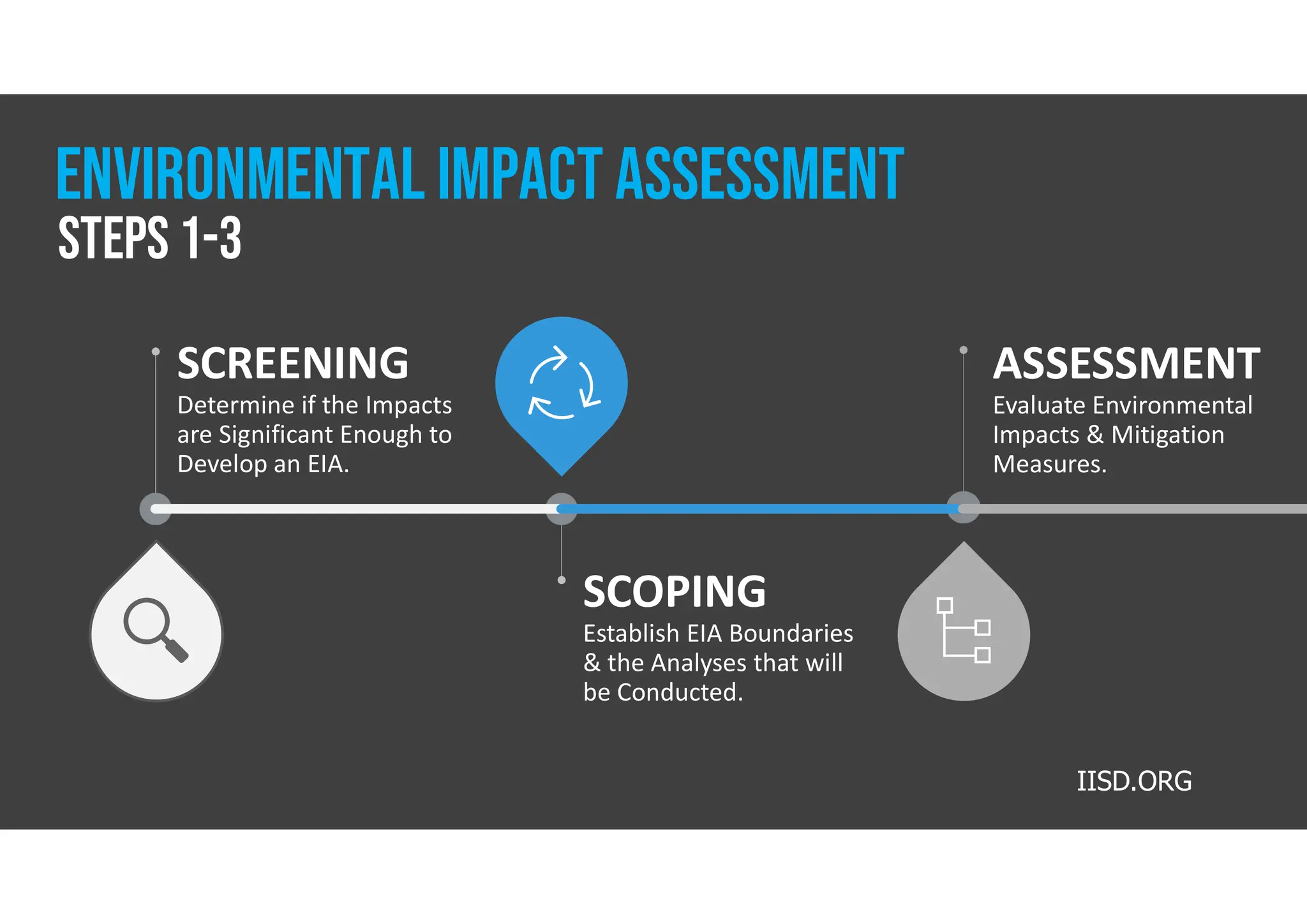
SCOPING
Establish EIA Boundaries
&the Analyses that will
be Conducted.
ASSESSMENT
Evaluate Environmental
Impacts & Mitigation
Measures.
SCREENING
Determine if the Impacts
are Significant Enough to
Develop an EIA.
IISD.ORG
Steps 1-3
Environmental impact assessment
11.
REPORT
Prepare EIA Report
EnsuringAll Key
Components are
Included.
REVIEW
A Specialist Team
Reviews the Quality of
the EIA Report.
MANAGEMENT
Develop a Plan for
Addressing Mitigation
Measures.
IISD.ORG
Steps 4-6
Environmental impact assessment
12.
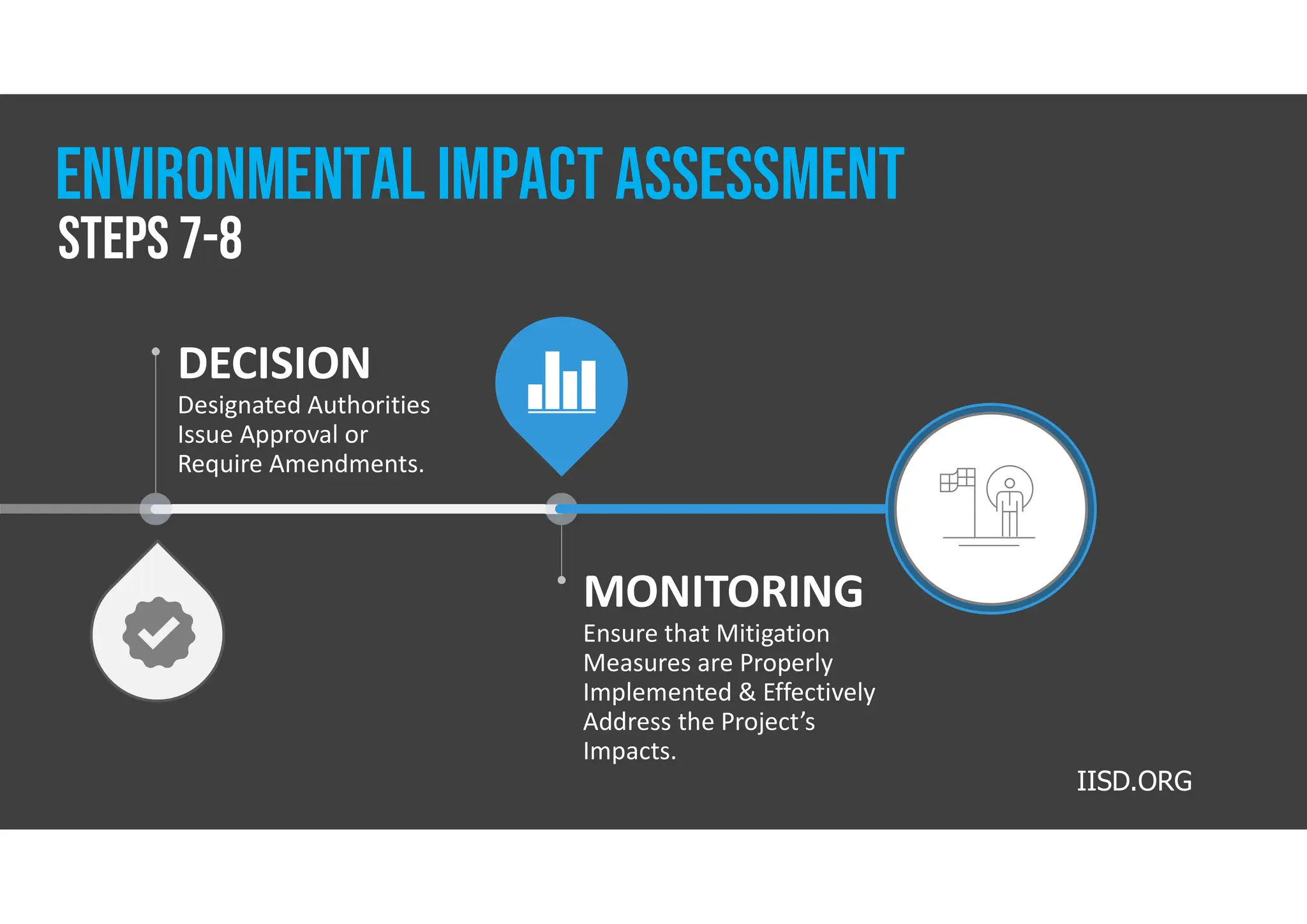
MONITORING
Ensure that Mitigation
Measuresare Properly
Implemented & Effectively
Address the Project’s
Impacts.
DECISION
Designated Authorities
Issue Approval or
Require Amendments.
IISD.ORG
Steps 7-8
Environmental impact assessment
13.
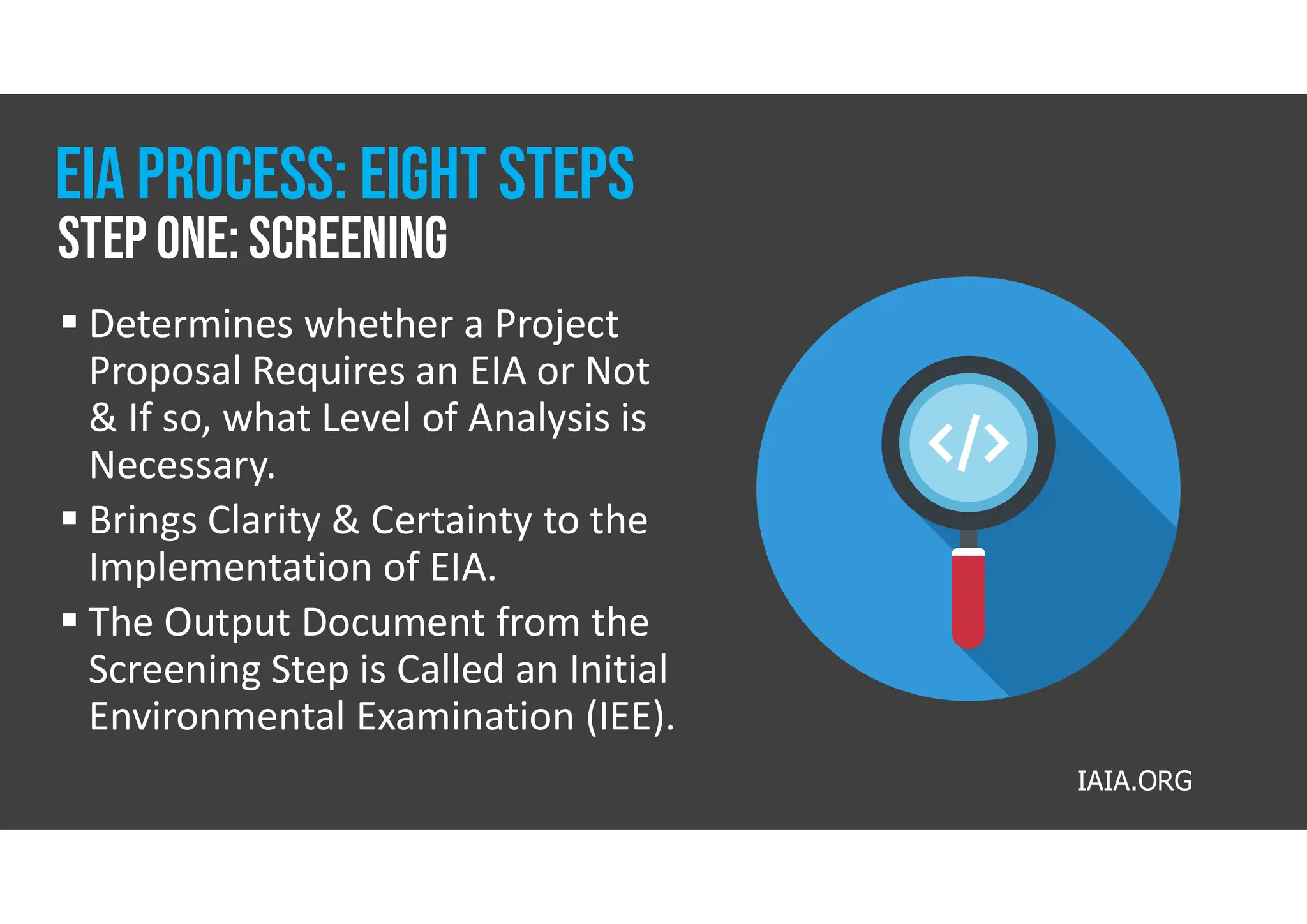
Determines whethera Project
Proposal Requires an EIA or Not
& If so, what Level of Analysis is
Necessary.
Brings Clarity & Certainty to the
Implementation of EIA.
The Output Document from the
Screening Step is Called an Initial
Environmental Examination (IEE).
Step one: Screening
Eia process: eight steps
IAIA.ORG
14.
IAIA.ORG
Establishes EIABoundaries & the
Analyses that will be Conducted.
Identifies the Most Significant Issues
& Eliminates the Less Significant to
Save on Time & Resources.
Techniques Used to Efficiently Gather
Information so that Decisions can be
Made: Baseline Studies, Checklists
Matrices & Diagrams.
step two: Scoping
Eia process: eight steps
15.
A SystematicIdentification,
Prediction & Evaluation of Impacts.
Introduces Mitigation Measures to
Minimize Adverse Impacts &
Enhance Positive Impacts.
Techniques Used to Efficiently
Present Results & Compare Options:
Matrices Checklists, Network
Diagrams & Graphical Comparisons.
Step three: assessment
Eia process: eight steps
IAIA.ORG
16.
Ensures thatthe EIA Process Leads to
Practical Action to Offset the Adverse
Environmental Impacts.
In this Step, a Plan is Developed to
Address Mitigation Measures Called
the Environmental Mgmt Plan (EMP).
EMP Includes Recommendations for
Action & Implementation. It also
Defines a Program & Costs.
Step four: IMPACT management
Eia process: eight steps
IAIA.ORG
17.
In thisStep, a Report Is Prepared
Called the Environmental Impact
Statement (EIS).
EIS Includes a Description of the
Program, Methodology, Policy &
Baseline Data.
EIS is a Crucial Document that Aids
the Developers in Managing the
Impacts & the Designated
Authorities in Decision-Making.
Step five: report
Eia process: eight steps
IAIA.ORG
18.
Also CalledAuditing: a Review of the
Quality of the EIA Report by a
Separate Team of Specialists.
Enhances EIA, Leading to more
Informed Decisions & Improved
Environmental Outcomes.
Ensures that the Information
Submitted is Credible & Sufficient for
the Decision-Making Step.
Public Participation & Input.
Step six: review
Eia process: eight steps
FAO.ORG
19.
Designated AuthoritiesIssue
Approval or Amendments Taking
into Consideration Environmental
Economic & Social Factors.
Involves Balancing Benefits & Costs
& Deciding on Trade-Offs among
other Factors.
Examples of Decision Documents:
Approvals, Permits Licenses, Etc.
Step seven: decision
Eia process: eight steps
IAIA.ORG
20.
After Approval,Monitoring is Used
to Effectively Manage Impacts.
Ensures Compliance with Legislation
& that Mitigation Measures are
Implemented. It also Improves
Future EIA Applications.
Monitoring Results can be Utilized
to Manage the Environment
Particularly to Identify Problems
Early so that Action can be Taken.
Step eight: monitoring
Eia process: eight steps
IAIA.ORG
21.
Helps Project DevelopersEnsure that they Meet Environmental
Regulations, Avoiding the Cost of Delays & Non-Compliance.
compliance
Promotes Transparency & Encourages Stakeholder Engagement
which Builds Trust, Confidence, Credibility & Loyalty.
engagement
Prevents Environmental Damage by Identifying Potential Impacts &
Mitigation Measures to Protect Ecosystems & Natural Resources.
prevention
Provides Valuable Information to Decision-Makers, Enabling
them to Make Informed Choices about the Proposed Project.
empowerment
Promotes Sustainable Development by Assessing Project Compatibility
with Environmental, Social & Economic Factors.
promotion
ENVCHEMPATNAS.COM
benefits
Environmental impact assessment
22.
Focuses on theShort-Term & Direct Impacts of a Project but may
Overlook the Long-Term & Indirect Impacts on Surrounding Areas.
limitations
Datasets may Contain Gaps & Incompleteness. Some Regions Lack
Comprehensive Monitoring Systems, Resulting in Missing Data.
Data gaps
Requires Financial, Technological & Human Resources, which is
Challenging for Small Organizations or Developing Nations to Allocate.
constraints
EIA Data often Involves Sensitive Information about Communities
Ecosystems & Industrial Practices, which Raises the Issue of Privacy.
Privacy
Requires Collaboration Across Disciplines—Ecology, Economics &
Social Sciences. Bridging these Gaps is Challenging.
Collaboration
FASTERCAPITAL.COM
challenges
Environmental impact assessment
24.
UNECE.ORG
In 1991, theConvention on Environmental
Impact Assessment in a Transboundary
Context (Espoo Convention) was Signed by
the UNECE. The Convention Mandates its
Members to Conduct an Environmental
Impact Assessment (EIA) of Any Planned
Activities that Could Significantly Impact
the Environment.
UN Economic Commission for Europe
EIA Transboundary Context










![Pollution.ppt [Autosaved].ppt yogesh kumbhar](https://cdn.slidesharecdn.com/ss_thumbnails/pollution-251205194856-d30cfee8-thumbnail.jpg?width=640&height=640&fit=bounds)


