Introduction to Electrical Power
Systems
By Prof. Yasmin Sayeed
Anjuman College of Engg. & Tech.,Nagpur
 The basic Need of life is Electricity
 All works is related to Electricity only
 Eg : Electric locomotives, Heating, Cooling, Fans,
Blowers, Motors, Illumination are some applications that
converts electrical energy into useful work.
 Growth of any country is measured in terms of per
Capital consumption of Electrical energy.
 India’s Consumption of Electricity is - 500 KWH /person
per year
 Various Reasons for the Popularity of electricity are :-
 Clean environment for user
 Higher efficiency
 Better controllability
 Quick transfer of power from source to load
 Energy conservation is simple
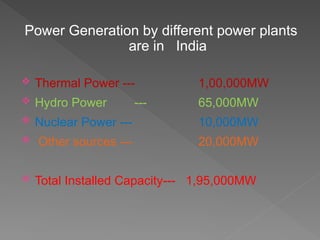
Power Generation by different power plants
are in India
 Thermal Power --- 1,00,000MW
 Hydro Power --- 65,000MW
 Nuclear Power --- 10,000MW
 Other sources --- 20,000MW
 Total Installed Capacity--- 1,95,000MW
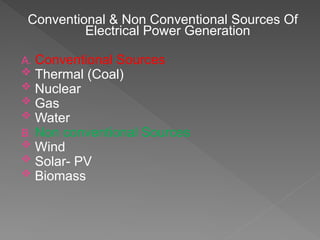
Conventional & Non Conventional Sources Of
Electrical Power Generation
A. Conventional Sources
 Thermal (Coal)
 Nuclear
 Gas
 Water
B. Non conventional Sources
 Wind
 Solar- PV
 Biomass
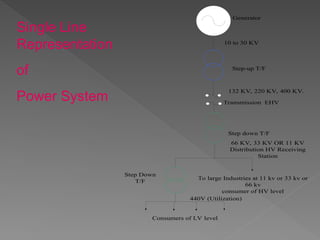
Generator
10 to 30 KV
Step-up T/F
132 KV, 220 KV, 400 KV.
Transmission EHV
Step down T/F
66 KV, 33 KV OR 11 KV
Distribution HV Receiving
Station
To large Industries at 11 kv or 33 kv or
66 kv
consumer of HV level
Step Down
T/F
440V (Utilization)
Consumers of LV level
Single Line
Representation
of
Power System
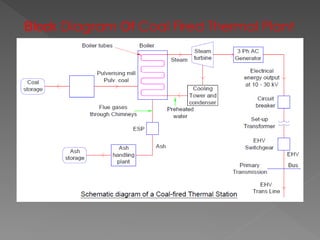
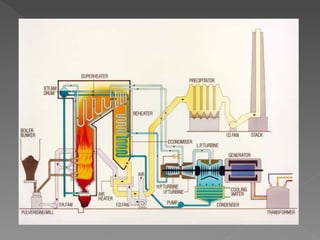
Block Diagram Of Coal Fired Thermal Plant
Thermal Power Plant
 India has rich stock of coal as natural resource.
 Chemical energy stored in coal is transformed to
electrical energy.
 Coal powder is fired in boiler that converts water into
steam at high temp. and pressure.
 This steam is injected over the blades of steam turbine
(prime mover) in controlled way and hence, rotor of 3
PH a.c. generator rotates.
 Mechanical energy is converted into electrical energy at rated
voltage(10-30KV).
 Used steam is cooled down to water using cooling towers and
condensers.
 This preheated water is again injected in boiler tubes to
convert back to steam.
 Flue gases are passed into atmosphere and fine particles of
ash are collected through ESP.
 Ash(40% of coal weight) is collected and transported to AHP.
Advantages :
 Fuel used is cheaper
 Smaller space is required compared to hydro power plant
 Thermal plants can be placed near load centers unlike hydro
and nuclear plants. Hence transmission of power losses can
be minimized
 Thermal plants are able to respond to the load demand more
effectively and supports the performance of the electrical grid
Demerits of Coal Thermal plant
 Pollution of the atmosphere
 Huge requirement of water
 Handling of coal and disposal of ash is quite difficult and
requires large area
 Gestation period (period for commissioning of plant) takes
long time
 Efficiency of thermal plant is quite less (30-35%)
 Operational cost of thermal plant is more costlier compared
to hydro and nuclear plant
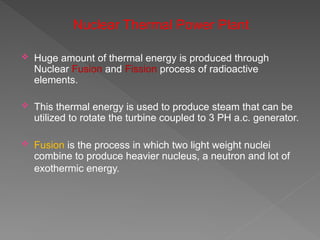
Nuclear Thermal Power Plant
 Huge amount of thermal energy is produced through
Nuclear Fusion and Fission process of radioactive
elements.
 This thermal energy is used to produce steam that can be
utilized to rotate the turbine coupled to 3 PH a.c. generator.
 Fusion is the process in which two light weight nuclei
combine to produce heavier nucleus, a neutron and lot of
exothermic energy.
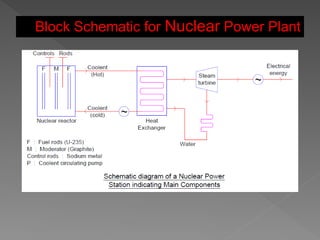
Block Schematic for Nuclear Power Plant
Advantages of Nuclear Power Generation
 Less quantity of fuel for generation of given amount of
energy compared to other sources.
 High reliability, Efficient and less running cost.
Disadvantages of Nuclear Power Generation
 Fuel is expensive and not available in abundance
everywhere.
 High capital cost.
 Maintenance cost is very high.
 Nuclear waste disposal is a great problem.
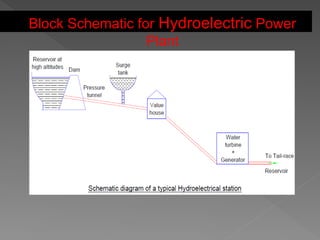
Block Schematic for Hydroelectric Power
Plant
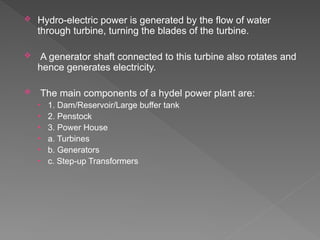
 Hydro-electric power is generated by the flow of water
through turbine, turning the blades of the turbine.
 A generator shaft connected to this turbine also rotates and
hence generates electricity.
 The main components of a hydel power plant are:
• 1. Dam/Reservoir/Large buffer tank
• 2. Penstock
• 3. Power House
• a. Turbines
• b. Generators
• c. Step-up Transformers
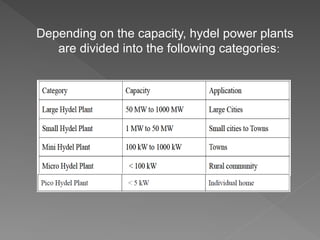
Depending on the capacity, hydel power plants
are divided into the following categories:
 Hydel plants are normally not in a continuous operation mode and
used for peak periods during the day like the wee hours and in the
evening.
 Also, they are used when the continuously operating thermal plants
go into overhauling.
 This is possible due to the less start up time required by hydro
power stations which is normally in few minutes as compared to
thermal power plant which is more than 8 hours.
 The command for starting or shutting is issued by from the related
Load Dispatch Center (LDC) of that particular region
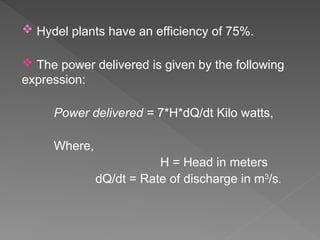
 Hydel plants have an efficiency of 75%.
 The power delivered is given by the following
expression:
Power delivered = 7*H*dQ/dt Kilo watts,
Where,
H = Head in meters
dQ/dt = Rate of discharge in m3
/s.
 Once a dam is constructed, electricity can be produced
at a constant rate
 If electricity is not needed, the sluice gates can be shut,
stopping electricity generation
 The build up of water in the lake means that energy can
be stored until needed, when the water is released to
produce electricity.
 The lake's water can be used for irrigation purposes.
 Hydropower is fueled by water, so it's a clean fuel
source. Hydropower doesn't pollute the air like power
plants that burn fossil fuels, such as coal, oil or natural
gas.
Advantages of Hydro Power Generation
 Dams are extremely expensive to build and must be built to a very
high standard.
 People living in villages and towns that are in the valley to be
flooded, must move out.
 Hydro power plants can be impacted by drought. When water is not
available, the hydro power plants can't produce electricity.
Disadvantages of Hydro Power Plant
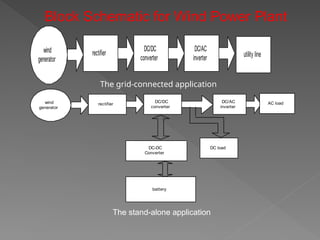
rectifier
DC/DC
converter
DC/AC
inverter utility line
wind
generator
The grid-connected application
rectifier
DC/DC
converter
wind
generator
battery
DC load
DC-DC
Converter
DC/AC
inverter
AC load
The stand-alone application
Block Schematic for Wind Power Plant
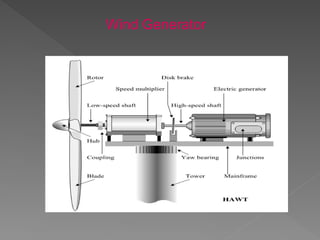
Wind Generator
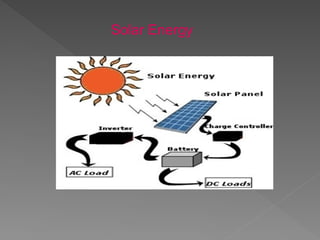
Solar Energy
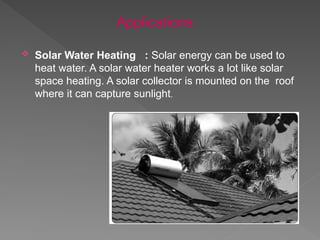
 Solar Water Heating : Solar energy can be used to
heat water. A solar water heater works a lot like solar
space heating. A solar collector is mounted on the roof
where it can capture sunlight.
Applications
 After initial investment, all the electricity produced is free.
 Incentives and rebates from government and utility companies
offset the initial investment.
 Clean, renewable energy source.
 No transmission costs for stand alone systems.
 Virtually no maintenance and no recurring costs
 Ideal for remote locations that cannot be tied to the grid
Advantages of Solar Energy Systems
 High initial cost to purchase solar panel system
 A relatively large area is required to install a solar system
 The highest efficiency is dependent on full sun exposure
 No electricity can be produced at night, and reduced production on cloudy/rainy days
Solar Energy Disadvantages

Introduction to Electrical Power Systems

  • 1.
    Introduction to ElectricalPower Systems By Prof. Yasmin Sayeed Anjuman College of Engg. & Tech.,Nagpur
  • 2.
     The basicNeed of life is Electricity  All works is related to Electricity only  Eg : Electric locomotives, Heating, Cooling, Fans, Blowers, Motors, Illumination are some applications that converts electrical energy into useful work.
  • 3.
     Growth ofany country is measured in terms of per Capital consumption of Electrical energy.  India’s Consumption of Electricity is - 500 KWH /person per year  Various Reasons for the Popularity of electricity are :-  Clean environment for user  Higher efficiency  Better controllability  Quick transfer of power from source to load  Energy conservation is simple
  • 4.
    Power Generation bydifferent power plants are in India  Thermal Power --- 1,00,000MW  Hydro Power --- 65,000MW  Nuclear Power --- 10,000MW  Other sources --- 20,000MW  Total Installed Capacity--- 1,95,000MW
  • 5.
    Conventional & NonConventional Sources Of Electrical Power Generation A. Conventional Sources  Thermal (Coal)  Nuclear  Gas  Water B. Non conventional Sources  Wind  Solar- PV  Biomass
  • 6.
    Generator 10 to 30KV Step-up T/F 132 KV, 220 KV, 400 KV. Transmission EHV Step down T/F 66 KV, 33 KV OR 11 KV Distribution HV Receiving Station To large Industries at 11 kv or 33 kv or 66 kv consumer of HV level Step Down T/F 440V (Utilization) Consumers of LV level Single Line Representation of Power System
  • 7.
    Block Diagram OfCoal Fired Thermal Plant
  • 9.
    Thermal Power Plant India has rich stock of coal as natural resource.  Chemical energy stored in coal is transformed to electrical energy.  Coal powder is fired in boiler that converts water into steam at high temp. and pressure.  This steam is injected over the blades of steam turbine (prime mover) in controlled way and hence, rotor of 3 PH a.c. generator rotates.
  • 10.
     Mechanical energyis converted into electrical energy at rated voltage(10-30KV).  Used steam is cooled down to water using cooling towers and condensers.  This preheated water is again injected in boiler tubes to convert back to steam.  Flue gases are passed into atmosphere and fine particles of ash are collected through ESP.  Ash(40% of coal weight) is collected and transported to AHP.
  • 11.
    Advantages :  Fuelused is cheaper  Smaller space is required compared to hydro power plant  Thermal plants can be placed near load centers unlike hydro and nuclear plants. Hence transmission of power losses can be minimized  Thermal plants are able to respond to the load demand more effectively and supports the performance of the electrical grid
  • 12.
    Demerits of CoalThermal plant  Pollution of the atmosphere  Huge requirement of water  Handling of coal and disposal of ash is quite difficult and requires large area  Gestation period (period for commissioning of plant) takes long time  Efficiency of thermal plant is quite less (30-35%)  Operational cost of thermal plant is more costlier compared to hydro and nuclear plant
  • 13.
    Nuclear Thermal PowerPlant  Huge amount of thermal energy is produced through Nuclear Fusion and Fission process of radioactive elements.  This thermal energy is used to produce steam that can be utilized to rotate the turbine coupled to 3 PH a.c. generator.  Fusion is the process in which two light weight nuclei combine to produce heavier nucleus, a neutron and lot of exothermic energy.
  • 14.
    Block Schematic forNuclear Power Plant
  • 15.
    Advantages of NuclearPower Generation  Less quantity of fuel for generation of given amount of energy compared to other sources.  High reliability, Efficient and less running cost.
  • 16.
    Disadvantages of NuclearPower Generation  Fuel is expensive and not available in abundance everywhere.  High capital cost.  Maintenance cost is very high.  Nuclear waste disposal is a great problem.
  • 17.
    Block Schematic forHydroelectric Power Plant
  • 18.
     Hydro-electric poweris generated by the flow of water through turbine, turning the blades of the turbine.  A generator shaft connected to this turbine also rotates and hence generates electricity.  The main components of a hydel power plant are: • 1. Dam/Reservoir/Large buffer tank • 2. Penstock • 3. Power House • a. Turbines • b. Generators • c. Step-up Transformers
  • 19.
    Depending on thecapacity, hydel power plants are divided into the following categories:
  • 20.
     Hydel plantsare normally not in a continuous operation mode and used for peak periods during the day like the wee hours and in the evening.  Also, they are used when the continuously operating thermal plants go into overhauling.  This is possible due to the less start up time required by hydro power stations which is normally in few minutes as compared to thermal power plant which is more than 8 hours.  The command for starting or shutting is issued by from the related Load Dispatch Center (LDC) of that particular region
  • 21.
     Hydel plantshave an efficiency of 75%.  The power delivered is given by the following expression: Power delivered = 7*H*dQ/dt Kilo watts, Where, H = Head in meters dQ/dt = Rate of discharge in m3 /s.
  • 22.
     Once adam is constructed, electricity can be produced at a constant rate  If electricity is not needed, the sluice gates can be shut, stopping electricity generation  The build up of water in the lake means that energy can be stored until needed, when the water is released to produce electricity.  The lake's water can be used for irrigation purposes.  Hydropower is fueled by water, so it's a clean fuel source. Hydropower doesn't pollute the air like power plants that burn fossil fuels, such as coal, oil or natural gas. Advantages of Hydro Power Generation
  • 23.
     Dams areextremely expensive to build and must be built to a very high standard.  People living in villages and towns that are in the valley to be flooded, must move out.  Hydro power plants can be impacted by drought. When water is not available, the hydro power plants can't produce electricity. Disadvantages of Hydro Power Plant
  • 24.
    rectifier DC/DC converter DC/AC inverter utility line wind generator Thegrid-connected application rectifier DC/DC converter wind generator battery DC load DC-DC Converter DC/AC inverter AC load The stand-alone application Block Schematic for Wind Power Plant
  • 25.
  • 26.
  • 27.
     Solar WaterHeating : Solar energy can be used to heat water. A solar water heater works a lot like solar space heating. A solar collector is mounted on the roof where it can capture sunlight. Applications
  • 28.
     After initialinvestment, all the electricity produced is free.  Incentives and rebates from government and utility companies offset the initial investment.  Clean, renewable energy source.  No transmission costs for stand alone systems.  Virtually no maintenance and no recurring costs  Ideal for remote locations that cannot be tied to the grid Advantages of Solar Energy Systems
  • 29.
     High initialcost to purchase solar panel system  A relatively large area is required to install a solar system  The highest efficiency is dependent on full sun exposure  No electricity can be produced at night, and reduced production on cloudy/rainy days Solar Energy Disadvantages