Harish Venkataraman
Depth Cameras Arch & Tech Lead, Cameras and
Depth, TED
Meta Inc.
Introduction to Depth
Sensing
• What is depth sensing?
• 3D sensing applications
• Technologies for 3D sensing
• Technological challenges/comparison
• Imaging for the metaverse
Outline
2
© 2024 Meta
• Depth sensing enables machines to perceive our environment in 3
dimensions
• They see the environment around them in the way humans do
• Depth sensing is the act of measuring distance to objects, obstacles in
the scene to generate 3D maps of the scene
• Specialized cameras/sensors are used for depth sensing
• Enables real time choices, decisions, experiences in many applications
Introduction to Depth Sensing
3
© 2024 Meta
• Depth sensing & cameras are used in a variety of applications:
• Smart phones (authentication, room scanning, low light auto focus)
• Industrial applications (robots)
• AR/VR applications
• Autonomous vehicles
• Agriculture (harvesting and weeding robots)
• Home (robot vacuum cleaners)
• Real estate (3D scanning)
Depth Sensing Applications
4
© 2024 Meta
The Tree of Light
5
© 2024 Meta
Passive
3D Sensing
Flash
Stereo Structured Light Time of Flight
Active
Static Dynamic
Indirect Direct
Dot Flash
Dot
Scan
LiDAR
Flash
Solid
State
Mech
Scanning
Non Optical
Approaches
(e.g., Radar,
USS)
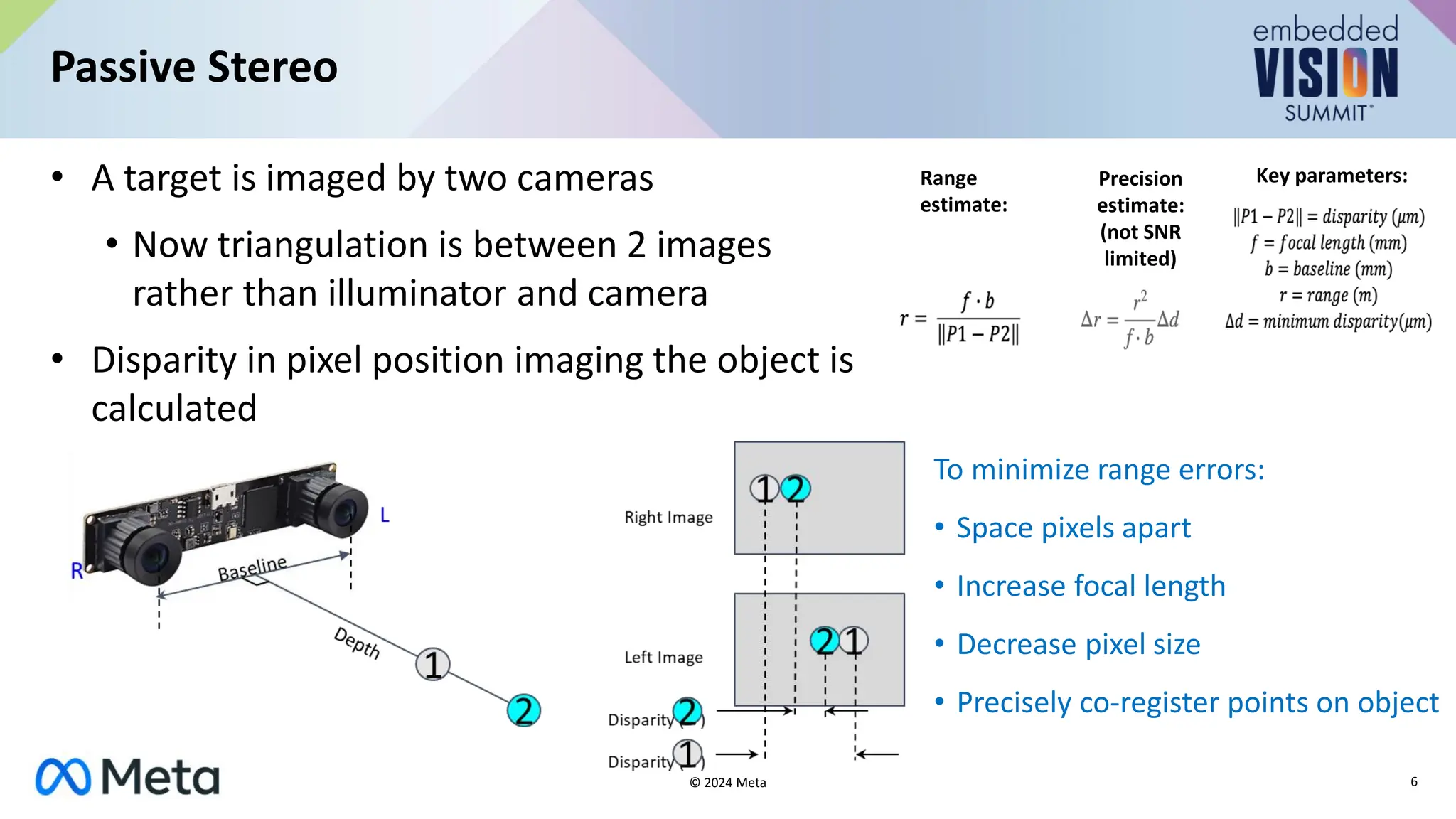
• A target is imaged by two cameras
• Now triangulation is between 2 images
rather than illuminator and camera
• Disparity in pixel position imaging the object is
calculated
Passive Stereo
6
© 2024 Meta
Key parameters:
Range
estimate:
Precision
estimate:
(not SNR
limited)
To minimize range errors:
• Space pixels apart
• Increase focal length
• Decrease pixel size
• Precisely co-register points on object
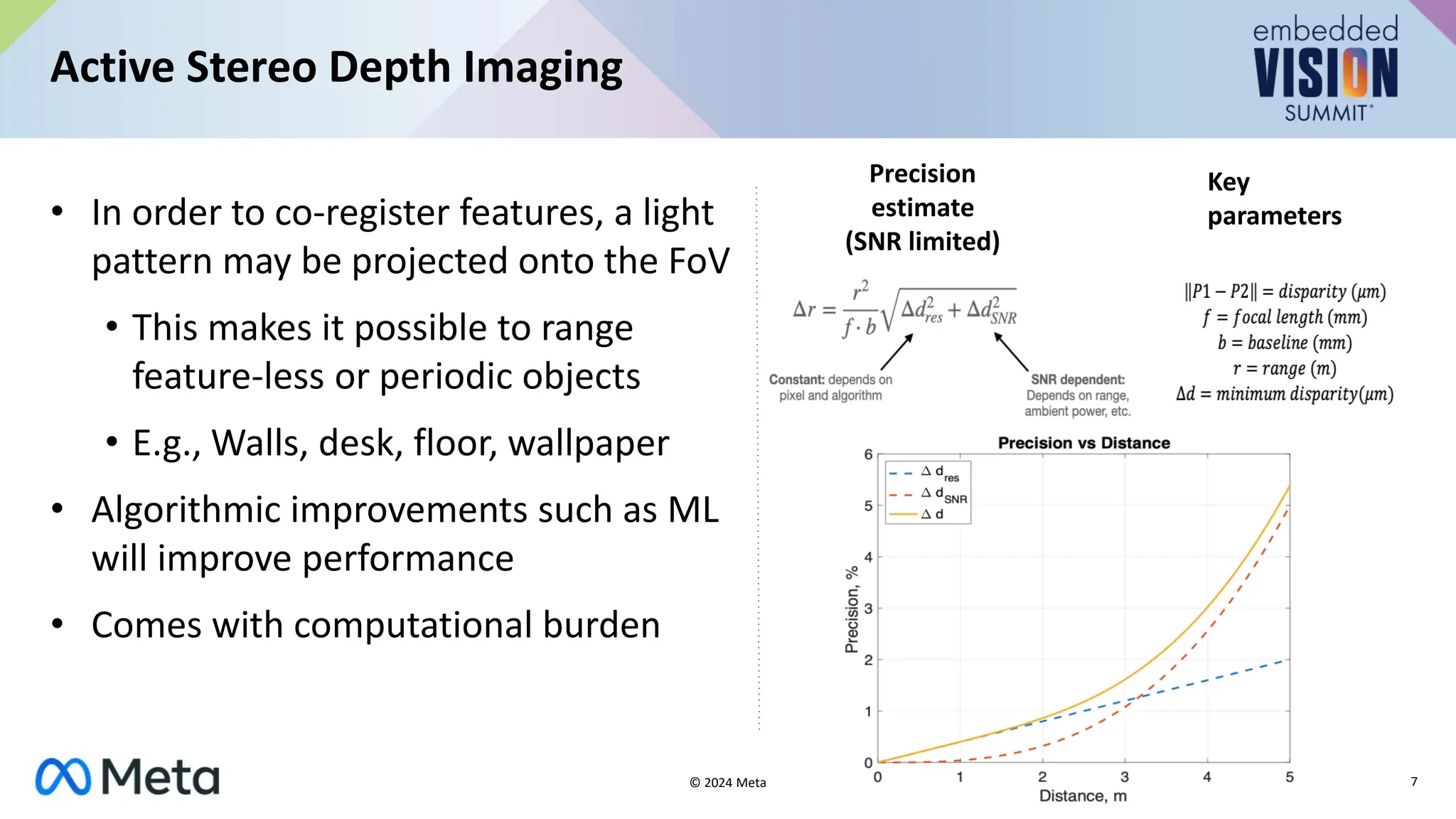
• In order to co-register features, a light
pattern may be projected onto the FoV
• This makes it possible to range
feature-less or periodic objects
• E.g., Walls, desk, floor, wallpaper
• Algorithmic improvements such as ML
will improve performance
• Comes with computational burden
Active Stereo Depth Imaging
7
© 2024 Meta
Key
parameters
Precision
estimate
(SNR limited)
• A target is illuminated by alight source with a
known pattern
• The angle in which it is viewed by camera
depends on its position wrt illuminator and
sensor
• Challenge is to uniquely localize the region in
the object being viewed by each pixel
• Light and dark patterns create registration
marks to improve this registration
Structured Light (Static)
Localize the region of the object being imaged by
illumination with a pattern. Tighter the pattern,
better the ranging accuracy.
Laser light backscattered from target
 detected by camera at certain
pixel
8
© 2024 Meta
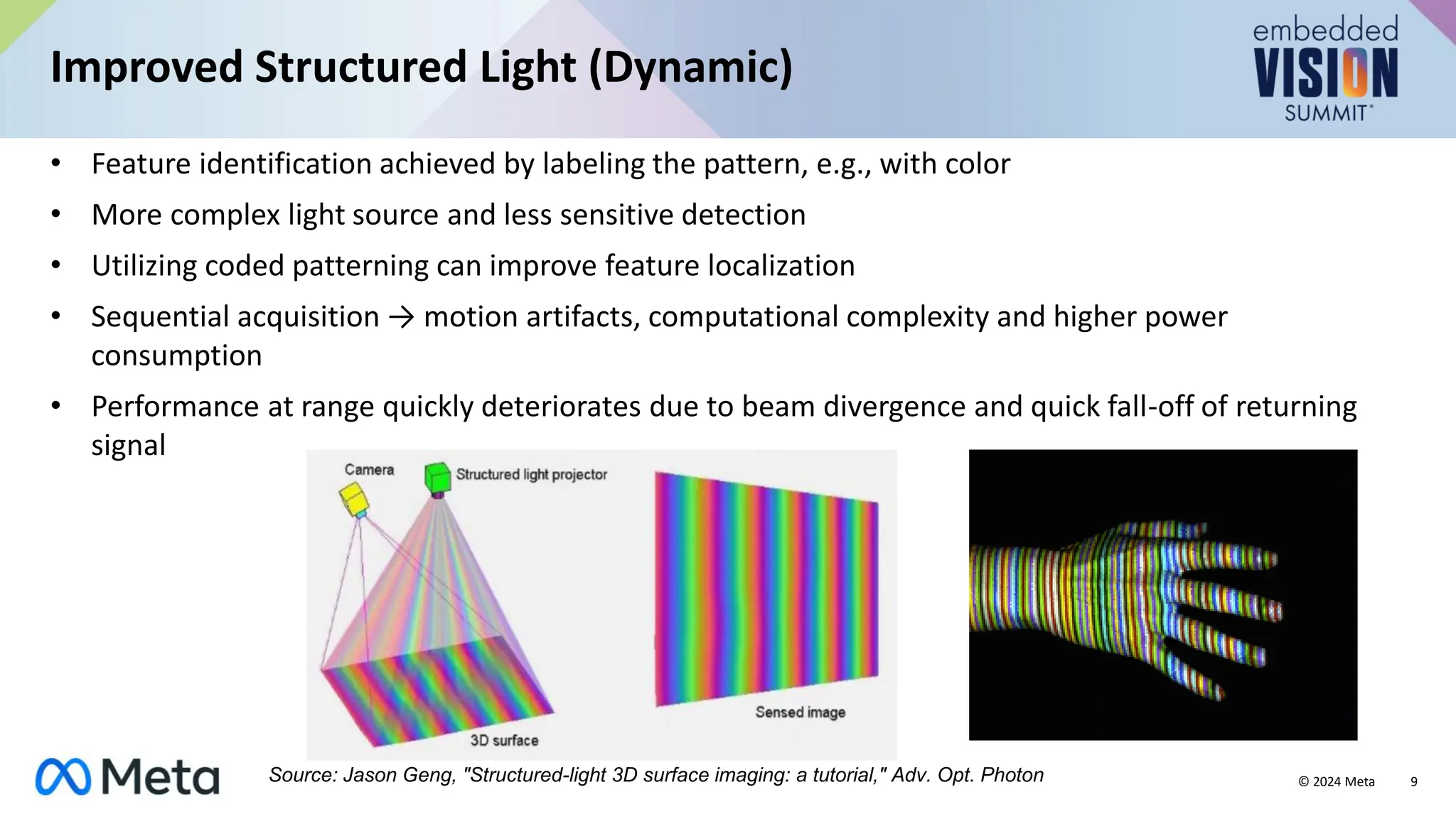
• Feature identification achieved by labeling the pattern, e.g., with color
• More complex light source and less sensitive detection
• Utilizing coded patterning can improve feature localization
• Sequential acquisition → motion artifacts, computational complexity and higher power
consumption
• Performance at range quickly deteriorates due to beam divergence and quick fall-off of returning
signal
Improved Structured Light (Dynamic)
9
© 2024 Meta
Source: Jason Geng, "Structured-light 3D surface imaging: a tutorial," Adv. Opt. Photon
• All ToF sensors use the fact that
• In iToF, the field is illuminated by RF-
amplitude-modulated light
• By proper gating of a CCD device, one can
calculate the phase shift of returning light, and
from there the time-of-flight and distance
• In-pixel circuitry enables high-resolution 3D
point clouds to get acquired
Depth via Indirect Time-of-Flight (iToF)
10
© 2024 Meta
𝑑 =
𝑐𝑡
2
540k pixel ST iToF Sensor
Analog
Devices
iToF
Module
• Operates by sending pulses of light and measuring their round-trip time-of-flight
• Requires very short laser pulses, precise photon time-of-arrival detector (SPAD), circuitry to process
timing info
• Generating ToF histograms is challenging and consumes a large silicon real estate
• Recent advances in 3D stacking technologies resulted in the first commercial dToF sensors
Depth via Direct Time-of-Flight (dToF)
11
© 2024 Meta
• Generates a digital pulse at the time of each incoming photon
• Unique in its ability to measure time-of-arrival of photons
• Digital detection means no read noise penalty & direct processing of individual events
• Ability to disambiguate and measure single photons
• No read noise enables extreme low light, digital measurement removes limitations of Full Well
Capacity
SPAD as ToF Detector
12
© 2024 Meta
Single incoming
photon generates an
avalanche of electrons
 counted as a digital
trigger.
Current is quenched
and device is reset to
detect the next photon
Description Typical Values
PDE
Probability to detect an event.
Analogous to QE
10-35%
Deadtime
Time required to reset SPAD after
event is detected
5-10 ns
VBD+Vex
Excess (Vex) supply voltage required
above breakdown (Vbd). Drives array
power
-21 V
Depth Technologies Comparison Matrix
13
© 2024 Meta
Active Stereo Structured Light iToF dToF
Range Low Low
Range & resolution need
to be traded off due to
low dynamic range
High
Resolution Medium High
Low to med; High
possible as the SPAD
pixel evolves over time
Point Cloud Quality Poor High Medium High
Power High High High Low
SoC/ISP Compute High Medium High: Needs ISP
Low: On sensor
processing
Cost
High (2 cameras + 1
projector)
Medium (1 camera + 1
projector)
Medium to high
(depends on range)
Low to medium
Solution Size Large
Large due to baseline
requirements
Large for high range Small
Depth Technologies Trends: Example Applications
14
© 2024 Meta
Active Stereo Structured Light iToF dToF
AR & VR Systems x x x x
Healthcare & Dental x x
Surveillance x x
Authentication x
Autonomous Vehicle
Navigation x x x
Robotics/Vacuum
Cleaners x x x
Room Scanning x
Photography x x
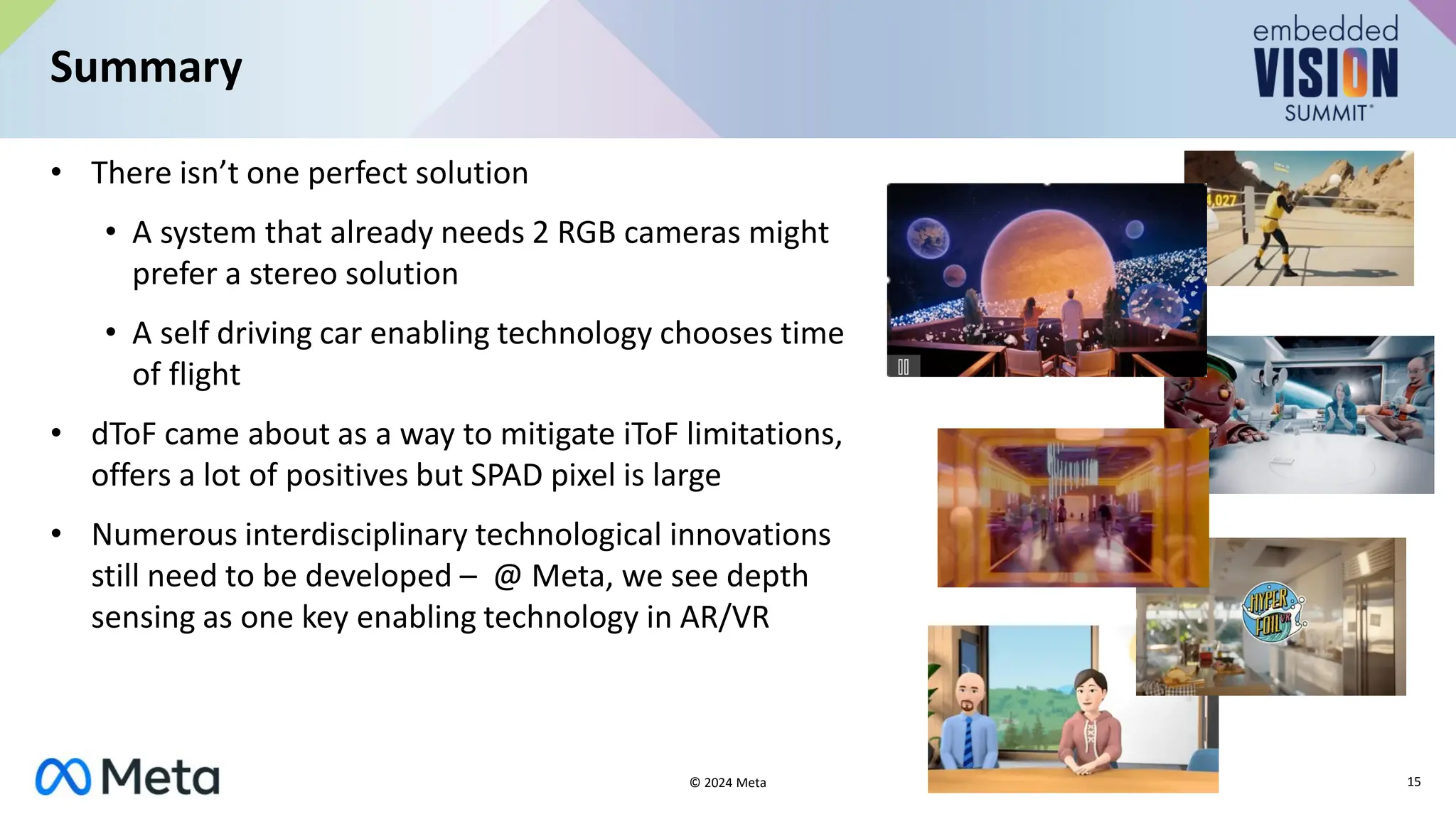
• There isn’t one perfect solution
• A system that already needs 2 RGB cameras might
prefer a stereo solution
• A self driving car enabling technology chooses time
of flight
• dToF came about as a way to mitigate iToF limitations,
offers a lot of positives but SPAD pixel is large
• Numerous interdisciplinary technological innovations
still need to be developed – @ Meta, we see depth
sensing as one key enabling technology in AR/VR
Summary
15
© 2024 Meta
• https://aivero.com/overview-of-depth-cameras/
• https://3d.pmdtec.com/en/ecosystem/blog/what-depth-sensing-technology-is-best-for-
your-project/
• https://www.e-consystems.com/blog/camera/technology/what-are-depth-sensing-
cameras-how-do-they-work/
Meta Inc links:
• https://developers.facebook.com/blog/post/2023/04/25/presence-platform-overview/
• https://developer.oculus.com/documentation/unity/unity-depthapi/
Resource Slide
16
© 2024 Meta

“Introduction to Depth Sensing,” a Presentation from Meta

  • 1.
    Harish Venkataraman Depth CamerasArch & Tech Lead, Cameras and Depth, TED Meta Inc. Introduction to Depth Sensing
  • 2.
    • What isdepth sensing? • 3D sensing applications • Technologies for 3D sensing • Technological challenges/comparison • Imaging for the metaverse Outline 2 © 2024 Meta
  • 3.
    • Depth sensingenables machines to perceive our environment in 3 dimensions • They see the environment around them in the way humans do • Depth sensing is the act of measuring distance to objects, obstacles in the scene to generate 3D maps of the scene • Specialized cameras/sensors are used for depth sensing • Enables real time choices, decisions, experiences in many applications Introduction to Depth Sensing 3 © 2024 Meta
  • 4.
    • Depth sensing& cameras are used in a variety of applications: • Smart phones (authentication, room scanning, low light auto focus) • Industrial applications (robots) • AR/VR applications • Autonomous vehicles • Agriculture (harvesting and weeding robots) • Home (robot vacuum cleaners) • Real estate (3D scanning) Depth Sensing Applications 4 © 2024 Meta
  • 5.
    The Tree ofLight 5 © 2024 Meta Passive 3D Sensing Flash Stereo Structured Light Time of Flight Active Static Dynamic Indirect Direct Dot Flash Dot Scan LiDAR Flash Solid State Mech Scanning Non Optical Approaches (e.g., Radar, USS)
  • 6.
    • A targetis imaged by two cameras • Now triangulation is between 2 images rather than illuminator and camera • Disparity in pixel position imaging the object is calculated Passive Stereo 6 © 2024 Meta Key parameters: Range estimate: Precision estimate: (not SNR limited) To minimize range errors: • Space pixels apart • Increase focal length • Decrease pixel size • Precisely co-register points on object
  • 7.
    • In orderto co-register features, a light pattern may be projected onto the FoV • This makes it possible to range feature-less or periodic objects • E.g., Walls, desk, floor, wallpaper • Algorithmic improvements such as ML will improve performance • Comes with computational burden Active Stereo Depth Imaging 7 © 2024 Meta Key parameters Precision estimate (SNR limited)
  • 8.
    • A targetis illuminated by alight source with a known pattern • The angle in which it is viewed by camera depends on its position wrt illuminator and sensor • Challenge is to uniquely localize the region in the object being viewed by each pixel • Light and dark patterns create registration marks to improve this registration Structured Light (Static) Localize the region of the object being imaged by illumination with a pattern. Tighter the pattern, better the ranging accuracy. Laser light backscattered from target  detected by camera at certain pixel 8 © 2024 Meta
  • 9.
    • Feature identificationachieved by labeling the pattern, e.g., with color • More complex light source and less sensitive detection • Utilizing coded patterning can improve feature localization • Sequential acquisition → motion artifacts, computational complexity and higher power consumption • Performance at range quickly deteriorates due to beam divergence and quick fall-off of returning signal Improved Structured Light (Dynamic) 9 © 2024 Meta Source: Jason Geng, "Structured-light 3D surface imaging: a tutorial," Adv. Opt. Photon
  • 10.
    • All ToFsensors use the fact that • In iToF, the field is illuminated by RF- amplitude-modulated light • By proper gating of a CCD device, one can calculate the phase shift of returning light, and from there the time-of-flight and distance • In-pixel circuitry enables high-resolution 3D point clouds to get acquired Depth via Indirect Time-of-Flight (iToF) 10 © 2024 Meta 𝑑 = 𝑐𝑡 2 540k pixel ST iToF Sensor Analog Devices iToF Module
  • 11.
    • Operates bysending pulses of light and measuring their round-trip time-of-flight • Requires very short laser pulses, precise photon time-of-arrival detector (SPAD), circuitry to process timing info • Generating ToF histograms is challenging and consumes a large silicon real estate • Recent advances in 3D stacking technologies resulted in the first commercial dToF sensors Depth via Direct Time-of-Flight (dToF) 11 © 2024 Meta
  • 12.
    • Generates adigital pulse at the time of each incoming photon • Unique in its ability to measure time-of-arrival of photons • Digital detection means no read noise penalty & direct processing of individual events • Ability to disambiguate and measure single photons • No read noise enables extreme low light, digital measurement removes limitations of Full Well Capacity SPAD as ToF Detector 12 © 2024 Meta Single incoming photon generates an avalanche of electrons  counted as a digital trigger. Current is quenched and device is reset to detect the next photon Description Typical Values PDE Probability to detect an event. Analogous to QE 10-35% Deadtime Time required to reset SPAD after event is detected 5-10 ns VBD+Vex Excess (Vex) supply voltage required above breakdown (Vbd). Drives array power -21 V
  • 13.
    Depth Technologies ComparisonMatrix 13 © 2024 Meta Active Stereo Structured Light iToF dToF Range Low Low Range & resolution need to be traded off due to low dynamic range High Resolution Medium High Low to med; High possible as the SPAD pixel evolves over time Point Cloud Quality Poor High Medium High Power High High High Low SoC/ISP Compute High Medium High: Needs ISP Low: On sensor processing Cost High (2 cameras + 1 projector) Medium (1 camera + 1 projector) Medium to high (depends on range) Low to medium Solution Size Large Large due to baseline requirements Large for high range Small
  • 14.
    Depth Technologies Trends:Example Applications 14 © 2024 Meta Active Stereo Structured Light iToF dToF AR & VR Systems x x x x Healthcare & Dental x x Surveillance x x Authentication x Autonomous Vehicle Navigation x x x Robotics/Vacuum Cleaners x x x Room Scanning x Photography x x
  • 15.
    • There isn’tone perfect solution • A system that already needs 2 RGB cameras might prefer a stereo solution • A self driving car enabling technology chooses time of flight • dToF came about as a way to mitigate iToF limitations, offers a lot of positives but SPAD pixel is large • Numerous interdisciplinary technological innovations still need to be developed – @ Meta, we see depth sensing as one key enabling technology in AR/VR Summary 15 © 2024 Meta
  • 16.
    • https://aivero.com/overview-of-depth-cameras/ • https://3d.pmdtec.com/en/ecosystem/blog/what-depth-sensing-technology-is-best-for- your-project/ •https://www.e-consystems.com/blog/camera/technology/what-are-depth-sensing- cameras-how-do-they-work/ Meta Inc links: • https://developers.facebook.com/blog/post/2023/04/25/presence-platform-overview/ • https://developer.oculus.com/documentation/unity/unity-depthapi/ Resource Slide 16 © 2024 Meta