Introduction to Data Science: Unveiling
Insights Hidden in Data
Introduction
In today's data-driven world, the ability to extract valuable insights from vast amounts of
information has become crucial. This is where data science comes into play. Data science is an
interdisciplinary field that combines various techniques and tools to analyze, interpret, and draw
meaningful conclusions from data. In this article, we will delve into the foundations of data
science, exploring its key components and the techniques employed to unravel hidden patterns
and trends.
What is Data Science?
Paragraph: At its core, data science involves the extraction of knowledge and insights from
structured and unstructured data. It encompasses a wide range of disciplines such as statistics,
mathematics, computer science, and domain knowledge. Data scientists utilize their expertise in
these areas to gather, clean, process, and analyze data with the goal of extracting valuable
information that can drive informed decision-making.
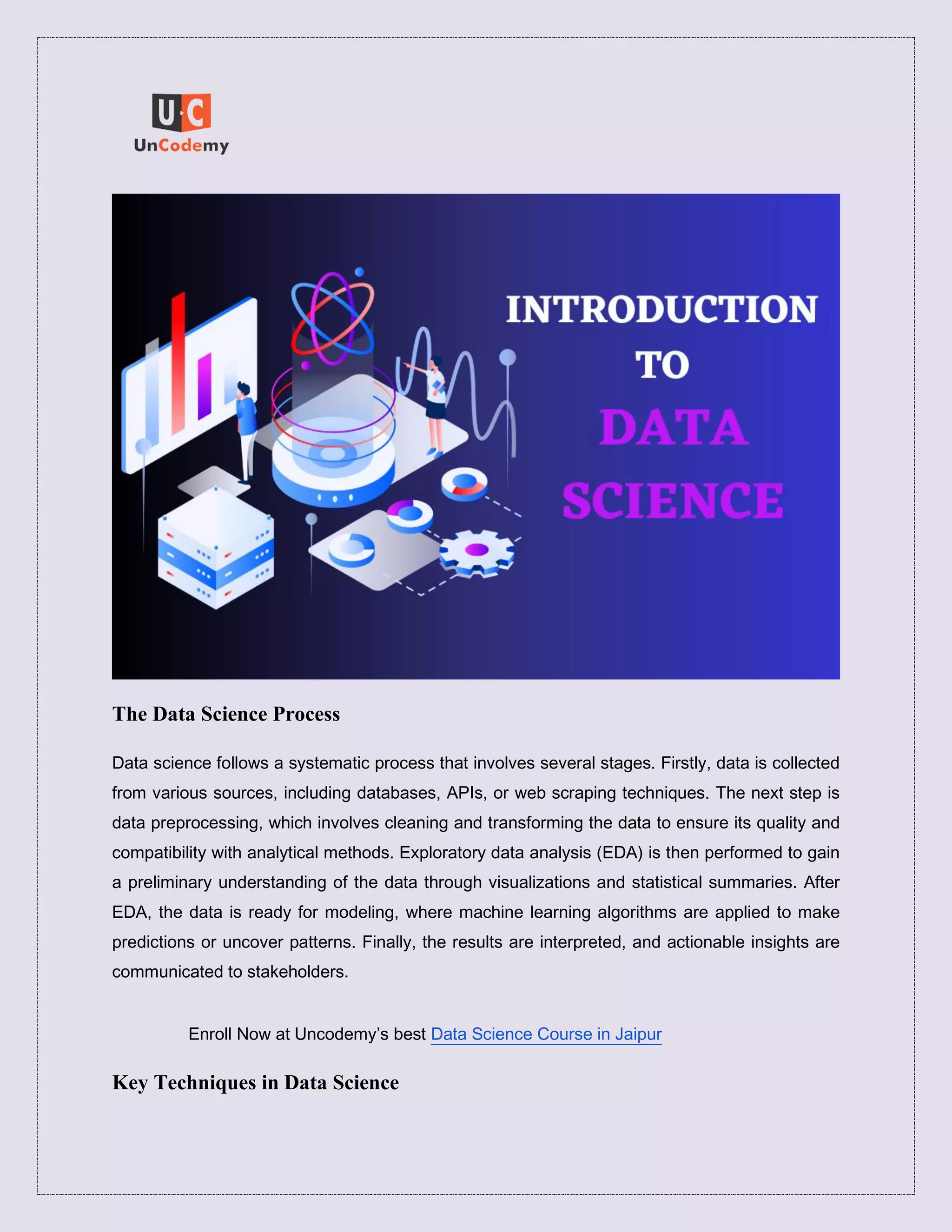
The Data Science Process
Data science follows a systematic process that involves several stages. Firstly, data is collected
from various sources, including databases, APIs, or web scraping techniques. The next step is
data preprocessing, which involves cleaning and transforming the data to ensure its quality and
compatibility with analytical methods. Exploratory data analysis (EDA) is then performed to gain
a preliminary understanding of the data through visualizations and statistical summaries. After
EDA, the data is ready for modeling, where machine learning algorithms are applied to make
predictions or uncover patterns. Finally, the results are interpreted, and actionable insights are
communicated to stakeholders.
Enroll Now at Uncodemy’s best Data Science Course in Jaipur
Key Techniques in Data Science
Data science employs a wide range of techniques to extract insights from data. Some of the
fundamental techniques include:
1. Statistical Analysis: Statistical methods are used to uncover patterns, relationships, and
trends in the data. Techniques such as hypothesis testing, regression analysis, and
clustering help in understanding the underlying patterns and making predictions.
2. Machine Learning: Machine learning algorithms enable computers to learn from data
and make predictions or decisions without being explicitly programmed. Supervised
learning, unsupervised learning, and reinforcement learning are common approaches
used in machine learning.
3. Data Visualization: Data visualization plays a crucial role in data science as it helps in
effectively communicating complex findings to both technical and non-technical
audiences. Visual representations such as charts, graphs, and interactive dashboards
aid in understanding patterns and trends.
4. Big Data Analytics: With the advent of technologies like Hadoop and Spark, data
scientists can handle and analyze large volumes of data efficiently. Big data analytics
involves processing and analyzing massive datasets to extract meaningful insights.
Applications of Data Science
Data science finds applications in various fields, revolutionizing industries and shaping decision-
making processes. Some notable applications include:
1. Business Analytics: Data science helps organizations make data-driven decisions,
optimize operations, and identify market trends to gain a competitive advantage.
2. Healthcare: Data science aids in analyzing electronic health records, clinical trials,
and medical imaging to improve patient outcomes, drug discovery, and disease
prediction.
3. Finance: Data science is utilized in fraud detection, risk assessment, algorithmic
trading, and portfolio optimization in the financial sector.
4. Social Media and Marketing: Data science techniques are applied to analyze user
behavior, sentiment analysis, and personalize marketing campaigns.
Conclusion
In conclusion, data science has become an essential discipline in today's data-driven world.
With its interdisciplinary nature and powerful techniques, data science enables us to uncover
valuable insights hidden within vast amounts of data. By following a systematic data science
process that includes data collection, preprocessing, exploratory analysis, modeling, and
interpretation, data scientists can extract meaningful information that drives informed decision-
making.

Introduction to Data Science: Unveiling Insights Hidden in Data

  • 1.
    Introduction to DataScience: Unveiling Insights Hidden in Data Introduction In today's data-driven world, the ability to extract valuable insights from vast amounts of information has become crucial. This is where data science comes into play. Data science is an interdisciplinary field that combines various techniques and tools to analyze, interpret, and draw meaningful conclusions from data. In this article, we will delve into the foundations of data science, exploring its key components and the techniques employed to unravel hidden patterns and trends. What is Data Science? Paragraph: At its core, data science involves the extraction of knowledge and insights from structured and unstructured data. It encompasses a wide range of disciplines such as statistics, mathematics, computer science, and domain knowledge. Data scientists utilize their expertise in these areas to gather, clean, process, and analyze data with the goal of extracting valuable information that can drive informed decision-making.
  • 2.
    The Data ScienceProcess Data science follows a systematic process that involves several stages. Firstly, data is collected from various sources, including databases, APIs, or web scraping techniques. The next step is data preprocessing, which involves cleaning and transforming the data to ensure its quality and compatibility with analytical methods. Exploratory data analysis (EDA) is then performed to gain a preliminary understanding of the data through visualizations and statistical summaries. After EDA, the data is ready for modeling, where machine learning algorithms are applied to make predictions or uncover patterns. Finally, the results are interpreted, and actionable insights are communicated to stakeholders. Enroll Now at Uncodemy’s best Data Science Course in Jaipur Key Techniques in Data Science
  • 3.
    Data science employsa wide range of techniques to extract insights from data. Some of the fundamental techniques include: 1. Statistical Analysis: Statistical methods are used to uncover patterns, relationships, and trends in the data. Techniques such as hypothesis testing, regression analysis, and clustering help in understanding the underlying patterns and making predictions. 2. Machine Learning: Machine learning algorithms enable computers to learn from data and make predictions or decisions without being explicitly programmed. Supervised learning, unsupervised learning, and reinforcement learning are common approaches used in machine learning. 3. Data Visualization: Data visualization plays a crucial role in data science as it helps in effectively communicating complex findings to both technical and non-technical audiences. Visual representations such as charts, graphs, and interactive dashboards aid in understanding patterns and trends. 4. Big Data Analytics: With the advent of technologies like Hadoop and Spark, data scientists can handle and analyze large volumes of data efficiently. Big data analytics involves processing and analyzing massive datasets to extract meaningful insights. Applications of Data Science Data science finds applications in various fields, revolutionizing industries and shaping decision- making processes. Some notable applications include: 1. Business Analytics: Data science helps organizations make data-driven decisions, optimize operations, and identify market trends to gain a competitive advantage.
  • 4.
    2. Healthcare: Datascience aids in analyzing electronic health records, clinical trials, and medical imaging to improve patient outcomes, drug discovery, and disease prediction. 3. Finance: Data science is utilized in fraud detection, risk assessment, algorithmic trading, and portfolio optimization in the financial sector. 4. Social Media and Marketing: Data science techniques are applied to analyze user behavior, sentiment analysis, and personalize marketing campaigns. Conclusion In conclusion, data science has become an essential discipline in today's data-driven world. With its interdisciplinary nature and powerful techniques, data science enables us to uncover valuable insights hidden within vast amounts of data. By following a systematic data science process that includes data collection, preprocessing, exploratory analysis, modeling, and interpretation, data scientists can extract meaningful information that drives informed decision- making.