Introduction to data quality management
FDM-Kompetenzpool-Treffen mit Austausch und Fortbildung zu "Datenqualität",
2021-07-06, BibliotheksVerbund Bayern – Kommission Virtuelle Bibliothek
Péter Király {pkiraly@gwdg.de, @kiru, pkiraly.github.io}
Gesellschaft für wissenschaftliche Datenverarbeitung mbH Göttingen (GWDG)
https://bit.ly/qa-kompetenzpool-2021
the problem
https://twitter.com/fxru/status/1052838758066868224
https://bit.ly/qa-kompetenzpool-2021
2
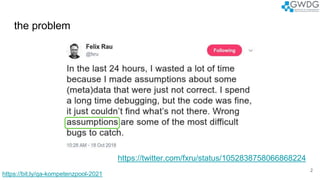
top 20 patterns, ‘date’ field, MoMa collection
Harald Klinke (LMU München) https://twitter.com/HxxxKxxx/status/1066805548866289664
3
https://bit.ly/qa-kompetenzpool-2021
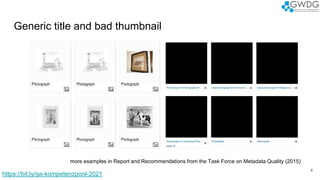
Generic title and bad thumbnail
4
more examples in Report and Recommendations from the Task Force on Metadata Quality (2015)
https://bit.ly/qa-kompetenzpool-2021
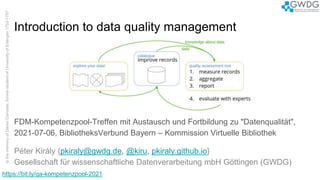
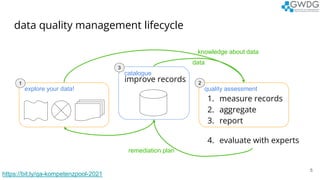
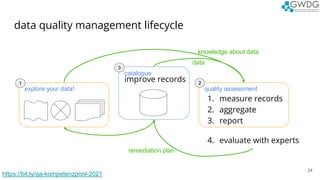
1. measure records
2. aggregate
3. report
4. evaluate with experts
catalogue
improve records
data quality management lifecycle
5
quality assessment
explore your data!
https://bit.ly/qa-kompetenzpool-2021
data
knowledge about data
remediation plan
1 2
3
quality and ‘fitness for purpose’
’We know it when we see it, but conveying the full bundle of assumptions and
experience that allow us to identify it is a different matter.’
6
https://bit.ly/qa-kompetenzpool-2021
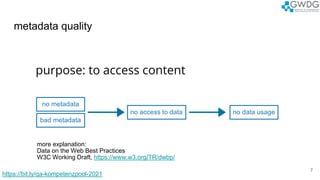
metadata quality
7
purpose: to access content
no metadata
no access to data no data usage
more explanation:
Data on the Web Best Practices
W3C Working Draft, https://www.w3.org/TR/dwbp/
bad metadata
https://bit.ly/qa-kompetenzpool-2021
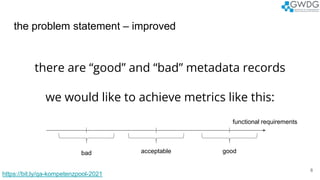
the problem statement – improved
8
there are “good” and “bad” metadata records
we would like to achieve metrics like this:
functional requirements
good
acceptable
bad
https://bit.ly/qa-kompetenzpool-2021
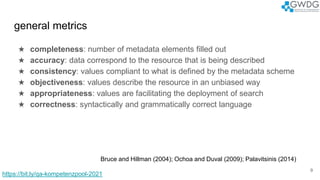
general metrics
★ completeness: number of metadata elements filled out
★ accuracy: data correspond to the resource that is being described
★ consistency: values compliant to what is defined by the metadata scheme
★ objectiveness: values describe the resource in an unbiased way
★ appropriateness: values are facilitating the deployment of search
★ correctness: syntactically and grammatically correct language
Bruce and Hillman (2004); Ochoa and Duval (2009); Palavitsinis (2014)
9
https://bit.ly/qa-kompetenzpool-2021
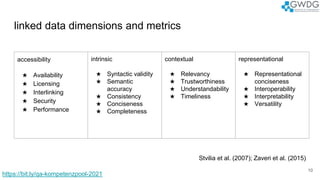
linked data dimensions and metrics
accessibility
★ Availability
★ Licensing
★ Interlinking
★ Security
★ Performance
intrinsic
★ Syntactic validity
★ Semantic
accuracy
★ Consistency
★ Conciseness
★ Completeness
contextual
★ Relevancy
★ Trustworthiness
★ Understandability
★ Timeliness
representational
★ Representational
conciseness
★ Interoperability
★ Interpretability
★ Versatility
Stvilia et al. (2007); Zaveri et al. (2015)
10
https://bit.ly/qa-kompetenzpool-2021
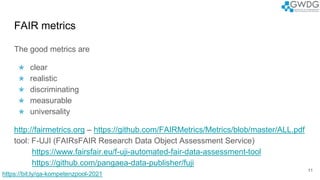
The good metrics are
★ clear
★ realistic
★ discriminating
★ measurable
★ universality
http://fairmetrics.org – https://github.com/FAIRMetrics/Metrics/blob/master/ALL.pdf
tool: F-UJI (FAIRsFAIR Research Data Object Assessment Service)
https://www.fairsfair.eu/f-uji-automated-fair-data-assessment-tool
https://github.com/pangaea-data-publisher/fuji
FAIR metrics
11
https://bit.ly/qa-kompetenzpool-2021
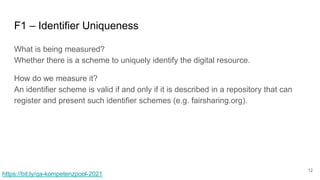
F1 – Identifier Uniqueness
What is being measured?
Whether there is a scheme to uniquely identify the digital resource.
How do we measure it?
An identifier scheme is valid if and only if it is described in a repository that can
register and present such identifier schemes (e.g. fairsharing.org).
12
https://bit.ly/qa-kompetenzpool-2021
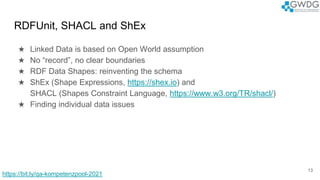
RDFUnit, SHACL and ShEx
★ Linked Data is based on Open World assumption
★ No “record”, no clear boundaries
★ RDF Data Shapes: reinventing the schema
★ ShEx (Shape Expressions, https://shex.io) and
SHACL (Shapes Constraint Language, https://www.w3.org/TR/shacl/)
★ Finding individual data issues
13
https://bit.ly/qa-kompetenzpool-2021
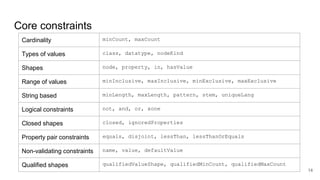
Core constraints
Cardinality minCount, maxCount
Types of values class, datatype, nodeKind
Shapes node, property, in, hasValue
Range of values minInclusive, maxInclusive, minExclusive, maxExclusive
String based minLength, maxLength, pattern, stem, uniqueLang
Logical constraints not, and, or, xone
Closed shapes closed, ignoredProperties
Property pair constraints equals, disjoint, lessThan, lessThanOrEquals
Non-validating constraints name, value, defaultValue
Qualified shapes qualifiedValueShape, qualifiedMinCount, qualifiedMaxCount
14
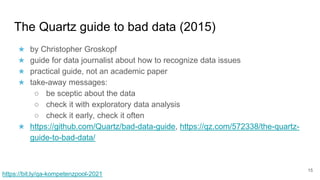
The Quartz guide to bad data (2015)
★ by Christopher Groskopf
★ guide for data journalist about how to recognize data issues
★ practical guide, not an academic paper
★ take-away messages:
○ be sceptic about the data
○ check it with exploratory data analysis
○ check it early, check it often
★ https://github.com/Quartz/bad-data-guide, https://qz.com/572338/the-quartz-
guide-to-bad-data/
15
https://bit.ly/qa-kompetenzpool-2021
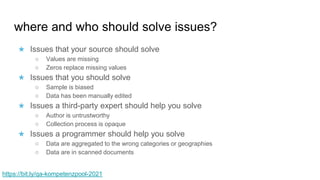
where and who should solve issues?
★ Issues that your source should solve
○ Values are missing
○ Zeros replace missing values
★ Issues that you should solve
○ Sample is biased
○ Data has been manually edited
★ Issues a third-party expert should help you solve
○ Author is untrustworthy
○ Collection process is opaque
★ Issues a programmer should help you solve
○ Data are aggregated to the wrong categories or geographies
○ Data are in scanned documents
https://bit.ly/qa-kompetenzpool-2021
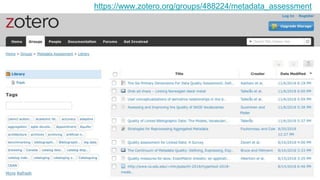
https://www.zotero.org/groups/488224/metadata_assessment
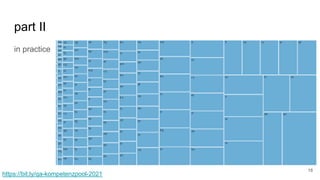
in practice
part II
18
https://bit.ly/qa-kompetenzpool-2021
hypothesis
19
by measuring structural elements we
can approximate metadata record quality
≃ metadata smell
https://bit.ly/qa-kompetenzpool-2021
organisational proposal
20
Europeana* Data Quality Committee
★ Analysing/revising metadata schema
★ Functional requirement analysis
★ Problem catalog
★ Multilinguality
* elsewhere: DDB, British Library, Digital Library Federation, DPLA ...
https://bit.ly/qa-kompetenzpool-2021
technical proposal
21
“Metadata Quality Assessment Framework”
a generic tool for measuring metadata quality
★ adaptable to different metadata schemes
★ scalable (to Big Data)
★ understandable reports for data curators
★ open source
https://bit.ly/qa-kompetenzpool-2021
What to measure?
22
★Structural and semantic features
Completeness, cardinality, uniqueness, length, dictionary entry, data type
conformance, multilinguality (generic metrics)
★Functional requirement analysis / Discovery scenarios
Requirements of the most important functions
★Problem catalog
Known metadata problems
https://bit.ly/qa-kompetenzpool-2021
demos
23
https://bit.ly/qa-kompetenzpool-2021
★Europeana metadata quality dashboard https://rnd-
2.eanadev.org/europeana-qa/
★Union catalogue of BibliotheksVerbund Bayern
http://134.76.17.95/bvb/
data quality management lifecycle
24
https://bit.ly/qa-kompetenzpool-2021
1. measure records
2. aggregate
3. report
4. evaluate with experts
catalogue
improve records
quality assessment
explore your data!
data
knowledge about data
remediation plan
1 2
3
Let’s cooperate!
★ https://github.com/pkiraly/metadata-qa-api
★ https://github.com/pkiraly/metadata-qa-marc
★ http://pkiraly.github.io
★ https://twitter.com/kiru
★ peter.kiraly@gwdg.de
★ Király (2019) Measuring metadata quality. 10.13140/RG.2.2.33177.77920
★ Király–Brase (2021) Qualitätsmanagement. In Praxishandbuch
Forschungsdatenmanagement, 10.1515/9783110657807-020
25
https://bit.ly/qa-kompetenzpool-2021

Introduction to data quality management (BVB KVB FDM-KompetenzPool, 2021)

  • 1.
    Introduction to dataquality management FDM-Kompetenzpool-Treffen mit Austausch und Fortbildung zu "Datenqualität", 2021-07-06, BibliotheksVerbund Bayern – Kommission Virtuelle Bibliothek Péter Király {pkiraly@gwdg.de, @kiru, pkiraly.github.io} Gesellschaft für wissenschaftliche Datenverarbeitung mbH Göttingen (GWDG) https://bit.ly/qa-kompetenzpool-2021
  • 2.
  • 3.
    top 20 patterns,‘date’ field, MoMa collection Harald Klinke (LMU München) https://twitter.com/HxxxKxxx/status/1066805548866289664 3 https://bit.ly/qa-kompetenzpool-2021
  • 4.
    Generic title andbad thumbnail 4 more examples in Report and Recommendations from the Task Force on Metadata Quality (2015) https://bit.ly/qa-kompetenzpool-2021
  • 5.
    1. measure records 2.aggregate 3. report 4. evaluate with experts catalogue improve records data quality management lifecycle 5 quality assessment explore your data! https://bit.ly/qa-kompetenzpool-2021 data knowledge about data remediation plan 1 2 3
  • 6.
    quality and ‘fitnessfor purpose’ ’We know it when we see it, but conveying the full bundle of assumptions and experience that allow us to identify it is a different matter.’ 6 https://bit.ly/qa-kompetenzpool-2021
  • 7.
    metadata quality 7 purpose: toaccess content no metadata no access to data no data usage more explanation: Data on the Web Best Practices W3C Working Draft, https://www.w3.org/TR/dwbp/ bad metadata https://bit.ly/qa-kompetenzpool-2021
  • 8.
    the problem statement– improved 8 there are “good” and “bad” metadata records we would like to achieve metrics like this: functional requirements good acceptable bad https://bit.ly/qa-kompetenzpool-2021
  • 9.
    general metrics ★ completeness:number of metadata elements filled out ★ accuracy: data correspond to the resource that is being described ★ consistency: values compliant to what is defined by the metadata scheme ★ objectiveness: values describe the resource in an unbiased way ★ appropriateness: values are facilitating the deployment of search ★ correctness: syntactically and grammatically correct language Bruce and Hillman (2004); Ochoa and Duval (2009); Palavitsinis (2014) 9 https://bit.ly/qa-kompetenzpool-2021
  • 10.
    linked data dimensionsand metrics accessibility ★ Availability ★ Licensing ★ Interlinking ★ Security ★ Performance intrinsic ★ Syntactic validity ★ Semantic accuracy ★ Consistency ★ Conciseness ★ Completeness contextual ★ Relevancy ★ Trustworthiness ★ Understandability ★ Timeliness representational ★ Representational conciseness ★ Interoperability ★ Interpretability ★ Versatility Stvilia et al. (2007); Zaveri et al. (2015) 10 https://bit.ly/qa-kompetenzpool-2021
  • 11.
    The good metricsare ★ clear ★ realistic ★ discriminating ★ measurable ★ universality http://fairmetrics.org – https://github.com/FAIRMetrics/Metrics/blob/master/ALL.pdf tool: F-UJI (FAIRsFAIR Research Data Object Assessment Service) https://www.fairsfair.eu/f-uji-automated-fair-data-assessment-tool https://github.com/pangaea-data-publisher/fuji FAIR metrics 11 https://bit.ly/qa-kompetenzpool-2021
  • 12.
    F1 – IdentifierUniqueness What is being measured? Whether there is a scheme to uniquely identify the digital resource. How do we measure it? An identifier scheme is valid if and only if it is described in a repository that can register and present such identifier schemes (e.g. fairsharing.org). 12 https://bit.ly/qa-kompetenzpool-2021
  • 13.
    RDFUnit, SHACL andShEx ★ Linked Data is based on Open World assumption ★ No “record”, no clear boundaries ★ RDF Data Shapes: reinventing the schema ★ ShEx (Shape Expressions, https://shex.io) and SHACL (Shapes Constraint Language, https://www.w3.org/TR/shacl/) ★ Finding individual data issues 13 https://bit.ly/qa-kompetenzpool-2021
  • 14.
    Core constraints Cardinality minCount,maxCount Types of values class, datatype, nodeKind Shapes node, property, in, hasValue Range of values minInclusive, maxInclusive, minExclusive, maxExclusive String based minLength, maxLength, pattern, stem, uniqueLang Logical constraints not, and, or, xone Closed shapes closed, ignoredProperties Property pair constraints equals, disjoint, lessThan, lessThanOrEquals Non-validating constraints name, value, defaultValue Qualified shapes qualifiedValueShape, qualifiedMinCount, qualifiedMaxCount 14
  • 15.
    The Quartz guideto bad data (2015) ★ by Christopher Groskopf ★ guide for data journalist about how to recognize data issues ★ practical guide, not an academic paper ★ take-away messages: ○ be sceptic about the data ○ check it with exploratory data analysis ○ check it early, check it often ★ https://github.com/Quartz/bad-data-guide, https://qz.com/572338/the-quartz- guide-to-bad-data/ 15 https://bit.ly/qa-kompetenzpool-2021
  • 16.
    where and whoshould solve issues? ★ Issues that your source should solve ○ Values are missing ○ Zeros replace missing values ★ Issues that you should solve ○ Sample is biased ○ Data has been manually edited ★ Issues a third-party expert should help you solve ○ Author is untrustworthy ○ Collection process is opaque ★ Issues a programmer should help you solve ○ Data are aggregated to the wrong categories or geographies ○ Data are in scanned documents https://bit.ly/qa-kompetenzpool-2021
  • 17.
  • 18.
  • 19.
    hypothesis 19 by measuring structuralelements we can approximate metadata record quality ≃ metadata smell https://bit.ly/qa-kompetenzpool-2021
  • 20.
    organisational proposal 20 Europeana* DataQuality Committee ★ Analysing/revising metadata schema ★ Functional requirement analysis ★ Problem catalog ★ Multilinguality * elsewhere: DDB, British Library, Digital Library Federation, DPLA ... https://bit.ly/qa-kompetenzpool-2021
  • 21.
    technical proposal 21 “Metadata QualityAssessment Framework” a generic tool for measuring metadata quality ★ adaptable to different metadata schemes ★ scalable (to Big Data) ★ understandable reports for data curators ★ open source https://bit.ly/qa-kompetenzpool-2021
  • 22.
    What to measure? 22 ★Structuraland semantic features Completeness, cardinality, uniqueness, length, dictionary entry, data type conformance, multilinguality (generic metrics) ★Functional requirement analysis / Discovery scenarios Requirements of the most important functions ★Problem catalog Known metadata problems https://bit.ly/qa-kompetenzpool-2021
  • 23.
    demos 23 https://bit.ly/qa-kompetenzpool-2021 ★Europeana metadata qualitydashboard https://rnd- 2.eanadev.org/europeana-qa/ ★Union catalogue of BibliotheksVerbund Bayern http://134.76.17.95/bvb/
  • 24.
    data quality managementlifecycle 24 https://bit.ly/qa-kompetenzpool-2021 1. measure records 2. aggregate 3. report 4. evaluate with experts catalogue improve records quality assessment explore your data! data knowledge about data remediation plan 1 2 3
  • 25.
    Let’s cooperate! ★ https://github.com/pkiraly/metadata-qa-api ★https://github.com/pkiraly/metadata-qa-marc ★ http://pkiraly.github.io ★ https://twitter.com/kiru ★ peter.kiraly@gwdg.de ★ Király (2019) Measuring metadata quality. 10.13140/RG.2.2.33177.77920 ★ Király–Brase (2021) Qualitätsmanagement. In Praxishandbuch Forschungsdatenmanagement, 10.1515/9783110657807-020 25 https://bit.ly/qa-kompetenzpool-2021