A Firm Foundation:
CX Debate Basics (Part I)
AN INTRODUCTION TO
POLICY DEBATE
What is policy debate (CX)?
 Policy debate is a structured format for fairly
arguing a topic of policy.
 Team debate: Two teams of two students each
 Two periods of debate: the constructive and
the rebuttal
 Each debater is allowed one constructive
speech and one rebuttal.
 Each constructive is followed by a cross-
examination period by an opponent.
 (Notice the even nature of each rule.)
What do we debate?
 CX debate centers around a topic, decided annually, that is
debated across the United States for the duration of the school
year.
 The topic is written in the form of a normative statement known
as a resolution.
 2024-2025 Policy Debate Resolution:
“Resolved: The United States federal government should
significantly strengthen its protection of domestic
intellectual property rights in copyrights, patents, and/or
trademarks.”
 The team that defends this statement is the affirmative, the
team that opposes this statement is the negative.
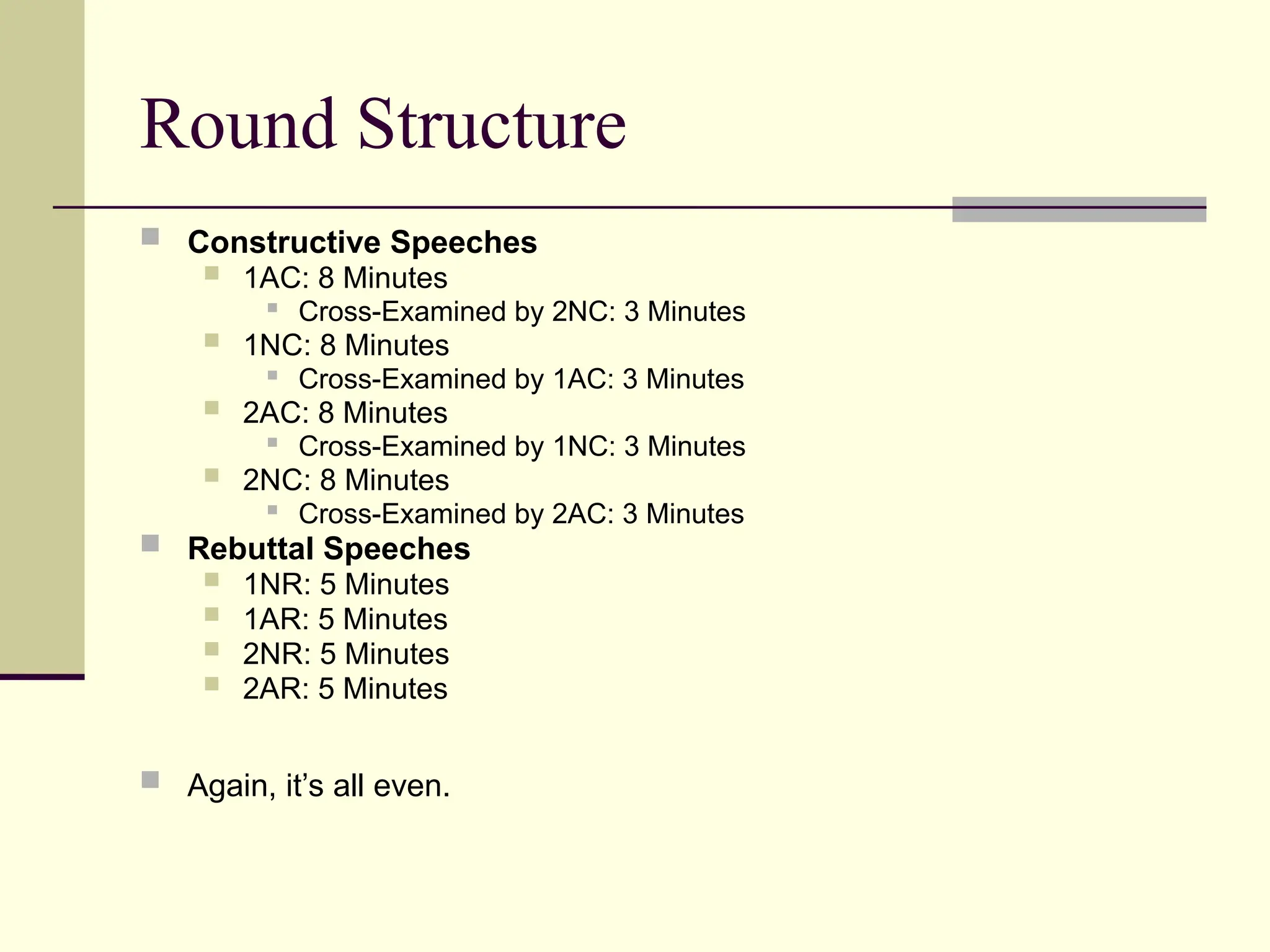
Round Structure
 Constructive Speeches
 1AC: 8 Minutes

Cross-Examined by 2NC: 3 Minutes
 1NC: 8 Minutes

Cross-Examined by 1AC: 3 Minutes
 2AC: 8 Minutes
 Cross-Examined by 1NC: 3 Minutes
 2NC: 8 Minutes

Cross-Examined by 2AC: 3 Minutes
 Rebuttal Speeches
 1NR: 5 Minutes
 1AR: 5 Minutes
 2NR: 5 Minutes
 2AR: 5 Minutes
 Again, it’s all even.
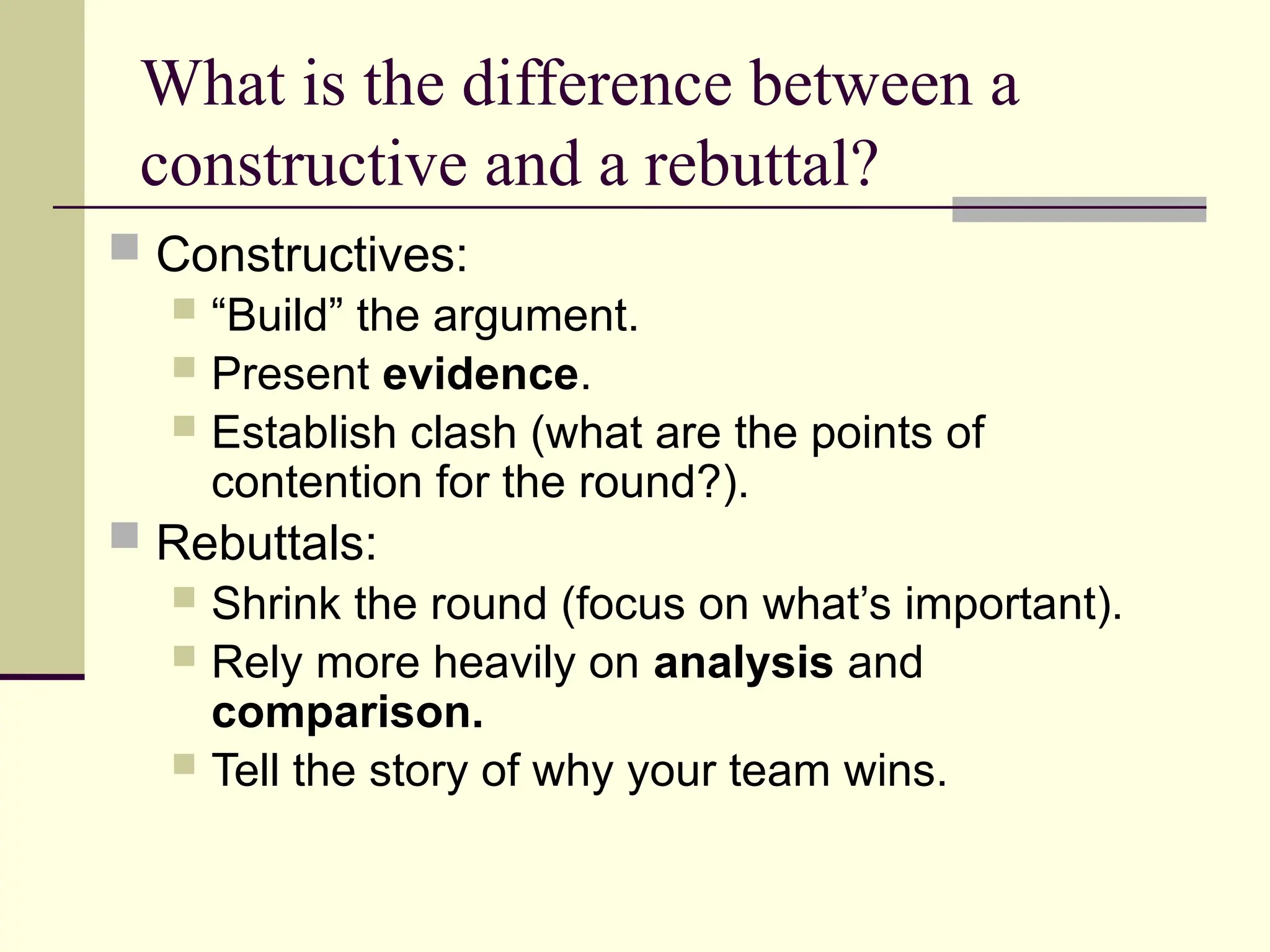
What is the difference between a
constructive and a rebuttal?
 Constructives:
 “Build” the argument.
 Present evidence.
 Establish clash (what are the points of
contention for the round?).
 Rebuttals:
 Shrink the round (focus on what’s important).
 Rely more heavily on analysis and
comparison.
 Tell the story of why your team wins.
Getting Started: The Basic Argument
 The status quo and presumption
 Affirmative responsibility: show why status quo
policies are insufficient to solve a particular harm,
thus overcoming presumption (doing so is said to
meet the “burden of proof”)
 Negative responsibility: Clash with the affirmative
propositions, showing why the status quo is
preferable to change (doing so meets the negative
“burden of rejoinder”)
 Purpose of the debate: win each contention of clash
Clash: The Stock Issues
 Stock Issues are the basic yet essential questions that must be
answered by any affirmative team who is attempting to change
the status quo.
 Stock Issues are how the affirmative meets the burden of proof;
together, the stock issues are:
 Inherency (I),
 Harms (H),
 Significance (S),
 Solvency (S)
 Topicality (T)
 NOTE: “Affirmative responsibility: show why status quo policies
are insufficient to solve a particular harm”
Definition of Inherency
 Inherency (abbreviated “I”) is evidence that
demonstrates the status quo’s inability to
resolve an issue or problem.
 Inherency creates a “need” to do the
affirmative plan; for example, an affirmative
would need to prove an inseparable condition
in the status quo that is causing harms and
requires a new policy action to solve.
Types of Inherency
 Structural Inherency (often called “legislative”) refers to a
specific law or policy that exists in the status quo and prevents a
change from occurring. This is the most easily defended form of
inherency since the affirmative can simply remove the
roadblock.
 Existential Inherency (often called “gap”) refers to the absence
of a law or policy that would achieve the affirmative solvency.
This type of inherency is defended by arguing that solvency is
obtained by adding a new component to the government’s
current policies.
 Attitudinal Inherency refers to an attitude that exists
preventing the plan from going into effect. This is the most
difficult form of inherency to argue because it is often vague and
difficult to prove in real tangible terms.
Definition of Harms
 Harms (abbreviated “H”): evidence that
demonstrates problems that are occurring in
the status quo.
 Harms can describe specific drawbacks of
the status quo (political, economic, military,
social and humanitarian concerns) or the
systemic issues underlying those harms
(racism, sexism, militarism, capitalism, etc.).
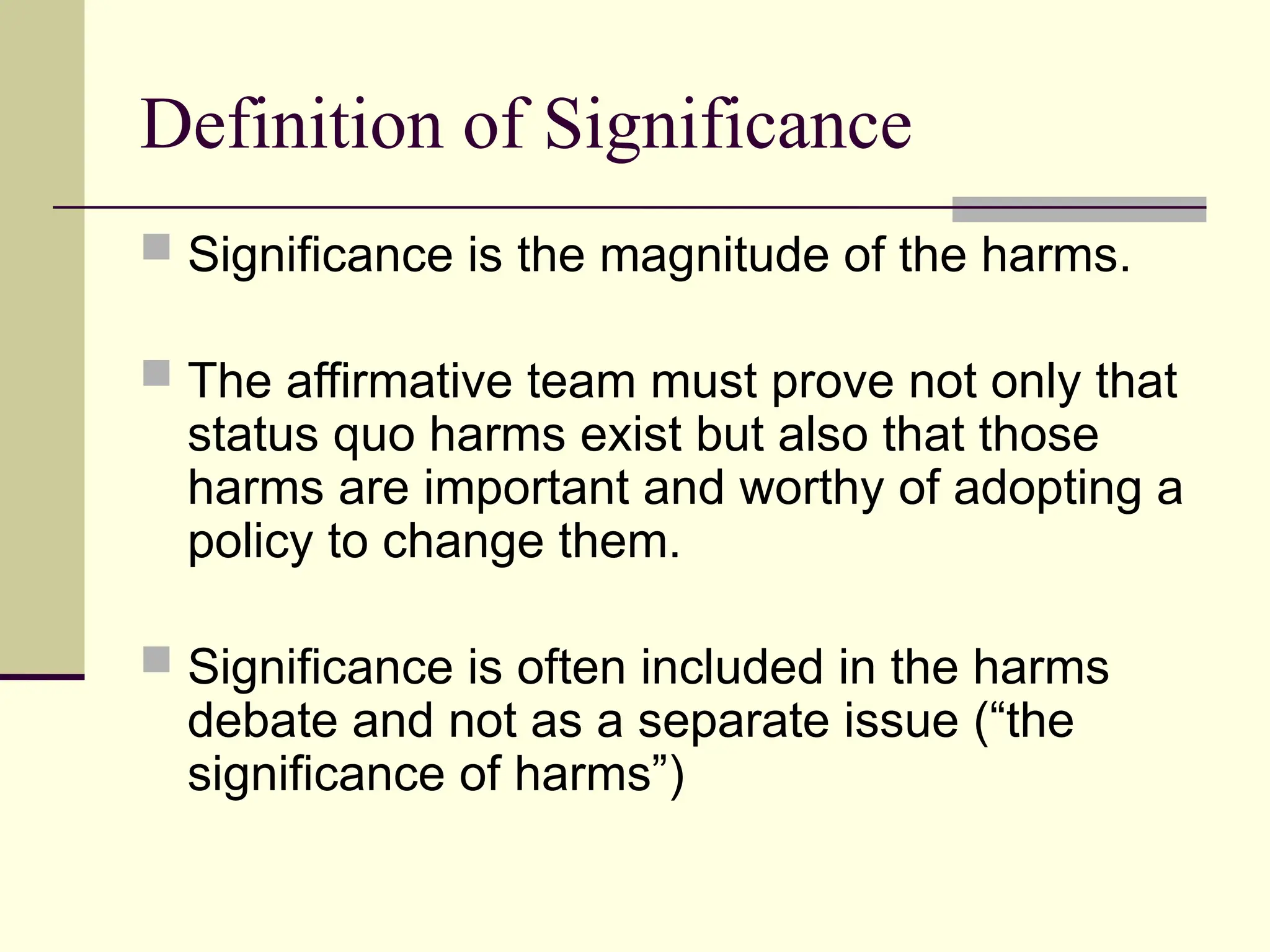
Definition of Significance
 Significance is the magnitude of the harms.
 The affirmative team must prove not only that
status quo harms exist but also that those
harms are important and worthy of adopting a
policy to change them.
 Significance is often included in the harms
debate and not as a separate issue (“the
significance of harms”)
The Affirmative Plan
 A plan is a written text that demonstrates a step-by-
step explanation of how the affirmative will achieve
solvency.
 The plan should be based on the advocacy of a
solvency author—This person is generally referred to
as a Solvency Advocate; an author that supports the
exact action that the affirmative plan takes.
 Tip: Find the evidence first and then write the plan
text.
Definition of Solvency
 Solvency (abbreviated “S”): Evidence that
shows how the affirmative plan will overcome
the inherent barrier and thereby solve for the
significance and harms.
Solvency and the Solvency Advocate
 A solvency advocate is an author that
supports the exact action that the affirmative
plan takes.
 Generally a single author but can be two
consistent authors that support the same plan
of action.
Harms, Solvency & Advantages
 Harms-Solvency scenarios are often referred
to as the affirmative advantages.
 Advantages are often outlined in “scenarios,”
showing how a certain catastrophic event will
occur if the present harms are left unchecked.
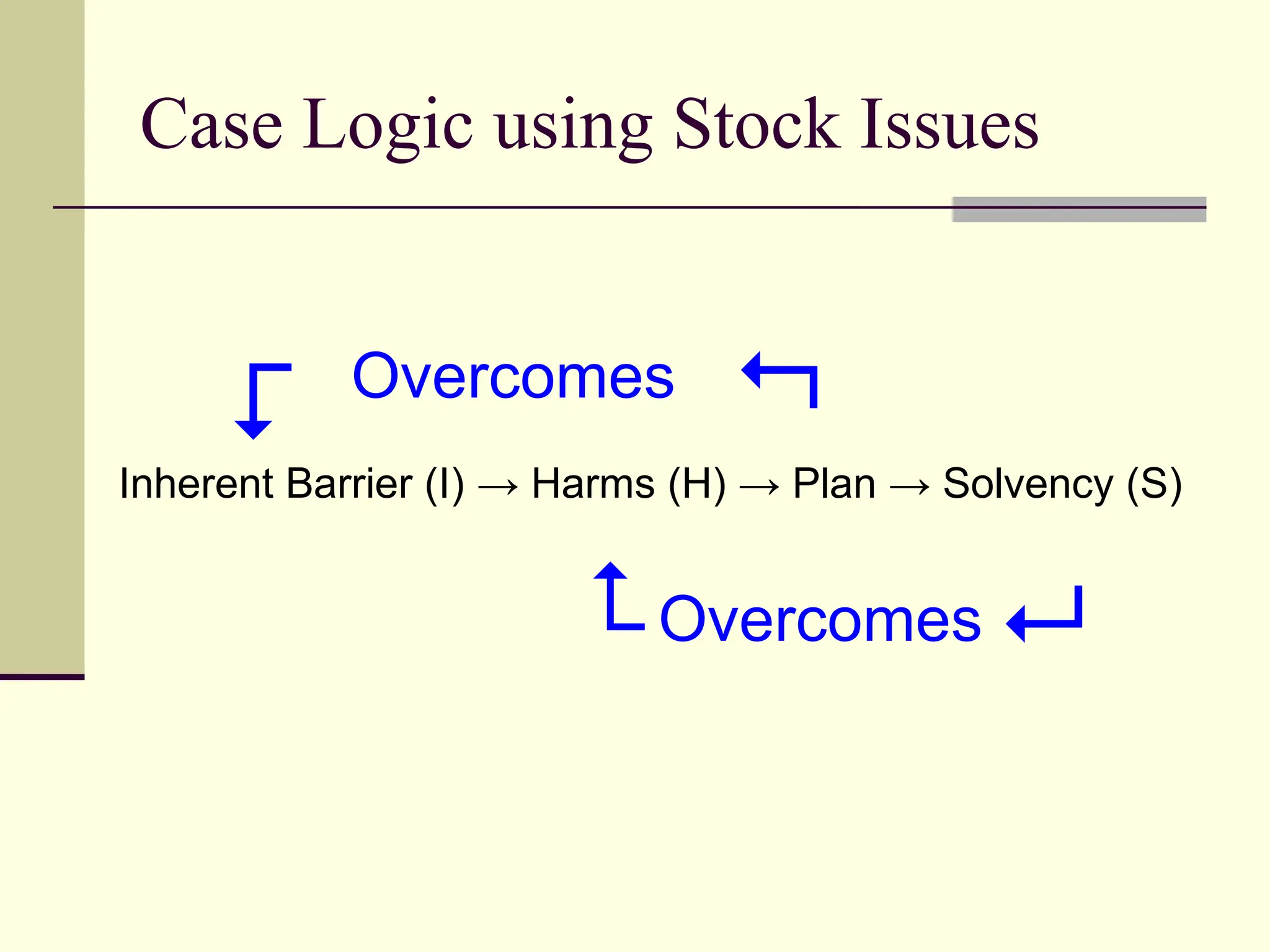
Case Logic using Stock Issues
Inherent Barrier (I) → Harms (H) → Plan → Solvency (S)
Overcomes
 

Overcomes

Coming Up Next…
 Topicality: Defining the subject
 Writing a Case: Putting it all together
 Flow: Taking notes, debate style
 Researching for success
Questions?
PowerPoint available at
http://minnesotaurbandebateleague.wikispaces.com/Curriculum

Introduction to CX Debate Intro Part I.pptx

  • 1.
    A Firm Foundation: CXDebate Basics (Part I) AN INTRODUCTION TO POLICY DEBATE
  • 2.
    What is policydebate (CX)?  Policy debate is a structured format for fairly arguing a topic of policy.  Team debate: Two teams of two students each  Two periods of debate: the constructive and the rebuttal  Each debater is allowed one constructive speech and one rebuttal.  Each constructive is followed by a cross- examination period by an opponent.  (Notice the even nature of each rule.)
  • 3.
    What do wedebate?  CX debate centers around a topic, decided annually, that is debated across the United States for the duration of the school year.  The topic is written in the form of a normative statement known as a resolution.  2024-2025 Policy Debate Resolution: “Resolved: The United States federal government should significantly strengthen its protection of domestic intellectual property rights in copyrights, patents, and/or trademarks.”  The team that defends this statement is the affirmative, the team that opposes this statement is the negative.
  • 4.
    Round Structure  ConstructiveSpeeches  1AC: 8 Minutes  Cross-Examined by 2NC: 3 Minutes  1NC: 8 Minutes  Cross-Examined by 1AC: 3 Minutes  2AC: 8 Minutes  Cross-Examined by 1NC: 3 Minutes  2NC: 8 Minutes  Cross-Examined by 2AC: 3 Minutes  Rebuttal Speeches  1NR: 5 Minutes  1AR: 5 Minutes  2NR: 5 Minutes  2AR: 5 Minutes  Again, it’s all even.
  • 5.
    What is thedifference between a constructive and a rebuttal?  Constructives:  “Build” the argument.  Present evidence.  Establish clash (what are the points of contention for the round?).  Rebuttals:  Shrink the round (focus on what’s important).  Rely more heavily on analysis and comparison.  Tell the story of why your team wins.
  • 6.
    Getting Started: TheBasic Argument  The status quo and presumption  Affirmative responsibility: show why status quo policies are insufficient to solve a particular harm, thus overcoming presumption (doing so is said to meet the “burden of proof”)  Negative responsibility: Clash with the affirmative propositions, showing why the status quo is preferable to change (doing so meets the negative “burden of rejoinder”)  Purpose of the debate: win each contention of clash
  • 7.
    Clash: The StockIssues  Stock Issues are the basic yet essential questions that must be answered by any affirmative team who is attempting to change the status quo.  Stock Issues are how the affirmative meets the burden of proof; together, the stock issues are:  Inherency (I),  Harms (H),  Significance (S),  Solvency (S)  Topicality (T)  NOTE: “Affirmative responsibility: show why status quo policies are insufficient to solve a particular harm”
  • 8.
    Definition of Inherency Inherency (abbreviated “I”) is evidence that demonstrates the status quo’s inability to resolve an issue or problem.  Inherency creates a “need” to do the affirmative plan; for example, an affirmative would need to prove an inseparable condition in the status quo that is causing harms and requires a new policy action to solve.
  • 9.
    Types of Inherency Structural Inherency (often called “legislative”) refers to a specific law or policy that exists in the status quo and prevents a change from occurring. This is the most easily defended form of inherency since the affirmative can simply remove the roadblock.  Existential Inherency (often called “gap”) refers to the absence of a law or policy that would achieve the affirmative solvency. This type of inherency is defended by arguing that solvency is obtained by adding a new component to the government’s current policies.  Attitudinal Inherency refers to an attitude that exists preventing the plan from going into effect. This is the most difficult form of inherency to argue because it is often vague and difficult to prove in real tangible terms.
  • 10.
    Definition of Harms Harms (abbreviated “H”): evidence that demonstrates problems that are occurring in the status quo.  Harms can describe specific drawbacks of the status quo (political, economic, military, social and humanitarian concerns) or the systemic issues underlying those harms (racism, sexism, militarism, capitalism, etc.).
  • 11.
    Definition of Significance Significance is the magnitude of the harms.  The affirmative team must prove not only that status quo harms exist but also that those harms are important and worthy of adopting a policy to change them.  Significance is often included in the harms debate and not as a separate issue (“the significance of harms”)
  • 12.
    The Affirmative Plan A plan is a written text that demonstrates a step-by- step explanation of how the affirmative will achieve solvency.  The plan should be based on the advocacy of a solvency author—This person is generally referred to as a Solvency Advocate; an author that supports the exact action that the affirmative plan takes.  Tip: Find the evidence first and then write the plan text.
  • 13.
    Definition of Solvency Solvency (abbreviated “S”): Evidence that shows how the affirmative plan will overcome the inherent barrier and thereby solve for the significance and harms.
  • 14.
    Solvency and theSolvency Advocate  A solvency advocate is an author that supports the exact action that the affirmative plan takes.  Generally a single author but can be two consistent authors that support the same plan of action.
  • 15.
    Harms, Solvency &Advantages  Harms-Solvency scenarios are often referred to as the affirmative advantages.  Advantages are often outlined in “scenarios,” showing how a certain catastrophic event will occur if the present harms are left unchecked.
  • 16.
    Case Logic usingStock Issues Inherent Barrier (I) → Harms (H) → Plan → Solvency (S) Overcomes    Overcomes 
  • 17.
    Coming Up Next… Topicality: Defining the subject  Writing a Case: Putting it all together  Flow: Taking notes, debate style  Researching for success
  • 18.