Introduction To Computing And Programming In
Python A Multimedia Approach Papcdr Mark J
Guzdial download
https://ebookbell.com/product/introduction-to-computing-and-
programming-in-python-a-multimedia-approach-papcdr-mark-j-
guzdial-1526820
Explore and download more ebooks at ebookbell.com
Here are some recommended products that we believe you will be
interested in. You can click the link to download.
Introduction To Computing And Programming In Python A Multimedia
Approach Fourth Edition Guzdial
https://ebookbell.com/product/introduction-to-computing-and-
programming-in-python-a-multimedia-approach-fourth-edition-
guzdial-21354934
Introduction To Computing And Programming In Python Global Edition 4th
Edition Mark J Guzdial
https://ebookbell.com/product/introduction-to-computing-and-
programming-in-python-global-edition-4th-edition-mark-j-
guzdial-6714384
Explorations In Computing An Introduction To Computer Science And
Python Programming 1st Edition Conery
https://ebookbell.com/product/explorations-in-computing-an-
introduction-to-computer-science-and-python-programming-1st-edition-
conery-37723400
Explorations In Computing An Introduction To Computer Science And
Python Programming John S Conery
https://ebookbell.com/product/explorations-in-computing-an-
introduction-to-computer-science-and-python-programming-john-s-
conery-36151176
Introduction To Computing And Programming With Java A Multimedia
Approach Barbara Ericson
https://ebookbell.com/product/introduction-to-computing-and-
programming-with-java-a-multimedia-approach-barbara-ericson-5411198
How To Design Programs An Introduction To Computing And Programming
Using Scheme Free Web Version Felleisen M
https://ebookbell.com/product/how-to-design-programs-an-introduction-
to-computing-and-programming-using-scheme-free-web-version-
felleisen-m-874218
How To Design Programs An Introduction To Computing And Programming
Using Scheme Free Web Version Felleisen M
https://ebookbell.com/product/how-to-design-programs-an-introduction-
to-computing-and-programming-using-scheme-free-web-version-
felleisen-m-4742466
How To Design Programs An Introduction To Programming And Computing
2nd Edition 2nd Matthias Felleisen
https://ebookbell.com/product/how-to-design-programs-an-introduction-
to-programming-and-computing-2nd-edition-2nd-matthias-
felleisen-50195556
How To Design Programs An Introduction To Programming And Computing
Matthias Felleisen
https://ebookbell.com/product/how-to-design-programs-an-introduction-
to-programming-and-computing-matthias-felleisen-4149148
Introduction to Media Computation:
A Multimedia Cookbook in Python
Mark Guzdial
December 16, 2002
ii
Contents
I Introduction 5
1 Introduction to Media Computation 7
1.1 What is computer science about? . . . . . . . . . . . . . . . . 7
1.2 What Computers Understand . . . . . . . . . . . . . . . . . . 11
1.3 Media Computation: Why digitize media? . . . . . . . . . . . 14
1.4 Computer Science for Non-Computer Scientists . . . . . . . . 15
1.4.1 It’s about communication . . . . . . . . . . . . . . . . 16
1.4.2 It’s about process . . . . . . . . . . . . . . . . . . . . . 16
2 Introduction to Programming 19
2.1 Programming is about Naming . . . . . . . . . . . . . . . . . 19
2.1.1 Files and their Names . . . . . . . . . . . . . . . . . . 21
2.2 Programming in Python . . . . . . . . . . . . . . . . . . . . . 22
2.2.1 Programming in JES . . . . . . . . . . . . . . . . . . . 23
2.2.2 Media Computation in JES . . . . . . . . . . . . . . . 23
2.2.3 Making a Recipe . . . . . . . . . . . . . . . . . . . . . 32
II Sounds 43
3 Encoding and Manipulating Sounds 45
3.1 How Sound is Encoded . . . . . . . . . . . . . . . . . . . . . . 45
3.1.1 The Physics of Sound . . . . . . . . . . . . . . . . . . 45
3.1.2 Encoding the Sound . . . . . . . . . . . . . . . . . . . 52
3.1.3 Using MediaTools for looking at captured sounds . . . 58
3.2 Manipulating sounds . . . . . . . . . . . . . . . . . . . . . . . 60
3.2.1 Open sounds and manipulating samples . . . . . . . . 60
3.2.2 Introducing the loop . . . . . . . . . . . . . . . . . . . 63
3.2.3 Changing the volume of sounds . . . . . . . . . . . . . 67
iii
iv CONTENTS
3.2.4 Manipulating different sections of the sound differently 77
3.2.5 Splicing sounds . . . . . . . . . . . . . . . . . . . . . . 81
3.2.6 Backwards sounds . . . . . . . . . . . . . . . . . . . . 85
3.2.7 Changing the frequency of sounds . . . . . . . . . . . 87
4 Creating Sounds 97
4.1 Creating an Echo . . . . . . . . . . . . . . . . . . . . . . . . . 98
4.1.1 Creating Multiple Echoes . . . . . . . . . . . . . . . . 99
4.1.2 Additive Synthesis . . . . . . . . . . . . . . . . . . . . 100
III Pictures 113
5 Encoding and Manipulating Pictures 115
5.1 How Pictures are Encoded . . . . . . . . . . . . . . . . . . . . 115
5.2 Manipulating Pictures . . . . . . . . . . . . . . . . . . . . . . 119
5.2.1 Exploring pictures . . . . . . . . . . . . . . . . . . . . 126
5.2.2 Changing color values . . . . . . . . . . . . . . . . . . 127
5.2.3 Copying pixels . . . . . . . . . . . . . . . . . . . . . . 134
5.2.4 Replacing Colors . . . . . . . . . . . . . . . . . . . . . 145
5.2.5 Combining pixels . . . . . . . . . . . . . . . . . . . . . 152
5.3 Color Figures . . . . . . . . . . . . . . . . . . . . . . . . . . . 159
6 Creating Pictures 165
6.1 Drawing on images with pixels . . . . . . . . . . . . . . . . . 165
6.2 Drawing with drawing commands . . . . . . . . . . . . . . . . 166
IV Meta-Issues: How we do what we do 169
7 Design and Debugging 171
7.1 Designing programs . . . . . . . . . . . . . . . . . . . . . . . 171
7.1.1 Top-down . . . . . . . . . . . . . . . . . . . . . . . . . 171
7.1.2 Bottom-up . . . . . . . . . . . . . . . . . . . . . . . . 171
7.2 Techniques of Debugging . . . . . . . . . . . . . . . . . . . . . 172
V Files 175
8 Encoding, Creating, and Manipulating Files 177
8.1 How to walk through a directory . . . . . . . . . . . . . . . . 177
CONTENTS v
8.2 Copying files . . . . . . . . . . . . . . . . . . . . . . . . . . . 178
VI Text 181
9 Encoding and Manipulation of Text 183
9.1 A recipe to generate HTML . . . . . . . . . . . . . . . . . . . 183
9.2 Converting from sound to text to graphics . . . . . . . . . . . 185
VII Movies 187
10 Encoding, Manipulation and Creating Movies 189
10.1 Manipulating movies . . . . . . . . . . . . . . . . . . . . . . . 189
10.2 Compositing to create new movies . . . . . . . . . . . . . . . 191
10.3 Animation: Creating movies from scratch . . . . . . . . . . . 192
11 Storing Media 195
VIII Isn’t there a better way? 197
12 How fast can we get? 199
12.1 Complexity . . . . . . . . . . . . . . . . . . . . . . . . . . . . 199
12.2 Speed limits . . . . . . . . . . . . . . . . . . . . . . . . . . . . 199
12.3 Native code versus interpreted code . . . . . . . . . . . . . . . 200
IX Programming and Design 201
13 Functional Decomposition 203
13.1 Using map . . . . . . . . . . . . . . . . . . . . . . . . . . . . . 203
14 Recursion 205
15 Objects 207
X Other Languages 209
16 Java 211
16.1 Java examples . . . . . . . . . . . . . . . . . . . . . . . . . . . 211
vi CONTENTS
List of Figures
1.1 Eight wires with a pattern of voltages is a byte, which gets
interpreted as a pattern of eight 0’s and 1’s, which gets inter-
preted as a decimal number. . . . . . . . . . . . . . . . . . . . 12
1.2 Alan Perlis . . . . . . . . . . . . . . . . . . . . . . . . . . . . 17
2.1 JES running on MacOS X (with annotations) . . . . . . . . . 24
2.2 JES running on Windows . . . . . . . . . . . . . . . . . . . . 25
2.3 The File Picker . . . . . . . . . . . . . . . . . . . . . . . . . . 28
2.4 File picker with media types identified . . . . . . . . . . . . . 29
2.5 Picking, making, and showing a picture . . . . . . . . . . . . 30
2.6 Defining and executing pickAndShow . . . . . . . . . . . . . . 34
3.1 Raindrops causing ripples in the surface of the water, just as
sound causes ripples in the air . . . . . . . . . . . . . . . . . . 46
3.2 One cycle of the simplest sound, a sine wave . . . . . . . . . . 46
3.3 The distance between peaks in ripples in a pond are not
constant—some gaps are longer, some shorter . . . . . . . . . 48
3.4 The note A above middle C is 440 Hz . . . . . . . . . . . . . 49
3.5 Some synthesizers using triangular (or sawtooth) or square
waves. . . . . . . . . . . . . . . . . . . . . . . . . . . . . . . . 50
3.6 Sound editor main tool . . . . . . . . . . . . . . . . . . . . . . 50
3.7 Viewing the sound signal as it comes in . . . . . . . . . . . . 51
3.8 Viewing the sound in a spectrum view . . . . . . . . . . . . . 52
3.9 Viewing a sound in spectrum view with multiple “spikes” . . 53
3.10 Viewing the sound signal in a sonogram view . . . . . . . . . 54
3.11 Area under a curve estimated with rectangles . . . . . . . . . 55
3.12 A depiction of the first five elements in a real sound array . . 57
3.13 A sound recording graphed in the MediaTools . . . . . . . . . 57
3.14 The sound editor open menu . . . . . . . . . . . . . . . . . . 58
vii
viii LIST OF FIGURES
3.15 MediaTools open file dialog . . . . . . . . . . . . . . . . . . . 58
3.16 A sound opened in the editor . . . . . . . . . . . . . . . . . . 59
3.17 Exploring the sound in the editor . . . . . . . . . . . . . . . . 59
3.18 Comparing the graphs of the original sound (top) and the
louder one (bottom) . . . . . . . . . . . . . . . . . . . . . . . 69
3.19 Comparing specific samples in the original sound (top) and
the louder one (bottom) . . . . . . . . . . . . . . . . . . . . . 70
3.20 Comparing the original sound (top) to the spliced sound (bot-
tom) . . . . . . . . . . . . . . . . . . . . . . . . . . . . . . . . 86
4.1 The top and middle waves are added together to create the
bottom wave . . . . . . . . . . . . . . . . . . . . . . . . . . . 109
4.2 The raw 440 Hz signal on top, then the 440+880+1320 Hz
signal on the bottom . . . . . . . . . . . . . . . . . . . . . . . 110
4.3 FFT of the 440 Hz sound . . . . . . . . . . . . . . . . . . . . 110
4.4 FFT of the combined sound . . . . . . . . . . . . . . . . . . . 110
4.5 The 440 Hz square wave (top) and additive combination of
square waves (bottom) . . . . . . . . . . . . . . . . . . . . . . 111
4.6 FFT’s of the 440 Hz square wave (top) and additive combi-
nation of square waves (bottom) . . . . . . . . . . . . . . . . 111
5.1 An example matrix . . . . . . . . . . . . . . . . . . . . . . . . 116
5.2 Cursor and icon at regular magnification on top, and close-up
views of the cursor (left) and the line below the cursor (right) 117
5.3 Merging red, green, and blue to make new colors . . . . . . . 118
5.4 The Macintosh OS X RGB color picker . . . . . . . . . . . . 118
5.5 Picking a color using RGB sliders from JES . . . . . . . . . . 119
5.6 RGB triplets in a matrix representation . . . . . . . . . . . . 120
5.7 Directly modifying the pixel colors via commands: Note the
small yellow line on the left . . . . . . . . . . . . . . . . . . . 125
5.8 Using the MediaTools image exploration tools . . . . . . . . . 126
5.9 The original picture (left) and red-reduced version (right) . . 128
5.10 Overly blue (left) and red increased by 20% (right) . . . . . . 129
5.11 Original (left) and blue erased (right) . . . . . . . . . . . . . 130
5.12 Lightening and darkening of original picture . . . . . . . . . . 131
5.13 Negative of the image . . . . . . . . . . . . . . . . . . . . . . 132
5.14 Color picture converted to greyscale . . . . . . . . . . . . . . 134
5.15 Once we pick a mirrorpoint, we can just walk x halfway and
subtract/add to mirrorpoint . . . . . . . . . . . . . . . . . . . 136
LIST OF FIGURES ix
5.16 Original picture (left) and mirrored along the vertical axis
(right) . . . . . . . . . . . . . . . . . . . . . . . . . . . . . . . 137
5.17 Flowers in the mediasources folder . . . . . . . . . . . . . . 141
5.18 Collage of flowers . . . . . . . . . . . . . . . . . . . . . . . . . 142
5.19 Increasing reds in the browns . . . . . . . . . . . . . . . . . . 147
5.20 Increasing reds in the browns, within a certain range . . . . . 148
5.21 A picture of a child (Katie), and her background without her 149
5.22 A new background, the moon . . . . . . . . . . . . . . . . . . 149
5.23 Katie on the moon . . . . . . . . . . . . . . . . . . . . . . . . 150
5.24 Mark in front of a blue sheet . . . . . . . . . . . . . . . . . . 150
5.25 Mark on the moon . . . . . . . . . . . . . . . . . . . . . . . . 151
5.26 Mark in the jungle . . . . . . . . . . . . . . . . . . . . . . . . 152
5.27 Color: RGB triplets in a matrix representation . . . . . . . . 159
5.28 Color: The original picture (left) and red-reduced version (right)160
5.29 Color: Overly blue (left) and red increased by 20% (right) . . 160
5.30 Color: Original (left) and blue erased (right) . . . . . . . . . 161
5.31 Color: Lightening and darkening of original picture . . . . . . 161
5.32 Color: Negative of the image . . . . . . . . . . . . . . . . . . 162
5.33 Color: Color picture converted to greyscale . . . . . . . . . . 162
5.34 Color: Increasing reds in the browns . . . . . . . . . . . . . . 163
5.35 Color: Increasing reds in the browns, within a certain range . 164
6.1 A very small, drawn picture . . . . . . . . . . . . . . . . . . . 166
6.2 A very small, drawn picture . . . . . . . . . . . . . . . . . . . 167
7.1 Seeing the variables using showVars() . . . . . . . . . . . . . 173
10.1 Movie tools in MediaTools . . . . . . . . . . . . . . . . . . . . 189
10.2 Dark starting frame number 9 . . . . . . . . . . . . . . . . . . 190
10.3 Somewhat lighter starting frame number 9 . . . . . . . . . . . 190
x LIST OF FIGURES
Preface
This book is based on the proposition that very few people actually want to
learn to program. However, most educated people want to use a computer,
and the task that they most want to do with a computer is communicate.
Alan Perlis first made the claim in 1961 that computer science, and program-
ming explicitly, should be part of a liberal education [Greenberger, 1962].
However, what we’ve learned since then is that one doesn’t just “learn to
program.” One learns to program something [Adelson and Soloway, 1985,
Harel and Papert, 1990], and the motivation to do that something can make
the difference between learning to program or not [Bruckman, 2000].
The philosophies which drive the structure of this book include:
• People learn concrete to abstract, driven by need. Teaching structure
before content is painful and results in brittle knowledge that can’t be
used elsewhere [Bruer, 1993]. Certainly, one can introduce structure
(and theory and design), but students won’t really understand the
structure until they have the content to fill it with – and a reason to
need the structure. Thus, this book doesn’t introduce debugging or
design (or complexity or most of computer science) until the students
are doing complex enough software to make it worthwhile learning.
• Repetition is good. Variety is good. Marvin Minsky once said, “If you
know something only one way, you don’t know it at all.” The same
ideas come back frequently in this book. The same idea is framed in
multiple ways. I will use metaphor, visualizations, mathematics, and
even computer science to express ideas in enough different ways that
one of the ways will ring true for the individual student.
• The computer is the most amazingly creative device that humans have
ever conceived of. It is literally completely made up of mind-stuff. As
the movie says, “Don’t just dream it, be it.” If you can imagine it,
1
2 LIST OF FIGURES
you can make it “real” on the computer. Playing with programming
can be and should be enormous fun.
Typographical notations
Examples of Python code look like this: x = x + 1. Longer examples look
look like this:
def helloWorld():
print "Hello, world!"
When showing something that the user types in with Python’s response,
it will have a similar font and style, but the user’s typing will appear after
a Python prompt (>>>):
>>> print 3 + 4
7
User interface components of JES (Jython Environment for Students)
will be specified using a smallcaps font, like save menu item and the Load
button.
There are several special kinds of sidebars that you’ll find in the book.
Recipe 1: An Example Recipe
Recipes (programs) appear like this:
def helloWorld():
print "Hello, world!"
End of Recipe 1
Computer Science Idea: An Example Idea
Key computer science concepts appear like this.
LIST OF FIGURES 3


Common Bug: An Example Common Bug
Common things that can cause your recipe to fail ap-
pear like this.
Debugging Tip: An Example Debugging Tip
If there’s a good way to keep those bugs from creeping
into your recipes in the first place, they’re highlighted
here.


Making it Work Tip: An Example How To
Make It Work
Best practices or techniques that really help are high-
lighted like this.
Acknowledgements
Our sincere thanks go out to · · ·
• Jason Ergle, Claire Bailey, David Raines, and Joshua Sklare who made
JES a reality with amazing quality for such a short amount of time.
Jason and David took JES the next steps, improving installation, de-
bugging, and process support.
• Adam Wilson built the MediaTools that are so useful for exploring
sounds and images and processing video.
• Andrea Forte, Mark Richman, Matt Wallace, Alisa Bandlow, and
David Rennie who helped build the course materials. Mark and Matt
built a great many of the example programs.
• Jeff Pierce for reviewing and advising us on the design of the media
language used in the book.
• Bob McMath, Vice-Provost at Georgia Tech, and Jim Foley, Associate
Dean for Education in the College of Computing, for investing in this
effort early on.
• Kurt Eiselt who worked hard to make this effort real, convincing others
to take it seriously.
4 LIST OF FIGURES
• Janet Kolodner and Aaron Bobick who were excited and encouraging
about the idea of media computation for students new to computer
science.
• Joan Morton, Chrissy Hendricks, and all the staff of the GVU Center
who made sure that we had what we needed and that the paperwork
was done to make this class come together.
• Picture of Alan Perlis from http://www.cs.cmu.edu/afs/cs.cmu.
edu/Web/csd/perlis.html. Picture of Alan Turing from http://
www.dromo.com/fusionanomaly/applecomputer.html. Picture of Grace
Hopper from http://www.autodesk.com/dyf/ginvolved/december.
html. Most of the clip art is used with permission from the Art Ex-
plosion package by Nova Development.
• Finally but most importantly, Barbara Ericson, and Matthew, Kather-
ine, and Jennifer Guzdial, who allowed themselves to be photographed
and recorded for Daddy’s media project and were supportive and ex-
cited about the class.
Part I
Introduction
5
Chapter 1
Introduction to Media
Computation
1.1 What is computer science about?
Computer science is the study of process: How we do things, how we specify
what we do, how we specify what the stuff is that you’re processing. But
that’s a pretty dry definition. Let’s try a metaphorical one.
Computer Science Idea: Computer science is
the study of recipes
They’re a special kind of recipe—one that can be
executed by a computational device, but that point
is only of importance to computer scientists. The
important point overall is that a computer science
recipe defines exactly what’s to be done.
If you’re a biologist who wants to describe how migration works or how
DNA replicates, or if you’re a chemist who wants to explain how an equi-
librium is reached in a reaction, or if you’re a factory manager who wants
to define a machine-and-belt layout and even test how it works before phys-
ically moving heavy things into position, then being able to write a recipe
that specifies exactly what happens, in terms that can be completely defined
and understood, is very useful. This exactness is part of why computers have
radically changed so much of how science is done and understood.
It may sound funny to call programs or algorithms a recipe, but the
analogy goes a long way. Much of what computer scientists study can be
defined in terms of recipes:
7
8 CHAPTER 1. INTRODUCTION TO MEDIA COMPUTATION
• Some computer scientists study how recipes are written: Are there
better or worse ways of doing something? If you’ve ever had to sepa-
rate whites from yolks in eggs, you know that knowing the right way
to do it makes a world of difference. Computer science theoreticians
worry about the fastest and shortest recipes, and the ones that take
up the least amount of space (you can think about it as counter space
— the analogy works). How a recipe works, completely apart from
how it’s written, is called the study of algorithms. Software engi-
neers worry about how large groups can put together recipes that still
work. (The recipe for some programs, like the one that keeps track of
Visa/MasterCard records has literally millions of steps!)
• Other computer scientists study the units used in recipes. Does it
matter whether a recipe uses metric or English measurements? The
recipe may work in either case, but if you have the read the recipe
and you don’t know what a pound or a cup is, the recipe is a lot less
understandable to you. There are also units that make sense for some
tasks and not others, but if you can fit the units to the tasks well, you
can explain yourself more easily and get things done faster—and avoid
errors. Ever wonder why ships at sea measure their speed in knots?
Why not use things like meters per second? There are places, like
at sea, where more common terms aren’t appropriate or don’t work
as well. The study of computer science units is referred to as data
structures. Computer scientists who study ways of keeping track of
lots of data in lots of different kinds of units are studying databases.
• Can recipes be written for anything? Are there some recipes that
can’t be written? Computer scientists actually do know that there are
recipes that can’t be written. For example, you can’t write a recipe
that can absolutely tell, for any other recipe, if the other recipe will
actually work. How about intelligence? Can we write a recipe that can
think (and how would you tell if you got it right)? Computer scientsts
in theory, intelligent systems, artificial intelligence, and systems worry
about things like this.
• There are even computer scientists who worry about whether peo-
ple like what the recipes produce, like the restauraunt critics for the
newspaper. Some of these are human-computer interface specialists
who worry about whether people like how the recipes work (those
“recipes” that produce an interface that people use, like windows,
buttons, scrollbars, and other elements of what we think about as a
1.1. WHAT IS COMPUTER SCIENCE ABOUT? 9
running program).
• Just as some chefs specialize in certain kinds of recipes, like crepes or
barbeque, computer scientists also specialize in special kinds of recipes.
Computer scientists who work in graphics are mostly concerned with
recipes that produce pictures, animations, and even movies. Com-
puter scientists who work in computer music are mostly concerned
with recipes that produce sounds (often melodic ones, but not always).
• Still other computer scientists study the emergent properties of recipes.
Think about the World Wide Web. It’s really a collection of millions
of recipes (programs) talking to one another. Why would one section
of the Web get slower at some point? It’s a phenomena that emerges
from these millions of programs, certainly not something that was
planned. That’s something that networking computer scientists study.
What’s really amazing is that these emergent properties (that things
just start to happen when you have many, many recipes interacting
at once) can also be used to explain non-computational things. For
example, how ants forage for food or how termites make mounds can
also be described as something that just happens when you have lots
of little programs doing something simple and interacting.
The recipe metaphor also works on another level. Everyone knows that
some things in recipe can be changed without changing the result dramat-
ically. You can always increase all the units by a multiplier to make more.
You can always add more garlic or oregano to the spaghetti sauce. But
there are some things that you cannot change in a recipe. If the recipe calls
for baking powder, you may not substitute baking soda. If you’re supposed
to boil the dumplings then saute’ them, the reverse order will probably not
work well.
Similarly, for software recipes. There are usually things you can easily
change: The actual names of things (though you should change names con-
sistently), some of the constants (numbers that appear as plain old numbers,
not as variables), and maybe even some of the data ranges (sections of the
data) being manipulated. But the order of the commands to the computer,
however, almost always has to stay exactly as stated. As we go on, you’ll
learn what can be changed safely, and what can’t.
Computer scientists specify their recipes with programming languages.
Different programming languages are used for different purposes. Some of
them are wildly popular, like Java and C++. Others are more obscure,
like Squeak and T. Others are designed to make computer science ideas
10 CHAPTER 1. INTRODUCTION TO MEDIA COMPUTATION
very easy to learn, like Scheme or Python, but the fact that they’re easy to
learn doesn’t always make them very popular nor the best choice for experts
building larger or more complicated recipes. It’s a hard balance in teaching
computer science to pick a language that is easy to learn and is popular and
useful enough that students are motivated to learn it.
Why don’t computer scientists just use natural languages, like English
or Spanish? The problem is that natural languages evolved the way that
they did to enhance communications between very smart beings, humans.
As we’ll go into more in the next section, computers are exceptionally dumb.
They need a level of specificity that natural language isn’t good at. Further,
what we say to one another in natural communication is not exactly what
you’re saying in a computational recipe. When was the last time you told
someone how a videogame like Doom or Quake or Super Mario Brothers
worked in such minute detail that they could actually replicate the game
(say, on paper)? English isn’t good for that kind of task.
There are so many different kinds of programming languages because
there are so many different kinds of recipes to write. Programs written in
the programming language C tend to be very fast and efficient, but they
also tend to be hard to read, hard to write, and require units that are more
about computers than about bird migrations or DNA or whatever else you
want to write your recipe about. The programming language Lisp (and its
related languages like Scheme, T, and Common Lisp) is very flexible and is
well suited to exploring how to write recipes that have never been written
before, but Lisp looks so strange compared to languages like C that many
people avoid it and there are (natural consequence) few people who know it.
If you want to hire a hundred programmers to work on your project, you’re
going to find it easier to find a hundred programmers who know a popular
language than a less popular one—but that doesn’t mean that the popular
language is the best one for your task!
The programming language that we’re using in this book is Python
(http://www.python.org for more information on Python). Python is a
fairly popular programming language, used very often for Web and me-
dia programming. The web search engine Google is mostly programmed in
Python. The media company Industrial Light  Magic also uses Python.
A list of companies using Python is available at http://www.python.org/
psa/Users.html. Python is known for being easy to learn, easy to read,
very flexible, but not very efficient. The same algorithm coded in C and
in Python will probably be faster in C. The version of Python that we’re
using is called Jython (http://www.jython.org). Python is normally im-
plemented in the programming language C. Jython is Python implemented
1.2. WHAT COMPUTERS UNDERSTAND 11
in Java. Jython lets us do multimedia that will work across multiple com-
puter platforms.
1.2 What Computers Understand
Computational recipes are written to run on computers. What does a com-
puter know how to do? What can we tell the computer to do in the recipe?
The answer is “Very, very little.” Computers are exceedingly stupid. They
really only know about numbers.
Actually, even to say that computers know numbers is a myth, or more
appropriately, an encoding. Computers are electronic devices that react to
voltages on wires. We group these wires into sets (like eight of these wires
are called a byte and one of them is called a bit). If a wire has a voltage
on it, we say that it encodes a 1. If it has no voltage on it, we say that it
encodes a 0. So, from a set of eight wires (a byte), we interpret a pattern of
eight 0’s and 1’s, e.g., 01001010. Using the binary number system, we can
interpret this byte as a decimal number (Figure 1.1). That’s where we come
up with the claim that a computer knows about numbers1.
The computer has a memory filled with bytes. Everything that a com-
puter is working with at a given instant is stored in its memory. That
means that everything that a computer is working with is encoded in its
bytes: JPEG pictures, Excel spreadsheets, Word documents, annoying Web
pop-up ads, and the latest spam email.
A computer can do lots of things with numbers. It can add them, sub-
tract them, multiply them, divide them, sort them, collect them, duplicate
them, filter them (e.g., “make a copy of these numbers, but only the even
ones”), and compare them and do things based on the comparison. For
example, a computer can be told in a recipe “Compare these two numbers.
If the first one is less than the second one, jump to step 5 in this recipe.
Otherwise, continue on to the next step.”
So far, the computer is an incredible calculator, and that’s certainly why
it was invented. The first use of the computer was during World War II for
calculating trajectories of projectiles (“If the wind is coming from the SE
at 15 MPH, and you want to hit a target 0.5 miles away at an angle of 30
degrees East of North, then incline your launcher to . . .”). The computer is
an amazing calculator. But what makes it useful for general recipes is the
concept of encodings.
1
We’ll talk more about this level of the computer in Chapter 12
12 CHAPTER 1. INTRODUCTION TO MEDIA COMPUTATION
0
1
0
1
0
0
1
0
74
wires
interpreted as
Figure 1.1: Eight wires with a pattern of voltages is a byte, which gets
interpreted as a pattern of eight 0’s and 1’s, which gets interpreted as a
decimal number.
Computer Science Idea: Computers can layer
encodings
Computers can layer encodings to virtually any level
of complexity. Numbers can be interpreted as charac-
ters, which can be interpreted in sets as Web pages,
which can be interpreted to appear as multiple fonts
and styles. But at the bottommost level, the com-
puter only “knows” voltages which we intepret as
numbers.
If one of these bytes is interpreted as the number 65, it could just be
the number 65. Or it could be the letter A using a standard encoding
of numbers-to-letters called the American Standard Code for Information
Interchange (ASCII). If that 65 appears in a collection of other numbers
that we’re interpreting as text, and that’s in a file that ends in “.html” it
might be part of something that looks like this a href=. . ., which a Web
browser will interpret as the definition of a link. Down at the level of the
computer, that A is just a pattern of voltages. Many layers of recipes up,
at the level of a Web browser, it defines something that you can click on to
get more information.
If the computer understands only numbers (and that’s a stretch already),
how does it manipulate these encodings? Sure, it knows how to compare
numbers, but how does that extend to being able to alphabetize a class
1.2. WHAT COMPUTERS UNDERSTAND 13
list/ Typically, each layer of encoding is implemented as a piece or layer of
software. There’s software that understands how to manipulate characters.
The character software knows how to do things like compare names because
it has encoded that a comes before b and so on, and that the numeric
comparison of the order of numbers in the encoding of the letters leads to
alphabetical comparisons. The character software is used by other software
that manipulates text in files. That’s the layer that something like Microsoft
Word or Notepad or TextEdit would use. Still another piece of software
knows how to interpret HTML (the language of the Web), and another
layer of that software knows how to take HTML and display the right text,
fonts, styles, and colors.
We can similarly create layers of encodings in the computer for our spe-
cific tasks. We can teach a computer that cells contain mitochondria and
DNA, and that DNA has four kinds of nucleotides, and that factories have
these kinds of presses and these kinds of stamps. Creating layers of encod-
ing and interpretation so that the computer is working with the right units
(recall back to our recipe analogy) for a given problem is the task of data
representation or defining the right data structures.
If this sounds like a lot of software, it is. When software is layered
like this, it slows the computer down some. But the amazing thing about
computers is that they’re amazingly fast—and getting faster all the time!
Computer Science Idea: Moore’s Law
Gordon Moore, one of the founders of Intel (maker
of computer processing chips for all computers run-
ning Windows operating systems), made the claim
that the number of transistors (a key component of
computers) would double at the same price every 18
months, effectively meaning that the same amount of
money would buy twice as much computing power
every 18 months. That means, in a year-and-a-half,
computers get as fast over again as has taken them
since World War II. This Law has continued to hold
true for decades.
Computers today can execute literally BILLIONS of recipe steps per
second! They can hold in memory literally encyclopediae of data! They
never get tired nor bored. Search a million customers for a particular card
holder? No problem! Find the right set of numbers to get the best value
out of an equation? Piece of cake!
14 CHAPTER 1. INTRODUCTION TO MEDIA COMPUTATION
Process millions of picture elements or sound fragments or movie frames?
That’s media computation.
1.3 Media Computation: Why digitize media?
Let’s consider an encoding that would be appropriate for pictures. Imagine
that pictures were made up of little dots. That’s not hard to imagine: Look
really closely at your monitor or at a TV screen and see that your images
are already made up of little dots. Each of these dots is a distinct color.
You know from your physics that colors can be described as the sum of red,
green, and blue. Add the red and green to get yellow. Mix all three together
to get white. Turn them all off, and you get a black dot.
What if we encoded each dot in a picture as collection of three bytes,
one each for the amount of red, green, and blue at that dot on the screen?
And we collect a bunch of these three-byte-sets to determine all the dots
of a given picture? That’s a pretty reasonable way of representing pictures,
and it’s essentially how we’re going to do it in Chapter 5.
Manipulating these dots (each referred to as a pixel or picture element)
can take a lot of processing. There are thousands or even millions of them
in a picture that you might want to work with on your computer or on the
Web. But the computer doesn’t get bored and it’s mighty fast.
The encoding that we will be using for sound involves 44,100 two-byte-
sets (called a sample) for each second of time. A three minute song requires
158,760,000 bytes. Doing any processing on this takes a lot of operations.
But at a billion operations per second, you can do lots of operations to every
one of those bytes in just a few moments.
Creating these kinds of encodings for media requires a change to the
media. Look at the real world: It isn’t made up of lots of little dots that
you can see. Listen to a sound: Do you hear thousands of little bits of sound
per second? The fact that you can’t hear little bits of sound per second is
what makes it possible to create these encodings. Our eyes and ears are
limited: We can only perceive so much, and only things that are just so
small. If you break up an image into small enough dots, your eyes can’t tell
that it’s not a continuous flow of color. If you break up a sound into small
enough pieces, your ears can’t tell that the sound isn’t a continuous flow of
auditory energy.
The process of encoding media into little bits is called digitization, some-
times referred to as “going digital.” Digital means (according to the Amer-
ican Heritage Dictionary) “Of, relating to, or resembling a digit, especially
1.4. COMPUTER SCIENCE FOR NON-COMPUTER SCIENTISTS 15
a finger.” Making things digital is about turning things from continuous,
uncountable, to something that we can count, as if with our fingers.
Digital media, done well, feel the same to our limited human sensory
apparatus as the original. Phonograph recordings (ever seen one of those?)
capture sound continuously, as an analogue signal. Photographs capture
light as a continuous flow. Some people say that they can hear a differ-
ence between phonograph recordings and CD recordings, but to my ear
and most measurements, a CD (which is digitized sound) sounds just the
same—maybe clearer. Digital cameras at high enough resolutions produce
photograph-quality pictures.
Why would you want to digitize media? Because it’s easier to manip-
ulate, to replicate exactly, to compress, and to transmit. For example, it’s
hard to manipulate images that are in photographs, but it’s very easy when
the same images are digitized. This book is about using the increasingly
digital world of media and manipulating it—and learning computation in
the process.
Moore’s Law has made media computation feasible as an introductory
topic. Media computation relies on the computer doing lots and lots of
operations on lots and lots of bytes. Modern computers can do this easily.
Even with slow (but easy to understand) languages, even with inefficient
(but easy to read and write) recipes, we can learn about computation by
manipulating media.
1.4 Computer Science for Non-Computer Scien-
tists
But why should you? Why should anyone who doesn’t want to be a com-
puter scientist learn about computer science? Why should you be interested
in learning about computation through manipulating media?
Most professionals today do manipulate media: Papers, videos, tape
recordings, photographs, drawings. Increasingly, this manipulation is done
with a computer. Media are very often in a digitized form today.
We use software to manipulate these media. We use Adobe Photoshop
for manipulating our images, and Macromedia SoundEdit to manipulate
our sounds, and perhaps Microsoft PowerPoint for assembling our media
into slideshows. We use Microsoft Word for manipulating our text, and
Netscape Navigator or Microsoft Internet Explorer for browsing media on
the Internet.
So why should anyone who does not want to be a computer scientist
16 CHAPTER 1. INTRODUCTION TO MEDIA COMPUTATION
study computer science? Why should you learn to program? Isn’t it enough
to learn to use all this great software? The following two sections provide
two answers to these questions.
1.4.1 It’s about communication
Digital media are manipulated with software. If you can only manipulate
media with software that someone else made for you, you are limiting
your ability to communicate. What if you want to say something or say it
in some way that Adobe, Microsoft, Apple, and the rest don’t support you
in saying? If you know how to program, even if it would take you longer to
do it yourself, you have that freedom.
What about learning those tools in the first place? In my years in com-
puters, I’ve seen a variety of software come and go as the package for draw-
ing, painting, word-processing, video editing, and beyond. You can’t learn
just a single tool and expect to be able to use that your entire career. If you
know how the tools work, you have a core understanding that can transfer
from tool to tool. You can think about your media work in terms of the
algorithms, not the tools.
Finally, if you’re going to prepare media for the Web, for marketing, for
print, for broadcast, for any use whatsoever, it’s worthwhile for you to have
a sense of what’s possible, what can be done with media. It’s even more
important as a consumer of media that you know how the media can be
manipulated, to know what’s true and what could be just a trick. If you
know the basics of media computation, you have an understanding that goes
beyond what any individual tool provides.
1.4.2 It’s about process
In 1961, Alan Perlis gave a talk at MIT where he made the argument that
computer science, and programming explicitly, should be part of a general,
liberal education [Greenberger, 1962]. Perlis is an important figure in the
field of computer science (Figure 1.2). The highest award that a computer
scientist can be honored with is the ACM Turing Award. Perlis was the
first recipient of that award. He’s an important figure in software engineer-
ing, and he started several of the first computer science departments in the
United States.
Perlis’ argument was made in comparison with calculus. Calculus is
generally considered part of a liberal education: Not everyone takes calculus,
but if you want to be well-educated, you will typically take at least a term of
1.4. COMPUTER SCIENCE FOR NON-COMPUTER SCIENTISTS 17
Figure 1.2: Alan Perlis
calculus. Calculus is the study of rates, which is important in many fields.
Computer science, as we said before (page 7), is the study of process. Process
is important to nearly every field, from business to science to medicine to
law. Knowing process formally is important to everyone.
Exercises
Exercise 1: Find an ASCII table on the Web: A table listing every char-
acter and its corresponding numeric representation.
Exercise 2: Find a Unicode table on the Web. What’s the difference
between ASCII and Unicode?
Exercise 3: Consider the representation for pictures described in Sec-
tion 1.3, where each “dot” (pixel) in the picture is represented by three
bytes, for the red, green, and blue components of the color at that dot. How
many bytes does it take to represent a 640x480 picture, a common picture
size on the Web? How many bytes does it take to represent a 1024x768
picture, a common screen size? (What do you think is meant now by a “3
megapixel” camera?)
Exercise 4: How many different numbers can be represented by one byte?
In other words, eight bits can represent from zero to what number? What
18 CHAPTER 1. INTRODUCTION TO MEDIA COMPUTATION
if you have two bytes? Four bytes?
Exercise 5: (Hard) How might you represent a floating point number in
terms of bytes?
Exercise 6: Look up Alan Kay and the Dynabook on the Web. Who is
he, and what does he have to do with media computation?
Exercise 7: Look up Alan Turing on the Web. Who was he, and what
does he have to do with our notion of what a computer can do and how
encodings work?
Exercise 8: Look up Kurt Goedel on the Web. Who was he, and what
amazing things did he do with encodings?
To Dig Deeper
James Gleick’s book Chaos describes more on emergent properties.
Mitchel Resnick’s book Turtles, Termites, and Traffic Jams: Explo-
rations in Massively Parallel Microworlds [Resnick, 1997] describes how ants,
termites, and even traffic jams and slime molds can be described pretty ac-
curately with hundreds or thousands of very small programs running and
interacting all at once.
Beyond the Digital Domain [Abernethy and Allen, 1998] is a wonder-
ful introductory book to computation with lots of good information about
digital media.
Chapter 2
Introduction to
Programming
2.1 Programming is about Naming
Computer Science Idea: Much of program-
ming is about naming
A computer can associate names, or symbols, with
just about anything: With a particular byte; with a
collection of bytes making up a numeric variable or
a bunch of letters; with a media element like a file,
sound, or picture; or even with more abstract con-
cepts, like a named recipe (a program) or a named
encoding (a type). A computer scientist sees a choice
of names as being high quality in the same way that
a philosopher or mathematician might: If the naming
scheme (the names and what they name) are elegant,
parsimonious, and usable.
Obviously, the computer itself doesn’t care about names. If the computer
is just a calculator, then remembering words and the words’ association with
values is just a waste of the computer’s memory. But for humans, it’s very
powerful. It allows us to work with the computer in a natural way, even a
way that extends how we think about recipes (processes) entirely.
XXX This section needs work
A programming language is really a set of names that a computer has
encodings for, such that those names make the computer do expected ac-
19
20 CHAPTER 2. INTRODUCTION TO PROGRAMMING
tions and interpret our data in expected ways. Some of the programming
language’s names allow us to define new namings—which allows us to create
our own layers of encoding. Assigning a variable to a value is one way of
defining a name for the computer. Defining a function is giving a name to
a recipe.
There are good names and less good names. That has nothing to do
with curse words, nor with TLA’s (Three Letter Acronyms). A good set of
encodings and names allow one to describe recipes in a way that’s natural,
without having to say too much. The variety of different programming
languages can be thought of as a collection of sets of namings-and-encodings.
Some are better for some tasks than others. Some languages require you to
write more to describe the same recipe than others—but sometimes that
“more” leads to a much more (human) readable recipe that helps others to
understand what you’re saying.
Philosophers and mathematicians look for very similar senses of quality.
They try to describe the world in few words, but an elegant selection of words
that cover many situations, while remaining understandable to their fellow
philosophers and mathematicians. That’s exactly what computer scientists
do as well.
How the units and values (data) of a recipe can be interpreted is often
also named. Remember how we said in Section 1.2 (page 11) that everything
is in bytes, but we can interpret those bytes as numbers? In some program-
ming languages, you can say explicitly that some value is a byte, and later
tell the language to treat it as a number, an integer (or sometimes int).
Similarly, you can tell the computer that these series of bytes is a collection
of numbers (an array of integers), or a collection of characters (a string),
or even as a more complex encoding of a single floating point number (a
float—any number with a decimal point in it).
In Python, we will explicitly tell the computer how to interpret our
values, but we will only rarely tell the computer that certain names only
are associated with certain encodings. Languages such as Java and C++
are strongly typed: Their names are strongly associated with certain types
or encodings.They require you to say that this name will only be associated
with integers, and that one will only be a floating point number. Python
still has types (encodings that you can reference by name), but they’re not
as explicit.
2.1. PROGRAMMING IS ABOUT NAMING 21
2.1.1 Files and their Names
A programming language isn’t the only place where computers associate
names and values. Your computer’s operating system takes care of the files
on your disk, and it associates names with those files. Operating systems
you may be familiar with or use include Windows 95, Windows 98 (Windows
ME, NT, XP. . .), MacOS, and Linux. A file is a collection of values (bytes)
on your hard disk (the part of your computer that stores things after the
power gets turned off). If you know the name of a file, you can tell it to the
operating system, and it can give you the values associated with that name.
You may be thinking, “I’ve been using the computer for years, and I’ve
never ’given a file name to the operating system.’ ” Maybe not explicitly,
but when you pick a file from a file choosing dialog in Photoshop, or double-
click a file in a directory window (or Explorer or Finder), you are asking
some software somewhere to give the name you’re picking or double-clicking
to the operating system, and get the values back. When you write your own
recipes, though, you’ll be explicitly getting file names and asking for their
values.
Files are very important for media computation. Disks can store acres
and acres of information on them. Remember our discussion of Moore’s Law
(page 13)? Disk capacity per dollar is increasing faster than computer speed
per dollar! Computer disks today can store whole movies, tons of sounds,
and tons of pictures.
These media are not small. Even in a compressed form, screen size
pictures can be over a million bytes large, and songs can be three million
bytes or more. You need to keep them someplace where they’ll last past the
computer being turned off and where there’s lots of space.
In contrast, your computer’s memory is impermanent (disappears when
the power does) and is relatively small. Computer memory is getting larger
all the time, but it’s still just a fraction of the amount of space on your disk.
When you’re working with media, you will load the media from the disk into
memory, but you wouldn’t want it to stay in memory after you’re done. It’s
too big.
Think about your computer’s memory as a dorm room. You can get to
things easily in a dorm room—they’re right at hand, easy to reach, easy
to use. But you wouldn’t want to put everything you own (or everything
you hope to own) in that one dorm room. All your belongings? Your skis?
Your car? Your boat? That’s silly. Instead, you store large things in places
designed to store large things. You know how to get them when you need
them (and maybe take them back to your dorm room if you need to or can).
22 CHAPTER 2. INTRODUCTION TO PROGRAMMING
When you bring things into memory, you will name the value, so that
you can retrieve it and use it later. In that sense, programming is something
like algebra. To write generalizable equations and functions (those that work
for any number or value), you wrote equations and functions with variables,
like PV = nRT or e = Mc2 or f(x) = sin(x). Those P’s, V’s, R’s, T’s,
e’s, M’s, c’s, and x’s were names for values. When you evaluated f(30), you
knew that the x was the name for 30 when computing f. We’ll be naming
media (as values) in the same way when using them when programming.
2.2 Programming in Python
The programming language that we’re going to be using in this class is
called Python. It’s a language invented by Guido van Rossum. van Rossum
named his language for the famous British comedy troupe Monty Python.
Python has been used for years by people without formal computer science
training—it’s aimed at being easy to use. The particular form of Python
that we’re going to be using is Jython because it lends itself to cross-platform
multimedia.
You’ll actually be programming using a tool called JES for “Jython En-
vironment for Students.” JES is a simple editor (tool for entering program
text) and interaction space so that you can try things out in JES and create
new recipes within it. The media names (functions, variables, encodings)
that we’ll be talking about in this book were developed to work from within
JES (i.e., they’re not part of a normal Jython distribution, though the basic
language we’ll be using is normal Python).
To install JES, you’ll have to do these things:
1. Make sure that you have Java installed on your computer. If you don’t
have it, you can get it from the Sun site at http://www.java.sun.com.
2. You’ll need to install Jython. You will probably have a CD accom-
panying this text including both Jython and JES. You will just unzip
the archive to get Jython and JES set up.
3. If you don’t have a CD, you’ll need the individual components. You’ll
be able to get Jython from http://www.jython.org and JES from
http://coweb.cc.gatech.edu/mediaComp-plan/Gettingsetup. Be
sure to unzip JES as a directory inside the Jython directory.
2.2. PROGRAMMING IN PYTHON 23
2.2.1 Programming in JES
How you start JES depends on your platform. In Linux, you’ll probably cd
into your Jython directory and type a command like jes. In Windows or
Macintosh, you’ll have a jes.bat batch file or a Jes applet that you can
double click from within the Jython directory.
XXX Insert Pictures of What this Looks Like Here
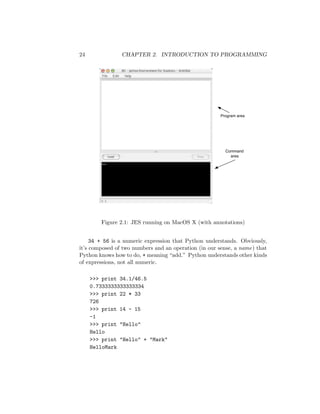
Once you start JES, it will look something like Figure 2.1. (A Windows
screenshot of the same thing is Figure 2.2—it really does run the same
thing on all Java-supported platforms.) There are two areas in JES (the bar
between them moves so that you can differentially resize the two areas):
• The top part is the program area. This where you write your recipes:
The programs and their names that you’re creating. This area is
simply a text editor—think of it as Microsoft Word for your programs.
The computer doesn’t actually try to intepret the names that you type
up in the program area until you press the Load, and you can’t press
the Load button until you’ve saved your program (by using the Save
menu item, which is visible in Figure 2.2 under the File menu.
• The bottom part is the command area. This is where you literally
command the computer to do something. You type your commands at
the  prompt, and when you hit return, the computer will interpret
your words (i.e., apply the meanings and encodings of the Python
programming language) and do what you have told it to do. This
interpretation will include whatever you typed and loaded from the
program area as well.
2.2.2 Media Computation in JES
We’re going to start out by simply typing commands in the command area—
not defining new names yet, but simply using the names that the computer
already knows from within JES.
The name print is an important one to know. It’s always used with
something following it. The meaning for print is “Display a readable rep-
resentation of whatever follows.” Whatever follows can be a name that the
computer knows, or an expression (literally in the algebraic sense). Try typ-
ing print 34 + 56 by clicking in the command area, typing the command,
and hitting return—like this:
 print 34 + 56
90
24 CHAPTER 2. INTRODUCTION TO PROGRAMMING
Command
area
Program area
Figure 2.1: JES running on MacOS X (with annotations)
34 + 56 is a numeric expression that Python understands. Obviously,
it’s composed of two numbers and an operation (in our sense, a name) that
Python knows how to do, + meaning “add.” Python understands other kinds
of expressions, not all numeric.
 print 34.1/46.5
0.7333333333333334
 print 22 * 33
726
 print 14 - 15
-1
 print Hello
Hello
 print Hello + Mark
HelloMark
2.2. PROGRAMMING IN PYTHON 25
Figure 2.2: JES running on Windows
Python understands a bunch of standard math operations. It also knows
how to recognize different kinds of numbers, both integer and floating point.
It also knows how to recognize strings (lists of characters) that are started
and ended with  (quote) marks. It even knows what it means to “add” two
strings together: It simply puts one right after the other.
26 CHAPTER 2. INTRODUCTION TO PROGRAMMING
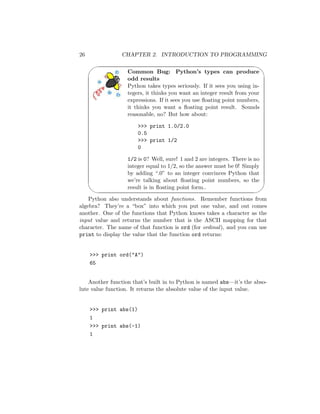
'

$
%
Common Bug: Python’s types can produce
odd results
Python takes types seriously. If it sees you using in-
tegers, it thinks you want an integer result from your
expressions. If it sees you use floating point numbers,
it thinks you want a floating point result. Sounds
reasonable, no? But how about:
 print 1.0/2.0
0.5
 print 1/2
0
1/2 is 0? Well, sure! 1 and 2 are integers. There is no
integer equal to 1/2, so the answer must be 0! Simply
by adding “.0” to an integer convinces Python that
we’re talking about floating point numbers, so the
result is in floating point form..
Python also understands about functions. Remember functions from
algebra? They’re a “box” into which you put one value, and out comes
another. One of the functions that Python knows takes a character as the
input value and returns the number that is the ASCII mapping for that
character. The name of that function is ord (for ordinal), and you can use
print to display the value that the function ord returns:
 print ord(A)
65
Another function that’s built in to Python is named abs—it’s the abso-
lute value function. It returns the absolute value of the input value.
 print abs(1)
1
 print abs(-1)
1
2.2. PROGRAMMING IN PYTHON 27
Debugging Tip: Common typos
If you type something that Python can’t understand
at all, you’ll get a syntax error.
 pint Hello
A syntax error is contained in the code
-- I can’t read it as Python.
If you try to access a word that Python doesn’t know,
Python will say that it doesn’t know that name.
 print a
A local or global name could not be
found.
Another function that JES1 knows is one that allows you to pick a file
from your disk. It takes no input, like ord did, but it does return a string
which is the name of the file on your disk. The name of the function is
pickAFile. Python is very picky about capitalization—neither pickafile
nor Pickafile will work! Try it like this print pickAFile(). When you
do, you will get something that looks like Figure 2.3.
You’re probably already familiar with how to use a file picker or file
dialog like this:
• Double-click on folders/directories to open them.
• Click to select and then click Open, or double-click, to select a file.
Once you select a file, what gets returned is the file name as a string
(a sequence of characters). (If you click Cancel, pickAFile returns the
empty string—a string of characters, with no characters in it, e.g., .) Try
it: Do print pickAFile() and Open a file.
 print pickAFile()
/Users/guzdial/mediasources/barbara.jpg
What you get when you finally select a file will depend on your operating
system. On Windows, your file name will probably start with C: and will
1
You might notice that I switched from saying “Python” knows to “JES” knows. print
is something that all Python implementations know. pickAFile is something that we built
for JES. In general, you can ignore the difference, but if you try to use another kind of
Python, it’ll be important to know what’s common and what isn’t.
28 CHAPTER 2. INTRODUCTION TO PROGRAMMING
Figure 2.3: The File Picker
have backslashes in it (e.g., ). On Linux or MacOS, it will probably look
something like the above. There are really two parts to this file name:
• The character between words (e.g., the / between “Users” and “guz-
dial”) is called the path delimiter. Everything from the beginning of
the file name to the last path delimiter is called the path to the file.
That describes exactly where on the hard disk (in which directory) a
file exists.
• The last part of the file (e.g. “barbara.jpg”) is called the base file
name. When you look at the file in the Finder/Explorer/Directory
window (depending on your operating system), that’s the part that
you see. Those last three characters (after the period) is called the file
extension. It identifies the encoding of the file.
Files that have an extension of “.jpg” are JPEG files. They contain
pictures. JPEG is a standard encoding for any kind of images. The other
kind of media files that we’ll be using alot are “.wav” files (Figure 2.4). The
“.wav” extension means that these are WAV files. They contain sounds.
WAV is a standard encoding for sounds. There are many other kinds of
extensions for files, and there are even many other kinds of media extensions.
For example, there are also GIF (“.gif”) files for images and AIFF (“.aif”
or “.aiff”) files for sounds. We’ll stick to JPEG and WAV in this text, just
to avoid too much complexity.
2.2. PROGRAMMING IN PYTHON 29
.wav file
.jpg file
Figure 2.4: File picker with media types identified
Showing a Picture
So now we know how to get a complete file name: Path and base name.
This doesn’t mean that we have the file itself loaded into memory. To get
the file into memory, we have to tell JES how to interpret this file. We know
that JPEG files are pictures, but we have to tell JES explicitly to read the
file and make a picture from it. There is a function for that, too, named
makePicture.
makePicture does require an argument—some input to the function. It
takes a file name! Lucky us—we know how to get one of those!
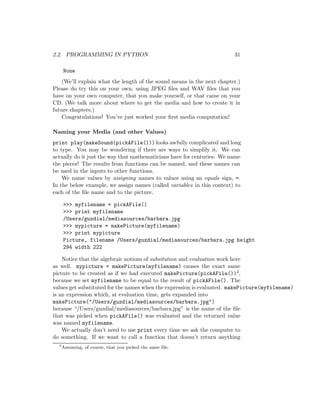
 print makePicture(pickAFile())
Picture, filename /Users/guzdial/mediasources/barbara.jpg height
294 width 222
The result from print suggests that we did in fact make a picture, from
a given filename and a given height and width. Success! Oh, you wanted
to actually see the picture? We’ll need another function! (Did I mention
somewhere that computers are stupid?) The function to show the picture
is named show. show also takes an argument—a Picture! Figure 2.5 is the
result. Ta-dah!
Notice that the output from show is None. Functions in Python don’t
have to return a value, unlike real mathematical functions. If a function
does something (like opening up a picture in a window), then it doesn’t also
need to return a value. It’s still pretty darn useful.
30 CHAPTER 2. INTRODUCTION TO PROGRAMMING
Figure 2.5: Picking, making, and showing a picture
Playing a Sound
We can actually replicate this entire process with sounds.
• We still use pickAFile to find the file we want and get its file name.
• We now use makeSound to make a Sound. makeSound, as you might
imagine, takes a file name as input.
• We will use play to play the sound. play takes a sound as input, but
returns None.
Here are the same steps we saw previously with pictures:
 print pickAFile()
/Users/guzdial/mediasources/hello.wav
 print makeSound(pickAFile())
Sound of length 54757
 print play(makeSound(pickAFile()))
2.2. PROGRAMMING IN PYTHON 31
None
(We’ll explain what the length of the sound means in the next chapter.)
Please do try this on your own, using JPEG files and WAV files that you
have on your own computer, that you make yourself, or that came on your
CD. (We talk more about where to get the media and how to create it in
future chapters.)
Congratulations! You’ve just worked your first media computation!
Naming your Media (and other Values)
print play(makeSound(pickAFile())) looks awfully complicated and long
to type. You may be wondering if there are ways to simplify it. We can
actually do it just the way that mathematicians have for centuries: We name
the pieces! The results from functions can be named, and these names can
be used in the inputs to other functions.
We name values by assigning names to values using an equals sign, =.
In the below example, we assign names (called variables in this context) to
each of the file name and to the picture.
 myfilename = pickAFile()
 print myfilename
/Users/guzdial/mediasources/barbara.jpg
 mypicture = makePicture(myfilename)
 print mypicture
Picture, filename /Users/guzdial/mediasources/barbara.jpg height
294 width 222
Notice that the algebraic notions of subsitution and evaluation work here
as well. mypicture = makePicture(myfilename) causes the exact same
picture to be created as if we had executed makePicture(pickAFile())2,
because we set myfilename to be equal to the result of pickAFile(). The
values get substituted for the names when the expression is evaluated. makePicture(myfilename)
is an expression which, at evaluation time, gets expanded into
makePicture(/Users/guzdial/mediasources/barbara.jpg)
because “/Users/guzdial/mediasources/barbara.jpg” is the name of the file
that was picked when pickAFile() was evaluated and the returned value
was named myfilename.
We actually don’t need to use print every time we ask the computer to
do something. If we want to call a function that doesn’t return anything
2
Assuming, of course, that you picked the same file.
32 CHAPTER 2. INTRODUCTION TO PROGRAMMING
(and so is pretty useless to print), we can just call the function by typing
its name and its input (if any) and hitting return.
 show(mypicture)
We tend to call these statements to the computer that are telling it to
do things commands. print mypicture is a command. So is myfilename
= pickAFile(), and show(mypicture). These are more than expressions:
They’re telling the computer to do something.
2.2.3 Making a Recipe
We have now used names to stand for values. The values get substituted
for the names when the expression is evaluated. We can do the same for
recipes. We can name a series of commands, so that we can just use the
name whenever we want the commands to be executed. This is exactly what
defining a recipe or program is about.
Remember when we said earlier that just about anything can be named
in computers? We’ve seen naming values. Now we’ll see naming recipes.
'

$
%
Making it Work Tip: Try every recipe!
To really understand what’s going on, type in, load,
and execute every recipe in the book. EVERY one.
None are long, but the practice will go along way to
convincing you that the programs work and helping
you understand why.
The name that Python understands as defining the name of new recipes
is def. def isn’t a function—it’s a command like print. There are certain
things that have to come after the word def, though. The structure of what
goes on the line with the def command is referred to as the syntax of the
command—the words and characters that have to be there for Python to
understand what’s going on, and the order of those things.
def needs three things to follow it on the same line:
• The name of the recipe that you’re defining, like showMyPicture.
• Whatever inputs that this recipe will take. This recipe can be a func-
tion that takes inputs, like abs or makePicture. The inputs are named
and placed between parentheses separated by commas. If your recipe
takes no inputs, you simply enter () to indicate no inputs.
• The line ends with a colon, :.
2.2. PROGRAMMING IN PYTHON 33
What comes after that are the commands to be executed, one after the
other, whenever this recipe is told to execute.
At this point, I need you to imagine a bit. Most real programs that
do useful things, especially those that create user interfaces, require the
definition of more than one function. Imagine that in the program area you
have several def commands. How do you think Python will figure out that
one function has ended and a new one begun? (Especially because it is
possible to define functions inside of other functions.) Python needs some
way of figuring out where the function body ends: Which statements are
part of this function and which are part of the next.
The answer is indentation. All the statements that are part of the def-
inition are slightly indented after the def statement. I recommend using
exactly two spaces—it’s enough to see, it’s easy to remember, and it’s sim-
ple. You’d enter the function in the program area like this (where  indicates
a single space, a single press of the spacebar): def hello():
print Hello!
We can now define our first recipe! You type this into the program area
of JES. When you’re done, save the file: Use the extension “.py” to indicate
a Python file. (I saved mine as pickAndShow.py.)
Recipe 2: Pick and show a picture
def pickAndShow():
myfile = pickAFile()
mypict = makePicture(myfile)
show(mypict)
End of Recipe 2
Once you’ve typed in your recipe and saved it, you can load it. Click
the Load button.
34 CHAPTER 2. INTRODUCTION TO PROGRAMMING
Figure 2.6: Defining and executing pickAndShow
Debugging Tip: Don’t forget to Load!
The most common mistake that I make with JES is
typing in the function, saving it, then trying the func-
tion in the command area. You have to click the
Load button to get it read in.
Now you can execute your recipe. Click in the command area. Since
you aren’t taking any input and not returning any value (i.e., this isn’t a
function), simply type the name of your recipe as a command:
 pickAndShow()

You’ll be prompted for a file, and then the picture will appear (Fig-
ure 2.6).
2.2. PROGRAMMING IN PYTHON 35
We can similarly define our second recipe, to pick and play a sound.
Recipe 3: Pick and play a sound
def pickAndPlay():
myfile = pickAFile()
mysound = makeSound(myfile)
play(mysound)
End of Recipe 3
'

$
%
Making it Work Tip: Name the names you
like
You’ll notice that, in the last section, we were us-
ing the names myfilename and mypicture. In this
recipe, I used myfile and mypict. Does it matter?
Absolutely not! Well, to the computer, at any rate.
The computer doesn’t care what names you use—
they’re entirely for your benefit. Pick names that (a)
are meaningful to you (so that you can read and un-
derstand your program), (b) are meaningful to others
(so that others you show your program to can un-
derstand it), and (c) are easy to type. 25-character
names, like,
myPictureThatIAmGoingToOpenAfterThis)
are meaningful, easy-to-read, but are a royal pain to
type.
While cool, this probably isn’t the most useful thing for you. Having
to pick the file over-and-over again is just a pain. But now that we have
the power of recipes, we can define new ones however we like! Let’s define
one that will just open a specific picture we want, and another that opens
a specific sound we want.
Use pickAFile to get the file name of the sound or picture that you want.
We’re going to need that in defining the recipe to play that specific sound
or show that specific picture. We’ll just set the value of myfile directly,
instead of as a result of pickAFile, by putting the string between quotes
36 CHAPTER 2. INTRODUCTION TO PROGRAMMING
directly in the recipe.
Recipe 4: Show a specific picture
Be sure to replace FILENAME below with the complete path to your own
picture file, e.g.,
”/Users/guzdial/mediasources/barbara.jpg”
def showPicture():
myfile = FILENAME
mypict = makePicture(myfile)
show(mypict)
End of Recipe 4
Recipe 5: Play a specific sound
Be sure to replace FILENAME below with the complete path to your own
sound file, e.g.,
”/Users/guzdial/mediasources/hello.wav”.
def playSound():
myfile = FILENAME
mysound = makeSound(myfile)
play(mysound)
End of Recipe 5
2.2. PROGRAMMING IN PYTHON 37
'

$
%
Making it Work Tip: Copying and pasting
Text can be copied and pasted between the pro-
gram and command areas. You can use print
pickAFile() to print a filename, then select it and
copy it (from the Edit menu), then click in the com-
mand area and paste it. Similarly, you can copy
whole commands from the command area up to the
program area: That’s an easy way to test the indi-
vidual commands, and then put them all in a recipe
once you have the order right and they’re working.
You can also copy text within the command area.
Instead of re-typing a command, select it, copy it,
paste it into the bottom line (make sure the cursor
is at the end of the line!), and hit return to execute
it.
Variable Recipes: Real functions that Take Input
How do we create a real function with inputs out of our stored recipe? Why
would you want to?
An important reason for using a variable so that input to the recipe
can be specified is to make a program more general. Consider Recipe 4,
showPicture. That’s for a specific file name. Would it be useful to have a
function that could take any file name, then make and show the picture?
That kind of function handles the general case of making and showing pic-
tures. We call that kind of generalization abstraction. Abstraction leads to
general solutions that work in lots of situations.
Defining a recipe that takes input is very easy. It continues to be a matter
of substitution and evaluation. We’ll put a name inside those parentheses
on the def line. That name is sometimes called the parameter—we’ll just
call it the input variable for right now.
When you evaluate the function, by specifying its name with an input
value (also called the argument) inside parentheses (like makepicture(myfilename)
or show(mypicture)), the input value is assigned to the input variable. Dur-
ing the execution of the function (recipe), the input value will be substituted
for the value.
Here’s what a recipe would look like that takes the file name as an input
38 CHAPTER 2. INTRODUCTION TO PROGRAMMING
variable:
Recipe 6: Show the picture file whose file name is input
def showNamed(myfile):
mypict = makePicture(myfile)
show(mypict)
End of Recipe 6
When I type
showNamed(/Users/guzdial/mediasources/barbara.jpg)
and hit return, the variable myfile takes on the value
/Users/guzdial/mediasources/barbara.jpg.
myPict will then be assigned to the picture resulting from reading and in-
terpreting the file at
‘‘/Users/guzdial/mediasources/barbara.jpg’’
Then the pictures is shown.
We can do a sound in the same way.
Recipe 7: Play the sound file whose file name is input
def playNamed(myfile):
mysound = makeSound(myfile)
play(mysound)
End of Recipe 7
We can also write recipes that take pictures or sounds in as the input
values. Here’s a recipe that shows a picture but takes the picture object as
the input value, instead of the filename.
Recipe 8: Show the picture provided as input
def showPicture(mypict):
show(mypict)
2.2. PROGRAMMING IN PYTHON 39
End of Recipe 8
Now, what’s the difference between the function showPicture and the
provided function show? Nothing at all. We can certainly create a function
that provides a new name to another function. If that makes your code
easier for you to understand, than it’s a great idea.
What’s the right input value for a function? Is it better to input a
filename or a picture? And what does “better” mean here, anyway? You’ll
read more about all of these later, but here’s a short answer: Write the
function that is most useful to you. If defining showPicture is more readable
for you than show, then that’s useful. If what you really want is a function
that takes care of making the picture and showing it to you, then that’s
more useful and you might find the showNamed function the most useful.
Objects and Functions Summary
In this chapter, we talk about several kinds of encodings of data (or objects).
Integers (e.g., 3) Numbers without a decimal point—they can’t
represent fractions.
Floating point numbers (e.g., 3.0, 3.01) Numbers with a fractional piece to them.
Strings (e.g., ”Hello!”) A sequence of characters (including spaces,
punctuation, etc.) delimited on either end
with a quote character.
File name A filename is just a string whose characters
represent a path, path delimiters, and a base
file name.
Pictures Pictures are encodings of images, typically
coming from a JPEG file.
Sounds Sounds are encodings of sounds, typically
coming froma WAV file.
Here are the functions introduced in this chapter:
Random documents with unrelated
content Scribd suggests to you:
FOR YOUNG PEOPLE
ROYAL ROGUES
By ALBERTA BANCROFT. With Illustrations by Louis Betts. 12mo.
$1.25
There are few healthy-minded folk, whatever their time of life,
who will not confess to a fondness for fairy tales of the right sort.
Royal Rogues has that quality which makes a children's book win
the hearts of grown-ups. The heroes are merry twin rogues, king's
sons of course, but with a strain of fairy blood in their veins. Wildly
strange and delightful are their explorations in the realms of
fairyland.
A charming story ... must be accounted one of the prettiest
and cleverest of modern fairy stories.—Worcester Spy.
ON BOARD A WHALER
An Adventurous Cruise through Southern Seas. By THOMAS WEST
HAMMOND. With 16 full-page illustrations by HARRY GEORGE
BURGESS. 12mo. $1.25
Thrilling throughout.... In the name of American youth, we
thank Mr. Hammond for resuscitating a memory that had slumbered
so long.—Com. Advertiser.
The yarn he spins of that and other trips in search of oil is one
of the best I ever read. It is indeed a thrilling, exciting, dangerous
story of the sea, a tale of personal experience put into book form by
as brave a sailor as ever chased whales, and it is full of that local
color which makes a fellow's blood tingle as he turns the pages. The
illustrations are excellent.—HENRY HAYNIE in The Boston Times.
G. P. PUTNAM'S SONS
NEW YORK LONDON
* * * * * * * *
By HERBERT STRANG
The Adventures of Harry Rochester: A Tale of the Days of
Marlborough and Eugene.
The Light Brigade in Spain; or, The Last Fight of Sir John Moore.
Kobo. A Story of the Russo-Japanese War.
*** END OF THIS PROJECT GUTENBERG EBOOK THE ADVENTURES
OF HARRY ROCHESTER ***
*** END OF THE PROJECT GUTENBERG EBOOK THE ADVENTURES
OF HARRY ROCHESTER: A TALE OF THE DAYS OF MARLBOROUGH
AND EUGENE ***
Updated editions will replace the previous one—the old editions
will be renamed.
Creating the works from print editions not protected by U.S.
copyright law means that no one owns a United States
copyright in these works, so the Foundation (and you!) can copy
and distribute it in the United States without permission and
without paying copyright royalties. Special rules, set forth in the
General Terms of Use part of this license, apply to copying and
distributing Project Gutenberg™ electronic works to protect the
PROJECT GUTENBERG™ concept and trademark. Project
Gutenberg is a registered trademark, and may not be used if
you charge for an eBook, except by following the terms of the
trademark license, including paying royalties for use of the
Project Gutenberg trademark. If you do not charge anything for
copies of this eBook, complying with the trademark license is
very easy. You may use this eBook for nearly any purpose such
as creation of derivative works, reports, performances and
research. Project Gutenberg eBooks may be modified and
printed and given away—you may do practically ANYTHING in
the United States with eBooks not protected by U.S. copyright
law. Redistribution is subject to the trademark license, especially
commercial redistribution.
START: FULL LICENSE
THE FULL PROJECT GUTENBERG LICENSE
PLEASE READ THIS BEFORE YOU DISTRIBUTE OR USE THIS WORK
To protect the Project Gutenberg™ mission of promoting the
free distribution of electronic works, by using or distributing this
work (or any other work associated in any way with the phrase
“Project Gutenberg”), you agree to comply with all the terms of
the Full Project Gutenberg™ License available with this file or
online at www.gutenberg.org/license.
Section 1. General Terms of Use and
Redistributing Project Gutenberg™
electronic works
1.A. By reading or using any part of this Project Gutenberg™
electronic work, you indicate that you have read, understand,
agree to and accept all the terms of this license and intellectual
property (trademark/copyright) agreement. If you do not agree
to abide by all the terms of this agreement, you must cease
using and return or destroy all copies of Project Gutenberg™
electronic works in your possession. If you paid a fee for
obtaining a copy of or access to a Project Gutenberg™
electronic work and you do not agree to be bound by the terms
of this agreement, you may obtain a refund from the person or
entity to whom you paid the fee as set forth in paragraph 1.E.8.
1.B. “Project Gutenberg” is a registered trademark. It may only
be used on or associated in any way with an electronic work by
people who agree to be bound by the terms of this agreement.
There are a few things that you can do with most Project
Gutenberg™ electronic works even without complying with the
full terms of this agreement. See paragraph 1.C below. There
are a lot of things you can do with Project Gutenberg™
electronic works if you follow the terms of this agreement and
help preserve free future access to Project Gutenberg™
electronic works. See paragraph 1.E below.
1.C. The Project Gutenberg Literary Archive Foundation (“the
Foundation” or PGLAF), owns a compilation copyright in the
collection of Project Gutenberg™ electronic works. Nearly all the
individual works in the collection are in the public domain in the
United States. If an individual work is unprotected by copyright
law in the United States and you are located in the United
States, we do not claim a right to prevent you from copying,
distributing, performing, displaying or creating derivative works
based on the work as long as all references to Project
Gutenberg are removed. Of course, we hope that you will
support the Project Gutenberg™ mission of promoting free
access to electronic works by freely sharing Project Gutenberg™
works in compliance with the terms of this agreement for
keeping the Project Gutenberg™ name associated with the
work. You can easily comply with the terms of this agreement
by keeping this work in the same format with its attached full
Project Gutenberg™ License when you share it without charge
with others.
1.D. The copyright laws of the place where you are located also
govern what you can do with this work. Copyright laws in most
countries are in a constant state of change. If you are outside
the United States, check the laws of your country in addition to
the terms of this agreement before downloading, copying,
displaying, performing, distributing or creating derivative works
based on this work or any other Project Gutenberg™ work. The
Foundation makes no representations concerning the copyright
status of any work in any country other than the United States.
1.E. Unless you have removed all references to Project
Gutenberg:
1.E.1. The following sentence, with active links to, or other
immediate access to, the full Project Gutenberg™ License must
appear prominently whenever any copy of a Project
Gutenberg™ work (any work on which the phrase “Project
Gutenberg” appears, or with which the phrase “Project
Gutenberg” is associated) is accessed, displayed, performed,
viewed, copied or distributed:
This eBook is for the use of anyone anywhere in
the United States and most other parts of the
world at no cost and with almost no restrictions
whatsoever. You may copy it, give it away or re-
use it under the terms of the Project Gutenberg
License included with this eBook or online at
www.gutenberg.org. If you are not located in the
United States, you will have to check the laws of
the country where you are located before using
this eBook.
1.E.2. If an individual Project Gutenberg™ electronic work is
derived from texts not protected by U.S. copyright law (does not
contain a notice indicating that it is posted with permission of
the copyright holder), the work can be copied and distributed to
anyone in the United States without paying any fees or charges.
If you are redistributing or providing access to a work with the
phrase “Project Gutenberg” associated with or appearing on the
work, you must comply either with the requirements of
paragraphs 1.E.1 through 1.E.7 or obtain permission for the use
of the work and the Project Gutenberg™ trademark as set forth
in paragraphs 1.E.8 or 1.E.9.
1.E.3. If an individual Project Gutenberg™ electronic work is
posted with the permission of the copyright holder, your use and
distribution must comply with both paragraphs 1.E.1 through
1.E.7 and any additional terms imposed by the copyright holder.
Additional terms will be linked to the Project Gutenberg™
License for all works posted with the permission of the copyright
holder found at the beginning of this work.
1.E.4. Do not unlink or detach or remove the full Project
Gutenberg™ License terms from this work, or any files
containing a part of this work or any other work associated with
Project Gutenberg™.
1.E.5. Do not copy, display, perform, distribute or redistribute
this electronic work, or any part of this electronic work, without
prominently displaying the sentence set forth in paragraph 1.E.1
with active links or immediate access to the full terms of the
Project Gutenberg™ License.
1.E.6. You may convert to and distribute this work in any binary,
compressed, marked up, nonproprietary or proprietary form,
including any word processing or hypertext form. However, if
you provide access to or distribute copies of a Project
Gutenberg™ work in a format other than “Plain Vanilla ASCII” or
other format used in the official version posted on the official
Project Gutenberg™ website (www.gutenberg.org), you must,
at no additional cost, fee or expense to the user, provide a copy,
a means of exporting a copy, or a means of obtaining a copy
upon request, of the work in its original “Plain Vanilla ASCII” or
other form. Any alternate format must include the full Project
Gutenberg™ License as specified in paragraph 1.E.1.
1.E.7. Do not charge a fee for access to, viewing, displaying,
performing, copying or distributing any Project Gutenberg™
works unless you comply with paragraph 1.E.8 or 1.E.9.
1.E.8. You may charge a reasonable fee for copies of or
providing access to or distributing Project Gutenberg™
electronic works provided that:
• You pay a royalty fee of 20% of the gross profits you derive
from the use of Project Gutenberg™ works calculated using the
method you already use to calculate your applicable taxes. The
fee is owed to the owner of the Project Gutenberg™ trademark,
but he has agreed to donate royalties under this paragraph to
the Project Gutenberg Literary Archive Foundation. Royalty
payments must be paid within 60 days following each date on
which you prepare (or are legally required to prepare) your
periodic tax returns. Royalty payments should be clearly marked
as such and sent to the Project Gutenberg Literary Archive
Foundation at the address specified in Section 4, “Information
about donations to the Project Gutenberg Literary Archive
Foundation.”
• You provide a full refund of any money paid by a user who
notifies you in writing (or by e-mail) within 30 days of receipt
that s/he does not agree to the terms of the full Project
Gutenberg™ License. You must require such a user to return or
destroy all copies of the works possessed in a physical medium
and discontinue all use of and all access to other copies of
Project Gutenberg™ works.
• You provide, in accordance with paragraph 1.F.3, a full refund of
any money paid for a work or a replacement copy, if a defect in
the electronic work is discovered and reported to you within 90
days of receipt of the work.
• You comply with all other terms of this agreement for free
distribution of Project Gutenberg™ works.
1.E.9. If you wish to charge a fee or distribute a Project
Gutenberg™ electronic work or group of works on different
terms than are set forth in this agreement, you must obtain
permission in writing from the Project Gutenberg Literary
Archive Foundation, the manager of the Project Gutenberg™
trademark. Contact the Foundation as set forth in Section 3
below.
1.F.
1.F.1. Project Gutenberg volunteers and employees expend
considerable effort to identify, do copyright research on,
transcribe and proofread works not protected by U.S. copyright
law in creating the Project Gutenberg™ collection. Despite these
efforts, Project Gutenberg™ electronic works, and the medium
on which they may be stored, may contain “Defects,” such as,
but not limited to, incomplete, inaccurate or corrupt data,
transcription errors, a copyright or other intellectual property
infringement, a defective or damaged disk or other medium, a
computer virus, or computer codes that damage or cannot be
read by your equipment.
1.F.2. LIMITED WARRANTY, DISCLAIMER OF DAMAGES - Except
for the “Right of Replacement or Refund” described in
paragraph 1.F.3, the Project Gutenberg Literary Archive
Foundation, the owner of the Project Gutenberg™ trademark,
and any other party distributing a Project Gutenberg™ electronic
work under this agreement, disclaim all liability to you for
damages, costs and expenses, including legal fees. YOU AGREE
THAT YOU HAVE NO REMEDIES FOR NEGLIGENCE, STRICT
LIABILITY, BREACH OF WARRANTY OR BREACH OF CONTRACT
EXCEPT THOSE PROVIDED IN PARAGRAPH 1.F.3. YOU AGREE
THAT THE FOUNDATION, THE TRADEMARK OWNER, AND ANY
DISTRIBUTOR UNDER THIS AGREEMENT WILL NOT BE LIABLE
TO YOU FOR ACTUAL, DIRECT, INDIRECT, CONSEQUENTIAL,
PUNITIVE OR INCIDENTAL DAMAGES EVEN IF YOU GIVE
NOTICE OF THE POSSIBILITY OF SUCH DAMAGE.
1.F.3. LIMITED RIGHT OF REPLACEMENT OR REFUND - If you
discover a defect in this electronic work within 90 days of
receiving it, you can receive a refund of the money (if any) you
paid for it by sending a written explanation to the person you
received the work from. If you received the work on a physical
medium, you must return the medium with your written
explanation. The person or entity that provided you with the
defective work may elect to provide a replacement copy in lieu
of a refund. If you received the work electronically, the person
or entity providing it to you may choose to give you a second
opportunity to receive the work electronically in lieu of a refund.
If the second copy is also defective, you may demand a refund
in writing without further opportunities to fix the problem.
1.F.4. Except for the limited right of replacement or refund set
forth in paragraph 1.F.3, this work is provided to you ‘AS-IS’,
WITH NO OTHER WARRANTIES OF ANY KIND, EXPRESS OR
IMPLIED, INCLUDING BUT NOT LIMITED TO WARRANTIES OF
MERCHANTABILITY OR FITNESS FOR ANY PURPOSE.
1.F.5. Some states do not allow disclaimers of certain implied
warranties or the exclusion or limitation of certain types of
damages. If any disclaimer or limitation set forth in this
agreement violates the law of the state applicable to this
agreement, the agreement shall be interpreted to make the
maximum disclaimer or limitation permitted by the applicable
state law. The invalidity or unenforceability of any provision of
this agreement shall not void the remaining provisions.
1.F.6. INDEMNITY - You agree to indemnify and hold the
Foundation, the trademark owner, any agent or employee of the
Foundation, anyone providing copies of Project Gutenberg™
electronic works in accordance with this agreement, and any
volunteers associated with the production, promotion and
distribution of Project Gutenberg™ electronic works, harmless
from all liability, costs and expenses, including legal fees, that
arise directly or indirectly from any of the following which you
do or cause to occur: (a) distribution of this or any Project
Gutenberg™ work, (b) alteration, modification, or additions or
deletions to any Project Gutenberg™ work, and (c) any Defect
you cause.
Section 2. Information about the Mission
of Project Gutenberg™
Project Gutenberg™ is synonymous with the free distribution of
electronic works in formats readable by the widest variety of
computers including obsolete, old, middle-aged and new
computers. It exists because of the efforts of hundreds of
volunteers and donations from people in all walks of life.
Volunteers and financial support to provide volunteers with the
assistance they need are critical to reaching Project
Gutenberg™’s goals and ensuring that the Project Gutenberg™
collection will remain freely available for generations to come. In
2001, the Project Gutenberg Literary Archive Foundation was
created to provide a secure and permanent future for Project
Gutenberg™ and future generations. To learn more about the
Project Gutenberg Literary Archive Foundation and how your
efforts and donations can help, see Sections 3 and 4 and the
Foundation information page at www.gutenberg.org.
Section 3. Information about the Project
Gutenberg Literary Archive Foundation
The Project Gutenberg Literary Archive Foundation is a non-
profit 501(c)(3) educational corporation organized under the
laws of the state of Mississippi and granted tax exempt status
by the Internal Revenue Service. The Foundation’s EIN or
federal tax identification number is 64-6221541. Contributions
to the Project Gutenberg Literary Archive Foundation are tax
deductible to the full extent permitted by U.S. federal laws and
your state’s laws.
The Foundation’s business office is located at 809 North 1500
West, Salt Lake City, UT 84116, (801) 596-1887. Email contact
links and up to date contact information can be found at the
Foundation’s website and official page at
www.gutenberg.org/contact
Section 4. Information about Donations to
the Project Gutenberg Literary Archive
Foundation
Project Gutenberg™ depends upon and cannot survive without
widespread public support and donations to carry out its mission
of increasing the number of public domain and licensed works
that can be freely distributed in machine-readable form
accessible by the widest array of equipment including outdated
equipment. Many small donations ($1 to $5,000) are particularly
important to maintaining tax exempt status with the IRS.
The Foundation is committed to complying with the laws
regulating charities and charitable donations in all 50 states of
the United States. Compliance requirements are not uniform
and it takes a considerable effort, much paperwork and many
fees to meet and keep up with these requirements. We do not
solicit donations in locations where we have not received written
confirmation of compliance. To SEND DONATIONS or determine
the status of compliance for any particular state visit
www.gutenberg.org/donate.
While we cannot and do not solicit contributions from states
where we have not met the solicitation requirements, we know
of no prohibition against accepting unsolicited donations from
donors in such states who approach us with offers to donate.
International donations are gratefully accepted, but we cannot
make any statements concerning tax treatment of donations
received from outside the United States. U.S. laws alone swamp
our small staff.
Please check the Project Gutenberg web pages for current
donation methods and addresses. Donations are accepted in a
number of other ways including checks, online payments and
credit card donations. To donate, please visit:
www.gutenberg.org/donate.
Section 5. General Information About
Project Gutenberg™ electronic works
Professor Michael S. Hart was the originator of the Project
Gutenberg™ concept of a library of electronic works that could
be freely shared with anyone. For forty years, he produced and
distributed Project Gutenberg™ eBooks with only a loose
network of volunteer support.
Project Gutenberg™ eBooks are often created from several
printed editions, all of which are confirmed as not protected by
copyright in the U.S. unless a copyright notice is included. Thus,
we do not necessarily keep eBooks in compliance with any
particular paper edition.
Most people start at our website which has the main PG search
facility: www.gutenberg.org.
This website includes information about Project Gutenberg™,
including how to make donations to the Project Gutenberg
Literary Archive Foundation, how to help produce our new
eBooks, and how to subscribe to our email newsletter to hear
about new eBooks.
Welcome to our website – the perfect destination for book lovers and
knowledge seekers. We believe that every book holds a new world,
offering opportunities for learning, discovery, and personal growth.
That’s why we are dedicated to bringing you a diverse collection of
books, ranging from classic literature and specialized publications to
self-development guides and children's books.
More than just a book-buying platform, we strive to be a bridge
connecting you with timeless cultural and intellectual values. With an
elegant, user-friendly interface and a smart search system, you can
quickly find the books that best suit your interests. Additionally,
our special promotions and home delivery services help you save time
and fully enjoy the joy of reading.
Join us on a journey of knowledge exploration, passion nurturing, and
personal growth every day!
ebookbell.com

Introduction To Computing And Programming In Python A Multimedia Approach Papcdr Mark J Guzdial

  • 1.
    Introduction To ComputingAnd Programming In Python A Multimedia Approach Papcdr Mark J Guzdial download https://ebookbell.com/product/introduction-to-computing-and- programming-in-python-a-multimedia-approach-papcdr-mark-j- guzdial-1526820 Explore and download more ebooks at ebookbell.com
  • 2.
    Here are somerecommended products that we believe you will be interested in. You can click the link to download. Introduction To Computing And Programming In Python A Multimedia Approach Fourth Edition Guzdial https://ebookbell.com/product/introduction-to-computing-and- programming-in-python-a-multimedia-approach-fourth-edition- guzdial-21354934 Introduction To Computing And Programming In Python Global Edition 4th Edition Mark J Guzdial https://ebookbell.com/product/introduction-to-computing-and- programming-in-python-global-edition-4th-edition-mark-j- guzdial-6714384 Explorations In Computing An Introduction To Computer Science And Python Programming 1st Edition Conery https://ebookbell.com/product/explorations-in-computing-an- introduction-to-computer-science-and-python-programming-1st-edition- conery-37723400 Explorations In Computing An Introduction To Computer Science And Python Programming John S Conery https://ebookbell.com/product/explorations-in-computing-an- introduction-to-computer-science-and-python-programming-john-s- conery-36151176
  • 3.
    Introduction To ComputingAnd Programming With Java A Multimedia Approach Barbara Ericson https://ebookbell.com/product/introduction-to-computing-and- programming-with-java-a-multimedia-approach-barbara-ericson-5411198 How To Design Programs An Introduction To Computing And Programming Using Scheme Free Web Version Felleisen M https://ebookbell.com/product/how-to-design-programs-an-introduction- to-computing-and-programming-using-scheme-free-web-version- felleisen-m-874218 How To Design Programs An Introduction To Computing And Programming Using Scheme Free Web Version Felleisen M https://ebookbell.com/product/how-to-design-programs-an-introduction- to-computing-and-programming-using-scheme-free-web-version- felleisen-m-4742466 How To Design Programs An Introduction To Programming And Computing 2nd Edition 2nd Matthias Felleisen https://ebookbell.com/product/how-to-design-programs-an-introduction- to-programming-and-computing-2nd-edition-2nd-matthias- felleisen-50195556 How To Design Programs An Introduction To Programming And Computing Matthias Felleisen https://ebookbell.com/product/how-to-design-programs-an-introduction- to-programming-and-computing-matthias-felleisen-4149148
  • 6.
    Introduction to MediaComputation: A Multimedia Cookbook in Python Mark Guzdial December 16, 2002
  • 7.
  • 8.
    Contents I Introduction 5 1Introduction to Media Computation 7 1.1 What is computer science about? . . . . . . . . . . . . . . . . 7 1.2 What Computers Understand . . . . . . . . . . . . . . . . . . 11 1.3 Media Computation: Why digitize media? . . . . . . . . . . . 14 1.4 Computer Science for Non-Computer Scientists . . . . . . . . 15 1.4.1 It’s about communication . . . . . . . . . . . . . . . . 16 1.4.2 It’s about process . . . . . . . . . . . . . . . . . . . . . 16 2 Introduction to Programming 19 2.1 Programming is about Naming . . . . . . . . . . . . . . . . . 19 2.1.1 Files and their Names . . . . . . . . . . . . . . . . . . 21 2.2 Programming in Python . . . . . . . . . . . . . . . . . . . . . 22 2.2.1 Programming in JES . . . . . . . . . . . . . . . . . . . 23 2.2.2 Media Computation in JES . . . . . . . . . . . . . . . 23 2.2.3 Making a Recipe . . . . . . . . . . . . . . . . . . . . . 32 II Sounds 43 3 Encoding and Manipulating Sounds 45 3.1 How Sound is Encoded . . . . . . . . . . . . . . . . . . . . . . 45 3.1.1 The Physics of Sound . . . . . . . . . . . . . . . . . . 45 3.1.2 Encoding the Sound . . . . . . . . . . . . . . . . . . . 52 3.1.3 Using MediaTools for looking at captured sounds . . . 58 3.2 Manipulating sounds . . . . . . . . . . . . . . . . . . . . . . . 60 3.2.1 Open sounds and manipulating samples . . . . . . . . 60 3.2.2 Introducing the loop . . . . . . . . . . . . . . . . . . . 63 3.2.3 Changing the volume of sounds . . . . . . . . . . . . . 67 iii
  • 9.
    iv CONTENTS 3.2.4 Manipulatingdifferent sections of the sound differently 77 3.2.5 Splicing sounds . . . . . . . . . . . . . . . . . . . . . . 81 3.2.6 Backwards sounds . . . . . . . . . . . . . . . . . . . . 85 3.2.7 Changing the frequency of sounds . . . . . . . . . . . 87 4 Creating Sounds 97 4.1 Creating an Echo . . . . . . . . . . . . . . . . . . . . . . . . . 98 4.1.1 Creating Multiple Echoes . . . . . . . . . . . . . . . . 99 4.1.2 Additive Synthesis . . . . . . . . . . . . . . . . . . . . 100 III Pictures 113 5 Encoding and Manipulating Pictures 115 5.1 How Pictures are Encoded . . . . . . . . . . . . . . . . . . . . 115 5.2 Manipulating Pictures . . . . . . . . . . . . . . . . . . . . . . 119 5.2.1 Exploring pictures . . . . . . . . . . . . . . . . . . . . 126 5.2.2 Changing color values . . . . . . . . . . . . . . . . . . 127 5.2.3 Copying pixels . . . . . . . . . . . . . . . . . . . . . . 134 5.2.4 Replacing Colors . . . . . . . . . . . . . . . . . . . . . 145 5.2.5 Combining pixels . . . . . . . . . . . . . . . . . . . . . 152 5.3 Color Figures . . . . . . . . . . . . . . . . . . . . . . . . . . . 159 6 Creating Pictures 165 6.1 Drawing on images with pixels . . . . . . . . . . . . . . . . . 165 6.2 Drawing with drawing commands . . . . . . . . . . . . . . . . 166 IV Meta-Issues: How we do what we do 169 7 Design and Debugging 171 7.1 Designing programs . . . . . . . . . . . . . . . . . . . . . . . 171 7.1.1 Top-down . . . . . . . . . . . . . . . . . . . . . . . . . 171 7.1.2 Bottom-up . . . . . . . . . . . . . . . . . . . . . . . . 171 7.2 Techniques of Debugging . . . . . . . . . . . . . . . . . . . . . 172 V Files 175 8 Encoding, Creating, and Manipulating Files 177 8.1 How to walk through a directory . . . . . . . . . . . . . . . . 177
  • 10.
    CONTENTS v 8.2 Copyingfiles . . . . . . . . . . . . . . . . . . . . . . . . . . . 178 VI Text 181 9 Encoding and Manipulation of Text 183 9.1 A recipe to generate HTML . . . . . . . . . . . . . . . . . . . 183 9.2 Converting from sound to text to graphics . . . . . . . . . . . 185 VII Movies 187 10 Encoding, Manipulation and Creating Movies 189 10.1 Manipulating movies . . . . . . . . . . . . . . . . . . . . . . . 189 10.2 Compositing to create new movies . . . . . . . . . . . . . . . 191 10.3 Animation: Creating movies from scratch . . . . . . . . . . . 192 11 Storing Media 195 VIII Isn’t there a better way? 197 12 How fast can we get? 199 12.1 Complexity . . . . . . . . . . . . . . . . . . . . . . . . . . . . 199 12.2 Speed limits . . . . . . . . . . . . . . . . . . . . . . . . . . . . 199 12.3 Native code versus interpreted code . . . . . . . . . . . . . . . 200 IX Programming and Design 201 13 Functional Decomposition 203 13.1 Using map . . . . . . . . . . . . . . . . . . . . . . . . . . . . . 203 14 Recursion 205 15 Objects 207 X Other Languages 209 16 Java 211 16.1 Java examples . . . . . . . . . . . . . . . . . . . . . . . . . . . 211
  • 11.
  • 12.
    List of Figures 1.1Eight wires with a pattern of voltages is a byte, which gets interpreted as a pattern of eight 0’s and 1’s, which gets inter- preted as a decimal number. . . . . . . . . . . . . . . . . . . . 12 1.2 Alan Perlis . . . . . . . . . . . . . . . . . . . . . . . . . . . . 17 2.1 JES running on MacOS X (with annotations) . . . . . . . . . 24 2.2 JES running on Windows . . . . . . . . . . . . . . . . . . . . 25 2.3 The File Picker . . . . . . . . . . . . . . . . . . . . . . . . . . 28 2.4 File picker with media types identified . . . . . . . . . . . . . 29 2.5 Picking, making, and showing a picture . . . . . . . . . . . . 30 2.6 Defining and executing pickAndShow . . . . . . . . . . . . . . 34 3.1 Raindrops causing ripples in the surface of the water, just as sound causes ripples in the air . . . . . . . . . . . . . . . . . . 46 3.2 One cycle of the simplest sound, a sine wave . . . . . . . . . . 46 3.3 The distance between peaks in ripples in a pond are not constant—some gaps are longer, some shorter . . . . . . . . . 48 3.4 The note A above middle C is 440 Hz . . . . . . . . . . . . . 49 3.5 Some synthesizers using triangular (or sawtooth) or square waves. . . . . . . . . . . . . . . . . . . . . . . . . . . . . . . . 50 3.6 Sound editor main tool . . . . . . . . . . . . . . . . . . . . . . 50 3.7 Viewing the sound signal as it comes in . . . . . . . . . . . . 51 3.8 Viewing the sound in a spectrum view . . . . . . . . . . . . . 52 3.9 Viewing a sound in spectrum view with multiple “spikes” . . 53 3.10 Viewing the sound signal in a sonogram view . . . . . . . . . 54 3.11 Area under a curve estimated with rectangles . . . . . . . . . 55 3.12 A depiction of the first five elements in a real sound array . . 57 3.13 A sound recording graphed in the MediaTools . . . . . . . . . 57 3.14 The sound editor open menu . . . . . . . . . . . . . . . . . . 58 vii
  • 13.
    viii LIST OFFIGURES 3.15 MediaTools open file dialog . . . . . . . . . . . . . . . . . . . 58 3.16 A sound opened in the editor . . . . . . . . . . . . . . . . . . 59 3.17 Exploring the sound in the editor . . . . . . . . . . . . . . . . 59 3.18 Comparing the graphs of the original sound (top) and the louder one (bottom) . . . . . . . . . . . . . . . . . . . . . . . 69 3.19 Comparing specific samples in the original sound (top) and the louder one (bottom) . . . . . . . . . . . . . . . . . . . . . 70 3.20 Comparing the original sound (top) to the spliced sound (bot- tom) . . . . . . . . . . . . . . . . . . . . . . . . . . . . . . . . 86 4.1 The top and middle waves are added together to create the bottom wave . . . . . . . . . . . . . . . . . . . . . . . . . . . 109 4.2 The raw 440 Hz signal on top, then the 440+880+1320 Hz signal on the bottom . . . . . . . . . . . . . . . . . . . . . . . 110 4.3 FFT of the 440 Hz sound . . . . . . . . . . . . . . . . . . . . 110 4.4 FFT of the combined sound . . . . . . . . . . . . . . . . . . . 110 4.5 The 440 Hz square wave (top) and additive combination of square waves (bottom) . . . . . . . . . . . . . . . . . . . . . . 111 4.6 FFT’s of the 440 Hz square wave (top) and additive combi- nation of square waves (bottom) . . . . . . . . . . . . . . . . 111 5.1 An example matrix . . . . . . . . . . . . . . . . . . . . . . . . 116 5.2 Cursor and icon at regular magnification on top, and close-up views of the cursor (left) and the line below the cursor (right) 117 5.3 Merging red, green, and blue to make new colors . . . . . . . 118 5.4 The Macintosh OS X RGB color picker . . . . . . . . . . . . 118 5.5 Picking a color using RGB sliders from JES . . . . . . . . . . 119 5.6 RGB triplets in a matrix representation . . . . . . . . . . . . 120 5.7 Directly modifying the pixel colors via commands: Note the small yellow line on the left . . . . . . . . . . . . . . . . . . . 125 5.8 Using the MediaTools image exploration tools . . . . . . . . . 126 5.9 The original picture (left) and red-reduced version (right) . . 128 5.10 Overly blue (left) and red increased by 20% (right) . . . . . . 129 5.11 Original (left) and blue erased (right) . . . . . . . . . . . . . 130 5.12 Lightening and darkening of original picture . . . . . . . . . . 131 5.13 Negative of the image . . . . . . . . . . . . . . . . . . . . . . 132 5.14 Color picture converted to greyscale . . . . . . . . . . . . . . 134 5.15 Once we pick a mirrorpoint, we can just walk x halfway and subtract/add to mirrorpoint . . . . . . . . . . . . . . . . . . . 136
  • 14.
    LIST OF FIGURESix 5.16 Original picture (left) and mirrored along the vertical axis (right) . . . . . . . . . . . . . . . . . . . . . . . . . . . . . . . 137 5.17 Flowers in the mediasources folder . . . . . . . . . . . . . . 141 5.18 Collage of flowers . . . . . . . . . . . . . . . . . . . . . . . . . 142 5.19 Increasing reds in the browns . . . . . . . . . . . . . . . . . . 147 5.20 Increasing reds in the browns, within a certain range . . . . . 148 5.21 A picture of a child (Katie), and her background without her 149 5.22 A new background, the moon . . . . . . . . . . . . . . . . . . 149 5.23 Katie on the moon . . . . . . . . . . . . . . . . . . . . . . . . 150 5.24 Mark in front of a blue sheet . . . . . . . . . . . . . . . . . . 150 5.25 Mark on the moon . . . . . . . . . . . . . . . . . . . . . . . . 151 5.26 Mark in the jungle . . . . . . . . . . . . . . . . . . . . . . . . 152 5.27 Color: RGB triplets in a matrix representation . . . . . . . . 159 5.28 Color: The original picture (left) and red-reduced version (right)160 5.29 Color: Overly blue (left) and red increased by 20% (right) . . 160 5.30 Color: Original (left) and blue erased (right) . . . . . . . . . 161 5.31 Color: Lightening and darkening of original picture . . . . . . 161 5.32 Color: Negative of the image . . . . . . . . . . . . . . . . . . 162 5.33 Color: Color picture converted to greyscale . . . . . . . . . . 162 5.34 Color: Increasing reds in the browns . . . . . . . . . . . . . . 163 5.35 Color: Increasing reds in the browns, within a certain range . 164 6.1 A very small, drawn picture . . . . . . . . . . . . . . . . . . . 166 6.2 A very small, drawn picture . . . . . . . . . . . . . . . . . . . 167 7.1 Seeing the variables using showVars() . . . . . . . . . . . . . 173 10.1 Movie tools in MediaTools . . . . . . . . . . . . . . . . . . . . 189 10.2 Dark starting frame number 9 . . . . . . . . . . . . . . . . . . 190 10.3 Somewhat lighter starting frame number 9 . . . . . . . . . . . 190
  • 15.
    x LIST OFFIGURES
  • 16.
    Preface This book isbased on the proposition that very few people actually want to learn to program. However, most educated people want to use a computer, and the task that they most want to do with a computer is communicate. Alan Perlis first made the claim in 1961 that computer science, and program- ming explicitly, should be part of a liberal education [Greenberger, 1962]. However, what we’ve learned since then is that one doesn’t just “learn to program.” One learns to program something [Adelson and Soloway, 1985, Harel and Papert, 1990], and the motivation to do that something can make the difference between learning to program or not [Bruckman, 2000]. The philosophies which drive the structure of this book include: • People learn concrete to abstract, driven by need. Teaching structure before content is painful and results in brittle knowledge that can’t be used elsewhere [Bruer, 1993]. Certainly, one can introduce structure (and theory and design), but students won’t really understand the structure until they have the content to fill it with – and a reason to need the structure. Thus, this book doesn’t introduce debugging or design (or complexity or most of computer science) until the students are doing complex enough software to make it worthwhile learning. • Repetition is good. Variety is good. Marvin Minsky once said, “If you know something only one way, you don’t know it at all.” The same ideas come back frequently in this book. The same idea is framed in multiple ways. I will use metaphor, visualizations, mathematics, and even computer science to express ideas in enough different ways that one of the ways will ring true for the individual student. • The computer is the most amazingly creative device that humans have ever conceived of. It is literally completely made up of mind-stuff. As the movie says, “Don’t just dream it, be it.” If you can imagine it, 1
  • 17.
    2 LIST OFFIGURES you can make it “real” on the computer. Playing with programming can be and should be enormous fun. Typographical notations Examples of Python code look like this: x = x + 1. Longer examples look look like this: def helloWorld(): print "Hello, world!" When showing something that the user types in with Python’s response, it will have a similar font and style, but the user’s typing will appear after a Python prompt (>>>): >>> print 3 + 4 7 User interface components of JES (Jython Environment for Students) will be specified using a smallcaps font, like save menu item and the Load button. There are several special kinds of sidebars that you’ll find in the book. Recipe 1: An Example Recipe Recipes (programs) appear like this: def helloWorld(): print "Hello, world!" End of Recipe 1 Computer Science Idea: An Example Idea Key computer science concepts appear like this.
  • 18.
    LIST OF FIGURES3 Common Bug: An Example Common Bug Common things that can cause your recipe to fail ap- pear like this. Debugging Tip: An Example Debugging Tip If there’s a good way to keep those bugs from creeping into your recipes in the first place, they’re highlighted here. Making it Work Tip: An Example How To Make It Work Best practices or techniques that really help are high- lighted like this. Acknowledgements Our sincere thanks go out to · · · • Jason Ergle, Claire Bailey, David Raines, and Joshua Sklare who made JES a reality with amazing quality for such a short amount of time. Jason and David took JES the next steps, improving installation, de- bugging, and process support. • Adam Wilson built the MediaTools that are so useful for exploring sounds and images and processing video. • Andrea Forte, Mark Richman, Matt Wallace, Alisa Bandlow, and David Rennie who helped build the course materials. Mark and Matt built a great many of the example programs. • Jeff Pierce for reviewing and advising us on the design of the media language used in the book. • Bob McMath, Vice-Provost at Georgia Tech, and Jim Foley, Associate Dean for Education in the College of Computing, for investing in this effort early on. • Kurt Eiselt who worked hard to make this effort real, convincing others to take it seriously.
  • 19.
    4 LIST OFFIGURES • Janet Kolodner and Aaron Bobick who were excited and encouraging about the idea of media computation for students new to computer science. • Joan Morton, Chrissy Hendricks, and all the staff of the GVU Center who made sure that we had what we needed and that the paperwork was done to make this class come together. • Picture of Alan Perlis from http://www.cs.cmu.edu/afs/cs.cmu. edu/Web/csd/perlis.html. Picture of Alan Turing from http:// www.dromo.com/fusionanomaly/applecomputer.html. Picture of Grace Hopper from http://www.autodesk.com/dyf/ginvolved/december. html. Most of the clip art is used with permission from the Art Ex- plosion package by Nova Development. • Finally but most importantly, Barbara Ericson, and Matthew, Kather- ine, and Jennifer Guzdial, who allowed themselves to be photographed and recorded for Daddy’s media project and were supportive and ex- cited about the class.
  • 20.
  • 22.
    Chapter 1 Introduction toMedia Computation 1.1 What is computer science about? Computer science is the study of process: How we do things, how we specify what we do, how we specify what the stuff is that you’re processing. But that’s a pretty dry definition. Let’s try a metaphorical one. Computer Science Idea: Computer science is the study of recipes They’re a special kind of recipe—one that can be executed by a computational device, but that point is only of importance to computer scientists. The important point overall is that a computer science recipe defines exactly what’s to be done. If you’re a biologist who wants to describe how migration works or how DNA replicates, or if you’re a chemist who wants to explain how an equi- librium is reached in a reaction, or if you’re a factory manager who wants to define a machine-and-belt layout and even test how it works before phys- ically moving heavy things into position, then being able to write a recipe that specifies exactly what happens, in terms that can be completely defined and understood, is very useful. This exactness is part of why computers have radically changed so much of how science is done and understood. It may sound funny to call programs or algorithms a recipe, but the analogy goes a long way. Much of what computer scientists study can be defined in terms of recipes: 7
  • 23.
    8 CHAPTER 1.INTRODUCTION TO MEDIA COMPUTATION • Some computer scientists study how recipes are written: Are there better or worse ways of doing something? If you’ve ever had to sepa- rate whites from yolks in eggs, you know that knowing the right way to do it makes a world of difference. Computer science theoreticians worry about the fastest and shortest recipes, and the ones that take up the least amount of space (you can think about it as counter space — the analogy works). How a recipe works, completely apart from how it’s written, is called the study of algorithms. Software engi- neers worry about how large groups can put together recipes that still work. (The recipe for some programs, like the one that keeps track of Visa/MasterCard records has literally millions of steps!) • Other computer scientists study the units used in recipes. Does it matter whether a recipe uses metric or English measurements? The recipe may work in either case, but if you have the read the recipe and you don’t know what a pound or a cup is, the recipe is a lot less understandable to you. There are also units that make sense for some tasks and not others, but if you can fit the units to the tasks well, you can explain yourself more easily and get things done faster—and avoid errors. Ever wonder why ships at sea measure their speed in knots? Why not use things like meters per second? There are places, like at sea, where more common terms aren’t appropriate or don’t work as well. The study of computer science units is referred to as data structures. Computer scientists who study ways of keeping track of lots of data in lots of different kinds of units are studying databases. • Can recipes be written for anything? Are there some recipes that can’t be written? Computer scientists actually do know that there are recipes that can’t be written. For example, you can’t write a recipe that can absolutely tell, for any other recipe, if the other recipe will actually work. How about intelligence? Can we write a recipe that can think (and how would you tell if you got it right)? Computer scientsts in theory, intelligent systems, artificial intelligence, and systems worry about things like this. • There are even computer scientists who worry about whether peo- ple like what the recipes produce, like the restauraunt critics for the newspaper. Some of these are human-computer interface specialists who worry about whether people like how the recipes work (those “recipes” that produce an interface that people use, like windows, buttons, scrollbars, and other elements of what we think about as a
  • 24.
    1.1. WHAT ISCOMPUTER SCIENCE ABOUT? 9 running program). • Just as some chefs specialize in certain kinds of recipes, like crepes or barbeque, computer scientists also specialize in special kinds of recipes. Computer scientists who work in graphics are mostly concerned with recipes that produce pictures, animations, and even movies. Com- puter scientists who work in computer music are mostly concerned with recipes that produce sounds (often melodic ones, but not always). • Still other computer scientists study the emergent properties of recipes. Think about the World Wide Web. It’s really a collection of millions of recipes (programs) talking to one another. Why would one section of the Web get slower at some point? It’s a phenomena that emerges from these millions of programs, certainly not something that was planned. That’s something that networking computer scientists study. What’s really amazing is that these emergent properties (that things just start to happen when you have many, many recipes interacting at once) can also be used to explain non-computational things. For example, how ants forage for food or how termites make mounds can also be described as something that just happens when you have lots of little programs doing something simple and interacting. The recipe metaphor also works on another level. Everyone knows that some things in recipe can be changed without changing the result dramat- ically. You can always increase all the units by a multiplier to make more. You can always add more garlic or oregano to the spaghetti sauce. But there are some things that you cannot change in a recipe. If the recipe calls for baking powder, you may not substitute baking soda. If you’re supposed to boil the dumplings then saute’ them, the reverse order will probably not work well. Similarly, for software recipes. There are usually things you can easily change: The actual names of things (though you should change names con- sistently), some of the constants (numbers that appear as plain old numbers, not as variables), and maybe even some of the data ranges (sections of the data) being manipulated. But the order of the commands to the computer, however, almost always has to stay exactly as stated. As we go on, you’ll learn what can be changed safely, and what can’t. Computer scientists specify their recipes with programming languages. Different programming languages are used for different purposes. Some of them are wildly popular, like Java and C++. Others are more obscure, like Squeak and T. Others are designed to make computer science ideas
  • 25.
    10 CHAPTER 1.INTRODUCTION TO MEDIA COMPUTATION very easy to learn, like Scheme or Python, but the fact that they’re easy to learn doesn’t always make them very popular nor the best choice for experts building larger or more complicated recipes. It’s a hard balance in teaching computer science to pick a language that is easy to learn and is popular and useful enough that students are motivated to learn it. Why don’t computer scientists just use natural languages, like English or Spanish? The problem is that natural languages evolved the way that they did to enhance communications between very smart beings, humans. As we’ll go into more in the next section, computers are exceptionally dumb. They need a level of specificity that natural language isn’t good at. Further, what we say to one another in natural communication is not exactly what you’re saying in a computational recipe. When was the last time you told someone how a videogame like Doom or Quake or Super Mario Brothers worked in such minute detail that they could actually replicate the game (say, on paper)? English isn’t good for that kind of task. There are so many different kinds of programming languages because there are so many different kinds of recipes to write. Programs written in the programming language C tend to be very fast and efficient, but they also tend to be hard to read, hard to write, and require units that are more about computers than about bird migrations or DNA or whatever else you want to write your recipe about. The programming language Lisp (and its related languages like Scheme, T, and Common Lisp) is very flexible and is well suited to exploring how to write recipes that have never been written before, but Lisp looks so strange compared to languages like C that many people avoid it and there are (natural consequence) few people who know it. If you want to hire a hundred programmers to work on your project, you’re going to find it easier to find a hundred programmers who know a popular language than a less popular one—but that doesn’t mean that the popular language is the best one for your task! The programming language that we’re using in this book is Python (http://www.python.org for more information on Python). Python is a fairly popular programming language, used very often for Web and me- dia programming. The web search engine Google is mostly programmed in Python. The media company Industrial Light Magic also uses Python. A list of companies using Python is available at http://www.python.org/ psa/Users.html. Python is known for being easy to learn, easy to read, very flexible, but not very efficient. The same algorithm coded in C and in Python will probably be faster in C. The version of Python that we’re using is called Jython (http://www.jython.org). Python is normally im- plemented in the programming language C. Jython is Python implemented
  • 26.
    1.2. WHAT COMPUTERSUNDERSTAND 11 in Java. Jython lets us do multimedia that will work across multiple com- puter platforms. 1.2 What Computers Understand Computational recipes are written to run on computers. What does a com- puter know how to do? What can we tell the computer to do in the recipe? The answer is “Very, very little.” Computers are exceedingly stupid. They really only know about numbers. Actually, even to say that computers know numbers is a myth, or more appropriately, an encoding. Computers are electronic devices that react to voltages on wires. We group these wires into sets (like eight of these wires are called a byte and one of them is called a bit). If a wire has a voltage on it, we say that it encodes a 1. If it has no voltage on it, we say that it encodes a 0. So, from a set of eight wires (a byte), we interpret a pattern of eight 0’s and 1’s, e.g., 01001010. Using the binary number system, we can interpret this byte as a decimal number (Figure 1.1). That’s where we come up with the claim that a computer knows about numbers1. The computer has a memory filled with bytes. Everything that a com- puter is working with at a given instant is stored in its memory. That means that everything that a computer is working with is encoded in its bytes: JPEG pictures, Excel spreadsheets, Word documents, annoying Web pop-up ads, and the latest spam email. A computer can do lots of things with numbers. It can add them, sub- tract them, multiply them, divide them, sort them, collect them, duplicate them, filter them (e.g., “make a copy of these numbers, but only the even ones”), and compare them and do things based on the comparison. For example, a computer can be told in a recipe “Compare these two numbers. If the first one is less than the second one, jump to step 5 in this recipe. Otherwise, continue on to the next step.” So far, the computer is an incredible calculator, and that’s certainly why it was invented. The first use of the computer was during World War II for calculating trajectories of projectiles (“If the wind is coming from the SE at 15 MPH, and you want to hit a target 0.5 miles away at an angle of 30 degrees East of North, then incline your launcher to . . .”). The computer is an amazing calculator. But what makes it useful for general recipes is the concept of encodings. 1 We’ll talk more about this level of the computer in Chapter 12
  • 27.
    12 CHAPTER 1.INTRODUCTION TO MEDIA COMPUTATION 0 1 0 1 0 0 1 0 74 wires interpreted as Figure 1.1: Eight wires with a pattern of voltages is a byte, which gets interpreted as a pattern of eight 0’s and 1’s, which gets interpreted as a decimal number. Computer Science Idea: Computers can layer encodings Computers can layer encodings to virtually any level of complexity. Numbers can be interpreted as charac- ters, which can be interpreted in sets as Web pages, which can be interpreted to appear as multiple fonts and styles. But at the bottommost level, the com- puter only “knows” voltages which we intepret as numbers. If one of these bytes is interpreted as the number 65, it could just be the number 65. Or it could be the letter A using a standard encoding of numbers-to-letters called the American Standard Code for Information Interchange (ASCII). If that 65 appears in a collection of other numbers that we’re interpreting as text, and that’s in a file that ends in “.html” it might be part of something that looks like this a href=. . ., which a Web browser will interpret as the definition of a link. Down at the level of the computer, that A is just a pattern of voltages. Many layers of recipes up, at the level of a Web browser, it defines something that you can click on to get more information. If the computer understands only numbers (and that’s a stretch already), how does it manipulate these encodings? Sure, it knows how to compare numbers, but how does that extend to being able to alphabetize a class
  • 28.
    1.2. WHAT COMPUTERSUNDERSTAND 13 list/ Typically, each layer of encoding is implemented as a piece or layer of software. There’s software that understands how to manipulate characters. The character software knows how to do things like compare names because it has encoded that a comes before b and so on, and that the numeric comparison of the order of numbers in the encoding of the letters leads to alphabetical comparisons. The character software is used by other software that manipulates text in files. That’s the layer that something like Microsoft Word or Notepad or TextEdit would use. Still another piece of software knows how to interpret HTML (the language of the Web), and another layer of that software knows how to take HTML and display the right text, fonts, styles, and colors. We can similarly create layers of encodings in the computer for our spe- cific tasks. We can teach a computer that cells contain mitochondria and DNA, and that DNA has four kinds of nucleotides, and that factories have these kinds of presses and these kinds of stamps. Creating layers of encod- ing and interpretation so that the computer is working with the right units (recall back to our recipe analogy) for a given problem is the task of data representation or defining the right data structures. If this sounds like a lot of software, it is. When software is layered like this, it slows the computer down some. But the amazing thing about computers is that they’re amazingly fast—and getting faster all the time! Computer Science Idea: Moore’s Law Gordon Moore, one of the founders of Intel (maker of computer processing chips for all computers run- ning Windows operating systems), made the claim that the number of transistors (a key component of computers) would double at the same price every 18 months, effectively meaning that the same amount of money would buy twice as much computing power every 18 months. That means, in a year-and-a-half, computers get as fast over again as has taken them since World War II. This Law has continued to hold true for decades. Computers today can execute literally BILLIONS of recipe steps per second! They can hold in memory literally encyclopediae of data! They never get tired nor bored. Search a million customers for a particular card holder? No problem! Find the right set of numbers to get the best value out of an equation? Piece of cake!
  • 29.
    14 CHAPTER 1.INTRODUCTION TO MEDIA COMPUTATION Process millions of picture elements or sound fragments or movie frames? That’s media computation. 1.3 Media Computation: Why digitize media? Let’s consider an encoding that would be appropriate for pictures. Imagine that pictures were made up of little dots. That’s not hard to imagine: Look really closely at your monitor or at a TV screen and see that your images are already made up of little dots. Each of these dots is a distinct color. You know from your physics that colors can be described as the sum of red, green, and blue. Add the red and green to get yellow. Mix all three together to get white. Turn them all off, and you get a black dot. What if we encoded each dot in a picture as collection of three bytes, one each for the amount of red, green, and blue at that dot on the screen? And we collect a bunch of these three-byte-sets to determine all the dots of a given picture? That’s a pretty reasonable way of representing pictures, and it’s essentially how we’re going to do it in Chapter 5. Manipulating these dots (each referred to as a pixel or picture element) can take a lot of processing. There are thousands or even millions of them in a picture that you might want to work with on your computer or on the Web. But the computer doesn’t get bored and it’s mighty fast. The encoding that we will be using for sound involves 44,100 two-byte- sets (called a sample) for each second of time. A three minute song requires 158,760,000 bytes. Doing any processing on this takes a lot of operations. But at a billion operations per second, you can do lots of operations to every one of those bytes in just a few moments. Creating these kinds of encodings for media requires a change to the media. Look at the real world: It isn’t made up of lots of little dots that you can see. Listen to a sound: Do you hear thousands of little bits of sound per second? The fact that you can’t hear little bits of sound per second is what makes it possible to create these encodings. Our eyes and ears are limited: We can only perceive so much, and only things that are just so small. If you break up an image into small enough dots, your eyes can’t tell that it’s not a continuous flow of color. If you break up a sound into small enough pieces, your ears can’t tell that the sound isn’t a continuous flow of auditory energy. The process of encoding media into little bits is called digitization, some- times referred to as “going digital.” Digital means (according to the Amer- ican Heritage Dictionary) “Of, relating to, or resembling a digit, especially
  • 30.
    1.4. COMPUTER SCIENCEFOR NON-COMPUTER SCIENTISTS 15 a finger.” Making things digital is about turning things from continuous, uncountable, to something that we can count, as if with our fingers. Digital media, done well, feel the same to our limited human sensory apparatus as the original. Phonograph recordings (ever seen one of those?) capture sound continuously, as an analogue signal. Photographs capture light as a continuous flow. Some people say that they can hear a differ- ence between phonograph recordings and CD recordings, but to my ear and most measurements, a CD (which is digitized sound) sounds just the same—maybe clearer. Digital cameras at high enough resolutions produce photograph-quality pictures. Why would you want to digitize media? Because it’s easier to manip- ulate, to replicate exactly, to compress, and to transmit. For example, it’s hard to manipulate images that are in photographs, but it’s very easy when the same images are digitized. This book is about using the increasingly digital world of media and manipulating it—and learning computation in the process. Moore’s Law has made media computation feasible as an introductory topic. Media computation relies on the computer doing lots and lots of operations on lots and lots of bytes. Modern computers can do this easily. Even with slow (but easy to understand) languages, even with inefficient (but easy to read and write) recipes, we can learn about computation by manipulating media. 1.4 Computer Science for Non-Computer Scien- tists But why should you? Why should anyone who doesn’t want to be a com- puter scientist learn about computer science? Why should you be interested in learning about computation through manipulating media? Most professionals today do manipulate media: Papers, videos, tape recordings, photographs, drawings. Increasingly, this manipulation is done with a computer. Media are very often in a digitized form today. We use software to manipulate these media. We use Adobe Photoshop for manipulating our images, and Macromedia SoundEdit to manipulate our sounds, and perhaps Microsoft PowerPoint for assembling our media into slideshows. We use Microsoft Word for manipulating our text, and Netscape Navigator or Microsoft Internet Explorer for browsing media on the Internet. So why should anyone who does not want to be a computer scientist
  • 31.
    16 CHAPTER 1.INTRODUCTION TO MEDIA COMPUTATION study computer science? Why should you learn to program? Isn’t it enough to learn to use all this great software? The following two sections provide two answers to these questions. 1.4.1 It’s about communication Digital media are manipulated with software. If you can only manipulate media with software that someone else made for you, you are limiting your ability to communicate. What if you want to say something or say it in some way that Adobe, Microsoft, Apple, and the rest don’t support you in saying? If you know how to program, even if it would take you longer to do it yourself, you have that freedom. What about learning those tools in the first place? In my years in com- puters, I’ve seen a variety of software come and go as the package for draw- ing, painting, word-processing, video editing, and beyond. You can’t learn just a single tool and expect to be able to use that your entire career. If you know how the tools work, you have a core understanding that can transfer from tool to tool. You can think about your media work in terms of the algorithms, not the tools. Finally, if you’re going to prepare media for the Web, for marketing, for print, for broadcast, for any use whatsoever, it’s worthwhile for you to have a sense of what’s possible, what can be done with media. It’s even more important as a consumer of media that you know how the media can be manipulated, to know what’s true and what could be just a trick. If you know the basics of media computation, you have an understanding that goes beyond what any individual tool provides. 1.4.2 It’s about process In 1961, Alan Perlis gave a talk at MIT where he made the argument that computer science, and programming explicitly, should be part of a general, liberal education [Greenberger, 1962]. Perlis is an important figure in the field of computer science (Figure 1.2). The highest award that a computer scientist can be honored with is the ACM Turing Award. Perlis was the first recipient of that award. He’s an important figure in software engineer- ing, and he started several of the first computer science departments in the United States. Perlis’ argument was made in comparison with calculus. Calculus is generally considered part of a liberal education: Not everyone takes calculus, but if you want to be well-educated, you will typically take at least a term of
  • 32.
    1.4. COMPUTER SCIENCEFOR NON-COMPUTER SCIENTISTS 17 Figure 1.2: Alan Perlis calculus. Calculus is the study of rates, which is important in many fields. Computer science, as we said before (page 7), is the study of process. Process is important to nearly every field, from business to science to medicine to law. Knowing process formally is important to everyone. Exercises Exercise 1: Find an ASCII table on the Web: A table listing every char- acter and its corresponding numeric representation. Exercise 2: Find a Unicode table on the Web. What’s the difference between ASCII and Unicode? Exercise 3: Consider the representation for pictures described in Sec- tion 1.3, where each “dot” (pixel) in the picture is represented by three bytes, for the red, green, and blue components of the color at that dot. How many bytes does it take to represent a 640x480 picture, a common picture size on the Web? How many bytes does it take to represent a 1024x768 picture, a common screen size? (What do you think is meant now by a “3 megapixel” camera?) Exercise 4: How many different numbers can be represented by one byte? In other words, eight bits can represent from zero to what number? What
  • 33.
    18 CHAPTER 1.INTRODUCTION TO MEDIA COMPUTATION if you have two bytes? Four bytes? Exercise 5: (Hard) How might you represent a floating point number in terms of bytes? Exercise 6: Look up Alan Kay and the Dynabook on the Web. Who is he, and what does he have to do with media computation? Exercise 7: Look up Alan Turing on the Web. Who was he, and what does he have to do with our notion of what a computer can do and how encodings work? Exercise 8: Look up Kurt Goedel on the Web. Who was he, and what amazing things did he do with encodings? To Dig Deeper James Gleick’s book Chaos describes more on emergent properties. Mitchel Resnick’s book Turtles, Termites, and Traffic Jams: Explo- rations in Massively Parallel Microworlds [Resnick, 1997] describes how ants, termites, and even traffic jams and slime molds can be described pretty ac- curately with hundreds or thousands of very small programs running and interacting all at once. Beyond the Digital Domain [Abernethy and Allen, 1998] is a wonder- ful introductory book to computation with lots of good information about digital media.
  • 34.
    Chapter 2 Introduction to Programming 2.1Programming is about Naming Computer Science Idea: Much of program- ming is about naming A computer can associate names, or symbols, with just about anything: With a particular byte; with a collection of bytes making up a numeric variable or a bunch of letters; with a media element like a file, sound, or picture; or even with more abstract con- cepts, like a named recipe (a program) or a named encoding (a type). A computer scientist sees a choice of names as being high quality in the same way that a philosopher or mathematician might: If the naming scheme (the names and what they name) are elegant, parsimonious, and usable. Obviously, the computer itself doesn’t care about names. If the computer is just a calculator, then remembering words and the words’ association with values is just a waste of the computer’s memory. But for humans, it’s very powerful. It allows us to work with the computer in a natural way, even a way that extends how we think about recipes (processes) entirely. XXX This section needs work A programming language is really a set of names that a computer has encodings for, such that those names make the computer do expected ac- 19
  • 35.
    20 CHAPTER 2.INTRODUCTION TO PROGRAMMING tions and interpret our data in expected ways. Some of the programming language’s names allow us to define new namings—which allows us to create our own layers of encoding. Assigning a variable to a value is one way of defining a name for the computer. Defining a function is giving a name to a recipe. There are good names and less good names. That has nothing to do with curse words, nor with TLA’s (Three Letter Acronyms). A good set of encodings and names allow one to describe recipes in a way that’s natural, without having to say too much. The variety of different programming languages can be thought of as a collection of sets of namings-and-encodings. Some are better for some tasks than others. Some languages require you to write more to describe the same recipe than others—but sometimes that “more” leads to a much more (human) readable recipe that helps others to understand what you’re saying. Philosophers and mathematicians look for very similar senses of quality. They try to describe the world in few words, but an elegant selection of words that cover many situations, while remaining understandable to their fellow philosophers and mathematicians. That’s exactly what computer scientists do as well. How the units and values (data) of a recipe can be interpreted is often also named. Remember how we said in Section 1.2 (page 11) that everything is in bytes, but we can interpret those bytes as numbers? In some program- ming languages, you can say explicitly that some value is a byte, and later tell the language to treat it as a number, an integer (or sometimes int). Similarly, you can tell the computer that these series of bytes is a collection of numbers (an array of integers), or a collection of characters (a string), or even as a more complex encoding of a single floating point number (a float—any number with a decimal point in it). In Python, we will explicitly tell the computer how to interpret our values, but we will only rarely tell the computer that certain names only are associated with certain encodings. Languages such as Java and C++ are strongly typed: Their names are strongly associated with certain types or encodings.They require you to say that this name will only be associated with integers, and that one will only be a floating point number. Python still has types (encodings that you can reference by name), but they’re not as explicit.
  • 36.
    2.1. PROGRAMMING ISABOUT NAMING 21 2.1.1 Files and their Names A programming language isn’t the only place where computers associate names and values. Your computer’s operating system takes care of the files on your disk, and it associates names with those files. Operating systems you may be familiar with or use include Windows 95, Windows 98 (Windows ME, NT, XP. . .), MacOS, and Linux. A file is a collection of values (bytes) on your hard disk (the part of your computer that stores things after the power gets turned off). If you know the name of a file, you can tell it to the operating system, and it can give you the values associated with that name. You may be thinking, “I’ve been using the computer for years, and I’ve never ’given a file name to the operating system.’ ” Maybe not explicitly, but when you pick a file from a file choosing dialog in Photoshop, or double- click a file in a directory window (or Explorer or Finder), you are asking some software somewhere to give the name you’re picking or double-clicking to the operating system, and get the values back. When you write your own recipes, though, you’ll be explicitly getting file names and asking for their values. Files are very important for media computation. Disks can store acres and acres of information on them. Remember our discussion of Moore’s Law (page 13)? Disk capacity per dollar is increasing faster than computer speed per dollar! Computer disks today can store whole movies, tons of sounds, and tons of pictures. These media are not small. Even in a compressed form, screen size pictures can be over a million bytes large, and songs can be three million bytes or more. You need to keep them someplace where they’ll last past the computer being turned off and where there’s lots of space. In contrast, your computer’s memory is impermanent (disappears when the power does) and is relatively small. Computer memory is getting larger all the time, but it’s still just a fraction of the amount of space on your disk. When you’re working with media, you will load the media from the disk into memory, but you wouldn’t want it to stay in memory after you’re done. It’s too big. Think about your computer’s memory as a dorm room. You can get to things easily in a dorm room—they’re right at hand, easy to reach, easy to use. But you wouldn’t want to put everything you own (or everything you hope to own) in that one dorm room. All your belongings? Your skis? Your car? Your boat? That’s silly. Instead, you store large things in places designed to store large things. You know how to get them when you need them (and maybe take them back to your dorm room if you need to or can).
  • 37.
    22 CHAPTER 2.INTRODUCTION TO PROGRAMMING When you bring things into memory, you will name the value, so that you can retrieve it and use it later. In that sense, programming is something like algebra. To write generalizable equations and functions (those that work for any number or value), you wrote equations and functions with variables, like PV = nRT or e = Mc2 or f(x) = sin(x). Those P’s, V’s, R’s, T’s, e’s, M’s, c’s, and x’s were names for values. When you evaluated f(30), you knew that the x was the name for 30 when computing f. We’ll be naming media (as values) in the same way when using them when programming. 2.2 Programming in Python The programming language that we’re going to be using in this class is called Python. It’s a language invented by Guido van Rossum. van Rossum named his language for the famous British comedy troupe Monty Python. Python has been used for years by people without formal computer science training—it’s aimed at being easy to use. The particular form of Python that we’re going to be using is Jython because it lends itself to cross-platform multimedia. You’ll actually be programming using a tool called JES for “Jython En- vironment for Students.” JES is a simple editor (tool for entering program text) and interaction space so that you can try things out in JES and create new recipes within it. The media names (functions, variables, encodings) that we’ll be talking about in this book were developed to work from within JES (i.e., they’re not part of a normal Jython distribution, though the basic language we’ll be using is normal Python). To install JES, you’ll have to do these things: 1. Make sure that you have Java installed on your computer. If you don’t have it, you can get it from the Sun site at http://www.java.sun.com. 2. You’ll need to install Jython. You will probably have a CD accom- panying this text including both Jython and JES. You will just unzip the archive to get Jython and JES set up. 3. If you don’t have a CD, you’ll need the individual components. You’ll be able to get Jython from http://www.jython.org and JES from http://coweb.cc.gatech.edu/mediaComp-plan/Gettingsetup. Be sure to unzip JES as a directory inside the Jython directory.
  • 38.
    2.2. PROGRAMMING INPYTHON 23 2.2.1 Programming in JES How you start JES depends on your platform. In Linux, you’ll probably cd into your Jython directory and type a command like jes. In Windows or Macintosh, you’ll have a jes.bat batch file or a Jes applet that you can double click from within the Jython directory. XXX Insert Pictures of What this Looks Like Here Once you start JES, it will look something like Figure 2.1. (A Windows screenshot of the same thing is Figure 2.2—it really does run the same thing on all Java-supported platforms.) There are two areas in JES (the bar between them moves so that you can differentially resize the two areas): • The top part is the program area. This where you write your recipes: The programs and their names that you’re creating. This area is simply a text editor—think of it as Microsoft Word for your programs. The computer doesn’t actually try to intepret the names that you type up in the program area until you press the Load, and you can’t press the Load button until you’ve saved your program (by using the Save menu item, which is visible in Figure 2.2 under the File menu. • The bottom part is the command area. This is where you literally command the computer to do something. You type your commands at the prompt, and when you hit return, the computer will interpret your words (i.e., apply the meanings and encodings of the Python programming language) and do what you have told it to do. This interpretation will include whatever you typed and loaded from the program area as well. 2.2.2 Media Computation in JES We’re going to start out by simply typing commands in the command area— not defining new names yet, but simply using the names that the computer already knows from within JES. The name print is an important one to know. It’s always used with something following it. The meaning for print is “Display a readable rep- resentation of whatever follows.” Whatever follows can be a name that the computer knows, or an expression (literally in the algebraic sense). Try typ- ing print 34 + 56 by clicking in the command area, typing the command, and hitting return—like this: print 34 + 56 90
  • 39.
    24 CHAPTER 2.INTRODUCTION TO PROGRAMMING Command area Program area Figure 2.1: JES running on MacOS X (with annotations) 34 + 56 is a numeric expression that Python understands. Obviously, it’s composed of two numbers and an operation (in our sense, a name) that Python knows how to do, + meaning “add.” Python understands other kinds of expressions, not all numeric. print 34.1/46.5 0.7333333333333334 print 22 * 33 726 print 14 - 15 -1 print Hello Hello print Hello + Mark HelloMark
  • 40.
    2.2. PROGRAMMING INPYTHON 25 Figure 2.2: JES running on Windows Python understands a bunch of standard math operations. It also knows how to recognize different kinds of numbers, both integer and floating point. It also knows how to recognize strings (lists of characters) that are started and ended with (quote) marks. It even knows what it means to “add” two strings together: It simply puts one right after the other.
  • 41.
    26 CHAPTER 2.INTRODUCTION TO PROGRAMMING ' $ % Common Bug: Python’s types can produce odd results Python takes types seriously. If it sees you using in- tegers, it thinks you want an integer result from your expressions. If it sees you use floating point numbers, it thinks you want a floating point result. Sounds reasonable, no? But how about: print 1.0/2.0 0.5 print 1/2 0 1/2 is 0? Well, sure! 1 and 2 are integers. There is no integer equal to 1/2, so the answer must be 0! Simply by adding “.0” to an integer convinces Python that we’re talking about floating point numbers, so the result is in floating point form.. Python also understands about functions. Remember functions from algebra? They’re a “box” into which you put one value, and out comes another. One of the functions that Python knows takes a character as the input value and returns the number that is the ASCII mapping for that character. The name of that function is ord (for ordinal), and you can use print to display the value that the function ord returns: print ord(A) 65 Another function that’s built in to Python is named abs—it’s the abso- lute value function. It returns the absolute value of the input value. print abs(1) 1 print abs(-1) 1
  • 42.
    2.2. PROGRAMMING INPYTHON 27 Debugging Tip: Common typos If you type something that Python can’t understand at all, you’ll get a syntax error. pint Hello A syntax error is contained in the code -- I can’t read it as Python. If you try to access a word that Python doesn’t know, Python will say that it doesn’t know that name. print a A local or global name could not be found. Another function that JES1 knows is one that allows you to pick a file from your disk. It takes no input, like ord did, but it does return a string which is the name of the file on your disk. The name of the function is pickAFile. Python is very picky about capitalization—neither pickafile nor Pickafile will work! Try it like this print pickAFile(). When you do, you will get something that looks like Figure 2.3. You’re probably already familiar with how to use a file picker or file dialog like this: • Double-click on folders/directories to open them. • Click to select and then click Open, or double-click, to select a file. Once you select a file, what gets returned is the file name as a string (a sequence of characters). (If you click Cancel, pickAFile returns the empty string—a string of characters, with no characters in it, e.g., .) Try it: Do print pickAFile() and Open a file. print pickAFile() /Users/guzdial/mediasources/barbara.jpg What you get when you finally select a file will depend on your operating system. On Windows, your file name will probably start with C: and will 1 You might notice that I switched from saying “Python” knows to “JES” knows. print is something that all Python implementations know. pickAFile is something that we built for JES. In general, you can ignore the difference, but if you try to use another kind of Python, it’ll be important to know what’s common and what isn’t.
  • 43.
    28 CHAPTER 2.INTRODUCTION TO PROGRAMMING Figure 2.3: The File Picker have backslashes in it (e.g., ). On Linux or MacOS, it will probably look something like the above. There are really two parts to this file name: • The character between words (e.g., the / between “Users” and “guz- dial”) is called the path delimiter. Everything from the beginning of the file name to the last path delimiter is called the path to the file. That describes exactly where on the hard disk (in which directory) a file exists. • The last part of the file (e.g. “barbara.jpg”) is called the base file name. When you look at the file in the Finder/Explorer/Directory window (depending on your operating system), that’s the part that you see. Those last three characters (after the period) is called the file extension. It identifies the encoding of the file. Files that have an extension of “.jpg” are JPEG files. They contain pictures. JPEG is a standard encoding for any kind of images. The other kind of media files that we’ll be using alot are “.wav” files (Figure 2.4). The “.wav” extension means that these are WAV files. They contain sounds. WAV is a standard encoding for sounds. There are many other kinds of extensions for files, and there are even many other kinds of media extensions. For example, there are also GIF (“.gif”) files for images and AIFF (“.aif” or “.aiff”) files for sounds. We’ll stick to JPEG and WAV in this text, just to avoid too much complexity.
  • 44.
    2.2. PROGRAMMING INPYTHON 29 .wav file .jpg file Figure 2.4: File picker with media types identified Showing a Picture So now we know how to get a complete file name: Path and base name. This doesn’t mean that we have the file itself loaded into memory. To get the file into memory, we have to tell JES how to interpret this file. We know that JPEG files are pictures, but we have to tell JES explicitly to read the file and make a picture from it. There is a function for that, too, named makePicture. makePicture does require an argument—some input to the function. It takes a file name! Lucky us—we know how to get one of those! print makePicture(pickAFile()) Picture, filename /Users/guzdial/mediasources/barbara.jpg height 294 width 222 The result from print suggests that we did in fact make a picture, from a given filename and a given height and width. Success! Oh, you wanted to actually see the picture? We’ll need another function! (Did I mention somewhere that computers are stupid?) The function to show the picture is named show. show also takes an argument—a Picture! Figure 2.5 is the result. Ta-dah! Notice that the output from show is None. Functions in Python don’t have to return a value, unlike real mathematical functions. If a function does something (like opening up a picture in a window), then it doesn’t also need to return a value. It’s still pretty darn useful.
  • 45.
    30 CHAPTER 2.INTRODUCTION TO PROGRAMMING Figure 2.5: Picking, making, and showing a picture Playing a Sound We can actually replicate this entire process with sounds. • We still use pickAFile to find the file we want and get its file name. • We now use makeSound to make a Sound. makeSound, as you might imagine, takes a file name as input. • We will use play to play the sound. play takes a sound as input, but returns None. Here are the same steps we saw previously with pictures: print pickAFile() /Users/guzdial/mediasources/hello.wav print makeSound(pickAFile()) Sound of length 54757 print play(makeSound(pickAFile()))
  • 46.
    2.2. PROGRAMMING INPYTHON 31 None (We’ll explain what the length of the sound means in the next chapter.) Please do try this on your own, using JPEG files and WAV files that you have on your own computer, that you make yourself, or that came on your CD. (We talk more about where to get the media and how to create it in future chapters.) Congratulations! You’ve just worked your first media computation! Naming your Media (and other Values) print play(makeSound(pickAFile())) looks awfully complicated and long to type. You may be wondering if there are ways to simplify it. We can actually do it just the way that mathematicians have for centuries: We name the pieces! The results from functions can be named, and these names can be used in the inputs to other functions. We name values by assigning names to values using an equals sign, =. In the below example, we assign names (called variables in this context) to each of the file name and to the picture. myfilename = pickAFile() print myfilename /Users/guzdial/mediasources/barbara.jpg mypicture = makePicture(myfilename) print mypicture Picture, filename /Users/guzdial/mediasources/barbara.jpg height 294 width 222 Notice that the algebraic notions of subsitution and evaluation work here as well. mypicture = makePicture(myfilename) causes the exact same picture to be created as if we had executed makePicture(pickAFile())2, because we set myfilename to be equal to the result of pickAFile(). The values get substituted for the names when the expression is evaluated. makePicture(myfilename) is an expression which, at evaluation time, gets expanded into makePicture(/Users/guzdial/mediasources/barbara.jpg) because “/Users/guzdial/mediasources/barbara.jpg” is the name of the file that was picked when pickAFile() was evaluated and the returned value was named myfilename. We actually don’t need to use print every time we ask the computer to do something. If we want to call a function that doesn’t return anything 2 Assuming, of course, that you picked the same file.
  • 47.
    32 CHAPTER 2.INTRODUCTION TO PROGRAMMING (and so is pretty useless to print), we can just call the function by typing its name and its input (if any) and hitting return. show(mypicture) We tend to call these statements to the computer that are telling it to do things commands. print mypicture is a command. So is myfilename = pickAFile(), and show(mypicture). These are more than expressions: They’re telling the computer to do something. 2.2.3 Making a Recipe We have now used names to stand for values. The values get substituted for the names when the expression is evaluated. We can do the same for recipes. We can name a series of commands, so that we can just use the name whenever we want the commands to be executed. This is exactly what defining a recipe or program is about. Remember when we said earlier that just about anything can be named in computers? We’ve seen naming values. Now we’ll see naming recipes. ' $ % Making it Work Tip: Try every recipe! To really understand what’s going on, type in, load, and execute every recipe in the book. EVERY one. None are long, but the practice will go along way to convincing you that the programs work and helping you understand why. The name that Python understands as defining the name of new recipes is def. def isn’t a function—it’s a command like print. There are certain things that have to come after the word def, though. The structure of what goes on the line with the def command is referred to as the syntax of the command—the words and characters that have to be there for Python to understand what’s going on, and the order of those things. def needs three things to follow it on the same line: • The name of the recipe that you’re defining, like showMyPicture. • Whatever inputs that this recipe will take. This recipe can be a func- tion that takes inputs, like abs or makePicture. The inputs are named and placed between parentheses separated by commas. If your recipe takes no inputs, you simply enter () to indicate no inputs. • The line ends with a colon, :.
  • 48.
    2.2. PROGRAMMING INPYTHON 33 What comes after that are the commands to be executed, one after the other, whenever this recipe is told to execute. At this point, I need you to imagine a bit. Most real programs that do useful things, especially those that create user interfaces, require the definition of more than one function. Imagine that in the program area you have several def commands. How do you think Python will figure out that one function has ended and a new one begun? (Especially because it is possible to define functions inside of other functions.) Python needs some way of figuring out where the function body ends: Which statements are part of this function and which are part of the next. The answer is indentation. All the statements that are part of the def- inition are slightly indented after the def statement. I recommend using exactly two spaces—it’s enough to see, it’s easy to remember, and it’s sim- ple. You’d enter the function in the program area like this (where indicates a single space, a single press of the spacebar): def hello(): print Hello! We can now define our first recipe! You type this into the program area of JES. When you’re done, save the file: Use the extension “.py” to indicate a Python file. (I saved mine as pickAndShow.py.) Recipe 2: Pick and show a picture def pickAndShow(): myfile = pickAFile() mypict = makePicture(myfile) show(mypict) End of Recipe 2 Once you’ve typed in your recipe and saved it, you can load it. Click the Load button.
  • 49.
    34 CHAPTER 2.INTRODUCTION TO PROGRAMMING Figure 2.6: Defining and executing pickAndShow Debugging Tip: Don’t forget to Load! The most common mistake that I make with JES is typing in the function, saving it, then trying the func- tion in the command area. You have to click the Load button to get it read in. Now you can execute your recipe. Click in the command area. Since you aren’t taking any input and not returning any value (i.e., this isn’t a function), simply type the name of your recipe as a command: pickAndShow() You’ll be prompted for a file, and then the picture will appear (Fig- ure 2.6).
  • 50.
    2.2. PROGRAMMING INPYTHON 35 We can similarly define our second recipe, to pick and play a sound. Recipe 3: Pick and play a sound def pickAndPlay(): myfile = pickAFile() mysound = makeSound(myfile) play(mysound) End of Recipe 3 ' $ % Making it Work Tip: Name the names you like You’ll notice that, in the last section, we were us- ing the names myfilename and mypicture. In this recipe, I used myfile and mypict. Does it matter? Absolutely not! Well, to the computer, at any rate. The computer doesn’t care what names you use— they’re entirely for your benefit. Pick names that (a) are meaningful to you (so that you can read and un- derstand your program), (b) are meaningful to others (so that others you show your program to can un- derstand it), and (c) are easy to type. 25-character names, like, myPictureThatIAmGoingToOpenAfterThis) are meaningful, easy-to-read, but are a royal pain to type. While cool, this probably isn’t the most useful thing for you. Having to pick the file over-and-over again is just a pain. But now that we have the power of recipes, we can define new ones however we like! Let’s define one that will just open a specific picture we want, and another that opens a specific sound we want. Use pickAFile to get the file name of the sound or picture that you want. We’re going to need that in defining the recipe to play that specific sound or show that specific picture. We’ll just set the value of myfile directly, instead of as a result of pickAFile, by putting the string between quotes
  • 51.
    36 CHAPTER 2.INTRODUCTION TO PROGRAMMING directly in the recipe. Recipe 4: Show a specific picture Be sure to replace FILENAME below with the complete path to your own picture file, e.g., ”/Users/guzdial/mediasources/barbara.jpg” def showPicture(): myfile = FILENAME mypict = makePicture(myfile) show(mypict) End of Recipe 4 Recipe 5: Play a specific sound Be sure to replace FILENAME below with the complete path to your own sound file, e.g., ”/Users/guzdial/mediasources/hello.wav”. def playSound(): myfile = FILENAME mysound = makeSound(myfile) play(mysound) End of Recipe 5
  • 52.
    2.2. PROGRAMMING INPYTHON 37 ' $ % Making it Work Tip: Copying and pasting Text can be copied and pasted between the pro- gram and command areas. You can use print pickAFile() to print a filename, then select it and copy it (from the Edit menu), then click in the com- mand area and paste it. Similarly, you can copy whole commands from the command area up to the program area: That’s an easy way to test the indi- vidual commands, and then put them all in a recipe once you have the order right and they’re working. You can also copy text within the command area. Instead of re-typing a command, select it, copy it, paste it into the bottom line (make sure the cursor is at the end of the line!), and hit return to execute it. Variable Recipes: Real functions that Take Input How do we create a real function with inputs out of our stored recipe? Why would you want to? An important reason for using a variable so that input to the recipe can be specified is to make a program more general. Consider Recipe 4, showPicture. That’s for a specific file name. Would it be useful to have a function that could take any file name, then make and show the picture? That kind of function handles the general case of making and showing pic- tures. We call that kind of generalization abstraction. Abstraction leads to general solutions that work in lots of situations. Defining a recipe that takes input is very easy. It continues to be a matter of substitution and evaluation. We’ll put a name inside those parentheses on the def line. That name is sometimes called the parameter—we’ll just call it the input variable for right now. When you evaluate the function, by specifying its name with an input value (also called the argument) inside parentheses (like makepicture(myfilename) or show(mypicture)), the input value is assigned to the input variable. Dur- ing the execution of the function (recipe), the input value will be substituted for the value. Here’s what a recipe would look like that takes the file name as an input
  • 53.
    38 CHAPTER 2.INTRODUCTION TO PROGRAMMING variable: Recipe 6: Show the picture file whose file name is input def showNamed(myfile): mypict = makePicture(myfile) show(mypict) End of Recipe 6 When I type showNamed(/Users/guzdial/mediasources/barbara.jpg) and hit return, the variable myfile takes on the value /Users/guzdial/mediasources/barbara.jpg. myPict will then be assigned to the picture resulting from reading and in- terpreting the file at ‘‘/Users/guzdial/mediasources/barbara.jpg’’ Then the pictures is shown. We can do a sound in the same way. Recipe 7: Play the sound file whose file name is input def playNamed(myfile): mysound = makeSound(myfile) play(mysound) End of Recipe 7 We can also write recipes that take pictures or sounds in as the input values. Here’s a recipe that shows a picture but takes the picture object as the input value, instead of the filename. Recipe 8: Show the picture provided as input def showPicture(mypict): show(mypict)
  • 54.
    2.2. PROGRAMMING INPYTHON 39 End of Recipe 8 Now, what’s the difference between the function showPicture and the provided function show? Nothing at all. We can certainly create a function that provides a new name to another function. If that makes your code easier for you to understand, than it’s a great idea. What’s the right input value for a function? Is it better to input a filename or a picture? And what does “better” mean here, anyway? You’ll read more about all of these later, but here’s a short answer: Write the function that is most useful to you. If defining showPicture is more readable for you than show, then that’s useful. If what you really want is a function that takes care of making the picture and showing it to you, then that’s more useful and you might find the showNamed function the most useful. Objects and Functions Summary In this chapter, we talk about several kinds of encodings of data (or objects). Integers (e.g., 3) Numbers without a decimal point—they can’t represent fractions. Floating point numbers (e.g., 3.0, 3.01) Numbers with a fractional piece to them. Strings (e.g., ”Hello!”) A sequence of characters (including spaces, punctuation, etc.) delimited on either end with a quote character. File name A filename is just a string whose characters represent a path, path delimiters, and a base file name. Pictures Pictures are encodings of images, typically coming from a JPEG file. Sounds Sounds are encodings of sounds, typically coming froma WAV file. Here are the functions introduced in this chapter:
  • 55.
    Random documents withunrelated content Scribd suggests to you:
  • 56.
    FOR YOUNG PEOPLE ROYALROGUES By ALBERTA BANCROFT. With Illustrations by Louis Betts. 12mo. $1.25 There are few healthy-minded folk, whatever their time of life, who will not confess to a fondness for fairy tales of the right sort. Royal Rogues has that quality which makes a children's book win the hearts of grown-ups. The heroes are merry twin rogues, king's sons of course, but with a strain of fairy blood in their veins. Wildly strange and delightful are their explorations in the realms of fairyland. A charming story ... must be accounted one of the prettiest and cleverest of modern fairy stories.—Worcester Spy. ON BOARD A WHALER An Adventurous Cruise through Southern Seas. By THOMAS WEST HAMMOND. With 16 full-page illustrations by HARRY GEORGE BURGESS. 12mo. $1.25 Thrilling throughout.... In the name of American youth, we thank Mr. Hammond for resuscitating a memory that had slumbered so long.—Com. Advertiser. The yarn he spins of that and other trips in search of oil is one of the best I ever read. It is indeed a thrilling, exciting, dangerous story of the sea, a tale of personal experience put into book form by as brave a sailor as ever chased whales, and it is full of that local
  • 57.
    color which makesa fellow's blood tingle as he turns the pages. The illustrations are excellent.—HENRY HAYNIE in The Boston Times. G. P. PUTNAM'S SONS NEW YORK LONDON * * * * * * * * By HERBERT STRANG The Adventures of Harry Rochester: A Tale of the Days of Marlborough and Eugene. The Light Brigade in Spain; or, The Last Fight of Sir John Moore. Kobo. A Story of the Russo-Japanese War. *** END OF THIS PROJECT GUTENBERG EBOOK THE ADVENTURES OF HARRY ROCHESTER ***
  • 59.
    *** END OFTHE PROJECT GUTENBERG EBOOK THE ADVENTURES OF HARRY ROCHESTER: A TALE OF THE DAYS OF MARLBOROUGH AND EUGENE *** Updated editions will replace the previous one—the old editions will be renamed. Creating the works from print editions not protected by U.S. copyright law means that no one owns a United States copyright in these works, so the Foundation (and you!) can copy and distribute it in the United States without permission and without paying copyright royalties. Special rules, set forth in the General Terms of Use part of this license, apply to copying and distributing Project Gutenberg™ electronic works to protect the PROJECT GUTENBERG™ concept and trademark. Project Gutenberg is a registered trademark, and may not be used if you charge for an eBook, except by following the terms of the trademark license, including paying royalties for use of the Project Gutenberg trademark. If you do not charge anything for copies of this eBook, complying with the trademark license is very easy. You may use this eBook for nearly any purpose such as creation of derivative works, reports, performances and research. Project Gutenberg eBooks may be modified and printed and given away—you may do practically ANYTHING in the United States with eBooks not protected by U.S. copyright law. Redistribution is subject to the trademark license, especially commercial redistribution. START: FULL LICENSE
  • 60.
    THE FULL PROJECTGUTENBERG LICENSE
  • 61.
    PLEASE READ THISBEFORE YOU DISTRIBUTE OR USE THIS WORK To protect the Project Gutenberg™ mission of promoting the free distribution of electronic works, by using or distributing this work (or any other work associated in any way with the phrase “Project Gutenberg”), you agree to comply with all the terms of the Full Project Gutenberg™ License available with this file or online at www.gutenberg.org/license. Section 1. General Terms of Use and Redistributing Project Gutenberg™ electronic works 1.A. By reading or using any part of this Project Gutenberg™ electronic work, you indicate that you have read, understand, agree to and accept all the terms of this license and intellectual property (trademark/copyright) agreement. If you do not agree to abide by all the terms of this agreement, you must cease using and return or destroy all copies of Project Gutenberg™ electronic works in your possession. If you paid a fee for obtaining a copy of or access to a Project Gutenberg™ electronic work and you do not agree to be bound by the terms of this agreement, you may obtain a refund from the person or entity to whom you paid the fee as set forth in paragraph 1.E.8. 1.B. “Project Gutenberg” is a registered trademark. It may only be used on or associated in any way with an electronic work by people who agree to be bound by the terms of this agreement. There are a few things that you can do with most Project Gutenberg™ electronic works even without complying with the full terms of this agreement. See paragraph 1.C below. There are a lot of things you can do with Project Gutenberg™ electronic works if you follow the terms of this agreement and help preserve free future access to Project Gutenberg™ electronic works. See paragraph 1.E below.
  • 62.
    1.C. The ProjectGutenberg Literary Archive Foundation (“the Foundation” or PGLAF), owns a compilation copyright in the collection of Project Gutenberg™ electronic works. Nearly all the individual works in the collection are in the public domain in the United States. If an individual work is unprotected by copyright law in the United States and you are located in the United States, we do not claim a right to prevent you from copying, distributing, performing, displaying or creating derivative works based on the work as long as all references to Project Gutenberg are removed. Of course, we hope that you will support the Project Gutenberg™ mission of promoting free access to electronic works by freely sharing Project Gutenberg™ works in compliance with the terms of this agreement for keeping the Project Gutenberg™ name associated with the work. You can easily comply with the terms of this agreement by keeping this work in the same format with its attached full Project Gutenberg™ License when you share it without charge with others. 1.D. The copyright laws of the place where you are located also govern what you can do with this work. Copyright laws in most countries are in a constant state of change. If you are outside the United States, check the laws of your country in addition to the terms of this agreement before downloading, copying, displaying, performing, distributing or creating derivative works based on this work or any other Project Gutenberg™ work. The Foundation makes no representations concerning the copyright status of any work in any country other than the United States. 1.E. Unless you have removed all references to Project Gutenberg: 1.E.1. The following sentence, with active links to, or other immediate access to, the full Project Gutenberg™ License must appear prominently whenever any copy of a Project Gutenberg™ work (any work on which the phrase “Project
  • 63.
    Gutenberg” appears, orwith which the phrase “Project Gutenberg” is associated) is accessed, displayed, performed, viewed, copied or distributed: This eBook is for the use of anyone anywhere in the United States and most other parts of the world at no cost and with almost no restrictions whatsoever. You may copy it, give it away or re- use it under the terms of the Project Gutenberg License included with this eBook or online at www.gutenberg.org. If you are not located in the United States, you will have to check the laws of the country where you are located before using this eBook. 1.E.2. If an individual Project Gutenberg™ electronic work is derived from texts not protected by U.S. copyright law (does not contain a notice indicating that it is posted with permission of the copyright holder), the work can be copied and distributed to anyone in the United States without paying any fees or charges. If you are redistributing or providing access to a work with the phrase “Project Gutenberg” associated with or appearing on the work, you must comply either with the requirements of paragraphs 1.E.1 through 1.E.7 or obtain permission for the use of the work and the Project Gutenberg™ trademark as set forth in paragraphs 1.E.8 or 1.E.9. 1.E.3. If an individual Project Gutenberg™ electronic work is posted with the permission of the copyright holder, your use and distribution must comply with both paragraphs 1.E.1 through 1.E.7 and any additional terms imposed by the copyright holder. Additional terms will be linked to the Project Gutenberg™ License for all works posted with the permission of the copyright holder found at the beginning of this work.
  • 64.
    1.E.4. Do notunlink or detach or remove the full Project Gutenberg™ License terms from this work, or any files containing a part of this work or any other work associated with Project Gutenberg™. 1.E.5. Do not copy, display, perform, distribute or redistribute this electronic work, or any part of this electronic work, without prominently displaying the sentence set forth in paragraph 1.E.1 with active links or immediate access to the full terms of the Project Gutenberg™ License. 1.E.6. You may convert to and distribute this work in any binary, compressed, marked up, nonproprietary or proprietary form, including any word processing or hypertext form. However, if you provide access to or distribute copies of a Project Gutenberg™ work in a format other than “Plain Vanilla ASCII” or other format used in the official version posted on the official Project Gutenberg™ website (www.gutenberg.org), you must, at no additional cost, fee or expense to the user, provide a copy, a means of exporting a copy, or a means of obtaining a copy upon request, of the work in its original “Plain Vanilla ASCII” or other form. Any alternate format must include the full Project Gutenberg™ License as specified in paragraph 1.E.1. 1.E.7. Do not charge a fee for access to, viewing, displaying, performing, copying or distributing any Project Gutenberg™ works unless you comply with paragraph 1.E.8 or 1.E.9. 1.E.8. You may charge a reasonable fee for copies of or providing access to or distributing Project Gutenberg™ electronic works provided that: • You pay a royalty fee of 20% of the gross profits you derive from the use of Project Gutenberg™ works calculated using the method you already use to calculate your applicable taxes. The fee is owed to the owner of the Project Gutenberg™ trademark,
  • 65.
    but he hasagreed to donate royalties under this paragraph to the Project Gutenberg Literary Archive Foundation. Royalty payments must be paid within 60 days following each date on which you prepare (or are legally required to prepare) your periodic tax returns. Royalty payments should be clearly marked as such and sent to the Project Gutenberg Literary Archive Foundation at the address specified in Section 4, “Information about donations to the Project Gutenberg Literary Archive Foundation.” • You provide a full refund of any money paid by a user who notifies you in writing (or by e-mail) within 30 days of receipt that s/he does not agree to the terms of the full Project Gutenberg™ License. You must require such a user to return or destroy all copies of the works possessed in a physical medium and discontinue all use of and all access to other copies of Project Gutenberg™ works. • You provide, in accordance with paragraph 1.F.3, a full refund of any money paid for a work or a replacement copy, if a defect in the electronic work is discovered and reported to you within 90 days of receipt of the work. • You comply with all other terms of this agreement for free distribution of Project Gutenberg™ works. 1.E.9. If you wish to charge a fee or distribute a Project Gutenberg™ electronic work or group of works on different terms than are set forth in this agreement, you must obtain permission in writing from the Project Gutenberg Literary Archive Foundation, the manager of the Project Gutenberg™ trademark. Contact the Foundation as set forth in Section 3 below. 1.F.
  • 66.
    1.F.1. Project Gutenbergvolunteers and employees expend considerable effort to identify, do copyright research on, transcribe and proofread works not protected by U.S. copyright law in creating the Project Gutenberg™ collection. Despite these efforts, Project Gutenberg™ electronic works, and the medium on which they may be stored, may contain “Defects,” such as, but not limited to, incomplete, inaccurate or corrupt data, transcription errors, a copyright or other intellectual property infringement, a defective or damaged disk or other medium, a computer virus, or computer codes that damage or cannot be read by your equipment. 1.F.2. LIMITED WARRANTY, DISCLAIMER OF DAMAGES - Except for the “Right of Replacement or Refund” described in paragraph 1.F.3, the Project Gutenberg Literary Archive Foundation, the owner of the Project Gutenberg™ trademark, and any other party distributing a Project Gutenberg™ electronic work under this agreement, disclaim all liability to you for damages, costs and expenses, including legal fees. YOU AGREE THAT YOU HAVE NO REMEDIES FOR NEGLIGENCE, STRICT LIABILITY, BREACH OF WARRANTY OR BREACH OF CONTRACT EXCEPT THOSE PROVIDED IN PARAGRAPH 1.F.3. YOU AGREE THAT THE FOUNDATION, THE TRADEMARK OWNER, AND ANY DISTRIBUTOR UNDER THIS AGREEMENT WILL NOT BE LIABLE TO YOU FOR ACTUAL, DIRECT, INDIRECT, CONSEQUENTIAL, PUNITIVE OR INCIDENTAL DAMAGES EVEN IF YOU GIVE NOTICE OF THE POSSIBILITY OF SUCH DAMAGE. 1.F.3. LIMITED RIGHT OF REPLACEMENT OR REFUND - If you discover a defect in this electronic work within 90 days of receiving it, you can receive a refund of the money (if any) you paid for it by sending a written explanation to the person you received the work from. If you received the work on a physical medium, you must return the medium with your written explanation. The person or entity that provided you with the defective work may elect to provide a replacement copy in lieu
  • 67.
    of a refund.If you received the work electronically, the person or entity providing it to you may choose to give you a second opportunity to receive the work electronically in lieu of a refund. If the second copy is also defective, you may demand a refund in writing without further opportunities to fix the problem. 1.F.4. Except for the limited right of replacement or refund set forth in paragraph 1.F.3, this work is provided to you ‘AS-IS’, WITH NO OTHER WARRANTIES OF ANY KIND, EXPRESS OR IMPLIED, INCLUDING BUT NOT LIMITED TO WARRANTIES OF MERCHANTABILITY OR FITNESS FOR ANY PURPOSE. 1.F.5. Some states do not allow disclaimers of certain implied warranties or the exclusion or limitation of certain types of damages. If any disclaimer or limitation set forth in this agreement violates the law of the state applicable to this agreement, the agreement shall be interpreted to make the maximum disclaimer or limitation permitted by the applicable state law. The invalidity or unenforceability of any provision of this agreement shall not void the remaining provisions. 1.F.6. INDEMNITY - You agree to indemnify and hold the Foundation, the trademark owner, any agent or employee of the Foundation, anyone providing copies of Project Gutenberg™ electronic works in accordance with this agreement, and any volunteers associated with the production, promotion and distribution of Project Gutenberg™ electronic works, harmless from all liability, costs and expenses, including legal fees, that arise directly or indirectly from any of the following which you do or cause to occur: (a) distribution of this or any Project Gutenberg™ work, (b) alteration, modification, or additions or deletions to any Project Gutenberg™ work, and (c) any Defect you cause.
  • 68.
    Section 2. Informationabout the Mission of Project Gutenberg™ Project Gutenberg™ is synonymous with the free distribution of electronic works in formats readable by the widest variety of computers including obsolete, old, middle-aged and new computers. It exists because of the efforts of hundreds of volunteers and donations from people in all walks of life. Volunteers and financial support to provide volunteers with the assistance they need are critical to reaching Project Gutenberg™’s goals and ensuring that the Project Gutenberg™ collection will remain freely available for generations to come. In 2001, the Project Gutenberg Literary Archive Foundation was created to provide a secure and permanent future for Project Gutenberg™ and future generations. To learn more about the Project Gutenberg Literary Archive Foundation and how your efforts and donations can help, see Sections 3 and 4 and the Foundation information page at www.gutenberg.org. Section 3. Information about the Project Gutenberg Literary Archive Foundation The Project Gutenberg Literary Archive Foundation is a non- profit 501(c)(3) educational corporation organized under the laws of the state of Mississippi and granted tax exempt status by the Internal Revenue Service. The Foundation’s EIN or federal tax identification number is 64-6221541. Contributions to the Project Gutenberg Literary Archive Foundation are tax deductible to the full extent permitted by U.S. federal laws and your state’s laws. The Foundation’s business office is located at 809 North 1500 West, Salt Lake City, UT 84116, (801) 596-1887. Email contact
  • 69.
    links and upto date contact information can be found at the Foundation’s website and official page at www.gutenberg.org/contact Section 4. Information about Donations to the Project Gutenberg Literary Archive Foundation Project Gutenberg™ depends upon and cannot survive without widespread public support and donations to carry out its mission of increasing the number of public domain and licensed works that can be freely distributed in machine-readable form accessible by the widest array of equipment including outdated equipment. Many small donations ($1 to $5,000) are particularly important to maintaining tax exempt status with the IRS. The Foundation is committed to complying with the laws regulating charities and charitable donations in all 50 states of the United States. Compliance requirements are not uniform and it takes a considerable effort, much paperwork and many fees to meet and keep up with these requirements. We do not solicit donations in locations where we have not received written confirmation of compliance. To SEND DONATIONS or determine the status of compliance for any particular state visit www.gutenberg.org/donate. While we cannot and do not solicit contributions from states where we have not met the solicitation requirements, we know of no prohibition against accepting unsolicited donations from donors in such states who approach us with offers to donate. International donations are gratefully accepted, but we cannot make any statements concerning tax treatment of donations received from outside the United States. U.S. laws alone swamp our small staff.
  • 70.
    Please check theProject Gutenberg web pages for current donation methods and addresses. Donations are accepted in a number of other ways including checks, online payments and credit card donations. To donate, please visit: www.gutenberg.org/donate. Section 5. General Information About Project Gutenberg™ electronic works Professor Michael S. Hart was the originator of the Project Gutenberg™ concept of a library of electronic works that could be freely shared with anyone. For forty years, he produced and distributed Project Gutenberg™ eBooks with only a loose network of volunteer support. Project Gutenberg™ eBooks are often created from several printed editions, all of which are confirmed as not protected by copyright in the U.S. unless a copyright notice is included. Thus, we do not necessarily keep eBooks in compliance with any particular paper edition. Most people start at our website which has the main PG search facility: www.gutenberg.org. This website includes information about Project Gutenberg™, including how to make donations to the Project Gutenberg Literary Archive Foundation, how to help produce our new eBooks, and how to subscribe to our email newsletter to hear about new eBooks.
  • 71.
    Welcome to ourwebsite – the perfect destination for book lovers and knowledge seekers. We believe that every book holds a new world, offering opportunities for learning, discovery, and personal growth. That’s why we are dedicated to bringing you a diverse collection of books, ranging from classic literature and specialized publications to self-development guides and children's books. More than just a book-buying platform, we strive to be a bridge connecting you with timeless cultural and intellectual values. With an elegant, user-friendly interface and a smart search system, you can quickly find the books that best suit your interests. Additionally, our special promotions and home delivery services help you save time and fully enjoy the joy of reading. Join us on a journey of knowledge exploration, passion nurturing, and personal growth every day! ebookbell.com