Computer Music Instruments Foundations Design And Development Victor Lazzarini
Computer Music Instruments Foundations Design And Development Victor Lazzarini
Computer Music Instruments Foundations Design And Development Victor Lazzarini
Computer Music Instruments Foundations Design And Development Victor Lazzarini
Computer Music Instruments Foundations Design And Development Victor Lazzarini
1.
Computer Music InstrumentsFoundations Design
And Development Victor Lazzarini download
https://ebookbell.com/product/computer-music-instruments-
foundations-design-and-development-victor-lazzarini-6776414
Explore and download more ebooks at ebookbell.com
2.
Here are somerecommended products that we believe you will be
interested in. You can click the link to download.
Computer Music Instruments Foundations Design And Development 1st Ed
2017 Lazzarini
https://ebookbell.com/product/computer-music-instruments-foundations-
design-and-development-1st-ed-2017-lazzarini-34511512
Computer Music Instruments Ii Realtime And Objectoriented Audio 1st Ed
Victor Lazzarini
https://ebookbell.com/product/computer-music-instruments-ii-realtime-
and-objectoriented-audio-1st-ed-victor-lazzarini-10486222
Computer Music Modeling And Retrieval Genesis Of Meaning In Sound And
Music 5th International Symposium Cmmr 2008 Copenhagen Denmark May
1923 2008 Revised Papers 1st Edition Mitsuko Aramaki
https://ebookbell.com/product/computer-music-modeling-and-retrieval-
genesis-of-meaning-in-sound-and-music-5th-international-symposium-
cmmr-2008-copenhagen-denmark-may-1923-2008-revised-papers-1st-edition-
mitsuko-aramaki-2535556
Computer Music Modeling And Retrieval Sense Of Sounds 4th
International Symposium Cmmr 2007 Copenhagen Denmark August 2731 2007
Revised Papers 1st Edition John Chowning Auth
https://ebookbell.com/product/computer-music-modeling-and-retrieval-
sense-of-sounds-4th-international-symposium-cmmr-2007-copenhagen-
denmark-august-2731-2007-revised-papers-1st-edition-john-chowning-
auth-4201072
3.
Computer Music ModelingAnd Retrieval Third International Symposium
Cmmr 2005 Pisa Italy September 2628 2005 Revised Papers 1st Edition
Philippe Guillemain
https://ebookbell.com/product/computer-music-modeling-and-retrieval-
third-international-symposium-cmmr-2005-pisa-italy-
september-2628-2005-revised-papers-1st-edition-philippe-
guillemain-4239636
Computer Music Modeling And Retrieval International Symposium Cmmr
2003 Montpellier France May 2627 2003 Revised Papers 1st Edition Uffe
K Wiil
https://ebookbell.com/product/computer-music-modeling-and-retrieval-
international-symposium-cmmr-2003-montpellier-france-
may-2627-2003-revised-papers-1st-edition-uffe-k-wiil-1082890
Computer Music Modeling And Retrieval Second International Symposium
Cmmr 2004 Esbjerg Denmark May 2629 2004 Revised Papers 1st Edition
Elaine Chew
https://ebookbell.com/product/computer-music-modeling-and-retrieval-
second-international-symposium-cmmr-2004-esbjerg-denmark-
may-2629-2004-revised-papers-1st-edition-elaine-chew-1547830
Computer Music Presents Music Producers Guide To Mixing 1st Edition
March 2023 1st Edition Computermusic
https://ebookbell.com/product/computer-music-presents-music-producers-
guide-to-mixing-1st-edition-march-2023-1st-edition-
computermusic-54635360
Quantum Computer Music Foundations Methods And Advanced Concepts
Eduardo Reck Miranda
https://ebookbell.com/product/quantum-computer-music-foundations-
methods-and-advanced-concepts-eduardo-reck-miranda-46890912
Foreword
I met VictorLazzarini for the first time in May 2004 in Karlsruhe, during the sec-
ond International Linux Audio Conference. I was there to present the Faust audio
programming language and Victor was giving a talk on developing spectral signal
processing applications. What struck me at the outset was Victor’s many talents.
Victor is not only a highly experienced composer and educator, and Professor of
Music and Dean of Arts, Celtic Studies and Philosophy at Maynooth University. He
is also a leading researcher in the field of sound synthesis and audio programming
languages, and a core developer of the Csound programming language.
It took us some time to transform our highly interesting informal discussions
during international conferences into a real collaboration. But in June 2013 Victor
suggested we could embed the Faust compiler into the future Csound 6 release in
order to be able to interleave Faust and Csound programs. We therefore decided to
collaborate to develop a set of opcodes to compile, run and control Faust code di-
rectly from Csound (a detailed description of these opcodes can be found in Chapter
2). The resulting Csound 6 opcodes were released in 2014.
Interestingly, it turns out that interleaving programming languages are at the heart
of Computer Music Instruments. Indeed, the first part of the book introduces the
foundations, from audio signals to programming environments, of the three partic-
ular programming languages (Python, Csound and Faust) that are used throughout
the book.
The second part of the book is dedicated to sound synthesis and signal processing
methods. The techniques presented range from source-filter models to frequency-
domain techniques, via granular methods, as well as feedback and adaptive systems.
Many practical examples with code are provided in Python, Csound and Faust.
The last part of the book focuses on communication protocols, interactions, and
computer music platforms. Mobile phones, embedded systems, and Web platforms
are covered. The text is completed by two appendices. The first provides support to
understand the mathematical notions used in the book. The second provides addi-
tional code examples.
I can strongly recommend this comprehensive book. The style is clear and easy to
follow. The examples are excellent. Readers of different levels of expertise will gain
benefit from it. The great talent of Victor Lazzarini is to provide a book that is in-
teresting from multiple perspectives: computer science, signal processing, software
development and, of course, sound art and music!
Lyon, December 2016 Yann Orlarey
8.
Preface
If we considerthe appearance of Max Mathews’ first direct digital synthesis pro-
gram for the IBM 704 mainframe, MUSIC I, as marking the year zero of computer
music, then the field is about to reach its sixtieth anniversary in 2018. Throughout
these years, amazing developments in software and hardware technology made the
production of (digital) electronic music a common feature of today’s music. For
the first few decades, access to computers for sound creation was limited to only a
few lucky individuals. With the popularisation of microcomputers, a revolution was
initiated, allowing a much a wider host of practitioners to avail themselves of these
wonderful devices. This has continued today and I expect it will extend well into the
future, as new possibilities emerge for music, sound art, sound design, and related
activities. The personal computing tools we have at hand today, which have various
forms, sizes, and capabilities, are incredibly powerful platforms for the development
and manipulation of new sound-making objects. This book is dedicated to the study
of these computer instruments from the ground up.
The text is organised into three parts, covering three aspects of the topic: foun-
dations; instrument development from the perspective of signal processing; and the
design of applications on existing computer music platforms. The first chapter, in
Part I, explores basic concepts relating to audio signals in and out of the computer.
It provides a gentle introduction to some key principles that will be used throughout
the book, with a touch of mathematics and plenty of illustrative examples. This is
followed by an introduction to the programming tools that will be used in the fol-
lowing two parts of the book, Python, Csound, and Faust. These three languages
were judiciously chosen to cover a wide variety of applications, which range from
demonstrating signal-processing algorithms to implementing full applications. An-
other important feature of these three environments is that they can be nicely inter-
leaved, from a higher to a lower level, and from an application-development to a
signal-processing function. This is demonstrated by a full example at the end of the
chapter.
The second part of the book is fully devoted to exploring ways of making sound
with a computer, the signal-processing design for instruments. It includes some clas-
sic approaches, such as source-filter models, clever ways of manipulating mathe-
9.
matical formulae, newerapproaches to feedback and adaptive techniques, and the
methods of granular synthesis. Part II is complemented by a thorough examination
of the principles of frequency-domain analysis-synthesis principles. Although these
chapters tend to make continued use of mathematical expressions, the discussion
also employs graphical plots and programming examples to complete the explo-
ration of each technique. This three-pronged approach is aimed at providing a full
perspective and a thorough examination of these sound-generation algorithms.
Finally, in the third part, we look at some complementary aspects of instrument
design: interaction tools and development platforms. Chapter 8 explores various
means of communication with sound synthesis programs, with examples presented
in the three target programming environments. We also examine graphical user in-
terfaces and the principles of custom hardware for sound control. The final chapter
in the book then discusses the various platforms for the development and perfor-
mance of computer instruments.
This book is designed for readers of different levels of expertise, from musicians
to sound artists, researchers, software developers, and computer scientists. More ex-
perienced users may want to skip some of the introductory points in Part I, depend-
ing on their background. Readers who are unsure about the mathematical language
used can avail themselves of Appendix A where all concepts applied in the book
are thoroughly explained (assuming just a basic understanding of arithmetics). All
important code that is not completely provided in the main text of the book appears
fully in Appendix B and is referenced in the relevant chapters.
I hope that this book will prove to be a useful reference for computer music prac-
titioners on the topic of instrument development. It aims to provide a solid founda-
tion for further research, development, music-making, and sound design. Readers
are encouraged to experiment with the examples and programs presented here as
they develop new perspectives in their practice of sound and music computing.
Maynooth, December 2016 Victor Lazzarini
Acronyms
0dbfs Zero decibelfull scale
12TET 12-Tone Equal Temperament
ADC Analogue-to-Digital Converter
ADSR Attack-Decay-Sustain-Release
AM Amplitude Modulation
AP All Pass
API Application Programming Interface
BP Band Pass
bpm beats per minute
BR Band Reject
CDP Composer’s Desktop Project
CLI Command-Line Interface
cps cycles per second
CPU Central Processing Units
DAC Digital-to-Analogue Converter
DAW Digital Audio Workstation
dB Decibel
DFT Discrete Fourier Transform
DMI Digital Music Instrument
DSL Domain Specific Language
DSP Digital Signal Processing
FBAM Feedback Amplitude Modulation
FFT Fast Fourier Transform
FIR Finite Impulse Response
FIFO First In First Out
FM Frequency Modulation
FOF Fonction d’Onde Formantique, formant wave function
FT Fourier Transform
GPGPU General Purpose Graphic Programming Unit
GPIO General-Purpose Input/Output
GPPL General-Purpose Programming Language
16.
GPU Graphic ProgrammingUnit
GUI Graphical User Interface
HDMI High Definition Monitor Interface
HP High Pass
HTML Hypertext Markup Language
HTTP Hypertext Transfer Protocol
Hz Hertz
IDE Integrated Development Environment
IDFT Inverse Discrete Fourier Transform
IF Instantaneous Frequency
IIR Infinite Impulse Response
IO Input-Output
IP Internet Protocol
IR Impulse Response
ISTFT Inverse Short-Time Fourier Transform
JIT Just In Time
JS Javascript
LADSPA Linux Audio Simple Plugin Architecture
LP Low Pass
LTI Linear Time-Invariant
MIDI Musical Instrument Digital Interface
ModFM Modified Frequency Modulation
MTU Maximum Transmission Unit
OS Operating Systeml
OSC Open Sound Control
PAF Phase-Aligned Formant
PD Phase Distortion
PLTV Periodic Linear Time-Varying
PM Phase Modulation
PNaCl Portable Native Client
PV Phase Vocoder
PWM Pulse Wave Modulation
RMS Root Mean Square
RTP Realtime Transport Protocol
SpSB Split-Sideband
STFT Short-Time Fourier Transform
TCP Transmission Control Protocol
UDO User-Defined Opcode
UDP User Datagram Protocol
UG Unit Generator
UI User Interface
VDU Video Display Unit
VGA Video Graphics Array
VST Virtual Studio Technology
WIMP Windows, Icons, Menus, Pointer
Chapter 1
Audio andMusic Signals
Abstract The fundamental aspects of audio and musical signals are discussed in
this chapter, as a preamble to exploring how computer instruments can be created. A
mostly non-mathematical, very intuitive notion of signals, waves, spectra and their
principal characteristics is first developed, introducing the reader to these concepts.
This is followed by a clear delineation of the case of musical signals, with their
specific conditions. A more formal look at signals is then attempted, looking at
these from the perspective of computer-based representations.
We use the general term signals to designate a number of diverse things that
can be described mathematically by functions of one or more independent variables
[40, 76]. Functions are taken here in a wide sense as constructs that map one or more
parameters to a given output. For instance, we can think of the act of turning a knob
from maximum to zero over a certain amount of time as a function that maps time
to changes in the knob position (Fig. 1.1). The signal, in this case, is something that
causes, or controls, these changes.
In the specific case of computer instruments, we can narrow this definition down
a little more. Signals are the information-carrying inputs and outputs of processes
in a system [72]. Such a system can be limited to software running on a given hard-
ware, or it can incorporate external components (and processes) such as our hearing
mechanism, a sound propagation medium (e.g. the air), transducers (e.g. loudspeak-
ers and microphones), and mechanical devices (e.g. a guitar).
In this book, we will be concerned mostly with signals in the software/hardware
environment of a computing platform. However, the fact that in many cases these
are representations, models or encoded forms of externally-occurring signals is im-
portant and for this reason we should begin by looking at some key concepts that
will apply to audio and musical signals more generally. The specific details of how
mechanical systems such as the air medium and our hearing mechanism work are,
nevertheless, beyond the scope of this text. We will be interested mostly in how
we can describe, emulate and manipulate signals that are eventually decoded and
transduced into a form that can be taken in by our auditory system.
19.
4 1 Audioand Music Signals
Fig. 1.1 A function mapping time to position. This could be used to describe a signal that controls
the position of a knob over a certain time duration.
1.1 Audio Signals
Signals as defined above can take many forms, even if we consider them only in the
narrower sense of an information-carrying link between two objects The forms we
are interested in are the ones that can eventually be made into a mechanical distur-
bance of a medium such as the air and have a number of important characteristics
that allow them to be picked up by our ears. This allows us to home in on a much
more constrained definition of something we will call an audio signal.
Let’s start by delimiting the desired characteristics of the final form of these sig-
nals. Firstly, when we say mechanical disturbances, we imply that something is
put into motion. In this case, we are talking about the matter that composes the
medium in which the signals propagate from source to destination. The most com-
mon medium is the air and, even though there are many alternatives to it, this is the
one that ultimately matters in this particular discussion as our ears are designed to
operate in it. To sum up, we are talking about signals that are carried by the move-
ment of matter that makes up the air medium (Fig. 1.2) [5, 31, 9].
Fig. 1.2 A representation of particles in the air and their movement carrying an audio signal.
20.
1.1 Audio Signals5
1.1.1 Waves
We now come to an important abstraction that helps us explore and understand sig-
nals that are travelling in a medium. From a general perspective we can idealise the
movement of the medium as waves that are traversing it [107, 5], starting from a
source and then reaching a point where they can be picked up. It is important not
to lose sight of the fact that this is an abstraction that is constructed by connect-
ing all the individual movements of the components of the medium (taken to be,
in a generic sense, its molecules or particles, which is yet another abstraction), as
illustrated in Fig. 1.3.
Fig. 1.3 The wave as an abstraction of the movement of particles in the air carrying an audio
signal. In this particular case, we are tracking the compressions and decompressions that occur at
different points in space as the signal travels through the medium.
So waves are a compact description of how air is, in turn, compressed and rar-
efied as the medium is put into motion [106]. Or, from a complementary perspective,
how particles are made to speed up, slow down, stop, change direction, speed up,
slow down, etc., back and forth. The first view is that of a pressure wave that propa-
gates through the medium, whereas the second is that of a velocity wave [31]. They
describe the same phenomenon, but provide two different ways of categorising it.
Both of them relate to things that happen over time and so, going back to our first
definition of signals, such waves can be described by functions of time.
This abstraction is very useful not only because it captures the movement very
well, but also because it leads to ways of analysing the characteristics of the signal
that is travelling through the medium. It is so powerful that we can make the identity
signal = wave without thinking too much about it, even though they are not strictly
the same thing. This goes even further, as we will be able to extend this idea to our
computer models of a signal, also calling them waves, or waveforms.
1.1.2 Parameters
The basic characteristics that define an audio waveform, and by extension an audio
signal, can be laid down as parameters of one or more functions that describe or at
21.
6 1 Audioand Music Signals
least approximate it. Depending on the complexity of the wave in question, we may
be able to model it with a varying number of these parameters and functions. Starting
with simple signals, one of the things we observe is that they can be periodic: the
back-and-forth movement captured by the concept of a wave may repeat over time
[8].
In this case, the amount of time that it takes to complete the repeated pattern
(called a wave cycle) is an important parameter that can describe this signal very
well. This is called the period of the waveform (Fig. 1.4), and we can ask a comple-
mentary question about it: how many of these cycles will occur in a given duration
(say over one second)? This is actually the reciprocal of our first parameter, and is
called the frequency of the waveform.
Frequency is a very important parameter, one that will be abstracted in a number
of ways. We can intuitively link it to our sense of pitch height, which is a scale from
high to low that we often use to classify sounds that we hear (not to be confused
with loudness, which is connected to a different parameter). In a general sense, our
sensation of pitch height increases with frequency and we are only able to perceive
signals that exist within a certain range of frequencies, nominally from 20 to 20,000
cycles per second (cps1) [31].
Another parameter that can be identified in waveforms is the amount of move-
ment in the air particles. This can describe how wide the range of compression/de-
compression that takes place is, or, from the velocity perspective, how fast the par-
ticles are moving. This is linked to how much energy the source is pushing into
the medium, and we perceive it as the amount of loudness or the volume of the
signal. This parameter can be measured either as the maxima of the peaks of com-
pression/decompression (or velocity), called the peak amplitudes (Fig. 1.4), or as
an average over time, the RMS2 amplitude. We are able to perceive tiny amounts of
pressure variation, but this depends on the frequencies of the waveform.
Fig. 1.4 A plot of a waveform showing its period and peak amplitude.
1 frequency is also measured in Hertz (Hz); 1 Hz is equivalent to 1 cps
2 RMS stands for root-mean-square, which is a method of calculating the average of a varying
quantity, such as a waveform [68].
22.
1.1 Audio Signals7
These two parameters are fundamental to all types of waveforms, but there are
others which we will explore as we introduce a more detailed description of audio
signals. Also, we have not explored signals that have no periodicity, or whose pe-
riods are too long for our ears to integrate as a single waveform cycle. For these
cases, we will need to generalise the concept of frequency that we have introduced
here. This will allow us also to start considering another dimension of audio signals,
which has to do with characteristics that are to do with neither pitch height nor am-
plitude/loudness. We often use the word colour to denote this perceptual aspect of
audio waves, as we have no alternative but to look for metaphors to describe what
we hear.
1.1.3 Waveform shapes
We can abstract even further in order to contemplate how different colours can arise
out of an audio waveform. This time, we look at the shapes that the particle move-
ments create if we were to draw up (‘plot’) their changes in pressure or velocity.
Suppose we look at a given point in space and plot the compression and rarefaction
that is taking place over time as a wave travels through it. Regardless of the period-
icity of the signal (or lack thereof), we will see the emergence of a shape that defines
the waveform. If there is a certain amount of repetition over time, that is, a certain
general pattern appears to exist, then we are likely to be able to hear a pitch in this
signal. We will also be able to see its peak amplitude, which will be determined by
the height of the plot (e.g. the maximum compression/decompression at that point).
Once we have abstracted the waveform (and signal) in this form, we do not need
to keep going back to its original physical form. This is very convenient because it
will be this model that we will be working with inside the computer and this will
be a valid representation (within some limits, as we will see) of an audio signal that
can be apprehended by our ears. We will come back to these ideas later on.
More generally, the shape of the waveform is linked to its colour characteris-
tics. If the periods are constant and the peak amplitude is also unchanging, but the
shape of the repeated patterns varies somewhat, we will perceive a modification
in the quality of the sound that is this third, more volatile, percept called timbre
[31, 106]. This is more of an emergent and multidimensional [29] quality than an
easily-definable parameter of a signal, but it is a very important aspect of the signal,
especially when we come to consider musical signals.
Determining the timbre of a waveform is a complex task. However it is possible
to develop a certain number of concepts that can help us to determine how different
shapes arise. From these, we can abstract (again!) a number of principles that can
allow us to understand various aspects of the phenomena of timbre, even if some of
these might be more elusive than others.
23.
8 1 Audioand Music Signals
1.1.4 Breaking waveforms down
To start exploring the various shapes of audio signals, and how these can relate to
our perception of timbre, we need to look first at very simple waves. The advantage
of these is that they can be composed to create more complex forms, and thus allow
us to generalise the notions we have developed so far. The ideal form that these sim-
ple signals take is defined by well-known mathematical functions called sinusoids.
These are fundamental to describing a variety of physical phenomena and will be
very useful here.
It is possible to derive a sinusoid by plotting circular motion, for instance the
height assumed by a spoke in a wheel as it rotates (Fig. 1.5) [3, 22]. The parameters
of a waveform introduced in Section 1.1.3 are featured here: the speed of the rotation
will determine the frequency and the width of the wheel is linked to the amplitude.
If we wished, we could use this rotating wheel to produce a ‘real’ audio signal
directly by making it induce a current to drive a loudspeaker3. However, it will be
better to proceed by using abstractions, which are more useful for making general
observations about waves and signals.
Fig. 1.5 Plotting the vertical position of a spoke in a wheel as it rotates yields a sinusoidal wave-
form.
In addition to amplitude and frequency, there is a third parameter associated with
sinusoids, called their phase. This measures the amount of synchronisation between
two sinusoids of the same frequency, by defining the starting point of the waveform
cycle. If it starts from zero and rises, then we say the wave is in sine phase. If it
starts from the maximum peak amplitude and falls, then it is in cosine phase. The
actual phase of a sinusoid can be anything in between these two (including inverted
sine and inverted cosine phases).
The reason that these two particular starting positions (cosine and sine) are so
important is that they are at right angles to each other. If we plot the various vertical
3 This is indeed a method used by some electric instruments, such as the Hammond organ.
24.
1.1 Audio Signals9
positions that a spoke in a wheel can assume as it rotates, we can also plot the
various horizontal positions that it assumes. When we look at these in relation to
each other, the former will show the wave in sine phase, and the latter in cosine
phase, as shown in Fig. 1.6. Or, more compactly, we can say that the first is a sine
wave and the second a cosine wave. Following from this right-angle ‘sync’ is an
important fact: we can describe any sinusoid as a weighted sum of a sine and a
cosine wave (of the same frequency, of course) [98, 68].
Fig. 1.6 Two phases of a sinusoid: plotting the vertical position yields a sine wave, whereas if we
take the horizontal position, we get a cosine wave.
So now we have a simple signal, the sinusoid, which is characterised by its fre-
quency, amplitude and phase. The next abstraction is to think of this as a kind of
building block for more complex waveforms. In fact, we can go even further and,
in general terms, consider that any audio signal can theoretically be broken down
25.
10 1 Audioand Music Signals
into sinusoidal components. There might be many of them, some of them might be
of very short duration, and this decomposition might be very complicated, but the
principle still applies.
This concept then allows us to think of an audio signal as being composed of
a mix of sinusoids at different frequencies, each one with a given amplitude and
phase. Often it is the case that we go one step further in this abstraction and remove
the mention of sinusoids, using the term frequencies directly: for example, we can
say that a signal has significant energy in certain frequencies, or discuss the low
frequencies that compose another signal, etc. The set of components that make up
a complex waveform is called its frequency spectrum. A useful representation of
these frequencies that a signal is made up of is seen in a spectrogram, where the
distribution of energy (amplitudes) in different parts of the spectrum is plotted over
time (Fig.1.7).
0.0 0.2 0.4 0.6 0.8 1.0
time (secs)
2.5
5
frequency
(kHz)
Fig. 1.7 A spectrogram showing the distribution of energy across frequencies in the spectrum.
Darker shades of red indicate frequencies with higher amplitudes, whereas lighter yellow/-
green/blue areas show low-energy components or their absence. Frequencies range from 0 to 5,000
cycles per second (or Hz).
1.2 Musical Signals
If we think of audio signals as a specific category of signals in general, which have
the attributes discussed in Section 1.1, then musical signals are a subcategory of
these. However, their specific characteristics do not make them a smaller subset of
all audio signals. In fact, what we could describe as musical includes a quite ex-
tensive range of objects. The important distinction is that while an audio signal in
general might not require a certain fidelity in transmission, coding/decoding, stor-
age, and playback, musical signals often do.
Let’s start with an example. In order for us to understand what is communicated
in a signal that carries speech information, we do not need a very wide range of fre-
26.
1.2 Musical Signals11
quencies. The low end does not need to fall below 100 Hz, and the highest frequen-
cies can be accommodated below 4,000 Hz (but speech can be intelligible within an
even narrower range). Likewise, we do not need to have a particularly large range
of amplitudes, as the information can be conveyed without much change in volume.
It is not possible, however, to limit musical signals to these constraints. Of course,
there might be some signals that could well fit them, but in general, music requires a
fuller range of frequencies and amplitudes. For this reason, devices and equipment
that are designed for musical applications need to be able to operate with greater
precision and quality. It is often the case, for instance, that ordinary telephone lines
are not good enough for the transmission of music, as they are specifically designed
for speech.
1.2.1 Scales
In order to manipulate musical signals, it is useful to find a means of organising
some of their basic attributes, such as amplitude and pitch. For this purpose, we can
make use of well-defined standard scales. Both pitch and amplitude are perceived
logarithmically, that is, on the basis of ratios of values rather than their differences
(see Appendix A, Section A.1). For instance, we hear a given change in amplitude,
say from 0.25 to 0.5, as a similar step to that from 0.1 to 0.2, a doubling of volume.
Similarly, a change from 100 to 200 Hz is perceived as similar to 250 to 500 Hz (an
interval of an octave).
To facilitate measurements, we can build scales that are based on linear units,
defining differences in amplitudes (rather than ratios). For this we need to define
them in terms of a logarithm. So, for amplitudes we have the decibel (dB) unit,
based on the following expression:
20log10
A1
A2
(1.1)
This yields the difference of the amplitudes A1 and A2. A 6 dB change means
a doubling (positive difference) or halving (negative difference) of amplitudes. The
dB expression gives the units and the means to build a scale. To complete this, we
need to choose a reference value (e.g, the A2 in Eq. 1.1). In digital audio, an obvious
choice is full scale amplitude, which is the maximum numeric value allowed (see
Section 1.3.1). This sets the 0 dB value for the scale and all the other values are
therefore in the negative range. Half-scale amplitude is then set to −6 dB, quarter-
scale to −12 dB, etc. A simple case is when 0 dB is set to 1, and the expression
defining the scale becomes
AdB(x) = 20log10 x (1.2)
The amplitude scale based on dB units and defined with reference to a maximum
value is called the 0dBFS scale (Fig. 1.8).
27.
12 1 Audioand Music Signals
0.125 0.250 0.500 1.000
amplitude (fs=1.0)
−60
−54
−48
−42
−36
−30
−24
−18
−12
−6
0
dB
Fig. 1.8 A plot of amplitudes on the 0dBFS scale, with a full-scale reference of 1.0, from −60 to
0 dBFS.
Likewise, pitch scales can also be defined in logarithmic terms. The most com-
mon unit is based on a 12-step division of the octave, which is the pitch ratio 2:1.
In this system, octave-separated pitches belong to the same class (pitch class) and
share their octave-invariant name. Based on this, an interval between two pitches P1
and P2 (given in cps, or Hz) is measured by
12log2
P1
P2
(1.3)
These units can be used to build the 12-tone equal-tempered (12TET) scale, with
twelve pitch classes. Seven of these are given letter names A-G, and the five re-
maining are denominated by using the nearest pitch class letter, adding a sharp ()
in front, if the pitch is one step above it or a flat (), if it is one step below (therefore
these pitch classes can be named using letter names that are either side of the letter
name, see Table 1.1). The standard reference point for the 12TET scale is the pitch
A in octave 4 (A4). This can be set to a given frequency and the frequencies f(n)
for other pitches are found using an expression based on Eq. 1.3:
f(n) = fA4 ×2
n
12 (1.4)
where n is the number of 12-tone steps between a given pitch (in 12TET) and A4
(Fig. 1.9).
Table 1.1 Pitch-class names and respective frequencies on the 12TET scale: one octave from A3
to A4.
Pitch class A(3) A B C C D D E F F G G A(4)
B C B D E F E G A
Frequency (Hz) 220 233 246.9 261.6 277.2 293.7 311.1 329.6 349.2 370 392 415.3 440
28.
1.2 Musical Signals13
Fig. 1.9 A plot of pitches on the 12TET scale, with A4 reference at 440 Hz, from A0 to C8.
A finer-grained unit ¢ for an interval ratio p is obtained by subdividing each one
of the 12 steps into 100 parts,
¢ = 1200log2 p (1.5)
This unit is called a cent and can be used to define small differences in pitches.
Frequency scales are the object of study in the field of tuning and temperament. A
variety of approaches can be used to construct them, which can produce scales with
different numbers of steps and step sizes [9].
1.2.2 Spectral types
In terms of their general characteristics, musical signals are not bound to specific
spectral descriptions (as in the case for instance, of speech). The class of objects
that compose them is limited only by our hearing capacity. There are however some
specific spectral types4 that are worth discussing in more detail. The first one of
these, which is very common in many musical practices, is that of signals that have
a pitch characteristic, or more precisely, that evoke the sense of pitch height.
Definitions are fairly fluid here, as we are dealing with a perceptual continuum.
However, what we will call here pitched spectra, are sounds that lead to the pos-
sibility of ascribing a specific pitch height to them that is unambiguous. The most
extreme case of this is of a pure sinusoid, which is a single frequency (rather than a
mixture of them). More commonly, we will find that this spectral type is composed
of several frequencies, which, when combined, will lead us to assign a specific pitch
to it.
4 We are using this terminology in a loose way, to describe signals that are alike in some recognis-
able form. The term ‘spectral typology’ has been used elsewhere in a more precise manner in the
analysis of musical works, but this is not the intended meaning here [96].
220440 880 1760 3520
frequency (Hz,A4=440)
12
24
36
48
60
72
84
12TET
pitch
29.
14 1 Audioand Music Signals
The perception of pitch is very complex and it is beyond the scope of this book
to examine its details. However, a few general points can be made about pitched
spectra. The first of them is that we can observe a pattern in the frequencies that
compose the spectrum (or at least in the most prominent of them). These frequen-
cies are aligned very closely with an integral series, as multiples of a certain (audi-
ble) frequency. In other words, it is possible to find a greatest common divisor for
them (within some degree of approximation) that is within our hearing range. This
is called the fundamental frequency, and we tend to assign the pitch of the signal
to this frequency. There are exceptions to this, but they depend on specific spectral
conditions (e.g. gaps in the spectrum, conflicting combinations of frequencies, etc.).
A plot of a typical harmonic spectrum is shown in Fig. 1.10, where frequencies are
clearly displayed with an equal spacing, corresponding to multiples of a fundamen-
tal (261 Hz in this case). The fluctuation seen in the components is due to vibrato in
the performance.
0.0 0.2 0.4 0.6 0.8 1.0
time (secs)
2.5
5
7.5
10
12.5
15
frequency
(kHz)
Fig. 1.10 A plot of the pitched spectrum of a 1-second viola sound, where each frequency compo-
nent is clearly seen as a dark line on the spectrogram.
This type of spectral alignment can also be called a harmonic spectrum. This
comes from the name given to component frequencies that are integer multiples of
a fundamental, harmonics. A set of frequencies that are multiples of a fundamental
frequency is called a harmonic series, and we can say that frequencies in such a
spectrum are harmonically related. It is also important to note that these conditions
will also give rise to a periodic waveform, the period of which is the reciprocal to the
fundamental frequency. So a periodic waveform with a fundamental in the correct
range will evoke the sense of a given pitch height. In fact, by repeating a pattern at
30.
1.2 Musical Signals15
a fast enough rate, it is possible to create a pitched spectrum, even if the original
played more slowly in one single shot does not evoke a pitch.
There are a variety of forms that pitched spectra can take, the simplest being of
a straight, static over time, harmonic series (Fig. 1.11). In some other cases, which
are commonly found in real-life sounds, spectra are more dynamic, with frequencies
appearing and disappearing as time passes. In fact, the fundamental frequency might
not actually be present as a component in the spectrum, but might be evoked by the
combination of harmonics. In some situations, the frequencies in a pitched spectrum
can be slightly misaligned with respect to the exact harmonic series, but the resulting
sound is still pitched. A typical example of this is found in a piano tone, whose
spectrum is stretched compared to a normal harmonic series.
0 0.025 0.05
time (secs)
−1.0
−0.5
0.0
0.5
1.0
amplitude
0.00 0.01 0.02 0.03 0.04 0.05
time (secs)
2.5
5
7.5
10
12.5
15
frequency
(kHz)
Fig. 1.11 A plot of a sawtooth wave and its spectrum, showing the relationship between a harmonic
spectrum and a periodic waveform.
In other cases, we may find spectra that are quasi-pitched. In other words, there is
increased ambiguity in assigning a pitch to the sound. This can happen when there
is a mix of components that are closely aligned with a harmonic series alongside
frequencies that are not. Also, in cases where there are only a few components,
not harmonically related, with a dominant frequency among them. As discussed
before, there is a continuum between pitched and quasi-pitched spectra, rather than
a definite boundary between these types.
Equally, it is also possible to speak of a spectral type that we might call inhar-
monic. This is the case for signals whose frequencies are not in a harmonic rela-
tionship. Among these, we find two distinct cases: spectra with discrete, clearly
separated components, and distributed spectra. The former case is a continuous ex-
31.
16 1 Audioand Music Signals
0.00 0.05 0.10 0.15 0.20
time (secs)
2.5
5
frequency
(kHz)
Fig. 1.12 A spectrogram of two cymbal strikes at 0 and 0.11 secs. We can see how there is a
distribution of energy across certain bands of the spectrum (with dark red representing areas with
higher amplitude), rather than the presence of individual components.
tension of the quasi-harmonic sounds, where there is no sense of definite pitch, al-
though some frequencies might be more dominant. Often these are perceived almost
as several tones played at the same time (like a chord).
The case of distributed spectra is more complex and may encompass a wider
variety of signals (Fig. 1.12). Here, there is a mixture of a great number of com-
ponents that are very close together, and cannot easily be separated into discrete
frequencies, covering a certain range of the spectrum. A typical example is that of a
cymbal sound, whose spectrogram shows energy dominating a certain band of fre-
quencies, which gives it its audible quality. We will be able to distinguish different
types of distributed spectra by the way the energy is spread, but there is no emerging
sense of pitch in the ways discussed before. The extreme case of distributed spectra
is white noise, which features an equal spread of energy over all frequencies (a flat
spectrum).
Finally, it is important to note that these types are often seen in combination.
For instance, we might have sounds which feature a prominent harmonic spectrum,
but also have some amount of distributed, noisy components, which might be a
very important characteristic of that sound. For instance, a flute note will have very
strong harmonics combined with some wideband noise (caused by blowing of air).
Other sounds might have a great number of inharmonic components at their onset
(start), which die away very quickly, leaving a stable harmonic spectrum. In this
case, because the duration of the inharmonic element is short, we still perceive the
overall result as pitched. However, the onset components are still very important
in defining the whole object. These are actually a very common feature of many
instrumental sounds, which are given the name transients. Figure 1.13 shows a plot
of a piano note split into its harmonic, long-term, steady spectrum, and its short-
lived onset transients and noise.
32.
1.3 Signals inand out of the Computer 17
−1.0
−0.5
0.0
0.5
1.0
−1.0
−0.5
0.0
0.5
1.0
Fig. 1.13 A plot of a piano note split into steady, long-term frequency components (top) and tran-
sients/noise (bottom), from [59].
1.3 Signals in and out of the Computer
Having discussed some salient features of audio and music signals mostly in abstract
terms, removed from their existence as physical phenomena, we now turn back to
look at them in a more concrete way. The major question we want to examine is
how these signals can exist inside a computer. This will allow us to move on to
manipulate them with confidence.
The first principle we need to look into is the fundamental difference between the
representation of an audio signal inside the computer and its counterpart outside it.
When we speak of a wave travelling through the air (or any other medium), we have
something that is continuous, both in time and in value. That is, if we could focus
on an infinitesimal time interval, there would be no break or gap in the function
that describes the signal. This is the case for waves that exist as electric signals
travelling on a wire, or as a mechanical disturbance in the air, or as the vibrations
in the three ossicles of our middle ear, etc. All of these forms are analogous to each
other. Moving from one to another is a matter of transducing the signal.
To represent signals inside the computer, however, we need to look for an alterna-
tive form. This is mainly because the computers we normally use (digital computers)
33.
18 1 Audioand Music Signals
hold data in discrete units, instead of a varying continuous quantity5. So in order to
capture and manipulate a continuous signal, we need to encode it in a discrete rep-
resentation. Conversely, if we want to reproduce it, we will need to decode it into a
continuous form. The full signal path from the acoustic waveform to the computer
and back is shown in Fig.1.14, where the various stages of transduction and en-
coding/decoding (through Analogue-to-Digital and Digital-to-Analogue converters,
ADC and DAC) are shown.
Fig. 1.14 The full signal path from acoustic wave to computer.
1.3.1 Digital signals
The types of signals we work with inside the computer are called digital signals.
This means that the signal is discrete in time and discrete in value (or as we say
more commonly, in amplitude). There are many ways that could be used to represent
a continuous waveform digitally. The most common of these, which is perhaps also
the conceptually simplest, is to take measurements, samples, of the values of the
5 While analogue computers exist, they are not the types of machines considered in this book, even
though an analogue synthesiser can be considered as a specialised form of such a computer.
34.
1.3 Signals inand out of the Computer 19
waveform at regular intervals, and then assign them a discrete value within a given
range, producing a series of numbers that describe the signal.
This process allows us to manipulate the waveform in many ways as if it were
the original, analogue, object by conceptually thinking that each number is smoothly
connected to the next one, reconstructing it as a continuous signal. However, while
this is a very useful abstraction, it is also important to know that there are limits
outside which this concept breaks down. The rest of this section will discuss the
nature of this type of digital encoding in a more formal way, also looking at how to
manage its limitations.
To derive a digital signal s(n) from an analogue function f(t), we start by select-
ing values from it at evenly spaced periods in time, T, [76]:
s(n) = f(nT) (1.6)
More formally, this is the application of a Dirac comb IIIT [11] to the function:
{IIIT f}(t) =
∞
∑
−∞
f(kT)δ(t −kT) (1.7)
0.0
0.2
0.4
0.6
0.8
1.0
−1.0
−0.5
0.0
0.5
1.0
−1.0
−0.5
0.0
0.5
1.0
Fig. 1.15 The sampling process: we apply a Dirac comb (top) to a signal (middle), selecting the
waveform values at each sampling period (bottom).
35.
20 1 Audioand Music Signals
This process is known as sampling, and is illustrated in Fig. 1.15. The Dirac comb
effectively selects values from each sampling point, which are separated by T, the
sampling period. More generally, we will use the concept of a sampling frequency
(or rate) fs that is its reciprocal ( fs = 1
T ).
The Sampling Theorem [75, 94] guarantees that if our signal contains only fre-
quencies between − fs
2 and fs
2 , it will be recoverable in the decoding process. This
means that, within these constraints, it is an accurate discrete-time representation of
the continuous waveform. The range of frequencies from − fs
2 to fs
2 is often called
the digital baseband, and any frequencies outside this will be represented by an
alias inside that range. This means that components outside the baseband cannot be
recovered correctly after decoding and will be mixed with the ones inside it. This is
called aliasing or foldover, as frequencies are folded over the edges of the baseband,
reflected back into it. The absolute limit of the digital baseband, fs/2, is also called
the Nyquist frequency.
The following expression can be used to determine an encoded frequency fd from
a continuous-signal frequency fc , given a certain sampling frequency [68]:
fd = fc −int
2fc
fs
× fs (1.8)
Generally speaking, we do not need to be concerned with the encoding process,
as all but the most limited ADC devices will make sure that all frequencies outside
the baseband are removed before sampling. The issue, however, lies with signals
generated (or modified) by computer instruments. If we are not careful, we may
introduce aliasing in the process of synthesising an audio signal. For this reason, we
tend to look for algorithms that are band-limited (or nearly so), which can be used
to generate waveforms that fit the digital baseband. Figure 1.16 demonstrates the
difference between two waveform spectra, one that was created with a band-limited
process and has no aliasing, and another with substantial foldover.
Aliasing is generally undesirable, but it can of course be used creatively in some
cases. We need to watch carefully because there are many situations where aliasing
can creep in and possibly spoil the sound of our synthesis processes. We will be not-
ing these conditions as they arise, when discussing the various instrument designs.
To complete the analogue-to-digital conversion, we need another step to obtain
discrete amplitudes from the continuous signal. This is called quantisation [35] and
involves assigning numbers, or quantisation steps, to ranges of input values. There
are various ways of defining these steps and the one we will use here is called linear
quantisation, which divides the range from minimum to maximum amplitude into
equal-sized regions.
The number of regions covering the min-max range will depend on how much
storage we assign to each sampled value. This is measured in bits, which are the
basic unit in the binary number system that is used by computers. One bit can store
two distinct values (e.g. 0 or 1), or two quantisation regions. If we add more bits,
we can increase the number of regions (and consequently decrease their size). In the
case of integers, the number of regions QN will be
36.
1.3 Signals inand out of the Computer 21
amp
0 5000 10000 15000
freq (Hz)
amp
Fig. 1.16 Comparison between a band-limited (top) and aliased (bottom) waveforms.
0
1
2
3
4
5
6
7
8
9
10
11
12
13
14
15
16
17
18
19
20
21
22
23
24
25
26
27
28
29
30
31
Fig. 1.17 A continuous waveform, sampled and quantised linearly into 32 regions (using 5 bits).
37.
22 1 Audioand Music Signals
QN = 2Nb (1.9)
where Nb is the number of bits in each sample. In the quantisation process, all input
values falling within one region are assigned to its nominal mid-range quantity. This
is shown in Fig. 1.17, where we see that some of the output values are very close
to the sampled values, others are not. From this we see that a certain amount of
quantisation error arises from the process. This increases with the size of the region
and it limits the dynamic range of the system (the range of amplitude variation that
is available), as the error takes the form of noise that is added to the signal. The
dynamic range is defined as the ratio between the maximum and minimum peak
(or RMS) amplitudes, or as the maximum signal-to-noise ratio (SNR) [98]. This
follows directly from Eq. 1.9 and we normally display this ratio on a dB-unit scale
(see Section 1.2.1) for convenience:
SNRmax = 20log10 QN (1.10)
Table 1.2 shows the dynamic range of various sizes of integer (whole-number)
samples. The SNR can be degraded if the signal does not use the full range of
numbers in the system (e.g. its maximum amplitude, also called full scale).
Table 1.2 Dynamic range for various integer sample sizes.
Nb dynamic range (dB) peak (absolute) amplitude
8 (signed) 48 128
8 (unsigned) 48 256
16 96 32,768
24 144 8,388,608
32 192 2,147,483,648
64 385 9,223,372,036,854,775,807
If real (decimal-point) numbers are used to represent sampled values, we have
some additional considerations [104]. Firstly, the values are encoded in a floating-
point format, which is made up of a mantissa and an exponent, for example
s = mantissa×bexponent
(1.11)
where b is some chosen base (2, 10, e, etc.). So, in general, it is the size of the
mantissa that will matter to us. In the two usual types of floating-point number,
single and double precision, we have 32 and 64 bits of storage, which are divided
24:8 and 53:11 for the mantissa and exponent, respectively. In normal mode, we
gain one extra bit of precision in the mantissa owing to the normalisation process
[32]. So, effectively, we have dynamic ranges of 156 and 331 dB for single and
double-precision floating-point numbers. An added advantage of the floating-point
representation is that the total SNR is not degraded if the signal amplitude does
not reach full scale. While fixed-point (integer) signals have their maximum peak
38.
1.4 Conclusions 23
amplitudedetermined by the precision (see table 1.2), floating-point samples are by
convention set in the range of −1.0 to 1.0.
One issue to pay attention to when working with digital signals is exactly to do
about keeping them within the permitted range. When a signal goes outside this
range, we have clipping, where the edges of the waveform get cut off, causing a
certain amount of amplitude distortion. In general, clipping in the input often occurs
before the analogue-to-digital conversion and can be controlled by reducing the level
of the signal coming into the computer. When generating or processing a waveform,
it is possible to introduce digital clipping as a result of numeric overflow (attempting
to use values beyond the storage capacity given by Nb). When overflow is not treated
correctly, the quality of the audio can be affected dramatically. It is possible to apply
soft forms of clipping that prevent the harsh audio distortion resulting from it, by
gently shaping the signal as it approaches the maximum, or at least just preventing
overflow. Also, when using floating-point processing, depending on the hardware,
it is possible to exceed (slightly) the normal range without distortion. However, this
is something that needs to be managed carefully, especially when mixing various
signals, as their combination can easily push the output over the limit.
The digital encoding discussed here is called linear pulse-code modulation (lin-
ear PCM). It is the most common way to handle signals in the computer. There are
many other forms of encoding, but they are not usually employed when we are ma-
nipulating waveforms in the way we will do in this book. They are often used as a
means of re-encoding signals to improve transmission, reproduction or storage. In
particular, there are various ways of compressing digital data that can be applied to
PCM audio signals, but these encodings are applied after any synthesis or processing
stages.
1.4 Conclusions
In this chapter, the most salient aspects of audio and music signals were introduced.
The concept of the wave as an abstraction of a concrete physical phenomenon was
put forward. The fundamental parameters of audio waveforms, namely amplitude,
frequency and phase were defined first in general, and then in the context of very
simple signals called sinusoids, and finally generalised in the form of the spectral
representation. The special characteristics of musical signals were outlined, together
with a general description of the major spectral types we will be encountering in this
book.
The final section of the chapter dealt with a number of practical aspects of manip-
ulating signals in the computer. We looked at the full path from source to destination
of the audio waveforms that are sent into and out of computers. The principles of
analogue-to-digital encoding and decoding were outlined, looking at the concepts of
sampling and quantisation. These operations and the key parameters defining them
were presented in a more formal way, which will be important in the following
chapters when we start to generate and process digital audio signals.
39.
Chapter 2
Music ProgrammingEnvironments
Abstract This chapter introduces the music programming environments that will be
used throughout the book. We start by giving an overview of the roles each language
might play in the development of computer instruments. Following this, we focus
on the three specific languages we will employ, Python, Csound, and Faust. Python
can be used in its role as a glue and host language containing dedicated code written
in the Csound language. It can also be employed for complete signal processing
programs. Csound is a prime DSL for music, which can be used in a variety of ways.
Finally, we introduce Faust as a way of programming dedicated signal-processing
algorithms that can be placed within the Csound environment or used as stand-alone
programs. The chapter concludes with an overview of how these three systems can
coexist in an instrument development scenario
Computer music instruments have a long history of software support. It stretches
all the way back to the early 1960s and the introduction by Max Mathews of his
MUSIC III program for the IBM 7904 computer [63]. This was an unprecedented
invention, an acoustical compiler, as Mathews called it, which provided the form
for a multitude of computer music programming environments that were to follow.
His idea, informed by earlier experiments with MUSIC I and II, was that musicians,
composers, researchers, etc. would be better served by a system that had open pos-
sibilities, based on building blocks that could be connected together. In other words,
rather than a program that can generate sound given parameters, one that can create
new programs for that purpose [88].
His acoustical compiler was able to create software based on a given description
that could be employed in music composition: a computer instrument [45]. Math-
ews followed it with MUSIC I [64, 100], and MUSIC V [65]. From this lineage of
software, also known as the MUSIC N family, there are a number of systems that are
currently in use. The one we will be employing in this book is Csound [59], which
will be introduced in this chapter. In Csound, we have a complete domain-specific
language (DSL), and a performance environment to run compiled programs that is
unrivalled in terms of its breadth of sound-processing possibilities.
40.
26 2 MusicProgramming Environments
Alongside the very domain-specific programming environments offered by the
MUSIC N-derived software, we should also consider the role of general-purpose
programming languages (GPPLs) in the development of computer instruments. It
is true to say that we could dispense completely with domain-specific approaches,
because any language could be employed for this purpose. In practice, however, we
will see that it is far more productive to use a DSL for specific aspects of instrument
development (e.g. the signal-processing elements of it). A GPPL might not have cer-
tain components built into it that would facilitate their design and implementation.
However, there are two roles into which GPPLs could be slotted quite well. The
first is to provide a glue for control and signal-processing components of our system.
For example, to allow the user to create a host user interface, graphical or otherwise,
to a collection of instruments. In this instance, while, again, many languages could
be chosen, the most appropriate ones are the high-level scripting languages. This
is because they are very straightforward to use and generally provide many possi-
bilities for interfacing, either built in as part of the programming environment or
as loadable modules. In this book, we will be employing the Python programming
language for this purpose, as it has all the attributes listed above and, in addition to
these, has excellent support for integration with Csound. Python, on its own, will
serve as a means of demonstrating signal-processing algorithms, as it can provide
compact code with excellent readability.
The second role in which we could find the use of a GPPL is at lower level in the
implementation of computationally-intensive tasks. In this case, we are better served
by a language that is classed as implementation level, such as C or C++. Specific
elements of an instrument that are more demanding in terms of resources should
ideally be programmed using these languages and compiled into components that
can be loaded by the DSL. In this book, we will be using these languages indirectly,
by employing a signal-processing language, Faust [77], which can be compiled into
efficient C++ code, or directly into a loadable object using a just-in-time (JIT) com-
piler.
This chapter will first consider these three systems, Csound, Python, and Faust,
separately, providing an informal overview of their languages and programming.
Following this, the ways in which these can be integrated into a single workflow
will be discussed. These languages will be then used in examples throughout the
book.
2.1 Python
Python is a scripting language employed in a variety of applications, from user in-
terfaces to scientific computing. It is a so-called multi-paradigm language, allowing
a diverse variety of programming approaches. It is generally simple to use and al-
lows for quick prototyping of ideas. Since it relies on an interpreter to translate
programs, it tends to be slow for computationally-intensive applications. However,
41.
2.1 Python 27
itis very easily extendable, which allows it to use pre-built components to speed up
some tasks.
The system (language/interpreter) has witnessed a major version change in recent
years. It has moved from version 2 (which was kept at 2.7) to 3 (currently 3.5) in a
non-backward compatible way. This has confused many users, as it took a long time
for many popular third-party components to be upgraded. At the time of writing,
Python 3 has become well established with most of the important dependencies
being made available for it. In this book, we will be adopting this version. This
section will introduce the key language elements that will allow the reader to follow
the program examples in later chapters. Further information can be found in the
official language reference documentation at python.org.
Python can be used interactively by typing code directly into an interpreter shell,
or by supplying it with programs written in text files. For instance the following
command starts an interactive session:
$ python3
Python 3.5.1 (v3.5.1:37a07cee5969, Dec 5 2015,
21:12:44)
[GCC 4.2.1 (Apple Inc. build 5666) (dot 3)] on darwin
Type help, copyright, credits or license for
more information.
At this stage, commands can be typed at the prompt (). Programs can also
be passed as files to the command:
$ python3 helloworld.py
Hello World!!
In this case, the file helloworld.py consists of a single line:
print('Hello World!!')
Python is a dynamically-typed language. This means that variable types are de-
fined according to the data they are carrying and the type can be re-defined for the
same name, if we need to:
a = 'hello'
type(a)
class 'str'
a = 1
type(a)
class 'int'
In this example the variable a was first holding a text string, and then a whole
number, which represent two distinct types. In addition to the various types we will
discuss below, Python has a special one, None, which indicates the absence of a
value and is used in situations when we need to specify this explicitly.
42.
28 2 MusicProgramming Environments
Built-in numeric data in Python is divided into three basic categories: integers
(class 'int'), floating-point numbers1 (class 'float') and com-
plex numbers (class 'complex'). Integers have unlimited precision and
floating-point data is implemented using double precision. Complex numbers have
two parts, real and imaginary, both of which are floating-point. A complex constant
has the form a + bj, where the letter j is used to label the imaginary part.
In addition to these, a special type of numeric data are the boolean numbers.
These are used in truth expressions and can assume two values: True or False.
These are a subtype of integers and behave like 1 and 0, respectively. When con-
verted to text, they become the strings 'True' and 'False'.
Arithmetic statements are very similar to various other languages. Assignment
is defined by =, and the common arithmetic operators are as usual: -,+,*,/, and
% minus/difference, addition, multiplication, division, and modulus, respectively.
To these, Python adds ** for exponentiation and @ for matrix multiplication. In
Python 3, division always returns a floating-point number even if we are using inte-
ger operands. To force truncation, we can use a double slash (//). As usual, expres-
sions can be combined together with parentheses (( )) to determine the precedence
of operations. Some of these operations can also have different meanings in contexts
that are not arithmetic, as we will see at various times in this book.
One significant aspect of the Python syntax is its insistence on indentation levels
as code block delimiters. This typographical approach works well for code readabil-
ity, but it is awkward in interactive use. For instance, to define a callable subroutine,
we use the the keyword def followed by the routine name, a list of parameters, and
a colon. The code that is going to be executed by this subroutine has to be placed at
a higher level of indentation to indicate that it belongs to the subroutine:
def mix(a,b):
c = a+b
return c
All the code that belongs together in a block needs to be at the same level of
indentation. This is also the case in other syntactic constructions that we will see
later in this chapter. Finally, comments starting with a hash (#) and continuing to
the end of the line are allowed.
2.1.1 Control of flow and loops
As with other languages, control of flow can be achieved with a combination of if
– elif – else statements, which evaluate a truth expression. Code in sections
defined by these keywords needs to be formatted at a higher indentation level. For
example:
if a 0:
1 The floating-point data type is used to represent real numbers in programs.
43.
2.1 Python 29
print('negative')
elifa == 0:
print('zero')
else:
print('positive')
As usual, the logical expressions following the if and elif keywords can have
multiple terms, combined by use of the boolean logical operators and and or.
The basic looping construction in Python is defined by while, followed by a
truth expression and a colon. The loop block is then placed, indented, under this:
n = 0
while n 10:
print(n)
n += 1
Here, we can optionally place an else section after the loop body, which will
execute when the expression is not true.
Another form of loop can be found in the for ... in ... statement. This
is slightly more complex in that it involves the concept of an iterable object that is
used to construct the loop. This type of loop is designed to work with sequences
such as lists and strings. Here is an example of this construction:
for x in [0,1,2,3,4]:
print(x)
which, when executed, yields
0
1
2
3
4
We can get gist of it from this example. The variable x takes the value of a
different member of the list each time the body of the loop is executed.
2.1.2 Sequences
In Python there are a number of data types that can be sequentially organised and
manipulated, which are known generically as sequences. Among these we have lists,
text strings, tuples and ranges.
Lists
A list is a sequential collection of data, which can be of the same or different types.
Lists are mutable, i.e. they can be enlarged, shortened, have items deleted, replaced,
44.
30 2 MusicProgramming Environments
inserted, etc. To create a list we can use square brackets as delimiters, or use the
named constructor:
l = [0,1,2,3,4] # list with 5 items
k = [] # empty list
k = list() # using the named list constructor
Lists can be accessed using a similar square-bracket notation. With it, we can
take slices of the list, as well as individual items:
a = [0,1,2,3,4]
a[0]
0
a[2:4]
[2, 3]
a[0:5:2]
[0, 2, 4]
a[:5:2]
[0, 2, 4]
a[1:]
[1, 2, 3, 4]
a[2] = 100
a
[0, 1, 100, 3, 4]
The general form for the slice is [start:end:increment]. In addition to
this, there are a number of operations that can be used to insert, append, copy, delete,
pop, remove, reverse, and sort a list. In addition to these, we can also have list
comprehensions of the following form:
[x*x for x in [1,2,3,4]]
[1, 4, 9, 16]
where an expression involving a variable (such as x*x) can be iterated over a list
input to produce an output list. This is a concise way to create a list based on the
evaluation of a function or expression.
Tuples
Tuples are immutable2 sequence types that can be used to store data objects together.
Access is similar to that for lists, and slices are also possible. However, none of the
mutation operations are available for tuples. They can be created using a comma-
separated sequence of items, or using the named constructor:
l = 0,1,2,3,4 # tuple with 5 items
k = tuple([0,1,2,3,4]) # using the named constructor
2 This means that they cannot be changed.
45.
2.1 Python 31
Ranges
Therange type is also immutable and represents a sequence of integers with a
start and an end. Ranges can be constructed with the forms range(end) or
range(start,end,increment), where the end value is not actually included
in the sequence. To make a list out of a range it is necessary to create one using a
list constructor (list()):
list(range(5))
[0, 1, 2, 3, 4]
list(range(0,5,2))
[0, 2, 4]
list(range(1,6))
[1, 2, 3, 4, 5]
Text strings
One special case of a sequence is a string. This is another immutable type, which
is used to hold text characters. Strings can be single quoted, embedding other dou-
ble quoted strings; double quoted, embedding other single-quoted strings; or triple
quoted, containing multiple lines:
a = 'this is a string'
a
'this is a string'
a = 'this' is a string
a
'this' is a string
a = '''these are lines
... lines and
... lines'''
a
'these are linesnlines andnlines'
print(a)
these are lines
lines and
lines
A number of operations can be performed on strings. For instance, the addition
operator (+) can be used to concatenate strings:
a = 'hello'
b = ' world!!'
a+b
'hello world!!'
46.
32 2 MusicProgramming Environments
Strings can be formatted in ways similar to the standard C library function
printf using the % operator. For instance:
a = this is a float: %f and this is an integer: %d
a % (1.1, 2)
'this is a float: 1.100000 and this is an integer: 2'
2.1.3 Functions
Functions, an example of which has already been presented earlier in this chapter,
can be used to implement subroutines or proper functions, with or without side-
effects. The basic syntax is:
def function-name(argument-list):
function-body
The function body has to be indented at a higher level to make it a separate block.
Alternatively, if the function consists of one line only, then it can be place on the
same line after the colon. The comma-separated argument list can have initialisers,
or default values, for parameters, and the function body can include the keyword
return to return results:
def add_one(a=0):
return a+1
Functions can return multiple values as tuples:
def add_one_two(a=0):
return a+1,a+2
On a function call, arguments are passed by object reference. This means that a
name on the argument list refers to a data object3 that is passed at the function call
and it can then be used in the function body accordingly. For instance:
def func(a):
print(a)
The name a refers to whatever object was given to the function and then is passed
to print. This might be of different types and the function will adjust its behaviour
accordingly:
func('hello')
hello
func(1)
1
3 All data in Python are objects of one type or another: numbers, sequences, text strings, etc. are
examples of built-in types. Other types can be user-defined, or supplied by packages.
47.
2.1 Python 33
Argumentscan also be passed out of order with keywords, which default to the
argument names:
def func(a,b): print(a+b)
...
func(b='world!!', a='hello ')
hello world!!
The scope of the names defined in a function is local, or within the function body
or block. On assignment, an object is created and bound to a name, locally. If we
want to keep it, we have to return a reference to it:
def func(a):
b = a + 1 # an object is created and assigned to b
return b # the object reference is returned
However, it is possible to access objects in the global namespace directly from
within a function, but only if the given name is not used in the function:
def func(): return b + 1
...
b = 2
func()
3
b
2
We can also use a special keyword global to refer explicitly to a global name.
In any case, we should avoid directly accessing objects that are in the global scope.
2.1.4 Classes
Python supports the creation of new types of objects with dedicated operations. This
is done through class definitions:
class NewType:
...
Classes are, by default, derived from a basic type called object, unless we
explicitly pass another type in the declaration:
class NewType(ParentType):
...
Following the class declaration, we normally place a number of methods to oper-
ate on this new type. These are special types of functions that are bound to the class
and can manipulate it:
48.
34 2 MusicProgramming Environments
class NewType:
def method(self):
...
The first argument to a class method is always the class object (by conven-
tion, we call it self) and can be used to refer to all the class members (variables
and functions, or methods). In addition to this argument, we can have a normal
argument list. Accessing methods of a given instance of a class use the syntax
object.method(), where object is the variable name of a given class, and
method one of its member functions. Classes can also have data members, or in-
stance variables, and these can be created by methods, added to the class definition
or even added to a new object after its creation. These can also be accessed using a
similar syntax, object.variable.
An object of a newly created class can be created by invoking its constructor,
which is a function with the name of the class:
a = NewType()
Constructors can be declared as a method named __init()__. This is used to
perform custom initialisation tasks:
class NewType:
def __init__(self,a):
self.a = a
def print(self):
print(self.a)
In this case, the constructor allows us to create objects with different attributes:
a = NewType(1)
a.print()
1
a = NewType(2)
a.print()
2
Inheritance allows a derived class to access methods and variables in the parent
class as if they were its own. A specific method in the base class can be accessed
using the syntax Parent.method(), if necessary.
2.1.5 Modules and libraries
Python can be extended with a variety of specialised modules or libraries. Normally
these are available from the central repositories at python.org or through package
49.
2.2 Csound 35
managementsystems4. Once a module/package is installed, we can load it using the
import statement:
import package_name
From there, all code in a package pkg can be accessed using the form pkg.obj,
where obj stands for any method, variable, constant, etc. defined in the package.
We can also give an alias name to a package:
import package_name as name
Pylab
In this book, we will be using a number of external libraries. In particular, we will
employ the scientific libraries SciPy, NumPy, and matplotlib, packaged together as
pylab. This will be commonly invoked by the command:
import pylab as pl
Most of the key SciPy/NumPy/matplolib objects will be exposed through this
interface. Occasionally, we might need to load specific parts of these libraries sep-
arately, if they are not available through pylab. The fundamental data type that is
used by all of these libraries is the NumPy array, which has been designed to
optimise numeric computation. It behaves very similarly to other sequence types
(such as lists), but it actually holds a numeric array in native form (integers, float
and complex subtypes are provided).
2.2 Csound
Csound is a sound and music computing system that can be used in a variety of
applications. It is programmed and run via its DSL through a variety of frontend
software. In this section we will introduce the basic aspects of its operation and the
main features of its language. We will concentrate on the most relevant elements that
will allow the reader to follow the examples in the next chapters. Further concepts
will be introduced as required. A complete reference for the system and language
can be found in [59].
The Csound language is compiled into an efficient set of signal processing-
operations that are then performed by its audio engine. All operations to compile
and run code can be accessed through a high-level programming language inter-
face, the Csound Application Programming Interface (API). We will first look at the
most salient aspects of the language before discussing how to use the API (through
Python) to run the system.
4 Many operating systems have their own package managers for adding new components. In addi-
tion, Python has pip (https://pip.pypa.io/en/stable/), which is used specifically for Python packages
on multiple platforms.
50.
36 2 MusicProgramming Environments
2.2.1 The language: instruments
The basic structuring unit in Csound is the instrument. This is used to hold a series
of operators called unit generators that are defined by various opcodes in the sys-
tem. An instrument is a model of a sound-processing/generating object that can be
instantiated any number of times. An instrument is defined as follows:
instr ID
...
endin
where ID is an integer or a name identifying the instrument. Inside instruments
we place unit generators that can process audio. For example, the opcode oscili
generates a sine wave signal with a specified amplitude and frequency (the first
and second parameters). This opcode takes frequencies in cps (Hz) and amplitudes
within the range specified by Csound. This is set by the constant 0dbfs, which de-
termines the maximum full-scale peak amplitude in the system (see section 1.2.1).
It defaults to 32,768 (for backwards compatibility), but it can be set to any positive
value. To get audio out of this instrument, we use the opcode out:
instr 1
out(oscili(0dbfs/2,440))
endin
To run this instrument, we need to schedule it, passing the instrument name, the
start time and the duration to schedule
schedule(1,0,1)
The call to schedule is placed outside instruments in global space. This call is
executed once Csound starts to perform. It could also be placed inside an instrument,
in which case it would recursively schedule itself.
2.2.2 Variables and types
Csound has a number of variable types. These define not only the data content, but
also the action time. When an instrument is run, there are two distinct action times:
initialisation and performance. The former is a once-off run through the code that is
used to initialise variables and unit generators, and execute code that is designed to
run once per instance. Performance time happens when instruments process signals,
looping over the unit generator code.
In the example above, at init time, the oscillator is allocated and its initialisation
routine is executed. At perf time, it produces the audio signal that is sent to the
output. Signals can be of two types: scalars and vectors. The first type is used for
control operations (e.g. parameter automation) and the second for audio. The two
51.
2.2 Csound 37
Table2.1 Basic variable types in Csound.
variable type action time data format
i init scalar
k perf scalar
a perf vector
action times and the two types of signals yield three basic variables types: i, k and a
(see Table 2.1).
Types are defined by the first letter of the variable names: i1, kNew, asig, etc. We
can rewrite our first example using these:
instr 1
iamp = 16000
icps = 440
asig = oscili(iamp, icps)
out(asig)
endin
In this case, the first two lines will execute at i-time, followed by the initialisa-
tion of the oscillator. At performance time the two last lines will be run in a loop
for the requested duration, filling and consuming audio signal vectors. The size of
these vectors is determined by the system constant ksmps and defaults to 10. The
sampling rate is also set by the constant sr and its default value is 44,100. A a third
quantity, the control rate (kr) is set to sr
ksmps , determining how often each control
(scalar) variable is updated. This also determines the processing loop period (how
often the processing code is repeated).
The scope of variables is local to the instrument. Global variables can be cre-
ated by attaching a ‘g’ to the start of the variable name (e.g. gi1, gkNew, or gasig).
Instruments can contain external initialisation arguments. These are identified by
parameter numbers p1...pN. The first three are set by default to the instrument num-
ber, start time and duration (in seconds, with −1 indicating indefinite duration). The
following arguments can be freely used by instruments. For instance:
instr 1
iamp = p4
icps = p5
asig = oscili(iamp, icps)
out(asig)
endin
This will allow us to use parameters 4 and 5 to initialise the amplitude and fre-
quency. In that case, we can have sounds of different pitches:
schedule(1,0,1,0dbfs/3,440)
schedule(1,0,1,0dbfs/3,550)
schedule(1,0,1,0dbfs/3,660)
52.
38 2 MusicProgramming Environments
Control variables are used to make parameters change over time. For instance,
we could use a trapezoidal envelope generator (linen) to shape the amplitude of
our example instrument, cutting out the clicks at the beginning and end of sounds:
instr 1
idur = p3
iamp = p4
icps = p5
ksig = linen(iamp,0.1,idur,0.2)
asig = oscili(ksig, icps)
out(asig)
endin
With these three basic types, it is possible to start doing signal processing with
Csound. More advanced types will be introduced later when we need them to design
certain instruments.
There are two alternative syntaxes in Csound. The examples above demonstrate
one of them, where opcode parameters are passed as comma-delimited lists inside
parentheses and the output is put into variables using the assignment operator (=).
The other form uses an output–opcode–input format, with no parentheses and no
explicit assignment, only spaces:
instr 1
idur = p3
iamp = p4
icps = p5
ksig linen iamp,0.1,idur,0.2
asig oscili ksig, icps
out asig
endin
The two ways of writing instrument code can be combined together. In particular,
the function-like syntax with the use of parentheses can be used to inline opcodes in
a single code line:
asig oscili linen(iamp,0.1,idur,0.2),icps
When opcodes are used with more than one output, however, this syntax is not
available, and we need to employ the more traditional output-opcode-input format.
Csound code can be run directly from its various frontends. The most basic one
is the csound command, to which code can be supplied as a text file. For instance,
if our instrument and schedule lines above are written to a file called instruments,
we could run it in this way:
$ csound --orc instruments -o dac
where the -o dac option tells Csound to play the sound directly to the soundcard.
Alternatively, we could use the API to compile and run programs directly.
53.
2.2 Csound 39
2.2.3The API
The Csound API provides complete access to the system, from configuration to code
compilation and audio engine performance. It is based on a C/C++ set of functions
and classes, but it has been wrapped for various languages. In the case of Python,
there are two alternative packages that can be used, csnd6 and ctcsound. The former
is only available for Python 2 and the latter can be used in both versions 2 and 3.
ctcsound
The ctcsound package provides full access to the Csound C API, in addition to a
few extra components. It can be loaded with the command:
import ctcsound
A typical use of the package involves the following steps:
• Creating a Csound object
• Setting up options to control the compiler and engine
• Compiling code
• Starting and running the audio engine
• Interacting with the compiled instruments
For example, the following code creates a Csound object, sets it to output audio
to the soundcard, compiles some code and performs it:
Listing 2.1 A simple Python Csound API example.
import ctcsound
code = '''
instr 1
idur = p3
iamp = p4
icps = p5
ksig = linen(iamp,0.1,idur,0.2)
asig = oscili(ksig, icps)
out(asig)
endin
schedule(1,0,1,0dbfs/3,440)
schedule(1,1,1,0dbfs/3, 550)
schedule(1,2,1,0dbfs/3, 660)
'''
cs = ctcsound.Csound()
cs.setOption('-odac')
54.
40 2 MusicProgramming Environments
cs.compileOrc(code)
cs.start()
cs.perform()
When running the Csound engine, it is often simpler to start a new thread for
performance, so that the user can interact with it. For this purpose, we have the
CsoundPerformanceThread class, which takes a Csound object and allows it
to be played:
Listing 2.2 Using a performance thread
cs = ctcsound.Csound()
cs.setOption('-odac')
cs.compileOrc(code)
cs.start()
perf = ctcsound.
CsoundPerformanceThread(self.cs.csound())
perf.play()
Methods for pausing, stopping and joining the thread are available (pause(),
stop(), and join()). With Csound running in a separate thread, we can start
new instruments running and set controls in them using methods of the Csound
class. Both of the above examples (with and without threads) can be used to run the
Csound code examples in this book, with Python as the host environment. In this
case all we need to do is to replace the triple-quoted string in code by the program
in question. We might also need to set other options, which we can do by calling
setOption() more than once with the option as an argument. A full working
example demonstrating these possibilities will be shown in section 2.4.
The software bus
Communication with a running Csound object is achieved via the software bus. It
works through logical channels that can be used to transmit control or audio data to
and from the host. The principle is straightforward. A channel with any given name
can be declared in Csound with the opcode chn_k or chn_a for control or audio,
respectively:
chn_a(Sname, imode)
chn_k(Sname, imode)
where Sname is a string with the channel name and imode is the mode (1, 2, 3
for input, output, and input/output respectively). If a channel is not declared, it is
created when it is used for the first time.
From Csound, we can write and read with the following opcodes
xs chnget Sname
chnset xs, Sname
records; expressed itslife in ways spreading indefinitely beyond them;
and neither was exempt from human elements till they were finished,
nor lost the Divine spirit when they were done. So arbitrary a doctrine
corrupts the beauty of Scripture, and deadens the noblest interest of
history. If the New Testament is to serve as an infallible standard, it is
thus committed to perfect unity and self-consistency; and you are
obliged to contend that the various types of doctrine found within its
compass—the Messianic conceptions of Matthew and John, the Faith
of Paul and James, the eucharistic conceptions of the first Evangelists
and the last, the eschatology of the Apocalypse and the Epistles—are
only different sides of one and the same belief, colored with the tints
and shadings of several minds. How utterly inadequate such an
hypothesis is to the explanation of the Scriptural phenomena, what a
distorted and absurd representation it gives of the sacred writers, and
their mode of thought, is best known to those who have honestly tried
to deal with the fourth Gospel, for instance, as historically the
supplement of the others, and dogmatically of the Book of Revelation;
to suppose the Logos-doctrine tacitly present in the speeches of Peter;
to detect the pre-existence in Mark, or remove it from John; or to
identify the Paraclete with the gifts of Pentecost. All feeling of living
reality is lost from our picture of the Apostolic time, when its outlines
are thus blurred, its contrasts destroyed, its grouped figures effaced,
and the whole melted away by the persevering drizzle of a watery
criticism into a muddy glory round the place where Christ should be.
If, moreover, we are to find everything in the first age, then the
second, and the third, and all others, must be worse, just in so far as
they differ from it; and the whole course of succeeding thought, the
widening and deepening of the Christian faith and feeling, the swelling
of its stream by the lapse into it of Oriental Gnosis and Hellenic
Platonism and the Western Conscience, must be a ceaseless
degeneracy. Thus to the Bibliolater as to the Romanist, Divine truth
has no history among men, unless it be the history of decline, or of
recovery purchased by decline. He also will accordingly care nothing
about what the people of Caius or Hippolytus thought. Is it in the
Bible? If so, he knew it before. Is it not in the Bible? Then he has
nothing to do with it but throw it away. By a fitting retribution, this
57.
moping worship ofthe letter of a book and the creed of a generation
brings it to pass that both are lost to the mind in a dismal haze of
ignorance and misconception; and if the Evangelical believer could
be transported suddenly from Exeter Hall into the company of the
twelve in Jerusalem, or the Proseucha which Paul enters on the banks
of the Strymon, or the room where the Agape is prepared at Rome,
we are persuaded that he would find a scene newer to his
expectations than by any other migration into a known time and
place.
But now let us abolish this isolation from the rest of human existence
of the incunabula of our faith, and throw open that time to free
relation with the whole providence of humanity. Suppose Christianity
to be the influence upon the world of a Divine Person,—in quality
divine, in quantity human,—whose Epiphany was determined at a
crisis of ripe conditions for the rescue, the evolution, the spread of
holy and sanctifying truth. What are those conditions? They consist
mainly in the co-presence, within the embrace of one vast state, of
two opposite races or types of men, both having a partial gift of divine
apprehension, and holding in charge an indispensable element of
truth; both with their spiritual life verging to exhaustion and capable
of no separate effort more; and each unconsciously pining away for
want of the complement of thought which the other only could supply.
The Hebrew brought his intense feeling of the Personality of God;
conceiving this in so concentrated a form as to exclude the proper
notion of infinitude, and render Him only the most powerful Being in
the Universe, its Monarch,—wielding the creatures as his puppets,—
acting historically upon its scenes as objective to Him, and by the
annals of his past agency supplying to the Abrahamic family a religion
of archives and documents. The sovereignty of Jehovah raised him to
an immeasurable height above his creation; dwarfed all other
existence; placed him by nature at a distance from men, and only by
condescension allowing of approximation. And hence his worshippers,
in proportion as they adored his greatness, felt the littleness of all
else; acquired a temper towards their fellow-men, if not severe and
scornful, at least not reverent and tender; and regarded them as
separate in kind from Him, mere dust on the balance or locusts in the
58.
field. The religionof the Hellenic race began at the other end,—from
the midst of human life, its mysteries, its struggles, its nobleness, its
mixture of heroic Free-will and awful Destiny; and their deepest
reverence, their quickest recognition of the Divine, was directed
towards the soul of a man vindicating its grandeur, though it should
be against superhuman powers. In proportion as men were great,
beautiful, and good, did they appear to be as lesser gods, and earth
and heaven to be filled with the same race. Thought, conscience,
admiration in the human mind were not personal accidents separately
originating in each individual; but the sympathetic response of our
common intellect, standing in front of Nature, to the kindred life of the
Divine intellect behind Nature, and ever passing into expression
through it. When this feeling of the Hellenic race became reflective,
and organized itself into philosophy, it represented the universe as the
eternal assumption of form by the Divine thought, which we were
enabled to read off by our essential identity of nature. Hence a whole
series of conceptions quite different from the Hebrew representations;
instead of Creation, Evolution of being; instead of Interposition from
without, Incarnation operating from within; instead of Omnipotent
Will, Universal Thought; assigning as the ideal of man's perfection, not
so much obedience to Law, as similitude of Mind to God; and tending
predominantly not to strength in Morals, but to beauty in Art. These
two opposite tendencies had run their separate course, and expended
their proper history; and were talking wildly, as in the approaching
delirium of death. But they are the two factors of all religious truth:
and to fuse them together, to make it impossible that either should
perish or should remain alone, the Christ was given to the world, so
singularly balanced between them, that neither could resist his power,
but both were drawn into it for the regeneration of mankind. In the
accidents of his lot given to the one race, and only baffling the visions
of prophets to transcend them; in the essence of his nature, so august
and attractive to the other that the faith in Incarnation was irresistible;
presented to the Hebrews by his mortal birth, and snatched from
them by his immortal; stopping by his holiness the mouth of Law, and
carrying it up into the higher region of Faith and Love; in the Temple
wishing the Temple gone, that there might be open communion, Spirit
59.
with Spirit; translatingsacrifice into self-sacrifice;—he had every
requisite for conciliating and blending the separated elements of truth
which, for so many ages, had been converging towards him. But if this
was the function providentially assigned to him, and for which the
divine and human were so blended in him, it is a function which could
not be accomplished in a moment, in a generation, in a century. It is
an historical function, freely demanding time for its theatre; and as
the separate factors had occupied ages in attaining their ripeness for
combination, so must their fusion consume many a lifetime of
effervescing thought, ere the homogeneous truth appeared. The
words of Christ are not in this view the end in which Revelation
terminates; but the means given to us of knowing himself,
contributions to the picture we form of his personality. Nor are the
sentiments of his immediate followers about his office and position in
the scheme of Providence anything more authoritative to us than the
incipient attempts made, when his influence was fresh, to grasp the
whole of his relations while only a part was to be seen. The records of
the great crisis are no doubt of superlative value, as the vehicles by
which alone we understand and feel its power; but their value is lost if
they are to dictate truth to our passive acceptance, instead of
quickening our reason and conscience to find it: they stop in this way
the very development which they were to lead, and disappoint Christ
of the very work he came to achieve. Human elements were inevitably
and fully present in the first age and its Scriptures, as in every other;
and the transitory ingredients they have left, it is a duty to detach
from the eternal truth. And as conditions of finite imperfection cannot
be banished from the central era, neither can the guidance of the
Infinite Spirit be denied, whether among the Hebrew, the Hellenic, or
the Christian people, in the ages before and after. In that new
development of human consciousness and knowledge in regard to
God, which we call Christianity, all the requisite conditions—viz. the
factors taken up, the Person who blends them, and the continuous
product they evolve—include Divine Inspiration as well as Human
Reflection,—the living presence and communion of the Eternal with
the Transitory Mind, of the perfectly Good with the good in the
Imperfect. To disengage the one from the other, to treasure up the
60.
true and holythat is born of God, and let fall the false and wrong that
is infused by man, is possible only to Reason and Conscience, is
indeed the perpetual work in which they live; the denial of which is
not merely Atheism, but Devil-worship,—not the bare negation, but
the positive reversal, of religion,—the virtual affirmation that God
indeed exists, but exists as Un-reason and Un-good. No mechanical,
no chronological separation can be effected of the Divine from the
Human, the Revealed from the Unrevealed, in faith; there is no
person, no book, no age, no Church, in which both do not meet, and
require to be disentangled the one from the other; but the
perseverance of God's living and self-harmonious Spirit throughout the
discordant errors of dying generations enables the men most apt and
faithful to his voice to know more and more what his reality is, and
drop the semblances by which it is disguised. The effect of this view
on our estimate of ecclesiastical literature is evident. As, according to
it, the Apostolic period is not exempted from critical judgment, so
neither are succeeding times to be without their claim on religious
reverence. The canonical books of the New Testament fall back into
the general mass of literature recording the earliest knowledge and
consciousness of the disciples, neither detached, as a mysterious
whole, from other productions of their time, nor excluding the
greatest diversities of value among themselves. They exhibit the first
struggling efforts—not always concurrent in their direction—of an
awakening spiritual life, to interpret a recent Divine manifestation, and
to solve by it the problem of the world's Providence. Their very
freshness and proximity to the great figure of Christ was by no means
an unmixed advantage to these efforts; and they were not so
complete and successful as to supersede their continuance in the next
and following generations, which lay under no incompetency for their
prosecution, and are as likely, so far as antecedent probability goes, to
have enriched and improved, as to have impoverished and spoiled, the
earlier doctrine of Christ's relation to God and to mankind. The chasm
thus disappears between the Apostolic age and its successor; the
products of the first are not to be accepted simply because they are
there, nor those of the second rejected because they are absent from
the first; nor is everything to be admitted on showing that it stands in
61.
both, and evenhad a tenure long enough to become the prescriptive
occupant of the Church. The Catholic is right in clinging to the
continuous thread of Divine Inspiration binding the centuries of
Christendom together; and in maintaining that the expression of true
doctrine grows fuller with time. He is wrong in making the Spirit over
to an hierarchical corporation; and in treating the ostensible growth of
doctrine as the mere negation of heresies. The Protestant is right in
rescuing from the haze of uncertain tradition the real historical ground
of his religion, and setting it in the focus of an intense reverence; and
in rejecting whatever cannot be adjusted with the clear facts and
essential Spirit of that primitive Gospel. He is wrong in his insulation of
that time as a sole authoritative age of golden days, in which the faith
had neither error nor defect, and from which it must be copied, with
daguerreotype exactitude, into every disciple's mind. Keep the positive
elements, destroy the negative limitations of both these systems, and
the true conception of Christianity emerges. As a system of self-
conscious doctrine, it is a religious Philosophy, starting from the
historical appearance of Christ as an expression of God in human life,
and always detained around this one object as its centre; and in its
development consulting not the idiosyncrasies and conceits of private
and personal reflection, but the devout consciousness and spiritual
consensus of all Christian ages and all holy men. All religion is the
product of an action of the Infinite mind upon the finite: in the
Christian religion that action takes place upon souls engaged in the
contemplation of Christ as the manifestation of God's moral nature.
This given object remaining the same, there is room for indefinite
expansion and variety; and every developed form is to be tried, not by
its date, but by the tests of truth relevant to religious philosophy.
How far M. Bunsen would recognize his own doctrine in this exposition
we cannot say; but without intending in the least to make him
responsible for it, we think it does not essentially deviate from his
scheme of thought. The philosophical aphorisms in which he has
embodied his speculative faith follow an order which we should have
spoiled, had we, for our present purpose, so brought them together
as to make them speak for themselves. And though they display the
same astonishing command of our language, in which the author
62.
never fails, thecast of the thoughts is so Teutonic, that few English
readers, it is to be feared, will appreciate their depth and richness.
The complaint, which we have heard and seen, that they are wholly
unintelligible, is indeed purely ridiculous, except that it sadly illustrates
the extent to which reflection, and even feeling, on such subjects has
ceased in England. M. Bunsen, we can assure our readers, knows
what he means, and lucidly states what he means; and those who
miss his meaning have for the most part no slight loss. The following
sentences, which the greatest sufferer from philosophobia may drink
in without convulsions, will explain his idea of Revelation, in its
bearing upon the use of written records. The mere Natural Religion
of the Deist, he observes, was—
The negative reaction against the equally untenable, unphilosophical,
and irrational notion, that revelation was nothing but an external
historical act. Such a notion entirely loses sight of the infinite or
eternal factor of revelation, founded both in the nature of the infinite
and that of the finite mind, of God and man.
This heterodox notion became still more obnoxious, by its imagining
something higher in the manifestation of God's will and being than the
human mind, which is the divinely-appointed organ of divine
manifestation, and in a double manner; ideally in mankind, as object,
historically in the individual man, as instrument.
The notion of a merely historical revelation by written records is as
unhistorical as it is unintellectual and materialistic. It necessarily leads
to untruth in philosophy, to unreality in religious thought, and to
Fetichism in worship. It misunderstands the process necessarily
implied in every historical representation. The form of expressing the
manifestation of God in the mind, as if God was himself using human
speech to man, and was thus himself finite and a man, is a form
inherent in the nature of human thought as embodied in language, its
own rational expression. It was originally never meant to be
understood materialistically, because the religious consciousness
which produced it was essentially spiritual; and, indeed, it can only be
thus misunderstood by those who make it a rule and criterion of faith,
63.
never to connectany thought whatever with what they are expected
to believe as divinely true.
Every religion is positive. It is, therefore, justly called a religion 'made
manifest' (offenbart), or, as the English term has it, revealed; that is
to say, it supposes an action of the infinite mind, or God, upon the
finite mind, or man, by which God, in his relation to man, becomes
manifest or visible. This can be mediate, through the manifestation of
God in the Universe of Nature; or a direct, immediate action, through
the religious consciousness.
This second action is called revealed, in the strictest sense. The more
a religion manifests of the real substance and nature of God, and of
his relation to the universe and to man, the more it deserves the
name of a divine manifestation, or of Revelation. But no religion which
exists could exist without something of truth, revealed to man,
through the creation, and through his mind.
Such a direct communication of the Divine mind as is called
Revelation has necessarily two factors, which are unitedly working in
producing it. The one is the infinite factor, or the direct manifestation
of eternal truth to the mind, by the power which that mind has of
perceiving it; for human perception is the correlate of divine
manifestation. There could be no revelation of God if there was not
the corresponding faculty in the human mind to receive it, as there is
no manifestation of light where there is no eye to see it.
This infinite factor is, of course, not historical; it is inherent in every
individual soul, only with an immense difference in the degree.
The action of the Infinite upon the mind, is the miracle of history and
of religion, equal to the miracle of creation.
Miracle, in its highest sense, is therefore essentially and undoubtedly
an operation of the Divine mind upon the human mind. By that action
the human mind becomes inspired with a new life, which cannot be
explained by any precedent of the selfish (natural) life, but is its
absolute contrary. This miracle requires no proof; the existence and
action of religious life is its proof, as the world is the proof of creation.
64.
The second factorof revelation is the finite or external. This means
of divine manifestation is, in the first place, a universal one, the
Universe or Nature. But, in a more special sense, it is a historical
manifestation of divine truth through the life and teaching of higher
minds among men. These men of God are eminent individuals, who
communicate something of eternal truth to their brethren; and, as far
as they themselves are true, they have in them the conviction, that
what they say and teach of things divine is an objective truth. They
therefore firmly believe that it is independent of their individual
personal opinion and impression, and will last, and not perish, as their
personal existence upon earth must.
The difference between Christ and other men of God is analogous to
that between the manifestation of a part, and of the totality and
substance, of the divine mind.—Vol. II. p. 60, seq.
The newly-found work, like other productions of the same period, can
have only a disturbing interest for the Roman Catholic and Orthodox
Protestant. For, in conjunction with previous evidence, it shows that
the unbroken unity of teaching is altogether a fiction; that what
afterwards became heresy was, in the latter part of the second
century, held in the church of the primacy itself, and by successors of
St. Peter; that the clergy of Rome, so far from owning the apostolic
authority of their chief, could resist him as heterodox; and that the
contents of the Catholic system, far from appearing as an invariable
whole from the first, were a gradual synthesis of elements flowing in
from new channels of influence brought into connection with the faith;
and as against the approved type of Protestant, it shows that his
favorite scheme of dogma was still in a very unripe state, and that
further back it had been still more so; so that if he binds himself to
the earliest creed, he may probably have to accept a profession which
he hardly regards as Christian at all. But from the third point of view,
which assumes that development is an inherent necessity in a
revelation, and may add to its truth, instead of subtracting from it, the
monuments of Christian literature from the secondary period have a
positive interest, free from all uneasiness and alarm. They arrest for
us, in the midst, the advance of theological belief towards the form
65.
ultimately recognized inthe Church, and expressed in the established
creeds; they render visible the beautiful features and expanded look
of the faith, when its Judaic blood had been cooled by the waters of
an Hellenic baptism; and though they leave many undetermined
problems as to the successive steps by which the original Hebrew type
of the Gospel in Jerusalem was metamorphosed into the Nicene and
hierarchical Christianity, they fix some intermediate points, and make
us profoundly conscious of the greatness of the change.
The author of the Philosophumena, for instance, would be stopped
at the threshold of every sect in our own country, and excluded as
heterodox. He crosses the lines of our theological definitions, and
trespasses on forbidden ground, in every possible doctrinal direction.
Cardinal Wiseman would have nothing to say to him; for he is
insubordinate to the Vicar of Christ, and profanely insists that a pope
may be deposed by his own council of presbyters. The Bishop of
Exeter would refuse him institution; for his Trinity is imperfect, and he
allows no Personality to the Holy Ghost. The Archbishop of Dublin
might probably think him a little hard upon Sabellius; but, if he would
quietly sign the Articles, (which, however, he could by no means do,)
might abstain from retaliation, and let him pass. At Manchester, Canon
Stowell would keep him in hot water for his respectable opinion of
human nature, and his lofty doctrine of free-will. In Edinburgh, Dr.
Candlish would not listen to a man who had nothing to say of reliance
on the imputed merits of Christ. The sapient board at New College, St.
John's Wood, would expel him for his loose notions of Inspiration. And
the Unitarians would find him too transcendental, make no common
sense out of his notions of Incarnation, and recommend him to try
Germany. This fact, that a bishop of the second and third centuries
would be ecclesiastically not a stranger only, but an outcast among us,
is most startling; and ought surely to open the eyes of modern
Christians to the false and dangerous position into which their
churches have been brought by narrow-heartedness and insincerity. It
will not be M. Bunsen's fault if our Churchmen remain insensible to
the national peril and disgrace of maintaining unreformed a system
long known to have no heart of modern reality, and now seen to have
as little ground of ancient authority. Again and again he raises his
66.
voice of earnestand affectionate warning. As a foreigner
domesticated among us, as a scholar of wide historical view, as a
philosophical statesman who, amid the diplomacy of the hour,
descends to the springs of perennial life in nations, as a Christian who
profoundly trusts the reality of religion, and cannot be dazzled by the
pretence, he sees, with a rare clearness and breadth, both the
capabilities and the dangers of our social and spiritual condition. He
sees that God has given to the English people a moral massiveness
and veracity of character which presents the grandest basis of noble
faith; while learned selfishness and aristocratic apathy uphold in the
Church creeds which only stupidity can sign without mental
reservations,—a Liturgy that catches the scruple of the intellectual
without touching the enthusiasm of the popular heart,—a laity without
function,—a clergy without unity,—and a hierarchy without power. He
sees that our insular position has imparted to us a distinctive
nationality of feeling, supplying copious elements for coalescence in a
common religion; while obstinate conservatism has permitted our
Christianity to become our great divisive power, and to disintegrate us
through and through. He respects our free institutions, which sustain
the health of our political life; but beside them he finds an
ecclesiastical system either imposed by a dead and inflexible
necessity, or left unguided to a whimsical voluntaryism, which
separates the combinations of faith from the relations of
neighborhood, of municipality, of country. With noble and richly-
endowed universities at the exclusive disposal of the Church, he finds
the theological and philosophical sciences so shamefully neglected,
that Christian faith notoriously does not hold its intellectual ground,
and in its retreat does nothing to reach a firmer position; but only
protests its resolution to stand still, and raise a din against the critic or
metaphysic host that drives it back. Is there no one in this great and
honest country that has trust enough in God and truth, foresight
enough of ruin from falsehood and pretence, to lay the first hand to
the work of renovation? Is statesmanship so infected with negligent
contempt of mankind, that no high-minded politician can be found to
care for the highest discipline of the people, and reorganize the
institutions in which their conscience, their reason, their upward
67.
aspirations, should findlife? Has the Church no prophet with faith
enough to fling aside creed and college, and fire within him to burn
away mediæval pedantries, and demand an altar of veracity, that may
bring us together for common work and common prayer? Or is it to
be left to the strong men, exulting in their strength, and storming with
the furor of honest discontent, to settle these matters with the sledge-
hammer of their indignation? Miserable hypocrisy! to open the lips and
lift the eyes to heaven, while beckoning with the finger of apathy to
these pioneers of Necessity! Would that some might be found to lay to
heart our author's warning and counsel in the following sentences:—
While we exclude all suggestions of despair, as being equally
unworthy of a man and of a Christian, we establish two safe
principles. The first is, that, in all congregational and ecclesiastical
institutions, Christian freedom, within limits conformable to Scripture,
constitutes the first requisite for a vital restoration. The second
fundamental principle is, that every Church must hold fast what she
already possesses, in so far as it presents itself to her consciousness
as true and efficacious. In virtue of the first condition, she will
combine Reason and Scripture in due proportions; by virtue of the
second, she will distinguish between Spirit and Letter, between Idea
and Form. No external clerical forms and mediæval reflexes of bygone
social and intellectual conditions can save us, nor can sectarian
schisms and isolation from national life. Neither can learned
speculations, and still less the incomparably more arrogant dreams of
the unlearned. Scientific consciousness must dive into real life, and
refresh itself in the feelings of the people, and that no one will be able
to do without having made himself thoroughly conversant with the
sufferings and the sorrows of the lowest classes of society. For out of
the feeling of these sufferings and sorrows, as being to a great degree
the most extensive and most deep-seated product of evil,—that is, of
selfishness,—arose, eighteen hundred years ago, the divine birth of
Christianity. The new birth, however, requires new pangs of labor, and
not only on the part of individuals, but of the whole nation, in so far
as she bears within her the germs of future life, and possesses the
strength to bring forth. Every nation must set about the work herself,
not, indeed, as her own especial exclusive concern, but as the interest
68.
of all mankind.Every people has the vocation to coin for itself the
divine form of Humanity, in the Church as well as in the State; its life
depends on this being done, not its reputation merely; it is the
condition of existence, not merely of prosperity.
Is it not time, in truth, to withdraw the veil from our misery? to point
to the clouds which rise from all quarters, to the noxious vapors which
have already well-nigh suffocated us? to tear off the mask from
hypocrisy, and destroy that sham which is undermining all real ground
beneath our feet? to point out the dangers which surround, nay,
threaten already to engulf us? Is the state of things satisfactory in a
Christian sense, where so much that is unchristian predominates, and
where Christianity has scarcely begun here and there to penetrate the
surface of the common life? Shall we be satisfied with the increased
outward respect paid to Christianity and the Church? Shall we take it
as a sign of renewed life, that the names of God and Christ have
become the fashion, and are used as a party badge? Can a society be
said to be in a healthy condition, in which material and selfish
interests in individuals, as well as in the masses, gain every day more
and more the upper hand? in which so many thinking and educated
men are attached to Christianity only by outward forms, maintained
either by despotic power, or by a not less despotic, half-superstitious,
half-hypocritical custom? when so many churches are empty, and
satisfy but few, or display more and more outward ceremonials and
vicarious rites? when a godless schism has sprung up between spirit
and form, or has even been preached up as a means of rescue? when
gross ignorance or confused knowledge, cold indifference or the
fanaticism of superstition, prevails as to the understanding of Holy
Scripture, as to the history, nay, the fundamental ideas of Christianity?
when force invokes religion in order to command, and demagogues
appeal to the religious element in order to destroy? when, after all
their severe chastisements and bloody lessons, most statesmen base
their wisdom only on the contempt of mankind? and when the
prophets of the people preach a liberty, the basis of which is
selfishness, the object libertinism, and the wages are vice? And this in
an age the events of which show more and more fatal symptoms, and
69.
in which acry of ardent longing pervades the people, re-echoed by a
thousand voices!—III. xv.
Sorry, however, as we should be to see our Roman presbyter
disconsolately wandering from fold to fold in modern England, and
dismissed as a black sheep from all, we should not like to find him
metamorphosed into chief shepherd either, and invested with the
guidance of our ecclesiastical affairs. Though he is above imitating the
feeble railing of Irenæus at the heresies, he deals with them in the
true clerical style; often missing their real meaning, he does not spare
them his bad word; and fancies he has killed them before he has even
caught them. He has an evident relish also for a tale of scandal, as a
make-weight against a theological opponent. In the Little Labyrinth,
he had told us a story about a Unitarian minister, who, for accepting
his schismatical office, had been horsewhipped by angels all night; so
that he crawled in the morning to the metropolitan, and gave in his
penitential recantation. And now, in the larger work, the author flies at
higher game, and makes out that Pope Callistus was an incorrigible
scamp; originally a slave in the household of a wealthy Christian
master, Carpophorus, whose confidence he abused in every possible
way. First, having been intrusted with the management of a bank in
the Piscina publica, he swindled and ruined the depositors, and
decamped, with the intention of sailing from Portus, but was found on
board ship; and, though he jumped into the sea to avoid capture, was
picked up, and condemned by his master to the hand-mill. Next, being
allowed to go out, on the plea of collecting some debts which would
enable him to pay a dividend to the depositors, he created a riot in a
Jews' synagogue, and, being brought before the prefect, was
sentenced to be flogged and transported to Sardinia. Thence he
escaped by passing himself off among a number of Christians,
released from their exile through the influence of the Emperor's
concubine, Marcia, and on the recommendation of Victor, the Pope. As
he was not included in the list of pardons, he no sooner made his
appearance in Rome than his master sent him off to live on a monthly
allowance at Antium. On the death of Carpophorus, he seems to have
attained his freedom by bequest; and his fertility of resource having
made him useful to the new Pope Zephyrinus, he acquired influence
70.
enough to succeedhim in the Primacy. We must confess that the
evident gusto with which our presbyter tells this scandal, the animus
with which he accuses Zephyrinus also of stupidity and venality, and
the predominance in his narrative of theological antipathy over moral
disgust, leave a painful impression on the reader respecting the spirit
then at work in the Apostolic See. And though his scheme of belief,
especially in relation to the person of Christ, was more rational than
the definitions of more modern creeds, yet we fear that he would be
not less nice about its shape, and intolerant of those who move about
in freer folds of thought, than a divine of the Canterbury cloisters or
the Edinburgh platform. His quarrel with the two popes whom he
abuses shows pretty clearly the stage of development which the
Christian theology had then reached. On this matter we must say a
few words.
Whatever may have been the precise order of combination which
brought the Hebrew and Hellenic ideas of God into union, there can
be no doubt about the two termini of the process. It started from the
monarchical conception of Jehovah, as a Unity without plurality; and it
issued in the Athanasian Trinity, with its three hypostases in one
essence. Of these, the Father expressed the Absolute existence, the
Son the Objective manifestation, the Holy Spirit the Subjective
revelation of God. In the presbyter's creed, the third term was not yet
incorporated, but still floated freely, diffused and impersonal. Leaving
this out of view, we may observe, in the remaining part of the
doctrine, two principal difficulties to be surmounted, arising from the
double medium of divine objective manifestation,—Nature, always
proceeding,—and Christ, historically transient. The first problem is,
How to pass at all out of the Infinite existence into Finite phenomena,
and conceive the relation between the Father and the Son; the
second, How to pass from Eternal manifestation through all
phenomena into temporary appearance in an Individual, so as to
conceive the relation between the Son and the Galilean Christ. Thus,
excluding all reference to the Holy Spirit, there were, in fact, four
objects of thought, whose relations to one another were to be
adjusted; viz. the Father, the Son evolving all things, the Christ or
divine individualization in the Gospel, and Jesus of Nazareth, the
71.
human being withwhose life this individualization concurred. Among
all these there were, so to speak, two clearly distinct Wills to dispose
of; that of the man Jesus at the lowest extremity, and that of the
Supreme God, which the Jew, at least, would fix at the upper. These
two Wills act, in the whole development of doctrine on this subject, as
the secret centres of Personality; and the remaining elements obtain
or miss a hypostatic character according as they are drawn or not into
coalescence with the one or the other. The volitional point of the
Divine Agency being once determined, it may be regarded as enclosed
between the Thought, or intellectual essence out of which it comes,
and the Execution by which it is realized; or it may be left
undistinguished from these, and may be made to coincide with either.
According to these variable conditions arise the several modes of
doctrine in reference to the Divine element in God's Objective
manifestation. The differences, for instance, between our presbyter's
doctrine and Origen's, will be found to depend on the different points
which they seize as the seat of divine volition, and the germ of their
logical development. Our author, exemplifying the Hebrew tendency,
seeks his initiative up at the fountain-head, and puts himself back
before the first act of creation; he starts from the One God, with
whom nothing was co-present, and fixes in Him the seat of the
primeval Will. There, however, it would remain, a mere potentiality,
did not the Eternal Mind, by reflection in itself, pass into self-
consciousness, and give objectivity to its own thought. This primary
expression of his essence, in which it enters into relation, but relation
only to itself, is the Logos, or Son of God, the agent in the production
of all things. The potentiality is thus reserved to the Father; the
effectuation is given to the Son; who, coming in at a point lower down
than the seat of Will, and simply bridging over the interval that leads
to accomplishment, is felt without the essential condition of a
numerically distinct subsistence; and has either the instrumental and
subordinate personality of a dependent being, or is imperfectly
hypostatized.[41] In this impersonal character does the Logos manifest
the Divine thought in the visible universe; in the minds of godly men,
which are the source of law; in the glance of prophets, which catches
and interprets the divine significance of all times; and first assumes a
72.
full personality inthe Incarnation. Having left the primary Will behind
in the Father's essence, the Logos remains but an inchoate hypostasis,
till alighting, in the human nature, on another centre of volition. As if
our author were half conscious, in reaching this point, of relief from an
antecedent uneasiness, he now holds fast to the personality which has
been realized, represents it as not dissolved by the death on the
cross, but taken up into heaven, and abiding for ever. It is, in this
view, the two extreme terms that supply the hypostatizing power; of
the others, the Logos has no personality but by looking back to the
Father; nor the Christ, but by going forward to the Son of Mary. This
shows the yet powerful influence of the Judaic Monarchianism, and
the embarrassment of a mind, setting out from that type of faith, to
provide any plurality within the essence of God. Origen, on the other
hand, yielded to the Hellenic feeling, and, instead of going back to any
absolute commencement, looked for his Divine centre and starting-
point further down; and took thence whatever upward glance was
needful to complete his view. As the Greek reverence was not touched
but by the Divine embodied in concrete life and form, so the
Alexandrine catechist instinctively fixed upon the Son, the objective
Thought of God, proceeding, not once upon a time or ever first, but
eternally, from Him, as the initiative position for his doctrine. Here
was placed the clearest and intensest focus of Will; and only in this
ever-evolving efficient were the full conditions of personality realized.
The Father was conceived more pantheistically, as the universal νους,
the intellectual background, whence issued the acting nature of the
Son. In meditating on them in their conjunction, Origen would think of
the relation between thought and volition; our author, of that between
volition and execution. Both doctrines show the imperfect fusion of
Hebrew and Hellenic elements, and illustrate the characteristic effect
of an excessive proportion of each. Where the Hebrew element
prevails, the personality of the Son is endangered; where the Hellenic,
the personality of the Father. Even our presbyter's doctrine of the Son,
however, gave too strong an impersonation to Him for the party in
Rome who sided with Zephyrinus and Callistus. These popes accused
him, it seems, of being a Ditheist; and themselves maintained that the
terms Father and Son denoted only different sides and relations of one
73.
and the sameBeing,—nay, not only of the same Being, but of the
same προσωπον; and that the spirit that dwelt in Christ was the
Father, of whom all things are full. For this opinion the two popes are
angrily dealt with by our author, and charged with being half
Sabellian, half humanitarian. His rancor justifies the suspicion, that,
though he represents the party which triumphed at Rome, his
opponents had been numerous and powerful, as, indeed, their
election to the primacy would of itself show, and that even his own
imperfect dogma was superinduced, not without a protracted struggle,
upon an earlier faith yet remote from the Nicene standard.
And this brings us at once to a question of historical research, which,
though far too intricate and extensive to be discussed here, we feel
bound to notice, as far as it is affected by the newly discovered work.
How long did it take for the Christian faith to assume the leading
features of its orthodox and catholic form, and especially to work itself
clear of Judaism? It is an acknowledged fact, that the earliest
disciples, including at the lowest estimate all the converts of the first
seven years from the ascension, not only were born Hebrews, but did
not regard their baptism as in any way withdrawing them from the
pale of their national religion; that, on the contrary, they claimed to be
the only true Jews, differing from others simply by their belief in a
personally appointed, instead of a vaguely promised Messiah; that
they aimed at no more than to bring over their own race to this
conviction, and persuade them that the national destinies were about
to be consummated, and, so far from relaxing the obligations of their
Law, adhered with peculiar rigor to its ritual and its exclusiveness. So
long as none but the twelve Apostles had charge of its diffusion,
Christianity was only a particular mode of Judaism, and its whole
discussion a ζητησις των Ιουδαιων. It is further admitted, that the first
inroad upon this narrowness was made by St. Paul, who insisted on
the universality of Christ's function, and the abrogation of the Mosaic
Law in favor of inward faith, as the condition of union with God. Nor,
again, is it denied that this freer view met with great resistance, and
that its conflict with the other, apparent throughout the Pauline
Epistles, formed the most animating feature of the Apostolic age.
During that period, two distinct parties, and two separate lines of
74.
development and growth,may be traced; one following out in morals
the legal idea into asceticism, voluntary poverty, and physical purity,
and in faith the monarchian idea into theocratic and millenarian
expectations; the other, proceeding from the notion of faith to
substitute an ideal Christ for the historical, a new religion for an old
law, the free embrace of divine reconciliation for the anxious strain of
self-mortifying obedience. But how long did this struggle and
separation continue? According to the prevalent belief, it was all over
in a few years; and, by the happy harmony and concurrence of the
Apostles, was determined in favor of the generous Pauline doctrine; so
that St. John lived to see the Hebrew Christians sink into a mere
Ebionitish sect outside the pale, and their stiff Unitarian theology
disowned in favor of the higher teachings of his Gospel. Against this
assumption of so easy a victory over the Jewish tendency, several
striking testimonies have often been urged. Tertullian, in a well-known
passage of his treatise against Praxeas, describes the dislike with
which the unlearned majority of believers regard the Trinitarian
distinctions in the Godhead, and the zeal with which they cry out for
holding to the Monarchy.[42] In the time of Pope Zephyrinus, as we
learn from Eusebius, a body of Unitarians in Rome, followers of
Artemon, defended their doctrine by the conservative plea of antiquity
and general consent; affirming that it was no other than the
uninterrupted creed of the Roman Church down to the time of Victor,
the preceding pope; and that the higher doctrine of the Person of
Christ was quite a recent innovation.[43] Nor are we without
ecclesiastical literature, of even a later date, that by its theological
tone gives witness to the same effect. The Clementine Recognitions,
written somewhere between 212 and 230, occupy a dogmatic
position, higher indeed than the disciples of Artemon, but only in the
direction of Arius, and, to save the Unity of God, deny the Deity of
Christ.[44] Relying on such evidence as this, Priestley, in his History of
Early Opinions, and his controversy with Bishop Horsley, maintained
that the creed of the Church for the first two centuries was Unitarian.
But this position was attended with many difficulties, so long as the
present canonical Scriptures were allowed to have been in the hands
of the Christians of that period, and recognized as authorities; for the
75.
narratives of themiraculous conception, the writings of Paul, and the
Gospel of John, are irreconcilable with the schemes of belief attributed
to the early Unitarians. Moreover, if for two centuries the Church had
interpreted its authoritative documents in one way, and formed on this
its services and expositions, it is not easy to conceive the rapid
revolution into another. During a period of free and floating tradition,
there is manifest room for the growth of essentially different modes of
faith; but after the reception of a definite set of sacred books, the
scope for change is much contracted. To treat the doctrine of the
Logos as an innovation, yet ascribe the fourth Gospel to the beloved
disciple; to suppose that justification by works was the generally
received notion among people who guided themselves by the
authority of Paul,—involves us in irremediable contradictions. Avoiding
these at least, possibly not without the risk of others, the celebrated
theologians of Tübingen have maintained a bolder thesis than that of
Priestley, including it indeed, but with it also a vast deal more. Their
theory runs as follows. The opposition which St. Paul's teaching
excited, and of which his letters preserve so many traces, was neither
so insignificant nor so short-lived as is commonly supposed; but was
encouraged and led by the other Apostles, especially James and John
and Peter, who never heartily recognized the volunteer Apostle; and
was so completely successful, that he died without having made any
considerable impression on the Judaic Christianity sanctioned from
Jerusalem. Accordingly, the earliest Christian literature was Ebionitish;
and no production was in higher esteem than the Gospel of the
Hebrews, which, after being long current, with several variations of
form, at last settled down into our Gospel of Matthew. In almost all
the writings known to us, even in Roman circles of the second
century,—the Shepherd of Hermas, the Memorials of Hegesippus, the
works of Justin,—some character or other of Ebionitism is present,—
millenarian doctrine, admiration of celibacy and of abstinence from
meat and wine, denunciation of riches, emphatic assertion of the
Messiahship of Jesus, and treatment of the miraculous conception as
at least an open question. The labors of Paul, however, had left a seed
which had been buried, but not killed; and from the first, a small party
had cherished his freer principles, and sought to win acceptance for
76.
them; and asthe progress of time increased the proportion of
provincial and Gentile converts, and the Jewish wars of Titus and
Hadrian destroyed the possibility of Mosaic obedience and the
reasonableness of Hebrew hopes, the Pauline element rose in
magnitude and importance. Thus the two courses of opposite
development ran parallel with each other, and gradually found their
interest in mutual recognition and concession. Hence, a series of
writings proceeding from either side, first of conciliatory
approximation only, next of complete neutrality and equipoise, in
which sometimes the figures of Peter and Paul themselves are
presented with studiously balanced honor, at others their characteristic
ideas are adjusted by compromise. The Clementine Homilies, the
Apostolic Constitutions, the Epistle of James, the Second Epistle of
Clement, the Gospel of Mark, the Recognitions, the Second Epistle of
Peter, constitute the series proceeding from the Ebionitish side; while
from the Pauline came the First Epistle of Peter, the Preaching of
Peter, the writings of Luke, the First Epistle of Clement, the Epistle to
the Philippians, the Pastoral Epistles, Polycarp's, and the Ignatians.
These productions, however, springing from the practical instinct of
the West, deal with the ecclesiastical more than with the doctrinal
phase of antagonism between the two directions; and end with
establishing in Rome a Catholic Church, founded on the united
sepulchres of Peter and Paul, and combining the sacerdotalism of the
Old Testament with the universality of the New Gentile Gospel.
Meanwhile, a similar course, with local modifications, was run by the
Church of Asia Minor. Rome, with its political aptitude, having taken in
hand the questions of discipline and organization, the speculative
genius of the Asiatic Greek addressed itself simultaneously to the
development and determination of doctrine. Here the Epistle to the
Galatians marks, as a starting-point, the same original struggle
between the contrasted elements which the Epistle to the Romans
betrays in Italy; while the Gospel of John closes the dogmatic strife of
development with an accepted Trinity for faith, just as the Ignatian
Epistles wind up the contests of the West with a recognized hierarchy
for government. And between these extremes the East presents to us,
first, the intensely Judaical Apocalypse; next, with increasing reaction
77.
in the Paulinedirection, the rudiments of the Logos idea in the
Epistles to the Hebrews, Colossians, and Ephesians; and as
Montanism, in the midst of which these arose, had already made
familiar the conception of the Paraclete, all the conditions were
present for combination into the Johannine doctrine of the Trinity; and
then it was, in the second quarter of the second century, that the
fourth Gospel appeared. The speculative theology thus native to
Lesser Asia was adopted for shelter and growth by the kindred
Hellenism of Egypt, and gave rise to the school of Alexandria. In the
whole of this theory great use is made of Montanism: it spans, as it
were, the interval between the parallel movements of Italy and Asia;
and is the common medium of thought in which they both take place.
Singularly uniting in itself the rigor, the narrowness, the ascetic
superstitions of its Hebrew basis, with a Phrygian prophetic
enthusiasm and an Hellenic theosophy, it imported the latter into the
doctrine, the former into the discipline, of the Church. The Roman
Catholic system betrays its Jewish or Montanist origin in its legalism,
its penances, its celibacy, its monachism, its ecstatic phenomena, its
physical supernaturalism, its exaggerated appreciation of martyrdom.
Such, in barest outline, is the theory which M. Bunsen characterizes as
the Tübingen romance. Its leading principle is, that the antagonism
between the Petrine and Pauline, the Hebrew and the Hellenic Gospel,
which has its origin and authentic expression in the Epistles to the
Galatians, Romans, and Corinthians, continued into the second
century; determined the evolution of doctrine and usage; stamped
itself upon the ecclesiastical literature; and ended in the compromise
and reconciliation of the Catholic Church. It is evident that, in the
working out of this principle, the New Testament canon is made to
give way. With the exception of the greater Pauline Epistles and the
Apocalypse, both of which are held fast as genuine productions of the
Apostles whose names they bear, and the first Gospel, which is
allowed to have at least the groundwork in the primitive tradition, the
received books are all set loose from the dates and names usually
assigned to them, and arranged, in common with other products of
the time, according to the relation they bear to the Ebionitish or to the
Pauline school, and the particular stage they seem to mark in the
78.
history of either.This proceeding, however, is not an original violence
resorted to for the exigencies of the theory; but, for the most part, a
mere appropriation to its use of conclusions reached by antecedent
theologians on independent grounds. The Epistle to the Philippians is
the only work, if we mistake not, on the authenticity of which doubt
has been thrown for the first time,—in our opinion, on very
inadequate grounds. In this, as in many other details of the
hypothetical history, there is not a little of that straining of real
evidence and subtle fabrication of unreal, which German criticism
seems unable to avoid. But the acerbity displayed by the North
German theologians towards the Tübingen critics appears to us
unwarranted and humiliating; and we certainly wish that M. Bunsen,
whose prompt admiration of excellence so nobly distinguishes him
from Ewald, could have expressed his dissent from Baur and
Schwegler in a tone still further removed from the Göttingen pitch. At
least, we do not find the positive assertion that the Tübingen theory is
finally demolished by the Philosophumena at all borne out by the
evidence; and are inclined to think that the case is very little altered
by the new elements now contributed to its discussion. The critical
offence which he thinks is now detected and exposed, is the ascription
of a late origin to the fourth Gospel,[45] and the treatment of it as the
perfected product, instead of the misused source, of the Montanist
conceptions of the Logos and the Paraclete. It cannot, however, be
denied, that, in the previous absence of any external testimony to the
existence of this Gospel earlier than the year 170,[46] the internal
difficulties are sufficiently serious to redeem the doubt of its
authenticity from the character of rashness or perversity. The
irreconcilable opposition between its whole mode of thought and that
of the Apocalypse is confessed by M. Bunsen himself, when he
suggests that the proem on the Logos was directed against Cerinthus,
—the very person whose sentiments the Apocalypse was supposed to
express, and to whom, accordingly, it was ascribed by those who
rejected it. One of the two books must resign, then, the name of the
beloved disciple; and, of the two, we need hardly say that the
Apocalypse is incomparably the better authenticated. Moreover, the
traditions which unite the names of James and John, as the
79.
authorities followed bythe Church of Lesser Asia, render it hard to
conceive that their doctrines can have taken precisely opposite
directions; and that, while James represented the Judaic Christianity
of the deepest dye, John can have produced the standard and
conclusive work on the other side. In particular, the well-known fact,
that the Asiatic Christians justified their Jewish mode of keeping
Easter by the double plea, (1.) that James and John always did so,
(2.) that Christ himself had done so before he suffered, seems
incompatible with any knowledge of the fourth Gospel, which denies
that Jesus ate the passover before he suffered, and makes his own
death to be the passover. How could this Quartodeciman controversy
live a day among a people possessing and acknowledging John's
Gospel, which so bears upon it as to give a distinct contradiction to
the view of the other Gospels, and to pronounce in Asia Minor itself an
unambiguous verdict in favor of the West? These are grave difficulties,
which, after all the ingenuity, even of Bleek, remain, we fear,
unrelieved; and in their presence we cannot feel the justice of M.
Bunsen's sentence, that Baur's opinion is the most unhappy of
philological conjectures. Everything conjectural, however, must give
way before real historical testimony; and, if new evidence is actually
contained in the Philosophumena, every true critic, of Tübingen or
elsewhere, will be thankful for light to dissipate the doubt. Now, it is
said that our Roman bishop, in treating of the heresy of Basilides,
supplies passages from the writings of this heresiarch which include
quotations from the fourth Gospel; and thus prove its existence as
early as the year 130. This argument, as stated by M. Bunsen,
appeared to us quite conclusive, and we hoped, that a decided step
had been gained towards the settlement of the question. Great was
our disappointment, on reading the account in the original, to find no
evidence that any extract from Basilides was before us at all. A
general description of the system bearing his name is given; but with
no mention of any work of his, no profession that the words are his,
and even so little individual reference to him, that the exposition is
introduced as being a report of what Basilides and Isidorus, and the
whole troop of these people, falsely say (καταψευδεται, sing.). Then
follows the account of the dogmas of the sect, with the word φησιν
80.
inserted from timeto time, to indicate that the writer is still reporting
the sentiments of others. The singular form of this word implies
nothing at all; it occurs immediately after the word καταψευδεται, and
has the same avowedly plural subject. The statement, therefore,
within which are contained the Scripture citations, is a merely general
one of the opinions of a sect which continued to subsist till a much
later time than the lowest date ever assigned for the composition of
the fourth Gospel. If the actual words of any writings current among
these heretics are given, they are the words of an author or authors
wholly unknown, and to refer them to Basilides in particular is a mere
arbitrary act of will. The change from the singular to the plural forms
of citation in the midst of one and the same sentence, and the
disregard of concord between verb and subject, show that no
inference can be drawn from so loose a system of grammatical usage.
All that can be affirmed is, that our author had in his hand some
production of the Basilidian χορος, in which the fourth Gospel was
quoted; but this affords no chronological datum that can be of the
smallest use.[47] The same remark applies to the use of John's Gospel
by the Ophites. That they did use it is evident; that they existed as far
back as the time of Peter and Paul is certainly probable; yet it does
not follow that the fourth Gospel was then extant. For they continued
in existence through two or three centuries, dating, as Baur has
shown, from a time anterior not only to the Christian heresies, but to
Christianity itself, and extending down to Origen's time; and to what
part of this long period the writings belonged which the author of the
Philosophumena employed, we are absolutely unable to determine.
We do not know why M. Bunsen has not appealed also to a quotation
from the Gospel which occurs (p. 194) in an account of the Valentinian
system. If, as he affirms (I. 63), this account were really in
Valentinus's own words, the citation would be of particular value in
the controversy. For it has always been urged by the Tübingen critics
as a highly significant fact, that while the followers of Valentinus
showed an especial eagerness to appeal to the Gospel of John, and
one of the earliest, Heracleon, wrote a commentary upon it, no trace
could be found of its use by the heresiarch himself. From this
circumstance, they have inferred that the Gospel was not available for
81.
him, and firstappeared after his time. A single clause cited by him
from the Gospel would demolish this argument at once. But the
assertion that we have here full eight pages of Valentinus's own
words appears to us quite groundless. No such thing is affirmed by
the writer of the eight pages. He promises to tell us how the strict
adherents to the original principle of the sect expounded their doctrine
(ὡς εκεινοι διδασκουσι); and then passes over, as usual, to the
singular φησι, returning, however, from time to time, to the plural
forms,—θελουσι, λεγουσι, c.,—and thus leaving no pretext for the
assumption that Valentinus is before us in person. The later Gnostics
indisputably resorted to the Gospel of John with especial zeal and
preference; and if their predecessors, Basilides and Valentinus, were
acquainted with the book, it is surprising that no trace of their
familiarity with it has been found; and that the former should have
sought to authenticate the secret doctrine he professed to have
received by the name of Matthew or Matthias instead of John. It
deserves remark, that the citations preserved by our author are made,
like those of Justin Martyr, as from an anonymous writing, without
mentioning the name of the Evangelist; a circumstance less surprising
in reference to the Synoptics alone, which present only varieties of the
same fundamental tradition, than when the fourth Gospel, so
evidently the independent production of a single mind, is thrown into
the group. The Epistles of Paul and the books of the Old Testament
are frequently quoted by name; and why this practice should
invariably cease whenever the historical work of an Apostle was in the
hand, it is not easy to explain. The Apocalypse is mentioned not
without his name.[48]
For these reasons we are of opinion that the question about the date
and authenticity of the fourth Gospel is wholly unaffected by the
newly-discovered work. On this side, no new facilities are gained for
confuting the Tübingen theory. The most positive and startling fact
against it is presented from another direction. We know that the
system of Theodotus, which was Unitarian, was condemned by Victor
in the last decade of the second century.[49] Now Victor was the very
pope to the end of whose period, according to the followers of
82.
Artemon, their monarchianfaith was upheld in the Roman Church,
and in the time of whose successor was the first importation of the
higher doctrine of the Logos. On this complaint of the Artemonites,
Baur and Schwegler lay great stress; but is it not refuted by Victor's
orthodox act of expelling a Unitarian? Undoubtedly it would be so, if
Theodotus were excommunicated precisely for his belief in the uni-
personality of God. But his scheme included many articles; and we
know nothing of the ground taken in the proceedings against him.
There was one question, however, which, however indifferent to us,
was evidently very near to the feelings of the early Church, and on
which Theodotus separated himself from the prevailing conceptions of
his time,—viz. At what date did the Christ, the Divine principle,
become united with Jesus, the human being? At his baptism, replied
Theodotus.[50] Before his birth, said the general voice of the
Christians. We are disposed to think this was the obnoxious tenet
which Victor construed into heresy; and if so, the strife had no bearing
upon the doctrine of the personality of the Logos, which the pope and
the heretic might both have rejected. Of the Unitarianism of that time,
it was no essential feature to postpone till the baptism the heavenly
element in Christ. We remember no reason for supposing that the
Artemonites did so, though Theodotus did; and if they knew that the
objection which had been fatal to him did not apply to them, their
claim of ancient and orthodox sanction for what they held in common
with him was not answered by pointing to his condemnation for what
was special to himself. But is there, it will be asked, any evidence that
the Roman Church attached importance to this particular ingredient of
the Theodotian scheme, so that their bishop might feel impelled to
visit it with ecclesiastical censure? We believe there is, and that too in
the Philosophumena. In the author's confession of faith occurs a
passage which produces at first a strange impression upon a modern
reader, and appears like a violence done to the Gospel history. It
affirms that Christ passed through every stage of human life, that he
might serve as the model to all. Nor is this idea a personal whim of
the writer; but is borrowed from his master, Irenæus, who gives it in
more detail, and winds it up with the assertion, that Christ lived to be
fifty years old.[51] Irenæus thus falsifies the history to make good the
83.
moral; our presbyter,by respecting the history, apparently invalidates
the moral: for it can scarcely be said of a life closed after thirty-one or
thirty-two years, that it supplies a rule πασα ἡλικιη; at least it would
seem more natural to apologize for its premature termination, than to
lay stress on its absolute completeness. The truth is, there was a
certain, obnoxious tenet behind, which these writers were anxious to
contradict, and which their assertion exactly meets,—viz. the very
tenet of Theodotus, that the Divine nature did not unite itself with the
Saviour till his baptism. Irenæus and his pupil could not endure this
limitation of what was highest in Christ to the interval between his
first public preaching and his crucifixion. They thought that in this way
it was reduced to a mere official investiture, not integral to his being,
but externally superinduced; and that such a conception deprived it of
all its moral significance. The union of the Logos with our nature was
not a provision for temporary inspiration or a forensic redemption; but
was intended to mould a life and shape a personal existence,
according to the immaculate ideal of humanity. To accomplish this
intention it was necessary that the Logos should never be absent from
any part of his earthly being; but should have claimed his person from
the first, and by preoccupation have neutralized the action of the
natural (or psychic) element, throughout all the years of his
continuance among men. The anxiety of Irenæus's school to put this
interpretation on the manifestation of the Logos, their determination
to distinguish it, on the one hand, from the mediate communication of
prophets as an immediate presentation (αυτοψει φανερωθηναι), and,
on the other, from the transient occupancy of a ready-made man, as a
permanent and thorough-going incarnation (σαρκωθηναι in opposition
to φαντασια or τροπη), is apparent in their whole language on this
subject. In the Son, we are carried to the fresh fountain-head of every
kind of perfection, and find the unspoiled ideal of heavenly and
terrestrial natures. In one of the fragments of Hippolytus, published
by Mai, and noticed in M. Bunsen's Appendix, this notion is conveyed
by the remark, that He is first-born of God's own essence, that he may
have precedence of angels; first-born of a virgin, that he may be a
fresh-created Adam; first-born of death, that he might become the
first fruits of our resurrection.[52] This doctrine it is, we apprehend,
84.
which amplifies itselfinto the Irenæan statement, that the divine and
ideal function of Christ coalesced with the historical throughout, so
that to infants he was a consecrating infant; to little children, a
consecrating child; to youth, a consecrating model of youth; and to
elders, a still consecrating rule, not only by disclosure of truth, but by
exhibiting the true type of their perfection.[53] The teaching of
Theodotus, that the heavenly εικων remained at a distance till the
baptism, was directly contradictory of this favorite notion; and might
well produce hostile excitement, and provoke condemnation, in a
church where the Irenæan influence is known to have been powerful.
The attitude that Victor assumed towards the Theodotians is thus
perfectly compatible with Monarchian opinions, and with an attitude
equally hostile, in the opposite direction, towards the advancing
Trinitarian claims of a distinct personality for the Logos. Though only
the one hostility is recorded of Victor, the other is ascribed, as we
have seen, to his immediate successors, Zephyrinus and Callistus, who
maintained that it was no other person than the Father that dwelt as
the Logos in the Son. The facts taken together, and spreading as they
do over the periods of three popes, afford undeniable traces of a
struggle at the turn of the second century, between a prevalent but
threatened Monarchianism, and a new doctrine of the Divine
Personality of the Son.
After all, why is M. Bunsen so anxious to disprove the late appearance
of the fourth Gospel? Did he value it chiefly as a biographical sketch,
and depend upon it for concrete facts, a first-hand authentication of
its contents would be of primary moment. But his interest in it is
evidently speculative rather than historical, and centres upon its
doctrinal thought, not on its narrative attestation; and especially
singles out the proem as a condensed and perfect expression of
Christian ontology. The book speaks to him, and finds him, out of its
mystic spiritual depths; sanctifies his own philosophy; glorifies with an
ideal haze the greatest reality of history; blends with melting tints the
tenderness of the human, and the sublimity of the divine life; and
presents the Holy Spirit as immanent in the souls of the faithful and
the destinies of humanity. But its enunciation of great truths, its
85.
penetration to thestill sanctuary of devout consciousness, will not
cease to be facts, or become doubtful as merits, or be changed in
their endearing power, by an alteration in the superscription or the
date. These religious and philosophical features converse directly with
Reason and Conscience, and have the same significance, whatever
their critical history may be; and are not the less rich as inspirations
from having passed for interpretation through more minds than one.
There is neither common sense nor piety, as M. Bunsen himself, we
feel certain, will allow, in the assumption that Revelation is necessarily
most perfect at its source, and can only grow earthy and turbid as it
flows. Were it something entirely foreign to the mind, capable of
holding no thought in solution, but inevitably spoiled by every
abrasion it effects of philosophy and feeling, this mechanical view
would be correct. But if it be the intenser presence, the quickened
perception of a Being absent from none; if it be the infinite original of
which philosophy is the finite reflection; if thus it speaks, not in the
unknown tongue of isolated ecstasy, but in the expressive music of
our common consciousness and secret prayer;—then is it so little
unnatural, so related to the constitution of our faculties, that the
mind's continuous reaction on it may bring it more clearly out; and,
after being detained at first amid sluggish levels and unwholesome
growths which mar its divine transparency, it may percolate through
finer media, drop its accidental admixtures, and take up in each
stratum of thought some elements given it by native affinity, and
become more purely the spring of life in its descent than in its source.
If, before the fourth Gospel was written, the figure of Christ, less close
to the eye, was seen more in its relations to humanity and to God; if
his deep hints, working in the experience of more than one
generation, had expanded their marvellous contents; if, in a prolonged
contact of his religion with Hellenism, elements had disclosed
themselves of irresistible sympathy, and the first sharp boundary
drawn by Jewish hands had melted away; if his concrete history itself
was now subordinate to its ideal interpretation;—the book will present
us still with a Christianity, not impoverished, but enriched. In
proportion as its thoughts speak for themselves by their depth and
beauty, may all anxiety cease about their external legitimation; their
86.
credentials become eternalinstead of individual; and where the Father
himself thus beareth witness, Christ needeth not the testimony of
man. It cannot be, therefore, any religious issue that depends on the
date of this Christian record; it cannot make truth, it can only awaken
the mind to discern it; and whether it has this power or not, the mind
can only report according to its consciousness of quickening light or
stagnant darkness. The interest of this question cannot surely be
more than a critical interest, to one who can feel and speak in this
noble strain:—
No divine authority is given to any set of men to make truth for
mankind. The supreme judge is the Spirit in the Church, that is to say,
in the universal body of men professing Christ. The universal
conscience is God's highest interpreter. If Christ speaks truth, his
words must speak to the human reason and conscience, whenever
and wherever they are preached: let them, therefore, be preached. If
the Gospels contained inspired wisdom, they must themselves inspire
with heavenly thoughts the conscientious inquirer and the serious
thinker: let them, therefore, freely be made the object of inquiry and
of thought. Scripture, to be believed true with full conviction, must be
at one with reason: let it, therefore, be treated rationally. By taking
this course, we shall not lose strength; but we shall gain a strength
which no church ever had. There is strength in Christian discipline, if
freely accepted by those who are to submit to it; there is strength in
spiritual authority, if freely acknowledged by those who care for
Christ; there is strength unto death in the enthusiasm of an
unenlightened people, if sincere, and connected with lofty moral
ideas. But there is no strength to be compared with that of a faith
which identifies moral and intellectual conviction with religious belief,
with that of an authority instituted by such a faith, and of a Christian
life based upon it, and striving to Christianize this world of ours, for
which Christianity was proclaimed. Let those who are sincere, but
timid, look into their conscience, and ask themselves whether their
timidity proceeds from faith, or whether it does not rather betray a
want of faith. Europe is in a critical state, politically, ecclesiastically,
socially. Where is the power able to reclaim a world, which, if it be
faithless, is become so under untenable and ineffective ordinances,—
87.
which, if itis in a state of confusion, has become confused by those
who have spiritually guided it? Armies may subdue liberty; but armies
cannot conquer ideas: much less can Jesuits and Jesuitical principles
restore religion, or superstition revive faith. I deny the prevalence of a
destructive and irreligious spirit in the hearts of the immense majority
of the people. I believe that the world wants, not less, but more
religion. But however this be, I am firmly convinced that God governs
the world, and that he governs it by the eternal ideas of truth and
justice engraved on our conscience and reason; and I am sure that
nations, who have conquered, or are conquering, civil liberty for
themselves, will sooner or later as certainly demand liberty of religious
thought, and that those whose fathers have victoriously acquired
religious liberty will not fail to demand civil and political liberty also.
With these ideas, and with the present irresistible power of
communicating ideas, what can save us except religion, and therefore
Christianity? But then it must be a Christianity based upon that which
is eternally God's own, and is as indestructible and as invincible as he
is himself: it must be based upon Reason and Conscience, I mean
reason spontaneously embracing the faith in Christ, and Christian faith
feeling itself at one with reason and with the history of the world.
Civilized Europe, as it is at present, will fall; or it will be pacified by
this liberty, this reason, this faith. To prove that the cause of
Protestantism in the nineteenth century is identical with the cause of
Christianity, it is only necessary to attend to this fact; that they both
must sink and fall, until they stand upon their indestructible ground,
which, in my inmost conviction, is the real, genuine, original ground
upon which Christ placed it. Let us, then, give up all notions of finding
any other basis, all attempts to prop up faith by effete forms and
outward things: let us cease to combat reason, whenever it
contradicts conventional forms and formularies. We must take the
ground pointed out by the Gospel, as well as by the history of
Christianity. We may then hope to realize what Christ died for, to see
the Church fulfil the high destinies of Christianity, and God's will
manifested by Christ to mankind, so as to make the kingdoms of this
earth the kingdoms of the Most High.—p. 172.
88.
Welcome to ourwebsite – the perfect destination for book lovers and
knowledge seekers. We believe that every book holds a new world,
offering opportunities for learning, discovery, and personal growth.
That’s why we are dedicated to bringing you a diverse collection of
books, ranging from classic literature and specialized publications to
self-development guides and children's books.
More than just a book-buying platform, we strive to be a bridge
connecting you with timeless cultural and intellectual values. With an
elegant, user-friendly interface and a smart search system, you can
quickly find the books that best suit your interests. Additionally,
our special promotions and home delivery services help you save time
and fully enjoy the joy of reading.
Join us on a journey of knowledge exploration, passion nurturing, and
personal growth every day!
ebookbell.com


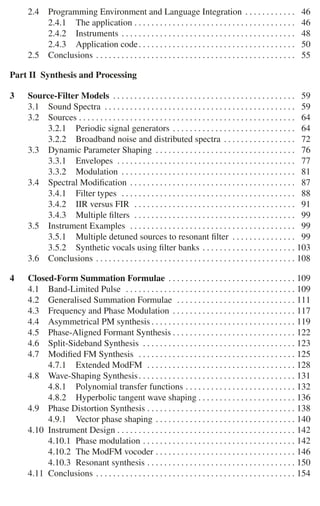
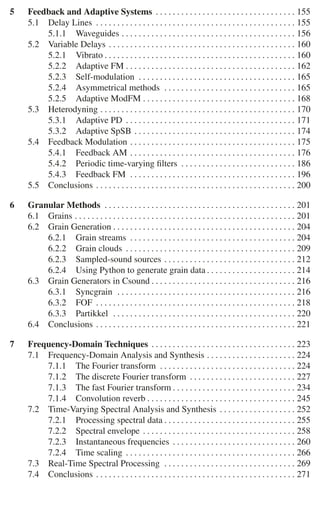
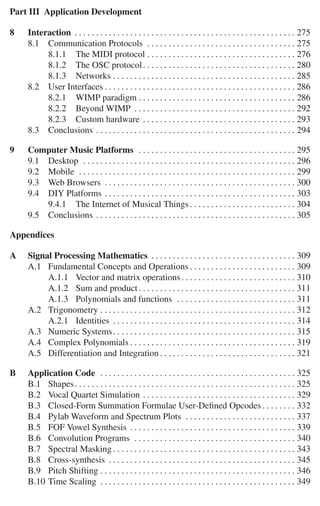

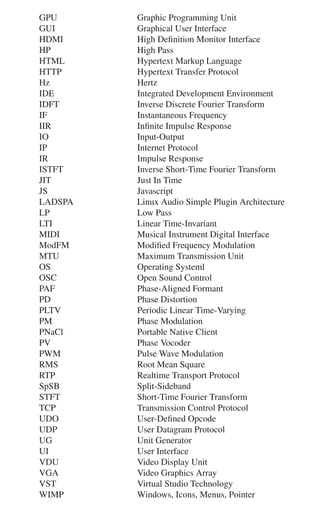

![Chapter 1
Audio and Music Signals
Abstract The fundamental aspects of audio and musical signals are discussed in
this chapter, as a preamble to exploring how computer instruments can be created. A
mostly non-mathematical, very intuitive notion of signals, waves, spectra and their
principal characteristics is first developed, introducing the reader to these concepts.
This is followed by a clear delineation of the case of musical signals, with their
specific conditions. A more formal look at signals is then attempted, looking at
these from the perspective of computer-based representations.
We use the general term signals to designate a number of diverse things that
can be described mathematically by functions of one or more independent variables
[40, 76]. Functions are taken here in a wide sense as constructs that map one or more
parameters to a given output. For instance, we can think of the act of turning a knob
from maximum to zero over a certain amount of time as a function that maps time
to changes in the knob position (Fig. 1.1). The signal, in this case, is something that
causes, or controls, these changes.
In the specific case of computer instruments, we can narrow this definition down
a little more. Signals are the information-carrying inputs and outputs of processes
in a system [72]. Such a system can be limited to software running on a given hard-
ware, or it can incorporate external components (and processes) such as our hearing
mechanism, a sound propagation medium (e.g. the air), transducers (e.g. loudspeak-
ers and microphones), and mechanical devices (e.g. a guitar).
In this book, we will be concerned mostly with signals in the software/hardware
environment of a computing platform. However, the fact that in many cases these
are representations, models or encoded forms of externally-occurring signals is im-
portant and for this reason we should begin by looking at some key concepts that
will apply to audio and musical signals more generally. The specific details of how
mechanical systems such as the air medium and our hearing mechanism work are,
nevertheless, beyond the scope of this text. We will be interested mostly in how
we can describe, emulate and manipulate signals that are eventually decoded and
transduced into a form that can be taken in by our auditory system.](https://image.slidesharecdn.com/3388207-250604203758-7ea62d5d/85/Computer-Music-Instruments-Foundations-Design-And-Development-Victor-Lazzarini-18-320.jpg)
![4 1 Audio and Music Signals
Fig. 1.1 A function mapping time to position. This could be used to describe a signal that controls
the position of a knob over a certain time duration.
1.1 Audio Signals
Signals as defined above can take many forms, even if we consider them only in the
narrower sense of an information-carrying link between two objects The forms we
are interested in are the ones that can eventually be made into a mechanical distur-
bance of a medium such as the air and have a number of important characteristics
that allow them to be picked up by our ears. This allows us to home in on a much
more constrained definition of something we will call an audio signal.
Let’s start by delimiting the desired characteristics of the final form of these sig-
nals. Firstly, when we say mechanical disturbances, we imply that something is
put into motion. In this case, we are talking about the matter that composes the
medium in which the signals propagate from source to destination. The most com-
mon medium is the air and, even though there are many alternatives to it, this is the
one that ultimately matters in this particular discussion as our ears are designed to
operate in it. To sum up, we are talking about signals that are carried by the move-
ment of matter that makes up the air medium (Fig. 1.2) [5, 31, 9].
Fig. 1.2 A representation of particles in the air and their movement carrying an audio signal.](https://image.slidesharecdn.com/3388207-250604203758-7ea62d5d/85/Computer-Music-Instruments-Foundations-Design-And-Development-Victor-Lazzarini-19-320.jpg)
![1.1 Audio Signals 5
1.1.1 Waves
We now come to an important abstraction that helps us explore and understand sig-
nals that are travelling in a medium. From a general perspective we can idealise the
movement of the medium as waves that are traversing it [107, 5], starting from a
source and then reaching a point where they can be picked up. It is important not
to lose sight of the fact that this is an abstraction that is constructed by connect-
ing all the individual movements of the components of the medium (taken to be,
in a generic sense, its molecules or particles, which is yet another abstraction), as
illustrated in Fig. 1.3.
Fig. 1.3 The wave as an abstraction of the movement of particles in the air carrying an audio
signal. In this particular case, we are tracking the compressions and decompressions that occur at
different points in space as the signal travels through the medium.
So waves are a compact description of how air is, in turn, compressed and rar-
efied as the medium is put into motion [106]. Or, from a complementary perspective,
how particles are made to speed up, slow down, stop, change direction, speed up,
slow down, etc., back and forth. The first view is that of a pressure wave that propa-
gates through the medium, whereas the second is that of a velocity wave [31]. They
describe the same phenomenon, but provide two different ways of categorising it.
Both of them relate to things that happen over time and so, going back to our first
definition of signals, such waves can be described by functions of time.
This abstraction is very useful not only because it captures the movement very
well, but also because it leads to ways of analysing the characteristics of the signal
that is travelling through the medium. It is so powerful that we can make the identity
signal = wave without thinking too much about it, even though they are not strictly
the same thing. This goes even further, as we will be able to extend this idea to our
computer models of a signal, also calling them waves, or waveforms.
1.1.2 Parameters
The basic characteristics that define an audio waveform, and by extension an audio
signal, can be laid down as parameters of one or more functions that describe or at](https://image.slidesharecdn.com/3388207-250604203758-7ea62d5d/85/Computer-Music-Instruments-Foundations-Design-And-Development-Victor-Lazzarini-20-320.jpg)
![6 1 Audio and Music Signals
least approximate it. Depending on the complexity of the wave in question, we may
be able to model it with a varying number of these parameters and functions. Starting
with simple signals, one of the things we observe is that they can be periodic: the
back-and-forth movement captured by the concept of a wave may repeat over time
[8].
In this case, the amount of time that it takes to complete the repeated pattern
(called a wave cycle) is an important parameter that can describe this signal very
well. This is called the period of the waveform (Fig. 1.4), and we can ask a comple-
mentary question about it: how many of these cycles will occur in a given duration
(say over one second)? This is actually the reciprocal of our first parameter, and is
called the frequency of the waveform.
Frequency is a very important parameter, one that will be abstracted in a number
of ways. We can intuitively link it to our sense of pitch height, which is a scale from
high to low that we often use to classify sounds that we hear (not to be confused
with loudness, which is connected to a different parameter). In a general sense, our
sensation of pitch height increases with frequency and we are only able to perceive
signals that exist within a certain range of frequencies, nominally from 20 to 20,000
cycles per second (cps1) [31].
Another parameter that can be identified in waveforms is the amount of move-
ment in the air particles. This can describe how wide the range of compression/de-
compression that takes place is, or, from the velocity perspective, how fast the par-
ticles are moving. This is linked to how much energy the source is pushing into
the medium, and we perceive it as the amount of loudness or the volume of the
signal. This parameter can be measured either as the maxima of the peaks of com-
pression/decompression (or velocity), called the peak amplitudes (Fig. 1.4), or as
an average over time, the RMS2 amplitude. We are able to perceive tiny amounts of
pressure variation, but this depends on the frequencies of the waveform.
Fig. 1.4 A plot of a waveform showing its period and peak amplitude.
1 frequency is also measured in Hertz (Hz); 1 Hz is equivalent to 1 cps
2 RMS stands for root-mean-square, which is a method of calculating the average of a varying
quantity, such as a waveform [68].](https://image.slidesharecdn.com/3388207-250604203758-7ea62d5d/85/Computer-Music-Instruments-Foundations-Design-And-Development-Victor-Lazzarini-21-320.jpg)
![1.1 Audio Signals 7
These two parameters are fundamental to all types of waveforms, but there are
others which we will explore as we introduce a more detailed description of audio
signals. Also, we have not explored signals that have no periodicity, or whose pe-
riods are too long for our ears to integrate as a single waveform cycle. For these
cases, we will need to generalise the concept of frequency that we have introduced
here. This will allow us also to start considering another dimension of audio signals,
which has to do with characteristics that are to do with neither pitch height nor am-
plitude/loudness. We often use the word colour to denote this perceptual aspect of
audio waves, as we have no alternative but to look for metaphors to describe what
we hear.
1.1.3 Waveform shapes
We can abstract even further in order to contemplate how different colours can arise
out of an audio waveform. This time, we look at the shapes that the particle move-
ments create if we were to draw up (‘plot’) their changes in pressure or velocity.
Suppose we look at a given point in space and plot the compression and rarefaction
that is taking place over time as a wave travels through it. Regardless of the period-
icity of the signal (or lack thereof), we will see the emergence of a shape that defines
the waveform. If there is a certain amount of repetition over time, that is, a certain
general pattern appears to exist, then we are likely to be able to hear a pitch in this
signal. We will also be able to see its peak amplitude, which will be determined by
the height of the plot (e.g. the maximum compression/decompression at that point).
Once we have abstracted the waveform (and signal) in this form, we do not need
to keep going back to its original physical form. This is very convenient because it
will be this model that we will be working with inside the computer and this will
be a valid representation (within some limits, as we will see) of an audio signal that
can be apprehended by our ears. We will come back to these ideas later on.
More generally, the shape of the waveform is linked to its colour characteris-
tics. If the periods are constant and the peak amplitude is also unchanging, but the
shape of the repeated patterns varies somewhat, we will perceive a modification
in the quality of the sound that is this third, more volatile, percept called timbre
[31, 106]. This is more of an emergent and multidimensional [29] quality than an
easily-definable parameter of a signal, but it is a very important aspect of the signal,
especially when we come to consider musical signals.
Determining the timbre of a waveform is a complex task. However it is possible
to develop a certain number of concepts that can help us to determine how different
shapes arise. From these, we can abstract (again!) a number of principles that can
allow us to understand various aspects of the phenomena of timbre, even if some of
these might be more elusive than others.](https://image.slidesharecdn.com/3388207-250604203758-7ea62d5d/85/Computer-Music-Instruments-Foundations-Design-And-Development-Victor-Lazzarini-22-320.jpg)
![8 1 Audio and Music Signals
1.1.4 Breaking waveforms down
To start exploring the various shapes of audio signals, and how these can relate to
our perception of timbre, we need to look first at very simple waves. The advantage
of these is that they can be composed to create more complex forms, and thus allow
us to generalise the notions we have developed so far. The ideal form that these sim-
ple signals take is defined by well-known mathematical functions called sinusoids.
These are fundamental to describing a variety of physical phenomena and will be
very useful here.
It is possible to derive a sinusoid by plotting circular motion, for instance the
height assumed by a spoke in a wheel as it rotates (Fig. 1.5) [3, 22]. The parameters
of a waveform introduced in Section 1.1.3 are featured here: the speed of the rotation
will determine the frequency and the width of the wheel is linked to the amplitude.
If we wished, we could use this rotating wheel to produce a ‘real’ audio signal
directly by making it induce a current to drive a loudspeaker3. However, it will be
better to proceed by using abstractions, which are more useful for making general
observations about waves and signals.
Fig. 1.5 Plotting the vertical position of a spoke in a wheel as it rotates yields a sinusoidal wave-
form.
In addition to amplitude and frequency, there is a third parameter associated with
sinusoids, called their phase. This measures the amount of synchronisation between
two sinusoids of the same frequency, by defining the starting point of the waveform
cycle. If it starts from zero and rises, then we say the wave is in sine phase. If it
starts from the maximum peak amplitude and falls, then it is in cosine phase. The
actual phase of a sinusoid can be anything in between these two (including inverted
sine and inverted cosine phases).
The reason that these two particular starting positions (cosine and sine) are so
important is that they are at right angles to each other. If we plot the various vertical
3 This is indeed a method used by some electric instruments, such as the Hammond organ.](https://image.slidesharecdn.com/3388207-250604203758-7ea62d5d/85/Computer-Music-Instruments-Foundations-Design-And-Development-Victor-Lazzarini-23-320.jpg)
![1.1 Audio Signals 9
positions that a spoke in a wheel can assume as it rotates, we can also plot the
various horizontal positions that it assumes. When we look at these in relation to
each other, the former will show the wave in sine phase, and the latter in cosine
phase, as shown in Fig. 1.6. Or, more compactly, we can say that the first is a sine
wave and the second a cosine wave. Following from this right-angle ‘sync’ is an
important fact: we can describe any sinusoid as a weighted sum of a sine and a
cosine wave (of the same frequency, of course) [98, 68].
Fig. 1.6 Two phases of a sinusoid: plotting the vertical position yields a sine wave, whereas if we
take the horizontal position, we get a cosine wave.
So now we have a simple signal, the sinusoid, which is characterised by its fre-
quency, amplitude and phase. The next abstraction is to think of this as a kind of
building block for more complex waveforms. In fact, we can go even further and,
in general terms, consider that any audio signal can theoretically be broken down](https://image.slidesharecdn.com/3388207-250604203758-7ea62d5d/85/Computer-Music-Instruments-Foundations-Design-And-Development-Victor-Lazzarini-24-320.jpg)
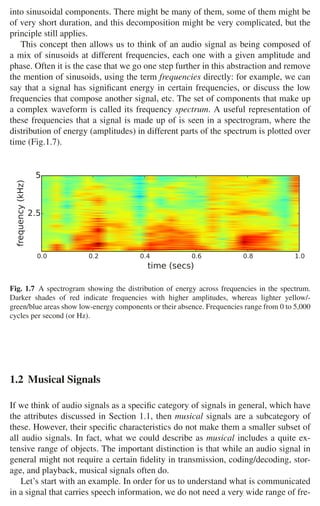
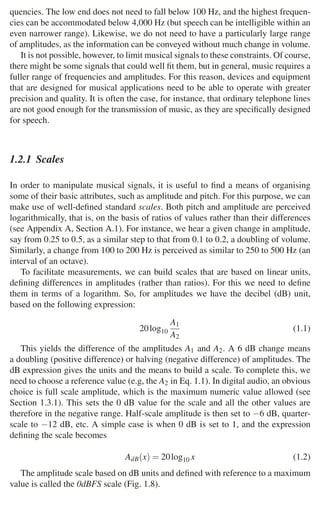
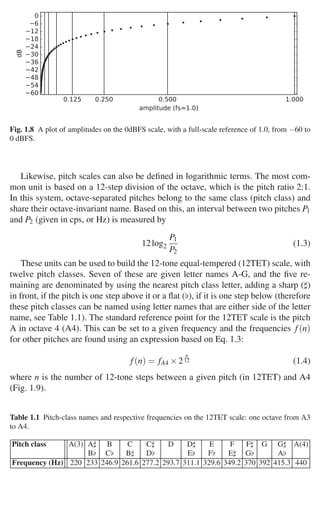
![1.2 Musical Signals 13
Fig. 1.9 A plot of pitches on the 12TET scale, with A4 reference at 440 Hz, from A0 to C8.
A finer-grained unit ¢ for an interval ratio p is obtained by subdividing each one
of the 12 steps into 100 parts,
¢ = 1200log2 p (1.5)
This unit is called a cent and can be used to define small differences in pitches.
Frequency scales are the object of study in the field of tuning and temperament. A
variety of approaches can be used to construct them, which can produce scales with
different numbers of steps and step sizes [9].
1.2.2 Spectral types
In terms of their general characteristics, musical signals are not bound to specific
spectral descriptions (as in the case for instance, of speech). The class of objects
that compose them is limited only by our hearing capacity. There are however some
specific spectral types4 that are worth discussing in more detail. The first one of
these, which is very common in many musical practices, is that of signals that have
a pitch characteristic, or more precisely, that evoke the sense of pitch height.
Definitions are fairly fluid here, as we are dealing with a perceptual continuum.
However, what we will call here pitched spectra, are sounds that lead to the pos-
sibility of ascribing a specific pitch height to them that is unambiguous. The most
extreme case of this is of a pure sinusoid, which is a single frequency (rather than a
mixture of them). More commonly, we will find that this spectral type is composed
of several frequencies, which, when combined, will lead us to assign a specific pitch
to it.
4 We are using this terminology in a loose way, to describe signals that are alike in some recognis-
able form. The term ‘spectral typology’ has been used elsewhere in a more precise manner in the
analysis of musical works, but this is not the intended meaning here [96].
220440 880 1760 3520
frequency (Hz,A4=440)
12
24
36
48
60
72
84
12TET
pitch](https://image.slidesharecdn.com/3388207-250604203758-7ea62d5d/85/Computer-Music-Instruments-Foundations-Design-And-Development-Victor-Lazzarini-28-320.jpg)
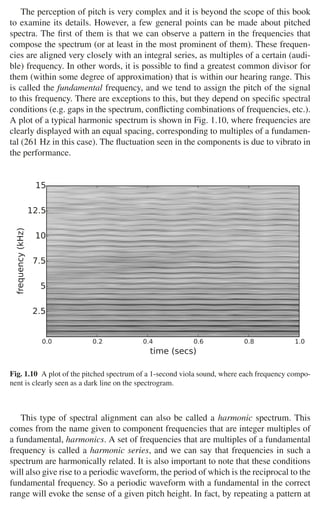
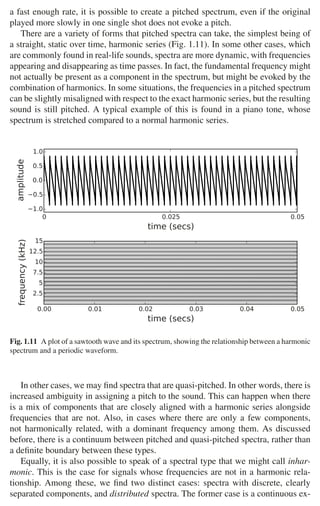
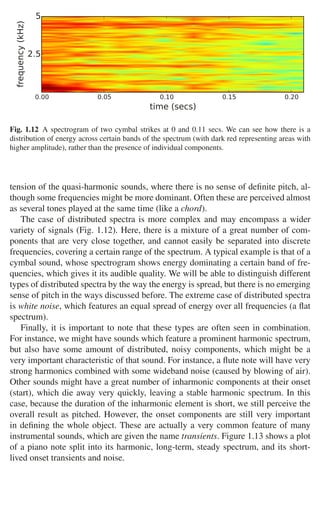
![1.3 Signals in and out of the Computer 17
−1.0
−0.5
0.0
0.5
1.0
−1.0
−0.5
0.0
0.5
1.0
Fig. 1.13 A plot of a piano note split into steady, long-term frequency components (top) and tran-
sients/noise (bottom), from [59].
1.3 Signals in and out of the Computer
Having discussed some salient features of audio and music signals mostly in abstract
terms, removed from their existence as physical phenomena, we now turn back to
look at them in a more concrete way. The major question we want to examine is
how these signals can exist inside a computer. This will allow us to move on to
manipulate them with confidence.
The first principle we need to look into is the fundamental difference between the
representation of an audio signal inside the computer and its counterpart outside it.
When we speak of a wave travelling through the air (or any other medium), we have
something that is continuous, both in time and in value. That is, if we could focus
on an infinitesimal time interval, there would be no break or gap in the function
that describes the signal. This is the case for waves that exist as electric signals
travelling on a wire, or as a mechanical disturbance in the air, or as the vibrations
in the three ossicles of our middle ear, etc. All of these forms are analogous to each
other. Moving from one to another is a matter of transducing the signal.
To represent signals inside the computer, however, we need to look for an alterna-
tive form. This is mainly because the computers we normally use (digital computers)](https://image.slidesharecdn.com/3388207-250604203758-7ea62d5d/85/Computer-Music-Instruments-Foundations-Design-And-Development-Victor-Lazzarini-32-320.jpg)
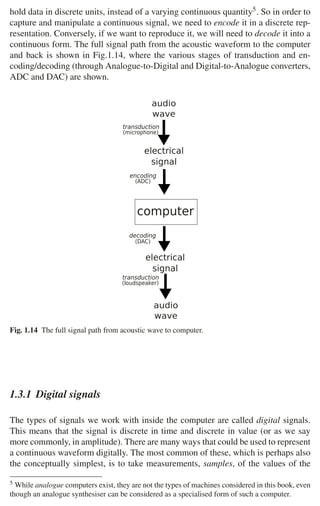
![1.3 Signals in and out of the Computer 19
waveform at regular intervals, and then assign them a discrete value within a given
range, producing a series of numbers that describe the signal.
This process allows us to manipulate the waveform in many ways as if it were
the original, analogue, object by conceptually thinking that each number is smoothly
connected to the next one, reconstructing it as a continuous signal. However, while
this is a very useful abstraction, it is also important to know that there are limits
outside which this concept breaks down. The rest of this section will discuss the
nature of this type of digital encoding in a more formal way, also looking at how to
manage its limitations.
To derive a digital signal s(n) from an analogue function f(t), we start by select-
ing values from it at evenly spaced periods in time, T, [76]:
s(n) = f(nT) (1.6)
More formally, this is the application of a Dirac comb IIIT [11] to the function:
{IIIT f}(t) =
∞
∑
−∞
f(kT)δ(t −kT) (1.7)
0.0
0.2
0.4
0.6
0.8
1.0
−1.0
−0.5
0.0
0.5
1.0
−1.0
−0.5
0.0
0.5
1.0
Fig. 1.15 The sampling process: we apply a Dirac comb (top) to a signal (middle), selecting the
waveform values at each sampling period (bottom).](https://image.slidesharecdn.com/3388207-250604203758-7ea62d5d/85/Computer-Music-Instruments-Foundations-Design-And-Development-Victor-Lazzarini-34-320.jpg)
![20 1 Audio and Music Signals
This process is known as sampling, and is illustrated in Fig. 1.15. The Dirac comb
effectively selects values from each sampling point, which are separated by T, the
sampling period. More generally, we will use the concept of a sampling frequency
(or rate) fs that is its reciprocal ( fs = 1
T ).
The Sampling Theorem [75, 94] guarantees that if our signal contains only fre-
quencies between − fs
2 and fs
2 , it will be recoverable in the decoding process. This
means that, within these constraints, it is an accurate discrete-time representation of
the continuous waveform. The range of frequencies from − fs
2 to fs
2 is often called
the digital baseband, and any frequencies outside this will be represented by an
alias inside that range. This means that components outside the baseband cannot be
recovered correctly after decoding and will be mixed with the ones inside it. This is
called aliasing or foldover, as frequencies are folded over the edges of the baseband,
reflected back into it. The absolute limit of the digital baseband, fs/2, is also called
the Nyquist frequency.
The following expression can be used to determine an encoded frequency fd from
a continuous-signal frequency fc , given a certain sampling frequency [68]:
fd = fc −int
2fc
fs
× fs (1.8)
Generally speaking, we do not need to be concerned with the encoding process,
as all but the most limited ADC devices will make sure that all frequencies outside
the baseband are removed before sampling. The issue, however, lies with signals
generated (or modified) by computer instruments. If we are not careful, we may
introduce aliasing in the process of synthesising an audio signal. For this reason, we
tend to look for algorithms that are band-limited (or nearly so), which can be used
to generate waveforms that fit the digital baseband. Figure 1.16 demonstrates the
difference between two waveform spectra, one that was created with a band-limited
process and has no aliasing, and another with substantial foldover.
Aliasing is generally undesirable, but it can of course be used creatively in some
cases. We need to watch carefully because there are many situations where aliasing
can creep in and possibly spoil the sound of our synthesis processes. We will be not-
ing these conditions as they arise, when discussing the various instrument designs.
To complete the analogue-to-digital conversion, we need another step to obtain
discrete amplitudes from the continuous signal. This is called quantisation [35] and
involves assigning numbers, or quantisation steps, to ranges of input values. There
are various ways of defining these steps and the one we will use here is called linear
quantisation, which divides the range from minimum to maximum amplitude into
equal-sized regions.
The number of regions covering the min-max range will depend on how much
storage we assign to each sampled value. This is measured in bits, which are the
basic unit in the binary number system that is used by computers. One bit can store
two distinct values (e.g. 0 or 1), or two quantisation regions. If we add more bits,
we can increase the number of regions (and consequently decrease their size). In the
case of integers, the number of regions QN will be](https://image.slidesharecdn.com/3388207-250604203758-7ea62d5d/85/Computer-Music-Instruments-Foundations-Design-And-Development-Victor-Lazzarini-35-320.jpg)
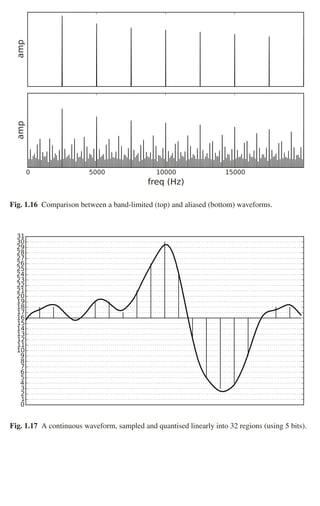
![22 1 Audio and Music Signals
QN = 2Nb (1.9)
where Nb is the number of bits in each sample. In the quantisation process, all input
values falling within one region are assigned to its nominal mid-range quantity. This
is shown in Fig. 1.17, where we see that some of the output values are very close
to the sampled values, others are not. From this we see that a certain amount of
quantisation error arises from the process. This increases with the size of the region
and it limits the dynamic range of the system (the range of amplitude variation that
is available), as the error takes the form of noise that is added to the signal. The
dynamic range is defined as the ratio between the maximum and minimum peak
(or RMS) amplitudes, or as the maximum signal-to-noise ratio (SNR) [98]. This
follows directly from Eq. 1.9 and we normally display this ratio on a dB-unit scale
(see Section 1.2.1) for convenience:
SNRmax = 20log10 QN (1.10)
Table 1.2 shows the dynamic range of various sizes of integer (whole-number)
samples. The SNR can be degraded if the signal does not use the full range of
numbers in the system (e.g. its maximum amplitude, also called full scale).
Table 1.2 Dynamic range for various integer sample sizes.
Nb dynamic range (dB) peak (absolute) amplitude
8 (signed) 48 128
8 (unsigned) 48 256
16 96 32,768
24 144 8,388,608
32 192 2,147,483,648
64 385 9,223,372,036,854,775,807
If real (decimal-point) numbers are used to represent sampled values, we have
some additional considerations [104]. Firstly, the values are encoded in a floating-
point format, which is made up of a mantissa and an exponent, for example
s = mantissa×bexponent
(1.11)
where b is some chosen base (2, 10, e, etc.). So, in general, it is the size of the
mantissa that will matter to us. In the two usual types of floating-point number,
single and double precision, we have 32 and 64 bits of storage, which are divided
24:8 and 53:11 for the mantissa and exponent, respectively. In normal mode, we
gain one extra bit of precision in the mantissa owing to the normalisation process
[32]. So, effectively, we have dynamic ranges of 156 and 331 dB for single and
double-precision floating-point numbers. An added advantage of the floating-point
representation is that the total SNR is not degraded if the signal amplitude does
not reach full scale. While fixed-point (integer) signals have their maximum peak](https://image.slidesharecdn.com/3388207-250604203758-7ea62d5d/85/Computer-Music-Instruments-Foundations-Design-And-Development-Victor-Lazzarini-37-320.jpg)
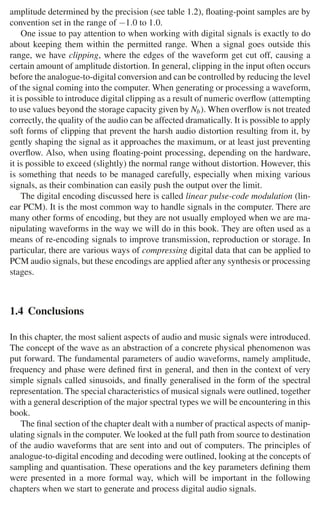
![Chapter 2
Music Programming Environments
Abstract This chapter introduces the music programming environments that will be
used throughout the book. We start by giving an overview of the roles each language
might play in the development of computer instruments. Following this, we focus
on the three specific languages we will employ, Python, Csound, and Faust. Python
can be used in its role as a glue and host language containing dedicated code written
in the Csound language. It can also be employed for complete signal processing
programs. Csound is a prime DSL for music, which can be used in a variety of ways.
Finally, we introduce Faust as a way of programming dedicated signal-processing
algorithms that can be placed within the Csound environment or used as stand-alone
programs. The chapter concludes with an overview of how these three systems can
coexist in an instrument development scenario
Computer music instruments have a long history of software support. It stretches
all the way back to the early 1960s and the introduction by Max Mathews of his
MUSIC III program for the IBM 7904 computer [63]. This was an unprecedented
invention, an acoustical compiler, as Mathews called it, which provided the form
for a multitude of computer music programming environments that were to follow.
His idea, informed by earlier experiments with MUSIC I and II, was that musicians,
composers, researchers, etc. would be better served by a system that had open pos-
sibilities, based on building blocks that could be connected together. In other words,
rather than a program that can generate sound given parameters, one that can create
new programs for that purpose [88].
His acoustical compiler was able to create software based on a given description
that could be employed in music composition: a computer instrument [45]. Math-
ews followed it with MUSIC I [64, 100], and MUSIC V [65]. From this lineage of
software, also known as the MUSIC N family, there are a number of systems that are
currently in use. The one we will be employing in this book is Csound [59], which
will be introduced in this chapter. In Csound, we have a complete domain-specific
language (DSL), and a performance environment to run compiled programs that is
unrivalled in terms of its breadth of sound-processing possibilities.](https://image.slidesharecdn.com/3388207-250604203758-7ea62d5d/85/Computer-Music-Instruments-Foundations-Design-And-Development-Victor-Lazzarini-39-320.jpg)
![26 2 Music Programming Environments
Alongside the very domain-specific programming environments offered by the
MUSIC N-derived software, we should also consider the role of general-purpose
programming languages (GPPLs) in the development of computer instruments. It
is true to say that we could dispense completely with domain-specific approaches,
because any language could be employed for this purpose. In practice, however, we
will see that it is far more productive to use a DSL for specific aspects of instrument
development (e.g. the signal-processing elements of it). A GPPL might not have cer-
tain components built into it that would facilitate their design and implementation.
However, there are two roles into which GPPLs could be slotted quite well. The
first is to provide a glue for control and signal-processing components of our system.
For example, to allow the user to create a host user interface, graphical or otherwise,
to a collection of instruments. In this instance, while, again, many languages could
be chosen, the most appropriate ones are the high-level scripting languages. This
is because they are very straightforward to use and generally provide many possi-
bilities for interfacing, either built in as part of the programming environment or
as loadable modules. In this book, we will be employing the Python programming
language for this purpose, as it has all the attributes listed above and, in addition to
these, has excellent support for integration with Csound. Python, on its own, will
serve as a means of demonstrating signal-processing algorithms, as it can provide
compact code with excellent readability.
The second role in which we could find the use of a GPPL is at lower level in the
implementation of computationally-intensive tasks. In this case, we are better served
by a language that is classed as implementation level, such as C or C++. Specific
elements of an instrument that are more demanding in terms of resources should
ideally be programmed using these languages and compiled into components that
can be loaded by the DSL. In this book, we will be using these languages indirectly,
by employing a signal-processing language, Faust [77], which can be compiled into
efficient C++ code, or directly into a loadable object using a just-in-time (JIT) com-
piler.
This chapter will first consider these three systems, Csound, Python, and Faust,
separately, providing an informal overview of their languages and programming.
Following this, the ways in which these can be integrated into a single workflow
will be discussed. These languages will be then used in examples throughout the
book.
2.1 Python
Python is a scripting language employed in a variety of applications, from user in-
terfaces to scientific computing. It is a so-called multi-paradigm language, allowing
a diverse variety of programming approaches. It is generally simple to use and al-
lows for quick prototyping of ideas. Since it relies on an interpreter to translate
programs, it tends to be slow for computationally-intensive applications. However,](https://image.slidesharecdn.com/3388207-250604203758-7ea62d5d/85/Computer-Music-Instruments-Foundations-Design-And-Development-Victor-Lazzarini-40-320.jpg)
![2.1 Python 27
it is very easily extendable, which allows it to use pre-built components to speed up
some tasks.
The system (language/interpreter) has witnessed a major version change in recent
years. It has moved from version 2 (which was kept at 2.7) to 3 (currently 3.5) in a
non-backward compatible way. This has confused many users, as it took a long time
for many popular third-party components to be upgraded. At the time of writing,
Python 3 has become well established with most of the important dependencies
being made available for it. In this book, we will be adopting this version. This
section will introduce the key language elements that will allow the reader to follow
the program examples in later chapters. Further information can be found in the
official language reference documentation at python.org.
Python can be used interactively by typing code directly into an interpreter shell,
or by supplying it with programs written in text files. For instance the following
command starts an interactive session:
$ python3
Python 3.5.1 (v3.5.1:37a07cee5969, Dec 5 2015,
21:12:44)
[GCC 4.2.1 (Apple Inc. build 5666) (dot 3)] on darwin
Type help, copyright, credits or license for
more information.
At this stage, commands can be typed at the prompt (). Programs can also
be passed as files to the command:
$ python3 helloworld.py
Hello World!!
In this case, the file helloworld.py consists of a single line:
print('Hello World!!')
Python is a dynamically-typed language. This means that variable types are de-
fined according to the data they are carrying and the type can be re-defined for the
same name, if we need to:
a = 'hello'
type(a)
class 'str'
a = 1
type(a)
class 'int'
In this example the variable a was first holding a text string, and then a whole
number, which represent two distinct types. In addition to the various types we will
discuss below, Python has a special one, None, which indicates the absence of a
value and is used in situations when we need to specify this explicitly.](https://image.slidesharecdn.com/3388207-250604203758-7ea62d5d/85/Computer-Music-Instruments-Foundations-Design-And-Development-Victor-Lazzarini-41-320.jpg)
![2.1 Python 29
print('negative')
elif a == 0:
print('zero')
else:
print('positive')
As usual, the logical expressions following the if and elif keywords can have
multiple terms, combined by use of the boolean logical operators and and or.
The basic looping construction in Python is defined by while, followed by a
truth expression and a colon. The loop block is then placed, indented, under this:
n = 0
while n 10:
print(n)
n += 1
Here, we can optionally place an else section after the loop body, which will
execute when the expression is not true.
Another form of loop can be found in the for ... in ... statement. This
is slightly more complex in that it involves the concept of an iterable object that is
used to construct the loop. This type of loop is designed to work with sequences
such as lists and strings. Here is an example of this construction:
for x in [0,1,2,3,4]:
print(x)
which, when executed, yields
0
1
2
3
4
We can get gist of it from this example. The variable x takes the value of a
different member of the list each time the body of the loop is executed.
2.1.2 Sequences
In Python there are a number of data types that can be sequentially organised and
manipulated, which are known generically as sequences. Among these we have lists,
text strings, tuples and ranges.
Lists
A list is a sequential collection of data, which can be of the same or different types.
Lists are mutable, i.e. they can be enlarged, shortened, have items deleted, replaced,](https://image.slidesharecdn.com/3388207-250604203758-7ea62d5d/85/Computer-Music-Instruments-Foundations-Design-And-Development-Victor-Lazzarini-43-320.jpg)
![30 2 Music Programming Environments
inserted, etc. To create a list we can use square brackets as delimiters, or use the
named constructor:
l = [0,1,2,3,4] # list with 5 items
k = [] # empty list
k = list() # using the named list constructor
Lists can be accessed using a similar square-bracket notation. With it, we can
take slices of the list, as well as individual items:
a = [0,1,2,3,4]
a[0]
0
a[2:4]
[2, 3]
a[0:5:2]
[0, 2, 4]
a[:5:2]
[0, 2, 4]
a[1:]
[1, 2, 3, 4]
a[2] = 100
a
[0, 1, 100, 3, 4]
The general form for the slice is [start:end:increment]. In addition to
this, there are a number of operations that can be used to insert, append, copy, delete,
pop, remove, reverse, and sort a list. In addition to these, we can also have list
comprehensions of the following form:
[x*x for x in [1,2,3,4]]
[1, 4, 9, 16]
where an expression involving a variable (such as x*x) can be iterated over a list
input to produce an output list. This is a concise way to create a list based on the
evaluation of a function or expression.
Tuples
Tuples are immutable2 sequence types that can be used to store data objects together.
Access is similar to that for lists, and slices are also possible. However, none of the
mutation operations are available for tuples. They can be created using a comma-
separated sequence of items, or using the named constructor:
l = 0,1,2,3,4 # tuple with 5 items
k = tuple([0,1,2,3,4]) # using the named constructor
2 This means that they cannot be changed.](https://image.slidesharecdn.com/3388207-250604203758-7ea62d5d/85/Computer-Music-Instruments-Foundations-Design-And-Development-Victor-Lazzarini-44-320.jpg)
![2.1 Python 31
Ranges
The range type is also immutable and represents a sequence of integers with a
start and an end. Ranges can be constructed with the forms range(end) or
range(start,end,increment), where the end value is not actually included
in the sequence. To make a list out of a range it is necessary to create one using a
list constructor (list()):
list(range(5))
[0, 1, 2, 3, 4]
list(range(0,5,2))
[0, 2, 4]
list(range(1,6))
[1, 2, 3, 4, 5]
Text strings
One special case of a sequence is a string. This is another immutable type, which
is used to hold text characters. Strings can be single quoted, embedding other dou-
ble quoted strings; double quoted, embedding other single-quoted strings; or triple
quoted, containing multiple lines:
a = 'this is a string'
a
'this is a string'
a = 'this' is a string
a
'this' is a string
a = '''these are lines
... lines and
... lines'''
a
'these are linesnlines andnlines'
print(a)
these are lines
lines and
lines
A number of operations can be performed on strings. For instance, the addition
operator (+) can be used to concatenate strings:
a = 'hello'
b = ' world!!'
a+b
'hello world!!'](https://image.slidesharecdn.com/3388207-250604203758-7ea62d5d/85/Computer-Music-Instruments-Foundations-Design-And-Development-Victor-Lazzarini-45-320.jpg)
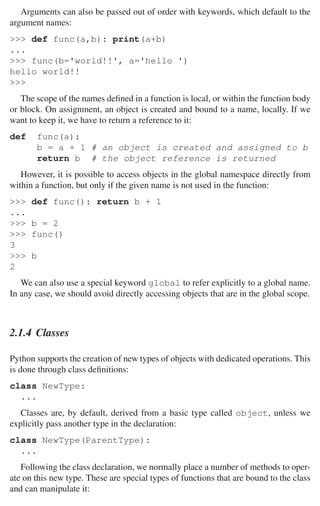
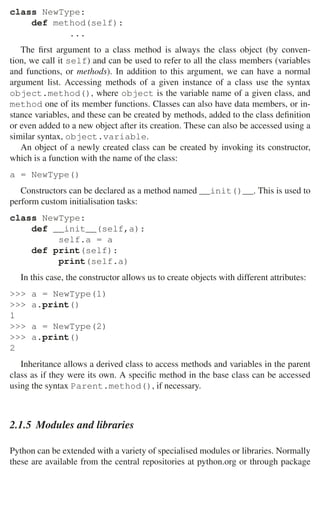
![2.2 Csound 35
management systems4. Once a module/package is installed, we can load it using the
import statement:
import package_name
From there, all code in a package pkg can be accessed using the form pkg.obj,
where obj stands for any method, variable, constant, etc. defined in the package.
We can also give an alias name to a package:
import package_name as name
Pylab
In this book, we will be using a number of external libraries. In particular, we will
employ the scientific libraries SciPy, NumPy, and matplotlib, packaged together as
pylab. This will be commonly invoked by the command:
import pylab as pl
Most of the key SciPy/NumPy/matplolib objects will be exposed through this
interface. Occasionally, we might need to load specific parts of these libraries sep-
arately, if they are not available through pylab. The fundamental data type that is
used by all of these libraries is the NumPy array, which has been designed to
optimise numeric computation. It behaves very similarly to other sequence types
(such as lists), but it actually holds a numeric array in native form (integers, float
and complex subtypes are provided).
2.2 Csound
Csound is a sound and music computing system that can be used in a variety of
applications. It is programmed and run via its DSL through a variety of frontend
software. In this section we will introduce the basic aspects of its operation and the
main features of its language. We will concentrate on the most relevant elements that
will allow the reader to follow the examples in the next chapters. Further concepts
will be introduced as required. A complete reference for the system and language
can be found in [59].
The Csound language is compiled into an efficient set of signal processing-
operations that are then performed by its audio engine. All operations to compile
and run code can be accessed through a high-level programming language inter-
face, the Csound Application Programming Interface (API). We will first look at the
most salient aspects of the language before discussing how to use the API (through
Python) to run the system.
4 Many operating systems have their own package managers for adding new components. In addi-
tion, Python has pip (https://pip.pypa.io/en/stable/), which is used specifically for Python packages
on multiple platforms.](https://image.slidesharecdn.com/3388207-250604203758-7ea62d5d/85/Computer-Music-Instruments-Foundations-Design-And-Development-Victor-Lazzarini-49-320.jpg)
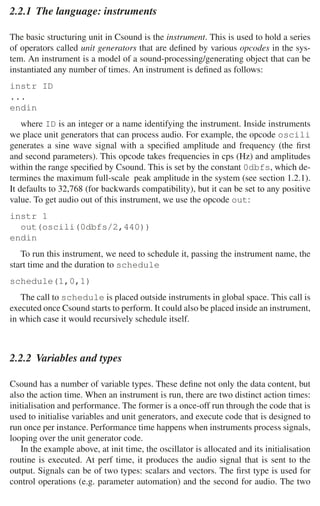
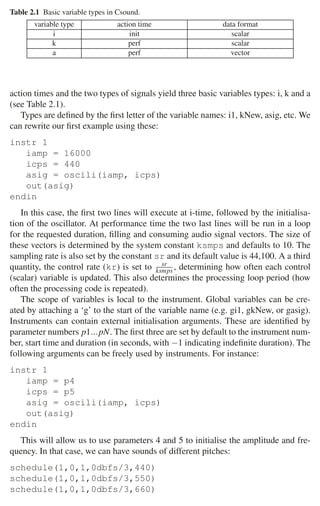
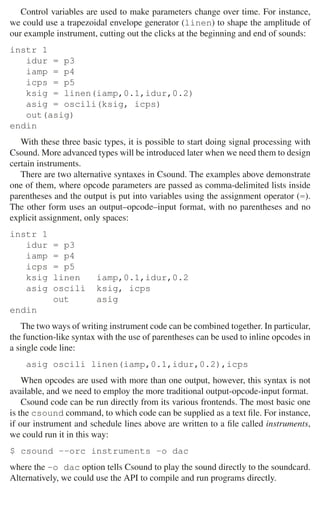
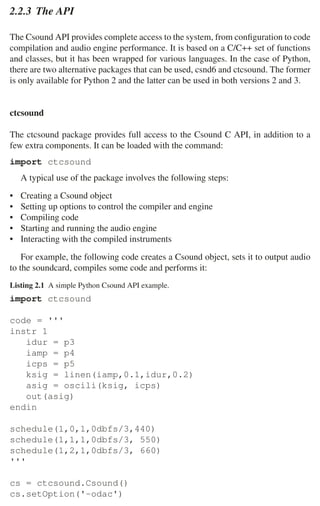
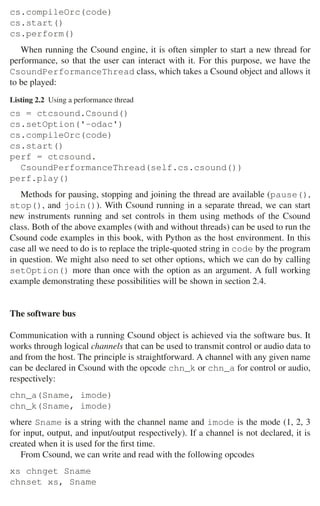
![human being with whose life this individualization concurred. Among
all these there were, so to speak, two clearly distinct Wills to dispose
of; that of the man Jesus at the lowest extremity, and that of the
Supreme God, which the Jew, at least, would fix at the upper. These
two Wills act, in the whole development of doctrine on this subject, as
the secret centres of Personality; and the remaining elements obtain
or miss a hypostatic character according as they are drawn or not into
coalescence with the one or the other. The volitional point of the
Divine Agency being once determined, it may be regarded as enclosed
between the Thought, or intellectual essence out of which it comes,
and the Execution by which it is realized; or it may be left
undistinguished from these, and may be made to coincide with either.
According to these variable conditions arise the several modes of
doctrine in reference to the Divine element in God's Objective
manifestation. The differences, for instance, between our presbyter's
doctrine and Origen's, will be found to depend on the different points
which they seize as the seat of divine volition, and the germ of their
logical development. Our author, exemplifying the Hebrew tendency,
seeks his initiative up at the fountain-head, and puts himself back
before the first act of creation; he starts from the One God, with
whom nothing was co-present, and fixes in Him the seat of the
primeval Will. There, however, it would remain, a mere potentiality,
did not the Eternal Mind, by reflection in itself, pass into self-
consciousness, and give objectivity to its own thought. This primary
expression of his essence, in which it enters into relation, but relation
only to itself, is the Logos, or Son of God, the agent in the production
of all things. The potentiality is thus reserved to the Father; the
effectuation is given to the Son; who, coming in at a point lower down
than the seat of Will, and simply bridging over the interval that leads
to accomplishment, is felt without the essential condition of a
numerically distinct subsistence; and has either the instrumental and
subordinate personality of a dependent being, or is imperfectly
hypostatized.[41] In this impersonal character does the Logos manifest
the Divine thought in the visible universe; in the minds of godly men,
which are the source of law; in the glance of prophets, which catches
and interprets the divine significance of all times; and first assumes a](https://image.slidesharecdn.com/3388207-250604203758-7ea62d5d/85/Computer-Music-Instruments-Foundations-Design-And-Development-Victor-Lazzarini-71-320.jpg)
![development and growth, may be traced; one following out in morals
the legal idea into asceticism, voluntary poverty, and physical purity,
and in faith the monarchian idea into theocratic and millenarian
expectations; the other, proceeding from the notion of faith to
substitute an ideal Christ for the historical, a new religion for an old
law, the free embrace of divine reconciliation for the anxious strain of
self-mortifying obedience. But how long did this struggle and
separation continue? According to the prevalent belief, it was all over
in a few years; and, by the happy harmony and concurrence of the
Apostles, was determined in favor of the generous Pauline doctrine; so
that St. John lived to see the Hebrew Christians sink into a mere
Ebionitish sect outside the pale, and their stiff Unitarian theology
disowned in favor of the higher teachings of his Gospel. Against this
assumption of so easy a victory over the Jewish tendency, several
striking testimonies have often been urged. Tertullian, in a well-known
passage of his treatise against Praxeas, describes the dislike with
which the unlearned majority of believers regard the Trinitarian
distinctions in the Godhead, and the zeal with which they cry out for
holding to the Monarchy.[42] In the time of Pope Zephyrinus, as we
learn from Eusebius, a body of Unitarians in Rome, followers of
Artemon, defended their doctrine by the conservative plea of antiquity
and general consent; affirming that it was no other than the
uninterrupted creed of the Roman Church down to the time of Victor,
the preceding pope; and that the higher doctrine of the Person of
Christ was quite a recent innovation.[43] Nor are we without
ecclesiastical literature, of even a later date, that by its theological
tone gives witness to the same effect. The Clementine Recognitions,
written somewhere between 212 and 230, occupy a dogmatic
position, higher indeed than the disciples of Artemon, but only in the
direction of Arius, and, to save the Unity of God, deny the Deity of
Christ.[44] Relying on such evidence as this, Priestley, in his History of
Early Opinions, and his controversy with Bishop Horsley, maintained
that the creed of the Church for the first two centuries was Unitarian.
But this position was attended with many difficulties, so long as the
present canonical Scriptures were allowed to have been in the hands
of the Christians of that period, and recognized as authorities; for the](https://image.slidesharecdn.com/3388207-250604203758-7ea62d5d/85/Computer-Music-Instruments-Foundations-Design-And-Development-Victor-Lazzarini-74-320.jpg)
![history of either. This proceeding, however, is not an original violence
resorted to for the exigencies of the theory; but, for the most part, a
mere appropriation to its use of conclusions reached by antecedent
theologians on independent grounds. The Epistle to the Philippians is
the only work, if we mistake not, on the authenticity of which doubt
has been thrown for the first time,—in our opinion, on very
inadequate grounds. In this, as in many other details of the
hypothetical history, there is not a little of that straining of real
evidence and subtle fabrication of unreal, which German criticism
seems unable to avoid. But the acerbity displayed by the North
German theologians towards the Tübingen critics appears to us
unwarranted and humiliating; and we certainly wish that M. Bunsen,
whose prompt admiration of excellence so nobly distinguishes him
from Ewald, could have expressed his dissent from Baur and
Schwegler in a tone still further removed from the Göttingen pitch. At
least, we do not find the positive assertion that the Tübingen theory is
finally demolished by the Philosophumena at all borne out by the
evidence; and are inclined to think that the case is very little altered
by the new elements now contributed to its discussion. The critical
offence which he thinks is now detected and exposed, is the ascription
of a late origin to the fourth Gospel,[45] and the treatment of it as the
perfected product, instead of the misused source, of the Montanist
conceptions of the Logos and the Paraclete. It cannot, however, be
denied, that, in the previous absence of any external testimony to the
existence of this Gospel earlier than the year 170,[46] the internal
difficulties are sufficiently serious to redeem the doubt of its
authenticity from the character of rashness or perversity. The
irreconcilable opposition between its whole mode of thought and that
of the Apocalypse is confessed by M. Bunsen himself, when he
suggests that the proem on the Logos was directed against Cerinthus,
—the very person whose sentiments the Apocalypse was supposed to
express, and to whom, accordingly, it was ascribed by those who
rejected it. One of the two books must resign, then, the name of the
beloved disciple; and, of the two, we need hardly say that the
Apocalypse is incomparably the better authenticated. Moreover, the
traditions which unite the names of James and John, as the](https://image.slidesharecdn.com/3388207-250604203758-7ea62d5d/85/Computer-Music-Instruments-Foundations-Design-And-Development-Victor-Lazzarini-78-320.jpg)
![inserted from time to time, to indicate that the writer is still reporting
the sentiments of others. The singular form of this word implies
nothing at all; it occurs immediately after the word καταψευδεται, and
has the same avowedly plural subject. The statement, therefore,
within which are contained the Scripture citations, is a merely general
one of the opinions of a sect which continued to subsist till a much
later time than the lowest date ever assigned for the composition of
the fourth Gospel. If the actual words of any writings current among
these heretics are given, they are the words of an author or authors
wholly unknown, and to refer them to Basilides in particular is a mere
arbitrary act of will. The change from the singular to the plural forms
of citation in the midst of one and the same sentence, and the
disregard of concord between verb and subject, show that no
inference can be drawn from so loose a system of grammatical usage.
All that can be affirmed is, that our author had in his hand some
production of the Basilidian χορος, in which the fourth Gospel was
quoted; but this affords no chronological datum that can be of the
smallest use.[47] The same remark applies to the use of John's Gospel
by the Ophites. That they did use it is evident; that they existed as far
back as the time of Peter and Paul is certainly probable; yet it does
not follow that the fourth Gospel was then extant. For they continued
in existence through two or three centuries, dating, as Baur has
shown, from a time anterior not only to the Christian heresies, but to
Christianity itself, and extending down to Origen's time; and to what
part of this long period the writings belonged which the author of the
Philosophumena employed, we are absolutely unable to determine.
We do not know why M. Bunsen has not appealed also to a quotation
from the Gospel which occurs (p. 194) in an account of the Valentinian
system. If, as he affirms (I. 63), this account were really in
Valentinus's own words, the citation would be of particular value in
the controversy. For it has always been urged by the Tübingen critics
as a highly significant fact, that while the followers of Valentinus
showed an especial eagerness to appeal to the Gospel of John, and
one of the earliest, Heracleon, wrote a commentary upon it, no trace
could be found of its use by the heresiarch himself. From this
circumstance, they have inferred that the Gospel was not available for](https://image.slidesharecdn.com/3388207-250604203758-7ea62d5d/85/Computer-Music-Instruments-Foundations-Design-And-Development-Victor-Lazzarini-80-320.jpg)
![him, and first appeared after his time. A single clause cited by him
from the Gospel would demolish this argument at once. But the
assertion that we have here full eight pages of Valentinus's own
words appears to us quite groundless. No such thing is affirmed by
the writer of the eight pages. He promises to tell us how the strict
adherents to the original principle of the sect expounded their doctrine
(ὡς εκεινοι διδασκουσι); and then passes over, as usual, to the
singular φησι, returning, however, from time to time, to the plural
forms,—θελουσι, λεγουσι, c.,—and thus leaving no pretext for the
assumption that Valentinus is before us in person. The later Gnostics
indisputably resorted to the Gospel of John with especial zeal and
preference; and if their predecessors, Basilides and Valentinus, were
acquainted with the book, it is surprising that no trace of their
familiarity with it has been found; and that the former should have
sought to authenticate the secret doctrine he professed to have
received by the name of Matthew or Matthias instead of John. It
deserves remark, that the citations preserved by our author are made,
like those of Justin Martyr, as from an anonymous writing, without
mentioning the name of the Evangelist; a circumstance less surprising
in reference to the Synoptics alone, which present only varieties of the
same fundamental tradition, than when the fourth Gospel, so
evidently the independent production of a single mind, is thrown into
the group. The Epistles of Paul and the books of the Old Testament
are frequently quoted by name; and why this practice should
invariably cease whenever the historical work of an Apostle was in the
hand, it is not easy to explain. The Apocalypse is mentioned not
without his name.[48]
For these reasons we are of opinion that the question about the date
and authenticity of the fourth Gospel is wholly unaffected by the
newly-discovered work. On this side, no new facilities are gained for
confuting the Tübingen theory. The most positive and startling fact
against it is presented from another direction. We know that the
system of Theodotus, which was Unitarian, was condemned by Victor
in the last decade of the second century.[49] Now Victor was the very
pope to the end of whose period, according to the followers of](https://image.slidesharecdn.com/3388207-250604203758-7ea62d5d/85/Computer-Music-Instruments-Foundations-Design-And-Development-Victor-Lazzarini-81-320.jpg)
![Artemon, their monarchian faith was upheld in the Roman Church,
and in the time of whose successor was the first importation of the
higher doctrine of the Logos. On this complaint of the Artemonites,
Baur and Schwegler lay great stress; but is it not refuted by Victor's
orthodox act of expelling a Unitarian? Undoubtedly it would be so, if
Theodotus were excommunicated precisely for his belief in the uni-
personality of God. But his scheme included many articles; and we
know nothing of the ground taken in the proceedings against him.
There was one question, however, which, however indifferent to us,
was evidently very near to the feelings of the early Church, and on
which Theodotus separated himself from the prevailing conceptions of
his time,—viz. At what date did the Christ, the Divine principle,
become united with Jesus, the human being? At his baptism, replied
Theodotus.[50] Before his birth, said the general voice of the
Christians. We are disposed to think this was the obnoxious tenet
which Victor construed into heresy; and if so, the strife had no bearing
upon the doctrine of the personality of the Logos, which the pope and
the heretic might both have rejected. Of the Unitarianism of that time,
it was no essential feature to postpone till the baptism the heavenly
element in Christ. We remember no reason for supposing that the
Artemonites did so, though Theodotus did; and if they knew that the
objection which had been fatal to him did not apply to them, their
claim of ancient and orthodox sanction for what they held in common
with him was not answered by pointing to his condemnation for what
was special to himself. But is there, it will be asked, any evidence that
the Roman Church attached importance to this particular ingredient of
the Theodotian scheme, so that their bishop might feel impelled to
visit it with ecclesiastical censure? We believe there is, and that too in
the Philosophumena. In the author's confession of faith occurs a
passage which produces at first a strange impression upon a modern
reader, and appears like a violence done to the Gospel history. It
affirms that Christ passed through every stage of human life, that he
might serve as the model to all. Nor is this idea a personal whim of
the writer; but is borrowed from his master, Irenæus, who gives it in
more detail, and winds it up with the assertion, that Christ lived to be
fifty years old.[51] Irenæus thus falsifies the history to make good the](https://image.slidesharecdn.com/3388207-250604203758-7ea62d5d/85/Computer-Music-Instruments-Foundations-Design-And-Development-Victor-Lazzarini-82-320.jpg)
![moral; our presbyter, by respecting the history, apparently invalidates
the moral: for it can scarcely be said of a life closed after thirty-one or
thirty-two years, that it supplies a rule πασα ἡλικιη; at least it would
seem more natural to apologize for its premature termination, than to
lay stress on its absolute completeness. The truth is, there was a
certain, obnoxious tenet behind, which these writers were anxious to
contradict, and which their assertion exactly meets,—viz. the very
tenet of Theodotus, that the Divine nature did not unite itself with the
Saviour till his baptism. Irenæus and his pupil could not endure this
limitation of what was highest in Christ to the interval between his
first public preaching and his crucifixion. They thought that in this way
it was reduced to a mere official investiture, not integral to his being,
but externally superinduced; and that such a conception deprived it of
all its moral significance. The union of the Logos with our nature was
not a provision for temporary inspiration or a forensic redemption; but
was intended to mould a life and shape a personal existence,
according to the immaculate ideal of humanity. To accomplish this
intention it was necessary that the Logos should never be absent from
any part of his earthly being; but should have claimed his person from
the first, and by preoccupation have neutralized the action of the
natural (or psychic) element, throughout all the years of his
continuance among men. The anxiety of Irenæus's school to put this
interpretation on the manifestation of the Logos, their determination
to distinguish it, on the one hand, from the mediate communication of
prophets as an immediate presentation (αυτοψει φανερωθηναι), and,
on the other, from the transient occupancy of a ready-made man, as a
permanent and thorough-going incarnation (σαρκωθηναι in opposition
to φαντασια or τροπη), is apparent in their whole language on this
subject. In the Son, we are carried to the fresh fountain-head of every
kind of perfection, and find the unspoiled ideal of heavenly and
terrestrial natures. In one of the fragments of Hippolytus, published
by Mai, and noticed in M. Bunsen's Appendix, this notion is conveyed
by the remark, that He is first-born of God's own essence, that he may
have precedence of angels; first-born of a virgin, that he may be a
fresh-created Adam; first-born of death, that he might become the
first fruits of our resurrection.[52] This doctrine it is, we apprehend,](https://image.slidesharecdn.com/3388207-250604203758-7ea62d5d/85/Computer-Music-Instruments-Foundations-Design-And-Development-Victor-Lazzarini-83-320.jpg)
![which amplifies itself into the Irenæan statement, that the divine and
ideal function of Christ coalesced with the historical throughout, so
that to infants he was a consecrating infant; to little children, a
consecrating child; to youth, a consecrating model of youth; and to
elders, a still consecrating rule, not only by disclosure of truth, but by
exhibiting the true type of their perfection.[53] The teaching of
Theodotus, that the heavenly εικων remained at a distance till the
baptism, was directly contradictory of this favorite notion; and might
well produce hostile excitement, and provoke condemnation, in a
church where the Irenæan influence is known to have been powerful.
The attitude that Victor assumed towards the Theodotians is thus
perfectly compatible with Monarchian opinions, and with an attitude
equally hostile, in the opposite direction, towards the advancing
Trinitarian claims of a distinct personality for the Logos. Though only
the one hostility is recorded of Victor, the other is ascribed, as we
have seen, to his immediate successors, Zephyrinus and Callistus, who
maintained that it was no other person than the Father that dwelt as
the Logos in the Son. The facts taken together, and spreading as they
do over the periods of three popes, afford undeniable traces of a
struggle at the turn of the second century, between a prevalent but
threatened Monarchianism, and a new doctrine of the Divine
Personality of the Son.
After all, why is M. Bunsen so anxious to disprove the late appearance
of the fourth Gospel? Did he value it chiefly as a biographical sketch,
and depend upon it for concrete facts, a first-hand authentication of
its contents would be of primary moment. But his interest in it is
evidently speculative rather than historical, and centres upon its
doctrinal thought, not on its narrative attestation; and especially
singles out the proem as a condensed and perfect expression of
Christian ontology. The book speaks to him, and finds him, out of its
mystic spiritual depths; sanctifies his own philosophy; glorifies with an
ideal haze the greatest reality of history; blends with melting tints the
tenderness of the human, and the sublimity of the divine life; and
presents the Holy Spirit as immanent in the souls of the faithful and
the destinies of humanity. But its enunciation of great truths, its](https://image.slidesharecdn.com/3388207-250604203758-7ea62d5d/85/Computer-Music-Instruments-Foundations-Design-And-Development-Victor-Lazzarini-84-320.jpg)