Ceramics
Feldspar
Feldspar
■
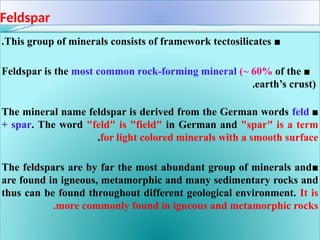
This group of minerals consists of framework tectosilicates
.
■
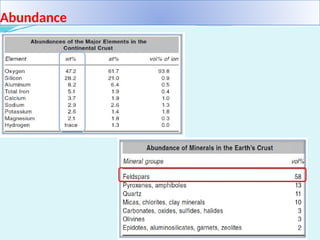
Feldspar is the most common rock-forming mineral (~ 60% of the
earth’s crust)
.
■
The mineral name feldspar is derived from the German words feld
+ spar. The word "feld" is "field" in German and "spar" is a term
for light colored minerals with a smooth surface
.
■
The feldspars are by far the most abundant group of minerals and
are found in igneous, metamorphic and many sedimentary rocks and
thus can be found throughout different geological environment. It is
more commonly found in igneous and metamorphic rocks
.
Feldspar
■
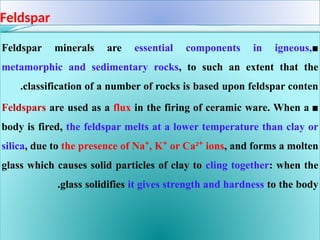
Feldspar minerals are essential components in igneous,
metamorphic and sedimentary rocks, to such an extent that the
classification of a number of rocks is based upon feldspar conten
.
■
Feldspars are used as a flux in the firing of ceramic ware. When a
body is fired, the feldspar melts at a lower temperature than clay or
silica, due to the presence of Na⁺, K⁺ or Ca²⁺ ions, and forms a molten
glass which causes solid particles of clay to cling together: when the
glass solidifies it gives strength and hardness to the body
.
Abundance
structure
■
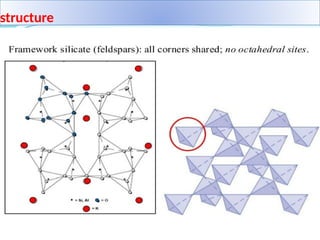
Felsdpars are framework silicates where each silica tetrahedra
share all corners with its four neighbouring tetrahedra
.
■
A portion of the tetrahedra contain Al³ instead of Si
⁺ ⁴
⁺
.
■
The charge is balanced by incorporating Na , Ca² or K
⁺ ⁺
⁺
.
structure
structure
■
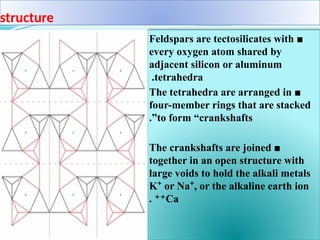
Feldspars are tectosilicates with
every oxygen atom shared by
adjacent silicon or aluminum
tetrahedra
.
■
The tetrahedra are arranged in
four-member rings that are stacked
to form “crankshafts
.”
■
The crankshafts are joined
together in an open structure with
large voids to hold the alkali metals
K or Na , or the alkaline earth ion
⁺ ⁺
Ca
. ⁺⁺
Composition
■
In feldspar tetrahedra form three-dimensional frameworks with Ca,
Na and K as the balancing cations
.
■
Feldspar is a common name that applies to a group of minerals with
a general chemical formula of
:
xAl(Al,Si)3O8
where: x can be sodium (Na) and/or calcium (Ca) and/or potassium
(K)
.
■
Chemically, the feldspars are silicates of aluminum, containing
sodium, potassium, iron, calcium, or barium or combinations of these
elements
.
■
Most deposits offer sodium feldspar as well as potassium feldspar
and mixed feldspars
.
Composition
■
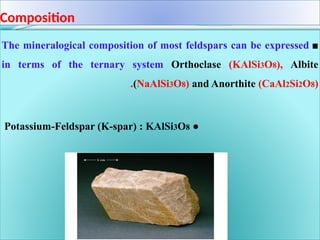
The mineralogical composition of most feldspars can be expressed
in terms of the ternary system Orthoclase (KAlSi3O8), Albite
(NaAlSi3O8) and Anorthite (CaAl2Si2O8)
.
●
Potassium-Feldspar (K-spar) : KAlSi3O8
Composition
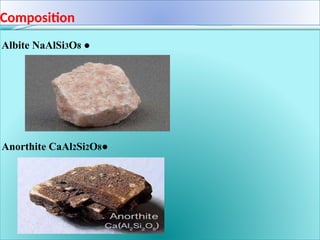
●
Albite NaAlSi3O8
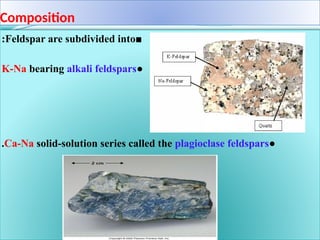
●
Anorthite CaAl2Si2O8
Composition
■
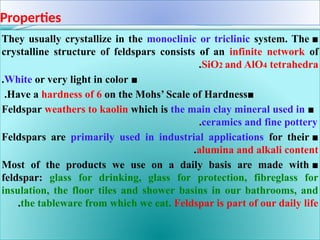
Feldspar are subdivided into
:
●
K-Na bearing alkali feldspars
●
Ca-Na solid-solution series called the plagioclase feldspars
.
Properties
■
They usually crystallize in the monoclinic or triclinic system. The
crystalline structure of feldspars consists of an infinite network of
SiO2 and AlO4 tetrahedra
.
■
White or very light in color
.
■
Have a hardness of 6 on the Mohs’ Scale of Hardness
.
■
Feldspar weathers to kaolin which is the main clay mineral used in
ceramics and fine pottery
.
■
Feldspars are primarily used in industrial applications for their
alumina and alkali content
.
■
Most of the products we use on a daily basis are made with
feldspar: glass for drinking, glass for protection, fibreglass for
insulation, the floor tiles and shower basins in our bathrooms, and
the tableware from which we eat. Feldspar is part of our daily life
.
Feldspar Resources
■
Feldspar raw materials are rocks with the prevalent portion of minerals
of the feldspar group or their mixtures in such a form, which allow their
industrial processing
.
■
Feldspars are a group of monoclinic (orthoclase) and triclinic
(plagioclases) potassium and sodium-calcium alumosilicates, and together
with quartz they represent the most common rock forming minerals
.
■
Suitable feldspar resources are dyke rocks (pegmatites, aplites), igneous
rocks (granites) and sediments (feldspar bearing sands and gravel),
eventually also residues of incompletely kaolinized rocks. The major
impurities are high content of iron in the feldspar
.
■
Most often, commercial feldspar are mined from pegmatite rocks
.
Feldspar Resources
■
Aplite, which is a fine-grained igneous rock with the same
mineralogical composition as granite, also is mined frequently for its
feldspar content
.
■
Alaskite is a granitic rock with few or no dark minerals. The
average mineral composition of the alaskites is feldspar (60%),
quartz (25%), and muscovite mica (15%)
. .
■
Rhyolite is also exploited for feldspar
.
■
Amongst the numerous rocks in which they are present, feldspars
are particularly abundant in igneous rocks like granite, which
contains from 50 to 70% of alkaline feldspar
.
Feldspar Processing Technologies
■
Feldspars are either selectively mined or processed by flotation and/or
magnetic separation, in order to remove the accessory minerals (e.g. quartz,
mica, etc.) present in the ore
.
■
The feldspar may then undergo a milling step which allows to adapt the
particle-size to the intended use
.
■
The degree of refining and possible milling is very dependent upon the final
use of the product
.
■
For a number of uses, it is perfectly acceptable, and even advantageous,
that the product retains some accessory minerals, e.g. quartz, while at the
other extreme some applications require extremely pure and fine-grounded
grades
.
■
Basically, the two properties which make feldspars useful for downstream
industries are their alkali and alumina content. ■
Normally feldspar concentrates should meet the following requirements
:
●
To maintain a proper ratio of (K2O+Na2O) to SiO2
.
●
To be low in iron content
.
Feldspar Application
■
Generally, feldspar is used in the manufacture of glass products
(70%), in ceramics and other products (30%)
.
■
In the manufacture of ceramics, feldspar is the second most
important ingredient after clay
.
■
Feldspars are an important glaze raw material used as the main
flux in ceramic industries
.
■
Feldspars are used as fluxing agents to form a glassy phase at low
temperatures and as a source of alkalis and alumina in glazes.
■Feldspars play an important role as fluxing agents in ceramics and
glass applications, and also are used as functional fillers in the paint,
plastic, rubber and adhesive industries
.
Feldspar Application
■
Feldspar does not have a strict melting point, since it melts
gradually over a range of temperatures. This greatly facilitates the
melting of quartz and clays and, through appropriate mixing, allows
modulations of this important step of ceramic making
.
■
The feldspathic glass they produce surrounds the refractory clay
particles and fills up the pores between them
.
■
Due to the free fluxes they contain, feldspathic glasses will also bind
to the surfaces of the refractory particles thus helping to bind the
ceramic body together
.
■
The more feldspathic glass a ceramic body contains, the denser the
fired body will be
.
■
They improve the strength, toughness, and durability of the
ceramic body, and bind the crystalline phase of other ingredients,
softening, melting and wetting other batch constituents

Introduction to ceramics (Feldspar).pptx

  • 1.
  • 2.
    Feldspar ■ This group ofminerals consists of framework tectosilicates . ■ Feldspar is the most common rock-forming mineral (~ 60% of the earth’s crust) . ■ The mineral name feldspar is derived from the German words feld + spar. The word "feld" is "field" in German and "spar" is a term for light colored minerals with a smooth surface . ■ The feldspars are by far the most abundant group of minerals and are found in igneous, metamorphic and many sedimentary rocks and thus can be found throughout different geological environment. It is more commonly found in igneous and metamorphic rocks .
  • 3.
    Feldspar ■ Feldspar minerals areessential components in igneous, metamorphic and sedimentary rocks, to such an extent that the classification of a number of rocks is based upon feldspar conten . ■ Feldspars are used as a flux in the firing of ceramic ware. When a body is fired, the feldspar melts at a lower temperature than clay or silica, due to the presence of Na⁺, K⁺ or Ca²⁺ ions, and forms a molten glass which causes solid particles of clay to cling together: when the glass solidifies it gives strength and hardness to the body .
  • 4.
  • 5.
    structure ■ Felsdpars are frameworksilicates where each silica tetrahedra share all corners with its four neighbouring tetrahedra . ■ A portion of the tetrahedra contain Al³ instead of Si ⁺ ⁴ ⁺ . ■ The charge is balanced by incorporating Na , Ca² or K ⁺ ⁺ ⁺ .
  • 6.
  • 7.
    structure ■ Feldspars are tectosilicateswith every oxygen atom shared by adjacent silicon or aluminum tetrahedra . ■ The tetrahedra are arranged in four-member rings that are stacked to form “crankshafts .” ■ The crankshafts are joined together in an open structure with large voids to hold the alkali metals K or Na , or the alkaline earth ion ⁺ ⁺ Ca . ⁺⁺
  • 8.
    Composition ■ In feldspar tetrahedraform three-dimensional frameworks with Ca, Na and K as the balancing cations . ■ Feldspar is a common name that applies to a group of minerals with a general chemical formula of : xAl(Al,Si)3O8 where: x can be sodium (Na) and/or calcium (Ca) and/or potassium (K) . ■ Chemically, the feldspars are silicates of aluminum, containing sodium, potassium, iron, calcium, or barium or combinations of these elements . ■ Most deposits offer sodium feldspar as well as potassium feldspar and mixed feldspars .
  • 9.
    Composition ■ The mineralogical compositionof most feldspars can be expressed in terms of the ternary system Orthoclase (KAlSi3O8), Albite (NaAlSi3O8) and Anorthite (CaAl2Si2O8) . ● Potassium-Feldspar (K-spar) : KAlSi3O8
  • 10.
  • 11.
    Composition ■ Feldspar are subdividedinto : ● K-Na bearing alkali feldspars ● Ca-Na solid-solution series called the plagioclase feldspars .
  • 12.
    Properties ■ They usually crystallizein the monoclinic or triclinic system. The crystalline structure of feldspars consists of an infinite network of SiO2 and AlO4 tetrahedra . ■ White or very light in color . ■ Have a hardness of 6 on the Mohs’ Scale of Hardness . ■ Feldspar weathers to kaolin which is the main clay mineral used in ceramics and fine pottery . ■ Feldspars are primarily used in industrial applications for their alumina and alkali content . ■ Most of the products we use on a daily basis are made with feldspar: glass for drinking, glass for protection, fibreglass for insulation, the floor tiles and shower basins in our bathrooms, and the tableware from which we eat. Feldspar is part of our daily life .
  • 13.
    Feldspar Resources ■ Feldspar rawmaterials are rocks with the prevalent portion of minerals of the feldspar group or their mixtures in such a form, which allow their industrial processing . ■ Feldspars are a group of monoclinic (orthoclase) and triclinic (plagioclases) potassium and sodium-calcium alumosilicates, and together with quartz they represent the most common rock forming minerals . ■ Suitable feldspar resources are dyke rocks (pegmatites, aplites), igneous rocks (granites) and sediments (feldspar bearing sands and gravel), eventually also residues of incompletely kaolinized rocks. The major impurities are high content of iron in the feldspar . ■ Most often, commercial feldspar are mined from pegmatite rocks .
  • 14.
    Feldspar Resources ■ Aplite, whichis a fine-grained igneous rock with the same mineralogical composition as granite, also is mined frequently for its feldspar content . ■ Alaskite is a granitic rock with few or no dark minerals. The average mineral composition of the alaskites is feldspar (60%), quartz (25%), and muscovite mica (15%) . . ■ Rhyolite is also exploited for feldspar . ■ Amongst the numerous rocks in which they are present, feldspars are particularly abundant in igneous rocks like granite, which contains from 50 to 70% of alkaline feldspar .
  • 15.
    Feldspar Processing Technologies ■ Feldsparsare either selectively mined or processed by flotation and/or magnetic separation, in order to remove the accessory minerals (e.g. quartz, mica, etc.) present in the ore . ■ The feldspar may then undergo a milling step which allows to adapt the particle-size to the intended use . ■ The degree of refining and possible milling is very dependent upon the final use of the product . ■ For a number of uses, it is perfectly acceptable, and even advantageous, that the product retains some accessory minerals, e.g. quartz, while at the other extreme some applications require extremely pure and fine-grounded grades . ■ Basically, the two properties which make feldspars useful for downstream industries are their alkali and alumina content. ■ Normally feldspar concentrates should meet the following requirements : ● To maintain a proper ratio of (K2O+Na2O) to SiO2 . ● To be low in iron content .
  • 16.
    Feldspar Application ■ Generally, feldsparis used in the manufacture of glass products (70%), in ceramics and other products (30%) . ■ In the manufacture of ceramics, feldspar is the second most important ingredient after clay . ■ Feldspars are an important glaze raw material used as the main flux in ceramic industries . ■ Feldspars are used as fluxing agents to form a glassy phase at low temperatures and as a source of alkalis and alumina in glazes. ■Feldspars play an important role as fluxing agents in ceramics and glass applications, and also are used as functional fillers in the paint, plastic, rubber and adhesive industries .
  • 17.
    Feldspar Application ■ Feldspar doesnot have a strict melting point, since it melts gradually over a range of temperatures. This greatly facilitates the melting of quartz and clays and, through appropriate mixing, allows modulations of this important step of ceramic making . ■ The feldspathic glass they produce surrounds the refractory clay particles and fills up the pores between them . ■ Due to the free fluxes they contain, feldspathic glasses will also bind to the surfaces of the refractory particles thus helping to bind the ceramic body together . ■ The more feldspathic glass a ceramic body contains, the denser the fired body will be . ■ They improve the strength, toughness, and durability of the ceramic body, and bind the crystalline phase of other ingredients, softening, melting and wetting other batch constituents