Introduction to Braided
River Systems
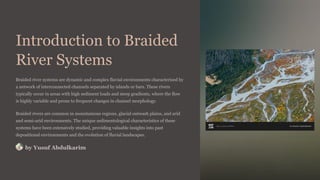
Braided river systems are dynamic and complex fluvial environments characterized by
a network of interconnected channels separated by islands or bars. These rivers
typically occur in areas with high sediment loads and steep gradients, where the flow
is highly variable and prone to frequent changes in channel morphology.
Braided rivers are common in mountainous regions, glacial outwash plains, and arid
and semi-arid environments. The unique sedimentological characteristics of these
systems have been extensively studied, providing valuable insights into past
depositional environments and the evolution of fluvial landscapes.
by Yusuf Abdulkarim
Sedimentological Characteristics of Braided Rivers
1 High Sediment Loads
Braided rivers are characterized by high sediment loads, primarily due to the
erosive power of their flows and the abundant supply of sediment from
upstream sources. This results in a high concentration of suspended and
bedload sediment, contributing to the formation of numerous bars and
islands within the channel network.
2 Rapid Flow Variability
The flow in braided rivers is highly variable, ranging from low-flow
conditions to periods of high discharge. This variability is often driven by
seasonal changes in precipitation and snowmelt, leading to significant
changes in channel geometry and sediment transport patterns.
3 Channel Instability
Channel instability is a defining feature of braided rivers. The high sediment
loads and variable flows create a dynamic system where channels shift,
merge, and split frequently, resulting in a constantly evolving landscape.
4 Dominant Gravel Transport
Gravel and coarse-grained sediment are dominant in braided river systems,
due to the high energy of the flows and the efficient transport of larger
particles. This dominance of gravel in the sediment load significantly
influences the development of sedimentary structures and bedforms.
Channel Geometry and Morphology
Channel Patterns
Braided river channels exhibit a variety
of patterns, including anabranching,
interwoven, and multi-thread. The
specific pattern observed is influenced
by factors such as sediment load, flow
regime, and topographic constraints.
Channel Width and Depth
Channel width and depth in braided
rivers vary significantly, depending on
the scale of the river system, the amount
of sediment transport, and the
frequency of flood events. The channels
are typically shallow and wide, with a
high aspect ratio (width/depth).
Bars and Islands
Bars and islands are prevalent features
in braided rivers, forming through the
deposition of sediment during high-flow
events. These features act as barriers to
the flow, leading to the formation of
new channels and the diversion of flow
paths.
Sedimentary Structures and
Bedforms
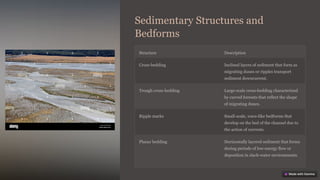
Structure Description
Cross-bedding Inclined layers of sediment that form as
migrating dunes or ripples transport
sediment downcurrent.
Trough cross-bedding Large-scale cross-bedding characterized
by curved foresets that reflect the shape
of migrating dunes.
Ripple marks Small-scale, wave-like bedforms that
develop on the bed of the channel due to
the action of currents.
Planar bedding Horizontally layered sediment that forms
during periods of low-energy flow or
deposition in slack-water environments.
Grain Size and Sorting Patterns
Gravel Dominance
Gravel is the dominant grain size in
most braided river systems,
reflecting the high energy of the
flows and the efficient transport of
larger particles.
Sand Presence
Sand is also present in braided
river deposits, particularly in areas
where flow energy is lower or
during periods of lower discharge.
Silt and Clay
Silt and clay are less common in
braided river systems, typically
found in finer-grained deposits
along the margins of the channel
network or in areas of deposition
during periods of very low flow.
Sorting Patterns
The sorting of sediment in braided
river deposits can vary depending
on the location within the channel
system and the energy of the flows.
In general, braided river deposits
are characterized by moderately to
poorly sorted sediment.
Vertical and Lateral Accretion
Surfaces
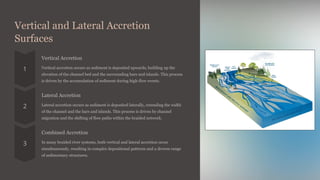
Vertical Accretion
Vertical accretion occurs as sediment is deposited upwards, building up the
elevation of the channel bed and the surrounding bars and islands. This process
is driven by the accumulation of sediment during high-flow events.
Lateral Accretion
Lateral accretion occurs as sediment is deposited laterally, extending the width
of the channel and the bars and islands. This process is driven by channel
migration and the shifting of flow paths within the braided network.
Combined Accretion
In many braided river systems, both vertical and lateral accretion occur
simultaneously, resulting in complex depositional patterns and a diverse range
of sedimentary structures.
Architectural Elements and Facies
Associations
Channel-Fill Facies
Channel-fill facies represent the
deposits within the active channels of
the braided river system. They are
typically characterized by gravel-rich
sediments, cross-bedding, and other
structures indicative of high-energy
flow.
Bar Facies
Bar facies represent the deposits on
the bars and islands within the
braided river system. They may
include a variety of sedimentary
structures, depending on the location
and the depositional environment.
Overbank Facies
Overbank facies represent the deposits that accumulate outside of the active
channel network, typically during flood events. These facies are often finer-
grained than channel-fill facies and may exhibit evidence of pedogenesis or other
post-depositional processes.
Practical Applications and Case Studies
1
Hydrological Modeling
Understanding the sedimentological characteristics of braided
rivers is crucial for hydrological modeling. This knowledge helps to
predict flood behavior, assess erosion potential, and optimize water
management strategies.
2
Sediment Transport
The study of braided river systems provides valuable insights into
sediment transport processes. This knowledge is used in the design
of river restoration projects, the mitigation of erosion hazards, and
the management of water resources.
3
Geotechnical Engineering
Sedimentological data from braided river deposits is used in
geotechnical engineering applications, such as the design of
foundations, the assessment of soil properties, and the prediction of
ground stability.
4
Petroleum Exploration
Braided river deposits can be important reservoirs of hydrocarbons.
Sedimentological analysis helps to identify potential reservoir
targets and to understand the distribution and characteristics of
reservoir rocks.
Summary
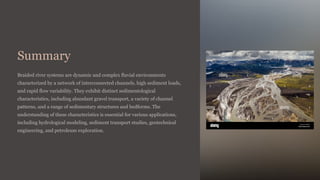
Braided river systems are dynamic and complex fluvial environments
characterized by a network of interconnected channels, high sediment loads,
and rapid flow variability. They exhibit distinct sedimentological
characteristics, including abundant gravel transport, a variety of channel
patterns, and a range of sedimentary structures and bedforms. The
understanding of these characteristics is essential for various applications,
including hydrological modeling, sediment transport studies, geotechnical
engineering, and petroleum exploration.
Conclusion
The study of braided river systems provides a valuable window into the processes that shape fluvial landscapes and the deposition of
sediment. Understanding the sedimentological characteristics of these environments allows for the accurate interpretation of past
depositional environments, the prediction of future fluvial behavior, and the development of sustainable management strategies for
river systems.

Introduction-to-Braided-River-Systems.pptx

  • 1.
    Introduction to Braided RiverSystems Braided river systems are dynamic and complex fluvial environments characterized by a network of interconnected channels separated by islands or bars. These rivers typically occur in areas with high sediment loads and steep gradients, where the flow is highly variable and prone to frequent changes in channel morphology. Braided rivers are common in mountainous regions, glacial outwash plains, and arid and semi-arid environments. The unique sedimentological characteristics of these systems have been extensively studied, providing valuable insights into past depositional environments and the evolution of fluvial landscapes. by Yusuf Abdulkarim
  • 2.
    Sedimentological Characteristics ofBraided Rivers 1 High Sediment Loads Braided rivers are characterized by high sediment loads, primarily due to the erosive power of their flows and the abundant supply of sediment from upstream sources. This results in a high concentration of suspended and bedload sediment, contributing to the formation of numerous bars and islands within the channel network. 2 Rapid Flow Variability The flow in braided rivers is highly variable, ranging from low-flow conditions to periods of high discharge. This variability is often driven by seasonal changes in precipitation and snowmelt, leading to significant changes in channel geometry and sediment transport patterns. 3 Channel Instability Channel instability is a defining feature of braided rivers. The high sediment loads and variable flows create a dynamic system where channels shift, merge, and split frequently, resulting in a constantly evolving landscape. 4 Dominant Gravel Transport Gravel and coarse-grained sediment are dominant in braided river systems, due to the high energy of the flows and the efficient transport of larger particles. This dominance of gravel in the sediment load significantly influences the development of sedimentary structures and bedforms.
  • 3.
    Channel Geometry andMorphology Channel Patterns Braided river channels exhibit a variety of patterns, including anabranching, interwoven, and multi-thread. The specific pattern observed is influenced by factors such as sediment load, flow regime, and topographic constraints. Channel Width and Depth Channel width and depth in braided rivers vary significantly, depending on the scale of the river system, the amount of sediment transport, and the frequency of flood events. The channels are typically shallow and wide, with a high aspect ratio (width/depth). Bars and Islands Bars and islands are prevalent features in braided rivers, forming through the deposition of sediment during high-flow events. These features act as barriers to the flow, leading to the formation of new channels and the diversion of flow paths.
  • 4.
    Sedimentary Structures and Bedforms StructureDescription Cross-bedding Inclined layers of sediment that form as migrating dunes or ripples transport sediment downcurrent. Trough cross-bedding Large-scale cross-bedding characterized by curved foresets that reflect the shape of migrating dunes. Ripple marks Small-scale, wave-like bedforms that develop on the bed of the channel due to the action of currents. Planar bedding Horizontally layered sediment that forms during periods of low-energy flow or deposition in slack-water environments.
  • 5.
    Grain Size andSorting Patterns Gravel Dominance Gravel is the dominant grain size in most braided river systems, reflecting the high energy of the flows and the efficient transport of larger particles. Sand Presence Sand is also present in braided river deposits, particularly in areas where flow energy is lower or during periods of lower discharge. Silt and Clay Silt and clay are less common in braided river systems, typically found in finer-grained deposits along the margins of the channel network or in areas of deposition during periods of very low flow. Sorting Patterns The sorting of sediment in braided river deposits can vary depending on the location within the channel system and the energy of the flows. In general, braided river deposits are characterized by moderately to poorly sorted sediment.
  • 6.
    Vertical and LateralAccretion Surfaces Vertical Accretion Vertical accretion occurs as sediment is deposited upwards, building up the elevation of the channel bed and the surrounding bars and islands. This process is driven by the accumulation of sediment during high-flow events. Lateral Accretion Lateral accretion occurs as sediment is deposited laterally, extending the width of the channel and the bars and islands. This process is driven by channel migration and the shifting of flow paths within the braided network. Combined Accretion In many braided river systems, both vertical and lateral accretion occur simultaneously, resulting in complex depositional patterns and a diverse range of sedimentary structures.
  • 7.
    Architectural Elements andFacies Associations Channel-Fill Facies Channel-fill facies represent the deposits within the active channels of the braided river system. They are typically characterized by gravel-rich sediments, cross-bedding, and other structures indicative of high-energy flow. Bar Facies Bar facies represent the deposits on the bars and islands within the braided river system. They may include a variety of sedimentary structures, depending on the location and the depositional environment. Overbank Facies Overbank facies represent the deposits that accumulate outside of the active channel network, typically during flood events. These facies are often finer- grained than channel-fill facies and may exhibit evidence of pedogenesis or other post-depositional processes.
  • 8.
    Practical Applications andCase Studies 1 Hydrological Modeling Understanding the sedimentological characteristics of braided rivers is crucial for hydrological modeling. This knowledge helps to predict flood behavior, assess erosion potential, and optimize water management strategies. 2 Sediment Transport The study of braided river systems provides valuable insights into sediment transport processes. This knowledge is used in the design of river restoration projects, the mitigation of erosion hazards, and the management of water resources. 3 Geotechnical Engineering Sedimentological data from braided river deposits is used in geotechnical engineering applications, such as the design of foundations, the assessment of soil properties, and the prediction of ground stability. 4 Petroleum Exploration Braided river deposits can be important reservoirs of hydrocarbons. Sedimentological analysis helps to identify potential reservoir targets and to understand the distribution and characteristics of reservoir rocks.
  • 9.
    Summary Braided river systemsare dynamic and complex fluvial environments characterized by a network of interconnected channels, high sediment loads, and rapid flow variability. They exhibit distinct sedimentological characteristics, including abundant gravel transport, a variety of channel patterns, and a range of sedimentary structures and bedforms. The understanding of these characteristics is essential for various applications, including hydrological modeling, sediment transport studies, geotechnical engineering, and petroleum exploration.
  • 10.
    Conclusion The study ofbraided river systems provides a valuable window into the processes that shape fluvial landscapes and the deposition of sediment. Understanding the sedimentological characteristics of these environments allows for the accurate interpretation of past depositional environments, the prediction of future fluvial behavior, and the development of sustainable management strategies for river systems.