Unreal Engine 5 - Series
Introduction to Visual Scripting – Episode 01
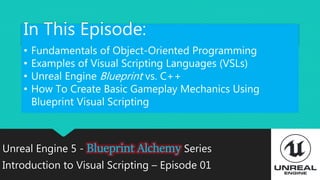
In This Episode:
• Fundamentals of Object-Oriented Programming
• Examples of Visual Scripting Languages (VSLs)
• Unreal Engine Blueprint vs. C++
• How To Create Basic Gameplay Mechanics Using
Blueprint Visual Scripting
Unreal Engine 5 - Series
Introduction to Visual Scripting – Episode 01
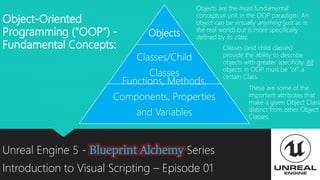
Classes/Child
Classes
Functions, Methods,
Components, Properties
and Variables
Objects are the most fundamental
conceptual unit in the OOP paradigm. An
object can be virtually anything (just as in
the real world) but is more specifically
defined by its class.
Classes (and child classes)
provide the ability to describe
objects with greater specificity. All
objects in OOP must be “of” a
certain Class.
These are some of the
important attributes that
make a given Object Class
distinct from other Object
Classes.
Unreal Engine 5 - Series
Introduction to Visual Scripting – Episode 01
Unreal Engine 5 - Series
Introduction to Visual Scripting – Episode 01
An object, when it is first created, is “a class unto itself”, but can also be a member of a broader class “family” that
can include several members. Object classes can also be used as base units to create what are known as “child
classes”. A child class usually has similar features to its corresponding base class (also known as its “parent” class),
due to a concept in OOP called inheritance. A child class will usually inherit the attributes, components, variables and
scripted functionality from its parent class, but can also be modified to more precisely define it, or to add additional
features that were/are not present in the original base class.
An example would be to create a parent class called “Plants”. All plants have certain things in common, and these
features are broadly defined in the parent class. But not all plants are the same. Some are pretty, while others may
look strange. Some smell nice, while others may not. Some are poisonous, but certainly not all of them. Some can
be used as food, while others are meant for decoration. Some might be more rarely seen than others. The list goes
on. So it goes for most Object Classes that are used in programming. Child Classes inherit the broad characteristics
defined by their corresponding parent class, but tend to be more specific in terms of their attributes compared to
their parents or siblings. For example, a child class of “Plants” can be “Flowers”. Even the new Flowers class can have
its own children to define each type more specifically.
Class Terminology:
• Functions/Methods (Actions that a Class can perform)
• Components (Pre-scripted pieces of functionality that can be added to
or inherited by a given class)
• Properties (Can be thought of as “settings” for the components and
variables in a given Class, in the sense we will encounter them in
• Variables (“Containers” that hold data types and values for them,
especially when they need to be accessed or changed frequently)
Unreal Engine 5 - Series
Introduction to Visual Scripting – Episode 01
Visual Scripting has similar, and often identical goals as
conventional programming. Instead of representing
programming concepts using syntax (typed-out lines of
“code”), Visual Scripting Languages (VSLs) represent
programming concepts using visible “nodes” which can
be displayed on a graph with connections between them.
What is “Visual Scripting”?
Unreal Engine 5 - Series
Introduction to Visual Scripting – Episode 01
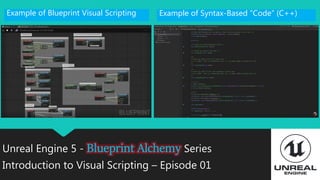
Example of Blueprint Visual Scripting Example of Syntax-Based “Code” (C++)
Unreal Engine 5 - Series
Introduction to Visual Scripting – Episode 01
Unreal Engine 5 - Series
Introduction to Visual Scripting – Episode 01
Examples of Visual Scripting Languages used in
Programming
There are hundreds, but here are a handful of examples:
• Unreal Engine Blueprint
• MAX/MSP
• Simulink
• LabView
• Scicos
• Visual BASIC
• Bubble
Unreal Engine’s powerful Blueprint Visual Scripting
Language allows for rapid prototyping and/or
programming of complex gameplay systems without
having to write (or memorize) a single line of syntax-
based code.
Unreal Engine 5 - Series
Introduction to Visual Scripting – Episode 01
Unreal Engine 5 - Series
Introduction to Visual Scripting – Episode 01
Additional Terminology:
• Assets – Files that are up for consideration to be used in a project.
Assets can be things like 3D models, audio files, animation files, and
particle systems. Assets don’t have to be visible, as some provide
functionality only.
• Actors – Once an asset has been added to the game world (often
referred to as a “Level” or “Map”, it becomes an “Actor” in te game.
Everything in your level is an actor, whether it’s visible or not.
• Blueprint Actors – Actors that provide scripted functionality, usually
in the form of providing interactivity and gameplay mechanics.

Introduction to Blueprint Scripting.pptx

  • 1.
    Unreal Engine 5- Series Introduction to Visual Scripting – Episode 01
  • 2.
    In This Episode: •Fundamentals of Object-Oriented Programming • Examples of Visual Scripting Languages (VSLs) • Unreal Engine Blueprint vs. C++ • How To Create Basic Gameplay Mechanics Using Blueprint Visual Scripting Unreal Engine 5 - Series Introduction to Visual Scripting – Episode 01
  • 3.
    Classes/Child Classes Functions, Methods, Components, Properties andVariables Objects are the most fundamental conceptual unit in the OOP paradigm. An object can be virtually anything (just as in the real world) but is more specifically defined by its class. Classes (and child classes) provide the ability to describe objects with greater specificity. All objects in OOP must be “of” a certain Class. These are some of the important attributes that make a given Object Class distinct from other Object Classes. Unreal Engine 5 - Series Introduction to Visual Scripting – Episode 01
  • 4.
    Unreal Engine 5- Series Introduction to Visual Scripting – Episode 01 An object, when it is first created, is “a class unto itself”, but can also be a member of a broader class “family” that can include several members. Object classes can also be used as base units to create what are known as “child classes”. A child class usually has similar features to its corresponding base class (also known as its “parent” class), due to a concept in OOP called inheritance. A child class will usually inherit the attributes, components, variables and scripted functionality from its parent class, but can also be modified to more precisely define it, or to add additional features that were/are not present in the original base class. An example would be to create a parent class called “Plants”. All plants have certain things in common, and these features are broadly defined in the parent class. But not all plants are the same. Some are pretty, while others may look strange. Some smell nice, while others may not. Some are poisonous, but certainly not all of them. Some can be used as food, while others are meant for decoration. Some might be more rarely seen than others. The list goes on. So it goes for most Object Classes that are used in programming. Child Classes inherit the broad characteristics defined by their corresponding parent class, but tend to be more specific in terms of their attributes compared to their parents or siblings. For example, a child class of “Plants” can be “Flowers”. Even the new Flowers class can have its own children to define each type more specifically.
  • 5.
    Class Terminology: • Functions/Methods(Actions that a Class can perform) • Components (Pre-scripted pieces of functionality that can be added to or inherited by a given class) • Properties (Can be thought of as “settings” for the components and variables in a given Class, in the sense we will encounter them in • Variables (“Containers” that hold data types and values for them, especially when they need to be accessed or changed frequently) Unreal Engine 5 - Series Introduction to Visual Scripting – Episode 01
  • 6.
    Visual Scripting hassimilar, and often identical goals as conventional programming. Instead of representing programming concepts using syntax (typed-out lines of “code”), Visual Scripting Languages (VSLs) represent programming concepts using visible “nodes” which can be displayed on a graph with connections between them. What is “Visual Scripting”? Unreal Engine 5 - Series Introduction to Visual Scripting – Episode 01
  • 7.
    Example of BlueprintVisual Scripting Example of Syntax-Based “Code” (C++) Unreal Engine 5 - Series Introduction to Visual Scripting – Episode 01
  • 8.
    Unreal Engine 5- Series Introduction to Visual Scripting – Episode 01 Examples of Visual Scripting Languages used in Programming There are hundreds, but here are a handful of examples: • Unreal Engine Blueprint • MAX/MSP • Simulink • LabView • Scicos • Visual BASIC • Bubble
  • 9.
    Unreal Engine’s powerfulBlueprint Visual Scripting Language allows for rapid prototyping and/or programming of complex gameplay systems without having to write (or memorize) a single line of syntax- based code. Unreal Engine 5 - Series Introduction to Visual Scripting – Episode 01
  • 10.
    Unreal Engine 5- Series Introduction to Visual Scripting – Episode 01 Additional Terminology: • Assets – Files that are up for consideration to be used in a project. Assets can be things like 3D models, audio files, animation files, and particle systems. Assets don’t have to be visible, as some provide functionality only. • Actors – Once an asset has been added to the game world (often referred to as a “Level” or “Map”, it becomes an “Actor” in te game. Everything in your level is an actor, whether it’s visible or not. • Blueprint Actors – Actors that provide scripted functionality, usually in the form of providing interactivity and gameplay mechanics.