Introduction to OOP
CSACW L7
By Professor. Edmond
Objectives/Goals
‱ Introduction to basic concepts of object-
oriented programming.
‱ Terminology of object-oriented
programming and syntax.
‱Practical applications of object-oriented
programming.
‱To practice coding and debugging skills.
Agenda
Introduction
‱ ABrief Programming History
‱ OOP
‱ Classes & Objects
5
Computer Programming
An algorithm is a step-by-step process.
A computer program is a step-by-step set of instructions for a computer.
Every computer program is an algorithm.
Computer Programming
The history of computer programming is a steady
move away from machine-oriented views of
programming towards concepts and metaphors that
more closely reflect the way in which we ourselves
see & understand the world
‱ Programming languages allow programmers to develop
software.
‱ How many major language families are there?
‱ The three major families of languages are:
‱ Machine languages
‱ Assembly languages
‱ High-Level languages
Computer Programming Languages
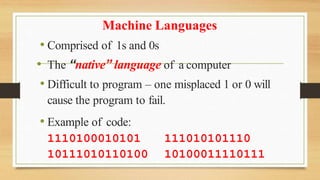
Machine Languages
‱ Comprised of 1s and 0s
‱ The “native” language of a computer
‱ Difficult to program – one misplaced 1 or 0 will
cause the program to fail.
‱ Example of code:
1110100010101
10111010110100
111010101110
10100011110111
Assembly Languages
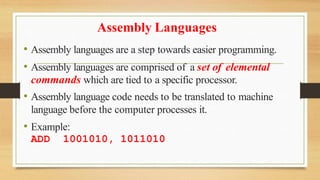
‱ Assembly languages are a step towards easier programming.
‱ Assembly languages are comprised of a set of elemental
commands which are tied to a specific processor.
‱ Assembly language code needs to be translated to machine
language before the computer processes it.
‱ Example:
ADD 1001010, 1011010
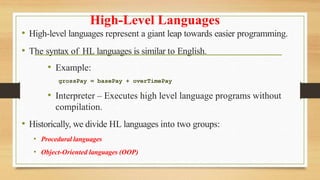
High-Level Languages
‱ High-level languages represent a giant leap towards easier programming.
‱ The syntax of HL languages is similar to English.
‱ Example:
grossPay = basePay + overTimePay
‱ Interpreter – Executes high level language programs without
compilation.
‱ Historically, we divide HL languages into two groups:
‱ Procedural languages
‱ Object-Oriented languages (OOP)
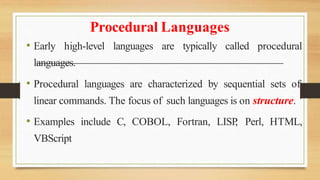
Procedural Languages
‱ Early high-level languages are typically called procedural
languages.
‱ Procedural languages are characterized by sequential sets of
linear commands. The focus of such languages is on structure.
‱ Examples include C, COBOL, Fortran, LISP
, Perl, HTML,
VBScript
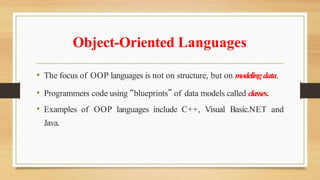
Object-Oriented Languages
‱ The focus of OOP languages is not on structure, but on modelingdata.
‱ Programmers code using “blueprints” of data models called classes.
‱ Examples of OOP languages include C++, Visual Basic.NET and
Java.
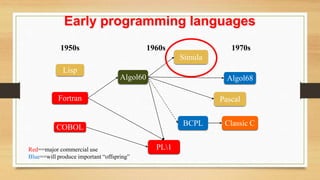
Early programming languages
Classic C
Pascal
Algol68
BCPL
Fortran
COBOL
Algol60
PL1
1950s 1960s 1970s
Simula
Lisp
Red==major commercial use
Blue==will produce important “offspring”
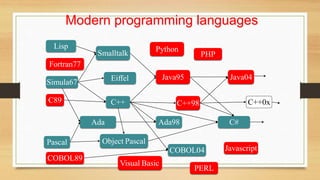
Modern programming languages
Object Pascal
C++
Java95
C#
Ada98
C++98
Java04
C++0x
Python
Lisp
Smalltalk
Fortran77
Ada
Eiffel
Simula67
PHP
C89
Pascal
COBOL89
PERL
Visual Basic
COBOL04 Javascript
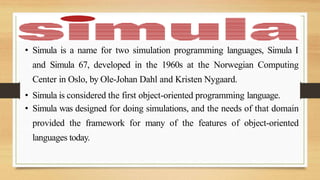
‱ Simula is a name for two simulation programming languages, Simula I
and Simula 67, developed in the 1960s at the Norwegian Computing
Center in Oslo, by Ole-Johan Dahl and Kristen Nygaard.
‱ Simula is considered the first object-oriented programming language.
‱ Simula was designed for doing simulations, and the needs of that domain
provided the framework for many of the features of object-oriented
languages today.
 Introduction
‱ ABrief Programming History
‱ OOP
‱ Classes & Objects
OOP
‱ OOP is mainly a program design philosophy.
‱ OOP uses a different set of programming languages than old procedural
programming languages (C, Pascal, etc.).
‱ Everything in OOP is grouped as self sustainable "objects". Hence, you
gain re-usability by means of four main object-oriented programming
concepts.
‱ In OOP programmers define not only the data type of a data structure, but also the
types of operations/methods (functions) that can be applied to the data structure.
‱ In this way, the data structure becomes an object that includes both data and
functions (methods) in one unit. In addition, programmers can create relationships
between one object and another.
‱ For example, objects can inherit characteristics from other objects.
OOP
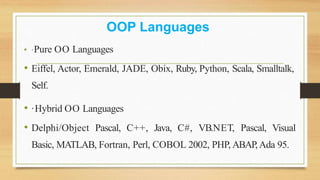
OOP Languages
‱ ·Pure OO Languages
‱ Eiffel, Actor, Emerald, JADE, Obix, Ruby, Python, Scala, Smalltalk,
Self.
‱ ·Hybrid OO Languages
‱ Delphi/Object Pascal, C++, Java, C#, VB.NET, Pascal, Visual
Basic, MATLAB, Fortran, Perl, COBOL 2002, PHP, ABAP,Ada 95.
OOP
‱ Key idea in object-oriented:
‱ The real world can be “accurately” described as a collection of
objects that interact.
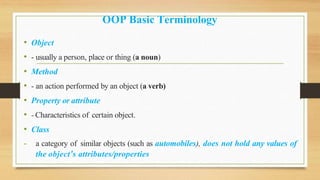
OOP Basic Terminology
‱ Object
‱ - usually a person, place or thing (a noun)
‱ Method
‱ - an action performed by an object (a verb)
‱ Property or attribute
‱ - Characteristics of certain object.
‱ Class
- a category of similar objects (such as automobiles), does not hold any values of
the object’s attributes/properties
Introduction
‱ A Brief Programming History
‱ OOP
‱ Classes & Objects
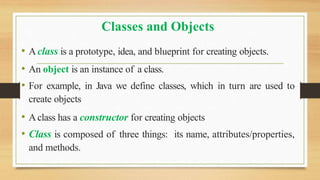
Classes and Objects
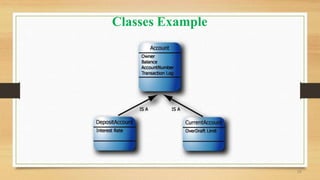
‱ Aclass is a prototype, idea, and blueprint for creating objects.
‱ An object is an instance of a class.
‱ For example, in Java we define classes, which in turn are used to
create objects
‱ Aclass has a constructor for creating objects
‱ Class is composed of three things: its name, attributes/properties,
and methods.
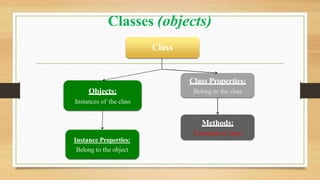
Classes (objects)
Objects:
Instances of the class
Methods:
Functions of class
Class
Instance Properties:
Belong to the object
Class Properties:
Belong to the class
27
Classes (objects)
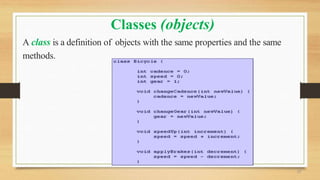
A class is a definition of objects with the same properties and the same
methods.
28
Classes Example
Almost everything in the world can be represented as
an object
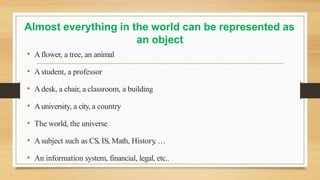
‱ Aflower, a tree, an animal
‱ Astudent, a professor
‱ Adesk, a chair, a classroom, a building
‱ Auniversity, a city, a country
‱ The world, the universe
‱ Asubject such as CS, IS, Math, History
, 

‱ An information system, financial, legal, etc..
An object is an instance of a class.
What Is an Object, again?
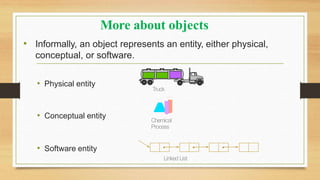
‱ Informally, an object represents an entity, either physical,
conceptual, or software.
‱ Physical entity
‱ Conceptual entity
‱ Software entity
More about objects
Truck
Chemical
Process
Linked List
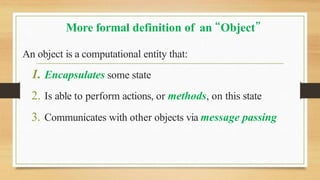
More formal definition of an “Object”
An object is a computational entity that:
1. Encapsulates some state
2. Is able to perform actions, or methods, on this state
3. Communicates with other objects via message passing
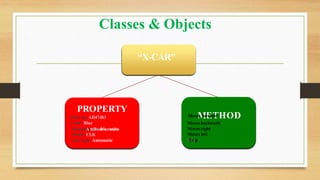
Classes & Objects
PROPERTY Do something:
function & procedure
“X-CAR”
PROPERTY
Plate no:AD47483
Color: Blue
ManufaA
ctu
tr
r
ie
e
br
u
:tM
e o
erc
se
td
at
ee
s
Model: CLK
Gear type:Automatic
Move
M
s for
E
waT
rd HOD
Moves backward
Moves right
Moves left
S
S
t
t
o
o
p
p
s
s
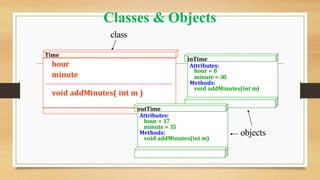
Classes & Objects
hour
minute
void addMinutes( int m )
Time
inTime
Attributes:
hour = 8
minute = 30
Methods:
void addMinutes(int m)
outTime
Attributes:
hour = 17
minute = 35
Methods:
void addMinutes(int m)
class
objects
35
Class/Object
Each copy of an object from a particular class is called an instance of the
class.
36
The act of creating a new instance of an class is called instantiation.
Class/Object
In short

‱ An Object is a Class when it comes alive!
‱ Homo Sapien is a class, John and Jack are objects
‱ Animal is a class “Snowball” the cat is an object
‱ V
ehicle is a class My neighbor's BMW is an object
‱ Galaxy is a class, the MilkyW
ay is an object
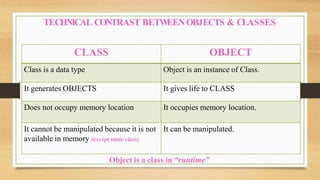
CLASS OBJECT
Class is a data type Object is an instance of Class.
It generates OBJECTS It gives life to CLASS
Does not occupy memory location It occupies memory location.
It cannot be manipulated because it is not
available in memory (except static class)
It can be manipulated.
TECHNICAL CONTRAST BETW
EENOBJECTS & CLASSES
Object is a class in “runtime”
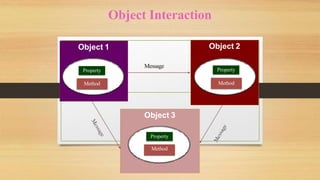
Objects Need to Collaborate!
‱ Objects are useless unless they can collaborate together
to solve a problem.
‱ Each object is responsible for its own behavior and
status.
‱ No one object can carry out every responsibility on its
own.
‱ How do objects interact with each other?
‱ They interact through messages.
Object 3
Object 2
Object Interaction
Object 1
Property
Method
Property
Method
Property
Method
Message
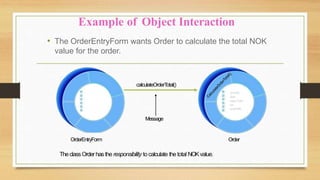
‱ The OrderEntryForm wants Order to calculate the total NOK
value for the order.
Example of Object Interaction
OrderEntryForm Order
orderID
date
salesTotal
tax
shipDate
calculateOrderT
otal()
TheclassOrderhasthe responsibility tocalculate the total NOKvalue.
Message
Thanks for your attention!
Any Questions?
Computer Science ACW Intro to OOP L7.pptx

Computer Science ACW Intro to OOP L7.pptx

  • 1.
    Introduction to OOP CSACWL7 By Professor. Edmond
  • 2.
    Objectives/Goals ‱ Introduction tobasic concepts of object- oriented programming. ‱ Terminology of object-oriented programming and syntax. ‱Practical applications of object-oriented programming. ‱To practice coding and debugging skills.
  • 3.
  • 4.
    Introduction ‱ ABrief ProgrammingHistory ‱ OOP ‱ Classes & Objects
  • 5.
    5 Computer Programming An algorithmis a step-by-step process. A computer program is a step-by-step set of instructions for a computer. Every computer program is an algorithm.
  • 6.
    Computer Programming The historyof computer programming is a steady move away from machine-oriented views of programming towards concepts and metaphors that more closely reflect the way in which we ourselves see & understand the world
  • 7.
    ‱ Programming languagesallow programmers to develop software. ‱ How many major language families are there? ‱ The three major families of languages are: ‱ Machine languages ‱ Assembly languages ‱ High-Level languages Computer Programming Languages
  • 8.
    Machine Languages ‱ Comprisedof 1s and 0s ‱ The “native” language of a computer ‱ Difficult to program – one misplaced 1 or 0 will cause the program to fail. ‱ Example of code: 1110100010101 10111010110100 111010101110 10100011110111
  • 9.
    Assembly Languages ‱ Assemblylanguages are a step towards easier programming. ‱ Assembly languages are comprised of a set of elemental commands which are tied to a specific processor. ‱ Assembly language code needs to be translated to machine language before the computer processes it. ‱ Example: ADD 1001010, 1011010
  • 10.
    High-Level Languages ‱ High-levellanguages represent a giant leap towards easier programming. ‱ The syntax of HL languages is similar to English. ‱ Example: grossPay = basePay + overTimePay ‱ Interpreter – Executes high level language programs without compilation. ‱ Historically, we divide HL languages into two groups: ‱ Procedural languages ‱ Object-Oriented languages (OOP)
  • 11.
    Procedural Languages ‱ Earlyhigh-level languages are typically called procedural languages. ‱ Procedural languages are characterized by sequential sets of linear commands. The focus of such languages is on structure. ‱ Examples include C, COBOL, Fortran, LISP , Perl, HTML, VBScript
  • 12.
    Object-Oriented Languages ‱ Thefocus of OOP languages is not on structure, but on modelingdata. ‱ Programmers code using “blueprints” of data models called classes. ‱ Examples of OOP languages include C++, Visual Basic.NET and Java.
  • 13.
    Early programming languages ClassicC Pascal Algol68 BCPL Fortran COBOL Algol60 PL1 1950s 1960s 1970s Simula Lisp Red==major commercial use Blue==will produce important “offspring”
  • 14.
    Modern programming languages ObjectPascal C++ Java95 C# Ada98 C++98 Java04 C++0x Python Lisp Smalltalk Fortran77 Ada Eiffel Simula67 PHP C89 Pascal COBOL89 PERL Visual Basic COBOL04 Javascript
  • 15.
    ‱ Simula isa name for two simulation programming languages, Simula I and Simula 67, developed in the 1960s at the Norwegian Computing Center in Oslo, by Ole-Johan Dahl and Kristen Nygaard. ‱ Simula is considered the first object-oriented programming language. ‱ Simula was designed for doing simulations, and the needs of that domain provided the framework for many of the features of object-oriented languages today.
  • 16.
     Introduction ‱ ABriefProgramming History ‱ OOP ‱ Classes & Objects
  • 17.
    OOP ‱ OOP ismainly a program design philosophy. ‱ OOP uses a different set of programming languages than old procedural programming languages (C, Pascal, etc.). ‱ Everything in OOP is grouped as self sustainable "objects". Hence, you gain re-usability by means of four main object-oriented programming concepts.
  • 18.
    ‱ In OOPprogrammers define not only the data type of a data structure, but also the types of operations/methods (functions) that can be applied to the data structure. ‱ In this way, the data structure becomes an object that includes both data and functions (methods) in one unit. In addition, programmers can create relationships between one object and another. ‱ For example, objects can inherit characteristics from other objects. OOP
  • 19.
    OOP Languages ‱ ·PureOO Languages ‱ Eiffel, Actor, Emerald, JADE, Obix, Ruby, Python, Scala, Smalltalk, Self. ‱ ·Hybrid OO Languages ‱ Delphi/Object Pascal, C++, Java, C#, VB.NET, Pascal, Visual Basic, MATLAB, Fortran, Perl, COBOL 2002, PHP, ABAP,Ada 95.
  • 20.
    OOP ‱ Key ideain object-oriented: ‱ The real world can be “accurately” described as a collection of objects that interact.
  • 21.
    OOP Basic Terminology ‱Object ‱ - usually a person, place or thing (a noun) ‱ Method ‱ - an action performed by an object (a verb) ‱ Property or attribute ‱ - Characteristics of certain object. ‱ Class - a category of similar objects (such as automobiles), does not hold any values of the object’s attributes/properties
  • 22.
    Introduction ‱ A BriefProgramming History ‱ OOP ‱ Classes & Objects
  • 25.
    Classes and Objects ‱Aclass is a prototype, idea, and blueprint for creating objects. ‱ An object is an instance of a class. ‱ For example, in Java we define classes, which in turn are used to create objects ‱ Aclass has a constructor for creating objects ‱ Class is composed of three things: its name, attributes/properties, and methods.
  • 26.
    Classes (objects) Objects: Instances ofthe class Methods: Functions of class Class Instance Properties: Belong to the object Class Properties: Belong to the class
  • 27.
    27 Classes (objects) A classis a definition of objects with the same properties and the same methods.
  • 28.
  • 29.
    Almost everything inthe world can be represented as an object ‱ Aflower, a tree, an animal ‱ Astudent, a professor ‱ Adesk, a chair, a classroom, a building ‱ Auniversity, a city, a country ‱ The world, the universe ‱ Asubject such as CS, IS, Math, History , 
 ‱ An information system, financial, legal, etc..
  • 30.
    An object isan instance of a class. What Is an Object, again?
  • 31.
    ‱ Informally, anobject represents an entity, either physical, conceptual, or software. ‱ Physical entity ‱ Conceptual entity ‱ Software entity More about objects Truck Chemical Process Linked List
  • 32.
    More formal definitionof an “Object” An object is a computational entity that: 1. Encapsulates some state 2. Is able to perform actions, or methods, on this state 3. Communicates with other objects via message passing
  • 33.
    Classes & Objects PROPERTYDo something: function & procedure “X-CAR” PROPERTY Plate no:AD47483 Color: Blue ManufaA ctu tr r ie e br u :tM e o erc se td at ee s Model: CLK Gear type:Automatic Move M s for E waT rd HOD Moves backward Moves right Moves left S S t t o o p p s s
  • 34.
    Classes & Objects hour minute voidaddMinutes( int m ) Time inTime Attributes: hour = 8 minute = 30 Methods: void addMinutes(int m) outTime Attributes: hour = 17 minute = 35 Methods: void addMinutes(int m) class objects
  • 35.
    35 Class/Object Each copy ofan object from a particular class is called an instance of the class.
  • 36.
    36 The act ofcreating a new instance of an class is called instantiation. Class/Object
  • 37.
    In short
 ‱ AnObject is a Class when it comes alive! ‱ Homo Sapien is a class, John and Jack are objects ‱ Animal is a class “Snowball” the cat is an object ‱ V ehicle is a class My neighbor's BMW is an object ‱ Galaxy is a class, the MilkyW ay is an object
  • 38.
    CLASS OBJECT Class isa data type Object is an instance of Class. It generates OBJECTS It gives life to CLASS Does not occupy memory location It occupies memory location. It cannot be manipulated because it is not available in memory (except static class) It can be manipulated. TECHNICAL CONTRAST BETW EENOBJECTS & CLASSES Object is a class in “runtime”
  • 39.
    Objects Need toCollaborate! ‱ Objects are useless unless they can collaborate together to solve a problem. ‱ Each object is responsible for its own behavior and status. ‱ No one object can carry out every responsibility on its own. ‱ How do objects interact with each other? ‱ They interact through messages.
  • 40.
    Object 3 Object 2 ObjectInteraction Object 1 Property Method Property Method Property Method Message
  • 41.
    ‱ The OrderEntryFormwants Order to calculate the total NOK value for the order. Example of Object Interaction OrderEntryForm Order orderID date salesTotal tax shipDate calculateOrderT otal() TheclassOrderhasthe responsibility tocalculate the total NOKvalue. Message
  • 42.
    Thanks for yourattention!
  • 43.