

Blockchain Ecosystem
• Blockchain Concepts Walkthrough
• Blockchain Fundraising 101
• Cryptocurrency Regulations Update
• Data Collection Methodology and Background
Blockchain Ecosystem
Blockchain
Concepts
Walkthrough
Blockchain
Fundraising 101
Cryptocurrency
Regulations
Update
Data Collection
Methodology
and Background
Blockchain Concepts Walkthrough
• Blockchain in a nutshell
• Blockchain 1.0/2.0/3.0 and Smart Contracts
• Consensus algorithms and Types of Blockchain
• Blockchain use cases-selective examples and selected corporate use
cases
• Other Interesting Use cases: conversations on the ground
• Leading consortiums/initiatives
• Current Blockchain Limitations
Blockchain in a Nutshell
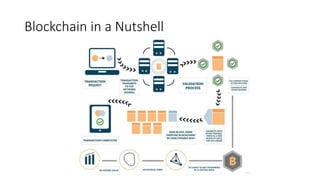
• A blockchain is a general digital ledger of transactions that are executed on the
network, e.g. using Bitcoin to buy a cup of coffee is a transaction.
• All users of the network, ‘Nodes’, have a copy of the transaction records and can
access them freely, a role previously played by centralized institutions. Therefore,
the blockchain network is ‘decentralized’.
• Transaction records within the blockchain are grouped into ‘blocks’. These blocks
are time stamped when they are created and ‘chained’ in number order of a
block.
• Some users of the network put up computational power or tokens at stake
(miners/validators) to validate the blocks of transactions, and check that
transactions records are not tampered with.
• As an incentive, tokens (e.g. some Bitcoins) are given as reward for their work, in
transaction fees and/or block rewards. . For example, bitcoin miners are given
Bitcoins and Ethereum validators are given Ether.
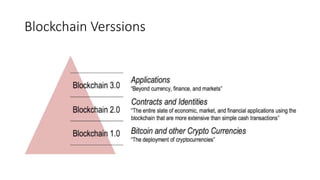
Blockchain Verssions
Blockchain 1.0: Currency
• Blockchain 1.0 is the creation of cryptocurrency, a virtual currency used for
• payment purposes derived from the combination of cryptography and
currency. Bitcoin is an example of Blockchain 1.0.
• ‘Cryptography’- Miners collect the transactions and compete by solving a
cryptographic problem.
• The winner can generate the ‘hash’ (turning large chunks of transaction
data into a line of numbers that represents the transactions) to add to the
blockchain using the cryptographic algorithm.
• ‘Currency’- comes in the form of tokens, which is used to trade value
securely.
Blockchain 1.0: Currency
• Miners collect the new transactions into a block, then attempt to
hash the block to form a 256-bit block hash value using trial and error.
Most of the time the hash proves unsuccessful, in which case the
miner will make slight modifications to the block and try hashing the
block again, over and over billions of times.
• If the hash starts with enough zeros, the block has been successfully
mined and is sent into the Bitcoin network, where consequently the
hash becomes the identifier for the block. Whenever some miners
successfully mine a block, the process begins anew.
Blockchain 1.0: Currency
• The successfully mined block is almost impossible to tamper with
because all previous blocks need to be re-encrypted in order to
change the transaction records in the block.
• As the network is decentralized and there are many copies need to be
re-encrypted, the bigger the network, the more computing power it
takes, and so bad actors are disincentivized to cheat the system.
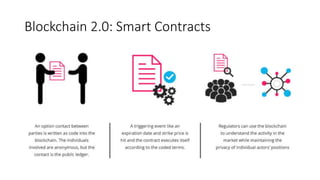
Blockchain 2.0: Smart Contracts
• Blockchain 2.0 is the introduction of smart contracts on a protocol, such as
Ethereum or NEO.
• Smart contracts are sets of programmable and executable rules/logic that
are irreversibly stored on the blockchain. When both parties have met the
pre-existing criteria, the agreed terms are automatically executed.
• Project build application on a decentralized peer to peer network is often
referred to as ‘dApp’, where the project’s related transactions are
decentralized across the network, so there is no single point of failure.
• ‘Outcomes’ on the smart contracts are stored on the blockchain. Every
party on the protocol has a copy of these ‘outcomes’. For the smart
contract to be processed and validated on the network, some operational
tokens (GAS, NEO Gas) are paid for the verification.
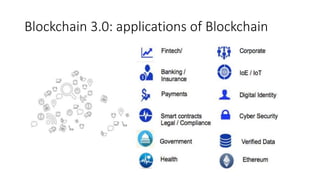
Blockchain 3.0: applications of Blockchain
• In general, Blockchain 3.0 refers to attempts of applying the concept
of blockchain to different sectors where the technology can be useful
in tackling hard issues, such as situations where coordination
between parties (i.e. standards organization, industry group,
multilateral organization, international treaty) is difficult or where
lack of trust amongst multiple parties exist.
• Blockchain 3.0 also includes attempts to fine tune the protocol in
order to speed up transaction approval speeds (increase throughput),
manage token price volatility and achieve interoperability between
protocols (e.g. swapping Ether with NEO and make sure both
protocols are compatible).
Blockchain 3.0: applications of Blockchain
• Blockchain is designed as an incentive system that can operate by a
set of predefined rules and in ideal cases does not need a centralized
body to manage and govern.
• All parties trust these set of rules and logics instead a centralized
body, so all parties can transact without trusting each other- hence
‘trustless’.
• Following this set of predefined rules enables full automation and
therefore creates the possibilities of software that can automatically
execute transactions and tasks, pay and be paid, totally self sustained
and powered by AI to improve themselves- the vision of
“autonomous business agents”.
Consensus Algorithms: Proof-of-Work (PoW)
• In layman terms, consensus algorithms are mechanisms created to verify
transaction records agreed by all parties in the blockchain network. They
encode the fundamental principles for resolving disputed transactions
among the parties in a blockchain network. As the design of blockchain is
decentralized, this is facilitated through the design of distributed
consensus.
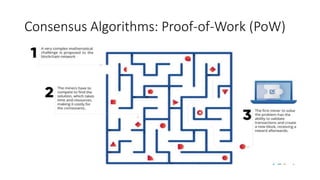
• Proof of Work is the first generation of consensus algorithm.
• Computers in the network (miners) collect transaction records into a block
and pass them through a computationally intensive hashing algorithm
multiple times to make sure it produces a line of numbers that correlates
with the block, solving a cryptographic problem. When completed, the
hash becomes a validator of the block of transaction.
Consensus Algorithms: Proof-of-Work (PoW)
• After the block is validated and completed, they are then time stamped
and broadcasted so that everyone (nodes) has a copy of the record.
• Many PoW protocols achieve alignment of incentives by distributing token
based rewards to miners who provide the validation service to the
network. As transaction volume and currency velocity goes up, so does the
value of the currency which attracts more miners to the network.
• The process evolves around “cryptographic problem” solved by trial and
error, which consumes much computing power. Miner proves its integrity
by doing the work. This mechanism also provides the “randomness” so that
theoretically no miner can predict and take control of the network.
• As an incentive, block reward or transaction fees, in terms of token or
cryptocurrencies, are given to the first miner who solves the cryptographic
puzzle.
The 51% attack and the Double Spend problem
• The 51% attack poses a theoretical risk to the integrity of the
blockchain when a group of miners take control of more than 50% of
the mining capability (hash rate) of the network.
• A PoW algorithm is secured by having all miners (computers
processing the networks transactions) agree on the blockchain. Nodes
look to each other to verify what they are working on as the valid
blockchain, acknowledging the longest chain as the true version of
the blockchain because more hashing power has been committed to
it, hence denoting that the majority agrees to this version.
The 51% attack and the Double Spend problem
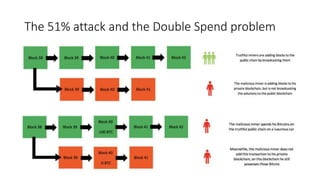
• If the majority of miners are controlled by a single entity, they have the
potential to create the longest chain, dubbed the ‘truthful chain', forming
the basis of all balances of wallets. The corrupted group miners can
purchase a house, for instance, and broadcast the transaction to non-
colluding nodes on one version of the chain, while continuing to mine
transactions from the network forming another version of the blockchain
without its order to purchase a house, and not broadcasting this
alternative chain to rest of the network.
• Once the purchase is complete, and the corrupted miners use their
superior mining power to create a longer chain by forming transaction
blocks “quicker”, they can post the longer, hence `truthful` version of the
chain to the network without its house purchasing transactions.
The 51% attack and the Double Spend problem
• This will be recognized as the truthful version without the tokens
spent, allowing the wallets to be replenished and the entity to double
spend its tokens again.
• Therefore, blockchain needs to be highly decentralized with a
significantly big network to avoid any entity taking 51% control.
• As miners are competing with computing power and speed of solving
the cryptographic problem, theoretically, quantum computing can
change the dynamics by solving the problem much quicker than the
network consistently and therefore able to undermine integrity of the
whole system.
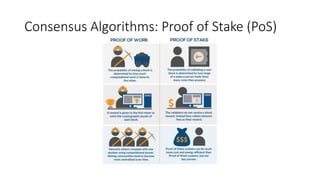
Consensus Algorithms: Proof of Stake (PoS)
• Proof of Stake is a structure which does not utilize miners, but instead uses
validators.
• The creator of the next block is chosen via a combination of random
selection and the amount of tokens he or she owns (wealth) or how long
he or she owned (age) (i.e. the stake).
• In order to validate transactions and create blocks, the validators (the
forger) must first put some of their own coins at ‘stake’. If a person
validates a fraudulent transaction, he or she would lose the stake
deposited.
• In some projects, they will further punish the “cheater” by removing their
rights to participate as a validator in the future.
• As an incentive, the validator takes transaction fees (in the form of tokens)
instead of block rewards.
Consensus Algorithms: Delegated Proof of Stake (DPoS)
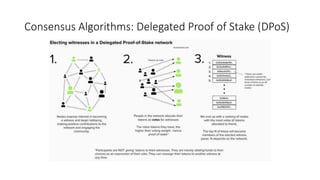
• Delegated Proof of Stake uses a limited number of nodes to propose
and validate blocks to the blockchain. This can increase the
transaction speed and thus solve the scalability problem of PoW.
• Some projects that use DPoS includes EOS, Ark, Bitshares and Steem.
The above figure illustrated one example of the DPoS. Those who get
voted in are called delegates/witnesses. Tokens are given to the top
100 witnesses and the top 20 witnesses are paid regularly. The users’
vote strength depends on the amount of tokens (stake) they own.
• The more they own, the more influence the person has on the
network.
Consensus Algorithms: Delegated Proof of Stake (DPoS)
• However as the community grows, it's going to become ncreasingly hard to
remain a witness due to increased competition.
• With voting being ongoing and constant, the desire to remain being a
witness help to maintain a high quality of work in validating transactions.
• PoS has a disadvantage that people with less token holding (stake) has less
chance to be a creator of the next block.
• DPoS solve this problem by allowing the small holders to vote for their
representatives, namely delegates/witnesses who are the trusted entities
to execute the block creation.
• On the other hand, small holders can also vote out these previously
selected entities if they cannot be trusted.
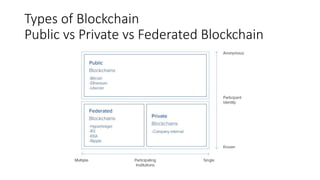
Types of Blockchain
Public vs Private vs Federated Blockchain
Types of Blockchain
Public vs Private vs Federated Blockchain
• There are two major types of blockchain- public chains and private chains.
Federated chain is a subset of Private chain.
• High profile blockchain protocols Ethereum ,EOS, NEO are public chains.
• Public chain’s main differentiation from private chain is that it is open to
anyone to participate, from downloading the blockchain data to viewing
the network’s past transactions, to validating data as miners/validators on
the network. In these public chains, participants remain anonymous.
• Private blockchains are open to a limited number of participants whose
identities are all known, allowing only internal, pre-approved parties to
write on the blockchain.
Types of Blockchain
Public vs Private vs Federated Blockchain
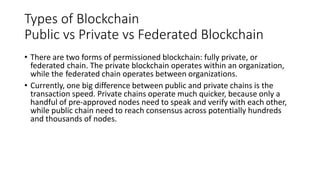
• There are two forms of permissioned blockchain: fully private, or
federated chain. The private blockchain operates within an organization,
while the federated chain operates between organizations.
• Currently, one big difference between public and private chains is the
transaction speed. Private chains operate much quicker, because only a
handful of pre-approved nodes need to speak and verify with each other,
while public chain need to reach consensus across potentially hundreds
and thousands of nodes.
Blockchain use cases
• Real Estate
• Gaming
• Marketing and Advertising
• E-Commerce and Retail
• Law
• Healthcare
• Trade Finance
Real Estate
Real Estate
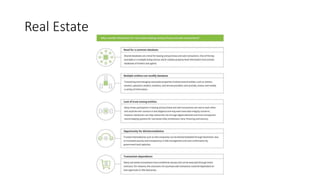
• A lot of promises have been made regarding the blockchain
technology, but most innovations observed, up to 2018, involve using
blockchain for disintermediation, indexing and storage of data under
one immutable, shared ledger, process automation using immutable
smart contracts and attempts to build autonomous agents to trade
blockchain recorded data.
• Initiatives are trying to use smart contracts to help the property
market become more efficient through implanting conditional clauses
to execute real estate transactions as participated by multiple
involved parties, reducing back-and-forth time and associated
overheads, while creating immutable price history for a property.
Real Estate
• Blockchain has the potential to record rental and purchase contracts into
one blockchain ledger visible to multiple parties, as well as eradicating the
need for third party intermediaries.
• Other potential use cases include title search. All the information, including
the registration of mortgages, other liens and encumbrances, can be
indexed on the blockchain network, reducing the need of a title Insurance.
This leverage the indexing ability and traceability of blockchain.
• In 2018, several blockchain projects have targeted at tokenizing property
ownership, including the highly anticipated Harbor protocol, to introduce a
more standardized and cheaper way to achieve seller financing, joint
purchase (vs partnership or setting up a corporation to buy) or fractional
ownership, as well as represent ownership and governance of common
spaces and other factors.
Gaming
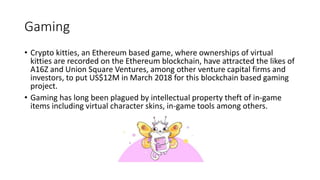
• Crypto kitties, an Ethereum based game, where ownerships of virtual
kitties are recorded on the Ethereum blockchain, have attracted the likes of
A16Z and Union Square Ventures, among other venture capital firms and
investors, to put US$12M in March 2018 for this blockchain based gaming
project.
• Gaming has long been plagued by intellectual property theft of in-game
items including virtual character skins, in-game tools among others.
Gaming
• Virtual assets can be recorded on an immutable blockchain ledger to help
prevent these types of theft. A hacker will have to ensure that the right
nodes in the decentralized network are hacked with accurate timing,
decipher through hashed blocks and overwrite previous blocks in order to
complete a gaming asset theft.
• In the past, developers have tried to create markets for virtual items within
their game worlds or cross-game platforms. However, the virtual items are
stored via centralized hosting and according to the modern intellectual
property rules, this makes those virtual items the property of the company
instead of the player.
• Therefore, blockchain enables the virtual items, price and transaction
stored in a distributed ledger and thereby facilitates a totally new asset
class for these virtual items in the industries such as digital art, gaming and
virtualreality to form.
Marketing and Advertising
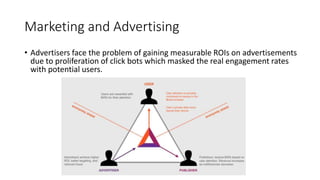
• Advertisers face the problem of gaining measurable ROIs on advertisements
due to proliferation of click bots which masked the real engagement rates
with potential users.
Marketing and Advertising
• By verifying real users with their blockchain identities. This potentially
gives advertiser the ability to measure real interactions. Examples like
the BAT projects reward users who voluntarily opt-in to target
advertising online.
• The consensual nature of the blockchain network also mean that the
control of personal data is given back to the users, and any use of data
can be traceable by the blockchain. This can potentially reduce the
misuse by a centralized institution which can hold one’s data and resell
to advertisers without the users’ acknowledgement or consent.
E-Commerce and Retail
• As an illustrative example, during the recent Double-11 sales, China
based Ant Financial collaborated with e-commerce giant Alibaba to
track the origin of up to US$150M worth of products sold during the
24-hour sales worldwide.
• In the case of e-commerce and retail, the current state of blockchain
technology is utilized to index the source of goods, from production
to delivery, immutability to offer transparency in the production and
delivery process, adding to consumer confidence. Initiatives such as
IBM Food Trust sees mega retailers including Walmart and Unilever
leveragingblockchain to add transparency to food supply chains.
Law
Law
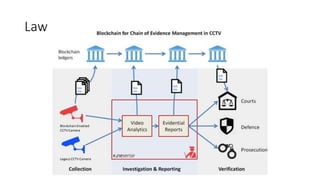
• In the world of criminal law, the chain of custody can be indexed and stored
on an immutable ledger when evidence went missing or being accidentally
destroyed. Using blockchain to store and standardize all of these evidence
could cover the function of a paper trail, but become indestructible with
decentralized ownership of the records across the nodes on the network.
• Other applications within the legal field leveraging similar characteristics
• of blockchain include patents, licensing and IP rights (copyrights,
trademarks).
• Smart contracts, which can potentially be programmed in clauses detailed
in a physical contract, may help to eliminate litigation and turn commercial
lawyers into advisory function.
Healthcare
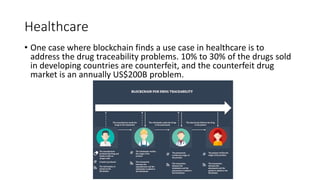
• One case where blockchain finds a use case in healthcare is to
address the drug traceability problems. 10% to 30% of the drugs sold
in developing countries are counterfeit, and the counterfeit drug
market is an annually US$200B problem.
Healthcare
• With a private blockchain with verified parties, including manufacturer,
wholesaler, pharmacist and patients acting as nodes in the blockchain
network, each new transaction added to a block is immutable and time
stamped, making it easy to track a product and make sure the information
cannot be altered.
• The intrinsic properties of blockchain — such as data security and
authenticity — can help in tackling some other major problems in
healthcare, including indexing clinical trial results (immutability) to avoid
trial result forgery, collecting individual health data from wearables and
other IoT devices and storing them on a permission based distributed
ledger, and electronic medical billing supported by smart contract
executions amongst other use cases.
Trade Finance
Trade Finance
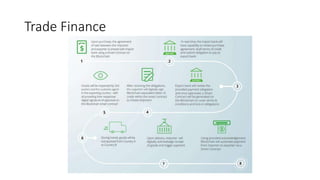
• Cross border trade finance requires exchanges for paper-based
documentation related to letters of credit which usually take between
510 days. Through using blockchain ledger trusted By multiple
Involved trade parties, the exchange was demonstrated to be
executed in 24 hours.
• The use of smart contracts also has the potential to facilitate process
automation in different stages of a cross border trades, which is to be
executed upon satisfaction of pre-conditions, such as bills of lading
and invoice financing based on blockchain certified events, with less
human supervision and quicker execution time.
Current Blockchain Limitations
• THROUGHPUT
• INTEROPERABILITY
• PRIVACY
• VOLATILITY
• STORAGE ISSUES
THROUGHPUT
THROUGHPUT
• Throughput is essentially the speed at which transactions can be processed,
factoring block difficulty and costs.
• The limiting throughput limits the ability of a blockchain to scale by handling
more transactions.
• The speed of the network is only as quick as it takes for the consensus
mechanisms to verify transactions (PoW, PoS, DPoS), measured by transactions
per second.
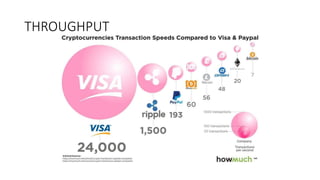
• Bitcoin can only process 7 transactions per second due to the amount of work
miners have to do (proof of integrity by proof of work) before they can validate a
block of data. Ethereum can only process 20 transactions per second in its proof
of stake algorithm.
• The current transaction speed of Blockchain platforms do not measure up with
traditional transaction methods such as Paypal and Visa.
INTEROPERABILITY
INTEROPERABILITY
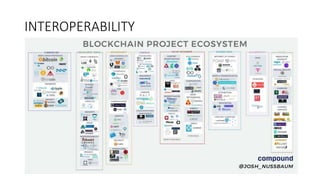
• Interoperability is the ability to share information freely across
different Blockchain protocols. One of the major limitations of the
Blockchain platforms currently is that information on different chains
cannot be shared. (the information on Bitcoin cannot be shared with
the information on Ethereum and vice versa).
• The smart contracts underlying decentralized applications also vary,
depending on the Blockchain platform. As such, we are still faced
with the problem of data silo, where information is ‘centralized’ on
one platform.
PRIVACY
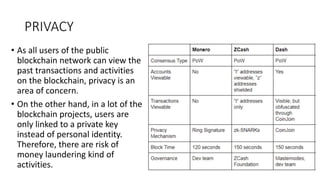
• As all users of the public
blockchain network can view the
past transactions and activities
on the blockchain, privacy is an
area of concern.
• On the other hand, in a lot of the
blockchain projects, users are
only linked to a private key
instead of personal identity.
Therefore, there are risk of
money laundering kind of
activities.
PRIVACY
• Blockchain is transparent in terms of transaction data and therefore it
leads to privacy issue. For example, if a user is using the same address
for all related activities, a malicious user can trace the public address
and all its past transactions in attempt to reveal information and
benefit from so.
• On the flipside, in the early days, users of cryptocurrencies do not go
through strict KYC (Know your Customer) process and central record-
keeping mechanism (like banks) and therefore regulators find it
difficult to trace the identity of the users linked to a public address
with suspicious activities, as public blockchain users are anonymous.
VOLATILITY
VOLATILITY
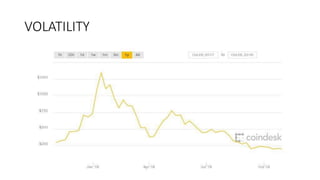
• Volatility is the measure of the price deviation of a financial asset over a
given period of time. Four years of volatility in the stock market can be
covered in a month in the cryptocurrency markets as demonstrated in
2018.
• Therefore, it is safe to say the value of cryptocurrencies are extremely
volatile to this date. This volatility makes it difficult for cryptocurrencies to
be used reliably for day-to-day transactions or Holding cryptocurrency as
assets.
• There are many discussion around this topic - some argue that
cryptocurrencies do not have intrinsic value, and therefore it is difficult to
value its price; some also argue the lack of regulatory oversight allows for
market manipulation which introduces volatility in crypto prices.
STORAGE ISSUES
STORAGE ISSUES
• A wallet is a software that stores cryptocurrencies and part of what
enables a person to send and receive cryptocurrencies.
• It stores the private key (a randomized 256-bit long alphanumeric password
shared only the user to decrypt messages encrypted with a sender’s public
key) which enables access to crypto tokens.
• Various forms of wallets exist, from hot wallets (accessible on internet) to
cold wallets (not accessible on internet, e.g. a USB drive or a piece of paper
which one uses to write the password) are available.
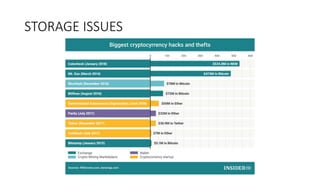
• Storage of cryptocurrencies have long been a concern to the space because
of the vulnerability displayed by various hacks over the course of
cryptocurrency history.
Blockchain Ecosystem
Blockchain
Concepts
Walkthrough
Blockchain
Fundraising 101
Cryptocurrency
Regulations
Update
Data Collection
Methodology
and Background
Blockchain Fundraising 101
• ICO vs STO vs IPO vs VC: Conceptual differences
• Current state of ICO: fundraising figures
• What is token: Utility vs Security Tokens
• Types of Token Sales
• ICO ecosystem player list
Initial Coin Offering (ICO)
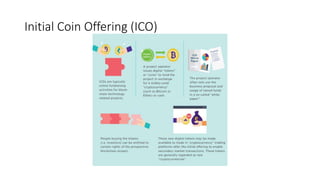
• ICO is a fundraising method used by blockchain startups to sell new form of
cryptocurrency or token that can be used in the product/service they wish to
build in the future, in exchange for fiat currency, or common cryptocurrencies
such as Bitcoin or Ether to support their development now.
• At the time of the ICO, most instances the product isn’t ready for launch yet.
Also, because of laws around securities, companies usually try to issue utility
token instead of security tokens to avoid the regulatory overhead.
• The ICO is thus similar to a pre-order for product or services (i.e. utility)
provided by the company. Unlike an IPO, the company does not sell its shares or
its control over the company (non-dilutive) if they are issuing utility token.
Initial Coin Offering (ICO)
• The fundraising target is to meet at least the ‘soft cap’ (minimum
amount). If the ‘soft cap’ isn’t met, the funds are returned to the
investors. If the soft cap is met, the company can still allow
oversubscription until the hard cap is met if such is defined at the
beginning of the fundraising project. The tokens can then be listed on
cryptocurrency exchanges (similar to an IPO) where people can trade
the tokens.
• One difference of ICO and Kick-Starter kind of crowdfunding is that
companies usually list their coin or token in an exchange (like
securities in IPO) and thus provide a secondary market for the token
trading as well as potential speculation opportunities in some cases.
Security Token Offering (STO)
• In 2018, especially towards the second half of the year, STOs becomes
the buzzword as the ICO hype slowly faded away.
• Security token issuance platforms such as TZero, Harbor, Polymath,
Securitize have raised funds in 2018 to chase this vision. A security
token can be digitally represent any number of real-world assets,
from resorts to loans, to shares of a company.
• Security tokens are subject to securities regulations related to the
issuing country of the STO and different country has different
securities rules and it represent investor rights, where in contrary
many utility tokens that raised funds through ICOs may not give the
same assurance of rights as an STO.
Security Token Offering (STO)
• The vision of security token offering is to turn initially illiquid real
world assets could potentially make them easier to access and trade
over the internet, thereby increasing liquidity and unlock a more
global capital market.
• Greater efficiency may also be achieved if smart contracts can be
deployed such as to execute dividend payouts, ensure voting rights
amongst other privileges enjoyed by a shareholder, all the while
reducing overhead to monitor these payouts, paperwork required
and potentially undercut middlemen who charge premium to
structure these securities.
Security Token Offering (STO)
• Security Token embraces innovation in a way that the underlying
security could be in different form instead of company shares alone.
For example, it can be tied to the revenue sharing of a certain product
or project without diluting the shares of the company at all.
Exchanges that provide security token trading would also be subject
to the security regulations.
• Securities Token Exchanges provide secondary trading to investors
globally while most stock exchanges mainly provides trading to local
investors. Enabling multi-jurisdiction regulations and automate the
transactions according to regulations from different jurisdictions of
the potential buyers and sellers is a must in order to make Security
Token exchanges viable.
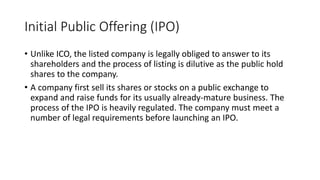
Initial Public Offering (IPO)
• Unlike ICO, the listed company is legally obliged to answer to its
shareholders and the process of listing is dilutive as the public hold
shares to the company.
• A company first sell its shares or stocks on a public exchange to
expand and raise funds for its usually already-mature business. The
process of the IPO is heavily regulated. The company must meet a
number of legal requirements before launching an IPO.
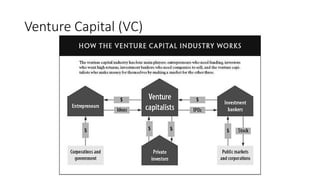
Venture Capital (VC)
• Companies (including blockchain projects) reach out to Venture
Capital firms to injection of capital in an early stage. As early stage
startups normally lack access to bank loans or public capital markets,
venture capital funding is one avenue for them to expand and
fundraise. At this point, the company may or may not have a working
product.
Venture Capital (VC)
• The fundraising process from venture capital firms is dilutive as they
typically take shares in the company. In return, venture capital firm
provides monetary resources, technical and managerial expertise.
• The fundraising process helps projects raises funds from the
institutional investors (the VCs), who are usually backed by other
institutional investors and accredited investors.
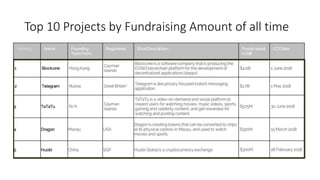
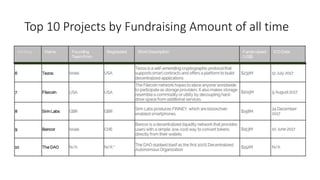
Top 10 Projects by Fundraising Amount of all time
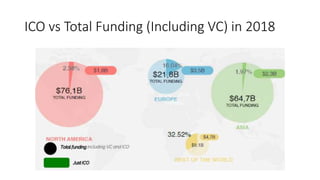
ICO vs Total Funding (Including VC) in 2018
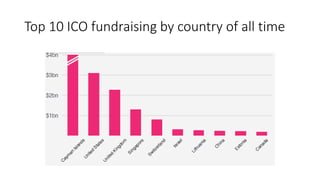
Top 10 ICO fundraising by country of all time
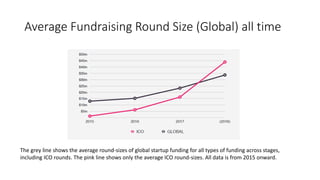
Average Fundraising Round Size (Global) all time
The grey line shows the average round-sizes of global startup funding for all types of funding across stages,
including ICO rounds. The pink line shows only the average ICO round-sizes. All data is from 2015 onward.
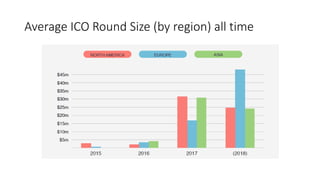
Average ICO Round Size (by region) all time
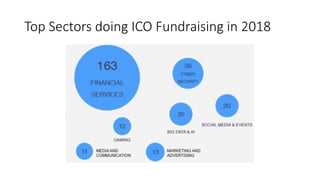
Top Sectors doing ICO Fundraising in 2018
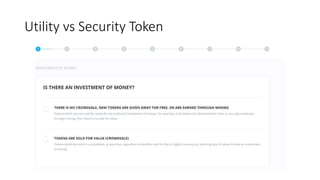
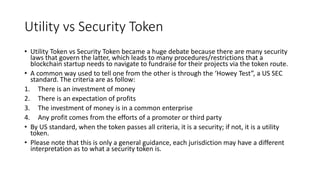
Utility vs Security Token
• Utility Token vs Security Token became a huge debate because there are many security
laws that govern the latter, which leads to many procedures/restrictions that a
blockchain startup needs to navigate to fundraise for their projects via the token route.
• A common way used to tell one from the other is through the ‘Howey Test”, a US SEC
standard. The criteria are as follow:
1. There is an investment of money
2. There is an expectation of profits
3. The investment of money is in a common enterprise
4. Any profit comes from the efforts of a promoter or third party
• By US standard, when the token passes all criteria, it is a security; if not, it is a utility
token.
• Please note that this is only a general guidance, each jurisdiction may have a different
interpretation as to what a security token is.
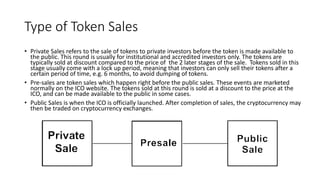
Type of Token Sales
• Private Sales refers to the sale of tokens to private investors before the token is made available to
the public. This round is usually for institutional and accredited investors only. The tokens are
typically sold at discount compared to the price of the 2 later stages of the sale. Tokens sold in this
stage usually come with a lock up period, meaning that investors can only sell their tokens after a
certain period of time, e.g. 6 months, to avoid dumping of tokens.
• Pre-sales are token sales which happen right before the public sales. These events are marketed
normally on the ICO website. The tokens sold at this round is sold at a discount to the price at the
ICO, and can be made available to the public in some cases.
• Public Sales is when the ICO is officially launched. After completion of sales, the cryptocurrency may
then be traded on cryptocurrency exchanges.
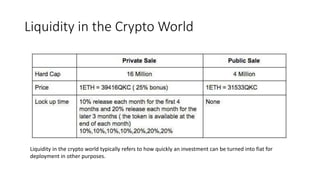
Liquidity in the Crypto World
Liquidity in the crypto world typically refers to how quickly an investment can be turned into fiat for
deployment in other purposes.
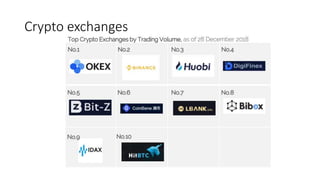
Crypto exchanges
Brokerages
Decentralized exchanges
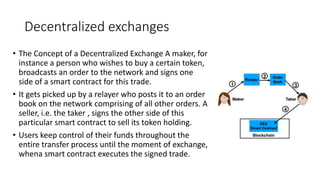
• The Concept of a Decentralized Exchange A maker, for
instance a person who wishes to buy a certain token,
broadcasts an order to the network and signs one
side of a smart contract for this trade.
• It gets picked up by a relayer who posts it to an order
book on the network comprising of all other orders. A
seller, i.e. the taker , signs the other side of this
particular smart contract to sell its token holding.
• Users keep control of their funds throughout the
entire transfer process until the moment of exchange,
whena smart contract executes the signed trade.
Decentralized exchanges
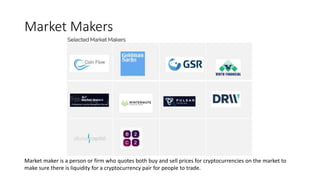
Market Makers
Market maker is a person or firm who quotes both buy and sell prices for cryptocurrencies on the market to
make sure there is liquidity for a cryptocurrency pair for people to trade.
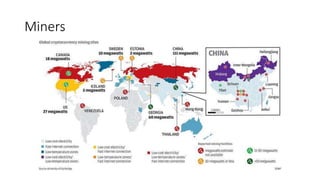
Miners
Miners
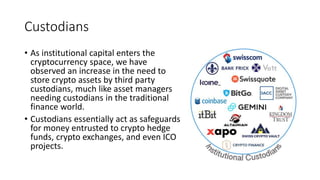
Custodians
• As institutional capital enters the
cryptocurrency space, we have
observed an increase in the need to
store crypto assets by third party
custodians, much like asset managers
needing custodians in the traditional
finance world.
• Custodians essentially act as safeguards
for money entrusted to crypto hedge
funds, crypto exchanges, and even ICO
projects.
Blockchain Ecosystem
Blockchain
Concepts
Walkthrough
Blockchain
Fundraising 101
Cryptocurrency
Regulations
Update
Data Collection
Methodology
and Background
Cryptocurrency Regulations
ICO Regulations
• Switzerland
• Malta
• Gibraltar
• UK
• Estonia
• Lithuania
• USA
• Singapore
• Thailand
• China
• Japan
• Korea
STO Regulations
• Switzerland
• USA
• Singapore
ICO Regulations Switzerland
• Regulation for Crypto Exchange
• Legal, need to register with the Swiss Financial Market Supervisory Authority.
• Attitude towards ICO activities
• Open, regulator focuses on the economic function and purpose of the tokens. The
key factors are the underlying purpose of the tokens and whether they are already
tradeable or transferable. Each ICO has to be decided case by case according to its
merits.
• Taxation on cryptocurrencies
• "Some tokens maybe eligible to Stamp Duty tax, which ranges between 7.5 base
points and 30 base points. Income tax is dependent on whether the entity is
structured as a Foundation or not."
• Supportive Measures for blockchain/ICO projects
• Possibility to allow cryptocurrency industry to have access to conventional banking
services in the country earliest by the end of 2018
ICO Regulations Switzerland
• Definition of Security Token
• "Payment Tokens are not securities: if act as a means of payment and are not
functionally analogous to traditional securities, FINMA does not treat them as
securities. This is consistent with FINMA’s current practice, e.g. in relation to
Bitcoin and Ether. Utility Tokens are not securities: If the sole purpose of the
token is to confer digital access rights to an application or service, and if not
for granting access to capital markets. However, if a utility token additionally
has an investment purpose at the point of issue, FINMA will treat such tokens
as securities. Asset Token are securities: An asset token qualifies as a security
if it represents a derivative (i.e. the value of the conferred claim depends on
an underlying asset)and the token is standardized and suitable for mass
trading."
STO Regulations Singapore
• Organizations must register and submit their prospectus to MAS before
launching STOs and unless qualified for one of the exemptions mentioned
in “A Guide to Digital Token Offerings”, by MAS.
• Until September 2018, no securities crypto token has been approved to
date.
• MAS can regulate digital token offers or issuance if the tokens are capital
market products under SFA (Securities and Futures Act).
• MAS would examine the characteristics and structure of a digital token
(including the rights attached to it) to know if it is a capital market product
under SFA.

Blockchain Ecosystem and Cryptocurrency Regulations

  • 1.
  • 2.
    Blockchain Ecosystem • BlockchainConcepts Walkthrough • Blockchain Fundraising 101 • Cryptocurrency Regulations Update • Data Collection Methodology and Background
  • 3.
  • 4.
    Blockchain Concepts Walkthrough •Blockchain in a nutshell • Blockchain 1.0/2.0/3.0 and Smart Contracts • Consensus algorithms and Types of Blockchain • Blockchain use cases-selective examples and selected corporate use cases • Other Interesting Use cases: conversations on the ground • Leading consortiums/initiatives • Current Blockchain Limitations
  • 5.
  • 6.
    Blockchain in aNutshell • A blockchain is a general digital ledger of transactions that are executed on the network, e.g. using Bitcoin to buy a cup of coffee is a transaction. • All users of the network, ‘Nodes’, have a copy of the transaction records and can access them freely, a role previously played by centralized institutions. Therefore, the blockchain network is ‘decentralized’. • Transaction records within the blockchain are grouped into ‘blocks’. These blocks are time stamped when they are created and ‘chained’ in number order of a block. • Some users of the network put up computational power or tokens at stake (miners/validators) to validate the blocks of transactions, and check that transactions records are not tampered with. • As an incentive, tokens (e.g. some Bitcoins) are given as reward for their work, in transaction fees and/or block rewards. . For example, bitcoin miners are given Bitcoins and Ethereum validators are given Ether.
  • 7.
  • 8.
    Blockchain 1.0: Currency •Blockchain 1.0 is the creation of cryptocurrency, a virtual currency used for • payment purposes derived from the combination of cryptography and currency. Bitcoin is an example of Blockchain 1.0. • ‘Cryptography’- Miners collect the transactions and compete by solving a cryptographic problem. • The winner can generate the ‘hash’ (turning large chunks of transaction data into a line of numbers that represents the transactions) to add to the blockchain using the cryptographic algorithm. • ‘Currency’- comes in the form of tokens, which is used to trade value securely.
  • 9.
    Blockchain 1.0: Currency •Miners collect the new transactions into a block, then attempt to hash the block to form a 256-bit block hash value using trial and error. Most of the time the hash proves unsuccessful, in which case the miner will make slight modifications to the block and try hashing the block again, over and over billions of times. • If the hash starts with enough zeros, the block has been successfully mined and is sent into the Bitcoin network, where consequently the hash becomes the identifier for the block. Whenever some miners successfully mine a block, the process begins anew.
  • 10.
    Blockchain 1.0: Currency •The successfully mined block is almost impossible to tamper with because all previous blocks need to be re-encrypted in order to change the transaction records in the block. • As the network is decentralized and there are many copies need to be re-encrypted, the bigger the network, the more computing power it takes, and so bad actors are disincentivized to cheat the system.
  • 11.
  • 12.
    Blockchain 2.0: SmartContracts • Blockchain 2.0 is the introduction of smart contracts on a protocol, such as Ethereum or NEO. • Smart contracts are sets of programmable and executable rules/logic that are irreversibly stored on the blockchain. When both parties have met the pre-existing criteria, the agreed terms are automatically executed. • Project build application on a decentralized peer to peer network is often referred to as ‘dApp’, where the project’s related transactions are decentralized across the network, so there is no single point of failure. • ‘Outcomes’ on the smart contracts are stored on the blockchain. Every party on the protocol has a copy of these ‘outcomes’. For the smart contract to be processed and validated on the network, some operational tokens (GAS, NEO Gas) are paid for the verification.
  • 13.
  • 14.
    Blockchain 3.0: applicationsof Blockchain • In general, Blockchain 3.0 refers to attempts of applying the concept of blockchain to different sectors where the technology can be useful in tackling hard issues, such as situations where coordination between parties (i.e. standards organization, industry group, multilateral organization, international treaty) is difficult or where lack of trust amongst multiple parties exist. • Blockchain 3.0 also includes attempts to fine tune the protocol in order to speed up transaction approval speeds (increase throughput), manage token price volatility and achieve interoperability between protocols (e.g. swapping Ether with NEO and make sure both protocols are compatible).
  • 15.
    Blockchain 3.0: applicationsof Blockchain • Blockchain is designed as an incentive system that can operate by a set of predefined rules and in ideal cases does not need a centralized body to manage and govern. • All parties trust these set of rules and logics instead a centralized body, so all parties can transact without trusting each other- hence ‘trustless’. • Following this set of predefined rules enables full automation and therefore creates the possibilities of software that can automatically execute transactions and tasks, pay and be paid, totally self sustained and powered by AI to improve themselves- the vision of “autonomous business agents”.
  • 16.
  • 17.
    Consensus Algorithms: Proof-of-Work(PoW) • In layman terms, consensus algorithms are mechanisms created to verify transaction records agreed by all parties in the blockchain network. They encode the fundamental principles for resolving disputed transactions among the parties in a blockchain network. As the design of blockchain is decentralized, this is facilitated through the design of distributed consensus. • Proof of Work is the first generation of consensus algorithm. • Computers in the network (miners) collect transaction records into a block and pass them through a computationally intensive hashing algorithm multiple times to make sure it produces a line of numbers that correlates with the block, solving a cryptographic problem. When completed, the hash becomes a validator of the block of transaction.
  • 18.
    Consensus Algorithms: Proof-of-Work(PoW) • After the block is validated and completed, they are then time stamped and broadcasted so that everyone (nodes) has a copy of the record. • Many PoW protocols achieve alignment of incentives by distributing token based rewards to miners who provide the validation service to the network. As transaction volume and currency velocity goes up, so does the value of the currency which attracts more miners to the network. • The process evolves around “cryptographic problem” solved by trial and error, which consumes much computing power. Miner proves its integrity by doing the work. This mechanism also provides the “randomness” so that theoretically no miner can predict and take control of the network. • As an incentive, block reward or transaction fees, in terms of token or cryptocurrencies, are given to the first miner who solves the cryptographic puzzle.
  • 19.
    The 51% attackand the Double Spend problem
  • 20.
    The 51% attackand the Double Spend problem • The 51% attack poses a theoretical risk to the integrity of the blockchain when a group of miners take control of more than 50% of the mining capability (hash rate) of the network. • A PoW algorithm is secured by having all miners (computers processing the networks transactions) agree on the blockchain. Nodes look to each other to verify what they are working on as the valid blockchain, acknowledging the longest chain as the true version of the blockchain because more hashing power has been committed to it, hence denoting that the majority agrees to this version.
  • 21.
    The 51% attackand the Double Spend problem • If the majority of miners are controlled by a single entity, they have the potential to create the longest chain, dubbed the ‘truthful chain', forming the basis of all balances of wallets. The corrupted group miners can purchase a house, for instance, and broadcast the transaction to non- colluding nodes on one version of the chain, while continuing to mine transactions from the network forming another version of the blockchain without its order to purchase a house, and not broadcasting this alternative chain to rest of the network. • Once the purchase is complete, and the corrupted miners use their superior mining power to create a longer chain by forming transaction blocks “quicker”, they can post the longer, hence `truthful` version of the chain to the network without its house purchasing transactions.
  • 22.
    The 51% attackand the Double Spend problem • This will be recognized as the truthful version without the tokens spent, allowing the wallets to be replenished and the entity to double spend its tokens again. • Therefore, blockchain needs to be highly decentralized with a significantly big network to avoid any entity taking 51% control. • As miners are competing with computing power and speed of solving the cryptographic problem, theoretically, quantum computing can change the dynamics by solving the problem much quicker than the network consistently and therefore able to undermine integrity of the whole system.
  • 23.
  • 24.
    Consensus Algorithms: Proofof Stake (PoS) • Proof of Stake is a structure which does not utilize miners, but instead uses validators. • The creator of the next block is chosen via a combination of random selection and the amount of tokens he or she owns (wealth) or how long he or she owned (age) (i.e. the stake). • In order to validate transactions and create blocks, the validators (the forger) must first put some of their own coins at ‘stake’. If a person validates a fraudulent transaction, he or she would lose the stake deposited. • In some projects, they will further punish the “cheater” by removing their rights to participate as a validator in the future. • As an incentive, the validator takes transaction fees (in the form of tokens) instead of block rewards.
  • 25.
    Consensus Algorithms: DelegatedProof of Stake (DPoS)
  • 26.
    Consensus Algorithms: DelegatedProof of Stake (DPoS) • Delegated Proof of Stake uses a limited number of nodes to propose and validate blocks to the blockchain. This can increase the transaction speed and thus solve the scalability problem of PoW. • Some projects that use DPoS includes EOS, Ark, Bitshares and Steem. The above figure illustrated one example of the DPoS. Those who get voted in are called delegates/witnesses. Tokens are given to the top 100 witnesses and the top 20 witnesses are paid regularly. The users’ vote strength depends on the amount of tokens (stake) they own. • The more they own, the more influence the person has on the network.
  • 27.
    Consensus Algorithms: DelegatedProof of Stake (DPoS) • However as the community grows, it's going to become ncreasingly hard to remain a witness due to increased competition. • With voting being ongoing and constant, the desire to remain being a witness help to maintain a high quality of work in validating transactions. • PoS has a disadvantage that people with less token holding (stake) has less chance to be a creator of the next block. • DPoS solve this problem by allowing the small holders to vote for their representatives, namely delegates/witnesses who are the trusted entities to execute the block creation. • On the other hand, small holders can also vote out these previously selected entities if they cannot be trusted.
  • 28.
    Types of Blockchain Publicvs Private vs Federated Blockchain
  • 29.
    Types of Blockchain Publicvs Private vs Federated Blockchain • There are two major types of blockchain- public chains and private chains. Federated chain is a subset of Private chain. • High profile blockchain protocols Ethereum ,EOS, NEO are public chains. • Public chain’s main differentiation from private chain is that it is open to anyone to participate, from downloading the blockchain data to viewing the network’s past transactions, to validating data as miners/validators on the network. In these public chains, participants remain anonymous. • Private blockchains are open to a limited number of participants whose identities are all known, allowing only internal, pre-approved parties to write on the blockchain.
  • 30.
    Types of Blockchain Publicvs Private vs Federated Blockchain • There are two forms of permissioned blockchain: fully private, or federated chain. The private blockchain operates within an organization, while the federated chain operates between organizations. • Currently, one big difference between public and private chains is the transaction speed. Private chains operate much quicker, because only a handful of pre-approved nodes need to speak and verify with each other, while public chain need to reach consensus across potentially hundreds and thousands of nodes.
  • 31.
    Blockchain use cases •Real Estate • Gaming • Marketing and Advertising • E-Commerce and Retail • Law • Healthcare • Trade Finance
  • 32.
  • 33.
    Real Estate • Alot of promises have been made regarding the blockchain technology, but most innovations observed, up to 2018, involve using blockchain for disintermediation, indexing and storage of data under one immutable, shared ledger, process automation using immutable smart contracts and attempts to build autonomous agents to trade blockchain recorded data. • Initiatives are trying to use smart contracts to help the property market become more efficient through implanting conditional clauses to execute real estate transactions as participated by multiple involved parties, reducing back-and-forth time and associated overheads, while creating immutable price history for a property.
  • 34.
    Real Estate • Blockchainhas the potential to record rental and purchase contracts into one blockchain ledger visible to multiple parties, as well as eradicating the need for third party intermediaries. • Other potential use cases include title search. All the information, including the registration of mortgages, other liens and encumbrances, can be indexed on the blockchain network, reducing the need of a title Insurance. This leverage the indexing ability and traceability of blockchain. • In 2018, several blockchain projects have targeted at tokenizing property ownership, including the highly anticipated Harbor protocol, to introduce a more standardized and cheaper way to achieve seller financing, joint purchase (vs partnership or setting up a corporation to buy) or fractional ownership, as well as represent ownership and governance of common spaces and other factors.
  • 35.
    Gaming • Crypto kitties,an Ethereum based game, where ownerships of virtual kitties are recorded on the Ethereum blockchain, have attracted the likes of A16Z and Union Square Ventures, among other venture capital firms and investors, to put US$12M in March 2018 for this blockchain based gaming project. • Gaming has long been plagued by intellectual property theft of in-game items including virtual character skins, in-game tools among others.
  • 36.
    Gaming • Virtual assetscan be recorded on an immutable blockchain ledger to help prevent these types of theft. A hacker will have to ensure that the right nodes in the decentralized network are hacked with accurate timing, decipher through hashed blocks and overwrite previous blocks in order to complete a gaming asset theft. • In the past, developers have tried to create markets for virtual items within their game worlds or cross-game platforms. However, the virtual items are stored via centralized hosting and according to the modern intellectual property rules, this makes those virtual items the property of the company instead of the player. • Therefore, blockchain enables the virtual items, price and transaction stored in a distributed ledger and thereby facilitates a totally new asset class for these virtual items in the industries such as digital art, gaming and virtualreality to form.
  • 37.
    Marketing and Advertising •Advertisers face the problem of gaining measurable ROIs on advertisements due to proliferation of click bots which masked the real engagement rates with potential users.
  • 38.
    Marketing and Advertising •By verifying real users with their blockchain identities. This potentially gives advertiser the ability to measure real interactions. Examples like the BAT projects reward users who voluntarily opt-in to target advertising online. • The consensual nature of the blockchain network also mean that the control of personal data is given back to the users, and any use of data can be traceable by the blockchain. This can potentially reduce the misuse by a centralized institution which can hold one’s data and resell to advertisers without the users’ acknowledgement or consent.
  • 39.
    E-Commerce and Retail •As an illustrative example, during the recent Double-11 sales, China based Ant Financial collaborated with e-commerce giant Alibaba to track the origin of up to US$150M worth of products sold during the 24-hour sales worldwide. • In the case of e-commerce and retail, the current state of blockchain technology is utilized to index the source of goods, from production to delivery, immutability to offer transparency in the production and delivery process, adding to consumer confidence. Initiatives such as IBM Food Trust sees mega retailers including Walmart and Unilever leveragingblockchain to add transparency to food supply chains.
  • 40.
  • 41.
    Law • In theworld of criminal law, the chain of custody can be indexed and stored on an immutable ledger when evidence went missing or being accidentally destroyed. Using blockchain to store and standardize all of these evidence could cover the function of a paper trail, but become indestructible with decentralized ownership of the records across the nodes on the network. • Other applications within the legal field leveraging similar characteristics • of blockchain include patents, licensing and IP rights (copyrights, trademarks). • Smart contracts, which can potentially be programmed in clauses detailed in a physical contract, may help to eliminate litigation and turn commercial lawyers into advisory function.
  • 42.
    Healthcare • One casewhere blockchain finds a use case in healthcare is to address the drug traceability problems. 10% to 30% of the drugs sold in developing countries are counterfeit, and the counterfeit drug market is an annually US$200B problem.
  • 43.
    Healthcare • With aprivate blockchain with verified parties, including manufacturer, wholesaler, pharmacist and patients acting as nodes in the blockchain network, each new transaction added to a block is immutable and time stamped, making it easy to track a product and make sure the information cannot be altered. • The intrinsic properties of blockchain — such as data security and authenticity — can help in tackling some other major problems in healthcare, including indexing clinical trial results (immutability) to avoid trial result forgery, collecting individual health data from wearables and other IoT devices and storing them on a permission based distributed ledger, and electronic medical billing supported by smart contract executions amongst other use cases.
  • 44.
  • 45.
    Trade Finance • Crossborder trade finance requires exchanges for paper-based documentation related to letters of credit which usually take between 510 days. Through using blockchain ledger trusted By multiple Involved trade parties, the exchange was demonstrated to be executed in 24 hours. • The use of smart contracts also has the potential to facilitate process automation in different stages of a cross border trades, which is to be executed upon satisfaction of pre-conditions, such as bills of lading and invoice financing based on blockchain certified events, with less human supervision and quicker execution time.
  • 46.
    Current Blockchain Limitations •THROUGHPUT • INTEROPERABILITY • PRIVACY • VOLATILITY • STORAGE ISSUES
  • 47.
  • 48.
    THROUGHPUT • Throughput isessentially the speed at which transactions can be processed, factoring block difficulty and costs. • The limiting throughput limits the ability of a blockchain to scale by handling more transactions. • The speed of the network is only as quick as it takes for the consensus mechanisms to verify transactions (PoW, PoS, DPoS), measured by transactions per second. • Bitcoin can only process 7 transactions per second due to the amount of work miners have to do (proof of integrity by proof of work) before they can validate a block of data. Ethereum can only process 20 transactions per second in its proof of stake algorithm. • The current transaction speed of Blockchain platforms do not measure up with traditional transaction methods such as Paypal and Visa.
  • 49.
  • 50.
    INTEROPERABILITY • Interoperability isthe ability to share information freely across different Blockchain protocols. One of the major limitations of the Blockchain platforms currently is that information on different chains cannot be shared. (the information on Bitcoin cannot be shared with the information on Ethereum and vice versa). • The smart contracts underlying decentralized applications also vary, depending on the Blockchain platform. As such, we are still faced with the problem of data silo, where information is ‘centralized’ on one platform.
  • 51.
    PRIVACY • As allusers of the public blockchain network can view the past transactions and activities on the blockchain, privacy is an area of concern. • On the other hand, in a lot of the blockchain projects, users are only linked to a private key instead of personal identity. Therefore, there are risk of money laundering kind of activities.
  • 52.
    PRIVACY • Blockchain istransparent in terms of transaction data and therefore it leads to privacy issue. For example, if a user is using the same address for all related activities, a malicious user can trace the public address and all its past transactions in attempt to reveal information and benefit from so. • On the flipside, in the early days, users of cryptocurrencies do not go through strict KYC (Know your Customer) process and central record- keeping mechanism (like banks) and therefore regulators find it difficult to trace the identity of the users linked to a public address with suspicious activities, as public blockchain users are anonymous.
  • 53.
  • 54.
    VOLATILITY • Volatility isthe measure of the price deviation of a financial asset over a given period of time. Four years of volatility in the stock market can be covered in a month in the cryptocurrency markets as demonstrated in 2018. • Therefore, it is safe to say the value of cryptocurrencies are extremely volatile to this date. This volatility makes it difficult for cryptocurrencies to be used reliably for day-to-day transactions or Holding cryptocurrency as assets. • There are many discussion around this topic - some argue that cryptocurrencies do not have intrinsic value, and therefore it is difficult to value its price; some also argue the lack of regulatory oversight allows for market manipulation which introduces volatility in crypto prices.
  • 55.
  • 56.
    STORAGE ISSUES • Awallet is a software that stores cryptocurrencies and part of what enables a person to send and receive cryptocurrencies. • It stores the private key (a randomized 256-bit long alphanumeric password shared only the user to decrypt messages encrypted with a sender’s public key) which enables access to crypto tokens. • Various forms of wallets exist, from hot wallets (accessible on internet) to cold wallets (not accessible on internet, e.g. a USB drive or a piece of paper which one uses to write the password) are available. • Storage of cryptocurrencies have long been a concern to the space because of the vulnerability displayed by various hacks over the course of cryptocurrency history.
  • 57.
  • 58.
    Blockchain Fundraising 101 •ICO vs STO vs IPO vs VC: Conceptual differences • Current state of ICO: fundraising figures • What is token: Utility vs Security Tokens • Types of Token Sales • ICO ecosystem player list
  • 59.
  • 60.
    Initial Coin Offering(ICO) • ICO is a fundraising method used by blockchain startups to sell new form of cryptocurrency or token that can be used in the product/service they wish to build in the future, in exchange for fiat currency, or common cryptocurrencies such as Bitcoin or Ether to support their development now. • At the time of the ICO, most instances the product isn’t ready for launch yet. Also, because of laws around securities, companies usually try to issue utility token instead of security tokens to avoid the regulatory overhead. • The ICO is thus similar to a pre-order for product or services (i.e. utility) provided by the company. Unlike an IPO, the company does not sell its shares or its control over the company (non-dilutive) if they are issuing utility token.
  • 61.
    Initial Coin Offering(ICO) • The fundraising target is to meet at least the ‘soft cap’ (minimum amount). If the ‘soft cap’ isn’t met, the funds are returned to the investors. If the soft cap is met, the company can still allow oversubscription until the hard cap is met if such is defined at the beginning of the fundraising project. The tokens can then be listed on cryptocurrency exchanges (similar to an IPO) where people can trade the tokens. • One difference of ICO and Kick-Starter kind of crowdfunding is that companies usually list their coin or token in an exchange (like securities in IPO) and thus provide a secondary market for the token trading as well as potential speculation opportunities in some cases.
  • 62.
  • 63.
    Security Token Offering(STO) • In 2018, especially towards the second half of the year, STOs becomes the buzzword as the ICO hype slowly faded away. • Security token issuance platforms such as TZero, Harbor, Polymath, Securitize have raised funds in 2018 to chase this vision. A security token can be digitally represent any number of real-world assets, from resorts to loans, to shares of a company. • Security tokens are subject to securities regulations related to the issuing country of the STO and different country has different securities rules and it represent investor rights, where in contrary many utility tokens that raised funds through ICOs may not give the same assurance of rights as an STO.
  • 64.
    Security Token Offering(STO) • The vision of security token offering is to turn initially illiquid real world assets could potentially make them easier to access and trade over the internet, thereby increasing liquidity and unlock a more global capital market. • Greater efficiency may also be achieved if smart contracts can be deployed such as to execute dividend payouts, ensure voting rights amongst other privileges enjoyed by a shareholder, all the while reducing overhead to monitor these payouts, paperwork required and potentially undercut middlemen who charge premium to structure these securities.
  • 65.
    Security Token Offering(STO) • Security Token embraces innovation in a way that the underlying security could be in different form instead of company shares alone. For example, it can be tied to the revenue sharing of a certain product or project without diluting the shares of the company at all. Exchanges that provide security token trading would also be subject to the security regulations. • Securities Token Exchanges provide secondary trading to investors globally while most stock exchanges mainly provides trading to local investors. Enabling multi-jurisdiction regulations and automate the transactions according to regulations from different jurisdictions of the potential buyers and sellers is a must in order to make Security Token exchanges viable.
  • 66.
  • 67.
    Initial Public Offering(IPO) • Unlike ICO, the listed company is legally obliged to answer to its shareholders and the process of listing is dilutive as the public hold shares to the company. • A company first sell its shares or stocks on a public exchange to expand and raise funds for its usually already-mature business. The process of the IPO is heavily regulated. The company must meet a number of legal requirements before launching an IPO.
  • 68.
  • 69.
    Venture Capital (VC) •Companies (including blockchain projects) reach out to Venture Capital firms to injection of capital in an early stage. As early stage startups normally lack access to bank loans or public capital markets, venture capital funding is one avenue for them to expand and fundraise. At this point, the company may or may not have a working product.
  • 70.
    Venture Capital (VC) •The fundraising process from venture capital firms is dilutive as they typically take shares in the company. In return, venture capital firm provides monetary resources, technical and managerial expertise. • The fundraising process helps projects raises funds from the institutional investors (the VCs), who are usually backed by other institutional investors and accredited investors.
  • 71.
    Top 10 Projectsby Fundraising Amount of all time
  • 72.
    Top 10 Projectsby Fundraising Amount of all time
  • 73.
    ICO vs TotalFunding (Including VC) in 2018
  • 74.
    Top 10 ICOfundraising by country of all time
  • 75.
    Average Fundraising RoundSize (Global) all time The grey line shows the average round-sizes of global startup funding for all types of funding across stages, including ICO rounds. The pink line shows only the average ICO round-sizes. All data is from 2015 onward.
  • 76.
    Average ICO RoundSize (by region) all time
  • 77.
    Top Sectors doingICO Fundraising in 2018
  • 78.
  • 79.
    Utility vs SecurityToken • Utility Token vs Security Token became a huge debate because there are many security laws that govern the latter, which leads to many procedures/restrictions that a blockchain startup needs to navigate to fundraise for their projects via the token route. • A common way used to tell one from the other is through the ‘Howey Test”, a US SEC standard. The criteria are as follow: 1. There is an investment of money 2. There is an expectation of profits 3. The investment of money is in a common enterprise 4. Any profit comes from the efforts of a promoter or third party • By US standard, when the token passes all criteria, it is a security; if not, it is a utility token. • Please note that this is only a general guidance, each jurisdiction may have a different interpretation as to what a security token is.
  • 80.
    Type of TokenSales • Private Sales refers to the sale of tokens to private investors before the token is made available to the public. This round is usually for institutional and accredited investors only. The tokens are typically sold at discount compared to the price of the 2 later stages of the sale. Tokens sold in this stage usually come with a lock up period, meaning that investors can only sell their tokens after a certain period of time, e.g. 6 months, to avoid dumping of tokens. • Pre-sales are token sales which happen right before the public sales. These events are marketed normally on the ICO website. The tokens sold at this round is sold at a discount to the price at the ICO, and can be made available to the public in some cases. • Public Sales is when the ICO is officially launched. After completion of sales, the cryptocurrency may then be traded on cryptocurrency exchanges.
  • 81.
    Liquidity in theCrypto World Liquidity in the crypto world typically refers to how quickly an investment can be turned into fiat for deployment in other purposes.
  • 82.
  • 83.
  • 84.
    Decentralized exchanges • TheConcept of a Decentralized Exchange A maker, for instance a person who wishes to buy a certain token, broadcasts an order to the network and signs one side of a smart contract for this trade. • It gets picked up by a relayer who posts it to an order book on the network comprising of all other orders. A seller, i.e. the taker , signs the other side of this particular smart contract to sell its token holding. • Users keep control of their funds throughout the entire transfer process until the moment of exchange, whena smart contract executes the signed trade.
  • 85.
  • 86.
    Market Makers Market makeris a person or firm who quotes both buy and sell prices for cryptocurrencies on the market to make sure there is liquidity for a cryptocurrency pair for people to trade.
  • 87.
  • 88.
  • 89.
    Custodians • As institutionalcapital enters the cryptocurrency space, we have observed an increase in the need to store crypto assets by third party custodians, much like asset managers needing custodians in the traditional finance world. • Custodians essentially act as safeguards for money entrusted to crypto hedge funds, crypto exchanges, and even ICO projects.
  • 90.
  • 91.
    Cryptocurrency Regulations ICO Regulations •Switzerland • Malta • Gibraltar • UK • Estonia • Lithuania • USA • Singapore • Thailand • China • Japan • Korea STO Regulations • Switzerland • USA • Singapore
  • 92.
    ICO Regulations Switzerland •Regulation for Crypto Exchange • Legal, need to register with the Swiss Financial Market Supervisory Authority. • Attitude towards ICO activities • Open, regulator focuses on the economic function and purpose of the tokens. The key factors are the underlying purpose of the tokens and whether they are already tradeable or transferable. Each ICO has to be decided case by case according to its merits. • Taxation on cryptocurrencies • "Some tokens maybe eligible to Stamp Duty tax, which ranges between 7.5 base points and 30 base points. Income tax is dependent on whether the entity is structured as a Foundation or not." • Supportive Measures for blockchain/ICO projects • Possibility to allow cryptocurrency industry to have access to conventional banking services in the country earliest by the end of 2018
  • 93.
    ICO Regulations Switzerland •Definition of Security Token • "Payment Tokens are not securities: if act as a means of payment and are not functionally analogous to traditional securities, FINMA does not treat them as securities. This is consistent with FINMA’s current practice, e.g. in relation to Bitcoin and Ether. Utility Tokens are not securities: If the sole purpose of the token is to confer digital access rights to an application or service, and if not for granting access to capital markets. However, if a utility token additionally has an investment purpose at the point of issue, FINMA will treat such tokens as securities. Asset Token are securities: An asset token qualifies as a security if it represents a derivative (i.e. the value of the conferred claim depends on an underlying asset)and the token is standardized and suitable for mass trading."
  • 94.
    STO Regulations Singapore •Organizations must register and submit their prospectus to MAS before launching STOs and unless qualified for one of the exemptions mentioned in “A Guide to Digital Token Offerings”, by MAS. • Until September 2018, no securities crypto token has been approved to date. • MAS can regulate digital token offers or issuance if the tokens are capital market products under SFA (Securities and Futures Act). • MAS would examine the characteristics and structure of a digital token (including the rights attached to it) to know if it is a capital market product under SFA.