Introduction to
Artificial
Intelligence
Welcome tothe world of artificial intelligence (AI). This
presentation will explore the fundamentals of AI, its history,
and its transformative impact on various industries.
2.
What is ArtificialIntelligence?
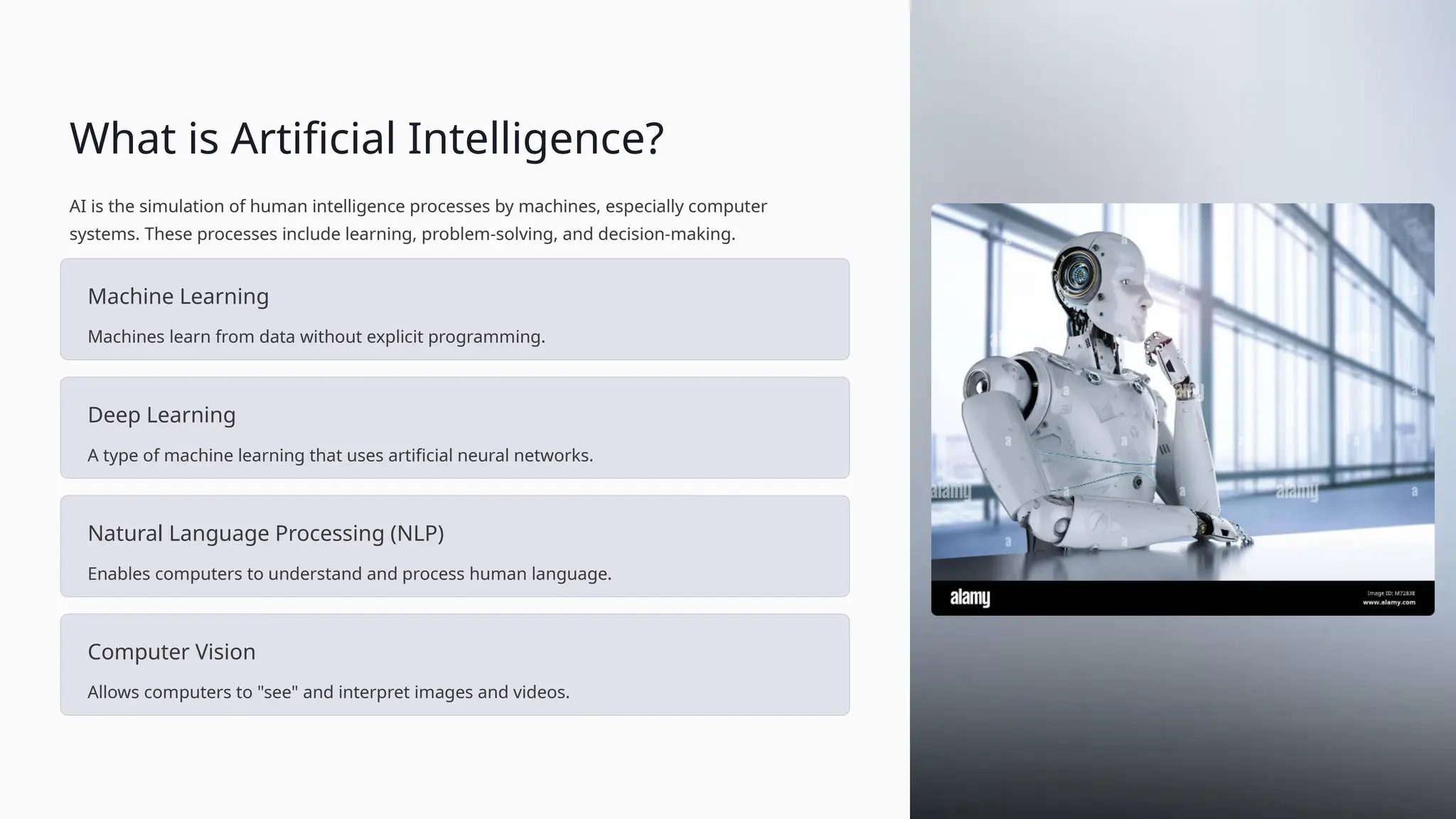
AI is the simulation of human intelligence processes by machines, especially computer
systems. These processes include learning, problem-solving, and decision-making.
Machine Learning
Machines learn from data without explicit programming.
Deep Learning
A type of machine learning that uses artificial neural networks.
Natural Language Processing (NLP)
Enables computers to understand and process human language.
Computer Vision
Allows computers to "see" and interpret images and videos.
3.
History and Evolutionof AI
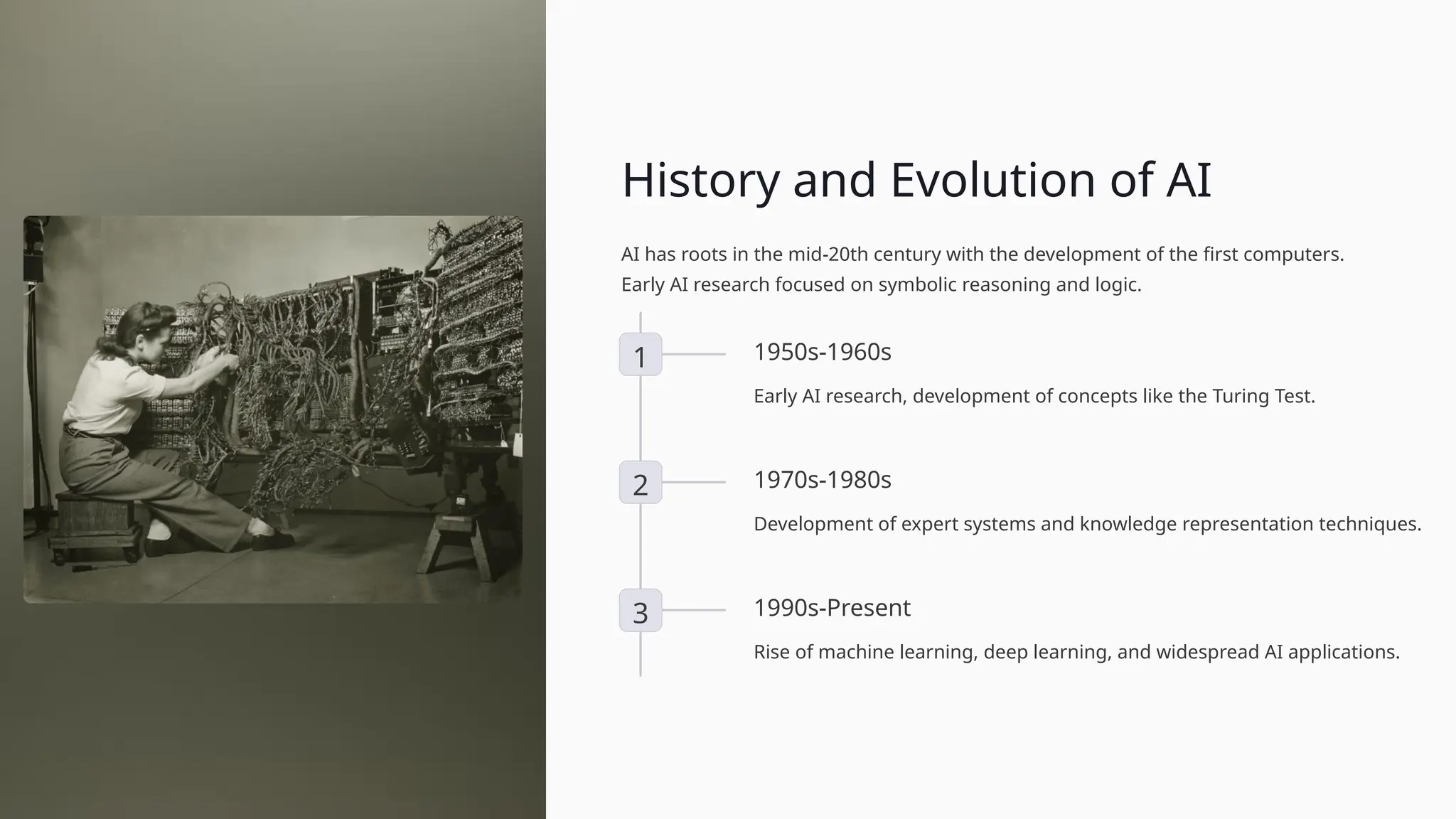
AI has roots in the mid-20th century with the development of the first computers.
Early AI research focused on symbolic reasoning and logic.
1 1950s-1960s
Early AI research, development of concepts like the Turing Test.
2 1970s-1980s
Development of expert systems and knowledge representation techniques.
3 1990s-Present
Rise of machine learning, deep learning, and widespread AI applications.
4.
Fundamental Concepts ofAI
AI relies on fundamental concepts like algorithms, data structures, and statistical
methods. Understanding these concepts is crucial for working with AI.
1 Algorithms
Sets of instructions that computers follow to solve problems.
2 Data Structures
Ways to organize and store data for efficient processing.
3 Statistical Methods
Used to analyze and interpret data to make predictions.
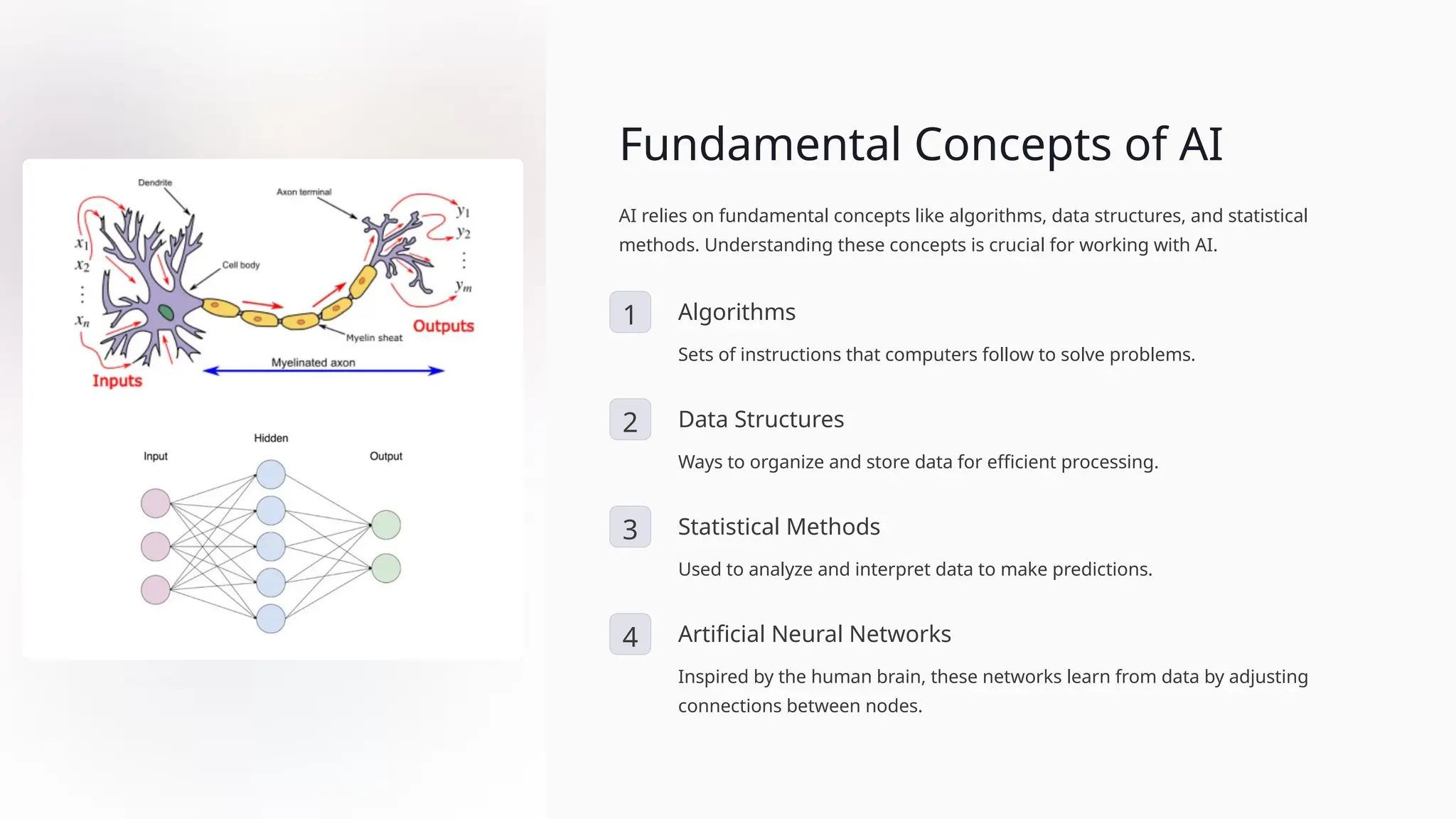
4 Artificial Neural Networks
Inspired by the human brain, these networks learn from data by adjusting
connections between nodes.
5.
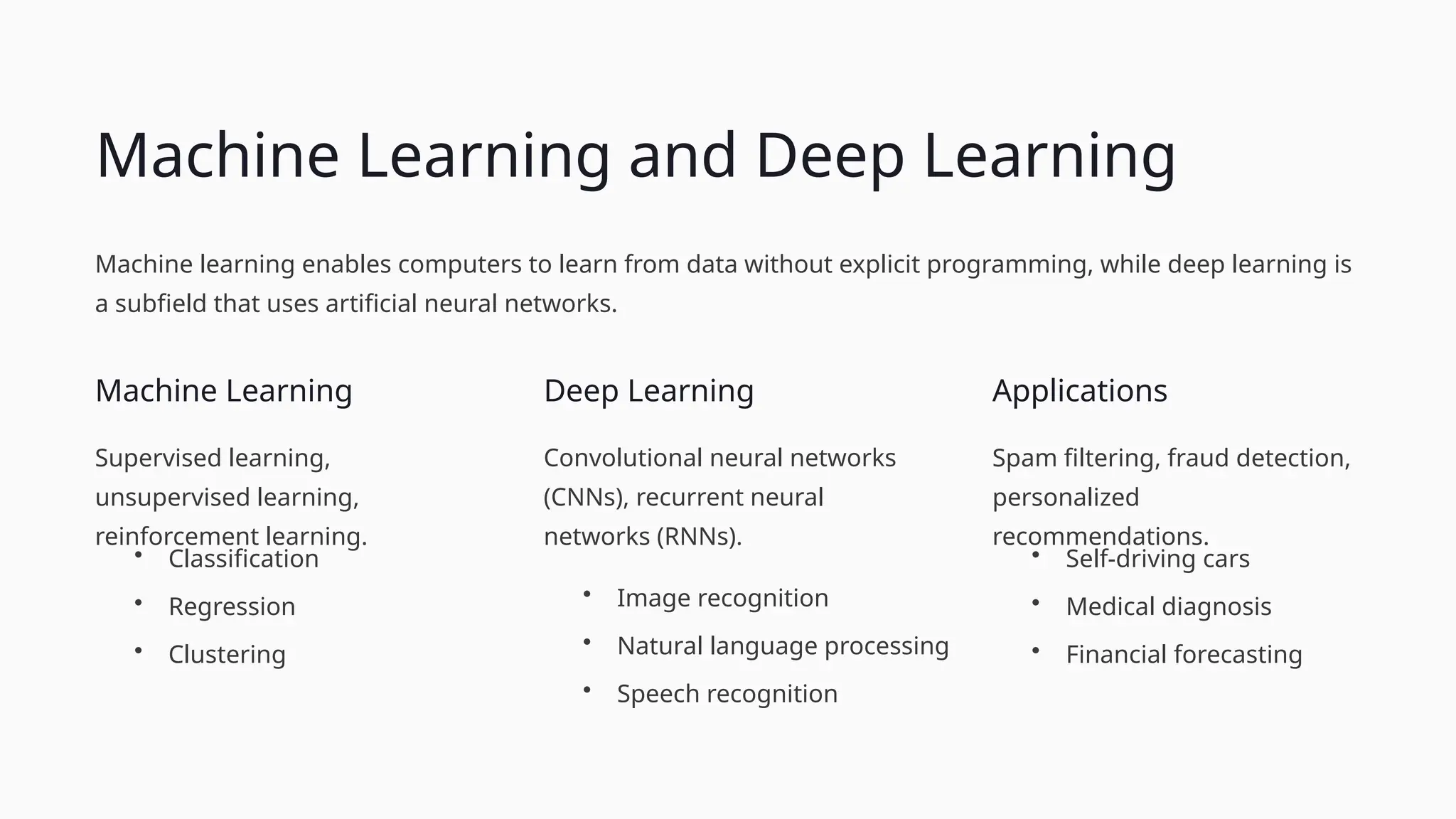
Machine Learning andDeep Learning
Machine learning enables computers to learn from data without explicit programming, while deep learning is
a subfield that uses artificial neural networks.
Machine Learning
Supervised learning,
unsupervised learning,
reinforcement learning.
• Classification
• Regression
• Clustering
Deep Learning
Convolutional neural networks
(CNNs), recurrent neural
networks (RNNs).
• Image recognition
• Natural language processing
• Speech recognition
Applications
Spam filtering, fraud detection,
personalized
recommendations.
• Self-driving cars
• Medical diagnosis
• Financial forecasting
6.
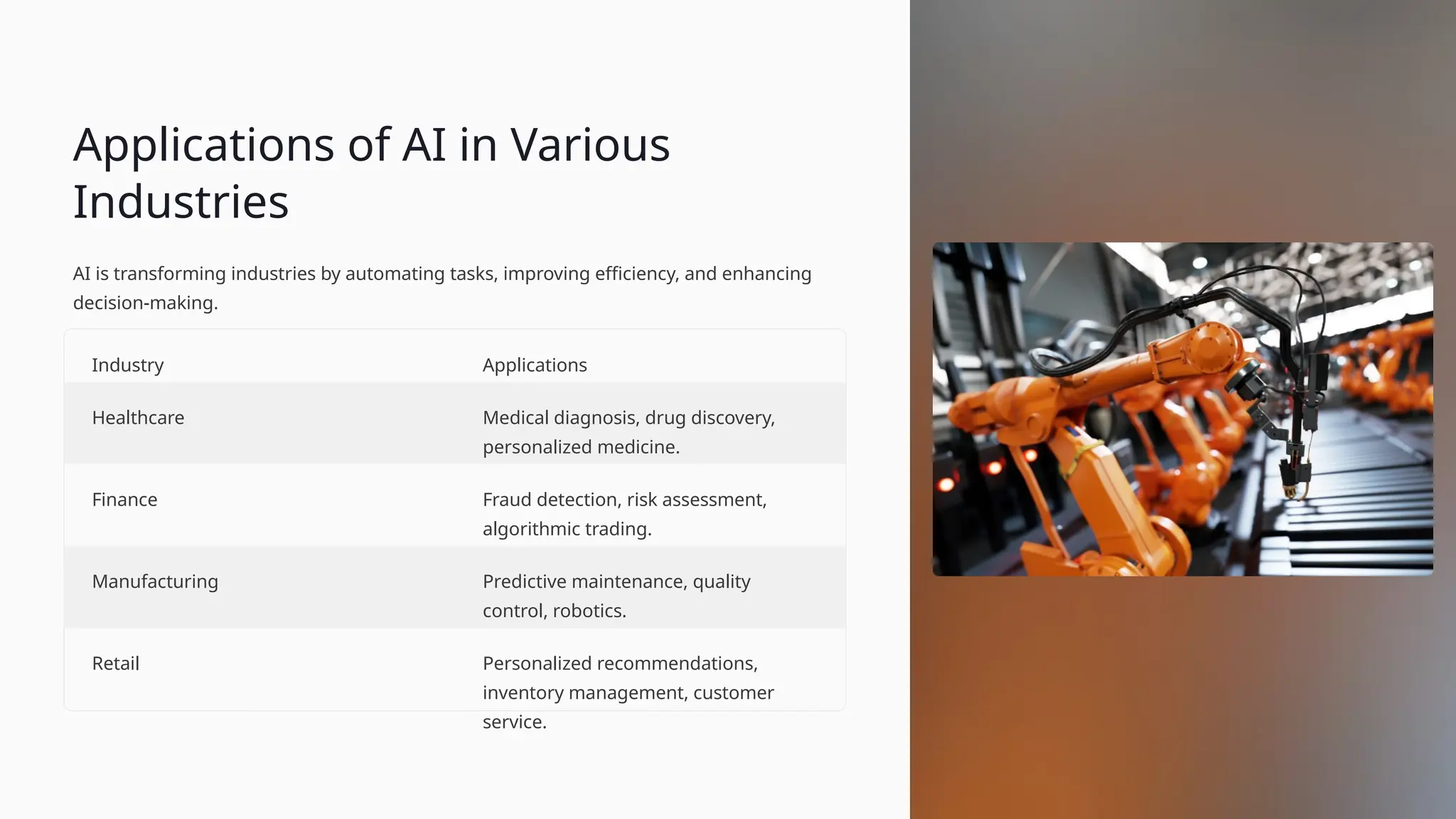
Applications of AIin Various
Industries
AI is transforming industries by automating tasks, improving efficiency, and enhancing
decision-making.
Industry Applications
Healthcare Medical diagnosis, drug discovery,
personalized medicine.
Finance Fraud detection, risk assessment,
algorithmic trading.
Manufacturing Predictive maintenance, quality
control, robotics.
Retail Personalized recommendations,
inventory management, customer
service.
7.
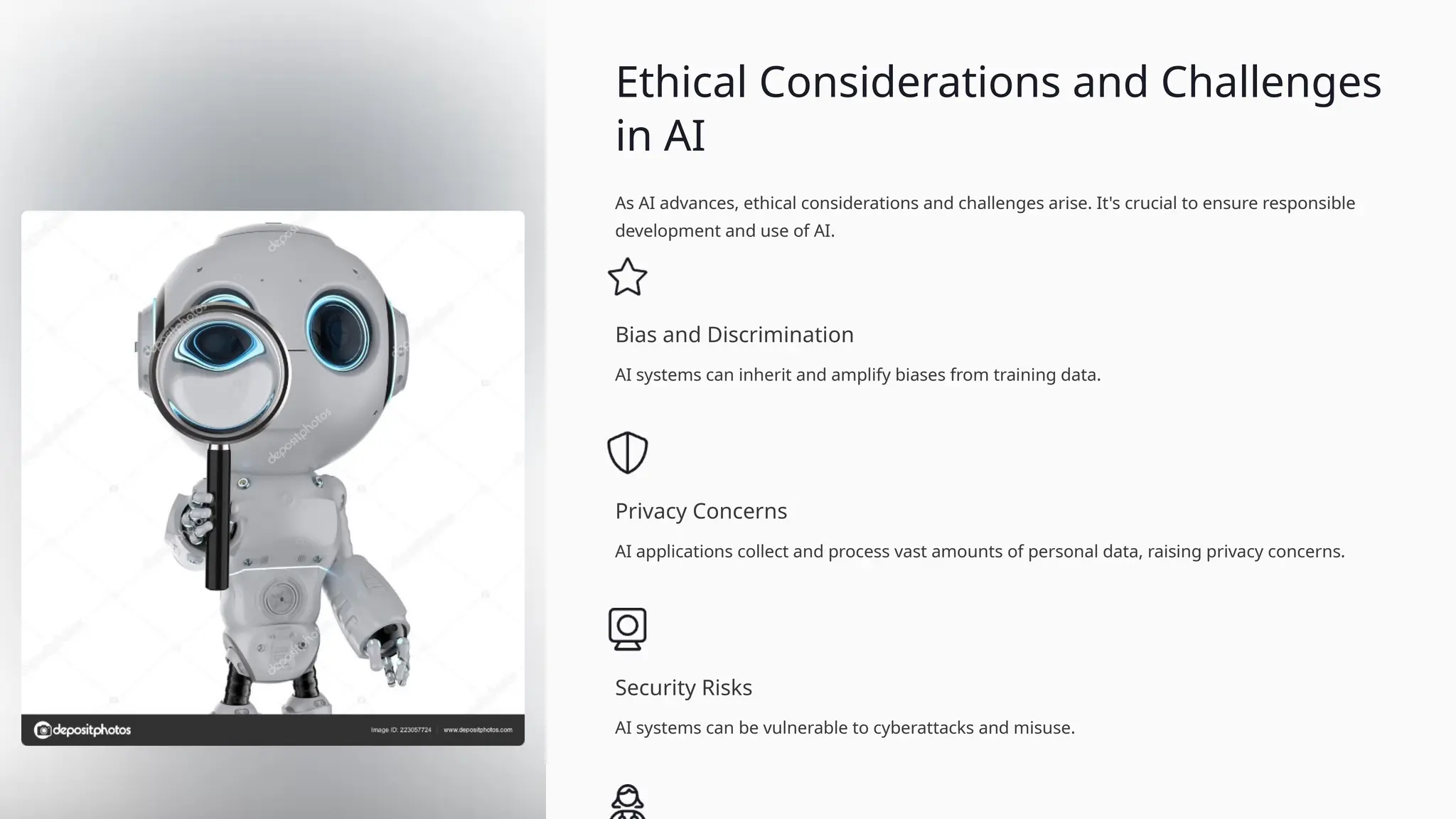
Ethical Considerations andChallenges
in AI
As AI advances, ethical considerations and challenges arise. It's crucial to ensure responsible
development and use of AI.
Bias and Discrimination
AI systems can inherit and amplify biases from training data.
Privacy Concerns
AI applications collect and process vast amounts of personal data, raising privacy concerns.
Security Risks
AI systems can be vulnerable to cyberattacks and misuse.
8.
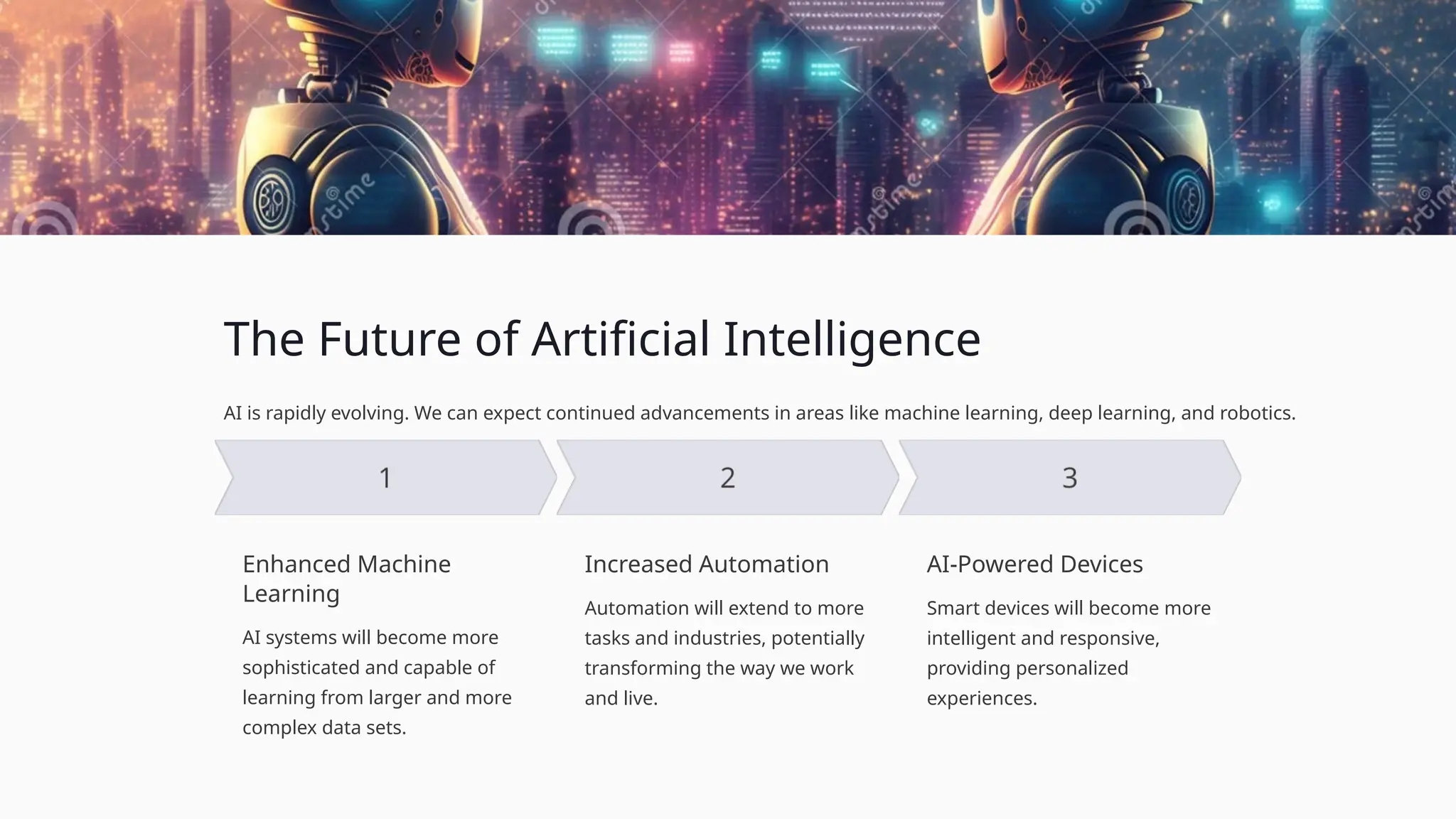
The Future ofArtificial Intelligence
AI is rapidly evolving. We can expect continued advancements in areas like machine learning, deep learning, and robotics.
Enhanced Machine
Learning
AI systems will become more
sophisticated and capable of
learning from larger and more
complex data sets.
Increased Automation
Automation will extend to more
tasks and industries, potentially
transforming the way we work
and live.
AI-Powered Devices
Smart devices will become more
intelligent and responsive,
providing personalized
experiences.
9.
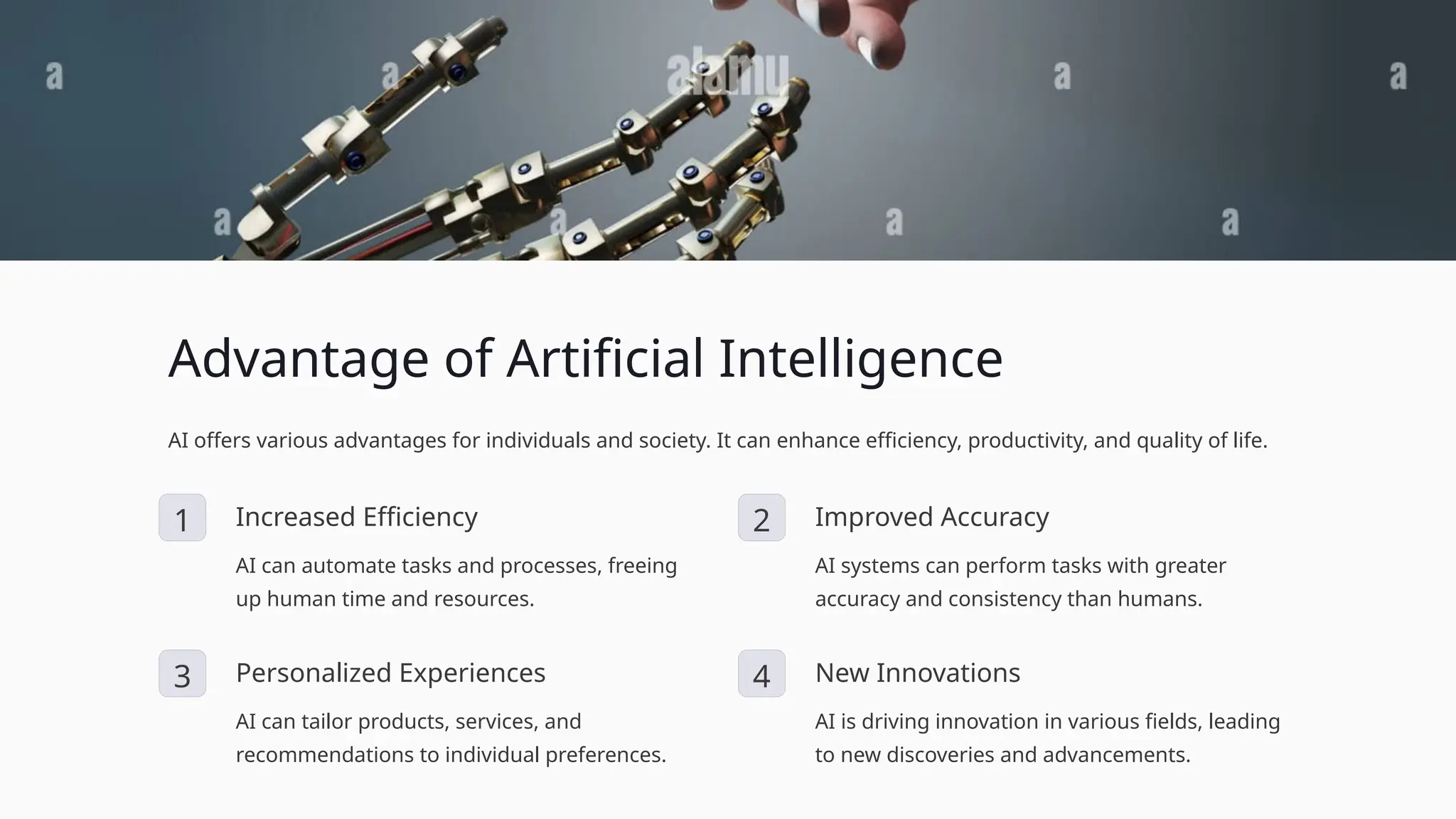
Advantage of ArtificialIntelligence
AI offers various advantages for individuals and society. It can enhance efficiency, productivity, and quality of life.
1 Increased Efficiency
AI can automate tasks and processes, freeing
up human time and resources.
2 Improved Accuracy
AI systems can perform tasks with greater
accuracy and consistency than humans.
3 Personalized Experiences
AI can tailor products, services, and
recommendations to individual preferences.
4 New Innovations
AI is driving innovation in various fields, leading
to new discoveries and advancements.
10.
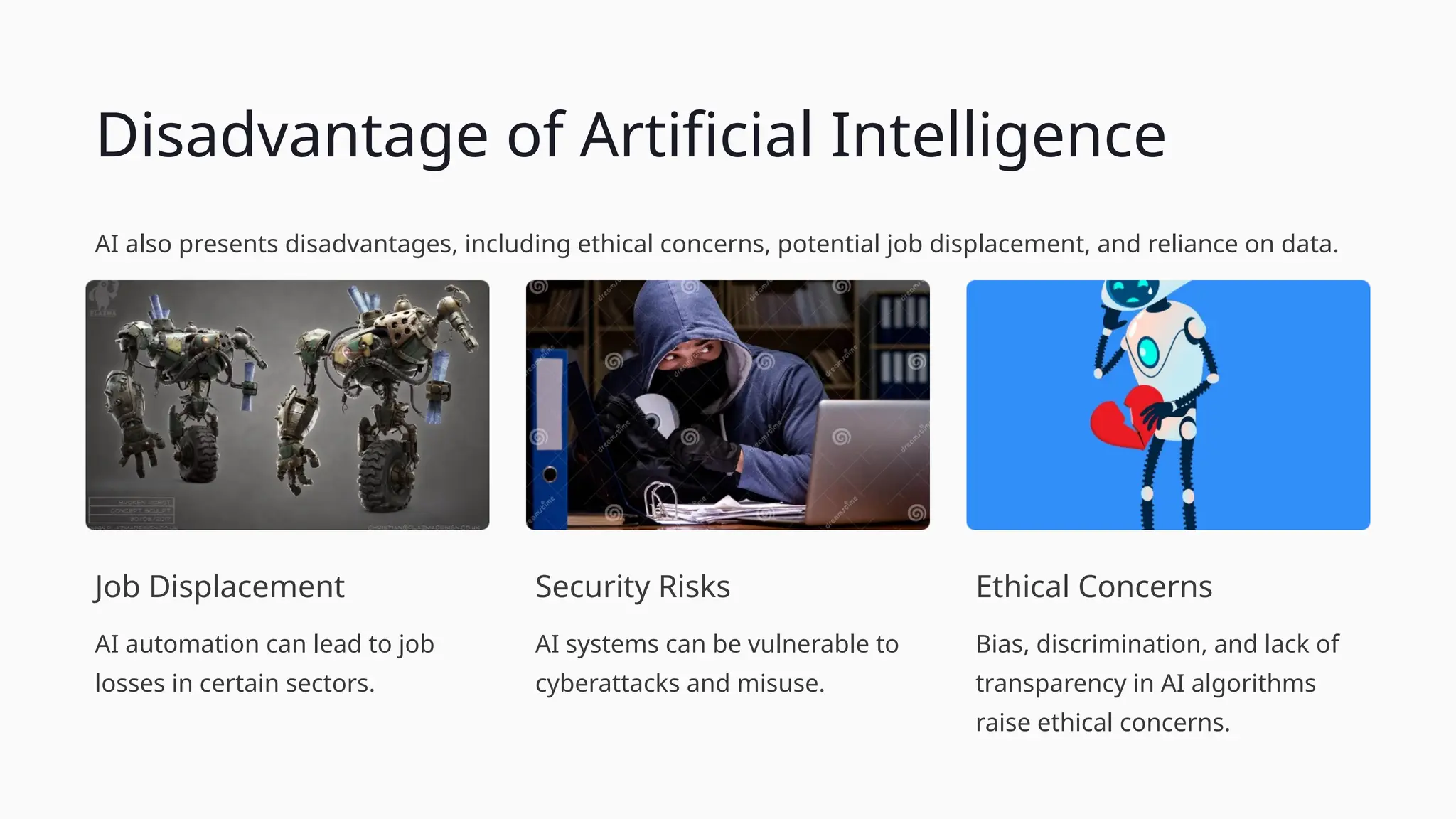
Disadvantage of ArtificialIntelligence
AI also presents disadvantages, including ethical concerns, potential job displacement, and reliance on data.
Job Displacement
AI automation can lead to job
losses in certain sectors.
Security Risks
AI systems can be vulnerable to
cyberattacks and misuse.
Ethical Concerns
Bias, discrimination, and lack of
transparency in AI algorithms
raise ethical concerns.


![IObit Software Updater Pro 6.3.0.15 with Crack [Latest]](https://cdn.slidesharecdn.com/ss_thumbnails/9e216e2b-6ae0-460a-8420-83492ee05ad5-250219111854-b6fa58153-250324064423-309cbc78-thumbnail.jpg?width=640&height=640&fit=bounds)


![Advanced System Optimizer 3.81.8181.238 + Serial Key [Latest]](https://cdn.slidesharecdn.com/ss_thumbnails/9e216e2b-6ae0-460a-8420-83492ee05ad5-250219111854-b6fa58151-250324064108-64968e05-thumbnail.jpg?width=640&height=640&fit=bounds)


![Advanced SystemCare Ultimate 16.5.0.88 Crack + Key [Latest]](https://cdn.slidesharecdn.com/ss_thumbnails/9e216e2b-6ae0-460a-8420-83492ee05ad5-250219111854-b6fa58153-250324065039-625bb0c6-thumbnail.jpg?width=640&height=640&fit=bounds)
![Razer Surround Pro 2.0.29.20 Full Crack + Keygen [Latest]](https://cdn.slidesharecdn.com/ss_thumbnails/artificialintelligence2-250521162705-49ebbc5b-thumbnail.jpg?width=640&height=640&fit=bounds)
![Burp Suite Professional 2022.1.1 Crack + License Key [Latest]](https://cdn.slidesharecdn.com/ss_thumbnails/artificialintelligence2-250521162242-8a1d1e9b-thumbnail.jpg?width=640&height=640&fit=bounds)
![Edraw Max 10.0.4 Crack with License Key Download [Latest]](https://cdn.slidesharecdn.com/ss_thumbnails/artificialintelligence2-250521092315-2e97628b-thumbnail.jpg?width=640&height=640&fit=bounds)
![Auslogics Driver Updater 1.24.0.3 Crack + License Key [Latest]](https://cdn.slidesharecdn.com/ss_thumbnails/artificialintelligence2-250528083428-270487fc-thumbnail.jpg?width=640&height=640&fit=bounds)

![WinCatalog 2020.2.5.1210 with Crack Download [Latest]](https://cdn.slidesharecdn.com/ss_thumbnails/artificialintelligence26-250529150615-8d05efb8-thumbnail.jpg?width=640&height=640&fit=bounds)
![VariCAD 2025 Crack v1.00 with Keygen Download [Latest]](https://cdn.slidesharecdn.com/ss_thumbnails/artificialintelligence26-250602143312-c0384862-thumbnail.jpg?width=640&height=640&fit=bounds)
![Aiseesoft FoneLab 10.2.92 Crack + Registration Code [2025]](https://cdn.slidesharecdn.com/ss_thumbnails/artificialintelligence26-250529090002-4767605e-thumbnail.jpg?width=640&height=640&fit=bounds)


