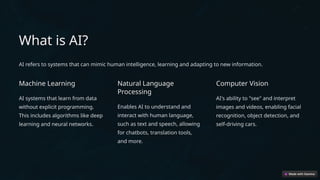
What is AI?
AIrefers to systems that can mimic human intelligence, learning and adapting to new information.
Machine Learning
AI systems that learn from data
without explicit programming.
This includes algorithms like deep
learning and neural networks.
Natural Language
Processing
Enables AI to understand and
interact with human language,
such as text and speech, allowing
for chatbots, translation tools,
and more.
Computer Vision
AI's ability to "see" and interpret
images and videos, enabling facial
recognition, object detection, and
self-driving cars.
3.
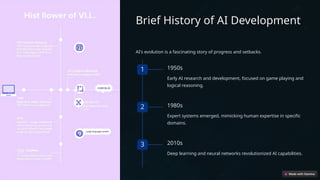
Brief History ofAI Development
AI's evolution is a fascinating story of progress and setbacks.
1 1950s
Early AI research and development, focused on game playing and
logical reasoning.
2 1980s
Expert systems emerged, mimicking human expertise in specific
domains.
3 2010s
Deep learning and neural networks revolutionized AI capabilities.
4.
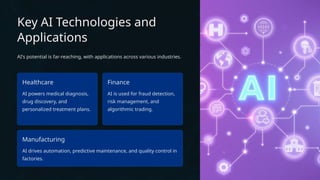
Key AI Technologiesand
Applications
AI's potential is far-reaching, with applications across various industries.
Healthcare
AI powers medical diagnosis,
drug discovery, and
personalized treatment plans.
Finance
AI is used for fraud detection,
risk management, and
algorithmic trading.
Manufacturing
AI drives automation, predictive maintenance, and quality control in
factories.
5.
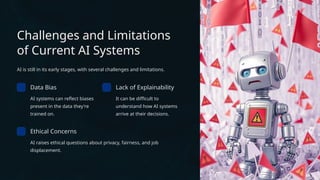
Challenges and Limitations
ofCurrent AI Systems
AI is still in its early stages, with several challenges and limitations.
Data Bias
AI systems can reflect biases
present in the data they're
trained on.
Lack of Explainability
It can be difficult to
understand how AI systems
arrive at their decisions.
Ethical Concerns
AI raises ethical questions about privacy, fairness, and job
displacement.
6.
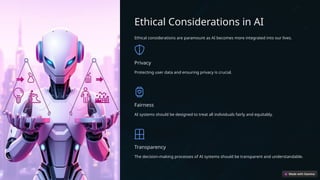
Ethical Considerations inAI
Ethical considerations are paramount as AI becomes more integrated into our lives.
Privacy
Protecting user data and ensuring privacy is crucial.
Fairness
AI systems should be designed to treat all individuals fairly and equitably.
Transparency
The decision-making processes of AI systems should be transparent and understandable.
7.
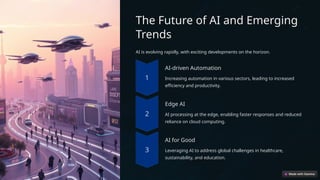
The Future ofAI and Emerging
Trends
AI is evolving rapidly, with exciting developments on the horizon.
AI-driven Automation
Increasing automation in various sectors, leading to increased
efficiency and productivity.
Edge AI
AI processing at the edge, enabling faster responses and reduced
reliance on cloud computing.
AI for Good
Leveraging AI to address global challenges in healthcare,
sustainability, and education.
8.
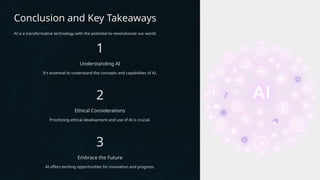
Conclusion and KeyTakeaways
AI is a transformative technology with the potential to revolutionize our world.
1
Understanding AI
It's essential to understand the concepts and capabilities of AI.
2
Ethical Considerations
Prioritizing ethical development and use of AI is crucial.
3
Embrace the Future
AI offers exciting opportunities for innovation and progress.



![IObit Software Updater Pro 6.3.0.15 with Crack [Latest]](https://cdn.slidesharecdn.com/ss_thumbnails/9e216e2b-6ae0-460a-8420-83492ee05ad5-250219111854-b6fa58153-250324064423-309cbc78-thumbnail.jpg?width=640&height=640&fit=bounds)
![Advanced SystemCare Ultimate 16.5.0.88 Crack + Key [Latest]](https://cdn.slidesharecdn.com/ss_thumbnails/9e216e2b-6ae0-460a-8420-83492ee05ad5-250219111854-b6fa58153-250324065039-625bb0c6-thumbnail.jpg?width=640&height=640&fit=bounds)
![Advanced System Optimizer 3.81.8181.238 + Serial Key [Latest]](https://cdn.slidesharecdn.com/ss_thumbnails/9e216e2b-6ae0-460a-8420-83492ee05ad5-250219111854-b6fa58151-250324064108-64968e05-thumbnail.jpg?width=640&height=640&fit=bounds)


