Introduction to
Artificial Intelligence
Artificial intelligence, also known as AI, is a rapidly advancing field in
technology.
Definition and Scope of Artificial
Intelligence
Artificial Intelligence (AI) refers to the simulation of human intelligence processes by machines, including
learning, reasoning, and self-correction.
AI encompasses a wide scope, from expert systems to natural language processing and robotics, aiming
to perform tasks that typically require human intelligence.
Its applications range from virtual assistants like Siri to self-driving cars and advanced medical
diagnostics.
AI's scope continues to expand as technology evolves, influencing various industries and everyday life.
History of Artificial Intelligence
1 Early Beginnings
The concept of artificial intelligence dates back to ancient civilizations and philosophical
debates.
2 The Growth Phase
In the mid-20th century, AI took shape with the development of key theories and initial
experiments.
3 The AI Revolution
In recent decades, advancements in computing power and data have propelled AI into
various fields.
Applications of Artificial Intelligence
Healthcare
AI is utilized for personalized
treatment plans and medical
diagnostics, improving patient
care.
It aids in drug discovery and
development, accelerating the
research and development
process.
Finance
AI is used for fraud detection,
risk assessment, and
algorithmic trading in financial
markets.
It provides personalized
financial advice and
enhances customer service
through chatbots.
Transportation
AI powers autonomous
vehicles, optimizing traffic
flow, and reducing accidents
on roads.
It improves logistics and
supply chain management
through predictive analytics
and route optimization.
Machine Learning and Deep Learning
Machine Learning
It enables computers to learn from data and
make decisions without being explicitly
programmed.
Deep Learning
A subset of machine learning that uses
neural networks to simulate human
decision-making.
Pattern Recognition
Deep learning excels at recognizing
patterns in data, making it valuable in
various applications.
Automated Feature Extraction
Deep learning can automatically extract
relevant features from raw data for more
accurate predictions.
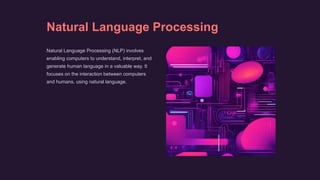
Natural Language Processing
Natural Language Processing (NLP) involves
enabling computers to understand, interpret, and
generate human language in a valuable way. It
focuses on the interaction between computers
and humans, using natural language.
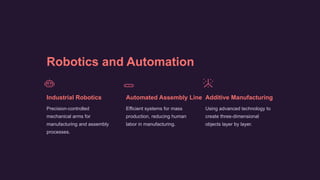
Robotics and Automation
Industrial Robotics
Precision-controlled
mechanical arms for
manufacturing and assembly
processes.
Automated Assembly Line
Efficient systems for mass
production, reducing human
labor in manufacturing.
Additive Manufacturing
Using advanced technology to
create three-dimensional
objects layer by layer.
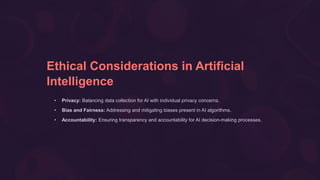
Ethical Considerations in Artificial
Intelligence
• Privacy: Balancing data collection for AI with individual privacy concerns.
• Bias and Fairness: Addressing and mitigating biases present in AI algorithms.
• Accountability: Ensuring transparency and accountability for AI decision-making processes.
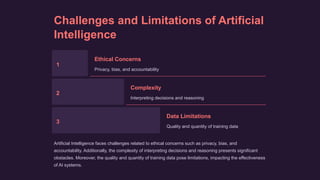
Challenges and Limitations of Artificial
Intelligence
1
Ethical Concerns
Privacy, bias, and accountability
2
Complexity
Interpreting decisions and reasoning
3
Data Limitations
Quality and quantity of training data
Artificial Intelligence faces challenges related to ethical concerns such as privacy, bias, and
accountability. Additionally, the complexity of interpreting decisions and reasoning presents significant
obstacles. Moreover, the quality and quantity of training data pose limitations, impacting the effectiveness
of AI systems.
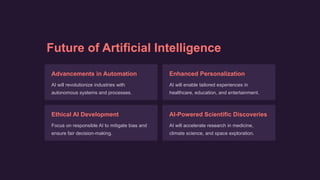
Future of Artificial Intelligence
Advancements in Automation
AI will revolutionize industries with
autonomous systems and processes.
Enhanced Personalization
AI will enable tailored experiences in
healthcare, education, and entertainment.
Ethical AI Development
Focus on responsible AI to mitigate bias and
ensure fair decision-making.
AI-Powered Scientific Discoveries
AI will accelerate research in medicine,
climate science, and space exploration.
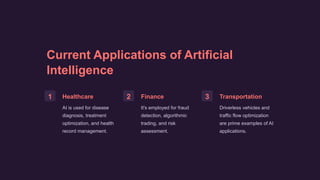
Current Applications of Artificial
Intelligence
1 Healthcare
AI is used for disease
diagnosis, treatment
optimization, and health
record management.
2 Finance
It's employed for fraud
detection, algorithmic
trading, and risk
assessment.
3 Transportation
Driverless vehicles and
traffic flow optimization
are prime examples of AI
applications.
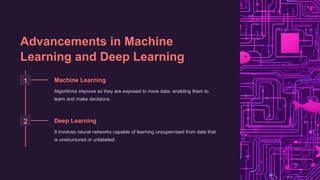
Advancements in Machine
Learning and Deep Learning
1 Machine Learning
Algorithms improve as they are exposed to more data, enabling them to
learn and make decisions.
2 Deep Learning
It involves neural networks capable of learning unsupervised from data that
is unstructured or unlabeled.
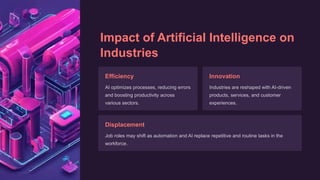
Impact of Artificial Intelligence on
Industries
Efficiency
AI optimizes processes, reducing errors
and boosting productivity across
various sectors.
Innovation
Industries are reshaped with AI-driven
products, services, and customer
experiences.
Displacement
Job roles may shift as automation and AI replace repetitive and routine tasks in the
workforce.
Ethical Considerations in Artificial
Intelligence
Privacy
Concerns over data privacy,
surveillance, and potential
misuse of personal
information.
Biases
AI systems may perpetuate
societal biases if not
carefully designed and
monitored.
Accountability
Clear responsibility and
accountability frameworks
are essential to handle AI-
related decisions.
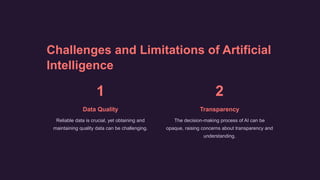
Challenges and Limitations of Artificial
Intelligence
1
Data Quality
Reliable data is crucial, yet obtaining and
maintaining quality data can be challenging.
2
Transparency
The decision-making process of AI can be
opaque, raising concerns about transparency and
understanding.
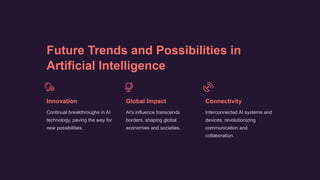
Future Trends and Possibilities in
Artificial Intelligence
Innovation
Continual breakthroughs in AI
technology, paving the way for
new possibilities.
Global Impact
AI's influence transcends
borders, shaping global
economies and societies.
Connectivity
Interconnected AI systems and
devices, revolutionizing
communication and
collaboration.
Thank You!
We appreciate your time and attention. If you have any questions or
would like to learn more, please don't hesitate to reach out to us. We look
forward to the opportunity to work with you and provide exceptional
service.

AI Hackathon.pptx

  • 1.
    Introduction to Artificial Intelligence Artificialintelligence, also known as AI, is a rapidly advancing field in technology.
  • 2.
    Definition and Scopeof Artificial Intelligence Artificial Intelligence (AI) refers to the simulation of human intelligence processes by machines, including learning, reasoning, and self-correction. AI encompasses a wide scope, from expert systems to natural language processing and robotics, aiming to perform tasks that typically require human intelligence. Its applications range from virtual assistants like Siri to self-driving cars and advanced medical diagnostics. AI's scope continues to expand as technology evolves, influencing various industries and everyday life.
  • 3.
    History of ArtificialIntelligence 1 Early Beginnings The concept of artificial intelligence dates back to ancient civilizations and philosophical debates. 2 The Growth Phase In the mid-20th century, AI took shape with the development of key theories and initial experiments. 3 The AI Revolution In recent decades, advancements in computing power and data have propelled AI into various fields.
  • 4.
    Applications of ArtificialIntelligence Healthcare AI is utilized for personalized treatment plans and medical diagnostics, improving patient care. It aids in drug discovery and development, accelerating the research and development process. Finance AI is used for fraud detection, risk assessment, and algorithmic trading in financial markets. It provides personalized financial advice and enhances customer service through chatbots. Transportation AI powers autonomous vehicles, optimizing traffic flow, and reducing accidents on roads. It improves logistics and supply chain management through predictive analytics and route optimization.
  • 5.
    Machine Learning andDeep Learning Machine Learning It enables computers to learn from data and make decisions without being explicitly programmed. Deep Learning A subset of machine learning that uses neural networks to simulate human decision-making. Pattern Recognition Deep learning excels at recognizing patterns in data, making it valuable in various applications. Automated Feature Extraction Deep learning can automatically extract relevant features from raw data for more accurate predictions.
  • 6.
    Natural Language Processing NaturalLanguage Processing (NLP) involves enabling computers to understand, interpret, and generate human language in a valuable way. It focuses on the interaction between computers and humans, using natural language.
  • 7.
    Robotics and Automation IndustrialRobotics Precision-controlled mechanical arms for manufacturing and assembly processes. Automated Assembly Line Efficient systems for mass production, reducing human labor in manufacturing. Additive Manufacturing Using advanced technology to create three-dimensional objects layer by layer.
  • 8.
    Ethical Considerations inArtificial Intelligence • Privacy: Balancing data collection for AI with individual privacy concerns. • Bias and Fairness: Addressing and mitigating biases present in AI algorithms. • Accountability: Ensuring transparency and accountability for AI decision-making processes.
  • 9.
    Challenges and Limitationsof Artificial Intelligence 1 Ethical Concerns Privacy, bias, and accountability 2 Complexity Interpreting decisions and reasoning 3 Data Limitations Quality and quantity of training data Artificial Intelligence faces challenges related to ethical concerns such as privacy, bias, and accountability. Additionally, the complexity of interpreting decisions and reasoning presents significant obstacles. Moreover, the quality and quantity of training data pose limitations, impacting the effectiveness of AI systems.
  • 10.
    Future of ArtificialIntelligence Advancements in Automation AI will revolutionize industries with autonomous systems and processes. Enhanced Personalization AI will enable tailored experiences in healthcare, education, and entertainment. Ethical AI Development Focus on responsible AI to mitigate bias and ensure fair decision-making. AI-Powered Scientific Discoveries AI will accelerate research in medicine, climate science, and space exploration.
  • 11.
    Current Applications ofArtificial Intelligence 1 Healthcare AI is used for disease diagnosis, treatment optimization, and health record management. 2 Finance It's employed for fraud detection, algorithmic trading, and risk assessment. 3 Transportation Driverless vehicles and traffic flow optimization are prime examples of AI applications.
  • 12.
    Advancements in Machine Learningand Deep Learning 1 Machine Learning Algorithms improve as they are exposed to more data, enabling them to learn and make decisions. 2 Deep Learning It involves neural networks capable of learning unsupervised from data that is unstructured or unlabeled.
  • 13.
    Impact of ArtificialIntelligence on Industries Efficiency AI optimizes processes, reducing errors and boosting productivity across various sectors. Innovation Industries are reshaped with AI-driven products, services, and customer experiences. Displacement Job roles may shift as automation and AI replace repetitive and routine tasks in the workforce.
  • 14.
    Ethical Considerations inArtificial Intelligence Privacy Concerns over data privacy, surveillance, and potential misuse of personal information. Biases AI systems may perpetuate societal biases if not carefully designed and monitored. Accountability Clear responsibility and accountability frameworks are essential to handle AI- related decisions.
  • 15.
    Challenges and Limitationsof Artificial Intelligence 1 Data Quality Reliable data is crucial, yet obtaining and maintaining quality data can be challenging. 2 Transparency The decision-making process of AI can be opaque, raising concerns about transparency and understanding.
  • 16.
    Future Trends andPossibilities in Artificial Intelligence Innovation Continual breakthroughs in AI technology, paving the way for new possibilities. Global Impact AI's influence transcends borders, shaping global economies and societies. Connectivity Interconnected AI systems and devices, revolutionizing communication and collaboration.
  • 17.
    Thank You! We appreciateyour time and attention. If you have any questions or would like to learn more, please don't hesitate to reach out to us. We look forward to the opportunity to work with you and provide exceptional service.