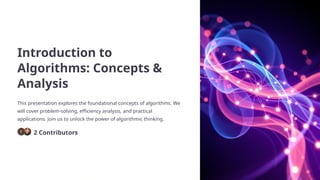
Introduction to
Algorithms: Concepts &
Analysis
This presentation explores the foundational concepts of algorithms. We
will cover problem-solving, efficiency analysis, and practical
applications. Join us to unlock the power of algorithmic thinking.
2 Contributors
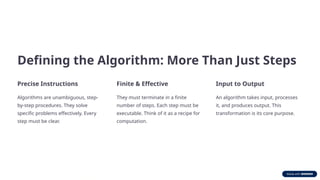
Defining the Algorithm: More Than Just Steps
Precise Instructions
Algorithms are unambiguous, step-
by-step procedures. They solve
specific problems effectively. Every
step must be clear.
Finite & Effective
They must terminate in a finite
number of steps. Each step must be
executable. Think of it as a recipe for
computation.
Input to Output
An algorithm takes input, processes
it, and produces output. This
transformation is its core purpose.
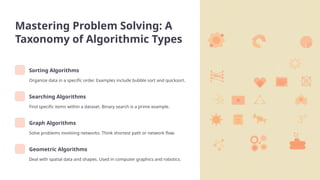
Mastering Problem Solving: A
Taxonomy of Algorithmic Types
Sorting Algorithms
Organize data in a specific order. Examples include bubble sort and quicksort.
Searching Algorithms
Find specific items within a dataset. Binary search is a prime example.
Graph Algorithms
Solve problems involving networks. Think shortest path or network flow.
Geometric Algorithms
Deal with spatial data and shapes. Used in computer graphics and robotics.
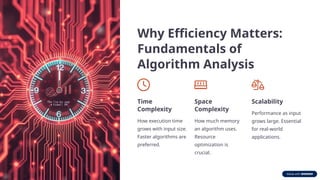
Why Efficiency Matters:
Fundamentals of
Algorithm Analysis
Time
Complexity
How execution time
grows with input size.
Faster algorithms are
preferred.
Space
Complexity
How much memory
an algorithm uses.
Resource
optimization is
crucial.
Scalability
Performance as input
grows large. Essential
for real-world
applications.
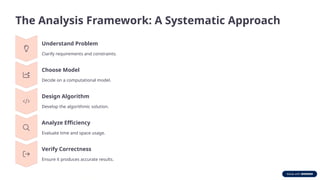
The Analysis Framework: A Systematic Approach
Understand Problem
Clarify requirements and constraints.
Choose Model
Decide on a computational model.
Design Algorithm
Develop the algorithmic solution.
Analyze Efficiency
Evaluate time and space usage.
Verify Correctness
Ensure it produces accurate results.
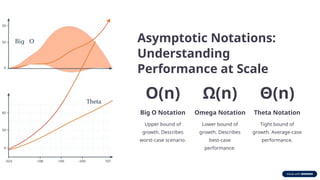
Asymptotic Notations:
Understanding
Performance at Scale
O(n)
Big O Notation
Upper bound of
growth. Describes
worst-case scenario.
Ω(n)
Omega Notation
Lower bound of
growth. Describes
best-case
performance.
Θ(n)
Theta Notation
Tight bound of
growth. Average-case
performance.
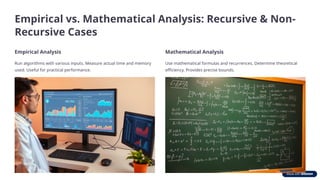
Empirical vs. Mathematical Analysis: Recursive & Non-
Recursive Cases
Empirical Analysis
Run algorithms with various inputs. Measure actual time and memory
used. Useful for practical performance.
Mathematical Analysis
Use mathematical formulas and recurrences. Determine theoretical
efficiency. Provides precise bounds.
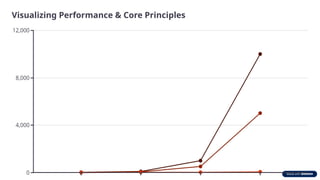
Visualizing Performance & Core Principles
🧠 Introduction to Design and Analysis of Algorithms
✅ What is an Algorithm?
An algorithm is a step-by-step procedure or set of rules to solve a specific problem or perform a computation.
📌 Example: A recipe to bake a cake, or Google Maps finding the shortest route.
📘 What is Algorithm Design?
Algorithm Design is the process of creating algorithms to solve problems efficiently. It involves:
Understanding the problem
Choosing the right strategy (e.g., divide & conquer, greedy, etc.)
Ensuring the solution is correct and optimal
📊 What is Algorithm Analysis?
Algorithm Analysis focuses on evaluating the performance of algorithms:
Time Complexity ️
⏱️– How fast does it run?
Space Complexity 💾 – How much memory does it use?
Using asymptotic notations like Big O, Theta (θ), and Omega (Ω)
💡 Why Do We Study Algorithms?
To write efficient and scalable code
To solve real-world problems smartly (e.g., network routing, file compression, scheduling)
For placement preparation and competitive exams like GATE
To build a strong foundation in computer science
📌 Types of Algorithmic Problems
Searching & Sorting
Graph Problems (Shortest path, connectivity)
Optimization Problems (Knapsack, TSP)
Decision Problems (Backtracking, NP problems)
🔁 Recursive vs. Non-Recursive Algorithms
Recursive: Algorithm calls itself (e.g., Tower of Hanoi, Merge Sort)
Non-recursive: Uses loops/iterations (e.g., Iterative Fibonacci)
🔬 Analysis Methods
Empirical Analysis: Running code and observing performance.
Mathematical Analysis: Deriving complexity using math.
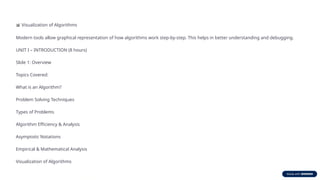
📊 Visualization of Algorithms
Modern tools allow graphical representation of how algorithms work step-by-step. This helps in better understanding and debugging.
UNIT I – INTRODUCTION (8 hours)
Slide 1: Overview
Topics Covered:
What is an Algorithm?
Problem Solving Techniques
Types of Problems
Algorithm Efficiency & Analysis
Asymptotic Notations
Empirical & Mathematical Analysis
Visualization of Algorithms
Introduction-to-Algorithms-Concepts-and-Analysis.pptx

  • 1.
    Introduction to Algorithms: Concepts& Analysis This presentation explores the foundational concepts of algorithms. We will cover problem-solving, efficiency analysis, and practical applications. Join us to unlock the power of algorithmic thinking. 2 Contributors
  • 2.
    Defining the Algorithm:More Than Just Steps Precise Instructions Algorithms are unambiguous, step- by-step procedures. They solve specific problems effectively. Every step must be clear. Finite & Effective They must terminate in a finite number of steps. Each step must be executable. Think of it as a recipe for computation. Input to Output An algorithm takes input, processes it, and produces output. This transformation is its core purpose.
  • 3.
    Mastering Problem Solving:A Taxonomy of Algorithmic Types Sorting Algorithms Organize data in a specific order. Examples include bubble sort and quicksort. Searching Algorithms Find specific items within a dataset. Binary search is a prime example. Graph Algorithms Solve problems involving networks. Think shortest path or network flow. Geometric Algorithms Deal with spatial data and shapes. Used in computer graphics and robotics.
  • 4.
    Why Efficiency Matters: Fundamentalsof Algorithm Analysis Time Complexity How execution time grows with input size. Faster algorithms are preferred. Space Complexity How much memory an algorithm uses. Resource optimization is crucial. Scalability Performance as input grows large. Essential for real-world applications.
  • 5.
    The Analysis Framework:A Systematic Approach Understand Problem Clarify requirements and constraints. Choose Model Decide on a computational model. Design Algorithm Develop the algorithmic solution. Analyze Efficiency Evaluate time and space usage. Verify Correctness Ensure it produces accurate results.
  • 6.
    Asymptotic Notations: Understanding Performance atScale O(n) Big O Notation Upper bound of growth. Describes worst-case scenario. Ω(n) Omega Notation Lower bound of growth. Describes best-case performance. Θ(n) Theta Notation Tight bound of growth. Average-case performance.
  • 7.
    Empirical vs. MathematicalAnalysis: Recursive & Non- Recursive Cases Empirical Analysis Run algorithms with various inputs. Measure actual time and memory used. Useful for practical performance. Mathematical Analysis Use mathematical formulas and recurrences. Determine theoretical efficiency. Provides precise bounds.
  • 8.
  • 9.
    🧠 Introduction toDesign and Analysis of Algorithms ✅ What is an Algorithm? An algorithm is a step-by-step procedure or set of rules to solve a specific problem or perform a computation. 📌 Example: A recipe to bake a cake, or Google Maps finding the shortest route.
  • 10.
    📘 What isAlgorithm Design? Algorithm Design is the process of creating algorithms to solve problems efficiently. It involves: Understanding the problem Choosing the right strategy (e.g., divide & conquer, greedy, etc.) Ensuring the solution is correct and optimal
  • 11.
    📊 What isAlgorithm Analysis? Algorithm Analysis focuses on evaluating the performance of algorithms: Time Complexity ️ ⏱️– How fast does it run? Space Complexity 💾 – How much memory does it use? Using asymptotic notations like Big O, Theta (θ), and Omega (Ω)
  • 12.
    💡 Why DoWe Study Algorithms? To write efficient and scalable code To solve real-world problems smartly (e.g., network routing, file compression, scheduling) For placement preparation and competitive exams like GATE To build a strong foundation in computer science
  • 13.
    📌 Types ofAlgorithmic Problems Searching & Sorting Graph Problems (Shortest path, connectivity) Optimization Problems (Knapsack, TSP) Decision Problems (Backtracking, NP problems)
  • 14.
    🔁 Recursive vs.Non-Recursive Algorithms Recursive: Algorithm calls itself (e.g., Tower of Hanoi, Merge Sort) Non-recursive: Uses loops/iterations (e.g., Iterative Fibonacci)
  • 15.
    🔬 Analysis Methods EmpiricalAnalysis: Running code and observing performance. Mathematical Analysis: Deriving complexity using math.
  • 16.
    📊 Visualization ofAlgorithms Modern tools allow graphical representation of how algorithms work step-by-step. This helps in better understanding and debugging. UNIT I – INTRODUCTION (8 hours) Slide 1: Overview Topics Covered: What is an Algorithm? Problem Solving Techniques Types of Problems Algorithm Efficiency & Analysis Asymptotic Notations Empirical & Mathematical Analysis Visualization of Algorithms