1
PresentationTopic:
Predicates and Quantifiers
Discrete Mathematics
Submitted By: Mehedi Hasan Saikat
ID: 162-15-7746
Section: B
Department Of Computer Science & Engineering
Daffodil International University.
SubmittedTo: Md. Sadekur Rahman
Senior Lecturer
Department Of Computer Science & Engineering.
Daffodil International University.
Predicate Logic
•Predicate logic is an extension of propositional logic
•It permits concisely reasoning about whole classes of
entities.
•Examples of a class is an integer class, a student in
CSE Dept, etc.
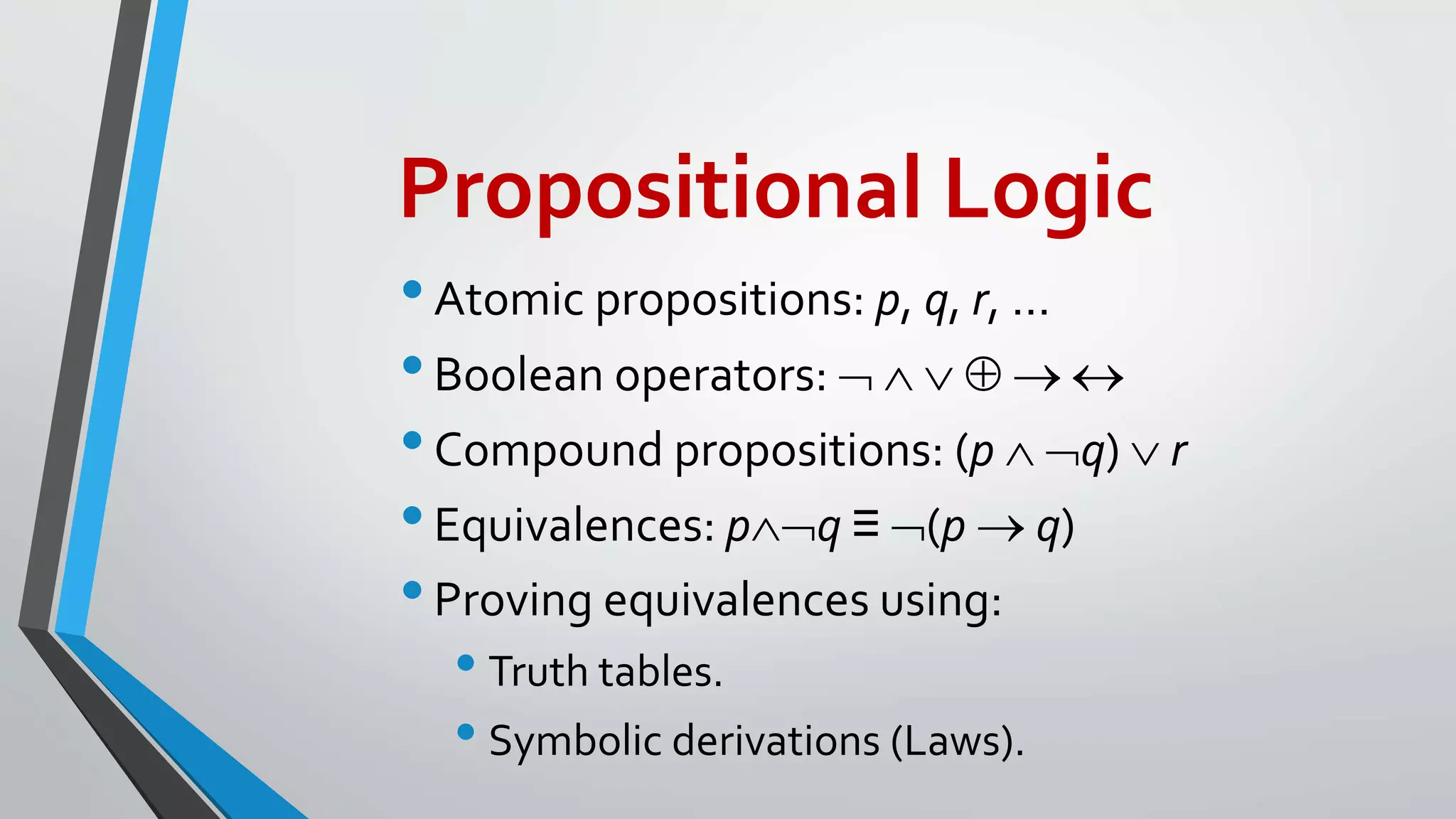
Propositional Logic
•Atomic propositions: p, q, r, …
•Boolean operators:      
•Compound propositions: (p  q)  r
•Equivalences: pq ≡ (p  q)
•Proving equivalences using:
• Truth tables.
• Symbolic derivations (Laws).
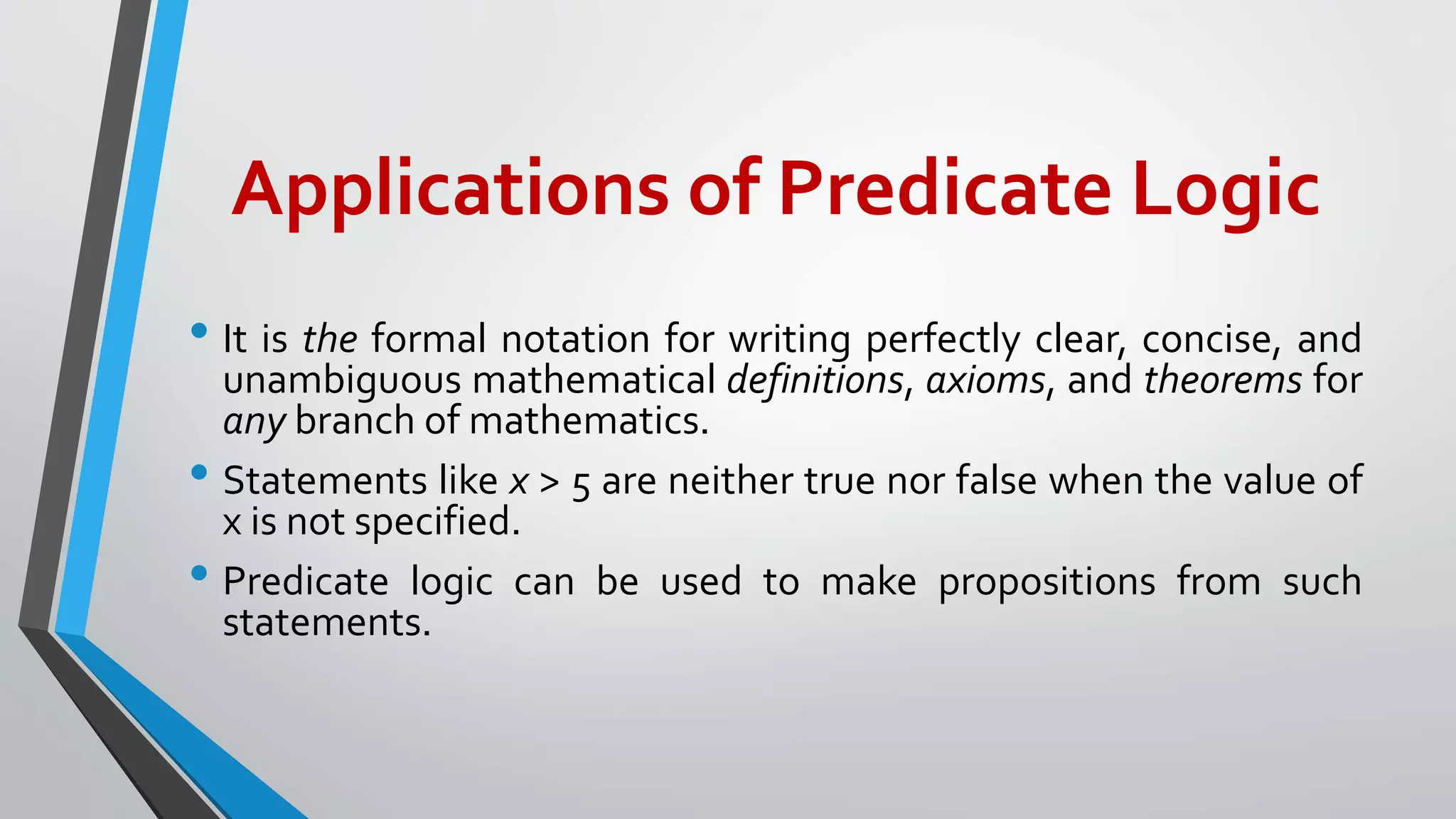
Applications of Predicate Logic
• It is the formal notation for writing perfectly clear, concise, and
unambiguous mathematical definitions, axioms, and theorems for
any branch of mathematics.
• Statements like x > 5 are neither true nor false when the value of
x is not specified.
• Predicate logic can be used to make propositions from such
statements.
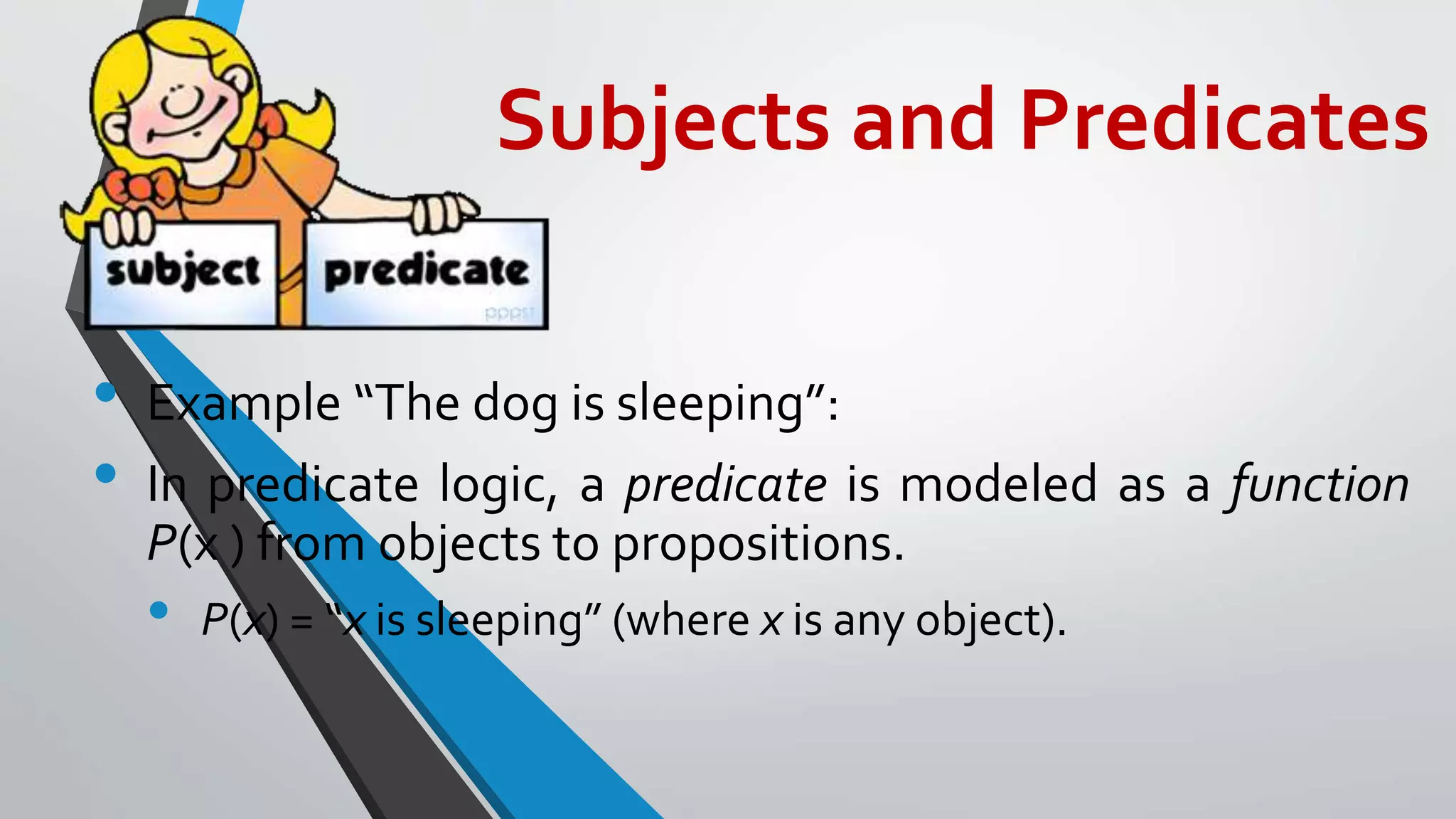
Subjects and Predicates
• Example “The dog is sleeping”:
• In predicate logic, a predicate is modeled as a function
P(x ) from objects to propositions.
• P(x) = “x is sleeping” (where x is any object).
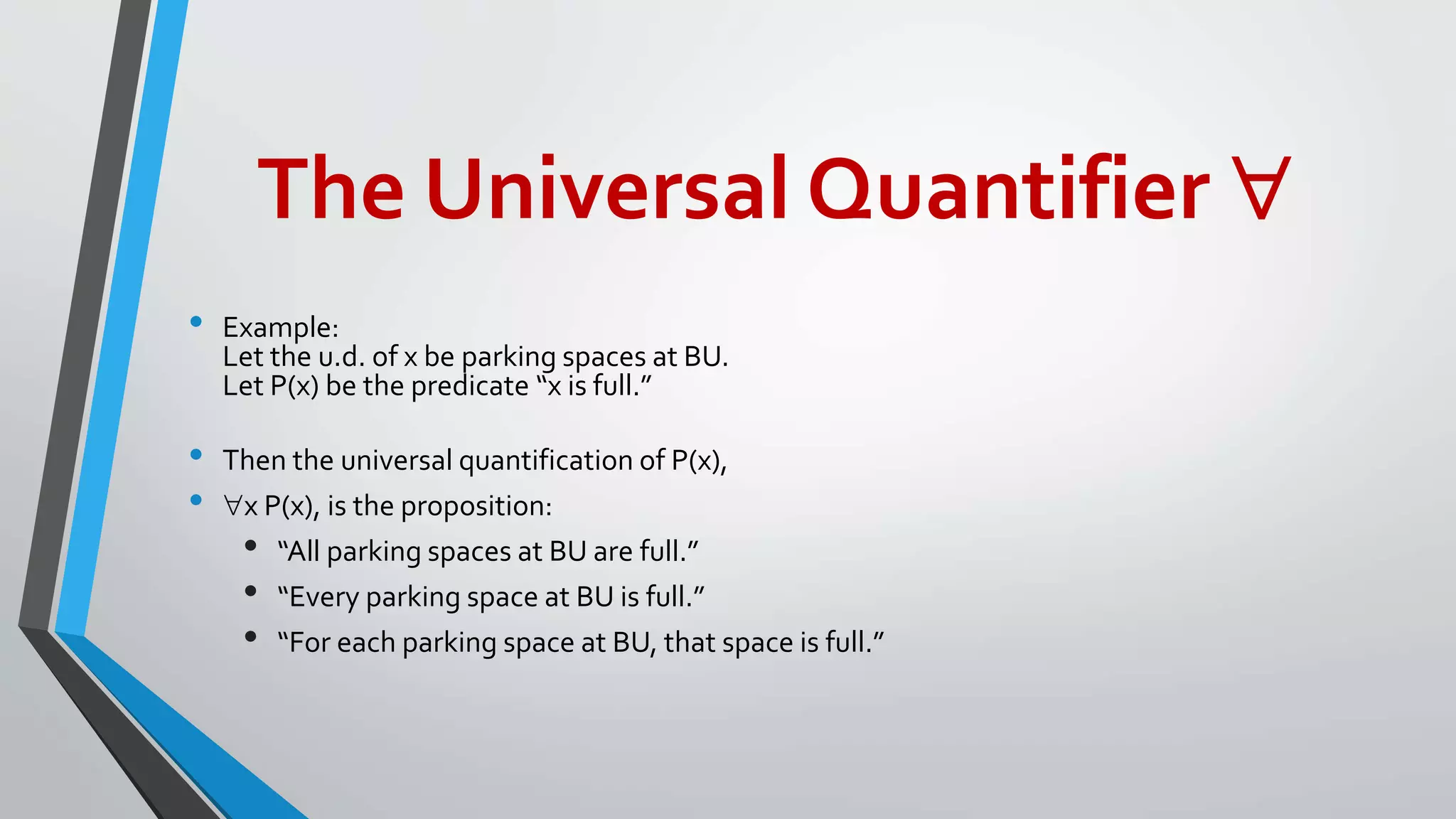
The Universal Quantifier 
• Example:
Let the u.d. of x be parking spaces at BU.
Let P(x) be the predicate “x is full.”
• Then the universal quantification of P(x),
• x P(x), is the proposition:
• “All parking spaces at BU are full.”
• “Every parking space at BU is full.”
• “For each parking space at BU, that space is full.”
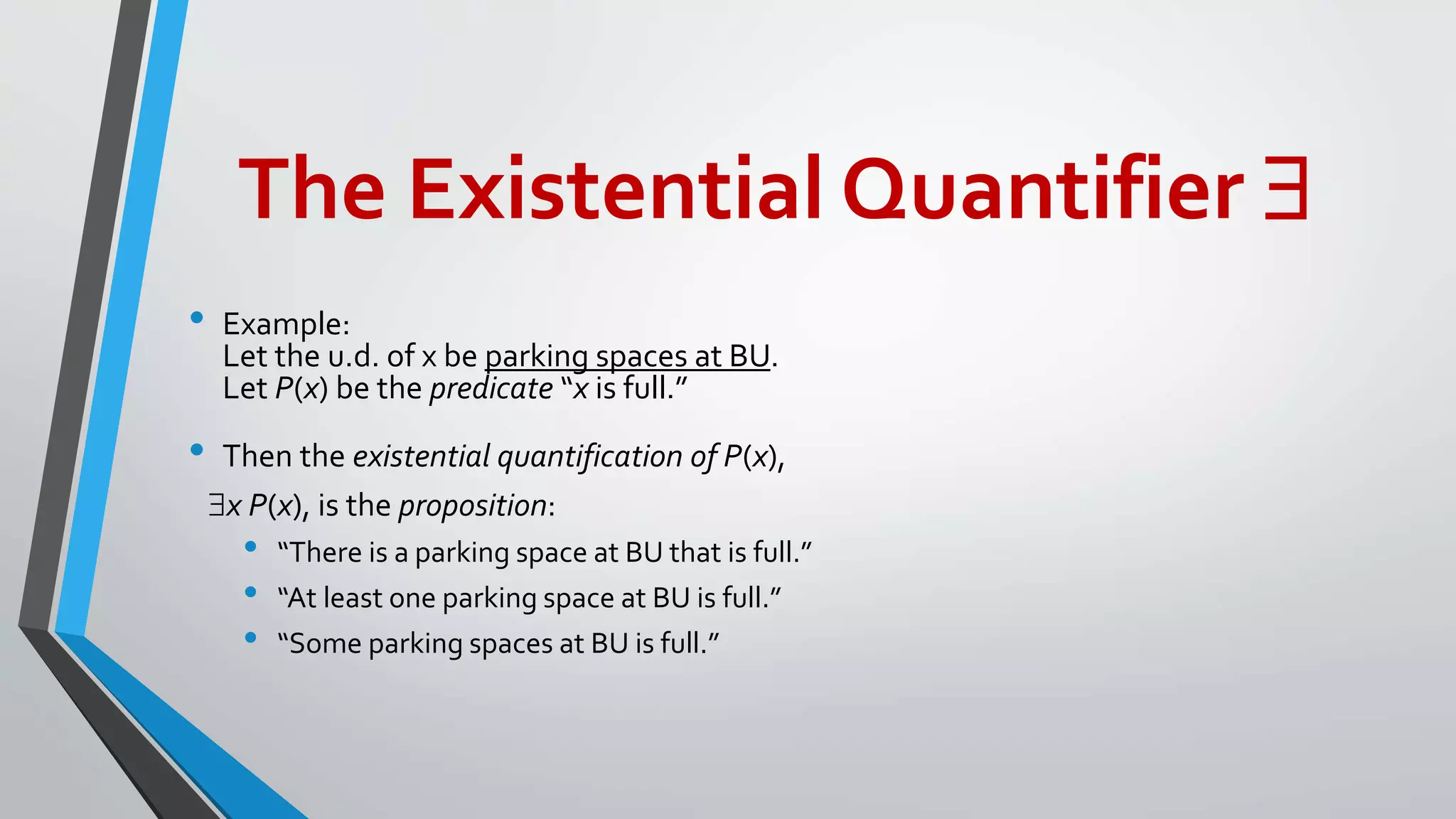
The Existential Quantifier 
• Example:
Let the u.d. of x be parking spaces at BU.
Let P(x) be the predicate “x is full.”
• Then the existential quantification of P(x),
x P(x), is the proposition:
• “There is a parking space at BU that is full.”
• “At least one parking space at BU is full.”
• “Some parking spaces at BU is full.”
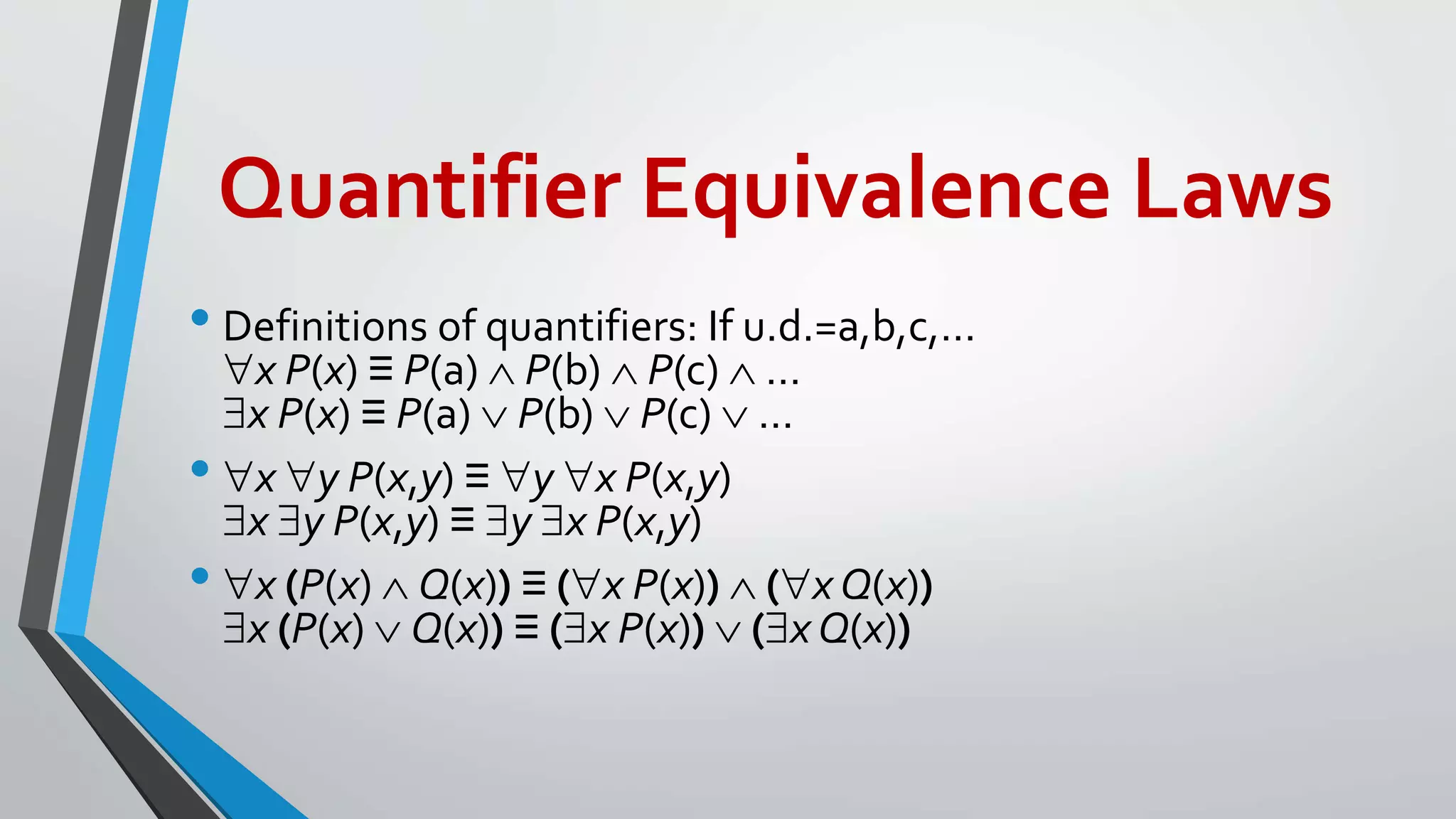
Quantifier Equivalence Laws
• Definitions of quantifiers: If u.d.=a,b,c,…
x P(x) ≡ P(a)  P(b)  P(c)  …
x P(x) ≡ P(a)  P(b)  P(c)  …
• x y P(x,y) ≡ y x P(x,y)
x y P(x,y) ≡ y x P(x,y)
• x (P(x)  Q(x)) ≡ (x P(x))  (x Q(x))
x (P(x)  Q(x)) ≡ (x P(x))  (x Q(x))
ThankYou

Predicates and quantifiers presentation topics

  • 1.
  • 2.
    Submitted By: MehediHasan Saikat ID: 162-15-7746 Section: B Department Of Computer Science & Engineering Daffodil International University. SubmittedTo: Md. Sadekur Rahman Senior Lecturer Department Of Computer Science & Engineering. Daffodil International University.
  • 3.
    Predicate Logic •Predicate logicis an extension of propositional logic •It permits concisely reasoning about whole classes of entities. •Examples of a class is an integer class, a student in CSE Dept, etc.
  • 4.
    Propositional Logic •Atomic propositions:p, q, r, … •Boolean operators:       •Compound propositions: (p  q)  r •Equivalences: pq ≡ (p  q) •Proving equivalences using: • Truth tables. • Symbolic derivations (Laws).
  • 5.
    Applications of PredicateLogic • It is the formal notation for writing perfectly clear, concise, and unambiguous mathematical definitions, axioms, and theorems for any branch of mathematics. • Statements like x > 5 are neither true nor false when the value of x is not specified. • Predicate logic can be used to make propositions from such statements.
  • 6.
    Subjects and Predicates •Example “The dog is sleeping”: • In predicate logic, a predicate is modeled as a function P(x ) from objects to propositions. • P(x) = “x is sleeping” (where x is any object).
  • 7.
    The Universal Quantifier • Example: Let the u.d. of x be parking spaces at BU. Let P(x) be the predicate “x is full.” • Then the universal quantification of P(x), • x P(x), is the proposition: • “All parking spaces at BU are full.” • “Every parking space at BU is full.” • “For each parking space at BU, that space is full.”
  • 8.
    The Existential Quantifier • Example: Let the u.d. of x be parking spaces at BU. Let P(x) be the predicate “x is full.” • Then the existential quantification of P(x), x P(x), is the proposition: • “There is a parking space at BU that is full.” • “At least one parking space at BU is full.” • “Some parking spaces at BU is full.”
  • 9.
    Quantifier Equivalence Laws •Definitions of quantifiers: If u.d.=a,b,c,… x P(x) ≡ P(a)  P(b)  P(c)  … x P(x) ≡ P(a)  P(b)  P(c)  … • x y P(x,y) ≡ y x P(x,y) x y P(x,y) ≡ y x P(x,y) • x (P(x)  Q(x)) ≡ (x P(x))  (x Q(x)) x (P(x)  Q(x)) ≡ (x P(x))  (x Q(x))
  • 10.