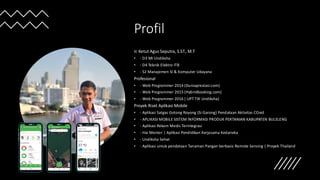
Profil
Ir. Ketut AgusSeputra, S.ST., M.T
• - D3 MI Undiksha
• - D4 Teknik Elektro ITB
• - S2 Manajemen SI & Komputer Udayana
Profesional
• - Web Programmer 2014 (Duniaprestasi.com)
• - Web Programmer 2015 (Hybridbooking.com)
• - Web Programmer 2016 ) UPT TIK Undiksha)
Proyek Riset Aplikasi Mobile
• - Aplikasi Satgas Gotong Royong (Si Garong) Pendataan Aktivitas COvid
• - APLIKASI MOBILE SISTEM INFORMASI PRODUK PERTANIAN KABUPATEN BULELENG
• - Aplikasi Rekam Medis Terintegrasi
• - Hai Mentor | Aplikasi Pendidikan Kerjasama Kedaireka
• - Undiksha Sehat
• - Aplikasi untuk pendataan Tanaman Pangan berbasis Remote Sensing | Proyek Thailand
3.
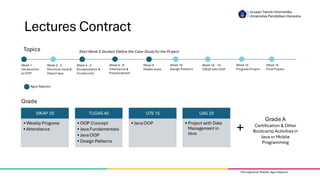
Lectures Contract
SIKAP 20
•Weekly Progress
• Attendance
TUGAS 40
• OOP Concept
• Java Fundamentals
• Java OOP
• Design Patterns
UTS 15
• Java OOP
UAS 25
• Project with Data
Management in
Java
Grade
+
Grade A
Certification & Other
Bootcamp Activitiesin
Java or Mobile
Programming
Pemrograman Mobile |Agus Seputra
Week 1
Introduction
to OOP
Week 2 - 3
Structure class &
Object Java
Week 4 - 5
Encapsulation &
Constructor
Week 6 - 8
Inheritance &
Polymorphism
Week 9
Middle Exam
Week 10
Design Patterns
Week 10 - 14
CRUD with OOP
Week 15
Progress Project
Week 16
Final Project
Topics Start Week 5 Student Define the Case Study for the Project
Agus Seputra
Jurusan Teknik Informatika
Universitas Pendidikan Ganesha
4.
Introduction
• What isProgramming?
• Do I need to be good in maths?
• What about logic?
• What is Computer Programming?
• Designing and building executable computer
programs
Jurusan Teknik Informatika
Universitas Pendidikan Ganesha
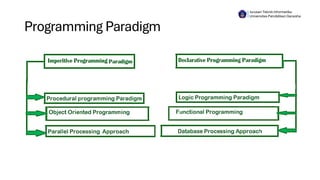
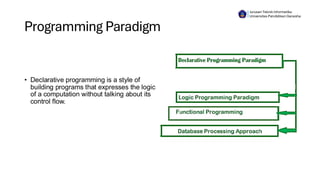
Programming Paradigm
• Declarativeprogramming is a style of
building programs that expresses the logic
of a computation without talking about its
control flow.
Jurusan Teknik Informatika
Universitas Pendidikan Ganesha
7.
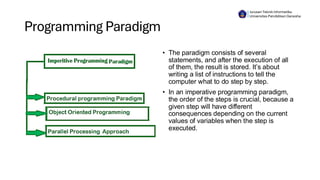
Programming Paradigm
• Theparadigm consists of several
statements, and after the execution of all
of them, the result is stored. It’s about
writing a list of instructions to tell the
computer what to do step by step.
• In an imperative programming paradigm,
the order of the steps is crucial, because a
given step will have different
consequences depending on the current
values of variables when the step is
executed.
Jurusan Teknik Informatika
Universitas Pendidikan Ganesha
8.
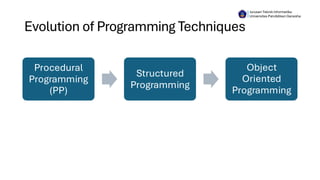
Evolution of ProgrammingTechniques
Procedural
Programming
(PP)
Structured
Programming
Object
Oriented
Programming
Jurusan Teknik Informatika
Universitas Pendidikan Ganesha
10.
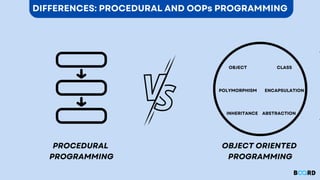
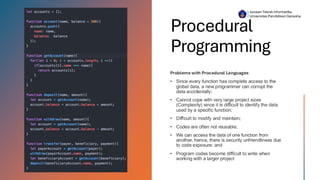
Procedural Programming
• Viewsa program as a series of steps
(procedures) to be carried out;
• Uses a list of instructions; and
• Takes inputs and returns outputs
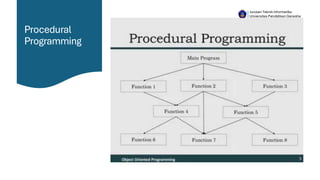
• Division into functions
• Each function has a clearly defined
purpose and a clearly defined interface
to the other functions in the program.
• The idea of breaking a program into
functions can further be extended by
grouping a number of functions
together into a larger entity called a
module
Jurusan Teknik Informatika
Universitas Pendidikan Ganesha
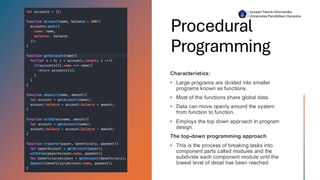
Procedural
Programming
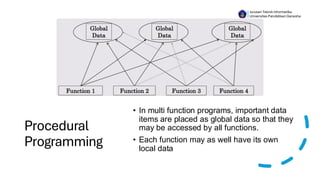
• In multifunction programs, important data
items are placed as global data so that they
may be accessed by all functions.
• Each function may as well have its own
local data
Jurusan Teknik Informatika
Universitas Pendidikan Ganesha
Procedural
Programming
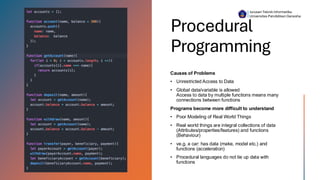
Causes of Problems
•Unrestricted Access to Data
• Global data/variable is allowed
Access to data by multiple functions means many
connections between functions
Programs become more difficult to understand
• Poor Modeling of Real World Things
• Real world things are integral collections of data
(Attributes/properties/features) and functions
(Behaviour)
• ve.g. a car: has data (make, model etc.) and
functions (acceleration)
• Procedural languages do not tie up data with
functions
Jurusan Teknik Informatika
Universitas Pendidikan Ganesha
Need For OOP
ProgrammingApproach
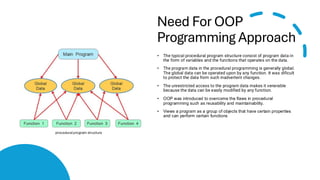
• The typical procedural program structure consist of program data in
the form of variables and the functions that operates on the data.
• The program data in the procedural programming is generally global.
The global data can be operated upon by any function. It was dificult
to protect the data from such inadvertent changes.
• The unrestricted access to the program data makes it venerable
because the data can be easily modified by any function.
• OOP was introduced to overcome the flaws in procedural
programming such as reusability and maintainability.
• Views a program as a group of objects that have certain properties
and can perform certain functions
proceduralprogram structure
18.
What Is ObjectOriented
Programming ?
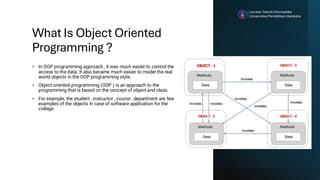
• In OOP programming approach , it was much easier to control the
access to the data. It also became much easier to model the real
world objects in the OOP programming style.
• Object oriented programming (OOP ) is an approach to the
programming that is based on the concept of object and class.
• For example, the student , instructor , course , department are few
examples of the objects in case of software application for the
college.
Jurusan Teknik Informatika
Universitas Pendidikan Ganesha
19.
The Object-oriented Approach
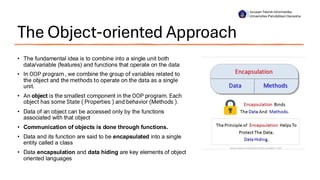
•The fundamental idea is to combine into a single unit both
data/variable (features) and functions that operate on the data
• In OOP program , we combine the group of variables related to
the object and the methods to operate on the data as a single
unit.
• An object is the smallest component in the OOP program. Each
object has some State ( Properties ) and behavior (Methods ).
• Data of an object can be accessed only by the functions
associated with that object
• Communication of objects is done through functions.
• Data and its function are said to be encapsulated into a single
entity called a class
• Data encapsulation and data hiding are key elements of object
oriented languages
Jurusan Teknik Informatika
Universitas Pendidikan Ganesha
20.
What Is ObjectIn OOP ?
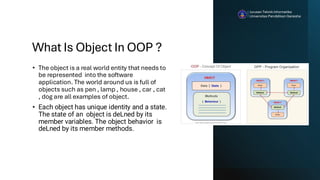
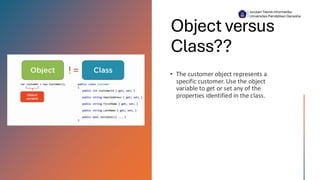
• The object is a real world entity that needs to
be represented into the software
application. The world around us is full of
objects such as pen , lamp , house , car , cat
, dog are all examples of object.
• Each object has unique identity and a state.
The state of an object is deLned by its
member variables. The object behavior is
deLned by its member methods.
Jurusan Teknik Informatika
Universitas Pendidikan Ganesha
21.
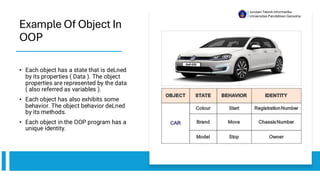
Example Of ObjectIn
OOP
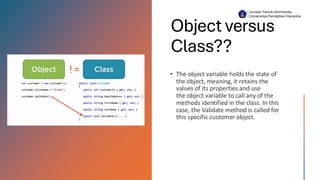
• Each object has a state that is deLned
by its properties ( Data ). The object
properties are represented by the data
( also referred as variables ).
• Each object has also exhibits some
behavior. The object behavior deLned
by its methods.
• Each object in the OOP program has a
unique identity.
Jurusan Teknik Informatika
Universitas Pendidikan Ganesha
22.
What Is ClassIn OOP ?
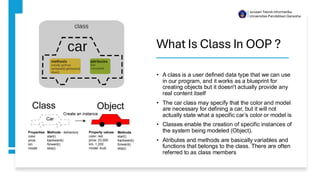
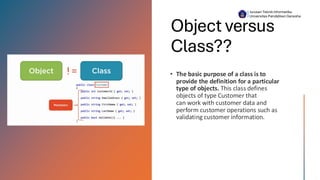
• A class is a user defined data type that we can use
in our program, and it works as a blueprint for
creating objects but it doesn't actually provide any
real content itself
• The car class may specify that the color and model
are necessary for defining a car, but it will not
actually state what a specific car’s color or model is
• Classes enable the creation of specific instances of
the system being modeled (Object).
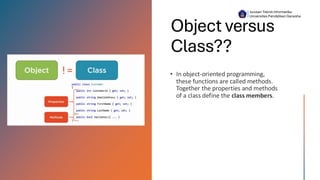
• Atributes and methods are basically variables and
functions that belongs to the class. There are often
referred to as class members
Jurusan Teknik Informatika
Universitas Pendidikan Ganesha
Example
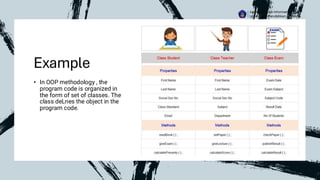
• In OOPmethodology , the
program code is organized in
the form of set of classes. The
class deLnes the object in the
program code.
Jurusan Teknik Informatika
Universitas Pendidikan Ganesha



![Lect 1 Number systems and base conversions. [Autosaved].pptx](https://cdn.slidesharecdn.com/ss_thumbnails/lect1numbersystemsandbaseconversions-260111134109-67c2d865-thumbnail.jpg?width=640&height=640&fit=bounds)


