Introduction to
Artificial Intelligence
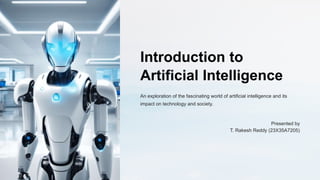
An exploration of the fascinating world of artificial intelligence and its
impact on technology and society.
Presented by
T. Rakesh Reddy (23X35A7205)
Definition and Scope of
Artificial Intelligence
Artificial Intelligence (AI) is the simulation of human intelligence processes
by machines, especially computer systems. It encompasses learning,
reasoning, problem-solving, perception, and language understanding.
The scope of AI includes the development of intelligent agents that can
perform tasks requiring human-like intelligence, such as visual perception,
speech recognition, decision-making, and language translation.
History of artificial intelligence
1 Early Beginnings
The concept of artificial intelligence dates back to ancient Greek myths, but it wasn't until
the mid-20th century that the formal exploration and development of AI began.
2 The AI Winter
In the 1970s and 1980s, AI faced skepticism and a period of reduced funding and
interest, known as the "AI Winter," due to unfulfilled promises and overinflated
expectations.
3 The AI Renaissance
In the 21st century, AI experienced a resurgence with advancements in machine learning,
neural networks, and data-driven algorithms, leading to the AI renaissance we see today.
Applications of Artificial Intelligence
Healthcare
AI is used to analyze medical data and assist
in diagnostics.
Finance
AI is employed for fraud detection and risk
assessment in financial institutions.
Transportation
AI powers autonomous vehicles and traffic
management systems.
Customer Service
AI chatbots and virtual assistants enhance
customer support experiences.
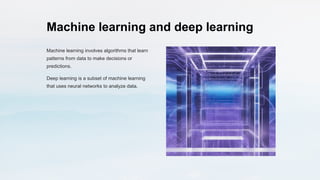
Machine learning and deep learning
Machine learning involves algorithms that learn
patterns from data to make decisions or
predictions.
Deep learning is a subset of machine learning
that uses neural networks to analyze data.
Natural language processing
• Text Understanding: AI system comprehending and interpreting human language.
• Speech Recognition: Converting spoken language into text.
• Language Generation: AI generating human-like language and responses.
Computer Vision
Image Recognition
Using AI to identify objects and
patterns in images.
Visual Analysis
AI processing and
understanding visual
information.
Algorithmic Vision
Algorithms analyzing and
interpreting visual data.
Ethical considerations in artificial
intelligence
1
Data Privacy
Protecting personal information from misuse.
2
Algorithm Bias
Awareness of bias in AI decision-making.
3
Transparency
Revealing the inner workings and decision-
making process of AI systems.
An image of a diverse team of developers and ethicists engaged in a thoughtful discussion about AI
ethics, with a serious yet hopeful mood, in a well-lit modern workspace. The image should convey a
sense of collaboration and introspection.
Challenges and Limitations of Artificial
Intelligence
Ethical Concerns
Ensuring AI applications align
with moral and ethical
standards is a primary
challenge. It involves
addressing bias, privacy
infringement, and potential
misuse.
Transparency and
Accountability
AI decision-making processes
often lack transparency,
raising concerns about
accountability and the ability
to understand and verify
outcomes.
Reliability and Safety
The reliability of AI systems,
especially in critical tasks,
and the potential for
unforeseen errors raise
challenges for safety and
trust.
Future of Artificial Intelligence
Ethical AI
Integration of ethical guidelines and
regulations to ensure responsible and fair AI
implementation.
AI-Powered Healthcare
Enhanced medical diagnosis and
personalized treatment using AI algorithms
and predictive analytics.
Autonomous Vehicles
Advancements in self-driving technology
and safety systems for autonomous
transportation.
AI in Education
Customized learning experiences, intelligent
tutoring systems, and adaptive educational
platforms.
THANK YOU

Introduction Artificial intelligence.pptx

  • 1.
    Introduction to Artificial Intelligence Anexploration of the fascinating world of artificial intelligence and its impact on technology and society. Presented by T. Rakesh Reddy (23X35A7205)
  • 2.
    Definition and Scopeof Artificial Intelligence Artificial Intelligence (AI) is the simulation of human intelligence processes by machines, especially computer systems. It encompasses learning, reasoning, problem-solving, perception, and language understanding. The scope of AI includes the development of intelligent agents that can perform tasks requiring human-like intelligence, such as visual perception, speech recognition, decision-making, and language translation.
  • 3.
    History of artificialintelligence 1 Early Beginnings The concept of artificial intelligence dates back to ancient Greek myths, but it wasn't until the mid-20th century that the formal exploration and development of AI began. 2 The AI Winter In the 1970s and 1980s, AI faced skepticism and a period of reduced funding and interest, known as the "AI Winter," due to unfulfilled promises and overinflated expectations. 3 The AI Renaissance In the 21st century, AI experienced a resurgence with advancements in machine learning, neural networks, and data-driven algorithms, leading to the AI renaissance we see today.
  • 4.
    Applications of ArtificialIntelligence Healthcare AI is used to analyze medical data and assist in diagnostics. Finance AI is employed for fraud detection and risk assessment in financial institutions. Transportation AI powers autonomous vehicles and traffic management systems. Customer Service AI chatbots and virtual assistants enhance customer support experiences.
  • 5.
    Machine learning anddeep learning Machine learning involves algorithms that learn patterns from data to make decisions or predictions. Deep learning is a subset of machine learning that uses neural networks to analyze data.
  • 6.
    Natural language processing •Text Understanding: AI system comprehending and interpreting human language. • Speech Recognition: Converting spoken language into text. • Language Generation: AI generating human-like language and responses.
  • 7.
    Computer Vision Image Recognition UsingAI to identify objects and patterns in images. Visual Analysis AI processing and understanding visual information. Algorithmic Vision Algorithms analyzing and interpreting visual data.
  • 8.
    Ethical considerations inartificial intelligence 1 Data Privacy Protecting personal information from misuse. 2 Algorithm Bias Awareness of bias in AI decision-making. 3 Transparency Revealing the inner workings and decision- making process of AI systems. An image of a diverse team of developers and ethicists engaged in a thoughtful discussion about AI ethics, with a serious yet hopeful mood, in a well-lit modern workspace. The image should convey a sense of collaboration and introspection.
  • 9.
    Challenges and Limitationsof Artificial Intelligence Ethical Concerns Ensuring AI applications align with moral and ethical standards is a primary challenge. It involves addressing bias, privacy infringement, and potential misuse. Transparency and Accountability AI decision-making processes often lack transparency, raising concerns about accountability and the ability to understand and verify outcomes. Reliability and Safety The reliability of AI systems, especially in critical tasks, and the potential for unforeseen errors raise challenges for safety and trust.
  • 10.
    Future of ArtificialIntelligence Ethical AI Integration of ethical guidelines and regulations to ensure responsible and fair AI implementation. AI-Powered Healthcare Enhanced medical diagnosis and personalized treatment using AI algorithms and predictive analytics. Autonomous Vehicles Advancements in self-driving technology and safety systems for autonomous transportation. AI in Education Customized learning experiences, intelligent tutoring systems, and adaptive educational platforms.
  • 11.