INTRODUCTION TO BUILDING RIA WITH ADOBE FLEX AND AIR By Abdelmonaim Remani Silicon Valley Code Camp 08
ONCE UPON A TIME
AT FIRST THERE WAS WEB 1.0 Page-Based Architecture: Static  or Dynamic Technologies Client Side (Rendering Presentation) HTML CSS JavaScript DOM DHTML Server Side (Business Logic and Data) Dynamic Content CGI Java Servlets and JSP .NET and ASP PHP Ruby on Rails Etc… Data Databases XML JSON
THE WEB IS IN COMA Web 1.0 was loosing to  Desktop Applications Performance and Speed Responsiveness Visual Richness / Media Data-Driven vs. Event-Driven Availability (Online vs. Offline) .COM bubble broke The Browser War
LA RENAISSANCE The community focused on developing standards A second look at Web Application They have what Web applications have two very important characteristics that Desktop Applications don’t have They are Centralized The are Inherently safe Run in context the browser Require no installation More powerful desktop machines are being made available (Moore’s Law)
THE RAISE OF WEB 2.0 New Technologies ??? The use features and technologies that we already have in a different way The use of these features for something more powerful than what they were intended for
THE BLOODLESS REVOLUTION OF AJAX AJAX (Asynchronous JavaScript And XML) As the acronym implies, AJAX is simply JavaScript, and XML or any other data interchange format It is about exploiting the communication feature of the browser in a new different way The goal is to get data from the server without a invoking full-page refresh for a better user experience How? AJAX is a Hack
THE GOLD RUSH AJAX brought a better user experience to the browser AJAX adoption increased quickly Web Applications’ complexity increased Drastic Change of the architecture of Web Applications is represented by No page-based A shift of programmatic logic from the server-side to the client-side Reduced the load on the server The sate is handled by the client instead of the server Data is loaded only when necessary Took advantage of the local machine power The Vision: One day the server is only going to used to distribute the application
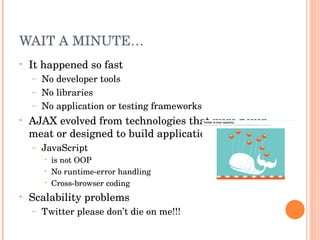
WAIT A MINUTE… It happened so fast No developer tools No libraries No application or testing frameworks AJAX evolved from technologies that were never meat or designed to build applications JavaScript is not OOP No runtime-error handling Cross-browser coding Scalability problems Twitter please don’t die on me!!!
HOLD YOUR HORSES Three Camps The Optimistics Let’s make it work Bullet-proof libraries and toolkits: DOJO, JQuery, etc…  http://en.wikipedia.org/wiki/Comparison_of_JavaScript_frameworks The Pessimistics JavaScript development sucks… Forget AJAX! Focus on new tech Rich Internet Applications: Adobe Flex, JavaFX, and Microsoft Silverlight The Google Way GWT Shifts some of the focus from feature richness to development and software engineering tools We could allow developers to program in any programming language, and just translate or compile it into JavaScript
ANTHROPOLOGIA Developers: Coders Build Applications Functional Data Driven UGLY Designers: Artists Build Applications Event-Driven Beautiful Devigners?
RICH INTERNET APPLICATIONS (RIA)
WHAT ARE RIAS Application that combine the benefits of Web and Desktop applications User experience of the Desktop Applications Responsive Data Driven Rich Media Online and Offline Low cost of Deployment and reach of Web Applications
TECHNOLOGIES RIA Technologies Adobe Flex JavaFX Microsoft SilverLight OpenLaszlo Etc…
ADOBE FLEX
WHAT IS FLEX Adobe Flex is a platform for building Rich Internet Application and Desktop Applications SDK (Open Source) Compiler, debugger, and other tools Libraries Provides a skeleton of Flex Application by extending the Flex Framework Prebuilt Components Programming Languages (MXML and ActionScript 3.0)
WHAT IS FLEX Flex Builder 3 IDE based on Eclipse Design tools Server-Side Enterprise Messaging Support Data Services Data sharing and communiction among clients Data push  from server to clients Etc… Options: Live Cycle Data Services, BlazeDS, etc… Adobe Flex Charting
FLEX APPLICATIONS Delivered as SWF (Shockwave Flash) files in HTML Runs on Flash Player 9 or later On 99.3% of the browsers Delivered as a Desktop application Runs on AIR (Adobe Integrated Environment)
RUN TIME  Flash Player 9 In the browser Tow virtual machines for backward Compatibility New Virtual Machine: AVM2 Run time error reporting Compile time type checking AIR On the desktop Application built in Flex, Flash, and HTML Seamless Install
PROGRAMMING LANGUAGES MXML
WHAT IS MXML Adobe Flex’s Markup (Declarative) XML Based Used to Create visual and non-visual component Compiles into ActionScript 3.0
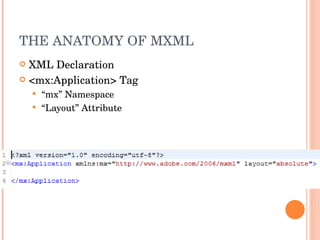
THE ANATOMY OF MXML XML Declaration <mx:Application> Tag “ mx” Namespace “ Layout” Attribute
MXML CONTROLS Controls (Id, properties, and events) In absolute Layout <mx:Label> <mx:TextInput> <mx:Button> <mx:Image> Using Layout Controls <mx:VBox> <mxHBox> Other
PROGRAMMING LANGUAGES ACTIONSCRIPT 3.0
THE LANGUAGE FEATURES Based on the ECMAScript Specification Object-Oriented Runs on a new VM: AVM2 (ActionScript Virtual Machine 2) Complete Access to Flash API and libraries
THE LANGUAGE FEATURES ActionScript 3.0 vs. ActionScript 2.0 New Features Packages Primitive Data Types (int and uint) Native XML types and E4X (ECMAscript for XML) Native Regular Expression support New event model 10 times faster Strongly typed Sealed Classes: Dynamically adding methods is not allowed Etc…
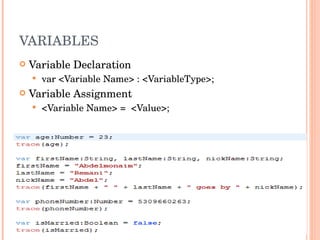
VARIABLES Variable Declaration var <Variable Name> : <VariableType>; Variable Assignment <Variable Name> =  <Value>;
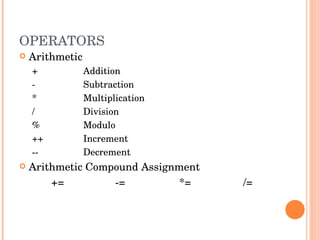
OPERATORS Arithmetic +  Addition -  Subtraction *  Multiplication /  Division %  Modulo ++ Increment -- Decrement Arithmetic Compound Assignment += -= *=   /=
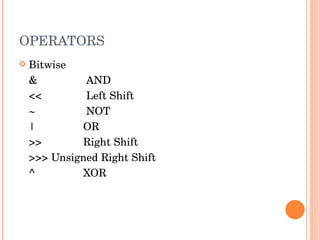
OPERATORS Bitwise &  AND <<  Left Shift ~  NOT | OR >> Right Shift >>> Unsigned Right Shift ^ XOR
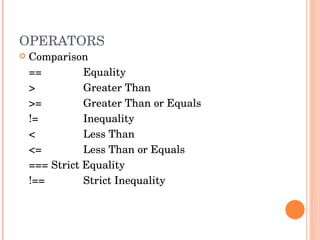
OPERATORS Comparison ==  Equality > Greater Than >= Greater Than or Equals  != Inequality < Less Than <= Less Than or Equals === Strict Equality !== Strict Inequality
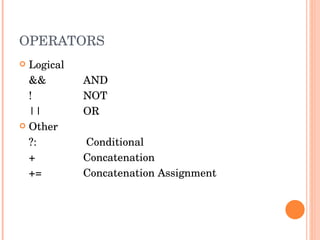
OPERATORS Logical && AND !  NOT || OR Other ?:  Conditional +  Concatenation += Concatenation Assignment
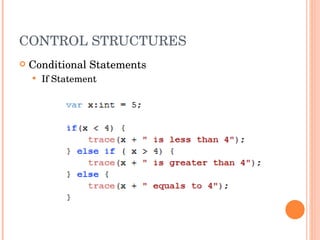
CONTROL STRUCTURES Conditional Statements If Statement
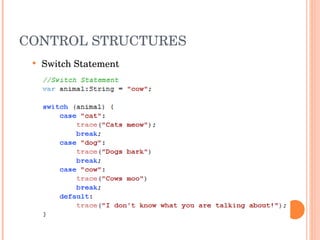
CONTROL STRUCTURES Switch Statement
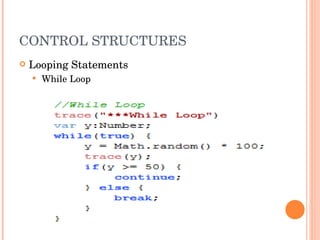
CONTROL STRUCTURES Looping Statements While Loop
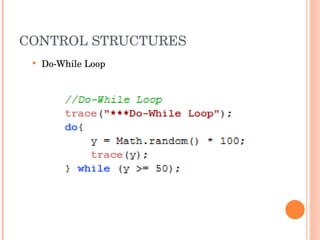
CONTROL STRUCTURES Do-While Loop
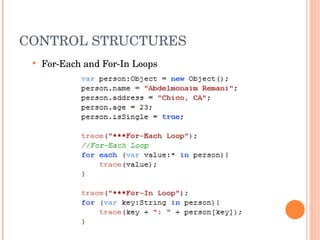
CONTROL STRUCTURES For-Each and For-In Loops
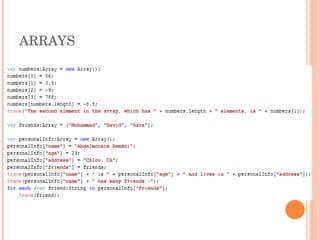
ARRAYS
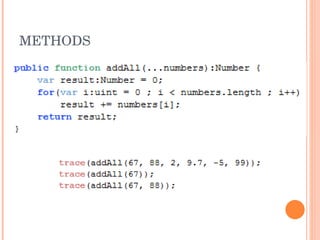
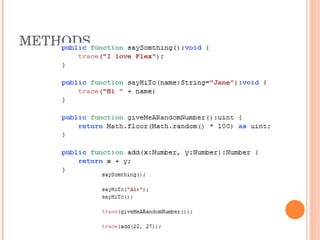
METHODS
METHODS
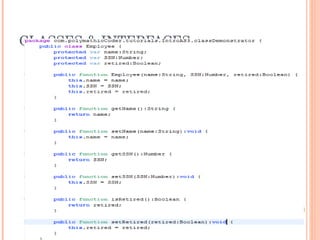
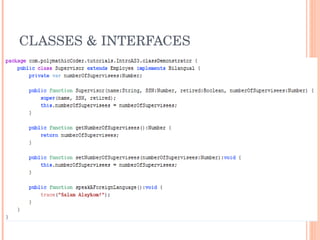
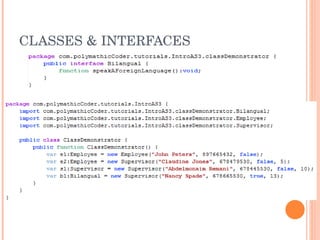
CLASSES & INTERFACES
BUILDING FLEX APPS
THE PROCESS Layout Visual component and style them Add event-handling Use data or communication services Build and run
FLEX & XML
E4X Parse XML (Similar to XPath) Manipulate XML Data XML Classes in ActionScript 3.0 XML XMLList
PARSING XML USING E4X xmlData.employee[2] xmlData..employee All nodes called node xmlData..employee.(firstName==‘Joe’) xmlData..employee.(@id > 1)
Q&A
THANK YOU

Introduction To Rich Internet Applications

  • 1.
    INTRODUCTION TO BUILDINGRIA WITH ADOBE FLEX AND AIR By Abdelmonaim Remani Silicon Valley Code Camp 08
  • 2.
  • 3.
    AT FIRST THEREWAS WEB 1.0 Page-Based Architecture: Static or Dynamic Technologies Client Side (Rendering Presentation) HTML CSS JavaScript DOM DHTML Server Side (Business Logic and Data) Dynamic Content CGI Java Servlets and JSP .NET and ASP PHP Ruby on Rails Etc… Data Databases XML JSON
  • 4.
    THE WEB ISIN COMA Web 1.0 was loosing to Desktop Applications Performance and Speed Responsiveness Visual Richness / Media Data-Driven vs. Event-Driven Availability (Online vs. Offline) .COM bubble broke The Browser War
  • 5.
    LA RENAISSANCE Thecommunity focused on developing standards A second look at Web Application They have what Web applications have two very important characteristics that Desktop Applications don’t have They are Centralized The are Inherently safe Run in context the browser Require no installation More powerful desktop machines are being made available (Moore’s Law)
  • 6.
    THE RAISE OFWEB 2.0 New Technologies ??? The use features and technologies that we already have in a different way The use of these features for something more powerful than what they were intended for
  • 7.
    THE BLOODLESS REVOLUTIONOF AJAX AJAX (Asynchronous JavaScript And XML) As the acronym implies, AJAX is simply JavaScript, and XML or any other data interchange format It is about exploiting the communication feature of the browser in a new different way The goal is to get data from the server without a invoking full-page refresh for a better user experience How? AJAX is a Hack
  • 8.
    THE GOLD RUSHAJAX brought a better user experience to the browser AJAX adoption increased quickly Web Applications’ complexity increased Drastic Change of the architecture of Web Applications is represented by No page-based A shift of programmatic logic from the server-side to the client-side Reduced the load on the server The sate is handled by the client instead of the server Data is loaded only when necessary Took advantage of the local machine power The Vision: One day the server is only going to used to distribute the application
  • 9.
    WAIT A MINUTE…It happened so fast No developer tools No libraries No application or testing frameworks AJAX evolved from technologies that were never meat or designed to build applications JavaScript is not OOP No runtime-error handling Cross-browser coding Scalability problems Twitter please don’t die on me!!!
  • 10.
    HOLD YOUR HORSESThree Camps The Optimistics Let’s make it work Bullet-proof libraries and toolkits: DOJO, JQuery, etc… http://en.wikipedia.org/wiki/Comparison_of_JavaScript_frameworks The Pessimistics JavaScript development sucks… Forget AJAX! Focus on new tech Rich Internet Applications: Adobe Flex, JavaFX, and Microsoft Silverlight The Google Way GWT Shifts some of the focus from feature richness to development and software engineering tools We could allow developers to program in any programming language, and just translate or compile it into JavaScript
  • 11.
    ANTHROPOLOGIA Developers: CodersBuild Applications Functional Data Driven UGLY Designers: Artists Build Applications Event-Driven Beautiful Devigners?
  • 12.
  • 13.
    WHAT ARE RIASApplication that combine the benefits of Web and Desktop applications User experience of the Desktop Applications Responsive Data Driven Rich Media Online and Offline Low cost of Deployment and reach of Web Applications
  • 14.
    TECHNOLOGIES RIA TechnologiesAdobe Flex JavaFX Microsoft SilverLight OpenLaszlo Etc…
  • 15.
  • 16.
    WHAT IS FLEXAdobe Flex is a platform for building Rich Internet Application and Desktop Applications SDK (Open Source) Compiler, debugger, and other tools Libraries Provides a skeleton of Flex Application by extending the Flex Framework Prebuilt Components Programming Languages (MXML and ActionScript 3.0)
  • 17.
    WHAT IS FLEXFlex Builder 3 IDE based on Eclipse Design tools Server-Side Enterprise Messaging Support Data Services Data sharing and communiction among clients Data push from server to clients Etc… Options: Live Cycle Data Services, BlazeDS, etc… Adobe Flex Charting
  • 18.
    FLEX APPLICATIONS Deliveredas SWF (Shockwave Flash) files in HTML Runs on Flash Player 9 or later On 99.3% of the browsers Delivered as a Desktop application Runs on AIR (Adobe Integrated Environment)
  • 19.
    RUN TIME Flash Player 9 In the browser Tow virtual machines for backward Compatibility New Virtual Machine: AVM2 Run time error reporting Compile time type checking AIR On the desktop Application built in Flex, Flash, and HTML Seamless Install
  • 20.
  • 21.
    WHAT IS MXMLAdobe Flex’s Markup (Declarative) XML Based Used to Create visual and non-visual component Compiles into ActionScript 3.0
  • 22.
    THE ANATOMY OFMXML XML Declaration <mx:Application> Tag “ mx” Namespace “ Layout” Attribute
  • 23.
    MXML CONTROLS Controls(Id, properties, and events) In absolute Layout <mx:Label> <mx:TextInput> <mx:Button> <mx:Image> Using Layout Controls <mx:VBox> <mxHBox> Other
  • 24.
  • 25.
    THE LANGUAGE FEATURESBased on the ECMAScript Specification Object-Oriented Runs on a new VM: AVM2 (ActionScript Virtual Machine 2) Complete Access to Flash API and libraries
  • 26.
    THE LANGUAGE FEATURESActionScript 3.0 vs. ActionScript 2.0 New Features Packages Primitive Data Types (int and uint) Native XML types and E4X (ECMAscript for XML) Native Regular Expression support New event model 10 times faster Strongly typed Sealed Classes: Dynamically adding methods is not allowed Etc…
  • 27.
    VARIABLES Variable Declarationvar <Variable Name> : <VariableType>; Variable Assignment <Variable Name> = <Value>;
  • 28.
    OPERATORS Arithmetic + Addition - Subtraction * Multiplication / Division % Modulo ++ Increment -- Decrement Arithmetic Compound Assignment += -= *= /=
  • 29.
    OPERATORS Bitwise & AND << Left Shift ~ NOT | OR >> Right Shift >>> Unsigned Right Shift ^ XOR
  • 30.
    OPERATORS Comparison == Equality > Greater Than >= Greater Than or Equals != Inequality < Less Than <= Less Than or Equals === Strict Equality !== Strict Inequality
  • 31.
    OPERATORS Logical &&AND ! NOT || OR Other ?: Conditional + Concatenation += Concatenation Assignment
  • 32.
    CONTROL STRUCTURES ConditionalStatements If Statement
  • 33.
  • 34.
    CONTROL STRUCTURES LoopingStatements While Loop
  • 35.
  • 36.
  • 37.
  • 38.
  • 39.
  • 40.
  • 41.
  • 42.
  • 43.
  • 44.
    THE PROCESS LayoutVisual component and style them Add event-handling Use data or communication services Build and run
  • 45.
  • 46.
    E4X Parse XML(Similar to XPath) Manipulate XML Data XML Classes in ActionScript 3.0 XML XMLList
  • 47.
    PARSING XML USINGE4X xmlData.employee[2] xmlData..employee All nodes called node xmlData..employee.(firstName==‘Joe’) xmlData..employee.(@id > 1)
  • 48.
  • 49.

Editor's Notes

  • #4 We can’t really talk about Web 2.0 without Web talking about 1.0 for many reasons. Anyways, the Web was a very boring place back then. We had a page-based architecture using the client-server paradigm We started out with dull Static pages and ended up with pages with dynamic content and database on the backend etc... A lot of things were done and many technologies has been developed; some of are still being used until this day Here is a list of some of theses technologies and how they fit into a traditional web app The thing that I want you to take away from this slide is that we never broke away from that page-based architecture and the core skeleton of the traditional web app remained the same
  • #5 People lost faith on Web Applications No Real Standards The quitter: Many abandoned the web and simply said that this will never work
  • #6 This was not all bad, but turned out to be a good thing after all It gave the time to the community to develop standards and revaluate its position
  • #7 Web 2.0 didn’t really bring any new technologies It is about looking at the features that we already have in the browser and the preexisting technologies and try to use them in a different way In other word, to use them for something more powerful that they were not intended for The first feature that happen to be looked up first was the communication feature of the browser Its ability to send HTTP request and process responses How can we use it differently?
  • #8 How? Usually, only one node of the DOM tree needs to be updated Using JavaScript, an HTTP request is sent to the server in the background The server responds with an “application/xml” (XML) MIME type, “application/json” (JSON) MIME type, or other JavaScript is used to change the inner html of the node to be updated The rest of the nodes in the DOM tree are not updated and are available the whole time for the user to interact with
  • #11 Flexible and productive development is more important Optimized JavaScript guaranteed by the compiler Look at a mature software development The Language Choice: Java (OO, the most popular, statically-typed, runtime-error checking, etc…) Unit Testing: Junit IDE: Eclipse
  • #23 Non-Absolute layout is fluid and results in slower applications Nesting many VBox and HBox affect performance
  • #27 int and uint data types: for faster integer-based math E4X provides an alternative way to DOM interfaces and uses a simpler syntax for accessing XML documents New event model: Listener-based event model with support for event propagation