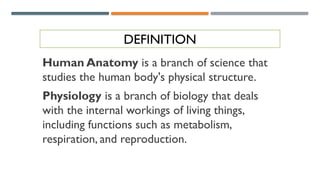
DEFINITION
Human Anatomy isa branch of science that
studies the human body's physical structure.
Physiology is a branch of biology that deals
with the internal workings of living things,
including functions such as metabolism,
respiration, and reproduction.
BASIC LIFE PROCESSES
1.Metabolism: It is the sum of all chemical
processes that occur in the body
a. Catabolism – breakdown of complex chemical
substance into simpler components
b. Anabolism – building up of complex chemical
substances from smaller, simpler components.
2. Responsiveness: It is the body’s ability to detect
and respond to changes.
6.
HOMEOSTASIS
Homeostasis: the self-sustainingmechanisms in
organisms that try to maintain stable internal
conditions.
~ without homeostasis, organisms would not be able
to have stable internal conditions, and therefore
would not be able to survive.
~Homeostasis is a dynamic condition in response to
changing conditions.
7.
BASIC LIFE PROCESSES
3.Movement: It includes motion of the whole body,
individual organs, single cells, etc.
4. Growth: It is an increase in body size and weight.
5. Differentiation: It is the development of a cell
from an unspecialized to a specialized state.
6. Reproduction: Formation of new cells or to the
production of a new individual.
8.
LABORATORY SAFETY
1. Washyour hands thoroughly with soap and
water upon entering the lab and before
leaving the lab.
2. Disinfect your lab space at the start and end
of each lab session.
3. Wear closed shoes that completely cover
your feet.
4. Restrain all loose clothing, long hair, and
dangling jewelry during lab activities.
5. Do not eat, drink, chew, smoke, apply
cosmetics, or handle contact lenses in the lab.
9.
LABORATORY SAFETY
6. Ifyou are pregnant, are immunocompromised,
are caring for someone who is
immunocompromised, know you are allergic
to a lab supply or are uncomfortable with a
lab procedure, then notify your instructor
immediately.
7. Familiarize yourself with the location of room
exits, first aid kit, eyewash station, safety
shower, fire extinguisher, and fire blanket.
8. Wear Personal Protective Equipment (PPE) as
directed by your instructor.
10.
LABORATORY SAFETY
9. Ifyou are wearing PPE and must leave the
lab, remove all PPE and wash your hands
with soap and water before leaving.
10. Use additional precautions when using
dissection equipment. Use cutting blades
only in a position facing away from you
and your lab partners.
11. Report incidents or injuries to your
instructor immediately, no matter how
small.
11.
LABORATORY SAFETY
12. Reportdamaged equipment and
broken slides or other broken
glassware to your instructor
immediately, no matter how
small.
13. Return all equipment, models, and
other materials used during a lab
to their original location
(laboratory room).
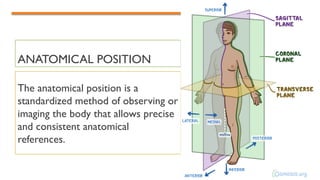
ANATOMICAL POSITION
The anatomicalposition is a
standardized method of observing or
imaging the body that allows precise
and consistent anatomical
references.
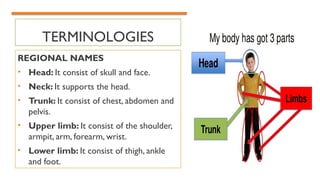
TERMINOLOGIES
REGIONAL NAMES
• Head:It consist of skull and face.
• Neck: It supports the head.
• Trunk: It consist of chest, abdomen and
pelvis.
• Upper limb: It consist of the shoulder,
armpit, arm, forearm, wrist.
• Lower limb: It consist of thigh, ankle
and foot.
16.
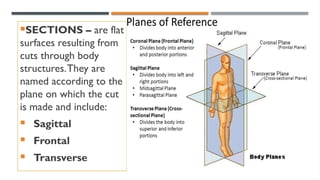
SECTIONS – areflat
surfaces resulting from
cuts through body
structures.They are
named according to the
plane on which the cut
is made and include:
Sagittal
Frontal
Transverse
17.
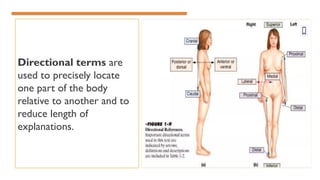
Directional terms are
usedto precisely locate
one part of the body
relative to another and to
reduce length of
explanations.



![CTEV [ clubfoot] DR ARUN LAL ,DR MOHAMED ASHRAF travancore medical college k...](https://cdn.slidesharecdn.com/ss_thumbnails/ctevclubfootdrarunlaldrmohamedashraftravancoremedicalcollegekollamkeralaindia-260208063247-18fc466c-thumbnail.jpg?width=640&height=640&fit=bounds)


