The First Amendment and Theories of
Constitutional Interpretation
JOUR 430 (PARK)
Amendment 1 to the U.S. Constitution
• “Congress shall make not respecting an establishment of
religion, or prohibiting the free exercises thereof; or
abridging the freedom of speech, or of the press, or the
right of the people peaceably to assemble, and to petition the
Government for a redress of grievances.”
• What is the importance of broad First Amendment
Protection?
• Are there both individual and social interests?
Theories of Interpretation
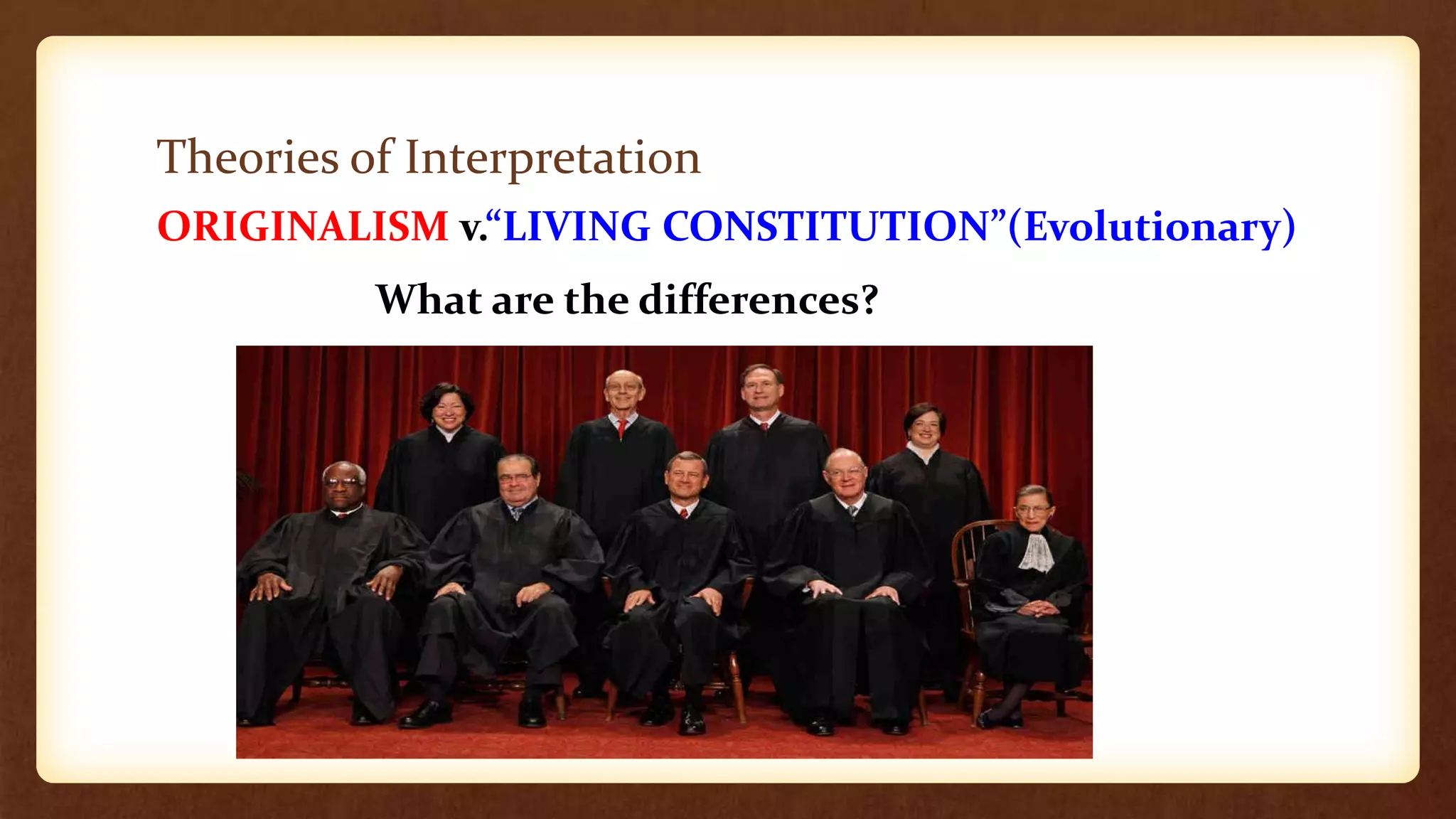
ORIGINALISM v.“LIVING CONSTITUTION”(Evolutionary)
What are the differences?
Theories of Interpretation
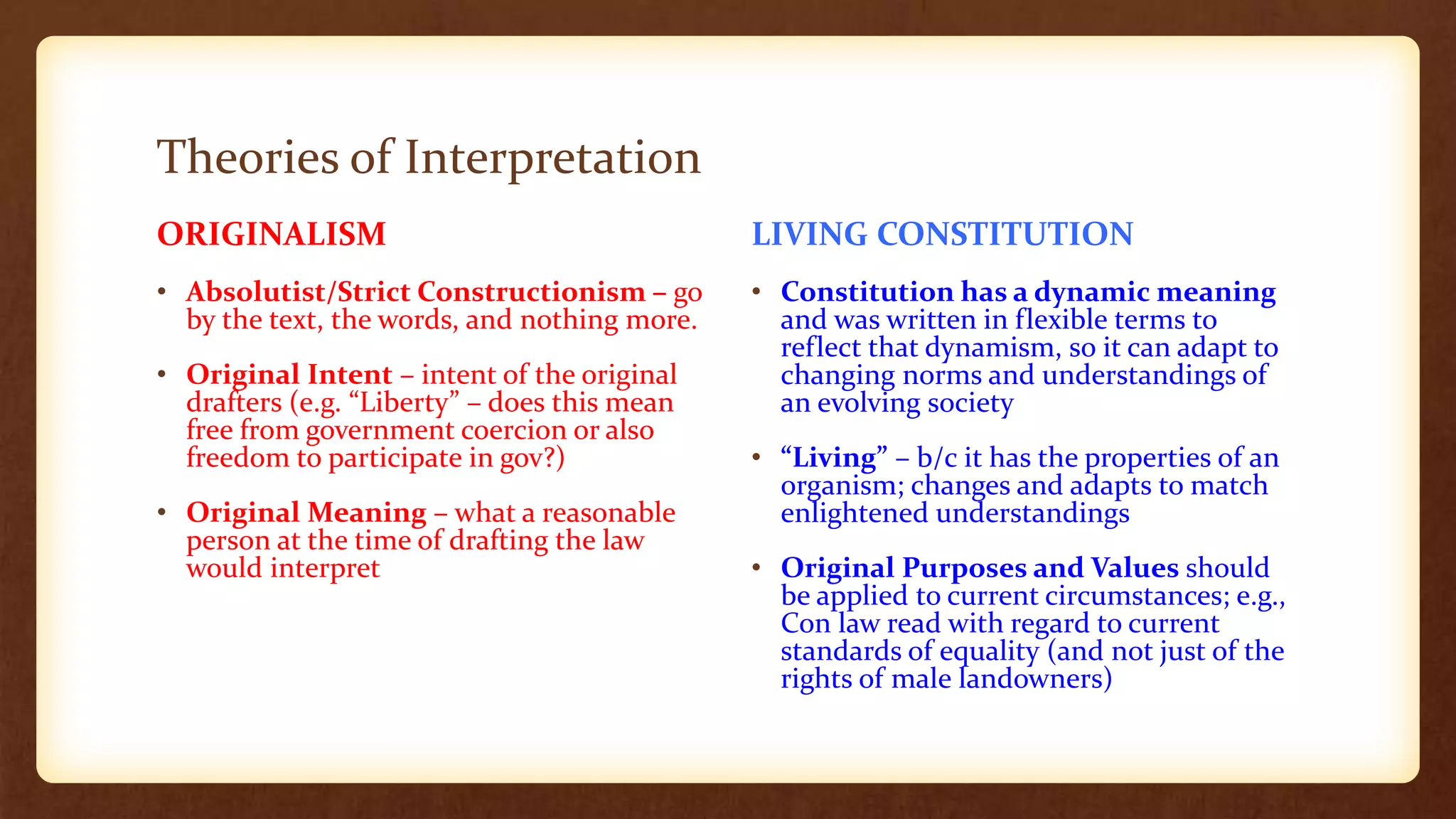
LIVING CONSTITUTION
• Constitution has a dynamic meaning
and was written in flexible terms to
reflect that dynamism, so it can adapt to
changing norms and understandings of
an evolving society
• “Living” – b/c it has the properties of an
organism; changes and adapts to match
enlightened understandings
• Original Purposes and Values should
be applied to current circumstances; e.g.,
Con law read with regard to current
standards of equality (and not just of the
rights of male landowners)
ORIGINALISM
• Absolutist/Strict Constructionism – go
by the text, the words, and nothing more.
• Original Intent – intent of the original
drafters (e.g. “Liberty” – does this mean
free from government coercion or also
freedom to participate in gov?)
• Original Meaning – what a reasonable
person at the time of drafting the law
would interpret
Advantages of Each Theory of Interpretation
• Originalism
• Less room to male law; judges
should not be philosopher kings
who make law – that is for the
legislature
• Living Constitution
• Flexibility; takes into account
changes in society, attitudes;
adapts to enlightened
understanding
“A State may not impose the death penalty by
hanging, stoning, or gunfire” (a 1930 state law)
How should this be
interpreted?
Various interpretations based
on the constitutonal theory of
interpretation …
Perhaps the law means …
(1) No death penalty by
hanging, stoning or gunfire, but
drowning or electrocution is
ok?
(2) Perhaps it means no “cruel
and unusual punishment”
because these forms were
considered “cruel”?
(3) Maybe it means “no death
penalty”?

Intro con interp.j430.f2016

  • 1.
    The First Amendmentand Theories of Constitutional Interpretation JOUR 430 (PARK)
  • 2.
    Amendment 1 tothe U.S. Constitution • “Congress shall make not respecting an establishment of religion, or prohibiting the free exercises thereof; or abridging the freedom of speech, or of the press, or the right of the people peaceably to assemble, and to petition the Government for a redress of grievances.” • What is the importance of broad First Amendment Protection? • Are there both individual and social interests?
  • 3.
    Theories of Interpretation ORIGINALISMv.“LIVING CONSTITUTION”(Evolutionary) What are the differences?
  • 4.
    Theories of Interpretation LIVINGCONSTITUTION • Constitution has a dynamic meaning and was written in flexible terms to reflect that dynamism, so it can adapt to changing norms and understandings of an evolving society • “Living” – b/c it has the properties of an organism; changes and adapts to match enlightened understandings • Original Purposes and Values should be applied to current circumstances; e.g., Con law read with regard to current standards of equality (and not just of the rights of male landowners) ORIGINALISM • Absolutist/Strict Constructionism – go by the text, the words, and nothing more. • Original Intent – intent of the original drafters (e.g. “Liberty” – does this mean free from government coercion or also freedom to participate in gov?) • Original Meaning – what a reasonable person at the time of drafting the law would interpret
  • 5.
    Advantages of EachTheory of Interpretation • Originalism • Less room to male law; judges should not be philosopher kings who make law – that is for the legislature • Living Constitution • Flexibility; takes into account changes in society, attitudes; adapts to enlightened understanding
  • 6.
    “A State maynot impose the death penalty by hanging, stoning, or gunfire” (a 1930 state law) How should this be interpreted? Various interpretations based on the constitutonal theory of interpretation … Perhaps the law means … (1) No death penalty by hanging, stoning or gunfire, but drowning or electrocution is ok? (2) Perhaps it means no “cruel and unusual punishment” because these forms were considered “cruel”? (3) Maybe it means “no death penalty”?