DOES THE SIZE OF COLLEGE
REALLY MATTER?
A Case Study For Determining The Factors That Contribute
To Enrollment at Different Sized Public Universities in Texas
Michael Ijeh
Undergraduate Research Scholar – Honors College
2015 Undergraduate Research Conference
April 3rd 2015
Introduction
• An extension of previous research
• Interval-Based analysis
TTU 2020 Strategic Plan
Some of The Details Include…
•Increase Total Enrollment to 40,000 students
and Promote Student Success
• Enrollment for 2014-15 School Year - approx. 35,000
students
•Benchmarking Against National and Texas
Peer Institutions
•Looking To Reach Tier One Status
Goal of the Case Study
So does the size of an institution change the factors that
influence its enrollment?
30%
30%
15%
18%
7%
2013-14 Makeup of Enrollment at
Texas Institutions – Based on
Enrollment Intervals
0-10,000
10,001-20,000
20,001-30,000
30,001-40,000
Above 40,000
Hypothesis
 Yes, I believe that the size of an institution
(based on enrollment) will influence which
factors are statistically significant.
• Location Effect
• Football Effect
• Economic Effect
Hypothesis
Factors expected to stay statistically
significant as Enrollment changes:
 Acceptance Rates
 Retention Rates
 University Rankings
Is It The Economy Or The Institutions Themselves?
So What does my Data say?
Factors That Influences Enrollment
Where:
 Y=Log(Enrollment)
 X=Factors that Influence Enrollment
 Observations
• 27 Different Public Universities in Texas
• 10 Year Span
Yi= α+∑21
=1 Xi+ԑi i=1,2,3,...,270
List of Schools
School Systems
 University of Texas
 Texas A&M University
 Texas State University
 Texas Tech University
 University of Houston
 University of North Texas
List of Schools
Independent Schools
 Midwestern State University
 Stephen F. Austin University
 Texas Southern University
 Texas Woman’s University
List of Institution-Based Factors
•Is the Institution a Main System
School? (Dummy)
•Is the Institution Independent?
(Dummy)
•Acceptance Rate*
•ACT Score (75th Percentile)
•Student to Faculty Ratio
•Percentage of Minority Students*
•Percentage of Graduate Students*
•Graduation Rate*
•Percentage of Undergraduate Students
Receiving Financial Aid*
•Retention Rate*
•Total Years Established
•Wins by the University’s Football Team
•Did the University’s Football Team
make it to the Postseason? (Dummy)
•Ranking of University (Reversed-
Ordered)
*Out of 100 Students for consistency purposes
List of Demographic/Economic Factors
• Is the Institution in a Major City?
(Dummy)
• Population of Texas over the Age
of 18
• Median Household Income in
Texas
• Inflation Rate (2004 Base Year)
•National Unemployment Rate between
Ages 16-24
•Total Unemployment Rate in Texas
•Is the Economy in a Recession?
(Dummy)
Descriptive Statistics
Enrollment
Interval
Average of
Enrollment
SD of
Enrollment
Average of
Tuition Rate
Total % of
Data Set
Notable Schools
0-10,000 7,086 1,703 $3,132 36.30% Angelo State, Prairie View A&M, Texas Southern
10,001-20,000 14,107 2,980 $4,335 30.74% Sam Houston State, Texas Woman’s , Stephen F. Austin
20,001-30,000 25,505 2,933 $4,422 10.37% UT Dallas, UT San Antonio, UT El Paso
30,001-40,000 34,267 2,783 $5,062 14.81% Houston, Texas State, North Texas, Texas Tech
Above 40,000 49,279 3,275 $6,490 7.78% UT Austin, Texas A&M
All Data 18,463 13,266 $4,183 100.00%
98
83
28
40
21
-
20
40
60
80
100
120
Frequency
Number of Institutions in
each Enrollment Interval
Regression Results
Significant Factors
Enrollment
Intervals
R^2
Major
City?
Economy in
Recession?
Inflation
Rate -
2004 Base
Main
System
School
Acceptance
Rate
ACT
Score
(75%)
Student to
Faculty
Ratio
% of
Minority
Students
% of
Graduate
Students
% of
Students
Receiving
Financial
Aid
Retention
Rate
Total
Years
Est.
Wins By
Football
Team
Graduation
Rate
Tuition
Rate
Relative
Ranking
0-10,000 0.5141
10,001-20,000 0.8272
20,001-30,000 0.9727
30,001-40,000 0.9200
Beyond
40,000
0.8400
All Data 0.8097
Where :
Positive Correlation at p< .1 (90% Confidence)
Negative Correlation at p< .1 (90% Confidence)
Regression Results Without Rankings
Significant Factors
Enrollment
Intervals
R^2
Major
City?
Economy in
Recession?
Inflation
Rate - 2004
Base
Main
System
School
Acceptance
Rate
ACT Score
(75%)
Student to
Faculty
Ratio
% of
Minority
Students
% of
Graduate
Students
% of
Students
Receiving
Financial
Aid
Retention
Rate
Total
Years
Est.
Wins By
Football
Team
Tuition
Rate
0-10,000 0.5026
10,001-20,000 0.8091
20,001-30,000 0.9699
30,001-40,000 0.9176
Beyond
40,000
0.8344
All Data 0.7878
Where :
Positive Correlation at p< .1 (90% Confidence)
Negative Correlation at p< .1 (90% Confidence)
Conclusion And Analysis
 Inverse Economic Effect
 Small School Inverse Effect
 Location Effect
 Legacy Effect
 Quality Effect
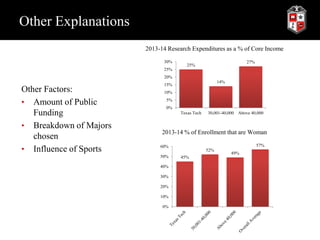
Other Explanations
2013-14 Research Expenditures as a % of Core Income
2013-14 % of Enrollment that are Woman
Other Factors:
• Amount of Public
Funding
• Breakdown of Majors
chosen
• Influence of Sports
45%
52%
49%
57%
0%
10%
20%
30%
40%
50%
60%
25%
14%
27%
0%
5%
10%
15%
20%
25%
30%
Texas Tech 30,001-40,000 Above 40,000
Implications for Texas Tech
 Focus on your Backyard
 Don’t Sacrifice Quality for Quantity
 There is a “Ceiling”
 Stay True to Core Values
Further Research Ideas
 Different measures of Size
• Assets
• Research Funds
• Endowment
 Different Regression Model
• Multivariate
• 2 Stage Lease Squares
• Quartile or Quintile Analysis
 Different Timeframe
• Financial Crisis played a role in data set
 Comparing to other States for Consistency
• Larger Schools
• Tier One Schools
Data Sources
 IPEDS Data Center
 National Bureau of Economic Research
 Bureau of Labor and Statistics
 International College and University Rankings
 Princeton Review Rankings
 US News College Rankings
 Lone Star Conference
 ESPN
Questions &
Comments?
Interval Enrollment Presentation - Final

Interval Enrollment Presentation - Final

  • 1.
    DOES THE SIZEOF COLLEGE REALLY MATTER? A Case Study For Determining The Factors That Contribute To Enrollment at Different Sized Public Universities in Texas Michael Ijeh Undergraduate Research Scholar – Honors College 2015 Undergraduate Research Conference April 3rd 2015
  • 2.
    Introduction • An extensionof previous research • Interval-Based analysis
  • 3.
    TTU 2020 StrategicPlan Some of The Details Include… •Increase Total Enrollment to 40,000 students and Promote Student Success • Enrollment for 2014-15 School Year - approx. 35,000 students •Benchmarking Against National and Texas Peer Institutions •Looking To Reach Tier One Status
  • 4.
    Goal of theCase Study So does the size of an institution change the factors that influence its enrollment? 30% 30% 15% 18% 7% 2013-14 Makeup of Enrollment at Texas Institutions – Based on Enrollment Intervals 0-10,000 10,001-20,000 20,001-30,000 30,001-40,000 Above 40,000
  • 5.
    Hypothesis  Yes, Ibelieve that the size of an institution (based on enrollment) will influence which factors are statistically significant. • Location Effect • Football Effect • Economic Effect
  • 6.
    Hypothesis Factors expected tostay statistically significant as Enrollment changes:  Acceptance Rates  Retention Rates  University Rankings
  • 7.
    Is It TheEconomy Or The Institutions Themselves? So What does my Data say?
  • 8.
    Factors That InfluencesEnrollment Where:  Y=Log(Enrollment)  X=Factors that Influence Enrollment  Observations • 27 Different Public Universities in Texas • 10 Year Span Yi= α+∑21 =1 Xi+ԑi i=1,2,3,...,270
  • 9.
    List of Schools SchoolSystems  University of Texas  Texas A&M University  Texas State University  Texas Tech University  University of Houston  University of North Texas
  • 10.
    List of Schools IndependentSchools  Midwestern State University  Stephen F. Austin University  Texas Southern University  Texas Woman’s University
  • 11.
    List of Institution-BasedFactors •Is the Institution a Main System School? (Dummy) •Is the Institution Independent? (Dummy) •Acceptance Rate* •ACT Score (75th Percentile) •Student to Faculty Ratio •Percentage of Minority Students* •Percentage of Graduate Students* •Graduation Rate* •Percentage of Undergraduate Students Receiving Financial Aid* •Retention Rate* •Total Years Established •Wins by the University’s Football Team •Did the University’s Football Team make it to the Postseason? (Dummy) •Ranking of University (Reversed- Ordered) *Out of 100 Students for consistency purposes
  • 12.
    List of Demographic/EconomicFactors • Is the Institution in a Major City? (Dummy) • Population of Texas over the Age of 18 • Median Household Income in Texas • Inflation Rate (2004 Base Year) •National Unemployment Rate between Ages 16-24 •Total Unemployment Rate in Texas •Is the Economy in a Recession? (Dummy)
  • 13.
    Descriptive Statistics Enrollment Interval Average of Enrollment SDof Enrollment Average of Tuition Rate Total % of Data Set Notable Schools 0-10,000 7,086 1,703 $3,132 36.30% Angelo State, Prairie View A&M, Texas Southern 10,001-20,000 14,107 2,980 $4,335 30.74% Sam Houston State, Texas Woman’s , Stephen F. Austin 20,001-30,000 25,505 2,933 $4,422 10.37% UT Dallas, UT San Antonio, UT El Paso 30,001-40,000 34,267 2,783 $5,062 14.81% Houston, Texas State, North Texas, Texas Tech Above 40,000 49,279 3,275 $6,490 7.78% UT Austin, Texas A&M All Data 18,463 13,266 $4,183 100.00% 98 83 28 40 21 - 20 40 60 80 100 120 Frequency Number of Institutions in each Enrollment Interval
  • 14.
    Regression Results Significant Factors Enrollment Intervals R^2 Major City? Economyin Recession? Inflation Rate - 2004 Base Main System School Acceptance Rate ACT Score (75%) Student to Faculty Ratio % of Minority Students % of Graduate Students % of Students Receiving Financial Aid Retention Rate Total Years Est. Wins By Football Team Graduation Rate Tuition Rate Relative Ranking 0-10,000 0.5141 10,001-20,000 0.8272 20,001-30,000 0.9727 30,001-40,000 0.9200 Beyond 40,000 0.8400 All Data 0.8097 Where : Positive Correlation at p< .1 (90% Confidence) Negative Correlation at p< .1 (90% Confidence)
  • 15.
    Regression Results WithoutRankings Significant Factors Enrollment Intervals R^2 Major City? Economy in Recession? Inflation Rate - 2004 Base Main System School Acceptance Rate ACT Score (75%) Student to Faculty Ratio % of Minority Students % of Graduate Students % of Students Receiving Financial Aid Retention Rate Total Years Est. Wins By Football Team Tuition Rate 0-10,000 0.5026 10,001-20,000 0.8091 20,001-30,000 0.9699 30,001-40,000 0.9176 Beyond 40,000 0.8344 All Data 0.7878 Where : Positive Correlation at p< .1 (90% Confidence) Negative Correlation at p< .1 (90% Confidence)
  • 16.
    Conclusion And Analysis Inverse Economic Effect  Small School Inverse Effect  Location Effect  Legacy Effect  Quality Effect
  • 17.
    Other Explanations 2013-14 ResearchExpenditures as a % of Core Income 2013-14 % of Enrollment that are Woman Other Factors: • Amount of Public Funding • Breakdown of Majors chosen • Influence of Sports 45% 52% 49% 57% 0% 10% 20% 30% 40% 50% 60% 25% 14% 27% 0% 5% 10% 15% 20% 25% 30% Texas Tech 30,001-40,000 Above 40,000
  • 18.
    Implications for TexasTech  Focus on your Backyard  Don’t Sacrifice Quality for Quantity  There is a “Ceiling”  Stay True to Core Values
  • 19.
    Further Research Ideas Different measures of Size • Assets • Research Funds • Endowment  Different Regression Model • Multivariate • 2 Stage Lease Squares • Quartile or Quintile Analysis  Different Timeframe • Financial Crisis played a role in data set  Comparing to other States for Consistency • Larger Schools • Tier One Schools
  • 20.
    Data Sources  IPEDSData Center  National Bureau of Economic Research  Bureau of Labor and Statistics  International College and University Rankings  Princeton Review Rankings  US News College Rankings  Lone Star Conference  ESPN
  • 21.