Tontadarya College Of Engineering
Mundargi Road,Panchal Nagar,kalyana Nagar,Gadag Karnataka-582101
Seminar On Internship In
INTERNET OF THINGS
Presented By:
 Jyoti.M.Dombar 2TG21AG020
 Pooja .M. Hiremath 2TG21AG015
 Shobha.S.Byadagi 2TG21AG020
 Shreya.Sondur 2TG21AG021
Internal Guide: External Guide:
Prof.Kumar Dr.Basavaraj.Patil
Company Profile
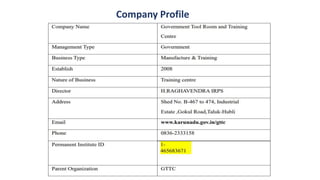
DESCRIPTION OF THE COMPANY:
“Its precision that makes the world go round”
 A premier Tool Room and Training Centre established in 1998 by the state Government
of Karnataka approved by AICTE. India with assistance of the Government of Denmark
has extensive facilities in Tool making and Training.
 Government tool and Training Centre (GTTC) is a modern tool room and training center
with state-of-art equipment, machinery and inspection facilities to meet the complex
needs of discerning customers.
 GTTC is committed to achieve customer satisfaction in quality and delivery of tool
engineering education, services and precision machining.
 GTTC has acquired mastery in Tool Engineering and vast experience in conducting well
structured, practical oriented training programs leading to post graduation, diplomas
and certificates.
INTERNET OF THINGS :
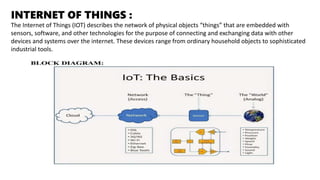
The Internet of Things (IOT) describes the network of physical objects “things” that are embedded with
sensors, software, and other technologies for the purpose of connecting and exchanging data with other
devices and systems over the internet. These devices range from ordinary household objects to sophisticated
industrial tools.
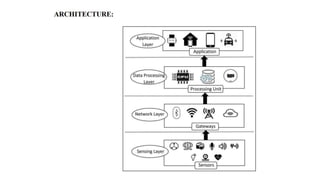
Sensors:
Sensors are the physical information collection sites which basically are devices that sense and record
physical information and further is given to processors to compute the data accordingly.
Processors:
Processors are the brain of the IoT system. Their main function is to process the data captured by the sensors
and process them so as to extract the valuable data from the enormous amount of raw data collected. In a
word, we can say that it gives intelligence to the data.
Gateways:
Gateways are responsible for routing the processed data and send it to proper locations for its (data) proper
utilization.
Applications:
 Applications form another end of an IoT system. Applications are essential for proper utilization of all the
data collected.
 These cloud-based applications which are responsible for rendering the effective meaning to the data
collected. Applications are controlled by users and are a delivery point of particular services.
 Examples of applications are home automation apps, security systems, industrial control hub, etc.
USER INTERFACE
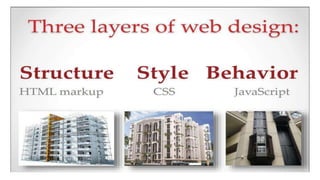
FRONT END HTML:
HTML is short for Hypertext Markup Language.HTML is used to
create electronic documents (called pages) that are displayed on
the World Wide Web. HTML code ensures the proper formatting
of text and images for any Internet Browser.
<!DOCTYPE html>
<html>
<body>
<h1>My First Heading</h1>
<p>My first paragraph.</p>
</body>
</html>
CSS:
◾ CSS was first proposed by Hakon Wium Lie on
October 10,1994
at CERN (European Organization for Nuclear
Research).
◾ Cascading Style Sheets (CSS) describes how HTML
elements are to be displayed on screen.
◾ CSS saves a lot of work. It can control the layout
of multiple web pages all at once.
◾ It is also responsible for responsive layouts of a
website.
◾ It is also written in any text editor but save as
.css extension
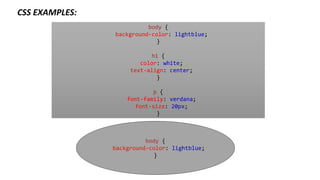
body {
background-color: lightblue;
}
body {
background-color: lightblue;
}
h1 {
color: white;
text-align: center;
}
p {
font-family: verdana;
font-size: 20px;
}
CSS EXAMPLES:
BACKEND DEVELOPMENTTECHNOLOGIESBACKEND
DEVELOPMENTTECHNOLOGIES
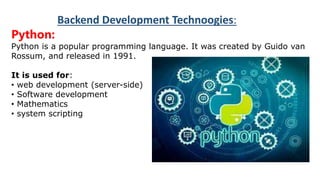
Backend Development Technoogies:
Python:
Python is a popular programming language. It was created by Guido van
Rossum, and released in 1991.
It is used for:
• web development (server-side)
• Software development
• Mathematics
• system scripting
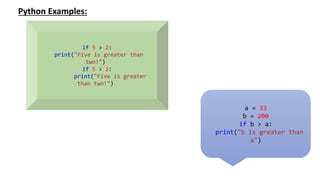
if 5 > 2:
print("Five is greater than
two!")
if 5 > 2:
print("Five is greater
than two!")
Python Examples:
a = 33
b = 200
if b > a:
print("b is greater than
a")
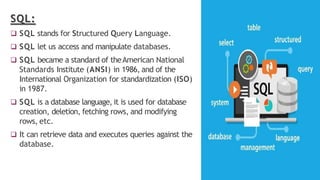
SQL:
 SQL stands for Structured Query Language.
 SQL let us access and manipulate databases.
 SQL became a standard of theAmerican National
Standards Institute (ANSI) in 1986, and of the
International Organization for standardization (ISO)
in 1987.
 SQL is a database language, it is used for database
creation, deletion, fetching rows, and modifying
rows, etc.
 It can retrieve data and executes queries against the
database.
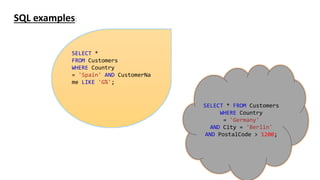
SQL examples:
SELECT *
FROM Customers
WHERE Country
= 'Spain' AND CustomerNa
me LIKE 'G%';
SELECT * FROM Customers
WHERE Country
= 'Germany'
AND City = 'Berlin'
AND PostalCode > 1200;
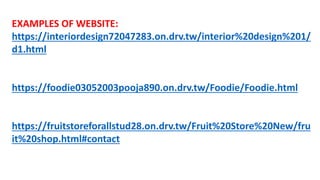
EXAMPLES OF WEBSITE:
https://interiordesign72047283.on.drv.tw/interior%20design%201/
d1.html
https://foodie03052003pooja890.on.drv.tw/Foodie/Foodie.html
https://fruitstoreforallstud28.on.drv.tw/Fruit%20Store%20New/fru
it%20shop.html#contact
internship presentation 1.pptx

internship presentation 1.pptx

  • 1.
    Tontadarya College OfEngineering Mundargi Road,Panchal Nagar,kalyana Nagar,Gadag Karnataka-582101 Seminar On Internship In INTERNET OF THINGS Presented By:  Jyoti.M.Dombar 2TG21AG020  Pooja .M. Hiremath 2TG21AG015  Shobha.S.Byadagi 2TG21AG020  Shreya.Sondur 2TG21AG021 Internal Guide: External Guide: Prof.Kumar Dr.Basavaraj.Patil
  • 2.
  • 3.
    DESCRIPTION OF THECOMPANY: “Its precision that makes the world go round”  A premier Tool Room and Training Centre established in 1998 by the state Government of Karnataka approved by AICTE. India with assistance of the Government of Denmark has extensive facilities in Tool making and Training.  Government tool and Training Centre (GTTC) is a modern tool room and training center with state-of-art equipment, machinery and inspection facilities to meet the complex needs of discerning customers.  GTTC is committed to achieve customer satisfaction in quality and delivery of tool engineering education, services and precision machining.  GTTC has acquired mastery in Tool Engineering and vast experience in conducting well structured, practical oriented training programs leading to post graduation, diplomas and certificates.
  • 4.
    INTERNET OF THINGS: The Internet of Things (IOT) describes the network of physical objects “things” that are embedded with sensors, software, and other technologies for the purpose of connecting and exchanging data with other devices and systems over the internet. These devices range from ordinary household objects to sophisticated industrial tools.
  • 6.
    Sensors: Sensors are thephysical information collection sites which basically are devices that sense and record physical information and further is given to processors to compute the data accordingly. Processors: Processors are the brain of the IoT system. Their main function is to process the data captured by the sensors and process them so as to extract the valuable data from the enormous amount of raw data collected. In a word, we can say that it gives intelligence to the data. Gateways: Gateways are responsible for routing the processed data and send it to proper locations for its (data) proper utilization. Applications:  Applications form another end of an IoT system. Applications are essential for proper utilization of all the data collected.  These cloud-based applications which are responsible for rendering the effective meaning to the data collected. Applications are controlled by users and are a delivery point of particular services.  Examples of applications are home automation apps, security systems, industrial control hub, etc.
  • 7.
    USER INTERFACE FRONT ENDHTML: HTML is short for Hypertext Markup Language.HTML is used to create electronic documents (called pages) that are displayed on the World Wide Web. HTML code ensures the proper formatting of text and images for any Internet Browser. <!DOCTYPE html> <html> <body> <h1>My First Heading</h1> <p>My first paragraph.</p> </body> </html>
  • 8.
    CSS: ◾ CSS wasfirst proposed by Hakon Wium Lie on October 10,1994 at CERN (European Organization for Nuclear Research). ◾ Cascading Style Sheets (CSS) describes how HTML elements are to be displayed on screen. ◾ CSS saves a lot of work. It can control the layout of multiple web pages all at once. ◾ It is also responsible for responsive layouts of a website. ◾ It is also written in any text editor but save as .css extension
  • 9.
    body { background-color: lightblue; } body{ background-color: lightblue; } h1 { color: white; text-align: center; } p { font-family: verdana; font-size: 20px; } CSS EXAMPLES:
  • 11.
    BACKEND DEVELOPMENTTECHNOLOGIESBACKEND DEVELOPMENTTECHNOLOGIES Backend DevelopmentTechnoogies: Python: Python is a popular programming language. It was created by Guido van Rossum, and released in 1991. It is used for: • web development (server-side) • Software development • Mathematics • system scripting
  • 12.
    if 5 >2: print("Five is greater than two!") if 5 > 2: print("Five is greater than two!") Python Examples: a = 33 b = 200 if b > a: print("b is greater than a")
  • 13.
    SQL:  SQL standsfor Structured Query Language.  SQL let us access and manipulate databases.  SQL became a standard of theAmerican National Standards Institute (ANSI) in 1986, and of the International Organization for standardization (ISO) in 1987.  SQL is a database language, it is used for database creation, deletion, fetching rows, and modifying rows, etc.  It can retrieve data and executes queries against the database.
  • 14.
    SQL examples: SELECT * FROMCustomers WHERE Country = 'Spain' AND CustomerNa me LIKE 'G%'; SELECT * FROM Customers WHERE Country = 'Germany' AND City = 'Berlin' AND PostalCode > 1200;
  • 15.