Internet of things
D.ABHISHEK
CONTENTS
• What is iot?
• How iot works?
• Current status of iot
• The future of iot
• Challenges
• applications
• conclusion
What is iot?
• The Internet of things (IoT) is a system of interrelated computing devices, and digital machines
provided with unique identifiers and the ability to transfer data over a network without requiring
human-to-computer interaction.
• The definition of the Internet of things has evolved due to multiple technologies, real-
time analytics, machine learning , commodity sensors, and embedded systems.
• It can also called as M2M(machine to machine), internet of everything , world wide web , sky net
History
• The main concept of a network of smart devices was discussed as early as 1982, with a
modified Coca-Cola vending machine at Carnegi University becoming the first Internet-connected
appliance, able to report its inventory and whether newly loaded drinks were cold or not.
• "Internet of things" was confirmed by Kevin Ashton of Procter & Gamble, later MIT’s Auto-ID
Center, in 1999.
• The key driving force behind the Internet of things is the MOSFET (metal-oxide-semiconductor
field-effect transistor, or MOS transistor)
How it works?
A complete IoT system integrates of:-
a) Sensors/Devices: sensors or devices collect data from their environment. This could be as
simple as a temperature reading.
b) Connectivity:The sensors/devices can be connected to the cloud through a variety of
methods including: cellular, WiFi, Bluetooth, local area networks[lan].
c) Data Processing:Once the data gets to the cloud, software performs some kind of processing
on it,such as checking that the temperature reading is within an acceptable range
d) User Interface:the information is made useful to the end-user in some way. This could be via
an alert to the user (email, text, notification, etc). For example, a text alert when the
temperature is too high in the company’s cold storage.
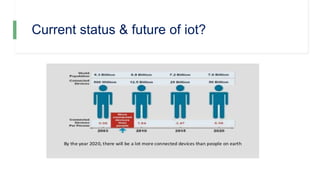
Current status & future of iot?
Why iot?
• Dynamic control of industry and daily life
• Improves the utilizations
• Flexible configuration
• Universal inter-networking
Implementation of iot
• Arduino
• Bolt iot
• raspberry pi
Arduino
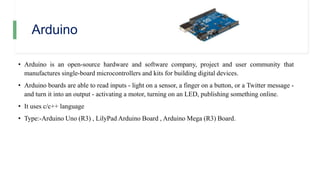
• Arduino is an open-source hardware and software company, project and user community that
manufactures single-board microcontrollers and kits for building digital devices.
• Arduino boards are able to read inputs - light on a sensor, a finger on a button, or a Twitter message -
and turn it into an output - activating a motor, turning on an LED, publishing something online.
• It uses c/c++ language
• Type:-Arduino Uno (R3) , LilyPad Arduino Board , Arduino Mega (R3) Board.
Bolt iot
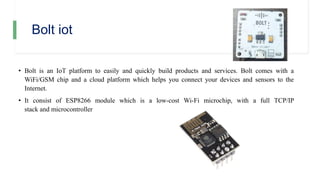
• Bolt is an IoT platform to easily and quickly build products and services. Bolt comes with a
WiFi/GSM chip and a cloud platform which helps you connect your devices and sensors to the
Internet.
• It consist of ESP8266 module which is a low-cost Wi-Fi microchip, with a full TCP/IP
stack and microcontroller
raspberry pi
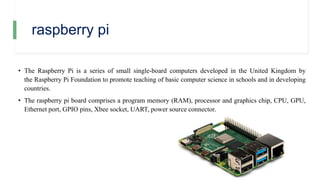
• The Raspberry Pi is a series of small single-board computers developed in the United Kingdom by
the Raspberry Pi Foundation to promote teaching of basic computer science in schools and in developing
countries.
• The raspberry pi board comprises a program memory (RAM), processor and graphics chip, CPU, GPU,
Ethernet port, GPIO pins, Xbee socket, UART, power source connector.
Challenges faced by iot
• Scalability
• Security
• Technical requirements
• Software complexity
Solutions to the challenges
• Overcoming compatibility issues is big task , but the new upcoming companies are starting to enable
increased through open source development
• Government and industry bodies need to set of rules , regulations and standards to ensure that the data is
not misused
• Iot needs strong authentication methods , encrypted data and a platform that can track irregularities on a
network
Applications
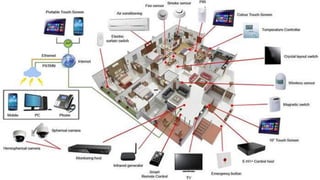
1. Smart home: it is ranked as highest Internet of Things application on all measured channels. More than
60,000 people currently search for the term “Smart Home” each month
2. Wearables: most of the people await the release of Apple’s new smart watch, there are plenty of other
wearable innovations like the Sony Smart B Trainer, the Myo gesture control, or LookSee bracelet
3. Smart City: Smart city spans a wide variety of use , from traffic management to water distribution, to
waste management, urban security and environmental monitoring
4. Connected car: The connected car is coming up slowly , Google, Microsoft, and Apple have all announced
connected car platforms.
Conclusion
• Internet of Things is the concept in which the virtual world of information technology connected to the
real world of things.
• The technologies of Internet of things such as RFID and Sensor make our life become better and more
comfortable.
• Iot infrastructure is still prone to the cyber attacks.
References
• https://www.zdnet.com/article/what-is-the-internet-of-things-everything-you-need-to-know-about-the-iot-
right-now/
• https://www.ibm.com/blogs/internet-of-things/what-is-the-iot/
• https://www.edureka.co/blog/iot-applications/
• https://www.sciencedirect.com/science/article/abs/pii/S0167739X13000241

Internet of things

  • 1.
  • 2.
    CONTENTS • What isiot? • How iot works? • Current status of iot • The future of iot • Challenges • applications • conclusion
  • 3.
    What is iot? •The Internet of things (IoT) is a system of interrelated computing devices, and digital machines provided with unique identifiers and the ability to transfer data over a network without requiring human-to-computer interaction. • The definition of the Internet of things has evolved due to multiple technologies, real- time analytics, machine learning , commodity sensors, and embedded systems. • It can also called as M2M(machine to machine), internet of everything , world wide web , sky net
  • 4.
    History • The mainconcept of a network of smart devices was discussed as early as 1982, with a modified Coca-Cola vending machine at Carnegi University becoming the first Internet-connected appliance, able to report its inventory and whether newly loaded drinks were cold or not. • "Internet of things" was confirmed by Kevin Ashton of Procter & Gamble, later MIT’s Auto-ID Center, in 1999. • The key driving force behind the Internet of things is the MOSFET (metal-oxide-semiconductor field-effect transistor, or MOS transistor)
  • 5.
    How it works? Acomplete IoT system integrates of:- a) Sensors/Devices: sensors or devices collect data from their environment. This could be as simple as a temperature reading. b) Connectivity:The sensors/devices can be connected to the cloud through a variety of methods including: cellular, WiFi, Bluetooth, local area networks[lan]. c) Data Processing:Once the data gets to the cloud, software performs some kind of processing on it,such as checking that the temperature reading is within an acceptable range d) User Interface:the information is made useful to the end-user in some way. This could be via an alert to the user (email, text, notification, etc). For example, a text alert when the temperature is too high in the company’s cold storage.
  • 6.
    Current status &future of iot?
  • 7.
    Why iot? • Dynamiccontrol of industry and daily life • Improves the utilizations • Flexible configuration • Universal inter-networking
  • 8.
    Implementation of iot •Arduino • Bolt iot • raspberry pi
  • 9.
    Arduino • Arduino isan open-source hardware and software company, project and user community that manufactures single-board microcontrollers and kits for building digital devices. • Arduino boards are able to read inputs - light on a sensor, a finger on a button, or a Twitter message - and turn it into an output - activating a motor, turning on an LED, publishing something online. • It uses c/c++ language • Type:-Arduino Uno (R3) , LilyPad Arduino Board , Arduino Mega (R3) Board.
  • 10.
    Bolt iot • Boltis an IoT platform to easily and quickly build products and services. Bolt comes with a WiFi/GSM chip and a cloud platform which helps you connect your devices and sensors to the Internet. • It consist of ESP8266 module which is a low-cost Wi-Fi microchip, with a full TCP/IP stack and microcontroller
  • 11.
    raspberry pi • TheRaspberry Pi is a series of small single-board computers developed in the United Kingdom by the Raspberry Pi Foundation to promote teaching of basic computer science in schools and in developing countries. • The raspberry pi board comprises a program memory (RAM), processor and graphics chip, CPU, GPU, Ethernet port, GPIO pins, Xbee socket, UART, power source connector.
  • 12.
    Challenges faced byiot • Scalability • Security • Technical requirements • Software complexity
  • 13.
    Solutions to thechallenges • Overcoming compatibility issues is big task , but the new upcoming companies are starting to enable increased through open source development • Government and industry bodies need to set of rules , regulations and standards to ensure that the data is not misused • Iot needs strong authentication methods , encrypted data and a platform that can track irregularities on a network
  • 14.
    Applications 1. Smart home:it is ranked as highest Internet of Things application on all measured channels. More than 60,000 people currently search for the term “Smart Home” each month 2. Wearables: most of the people await the release of Apple’s new smart watch, there are plenty of other wearable innovations like the Sony Smart B Trainer, the Myo gesture control, or LookSee bracelet 3. Smart City: Smart city spans a wide variety of use , from traffic management to water distribution, to waste management, urban security and environmental monitoring 4. Connected car: The connected car is coming up slowly , Google, Microsoft, and Apple have all announced connected car platforms.
  • 16.
    Conclusion • Internet ofThings is the concept in which the virtual world of information technology connected to the real world of things. • The technologies of Internet of things such as RFID and Sensor make our life become better and more comfortable. • Iot infrastructure is still prone to the cyber attacks.
  • 17.