In-depth Analysis ofGATT
(General Agreement on Tariffs
and Trade)
LLM Lecture | 50 Marks | Presented
by: [Your Name]
2.
Historical Background
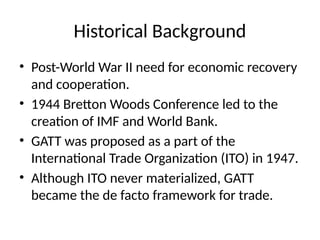
• Post-WorldWar II need for economic recovery
and cooperation.
• 1944 Bretton Woods Conference led to the
creation of IMF and World Bank.
• GATT was proposed as a part of the
International Trade Organization (ITO) in 1947.
• Although ITO never materialized, GATT
became the de facto framework for trade.
3.
Structure and LegalNature
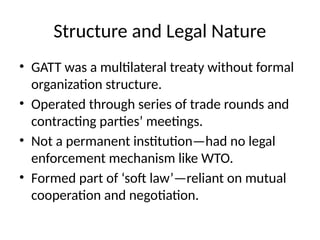
• GATT was a multilateral treaty without formal
organization structure.
• Operated through series of trade rounds and
contracting parties’ meetings.
• Not a permanent institution—had no legal
enforcement mechanism like WTO.
• Formed part of ‘soft law’—reliant on mutual
cooperation and negotiation.
4.
Objectives and Scope
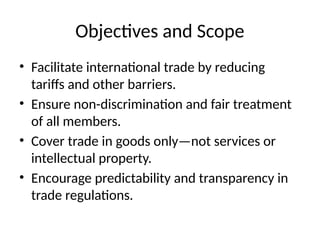
•Facilitate international trade by reducing
tariffs and other barriers.
• Ensure non-discrimination and fair treatment
of all members.
• Cover trade in goods only—not services or
intellectual property.
• Encourage predictability and transparency in
trade regulations.
5.
Core Principles
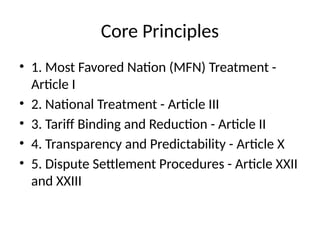
• 1.Most Favored Nation (MFN) Treatment -
Article I
• 2. National Treatment - Article III
• 3. Tariff Binding and Reduction - Article II
• 4. Transparency and Predictability - Article X
• 5. Dispute Settlement Procedures - Article XXII
and XXIII
6.
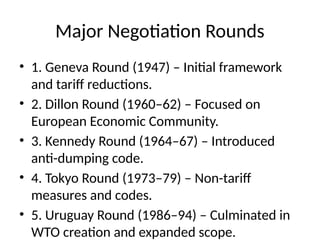
Major Negotiation Rounds
•1. Geneva Round (1947) – Initial framework
and tariff reductions.
• 2. Dillon Round (1960–62) – Focused on
European Economic Community.
• 3. Kennedy Round (1964–67) – Introduced
anti-dumping code.
• 4. Tokyo Round (1973–79) – Non-tariff
measures and codes.
• 5. Uruguay Round (1986–94) – Culminated in
WTO creation and expanded scope.
7.
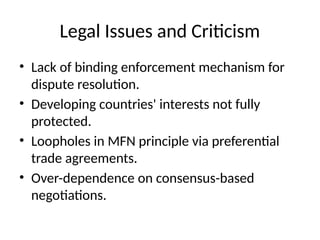
Legal Issues andCriticism
• Lack of binding enforcement mechanism for
dispute resolution.
• Developing countries' interests not fully
protected.
• Loopholes in MFN principle via preferential
trade agreements.
• Over-dependence on consensus-based
negotiations.
8.
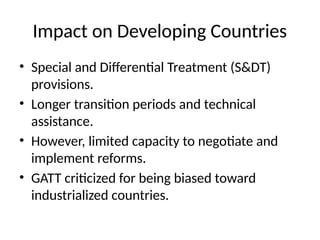
Impact on DevelopingCountries
• Special and Differential Treatment (S&DT)
provisions.
• Longer transition periods and technical
assistance.
• However, limited capacity to negotiate and
implement reforms.
• GATT criticized for being biased toward
industrialized countries.
9.
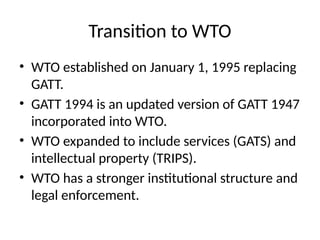
Transition to WTO
•WTO established on January 1, 1995 replacing
GATT.
• GATT 1994 is an updated version of GATT 1947
incorporated into WTO.
• WTO expanded to include services (GATS) and
intellectual property (TRIPS).
• WTO has a stronger institutional structure and
legal enforcement.
10.
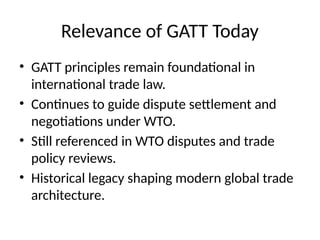
Relevance of GATTToday
• GATT principles remain foundational in
international trade law.
• Continues to guide dispute settlement and
negotiations under WTO.
• Still referenced in WTO disputes and trade
policy reviews.
• Historical legacy shaping modern global trade
architecture.
11.
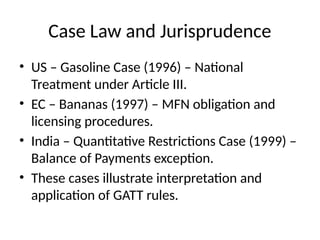
Case Law andJurisprudence
• US – Gasoline Case (1996) – National
Treatment under Article III.
• EC – Bananas (1997) – MFN obligation and
licensing procedures.
• India – Quantitative Restrictions Case (1999) –
Balance of Payments exception.
• These cases illustrate interpretation and
application of GATT rules.
12.
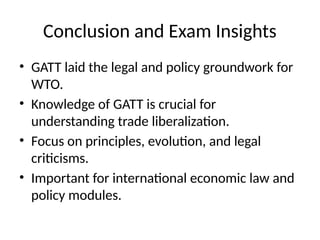
Conclusion and ExamInsights
• GATT laid the legal and policy groundwork for
WTO.
• Knowledge of GATT is crucial for
understanding trade liberalization.
• Focus on principles, evolution, and legal
criticisms.
• Important for international economic law and
policy modules.
![In-depth Analysis of GATT
(General Agreement on Tariffs
and Trade)
LLM Lecture | 50 Marks | Presented
by: [Your Name]](https://image.slidesharecdn.com/gattllmdetailedlecture-250414182301-96fed49a/85/GATT_LLM_Detailed_Lecture-pptx-llm-lectu-1-320.jpg)
![In-depth Analysis of GATT
(General Agreement on Tariffs
and Trade)
LLM Lecture | 50 Marks | Presented
by: [Your Name]](https://image.slidesharecdn.com/gattllmdetailedlecture-250414182301-96fed49a/75/GATT_LLM_Detailed_Lecture-pptx-llm-lectu-1-2048.jpg)