Internal	
  gain	
  assump/ons	
  and	
  building	
  size	
  
!
Nick	
  Grant,	
  E-­‐Mail	
  nick@elementalsolu6ons.co.uk	
  
@ecominimalnick	


Alan	
  Clarke,	
  E-­‐Mail	
  alan@arclarke.co.uk	
  
@AR_Clarke!
Interna/onal	
  Passivhaus	
  conference	
  	
  Aachen	
  2014	
  
Thanks	
  to	
  members	
  of	
  the	
  Passivhaus	
  Trust	
  for	
  technical	
  review.	
  
Small	
  is	
  beau6ful	
  but	
  tricky	
  in	
  PHPP	
  
Our	
  model	
  building:	
  
2	
  floors	
  
Square	
  in	
  plan	
  
6m	
  fixed	
  height	
  
0.5m	
  wall,	
  roof	
  and	
  floor	
  thickness	
  
L=	
  3.6m	
  to	
  13.3m	
  
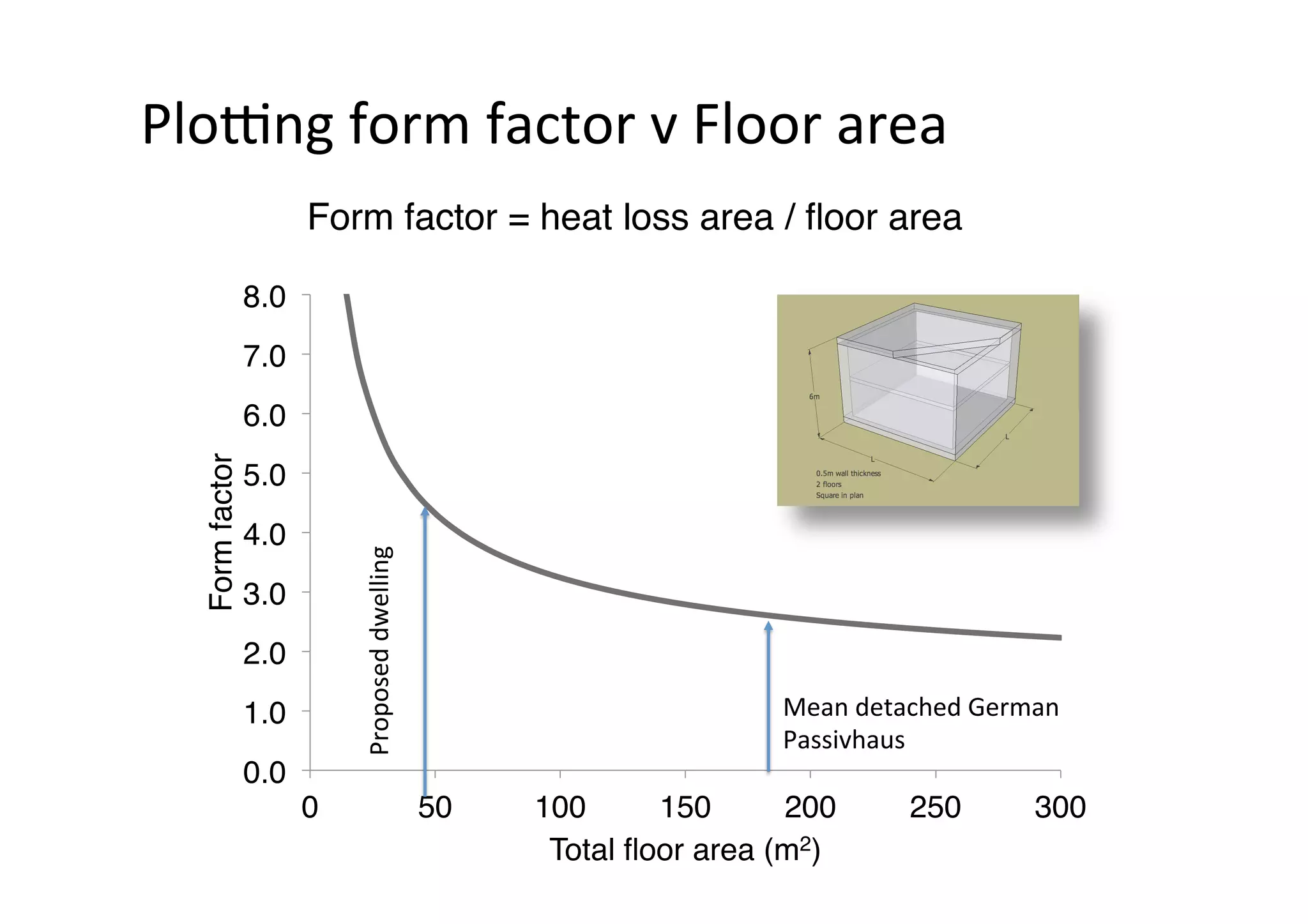
PloWng	
  form	
  factor	
  v	
  Floor	
  area	
  
Mean	
  detached	
  German	
  
Passivhaus	
  
0.0!
1.0!
2.0!
3.0!
4.0!
5.0!
6.0!
7.0!
8.0!
0! 50! 100! 150! 200! 250! 300!
Formfactor!
Total floor area (m2)!
Form factor = heat loss area / floor area!
Proposed	
  dwelling	
  
PloWng	
  Annual	
  heat	
  v	
  floor	
  area	
  
smaller	
  dwellings	
  appear	
  less	
  efficient	
  
0.1	
  U	
  values,	
  PH	
  vent	
  and	
  glazing,	
  simplest	
  form	
  etc,	
  same	
  for	
  all	
  sizes	
  
Even	
  a	
  cube	
  won’t	
  work	
  
Almost	
  any	
  shape	
  and	
  
orienta6on	
  works	
  in	
  PHPP	
  
But	
  small	
  area	
  so	
  should	
  s6ll	
  use	
  less?	
  
0!
200!
400!
600!
800!
1000!
1200!
1400!
1600!
20! 70! 120! 170!
kWh/(a.p)!
Total floor area!
Calculated annual heating demand per person
by PHPP (35m2/p) !
Does it really cost more to heat
a small home of the same
specification?!
This	
  doesn’t	
  fit	
  my	
  anecdotal	
  experience:	
  
15m2	
  living	
  off	
  grid	
  for	
  7	
  years,	
  100mm	
  insula6on	
  &	
  double	
  
glazed	
  but	
  cosy	
  warm	
  with	
  twigs	
  and	
  body	
  heat.	
  
1/3	
  not	
  3x	
  the	
  fuel	
  to	
  heat	
  our	
  larger	
  super-­‐insulated	
  house	
  
What	
  about	
  a	
  6ny	
  envelope,	
  
in	
  an	
  extreme	
  climate?	
  
Na6onal	
  Geographic	
  
Is	
  high	
  form	
  factor	
  compensated	
  by	
  higher	
  specific	
  gains?	
  
About	
  a	
  third	
  ±	
  PH	
  hea6ng	
  is	
  from	
  IHGs	
  
0.0
16.1
11.5
14.9
5.8
0.00.0
13.6
0.00.00.0
4.3
5.2
0.0
12.5
1.1
0
5
10
15
20
25
30
35
40
45
Losses Gains
Heatflows[kWh/(m²a)].
Energy balance heating (annual method)
Non useful heat gains
Exterior wall - Ambient
Roof/Ceiling - Ambient
Floor slab / Basement ceiling
Windows
Ventilation
Solar gains
Internal heat gains
Heating demand
2.1	
  W/m2	
  IHG	
  breakdown:	
  
Per	
  person:	
  
Metabolic,	
  ligh6ng	
  
people,	
  drying	
  towels,	
  
some	
  appliances	


≅	
  54W/p	
  
Per	
  m2:	
  
Aux	
  electric,	
  ligh6ng	
  
space,	
  DHW	
  distribu6on,	
  
pot	
  plant	
  evapora6on?	


≅	
  0.1W/m2	
  
Per	
  dwelling:	
  
Fridge,	
  freezer,	
  
appliances,	
  boiler	
  
DHW	
  base	
  storage	


≅105W/dwelling	
  
Calculated	
  in	
  PHPP	
  IHG	
  sheet	
  (DHW	
  not	
  included):	
  
But	
  how	
  many	
  people?	
  
Occupancy	
  v	
  TFA	
  
SAP	
  2005	
  
SAP	
  2012	
  (based	
  on	
  30,000	
  homes)	
  
Is	
  UK	
  occupancy	
  data	
  relevant?	
  
0.0!
0.5!
1.0!
1.5!
2.0!
2.5!
3.0!
3.5!
0!
50!
100!
150!
200!
250!
People/home!
m2!
Average m2/p!
Average m2/dwelling!
PHPP35m2/p!
P/dwelling!
Linear (P/dwelling)!
IHG	
  calculated	
  using	
  PHPP	
  assump6ons	
  	
  
with	
  BRE	
  occupancy	
  rate.	
  
y = 71.32x-0.73!
R² = 0.99!
0.0!
1.0!
2.0!
3.0!
4.0!
5.0!
6.0!
7.0!
8.0!
20! 40! 60! 80! 100! 120! 140! 160! 180! 200!
Internalheatgain(W/m2)!
Total floor area (m2)!
calculated W/m²!
W/m2 PHPP occupancy for
comparison!
curve fit W/m²!
2.1 W/m2 is about right for typical detached PH in Germany!
PHPP	
  2.1	
  W/m2	
  
IHG	
  with	
  BRE	
  occupancy	
  
to	
  obtain	
  curve	
  fit	
  
0.0!
5.0!
10.0!
15.0!
20.0!
25.0!
30.0!
35.0!
40.0!
20! 40! 60! 80! 100! 120! 140! 160! 180! 200!
kWh/(m2.a)!
Total floor area!
Heating demand for simplified
dwelling!
variable W/m²
internal gain!
fixed 2.1 W/m²
internal gain!
Annual	
  Heat	
  demand	
  
Using	
  IHG	
  =	
  71TFA-­‐0.73	
  
IHG	
  assump6ons	
  will	
  never	
  be	
  correct	
  over	
  the	
  
life	
  of	
  building	
  but	
  an	
  improved	
  heuris6c*	
  model	
  
will	
  beker	
  reflect	
  reality	
  for	
  smaller	
  and	
  larger	
  
buildings.	


The	
  downsides	
  of	
  overes6ma6ng	
  IHGs	
  for	
  small	
  
buildings	
  are	
  less	
  than	
  for	
  underes6ma6ng.	
  
“All	
  models	
  are	
  wrong,	
  some	
  are	
  useful”	
  
	
  George	
  Box	
  
*Rule	
  of	
  thumb/trial	
  and	
  error	
  
‘The	
  importance	
  of	
  hot	
  water	
  system	
  design	
  in	
  
the	
  passivhaus’	
  Clarke	
  &	
  Grant	
  Dresden	
  2010	
  
Losses	
  
contribu6ng	
  to	
  
hea6ng	
  
Wasted	
  losses	
  
Assume	
  state	
  of	
  the	
  art	
  DHW	
  
Dwelling	
  will	
  probably	
  have	
  either:	
  
1.	
  Hot	
  water	
  distribu6on	
  from	
  central	
  system:	
  
	
  Say	
  15m	
  x	
  15mm	
  pipe	
  with	
  25mm	
  insula6on	
  
	
  =	
  45W	
  ignoring	
  conduc6on	
  to	
  outlets	
  etc.	
  
Or:	
  	
  
2.	
  Storage:	
  
	
  3W/K	
  PHPP	
  default	
  =	
  120W	
  
	
  2W/K	
  minimum	
  in	
  PHPP	
  =	
  80W	


Plus	
  distribu6on	
  losses	
  and	
  actual	
  DHW	
  use	
  hea6ng	
  space	
  
Can	
  we	
  agree	
  40W/dwelling	
  is	
  a	
  low	
  es6mate?	


0.0!
1.0!
2.0!
3.0!
4.0!
5.0!
6.0!
7.0!
8.0!
20! 40! 60! 80! 100! 120! 140! 160! 180! 200!
Internalheatgain(W/m2)!
Total floor area (m2)!
calculated W/m²!
W/m2 PHPP occupancy for
comparison!
curve fit W/m²!
IHG	
  including	
  40W/dwelling	
  DHW	
  losses	
  
PHPP	
  2.1	
  W/m2	
  
Curve	
  fit:	
  IHG	
  =	
  100TFA-­‐0.77	
  
Adding	
  40W/dwelling	
  DHW	
  gains	
  
IHG	
  =	
  100TFA-­‐0.77	
  
0.0	
  
5.0	
  
10.0	
  
15.0	
  
20.0	
  
25.0	
  
30.0	
  
35.0	
  
40.0	
  
20	
   40	
   60	
   80	
   100	
   120	
   140	
   160	
   180	
   200	
  
kWh/(m2.a)	
  
Total	
  floor	
  area	
  
variable	
  W/m²	
  internal	
  
gain	
  
fixed	
  2.1	
  W/m²	
  internal	
  
gain	
  
Curve	
  should	
  pass	
  through	
  origin	
  0-­‐0!	
  	
  
Small	
  buildings	
  do	
  need	
  less	
  heat/p	
  
0!
200!
400!
600!
800!
1000!
1200!
20! 70! 120! 170!
kWh/(a.p)!
Total floor area!
Overall annual heating demand per person
BRE occupancy, ignoring DHW gains!
Curve	
  should	
  pass	
  through	
  origin	
  0-­‐0!	
  	
  
Conclusions	
  
•  kWh/(m2.a)	
  metric	
  validated,	
  (usually	
  cri6cised	
  as	
  
favouring	
  larger	
  dwellings).	
  
•  Small	
  homes	
  work	
  beker	
  than	
  large	
  ones.	
  
•  No	
  relaxa6on	
  is	
  needed	
  for	
  small	
  dwellings.	
  
•  Implica6ons	
  for	
  summer	
  overhea6ng	
  calcula6ons.	
  
•  More	
  realis6c	
  occupancy	
  assump6ons	
  have	
  
implica6ons	
  for	
  primary	
  energy	
  calcula6ons.	


Schools	
  (in	
  brief)	
  
Δ	
  Metabolic	
  Heat	
  Gains	
  Only	
  
School	
   	
   	
  Children 	
  TFA	
  m2	
   	
  m2/child	
  
Bushbury	
  Hill	
  (UK)	
  240 	
   	
  1707 	
   	
  7.1	
  
Oakmeadow	
  (UK)	
  450 	
   	
  2205 	
   	
  4.9	
  
Montgomery	
  (UK)	
  446 	
   	
  2367 	
   	
  5.3	
  
Swillington	
  (UK) 	
  240 	
   	
  1344 	
   	
  5.6	
  
Wilkinson	
  (UK)	
   	
  459 	
   	
  2500 	
   	
  5.4	
  
LH	
  Hannover	
  (D) 	
  300 	
   	
  3507 	
   	
  11.7	
  
Gronau	
  (D)	
   	
   	
  336 	
   	
  2953 	
   	
  8.8	
  
Reidberg	
  (D) 	
   	
  500 	
   	
  5540 	
   	
  11.1	


Average	
  for	
  UK	
  examples	
  	
   	
  5.7	
  m2/child	
  
Average	
  for	
  German	
  examples 	
  10.5	
  m2/child	
  
Difference	
  +1.32W/m2	
  
+	
  5-­‐6	
  kWh/(m2.a)	
  of	
  useful	
  hea/ng	
  
Against	
  15kWh/(m2.a)	
  target	
  
Less reliance on solar gain
4.2
6.3
3.9
13.2
0.2
12.9
17.7
8.2
14.7
0.0
5.0
10.0
15.0
20.0
25.0
30.0
35.0
40.0
45.0
Losses Gains
kWh/(m2.a)
Annual Heat Balance
Heat
Solar
IHG
Vent
Doors Opaque
Window
Ground
Roof
Walls
3.8W/m2 v 2.8W/m2 IHG
Means we designed a different building
50% v 60% g glass
No additional south glazing just to meet 15kWh/(m2.a)
Schools Conclusions
•  Design	
  is	
  very	
  sensi6ve	
  to	
  IHG	
  assump6ons.	
  
•  Too	
  low	
  an	
  IHG	
  assump6on	
  favours	
  passive	
  
solar	
  design	
  with	
  associated	
  high	
  cost	
  and	
  
increased	
  overhea6ng	
  risk.	
  
•  Custom	
  IHG	
  calcula6ons	
  could	
  lead	
  to	
  game	
  
playing	
  but	
  occupancy	
  density	
  and	
  6me	
  
should	
  be	
  factored	
  in.	
  
•  More	
  detailed	
  analysis	
  could	
  not	
  be	
  fiked	
  
into	
  this	
  paper.	
  

Internal Heat gains and small dwellings

  • 1.
    Internal  gain  assump/ons  and  building  size   ! Nick  Grant,  E-­‐Mail  nick@elementalsolu6ons.co.uk   @ecominimalnick     Alan  Clarke,  E-­‐Mail  alan@arclarke.co.uk   @AR_Clarke! Interna/onal  Passivhaus  conference    Aachen  2014   Thanks  to  members  of  the  Passivhaus  Trust  for  technical  review.  
  • 2.
    Small  is  beau6ful  but  tricky  in  PHPP   Our  model  building:   2  floors   Square  in  plan   6m  fixed  height   0.5m  wall,  roof  and  floor  thickness   L=  3.6m  to  13.3m  
  • 3.
    PloWng  form  factor  v  Floor  area   Mean  detached  German   Passivhaus   0.0! 1.0! 2.0! 3.0! 4.0! 5.0! 6.0! 7.0! 8.0! 0! 50! 100! 150! 200! 250! 300! Formfactor! Total floor area (m2)! Form factor = heat loss area / floor area! Proposed  dwelling  
  • 4.
    PloWng  Annual  heat  v  floor  area   smaller  dwellings  appear  less  efficient   0.1  U  values,  PH  vent  and  glazing,  simplest  form  etc,  same  for  all  sizes   Even  a  cube  won’t  work   Almost  any  shape  and   orienta6on  works  in  PHPP  
  • 5.
    But  small  area  so  should  s6ll  use  less?   0! 200! 400! 600! 800! 1000! 1200! 1400! 1600! 20! 70! 120! 170! kWh/(a.p)! Total floor area! Calculated annual heating demand per person by PHPP (35m2/p) ! Does it really cost more to heat a small home of the same specification?!
  • 6.
    This  doesn’t  fit  my  anecdotal  experience:   15m2  living  off  grid  for  7  years,  100mm  insula6on  &  double   glazed  but  cosy  warm  with  twigs  and  body  heat.   1/3  not  3x  the  fuel  to  heat  our  larger  super-­‐insulated  house  
  • 7.
    What  about  a  6ny  envelope,   in  an  extreme  climate?   Na6onal  Geographic   Is  high  form  factor  compensated  by  higher  specific  gains?  
  • 8.
    About  a  third  ±  PH  hea6ng  is  from  IHGs   0.0 16.1 11.5 14.9 5.8 0.00.0 13.6 0.00.00.0 4.3 5.2 0.0 12.5 1.1 0 5 10 15 20 25 30 35 40 45 Losses Gains Heatflows[kWh/(m²a)]. Energy balance heating (annual method) Non useful heat gains Exterior wall - Ambient Roof/Ceiling - Ambient Floor slab / Basement ceiling Windows Ventilation Solar gains Internal heat gains Heating demand
  • 9.
    2.1  W/m2  IHG  breakdown:   Per  person:   Metabolic,  ligh6ng   people,  drying  towels,   some  appliances     ≅  54W/p   Per  m2:   Aux  electric,  ligh6ng   space,  DHW  distribu6on,   pot  plant  evapora6on?     ≅  0.1W/m2   Per  dwelling:   Fridge,  freezer,   appliances,  boiler   DHW  base  storage       ≅105W/dwelling   Calculated  in  PHPP  IHG  sheet  (DHW  not  included):  
  • 10.
    But  how  many  people?   Occupancy  v  TFA   SAP  2005   SAP  2012  (based  on  30,000  homes)  
  • 11.
    Is  UK  occupancy  data  relevant?   0.0! 0.5! 1.0! 1.5! 2.0! 2.5! 3.0! 3.5! 0! 50! 100! 150! 200! 250! People/home! m2! Average m2/p! Average m2/dwelling! PHPP35m2/p! P/dwelling! Linear (P/dwelling)!
  • 12.
    IHG  calculated  using  PHPP  assump6ons     with  BRE  occupancy  rate.  
  • 13.
    y = 71.32x-0.73! R²= 0.99! 0.0! 1.0! 2.0! 3.0! 4.0! 5.0! 6.0! 7.0! 8.0! 20! 40! 60! 80! 100! 120! 140! 160! 180! 200! Internalheatgain(W/m2)! Total floor area (m2)! calculated W/m²! W/m2 PHPP occupancy for comparison! curve fit W/m²! 2.1 W/m2 is about right for typical detached PH in Germany! PHPP  2.1  W/m2   IHG  with  BRE  occupancy   to  obtain  curve  fit  
  • 14.
    0.0! 5.0! 10.0! 15.0! 20.0! 25.0! 30.0! 35.0! 40.0! 20! 40! 60!80! 100! 120! 140! 160! 180! 200! kWh/(m2.a)! Total floor area! Heating demand for simplified dwelling! variable W/m² internal gain! fixed 2.1 W/m² internal gain! Annual  Heat  demand   Using  IHG  =  71TFA-­‐0.73  
  • 15.
    IHG  assump6ons  will  never  be  correct  over  the   life  of  building  but  an  improved  heuris6c*  model   will  beker  reflect  reality  for  smaller  and  larger   buildings.     The  downsides  of  overes6ma6ng  IHGs  for  small   buildings  are  less  than  for  underes6ma6ng.   “All  models  are  wrong,  some  are  useful”    George  Box   *Rule  of  thumb/trial  and  error  
  • 16.
    ‘The  importance  of  hot  water  system  design  in   the  passivhaus’  Clarke  &  Grant  Dresden  2010   Losses   contribu6ng  to   hea6ng   Wasted  losses  
  • 17.
    Assume  state  of  the  art  DHW   Dwelling  will  probably  have  either:   1.  Hot  water  distribu6on  from  central  system:    Say  15m  x  15mm  pipe  with  25mm  insula6on    =  45W  ignoring  conduc6on  to  outlets  etc.   Or:     2.  Storage:    3W/K  PHPP  default  =  120W    2W/K  minimum  in  PHPP  =  80W     Plus  distribu6on  losses  and  actual  DHW  use  hea6ng  space   Can  we  agree  40W/dwelling  is  a  low  es6mate?      
  • 18.
    0.0! 1.0! 2.0! 3.0! 4.0! 5.0! 6.0! 7.0! 8.0! 20! 40! 60!80! 100! 120! 140! 160! 180! 200! Internalheatgain(W/m2)! Total floor area (m2)! calculated W/m²! W/m2 PHPP occupancy for comparison! curve fit W/m²! IHG  including  40W/dwelling  DHW  losses   PHPP  2.1  W/m2   Curve  fit:  IHG  =  100TFA-­‐0.77  
  • 19.
    Adding  40W/dwelling  DHW  gains   IHG  =  100TFA-­‐0.77   0.0   5.0   10.0   15.0   20.0   25.0   30.0   35.0   40.0   20   40   60   80   100   120   140   160   180   200   kWh/(m2.a)   Total  floor  area   variable  W/m²  internal   gain   fixed  2.1  W/m²  internal   gain   Curve  should  pass  through  origin  0-­‐0!    
  • 20.
    Small  buildings  do  need  less  heat/p   0! 200! 400! 600! 800! 1000! 1200! 20! 70! 120! 170! kWh/(a.p)! Total floor area! Overall annual heating demand per person BRE occupancy, ignoring DHW gains! Curve  should  pass  through  origin  0-­‐0!    
  • 21.
    Conclusions   •  kWh/(m2.a)  metric  validated,  (usually  cri6cised  as   favouring  larger  dwellings).   •  Small  homes  work  beker  than  large  ones.   •  No  relaxa6on  is  needed  for  small  dwellings.   •  Implica6ons  for  summer  overhea6ng  calcula6ons.   •  More  realis6c  occupancy  assump6ons  have   implica6ons  for  primary  energy  calcula6ons.    
  • 22.
  • 23.
    Δ  Metabolic  Heat  Gains  Only   School      Children  TFA  m2    m2/child   Bushbury  Hill  (UK)  240    1707    7.1   Oakmeadow  (UK)  450    2205    4.9   Montgomery  (UK)  446    2367    5.3   Swillington  (UK)  240    1344    5.6   Wilkinson  (UK)    459    2500    5.4   LH  Hannover  (D)  300    3507    11.7   Gronau  (D)      336    2953    8.8   Reidberg  (D)    500    5540    11.1       Average  for  UK  examples      5.7  m2/child   Average  for  German  examples  10.5  m2/child   Difference  +1.32W/m2   +  5-­‐6  kWh/(m2.a)  of  useful  hea/ng   Against  15kWh/(m2.a)  target  
  • 24.
    Less reliance onsolar gain 4.2 6.3 3.9 13.2 0.2 12.9 17.7 8.2 14.7 0.0 5.0 10.0 15.0 20.0 25.0 30.0 35.0 40.0 45.0 Losses Gains kWh/(m2.a) Annual Heat Balance Heat Solar IHG Vent Doors Opaque Window Ground Roof Walls 3.8W/m2 v 2.8W/m2 IHG Means we designed a different building 50% v 60% g glass No additional south glazing just to meet 15kWh/(m2.a)
  • 25.
    Schools Conclusions •  Design  is  very  sensi6ve  to  IHG  assump6ons.   •  Too  low  an  IHG  assump6on  favours  passive   solar  design  with  associated  high  cost  and   increased  overhea6ng  risk.   •  Custom  IHG  calcula6ons  could  lead  to  game   playing  but  occupancy  density  and  6me   should  be  factored  in.   •  More  detailed  analysis  could  not  be  fiked   into  this  paper.