SAVING AND
INVESTING
TARGET
EXPLAIN HOW SAVINGS AND
INVESTING CONTRIBUTETO
FINANCIALWELL-BEING,
BUILDING WEALTH, AND HELPING
MEET PERSONAL FINANCIAL
GOALS
USEAN ONLINECOMPOUND INTEREST
CALCULATORTO CALCULATETHETOTAL
AMOUNTAN INDIVIDUALWOULD HAVE IN A
SAVINGSOR RETIREMENT ACCOUNT
IDENTIFYWHAT FACTORS IMPACT
COMPOUNDING AND HOW
EXPLAIN WHY COMPOUNDING CAN BE A
POWERFUL SAVINGAND INVESTING
STRATEGY
Meet short-term
goals
Keep funds secure
while growing
Simple interest
 Plan for long-term goals
like retirement
 More risk for more return
on an investment
 Compound interest-
interest on initial principal
and all accumulated
interest
(I = P [(1 + i)n -1]
THETOTAL COST OF BORROWING: LOAN
BASICS
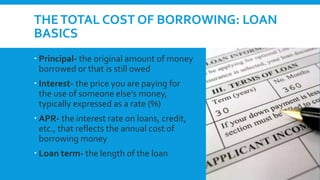
 Principal- the original amount of money
borrowed or that is still owed
 Interest- the price you are paying for
the use of someone else’s money,
typically expressed as a rate (%)
 APR- the interest rate on loans, credit,
etc., that reflects the annual cost of
borrowing money
 Loan term- the length of the loan
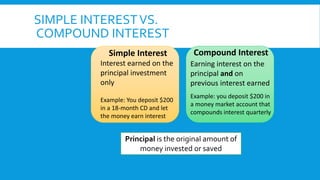
Simple Interest Compound Interest
SIMPLE INTERESTVS.
COMPOUND INTEREST
Interest earned on the
principal investment
only
Example: You deposit $200
in a 18-month CD and let
the money earn interest
Earning interest on the
principal and on
previous interest earned
Example: you deposit $200 in
a money market account that
compounds interest quarterly
Principal is the original amount of
money invested or saved
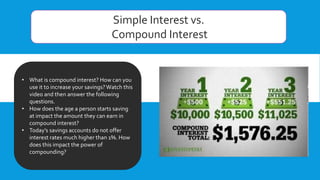
Simple Interest vs.
Compound Interest
• What is compound interest? How can you
use it to increase your savings?Watch this
video and then answer the following
questions.
• How does the age a person starts saving
at impact the amount they can earn in
compound interest?
• Today’s savings accounts do not offer
interest rates much higher than 1%. How
does this impact the power of
compounding?
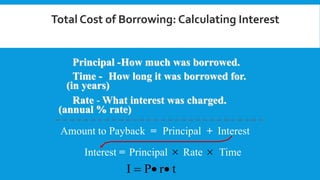
Principal -How much was borrowed.
Time - How long it was borrowed for.
(in years)
Rate -
(annual % rate)
What interest was charged.
Amount to Payback = Principal + Interest
Interest = Principal  Rate  Time
I P r t
  
TheTotal Cost of Borrowing: Calculating Interest
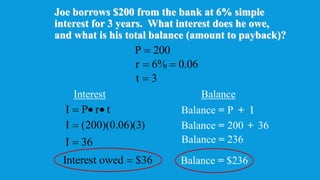
Joe borrows $200 from the bank at 6% simple
interest for 3 years. What interest does he owe,
and what is his total balance (amount to payback)?
Interest Balance
I P r t
  
I  (200)(0.06)(3)
I 36

Interest owed $36

Balance = P + I
Balance = 200 + 36
Balance = 236
Balance = $236
P 200

r 6%
 0.06

t 3

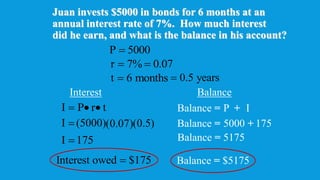
Juan invests $5000 in bonds for 6 months at an
annual interest rate of 7%. How much interest
did he earn, and what is the balance in his account?
Interest Balance
I P r t
  
I (5000)(0.07)(0.5)
I 175

Interest owed $175

Balance = P + I
Balance = 5000 + 175
Balance = 5175
Balance = $5175
P 5000

r 7%
 0.07

t 6 months
 0.5 years

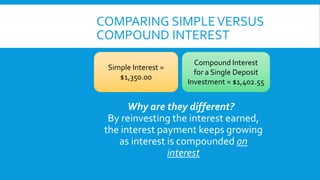
Compound Interest
for a Single Deposit
Investment = $1,402.55
Simple Interest =
$1,350.00
COMPARING SIMPLEVERSUS
COMPOUND INTEREST
Why are they different?
By reinvesting the interest earned,
the interest payment keeps growing
as interest is compounded on
interest
SMART INVESTING
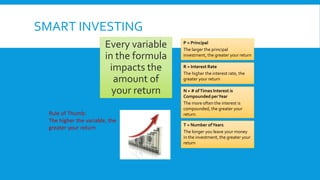
Every variable
in the formula
impacts the
amount of
your return
P = Principal
The larger the principal
investment, the greater your return
R = Interest Rate
The higher the interest rate, the
greater your return
N = # ofTimes Interest is
Compounded perYear
The more often the interest is
compounded, the greater your
return.
T = Number ofYears
The longer you leave your money
in the investment, the greater your
return
Rule of Thumb:
The higher the variable, the
greater your return
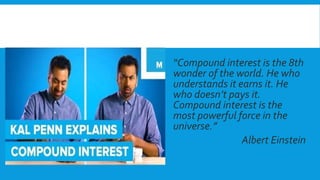
“Compound interest is the 8th
wonder of the world. He who
understands it earns it. He
who doesn’t pays it.
Compound interest is the
most powerful force in the
universe.”
Albert Einstein
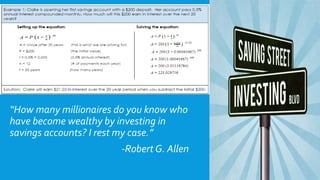
“How many millionaires do you know who
have become wealthy by investing in
savings accounts? I rest my case.”
-Robert G. Allen
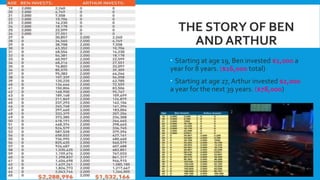
 Starting at age 19, Ben invested $2,000 a
year for 8 years. ($16,000 total)
 Starting at age 27, Arthur invested $2,000
a year for the next 39 years. ($78,000)
THE STORY OF BEN
AND ARTHUR
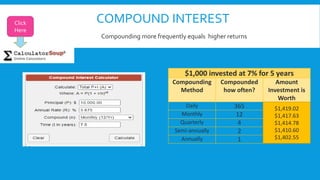
COMPOUND INTEREST
 Number of times interest is compounded has effect on return
 Compounding more frequently equals higher returns
$1,000 invested at 7% for 5 years
Compounding
Method
Compounded
how often?
Amount
Investment is
Worth
Daily 365
Monthly 12
Quarterly 4
Semi-annually 2
Annually 1
$1,419.02
$1,417.63
$1,414.78
$1,410.60
$1,402.55
Click
Here

Interest

  • 1.
    SAVING AND INVESTING TARGET EXPLAIN HOWSAVINGS AND INVESTING CONTRIBUTETO FINANCIALWELL-BEING, BUILDING WEALTH, AND HELPING MEET PERSONAL FINANCIAL GOALS USEAN ONLINECOMPOUND INTEREST CALCULATORTO CALCULATETHETOTAL AMOUNTAN INDIVIDUALWOULD HAVE IN A SAVINGSOR RETIREMENT ACCOUNT IDENTIFYWHAT FACTORS IMPACT COMPOUNDING AND HOW EXPLAIN WHY COMPOUNDING CAN BE A POWERFUL SAVINGAND INVESTING STRATEGY Meet short-term goals Keep funds secure while growing Simple interest  Plan for long-term goals like retirement  More risk for more return on an investment  Compound interest- interest on initial principal and all accumulated interest (I = P [(1 + i)n -1]
  • 2.
    THETOTAL COST OFBORROWING: LOAN BASICS  Principal- the original amount of money borrowed or that is still owed  Interest- the price you are paying for the use of someone else’s money, typically expressed as a rate (%)  APR- the interest rate on loans, credit, etc., that reflects the annual cost of borrowing money  Loan term- the length of the loan
  • 3.
    Simple Interest CompoundInterest SIMPLE INTERESTVS. COMPOUND INTEREST Interest earned on the principal investment only Example: You deposit $200 in a 18-month CD and let the money earn interest Earning interest on the principal and on previous interest earned Example: you deposit $200 in a money market account that compounds interest quarterly Principal is the original amount of money invested or saved
  • 4.
    Simple Interest vs. CompoundInterest • What is compound interest? How can you use it to increase your savings?Watch this video and then answer the following questions. • How does the age a person starts saving at impact the amount they can earn in compound interest? • Today’s savings accounts do not offer interest rates much higher than 1%. How does this impact the power of compounding?
  • 5.
    Principal -How muchwas borrowed. Time - How long it was borrowed for. (in years) Rate - (annual % rate) What interest was charged. Amount to Payback = Principal + Interest Interest = Principal  Rate  Time I P r t    TheTotal Cost of Borrowing: Calculating Interest
  • 6.
    Joe borrows $200from the bank at 6% simple interest for 3 years. What interest does he owe, and what is his total balance (amount to payback)? Interest Balance I P r t    I  (200)(0.06)(3) I 36  Interest owed $36  Balance = P + I Balance = 200 + 36 Balance = 236 Balance = $236 P 200  r 6%  0.06  t 3 
  • 7.
    Juan invests $5000in bonds for 6 months at an annual interest rate of 7%. How much interest did he earn, and what is the balance in his account? Interest Balance I P r t    I (5000)(0.07)(0.5) I 175  Interest owed $175  Balance = P + I Balance = 5000 + 175 Balance = 5175 Balance = $5175 P 5000  r 7%  0.07  t 6 months  0.5 years 
  • 8.
    Compound Interest for aSingle Deposit Investment = $1,402.55 Simple Interest = $1,350.00 COMPARING SIMPLEVERSUS COMPOUND INTEREST Why are they different? By reinvesting the interest earned, the interest payment keeps growing as interest is compounded on interest
  • 9.
    SMART INVESTING Every variable inthe formula impacts the amount of your return P = Principal The larger the principal investment, the greater your return R = Interest Rate The higher the interest rate, the greater your return N = # ofTimes Interest is Compounded perYear The more often the interest is compounded, the greater your return. T = Number ofYears The longer you leave your money in the investment, the greater your return Rule of Thumb: The higher the variable, the greater your return
  • 10.
    “Compound interest isthe 8th wonder of the world. He who understands it earns it. He who doesn’t pays it. Compound interest is the most powerful force in the universe.” Albert Einstein
  • 11.
    “How many millionairesdo you know who have become wealthy by investing in savings accounts? I rest my case.” -Robert G. Allen
  • 12.
     Starting atage 19, Ben invested $2,000 a year for 8 years. ($16,000 total)  Starting at age 27, Arthur invested $2,000 a year for the next 39 years. ($78,000) THE STORY OF BEN AND ARTHUR
  • 13.
    COMPOUND INTEREST  Numberof times interest is compounded has effect on return  Compounding more frequently equals higher returns $1,000 invested at 7% for 5 years Compounding Method Compounded how often? Amount Investment is Worth Daily 365 Monthly 12 Quarterly 4 Semi-annually 2 Annually 1 $1,419.02 $1,417.63 $1,414.78 $1,410.60 $1,402.55 Click Here