1
SMARTER SOLUTIONS
FOR TRANSMISSION & DISTRIBUTION
Intelligent management of Power Transmission and
distribution
2
It requires extensive use of ICT based systems for effective management of Power
transmission and distribution network Assets
Achieve smarter city imperatives with real time geospatial
enabled analytics for effective Citizen services
Complete Asset information and
better accountability
Real time operational data for
informed decision making
Single Unified view of entire
Operations
SmartCities are expected to provide world class services to its Citizens by effective and
efficient operations of its Power supply network assets, reducing the power leakages &
un-planned Outages, and improving operational performance.
Role of ICTs in Power Transmission & Distribution
3
Apart from the increasing gap between demand and supply, the main challenge being faced by
Indian power sector is the huge Transmission and Distribution (T&D) losses. The national average
Aggregate Technical and Commercial losses (AT&C) were reported to around 27.15% in 2009-2010
[CEA Energy Generation Report 2010-11]
In the distribution sub-sector, which is presently the weakest link in the power supply chain, Cost-
effective ICT interventions can improve the operational and financial performance of the entire
power sector. An important enabler is Government of India’s flagship program R-APDRP
Key ICT interventions in power distribution sub-sector that need immediate attention are:
 Advanced Metering Infrastructure [AMI],
 Advanced Distribution Operation including Distribution Automation and advanced controls,
 Asset management,
 Improved interfaces and decision support,
 Regulatory Information Management system,
 Service Delivery Mechanism
Source: ‘Smart(er) Metering: An Enabler of Transformation’ by Dr. Rahul Tongia, Tech. Advisor,
Smart Grid Task Force, Govt. of India [ Feb. 10, 2015]
Priority areas for ICT Interventions
4
Major components
of power
distribution
Opportunities for ICT sector Impact /Benefits
AMI • Smart Meters
• Consumer portals
• Home Area Network (HAN)
• Meter Data Acquisition and Data Management
System
• Customer service application and operational
gateway applications
• Assist revenue management
• Empower consumers
• Reliable supply
Asset management • Developing central database of information of
Assets / equipment
• GIS mapping of power line and power system
equipment
• Management Information System(MIS)
• Resource optimization
• Inventory Management
• Process streamlining
• Locating leakage and checking
• conductor theft
• Quick restoring the services post
• damage/ outage
Service Delivery
Mechanism
• Enabling different modes of billing (e-billing, m-
billing) and collection
• Fault Monitoring System
• SMS based alerts about services (outages,
maintenance, billing etc.)
• Empower customers
• Streamline the service delivery
As per the NASSCOM report, the following are the areas which need immediate ICT interventions
Source: Report ‘Sustainable Tomorrow: Harnessing ICT Potential’ by Business Council for Sustainable
Development (TERI-BCSD) and National Association of Software & Services Companies (NASSCOM).
Role of Ministry of Power, GOI - Integrated Power
Development Scheme [IPDS]
5
Source : http://apdrp.gov.in/Form_IPDS/Additional_Guidelines_Regarding_Towns
The Union Cabinet chaired by the Prime Minister, Shri Narendra Modi, launched "Integrated Power
Development Scheme" (IPDS) with the objectives of:
• strengthen of sub transmission and distribution system,
• metering of distribution transformers / feeders / consumers in the urban areas, and
• IT enablement of distribution sector [as per CCEA target laid under R-APDRP]
Source: APDRP Order http://www.apdrp.gov.in/IPDS_Order_Guidelines/IPDS_OM.pdf
The component of IT enablement approved by CCEA in June, 2013 in the form of RAPDRP for 12th and
13th Plans will get subsumed in this scheme and CCEA-approved scheme outlay of Rs.44,011 crore
including a budgetary support of Rs. 22,727 crore will be carried over to the new scheme of IPDS.
• The process of sanction of projects shall commence from December 2014
• After sanction of projects, contracts for execution of projects are to be awarded by States
Discoms / Power Departments.
• The projects shall be completed within 24 months from date of award.
How State Power companies can take up ICTs
6
State Government owned power companies can leverage the IPDS scheme to implement ICTs and
make the power transmission more efficient
Coverage of Urban Areas:
Monitoring Committee approved include the following towns also in addition to the statutory towns
as urban area to be covered under IPDS:
• District head quaters (particularly in NE States) if covered under urban category.
• Towns covered under urban category as per Census 2011.
• Towns notified by State Govt.(as urban / Municipal area).
[Additional Criteria for Towns Approved in 2nd Monitoring Committee on 19-Feb-2015]
[Inclusion of additional towns beyond Statutory towns for coverage under urban area for sanction of project under
IPDS]
Integrated Power Development Scheme
7
Scope of ICT under this scheme
Source: APDRP Order http://www.apdrp.gov.in/IPDS_Order_Guidelines/IPDS_OM.pdf
Need for an Intelligent Operations Management
System for Power Transmission & Distribution
Smart Operations Management system
enables the Power Distribution
companies to overcome challenges with:
 Transmission Assets
(Transformers, Capacitors,
Poles, etc) location & condition,
 Preventive Maintenance of
assets,
 Equipment Theft and
 Real time monitor and control
of Field force operations.
8
Intelligent Transmission Monitoring System
Asset Management
Field Force / Work
Management
Inventory &
Procurement
Decision Support
Geographic
Information
System
9
 Asset Usage Monitoring
 Field force & Work Management
 GIS/GPS based Inventory tracking
 Real time monitoring of assets
Key Tenets of Intelligent Transmission Management System
GIS based Tracking of Transmission Assets
10
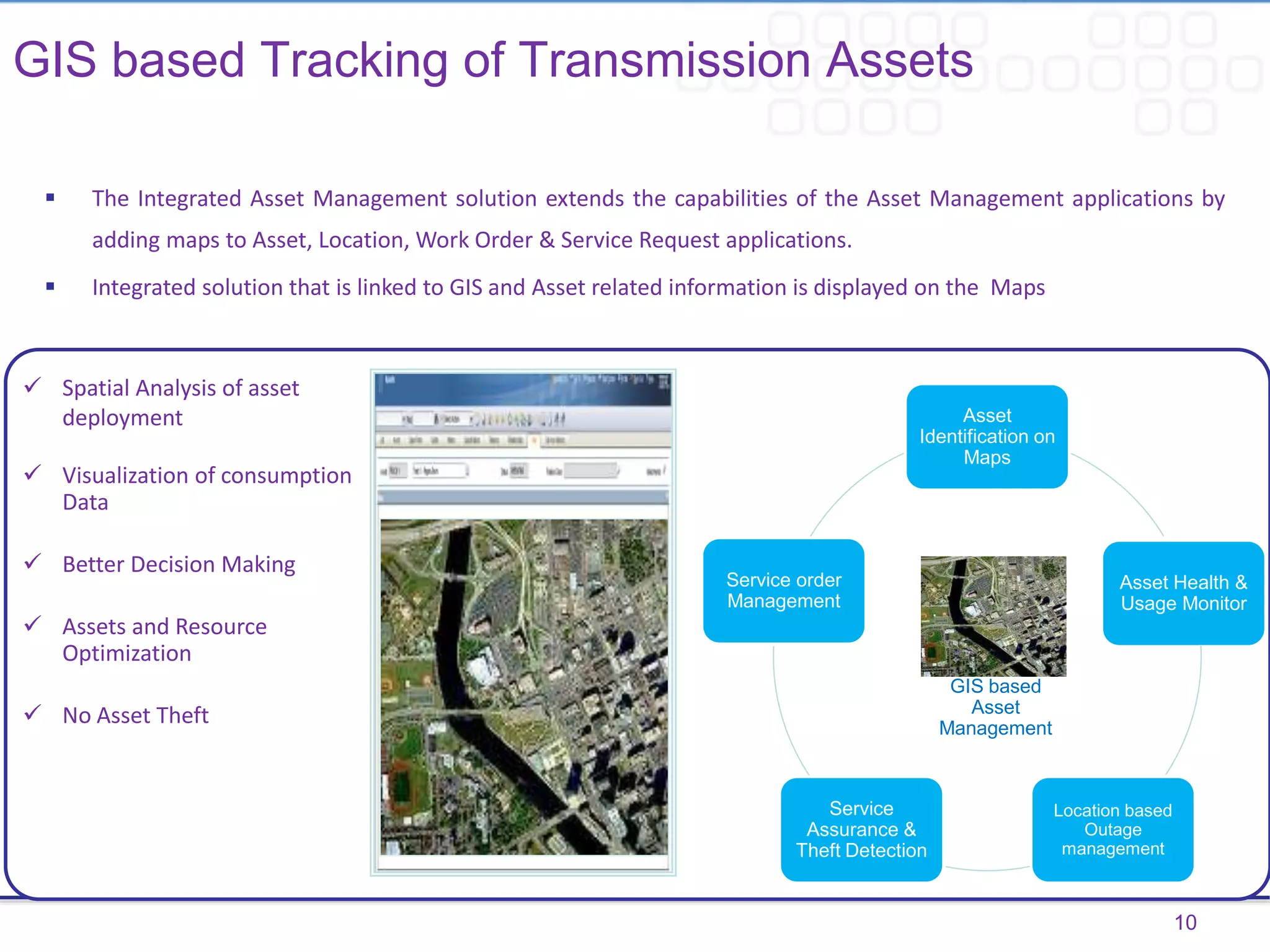
 The Integrated Asset Management solution extends the capabilities of the Asset Management applications by
adding maps to Asset, Location, Work Order & Service Request applications.
 Integrated solution that is linked to GIS and Asset related information is displayed on the Maps
 Spatial Analysis of asset
deployment
 Visualization of consumption
Data
 Better Decision Making
 Assets and Resource
Optimization
 No Asset Theft
Asset
Identification on
Maps
Asset Health &
Usage Monitor
Location based
Outage
management
Service
Assurance &
Theft Detection
Service order
Management
GIS based
Asset
Management
Integrated Distribution Operations solution for smart
cities
11
Value proposition
 Empowers Cities towards effective information
sharing through spatially enabled workflow
 Geospatial enabled e-Governance solution to
deliver government services and workflows
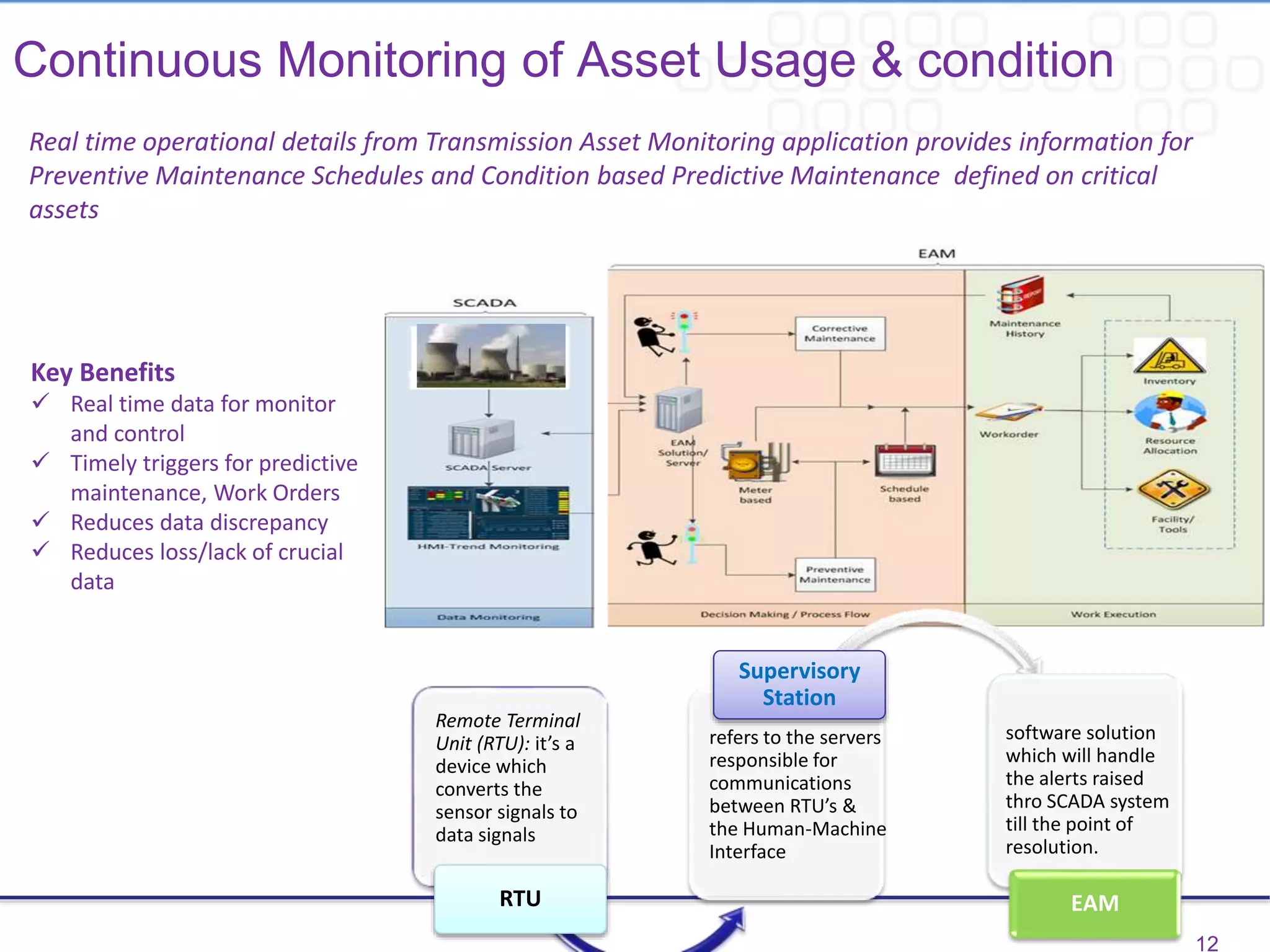
Continuous Monitoring of Asset Usage & condition
12
Key Benefits
 Real time data for monitor
and control
 Timely triggers for predictive
maintenance, Work Orders
 Reduces data discrepancy
 Reduces loss/lack of crucial
data
Remote Terminal
Unit (RTU): it’s a
device which
converts the
sensor signals to
data signals
RTU
Supervisory
Station
EAM
refers to the servers
responsible for
communications
between RTU’s &
the Human-Machine
Interface
software solution
which will handle
the alerts raised
thro SCADA system
till the point of
resolution.
Real time operational details from Transmission Asset Monitoring application provides information for
Preventive Maintenance Schedules and Condition based Predictive Maintenance defined on critical
assets
Intelligent Outage Management
13
Outage
Mgmt
System
GIS
CIS
EAM
SCADA
Leveraging GIS maps, the system diagnose the outage for location, cause, extent of
outage, its priority, affected customers, expected restoration time
 The outage management system helps in identifying the location of
fault (on the GIS Maps) and its causes resulting in improved response
time for dispatching crews and improving the service restoration time.
 Outage Management system integrates with Geographic Information
system (GIS) Enterprise Asset Management (EAM), Customer
Information System (CIS), and SCADA
 The historical data enables measurement of key performance metrics
like Outage Response duration, work back log, frequency
 An integrated Outage Management system to manage different types
of works and service requests in one application environment. Outage
Management System helps to manage outages effectively and
efficiently.
Outage Management Solution…ctd
14
Network elements
affected by the break
down of selected
element are highlighted
in yellow color
Selected network
element highlighted in
RED color
Smart Field Force Management
15
Our Integrated Asset Management contains the Field
Force Management capabilities:
 Field Force is a combination of labor and tools defined to
perform a work.
 Field Force Management helps in identification of right
resources for the right work
 Identify and Map Right Skills and Qualifications for a work
 Work allocation based on current location
 View ongoing work assignments and priorities
 Asset Condition Assessment Solutions
 Damage Assessment Solutions
 Live field assistance for supporting the crew at work
 Flexible interface capabilities for work assignment notifications in real
time or near real time based on requirement
Field Navigatio
Enterprise GIS Repository
Extract
Update
Asset Condition
Assessment
Vegetation
Management Field Mapping/
compliance
Surveys
Download
Interne
t
It enables real time location tracking of crews and dispatch crews to work and manage Work order
Smart Field Force Management – GIS based
16
Add Retail Dealer
to the Route
Planner
Add Warehouse
to the Route
Planner
Add New Retail
Dealer
Get the Route on the
map
Change the
position of
the
waypoint
along the
route
Delete
button,
meant to
delete the
way point
HIGH LEVEL ARCHITECTURE
17
A bird’s eye view of proposed Intelligent Power
Distribution Management solution landscape
18
Power Transmission Company
Work Management Material Management
Material
Requests
Item
Master
Material
Planning
Inventory Receipts
Issues /
Returns
Transfers
Assets Maintenance
Asset Management
GIS
Locations
Move/Swap
Revenue
O&M
Non
Revenue
Field Force Mgmt
Work Plan
Work order
Dispatch
Route
Plan
Service
Requests
GL
Project
Costing
Projects
Asset
Accounting O&M Budgeting
Purchase Inventory
Service
Orders
Billing
Payments Collections
Customer Service
Comprehensive Functional Landscape
19
EnterpriseServiceBus
PROCESS AND
FUNCTIONS
Work Management
Asset
Management
Material Management
Asset Life Cycle
Asset Specifications
Meters
Asset Maintenance History
Move Swap
Asset and Locations Hierarchy
Locations
Receive and
Setup
Dispose
Track
Move
Embedded GIS
Service Address
Spatial Enablement
Availability and Valuation
Issue, Transfer and Returns
Storerooms and Reordering
Items, Tools and Inventory
Procurement
Material and Purchase
Requests
Contracts, RFQ and PO
Receiving
Invoicing
Project Request
Assign Planner
Scope, Schedule & Budget
Preliminary Design
Siting & Permitting
Land Acquisition
Final Design
Specifications
Material Requirements
Procurement (LL)
Site Preparation
Construction
Commissioning
Close Out
Financial
Management
Cost
Management
Chart of
AccountsCondition Monitoring
Service Requests
Work Order Tracking Job Plans
Safety Plans
Failure Codes
SchedulingWork Assignments
Work Dispatch
Work Flow and
Notifications
Electronic Routing
and Approval
Labor Reporting
Preventive Maintenance
Corrective Maintenance
Failure Reporting
Quick Reporting

Intelligent power transmission asset management solutions

  • 1.
  • 2.
    Intelligent management ofPower Transmission and distribution 2 It requires extensive use of ICT based systems for effective management of Power transmission and distribution network Assets Achieve smarter city imperatives with real time geospatial enabled analytics for effective Citizen services Complete Asset information and better accountability Real time operational data for informed decision making Single Unified view of entire Operations SmartCities are expected to provide world class services to its Citizens by effective and efficient operations of its Power supply network assets, reducing the power leakages & un-planned Outages, and improving operational performance.
  • 3.
    Role of ICTsin Power Transmission & Distribution 3 Apart from the increasing gap between demand and supply, the main challenge being faced by Indian power sector is the huge Transmission and Distribution (T&D) losses. The national average Aggregate Technical and Commercial losses (AT&C) were reported to around 27.15% in 2009-2010 [CEA Energy Generation Report 2010-11] In the distribution sub-sector, which is presently the weakest link in the power supply chain, Cost- effective ICT interventions can improve the operational and financial performance of the entire power sector. An important enabler is Government of India’s flagship program R-APDRP Key ICT interventions in power distribution sub-sector that need immediate attention are:  Advanced Metering Infrastructure [AMI],  Advanced Distribution Operation including Distribution Automation and advanced controls,  Asset management,  Improved interfaces and decision support,  Regulatory Information Management system,  Service Delivery Mechanism Source: ‘Smart(er) Metering: An Enabler of Transformation’ by Dr. Rahul Tongia, Tech. Advisor, Smart Grid Task Force, Govt. of India [ Feb. 10, 2015]
  • 4.
    Priority areas forICT Interventions 4 Major components of power distribution Opportunities for ICT sector Impact /Benefits AMI • Smart Meters • Consumer portals • Home Area Network (HAN) • Meter Data Acquisition and Data Management System • Customer service application and operational gateway applications • Assist revenue management • Empower consumers • Reliable supply Asset management • Developing central database of information of Assets / equipment • GIS mapping of power line and power system equipment • Management Information System(MIS) • Resource optimization • Inventory Management • Process streamlining • Locating leakage and checking • conductor theft • Quick restoring the services post • damage/ outage Service Delivery Mechanism • Enabling different modes of billing (e-billing, m- billing) and collection • Fault Monitoring System • SMS based alerts about services (outages, maintenance, billing etc.) • Empower customers • Streamline the service delivery As per the NASSCOM report, the following are the areas which need immediate ICT interventions Source: Report ‘Sustainable Tomorrow: Harnessing ICT Potential’ by Business Council for Sustainable Development (TERI-BCSD) and National Association of Software & Services Companies (NASSCOM).
  • 5.
    Role of Ministryof Power, GOI - Integrated Power Development Scheme [IPDS] 5 Source : http://apdrp.gov.in/Form_IPDS/Additional_Guidelines_Regarding_Towns The Union Cabinet chaired by the Prime Minister, Shri Narendra Modi, launched "Integrated Power Development Scheme" (IPDS) with the objectives of: • strengthen of sub transmission and distribution system, • metering of distribution transformers / feeders / consumers in the urban areas, and • IT enablement of distribution sector [as per CCEA target laid under R-APDRP] Source: APDRP Order http://www.apdrp.gov.in/IPDS_Order_Guidelines/IPDS_OM.pdf The component of IT enablement approved by CCEA in June, 2013 in the form of RAPDRP for 12th and 13th Plans will get subsumed in this scheme and CCEA-approved scheme outlay of Rs.44,011 crore including a budgetary support of Rs. 22,727 crore will be carried over to the new scheme of IPDS. • The process of sanction of projects shall commence from December 2014 • After sanction of projects, contracts for execution of projects are to be awarded by States Discoms / Power Departments. • The projects shall be completed within 24 months from date of award.
  • 6.
    How State Powercompanies can take up ICTs 6 State Government owned power companies can leverage the IPDS scheme to implement ICTs and make the power transmission more efficient Coverage of Urban Areas: Monitoring Committee approved include the following towns also in addition to the statutory towns as urban area to be covered under IPDS: • District head quaters (particularly in NE States) if covered under urban category. • Towns covered under urban category as per Census 2011. • Towns notified by State Govt.(as urban / Municipal area). [Additional Criteria for Towns Approved in 2nd Monitoring Committee on 19-Feb-2015] [Inclusion of additional towns beyond Statutory towns for coverage under urban area for sanction of project under IPDS]
  • 7.
    Integrated Power DevelopmentScheme 7 Scope of ICT under this scheme Source: APDRP Order http://www.apdrp.gov.in/IPDS_Order_Guidelines/IPDS_OM.pdf
  • 8.
    Need for anIntelligent Operations Management System for Power Transmission & Distribution Smart Operations Management system enables the Power Distribution companies to overcome challenges with:  Transmission Assets (Transformers, Capacitors, Poles, etc) location & condition,  Preventive Maintenance of assets,  Equipment Theft and  Real time monitor and control of Field force operations. 8
  • 9.
    Intelligent Transmission MonitoringSystem Asset Management Field Force / Work Management Inventory & Procurement Decision Support Geographic Information System 9  Asset Usage Monitoring  Field force & Work Management  GIS/GPS based Inventory tracking  Real time monitoring of assets Key Tenets of Intelligent Transmission Management System
  • 10.
    GIS based Trackingof Transmission Assets 10  The Integrated Asset Management solution extends the capabilities of the Asset Management applications by adding maps to Asset, Location, Work Order & Service Request applications.  Integrated solution that is linked to GIS and Asset related information is displayed on the Maps  Spatial Analysis of asset deployment  Visualization of consumption Data  Better Decision Making  Assets and Resource Optimization  No Asset Theft Asset Identification on Maps Asset Health & Usage Monitor Location based Outage management Service Assurance & Theft Detection Service order Management GIS based Asset Management
  • 11.
    Integrated Distribution Operationssolution for smart cities 11 Value proposition  Empowers Cities towards effective information sharing through spatially enabled workflow  Geospatial enabled e-Governance solution to deliver government services and workflows
  • 12.
    Continuous Monitoring ofAsset Usage & condition 12 Key Benefits  Real time data for monitor and control  Timely triggers for predictive maintenance, Work Orders  Reduces data discrepancy  Reduces loss/lack of crucial data Remote Terminal Unit (RTU): it’s a device which converts the sensor signals to data signals RTU Supervisory Station EAM refers to the servers responsible for communications between RTU’s & the Human-Machine Interface software solution which will handle the alerts raised thro SCADA system till the point of resolution. Real time operational details from Transmission Asset Monitoring application provides information for Preventive Maintenance Schedules and Condition based Predictive Maintenance defined on critical assets
  • 13.
    Intelligent Outage Management 13 Outage Mgmt System GIS CIS EAM SCADA LeveragingGIS maps, the system diagnose the outage for location, cause, extent of outage, its priority, affected customers, expected restoration time  The outage management system helps in identifying the location of fault (on the GIS Maps) and its causes resulting in improved response time for dispatching crews and improving the service restoration time.  Outage Management system integrates with Geographic Information system (GIS) Enterprise Asset Management (EAM), Customer Information System (CIS), and SCADA  The historical data enables measurement of key performance metrics like Outage Response duration, work back log, frequency  An integrated Outage Management system to manage different types of works and service requests in one application environment. Outage Management System helps to manage outages effectively and efficiently.
  • 14.
    Outage Management Solution…ctd 14 Networkelements affected by the break down of selected element are highlighted in yellow color Selected network element highlighted in RED color
  • 15.
    Smart Field ForceManagement 15 Our Integrated Asset Management contains the Field Force Management capabilities:  Field Force is a combination of labor and tools defined to perform a work.  Field Force Management helps in identification of right resources for the right work  Identify and Map Right Skills and Qualifications for a work  Work allocation based on current location  View ongoing work assignments and priorities  Asset Condition Assessment Solutions  Damage Assessment Solutions  Live field assistance for supporting the crew at work  Flexible interface capabilities for work assignment notifications in real time or near real time based on requirement Field Navigatio Enterprise GIS Repository Extract Update Asset Condition Assessment Vegetation Management Field Mapping/ compliance Surveys Download Interne t It enables real time location tracking of crews and dispatch crews to work and manage Work order
  • 16.
    Smart Field ForceManagement – GIS based 16 Add Retail Dealer to the Route Planner Add Warehouse to the Route Planner Add New Retail Dealer Get the Route on the map Change the position of the waypoint along the route Delete button, meant to delete the way point
  • 17.
  • 18.
    A bird’s eyeview of proposed Intelligent Power Distribution Management solution landscape 18 Power Transmission Company Work Management Material Management Material Requests Item Master Material Planning Inventory Receipts Issues / Returns Transfers Assets Maintenance Asset Management GIS Locations Move/Swap Revenue O&M Non Revenue Field Force Mgmt Work Plan Work order Dispatch Route Plan Service Requests GL Project Costing Projects Asset Accounting O&M Budgeting Purchase Inventory Service Orders Billing Payments Collections Customer Service
  • 19.
    Comprehensive Functional Landscape 19 EnterpriseServiceBus PROCESSAND FUNCTIONS Work Management Asset Management Material Management Asset Life Cycle Asset Specifications Meters Asset Maintenance History Move Swap Asset and Locations Hierarchy Locations Receive and Setup Dispose Track Move Embedded GIS Service Address Spatial Enablement Availability and Valuation Issue, Transfer and Returns Storerooms and Reordering Items, Tools and Inventory Procurement Material and Purchase Requests Contracts, RFQ and PO Receiving Invoicing Project Request Assign Planner Scope, Schedule & Budget Preliminary Design Siting & Permitting Land Acquisition Final Design Specifications Material Requirements Procurement (LL) Site Preparation Construction Commissioning Close Out Financial Management Cost Management Chart of AccountsCondition Monitoring Service Requests Work Order Tracking Job Plans Safety Plans Failure Codes SchedulingWork Assignments Work Dispatch Work Flow and Notifications Electronic Routing and Approval Labor Reporting Preventive Maintenance Corrective Maintenance Failure Reporting Quick Reporting