IAES International Journal of Artificial Intelligence (IJ-AI)
Vol. 13, No. 3, September 2024, pp. 2557~2565
ISSN: 2252-8938, DOI: 10.11591/ijai.v13.i3.pp2557-2565  2557
Journal homepage: http://ijai.iaescore.com
Intelligent automation computational modelling for contextual
consulting services using Industry 4.0
Vijay Kumar Pandey, Neeraj Kumar Rathore, Narayan P. Bhosale
Department of Computer Science, Indira Gandhi National Tribal University, Amarkantak, India
Article Info ABSTRACT
Article history:
Received Nov 28, 2023
Revised Feb 6, 2024
Accepted Feb 16, 2024
The methodology towards operational management and service delivery
associated with consulting firms, irrespective of any business domain, are
less revisited in perspective from the automation-based process
management. Adoption of Industry 4.0 has been attempted by various
researchers from the business process management; however, there are less
evidence of any computational model towards it. Apart from this, existing
models are accompanied by various loopholes which makes its further
challenging to analyze it on practical environment. Hence, the proposed
study introduces a novel computational and analytical framework which is
capable of performing the predictive modelling in order to meet the
contextual service development and delivery demands in distributed
environment. The novelty of this model is its inclusion of contextual data
aggregation, contextual constraint analysis, predictive maintenence, and
self-adjusting machine which are core attributes of Industry 4.0 automation
standards. The study outcome shows that proposed system offers 20% cost
reduction and 89% of minimized service delivery time in contrast to existing
related work. Same has been also observed in benchmarked outcomes with
state-of-art models.
Keywords:
Automation
Contextual consulting
Cost
Distributed environment
Industry 4.0
Service delivery
This is an open access article under the CC BY-SA license.
Corresponding Author:
Vijay Kumar Pandey
Department of Computer Science, Indira Gandhi National Tribal University
Amarkantak, Madhya Pradesh 484887, India
Email: vijay.research4@gmail.com
1. INTRODUCTION
The term contextual consulting states a mechanism of a consulting approach that considers typical
circumstances of an organization or clients, environment, and particular context [1]. It essentially focuses
towards understanding the significance of dynamics, opportunities, and unique challenges associated with a
particular situation of a business prior to offering the solution and advice [2]. In this process, various in-depth
information associated with internal processes, market condition, industry, and the organization of the clients
are worked more closely by the business consultants. The mechanism doesn’t only offer an importance to the
quantitative data but also it offers an importance to the employee dynamics, leadership style, and
organization culture. Some of the key elements associated with the contextual consulting are in-depth
analysis, customization, collaboration, flexibility, holistic approach, cultural sensitivity [3]. However, from
the contextual of data analysis and decision making, there are various challenges. The primary challenges are
associated with the complexity of the context where right from oversimplification to all the associated factors
towards understanding and analyzing is highly computationally and logically challenging [4]. The second
challenge is associated with the dynamic environment as context are not static and they eventually evolve
over time [5]. The third challenge is associated with the subjectivity and bias where the solution could
possibly be biased over certain perspective put forward by the consultants and may not appropriately
 ISSN: 2252-8938
Int J Artif Intell, Vol. 13, No. 3, September 2024: 2557-2565
2558
represent the complete context [6]. The fourth challenge is associated with the effective communication
between the client and service provider along with the development team leading to lack of understanding
[7]. It is also noted that consultants would be likely be more rely on prior implementation strategies that
could be also less accounted for the alteration in the current context or the demand for innovative solution;
hence over emphasis on past success is fifth challenge in contextual consulting practice [8]. Finally, the sixth
challenge is associated with balancing the qualitative attributes with the quantitative attributes towards
decision making. The existing methods of contextual consulting varies from one to another organization
where some of the standard models in practice are appreciative inquiry, soft system methodology, cultural
intelligence framework, cynefin framework, agile consulting, scenario planning, and design thinking [9]. It is
also noted that automation is increasing playing a significant role in transforming conventional consulting
with an agenda to improve upon the efficiency [10]. The methods by which automation are being included in
consulting practices are via data analysis and reporting, market research, process automation, client
relationship management, workflow automation, proposal generation, artificial intelligence (AI)-based
insights, virtual assistance, cybersecurity consulting, and training and development [11], [12]. In this context,
Industry 4.0 is making its way towards contributing the incorporation of automation standards in consulting
practices [13]. The Fourth Industrial Revolution, Industry 4.0, represents the integration of automation, data,
and technologies in industrial and manufacturing processes. The prime beneficial perspective of Industry 4.0
is increased efficiency, enhanced productivity, cost reduction, improved quality, flexibility in production,
supply chain optimization, innovation and customization, enhanced sustainability, improved workplace
safety, empowered decision making, and novel business models [14]. However, developing a proper
automation-based approaches for contextual consulting practices is not simple as existing Industry 4.0 is
mainly focused on industrial practices and manufacturing units. Its principle is not made for
non-manufacturing units, although, there is a fair possibility of utilizing this strategy to harness in any
business demands.
Adoption of automation standard has been witnessed in couple of existing related work.
Alghamdi and Agag [15] have used AI-based big data scheme towards analyzing the market changes.
Elizondo and Reyes [16] have used Industry 4.0 principle in developing a competency maturity model for an
employee using delphi method. Adoption of Industry 4.0 using lean principle is witnessed in work of
Foley et al. [17] to enhance the workflow operation and reduce waste. Gajdzik and Wolniak [18] have
studied the impact of standard automation towards business operations. Similar form of study was also
carried out by Godina et al. [19] towards evaluating models of sustainable business process. Habraken and
Bondarouk [20] have analyzed decision-making challenges associated with an adoption of Industry 4.0
standard. Considering a unique case study of fashion industry, Madsen and Slåtten [21] have developed a
study framework towards assessing significance of 4.0 and 5.0 industry standard. Rosin et al. [22] have
presented a decision-making computational model towards improving the performance of cyber-physical
system. An intelligent system is designed by Serey et al. [23] have where a model is designed using Industry
4.0 standard towards facilitating strategic planning in the business models. Further, Sun et al. [24] have
developed an evaluation platform for consulting projects using fuzzy logic. Apart from this, there are various
other studies where various forms of decision-making models have been evolved towards assisting the
consulting firm indirectly for an effective decision making viz. learning-based analysis of content [25],
modelling dispatching reliability [26], personnel management using analytics [27], analyzing sustainability
capability in dynamic environment [28], knowledge-based human resource management [29], sustainable
system using machine learning [30]–[34], decision making using data-driven methods [35], predictive
methods in production [36], productivity analysis [37], dispatching management [38], and learning-based
digitization management [39].
However, there are different forms of research-based challenges associated with the related work
methodologies linking to its adopting in consulting practices. The identified research problems in this regard
are as follows; i) scalability issues: the consulting firm is required to ensure that their automation consulting
solutions are highly scalable and can accommodate the maximized complexities and workloads. This is quite
a challenging task owing to highly interconnected attributes right from development of contextual solution
and dispatching them to the clients, ii) consistent maintenance and monitoring: developing a computational
solution towards contextual consulting demands ongoing monitoring of all the modules involved in solution
in order to ensure an optimal performance. Although predictive approach can do this task quite fruitfully, but
likelihood of inclusion of new set of dynamics are more to be ignored in this process, iii) change
management: the business processes incorporating Industry 4.0 is demands to include organizational change
for effective predictive solution. However, this is quite challenging for outsourcing consulting firms with
distributed task management included in them, iv) interoperability issues: accomplishing interoperability
among varied number of heterogeneous system and technology is quite challenging to be accomplished.
Multiple vendors can adopt multiple standards while offering a seamless interactivity platform towards
Int J Artif Intell ISSN: 2252-8938 
Intelligent automation computational modelling for contextual consulting services … (Vijay Kumar Pandey)
2559
development and communication between various teams is quite challenging to be accomplished, and
v) issues in integrating with the legacy system: existing consulting business may already posses existing
legacy system in place while integrating Industry 4.0 could incorporate further complexities towards its
management and could require additional resources just to make it operational. Hence, it is quite challenging
to develop a computational model which harnesses the potential of Industry 4.0 automation standard for
evolving into contextual consulting practices.
Therefore, the prime contribution of the proposed study is to develop a distinct and cost-effective
practical modelling of contextual consulting firm with an incorporation of automation standards of
Industry 4.0. The value added to this model is that unlike existing consulting practice models observed in
literature, proposed scheme offers a fully automated decision-making system considering constraint-based
modelling to offer more viability in its implementation. The next section illustrates its methodology.
2. METHOD
The proposed system introduces a novel intelligent modelling which hybridizes the analytical core
and statistical inference system in order to incorporate Industry 4.0 for automating the service delivery of
contextual consulting firms. In order to introduce practicality aspect of deployment, the scheme considers
three essential constraint attributes viz. θ1, θ2, and θ3 related to consulting team, client’s requirement, and
libraries respectively. The term libraries represent blueprint of the contextual solution offered by
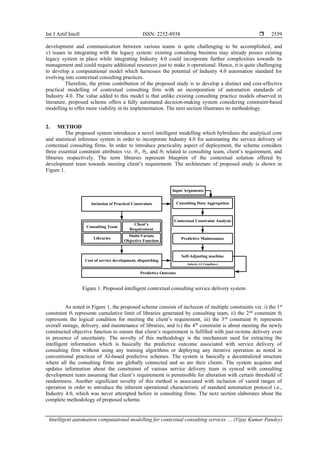
development team towards meeting client’s requirement. The architecture of proposed study is shown in
Figure 1.
Figure 1. Proposed intelligent contextual consulting service delivery system
As noted in Figure 1, the proposed scheme consists of inclusion of multiple constraints viz. i) the 1st
constraint θ1 represents cumulative limit of libraries generated by consulting team, ii) the 2nd
constraint θ2
represents the logical condition for meeting the client’s requirement, iii) the 3rd
constraint θ3 represents
overall storage, delivery, and maintenance of libraries, and iv) the 4th
constraint is about meeting the newly
constructed objective function to ensure that client’s requirement is fulfilled with just-in-time delivery even
in presence of uncertainty. The novelty of this methodology is the mechanism used for extracting the
intelligent information which is basically the predictive outcome associated with service delivery of
consulting firm without using any training algorithms or deploying any iterative operation as noted in
conventional practices of AI-based predictive schemes. The system is basically a decentralized structure
where all the consulting firms are globally connected and so are their clients. The system acquires and
updates information about the constrainst of various service delivery team in synced with consulting
development team assuming that client’s requirememt is permissible for alteration with certain threshold of
randomness. Another significant novelty of this method is associated with inclusion of varied ranges of
operation in order to introduce the inherent operational characteristic of standard automation protocol i.e.,
Industry 4.0, which was never attempted before in consulting firms. The next section elaborates about the
complete methodology of proposed scheme.
Industry 4.0 Compliance
Consulting Data Aggregation
Contextual Constraint Analysis
Predictive Maintenance
Self-Adjusting machine
Predictive Outcome
Inclusion of Practical Constraints
Consulting Team
Client’s
Requirement
Libraries
Multi-Variate
Objective Function
Cost of service development, dispatching
Input Arguments
 ISSN: 2252-8938
Int J Artif Intell, Vol. 13, No. 3, September 2024: 2557-2565
2560
2.1. Implementation strategy
The prime agenda of the proposed framework is to perform a preemptive analysis of the client’s
requirement considering the fact that the entire system consists of core units i.e., consulting team, client
requirement, and libraries. A novel mechanism of AI-based automation scheme has been implemented in the
study which is unconventionally different than any existing approaches ever reported, the implementation
strategy is initiated by considering some of the practical constraints: i) the pattern of the fluctuation of
client’s requirement is exponentially stochastic in nature. Such pattern fluctuation depends upon various
intrinsic and extrinsic attributes when associated with specific business of consulting firm. It will mean
stochastic variable of client’s requirement is a dependent attribute towards consulting team and libraries.
ii) for a large scale and distributed consulting firm, it is essential to localize the selected consulting team and
precise library that are required to be highly flexible in case of dynamic user’s requirement. The system is
required to be properly synced with the requirements and delivery agenda of the business enterprise in
adherence of Industry 4.0 standards. According to the highlights of the constraints, it is now clear that client’s
requirement is one of the most challenging aspects of the proposed system modelling. Apart from this, it can
be also noted that there is a strong linkage among all the three attributes. The proposed scheme deploys a
linear optimization method in order to induce the automation process towards the contextual consulting
practices. Another essential consideration of design principle is towards considering the selection of
distributed consulting team of same consulting firm as well as its libraries along with diverse selection of
front-end unit where the client’s requirement could be catered up. The complete modelling is carried out
considering the possible situation of distributed operation linked with the consulting team in associated with
the libraries. Apart from this, the model also considers multiple state of constraints connected with number of
consulting team that are demanded to fulfil the client’s requirement on varied location.
2.2. Algorithm modelling
This section presents discussion of the proposed intelligent algorithm towards automating the
contextual consulting practices. The core agenda of this algorithm is to develop a novel AI-based scheme
which bears a completely different charecteristics mainly associated with reduced dependencies on trained
data, higher predictive accuracy, and non-iterative operation. The algorithm mainly assists towards
just-in-time delivery of the libraries to meet the client’s requirement. The essential steps of algorithmic
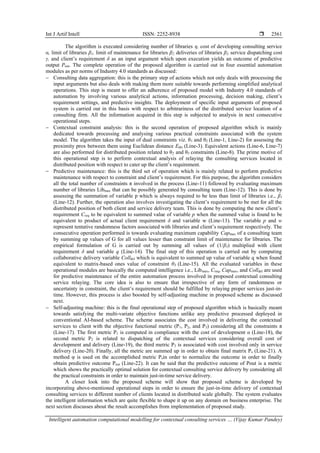
operation are shown as follows.
Algorithm for intelligently automating contextial consulting services
Input: η, α, β1, β2, β3, γ, δ
Output: Pout
Start
1. For i=1: θ1
2. For j=1: θ2
3. prox(θ1 θ2)→Edis(i, j)
4. End
5. End
6. For i=1: θ3
7. For j=1: θ2
8.prox(θ3, θ2)→Edis[((θ1, θ2)i,j
]
9. End
10. End
11. For i=1:π
12.Libmax→sum(p)<β1
13.Creq→(sum(p)~(δ.w))
14.Capmax→sum(G<θ2)
15.Colldel→sum(q)==one(θ3)
16. End
17. For i=1:π
18.P1→sum(p).α
19.P2→ α.ρ
20.P3→sum[δ. α.sum(ρ).w]
21.Ps→sum(P1, P2, P3, P4)
22.Pout→φ(Ps)
23. End
End
Int J Artif Intell ISSN: 2252-8938 
Intelligent automation computational modelling for contextual consulting services … (Vijay Kumar Pandey)
2561
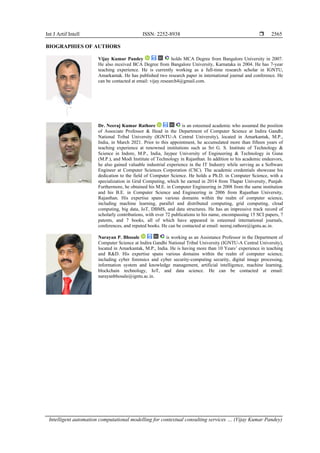
The algorithm is executed considering number of libraries η, cost of developing consulting service
α, limit of libraries β1, limit of maintenance for libraries β2, deliveries of libraries β3, service dispatching cost
γ, and client’s requirement δ as an input argument which upon execution yields an outcome of predictive
output Pout. The complete operation of the proposed algorithm is carried out in four essential automation
modules as per norms of Industry 4.0 standards as discussed:
− Consulting data aggregation: this is the primary step of actions which not only deals with processing the
input arguments but also deals with making them more suitable towards performing simplified analytical
operations. This step is meant to offer an adherence of proposed model with Industry 4.0 standards of
automation by involving various analytical actions, information processing, decision making, client’s
requirement settings, and predictive insights. The deployment of specific input arguments of proposed
system is carried out in this basis with respect to arbitrariness of the distributed service location of a
consulting firm. All the information acquired in this step is subjected to analysis in next consecutive
operational steps.
− Contextual constraint analysis: this is the second operation of proposed algorithm which is mainly
dedicated towards processing and analysing various practical constraints associated with the system
model. The algorithm takes the input of dual constraints viz. θ1 and θ2 (Line-1, Line-2) for assessing the
proximity prox between them using Euclidean distance Edis (Line-3). Equivalent actions (Line-6, Line-7)
are also performed for distributed position related to θ2 and θ3 constraints (Line-8). The prime motive of
this operational step is to perform contextual analysis of relaying the consulting services located in
distributed position with respect to cater up the client’s requirement.
− Predictive maintenance: this is the third set of operation which is mainly related to perform predictive
maintenance with respect to constraint and client’s requirement. For this purpose, the algorithm considers
all the total number of constraints π involved in the process (Line-11) followed by evaluating maximum
number of libraries Libmax that can be possibly generated by consulting team (Line-12). This is done by
assessing the summation of variable p which is always required to be less than limit of libraries i.e., β1
(Line-12). Further, the operation also involves investigating the client’s requirement to be met for all the
distributed position of both client and service delivery team. This is done by computing the new client’s
requirement Creq to be equivalent to summed value of variable p when the summed value is found to be
equivalent to product of actual client requirement δ and variable w (Line-13). The variable p and w
represent tentative randomness factors associated with libraries and client’s requirement respectively. The
consecutive operation performed is towards evaluating maximum capability Capmax of a consulting team
by summing up values of G for all values lesser than constraint limit of maintenance for libraries. The
empirical formulation of G is carried out by summing all values of (1/β3) multiplied with client
requirement δ and variable q (Line-14). The final step of this operation is carried out by computing
collaborative delivery variable Colldel which is equivalent to summed up value of variable q when found
equivalent to matrix-based ones value of constraint θ3 (Line-15). All the evaluated variables in these
operational modules are basically the computed intelligence i.e., Libmax, Creq, Capmax, and Colldel are used
for predictive maintenance of the entire automation process involved in proposed contextual consulting
service relaying. The core idea is also to ensure that irrespective of any form of randomness or
uncertainty in constraint, the client’s requirement should be fulfilled by relaying proper services just-in-
time. However, this process is also boosted by self-adjusting machine in proposed scheme as discussed
next.
− Self-adjusting machine: this is the final operational step of proposed algorithm which is basically meant
towards satisfying the multi-variate objective functions unlike any predictive processed deployed in
conventional AI-based scheme. The scheme associates the cost involved in delivering the contextual
services to client with the objective functional metric (P1, P2, and P3) considering all the constraints π
(Line-17). The first metric P1 is computed in compliance with the cost of development α (Line-18), the
second metric P2 is related to dispatching of the contextual services considering overall cost of
development and delivery (Line-19), the third metric P3 is associated with cost involved only in service
delivery (Line-20). Finally, all the metric are summed up in order to obtain final matrix Ps (Line-21). A
method φ is used on the accomplished metric Psin order to normalize the outcome in order to finally
obtain predictive outcome Pout (Line-22). It can be said that the predictive outcome of Pout is a metric
which shows the practically optimal solution for contextual consulting service delivery by considering all
the practical constraints in order to maintain just-in-time service delivery.
A closer look into the proposed scheme will show that proposed scheme is developed by
incorporating above-mentioned operational steps in order to ensure the just-in-time delivery of contextual
consulting services to different number of clients located in distributed scale globally. The system evaluates
the intelligent information which are quite flexible to shape it up on any domain on business enterprise. The
next section discusses about the result accomplishes from implementation of proposed study.
 ISSN: 2252-8938
Int J Artif Intell, Vol. 13, No. 3, September 2024: 2557-2565
2562
3. RESULTS
The implementation of the proposed study model is carried out considering Kaggle dataset
associated with the survey of consulting firm [40]. The dataset consists of a smaller number of fields
(field=19) that is synthetically increased to 10 thousand fields. Apart from this, the dataset is further
augmented by including a new column associated with locations of consulting team as well as user’s
locations too. The study modelling considers its fine-tuning parameter (range:15-25), where the initialization
of the constraints is carried out using probability values for better applicability of proposed model in global
business domain. The initialized values are θ1=0.05, θ2=0.05, and θ3=1 which are carried out on the basis of
p-significance value in inferential statistics. The assessment model also considers the presence of 30 number
of libraries to be developed by the consulting firm that are also utilized for assessing the cost involved in the
service delivery process. The assessment is carried out with respect to multiple standard performance
parameters as discussed below.
3.1. Comparative assessment of model
The comparative assessment of proposed study model is carried out considering the work done in
[17], [24] with respect to cost reduction and service delivery time. The existing models are subjected to
similar test-bed where only the core algorithmic segment of existing model has been implemented. The mean
of values for performance metric for existings scheme. Exist is chosen to be compared with proposed scheme
ProP. The analytical outcome shown in Figure 2. The Figure 2(a) highlights that proposed scheme offers
approximately 20% of more cost reduction compared to the existing system. The prime reason behind this is
proposed scheme offers a highly integrated scheme where a better collaborative approach is applied on every
consulting team with proper maintenance of their libraries in compliance for meeting the client’s requirement
in presence of uncertainty/randomness associated with it. This phenomenon reduces the increasing effort and
resources towards processing the client’s requirement leading to decreased cost. Whereas the existing scheme
involves increasing number of efforts towards service delivery leading to increasing operational and service
delivery cost. The outcome exhibited in Figure 2(b) showcase that proposed scheme offers approximately
89% of reduced service delivery time in contrast to existing models.
(a) (b)
Figure 2. Analytical outcomes of (a) cost reduction and (b) service delivery time
The prime rational behind this outcome is that existing model carry out multiple steps of operation
in order to confirm their optimal decision by ignoring the uncertainty attributes associated with it. Therefore,
when this model is exposed to current test-environment where it encounters uncertainty and randomness, the
existing model was seen to consume maximum operational time just to find the optimal point of deliverying
the services. However, proposed system excels better mainly due to its inclusion of multi-variate objective
function where the intelligent information was already extracted by development team. The development
teams are facilitated with faster accessibility to all dynamic information associated with capacity of libraries
where the part of the libraries was designed based on direct input of client’s requirement while a segment of
it is developed also considering the possibility of dynamicity in the client’s requirement. Hence, faster
service delivery time is offered by proposed scheme.
Int J Artif Intell ISSN: 2252-8938 
Intelligent automation computational modelling for contextual consulting services … (Vijay Kumar Pandey)
2563
3.2. Benchmarked assessment of model
The comparative evaluation of proposed scheme with state-of-art method has been carried out
considering four performance metrics viz. i) cycle time reduction: this metric is computed by measuring the
duration involved to complete a consulting process before and after introducing Industry 4.0. ii) resource
utilization: the study considers abstractive attributes e.g., human and technology as resources with a defined
task to be completed in target time. This term computes the abstractive quantity of resources required to
complete the task in defined time. iii) data accuracy: this metric assesses the accuracy of data deployed in
decision making. iv) cost reduction: this metric computes the operational cost deployed for decision making
right from development to dispatching of contextual solution. Table 1 highlights the outcome which is based
on observing the performance of distinct models of both proposed and state-of-art methods in similar test
environment discussed in prior section.
Table 1. State-of-art method comparison
Approaches Cycle time reduction Resource utilization Data accuracy Cost reduction
Elizondo and Reyes [16] Low High Medium Low
Foley et al. [17] Low High Medium Low
Gajdzik and Wolniak [18] Medium Medium Medium Medium
Godina et al. [19] Low Low Medium Low
Habraken and Bondarouk [20] Medium Medium Low Low
Madsen and Slåtten [21] Low High Low Low
Rosin et al. [22] Low High Medium Low
Serey et al. [23] Medium Medium Low Low
Proposed High Low High High
Table 1 highlights the prime distinction in the proposed study model with state-of-art where it can
be noted that proposed study model offers significantly better performance in every stated performance
metric. The prime reason behind this outcome is that existing state-of-art are mainly found to develop a
use-case specific model where the defined solution is less practical when exposed to a dynamic events or
uncertainty. However, with a comprehensive multiple constraint-based modelling, proposed scheme offers
more flexibility not only in identifying various loopholes but also to determine an optimal way to dispatch
the generated solution to distributed clients.
4. CONCLUSION
This prime contribution stated in proposed study model are i) faster and efficient processing the
contextual solution with effective operational planning for both development team and clients, ii) derivation
of linear constraints from practical consulting cases in order to facilitate model reliability, and iii) adoption of
multi-objective principle of optimization which can bridge the gap between consulting demands and service
dispatching with just-in-time delivery. The future work of proposed study model will be further enhanced to
incorporate a greater number of complexities associated with internal processing of demands of clients with
exclusive emphasis towards more faster dispatching mechanism in distributed way. The notion is to offer
more faster and seamless consulting services with least development team and more client base.
REFERENCES
[1] E. L. Crișan and A. Marincean, “The digital transformation of management consulting companies: a review,” Information Systems
and e-Business Management, vol. 21, no. 2, pp. 415–436, 2023, doi: 10.1007/s10257-023-00624-4.
[2] A. Fleischmann, S. Oppl, W. Schmidt, and C. Stary, Contextual process digitalization, Cham: Springer 2020, doi: 10.1007/978-3-
030-38300-8.
[3] N. Alahmari, R. Mehmood, A. Alzahrani, T. Yigitcanlar, and J. M. Corchado, “Autonomous and sustainable service economies:
data-driven optimization of design and operations through discovery of multi-perspective parameters,” Sustainability, vol. 15, no.
22, 2023, doi: 10.3390/su152216003.
[4] D. T. Phuc, D. V. Nghiem, B. B. Minh, T. M. Linh, and D. S. Hieu, “Apply deep learning to improve the question analysis model
in the Vietnamese question answering system,” International Journal of Electrical and Computer Engineering, vol. 13, no. 3, pp.
3311–3321, 2023, doi: 10.11591/ijece.v13i3.pp3311-3321.
[5] N. K. Chowdaiah and A. Dammur, “Resource-efficient workload task scheduling for cloud-assisted internet of things
environment,” International Journal of Electrical and Computer Engineering, vol. 13, no. 5, pp. 5898–5907, 2023, doi:
10.11591/ijece.v13i5.pp5898-5907.
[6] A. T. Järvenpää, A. Pavlik, and T. K. Gustavsson, “Contextual communicative competence in multinational infrastructure
projects,” Buildings, vol. 11, no. 9, 2021, doi: 10.3390/buildings11090403.
[7] N. Nurdin, S. S. Pettalongi, M. N. Ahsan, and V. Febrianti, “Factors affecting students’ continuance intention to use teaching
performance assessment application from technology continuance theory,” International Journal of Electrical and Computer
Engineering, vol. 13, no. 5, pp. 5342–5353, 2023, doi: 10.11591/ijece.v13i5.pp5342-5353.
 ISSN: 2252-8938
Int J Artif Intell, Vol. 13, No. 3, September 2024: 2557-2565
2564
[8] O. C. -Franco, M. C. -Franco, and W. C. -Franco, “Barriers to innovations and innovative performance of companies: a study
from Ecuador,” Social Sciences, vol. 11, no. 2, 2022, doi: 10.3390/socsci11020063.
[9] P. Shao, R. Tan, Q. Peng, L. Zhang, K. Wang, and Y. Dong, “Problem-solving in product innovation based on the cynefin
framework-aided TRIZ,” Applied Sciences, vol. 12, no. 9, 2022, doi: 10.3390/app12094157.
[10] C. Coombs, D. Hislop, S. K. Taneva, and S. Barnard, “The strategic impacts of intelligent automation for knowledge and service
work: an interdisciplinary review,” Journal of Strategic Information Systems, vol. 29, no. 4, 2020, doi:
10.1016/j.jsis.2020.101600.
[11] J. P. Deranty and T. Corbin, “Artificial intelligence and work: a critical review of recent research from the social sciences,” AI
and Society, vol. 39, 2022, doi: 10.1007/s00146-022-01496-x.
[12] T. Davenport, A. Guha, D. Grewal, and T. Bressgott, “How artificial intelligence will change the future of marketing,” Journal of
the Academy of Marketing Science, vol. 48, no. 1, pp. 24–42, 2020, doi: 10.1007/s11747-019-00696-0.
[13] A. R. Santhi and P. Muthuswamy, “Industry 5.0 or industry 4.0S? Introduction to industry 4.0 and a peek into the prospective
industry 5.0 technologies,” International Journal on Interactive Design and Manufacturing, vol. 17, no. 2, pp. 947–979, 2023,
doi: 10.1007/s12008-023-01217-8.
[14] M. Elnadi and Y. O. Abdallah, “Industry 4.0: critical investigations and synthesis of key findings,” Management Review
Quarterly, vol. 74, 2023, doi: 10.1007/s11301-022-00314-4.
[15] O. A. Alghamdi and G. Agag, “Boosting innovation performance through big data analytics powered by artificial intelligence use:
an empirical exploration of the role of strategic agility and market turbulence,” Sustainability, vol. 15, no. 19, 2023, doi:
10.3390/su151914296.
[16] B. L. T. -Elizondo and H. G. -Reyes, “An employee competency development maturity model for industry 4.0 Adoption,”
Sustainability, vol. 15, no. 14, 2023, doi: 10.3390/su151411371.
[17] I. Foley, O. McDermott, A. Rosa, and M. Kharub, “Implementation of a lean 4.0 project to reduce non-value add waste in a
medical device company,” Machines, vol. 10, no. 12, 2022, doi: 10.3390/machines10121119.
[18] B. Gajdzik and R. Wolniak, “Influence of Industry 4.0 projects on business operations: literature and empirical pilot studies based
on case studies in Poland,” Journal of Open Innovation: Technology, Market, and Complexity, vol. 8, no. 1, 2022, doi:
10.3390/joitmc8010044.
[19] R. Godina, I. Ribeiro, F. Matos, B. T. Ferreira, H. Carvalho, and P. Peças, “Impact assessment of additive manufacturing on
sustainable business models in industry 4.0 context,” Sustainability, vol. 12, no. 17, 2020, doi: 10.3390/su12177066.
[20] M. Habraken and T. Bondarouk, “Embracing variety in decision-making regarding adoption of industry 4.0,” Administrative
Sciences, vol. 10, no. 2, 2020, doi: 10.3390/admsci10020030.
[21] D. Ø. Madsen and K. Slåtten, “Comparing the evolutionary trajectories of industry 4.0 and 5.0: a management fashion
perspective,” Applied System Innovation, vol. 6, no. 2, 2023, doi: 10.3390/asi6020048.
[22] F. Rosin, P. Forget, S. Lamouri, and R. Pellerin, “Enhancing the decision-making process through industry 4.0 technologies,”
Sustainability, vol. 14, no. 1, 2022, doi: 10.3390/su14010461.
[23] J. Serey et al., “Framework for the strategic adoption of industry 4.0: a focus on intelligent systems,” Processes, vol. 11, no. 10,
2023, doi: 10.3390/pr11102973.
[24] H. Sun, W. Ni, and L. Huang, “Fuzzy assessment of management consulting projects: model validation and case studies,”
Mathematics, vol. 11, no. 20, 2023, doi: 10.3390/math11204381.
[25] A. Z. Ahmed and M. R. Díaz, “A methodology for machine-learning content analysis to define the key labels in the titles of online
customer reviews with the rating evaluation,” Sustainability, vol. 14, no. 15, 2022, doi: 10.3390/su14159183.
[26] D. Bauer, T. Bauernhansl, and A. Sauer, “Improvement of delivery reliability by an intelligent control loop between supply
network and manufacturing,” Applied Sciences, vol. 11, no. 5, pp. 1–22, 2021, doi: 10.3390/app11052205.
[27] W. Cho, S. Choi, and H. Choi, “Human resources analytics for public personnel management: concepts, cases, and caveats,”
Administrative Sciences, vol. 13, no. 2, 2023, doi: 10.3390/admsci13020041.
[28] D. R. S. Dewi, Y. B. Hermanto, E. Tait, and M. E. Sianto, “The product–service system supply chain capabilities and their impact
on sustainability performance: a dynamic capabilities approach,” Sustainability, vol. 15, no. 2, 2023, doi: 10.3390/su15021148.
[29] P. Evangelista, A. Kianto, H. Hussinki, M. Vanhala, and A. M. Nisula, “Knowledge-based human resource management, logistics
capability, and organizational performance in small finnish logistics service providers,” Logistics, vol. 7, no. 1, 2023, doi:
10.3390/logistics7010012.
[30] J. M. Cadenas, M. C. Garrido, and R. M. -España, “A methodology based on machine learning and soft computing to design more
sustainable agriculture systems,” Sensors, vol. 23, no. 6, 2023, doi: 10.3390/s23063038.
[31] H. İnaç, Y. E. Ayözen, A. Atalan, and C. Ç. Dönmez, “Estimation of postal service delivery time and energy cost with e-scooter
by machine learning algorithms,” Applied Sciences, vol. 12, no. 23, 2022, doi: 10.3390/app122312266.
[32] N. Kulaç and M. Engin, “Developing a machine learning algorithm for service robots in industrial applications,” Machines, vol.
11, no. 4, 2023, doi: 10.3390/machines11040421.
[33] J. Oršič, B. Jereb, and M. Obrecht, “Sustainable operations of last mile logistics based on machine learning processes,” Processes,
vol. 10, no. 12, 2022, doi: 10.3390/pr10122524.
[34] A. K. Rad et al., “Machine learning for determining interactions between air pollutants and environmental parameters in three
cities of Iran,” Sustainability, vol. 14, no. 13, 2022, doi: 10.3390/su14138027.
[35] R. Sala, F. Pirola, G. Pezzotta, and S. Cavalieri, “Data-driven decision making in maintenance service delivery process: a case
study,” Applied Sciences, vol. 12, no. 15, 2022, doi: 10.3390/app12157395.
[36] S. Sankhye and G. Hu, “Machine learning methods for quality prediction in production,” Logistics, vol. 4, no. 4, 2020, doi:
10.3390/logistics4040035.
[37] T. Sato, H. Takeuchi, S. Kondoh, and Y. Umeda, “Analyzing consultancy on production systems based on the digital triplet
concept,” Machines, vol. 11, no. 7, 2023, doi: 10.3390/machines11070706.
[38] A. M. -Villamizar, E. L. S. -Charris, L. R. -Rubiano, and J. Faulin, “Measuring disruptions in last-mile delivery operations,”
Logistics, vol. 5, no. 1, 2021, doi: 10.3390/logistics5010017.
[39] A. Xu, M. Darbandi, D. Javaheri, N. J. Navimipour, S. Yalcin, and A. A. Salameh, “The management of IoT-based organizational
and industrial digitalization using machine learning methods,” Sustainability, vol. 15, no. 7, 2023, doi: 10.3390/su15075932.
[40] X. Meng, S. Li, M. M. Malik, and Q. Umer, “Machine-learning-based suitability prediction for mobile applications for kids,”
Sustainability, vol. 14, no. 19, 2022, doi: 10.3390/su141912400.
Int J Artif Intell ISSN: 2252-8938 
Intelligent automation computational modelling for contextual consulting services … (Vijay Kumar Pandey)
2565
BIOGRAPHIES OF AUTHORS
Vijay Kumar Pandey holds MCA Degree from Bangalore University in 2007.
He also received BCA Degree from Bangalore University, Karnataka in 2004. He has 7-year
teaching experience. He is currently working as a full-time research scholar in IGNTU,
Amarkantak. He has published two research paper in international journal and conference. He
can be contacted at email: vijay.research4@gmail.com.
Dr. Neeraj Kumar Rathore is an esteemed academic who assumed the position
of Associate Professor & Head in the Department of Computer Science at Indira Gandhi
National Tribal University (IGNTU-A Central University), located in Amarkantak, M.P.,
India, in March 2021. Prior to this appointment, he accumulated more than fifteen years of
teaching experience at renowned institutions such as Sri G. S. Institute of Technology &
Science in Indore, M.P., India, Jaypee University of Engineering & Technology in Guna
(M.P.), and Modi Institute of Technology in Rajasthan. In addition to his academic endeavors,
he also gained valuable industrial experience in the IT Industry while serving as a Software
Engineer at Computer Sciences Corporation (CSC). The academic credentials showcase his
dedication to the field of Computer Science. He holds a Ph.D. in Computer Science, with a
specialization in Grid Computing, which he earned in 2014 from Thapar University, Punjab.
Furthermore, he obtained his M.E. in Computer Engineering in 2008 from the same institution
and his B.E. in Computer Science and Engineering in 2006 from Rajasthan University,
Rajasthan. His expertise spans various domains within the realm of computer science,
including machine learning, parallel and distributed computing, grid computing, cloud
computing, big data, IoT, DBMS, and data structures. He has an impressive track record of
scholarly contributions, with over 72 publications to his name, encompassing 15 SCI papers, 7
patents, and 7 books, all of which have appeared in esteemed international journals,
conferences, and reputed books. He can be contacted at email: neeraj.rathore@igntu.ac.in.
Narayan P. Bhosale is working as an Assistance Professor in the Department of
Computer Science at Indira Gandhi National Tribal University (IGNTU-A Central University),
located in Amarkantak, M.P., India. He is having more than 10 Years’ experience in teaching
and R&D. His expertise spans various domains within the realm of computer science,
including cyber forensics and cyber security-computing security, digital image processing,
information system and knowledge management, artificial intelligence, machine learning,
blockchain technology, IoT, and data science. He can be contacted at email:
narayanbhosale@igntu.ac.in.

Intelligent automation computational modelling for contextual consulting services using Industry 4.0

  • 1.
    IAES International Journalof Artificial Intelligence (IJ-AI) Vol. 13, No. 3, September 2024, pp. 2557~2565 ISSN: 2252-8938, DOI: 10.11591/ijai.v13.i3.pp2557-2565  2557 Journal homepage: http://ijai.iaescore.com Intelligent automation computational modelling for contextual consulting services using Industry 4.0 Vijay Kumar Pandey, Neeraj Kumar Rathore, Narayan P. Bhosale Department of Computer Science, Indira Gandhi National Tribal University, Amarkantak, India Article Info ABSTRACT Article history: Received Nov 28, 2023 Revised Feb 6, 2024 Accepted Feb 16, 2024 The methodology towards operational management and service delivery associated with consulting firms, irrespective of any business domain, are less revisited in perspective from the automation-based process management. Adoption of Industry 4.0 has been attempted by various researchers from the business process management; however, there are less evidence of any computational model towards it. Apart from this, existing models are accompanied by various loopholes which makes its further challenging to analyze it on practical environment. Hence, the proposed study introduces a novel computational and analytical framework which is capable of performing the predictive modelling in order to meet the contextual service development and delivery demands in distributed environment. The novelty of this model is its inclusion of contextual data aggregation, contextual constraint analysis, predictive maintenence, and self-adjusting machine which are core attributes of Industry 4.0 automation standards. The study outcome shows that proposed system offers 20% cost reduction and 89% of minimized service delivery time in contrast to existing related work. Same has been also observed in benchmarked outcomes with state-of-art models. Keywords: Automation Contextual consulting Cost Distributed environment Industry 4.0 Service delivery This is an open access article under the CC BY-SA license. Corresponding Author: Vijay Kumar Pandey Department of Computer Science, Indira Gandhi National Tribal University Amarkantak, Madhya Pradesh 484887, India Email: vijay.research4@gmail.com 1. INTRODUCTION The term contextual consulting states a mechanism of a consulting approach that considers typical circumstances of an organization or clients, environment, and particular context [1]. It essentially focuses towards understanding the significance of dynamics, opportunities, and unique challenges associated with a particular situation of a business prior to offering the solution and advice [2]. In this process, various in-depth information associated with internal processes, market condition, industry, and the organization of the clients are worked more closely by the business consultants. The mechanism doesn’t only offer an importance to the quantitative data but also it offers an importance to the employee dynamics, leadership style, and organization culture. Some of the key elements associated with the contextual consulting are in-depth analysis, customization, collaboration, flexibility, holistic approach, cultural sensitivity [3]. However, from the contextual of data analysis and decision making, there are various challenges. The primary challenges are associated with the complexity of the context where right from oversimplification to all the associated factors towards understanding and analyzing is highly computationally and logically challenging [4]. The second challenge is associated with the dynamic environment as context are not static and they eventually evolve over time [5]. The third challenge is associated with the subjectivity and bias where the solution could possibly be biased over certain perspective put forward by the consultants and may not appropriately
  • 2.
     ISSN: 2252-8938 IntJ Artif Intell, Vol. 13, No. 3, September 2024: 2557-2565 2558 represent the complete context [6]. The fourth challenge is associated with the effective communication between the client and service provider along with the development team leading to lack of understanding [7]. It is also noted that consultants would be likely be more rely on prior implementation strategies that could be also less accounted for the alteration in the current context or the demand for innovative solution; hence over emphasis on past success is fifth challenge in contextual consulting practice [8]. Finally, the sixth challenge is associated with balancing the qualitative attributes with the quantitative attributes towards decision making. The existing methods of contextual consulting varies from one to another organization where some of the standard models in practice are appreciative inquiry, soft system methodology, cultural intelligence framework, cynefin framework, agile consulting, scenario planning, and design thinking [9]. It is also noted that automation is increasing playing a significant role in transforming conventional consulting with an agenda to improve upon the efficiency [10]. The methods by which automation are being included in consulting practices are via data analysis and reporting, market research, process automation, client relationship management, workflow automation, proposal generation, artificial intelligence (AI)-based insights, virtual assistance, cybersecurity consulting, and training and development [11], [12]. In this context, Industry 4.0 is making its way towards contributing the incorporation of automation standards in consulting practices [13]. The Fourth Industrial Revolution, Industry 4.0, represents the integration of automation, data, and technologies in industrial and manufacturing processes. The prime beneficial perspective of Industry 4.0 is increased efficiency, enhanced productivity, cost reduction, improved quality, flexibility in production, supply chain optimization, innovation and customization, enhanced sustainability, improved workplace safety, empowered decision making, and novel business models [14]. However, developing a proper automation-based approaches for contextual consulting practices is not simple as existing Industry 4.0 is mainly focused on industrial practices and manufacturing units. Its principle is not made for non-manufacturing units, although, there is a fair possibility of utilizing this strategy to harness in any business demands. Adoption of automation standard has been witnessed in couple of existing related work. Alghamdi and Agag [15] have used AI-based big data scheme towards analyzing the market changes. Elizondo and Reyes [16] have used Industry 4.0 principle in developing a competency maturity model for an employee using delphi method. Adoption of Industry 4.0 using lean principle is witnessed in work of Foley et al. [17] to enhance the workflow operation and reduce waste. Gajdzik and Wolniak [18] have studied the impact of standard automation towards business operations. Similar form of study was also carried out by Godina et al. [19] towards evaluating models of sustainable business process. Habraken and Bondarouk [20] have analyzed decision-making challenges associated with an adoption of Industry 4.0 standard. Considering a unique case study of fashion industry, Madsen and Slåtten [21] have developed a study framework towards assessing significance of 4.0 and 5.0 industry standard. Rosin et al. [22] have presented a decision-making computational model towards improving the performance of cyber-physical system. An intelligent system is designed by Serey et al. [23] have where a model is designed using Industry 4.0 standard towards facilitating strategic planning in the business models. Further, Sun et al. [24] have developed an evaluation platform for consulting projects using fuzzy logic. Apart from this, there are various other studies where various forms of decision-making models have been evolved towards assisting the consulting firm indirectly for an effective decision making viz. learning-based analysis of content [25], modelling dispatching reliability [26], personnel management using analytics [27], analyzing sustainability capability in dynamic environment [28], knowledge-based human resource management [29], sustainable system using machine learning [30]–[34], decision making using data-driven methods [35], predictive methods in production [36], productivity analysis [37], dispatching management [38], and learning-based digitization management [39]. However, there are different forms of research-based challenges associated with the related work methodologies linking to its adopting in consulting practices. The identified research problems in this regard are as follows; i) scalability issues: the consulting firm is required to ensure that their automation consulting solutions are highly scalable and can accommodate the maximized complexities and workloads. This is quite a challenging task owing to highly interconnected attributes right from development of contextual solution and dispatching them to the clients, ii) consistent maintenance and monitoring: developing a computational solution towards contextual consulting demands ongoing monitoring of all the modules involved in solution in order to ensure an optimal performance. Although predictive approach can do this task quite fruitfully, but likelihood of inclusion of new set of dynamics are more to be ignored in this process, iii) change management: the business processes incorporating Industry 4.0 is demands to include organizational change for effective predictive solution. However, this is quite challenging for outsourcing consulting firms with distributed task management included in them, iv) interoperability issues: accomplishing interoperability among varied number of heterogeneous system and technology is quite challenging to be accomplished. Multiple vendors can adopt multiple standards while offering a seamless interactivity platform towards
  • 3.
    Int J ArtifIntell ISSN: 2252-8938  Intelligent automation computational modelling for contextual consulting services … (Vijay Kumar Pandey) 2559 development and communication between various teams is quite challenging to be accomplished, and v) issues in integrating with the legacy system: existing consulting business may already posses existing legacy system in place while integrating Industry 4.0 could incorporate further complexities towards its management and could require additional resources just to make it operational. Hence, it is quite challenging to develop a computational model which harnesses the potential of Industry 4.0 automation standard for evolving into contextual consulting practices. Therefore, the prime contribution of the proposed study is to develop a distinct and cost-effective practical modelling of contextual consulting firm with an incorporation of automation standards of Industry 4.0. The value added to this model is that unlike existing consulting practice models observed in literature, proposed scheme offers a fully automated decision-making system considering constraint-based modelling to offer more viability in its implementation. The next section illustrates its methodology. 2. METHOD The proposed system introduces a novel intelligent modelling which hybridizes the analytical core and statistical inference system in order to incorporate Industry 4.0 for automating the service delivery of contextual consulting firms. In order to introduce practicality aspect of deployment, the scheme considers three essential constraint attributes viz. θ1, θ2, and θ3 related to consulting team, client’s requirement, and libraries respectively. The term libraries represent blueprint of the contextual solution offered by development team towards meeting client’s requirement. The architecture of proposed study is shown in Figure 1. Figure 1. Proposed intelligent contextual consulting service delivery system As noted in Figure 1, the proposed scheme consists of inclusion of multiple constraints viz. i) the 1st constraint θ1 represents cumulative limit of libraries generated by consulting team, ii) the 2nd constraint θ2 represents the logical condition for meeting the client’s requirement, iii) the 3rd constraint θ3 represents overall storage, delivery, and maintenance of libraries, and iv) the 4th constraint is about meeting the newly constructed objective function to ensure that client’s requirement is fulfilled with just-in-time delivery even in presence of uncertainty. The novelty of this methodology is the mechanism used for extracting the intelligent information which is basically the predictive outcome associated with service delivery of consulting firm without using any training algorithms or deploying any iterative operation as noted in conventional practices of AI-based predictive schemes. The system is basically a decentralized structure where all the consulting firms are globally connected and so are their clients. The system acquires and updates information about the constrainst of various service delivery team in synced with consulting development team assuming that client’s requirememt is permissible for alteration with certain threshold of randomness. Another significant novelty of this method is associated with inclusion of varied ranges of operation in order to introduce the inherent operational characteristic of standard automation protocol i.e., Industry 4.0, which was never attempted before in consulting firms. The next section elaborates about the complete methodology of proposed scheme. Industry 4.0 Compliance Consulting Data Aggregation Contextual Constraint Analysis Predictive Maintenance Self-Adjusting machine Predictive Outcome Inclusion of Practical Constraints Consulting Team Client’s Requirement Libraries Multi-Variate Objective Function Cost of service development, dispatching Input Arguments
  • 4.
     ISSN: 2252-8938 IntJ Artif Intell, Vol. 13, No. 3, September 2024: 2557-2565 2560 2.1. Implementation strategy The prime agenda of the proposed framework is to perform a preemptive analysis of the client’s requirement considering the fact that the entire system consists of core units i.e., consulting team, client requirement, and libraries. A novel mechanism of AI-based automation scheme has been implemented in the study which is unconventionally different than any existing approaches ever reported, the implementation strategy is initiated by considering some of the practical constraints: i) the pattern of the fluctuation of client’s requirement is exponentially stochastic in nature. Such pattern fluctuation depends upon various intrinsic and extrinsic attributes when associated with specific business of consulting firm. It will mean stochastic variable of client’s requirement is a dependent attribute towards consulting team and libraries. ii) for a large scale and distributed consulting firm, it is essential to localize the selected consulting team and precise library that are required to be highly flexible in case of dynamic user’s requirement. The system is required to be properly synced with the requirements and delivery agenda of the business enterprise in adherence of Industry 4.0 standards. According to the highlights of the constraints, it is now clear that client’s requirement is one of the most challenging aspects of the proposed system modelling. Apart from this, it can be also noted that there is a strong linkage among all the three attributes. The proposed scheme deploys a linear optimization method in order to induce the automation process towards the contextual consulting practices. Another essential consideration of design principle is towards considering the selection of distributed consulting team of same consulting firm as well as its libraries along with diverse selection of front-end unit where the client’s requirement could be catered up. The complete modelling is carried out considering the possible situation of distributed operation linked with the consulting team in associated with the libraries. Apart from this, the model also considers multiple state of constraints connected with number of consulting team that are demanded to fulfil the client’s requirement on varied location. 2.2. Algorithm modelling This section presents discussion of the proposed intelligent algorithm towards automating the contextual consulting practices. The core agenda of this algorithm is to develop a novel AI-based scheme which bears a completely different charecteristics mainly associated with reduced dependencies on trained data, higher predictive accuracy, and non-iterative operation. The algorithm mainly assists towards just-in-time delivery of the libraries to meet the client’s requirement. The essential steps of algorithmic operation are shown as follows. Algorithm for intelligently automating contextial consulting services Input: η, α, β1, β2, β3, γ, δ Output: Pout Start 1. For i=1: θ1 2. For j=1: θ2 3. prox(θ1 θ2)→Edis(i, j) 4. End 5. End 6. For i=1: θ3 7. For j=1: θ2 8.prox(θ3, θ2)→Edis[((θ1, θ2)i,j ] 9. End 10. End 11. For i=1:π 12.Libmax→sum(p)<β1 13.Creq→(sum(p)~(δ.w)) 14.Capmax→sum(G<θ2) 15.Colldel→sum(q)==one(θ3) 16. End 17. For i=1:π 18.P1→sum(p).α 19.P2→ α.ρ 20.P3→sum[δ. α.sum(ρ).w] 21.Ps→sum(P1, P2, P3, P4) 22.Pout→φ(Ps) 23. End End
  • 5.
    Int J ArtifIntell ISSN: 2252-8938  Intelligent automation computational modelling for contextual consulting services … (Vijay Kumar Pandey) 2561 The algorithm is executed considering number of libraries η, cost of developing consulting service α, limit of libraries β1, limit of maintenance for libraries β2, deliveries of libraries β3, service dispatching cost γ, and client’s requirement δ as an input argument which upon execution yields an outcome of predictive output Pout. The complete operation of the proposed algorithm is carried out in four essential automation modules as per norms of Industry 4.0 standards as discussed: − Consulting data aggregation: this is the primary step of actions which not only deals with processing the input arguments but also deals with making them more suitable towards performing simplified analytical operations. This step is meant to offer an adherence of proposed model with Industry 4.0 standards of automation by involving various analytical actions, information processing, decision making, client’s requirement settings, and predictive insights. The deployment of specific input arguments of proposed system is carried out in this basis with respect to arbitrariness of the distributed service location of a consulting firm. All the information acquired in this step is subjected to analysis in next consecutive operational steps. − Contextual constraint analysis: this is the second operation of proposed algorithm which is mainly dedicated towards processing and analysing various practical constraints associated with the system model. The algorithm takes the input of dual constraints viz. θ1 and θ2 (Line-1, Line-2) for assessing the proximity prox between them using Euclidean distance Edis (Line-3). Equivalent actions (Line-6, Line-7) are also performed for distributed position related to θ2 and θ3 constraints (Line-8). The prime motive of this operational step is to perform contextual analysis of relaying the consulting services located in distributed position with respect to cater up the client’s requirement. − Predictive maintenance: this is the third set of operation which is mainly related to perform predictive maintenance with respect to constraint and client’s requirement. For this purpose, the algorithm considers all the total number of constraints π involved in the process (Line-11) followed by evaluating maximum number of libraries Libmax that can be possibly generated by consulting team (Line-12). This is done by assessing the summation of variable p which is always required to be less than limit of libraries i.e., β1 (Line-12). Further, the operation also involves investigating the client’s requirement to be met for all the distributed position of both client and service delivery team. This is done by computing the new client’s requirement Creq to be equivalent to summed value of variable p when the summed value is found to be equivalent to product of actual client requirement δ and variable w (Line-13). The variable p and w represent tentative randomness factors associated with libraries and client’s requirement respectively. The consecutive operation performed is towards evaluating maximum capability Capmax of a consulting team by summing up values of G for all values lesser than constraint limit of maintenance for libraries. The empirical formulation of G is carried out by summing all values of (1/β3) multiplied with client requirement δ and variable q (Line-14). The final step of this operation is carried out by computing collaborative delivery variable Colldel which is equivalent to summed up value of variable q when found equivalent to matrix-based ones value of constraint θ3 (Line-15). All the evaluated variables in these operational modules are basically the computed intelligence i.e., Libmax, Creq, Capmax, and Colldel are used for predictive maintenance of the entire automation process involved in proposed contextual consulting service relaying. The core idea is also to ensure that irrespective of any form of randomness or uncertainty in constraint, the client’s requirement should be fulfilled by relaying proper services just-in- time. However, this process is also boosted by self-adjusting machine in proposed scheme as discussed next. − Self-adjusting machine: this is the final operational step of proposed algorithm which is basically meant towards satisfying the multi-variate objective functions unlike any predictive processed deployed in conventional AI-based scheme. The scheme associates the cost involved in delivering the contextual services to client with the objective functional metric (P1, P2, and P3) considering all the constraints π (Line-17). The first metric P1 is computed in compliance with the cost of development α (Line-18), the second metric P2 is related to dispatching of the contextual services considering overall cost of development and delivery (Line-19), the third metric P3 is associated with cost involved only in service delivery (Line-20). Finally, all the metric are summed up in order to obtain final matrix Ps (Line-21). A method φ is used on the accomplished metric Psin order to normalize the outcome in order to finally obtain predictive outcome Pout (Line-22). It can be said that the predictive outcome of Pout is a metric which shows the practically optimal solution for contextual consulting service delivery by considering all the practical constraints in order to maintain just-in-time service delivery. A closer look into the proposed scheme will show that proposed scheme is developed by incorporating above-mentioned operational steps in order to ensure the just-in-time delivery of contextual consulting services to different number of clients located in distributed scale globally. The system evaluates the intelligent information which are quite flexible to shape it up on any domain on business enterprise. The next section discusses about the result accomplishes from implementation of proposed study.
  • 6.
     ISSN: 2252-8938 IntJ Artif Intell, Vol. 13, No. 3, September 2024: 2557-2565 2562 3. RESULTS The implementation of the proposed study model is carried out considering Kaggle dataset associated with the survey of consulting firm [40]. The dataset consists of a smaller number of fields (field=19) that is synthetically increased to 10 thousand fields. Apart from this, the dataset is further augmented by including a new column associated with locations of consulting team as well as user’s locations too. The study modelling considers its fine-tuning parameter (range:15-25), where the initialization of the constraints is carried out using probability values for better applicability of proposed model in global business domain. The initialized values are θ1=0.05, θ2=0.05, and θ3=1 which are carried out on the basis of p-significance value in inferential statistics. The assessment model also considers the presence of 30 number of libraries to be developed by the consulting firm that are also utilized for assessing the cost involved in the service delivery process. The assessment is carried out with respect to multiple standard performance parameters as discussed below. 3.1. Comparative assessment of model The comparative assessment of proposed study model is carried out considering the work done in [17], [24] with respect to cost reduction and service delivery time. The existing models are subjected to similar test-bed where only the core algorithmic segment of existing model has been implemented. The mean of values for performance metric for existings scheme. Exist is chosen to be compared with proposed scheme ProP. The analytical outcome shown in Figure 2. The Figure 2(a) highlights that proposed scheme offers approximately 20% of more cost reduction compared to the existing system. The prime reason behind this is proposed scheme offers a highly integrated scheme where a better collaborative approach is applied on every consulting team with proper maintenance of their libraries in compliance for meeting the client’s requirement in presence of uncertainty/randomness associated with it. This phenomenon reduces the increasing effort and resources towards processing the client’s requirement leading to decreased cost. Whereas the existing scheme involves increasing number of efforts towards service delivery leading to increasing operational and service delivery cost. The outcome exhibited in Figure 2(b) showcase that proposed scheme offers approximately 89% of reduced service delivery time in contrast to existing models. (a) (b) Figure 2. Analytical outcomes of (a) cost reduction and (b) service delivery time The prime rational behind this outcome is that existing model carry out multiple steps of operation in order to confirm their optimal decision by ignoring the uncertainty attributes associated with it. Therefore, when this model is exposed to current test-environment where it encounters uncertainty and randomness, the existing model was seen to consume maximum operational time just to find the optimal point of deliverying the services. However, proposed system excels better mainly due to its inclusion of multi-variate objective function where the intelligent information was already extracted by development team. The development teams are facilitated with faster accessibility to all dynamic information associated with capacity of libraries where the part of the libraries was designed based on direct input of client’s requirement while a segment of it is developed also considering the possibility of dynamicity in the client’s requirement. Hence, faster service delivery time is offered by proposed scheme.
  • 7.
    Int J ArtifIntell ISSN: 2252-8938  Intelligent automation computational modelling for contextual consulting services … (Vijay Kumar Pandey) 2563 3.2. Benchmarked assessment of model The comparative evaluation of proposed scheme with state-of-art method has been carried out considering four performance metrics viz. i) cycle time reduction: this metric is computed by measuring the duration involved to complete a consulting process before and after introducing Industry 4.0. ii) resource utilization: the study considers abstractive attributes e.g., human and technology as resources with a defined task to be completed in target time. This term computes the abstractive quantity of resources required to complete the task in defined time. iii) data accuracy: this metric assesses the accuracy of data deployed in decision making. iv) cost reduction: this metric computes the operational cost deployed for decision making right from development to dispatching of contextual solution. Table 1 highlights the outcome which is based on observing the performance of distinct models of both proposed and state-of-art methods in similar test environment discussed in prior section. Table 1. State-of-art method comparison Approaches Cycle time reduction Resource utilization Data accuracy Cost reduction Elizondo and Reyes [16] Low High Medium Low Foley et al. [17] Low High Medium Low Gajdzik and Wolniak [18] Medium Medium Medium Medium Godina et al. [19] Low Low Medium Low Habraken and Bondarouk [20] Medium Medium Low Low Madsen and Slåtten [21] Low High Low Low Rosin et al. [22] Low High Medium Low Serey et al. [23] Medium Medium Low Low Proposed High Low High High Table 1 highlights the prime distinction in the proposed study model with state-of-art where it can be noted that proposed study model offers significantly better performance in every stated performance metric. The prime reason behind this outcome is that existing state-of-art are mainly found to develop a use-case specific model where the defined solution is less practical when exposed to a dynamic events or uncertainty. However, with a comprehensive multiple constraint-based modelling, proposed scheme offers more flexibility not only in identifying various loopholes but also to determine an optimal way to dispatch the generated solution to distributed clients. 4. CONCLUSION This prime contribution stated in proposed study model are i) faster and efficient processing the contextual solution with effective operational planning for both development team and clients, ii) derivation of linear constraints from practical consulting cases in order to facilitate model reliability, and iii) adoption of multi-objective principle of optimization which can bridge the gap between consulting demands and service dispatching with just-in-time delivery. The future work of proposed study model will be further enhanced to incorporate a greater number of complexities associated with internal processing of demands of clients with exclusive emphasis towards more faster dispatching mechanism in distributed way. The notion is to offer more faster and seamless consulting services with least development team and more client base. REFERENCES [1] E. L. Crișan and A. Marincean, “The digital transformation of management consulting companies: a review,” Information Systems and e-Business Management, vol. 21, no. 2, pp. 415–436, 2023, doi: 10.1007/s10257-023-00624-4. [2] A. Fleischmann, S. Oppl, W. Schmidt, and C. Stary, Contextual process digitalization, Cham: Springer 2020, doi: 10.1007/978-3- 030-38300-8. [3] N. Alahmari, R. Mehmood, A. Alzahrani, T. Yigitcanlar, and J. M. Corchado, “Autonomous and sustainable service economies: data-driven optimization of design and operations through discovery of multi-perspective parameters,” Sustainability, vol. 15, no. 22, 2023, doi: 10.3390/su152216003. [4] D. T. Phuc, D. V. Nghiem, B. B. Minh, T. M. Linh, and D. S. Hieu, “Apply deep learning to improve the question analysis model in the Vietnamese question answering system,” International Journal of Electrical and Computer Engineering, vol. 13, no. 3, pp. 3311–3321, 2023, doi: 10.11591/ijece.v13i3.pp3311-3321. [5] N. K. Chowdaiah and A. Dammur, “Resource-efficient workload task scheduling for cloud-assisted internet of things environment,” International Journal of Electrical and Computer Engineering, vol. 13, no. 5, pp. 5898–5907, 2023, doi: 10.11591/ijece.v13i5.pp5898-5907. [6] A. T. Järvenpää, A. Pavlik, and T. K. Gustavsson, “Contextual communicative competence in multinational infrastructure projects,” Buildings, vol. 11, no. 9, 2021, doi: 10.3390/buildings11090403. [7] N. Nurdin, S. S. Pettalongi, M. N. Ahsan, and V. Febrianti, “Factors affecting students’ continuance intention to use teaching performance assessment application from technology continuance theory,” International Journal of Electrical and Computer Engineering, vol. 13, no. 5, pp. 5342–5353, 2023, doi: 10.11591/ijece.v13i5.pp5342-5353.
  • 8.
     ISSN: 2252-8938 IntJ Artif Intell, Vol. 13, No. 3, September 2024: 2557-2565 2564 [8] O. C. -Franco, M. C. -Franco, and W. C. -Franco, “Barriers to innovations and innovative performance of companies: a study from Ecuador,” Social Sciences, vol. 11, no. 2, 2022, doi: 10.3390/socsci11020063. [9] P. Shao, R. Tan, Q. Peng, L. Zhang, K. Wang, and Y. Dong, “Problem-solving in product innovation based on the cynefin framework-aided TRIZ,” Applied Sciences, vol. 12, no. 9, 2022, doi: 10.3390/app12094157. [10] C. Coombs, D. Hislop, S. K. Taneva, and S. Barnard, “The strategic impacts of intelligent automation for knowledge and service work: an interdisciplinary review,” Journal of Strategic Information Systems, vol. 29, no. 4, 2020, doi: 10.1016/j.jsis.2020.101600. [11] J. P. Deranty and T. Corbin, “Artificial intelligence and work: a critical review of recent research from the social sciences,” AI and Society, vol. 39, 2022, doi: 10.1007/s00146-022-01496-x. [12] T. Davenport, A. Guha, D. Grewal, and T. Bressgott, “How artificial intelligence will change the future of marketing,” Journal of the Academy of Marketing Science, vol. 48, no. 1, pp. 24–42, 2020, doi: 10.1007/s11747-019-00696-0. [13] A. R. Santhi and P. Muthuswamy, “Industry 5.0 or industry 4.0S? Introduction to industry 4.0 and a peek into the prospective industry 5.0 technologies,” International Journal on Interactive Design and Manufacturing, vol. 17, no. 2, pp. 947–979, 2023, doi: 10.1007/s12008-023-01217-8. [14] M. Elnadi and Y. O. Abdallah, “Industry 4.0: critical investigations and synthesis of key findings,” Management Review Quarterly, vol. 74, 2023, doi: 10.1007/s11301-022-00314-4. [15] O. A. Alghamdi and G. Agag, “Boosting innovation performance through big data analytics powered by artificial intelligence use: an empirical exploration of the role of strategic agility and market turbulence,” Sustainability, vol. 15, no. 19, 2023, doi: 10.3390/su151914296. [16] B. L. T. -Elizondo and H. G. -Reyes, “An employee competency development maturity model for industry 4.0 Adoption,” Sustainability, vol. 15, no. 14, 2023, doi: 10.3390/su151411371. [17] I. Foley, O. McDermott, A. Rosa, and M. Kharub, “Implementation of a lean 4.0 project to reduce non-value add waste in a medical device company,” Machines, vol. 10, no. 12, 2022, doi: 10.3390/machines10121119. [18] B. Gajdzik and R. Wolniak, “Influence of Industry 4.0 projects on business operations: literature and empirical pilot studies based on case studies in Poland,” Journal of Open Innovation: Technology, Market, and Complexity, vol. 8, no. 1, 2022, doi: 10.3390/joitmc8010044. [19] R. Godina, I. Ribeiro, F. Matos, B. T. Ferreira, H. Carvalho, and P. Peças, “Impact assessment of additive manufacturing on sustainable business models in industry 4.0 context,” Sustainability, vol. 12, no. 17, 2020, doi: 10.3390/su12177066. [20] M. Habraken and T. Bondarouk, “Embracing variety in decision-making regarding adoption of industry 4.0,” Administrative Sciences, vol. 10, no. 2, 2020, doi: 10.3390/admsci10020030. [21] D. Ø. Madsen and K. Slåtten, “Comparing the evolutionary trajectories of industry 4.0 and 5.0: a management fashion perspective,” Applied System Innovation, vol. 6, no. 2, 2023, doi: 10.3390/asi6020048. [22] F. Rosin, P. Forget, S. Lamouri, and R. Pellerin, “Enhancing the decision-making process through industry 4.0 technologies,” Sustainability, vol. 14, no. 1, 2022, doi: 10.3390/su14010461. [23] J. Serey et al., “Framework for the strategic adoption of industry 4.0: a focus on intelligent systems,” Processes, vol. 11, no. 10, 2023, doi: 10.3390/pr11102973. [24] H. Sun, W. Ni, and L. Huang, “Fuzzy assessment of management consulting projects: model validation and case studies,” Mathematics, vol. 11, no. 20, 2023, doi: 10.3390/math11204381. [25] A. Z. Ahmed and M. R. Díaz, “A methodology for machine-learning content analysis to define the key labels in the titles of online customer reviews with the rating evaluation,” Sustainability, vol. 14, no. 15, 2022, doi: 10.3390/su14159183. [26] D. Bauer, T. Bauernhansl, and A. Sauer, “Improvement of delivery reliability by an intelligent control loop between supply network and manufacturing,” Applied Sciences, vol. 11, no. 5, pp. 1–22, 2021, doi: 10.3390/app11052205. [27] W. Cho, S. Choi, and H. Choi, “Human resources analytics for public personnel management: concepts, cases, and caveats,” Administrative Sciences, vol. 13, no. 2, 2023, doi: 10.3390/admsci13020041. [28] D. R. S. Dewi, Y. B. Hermanto, E. Tait, and M. E. Sianto, “The product–service system supply chain capabilities and their impact on sustainability performance: a dynamic capabilities approach,” Sustainability, vol. 15, no. 2, 2023, doi: 10.3390/su15021148. [29] P. Evangelista, A. Kianto, H. Hussinki, M. Vanhala, and A. M. Nisula, “Knowledge-based human resource management, logistics capability, and organizational performance in small finnish logistics service providers,” Logistics, vol. 7, no. 1, 2023, doi: 10.3390/logistics7010012. [30] J. M. Cadenas, M. C. Garrido, and R. M. -España, “A methodology based on machine learning and soft computing to design more sustainable agriculture systems,” Sensors, vol. 23, no. 6, 2023, doi: 10.3390/s23063038. [31] H. İnaç, Y. E. Ayözen, A. Atalan, and C. Ç. Dönmez, “Estimation of postal service delivery time and energy cost with e-scooter by machine learning algorithms,” Applied Sciences, vol. 12, no. 23, 2022, doi: 10.3390/app122312266. [32] N. Kulaç and M. Engin, “Developing a machine learning algorithm for service robots in industrial applications,” Machines, vol. 11, no. 4, 2023, doi: 10.3390/machines11040421. [33] J. Oršič, B. Jereb, and M. Obrecht, “Sustainable operations of last mile logistics based on machine learning processes,” Processes, vol. 10, no. 12, 2022, doi: 10.3390/pr10122524. [34] A. K. Rad et al., “Machine learning for determining interactions between air pollutants and environmental parameters in three cities of Iran,” Sustainability, vol. 14, no. 13, 2022, doi: 10.3390/su14138027. [35] R. Sala, F. Pirola, G. Pezzotta, and S. Cavalieri, “Data-driven decision making in maintenance service delivery process: a case study,” Applied Sciences, vol. 12, no. 15, 2022, doi: 10.3390/app12157395. [36] S. Sankhye and G. Hu, “Machine learning methods for quality prediction in production,” Logistics, vol. 4, no. 4, 2020, doi: 10.3390/logistics4040035. [37] T. Sato, H. Takeuchi, S. Kondoh, and Y. Umeda, “Analyzing consultancy on production systems based on the digital triplet concept,” Machines, vol. 11, no. 7, 2023, doi: 10.3390/machines11070706. [38] A. M. -Villamizar, E. L. S. -Charris, L. R. -Rubiano, and J. Faulin, “Measuring disruptions in last-mile delivery operations,” Logistics, vol. 5, no. 1, 2021, doi: 10.3390/logistics5010017. [39] A. Xu, M. Darbandi, D. Javaheri, N. J. Navimipour, S. Yalcin, and A. A. Salameh, “The management of IoT-based organizational and industrial digitalization using machine learning methods,” Sustainability, vol. 15, no. 7, 2023, doi: 10.3390/su15075932. [40] X. Meng, S. Li, M. M. Malik, and Q. Umer, “Machine-learning-based suitability prediction for mobile applications for kids,” Sustainability, vol. 14, no. 19, 2022, doi: 10.3390/su141912400.
  • 9.
    Int J ArtifIntell ISSN: 2252-8938  Intelligent automation computational modelling for contextual consulting services … (Vijay Kumar Pandey) 2565 BIOGRAPHIES OF AUTHORS Vijay Kumar Pandey holds MCA Degree from Bangalore University in 2007. He also received BCA Degree from Bangalore University, Karnataka in 2004. He has 7-year teaching experience. He is currently working as a full-time research scholar in IGNTU, Amarkantak. He has published two research paper in international journal and conference. He can be contacted at email: vijay.research4@gmail.com. Dr. Neeraj Kumar Rathore is an esteemed academic who assumed the position of Associate Professor & Head in the Department of Computer Science at Indira Gandhi National Tribal University (IGNTU-A Central University), located in Amarkantak, M.P., India, in March 2021. Prior to this appointment, he accumulated more than fifteen years of teaching experience at renowned institutions such as Sri G. S. Institute of Technology & Science in Indore, M.P., India, Jaypee University of Engineering & Technology in Guna (M.P.), and Modi Institute of Technology in Rajasthan. In addition to his academic endeavors, he also gained valuable industrial experience in the IT Industry while serving as a Software Engineer at Computer Sciences Corporation (CSC). The academic credentials showcase his dedication to the field of Computer Science. He holds a Ph.D. in Computer Science, with a specialization in Grid Computing, which he earned in 2014 from Thapar University, Punjab. Furthermore, he obtained his M.E. in Computer Engineering in 2008 from the same institution and his B.E. in Computer Science and Engineering in 2006 from Rajasthan University, Rajasthan. His expertise spans various domains within the realm of computer science, including machine learning, parallel and distributed computing, grid computing, cloud computing, big data, IoT, DBMS, and data structures. He has an impressive track record of scholarly contributions, with over 72 publications to his name, encompassing 15 SCI papers, 7 patents, and 7 books, all of which have appeared in esteemed international journals, conferences, and reputed books. He can be contacted at email: neeraj.rathore@igntu.ac.in. Narayan P. Bhosale is working as an Assistance Professor in the Department of Computer Science at Indira Gandhi National Tribal University (IGNTU-A Central University), located in Amarkantak, M.P., India. He is having more than 10 Years’ experience in teaching and R&D. His expertise spans various domains within the realm of computer science, including cyber forensics and cyber security-computing security, digital image processing, information system and knowledge management, artificial intelligence, machine learning, blockchain technology, IoT, and data science. He can be contacted at email: narayanbhosale@igntu.ac.in.