Ontology-based Context-sensitive
          Computing for FMS Optimization

Date: March, 2012                   Journal: Assembly Automation, Vol. 32, Issue 2,
Linked to: RTD research and         pp.163-174, ISSN: 0144-5154
Self-learning project at FAST
                                    Title of the Paper: Ontology-based Context
                                    -sensitive Computing for FMS Optimization

                                    Authors: M. Kamal Uddin, J. Puttonen, S.Scholze,
Contact Information                 A. Dvoryanchikova, J.L. Martinez Lastra
Tampere University of Technology,
FAST Laboratory,
P.O Box 600,
FIN 33101, Tampere,
Finlnad
Email: fast@tut.fi
Web: www.tut.fi/fast                If you would like to receive a reprint of the
                                    original paper, please contact us
2
Outline


Introduction and Background: Context-Sensitive Computing and
 Ontologies in Manufacturing

Methodology: Context-Sensitive Computing for FMS Optimization
   • Context model Development
   • Context management
   • A Framework: Context-Sensitive computing for FMS optimization


FMS Use case implementation

Conclusions and Future work
3
  Introduction

FMS Plants are associated with
    • Chaotic job processing orders
    • Unscheduled events at run time
    • Lack of transperency of complex machines/processes


Plants states are isolated and cannot be fully understood since there is a
 lack of infrastructure providing explicit manufacturing knowledge

Modern FMS plant utilizes complex control architectures, promoting
 integration of various decision support applications

Context-sensitive support applications are emerging in different areas of
 manufacturing for providing runtime decision support and,

Ontology-based context-sensitive computing is the top candidate paradigm
 to provide optimization support for modern FMS plants
4
      Background: Ontology-based Context
      Modeling and Applications in Manufacturing

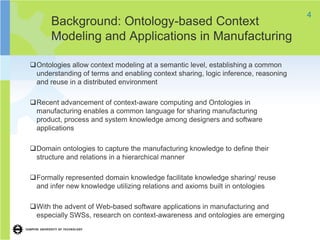
Ontologies allow context modeling at a semantic level, establishing a common
 understanding of terms and enabling context sharing, logic inference, reasoning
 and reuse in a distributed environment

Recent advancement of context-aware computing and Ontologies in
 manufacturing enables a common language for sharing manufacturing
 product, process and system knowledge among designers and software
 applications

Domain ontologies to capture the manufacturing knowledge to define their
 structure and relations in a hierarchical manner

Formally represented domain knowledge facilitate knowledge sharing/ reuse
 and infer new knowledge utilizing relations and axioms built in ontologies

With the advent of Web-based software applications in manufacturing and
 especially SWSs, research on context-awareness and ontologies are emerging
5
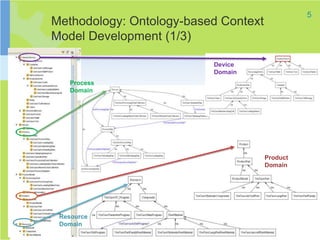
Methodology: Ontology-based Context
Model Development (1/3)

                          Device
                          Domain
    Process
    Domain


                                      Product
                                      Domain


 Resource
 Domain
6
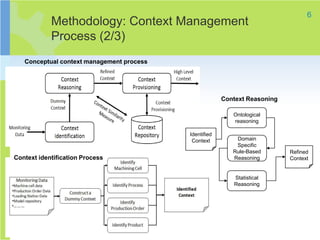
            Methodology: Context Management
            Process (2/3)
   Conceptual context management process


                                                        Context Reasoning

                                                           Ontological
                                                           reasoning

                                           Identified
                                            Context         Domain
                                                            Specific
                                                           Rule-Based       Refined
Context identification Process                             Reasoning        Context


                                                           Statistical
                                                           Reasoning
7
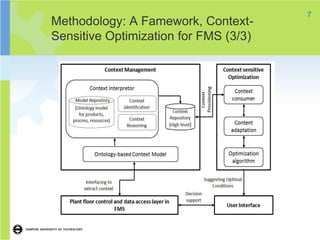
Methodology: A Famework, Context-
Sensitive Optimization for FMS (3/3)
8
            FMS Use Case Implementation: Overview
            (1/4)
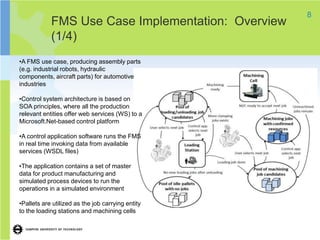
•A FMS use case, producing assembly parts
(e.g. industrial robots, hydraulic
components, aircraft parts) for automotive
industries

•Control system architecture is based on
SOA principles, where all the production
relevant entities offer web services (WS) to a
Microsoft.Net-based control platform

•A control application software runs the FMS
in real time invoking data from available
services (WSDL files)

•The application contains a set of master
data for product manufacturing and
simulated process devices to run the
operations in a simulated environment

•Pallets are utilized as the job carrying entity
to the loading stations and machining cells
9
     FMS Use Case Implementation: Approach
     (2/4)
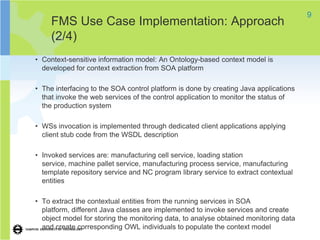
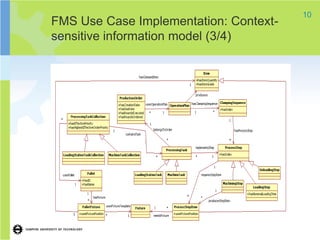
• Context-sensitive information model: An Ontology-based context model is
  developed for context extraction from SOA platform

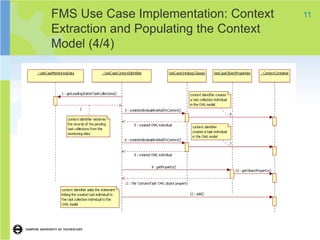
• The interfacing to the SOA control platform is done by creating Java applications
  that invoke the web services of the control application to monitor the status of
  the production system

• WSs invocation is implemented through dedicated client applications applying
  client stub code from the WSDL description

• Invoked services are: manufacturing cell service, loading station
  service, machine pallet service, manufacturing process service, manufacturing
  template repository service and NC program library service to extract contextual
  entities

• To extract the contextual entities from the running services in SOA
  platform, different Java classes are implemented to invoke services and create
  object model for storing the monitoring data, to analyse obtained monitoring data
  and create corresponding OWL individuals to populate the context model
10
FMS Use Case Implementation: Context-
sensitive information model (3/4)
FMS Use Case Implementation: Context    11
Extraction and Populating the Context
Model (4/4)
12
   Conclusions and Future Work

• The paper presents a modular approach of context-sensitive computing to
  achieve optimization to the dynamic operating environment of FMS. The
  context model development and the context management approach provides a
  common interface for context acquisition, reuse and updates, which are utilized
  by desperate client applications for runtime optimal decision making

• The core functional requirements of context-sensitive computing as the context
  modelling using OWL ontologies, WS-based interfacing for SOA control
  platform, runtime extraction of contextual entities, populating and updating of
  the dynamic entities to the context model are implemented within a practical
  FMS use case

• The next steps of this work will address higher level implementation of the
  presented framework for ontology-based context-sensitive computing for FMS
  optimization. High level context processing through context management will be
  implemented. An optimization algorithm will be developed, which will utilize the
  runtime KPI relevant contexts to provide proactive optimal suggestions to a
  separate UI

Ontology-based Context-sensitive Computing for FMS Optimization

  • 1.
    Ontology-based Context-sensitive Computing for FMS Optimization Date: March, 2012 Journal: Assembly Automation, Vol. 32, Issue 2, Linked to: RTD research and pp.163-174, ISSN: 0144-5154 Self-learning project at FAST Title of the Paper: Ontology-based Context -sensitive Computing for FMS Optimization Authors: M. Kamal Uddin, J. Puttonen, S.Scholze, Contact Information A. Dvoryanchikova, J.L. Martinez Lastra Tampere University of Technology, FAST Laboratory, P.O Box 600, FIN 33101, Tampere, Finlnad Email: fast@tut.fi Web: www.tut.fi/fast If you would like to receive a reprint of the original paper, please contact us
  • 2.
    2 Outline Introduction and Background:Context-Sensitive Computing and Ontologies in Manufacturing Methodology: Context-Sensitive Computing for FMS Optimization • Context model Development • Context management • A Framework: Context-Sensitive computing for FMS optimization FMS Use case implementation Conclusions and Future work
  • 3.
    3 Introduction FMSPlants are associated with • Chaotic job processing orders • Unscheduled events at run time • Lack of transperency of complex machines/processes Plants states are isolated and cannot be fully understood since there is a lack of infrastructure providing explicit manufacturing knowledge Modern FMS plant utilizes complex control architectures, promoting integration of various decision support applications Context-sensitive support applications are emerging in different areas of manufacturing for providing runtime decision support and, Ontology-based context-sensitive computing is the top candidate paradigm to provide optimization support for modern FMS plants
  • 4.
    4 Background: Ontology-based Context Modeling and Applications in Manufacturing Ontologies allow context modeling at a semantic level, establishing a common understanding of terms and enabling context sharing, logic inference, reasoning and reuse in a distributed environment Recent advancement of context-aware computing and Ontologies in manufacturing enables a common language for sharing manufacturing product, process and system knowledge among designers and software applications Domain ontologies to capture the manufacturing knowledge to define their structure and relations in a hierarchical manner Formally represented domain knowledge facilitate knowledge sharing/ reuse and infer new knowledge utilizing relations and axioms built in ontologies With the advent of Web-based software applications in manufacturing and especially SWSs, research on context-awareness and ontologies are emerging
  • 5.
    5 Methodology: Ontology-based Context ModelDevelopment (1/3) Device Domain Process Domain Product Domain Resource Domain
  • 6.
    6 Methodology: Context Management Process (2/3) Conceptual context management process Context Reasoning Ontological reasoning Identified Context Domain Specific Rule-Based Refined Context identification Process Reasoning Context Statistical Reasoning
  • 7.
    7 Methodology: A Famework,Context- Sensitive Optimization for FMS (3/3)
  • 8.
    8 FMS Use Case Implementation: Overview (1/4) •A FMS use case, producing assembly parts (e.g. industrial robots, hydraulic components, aircraft parts) for automotive industries •Control system architecture is based on SOA principles, where all the production relevant entities offer web services (WS) to a Microsoft.Net-based control platform •A control application software runs the FMS in real time invoking data from available services (WSDL files) •The application contains a set of master data for product manufacturing and simulated process devices to run the operations in a simulated environment •Pallets are utilized as the job carrying entity to the loading stations and machining cells
  • 9.
    9 FMS Use Case Implementation: Approach (2/4) • Context-sensitive information model: An Ontology-based context model is developed for context extraction from SOA platform • The interfacing to the SOA control platform is done by creating Java applications that invoke the web services of the control application to monitor the status of the production system • WSs invocation is implemented through dedicated client applications applying client stub code from the WSDL description • Invoked services are: manufacturing cell service, loading station service, machine pallet service, manufacturing process service, manufacturing template repository service and NC program library service to extract contextual entities • To extract the contextual entities from the running services in SOA platform, different Java classes are implemented to invoke services and create object model for storing the monitoring data, to analyse obtained monitoring data and create corresponding OWL individuals to populate the context model
  • 10.
    10 FMS Use CaseImplementation: Context- sensitive information model (3/4)
  • 11.
    FMS Use CaseImplementation: Context 11 Extraction and Populating the Context Model (4/4)
  • 12.
    12 Conclusions and Future Work • The paper presents a modular approach of context-sensitive computing to achieve optimization to the dynamic operating environment of FMS. The context model development and the context management approach provides a common interface for context acquisition, reuse and updates, which are utilized by desperate client applications for runtime optimal decision making • The core functional requirements of context-sensitive computing as the context modelling using OWL ontologies, WS-based interfacing for SOA control platform, runtime extraction of contextual entities, populating and updating of the dynamic entities to the context model are implemented within a practical FMS use case • The next steps of this work will address higher level implementation of the presented framework for ontology-based context-sensitive computing for FMS optimization. High level context processing through context management will be implemented. An optimization algorithm will be developed, which will utilize the runtime KPI relevant contexts to provide proactive optimal suggestions to a separate UI