Intellectual Property Rights in an Age of
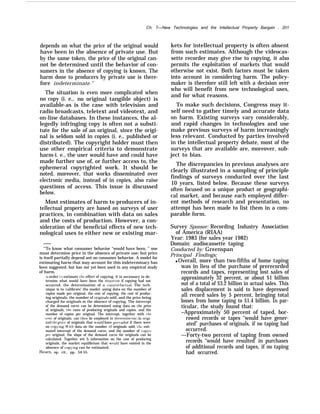
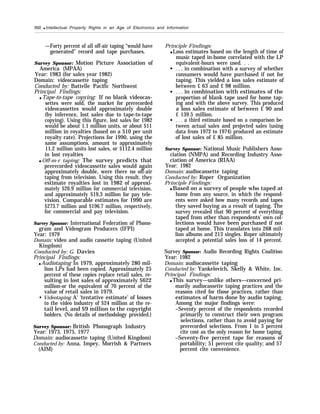
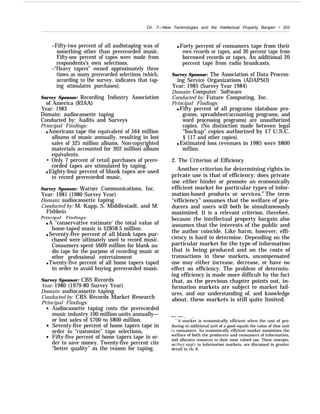
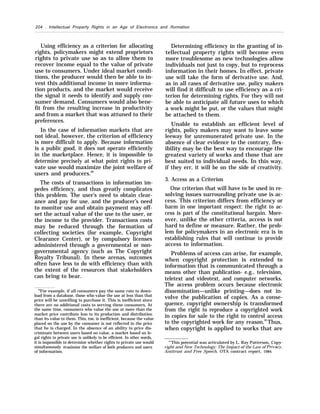
Electronics and Information
April 1986
NTIS order #PB87-100301
Recommended Citation:
U.S. Congress, Office of Technology Assessment, lntellectual Property Rights in an
Age of Electronics and Information, OTA-CIT-302 (Washington, DC: U.S. Govern-
ment Printing office, April 1986).
Library of Congress Catalog Card Number 86-600522
For sale by the Superintendent of Documents
U.S. Government Printing Office, Washington, DC 20402
Foreword
This report examines the impact of recent and anticipated advances in com-
munication and information technologies on the intellectual property system. It
focuses primarily on the Federal copyright system, and on the continuing effec-
tiveness of copyright law as a policy tool in the light of technologies such as audio-
and videorecorders, computer programs, electronic databases, and telecommuni-
cations networks. To obtain a comprehensive view, the study examined the intel-
lectual property system from a number of perspectives: the constitutional basis
of intellectual property policy; the system’s goals, laws, and economics; the crea-
tive environment; problems of enforcement; the international context; and the Fed-
eral role in administering intellectual property rights.
OTA found that technological developments are affecting all aspects of the
intellectual property system. Moreover, because we are only beginning to move
into the era of electronic information, the full impact of new technologies will not
become fully apparent for some time. Fundamental changes are occurring in in-
formation technologies that will antiquate many of the policy mechanisms now
in force, and bring new intellectual property problems requiring new solutions.
Thus, even if Congress acts now in response to current problems, it will need to
be prepared to act again within the next decade.
The report was requested by Senator Charles McC Mathias, Jr., Chairman
of the Senate Judiciary Committee, Subcommittee on Patents, Copyrights and
Trademarks; and by Congressman Peter W. Rodino, Jr., Chairman of the House
Judiciary Committee, Congressman Robert W. Kastenmeier, Chairman of the Sub-
committee on Courts, Civil Liberties, and the Administration of Justice, Congress-
man Hamilton Fish, and Congressman Carlos Moorhead.
In preparing this report, OTA has drawn on working papers developed by
OTA staff and contractors, the comments of participants at seven OTA work-
shops held to discuss issues, the results of two public opinion surveys conducted
by Yankelovich, Skelly & White, and conversations between OTA staff and over
130 interested individuals. Drafts of the report were reviewed by the OTA advi-
sory panel, officials from the Copyright Office, the Patent and Trademark Office,
the Library of Congress, the Department of Commerce, the Department of State,
the Office of the U.S. Trade Representative, and a broad range of individuals from
law firms, public interest groups, trade associations, private industry, and
academia.
OTA appreciates the participation of the advisory panelists, workshop par-
ticipants, Federal agency officials, and interested citizens, without whose help
this report would not have been possible. The report itself, however, is the sole
responsibility of OTA, not of those who ably advised and assisted us in its prep-
aration.
Director
,..{II
Intellectual Property Rights in an Age
of Electronics and Information Advisory Panel
Paul Goldstein, Chairman
Professor of Law, Stanford Law
Jon Baumgarten
Partner
Paskus, Gordon & Hyman
Charles Benton
President of the Board
Benton Foundation
Stanley Besen
Economist
Rand Corp.
Honorable Stephen Breyer
Judge of the U.S. Court of Appeals
Stan Cornyn
Senior Vice President
Warner Records
Oswald Ganley
Professor and Executive Director
Program on Information Resources Policy
Harvard University
Gustave Hauser
Chairman and Chief Executive Officer
Hauser Communications, Inc.
Mitchell Kapor
President
Lotus Corp.
Robert Lekachman
Professor of Economics
Lehman College
William Lilley, III
Vice President for Corporate Affairs
CBS, Inc.
George Minot
Senior Vice President
CompuServ, Inc.
School, Stanford University
Dorothy Nelkin
Professor of Sociology
Cornell University
James Nelson
State Librarian and Commissioner
Kentucky Department for Libraries and
Archives
John Shattuck
Vice President for Government Community
and Public Affairs
Harvard University
Oliver Smoot
Executive Vice President
Computer and Business Equipment
Manufacturers Association
Patricia Sturdivant
Associate Superintendent
Houston Independent School District
Sherry Turkle
Associate Professor of Sociology
Massachusetts Institute of Technology
Jack Valenti
President
Motion Picture Association of America,
Inc.
Vivian Weil
Senior Research Associate
Illinois Institute of Technology
Martha Williams
Professor of Information Science
University of Illinois
The Advisory Panel provided advice and constructive criticism throughout this project. The panel does not, however, necessarily
approve, disapprove, or endorse this report. OTA assumes full responsibility for the report and the accuracy of its contents.
iv
— .
Intellectual Property Rights in an Age
of Electronics and Information Assessment Staff
John Andelin, Assistant Director, OTA
Science, Information, and Natural Resources Division
Fred W. Weingarten, Program Manager
Communication and Information Technologies Program
Project Staff
D. Linda Garcia, Project Director
Conceptual Framework and Societal Analysis
Lauren Ackerman
International and Institutional Analysis
Earl Dowdy
Technology and Economic Analysis
Paul Goldwhite
Summer Intern
Robert Kost
Legal Analysis
Arati Prabhakar
Congressional Fellow
Linda G. Roberts
Analysis of Creative Environment and Public Outreach Activities
Susan Walton
Contractor, Editorial Assistance
Administrative Staff
Liz Emanuel Audrey Newman Shirley Gayheart*
Renee Lloyd Patricia Keville
Contractors and Consultants
James Beniger
Department of Sociology
Princeton University
Cliff Berg
National Academy of Public
Administration
Stanley Besen
Rand Corp.
Anne Wells Branscomb
Attorney
Deborah Buckner
Yankelovich, Skelly & White, Inc.
Christopher Burns
Christopher Burns, Inc.
Herbert Dordick
Department of Communications
Temple University
Jose-Marie Griffiths
King Research, Inc.
Roland Hornet
Communications Law and Policy
Consultants
Donald King
King Research, Inc.
Kenneth L. Kraemer
Irvine Research Corp.
Leslie King
Irvine Research Corp.
Patricia Martin
Christopher Burns, Inc.
L. Ray Patterson
School of Law
Emory University
W. Curtiss Priest
Center for Policy Alternatives
Massachusetts Institute of Technology
Carroll Pursell
Professor of History
University of California, Santa Barbara
David Richardson
Yankelovich, Skelly & White, Inc.
David Schetter
Irvine Research Corp.
A. Allan Schmid
Department of Agricultural Economics
Michigan State University
Harold Seidman
National Academy of Public
Administration
Petra Shattuck
Department of Political Science
City University of New York
Richard Solomon
Massachusetts Institute of Technology
Jane Yurow
Jane Yurow Associates
vi
Legal Workshop Participants
Roy Freed
Partner
Brown, Rudnick, Freed & Gesmer,
Counselors at Law
Leon Friedman
Attorney
Morton Goldberg
Partner
Schwab, Goldberg, Price & Dannay
Paul Goldstein
Professor of Law
Stanford University.
Henry Jones, I I I
General Counsel
Ashton-Tate
Irwin Karp
General Counsel
Authors League
Michael Keplinger
Attorney Advisor
Office of Legislative and
International Affairs
U.S. Patent and Trademark Office
John Lautsch
Chairman
ABA Computer Law Division
Arthur Levine
Partner
Levine, Lupo & Lippman
Sue Martin
Chairperson of Copyright Committee
American Library Association
Director of Milton S. Eisenhower
Library
Johns Hopkins University
Christopher Meyer
Senior Attorney
Copyright office
Library of Congress
Melville Nimmer
Professor of Law
UCLA Law School
Ron Palenski
Staff Attorney
Association of Data Processing
Service Organizations
Marybeth Peters
Senior Attorney
Copyright office
Library of Congress
Mark Rotenberg
President
Public Interest Computer Association
Pamela Samuelson
Professor of Law
University of Pittsburgh
Cary Sherman
Attorney
Arnold & Porter
Eric Smith
Partner
Paskus, Gordon & Hyman
Raymond Weisbond
Counsel
Warner Communications, Inc.
Technologies for Information
Creation Workshop Participants
Ronald Erickson
Educational and Technical Advisor
Museum of Holography
Robert Ewald
Director of Education Industries
(Universities)
Cray Research, Inc.
Harold Hosack
Project Director of the CCD Imager
and Camera Project
Texas Instruments, Inc.
Michael Kowalski
Writer and Freelance Computer
Programmer
Post Industrial Productions, Inc.
Steve Mayer
Chairman
Take One Partners
Mark Schubin
Freelance Technological Consultant
Jim St. Lawrence
Producer in Residence and Director
of the Interactive Technologies
Laboratory
New York Institute of Technology
Information Storage and
Database Technologies
Workshop Participants
Larry Bernstein
Director
Diagnostic Operations Systems
Laboratory
AT&T Bell Labs
Robert Castrignano
Vice President for Information
Storage Systems Technology
CBS Technology Center
Charles Goldstein
Chief, Information Technology Branch
Lister Hill National Center for
Biomedical Research
National Library of Medicine
Fred Kilgour
Founder Trustee
Online Computer Library Center
Nick Roussopoulois
Professor of Computer Science
University of Maryland
Christopher Weaver
Vice President for Disk Research
Videomagic Laboratories
Robert Worsing
Vice President for Corporate Security
Control Data Corp.
Display, Printing, and
Reprographic Technologies
Workshop Participants
Ifay Chang
Manager of Exploratory:. Display
Technology
T.J. Watson Research Center
IBM Corp.
Richard Green
Senior Vice President
Broadcast operations and
Engineering
Public Broadcasting Service
Edward McIrvine
Manager, R&D Planning
Corporate Research Group
Xerox Corp.
Melvin Prueitt
Los Alamos National Laboratory
Information Technology and
Its Impact on the Creative
Process Workshop Participants
Theodore Bikel
Actor and President Emeritus
Actors Equity
Milton Glaser
Graphic Artist
Richard Green
Musician
Joyce Hakansson
President
Hakansson Associates
James Hammerstein
Stage Director
David McCune
Writer, Software Designer, and
President
The Proteus Group, Inc.
Ann-Byrd Platt
Author
Federik Pohl
Author
Anna Sofaer
Artist and Independent Film Producer
Bill Weems
Photographer
George David Weiss
Songwriter and President
The Songwriters Guild
vii
Mini-Economic Workshop
Participants
Stanley Besen
Economist
Rand Corp.
Christopher Burns
Consultant
Christopher Burns. Inc.
Robert Lekachman
Professor of Economics
Lehman College
Patricia Martin
Consultant
Christopher Burns. Inc.
W. Curtiss Priest
Center for Policy Alternatives
Massachusetts Institute of Technology
A. Allan Schmid
Professor of Economics
Michigan State University
Students’ Perceptions of the
Intellectual Property Rights
Issue Workshop Participants
Lisa Feldman
10th Grader
Magruder High School
Carl Fletcher
12th Grader
Ballou High School
Eugene Gholz
9th Grader
Georgetown Day High School
Nick Landau
11th Grader
Georgetown Day High School
Eric Martinusen
11th Grader
Georgetown Day High School
Michael Meredith
12th Grader
George Mason High School
Robert Salsbury
9th Grader
George Mason High School
Elinor Scully
11th Grader
George Mason High School
Clare Shannon
10th Grader
George Mason High S
Ron Smith
10th Grader
Richard Montgomery
Wyvonella Spratt
11th Grader
Ballou High School
Deborah Van Lenten
11th Grader
Wooten High School
hool
High School
Marty White
12th Grader
Ballou High School
External Reviewers
Chapter 1: Conceptual Framework
for Analyzing Intellectual
Property Issues Rights
Bernard Barber
Professor of Sociology
Columbia University
Jack Copeland
President
National Educational Media, Inc.
Elizabeth Eisenstein
Professor of Social History
University of Michigan
Jack Golodner
Director
Department for Professional Employees
AFL-CIO
Stanley Gortikov
President
Recording Industry Association
of America, Inc.
John Hersey
Author
L. Ray Patterson
Professor of Law
Emory University
David Peyton
Director of Government Relations
Information Industry Association
Mike Remington
Chief Counsel
House Subcommittee on Courts, Civil
Liberties, and the Administration
of Justice
Daniel Toohey
Attorney
Dow, Lohnes & Albertson
Chapter 2: Intellectual Property
Goals in a Changing
Information Environment
Bernard Barber
Professor of Sociology
Columbia University
Jack Copeland
President
National Educational Media, Inc.
Elizabeth Eisenstein
Professor of Social History
University of Michigan
Stanley Gortikov
President
Recording Industry Association of
America, Inc.
John Hersey
Author
David Liebowitz
Attorney
Wiley & Rein
L. Ray Patterson
Professor of Law
Emory University
David Peyton
Director of Government Relations
Information Industry Association
Petra Shattuck
Professor of Political Science and
Public Law
City University of New York
Cary Sherman
Attorney
Arnold & Porter
Daniel Toohey
Attorney
Dow, Lohnes & Albertson
Bruce H. Turnbull
Attorney
Weil, Gotshaf & Manges
Chapter 3: The Accommodation
of Intellectual Property Law to
Technological Change
Charles Boiler
Executive Director
American Copyright Council
Duncan Davidson
Attorney
Cambridge Venture Partners
Edward Frankel
Computer Law Specialist
Hugh Gibbons
Professor of Law
Franklin Pierce Law Center
John Hersey
Author
John Lautsch
President
Computer Law Division of the
American Bar Association
Melville Nimmer
Professor of Law
University of California-Los Angeles
L. Ray Patterson
Professor of Law
Emory University
Marybeth Peters
Senior Attorney and Policy Planning
Advisor
U.S. Copyright Office
David Peyton
Director of Government Relations
Information Industry Association
Manny Pokotilow
Attorney
Caesar, Riuse, Berstein & Cohen, Ltd.
Mike Remington
Chief Counsel
House Subcommittee on Courts, Civil
Liberties, and the Administration
of Justice
David Leibowitz
Attorney
Wiley & Rein
David Richtman
Cambridge Technology Systems
Jim St. Lawrence
Director of the Interactive
Technologies Laboratory
New York Institute of Technology
Edward McIrvine
Manager of R&D Planning
Xerox Corp.Robert Rines
Attorney
Rines & Rines
George David Weiss
Songwriter and President
The Songwriters Guild
L. Ray Patterson
Professor of Law
Emory UniversityPamela Samuelson
Professor of Law
University of Pittsburgh
David Peyton
Director of Government Relations
Information Industry Association
Chapter 6: Technology, Intellectual
Property, and the Operation
of Information Markets
Bob Shaw
Attorney and President of the
Patent, Trademark, and Copyright
Research Foundation
Barbara Polansky
Copyright Administrator
American Chemical Society
Marjorie Blumenthal
Economist
General Electric Information
Services Co.
Robert Stern
Attorney
Mike Remington
Chief Counsel
House Subcommittee on Courts, Civil
Liberties, and the Administration
of Justice
Duncan Davidson
Partner
Cambridge Venture Partners
Daniel Toohey
Attorney
Dow, Lohnes & Albertson
Henry Geller
Director
Washington Center for Public
Policy Research
Allen Wagner
University Counsel
University of California, Berkeley
Chapter 5: Impact of Technology
on the Creative Environment
Bernard Barber
Professor of Sociology
Columbia University
Chapter 4: Impact of Technology
on Enforcement of Intellectual
Property Rights
Duncan MacRae
Professor of Political Science
University of North Carolina
Theodore Bikel
Actor and President Emeritus
Actors Equity
Bruce M. Owen
Economist
Economists Inc.
Fritz Attaway
Vice President and Counsel
Motion Picture Association of
America, Inc.
Ann Byrd-Platt
Author Curtiss Priest
Research Associate
MIT Center for Policy Alternatives
Ivan Bender
Attorney
Jack Copeland
President
National Educational Media, Inc. Mike Remington
Chief Counsel
House Subcommittee on Courts, Civil
Liberties, and the Administration
of Justice
Larry Bernstein
Director
Diagnostics operations Systems
Laboratory
AT&T Bell Laboratories
Susan Dooha
Executive Director
Graphics Artists Guild
Elizabeth Eisenstein
Professor of Social History
University of Michigan
Michael Rubin
Office of the Assistant Secretary for
Productivity, Technology, and
Innovation
U.S. Department of Commerce
Robert Castrignano
Vice President Information Storage
Systems Technology
CBS Inc. Richard Green
Senior Vice President
Broadcasting Operations and
Engineering
Public Broadcasting Service
Edward Conklin
Vice President
FORTH, Inc.
Fred Smith
President
Competitive Enterprise Institute
Stanley Gortikov
President
Recording Industry of America, Inc.
John Hersey
Author
A. Allan Schmid
Professor of Economics
Michigan State UniversityNancy Marshall
Associate Director of University
Libraries
University of Wisconsin-Berkeley
Frederick Kilgour
Founder Trustee
Or-dine Computer Library Center
Lester C. Thurow
Professor of Management and
Economics
Massachusetts Institute of TechnologyMichael Kowalski
Writer/Freelance Computer
Programmer
Postindustrial Productions, Inc.
Edward McIrvine
Manager for R&D Planning
Xerox Corp.
Anita Walgren
National Telecommunications and
Information Administration
U.S. Department of Commerce
Barbara Nessin
Professor of Law
Emory University
Jim St. Lawrence
Director of the Interactive
Technologies Laboratory
New York Institute of Technology
David Waterman
Professor of Communications
University of Southern California
Barbara Nessim
Graphic Artist
Bernard Lechner
Staff Vice President for Advanced
Video Systems Research
RCA laboratories
Lawrence White
Professor of Economics
New York University
David Peyton
Director of Government Relations
Information Industry Association
ix
Chapter 7: New Technologies and
the Intellectual Property Bargain
Charles Boiler
Executive Director
American Copyright Council
Nancy Buc
Weil, Gotshall & Manges
Jack Copeland
President
National Educational Media, Inc.
Roy Freed
Attorney
Brown, Rudnick, Freed & Gesner
Leon Friedman
Professor of Law
Hofstra University
Henry Geller
Director
Washington Center for Public
Policy Research
John Hersey
Author
Nancy Marshall
Counsel
National Library Association
Maurice Mitchell
Director
Annenberg Schools
Program
L. Ray Patterson
Professor of Law
Emory University
David Peyton
Washington
Director of Government Relations
Information Industry Association
Michael Remington
Chief Counsel
House Committee on the Judiciary
Mark Rotenburg
Public Interest Computer Association
Cary Sherman
Attorney
Arnold & Porter
Daniel Toohey
Attorney
Dow, Lohnes & Albertson
Ray Weisbond
Attorney
Warner Communications, Inc.
Chapter 8: Impact of Technology on
the International Intellectual
Property System
Norman Alterman
Vice President and Deputy General
Counsel
Motion Picture Association of
America, Inc.
Fritz Attaway
Vice President and Counsel
Motion Picture Association of
America, Inc.
x
Charles Boiler
Executive Director
American Copyright Council
Robert Bruce
Attorney
Debevoise & Plimpton
Marsha Carow
Vice President
Harcourt Brace Jovanovich, Inc.
John Clements
Director of Governmental Affairs
American Federation of Information
Processing Societies
Stanley Gorkikov
Recording Industry Association of
America, Inc.
Jacques Gorlin
Consultant
Eileen Hill
International Trade Administration
U.S. Department of Commerce
David Leibowitz
Attorney
Wiley & Rein
Marybeth Peters
Senior Attorney and Policy Planning
Advisor
U.S. Copyright Office
David Peyton
Director of Government Relations
Information Industry Association
Barbara Pohansky
Copyright Administrator
American Chemical Society
Carol Risher
Director of Copyright and New
Technology
Association of American
Publishers, Inc.
Cary Sherman
Attorney
Arnold & Porter
Gary Slaiman
Attorney
Weil, Gotshal & Manges
Daniel Toohey
Attorney
Dow, Lohnes & Albertson
Harvey Winter
Director
Office of Business Practices
U.S. Department of State
Alice Zalick
Assistant General Counsel
Office of the United States
Trade Representative
Chapter 9: Federal Role in the
Administration of Intellectual
Property Rights
Robert Cassler
Chief Counsel
Copyright Royalty Tribunal
John Clements
Director of Governmental Affairs
American Federation of Information
Processing Societies
Roger Garcia
Government Division
Congressional Research Service
Library of Congress
Judy Goans
Office of Legislation and
International Affairs
U.S. Patent and Trademark Office
U.S. Department of Commerce
Ronald Moe
Government Division
Congressional Research Service
Library of Congress
Harold Relyea
Government Division
Congressional Research Service
Library of Congress
Mike Remington
Chief Counsel
House Subcommittee on Courts, Civil
Liberties, and the Administration
of Justice
Petra Shattuck
Professor of Political Science and
Public Law
City University of New York
Cary Sherman
Attorney
Arnold & Porter
Daniel Toohey
Attorney
Dow, Lohnes & Albertson
Anita Walgren
National Telecommunications and
Information Agency
U.S. Department of Commerce
Harvey Winter
Director
Office of Business Practices
U.S. Department of State
List of Other Contributors
Raymond Ahlberg
Industry Specialist
U.S. Department of Commerce
David Altschul
Vice President
Warner Records
Stella Alvo
Co-owner
The Video Bus
Nicholas Arcomano
Vice President and Counsel
SESAC, Inc.
Moses Asch
Founder and President
Folkways Records
Russ Bach
Vice President, WEA
Warner Records
Len Cutler
Director of the Instruments and
Photronics Lab
Hewlett Packard
Steve Fluty
Editor
Viewtext Magazine
Steve Fox
Associate Director of Patents
and Licenses
Hewlett Packard
Donald Barr
President
Barr Films
Joan Desens
Lexica Corp.
Jean Dexheimer
Director, Inter-University
Consortium for Educational
Computing
Carnegie Mellon University
Barbara Bayah
Classroom Teacher
Cupertino Union Public Schools
Sarah Frank
BBC-TV Co-Productions
Michael Franklin
Executive Secretary
Director’s Guild of America
Paul Bender
Dean
Arizona State Law School Thomas DiRenzo
Vice President, Direct Marketing
and Communications
Institute for Scientific Information
C.E. Gallivan
Director of Marketing
Hewlett Packard
Paul Bortz
Managing Director
Browne, Bortz & Coddington, Inc.
Hugh Donaghue
Vice President
Government Programs and
International Trade Relations
Control Data Corp.
Kit Galloway
President
Mobile Image
Gene Boucher
Executive Director
American Guild of Musical Artists
Eugene Garfield
President
Institute for Scientific Information
Robert Bramson
Attorney
Schnader, Harrison, Segal & Lewis
George Dummer
Director
Office of Sponsored Programs
Massachusetts Institute of Technology
Clifton H. Garrett
Deputy District Attorney
County of Los Angeles
Major Frauds Division
Electronic Crime Section
Barry Bronson
Member of the Technical Staff
Hewlett Packard
Moria Egan
Assistant to the President for
Government Relations
New York Public Library
Toni Carbo-Bearman
Executive Director
National Commission on Libraries
and Information Science
Andrew Gerber
Student
Massachusetts Institute of TechnologyAlan Eisenberg
Executive Secretary,
Actors Equity Association
Charles Butts
Vice President
Houghton Mifflin Co.
Ric Giardina
General Counsel
MicroPro InternationalWilliam Eldridge
Director of Research
Federal Judical Center
Doug Carothers
Patent Attorney
Xerox Palo Alto Research Center
Steven Gilbert
Director, Computer Literacy Project
EDUCOMRobert Enenstein
President
Educational Microcomputer
Associates, Inc.
Felix Chamberlain
Artists and Repetoire
Warner Records
Terry Gilbreth
Director
Electronic and Media Publishing
Holt, Rinehart & WinstonRobert Churchill
President
Churchill Films
Paul Fagan
Chief Economist
ASCAP Michael Glen
Attorney
Intel Corp.Sandy Cohen
Attorney
Weil, Gotshal & Manges
Laurie Failes
Teacher
Lexington, MA, Public Schools Mel Goldberg
Former Vice President
ABCRoger Cole
Assistant Director for
Administration
Eastman-Kodak Co.
Leonard Feist
Harry Fox Agency
National Music Publishers
Association, Inc.
Mary Goldscmidt
Vice President
Lotus Corp.
Howard Colson
Assistant Vice President
Public Relations
Broadcast Music, Inc.
Lee Felsenstein
President
Golemics, Inc.
Jack Golodner
Director
Department for Professional Employees
AFL-CIOEamon Fennessy
President
Copyright Clearance Center, Inc.
Edward Conklin
Vice President
FORTH, Inc.
Ed Goode
Chairman
Computer Science Department
Lexington, MA, High School
LeRoy Finkel
Computer Coordinator
San Mateo County Office of
Education
Edward Cramer
President
Broadcast Music, Inc. Bobby Goodson
President
International Council on Computers
in Education
Bill Crowell
Vice President for Research
MicroPro International
Frank Fischer
Urban Institute
Andrew Flugelman
President
Freeware
Karla Graue
National Cable AssociationCally Curtis
President
Curtis Films
xi
Peter A. Gross
President
Lexica Corp.
Lyn Gubser
Executive Director
Association for Educational
Communications & Technology
Marianne Hall
Commissioner
Copyright Royalty Tribunal
Mel Harris
President
Paramount Corp.
W.B. “Trip” Hawkins
President
Electronic Arts
Richard H. Hersh
Vice President for Research
University of Oregon
Alexander Hoffman
Vice President
Doubleday & Co., Inc.
Vivian Homer
Electronic Media Consultant
Former Vice President for Program
Development
Warner Communications
Lucy Hammer
Ambassador Dougan’s Office
U.S. Department of State
Dov Jacobs
Free-lance Software Developer
Nick Johnson
University of Iowa Law School
(formerly FCC Commissioner)
Alan Kent
Assistant Dean
School of Library and Information
Science
University of Pittsburgh
Daniel Klassen
President
Information Technology Design
Associates
Walter Koetke
Director of Technology
Scholastic Publishing Co.
Bernard Korman
Chief Counsel
ASCAP
Dan Lacy
Vice President
McGraw Hill, Inc.
Jim Lardner
Reporter
The New Yorker
Edith Leonian
Philip Leonian
Advertising Photographers of America
Society of Photographer and Artist’s
Representatives, Inc.
David Levine
Executive Director
Dramatists Guild
Del Lipert
Vice President
Digital Equipment Corp.
Beth Lewd
Computers in Education Specialist
Lexington, MA, Public Schools
William H. McAllister
Director, Patents and Licenses
Hewlett Packard
Scott Mace
Reporter
InfoWorld
John Mallinson
Director
Center for Magnetic Recording
University of California, La Jolla
Rick Manning
Executive
Data Courier
Andrew Manshell
Counsel
Birch Tree Group
Ernest R. (Bodie) Marx
Vice President
Mindscape, Inc.
Gene Mater
Vice President
CBS
International Group
Donald McCoy
Vice President and General Manager
CBS Technology Center
Al McPherson
Engineer
Warner Records
Gloria Messinger
Managing Director
ASCAP
Steve Metalitz
Staff Director and Chief Counsel
Senate Subcommittee on Patents,
Copyrights, and Trademarks
Mark Meyers
Vice President for Research and
Director Webster Research Center
Xerox Corp.
Timothy Miles
Industry Specialist
Department of Commerce
Maurice Mitchell
Director
The Washington Program in
Communications Policy Studies
Annenburg Schools
Gerald Mossinghoff
President
Pharmaceutical Manufacturers
Association
Robert Nahory
Manager Optical Properties of
semiconductors Research
Bell Communications Research
William Nix
Vice President and Deputy
General Attorney
Motion Picture Association of
America, Inc.
Dan Oelhsen
Editor-in-Chief
Electronic Publishing
Simon & Schuster
Greg Olsen
Founder and CEO
EPITAXX, Inc.
Ralph Oman
Chief Counsel
Senate Subcommittee on Patents,
Copyrights, and Trademarks
Ken Orsati
Executive Director
Screen Actor’s Guild
Don Parker
Vice President for Research
QMS, Inc.
Janice Patterson
Director, Computer Operations
Wisconsin Center for Education
Research
University of Wisconsin
Kenton Pattie
Vice President
NAVA/ICIA
Russell Pipe
Transnational Data Reporting Service
Abe Polonsky
Screenwriter
Dave Poltrack
Vice President for Research
Broadcast Group
CBS, Inc.
Linda Prowse
Engineering Management Training
Manager
Hewlett Packard
Sherrie Rabinowitz
Mobile Image
James Ratcliffe
Director of Public Affairs
R.R. Donnelley and Sons, Inc.
Retta Richardson
Executive Director
Southern Educational
Communications Association
Susan Rifkin
U.S. Patent & Trademark Office
Office of Technology Assessment
and Forecasting
Humberto Rivera
President
GeoVision, Inc.
Seymour Rubenstein
President Emeritis
MicroPro International
Marie Salah
Teacher
Watertown, MA, Public Schools
Carol Schele
Smithsonian Institution
Karen Sheingold
Director
Center for Children and Computers
Bank Street College of Education
William Skok
Office of Business Practices
U.S. Department of State
Alan Smith
Vice President, Administration
Broadcast Music, Inc.
Bob Spielvogel
Lexica Corp.
Richard Stern
Attorney
Stern & Roberts
Erwin C. Surrency
Law Library
University of Georgia
Rene Tegtmeyer
Assistant Commissioner
U.S. Patent and Trademark Office
Gail Thackery
Assistant District Attorney
Philadelphia, PA
Victor Vyssotsky
Executive Director for Research
Information Sciences
AT&T Bell Laboratories
Eric Walter
Vice President of Operations
Electronic Arts
Robert Wesslund
Vice President for Technology Exchange
Control Data Corp.
Savan Wilson
Director of Education
Mississippi Authority
Educational TV
Ethel Winant
Producer
for
Metromedia Producers, Inc.
Sanford I. Wolff
National Executive Secretary
American Federation of Television
and Radio Artists
Charles Wood
Consultant
Information Integrity Investments
Delbert Yocam
Executive Vice President
Apple Computer, Inc.
John van Raalte
Senior Scientist
Advanced Display Technologies
RCA Laboratories
Isa Zimmerman
Assistant Superintendent
Lexington, MA, Public Schools
OTA Reviewers
Ben Amick, Analyst
Clyde Behney, Program Manager
Audrey Buyrn, Program Manager
Richard Dalbello, Analyst
Jim Dray, Research Analyst
Gretchen Kolsrud, Program Manager
Nancy Naismith, Program Manager
Robert Niblock, Program Manager
Lisa Raines, Analyst
. .X111
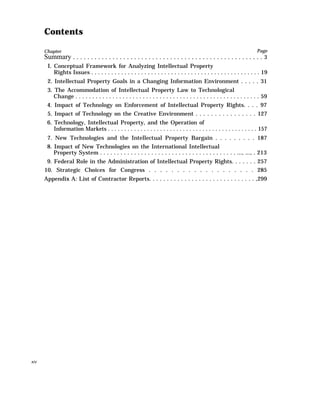
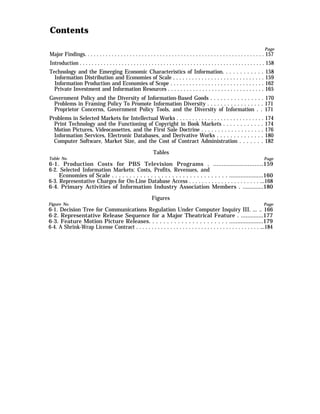
Contents
Chapter Page
Summary . . . . . . . . . . . . . . . . . . . . . . . . . . . . . . . . . . . . . . . . . . . . . . . . . . . . . 3
I. Conceptual Framework for Analyzing Intellectual Property
Rights Issues . . . . . . . . . . . . . . . . . . . . . . . . . . . . . . . . . . . . . . . . . . . . . . . . . . . 19
2. Intellectual Property Goals in a Changing Information Environment . . . . . 31
3. The Accommodation of Intellectual Property Law to Technological
Change . . . . . . . . . . . . . . . . . . . . . . . . . . . . . . . . . . . . . . . . . . . . . . . . . . . . . . . 59
4. Impact of Technology on Enforcement of Intellectual Property Rights. . . . 97
5. Impact of Technology on the Creative Environment . . . . . . . . . . . . . . . . 127
6. Technology, Intellectual Property, and the Operation of
Information Markets . . . . . . . . . . . . . . . . . . . . . . . . . . . . . . . . . . . . . . . . . . . . . . 157
7. New Technologies and the Intellectual Property Bargain . . . . . . . . . 187
8. Impact of New Technologies on the International Intellectual
Property System . . . . . . . . . . . . . . . . . . . . . . . . . . . . . . . . . . . . . . . . ..., ..., . 213
9. Federal Role in the Administration of Intellectual Property Rights. . . . . . . 257
10. Strategic Choices for Congress . . . . . . . . . . . . . . . . . . . 285
Appendix A: List of Contractor Reports. . . . . . . . . . . . . . . . . . . . . . . . . . . . . . ,299
xiv
Summary
—— ..- . —
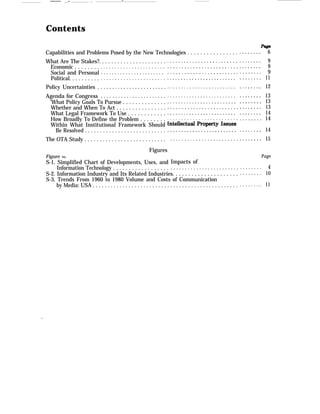
Contents
Capabilities and Problems Posed by the New Technologies . . . . . . . . . . . . . . . .
What Are The Stakes?. . . . . . . . . . . . . . . . . . . . . .
Economic . . . . . . . .
Social and Personal
Political. . . . . . . . . .
Policy Uncertainties .
Agenda for Congress
. . . . . . . . . . . . . . . . . . . . . . .
. . . . . . . . . . . . . . . . . . . . . . .
. . . . . . . . . . . . . . . . . . . . . . .
. . . . . . . . . . . . . . . . . . . . . . .
. . . . . . . . . . . . . . . . . . . . . . .
‘What Policy Goals To Pursue . . . . . . . . . . . . . .
Whether and When To Act . . . . . . . . . . . . . . . .
What Legal Framework To Use . . . . . . . . . . . .
How Broadly To Define the Problem . . . . . . . .
Within What Institutional Framework Should
Be Resolved . . . . . . . . . . . . . . . . . . . . . . . . . . .
The OTA Study . . . . . . . . . . . . . . . . . . . . . . . . . . .
. . . . . . . . . . . . . . . . . . . . . . . . .
. . . . . . . . . . . . . . . . . . . . . . . . .
. . . . . . . . . . . . . . . . . . . . . . . . .
. . . . . . . . . . . . . . . . . . . . . . . . .
. . . . . . . . . . . . . . . . . . . . . . . . .
. . . . . . . . . . . . . . . . . . . . . . . . .
. . . . . . . . . . . . . . . . . . . . . . . . .
. . . . . . . . . . . . . . . . . . . . . . . . .
. . . . . . . . . . . . . . . . . . . . . . . . .
.
Figures
Figure No.
S-1. Simplified Chart of Developments, Uses, and
Information Technology . . . . . . . . . . . . . . . . . .
. . . . . . . . . . . . . . . . . . . . . . . .
. . . . . . . . . . . . . . . . . . . . . . . .
Impacts of
. . . . . . . . . . . . . . . . . . . . . . . .
S-2. Information Industry and Its Related Industries. . . . . . . . . . . . . . . . . . . . .
S-3. Trends From 1960 to 1980 Volume and Costs of Communication
by Media: USA . . . . . . . . . . . . . . . . . . . . . . . . . . . . . . . . . . . . . . . . . . . . . . . . .
. . . . . . . .
. . . . . . . .
. . . . . . . .
. . . . . . . .
. . . . . . . .
. . . . . . . .
. . . . . . . .
. . . . . . . .
. . . . . . . .
. . . . . . . .
. . . . . . . .
. . . . . . . .
. . . . . . . .
6
9
9
9
11
12
13
13
13
14
14
14
15
Page
. . . . . . . . 4
. . . . . . . . 10
. . . . . . . . 11
.
Summary
Domestic intellectual property law—princi-
pally the law covering patents, copyrights, and
trademarks–is rooted in the United States
Constitution. Under the law, the government
is authorized to grant intellectual property
rights not as rewards but as inducements to
authors and inventors to create and dissemi-
nate intellectual works. The statutory nature
and purpose of the constitutional authoriza-
tion is stated explicitly in the 1909 Copyright
Act:
The enactment of copyright legislation by
Congress under the terms of the Constitution
is not based on any natural right that the
author has in his writings, for the Supreme
Court has held that such rights as he has are
purely statutory rights, but on the ground
that the welfare of the public will be served
and progress of science and useful arts will
be promoted . . . Not primarily for the bene-
fit of the author, but primarily for the bene-
fit of the public such rights are given. Not
that any particular class of citizens, however
worthy, may benefit, but because the policy
is believed to be for the benefit of the great
body of people, in that it will stimulate writ-
ing and invention to give some bonus to au-
thors and inventors.
The mechanisms by which the intellectual
property system worked in the past were
straightforward. The government granted
rights to an author or inventor. From this point
on, the government’s role was relatively mi-
nor. Rewards were determined in the market-
place. In order to benefit from copyright, an
author had to publish his works, thus making
them available to the public. In order to ob-
tain a patent, the inventor had to reduce his
ideas to useful applications. The holders of
copyrights and patents holders were respon-
sible for detecting infringements and prevent-
ing unauthorized use of a work. Enforcing one’s
right was not unduly burdensome. This was
particularly true in the case of copyright. Given
the expense and the organizational require-
ments needed to reproduce works there were
only a limited number of printers, and thus it
was relatively easy to keep track of their
activities.
Today, however, technology is complicating
this process and undermining many of the
mechanisms that governed the system in the
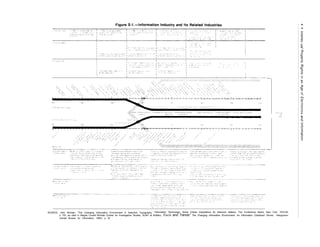
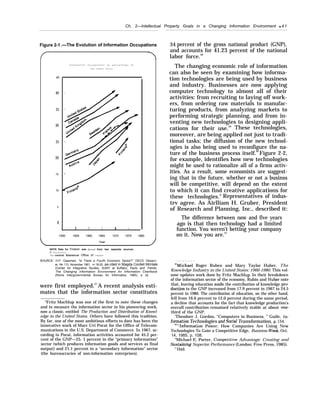
past. This trend is likely to continue; as shown
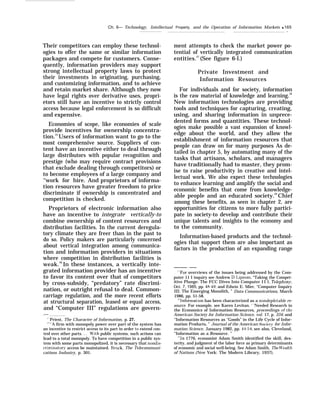
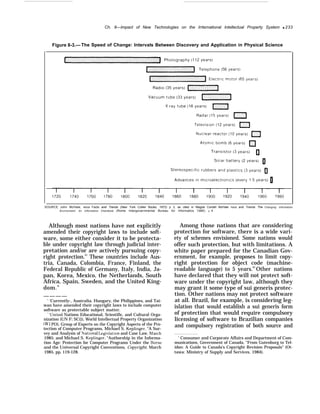
on figure S-1, today’s technologies are the be-
ginning, not the end, of the information revo-
lution. Computers, two-way interactive cable,
fiber optics, optical disks, communications sat-
ellites, and other devices are becoming stead-
ily more sophisticated and powerful, and their
uses are expanding almost daily. The great-
est impact, however, will come not from sin-
gle technologies, but rather from their use in
combination.
Although Congress has always had to reckon
with technological change, the new informa-
tion and communications technologies avail-
able today are challenging the intellectual prop-
erty system in ways that may only be resolv-
able with substantial changes in the system
or with new mechanisms to allocate both rights
and rewards. Once a relatively slow and pon-
derous process, technological change is now
outpacing the legal structure that governs the
system, and is creating pressures on Congress
to adjust the law to accommodate these
changes. The pressures are coming from a num-
ber of different parties, and they are motivated
by a wide range of concerns:
q Authors, publishers, film makers, and pro-
ducers; representatives of the recording in-
dustry; and other copyright holders whose
works can be delivered electronically: This
group is concerned that technologies such
as tape recorders and videocassette re-
corders are so widely used that they un-
dermine their ability to enforce their copy-
rights. They are calling on Congress to
adopt stronger enforcement measures. Al-
ternatively, some group members would
like Congress to provide new ways to pro-
tect their incomes, such as imposing taxes
or royalties on blank tapes.
3
1
I
I
.! . , . , . I I
* ,. , { I
,. ! ,$ .
I
I
1 I 1 I 1 ~—
T.. ., *
, ,t -
.-. .“-, ,
-r, -, A . . . .
SOURCE: John McHale, “The Changing Information Environment A Selective Topography, “ Information Technology: Some Critical Implications for Dee/s/on Makers, The Conference Board, New York, 1972-82,
p 193, as cited in Magda Cordell McHale (Center for Investigative Studies, SUNY at Buffalo), Facts and Trends” The Changing Information Environment: An Information Chartbook (Rome: Intergovern-
mental Bureau for Informatics, 1985), p 32
q
q
q
q
q
q
Designers and producers of computer soft-
ware and other functional works that do not
fit comfortably into existing categories of
intellectual property law: This group is con-
cerned that, given the uncertainties in the
law, their works will be inadequately pro-
tected. They are calling for more explicit
and extensive protection under existing
or under new laws.
Database producers, information analysts,
and others who package existing informa-
tion for specific uses: This group opposes
restrictions on the use and reuse of copy-
righted materials. They also want incen-
tives to be reallocated so that they receive
a greater financial return for the value that
they add to information by analyzing, re-
organizing, and packaging it.
Manufacturers of equipment capable of
copying, reproducing, or recording (paper
copiers, satellite antennas, videocassette
recorders, and audio tapes): Members of
this group oppose the imposition of taxes
or royalties on tapes and any other actions
that might increase the cost of their prod-
ucts to the consumer, or that make them
less convenient to use. They claim that
they aid copyright holders by creating new
markets for products and so should not
be penalized by having taxes imposed.
Educators and scientists: Members of this
group generally oppose extensions of the
law, arguing that such extensions would
make the resources and materials they
need to do their work prohibitively expen-
sive. Some members of this group seek to
exempt educational uses from the law.
Others are calling for licensing agreements
that would allow them to use copyrighted
materials at reduced rates.
The general public: Many people are be-
coming increasingly accustomed to hav-
ing new technology available at low cost
to use as they please in their homes and
offices. They want assurance that they can
continue to copy films, records, and other
information for their private use.
Developing countries: Many developing
countries want to use American intellec-
Summary q 5
tual property products to further their so-
cial, economic, and political development.
These nations believe that the United
States and other industrialized nations
should relax intellectual property protec-
tion so that they can afford to make use
of these new products and services.
These competing interests give rise to pol-
icy questions that resist quick, simple answers.
Part of the problem is that new technologies
are bringing new parties into the intellectual
property debate, many of whom hold values
and attitudes that differ from those of more
traditional players—the authors, printers, and
publishers, for example. The extreme case of
this is the so-called computer “hacker” who
believes that software and other forms of in-
formation should be shared freely. Holding less
extreme but more common views are those
members of the public who believe that they
should be able to continue to use the new tech-
nologies to copy materials, at home, for their
own personal use. In addition, there are those
secondary information providers-information
brokers and database producers, for example–
who, in contrast to the original creators of in-
formation, want fewer restrictions on the use
and reuse of information.
Complicating intellectual property issues
even further is the fact that technology is also
changing the roles that people involved in the
copyright system play. In fact, taking advan-
tage of the new technologies, many people now
play multiple roles, and their attitudes about
intellectual property protection may vary ac-
cordingly.
The relationship among traditional players
are also changing, breaking down old alliances,
and generating some new ones. Working on
an electronic network, for example, the author
of a book can now edit, print, publish, and dis-
tribute his works; tasks that were traditional-
ly within the purview of the publisher. Under
these circumstances, the author may be less
inclined to assign his rights to the publisher.
Similarly, because it provides new outlets for
distribution such as pay-per-view cable tele-
6 q Intellectual Property Rights in an Age of Electronics and Information
vision and videocassettes, technology is also cassettes, for example, an independent film
changing the relationships among film makers, maker can circumvent the major film compa-
film producers, and film distributors. Trans- nies and, in the same fashion, a major film com-
mitting his works directly to the user on video- pany can avoid dealing with theater chains.
CAPABILITIES AND PROBLEMS POSED BY
THE NEW TECHNOLOGIES
To understand the legal and political pres-
sures that new technologies place on the intel-
lectual property system, one needs to under-
stand their unique capabilities. A few examples
convey the scope and pace of technological
progress and the problems that it poses:
A problem of identifying authorship: A
group of authors using personal comput-
ers connected by a telephone network can
collaborate in writing an article, a piece
of software, or a database. This work can
exist in various forms, in different places,
and can be modified by anyone having ac-
cess to the network. This networking tech-
nology provides new opportunities to com-
bine talents, resources, and knowledge.
Also, using satellite technology, authors,
scholars, or other creators from all over
the world can work together simultane-
ously on the same project.
However, this same networking capa-
bility might create problems for the intel-
lectual property system. Copyright, for ex-
ample, is granted to “original” works of
‘‘authorship. In a world where there are
many authors of one work, worldwide col-
laboration, and ever-changing materials,
a law based on the concepts of originality
and authorship may become too unwieldly
to administer.
A problem of identifying infringements and
enforcing rights: The increased communi-
cations capacity (in terms of speed, band-
width, and distance) made possible by fi-
ber optic technology will allow computer
users to rapidly transmit incredible amounts
of information at a rate of 100 average
length pages in a second. Such a capabil-
ity could permit the creation of central-
ized libraries with universal access.
On the other hand, these high-speed
communications media, combined with
large capacity optical disk storage tech-
nologies, will also pose enforcement prob-
lems for the intellectual property system.
They allow individuals to trade vast quan-
tities of copyrighted materials without the
knowledge or permission of copyright
holders. With these technologies, the sit-
uation is no longer simply one of an indi-
vidual trading or giving away a book to
someone else; rather, it is one in which in-
dividuals can inexpensively and privately
share the contents of an entire library.
q A problem of private use: At the end of
World War II, copyrighted information
flowed into American homes through three
channels-print publications, radios, and
phonograph records. And although peo-
ple could enjoy these works freely, they
could not copy them conveniently and at
low cost. Today, the situation has changed
radically. Americans can now receive a
much greater amount and variety of copy-
righted materials via a whole host of new
media-satellite, cable and broadcast tele-
vision, computers, videocassette record-
ers, and telephone lines, to name a few.
Moreover, using computer networking tech-
nology, they can now easily and inexpen-
sively reproduce and transmit copyrighted
works.
This remarkable state of affairs raises
several problems for the copyright sys-
tem. First, if a private citizen copies in-
formation–a film or record, for example–
should this be considered an infringement
Summary q 7
.— —
of copyright? At present, the law gives
little guidance in this area; nor, until re-
cently, did it need to. Such private use was
so limited it posed no threat to industry
profits. Second, if it were decided that
home copying infringed copyright, how
could a ban against it be enforced? Since
many people could be engaged in this kind
of behavior in the privacy of their own
homes, their activities would be impos-
sible to track.
• A problem of functional works: At one time
a writer wrote solely to communicate
meaning to his readers. He did so in nov-
els, biographies, news stories, scientific
treatises, and even in recipes. Today, how-
ever, a writer can write for a machine
rather than a human audience. He does
so when he writes computer software-in-
structions that tell the machine what to
do. A computer program can also create
new programs, and even control industrial
processes. In the future, information it-
self will play a similar functional role. A
piece of information entered into a data-
base, for example, may automatically re-
tool one of several manufacturing fa-
cilities.
Writings of this kind are becoming cen-
tral to the economy because they can effi-
ciently substitute for labor and mechani-
cal processes. It is, however, precisely the
capability of substituting for machine
processes that causes problems for the tra-
ditional intellectual property system.
Intellectual property law provides two
basic forms of protection–patent and
copyright. These schemes reflect a basic
distinction between invention and author-
ship. Inventions are essentially useful de-
vices or processes, whereas works of au-
thorship convey information and ideas.
And although both schemes encourage the
production and dissemination of ideas,
they do so in two different ways. Patent
requires disclosure, and copyright as-
sumes that in order to profit from a work,
an author must publish it. Moreover, the
types of protection granted reflect the
differences between writings and inven-
tions. Copyright prevents commercial copy-
ing; patent prevents commercial use.
With the development of computer soft-
ware and other functional works, the clear
distinction between inventions and writ-
ings is beginning to break down. These de-
velopments raise questions about whether
new information-based products can be ac-
commodated within the old legal frame-
work, and whether efforts to do so will un-
dermine the original intent of the law.
q A problem of derivative use: A major news-
paper maintains its index on computer.
A user of this index takes the information
in it and analyzes it for another client, giv-
ing him up-to-date, timely information
that is precisely tailored to his needs.
Using electronic technology, a research
chemist can search all bibliographic data
on a particular chemical in a matter of
hours, instead of the weeks it once would
have taken. An investor who must make
a snap decision about whether to buy or
sell can call up a constantly updated data-
base, and use the information to pursue
his profits.
The new information technologies,
which allow for this kind of customized
information on demand, are creating a
wide range of new opportunities to expand
the variety, scope, and sophistication of
information-based products and services.
In fact, a whole new industry has devel-
oped to provide these services; and it is
now one of the fastest growing sectors in
the economy.
As the opportunities to create deriva-
tive works increase and as this sector
comes to play a larger role in the economy,
questions arise about what kinds of infor-
mation can legally be used to create sec-
ondary information products. Under ex-
isting intellectual property law, copyright
holders have the right to benefit from all
subsequent works based on their original
works. If interpreted broadly, it is possi-
8 q Intellectual Property Rights in an Age of Electronics and Information
—
ble, however, that this approach will in-
hibit the production and use of secondary
materials.
A problem of intangible works: In their
homes, people can now receive electroni-
cally a broad range of information-based
products and services—e.g., shopping,
stock market and banking information,
educational software, videogames, films,
and musical works, to name a few. In the
long run, however, individual access to
information may be more costly and thus
more limited as intellectual work become
transmitted in intangible forms.
Publication and dissemination of intel-
lectual works were fostered under the tra-
ditional copyright scheme because authors
had to publish copies of their work in or-
der to profit. Although the author retained
the right to print and publish a work, he
no longer controlled the copies after the
first sale. Since public dissemination went
hand in hand with profit-making, this sys-
tem promoted the interests of both the
public and the author.
As more and more works are trans-
mitted electronically, however, public ac-
cess to information, originally built into
the copyright system, may in fact become
more limited. Not only may the individ-
ual price of information be higher; now
people may have to pay for it every time
they wish to use it.
When printing was the dominant tech-
nology, this was not the case. Once a per-
son bought a copy of a book or magazine,
he owned it. It became his personal prop-
erty. He could consult it repeatedly, with-
out additional cost. He could share it, rent
it, or resell it, without the proprietor’s per-
mission. Copyright holders, therefore, did
not control the market for their works.
Their monopoly was limited. Booksellers
competed for sales, not only with the pro-
prietor, but also with one another. Infor-
mation, therefore, was available from
many sources at a competitive price.
With the electronic distribution of
works, however, proprietors have more
control. Because their works need not be
sold in hard copies, and because it is ques-
tionable whether individuals can legally
copy them, they do not have to compete
with resellers, wholesalers, or others who
might drive down the price of their prod-
ucts. As the only source of distribution,
people must come to the copyright holder
on his own terms. Now controlling access
to their works, copyright holders can re-
strict it in order to enhance their profits.
If they were to do this, copyright law
would no longer perform the function it
was designed for under the Constitution.
Moreover, once copyright serves to limit
access, it raises issues for communications
policy as well as for copyright.
A problem of meeting educational goals:
The intellectual property system was orig-
inally designed to enhance learning and
the useful arts. This goal is more difficult
to meet today because of the increasing
market value of intellectual properties.
The technologies provide numerous op-
portunities for educational use. However,
because software development is often ex-
pensive, it is in the interest of the devel-
oper to concentrate on products for cus-
tomers who can pay the most—businesses,
not schools. The schools then have the
choice of doing without software, divert-
ing money from other equally needed ed-
ucational materials, or developing their
own software, since they cannot legally
copy copyrighted works. The copyright
problem in this situation is simple: Copy-
right, designed as a policy tool to enhance
learning, fails to meet its goal.
A problem of integrity: Assisted by the
computer, a film maker can create scenes
that were never actually filmed, or take
existing images and place them in entirely
new contexts. These capabilities open new
avenues for creativity. But at the same
time, they may be used to misrepresent
a work or undermine its integrity. An un-
scrupulous artist, for example, might use
technology to distort a well-known piece
of art for his own purposes or profit with-
out the knowledge of the original artist.
In this electronic environment, creators
Summary q 9
may become as concerned about the in-
tegrity of their works as they are about
their profits. To be effective, intellectual
property law may need to take into ac-
count the problem of artistic integrity, as
well as that of financial rewards.
An international problem: All of the capa-
bilities and problems that characterize do-
mestic use of the new technologies are
equally prominent—sometimes more so—
when they are used internationally. Sat-
ellite technology permits global commu-
nication, but it also beams in program-
ming that nations may not want. Satellites
collect valuable agricultural and environ-
mental information about the developing
world. But once it has been analyzed by
a commercial company and copyrighted,
it may be priced too high for developing
countries to afford. A nation near the
United States is able to pick up and un-
scramble satellite programming that view-
ers want—and do so without paying the
fee charged by the company. Domestic
companies have no way to monitor use or
enforce their copyright claims. These prob-
lems are exacerbated by considerable dis-
agreement among nations about intellec-
tual property issues.
WHAT ARE THE STAKES?
The new technologies are extremely power-
ful tools. For the United States, therefore, the
stakes of identifying the best laws and policies
for their use are very high. These stakes fall
into three general categories: 1) economic, 2)
social and personal, and 3) political.
Economic
Information technologies and information-
based products and services are becoming cen-
tral to the economy as a whole. The new tech-
nologies and the information they embody can
be used to improve efficiency, increase produc-
tivity, and thus engender economic growth. In-
formation is reusable, and unlike capital re-
sources, such as steel or iron, it can be produced
and distributed using few physical resources.
Not only is information an efficient substitute
for labor, it can also be used to improve the
overall efficiency of the production process.
Businesses, for example, are now applying
computer technology to almost all of their
activities: from recruiting to laying off work-
ers, from ordering raw materials to manufac-
turing products, from analyzing markets to
performing strategic planning, and from in-
venting new technologies to designing appli-
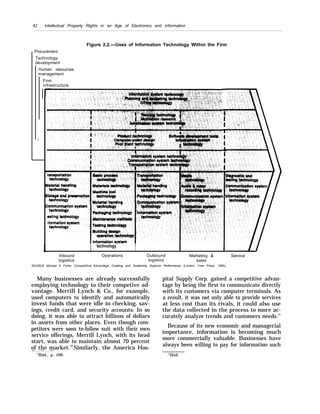
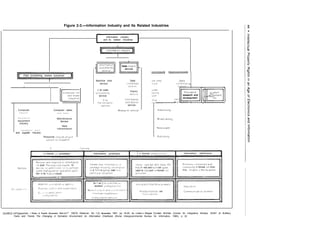
cations for their use. To serve these needs, a
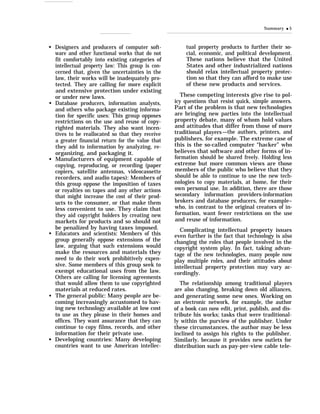
whole new industry has been spawned. (See fig-
ure S-2. ) One of the fastest growing sectors of
the economy, this industry is spearheading the
Nation’s economic growth and enhancing its
competitive position in the international mar-
ketplace.
The economic stakes raised by the new tech-
nologies are particularly high for the copyright
industries—publishing and other industries
that rely on the legal protections provided by
copyright law. It is estimated that in 1982, the
combined sales of these industries constituted
approximately 5 percent of the gross national
product. Estimates suggest that more than 2.2
percent of the labor force is affected by trade
in intellectual property. The amount of finan-
cial damage that these industries suffer due
to infringements of intellectual property rights
is extremely hard to estimate. Very few inde-
pendent, quantitative data are available, and
existing analyses often contradict each other.
Social and Personal
Information is a dominant force in our lives.
In the United States, an enormous amount of
information is communicated in the form of
words through electronic media. In the 1970s,
for example, it was estimated that the Amer-
ican population was exposed to about 8.7 tril-
lion words each day through electronic media
such as radio; television; and print media such
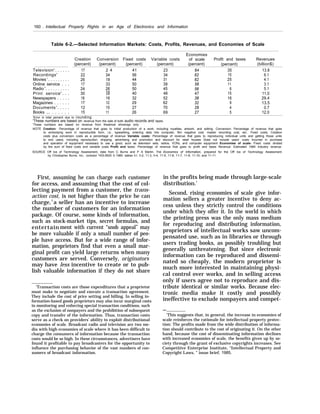
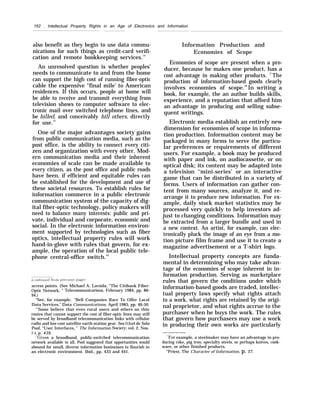
Figure S-2.— Information Industry and Its Related Industries
Sectors
Information processor> I n format I c I producer> I n for rTl at Iorl d I >tr bu tors
. . . . . . . . . . . . . . . . .. . . . . . . . . . . . . . . . . . . . . . . . . . . . . . . . . . . . . . . . . . . . . . . . . . . . . . . . . . . . . . . . . . . . . . . . . . . . . . . . . . . . . . . . . . . . . . . . . . . . . . . . . . . .. . . . . . . . . . . . . . . . . . . . . . . . . . . . . . . . . . .. . . . . . . . . . . . . . . . . . . . . . . . . . . . . . . . . . .
I n pu Is The response may be to Creale new In forma[lon or
pa( kage e i I SI I nq Informal IOP rTldch I neb dnC le~tlnol og es convey I nq I nformdl Ion fr(>m
u Sed I c 5 iI pport n forma I I on ( f](, III t id tor lr) I he r?c I p I er) 1
. . . . . . . .“. . . . . . . .“. . . . . . . . . . . . . . . . . .
. . . . . . . . . . . . . . . . . . . . . . . . . . . . . . . . . . . . . . . . . . . . . . . . . . . . . . . . . . . . . . . . . . . . . . . . .
Ad rll I n Is! r al I VP a rlC Imd tnager( a Sc I en t f I L d nc f PC h t7 IC,j
Pr OCeSb ~, jnt r II drl(j s u perv I sc r ,
I n format I, ) 17 Q JI hcrp rs
Cummunication workers
I
—..—
Summary q 1 1
.—
as newspapers, books, and magazines. This fig-
ure is rising; each year, the number of words
communicated increases at an average rate of
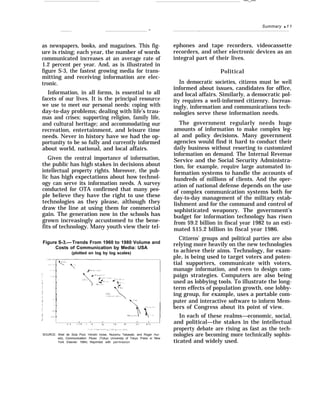
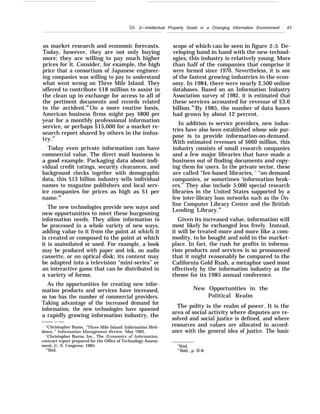
1.2 percent per year. And, as is illustrated in
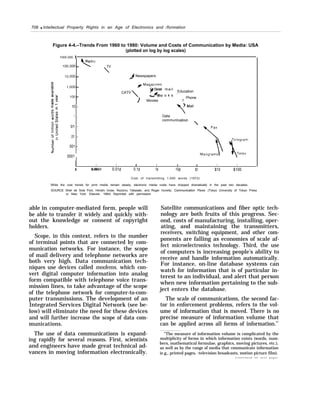
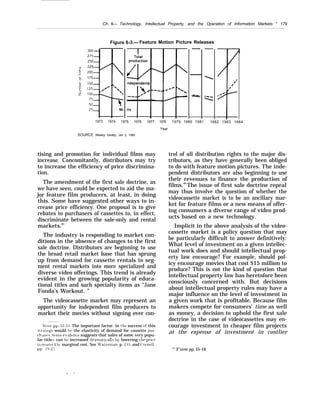
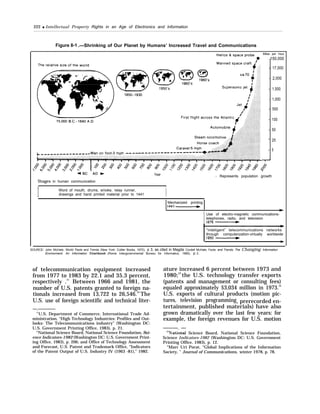
figure S-3, the fastest growing media for trans-
mitting and receiving information are elec-
tronic.
Information, in all forms, is essential to all
facets of our lives. It is the principal resource
we use to meet our personal needs: coping with
day-to-day problems; dealing with life’s trau-
mas and crises; supporting religion, family life,
and cultural heritage; and accommodating our
recreation, entertainment, and leisure time
needs. Never in history have we had the op-
portunity to be so fully and currently informed
about world, national, and local affairs.
Given the central importance of information,
the public has high stakes in decisions about
intellectual property rights. Moreover, the pub-
lic has high expectations about how technol-
ogy can serve its information needs. A survey
conducted for OTA confirmed that many peo-
ple believe they have the right to use these
technologies as they please, although they
draw the line at using them for commercial
gain. The generation now in the schools has
grown increasingly accustomed to the bene-
fits of technology. Many youth view their tel-
Figure S-3.— Trends From 1960 to 1980 Volume and
Costs of Communication by Media: USA
(plotted on log by log scales)
; , , , , 1 1)) c I,,,lc ,, ,C Ic 1,({ $’ $ 1(I SIlnl
SOURCE: Ithiel de Sola Pool, Hiroshi Inose, Nozomu Takasaki, and Roger Hur-
witz, Communication Flows (Tokyo University of Tokyo Press or New
York Elsevier 1984) Reprinted with permission
ephones and tape recorders, videocassette
recorders, and other electronic devices as an
integral part of their lives.
Political
In democratic societies, citizens must be well
informed about issues, candidates for office,
and local affairs. Similarly, a democratic pol-
ity requires a well-informed citizenry. Increas-
ingly, information and communications tech-
nologies serve these information needs.
The government regularly needs huge
amounts of information to make complex leg-
al and policy decisions. Many government
agencies would find it hard to conduct their
daily business without resorting to customized
information on demand. The Internal Revenue
Service and the Social Security Administra-
tion, for example, require large automated in-
formation systems to handle the accounts of
hundreds of millions of clients. And the oper-
ation of national defense depends on the use
of complex communication systems both for
day-to-day management of the military estab-
lishment and for the command and control of
sophisticated weaponry. The government’s
budget for information technology has risen
from $9.2 billion in fiscal year 1982 to an esti-
mated $15.2 billion in fiscal year 1986.
Citizens’ groups and political parties are also
relying more heavily on the new technologies
to achieve their aims. Technology, for exam-
ple, is being used to target voters and poten-
tial supporters, communicate with voters,
manage information, and even to design cam-
paign strategies. Computers are also being
used as lobbying tools. To illustrate the long-
term effects of population growth, one lobby-
ing group, for example, uses a portable com-
puter and interactive software to inform Mem-
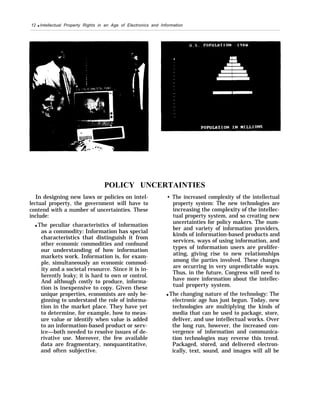
bers of Congress about its point of view.
In each of these realms—economic, social,
and political—the stakes in the intellectual
property debate are rising as fast as the tech-
nologies are becoming more technically sophis-
ticated and widely used.
12 q Intellectual Property Rights in an Age of Electronics and Information
POLICY UNCERTAINTIES
In designing new laws or policies on intel-
lectual property, the government will have to
contend with a number of uncertainties. These
include:
q The peculiar characteristics of information
as a commodity: Information has special
characteristics that distinguish it from
other economic commodities and confound
our understanding of how information
markets work. Information is, for exam-
ple, simultaneously an economic commod-
ity and a societal resource. Since it is in-
herently leaky; it is hard to own or control.
And although costly to produce, informa-
tion is inexpensive to copy. Given these
unique properties, economists are only be-
ginning to understand the role of informa-
tion in the market place. They have yet
to determine, for example, how to meas-
ure value or identify when value is added
to an information-based product or serv-
ice—both needed to resolve issues of de-
rivative use. Moreover, the few available
data are fragmentary, nonquantitative,
and often subjective.
• The increased complexity of the intellectual
property system: The new technologies are
increasing the complexity of the intellec-
tual property system, and so creating new
uncertainties for policy makers. The num-
ber and variety of information providers,
kinds of information-based products and
services, ways of using information, and
types of information users are prolifer-
ating, giving rise to new relationships
among the parties involved. These changes
are occurring in very unpredictable ways.
Thus, in the future, Congress will need to
have more information about the intellec-
tual property system.
q The changing nature of the technology: The
electronic age has just begun. Today, new
technologies are multiplying the kinds of
media that can be used to package, store,
deliver, and use intellectual works. Over
the long run, however, the increased con-
vergence of information and communica-
tion technologies may reverse this trend.
Packaged, stored, and delivered electron-
ically, text, sound, and images will all be
Summary * 13
interchangeable. Our understanding of how tual property system, is replete with un-
and when such changes will take place, certainty.
and of how they might affect the intellec-
AGENDA FOR CONGRESS
Faced with a growing number of requests
for action, in addition to a ubiquitous and rap-
idly changing technology, Congress confronts
the problem of trying to take into account the
magnitude and the scope of technological
change, while also balancing interests and re-
sponding to present concerns. In considering
how Congress might proceed, OTA identified
five major strategic choices:
1. what policy goals to pursue,
2. whether and when to act,
3. what legal framework to use,
4. how broadly to define the problem, and
5. within what institutional framework is-
sues should be resolved.
What Policy Goals To Pursue
OTA found that the intellectual property
system may no longer serve social, economic,
and political goals with the same ease in an
information age, given the enhanced value of
information in all realms of life. It is likely,
therefore, that Congress, when designing new
intellectual property laws and policies, will
have to choose more explicitly among policy
goals. Alternatively, Congress could use pol-
icy mechanisms other than the granting of in-
tellectual property rights to foster some goals
not supported by the present system. In the
pursuit of economic goals, for example, other
economic incentives—such as subsidies or tax
exemptions—might be granted. Unlike the ex-
tension of intellectual property rights, such
mechanisms would have few negative conse-
quences for learning and the creative envi-
ronment.
Whether and When To Act
Decisions about when to act are clearly re-
lated to decisions about whether to act, and
to decisions about whether to deal with prob-
lems separately or in a comprehensive fash-
ion. In considering these choices, OTA found
that technological developments are, indeed,
affecting all aspects of the intellectual prop-
erty system. Moreover, because we are only
beginning to move into an electronic era, the
full impact of the new technologies will not be-
come completely apparent for some time. Fun-
damental changes in technology are occurring
that will antiquate many of today’s solutions
and bring new kinds of problems requiring new
kinds of solutions. Thus, even if Congress de-
cides to act now in some areas, it will need to
be prepared to reconsider these actions within
the next decade.
Some problems are particularly pressing be-
cause stakeholders are seeking immediate leg-
islative action, societal stakes are particularly
high, or technological change is occurring so
rapidly that Congress must act sooner rather
than later if it wants to deliberately channel
its impact. OTA identified four such problems:
enforcement, private use, functional works,
and the international intellectual property
system.
Other problems, although equally important,
are less ripe for immediate action. Engendered
by technologies still in their infancy, these
problems are only now just emerging, and our
understanding of them is severely limited. Ex-
amples of such problems include assigning val-
ue and distributing rewards in cases of deriva-
tive use, protecting the integrity of works in
an electronic environment, and attributing and
assigning authorship when works are gener-
ated by interactive or electronic processes.
Although it may be too early to determine
long-term solutions to these problems, OTA
concluded that some steps will need to be taken
14 q Intellectual Property Rights in an Age of Electronics and Information
now if they are to be adequately dealt with in
the long run. One approach might be to begin
now to systematically collect data about, and
enhance our understanding of, information
needs, information users and producers, and
information-based products and services. This
approach might require institutional changes,
since, at present, no agency within the Gov-
ernment is set up to carry out such a task.
What Legal Framework To Use
The intellectual property system was care-
fully designed to balance the public and the
private interest. OTA found, however, that be-
cause the new information and communication
technologies do not fit neatly within the ex-
isting framework of the law, the balance may
be harder to achieve in the future.
OTA identified functional works as a par-
ticularly serious problem in this regard. The
analysis found that the distinction between
writings and inventions is indeed breaking
down with respect to functional works such
as computer software and semiconductor chip
masks. Because there are many works of this
type, they may require their own framework
for protection. If it were based on the distinc-
tive characteristics of these works, the law
might be more accurately targeted to achieve
specific policy outcomes, thus serving as a
more robust policy tool. With a new category
of law, both producers and users would face
less uncertainty each time a new type of work
were introduced. OTA’s analysis suggests, too,
that a fruitful basis for a revision along these
lines might be found in the distinctions be-
tween works of art, works of fact, and works
of function.
How Broadly To Define the Problem
OTA found that intellectual property policy
can no longer be separated from other policy
concerns. Because information is, in fact, cen-
tral to most activities, decisions about intel-
lectual property law may be decisions about
the distribution of wealth and social status.
Furthermore, given the unlimited scope of the
new technologies and the growing trade in in-
formation-based products and services, U.S.
intellectual property policy is now inextrica-
bly tied to international affairs. Communica-
tions policy, too, is becoming more linked to
intellectual property policy, as more and more
intellectual works are being transmitted by me-
dia such as cable television, telephone lines,
and communication satellites. Today, intellec-
tual property issues also give rise to privacy
concerns as copyright holders seek technical
means to monitor use. In making decisions
about intellectual property policy, therefore,
Congress must consider a whole new range of
issues, and decisionmakers in all these areas
will need to strive for greater coordination.
Within What Institutional Framework
Should Intellectual Property Issues
Be Resolved
OTA found that intellectual property issues
cannot be resolved without dealing with the
question of institutional capabilities and
change. In the absence of institutional change,
the courts will increasingly be called on to re-
solve highly complex and technical issues and
to make policy in this area. The judiciary, how-
ever, may not be suited for this role.
The pace of technological change will con-
tinue to put pressure on existing institutional
arrangements. To the extent that Congress,
in responding to these changes, adopts legis-
lation requiring a more active Government
role, new institutional arrangements will prob-
ably be required. If this were to be the case,
Congress might want to expand the responsi-
bilities of existing agencies, or it might estab-
lish a new central agency to address intellec-
tual property issues. Such an agency’s mission
might include monitoring technological change
and assessing how the law might deal with it,
providing the necessary expertise to deal with
complex technological issues, and collecting
and analyzing data about information markets
and use. Such an agency might also assume
additional regulatory functions, such as dis-
tributing rewards or adjudicating disputes. Fi-
nally, it might coordinate intellectual property
policy with policy in related areas.
Summary “ 15
THE OTA STUDY
The request for this assessment, Intellectual
Property Rights in an Age of Electronics and
Information, was made by Senator Charles
McC. Mathias, Jr., Senate Committee on the
Judiciary, and by Congressmen Peter W. Rodino,
Jr., Robert W. Kastenmeier, Hamilton Fish,
and Carlos Moorhead, House Committee on
the Judiciary.
In thinking about how the new communi-
cation and information technologies might
affect intellectual property rights, OTA has
adopted a broad approach, looking at the kinds
of stresses that technology might be placing
on the intellectual property system as a whole,
and on each of its parts. Such an approach was
required because the new technologies do not
necessarily have a direct effect on intellectual
property rights. Rather, more often than not,
their influence on the law is felt indirectly, as
a result of such things as technologically in-
duced changes in norms, values, and expecta-
tions, as well as in the ways in which intellec-
tual works are created, produced, marketed,
and distributed.
Such an approach is also useful because, given
the political intensity and high economic
stakes of the intellectual property debate
today, it is extremely important to view the
entire situation as all one piece. Those involved
in the policy debate often define issues solely
in terms of their own interests and world views.
Chapter 1
Conceptual Framework for
Analyzing Intellectual Property
Rights Issues
Contents
Introduction . . . . . . . . . . . . . . . . . . . . . . . . . . . . . . . . . . . . . . . . . . . . . . . . . . . . . . . . . . . . . . .
The Nature of Technology. . . . . . . . . . . . . . . . . . . . . . . . . . . . . . . . . . . . . . . . . . . . . . . . . . .
The Intellectual Property System and Its Relationship to Social and Technological
Change: A Framework for Analysis . . . . . . . . . . . . . . . . . . . . . . . . . . . . . . . . . . . . . . . .
The Intellectual Property System . . . . . . . . . . . . . . . . . . . . . . . . . . . . . . . . . . . . . . . . . . . .
The Intellectual Property System as a Dynamic System:
The Impact of Technology . .
The Approached and Outline of the
Emphasis on Copyright . .
. . . . . . . . . . . . . . . . . . . . . . . . . . . . . . . . . . . . . . . . . . . . . .
Report . . . . . . . . . . . . . . . . . . . . . . . . . . . . . . . . . . . . . . .
. . . . . . . . . . . . . . . . . . . . . . . . . . . . . . . . . . . . . . . . . . . . . .
19
20
21
21
23
25
25
l-1. Characteristics of Information Technologies and the Uses of
Intellectual
l-2. Framework
Figure No..
Property....
of Analysis..
1-1. The Intellectual
. . . . . . . . . . . . . . . . . . . . . . . . . . . . . . . . . . . . . . . . . . . . . . . . . 24
. . . . . . . . . . . . . . . . . . . . . . . . . . . . . . . . . . . . . . . .. . . . . . . . . 26
Figure
Page
System . . . . . . . . . . . . . . . . . . . . . . . . . . . . . . . . . . . . . . . . . . 22
Chapter 1
Conceptual Framework for Analyzing
Intellectual Property Rights Issues
INTRODUCTION
An intellectual property system is made up
of laws and practices and the relationships they
generate among individuals and institutions.
A system of this kind reflects the larger soci-
ety of which it is a part. For, although intel-
lectual property rights have been recognized
in natural law, historically, governments have
granted such rights to achieve a variety of pol-
icy goals. This is equally true today. Which
policy goals a particular intellectual property
system is designed to serve depends, in large
measure, on history, circumstances, and the
overriding needs of society.
Technological change has been one factor
that has had an especially significant influence
on both social systems and the intellectual
property systems that arise from them. Today,
it is posing a formidable challenge to the in-
tellectual property system. Developments in
information and communication technology
are threatening to outpace previous technologi-
cal advances in both speed and scope. They
are stressing the intellectual property system
to the point of raising fundamental questions
about the system itself. This chapter presents
a theoretical overview of the intellectual prop-
erty system, and identifies how technology
may influence it. It is deliberately abstract,
intending to lend perspective to questions
whose political and economic significance may
make objectivity difficult to achieve.
The U.S. system of intellectual property
rights and practices evolved in a way that
balances social, political, and economic inter-
ests. The system has been modified, both for-
mally and informally, in response to events and
circumstances. Its basic framework was set in
Section 8, Article 1 of the Constitution, which
authorized Congress to grant exclusive own-
ership rights of writings and inventions for a
limited period of time. The purpose was two-
fold: 1) to foster the progress of science and
the useful arts, and 2) to encourage the crea-
tion and dissemination of information and
knowledge to the public.
Although this framework was originally de-
signed to deal with the problems and opportu-
nities afforded by the invention of printing—
the information technology that dominated the
18th century–it has proven flexible enough
to accommodate a variety of new technologies.
Today, however, advances in technologies such
as microelectronics, fiber optics, and satellites
are testing the limits of this flexibility. Devel-
opments in areas such as biotechnology]
are
also influencing the system, but they are be-
yond the scope of this study.
Bringing swift changes in computers, com-
munications, and other information technol-
ogies, these technological advances are likely
to have a major social impact, carrying us fur-
ther into a new “information age. ” The new
technologies transmit information dramatical-
ly faster, and they can collect, store, manipu-
late, and transmit larger amounts of it. With
these new technologies, more people can gain
access to information, which they can more
readily use to trace past actions and predict
or influence future events. In the next few
decades, as these technologies continue to be
developed, they will be used for an ever-ex-
panding number of activities and tasks. This
‘Although biotechnology has many similarities to informa-
tion technologies in terms of its having a direct impact on the
intellectual property system, this report does not discuss these
impacts in detail. (; ii’en the magnitude of the impact that the
development of biotechnology might ha~re on society’, any dis-
cussion in this report, which focuses on information technol-
ogies cannot do justice to this topic. For a discussion of some
of these issues, see [J. S. Congress, Office of Technology Assess-
ment, Commercial lliotwhnoio~”.. .4n International.4 na!.~’sjs,
OTA-BA-218 (J$’ashington. 1)(’: LJ.S. (;o~ernment Printing of-
fice, ,Januar? 1984).
19
20 q Intellectual Property Rights in an Age of Electronics and Information
advance of technological frontiers will change, areas of
in equally significant ways, the structure of likely to
the social, economic, and political orders. nounced
intellectual property law, they are
have the most immediate and pro-
impact on copyright, the area of in-
Just as the technologies of the 18th century
shaped the intellectual property system as we
know it today, so too are the new information
and communication technologies likely to alter
significantly how society views intellectual
property, the mechanisms employed to protect
it, and the value that society places on intel-
lectual properties, both as market goods and
as public resources. Although information and
communication technologies will touch all
tellectual property law that has been most con-
cerned with the flow and use of information
in society. Moreover, to the extent that tradi-
tional legal categories cannot accommodate
these technologies, new kinds of intellectual
property law may be required.
This report examines how technological de-
velopments might affect the intellectual prop-
erty system. Each chapter focuses on one part
of the system.
THE NATURE OF TECHNOLOGY
Technology can be defined in many ways,
both broad and narrow. Some older definitions
limit technology to mean specific tools or ma-
chines. Other theorists define technology more
broadly as know-how: ‘‘a system of knowledge
intended to have a practical bearing."2
Beyond
this, one can also include in a definition of tech-
nology the human processes and relationships
required to bring a scientific idea to lifes
People chose their definition of technology
to suit the question they are asking and the
problem they must solve. Scientists and engi-
neers, for example, may have less need to con-
sider human factors, and so their definitions
concentrate more on machines and physical
structures—roads, airports, and nuclear re-
actors.4
But a purely mechanical definition of
technology would be inadequate for a study
analyzing how technology affects the intellec-
tual property system. Technology touches this
system directly and indirectly, affecting its
‘,Jay Weinstein, .%ciolog>’ Technolom’: Foundations of Post-
,4 cadem”c Sciemv ( N“ew Brunswick, London: Transaction Books,
19821, p. X 1. For this view, see also J.K. Fiebleman, “Pure
Science, Applied Science, Technology Engineering: An Attempt
at Definitions, ” TtJchnolog~’ and Culture, fall, 1961, pp. 305-
3 17; and C’, Susskind, [Understanding Technology (13altimore,
MD: Johns Ilopkins Uni’ersity Press, 1973).
‘For a discussion of technology understood as “a form of so-
cial organization, see Todd R. La Porte, Technology’ as Social
Organization, Institute of Governmental Studies, N’orking Pa-
per #84-1, (Jni’ersit}r of California, Berkeley.
‘Ibid.
laws and rules and influencing the social and
economic conditions in which relationships
take place. To illustrate the potential effect of
technology in both these spheres, we must
broaden the focus of the analysis and include
in it the areas where physical objects and peo-
ple meet. As Todd La Porte has said, one must
look at “who is technology,” as well as “what
is technology.”5
This report defines technology broadly, in-
corporating relationships and transactions be-
tween creators, publishers, distributors, and
users of intellectual property as well as the
hardware they use. To maintain this view,
while also allowing for independent analysis
of machines, tools, and techniques, we will con-
sider technology a "package’ that, to borrow
from Langdon Winner’s categories, comprises:6
apparatus: the physical devices of tech-
nical performance such as tools, instru-
ments, machines, etc;
techniques: the technical activities, such
as skills, methods, procedures, and rou-
tines that people engage in to accomplish
tasks; and
‘I bid., p. 8.
‘)
For a study that conceitres of technology as a package, see
James N. Danziger, William H. Dutton, Rob Kling, and Ken-
neth 1.. Kramer, Computers and Politics: Iligh Technology’ in
American I,ocal (~o}-ernments (New York: Columbia Univer-
sity Press, 1982).
Ch. 1—Conceptual Framework for Analyzing intellectual Property Rights Issues q 2 1
social arrangements: the relationships
that are established and the transactions
that take place allowing people to carry out
technical processes and to give physical
form to their ideas.7
Using this definition, this and subsequent
chapters are based on a broad model of the re-
lationship between technological and social
change.8
In this model, technology is consid-
‘I,angd{)n l’innt>r, 1 utonomou.s l’echnolog}.: Technic.s-(lut-
of-(’ ontrol a.~ a 7’henw c)f l)~)liti[’al ‘f’hou~rht ((’an] hridge, NI,!
and 1,ondon, J{nglan& the NI IT l)ress), pp. 11-12,
“Th[’ study {)t t(’chnolog~ and s(xiet? has a long histor~’ g(J-
ing back two cwnt,uries to the works of Adam Smith, Henri Saint-
ered to be one of many factors influencing so-
ciety, while society is viewed as affecting tech-
nological development through its structures,
laws, and practices.
Simon, and Karl Marx. In fact, it was the growing interest in
technological de~’elopments that ga~’e birth to the field of soci-
olo~’. Interest has intensifiwl in recent ~’ears, as both scholars
and policy makers have sought to anticipate and ameliorate the
unintended consequences of the deplo~-ment of technolo~’. Once
again, these interests ha~’e gi~’en rise to a new field of stud>’,
that of technology assessment. For two accounts of the history
of ideas about technolo~’, see Weinstein, op. cit., and W’inner,
op. cit.
THE INTELLECTUAL PROPERTY SYSTEM AND ITS
RELATIONSHIP TO SOCIAL AND TECHNOLOGICAL CHANGE:
A FRAMEWORK FOR ANALYSIS
The Intellectual Property System
Theoretical models and actual systems often
differ significantly. In the real world, the form
and structures of intellectual property systems
are worked out in the political arena. Seldom
is a system a well-conceived and well-designed
construct; it is more likely to take shape hap-
hazardly, reflecting the political compromises
and historical events that went into its mak-
ing. The American intellectual property sys-
tem is a product of such compromises, and
strong forces are still shaping it today. Those
involved in the debate often define issues nar-
rowly, in terms limited to their own interests
and world views. But, given the magnitude of
the technological changes occurring, and their
potential impact on the intellectual property
system, it is extremely important to view the
entire situation as a whole, in terms of the
interrelationships of its parts.
In looking at how technology might affect
the intellectual property system, it is useful
to conceive of the system as a set of incentives
and rewards designed to affect the behavior
of individuals or organized groups engaged in
creative or inventive activities. This system
is divided into five interrelated parts:
1. policy goals that it seeks to accomplish,
2.
3.
4.
5.
The
property rights that provide incentives
and rewards,
operating rules,
mechanisms by which policy goals are
achieved, and
the realm of people and activities that the
system is designed to influence.
intellectual property system can be visual-
ized as shown in figure 1-1. As this diagram
illustrates, the outputs of the system provide
feedback about how effectively the system is
working.
Policy goals are the ends towards which the
intellectual property system is directed; they
mirror the goals of the society. Thus, as illus-
trated in chapter 2, time and social change may
alter intellectual property goals. As the goals
change, other parts of the system are likely
to change in response.
Property rights are granted as incentives and
rewards. A property right might include, for
example, one or any number of the following
rights:9
‘These terms were borrowed from Lawrence Becker, “The
Moral Basis of Property Rights,. "Property J. Roland I]envork
and tJohn 11’. (’hapman (eds. ) (lNew’ York: New York Unirersit3T
Press, 1980), pp. 189-190.
22 q Intellectual Property Rights in an Age of Electronics and Information
Figure 1-1.— The Intellectual Property System
Intellectual property aystem goals
I
[ I
System feedback mechanism
SOURCE Office of Technology Assessment
1.
2.
3.
4.
5.
6.
7.
8.
9.
the right to possessor physically control
something,
the right to use or enjoy its benefits,
the right to manage or decide how it is to
be used,
the right to receive income from it,
the right to consume or destroy it,
the right to modify it,
the right to transfer it,
the right to distribute it, and
the right to exclude others from using it.
Rights may be granted only under certain
conditions, or they maybe limited in their ap-
plication. For example, to claim a patent in the
United States, an inventor must demonstrate
that his invention is useful, nonobvious, and
novel. To receive a copyright, an author’s work
must be original.10
Neither right offers perma-
nent protection. Patent rights generally last
for 17 years, and copyrights are granted to in-
dividuals for life plus 50 years and to corpora-
tions for 75 years.
Together, these rights, incentives, and the
conditions under which they are granted con-
stitute the operating rules of the intellectual
_
10
The word “work’ is a general term referring to any intellec-
tual creation. It is used in the legal sense to distinguish par-
ticular copies from what is protected by copyright.
property system. The rules make demands on
everyone involved in the system. The grant-
ing of a right to one party, for example, may
in effect create a corresponding obligation or
liability on the part of another. Structuring the
way the parties relate to and depend on one
another, these rights and incentives serve as
the rules governing the behavior of individuals
involved in the creation, production, distribu-
tion and use of works, products, and services
designated as intellectual properties.
Different intellectual property systems may
define intellectual properties differently, and
each may attach different rights, responsibil-
ities, and benefits to them. The structure of
rights will be determined, in part, by the pol-
icy goals of the system, and by the mechanisms
chosen to achieve them. Thus, a system de-
signed primarily to encourage learning and in-
vention, as is American patent law, may re-
quire inventors to disclose information. In
contrast, a system designed principally to reg-
ulate economic relationships, such as trade
secret law may, in fact, prohibit disclosure.
Similarly, a copyright system with the chief
goal of fostering the dissemination of informa-
tion might grant rights only in published
works; whereas one aiming to reward author-
Ch. 1 —Conceptual Framework for Analyzing Intellectual Property Rights Issues q 23
ship might protect works before they are made
publicly available.
Similarly, the mechanisms used to achieve
policy goals—the way in which the system
operates-can vary among and within systems,
depending on the kind of work to be protected,
the nature of the activities to be influenced,
the kinds of rights to be granted, and the pol-
icy goals to be achieved. For example, a sys-
tem that grants rights on the condition of an
act such as publication, or on the condition of
qualities such as usefulness or novelty, might
require a very different administrative appa-
ratus than a system with no such conditions.
We see, for example, that because patents are
granted under more stringent conditions than
copyrights, the Patent and Trademark Office
historically has had more resources and admin-
istrative responsibilities than the Copyright
Office has had.
The people, institutions, and activities that the
intellectual property laws aim to influence are
also crucial elements in the system. What ac-
tivities these people do, as well as the socio-
economic constraints under which they oper-
ate, determine whether a particular incentive
or reward might achieve its intended policy
goal. To be most effective, rewards and incen-
tives must match the motivations, needs, and
perceptions of the people they are designed to
influence, and they must accurately reflect the
kinds of activities that they pursue. If an in-
centive miscalculates the economics of creat-
ing, producing, and distributing an intellectual
property, it will not motivate people to keep
creating. In addition, because people creating
different forms of intellectual property oper-
ate in different environments and have vary-
ing concerns, they may respond best to differ-
ent kinds of inducements.
The outputs of the intellectual property sys-
tem—such as the amount, quality, and diversity
of works—reveal, in part, how well it is work-
ing. But a number of difficulties arise in any
effort to evaluate a system’s performance.
First, there are problems in selecting criteria
that best measure effectiveness-that is, which
results to note and which to ignore. Second,
—.
one cannot easily determine whether these cri-
teria are being met. Finally, evaluating and
assessing the accuracy and independence of
the information needed to analyze the system
is fraught with difficulty. At present, most of
the information about such things as the ex-
tent of infringement, the potential economic
damages of infringement, or the uses made of
information-based products and services is
available only from the stakeholders them-
selves.
The Intellectual Property System
as a Dynamic System: The Impact
of Technology
The dynamic nature of the intellectual prop-
erty system further complicates its analysis.
It exists within society, and shifts in response
to social, political, and economic circum-
stances. Thus, when society values change,
so may the motives and attitudes of creators,
inventors, and users of intellectual properties.
Similarly, changes in economic conditions can
alter relationships and positions between and
among individuals and groups in the system,
redistributing their shares of financial obliga-
tions and rewards.
Of the many factors that might affect the
intellectual property system, technological
change is likely to have the greatest impact.
We can see this clearly in examining the ef-
fects of new technologies on the intellectual
property system.
Electronic information technologies are fun-
damentally different from print technology in
a number of ways. For example, broadcasting
technologies (radio, television) make a work
simultaneously available in the homes of so
many users that arrangements for payments
for the transfer of works to them is often pro-
hibitively expensive. Other technological ad-
vances, such as photocopiers and audio and
video tape machines, have so reduced the cost
and decentralized the process of copying works
that rights holders are no longer assured that
they have control over the production and in-
tegrity of their intellectual property. As infor-
24 q Intellectual Property Rights in an Age of Electronics and Information
Table 1-1 .–Characteristics of Information Technologies and the Uses of Intellectual Property
.—
Technical characteristics Technical characteristics
of works Uses of works of works Uses of works
Mechanical print
Produced in tangible “units”
(but requires expensive
machines and special skills
to copy in large quantities)
Fixed in tangible copies
(one ‘canonical” form of
“the work” exists)
Analog electronic print
“Originals” sold in tangible
copies
Reproducible at moderate
cost (e. g., xerograhic copies,
audio and video tapes)
Decentralized
Technology-bounded
Analog electronic broadcast
Simultaneously available
(one “intangible copy”)
Publishers, printers, and
booksellers cooperate to publish
work and sell units to individuals
or Iibraries, authors received per-
copy royalty on first sale of a
copy; copyright holder retains
rights to print and publish “the
w o r k "
Individuals read, scholars quote or
cite; owner of a copy may copy
parts of it by hand, or sell, rent, or
destroy his copy
E g , audio recordings and
videocassettes are initially
manufactured and sold somewhat
Iike traditional, mechanically
printed books
Small works, or parts of large
works, are often copied privately
by users with machines, rather
than by hand, copies of copies are
poorer in quality than copies of
originals
Many Individuals have equipment
and skills to make copies
Different media and equipment
usually needed to use and copy
different types of works
Advertisers may pay for work to
attract potential customers to
their product, alternatively, users
may pay (e g , public broadcasting,
subscription television)
——
mation technologies become computerized, the
copy, transfer, and manipulation of works are
becoming even more decentralized, speedy, and
inexpensive.
At a basic level, the very definitions on which
intellectual property rights are based take on
new meanings, or become strained and even
irrelevant, when applied to the context created
by new technologies. They raise questions, for
example, about what constitutes a‘ ‘derivative
work’ when works are made available through
intangible electronic waves or digital bits;
about what constitutes a “work”; and about
who owns the right to it when it is interactive,
and when creators have combined their efforts
to produce it.
Digital electronic
Simultaneously available
Reproducible at very low
cost
Versatile
Decentralized and pervasive
Interconnected
Dynamic
Processible
Autonomous
Many Individuals may access a
central store of works, a “data
base”
Prices for magnetic and optical
storage media will continue to
fall; media are very high in
capacity, and very fast in making
reproductions: perfect copies can
be made from copies
Many types of works (e, g , text,
music, video-taped or filmed
pictures) may be stored and
communicated digitally
Highly capable machines are
becoming ubiquitous in homes
and offices
Machines may be privately Iinked
by switched telephone circuits:
works can be transfered with
Impunity; and joint authorship IS
not restricted by the physical
separation of the authors
Work may be Interactive or
constantly evolving; one
“canonical” copy may not exist
Machines may be programmed to
transform and manipulate works,
perhaps masking evidence of
original authorship
Works may be functional, rather
than only meaningful, as are
traditional copyrightable works
—
The characteristics that differentiate the new
technologies from the old, and that create po-
tential problems for the system, are summa-
rized above in table 1-1.
Changing technology may influence each
part of the system directly, or it may affect
it indirectly by modifying the larger social envi-
ronment in which the intellectual property sys-
tem operates. New technologies, for example,
may affect the boundaries of the system and
the nature of the rights that it provides. In
doing so, they may change the “rules of the
game” by which it operates. As discussed in
chapter 3, each new technology has brought
questions about whether and where it should
fit into the existing system. Most recently, for
Ch. 1—Conceptual Framework for Analyzing Intellectual Property Rights Issues q 25
example, Congress, borrowing from both copy-
right and patent law, adopted a new suigeneris
law, I that established a separate niche for com-
puter chip technology in the intellectual prop-
erty system.
Technological developments may also change
the mechanisms used to achieve intellectual
property goals. Chapter 4 points out that dem-
onstrating ‘‘authorship’ or ‘‘originality as a
condition for receiving property rights, while
relatively straightforward in a print culture,
is much more complicated in an age of elec-
tronic technology. Similarly, as illustrated in
chapter 7, a system that assumes copyright
holders can enforce their own rights against
infringement may operate unsuccessfully if de-
centralized reproduction and electronic trans-
mission prevents identifying where and when
infringements take place.
Because technology brings about new kinds
of interactions between people, as well as new
technological apparatus and new processes and
techniques, it is also likely to affect the peo-
ple, institutions, and activities that are part
of the realm of the intellectual property sys-
tem. As noted in many of the following chap-
ters, new technologies not only affect what peo-
ple do and how and why they do it, they also
may restructure the socioeconomic opportu-
nities available to them and the constraints
under which they operate. And, in creating a
multitude of new opportunities for application,
use, and profit-making, issues may arise among
the parties in the system the resolution of
which, over the long run, may prompt changes
in the goals, the boundaries, and the structure
of the system itself.
THE APPROACH AND OUTLINE OF THE REPORT
Using the above model, this assessment ana-
lyzes the impact of the new information and
communications technologies on the U.S. in-
tellectual property system. Table 1-2 outlines
the problems to be analyzed.
In this table, six major criteria are suggested
to evaluate how well the system is function-
ing. Corresponding to these criteria are a num-
ber of research questions that might be asked
to determine how well the criteria are being
met, and some possible indicators of the sys-
tem’s effectiveness. The broad scope of the ta-
ble illustrates the magnitude and complexity
of the problem. It also suggests some useful
questions around which to build an analysis,
many of which serve as starting points in the
following chapters.
The Emphasis on Copyright
In general terms, intellectual property law
includes any law that grants rights in the prod-
ucts of the intellect. As such, it is a generic
term that covers patent, copyright, trademark
law, and the Semiconductor Chip Act, as well
as trade secrets and tort misappropriation law.
There are two major reasons for this empha-
sis. First, since copyright is concerned primar-
ily with the use and flow of information and
information-based products and services, it is
the area of intellectual property law that will
be most affected by advances m communica-
tion and information technologies. Second, it
is to copyright rather than to other provisions
that the creators, developers, producers, and
distributors of new information technologies
are looking in their efforts to gain legislative
protection for their works.
This emphasis notwithstanding, we have
tried to look broadly at the impact of technol-
ogy on the entire intellectual property system.
This broad perspective allows us to address
not only the problem and opportunities that
the new technologies present for the copyright
system itself, but also to consider alternative
ways, including some entirely new ones, of ad-
dressing them.
26 q Intellectual Property Rights in an Age of Electronics and Information
— —
Table 1-2.— Framework of Analysis
Evaluative criteria Questions for research
7. Effectiveness in meeting
overall systems goals
A. Creation and dissemination Degree of creativity
of creative, informational,
and scientific works
Availability
Congruence of incentives
B. Enhancement of
the learning
environment
C. Economic growth
and development
Degree of scientific
and technological
development
State of the arts and
entertainment
Overall condition of education
Growth of information-based
industries
International competitiveness
2. Efficiency in achieving goals Costs and benefits of granting
rights
q
q
q
q
q
q
q
q
q
q
q
q
q
q
q
q
q
Ž
q
q
q
q
q
q
q
q
q
q
q
q
q
q
q
q
q
q
q
indicators/types of Information
that might be collected
Evaluations of creators, critics, users
Output of works
Number of prizes offered in these fields
Number of people engaged in these fields
Interactions of members of the creative en-
vironment
Number and variety of informational resources
Evaluations of creators, publishers, producers,
users
Diversity of works
Price of works
Opportunities for access
Evaluations of creators, publishers, and producers
Level of output
Emergence of new fields
Number of scientists/technologists
Number and quality of scientific publications
Interactions between members of the scientific/
technical community
Patents issued
Awards granted
Evaluations by members of the scientific/technical
community
Emergence of new fields
Number of creators
Condition of production/distribution industries
Availability of resources for creation/production/
distribution
Awards granted
Market for creative works
Evaluations by national educators/businessmen/
parents/National Science Foundation/etc.
Literacy rates
Test scores
Availability and qualifications of faculty/teachers
Quantity and quality of educational materials/
information-based resources
Interactions among members of the educational
community
Development of new industries and profit-making
opportunities
Percentage of employment
Number of firms
Contribution to gross national product
Use of information-based products and services in
non-information industries
Balance of trade
Institutional costs
Transactional costs
Social costs in terms of achieving systems goals
Benefits measured in terms of achieving system
goals
Estimates of harm due to infringement/lack of
intellectual property protection
Profit margins
Industry competition
Estimates of economic value of intellectual
property rights to proprietors
Ch. 1—Conceptual Framework for Analyzing Intellectual Property Rights Issues q 27
Table 1-2.—Framework of Analysis—Continued
—
Indicators/types of information
Evaluative criteria Questions for research that might be collected
Costs and benefits of
alternative measures for
achieving system goals
3. Enforceability Extent of Infringement
Ease of detection
4. System durability
Legitimacy of the system
Flexibility in the face of
change
Legitimacy of the system
Ability to resolve conflicts/
harmonize interests
Reliability/predictability as a
guide to action
Robustness of principles
5. Precision as policy tool Predictability of outcome
independence/compatibility
with respect to other policy
areas
Sensitivity to differences
among different kinds of
information-based products
and services
6. Congruence with international Ability to resolve conflicts -
and other national systems
Harmony with other intellect
al property systems
Compatibility with other inter-
national regimes—i.e.,
GATT, UNESCO
SOURCE Office of Technology Assessment
—
q Institutional costs
q Transactional costs
q Social/economic costs/benefit in terms of achiev-
ing system goals
q Public/institutional behaviors
q Technologial capabiIities to access/reproduce/
reformat information-based products and services
q Privacy of use and decentralized access to
reproductive/access/and communication tech-
nologies
• Technological capabiIities to preclude authorized
access/use
q Transaction costs
q Technological capabiIities to monitor access/use
q Public attitudes/support for the system
• Frequency of legislative revision/amendment
Ž Resort to alternative forms of protection
q Consensus in cases of first impression
q Consistent/coherent application of law
• Public attitudes/support for the system
q Extent of infringement
q Acceptance of decisions by parties in dispute—i.e.,
number of appeals
q Extent of unresolved issues — I.e., fair use,
copyrightability of computer software
Ž Internal coherence/consistency of law
. Resort to other forms of protection
q Overlap with other law
q Quality, quantity, independence of available infor-
mat ion
q Number of agencies involved
q Cross-cutting issues
• Interested congressional committees
. Convergence of stake holder Interests
q Intensification of issues
q Roles of different kinds of Information-based
products and services
q Economics of different kinds of information
markets
q Public attitudes toward different types of
information-based products and services
q Technological characteristics of different
information-based products and services
q Enforcement mechanisms
q Level of infringement
q International court cases
q Resort to other policies mechanisms to deter
infringement— i.e., trade sanctions
q Level and participation in International regimes
q Scope of International treaties
. IncompatibiIities with international law — i.e., infor-
malities
q Policy conflicts and inconsistencies
Chapter 2
Intellectual Property Goals in a
Changing Information Environment
Introduction . . . . . . . . . . . . . . . . . . . . . . . . . . . . . . . . . . . . . . . . . . . . . . . . , . . . . . . . . . . . . . 32
Evolution of the Concept and Practice of Granting Intellectual Property Rights. . . . 33
Emergence of the Concept of Intellectual Property Rights . . . . . . . . . . . . . . . . . . . . . . . 33
Copyright as a Mechanism for Censorship and the Regulation of Trade . . . . . . . . . . . 34
Copyrights To Prevent Monopoly Practices: The Idea of Author Rights . . . . . . . . . . . 35
Traditional Goals of the U.S. Intellectual Property System . . . . . . . . . . . . . . . . . . . . . . 37
Opportunities and Policy Choices in an Information Age. . . . . . . . . . . . . . . . . . . . . . . . . . 39
Three Realms of opportunity . . . + ., . . . . . . . . . . . . . . . . . . . . . . . . . . . . . . q . . . . . . . q q . 40
Opportunities in the Techno-Economic Realm. , . . . . . . . . . . . . . . . . . . . . . . . . . . . . . . . . 40
New Opportunities in the Political Realm ... , . . . . . . . . . . . . . . . . . . . . . . . . . . . . . . . . . 43
Opportunities in the Cultural Realm . . . . . . . . . . . . . . . . . . . . . . . . . . . . . . . . . . . . . . . . . 49
The Potential for Conflict in the Use of New Technologies . . . . . . . . . . . . . . . . . . . . . . . . 53
Implications for the Intellectual Property System . . . . . . . . . . . . . . . . . . . . . . . . . . . . . . . . 56
Figures
Figure No. Page
Z-I. The Evolution of Information Occupations . . . . . . . ., ....... . . . . . . . . . . . . . . . . . 41
2-2. Uses of Information Technology Within the Firm . . . . . . . . . . . . . . . . . . . . . . . . . . . . 42
2-3. Information Industry and Its Related Industries . . . . . . . . . . . . . . . . . . . . . . . . . . . . . 44
2-4. Development of Custom Targeting Database . . . . . . . . . . . . . . . . . . . . . . . . . . . . . . . . 48
2-5. Carnegie Mellon Flowchart . . . . . . . . . . . . . . . . . . . . . . . . . . . . . . . . . . . . . . . . . . . . . . . . 55
Chapter 2
Intellectual Property Goals in a
Changing Information Environment
FINDINGS
In an information age, decisions about the
granting of intellectual property rights are
Linked to other information policy decisions,
and in making them, we are making decisions
about the nature of society itself. Given the
convergence of these issues, it may be neces-
sary to establish clearer priorities about the
goals towards which intellectual property pol-
icy is directed.
The new information and communication tech-
nologies create, for both individuals and society
as a whole, new cultural, economic, and politi-
cal opportunities, as well as new information re-
quirements and needs. These technologies are
capable not only of generating, storing, and
processing vast amounts of information; they
can also provide greater access to information,
enhance the environment for learning and crea-
tivity, generate new opportunities for profit-
making and economic growth, and facilitate
participation in political and social affairs.
Insofar as they afford new socioeconomic op-
portunities, the new information and communi-
cation technologies will assume a greater role
in society, and in the economy, giving rise to pub-
lic policy issues about their use. Issues will
emerge, for example, with respect to which in-
formation needs will be met; which opportuni-
ties will be developed; and which parties will
benefit from them.
Concerned primarily with the use and flow of
information in society, intellectual property law
has historically served in the United States to
decide many of these issues. In resolving them,
an effort has been made to strike a suitable
balance between the needs of creators, produc-
ers, and distributors of intellectual properties
and the social, economic, and political needs
of the nation as a whole. In such a fashion, in-
tellectual property law has been able to simul-
taneously serve a wide variety of social and
economic public policy goals.
The ability of intellectual property law to
strike such a balance was not particularly diffi-
cult in the past, when the social and economic
stakes in information were lower than today
and when relatively few and well-defined play-
ers were involved in the intellectual property
process. Information-based products and serv-
ices were peripheral to the performance of
many social and economic activities, and peo-
ple had lower expectations about their use and
the level of profit that might be derived from
them. As a result, issues involving the grant-
ing of intellectual property rights could be
worked out among the major players without
much public involvement or concern.
The resolution of these issues in an informa-
tion age, however, will be more problematic, re-
quiring that more stakeholders be taken into ac-
count and that decisions be made about the
distribution of incentives and rewards. Given
the variety of opportunities that the new tech-
nologies afford, the increased value of infor-
mation, changing relationships among the tra-
ditional participants in the intellectual
property system, and rising expectations
about the benefits of these technologies, the
number of stakeholders with disparate inter-
ests and competing claims on the system will
be greater than ever before. In such a context,
the granting of intellectual property rights, in-
stead of mutually serving a variety of differ-
ent stakeholders, and equally fostering a broad
set of diverse policy goals, may pit some stake-
holders and goals against one other. Moreover,
given the ease of access to the new technol-
ogies, members of the public are now major
stakeholders in the system, and as such their
attitudes and behavior are likely to have a
greater impact on policy choices and outcomes.
31
32 . Intellectual Property Rights in an Age of Electronics and Information
INTRODUCTION
Although intellectual property rights have
been recognized in natural law, historically,
governments have granted such rights to
achieve a variety of policy goals. This is equally
true today. In the West, the granting of copy-
right, for instance, is viewed primarily as a
mechanism for encouraging the dissemination
of information. But in Eastern bloc countries,
the policy goals differ and it is regarded chiefly
as ‘an instrument for the management of cul-
tural processes.”1
Which policy goal a particular intellectual
property system is designed to serve depends,
in large measure, on the history, circum-
stances, and overriding needs of a society at
the time the system is first set up. Develop-
ing countries, for example, which must import
most cultural and scientific materials, have
often been unwilling to extend protection to
foreign works. This was true of the United
States during its first 100 years, and is the case
in many Third World countries today.
Despite their varying goals, however, all in-
tellectual property systems basically concern
policies involving the use and flow of informa-
tion. This is especially true of the copyright
system, which was established specifically to
deal with the social and economic changes
brought about by what, historically, has
proved one of the most “world shaking” in-
formation technologies-the printing press.
Characterizing copyright role in structuring
information flow, Edward Plowman and L.
Clark Hamilton wrote:
In a wider perspective, a number of basic
dimensions of the nature and function of
copyright may be distinguished. In an over-
all, cultural perspective, the stated purpose
of copyright is to encourage intellectual cre-
ation by serving as the main means of recom-
pensing the intellectual worker and to protect
his moral rights. In an economic sense, copy-
right can be seen as a method for the regula-
tion of trade and commerce.
Copyright thus serves as a mechanism by
which the law brings the world of science, art,
and culture into relationship with the world
of commerce. In a social sense, copyright is
an instrument for the cultural, scientific and
technological organization of society. Copy-
right is thus used as a means to channel and
control flows of information in society. [em-
phasis added].2
The patent and trade secrets systems also
involve the flow of information. The patent sys-
tem is designed primarily to foster scientific
and technical information. Although patent
law permits only the inventor or patent holder
to make, use, or sell his invention, it also re-
quires that the inventor disclose to the world
the information necessary to enable others to
reconstruct the invention after a 17-year period
of protection has elapsed. Patent law, there-
fore, seeks to encourage the distribution of in-
formation by making disclosure a condition of
protection. The trade secrets system, in con-
trast to the patent system, is designed to dis-
courage the widespread flow of certain types
of information. Secrecy is maintained in order
to give the holder of the trade secret a com-
petitive advantage in the marketplace.
Like the printing press, the new information
technologies also affect society. They are
changing the way people work and conduct
their business; how they interact and relate to
one another; the way they learn, create, and
process information, and their needs and ex-
pectations. In fact, these new technologies are
altering the way man views himself and his
place in the world.3
Together, the development and widespread
use of these new technologies have helped to
usher in what some social observers charac-
terize as a “post-industrial,” or “information”
‘Puscher, “Copyright in the German Democratic Republic,”
Copyright IMZetin of the LEA, vol. 10, No. 3, 1976, as cited
in Stephen Stewart, The Law of Internati”omd Copyright and
Neighboring ~“ghts (London: Butterworth & Co. (Publishers)
Ltd., 1983), p. 10.
‘Edward W. Plowman and L. Clark Hamilton, Copyright:
Inteflectmd Property in the Information Age (London: Rout-
ledge and Kegan Paul, 1980), p. 25.
‘Sherri Turkel, The Second Self: Computers and the Human
Spirit (New York: Simon & Schuster, 1984),
Ch. 2—Intellectual Property Goals in a Changing Information Environment q 33
society.4
In this society, the creation, use, and
communication of information plays a central
role. Not only will the amount of information
continue to increase, but people will also rely
on it in more and in different circumstances.
The changes brought on by the new technol-
ogies will generate new social, economic, and
cultural opportunities and choices, which will
bring with them the need for major policy
decisions.
Because intellectual property policy, and es-
pecially copyright policy, serve as a policy tool
that structures the use and flow of informa-
tion, it is likely to play a major role in an infor-
mation age. How the intellectual property sys-
tem is structured will determine not only which
individuals and groups benefit from the new
opportunities afforded by the new technol-
ogies, but also in what ways and the extent
to which, as a society, we might take advan-
tage of them. Furthermore, if the enhanced
value of information creates conflicts between
economic, political, and cultural goals, the
structure of the system will establish some of
the rules that determine whether information
will be treated as an economic commodity or
a societal resource.
Given the relationship between intellectual
property goals and social change, and the prob-
able influence of the copyright system in an
information age, the question arises of whether
the policy goals of the United States intellec-
tual property system, established in an agrar-
ian society and when print technology domi-
nated, are still appropriate for today.
Evolution of the Concept and Practice
of Granting Intellectual Property Rights
Social, economic, political, and technologi-
cal factors all influence the nature of intellec-
4
For discussions and characterizations of the “ Information
Society. ” See, for example, U.S. Congress, Office of Technol-
ogy Assessment, Computer-Based National Information Sys-
tems, OTA-CIT-146 (Washington, DC: U.S. Government Print-
ing Office, September 198 1); Susan Artandi, “Man, Information,
and Society: New Patterns of Interaction, Journal for the Amer-
ican Society for Information Science, January 1979; and Daniel
Bell, The Coming of Post Industrial Society (New York: Basic
Books, 1973).
tual property systems and the goals that gov-
ernments have sought to promote by granting
those rights. The connection between these fac-
tors and intellectual property systems is clear-
ly visible if one examines the concept of intel-
lectual property as it evolved over time. In-
tellectual property rights began in a autocratic
period, as a tool of monarchs to stimulate
invention, regulate trade, reward favorites,
establish patronage, and control and censor the
dissemination of ideas and information. Two
hundred years later, in a democratic context,
this tool evolved into a system designed to fos-
ter freedom of expression and the creation and
dissemination of new ideas.
Emergence of the Concept of
Intellectual Property Rights
The birth of the idea of intellectual property
itself demanded certain social conditions. It
required a centralized political authority and
a government that intervened in economic af-
fairs; the development of trade and commerce;
a market for literature, art, and invention; and
the growth of the idea of, and respect for, the
individual as creator. Only in the late Middle
Ages did such conditions develop, and only
then did the concept of intellectual property
rights, as we know it today, emerge.5
In addition to these societal changes, tech-
nological change-and in particular, the devel-
opment and widespread deployment of the
printing press— also created the need for in-
tellectual property protection. Before the de-
velopment of printing, inventors, embodying
their ideas within their own persons, did not
need to concern themselves with the prospect
— ---- - -----
‘Bruce W. Bugbee, Genesis of American Patent and Copy-
right Law (Washington, DC: Public Affairs Press, 1967). This
latter condition existed in Roman times where the social cli-
mate was supportive of individual attribution and payment for
intellectual activities. In a number of texts from the period, for
example, there are references to individuals as authors and to
the terms of payment for intellectual contributions. Moreover,
plagiarism was clearly considered to be unethical. There is no
evidence, however, that such attitudes and procedures were in
any way sanctioned by law. Conditions radically changed dur-
ing the Middle Ages, however, when monasteries and other re-
ligious institutions began to assume primary responsibility for
intellectual and creative pursuits. As in pre-Roman times, the
idea of individual, as author, lost support. Plowman and Hamil-
ton, Copyright, pp. 9-11.
34 q Intellectual Property Rights in an Age of Electronics
of others reaping the financial rewards of their
work. They simply went from town to town
selling their intellectual wares. However, once
their ideas were recorded and widely distrib-
uted in print, the inventors lost this control
and, hence, their economic bargaining power.
The problem created by the printing press was
even greater for authors whose profits were
derived not from their ideas but from what sub-
sequently was even more easily duplicated, the
written word itself.
The first intellectual property rights were
granted as patents. Characterized by one au-
thor as being “the idea of progress appearing
in the law, patents were associated with tech-
nological development from the start.6
Offered
by sovereigns and local governments as part
of their overall economic policies to stimulate
commerce and technological advance, they
were, essentially, monopolies designed to en-
tice artisans and inventors into their States
or localities.7
Copyrights-or the granting of rights in liter-
ary property—did not develop in either con-
cept or practice until the 15th century. Even
more than patent rights, copyright can be iden-
tified with one specific technology, the print-
ing press.
The printing press brought about major so-
cial, economic, and political changes.8
By great-
‘Significant inventions of the late Middle Ages included
various processes that would increase the efficiency of artisans,
such as textile-making equipment, textile dye processes, glass
manufacturing, stained glass processes, mining and metallurgy,
windmills, and ship-building designs. Bruce W. Bugbee, Gene-
sis of American Patent and Copyright Law (Washington, DC:
Public Affairs Press, 1967), pp. 12, 167.
‘The city-state of Venice, with its important role in world
commerce and its strong central government, became the first
government to grant patents. The importance that the Vene-
tians attached to the goal of economic development is reflected
by the fact that a patent right granted in a work had to be relin-
quished if it did not prove to be commercially successful. As
towns and commerce revived, technological development acceler-
ated, and political centralization increased, this practice of grant-
ing patent rights spread throughout Europe.
‘For a detailed and in-depth discussion of the social changes
brought about by the advent of printing, see Elizabeth L. Eisen-
stin, The Printing Press as an Agent of Change: Communica-
tions and cultural transformations in early modem Europe, vol.
I and 11 (Cambridge, England: Cambridge University Press,
1982); For a discussion of the more general impact of communi-
cation technology on society, see Harold Innis,The Bias of Com-
munication (Toronto: University of Toronto Press, 1951).
and Information
— — .
ly increasing the speed and reducing the costs
of reproduction, printing made it much easier
to disseminate ideas. By increasing the gen-
eral level of literacy, it also made more people
susceptible to, and eager to partake of, such
ideas. As a result, the market for information
products and literary works grew, and their
economic value was greatly enhanced. In fact,
one might say that printing was the growth
industry of the time. Later, as books and
manuscripts ceased to be isolated on mones-
tary shelves, and became available to many
people simultaneously, they began to serve as
an important forum for public discussion.
Occurring at the time of religious and polit-
ical turmoil, printing presented the monarchs
of Europe with both a political threat and an
economic opportunity. The law of copyright
was developed to deal with this threat, as well
as to take advantage of this opportunity. The
shape the law took reflects its dual purpose:
censorship of the press and regulation of trade.
Although copyright systems were established
across Europe, England provides the most use-
ful illustration of how the system worked, since
the American system was derived from Eng-
lish experience.
Copyright as a Mechanism for
Censorship and the Regulation of Trade
As in most European countries, England’s
need for copyright protection arose with the
invention of the printing press, and it had its
origins in the English censorship laws. These
acts included the Star Chamber Decrees of
1566, 1586, and 1637, as well as three acts
passed in the 1640s during the Interregnum,
and the Licensing Act of 1692. Together, they
provided for such things as the granting of pat-
ents for specified works, the confinement of
printing to authorized presses, the licensing
of books before publication, and the use of
trade organizations and special government
agencies for enforcement.9
While direct censorship was the most effec-
tive means of confronting the political threat
‘Benjamin Kaplan, An Unhurried View of Copyright (New
York and London: Columbia University Press, 1967).
Ch. 2—Intellectual Property Goals in a Changing Information Environment q 35
.
brought about by the new technology, it also
stifled the printing industry, and thus limited
the government economic benefits from print-
ing. Seeking to both end the dissemination of
heretical and seditious literature, but still
profit from the burgeoning printing trade, the
English Government aligned itself with pub-
lishers. In exchange for an agreement to en-
force the censorship laws, the government
granted the publishers’ guild, known as the
Stationers, a monopoly right to print, publish,
and sell works—a copyright. ’”
The effectiveness of this arrangement came
about, as Ithiel de Sola Pool has noted, because
“the printing press was a bottleneck where cop-
ies could be easily examined and controlled."11
The arrangement was also beneficial to pub-
lishers. It not only provided them with a mon-
opoly; but also, as partners with government,
they were free to manage their own affairs,12
Thus, through their bylaws, they regulated the
book trade. ’3
Copyrights To Prevent Monopoly
Practices: The Idea of Author Rights
In the period following the Restoration, the
Government’s major concern was no longer
press censorship. Instead, there was a grow-
ing wariness about the publishers’ monopoly— . —
“’The copyright was limited to members of the Stationers’
guild so that only registered members could print books. Once
a publisher entered the title of a work, his name, and the date
of publication into the company register, he obtained a perpetual
copyright in it. With what was essentially an economic right
designed to protect his investment from competition, the pub-
lisher could also trade in rights. He could buy copyrights, sell
them, or assign them to any other member of the company. When
cases of copyright infringement and disputes among publishers
arose, they were decided by the company courts. The Stationers’
copyright remained in force for over 150 years, when the condi-
tions underlying the system changed significantly. Stephen
Stewart, Law of International Copyright, and Neighboring
Rights (London: Butterworths & Co. (Publishers), Ltd., 1983).
‘‘ Ithiel de Sola Pool, Technologies of Freedom (Cambridge,
MA: Belknap Press, 1983), pp. 16-17.
“Originating as a craft guild in the early 15th century, the
Stationers were established as a company by Henry VIII in
1557. They consisted of members of the book trade—printers,
book binders and booksellers. For a discussion of the history
of the Stationers’ Company and its role in the development of
copyright, see Lyman Ray Patterson, Copyright in Historical
Perspective (Nashville, TN: Vanderbilt University Press, 1968).
Chapter IV.
“Stewart, The Law of International Copyright, p. 18.
of the book trade. By buying up all of the rights
to copy books, the publishers had effectively
limited their competition, restricted the sup-
ply of books, and artificially raised prices. No
longer in favor of blatant censorship,14
or sym-
pathetic to monopoly, the Parliament found
this situation unacceptable. In 1695, it failed
to renew the Licensing Act of 1692, thus al-
lowing the Stationers copyright to lapse.
The result was confusion in the book trade.
Piracy became commonplace. The Stationers
aggressively appealed to Parliament to re-
establish order with a new copyright law. As
Lord Camden later described it:
They–the stationers (whose property by
that time) consisted of all the literature of the
Kingdom, for they had contrived to get all
the copies into their own hands-came up to
Parliament in the form of petitioners, with
tears in their eyes, hopeless and forlorn, they
brought with them their wives and children
to excite compassion, and induce Parliament
to grant them a statutory security. ’5
Responsive to the Stationers’ petitions to
reestablish order in the book trade, but op-
posed to excessive monopolies, the Parliament
passed legislation in 1709 that was supposed
to meet both concerns. This was the Statute
of Anne. Characterized as the first modern
copyright law, it served as the model for copy-
right law in the United States, and all other
English-speaking countries.
Although the Statute of Anne resembled the
Stationers’ copyright in some ways, it was de-
signed to end their monopoly of the book trade
and included several provisions to assure this
end. Copyright would no longer be exclusive;
the statute made it available to everyone.
Moreover, it was limited to a period of 14
—-.—_.———
“It should be noted that the repression of the press did not
end in 1693. Instead of using copyright as a mechanism to con-
trol the press, the British Government used a tax policy. The
government imposed taxes, for example, on newsprint, ads, and
on newspapers. one newspaper The Spectator, folded in 1712,
as a result of increased publication costs due to heavy taxa-
tion. de Sola Pool, Technologies of Freedom, p. 15.
“’’Donaldson v. Becket” (H.L. 1774), as reported in 17 Han-
sard, Parh”amentary History of England, 953, 995 (1813), as
quoted in Kaplan, Unhurried View, p. 7.
36 q Intellectual Property Rights in an Age of Electronics and Information
years. ’G As a concession to the Stationers, the
act allowed them to maintain their existing
copyrights for a period of 21 years, after which
the works attached to them would be returned
to the public domain.
Entitled “A Bill for the Encouragement of
Learning and for Securing the Property of Cop-
ies of Books to the Rightful Owners Thereof,"
the new statute stated clearly that copyright
should benefit authors. The law advanced the
idea of authors’ rights, absent from the Sta-
tioners’ copyright, although authors had pre-
viously been paid for their works. 17
In the new
political and economic context, however, par-
liamentary leaders viewed the granting of
copyright to authors as a good device to break
the publishers’ monopoly, although not nec-
essarily inherently virtuous.18
The legitimacy of the claim of authors’ rights
also found support within the larger society.
In 1690, John Locke argued in his TWO Trea-
tises on Civil Government that the author has
a natural right in his work since he had ex-
pended his own labor in creating it. ” At the
same time, European thinkers and jurists put
forth similar views.20
The public and the courts,
—. . -. -
“The statute allowed a second’ term of 14 years if the
author was alive. Even if he had sold his copyright, the author
could claim it back after 14 years.
“Manuscripts were generally bought from authors for some
lump sum. Once the authors sold his material to the publishers,
it was the publishers who had the right to make multiple co-
pies, Kaplan, Unhurried View, 1967.
‘“Ironically, in the end, the publishers were the most effec-
tive and outspoken constituency in generating acceptance for
the idea of authors’ natural rights in their work, and it was they
who benefited most from it. The previous statutes, it should
be remembered, provided publishers with an economic right,
which protected only the economic benefits derived from the
publication and sale of copies. The issue of who owned the work
was not involved. However, with the growing acceptance of the
idea that the author had a natural right in his work, the notion
of what the right protected was considerably expanded. Since
authors routinely assigned their copyrights to publishers, hav-
ing no other recourse to distribute their works, it was the pub-
lishers, and not the authors, who benefited over the long run
from this expanded right. Patterson, Historiczd Perspective,
p. 18.
“John Locke, Two Treatises on Civil Government (Cam-
bridge, England: Cambridge University Press, 1967).
“’European jurists conceived of authors rights as being nat-
ural to the way things are. In France this attitude was incorpo-
rated into two basic decrees granting authors: 1) the right to
public performance (1791 ), and 2) the right to copy and repro-
duction (1793). These two decrees served as the mainstay of
French copyright law for over 160 years. Plowman and Hamil-
ton, Copyright, p. 16.
too, were generally more willing to reward the
author for his special contribution to society.
As Kaplan has pointed out, there was a grad-
ual moving away from the Elizabethan per-
spective that imitation was admirable and in-
novation dangerous, and a growing apprecia-
tion of the role of the creator.21
These developments, notwithstanding, copy-
right in England remained a statutory right,
reflecting its origins as a privilege granted by
government to achieve a particular public pol-
icy purpose. The issue of authors’ common law
rights was tested in two major court decisions.
In the first, Millar v. Taylor (1769), the pub-
lishers’ and authors’ point of view prevailed:
the court ruled that the author had a common
law copyright in perpetuity. Five years later,
however, this position was reversed with the
decision in the case of Donaldson v. Becket de-
livered by the House of Lords in 1774. While
recognizing the author’s common law right to
print, publish, and sell his work, and his right
to assign his copyright to another, the House
of Lords held that this right was supplanted
by the Statute of Ame. Thus, while the author
had a right to decide whether to publish or not,
once he had chosen to do so, his copyright was
a statutory one and it was limited by the terms
of the statute.22
As this brief account suggests, the concept
of intellectual property rights emerged at a par-
ticular time when socioeconomic conditions
were ripe for it. It emerged as a public policy
device to deal with the problems and enhance
the benefits of the rash of technological inno-
vations that occurred in the late Middle Ages
and early Renaissance. The law of copyright,
in particular, was related to the advent of one
technology, the printing press.
—-———— —
“As Kaplan notes, “From the classical writers as ex-
pounded by critics of the Italian and French Renaissance, the
Elizabethans had received the notion that artists’ excellence
lay in imitating the best works of the past, not in attempting
free imitations. All they needed, indeed, all the possible sub-
jects and materials for literary production were already disclosed
in existing writings, the “publica materia ” to which Horace re-
ferred. What was required of an author was to give an expres-
sion compatible with his own time. ” Kaplan, Unhurried View,
p. 23,
“Ibid., p. 14; see also discussion by Patterson, which sug-
gests that if the common law courts had had a role in the early
development of copyright, the English might have adopted a
stronger position in favor of the author. Ibid., p. 16.
Ch. 2—Intellectual Property Goals in a Changing Information Environment q 37
While the structure of the laws and the goals
to which they were put have changed with time
and historical circumstance, intellectual prop-
erty law has essentially remained a mechanism
government can use to structure and channel
the societal impacts of technological change.
In the Elizabethan era, intellectual property
law was used to control the flow of informa-
tion. But when transplanted to the United
States, it was conceived of not only as an in-
strument to foster the creation of new inven-
tions and ideas but also to encourage their dis-
semination among the public.
Traditional Goals of the
U.S. Intellectual Property System
Although the ruling monarchs of Europe had
regarded the widespread dissemination of in-
formation with considerable alarm, the oppo-
site view prevailed in the United States. Build-
ing a nation required the establishment of
communication links, the development of a uni-
fied market, the forging of a common culture,
and the building of a democratic polity. The
widespread flow of information was essential
to accomplish these tasks, and the establish-
ment of an intellectual property system, they
believed, would aid the creation and spread of
information. Appreciative of the potential that
information held for fostering national devel-
opment, the Founding Fathers saw the grant-
ing of intellectual property rights, not as a nat-
ural right, but as a statutory, or positive right,
in this case granted to promote learning.
To understand the import attached to the
idea of learning, one must consider the histori-
cal context of the times. The writers of the Con-
stitution were products of the enlightenment.
Their views and attitudes reflected the increas-
ingly pervasive awareness of the power of
knowledge to affect social change. As the his-
torian Peter Gay has described it:
In the century of the enlightenment, edu-
cated Europeans awoke to a new sense of life.
They experienced an expansive sense of pow-
er over nature and themselves; the pitiless cy-
cles of epidemics, famines, risky life and early
death, devastating war and uneasy peace—
the treadmill of human existence—seemed to
be yielding at last to the application of criti-
cal intelligence. Fear of change, up to then
nearly universal, was giving way to fear of
stagnation; the word innovation, traditionally
an effective term of abuse, became a word of
praise.23
Looking at the concept of learning in this
context it is clear that, to the Founding
Fathers, learning was more than an end in and
of itself. It was the hope of an age, the means
to achieve a whole range of goals. With knowl-
edge and learning, virtually anything was con-
sidered to be possible.
That knowledge should be fostered and dis-
seminated was also a paramount belief of the
times. The age of enlightenment was, accord-
ing to Gay:
... an age of academics—academics of medi-
cine, of agriculture, of literature, each with
its prizes, its journals, and its well attended
meetings. In the academies and outside them,
in factories and workshops and coffeehouses,
intelligence, liberated from the bonds of tra-
dition, often heedless of aesthetic scruples or
religious restraints, devoted itself to practi-
cal results; it kept in touch with scientists and
contributed to technological refinements.24
Given this general mood of the age, it is easy
to understand why the idea of granting intel-
lectual property rights was so popular. Cor-
rectly anticipating acceptance of such a right,
James Madison, wrote in The Federalist, for
example, “The utility of this power will scarce-
ly be questioned.”25
He was right. There was
practically no discussion of intellectual prop-
erty rights at the Constitutional Convention,
even though provisions for granting such rights
merited a prominent place in the Constitution.
The convention was convened in early May
1787, and was adjourned in mid-September.
The issue of intellectual property rights, how-
ever, did not arise until August 18th, when
James Madison and Charles Pinckney each put
‘{Peter Gay, The Age of Enlightenment: An Interpretation.
The Science of Freedom (New York: W. W. Norton & Co., 1977),
p. 3.
“Gay, Age of Enlightenment, p. 9.
‘“As quoted in Bugbee, Genesis, p. 130.
38 q Intellectual Property Rights in an Age of Electronics and Information
forth proposals to include among Congress’
powers the right to grant intellectual property
rights. And the idea was not considered again
until September 5th, when the Convention
unanimously approved without discussion a
committee proposal to adopt a constitutional
clause empowering the Congress “To Promote
the Progress of Sciences and Useful Arts, by
securing for limited Times to Authors and In-
ventors the Exclusive Right to their respec-
tive Writings and Discoveries.”26
That the enhancement of learning was the
purpose of this clause–Article 1, Section 8 of
the Constitution—can be reasonably discerned
despite the lack of debate at the convention.
Two intellectual property rights proposals
were submitted, one by Madison and one by
Pinckney. Although introduced independently
of each other, they both were couched among
other proposals aimed at advancing the state
of science and learning. Both proposals also
authorized Congress, for example, to:
grant charters of incorporation in cases
where the public good may require them;
establish a university;
encourage by premiums and provisions,
the advancement of knowledge and dis-
coveries; and
establish public institutions, rewards, and
immunities for the promotion of agricul-
ture, commerce, trade and manufacture.27
Because all of these proposals were submitted
jointly, one can assume that they shared a com-
mon intent.
Just as it was clear from the time of the Con-
stitutional Convention that intellectual prop-
erty law was intended to serve the goals of edu-
cation and learning, so it was also plainly
understood that intellectual property rights
were to be considered statutory rights, granted
to fulfill a public policy purpose. This idea is
apparent in the first Federal copyright act of
1790 insofar as it excluded nonresidents from
the benefits of copyright. It was reaffirmed,
moreover, by the Supreme Court in the famous
————
“Ibid., 128-130.
“Patterson, Historical Perspective, ch. 12.
case of Wheaton v. Peters which, drawing
heavily on the British case of Donaldson v.
Becket, concluded that copyright was a stat-
utory construct to the point of requiring com-
pliance with the formalities of the law as a con-
dition of protection.28
It is clearly laid out again
in the legislative committee report on the 1909
Copyright Act, which describes the purpose
of copyright as follows:
The enactment of copyright legislation by
Congress under the terms of the constitution
is not based on any natural right that the
author has in his writings, for the Supreme
Court has held that such rights as he has are
purely statutory rights, but on the ground
that the welfare of the public will be served
and progress of science and useful arts will
be promoted . . . Not primarily for the bene-
fit of the author, but primarily for the bene-
fit of the public such rights are given. Not
that any particular class of citizens, however
worthy, may benefit, but because the policy
is believed to be for the benefit of the great
body of people, in that it will stimulate writ-
ing and invention to give some bonus to authors
and inventors.
The Founding Fathers’ hopes for the intel-
lectual property system were well founded. In
the century and a half after its establishment,
there was not only a great flourishing of crea-
tive, technological, and scientific works; but
also, many of these works were designed with
the needs of society and the common man in
mind. Edward Riddle noted how much Amer-
ican technology reflected a concern for the pub-
lic welfare in his report to the commissioner
of patents about the 1851 technology exhibit
at the Crystal Palace in London. Comparing
the U.S. contribution to those of other Euro-
pean states, he said:
The Russian exhibition was a proof of the
wealth, power, enterprise, and intelligence of
Nicholas; that of the United States an evi-
dence of the ingenuity, industry, and capac-
ity of a free and educated people. The one was
the ukase of an emperor to the notabilities
of Europe; the other the epistle of a people
to the workingmen of the world. . . . We
‘H
Kaplan, Unhurried View, p. 26.
— .
Ch. 2—Intellectua/ Property Goals In a Changing Information Environment q 39
showed the results of pure democracy upon
the industry of men. 29
This close association of technology with
democracy was widespread throughout Amer-
ica in the first 100 years of its development.30
A democratic polity was thought to be a pre-
requisite to advancement in applied science,
while technological achievements were ex-
pected to provide the physical means of achiev-
ing the democratic objectives of political, so-
cial, and economic equality. Visiting America
in 1831, Alexis de Tocqueville, the well-known
commentator on American society, observed
this linkage. Describing the relationship be-
tween technology and democracy, he wrote:
. . . the extreme social mobility in America
was fertile soil for progress in technology, be-
cause democratic peoples were ambitious,
never satisfied with their status, and-above
all—were always free to change it. . . . You
may be sure that the more a nation is demo-
cratic, enlightened, and free, the greater will
be the number of these interested promoters
— -.
‘Wdward Riddle, “Report on the World’s Exposition, ” Re-
port of the Commissioner of Patents for the Year 1851, House
Exec. Docs., 32 Cong., 1 sess., No. 102, Part 1, pp. 484-85, as
cited in Hugo A. Maier, “Technology and Democracy, 1800-
1869, ” Journal of American History, vol. 43, p. 625.
“ Meier, Technology & Democraq’, p. 618.
of scientific genious, and the more will dis-
coveries immediately applicable to productive
industry confer gain, fame, and even power
on their authors.3 1
This enthusiasm for learning and the belief
that it is linked to technological development
and socioeconomic progress is less apparent
today. One can particularly see this in the area
of intellectual property law. Unlike the found-
ers of the intellectual property system, who
saw the law as mutually serving both educa-
tional and economic goals, many people now
see these goals as competing with one another.
A number of people fear, for example, that
widespread public access to the new technol-
ogies will limit industry’s ability to exploit
fully the economic potential of these technol-
ogies. Emphasizing that economic growth and
development is to the benefit of all individuals,
they urge that the law be restructured to fa-
vor business needs over individual ones, and
economic goals over social ones. As the follow-
ing discussion points out, conflicts such as
these are likely to become more prevalent in
an information age.
“Alexis de Tocqueville, Journey to America, translated by
George Lawrence, J.P. Mayer (cd. ) (New York: Anchor Books,
1971).
OPPORTUNITIES AND POLICY CHOICES
IN AN INFORMATION AGE
The development of new technologies creates
opportunities for society as a whole, as well
as for individuals and groups. The new infor-
mation and communication technologies will
also create such opportunities. These technol-
ogies are capable not only of generating, stor-
ing, and processing vasts amounts of informa-
tion; they can also provide greater access to
information, enhance the environment for
learning and creativity, generate new oppor-
tunities for profit-making and economic growth,
and enhance the decisionmaking process as
well as facilitate participation in political and
social affairs.
Whether and how people develop technologi-
cal opportunities offered by recent advances,
and who will benefit from them, depends on
an array of societal variables. The direction
technology takes, for example, might be af-
fected by such factors as the role of govern-
ment and policy makers, cultural mores, the ex-
tent of existing technological infrastructure,
or the structure of the economic system.
As we have seen, one way that governments
have historically sought to structure and chan-
nel the direction of technological change has
been through the intellectual property system.
To understand how intellectual property pol-
icy might affect the development of the new
information and communication technologies
and the distribution of the opportunities that
these technologies afford, it is necessary, first,
40 . Intellectual Property Rights in an Age of Electronics and Information
to briefly identify these opportunities and
point out where the realization of one may com-
plement or preclude the development of
another.
Three Realms of Opportunity
Examining how society has evolved in the
face of technological development, the sociol-
ogist, Daniel Bell, characterizes modern soci-
ety as being divided into three distinct realms:
the techno-economic, the political, and the cul-
tural.32
In preindustrial societies, these realms
were relatively indistinct from one another.
However, with the advance of technology and
the specialization that it imposes, they have
become increasingly differentiated. Today,
each has its own rhythm of change, its own
set of values, and its own corresponding mode
of behavior. Moreover, because the forces that
drive each of these realms are no longer com-
plementary, they are generating a growing
number of conflicts between them.33
Bell’s framework for anaylzing advanced in-
dustrial societies is a useful tool for identify-
ing the kinds of economic, political, and cul-
tural opportunities that the new information
technologies provide. Because it describes how
each realm operates and the values that it sup-
ports, it can help to pinpoint the particular
needs that the new technologies might serve.
Moreover, insofar as it identifies the areas
where there may be conflict between realms,
it may suggest circumstances under which
there might be competition for information re-
sources, and hence conflicts about intellectual
property goals.
Opportunities in the
Techno-Economic Realm
The techno-economic realm is organized pri-
marily to produce and distribute goods and
services. The principle value underlying this
realm is that of ‘functional rationality’ ‘—that
is to say, according to the rule that each indi-
“Daniel Bell, The Cultural Contradictions of Capitalism
(New York: Basic Books, 1976).
“Ibid,, p. 10.
vidual and each group in the system carry out
rationally conceived, specified roles which,
when taken together, are designed to maximize
production. The principle means of achieving
this value is by economizing; decisions are
made on the basis of cost/benefit analyses, and
technology is applied to substitute less effi-
cient processes with more efficient ones. De-
signed to further this kind of rationality and
efficiency, the techno-economic realm is struc-
tured in a bureaucratic, and hierarchical fash-
ion. 34
Today, the new information and communi-
cation technologies provide numerous ways of
enhancing the values of the techno-econom.ic
realm: they can improve efficiency, increase
productivity, and thus they can engender eco-
nomic growth. Information is, for example, re-
usable and, unlike capital resources such as
steel or iron, it requires very few physical re-
sources for its production and distribution.35
Moreover, information can now be used not
only to substitute more efficiently for labor;
it can also be used to improve the overall effi-
ciency of the productive process itself. And,
as productive processes become increasingly
complex in advanced industrial societies, the
largest reserve of economic opportunities will
be in organizing and coordinating productive
activity through the process of information
handling.” Given these characteristics and ca-
pabilities, information is likely to become more
important as a resource in the techno-economic
realm.
This growing importance of information to
the economy is evident from the continued
growth of the information sector of the econ-
omy, a trend that, as can be seen from figure
Z-I, has been paralleled in other advanced in-
dustrial societies. In fact, it was to highlight
such changes that terms such as the “infor-
mation society” and the “information age”
“Ibid., p. 11.
“Harlan Cleveland, “The Twilight of Hierarchy: Specula-
tions on the Global Information Society, ” Bruce R. Guile (cd. )
Information Technologies and Social Transformation (Wash-
ington, DC: National Academy Press, 1985), p. 56.
“Charles Johnshur, “Information Resources and Economic
Productivity, Information Economics and Policy I (North Hol-
land: Elsevier Science Publishers, 1983), pp. 13-35.
Ch. 2—Intellectual Property Goals in a Changing Information Environment q 41
Figure 2-1.—The Evolution of Information Occupations
I n f o r m a t i o n o c c u p a t i o n s a s p e r c e n t a g e o f
t h e l a b o r f o r c e
45
40
35
30
25
20
15
10
5
0
I I 1 1 1 1
1950 1955 1960 1965 1970 1975 1980
Year
NOTE Data for Finland was derived from two separate sources:
a
I. P i e t a r i n e n
b
The central Statistical Office of Finland
SOURCE: H.P. Gassman, “Is There a Fourth Economic Sector?” OECD Observ-
er, No 113, November 1961, PP 18-20, as cited in Magda Cordell McHale
(Center for Integrative Studies, SUNY at Buffalo), Facts and Trends
The Changing Information Environment An Information Chartbook
(Rome Intergovernmental Bureau for Informatics, 1985), p 32
were first employed.37
A recent analysis esti-
mates that the information sector constitutes
“Fritz Machlup was one of the first to note these changes
and to measure the information sector in his pioneering work,
now a classic, entitled The Production and Distribution of Knowl-
edge in the United States. Others have followed this tradition.
By far, one of the most ambitious efforts to date has been the
innovative work of Marc Uri Porat for the Office of Telecom-
munications in the U.S. Department of Commerce. In 1967, ac-
cording to Porat, information activities accounted for 45.2 per-
cent of the GNP—25. 1 percent in the “primary information”
sector (which produces information goods and services as final
output) and 21.1 percent in a “secondary information” sector
(the bureaucracies of non-information enterprises).
34 percent of the gross national product (GNP),
and accounts for 41.23 percent of the national
labor force.38
The changing economic role of information
can also be seen by examining how informa-
tion technologies are being used by business
and industry. Businesses are now applying
computer technology to almost all of their
activities: from recruiting to laying off work-
ers, from ordering raw materials to manufac-
turing products, from analyzing markets to
performing strategic planning, and from in-
venting new technologies to designing appli-
cations for their use.39
These technologies,
moreover, are being applied not just to tradi-
tional tasks; the diffusion of the new technol-
ogies is also being used to reconfigure the na-
ture of the business process itself.40
Figure 2-2,
for example, identifies how new technologies
might be used to rationalize all of a firms activ-
ities. As a result, some economists are suggest-
ing that in the future, whether or not a businss
will be competitive, will depend on the extent
to which it can find creative applications for
these technologies.” Representatives of indus-
trv agree. As Airlliam H. Gruber, President“ -
of Research and Planning, Inc., described it:
The difference between now and five years
ago is that then technology had a limited
function. You weren’t betting your company
on it. Now you are.43
. . . . . . . . .
3RMichael Roger Ruben and Mary Taylor Huber, The
Knowledge Industry in the United States: 1960-1980. This vol-
ume updates work done by Fritz Machlup. In their breakdown
of the information sector of the economy, Rubin and Huber note
that, leaving education aside the contribution of knowledge pro
duction to the GNP increased from 17.9 percent in 1967 to 24.5
percent in 1980. The contribution of education, on the other hand,
fell from 16.6 percent to 12.0 percent during the same period,
a decline that accounts for the fact that knowledge production’s
overall contribution remained relatively stable at about one-
third of the GNP.
‘Theodore J. Gordon, “Computers in Business, ” Guile, 1n-
forrnation Technologies ami Social Transformation, p. 154.
‘“’’Information Power: How Companies Are Using New
Technologies To Gain a Competitive Edge, Business Week, Oct.
14, 1985, p. 108.
“Michael E. Porter, Competitiw Advantage: Creating and
Sustaim”ng Superior Performance (London: Free Press, 1985).
43
1bid.
42 . Intellectual Property Rights in an Age of Electronics and Information
Figure 2.2.—Uses of Information Technology Within the Firm
Procurement
Technology
development
I
Human resources
management
Firm
infrastructure
I 1 technology-
1 I
Inbound Operations Outbound Marketing &
logistics logistics sales
SOURCE Michael E Porter, Competitive Advantage: Creating and Sustaining Super/or Performance (London: Free Press, 1985),
Many businesses are already successfully
employing technology to their competive ad-
vantage. Merrill Lynch & Co., for example,
used computers to identify and automatically
invest funds that were idle in checking, sav-
ings, credit card, and security accounts: In so
doing, it was able to attract billions of dollars
in assets from other places. Even though com-
petitors were soon to-follow suit with their own
service offerings, Merrill Lynch, with its head
start, was able to maintain almost 70 percent
of the market.44
Similarly, the America Hos-— . . — . . —
“Ibid., p. 109.
Service
pital Supply Corp. gained a competitive advan-
tage by being the first to communicate directly
with its customers via computer terminals. As
a result, it was not only able to provide services
at less cost than its rivals, it could also use
the data collected in the process to more ac-
curately analyze trends and customers needs.45
Because of its new economic and managerial
importance, information is becoming much
more commercially valuable. Businesses have
always been willing to pay for information such
“Ibid.
Ch. 2—Intellectual Property Goals in a Changing Information Environment . 43
as market research and economic forecasts.
Today, however, they are not only buying
more; they are willing to pay much higher
prices for it. Consider, for example, the high
price that a consortium of Japanese engineer-
ing companies was willing to pay to understand
what went wrong on Three Mile Island. They
offered to contribute $18 million to assist in
the clean up in exchange for access to all of
the pertinent documents and records related
to the accident.46
On a more routine basis,
American business firms might pay $800 per
year for a monthly professional information
service, or perhaps $15,000 for a market re-
search report shared by others in the indus-
try.47
Today even private information can have
commercial value. The direct mail business is
a good example. Packaging data about indi-
vidual credit ratings, security clearances, and
background checks together with demographic
data, this $13 billion industry sells individual
names to magazine publishers and local serv-
ice companies for prices as high as $1 per
name.48
The new technologies provide new ways and
new opportunities to meet these burgeoning
information needs. They allow information to
be processed in a whole variety of new ways,
adding value to it from the point at which it
is created or composed to the point at which
it is assimilated or used. For example, a book
may be produced with paper and ink, on audio
cassette, or on optical disk; its content may
be adapted into a television “mini-series” or
an interactive game that can be distributed in
a variety of forms.
As the opportunities for creating new infor-
mation products and services have increased,
so too has the number of commercial providers.
Taking advantage of the increased demand for
information, the new technologies have spawned
a rapidly growing information industry, the
—-——— — ——
“Christopher Bums, "Three Mile Island: Information Melt-
down, ” Information Management Review, May 1985.
‘-
Christopher Burns, Inc., The Economics of Information,
contract report prepared for the Office of Technology Assess-
ment, U. S. Congress, 1985.
‘“Ibid.
scope of which can be seen in figure 2-3. De-
veloping hand in hand with the new technol-
ogies, this industry is relatively young. More
than half of the companies that comprise it
were formed since 1970. Nevertheless, it is one
of the fastest growing industries in the econ-
omy. In 1984, there were nearly 2,500 online
databases. Based on an Information Industry
Association survey of 1982, it is estimated that
these services accounted for revenue of $3.6
billion.49
By 1985, the number of data bases
had grown by about 12 percent.
In addition to service providers, new indus-
tries have also been established whose sole pur-
pose is to provide information-on-demand.
With estimated revenues of $660 million, this
industry consists of small research companies
and a few major libraries that have made a
business out of finding documents and copy-
ing them for users. In the private sector, these
are called “fee-based libraries, ’ “on-demand
companies, or sometimes ‘information brok-
ers.” They also include 5,000 special research
libraries in the United States supported by a
few inter-library loan networks such as the On-
line Computer Library Center and the British
Lending Library.50
Given its increased value, information will
most likely be exchanged less freely. Instead,
it will be treated more and more like a com-
modity, to be bought and sold in the market-
place. In fact, the rush for profits in informa-
tion products and services is so pronounced
that it might reasonably be compared to the
California Gold Rush, a metaphor used most
effectively by the information industry as the
theme for its 1985 annual conference.
New Opportunities in the
Political Realm
The polity is the realm of power. It is the
area of social activity where disputes are re-
solved and social justice is defined, and where
resources and values are allocated in accord-
ance with the general idea of justice. The basic
“Ibid.
“’Ibid., p. II-8.
Figure 2-3.—lnformation Industry and Its Related Industries
Information Industry
and Its related industries
q q
I
Data processing related industries
I I
-
, Computer Computer sales
In d u s t r y a n d l e a s e
P e i p h e r a l Maintenance
equipment Service
industry
Data
E q u i p m e n t p a r t s
transmission
and supplier Industry
Sectors
Personnel W ucat ton drl d
persor r~el c~tspatrh
Machine time
service
J oh order
- proc~sslng
service
F,le
ma In te nance
serwce
mlData supply
service
Data
col Iectlon .
sc, v I ce
Inquiry
serwce
-
I nformat [on
dlstrbut{on
-
service
Resedrch er/lce
-
8
Advertls ng
6rOdCt CdSt Ing
Ne.vsp~per
pLlbl lsh I nq
,01Educat Ion
research and
development
Ldwyt?r
dccountan t
etc
I n forma! I or) processor> Information producers I n format Ion Infrastructure Information distributors
. . . . . . . . . . . . . . . .. . . . . . . . . . . . . . . . . . . . . . . . . . . . . . . . . . . . . . . . . . . . . . . . . . . . . . . . . . . . . . . . . . . . . . . . . . . . . . . . . . . . . . . . . . . . . . . . . . . . . . . . . . . .. . . . . . . . . . . . . . . . . . . . . . . . . . . . . . . . . . .. . . . . . . . . . . . . . . . . . . . . . . . . . . . . . . . . . .
I n puts Th~ response may be 10
mac h I nes and tectl nol crg Ies convey! ng I n format Ion from
I rl d form a pprOD nate [() d used to sup port I n format Ion t h e I mt Ia[or to the reclptenl
the I n for rnal I or) Inputs
, . . . . . . . . . . . .“. . . . . . . . . . . . . . . . . . . . . .
. . . . . . . . . . . . . . . . . . . . . . . . . . . . . . . . . . . .. . . . . . . . . . . . . . . . . . . . . . . . . . . . . . . . . . . . . . . . . . . . . . . . . . . . . . . .
Sc I en [ I fL and tech n I ra I
Ad rT) r) st r at VP d rl d !m an ag~ri a I I nfor maf IOrI rna[- h I ntc v, orkers
workers lcrrmponer) ts I
Potal ,3 nd fe leL om
(;, r, I -
a I arrc ,, ~, ,3’C[;
I n tormat I LJn qat herer 
Consuttatlv* servl-c
. . . . . . . . . . . . . . . . . . . . . . . . . . . . . . . . . . . . . . . . . . . . . . . . . . . . . . . . . . . . . . . . . . . . . ..:. . . . . . . . . . . . . . . . . . . . . . . . . . . . . . . . .
;OtJRCE l-l P Gassman, “IS There a Fourth Economic Sector?” OECD Observer, No 113 November 1981, pp 18-20, as cited In Magda Cordell McHale (Center for Integrative Studies, SUNY at Buffalo),
Facts and Trends The Changing /n format/on Environment An Information Chartbook (Rome Intergovernmental Bureau for Informatics, 1985), p 32
Ch. 2—Intellectual Property Goals in a Changing information Environment q 45
.
Courtesy of Information Industry Association
value that maintains the polity is “legitimacy”
—the general adherence of the people to the
conception of justice embodied in the society’s
traditions or constitution, and acknowledge-
ment of the authority that governs on its be-
half.51
Whereas in the economic realm change
takes place in a linear fashion through in-
creased specialization and economization, in
the political realm change comes about more
haphazardly, through the competition for
power and influence. In a democratic polity,
the means of bringing about change is partici-
pation and persuasion; individuals and groups
seek to gain access to resources and values by
shaping attitudes and beliefs about what con-
stitutes justice. To be effective, they must have
access to both the means to influence as well
as the means to be influenced. They must have
the right to obtain information as well as the
right to distribute it. In contrast to the bureau-
cratic structure of the economic realm, the po-
litical realm in a democratic society is decen-
tralized and open.”
Communication and information pervade po-
litical life.” Without them there can be no na-
“Bell, Cultural Contradictions, p. 1.
“’Ibid.
‘“In the discussion that follows, the term communications
refers to both the information and the process by which infor-
mation is shared and exchanged.
tion. For it is through the process of commu-
nications that people first develop a sense of
community and a shared set of values that le-
gitimize political authority.54
By magnifying
and amplifying some actions, the communica-
tions process, moreover, distinguishes between
what is a private act and what is a public af-
fair. It organizes what may seemingly be ran-
dom activities to show how individuals and
groups are related to one another in the pur-
suit of power, providing individuals who want
to influence the course of political events a road
map to guide them.55
Citizens rely on the com-
munications process to gather information, to
identify like-minded people, to organize their
forces, and to articulate their political prefer-
ences. Furthermore, because it generates a
common fund of knowledge and information,
the communication system facilitates produc-
tive and rational debate. Without some knowl-
edge and understanding of how others are in-
formed, and of what they believe, individuals
could not make reasoned and sensible argu-
ments and decisions.
56
The communications
process also provides guidance to political
leaders. Because communication channels flow
in two directions, communications serve not
only to inform citizens about political events,
they also provide feedback to political leaders
about the values and attitudes of their constit-
uents.57
Given this intimate relationship between the
communications and political processes, it is
not surprising that, just as the new technol-
ogies afford opportunities in the economic
realm, so they create new political opportuni-
ties. Capable of sending a vast amount and a
54Karl Deutsch, IVa tionalisrn and Socia) Communication
(New York: Free Press, 1963).
‘5Lucien W. Pye (cd.), Communications and Political Devel-
opment, Studies in Political Development [Princeton, NJ: Prince
ton University Press, 1965), p. 6.
5’Ibid.
57Mass media communicators, for example, interpret public
attitudes, They adjust their materials to take into account how
the public reacts to their descriptions of news and events. Those
in position of political power, in turn, adapt their behaviors to
conform to the media’s portrayal of the public’s mood at any
one time. For a discussion of this theory see, Elihu Katz, “The
Two Step Flow of Communications: An Up-To-Date Report on
the Hypothesis, ” Public Opinions Quarterly, vol. 21, spring 1957.
46 . Intellectual Property Rights in an Age of Electronics and /formation
wide variety of information long distances at
unprecedented speeds, these technologies al-
low entire populations to experience major pub
lic and political events in common, thereby
fostering a sense of national community. Be-
cause they are also interactive, these technol-
ogies can play a greater role in helping politi-
cal leaders to communicate to the public and
to assess its mood, thus helping to reinforce
the legitimacy of the political system. More-
over, given the decentralized distribution of
many of the new technologies, and their capac-
ity to store, copy, manipulate, retrieve, and
send information, they can be used to foster
participation, helping individuals to gain ac-
cess to information and other political re-
sources, to locate parties holding similar posi-
tions, to articulate and widely disseminate
their views, and to more effectively and effi-
ciently organize their political involvement. Al-
ready we see evidence of the new technologies
being used in several of these ways.
In the past few years, for example, a grow-
ing number of political leaders are beginning
to use the new technologies to communicate
more effectively with their constituents. A
number of senators and representatives now
produce their own news clips and interviews,
which they transmit via satellite to their local
television stations. This technique allows them
to speak directly to the public, without others
commenting on, or interpreting, their remarks.58
Computer technology also provides new
ways to enhance the efficiency of political com-
munications. Using the mass media, for exam-
ple, politicians have to spend considerable
money and effort to send a message’ that will
have enough overall appeal to pay for the ef-
fort. Using the new electronic media, on the
—.————
‘“Paul West, “The Video Connection: Beaming It Straight
to the Constitutents, ” Wasfu”ngton Journalism Review, June
1985, pp. 48-50. Congressmen have always appealed to the public
directly through newsletters, questionnaires, and other franked
materials. However, some observers consider the use of satel-
lite technology as a different kind of development, which may
give cause for alarm. Unlike the previous kinds of appeals, which
were sent to individuals and which were clearly identified as
being politically oriented, the new video materials are often dis-
tributed as part of local news broadcasts, and thus their origin
and intent might be misconstrued.
other hand, whether it be cable, teletext, or the
computer, politicians can “custom target”
their messages to those who are the most likely
to be responsive to it. In this manner, they can
more efficiently allocate their time and re-
sources, focusing them on those voters who
are the most likely to give them support.59
The new technologies, moreover, have poten-
tial to aid citizens in acquiring the informa-
tion about government that they need in or-
der to participate effectively in political life.
A growing number of communities and govern-
ment agencies, for example, now allow individ-
uals to access their computerized records using
public terminals.60
Moreover, some people hope
that, in the future, individuals will not only
be permitted to access an agency’s data but
also the computer software used to analyze this
data. With such information, citizens would
be able to rerun agency decisionmaking mod-
els, using their own assumptions or data.61
In
6 2 a n d t e l e t e x t
6 3
p r o v i d e
addition, cablecasting
—-.——59
Kevin L. Kramer and Edward J. Schneider, “Innovations
in Campaign Research: Finding the Voters in the 1980s, ” Robert
G. Meadow (cd.), New Commum”cation Technologies in Politics:
The Papers for a Conference, The Washington Program, An-
nenberg School of Communications, 1985. See also William C.
Paley and Shelly Moffett, “The New Electronic Media-Instant
Action and Reaction, ” (knpm”gns and Elections, C. 4, 1984,
pp. 4-12.
~he idea of government databases, accessible to the pub-
lic, has existed since the 1960s and early 1970s. At that time,
many people hoped that the automation of government opera-
tions would produce vast stores of information about the gov-
ernment and community which could be made available to in-
terested citizens through remote computer terminals. Although
the ideal of remote access never materialized, today use of pub-
lic terminals for access to these databases within government
agencies is common, and becoming more so. Kenneth L.
Kraemer, John Leslie King, and David G. Schetter, innovative
Use of Information Technology in Facih”tating Public Access
to Agency Decisionmak”ng: An Assessment of the Experience
in State and Local Governments, final report prepared for the
O~~~;:;f Technology Assessment, March 1985, pp. 35-36.
“Utilization of these channels by local government is gener-
ally low. Most cities have only about two cable applications for
governmental affairs programming. These have mainly been
limited to a variety of one-way services that require a minimal
production effort, such as for broadcasting city council meet-
ings, for community bulletin boards, and for calendars and short
local news items. Ibid., p. 35.
“There is considerable potential to provide public access to
information related to government decisionmaking via teletext
and videotex services. At present, the kinds of information pro-
vided generally are limited to such things as notification about
schedules for hearings, meetings, etc., or to the posting of the
results of such activities. Ibid.
Ch. 2—intellectual Property Goals in a Changing Information Environment q 47
new channels for public access to governmental
decisionmaking by increasing the levels of pub-
lic awareness, interest, and knowledge about
governmental affairs.
To effectively champion one’s views, indi-
viduals, however, do not just act alone; they
act in concert. The new technologies, with their
capabilities to store, manipulate, retrieve, and
network are optimally suited to help them in
this regard. With a personal computer and a
modem, individuals can collect and store in-
formation related to their concerns; they can
maintain lists of potential supporters and con-
tributors and target specific messages to them;
they can match organizational resources with
organizational needs; and they can gain con-
stant feedback about the progress being made.
Figure 2-4 below illustrates, for example, how
the new technologies can manipulate and struc-
ture information in a way that will improve
both the efficiency and effectiveness of a po-
litical campaign.
Clearly one need not be a seasoned political
activist to take advantage of these new capa-
bilities. Acting on his own, one man in Colorado
Springs, for example, led a successful cam-
paign to block a local ordinance placing restric-
tions on home-based entrepreneurial activities.
Surprised that he was the only citizen to at-
tend the first hearing on the ordinance, he
brought the issue to the community’s atten-
tion by publishing it together with a list of his
concerns on his computer bulletin board. A
small notice in the local newspaper helped to
advertise his plan. A number of people contrib-
uted their comments via the computer net-
work. When, several weeks later, a second hear-
ing was held, 175 people appeared to defeat
the ordinance.64
Information technologies can even be used
to lobby. Lobbyists for the Environmental
Fund, for example, carry a personal computer
when visiting congressional offices. Their spe-
cially designed interactive software allows con-
gressmen to look at population projections
“’Dave ~ughes, “The Neighborhood ROM, Computer-Aided
Local Politics, ” 45, Whole Earth Ret’iew, March 1985, p. 89.
using a range of different assumptions. Accord-
ing to lobbyist Casy Dinges, this kind of in-
teraction is not only effective in informing con-
gressmen of an organization’s point of view;
it also provides them with a memorable experi-
ence, thereby engaging their interest in the is-
sues over the long term.65
Because of their effectiveness as political
tools, the new technologies are becoming es-
sential to all those who aspire to influence the
political process. For, just as these tools are
often the critical competitive factor in the eco-
nomic realm, so too are they in the political
realm. Thus, politicians and politically active
citizens, like their businessmen counterparts,
are hurrying to establish their own informa-
tion bases. This move towards technology is
very apparent, for example, at the level of na-
tional politics. Trying to catch up with the
Republican Party, which began very early to
incorporate technology into its campaign oper-
ations, the Democratic National Committee is
now endeavoring to equip itself with an infor-
mation infrastructure that will include a na-
tional bulletin board, that is capable of trad-
ing political information between the national
office and key House candidates.66
With the numerous possibilities that the new
technologies afford, attention is becoming, fo-
cused on the politics of information. In the in-
ternational arena, for example, Third World
countries now assert that the control over in-
formation within their national boundaries is
vital to their economic, political, and social
well-being. To achieve their ends, they are call-
ing for a new World Information Order, that
would allow them to select the information that
enters their nations and that would assure
them access to the information they require
for development.67
“Interview with Casy Dinges, Lobbyist, Environmental
Fund, April 1985.
‘i
’ David Burnham, “Democrats Chase Dollars With Com-
puter Aid, ” The IVew York Times, Feb. 5, 1986, p. B6.
‘“Joge Becker, Information Technology and A New Infor-
mation Order, Information and Society Series (Amsterdam:
Chartwell-Bratt Ltd., 1984).
48 q Intellectual Property Rights in an Age of Electronics and Information
Figure 2-4.— Development of Custom Targeting Database
Work flow
.
Survey Census Election
data data returns
.
Derive Derive neighborhood Derive
custom clusters profiles precinct profiles
,
q Candidate vote q Age q Core republican
intentions . Income q Core democratic
q Issue orientation . Education . Ticket splitting
q Job approval . Race areas
q Turnout . Occupation
Custom targeting database
q Rank “neighborhoods” from the most to least
attractive on vote intention
. Select best “neighborhood” targets
q Determine appropriate message appeals
I
w
Registered voter file
I
q Name and address • Carrier routes
. Phone numbers, q Party affiliation
q Vote history q Date of birth
Phone banks canvassing Direct mail Party building
,
Telephone calling Computer tape Check off lists
forms Precinct walk lists Mailing labels Precinct lists
Clerical needs
b &
SOURCE Kevin L Kramer, Edward J. Scheneider, “Innovations in Campaign Research, Finding the Voters in the 1980s, ” NewCommunications Technologies in Politics.
The Washington Program, Annenberg School of Communications, Robert G. Meodans (cd.), Washington, DC, 1985, p 24 Used with permission
Ch. 2—Intellectual Property Goals in a Changing Information Environment q 49
—
Political observers in advanced industrial-
ized societies are also considering how the new
technologies might affect political life. Among
them, they have developed two quite distinct
and contradictory scenarios. One of these
posits “the rise of the computer state."68
According to this scenario, government and
large corporations will use the centralized stor-
age and processing capabilities of computer
technology to consolidate their control and to
monitor and manipulate behavior. The second
scenario, in contrast, envisions the opposite
state of political affairs. Characterizing the new
technologies as “technologies of freedom, ” this
view of the future postulates that, given their
decentralized use and increased availability,
these technologies will lead to a dispersal of
political power and permit enhanced participa-
tory democracy.”
Evidence can be found to support both of
these contentions. As has already been pointed
out, some local communities are taking steps
to increase the public’s access to information.
On the other hand, taking advantage of the
monitoring and processing capabilities of the
new technologies, government is looking more
favorably at the prospects of employing such
devices as electronic surveillance, computer
matching, and polygraph testing.70
In the long
run, the political outcome will depend less on
the technology itself and more on the legal and
social structure that determines how the new
technologies will be used.
Opportunities in the Cultural Realm
Culture is the realm of “sensibility of emo-
tion, moral temper, and of the intelligence
[that] seeks to order these feelings.’’” Provid-
ing a consistent moral and aesthetic frame of
reference, it serves to develop and sustain the
‘“See, for example, David Burnham, The Rise of the Com-
puter State: The Threat to Our Freedoms, Our Ethics, and Our
Democratic Process (New York: Random House, 1984).
‘‘Ilarlan Cleveland, “The Twilight of Hierarchy: Specula-
tions on the Global Information Society, Bruce R. Guile (cd.),
Information Technologies, p. 61.
U.S. Congress, Office of Technology Assessment, Federal
(;o~ernment Information Technolog~’: Electronic Sur’eillance
and (’i~rif I.iberties, OTA-C IT-293 (J1’ashington, DC: U.S. Gor-
ernment Printing (Mice, October 1 985).
Bell, Cultural Contradictions, p. 12.
identities of both individuals and societies.72
This realm comprises all of those imaginative
and spiritual activities—such as painting, po-
etry, or music, as well as litany, liturgy, and
ritual—whereby men and women seek to un-
derstand their natures–who they are, their
relationships to others and to God.73
Although
the ways that people have dealt with these ex-
istential concerns have changed considerably
over time and in different eras, the themes that
have preoccupied mankind–death, tragedy,
love, sacrifice, heroism, obligation, and re-
demption–have remained constant. Thus new
art forms and new ideas do not replace old ones;
they become apart of an ever expanding source
on which individuals can draw to recreate and
reinterpret aesthetic and religious experience.
The cultural realm, then, is governed by the
principle of communal sharing and exchange.74
Communication is the process by which cul-
ture is developed and maintained. For it is only
when people develop language, and thus a way
of communicating, that a culture can, in fact,
emerge and be imparted.75
Information, the
content of communications, is the basic source
of all human intercourse.7
’ Over the course of
human history, it has been embodied and com-
municated in an ever expanding variety of
media, including among them spoken words,
graphics, artifacts, music, dance, written text,
film, recordings, and computer hardware and
software. Together, these media and the chan-
nels through which they are distributed, con-
stitute the web of society, which determine the
direction and pace of social development. Seen
from this perspective, the communication of in-
formation permeates the cultural environment
and is essential to all aspects of social life.77
Linked as they are to all social activity, the
new information and communication technol-
ogies provide endless opportunities to enhance
the cultural realm. Given their networking ca-
“Without a cultural tradition, individuals interactions
would be meaningless. For, in order to define themselves and
to take purposeful action in different situations and in relation-
ships to others, individuals need reference to a relatively stable
construct of shared symbols. Talcott Parsons, The Social Sys-
tem (Glencoe. IL: Free Press, 1964), pp. 11-12.
“Bell, Cultural Contradictions, p. 12.
“’Ibid. p. 15.
“ Ibid.
“Pye, Political lle~’elopment. p. 4.
Ibid.
50 c /intellectual Property Rights in an Age of Electronics and Information
pabilities, they provide an expanded infrastruc-
ture for information sharing and exchange.
They can be used, moreover, not only to gen-
erate greater amounts of information and new
kinds of cultural forms, but also to make this
knowledge more accessible and to provide it
in more convenient and suitable ways. In addi-
tion, because they are decentralized and widely
available, they open the way for many new peo-
ple to become actively involved in creative
activities. Finally, given their ability to store
and retrieve vast quantities of information,
they can serve as a storehouse of cultural re-
sources, making them accessible and available
for generations and civilizations to come.
Many of these opportunities are already be-
ing developed. Most prominent is the oppor-
tunity to provide more and more information.
Between 1960 and 1977, for example, the words
supplied in all media grew at a rate of 8.7 per
year, which is 5 percent faster than the rate
of growth of the the GNP (measured in con-
stant dollars). The total number of words
produced has increased from 1.07 X 10⁹
in 1960
to 3.36 x 10⁹
in 1977.78
And individuals are
consuming, on the average, 1.2 percent more
words each year. As already noted in figure
S-3, the largest proportion of this growth is
attributable to electronic media.
Moreover, this information can now be pro-
vided in a much greater number of forms,
giving people the opportunity to have more
control over, and choice about, the kinds of in-
formation and cultural works that they enjoy.
One new technology that will increase infor-
mation channels, for example, is videotex. By
taking advantage of television’s full channel
capacity, this technology can augment the
number of information outlets 100-fold.79
Other
new technologies that increase the available
sources of information are videocassette re-
corders, optical disks, direct broadcast satel-
——
‘81thiel de Sola Pool and Roger Hurwitz, “Methodological
Issues in the Measurement of Information Flows, ” Workshop
on Measurement of Information, Sponsored by the National
Science Foundation, Research Program on Communications Pol-
icy, Massachusetts Institute of Technology, July 1982, p. 8.
“’Irving Louis Horowitz, “New Technology, Scientific Infor-
mation and Democratic Choices, ” Information Age, vol. 5, No.
2, April 1983, p. 69.
lites, and computer bulletin boards, to name
but a few.
The new technologies also allow people to
receive information specifically tailored to their
needs. Today many newspapers, for example,
use computer technology to create and distrib-
ute special editions for different geographical
audiences .80 Similarly, community, religious,
and citizen-based organizations use technol-
ogy to select the audience for whom their mes-
sages would be most relevant. Using home
technologies, people can also select the infor-
mation they desire. They might, for example,
choose bibliographic data or financial informa-
tion from on-line databases such as the Source
or CompuServ. Or, they might just place a
query on their electronic bulletin boards.
With the new technology, people can, more-
over, use information at times and under con-
ditions that are most convenient for them.
With an audio or video recorder, they can lis-
ten to or watch programs at a time other than
when they were originally aired. Moreover,
they can rent or buy an ever growing number
of tapes and programs to enjoy at their leisure
in their homes. Such flexibility not only allows
viewers the choice of when and what to watch;
because it permits them to record program-
ming for later viewing, it also allows them to
expand their repertoire of home entertainment.
The power of the new technologies to en-
hance the cultural realm are evident not only
with respect to the quantity, variety, and ac-
cessibility of the information that individuals
can receive in their homes. Of equal, if not
more, significance is the fact that these tech-
nologies are interactive. As such, they en-
courage active, not passive, behavior.81
More-
over, given their ability to copy, store, and
reprocess information, and to transmit it to
large audiences, they make it possible for or-
dinary individuals to carry out activities that
once required the skills of a specialized elite.82
Now conceivably, everyone can be a creator
‘“Anthony Smith, Goodbye Gutenberg: The Newspaper
Revolution in the 1980s (Oxford: Oxford University Press, 1980),
pp. 51-61.
“Horowitz, Information Age, p. 69.
“’Ibid.
Ch. 2—lntellectual Property Goals in a Changing information Environment q 51
and a publisher. Each person can actively con-
tribute to his culture, and not just partake of it.
The ability of technologies to help individ-
uals reach out to the community is no where
better illustrated than in the case of videotex.
Although this technology has not yet taken
hold in the United States, the French experi-
ence with it provides a clue about what a na-
tional system such as this might entail. Es-
tablished by the French Government in 1981,
the French system, Teletel, now consists of 1.4
million terminals—called Minitels —operating
in households and businesses throughout the
country.84
Using le Kiosque, Teletel’s most
popular feature, the French people can select
from over 200 different kinds of information
services. Many use the system simply to “chat”
with Minitel friends. Farmers rely on it for in
formation about the weather and commodity
prices. In addition, the government is now be-
ginning to expand the system to provide hu-
man services. Already, pilot programs are
underway to develop networks for such groups
as diabetics, victims of AIDS, parents of
epileptic children, and battered wives.85
Although the use of videotext has been much
less popular in the United States than in
France, Americans are also reaching out to
others on electronic bulletin boards. Becom-
ing increasingly popular among the public,
bulletin boards not only allow individuals to
access information from their homes; they also
help them to contact others in similar situa-
tions or with similar needs, to discuss and share
information, or even to collaborate with them
on-line. Groups, such as the disabled, who have
traditionally been isolated from society, have
found in networking a new way of socializing.”
The new technologies also serve as catalysts
for social action. Still eager to learn, many
elderly people have found computing to be a
very engaging past time. In fact, because com-
puting is an activity that does not require phys-
“Nadine Epstein, “Et Voila! I.e Minitel, ” The ,Vew York
Times i$lagine, Mar. 9, 1986, pp. 48-49.
‘ Ibid.
“Sherry SonLag, “For Disabled, Computers Are Creating
New I,ies,” The ,Vew York !l’imes, vol. 134, p. l(n) and 1(1).
ical prowess, and which can be done at home,
a number of senior citizens are thinking about
using their newly acquired skills to begin a sec-
ond career. Recognizing this potential inter-
est, some communities have begun programs
to get the elderly more involved.” The Little
House Senior Adults Center in San Mateo,
California, for example, has been so success-
ful with its computer programs that its direc-
tors are now thinking about building a com-
puter network for the elderly.
In the same way that individuals benefit
from the new technologies, so too will cultural
institutions such as libraries, schools, and
museums. Using technology, these institutions
will be able not only to reach out into the com-
munity to provide information and cultural
works to those who would otherwise not have
access to them, but also to help people to par-
ticipate in cultural activities. Thus they serve
to replenish the cultural store.
As documented in a previous OTA study,
Informational Technology and Its Impact on
American Education, the computer and other
information-related technologies can help
educational institutions play a major role in
providing people with the knowledge and skills
they need to participate in and enjoy the ben-
fits of an information age.88
The interactive na-
ture of computer technologies allows students
to become actively involved, and thus, more
engaged, in their own learning process. Using
a videodisk to simulate laboratory experi-
ments, for example, students can view on a
monitor the explosion that would take place
if they were to mix incompatible chemicals .89
Videocassettes are also being successfully used
for educational purposes. The film company,
Education and Learning, for example, has re-
“’Kathy Chin, “The Elderly Learn To Compute, ” Infoworki,
May 7, 1984, pp. 24-29.
‘*U.S. Congress, Office of Technology Assessment, Informa-
tional Technology and Its Impact on American Education, OTA-
CIT-187 (Washington. DC: U.S. Government Printing Office,
November 1982). This study found that information technol-
ogy is already beginning to play an important role in providing
education and training in some sectors, and that it is likely to
become a major vehicle for doing so in the next few decades.
“Jim Bartimo, “Classrooms To Utilize Videodisc Technol-
ogy, ” Infoworld, Mar. 12, 1984, p. 40.
52 q Intellectual Property Rights in an Age of Electronics and Information
cently compiled a Video Encyclopedia of the
20th century, comprising 75 one hour video-
cassettes that cover major events from 1893
to 1985. Students can randomly access these
tapes to witness famous historical events, such
as the Scopes trial, or to view periodic pieces
describing such things as the costumes of a
particular era.90
Universities, too, are also taking advantage
of new technologies. Over the past few years,
for example, many universities and colleges
have been experimenting with ways of in-
tegrating computers into their course curric-
ula. At Stevens Institute of Technology, for
example, interactive calculus programs are
used to assist students in learning to do math-
ematical analysis. In chemistry, computers are
used for graphic simulations and for drill and
practice. In introductory computer graphics
courses, computers serve as electronic draw-
ing boards, and in the labs they are being used
to assemble data, provide interface with equip-
ment, and stimulate experiments that might
otherwise be unfeasible, too expensive, or too
dangerous.91
Of particular benefit to universities will be
the development of computer networks, which
can connect students and faculty members to
a wealth of information, both on and off cam-
puses. These networks, still in their infancy,
are modeled after ARPANET, the research
network developed by the Department of De-
fense. Carnegie Mellon University in Pitts-
burg, Pennsylvania, has already taken major
steps to develop such a network. By the end
of this year, they plan to link all of their stu-
dents’ personal computers into a time-sharing
file system. This system will not only provide
for point-to-point communication and elec-
tronic mail; it will also allow the user to browse
through all of the databases on campus.92
Other
universities such as MIT and Rensselear Poly-
technic Institute are following suit.93
Most im-
— ..——
“’Fred M. Hechinger, “Video Cassettes Bring History to
I.ife, ” The IVew York Times, Jan. 14, 1986.
“Donna Osgood, “A Computer on Every Desk, ” BJ’te,
June 1984.
‘“Ibid.
“MIT network system is being developed through Project
Athena, a $70 million effort to create a single operating system
portant of all, universities are now thinking
about expanding their networking efforts to
link their own systems to those that connect
researchers and research throughout the
United States.94
As institutions that acquire, store, manage,
and disseminate information, libraries are also
well suited to take advantage of the opportu-
nities that new technologies afford. And, in
fact, these technologies have affected all
aspects of library services. Software is now
commercially available for practically all li-
brary operations: circulation, inventory, acqui-
sitions, periodicals, cataloging, and reserves.
Moreover, using these technologies, libraries
have developed networks that can access na-
tional databases, allowing users faster and
more efficient access to information.
Considering all of these opportunities to-
gether, the new technologies would appear to
have been designed especially for a modern age
such as ours, which seeks self-fulfillment and
self-realization. They offer convenience and
personal choice. They can promote self-discov-
ery. And with them, people can enter new
realms, mental as well as physical.
Whether or not these opportunities are fully
exploited is, of course, uncertain. For just as
there are two opposing scenarios about politi-
cal life in an information age, so too are there
two visions of the impact of technology on the
individual, one more favorable than the other.
While acknowledging their potential, some peo-
pie, for example, are concerned lest these tech-
nologies serve to further divide the world be-
tween the information rich and the information
poor, reinforcing or even exacerbating exist-
ing social and economic differences. In fact,
the more powerful the technology, the wider
the gap might be.
that will allow programs available on one part of the system
to be available on all others. Similarly, Rensselaer Polytechnic
Institute is planning a system that will not only be geared to
problem-solving and calculations, but that will also serve to pro-
vide electronic mail, word processing, on-line libraries, and com-
munication among faculty and students. Ibid.
“Dennis M. Jennings, Lawrench H. Landweber, Ira H.
Fuchs, David J. Farber, and W. Richards Adrion, “Computer
Networking for Scientists” Science, vol. 231, Feb. 28, 1986,
p. 950.
Ch. 2—Intellectual Property Goals In a Changing Information Environment q 53
Those who are concerned fear that the poor
will be unable to afford the products of the in-
formation age if they are distributed primar-
ily in the market.95
They worry, moreover,
about the possibility that only those who are
already skilled will be able to take advantage
of the highly differentiated and individualized
services offered by the new technologies.96
“see, for example, Carol A. Tauer, “Social ,Justice and Ac-
cess to Information, ” Minnesota Libraries, vol. 27, No. 2, sum-
mer 1982, pp. 39-42; see also, Stephanie Siegal, ‘‘The IIigh Cost
of Information, ” Freedom of Information Center Report, No.
489, School of Journalism, University of Missouri at Colum-
bia, March 1984, pp. 1-7.
‘E;dward Plowman, “The Communications Revolution, ”
ASI.ZB Proceedings, vol. 33, No. 10, October 1981, p. 377.
They fear too that, given the growing market
value of information, information providers
may increasily focus on producing high cost
and highly profitable information products and
services and cut back on their efforts to meet
the information needs of the poor.97
Where,
they ask, in the midst of the information revo-
lution, is the information that ordinary peo-
ple need to solve their everyday problems.98
‘“Ibid.
‘“b;ugene Garfield, “Societ-y’s Unmet Information Needs, ”
.4S1S Bulletin, october Norember 19N5, p. 6.
THE POTENTIAL FOR CONFLICT IN THE USE
OF NEW TECHNOLOGIES
The new communication and information
technologies will play a greatly enhanced role
in all aspects of life. In fact, as we have seen,
their availability and use may, in many cases,
be the critical factor for success. The enhanced
value of these technologies is reflected, first
of all, in the growing number of people who,
from whatever realm of life, are striving to inte-
grate these technologies into their daily activ-
ities and operations. It is reflected, moreover,
in the greatly increased market for informa-
tion-based products and services, and the
flourishing of new industries to provide for
these burgeoning information needs.
Not all of these technological opportunities,
however, will be exploited. In fact, taking
advantage of some opportunities may preclude
the development of others. The potential for
conflict in the use of new technologies can be
seen most clearly by contrasting how informa-
tion is valued in the realms of economics, poli-
tics, and culture. Conflicts are likely to be most
pronounced when the economic value of infor-
mation is very high. For it is under such cir-
cumstances that the discrepancy between the
need for exclusion, and the need for distribu-
tion, sharing, and use is the most starkly
drawn.
From the perspective of the economic realm,
the value of information is in its exclusivity
—that is to say, in the ability of its owner to
be able to exploit the difference between what
he knows and what other people do not know.99
In a horse race, for example, the value of an
accurate assessment of the horse’s chance in-
creases directly with the exclusivity of that
wisdom, and the value is obviously decreased
by sharing. Similarly, an important factor in
encouraging investment is the presumption
that the investor is better informed than others
about the outcome of the enterprise. To the
degree that all investors have equal access to
information this potential for difference is re-
duced, along with the incentive for invest-
ment.100
To be supportive of democratic values, in-
formation, on the other hand, cannot be exclu-
sive. It must be plentiful, varied, and the chan-
nels of access to it must be open. Politicians
and political advocates, for example, seek to
influence through persuasion. To be success-
ful, they must disseminate their views as
widely as possible. In contrast to the business-
“q
Burns, The Economics of Information, p. III-3,
““’Ibid.
54 q Intellectual Property Rights in an Age of Electronics and Information
man who seeks to maintain his trade secrets,
the politician benefits when his cause becomes
the subject of widespread discussion. And if
they are to be politically responsible and to
hold legislators politically accountable, citizens
also need to become acquainted with and dis-
cuss a wide range of political points of view.
In the cultural realm too, information is
made more valuable not by its exclusion, but
rather by its perpetual use and reuse. To un-
derstand a thought or an idea, people must
process it together with the information that
they already have. In making use of informa-
tion, therefore, they do not diminish it. They
enhance its value.101
Moreover, even the indi-
viduals who are involved in cultural activities
can benefit from the repetitive use of their
works. For a scholar’s reputation and prestige
will be more rapidly enhanced the more often
his works are cited, and will dwindle if his
works are ignored. Similarly, a recording art-
ist may seek to have his records broadcast as
widely as possible, just to establish a wide-
spread reputation and a loyal following. 102
Concerned primarily with the use and flow
of information in society, intellectual property
law has historically served in the United States
to decide which technological opportunities
would be developed, and thus which values
would be served. For example, the granting
of an exclusive right to the creator or provider
of an intellectual work changes the basis on
which it is made available to society. The cri-
teria to use the work becomes the ability to
pay. The granting of such a right, therefore,
can favor the values of the economic realm over
those of the political and cultural realms. On
the other hand, the fair use doctrine, which pro-
vides exceptions to what would otherwise be
considered a copyright infringement, has the
——
‘(’’Harlan Cleveland, “Information as a Resource, ” The Fu-
turist, December 1982, p. 37.
““”Harlan Cleveland, “The Twilight of Hierarchy, ” pp. 186-
187. Gossip, for example, spreads rapidly among family mem-
bers, friends, and neighbors. Books and magazines, and now
records, tapes, software programs, and films are commonly
passed along from one person to the next. Ideas are discussed
and debated at social gatherings, among scholars, and in the
press. And by making information more available, and more
easily accessible, the new technologies will foster these prac-
tices even more.
express purpose of fostering the values of the
cultural and political realms. In like fashion,
the first sale doctrine, which limits the propri-
etor’s control of a work once he has sold it, is
designed to ensure public access to works.
However, neither of these doctrines are sup-
portive of the value of exclusivity.
In resolving these issues, policy makers have
sought to strike a suitable balance between the
needs of creators, producers, and distributors
of intellectual property and the social, eco-
nomic, and political needs of the nation as a
whole. In such a fashion, intellectual property
law has been able to simultaneously serve a
wide variety of social and economic public pol-
icy goals.
The ability of intellectual property law to
strike such a balance was not particularly dif-
ficult in the past, when the social and economic
stakes in information were lower than today
and when relatively few and well-defined play-
ers were involved in the intellectual property
process. Information-based products and serv-
ices were peripheral to the performance of
many social and economic activities, and peo-
ple had lower expectations about their use and
the level of profit that might be derived from
them. As a result, issues involving the grant-
ing of intellectual property rights could be
worked out among the major players without
much public involvement or concern.
The resolution of these issues in an informa-
tion age, however, will be more problematic,
requiring that more stakeholders be taken into
account and that decisions be made about the
distribution of incentives and rewards. Given
the variety of opportunities that the new tech-
nologies afford, the increased value of informa-
tion, changing relationships among the tradi-
tional participants in the intellectual property
system, and rising expectations about the ben-
efits of these technologies, the number of stake
holders with disparate interests and compet-
ing claims on the system will be greater than
ever before. In such a context, the granting
of intellectual property rights, instead of mutu-
ally serving a variety of different stakeholders
may actually pit one against another.
Ch. 2—Intellectual Property Goals in a Changing Information Environment q 55
The problem is exacerbated by the fact that,
as the market value of information increases,
so does the pressure to treat information activ-
ities in economic terms alone. Today, for ex-
ample, there are a growing number of people
engaged in information activities, which were
once clearly considered to be outside of the
realm of economics, who are now aggressively
competing to economically exploit their works.
And, to assure that they can do so, they are
avidly seeking intellectual property rights.
Not surprisingly, such rivalry for ownership
is becoming common in institutions of higher
education and research, where the potential for
profits is high. Here the claims and counter-
claims of ownership are continually multiply-
ing: claims of students against students, stu-
dents against faculty members, faculty against
faculty, and the university against students
and faculty. ’03 A particularly contentious is-
sue in this regard is “work-f or-hire.” Some
university administrators now argue, for ex-
ample, that, just as companies automatically
own the copyright on works done on company
time and with company resources, so too
universities should have the rights to every-
thing created in conjunction with their facil-
ities.104
These issues of ownership will not be
easily resolved. For, as the Carnegie Mellon
University flowchart illustrates, there are a
wide variety of ways in which rewards can be
distributed. (See figure 2-5.)
As the rush to make a profit in information
becomes increasingly prevalent, many people
are less willing to share their ideas and ex-
change their views. Some teachers report, for
example, that they are unwilling to use com-
puter software that they have developed in
‘r
’’ Dorothy Nelkin, Science as Intellectual Property: Who
Con.tro)s Scientific Research (New York: Macrnillian Publish-
ing Co., 1984), pp. 1-8.
“’’Just beginning to grapple with these issues, universities
vary considerably in their work for hire policies. Brown Univer-
sity, for example, follows a relatively liberal policy, allowing
faculty, students, and staff to share rewards. In contrast, at
Virginia Polytechnic Institute lawyers for the university have
recently concluded that students’ assignments are the property
of their professors. Ivars Peterson, ‘‘Bits of Ownership: Grow-
ing Computer Software Sales Are Forcing Universities To Re-
think Their Copyright and Patent Policies, ” Science News, Sept.
21, 1985, pp. 189-190.
Figure 2-5. —Carnegie Mellon Flowchart
rd
p e r a g r e e m e n t
r,
,,
ownership
,
U Has firsl c Has firs!
optxon to 0Pt30n to
develop develop
I I
C Receives
net
.,
U Receives U Rece, ws
16°0of CS n o n e x c l u s i v e
net above risk hcense
SOURCE Richard Stern, Carnegie-Mellon University
56 q Intellectual Property Rights in an Age of Electronics
their classrooms. Because of its high market
value, they fear that their local school district
will try to copyright it.105
Similarly, many peo-
ple who participate in joint projects, such as
electronic conferences, are becoming more hesi-
tant about what they say. Because their ideas
bring a high price, they want to reserve for
themselves the right to profit from them.106
The growing focus on protection and secur-
ing ownership rights is also evident in the fields
of art and entertainment. One extreme, but per-
haps highly illustrious, example is the recent
case in Seattle, Washington, where the estate
of a well-known songwriter sued a church for
singing the benediction to the tune of a copy-
“’’Discussion with participants, Workshop on Educational
Policy, National Educational Computing Conference, summer
1984.
““Ma rguerite Zientara, “Watch Your Words: Who Owns In-
formation in an Electronic Conference?” Moworki, Aug. 6,1984,
pp. 333-334.
and /formation
righted melody. Protesting the profit-oriented
climate of the times, one outraged churchgoer
protested saying:
Well, we do understand that the copyright
law becomes involved. However, to us simple
folk, it would seem that both creator and
owners of [the tune] could very easily waive
their rights and by doing so enjoy a sense of
great honor and deep gratification that their
song is now a beloved hymn sung in chorus
by many thousands of good people during
church services, rather than to threaten and
crush their own beautiful song into near
oblivion.
In these times, these fearful, unruly, ego-
tistical and utterly selfish times, this action
to stop the singing of a hymn in our churches
is surely the ultimate low.
“]
”Harry A. MacLaren, “Letter to the Editor, ” Seattle
Times, July 26, 1985, p. A-20.
IMPLICATIONS FOR THE INTELLECTUAL PROPERTY SYSTEM
To the Founding Fathers, the design of an
intellectual property system appeared a rela-
tively simple matter. Building on a long tradi-
tion, and on years of European experience, they
simply followed the British model, which was
equally well suited to meet both countries’
needs. This model assumed that, by granting
economic rights to the creator of intellectual
works, information would be created and dis-
seminated, and thus a number of other social
and economic objectives would be achieved.
In this model, not only were other societal goals
understood to be furthered by fostering the
learning environment, these goals were also
seen to be mutually compatible and self-en-
forcing.
In an information age, the situation is more
complex. Information is central to all aspects
of society. Moreover, the new information tech-
nologies provide new opportunities to move
ahead in almost all areas of activity. With these
opportunities, however, will also come new con-
flicts. For, given the pivotal role that informa-
tion will play in the future, its enhanced value
will give rise to a greater number of compet-
ing claims on its use.
Given this potential for conflict, a key as-
sumption on which the Founding Fathers es-
tablished the intellectual property system may
no longer be valid in an information age. In-
stead of equally fostering a number of diverse
political, economic, and cultural goals, the
granting of economic incentives may, under
some circumstances, pit one kind of goal, or
one societal purpose, against another. In an
environment such as this, it is more essential
than ever to remember that in making deci-
sions about the intellectual property system,
we are making decisions about the nature of
society itself. Therefore, in addressing the
question of what are the most appropriate
goals for the intellectual property system in
an age of information, we must ask ourselves
first, given all of the opportunities that the new
technologies afford, what kind of a society
would we like to live in.
Chapter 3
The Accommodation of Intellectual
Property Law to Technological Change
Contents
Page
Findings . . . . . . . . . . . . . . . . . . . . . . . . . . . . . . . . . . . . . . . . . . . . . . . . . . . . . . . . . . . . . . . . . . . 59
Introduction: The Law’s Race With Technology . . . . . . . . . . . . . . . . . . . . . . . . . . . . . . . . . 59
Part I: Some Basic Intellectual Property Concepts . . . . . . . . . . . . . . . . . . . . . . . . . . . . . . . 60
The Nature of Intellectual . . . . . . . . . . . . . . . . . . . . . . . . . . . . . . . . . . . . . . . . . . . . . . . . . . 60
Intellectual Property Boundaries and Policy Objectives . . . . . . . . . . . . . . . . . . . . . . . . . 61
Idea and Expression-The Boundary Between Mine and Yours . . . . . . . . . . . . . . . . . . 62
“Clear Distinction” Test . . . . . . . . . . . . . . . . . . . . . . . . . . . . . . . . . . . . . . . . . . . . . . . . . . . 62
"Abstractions" Test . . . . . . . . . . . . . . . . . . . . . . . . . . . . . . . . . . . . . . . . . . . . . . . . . . . . . . . 63
Some Related Concepts . . . . . . . . . . . . . . . . . . . . . . . . . . . . . . . . . . . . . . . . . . . . . . . . . . . . 63
Part II: The Impact of Technology on Three Varieties of Information-
Based Products . . . . . . . . . . . . . . . . . . . . . . . . . . . . . . . . . . . . . . . . . . . . . . . . . . . . . . . . . 64
An Open-Ended Protection Scheme . . . . . . . . . . . . . . . . . . . . . . . . . . . . . . . . . . . . . . . . . . 64
Three Categories of Works . . . . . . . . . . . . . . . . . . . . . . . . . . . . . . . . . . . . . . . . . . . . . . . . . . 65
Computer Programs and Trade Secrets . . . . . . . . . . . . . . . . . . . . . . . . . . . . .. . . . . . . . . 87
Part III: Implications for Policy . . . . . . . . . . . . . . . . . . . . . . . . . . . . . . . . . . . . . . . . . . . . . . 88
Option #l: Rely on the Marketplace. . . . . . . . . . . . . . . . . . . . . . . . . . . . . . . . . . . . . . . . . . 89
Option #2: Judicial Accommodation. . . . . . . . . . . . . . . . . . . . . . . . . . . . . . . . . . . . . . . . . . 90
Option #3: Amendment. . . . . . . . . . . . . . . . . . . . . . . . . . . . . . . . . . . . . . . . . . . . . . . . . . . . . 91
Option #4: Sui Generis Legislation . . . . . . . . . . . . . . . . . . . . . . . . . . . . . . . . . . . . . . . . . . . 91
Option #5: Revision . . . . . . . . . . . . . . . . . . . . . . . . . . . . . . . . . . . . . . . . . . . . . . . . . . . . . . . . 92
Option #6: Alternatives to Copyright and Patent. . . . . . . . . . . . . . . . . . . . . . . . . . . . . . . 93
Table
Table No. Page
3-1. Who Should be Responsible for Solving Intellectual Property Problems?. . . . . . . . . 89
Figures
Figure No. Page
3-1. Property Rights in Information. . . . . . . . . . . . . . . . . . . . . . . . . . . . . . . . . . . . . . . . . . . . 64
3-2. Types of Information-Based Products . . . . . . . . . . . . . . . . . . . . . . . . . . . . . . . . . . . . . . 67
3-3. Flowchart for the ’’Minstrel’’ Program. . . . . . . . . . . . . . . . . . . . . . . . . . . . . . . . . . . . . . 71
3-4. Computer Programs- "What Is Protected?".. . . . . . . . . . . . . . . . . . . . . . . . . . . . . . . . 82
Chapter 3
The Accommodation of Intellectual
Property Law to Technological Change
q
q
FINDINGS
The application of a uniform system of intel-
lectual property principles, such as that em-
bodied in copyright and patent law, to diver-
gent types of information-based products may
no longer be possible. Modern technologies
are exaggerating dissimilarities between in-
formation products that were once protec-
table under a single system of law, and are,
in some cases, giving rise to new products
that strain the applicability of old principles
of law. Under these new circumstances, in-
formation-based products can be grouped
into three large categories—works of art,
fact, and function, which are subject to
different principles of intellectual property
protection.
The assumption of intellectual property law
that intellectual property rights-can be deter-
mined and remain stable over time is less and
less valid. Copyright law, in particular, as-
sumes that the works it protects have a fixed
form, and that ownership can be determined
by protecting particular expressions of in-
formation. Today, however, computer and
communication technologies are changing
the nature of information-based products in
a fundamental way, making them dynamic,
interactive, and functional components of
processes. The present system of copyright
law, which evolved under the model of print
publication, may no longer serve to deter-
mine the boundaries of ownership in com-
puter-based methods of creation and dissem-
ination.
q
Some of these technological impacts may only
appear in the long term, when technologies
for creating and disseminating information be
come more widely used. Many of the tech-
nologies, such as computer networks and
digital editing, are still in the developmen-
tal stage, and the intellectual property is-
sues they raise are only just emerging.
Some of the effects of technology on the ade-
quacy of intellectual property law, however,
have already begun to undermine its useful-
ness as a policy tool, In particular, neither
copyright nor patent law has successfully
accommodated works of function, such as
computer programs. Copyright law may pro-
vide either too much or too little protection
for them, and patent law, while available for
some novel processes that utilize computer
programs, may be unavailable or too cum-
bersome to protect many types of computer
p r o g r a m s .
Alternatives to Federal intellectual property
protection are available, but these too have
their drawbacks. State trade secrets law, al-
though widely used for specially designed
products, is ineffective in protecting mass-
marketed products. Moreover, it may entail
foregoing uniform Federal and international
protections, and, in some cases, it may be
preempted by Federal law.
INTRODUCTION: THE LAW’S RACE WITH TECHNOLOGY
Ten years after the general revision of the have raised a
United States copyright law, new technologies law’s ability
for creating and disseminating information change. This
new set of questions about the
to accommodate technological
uncertainty comes from many
59
60 q Intellectual Property Rights in an Age of Electronics and Information
quarters: the judiciary, the legal community,
academia, and the creators whose work the law
is designed to protect. Such doubts are not
limited to copyright law; they extend to other
areas of intellectual property law where infor-
mation technologies have also left their mark. *
Although most observers agree that tech-
nology is changing the way in which intellec-
tual property law operates, many disagree over
just how sweeping these technological changes
are, and what ought to be done in response to
them. Some suggest that the changes are
occurring primarily at the margins of intellec-
tual property law, and can be dealt with in-
crementally by the courts or through specific
amendments to the law.2
Proponents of this
view argue that new technological develop-
ments are in many ways like “old wine in new
wineskins. Some observers believe that,
where problems are specific, they can be dealt
with in a specific fashion, without the need to
completely rethink or revise intellectual prop-
erty law.3
The Semiconductor Chip Protection
Act is an example of a measured, specific con-
gressional response to such a problem.
Others, however, believe that recent techno-
logical changes are revolutionary, and have
——- -..——.——.
‘See e.g.: {~ottschafk i. Benson. 409 U.S. 63,73 (1972):
If programs ar[~ to be patentable, considerable problems
are raised which only commit tees of Congress can manage.
‘l’[I]n the main, it seems to me, the Copyright Act is work-
ing pretty well. There are some gaps, some parts of it that don’t
address current needs, but I don’t think it is working all that
badly right now. ” Testimony of David Lange before the Subcom-
mittee on Courts, Civil Liberties, and the Administration of Jus-
tice of the Committee on the Judiciary, House of Representa-
tives, 98th Cong., 1st sess. on Copyright and Technological
Change, July 20-21, 1983, p. 73.
“’Some specifics of copyright law may change–some may
have to change–but the basic principles of copyright . . . will,
I think, bear retention. ” Jon Baumgarten, “Copyright at the
Crossroads, ” Billboard, Nov. 12, 1983, p. 1.
fundamental implications for intellectual prop-
erty law. Typical of this perspective is a state-
ment in a recent report by The President’s
Commission on Industrial Competitiveness:
Although the application of our intellectual
property rules has been adjusted over time
in response to changing commercial practice
and evolving technologies, the continuing
stream of the new scientific advances calls for
rethinking the very concepts derived from
earlier centuries on which those rules are
based. New concepts of what intellectual
property is and how it should be protected–
beyond patents, trademarks, trade secrets,
and copyrights—may well be needed, as well
as sweeping changes in intellectual property
laws and the ways they are administered and
enforced.4
Advocates of this position argue that the
concepts employed in intellectual property
law–” authorship, ‘‘ “invention," “writing"—
and related notions, are increasingly the ob-
solete products of a bygone age of print.
Participants in this ongoing debate often
confuse the issue of whether intellectual prop-
erty, as presently conceived, should survive
with the issue of whether it can survive. This
chapter does not attempt to evaluate the first
of these questions, but considers the viability
of the present system in the light of vast tech-
nological change. The question of viability can
be separated into two distinct issues: enforce-
ment, which is dealt within chapter 4, and the
law, which is the subject of this chapter.
‘Global Competition: The New Reality, The President’s
Commission on Industrial Competitiveness, January 1985; Ap-
pendix D, “A Special Report on the Protection of Intellectual
Property Rights, ” p. 305.
PART I: SOME BASIC INTELLECTUAL PROPERTY CONCEPTS
The Nature of Intellectual Property While personal property law determines owner-
ship over things, intellectual property law se-
Intellectual property can be distinguished cures ownership in the particular form or ex-
from other forms of property in that it is a bun- pression embodied in things. A comparison of
dle of rights attached to the intangible form two types of property rights in the same item
of an intellectual, scientific, or artistic creation. illustrates this distinction:
Ch. 3— The Accommodation of Intellectual Property Law to Technological Change q 61
q
q
s
q
q
9
A phonorecord with
“Misty" recorded on it
A copy of the local
telephone hook
A bottle of chemical Z
A microbe containing
q
q
q
q
q
q
intellectual property.
The circuit design for all Brand
X television sets
The pictoral work embodied in
all copies of the photograph
‘ ‘ T r e e s
The musical composition
embodied in all phonorecords
with "Misty" on them
The particular arrangemcnt of
names in the literary work
known as the local telephone
book
A method of manufacturing
chemical Z
The process of engineering
gene Y
Civil War, just as patent rights in a particular
thermostat design could extend to all devices
that performed similar functions.
In the United States, however, policy makers
have set far more limited boundaries for copy-
rights and patents. As stated in the U.S. Con-
stitution, ownership in writings and inventions
is bounded by policies that will ‘‘promote the
progress of science and useful arts."5
Mark-
ing off boundaries in intellectual property is
essentially a policy choice which has major im-
. . . . . plications for innovation. Boundaries that are
An intellectual property right is the exclu-
sive prerogative to make tangible objects in
particular forms. At its simplest, a copyright
is the exclusive right to make copies of partic-
ular tangible expressions of information, and
a patent is the exclusive right to make, use,
or sell a particular application of an idea.
Intellectual Property Boundaries
and Policy Objectives
Any property right, whether tangible or in-
tangible, must have boundaries. Property is
by definition exclusive; what one owns must
be distinguished from what is owned by others.
Boundaries of tangible property are relatively
easy to establish. A property right in a parcel
of real estate, for example, refers to a specific,
measurable terrain.
However, because ownership in intellectual
property attaches to the intangible character-
istics of tangible objects, the boundaries of
ownership must be established in terms of
those intangible characteristics. For example,
to extend a property right to the author of a
book on auto mechanics, one must specify
which features of the book are subject to the
property right: the precise wording of the book;
the structure of paragraphs; the style of writ-
ing; the organization of topics; the information
conveyed to a reader; or the practice of auto
mechanics as described by the book. The bound-
aries of intellectual property are ultimately
agreed on by convention, and require that pol-
icy makers choose where and why they are es-
tablished. In theory, copyright in a book on
the Civil War could extend to all books on the
‘marked too broadly may impair the ability of
individuals to create, innovate, or improve
upon the works of others. Boundaries that are
set too narrowly, or that fail to protect the most
socially valuable aspects of writings or inven-
tions, may diminish the incentive to create or
innovate. To promote science and useful arts,
policy makers must strike an optimal balance
between what belongs to a creator and what
belongs to the public domain.
For patents, the boundaries of ownership in
an invention encompass only the novel features
of that invention. Patent ownership is estab-
lished by the “claims’ made in the patent ap-
plication and accepted by the Patent and Trade-
mark Office, and patent law requires that the
claimed invention be distinct from previous in-
ventions, which are known as the ‘‘prior art.
In contrast, copyright protection attaches
to a work at the moment of its creation, and
the law requires only that the work be origi-
nal-that is, not a copy of another author’s
work. Copyright law does not require that an
author claim some aspect of a writing as his
own, or that a writing be distinguished from
the prior art. Because copyright does not have
a threshold determination of ownership, the
boundaries of ownership in a work are, of ne-
“Article 1, Section 8, clause 8 of the Constitution, authoriz-
ing the Congress to establish intellectual property, law, reads:
Congress shall have Power To promote the Progress of Sci-
ence and useful Art c., h? ~wwrlng for hrmte(i “1’Imes t o A ut hor~
and I n~entors the exclusII’e Right to their respect Ie ’rtt ]ng~
and I)isco.cries
The term “Science, as it was usedh~’ the authors of the Con-
stitution, was derived from the Latin ‘‘scientia, meaning knowl-
edge, or to know.
62 . Intellectual Property Rights in an Age of Electronics and Information
cessity, established by limiting ownership
rights to the particular manifestation or ex-
pression of information. Copyright does not
protect abstract ideas, concepts, systems, and
themes.
This assessment is concerned exclusively
with the effects of technology on proprietary
rights in information-based products and serv-
ices. Since copyright law has been the tradi-
tional system of protecting these works, the
boundaries most germane to this chapter are
those established by copyright. For this rea-
son, copyright law’s method of defining bound-
aries-the “idea/expression dichotomy" —mer-
its a detailed discussion.
Idea and Expression—The Boundary
Between Mine and Yours
The distinction between idea and expression
is one of the most fundamental yet elusive con-
cepts in intellectual property law. Ideas, as
such, are neither patentable nor copyrightable.
To obtain a patent, the inventor must reduce
the principles on which an invention is based
to a concrete application. The photoelectric ef-
fect is not patentable, although the design for
a particular photovoltaic cell may be. Similarly,
copyright does not protect “[i]deas, abstract
conceptions and similar matters, but rather
the “manner of treatment, expression, inci-
dents and details . . . "6
The distinction is cru-
cial, since a monopoly on ideas might impair
the very goals that intellectual property law
seeks to promote. If, for example, the idea of
combining music and drama were protected
by copyright, Gilbert and Sullivan’s plays
might well have been the last musicals pro-
‘ Loew's, Inc. v. Columbia Broadcasting System, 131
F. Supp. 165 (D.C. Cal. 1955); aff’d 239 F.2d 532; aff’d 356 U.S.
43, reh, den. 356 U.S. 934, The idea/expression dichotomy was
codified in the 1976 CopJ’right Act as follows:
In no case does copyright protection for an original work of
au t horshlp extend to any idea, procedure, process, s.},stem,
method of opera t]on, concept, principle, or disco~wr.),, regardless
of the form In which it is descrl})ed, explained, illus~rated, or em-
hodled in such work.
17 [J. S.C. § 102(b) (emphasis addedl. None of these terms are
defined, and the legislative commentary on the subject says
only that section 102(b) “in no way enlarges or contracts the
scope of copyright protection. S.Rep. No, 94-473, supra at 54;
H.R. Rep. No. 94-1476, supra at 5 7 .
duced. Instead, we have available a vast and
varied range of musical drama.
Despite its importance, the distinction be-
tween an idea and an expression is difficult to
draw with certainty. Through the years, courts
have developed at least two different theories
of what the idea/expression dichotomy means.
We will refer to these theories as the “clear
distinction” test and the “abstractions” test.
“Clear Distinction” Test
Copyright scholars generally regard the case
of Baker v. Selden7
as the wellspring of mod-
ern thought on the doctrine of idea and expres-
sion. This case concerned an alleged infringe-
ment of Selden's Condensed Ledger, or Book-
keeping Simplified, a book that consisted of
a series of blank ledger sheets and an introduc-
tory essay explaining their use. The unique fea-
ture of Selden’s ledger was that, “by a pecu-
liar arrangement of columns and headings, [it]
presents the entire operation, of a day, a week
or a month, on a single page, or on two pages
facing each other in an account book. ” In his
own account book, the defendant in this case
accomplished a result very similar to Selden’s,
using a different arrangement of columns and
headings.
The Supreme Court, although agreeing that
the plaintiff book might be copyrighted, nev-
ertheless drew “a clear distinction between the
book, as such, and the art that it is intended
to illustrate. ” “[N]o one, ” said the court,
‘‘would contend that the copyright of the trea-
tise would give the exclusive right to the art
or manufacture described therein. ” A c o p y -
right in books on medicine, art, or mathematics
gives the author an exclusive right to print and
publish those books, but the systems, ideas,
or methods described in them “are the com-
mon property of the whole world” and any
author has the right to express or explain them
in his own way. Moreover, since copyright, un-
like patent, requires no novelty, the grant of
an exclusive right in the art described in a book,
‘‘when no examination of its novelty has ever
been officially made, would be a surprise and
101 Us. 841 (1880).
Ch. 3— The Accommodation of Intellectual Property Law to Technological Change . 63
a fraud upon the public. . . That is the prov-
ince of letters patent, not of copyright.”8
“Abstractions” Test
Courts have interpreted “idea and expres-
sion in other ways. The “clear distinction’
test distinguished copyright from patent pro-
tection, but did not define the scope of copy-
right protection. If copyright protects only the
literal expression adopted by an author, it al-
lows others to escape claims of infringement
by changing the original in only trivial or in-
significant ways. The courts have avoided this
result by treating idea and expression as a con-
tinuum of similarity. Thus, in Nichols v.
Universal Pictures Corp.,’ Judge Learned
Hand articulated what is now known as the
“abstractions test”:
Upon any work . . . a great number of pat-
terns of increasing generality will fit equally
well, as more and more of the incident is left
out. . . . [T]here is a point in this series of ab-
stractions where they are no longer protected,
since otherwise the playwright could prevent
the use of his “ideas, ” to which, apart from
their expression, his property is never ex-
tended. Nobody has ever been able to fix that
boundary, and nobody ever can . . . As re-
spects plays, the controversy chiefly centers
upon the characters and sequence of incident,
these being the substance.
The abstractions test differs subtly from the
holding of Baker v. Selden, and points to a con-
fusion in the meaning of idea/expression. The
abstractions test relies on general similarities
between works that are largely a matter of de-
gree. If, for example, it was alleged that My
Fair Lady infringed Pygmalion, one would look
to the degree of similarity of expression in the
two stories—the plot, the characters and their
‘Id. pp 842-44, The ruling in Baker is more subtle than it
appears at first glance. The work in question was of an explana-
tory, functional sort (see discussion below under works of func-
tion), Unlike Furely artistic or factual works (see discussion be-
low under works of art and works of fact). the accounting book
explained a method or procedure, which thus raised the specter
of patent-like protection not present in the case of art or fact.
For artistic works in particular, “expression ‘‘ i.~ not limited to
the Iiteral expression of a u’ork, ‘‘else a plagiarist would escape
by immaterial ’ariations. ,Vichols t’. Unii’ersal Pictures Corp.,
45 F.2d 1 1 9 (2d C’ir. 1930).
’45 F.2d 119, 121 {2d Cir. 1930), cert. denied, 282 ~J, S. 902
(1931).
roles, and the dialog. The principle articulated
in Baker v. Selden, however, concerns the kind
of protection afforded a writing, drawing a line
at the the manner of expression, and extend-
ing to neither the underlying concepts or in-
formation expressed, nor to the activities or
techniques described. These two analyses—
the ‘‘abstractions’ test and the ‘clear distinc-
tion” test—are often combined into the term
‘‘idea/expression, but they are essentially dif-
ferent, Although both limit the boundaries of
copyright, each sets that limit in a different
way. As we shall see in Part Two of this chap-
ter, neither of these two fundamental copyright
principles is particularly applicable to comput-
er processable information.
Some Related Concepts
A number of closely related, but distinct
copyright principles can be derived from the
idea/expression dichotomy (see figure 3-I). For
example, in order to be copyrighted, a work
must be original, which simply means that it
cannot have the same expression as another
work. The boundaries of a given original ex-
pression also include the right to build upon
it by creating a derivative work.11
A given copy-
right is infringed when there is substantial sim-
ilarity of expression between the original and
another work. The notion of a copyrighted
work emphasizes that the boundary of a given
expression is intangible, and is distinct from
the actual physical object–the copy–in which
it is embodied. 12
The work is the subject of in-
tellectual property ownership; the copy is or-
dinarily the private property of the purchaser.
—
‘However, an identical, but independently created work, is
not an infringement, The ‘‘originality necessary to support a
copyright merely calls for independent creation, not novelty,
1 Nimmer on Cop~right, Y2,01 [A] ( 1982), originality} is, how-
ever. subject to a de minirnus standard, and works ent~rely lack-
ing in creativity or substance cannot be copjrrighted. Simple
phrases, such as “apply hook to wall, ’ for example, maj not
meet this standard.
‘derivative work is defined in section 101 of the act as:
. . a work t)ased upon one or more preexist Ing works, such as
a translation, musical arrangement, drama tiTat lon, Slct Ion ali~ a-
tlon, mot Ion picture version, sound recording. art reproduction,
at)ridgment, condensation. or an}. ot her form in which a work
may be recast, transformed, or adapted.
‘Section 202 of the act says that “[ownership of a cop~T-
right, or of any of the exclusive rights under a copyright, IS
distinct from ownership of an} material object in which the work
is embodied, The material object, or copy, is usually the pri -
’ate property of its purchaser. 17 U.S.C, §109.
64 . lntellectual Property Rights in an Age of Electronics and Information
Figure 3-l.— Property Rights in Information
Private propertyPublic domain
Ideas Copies

Infringement through Infringement through
substantial similarity copying

(“Abstractions” and
“Clear Distinction ”
theories)
(including derivative works)
SOURCE Office of Technology Assessment
PART II: THE IMPACT OF TECHNOLOGY ON THREE
VARIETIES OF INFORMATION-BASED PRODUCTS
The variety of intellectual and artistic works
protected by copyright law in the United States
has grown steadily since Congress enacted the
first copyright statute in 1790.13
As technol-
ogy introduced new and unprecedented forms
of expression into the commercial, artistic, and
scholarly worlds, copyright law has taken each
into its protective system of rights. Although
the forms of expression, media, and economics
of creation, distribution, and use varied widely
among new types of works, copyright law ab-
sorbed each new type of creation with very lit-
tle change to its underlying concepts, distin-
guishing only slightly between the types of
works that it protects.
An Open-Ended Protection Scheme
Copyright protects a vast range of works,
many of which bear little similarity to each
other. Through the years, copyright has come
to protect virtually all artifacts of communi-— .13
Ch. 15, §1, 1 Stat. 12 cation: piggy banks and doctoral theses, tele-
Ch. 3— The Accommodation of Intellectual Property Law to Technological Change q 65
vision programs and restaurant menus, ash
trays and news documentaries, bread wrappers
and sound effects recordings, artistic photo-
graphs and tablecloth designs, road maps and
stock market reports, toilet paper designs and
movies, computer programs and greeting
cards. Prior to the Copyright Act of 1976, a
work had to fall under a category of work de-
fined by statute to be copyrightable. Thus,
each time technology created a new form of
expression—photography, for example—Con-
gress had to amend the copyright law.
The drafters of the Copyright Act of 1976
sought to avoid the need for constant amend-
ment by making the subject matter of copy-
right open ended and “technology neutral."14
Instead of listing types of works, the act de-
fines the attributes a work must possess to be
protected:
Copyright protection subsists . . . in origi-
nal works of authorship fixed in any tangible
medium of expression, now known or later de-
veloped, from which they can be perceived,
reproduced, or otherwise communicated, ei-
ther directly or with the aid of a machine or
device.15
The act, therefore, treats all information-
based products and services the same for pur-
poses of copyrightability. By making the cri-
teria of copyrightability nonspecific and purely
formal, the act gives the necessary and suffi-
cient conditions of statutory protection appli-
cable to any conceivable work, regardless of
the technologies involved in its creation, dis-
tribution, or use.
Since a work can be fixed in any tangible
medium ‘‘now known or later developed, ” all
works fixed after 1978 are automatically copy-
righted, without the earlier requirement that
they be published or disseminated;16
and, with
“’Authors are continually finding new ways of expressing
themselves, but it is impossible to foresee th~~ forms that these
new expressi~’e methods will take, The bill does not intend ei-
t her to freeze the scope of copyrightable subject matter at the
present stage of communication technology or to aIlmv unlim-
lted expansion into areas completely outside the present con-
gressional intent. Section 102 implies neither that that subject
matter is unlimited nor that new forms of expression within
that general area of sub]ect matter would necessaril}r be unpro-
tected. 1 I. R. Rep. No, 94-1476.
17 U.S.C. §102(a),
‘ 17 U.S.C. § 302(a).
some exceptions, all works are protected un-
der the same basic bundle of rights. ”
Given the broad and pliable language of the
act, with its emphasis on technological accom-
modation, the question is how technology can
affect its continuing viability. The answer to
this lies in the very broadness of the concept
of “works of authorship, ” and in the legacy
of copyright principles carried forward in the
1976 Act. The 1976 Copyright Act assumes
that, by making “works of authorship’ a com-
prehensive category, the copyright system
could successfully assimilate unforeseeable
technologically based works. However, as il-
lustrated below, because it continues to use
concepts fashioned over the previous 200
years, the new copyright law is, like its
predecessors, encountering some familiar prob-
lems now placed in relief by modern tech-
nology.
The central problem of copyright law’s con-
tinued accommodation to new technologies lies
in the indiscriminate application of the doc-
trine of idea and expression to three fundamen-
tally different categories of works: works of
art, works of fact, and works of function. Un-
less the law recognizes the inherent differences
among these types of works, technology may
make the boundaries of intellectual property
ownership difficult or impossible to establish,
and less relevant to the policy goals the law
seeks to further.
Three Categories of Works
Although the copyright law adopts a uni-
form approach to protected works, not all types
of information-based products are the same,
nor can they be treated as if they were. A list
of stock and bond prices, for example, differs
from the musical score of a motion picture, and
both of these are distinct from a computer pro-
gram. In the case of stock prices, the value is
in the information itself—the number of shares
traded and the daily fluctuation in prices. The
value of a musical score, in contrast, lies in the
‘-17 U.S.C. §106. All works are subject to reproduction. der-
ivation, and dissemination rights; some are subject to perfor-
mance eights: others to display rights.
66 q Intellectual Property Rights in an Age of Electronics and Information
way it sounds to an audience—the appeal of
its melody, rhythm, and harmony. And com-
puter programs are valued for what they do–
their effectiveness at performing a given task
in a computer.
This analysis has identified three types of
copyrightable works: works of art, works of
fact, and works of function. Figure 3-2 shows
one way of conceptualizing this trichotomy,
and gives examples of the types of information-
based products and services that might fall
into each category. Although dividing lines be-
tween each categories are not absolutely dis-
tinct, major differences between the catego-
ries do exist. It is these differences that pose
problems for the uniform application of copy-
right principles to all three categories.
Works of Art and Interactive Technologies
The phrase works of art, as used in this dis-
cussion, denotes works that are created for
their own intrinsic value-whether that value
is primarily aesthetic, entertaining, or educa-
tional in nature. This definition implies no ap-
praisal of qualitative or artistic merit; labels
for soup cans and recordings of symphonies
are both works of art. Although it is impossi-
ble to fix firm boundaries on what constitutes
a work of art, this category includes such tradi-
tionally copyrightable items as fiction, paint-
ings and other graphic works, sculpture, music,
drama, film, and choreography. Other works,
such as sculpture used as bases for lamps19
or
film documentaries20
also fall within this cate-
gory, but contain factual or functional ele-
ments as well.
Traditionally, works of art have been amen-
able to an analysis of idea and expression un-
der the “abstractions test, ” since very often
the intrinsic value of the work depends heav-
‘“Copyright does not concern itself with the qualitative as-
pects of a work. See: Bleistein v. Donaldson Lithographic Co.,
188 U.S. 239 (1903).
‘“AS in the case of Mazer IF. Stein, 347 U.S. 201 (1954),
where a statuette used as the base of a lamp, was found copy-
rightable insofar as its utilitarian aspects could be separatsd
from its aesthetic aspects.
‘(
’Such as the documentary of the Hindenberg disaster in
Heeling v. Um”versa.1 Cit&V Stud”os, Inc., 618 F.2d 972 (2nd Cir.),
cert. denied, 449 U.S. 841 (1980),
ily on the particular expression adopted. The
intrinsic value of Duchamp’s ‘Nude Descend-
ing a Staircase, for example, lies in the over-
all style and manner of execution, the use of
lines and solids, and the colors chosen. It is
these values that copyright protects when pro-
tection is limited to the painting’s expression.
Furthermore, works of art have always had
a fixity and completeness to them. Although
their creation involved preliminary steps such
as drafting, sketching, and revision, they did
not change in appearance or structure, and re-
tained a distinct and perpetual identity. Par-
ticular works were distinguishable from one
another because the expression was complete
and final once the work was fixed. Moreover,
the fixation of a work in a tangible copy al-
lowed its preservation over time.
It is this static, individuated, and localiza-
ble quality of works of art that allows copy-
right law to speak in terms of the work21
cre-
ated by an author or authors22
belonging to him
from the moment of creation,23
subject to the
laws of the country in which the work was cre-
ated.24
As we have seen in chapter 2, printing
made copyright both possible and necessary,
since it permitted the existence of many iden-
tical copies of a work and so shifted the pri-
mary economic value in writings from the
ownership of a particular manuscript to the
ownership of a right to make copies of that
manuscript, while it simultaneously created
markets for unauthorized copies. The very no-
tion of a particular “expression” as the prod-
uct of a particular author was to a large de-
gree enabled by the invention of the printing
press. Evidence for the proprietary boundaries
of a work relied on the existence of a single,
unchanging artifact-the book, the painting,
the sculpture.
This model of the static work of art may no
longer apply to works involving certain new
technologies. In particular, digital computing
and communication technologies pose both
“17 U.S.C. §20.
’2
17 U.s.c. §20.
‘[
1 7 U.s.c. § 3 0 .
“17 U. S. C., ch. 6, infra.
Ch. 3—The Accommodation of Intellectual Property Law to Technological Change q 67
Figure 3-2.— Types of Information-Based Products
Works of art
Copyrightable works
(shaded area)
Drama Inspirational
Sculpture
Film
literature
Painting (abstract)
Photographs Biography

Recorded music
drawings Clocks
Historical Recipes
Computer music,
literature
graphics
Computer Computer programs
and
charts
Patients’
x-rays PhotographsRaw
satelIite
data
U n c o m p i l e d
statistics
(as news-footage)
News stories
Telephone
directories
databases (applications)
(text) / Computer
I n s t r u c t i o n s
z
Code books circuitry
I
Computer programs
(operating systems)
Computer databases
(compilations) Circuit Circuits
I diagrams
Phone
 I
bills
Semiconductor Computer Semlconductor
The chip masks algorithms chips
calendar A
/
Cam shaft
/
Works of fact
DNA nucleotide Gears
Stock market quotes sequence? Microcode? A
SOURCE Office of Technology Assessment
conceptual and legal problems for copyright
law in this regard. If print technologies” per-
mitted stasis, electronic technologies permit
a new dynamism that makes proprietary bound-
aries for many works of art indistinct, elusive,
and subject to constant change. Although
opinions vary widely on the viability and com-
mercial deployment of such things as electronic
——.———
‘r
’’ Print technologies”’ is used here in a very broad sense,
and would include not only the methods of printing books and
magazines, but photographs, records, and motion pictures as
well.
Works of function
publishing, on-line conferencing and editing,
and interactive computing, these technologies
have reasonably clear implications for the prin-
ciples of ownership:
In short, the process of computer commu-
nication produces multitudinous versions of
texts, which are partially authored by peo-
ple and partly automatic. The receivers may
be individuals, or they maybe other machines
that never print the words in visible form but
use the information to produce something else
again. So some of the text that is used exists
68 q Intellectual Property Rights in an Age of Electronics and I n f o r m a t i o n
electronically but is never apparent; some is
flashed briefly on a screen; and some is printed
out in hard copy, What starts out as one text
varies and changes by degrees to a new one.
Totally new concepts will have to be invented
to compensate creative work in this environ-
ment. The print-based notion of copyright
simply will not work.26
Some have suggested that, for art and scholar-
ship, the new technology has created an envi-
ronment more like that of the Middle Ages
than of the post-Gutenberg era, resembling the
oral tradition rather than the print culture. The
ramifications of such a change can be explored
by considering two particular embodiments of
information technology as they apply to works
of art: computer networks and interactive com-
puting.
Computer Networks. The advent of computer
networks may mean the loss of the identifia-
ble boundaries of works on which copyright
has relied to distinguish yours’ from “mine.
In this fluid environment, works of art may
lose the singular thing-like quality that made
copyright protection possible. The extent of
the problem is hard to estimate given our lim-
ited understanding of the full impact of elec-
tronic networks on the creative environment.
A computer network is a collection of com-
puters, called hosts, that communicate with
each other. The host computers may be micro-
computers, commonly used in homes and busi-
nesses, or they may be larger mini-, main-
frame, or supercomputers. With connections
between hosts ranging from local area net-
works to satellite-mediated long-haul net-
works, data in the form of text, voice, and, in
principle, video, can be stored, modified, and
exchanged by anyone anywhere on the planet.27
Computer networks offer a variety of advan-
tages over centralized computing. They per-
mit remote processing, which allows any host
in the network to use computer programs
stored on another host in the network. Users
‘hlthiel de Sola Pool, Technologies of Freedom (Cambridge,
MA: Belknap Press, 1983), p. 215.
“For a detailed description of computer networks, see: An-
drew S. Tannenbaum, Computer Networks (Fjnglewood Cliffs,
NJ: Prentice-Hall, 1981).
in such a network can gain remote access to
supercomputers to do advanced graphics, chip
design (and remote fabrication), or scientific
or economic computer simulation. Networks
also allow users to access remote databases.
Finally, communications, such as computer
conferencing, allow collaboration among users
of the network. z
”
The capacities of computer networks for on-
line creation and worldwide collaboration will
demand rethinking several key aspects of copy-
right law.29
First, concepts dealing with the cre-
ation of a work will have to take into account
several novel features of networks. A network,
for example, allows an author to collaborate
with others in ways that are different from the
past. Collaboration may occur in a very hap-
hazard and informal fashion, and each contrib-
utor may be anonymous and his contributions
unrecorded. Some may be independent authors,
while others may be creating works for hire.30
Imagine, for example, a network “magazine”
in which the readers are also contributors, re-
ceiving and perhaps modifying a different ver-
sion of the text or graphics in the magazine.
Under these circumstances, who has a right
to claim ownership of a work if it becomes com-
mercially valuable? To which of the multitude
of different versions of the work did this per-
son contribute? What share of the contribu-
tion was his? What rights does this person pos-
sess to insure the integrity of his work?
———— .
‘“’’The experience of the ARPANET, which is being recon-
firmed in CSNET and other networks, is that collaboration, of~n
envisioned as the least of the three (applications), is in fact the
most important. ” Peter Denning, “The Science of Computing:
Computer Networks, ” American Scientist, vol. 73, 1985, pp.
127-129.
“Many of the difficulties alluded to here apply with equal
force to works of fact and works of function, discussed below.
This analysis of the impact of networks and interactive pro-
grams on works of art is therefore cumulative. It is confined
to works of art for the sake of clarity.
“’Some textbooks have already been written (although not
published) “on-line.” See, for example, C. Mead and L. Conway,
Introduction to VLSI Systems (Reading, MA: Addison-Wesley,
1980), which was written over the ARPANET.
Ch. 3— The Accommodation of Intellectual Property Law to Technological Change q 69
Although copyright law allows for the possi-
bility of collaborative and anonymous works,31
the application of copyright law to on-line cre-
ation may become forced and arcane. Ques-
tions will arise, in this regard, over what ‘‘the’
copyrightable work is. If, for example, a pic-
ture, a musical composition, or a story is be-
ing constantly embellished, and separate ver-
sions are being culled from an original and
reworked over time, issues of ownership and
identification of the work become exceedingly
intricate. As with on-line computer databases
(described below), the perpetual creation and
modification of works of art raises questions
about when copyright protection begins and
ends.32
The deposit and registration of fre-
quently changing works is likewise compli-
cated.33
Networks also pose immense practical diffi-
culties for administering the copyright system.
Once in a host computer, a work can be easily
and quickly transferred to any other host in
the network. Even if the work is confined to
one ‘‘closed network, 34
it can be entered into
other networks by a given host, at which point
control over the work is lost. 35
Copyrighted
works, such as photographs, that exist in a
closed database library, which is itself part of
a network, may be downloaded onto one host
in the network and transferred to another net-
work, where they may be excerpted or modi-
fied by others with access to the network.” If
.———
“17 U.S.C. §§§ 101,201, and 101, Joint works require that
the authors intend that their contributions be merged insepa-
rably into one work, but collective works are separate and inde-
pendent elements of the whole (like the individual stories which
comprise an anthology). In the case of joint works, the inten-
tion of the authors may have to be inferred or constructed by
a court.
‘ 17 (J, S.(’. i 1102,302,
See page 7’7 of this chapter for a discussion of the applica-
tion administrative formalities for works of fact,
‘Closed networks usually ha~.e proprietary access equip-
ment, which permit only those with the right equipment to ac-
cess the information in the network. I.EX IS, the legal database
network, and airline reservation systems are examples of closed
networks. Solomon, ‘‘I ntellectual Property and New Computer-
hased Media, ” OTA contract report, Aug. 1, 1984.
of course, these acti~ities may be illegal under copyright
law, but lacking an “audit trail, ” and an awareness of the “leak”
on the part of the copyright holder, the possibility of enforce-
ment is practicall~’ nonexistent, See ch. 4 on enforcement.
“Questions concerning modification and deri~ation are per-
haps the most perplexing of all. How, for example, can prop-
such “sharing” occurred in simple exponen-
tial fashion at 15 minute intervals, it would
take approximately 8 hours to blanket the en-
tire world’s population with copies. ”
The problems of administering copyright for
on-line works also occur internationally, but
with an added twist. Under U.S. law, copyright
protection of published works hinges upon the
nationality of the author or the location of first
publication.38
But satellite data transmissions
and submarine optical fiber links may muddle
the concept of a work’s “national origin, ” and
international collaborative efforts and the
simultaneous existence of numerous versions
of a work worldwide will preclude its easy iden-
tification with a particular nation. Thus, pub-
lication and location many no longer be work-
able criteria when numerous versions of a work
are simultaneously appearing throughout the
world .39
Interactive Computing. Interactive comput-
ing refers to any creative process in which a
preliminary or final version of a work is the
result of interactions between a person and a
programmed machine. The proportion of the
work that is the product of the machine, and
the proportion that is the product of a human
may vary. In many cases, as with word proc-
essing programs, the machine contributes lit-
tle to the creation of a work; it is ‘ ‘transpar-
ent’ to the writer’s creativity. But with some
programs, such as those that summarize (ab-
stract) written articles, the processing done by
the computer could constitute “an original
work of authorship’ if it were done by a hu-
man being.40
Indeed, the machine itself is at
once a series of processes, concepts and syn-
erty rights attach to works which are intended to be modifiable
components of an interactive process? This question will be dealt
with presentl~’ under “ Interactive Technologies. ”
‘-232 is approximately 4.29 billion.
‘“In general, a work is protected under (J. S. law if: 1 ) one or
more of its authors is a national or domiciliary of the United
States or any nation which is a member of a copyright treaty
to which the United States is a party, or if 21 the work is first
published in the United States or in a country which is party
to the Universal Copyright Convention. 17 U.S.C. § 104.
“’Publication is the distribution of copies to the public, 17
U.S.C.  101; is transmission of digitized information to thou-
sands of host computers a ‘‘distribution of copies?’
4’ Originality is the sina qua non of copyrightability, but re-
fers only to the fact that a work is not a copy of another.
70 . Intellectual Property Rights in an Age of Electronics
theses of human intelligence-so mixed that
it is difficult, if not impossible, to separate its
parts from the whole.” Interactive computing
takes many forms, and cuts across many dis-
ciplines. Some examples of interactive comput-
ing are:
q
q
q
q
Interactive fiction is a computer-mediated
form of storytelling/writing that permits
the user of a program to “co-author” a
story by making choices about details of
the plot as the story unfolds on the
computer.
Computer-aided design (CAD) is a technol-
ogy that is widely used in science and engi-
neering. Using CAD systems, engineers
may design new products, invent new
processes, or even create other software
programs that are based on interactions
between their own experience and exper-
tise with a CAD system. A program called
SYNGEN, for example, suggests poten-
tially useful chemical reactions based on
chemical reaction-mechanism theory. Using
SYNGEN, some completely new reactions
are “invented” that may prove important
enough to be further developed in the lab-
oratory. ’z
Interactive computer graphics permits a
creator to use another’s images as the
“grist” for computer-assisted manipula-
tion in the production of further works.
Creators using this technology cannot
only generate images of nature that have
never existed in reality; they can also take
images from existing photographs or
films, “map” them into a computer mem-
ory, and bring them back to life in totally
new settings, with new movement and
dialog.
Computer-processed music permits the
processing, editing, and resynthesis of
.
“Richard Solomon, “Intellectual Property and the New
Computer-Based Media, OTA contractor report, Aug. 1, 1985.
p. 2.
‘“James Hendrickson, “Synthesizing Chemicals by Comput-
er, ” Technology’ Review, April 1984, pp. 24-27: see also R.K.
I,indsay, et al., ,4pplications of Artificial Intelligence for Or-
gw”c Chemistry: The DEIVDRAL Project (New York: McGraw-
Iiill, 1980). In this example, similar questions might be raised
of patent law: who is the “inventor? ’’-the programmer, the
operator, or the machine’?
and Information
— .—
sometimes costly preexisting works in the
production of new works. Music can be
sampled and manipulated in a process
known as digital editing, and the notes and
even the work itself can be rearranged and
manipulated to create entirely new works.
The interactive capability of computers
poses unique problems for the category of
works of art. The problem is in determining
where the programmer’s expression ends and
where the user’s contribution to the final form
of the expression begins. This problem stems
from the fact that computers often mediate be-
tween programmer and user, and intermingle
the creative efforts of both. Indeed, the pro-
gram itself may contribute substantially to a
creator’s final artwork, and in ways that could
be considered an autonomous or creative activ-
ity if done by a human being.43
Because the
programmer’s, the user’s, and even the com-
puter’s expressions are intermingled in the
process of creation, separating rights in the
products of interaction with a program from
those in the program itself will become increas-
ingly difficult. Consequently, many interactive
computer-based applications may generate en-
tirely new questions of ownership and origi-
nality.44
Figure 3-3, which describes a hypothet-
ical interactive program called “MINSTREL,”
illustrates the difficulties that can arise in sort-
ing out the contributions of the various par-
ties to interactively produced works.
The problems of interactive computing and
machine-generated works were considered by
the National Commission on New Technologi-
cal Uses (hereafter CONTU) in its 1976 Re-
“Computer programs may modify themselves based on an
interaction with the environment, and then alter the environ-
ment itself. Programs now exist, for example, that permit a com-
puter to “learn, ‘‘ in some sense, from its environment. A num-
ber of rules for producing a given result are compared with an
environment; generalizations are formed as a result of the com-
parison; and these generalizations are then incorporated into
the rules of production. See “Learning” in Proceedings of the
National Conference on Artificial Intelligence (Los Altos, CA:
American Association for Artificial Intelligence, 1983), and Slee-
man & Brown (cd.), intelligent Tutoring Systems (London: Aca-
demic Press, 1982), Part IV “Self-Improving Teaching Systems. ”
“There are disputes today, for example, over ownership in
the output of programs that automatically route signals through
gate-arrays, and in code that is compiled by a proprietary com-
piler program. Conversation with Richard Stern, Nov. 11, 1985.
Ch. 3—The Accommodation of Intellectual Property Law to Technological Change q 71
Figure 3-3.— Flowchart for the “Minstrel” Program
Minstrel selects
random notes
Minstrel arranges
notes into piece I Update algorithm I
I per algorithm
I
1
Pieces stored in RAM
1
I Tone generator
I
T i
Composer selects
a piece
I ~
Composer modifies
No
piece
* -f Yes
Synthesizer generates
analog etude
4
b
t, * I 4 t
A Composer uses a software program. named “Minstrel” which was
written and developed by a Programmer One of the results of this
program, Etudes for Unaccompanied Computer, a collection of the-
matic musical pieces, Is the subject of a Iawsuit between Program-
mer and Corn poser
The Programmer had made no Iicense or sale agreements with the
Composer for either the use or the purchase of “Minstrel. ” He ex-
pected to receive no remuneration fort he Composer’s use of the pro-
gram or for the computer time Indeed. the Programmer had given per-
mission to the Composer to use “ Minstrel ” and the computer simply
“to see what It could do “
The software program “Minstrel” randomly selects “notes” from
the standard twelve tone scale These notes are represented as varia-
bles in the program On the basis of rules embodied in a music com-
posing algorithm developed by the Programmer, these notes are com-
bined into melodies and chords, and processed into pleasing
harmonic, rhythmic, and thematic structures A number of pieces are
thus created and stored in Random Access Memory (RAM) The Com-
poser then selects one of the pieces on the basis of his own aesthetic
tastes and modifies the selected piece to make improvements These
modifications are then incorporated into the original “Minstrel” algo-
port.” The commission found that “there is
no reasonable basis for considering that a com-——
“CONTU was created by the act of Dec. 31, 1974; Public
rithm. This process is reiterated so that the program in effect “learns’”
from the composer’s judgment
Etudes for Unaccompanied Computer was recorded in the follow-
ing media: 1 ) the final object code (digital) version was downloaded
from RAM onto a floppy disk; 2) a final audio (anal`ogue) version was
prepared using a commercially available music synthesizer and re-
corded on magnetic tape; 3) a sheet music version was printed using
a special printer designed by the Programmer
When the Composer left the Programmer’s laboratory, he took with
him the floppy disk, the magnetic tape. and the paper upon which
the sheet music to Etudes was printed—all of which were his person-
al property. The Composer Iicensed the audio recording to the Rec-
ord Company, and the sheet music to a Publishing House. This raises
some questions:
1, Who is the author of the “Minstrel” Program after it has been
modified by Composer?
2. Who IS the author of ‘<Etudes?” The Composer? The Program-
mer? The “Minstrel” program?
3. Does the Composer’s use of “Minstrel” infringe the Programmer’s
right to make derivative works from ‘‘Minstrel?“
4 Is “Etudes” a work derivative of “Minstrel?”
— — - . -
Law No. 93-53, tit. II; 88 Stat. 1973. See, generally, The Final
Report of the National Commission on New Technological Uses
of Copyrighted Works (Washington, DC: Library of Congress,
1979), The Final Report was issued July 31, 1978.
72 . Intellectual Property Rights in an Age of Electronics and Information
puter in any way contributes authorship to a
work produced through its use. The commis-
sion said:
The computer, like a camera or a typewrit-
er, is an inert instrument, capable of function-
ing only when activated either directly or in-
directly by a human. When so activated it is
capable of doing only what it is directed to
do in a way that it is directed to perform
. . . . The obvious answer is that the author
is one who employs the computer.46
It is misleading, however, to think of pro-
grams as inert tools of creation, in the sense
that cameras, typewriters, or any other tools
of creation are inert. Moreover, CONTU’s com-
parison of a computer to other instruments of
creation begs the question of whether interac-
tive computing employs the computer as co-
creator, rather than as an instrument of crea-
tion. It is still an open question whether the
programmed computer is unlike other tools of
creation. Authorities in the field of artificial
intelligence (AI), although disagreeing on AI
nature and purpose, do agree that its aim is
to produce a pattern of output that would be
considered intelligent if it were displayed by
a human being.47
One must ask, therefore,
whether machines or interactions with ma-
chines might produce a pattern of output that
would be considered creative or original if done
by a human being. If machines are in any sense
co-creators, the rights of programmers and
users of programs may not be easily deter-
mined within the present copyright system.
If the questions raised by interactive com-
puting are not settled in the legislature, the
judicial system will be called on to resolve
them. Thus far, there have been few court de-
cisions on the matter of interactive computer
programs, and those that exist have been re-
solved on extremely narrow grounds. Most of
the relevant cases have concerned video games,
which employ computer programs (usually re-
corded in Read Only Memory, or ROM) to gen-
erate video images and sounds that respond
in a limited way to the game player. The case—. —. ..-—
“CONTU Final Report, p. 44.
4
Howard Gardner, The Mind New Science–A Histor}’ of
the Cognitive Revolution (New York: Basic Books, 1985), ch.
6. Depending on whom one talks to, AI may have in part al-
ready achieved its objectives.
law has, for the most part, been built on litiga-
tion involving traditional audiovisual works.48
In the only case dealing with interactivity, the
defendant asserted that, because the player in-
teracted with the game, he was a coauthor of
the video work.49
The court rejected this argu-
ment, saying that a substantial proportion of
the work was repetitive and not subject to
player control. However, as computer pro-
grams increasingly permit the user wider choice
in structuring input and output, the analogies
between interactive computer programs and
traditional works will begin to break down.
Courts will then be left with little guidance,
and even less expertise, to solve these highly
complex conceptual and technological issues.
But the decisions they render will, in effect,
be policy decisions affecting many aspects of
the creative environment.
The courts may not have to react immedi-
ately to the difficulties of interactive comput-
ing. Creation through interactive computing
is new, and is still the domain of pioneering
artists with access to the necessary comput-
ing power and memory .50 However, as inter-
active techniques become cheaper and more
widely available, either the legislature or the
courts will have to confront some questions
that will be very difficult to resolve under the
present system. These include:
q Does copyright in a program (for exam-
ple, an interactive graphics program) en-
title the copyright owner to the output of
these programs? If so, under what circum-
stances? If that output was unforeseen by
the programmer? When the user inputs
the data? When the work is “predominate-
ly” the result of the machine program, pre-
suming that authorship in outputs might
be measured?
‘xSee, e.g., Midway Manufacturing Co. v. Arctic Interna-
tional, Inc., CCH Copyright Law Reporter 125,526 (7th Cir.
1983); Stern Electrom”cs, Inc. v. Kaufman, 669 F.2d 852 (2d Cir.
1982); Midwa-v Manufacturing Co. v. Omni Video Games, Inc.,
668 F.2d 70 (lst Cir. 1981). Courts have held video game pro-
grams embedded in ROM copyrightable, and video game man-
ufacturers have often copyrighted the audiovisual portion of
the game separately. Atari, Inc. v. North American Phih”ps Con-
sumer Electronics Corp., 672 F.2d 607 (7th Cir. 1982).
“t$’illiams Electronics, Inc. v. Arctic International, Inc.,
685 F.2d 870 {3rd Cir. 1982).
“’’See ch. 5 for a discussion of the impact of interactive com-
puting on the works of artists.
Ch. 3— The Accommodation of Intellectual Property Law to Technological Change q 73
q
q
Ought protection of the program to extend
to its output? Where, for public policy
purposes, ought expression in a program
leave off? What are the appropriate bound-
aries necessary to insure that both pro-
grams and their creative interactions are
given incentive?
How are legal distinctions to be applied
to this new-creative environment? Does
expression include all of the ways in which
a program may literally express itself?
Does the user’s interaction result in the
production of a derivative work, and to
whom does the derivative work belong?51
What of originality in works that are
predominately automated? Who is the
author?
Providing answers to these questions will
become more urgent as creative activities con-
tinue to fuse with machine intelligence. One
effect of computer-mediated works of art on
copyright may be the blurring of the distinc-
tion between the copyrighted work and its
product. It may no longer be possible to ascer-
tain the ownership of a particular expression.
Both the creators and users of a program may
have some claim to its output. Similarly, the
line between the creator and the user of a work
of art may be less clear, and distinctions may
have to be made between the creation, use, and
appropriation of an expression.
Works of Fact and Computer Databases
The category works of fact, as used here, en-
compasses any work whose value lies in the
accurate representation of reality. As with
works of art, works of fact is an amorphous
category, and may include biographies and
dramatized or fictionalized accounts of events,
which are also works of art. Maps, nautical
charts, news programs, documentaries, and sci-
entific and scholarly literature are examples
of works of fact. Compilations, such as tele-
phone directories, stock market quotations,
statistical tables, and bibliographies, may also
fall into this category.
——
‘‘A derivative work is a work “based upon one or more pre-
existing works. ” 1 7 U.s.c. ~lo2, 106,
Works of fact have long been copyrightable,
but copyright protection in works of fact is lim-
ited to the way in which facts are expressed.
It does not extend to the underlying informa-
tion or facts expressed. In a map, for exam-
ple, protection is limited to the details, colors,
and symbols chosen by the author, and does
not extend to the terrain that is represented
by the map. In a statistical table, copyright
protects the arrangement and labeling of col-
umns and variables, but not the numbers or
statistical values represented. In a news story,
copyright protects the wording and the way
in which the information is expressed and pre-
sented, but does not protect the information
about events that are the subject of the news
story.
Works of fact have always caused problems
for copyright law because, unlike works of art,
their economic value is often in the underlying
information, rather than in the manner in which
that information is expressed. Copyright,
therefore, does not necessarily protect the val-
ue of a work of fact. This discrepancy will likely
be exaggerated by information technologies,
because computers can easily manipulate the
expression of a work of fact, and communica-
tion systems can quickly transfer the work.
The problems with copyright protection for
works of fact stem from two otherwise com-
plementary concerns of copyright: the provi-
sion of incentives to stimulate the production
and dissemination of original works, and the
policy goal of sharing information and ideas
and making them widely available.
Works of fact often take much time and ef-
fort to produce, and some economic incentive
is necessary to encourage their production.
Tabulating price data, covering news stories,
and drafting maps, for example, require in-
dependent research and investigation. If an
author knows that a competitor may reproduce
his work with impunity at little or no cost, he
may have less incentive to create the work in
the first place. Recognizing that the ostensi-
bly copyrightable component of such works of
fact–the wording, selection, arrangement, and
presentation of information—is of little bene-
74 . Intellectual Property Rights in an Age of Electronics and Information
fit to a proprietor whose competitors can eas-
ily change the appearance of facts and infor-
mation, some courts have sought to expand
copyright protection well beyond the particu-
lar form that the work takes:
. . . the test is whether the one charged with
infringement has made an independent pro-
duction, or made a substantial and unfair use
of the complainant’s work.52
Despite the judiciary’s tendency to expand
copyright protection in works of fact to “un-
fair” appropriation by competitors, copyright
in these works is still severely limited: the in-
formation or data within the work is not copy-
rightable. 53
Given the imperative that copy-
right should “promote broad public avail-
ability"54
of the ideas and information latent
in any expression, the protection of informa-
tion is anathema to copyright philosophy. Early
in this century, the Supreme Court recognized
the inadequacies of copyright protection for
works of fact, and sought to get around them
by constructing a “quasi-property right” in
news stories to address an underlying wrong-
doing.55
“Toskvig v. Bruce Pub. Co., 181 F.2d 664 (7th Cir. 1950) a
case that concerned a compilation, which is a work formed by
the collection and assembling of preexisting materials, or data
that is selected, coordinated, or arranged in an original way,
17 U,S.C. § 101, and are particularly vulnerable to this proh-
lem, See also: Leon v. Pacific Telephone & Telegraph Co,, 91
F.2d 484 (9th Cir. 1937), Triangle Publications ~r. New ~jng~and
Newspaper Publishing Co., 46 F, Supp. 198 (I). Mass. 1942), and
Quinto v. Legal Times of Nrashington, Inc., 506 F.Supp 554
(D. D.C. 198 1). As one court has said, if “protection (for compi-
lations) is limited solely to the form of expression, the economic
incentives underlying the copyright law are largely swept away.
National Business Z~ists, Inc. v. Dun & Bradstreet, Inc., 552
F. SUpp, 99 (N. D, 111. 1982). Parenthesis added.
“’This statement is truer of compilations of data, such as
airline schedules or telephone numbers, but also extends to com-
pilations in which the compiled material is itself copyrightable,
as in the case of NEXIS, a computerized database of news sto-
ries. In the latter, both the format of the compilation and the
compiled material is protectable by copyright. However, in no
case does copyright extend to the information conveyed by ei-
ther the compilation or the material compiled.
“FOX Film Corp. v. Doyal, 286 U.S. 123 (1967).
‘h
International New Service v. The Associated Press, 248
U.S. 215 (1918), in which the Court said that “the news ele-
ment— the information respecting current events contained in
the literary production—is not the creation of the writer, but
is a report of matters that ordinarily are publicijuris; it is the
history of the day. ” Id. at 234. This case was based on the Copy-
right Act of 1909, and was implicitly overruled by the Copy-
right Act of 1976. The difficulties that the court faced, how-
There is a tension, therefore, in copyright
protection for works of fact. The tension is be-
tween incentives and the public access to in-
formation,” and this tension is likely to be
heightened by modern information and com-
munication technology. A good example is
computer database technology.
Computer Database Technology.–A com-
puter database is a compilation of stored com-
puter-readable information. A database ven-
dor frequently sells both the data and the
means of accessing, searching, and assembling
that data through use of a computer program.
Computerized database technology has a num-
ber of characteristics that set it apart from
traditional methods of compiling information.
These characteristics have to do with the way
that information is stored, input, searched, and
distributed:
• Storage: The storage medium may take
many forms: punch card, magnetic tape,
hard or floppy disk, microelectronic com-
ponents within the computer, and the
laser-read optical disk. Electronic storage
media greatly concentrate the amount of
information that can be stored in one loca-
tion. One 5-inch optical disk, for example,
is capable of storing over 10,000 pages of
printed information.57
The information
may be stored in any fashion: serially,
chronologically, or as a hierarchy of infor-
mation types. The type of information
stored may be print, audio, or still or mo-
tion audiovideo. Anything that can be rep-
resented digitally can be stored and ac-
—— — . — —
ever, remain. A recent Supreme Court decision, Harper & Row
v. Nation Enterprises, No. 83-1632, May 20, 1985, also dealt
with the appropriation of a work of fact, but since the defen-
dant copied some of the plaintiff’s work verbatim, the court
did not have to reach the issue of idea and expression.
“’’The tension is most acute in the case of factual compila-
tions which document information compiled by the government,
or information that is already in the public domain, since pro-
prietary rights in the information would have the public pay
twice for the same data. see, e.g., Dow Jones & Co., Inc. I. Board
of Trade, 546 F. Supp. 113 (S. D.N. Y 1982).
‘ ‘The optical disk, which is presently in use in some comput-
er systems and in home stereo systems, is also capable of stor-
ing, in digital form, roughl~~ two hours of music or audiovisual
material, or thousands of stall pictures, The Library of Congress’
current project utilizes all of these capabilities. At present, com-
mercially available optical disks are strictly for playback, but
‘‘write/erase’ versions will be available shortly.
Ch. 3— The Accommodation of Intellectual Property Law to Technological Change q 75
q
q
q
cessed by computer. 58
The types of works
stored on present-day databases include
full text literary and legal works, biblio-
graphic information, scientific, financial,
legal, criminal, demographic, and defense
information. However, since a computer
is indifferent to the nature of the informa-
tion stored, computer programs are also
accessible as ‘‘data’ on a database.59
Input: Information may be input into a
database in a number of ways: it may be
typed in by a person at a computer termi-
nal; it may be fed in automatically from
a sensing device, such as a heat sensor or
a pressure gauge; it may be read in from
a typed or written document by an opti-
cal character reader; systems are coming
into use that accept input from the human
voice.
Search: Information is accessed in a data-
base by the use of a computer program,
through which users can instruct the com-
puter to search for keywords or catego-
ries (fields) of information such as article
titles or authors’ names. Artificial-intelli-
gence-based programs are becoming avail-
able that allow searches in natural lan-
guages, such as English, based on the
syntax or semantics of a query. Telecom-
munications links allow users to search for
information stored in computers in many
different locations throughout the world.
Distribution: Once accessed, the informa-
tion is typically fed to a user’s terminal
and may be copied on a local storage de-
vice, such as a magnetic disk. This infor-
mation may be processed in the user’s
computer such that it may no longer re-
semble the “original’ information. And
‘Information theory implies that anything seen, heard,
smelled, or felt can be represented, encoded, and replicated by
a series of 0s and 1s, although putting theory into practice has
required over 40 years and billions of dollars. Solomon, op. cit..
p, 14. I+~’en smells maybe represented digitallv. “Robot Noses, ”
B u s i n e s s J1’eek, Ma? 13, 1985, p. 57.
‘Indeed, the de fimtion of “database’ can get quite confus-
ing. For example, a current trend in the design of computer chip
manufacturing for ’ery large scale integration (VI.SI ) is through
the use of a ‘‘design’ database that, when guided by various
algorithms, can integrate database components in the design
of a chip. Thus, to say that databases store information is to
simplify the dynamic uses to which this information may auto-
matically be applied.
it may, in turn, be searched by, distrib-
uted to, and processed in other computers.
These unique characteristics of computer
database technology may severely curtail the
usefulness of copyright protection for works
of fact that are distributed on-line, since copy-
right protection extends to only the work’s ex-
pression. This expression may be easily and
systematically changed by a person with ac-
cess to the database and the ability to ‘down-
load’ and copy information from it with all evi-
dence of copying erased.’” Once the information
is modified, the user may no longer be liable
for infringement, since the information, as
such, is not protected. The downloading and
the subsequent rearrangement of the informa-
tion may be entirely legal, especially if the
downloading onto disk is permitted under con-
tract. Since information that is rearranged and
copied by hand may be legally appropriated,61
the same rearrangement might easily be done
by the computer in real time as it is being
received.62
Even if copying onto disk were illegal and
did infringe the owner’s reproduction, publica-
tion, or display rights, the copyright owner
could not possibly monitor and enforce all such
uses.63
Given the relatively low cost of down-
60
A computer must, in some fashion, download the informa-
tion in order to use it. The downloading may not be into perma-
nent disk storage, but memories within the computer all pos-
sess some degree of permanence. Indeed, the information must
be stored in some way in order for a user to access it. Informa-
tion that is accessible for only transient durations is very often
of little use, since the information must in some wa~’ be sur-
veyed, compared, and selected. At least one industry represent-
ative cautions that: “(copyright is) a rock-bottom starting
point. . . If nothing else, the copyright enables the negotiation
of contracts providing for anticipated, and remunerated down-
loading. ” Letter from David Peyton to OTA, Information In-
dustry Association, Aug. 8, 1985. Copyright, in this view, may
be necessary, but not sufficient for the protection of databases.
“The status of hand copying under copyright law is uncer-
tain. See Chapter 7: New Technologies and the Intellectual Prop-
erty Bargain. For works of fact, such as demographic tables
or phone listings, the rearrangement of the information is not
an infringement—otherwise, cop~’right would step be~’ond ex-
pression and protect information.
‘It might be argued that, in order to transform the infor-
mation, the computer must first cop?’ into RAM before proceed-
ing with the transformation. This 1s a strained application of
law, since the copy in RAM may be too ephemeral to constitute
a‘ ‘fixation, or it may be an ‘‘essential step’ under section 117
to an otherwise legal procedure.
‘ ‘See ch. 4 on enforcement.
76 q Intellectual Property Rights in an Age of Electronics and Information
loading, and the continuing expansion of com-
puter storage capabilities, a user might easily
compete with his provider, and secure copy-
right in his ‘‘new’” database. Although many
database services prohibit such activities by
contract, these contracts, as a practical mat-
ter, may be unenforceable. The copyright hold-
er may find it extremely cumbersome, if not
impossible, to detect and prove infringement,
unless the contract itself provides for moni-
toring.
Beyond these questions about the scope of
copyright in works of fact, computer databases
also raise a number of separate, but related pol-
icy questions. The first is whether databases
generated by computers, such as Landsat
Earth resources data, can and should receive
copyright protection. A second is whether
copyright should extend to all contributors to
a database. Finally, there is the question of how
to best administer copyright in works on a com-
puter database.
The question of computer authorship has to
do with a legal requirement that the item to
be copyrighted be an ‘original work of author-
ship. "64
Although “originality’ requires only
that the work not be a copy of another work,
questions still exist over whether information
that is automatically written or compiled by
a computer is a ‘‘work of authorship’ within
the meaning of the law.” As discussed at the
beginning of this section, in the absence of the
creative activity normally associated with writ-
ing a novel or composing a song, copyright in
works of fact often serves to protect the labor
or diligence of a researcher or compiler of facts.
However, machines are increasingly replacing
human labor involving the recognition, orga-
nization, and compilation of facts and infor-
mation. Electronic compilers and assemblers,
for example, have taken over the process of
compiling computer code from high-level lan-
guages to machine-readable form. Work is also
— 64
17 U.S.C. § 102(a).
“’’For example, oil production, electricity usage, or credit in-
formation may be automatically measured and compiled as
transactions occur. Even in cases of full text databases, the ele-
ment of authorship may consist of little more than entering in-
formation at a keyboard, or using an optical character reader
to scan the material and enter it into the computer.
under way on natural language processing sys-
tems, which may enable computer systems to
‘‘understand’ documents within a database,
and then produce written abstracts of the doc-
ument in response to queries from a database
user. Similar research is being conducted on
machine-generated translations of documents
from one language to another.” When the ele-
ment of human labor involved in the process-
ing of information is replaced by automation,
the incentive of copyright protection may be-
come entirely disconnected from the author-
ship that it seeks to inspire. Information that
is automatically generated by a computer is
‘‘authored, if at all, by a program that is in-
different to legal incentives.”
If copyright is to be granted to machine-
produced works, it would signal a new role for
copyright, and a departure from its traditional
role as an incentive for authors. This raises the
issue of whether copyright, in addition to pro-
viding incentives for authorship, skill, or dili-
gence, should also serve as a method of pro-
tecting a return on capital investment in an
information-conversion business. In the infor-
mation age, copyright may increasingly be
called upon to serve as an economic regulatory
device that establishes proprietary rights in
the products of automated processes. Accom-
panying such sweeping policy changes would
be changes in the law. Congress would have
to consider whether computer input, process-
ing, and output are legally sufficient to con-
stitute an original work of authorship.
Works of fact stored in computer databases
also pose the question of who should receive
copyright protection for the individual contri-
butions to the database. Many databases con-
sist of thousands of short records or entries
on a particular subject, which are typically
produced by many contributors. Very often,
none of these contributors can copyright their
*U.S. Congress, Office of Technology Assessment, informa-
tion Technology Ii&D: Critical Trends and Issues, OTA-CIT-
268 (Washington, DC: U.S. Government Printing Office, Feb-
Illmy 1985).
‘“The issue of whether the author of a program can claim
copyright in the output of the program is discussed in the pre-
vious section on works of art.
Ch. 3— The Accommodation of Intellectual Property Law to Technological Change q 77
— — —
contributions, because the individual contri-
butions are often “de minimus’’ –that is, so
lacking in quantity or originality as to make
them uncopyrightable, or containing expression
that admits of so little variation as to merge
with the idea. An individual bibliographic ci-
tation, for example, typically contains the
name of an author, the name of a book or arti-
cle, the time and place of publication, and other
facts. This citation is probably not copyright-
able, since the author of the citation contrib-
uted insufficient original expression to consti-
tute authorship or originality. The database
itself, however, is a copyrightable compilation
or collective work,68
and the proprietor or the
database owner would own the copyright. Yet,
the database owner might not be the one who
exercised the skill, industry, and diligence that
copyright in works of fact is meant to protect.
Instead, countless field agents or government
employees perform the labor of researching and
assembling the information, and they do not
receive copyright. As with machine-produced
works, the incentive of copyright in databases
is disconnected from the authorship it seeks
to promote.” Copyright in many computer
databases may increasingly play a role as secu-
rity for investments, rather than simply pro-
viding an incentive for authorship.
Finally, there is a question of how copyright
in computer databases that are continuously
modified should be administered. Copyright
law requires that the copyright owner comply
with a number of administrative formalities.
In general, the copyright owner must deposit
two copies of any published work bearing no-
tice of copyright protection in the Copyright
Office within 3 months of publication.70
The
68
17 U.S.C.§§ 103, 101.
“q
This issue was central to a controversy surrounding the
or-dine Computer Library Center’s (OCLC’S) bibliographic data-
base. The contributors to the OCLC database are member
libraries, some of whom objected to what they saw as an un-
deserved windfall for the OCLC database proprietor. In a letter
from one of the member libraries to the Copyright Office, a ques-
tion was asked “whether it is legally or morally legitimate to
copyright a database comprising records where both the intel-
lectual content, the physical record creation, and the input of
a great bulk of the records are funded with taxpayer’s dollars.
Cop>’right Notices, vol. 32, May 1984.
17 U.S.C. ~407. Failure to deposit these copies may result
in a fine of the copyright owner. The Register of Copyrights
may exempt categories of materials from deposit requirements,
copyright deposit is required in order to ac-
quire copies “for the use and disposition of the
Library of Congress."71
Indeed, much of the
Library of Congress’ collection is a product of
many years of copyright deposits.
Databases, like any other work, may be de-
posited for the Library’s use and disposition.
‘Many databases, however, are “dynamic”-
they-are constantly updated, expanded, and
modified, so that the “work’ is never in a fixed
or final form. Dynamic databases, therefore,
raise a question of whether and how copies are
to be deposited with the Copyright Office, and
whether the objectives of the deposit require-
ments can be met.
To get around the difficulties of depositing
dynamic databases, industry representatives
from the American Association of Publishers
and the Information Industry Association
have proposed “group registration” and the
deposit of “identifying materials’ of dynamic
databases, which would represent portions or
samples of the copyrighted database.72
Al-
though the industry proposal may prove work-
able for administrative purposes, questions re-
main over whether the objectives of the deposit
requirement will be met. If, in the future, more
and more information is stored in computer
databases, and is subject to perpetual modifi-
cation, policy makers may need to reexamine
the rationale for deposit in light of the needs
of the Library of Congress and the burdens on
copyright owners. -
or modify deposit requirements. Only the first and last 25 pages
of “identifying material’ of computer programs, for example,
need be deposited. 37 CFR !202.20.
“] 17 U.S.C. $407, Notes of the Committee on the tJudiciary,
H.R. No. 94-1476. The fundamental criteria gmerning excep-
tions to the deposit requirements are the needs and wants of
the Library, balanced against the hardship of deposit on the
copyright owner.
250 Federal Register, 24240 (June 10, 1985), W’hile such a
solution is perhaps plausible for databases which rely on a more
or less constant and overarching "selection and arrangement’
of information (see discussion below), it is less plausible for works
of art. The protectable expression in many works of fact is often
the format or arrangement of data—the formal “receptacle” into
which new content can be added. In works of art, however, the
protectable expression is the content itself–the way the pic-
ture looks or the way that the story reads. When the protecta-
ble expression is itself in flux and exists in many different ver-
sions in many different places, it may not do to register the
creation in the categorical way envisioned the proposals of the
AAP and the 11A,
78 . Intellectual Property Rights in an Age of Electronics and Information
Works of Function and Computer Programs
The category “works of function, ” as used
in this discussion, denotes those works that
use information to describe or implement a
process, procedure or algorithm.73
They may
be physical objects which embody procedural
information, such as cams or cogs in a machine,
thermostatic controls, or punch cards for a
loom. In general, physically embodied works
of function implement a procedure, process, or
algorithm directly by being incorporated into
the intrinsic design of the mechanism.74
How-
ever, not all works of function are physical em-
bodiments of information. They maybe written
works, such as recipes or instruction manuals,
which merely describe a procedure or algorithm
that must be implemented by a human being.
Modern technology has created a new class
of functional works. They are hybrids of those
works of function that physically implement
processes and those that describe processes.
Computer programs are hybrid functional
works insofar as they employ words and sym-
bols to implement and control a process. Al-
though understandable by humans, computer
programs also initiate and control processes
or procedures by operating electronic switches
in a computer. These switches may, in turn,
control other machines or devices.75
Important differences exist between works
of function and works of art and fact. Unlike
works of art, works of function are seldom val-
ued for their intrinsic or aesthetic qualities.
———. .-— .— .
“’rrhe Dictionary of New Information Technology (New
York: Vintage Books, 1982) defines an algorithm as “a proce-
dure, or rule, for the solution of a problem in a finite number
of steps.
“For example, a cam in a machine is a physical embodiment
of the logical operation: “if there is a 3600 turn, push rod X.
It implements this procedure directly when the camshaft is
turned 360 . Similarly, a thermostat physically embodies the
logical operation “if the temperature rises above 70°, turn off
switch Z.” [n each case, the design of the object embodies in-
formation to a surrounding physical system.
7’Recombinant DNA may also be thought of as a hybrid
functional work; encoded genetic information can be used to
control the production of proteins in a living, physical organ-
ism. This section focuses principally on computer programs as
functional works, and considers recombinant DNA only brief-
ly, and by way of contrast with computer software. One reason
for this is that, while both are arguably works of function, they
raise separate social, economic, and ethical issues which are be-
yond the scope of this report.
A recipe, for example, is useless without the
necessary ingredients and utensils. Similarly,
a step-by-step instruction manual for a non-
existent machine, or a computer program with-
out a computer has no value. Works of func-
tion also differ from works of fact. The value
of a work of fact lies in its accurate represen-
tation of reality-maps and news stories, for
example, are reports about what is. Works of
function, in contrast, are descriptions of what
can be if a given procedure is followed.
Although copyright protection is available
for works of function, it is subject to a very
important limitation: Copyright does not pro-
tect the functional aspect of functional works.76
Copyright in a recipe, for example, does not
grant the copyright holder rights in the pro-
cedure described in the recipe. Others are free
to bake the cake, and infringe no copyright in
doing so. The functional aspects of a recipe are
separated from its descriptive aspects, which
alone are protectable.
For computer programs, the difficulty is pro-
tecting their descriptive aspect—the symbols
used in the program-without at the same time
protecting their functional aspect–what the
symbols do in a computer. Because programs
possess both a symbolic and functional nature,
copyright may either protect too little if the
copyrightable expression is limited to the lit-
eral program code, or too much if the copyright-
able expression extends beyond the program
code.
Computer Programs.77
On the basis of the rec-
ommendations of the CONTU Commission,
and without legislative debate, Congress de-
termined that computer programs could be
copyrighted as “literary works” under Section
“This is the law under Baker v. Seldon, which was dis-
cussed above.
“The words “program” and “software” are often used inter-
changeably, but software has, in recent years, broadened to in-
clude the supporting materials which accompany the sale of com-
puter programs, and even the the content of technologically
based communications (e.g., prerecorded videocassettes are often
referred to as software). This chapter adopts the terminology
of the Copyright Act, and speaks in terms ofcomputerprognwns,
which are sets of “statements or instructions to be used directly
or indirectly in a computer in order to bring about a certain
result. ” 17 U.S.C. § 101.
Ch. 3— The Accommodation
102 of the 1976 Copyright Act. 78
Although the
issue of whether computer programs could or
should be either copyrighted or patented was
the subject of considerable legal controversy,
it is now dormant.
In the nearly 10 years since CONTU’s rec-
ommendations, the types of litigation over
computer software have evolved through what
one lawyer has called ‘two generations."79
The
first generation concerned the issue of whether
computer soft ware is or should be protectable
by copyright. Except for certain details, the
courts have resolved these questions in favor
of copyright protection for programs.
The second generation of computer program
litigation, still in progress, concerns what kind
and how much protection will be afforded. The
questions emerging during this generation
point to strains within the conceptual fabric
of copyright, which have existed ever since its
inception. This chapter will focus on the issues
likely to arise in this second generation liti-
gation.
The 1980 amendment to Section 101 of the
Copyright Act defines a computer program as
‘‘a set of statements or instructions to be used
directly or indirectly in a computer in order
to bring about a certain result."80
The courts
have interpreted this definition in a very com-
prehensive fashion:
Any Medium: The set of statements or in-
structions can be embedded in any medium,
from paper to magnetic tape to disks to Read-
Only Memory (ROM) silicon chips.81
“1 980 Computer Software Copyright Act; Dec. 12, 1980;
Public I.aw No, 96-517,  10; 94 Stat. 3028. The amendment af-
fected only $ ]101 and 117 of the code, which, respectively, con-
cerned the definition of ‘‘computer program and ‘‘ I,imitations
on h; xclusive R i g h t s .
‘Jon Haumgarten, “(’copyright and Computer Software: L)ata-
bases and Chip Technology, ” an unpublished bibliography, 1985.
“’Title 17 ~ 101, as amended Public I.aw 96-517, $ IOia}, I)ec.
12, 1980, 94 Stat, 3028. Note that “computer software’ is used
differently than “computer program” here and elsewhere in the
literature; the former includes such ancillary material as writ-
ten instruction manuals, books, and supporting documentation.
M .See Apple Computer Inc.}, Franklin Computer (’orp., 714
F.2d 1240 {3d Cir. 1983), cert. dismissed per stipulation, 104
S. Ct. 690; and Apple Computer, Inc. ~’. Formula International,
Inc., 724 F.2d 521 (9th Cir. 1984), By implication, copyright
would also extend to programs in Programmable-ROMs
(PROMS) and Erasable-Programmable ROMs (E; PROMS).
of Intellectual Property Law to Technological Change q 7 9
Any Form: The program may be “source
code, i.e., the form in which a programmer
writes the program in a particular language
(such as BASIC or PASCAL or FORTRAN);
or “object code, ” which is the source code
translated into a form directly processed by
the computer. ” Any program, whether used
to govern the internal operations of a com-
puter or used to interact with the user, may
be considered copyrightable.83
Any Computer: The term “computer” is
quite broad, encompassing everything from
fast, specially designed Cray supercomput-
ers, which may be constructed out of thou-
sands of integrated circuits, to a single
microprocessor chip.
Computers are commonly described in terms
of hardware, which is the physical machine
components, and software, the term for com-
puter programs. In modern computer design,
however, hardware and software functions are
largely interchangeable. The allocation of func-
“’This ‘(breakdown” is usually accomplished automatically!
by the computer through the use of an “interpreter,” “compiler,
or ‘‘assembler’ (which is itself a programl. An?’ computer pro-
gram in a given language may be used as the source code for
an object code in another language. ‘‘1 I igh le~rel languages,
such as ‘‘1.1 SP, in their machine code form, ma~’ sertre as the
object code for a source code written in another language, such
as FORTRAN. The FORTRAN“ program can in turn function
in the presence of a “ PI, 1“ interpreter as the source code for
source code written in the language PI. 1. In this fashion, pro-
grams may be layered upon programs. Object code and source
code are merely relational terms, designating which language
the programmer may be working in, and which language the
machine operates in, Indeed, the so-called htwdwrm-e in a given
machine may itself be configured in 1. I SP (or any otherl ‘‘soft-
ware language; the hardware software distinction is not abso-
lutely distinct.
“’’Microcode,” also know as ‘‘firmware, is the most primi-
tive level of programming, and embodies the sequence of paths
that a given electrical signal is to follow between the arithmetic
and logic units of the computer. Its function is to replace a "hard-
wired control system that ‘‘ mediate[s] the transfer of infor-
mation between the central processor, the main memor~’ units,
and the various input and output devices. David Patterson,
“ Microprogramming, Scientific American, ’ol. 248, March
1983, p, 50. The copJ’rightability of microcode remains unest ab-
lished, but it seems in principle no less “a set of statements
or instructions’ than any other form of program, although it
is not usually changed, or even seen, once it is etnbedded in a
microprocessor. Microcode has been held patentable, in re Brad-
IPJT, 600 F.2d 807 (C. C,P.A, 1979), tiff”d, by an equallJ cfi~icfed
court, sub nom. Diamond ~’. Diehr, 450 U.S. 381 { 19811, and
a case is pending on the issue of its copy. rightability, ,N-EC ~.
Intel, Cir. Action No. 84-20799, A motion for summar~ judg-
ment in the N F~C case has been denied, and is scheduled for
trial in April 1986.
80 q Intellectual Property Rights in an Age of Electronics and Information
tions between them is the result of design de-
cisions that balance such factors as the speed,
cost, and flexibility required in the final prod-
uct. The symbols in any computer program,
therefore, are ultimately substitutes for hard
wiring. This interchangeability between soft-
ware (symbols) and hardware (circuitry) make
programs a paradoxical sort of “writing, since
they are symbols expressed as components of
machines.
Like other copyrightable works, programs
symbolize information to human beings, and
can be read and understood by programmers.
The CONTU Report stressed that programs,
like other copyrightable works, communicate
to those who can read them.84
Because com-
puter programs are symbolic, they appear to
be at least as eligible for copyright as sound
recordings, which require a record player to
be understood by human beings.85
But, com-
puter programs unlike previous “literary
works, are both writings in the traditional
sense and tools for accomplishing particular
results. All traditional forms of writings are
inert and purely representational. Books, mov-
ies, musical compositions, paintings, or statu-
ary do nothing that a user does not do with
them. They simply convey information or en-
tertain a reader, viewer, or listener. But, as one
expert in artificial intelligence says:
....[t]here is a qualitative difference between
the computer as a medium of expression and
clay or paper. Like the genetic apparatus of
a living cell, the computer can read, write and
follow its own markings to levels of self-in-
terpretation whose intellectual limits are still
not understood.86
Computer programs also differ not only from
works of art and fact, but also from traditional
works of function such as cams, thermostats,
instruction manuals, code books, or recipes.
“CONTU Final Report, p. 21.
‘“TO accommodate the way in which technology mediates in-
formation between human beings, a provision in the Copyright
Act says that all original works of authorship are copyrighta-
ble so long as they can be perceived, reproduced, or communi-
cated, “either directly or indirectly with the aid of a machine
or device. ” 17 U.S.C. §102(a),
“Alan Kay, “Computer Software, ” Scientific American vol.
251 September 1984, p. 53.
These traditional works either describe a proc-
ess to a person, who then intervenes to lend
the words or phrases their utility, or they im-
plement a process without describing it. Com-
puter programs, as hybrid functional works,
describe and implement processes. They cause
physical changes to occur in a machine, and
can interact with other programs or with an
environment. A recipe encoded in a program
language cannot only tell a programmer how
to bake a cake, it can “tell’ the computer, too.
With the appropriate robotic apparatus, the
recipe can cause the cake to be baked.
The hybrid character of computer programs
raises some very difficult problems for the law
of copyright, and has prompted commentators
to point to inconsistencies in copyright pro-
tection for programs:
No one would ever advise you that the copy-
right on a schematic diagram of a diode ma-
trix would extend to the diode matrix, yet
that is exactly what is being done by extend-
ing copyright on 1s and 0s to a diode matrix
which it represents. Thus the same diode ma-
trix could be covered by copyright on one
form of work and not the other. This is obvi-
ously wrong. 87
These inconsistencies grow out of the basic
copyright distinction between unprotectable
ideas and protectable expressions, and they are
symptoms of a very fundamental problem with
copyright protection for computer programs.
The problem is whether copyright protection
can be limited to the “expression” of a com-
puter program, without also protecting the
“idea, procedure, process, system, method of
operation, concept, principle, or discovery. ’88
Although both CONTU and Congress made
““Letter to OTA from Manny D. Pokotilow, Esq., Cesar, Ri-
vise, Bernstein & Cohen, Ltd., Philadelphia, PA, Aug. 5, 1985.
See also: Richard Stem, “The Case of the Purloined Object Code:
Can It Be Solved?” BYTE, September 1982; and Pam Samuel-
son, “CONTU Revisited: The Case Against Copyright Protec-
tion for Computer Programs in Machine-Readable Form, ” 1984
Duke Law Journal, 663 (1984).
“The quoted language is from 17 U.S.C. 102(b). The
‘‘idea/expression dichotomy codified therein is a broader for-
mulation than “ideas,” per se. It comprehends the distinction
made in Baker v. Selden between the expression and the ‘‘art
expressed, rather than just the abstract manner of presentation.
Ch. 3— The Accommodation of Intellectual Property Law to Technological Change S
81
clear that “the expression adopted by the
programmer is the copyrightable element in
a computer program, and that the actual proc-
esses or methods embodied in the program are
not within the scope of the copyright law,"89
the question still remains. What is the expres-
sion in a computer program?
Part of the problem is that the scope of the
expression of a computer program can vary
widely, depending on how the word expression
is interpreted. As figure 3-4 illustrates, com-
puter programs can be described in many
ways, ranging from those descriptions that fo-
cus on the precise code used to those that gen-
erally describe the procedure or algorithm to
be implemented by the program. The bounda-
ries of copyright protection in programs will
depend on what is considered an expression
and what is considered an idea.%’ Opinions vary
on where the protectable expression should
stop and where unprotectable ideas begin, One
author believes that ‘the expression in the soft-
ware does not consist of the exact written
source code, but the specific logic and design
of the program."91
others take an opposing
view, and argue that copyright protection in
a computer program, ‘‘is limited to the literal
code and does not extend to the structure or
other nonliteral elements of the computer pro-
gram."92
Regardless of how legal scholars resolve the
issue of idea and expression, the Federal courts,
in interpreting copyright law, will eventually
face a dilemma; either: 1) the copyrightable ex-
pression in a computer program will be limited
“‘{ l{c~~ Yfj. :144T:] , 94th (’ong., 1st sess. 1975, p. 54; and
11 R Rep A() 91- 14’76, 94th (’ong., 2d sess. 1976, p. 57 (empha-
si~ added). I n k(wping with this notion, the circuit court in ,Ap-
pl(~ ( ‘omputt’r. In(,.  b’ranklin Computer Corp., 714 F.2d 1240
~tld (’ir. 19H:;), said t haL ‘‘ .IIpplp does not seek to copyright the
met hcd which in+t ructs the computer to perform it~ operating
fun(tif)n< hut {~nl} t ht instructions thcmsel~cs.’
‘ SWI [’art 1 of t hls chapter for a discussion of idea and ex-
pr(’s<lon :i~ t ht. deterrn]nant of the boundaries of intellectual
propert~ OW nershlp.
I )un(an I )a~rlds{)n, ‘‘ [’protecting (’omput~~r Softvare: A
(’(jmprt’h[’n~i~ e /nal}si, ,lurimefric.~Journal, summer 1983.
p :jt;;
< I )efend;int ilemorandum in Support of Their hlotion for
New Trial and or to Alter ,Judgment, }I”helan .Alssociates, Inc.
I’. .Jaslow l)enta] I.atmratory’, Inc., Ci’il Action NO, 83-4583 [P;,
1), I)a 1 W5), p, H; reported in 22,5 (1, S. P.Q. 156 {I<:. 1). Pa. 1985).
to the strict line-by-line program code, in which
case the unscrupulous might easily escape lia-
bility for infringement by simply varying the
code in a trivial way, or 2) the copyrightable
expression will be extended to the logic, de-
sign, structure, performance or even the out-
put of the computer program, in which case
one has copyrighted a “procedure, process, sys-
tem, or method of operation, ” The cases that
have been decided thus far indicate that the
courts are adopting the latter alternative, and
have extended the meaning of expression in
computer programs to include the processes
that the programs implement. One opinion, for
example, suggests that a program that achieves
results similar to other programs, or even to
other works of function—such as a commodi-
ties trading manual— will constitute an appro-
priation of a copyrighted expression. ” The
court in this case emphasized a similarity in
“overall structure’ between one work and the
other. In another case, a court found that 44
out of 186,000 lines of code constituted sub-
stantial similarity of expression.94
Yet another
court ruled that ‘‘the protectable expression
in a computer program is the manner in which
the program operates, controls, and regulates
the computer in receiving, assembling, calcu-
lating, retaining, correlating, and producing
useful information either on a screen, print-out,
or by audio communication."95
In theory, none of these rulings is permitted
under traditional copyright principles. This is
not because the courts have misinterpreted
copyright law, but because copyright law can-
not be successfully applied to computer pro-
grams. Unlike artistic or factual works, which
44’i4’illiams v. .4rndt, F. Supp. (1) hftlSS., 198S1, ~().
83-3397. In this case, the plaintiff’s work was a s~ep-hy-step
method for trading in various commodities. The defendant, with-
out authorization, translated the plaintiff work into a com-
puter program that achie~’ed similar results, and was found
~ilt~ of infringement.
“’S,4S Institute l’, S&H C o m p u t e r S.v’stems, Inc,, F’.
Supp. (M.D. Term. 1985), No. 82-3669. The court in this
case also had before it e~’idence of actual cop}’ing b~ the de-
fendant s–a fact which made the conclusion of infringement eas-
ier to draw.
‘ $”helan Associates, Inc. J, Jaslour Dental Laboratory)’,
Inc., 225 (JSPQ 156 (F;.1). Pa. 1985), hut see: Q-CO, Industries.
inc. ~, Iioffman, F. Supp. , N o . 85 C’i’. 4653 RW’S
(S. D. N.}’. 1985)
82 . Intellectual Property Rights in an Age of Electronics and Information
Figure 3-4.—Computer Programs - “What Is Protected?”
Each of items (a) through (g) represents a
different, but equivalent expression of a
procedure for computing an average. Each of
these expressions could act as a program for
computing an average, depending on the
sophistication of the computer operating
system handling the information.
If copyright protection in one of these
expressions is broadened to include any or
all of the equivalent expressions, then
copyright protection has been extended to
ideas or processes, and assumed patent-
Iike status without stringent patent
requirements (such as novelty and
nonobviousness).
If copyright protection in one of these
expressions is limited only to that expres-
sion, then copyright protection is almost
useless, because it allows others to escape
infringement by insignificant variation of
the expression.
The scope of patent protection in programs
IS also hard to ascertain. The distinction
between mathematical formulae,
algorithms, and computer programs, is not
clear. In theory, one cannot patent
mathematical formulae or laws of nature,
but how is this distinction between
discoveries and inventions to be drawn in
the context of computer programs?
Intellectual property protection for such
fundamental procedures as computing an
average is problematic. Proprietary rights in
the “building blocks” of computer science
may impede, rather than further, its pro-
gress. If rights are to be granted in
functional works such as programs, at least
one question is: what is so basic as to con-
stitute a “staple” item in the trade?
As computers become more sophisticated
in their ability to process natural language
(conversational English, for example), the
line between what counts as a protectable
program and what constitutes user input
will begin to blur. As this illustration shows,
“program” and “algorithm” have no fixed
meanings.
(a)
To compute an average, sum the numbers
in the set to be averaged, and divide by the
number of items in the set
(b)
(c)
Get a data item
add item to total
increment index
if no more items, continue:
else go to get
divide total by index
(d)
10 data 10, 12, 17, 22, 6, – 1
20 read X,
30 If x = – 1 goto 70
40 let Xt = Xt +X,
50 n = n + 1
70 average= Xt/n
80 print average
(e)
Get item x(
I
xt
= Xt +x,
I n=n+1
(f)
Call average
10, 12, 17, 22, 8
(9)
01100100110101010
10010011011001110
01110101001100100
110100110, ., .
SOURCE Off Ice of Technology Assessment
Ch. 3— The Accommodation of Intellectual Property Law to Technological Change q 83
are subject to the ‘‘abstractions test between
idea and expression, copyright in computer
software is an either/or choice. Either one pro-
tects the words or variables as they are liter-
ally represented by the programmer, or one is
forced to interpret those words or variables in
terms of the procedure they implement in a
computer system; thus protecting a procedure,
process, or method of operation. ’G The “clear
distinction” made in Baker v. Selden, “between
the book, as such, and the art it is intended
to illustrate, collapses in a computer program,
because the program embodies both “the book”
and “the art. ” one cannot arrive at a “clear
distinction” between idea and expression in
a computer program by using traditional copy-
right analyses.
Policy Implications, The practical import of
appropriate protection for computer programs
lies in the public policy objectives of the copy-
right system itself. For computer program pro-
prietors and creators, as well as to the domes-
tic and international economies, it is important
that computer programs be adequately pro-
tected.97
If courts construe copyright protec-
tion in computer programs narrowly, creators
and proprietors may well find unprotected the
very thing that distinguishes their product
from others–its logic and design. Equally im-
portant, if only the precise code is considered
expression, copyright protection will be of
limited use, since this expression can be easi-
ly changed by competitors.
. . . —
“ (’onsider the distinction logicians make between ‘‘object
language and ‘‘ met a 1 anKu age (or langua~e about the object
languag[’~ in the context of t h[~ following >tatements:
Ilake the cak(~
Fjxecute ‘‘ Ilake the (akef
The former is the object language; the latter is the meta lan-
guage. This distinction collapses in computer programs, since
propositions can be ‘ (
recursike’ i.e., they can serve as both ob-
ject and meta statements. ‘( Bake the cake, ’ depending on the
con t~’ x t of use within the running of a computer program. may
either be information to be displayed to the user, or a subrou-
tine instructing the computer to bake the cake.
‘‘A major, if not the chief means of in~renting toda}’ is be-
ing done in a non-engineering liberal arts mode which is alien
to the historical patent-copyright paradigm, From a speech
given by .John I,autsch, “W7hy Be Concerned About Proprie-
tary I%otection of Software’?’ American Bar Association Con-
ference. W’ashingt,on, 1)(’, tJuly 1985.
If, on the other hand, courts continue to in-
terpret the expression in computer programs
as broadly as they have in recent cases, devel-
opers of computer programs may also be ad-
versely affected, If copyright in computer pro-
grams is held to extend to the “useful
knowledge’ ‘–the method of achieving certain
results—embodied in the program structure
or algorithms, copyright may block software
innovators by precluding the creation of pro-
grams that differ in detail, but implement and
perhaps improve on copyrighted programs.’”
The patent system was designed to have this
effect, but it is inappropriate for the copyright
system, which was neither doctrinally nor ad-
ministratively designed to protect functional
information. Overly broad copyright protec-
tion would give the owner patent-like protec-
tion over processes for a much longer duration
than patent law provides, and do so with no
examination for the program’s novelty or non-
obviousness, as is required by patent law.
Moreover, patent law requires that an inven-
tion bean advance over the ‘prior art, requir-
ing an inventor to examine previously patented
claims before gaining patent protection. For
this reason, the Patent and Trademark Office
keeps records of all patents that have been is-
sued. But the Copyright Office does not keep
records of “prior art, ’99
which leaves no way
of predetermining whether a program that per-
forms similar functions or obtains similar re-
sults will infringe a previously copyrighted
program.
Copyright law does not distinguish between
the types of computer programs it protects,
which may exacerbate some of the difficulties
described above. The type of computer pro-
gram that is copyrighted may significantly af-
“AS tJustice Bradley commented in Baker ~, Selden: “The
~’er~’ object of publishing a book on science or the useful arts
is to communicate to the world the useful knowledge it con-
tains. But that object would be frustrated if the knov.ledge could
not be used without incurring the guilt of piracy of the book.
101 LJ, S. 841 at 103 ( 1880).
“Deposit of programs in the Copyright office is required if
the program is published with notice. 17 U.S. C. 407. Howerer,
only the first and last 25 pages of a program need be deposited,
and these need only be sufficient to identify the program in ques-
tion. 37 CFR $202.20 (c)(viii(A). These pages need not disclose
any of the workings of the program,
84 q Intellectual Property Rights in an Age of Electronics and Information
feet the market power a copyright owner can
possess.100
For example, both operating sys-
tems and applications programs are generically
computer programs, but crucial distinctions
exist between the two. Operating systems gov-
ern the internal operation of a computer, and
allow it to communicate with a range of appli-
cations programs (e.g., spreadsheets, graphics,
and word processing programs). The operat-
ing system will, therefore, determine which ap-
plications programs can run on a particular
computer. Thus, copyright on an operating sys-
tem may be a far more powerful right than a
copyright on an applications package, and may
govern the market for applications packages.
Indeed, this desire to make one’s applications
program marketable may have been at the
heart of the Apple v. Franklin case, since it
was unlikely that the 15,000 applications pro-
grams written for Apple’s operative system
would be rewritten to run on the Franklin Com-
puter’s machines. ’”’
Reverse Engineering. The trend of interpret-
ing expression broadly in copyright for com-
puter programs may also pose problems for
reverse engineering. Reverse engineering refers
to the unauthorized, although not necessarily
illegal, reproduction of programs in their ob-
ject or source code form for the purpose of
teaching, analyzing, or evaluating the con-
cepts, techniques, or ideas embodied in the pro-
gram.
102
This process promotes innovation by
allowing programmers to build on the works
of others in the creation of new works. It also
eliminates the need for redundant research and
development. Reverse engineering allows ab-
stract knowledge and techniques to be passed
on, while prohibiting the wholesale appropri-
ation and sale of another’s work.
— — - —
“’”For a thorough discussion of copyright and market power,
see ch. 6.
‘“’ Allan Schmid, “Intellectual Property Rights in Bio-
technology and Computxx Technology, ” to be published in Zeit-
schrift fur die gmmrnte Staatswissenschaft, 1985. One writer
argues, however, that this problem has been contradicted by
the facts. Duncan Davidson, “Software and the Wealth of Na-
tions, ” to be published in Computer Law and Practice, 1985.
‘“’The language used in this definition is adapted from the
Semiconductor Chip Protection Act, 17 U.S.C. f906.
Computer programs create unique concerns
about reverse engineering because, unlike other
copyrightable works, their expression is not
disclosed when they are published. ’03 While a
journalist can learn his craft without copying,
by reading the others’ published works, a pro-
grammer cannot. He must copy the program
from its original storage medium–probably
by decompiling it into source code form–in
order to read and learn from the works of his
predecessors. This copying may give rise to
copyright liability, even though it may in no
way interfere with the market value of the cop-
ied software.104
The copy that is made in the
course of reverse engineering may have rela-
tively little financial value. It may bear little,
if any, resemblance to the work that is allegedly
infringed, and may even be destroyed after use.
Instead of examining the work, the court looks
to the “paper trail” left by the defendant in
the research and development process. The in-
fringement often occurs in the process of copy-
ing a program to create a new one. However,
courts have used this initial copying as the ba-
sis for finding that the final work produced by
a defendant was an infringement, even though
it resembled the copied program only slight-
ly.105
This creates uncertainty whether any
copying, even that for reverse engineering, is
legal.
As it exists, copyright law offers two con-
ceivable ways of dealing with the problem of
reverse engineering. One possibility, Section
117 of the Copyright Act, permits copying of
software as an “essential step” in the utiliza-
tion of a computer program for “archival pur-
— . .—
‘r
’]
For a discussion of the disclosure issues surrounding com-
puter programs, see Pamela Samuelson, “CONTU Revisited:
The Case Against Copyright Protection for Computer Programs
in Machine-Readable Form, 1984 Duke Law Journal 665.
‘“Pamela Samuelson, “The Demise of the Right To Reverse
Engineer Computer Programs: Is It Appropriate?” unpublished
draft, Sept. 25, 1984.
‘(
’’Indeed, the emphasis on the conduct of the defendant, as
opposed to an assessment of the similarity in content between
works can be seen in several recent cases: e.g., SAS Institute,
Inc. v. S&H Computer Systems, Znc. (1985 M.D. Term.), No.
82-3669, Whelan Associates, Inc. v. Jaslow Dentaf Laboratory,
225 U. S.P.Q. 156 (E. D. Pa. 1985), and Hubco Data Products
Corp. v. Management Assistance, Inc., 219 U.S.P.Q. 450 (D.
Idaho 1983).
Ch. 3— The Accommodation of Intellectual Property Law to Technological Change “ 85
poses. "106
This provision does not explicitly ad-
dress the issue of reverse engineering. CONTU,
which wrote section 117, interpreted ‘ ‘essen-
tial step” narrowly, to include only the copy-
ing done by a computer in the process of load-
ing a program into the machine. Likewise, the
courts have followed this interpretation. 107
A
broader interpretation of “essential step”
might permit reverse engineering. But because
such a broad interpretation of section 117 may
also conflict with the copyright owner’s exclu-
sive right to prepare derivative works,108
it
seems to be a slim reed on which to facilitate
reverse engineering.
Alternatively, the doctrine of fair use may
provide for reverse engineering, because it per-
mits copying for scholarship or research. 109
Fair
use, however, evolved in the context of print
technology, and so several of its features make
it an uncertain device, at best. Two of the cri-
teria used in determining the fairness of a use
are: ( 1 ) the purpose and character of the use,
including whether the use is of a commercial
nature; and 2) the amount and substantiality
of the work as a whole. 110
Because reverse engi-
neering is often performed for inherently com-
mercial reasons, the “purpose and character
criterion could weigh against a finding of fair
use. Furthermore, programs must often be cop-
ied in their entirety to understand their work-
ings, or to study the relevant portions of code.
The fair use factors concerning “amount and
substantiality’ not only deal with the num-
ber of copies of a work made, but also with the
portion of a work that is copied. Hence, the
fair use doctrine may not allow reverse engi-
neering. However, because there has been no
court decision on the matter of reverse engi-
‘“The relevant part of section 117 reads:
it IS not an Infringement for the owner of a copy of a cc)n)put-
er program to make a cop~ or adaptation of that computer
pro~am pro~ided ( 1 I that-~uch a new copy or adaptation I S
c r e a t e d a s an csw’n tlal step in the ut]hzat Ion of the computer
pro~am In c o n j u n c t i o n with a rnachlne and that It IS used In
no other manner
‘ S e e , e . g . : Midwa~’ Alanufacturing Co I’. Strohon, 564
F.supp. 741 (?J. I). Ill. 1984),
“17 U.S.C, ~ 106,
‘q
The doctrine of fair use is codified in Section 107 of the
Copyright Act, and is discussed in ch. 7 of this report.
“17 U. SC. ~107, sections 1 and 3
neering, it is impossible to say definitively
whether fair use will allow it.
Computer Program and Patent Law
Given the problems of applying copyright
protection to computer programs, patent pro-
tection may be a more viable alternative than
fair use. Among other things, patent law pro-
tects new and useful processes,111
and computer
programs, as works of function, use informa-
tion in a process. Many patents have been is-
sued for computer programs.
Patent protection, however, also poses prob-
lems. Some are theoretical; not all programs
that need protection will be eligible for patent
protection. Some are practical, and have to do
with how suitable the patent system is to the
commercial environment of program engi-
neering.
Programs and Patent Theory. Since 1966, the
issue of program patentability has been jug-
gled among the Patent Office, the Court of Cus-
toms and Patent Appeals (now the Court of
Appeals for the Federal Circuit), and the Su-
preme Court.112
Computer programs have prov-
en to be as problematic an “invention’ for pat-
ent law as they have been a “writing” for
copyright law.113
For, the same characteristics
that make programs acceptable subject mat-
ter under the copyright scheme cause problems
under the patent scheme. Whereas copyright
has problems with the functional nature of pro-
grams, patent law has difficulties with sym-
bolic nature of programs. They represent proc-
esses that have heretofore been mental, such
——— ——
]‘ ‘Section 101 of Title 35 (Patents) states that whoe~er in-
vents or discovers any new and useful ~ 1 I process, (2) machine,
{3) manufacture, or (4) composition of matter, or an}’ new or
useful improvement thereof, ma~’ obtain a patent on his inren -
tion or discovery.
‘ “SW Duncan Daridson ‘‘ I’rotecting Computer Software:
A Comprehensive Analysis, in 1983 .Arizona State I,awr Jour-
nal 611, 634-650.
“ ‘One writer has suggested that ‘‘[m]uch as the distinction
is breaking down in copyright because of technological changes
blurring the distinction between a product and its idea, so too-
especially in the area of computer software— is the dichotom~.
losing its meaning in patent law. ” James Beniger, Information
Technolo~”es and Commodities in the De~’elopment of intellec-
tual Proper.’: Changing Rights and Practices, OTA contract
report, April 1985, p. 58.
86 • Intellectual Property Rights in an Age of Electronics and /nformation
as balancing a checkbook or searching for a
word in a text.
Strictly speaking, computer programs are
not in and of themselves patentable. At
present:
. . . [patent protection] is available for com-
puter programs that are intrinsically tied to a
device which physically and automatically ap-
plies the results of the computer program. . . .
The invention is not in the program: It is
merely implemented by the program (and) is
actually a new method of doing something.
Patentability is determined by whether the
program implements a physical process that
is itself the subject of invention, and meets the
criteria for patentable processes.115
For exam-
ple, a method of typesetting,116
of timing the
curing of rubber,117
of searching for oil,118
or
of storing and manipulating telephone signals
and records in a database 119
are patented in-
ventions that include computer programs as
components of the invention. Programs that
are the only novel component of an otherwise
unpatentable process, 120
or that merely imple-
ment an algorithm or a scientific or mathemati-
cal truth,121
are not patentable.122
This is the
‘John C. Lautsch, American Standard iiandbook of Soft-
ware Business I.aw (Reston, VA: Reston Publishing, 1985), p. 65.
“That is, useful, novel, and nonob~ious (35 U,S.C. lOl,
103). Similarly, machines, methods of manufacture, and com-
positions of matter that employ programs and that meet the
statutory criteria for patentability are also patentable.
‘” In r-e Freeman, 573 F,2d 1237 (CCPA 1978).
“ Diamond v’. Diehr, 450 U.S. 175 (1981).
“In re Taner, 681 F.2d 787 (CCPA 1982).
“’I’atent No. 4,479, 196– Hyperedge E~nti~r-Relationship Data
Base Systems ( 1 984), for example.
‘“’ Parker ~. Flook, 437 U.S. 584 ( 19781.
“Gottschalk ~, Benson, 409 U.S. 63 { 19’72). The Supreme
Court ruled that a program for the conversion of binary coded
decimals into pure binary numerals could not be patented, since
“the patent wollld wholly pre-empt the mathematical formula
and in practical effect would be a patent on the algorithm it-
self. ” 409 U.S. at 71 72 (1972).
‘“’This statement is based on the caselaw that has so far de-
veloped. one observer, however, has pointed out that “[p]atents
are now being granted every week with claims covering a series
of steps which can be executed completely on a computer and,
it appezws, without any last-step output, that is, to turn a crank,
light a light, eject a part, and so forth. Whether court (sic) will
uphold such claims in infringement proceedings remains to be
seen. ” Letter to OTA from Robert Shaw, The Patent, Trade-
mark, and Copyright Research Foundation, Franklin Pierce Law
Center, Oct. 11, 1985. Many paten s have been issued for “pure”
#b,
programs (e.g., 4’SW’IFT-TECH” is a patented computerized
database search algorithm that runs on mainframe, mini, or
microcomputers. U.S. Pat. No. 4,270, 182).
case for a great many computerized industrial
processes, and the majority of programs writ-
ten for personal computers.
The courts’ reluctance to uphold patent pro-
tection on programs in isolation from physi-
cal processes points to a very fundamental
problem with patent protection for programs.
Programs are expressions of algorithms, which
are rules or procedures for achieving particu-
lar results. Algorithms, like mathematical for-
mulae and laws of nature, are not patentable,
Yet, the algorithms expressed in programs can
also be configured in a computer in hard-wired
form.
This equivalence between algorithms in
hardware and those in software raises an is-
sue concerning the patent ‘doctrine of equiva-
lents.” The doctrine states that a patent pro-
tects equivalent configurations, even though
they may neither be disclosed nor actually
claimed, unless the equivalent configuration
performs the function in a substantially dif-
ferent way.123
If, therefore, a program can be
described in terms of the functioning of digi-
tal logic circuitry in the computer hardware,
rather than in terms of algorithms embodied
in software, patents might be issued on ma-
chines which if they were software, would be
denied.124
The Practical Limitations of Patent. There are
administrative and practical problems con-
nected with seeking patent protection for com-
puter programs. Many observers consider time
and expense to be the greatest drawback. A
claim may be pending for 2 to 3 years and cost
an inventor upwards of $10,000 to prosecute. 125
Many innovators may find the time and ex-
pense involved in obtaining patents for com-
puter programs prohibitive, depending on the
rate at which software designs become obso-
lete, and the amount of financial resources
available to a given software innovator. Even
‘“{Duncan Davidson, “Protecting Computer Software: A Com-
prehensive Analysis, ” 1983 Arizona State Law Journal 611,
643, citing 4 D. Chism, Patents, $18.04 (1982)
“’Ibid.
“’Larry Kahaner, “Patent Reform, Pending, ” Across the
Board, September 1984, p. 36; and conversations with Richard
Stern (see note 44) and Robert Shaw (see note 122). See ch. 9
on institutional issues.
Ch 3— The Accommodation of Intellectual Property Law to Technological Change q 87
after a patent is successfully obtained, it is
often found invalid when challenged in court,126
making the value of a patent to investors high-
ly uncertain. The scope of patent claims in pro-
grams, too, is uncertain, because of their sym-
bolic nature. The actual code written by a
programmer is seldom the subject of patent
claims. Instead, what is claimed is the proc-
ess that the code implements, and the program
is incidental to this process. The scope of the
patent claim may, therefore, be difficult to
delineate precisely, because it does not refer
to a specific embodiment or tangible item.
Computer Programs and Trade Secrets
A trade secret is a form of intellectual prop-
erty that covers any confidential formula, pat-
tern, device, or compilation of information used
in a business, which gives that business an op-
portunity to obtain an advantage over com-
petitors who do not know or use the secret.]”
Trade secret law is a viable method of protect-
ing computer programs, and in some cases,
seems better suited to programs than either
patent or copyright. Indeed, software devel-
opers rely on it heavily for protecting against
the unauthorized disclosure of competitively
valuable information.
Trade secret law differs substantially from
both patent and copyright law. The law of each
State, rather than Federal law, defines what
a trade secret is, and what rights the holder
of a trade secret has. Unlike copyright, trade
secret protection can extend to the ideas, al-
gorithms, and procedures embodied in a pro-
gram, as well as to the expression adopted by
the programmer. Unlike patent, a trade secret
generally requires no compliance with formal-
ities, no waiting time to acquire, and no proof
of novelty or nonobviousness. Perhaps most
important, trade secret is not encumbered with
the problems of fitting computer programs into
subject matter schemes of patent and copy-
“Elstimates of holdings of in~’alidity range from 50 percent
(see Davidson, op. cit. ) to 70 percent (Richard Stern, “ROhl
in Search of a Remedy: Can They Find It? 1 Computer Law
Reporter 4, 1982).
“ Restatement of Torts, $75’7, comment B
right. ]28
In trade secret cases, a court is freer
to focus on the effects of disclosure on a plain-
tiff’s business, and the contractual or tortious
misdeeds of a defendant, rather than on strict
standards of infringement. 129
Trade secret protection, however, has draw-
backs from both a public policy and a proprie-
tary point of view. As a matter of public pol-
icy, an overreliance on trade secret protection
may hinder technological growth in the com-
puter industry by “locking up” information
that can benefit whole sectors of the industry.
Unlike the patent and copyright systems, trade
secret does not further the goals of disclosure
and publication. Quite the reverse: trade secret
protection is lost by unrestricted or unpro-
tected disclosure of the secret. 130
Trade secrets
are often enforced through contracts between
employers and employees that restrict the em-
ployees’ rights to enter into competitive ven-
tures or to subsequently become employed by
competitor companies. Although intended to
protect employers from unscrupulous employ-
ees, abuses of these noncompetition agree-
. -.
““Rather than the uniqueness, novelty, or originality of the
program, a court ruling upon a trade secrets case will look to
the unique ’alue of the program to a compan~ competitive
ad~’antage, the company’s in~’estment in the program design,
or the ‘ ‘unique logic and coherence’ of the program. See, e.g.:
Corn-Share, Inc. }$. Computer Complex, Inc., 338 F, Supp. 1229
(E, D. Mich. 1971) and Computer Print S~”sterns, Znc. ’, Lewis,
422 A.2d 148 (Pa, Super. 1980), but see: Structural 11~’namics
Research Corp. L’. Engineering Afechanics Research Corp., 318
N. J4’.2d 691 (Minn. 1982) (“Mere rariations in general processes
known in the field which embod~’ no superior advances are not
protected.”)
“qThe same can be said of man>’ other State law forms of in-
tellectual property protection. Theories such as tortious inter-
ference with contract, interference with prospecti~’e ad~rantage,
misappropriation, and unfair competition law all focus on the
conduct of defendants, rather than on the subject matter of the
item that is allegedly infringed.
‘“’The factors that go into an assessment of whether certain
information is one’s trade secret include:
1. the extent to which the information is known outside of
his business;
2. the extent to which it is known by employees and others
involved in his business;
3. the extend of measures taken by him to guard the secrecy
of the information;
4. the value of the information to him and to his competitors;
5. the amount of effort or money expended by him in devel-
oping the information; and
6. the ease or difficult’ with which the information could be
properly acquired or duplicated by others.
Restatement of Torts, §757, comment B.
88 q Intellectual Property Rights in an Age of Electronics and Information
ments may also hinder technological advance
by acting as a barrier to employee established
startup companies.131
Trade secret protection is of limited useful-
ness to many types of software developers and
vendors. Programs that are mass marketed are
not suitable candidates for trade secret pro-
tection, since the trade secret status of the soft-
ware is lost through disclosure, and disclosure
is often the natural consequence of mass mar-
keting. To avoid this problem, some vendors
have licensed, rather than sold, their programs,
and required the licensees to keep the program
secret .-Depending on the number of licensees,
however, these schemes may be neither legally
nor practically enforceable.132
The software
—— — -. —. —.
“’’These (noncompetition) suits hit the startups at their
most vulnerable stage, when every available dollar and minute
has to be poured into the nascent company. The suits have be-
come so common as to kindle suspicions that some established
companies are using the courts more to suppress competition
than to right legitimate wrongs. ” “In High-Tech Industry, New
Firms Often Get Fast Trip to Courtroom, ” Wall Street Jour-
nal, Aug. 14, 1984.
‘-Davidson, “Protecting Computer Software, ” op. cit.
vendor also faces a number of other problems
with trade secret protection, including a lack
of uniformity in trade secret laws from State
to State, and difficulties in attempting to ob-
tain concurrent protection through patent or
copyright law. 133
“Secrecy may be lost through copyright registration and
deposit, or through a Freedom of Information Act request upon
the Copyright office, The Copyright Office has promulgated
‘‘secure deposit” regulations with respect to deposit of the Mul-
tistate Bar h~xam, 37 CFR $203.40, and see ,VationaJ Confer-
ence of Bar Examiners t’. .Mult,istate Legal $tu~ies, 692 F,2d
478 (7th Cir. 1982), and the Freedom of Information Act has
a trade secret exemption, 5 U.S, C. $552( b)(41, but neither of these
provisions has been construed with respect to computer pro-
grams. Section 301 of the Copyright Act preempts State law
that provides 4
‘equivalent protection. Despite the fact that
the Supreme Court has found that patent law does not preempt
State trade secrets law, Kewanee OiJ Co. ~’. Bicron Corp., 416
U.S. 470 (1974), the situation is not entirely clear with respect
to preemption of State trade secrets law by Federzd copyright
law. See e.g., Videotronics, Inc. t’. l?end Electronics, 564 F. Supp.
1471 (D. Nev. 1983),
PART III: IMPLICATIONS FOR POLICY
The application of a uniform system of in-
tellectual property principles, such as that em-
bodied in copyright and patent law, to diver-
gent types of information-based products may
no longer be possible. Modern technologies are
exaggerating dissimilarities between informa-
tion products that were once protectable un-
der a single system of law, and are, in some
cases, giving rise to new products that strain
the application of old legal principles.
There may be no one simple solution to the
problem of accommodating intellectual prop-
erty law to technological change. Being differ-
ent in kind, many of the problems require dif-
ferent types of solutions. Determining the
proper form of protection for computer pro-
grams, for example, is largely a question of
which aspects of programs the law should pro-
tect; whereas determining ownership in works
distributed on-line is one of finding a feasible
administrative mechanism.
Problems also require different degrees of
change. Copyrighting dynamic databases, for
example, may call for relatively minor changes
in copyright registration and deposit regula-
tions, but the difficulties that computer and
communication technologies pose for protect-
ing works of fact may necessitate sweeping
changes in the type of protection that the law
currently offers.
The timeframe in which problems are likely
to arise also hinders attempts to construct one
comprehensive solution. Protecting computer
programs is a problem that requires immedi-
ate attention, but other issues, such as inter-
active authorship, may not significantly affect
the intellectual property system until early in
the next century.
Given the complexities of formulating appro-
priate intellectual property law, it is convenient
to organize Congress’ policy options accord-
Ch. 3— The Accommodation of Intellectual Property Law to Technological Change q 89
ing to the type of action that might be taken.
A choice of one option does not necessarily ex-
clude others, and the policy maker may choose
to exercise several options at once, or in se-
quence over time. These options, and their
strengths and drawbacks, are described below.
Option #l: Rely on the Marketplace
Marketplace options accommodate techno-
logical change with little or no government in-
tervention. Under this kind of option, private
entrepreneurs, acting individually or as groups,
address problems that exist in intellectual
property law. Solutions to particular problems
will often take the form of “technological fixes”
or private contractual agreements. For exam-
ple, ‘‘identifiers” electronically embedded in
some works may help to solve some of the prob-
lems of integrity and identity associated with
works of art that are produced and distributed
on-line, and technological methods of monitor-
ing use, although expensive, are available for
some database distributors of works of fact.
And, where current legal protection is inade-
quate for works of function, proprietors might
try to supplement intellectual property pro-
tection through the use of site licensing or
‘‘shrink wrap" licensing.134
The marketplace approach to resolving intel-
lectual property issues is favored by a majority
of the public, 54 percent of whom feel that busi-
ness should have the primary responsibility
for solving problems associated with intellec-
tual property. (See table 3-l.) In response to
a survey conducted for OTA by Yankelovich,
Skelly & White, Inc., the public responded in
the following way when asked “Thinking about
this issue of intellectual or creative property,
who would you say should have primary re-
sponsibility for solving any problems created
by new technologies (like computers or
videocassette recorders)?” Manufacturers of
computer hardware and many established soft-
ware developers, fearing that legislative efforts
“’Shrink wrap licenses, so called because they purport to
bind the purchasers of mass market software to a license agree-
ment rather than an outright sale, are of unproven effective-
ness and legality. See ch. 6, pp. 183-184 for further discussion
of shrink-wrap licenses.
Table 3-1 .—Who Should be Responsible for Solving
Intellectual Property Problems?
Familiar Not familiar
with with
Total issues issues
Business in the Information
and entertainment
industries . . . . . . . . . . . . . . . . . 54% 54% 53%
The government ., 34 33 35
Both 8 11 7
Neither . . . . . . . 1 1 1
Don’t Know 3 1 4
SOURCE Yankelovich, Skelly White, Inc. Public Perceptions of the Intellec-
tual Propertyi Rights Issue contract prepared for OTA February
1985
to adapt intellectual property law may create
more uncertainty than it resolves, would also
prefer that Congress pursue marketplace op-
tions. In some cases, private industry has al-
ready taken a marketplace initiative by seek-
ing to establish technical standards,135
or by
protecting their products through contractual
agreements with their customers. However,
not all representatives of the information in-
dustry believe that the marketplace alone can
provide adequate protection for their products.
Database vendors, in particular, are uncertain
about marketing their services without ade-
quate and appropriate legal mechanisms.
The marketplace option has several advan-
tages over others. The marketplace is more
likely to be able to respond rapidly and flexi-
bly to rapid innovation. Contracts between
computer program sellers and buyers are likely
to address the specific needs of each party, and
can be tailored to take unique features of the
technology into account. Technological means
of protecting information or monitoring use
avoid costly enforcement and litigation. And,
marketplace solutions can evolve as rapidly
as the technology.
Marketplace solutions do not solve all of the
problems that vendors of information products
face, nor do they necessarily further the pub-
lic interest. Unlike intellectual property law,
contracts do not ordinarily bind those not
—
“’The Association of Data Processing Service Organiza-
tions (ADAPSO) has recently proposed a standard method of
copy-protecting computer software, and the proposal has met
with some resistance from both software vendors and users.
90 q Intellectual Property Rights in an Age of Electronics and Information
party to the agreement. This means that, lack-
ing adequate intellectual property protection,
a creator or purveyor of information is often
without legal recourse against third parties.
Technology-based protections may also be
unworkable. Not only are they susceptible to
the diligent “hacker,’ they may also be imprac-
ticable to market or difficult to standardize.
Moreover, by protecting works that are pub-
licly disseminated, copyright encourages dis-
semination. In lieu of copyright protection, in-
formation providers may be inclined to “lock
up’ access to information that they previously
had incentive to keep open. This would not
serve the public interest.
Option #2: Judicial Accommodation
Judical accommodation is an option that al-
lows the Federal court system to treat intel-
lectual property problems on a case-by-case ba-
sis, by fitting existing law to the particular
facts before the court. By interpreting the law
in specific circumstances, courts develop rules
that eventually have broader application.
Many judicially developed doctrines, such as
fair use and the idea/expression dichotomy,
were later codified by the legislature.
The individuals having the strongest opin-
ions about judicial accommodation are attor-
neys. Those attorneys who view existing in-
tellectual property law as adequate to deal with
technological issues also feel that the judicial
forum is the most appropriate method of deal-
ing with technological advance. The great vir-
tue of the judicial process, according to this
perspective, is its ability to adapt the broad
outlines and fundamental principles of statu-
tory law to circumstances that are unforesee-
able at the time law was written into statute.
They also stress that many uncertainties, such
as whether computer programs are copyright-
able, have already been resolved by the courts,
and that a foundation therefore exists for fur-
ther judicial development.
A growing minority of attorneys, many of
whom come from a background of engineer-
ing and patent law, strongly disagree. They
argue that not only are existing methods of
legal protection inadequate, but so too are
judges’ abilities to comprehend the subtleties
of the technology and the long-range impact
of their decisions. Given uncertainties in ap-
plying the law to new technologies, they often
counsel their clients to proceed conservatively
in order to avoid lawsuits. The clients, in turn,
may forego potentially profitable avenues of
research or application. Often, there is no way
of knowing how the law will apply to them un-
til they are haled into court–a prospect that
many wish to avoid.
The legal profession’s opinions on judicial
accommodation reveal many of the strengths
and weaknesses of this option. Judicial accom-
modation may be advantageous in some cases,
where statutory law can be construed by the
courts so as to avoid the need for legislative
solutions. The judiciary may, for instance, be
able to clarify the meaning of the fair use and
idea/expression doctrines in the context of com-
puter software. The courts’ role is to adapt gen-
eral law to specific circumstances and, given
the idiosyncrasies of the situations that may
arise, the flexibility of judicial accommodation
gives it many advantages over attempting to
anticipate future problems through legislation.
In many cases, alternative causes of action—
such as trade secrets, misappropriation, and
unfair competition law—may also fill the gaps
left in copyright or patent law because of the
effects of technology.
Nevertheless, the courts, which are gener-
alists par excellence, may be ill-equipped to
deal with many of the highly technical and mul-
tifaceted problems raised by some of the tech-
nologies. Moreover, as this chapter suggests,
many of the problems in intellectual property
law are fundamental, and may not lend them-
selves to resolution through a case-by-case ap-
plication of the law. In order to obtain results
that seem to them just, courts have recently
begun to render decisions that are, in essence,
policy choices.
In light of the Supreme Court’s consistent
signals to Congress that the judiciary should
not serve as a policymaking forum for patent
and copyright law, resort to the courts to re-
Ch. 3— The Accommodation of Intellectual Property Law to Technological Change q 91
solve many of these technological issues may
be tantamount to a delegation of Congress’ pol-
icymaking authority. Even if the judiciary acts
with restraint with respect to policymaking,
the application of obsolete law to novel circum-
stances may end up skewing the policy objec-
tives that the statute seeks to promote.
Option #3: Amendment
Amendment is an option that allows Con-
gress to modify portions of existing law in or-
der to accommodate changes in the way the
law operates brought about by technology. In
1980, for example, the copyright law was
amended to include computer programs, and
in 1985, it was amended to deal with the rental
of sound recordings. A bill presently before
Congress would amend the copyright law to
include the ornamental designs of utilitarian
items, such as semiconductor chip masks.136
Industries and organizations that rely on,
or are affected by copyright protection, gen-
erally favor amendment, where necessary, as
an option for accommodating technology.
Among these groups are the recording and mo-
tion picture industries, the library and educa-
tional associations, the software and computer
industries, and a variety of authors’, publish-
ers’, and artists organizations. Each of these
groups tends to have specific and unique con-
cerns that are often best addressed by amend-
ment. These organizations view amendment
as the best option for a number of reasons: mar-
ketplace options may not be viable for achiev-
ing many results, such as proposed royalties
on blank tapes; 137
litigation may produce re-
sults that are unfavorable, as with Sony Inc.
v. Universal studios,138
or not sufficiently com-
prehensive for the group’s particular ends; and
the groups’ interests are seldom broad enough
to favor more comprehensive legislative op-
tions, such as revision or sui generis legislation.
Amendment to patentor copyright law may
bean appropriate solution to some of the prob-
lems posed by technology, especially those
“ 1 I. R. 1900,” also known as “Th~’ Design Protection Act of
19~5. Introduced b~ Represent atit’e Nlooreh{’ad.
S. 31 and 1{. R. 1030
“LSOnJr Corp. I’, [ ‘nirersa) (’it~’ ,Studio.s< 464 (1. S. 417 { 1981).
amenable to relative}’ isolated legislative
treatment. For example, the problems of de-
posit and registration for dynamic computer
databases, the difficulties involved with thou-
sands of contributors to a single database, and
the issue of the scope of protection for com-
puter programs may be soluable through amend-
ments to appropriate sections of the Copyright
Act. Accommodation by amendment offers the
advantage of relative timeliness in the face of
technological change. Next to judicially fash-
ioned responses, amendment is perhaps most
flexible in meeting the rapid pace of techno-
logical change. Amendment also offers the ad-
vantage of fitting specific technological accom-
modation within a larger precedential context,
thus reducing uncertainties about whether ex-
isting legal principles would apply to new pro-
visions.
However, insofar as problems affect the en-
tire intellectual property system, accommoda-
tion by amendment may be but a temporary
solution. If, for example, computer databases
and net works become a principal means of stor-
ing and distributing information, copyright
law, both in principle and in practice, may fail
to protect what needs protection—algorithms
and information. Amendment may fail to ad-
dress the fundamental difficulties posed by
technological advance, since the problems lie
at the conceptual core, rather than at the
periphery, of existing law. The failure of copy-
right law to account for the trifold nature of
information—works of art, fact, and func-
tion—is an example of a fundamental problem
that technology is exacerbating.
Option #4: Sui Generis Legislation
Sui generis is a latin phrase used to describe
any law that is ‘‘of its own kind or class. Sui
generis intellectual property law is legislation
that stands apart from existing patent, copy-
right, trademark, or unfair competition law.
The Semiconductor Chip Protection Act is an
example of sui generis law designed to protect
the architecture of semiconductor chips.’” The
sui generis option has also been suggested for
computer programs.
“The Semiconductor Chip Protection .Act comprises Chap-
ter 9 of Title 17, L1. S. Code.
92 q Intellectual Property Rights in an Age of Electronics and Information
The identity of the parties likely to favor or
oppose sui generis legislation will depend on
what the legislation seeks to protect, and on
how it proposes to protect it. In the case of
the Semiconductor Chip Protection Act, for ex-
ample, the semiconductor industry generally
favored protecting chips through an amend-
ment to the existing copyright system, rather
than sui generis law, because of the greater cer-
tainty that amendment offered. Other groups,
such as the publishing and computer software
business, favored the sui generis option be-
cause of possible adverse effects that amend-
ment of the copyright law would have had on
protection of other types of copyrightable
works. In general, groups whose products sui
generis law is likely to affect prefer protection
under existing copyright or patent schemes be-
cause of the lag time involved in writing a
whole new system of protection, and because
of the uncertain way that courts will interpret
the new law.
The sui generis option offers the advantage
of accommodating intellectual property law to
the gradual introduction of new technologies.
Even with rapid technological change, many
of the traditional, print-based, methods of cre-
ation and distribution will continue to form a
great part of the commerce in the information
industry, and traditional concepts developed
for print culture may still work quite well. As
new forms of expression grow up alongside of
existing ones, Congress may want to consider
parallel forms of intellectual property protec-
tion. Indeed, the Semiconductor Chip Protec-
tion Act is a good example of this parallel, sui
generis approach. Sui generis legislation can
be specifically tailored to the idiosyncrasies of
the technologies and their markets, without
damaging the fabric of existing law. Where
doubt exists over the applicability of the in-
tellectual property clause of the U.S. Consti-
tution, alternative constitutional authority can
be found in the commerce clause.
A sui generis law for computer programs and
other works of function might be desirable for
many of the above reasons, Like the Semicon-
ductor Chip Protection Act, a sui generis law
for programs and other works of function could
build in a balance between proprietary and pub-
lic interests, by granting appropriate proprie-
tary rights in those aspects of the work that
are valuable, by allowing for reverse engineer-
ing, and perhaps by limiting the term and scope
of protection to reflect actual markets for func-
tional works.
Works of fact might also be protected un-
der a sui generis scheme that recognizes the
importance of protecting information per se,
while at the same time balancing such protec-
tions against the rights and needs of the pub-
lic to that information. Compulsory license ar-
rangements and alternative remedies, such as
the imposition of “reasonable” royalties for
certain types of infringement, might also be
tailored to the specifics of the interests at
stake.
Sui generis schemes of protection are not,
however, a panacea. They are costly in terms
of the political investment necessary for their
creation. They may also require the creation
of new administrative agencies, with appropri-
ate expertise. Lacking a history of judicial
precedent, uncertainties will also exist as to
the meaning of terms and the applicability of
the law to specific circumstances. Further-
more, sui generis laws may cause great difficul-
ties for international legal, economic, and po-
litical arrangements. Computer programs, for
example, have only recently been incorporated
into the the body of many of the developed na-
tions’ copyright law, and only after many years
of contention.
Option #5: Revision
Revision would entail rewriting all or a sub-
stantial part of the Copyright Act of 1976 to
conform to the policy goals that Congress
seeks to further in a new technological context.
A revision might retain the basic legal princi-
ples already developed in law, as the revision
of 1976 did, or it might adopt wholly new prin-
ciples.
Although many observers have commented
from time to time on the obsolescence of copy-
right law, and although some have even envi-
sioned the broad outlines of a future intellec-
Ch. 3— The Accommodation of Intellectual Property Law to Technological Change q 93
tual property law,140
OTA found few advocates
of a general revision of copyright law. Indeed,
most parties with whom OTA spoke indicated
that they believed the Copyright Act of 1976
is adequate for the foreseeable future.
Nevertheless, Congress will have to give con-
sideration to the general revision of the copy-
right laws in the course of the next decade. In
addition to substantial and worsening enforce-
ment problems,141
copyright law is becoming
irrelevant to new technologies and more re-
moved from the policy objectives for which it
was designed. Hence, many of the same pres-
sures exerted by technology on the Copyright
Act of 1909, which required the 1976 revision,
have already begun to undermine the Copy-
right Act of 1976. Congress should therefore
begin now to gather the information necessary
for the eventual revision of the copyright law.
This chapter suggests a framework for an
eventual revision of the copyright law. The re-
vision might be modeled on the trichotomy de-
veloped in this chapter for works of art, fact,
and function; and it could specify rules for the
protection of each. Under this system, works
of art, whose value is closely tied to expres-
sion, might be protected in a traditional copy-
right fashion. Protection for works of fact,
whose value lies in the accurate representation
of reality, might be tailored to reflect this value,
while at the same time assuring adequate pub-
lic access to socially and politically important
information. Works of function, which rely on
algorithms as their source of value, might be
protected along lines of patent law, with some
threshold requirements of advance over prior
art and disclosure.
The copyright proprietor could register his
work under one of these three categories, com-
‘ SW. c’ ~ l irhael 1)~’ndleton. ‘‘Intellectual I’roperty, I n-
f[)rmat]f)n- Il:iwd S{)cif,t?r. :ind a TJew I nternat ional F;con[)mic
( )rcier– The I’f)licy ( )ptions’?” 2 I+:uropean i n t e l l e c t u a l l’ropert.v
R(>[rieu. ;j 1 ( 19HF)); 1 larlan (’leyeland, “ King Canute and the In-
formation R(’ource, 7’echnolog~r Retiew’, Januw-}’ 19H-1, pp.
12-1 h; (;arJ’ Klueck, “The Coming ,Jurisprudence of the infor-
mation Age, ‘‘ 21 San Djt’go Z.aw ftp~rit~w 1077-111 I { 19811, R.
(;rant I larnrnond, “Quantum I)h}’sics, Fjconometric lo(iels, tind
I’rf)pert~ Rights to Information, ” 27 ,Ifc(iill 1,aw ,Journal 47
{ 19X1): I thiel de Sola I’(ml, ~’echnolo~n”e.~ of f“’reedonl ((’an~hridge,
h! A, 13elknap [ :ni~’ersity. [)ress, 19X:l, especial]] pp 212-217.
‘ See ch. 4
ply with the relevant formalities of each, and
receive a type of protection more closely suited
to the value and social function of the work.
Traditional limitations on rights, such as fair
use, could be adapted to fit the particular na-
ture of the type of work in question: for works
of art, fair use might resemble its present form;
fair use in works of fact might be limited ac-
cording to the social utility of permitting non-
proprietors to copy or publish the work;142
and
for works of function, fair use might be shaped
to meet the particular requirements of reverse
engineering. Durational provisions could also
be designed to reflect the economic “lifetime”
of the particular type of information product,
Such a proposal, of course, has many draw-
backs. The 1976 revision of the copyright law
was a major political effort, requiring over 25
years of study and legislative bargaining. Like
sui generis laws, a revision that departed sub-
stantially from the existing copyright frame-
work might cause substantial domestic and in-
ternational uncertainty. In addition, a revision
would have to address concerns over enforce-
ment, which would exist regardless of how care-
fully protection is tailored to subject matter.
Option #6: Alternatives to
Copyright and Patent
Congress may also wish to consider alter-
native options that dispense with tradition-
bound ideas of intellectual property, One
scheme would be essentially distributive in na-
ture, Under the distributive approach, the law
might limit itself to prohibiting only the un-
authorized duplication of works for a period
of time. Issues concerning the cumbersome and
increasingly obsolete definitions of intellectual
property, such as what constitutes the appro-
priation of an idea versus an expression, what
constitutes a derivative work, a performance,
display, and so on, would be jettisoned in fa-
‘“In Iiarper & RO W t’. ,Vation b:nterpri.s(, s, suprenlc~ (’ourt
No. 83-1632 (1985), for example, the Supreme (’ourt decided that
the First Amendment interests asserted b~’ iN”ation .kIagazine
were essential]~r spurious, since Time h! agazine would ha~e
shortl}r prol~ided the public with the (jm-ald Ford’s memoirs an?r-
wa~”. I n essencei the court was passing on the balance that a
works of fact pro~’ision Would strike bet wren ac(’ess a n d
remuneration.
94 q Intellectual Property Rights in an Age of Electronics and Information
vor of a law which looked to a desired outcome.
The outcome might be specified in terms of re-
covery of fixed costs associated with the pro-
duction and distribution of, and value added
to, a particular work, plus rents limited to a
certain rate of return. After rate of return ob-
jectives were met, the work would enter the
public domain. The distributive scheme has the
virtues of simplicity and adaptability, making
it resistant to technological obsolescence.
Although it departs substantially from ex-
isting law, the distributive approach is not
without precedent. The regulation of public
utilities is conducted in a very similar fashion.
Moreover, many aspects of current copyright
law, such as royalties on cable television trans-
missions, are already moving in the direction
of a distributive approach. Bills presently be-
fore Congress, which would impose a‘ ‘compul-
sory license” on the sale of blank tapes and
recording equipment, are also essentially dis-
tributive in nature.143
The distributive approach would require in-
formation about information markets that is
presently unavailable (see ch. 6 on the Opera-
tion of Information Markets). Moreover, the
distributive approach might be politically un-
tenable, since it would essentially impose a ceil-
ing on returns for a creative work. The admin-
istrative mechanism necessary to make the
distributive scheme work, although presaged
in some ways by the Copyright Royalty Tri-
bunal, is nonexistent and would have to be
carefully constructed by Congress.
Another alternative approach to the present
system of copyright might be called the mini-
mal scheme. The minimal approach would re-
move all legal protections except those abso-
lutely necessary for the production of works.
The problems of technological obsolescence
could be avoided by avoiding entirely the need
‘“iSpecifically, S. 31 and 11. R. 1030. Like the distributional
approach, these bills attempt to set ‘‘fair’ rates of taxation on
blank tapes, and distribute the taxes to the recording and mo-
tion picture industries.
for legal categorization of subject matter and
rights. Such an approach is described by Judge
Stephen Breyer in an article, “The Uneasy
Case for Copyright."144
The minimal approach
would be particularly well suited to a techno-
logical environment that is fast changing, and
where the economic viability of creative ven-
tures relies on the pace of innovation, rather
than on legal protection for works that have
already been created. One result of the mini-
mal approach might be to speed up the pro-
duction and marketing of works such as com-
puter programs, since those who are first to
the market with the best products are most
likely to recoup rewards. The minimal ap-
proach would also ostensibly lower prices and
eliminate the costs of copyright transactions.
The minimal approach, like all other solu-
tions, suffers severe drawbacks. Notwithstand-
ing its likely serious political impediments, the
minimal scheme relies heavily on publishers’
purported advantages in lead time and abil-
ity to retaliate in the marketplace-advantages
that may be offset by the speed and low cost
of modern communication technologies. A min-
imal approach would entail many risks to au-
thorship and publishing as we know it, some
of which are detailed in chapter 2.
Finally, another alternative approach would
dispense with the notion of property, per se,
and instead concentrate on remuneration based
on access. Indeed, because of the advent of elec-
tronically disseminated works, many publish-
ers are moving to an access-based system any-
way. By removing concepts of property entire-
ly, the conceptual and legal difficulties with
respect to the boundaries of intellectual prop-
erty that are caused by technology can be
avoided entirely. The issues surrounding ac-
cess-based systems are discussed in detail in
chapter 7, and will not be dealt with here.
“’Stephen Breyer, “The Uneasy Case for Copyright: A
Study of Copyright in Books, Photocopies, and Computer Pro-
grams, ” 84 Harvard Law Review 281 (1970).
Chapter 4
Impact of Technology on
Enforcement of Intellectual
Property Rights
Contents
Page
Major Findings .....,... . . . . . . . . . . . . . . . . . . . . . . . . . . . . . . . . . . . . . . . . . . . . . . . . . . . 97
Introduction . . . . . . . . . . . . . . . . . . . . . . . . . . . . . . . . . . . . . . . . . . . . . . . . . . . . . . . . . . . . . . 98
Trends in Storage Technologies: Impacts on the Right To Control
the Reproduction of Copy righted Material . . . . . . . . . . . . . . . . . . . . . . . . . . . . . . . . . . 99
Copyright Enforcement in the Early Print Environment . . . . . . . . . . . . . . . . . . . . . . . 99
Impact of Reprography on Enforcement of Copyright . . . . . . . . . . . . . . . . . . . . . . . . . 99
Impact of Audio and Video Taping on the Enforcement of Copyright . . . . . . . . . . . . 100
Impact of Computers and Digital Information on the Enforcement of Copyright. . . 102
Trends in Communication Technology: Impacts on the Right To Control
Publication and Performance . .............. . . . . . . . . . . . . . . . . . . . . . . . . . . . . . 104
Print, Live Performance, and Copyright . . . . . . . . . . . . . . . . . . . . . . . . . . . . . . . . . . . . . 104
Impact of Radio and Television on the Enforcement of Copyright . . . . . . . . . . . . . . . 105
Cable Television. . . . . . . . . . . . . . . . . . . . . . . . . . . . . . . . . . . . . . . . . . . . . . . . . . . . . . . . . . 105
Subscription Television. . . . . . . . . . . . . . . . . . . . . . . . . . . . . . . . . . . . . . . . . . . . . . . . . . . . 105
Impact of Communication Satellites on the Enforcement of Copyright . . . . . . . . . . . 106
Impact of Facsimile on the Enforcement of Copyright . . . . . . . . . . . . . . . . . . . . . . . . . 107
Data Communications and the Enforcement of Copyright . . . . . . . . . . . . . . . . . . . . . . 107
Databases . . . . . . . . . . . . . . . . . . . . . . . . . . . . . . . . . . . . . . . . . . . . . . . . . . . . . . . . . . . . . . . 109
Computer Bulletin Boards . . . . . . . . . . . . . . . . . . . . . . . . . . . . . . . . . . . . . . . . . . . . . . . . . 110
Local Area Networks . . . . . . . . . . . . . . . . . . . . . . . . . . . . . . . . . . . . . . . . . . . . . . . . . . . . . 110
Integrated Services Digital Network . . . . . . . . . . . . . . . . . . . . . . . . . . . . . . . . . . . . . . . . 111
Trends in Processing Technology: Impacts on the Right To Control
the Making of Derivative Works . . . . . . . . . . . . . . . . . . . . . . . . . . . . . . . . . . . . . . . . . . 111
Impact of Processing Technology on the Derivation of Text . . . . . . . . . . . . . . . . . . . . 112
Impact of Processing Technology on the Derivation of Music . . . . . . . . . . . . . . . . . . . 113
Impact of Processing Technology on the Derivation of Video . . . . . . . . . . . . . . . . . . . 113
Impact of Processing Technology on the Derivation of Computer Programs . . . . . . . 114
Adjuncts and Alternatives to Traditional Enforcement Mechanisms . . . . . . . . . . . . . . . 116
Technological Protection . . . . . . . . . . . . . . . . . . . . . . . . . . . . . . . . . . . . . . . . . . . . . . . . . . . . 116
Software . . . . . . . . . . . . . . . . . . . . . . . . . . . . . . . . . . . . . . . . . . . . . . . . . . . . . . . . . . . . . . . . 117
Broadcast Signals . . . . . . . . . . . . . . . . . . . . . . . . . . . . . . . . . . . . . . . . . . . . . . . . . . . . . . . . 118
Audio and Video Recordings . . . . . . . . . . . . . . . . . . . . . . . . . . . . . . . . . . . . . . . . . . . . . . . 118
Effectiveness . . . . . . . . . . . . . . . . . . . . . . . . . . . . . . . . . . . . . . . . . . . . . . . . . . . . . . . . . . . . 119
Advantages and Disadvantages of Technological Protection . . . . . . . . . . . . . . . . . . . . 119
Public Relations Strategies . . . . . . . . . . . . . . . . . . . . . . . . . . . . . . . . . . . . . . . . . . . . . . . . 120
Public Attitudes and the Legitimacy of Intellectual Property Law . . . . . . . . . . . . . . . 121
Table
Table No. Page
4-1. Motion Picture Association of America Film Security Office
Recent Criminal and Civil Cases . . . . . . . . . . . . . . . . . . . . . . . . . . . . . . . . . . . . . . . . . . 101
Figures
Figure No. Page
4-1. Audio Recorder Sales, 1958-80. . . . . . . . . . . . . . . . . . . . . . . . . . . . . . . . . . . . . . . . . . . . 100
4-2. Factory Sales of Videocassette Recorders, 1977-86. . . . . . . . . . . . . . . . . . . . . . . . . . . 101
4-3. The Sequence of Inventions in Telecommunications, 1840-2000 . . . . . . . . . . . . . . . . 104
4-4. Trends From 1960 to 1980: Volume and Costs of Communication
by Media: USA . . . . . . . . . . . . . . . . . . . . . . . . . . . . . . . . . . .................,....108
——
Chapter 4
Impact of Technology on Enforcement of
Intellectual Property Rights
MAJOR
Technology is making it cheaper to copy,
transfer, and manipulate information and in-
tellectual property. For example, devices such
as optical disk storage systems may allow the
average person to collect entire libraries of
copyrighted textual, musical, and visual works
in his home. Decreasing prices and increasing
capabilities of information systems will per-
mit more people to make use of more works.
Consequently, enforcement efforts will have
to reckon with a much larger volume of poten-
tial infringements than exists today.
Technology is allowing the copy, transfer,
and manipulation of information and intellec-
tual property to occur more quickly. For ex-
ample, fiber optic technology is currently ca-
pable, under laboratory conditions, of trans-
ferring 100 average-length novels over a dis-
tance of 100 miles in 1 second. These capabil-
ities may soon be available in offices and
homes. As a result of this and many similar
developments, owners of rights may have less
marketplace “cushion’ in which to realize a
return on their creative and financial invest-
ments. Thus, they may have less incentive to
produce works.
Technology is making the copying, transfer,
and manipulation of information and intellec-
tual works more private. For example, personal
computers can store, process, and communi-
cate the contents of large commercial data-
bases without the knowledge or consent of the
compilers of such works. As a result, owners
of rights face greater difficulty detecting, prov-
ing, and stopping infringements. Thus, they
may have less incentive to make their works
generally available.
FINDINGS
Together, improvements in the cost, speed,
and capabilities of information technologies are
making traditional proprietor-initiated (civil)
enforcement largely ineffective in securing rea-
sonable control over public distribution of in-
tellectual works. The effect might be to make
investors reluctant to fund the creation of in-
tellectual works. More likely, proprietors of in-
tellectual property will be more hesitant to dis-
tribute their works in forms over which they
have little physical control.
The technology itself is providing proprie-
tors with ways to more tightly control the dis-
tribution of their works. Private, computerized,
electronic systems can provide them with the
means to enforce control by limiting and
monitoring access. Policy makers may have to
weigh the benefits of such control against the
potential social costs of restricting public ac-
cess and monitoring private citizens informa-
tion use.
As technology makes the enforcement of in-
tellectual property rights more difficult, pub-
lic support for these rights becomes all the
more critical. At present, however, the public
has little knowledge of intellectual property
rights as an issue. To the extent that citizens
are aware of this issue, they draw clear distinc-
tions between proprietors’ rights to operate
in the marketplace and their own rights to use
information as they please in their own homes
and businesses. Therefore, so long as proprie-
tors’ rights do not conflict with the public’s
sense of privacy and fairness, the public is
likely to lend support to the intellectual prop-
erty system.
97
98 q Intellectual Property Rights in an Age of Electronics and Information
INTRODUCTION
The granting of legal rights is based on the
assumption that those rights can be enforced.
Intellectual property law has been based on
the premise that, by and large, rightholders
will enforce their own rights by monitoring the
use of their works and suing infringers. To do
this, they must know of specific cases of in-
fringement, and they must be able to collect
enough evidence to prove in court that a par-
ticular person or corporation violated their
rights.
Information technologies are impeding tradi-
tional enforcement mechanisms. They make
the copy, transfer, and transformation of works
cheaper, faster, and more private, and thus
more prevalent and harder to detect and prove.
Without effective enforcement of their rights,
intellectual property owners may have less in-
centive to produce and disseminate intellec-
tual works. This, in turn, could jeopardize the
benefits society gains from the open dissemi-
nation of intellectual works. And, insofar as
there are widespread, unimpeded infringe-
ments, the legitimacy of intellectual property
law might itself be undermined.
The enforcement problem raises fundamen-
tal questions about the nature and efficacy of
the intellectual property system as a whole.
Many of these issues are covered elsewhere in
this
1.
2.
3.
report. This chapter focuses on:
how advances in technology are reducing
the effectiveness of the traditional means
of enforcement;
some of the private initiatives that propri-
etors are adopting to protect their inter-
ests; and
public attitudes that bear on the enforce-
ment of intellectual property law.
To understand how technology affects the
enforcement of intellectual property rights, one
must begin with a central problem: As the tech-
nologies for creating, distributing, and using
information change, the very concepts and defi-
nitions that have traditionally defined intel-
lectual property rights and their boundaries
become ambiguous. This ambiguity makes it
difficult to apply the law in a consistent fash-
ion and in a way that is consonant with the
goal of promoting “science and the useful
arts. In particular, controversies arise about
which particular uses of new technology cause
damage to creators and copyright owners, and
whether such damage significantly reduces in-
centives to produce and disseminate works.
This chapter divides intellectual property
rights into three categories, which correspond
to the kinds of rights that have traditionally
attached to intellectual works: the right to
copy, the right to publish and perform, and the
right to make derivative works. These catego-
ries are used only to describe the new technol-
ogies in terms with which policy makers are fa-
miliar. Their use should not imply that these
rights should be extended or enforced. In fact,
one of the challenges that policy makers face
is understanding whether traditional concepts
can be employed in new technological contexts.
The impact of technological change is differ-
ent for different intellectual property rights.
This chapter examines trends in three catego-
ries of technology, each corresponding to a par-
ticular kind of right traditionally granted by
copyright law. Changes in storage technol-
ogies, for example, affect the right of proprie-
tors to control the copying of their works. Ad-
vances in communication technologies affect
their right to control publication and perform-
ance. And new information processing tech-
nologies affect the proprietors’ right to con-
trol the production of derivative works. More-
over, to demonstrate the effect of advancing
technology on enforcement, this chapter will
also look at how these technologies interact
with each other in integrated computer- and
telecommunications-based systems. In the long
run, it is the convergence and interaction of
these technologies that may prompt the most
significant enforcement problems for the in-
tellectual property system as a whole.
..
Ch. 4–Impact of Technology on Enforcement of Intellectual Property Rights . 99
TRENDS IN STORAGE TECHNOLOGIES: IMPACTS
ON THE RIGHT TO CONTROL THE REPRODUCTION
OF COPYRIGHTED MATERIAL
Information storage technologies are devices
and systems that fix and hold information in
a reusable form. Storage technologies include
paper and ink, photographs, vinyl disks for mu-
sical recordings, motion-picture film, audio and
videocassette tapes, semiconductor memory
chips, and optical disks, among others.
Two recent trends in storage technology are
likely to affect the enforcement of intellectual
property rights. First, as storage technologies
become cheaper and capable of holding more
information, it becomes harder to enforce pro-
prietary rights; more people can use these tech-
nologies to copy works privately. Secondly,
storage technologies are becoming less special-
ized to specific forms of information. They are
often part of computerized systems that han-
dle many forms of information-e. g., text,
graphics, music, and video. Information in
computerized, digital form is much harder to
control than information in traditional for-
mats. Together, these two changes transform
copying into a problem of much greater scope
for proprietors than it has ever been before.
Copyright Enforcement in the
Early Print Environment
When first enacted, American copyright law
protected expressions of information in the
form of printed text and graphics: books, maps
and charts.1
Anyone seeking to fix or store
these expressions for dissemination had to
make a relatively large investment in capital
goods: movable type, volumes of paper and ink,
mechanical presses, and other equipment. They
had to obtain skilled labor: typesetters, print-
ers, draftsmen, and others. These activities
were difficult to conceal. They also had to of-
fer copies in the open marketplace. The public
quality of these operations meant that copy-
right owners could detect and stop large-scale,
economically damaging infringements, thus
‘Chapter 1 15. Section 1, Statute 124, Act of 1790.
controlling the reproduction of their work with
relative ease. Copying by hand for personal use
and scholarship was not a major problem. It
did not threaten proprietors because it was not
a viable means of competing with copyright
holders or of denying them sales revenues from
their work.
Although technology changed through the
19th and early 20th centuries and provided new
forms in which to fix expressions of informa-
tion—photographs, lithographs, motion pic-
ture films—the capital and labor required for
reproduction remained fairly high, and com-
petitive infringing activities were still hard to
conceal. Thus, these technologies posed only
minor problems in copyright enforcement.
Impact of Reprography on
Enforcement of Copyright
In the mid-20th century, photocopying, mim-
eograph, and xerography were developed,
making it much cheaper and easier to repro-
duce printed materials. More people began to
copy text and graphic images, making it harder
for copyright holders to monitor such activi-
ties. As these technologies became more com-
mon, it became too costly and impractical for
proprietors to try to authorize copying, collect
royalties, and enforce their rights on a case-
by-case basis, even if users were inclined to
seek permission and pay for use.
It is difficult to estimate the economic im-
pact of this unauthorized copying.2
In general,
while we know that xerographic reproduction
causes some lost sales for copyright holders,
it does not appear to be a serious threat to the
economic viability of general-interest book,
magazine, or newspaper publishing.3
Publish-
‘BJ- the term “unauthorized,” this chapter means those
uses of cop.~’righted works that have not been specificall.v per-
mitted b-}’ the cop~’right holder. It does not seek to imply that
these uses are, or should be, illegal.
‘The number of titles published and the profits of publish-
ers have remained high despite the introduction and spread of
(continued on next page)
100 q Intellectual Property Rights in an Age of Electronics and Information
ers of very specialized periodicals with small
circulations, such as scientific and technical
journals, contend that disastrous losses of sales
could result if corporations and libraries re-
place multiple subscriptions with photocopies.
If such replacement were occurring on a large
scale, one might expect a decline in subscrip-
tions and an eventual reduction in the range
of titles published. However, Copyright Office
data from publishers on trends in the numbers
of titles and subscriptions in this category of
copyrighted works are inconclusive. They do
not show that specialized scientific and tech-
nical publications are significantly more af-
fected by photocopying than are general-inter-
est periodicals.4
Impact of Audio and Video Taping
on the Enforcement of Copyright
Just as reprography has led to unauthorized
copying of text and graphics, the recent wide-
spread availability of audio and video taping
technologies has brought about more unautho
rized reproduction of recorded music and mo-
tion pictures. Here, too, copyright holders are
faced with the difficult problem of controlling
copying while millions of people own machines
that can reproduce their works in private, at
fairly low cost and with little effort.
The level of use of audio and videotape tech-
nologies is high and rising. (See figures 4-1 and
4-2.) By 1982, 52 percent of Americans over
the age of 13 had used audio tape machines
within the previous 2 years to record phono-
graph records and other materials.5
By the end
of 1985, 37 percent of American homes had
——- . . —- . -
(continued from previous p a g e )
xerograpluc bchnology, which was first commercially available
in 1960. See Michael Rogers Rubin and Mary Taylor Huber,
The Knowledge Industry in the ?Jrited Stated J960-1980
(Princeton, NJ: Princeton University Press, 1986 (in press)). Be-
tween 1960 and 1980, industry sales increased from $1 to $4
billion. Paul M. Hirsch, “U.S. Cultural Productions: The Im-
pact of Ownership, ” Journal of Commuru”cation, vol. 35, no. 3,
Summer 1985, p. 117.
‘Dennis D. McDonald and Colleen G. Bush, Libraries, Pub-
lishers and Photocopying: Final Report of Surveys Conducted
for the United States Cop~ight offi”ce, May 1982, table 4-6,
p. 4-16.
‘Yankelovich, Skeily & White, Inc., Why Americans Tape:
A Survey of Home Audio Taping in the Um”ted States, Septem-
ber 1982, p. 28.
Figure 4-1.— Audio Recorder Sales, 1958-80
14
12
10
8
6
4
1
2
0 . 1 I 14 I t I a 1 s 1, I t I I I I
1958 1960 1962 19641966 19681970 19721974 197619781980
Year
SOURCE Data compiled from Merchandising Weekly by Michael Rogers Rubin
and Mary Taylor Huber, The Knowledge Industry in the United States,
1950-1980 (Princeton, NJ Princeton University Press, 1986), in press
videocassette recorders, up from 28 percent at
the end of 1984.6
Consumers use video recording machines for
‘‘time shifting" — that is, recording television
broadcasts to enjoy at a more convenient time.’
They often use audio tape machines to record
music to play in more than one location, for
instance, in a car. Some tape machine owners
use their machines to trade music or video pro-
grams with friends, and to build personal
libraries.
These machines are also used for less casual
purposes, such as the mass duplication of copy-
righted works to sell in direct commercial com-
petition with copyright holders. Many propri-
etors contend that commercial piracy of audio
and video materials is widespread.8
—-— — . . —
6
Electronics, Jan, 6, 1986, p. 50. Some industry analysts
predict that 70 percent of U.S. households will have VCR equip-
ment by the early 1990s. See Alex Ben Block, “Hard Dollars
in Video Software, ” Forbes, June 17, 1985, pp. 128-131.
‘The recording of commercially broadcast television for
time-shift viewing was specifically found to be fair use by the
Supreme Court. See Sony Corp. v. Universal City Studios, 464
U.S. 417 (1984).
“The movie industry, through its trade association, the Mo-
tion Picture Association of America (MPAA), established a Film
Security Office in 1975 to combat commercial piracy of films
distributed by the major Hollywood studios. See table 4-1 for
some of their recent enforcement statistics. The musical record-
ing industry claims, on the basis of surveys conducted by the
International Federation of Phonogram and Videogram Pro-
ducers, that one out of four musical recordings sold worldwide
is a pirate copy. In the United States, their data estimate 1 in
10 copies sold is illegitimate. (Reported in Variety, July 31,1985,
pp. 1, 92.)
Ch. 4—Impact of Technology on Enforcement of Intellectual Property Rights q 101
Figure 4-2.— Factory Sales of
Videocassette Recorders, 1977-86
12
2
0
1977 1978 1979 1980 1981 1982 1983 1984 1985 1986
a
Year
SOURCES 1977.79: U S Department of Commerce Bureau of the Census
Statistical Abstracts 1980. 1980-83. Statistical Abstracts 1985 1984-85:
Electronic Industry Association Electronic Market Trends March
1986 1986: Electronic Industry AS S O C iation estimate.
Some owners of copyright in musical record-
ings and motion pictures have presented fig-
ures to support their claims of substantial eco-
nomic losses from consumers use of audio and
video taping technologies. In testimony before
the Senate Judiciary Committee on October
25, 1983, Alan Greenspan presented evidence
collected for the Recording Industry Associa-
tion of America suggesting that in 1982 the
industry sustained sales losses of more than
$1.4 billion that were attributable to home tap-
ing of borrowed recordings and radio broad-
casts.9
Battelle Pacific Northwest Laboratories,
in a study performed for the Motion Picture
Association of America, estimated that, in
1982, motion picture copyright owners had lost
more than $57 million in royalties because
videocassette sales were displaced by home
tape copying and off-air taping.10
These figures, however, are not definitive.
As detailed in chapter 7, the question of whether
a particular instance of copying actually dis-
placed a sale of a copy is often impossible to
answer definitively. Moreover, to the extent
that the data are inadequate, or that the anal-
yses are inappropriate, these studies may ei-
ther grossly overestimate or underestimate the
actual harm suffered by musical recording and
motion picture copyright proprietors.11
Some
analysts have suggested that there are better
methodologies for determining the economic
losses from home taping. In deciding intellec-
tual property policy, policy makers will most
—————
‘%tatement of Alan Greenspan Re. S.31 Before the Subcom-
mittee on Patents, Copyrights and Trademarks, Senate Com-
mittee on the Judiciary, Oct. 25, 1983, p. 7.
“’F.J. Cronin, R.J. Ness, A.R. Wusterbarth, and J. I,. Eisen-
hauer, An Analysis of the Economic Benefits and Harm From
Videocassette Recorders and Related Products, August 1983,
as cited in Economic Issues Relating to New Technoio~”es and
Intellectual Property, by Stanley M. Besen (contract prepared
for OTA, December 19841, p. 44,
“See Besen, op. cit., pp. 47-48.
Table 4-1. —Motion Picture Association of America Film Security Office
Recent Criminal and Civil Cases
Pending casesa
Cases where sentence passed.
‘ T h r o u g h –
Through
1984 June 1985 1984 June 1985— — . —
Criminal actions: -
-—
Seizure incidents . . . . . . . . . . . . . . 28 39 24 1
Videocassettes seized ., ... . . . . 1,990 24,591 6,286 647
Films seized ., ... . . . . . . . . . . . 500 210 100 0
Guilty pleas/convictions . . . . . . . . . . . 2 9 38 11
indict merits/arrests/information . . 10 12 30 4
Civil actions:
Cases recommended . . . . . . . . . . . . 34 24
Seizures ... ... ... . . ... 7 9
Videocassettes seized ., . . . . . . . . 534 2,601
Films seized . . . . . . . . . . . . . . . . . . . . 0 0 —a
Cases pending at end of the indicated time
SOURCE: Motion Picture Association of America
102 . Intellectual Property Rights in an Age of Electronics and Information
likely want to take these alternative analyti-
cal approaches into account.12
Impact of Computers and Digital
Information on the Enforcement
of Copyright
The growing use of computers to handle and
store information could make it even harder
for copyright holders to enforce their rights.
In the case of the right to control reproduc-
tion, the computer poses three major problems
for copyright proprietors that are distinct in
kind as well as in degree from other technol-
ogies used to store or copy information.
First, copying digital information can be
done at a fraction of the cost and in a fraction
of the time that it takes with photocopying or
analog audio or video taping. Second, the dig-
it al nature of computer-mediated information
means that an infinite number of perfect cop-
ies of material can be made. Possession of an
original is not required to obtain subsequent
copies of original quality. Thus, the informa-
tion content of a work can be completely sepa-
rated (or unbundled) from the medium that car-
ries it.13
Third, in the normal course of oper-
ations, a computer makes many copies of parts
of works. Some copies exist for only a few mil-
lionths of a second. Other copies may be held
until the machine is turned off or the material
is written over. Some copies may be held in
permanent form on magnetic disk or tape. 14
—
“See Besen, op. cit., pp. 39-40. See also Stanley M. Besen,
Private Copying, Reproduction Costs, and the Suppl+y of Intel-
lectual Propert-v (prepared for the NationaJ Science Foundation,
December 1984); and I.E. Novos and M. Waldman, “The Effects
of I ncreaseci Copyright Protection: An Analytical Approach, ’
92 Journal of Political Economy 236 ( 1984),
‘ ‘Users’ ability to unbundle information may have a signifi-
cant impact on the alternatives that proprietors pursue to pro-
tect their economic interests in intellectual property. See ch.
6, for further discussion on this point.
“In the case of computer programs, “a user is at least
somewhat negligent if he does not make copies of his programs.
[There are] two reasons [for this]: 1) one cannot see by visual
inspection if a program is intact; and 2) operator error or pro-
gram “glitches” can quickly destroy a program. Thus good pro-
gramming practice and copyright regulations [may be] mutual-
ly exclusive. ” Personal communication from Edward Conklin,
FORTH, Inc., July 23, 1985.
Because of these characteristics, computers
pose novel questions for enforcement. For ex-
ample, how, aside from appeals to ethics, can
proprietors convince consumers to buy origi-
nals when perfect copies are probably much
cheaper? How can consumers tell whether they
are purchasing originals or counterfeits? At
what point is the proprietor’s right to control
copying violated within a user’s computer sys-
tem?15
Similarly, how much of the material that
resides in a computer can or should be recog-
nized as part of the copyrighted work?
These problems are emerging at a time when
monitoring and stopping the copying of works
is becoming harder. The proprietors’ right to
control copying may thus be severely chal-
lenged by the growing scale and private na-
ture of infringement made possible by increas-
ingly powerful and widely used personal
computers. Also, as discussed below, comput-
ers’ processing capabilities may pose special
problems with respect to proving infringement.
Currently, users receive a relatively small
amount of copyrighted material in digital, com-
puter-readable form–computer programs and
a small but rapidly growing amount of mate-
rial made available through on-line databases.
But this is changing with other technological
advances that simplify the conversion of printed
text and graphics into machine-readable, dig-
ital format. Optical character readers for text
input are growing in popularity in offices as
prices fall and capabilities rise. Some analysts
expect that these machines will be widely used
by the end of the decade. And if price and ca-
pability trends continue in their current direc-
tion, the automatic conversion of printed or
written text and graphics into computer-read-
able form may become a routine practice by
the turn of the century.16
Once in a computer in digital form, text can
be reproduced with a growing array of com-
puter-driven printers. These range in price and
. . —
“section 117 of Title 17 addresses this problem, but the lan-
guage has yet to be widely tested by the courts.
“Outlook for Office Automation Technologies 1985-2000,
report prepared for OTA by the Georgia Institute of Technol-
ogy, J.D. Roessner, principal investigator, March 1985.
Ch. 4—Impact of Technology on Enforcement of Intellectual Property Rights • 103
capability from the cheap, fairly slow, and low-
quality dot-matrix and thermal transfer de-
vices, to very fast and high-quality laser and
ink-jet devices. As these technologies mature,
as manufacturing techniques improve, and as
economies of scale are realized, consumers will
most likely be able to get faster, better printers
for lower cost.17
Record companies are beginning to offer mu-
sic to consumers in digital form by way of com-
pact disk players and laser-scan disks. In their
present form, compact disks are read only,
which means that users cannot record on them,
although one can record analog tapes from
them with cassette or reel-to-reel tape ma-
chines. But manufacturers of laser disks are
developing erasable and rerecordable media
similar in storage capacity and durability to
compact disks. With these, consumers may be
able to reproduce the full, master recording
quality of compact disks on home equipment.
Copying video in digital form is now limited
by the fact that current television transmit-
ters, receivers, and video recorders supply the
material in analog form. International stan-
dards-making committees are discussing the
establishment of digital television and video
tape standards, so this situation could change
very quickly.
The digital optical disk, a technology that
uses lasers to record and read information off
a disk that rotates at a high rate of speed, offers
great. potential for storing very large volumes
of digitized information. A single read-only op-
————-—.
Paper will continue to be an important temporary storage
medium because people tend to prefer the higher contrast, port-
ability, and other characteristics of print that video screens lack,
But electronic and optical media are becoming more attractive
for permanent storage of information in many applications be-
cause storage volume is vastly reduced and cost and conven-
ience of access can be superior to paper storage. Thus the trend,
at least in repeated-use and interactive applications, is toward
mass electronic and optical storage and on-demand printing.
E.C. McIrvine at the OTA Workshop on Display, Printing, and
Reprography, Mar, 13, 1985,
tical disk, currently on the market, can easily
store several hundred thousand pages of printed
text, 6 hours of master recording quality mu-
sic, or 2 hours of full-motion, television qual-
ity video. In some applications, many disks
are collected in an automatic playback machine
much like a jukebox. This is being done for the
optical disk project at the Library of Congress
in which old books, photographs, and etchings
are being digitized and stored on optical disks.
Thus, a very large volume of information can
be made available on-line (by computer termi-
nal) at very low cost for storage and access.
In their present form, optical disks can be
written on only once, and then only using a
relatively expensive high-power laser device
to impress digital data on the disk. But sev-
eral companies, both in the United States and
abroad, are working intensively to develop op-
tical media and supporting hardware that al-
low a disk to be recorded, erased, and rerecorded
many times. 18
Their goal is to manufacture a
device that the average consumer can use with
his personal computer, stereo, and television
equipment. This technical advance would make
it even cheaper and easier to copy information,
while increasing the speed at which a computer
could access the large volume of information
storable on optical disks.
In summary, advances in information stor-
age technology have made the process of copy-
ing information cheaper, easier, and available
to more people. These trends show every indi-
cation of continuing. The technologies are mak-
ing the old definitions of “rights, ‘‘infringe-
merits, ” and “fair use” ambiguous and largely
obsolete. Because of technical advances and
the blurring of definitions, the traditional copy-
right enforcement mechanism, whereby propri-
etors sue violators in civil proceedings, may
no longer be effective in protecting the crea-
tive and economic interests of copyright owners,
‘“B, Dumaine, “Here Comes the Erasable I.aser Disk, ’ For-
tune, Mar. 5, 1985, p. 100,
104 q Intellectual Property Rights in an Age of Electronics and Information
TRENDS IN COMMUNICATION TECHNOLOGY: IMPACTS ON
THE RIGHT TO CONTROL PUBLICATION AND PERFORMANCE
Communication technology is the term that
encompasses the many devices and systems
used to move information from place to place.
These technologies evolved very slowly until
the 1840s, when, after electronic telegraphy
was developed, they rapidly grew in capabil-
ity. Since then, innovations in telecommuni-
cation technology have quickly advanced the
speed, distance covered, and scope of intercon-
nection of people and places, all of which are
still growing exponentially (see figure 4-3).
These technologies are now part of the basic
infrastructure of society. We have come to rely,
for example, on the telephone system, broad-
cast radio, and television to supply us with vi-
tal information about our family, friends, bus-
inesses, and government.
Increasingly, we also receive information
products and services through telecommuni-
cation links that entertain, educate, and help
us make decisions. Since many of these goods
and services are protected by intellectual prop-
erty law, advances in communication technol-
ogies will have a major impact on enforcement
of intellectual property owners’ right to con-
trol the publication and performance of their
works over telecommunication facilities.
Print, Live Performance, and
Copyright
Before the 1920s, communication technolo-
gies had very little affect on the enforcement
of copyright, simply because copyrighted
Figure 4-3.—The Sequence of Inventions in Telecommunications, 1840-2000
100 billion
10 billion
1 billion
100 million
10 million
1 million
100,000
10,000
1,000
100
10
1
Switched Satellites /
/
S a t e l l i t e s . 0 ’ T-4 fiber
L5 coaxial cable
,....:, :,.,. ...::.., :’,....;.0
,,. , .’.,. , .,. ,: :,.:..,,:../ ... , ..: : Cable television. .
/
Carrier telephone
s T-1 digital carrier
/ ‘ =Baudot multiplex telegraph 9 TWX
I 1 1 1 1 I 1 I 1 I I 1 1 1 1 1 I
1830 1860 1890 1920 1950 1980 2000
Year
SOURCE Richard J Solomon and John Ward, Massachusetts Institute of Technology Adapted from James Martin, Future Developments In Telecommunications, 1976
1980 Annenberg School of Communications Used with permission.
Ch. 4—Irnpact of Technology on Enforcement of Intellectual Property Rights “ 105
works were communicated by physically mov-
ing printed copies or by expressing the works
in live stage performances. As the country ex-
panded, there were undoubtedly many unau-
thorized performances of copyrighted dramatic
and musical works, but the important markets
for such uses were in large cities, so composers
and dramatists found it possible to monitor
enough of the uses of their work to protect their
economic rights.
Impact of Radio and Television on
the Enforcement of Copyright
Broadcasting changed this. Commercial ra-
dio broadcasting, initiated at KDKA radio in
Pittsburgh in 1920, complicated copyright en-
forcement by dispersing a “performance” over
a wide area. When the networks such as NBC
were formed soon after, performances could be
heard over virtually the entire nation. Thus,
broadcast technology made “collecting at the
door” from users of a performance of copy-
righted music virtually impossible. To continue
profiting from the use of their work, the owners
of copyright in music and the broadcasters de-
veloped the system of advertiser support for
the actual broadcast, and established contracts
with collecting societies to monitor the use of
copyrighted work and to pay composers’ royal-
ties. (See ch. 9 for details on collecting societies. )
The advent of broadcast television presented
similar enforcement problems for copyright
holders. To solve them, networks made simi-
lar arrangements to finance the cost of present-
ing “free” television to the public. This sys-
tem of advertiser support and contracting with
copyright proprietors for use of their work pro-
vided a viable and lucrative means of present-
ing and paying to broadcast musical enter-
tainment.
Cable Television
Cable television originated as a means of pro-
viding television to remote areas by the recep-
tion of broadcasts with a tall antenna and re-
transmission of them by wire to subscribers.
Subsequently, because of the way the courts
and Congress have intervened in the relation-
ship between copyright holders and cable broad-
casters, it has become a technology with sig-
nificant implications for copyright enforcement.
Cable television itself does not present in-
tractable problems of detecting or proving in-
fringement because most existing cable sys-
tems are public. ” But cable television systems
have had to contend with two other enforce-
ment problems. One is theft of service, which
is the deliberate unauthorized connection to
a cable service. The other is the high transac-
tions costs that multiple-channel cable compa-
nies face in identifying and negotiating royalty
payments with the many copyright holders in
television. Congress acknowledged the mag-
nitude of the second problem by establishing
the Copyright Royalty Tribunal to set cable
retransmission royalty rates and to disperse
funds collected by the Copyright Office.20
Subscription Television21
Some over-the-air television stations scram-
ble their signals to prevent access unless the
consumer has rented a décoder box and paid
a subscription. The direct enforcement prob-
lem with subscription television (STV) is theft
of service. Some users and commercial com-
panies build illegal decoding equipment that
allows users to receive subscription television
signals without paying the station. In this
event, the copyright holder may be undercom-
pensated because his royalty payments are
based on the size of the paying audience for
a subscription television broadcast.
Television is also relayed to paying sub-
scribers by microwave radio. This is called Mul-
‘+
There are a growing number of private cable television
operations, generally called Sat-ellite Master .Antenna Tele’ision
(SMATV) that ma~’ present difficult enforcement problems.
These systems will be discussed below,
“’U.S. House of Representatives, 94th (’ong., Report 94-
1476, p. 88.
- Subscription television was originally ( 19641 a term ap-
plied to cable television in California, Erik 13arnouw, Tube of
f)lent~’ (New York: Oxford University’ I]ress, 19821, p. 350. Now
it is usually applied to transmissions o’er L’ 11 F and J 11 F chan-
nels that are scrambled.
106 . Intellectual Property Rights in an Age of Electronics and Information
tipoint Distribution Service (MDS). In some
areas, companies have set up several micro-
wave channels for television delivery; these
systems are called Multichannel Multipoint
Distribution Service (MMDS). To receive these
signals, consumers need a special device called
a down converter and also a special antenna.
Together, the converter and the antenna make
the higher frequency microwave signal com-
patible with a standard television set. MDS
companies rent these devices and charge a
monthly fee for the program service. But the
devices are widely available from sources other
than MDS companies. Thus, like STV, the
MDS enforcement problem generally involves
theft of service. MDS is treated by the FCC
as a common-carrier system; channel time is
leased to program suppliers on a tariff basis.
Copyright holders contract with MDS compa-
nies for transmission services and revenues are
based on the size of the paying audience. Thus,
program suppliers and transmitters are under-
compensated to the extent that there are ‘free
riders.
Impact of Communication Satellites
on the Enforcement of Copyright
Geosynchronous communication relay sat-
ellites affect the enforcement of copyright law
because an increasing amount of copyrighted
material is being transmitted by these sys-
tems. Currently, anyone who has a proper an-
tenna ‘dish’ and a down converter can receive
the material. Much of the copyrighted mate-
rial transmitted by these satellites is intended
for cable television “head-ends, or transmis-
sion facilities, or for broadcast stations affili-
ated with television networks. Many of the un-
authorized users are home consumers who live
far from VHF and UHF stations, have poor
reception, and no cable service. For these peo-
ple, satellite signals offer a wide selection of
programming (more than 100 channels) with
high signal quality for the one-time cost of the
dish and the down converter. These systems
are currently priced as low as $1,000, depend-
ing on dish size and its ability to aim the re-
ceiver at more than one satellite.22
Some hotels and other commercial establish-
ments also use satellite-derived programming,
capturing it with roof-top dish antennas and
cabling it to their customers. Some apartment
complexes install satellite reception gear and
small, private cable distribution systems that
compete directly with municipal cable opera-
tions. These are the SMATV systems men-
tioned earlier. Many of these uses of copy-
righted programs are authorized by contract,
but others may not be.
Other unauthorized users are in foreign coun-
tries that fortuitously fall within the “foot-
print” of one or more satellite signals. These
foreign users often retransmit satellite-derived
material over government or privately owned
cable or over-the-air broadcast facilities with-
out seeking the permission of, or making pay-
ment to, the copyright holders. As with other
types of subscription-based television (STV,
MDS, MMDS), if copyright royalty contracts
are based on the size of the paying audience,
these unauthorized uses deprive copyright
holders of rightful compensation.
When revising the Communications Act in
1984, Congress, recognizing the already wide-
spread use of satellite signals by home consum-
ers, put the onus of enforcing property rights
in these transmissions on the program provid-
ers and the satellite system operators. The re-
visions encouraged them to establish market
mechanisms for payment, and to encrypt their
signals. Congress struck a compromise be-
tween the interests of copyright holders and
those of owners of satellite dishes, making it
illegal for unauthorized users to intercept cer-
tain satellite signals. However, interception of
satellite signals is not a violation if:
“’Michael Doan, “A Scramble To Break the Satellite Dish, ’
U.S. News and World Report, Sept. 30, 1985, pp. 52-53. In 1985,
over 1.4 million homes had satellite dishes, and some believe
that this number could double in 1986. Sales are quite brisk,
approaching 50,000 units per month. New York Times, July
8, 1985, pp. 1,C16.
Ch. 4–Impact of Technology on Enforcement of Intellectual Property Rights q 107
(1) the programming involved is not en-
crypted: and
(2)(A) a marketing system is not established. . .
23
A t l e a s t o n e c o m p a n y , H o m e B o x O f f i c e ,
Inc., has begun to encrypt its satellite trans-
missions to some cable c o m p a n i e s .24
At pres-
ent, such encryption is expensive because all
r e c e i v e r s m u s t b e p r o v i d e d w i t h d e c o d i n g
equipment. It is not yet clear to what extent
other program providers will see an advantage
i n e m p l o y i n g e n c r y p t i o n t o p r o t e c t s a t e l l i t e
television transmissions.
A new use of satellite transmission to deliver
copyrighted works could further complicate en-
forcement. A number of companies are trying
to find a way to develop a profitable market
to satisfy the growing demand for distribution
o f t e l e v i s i o n p r o g r a m m i n g b y s a t e l l i t e . O n e
possibility, direct broadcast satellite (DBS)
technology, could provide consumers with a
service that offers as many channels as cable
television. The service would sell or rent sat-
ellite dishes and down converters to home vid-
eo consumers, and transmit television signals
directly to them.
DBS could complicate enforcement of cur-
rent theft-of-service and illegal signal intercep-
tion laws if some DBS program providers of-
fer free services, or if program providers cannot
agree to encrypt all satellite television signals.
In either case, the mere possession of a back-
yard dish and special microwave reception
equipment would not be sufficient evidence to
prove unauthorized use. ” Indeed, unauthorized
use could be very difficult to stop.
To demand payment from a user, program
owners must prove that the user actually
snatched and watched a program. Short of
staking out the farmhouse with electronic
eavesdropping equipment and then storming
“47 U, S,~.. Section 705, 318 ( 1984).
L4LJ.S. News and M’orld Report, Sept. 30, 1985, p. 52.
“ In the case of MDS receiving equipment, the courts have
found that the manufacture and sale of down converters and
antennas without authorization from program providers is a
violation of the Communications Act and FCC regulations. See
United States v. Stone, U. S. D, C., Southern District of Texas,
IIouston Division, Aug. 11, 1982; and Movie Systems, Inc. v.
Heller, U.S. Court of Appeals, Eight Circuit, decided June 30,
1983.
.— .
it with a search warrant, how can program
owners prove a farmer ripped them off?26
Impact of Facsimile on the
Enforcement of Copyright
Facsimile is a communication technology
with potentially significant implications for
copyright enforcement. Facsimile machines
work by scanning a document and digitizing
its image. This is distinct from optical charac-
ter recognition (OCR), which scans a document
and digitizes the individual characters so that
the text can be manipulated in a computer sys-
tem. OCR can be thought of as a further proc-
essing step beyond that employed in facsimile.
Because the present cost of facsimile is high
compared to mail delivery, for which it sub-
stitutes, its current impact on copyright is
probably small. But as seen in figure 4-4, the
volume of information communicated by fac-
simile has risen sharply over the past two dec-
ades, and it is becoming more and more attrac-
tive as a means of moving documents.
Normally, a facsimile document is trans-
mitted over telephone lines to a facsimile de-
coder and a xerographic copier. The document
is communicated in digital form. Therefore,
copyright problems could arise if the cost of
transmitting information this way drops sig-
nificantly for, as with data communications,
the transmission of information by facsimile
technology is highly covert.
Data Communications and the
Enforcement of Copyright
Data communications is the term used to de-
scribe computer-to-computer transfer of digi-
tal information. The copyright enforcement
problems associated with data communica-
tions result from their growing scope, scale,
and speed combined with the covertness with
which people can take advantage of these ad-
vances. In practical terms, this means that,
as more and more copyrighted material is avail-
“Alex Ben Block, “An Eye in the Sky, ” Forbes, November
1984, p. 196,
708 q Intellectual Property Rights in an Age of Electronics and /formation
able in
be able
Figure 4-4.–Trends From 1960 to 1980: Volume and Costs of Communication by Media: USA
(plotted on log by log scales)
1000.000 I
10 -
1 .
01 -
.01 -
001 -
0001
t
TV
Newspapers
CATV
fl;rect mail
Education
~ B o o k s =
t
Phone
Movies
Mail
Data
communlcation
I 1 1 1 I 1 1 1 1
0 0.001¢ 0.01¢ 0.1¢ 1¢ 10¢ $1 $10 $100
Cost of transmitting 1,000 words (1972)
While the cost trends for print media remain steady, electronic media costs have dropped dramatically in the past two decades,
SOURCE Ithiel de Sola Pool, Hiroshi Inose, Nozomu Takasaki, and Roger Hurwitz, Communication Flows (Tokyo University of Tokyo Press
or New York: Elsevier, 1984) Reprinted with permission
computer-mediated form, people will
to transfer it widely and quickly with-
out the knowledge or consent of copyright
holders.
Scope, in this context, refers to the number
of terminal points that are connected by com-
munication networks. For instance, the scope
of mail delivery and telephone networks are
both very high. Data communication tech-
niques use devices called modems, which con-
vert digital computer information into analog
form compatible with telephone voice trans-
mission lines, to take advantage of the scope
of the telephone network for computer-to-com-
puter transmissions. The development of an
Integrated Services Digital Network (see be-
low) will eliminate the need for these devices
and will further increase the scope of data com-
munications.
The use of data communications is expand-
ing rapidly for several reasons. First, scientists
and engineers have made great technical ad-
vances in moving information electronically.
Satellite communications and fiber optic tech-
nology are both fruits of this progress. Sec-
ond, costs of manufacturing, installing, oper-
ating, and maintaining the transmitters,
receivers, switching equipment, and other com-
ponents are falling as economies of scale af-
fect microelectronics technology. Third, the use
of computers is increasing people’s ability to
receive and handle information automatically.
For instance, on-line database systems can
watch for information that is of particular in-
terest to an individual, and alert that person
when new information pertaining to the sub-
ject enters the database.
The scale of communications, the second fac-
tor in enforcement problems, refers to the vol-
ume of information that is moved. There is no
precise measure of information volume that
can be applied across all forms of information.27
“The measure of information volume is complicated by the
multiplicity of forms in which information exists (words, num-
bers, mathematical formulae, graphics, moving pictures, etc.),
as well as by the range of media that communicate information
(e.g., printed pages, -television broadcasts, motion picture film).
( c o n t i n u e d o n n e x t p a g e )
Ch. 4—Impact of Technology on Enforcement of Intellectual Property Rights q 109
Nevertheless, it is clear that electronic media
in general, and data communications in par-
ticular, are fostering an enormous increase in
the volume of information transported. This
increase is due to the same factors that account
for increasing scope. But the scale of data com-
munications is also growing because informa-
tion is a highly efficient means of affecting the
control of processes from a distance. Thus, data
communications can substitute for human ob-
servation and action.
The volume of information that passes through
data communication networks is still small
compared with the amount of printed materi-
al distributed through traditional channels.
But, as seen in figure 4-4, data communication
volume increased approximately 1,000-fold be-
tween 1960 and 1980. The personal computer
and the modem will undoubtedly increase this
further, and technological advances such as op-
tical character recognition, voice recognition,
and optical disks will make data communica-
tions an even more attractive way to transfer
many kinds of information, some of it in copy-
righted form.
The speed of electronic communications is
the third factor that affects copyright enforce-
ment, and it too is increasing at a dizzying pace.
(See figure 4-3.) Not only have new inventions
allowed faster communications, but R&D lab-
oratories are continually advancing the speed
of established communication devices and me-
dia. For example, the achievable speed of data
communications over standard copper wire
pairs, such as the wires that run to home tele-
phones, have increased 100-fold since 1970. The
channel capacity of coaxial cable, the stand-
/( f )[1 / I II ( , f ,(1 / I f I 1)1 J){ (  II 1{1 . )I<t<t
This protean quality has so far defied the development of a uni-
’ersally applicable unit of measurement. As more and more in-
formation is transmitted by data communications, the digital
bit–electronic ones and zeros–may become a gross measure.
But the relationship between the number of bits in a communi-
cation and the quantity of useful information or knowledge con-
tained in them is very complex. “One longs, indeed, for a unit
of knowledge, which perhaps might be called a ‘‘wit analogous
to the ‘‘hit’ as used in information theory; but up to now no
practical unit has emerged. ” Kenneth 130ulding, ‘‘The Economics
of Knowledge and the Knowledge of Economics, Econom”cs
of Information and Knowledge, D.M. I.amberton (cd. ) (Balti-
more: Penguin Woks, 1971 ).
ard cable television medium, has increased
from 12 to 54 channels since 1975, and the
newer systems have potential for transmitting
72 simultaneous full-motion television chan-
nels over one coaxial cable. Geosynchronous
communication satellites have increased in ca-
pacity since the 240 voice channel (or one TV
channel) “Early Bird” Intelsat I was launched
in 1965. The Intelsat V series, first launched
in 1980, averages 12,000 voice circuits and two
TV channels. The capacity of fiber optics tech-
nology has improved more than 100-fold since
its commercial introduction in 1977. Recent
laboratory tests of new fiber optic systems
demonstrate the ability to transmit 300,000
telephone conversations, or the contents of 100
average-length novels, a distance of nearly 100
miles in 1 second. 28
A characteristic of data communications
with important implications for intellectual
property enforcement is that digital transmis-
sion can usually be conducted with a high de-
gree of secrecy. Thus, unless significant changes
are made in the operation of public telecom-
munication networks, the increasing volume
of data communications will make it essentially
impossible for proprietors to trace the subse-
quent movements of their works once they are
captured by users’ computer and data commu-
nication systems. This raises the issue of
whether proprietors should, and in practical
terms can, control the transfer of their works
after users first receive them,
Databases
Computer databases are collections of facts,
statistics, bibliographic citations, and other in-
formation, including complete texts of some
copyrighted works. Many of these collections
are offered over telephone lines to users who
have data communication terminals or person-
al computers. The user pays a fee to search
through the database for the particular infor-
mation that he needs. The database proprie-
tor can obtain a copyright on the database.
Thus certain uses of the information that a user
obtains will be illegal.
‘“Telephony, Oct. 21, 1985, p. 24.
110 . Intellectual Property Rights in an Age of Electronics and Information
One unauthorized use about which proprie-
tors are particularly concerned is when com-
petitors employ large storage capacity com-
puters to download large portions of their
databases.” This permits unscrupulous infor-
mation service entrepreneurs to avoid risking
much of the investment that is required to com-
pile a database.
Advancing technology could make the prac-
tice more common. The large-scale download-
ing of database information is becoming cheap-
er and easier with improvements in cost and
capacity of computer storage media, faster tele-
communication networks, and wider access to
computer power. Infringers may increasingly
use computer power to reprocess information
and make it appear original. Thus, proprietors
may find it increasingly difficult to know when
a competitor is using their downloaded material.
Computer Bulletin Boards
A growing number of personal-computer en-
thusiasts are keeping in touch with each other
and exchanging information using computer
bulletin boards.30
As the name implies, a com-
puter bulletin board is a computerized storage
space offered by a computer owner that serves
as a place to post messages. There are two im-
portant differences between a computer bulle-
tin board and the more familiar variety. First,
a computer can offer a very large space in which
to post messages. Thus, many computer users
can post copies of their favorite software pro-
grams, such as computer games. Some of these
programs are in the public domain; others are
copyrighted. Second, the telephone network
can be employed by users of computer bulle-
tin boards to build a community that is not
confined to a physical neighborhood. Thus,
some computer enthusiasts use bulletin boards
to keep each other informed about the latest
software releases and maintain a sense of com-
munity of interests among widely dispersed
colleagues and friends. Bulletin boards are also
—
used illegally to trade credit card numbers,
long-distance access codes, and the instruc-
tions to disable the copy protection of com-
puter software packages. In this way, the
unscrupulous help others steal goods and
services .31
Bulletin boards are an especially thorny in-
tellectual property enforcement problem be-
cause they can be used to very quickly spread
copyrighted works throughout the community
of computer hobbyists. Bulletin boards are an
informal publication mechanism. Because
access is generally not restricted, proprietors
may monitor the contents of bulletin boards
to detect unauthorized trading of their works.
But, as their numbers proliferate, these infor-
mal community communications media may
defy systematic surveillance and control. More-
over, it is not clear whether a bulletin board
operator can be held liable for messages posted
anonymously on his system.32
Local Area Networks
Local area networks (LANs) are data com-
munication facilities that connect computers
in a geographically restricted area, such as an
office suite, a building, or an industrial park.
These networks range in size from the very
small to ones that have thousands of users.
The expanding market for office automation
technology, particularly personal computers
and professional work stations for word proc-
essing, document management, and data anal-
ysis, is encouraging the development and de-
ployment of network facilities that allow
workers to communicate with one another.
LANs allow users to transfer large files of in-
formation very quickly among personal com-
puters, work stations, and large mainframe
computers that can store and process corporate
or institutional databases. LANs can also give
many users access to computer software pro-
grams from a central repository.
“Interview with Eugene Garfield, Institute for Scientific
Information, Mar. 11, 1985.
30
There are thousands of computer bulletin boards now in
use, A. Pollack, “Free-Speech Issues Surround Computer Bulle-
tin Board Use, ” New York Times, Nov. 12, 1984, p. 1,D4.
J1 Ric M arming, “Policing the Boards, ” Popular Computing,
July 1985, pp. 37-39.
“New York Times, Nov. 12, 1984, op. cit.
Ch. 4 —Impact of Technology on Enforcement of Intellectual Property Rights q 1 1 1
Copyright infringements can occur in these
c i r c u m s t a n c e s w h e n c o m p u t e r p r o g r a m s , i n -
formation downloaded from commercial data-
bases, or other copyrighted materials are made
available and shared in these systems. Many
software license agreements and database sub-
scription contracts specifically prohibit the use
o f l i c e n s e d m a t e r i a l i n m u l t i u s e r s e t t i n g s .
Other contracts provide for “site licenses” to
allow multiple uses of software. Enforcement
of such contract provisions can be difficult be-
cause of the private nature of local area net-
works. Often, evidence of contract abrogation
o r c o p y r i g h t i n f r i n g e m e n t m u s t b e o b t a i n e d
from disgruntled employees of the infringing
institution or from paid infiltrators.
Integrated Services Digital Network
In its present structure, much of the national
and international telecommunication network
uses equipment that transmits analog signals.
This is particularly true for local “final-mile”
connections. Voice communication, still the
largest category of telephone usage, is efficient-
ly handled by analog transmission. But the vol-
ume of data transmitted by telephone is grow-
ing. This growth is encouraging local and
long-distance companies to convert more and
more of the telephone network plant to digital
transmission. If efforts to set standards are
successful, the end stage of this conversion
process will bean Integrated Services Digital
Network or ISDN– "an integrated national
net work that can connect any information pro-
vider with all its potential customers and any
user with all the range of information resources
available." 33
Planners envision that users will
access such a network through a standard con-
‘I{ .M’. Nlc( ;raw, ,Jr,, ‘ ‘The I nforrnation 1ndustrJ: ‘1’he I’rin-
ciples That f+; ndure, (’ompufer.s and }’eople, hla}-tJune 1983,
p. 10
nection resembling an electric power plug-in
receptical, available in virtually every building.
As more and more of the telecommunications
infrastructure is converted to digital transmis-
sion facilities, the issue of copyright enforce-
ment will be contested on a much larger scale.
On the one hand, digital transmission can be
a significant threat to enforcement because
scope, scale, speed, and decentralization may
make it very difficult to detect transfers of
copyrighted works among private users. But
because of the recordkeeping and processing
power of digital communications switching
technology, there may be opportunity for pro-
prietors to monitor contact between data ter-
minals. Telephone transaction records could
provide evidence that a particular terminal ac-
cessed a particular store of copyrighted mate-
rial at a particular time, and so aid enforce-
ment. Alternatively, proprietors might embed
digital “signatures” in their works to aid in
their monitoring efforts.
The development of an Integrated Digital
Services Network raises a basic question for
intellectual property: To what extent will the
enforcement of intellectual property law be a
factor in the design, construction, and opera-
tion of future telecommunication facilities?
This raises several corollary questions: Who,
in our newly deregulated telecommunication
environment, will decide to what extent and
in what ways intellectual property enforcement
will be implemented in telecommunication sys-
tems? What criteria will be used to decide
which information will be collected about users
of networks and who and under what circum-
stances access to that information can be
obtained?34
“The policy implications of new electronic sur~eillance tech-
nologies ha~’e been re~’iewed in a recent OTA publication, Elec-
tronic Sur~’eil]ance and Ciril Liberties, OTA-CIT-293 (Washi-
ngton, DC: U.S. Government Printing office, october 1985).
TRENDS IN PROCESSING TECHNOLOGY: IMPACTS ON THE
RIGHT TO CONTROL THE MAKING OF DERIVATIVE WORKS
Information processing is the physical trans- computing machines. Information processing
formation and logical manipulation of symbols. technology-computer hardware and software—
It is an activity carried out by both people and has advanced rapidly since the initial devel-
112 q lntellectual Property Rights in an Age of Electronics and Information
opment of electronic computers in the late
1940s and early 1950s. It has been used to au-
tomate many tasks, improving the efficiency
and speed of much of the information process-
ing work that people formerly accomplished
mentally or with the aid of mechanical devices
such as paper and pencil. In the last 10 years,
computing resources have become increasingly
available to people in private homes and of-
fices. They use this technology to transform
and manipulate many kinds of information, in-
cluding some types of copyrighted works.
Increasingly, people use information proc-
essing technology to prepare derivatives of pro-
tected works—to selectively modify them or
take them apart and to reassemble the pieces
into new, or apparently new, works. To a large
extent, the intellectual property enforcement
problems stemming from the use of process-
ing technology are nascent, but current uses
offer clues to the potential impact of these
problems. A discussion of the current and po-
tential effects of this technology on several
different types of intellectual property illus-
trates the implications of information process-
ing technology for enforcement. Integrated
with storage and communication technologies
into computerized, digital information sys-
tems, processing technologies promise some
truly formidable problems for the enforcement
of intellectual property rights,
Impact of Processing Technology
on the Derivation of Text
Affecting the way that people prepare text,
information processing technology is begin-
ning to be used to make derivations of copy-
righted textual works. Word-processing hard-
ware and software are becoming commonplace
technologies in offices. Integrated word-proc-
essing, database-management, and on-line in-
formation retrieval capabilities are also offered
in personal computer software packages. These
capabilities make it possible to build personal
databases derived from the copyrighted works
of CompuServ, The Source, and other on-line
information retrieval companies. In fact, these
companies design their databases with the
intention of making it easy for users to make
derivations. Users construct search statements
that select a part of the database relevant to
their needs.
Some people use these processing capabili-
ties to extract portions of commercial data-
bases and resell access to the information. In
many cases, it is unclear whether infringe-
ments have occurred. Although containing the
original information in some form, the deriva-
tion may look quite different, either because
the format or other features have been changed
to add value, or because of a deliberate attempt
to disguise the source of the information. In
other cases it is obvious that the derivative
database stems from the original and may be
in clear competition with it. The volume of
both of these kinds of database derivation can
be expected to rise as the amount of textual
material available in computer-processible
form increases, and as processing capability
becomes better, cheaper, and more widespread.
Hence, the enforcement of copyright in data-
bases will become a larger problem, one de-
scribed by some observers as insurmountable.
There are some text processing capabilities
on the technological horizon that may have im-
portant, long-term impacts on the enforcement
of copyright. Some of these are still experimen-
tal and others are merely speculative. Auto-
matic indexing, abstracting, and document
preparation systems that combine optical disk
storage, high-speed digital communications,
and perhaps novel computer architectures and
intelligent text processing software may be
common by the end of the decade. Such sys-
tems will be able to search a large body of ma-
chine-readable text, including many articles
and books, select particular elements that are
relevant to a given research question (much
as current database systems do), prepare cus-
tomized indexes and abstracts of relevant doc-
uments, and, most speculatively, prepare a re-
port in proper English of specified length that
summarizes the findings of the query. Should
these capabilities be realized, they may require
policymakers to rethink the question of what
information processing activities are accept-
able in relation to copyrighted materials. They
— — .——
Ch. 4–Impact of Technology on Enforcement of Intellectual Property Rights “ 113
may also demand new approaches to monitor-
ing and enjoining infringements of copyright
in textual works.
Impact of Processing Technology
on the Derivation of Music
Information processing technology is affect-
ing the way people create music, and it is be-
ginning to affect the ways in which they can
prepare derivatives of copyrighted musical
works. In the last 15 years, the decreasing cost
of digital electronic processing technologies—
logic and memory-have brought music syn-
thesizing, audio editing, and dubbing technol-
ogy out of the academic laboratories and so-
phisticated professional studios where systems
were often custom designed and expensive to
build and maintain. Now available off the shelf,
these technologies are in the hands of disk
jockeys, sound engineers in small studios, and
aspiring professional and even amateur musi-
cians. At the same time, the actual capabilities
of these technologies have improved signifi-
cantly. According to one OTA advisor, ‘‘There
has been a quantum leap in terms of the so-
phistication of the kinds of information that
you can produce on an off-the-shelf synthe-
sizer."35
Now, for the price of a grand piano,
musicians can buy machines capable of analyz-
ing and synthesizing sound wave forms and
custom-designing sounds that have never been
heard before.
Because these technologies are widely avail-
able, people are becoming accustomed to the
freedom of using them to create, use, and re-
use music. The groundwork is being laid for
digital sound editing capability in the home.
As mentioned earlier, compact disks already
supply consumers with music in digital form.
Within 3 years, digital audio tape may also be
available. 36
A standard digital communication
connection for music synthesizers and personal
—. — —
“ Michael Kowalski at the OTA Workshop on Technologies
for Information Creation, Dec. 6, 1984.
“Interview with Stan Cornyn, Apr. 4, 1985. For about
$1,000, one can now buy an adapter device that allows a videocas-
sette recorder to be used to record music digitally. Barry Fox,
“optical Memories for Home Computers, ” New Scientist, Apr.
11, 1985, pp. 17-20.
computers, the Musical Instrument Digital In-
terface (MIDI), is growing in popularity. And
personal computers are now beginning to ap-
pear that have digital sound recording capa-
bility.37
Copyright enforcement problems are arising
from digital music processing technologies be-
cause people can “disassemble” music when
it is in digital form. This disassembly can oc-
cur vertically-that is snippets’ of sound can
easily be cut from a copyrighted work and in-
corporated in a derivation that may be noth-
ing more than a collage of pieces of copyrighted
works. Although it is more expensive, difficult
to accomplish, and limited in application, dis-
assembly can also occur horizontally. For in-
stance, the bass line of a song maybe stripped
off and used in a second work, creating what
is, to some extent, a derivative work.38
Another intellectual property problem may
arise from the use of sound emulators that can
mimic complex sounds, including voices, with
great precision. A question may arise about
whether a singer can claim property rights in
the sound of his voice.
These capabilities pose two questions rele-
vant to intellectual property rights enforce-
ment. First, how is a proprietor to recognize
and prove infringement in this very dynamic
musical environment? Second, what rights
does or should an artist/copyright holder have
to maintain the integrity of his work, and how
can he enforce those rights?
Impact of Processing Technology
on the Derivation of Video
Information processing technology is also
affecting how people create visual works, and
how they can use copyrighted visual works as
raw material for other works. Digital, comput-
er-assisted retouching of photographs has
. . . . . -.——.
‘-Scott Mace, ‘ ‘Electronic Orchestras in Your Living
Room, ” Infoworld, Mar. 25, 1985, pp. 29-33.
‘“Michael Kowalski, Dec. 6, 1985. Mr. Kowalski actually
played for the workshop two pieces of commercially recorded
and released music that demonstrated the stripping and reuse
of a bass line.
114 q Intellectual Property Rights in an Age of Electronics and Information
reached a level of sophistication where the im-
ages of people can be added or subtracted from
pictures leaving little or no trace of tamper-
ing.” The pace of progress of video tape edit-
ing technology is such that a new generation
of equipment appears about every 4 years.40
The television technical community is study-
ing the establishment of a worldwide digital
video tape standard. Such a standard would
allow all studio-based production work, includ-
ing editing, to be done in digital format.41
Thus,
some early steps are being taken in the world
of video toward the kind of disassembling ca-
pability now possible with music. Combined
with communication technologies-UHF and
VHF broadcasting, direct broadcast satellite,
cable television—and storage technologies—
video tape, optical disk—video processing is
revolutionizing the way visual works are made,
disseminated, and reused. Thus, equally revo-
lutionary questions may be posed regarding
the enforcement of intellectual property rights
in visual works.
Computer hardware and software are reach-
ing a truly phenomenal level of sophistication
in the generation of graphics. Some experts
suggest that, within as few as 5 years, it will
be possible to use the filmed image of John
Wayne, for example, and produce a full-length
motion picture with a synthesized ‘‘Duke’ in
the starring role.42
Lucasfilm, Ltd., of San
Rafael, California, has developed and is now
marketing a machine, the EditDroid, that uses
optical disk storage and computer processing
to automate virtually the entire process of film
editing, making the actual cutting of film un-
necessary, except perhaps at the very last
‘“Some people believe that, upon challenge, photographs
may no longer be held as admissible evidence in court, S. Brand,
K. Kelly, and J. Kenny, “Digital Retouching: The End of Pho-
tography as l:vidence of Anything, ” 14’hole Earth Reviewq JUIV
1985, pp. 42-49.
“’Interview with Humberto Rivera, Apr. 18, 1985.
“Richard Green at the OTA Workshop on Display, Print-
ing, and Reprography, Mar. 13, 1985,
“Several states, including California, have recently passed
laws that would require commercial users to obtain permission
from the heirs of a deceased celebrity before they can use a like-
ness, thus treating the person’s name and likeness as the prop-
erty of the heirs, D. B. Moskowitz, "Celebrities' Ghosts Are
Hanging Over Advertisers," Business Week, June 3, 1985, p.
108.
stage of producing a master print.43
The mar-
riage of optical disk storage and video proc-
essing equipment suggests the possibility of
establishing “image banks’ consisting of digi-
tized images and standard algorithms to ma-
nipulate, transform, and link together video
image frames, or even parts of frames, into new
visual works derived from older, perhaps copy-
righted, works.44
The ownership management
of such image banks could be complex.
Standards for digital television broadcast-
ing and reception are being discussed in inter-
national standards forums.45
Digital television
promises to lower the cost and improve the
quality of pictures produced by home television
receivers, and could also make it possible for
home users to store and reprocess television
programs. Again, the enforcement of the in-
tellectual property right to control the produc-
tion of derivative works would be complicated
by the private and potentially widespread tech-
nical capability to make new uses of copy-
righted works.
Impact of Processing Technology on
the Derivation of Computer Programs
Part of the research and development effort
in computer technology goes into the creation
of hardware and software tools that can be
used to help create other computer programs.46
These tools aid people in developing new and
ever more sophisticated programs. Some tools
can also be used to adapt existing software to
new uses. Thus, if they are employed in the
unauthorized production of derivative works,
their use may violate intellectual property
rights.
4’S. Gannes, “Lights, Cameras . Computers, ” Discover,
August 1984, pp. 76-79.
“Jim St. Lawrence at the OTA Workshop on Technologies
for Information Creation, Dec. 6, 1984,
“Richard Green, Mar. 13, 1985.
“’Examples of such tools include workstations, program edi-
tors, code debuggers, program generators, programming envi-
ronments (integrated sets of tools), and, in the future, perhaps
libraries of standard information processing modules that can
be assembled to perform more complex functions and tasks.
For a discussion of these technologies-the potential future and
the current problems of software engineering-the reader is re-
ferred to the OTA report, Information 7’echnology R&D: Criti-
cal Trends and Issues, OTA-CIT-268 (Washington, DC: U.S.
Government Printing Office, February 1985), pp. 75-87.
Ch. 4—Impact of Technology on Enforcement of Intellectual Property Rights q 115
The adaptation of computer programs to
serve new or custom uses is, in many contexts,
a well-accepted and widespread activity. Some
computer languages and soft ware tools are
designed specifically to aid in modifying pro-
grams that they help create. In particular,
operating systems software is designed to help
users tailor their programs and computing sys-
tems to serve special needs. ” Some program-
mers and computer scientists believe that, be-
cause software is such a valuable resource,
their creations should be in the public domain
and under no circumstances restricted in their
use as tools.48
The number of American homes with per-
sonal computers rose from zero in 1975 to 8
million by the end of 1983.49
This technology
has spread even more rapidly into offices. As
personal computers become more widespread
and the demand for more specialized software
rises, the opportunity and the desire to manipu-
late copyrighted programs to serve particular
purposes may also increase.
An especially relevant example of such ma-
nipulation is the use of programs designed to
disable the copy-prevention schemes of many
personal-computer programs, thereby allow-
ing users to make multiple copies of these
copyrighted works. Other currently available
software tools— ‘interpreters ‘— are used to
translate a program from one computer lan-
guage to another. Other tools aid in the “re-
verse engineering’ of programs. Reverse engi-
neering refers to the practice of analyzing a
program to determine how it is arranged to ac-
complish its functions. A major goal is under-
standing the underlying algorithms used by
the program designers. A very fuzzy line sep-
arates legitimate reverse engineering practices
and violation of the copyright owner’s right
to control the production of derivative works.
— ——.—- —
‘ Interview with Edward Conklin, FORTH, Inc., Apr. 19,
1985.
‘“Richard Stallman, “The GNU Manifesto,” Dr. Dobb's
Journal, March 1985, pp. 30-34.
‘q
Walter S. Baer, “Information Technologies in the Home, ”
Information Technologies and Social Transformation (Wash-
ington: National Academy of Engineering, 1985), p. 124. In 1984,
for the first time Americans spent more for machines in the
“personal computer” category—i.e., those costing less than
$10,000–than on mainframe computers or minicomputers,
Congress and the courts have not yet grap-
pled with the question of what elements of com-
puter programs copyright should protect. This
issue is examined in detail in chapter 3 of this
report. Here, it is important to note that much
of the derivative uses of computer programs
and their underlying processes and algorithms
occurs in private, and as such presents propri-
etors with major obstacles in detecting and
proving infringement of their rights, even
given clear policy on what those rights include.
There is a widespread and growing research
and development effort aimed at making com-
puter software production easier. One goal of
this effort is to develop extensive libraries of
standardized functional modules of computer
code. Some software module libraries already
exist. These standard modules comprise com-
puter program segments that represent the
most efficient known formulation of how to ac-
complish a particular task, such as sorting rec-
ords alphabetically. Libraries of modules may
soon be organized so that they can be auto-
matically selected and combined into programs
on the basis of functional specifications. The
use of standardized modules would help ame-
liorate the problem of low productivity in the
currently labor-intensive software industry.
The establishment of large libraries of reus-
able software modules raises questions about
ownership and the management of transac-
tions in these resources. Difficulty is likely to
arise in determining whether the copyright
ownership of a module constitutes a restraint
on the use of a function or an idea.
The nature of the computer is at the core of
many copyright enforcement problems, includ-
ing those that surround the unauthorized deri-
vation of computer programs themselves. A
truly revolutionary machine, the computer was
recognized as such when the ideas governing
its operation were first conceived. In the 1930s,
Alan Turing suggested, by way of a mathe-
matical model, that any computer can simu-
late the operation of any other computer, past,
present, or future.’” The real limit on the use-
“’Alan Kay, “Computer Software, ” Scientific American, Sep-
tember 1984, p. 53.
116 q Intellectual Property Rights in an Age of Electronics and Information
fulness of this simulation capability is the
speed at which a given computer operates; and
the speed of computers is widely projected to
continue to rise at a breathtaking pace, at least
for the remainder of the century.” Thus, “It
is clear that in shaping software [tool] kits the
limitations on design are those of the creator
and the user, not those of the medium."52
The
—
52
See OTA, Information Technology R&D: Critical 7’rends
and Issues, op. cit., pp. 324-331.
‘Kay, “Computer Software, ’ p. 57
capabilities to manipulate and transform copy-
righted computer programs into derivative
works, to do so privately and without leaving
a trace, are well within the limits of present
computer systems. These capabilities confront
legislators, courts, law enforcement agencies,
and intellectual property owners with the ques-
tion of what should or can be done to control
the use of rapidly proliferating computer power
in manipulating and transforming cop-y-righted
works.
ADJUNCTS AND ALTERNATIVES TO TRADITIONAL
ENFORCEMENT
Faced with mounting difficulty in identify-
ing, detecting, and prosecuting infringements
of their traditional rights, intellectual property
proprietors are pursuing three basic strategies
to protect their economic and artistic interests,
They are: implementing technological protec-
tions to prevent the unauthorized copy, publi-
cation, and use of their works; initiating pub-
lic relations campaigns that appeal for citizens’
moral support and respect for property rights;
and lobbying for legislation that strengthens
government enforcement efforts, or establishes
alternative mechanisms for obtaining remun-
eration.
These strategies are not mutually exclusive,
and do not apply uniformly across all situa-
tions. Proprietors see different enforcement
problems arising from different technologies,
which affect particular types of works in differ-
ent contexts of use. Thus, a mix of strategies
may be most appropriate to meet these differ-
MECHANISMS
ent challenges. Although a given form of tech-
nological protection, for example, may effec-
tively reduce copying of personal-computer
software distributed on floppy disks, it may
be totally ineffective if the software is distrib-
uted over telephone lines. Appeals to peoples
sense of “fair play’ may be quite useful in
educational or corporate environments, but in-
effective, or even offensive and counterproduc-
tive, when applied in the context of home use.
The collection and distribution of royalties on
the sale of blank media may be a workable so-
lution when applied to cassette tapes for mu-
sic or movies; but such a solution may be an
administrative nightmare if applied to more
versatile media such as magnetic or optical
disks, where many more kinds of information
products, and thus many more and varied in-
terests, would have to be accommodated in dis-
tributing royalties.
TECHNOLOGICAL PROTECTION
Several varieties of technological protection 1) security measures such as locks, scrambling,
are now used to prevent unauthorized use of and encryption; 2) technological methods to
intellectual works in the forms of computer monitor information flow; and 3) proprietary
software, broadcast video signals, and audio channels for the distribution of information.
and video recordings. These technological ap- Each of these methods has advantages and dis-
proaches for securing intellectual property advantages that make it appropriate for vari-
rights may be grouped into three categories: ous uses.
Ch. 4–Impacf of Technology on
Every technological approach to the protec-
tion of intellectual property requires a trade-
off between the security of the property and
its accessibility, marketability, cost, and qual-
ity. Furthermore, as was reiterated by every
technical expert with whom OTA spoke, while
any technological barrier may work in some
cases by acting as a‘ ‘stop sign warning against
unauthorized use, no form of technological pro-
tection is 100 percent effective against deter-
mined opponents.
Software
Many present and proposed methods of using
technology to protect intellectual property cen-
ter on software, in part because it is the newest
and most technologically sophisticated infor-
mation-based product today. Further, software
copying has three distinctive qualities that set
it apart from the copying of other expressions
of intellectual property, making protection a
particularly critical issue, First, it is easier to
copy software than other products, such as au-
dio records or books, because the physical ef-
fort is minimal—as simple as pressing a sin-
gle key. Second, a computer can copy software
extremely fast compared to the length of time
required to copy other materials. Finally, un-
like a taped copy of an audio recording, the
duplicate is typically an exact, perfect copy
of the original software with no distortion of
quality, Thus, the same technological qualities
that make software useful also make it vulner-
able to copying.
Software protection for mass-market, per-
sonal computer programs generally falls in the
first category of technological approaches
listed above: locks and encryption. Another al-
ternative is the use of proprietary channels for
the distribution of software.
Software embodied in disks maybe protected
from copying in two basic ways. Either the pro-
tection mechanism can be built into the soft-
ware, or it may be divided and coordinated be-
tween software and hardware. The essential
distinction between the two methods is that
the hardware-plus-software protection mech-
anisms are able to limit software to one com-
puter
Enforcement of
or one user.
Intellectual Property Rights q 117
In contrast, the software-
only protection mechanisms cannot control use
of the software, only the number of copies that
exist. Software-only protection methods are
currently in use, and implementation of more
advanced and secure hardware-plus-software
methods is being discussed. Some chip manu-
facturers are designing computer chips with
machine-readable serial numbers and decryp-
tion circuits to help software makers more ef-
fectively control their products.’)
But, in gen-
eral, hardware companies have little incentive
to help prevent copying because the availabil-
ity of “free” software makes their products
more attractive and less expensive for the in-
dividual to use.
There are numerous other mechanisms that
could prevent unauthorized copying, some re-
quiring substantial changes in hardware, and
others based on modified systems of distribu-
tion. One of the former involves providing soft-
ware in read-only memory (ROM) and redesign-
ing computers so they accept ROM modules
or cartridges.54
Taking the concept of software
cartridges a step further, one can imagine com-
puters being sold with many software pro-
grams built into the machine, residing in in-
ternal ROM chips. ” A developer of especially
useful software, fearing lost profits due to ille-
gal copying, could market his software only
in this form—inside a computer. Such a policy
has many drawbacks. It would severely limit
users of computers, who would be forced to buy
an entire computer to get a useful piece of soft-
ware. Even if computers were inexpensive, the
waste would be great and the computer’s util-
“For example, ‘i
Software Protection Llevices, Inc., is at-
tempting to incorporate its Copyrighta- software protection s~’s-
tem into a microcomputer chip under joint development with
The Western Design Center, ” a Mesa, AR, microprocessor de-
sign firm. Edward Warner, “Few Takers for Embedded Pro-
tection, ” Computerworhi, Mar. 12, 1984, p. 109.
“Computers that accept software in ROM have thus far
met with mixed success. For example, the Texas Instruments
99 and the IBM PCjr accept software in ROM cartridges.
“The trend toward building software into computers is, by
and large, currently motivated by the desire for small, light-
weight computers, not to prevent copying. For example, the
Hewlett Packard Portable computer has its operating system
software and two applications programs, Lotus l-2-3Thf, and
a text editor, provided by internal ROM to eliminate the size
and weight of disk drives.
118 q Intellectual Property Rights in an Age of Electronics and Information
ity as a ‘‘universal machine, or a device that
can imitate any other device, would be lost.
Such computers would be special-purpose ma-
chines only.
Another form of technological protection
permits developers of programs (as distinct
from suppliers of data) to keep their programs
in their own computers, rather than distribut-
ing their software on the market. People who
want to use the program are required to con-
nect to the developer’s computer, upload the
data they want processed, and pay an on-line
use fee. The disadvantages of this scheme are
losses in flexibility-users are not able to link
their programs to remote, protected ones eas-
ily—and communication costs for the on-line
link.
One still-theoretical solution would be to link
software access to a unique personal identifier.
A computer terminal would be equipped with
a hardware device that accepted sensory in-
put, such as a person’s appearance, finger-
prints, hand geometry, voiceprint, or retinal
pattern. Software could be designed to permit
only the person whose appearance or prints
matched to log onto the computer or to use
a piece of software.56
Broadcast Signals
Because broadcast signals-television and
radio transmissions—are not contained in a
tangible medium or transmitted over wires,
they cannot be locked like software or distrib-
uted through proprietary channels. They may
be protected in only two ways: directly by
scrambling or encryption, or indirectly by mon-
itoring techniques.
Scrambling or encryption techniques alter
the signals so that they are unintelligible un-
less the proper decoding device is used at the
reception end of the transmission. Typically,
the signal for a network television show has
a long route to the viewer—e.g., from the net-
work to a satellite to the affiliate station and
finally to the home viewer—and so is vulner-
‘<John Koehring, “Automatic Identity Verification, ” Infor-
mation Age, April 1984, pp. 103-110.
able to unauthorized pickup at many different
points, Broadcasters need to ensure that these
transmissions are not accessed until the end
of the process, after the local affiliate station
has added local advertisements. Thus, the net-
works may scramble the signals so that only
the affiliate station, using a decoder, has ac-
cess to the satellite transmissions.57
Monitoring techniques to verify unautho-
rized viewing or listening have been applied
in some cases, particularly by some subscrip-
tion television and MDS companies. So far, the
courts have upheld this form of electronic sur-
veillance, but privacy concerns remain. In any
case, monitoring individual residences for theft
of service is very expensive and therefore of
limited value to proprietors, except perhaps
as a deterrent.
Audio and Video Recordings
In ways similar to those used for computer
software, audio and video recordings may be
copy protected by a mechanism built into the
recording itself, or by a scheme coordinated
between the recording and the playback/copy-
ing machine.
Musical recordings have traditionally in-
cluded no mechanism to prevent copying. All
known copy-preventer systems tend to degrade
the quality of sound reproduction. Recently,
there is renewed interest in protecting musi-
cal recordings because digital CD/ROM rec-
ords are potentially infinitely copyable in high
quality. Manufacturers of compact disk record-
ings are, therefore, embedding a unique “sig-
nature’ in their products to serve as evidence
of unauthorized copying or manipulation.58
One company now offers protection for video-
cassette tapes in a system that “confuses the
automatic gain control of VCRs, causing them
to make copies that have dim, weak pictures
that are marred by video ‘noise.’ "59
This sys-
“’interview with David Poltrack, CBS, Inc., June 10, 1985.
58
Interview with Al McPherson, Warner Records, Inc.,
Apr. 19, 1985.
59
’’ Homevid ‘Club’ Has Surprise for Pirates, ” Variety, Apr.
24, 1985. Consumer electronics catalogs feature devices that
claim to defeat these automatic-gain-control-based protection
schemes.
.—
Ch. 4—Impact of Technology on Enforcement of Intellectual Property Rights q 119
tern could also be used for broadcast signals,
so that a work taped from an on-air perform-
ance and protected in this fashion would yield
a very poor copy.
CBS Inc. recently announced a system to
prevent copying of records, tapes, and c o m -
pact disks that will be coordinated between a
d e v i c e i n c o n s u m e r s ’ h o m e - r e c o r d i n g e q u i p -
ment and a coded signal on the purchased re-
cordings.”’ Record distributors would likely of-
fer two versions of recordings, o n e c o p y
protected and the other not, and charge differ-
ent prices for them. Industry spokesmen a c -
knowledge that it will probably take d e c a d e s
for this scheme to significantly affect consumer
copying, because people will be able to copy
protected recordings with their existing equip-
ment. Also, equipment manufacturers are like-
ly to continue to offer equipment that does n o t
include the copy-protection device, unless the
law requires such devices.
Effectiveness
The ability of technological protection to pre-
vent illegal copying or access depends on the
medium and the type of protection, but a few
absolutes can be stated. Any form of techno-
logical protection will prevent some unautho-
rized use; no form of technological protection
will stop all unauthorized use. Some systems
are relatively easy to defeat, others more dif-
ficult. And it is conceivable that new forms of
technology will alter the effectiveness of these
d e v i c e s .
Another factor is the level of technological
literacy in society. Today, many children have
early and frequent exposure to the new com-
puter technologies, and so will be better
equipped to use—or misuse—technology. The
higher the level of society’s computing skill,
the more difficult the job of technological pro-
tection becomes-at least for computer-based
intellectual property.
For technological protection to work on a
large scale, the challenge is to find a level high
“ Martha N1. Ilamilton, “Record Industry Uneils L)e’ice to
Block Copying,” The Washington Post, Mar. 26, 1986, p. G3.
enough to reduce unauthorized use to a man-
ageable level, but low enough so that consum-
ers would not find the protection mechanism
so distasteful that they would refuse to pur-
chase and use protected materials.61
The mar-
ketplace will tend to set an equilibrium of
acceptable protection. But given the uncertain-
ties of technological change and shifting con-
sumer preferences, industry will have to mon-
itor the market carefully to assess the effec-
tiveness of protection and to gauge consumer
reaction to protection mechanisms.
Advantages and Disadvantages of
Technological Protection
Some analysts believe that proprietors’ reli-
ance on technological protection is a natural
and reasonable process. They argue that using
such protection is like building fences to pro-
tect real estate. Thus, improvements in tech-
nologies for copying and manipulating intel-
lectual property will probably result in better
technologies to prevent these activities, just
as the opening of western lands was followed
by the invention of barbed wire.62
However, from the point of view of public
policy, technological protection may be a poor
way to protect intellectual property rights be-
cause it ignores part of the constitutional com-
promise between the public welfare and the
profit-making of intellectual creators. Techno-
logical bars may block dissemination of and
access to intellectual property.
One result of this loss of access could be re-
dundancy in spending for research and devel-
opment. Since technological protection by-
passes intellectual property law, software
producers, for example, might decide not to
disclose the contents of their software, depriv-
ing competitors, experimenters, and research-
ers of the benefits of their work. Thus, some
software research and development would re-
peat previous, but undisclosed, work. This
duplication and waste of resources is precisely
+ Christopher Weaver, OTA Workshop on Storage and
Database Technologies, Jan. 11, 1985.
‘Personal communication from Fred Smith, (’competitive
Enterprise Institute, January 1986.
120 . Intellectual Property Rights in an Age of Electronics and Intormation
-.
what patent law strives to avoid. Moreover,
technological protection of software does not
expire after a set period of time, as other intel-
lectual property rights do. The creator of soft-
ware could, in effect, have a perpetual monop-
oly on his work.
Technological protection in and of itself does
not necessitate changes in intellectual prop-
erty law, but it could precipitate changes by
weakening the distinctions between different
types of intellectual property—patents, trade
secrets, trademarks, and copyrights. If tech-
nological protection were effective, intellectual
creators would not have to observe the formal-
ities required for legal protection, e.g., submit-
ting to the lengthy and expensive patent proc-
ess, or disclosing works to the Copyright Office.
They might still choose to do so for additional
protection if technological protection fails, but
there would be less reason. Technological pro-
tection, if applied indiscriminately to any or
all kinds of intellectual property, could blur
the legal distinctions among these forms of pro-
tection. In reflecting what might become a
widely accepted public practice, the law itself
could likewise cloud the differences.63
Widespread technological protection could
make intellectual property law more effective
in one important way: it would alert consumers
who attempt to copy that they are breaking
the law. This would not necessarily stop them,
but by forcing them to take elaborate steps
to make copies, it would at least make the act
less convenient and emphasize its illegality.
Widespread use of technological protection
could generate a need for new, related laws or
regulations. In addition to the potential need
for standards legislation, laws that proscribe
the manufacture, sale, distribution, or use of
be necessary to ensure effectiveness. This type
of legislation has two drawbacks. The first is
that there are some legal uses of duplicated
materials, which would make it necessary to
outlaw devices with legitimate uses. The sec-
ond drawback, closely related to the first, is
that it would be necessary to define and char-
acterize devices and methods used for defeat-
ing technological protection. Those definitions
and characterizations would cover specific ap-
plications of technology, and would themselves
exist in a changing technological environment.
The law would require making the precise tech-
nological definitions necessary to prevent de-
feat of protection mechanisms, while at the
same time allowing the use of related tech-
nologies.
Another kind of legislation, similar to con-
trol of copying methods, could be enacted that
would outlaw the intentional defeat of, or tam-
pering with, technological protection mecha-
nisms, regardless of any violation of intellec-
tual property rights. Or, perhaps, ordinary
violations of intellectual property law might
still be treated as they are now, but violations
that involved the intentional defeat of tech-
nological protection mechanisms could carry
additional penalties.
Public Relations Strategies
Even with safeguards against unauthorized
use, today’s information technologies provide
users greater potential access to intellectual
property, and the means to reproduce, store,
transfer, and manipulate works. Responding
to this probable increase in uses of technology,
many proprietors have tried to inform the pub-
lic about intellectual property rights and per-
suade them to respect those rights.
devices or program software intended to de- To influence public attitudes, business lead-
feat technological protection mechanisms may ers have followed three basic strategies. First,
they have tried to alert the public to the idea63
John Hersey, in the final report (1978) of the National
Commission on New Technological Uses of Copyrighted Works
that copying is illegal and will be prosecuted.
(CONTU), worries about the “subtle dehumanizing danger” of Second, they have tried to convince users that
blurring the distinction between types of intellectual property. they have a stake in assuring the fair compen-
He opposes extending copyright to computer programs at ‘the sation of artists, publishers, and distributors.moment at which the program ceases to communicate with hu-
man beinm and is made caDable of communicating with ma- Third, they have sought to educate the public
chines.” CONTU, p. 33. ‘ about copyright, appealing to them as citizens
Ch. 4—Impact of Technology on Enforcement of Intellectual Property Riqhts q 121
who will obey the law once they understand
it. These strategies have met with varying lev-
els of success.
When the law clearly defines infringement,
it becomes easier to inform the public and build
awareness about the issue. For instance, the
Motion Picture Association of America (MPAA)
e m p h a s i z e s t h e p r o t e c t i o n s p r o v i d e d b y l a w
in its posters, brochures, articles, and manuals
for enforcement officers. They tell the public
that video piracy is a Federal crime, and that
offenders will be prosecuted. Newspapers and
magazines are sent press releases about suc-
cessful prosecutions to spread the word that
the film industry is enforcing its rights. Simi-
l a r l y , w h e n t h e r e c o r d i n g i n d u s t r y u n c o v e r s
large-scale piracy, the ensuing publicity alerts
the public to the problem. The industry hopes
that the public, aware of counterfeit tapes and
records, will be less likely to buy them.
Book publishers, too, launched a major pub-
lic awareness campaign after Congress passed
the 1976 Copyright Act, seeking support for
new provisions that defined fair use. The tar-
g e t a u d i e n c e i n c l u d e d l i b r a r i a n s , e d u c a t o r s ,
r e p r e s e n t a t i v e s o f i n d u s t r i e s t h a t u s e c o p y -
righted works, and the general public. Book
publishers distributed printed materials and
held sessions at professional meetings and pub-
lic forums. Many publishers believe that these
efforts produced only very limited results.
Book publishers point to the inherent limi-
tations of the copyright notices on books, arti-
cles, and copying machines.64
If the industry
i s s e r i o u s a b o u t r e d u c i n g u n a u t h o r i z e d p h o -
t o c o p y i n g , m a n y b e l i e v e t h a t t h i s i n t e n t i o n
must be made clear through well-publicized liti-
gation. As the President of the Association of
American Publishers, Townsend Hoopes, said
in announcing a lawsuit against Texaco for un-
a u t h o r i z e d p h o t o c o p y i n g :
Major businesses that either make no ef-
fort to obtain clearance for their photocopy-
64
The 1982 King Research report on photocopying in librar-
ies found that 85 percent of photocopy machines in all libraries,
93 percent of the coin-operated photocopy machines in all
libraries, and 100 percent of coin-operated photocopy machines
in academic libraries bear a copyright warning notice. I).
McDonald, Libraries, Publishers and Photocopying, pp. 2-16
ing . . . or like Texaco. make only token pay-
ments must under-stand that publishers will
not remain silent regarding violations of their
copyrights. 6 5
S i m i l a r l y , t h e c o m p u t e r s o f t w a r e i n d u s t r y
has undertaken an aggressive public-relations
campaign. Because software copying is tech-
nically so difficult to prevent, many in the soft-
ware industry argue that public relations is
essential to an overall strategy of copyright
e n f o r c e m e n t . T h r o u g h i t s t r a d e a s s o c i a t i o n ,
ADAPSO, the software industry has brought
some major legal cases66
and has developed and
w i d e l y d i s t r i b u t e d a b r o c h u r e t h a t s t a t e s :
People who would never walk into a store
and shoplift a software product think noth-
ing of making several copies of the same soft-
ware. The results are the same. The act is just
as wrong. 67
The industry has taken out advertisements in
computer magazines that make the same point.
Public Attitudes and the Legitimacy
of Intellectual Property Law
Neither the threat of legal action, nor the ed-
ucation of users about cop}’ right may be enough
to change public attitudes and behavior. Only
if the public perceives copyright rules as fair
and reasonable will they voluntarily respect
the law.
OTA commissioned a public opinion survey
to identify current public attitudes on intel-
lectual property. The major findings were as
follows:68
• At the present time, ‘‘ Intellectual Prop-
erty Rights’ is not an issue the public feels
—— -—65
Press release from the Association of American Publish-
ers, Inc., Washington, DC, May 6, 1985,
“(See, for example, “ADAPSO Suit Alleges Piracy, (’om-
puterworid, Jan. 21, 1985; ‘(
Micropro and ADA 1’S() Sue Amer-
ican Brands, Allege Software Piracy, I)owrnfmxf, Februar-}’
1985,
‘-Thou SAdt ,N’ot Dupe (Washington, DC: AI) A1)S(), 198.1)
This brochure was mailed to 5,000 colleges and universities,
22,000 school districts, and 17,000 corporate counsels in the
United States.
‘wFub)ic Perceptions of the Intellectual Propert~r Rights is-
sue (prepared for OTA by The Policy Planning Cl roup, Yankel-
ovich, Skelly & White, Inc., Februrary 1985).
122
-
q Intellectual Property Rights In an Age of Elcctronics and Information
it knows a great deal about. It is also not
an issue they perceive effects them.
The vast majority of the public finds ac-
ceptable—such that they would be will-
ing to do it—some form[s] of unauthorized
copying of copyrighted material.
Surprisingly, willingness on the part of the
public to engage in behaviors that infringe
on intellectual property rights is not af-
fected by awareness of the issue or expe-
rience, in general, with home technologies.
Conversely, several specific attitude sets
appear to be related to the acceptance of
copying behaviors. Among them are:
—a tolerance of ‘‘gray area’ behaviors,
–belief in the benefits of sharing infor-
mation, and
–pragmatic responses such as the accept-
ance of copying copyrighted material
while acknowledging that it is probably
wrong,
The public draws the line at behaviors that
infringe on intellectual property rights
when they involve the obvious or active
circumvention of payment, when they are
done for sale or profit, or on behalf of busi-
ness or in a corporate setting.
At the moment, the public perceives the
intellectual property-rights-issue to be a
marketplace problem whose solution should
come from the industries and companies
affected.
OTA also commissioned a survey of the atti-
tudes of small business executives toward in-
tellectual property. The major findings were
as follows:69
q
q
Small business executives appear to be
more sensitive to the problem of intellec-
tual property rights than the general
public.
They are more likely to agree with state-
ments that emphasize the need to preserve
the proprietary nature of information. As
producers, many of their products are pro-
tected by copyright, patent, or trademark
‘The Intellectual l+opert~ Rights Issue: The Small 13usi-
nessman Perspecti}’e (prepared for OTA by The Policy Plan-
ning Group, Yankelovich, Skelly & White, Inc., August 1985).
laws. Thus, these executives are support-
ers of the law.
Because of definitions used in the sample
selection, the small business executives
studied are owners of, or have access to,
computers. Their attitudes show that they
are technology oriented—believing that
more technology is better. They are strong
supporters of actions that will promote
and ensure the availability of future tech-
nologies.
Small business executives appear less
likely than the general public to find copy-
ing behaviors acceptable.
– While they find almost all copying be-
haviors unacceptable, they make an ex-
ception for the one behavior they would
be most likely to engage in: the making
of copies of computer programs.
–As is the case with the general public,
there is consensus that any sort of copy-
ing for sale is totally unacceptable,
whereas copying for personal use is
more acceptable.
Small business executives emphasize non-
governmental solutions to intellectual
property rights problems. When given a
choice, they prefer solutions that involve
technologies that physically prevent copy-
ing. Further, they believe that the clarifi-
cation of ambiguities about which copy-
ing behaviors are or are not permissible
would be helpful.
–However, as is the case with the gen-
eral public, the intellectual property is-
sue is of low salience among small busi-
ness executives, and there is little
demand for solutions at present.
Small business executives see themselves
as potentially part of the process of find-
ing solutions to intellectual property prob-
lems. Within their own companies, they
are willing to set rules and guidelines
against conduct that violates intellectual
property rights. However, they will only
go as far as setting standards. They feel
that they cannot and will not accept re-
sponsibility for actual enforcement of
rules or laws designed to prevent behav-
iors such as copying.
—
Ch. 4–Impact of Technology on Enforcement of Intellectual Property Rights q 123
From these surveys of the general public and the copyright holder and the users of the work.
executives of small businesses, and discussions Messages about unauthorized copying may be
with students and educators, OTA found that more effective if they emphasize the value of
public relations strategies are likely to be most an ongoing partnership between creators and
effective if they focus not on the rights of copy- u s e r s .
right holders, but on the relationship between
Chapter 5
Impact of Technology
on the Creative Environment
Contents
Page
Findings, . . . . . . . . . . . . . . . . . . . . . . . . . . . . . . . . . . . . . . . . . . . . . . . . . . . . . . . . . . . . . . . . . 127
Introduction . . . . . . . . . . . . . . . . . . . . . . . . . . . . . . . . . . . . . . . . . . . . . . . . . . . . . . . . . . . . . . 127
The Creative Environment . . . . . . . . . . . . . . . . . . . . . . . . . . . . . . . . . . . . . . . . . . . . . . . . . . 128
Impact of Technology on Creators . . . . . . . . . . . . . . . . . . . . . . . . . . . . . . . . . . . . . . . . . . . . 129
Self-Image and Motivations . . . . . . . . . . . . . . . . . . . . . . . . . . . . . . . . . . . . . . . . . . . . . . . . 129
Tools for Creativity . . . . . . . . . . . . . . . . . . . . . . . . . . . . . . . . . . . . . . . . . . . . . . . . . . . . . . . . 132
Expanding Boundaries . . . . . . . . . . . . . . . . . . . . . . . . . . . . . . . . . . . . . . . . . . . . . . . . . . . . 132
New Ways of Proceeding . . . . . . . . . . . . . . . . . . . . . . . . . . . . . . . . . . . . . . . . . . . . . . . . . . 135
Who Can Participate. . . . . . . . . . . . . . . . . . . . . . . . . . . . . . . . . . . . . . . . . . . . . . . . . . . . . . 142
Impact of Technology on Resources and Materials . . . . . . . . . . . . . . . . . . . . . . . . . . . . . . 145
Impact of Technology on Roles, Relationships, and Rewards . . . . . . . . . . . . . . . . . . . . . 149
Roles and Relationships . . . . . . . . . . . . . . . . . . . . . . . . . . . . . . . . . . . . . . . . . . . . . . . . . . . 149
The System of Incentives and Rewards . . . . . . . . . . . . . . . . . . . . . . . . . . . . . . . . . . . . . . 151
Implications for the Intellectual Property Rights System . . . . . . . . . . . . . . . . . . . . . . . . 153
Changing Players in the Creative Environment . . . . . . . . . . . . . . . . . . . . . . . . . . . . . . . 153
The Emergence of New Opportunities . . . . . . . . . . . . . . . . . . . . . . . . . . . . . . . . . . . . . . . 154
Tables
Table No. Page
5-1. Electronic Networking: Academic and Research Uses . . . . . . . . . . . . . . . . . . . . . . . . 141
5-2. Libraries in the United States . . . . . . . . . . . . . . . . . . . . . . . . . . . . . . . . . . . . . . . . . . . . 146
F i g u r e s
Figure No. Page
5-1. Applications of Information Technologies to the Creation and
Processing of Information . . . . . . . . . . . . . . . . . . . . . . . . . . . . . . . . . . . . . . . . . . . . . . . 138
5-2. National Magnetic Fusion Energy Network . . . . . . . . . . . . . . . . . . . . . . . . . . . . . . . . 142
5-3. An Example of At-Home Publishing . . . . . . . . . . . . . . . . . . . . . . . . . . . . . . . . . . . . . . 144
5-4. Public and Private Institutions Providing Information Products and Services . . . 147
5-5. institutional Users of Computer Readable Databases . . . . . . . . . . . . . . . . . . . . . . . . 148
Chapter 5
Impact of Technology
on the Creative Environment
FINDINGS
The development and widespread use of the
new information and communication technolo-
gies are changing the creative environment in
a number of ways, many of which will have sig-
nificant implications for the intellectual prop-
erty system. These technologies, for example,
are redefining who creators are and what moti-
vates them, the kinds of tools and materials
they use, and how they gain access to these
tools, the skills and knowledge they need to
pursue their work, and their roles and relation-
ships to others in their environment.
In this new environment, the incentives and
rewards provided by the intellectual property
system may no longer achieve their intended pol-
icy goals, In many cases, they inadequately re-
flect the motivations, needs, and perceptions
of the members of the creative environment,
or the kinds of activities that they pursue.
Moreover, they may miscalculate the econom-
ics of creating, producing, and distributing
intellectual properties, Under these circum-
stances, new kinds of inducements may be re-
quired.
One of the most significant differences in to-
day’s creative environment is the growth in
the number of participants and the transfor-
mation of traditional roles and relationships.
New participants have entered the scene as
new technological opportunities have emerged.
Not parties to previous intellectual property
agreements, many of the new players and even
some of the older ones who now operate in new
modes, have new and divergent attitudes about
who should have access to works and materi-
als, and about what kinds of activities and pur-
suits should be rewarded. Under these circum-
stances, controversies are likely to develop
among players about the distribution of rewards.
Furthermore, in the future, there may be less
consensus about the basic aims of the intellectual
property system.
The new technologies will greatly enhance the
creative environment, providing new and pow-
erful tools that can expand the boundaries of
creativity, changing the ways in which crea-
tors and inventors carry out their work, and
opening the way for more people to participate
in the creative process and to share the prod-
ucts of scholarly and scientific research. At the
same time, these technological capabilities also
pose new problems for the intellectual property
system. Allowing users to access and manipu-
late creative works with unprecedented ease
and speed, they make it more difficult for cre-
ators and inventors to identify or trace inci-
dents of copyright infringement or plagiarism.
INTRODUCTION
The American system of intellectual prop- such incentives, in the form of exclusive rights,
erty rights was established to foster creativity would stimulate the development and dissem-
and learning by providing economic incentives ination of ideas, discoveries and inventions, in-
to individual creators, 1
It was assumed that formation, and knowledge. As a result, artists,
writers, and scholars would have at their dis-
“1’hrfju~hout this chapter the t[’rm creators is used in a gen-
posal the resources necessary to support their
erlc sense t o include all t hose p(’opl(” who art, i n ~rol~mi in art is- creative work. Most of what they needed was
tic {Jr Int(’llettual actlrltles. available through printed materials,
127
128 q Intellectual Property Rights in an Age of Electronics and Information
Today, however, we have moved far beyond
the print culture into an era where the new in-
formation and communication technologies are
rapidly altering the environment for creativ-
ity. This raises the question of whether incen-
tives of intellectual property rights, established
in an era when the printing press dominated
communication technology, remain adequate
in an age of information and electronics.
This chapter analyzes the relationship be-
tween incentives and the creative environment
THE CREATIVE
Artists, writers, composers, and inventors
do not work in a vacuum. Nor, as the social
historian Elizabeth Eisenstein has pointed, “do
major innovations, discoveries, and artistic
works spring to life abruptly and full blown,
like Minerva from Jove’s brow."2
Rather, an
invention, discovery, or creative act is more
like a complex social process than an isolated
incidents The environment in which these proc-
esses occur is the ‘‘creative environment. ”
The creative environment consists of several
elements:
the creators themselves—the scholars,
poets, writers, artists, inventors, and
others who produce intellectual works;
the tools and materials that creators need
to perform their tasks;
the foundation of artistic and intellectual
material on which to build, which might
be as fundamental as an epic poem or as
sophisticated as an on-line, bibliographic
database;
a set of skills and procedures for carrying
our their work;
‘Elizabeth L. Eisenstein, The Printing Press as an Agent of
Change: Communications and Cultural Transformations in Early
Modern Europe, vol. I (Cambridge, England: Cambridge Univer-
sity Press, 1979), p. 31. For two other discussions of the inter-
related activities and processes leading to invention and
creativity, see also, Arnold Pacey, The Maze of Igenuity, Ideas
and Idealism in the Development of Technology (Cambridge,
MA: MIT Press, 1980); and Daniel J. Boorstin, The Discovers:
A History of Man Search to Know His World and HimseJf
(New York: Vintage Books, 1985).
3Eisenstein, op. cit., p. 31.
by examining: 1) how technology relates to the
creative environment, and 2) how today’s new
technologies are affecting that environment.
Where possible it will distinguish between the
environments in which artists, scholars and
scientists, and information entrepreneurs oper-
ate to determine whether technology is affect-
ing these areas in different ways in order to
identify where creators might require differ-
ent kinds of incentives and rewards.
ENVIRONMENT
q a formal or informal system of education
and training;
Ž a network of relationships with others,
each constituting a set of roles; and
q a community of shared and supportive
values and a system of incentives and
rewards.
Together, these elements constitute a sys-
tem in which each part affects all others. The
creative environment can also be influenced
by external factors, such as economic devel-
opments, politics, or social change. Technol-
ogy is one external factor that is likely to have
a particular significant impact because just to
be able employ it generally requires the restruc-
turing of the environment in which it is to be
used.4
As the following discussion shows, the in-
fluence of technology on the creative environ-
ment is likely to take several forms. It will af-
fect who the creators are and what motivates
them, what kinds of tools and materials crea-
tors use and how they get access to them; the
skills they need to carry our their work; and
their roles and relationships to others in their
environment.
4
Langdon Winner, Autonomous Technology: Technics Out
of Control as a Theme in Political Thought (Cambridge, MA:
MIT Press, 1977), p. 100. See also Jacques Ellul, The Techno-
logictd Societ.v (New York: Vintage Books, Alfred A. Knopf,
1964).
Societies are
Ch. 5—Irnpact of Technology on the Creative Environment q 129
IMPACT OF TECHNOLOGY ON CREATORS
shaped and characterized by
the technology that predominates in them. one
can speak, for example, of Stone Age man or
of the basket weavers. Today, computer tech-
nology is becoming pervasive. While virtually
everyone encounters this technology daily in
one form or another, its power and scope en-
sure that it will have an especially pronounced
effect on those involved in creative, scientific,
and scholarly pursuits. In particular, it will af-
fect how artists, inventors, and scholars see
themselves–their self-image, and what moti-
vates them.
Self-Image and Motivations
The historical case of the printing press il-
lustrates how technology can affect creators’
self-images and motivation. In fact, the con-
cept of individual authorship, which definitive-
ly changed authors’ self images, emerged from
this new technology.5
Before the printing press
manuscripts were treated more or less as sa-
cred texts whose authorship was as irrelevant
as it was difficult to ascertain. Daniel Boor-
stin captures how difficult it was to trace
authorship before the establishment of a
printed, title page:6
There were special problems of nomencla-
ture when books were commonly composed
as well as transcribed by men in holy orders.
In each religious house it was customary for
generation after generation of monks to use
the same names. When a man took his vows,
he abandoned the name by which he had been
known in the secular world, and he took a
name of one of the monastic brothers who had
recently died. As a result, every Franciscan
house would always have its Bonaventura,
but the identity of 'Bonaventura’ at any time
5
As Einsenstein has pointed out
F’rr)rn t h{, flrqt, authorship was closely Ilnked to t ht. new tech
nolt)~~, ,As F’eh’re and kf artln sugge~t, It IS a ‘ neolc+p qm to u w,
the term “man of let ~erq’ I){’ fort> the advent of prlntlng [’art 1>
t)ecause copyists had, after all, rre; er paid thosr who~r works
t h e y rop]ed, partly becauqe new hooks were a ~mall port Ion of
tht~ earl} t)(x)k trade, an{i partl~ because dl~l~rons of Ilterarv la
hor remained blurred, the author retained a quasi-ameteur st a-
tus until the elght[wnth c e n t u r y
~:isenstein, op cit., pp 15;1- 154
‘ Boorstin, op. cit., p 530
could only be defined by considerable re-
search.
All this, as we have seen, gave a tantaliz-
ing ambiguity to the name by which a medie-
val manuscript book might be known. A man-
uscript volume of sermons identified as
Sermones Bonaventurae might be so called
for any one of a dozen reasons . . . . Was the
original author the famous .Saint Bonaven -
tura of Fidanza? Or was there another author
called Bonaventura ? Or was it copies by
someone of that name? Or by someone in a
monastery of that name? Or preached by
some Bonaventura, even though not com-
posed by him. Or had the volume once been
owned by a Friar Bonaventura, or by a mon-
astery called Bonaventury? Or was this a col-
lection of sermons by different preachers, of
which the first was a Bonaventura? or were
these simply in honor of Saint Bonaventura?
The printing press not only gave rise to the
concept of the individual author, it also af-
fected how creative people were motitated.
With the enhanced economic value of printed
books fostered by the new technology, crea-
tors encountered conflict concerning whether
they were—or should be— ‘serving the muses
or mechanic printers, [or were] engaged in a
‘divine art’ or a ‘mercenary metier. ’ "7
Just as
the printing press affected the self-image and
motivations of 17th and 18th century creators,
so too are the new information technologies
already changing contemporary creators’ atti-
tudes and perceptions about themselves and
their work.
In many fields, the convergence of audio,
video, and computer technologies now allows
the creator to express his/her art in multiple
modes and media, changing the way he/she de-
fines his role. Basing her art on a variety of
technologies, the entertainer, Laurie Anderson,
for example, defines herself at one and the same
time as a musician, a composer, a video maker,
a writer, an inventor, and a pop stars The same
technologies turn audio engineers into stage
F:isenstein, op. cit., p. 5~1.
‘tJ. IIoberman, “The New .Avant-(; arde I’rorn Anderson to
H?rne,” Dial hfagaine, ,Jul~’ 1985, pp. 5-6.
130 q Intellectual Property Rights in an Age of Electronics and Information
performers, sound-mixers into composers and
performers on records,’ and computer scien-
tists into film artists. Many artists are also
software designers, many composers are tech-
nicians, and many biologists are information
scientists. As technology becomes more inte-
gral to the arts, artists have to become techni-
cians before they can create.
Beyond changing perceptions of their roles,
the new technologies may actually affect how
creators think, how they become aware of who
they are and what they do, and how they de-
fine their relationship to the rest of the world.
After analyzing people’s experiences with the
computer, Sherry Turkle observes:10
The computer becomes part of everyday
life. It is a constructive as well as a projec-
tive medium. When you create in a pro-
grammed world, you work in it, you experi-
ment in it, you live in it. The computer’s
chameleon like quality, the fact that when you
program it, it becomes your creature, makes
it an ideal medium for the construction of a
wide variety of private worlds and, through
them, for self-exploration. Computers are
more than screens onto which personality is
projected. They have already become a part
of how a new generation is growing up.
By firing creators’ imaginations, the new
technologies are also widening the scope of
creative activity itself and opening new oppor-
tunities. The interactive fiction writer, Ann
Byrd-Platt, for example, was discouraged from
becoming a novelist, believing she could not
distinguish herself from “the hundreds and
hundreds of writers just like her.’’” She found
that an understanding of computers and tech-
nology gave her new areas in which to exercise
her creativity. In writing interactive fiction—
an art form impossible without computers—
—
‘.See for example Ken Emerson, “David Byrne: Thinking
Man’s Rock Star, ” 7’he New }’ork ~“mes Magazine, May 5, 1985,
pp. ~~-~~. In creating “once in a I,ifet,ime ” teams of technical
and artistic indi~’iduals create together, working out their sense
of structure, relying on intuition, improvisation, and technol-
OW’. Thus the creator maJ’ be both musician and engineer.
Sherrv Turkel, The Second Se~f: Computers and the ]lu-
mtm Spi~it (New York: Simon & Schuster, 1984), p. 15.
‘Ann Byrd- Platt, OTA Workshop on the Impact of Tech-
nology on the Creative Environment, Apr. 24, 1985.
she succeeded in finding a niche for herself and
her creativity.
Technology, may also change how society
perceives creators and their work. For exam-
ple, while most people have always recognized
that the stage director imparts a unique con-
tribution to the performance of a play or mu-
sical, the director was unable to claim ‘author-
ship’ of his work, because his contribution
could not be written down or expressed unam-
biguously. Today, however, video-recording
technology, can ‘fix’ the unique way in which
actors, props, motion, and scenery are arrayed
in each director’s interpretation of a work. By
thus establishing his authorship, the stage di-
rector has greater credence in his claim to copy-
right. 12
Technology has also affected the motiva-
tions of artists and scientists. Changes in atti-
tude seem to be most pronounced in those areas
where the new technologies have helped to en-
hance the market value of creative and scien-
tific works. Again, as in the age of the print-
ing press, many creators are wrestling with
choices about whether to focus on intrinsic or
monetary rewards.
Traditionally, artists have been inspired to
create and scientists driven to invent and dis-
cover for reasons that can be clearly set apart
from monetary rewards. The graphic artist Mil-
ton Glaser succinctly characterized these kinds
of motivations when he said:
I would suspect that a good many people
would say that the basic reason they do their
work is that it pleases them, because they love
it, because they are obsessed by it, and be-
cause they don’t feel that they have any
choice. 13
Underlying motivations and the sense of pur-
pose for creators remains strong. Explains The-
odore Bikel:
The arts are about risk taking. More often
than not [they are] about endangerment. You
endanger your soul each time you put some
————
‘James Hammerstein, OTA Workshop on the Impact of
Technology on the Creative Environment, Apr. 24, 1985.
‘Milton Glaser, OTA Workshop on the Impact of Technol-
ogy on the Creative Environment, Apr. 24, 1985.
Ch. 5—Irnpact of Technology on the Creative Environment q 131
pen to paper each time you try to interpret
somebody else’s words. We are about poetry-.
We are about the gossamer fabric of hopes,
of dreams. We finally in the last analysis hope
that what we do create will furnish the na-
tion laughter, the nation’s tears, certainly
the nation’s memory of what today. was like
and what yesterday was like. 14
Scientists, too, have been fueled chiefly by
nonmonetary concerns. One major force driv-
ing them to pursue their work has been the de-
sire to be the first to solve a problem, to be
the discoverer, or the inventor. It was, in fact,
the originality of a finding that served as “tes-
timony that one had successfully lived up to
the most exacting requirements of one’s role
as a scientist."15
This desire to be first gave
rise to numerous battles over originality in the
scientific community during the 18th and 19th
centuries. 16
Equally important has been the scientist’s
desire to contribute to the advancement of
knowledge in his field. Traditionally, once a
scientist made an original contribution, he did
not try to maintain the right of exclusive ac-
cess to it. Rather, scientists’ discoveries and
inventions became part of the public domain
available for all to use and build on.17
Benjamin Franklin exemplified this ethic.
Explaining why he had turned down an offer
from the Governor of Pennsylvania to patent
the Franklin stove. he wrote to a friend:
I declined from a Principle which has weighed
with me on such occasions, vis. That as we
enjoy great Advantages from the Invention
of others, we should be glad of an opportu-
nity to serve others by an invention of ours,
and this we should do freely and generously.
Nor did scientists traditionally seek to mar-
ket their discoveries. Louis Pasteur’s attitude
—
‘Theodore Bike], OTA W’orkshop on the Impact of Technol-
OW’ on the (’reatie ~~n~’ironment, Apr. 24, 1985.
Robert K, Merton, The .%ciolo~ of Science: Theoretical
and Empirica] ln~’(].~tig[]ticlz?.s [Chicago, 11.: The Uni~.ersit~ of
(’hicago I)r-ess, 1973)
‘ Ibid,
I bid.
“As quoted i n Ilruce M’illis Ilugbeel (;ene.si.s of ,4 merican
l’atent and (’op~’right l,a w (M’ashington. 1)(’, I)ublic A f f a i r s
I)ress, 19761, p. 72.
was typical. Although he himself estimated
that the use of his method would save 100 mil-
lion francs per year, he was not interested in
profiting financially from his discoveries. As
he explained to Napoleon III:
In France scientists would consider they
lowered themselves by doing s0.19
While many of these traditional motives are
still in force, recent technological developments
have noticeably affected how scientists and cre-
ators feel about their work, the reasons they
pursue it, and the rewards they expect to gain
from it. In particular, the enhanced commer-
cial value attributed to many information prod-
ucts and services has brought about both con-
flict and change.
Changing motivations are probably the great-
est in fields of science where the commerciali-
zation of research results has proved highly
profitable. Industry representatives are now
actively courting the traditional scholar-scien-
tist. As one professor of biological science at
Harvard University described it,
At this point, it’s mind boggling. I’m courted
every day. Yesterday, some guy offered me lit-
erally millions of dollars to go direct a research
outfit on the west coast . . . He said any price.’”
Such offers have placed many scholars in
conflict about their roles. While some respond
favorably to these developments–even to the
point of creating their own firms to exploit
their discoveries for profits—others have op-
posed them as unsuitable for academic science.
Trying to sort out what is appropriate behavior
for academics and academia, a number of ma-
jor universities have themselves begun work-
ing together to develop policy guidelines for
university-industry relationships. z}
‘As quoted in J.D. Bernal, Science and lndustry in the
Nineteenth C~nt~r (Ixmdon: Routeledge and Kegan Paul, 1953),
p. 86.
‘ ‘As quoted in l~enry Etzkowitz, ‘‘kjntrepreneurial Scien-
tists and Entrepreneurial IJniversities in American Academic
.Science, ” kfiner~w vol. XXI, Nos. 23, summerautumn1985, p. 199.
“ “Academe and Industry Debate Partnership, ” Science.
vol. 219, No. 4481, January 1983, pp. 150-151, See also U.S.
Congress, Office of Technology Assessment, Information Tech-
nolo~’ Research and De~’elopment: Critical Trends and issues,
OTA-CIT-268 (Washington, DC: U.S. Govemrnent Printing Of-
fice, February 1985),
132 . Intellectual Property Rights in an Age of Electronics and Information
Creators in the arts and entertainment face
similar choices. With the development of a
mass media marketplace, these fields have be-
come big businesses where intellectual works
are often treated purely as economic commodi-
ties. The development and proliferation of new
channels of distribution has promoted fierce
competition for entertainent products, which
has greatly increased its commerical value.22
Under these circumstances, authors, artists,
musicians and other creators may be faced with
difficult choices about whether to develop their
art in response to the market or to their own
internal forces. 23 As Milton Glaser described
this dilemma:
If you begin with the idea that the movie
business is a business that has an artistic ele-
22
Tom Whiteside, “onward and Upward With the Arts,”
Cable I, II, and I I I [three-part article seriesl, The New l’orker,
May 1985,
‘ ‘Just such a phenomenon occurred, as has already been
noted, with the growth of the book market after the develop-
ment and widespread deployment of the printing press. Such
an occurrence happened again in late 19th century America,
when the book market was expanded to meet the needs of an
increasingly literate population. To profit from this literate, al-
though generally less educated audience, it was common for
publishers, for example, to press authors to lower their artistic
standard for the sake of increasing sales, See for example, Lewis
A. Coser, Charles Kadushin, and Walter Powell, Books: 7’he
(’u}ture and Commerce of Publishing [New York: Basic Books,
Inc, 1982), pp. 226-227.
ment to it, , . . [then you need to recognize
that] the control of the movie business essen-
tially is in the hand of the people who think
of it as a business, invest the money, and are
in it to make money and do.24
The choice a creator makes depends on his
fundamental motives and on his relationship
to others within the creative environment. For
software developer David McCune, for exam-
ple, there really is no choice. As he says:
I'm going to program computers no mat-
ter what. 1‘m concerned that I make enough
money to pay the rent and buy myself a com-
puter, basically. Other than that I don’t really
care much.25
Some artists are supported by government
grants or endowments from private founda-
tions. Few are successful enough to attain both
the desired economic independence and artis-
tic freedom. Most, however, choose to work
within the existing system and, when they can,
to finds ways to express their creativity. In
effect, they work in both worlds, the world of
art and the world of business.
—
24
Milton Glaser, OTA Workshop on the Impact of Technol-
ogy on the Creative Environment, Apr. 24, 1985.
25
David McCune, OTA Workshop on the Impact of Technol-
ogy on the Creative Environment, Apr. 24, 1985.
TOOLS FOR CREATIVITY
Machine tools enhanced man’s ability to per-
form physical tasks. Similarly, the new infor-
mation technology will enhance his ability to
carry out intellectual pursuits. 26
Because these technologies are primarily in-
tellectual tools, they are likely to be used
extensively in science, scholarship, and the
creative and performing arts. In these areas,
technologies may:
.
26
For a discussion of how information and communication
technology can extend man’s creative process of knowing, see
Marshall McLuhan, Understanding Media: The Extensions of
Man (New York: Signet, 1964). For a more recent and specula-
tive discussion about the impact of the computer on the mind,
see Robert Jastrow, The Enchanted Loom: Mind in the Uni-
verse (New York: Simon & Schuster, 1981).
1. expand the boundaries of the fields as we
know them,
2. change the ways in which creators and in-
ventors carry our their work, and
3. allow more people to participate in the
creative process and to share the products
of scholarly and scientific research.
Expanding Boundaries
History offers many instances in which new
technological tools have advanced the bound-
aries of science and scholarship, also expanded
the domains of art and entertainment. The in-
vention of the clock and the lens, for example,
greatly facilitated the development of the
Ch. 5—Impact of Technology on the Creative Environment . 133
sciences of mechanics and astronomy.27
Simi-
larly, technologies expanded the domains of
art and communication. With the substitution
of oil paint for egg tempera, the course of paint-
ing was dramatically changed, giving rise to
the Renaissance style of art. ” The development
of the camera, too, brought entirely new forms
of art and entertainment. As the art critic John
Berger notes in his analysis of the impact of
the camera on our perception of the visual arts:
The art oft he past no longer exists as it once
did. Its authority is lost. In its place there is
a language of images. What matters now is
who uses this language and for what pur-
poses .’”
Like their earlier counterparts, the new com-
munication technologies are exerting a wide-
ranging influence on the arts and sciences and
on the development of other information prod-
ucts and services. They offer new tools. By tak-
ing advantage of computers’ high-speed data-
processing abilities, computer graphics can
represent many types of information and art,
from mathematical formulae to cartoons. Com-
puters facilitate the manipulation and re-
arrangement of anything that can be expressed
in computer-readable form—images, data files,
text. The new techniques for inexpensive re-
production–xerography, audio and video dup-
lication, computer copying–also allow crea-
tors and other users to gain access more easily
to a much broader range of intellectual prop-
erties than ever before,
These technologies have varying effects on
the actual substance of creation. For some peo-
ple, new technological capabilities enhance the
creative process by making it faster, cheaper,
or easier to produce a work. For others, they
actually change the boundaries of their art.
27
John P. McKelvey, “Science and Technology: The Driven
and the Driver, ” Technology Review, January 1985, p. 42. As
McKelvey points out, the casual relationship works both ways,
with pure science often given rise to new technologies.
‘“Milton Glaser, OTA W’orkshop on the Impact of Technol-
ogy on the Creative Environment, Apr. 24. 1985,
‘“John Berger, British Broadcasting Corp., U’a.vs of Seeing
(London: Penguin Books, 1972), p. 21, as cited in Edward M’.
Plowman and L. Clark Hamilton, Cop~’right: Intellectual Prop-
ert~’ in the Information Age (Imndon: Routledge & Kegan Paul,
1980).
A growing number of authors, for example,
write on word processors because the new de-
vices make it easier to edit, store, and trans-
mit their documents. For these authors, word
processing has not produced a new form of lit-
erary expression; it has simply facilitated the
mechanics of creating literary works. Similarly,
film makers use sophisticated and intelligent
tools to capture or create images and sounds
with greater ease and dazzling speed.
Beyond facilitating the creative process,
some technological advances have actually
opened new channels for the expression of
creativity, thereby expanding the very nature
of science and art, Using these new computer-
ized channels to generate graphics and synthe-
size music, artists, film makers, and composers
are creating new kinds of images. These new
pictures and sounds are born of equations, al-
gorithims, and mathematical models. Using
computer programs and mathematical values
to represent color, shape curvatures, shading,
and even randomness, teams of engineers, ar-
tists, and film makers “produce extraordinar-
ily complex and lifelike graphic simulations
that rival and sometimes exceed those born
of traditional animation."30
Whether used to
“draw” a seaside landscape (see box 5-l), to
generate special effects, or make motion pic-
tures, the power for creation lies in the soft-
ware and the imagination of the team. For cre-
ators at Lucasfilms, today’s tools represent
only the beginning of what will later be possi-
ble: In the future, “the computer will allow
Hollywood to tell stories that could not have
been told any other way.’’”
Like their counterparts in the arts, scientists
use increasingly powerful computers to carry
out more and more complex calculations, and
to represent and to simulate experiments, proc-
esses, and phenomena. The use of supercom-
puters and color imaging techniques for nu-
merical computation in fields such as physics
enables scientists to solve increasingly com-
“’Stuart Gannes, “1.ights, Cameras Computers. ” DISCOlrER,
August 1984, pp. 76-79,
“I+ld Catmull, Head of the Computer Development Group,
Lucasfilms, as quoted by Stuart Gannes, “Lights, Cameras
.,, Computers,” DISCOVER, August 1984, p. 79.
134 • Intellectual Property Rights in an Age of Electronics and Information
Box 5-1.-Using Computer Generated Imagery to “Draw” a Seaside Landscape
Photo credit: Lucasfilm, Ltd., © 1985
This composite image, titled “Road to Point Reyes” was produced by a team of creators work-
ing in the Computer Graphics Project at Lucasfilm. Under the direction of Robert Cook, the land-
scape was defined using patches, polygons, fractals, particle systems and a variety of procedural
models. Each of the elements of the landscape were rendered separately and later composite. Rob
Cook designed the picture and did the texturing and shading, including the road, hills, fence, rain-
bow, shadows, and reflections. Loren Carpenter used fractals for the mountains, rock, and lake,
and a special atmosphere program for the sky and haze. Tom Porter provided the procedurally drawn
texture for the hills and wrote the software by combining the elements. Bill Reeves defined the
grass by means of a moving particle system he developed. He also wrote the modeling software.
David Salesin put the ripples in the puddles. Alvy Ray Smith rendered the flowering forsythia plants
using a procedural model. The visible surface software was written by Loren Carpenter. Robert
Cook wrote the antialiasing software, a program to prevent unauthorized access.
The picture was rendered using an Ikonas graphics processor and frame buffers, and was scanned
on FIRE 240, courtesy of MacDonald Dettwiler & Associates Ltd. The resolution is 4K x 4K, 24
bits/pixel.
plex problems—problems with so many vari-
ables that the true visualization requires a nu-
merical solution. For example, modeling gas
flowing in black holes, where the actual mani-
festations of the gas dynamics around them
are too small to be observed, requires numeri-
cal experiments of a new order of magnitude.
Explains Larry Smarr:
A typical experiment makes use of at least
10,000 time steps. Thus, the finite-difference
solution is a set of five variables on a space
time lattice of 250 million points, that is, the
solution of 1.25 billion numbers of nonlinear
partial differential equations.32
32
Larry L. Smarr, “An Approach to Complexity: Numerical
Computations, ” Science, vol. 228, No. 4698, Apr. 26, 1985, pp.
403-405.
Ch. 5—Impact of Technology on the Creative Environment • 135
Participants at OTA workshops convened
for this study,” described the multiple ways
in which the new technologies are expanding
the boundaries of science, music, art, dance,
photography, film, and television:
In musical composition and performance,
new sounds and arrangements result from
computer synthesizers, digital sound ana-
lyzers, and electronic editors. Although mu-
sical notation can begin on paper, it may also
be “drawn” electronically. The technology
not only provides tools to generate sounds,
but also the means to store and manipulate
them as well. Thus composition and perform-
ance can result from revision, expansion, or
recombination of unending variety of chords,
melodies, rhythms, or pitch.
A dance sequence blends the performance
of a live dancer with that of computer-gener-
ated images and information. Intricate and
complex sequences of movement and dance
are developed by the choreographer and per-
formed by the computer. While early comput-
er representations of dance were rudimentary
representations, computer images are now
essential elements of the performance itself.
In some instances, the computer-generated
dance sets out new steps, followed in turn by
the live dancer. For some choreographers and
dancers, the boundaries between technology
and dance cross in the generation of new art
forms. (See box 5-2. )
The new technologies not only affect per-
formance in dance directly, as adjunct art
forms; they also provide new ways to perma-
nently record dance. In turn, once stored,
these computer records not only become
choreographical records, when broken down
into their elements, they can also become
sources for new steps and sequences.
Technological changes in cameras, film,
lighting equipment, laser separators, print
publishing, and computer processing of elec-
tronic images are all affecting photography.
Computing power display technologies en-
hance capacity that they expand science into
new horizons. (See box 5-3. ) This expanded
capacity allows for new ways of visualizing
and analyzing physical phenomena such as
the behavior of a molecule or the evolution
of a galaxy.
The power of the new technologies is not
limited to science and the arts, it cuts across
virtually all information-related fields. New in-
formation technologies have expanded the va-
riety, scope, and sophistication of information
products and services. Described by some ob-
servers as being in the very process of ‘‘self-
creation,"34
the information industry—from
database businesses, software and hardware
providers, publishers, cable television, infor-
mation analysis centers and clearinghouses—
continues to grow. In the U.S. software indus-
try alone, there are an estimated 1,200 com-
panies and thousands of individual free-lancers
creating and producing software and provid-
ing services worth $40 billion annually.
The new technologies can both enhance ex-
isting information products and services and
generate new ones. Figure 5- I lays out the mul-
tidimensional and multifaceted technological
capabilities that play a role in developing in-
formation products and services to meet a wide
range of information-related functions. At the
same time, the technologies enhance the value
of information products and services by mak-
ing them more accurate, timely, and accessible.
New Ways of Proceeding
The development and use of new tools also
influences the way people perform creative
activities. Historically we can see, for exam-
ple, that the technology of mass printing and
publishing changed the process of conducting
scientific research and scholarship by impos-
ing precision and standards for publication.
Books were reviewed, examined, and marked
up in ways they had never been before. For
the first time, images could be printed with
text. A system for organizing books was de-
veloped; titles were systematically arranged
with bibliographies compiled, making it eas-
“OTA Workshops: Technologies for Information (Treat) on, “Charles W’. Nlor]tz, I’resident and Chief operating office,
I)ec 6, 1984, I)lsplay, 1+-inting, and Reprography}, Ma] 1 ~1, 1985. I)un & Hradstreet (’orp., Ke~’note Address, 15th Annual Con-
1 mpact {}f Technolo~ on the (’reati~e F;nironment, Apr 24, ven tion and 1’; xhihi t ion, The J nformat ion I ndust ~, A ssw,lati{)n,
1985). Nov. 7, 1983. New York City.
136 . Intellectual Property Rights in an Age of Electronics and Information
Box 5-2.-Dance and Computer Technology
“And who can tell the dancer from the dance?”
–William Bulter Yeats
Computer graphic images depicting dancers and dance sequences were created at the New York
Institute of Technology’s Computer Graphics Laboratory by Robert McDermott, Rebecca Allen,
Paul Heckbert, Lance Williams, and Jim St. Lawrence. The computer-generated figures are “roto-
scoped” to mimic the steps of a videotaped human dancer’s performance. They can then be com-
bined with live action film or video as in Twyla Tharpe’s “Catherine Wheel,” a co-production be-
tween Dance in America and the British Broadcasting Corp.
ier to use the growing volume of written works.
These changes, in turn, facilitated the devel-
opment of the scientific method.35
Printing and the widespread distribution of
books also fostered new relationships among
scientists, artists, intellectuals, and their geo-
graphically distant counterparts. As Eisen-
stein has pointed out:
The fact that identical images, maps, and
diagrams could be viewed simultaneously by
35
Eisenstein, op. cit., pp. 80-111.
scattered readers constituted a kind of com-
munications revolution itself.36
Just as technology affects the tools used by
creators and enhances and expands the crea-
tive process, so too it will lead to new ways
of operating. With computers’ increased capac-
ity to store, retrieve, and manipulate informa-
tion and images, the process of creativity and
research is becoming more interactive. Two
phenomena illustrate this: electronic snipping
and pasting and computer networking.
“Ibid., p. 56.
—
Ch. 5—Impact of Technology on the Creative Environment q 137
Box 5-3.-Using Computer Graphics as a Tool To Explore New Surface Structures
Photo credit: D. Hoffman and J.T. Hoffman. © 1985
Minimal surfaces are mathematical idealizations of membranes which are stretched in such a
way as to attempt to make their surface area as small as possible. They occur as soap films, as
interfaces in liquid crystals, and have been used theoretically in physics and general relativity.
In 1984, David Hoffman, a mathematician at the University of Massachusetts at Amherst and
William H. Meeks III, then at Rice University, were able to prove the existence of a new minimal
surface, the first of its type to be discovered in 200 years. By using numerical methods to approxi-
mate a possible example, and then computer graphics developed by James T. Hoffman to view por-
tions of it, they were able to discern that the surface was highly symmetric. According to David
Hoffman, “This provided qualitative information and insight which led to a new general theory
and the construction of infinitely many examples.” Moreover, he notes, “The ability to process and
condense large amount of information by means of computer graphics is well known in other fields,
but has only recently been used in mathematics.”
Pictured below, is a computer-generated view of the new minimal surface.
138 q Intellectual Property Rights in an Age of Electronics and Information
Figure 5-1 .—Applications of Information Technologies to the Creation and Processing of Information
Description & synthesis Logical access
Microcomputers
CAD/CAM
Synthesizers
Cataloging utilities
/
Circulation systems
Catalogs
Automatic indexing
Online retrieval systems
Automatic synopsis
/
Database management lnstru-
Computer. generation systems mentation
‘aided
translation
Graphics systems
Management
information
systems
Computers
Decision
and terminals / Telephone lines support systems
Satellites
Cable networks  Knowledge bases
Word processors
Photocomposition Microwave”
Local area Microcomputers
Computers
Television sets
Printers
Photocopiers
Printing
presses
Microform readers/printers Compact disk

/ Facsimile terminals Holographs

Physical transformation Storage & preservation
SOURCE King Research, Inc., July 1985
Electronic Snipping and Pasting
Even when done with scissors and paste,
snipping and pasting consists of a process of
storing, retrieving, and manipulating informa-
tion. The computer, with its unique capacity
to perform these tasks, is the ultimate editing
tool. With this technology readily available,
the creator is now as prone to re-create as to
create in the first place.
Computer and video technologies are hav-
ing such an effect on film editing. With tools
such as EditDroid, developed by Lucasfilms,
the arduous task of editing thousands of feet
of film is simplified by electronic snipping and
pasting.
37
By computerizing the editing Proc-
— . — .
“Experts point out that film editing is a major component
in the making of a film. It can take as long as the shooting it-
self. A typical finished feature film consits of 10,000 feet of film,
on six reels, the result of as many as 2,000 splices from the origi-
nal footage. See Gannes, op. cit.
0
3
Decision support
-0 systems
z
w CAD/CAM—.
C-I
w Graphics—
ess, a film artist can rearrange footage in the
same way a writer rearranges words on his
word processor: inserting and deleting images
frame by frame; taking whole sequences from
one place and shifting them to another; and
scrolling through sequences again and again.
All this is done in a matter of seconds.38
As
in creating texts or developing on-line data-
bases and information services, films can also
be edited, merged, and reformed. In the same
fashion, old films, stored tape footage, and
other archival material can all serve as the ba-
sis for new derivative products and creative
works.
Electronic snipping and pasting has also al-
tered the world of the still image photographer.
Using laser and computer technologies to scan
original photographs and convert them into
38
Ibid,
Ch. 5 Impact of Technology on the Creative Environment q 139
digital data, one can manipulate the ‘no-longer
photographic’ image in very sophisticated
ways.39
Color, texture, figures, and so on can
be varied slightly or totally. (See box 5-4, “NOW
you see them, now you don’t. The same tech-
nologies can also transmit photographs elec-
tronically to printers in remote locations.
These capabilities can alter both the way a
photographer works and his control over his
work. Before digitized photography, for exam-
ple, the photographer could control his images
by controlling the film negatives. Today, how-
ever, the commerical photographer must ne-
gotiate in advance, in exact detail, how the im-
age will be used, for what length of time, and
under what circumstances. Explains Bill
Weems: “The human relationships of the whole
industry have changed dramatically now. . . .
You have a whole new world to deal with here.
Images are not only stored and retrieved, but
are digitized and re-created.”40
To work out
these relationships, additional time must be
spent dealing with administrative and trans-
action issues. And the photographer wonders
if it is only a matter of time before it will be
literally impossible to track all of the uses of
one’s images.
The production of music and sound is equally
amenable to electronic snipping and pasting.
Using the ability to store recorded sound dig-
itally and gain increased digital control of that
sound, the musician can mix and match not
only sounds, but also rhythms and pitch. Ac-
cording to composer Michael Kowalski, these
new tools allow for:
. . . unprecedented access to reproducing,
copying and editing sound— an ability to take
tiny snippets of sound, anywhere from a twenty-
thousandth of a second of a sound to the whole
piece of music, and manipulate it to your
heart’s content.”
These technological advances have the po-
tential to damage creators’ interests as well.
— — —
‘Steward Brand, Kevin Kelly, and Jay Kinney. “Digital
Retouching,” Whole Earth Review, No. 47, July 1985, pp. 42-47.
‘ Hill W’eems, OTA Workshop on the Impact of Technology
on the Creative E:n’ironment, Apr. 24, 1985,
4’ Michael Kowalski, OTA W’orkshop on Technologies for In-
formation Creation, Dec. 6, 1984.
The same images and sounds that the artist,
photographer, or musician has stored to use,
manipulate, revise, and reproduce can also be
manipulated, revised, copied, and used in a
multitude of ways by others, with or without
permission. Some creators worry that a “cav-
alier attitude will develop toward taking what-
ever you want and doing whatever you want
with it. "42
This attitude has already surfaced
within the artistic community itself, as well
as in the worlds of advertising and publish-
ing.” Although many of these innovative tools
for cutting and pasting are still relatively ex-
pensive and unavailable, they may be more ac-
cessible in the future. With wider deployment
of such techniques, artists, photographers, and
musicians may find it increasingly difficult to
track or trace the uses of their work. Notes
Joyce Hakansson:
Now, talent, creativity, works of art are also
in an intangible fashion being transmitted
and we are not aware of the fact that we are
stealing; that we are, in fact, impinging. We
are encroaching on somebody’s rights. That
has to be transmitted. The new technology
is now putting things in a new format and we
have to be taught to look at it in a new way.44
Thus one question for the creative commu-
nity is: How do you proceed?
Computer Networking
Computer networking makes it possible to
use distant computing power to analyze data
or generate new images; to consult with one’s
colleagues and jointly write papers; and to ex-
change ideas or reports. However, such shifts
in the way information and knowledge are cre-
. — —
“Ibid.
“Interview with Lauretta Jones and Bonnie Sullivan,
graphic artists in New York City, March 1985, For example,
Jones worried about continued reuse of her images, done easily
without her permission, once her client has a copy of her disk,
on which the image was fixed. Sullivan found that using a very
sophisticated computer graphics system that required that she
store her images on hard disk, placed her image files in a com-
puter system in which she had no control. Finding that other
users had access to her files without her knowledge or acquies-
cence, Sullivan chose not to work on the system until users could
agree to control and respect controlled access to one another’s
work.
44
Jovce Hakansson, OTA Workshop on Technology and the
Creative Environment, Apr. 24, 1985.
140 q Intellectual Property Rights in an Age of Electronics and Information
Box 5-4 Art of Digital Retouching
Photo credit: Pacific LithographCo., San Francisco, CA
This demonstration of digital retouching was put together by Pacific Lithograph Co. What ap-
pears to be two separate photographs is actually only one. By digitizing the photograph of the four
hikers, it becomes possible to capture and then manipulate information about color, patterns, and
texture.With a Chromacom machine, a computer-driven device, it becomes a simple matter to copy
the color texture at one point and slide it over to another. Distinctive patterns are copied exactly.
Thus the three people standing in the top-me were not remooved instead they were “washed over”
with sky and mountain bits, taken from the scene. Each mow of the cursors brings the seams of
the changes closer and closer together. While requiring skill, the digitizing process appears to be
almost a routine operation.
Ch. 5
ated and distributed can have a tremendous
impact on the worlds of scholarship and crea-
tivity. For just as the centralization of book-
making and publishing led to the development
of authorship and standardized texts, so might
electronic networking speed the decentraliza-
tion of information distribution, which, in turn,
may to lead changes in the processes by which
research is conducted and art is created.
These changes are already becoming visible
in the academic world, where scientists are
using computers and telecommunication links
to conduct research and communicate with one
another on networks supported by the Depart-
ment of Defense (ARPANET), the National
Science Foundation (NSFNet), and the Depart-
ment of Energy (MFENET).45
The number of
networks and users are growing rapidly, not
only for scientific communities, but also in
other academic disciplines.
BITNET, for example, used by scientists
and other scholars, provides linkages to more
than 175 institutions of research and higher
education in the United States and has direct
links to networks in Canada and Europe. Users
of BITNET and other networks send each
other messages, text files, and computer pro-
grams. ” Those who use computer networking
describe it as an essential tool in their work.
(See table 5-l.)
Some networks serve not only as mecha-
nisms for exchange of data and information,
they also provide the means to access distant
computing power for conducting research. One
such example is the National Magnetic Fusion
Energy Network (see figure 5-2), which con-
nects a total of 4,000 users in 100 separate loca-
—
‘“For a description of the operation and scope of those net-
works see, Dennis M. Jennings, I.awrence H. I.andweber, I ra
H. Fuchs, David ,J. Farber, and W. Richards Adrion, 1’Comput-
er Networking for Scientists, Science, vol. 231, No. 4741, pp.
943-950.
~, Files, for example, can include any type of machine-reada-
ble document, such as memoranda, research proposals, manu-
scripts, and letters. Just as networks transmit messages from
one computer to another, networks also transmit information
from one computer to another, in the form of data or computer
programs. See Ira H. Fuchs and Daniel J. Obserst, Report orI
.Vetworking, OTA contractor report, June 1985.
—Impact of Technology on the Creative Environment “ 141
Table 5-1 .—Electronic Networking: Academic
and Research Uses
“1 have found the network to be extremely useful thus far
In furthering my collaborative efforts with researchers in other
cities The ability to transmit both raw and transformed
data and computer printouts of analyses rapidly between lo-
cations greatly facilitated the collaborative efforts. It was pos-
sible, indeed in cases easier than if we’d been in the same
city, to receive data, run an analysis, ship results, discuss
the results, and plot next strategies for analysis with col-
leagues in Boston and New York . Further, I am actively
collaborating in a research grant at --– with – -- –
and we both have found the ability to send copies of meas-
ures, initial data, and other forms rapidly to each other has
greatly facilitated our work
., “We use BITNET for electronic mail dialogues with
authors in all stages of publishing business, Including the
shipment of complete book manuscripts to our editors
Two encyclopedia projects are underway at remote locations.
We currently carry on conversations with the authors and edi-
tors of the projects, but when they move into the copy-editing
stage we plan to have a constant flow of articles, back and
forth project editors to our in-house manuscript editors, and
vice versa"
“Last summer,... I moved shop from – to
I was able to ship the majority of files from both
the CS/SOM DEC-20 and the IBM 4341 quickly and effortless-
l y t o ––– via BITNET “
... “I have used BITNET on several occasions to send data
to and receive data from users at [several different universi-
ties]. [It] has made the scientific interactions with research-
ers at these institutions much easier than it would be without
the network. Unfortunately several institutions with which I
regularly communicate are not on the network.”
Other faculty members used the network while they were
on academic leave to advise graduate students who were
working on their dissertations. “Using BITNET, question and
answer exchange or draft approval could take place within
the same day. ”
SOURCE BITNET Network lnformation Center. EDUCOM Princeton, NJ
tions, all of whom are involved in multi-insti-
tutional research efforts.47
Electronic networks can also provide access
to vast electronic libraries. Although few re-
searchers today report using their time on elec-
tronic networks to search on-line bibliographic
and content databases, more are likely to do
so in the future. Eventually, researchers con-
ceivably might acquire all they need—people,
research tools, current data and information,
‘-
Figures provided by the Office of Fusion Energy, U.S. De-
partment of Energy, and the National Magnetic Fusion Energy
Computer Center, Lawrence Livermore National Laboratory,
University of California.
142 q Intellectual Property Rights in an Age of Electronics and Information
Figure 5-2.— National Magnetic Fusion Energy Network
Hanford Engineering University of
Development Laboratory Wisconsin
1  Argonne Grumman Aerospace
University of
I  Nat, Lab
Washington University of Illinois  New York I
Lawrence Berkeley
Laboratory
University of
California
Berkeley
NMFECC
LAWRENCE
LIVERMORE A
NATIONAL
LABORATORY
/
University of
California
Los Angeles
TRW Inc
/
University
Columbia University

Cornell
University Massachusetts

Institute of
/ / T e c h n o l o g y
PLASMA
ORATORY
Y
GENERAL
ATOMIC
/ 
NATIONAL
LABORATORY
Fusion Engineering
Science LOS ALAMOS
-
‘ University of Texas Auburn University
Applications SCIENTIFIC-
Inc. LABORATORY
SOURCE National Magnetic Fusion Energy Computing Center, Lawrence Livermore
and published literature-via these electronic
networks.
In such a fluid, interactive system, the pos-
sibility of discovery or invention on-line, once
a vision of the future, is now a reality. As scien-
tists and researchers work in this environment,
intellectual property concerns are likely to arise
on such issues as determining originality and
assigning patents. International transmission
of data, software, and other information may
further complicate this situation.
It should be noted, however, the information
distributed on networks differs in one key way
from information published in technical and
scientific journals. Works transmitted elec-
tronically are likely to be still in progress, with
multiple authors, each at a different stage of
revising the work. Eventually, scientific re-
search may actually be published on such net-
works instead of on paper. This practice would
have far-reaching consequences for scholar-
—
Dual 56 kilobit satellite Iinks
— Medium speed land Iine
National Laboratory
ship. As Ithiel de Sola Pool has noted, “The
proliferation of texts in multiple forms, with
no clear line between early drafts and final
printed versions, will overwhelm any identifi-
cation of what is the world’s literature. “48
As
in the days prior to the printing press, origi-
nality will be hard to verify and authorship
hard to establish.
Who Can Participate
The new information and communication
technologies and networks may determine, in
part, who can participate in the creative proc-
ess. These tools, like their earlier counterparts,
can increase the need for some skills and re-
duce the need for others. In the past, for ex-
ample, the invention of letters and the devel-
opment of written language increased the need
48
Ithiel de Sola Pool Technologies of Freedom (Cambridge,
MA, and London, England: The Belknap Press of Harvard
University, 1986), p. 212.
Ch.
for analytic skills and diminished the need for
some of the poetic skills that facilitated mem-
orization. Similarly, the new information tech-
nologies are bringing about changes in the
skills required to participate in the creative
process, helping to determine in this way who
can take part in this process. The effect, how-
ever, differs depending on the product. Al-
though these tools decentralize and democra-
tize some kinds of activities, they might be
erecting barriers to entry for others.
Until recently, computer technology was the
exclusive province of a technological elite.
Use of computers required a special set of skills
and knowledge held by highly trained comput-
er scientists and a select group of self-educated
computer hobbyists or hackers. Today, ad-
vances in hardware design and operation, as
well as improvements in software design and
applications, have brought computer technol-
ogy to the public as well as to artists and scho-
lars. Now everyone can use new technologies
to expand and enhance their creative powers
and vision.
Before the advent of computer synthesizers
or software tools such as MacPaint, innate abil-
ity and years of training were needed to play
a musical instrument, compose a tune, or cre-
ate an illustration for printing, While today
tools substitute for neither artistic talent nor
training, they do open new avenues for crea-
tive expression and communication of the un-
initiated. Using a personal computer, one can
generate melodies, explore harmonies, and play
an instrument, bypassing the study and prac-
tice that separated the musician from the non-
musician.49
Digital synthesizers, sound sys-
tems, and recording systems can further ex-
tend the reach of both amateurs and profes-
sionals, and at increasingly lower costs.50
Now
a musician can create highly sophisticated
sound in his basement or in a studio, using
tools that were once available only in a univer-
sity music research Laboratory.51
‘” hlusic in the (’omputer Age, Compute, January 1985,
Scott M ace, ‘‘ F;lectronic orchestras in Your I.i’ing
Roomi ” Infoworld, Mar, 25, 1985, pp. 29-33,
hlichael Kowalski, 01’.+4 Workshop on Technologies for In-
formation (’reation, I)ec 6. 1984.
5—Impact of Technology on the Creative Environment c 143
The technologies that make such things pos-
sible are now more widely available, as the case
of computer graphics illustrates. A few years
ago, these technologies were only available to
computer scientists and engineers involved
with computer-aided design, data analysis, and
mathematical modeling. Now a wide range of
software applications are readily available for
use in diverse fields. This software does not
pose problems for novices since they provide
what has come to be called “a user-friendly
operator-machine interface."52
In this way, ob-
jects, ideas, and projects of study can be ex-
pressed and represented graphically for busi-
ness, education, and personal use. For example,
using stylized, highly professional fonts and
figures that can be “called up” on a personal
computer, one father, as figure 5-3 illustrates,
composed a rather artistic letter to his son, off
at camp.
Advances in hardware and software are also
enhancing access to information itself, and to
resources that can provide information. Elec-
tronic networks such as the Source or Compu-
Serve can put people in touch with vast infor-
mation resources such as on-line information
services, electronic databases, and new forms
of information sources, such as community
bulletin boards.
Searching the literature with on-line comput-
erized databases has, until recently, been done
principally by trained information specialists,
such as librarians or technical specialists em-
ployed by large companies. Such searches not
only required the use of highly specialized and
arcane computer commands but also highly
specialized knowledge of the databases them-
selves. More accessible software designed to
reach on-line databases makes it easier for
users of personal computers to retrieve infor-
mation. Similarly, improvements in the design
interface of on-line systems themselves facili-
tate search and location of information. These
developments enable medical professionals,
market managers, or off-campus students to
turn on their personal computers, connect with
“Andries ’an Dam, “Computer Software for Graphics,
Scientific American, 101.251, September 1984, pp. 146-159,
144 . Intellectual Property Rights in an Age of Electronics and Information
SOURCE John Willis, Frederick, MD,1985
Ch 5—Impact of Technology on the Creative Environment q 145
on-line information providers, and obtain the
materials they need.53
Information can be acquired electronically
in other ways as well. Public bulletin boards
allow individuals of all ages, interests, and
levels of expertise to access information. Many
hundreds of such bulletin boards are now oper-
ating nationwide. These facilities provide a va-
riety of information, from answers to a user
questions by other users, to digital informa-
tion tidbits, opinions, articles, or even entire
magazines. Many also provide access to pub-
lic domain soft ware. Use of the board requires
a phone line, a personal computer and disk
drive, a modem, and software that makes the
connection to the board. Most boards can be
reached without charge by dialing a local phone
number. 54 For many people, fellow bulletin
board users become more than a source of in-
formation; they comprise a community.’;
These new opportunities for both technical
and nontechnical users have not diminished
‘See for example, ‘‘A New Shortcut to Electronic Librar-
ies, ” Business $Ireek, May 28, 1984, p. 106
‘See Steven I.evy, “Touring the Hulleting Boards, ’ Popu-
far (’omputing, February 1984.
A t the OTA W“orkshop on Students Perceptions of the In-
tellectual Property Rights Issue, May 20, 1985, one high school
student explained that he had two sets of friends: 1 ) friends
from school that he might call on the phone and talk about home-
work or other things; and 2) friends from the computer whose
real names might not be known but who are a constant source
of conversation and recreation on-line. Notes this student: ‘‘ Mjr
computer probably doesn ‘t stay off more than half an hour af-
ter I get home. and before 1 go to bed. So it’s on for essen-
tially 6 hours ‘‘
the need for training and education in various
fields. Despite potentially broad and instantly
available access to information, users still must
learn to use these tools to their fullest capac-
ity. Given this need, education and training
might best be used to help progress from de-
veloping routine skills to adopting more inno-
vative processes, focusing less on the trans-
fer of facts, and more on understanding how
to find and use information.56
As Ithiel de Sola Pool notes in Technologies
of Freedom:
The technologies used for self-expression,
human intercourse, and recording of knowl-
edge are in unprecedented flux. A panoply of
electronic devices puts at everyone’s hand ca-
pacities far beyond anything that the print-
ing press could offer. Machines that think,
that bring great libraries into anybody’s
study, that allow discourse among person’s
a half-world apart, are expanders of human
culture. They allow people to do anything that
could be done with communication tools of
the past, and many more things too.’”
“ For example, some companies provride corporate training
in on-line searching to give the end user. such as the research
chemist, the skills that would enable him to use highly techni-
cal on-line databases, such as Chemical Abstracts. I n learning
to use such search systems, researchers find they understand
more fully both the possibilities and limitations of the data-
base, and are able to use information professionals even more
effecti~’ely for more complicated searches. See ‘‘on-I.ine I,iter-
ature Searching Catches on Among Researchers, (’heroical &r
En@”neering News, May 7, 1984, pp. 29-31,
‘-Pool, op. cit., p. 226.
IMPACT OF TECHNOLOGY ON RESOURCES AND MATERIALS
In the process of creating, artists, scholars,
and others build on the works of the past and
draw on those of their contemporaries. In
preliterate societies, the poets, storytellers, and
artists drew their content from national lore.
The epic poem served, in effect, as a cultural
database. In more recent times, the university
and other institutions of learning have housed
a nation’s accumulated wisdom. Individuals
gained access to this knowledge either through
their own education and training or through
informal or self-initiated activities. Modern in-
formation technologies are greatly expanding
our capacity to store, input, search, and dis-
tribute any type of information that can be rep-
resented in digital form.
Traditionally, the library has been a key re-
pository for information resources. Today, the
Nation’s approximately 110,802 libraries sup-
ported by universities, education, research, and
business institutions, and by local communi-
146 . Intellectual Property Rights in an Age of Electronics and Information
ties (see table 5-2), remain committed to orga-
nizing knowledge, supporting continuing schol-
arship and learning, and offering open-ended
access to the universe of knowledge.58
This universe of information has grown ex-
ponentially, doubling steadily every 15 years
or so.” Scientific journals now number 50,000
worldwide and 6,500 in the United States. Sim-
ilarly, scientific books published in the United
States now number 20,000 annually. ’()
Works in other fields have grown as dramat-
ically as those in science. For example, between
1900 and 1970, the libraries of major universi-
ties in the United States doubled their book
holdings every 17 years.61
The Library of Con-
gress, the “Nation’s Library,” has more than
80 million items in its collection, including over
20 million books and pamphlets, Its collections
continue to grow at the rate of 7,000 items a
day.62
““see, for example, Scholarship. Research and .4cces.s to In-
formation, A Statement from the Council on I.ibrary Resources,
Washington DC, January 1985,
“.See King Research Inc., Impact of Information Technt~l-
ogy’ on information Sertrice Pro’iders and 7’heir (’lien te]e, OTA
contract report, July 1985,
“’Derek de Solla Price, Little Science, Big Science (New
York: Columbia University Press, 1963).
“ Isabel Cil]iers, 4’ Impact of the Information SOciet} on the
Information Profession, ” Information Age, vol. 7, No. 2, April
1985,
“% Peter T. Rohrback, FIND: Automation at the l.ibrar.}’
of Congress, The First Twent?,-five )’ears and lle-~’ond ($’ash-
ington, 1)(’: The I.ibrary of Congress, 1985).
Table 5-2.— Libraries in the United States
Libraries N umber
P u b l i c ( C e n t r a l ) 8,768’
Total public outlets = 70,956 which “Includes 6,056
branch Iibraries
A c a d e m i c 4,924
S c h o o l , p u b l i c 70,400
School, private 14,300
Special . . . . . . . . . . . . . . . . . . . . . . . . . . . 12,410
Includes. Federal
Law
Medical
Religious
Corporate
Total . . . . . . . . . . . . . . ..... 110,802
SOURCE National Commission on Libraries and Information Science
As the amount and use of information in-
creases in all sectors of society, other public
and private institutions have joined libraries
to provide information and services.63
These
new institutions describe and synthesize in-
formation, provide logical access to it, evalu-
ate and analyze information, and store and pre-
serve materials. (See figure 5-4. )
Dramatically affecting the ways information
is stored, organized, accessed, reprocessed, and
used, the new technologies may have a radical
impact on libraries and analogous institutions,
They permit libraries and information provid-
ers not only to enhance and expand the serv-
ices they offer, but also to provide new serv-
ices that were previously unavailable. 64
Using
electronic networks and databases, location or
size are no longer the sole determinants of the
services that such institutions can provide. 65
Computer databases, themselves, now con-
stitute a new kind of library. Members of the
legal profession, for example, now rely exten-
sively on on-line databases such as WESTLAW
and LEXIS (see figure 5-5). Users can access
many different kinds of information ranging
from bibliographic, full text, or abstracted ma-
terials to compendiums of processes on physi-
cal and chemical properties. These data may
be compiled separately or jointly by govern-
ment agencies, academic institutions, libraries,
information analysis centers, clearinghouses,
publishers of books, journals, newspapers,
newsletters, and business and industry.
Databases have also been created by indi-
viduals, small groups, and communities of
users with shared interests. Developed to meet
particular needs, they have often come to life
spontaneously and informally. Some are acces-
b’$ee 1;.~, Brinberg, “Information in the U.S.–An Indus-
try Service Industry, ” Information and the Transformation of
.%ciet~’, G.P, Sweeny (cd. ) (New York: Elserier North- Ilolland
Publishing Co,, 1982),
“See for example, Patricia Battin, “The I;lectronic I.ibrary:
A Vision for the Future, ” EDUCOM Bulletin, summer 1984.
Ilattin describes the application of computer and communica-
tion technologies to library processing activities over the past
15 years. In addition see, Peter T, Rohrbach, FIND: A utoma-
tion at the Library of Congress, The First Twent~’-fi’e Years
and Beyond (Washington, DC: I.ibrary of Congress, 1985).
“see Battin, op. cit.
Ch. 5—Impact of Technology on the Creative Environment q 147
Figure 5-4.— Public and Private Institutions Providing Information Products and Services
—
Description & synthesis Logical access
Editing
units
Translating
units
Information
Speech Writing
analysis centers
Units
Information brokers
Technical writing
units
Financial
institutions
Engravers
Photoprocessing
Libraries
units
Publishers
book stores
Word processing units Museums
Printers
Document
Recording
companies
Film companies OCM units
D a t a b a s e / Records
producers management units
/
Word processing units
Computer centers
Book stores
OCR units
Bibliographic
Clearinghouses utilities
Physical transformation Storage & preservation
SOURCE Kinq Research Inc June 1985
sible only to authorized individuals; others are
open to the public. Spurred by the desire to
share ideas or obtain needed information, users
create these new information resources on elec-
tronic bulletin boards or computer networks.66
Computer engineer and software designer Lee
Felsenstein envisions thousands of such user
communities providing information within and
across communities and serving as the com-
———.——
“’Take the example of database teaching ideas brought to-
gether by members of the math/science forum on CompuServe.
The database came about when one participant in the forum
asked others if they had examples of effective approaches to
teaching physics. Almost immediately, several members of the
forum responded. In turn, other suggestions and revisions or
expansions of the original set of ideas were shared. Thus the
entries in this database increase just as they do on databases
which compile information about published literature or laws
and legal decisions. In this instance information is upgraded
and revised, not by professional editors, librarians, or research-
ers, but by users themselves.
c
Su
5
3
munity memory" owned and shared by all par-
ticipants.67
Other kinds of technology-driven resources
are also emerging. Laser-read optical storage
systems are being used to store and retrieve
visual images, such as photographs, maps,
drawings and paintings. At the Smithsonian
National Air and Space Museum, for example,
videodisks derived from 1 million photographs
currently stored at the museum will be used
to capture the entire history of aviation.68
Ten
archival videodisks are planned, each contain-
ing color and black-and-white photographs of
U.S. and foreign aircraft, as well as the ar-
“Interview, Apr. 15, 1985.
‘“SW M. Woodbridge Williams, “ 100,000 Photos on a Plat-
ter,” Photo District News, July/August 1984.
148 q Intellectual Property Rights in an Age of Electronics and Information
Figure 5-5.— Institutional Users of Computer Readable Databases
Legal
Industry
Public libraries
Not for profit
Government
Academia
Information brokers
SOURCE Martha Williams (ed), lnformation Market lndicators, September 1985
tifacts and people associated with the devel-
opment of aviation and space flight.69
The use of videodisk for this and similar proj-
ects offers significant advantages over print
technology. Once they have been stored on
videodisk and indexed by location on the disk,
subject matter, and cross references, the pho-
tographs become database entries—inter-
active, and easily accessible. Searching be-
comes a dialog between the searcher and the
database or electronic library. In this dialog
the searcher is not limited by old structures
of knowledge that have been built into tradi-
tional library indexes; he can put together
whole new combinations of ideas.70
Electronic databases and libraries are power-
ful tools and important resources because they
. - .- ..- .
“It is interesting to note that most of the photographs are
in the public domain. Some, however, are still under copyright
and will require permission for use by the photographer. As a
research project, the developers hope that such permission will
be given. But there are some members of the photography com-
munity who view the “precedents” of this project with alarm.
(Interview with Philip Leonian, New York City, November 1984.)
“’James Ducker, “Electronic Information–Impact of the
Database, ” Futures, April 1985, vol. 17, No. 2, pp. 164-169.
provide greater access to more indices and
source material than single libraries contain.
Like computer databases, videodisks make re-
sources such as photographs more accessible
to more people. Similarly, digital libraries of
software routines and tools, and optical disk
libraries of motion pictures, offer these mate-
rials to larger audiences. Eventually, libraries
of audio data may be compiled for musical com-
position.
In creating new ways to capture and handle
information, the use of information technol-
ogies may conflict with traditional methods
of scholarship, which require a clear record of
each contribution and a published work that
is fixed. A computer-readable database, for ex-
ample, can archive information in permanent
form. But at the same time, this information
will be in constant flux if it is continuously up-
dated, revised, and deleted. These capabilities
raise concerns for many in the research com-
munity. As the Council on Library Resources
recently described the problem:
Scholarship is personal, but its results are
not private. To judge the validity of scholar-
Ch.
ly work, the records of past and present re-
search must be open to scrutiny. This is the
only way the intellectual audit trail that is
at the heart of discovery can be maintained.
Limitecl or conditional access to bibliographic
records (or information about information in
any form) is of particular concern .71
A second problem arises out of the increased
capacity to manipulate information in comput-
er databases. Accuracy, reliability, and qual-
ity are concerns for both author and publisher
when they enter their works or products in a
database. Although in some instances, the
author may cooperate with the publisher in de-
veloping abstracts of technical works or books,
in others, the author does not play a role. In-
stead, teams of editors and research librarians,
or others who are developing or assembling the
database, may abstract the works. In all cases,
authors and publishers want to assure that the
abstracted or summarized work maintains its
integrity.
The issue of information presentation, integ-
rity, and documentation of sources is also be-
coming a problem for artistic creators, such
as photographers and artists whose images
may become part of large electronic libraries.
—.——
‘Scholarship, Research, and Access to Information, A
Statement from the Council on Library Resources, Washing-
t`on, D.C. January 1985.
5— Impact of Technology on fhe Creative Environment q 149
Although most creators want others to learn
and benefit from their works, they also want
assurance that their personal contribution is
recognized and kept intact.
A final concern for all creators, be they scien-
tists, scholars, artists, or individual learners,
is one relating to cost and access. As more data-
bases and electronic libraries develop, infor-
mation that was once available in journals or
other paper forms may now appear only in com-
puter-processable forms. Now providing com-
puter database services, academic and public
libraries face new and increasing costs. Some
have been able to pass on costs of on-line
searching to users rather than subsidizing
those costs within the library budget. But,
while grants and subsidies may fund the work
of many scholars and scientists and, therefore,
cover these additional costs, they will not fund
others, who will be disadvantaged. And those
who can pay, cannot only tap into electronic
resources, they can also take advantage of in-
formation brokers and information on demand
services now available at additional cost.72
‘See for example, Darid Streitfeld, “Ask and The3’ shall
Retrie’e, ” The W’ashignton Post, Aug. 16, 1985, p. 1~5. A t}rpi-
cal information on demand research project may cost a client
about $300. Clients include businesses, foundations, hobb~’ists,
and ini’enters, even writers who are ‘‘reasonably success-
ful’’–and can afford to pay, for these services,
IMPACT OF TECHNOLOGY ON ROLES,
RELATIONSHIPS AND REWARDS
Roles and Relationships pendent on the publisher who had a monopoly
The use of technology in society involves in-
on the distribution of works.73
dividuals working in relation to one another. New information technologies, too, can make
The characteristics of the technology they use creators more or less dependent on others, al-
help to define the roles people play in these rela- tering the relationship between author and
tionships. Again, the case of printing illus- publisher, film maker and producer, database
trates how this might take place. Before pub- compiler and distributor, and inventor and
lishers became established, authors depended manufacturer. Whether this change in the rela-
on patrons to support their work. With the ad-
vent of publishers, this dependency ended, to
be replaced by another. The author became de-
‘Benjamin Kaplan, An Unhurried View of Copyright {New
York and London: Columbia University Press, 1967).
150 q Intellectual Property Rights in an Age of Electronics and Information
tionship occurs depends on how technological
advances affect the costs of new tools, the loca-
tion of tools and resources, the restructuring
of roles, and the control over the mechanisms
for distribution. The nature and scope of crea-
tive endeavors also help to shape the relation-
ships among creators and others. Where crea-
tors must work in expensive, large-scale,
centralized operations, they will be more in-
terdependent.
As tools based on new technology become
cheaper, more powerful, more available, and
easier to use, a greater number of creators can
use them to explore and manipulate images,
sounds, and information, The increasingly so-
phisticated tools also enable the artist to pro-
duce a more polished professional work. Mu-
sicians, for example, who once depended totally
on recording studios, now may have equipment
in their basements for performing, recording,
mixing, and producing musical works.74
This
technology can be used to produce tapes that,
on the basis of quality, are indistinguishable
from commercial studio tapes.
Such tools and technologies will also open
new avenues for distribution. As musician,
Richard Green, explains:
. . . musicians can for very small amounts of
money do their recording project, print un-
limited cassettes and distribute them, totally
bypassing the larger aspects of the music bus-
iness as we call it, Totally bypassing, among
other things. . . . copyright laws [and] govern-
ment regulations. There are a lot of bad things
about this. The good point about this is that
it allows the individual to disseminate his
work.75
In film making, too, highly sophisticated
cameras and audio equipment are no longer the
exclusive domain of major studios. Dropping
in price, this equipment is more widely avail-
able to a growing number of independent film
makers. These creators find they are able to
work cheaply and have the creative freedom
they say would not be possible in Hollywood,
‘Richard Green, OTA Workshop on the Impact of Technol-
ogy on the Creative Environment, Apr. 24, 1985.
“’Ibid.
where the average film budget is $11 million.76
Just as audio technologies enable musicians
to create finished products, so too have the
tools to create and edit images allowed the film
maker to produce professional and appealing
products, on modest budgets, with funds
scavenged from foundations, government, in-
dividual investors, and even relatives. More-
over, with their greater sophistication and ap-
peal, and their more extensive distribution
mechanisms, these films are being extended
beyond traditional audiences on college cam-
puses and in art houses. Public and cable tele-
vision, as well as local multiplex theaters, are
now showing independent films alongside first-
run Hollywood features.77
The world of publishing has similarly been
affected by the new technologies. Using a state-
of-the-art printing system, a publisher such as
Westview Press can quickly produce books in
limited editions of between 100 to 2,000 copies.
This kind of production run allows the pub-
lisher to rapidly accommodate the needs of the
market and to produce highly specialized books
for limited markets.78
The number of small, in-
dependent publishing houses has increased
while the older, larger, commercial publishing
industry is becoming more centralized through
mergers and acquisitions. It is estimated that
as many as 200 new publishers start operations
every month. In the last decade, the number
of publishing houses has quadrupled and now
stands at about 20,000.79
Whether creating and publishing computer-
readable databases, monographs, or full man-
uscripts, both authors and publishers can use
computer-driven tools and resources. At the
same time, technology itself is changing the
“Kathleen Hulser, “Ten Cheap Movies and How They Got
That Way, ” American Film, May 1984, pp. 22-25, 53.
77
See for example, Julie Salamon, “It’s Boomlet Time for
Moviedom’s Little Guys, ” Wall Street Journal, Mar. 28, 1985.
Notes Salamon, the number of such film makers is growing:
the Association of Independent Video and Filmmakers has
grown to more than 3,000 members from 700 in 1980.
‘“See for example, Lisa See, “Frederick Praeger: Portrait of
a Publisher, ” Publishers Weekly, June 14, 1985.
“see Marc Leepson, “The Book Business, Editorial Re-
search Reports,” The Congressional Quarterly, Washington,
DC, June 28, 1985.
Ch. 5—Irnpact of Technology on the Creative Environment q 151
relationship between the author, publisher, and
user of copyrighted works. Some observers see
this as a dramatic change, where products and
services can be tailored with increasing speci-
ficity to meet the needs and requirements of
users:
The user, in turn, becomes more than just
a buyer of titles. Through his selective use of
the databases, he signals to the publisher his
specific interests, and through user-driven
publishing he can become a publisher in his
own right. . . . In fact, one can say that there
is no true end product until the user tailors
the data into his unique set of ideas, for exam-
ple, his own published product.80
With an estimated 20 million printers now
available, xerography has “made everybody
a printer, according to Paul A. Strassman,
former Xerox Vice President.81
Each improve-
ment in reprographic technology, such as im-
age clarity, color reproduction, speed, and com-
pilation, makes it more feasible for creators
to publish and distribute their own work. In
particular, where traditional modes of publish-
ing and distribution are either not accessible
or financially impractical, this mechanism can
make it much easier to disseminate informa-
tion and images. Thus, for example, one can
easily publish a newsletter for a special-interest
group, a community association, or a group
of scholars. Moreover, the technology permits
more people to share their work—be it a col-
lection of poems, a book of recipes, or a series
of drawings.
The development of electronic networks that
transmit text, numerical, or graphic images to
printers at remote locations can further expand
authors’ publishing and distribution capabili-
ties. The result is that roles once held by sev-
eral people are now all held by one person.
Starting with a single copy of a letter or arti-
cle composed at a computer and transmitted
to readers at the other ends of the network,
one person can become author, printer, pub-
lisher, and distributor of a work.
*’Ilerbert R. 13rinberg, “The Brave New J$’orld of F;lectronic
Publishing, ” Publishers it’eekl}’, No. 23, 19/+4, pp. 3z-05
“’See Michael Kernan, “The Deans of Duplication, ” 7’he
Jt’zx+ington Post, .Aug, 21, 1985.
While an increasing number of computer-
driven tools are dropping in cost, some will al-
ways be prohibitively expensive for the indi-
vidual artist, scientist, or inventor. Moreover,
hand-held calculators or portable computer-
aided design systems now exist that are more
powerful than the early mainframe computer
systems that occupied whole rooms, certain
classes of artistic work, or scientific problems
demand even more power and sophistication
than even these systems provide. Thus, some
creators find that to do their work, they must
be part of a well-equipped facility, such as a
computer graphics production studio. In other
instances, the writers, programmers, and ar-
tists who choose to work in a highly innova-
tive and capital-intensive venture, such as
videotex, may need to join a corporate entity
to work in that field. And the scientist whose
research requires access to a multimillion dol-
lar supercomputing facility has to be affiliated
with industry, government, or academic insti-
tutions.82
Other factors may also limit use of new tools
and mechanisms of distribution. Taking full
advantage of these technologies may require
technical expertise not normally held by authors,
artists, or dancers. Thus, technology can re-
quire the creator to interact with people with
whom he has never dealt with before.
The System of Incentives and Rewards
The granting of rewards requires that crea-
tors and inventors be given a special status
in society. Historically, this did not happen un-
til the time of the Renaissance. Before then,
creativity was considered the prerogative of
God. Because the Renaissance notion of crea-
tivity deemed the work of any major poet, art-
ist, or inventor as a product of a special crea-
tive genius, which most mortals lacked, it
became something to be rewarded. ”
“The capital costs of buying and maintaining a supercom-
puter facility requires sponsorship by large institutions. Once
established an individual user could simply buy time in small
amounts still supporting only a fraction of the true costs of main-
taining the facility.
“’Pacey, op. cit, p. 87.
152 . Intellectual Property Rights in an Age of Electronics and Information
The technology of printing fostered this no-
tion of the individual, as creator. With the in-
vention of the printing press it was possible
for a single author to produce a work, no longer
dependent on communal efforts. Moreover,
conventions such as standardized texts and
a title page were developed, making individ-
ual attribution practical. Today, the new in-
formation technologies are affecting society’s
attitudes about creativity, regarding both how
it treats the creative genius and how it assigns
rewards.
The intellectual property system can be con-
ceived of as a societal device to foster creativ-
ity. To be most effective, however, it requires
that an author’s particular contribution and
work can be clearly identified. The new tech-
nologies are undermining this assumption.
They foster multiple authorship and intangi-
ble works. Thus, instead of a situation in which
a single author, artist or scientist creates one
single product, such as a book or mechanical
device, now many authors work jointly and
their individual contributions are often diffi-
cult to distinguish from one another. Moreover,
to the extent that they are working in and on
electronic media, their materials may be con-
stantly changing.
Examples of multiple authorship are found
in the world of arts and entertainment, as well
as in research and development. Whereas tradi-
tionally, a song was the work of a composer
and a lyricist, whose particular contribution
was easily discerned and rewarded by the in-
tellectual property system, today the creation
of a song, the production of a film, the devel-
opment of computer software or an electronic
database, and the design of a new hardware
system, may involve many different creative
inputs, connected in a myriad of ways. Creat-
ing a seaside landscape with computer-gener-
ated imagery, for example, may entail one art-
ist creating the atmosphere, another texture,
and others rocks and beaches. In the final exe-
cution, a software program will “glue” it all
together.
When designers, artists, musicians, and pro-
grammers are parts of teams that receive joint
remuneration as teams, individual authorship
may not be an issue. To avoid problems of
dividing rewards, some creative teams have
formed their own companies or economic units,
jointly sharing their creative expertise, the de-
velopment costs, and eventually, the profits.
Many computer software efforts have been
built by such creative entrepreneurial teams.
In other cases, teams of creators and scien-
tists are salaried and supported by an institu-
tion such as a software development company,
an advertising agency, a hardware manufac-
turer, or a university or a government labora-
tory. In these circumstances, the creative con-
tribution of the employed inventor or artist is
often treated as a work-for-hire. The work of
the individuals in the team might be recognized
in the process of applying for an institutional
patent or copyright. In scientific fields, tech-
nical papers are commonly authored jointly .84
Although there are many independent writ-
ers, artists, composers, and poets involved in
creative activities, most information products
and services are developed by employee work-
ing teams who rarely receive financial rewards
in direct proportion to their particular contri-
butions.85
Attribution is normally to the source
of publication, not to the writer. Profits flow
for the most part to the investors, not to those
who found the data, organized the presenta-
tion, or created an efficient expression.
Nevertheless, there are many creative efforts
that go unrewarded or unrecognized, and it is
these examples that free-lance creators often
cite when calling for changes in the present sys-
tem. Some free-lance graphic artists and pho-
tographers believe, for example, that as crea-
tors, they should maintain control over their
images even when their materials have been
“’Like creators employed by businesses, scientists are paid
salaries, but the relationship between this compensation and
the incentives to create intellectual property is weak. Gaston
studied the reward system in British and American science and
affirmed what has generally been believed: that scientists are
rarely motivated by salary or other compensation. Rather, they
operate more under nonpecuniary incentives such as distin-
guished titles at universities, distinguished levels of member-
ship professional associations, honors, prizes, and fellowships,
editorships of journals, and citation in journals. See Jerry
Gaston, The Reward System in British and American Science
(New York: John Wiley & Sons, Inc., 1978).
“’see Christopher Bums and Patricia A. Martin, The Eco-
nomics of Information, OTA contractor report, 1985.
Ch. 5—impact of Technology on the Creative Environment . 153
commissioned as works-for-hire. This attitude
is becoming more pronounced as creative ma-
terials become easier to manipulate and reuse.”
While creators want their works to be widely
seen and distributed, they also want adequate
compensation for derivative uses, which bring
additional profits to publishers. They are con-
cerned, moreover, that the images attributed
to them are, in fact, of their own creation.
The new information technologies can also
affect how society views the work of the crea-
tor and the values it attributes to his work.
The growing economic value of information in
the arts and entertainment industries fuel pub-
lic perceptions of superstars, superbooks, com-
puter millionaires and the like. In focus group
sessions conducted by Yankelovich, Skelly &
“See the Graphics Artists Guild and the American Society
of Magazine Photographers, Testimony Regarding M’ork-for-
Hire Under the Cop~rright Act, before the Judiciary Commit-
tee, U.S. Senate, Oct. 1, 1982. See also additional testimon~’
presented by Robin E3rickman, Graphic Artists Guild Member.
White for OTA, participants pointed out that
rock stars, movie actors, and information in-
dustries were making a lot of money. They were
skeptical of the claim that such individuals or
companies would be seriously affected by per-
sonal copying. 87
And yet many book, film, and
computer companies are small, high-risk, low-
profit operations. Similarly, many free-lance
artists and performers barely make ends meet.
It should be noted that the intellectual prop-
erty system is only one means by which soci-
ety supports the creative environment. In ad-
dition, there still exists public and private
programs providing grants and patronage. To
the extent that alternative mechanisms will
affect public policy choices about intellectual
property rights, they are discussed in other
chapters of this report.
87
Yankelovich, Skelly & White, Inc., Focus Group Sessions
in Philadelphia, PA, and Greenwich, CT, October 1984.
IMPLICATIONS FOR THE INTELLECTUAL
PROPERTY RIGHTS SYSTEM
As we have seen in this chapter as well as
in previous ones, the intellectual property sys-
tern governs the relationships among individ-
uals involved in the creative environment. It
determines who are creators, what tools and
resources are available to them, and how and
under that circumstances their work will be
distributed to the public.
Technology is affecting the creative environ-
ment in a number of ways that are likely to
have implications for the intellectual property
system. These can be summarized under two
major headings: 1) changing players in the
creative environment, and 2) the emergence of
new opportunities.
Changing Players in the Creative
Environment
Traditionally, the intellectual property sys-
tem was a simple one, involving only a few
players–the creator, publisher/distributor,
and user. New participants have come on the
scene as new technologies have emerged. Thus
in addition to the writer and artist, we now
have the composer, photographer, and the film
maker. In addition to the publisher, we now
have the record company, the television pro-
ducer, and the cable operator. And added to
the reader, we have the radio and record lis-
tener, the television viewer, and the computer
user.
With the new information technologies, the
number and variety of players have increased
many fold. Moreover, now more than ever be-
fore, technology is affecting the roles that each
player plays and his relationship to others in
the system. Today the user, whether he is deal-
ing with audio, visual, or computer-generated
materials is not just a passive receiver. He can
at the same time be a creator or a distributor
of his own or others’ materials. In this sense,
for example, the personal computer user who
make copies of software for several of his
154 q Intellectual Property Rights in an Age of Electronics and Information
— . —
friends while making one for himself, is, in fact,
acting as a distributor. And the university that
houses educators and researchers is increas-
ingly claiming rights as the creator of their
works.
Above all, these changing roles and relation-
ships may affect the consensus on which sup-
port for the system has traditionally rested.
Many of the new players, not a party to the
agreements of the past, may hold different val-
ues about who should have access to what ma-
terials and who should be provided rewards.
One such newcomer on the scene is the com-
puter hobbyist who finds the thrill of creating
something useful and successful more impor-
tant than either owning the copyright or be-
ing recognized as the author.88
Given the trend identified in this chapter
towards joint authorship and the increasingly
fluid creative process, controversies may also
emerge among players about the distribution
of rewards. Describing the culmination of the
development of the Data General Eclipse MV/
8000, Tracy Kidder depicts the dilemmas
around the distribution of rewards:
Long before it disbanded formally, the
Eclipse Group, in order to assist the company
in applying for patents on the new machine,
had gathered and had tried to figure out
which engineers had contributed to Eagle’s
patentable features. Some who attended
found those meetings painful. There was bick-
ering. Harsh words were occasionally ex-
changed. Alsing, who during the project had
set aside the shield of technical command,
came in for some abuse—Why should his
name go on any patents, what had he done?
Someone even asked that question regarding
West. Ironically, perhaps, those meetings il-
lustrated that the building of Eagle really did
constitute a collective effort, for now that
they had finished, they themselves were hav-
ing a hard time agreeing on what each indi-
vidual had contributed. But, clearly, the team
was losing its glue. ‘It has no function any-
more. It’s like an afterbirth, ’ said one old hand
after the last of the patent meetings.89
88
Stephen Levy, Hackers: Heroes of the Computer Revolu-
tion (Garden City, NY: Anchor Press/Doubleday, 1984), pp.
43-44.
“’Tracy Kidder, The Soul of a New Machine (Boston, MA:
Little, Brown & Co.), p. 288.
As the economic value of information-based
products and services increases, disagreements
such as these may become more intense.
The technology will also affect the expec-
tations of the user, making him more or less
willing to comply with the rules of the system.
As the Yankelovich study suggests, the more
technology to which people have access, the
more they expect of technology. Youth have
particularly high expectations. Often they take
the new technologies for granted. As one young
user recounted at a recent OTA workshop, he
was willing to pay for work only if “it was really
awesome. ’90
The Emergence of New Opportunities
As this chapter points out, the new technol-
ogies greatly enhance the creative environ-
ment, providing new and powerful tools and
new opportunities for artistic expression, so-
cietal advancement, and financial gain. As in
the past, the intellectual property system will
establish the rules by which these opportuni-
ties will be taken advantage of and who will
get to benefit from them. Because of the en-
hanced social and economic value of creative
and scientific works, intellectual property law
becomes an important public policy tool in an
information age. It will determine, for exam-
ple, whether new technologies are used to in-
crease access to the Nation’s information re-
sources and if so, by whom, and at what cost.
By virtue of their ability to increase access,
these technologies may pose problems for the
intellectual property system and for the in-
tegrity of the creator’s work. As noted in the
chapter, they allow users to access and manipu-
late creative works with ease and speed previ-
ously unheard of. While this may enhance their
ability to work jointly and create new prod-
ucts and services, it will also make it more dif-
ficult to identify or trace cases of copyright
infringement or plagiarism that may occur.
This is significant for the creator’s motivation.
For, as we have seen, the creator is as often
concerned about the integrity of his works as
he is about his own financial gain.
—— —
“OTA Workshop on High School Students Perceptions of
Intellectual Property Issues, May 20, 1985.
Chapter 6
Technology, Intellectual Property,
and the Operation of
Information Markets
Contents
Page
Major Findings. . . . . . . . . . . . . . . . . . . . . . . . . . . . . . . . . . . . . . . . . . . . . . . . . . . . . . . . . . . . 157
Introduction . . . . . . . . . . . . . . . . . . . . . . . . . . . . . . . . . . . . . . . . . . . . . . . . . . . . . . . . . . . . . . 158
Technology and the Emerging Economic Characteristics of Information. . . . . . . . . . . . 158
Information Distribution and Economies of Scale . . . . . . . . . . . . . . . . . . . . . . . . . . . . . 159
Information Production and Economies of Scope . . . . . . . . . . . . . . . . . . . . . . . . . . . . . . 162
Private Investment and Information Resources . . . . . . . . . . . . . . . . . . . . . . . . . . . . . . . 165
Government Policy and the Diversity of Information-Based Goods . . . . . . . . . . . . . . . . 170
Problems in Framing Policy To Promote Information Diversity . . . . . . . . . . . . . . . . . 171
Proprietor Concerns, Government Policy Tools, and the Diversity of Information . . 171
Problems in Selected Markets for Intellectual Works . . . . . . . . . . . . . . . . . . . . . . . . . . . . 174
Print Technology and the Functioning of Copyright in Book Markets . . . . . . . . . . . . 174
Motion Pictures, Videocassettes, and the First Sale Doctrine . . . . . . . . . . . . . . . . . . . 176
Information Services, Electronic Databases, and Derivative Works . . . . . . . . . . . . . . 180
Computer Software, Market Size, and the Cost of Contract Administration . . . . . . . 182
Tables
Table No. Page
6-1. Production Costs for PBS Television Programs . .............................159
6-2. Selected Information Markets: Costs, Profits, Revenues, and
Economies of Scale . . . . . . . . . . . . . . . . . . . . . . . . . . . . . . . . . .....................160
6-3. Representative Charges for On-Line Database Access . . . . . . . . . . . . . . . . . . . . . . ...168
6-4. Primary Activities of Information Industry Association Members . .............180
Figures
Figure No. Page
6-1. Decision Tree for Communications Regulation Under Computer Inquiry III. ... .. 166
6-2. Representative Release Sequence for a Major Theatrical Feature . ..............177
6-3. Feature Motion Picture Releases. . . . . . . . . . . . . . . . . . . . . . .....................179
6-4. A Shrink-Wrap License Contract . . . . . . . . . . . . . . . . . . . . . . . . . . . . . . . . . . . . . . . . ...184
Chapter 6
Technology, Intellectual Property, and
the Operation of Information Markets
MAJOR FINDINGS
New technologies are causing information to
assume economic characteristics that make it sig-
nificantly different from other commodities in
the way markets develop and operate. These eco-
nomic characteristics-economies of scale and
scope in production and distribution, and re-
usability and expandability as a resource—
are further complicated by information’s so-
cial and political significance. Therefore, gov-
ernment intervention, through intellectual
property laws or other government policy
mechanisms, is a particularly critical factor in
the operation of information markets.
Policymakers currently have little objective,
quantitative data with which to make policy
judgments about information markets. The data
problem stems, in part, from the rapid changes
in information markets attributable to tech-
nological change. As well, data collection in
this area of the economy is not yet institu-
tionalized in government. Often, the available
data are fragmentary and are supplied by
stakeholders in the policy debates. As a result,
policymakers face a high level of uncertainty
about the impact of decisions on the cost and
availability y of specific varieties of information.
The effects of policies designed to govern
transactions between sellers and buyers of in-
formation are becoming more complicated. It is
likely that a decision made to affect one vari-
ety of information may be ineffective or inap-
propriate if applied more generally. Moreover,
more people are making a living by creating,
distributing, and using information, so these
policies are becoming more important in reg-
ulating the economy as a whole. The market-
place rules that intellectual property policy
establishes will need to evolve, and perhaps
become more subtle and complex, as informa-
tion markets change.
Intellectual property law is increasingly out-
dated in providing appropriate incentives for the
production and distribution of many informa-
tion-based goods. Because of this, markets may
increasingly fail to provide economically and
socially efficient varieties of information. In
trying to remedy information-market failures,
policymakers face trade-offs among interests
with high stakes in intellectual property de-
bates. When they enact changes in intellectual
property law they may be required to make
some explicit decisions about the actual na-
ture, content, and distribution of goods based
on information.
It is clear that changes in intellectual prop-
erty policy alone will not remedy all the market
failures to which information-based goods are
subject. Communication, antitrust, public
information, education, tax, and government
R&D policies, and perhaps others, can be ex-
pected to interact more and more with intel-
lectual property policy in their impact on the
operation of information markets.
Although the information industry is relative-
ly unconcentrated today, this may change in the
future: economies of scale and scope, the require-
ments for large capital investments, and mar-
ket power and high profits that may come
through control of communications and content
resources are potentially strong incentives to
ownership concentration. Considering the so-
cial and political importance of information in
a democracy, Congress may consider it impor-
tant that the information industry remain less
concentrated than other industries. Intellec-
tual property rules affect the distribution of
wealth and opportunities in society; therefore,
they must be carefully crafted to maintain a
balance between private and public interests
in information.
157
158 q Intellectual Property Rights in an Age of Electronics and Information
INTRODUCTION
Intellectual property law is based on the
premise that intellectual works differ from
other commodities traded in free markets. The
U.S. Constitution authorizes Congress to enact
intellectual property law, recognizing that
“writings and inventions” require special
treatment.
Intellectual works are taking on greater sig-
nificance for society. Information’s value as
a commodity and as a source of productivity
and wealth is rising; the range of available
information-based products and services is ex-
panding; the technologies through which these
products and services are created and distrib-
uted are changing; and the number of people
whose livelihood depends on information pro-
duction, trade, and use is increasing. Because
of these changes, the markets that determine
the supply, variety, price, and availability of
different kinds of information are in flux.
The operation of markets for intellectual
works is of particular interest because all
citizens require many kinds of information to
make political choices and to become produc-
tive members of society. Because an informed
and free citizenry is essential to democracy,
the first amendment requires that the Feder-
al Government value and defend freedom of
expression: the exchange of information un-
encumbered by government. The government
has intervened in information activities where
policy makers concluded that private enter-
prise, acting on its own, would not provide
citizens with the full range of information that
they deemed necessary for society.
The Federal Government has along history
of involvement in the production and dissemi-
nation of information. The government has
TECHNOLOGY AND THE
CHARACTERISTICS
An information-based good is a package that
consists of an intangible content portion—the
information itself—and a medium in which the
produced information when private enterprise
saw no advantage in doing so or when the in-
formation was vital to government operations.
The government has also used a variety of
strategies, including intellectual property law,
to encourage private investment and markets
in intellectual works.
The mechanisms of intellectual property law
were originally designed to counteract a basic
economic characteristic of information: It is
much more costly to originate valuable infor-
mation than to reproduce it. Thus, the law gave
producers limited control over reproduction
and dissemination in the form of copyrights,
patents, and trademarks. The grant of such
marketplace control was intended to induce
producers to continue producing and dissemi-
nating works by allowing them to gain enough
income to cover their costs and earn a profit.
In this way, the public interest in learning was
made to coincide with the economic interests
of creators and publishers. In the marketplace
for printed works, governed by copyright, the
incentive to produce was linked to the incen-
tive to disseminate printed copies as widely
as possible; for selling copies was how produc-
ers generated income.
As technologies for creating and marketing
information change, as new uses for informa-
tion are developed, and as information takes
a more central place in the economic and so-
cial life of the Nation, information is beginning
to display a number of characteristics that
alter the incentive structure for production and
dissemination. This chapter examines some of
these characteristics and explores how they af-
fect the interests and the marketplace activi-
ties of producers, distributors, and users of
different kinds of intellectual works.
EMERGING ECONOMIC
OF INFORMATION
content is embodied and through which it is
communicated. Information content is chang-
ing as people find new ways to use informa-
Ch. 6—Technology, Intellectual Property, and the operation of Information Markets . 159
tion to entertain, educate, make decisions, and
produce other goods and services. The media
that make information available are also in the
midst of rapid and profound change. In par-
ticular, technology is increasing the economies
of scale and scope under which information
packages are produced and disseminated; and
information-based goods are emerging as basic
and essential resources for the economy, the
polity, and culture. These changes in the me-
dia, the content, and the uses of information
are altering the operation of markets for in-
formation-based goods, and thereby stressing
the intellectual property system.
Information Distribution and
Economies of Scale
At the outset, intellectual property protec-
tion was a response to an economic character-
istic of information-based goods in the print
medium: origination costs are high in compar-
ison to reproduction and distribution costs.
Economists describe goods with this charac-
teristic as having economies of scale. Modern
media allow even greater economies of scale
in information distribution, so that in some
cases an information-provider marginal costs
approach zero.1
For example, radio and televi-
sion broadcast stations incur no additional
costs when additional people tune in; a com-
puter database company can serve additional
‘Economies of scale exist when the initial investment
needed to begin production of a good (fixed cost) is high rela-
tive to the cost of producing additional units of the good (mar-
ginal cost), and when marginal costs decline with increased pro-
duction. In the case of electronic information-based goods, in
contrast to other products, a distributor’s marginal cost may
involve only the cost of serving an additional customer, rather
than the cost of producing an additional, tangible unit. In this
way, information-based goods resemble services. With electronic
distribution, one “performance” may serve all customers, as
is the case in radio and television broadcasting. Thus, in con-
trast to other services, the marginal cost of providing informa-
tion can be essentially zero. Electronic information is often medi-
ated by a system. Part of the cost of establishing the system
is paid by the provider (e. g., broadcast transmitters or data-
base computers) and part by the customer (e.g., radio or TV
receivers or personal computers). Thus, a significant portion
of the cost of distributing electronic information must be “sunk”
before any information is sent or received. See A. AlIan Schmid,
A Conceptual Framework for organizing Observations About
Parties Interested in Intellectual Property, contract report pre-
pared for OTA, February 1985,
users, within the limits set by their equipment,
at very low incremental cost. This is so because
many information-based goods that are em-
bodied in and distributed through electronic
media assume a basic characteristic of intan-
gible information content: They are not nec-
essarily depleted with use.2
However, with time, much information does
become obsolete, or at least less interesting.
Although information technology promises to
improve the productivity of many aspects of
information production, it is still expensive to
originate movies, television programs, elec-
tronic databases, computer programs, and
other valuable information because these activ-
ities are labor intensive, requiring human
knowledge, creativity, and skill. Hence, the
cost of originating information relative to the
cost of distributing it is high and is likely to
remain so. (See tables 6-1 and 6-2. )
The increase in distributional economies of
scale achieved with modern information tech-
nologies affects the incentives for producing
and disseminating information-based goods,
and so influences the operation of information
markets in three direct ways.
— .-—--—
‘How marvelous it is that, once recorded, an intellectual
work can potentially be reproduced and communicated an in-
finite number of times. The value of a given piece of informa-
tion, as for example a weather report, may change or diminish
over time. But the information itself can be used simultane-
ously or successively by many people without being consumed
in the process. The value of information is a result of the con-
text in which it is received and used. (Gregory Bateson defines
information as “the difference that makes a difference. See
Mind and Nature (New York: Bantam Books, 1979).) Context
is essentially the knowledge possessed by the receiver of infor-
mation that shapes its meaning. Thus, information actually ex-
pands and takes on new meaning as it is received and used by
more people. See Harlan Cleveland, “Information as a Resource,
The Futurist, December 1982, p. 36.
Table 6-1 .—Production Costs for
PBS Television Programs
Cost of producing
Program 1 hour episode
The Brain . . . . . . . . . . . . . . . . ... ., $556,000
The Constitution:
That Delicate Balance . . . . 169,000
Mystery . ... ... ... ... ... . . . 76,000
Frontline ... . . . . . . . 145,000
Nova ... . . . ... ... 230,000
SOURCE Paul I Bortz
-—
160 . Intellectual Property Rights in an Age of Electronics and Information
Table 6-2.—Selected Information Markets: Costs, Profits, Revenues, and Economies of Scale
Televisiona
. . . . . .
Recordingsb
Movies c
. . . . . . . . .
Online service . . .
Radio a
. . . . . . . . . .
Print servicea
. . .
Newspapers . . . . .
Magazines . . . . . .
Documentsa
. . . . .
Books ... . . . . . .
Creation
(percent)
17
22
26
17
24
30
16
17
12
15
Conversion
(percent)
2 4
34
18
33
26
10
16
12
15
11
Fixed costs
(percent)
41 -
56
44
50
50
40
32
29
27
26
Economies
Variable costs of scale
(percent) (percent)
23
34
31
39
45
46
52
62
70
69
64
62
62
56
56
47
38
32
28
27
Profit and taxes
(percent)
35
10
25
11
6
15
16
9
4
5
Revenues
(billion$)
13.8
6.1
4.1
3.1
5.1
11,0
29.4
13.5
0.7
12.0
a
Error in total percent due to roundingb
These numbers are based on revenue from the sale of both audio records and tapes.
c
These numbers are based on revenue from theatrical showings only
NOTE Creation: Percentage of revenue that goes to Initial production of a work, including royalties, artwork, and editing. Conversion: Percentage of revenue that goes
to embodying work in reproducible form, i.e., typesetting, entering data into computer, film negative cost, master recording cost, etc.. Fixed costs: Creation
costs plus conversion costs as a percentage of revenue Variable costs: Percentage of revenue that goes to reproducing individual units and getting those units
to end users, including reproduction, shipping, advertising and promotion and discount for retail houses Does not include users’ costs Incurred in purchase
and operation of equipment necessary to use a good, such as television sets, radios, VCRs, and computer equipment Economies of scale: Fixed costs divided
by the sum of fixed costs and variable costs Profit and taxes: Percentage of revenue that goes to profit and taxes Revenue: Estimated 1984 Industry revenue
SOURCE Off Ice of Technology Assessment, data from C Burns and P A Martin, The Economics of Information, prepared for the Off Ice of Technology Assessment
by Christopher Burns, Inc., contract *433.9520 01 1985. tables Ii-l. II-2, 11.3, II-4, 11-5, 11-6, 11-7, 11-8, 11-10, and 11-11
First, assuming he can charge each customer
for access, and assuming that the cost of col-
lecting payment from a customer, the trans-
action cost, is not higher than the price he can
charge,3
a seller has an incentive to increase
the number of customers for an information
package. Of course, some kinds of information,
such as stock-market tips, secret formulas, and
entertain ment with current “snob appeal” may
be more valuable if only a small number of peo-
ple have access. But for a wide range of infor-
mation, proprietors find that even a small mar-
ginal profit can yield large returns when many
customers are served. Conversely, originators
may have less incentive to create or to pub-
lish valuable information if they do not share
‘Transaction costs are those expenditures that a proprietor
must make to negotiate and execute a transaction agreement.
They include the cost of price setting and billing. In selling in-
formation-based goods proprietors may also incur marginal costs
in monitoring and enforcing special transaction conditions, such
as the exclusion of nonpayers and the prohibition of subsequent
copy and transfer of the information. Thus, transaction costs
serve as a check on providers’ ability to exploit distributional
economies of scale. Broadcast radio and television are two me-
dia with high economies of scale where it has been difficult to
charge the consumers of information because the transaction
costs would be so high. In these circumstances, advertisers have
found it profitable to pay broadcasters for the opportunity to
influence the purchasing behavior of the vast numbers of con-
sumers of broadcast information.
in the profits being made through large-scale
distribution.’
Second, rising economies of scale give infor-
mation sellers a greater incentive to deny ac-
cess unless they strictly control the conditions
under which they offer it. In the world in which
the printing press was the only mass medium
for reproducing and distributing information,
proprietors of intellectual works saw uncom-
pensated use, such as in libraries or through
users trading books, as possibly troubling but
generally unthreatening. But since electronic
information can be reproduced and dissemi-
nated so cheaply, the modern proprietor is
much more interested in maintaining physi-
cal control over works, and in selling access
only if users agree not to reproduce and dis-
tribute identical or similar works. Because elec-
tronic media make it costly and possibly
ineffective to exclude nonpayers and compet-
—
‘This suggests that, in general, the increase in economies of
scale reinforces the rationale for intellectual property protec-
tion: The profits made from the wide distribution of informa-
tion should contribute to the cost of originating it. On the other
hand, because the cost of disseminating information declines
with increased economies of scale, the benefits given up by so-
ciety through the grant of exclusive copyrights increases. See
Competitive Enterprise Institute, “Intellectual Property and
Copyright Laws, ” issue brief, 1985.
. .
Ch. 6—Technology, Intellectual Property, and the Operation ot Intormation Markets q 161
itors, proprietors may, more than ever, favor
government intervention to help them enforce
exclusion or collect payment. Alternatively,
they may invest in more efficient ‘‘ fences,” or
private means to exclude unwanted users. This
alternative is explored in detail in chapter 4.5
A third effect of increasing economies of
scale on information markets is that owner-
ship of distribution facilities tends to concen-
trate in fewer hands.6
Since the per-user cost
of distribution declines as the number of users
rises, a large network can price information
lower than a small network and may eventu-
ally buy out or drive out the smaller business.7
This tendency is enhanced where the fixed
costs of developing a network infrastructure
are very high, as they are for launching com-
munication satellites, laying cables, or secur-
ing broadcast licenses or other government reg-
ulatory approval.”
The potential of economies of scale to cause
media concentration in electronic distribution
is currently checked by the number and varie-
ty of distribution technologies.’ Newspapers
compete with television in providing news and
advertising; videocassettes compete wit h thea-
ters and cable television to supply feature mo-
vies; newsletters and magazines compete with
on-line computer database services to provide
specialized information on a wide range of
subjects.
—.—
Anothe;alternative, adopted by tele~’ision and radio broad-
casters and also newspaper and magazine publishers, is to bun-
dle the entertainment or news information with advertising.
The advertiser ma~’ associate his message to bu~ with desira-
ble aspects of the information-based good—e. g,, the integrity
of the news, or the pleasures of the entertainment.
‘ J?’, Curtiss Priest, The Character of Information: Charac-
teristics and Properties of Information Related to issues Con-
cerning intellectual Propert~’, contract report prepared for OTA,
~’ebruar~ 1985, p. 27.
See Geral(i Brock, The Telecommunications Industr~’: The
Dynamics of .Ifarket Structure (Cambridge, MA: I{arxrard
Universit~ Press, 1981).
‘NICI spent $10 miilion in regulator~ and iegal costs o~.er
an %lear period to obtain approval for its first microwave long-
distance teiephone service. Brock, The Telecommunications In-
dustr~r, p. 213. The facilities of Lele;’ision station KTI.A in I,os
Angeles, and its F(’C broadcast iicense. sold for $510 million
in 1985.
“See Benjamin hl. Compaine, Christopher H. Steriing,
Thomas Guback, and ,J. Kendrick Noble, tJr., Ii”ho Owns the
%fedia? (M’hite Plains, NY: Knowledge Industr3. Publications,
1982),
There will probably be uncertainty for some
time over the most profitable ways to provide
different types of information. Companies and
research institutions are experimenting widely
with new media forms, exploring whether one
medium may have a competitive advantage
over others.10
People consider a complex set
of factors in choosing one medium over another
for receiving a particular type of information. 11
Cost is a major consideration; it may drop slow-
ly for a new medium as people adopt it and
economies of scale come into play. While un-
certainties rule, the ownership of media can
be expected to fluctuate.
Fiber optic systems are being rapidly added
to the mix of information-distribution technol-
ogies. ]2
The single-mode fibers now being in-
stalled in the country’s telephone plants have
communication capacities significantly great-
er than copper wire or coaxial cable. One fiber
can carry the entire Encyclopedia Britanica
from Washington to Baltimore in a second or
300 simultaneous television channels within
a city, Laboratory results suggest that this ca-
pacity may rise 1,000-fold or more with im-
provements in signal transmission and detec-
tion equipment that can be used with existing
fiber lines.
The economies of scale offered by fiber op-
tics are certain to affect communication com-
panies’ strategies as they learn to employ this
technology profitably. Many other distribution
technologies may prove much less economical.
For a time, large businesses with great data
communication needs will benefit the most
from these economies. ” Small businesses will
“’Although technological innovations may cause cost
changes that move slowly at first, their longer term effects ‘can
change cost ratios by orders of magnitude rather than by the
few percentage points that constitute common static barriers
to entry, ” Brock, The Telecommunications industr~, p, 301.
“J. Dimmick and E. Rothenbuhier. “The ‘i’heor?’ of the
Niche: Quantifying Competition Among Media Industries, ”
Journal of Communication, vol. 34, No. 1, 1984, pp. 103-120.
“See the OTA report Information Technolomr R&D: Criti-
cal Trends and Issues, OTA-CIT-268 (Washington. DC: U.S.
Government Printing Office, February 1985). for a case study
on fiber-optic technology.
‘ ‘Many large companies that rely heaviiy on data communi-
cations, in particular, banks such as Citicorp, are installing their
own fiber lines in buildings that house their offices and com-
puters and between their facilities and long-distance telephone
(Continued on next page)
162 . Intellectual Property Rights in an Age of Electronics and Information
also benefit as they begin to use data commu-
nications for such things as credit-card verifi-
cation and remote bookkeeping services.14
An unresolved question is whether peoples’
needs to communicate to and from the home
can support the high cost of running fiber-optic
cable the expensive ‘‘final mile’ to American
residences. If this occurs, people at home will
be able to receive and transmit everything from
television shows to computer software to elec-
tronic mail over switched telephone lines, and
be billed, and conceivably bill others, directly
for use.15
One of the major advantages society gains
from public communication media, such as the
post office, is the ability to connect every citi-
zen and organization with every other. Mod-
ern communication media and their inherent
economies of scale can be made available to
every citizen, as the post office and public roads
have been, if efficient and equitable rules can
be established for the development and use of
these societal resources. To establish rules for
information commerce in a public electronic
communication system of the capacity of dig-
ital fiber-optic technology, policy makers will
need to balance many interests: public and pri-
vate, individual and corporate, economic and
social. In the electronic information environ-
ment supported by technologies such as fiber
optics, intellectual property rules will work
hand-in-glove with rules that govern, for ex-
ample, the operation of the local public tele-
phone central-office switch.16
access points. (See Michael A. Laviola, ‘‘The Citibank Fiber-
Optic Network, ” Telecommunications, February 1984, pp. 86-
94.)
“See, for example, “Bell Companies Race To Offer Local
Data Services,” Data Communications, April 1985, pp. 46-50.
‘r
’Some believe that even rural users and others on thin
routes that cannot support the cost of fiber-optic lines may still
be served by broadband telecommunication links with cellular
radio and low-cost satellite earth-station gear. See Ithiel de Sola
Pool, “User Interfaces, ” The Information Societ.v, vol. 2, Nos.
:1 4, p. 439.
“’(liven a broadband, public-switched telecommunication
network available to all, Pool suggested that opportunities would
abound for small, diverse information businesses to flourish in
an electronic environment. Ibid., pp. 433 and 441.
Information Production and
Economies of Scope
Economies of scope are present when a pro-
ducer, because he makes one product, has a
cost advantage in making other products. 17
The
production of information-based goods clearly
involves economies of scope.18
In writing a
book, for example, the an author builds skills,
experience, and a reputation that afford him
an advantage in producing and selling subse-
quent writings.
Electronic media establish an entirely new
dimension for economies of scope in informa-
tion production. Information content may be
packaged in many forms to serve the particu-
lar preferences or requirements of different
users. For example, a book may be produced
with paper and ink, on audiocassette, or on
optical disk; its content may be adapted into
a television ‘‘mini-series’ or an interactive
game that can be distributed in a variety of
forms. Users of information can gather con-
tent from many sources, analyze it, and re-
arrange it to produce new information. For ex-
ample, daily stock market statistics may be
processed very quickly to help investors ad-
just to changing conditions. Information may
be extracted from a larger bundle and used in
a new context. An artist, for example, can elec-
tronically pluck the image of an eye from a mo-
tion picture film frame and use it to create a
magazine advertisement or a T-shirt logo.
Intellectual property concepts are funda-
mental in determining who may take advan-
tage of the economies of scope inherent in in-
formation production. Serving as marketplace
rules that govern the conditions under which
information-based goods are traded, intellec-
tual property laws specify what rights attach
to a work, what rights are retained by the origi-
nal proprietor, and what rights accrue to the
purchaser when he buys the work. The rules
that govern how purchasers may use a work
in producing their own works are particularly
--—-.——-—--——
‘“For example, a steelmaker may have an advantage in pro-
ducing coke, pig iron, specialty steels, or perhaps knives, cook-
ware, or other finished products.
“Priest, The Character of Information, p. 27.
Ch. 6—Technology, Intellectual Property, and the Operation of Information Markets q 163
important. These rules strike a balance be-
tween the benefits of exclusive control as an
incentive to innovate, and the cost of limiting
others’ ability to compete with a rights holder.
Until recently policy makers could allocate
the right to exploit economies of scope fairly
easily using relatively simple rules. Some rules
have been passed down from antiquity in the
customs of scholarship, which demand that
users cite and credit originators for their con-
tributions. The legal concept of derivative use
was first formalized as a rule by the courts in
giving authors exclusive rights to make and
sell foreign translations. In response to tech-
nological change, this concept was later ex-
tended by the judiciary to give fiction writers
a say in the making of movies based on their
books. In 1976, rules based on derivative use
rights were defined by Congress to govern a
broad range of situations. Copyright now con-
fers to a proprietor exclusive rights over all
goods substantially based on an original work.
In parallel to the evolution of rules for deriva-
tive use, the concept of fair use has grown and
evolved. Originally developed by the courts as
an exception to exclusive copyright, it was de-
signed to promote the scholarly use of intel-
lectual works by suspending, under certain
conditions, the rule that users obtain permis-
sion to use portions of protected works in
building new works. Fair use was codified by
Congress, also in the 1976 act, to apply to ed-
ucational use of photocopying technologies.
Today, however, technology is complicating
the allocation of rights in information. Mod-
ern information technologies force a fundamen-
tal confrontation between the two concepts of
derivative use and fair use. With new electronic
technologies, people have a host of new oppor-
tunities to create new information packages
based on existing works; to serve new custom-
ers by manipulating and transforming works;
to add value by placing existing information
in new contexts; and, generally, to participate
in intellectual work. These technologies have
given scholarship—the building of human
knowledge—a new set of tools and a broader
field of operations. And as a result, the eco-
nomic, legal, and social questions involved in
determining proper and efficient rules for con-
trolling derivative use have become much more
complex.
From the legal perspective, modern informa-
tion technologies make it harder to define
which commercial uses are merely derivative
(that is, copies) and thus unfairly competitive.
These technologies make it more difficult and
costly to detect infringements and enforce de-
rivative use rights. Furthermore, detection of
infringement and enforcement are potentially
more intrusive of personal privacy. These sub-
jects are covered in chapters 3 and 4.
From the economic perspective, it is unclear
whether, as a general rule, the right to control
derivative uses encourages or inhibits the
growth of knowledge. Because derivative
works may substitute for and undercut mar-
kets for originals, they might diminish incen-
tives to create or disseminate works. On the
other hand, the threat of competition from deri-
vations might spur the originator to make his
own derivations or to create new works. When
proprietors seek to inhibit derivative uses, as
they might, for example, by building techni-
cal or contractual ‘‘fences’ and suing infring-
ers, they increase the transaction costs asso-
ciated with distributing information. Such
efforts reduce the benefits that society gains
from the high economies of scale offered by
electronic media, Moreover, if a user is not al-
lowed to make his own derivations, society may
be deprived of the unique contribution he alone
could make. Thus, society could lose some of
the benefit, in the form of economies of scope,
that electronic information offers.19
Market-
place rules based on the right of derivative use
clearly affect the competition that proprietors
of information-based goods face and the profit-
making strategies that information providers
pursue.
“’There are two ways in which a person ma} be pre~rented
from making dw-i~ations: 1 ) enforceable rules prohibiting deri-
vation: 2) secrecy or technical protection schemes that physi-
cally prevent deri~ations. Both of these prei’entions ma~’ re-
sult in the costly and inefficient duplication of effort, which the
intellec~ual property system seeks to minimize.
164 q Intellectual Property Rights in an Age of Electronics and Information
—
Operating under conditions of economies of
scope, information providers often construct
a variety of packages to tap markets for differ-
ent combinations of media and information
content. For instance, the movie industry
offers the same content in a variety of media
forms, including movie houses, free broadcast
television, monthly subscription television,
“pay-per-view” and “premium-channel” cable
television, and videocassettes and disks. This
repackaging of movies is designed to imple-
ment price discrimination, the setting of prices
according to assumptions about how much
users value the information package and their
ability to pay, rather than on the basis of the
marginal cost of providing the information.
Another set of information-providers oper-
ate in markets that cater to users’ needs for
very specific information content. For exam-
ple, financial analysts, engineering consul-
tants, market research specialists, and a grow-
ing array of information brokers use their
expertise to select relevant content from masses
of available information and construct highly
customized packages .20 These providers price
discriminate on the basis of users’ different
content requirements, rather than on the ba-
sis of users’ preferences for different media
forms, as is the case, for instance, with movie
distributors.
The effectiveness of price discrimination
hinges on proprietors’ ability to exclude com-
petitors from offering similar packages. Pro-
viders must also know what information users
need and what they are willing to pay for it.
The feedback that information providers re-
ceive from their customers’ purchasing behav-
ior allows them to tailor both the goods they
offer and the prices they charge.21
—.—————
‘(
’One may consider many traditional “professions,” such as
law, medicine, and engineering, as being in the business of pro-
viding highly customized information.
“A crude form of price discrimination, which requires rela-
tively little control of derivative use or detailed knowledge about
customers’ preferences and requirements, is employed by other
information providers. Publishers of newspapers and magazines,
for example, “bundle” information and take advantage of the
fact that some people value one feature or article enough to pay
a price that exceeds the cost of the article and thus contributes
to the provision of other items in the bundle.
Computer database technology promises
information providers new opportunities to
amass comprehensive collections of informa-
tion, offer data processing services, constantly
updated information content on a broad range
of subjects, and precisely tailored packages in
a wide variety of forms. They can do all these
things through a self-service system for “one-
stop” information shopping.2223
These comput-
erized delivery systems also offer proprietors
greater potential to collect and analyze feed-
back, in the form of transaction information,
on customers’ information-use habits so they
can implement price discrimination more ef-
fectively. 24
Computerized information-retrieval systems
also make proprietors more vulnerable to un-
controlled derivative use of their resources.
.— - -— ..—
“Theoretically, any kind of information can be embodied in
a computerized database. Currently, most information that is
offered through publicly available databases is factual in na-
ture--economic and financial statistics, bibliographic citations,
etc. (See Martha E. Williams, “Electronic Databases, ” Science,
Apr. 26, 1985, pp. 445-455. ) More and more access tofunctional
information is being offered, such as remote data processing
for bookkeeping or statistical analysis. A number of ventures
offering computer software transmitted to the user from a cen-
tralized collection have been tried, with mixed success. (See
Download, January 1986, pp. 1-4.) Potentially, art can also be
offered on a user-selectable basis, for example, full text of novels
and other books, music in a form some have termed the “celes-
tial jukebox, and "imagebanks" that contain content and soft-
ware for making and manipulating pictoral works.
“Electronic technologies also make the cruder form of price
discrimination that relies on bundling less effective. Photocopy
machines, videocassette recorders, and especially computers al-
low users to quickly and conveniently “unbundle’ information,
taking only those pieces that are valuable to them. Christopher
Burns and Patricia Martin, The Economics of Information, con-
tract report prepared for OTA, April 1985, p. I-7. This same
unbundling capability threatens advertising revenues.
2
’This transaction information has growing economic value
as a marketing tool and a commodity in its own right. There
is a potential conflict between the development of highly effi-
cient computerized information markets and the right of citizens
to privacy in their personal affairs. The Cable Communications
Policy Act of 1984 places specific limits on the collection and
use of personally identifiable data on subscribers of cable sys-
tems (section 631). The Videotex Industry Association has de-
veloped voluntary privacy guidelines for the use of transaction
data collected in their operations. A spokesman for the on-line
computer database industry says that, at present, it is too ex-
pensi}’e to collect and use detailed transaction data from their
operations. It may be possible to have computerized, electronic
transaction systems that technically limit the collection and
use of personally identifiable transaction information. See, for
example, David Chaum, “Security Without Identification:
Transiiction Systems To Make Big Brother Obsolete, ” Com-
munications of the ACM, October 1985.
Ch. 6— Technology, Intellectual Property, and the Operation of Information Markets q 165
Their competitors can employ these technol-
ogies to offer the same or similar information
packages and compete for customers. Conse-
quently, information providers may support
strong intellectual property laws to protect
their investments in originating, purchasing,
and customizing information, and to achieve
and retain market share. Although they now
have legal rights over derivative uses, propri-
etors still have an incentive to strictly control
access because legal enforcement is so difficult
and expensive.
Economies of scope, like economies of scale
provide incentives for ownership concentra-
tion.25
Users of information want to go to the
most comprehensive source. Suppliers of con-
tent have an incentive either to deal through
large distributors with popular recognition and
prestige (who may require contract provisions
that exclude dealing through competitors) or
to become employees of a large company and
‘‘work for hire. And proprietors of informa-
tion resources have greater freedom to price
discriminate if ownership is concentrated and
competition is checked.
Proprietors of electronic information also
have an incentive to integrate vertically-to
combine ownership of content resources and
distribution facilities. In the current deregula-
tory climate they are freer than in the past to
do so. Policy makers are particularly concerned
about vertical integration among communica-
tion and information providers in situations
where competition in distribution facilities is
weak.26
In these instances, a vertically inte-
grated information provider has an incentive
to favor its content over that of competitors
by cross-subsidy, “predatory” rate discrimi-
nation, or outright refusal to deal. Common-
carriage regulation, and the more recent efforts
at structural separation, leased or equal access,
and “Computer III” regulations are govern-
.——
“ Priest, The Character of Information, p. 27.
““A firm with monopoly power over part of the system has
an incentive to restrict access to its part in order to extend con-
trol over other parts. . . W’ith public systems, such actions can
lead to a total monopoly. To have competition in a public sys-
tem with some parts monopolized, it is necessary that nondis-
criminator~’ access be maintained. Brock, The Telecommuni-
cations Industry, p. 301.
.
ment attempts to check the market power po-
tential of vertically integrated communication
entities.27
(See figure 6-l.)
Private Investment and
Information Resources
For individuals and for society, information
is the raw material of knowledge and learning.28
New information technologies are providing
tools and techniques for capturing, creating,
using, and sharing information in unprece-
dented forms and quantities. These technol-
ogies make possible a vast expansion of knowl-
edge about the world, and they allow the
establishment of information resources that
people can draw on for many purposes As de-
tailed in chapter 5, by automating many of the
tasks that artisans, scholars, and managers
have traditionally had to master, they prom-
ise to raise productivity in creative and intel-
lectual work. We also expect these technologies
to enhance learning and amplify the social and
economic benefits that come from knowledge-
able people and an educated society.29
Chief
among these benefits, as seen in chapter 2, are
opportunities for citizens to more fully partici-
pate in society-to develop and contribute their
unique talents and insights to the economy and
to the community.
Information-based products and the technol-
ogies that support them are also important as
factors in the production of an expanding range
——-—— —-—
‘“For overviews of the issues being addressed by the Com-
puter 11 I inquiry see Andrew D. I,ipman, “Taking the Compet-
itive Plunge: The FCC Dives Into Computer I I 1, Telephon?~,
Oct. 7, 1985, pp. 48-49; and Edwin E. Mier, “Computer Inquiry
III: The Emerging Monolith, ” Data Communications, March
1986, pp. 51-58.
‘“Information has been characterized as a nondepletable re-
source. For example, see Karen Levitan. ‘ ‘Needed Research in
the Economics of Information Resources, proceedings of the
American Society for Information Science, vol. 17, p. 334; and
“Information Resources as ‘(
Goods” in the Life Cycle of Infor-
mation Products, ” Journal of the American Societ}’ for Infor-
mation Science, January 1982, pp. 44-54; see also, Cleveland,
“Information as a Resource. ”
‘<’In 1776, economist Adam Smith identified the skill, dex-
terity, and judgment of the labor force as primary determinants
of economic and social well-being. See Adam Smith, The Vt’eal.th
of Nations (New York: The Modern Library, 1937).
166 q Intellectual Property Rights in an Age of Electronics and information
Figure 6-1 .—Decision Tree for Communications Regulation
Under Computer Inquiry Ill
No
Is it a common
carrier? v
Is it a dominant No
carrier? v
.
I Yes
What is the
nature of service?
Basic communications Noncommunications
Ancillary to
communications
Is there a competitive
environment?
No Yes
Bottleneck
facilities?
Yes No
I Accounting
Minimal FCC
regulation
(forbearance)
7v controls
. 1
Regulated Regulated Accounting Accounting UnreguIated
as before together and tariff -
oversight -
with “basic” controls only
communications
Maximum Degree of FCC regulation Minimum
SOURCE” From presentation by Pacific Bell to FCC Commtssloner Dennis Patrick, September 1985
of goods and services.30
Information technol-
ogy increases productivity and contributes to
the material wealth and well-being of society;31
and information itself imparts competitive ad-
vantages to those that possess it and can make
good use of it.32
————
‘OSee ch. 2 for a discussion of the importance of information
to the economy.
‘i
Charles Jonscher, “Information Resources and Economic
Productivity, “ Information Econorm”cs and Policy 1, 1983, pp.
13-35.
“Michael E. Porter and Victor E. Millar, “How Information
Gives You Competitive Advantage, ” Eh-vard Business Rew”ew,
July/August 1985, pp. 149-160.
Although information is essential to mate-
rial production and social welfare, economists
generally believe that private enterprise in-
vests less in its production and distribution
than is socially desirable or efficient.33
The root
cause of this inadequate private investment
is uncertainty. Motivated by profit, individ-
—— ———.—
%ee Yale Braunstein, “Information as a Factor of Produc-
tion, ” The Information Society, vol. 3, No. 3, pp. 261-273. An
increased amount of valuable goods and services could be pro-
duced with a given amount of land, labor, and capital resources
if more were invested in information that is applicable to produc-
tive activities.
Ch. 6—Technology, Intellectual Property, and the Operation of Information Markets Ž 167
—
uals and corporations are uncertain whether
they may benefit by investing in the develop-
ment of information resources.
The producers, distributors, managers, and
users of information, and the people that in-
vest in these activities, all operate in an envi-
ronment characterized by uncertainy.34
Many
originators of information, whether they are
artists, scientists, or computer programmers,
are working at the frontier of knowledge, so
the outcome of their work is inherently uncer-
tain. They may succeed or fail in accomplish-
ing their goals, or the goals themselves may
be poorly defined, deliberately ambiguous, or
self-justifying. They often do not know in ad-
vance how much time will be required to meet
their objectives, what the ultimate value of
their work will be, or how much money they
will make from a work.
Distributors of information face uncertainty
because they have only imperfect control over
the public dissemination and use of their prod-
ucts. Information is inherently “leaky,” so it
is both expensive and difficult for them to ex-
clude nonpayers and competitors from using
it. Also, because users’ requirements and pref-
erences are hard to define precisely and they
change unpredictably, price discrimination is
a trial-and-error process.
“The distinction between information distributors and man-
agers is informed by an analysis by Charles Jonscher. (“Infor-
mation Resources and Economic Productivity, pp. 18-1 9.) As
Jonscher states, it is difficult to precisely ascertain the relative
magnitude of effort accounted for by market allocation versus
centralized management of information, but:
The distinction is quite fundamental, in that the extent to
which economic [and information resource] management is cen-
tralized or left to the interaction of independent trading parties
lies at the heart of the distinction between market and non-
market allocation processes, and indeed between socialist and
capitalist economies.
Jonscher estimates that in 1978 information management and
distribution activities, which together account for more than
80 percent of total information economic activities, were car-
ried out approximately half by distributors (39 percent of total
activity) and half by managers working for firms or government
bodies (42 percent of total). Intellectual property rules are fun-
damental to the operations of independent distributors, and thus
crucial to market-driven allocation of information resources, In
the absence of adequate incentives for independent distribu-
tion of information, it is reasonable to assume that private sec-
tor firms will be compelled to rely more on internal production
and distribution and centralized management of information
resources, and the need for government to provide publicly avail-
able information will rise.
The professional managers of information—
employees of companies and government who
obtain, organize, and provide access to infor-
mation—also face large uncertainties. They
must contend with increasingly complex me-
dia and information content, while continuing
to meet organizations ever-changing informa-
tion needs. Moreover, within corporate and
State bureaucracies, the real cost of generat-
ing and managing information resources is gen-
erally accounted for very poorly or not at all,
so there is often little ability or incentive to
engage in rigorous “make or buy” decisions
when information is needed.35
Users, perhaps, face the greatest uncertain-
ties of all. Economist Kenneth Arrow recog-
nized a paradox in trying to determine the de-
mand for information. “[The] value [of
information] for the purchaser is not known
until he has the information, but then he has
in effect acquired it without cost. "36
Of course,
through experience and exposure to advertis-
ing, users build expectations about the value
of information packages that they consider for
purchase. They may browse through printed
information in book stores and, if facilities and
resources are available, at public libraries. But
the user of electronic information is generally
denied access unless he agrees in advance to
pay. Therefore, he may be unable to compare
one package with another. Moreover, because
access to electronic databases is charged for
by the hour or minute, the user is under the
pressure of the clock.37
(See table 6-3.) Also,
‘r
’Marc Porat, “Information Workers Jt’ithin 13ureaucra-
cies, Bulletin of the American SOciet-}r for Information Science,
February 1984, p. 17. See also, Burns, The 13conomics of Znfor-
rnation, pp. V-l-9.
“Kenneth J. Arrow, “Economic Welfare and the Allocation
of Resources to Invention, ” Economics of Information and
Knowledge, D.M. I.amberton (cd.) (Baltimore, MD: Penguin
Books, 1971), p. 148.
‘“Both of these factors sharply limit peoples’ opportunity to
browse randomly and make the occasional serendipitous dis-
covery. This is a complex subject that involl’es the design of
computerized information-delivery systems and the methods
used to index, access, retrieve, and charge for computerized in-
formation, Automated systems may yet be designed and offered
that can promote the ability to make new connections among
disparate pieces of information. But this capability is limited
in present systems, and the pressure of a ‘‘running meter’ fur-
ther limits their use as general tools in knowledge building. The
question of how information resources are to be structured to
(continued on next page)
168 q Intellectual Property Rights in an Age of Electronics and Information
Table 6-3.—Representative Charges for
On-Line Database Access
Database Per minute
(publisher) access chargea
Academic American Encyclopedia
(Grolier Electronic Publishing) . . . . . . . . . . .
AP News
(Press Association) . . . . . . . . . . . . . . . . . . . .
BLS Consumer Price Index
(U.S. Bureau of Labor Statistics). . . . . . . . . .
Books in Print
(RR. Bowker) . . . . . . . . . . . . . . . . . . . . . . . . . .
Career Placement Registry
(Career Placement Registry, Inc.) . . . . . . . . .
ChemsearchTM
(Dialog Information Services, Inc. and
Chemical Abstracts Service) . . . . . . . . . .
CIS
(Congressional Information Service, Inc.) . .
ClaimsTM
/U.S. Patent Abstracts
(lFI/Plenum Data Company) . . . . . . . . . . . . .
Compendex
(Engineering Information, Inc.) . . . . . . . . . . .
Laborlaw
(Bureau of National Affairs) . . . . . . . . . . . . . .
Medline
(U.S. National Library of Medicine). . . . . . . .
Peterson’s College Database
(Peterson’s Guides, Inc.) . . . . . . . . . . . . . . . .
Pollution Abstracts
(Cambridge Scientific Abstracts) . . . . . . . . .
PTS U.S. Time Series
(Predicasts, Inc.) . . . . . . . . . . . . . . . . . . . . . . .
Zoological Record
(Biosciences Information Services) . . . . . . .
$0.75
1.40
0.75
1.08
1.58
2.42
1.50
1.58
1.65
2.00
0.60
0,90
1.40
1.90
1.30 —a
Does not include telecommunications charges. which run $6 to $18 Per hour
SOURCE DIALOG Price List, October 1985
unless public or shared facilities are available,
he must buy equipment before he can receive
electronic information, equipment that may
subsequently fall drastically in price or soon
become obsolete.
Investment in information production, dis-
tribution, management, and use is risky. Only
meet different information needs is a problem that libraries con-
stantly face. Public libraries are increasingly compelled to make
either/or choices, in a time of shrinking budgets, among invest-
ments in different kinds of information resources for their pa-
trons. The issue of charges for information services in public
libraries is sparking great controversy, and the introduction
of computerized retrieval systems is at the center of that de-
bate. See, for example, Brett Butler, “Online Public Access: The
Sleeping Beast Awakens, ” Bulletin of the American Society
for Information Science, December 1983, pp. 6-10; and Jose-
Marie Griffiths and Donald W. King, Impact of Information
Technology on Information Service Providers and Their Clien-
tele, contract report prepared for OTA by King Research, Inc.,
July 1985, pp. 54-84.
a small portion of the total value that individ-
uals and society gain from the use of informa-
tion resources can be expected to be returned
to producers and distributors through pay-
ments for use. This is because information is
intangible and leaky, and its value expands un-
predictably through new uses and the build-
ing of knowledge.38
As a result of this discrep-
ancy, the private economy allocates less land,
labor, and capital to information resource pro-
duction than is socially efficient or desirable.
Economists characterize those markets in
which resources are unlikely to be allocated effi-
ciently as exhibiting market failure. There are
numerous types and degrees of market fail-
ure;39
study of market failures associated with
information began in the mid-1920s.40
In their
analyses, economists generally have included
information in a class of goods called public
goods. Others in this class are parks, light-
houses, and national defense.” Because the pri-
‘FPriest, ‘The Character of Information, pp. 33-35.
“See, for example, Francis M. Bator, “The Anatomy of
Market Failure, ” QmrterlyJoumal of Economics, August 1958,
pp. 351-379; and Robert H. Haveman and Julius Margolis (eds.),
Public Expenditures and Policy Analysis (Chicago, IL: Mark-
ham, 1970).
4“Pigou recognized that knowledge provides benefits to so-
ciety as well as to the purchaser. Arthur C. Pigou, The Eco-
normcs of Welfare, 4th ed. (London: Macmillan, 1932). In 1962,
Arrow wrote a seminal piece on the subject in which he recog-
nized three forms of market failure associated with informa-
tion: indivisibilities, inappropriability, and uncertainty. (Ken-
neth Arrow, “Economic Welfare and the Allocation of Resources
to Invention.”) More recent looks at information and market
failure include: Yale M. Braunstein, “The Functioning of In-
formation Markets, ” in Issues in Information Policy, directed
by Jane H. Yurow, edited by Helen A. Shaw (U.S. Department
of Commerce, National Telecommunications and Information
Administration, February 1981), pp. 57-74; Michael D. Cooper,
“The Structure and Future of the Information Economy, ” In-
formation Processing and Management, vol. 19, No. 1, pp. 9-
26; W. Curtiss Priest, “Characteristics of Information in Com-
merce and Transactions, ” working paper (Cambridge, MA: MIT
Center for Policy Alternatives, Oct. 25, 1984); and W. Curtiss
Priest, “Development of Economic Guidelines and Alternative
Options for Public Investment Decisions in Scientific and Tech-
nical [formation,” working paper (Cambridge, MA: MIT Cen-
ter for Policy Alternatives, Mar. 15, 1984).
“According to Samuelson, a public good has the attribute
“that each individual’s consumption of such a good leads to
no subtraction from any other individual’s consumption of that
good . .“ Paul Samuelson, “The Pure Theory of Public Expend-
iture, ” Review of Econorm”cs and Statistics, vol. 36, 1954, p.
387. Actually, Samuelson uses the term “collective consump-
tion good, ” but public good is now the commonly accepted ter-
minology. Stanley M. Besen, Economic Issues Relating to New
Technologies and Intellectual Property, contract report prepared
for OTA, December 1984, p. 1.
Ch. 6—Technology, Intellectual Property, and the Operation of Information Markets q 169
.—
vate economy underinvests in them, public
goods are often provided or subsidized by the
government.”
Given the importance of information re-
sources and the fact that the private sector un-
derinvests in them, the public policy question
is: How might the government best encourage
their growth and use? Can the government re-
duce the uncertainties faced by people engag-
ing in information activities, and if so, how?
May reducing the uncertainty of one group re-
sult in problems or expense for others? And,
given that it costs more to originate informa-
tion than to reproduce and distribute it, a corol-
lary question is: How might the government
best encourage the growth of the human re-
sources that form the pool of knowledge, crea-
tivity, and skill from which valuable informa-
tion originates?
Motivated only by financial profit, the pri-
vate sector will produce and distribute those
types and forms of information from which
they can inexpensively exclude nonpayers and
competitors, and for which they can collect
enough revenue to cover their costs and real-
ize a profit that is competitive with other in-
vestments. 43
To compensate for insufficient pri-
vate investment, government could:
1. institute policies that help proprietors to
. . —
‘-Since exclusion is difficult and may be socially inefficient,
the use of tax-payer money to supply the good can often be justi-
fied. F;conomists and public admimstrators point out that gov-
ernment is not obligated to provide all public goods. There are
situations in which the waste and distortion that government
ma~’ incur in trying to counteract market failures associated
with public goods may produce more inefficiency than it cures.
See, for example I’ritz hlachlup, Know’fecige: Its Creation, Dis-
tribution and F;ccmomic Significance, Volume 111: The Eco-
nomics of Information and Human Capital 1 Princeton, NJ:
Princeton University Press, 1 984), p. 157.
‘ Fortunately, there are many moti~ations for producing
and disseminating information aside from financial gain. See
ch. 5, “The Creatie Flnrironment. ’ See also, Robert M. Hurt
and Robert !YI. Schuchman, “The Economic Rationale of Copy-
right, ” .+!merican Plccmomic }iet’iew’, Maj’ 1966, pp. 425-426.
exclude nonpayers and competitors, col-
lect payment, or price discriminate;
Z. subsidize investment in the production or
distribution of information that the pri-
vate sector finds unprofitable; and/or
3. undertake the task of producing and/or
disseminating information.
The latter two approaches require that gov-
ernment identify unprofitable kinds of infor-
mation for which there is a compelling social
need and public interest. Some of these judg-
ments are straightforward. Public investment
has long supported most basic scientific re-
search, a large part of the applied research in
fields such as medicine, agriculture, and ener-
gy, the bulk of economic and social statistics
on which government policy is based, a large
share of the cost of formal education, and many
other information activities.
The first approach—helping private enter-
prise exclude, collect payment, and price dis-
criminate—has been the traditional role of
intellectual property policy and law. It has af-
forded three distinct advantages over govern-
ment subsidy or direct investment in produc-
tion. First, it minimizes the government need
to make judgments about the specific value
and uses of information. Second, it permits pri-
vate markets to respond quickly to changes
in consumer demand where profits signal in-
vestors to shift resources and where there are
no substantial barriers to competition. Third,
intellectual property protection has tradition-
ally promoted both learning and private invest-
ments in the production of ideas.
Changes in technology that alter the incen-
tives for producing and disseminating infor-
mation may in some cases weaken the advan-
tages of intellectual property protection. If
unchecked, the incentive to control access and
to concentrate ownership of media and content
may undermine the promotion of learning and
widespread participation in the development
and use of knowledge and information resources.
170 q Intellectual Property Rights in an Age of Electronics and information
GOVERNMENT POLICY AND THE DIVERSITY
OF INFORMATION-BASED GOODS
A basic goal of intellectual property law is
to promote a healthy diversity in the ideas, in-
formation, and knowledge available to society.
In the age of print, diversity was fostered by
granting individual creators the right to con-
trol the conditions under which their works
were published, printed, and distributed in tan-
gible copies. The questions of what rights at-
tach to works embodied in tangible copies,
which particular rights a proprietor retains,
and which rights are transferred to a buyer of
a copy of a work have been relatively easy to
determine. The incentives to originate works
and disseminate copies were clearly fostered
by the limited controls afforded by copyright.
Users’ ability to employ existing works in
learning and scholarship were supported by the
legal limits of copyright control developed in
the fair use and first sale doctrines.44
Thus, a
rich diversity of information, and the growth
and use of knowledge, was promoted by a bal-
anced set of rights over information.
As information is increasingly distributed
in less tangible electronic forms, these ques-
tions of rights in information become more
complicated. If one assumes that, in the infor-
mation age, more people will make a living pro-
ducing, distributing, and using information,
these questions of rights become all the more
important. As detailed in chapter 3, new tech-
nologies are blurring the boundaries defined
by the traditional legal rights over informa-
tion. Concomitantly, as seen in chapter 4, the
enforcement of those traditional rights is in-
creasingly difficult and troublesome. Works
in electronic form take on a fluid character.
Form and content are transformable and dy-
namic; separating idea from expression is a
more arbitrary judgment; and information is
an integral part of automated processes, as well
as a conveyor of meaning to people.
“The first sale doctrine states that ownership of a copy of
a work passes to the purchaser of the copy. The purchaser may
then sell or otherwise dispose of his copy (section 109). The first
sale doctrine allows the development of trade and rental mar-
kets out of the control of the copyright owner and thus limits
his potential market power.
Alongside changes in the character of infor-
mation as a technical package, as an economic
and social good, and as a cluster of legal con-
cepts, the structure of incentives for originat-
ing, disseminating, and adding value to infor-
mation is undergoing change. To maintain a
balance in the rights over information, new
definitions that correspond to the emerging
technical, economic, and social characteristics
of electronic information must be developed.
In particular, the definition of rights should
clarify the ways purchasers may use works:
What are the rules for using protected works
in producing and distributing information?
How may one compete with his source of in-
formation or with sellers of similar works?
For some types of information, especially
works of fact, proper inducements to add value
may be as important in the information age
as incentives to originate works were in the
age of print.45
For other types of works, espe-
cially art, rules that help creators preserve the
integrity of their contributions may be most
appropriate. New types of art that arise from
collaborative or interactive processes may re-
quire new kinds of corporate arrangements.
Functional works may require new adminis-
trative mechanisms to assure that proper, pol-
icy-consistent controls are placed both on in-
fringements and on the market power inherent
in patent-like protection.4G
In these ways,
intellectual property law may continue to fos-
ter the creation and dissemination of emerg-
ing information-based goods, a healthy diver-
sity of works, and the profitable trade of
information in open markets.
Historically, many other government policy
mechanisms-communications regulation, an-
titrust enforcement, R&D management and
support, the development and promulgation
“Burns, The Econom”cs of Information, pp. 111-17-18.
“See Carroll Pursell, Historical Case Studies of the lrlflu-
ence of Intellectual Property Laws on Technolo~”cal Change,
contract report prepared for OTA, August 1985, for a discus-
sion clf the history of market power derived from patents in a
selection of information technology industries.
Ch. 6—Technology, Intellectual Property, and the Operation of Information Markets • 171
of technical standards, special tax provisions,
the funding of education, and public informa-
tion production and dissemination-have also
had significant effects on the development of
information markets. As markets change in
response to new media and the expanding role
of information in economic life, policy makers
may need to think about how all of these mech-
anisms interact in their affect on the diversity
of available information.
Problems in Framing Policy To
Promote Information Diversity
Designing policy to promote diversity in in-
formation is fraught with difficulty. Few ef-
forts have been made to collect adequate data
to make policy judgments about information
markets based on strict, quantitative criteria.47
The data that exist reveal little about how dif-
ferent kinds of information are produced and
used, about the factors that guide producers
and users in their investment and purchase de-
cisions, or about how to measure the influence
of different kinds of information as factors in
the production of subsequent information or
other goods.48 Moreover, much of the available
47
Two comprehensive efforts at collecting data on the infor-
mation economy have been undertaken and published. The first,
Fritz Machlup’s The Production and Ilistribution of Knowledge
in the .!lnited States, published by the Princeton University
Press in 1962 and since extended in three additional volumes,
Knowledge and Knowledge Production, 1980, The Branches of
Learning, 1982, and The Economics of Information and Hu-
man Capital, 1984, presents data on aspects of the production
of some varieties of information. The second, I,Iarc Porat The
Information Economy, published in 1977 by the Department
of Commerce, Office of Telecommunications, is a snapshot of
information-related economic activities for the year 1967. A third
study, which updates some of Machlup’s work, is scheduled for
publication in 1986: Michael Rubin and Mary Taylor Huber,
The Knowledge Industry in the United States: 1960-1980
(Princeton, NJ: Princeton University Press, in press). The Copy-
right Office has begun to produce a series of studies on the size
of the copyright industries, the first of which was presented
to the Senate Judiciary Committee in December 1984. Many
economists and other writers use a wider array of industry-level
statistics in analyzing the operation of information markets.
It is often the case that these data are incomplete or may even
be inappropriate to the analytic questions under consideration.
‘“”A strong argument can be made that this new kind of
capital [knowledge capital] is more critical to the growth of the
American economy than is money capital. But knowledge capi-
tal does not show up in the numbers economists look at (or quote)
when evaluating capital formation. From “Gnomons, Words
and Policies, a speech given by Walter B. Wriston to the I+~x-
ecutives’ Club of Chicago on May 8, 1985, as quoted inHarper ‘s,
September 1985, p. 22.
data is supplied by stakeholders in the policy
debates, and thus may be biased. At present,
the available data are inadequate to directly
and objectively test hypotheses about invest-
ment in and supply of different kinds of infor-
mation.
Another problem is that the optimal diver-
sity of information-based goods is difficult, if
not impossible, to specify. Each person’s needs
for information are unique; and individuals
place different value on information depend-
ing on the uses to which they plan to put it.
In some cases, the information package may
be most valuable if it is standardized, as, for
example, is information on the toxicity of
chemicals. Other kinds of information are most
valuable when they are simultaneously avail-
able to a wide audience, as, for example, is news
coverage of a historic event. Other informa-
tion is uniquely prepared for, and only valu-
able to, a single individual, as is the financial
analysis of one’s estate. Therefore, the intel-
lectual property goal of fostering a balanced
diversity of information is difficult to achieve,
given the vastly different kinds of content and
the wide range of media that are needed to effi-
ciently serve audiences ranging from one to
millions of users.
Proprietor Concerns, Government
Policy Tools, and the Diversity
of Information
The actual diversity of information-based
goods available to individuals and society de-
pends on a complex set of factors. Because of
economies of scale and scope, proprietors’
choices of profit-making strategies will be
guided by whether, and to what degree, they
can select the audience for a given information
package. They select customers focusing on
three major criteria: exclusion (of nonpayers
and competitors), collection, and price discrimi-
nation. Government policy interacts with pro-
prietor concerns and their strategies for select-
ing audiences on a technical level and a
transactional level to affect the diversity of
available information.
172 . Intellectual Property Rights in an Age of Electronics and Information
Technical Concerns
Information providers must select a distri-
bution medium with technical characteristics
suitable for their particular variety of infor-
mation content. For example, a broadcast tele-
vision signal requires a dedicated portion of
radio spectrum; a publicly available computer-
ized database information service requires
computer hardware, software programs, and
a public switched telephone network.
Government support for and promulgation
of technical standards will fundamentally af-
fect the development and operation of commu-
nications media. The regulation and licensing
of radio spectrum affects the operations of in-
formation providers who use broadcast or pri-
vate radio channels (including terrestrial micro-
wave and geosynchronous satellite links) to
distribute goods. The development of Inte-
grated Services Digital Network (ISDN), which
will rely heavily on fiber-optic lines, is currently
the subject of a worldwide, but loosely coordi-
nated, standards-making procedure. The re-
sulting system will have major and long-lasting
effects on markets for information-based
goods.”
Technical standards are also of fundamen-
tal importance in regulating the content of cer-
tain kinds of information, particularly factual
and functional information. The National Bu-
reau of Standards (NBS) has been interested
for some time in establishing “Data Quality
Indicators” for scientific and technical infor-
mation that could help universities, businesses,
and government agencies by increasing the
‘“See, for example, Michael D. Bander, “Pacific Bell Forsees
Three-Phase ISDN Revolution, ” Telephony, Mar. 24, 1986,pp.
44-53. In general, technical standards perform four basic func-
tions in markets:
1. they provide information on terminology and test and meas-
urement methods;
2. they promote minimum levels of acceptable quality, such
as safety standards do;
3. they promote compatildity of components in systems to
allow users to purchase components from multiple vendors;
and
4. they promote reduction in variety to allow economies of
scale to be realized.
John H. Young, Effects of Standards on Information Technol-
ogy R&D: Local Area Net works and Integrated Service Di~”-
tal Network, contract report prepared for OTA, November 1983.
reliability of factual information distributed
by computer databases. “These indicators
would provide the user with enough informa-
tion to determine the utility and suitability for
specific purposes. ’50
Such information, many
believe, could yield substantial productivity
improvements in research, development, and
manufacturing in a wide range of fields, and
increased safety for workers and for the pub-
lic. NBS is also at work on technical standards
for computer software to improve government
operations. These efforts may affect the na-
ture of computer programs used by the private
sector as well.
Because of technical differences among me-
dia, the difficulty of excluding, collecting, and
price discriminating will vary according to the
medium. For example, many goods published
in tangible copies, such as books, are available
to everyone at more or less identical prices.
They are paid for in individual transactions,
and require a visible capital investment to be
competitively reproduced for sale. Information
broadcast over radio and television is, by and
large, available to all and paid for by adver-
tisers, and competing broadcasts are easy to
recognize and exclude from competition.51
Information-based goods may also be leased
or exhibited to consumers on a per-use basis.
Movies shown in theaters, pay-per-view tele-
vision, and electronic databases are paid for
in this manner. Many goods are provided by
subscription on a more or less continuing ba-
sis. Information packages offered by lease or
subscription vary widely in terms of how
proprietors can exclude, collect, and price dis-
criminate. Some of these packages and trans-
action mechanisms are looked at in detail
. — —
‘(
’National Bureau of Standards, Workshop on Data Quality
Indicators: Summary Report and Recommendations. Gathers-
burg, MD, Feb. 10-12, 1982, p. iii.
“Printed and broadcast information are increasingly vulner-
able to advanced copying technologies, Proprietors’ ability to
exclude private copying is a subject of heated debate, and is
discussed in other sections of this report. At this point, it is
important to consider the potential for private copying as one
of the factors that all information proprietors must consider
in their marketing strategies.
Ch. 6—Technology, Intellectual Property, and the Operation of Information Markets q 173
below.52
As technologies for storing, commu-
nicating, and processing information converge
in computer-based systems, proprietors are in-
creasingly concerned about the extent to which
users may subsequently reuse or trade their
works, and thus diminish proprietors’ oppor-
tunities to collect for use and price dis-
criminate.
Some forms of distribution and payment will
encourage mass markets for goods and tend
to restrict the diversity of the goods offered.53
Other forms of distribution and payment will
encourage highly diverse varieties of informa-
tion that are tailored to individual needs and
preferences. s
’ Economic theory suggests that
producers will use the feedback they receive,
from observing how consumers purchase and
use goods, to fine-tune products and services
to serve consumer preferences. Information
providers may also use this transactional in-
formation to improve price discrimination and
thus increase their profits.
Transactional Concerns
A second factor a proprietor must consider
in selecting distribution media and offering in-
formation content is the cost of administering
business transactions with his customers.
Transaction costs will depend on the techni-
cal characteristics of the media, the number
of customers the proprietor must deal with
directly, and government-derived rules that
specify the legal conditions to which trans-
actions must adhere. The information he re-
ceives from transactions will, in turn, provide
the proprietor with feedback, allowing adjust-
ments in products, services, and prices.
‘“’’What we must do is to analyze the natural structure of
the new systems of communication as they seem to be emerg-
ing to try to identify what systems of payment are enforceable
and socially acceptable. ” Ithiel de Sola Pool, 7’ecfmolo@”es of
Freedom (Cambridge, MA: Belknap Press, 1983), p. 5.
“If the profitable provision of highly differentiated prod-
ucts can occur only where different prices can be charged to
different customers of the same product, while undifferentiated
products can be sold profitably at a single price, the differen-
tiated products will not be offered even if efficiency would be
increased by doing so.” Besen, Economic Issues Relating to
New Technologies and Intellectual Property, p. 4.
‘Ithiel de Sola Pool, ‘*The Culture of Electronic Print, ”
Daedalus, vol. 3, No. 4, fall 1982, pp. 17-31.
Intellectual property law and other gov-
ernment mechanisms may affect diversity by
encouraging one form of distribution over
another. For example, the enforcement of theft
of service laws might make terrestrial micro-
wave (MDS) more attractive than free broad-
cast television as away of distributing movies
by making transactions with individual con-
sumers profitable. Government-sanctioned
mechanisms that aggregate transactions, such
as the Copyright Royalty Tribunal or private
collecting societies such as ASCAP, can reduce
the cost of managing the transactions between
proprietors and users. This may give media
that are covered by such arrangements cost
advantages in obtaining content for distribu-
tion. The aggregation of transaction arrange-
ments may also affect ownership concentra-
tion and market power in the information
industry. For example, eliminating the com-
pulsory licensing provision for cable television
retransmissions may give cable program sup-
pliers increased incentive to merge with or buy
out competitors.55
Other regulations, such as
those that govern common carriers and those
called for in the Cable Communications Act
of 1984, can require companies to offer leased
access to channels on a competitive basis.
Government policy may also encourage in-
vestment in certain types of information con-
tent by affecting the risks producers face in
transacting business. For example, tax credits
and subsidies may discriminate among differ-
ent types of information-based goods. Compul-
c5Priest, The Character of Information, p. 37. The current
operation of the Copyright Royalty Tribunal (CRT) encourages
programs suppliers to work together to settle royalty disputes
so as to avoid the Tribunal’s adjudication procedure. This re-
quires suppliers to seek representation from powerful tradeass~
ciations, such as the National Association of Broadcasters and
the Motion Picture Association of America, who can afford the
cost of presenting a case for remuneration to the Tribunal. The
Copyright Act grants antitrust immunity for private agreements
on the distribution of royalties by the CRT. There is no public
record of how the trade associations decide to disburse funds
to the copyright holders they represent. See Cable Retransmis-
sion of Broadcast Television Programs Following Elimination
of the “Must Carrj’ Ru)es (Washington, DC: Office of Policy
Analysis and Development, National Telecommunications and
Information Administration, U.S. Department of Commerce,
1985), p. 7. Some private collecting societies operate under anti-
trust consent decrees that serve to inhibit price fixing and anti-
competitive behavior. (See footnote 70, p. 281.)
174 . Intellectual Property Rights in an Age of Electronics and Information
sory licenses and royalty collection and dis-
tribution may affect the relative costs of
rebroadcasting versus originating information
content.56
Government R&D and public infor-
mation activities may make information-based
goods available that can compete with goods
produced or offered by the private sector. Rules
limiting the transferability of intellectual prop-
erty rights between creators and publishers
may affect the transfer of risk. Common-car-
riage, cross-ownership, equal-access, and anti-
trust rules can set limits on industry concen-
tration and check anticompetitive transaction
arrangements.
Private sector transactions may not provide
all the information society requires because the
profit motive may not allow for the produc-
tion or distribution of some kinds of informa-
tion. Some information may be of such criti-
cal importance to citizens and to the process
of governing that policy makers may decide
that no one should be denied access for any
reason. Therefore, free or subsidized public in-
formation sources, such as libraries and pub-
lic schools, and tax-supported public informa-
tion content, such as the census, weather
forecasts, and information on the operations
of government agencies, may be reasonable
and proper alternatives to reliance on private-
‘h
See Cable Retransmission of Broadcast Television Pro-
grams Following Elimination of the “Must Carry” Rules.
sector, profit-motivated information trans-
actions .57
At the most basic level, intellectual property
law may specify which works are public infor-
mation or are of such a fundamental nature
that they are neither copyrightable or patent-
able. In this way, the law can prevent compa-
nies from discriminating in the selection of
users or from employing de facto proprietary
standards to exclude competition and exercise
market power.58
And, as discussed above, le-
gal distinctions, such as those implied by the
categories of art, fact, and function, may be
useful in adjusting the incentive structure to
the realities of electronic information produc-
tion and distribution.
“OTA has studied the question of the impact of changing
technology on the provision of public information. See Federal
Government Information Technology: Management, Security,
and Congressional Oversight, ch. 7, pp. 139-158,February 1986,
for an overview of policy concerns relating to government in-
formation.
“HThe fact that electronic information is often available only
through a system, that is, “a set of complementary products
which must be used together to provide value” (Brock, The
Telecommunications Industry, p. 16), the potential for attain-
ing market power is enhanced. For example, a computer manu-
facturer may be able to restrict competition in markets for
peripheral components by developing proprietary processor-in-
terconnection standards (Brock, p. 17). Similarly, a company
may employ copyright on operating system software to restrict
competition for its hardware or applications software; and a
communication company may restrict competition by refusing
to provide competitors with connecting lines to customers.
PROBLEMS IN SELECTED MARKETS FOR
INTELLECTUAL WORKS
Print Technology and the Functioning
of Copyright in Book Markets
Traditionally, copyright law has been most
concerned with the relatively simple markets
for distributing information-based goods in
printed form. Printing production technology
is efficient on a relatively small scale; for ex-
ample, printers may produce a fairly small
number of copies of books at a per-copy cost
that is not much higher than large-scale print-
ing. Thus, there are more than 15,000 Amer-
ican book publishers, and most of these com-
panies are small.59
But large advertising
expenditures, buyouts of publishing houses by
conglomerates that may be more adverse to
taking risks,60
and the concentration of book
retailing
61
have, some observers contend,
“’’The Book Business, ” Ech”torid Research Reports, June
28, 1’385, p. 479.
‘Twelve publishing firms, all of them divisions of conglom-
erate corporations, garnered 45 percent of book sales in 1983.
“The Book Business, ’ p. 486. See also, Lewis A. Coser, Charles
Kadushin, and Walter W. Powell, Books: The Culture and
Commerce of Publkdu”ng (New York: Basic Books, 1982), p. 29.
‘i
’ Although approximately 80 percent of the 9,500 full-line
bookstores are independently owned, the volume of orders that
publishers obtain from the major chains, Waldenbooks, B. Dal-
[continued on next page)
Ch. 6—Technology, Intellectual Property, and the Operation of Information Markets . 175
erected substantial and growing barriers for
authors trying to publish their first book.62
Others contend that, “the cost of printing, off-
setting, or photocopying a manuscript remains
low enough that virtually anyone can publish
anything. "63
Thus, the problem for new authors
may not be getting their books published, but
getting them reviewed and widely read.
Not all publishing firms perceive of their
business in the same ways. Some consider
themselves to have an almost exclusive respon-
sibility to maximize profits for owners and
stockholders. Others feel they are primarily re-
sponsible to the educated public, to the gen-
eral public, or to the cultural traditions of the
Nation.64
Publishers are increasingly influenced by the
media industries and corporate world in which
they must do business. The growth and result-
ing complexity of many publishing houses has,
in some cases, caused a loss of contact between
publishers and the writers, thinkers, and liter-
ary critics who previously were central to the
publishing business. The integration of book
publishing into conglomerate corporations also
tends to divorce publishing decisions from
purely literary criteria. Publishing contracts
are more often negotiated with literary agents
or lawyers rather than with authors. 65
Independent authors use copyright in nego-
tiating the conditions under which publishers
will offer their books to the public. In most
cases, the author transfers his copyright own-
(continues from previous page)
ton, Barnes & Noble, and Crown, give them a major influence
over what gets published.
[T]he chains tend to reserve shelf space for guaranteed best-
sellers b}’ name authors, books that are hot at the moment (such
as celeb;ity exercise books or diet books) and low-cost sale books
called remainders [unsold hardcover books returned to publishers
and wholesaled to chains at very low prices]. Many books that
have been published in the recent past and sell in steady but
low quantities, are difficult, if not impossible, to find at the dis-
count chains.
“The Book Business, ” p. 495.
““J%’ill Books Survive?”’ a discussion held at the American
Booksellers Association convention in San Francisco, Lewis H.
Lapham, moderator, Harper’s, August 1985.
‘ ‘Paul Hirsch, “U.S. Cultural Productions: The Impact of
Ownership, ” Journal of Communication, vol. 35, No. 3, sum-
mer 1985, p. 114.
“Coser, Kadushin, and Powell, Books, p. 15.
“’Ibid., pp. 31-32,
ership to the publisher in exchange for edit-
ing, typesetting, printing, distribution, adver-
tising, and promotional services. The author
may receive compensation in advance of the
sale of copies. He also will receive a royalty,
usually about 10 percent of the sale price, for
each copy sold. Often, the advance payment
is deducted from the author’s forthcoming
royalties.
Currently, the players in the intellectual
property community are debating the transfer-
ability of intellectual property rights, and the
potential alterations in the bargaining posi-
tions of creators and publishers that might
occur should the transferability of rights be
changed. The transfer of rights is closely re-
lated to the transfer of risk between author and
publisher. Some economists contend that a
change in intellectual property law that limits
the extent to which authors may transfer
rights over their works will limit their ability
to transfer risk.66
Such a view assumes that
“work for hire’ is the extreme case in which
a creator is so averse to risk that he exchanges
all rights in his work for a salary.
Existing copyright law returns control of a
work to an independent author after 35 years
unless he renews the transfer contract.67
Pol-
icymakers could shorten this term, taking into
account the reasonable shelf life of different
kinds of works, and so give independent au-
thors more long-term control over their work
without producing a large effect on their abil-
ity to transfer risk.
The work-for-hire situation is more compli-
cated. Employers often supply hired creators
with sophisticated and expensive equipment,
and therefore claim ownership in the works
produced in their shops. Another problem is
that many works are produced by teams of cre-
ators, and it can be very difficult to divide
rights in a work. In such cases, corporate
ownership may be a more efficient way of orga-
“’Besen, Economic Issues Relating to New Technologies
and Intellectual Property, pp. 30-33.
‘-
Generally, publishing contracts allow publishers, but not
authors, to terminate the contract. Coser, Kadushin, and Powell,
Books, p. 229.
176 q Intellectual Property Rights in an Age of Electronics and information
nizing production, distribution, and rewards
to creators. Thus, although modifying the rules
about transfer of rights may foster the diver-
sity of some kinds of information by encourag-
ing independent authorship, other kinds of
information production may be too complex
for anything but corporate sponsorship and
control.
Subsidiary rights to derivative works is
another issue of interest in the negotiations
between a creator of an intellectual work and
a publisher. The law allows a copyright propri-
etor to exploit markets for a work other than
those for the initial form in which the work is
published. This raises the question of whether
the creator or the publisher is to control the
exploitation of markets for these works. When
the subsidiary markets are known (e.g., a novel
always has a potential to be produced as a play
or movie), the contract between author and
publisher can specifically address the control
of subsidiary rights. However, given the rapid
changes in information uses and distribution
technologies, it is conceivable that new forms
for distributing works will emerge that are not
contemplated in current publication contracts.
In this context, intellectual property law could
specify which party owns rights in unantici-
pated markets if contracts are not explicit
about subsidiary rights.
The questions raised by the issue of the
transferability of rights between creator and
publisher may be relevant to a wide range of
situations. For example:
the development of computer software,
where the question involves the way in
which the authors of software and firms
that market and distribute their products
divide the revenues from sale or lease;
the production of motion pictures, where
the questions involve the rights retained
by producers and those transferred to a
film’s distributors;
the production of television programs,
where the questions involve the rights re-
tained by producers and those transferred
to the networks; and
the invention of technical processes or new
products, where the questions involve the
rights retained by the inventor and those
transferred to the exploiters of the in-
vention.
Motion Pictures, Videocassettes, and
the First Sale Doctrine
Motion picture production and distribution
is a part of the information industry in which
the definition of rights and the conditions un-
der which those rights may be transferred are
of growing importance. In this part of the in-
formation industry, intellectual property rules
have a major influence on the diversity of prod-
ucts produced and made available to the pub-
lic. The markets for motion picture products
have expanded since the 1950s as television,
followed by videocassettes, became alternative
methods of distribution, augmenting tradi-
tional theater exhibitions.68
The major motion picture distributors stag-
ger the release of feature films in these mar-
kets to maximize the per-viewer net revenue
they can obtain in each, and thus maximize
their profits for each film.69
(See figure 6-2.) The
staggered or ‘tiered’ release strategy is away
of implementing price discrimination. Those
consumers who value early access to a movie
are willing to pay a higher price than those who
are content to wait for it to appear on pay tele-
vision or those who can wait 2 years or more
until they may expect to see the movie on free
television.
““The characterization of “scope” in movie products may be
a subject of disagreement. To be characterized, on a priori
grounds, as distinct markets for different products, the differ-
ent forms of movie distribution would have to substitute very
little for each other. In practice, there apparently is substan-
tial substitution between at least some of the forms, in particu-
lar rented cassettes and pay television. Other forms, such as
theater attendance and cassette sales, substitute less and may
in fact be complementary products. See David Waterman, “Pre-
recorded Home Video and the Distribution of Theatrical Fea-
ture Films, ” ch. 7, pp. 221-243, in Video Media Competition:
Regulation, Econom”cs and ‘Technology, Eli M. Noam (cd.) (New
York Columbia University Press, 1985). The Justice Depart-
ment has specific guidelines for defining market scope in merger
and antitrust actions that are based on the ability of producers
to control prices. See U.S. Department of Justice, Antitrust
Division, Merger Guidelines, 1984.
“’Waterman, “Prerecorded Home Video and the Distribu-
tion of Theatrical Feature Films, ” p. 231.
Ch. 6—Technology, lntellectual Property, and the Operation of Information Markets “ 177
Figure 6-2. —Representative Release Sequence for
a Major Theatrical Feature
SOURCE Waterman & Associates Video Media Competition. Regulation Eco-
nomics and Technology. EIi M.Noam (ed) (New York Columbia Univer-
sity Press 1985)
The profitability of the tiered release strat-
egy depends on the distributor’s ability to con-
trol the timing, number of exhibitions, and
price of the movie in each market. Such con-
trol allows him to coordinate advertising and
promotion, and segment markets according to
the cost of the various distribution media and
the value of the product to different con-
sumers. 70
Price discrimination in the sale of informa-
tion-based products may promote efficient
allocation of investment since the revenue
returned to a producer more closely approxi-
mates the value of the good to consumers. The
profitability of markets for different forms can
alert producers and distributors to trends in
consumer preference. However, extensive price
control combined with barriers to market en-
try for potential competitors may reduce mar-
ket efficiency by allowing producers to restrict
supply and obtain monopolistic profits. Tradi-
tionally, movie distributors have almost com-
pletely controlled access to their products and
the prices charged for access.” This has been
I hid,
Marketplace controls by motion picture producers, distri-
butors, and exhibitors ha~re been the subject of antitrust litiga-
tion for many years. See, for example,Paramount Famous Lask.lr
Corp. ~. United States, 282 U.S. 30,42 (1930), Schine Chain Thea-
ters, Inc. t’. United States, 334 U.S. 110 I 1948), United States
r. l)aramount Pictures, Inc., 334 U.S. 131 ( 1948), and United
S’tates }’. l,oew Inc., 371 U.S. 38 ( 1962). These and other cases
possible, in part, because until recently movies
were not distributed to end-users in individ-
ual, tangible copies. And lease agreements for
theaters and television have strictly controlled
the conditions under which movies may be ex-
hibited.
The release of movies in videocassette form
and the growth of the video rental market have
loosened distributors’ control over the timing,
frequency, and prices charged for access to
their products. The first sale doctrine is a ma-
jor impediment to distributors’ control over
the cassette rental market.72
Because of this,
the major distributors of feature movies sup-
port amendment of the first sale doctrine to
allow distributors more income from videocas-
sette rentals and to compel rental outlets to
seek specific permission to rent cassettes.73
Other cassette distributors who do not also dis-
tribute movies to theaters for exhibition op-
pose this change.74
Amendment of the first sale doctrine could
have mixed effects on the overall efficiency of
the videocassette market. On one hand, dis-
tributors would probably try to raise prices for
cassette rental. This would tend to push their
per-viewer revenues on cassette rentals closer
to those from the highly price-efficient pay-per-
view cable and theater distribution modes and
thus increase the major distributors’ net rev-
enues. The major distributors argue that this
revenue would be used to finance the produc-
tion of more movies to meet the increased de-
mand for films fostered by the new distribu-
.
are analysed in Michael Conant, Antitrust in the Motion Pic-
ture Industry (Philadelphia, PA: Ayer Co., 1978).
“’’The fact that distributors choose to release movies on
prerecorded software [video cassettes and disks] in spite of the
[first-sale] doctrine is evidence that they increase their net rev-
enue by doing so. Waterman, p. 236.
“The Motion Picture Industry Association and its member
companies, Paramount, Columbia, MGM/United Artists, 20th
Century Fox, Universal, Warner Brothers, Embassy, Orion, and
Buena Vista (Walt Disney), who together controlled more than
89 percent of theatrical distribution and 90 percent of videocas-
sette distribution in 1983 (data from Waterman, tables 1 I and
IV) have been the major proponents of first sale doctrine amend-
ment for videocassettes. Two bills to amend the first sale doc-
trine for audio-visual works were introduced in Congress and
had hearings held on them in 1983 and 1984: H.R. 1029 and S.33.
“’Statement of Austin O. Furst, Jr., before the House Judi-
ciary Subcommittee on Courts, Civil Liberties, and the Admin-
istration of Justice, Apr. 12, 1984.
178 . Intellectual Property Rights in an Age of Electronics and /formation
tion technologies.
75
They argue, moreover, that
the prices for cassette purchases by users
would decline because distributors could price
discriminate between sales to rental outlets
and to final consumers.
On the other hand, higher cassette rental
returns to distributors may force many rental
outlets out of business. The market for cas-
sette rentals is in the process of consolidation
and shake-out even with the first sale doctrine
intact.76
Any increase in rental prices that
caused a substantial reduction in rental vol-
ume would be likely to cause further concen-
tration and would work to the disadvantage
of smaller outlets.77
A reduction in rental out-
lets would tend to reduce price competition
among the remaining outlets; a reduction in
rental volume could force the outlets left to
devote more shelf space to mass-market fea-
ture titles and less to titles appealing to
smaller, more specialized consumer markets.78
Some opponents of past attempts to amend
the first sale doctrine for videocassettes are
also concerned that modifications could lead
to the imposition of “tie-in’ or “full-line” sales
requirements by distributors. In such arrange-
ments, a distributor would require a rental out-
let to purchase additional titles as a condition
for obtaining one or more very popular works.
If this were legal,79
a distributor would have
—— ——- - — . ——
“’iThe Consumer Video Sales/Rental Amendment of 1983
Briefing Materials” (Washington, DC: Motion Picture Associ-
ation of America, 1983),
“’Alex Ben Block, “Hard Dollars in Video Software, ” Forbes,
June 17, 1985, pp. 128-131.
“’Statement of Nina W. Cornell, President, Cornell, Pel-
covits & Brenner Economists Inc., before the Subcommittee
on Courts, Civil I.iberties, and the Administration of Justice
of the House Judiciary Comrnittee, Econom”c Impacts of Repeal-
ing the First Sale Doctn”ne for Audiovisual Works, Oct. 27, 1983,
pp. 29-31.
‘“Statement of Stuart Karl before the House Judiciary Sub-
committee on Courts, Civil Liberties and the Administration
of Justice, Apr. 12, 1984, pp. 13-15.
“9The Supreme Court has ruled that tying arrangements are
illegal because they, “deny competitors free access to the mar-
ket for the tied product, not because the party imposing the
tying requirements has a better product or lower price but be-
cause of this power or leverage in another market. At the same
time buyers are forced to forego their free choice between com-
peting products. ” Northern Pacific Railway v. United States,
356 U.S. 1,6 (1958). The amendment of the first sale doctrine
proposed in H.R. 1029 may not specifically permit such tying
arrangements, but it may lead to many situations in which liti-
more control over a rental outlet shelf space,
and could compete with other distributors on
bases other than the price and quality of his
goods.
The conflict over the first sale doctrine
among players in the videocassette market is
especially interesting in light of the motion pic-
ture industry’s overall current situation. Fig-
ure 6-3 shows the number of feature movie
starts by major studios and independent pro-
ducers. The steep rise in feature film produc-
tion beginning in 1982 was predicated on the
industry’s perception of increased demand,
fostered by the growth of the cable television
and videocassette markets and by an infusion
of more than $1 billion in capital in 1984.80
Some stock analysts consider markets for fea-
ture motion pictures to be facing an impend-
ing glut. They have cautioned investors not
to expect impressive earnings from the major
distributors. 81
In fact, the major movie studios
have recently cut production sharply .82
The important policy question is whether the
proposed amendment of the first sale doctrine
will, as the major distributors claim, lead to
increases in the number of films produced and
make the films more valuable and available to
consumers. Faced with impending market glut,
the producers of feature films often react by
cutting production. Alternatively, they may
attempt various mechanisms to exact more
revenue from the films they produce. Adver-
gation would be required to nullify cases of tying, whereas their
likelihood is much less under the current video cassette market
structure. See Statement of Jonathan Rose, Professor of Law,
Arizona State University College of Law, before the Subcom-
mittee on Courts, Civil Liberties, and the Administration of Jus-
tice of the House Judiciary Committee, Feb. 23, 1984. General-
ly, unlike the legal precedent in patent infringement cases,
antitrust violations have not been treated as a valid defense
of copyright infringement. See Robert A. Feitel, “Copyright
Misuse and Cable Television: Orth-O-Vision, Inc. v. Home Box
office,’” Federal Commum”cations ~Jtfw Journal, vol. 35, fall 1983,
pp. ,347-373.
“OHarold A. Vogel, “(llitterless Glut,’” ~ntert~”nment ~n.
dustry, Merrill Lynch, Capital Markets Securities Research Di-
vision, Jan. 28, 1985.
“J’ogel, “Glitterless Glut. ”
““A cut in production apparently improves the quality of
films–and improves their chances to become hits by giving them
more exposure. ” Ellen Farley, “The Movie Studios Hope Less
Will Be More, ” Business Week, Jan. 13, 1986, p. 9.
Ch. 6— Technology, Intellectual Property, and the Operation of Information Markets “ 179
Figure 6-3.— Feature Motion Picture Releases
1973 1974 1975 1976 1977
SOURCE Weekly Variety, Jan 2, 1985
tising and promotion for individual films may
increase. Concomitantly, distributors may try
to increase the efficiency of price discrimina-
tion.
The amendment of the first sale doctrine, as
we have seen, could be expected to aid the ma-
jor feature film producers, at least, in doing
this. Some have suggested other ways to in-
crease price efficiency. One proposal is to give
rebates to purchasers of cassettes to, in effect,
discriminate between the sale-only and rental
markets.83
The industry is responding to market con-
ditions in the absence of changes to the first
sale doctrine. Distributors are beginning to use
the broad retail market base that has sprung
up from demand for cassette rentals to seg-
ment rental markets into more specialized and
diverse video offerings. This trend is already
evident in the growing popularity of educa-
tional titles and such specialty items as “Jane
Fonda’s Workout. ”
The videocassette market may represent an
opportunity for independent film producers to
market their movies without signing over con-
“ ftose, pp. ~12-fItI. The important factor- in the success of this
strattigyr would he the elasticity of demand for cassette pur-
ch as(~s. S{)m(’ e~riden{e suggests that sales of some very popu-
lar title+ can t)e increased dramaticall~. l)~r lowering the pric’c
to n(’zirer t ht. marginal cost. See M’aterman, p. 2;35, and (’ornell.
pp 19-21
---
1978 1979 1980 1981 1982 1983 1984
Year
trol of all distribution rights to the major dis-
tributors, as they have generally been obliged
to do with feature motion pictures. The inde-
pendent distributors are also beginning to use
their revenues to finance the production of
films.84
The issue of first sale doctrine repeal
may thus involve the question of whether the
videocassette market is to be an ancillary mar-
ket for feature films or a new means of offer-
ing consumers a diverse range of video prod-
ucts based on a new technology.
Implicit in the above analysis of the video-
cassette market is a policy question that may
be particularly difficult to answer definitively:
What level of investment on a given intellec-
tual work does and should intellectual prop-
erty law encourage? For example, should pol-
icy encourage movies that cost $15 million to
produce? This is not the kind of question that
intellectual property law has heretofore been
consciously concerned with. But decisions
about intellectual property rules may have a
major influence on the level of investment in
a given work that is profitable. Because film
makers compete for consumers’ time as well
as money, a decision to uphold the first sale
doctrine in the case of videocassettes may en-
courage investment in cheaper film projects
at the expense of investment in costlier
‘“’ F’urst pp. I5-16
, .
180 . Intellectual Property Rights in an Age of Electronics and Information
-. —
projects.85
Thus, intellectual property policy-
making may require hard, explicit decisions
about the nature and content of some infor-
mation markets, which may compel policy
makers to make judgments about the social
value of private investments in different kinds
of works.
Information Services, Electronic
Databases, and Derivative Works
The scope of the information services indus-
try is illustrated by table 6-4 which lists the
variety of activities carried out by member
companies of the Information Industry Asso-
ciation. These companies find or create infor-
‘“At least one film-industry analyst disagrees strongly with
this conclusion. He believes that the number of projects under-
taken, and not the per-project spending or quality of films, will
be reduced by upholding the first sale doctrine. David Water-
man, personal communication, January 1986. However, another
analyst cites the movie industry reaction to the introduction
of television to argue that per-movie investment levels may de-
cline in the face of competition from new technologies. Hirsch,
“U.S. Cultural Productions, ” p. 116; see also Paul Ilirsch, “Proc-
essing Fads and Fashions: An organization-Set Analysis of Cul-
tural Industry Systems, American Journal of Sociology, Jan-
uary 1972, pp. 639-659.
— ——
mation and package it in forms most useful
to their clients. They may obtain the informa-
tion from government sources, nonprofit in-
stitutions, other private information compa-
nies, or they may originate it themselves. They
add value to this information by packaging the
most relevant, timely, and reliable information
in its most useful form.
Within the information services industry,
the impact of intellectual property law is a sub-
ject of great interest and some controversy.
In particular, these markets are directly af-
fected by the rules governing derivative uses
of intellectual properties.
Many information service providers obtain
information from several sources and then
profit from distributing the package of infor-
mation they create. Often, the information
service company claims a property right on the
package. In other cases, the service company
administers the property rights of those who
provided them with information content.
A producer’s profits and leverage in attract-
ing information from originators depend on his
ability to exclude nonpaying customers from
Table 6-4. —Primary Activities of Information Industry Association Members
26
26
25
22
22
22
20
19
19
19
18
18
17
17
17
17
16
Document acquisitions and delivery (S)
Periodicals-publishers (P)
Publishing (P)
Consulting services (S)
Databases—design and/or
management (S)
Databases—information (P)
(publishers of information about
databases)
Indexing publishing (P)
Databases—searching (S) (firms
that carry out database searches)
Information systems—design and
evaluation (S)
Market research services (S)
Business information (P)
Micropublishing
Current awareness services (S)
Databases–vendors/lessors (S)
(companies that produce or sell the
use of databases)
Government information (P)
Literature searches (S)
Corporate information (P).- -—.—. .—
KEY (S) Service
(P) Product
15
13
13
13
12
11
11
10
10
9
8
8
8
8
8
8
7
7
7
7
7
6
6
6—
SOURCE Carlos A Cuadra, ‘The Role of the Private Sector
1, January 1980 p 98
—
Directories (P) 6
Abstracting publishing (P) 6
Indexing services (S) 6
International business information (S) 6
Energy information (P) 6
Abstracting services (S) 5
Financial information (P) 5
Marketing services (S) 5
Software (S) 5
Scientific literature (P) 5
Audiovisual materials (P) 5
Cataloging services (S) 5
Engineering information (P) 5
Environmental information (P) 5
Legal information (P) 5
Television information (P) 5
Clearinghouse (D) 5
Library Automation Services (S) 5
Medical literature (P) 5
Newsletters-publishers (P) 5
Typesetting services (S) 5
Asia (P) 5
Economics (P) 5
Electronics information (P)— .—
Forecasting services (S)
Microform system design services (S)
Micrographic services (S)
Records management services (S)
Reprint publishers (P)
Accounting information (P)
Agriculture (P)
Book information (P)
Bookselling services (S)
Chemical information (P)
Computers-hardware (S)
Conferences-information (P)
Drug information (P)
Education (P)
Europe (P)
Financial Information (International) (P)
Information industry (P)
Looseleaf services (P)
Management information (P)
Patent information (P)
Product development (S)
Social science literature (P)
Statistics (P)
I n the Development and Improvement of LIbrary and Information Services ‘‘Library Quarterly, vol. 50, No
Ch. 6—Technology, Intellectual Property, and the Operation of Information Markets q 181
using his goods. Success also depends on
whether he can prevent others from commer-
cially exploiting his various packages, and
whether he can prevent competitors from re-
packaging his products. Such exclusion will
affect his competitors’ available sources of sup-
ply and the ways they may use the informa-
tion available. Thus, the stronger derivative
use rights are, the greater the potential for con-
trol a producer will have over the prices he
charges and the exclusion of competition. But
if derivative use controls are too weak, the pro-
ducer may be unable to receive compensation
adequate to cover the cost of constructing a
particular package.
The information service providers’ dilemma
over derivative use rights is mitigated some-
what by the nature of their business. Their
products are valued because they meet the spe-
cific needs of their clients. Thus, given some
latitude in the derivative use of others’ prod-
ucts, small companies can succeed by target-
ing a particular market niche and serving those
customers well.
Since the products are highly customized,
the market for a particular product may be
quite small because the demand for additional
copies is quickly exhausted. Thus, a service
provider may be able to succeed by focusing
his efforts to exclude competitors on a small
group of people; and control over his products
need only limit the ability of competitors to
steal his customers. With no marketplace rules,
competitors could do this by unfairly under-
cutting prices and competing without invest-
ing in finding and purchasing or developing
their own information. The regulation of un-
fair trade practices may serve as well or bet-
ter than copyright in this situation.86
Electronic delivery of information services
complicates the situation. Over the past 10
years, this segment of the information econ-
omy has grown to the point where there are
now over 2,800 data files publicly available to
“’The formalities of copyright, registration and deposit of
copies with the I,ibrary of Congress, ma}’ be especially burden-
some to the producers of highly di~’ersified and frequently up-
dated information products.
users with the proper computer and commu-
nication equipment.87
These services operate
by making a very large file of information, such
as scientific journal bibliographic citations or
industry statistics, available with software
that allows users to search the file and create
a customized information product themselves.
Competitors may copy the entire file or sig-
nificant portions of it, construct their own
search software, and exploit the original pro-
ducer’s market by undercutting prices. Thus,
derivative uses of large electronic databases
can be more attractive to competitors; and deri-
vations may damage the original producer of
a large database more than they would a com-
pany serving a small market niche. Conversely,
producers of large electronic databases have
economies of scale and scope not available to
those who employ people directly in produc-
ing customized products. Thus, the on-line in-
formation service industry may have a greater
tendency to concentrate than does its print
counterpart, and large electronic database pro-
ducers may have greater power to control the
supply and price of information.88
Another potential problem related to con-
centration in the electronic publishing indus-
try concerns the question of private control
over information in a particular field. Although
it may be most efficient for consumers to be
able to go to one source to obtain all the avail-
able information on a particular subject, the
monolithic control thus afforded the proprie-
tor of such a source may allow him to elimi-
nate all effective competition—to corner the
market for information on a subject—and thus
set conditions on access and prices so as to earn
monopoly profits.89
“’Martha E. Williams, “Policy Issues for Electronic Data-
bases and Database Systems,’” The Information Societ~r, vol.
2, Nos. 3/4, 1984, p. 445.
““The top four (out of 14 total) vendors of electronic data-
bases in the U.S. information center library market accounted
for 92.6 percent of the $54.08 million in 1984 re~enues in that
industry. Two firms accounted for approximatel~’ 84 percent
of 1984 revenues. Martha E. Williams, Information ,Tfarlret IZI-
dicators, summer 1985, pp. 1-2.
““Martha E. Williams, “Policy Issues for Electronic I)ata-
bases and Database Systems, ” The Information Societ~r, vol.
2, Nos. 34, 1984, p. 4 11; and Pool, “User Interfaces, p. 441.
Pool suggests that information resource monopolies are likel~r
to be narrow and perhaps short-lived.
182 q Intellectual Property Rights in an Age of Electronics and Information
Computer Software, Market Size, and
the Cost of Contract Administration
The dynamics of markets for computer soft-
ware programs depend, to a large extent, on
market size—that is, the number of users who
may find a particular type of program useful
to them. Many programs are so specialized
that markets for them are quite small. In these
cases, it is possible for distribution to proceed
on the basis of contracts worked out with in-
dividual purchasers. Individualized contracts
have the advantage of spelling out in detail
the rights that a user purchases and the rights
that a proprietor retains. For example, soft-
ware for mainframe computers has largely been
distributed under contract lease or license ar-
rangements where the purchaser does not ac-
tually buy a copy, but instead buys rights to
use and perhaps modify a program. The ven-
dor often agrees to provide certain services,
such as expert help in customizing a program
for specific user requirements, provision of up-
dated versions at favorable prices, or on-call
response to problems that crop up in using the
software. Often, the software distributed un-
der contract is treated as a trade secret. Thus,
when software is distributed under terms of
individualized contracts, the government role
may be confined to adjudication of contract
disputes at the State level. Software proprie-
tors may also seek Federal copyright for addi-
tional protection against programs that may
compete as substitutes.90
Computer software proprietors often face
particular problems in controlling or exclud-
ing the marketing of programs that are poten-
tial substitutes for their programs. There is
often a range of programs available that may
provide similar value to users. These programs
may have been developed in the course of
government-sponsored R&D, and many are in
the public domain. For example, the computer
language called “Forth” was developed at the
National Radio Astronomy Observatory. One
company that deals in developing and market-
ing products based on Forth has to compete
‘See SAS Institute, Inc. v. S&H Computer Systems, Inc.
(M.D. Term. 1985, nos. 82-3669 and 82-3670).
with some programs in the public domain, and
some that have been developed by hobbyists
who are not especially interested in profiting
from the use of their work.91
In such situations,
users may see a wide disparity in the prices
being charged for programs that may appear
to have similar capabilities. A proprietor in
commercial business, in these circumstances,
will have to compete with such substitutes by
advertising and offering superior service. Such
competition can result in a healthy diversity
of software products. But users can also be con-
fused by this diversity, and they may be be-
wildered by the prices that commercial soft-
ware providers charge.92
Thus, the software
business can be particularly risky, and is often
dependent on elaborate and expensive market-
ing techniques.
Software developers have tried a number of
innovative marketing techniques for software
programs. For example, one successful effort
goes under the title “Freeware.” The concept
of Freeware evolved of necessity, according to
Andrew Flugelman, the program’s creator and
developer. 93
Flugelman was searching for a way
to share a program he developed for commu-
nicating among computers by telephone, and
make money from his efforts at the same time.
To protect his investment, he considered a soft-
ware protection scheme, but he discarded the
idea because he figured that it would be un-
popular, ineffective, and would limit the use
of his software. Having been a book publisher,
Flugelman was well aware of both the high
value and high cost of advertising a product
and of setting up mechanisms to distribute it.
Putting these two concerns together, he came
up with the idea of offering his software free—
first on electronic bulletin boards and later by
mail. He anticipated that, once his method took
y Interview with Edward Conklin, FORTH, Inc., Apr. 19,
1985.
9“Software companies, like most information providers, have
significant discretion in setting prices because, once a package
is developed, reproduction and distribution costs are relatively
low. They often set prices high under the assumption that a
package with a high price is perceived as superior to one that
serves a similar function but is much cheaper. Elizabeth Ran-
ney, “The Puzzle of Software Pricing,” Info WorM, Nov. 4,1985,
pp. 35-39.
‘“ Interview with Andrew Flugelman, Apr. 15, 1985.
Ch. 6—Technology, Intellectual Property, and the Operation of /formation Markets s 183
—
hold, users would themselves advertise and dis-
tribute his product. However, while Flugelman
offered his software for free, he encouraged
those who used it to pay a nominal fee to show
their satisfaction with the product.
Several other software developers have used
similar approaches to launch their products.
Some, like Flugelman, have been successful in
generating healthy revenues and in maintain-
ing full-time businesses. 94
These approaches,
however, have had their problems. Since soft-
ware products often require extensive docu-
mentation and user support to be fully utilized,
the costs of such support can grow uncontrol-
lably. Furthermore, as Flugelman has noted,
the Freeware concept appears to have worked
most successfully with the individual user—
the computer hobbyist, the home user, and the
very small business man. With these users, the
creator can appeal on a one-to-one basis to “the
morality and basic honesty of the public.”95
In the environment of large corporations, per-
sonal appeals are apt to get lost.
Software designers may indeed increasingly
have to resort to approaches that rely on users
to advertise and distribute software, because
both advertising and distribution are begin-
ning to constitute larger and larger proportions
of software companies’ total costs. Ashton-
Tate, for example, spent $4 million on adver-
tising during the Democratic Convention and
the Los Angeles Olympics, Similarly, other
companies are aggressively pursuing a vari-
ety of advertising and marketing schemes in
an effort to stay at the top of what is now a
highly turbulent and competitive industry. To
increase the sales and name recognition of their
products, some companies are even offering
their buyers coupons, trial samples, and trade-
ins on previous models. In such a climate, a
whole variety of new advertising and distri-
bution schemes can be expected.
As personal computers have come into wide-
spread use, the cost to software proprietors
—
“See Larry Thompson, *’Freewa-~ and Freeware. ” Iliscotrer,
November 1984, pp. 87-89.
4 “Software: The .New Driving Force: J$rith Computers Be-
coming More Alike, the Action Shifts to Programs, Business
Ureek, Feb. 27, 1984, p. 74.
of managing individualized contracts and pro-
viding customized user services has risen dra-
matically. Proprietors have tried a number of
strategies to lower these transaction costs. For
instance, many software companies offer” site
licenses” that authorize a purchaser, such as
a company or government agency, to make a
specific number of copies for multiple use
within the institution. But site licensing may
not be practical unless the proprietor deals with
a relatively small number of institutions. This
is because the proprietor must have frequent
contact with the user institution, sending rep-
resentatives to the site regularly enough to as-
sure that the terms of the agreement are not
being violated.” Moreover, when proprietors
are dealing with very large institutions, site
licenses may make the problem of enforcing
compliance with the license extremely costly
to monitor.
Another strategy adopted by the distribu-
tors of personal computer software is the
“shrink-wrap” license. With these, vendors of
mass-market programs, such as word process-
ing packages, display a licensing contract on
the cover of the container in which the soft-
ware and its documentation are sold that speci-
fies the exclusive rights that they retain. (See
figure 6-4.) By opening the package, the pur-
chaser tacitly agrees to the provisions of the
contract. The legality of such ‘take it or leave
it contracts has been tested in only one State,
Louisiana, which passed a specific statute
validating shrink-wrap licenses.
Many computer program users are con-
cerned about shrink-wrap licensing because it
increases their uncertainty in making com-
puter software purchase and use decisions. A
user may decide after trying a program that
it is not appropriate for his particular needs.
There is also a question of what rights a pur-
chaser might have should the software ven-
dor go out of business. A purchaser may en-
trust valuable information that is critical to
his business to the operation of a particular
software system, and come to rely on vendor
support. Industry is addressing this problem
‘+’lldward !{’arner, “Site I,icensin~ Stirs IJebat~ at Com-
dex, ” C’omputerworki, May 13, 1985, pp. 1,11.
184 . Intellectual Property Rights in an Age of Electronics and /formation
to some extent by establishing “software es- licensees should the vendor go out of business
crow” systems in which a third party holds or terminate service on a particular program.97
a program’s source code and development and “-Liliane Choney, “Software Escrow and the Security Prac-
maintenance documentation for release to titimer, Computer Security Journal, summer 1984, pp. 67-76.
Figure 6-4.—A Shrink-Wrap License Contract
XYQUEST Program License Agreement
YOU SHOULD CAREFULLY READ THE TERMS AND CONDITIONS OF THIS AGREEMENT BEFORE
BREAKING THE SEAL OF THIS PACKAGE OPENING THE PACKAGE INDICATES YOUR ACCEPTANCE
OF THESE TERMS AND (’CONDITIONS XYQUEST PROVIDES THIS PROGRAM AND LIENSES ITS USE
IN THE UNITED STATES AND PUERTO RlCO. YOU ASSUME THE RESPONSIBILITY FOR THE SELEC-
TION OF THE PROGRAM TO ACHIEVE YOUR INTENDED RESULTS, AND FOR THE INSTALLATION,
USE AND RESULTS OBTAINED FROM THE PROGRAM
LICENSE
You may
a) use the program on a single machine,
b) copy the program into any machine readable or printed form for backup or modification purposes in support of
your intended use of the program on a single machine.
c) modify the program and/or merge it into another program on the single machine (Any Portion of this program
merged into another program will continue to be subjecl to the terms and conditions of this agreement.); and,
d) transfer the program and license to another party if the other party agrees to accept the terms and conditions of this
Agreement If you transfer the program, you must at the same time either transfer all copies whether in printed or
machine readable form to the same party or destroy any coples not transfered, this includes all modifications and
portions of the program contained or merged into other programs
You must reproduce and include the copyright notice on any copy, modification or portion merged into another
program
YOU MAY NOT USE, COPY, MODIFY OR TRANSFER THE PROGRAM, OR ANY COPY, MODIFICATION
OR MERGED PORTION, IN WHOLE OR IN PART, EXCEPT AS EXPRESSLY PROVIDED FOR IN THIS
LICENSE
IF YOU TRANSFER POSSESSION OF ANY COPY, MODIFICATION OR MERGED PORTION OF THE
PROGRAM TO ANOTHER PARTY YOUR LICENSE IS AUTOMATICALLY TERMINATED
TERM OF LICENSE
The license is effective until terminated. You may terminate the license at any other time by destroying the program
together with all copies, modifications and merged portions in any form It will also terminate upon conditions set
forth elsewhere in this Agreement or if you fail to comply with any term or condition of this Agreement. You agree
upon such termination to destroy the program together with all copies, modifications and merged portions in any
form
Limited Warranty
THE PROGRAM IS PROVIDED ‘AS IS’ WITHOUT WARRANTY OF ANY KIND, EITHER EXPRESSED OR
IMPLIED, INCLUDING, BUT NOT LIMITED TO THE IMPLIED WARRANTIES OF MERCHANTABILITY
AND FITNESS FOR A PARTICULAR PURPOSE THE ENTIRE RISK AS TO THE QUALITY AND PERFOR-
MANCE OF THE PROGRAM IS WITH YOU. SHOULD THE PROGRAM PROVE DEFECTIVE, YOU AS-
SUME THE ENTIRE COST OF ALL NECESSARY SERVICING, REPAIR OR CORRECTION. SOME STATES
DO NOT ALLOW THE EXCLUSION OF IMPLIED WARRANTIES, SO THE ABOVE EXCLUSION MAY NOT
APPLY TO YOU THIS WARRANTY GIVES YOU SPECIFIC LEGAL RIGHTS AND YOU MAY ALSO HAVE
OTHER RIGHTS THAT VARY FROM STATE TO STATE
XYQUEST does not warrant that the functions contained in the program Will meet your requirements or that the
operation of the program will be uninterrupted or error free.
Limitations of Remedies
XYQUEST’s entire liability and your exclusive remedy shall be:
a) the replacement of any diskette not meeting XYQUEST’s Limited Warranty and which is returned to XYQUEST
or an authorized XYQUEST distributor along with a copy of your receipt, or
b) if XYQUEST is unable to deliver a replacement diskette which is free of defects in materials or workmanship, you
may terminate this agreement by returning the program with all documentatlon and your money will be refunded.
IN NO EVENT WILL XYQUEST BE LIABLE TO YOU FOR ANY DAMAGES, INCLUDING ANY LOST
PROFITS, LOST SAVINGS OR OTHER INCIDENTAL OF CONSEQUENTIAL DAMAGES ARISING OUT
OF THE USE OR INABILITY TO USE SUCH PROGRAM EVEN IF XYQUEST HAS BEEN ADVISED OF THE
POSSIBILITY OF SUCH DAMAGES OR FOR ANY CLAIM BY ANY PARTY.
SOME STATES DO NOT ALLOW THE LIMITATION OR EXCLUSION OF LIABILITY FOR INCIDENTAL
OR CONSEQUENTIAL DAMAGES SO THE ABOVE LIMITATION MAY NOT APPLY TO YOU.
General
You may not sublicense, assign or transfer the license or the program except as expressly provided m this Agreement.
Any attempt otherwise to sublicense, assign or transfer any of the rights, duties or obligations hereunder is void.
This Agreement will be governed by the laws of the state of Massachusetts.
Should you have any questions about this Agreement, you may contact XYQUEST, Sofeware Sales and service, P.O.
Box 372, Bedford, Massachusetts 01730.
YOU ACKNOWLEDGE THAT YOU HAVE READ THIS AGREEMENT, UNDERSTAND IT AND AGREE TO
ITS TERMS AND COND1TIONS. YOU FURTHER AGREE THAT IT IS THE COMPLETE AND EXCLUSIVE
STATEMENT OF THE AGREEMENT BETWEEN YOU AND XYQUEST WHICH SUPERSEDES ANY PRO-
POSAL OR PRIOR AGREEMENT, ORAL OR WRITTEN, AND ANY OTHER COMMUNICATIONS BE-
TWEEN US RELATING TO THE SUBJECT MATTER OF THIS AGREEMENT.
SOURCE. XYWRITE II Program Materials, XyQuest, Inc. , 1983
Chapter 7
New Technologies and the
Intellectual Property Bargain
Contents
. . . . . . . . . . . . . . . . . . . .Findings . . . . . .
The Intellectual Property Bargain . . . .
Transformation of the Constitutional
. . . . . . . . . . . . . . . . . . . . . . . .
Bargain : : : : : : : : : : : : : : : :
The Intellectual Property Bargain in a New Technological Context
Private Use . . . . . . . . . . . . . . . . . . . . . . . . . . . . . . . . . . . . . . . .
Private Use as Fair Use. . . . . . . . . . . . . . . . . . . . . . . . . . . . . . . . . . .
. . . . . . . . . . . . . . . .
. . . . . . . . . . . . . . . .
. . . . . . . . . . . . . . . .
. . . . . . . . . . . . . . . .
. . . . . . . . . . . . . . . .
. . . . . . . . . . . . . . . .
P a g e
187
188
190
193
193
195
Chapter 7
New Technologies and the
Intellectual Property Bargain
q
q
q
FINDINGS
Technology is spawning a wide range of new
opportunities to use information-based prod-
ucts and services. A central question for in-
tellectual property law is who shall benefit
from these opportunities. In the Supreme
Court’s “Betamax” decision, for example,
the question was whether proprietors or
users would benefit, either directly or indi-
rectly, from home videorecording capabil-
ities. As even newer technologies affect indi-
viduals’ abilities to copy, store, and modify
information, such questions are likely to
multiply.
Because it evolved in a period when dupli-
cation and storage technologies were cen-
tralized and deployed in a commercial con-
text, copyright law offers little guidance to
courts in resolving conflicts over who shall
benefit from new uses afforded by technology.
Neither the existing framework of rights nor
limitations on those rights, such as fair use,
clearly apply to the private use of informa-
tion-based goods.
Some survey research has been conducted
on the financial benefits that would accrue
to proprietors if they were remunerated for
new technological uses, and unremunerated
uses are often considered harmful to copy-
right proprietors. Estimates of harm, how-
ever, are in and of themselves insufficient to
assist Congress in resolving the issue of who
is to benefit from new uses. They presuppose
q
q
and cannot be the foundation for a legal right
to profit from new uses of copyrighted works
made available by technology. Whether Con-
gress wishes to consider new uses as harm-
ful will depend on the goals that it seeks to
promote through copyright law, and where
it believes the benefits of new technologies
should be allocated.
The need for congressional action on this is-
sue is immediate. Public opinion, while tend-
ing to favor free private use, is not yet firmly
established. However, as technologies for
duplicating, storing, and manipulating in-
formation become more prevalent and so-
phisticated, public opinion and public be-
haviors may become more entrenched.
A separate, but related issue is that of ac-
cess to information goods distributed elec-
tronically. Traditionally, copyright law has
provided a quid pro quo between proprie-
tors and the public in information goods sold
in copies. The sale of copies ensured public
access to copyrighted works. However, be-
cause electronically disseminated works are
not sold in copies, but accessed through com-
munications media, Congress may need to re-
think the intellectual property bargain to en-
sure adequate access to information goods.
The policies pursued with respect to access
and communications law will affect the reso-
lution of the private use issue.
INTRODUCTION: A NEW INTELLECTUAL
PROPERTY CONTEXT
Innovations in information technology re- information-based products and services: 1)
quire that policy makers address two funda- what rights in information products and serv-
mental questions about property rights in ices should be granted to a proprietor and 2) what
187
188 q Intellectual Property Rights in an Age of Electronics and Information
—
rights should be retained by the public? Al-
though copyright law has traditionally an-
swered these questions, information and com-
munication technologies have created a new
context in which the application of copyright
law is uncertain. In some cases, the technol-
ogy is shifting the capabilities of printing, pub-
lishing, and distributing information from the
centralized commercial entrepreneur to private
individuals. In others, the technology is cre-
ating new and unprecedented uses for infor-
mation products and services. The videocas-
sette recorder, for instance, not only allows a
user to watch motion pictures where and when
he will, but also to store video transmissions
taken off the airwaves.
The current debate before the courts and
Congress centers on whether copyright propri-
etors or the public shall benefit from these new
technological capabilities, and whether and
how both can benefit. On the one hand, tech-
nology gives the public an unprecedented abil-
ity to access, store, transmit, and manipulate
information, with little or no need for pub-
lishers, printers, or distributors. On the other,
the same technologies simultaneously permit
the copyright proprietor to exploit markets
that have never before existed. In many cases,
the interests of the proprietor and the public
are in conflict; as, for example, with home video
recording.
In resolving the question of who should ben-
efit from new technology, one must begin by
understanding that rights granted to a propri-
etor in a work act as prohibitions on the sub-
sequent uses that others may make of it. To
grant a right is to make certain activities ille-
gal for all but the author of a work. Thus, the
———
benefit conferred on an author by the grant
of a right exacts a corresponding cost from the
remainder of society.
The rights granted the author are not, how-
ever, meant to be gratuitous burdens on the
freedoms of the public. Congress has in the past
stressed that rights are granted to authors for
the purpose of benefiting the public, and so,
.,. [i]n enacting a copyright law Congress
must consider . . . two questions: First how
much will the legislation stimulate the pro-
ducer and so benefit the public, and, second,
how much will the monopoly granted be det-
rimental to the public? The granting of such
exclusive rights, under the proper terms and
conditions, confers a benefit upon the public
that outweighs the evils of the temporary
monopoly. 1
The effect of technology on this ‘cost/bene-
fit” equation underlies the discussion in this
chapter. To understand how the current debate
arose, the chapter looks first at the U.S. Con-
stitution and the bargain that it established
between authors and the public. It then exam-
ines how technology has changed the context
in which that bargain is carried out, causing
ambiguity and uncertainty over which rights
should belong to the proprietor and which
should be retained by the public. Finally, this
chapter suggests that resolving this issue will
depend on which criteria are chosen for analy-
sis, and which goals Congress seeks to imple-
ment through intellectual property policy.
Four such criteria are considered: harm, effi-
ciency, access, and public opinion.
‘H. R, Rep, No. 2222, 60th Cong., 2d sess. (1909).
THE INTELLECTUAL PROPERTY BARGAIN
We saw in chapter 2 that American intellec- tion of writings, and the eventual return of both
tual property law can be thought of as a bar- to the public domain.2
The purpose of copy-
gain between individual creators and the pub- right, in particular, is to benefit the public by
lie. In exchange for granting authors and encouraging learning through the dissemina-
inventors exclusive rights in their writings and ———
‘U.S. Const., Art., I, sec. 8, cl. 8. At the time the constitu-
inventions, the American public is to benefit
from the disclosure of inventions, the publica-
tion was written, the word “science” meant knowledge in the
broadest sense of the word.
Ch. 7—New Technologies and the Intellectual Property Bargain q 189
— ——
tion of works. Although the Supreme Court
has consistently interpreted the intellectual
property bargain to be “primarily” for the ben-
efit of the public,3
James Madision—the prin-
cipal author of the intellectual property clause—
believed that “[t]he public good fully coin-
cides . . . with the claims of individuals’ in in-
tellectual property.’ In Madison’s view there
was no question of subordinating the interests
of either the author or the public. The purpose
of the intellectual property clause—the public
benefit–and the mechanism for achieving that
purpose—the creator’s exclusive right—were
merged in one simple bargain.5
Although few disagree that the ends that in-
tellectual property seeks to promote are in the
public interest, many feel that the means cho-
sen are in fact inimical to it. Because the con-
stitution grants exclusive rights, copyrights
and patents are sometimes considered “monop-
olies,” and—at best—necessary evils. Thomas
Macaulay, a British legal historian, voiced this
opinion in a speech on the subject of copyright
before Parliament:
Copyright is a monopoly, and produces all
the effects which the general voice of man-
kind attributes to monopoly. The effect of
monopoly generally is to make articles scarce,
to make them dear, and to make them bad.
It is good that authors should be remuner-
ated; and the least exceptionable way of
remunerating them is by a monopoly. Yet
monopoly is an evil. For the sake of the good
we must submit to the evil; but the evil ought
not last a day longer than is necessary for the
purpose of securing the good.’
James Madison, too, was aware of the mo-
nopolistic connotations of a governmentally
granted exclusive right.7
However, he distin-
guished American intellectual property and
thus copyright from the pernicious monopo-
lies that had preceded it:
Monopolies are sacrifices of the many to the
few. Where the power is in the few it is natu-
ral for them to sacrifice the many to their own
partialities and corruptions. When the power
as with us is in the many not in the few the
danger cannot be very great that the few will
be thus favored.8
To avoid the evils of monopoly, Madison in-
tended that the exclusive rights afforded by
copyright be very limited; he envisioned lim-
ited rights, owned by “many,” for limited
periods of time.
Madison’s concerns over monopoly and his
confidence in the “coincidence” of the public
and private interest were reflected in the par-
simonious bundle of rights granted by the first
copyright act.9
To accomplish its stated goal
of encouraging learning, the act granted authors
rights that were far more limited than those
of the most recent copyright statute. Copy-
right law gave authors only the rights to
“print, reprint, publish and vend” their writ-
ings. The author retained the right to repro-
duce the copyrighted work for sale, but he held
no property rights in books as such. A copy-
right was infringed, not by the uses to which
a work was put, but by the unauthorized exer-
cise of the author’s commercial rights to sell
the work and to print copies of it. ’” Thus, af-
“’The Copyright law, like the patent statute, makes reward
to the owner a secondary consideration.’” Fox Film v. Doyal,
286 U.S. 123, 127, as quoted in SorJy Corp. v. Universid Cit~T
Studios, 464 U.S. 417, 429 [1984).
‘From The Federalist, No. XLIII, 281 (italics added).
Leon Seltzer, author of a noted book on copyright, wrote
that “to sav that the benefit to the author is a ‘secondary con-
sideration’-is like saying that when reliance is put on a flask
to transport wine across a carpeted room, whether or not the
flask leaks is, with respect to getting the wine there, a ‘second-
ary consideration. ‘‘ Leon Seltzer, Exemptions and Fair Use
in Cop}’right (Cambridge, MA: Harvard University Press, 1978),
p.14.
‘Thomas Macaulay, “Speeches on Copyright” (1841), quoted
from Barbara Ringer, The Demonology of Cop~ight (New York:
R.R. Bowker, 1974), p. 13. More recently, Stephen Breyer and
Benjamin Kaplan have expressed similar views on copyright,
calling for limits on its scope and duration. See: Stephen Breyer,
‘‘The Uneasy Case for Copyright, 84 Harvard La w Re~+ew 281,
1970: and Benjamin Kaplan, An Unhurried View of Cop~v-ight
(New York: Columbia University Press, 1967).
As ch. 2 discussed, many of the earliest intellectual prop-
erty schemes, such as the Stationers Copyright, were true mo-
nopolies, concentrating a good deal of economic and social power
in the hands of a small number of people.
‘Letter from James Madison to Thomas Jefferson, Oct. 17,
1788, as quoted in Bruce Bugbee, (ienesis of American Patent
and Cop-vright Law (11’ashington, DC: Public Affairs Press,
1967), p. 130.
C’Act of May 31, 1790, ch, 15, 1 Stat. 124.
“At the time that the constitution was written, printing
and publishing required large, costly equipment that made them
essentially commercial enterprises. The constitutional bargain
therefore presupposed a commercial environment for the ex-
ploitation of Writings; it could hardly have done otherwise, since
the technology of the day necessitated a publisher. Thus, be-
cause of the economics and technology of publishing, the rights
(continued on next page)
190 . Intellectual Property Rights in an Age of Electronics and Information
ter a work had been commercially printed and
sold, others could display it, read from it pub-
licly, or even write other books based on it,
without infringing the author’s copyright.11
Even though the author might have profited
from these subsequent uses, the drafters of the
first copyright act did not believe it necessary
to grant such extensive rights in order to en-
courage learning.
Numerous other features of the first copy-
right law ensured that the bargain struck be-
tween the author and the public would not con-
stitute a monopoly.12
For example, the term
of copyright protection was limited to 14
years,13
after which time the work would re-
turn to the public domain and anyone would
be free to print it. The copyright term ended
within the lifetime of both the author and his
reading public, so that, even if copyright were
a monopoly, it was one that could not last long.
Moreover, copyright was initially vested in the
author, although he could thereafter assign his
copyright to others. By creating as many copy-
rights as there were authors, the law avoided
the concentration of market power, as Madi-
son said, in “hands of the few. ”
(continued from previous page)
conferred by the intellectual property clause on authors had
operational significance as a regulation of the business of pub-
lishing. Indeed, this notion of copyright as a form of trade reg-
ulation is, as we shall see, substantiated in other developments.
The precursor to the concept of copyright—the Stationer’s
Charter-granted publishing rights to printers, rather than
authors; furthermore, the first Federal copyright statute was
held to extinguish any common law rights of the author upon
publication (an activity which at the time required the commer-
cial publisher as intermediary).
“Each of these activities would be illegal today,
12
It is doubtful that a copyright would qualify as a monop-
oly as defined by antitrust law. Monopoly, as the term is used
in antitrust, is the power to set prices or exclude competition
in a relevant geographic and product market. See, e.g., United
States v. Grinnell Corp., 384 U.S. 563 (1966). A single copy-
right is at most a monopoly of a product, which seldom gives
the copyright proprietor market power. Others are free to com-
pete with the author, so long as they do not copy or produce
works that are substantially similar.
13
This term was renewable by living authors for another 14
years. The drafters of the act may have arrived at 14 years based
on previous experience. Several of the States had, per a 1783
recommendation of the Continental Congress, passed copyright
legislation with a term of 14 years. The recommendation was
modeled on the Statute of Anne, which also implemented a 14-
year term. L. Ray Patterson, Copyright in Historical Perspec-
tive (Nashville, TN: Vanderbilt University Press, 1968), p. 183.
Transformation of the
Constitutional Bargain
During the 19th and 20th centuries, this con-
stitutional bargain was gradually transformed,
perhaps the most significantly through the
gradual expansion of rights. Like the expan-
sion of copyrightable subject matter (see ch.
3), the expansion of rights granted under copy-
right largely tracked technological develop-
ment. Those granted under the first copyright
act of 1790 corresponded to the capabilities
of the printing press; these were the rights to
print, reprint, publish, and vend a writing.14
New rights were gradually added to the copy-
right scheme as social and technological change
prompted Congress to include an expanding
variety of subject matter. The “right to per-
form, ” for example, was first granted in 1856
for dramatic compositions, 15
and in 1897 was
applied to musical compositions.16
In 1909,
Congress granted musical compositions a “me-
chanical recording right, "17
at which time the
duration of copyright was also lengthened from
its initial 14 to 28 years,18
and on renewal, to
56 years.19
Finally, in 1976, the term of copy-
right was extended to the life of the author plus
50 years.20
During this period of statutory expansion,
the judiciary also sought to mark the bound-
aries of the exclusive right. In the beginning,
the courts confined infringement to literal
word-for-word plagiarism, and seldom assessed
the ostensible similarities between one work
and another. They did not extend copyright
protection to protect what are now known as
“derivative works.”21
A playwright, for exam-
ple, did not require permission from the author
of a novel to base his play on the novel. Courts
strictly limited infringement to printing the
author’s book without his consent.
. —
‘“A(t of May 31, 1790, ch. 15, 1 Stat. 124.
“Act of Aug. 18, 1856, ch. 169, 11 Stat. 138.
“Act of Jan. 6, 1897, ch. 4, 29 Stat. 481.
‘7
Act of Mar. 4, 1909, ch. 320, 35 Stat. 1075.
‘n
Ib~d.
“Former Title 17 U.S.C. $24.
‘“Current 17 U.S.C. j302.
“For example, a German translation of the entirety of Un-
cle Tom Cabin was held not to infringe. Stowe v. Thomas, 23
Fed. Cas. 201, No. 13514 (C. C. E. D. Pa. 1853).
—.—
Ch. 7—New Technologies and the intellectual Property Bargain q 191
Gradually, however, the courts began to
adopt a broader and more qualitative approach
to the question of similarity.22
They began to
interpret “copying” to mean more than sim-
ple duplication and to include mimicking or ex-
tensive borrowing within its definition. They
decided whether a defendant had infringed a
plaintiff’s right to print, reprint, publish, or
vend on the basis of an often subjective esti-
mation of what was essential and unique to
a given author’s writing.23
As chapter 3 details,
the courts began to use the concept of “idea”
versus “expression” as the accepted tool of
analysis for determinations of similarity. They
ruled that infringement occurred not only when
an individual printed the writings of another,
but also when one author adopted an expres-
sion that was similar to another’s. Courts
found no infringement only when the similari-
ties between works were confined to ideas—
the abstract concepts or themes employed in
the work.
It was Congress however, that, unwittingly
and perhaps accidentally, granted written
works the most far reaching of rights in the
act of 1909. To the exclusive rights of print-
ing, reprinting, publishing, and vending, it
added the right to copy.24
Before then, “copy-
ing’ was a right applied only to photographs,
paintings, engravings, and other graphic works:
works that were not ordinarily reproduced
through “printing” or “reprinting.” Although
section 1 of the 1909 act claimed to “retain
without change” the rights granted under prior
22
See, for example, the case of Daly v. Palmer, 6 Fed. Cas.
1132, No 3552 (C.C.S.D.N.Y. 1868), in which an escape from
bondage to a train track constituted the sole common theme
between two plays, and the basis of infringement.
“Kaplan, Unhurried View, p. 28.
“The word “copy” was first used in conjunction with the in-
fringement of etchings in an amendment of 1802, ch. 36, ~3,
2, Stat. 171. Again, in an amendment of 1831, copying was a
term applied to the infringement of other than literary works.
See the Revision of 1831, Ch. 16, jj6-7, 4 Stat. 436, In 1870,
when paintings, drawings, chromos, statuettes, and other three-
dimensional works were added to the growing list of subject
matter, the rights afforded all copyrighted works were ag-
~egated under one section ($86), but the activities constitut-
ing infringing conduct were separated so that “copy” applied
to works other than maps, books, and charts. Revision of 1870,
ch. 230,  99-100, 16 Stat. 198. In the general revision of 1909,
infringing conduct was not defined, and “copy” was retained
as a right applying to all works.
law,25
it nevertheless extended the right to copy
to a new subject matter.26
This seemingly trivial change in the word-
ing of the law would have far-reaching conse-
quences. The change meant that “copyright
proprietors, without seeking it and apparently
quite by accident, acquired at least the sem-
blance of a right of an activity that was to have
increasing importance in the new century. “27
For the ambiguity of the word “copy” subse-
quently endowed proprietors with rights, not
only against commercial piracy, but also
against noncommercial personal or private
use.28
To some, this expansion of copyright law
is at odds with the traditional intention of copy-
right. Commenting on the issue of photocopy-
ing, Francis Nevins, a copyright scholar, notes
that:
. . . [copyright is intended to govern relations
between the creator of a work and all those
business people who intervene between the
creator and the work’s ultimate consumers.
It is not intended to control non-commercial
—————
25
H.R. Rep. No. 2222, 60th Cong., 2d sess. 4 (1909).
‘b
Thus, the redundancy of the terms “print, reprint, and
copy” was noted years later in a Report of the Registrar of
Copyrights on the General Revision of the U.S. Copyright Law,
87th Cong., 1st sess., 1961. Although the verbs “copy” and
‘‘print are nowhere defined in the law, Webster offers a defini-
tion of print most clearly fitting the context of authorship and
publication: “to publish in print. ” This defintion would make
sense of phrases such as “out of print. ” “Copy” is described
as a synonym for “imitate, mimic, ape, mock. ”
“L. Ray Patterson, “Copyright, Congress and Technology:
The Public Record ’” —Book Review, 34 Vanderbilt Law Review,
833 (1981), n.30; see also Vernon Clapp, Cop.vright —A Librar-
ian View (1968),
“The dubious pedigree of the right to copy was later recog-
nized in the watershed case of Williams & Wilkins Company
v. United States, 487 F.2d 1345, 1351 (Ct. Cl. 1973), aff’d, 420
U.S. 376 (1975), which stated that “ ‘copy’ is not to be taken
in its full literal sweep, thus raising ‘‘a solid doubt whether
and how far ‘copy’ applies to books and journals. In this case,
publishers of medical journals sued the United States for the
copying activities of the National Libraries of Medicine and Na-
tional Institutes of Health, which, in a split decision, the Court
of Claims determined to be fair use. Professor Nimmer notes
the ambiguity regarding “copy,” and says that the confusion
is no longer present ‘‘since under the 1976 act the term ‘copy’
clearly includes a photocopy (citing Section 101 of the Act which
defines “copies’’ ).” Nimmer on Cop~”ght j13.05[Ej (]984). HOW-
ever, the definition to which Professor Nimmer alludes is of the
noun form—i.e., “the tangible object’ ’–while the ambiguity
noted in Williams & Wilkins revolves around the meaning and
application of the verb form—i.e., whether the activity of copy-
ing is one in which the copyright owner holds a right.
192 q Intellectual Property Rights in an Age of Electronics and Information
use of copyrighted works nor to permit law-
suits against non-commercial users. 29
At a critical juncture in the emergence of new
technologies such as the photocopier and the
tape recorder, the vagaries of copyright law
may have yielded a fundamental change in the
bargain between the proprietor and the pub-
lic. A literal interpretation of the right to copy
transformed copyright from the right to con-
trol the use of copyright for commercial profit
(vis-à-vis competing publishers) to the right
to control the copyrighted work itself (vis-à-
vis the user of the copyrighted work) .30 Ironi-
cally, proprietors’ control over the copyrighted
work emerged at same time as technology was
perfecting methods of denying them that con-
trol—the photocopier and the tape recorder.
This distinction between control over a copy-
right and control over a copyrighted work is
critical. If copyright is essentially the right to
commercially exploit an intellectual creation,
then it is a form of regulation designed to en-
sure that only an author will be allowed to sell
his work to the public. It also means that end
users of the work are free to copy, store, ma-
nipulate, and share copies that they have pur-
chased. If, on the other hand, copyright is a
right to control how a work is used, then it is
a form of property; a bundle of rights that fol-
lows each and every copy of a book, record,
or computer program. Under this theory, pro-
prietors have rights to profit from the uses to
which the work is put.31
“Francis M. Nevins, Jr., “University Photocopying and
Fair Use: An American Perspective, ” 8 European lntellectual
Property Review 222 (1985) (italicx added). Support for this no-
tion of copyright as an essentially commercial right can also
be found in Supreme Court opinions:
An author who possesses an unlimited copyright may preclude
others from copying his creation for commercial purposes with-
out permission. . Congress may guarantee to authors and in-
ventors a reward in the form of control over the sale or commer-
cial use of copies of their works.
GoMs.tein v. California, 412 U.S. 546,555 (1973) (italics added).
“’Note that this is different than the distinction made in
Section 202 of the Copyright Law between the work and the copy.
“Today, rights to these uses is confined to reproducing, de-
riving, publically performing or displaying, and distributing the
copyrighted work. 17 U.S.C. j 106. Other rights to uses of a work
have been proposed, such as rights to royalties on library lending.
The theory of copyright as property is the
source of much confusion and conflict over
copyright law. It provides the basis for say-
ing that copyright proprietors have a problem
of enforcing unauthorized uses, such as home
videotaping (see ch. 4). If copyright is a public
policy tool, directed toward regulating com-
petitors in the marketplace, rights to these uses
do not exist. Nor do problems of enforcing
them. Also, as new uses for copyrighted works
are bred by technology (see later in this chap-
ter), conflicts arise over who benefits from
these new uses. Again, if copyright is con-
strued as a right to commercialize one’s crea-
tion, rather than a property right in each copy
of that creation, the benefits of new technol-
ogies will go to the public.
The central question that Congress needs to
address is whether copyright shall be consid-
ered property or regulation. If Congress were
to resolve the question, clear guidelines on the
legality of the “private use”32
of copyrighted
works might be possible. So far, however, Con-
gress has not given a clear statement of the
nature and purpose of copyright. When it en-
acted the latest revision of the copyright law
in 1976, Congress folded the exclusive rights
to print, reprint, and copy into the right “to
reproduce the copyrighted work in copies. ’33
Ambiguities remain, however, about whether
this and other exclusive rights are proprietary
or regulatory in nature, and therefore, whether
they apply to private use activities. The House
Committee Report that accompanies the act
sheds little light on the question, but suggests
that at least the right to reproduce copies is
directed at commercial printing and publish-
ing activities, and is therefore regulatory .34 Sig-
nificantly, no court has yet held private use
to be an infringement, which also suggests that
32
Private use is defined and discussed in greater detail in
the next section.
“17 U.S.C. § 106(1).
“11.R. Report No. 94-1476 says that:
A single act of infringement may violate all of these rights
(under $106) at once, as where a publisher reproduces, adapts,
and sells copies of a person’s copyrighted work as part of a pub-
hshing venture. Infringement takes place when any of the rights
is violated: where, for example, a printer reproduces copies with-
out selling them or aretailer sells copies of a person’s copyrighted
work as part of a publishing venture.
Ch. 7—New Technologies and the Intellectual Property Bargain q 193
— —
copyright is regulatory and not meant to pro-
hibit copying by end users of a work.35
The “Be-
tamax” decision, in which the Supreme Court
ruled that videotaping for purposes of "time-
shifting’ is legal, left the question of private
use open. The status of rights in sound record-
ings are also ambiguous. Although the House
Report accompanying the 1971 recording rights
amendment says that “private copying’ is ex-
cluded from the act,36
advocates of the record-
— . —
The U’illiams & WilJc~rIs case seems to be the closest that
courts have come to deciding the issue of pri~’ate use. That
case— which decided that the substantial and systematic copy-
ing and distribution of journal articles by two governmental
institutions was fair use— has little resemblance to the pritrate
use concerns of the record, software, and motion picture indus-
tries. The case was heard by a total of 16 judges, and was split
/3 to 8 on the issue of infringement. In dicta, S0%’1’ Corp. }’.
Universal Cit.v Studios. 464 U.S. 417 (1984), the Supreme Court
has said that:
., [e]ven copying for noncommercial purposes may impair the
copvright hol(iers ah iljt} [ o oht ain the rewards that Congress
intended him to havcj
But, the status of such pri~ate use was further obscured in the
next sentences:
Hut a use that has no d(.mon~trahle effect upon the potential
market for, or the alue of, the copyrighted work need not be
prohibited in order to protect the author’s incentive to create
The prwhihition of ~uch noncommercial uses would mere]; in-
hihlt access to Ideas without an} countervailing benefit.
The issue of private use, as a class of uses to which cop~righted
works majr be put, remains unresolved.
“ H.1{. Rep. No. 92-487, 92d Cong., 1st sess. 2 ( 1971) reads:
ing and electronics industries disagree over
whether these comments apply to the 1976 re-
vision. Proposed legislation, which would pro-
vide for “royalties’ on blank tape,37
and ex-
emptions for home-taping activities”
are all
predicated on the resolution of this policy is-
sue, which existed since the time the photo-
copier was introduced over 20 years ago.
The issue of whether copyright is regulatory
and governs only commercial entrepreneurs,
or whether it is proprietary and controls the
ultimate users of copyrighted works is still un-
settled. A definitive answer will require con-
gressional action. Whether, in deciding the is-
sue, Congress wants to strike a new bargain
will depend on a number of criteria, four of
which are considered in the next part of this
chapter.
Specifically, it is not the intent ion of theC’ommittee to restrain
the home recording, from broadcasts or from tapes or records,
of recorded performances, where the home recording is for pri-
vate use and with not purpose of reproducing or otherwise
capitalizing on it This practice is common and unres[ralned
today, and the record produc~rs and performers would be in no
different position from that of the owners of copyright in
recorded musical composition o~’er the past 20 y ears.
‘“S.31 and H.R. 1030 (Sen. N!athias and Rep. Don Edwards),
9t3th Cong., 1st sess.
%. 175 and H.R. 175 (Sen. DeConcini and Rep. Fole~r), 98Lh
Cong., 1st sess.
THE INTELLECTUAL PROPERTY BARGAIN
IN A NEW TECHNOLOGICAL CONTEXT
Technology is transferring activities such as what conditions. Whether copyright should ex-
printing, publishing, reproducing, and modi- tend to private use depends, in turn, on a num-
fying works from the commercial entrepreneur ber of criteria, including whether it causes
to the end user. As a result, policy questions harm to copyright proprietors, whether it
are emerging about whether and how the copy- would be economically efficient to extend
right proprietor is to be remunerated for end rights, whether political support for an exten-
user, or private use, activities. The private use sion of rights exists, and whether access to in-
of copyrighted works raises questions of how formation can be ensured.
far the rights currently granted to the copy-
right proprietor should extend when new tech- Private Use
nologies change the context in which these
rights operate. Because copyright law does not Private use of copyrighted works differs
clearly extend to private use, Congress needs from commercial piracy in several ways. Pri-
to consider whether it should, and if so, under vate use is private, meaning that it is difficult,
194 q Intellectual Property Rights in an Age of Electronics and Information
if not impossible, to detect, monitor, and con-
trol the use.39
Unlike commercial piracy, pri-
vate use is not a commercial activity. The per-
son who makes a copy of a television program
or a magazine article does not ordinarily at-
tempt to sell that copy. He is typically an end
user of the information, and as such, does not
compete commercially with the proprietor.
However, as is discussed below, the aggregate
economic effect of individuals’ private use may
be equivalent to what might occur with com-
mercial piracy.
For puposes of this discussion we shall de-
fine private use as the unauthorized, uncom-
pensated, noncommercial, and noncompetitive
use of a copyrighted work by an individual who
is a purchaser or user of that work.40
The "time
shifting” videotaping involved in Sony Corp.
v. Universal City Studios,41
the home record-
ing of a piece of music, the copying of a maga-
zine, a newspaper article, or a computer pro-
gram might all be considered instances of
private use. Private use may be occasional or
insubstantial-as when a cartoon is photocop-
ied (possibly infringing reproduction rights)
and posted on an office door (possibly infring-
ing display rights) -or it can be systematic and
substantial-as when music “libraries” are
built on blank tape (possibly infringing repro-
duction rights) and shared amongst friends
(possibly infringing distribution rights) .42
Technology has fostered private use, and it
will continue to expand individuals’ capabil-
ities to make private use of copyrighted mate-
rials. With each new application of technology,
“The difficulties of enforcing private use activities is dis-
cussed in ch. 6 on enforcement.
‘“See Anne Branscomb, The Accommodation of Intellectual
Property Law to the Introduction of New Technologies, OTA
contract re ort, December 1984, discussed under the term” r-
P
rsonal use. ’ It should be noted that “unauthorized” here oes
not mean “illegal’’ -it means without consent. “Noncompeti-
tive” means that the fruits of private use are not sold commer-
cially. Private use is also referred to as “
p
rsona.1 use, ” “pri-
vate co in , “ “noncommercial use, ” an “home use. ”
4’SO{~ (%orp. v. Universal City Studios, 464 U.S. 417
(1984).
“The literal application of Section 106 of Title 17 would,
subject to the application of fair use or exemptions, make any
reproduction, derivation, dissemination, performance or display,
regardless of its context, an infringement. It may well be that
the new wave of technological uses, urdike the technolo “es of
?reprography and reproduction, would implicate each o these
rights.
new forms of private use will occur. At present,
these uses principally involve the copyright
proprietor’s right to reproduce the copyrighted
work.43
The photocopier and the audio and
videocassette player, for example, each enable
users to reproduce information, and perhaps
infringe the proprietor’s reproduction right. As
more information becomes distributed elec-
tronically and downloaded over networks, the
issue of private use involving reproduction
may become more complex. In the age of print,
for example, a person could purchase a book,
and read and re-read it as often as he pleased.
When accessing information over a network,
however, a person may need to reproduce a
work tore-use it. Thus, conflicts may arise be-
tween proprietors and users requiring a pol-
icy decision about the rights people have in
information they have purchased.
Private use involving reproduction rights
may be only the beginning of private use is-
sues. As inexpensive home computers become
more prevalent, and as more information is
stored in computer processible media,44
the
proprietor’s exclusive right to make derivative
works may become an equally important is-
sue.45
The extreme manipulability of digitally
mediated information will allow individuals to
reconstruct, enhance, and modify information
to suit their taste or needs. This is already pos-
sible with computer programs, and may soon
be feasible for music, video, and text. In the
future, a user might enter the digital version
of a song—perhaps stored in a medium simi-
lar to today’s compact disk-into the memory
of his computer. Once in the computer, he could
subject the song to any number of modifica-
tions: he may take the vocals out and substi-
tute them with his own; he may vary the pitch,
rhythm, and melody; or he may add instru-
ments. The issue will then be whether the copy-
right proprietor has the exclusive right to pro-
vide users with modified versions of his work.
Just as today’s audiotaping potentially harms
proprietors by displacing a sale (see below), so
too might proprietors say that user derivation
of their works deprives them of potential sales.
4“17 U.S.C. §106(1).44
See ch. 4 on enforcement.
“17 U.S.C. §§ lOl, 106(2).
—.
Ch. 7—New Technologies and the Intellectual Property Bargain q 195
As computer networks proliferate, private
use may assume other forms, and create issues
involving the proprietor’s exclusive rights to
distribute, perform, or display the copyrighted
work.46
If, for example, a user in a computer
network sends copyrighted information to an-
other network user, has he infringed the propri-
etor’s right to distribute the work? If policy-
makers or the courts liken this sharing over
networks to sending a book to a friend through
the mail, they will find no infringement of copy-
right, and hence no issue of private use. If, in-
stead, they compare it to a person photocopy-
ing and sending a book to a friend, they may
find that the proprietor’s copyright has been
infringed. Whether private use is considered
an illegal activity will often depend on the anal-
ogies that policy makers use.
New methods of distributing information,
such as Cable Television, Satellite Master-
Antenna Television (SMATV), Multichannel
Multipoint Distribution Service (MMDS), and
Direct Broadcast Satellites (DBS), augment the
technologies for private use and exacerbate ex-
isting tensions with respect to it.47
In many
cases, the communication issues created by the
new distribution technologies are very simi-
lar to copyright issues involving private use.
The case of DBS and “satellite viewing
rights’ is one example. A recently enacted law
allows people to sell and own receiving equip-
ment, such as dish antennae, but requires them
to pay a “reasonable” fee to program owners
if a marketing system for collecting such fees
has been set up.48
Although ostensibly a com-
munications law, this prohibition of unautho-
rized reception is bound up with intellectual
property issues, including private use.49
As
“17 U.S.C. § 106(3),(4), (5).
‘-
Although these communication technologies are presently
used primarily for television, their application need not be so
limited. Telephone signals, videotext, teletext, and data trans-
missions may eventually be routed through cable and satellite
systems. Trudy Bell, “The New Television: Looking Behind the
Tube,” IEEE Spectrum, September 1984.
‘“Section 705 of the Communications Act (Section 5 of the
Communications Policy Act).
“’Unauthorized reception of signals by an individual in-
fringes none of the rights of the copyright holder. SMATV, which
ties many receivers to a master antenna, may infringe the right
to perform.
with activities such as home taping, the propri-
etors of DBS programming assert that the un-
authorized and unremunerated reception of sig-
nals deprives them of revenue. Cable Television
operators, who are the intended recipients of
many of these satellite signals, also assert that
unauthorized reception undermines their sub-
scription system. Like private use, the satel-
lite viewing rights issue also involves the
balancing of compensation to proprietors with
public access to the signals.50
Like private use,
unauthorized reception is difficult to monitor
and prove, and detection may raise privacy
problems.51
Because of these similarities, much
of the following analysis of private use applies
with equal force to unauthorized reception.
Private Use as Fair Use
Fair use is a judicially developed doctrine,
which originated in 1841 in the case of Folsom
v. Marsh.52
Its purpose, like that of the copy-
right itself, is to benefit the public by facilitat-
ing the access to and dissemination of works.
It is a “safety valve” for cases in which copy-
right law does not serve the public interest.53
In other words, fair use concerns those uses
of a work that would be technically infringing,
but for the fact that they themselves further
the promotion of science and useful arts.
Fair use is not subject to precise definition.
Which uses are fair will often depend on the
particular circumstances of a case. For this rea-
son, fair use is often called an “equitable rule
of reason. ’54
Although Congress codified the
-.—.—-——-
‘(
’S.1618 (Sen. Gore), “Satellite Viewing Rights Act of
1985, ” for example, seeks to ensure access by limiting broad-
caster discretion over distribution, pricing, price discrimination,
and decoder availability.
“’’Short of Staking Out the Farmhouse, How Can Program
Owners Prove That a Farmer Ripped Them Off? Answer: They
Probably Can’t. ” Forbes, Nov. 5, 1984. See also ch. 4 on en-
forcement.
529 Fed. Cas. 342,246, No. 4,901 (C.C.D. Mass. 1841).
“In some cases, “courts in passing upon particular claims
of infringement must occasionally subordinate the copyright
holder’s interest in a maximum financial return to the greater
public interest in the development of art, science and industry. ”
13erlik v. E.C. Puln%mtions, Inc., 329 F.2d 541,544 (2d Cir. 1964).
“41
7 U.S.C. j 107; “Indeed, since the doctrine is an equitable
rule of reason, no generally applicable defintion is possible, and
each case raising the question must be decided on its own facts. ”
H.R. Rep. No. 94-1476 (1975).
196 q Intellectual Property Rights in an Age of Electronics and Information
.- ——
doctrine in the 1976 Copyright Act, it preferred
not to define the term, and instead delegated
its interpretation to the courts. Even the type
of ‘use” that falls under the term ‘fair’ in the
statute was left unspecified by Congress, but
a House Report says that such uses would “in-
clude” reproduction.55
Fair use is not, however, a tabula rasa. It
is a defense to a claim of infringement that,
if successful, negates a finding of infringe-
ment.56
Section 107 of the 1976 Copyright Act
lists four factors that courts may consider in
deciding whether a particular use is fair:
1. the purpose and character of the use, includ-
ing whether such use is of a commercial
nature or is for nonprofit educational
purposes;
2. the nature of the copyrighted work;
3. the amount and substantiality of the por-
tion used in relation to the copyrighted
work as a whole; and
4. the effect of the use upon the potential mar-
ket for or the value of the copyrighted
work.57
Although the fair use factors are neither ex-
haustive nor determinative of the “fairness”
of a particular use, they are nevertheless used
by courts to balance the competing claims of
learning and economic incentive. Judicial his-
tory is replete with interpretations of the fair
use factors, and the types of activities that can
be labeled fair use are well charted. The fair
use doctrine has proven most difficult and con-
troversial in cases of first impression, where
the court must proceed with little or no guid-
ance from prior rulings.
Despite its usefulness as a safety valve for
copyright protection, the fair use doctrine may
be an inappropriate mechanism for resolving
the private use issue for a variety of reasons.
First, and perhaps most important, the appli-
cation of the fair use doctrine presupposes in-
fringing conduct. Although legal scholars dis-
agree about whether fair use excuses or negates
55
Id. Arguably, fair use comes into play anytime there is an
allegation of infringement of any of the exclusive rights in § 106
of Title 17.
‘hSee n. 58.
‘“17 U.s.c. §107.
a claim of infringement, it is clear that the de-
fense of fair use is only relevant where infringe-
ment is alleged.58
For instance, one need not
claim that sharing a book with a friend is fair
use, because sharing books is not infringing
conduct under copyright law. Since neither the
courts nor Congress has unequivocally deter-
mined that private use constitutes an infringe-
ment, the application of the fair use doctrine
to private use may be premature.
Secondly, fair use is a tool used by the judi-
ciary to resolve competing claims over the use
of copyrighted works. However, the judiciary
may be an inappropriate forum for address-
ing the private use issue. Private use is essen-
tially a policy issue. It involves a determina-
tion of whether whole classes of activities, such
as audio or video taping, should be considered
infringements. It requires, moreover, an evalua-
tion of who shall benefit, and how, from new
technological uses, and whether copyright pro-
tection should extend beyond protecting com-
mercial activities to protecting profits in mar-
kets that did not exist before the introduction
of new technologies. However, the function of
courts is not to make policy, but to interpret
law. In recognition of this point, the Supreme
Court stated in Sony v. Universal Studios, “it
is not our job to apply laws that have not been
written. ’59
— — —
““Professor Nimmer seems to favor the latter interpretation
(despite a substantial similarity of works, “the defendant is ren-
dered immune from liability because the particular use which
he has made of the plaintiff’s material is a ‘fair use. ’ “ Nimmer
on Copyright, § 13.05 (1985));as does Professor Goldstein (“[t]he
effect of the fair use defense is to excuse otherwise infringing
conduct in circumstances where the public interest compels free
access “ Goldstein, “Copyright and the First Amendment, 70
Columbia Law Review 1011 (1970)). Messers Kaplan (“policy
runs throughout our subject . . . it would, I think, be possible
to dispense with it (fair use) in relation to (infringement). ”
Kaplan, An Unhurried View of Copyright (New York and Lon-
don: Columbia University Press, 1967), pp. 69-70 and Seltzer
(“[f]air use. . . has to do with whether a particular cost-free use
is one both foreseen by the author and contemplated by the
Constitution.” Seltzer, Exemptions and Fair Use in Copyright,
(Cambridge and London: Harvard University Press, 1978), p.
29 seem to favor the former. For purposes of this discussion,
the matter may be academic, since the fair use defense arises
only in cases where a claim of infringement is made.
“Sony Corp. v. Universal City Studios, 464 U.S. 417 (1984).
For a discussion of the institutional reasons why the courts may
not be best suited to deal with these issue, see ch. 9.
—
Ch. 7—New Technologies and the Intellectual Property Bargain q 197
. — — . . .
Moreover, because fair use evolved in a com-
mercial context, the fair use doctrine may sim-
ply be inapplicable to private use activities.
Traditionally, fair use has been limited to cases
in which a copyrighted work was used in the
production of yet another work.60
The use of
a work for its own sake-for intrinsic pur-
poses–has traditionally fallen outside of the
fair use doctrine. The reason for this interpre-
tation had to do with the very purpose of copy-
right: the promotion of learning. 61
Without
some “give” in the exclusive rights of an
author to his or her work, other authors might
be thwarted in their ability to make contribu-
tions to the public good by way of “criticism,
comment, news reporting, teaching, scholar-
ship or research."62
Fair use, then, does not
shield every ostensibly infringing use of a
work, only those justified by the very purpose
of copyright itself.
Fair use evolved in the context of print era
technologies, and was designed to resolve the
tensions between an author and others mak-
ing use of his work. Typically, the doctrine was
invoked by an author who wanted to use por-
tions of another’s work. Thus, it was aimed
primarily at the resolution of tensions between
copyright interests, broadly construed to in-
clude those activities for the promotion of
learning. The emergence of reprographic tech-
nology, however, created a new and uncertain
context for fair use. For the first time, it was
end users and not competing authors who in-
voked the doctrine, seeking to use material for
its intrinsic purposes.63
Thus, fair use was
— —— - ——— ——
“ Fair use “has always had to do with the use by a second
author of a first author’s work. Leon Seltzer, Exemptions and
Fair Use in Copvright, p. 24. This principle, termed “produc-
ti~’e use” by the Circuit Court in Universal Cittiv Studios, Inc.
~’. Son.}’ Corp., 659 F.2d 963 (9th Cir. 1981 ), rev ‘d, 464 U.S. 417
( 1984)104 S. Ct. 774 ( 1984), was rejected as a sole criterion by
the Supreme Court majority in the Son-v case, but the rejection
has no support in prior case law. Indeed, in a study prepared
by Alan I,atman for the Senate Committee on the Judiciary,
Copyright I.aw Revision, Subcommittee on Patents, Trade-
marks, and Copyrights. 86th Cong., 2d sess., 1 (1960), not a
case was found upholding the fair use defense in the instance
of intrinsic, private use.
‘‘ See: Patterson, Cop.vright and .Vew Technolog~’: The Im-
pact on the Law of PrivacLv, .4ntitrust, and Free Speech, OTA
contract report, 1985.
‘-17 U.s. c. $107.
‘‘{’illiams & W’ilkins Co, F’. United States, 487 F.2d 1345
(Ct. Cl. 1973), aff’d, 420 IJ.S. 376 (1975).
called on to resolve extra-copyright claims be-
tween proprietors and end users.
To decide the issue of reprography, the courts
drew an analogy between photocopying and
making a handwritten copy of the work for pri-
vate consumption. Photocopying was regarded
as merely a more efficient way of doing the
same thing as hand copying, and as such, was
not considered to be an infringement.64
Al-
though similar in principle, the analogy be-
tween hand and photocopying soon breaks
down, however. For, precisely because pho-
tocopying is more efficient than hand copying,
its potential to cause economic harm is much
greater.65
This is the problem of harm in the
aggregate, a problem that becomes more
troublesome as technology continues to im-
prove the efficiency of private copying.
In addressing the private use issue to which
the new technologies give rise, the fair use doc-
trine, as we have seen, is of limited value. In-
stead, policy makers will need to decide the is-
sues on the basis of value judgments about who
should benefit from the new uses that technol-
ogy creates—proprietors or private users. The
four criteria discussed below may serve as the
basis for such a discussion.
1. The Criterion of Economic Harm
Within the copyright community, many peo-
ple argue that private use damages the copy-
right proprietor economically by displacing po-
tential sales and thus profits. This argument,
founded on an interpretation of existing law
and on economic analyses of harm, presup-
.—
“The legal status of hand-copying for personal use is not
known. Nimmer reports that “[t]here is no reported case on the
question of whether a single handwritten copy of all or substan-
tially all of a book or other protected work made fort he copier’s
own private use is an infringement or fair use, ” ,Vimmer on Cop> T-
right j 13.05[E], but the ~~illiams and llllkins case states that
,, . . . it is almost unanimously accepted that a scholar can make
a handwritten copy of an entire copyrighted article for his own
use. . . “ 487 F.2d at p. 1350. “[A]nyway,” says Professor
Kaplan, ” it was a question no one would be interested to liti-
gate,’” op. cit. p. 68.
“’’Few people hand copy, but millions find machine copying
economical and convenient. . . .(the argument) fails to take into
account the true economic effect when thousands of individual
decisions are aggregated. ‘“ “New Technology and the Law of
Copyright, ” 15 U. C.1..A. Law Review 931, 951 (1968). Whether
such deleterious economic effects exist is uncertain (see ch. 4).
198 • Intellectual Property Rights in an Age of Electronics and Information
poses the existence of a right to profit on pri-
vate use.66
Such a right, however, does not
clearly exist. Instead, policymaker have yet
decide to what uses the proprietors’ exclusive
rights should extend. In doing so, they may
want to take the economic consequences of pri-
vate use into account. They should also note
that assertions that private use causes eco-
nomic damages presupposes the transgression
of a legal right, and cannot, therefore, be the
foundation of that right.
One of the difficulties of using economic
harm as a criterion for determining the issue
of private use is that the economic conse-
quences of new technological uses vary signif-
icantly according to the type of use, the type
of work, and the marketing adaptations that
copyright proprietors make to accommodate
that use. Moreover, technologies that permit
copying can either harm or benefit both propri-
etors and users, depending on several empiri-
cally determined factors: the costs of produc-
tion and distribution, the behavior of producers
and consumers in the absence of unauthorized
copying, and the effects of copying on subse-
quent purchasing behavior. Using harm as a
criterion for determining rights in new tech-
nological uses would require, therefore, the
compilation and analysis of a significant amount
of information.
It is not surprising, therefore, that not all
of those involved in the intellectual property
debate agree that harm should be used as a
basis to determine rights. David Ladd, a form-
er Register of Copyrights, for example, argues
that to require a showing of harm in order to
secure protection would inevitably prejudice
the interests of proprietors, since such a show-
ing is difficult in any event, and it assumes
that a neutral observer could determine what
“fair” compensation is for new technological
uses.67
Others, however, suggest that a heavy
‘Notwithstanding those uses which are fair uses, or which
are exempt or not covered by the act.
“Mr. David Ladd, from a speech, “Seven Years of the New
Copyright Act, ” sponsored by the American Bar Association
Forum Committee on the Entertainent and Sports Industries,
Section on Patent, Trademark and Copyright Law, Washing-
ton, DC, Oct. 26-27, 1984. Some have also argued that since
Section 504(c) of the Copyright Act permits a court to, in its
burden of proof for extending rights to new
areas and showing harm should lie on those
seeking proprietary rights. David Lange would
have the proponent of a new right prove not
only that it would make him more secure eco-
nomically, but that the public domain would
ultimately be enhanced by the extension of ex-
isting or new rights to the new uses.68
The Su-
preme Court, in Sony Corp. v. Universal City
Studios, proposes yet a different standard:
. . . [a] challenge to a non-commercial use of a
copyrighted work requires proof either that
the particular use is harmful, or that if it
should become widespread, it would adversely
affect the potential market for the copyrighted
work.69
The use of harm as a criterion is made even
more difficult by the fact that the concept has
no clear qualitative definition. Rights define
harm. Where there is no right, there may be
economic consequences, but not harm. If, for
example, a person wished to charge money
every time his name was uttered in public, he
would need a right to do so. If his claim to
remuneration went uncompensated, he might
be said to suffer economic consequences (he
would not receive money), but in lieu of a right
to receive money, one would hesitate to say
he had been harmed. Harm to intellectual prop-
erty owners therefore hinges on how policy-
makers define the proprietors’ rights, but new
technologies have made the application of
rights to new contexts ambiguous.
Notwithstanding these difficulties, OTA
found that a calculation of harm is unavoida-
ble in instances where new technology re-
arranges the relationships between proprietors
and the public. Because intellectual property
— —
discretion, award statutory damages in lieu of actual damages
for willful infringement, the issue of harm is irrelevant to in-
fringement. This argument, however, is not entirely germane
to the policy issue of whether a right should be granted or ex-
tended in the first place, and assumes that a fair use defense
is unsuccessful.
‘Statement of Professor David Lange, Duke University
School of Law, Hearings Before the Subcommittee on Courts,
Civil Liberties, and the Administration of Justice of the Com-
mittee on the Judiciary, House of Representatives, 98th Cong.,
1st sess., July 20 and 21, 1983.
“Sony Corp. v. Universal City Studios, 464 U.S. 417 (1984).
Ch. 7—New Technologies and the Intellectual Property Bargain q 199
law itself serves to compensate for market fail-
ure in the production or dissemination of a pub-
lic good,70
and because the allocation and
strength of rights determines who and what
will be compensated, the question of harm can-
not be dispensed with.71
Moreover, in the ab-
sence of clearly defined rights to new uses,72
it is still possible to distinguish between at
least two different types of claims to harm in
intellectual property: actual harm and poten-
tial harm.
Actual harm occurs when there is a reduc-
tion in the profits of the producer below their
level prior to a new unauthorized use.73
Actual
harm does not occur, however, if the unautho-
rized use leaves profits from all previous uses
unaffected.74
The criterion of actual harm looks
to whether new uses made available by tech-
nology compete with proprietors’ preexisting
economic interests. For example:
Ž if a commercial broadcaster’s programs
are taped off-air by a viewer, and the
broadcaster’s advertising revenues from
that program do not decline, the broad-
caster has suffered no actual harm;75
• if a radio broadcaster or cable company
transmits a long-playing album to an au-
dience, and the audience avoids purchas-
“’For a discussion of market failure, see ch. 6.
“Moreover, copyright law–through the vehicle of the Copy-
right Royalty Tribunal—is already determining what consti-
tutes a “fair return’ to creators and ‘‘fair income’ to users un-
der two of the compulsory licensing provisions of the act. 17
U.S.C. 801(b)(l)(A), governing the objectives of rates under
Sections 115 and 116. In addition, bills submitted in the 98th
Congress (S.31 and H. R.103O), which deal indirectly with the
issue of private use by imposing a‘ ‘compulsory license’ on pur-
chasers of video and audio equipment and tape, would have an
arbitration board determine “the projected impact of home video
recording on copyright owners. The ‘compulsory license’ cre-
ated by these bills differs from any previous compulsory license.
Formerly, compulsory licenses were imposed on the copyright
owner for the benefit of competitors; the bills would impose a
compulsory license on the user for the benefit of the copyright
owner. Patterson, Copyright and New Technologies.
‘iThe analysis of harm that follows is, in other words, based
on the assumption that the proprietor’s exclusive rights under
$106 of Title 17 do not clearly apply to private use.
‘iBesen, op. cit., p. 46.
‘“Ibid.
“$Even though the copyright holder’s right to reproduce the
work may have been infringed.
•
q
q
ing the album by taping it off-air, the
proprietor has suffered actual harm;76
if a purchaser of a computer program runs
that program simultaneously on several
machines, no actual harm has occurred;77
if the purchaser of a computer program
modifies the program to run more effi-
ciently, the copyright proprietor of the un-
modified program has suffered no actual
harm;78
and
if a SMATV system is set up in a hotel
to receive commercial broadcasts and dis-
tribute them to the hotel rooms, no actual
harm has occurred.79
Actual harm cannot be presumed on the ba-
sis of infringement—it is a thoroughly empiri-
cal measurement. The same standard of meas-
uring actual harm can be used regardless of
the technology involved: if a new technologi-
cally based use causes a reduction in profits
by substituting for previous uses, then actual
harm is present. Causation, however, is not al-
ways easy to establish, even with empirical
data available, since mere correlation (e.g.,
declining sales in the presence of a new use)
is not tantamount to causation (e.g., the sub-
stitution of a new use for a previous one).
The second type of harm is potential harm,
where harm occurs if the new use reduces prof-
its below the level they would have reached
had the producer been able to exploit the mar-
ket served without authorization.80
In other
words, potential harm arises where a proprie-
tor could have and would have been able to
supply the product and receive compensation.
Unlike actual harm, potential harm occurs even
if existing markets are unaffected.
—.———.
“’Note that the copyright owner of the sound recording has
no performance right, and a broadcast of sound recordings is
not an infringement, even though the broadcast may be taped.
The end-user’s taping may be an infringement, but this is un-
certain.
“Technically, loading programs into several machines may
be an infringement of the reproduction right, but this is uncer-
tain under Section 117 of the Copyright Act.
78
The modification of the program is probably an infringe-
ment of the proprietor’s right to prepare derivative works, un-
less allowed by Section 117.
“’This conduct may be in violation of Section 705 of the
Communications Act.
“’Besen, op. cit., p. 46.
200 . Intellectual Property Rights in an Age of Electronics and Information
Claims of potential harm are based on a right
to the new opportunities provided by technol-
ogy. In a potential harm situation, proprietors
and users have competing claims to the value
of the new use. To the copyright proprietor,
these new opportunities represent new and
profitable markets. To the copyright user, the
opportunities provide enhanced flexibility, wide-
spread availability and inexpensive access.
Arguments based on an analysis of harm pre-
sume—and so cannot be the basis of—a pro-
prietary right in the new opportunities for
use.81
Potential harm, therefore, cannot in and
of itself justify the extension of a right. In-
stead, some other criterion, such as an increase
in efficiency or access (see below), is needed
in order to determine whether to extend a right
to new uses.
Like actual harm situations, potential harm
can take many different forms and appeal to
many different rights:
q
q
q
An unauthorized off-air videotape of a sub-
scription television motion picture is made
by a consumer. The proprietor of the mo-
tion picture has suffered potential harm
if the consumer could have and would have
purchased the motion picture from the
proprietor-or if the consumer could have
and would have paid for the right to make
an authorized videotape of the motion pic-
ture.82
A computer program designed to run in
BASIC computer language is translated,
without authorization, by a user to run in
FORTRAN. The author of the program
has suffered potential harm if the user
could have and would have purchased a
translated version of the program from the
author.
A user of an on-line database downloads,
without authorization, the entire text of
“’To predicate a proprietary right on a potential harm anal-
ysis is circular: X is harmed because X has a right to the new
use and X has a right to the new use because X is harmed.
“’Note that in this scenario, potential harm exists even
though the conduct may be entirely legal.
an article. The user thereafter consults the
article at his leisure. Database articles are
normally paid for on a “pay per use” ba-
sis. The proprietor has suffered potential
harm if the user could have and would
have paid for each use.
A television station broadcasts its news
stories and shortly thereafter erases the
videotapes on which they are fixed. A busi-
ness videotapes the news programs off-
air, and later sells copies of the tapes to
interested parties. The news program has
suffered no potential harm, since inter-
ested parties could not have purchased the
tapes from the television station.83
The criterion of potential harm makes intel-
lectual property rights considerably more pow-
erful than that of actual harm. This added
strength of rights under a theory of potential
harm stems from the fact that the potential
uses to which a work can be put are unlimited
in number and variety. Once the criterion of
potential harm is accepted, its amount is
limited in principle only by the activities cov-
ered by intellectual property rights. So long
as a case can be made that a user could have
and would have84
remunerated the proprietor
for the use, all conceivable uses that infringe
a right could be said to cause potential harm.
Potential harm, however, is not an easy case
to make. Empirical studies of the potential
harm done to proprietors all suffer from a basic
methodological shortcoming: they do not clearly
describe the behavior of either consumers or
producers in the absence of private use.85
The
assertion that consumers “would have” pur-
chased an original in the absence of private use
. —
“’See: Duncan v. Pacific and Southern, 744 F.2d 1490 (llth
Cir. 1984), cert. denied, 105 S. Ct. 1867.
“Note that even “would have and could have” suffers from
definitional ambiguity. “Would have” can refer to a subjective
disposition of the user to buy in the absence of an ability to
copy (a most difficult item of proof), or to the collective eco-
nomic behavior of the market in the absence of copying (it is
the latter of these that Besen uses in his resolution of the prob-
lem of indeterminacy (see below)). “Could have” can refer to
either the financial ability of the user to buy in the absence of
copying (calculated either individually or in the aggregate) or
to the availability of an original (problematic in the case of tele-
vision broadcasts).
“S~e Besen, op. cit.,pp 52-54.
Ch. 7—New Technologies and the Intellectual Property Bargain . 201
depends on what the price of the original would
have been in the absence of private use. But
by the same token, the price of the original can-
not be determined until the behavior of con-
sumers in the absence of copying is known, The
harm done to producers by private use is there-
fore indeterminate.”
The situation is even more complicated when
no copy (i. e., no original tangible object) is
available-as is the case with television and
radio broadcasts, teletext and videotext, and
on-line databases. In these instances, the al-
legedly infringing copy is often not a substi-
tute for the sale of an original, since the origi-
nal is seldom sold in copies (i. e., published or
distributed). The copyright holder must then
use other empirical criteria to demonstrate
harm-i. e., the user would have and could have
made further use of, or further access to, the
ephemeral copyrighted work. It should be
noted, moreover, that works disseminated over
electronic media, instead of in copies, also raise
questions of access. This issue is discussed
below.
Most estimates of harm to producers of in-
tellectual property are based on surveys of user
practices, in combination with data on sales
and the costs of production. However, a con-
sideration of the beneficial effects of new tech-
nological uses to either new or existing mar-
.——
“’To know what consumer behavior “would have been, ” one
must determine price in the absence of private use; but price
is itself partially depend ant on consumer behavior. A model for
estimating harm that may account for this indeterminacy has
been suggested, but has not yet been used in any empirical study
of harm.
In order to estimate the effect of copying. it is necessary to de-
termine what would have been the situzition if copying had not
occurred. the determination of a counterfactual. The tech-
nique is to ‘calibrate’ the model. using data on the number of
copies made per original, the cost of copying, the cost of produc-
ing originals, the number of originaIs sold, and the price being
charged for originals m the absence of copying, The intercept
of the demand curve can be determined using data on the price
of originals, the costs of producing originals and copies, and the
number of copies per original. The intercept, together with the
cost of originals, can then be employed to dererrnine (sic; in origi-
nal) the price of originals that would have prmailed if there were
no cop:ing. With data on the number of originals sold, the esti-
mated intercept of the demand curve, and the number of copies
per original, the slope of the demand curve for originals can be
calculated. Together wit h information on the cost of producing
originals, the market equilibrium that would have existed in the
absence of cop}ing can he estimated.
13esen, op. cit., pp. 54-55.
kets for intellectual property is often absent
from such estimates. Although the videocas-
sette recorder may give rise to copying, it also
permits the exploitation of markets that would
otherwise not exist. Both factors must be taken
into account in considering harm. The policy-
maker is therefore still left with a decision over
who will benefit from new technological uses,
and for what reasons.
To make such decisions, Congress may it-
self need to gather timely and accurate data
on harm. Existing surveys vary considerably,
and rapid changes in technologies and use
make previous surveys of harm increasingly
less relevant. Conducted by parties involved
in the intellectual property debate, most of the
surveys that are available are, moreover, sub-
ject to bias.
The discrepancies in previous analyses are
clearly illustrated in a sampling of principle
findings of surveys conducted over the last
10 years, listed below. Because these surveys
often focused on a unique product or geographi-
cal market, and because each employed differ-
ent methods of research and presentation, no
attempt has been made to list them in a com-
parable form.
Survey Sponsor: Recording Industry Association
of America (RIAA)
Year: 1983 {for sales year 1982)
Domain: audiocassette taping
Conducted by: Greenspan
Principal Findings;
q Overall, more than two-fifths of home taping
was in lieu of the purchase of prerecorded
records and tapes, representing lost sales of
approximately 32 percent, or about $1 billion
out of a total of $3.2 billion in actual sales. This
sales displacement is said to have depressed
all record sales by 5 percent, bringing total
losses from home taping to $1.4 billion. In par-
ticular, the study found that:
–Approximately 50 percent of taped, bor-
rowed records or tapes ‘‘would have gener-
ated” purchases of originals, if no taping had
occurred.
—Forty-two percent of taping from owned
records “would have resulted’ in purchases
of additional records and tapes, if no taping
had occurred.
202 q Intellectual Property Rights in an Age of Electronics and Information
—Forty percent of all off-air taping “would have
generated” record and tape purchases.
Survey Sponsor: Motion Picture Association of
America (MPAA)
Year: 1983 (for sales year 1982)
Domain: videocassette taping
Conducted by: Battelle Pacific Northwest
Principal Findings:
q Tape-to-tape copying: If no blank videocas-
settes were sold, the market for prerecorded
videocassettes would approximately double
(by inference, lost sales due to tape-to-tape
copying). Using this figure, lost sales for 1982
would be about 1.1 million units, or about $11
million in royalties (based on a $10 per unit
royalty rate). Projections for 1990, using the
same assumptions, amount to approximately
11.2 million units lost sales, or $112.4 million
in lost royalties
q Off-m-r taping: The survey predicts that
prerecorded videocassette sales would again
approximately double, were there no off-air
taping from television. Using this result, they
estimate royalties lost in 1982 of approxi-
mately $26.9 million for commercial television,
and approximately $19,3 million for pay tele-
vision. Comparable estimates for 1990 are
$273.7 million and $196.7 million, respectively,
for commercial and pay television.
Survey Sponsor: International Federation of Phono-
gram and Videogram Producers (IFPI)
Year: 1979
Domain: video and audio cassette taping (United
Kingdom)
Conducted by: G. Davies
Principal Findings:
q Audiotaping In 1979, approximately 280 mil-
lion LPs had been copied. Approximately 25
percent of these copies replace retail sales, re-
sulting in lost sales of approximately $622
million-or the equivalent of 70 percent of the
value of retail sales in 1979.
• Videotaping A‘ ‘tentative estimate’ of losses
to the video industry of $24 million at the re-
tail level, and $9 million to the copyright
holders. (No details of methodology provided.)
Survey Sponsor: British Phonograph Industry
Year: 1973, 1975, 1977
Domain: audiocassette taping (United Kingdom)
Conducted by: Anna, Impey, Morrish & Partners
(AIM)
Principle Findings:
q Loss estimates based on the length of time of
music taped in-home correlated with the LP
equivalent-hours were used. . .
q . . . in combination with a survey of whether
consumers would have purchased if not for
taping. This yielded a loss sales estimate of
between £ 63 and £ 98 million.
q . . . in combination with estimates of the
proportion of blank tape used for home tap-
ing and with the above survey. This produced
a loss sales estimate of between £ 90 and
£ 139.5 million.
q . . . a third estimate based on a comparison be-
tween actual sales and projected sales (using
data from 1972 to 1974) produced an estimate
of lost sales of £ 85 million.
Survey Sponsor: National Music Publishers Asso-
ciation (NMPA) and Recording Industry Asso-
ciation of America (RIAA)
Year: 1982
Domain: audiocassette taping
Conducted by: Roper Organization
Principle Findings:
q Based on a survey of people who taped at
home from any source, in which the respond-
ents were asked how many records and tapes
they saved buying as a result of taping. The
survey revealed that 90 percent of everything
taped from other than respondents’ own col-
lections would have been purchased if not
taped at home. This translates into 268 mil-
lion albums and 213 singles. Roper ultimately
accepted a potential sales loss of 14 percent.
Survey Sponsor: Audio Recording Rights Coalition
Year: 1982
Domain: audiocassette taping
Conducted by: Yankelovich, Skelly & White, Inc.
Principal Findings:
q This survey—unlike others—concerned pri-
marily audiocassette taping practices and the
reasons cited for those practices, rather than
estimates of harm done by audio taping.
Among the major findings were:
–Seventy percent of the respondents recorded
primarily to construct their own program
selections, rather than to avoid paying for
prerecorded selections. From 1 to 3 percent
cite cost as the only reason for home taping.
–Seventy-five percent tape for reasons of
portability; 51 percent cite quality; and 57
percent cite convenience.
Ch. 7—New Technologies and the Intellectual Property Bargain • 203
–Fifty-two percent of all audiotaping was of
something other than prerecorded music.
Fifty-one percent of tapes were made from
respondents’s own selections.
–“Heavy tapers” owned approximately three
times as many prerecorded selections (which,
according to the survey, indicates that tap-
ing stimulates purchases).
Survey Sponsor: Recording Industry Association
of America (RIAA)
Year: 1983
Domain: audiocassette taping
Conducted by: Audits and Surveys
Principal Findings:
q Americans tape the equivalent of 564 million
albums of music annually, resulting in lost
sales of 325 million albums. Non-copyrighted
materials accounted for 302 million album
equivalents.
• Only 7 percent of retail purchases of prere-
corded tapes are stimulated by taping.
q Eighty-four percent of blank tapes are used
to record prerecorded music,
Survey Sponsor: Warner Communications, Inc.
Year: 1981 (1980 Survey Year)
Domain: audiocassette taping
Conducted by: M. Kapp, S. Middlestadt, and M.
Fishbein
Principal Findings:
q A ‘‘conservative estimate’ the total value of
home-taped music is $2858.5 million.
q Seventy-five percent of all blank tapes pur-
chased were ultimately used to record music.
Consumers spent $609 million for blank au-
dio tape for the purpose of recording music or
other professional entertainment
q Twenty-five percent of all home tapers taped
in order to avoid buying prerecorded music.
Survey Sponsor: CBS Records
Year: 1980 (1979-80 Survey Year)
Domain: audiocassette taping
Conducted by: CBS Records Market Research
Principal Findings:
Audiocassette taping costs the prerecorded
music industry 100 million units annually—
or lost sales of $700 to $800 million.
Seventy-five percent of home tapers tape in
order to “customize” tape selections,
Fifty-five percent of home tapers tape in or-
der to save money. Twenty-five percent cite
“better quality” as the reason for taping.
q Forty percent of consumers tape from their
own records or tapes, and 30 percent tape from
borrowed records or tapes. An additional 20
percent tape from radio broadcasts.
Survey Sponsor: The Association of Data Process-
ing Service Organizations (ADAPSO)
Year: 1985 (Survey Year 1984)
Domain: Computer Software
Conducted by: Future Computing, Inc.
Principal Findings:
q Fifty percent of all programs (database pro-
grams, spreadsheet/accounting programs, and
word processing programs) are unauthorized
copies. (No distinction made between legal
“backup” copies authorized by 17 U.S.C.
§ 117 and other copies).
q Estimated loss revenues in 1985 were $800
million.
2. The Criterion of Efficiency
Another criterion for determining rights in
private use is that of efficiency: does private
use either hinder or promote an economically
efficient market for particular types of infor-
mation-based products or services.87
The term
“efficiency” assumes that the welfare of pro-
ducers and users will both be simultaneously
maximized. It is a relevant criterion, therefore,
because the intellectual property bargain also
assumes that the interests of the public and
the author coincide. Like harm, however, effi-
ciency is hard to determine. Depending on the
particular market for the type of information
that is being produced and on the costs of
transactions in these markets, uncompensated
use may either increase, decrease, or have no
effect on efficiency. The problem of determin-
ing efficiency is made more difficult by the fact
that, as the previous chapter points out, in-
formation markets are subject to market fail-
ures, and our understanding of, and knowledge
about, these markets is still quite limited.
— — . .
‘“A market is economically efficient when the cost of pro-
ducing an additional unit of a good equals the value of that unit
to consumers. An economically efficient market maximizes the
welfare of both the producers and consumers of information,
and allocates resources to their most valued use. These concepts,
as the~’ appl~’ to information markets, are discussed in greater
detail in ch. 6.
204 . Intellectual Property Rights in an Age of Electronics and /formation
Using efficiency as a criterion for allocating
rights, policymakers might extend proprietors
rights to private use so as to allow them to
recover income equal to the value of private
use to consumers. Under ideal market condi-
tions, the producer would then be able to in-
vest this additional income in more informa-
tion products, and the market would receive
the signal it needs to identify and supply con-
sumer demand. Consumers would also bene-
fit from the resulting increase in productivity
and from a market that was attuned to their
preferences.
In the case of information markets that are
not ideal, however, the criterion of efficiency
is more difficult to apply. Because information
is a public good, it does not operate efficiently
in the marketplace. Hence, it is impossible to
determine precisely at what point rights to pri-
vate use would maximize the joint welfare of
users and producers.88
The costs of transactions in information im-
pedes efficiency, and thus greatly complicates
this problem. The user’s need to obtain clear-
ance and pay for use, and the producer’s need
to monitor use and obtain payment may off-
set the actual value of the use to the user, or
the income to the provider. Transactions costs
may be reduced through the formation of
collecting societies (for example, Copyright
Clearance Center), or by compulsory licenses
administered through a governmental or non-
governmental agency (such as The Copyright
Royalty Tribunal). In these arenas, outcomes
often have less to do with efficiency than with
the extent of the resources that stakeholders
can bring to bear.
88
For example, if all consumers pay the same rate to down-
load from a database, those who value the use at less than that
price will be unwilling to purchase it. This is inefficient since
there are no additional costs to serving these consumers, At
the same time, consumers who value the use at more than the
market price contribute less to its production and distribution
than its value to them. This, too, is inefficient, because the value
placed on the use by the consumer is not reflected in the price
that he is charged. In the absence of an ability to price dis-
criminate between users based on value, a market based on le-
gal rights to private use is unlikely to be efficient. In other words,
it is impossible to determine whether rights to private use would
simultaneously maximize the welfare of both producers and users
of information.
Determining efficiency in the granting of in-
tellectual property rights will become even
more troublesome as new technologies allow
individuals not just to copy, but to reprocess
information in their homes. In effect, private
use will take the form of derivative use. And,
as in all cases of derivative use, policy makers
will find it difficult to use efficiency as a cri-
terion for determining rights. For they will not
be able to anticipate all future uses to which
a work might be put, or the values that might
be attached to them.
Unable to establish an efficient level of
rights, policy makers may want to leave some
leeway for unremunerated private use. In the
absence of clear evidence to the contrary, flex-
ibility may be the best way to encourage the
greatest variety of works and those that are
best suited to individual needs. In this way,
if they err, it will be on the side of creativity.
3. Access as a Criterion
One criterion that will have to be used in re-
solving issues surrounding private use is ac-
cess. This criterion differs from efficiency or
harm in one important respect: the right to ac-
cess is part of the constitutional bargain. More-
over, unlike the other criteria, access is not
hard to define or measure. Rather, the prob-
lem for policymakers in an electronic era is in
establishing rules that will continue to provide
access to information.
Problems of access can arise, for example,
when copyright protection is extended to
information that is communicated through a
means other than publication- e.g., television,
teletext and videotext, and computer networks.
The access problem occurs because electronic
dissemination—unlike printing—does not in-
volve the publication of copies. As a conse-
quence, copyright ownership is transformed
from the right to reproduce a copyrighted work
in copies for sale to the right to control access
to the copyrighted work for any reason.89
Thus,
when copyright is applied to works that are
“’This potential was articulated by L. Ray Patterson, Copy-
right and New Technology: The Impact of the Law of Privacvv,
Antitrust and Free Speech, OTA contract report, 1984.
Ch. 7—New Technologies and the Intellectual Property Bargain . 205
electronically disseminated, the balance be-
tween the rights held by the proprietor and
those retained by the public is changed. This
problem of access can best be seen by contrast-
ing what happens when works are dissemi-
nated by print and electronic technology.
Dissemination by Print. Copyright law, from
the Statute of Anne in 1710 to the Copyright
Act of 1976, has adopted the technological par-
adigm of printing—the distribution of a work
in copies for sale-as its underlying concep-
tual paradigm.90 Indeed, until the invention of
radio around 1900 and television in about 1928,
no other form of dissemination was possible;
copyrighted works were always found in printed
copies. 91
Until the Copyright Act of 1976, copyright
protection was conditional on publication. That
is, unless the work was available to the public
in copies, it did not receive statutory copyright
protection.92
Common law protection was avail-
able for unpublished works, but Federal law
required that, if statutory protection was
sought, the author’s discretion over whether
to publish was relinquished.93
The 1976 act
abolished this requirement, replacing it with
the principle of “automatic copyright ‘–that
is, copyright now subsists from the moment
——
“’The Statute of Anne was concerned exclusively with
books, since the printing press was the only “information tech-
nology” then in existence. The Statute is prefaced by this phrase:
“An Act for the ~ncouragement of I.earnin~, by Vesting the
Copies of Printed Books in the Authors or Purchasers of such
Copies, during the Times therein mentioned. ”8 Ame C. 19 (1710)
(underline added). The Statute contemplated that the only
method for distributing information was in books.
The 1909 Act predicated copyright protection on publication
of a work in copies. Former Title 17 U.S. C. 510).
Similarly, the Copyright Act of 1976 contemplates the dis-
tribution and publication of a work in copies, 17 U.S.C.  f 106,
101, and the formal requirements of u otice ($  401-406) and de-
posit (~407) are also based on publication.
“A copy is the material object in which a work is fixed; it
is, for example, the printed and bound version of the literary
work Grat’ity ‘S Rainbow, or the exposed strip of celluloid in
which the work known as Citizen Kane is fixed. For sound record-
ings, the material object is referred to as a “phonorecord, ” 17
U.s.c. $101,
“’section 10 of the 1909 act required publication of the work
with notice as a condition of copyright. An exception to this
rule was found in Section 12, concerning works, such as motion
pictures or statuary, which are not normally reproduced for sale
(published), but performed or exhibited in public.
’117 U. SC. ~2, 10 (repealed).
the work is created and fixed in a tangible
medium.94
Where a work is sold in copies, a proprietor’s
control over these copies (but not the copy-
right) ceases after they are sold.95
This is known
as the first sale doctrine and it permits a pur-
chaser of a copy of work to lend, sell, or freely
reuse that copy without authorization from the
proprietor. Once a copy enters the public arena,
its presence there is permanent and uncon-
trolled; determining who sees the copy, for how
long, and under what conditions are not the
prerogatives of the proprietor. Copyright con-
trol extends to the first sale of the copy,96
af-
ter which efforts to control distribution or price
are prohibited by law. In print publishing, the
proprietor does not control the conduits through
which the public has access to a work—or, if
he does, the control was not based on copy-
right. Thus, a publisher’s effort to maintain
the retail prices of its books was rejected as
counter to the first sale doctrine.97
Even when
the copyright owner does not exercise his right
to vend the work, and instead licenses its use,
attempts to maintain prices or control perform-
ance of work sometimes may run afoul of anti-
trust laws.98
Under a print system, the legal rights are
also limited to control over the first sale of a
copy. Property rights in the intangible “work,”
such as a literary work, do not extend to the
tangible “thing,” such as a book, in which the
information is embodied. The public access to
a copyrighted work—the number and variety
of conduits through which copies of a work can
be obtained and the ability to use and dispose
of the copy freely—is thus guaranteed under
a print system requiring publication as a con-
‘“Sections 102 and 302 of Title 17. The act also preempted
commonlaw copyright.
“This principle is known as the doctrine of first sale. See:
17 U.S.C. $109 (formerly $27). Under the first sale doctrine, copy-
right permits no restraints on the alienation of a copy.
‘Former Title 17 U.S.C. $27, the first codification of the
“first sale doctrine. ”
“-Bobbs-Merrill Co. v. Straus, 210 U.S. 339 (1908); See also:
Scribner v. Straws, 210 U.S. 352 (1908) and !3rzms v. American
Publisher’s Association, 231 U.S. 192 (1913),
“’E.g., Interstate Circuit, Inc. v. United States, 306 U.S.
208 (1939) and United States ~’. Paramount Pictures, Inc., 334
Us. 131 (1947).
206 q Intellectual Property Rights in an Age of Electronics and Information
dition of protection. The bargain between
author and public is built into the law, and as-
sumes the dissemination of a work in copies.
Electronic Dissemination: A New Copyright
Milieu. While the system of print publication
may to an extent still reflect reality, it has in
recent years been largely superseded by a new
system of dissemination.99
For purposes of this
discussion, we will refer to the new system as
electronic dissemination, 100
and define it as the
transmission of information in the form of elec-
tronic signals. Under this system, a work is
communicated, rather than distributed. In
other words, the work is disseminated in an
intangible, rather than tangible, medium.101
Hence, novels and newspapers, which have
traditionally been distributed in print on pa-
per, may now be stored and delivered electron-
ically.
102
The last vestiges of information as a
— . —
‘As Ithiel de Sola Pool observes:
The nonprint media are not just passing the print media (in
terms of the amount of information as measured by the number
of words), but are for the first time showing signs of displacing
them in part.
Ithiel De Sola Pool, 7’echnolo@”es of Freedom, (Cambridge, MA:
Belknap Press, 1983), p.20.
‘(
”)
The word “dissemination” is used in place of either “dis-
tribution” or “publication.” The latter are terms of art having
a unique legal denotation. Under the Copyright Act, ‘ ‘publica-
tion” is the distribution of copies or phonorecords of a work,
17 U.S.C. jlOl, and “distribution” occurs by offering copies
or phonorecords of the work for sale or other transfer of owner-
ship, 17 U.S. C.  106(3). Both terms are predicated on the no-
tion of a copy–the material object in which the work is fixed.
17 U.s.c. $101.
‘(’’Electronic dissemination can be said to be an intangible
medium for a number of reasons:
1. electrons, electromagnetic waves or photons are transient
(for our purposes these can be considered the same
phenomena); they disappear when their energy stimulus
is turned off. On a high speed telecommunications circuit
they appear and disappear as rapidly as 10 billion times
each second;
2. without a receiving devise of some kind, the transmission
is for all practical purposes, non-existent; and
3. unlike physical media (disks, tapes, film), wire or other trans-
mission does not lend itself to physical controls (such as
a locked box).
From Solomon, “Intellectual Property and the New Computer-
Based Media, ” OTA contractor paper, p.8.
‘(]
’The demise of the book has been prophesied for some
time now (See; e.g., C. Overhage, and R. Harmon, Project ln-
trex (Cambridge, MA: MIT Press, 1965), speculating on the
promising future of microfilm), but despite a growing infrastru-
cture (i.e., the growing popularity of the home computer, the grow-
ing availability of online information, and the prospect of the
Integrated Services Digital Network), it is likely that–for cer-
tangible “thing” to be bought and sold have
been removed, and it has taken on the attrib-
utes of a service.103
Not all technologies for electronic dissemi-
nation have the same potential to raise issues
of access. The technologies differ widely in
their format, limitations, and suitability for
use with particular types of information.104
Moreover, technological limitations, consumer
demand, and the economics of production will
variously affect the likelihood that these tech-
nologies will replace or augment a traditional
mode of distributing copyrighted works. Other
factors, such as whether the dissemination sys-
tem is “open’ or “closed, "]05
and prohibitions
on copying or downloading, may also affect the
salience of the access issue. Also, many of the
technologies now being developed are of un-
known technological or commercial viability,106
or lack definite application. These uncertain-
ties further obscure the possibility of conclu-
sive statements regarding affect of access con-
cerns on private use.
In general, the technologies of electronic
dissemination can be, or are now used for
communicating copyrighted or copyrightable
works to the public. Each technology makes
it unnecessary to distribute copies. Each also
represents a way of moving information from
place to place that has no clear analog in the
system of print. Electronic dissemination re-
quires a consideration of how copyright prin-
ciples that apply to it—automatic copyright,107
tain uses, such as temporary storage media—printed informa-
tion will always be with us. OTA Workshop on Storage Tech-
nologies, 1985.
“’’Electronic dissemination is not new, only the copyright
protection of electronically disseminated works. Television and
radio broadcasts have been around since early in the century,
but were not copyrightable until the 1976 act.
‘(’’For present purposes, electronic dissemination technol-
ogies comprise television (including broadcast, cable, SMATV,
DES, STV, and others); radio; video and teletext (included, per-
haps, under the designation of television); and online services.
‘(
’’Broadcast television is an example of an open system; pay
television or on-line database services are examples of a closed
system.
“’h
Pay-per-View television is a case in point. See: “Here We
Go Again, ” Forbes, Aug. 26, 1985, pp. 108-114.
‘(’’Automatic copyright, endows the proprietor with copy-
right protection from the moment a work is created, with no
obligation to make the work available to the public—in copies
or otherwise. 17 U.S.C. §102(a).
Ch. 7—New Technologies and the lntellectual Property Bargain . 207
uniform protection,108
and the first sale doc-
trine109
—affect private use issues.
Because no copies are distributed, electronic
dissemination means that the proprietor must
either monitor or control access in order to be
remunerated. 110 111
In broadcasting, where ac-
cess to works can be measured but not con-
trolled, advertising has proven a successful
method of paying for the copyrighted work. 112
In other cases, advertising may not be viable
or desirable. In these instances, the communi-
cations medium must lend itself to the meas-
urement and control of access, whether by sub-
scription, pay-per-use, or user-identification.
The proprietor is remunerated through control
over access to either the medium (e.g., cable
television) 113
or the work (e.g., on-line data-
bases, and videotext and teletext).114
“All original works of authorship are copyrightable, re-
gardless of how they are disseminated, as long as they are per-
ceptible either directly or with the aid of a machine or device.
17 U.S. C. j102(a). Thus, books disseminated in tangible copies
and books that are distributed in the form of intangible elec-
tromagnetic signals receive the same protection. While the copy-
right holder of the printed book loses control over price, use,
and distribution of the copy once the work is published, the copy-
right holder of the “electronic” book does not. Performances
and pictures of events transmittedlive are also protected as long
as a tangible copy —e. g., a videotape—is fixed simultaneously
when the signal is transmitted. However, a performance, e.g.,
a news broadcast, does not constitute publication. (It should
be noted that different rights for different kinds of subject matter
are provided in Section 106, and that Section 108 through 118
set subject matter specific limitations on rights).
““’The doctrine of first sale, Title 17 U.S.C. f109, which has
always abbreviated the rights of the copyright holder in the
copy, is largely irrelevant to works disseminated electronically,
since no tangible version of such works is ever sold. Instead,
what is sold is access to the copy in limited slices of time or
quantity.
“’’The copyright proprietor of many television shows, for in-
stance, is also the broadcaster, but need not be—the copyright
proprietor may be the producer, or even the filmmaker. Ulti-
mately, a copyright proprietor must be compensated for pro-
ceeds of a broadcast (whether by assignment of performance
or display rights, or license, or royalty).
“The measurement or control of access may take many
forms. In television, for example, it maybe based upon by viewer
penetration rate, as measured by “Nielson Ratings,”’ which is
in turn translated into advertising revenues (as with network-
broadcasts); or it may be based on a set royalty (as is the case
with cable television rebroadcasts); or on a pay-per-use basis
(as with many database services).
“- For a discussion of private alternatives, see ch. 6.
“ ‘Where access to the medium is controlled, the copyright
proprietor is often remunerated indirectly. In cable television,
for example, the copyright proprietor is remunerated (often via
a compulsory license) indirectly on the basis of the cable com-
panies’ ability to control access to the coaxial cable.
114
The situation occurs most often in cases in which the
Copyright protection is, however, still use-
ful to proprietors whose works are electroni-
cally disseminated. Indeed, the value of copy-
right to the proprietor may be enhanced, since
he may avoid the consequences of the first sale
doctrine. Consequently, the proprietor can cap-
ture payment for more of the value of addi-
tional uses of the copyrighted work, and can
price discriminate among buyers, thereby re-
covering the marginal utility of a work to a
variety of users.115
The proprietor may also
avoid the need for channels of distribution, in-
cluding shippers, wholesalers, and retailers.
The result may be an overall increase in the
economic efficiency of production and distri-
bution, but may pose problems insofar as the
dissemination of copyrighted works is encum-
bered with the public interest.
Electronic dissemination creates some very
complex issues with respect to the public in-
terest, and involves the intellectual property
system in other issues, such as communica-
tions, antitrust, and freedom of speech. The
very means by which the proprietor secures
remuneration is by controlling dissemination
to the public. The public does not gain access
to copyrighted works by buying or borrowing
published copies, but through the reception of
ephemeral performances or displays, such as
television programs. Because works are never
published, the proprietor need not give up le-
gal control over access. As a consequence, the
public is dependent on the information pro-
vider for each and every access made to a work,
and the provider may be the sole source for
the work. Competitive pricing between re-
tailers, and the competition for the copyrighted
work from alternative sources, such as libraries
and “second hand” booksellers is removed.
Situations in which access is controlled by
a proprietor heighten the potential for anti-
proprietor, assignee, or licenser and the disseminator are one
and the same entity. In such cases, copyright control is direct:
access to the work itself is controlled.
‘]
’’See: Besen, op. cit., p. 4; and David Waterman, Videocas-
settes, Videodiscs, and the Role of Theatrical Distribution,
Waterman and Associates, and Annenberg School of Commu-
nications, University of Southern California, Mar. 13, 1984, from
a conference on “R-ivalry Among Video Transmission Media:
Assessment and Implications. ” (Harriman, NY: Arden House,
Apr. 13-15, 1984).
208 q Intellectual Property Rights in an Age of Electronics and Information
competitive behavior, especially where cross-
ownership exists between the medium of com-
munication and the material that is communi-
cated. This potential becomes even more acute
when the copyrighted content is accessed, but
not purchased by the consumer. Since the copy-
right owner need not lose control over distri-
bution, it can at once be the owner and the sole
source of access to the copyrighted work.116
This combination of content and distribution
is a form of vertical integration, and forms the
junction between copyright policy-which has
traditionally dealt with ownership of content
—and communication policy-which has tradi-
tionally dealt with the ownership of carriage.
When communications becomes the neces-
sary condition for access to a work, it is neces-
sary to consider what interrelations exist be-
tween carriage and content. In particular, when
control over content and control over carriage
are located in one and the same entity, the
power of copyright becomes closely related to
the number of channels of access to a given
work. Some cross-ownership restrictions117
ad-
dress themselves primarily to cross-ownership
between the media (telephone and broadcast
television), but do not deal with the medium-
content issue. The FCC’s Computer I and II,
and most recently, Computer III regulations
are efforts to address the issue of vertical in-
tegration through restrictions on the commu-
nications industry.118
There may also be first amendment consider-
ations involved in the issue of access. When
—-—
“’There are some indications that the vertical integration of
production and dissemination through cross-ownership is be-
ginning to occur, especially in the cable industry. The motion
picture industry is presently an oligopoly of seven companies
which comprising S5 percent of the market (based on box office
gross]. ~~sjmss ~ee~, Feb. 21, 1983, p. 78. Each major pro-
duction studio, or its parent, either owns or is involved in joint
ventures in pay-television st~tions. See Ithiel de Sola Pool, 7’ec~-
~oh~”es of Freedom (Cambridge MA: Belknap Press, 1983); and
Who Owns Whom (London: Dun & Bradstreet, 1984). In gen-
eral, acquisitions and mergers in the information industry hit
a new record in 1984. Information Hotline, vol. 17, No. 5, May
1985, pp. 1, 12.
‘“For example, Section 613 of the recently enacted Cable
Communications Policy Act of 1984 (Title VI of the Communi-
cations Act of 1934).
“KSee ch. 6 on information markets for a more thorough dis-
cussion of the vertical integration.
no copy of a copyrighted work is available to
the public, the “right to receive information
and ideas"119
may conflict with the right to re-
strict access based on proprietary discretion. 120
Robust debate requires that information be
available for public inspection and analysis. 121
Fair use may be a way of reconciling conflicts
between private rights and political rights, but
there are important theoretical as well as prac-
tical differences between fair use and the first
amendment. 122
5. The Criterion of Public Opinion
Finally, the importance of public opinion in
decisions about intellectual property rights
cannot be overlooked. For the public’s percep-
tion of what is fair and equitable is bound up
with questions of legitimacy and enforce-
ability y:
On few points in the longstanding debate
over the “rule of law” is there greater con-
sensus than on the close and necessary rela-
tion between societal support for a system of
“’Board~f Education v. Pico, 457 U.S. 853, 867 (1982); Cf.
Stanley v. Geor~”a, 394 U.S. 557, 564 (1969).
“’)
In Duncan v. Pacific& Southern Co., Inc., 744 F.2d 1490
(1 lth Cir. 1984), cert. denied, 105 S. Ct. 1867 (1985), for exam-
ple, a defendant to a copyright infringement suit was enjoined
from taping local television newscasts and selling them to in-
terested parties. Despite the fact that the television station
erased tapes of its news programs after they were retained a
week, and the fact that the news clips were sold only to the
subjects of the station’s broadcasts, the court found for the plain-
tiff. Unlike the recent case of Harper & Row, Inc. v. Nation
Enterprises, S. Ct. No. 83-1632 (citing the Duncan case), the
plaintiff in the Duncan case, per its own admission, was neither
in competition with nor harmed by the defendant news serv-
ice. I n the Duncan case, ironically, the infringed videotape was
obtained through a customer of the defendant’s.
“’Such was the basis of the defense in the CBS v. Vander-
bilt University litigation (Civ. No. 7336 (M.D. Tenn., filed Dec.
21, 1973), a case in which Vanderbilt University was engaged
in copying CBS’s news coverage for archival and educational
purposes. The suit was later dropped when Section 108(b) of
the new copyright law essentially mooted the issue.
“’’’The scope and extent of fair use falls within the discre-
tion of the Congress itself. Fair use, when properly applied, is
limited to copying by others which does not materially impair
the marketability of the work which is copied. The First Amend-
ment principle, when appropriate, may be invoked despite the
fact that the marketability of the copied work is thereby im-
paired. Nimmer, Cases and Maten”a)s on Cop~ight ( 1978), Sec-
tion 1.10 A, pp. 1-64 as quoted in Rosenfeld, “The American
constitution, Free Inquiry, and The Law, ” in Fti”r Use and Free
Znqujry, Lawrence and Timberg (eds.) (Ablex Publishing Corp.:
New Jersey) 1980, p. 287, 302.
Ch. 7—New Technologies and the Intellectual Property Bargain q 209
law and the effectiveness of such a legal sys-
tem in regulating conduct. The viability of the
legal order of a free society cannot rest solely
on applications or threats of force by author-
ities. It must rest on a people’s sense of the
legitimacy of the rule-making institutions and
of the rules these institutions make. 123
A survey of the public commissioned by
OTA on the issue of intellectual property rights
reveals a number of findings of relevance to
the public’s perceptions of what rights should
and should not exist in information products.124
With respect to the issue of private use, in par-
ticular, the public’s attitudes seem to reflect
a rough congruence to the distinction between
commercial and noncommercial uses.
The survey reveals that two-thirds of the
public is neither familiar with nor feels affected
by intellectual property rights issues. How-
ever, neither familiarity nor self-interest appear
to be related to their responses; the knowledge-
able and the uninformed responded in very
much the same way. Among the more signifi-
cant of those responses were:
The vast majority of the public (over 7 in
10) believes that copying personal posses-
sions, like a record or a program from one’s
own TV, is acceptable behavior.
A majority of the public believes that trad-
ing and copying information and enter-
tainment such as computer programs and
records is acceptable behavior.
When there is an issue of access–either
the information is readily available such
as a library book or there is a question
whether the information (broadcast sig-
nals or airwaves) should be free—the pub-
lic is divided.
While each of these behaviors involved per-
sonal or private behavior which might give rise
Sha[ tu{k. l’ublr’c  ttitude.q .nnd th(> b.’nf[]rceahilitjr of Law,
OTA contract report. 1985. p 2. “Sometimes . the official sec-
tor maj be dt’tached from the prik’ate sector, in the sense that
there l’+ no longer genw-al obedience tot he rules which are valid
according LO the (t it ~ria of ~’aliditj’ in use in the courts. Th~’
~’aricty of w:t}~ in whi~h t his may happen !Jelongs to the pathol-
ogy of 1(’#<ul s}’ St e In % . ‘ ‘ 11.1 ,..+4. IIart, The ~oncepl of l.a}~
( I,ondon: oxff~r{l ( ‘niersit J l)ress. 1961), p 114.
“Puhli( l’ercepcion,s of tht’ “lntellt’ctu:tl [+-c~pert> liights” q
issue, prepared b?’ The Policy Planning (;roup }’a]’kelo~ich
Skelly & W’hite, Inc., February 1985.
to civil liability under copyright law,125
there
appears to be little public support for such con-
sequences.
However, when asked about conduct which
generally involved commercial, for-profit activ-
ity or willful, active attempts to avoid paying
for something the public responded as follows:
More than 8 in 10 among the public find
behaviors that obviously circumvent a fee
or service (such as purchasing a descram-
bler to watch pay TV, or secretly record-
ing a concert) to be unacceptable.
There is almost complete unanimity among
the public that behaviors which jeopard-
ize privacy, such as entering a database
without permission are unacceptable.
If copying of copyrighted materials is
done for reasons other than private use,
for public display, for sale or personal gain,
or on behalf of a large corporation, the
majority oft he public found the behavior
less acceptable.
While the public was not informed of the ille-
gality or criminal nature of any of the behaviors
on which they were questioned, it is interest-
ing to note that many of their responses re-
flect the criteria for criminal infringement set
forth in in the copyright law: the infringement
of copyright “willfully and for purposes of com-
mercial advantage or private financial gain."126
In general, the public seems to be in support
of laws regarding criminal infringement or ac-
cess, and competitive or institutionalized copy-
ing activities, but it withholds support for pro-
hibitions on civil infringement or private use
copying behavior.
——.
“ Under 1 T U.S. C   106, 501, if these protrusions arc inter-
preted to co~’er pri~ate use,
‘“’ 17 U .S. C, 50G. This is not to suggest that criminal in-
fringement is not a problem for the motion picture :Ind record-
ing industries. “W’hile reports of raids and confiscation of pi-
rated materials are quite common, it should be emphasized that
the statistics suggest that there [ire man~’ nlore pirates opw-at -
ing than are ever apprehended, . “ Statement of Nlr, Df)nald
C. (krran, Acting [tegistrar, I.ibrary of ~ongrt>ss, ]]cari) ig on
Ciil and Crirnin:il k;nforcement of th~ Copyright I.aws Refore
the Senate Subcoml.~ittee on Patents, Copyrights and ‘l’rade-
marks, Commit ttx’ on the tJudiciar~, ~lpr. 17, 19S5. According
to industrj’ sour~es, criminal infringement has stabilized. W’il-
Iiam Nix, MPAA and .Joe lloscaret.  ice Prescient of Film and
Video stwurit~ at Paran]ount l’ict ures, as cited in {’urran, op. cit.
Chapter 8
Impact of New Technologies
on the International Intellectual
Property System
Contents
Page
Findings . . . . . . . . . . . . . . . . . . . . . . . . . . . . . . . . . . . . . . . . ...........................213
Introduction . . . . . . . . . . . . . . . . . . . . . . . . . . . . . . . . . . . . . . . . . . . . . . . . . . . . . . . . . . . .,..214
Early History . . . . . . . . . . . . . . . . . . . . . . . . . . . . . . . . . .............................214
Present International Intellectual Property System ..,,, . . . . . . . . . . . . . . . . . 215
Harmonization of Disparate National Intellectual Property” Systems . .............215
Principle of National Treatment . . . . . . . . . . . . . . . . . . . . . . . . . . . . . . . . . ............219
Minimum Rights . . . . . . . . . . . . . . . . . . . . . . . . . . . . . . . . . .........................219
Stresses on the International Intellectual Property System. . ......................220
Increasing Flows of Information and Information-Based Products and Services
Between Nations . . . . . . . . . . . . . . . . . . . . . . . . . . . . . . . .........................221
Policy Implications . . . . . . . . . . . . . . . . . . . . . . . . . . . . . . . ........................,223
Growing Importance of Information and Information-Based Products and
Services to National Economies and International Trade and Competitiveness ....224
Policy Implications . . . . . . . . . . . . . . . . . . . . . . . . . . . . . . . ..................,......225
Increasing Cultural and Political Significance of Information and
Information-Based Products and services . . . . . . . . . . . . . . . . . . . . . . . . . . ........228
Policy Implications . . . . . . . . . . . . . . . . . . . . . . . . . . . . . . . .........................230
Emergence of New Information-Based Products and Services That Do Not
Correspond to Traditional Intellectual Property Protections . . . . . . . .............232
Policy Implications . . . . . . . . . . . . . . . . . . . . . . . . . . . . . . . . . . . . . . . . . . . . . . . . . .......235
Increasing Difficulty of Enforcing Intellectual Property Rights Caused by
Emerging Information and Communication Technologies . .....................237
Policy Implications . . . . . . . . . . . . . . . . . . . . . . . . . . . . . . . .........................246
Growing Convergence of International Intellectual Property Issues With Other
International Issues. . . . . . . . . . . . . . . . . . . . . . . . . . . . . . . . . . . . . . . . . . . . . . . . . . . ...247
Policy Implications . . . . . . . . . . . . . . . . . . . . . . . . . . . . . . . ...............,.........249
Implications for Future U.S. International Intellectual Property Policy . ............250
Tables
Table No. Page
8-l. International Intellectual Property Agreements . .............................216
8-2. Membership in the Berne Convention, the Universal Copyright Convention,
and the Paris Convention for the protection of Industrial Property ..., . ........218
8-3. Estimated Losses From Piracy in Ten Selected Countries . ....................241
8-4. Countries and Regions That Infringe Copyrights of U.S. Motion Picture and
Television, Prerecorded Entertainment, Publishing, and Advertising Industries . . .242
8-5. Policy Options for Addressing International Intellectual Property Issues . .......251
Figures
Figures No. Page
8-1. Shrinking of Our Planet by Humans’ Increased Travel and Communications .. ...222
8-2. Computer Utilization: Selected Countries, 13 Sectors . ........................226
8-3. The Speed of Change: Intervals Between Discovery and Application in
Physical Science. . . . . . . . . . . . . . . . . . . . . . . . . . . . . . . . .........................233
8-4. The Level and Location of International Counterfeit Activity of U.S. Products ...239
Chapter 8
Impact of New Technologies
on the International Intellectual
Property System
FINDINGS
OTA found that recent developments in in-
formation and communication technologies are
creating new stresses on the international in-
tellectual property system. Such developments
include:
q
q
q
q
q
q
the increasing flow of information and
information-based products and services
among nations;
the growing economic importance of in-
formation and related products and serv-
ices, both within and between nations;
the increasing cultural and political sig-
nificance of information and related prod-
ucts and services;
the emergence of new information-based
products and services that do not corre-
spond to traditional categories of pro-
tection;
the increasing difficulty of enforcing in-
tellectual property rights at the interna-
tional level; and
the growing convergence of international
intellectual property issues with other in-
ternational issues.
Given their magnitude, these technological
developments pose novel difficulties that chal-
lenge the relative stability of the international
system. They affect not only the international
legal system, but also international economic
and political relations. Consequently, they
have major implications for the United States
both as a participant in the international in-
tellectual property system and also with re-
spect to its choices for domestic intellectual
property policy. These policy implications are:
q As information and communication tech-
nologies facilitate the international ex-
change of intellectual property, domestic
intellectual property issues will need to
be resolved within an international con-
text and according to internationally agreed
upon norms.
As technological change prompts greater
need for rapid international consensus on
how and what to protect, the United
States will need to take greater interna-
tional action to keep abreast of as well as
influence the development of international
policies for the protection of new tech-
nologies.
As information and information-based
products and services become major trade
items and the basis for economic growth,
international trade and economic consider-
ations will increasingly be brought to bear
on the resolution of international intellec-
tual property issues.
Given the growing cultural and political
significance of information-based prod-
ucts and services, international political
relations will need to be taken into account
in resolving international intellectual prop-
erty issues.
As information and communication tech-
nologies undermine the traditional mech-
anisms for enforcing intellectual property
rights, the international community will
need to cooperate and coordinate their ef-
forts to provide adequate and uniform en-
forcement mechanisms and remedies.
Given the convergence of international in-
tellectual property issues with other in-
ternational issues, the United States
might need to establish domestic institu-
tional arrangements to develop and coor-
dinate consistent international policies.
213
214 • Intellectual Property Rights in an Age of Electronics and Information
The United States can choose among a vari-
ety of policy strategies to deal with technologi-
cal change and its effects on the international
intellectual property system. There is no clear-
cut, single strategy, however, that will com-
prehensively address all international intellec-
tual property issues. Moreover, many policy
strategies may conflict with one another and
exacerbate other stresses on the international
intellectual property system. Thus, the United
States will need to make fundamental decisions
about how it would like to frame international
intellectual property issues (for example, in
terms of trade, legal, or political relations) and
design its international intellectual property
policies accordingly. As information and com-
munication technologies become major factors
in international trade and nations’ economic
and social development, such policy decisions
will become more significant to many aspects
of U.S. foreign policy—from international is-
sues of trade, defense, and foreign aid to is-
sues of international information and commu-
nication policy.
INTRODUCTION
Historically, U.S. intellectual property pol-
icy developed in isolation from the rest of the
world. Such isolation was possible because
print materials were confined, for the most
part, within national borders. Over time and
as the necessity arose, the United States slowly
began to extend its participation in the inter-
national intellectual property system.
Recently, however, new technological devel-
opments have led to a great expansion in the
number of ways to create, store, reproduce, dis-
tribute, and transmit literary, scientific, and
creative works. The progressive development
of, for example, radio, television, and comput-
ers coupled with advanced telecommunication
and satellite systems have greatly increased
international distribution and access to works.
These technological developments are creat-
ing new stresses on the international intellec-
tual property system, which raise questions
about whether the United States should play
EARLY
Before the 19th century, intellectual prop-
erty protection was largely a domestic concern.
Because of the limited intercourse and com-
munication among nations, works were distrib-
uted almost exclusively within their authors’
country. Thus, the lack of international pro-
tection caused little concern.
a more active role in the international intellec-
tual property system.
To examine the effects of new communica-
tion and information technologies on the in-
ternational intellectual property system and
the adequacy of U.S. participation in it, this
chapter will:
1.
2.
3.
4.
review the early history of U.S. partici-
pation in the international intellectual
property system;
describe the present international intellec-
tual property system;
describe how technological developments
may affect the international intellectual
property system; and
suggest the implications that these devel-
opments have for both the level and type
of U.S. participation in the international
intellectual property system and for U.S.
domestic intellectual property policy.
HISTORY
By the early 1800s, a variety of social and
technological developments began to generate
interest in international intellectual property
protection. Increased trade, communications,
and travel were important factors, as was the
growing practice of learning foreign languages.
In response, the European nations began to
—
Ch. 8—Irnpact of New Technologies on the International Intellectual Property System q 215
consider mechanisms to ensure protection
abroad for their domestic works, as well as to
protect foreign works. These nations first set
up a number of bilateral protection agree-
ments; then, in 1866, many of the European
nations joined together and signed the first
multilateral agreement, the Berne Convention.1
While many European states relied on mul-
tilateral agreements to regulate their copyright
relations, the United States did not participate
in any international copyright arrangements
for the first 100 years of its existence, nor did
it recognize any copyright protection for for-
eign works or authors.z
In fact, in the first U.S.
copyright law of 1790, Congress explicitly re-
stricted the protection of foreign works:
‘Edward W. Ploman and L. Clark Hamilton, Copyright: IrI-
teffec.tual Property in the Information Age (London: Routledge
& Kegan Paul, 1980), p. 18.
The position of the United States was almost unique at the
time. The major Western nations early on made provisions for
the international protection of authors’ rights. Acting in 1828,
Denmark was the first, Prussia followed in 1836 and England
in 1837. France in 1852 and Belgium in 1854 also granted pro-
tection for alI for foreign works. By the mid-19th century, only
the Soviet Union, the Ottoman Empire, and the United States
did not grant protection for foreign works. Aubert J. Clark, The
Movement for International Copyright in Nineteenth Century
America, (Washington DC: The Catholic University Press, 1960),
p. 26.
. . . [N]othing in this act shall be construed to
extend to prohibit the importation or vend-
ing, reprinting or publishing within the
United States, of any map, chart, book or
books, written or printed, or published by any
person not a citizen of the United States, in
foreign parts or places without the jurisdic-
tion of the United States.3
It was not until 1891, when Congress passed
the Chace International Copyright Act, that
the United States begin to recognize interna-
tional copyright relations. The act, however,
provided neither for multilateral agreements
nor for the protection for foreign works man-
ufactured outside the United States.4
But it
did extend copyright relations to nations found
and proclaimed by the President to afford ade-
quate protection to American works. This act
provided the basis for all of the U.S. bilateral
copyright relations for more than the next 60
years.
‘Committee on the Judiciary, Subcommittee on Patents,
Copyrights, and Trademarks, hearing on “Oversight on Inter-
national Copyrights, ’ Sept. 24, 1984, p. 28.
‘The manufacturing requirement, still in existence today al-
beit in a much diluted form, stipulates that nondramatic liter-
ary material must be manufactured in the United States (or
Canada) to enjoy full copyright protection in the United States.
This requirement is scheduled to be repealed as of July 1986.
Title 17 U.S.C. Sec. 601(a).
PRESENT INTERNATIONAL INTELLECTUAL
PROPERTY SYSTEM
Over the last century, the international sys-
tem for protecting intellectual property has
been quite stable, displaying a higher level of
cooperation than other international agree-
ments. Unlike other international agreements
that are periodically readapted or completely
revised, the interlocking conventions that con-
stitute the international intellectual property
system have provided a permanent legal frame
work, although it is subject to amendments
and revisions if required. Table 8-1 summarizes
the major international intellectual property
conventions. Table 8-2 shows the national
membership of each of the three major intel-
lectual property agreements.
The system is complex and structured around
many different international conventions and
agreements to which different groups of coun-
tries adhere. These conventions share several
outstanding characteristics that govern the in-
ternational intellectual property system. They
are:
1. the harmonization of disparate national
intellectual property systems;
2. the principle of national treatment; and
3. the establishment of minimum rights.
Harmonization of Disparate National
intellectual Property Systems
Although rooted in various philosophical tra-
ditions, the intellectual property systems of
different nations have been harmonized over
the years under international intellectual prop-
— — . — —
A g r e e m e n t
-
Revisions
— — . — —
Copyright agreements:
The Berne Convention for the Protection
of Literary and Artistic Works (1886)
1896: Paris Additional Act and
Interpretative Declaration
1908 Berlin Act
1914 Berne Additional Protocol
1928: Rome Act
1948: Brussels Act
1967 Stockholm Act
1971 Paris Act
The Rome Convention for the Protection of
Performers, Producers of Phonograms, and
Broadcasting Organizations (1961)
N o n e
The Universal Copyright Convention (1957)
1971: Paris
The Convention for the Protection of
Producers of Phonograms Against the
Unauthorized Duplicatlon of Their
Phonograms (1971)
None
Table 8-1 .—International Intellectual Property Agreements
— .
Protected subject matter
— . — —
“This Convention obliges Contracting States to protect the
expression of literary and artistic works [which include] every
production in the literary, scientific, and artistic domain, whatever may
be the mode or form of its expression, such as books, pamphlets,
and other writings: lectures, addresses, sermons and other works
of the same nature, dramatic or dramatlco-musical works:
choreographic works and entertainments in dumb show; musical
compositions with or without words, cinematographic works to which
are assimilated works expressed by a process analogous to
cinematography: works of drawing, painting, architecture, sculpture,
engrawng, and Iithography, photographic works to which are
assimilated works expressed by a process analogous to photography;
works of applied art, Illustrations, maps. plans, sketches, and three-
dimensional works relative to geography, topography, architecture,
or science. ” Article II
This Convention obliges Contracting States to extend protection:
“a) to performers who are its nationals, as regards performances
taking place, broadcast. or first fixed. on its territory,
b) to producers of phonograms who are its nationals, as regards
phonograms first fixed or first published on its territory,
c) to broadcasting organizations which have their headquarters on
its territory, as regaras Broadcasts transmitted from transmitters
situated on its territory “ Article II
“Each Contracting State undertakes to provide for the adequate and
effective protection of the rights of authors and other copyright
proprietors in literary, scientific, and artistic works, including writing,
musical, dramatic, and cinematographic works, and paintings, engrav-
ings, and sculpture. ” Article 1.
“Each Contracting State shall protect producers of phonograrns who
are nationals of other Contracting States against the making of
duplicates without the consent of the producer and against the
Importation of such duplicates, provided that any such making or
Importation IS for the purpose of distribution to the public, and against
the distribution of such duplicates to the public. ” Article Il.
U S membership Comments
— — . — — . —
N o Basic principles established under
the Berne Convent Ion
1 Principle of national treatment
2. Principle of automatic protection
(with no formalities)
3 Principle of Independence of
protection
4 M i n i m u m r i g h t s
N o
Yes The primary purpose of the UCC was
to join the United States and the
Latin American countties with the
countries of Europe, Asia, and Africa
in a Single multinational agreement.
Like the Berne Convent Ion, the UCC
IS based on national treatment and
minimum rights. Unllie the Berne
Convention, the UCC has several
formalities, such as a notice
requlirement
Yes
Agreement Revisions
Inter American Copyright Convent Ions
The Montevideo Convention (1889)
N o n e
The Mexico City Convent Ion (1 902)
N o n e
The RIO de Janeiro Convent Ion (1 906)
N o n e
The Buenos Aires Convention (1910)
N o n e
The Havana Convention (1928)
N o n e
The Washington Convention (1946)
N o n e
The Convent Ion Relating to Distribution
of Program-Carrying Signals
Transmitted by Satellite (1974)
N o n e
Patent and Trademark Agreements:
The Paris Convent Ion for the Protect Ion
of Industrial Property (1 883)
1900: Brussels
1911 Washington
1925 The Hague
1934 London
1938 Lisbon
1967 Stockholm
Table 8-1 .—International Intellectual Property Agreements—Continued
Protected subject matter U.S. membership Comments
This Convent Ion obliges Contracting States to protect the expres- N o The Buenos Aires Convent Ion
S ion of Iiterary and artistic works which include books, writings,
p a m p h l e t s of al I Kinds, whatever may be the subject of which they
treat and whatever the number of their pages, dramatic or dramatico-
musical works choreographic and musical compositions with or
W ithout words, drawings paintings scuIpture engravings
photographic works astronomical and geographical globes. plans
sketches or plastic works relating to geography geology or
topography archiItecture or any other science and finalIy alI
productions that can be published by any means of Impress Ion or
reproduction Article II
of I
1910 remains the basic Pan
N o American copyright Instrument
The Convent Ion obliges Contracting States to take adequate and Yes
effective measures to prevent the distribution on or from its territory
of any program-carrying signal by any distributor for whom the signal
emitted to or passing through the satellite IS not Intended."
During the past 20 years there has
N o
been a clear trend away from these
Yes
regional copyright conventions I n
f a v o r o f w o r l d w i d e a g r e e m e n t s
N o
C o n s e q u e n t l y i n m a n y I n s t a n c e s
t h e U C C h a s r e p l a c e d t h e P a n -
N o
A m e r i c a n c o n v e n t i o n s a s t h e
operative agreement
The protection of industrial property has as Its object patents, utility Yes
models industrial designs, trademarks, service marks, trade names
indications of source or appelIations of origin. and the repression of
unfair competition.
Industrial property shall be understood in the broadest sense and
shall apply not only to industrial and commerce proper but Iikewise
to agricultural and extractive Industries and to all manufactured or
natural products for example. wines, grain, tobacco leaf fruit cattle.
minerals, mineral waters, beer, fIowers, and flour
P a t e n t s s h a l l I n c l u d e t h e v a r i o u s k i n d s o f I n d u s t r i a l p a t e n t s
recognized by the laws of the countries of the Union such as patents
of importation patents of [improvement, patents and certificates of
addition etc." Article I
The Patent Cooperation Treaty (1 978)
N o n e The Treaty facilitates the filing of the applications for patents on the Yes
same Invent Ion in member countries by providing among other
things for centralized fiIing procedures and a standardized
application format
SOURCE Off Ice of Technology Assessment
q
218 q Intellectual Property Rights in an Age of Electronics and Information
—
Table 8-2.— Membership in the Berne Convention, the Universal Copyright Convention,
and the Paris Convention for the Protection of Industrial Property
Country Berne UCC
Algeria . . . . . . . . . . . . . . . . . . . .
Andorra. . . . . . . . . . . . . . . . . . . .
Argentina . . . . . . . . . . . . . . . . . .
Australia. . . . . . . . . . . . . . . . . . .
Austria . . . . . . . . . . . . . . . . . . .
Bahamas . . . . . . . . . . . . . . . . . .
Bangladesh . . . . . . . . . . . . . . . .
Barbados . . . . . . . . . . . . . . . . . .
Belgium . . . . . . . . . . . . . . . . . . .
Belize . . . . . . . . . . . . . . . . . . .
Benin . . . . . . . . . . . . . . . . . . . . .
Brazil . . . . . . . . . . . ... . . . . . . .
Bulgaria . . . . . . . . . . . . . . . . . . .
Burkina Faso . . . . . . . . . . . . . . .
Burundi . . . . . . . . . . . . . . . . . . . .
Cameroon. . . . . . . . . . . . . . . . . .
Canada . . . . . . . . . . . . . . . . . . . .
Central African Republic . . . . .
Chad . . . . . . . . . . . . . . . . . . . . . .
Chile . . . . . . . . . . . . . . . . . . . . . .
Colombia . . . . . . . . . . . . . . . . . .
Congo . . . . . . . . . . . . . . . . . . . . .
Costa Rica. . . . . . . . . . . . . . . . .
Cuba . . . . . . . . . . . . . . . . . . . . . .
Cyprus . . . . . . . . . . . . . . . . . . . .
Czechoslovakia . . . . . . . . . . . . .
Democratic Kampuchea . . . . .
Denmark . . . . . . . . . . . . . . . . . . .
Dominican Republic . . . . . . . . .
Ecuador . . . . . . . . . . . . . . . . . . .
Egypt . . . . . . . . . . . . . . . . . . . . .
El Salvador. . . . . . . . . . . . . . . . .
Fiji . . . . . . . . . . . . . . . . . . . . . . . .
Finland . . . . . . . . . . . . . . . . . . . .
France . . . . . . . . . . . . . . . . . . . .
Gabon . . . . . . . . . . . . . . . . . . . . .
Germany, Democratic
Republic of. . . . . . . . . . . . . . .
Germany, Federal
Republic of . . . . . . . . . . . . . .
Ghana . . . . . . . . . . . . . . . . . . . . .
Greece . . . . . . . . . . . . . . . . . . . .
Guatemala . . . . . . . . . . . . . . . .
Guinea . . . . . . . . . . . . . . . . . . . .
Haiti . . . . . . . . . . . . . . . . . . . .
Holy See... . . . . . . . . . . . . . . .
Hungary . . . . . . . . . . . . . . . . . . .
Iceland . . . . . . . . . . . . . . . . . . . .
India . . . . . . . . . . . . . . . . . . . . . .
Indonesia . . . . . . . . . . . . . . . . . .
Iran . . . . . . . . . . . . . . . . . . . . . . .
Iraq . . . . . . . . . . . . . . . . . . . . . . .
Ireland. . . . . . . . . . . . . . . . . . . .
Israel . . . . . . . . . . . . . . . . . . . . . .
Italy . . . . . . . . . . . . . . . . . . . . . . .
Ivory Coast . . . . . . . . . . . . . . .
Japan . . . . . . . . . . . . . . . . . .
Jordan. . . . . . . . . . . . . . . . . . . . .
Kenya . . . . . . . . . . . . . . . . . . . . .
SOURCE
-
Office of Technology Assessment
x
x
x
x
x
x
x
x
x
x
x
x
x
x
x
x
x
x
x
x
x
x
x
x
x
x
x
x
x
x
x
x
x
x
x
x
x
Paris
x
x
x
x
x
x
x
x
x
x
x
x
x
x
x
x
x
x
x
x
x
x
x
x
x
x
x
x
x
x
x
x
x
x
x
x
x
x
x
x
x
x
x
x
x
x
x
x
x
x
x
x
x
x
x
x
x
x
x
x
x
x
x
x
x
x
x
x
x
x
x
x
x
x
x
x
x
x
x
x
x
x
x
x
x
x
Country
Korea, Republic of . . . . . . . . .
Laos . . . . . . . . . . . . . . . . . . . . . .
Lebanon . . . . . . . . . . . . . . . . . . .
Liberia. . . . . . . . . . . . . . . . . . . . .
Libya . . . . . . . . . . . . . . . . . . . . . .
Liechtenstein. . . . . . . . . . . . . . .
Luxembourg. . . . . . . . . . . . . . . .
Madagascar . . . . . . . . . . . . . . . .
Malawi . . . . . . . . . . . . . . . . . . . .
Mali . . . . . . . . . . . . . . . . . . . . . .
Malta. . . . . . . . . . . . . . . . . . . . . .
Mauritania . . . . . . . . . . . . . . . .
Mauritius . . . . . . . . . . . . . . . . . .
Mexico . . . . . . . . . . . ..., ...,
Monaco . . . . . . . . . . . . . . . . . . . .
Morocco . . . . . . . . . . . . . . . . . . .
Netherlands . . . . . . . . . . . . . . . .
New Zealand . . . . . . . . . . . . . . .
Nicaragua. . . . . . . . . . . . . . . . . .
Niger. . . . . . . . . . . . . . . . . . . . .
Nigeria . . . . . . . . . . . . . . . . . . . .
Norway . . . . . . . . . . . . . . . . . . . .
Panama. . . . . . . . . . . . . . . . . . . .
Pakistan . . . . . . . . . . . . . . . . . . .
Paraguay . . . . . . . . . . . . . . . . . .
Peru . . . . . . . . . . . . . . . . . . . . . . .
Philippines . . . . . . . . . . . . . . . . .
Poland . . . . . . . . . . . . . . . . . . . .
Portugal . . . . . . . . . . . . . . . . . . .
Romania. . . . . . . . . . . . . . . . . .
Rwanda. . . . . . . . . . . . . . . . . . . .
San Marine. . . . . . . . . . . . . . . .
Senegal . . . . . . . . . . . . . . . . . . .
Singapore . . . . . . . . . . . . . . . . . .
South Africa . . . . . . . . . . . . . . .
Soviet Union ..., . . . . . . . . . . .
Spain.. . . . . . . . . . . . . . . . . . . . .
Sri Lanka . . . . . . . . . . . . . . . . . .
Suriname . . . . . . . . . . . . . . . . . .
Sweden . . . . . . . . . . . . . . . . . . . .
Switzerland . . . . . . . . . . . . . . . .
Syria ..., . . . . . . . . . . . . . . . . . .
Tanzania. . . . . . . . . . . . . . . . . .
Thailand . . . . . . . . . . . . . . . . . . .
Togo . . . . . . . . . . . . . . . . . . . . .
Trinidad and Tobago . . . . . . .
Tunisia . . . . . . . . . . . . . . . . . . . .
Turkey . . . . . . . . . . . . . . . . . . . . .
Uganda . . . . . . . . . . . . . . . . . . . .
United Kingdom . . . . . . . . . . . .
United States . . . . . . . . . . . . . . .
Upper Volta . . . . . . . . . . . . . . . .
Uruguay ..., . . . . . . . . . . . . . .
Venezuela, . . . . . . . . . . . . . . . . .
Viet Nam . . . . . . . . . . . . . . . . . .
Yugoslavia . . . . . . . . . . . . . . . . .
Zaire . . . . . . . . . . . . . . . . . . . . . .
Zambia . . . . . . . . . . . . . . . . . . . .
Zimbabwe . . . . . . . . . . . . . . . . . .
Berne UCC Paris
x
x
x
x
x
x
x
x
x
x
x
x
x
x
x
x
x
x
x
x
x
x
x
x
x
x
x
x
x
x
x
x
x
x
x
x
x
x
x
x
x
x
x
x
x
x
x
x
x
x
x
x
x
x
x
x
x
x
x
x
x
x
x
x
x
x
x
x
x
x
x
x
x
x
x
x
x
x
x
x
x
x
x
x
x
x
x
x
x
x
x
x
x
x
x
x
x
x
x
x
x
x
x
x
x
x
x
x
x
x
x
x
x
x
x
x
x
x
x
x
x
Ch. 8—Impact of New Technologies on the International Intellectual Property System . 219
— —
erty agreements. This harmonization was pos-
sible because each of the national systems
shared a common set of goals. In general, na-
tions have advanced four major rationales to
justify intellectual property protection. These
have generally been accepted in most coun-
tries, but nations weigh them differently.5
Based on these justifications, three tradi-
tions of intellectual property law have evolved.
These include: the droit d’auteur system, which
places the emphasis on the principles of natu-
ral justice; the Anglo-Saxon or copyright sys-
tem, which is based on economic arguments;
and the socialist system, which places the em-
phasis on socialist doctrine and the importance
of the author in terms of his social role. There
are, however, considerable variations among
different countries that follow the same sys-
tem.6
Although both the justifications for and
the actual systems of protection may differ
from nation to nation, overall international
agreement is possible because the end result
or goal is the same–to protect intellectual
property.
Principle of National Treatment
The second shared characteristic of these in-
ternational agreements is the principle of na-
tional treatment. In practice, this principle was
adopted to achieve two goals: 1) to facilitate
international judicial interpretation; and 2) to
“First, the principle of natural justice says that the author
is the creator of the work, which is the expression of his person-
ality, and therefore he should decide whether and how his work
is commercialized and prevent any injury and mutilation of his
intellectual offspring. The royalties he receives are the wages
for his intellectual work, Second, the economic justification for
protection is based on the argument that the investment in creat-
ing works, as well as in disseminating them to the public, would
not be undertaken unless creators have a reasonable expecta-
tion of recouping investments and earning a reasonable profit.
The third justification for protection is based on the argument
that creative works are a considerable national asset, and there-
fore it is in the public interest to encourage and reward creativity
as a contribution to the national culture. The fourth is based
on a social argument that the dissemination of works to many
diverse sectors of the public improves social cohesion and ad-
vances the society. Stephen Stewart, The Law of International
Copyright and Neighboring Rights (London: Butterworth & Co.
(Publishers) Ltd., 1983), pp. 3-6.
‘Stephen Stewart, The Law of International Copyright and
Neighboring Rights (London: Butterworth & Co. (Publishers)
Ltd., 1983), pp. 6-11.
unify laws among countries that offer differ-
ing levels of protection.7
National treatment facilitates international
judicial interpretation because it requires that
judicial decisions be made within the country
where the rights holder seeks protection, re-
gardless of his nationality. As a result, judg-
ments are more consistent and more certain;
the courts can more effectively interpret their
own laws as opposed to those of other nations.
Second, many nations adhere to national
treatment because they believe it leads to bet-
ter political relations and unifies levels of pro-
tection among countries. Nations believe that
this will occur because rights owners in coun-
tries of low-level protection, who receive higher
levels of protection in other countries, will
press their governments to raise their domes-
tic levels of protection. Thus, it is believed that
national treatment will give rise to a more uni-
fied and higher common level of protection
among nations.
Minimum Rights
All international intellectual property agree-
ments also establish a common set of minimum
rights that may be claimed in all adhering coun-
tries, regardless of national legislation. Al-
though convention countries are not required
to grant minimum rights to their own nation-
als, all foreign member country nationals are
entitled to these minimum rights. These mini-
mum rights attempt to ensure that national
treatment does not lead to any imbalances in
levels of protection among nations. Without
them, national treatment, which exclusively
calls for equal treatment of foreigners and na-
tionals within a convention country, could not
prevent large discrepancies in levels of protec-
tion among countries.8
Consequently, mini-
‘Ibid., p. 39.
“The principle of national treatment without minimum
rights might produce a serious imbalance which States would
find unacceptable. For exampIe:
If countries A and B were members of a [international] conven-
tion which provides only for national treatment and has no mini-
mum rights and country A grants performance and broadcasting
rights as well as a reproduction right, the effect would be that
the nationals of country B would enjoy performance and broad-
casting rights in country A, but nationals of country A would
[continued on next page)
220 q Intellectual Property Rights in an Age of Electronics and information
mum rights work in conjunction with national
treatment to achieve the greatest possible uni-
formity of intellectual property protection
among countries.9
Minimum rights also provide a flexible mech-
anism for unifying and increasing levels of in-
ternational protection as needed. Starting with
a small number of minimum rights, a conven-
tion can add others as new rights are required
and as the level of international agreement
rises. For example, beginning with the trans-
lation right, the Berne Convention later added
the rights of public performance and broad-
casting, the droit moral (moral rights), and the
— —.—.— —-
(continued from pre~’ious page)
not enjoy these rights in country B because the nationals of coun-
try B do not enjoy them either. This could produce a serious dis-
equilibrium which would be unacceptable to country A.
Ibid., pp. 40-41.
“A history of copyright and neighboring rights bears this out . . .
When the Universal Copyright was negotiated 60 years after [the
13erne Convention], the difference in the level of protection with
rights covered by the convention became less marked, and thus
less stringent measures to insure against unacceptable differences
in the level of protection were required.
Ibid., p. 40.
cinematographic right. The Universal Copy-
right Convention (1952 text) originally pro-
vided only for the translation right; its revised
version (1971 text) added the reproduction
right, the broadcasting right, and the public
performance right. ’”
The harmonization of different national in-
tellectual property systems, the principle of
national treatment, and minimum rights have
enabled the periodic revision of international
conventions, which has given the international
system the flexibility needed to adapt over
time to technological change and changing atti-
tudes about intellectual property protection.
However, with the development of many new
ways of creating, reproducing, and exploiting
intellectual works, the international intellec-
tual property system is currently experienc-
ing a number of new and perhaps more seri-
ous stresses. Questions arise, therefore, as to
whether U.S. domestic policy and participa-
tion in the existing international system can
deal with such changes.
— — .
“’[bid., p. 40.
STRESSES ON THE INTERNATIONAL INTELLECTUAL
PROPERTY SYSTEM
Recent technological developments are cre-
ating pressures on the international intellec-
tual property system. Such developments and
their effects include:
1.
2,
3.
4.
the increasing flow of information and
information-based products and services
among nations;
the growing economic importance of in-
formation and related products and serv-
ices, both within and between nations;
the increasing cultural and political sig-
nificance of information and related prod-
ucts and services;
the emergence of new information-based
products and services that do not cor-
respond to traditional categories of pro-
tection;
5. the increasing difficulty of enforcing in-
tellectual property rights at the interna-
tional level; and
6. the growing convergence of international
intellectual property issues with other in-
ternational issues.
Greater in magnitude than those of the past,
today’s technological developments pose novel
difficulties that challenge the relative stabil-
ity of the international system. Such develop-
ments affect not only the international legal
system, but also international economic and
political relations. Consequently, these devel-
opments may affect the U.S. role in the inter-
national intellectual property system as well
as domestic intellectual property policy. A
brief description of these developments and
Ch. 8—Irnpact of New Technologies on the Intemational Intellectual Property System “ 221
their potential implications for U.S. interna-
tional and domestic policies are provided
below.
Increasing Flows of Information
and Information-Based Products
and Services Between Nations
Technological advances in and the growing
convergence of information and communica-
tion technologies have greatly increased the
flow of information and information-based
products and services across national borders.
Increases in international trade, as well as the
development of satellite, broadcast, fiber op-
tics, and other telecommunication technol-
ogies, have combined with more powerful in-
formation storage, processing, and distribution
technologies to bring about international ex-
changes of intellectual property. As illustrated
in figure 8-1, these developments have led to
greater international exchanges of information
and technology and international inter-
dependence.
Although exact measurements of computer-
ized data flows are difficult to attain, many
inquiries reveal that their rate of growth
exceeds the growth rate of nonvoice communi-
cations.11
The growing number of installed ter-
minals, telecommunication facilities, database
searches, and computer services all reflect the
increasing flow of information.
For example, the number of network termi-
nating points (points of connection between
user equipment and telecommunication trans-
mission facilities) in Western Europe increased
from 393,000 in 1979 to 832,000 in 1983 and
is projected to reach 1,620,000 in 1987. The
total number of bits sent per average working
day grew from 1,310 billion in 1979 to 3,970
billion 1983 and is expected to reach 9,820 bil-
lion in 1987. In North America and Western
Europe, the number of data searches increased
Cees *J. 1iamelink, Translational Data F’lows in the Infor-
mation ,4ge (Sweden: Studentlitteratur AH, Chartwell-Bratt
i,td., 1984), p. 44.
“M. Renedetti, “Ejurodata ’79: The Growth of Data Com-
munications in W’estern Europe, paper for the I B I Conference
on ‘1’ranshorder Flow Policies, Rome, June 1980.
from 3.3 million in 1973 to 12.5 million in 197613
and the number of users of database services
increased from 10,000 in 1965 to 2 million in
1978.14
Exports by U.S. information services
companies increased by 9 percent between
1982 and 1983, and are expected to continue
to increase by 9 percent annually through
1987.15
The U.S. software industry also reported
an increase in exports that represented 30 per-
cent of total sales by 1982.16
In addition, the
use of satellite technology is greatly increas-
ing the electronic exchange of entertainment
programs internationally. Sky Channel, for ex-
ample, provides by satellite many European
cable systems with programs intended for the
entire European market. 17
Estimates place the
1985 transatlantic flow of television programs
at approximately 20,000 to 30,000 hours annu-
ally. 18
Other indications of international informa-
tion exchanges are reflected in increases in
international trade of computers and telecom-
munication equipment, as well as by the grow-
ing international exchange of patents, scien-
tific information, technology, and cultural
products. ” For example, between 1978 and
1982, U.S. exports and imports of computers
and equipment increased by 21.2 and 29.8 per-
cent, respectively .20 U.S. exports and imports
———-————
‘ ‘Paul B. Silverman, “international Telecommunications as
a Tool for Technology Transfer, paper for the Technolog~ E x-
change ’78, Atlanta, February 1978.
“P.]. van Velse, “Aspects of a European Information In-
dustry, paper for the Commission of the European Communi-
ties, Luxembourg, September 1979.
“US. Department of Commerce, International Trade Ad-
ministration, “A Competitive Assessment of the U.S. informa-
tion Services Industry’ (J$’ashington, DC: (J. S. Government
Printing Office, 1984), p. 35.
“’U.S. Department of Commerce, International Trade Ad-
ministration, “A Competitive Assessment of the U.S. Software
Industry’ (Washington DC: U.S. Government Printing office,
1984), p. 35.
“Michael Schrage, “Murdoch Reaches for Sky in European
TV Battle, ” The tlrashington Post, Nlar. 3, 1985, p. F, 1, 6, 7.
IKKalba Bowen Associates, The Economist: Connections:
U’orid Communications Report, No. 32, May 24, 1985, p. 8.
“For a detailed analysis of these trends, see U.S. Congress,
Office of Technology Assessment, Information Technology
R&D: C1-iticd Trends and Issues, OTA-CIT-268 (Washington
DC: U.S. Government Printing Office, February 1985).
“’U.S. Department of Commerce, International Trade Ad-
ministration, “High Technology Industries: Profiles and Out-
looks: The Computer Industry” (Washington DC: U.S. Gov-
ernment Printing office, 1983), p. 24.
222 q Intellectual Property Rights in an Age of Electronics and Information
Figure 8-1 .—Shrinking of Our Planet by Humans’ Increased Travel and Communications
Miles per hour
- 150,000
- 17,000
- 2,000
- 1,500
- 1,000
- 500
- 100
- 50
“ 25
- 5
Year - Represents population growth
Stages in human communication
r 1
I Word of mouth, drums, smoke, relay runner,
drawings and hand printed material prior to 1441 I
Mechanized printing
,
I
Use of electro-magnetic communications-
telephones, radio, and television
“intelligent” telecommunications networks
through computerization-virtually worldwide
SOURCE: John McHale, World Facts and Trends (New York: Collier Books, 1972), p 3, as cited in Magda Cordell McHale, Facts and Trends: The Changing Information
Environment: An Information Chartbook (Rome Intergovernmental Bureau for Informatics, 1985), p 2.
of telecommunication equipment increased
from 1977 to 1983 by 22.1 and 35.3 percent,
respectively .21
Between 1966 and 1981, the
number of U.S. patents granted to foreign na-
tionals increased from 13,722 to 26,546.22
The
U.S. use of foreign scientific and technical liter-
—.——-——
21
U.S. Department of Commerce, International Trade Ad-
ministration, “High Technology Industries: Profiles and Out-
looks: The Telecommunications industry” (Washington DC:
U.S. Government Printing Office, 1983), p. 21.
‘z
National Science Board, National Science Foundation, SU”-
ence Indicators-1982 (Washington DC: U.S. Government Print-
ing Office, 1983), p. 206; and Office of Technology Assessment
and Forecast, U.S. Patent and Trademark Office, “Indicators
of the Patent Output of U.S. Industry IV (1963 -81),” 1982.
ature increased 6 percent between 1973 and
1980;23
the U.S. technology transfer exports
(patents and management or consulting fees)
equaled approximately $3,034 million in 1973.24
U.S. exports of cultural products (motion pic-
tures, television programming, prerecorded en-
tertainment, published materials) have also
grown dramatically over the last few years: for
example, the foreign revenues for U.S. motion
———. —
‘Sh-ational Science Board, National Science Foundation,
Science Indicators-1982 (Washington DC: U.S. Government
Printing Office, 1983), p. 12.
“Marc Uri Porat, “Global Implications of the Information
Society, ” Journal of Communications, winter 1978, p. 78,
Ch. 8—impact of New Technologies on the International Intellectual Property System q 223
picture studios rose from $820 million to $1,420
million from 1978 to 1983.25
Policy Implications
The increasing flow of information and in-
formation-based products and services are
breaking down national boundaries, thus chal-
lenging the traditional theories of international
relations, which are based on the nation-state.26
With the erosion of national sovereignty, events
taking place in one country will increasingly
be felt in others. Consequently, intellectual
property decisions, that were once considered
exclusively domestic concerns, will now have
to be made with international considerations
in mind.
Currently, U.S. participation in international
intellectual property fora is relatively limited.
No longer a party to the United Nations Educa-
tional and Cultural Organization (UNESCO),
the United States might not have as much
political leverage in the Universal Copyright
Convention (UCC), which is administered by
UNESC0.27
Although the U.S. withdrawal
does not preclude the United States from ob-
serving UCC activities, it does prevent the
United States from participating in the
UNESCO General Conference, which reviews
and approves the various budgets and admin-
istrative bodies of UNESCO, including the
Copyright Division. As a result, the U.S. abil-
it y to influence other nations in its favor might
be weakened. Because the United States is no
longer funding UNESCO activities, a reduc-
-.——
“CBS, inc., “Trade Barriers to U.S. Motion Picture and
Television, Prerecorded Entertainment, Publishing and Adver-
tising Industries, ” September 1984, p. 10.
“The theory of the nation-state or the state-as-the-only -ac-
tor approach was first advanced by Arnold Wolfers. According
to his theory, the most important characteristic of States is
their sovereignty, which is considered indivisible and absolute.
The model further implies that because States do not recognize
any higher authority, they are consistently in an international
state of conflict and competition. Consequently, there is almost
a complete separation between politics within nations and poli-
tics between nations. Arnold Wolfers, ll~scm~ m(i Collfi~or8-
.tion: Essays in International Politics (Baltimore: Johns Hop-
kins University Press, 1962).
‘-The increasing politicization that polarized UNESCO was
a major impetus of the U.S. decision to withdraw from UNESCO
in late 1984. Seymour Finger, “Reform or Withdrawal, ” For-
eign Service Journal, vol. 61, June 1984, pp. 18-23.
tion in funding for studies on emerging copy-
right issues which are traditionally sponsored
by the UCC might also occur. Moreover, the
United States might lose some of its ability
to influence decisions about which substantive
issues such studies will address. For example,
recent U.S. efforts to convince the UCC Inter-
governmental Committee to undertake studies
on the copyrightability of computer software
have not yet been successful.
Magnifying the problems arising out of the
U.S. withdrawal from UNESCO is the fact that
the United States is not a member of the only
other major international copyright conven-
tion, the Berne Convention. Although, over
time, the United States has amended its do-
mestic copyright laws to be more compatible
with those of the Berne Convention, several
major attributes of U.S. copyright law impede
U.S. ratification of the Berne Convention.
These attributes include, for example, the for-
malities required to obtain protection under
U.S. copyright law, such as registration and
those enumerated in the manufacturing clause.28
As a nonmember of the Berne Convention, the
United States can only observe Berne policy
decisions; it cannot directly influence the de-
velopment of policy concerning international
protection of new technologies.
Given the increasing internationalization of
intellectual property issues, the United States
may want to take greater steps to influence
their resolution. There are several options the
United States might pursue to strengthen its
presence in international intellectual property
organizations. First, the United States might
consider rejoining UNESCO. Because UNESCO
houses not only the governing body of the
Universal Copyright Convention, but also
other agencies that oversee related matters of
international information and communications
policy, joining UNESCO might place the United
States in a more advantageous position from
“Statement of Ralph Oman, Register of Copyrights, Assis-
tant Librarian for Copyright Services, Library of Congress, Hear-
ing on S. 1822 and S. 1938 Bills to Make Permanent the Manu-
facturing Clause of the Copyright Act, before the Subcommittee
on Patents, Copyrights and Trademarks, Senate Committee on
the Judiciary, Jan. 21, 1986, p. 35.
224 q Intellectual Property Rights in an Age of Electronics and Information
which to influence the decisionmaking proc-
ess of such agencies, Rejoining UNESCO,
moreover, might relieve much of the resent-
ment harbored by many developing countries
for the United States and its historical lack
of international participation in the interna-
tional intellectual property system.
Rejoining UNESCO, however, is not with-
out political and economic tradeoffs. Addition-
al funding, for example, would be required if
the United States were to become a member
of UNESCO. In addition, the United States
would most likely need to make further politi-
cal and perhaps economic concessions to ad-
dress the concerns of the developing nations.
A second option to strengthen U.S. partici-
pation in the international intellectual prop-
erty system would be to ratify the Berne Con-
vention. This would benefit U.S. international
copyright relations in several ways. First, the
administrator of the Berne Convention, the
World Intellectual Property Organization
(WIPO), would provide a more favorable fo-
rum for dealing with international intellectual
property issues because it specializes only in
intellectual property rights and it is consid-
ered to be less politicized than UNESCO. Sec-
ond, the Berne Convention provides the high-
est levels of international copyright protection.
Third, ratification of the Berne Convention
would also provide the United States with the
opportunity to influence major policy devel-
opment with regard to new technologies. Fi-
nally, joining the Berne Convention would
show other nations, particularly developing na-
tions, that the United States is indeed very
committed to the protection of international
intellectual property rights and that it is cog-
nizant of the growing need for its system of
intellectual property rights to operate within
an international context.29
For these reasons
and others, there is wide agreement among
those dealing with intellectual property issues,
particularly at the international level, that a
‘s
Donald Quigg, Acting Assistant Secretary and Commis-
sioner of Patents and Trademarks, testimony on “U.S. Adher-
ence to The Berne Convention, ” before the Subcommittee on
Patents, Copyrights, and Trademarks, Senate Committee on
the Judiciary, May 16, 1985.
number of benefits would accrue to the United
States if were to adhere to the Berne Conven-
tion.30
At the same time, there are several trade-
offs associated with U.S. ratification of the
Berne Convention. The major disadvantage of
signing would be the legislative adjustments
needed to bring the present U.S. copyright law
into compliance with the Berne Convention.
Although Congress has over the years sought
to make U.S. law more compatible, several le-
gal adjustments are still required. These in-
clude the need to remove copyright formali-
ties embodied in the U.S. law—such as notice
and deposit, compulsory licenses, and the man-
ufacturing clause— and the need to add moral
rights.31
The Department of State’s Ad Hoc
Working Group on U.S. Adherence to the
Berne Convention, which is made up of repre-
sentatives of the copyright community, is cur-
rently exploring how these adjustments can
be made while preserving traditional U.S. laws
and practices as much as possible.
Growing Importance of Information
and Information-Based Products and
Services to National Economies and
International Trade and
Competitiveness
Historically, all nations have viewed the cre-
ation of intellectual works as having great cul-
—. -. .——.
“’For example, at the Sept. 12, 1984, meeting of the Depart-
ment of State’s International Copyright Advisory Panel, the
private sector representatives from all different parts of the in-
tellectual property community were unanimous in their sup-
port for U.S. adherence to the Berne Convention. Moreover, all
of the witnesses who testified before the Subcommittee on Pat-
ents, Copyrights, and Trademarks, Senate Committee on the
Judiciary, expressed their support for U.S. adherence to the
Berne Convention. Hearing on “U.S. Adherence to The Berne
Convention, ” before the Subcommittee on Patents, Copyrights,
and Trademarks, Senate Committee on the Judiciary, May 16,
1985.
“’’The importance of maintaining the attributes of U.S.
copyright law, such as deposit, registration, and recordation
provisions can scarcely be questioned. For these provisions have
served a most important public function; they have enabled the
Library of Congress to become the most important repository
for U.S. cultural expression as well as for the rest of the world. ”
Donald Curran, Associate Librarian of Congress and Acting
Register of Copyrights, Copyright Office, testimony before the
Subcommittee on Patents, Copyrights, and Trademark, Sen-
ate Committee on the Judiciary, May 16, 1985.
— — .- .-
Ch. 8—Impact of New Technologies on the International Intellectual Property System q 225
tural and social significance. Recently, how-
ever, intellectual products are becoming an
increasingly important component of national
and international economies .32
A recent study
on the size of the copyright industries reflects
the same trend. These industries, which rely
on the exploitation of the legal protections em-
bodied in the copyright law, showed growth
in sales from $6.2 million, or 2 percent of the
gross national product (GNP), in 1954 to $140.9
billion, or approximately 5 percent of the GNP,
in 1982.33
An additional $11.3 billion would be
added if semiconductor chips were included.
Estimates of the U.S. labor force involved in
the copyright industries suggest that more
that 2.2 million workers are affected by trade
in intellectual property .34
The U.S. Department
of Commerce also estimates that in 1983, the
United States enjoyed a $4.7 billion favorable
balance of payments in the licensing and as-
signment of patent rights, trademarks, and
copyrights. 35
Information and information-based products
and services are not only valuable economic
commodities in and of themselves; their use
also increasingly affects the performance of
other economic sectors. The application of in-
formation technology is responsible for vast
increases in productivity y in manufacturing in-
dustries, offices, financial services, and scien-
Several major studies completed over the last several
years document this trend. Daniel Bell was one of the first to
describe the changing role of information in society: “And if
capital and labor are the major structural features of industrial
society, information and knowledge are those of the post-
industrial society. Daniel Bell, The Corning of Post Industrid
Societ~r (New York: Basic Books, 1976), p. xiii. A quantitati~re
stud~’ b~’ Marc Porat found that by 1967, the primar~r and sec-
ondary production, processing, and distribution of information-
based products and services constituted approximately 46 per-
cent of the G N P and that nearly half of the labor force is en-
gaged with informational activities. Marc Uri Porat, Office of
Telecommunications, U.S. Department of Commerce, “The In-
formation I+:conomy: Definition and Measurement” (Washing-
ton DC: U.S. Go}’ernrnent Printing Office, 1 977).
“Michael H. Rubin, *’The Copyright Industries in the
United States: An Economic Report Prepared for the Amer-
ican Copyright Council, ” 1985, p. 1.
“U.S. Copyright Office “The Size of the Copyright Indus-
tries in the IJnited States, ” Subcommittee on Patents, Copy-
rights, and Trademarks, Senate Committee on the .Judiciary,
December 1984.
‘ Flileen Ilill, *’Commerce Department Seeks Greater Pro-
tection for U.S. Intellectual Property Rights, ” Business Amer-
ica, Mar. 18, 1985, p. 3.
tific research.36
Because they have become not
only an important component in the U.S. econ-
omy, but also a significant productivity fac-
tor in many industrial sectors, information and
information-based products and services have
become an extremely crucial element in the
U.S. economy and its overall international com-
petitiveness.37
Just as information and information-based
products and services are of increased value
to national economies, they are also becoming
more important to the world economy. Recent
evaluations have found that this complex of
information industries is already the third
largest in the world economy. In 1980, each
of the industrialized nations spent approxi-
mately 4 or 5 percent of its GNP on informa-
tion-based products and services.38
Figure 8-2
illustrates the large number of sectors in which
many nations are using information technol-
ogies. Another estimate notes that the world
information market equaled approximately
$350 billion or 18 percent of world trade in
1980.39
Policy Implications
Given the growing importance of informa-
tion and information-based products and serv-
ices to the U.S. economy, its export markets,
and thus to its international competitiveness,
intellectual property rights are acquiring great-
er significance. Policy makers are now recog-
. —
“One economist documented these trends by showing that
the introduction of information technology has made work more
specialized and efficient, which in turn has led to greater produc-
tivity. Thus, the analysis showed that the quantity of real out-
put produced by each production-sector worker in the U.S. econ-
omy was 6.4 times greater in the year 1970 than in 1900. Charles
Jonscher, “Information Resources and Economic Productivit~”, ”
Information Economics and Public Policjr, vol. 1, No. 1, 1983,
p. 21.
‘q
The President’s Commission on Industrial Competiti”e-
ness, Committee on Research, Development, and Manufactur-
ing, Appendix D, 4’Preserving America’s Industrial Competi-
tiveness-A Special Report on the Protection of Intellectual
Property Rights, ” October 1984.
1“Edward W’. Ploman and 1.. Clark Hamilton, Copyright: 1n-
te]lectual Propert.v in the Information Age (London: Routledge
& Kegan Paul, 1980], p. 217.
‘L’Cees J, Iiamelink, I%msnational Data Flows in an Infor-
mation ,4ge i Sweden: Studentlitt.eratur Ab Chartwell-Bratt I.td.,
1984), p. 23.
226 • Intellectual Property Rights in an Age of Electronics and Information
Figure 8-2.—Computer Utilization: Selected Countries, 13 Sectors
France
(1978)
Mexico I
nizing the importance of factoring intellectual
property protection into bilateral and multi-
lateral trade relations. Similarly, international
trade concerns are looming larger in interna-
tional intellectual property relations. Such
growing linkages may call for greater atten-
tion to these relationships and new ways of
coordinating and addressing the issues to
which they give rise. Thus, the United States
might need to reassess its intellectual prop-
erty policy at the national and international
levels to accommodate these new linkages.
:..,.,
:
The United States has already taken some
steps toward recognizing the protection of in-
tellectual property rights as a major trade
issue. The recent passage of the Trade and
Tariff Act of 1984 (Public Law 98-573), for ex-
ample, allows the President to take into ac-
count nations’ laws and practices to adequately
protect intellectual property rights as a con-
dition for receiving the trade preferences
granted under the Generalized System of Pref-
erences Program (GSP).40
In addition, the Car-
‘“The Trade and Tariff Act of 1984 contains five provisions
(continued on next page)
—
Ch. 8—Impact of New Technologies on the International Intellectual Property System “ 227
Figure 8-2.— Computer Utilization: Selected Countries, 13 Sectors—Continued
The Netherlands
(1980)
Philippines
(1980)
Spain
(1978)
Switzerland
(1978)
Taiwan
(1978)
+
qq I I 1.
Venezuela
(1979)
= Mini computers 1
1’K e y — - 1
– Small computers
-1 q
—
— = Medium computers
= Large computers
~ I1 J
SOURCE U S Department of Commerce, International Trade Administration, Computers and Peripheral Equipment — Various Countries (Washington, DC U S Govern.
ment Printing Office, 1980), as cited in Magda Cordell McHale, Facts and Trends: The Changing Informatfin Environment: An informatron Char/book (Rome
Intergovernmental Bureau for Informatics, 1985), p 32
ibbean Basin Economic Recovery Act (Public
Law 98-67) makes the protection of U.S. copy-
righted broadcast works a condition for Carib-
bean nations to receive U.S. aid.
A number of other strategies are also avail-
able to strengthen trade opportunities for U.S.
intellectual property products. One such op-
tion is to prevent imports of illicit copies of
U.S. products or products illicitly manufac-
tured with U.S. patented processes. The pro-
posed Process Patent Amendment of 1985 (S.
1543 and H.R. 1069), for example, would make
it a violation of patent law to use, sell, or im-
port any product made overseas that is pro-
duced by an unlicensed patent process.
related to intellectual property protection. Many of the coun-
tries that are eligible for GSP benefits are also those countries
which do not adequately protect intellectual property rights.
These countries include, for example, Argentina, Bangladesh,
Brazil, Chile, Colombia, Costa Rica, Egypt, Ecuador, Guate-
mala, India, Indonesia, Korea, Mexico, Pakistan, Peru, the
Philippines, Portugal, Sri
Lanka, Taiwan, Thailand, Turkey, Uru-
guay, Venezuela, and Yugoslavia.
228 q Intellectual Property Rights in an Age of Electronics and Information
— ——
Another recently proposed option is to in-
clude information products and services within
the General Agreement on Tariffs and Trade
(GATT). This option has broad support for sev-
eral reasons. First, including intellectual prop-
erty products in the GATT could provide in-
ternational enforcement mechanisms in the
form of dispute settlement mechanisms and
trade sanctions as final retaliatory mechanisms
for dealing with infringements—mechanisms
that are not currently provided in international
intellectual property agreements. Second, un-
like many international intellectual property
agreements, the GATT has a broad represen-
tation of the industrialized and developing na-
tions as well as a history of consensus-building
among its member states. Third, the GATT
takes into account the economic development
needs of the developing countries, allowing
them differential treatment as a means of as-
sisting their development.
There are, however, some negative aspects
to such approaches. Linking the granting of
trade preferences or foreign aid to the protec-
tion of intellectual property rights might pro-
voke political discord between the United
States and developing nations. Including in-
tellectual property products within the GATT
also conflicts with many developing countries’
notions of information and information-based
products and services and might lead to polit-
ical unrest and various forms of retaliation.
Increasing Cultural and Political
Significance of Information and
Information-Based Products
and Services
Historically, there have been political ten-
sions between nations whose role as produc-
ers of intellectual property allowed them
greater access to such products and nations
that imported intellectual property products,
and had only limited access to them. When the
United States was still a relatively young and
developing country, for example, it refused to
respect international intellectual property
rights on the grounds that it was freely enti-
tled to foreign works to further its social and
economic development.
Developing nations make the same argu-
ment today. Many believe they should be ex-
empt from measures protecting intellectual
property created outside their borders. They
argue that access to information is vital to their
development. Championing this viewpoint, de-
veloping nations were able to get revisions in
the Berne Convention at Stockholm in 1967
and in the Universal Copyright Convention in
1971. Moreover, the influence of these coun-
tries has been felt at meetings of the United
Nations Conference on Trade and Develop-
ment (UNCTAD) and at the recent meeting to
revise the Paris Industrial Property Conven-
tion.41
As information and information-based prod-
ucts and services become more important to
social and economic development, questions
of information access, which were formerly
quite distinct from political considerations, are
acquiring greater political significance.42
Be-
cause both developed and developing nations
view intellectual property protections as a ma-
jor mechanism for regulating and controlling
the flow of and access to information and in-
formation-based products and services, there
is growing political pressure on the interna-
tional intellectual property system.43
A case in point is the information gathered
by remote sensing satellites. In 1972 the United
States launched the Land Remote Sensing Sat-
ellite (Landsat) as part of a broader resource
“For example, the provisions for developing nations that
were added to the Universal Copyright Convention in 1971 in-
clude exemptions that fall into three categories: 1 ) translation
rights subject to compulsory licensing; 2) reprint rights sub-
ject to compulsory licensing; and 3) compulsory licensing in gen-
eral. Subcommittee on Patents, Copyrights, and Trademarks,
Senate Committee on the Judiciary, hearing on “Oversight on
International Copyrights, ” Sept. 24, 1984, pp. 61-62.
4’Rita Cruise O’Brien and G. K. Helleiner, “The Political
Economy of Information in a Changing International Economic
Order, ” International Organization, vol. 34, No. 4, Autumn 1980,
p. 446.
“These access tensions, for example, have given rise to dis-
cussions of a New World Information Order in which develop-
ing nations call for freer access to technical and educational ma-
terials as well as a redress of the imbalances in the international
flow of news and cultural products and a New World Interna-
tional Economic Order which calls for greater controls over and
access to technology transfer to Third World nations. Both of
these orders are intended to strengthen the self-sufficiency of
developing nations.
———
Ch. 8—impact of New Technologies on the International lntellectual Property System q 229
monitoring and assessment system .44
Uncopy-
rightable raw data on all countries generated
by this series on the Earth Resources Satel-
lite Program are disseminated to governments,
firms, or individuals at very low prices. As
Landsat is currently being transferred from
government ownership to the private sector,
data that have been processed and analyzed
(by private sources), and thus are copyright-
able, such as field-by-field analyses of crop-
lands, blight, drought, and mineral resources,
are available at a much higher price. Because
less developed nations have difficulty paying
these prices, or lack the computer technologies
needed to process and interpret the data them-
selves, they often cannot gain access to such
data. As a result, they believe that they are
potentially at a disadvantage in world agricul-
tural commodity markets, where private firms
and wealthier governments can afford and use
the data to make more well-informed, strate-
gic decisions:
The importance of information lies in its
role as a central factor in decision-making, in-
cluding all matters related to development.
Information is a precondition for identifying
alternatives, reducing uncertainties about
their implications, and facilitating their im-
plementation. As such, information is a criti-
cal resource, not least for enhancing the ne-
gotiating capabilities of developing countries
in the pursuit of clearly defined objectives,
in particular in dealing with translational cor-
porations.45
Many governments of developing countries
also view information-processing and commu-
nication technologies as means to achieve ma-
jor societal goals. Likening these technologies
to a change in the “entire nervous system of
social organization, many governments con-
sider the establishment of information infra-
structures to be crucial for development.46
“For a detailed analysis of international remote sensing sat-
ellite issues, see U.S. Congress, Office of Technology Assess-
ment, Remote Sensing and the Private Sector: Issues for Dis-
cussion– A Technical Memorandum, OTA-TM-I SC-20
(Washington, DC: U.S. Government Printing Office, March
1984).
“United Nations Center for Transnational Corporations,
Transborder Data Flows: Access to the International On-1ine
Database Market (New York: United Nations, 1983).
“Simon Nora and Alain Mine, The Computerization of So-
cietj’ (Cambridge, MA: MIT Press, 1980).
These nations want to use information and
communication technologies for such things
as: national integration; administrative effec-
tiveness; the delivery of formal and informal
education; teacher training; agricultural infor-
mation; medical and health care services; re-
gion-specific cultural programming; and cop-
ing with natural disasters.47
Many developing
countries believe, therefore, that international
intellectual property protection, which can act
as a regulator of information flows, might in-
hibit such use and act as a barrier to devel-
opment.
For these same reasons, many developing
countries are wary of certain product patents.
They contend that royalty payments required
by patents should be relaxed for products that
are necessary for development, and in some
cases, human survival.48
Many industrialized
nations oppose this point of view. Having in-
curred large costs in the research and devel-
opment of products, they believe they are en-
titled to recoup their investments by selling
in foreign markets.
One product that caused such a problem is
the patented pharmaceutical product Tagamet
(generic name, cimetadine, an anti-ulcer drug),
developed by the U.S. company SmithKline-
Beckman. By the time the company was ready
to market its product in Argentina, 48 percent
of its market had already been undercut by a
local firm selling the product at a much lower
price. Due to Argentina’s lack of patent pro-
tection for pharmaceuticals, the local compa-
nies could take the product and sell it at a lower
price because they did not have to recoup de-
velopment costs or pay royalty fees. Smith-
“Jorg Becker, Information Technolom’ and a iVew Interna-
tional Order (Sweden: Studentlitteratur A13, Chartwell-Bratt
Ltd., 1984), pp. 109-111.
‘“Because many developing nations believe they need to ac-
quire technology from the advanced nations, they tend to re-
tain patent, trademark, and copyright laws because they pro-
vide some security that helps to continue to attract foreign
enterprise. However, the intellectual property protection is fre-
quently modified. They may offer, for example, compulsory
license requirements, curbs on the manner in which the royal-
ties are paid, exclusion of certain products or subject matter
from protection, or official examination of the terms on which
foreign rights owners establish their own local operations or
grant licenses to local enterprises. W.R. Cornish, Intellectual
Propert-v: Patents, Cop-vright, Trademark, and Allied Rights
(London: Sweet & Maxwell, 1981), p. 17.
230 q Intellectual Property Rights in an Age of Electronics and Information
Kline-Beckman claimed it lost approximately
$50 million in revenues because of the lack of
patent protection in many developing na-
tions.49
Growing political tensions between nations
are also occurring with regard to intellectual
property rights for plants. The United States
and the other industrialized nations have no
native primary crops. As a result, Western na-
tions have traditionally used plant varieties
from the Third World to genetically engineer
new and better seeds for farm crops. Because
many of the developing nations do not have
the technology for seed development, they are
generally forced to buy many of these geneti-
cally engineered seeds from the industrialized
nations. Political tensions between nations
arise because developing nations believe that
the industrialized nations are exploiting the
Third World’s natural resources. They attrib-
ute the problem to the granting of intellectual
property rights:
How is it that we farmers [from the Middle
East] spent 10,000 years cultivating and
breeding our plants, then someone else from
the West works on it for 10 years, and only
then is it called “intellectual property” and
becomes patentable?50
Although most tensions arising out of intel-
lectual property rights have been primarily be-
tween industrialized and less developed na-
tions, political issues related to such rights
have recently begun to emerge between devel-
oped nations as well. A case in point involves
the Strategic Defense Initiative (SDI) research
program. Among other goals, political comity
and support among nations for defense are ma-
jor goals of the SDI research program. For this
reason, the United States is seeking other na-
tions’ cooperation and participation in the SDI
research program.
“Gerald Mossinghoff, President of the Pharmaceutical Manu-
facturers Association, testimony ‘on the BenefiCiw Countv
I+actices, before the General System of Preferences Subcom-
mittee of the Trade Policy Committee, June 24, 1985.
‘OPhillip Hilts, “Battles Sprout Over World Seed Supply:
Bureaucrats and Nations Grapple With Charges of Neglect and
Genetic 1mperkilism,” The Washington Post, Nov. 4, 1985, p.
A3.
However, one of the major impediments to
gaining the support of other nations is the is-
sue of ownership of technology. For example,
the United Kingdom made it clear to the
United States that it would not participate in
the SDI program unless the terms for the
rights to the technology were stipulated at the
outset of the research. The United States, how-
ever, believes that this would be incompatible
with the Defense Department’s regulations,
which do not allow blanket patent and tech-
nology transfer guarantees and require con-
sideration on a case-by-case basis. Thus, intel-
lectual property rights are the source of some
political pressures among nations and may ac-
tually preclude international political cooper-
ation and participation in the SDI program.51
Policy Implications
There are no simple solutions to the politi-
cal issues raised by intellectual property rights.
Although U.S. economic interests would most
likely be served better by strict enforcement
of intellectual property protections in other na-
tions, political relations may also be a consid-
eration. Many U.S. intellectual property prod-
ucts, for example, help promote U.S. culture
abroad:
Books have unique qualities enabling them
to provide foreigners substantive perceptions
and insight into American society and gov-
ernment policies which they can get no other
way. . . [T]hey smooth the path for the pur-
suit of our foreign policies. It has been said
that next to people, books are our best am-
bassadors of international enlightenment and
goodwill.52
— .
5’Karen DeYoung, “British, American Officials Hit Snags
on SDI Cooperation: Allies at Odds Over Contract Terms, Own-
ership of Technology, ” The Washington Post, Oct. 26, 1985, A5.
“Curtis Benjamin, U.S. Books Abroad: Neglected Ambas-
sadors (Washington, DC: U.S. Library of Congress, 1983), p.
72. Recognizing the importance of books to increased under-
standing of the United States, the U.S. Government through
the U.S. Information Agency distributes books worldwide in
57 languages; by 1971 it had published and disseminated 19,220
editions totaling 157,200.000 copies. Nicholas Henry,~p~’ght,
Information Technology, Public Policy, Part 1: Copyright-Public
Policies (New York: Marcel Dekker, Inc., 1967), p. 5.
Ch. 8—Impact of New Technologies on the International Intellectual Property System q 231
Similarly, copyrighted musical works, audio-
visual works, sound recordings, and patented
technical works also further international un-
derstanding and an appreciation of U.S. cul-
ture, and so might aid U.S. relations with both
developing and industrialized nations.
Although many consider it unfair to expect
producers of intellectual property to absorb
large losses in international markets in order
to foster international relations, the cultural
and political significance of these products
might require striking a new balance between
producers and importers of intellectual prop-
erty products. Political and cultural consider-
ations as well as economic concerns might need
to be taken into account when adjusting the
international intellectual property system.
These considerations might also need to be fac-
tored into U.S. domestic intellectual property
policy and international trade and political
relations.
Recognizing how important U.S. cultural
and educational products are to its relations
with other nations, the United States has es-
tablished several programs within the U.S. In-
formation Agency (USIA). These programs are
designed to promote international understand-
ing by providing developing and industrialized
countries with American films, radio pro-
grams, television programs, music, books, and
cultural programs at low or no cost. These pro-
grams, however, have been greatly reduced
over the last few years. The USIA-sponsored
book publishing program, for example, which
includes translation programs and low-priced
book programs, was reduced from 6,621,000
copies in 1956 to 525,000 copies in 1980.53
As
a result, many people have criticized the U.S.
Government for failing to meet the Third
World’s cultural and educational needs. One
former U.S. ambassador, for example, asserted
that the U.S. Government’s recent neglect of
its overseas book, educational, and cultural
programs denies our foreign policy “one of our
greatest sources of strength as a nation.”54
“’Curtis Benjamin, U.S. Books Abroad: Neglected Ambas-
sadors (Washington, DC: Library of Congress, 1984), p. 91.
“’’’Selling America in the Marketplace of Ideas, ” New York
Times Magazine, Mar. 20, 1983.
Another U.S. diplomat pointed out that other
industrialized nations, such as France, the
United Kingdom, and West Germany, devote
a greater proportion of their national budgets
to public distribution of information products
for diplomatic purposes than does the United
States.”
The United States has several options for
addressing the political issues raised by new
technologies. If the United States wishes to
address the informational needs of developing
countries, for example, it might increase USIA
information distribution programs, and include
provisions for the distribution of information
in other international development programs
for education, agriculture, medicine, transpor-
tation, etc. Moreover, USIA might implement
new programs to help nations to develop in-
formation and communication infrastructures,
so they can utilize information in electronic
forms such as databases, videotapes, and soft-
ware programs:
Information access is easier to transfer to
the developing world than was agriculture or
industrial know-how. While it is not possible
to put the Third World on an equal footing
with the First World in the next ten years,
it is possible to communicate the needed ex-
pertise now. The best mathematicians in the
world could create expert systems and make
them available to the poorest countries
through existing satellite networks and earth
stations, relayed by telephones to low-cost
terminals. Medical diagnosis and training or
engineering design could also be redistributed
throughout the world at a unit cost within
national budgets.56
Another option that the United States might
pursue would be to earmark funds that were
traditionally allocated for foreign aid for the
purchase of intellectual property products.
This would give developing countries access
to information and information-based products
and services and at the same time instill re-
5’Allen Hansen, Jr., USIA Public Diplomacy in the Comput-
er Age (New York: Praeger Press, 1984).
“Jerome Glenn, “Helping Countries Help Themselves:
Keys to Third World Development, ” The Futurist, December
1985, pp. 33-35.
232 q Intellectual Property Rights in an Age of Electronics and Information
.-
spect for the protection of intellectual prop-
erty rights.
Although these options address the grow-
ing political issues relating to intellectual prop-
erty rights, they might also conflict with U.S.
trade and economic views of intellectual prop-
erty. For if the United States contributes many
of its information-based products and services
to developing countries, it cannot receive the
international market value of such highly
sought after products and services. This, in
turn, could have a negative effect on the U.S.
balance of payments.
Emergence of New Information-Based
Products and Services That
Do Not Correspond to Traditional
Intellectual Property Protections
Although rooted in different philosophical
traditions, the intellectual property systems
of different nations have been harmonized over
the years through the international intellec-
tual property system. This cooperation, made
possible by a shared set of goals as well as by
national treatment, led in the past to general
agreement among nations on what constituted
protectable subject matter, infringement activ-
ity, and the like. This process of reaching in-
ternational agreement is generally slow, de-
pending on years of interplay between national
and international laws and policies.57
The unprecedented rapid and large-scale de-
velopment of new information and information-
based technologies, which is illustrated in fig-
ure 8-3, has disrupted this formerly stable sys-
tem. Such rapid and large-scale technological
change has forced nations to respond faster
and perhaps more dramatically in interpret-
ing and legislating intellectual property pro-
tection. Some nations have enacted intellec-
tual property legislation to protect emerging
technologies, while other nations have not.
These divergent reactions have led to great in-
consistencies among nations, which, in turn,
“This slow and elastic process of unifying national intellec-
tual property law and policies is cited as one of the most impor-
tant aspects of the international intellectual property con-
ventions.
have made agreement at the international level
more difficult.
Intellectual property protection for comput-
er software is one often-cited example of the
differing levels of protection nations have
granted a new technology:
The debate on both the possibilities and ap-
propriate form for protection of software has
now been continuing for nigh on 15 years.
. . . Despite the harmonization of national leg-
islation . . . we are still faced with a whole
gamut of divergent solutions ranging from
the full recognition of the patentability of
software and its protection under copyright,
through various intermediary solutions, to a
radical refusal of any protection for computer
software.58
Because the United States was one of the
first countries where computer software be-
came a large and important market, it was here
that the debate over its protection first took
place.59
Like many other industrialized nations,
the United States explored the possibilities of
protecting software by drawing analogies be-
tween the characteristics of software and other
intellectual properties that are protected by
existing legal frameworks, such as copyright,
patent, and trade secrets. After many heated
debates and commissioned studies, the United
States, in a 1980 amendment to the 1976 Copy-
right Act, explicitly granted copyright protec-
tion for software.60
— .——
5MKolle, “Computer Software Protection–Present Situation
and Future Prospects, Copyright 13, 1977, p. 70.
“In 1982, the worldwide revenues from software amounted
to $13 billion and is projected to quadruple by 1987. U.S. com-
panies garner approximately 70 percent of the market. United
States Trade Representative, “USTR Seminar on International
Copyright Issues in Computer Software, ” Sept. 24, 1984.
‘The United States implicitly extended copyright protec-
tion to computer software in the Copyright Act of 1976, 17U.S.C.
jj 101-810. The National Commission on New Technological
Uses of Copyrighted Works (CONTU), created by Congress to
revise comprehensively the copyright laws of the United States,
stated in its final report that “it is clear that. . . those who have
admini:~tered the portions of the 1909 act concur in the posi-
tion that programs are copyrightable. The Copyright Act was
amended in 1980 to expressly state that computer programs
were to be included as copyrightable works: Section 101 of the
Act was amended by addition of the word “computer program, ”
and a definition of that term; Section 117 was amended by the
addition of certain limitations on exclusive rights pertaining
specifically to computer programs. The U.S. courts have also
recognized copyright protection for software.
Ch. 8—Impact of New Technologies on the Irrternational Intellectual Property System q 233
Figure 8-3.— The Speed of Change: Intervals Between Discovery and Application in Physical Science
SOURCE John McHale, World Facts and Trends (New York Collier Books, 1972) p 3, as cited in Magda Cordell McHale Facts and Trends The Changing Information
Environment: An Information Chartbook (Rome Intergovernmental Bureau for lnformatics 1985) p 4
Although most nations have not explicitly
amended their copyright laws to include soft-
ware, some either consider it to be protecta-
ble under copyright law through judicial inter-
pretation and/or are actively pursuing copy-
right protection.61
These countries include Aus-
tria, Canada, Colombia, France, Finland, the
Federal Republic of Germany, Italy, India, Ja-
pan, Korea, Mexico, the Netherlands, South
Africa, Spain, Sweden, and the United King-
dom.”
— — — —
‘ ‘Currently-, Australia, Hungary, the Philippines, and Tai-
wan have amended their copyright laws to include computer
software as protectable subject matter.
‘“United Nations Educational, Scientific, and Cultural Orga-
nization (UN F; SC()), World Intellectual Property Organization
(WI PO), Group of Experts on the Copyright Aspects of the Pro-
tection of Computer Programs, Michael S. Keplinger, “A Sur-
vey and Analysis of N’ational I.egislation and Case Law, hlarch
1985; and Michael S. Keplinger, “Authorship in the Informa-
tion Age: Protection for Computer Programs Under the Berne
and the Universal Copyright Conventions, Copyright, March
1985, pp, 119-128.
Among those nations that are considering
protection for software, there is a wide vari-
ety of schemes envisioned. Some nations would
offer such protection, but with limitations. A
white paper prepared for the Canadian Gov-
ernment, for example, proposes to limit copy-
right protection for object code (machine-
readable language) to 5 years.63
Other nations
have declared that they will not protect soft-
ware under the copyright law, although they
may grant it some type of sui generis protec-
tion. Other nations may not protect software
at all. Brazil, for example, is considering leg-
islation that would establish a sui generis form
of protection that would require compulsory
licensing of software to Brazilian companies
and compulsory registration of both source and
‘ Consumer and Corporate Affairs and Department of Com-
munications, Government of Canada, ‘‘From Gutenburg to Tel-
idon: A Guide to Canada’s Copyright Revision Proposals" (Ot-
tawa: Ministry of Supply and Services, 1984).
234 q Intellectual Property Rights in an Age of Electronics and Information
object codes. The proposed protection, more-
over, would be for a very short duration. Such
varied approaches to protecting—or not pro-
tecting—software and other rapidly changing
technologies might impede attempts to reach
an international agreement on software pro-
tection.64
The introduction of reprographic technol-
ogies offers another example of how new tech-
nology is complicating the harmonization of
national intellectual property law at the inter-
national level. The increasing use of these tech-
nologies has undermined owners’ rights to col-
lect remuneration for the reproduction of their
works. To cope with these problems, many na-
tions have legislated new rights enabling cre-
ators to collect compensation for the use of
their works. The Federal Republic of Germany,
for instance, has dealt with the problem by
amending its copyright law to include a com-
pulsory license that allows authors to collect
equitable remuneration for the commercial re-
production of their works. In contrast, France
has introduced a tax on the sale and importa-
tion of all reprographic copying machines in
its 1976 Finance Act. Part of the collected rev-
enues from the tax are paid to the copyright
owners. This law applies only to French copy-
right holders, even though France is a mem-
ber of both international copyright con-
ventions.
Although both of these solutions aim to en-
sure rights owners remuneration, they are le-
gally inconsistent with one another, and thus
will cause difficulty for international agree-
— — —
“The fact that WIPO’S 1978 proposed draft Treaty for the
Protection of Computer Software (which includes rules for the
minimum protection of software that are closely related to those
of copyright and unfair competition) has not been ratified illus-
trates the problems of finding an adequate protection for soft-
ware that can be agreed on internationally. The draft Treaty
proposed that in view of the large degree of uncertainty gener-
ally related to the existence and form of protection under copy-
right, that a special system of protection of software similar
to copyright should be set up at national and international levels.
The draft Treaty, moreover, calls for the international deposit
of software. Some individuals believe, however, that Article 11
of the Berne Convention is applicable for the international pro-
tection of software. Cynthia L. Mellema, “Copyright Protec-
tion for Computer Software: An International View, Syracuse
Journaf of International Law and Commerce, vol. 11, summer
1984, p. 90.
ment. The West German compulsory license,
although under the rubric of copyright law,
would be incompatible with the solution
enacted by the French. The more serious diffi-
culty, however, arises with solutions like that
adopted by France. Because the right to com-
pensation is introduced under legislation out-
side of the copyright law, the principle of
national treatment, on which the entire inter-
national intellectual property system is built,
is seriously undermined.65
The principle of na-
tional treatment is challenged because the com-
pensation for the reproduction right does not
arise from a copyright, and thus foreigners can-
not collect compensation for use of their works.
In general:
If that device is generally used by govern-
ments when dealing with the new uses of
copyright material arising from new technol-
ogy and new means of communication, the
fundamental principle of national treatment
and with it the [international] copyright con-
ventions based on it, could be seriously eroded
in the near future. 66
Another problematic situation arises from
applying patent law to activities in outer space.
Domestically, the National Aeronautics and
Space Administration (NASA) has adopted a
— —
“Another example of how a right to remuneration has been
taken out of the copyright sphere can be seen in the rights many
countries have granted to enable creators to receive remunera-
tion from home taping activities. In the case of home taping,
a levy on recording equipment or blank tape can be treated as
royalty to be divided among copyright holders as in West Ger-
many or Austria. However, it can also be treated largely as a
tax, as in Sweden, where 90 percent goes to public funds and
10 percent goes to the rights owners (authors, performers, and
phonogram producers). Public lending rights (although an in-
direct response to the introduction of reprographic technologies),
which entitle authors of literary works to receive a royalty when
their books are borrowed from a library, have also caused difficul-
ties for international harmonization. For example, in the Fed-
eral Republic of Germany this right is granted in their copy-
right law, and therefore as the Federal Republic of Germany
is a member of both the Berne and UCC Conventions, foreign-
ers are entitled to remuneration if their books are borrowed.
The Scandinavian countries and the United Kingdom, however,
which also grant a public lending right, have chosen to do so
by separate legislation outside of the copyright laws and there-
fore are not bound to grant the right to foreigners; although
like the Federal Republic of Germany, they are also members
of both conventions, Stephen Stewart, The Law of Intematiomd
Cop~”ght and Neighboring Rights (London: Butterworth & Co.
(Publishers) Ltd., 1983), pp. 42-43, 282.
‘Ibid., p. 43.
Ch. 8—Impact of New Technologies on the International Intellectual Property System • 235
.
clear policy of providing maximum protection
for intellectual property rights to encourage
the use of and commercialization of NASA-
supported and developed technology. How-
ever, as more research, particularly interna-
tional cooperative research, is performed in
space, it may become more difficult to deter-
mine which national legal jurisdiction of pat-
ent protection applies to it. For example, sec-
tions 102 and 104 of the U.S. Code 35 state
that the factors used to determine patentabil-
ity under U.S. law or to establish priority in
international conflicting claims to invention
include where an invention was conceived, re-
duced to practice, or used. In addition, under
the U.S. patent law patents protect use or man-
ufacture only in the United States. As more
U.S. and international research and develop-
ment is performed in space, the question arises,
therefore, as to how to obtain and enforce U.S.
patent rights in space.67
Policy Implications
The speed and scale of technological change,
now and in the future, together with the rapid
development of national and international law,
are likely to heighten the pressures for the de-
velopment of international intellectual prop-
erty law.68
As technological change prompts
more need for rapid international consensus,
greater international action and coordination
will become necessary. Consequently, the
United States might have to participate to the
‘“’’The Applicability of U.S. Patent Laws in Outer Space, ”
Telecom Highlights, June 19, 1985, p. 4; and Barbara Luxen-
berg (Special Assistant to the Assistant Secretary and Com-
missioner of Patents and Trademarks, U.S. Department of Com-
merce), “Protection Intellectual Property in Space: Policy
Options and Implications for the United States, ” presented to
the Georgia Institute of Technology Conference, 1985, Inter-
national Space Policy: Options for the Twentieth Century and
Beyond, May 16, 1985.
‘After approximately a century without any major copy-
right reform, the reform of national copyright laws to adjust
the law to advancing technology has speeded up considerably
in the last three decades. For example, new copyright acts passed
in France in 1957, the United Kingdom, 1956; India, 1957; the
Scandinavian countries, 1959/1960; Germany 1965; Australia,
1968; Japan, 1971; the Soviet Union, 1973; and the United
States, 1976; and many Latin American countries, 1970s are
evidence of this trend. Stephen Stewart, The International La w
of Copyright and Neighboring Rights (London: Butterworth
& Co. (Publishers) Ltd., 1983), p. 281.
fullest possible extent in international intel-
lectual property fora so that it can both influ-
ence international decisions and keep abreast
of national and international developments.
The United States, moreover, might need to
take greater account of how its domestic in-
tellectual property legislation could affect or
be affected by the international system.
As discussed above, the extent of U.S. par-
ticipation in international intellectual property
organizations is relatively limited because of
its withdrawal from UNESCO and its absti-
nence from the Berne Convention. This lack
of participation might seriously impede the
United States from monitoring developments
in international agreements. Moreover, it may
also weaken the U.S. ability to influence deci-
sions about which rights might be incorporated
into the international agreements with respect
to new technologies.
In addition to its lack of international par-
ticipation, recently proposed and already legis-
lated U.S. intellectual property policies might
be inconsistent with international intellectual
property norms. The recent passage of the
Semiconductor Chip Protection Act of 1984
(Public Law 98-620), for example, created a sui
generis protection for semiconductor chips. Al-
though this new type of protection maybe well
suited for the functional nature of chips, there
is a trade-off with respect to its consistency
with the system of international agreements.
Because the Semiconductor Chip Protection
Act of 1984 is a sui generis approach and does
not fall under the rubric of copyright or pat-
ent law, there is no international agreement
under which the protection of chips can be
organized at the international level. Moreover,
section 902 of the act states that foreigners
may only receive protection if their nation also
protects mask works. This reciprocity clause
is inconsistent with the principle of national
treatment which requires all nations to pro-
vide foreigners with the same protection as
their citizens. Exacerbating these problems,
some nations, such as the United Kingdom,
disagree with the sui generis approach, con-
sidering chips to be protected under copyright
236 q Intellectual Property Rights in an Age of Electronics and Information
——
law.69
To date, only one other nation, Japan,
has legislated a sui generis protection for semi-
conductor chips.
The International Software Protection Act
of 1985 (S. 339, 99th Congress) is another ex-
ample of a proposed policy that might cause
problems for the present system. This bill
would amend the U.S. copyright law to pro-
tect a foreign nation’s computer software only
to the extent that such a nation protects
software-the so-called “rule of the shorter
term. ” It also stipulates that, if a nation pro-
tects software for a period of less than 25 years,
the U.S. will suspend all protection for that
nation’s software. Like the reciprocity clause
of the Semiconductor Chip Protection Act, this
conflicts with the principles of national treat-
ment called for in the international intellectual
property agreements.
The recently proposed renewal of the manu-
facturing clause also illustrates how a U.S. in-
tellectual property policy might negatively ef-
fect U.S. international intellectual property
relations. First introduced in the 1891 Copy-
right Act, this clause required that literary
works be printed in the United States in order
to enjoy U.S. copyright protection. The gen-
eral purpose of the manufacturing clause was
to protect those who feared that granting un-
restricted copyright protection to foreign (spe-
cifically British) authors would enable foreign
publishers to dominate the U.S. book market.
Recognized by many as a type of “xenopho-
bic trade barrier” the manufacturing clause has
been weakened over time, and most recently
was set to expire in July 1986 (Public Law 97-
215).70
However, Congress is currently consid-
ering legislation that would extend the manu-
facturing clause or make it permanent (S. 1938,
S. 1822, H.R. 3465, H.R. 3890, 99th Congress).
The manufacturing clause has created sev-
eral difficulties for U.S. international intellec-
tual property relations. Because it imposes for-
malities (the requirement of U.S. publication)
“R. Hart, “Legally Protecting Semiconductor Chips in the
UK, ” European Intellectual Property Review, vol. 9, 1985, pp.
258-263.
“’Benjamin Kaplan, An Unhurried View of Copyright (New
York: Columbia University Press, 1967), p. 124.
on works of foreign origin, it impedes U.S. ad-
herence to the Berne Convention. For to join
the Berne Convention, member nations can-
not impose formalities as a condition of copy-
right. The manufacturing clause has also been
the subject of complaints of unfair trade prac-
tices by the European Economic Community
(EEC), and found to be an import restraint that
is inconsistent with Article XI of the General
Agreement on Tariffs and Trade (GATT) .7’ Be-
cause it restricts the protection of foreign
works and precludes the United States from
ratifying the Berne Convention, this clause
might also lead other nations to believe that
the United States is disingenuous in its at-
tempts to convince other nations to ratify in-
ternational intellectual property conventions.
If the United States proceeds with policies
that are incompatible with either international
agreements or other nations’ domestic laws
and practices, it might jeopardize its ability
to incite other nations to protect U.S. intellec-
tual property products. For unlike many other
items of international trade, the financial re-
turns from intellectual property products are
largely dependent on other nations’ laws and
enforcement actions. Therefore, the United
States must ensure other nations’ cooperation
and support for the international protection
of intellectual property rights. A coercive ap-
proach or the imposition of U.S. policies on
other nations might not necessarily serve to
elicit other nations support for the interna-
tional protection of intellectual property, as
one copyright analyst points out:
Of course it would be pure folly to expect
all nations of the world, including the new
ones, to introduce at the present stage the
same copyright regime as we and other well-
endowed old-timers are-or, in the case of the
Soviet Union, should be–willing to accept.
We should recall that in 1891 that this coun-
try, claiming to be a have-not, provided no
legal protection whatever for the published
works of foreigners. When our legislation of
1891 finally did grant rights to such works,— .
“’Ralph Oman, Register of Copyrights, Library of Congress,
testimony on “Bills To Make Permanent the Manufacturing
Clause of the Copyright Act, ” before the Subcommittee on Pat-
ents, Copyrights, and Trademarks, Senate Committee on Judi-
ciary, .Jan. 21, 1986, p. 7.
—
Ch. 8—Impact of New Technologies on the International Intellectual Property System q 237
—
it was on the condition, in the case of books
among certain other productions, that man-
ufacture be carried out in the United States
. . . . But I have brought in the manufactur-
ing clause to suggest by example that har-
monization is bound to have its difficulties
and, beyond that, to propose that we [the
United States] ourselves should take another
step toward international pacification.72
Ratifying the Berne Convention and rejoin-
ing UNESCO are possible to options to bring
U.S. law into line with international intellec-
tual property law. As previously discussed,
these options would have both positive and
negative effects on the U.S. position in the in-
ternational intellectual property system.
Another option to address the legal issues
raised by new technologies would be to estab-
lish a critical review of how proposed legisla-
tion would affect and be affected by the inter-
national system; accordingly, legislation might
be modified to that effect. However, similar
to the negative outcomes associated with join-
ing the Berne Convention, conforming U.S.
laws and practices to international intellectual
property norms might threaten the integrity
of traditional U.S. intellectual property laws
and practices.
Increasing Difficulty of Enforcing
Intellectual Property Rights Caused
by Emerging Information and
Communication Technologies
Traditionally, nations granted intellectual
property rights on the assumption that they
could, in fact, be enforced. In the past, this was
true; copyright holders could more easily col-
lect for uses and detect infringements of their
works. This was the case because uses of crea-
tive works were easily monitored, and infringe-
ments easily detectable, and because the geo-
graphic scope of use was generally confined
within national boundaries.
“’Benjamin Kaplan, “An Unhurried View of Copyright (New
York: Columbia University Press, 1967), pp. 123-124.
While facilitating the international exchange
of intellectual property, new communication
and information technologies have also under-
mined the traditional ways of enforcing intel-
lectual property rights. The same technologi-
cal advances contributing to economic growth,
trade, and international access have also made
it easy and inexpensive to reproduce and pi-
rate intellectual property .73 Moreover, these
technologies, such as satellites, cable, photo-
copying, recording audio and video devices,
computers, and electronic storage, retrieval,
and distribution systems, are more powerful
than their predecessors, engendering problems
of enforcement that are much larger and more
international in scope.
The level of legal protection for intellectual
property in many nations also contributes to
international piracy of U.S. copyrighted works.
The problems U.S. copyright owners face abroad
with respect to these conditions can be classi-
fied into three categories:
1. nonexistent (ineligibility) copyright pro-
tection in a foreign country;
2. inadequate protection in a foreign coun-
try; and
3. ineffective copyright protection in a for-
eign country .74
The growing problem of international en-
forcement is exemplified in the apparent rapid
increase of international piracy of protected
works. Many U.S. industries have reported
large losses due to foreign private copying,
commercial piracy, and counterfeiting of their
intellectual property products.75
The U.S. In-
“’International Intellectual Property Alliance, “Internation-
al Intellectual Property Alliance: U.S. Government Trade Pol-
icy: Views of the Copyright Industries, 1985, p. 10.
“’Subcommittee on Patents, Copyrights, and Trademarks,
Senate committee on the Judiciary, “Oversight on International
Copyrights: How To Protect the Nation’s Creativity by Pro-
tecting the Value of the Intellectual Property, ” Sept. 25, 1985,
p. 86.
“Although piracy and counterfeiting each constitute theft
of intellectual property, there are small differences in their mean-
ing. In addition, private copying, which is not clearly defined
as a legal or an illegal practice under most nations’ laws, also
has a potential impact on the sales of intellectual property prod-
ucts. Piracy refers to unauthorized reproduction for commer-
cial gain of literary, musical, artistic, and other copyright works.
Because pirates do not pay royalties and bear no development
costs, they can easily sell their products more cheaply than the
(continued on next page)
238 . Intellectual Property Rights in an Age of Electronics and /formation
ternational Trade Commission estimates U.S.
domestic and foreign sales losses due to pat-
ent and copyright infringements at between
$6 billion and $8 billion per year.76
Figure 8-4
shows the level of infringing activities and
some frequently counterfeited products. The
International Anti-Counterfeiting Coalition
and the U.S. Customs Service place losses due
to the infringement of intellectual property
rights closer to $20 billion annually .77
Another
survey undertaken by the International Intel-
lectual Property Alliance of the losses due to
piracy of U.S. copyrighted records and tapes,
motion pictures, and books in 10 selected na-
tions estimates annual losses at $1.3 billion
(see table 8-3). A poll of the motion picture and
television, prerecorded entertainment, and
publishing and advertising industries also re-
vealed that 100 percent of the executives sur-
veyed cited intellectual property rights in-
fringements abroad as a major barrier to sales
of their products in international markets78
(see
table 8-4).
Although these estimates provide a general
approximation of the extent of the piracy prob-
lem, there are relatively few data on specific
industries in individual countries and on the
actual amounts of revenue lost due to private
copying, commercial piracy, and counterfeit-
ing. Evidence of private copying and piracy
(continued from previous page)
rights owners. Counterfeiting refers to unauthorized duplica-
tion of a product’s trademark to give a similar appearance of
a specific product. In addition to directly undercutting the origi-
nal rights owner’s market, counterfeiters by producing lower
quality imitations of products may also damage the products
quality reputation and further undercut the original market.
Although not illegal, private copying generally refers to home
copying of intellectual property products solely for individual
consumption. It has resulted from the ready availability to the
consumer from 1964 onwards of magnetic tape reproduction
equipment coupled with blank cassettes, videotape recorders
coupled with blank cassettes, personal computers coupled with
blank software, etc. See Gillian Davies PrivateCopying of Sound
and Ad”oviswd Recordings (Oxford: ESC Publishing Limited),
1984.
“U.S. International Trade Commission, “The Effects of
Foreign Product Counterfeiting on U.S. Industry” (Washing-
ton, DC: U.S. International Trade Commission, January 1984).
“Eileen Hill, “Intellectual Property Rights: Commerce De-
partment Program Seeks Greater Protection for U.S. Intellec-
tual Property Rights, ” Business America, Mar. 18, 1985, p. 4.
““CBS, Inc., “Trade Barriers to U.S. Motion Picture and
Television, Prerecorded Entertainment, Publishing and Adver-
tising Industries, ” September 1984, p. iii.
is generally gathered indirectly: by measuring
the increase of sales and availability of hard-
ware that permits easy and inexpensive copy-
ing; the increase of sales of blank audio and
video tapes; the decreasing sales of published,
audio, and video works; the decreasing num-
ber of journal subscriptions in different coun-
tries; the widespread availability of unautho-
rized copies of American creative works; or the
level of ineffectiveness or inadequacy of pro-
tection offered in different countries. These
measurements, however, do not directly indi-
cate what percentage of the purported piracy
is of U.S. products. In other instances, when
overall estimates of revenues lost to piracy are
presented, the methodology or definitions of
harm used to extrapolate such figures are often
inconsistent throughout the calculations or are
not readily apparent. For example, much of the
survey data on the effects of unauthorized
copying on producers must be carefully inter-
preted in light of the way in which harm is
defined:
Two possible definitions [of harm] are sug-
gested. Under the first, harm is measured by
the reduction in profits of the producer be-
low their level prior to a new unauthorized
use. Under this definition, harm does not oc-
cur if the unauthorized use leaves profits from
all previous uses unaffected. . . Under a sec-
ond definition, harm occurs if the new use re-
duces profits below the level they would have
reached had the producer been able to exploit
the market served without authorization. . .
Clearly, these alternative definitions can give
very different answers to the question of
whether an unauthorized use has harmed the
property owner. The distinction between
them must be kept in mind when examining
the various claims of harm.79
The definitions of piracy also vary greatly
from nation to nation, and they are generally
dependent on each country’s intellectual prop-
erty laws and on international norms. It would
seem, therefore, that because American prod-
ucts garner a relatively large percentage of for-
eign markets, foreign piracy of U.S. intellec-
“Stanley Besen, “Economic Issues Relating to New Tech-
nologies and Intellectual Property, ” contract prepared for OTA,
Dect!mber 1984, pp. 45-55.
Ch. 8—Impact of New Technologies on the International Intellectual Property System “ 239
— . —.—— — — - ——.— —
Figure 8-4.—The Level and Location of International Counterfeit Activity of U.S. Products
1
Un
L
Semiconductors
Canada I
.uxury goods Aircraft Machine Electronic  y ~ ~ ’
ited States parts
parts
{
uxury goods Sporting
Mexico goods
porting goods
Brazil
Most active Moderate
u, / Light M i n i m a l,/
SOURCE International Trade Commission. as cited in Business Week, Dec. 16, 1985
tual property products is also sizable. These
uncertainties notwithstanding, the major avail-
able statistics on piracy and counterfeiting in
the publishing, recording, motion picture, and
software industries are summarized below.
The Publishing Industry
According to publishing industry officials,
the introduction of technologies such as pho-
tocopying, and new electronic storage and
print technologies has led to vast international
piracy and private copying of texts and liter-
ary works.80
Compounding this is the marriage
80
Literar~ works are defined in § 101 of the 1976 Copyright
Act as “. . . works other than audiovisual works, expressed in
of communication technologies with electronic
information storage and retrieval systems,
which has led to more and faster international
words, numbers, or other verbal or numerical symbols or indi-
cia, regardless of the nature of the material objects, such as
books, periodicals, manuscripts, phonorecords, film, tapes, disks,
or cards, in which they are embodied. ”
Internationally, literary works are protected under the UCC
of which the United States is a member: “Each Contracting
State undertakes to provide adequate and effective protection
of the rights of authors and other copyright proprietors in liter-
ary, scientific, and artistic works, including writings, musical,
dramatic, cinematographic works, and paintings, engravings,
and sculpture. Article I, Universal Copyright Convention,
Paris, 1971. Literary works enjoy a higher international level
of minimum protection under the Berne Convention of which
the United States is not a member.
240 • Intellectual Property Rights in an Age of Electronics and /formation
u
m
m
al
c
‘3
:
— -—
Ch. 8—Impact of New Technologies on the International Intelectual Property System Ž 241
—
exchanges of printed works, The third factor
contributing to piracy is the lack of adequate,
effective, or indeed, any legal protection for
U.S. literary works in many nations.
The Association of American Publishers,
Inc. (AAP) estimates that the industry loses
$1 billion each year to piracy of English-lan-
guage books worldwide. Of this, AAP esti-
mates that U.S. works account for 70 percent.
The AAP also suggests that estimates of lost
revenues would be greater if calculated on the
basis of U.S. legitimate prices instead of on
the basis of estimated revenues earned by pi-
rates. The publishing industry has also com-
pleted a country-by-country analysis of the
piracy of published or literary works.” Al-
though the AAP does not calculate direct evi-
dence of actual harm to the industry, its re-
port indicates that piracy is more common in
some nations than in others. The majority of
the piracy reported takes place in developing
or newly industrializing nations. For example,
over 27 U.S. publishers reported evidence of
piracy of their materials in Taiwan:
‘ .4ssociation of American Publishers, Inc., “Piracy of CopJT-
righted Material: A Report Prepared at the Request of the U.S.
Department of State,” 1985.
An estimate of at least 560 titles from refer-
ence, professional, trade, personal computer
and college textbooks have been pirated in
Taiwan with approximately 48,000 pirate cop-
ies in English and Chinese. . . [in addition]
Taiwan is illegally exporting pirated books
to Australia. The books are business and com-
puter-related and are published by well-known
American publishers.”
In addition to pirating of domestic sales, Tai-
wan as well as other A SEAN countries pirate
products to export to other nations.83
Approx-
—
‘“ Ibid~, ‘p~6.
“ASl?AN (Association of Southeast Asian Nations) coun-
tries are Brunei, Indonesia, Malaysia. the Philippines, Singa-
pore, and Thailand.
“In January 1983, the Taiwanese police seized a container
bound for Nigeria, purportedly carrying water filter cups and
crash helmets. Hidden inside were 54,000 copies of five British
titles that had not been authorized by the copyright holders
for export from Taiwan. The cargo was valued at $48,000. (Its
selling price in Nigeria would have been at least $250,000). Af-
ter long and expensive litigation the penalty for this offense
was 1 year’s imprisonment, but the sentence was suspended.
The infringing cargo was destroyed, but no printing plates were
confiscated and only a small fine was assessed for false declara-
tion. If 20 to 40 such shipments are smuggled out of Taiwanese
ports each month, then the export value of these shipments at
pirate prices would amount to a figure between $60 million and
$120 million per year. ” Association of American Publishers,
Inc., “Detailed Information on Worldwide Piracy of Copyrighted
Material and the Copyright Laws and Penalties, ” June 11, 1985,
pp. 19-20.
242 . Intellectual Property Rights in an Age of Electronics and Information
Table 8-4.—Countries and Regions That Infringe Copyrights of U.S. Motion Picture and Television,
Prerecorded Entertainment, Publishing, and Advertising Industries
Copyright infringement
. — .
Algeria. . . . . . . . . . . . . . . .
Andean Pact . . . . . . . . . . . . .
Argentina . . . . . . . . . . . . . . .
Australia . . . . . . . . . . . . . . .
Austria. . . . . . . . . . . . . . . . .
Belgium. . . . . . . . . . . . . . . . .
Brazil . . . . . . . . . . . . . . . . . . .
Canada . . . . . . . . . . . . . . . . .
Caribbean Region . . . . . . . .
Chile . . . . . . . . . . . . . . . . . . .
Colombia . . . . . . . . . . . . . .
Denmark . . . . . . . . . . . . . . . .
Dominican Republic . . . . . .
Eastern Block. . . . . . . . . . . .
EEC . . . . . . . . . . . . . . . . . .
Egypt . . . . . . . . . . . . . . . . . .
Finland . . . . . . . . . . . . . . . . .
France. . . . . . . . . . . . . . . . . .
Germany, Federal
Republic of . . . . . . . . . .
Greece. . . . . . . . . . . . . . .
Hong Kong . . . . . . . . . . . . . .
India. ..., . . . . . . . . . . . . .
Indonesia . . . . . . . . . . . . . .
Iran ., . . . . . . . . . . . . . . . . .
Iraq ., . . . . . . . . . . . . . . . . . .
Israel ., . . . . . . . . . . . . . .
Italy . . . . . . . . . . . . . . ..., . .
Jamaica . . . . . . . . . . . . . . . . .
—.-— — —— .
I
[1
11
[ 1
—-— . . — —
Japan . . . . . . . . . . . . . . . . . . .
Kenya . . . . . . . . . . . . . . . . . .
Korea . . . . . . . . . . . . . . . . . . .
Lebanon . . . . . . . . . . . . . . . .
Malaysia . . . . . . . . . . . . . . . .
Mexico . . . . . . . . . . . . . . . . .
Netherlands . . . . . . . . . . .
New Zealand . . . . . . . . . . .
Nigeria . . . . . . . . . . . . . . . . .
Norway . . . . . . . . . . . . . . . . .
Pakistan . . . . . . . . . . ..., . .
People’s Republic
of China . . . . . . . . . . . . . .
Peru . . . . . . . . . . . . . . . . . . . .
Philippines . . . . . . . . . . . . . .
Portugal . . . . . . . . . . . . . . . .
Saudi Arabia. . . . . . . . . . . . .
Singapore . . . . . . . . . . . . .
South Africa. . . . . . . . . . . . .
Spain . . . . . . . . . . . . . . . . . . .
Sweden . . . . . . . . . . . . . . . . .
Switzerland . . . . . . . . . . . . . .
Syria . . . . . . . . . . . . . . . . . . .
Taiwan. . . . . . . . . . . . . . . . . .
Tanzania . . . . . . . . . . . . . . .
Thailand . . . . . . . . . . . . . . .
United Kingdom. . . . . . . . . .
Venezuela . . . . . . . . . . . . . . .
—
I
1
s
[1
s
[ 1
9
s
s
s
s
s
s
s
s
L
s
[1
s
s
s
s
s
s -- Primary problem country or region identified by interviewed executive
= Primary problem country or region identified in literature reviewed
SOURCE Columbia Broadcasting Co., lnc, “Trade Barriers to US Motion Pictures and Television, Prerecorded Entertainment, Publishing and Advertising Industries," 1984
imately 16 American publishers reported in- and other costs-not to mention royalties—
fringement activity in Korea: that original publishers do pay. They provide
books to stores on consignment, making it
It is estimated that pirates sell at least $100 easy for retailers. They also sell directly from
million of books annually, and sales are ris- catalogs. One such catalog distributed in Ko-
ing each year. Importers’ sales are an esti- rea, entitled Il Won Books Information, lists
mated $5 million to $8 million annually, but over 8,000 pirated books.84
are plunging. Foreign book pirating flourishes
because it is legal. This country hasn’t signed Other countries where American publishers
any international copyright convention and have discovered infringements include Argen-
local law does not protect copyrights of for- —“Ass~ciation of American Publishers, Inc., “Pir~cy of
eign publishers. Korean publishers can copy Co~yrightedMaterial:A Report Prepared attheRequest of the
books without paying advertising, promotion U.S. Department of State,” 1984, pp. 2-3.
Ch. 8—Impact of New Technologies on the International Intellectual Property System q 243
tina, Australia, Brazil, Chile, China, Colombia,
Costa Rica, the Dominican Republic, Ecuador,
Egypt, West Germany, Greece, Holland, Hong
Kong, India, Indonesia, Iran, Iraq, Jamaica,
Japan, Malaysia, Mexico, Nigeria, Pakistan,
Panama, Peru, the Philippines, Saudi Arabia,
Singapore, Thailand, Venezuela, and the So-
viet Union.85
The Recording Industry
As in the publishing industry, recording
companies report widespread international in-
fringements of sound recordings. The introduc-
tion of broadcasting and of less expensive,
high-quality duplicating hardware have led to
increased international piracy, counterfeiting,
and private copying of sound recordings.86
Another major contributing factor to this
piracy is the lack of adequate or effective pro-
tection for U.S. audio works in many countries.
Half of the member countries of the United
Nations, for example, do not yet recognize the
reproduction right in sound recordings. Many
of the nations that do not provide adequate
protection for U.S. literary works are also those
that do not protect U.S. sound recordings.87
..— . ——
“’Association of American Publishers, Inc., “Piracy of
Copyrighted Material: A Report Prepared at the Request of the
U.S. Department of State, ” 1984.
“ Under U.S. law sound recordings were first explicitly pro-
tected by a 1971 amendment (Public Law 92-140, 85 Stat. 391)
and under § 101 of the 1976 Copyright Act are thus defined:
“material objects in which sounds, other than those accompany-
ing a motion picture or other audiovisual work, are fixed by
any method now known or later developed, and from which the
sounds can be perceived, reproduced, or otherwise communi-
cated, either directly or with the aid of a machine or device.
Internationally, sound recordings are protected under the 1971
Convention for the Protection of Producers of Phonograms
Against Unauthorized Duplication of Their Phonograms of
which the United States is a member. The 1961 International
Convention for the Protection of Performers, Producers of
Phonograms and Broadcasting Organizations, better known as
the Rome Convention, protects sound recordings internation-
ally, as a neighboring right. The United States, however, is not
a member of this Convention.
“-These countries include Argentina, Bolivia, Brazil, Chile,
Cyprus, Egypt, Greece, India, Indonesia, Italy, Korea, Kuwait,
Lebanon, Malaysia, Mexico, Morocco, Nigeria, the Netherlands,
Panama, Peru, Philippines, Portugal, Saudia Arabia, Singapore,
Taiwan, Thailand, Tunisia, Turkey, and Venezuela. Statement
of the Recording Industry of America, Inc., before the U.S. De-
partment of State International Copyright Panel, “The Piracy
of Copyrighted Sound Recordings in Foreign Countries, ’ Mar.
22, 1985, pp. 2-8.
Because many of the developing and newly
industrializing countries do not afford ade-
quate protection for U.S. sound recordings,
these countries also are the sites of the major-
ity of piracy and counterfeiting of these works.
Singapore is an excellent example of the
magnitude of the problem, where it is esti-
mated that 70 million counterfeit and pirate
sound recordings were exported in 1984. This
incredible total, plus an additional 15 million
counterfeit units produced in Singapore for
internal consumption, accounted for 90 per-
cent of sound recordings manufactured or
sold in Singapore last year. A large percent-
age of the unlawfully duplicated products was
U.S. owned. This situation exists despite
energetic efforts of the IFPI (International
Federation of Phonogram and Videogram
Producers) to combat the problem.88
Several Latin American countries are also re-
sponsible for large numbers of pirated and
counterfeited U.S.-owned audio works:
In Panama, as much as 80 percent of the
musical tape market is dominated by coun-
terfeit and pirate goods. In Peru, the percent-
age of illicit tape recordings is approximately
70 percent. Bolivia and Chile both report that
approximately 50 percent of the tape record-
ings manufactured and sold there are coun-
terfeit or pirate, The huge Mexican market
had a 40 percent penetration of counterfeit
and pirate tapes in 1982—equaling approxi-
mately 11 million units of $30 million in lost
sales.89
In addition to citing specific problems in
different nations, the Recording Industry of
America, Inc. (RIA) has reported overall sta-
tistics on the extent of foreign piracy and coun-
terfeiting of U.S. sound recordings. The esti-
mated total sales of counterfeit and pirated
U.S.-owned sound recordings overseas in 1982
was, according to the RIA, well over $250 mil-
lion. Based on worldwide market shares for
‘Statement of the Recording Industry of America, Inc., be-
fore the U.S. Department of State International Copyright
Panel, “The Piracy of Copyrighted Sound Recordings in For-
eign Countries, Mar. 22, 1985, p. 2.
**Statement of the Recording Industry of America, Inc., be-
fore the U.S. International Trade Commission, “The Impact
of Foreign Product Counterfeiting on the U.S. Recording In-
dustry,” Sept. 19, 1983, p. 10.
244 Ž Intellectual Property Rights in an Age of Electronics and Information
——
different nations’ music, it is probable that ap-
proximately 50 percent of the estimated $515
million in counterfeit and pirate sales outside
of the United States in 1982 relates to record-
ings originally created and owned by U.S. re-
cording companies, performers, lyricists, and
composers. 90
The Motion Picture Industry
Like the publishing and recording industries,
the motion picture industry is also experienc-
ing international private copying, piracy, and
counterfeiting of U.S.-owned audiovisual works.91
The Motion Picture Association of America,
Inc. estimates, for example, that worldwide
losses due to film and video piracy are now ap-
proaching $1 billion per year.92
In addition to
the lack of adequate legal protection of audio-
visual works in many nations, the major fac-
tor leading to international infringements of
U.S.-owned audiovisual works is the introduc-
tion and increased use of information and com-
munication technologies. Used individually or
together, videocassette recorders (VCR), sat-
ellites, and cable technologies have been re-
ferred to by some analysts as an electronic
triad, or the unholy trinity, for copyright
holders of motion pictures.93
— — — —.—
“Statement of the Recording Industry of America, Inc., be-
fore the U.S. Department of State International Copyright
Panel, “The Piracy of Copyrighted Sound Recordings in For-
eign Countries, ” Mar. 22, 1985, p. 1, 6.
“Motion pictures and other audiovisual works are a protect-
able subject matter under the U.S. Copyright Law and were
defined under the 1976 Act in § 101 as “. . . works that consist
of a series of images which are intrinsically intended to be shown
by the use of machines or devices such as projectors, viewers,
or electronic equipment, together with accompanying sounds,
if any, regardless of the nature of the material objects, such
as films or tapes, in which the words are embodied. ”
Internationally, motion pictures and audiovisual works un-
der Article 1 of the Universal Copyright Convention (1952 and
1971 texts) of which the United States is a member: “Each Con-
tracting State undertakes to provide adequate and effective pro-
tection of the rights of authors and other copyright proprietors
in literary, scientific and artistic works, including writings, mu-
sical, dramatic and cinematographic works, and paintings, en-
gravings and sculpture. ” Audiovisual works are also protected
internationally under Article 2 of the Berne Convention for Liter-
ary and Artistic Works of which the United States is not a
member.
“Motion Picture Association of America, Inc., “Film and
Video Piracy: Manual for Investigators and Prosecutors, ” 1984,
p. 3.
‘{Edward W. Ploman and L. Clark Hamilton, Copyright: 1n-
—
The relatively recent advent of satellite tech-
nology has had the greatest impact on inter-
national video piracy.94
Although terrestrial
broadcasting has permitted some spillover into
other countries of U.S. copyrighted materials,
the scope of the satellite footprints is much
greater and allows other nations greater un-
authorized access to U.S. works.95
Although
technical advances are improving the accuracy
of the satellite beams, it will never be possible
to shape the beams so precisely that they fol-
low the contours of a given country.” Conse-
quently, U.S. satellite signals are poached by
owners of earth station receivers or by cable
systems, which retransmit them to relatively
tellectmd Property in An Information Age (London: Routledge
& Kegan Paul, 1980), p. 153.
The various forms of film and video piracy can be grouped
into three main categories: 1 ) film to tape transfers, 2) duplica-
tion of legitimate prerecorded videocassettes and videodisks,
and 3) videotaping off television. Additional types of film and
videcl piracy include the unauthorized distribution of film prints,
the unauthorized public performance of a legitimately owned
film print or videocassette or disk, and the unauthorized inter-
ception of subscription TV programming. Motion Picture Asso-
ciation of America, Inc., “Film and Video Piracy: Manual for
Investigators and Prosecutors, ” 1984, p. 6,
“’Copyrighted programs carried via satellite are protected
internationally by the Convention Relating to Distribution of
Programme-Carrying Signals Transmitted by Satellite of 1974.
On Oct. 12, 1984, the United States ratified this Convention
without any amendment to domestic law. Commonly referred
to as the Brussels Satellite Convention, it obligates contract-
ing states to take adequate measures to prevent the unauthorized
distribution of programming carried by satellite on or from their
territories. The Convention leaves each state free to choose its
own method of implementation, including designation of the
specific beneficiaries of protection. The Convention, however,
exempts signals that are intended for direct reception from sat-
ellite by the general public; these broadcast satellite signals are
generally already regulated under the copyright or neighbor-
ing rights regimes of most nations. It also does not apply to
individual reception of satellite signals for purposes of private
viewing. Because there are currently only nine contracting states
to this Convention, the international effectiveness of this treaty
remains questionable.
“’Satellite footprints are defined as “the area of the earth’s
surface in which satellite transmissions can be received. . . Note
that a footprint is a fluid concept and not a static one. Its size
will depend on the technical characteristics of the receiving dish
and environmental conditions. Therefore, a particular satellite
transmission will have one footprint when 10-foot earth-based
dishes are being used and another one when 3-foot dishes are
being used. ” Motion Picture Export Association of America,
Inc., “MPEAA Memorandum on the Uses of Satellite Technol-
ogy, ” 1984, p. 9.
‘Edward W. Ploman and L. Clark Hamilton, Copyright: Zn-
tellect ual Property in An Information Age (London: Routledge
& Kegan Paul, 1980), p. 155.
Ch. 8—Impact of New Technologies on the International Intellectual Property Systern “ 245
large audiences without compensation to U.S.
copyright holders.
Canada, for example, takes advantage of its
geographic proximity to the United States and
the availability of American satellite signals:
Canadian cable systems under court decisions
have no copyright liability under Canadian
law for their stock in trade, their distribution
to their paying subscribers of copyrighted
works contained in the broadcast signals,
both Canadian and American, which they cap-
ture from the air.97
Piracy of American signals is also a wide-
spread problem in Central America. Costa Rica
and the Dominican Republic, for example,
pirate large amounts of U.S.-owned pro-
gramming:
The most compromising form of piracy in
this country [Costa Rica] is the unauthorized
retransmission of cable TV signals. These sig-
nals carry a wide variety of copyrighted ma-
terial. Cable Color, a pirate cable system lo-
cated in the capital city of San Jose, has a
subscriber count of approximately 10,000,
while a similar cable TV system, Supercanal,
transmits to 3,000 subscribers. Television Re-
ceive Only (TVRO) dishes as well as unautho-
rized public performances also present a seri-
ous problem to the American motion picture,
cable, and television industries.
The theatrical and television markets for
feature films and television programming
continue to be severely affected by the sig-
nal theft practiced by cable TV Dominican
and Telecable National. These two pirate ca-
ble TV systems cumulatively service 20,000
subscribers in the capital city of Santo
Domingo, as well as the second largest Do-
minican city, Santiago. Television Receive
Only dishes can be found in large numbers
throughout the city.98
Many Caribbean nations are also responsible
for pirating U.S. programming by satellite.
Jamaica is a prime example:
————
‘ CBS, Inc., “Statement of CBS Inc. Before the Canadian
Parliamentary Standing Committee cm Communications and
Culture, ” April 1985, pp. 1-2.
“Motion Picture Association of America, Inc., “Brief De-
scription of Film Piracy, for U.S. Department of State Inter-
national Copyright Panel, Mar. 22, 1985, pp. 1-2.
As with nearly every other island in the Car-
ibbean, there is wholesale video and signal
piracy in Jamaica. . . Many homes and com-
mercial facilities such as hotels have Televi-
sion Receive Only dishes that intercept sat-
ellite signals without authorization. One of
these has been operated by the Jamaica
Broadcast Company, a government-owned
operation that has intercepted motion picture
programming and rebroadcast it to the en-
tire island without charge. The impact of such
practices is self-evident.99
In many countries, the widespread consumer
use of videocassette recorders has joined in-
adequate or ineffective legal protection in
promoting increased piracy of American audio-
visual works. These pirated copies are, in turn,
sometimes rebroadcast on cable or local broad-
casts. Many of the countries where piracy of
literary and musical works is rampant also are
responsible for widespread video piracy.
Several ASEAN countries, for instance, are
major centers of piracy of U.S. audiovisual
works. In addition to pirating for domestic
sales, many of these nations export large
amounts of pirated and/or counterfeited copies.
Both Korea and Indonesia are well known for
these activities:
Due to the absence of adequate and effec-
tive copyright legislation in relation to for-
eign works, the videocassette piracy problem
in Korea is serious. Pirated copies of Amer-
ican films are widely available and service a
550,000 VCR population in South Korea. Many
of these are reputed to come from U.S. mili-
tary bases in the country. Some hotels are
using videocassettes for in-house entertain-
ment without licensing agreement, and there
is unauthorized use of American films by
broadcast television stations. . . .
In a country with 600,000 videocassette
recorders, the piracy of American motion pic-
tures is 100 percent. This is due to the absence
of adequate and effective copyright legisla-
tion which, in turn, inhibits legitimate mar-
ket entry. ’no
Motion Picture Association of America, Inc., "Brief De-
scription of Film Piracy, for U.S. Department of State Inter-
national Cop}’ right Panel, Mar. 22, 1985, p. 3.1
‘ “’Motion Picture Association of America, Inc., “Brief De-
scription of Film Pirac~r, for CJ, S. Department of State Inter-
national Copyright Panel, Mar. 22, 198.5, p. 3.
246 . Intellectual Property Rights in an Age of Electronics and Information
Other countries where video piracy occurs in-
clude Brazil, Canada, Costa Rica, Cyprus, the
Dominican Republic, Egypt, France, Hong
Kong, Indonesia, Israel, Italy, Jamaica, Ko-
rea, Malaysia, Mexico, the Netherlands, Nige-
ria, Pakistan, Panama, Peru, the Philippines,
Saudi Arabia, Singapore, South Africa, Spain,
Sweden, Taiwan, Thailand, Turkey, United
Kingdom, Venezuela, and West Germany.101
The Software Industry
Because few major studies of the problem
have been undertaken, there are few data on
the extent of foreign piracy of U.S. software
products. 102
This is so largely because software
is a relatively new industry, and also because
microcomputers are much less widely used
abroad than in the United States. 103
Recently,
however, the International Intellectual Prop-
erty Alliance undertook a major study on the
extent of international piracy of U.S. software
products. This study found that the U.S. soft-
ware industry is losing significant annual sales
because of copyright violations in Brazil ($35
million), Egypt ($3 million), Korea ($20 million),
Malaysia ($7 million), the Philippines ($4 mil-
lion), Singapore ($20 million), Taiwan ($34 mil-
lion), and Thailand ($2 million).104
Given the precedent of foreign piracy of other
U.S. intellectual property products and the ex-
“’lElizabeth Greenspan, “Film and Video Piracy, ” Interna-
tional Media Law, 1983.
‘()
’Published anecdotal evidence of foreign software piracy is
also rare. Some examples, however, have been cited by the AAP:
“Pirated software [in Taiwan] is sold for 1 percent of the U.S.
list price, or $3.50 for a best-selling U.S. software product like
VISICALC or WordStar or others that sell for approximately
$350 in the United States. Often the pirate gives away 5 or 10
pieces of software with a Pineapple (or pirated Apple) comput-
er. Pirated computer books may also be included in this pack-
age. ” Other countries where software piracy occurs include Bra-
zil, Greece, Korea, and Singapore. Association of American
Publishers, “Piracy of Copyrighted Material, ” a Report Pre-
pared at the Request of U.S. Department of State, ” Mar. 22,
1985.
‘(’’’The Software Publishers Association informally estimates
that for every legitimate copy of U.S. software abroad there
are approximately 5 to 10 pirated copies, telephone conversa-
tion, July 8, 1985.
‘“’ International Intellectual Property Alliance, “Piracy of
U.S. Copyrighted Works in Ten Selected Countries: A Report
by the International Intellectual Property Alliance to the United
States Trade Representatives, ” August 1985.
pected growth of foreign demand for comput-
ers and computer products, the piracy of soft-
ware abroad may soon become a larger concern
to U.S. software manufacturers. Consequently,
over the long term more in-depth analysis and
documentation can be expected. With such in-
formation, U.S. software manufacturers might
more effectively deter international piracy.
Policy Implications
Although these statistics can only measure
the harm from private copying and piracy in-
directly, they make it clear that piracy is a more
serious problem at the international level than
at the domestic level. Because of the increas-
ing importance of information-based products
and services to the U.S. economy and interna-
tional trade, deterring foreign piracy of U.S.
intellectual property products will most likely
become a high priority for the United States.
As new technological developments erode tra-
ditional enforcement mechanisms and permit
greater international dissemination of such
products, the United States will need to seek
to improve enforcement of U.S. intellectual
property rights abroad. Moreover, given the
inadequacy of enforcement abroad, the United
States might want to pursue ways of ensur-
ing that countries strengthen their legal pro-
tection and enforcement mechanisms for both
foreign and domestic works.
Currently, the United States is taking some
action to ensure adequate protection. It is, as
previously discussed, using the granting of
trade preferences as an incentive for the estab-
lishment of legal protection and increased en-
forcement efforts to protect intellectual prop-
erty products. Moreover, the United States has
begun a series of bilateral discussions with
other nations concerning international enforce
ment. These include discussions with Japan
on the protection of software under Japanese
copyright law; discussions with Canada on the
issue of protecting cable retransmissions of
U.S. broadcast programming; and discussions
with Caribbean nations on the unauthorized
interception and retransmission of U.S. sat-
ellite-transmitted motion pictures and other
programming. These meetings have proved
Ch. 8—impact of New Technologies on the International Intellectual Property System q 247
successful: Japan has decided to protect soft-
ware under copyright; Canada is considering
the copyright status of cable retransmissions;
and the Jamaican broadcasting authorities are
beginning negotiations.105
The United States is also initiating educa-
tional seminars on intellectual property rights
for industry and government representatives,
local attorneys, and educators of developing
countries. In early 1985, for example, U.S. dele-
gations from the Copyright Office, the Patent
and Trademark Office, and the Department of
State went to Indonesia, Malaysia, and Thai-
land to present lectures on crucial international
intellectual property legal issues and the need
to provide adequate and effective laws and en-
forcement mechanisms to deter infringement.
These have been particularly useful because
each of these nations is considering revisions
to its copyright laws and is examining how to
best protect new technologies, such as com-
puter software.106
In addition, the U.S. Gov-
ernment has recently begun to offer training
programs for patent, copyright, and trademark
administrators of other nations.
There are also other options the United
States might pursue to mitigate international
piracy. The United States, for example, could
more actively participate in international in-
tellectual property for a, the positive and neg-
ative aspects of which have already been dis-
cussed.
To complement these efforts, the United
States could also encourage U.S. industry,
both producers and users of intellectual prop-
erty products, to participate more actively in
international associations that fight interna-
tional piracy. Such associations include, for ex-
ample, the International Federation for Phono-
gram and Videogram Producers (IFPI), the
Federation Against Software Theft (FAST),
‘f
’r
’Michael Kirk, Assistant Commissioner for External Af-
fairs, United States Patent and Trademark Office, Department
of Commerce, testimony on “Copyright Enforcement, before
the Subcommittee on Patents, Trademarks, and Copyright, Sen-
ate Committee on the Judiciary, Apr. 17, 1985, p. 7.
‘ “’For a good case study of U.S. bilateral efforts to reduce
piracy in a nation, see “Protection From Commercial Counter-
feiters in Taiwan for U.S. Firms, ” Law and Policy in Interna-
tional Business, vol. 16, No. 2, 1984.
and the Federation Against Copyright Theft
(FACT).107
The United States might also expand cur-
rent talks with developing countries on intel-
lectual property law and piracy of U.S. prod-
ucts. These seminars, which might be either
bilateral or sponsored through a multilateral
agency, could provide developing countries
with information on how to construct adequate
and effective intellectual property laws and en-
forcement mechanisms. They might also be
used to outline the importance of protecting
intellectual property rights for developing na-
tions as international trade partners, as well
as for the growth of their domestic intellectual
property industries.
A more coercive option would be to impose
trade sanctions or other retaliatory measures
on nations that do not enforce U.S. intellec-
tual property rights. This option, however, en-
tails trade-offs in terms of the political dis-
cordance that such sanctions might provoke
between developing nations and the United
States. Some trade experts, for example, warn
“that with no international consensus on how
to defend intellectual property rights, any at-
tempt to impose U.S. views on others could
jeopardize efforts to improve agricultural and
manufacturing trade. ’’108
Growing Convergence of International
Intellectual Property Issues With
Other International Issues
Nations have come to view information and
information-based products and services as
components for improved productivity and
‘“7A current example of industry efforts to reduce interna-
tional piracy of U.S. prcducts is Ashton Tate’s cooperation with
the International Trade Administration, the Association of Data
Processing Service Organizations (ADAPSO), Lotus Develop-
ment Corp., MicroPro International, and other software com-
panies to develop a series of seminars on intellectual property
rights and regulations for exporting software. They are also
considering the establishment of ‘{an industry-financed war chest
to provide funds to fight piracy through Iegal channels as weII
as through public education. “ “Ashton-Tate Fights at Home
and Abroad, ’ Download, March 1986, pp. 11-12.
‘“’Bruce Stokes, “Intellectual Piracy Captures the Atten-
tion of the President and Congress, ” National Journal, Feb. 22,
1986, pp. 443-445.
248 . Intellectual Property Rights in an Age of Electronics and Information
international competitiveness, international
trade, and as a means to achieve major socie-
tal goals. As a result, international intellectual
property issues are increasingly tied to inter-
national competitiveness, trade, development,
and political issues. These linkages, together
with the growing convergence of communi-
cation and information technologies, are cre-
ating new intersections between international
intellectual property issues and other interna-
tional issues, such as space and telecommuni-
cation issues.
The convergence of information and infor-
mation-based products and services and com-
munication technologies is largely due to the
overall goal shared by many nations to build
information infrastructures for both social and
economic development.109
As information and
information-based products and services are
increasingly used with electronic communica-
tion systems, the communication policies that
govern such systems intersect with intellec-
tual property policies. Thus, products and serv-
ices that have traditionally been regulated
separately are now used in new combinations:
Current changes in technology are produc-
ing new patterns, with traditional services be-
ing combined into unexpected hybrid shapes
and uses, in defiance of the established cate-
gories. . . Cable systems can be combined
with terrestrial broadcasting, and either one
or both of these with satellite systems. The
combination of technical systems corre-
sponds to an integration of services: televi-
sion and facsimile combine in telefacsimile;
the data bases used for electronic photocom-
posing can also be used for information re-
trieval. The combination of television and
telephone is at the origin of the videophone,
and these, together with computerized data
systems, result in teletext and videotex serv-
ices. In fact, certain videotex services already
represent a combination of telecommunica-
tions, computer, broadcasting, print, and in-
formation systems.110
‘@In an information society, such that it is envisioned, there
will be a greater interdependence between information and com-
munication technologies as nations seek to construct what the
French Government calls “the entire nervous system of social
organization. ” Simon Nora and Alain Mine, The Computeriza-
tion of Society (Cambridge, MA: MIT Press, 1980).
““Edward W. Ploman and L. Clark Hamilton, Cop~ight:
lnt.elkctuaf Property in an information Age (London: Routledge
& Kegan Paul), p. 151.
Because of these new combinations, new uses
and distribution channels are developing that
may have been unanticipated by the legal sys-
tem. Consequently, two traditionally unrelated
legal or regulatory regimes are now in contact
with each other. Conflicts may arise when these
regimes have mutually exclusive policy ob-
jectives.
A case in point is the unavoidable satellite
spillover or footprints that cut across national
frontiers. While this spillover is not materially
different from spillover in terrestrial broadcast-
ing, it is, however, much greater in scope and
subject to different legal protections and re-
gimes. Under the Radio Regulations of the In-
ternational Telecommunications Union (ITU),
space is considered common property, for ex-
ample, which cannot be owned by individuals,
corporations, or governments.111
Although
such regulations recognize the privacy of trans-
missions, there are no enforcement mecha-
nisms or remedies for the violation of rights.
Not finding this spillover acceptable and want-
ing to enforce their rights, rights owners have
insisted on extended protection. Their de-
mands, however, conflict with the internation-
ally agreed upon principle of the law of the com-
mons, which has developed in the context of
space and telecommunications law. Thus, ef-
forts to protect the intellectual property em-
bodied in satellite signals may need to be han-
dled in widely differing legal and regulatory
contexts. 112
Also exemplifying the multifaceted nature
of intellectual property issues is the increas-
ing number of institutions that deal with such
issues. At present, the World Intellectual Prop-
erty Organization deals with the administra-
tion of rights; the United Nations Educational,
Scientific, and Cultural Organization oversees
international information flows for the bene-
fit of education, science, and culture, and de-
velops communications policies for the devel-
opment of infrastructures; the International
Telecommunications Union allocates frequency
“’see Article N28/7 of the Radio Regulations, also the Final
Acts of the World Administrative Radio Conference—Broad-
casting Satellites, 1977.
“’Edward W. Ploman and L. Clark Hamilton, Copyright:
Intelkctual Property in the Information Age. (London: Rout-
ledge & Kegan Paul, 1980), p. 155.
——
Ch. 8—Impact of New Technologies on the International Intellectual Property System q 249
bands and promulgates technical standards in
the area of telecommunications; the United Na-
tions Centre on Translational Corporations
oversees transborder information-related serv-
ices; and the United Nations Conference on
Trade and Development and the General Agree-
ment on Tariffs and Trade regulate the trade
of some information-based products and serv-
ices.113
Policy Implications
Because the present set of international le-
gal and regulatory regimes and institutions are
generally linked to a particular technology, new
combinations of older technologies might, like
new technologies, create inconsistencies be-
tween traditionally separate policies and in-
stitutions. To deal with such cross-cutting
issues, the international protection for intel-
lectual property may need to be considered in
a larger social, legal, and technical context. The
United States, therefore, might want to de-
velop an integrated approach or policy to deal
with the cross-cutting nature of international
issues. In addition, it may need to improve the
coordination among domestic agencies that are
responsible for international and intellectual
property issues.
Currently, there is no agency in the U.S. Gov-
ernment that has centralized responsibilities
for dealing with the cross-cutting international
intellectual property issues. Instead, various
Federal agencies perform different and sepa-
rate functions with respect to international in-
tellectual property rights. ’l’
The Department of State plays a lead role
in coordinating other Federal agencies and rep-
resenting the United States at multilateral and
bilateral intellectual property negotiations.
Both the Patent and Trademark Office and the
Copyright Office are responsible for monitor-
ing international legal developments, repre-
senting the United States in their respective
——
“‘Gregorio Garzon Clariana, “Legal Framework for Interna-
tional Information, ” Translational Data Report, vol. 8, No. 2,
pp. 101-107.
“’These agencies are each described in more detail in Chap-
ter 9, “The Federal Role in the Administration of Intellectual
Property Rights. ”
—
international conventions, and advising Con-
gress and the Administration on developing
international intellectual property policy.
The National Telecommunications and In-
formation Agency (NTIA) plays an important
role in the protection of copyrighted material
transmitted outside the United States via tel-
ecommunication technologies. It also partici-
pates in negotiations of international agree-
ments on the use of satellites for rebroadcast
materials.
For trade-related international intellectual
property issues, the U.S. Trade Representa-
tive plays a major role. Its responsibilities in-
clude monitoring foreign nations’ efforts to
protect intellectual property and then, accord-
ing to such an analysis, recommending whether
such nations should be eligible to receive trade
preferences. The International Trade Admin-
istration also monitors international enforce-
ment of intellectual property rights and pro-
vides this information and counseling on
export opportunities and problems to the busi-
ness community. The U.S. International Trade
Commission is an independent quasi-judicial
agency that determines whether unfair trade
acts related to imports, which often involve
patent, trademark, or copyright infringements,
are harmful to U.S. industries.
The U.S. Information Agency takes primary
responsibility for culturally oriented intellec-
tual property policy. It oversees the distribu-
tion of U.S. intellectual property products such
as films, books, and music to other nations for
the promotion of better understanding the
United States and its citizens.
Recognizing the fragmentation of policy
responsibilities for international intellectual
property issues within the Federal Govern-
ment, several policy coordination groups for
intellectual property policy have been recently
formed. These groups include the Cabinet
Council on Commerce and Trade (Working
Group on Intellectual Property), the Trade Pol-
icy Committee (Subcommittee on Intellectual
Property), and the Senior Interagency Group
on Communication and Information Policy
(Working Group on Copyright and Intellectual
Property).
250 . Intellectual Property Rights in an Age of Electronics and Information
— —
These efforts to coordinate area good start
towards recognizing the many issues involved
in international intellectual property policy.
However, given the increasing legal, social, po-
litical, and economic factors affecting intellec-
tual property rights, the current U.S. Govern-
ment organization for international intellectual
property issues might make it very difficult
to address these multifaceted issues in a com-
prehensive fashion.
To deal with these cross-cutting issues, the
United States might establish a governmental
agency responsible for both domestic and in-
ternational intellectual property rights. This
agency would subsume all the administrative
responsibilities of the Copyright Office, the
Patent and Trademark Office, and the respon-
sibilities of other agencies involved with intel-
lectual property rights. Internationally, it
would represent the United States on all mat-
ters that relate to intellectual property rights.
Such an agency would also have centralized
in-house capabilities to analyze the effects of
new technological developments on the inter-
national intellectual property system and the
U.S. position in relation to the system. Using
this analysis, it could advise Congress on pos-
sible domestic and international intellectual
property strategies.
At the same time, the establishment of such
an agency has several drawbacks. The consoli-
dation of responsibility for intellectual prop-
erty rights, for example, would take expertise
on intellectual property rights from agencies
that need it, such as the Department of Com-
merce and the Library of Congress. Similarly,
consolidation might also inhibit existing ac-
cess to expertise on legal, trade, and foreign
policy, made possible by multi-agency involve-
ment. Finally, such a proposal would probably
meet resistance from the agencies themselves.
IMPLICATIONS FOR FUTURE U.S. INTERNATIONAL
INTELLECTUAL PROPERTY POLICY
As described throughout this chapter, the
United States is undertaking and considering
many options to address international intel-
lectual property issues. Table 8-5 summarizes
some of the major policy strategies available
to the United States for dealing with many of
the international intellectual property issues
brought about by new technologies. It further
gives major examples, issues or stresses that
would be addressed, and suggests both posi-
tive and negative outcomes of such strategies.
There is no single, clear-cut strategy that the
United States could adopt to comprehensively
address all of the international intellectual
property issues engendered by new technol-
ogies. A policy strategy designed to deal with
international trade and enforcement issues,
such as those already legislated (sections of
the Trade and Tariff Act of 1984 and the Carib-
bean Basin Economic Recovery Act), for ex-
ample, fails to address any of the international
political issues presented by new technologies.
Strategies designed to focus on political issues,
moreover, do not readily address international
intellectual property trade issues.
In fact, many policy strategies designed to
address specific issues may exacerbate other
stresses on the international intellectual prop-
erty system. Treating intellectual property, for
example, solely as international trade issues
could provoke problems of international polit-
ical relations, even to the point of inciting
retaliation from other nations; but focus on in-
ternational political relations might foreclose
export opportunities for the U.S. domestic in-
tellectual property industry. Similarly, treat-
ing international intellectual property issues
as separate from other international policies
might lead to conflicts with international in-
formation and communication policies and
other foreign policies.
Although many of the policy strategies for
addressing international intellectual property
issues are not mutually exclusive, the United
for Addressing International Intellectual Property Issues
P o l iCY a c t i o n
Ratify the Berne Convent Ion
for the Protection of
Literary and Artistic Works
Rejoin United Nations
Educational and Cultural
Organization (UNESCO)
Negotiations, education –
seminars, and training
programs on intellectual
property rights for
other nations
Bilateral intellectual property
agreements with nations that
are not members of any
international Intellectual
property agreements
Legislation with specific
international reciprocity
clauses
Table 8-5.—Policy Options
Examples
Issues or stresses
to be addressed
Internationalization
of intellectual
property
Political
Legal
Enforcement
Internationalization
of intellectual
property
Political
Legal
Enforcement
property could organize seminars and train -
iIng programs for foreign officials responsi-
ble for the administration of Intellectual
property rights, such as those already
undertaken in Indonesia, Malaysia, and
Thailand.
Where countries are not members of interna-
tional Intellectual property conventions, the
United States could establish specific
bilateral Intellectual property agreements,
such as those already established with
Romania, South Africa. and Thailand.
Domestic Iegislation that would make specific
intelIectual property rights in the United
States available to foreign nationals only if
their nation granted comparable rights to
U S nationals, such as those reciprocity
clauses in the Semiconductor Chip Protec-
tion Act (Public Law 98-620) and the pro-
p o s e d I n t e r n a t i o n a l C o m p u t e r S o f t w a r e
Protect Ion Act of 1985 (S. 399, 99th
Congress)
Legal
Enforcement
Legal
Enforcement
Possible positive outcomes Possible negative outcomes
U.S. would appear more genuine in its support Disrupts traditional U S intel -
for international Intellectual property pro- Iectual property laws and
tection, and consequently it might be more practices, such as registra-
effective in convincing other nations to tion and deposit
enact legal and enforcement measures for
Intellectual property protection and to ratify
International intellectual property agree-
ments
U.S. might have more political strength from
which to Influence International Intellectual
property policy development.
U.S. would appear more genuine in its support U S would need to make eco-
for international Intellectual property pro- nomic and political conces-
tection, and consequently it might be more sions particularly to address
effective in convincing other nations to the concerns of developing
enact legal and enforcement measures for nations
Intellectual property protection and to ratify Requires additional funding
international intellectual property agree-
ments
U.S. might have more political strength from
which to influence International Intellectual
property policy development
U.S. might Increase its ability to Influence the
number and subjects of studies on copy-
right and new technologies undertaken by
the UCC
Provide other countries with an understand- Requires additional funding
ing of the importance of protecting intellec-
tual property rights.
Promote international harmonization of na-
tions’ domestic Intellectual property laws
Permit the establishment of Intellectual prop- Disrupts Integrity of traditional
erty relations with countries that are cur- system of international lntel-
rently not members of any international In- Iectual property ageements.
tellectual property agreements
Provide leverage to induce other nations to Disrupts integrity of traditional
enact adequate and/or enforce international system of international
intelIectual property rights Intellectual property
agreements
Table 8-5.— Policy Options for Addressing International Intellectual Property Issues—Continued
Issues or stresses
to be addressedPolicy action
Trade preferences contingent
on nations’ laws and efforts
to enforce International
Intellectual property rights
Examples—
Where countries receive trade preferences
and/or foreign aid and do not have adequate
laws or enforcement measures for the pro-
tection of Intellectual property, the United
States could make the receiving of such
benefits contingent upon the improvement
of Intellectual property laws and enforce-
ment efforts, as called for in the Trade and
Tariff Act of 1984 (Public Law 98-573) and
in the Caribbean Basin Economic Recovery
Act (Public Law 98-67).
Information-based products and services
Possible positive outcomes
Provide leverage to induce other nations to
enact adequate legal protection and/or en-
force International Intellectual property
rights
Possible negative outcomes
Provokes new difficulties for
U.S. international political re-
Iations
Trade and Economic
Enforcement
Trade sanctions against
nations which do not
respect international
Intellectual property rights
Trade and Economic
Enforcement
Provide a retaliatory mechanism against na-
tions that do not have adequate legal pro-
tection and/or do not adequately enforce in-
ternational intellectual property rights.
Provokes new difficulties for
U.S. International political re-
Iations and/or retaliation
from other nations, particu-
Iarly from developing
nations
could be included in international trade
agreements that have trade sanction penal-
ties already in place, such as in the General
Agreement on Tariffs and Trade (GATT),
Imposition of trade penalties on nations that
import goods that infringe U.S. intellectual
property rights, such as the penalties called
for in the Process Patent Amendment
(S.1543 and H R. 1069, 99th Congress).
Increased funding with focus on–developing
countries’ specific needs for information -
based products and services, such as those
Strengthen U.S. Government-
sponsored information
distribution programs
Political Promote International political and cultural
understanding.
Provide incentives for countries to respect in-
ternational Intellectual property rights.
Requires additional funding
distibution programs sponsored by the
U S information Agency (US! A), the Peace
Corps, and the Library of Congress.
Funding for developing countries specifically
earmarked for the purchase of information -
based products and services.
Foreign aid to nations for
purchase of Intellectual
property products
Political Promote International political and cultural
understanding.
Provide incentives for countries to respect in-
ternational Intellectual property rights.
Promote the development of domestic intel-
lectual property industnes in other nations.
Provide a forum for better coordination among
the governmental agencies responsible for
various aspects of international intellectual
property protection
Requires additional funding.
Permanent coordinating body
for all government
agencies involved with
intellectual property issues
Standing coordinating body that would con-
sist of representatives from all agencies in-
volved with Intellectual property rights Is-
sues, such as the working groups of the
Cabinet Council on Commerce and Trade,
the Trade Policy Committee, and the Inter-
agency Group on Communications and In-
formation Policy
Institutional Complicates decisionmaking
process for International in-
tellectual property policy by
decentralizing Individual
agencies’ policymaking
responsibilities
Establishment of government
agency for Intellectual
property
Institutional Provide a mechanism for presenting a more
united U.S. position on international intel.
Loss of direct access to exper-
tise or Intellectual property
protection needed by individ-
ual government agencies
Combining under the jurisdiction of one gov-
ernmental agency alI of the responsibilities
for the administration of Intellectual prop-
erty rights, includlng all International intel-
lectual property policies,
Iectual property issues.
Provide a mechanism to centralize expertise
on foreign policy and Intellectual property
within the Federal Government.
SOURCE Office of Technology Assessment
Ch. 8—Impact of New Technologies on the International Intellectual Property System q 253
—
States must recognize the trade-offs involved
in choosing one policy strategy over another,
or the possibility that two policy strategies
might conflict. Given such potential policy con-
flicts, the United States will need to make fun-
damental decisions about how it wishes to view
intellectual property (for example, as an item
of trade, an item to enhance its foreign diplo-
matic relations, etc.) and design its overall in-
ternational intellectual property policy strat-
egies accordingly. Such decisions are likely to
become more important in light of the enhanced
role of the new technologies in economic and
social development. Decisions about interna-
tional intellectual policy, moreover, will need
to be made in conjunction with many other
aspects of U.S. foreign policy—from interna-
tional issues of defense, trade, and foreign aid
to issues of international information and com-
munication policy.
Chapter 9
Federal Role in the
Administration of Intellectual
Property Rights
— . — — — — —
Contents
P a g e
Findings . . . . . . . . . . . . . . . . . . . . . . . . . . . . . . . . . . . . . . . . . . . . . . . . . . . . . . . . . . . . . . . . . . 257
Introduction . . . . . . . . . . . . . . . . . . . . . . . . . . . . . . . . . . . . . . . . . . . . . . . . . . . . . . . . . . . . . 257
Development of U.S. Intellectual Property Policy . . . . . . . . . . . . . . . . . . . . . . . . . . . . . . . 258
Goals for Granting Intellectual Property Rights . . . . . . . . . . . . . . . . . . . . . . . . . . . . . . 258
Federal Role in the Administration of Intellectual Property Rights . . . . . . . . . . . . . . 259
Early Development of the Governmental Institutions for the Administration of
Intellectual Property Rights . . . . . . . . . . . . . . . . . . . . . . . . . . . . . . . . . . . . . . . . . . . . . . 260
Present Institutional Arrangements for the Administration of Intellectual
Property Rights . . . . . . . . . . . . . . . . . . . . . . . . . . . . . . . . . . . . . . . . . . . . . . . . . . . . . . . . 262
Patent and Trademark Office . . . . . . . . . . . . . . . . . . . . . . . . . . . . . . . . . . . . . . . . . . . . . . 262
Copyright Office . . . . . . . . . . . . . . . . . . . . . . . . . . . . . . . . . . . . . . . . . . . . . . . . . . . . . . . . . 263
Copyright Royalty Tribunal . . . . . . . . . . . . . . . . . . . . . . . . . . . . . . . . . . . . . . . . . . . . . . . . 264
Other Supporting Agencies Within the Federal Government . . . . . . . . . . . . . . . . . . . . 265
Federal Courts. . . . . . . . . . . . . . . . . . . . . . . . . . . . . . . . . . . . . . . . . . . . . . . . . . . . . . . . . . . 268
Non-Federal Agencies: Collecting Societies . . . . . . . . . . . . . . . . . . . . . . . . . . . . . . . . . . . 269
Emergence of New Technologies and Their Implications for the Present Federal
Institutional Arrangements for the Administration of Intellectual
Property Rights. . . . . . . . . . . . . . . . . . . . . . . . . . . . . . . . . . . . . . . . . . . . . . . . . . . . . . . . 271
Rapidity of and Uncertainty With Respect to, Changes in Information and
Communication Technologies . . . . . . . . . . . . . . . . . . . . . . . . . . . . . . . . . . . . . . . . . . . . . 271
Growing Demand for Nontraditional Copyright Solutions Requiring a Regulatory
Approach . . . . . . . . . . . . . . . . . . . . . . . . . . . . . . . . . . . . . . . . . . . . . . . . . . . . . . . . . . . . . . 272
Need for Greater Understanding of and Information About the Processes By Which
Intellectual Properties Are Created, Published, Distributed, and Used . . . . . . . . . . 273
Development of Technologies That Do Not Correspond to Traditional Intellectual
Property Categories, and the Creation of Sui Generis Intellectual Property
Legislation . . . . . . . . . . . . . . . . . . . . . . . . . . . . . . . . . . . . . . . . . . . . . . . . . . . . . . . . . . . . 274
Growing Convergence of Intellectual Property Issues With Other
International Issues.. . . . . . . . . . . . . . . . . . . . . . . . . . . . . . . . . . . . . . . . . . . . . . . . . . . . 275
Growing Convergence of Intellectual Property Issues With Other Information
Policy Issues.. . . . . . . . . . . . . . . . . . . . . . . . . . . . . . . . . . . . . . . . . . . . . . . . . . . . . . . . . . 276
Implications for Future Institutional Arrangements for the Administration of
Intellectual Property Rights. ........, . . . . . . . . . . . . . . . . . . . . . . . . . . . . . . . . . . . . 276
No Action: Leave Major Decisions to the Courts . . . . . . . . . . . . . . . . . . . . . . . . . . . . . . 276
Encourage the Use of Collecting Societies. . . . . . . . . . . . . . . . . . . . . . . . . . . . . . . . . . . . 280
Strengthen and Increase the Responsibilities of Existing Agencies . . . . . . . . . . . . . . 281
Establish a Central Federal Intellectual Property Agency . . . . . . . . . . . . . . . . . . . . . . 282
Considerations for the Choices of Institutional Arrangements . . . . . . . . . . . . . . . . . . . 282
Chapter 9
Federal Role in the Administration
of Intellectual Property Rights
FINDINGS
Assuming that the granting of exclusive
property rights to individuals would automat-
ically lead to the creation and public dissemi-
nation of information, the Nation’s first leg-
islators ascribed to government a relatively
inactive role in the intellectual property sys-
tem. Accordingly, the Federal role and cor-
responding institutions have evolved to perform
minimal regulatory functions. The system was
designed to be self-enforcing; the government
institutions granted rights, registered works,
and the individual creators and users were re-
sponsible for protecting their rights and en-
forcing them through the courts.
Today, however, the emergence of new in-
formation and communication technologies is
placing new demands on governmental insti-
tutions responsible for the administration of
intellectual property rights. The question
arises, therefore, of whether existing Federal
institutional arrangements for the administer-
ing intellectual property rights, as initially
designed, can adequately cope with new tech-
nological developments and the new responsi-
bilities that may be placed on them.
To manage these stresses, Congress has sev-
eral options that it could pursue. These options
range from leaving the agencies as they exist
to completely restructuring them. Before con-
sidering institutional arrangements for the
administration of rights, however, Congress
must first make overall decisions about the in-
tellectual property system itself. Congress
must determine which goals it wishes to pro-
mote, which laws and practices to establish,
and how to balance competing interests in light
of the effects of new technological develop-
ments. It must also determine whether the role
of government in the intellectual property sys-
tem should be regulatory or nonregulatory.
Only after such decisions are made, can Con-
gress begin to construct institutional arrange-
ments for the administration of intellectual
property rights.
INTRODUCTION
The granting of intellectual property rights
can be viewed as a public policy tool designed
to achieve policy goals. Historically, govern-
ments have granted intellectual property
rights to meet different policy goals. Such
goals, for example, have included economic de-
velopment or industrial policy, regulation of
trade, censorship, promotion of public learn-
ing, and the development of a national culture.
The particular role governments play in intel-
lectual property systems depends to some ex-
tent on the goals the policy is designed to
foster.
Early in the evolution of the United States,
the Founding Fathers clearly viewed intellec-
tual property policy as a means to promote the
progress of science and the useful arts, and to
disseminate such knowledge to the public,
They believed, moreover, that public dissemi-
nation of information would help to meet the
other overriding societal needs of the time—
to develop an industrial base, create a national
literature, and maintain the level of knowledge
among citizens required to sustain a demo-
cratic polity.
Assuming that the granting of exclusive
property rights to individuals would automat-
ically lead to the creation and public dissemi-
nation of information, the Nation’s first leg-
islators ascribed to government a relatively
257
258 q Intellectual Property Rights in an Age of Electronics and Information
—
inactive role in the intellectual property sys-
tem. This role corresponded to their preference
for a free market approach, and alleviated their
fears of overly centralized government. Ac-
cordingly, the Federal role and corresponding
institutions have evolved to perform minimal
regulatory functions. The system was designed
to be self-enforcing; the government institu-
tions granted rights, registered works, and the
individual creators and users were responsi-
ble for protecting their rights and enforcing
them through the courts.
Today, however, the emergence of new in-
formation and communication technologies is
placing new demands on governmental insti-
tutions responsible for the administration of
intellectual property rights. In reaction to the
development of new technologies, for example,
policymakers have passed legislation that calls
for government to take on new or increased
responsibilities. This raises the question, there
fore, of whether existing Federal institutional
arrangements for administering intellectual
property rights, as initially designed, can ade-
quately cope with new technological develop-
ments and the new responsibilities that may
be placed on them.
To examine the current Federal role in the
intellectual property system and how it may
change in response to new technology, this
chapter will:
1.
2.
3.
4.
describe the development of the goals and
rationale for the Federal role in the intel-
lectual property system and under what
conditions it worked effectively;
characterize the current Federal institu-
tional arrangements for dealing with in-
tellectual property issues;
describe how technological developments
may be stressing such arrangements; and
explore the implications for future institu-
tional arrangements.
DEVELOPMENT OF U.S. INTELLECTUAL PROPERTY POLICY
Goals for Granting Intellectual
Property Rights
In the United States a unique set of social,
political, economic, and technological factors
gave rise to a specific set of policy goals that
intellectual property rights were designed to
achieve. These factors, moreover, shaped the
design of the Federal role in the administra-
tion of intellectual property rights. ’
During the early history of the United
States, the Founding Fathers adhered to the
belief in the right of the individual to own prop-
erty and pursue his intellectual interests.2
The
‘See ch. 2 for a discussion of how different historical circum-
stances influenced governments’ use of intellectual property
rights to achieve varying economic, political, and social goals,
‘John Locke, for example, was one of the most influential
philosophers on the Framers of the U.S. Constitution. Locke
stated, for example, that “Every man has a property in his own
person. The labor of his body and the work of his hands we may
say are properly his." Garry Wills, Inventing America: Jeffer-
son Declaration of Independence (New York: Doubleday &
Co., Inc., 1978), pp. 229-239; and Bruce Bugbee, Genesis of Amer-
ican Patent and Copyright Law (Washington, DC: Public Af-
fairs Press, 1967), pp. 84-125.
early legislators also recognized the impor-
tance of a democratic polity, which required
public dissemination of knowledge to function
adequately.3
Because the United States was
a developing country, its policy makers also
wished to stimulate industrial growth, particu-
larly in light of the burgeoning industrial rev-
olution taking place in England.4
The Framers of the U.S. Constitution rec-
ognized that the granting of intellectual prop-
erty rights was one way to achieve such basic
social, political, and economic ideals. They be-
lieved that granting these rights would pro-
‘These beliefs originated from the ideas of John Locke and
Jean Rousseau. See, for example, John Locke, Second Treatise
on Civil Government, 1690, and Jean Jacques Rousseau, So-
cia) Contract, 1762. Gordon Wood, The Creation of the Amer-
ican Republic, 1776-1787 (North Carolina: University of North
Carolina Press, 1969), pp. 53-65; and Bruce Bugbee, The Gene-
sis of American Patent and Copyright Law (Washington, DC:
Public Affairs Press, 1967), pp. 84-125.
‘Hunter Dupree, Science in the Federal Government: A His-
tory Policies and Activities to 1940 (Cambridge, MA: The
Belknap Press of Harvard University Press, 1957); and Bruce
Bugbee, Genesis of American Patent and Cop~ight Law (Wash-
ington, DC: Public Affairs Press, 1967), pp. 84-125.
Ch. 9—Federal Role in the Administration of Intellectual Property Rights “ 259
vide incentives for creators or industries to
produce and disseminate works, which would
promote public education and industrial
growth. To provide an initial framework for
this policy, the Framers included the clause
in the U.S. Constitution:
To promote the Progress of Science and use-
ful Arts, by securing for limited Times to Au-
thors and Inventors the exclusive Right to
their respective Writings and Discoveries.
(Section 1, Article 8, clause 8.)5
In The Federalist, James Madison clearly
establishes the overall purpose of granting
rights to individuals, which was the automatic
promotion of the public good:
The utility of this power will scarcely be
questioned. The copyright of authors has been
solemnly adjudged, in Great Britain, to be a
right of common law. The right to useful in-
ventions seems with equal reasons to belong
to the inventors. The public good fully coin-
cides in both cases with the claims of individ-
uals. The States cannot separately make ef-
fectual provision for either of the cases, and
most of them have anticipated the decision of
this point, by laws passed by the insistence
of Congress.6
A later, more definitive interpretation of this
overall purpose—the stimulation of the crea-
tion and dissemination of information to the
public—was stated in a legislative report on
the Copyright Act of 1909:
The Constitution does not establish copy-
rights, but provides that Congress shall have
“The inten~e~ goals of this clause become very apparent
when the original two proposals concerning intellectual prop-
erty which were proposed during the Constitutional Conven-
tion are examined:
Madison’s proposals envisioned a national legislature with the
authority to ‘To secure literary authors their copy rights for a
limited time, To establish a University, To encourage by premi-
ums and provisions, The advancement of useful knowledge and
discoveries’; The other set of proposals was offered by Charles
Pickney, and included the following contemplated powers: ‘To
grant charters of incorporation, To grant patents for useful in-
ventions, To secure to Authors exclusive rights for a . cer-
tain time, To establish public institutions, rewards, and immu-
nities for the promotion of agriculture, commerce, trades, and
manufactures.
Bruce Bugbee, The Genesis of American Patent and Copyright
Law (Washington, DC: Public Affairs Press, 1967), p. 126.
‘Alexander Hamilton, James Madison, and John Jay, The
Federalist Papers, No. 43 (New York: The New American Li-
brary of World Literature, Inc., 1961), pp. 271-272.
the power to grant such rights if it thinks best.
Not primarily for the benefit of author, but pri-
marily for the benefit of the public, such rights
are given. Not that any particular class of citi-
zens, however worthy, may benefit, but be-
cause the policy is believed to be for the bene-
fit of the great body of people, in that it will
stimulate writing and invention to give some
bonus to authors and inventors.’
Federal Role in the Administration of
Intellectual Property Rights
The Federal role in the administration of
rights evolved in a way that clearly reflected
the goals of the U.S. intellectual property sys-
tem. Similar to the development of the goals
of intellectual property rights, political, eco-
nomic, and technological factors influenced the
type of role that Congress designed for the gov-
ernment in the administration of such rights.
First, Adam Smith’s ideas of a free market,
non-interventionist approach that could pro-
vide economic incentives and an efficient mech-
anism for markets and economic growth were
increasingly accepted.8
Reacting against the
English Government which used excessive reg-
ulatory controls, Americans also favored the
Jeffersonian notion of a government with as
few regulatory functions as possible.’ Addi-
tionally, the major technology of the time, the
printing press, allowed the granting of rights
to lead automatically to the dissemination of
information. This was so because works had
to to be published in order to enjoy protection.
Moreover, in the absence of inexpensive repro-
duction technologies of today, publishers could
more accurately estimate the returns on their
investments and, thus had more direct eco-
nomic incentives to publish works. Rights
7House Report No. 2222, 60th Cong., 2d sess., as cited in
Alan Latman and Robert German, Copyright for The Eighties
(Charlottesville, VA: Michie, Bobbs-Merrill, 1981), p. 12.
“Charles Beard, An Econonu”c Interpretation of the Constr
tution of the Um”ted States (New York l%= press, 1965); and
Adam Smith, The Wealth of Nations, 1776 (New York: The Mod-
ern Library, 1937).
‘Alexander Hamilton, James Madison, and John Jay, The
Federalist Papers, No. 39-46 (New york: The New American
Library of World Literature, Inc., 1961), pp. 240-300; and Julian
Boyd (cd.), The Papers of Thomas Jefferson (Princeton, NJ:
Princeton University Press, 1950).
58 – 922 :1 – 86 – 10
260 q Intellectual Property Rights in an Age of Electronics and Information
owners could also enforce their rights them-
selves because infringements were relatively
easy to detect.
Under these circumstances, the early legis-
lators believed that the intellectual property
system could function adequately with mini-
mal government intervention if left to its own
devices:
When printing was the only information
technology of any significance, eighteenth cen-
tury policy makers conceived of an arrange-
ment for knowledge-dissemination and com-
pensation in society that was elegant in its
absence of centralization and administration.
Lawyers set up the machinery for granting ex-
clusive rights to copy to those who wrote and
to those who controlled the presses; Adam
Smith’s “invisible hand” took care of the de-
tails. As Madison noted, copyright provided
an efficient means of achieving the constitu-
tional goal of promoting science and the use-
ful arts because it was one of the fortuitous
policies in which the ends of the individual cit-
izen and the goals of the collectivity could be
made synonymous. Copyright, in short, was
not a bad idea at the time.10
Consequently, the legislators of the Patent
and Copyright Acts of 1790 designed a rela-
tively inactive role for the Federal Government
in the intellectual property system. These Acts
clearly delineated the exclusive rights to be
granted and the conditions under which they
would be granted, and established the role of
government as simply a register of works seek-
ing protection. The acts also required creators
who wanted to protect their works to publish
them in local newspapers. The registration
function, like the publication requirement,
closely corresponded to the goals of intellec-
tual property policy. For the repositories of
submitted works and the publication of those
works in public institutions were primarily for
the public to access and learn from, thus ful-
filling the original intent of the granting intel-
lectual property rights.
The institutional arrangements for register-
ing works were also created by the legislation
“Nicholas Henry, Copyright, Information Technology, Pub-
lic Policy (New York: Marcel Dekker, 1967), pp. 56-57.
of 1790.11
The Patent Act established a Patent
Board, which was made up of the Secretary
of State, Secretary of War, and the Attorney
General. Referring to themselves collectively
as the “Commissioners for the Promotion of
Useful Arts, ” the members of the board were
empowered to issue a patent for any device or
process “if they shall deem the invention suffi-
ciently useful or important. The statute also
established a Register of Patents, to be kept
by the Secretary of State.12
The Copyright Act
required the local District Courts (nearest to
where the person seeking protection lived) and
the Secretary of State to register and serve
as depositories of creative works.13
And the
courts, of course, served to interpret any prob-
lems rights owners or users might have enforc-
ing their rights.14
Early Development of the Governmental
Institutions for the Administration of
Intellectual Property Rights
Since 1790, several factors have affected the
evolution of the governmental institutions set
up to administer intellectual property rights.
These include the increasing number of crea-
— —
“Before such institutional arrangements were established,
Congress was responsible for granting both copyrights and pa-
tents on a case-by-case basis. Increases in numbers of creators
seeking protection for their works was a major impetus for Con-
gress to establish institutions to register and deposit works.
‘i
Bruce Bugbee, Genesis of Patent and Copyright Law
(Washington, DC: Public Affairs Press, 1967), p. 149.
“’’The copyright law of 1790 stated that an author desiring
protection thereunder was to deposit a copy of his work with
the clerk of the District Court where he lived, but he was also
required to send a second copy of his production to the LT
. S.
Secretary of State within six months. The clerk of the District
Court was to record this work according to a detailed form
prescribed in the statute, and could charge a sixty-cent fee for
this service. Duplicates under seal could be issued at sixty cents
each, and the grantee was required to publish, within two
months, a copy thereof in at least one newspaper for a four week
period–an interesting carry over of a feature which the Senate
had dropped from the general patent bill prior to its passage.
Bruce Bugbee, The Genesis of Patent and Cop~”ght Law (Wash-
ington, DC: Public Affairs Press, 1967), p. 147.
14, ,
. . The courts at the beginning construed the Act (the
Copj’right Act of 1790] very strictly and hence the author was
obliged to proceed with the utmost caution along the tortuous
copyright route lest any slip prove his undoing. ” Alan Latman
and Robert German, Copyright for The Eighties (Charlottes-
ville, VA: Michie, Bobbs-Merrill, 1981), p. 5.
Ch. 9—Federal Role in the Administration of Intellectual Property Rights q 261
tors seeking protection for their works and the
growing number of types of works that Con-
gress has included as protectable subject mat-
ter under intellectual property law.
In response to such changes, Congress has,
over time, transformed the original institutions
into larger, more distinct governmental agen-
cies with increased responsibilities, admin-
istrative or otherwise. In spite of these modifi-
cations, these government agencies responsible
for intellectual property rights have remained
largely nonregulatory, their role being to reg-
ister and deposit works, and to disseminate
knowledge to the public.
Copyrights
Like the patent system, the copyright sys-
tem of 1790 was amended soon after its crea-
tion. The major change expanded the types of
subject matter to be protected under U.S. copy-
right law. Such expansion of the law to cover
new types of works added increasing respon-
sibilities to the Federal institutions which reg-
istered works.15
Reflecting such increases, the Federal copy-
right institutions grew in size and administra-
tive functions. In 1859, the responsibility of
registering works was transferred to the De-
partment of the Interior. Then in 1870, when
Congress was enacting patent legislation, it
undertook a major reform of the copyright sys-
tem. Congress assigned the registering of
copyrights and the depositing of works to the
Library of Congress, which had been estab-
lished in 1800. Under this statute, the Librar-
ian of Congress received and maintained all
copyright records and deposit copies, which
the District Courts had held under the old, de-
centralized system. In 1897, a separate Copy-
right Office was established within the Library
of Congress, where it remains today. Much like
“Over time, legal protection, for example, has been ex-
tended to include: designs, engravings, and etchings (1802); mu-
sical compositions (183 1); dramatic compositions (1856); pho-
tographs and negatives (1865); statues and models (1870); all
writings of an author (1909); motion pictures (1912); sound
recordings (1972); original works of authorship (1976); computer
software (1980); and mask works (sui generis protection) for semi-
conductor chips (1984).
the changes made in the patent system, the
transfer of the registration and deposit func-
tion to a centralized library clearly reflected
the wish to promote public dissemination of
intellectual creations.16
Patents
A few years after the Patent Board was es-
tablished in 1790, the large numbers of pat-
ent applications became too time-consuming
for the board members whose primary respon-
sibilities were as members in the Cabinet.17
To
remedy this situation, Congress, in 1789,
dropped the requirement that inventions be
sufficiently useful or important to receive a pat-
ent, and replaced the examination process per-
formed by the Cabinet members with simple
registration. In 1802, Congress enacted legis-
lation that created a Patent Office as a distinct
division within the Department of State.18
Dissatisfaction with this process and the in-
creasing number of applications for patents led
to legislation in 1836 that enlarged and ele-
vated the status of the Patent Office to a sep-
arate bureau within the Department of State.
The statute also authorized the President to
appoint a Commissioner of Patents, who in
turn was to appoint a full-time staff of ex-
aminers and other clerks and assistants. It also
reinstated the process of examining patent ap-
plications for novelty, utility, and invention.
As under the laws of 1790 and 1793, applica-
tions were to be submitted with specifications,
drawings, and when necessary, models. The
statute further directed the Commissioner to
display the models in a gallery open to the pub-
lic, thus further promoting the public dissem-
ination of knowledge.
— —
“’The Thomas Jefferson Building of the Library of Con-
gress, for example, was established by the Copyright Act of
1870 to house the growing collections that were being acquired
as a result of the copyright deposit system.
“For example, under the Patent Act of 1790, approximately
57 patents were granted: 3 in 1790,33 in 1791, 11 in 1792, and
10 in the early weeks of 1793. Bruce Bugbee, Genesis of Ameri-
can Patent and Copyright Law (Washington, DC: Public Af-
fairs Press, 1967), p. 149.
‘“Bruce Bugbee, Genesis of American Patent and Cop~ight
Law (Washington, DC: Public Affairs Press, 1967), p. 150.
262 • Intellectual Property Rights in an Age of Electronics and Information
In 1849, the Patent Office was transferred nally, in 1925, the Patent Office was placed
to the newly created Department of the In- in the Department of Commerce, where it re-
terior. In 1870 the Commissioner of Patents mains today.
was authorized to register trademarks.19
Fi-
“The Supreme Court held such legislation to be unconstitu- registration of trademarks was permissible under the power to
tional because trademarks did not cover a product of author- regulate commerce. Gustavus A Weber, The Patent Offi”ce (Bal-
ship or invention. Subsequently, the Supreme Court found that timore, MD: The Johns Hopkins University Press, 1924).
PRESENT INSTITUTIONAL ARRANGEMENTS FOR THE
ADMINISTRATION OF INTELLECTUAL PROPERTY RIGHTS
Although the U.S. intellectual property laws
have been revised many times since 1790, the
basic institutional arrangements have, with
minor changes, remained intact—performing
minimal, indirect regulatory functions. These
institutions administer basic laws, register and
deposit works, and provide support services.20
They have, moreover, shown a remarkable re-
siliency to technological change, thus far.
In adjusting to technological development,
many of the institutions have undergone sim-
ilar changes. First, each of the institutions has
increased in size, reflecting the growing num-
ber and types of works to be protected. Sec-
ond, each has begun to use information tech-
nologies to perform more efficiently. Third, to
‘“Donald Curran, Acting Register of Copyrights, for exam-
ple, speaking before the Patent, Trademark, and Copyright Sec-
tion of the American Bar Association, said that “the Federal
Government does not now in any but the most tangential way
‘‘regulate’ the copyright industries. . . ‘‘ Information Hotline,
vol. 17, No. 10, November 1985, p. 4.
Regulation can be defined as:
Federal laws or rules which impose government standards and
significant economic responsibilities on individuals or organiza-
tions outside the Federal establishment. . . Regulation is car-
ried out by Federal agencies through such means as setting or
approving prices, rates or fares, profits, interest rates, and wages;
awarding licenses, frachises, certificates, and permits; or estab-
lishing and enforcing standards of behavior such as worker safety
rules, air quality levels, public disclosure of financial informa-
tion, or prohibitions of price, racial, religious, or sexual discrimin-
ation.
Although almost all government activities involve a rule or a
regulation, there are varying degrees of regulation. The admin-
istration of intellectual property rights, for example, relies on
the law to define property rights and lets those who possess
them negotiate their value either in the marketplace or in a pri-
vate, decentralized fashion. A more regulatory approach would
rely on public authorities to directly determine and allocate the
value of intellectual property. Domestic Council Review Group
on Regulatory Reform, “The Challenge of Regulatory Reform:
A Report to the President” (Washington, DC, 1977), p. 47.
deal more effectively with the growing inter-
nationalization of intellectual property issues,
all of the institutions individually and jointly,
have increased their international activities.
Fourth, in reaction to the increasing complex-
ity of new technologies (particularly cable) that
have given rise to new stakeholders, a new
agency has been established that departs from
the traditional role of government regarding
intellectual property rights.21
And finally, the
courts have become increasingly burdened
with cases involving more complex technical
issues. A brief characterization of the principal
institutional actors involved with the admin-
istration of property rights and some of the
current issues they face are provided below.
Patent and Trademark Office
The U.S. Patent and Trademark Office (PTO)
is located within the Department of Commerce.
Similar to the Copyright Office, PTO has no
jurisdiction over questions relating to enforce-
ment of patents, nor over matters that con-
cern the promotion or the utilization of patents.
PTO's major function is to administer the pat-
ent laws as they relate to the granting of pa-
tents. It examines applications for patents to
— —
“The functions have become more regulatory in the sense
that the government is actively deciding the value of royalties
for intellectual works. The first time that an exception was made
to the traditional copyright approach was in the Copyright Act
of 1909 which required copyright proprietors of musical works
to license their use in mechanical recordings for a royalty of
2 cents. Since 1909, three other exceptions have been made for
cable retransrnissions, musical recordings used in j
Intellectual Property.PDF

Intellectual Property.PDF

  • 1.
    Intellectual Property Rightsin an Age of Electronics and Information April 1986 NTIS order #PB87-100301
  • 2.
    Recommended Citation: U.S. Congress,Office of Technology Assessment, lntellectual Property Rights in an Age of Electronics and Information, OTA-CIT-302 (Washington, DC: U.S. Govern- ment Printing office, April 1986). Library of Congress Catalog Card Number 86-600522 For sale by the Superintendent of Documents U.S. Government Printing Office, Washington, DC 20402
  • 3.
    Foreword This report examinesthe impact of recent and anticipated advances in com- munication and information technologies on the intellectual property system. It focuses primarily on the Federal copyright system, and on the continuing effec- tiveness of copyright law as a policy tool in the light of technologies such as audio- and videorecorders, computer programs, electronic databases, and telecommuni- cations networks. To obtain a comprehensive view, the study examined the intel- lectual property system from a number of perspectives: the constitutional basis of intellectual property policy; the system’s goals, laws, and economics; the crea- tive environment; problems of enforcement; the international context; and the Fed- eral role in administering intellectual property rights. OTA found that technological developments are affecting all aspects of the intellectual property system. Moreover, because we are only beginning to move into the era of electronic information, the full impact of new technologies will not become fully apparent for some time. Fundamental changes are occurring in in- formation technologies that will antiquate many of the policy mechanisms now in force, and bring new intellectual property problems requiring new solutions. Thus, even if Congress acts now in response to current problems, it will need to be prepared to act again within the next decade. The report was requested by Senator Charles McC Mathias, Jr., Chairman of the Senate Judiciary Committee, Subcommittee on Patents, Copyrights and Trademarks; and by Congressman Peter W. Rodino, Jr., Chairman of the House Judiciary Committee, Congressman Robert W. Kastenmeier, Chairman of the Sub- committee on Courts, Civil Liberties, and the Administration of Justice, Congress- man Hamilton Fish, and Congressman Carlos Moorhead. In preparing this report, OTA has drawn on working papers developed by OTA staff and contractors, the comments of participants at seven OTA work- shops held to discuss issues, the results of two public opinion surveys conducted by Yankelovich, Skelly & White, and conversations between OTA staff and over 130 interested individuals. Drafts of the report were reviewed by the OTA advi- sory panel, officials from the Copyright Office, the Patent and Trademark Office, the Library of Congress, the Department of Commerce, the Department of State, the Office of the U.S. Trade Representative, and a broad range of individuals from law firms, public interest groups, trade associations, private industry, and academia. OTA appreciates the participation of the advisory panelists, workshop par- ticipants, Federal agency officials, and interested citizens, without whose help this report would not have been possible. The report itself, however, is the sole responsibility of OTA, not of those who ably advised and assisted us in its prep- aration. Director ,..{II
  • 4.
    Intellectual Property Rightsin an Age of Electronics and Information Advisory Panel Paul Goldstein, Chairman Professor of Law, Stanford Law Jon Baumgarten Partner Paskus, Gordon & Hyman Charles Benton President of the Board Benton Foundation Stanley Besen Economist Rand Corp. Honorable Stephen Breyer Judge of the U.S. Court of Appeals Stan Cornyn Senior Vice President Warner Records Oswald Ganley Professor and Executive Director Program on Information Resources Policy Harvard University Gustave Hauser Chairman and Chief Executive Officer Hauser Communications, Inc. Mitchell Kapor President Lotus Corp. Robert Lekachman Professor of Economics Lehman College William Lilley, III Vice President for Corporate Affairs CBS, Inc. George Minot Senior Vice President CompuServ, Inc. School, Stanford University Dorothy Nelkin Professor of Sociology Cornell University James Nelson State Librarian and Commissioner Kentucky Department for Libraries and Archives John Shattuck Vice President for Government Community and Public Affairs Harvard University Oliver Smoot Executive Vice President Computer and Business Equipment Manufacturers Association Patricia Sturdivant Associate Superintendent Houston Independent School District Sherry Turkle Associate Professor of Sociology Massachusetts Institute of Technology Jack Valenti President Motion Picture Association of America, Inc. Vivian Weil Senior Research Associate Illinois Institute of Technology Martha Williams Professor of Information Science University of Illinois The Advisory Panel provided advice and constructive criticism throughout this project. The panel does not, however, necessarily approve, disapprove, or endorse this report. OTA assumes full responsibility for the report and the accuracy of its contents. iv
  • 5.
    — . Intellectual PropertyRights in an Age of Electronics and Information Assessment Staff John Andelin, Assistant Director, OTA Science, Information, and Natural Resources Division Fred W. Weingarten, Program Manager Communication and Information Technologies Program Project Staff D. Linda Garcia, Project Director Conceptual Framework and Societal Analysis Lauren Ackerman International and Institutional Analysis Earl Dowdy Technology and Economic Analysis Paul Goldwhite Summer Intern Robert Kost Legal Analysis Arati Prabhakar Congressional Fellow Linda G. Roberts Analysis of Creative Environment and Public Outreach Activities Susan Walton Contractor, Editorial Assistance Administrative Staff Liz Emanuel Audrey Newman Shirley Gayheart* Renee Lloyd Patricia Keville
  • 6.
    Contractors and Consultants JamesBeniger Department of Sociology Princeton University Cliff Berg National Academy of Public Administration Stanley Besen Rand Corp. Anne Wells Branscomb Attorney Deborah Buckner Yankelovich, Skelly & White, Inc. Christopher Burns Christopher Burns, Inc. Herbert Dordick Department of Communications Temple University Jose-Marie Griffiths King Research, Inc. Roland Hornet Communications Law and Policy Consultants Donald King King Research, Inc. Kenneth L. Kraemer Irvine Research Corp. Leslie King Irvine Research Corp. Patricia Martin Christopher Burns, Inc. L. Ray Patterson School of Law Emory University W. Curtiss Priest Center for Policy Alternatives Massachusetts Institute of Technology Carroll Pursell Professor of History University of California, Santa Barbara David Richardson Yankelovich, Skelly & White, Inc. David Schetter Irvine Research Corp. A. Allan Schmid Department of Agricultural Economics Michigan State University Harold Seidman National Academy of Public Administration Petra Shattuck Department of Political Science City University of New York Richard Solomon Massachusetts Institute of Technology Jane Yurow Jane Yurow Associates vi
  • 7.
    Legal Workshop Participants RoyFreed Partner Brown, Rudnick, Freed & Gesmer, Counselors at Law Leon Friedman Attorney Morton Goldberg Partner Schwab, Goldberg, Price & Dannay Paul Goldstein Professor of Law Stanford University. Henry Jones, I I I General Counsel Ashton-Tate Irwin Karp General Counsel Authors League Michael Keplinger Attorney Advisor Office of Legislative and International Affairs U.S. Patent and Trademark Office John Lautsch Chairman ABA Computer Law Division Arthur Levine Partner Levine, Lupo & Lippman Sue Martin Chairperson of Copyright Committee American Library Association Director of Milton S. Eisenhower Library Johns Hopkins University Christopher Meyer Senior Attorney Copyright office Library of Congress Melville Nimmer Professor of Law UCLA Law School Ron Palenski Staff Attorney Association of Data Processing Service Organizations Marybeth Peters Senior Attorney Copyright office Library of Congress Mark Rotenberg President Public Interest Computer Association Pamela Samuelson Professor of Law University of Pittsburgh Cary Sherman Attorney Arnold & Porter Eric Smith Partner Paskus, Gordon & Hyman Raymond Weisbond Counsel Warner Communications, Inc. Technologies for Information Creation Workshop Participants Ronald Erickson Educational and Technical Advisor Museum of Holography Robert Ewald Director of Education Industries (Universities) Cray Research, Inc. Harold Hosack Project Director of the CCD Imager and Camera Project Texas Instruments, Inc. Michael Kowalski Writer and Freelance Computer Programmer Post Industrial Productions, Inc. Steve Mayer Chairman Take One Partners Mark Schubin Freelance Technological Consultant Jim St. Lawrence Producer in Residence and Director of the Interactive Technologies Laboratory New York Institute of Technology Information Storage and Database Technologies Workshop Participants Larry Bernstein Director Diagnostic Operations Systems Laboratory AT&T Bell Labs Robert Castrignano Vice President for Information Storage Systems Technology CBS Technology Center Charles Goldstein Chief, Information Technology Branch Lister Hill National Center for Biomedical Research National Library of Medicine Fred Kilgour Founder Trustee Online Computer Library Center Nick Roussopoulois Professor of Computer Science University of Maryland Christopher Weaver Vice President for Disk Research Videomagic Laboratories Robert Worsing Vice President for Corporate Security Control Data Corp. Display, Printing, and Reprographic Technologies Workshop Participants Ifay Chang Manager of Exploratory:. Display Technology T.J. Watson Research Center IBM Corp. Richard Green Senior Vice President Broadcast operations and Engineering Public Broadcasting Service Edward McIrvine Manager, R&D Planning Corporate Research Group Xerox Corp. Melvin Prueitt Los Alamos National Laboratory Information Technology and Its Impact on the Creative Process Workshop Participants Theodore Bikel Actor and President Emeritus Actors Equity Milton Glaser Graphic Artist Richard Green Musician Joyce Hakansson President Hakansson Associates James Hammerstein Stage Director David McCune Writer, Software Designer, and President The Proteus Group, Inc. Ann-Byrd Platt Author Federik Pohl Author Anna Sofaer Artist and Independent Film Producer Bill Weems Photographer George David Weiss Songwriter and President The Songwriters Guild vii
  • 8.
    Mini-Economic Workshop Participants Stanley Besen Economist RandCorp. Christopher Burns Consultant Christopher Burns. Inc. Robert Lekachman Professor of Economics Lehman College Patricia Martin Consultant Christopher Burns. Inc. W. Curtiss Priest Center for Policy Alternatives Massachusetts Institute of Technology A. Allan Schmid Professor of Economics Michigan State University Students’ Perceptions of the Intellectual Property Rights Issue Workshop Participants Lisa Feldman 10th Grader Magruder High School Carl Fletcher 12th Grader Ballou High School Eugene Gholz 9th Grader Georgetown Day High School Nick Landau 11th Grader Georgetown Day High School Eric Martinusen 11th Grader Georgetown Day High School Michael Meredith 12th Grader George Mason High School Robert Salsbury 9th Grader George Mason High School Elinor Scully 11th Grader George Mason High School Clare Shannon 10th Grader George Mason High S Ron Smith 10th Grader Richard Montgomery Wyvonella Spratt 11th Grader Ballou High School Deborah Van Lenten 11th Grader Wooten High School hool High School Marty White 12th Grader Ballou High School External Reviewers Chapter 1: Conceptual Framework for Analyzing Intellectual Property Issues Rights Bernard Barber Professor of Sociology Columbia University Jack Copeland President National Educational Media, Inc. Elizabeth Eisenstein Professor of Social History University of Michigan Jack Golodner Director Department for Professional Employees AFL-CIO Stanley Gortikov President Recording Industry Association of America, Inc. John Hersey Author L. Ray Patterson Professor of Law Emory University David Peyton Director of Government Relations Information Industry Association Mike Remington Chief Counsel House Subcommittee on Courts, Civil Liberties, and the Administration of Justice Daniel Toohey Attorney Dow, Lohnes & Albertson Chapter 2: Intellectual Property Goals in a Changing Information Environment Bernard Barber Professor of Sociology Columbia University Jack Copeland President National Educational Media, Inc. Elizabeth Eisenstein Professor of Social History University of Michigan Stanley Gortikov President Recording Industry Association of America, Inc. John Hersey Author David Liebowitz Attorney Wiley & Rein L. Ray Patterson Professor of Law Emory University David Peyton Director of Government Relations Information Industry Association Petra Shattuck Professor of Political Science and Public Law City University of New York Cary Sherman Attorney Arnold & Porter Daniel Toohey Attorney Dow, Lohnes & Albertson Bruce H. Turnbull Attorney Weil, Gotshaf & Manges Chapter 3: The Accommodation of Intellectual Property Law to Technological Change Charles Boiler Executive Director American Copyright Council Duncan Davidson Attorney Cambridge Venture Partners Edward Frankel Computer Law Specialist Hugh Gibbons Professor of Law Franklin Pierce Law Center John Hersey Author John Lautsch President Computer Law Division of the American Bar Association Melville Nimmer Professor of Law University of California-Los Angeles L. Ray Patterson Professor of Law Emory University Marybeth Peters Senior Attorney and Policy Planning Advisor U.S. Copyright Office David Peyton Director of Government Relations Information Industry Association Manny Pokotilow Attorney Caesar, Riuse, Berstein & Cohen, Ltd.
  • 9.
    Mike Remington Chief Counsel HouseSubcommittee on Courts, Civil Liberties, and the Administration of Justice David Leibowitz Attorney Wiley & Rein David Richtman Cambridge Technology Systems Jim St. Lawrence Director of the Interactive Technologies Laboratory New York Institute of Technology Edward McIrvine Manager of R&D Planning Xerox Corp.Robert Rines Attorney Rines & Rines George David Weiss Songwriter and President The Songwriters Guild L. Ray Patterson Professor of Law Emory UniversityPamela Samuelson Professor of Law University of Pittsburgh David Peyton Director of Government Relations Information Industry Association Chapter 6: Technology, Intellectual Property, and the Operation of Information Markets Bob Shaw Attorney and President of the Patent, Trademark, and Copyright Research Foundation Barbara Polansky Copyright Administrator American Chemical Society Marjorie Blumenthal Economist General Electric Information Services Co. Robert Stern Attorney Mike Remington Chief Counsel House Subcommittee on Courts, Civil Liberties, and the Administration of Justice Duncan Davidson Partner Cambridge Venture Partners Daniel Toohey Attorney Dow, Lohnes & Albertson Henry Geller Director Washington Center for Public Policy Research Allen Wagner University Counsel University of California, Berkeley Chapter 5: Impact of Technology on the Creative Environment Bernard Barber Professor of Sociology Columbia University Chapter 4: Impact of Technology on Enforcement of Intellectual Property Rights Duncan MacRae Professor of Political Science University of North Carolina Theodore Bikel Actor and President Emeritus Actors Equity Bruce M. Owen Economist Economists Inc. Fritz Attaway Vice President and Counsel Motion Picture Association of America, Inc. Ann Byrd-Platt Author Curtiss Priest Research Associate MIT Center for Policy Alternatives Ivan Bender Attorney Jack Copeland President National Educational Media, Inc. Mike Remington Chief Counsel House Subcommittee on Courts, Civil Liberties, and the Administration of Justice Larry Bernstein Director Diagnostics operations Systems Laboratory AT&T Bell Laboratories Susan Dooha Executive Director Graphics Artists Guild Elizabeth Eisenstein Professor of Social History University of Michigan Michael Rubin Office of the Assistant Secretary for Productivity, Technology, and Innovation U.S. Department of Commerce Robert Castrignano Vice President Information Storage Systems Technology CBS Inc. Richard Green Senior Vice President Broadcasting Operations and Engineering Public Broadcasting Service Edward Conklin Vice President FORTH, Inc. Fred Smith President Competitive Enterprise Institute Stanley Gortikov President Recording Industry of America, Inc. John Hersey Author A. Allan Schmid Professor of Economics Michigan State UniversityNancy Marshall Associate Director of University Libraries University of Wisconsin-Berkeley Frederick Kilgour Founder Trustee Or-dine Computer Library Center Lester C. Thurow Professor of Management and Economics Massachusetts Institute of TechnologyMichael Kowalski Writer/Freelance Computer Programmer Postindustrial Productions, Inc. Edward McIrvine Manager for R&D Planning Xerox Corp. Anita Walgren National Telecommunications and Information Administration U.S. Department of Commerce Barbara Nessin Professor of Law Emory University Jim St. Lawrence Director of the Interactive Technologies Laboratory New York Institute of Technology David Waterman Professor of Communications University of Southern California Barbara Nessim Graphic Artist Bernard Lechner Staff Vice President for Advanced Video Systems Research RCA laboratories Lawrence White Professor of Economics New York University David Peyton Director of Government Relations Information Industry Association ix
  • 10.
    Chapter 7: NewTechnologies and the Intellectual Property Bargain Charles Boiler Executive Director American Copyright Council Nancy Buc Weil, Gotshall & Manges Jack Copeland President National Educational Media, Inc. Roy Freed Attorney Brown, Rudnick, Freed & Gesner Leon Friedman Professor of Law Hofstra University Henry Geller Director Washington Center for Public Policy Research John Hersey Author Nancy Marshall Counsel National Library Association Maurice Mitchell Director Annenberg Schools Program L. Ray Patterson Professor of Law Emory University David Peyton Washington Director of Government Relations Information Industry Association Michael Remington Chief Counsel House Committee on the Judiciary Mark Rotenburg Public Interest Computer Association Cary Sherman Attorney Arnold & Porter Daniel Toohey Attorney Dow, Lohnes & Albertson Ray Weisbond Attorney Warner Communications, Inc. Chapter 8: Impact of Technology on the International Intellectual Property System Norman Alterman Vice President and Deputy General Counsel Motion Picture Association of America, Inc. Fritz Attaway Vice President and Counsel Motion Picture Association of America, Inc. x Charles Boiler Executive Director American Copyright Council Robert Bruce Attorney Debevoise & Plimpton Marsha Carow Vice President Harcourt Brace Jovanovich, Inc. John Clements Director of Governmental Affairs American Federation of Information Processing Societies Stanley Gorkikov Recording Industry Association of America, Inc. Jacques Gorlin Consultant Eileen Hill International Trade Administration U.S. Department of Commerce David Leibowitz Attorney Wiley & Rein Marybeth Peters Senior Attorney and Policy Planning Advisor U.S. Copyright Office David Peyton Director of Government Relations Information Industry Association Barbara Pohansky Copyright Administrator American Chemical Society Carol Risher Director of Copyright and New Technology Association of American Publishers, Inc. Cary Sherman Attorney Arnold & Porter Gary Slaiman Attorney Weil, Gotshal & Manges Daniel Toohey Attorney Dow, Lohnes & Albertson Harvey Winter Director Office of Business Practices U.S. Department of State Alice Zalick Assistant General Counsel Office of the United States Trade Representative Chapter 9: Federal Role in the Administration of Intellectual Property Rights Robert Cassler Chief Counsel Copyright Royalty Tribunal John Clements Director of Governmental Affairs American Federation of Information Processing Societies Roger Garcia Government Division Congressional Research Service Library of Congress Judy Goans Office of Legislation and International Affairs U.S. Patent and Trademark Office U.S. Department of Commerce Ronald Moe Government Division Congressional Research Service Library of Congress Harold Relyea Government Division Congressional Research Service Library of Congress Mike Remington Chief Counsel House Subcommittee on Courts, Civil Liberties, and the Administration of Justice Petra Shattuck Professor of Political Science and Public Law City University of New York Cary Sherman Attorney Arnold & Porter Daniel Toohey Attorney Dow, Lohnes & Albertson Anita Walgren National Telecommunications and Information Agency U.S. Department of Commerce Harvey Winter Director Office of Business Practices U.S. Department of State List of Other Contributors Raymond Ahlberg Industry Specialist U.S. Department of Commerce David Altschul Vice President Warner Records Stella Alvo Co-owner The Video Bus Nicholas Arcomano Vice President and Counsel SESAC, Inc. Moses Asch Founder and President Folkways Records
  • 11.
    Russ Bach Vice President,WEA Warner Records Len Cutler Director of the Instruments and Photronics Lab Hewlett Packard Steve Fluty Editor Viewtext Magazine Steve Fox Associate Director of Patents and Licenses Hewlett Packard Donald Barr President Barr Films Joan Desens Lexica Corp. Jean Dexheimer Director, Inter-University Consortium for Educational Computing Carnegie Mellon University Barbara Bayah Classroom Teacher Cupertino Union Public Schools Sarah Frank BBC-TV Co-Productions Michael Franklin Executive Secretary Director’s Guild of America Paul Bender Dean Arizona State Law School Thomas DiRenzo Vice President, Direct Marketing and Communications Institute for Scientific Information C.E. Gallivan Director of Marketing Hewlett Packard Paul Bortz Managing Director Browne, Bortz & Coddington, Inc. Hugh Donaghue Vice President Government Programs and International Trade Relations Control Data Corp. Kit Galloway President Mobile Image Gene Boucher Executive Director American Guild of Musical Artists Eugene Garfield President Institute for Scientific Information Robert Bramson Attorney Schnader, Harrison, Segal & Lewis George Dummer Director Office of Sponsored Programs Massachusetts Institute of Technology Clifton H. Garrett Deputy District Attorney County of Los Angeles Major Frauds Division Electronic Crime Section Barry Bronson Member of the Technical Staff Hewlett Packard Moria Egan Assistant to the President for Government Relations New York Public Library Toni Carbo-Bearman Executive Director National Commission on Libraries and Information Science Andrew Gerber Student Massachusetts Institute of TechnologyAlan Eisenberg Executive Secretary, Actors Equity Association Charles Butts Vice President Houghton Mifflin Co. Ric Giardina General Counsel MicroPro InternationalWilliam Eldridge Director of Research Federal Judical Center Doug Carothers Patent Attorney Xerox Palo Alto Research Center Steven Gilbert Director, Computer Literacy Project EDUCOMRobert Enenstein President Educational Microcomputer Associates, Inc. Felix Chamberlain Artists and Repetoire Warner Records Terry Gilbreth Director Electronic and Media Publishing Holt, Rinehart & WinstonRobert Churchill President Churchill Films Paul Fagan Chief Economist ASCAP Michael Glen Attorney Intel Corp.Sandy Cohen Attorney Weil, Gotshal & Manges Laurie Failes Teacher Lexington, MA, Public Schools Mel Goldberg Former Vice President ABCRoger Cole Assistant Director for Administration Eastman-Kodak Co. Leonard Feist Harry Fox Agency National Music Publishers Association, Inc. Mary Goldscmidt Vice President Lotus Corp. Howard Colson Assistant Vice President Public Relations Broadcast Music, Inc. Lee Felsenstein President Golemics, Inc. Jack Golodner Director Department for Professional Employees AFL-CIOEamon Fennessy President Copyright Clearance Center, Inc. Edward Conklin Vice President FORTH, Inc. Ed Goode Chairman Computer Science Department Lexington, MA, High School LeRoy Finkel Computer Coordinator San Mateo County Office of Education Edward Cramer President Broadcast Music, Inc. Bobby Goodson President International Council on Computers in Education Bill Crowell Vice President for Research MicroPro International Frank Fischer Urban Institute Andrew Flugelman President Freeware Karla Graue National Cable AssociationCally Curtis President Curtis Films xi
  • 12.
    Peter A. Gross President LexicaCorp. Lyn Gubser Executive Director Association for Educational Communications & Technology Marianne Hall Commissioner Copyright Royalty Tribunal Mel Harris President Paramount Corp. W.B. “Trip” Hawkins President Electronic Arts Richard H. Hersh Vice President for Research University of Oregon Alexander Hoffman Vice President Doubleday & Co., Inc. Vivian Homer Electronic Media Consultant Former Vice President for Program Development Warner Communications Lucy Hammer Ambassador Dougan’s Office U.S. Department of State Dov Jacobs Free-lance Software Developer Nick Johnson University of Iowa Law School (formerly FCC Commissioner) Alan Kent Assistant Dean School of Library and Information Science University of Pittsburgh Daniel Klassen President Information Technology Design Associates Walter Koetke Director of Technology Scholastic Publishing Co. Bernard Korman Chief Counsel ASCAP Dan Lacy Vice President McGraw Hill, Inc. Jim Lardner Reporter The New Yorker Edith Leonian Philip Leonian Advertising Photographers of America Society of Photographer and Artist’s Representatives, Inc. David Levine Executive Director Dramatists Guild Del Lipert Vice President Digital Equipment Corp. Beth Lewd Computers in Education Specialist Lexington, MA, Public Schools William H. McAllister Director, Patents and Licenses Hewlett Packard Scott Mace Reporter InfoWorld John Mallinson Director Center for Magnetic Recording University of California, La Jolla Rick Manning Executive Data Courier Andrew Manshell Counsel Birch Tree Group Ernest R. (Bodie) Marx Vice President Mindscape, Inc. Gene Mater Vice President CBS International Group Donald McCoy Vice President and General Manager CBS Technology Center Al McPherson Engineer Warner Records Gloria Messinger Managing Director ASCAP Steve Metalitz Staff Director and Chief Counsel Senate Subcommittee on Patents, Copyrights, and Trademarks Mark Meyers Vice President for Research and Director Webster Research Center Xerox Corp. Timothy Miles Industry Specialist Department of Commerce Maurice Mitchell Director The Washington Program in Communications Policy Studies Annenburg Schools Gerald Mossinghoff President Pharmaceutical Manufacturers Association Robert Nahory Manager Optical Properties of semiconductors Research Bell Communications Research William Nix Vice President and Deputy General Attorney Motion Picture Association of America, Inc. Dan Oelhsen Editor-in-Chief Electronic Publishing Simon & Schuster Greg Olsen Founder and CEO EPITAXX, Inc. Ralph Oman Chief Counsel Senate Subcommittee on Patents, Copyrights, and Trademarks Ken Orsati Executive Director Screen Actor’s Guild Don Parker Vice President for Research QMS, Inc. Janice Patterson Director, Computer Operations Wisconsin Center for Education Research University of Wisconsin Kenton Pattie Vice President NAVA/ICIA Russell Pipe Transnational Data Reporting Service Abe Polonsky Screenwriter Dave Poltrack Vice President for Research Broadcast Group CBS, Inc. Linda Prowse Engineering Management Training Manager Hewlett Packard Sherrie Rabinowitz Mobile Image James Ratcliffe Director of Public Affairs R.R. Donnelley and Sons, Inc. Retta Richardson Executive Director Southern Educational Communications Association Susan Rifkin U.S. Patent & Trademark Office Office of Technology Assessment and Forecasting
  • 13.
    Humberto Rivera President GeoVision, Inc. SeymourRubenstein President Emeritis MicroPro International Marie Salah Teacher Watertown, MA, Public Schools Carol Schele Smithsonian Institution Karen Sheingold Director Center for Children and Computers Bank Street College of Education William Skok Office of Business Practices U.S. Department of State Alan Smith Vice President, Administration Broadcast Music, Inc. Bob Spielvogel Lexica Corp. Richard Stern Attorney Stern & Roberts Erwin C. Surrency Law Library University of Georgia Rene Tegtmeyer Assistant Commissioner U.S. Patent and Trademark Office Gail Thackery Assistant District Attorney Philadelphia, PA Victor Vyssotsky Executive Director for Research Information Sciences AT&T Bell Laboratories Eric Walter Vice President of Operations Electronic Arts Robert Wesslund Vice President for Technology Exchange Control Data Corp. Savan Wilson Director of Education Mississippi Authority Educational TV Ethel Winant Producer for Metromedia Producers, Inc. Sanford I. Wolff National Executive Secretary American Federation of Television and Radio Artists Charles Wood Consultant Information Integrity Investments Delbert Yocam Executive Vice President Apple Computer, Inc. John van Raalte Senior Scientist Advanced Display Technologies RCA Laboratories Isa Zimmerman Assistant Superintendent Lexington, MA, Public Schools OTA Reviewers Ben Amick, Analyst Clyde Behney, Program Manager Audrey Buyrn, Program Manager Richard Dalbello, Analyst Jim Dray, Research Analyst Gretchen Kolsrud, Program Manager Nancy Naismith, Program Manager Robert Niblock, Program Manager Lisa Raines, Analyst . .X111
  • 14.
    Contents Chapter Page Summary .. . . . . . . . . . . . . . . . . . . . . . . . . . . . . . . . . . . . . . . . . . . . . . . . . . . . 3 I. Conceptual Framework for Analyzing Intellectual Property Rights Issues . . . . . . . . . . . . . . . . . . . . . . . . . . . . . . . . . . . . . . . . . . . . . . . . . . . 19 2. Intellectual Property Goals in a Changing Information Environment . . . . . 31 3. The Accommodation of Intellectual Property Law to Technological Change . . . . . . . . . . . . . . . . . . . . . . . . . . . . . . . . . . . . . . . . . . . . . . . . . . . . . . . 59 4. Impact of Technology on Enforcement of Intellectual Property Rights. . . . 97 5. Impact of Technology on the Creative Environment . . . . . . . . . . . . . . . . 127 6. Technology, Intellectual Property, and the Operation of Information Markets . . . . . . . . . . . . . . . . . . . . . . . . . . . . . . . . . . . . . . . . . . . . . . 157 7. New Technologies and the Intellectual Property Bargain . . . . . . . . . 187 8. Impact of New Technologies on the International Intellectual Property System . . . . . . . . . . . . . . . . . . . . . . . . . . . . . . . . . . . . . . . . ..., ..., . 213 9. Federal Role in the Administration of Intellectual Property Rights. . . . . . . 257 10. Strategic Choices for Congress . . . . . . . . . . . . . . . . . . . 285 Appendix A: List of Contractor Reports. . . . . . . . . . . . . . . . . . . . . . . . . . . . . . ,299 xiv
  • 15.
  • 16.
    —— ..- .— Contents Capabilities and Problems Posed by the New Technologies . . . . . . . . . . . . . . . . What Are The Stakes?. . . . . . . . . . . . . . . . . . . . . . Economic . . . . . . . . Social and Personal Political. . . . . . . . . . Policy Uncertainties . Agenda for Congress . . . . . . . . . . . . . . . . . . . . . . . . . . . . . . . . . . . . . . . . . . . . . . . . . . . . . . . . . . . . . . . . . . . . . . . . . . . . . . . . . . . . . . . . . . . . . . . . . . . . . . . . . . . . . . . . . . . ‘What Policy Goals To Pursue . . . . . . . . . . . . . . Whether and When To Act . . . . . . . . . . . . . . . . What Legal Framework To Use . . . . . . . . . . . . How Broadly To Define the Problem . . . . . . . . Within What Institutional Framework Should Be Resolved . . . . . . . . . . . . . . . . . . . . . . . . . . . The OTA Study . . . . . . . . . . . . . . . . . . . . . . . . . . . . . . . . . . . . . . . . . . . . . . . . . . . . . . . . . . . . . . . . . . . . . . . . . . . . . . . . . . . . . . . . . . . . . . . . . . . . . . . . . . . . . . . . . . . . . . . . . . . . . . . . . . . . . . . . . . . . . . . . . . . . . . . . . . . . . . . . . . . . . . . . . . . . . . . . . . . . . . . . . . . . . . . . . . . . . . . . . . . . . . . . . . . . . . . . . . . . . . . . . . . . . . . . . . . . . . . . . . . . . . . . . . . . . Figures Figure No. S-1. Simplified Chart of Developments, Uses, and Information Technology . . . . . . . . . . . . . . . . . . . . . . . . . . . . . . . . . . . . . . . . . . . . . . . . . . . . . . . . . . . . . . . . . . Impacts of . . . . . . . . . . . . . . . . . . . . . . . . S-2. Information Industry and Its Related Industries. . . . . . . . . . . . . . . . . . . . . S-3. Trends From 1960 to 1980 Volume and Costs of Communication by Media: USA . . . . . . . . . . . . . . . . . . . . . . . . . . . . . . . . . . . . . . . . . . . . . . . . . . . . . . . . . . . . . . . . . . . . . . . . . . . . . . . . . . . . . . . . . . . . . . . . . . . . . . . . . . . . . . . . . . . . . . . . . . . . . . . . . . . . . . . . . . . . . . . . . . . . . . . . . 6 9 9 9 11 12 13 13 13 14 14 14 15 Page . . . . . . . . 4 . . . . . . . . 10 . . . . . . . . 11 .
  • 17.
    Summary Domestic intellectual propertylaw—princi- pally the law covering patents, copyrights, and trademarks–is rooted in the United States Constitution. Under the law, the government is authorized to grant intellectual property rights not as rewards but as inducements to authors and inventors to create and dissemi- nate intellectual works. The statutory nature and purpose of the constitutional authoriza- tion is stated explicitly in the 1909 Copyright Act: The enactment of copyright legislation by Congress under the terms of the Constitution is not based on any natural right that the author has in his writings, for the Supreme Court has held that such rights as he has are purely statutory rights, but on the ground that the welfare of the public will be served and progress of science and useful arts will be promoted . . . Not primarily for the bene- fit of the author, but primarily for the bene- fit of the public such rights are given. Not that any particular class of citizens, however worthy, may benefit, but because the policy is believed to be for the benefit of the great body of people, in that it will stimulate writ- ing and invention to give some bonus to au- thors and inventors. The mechanisms by which the intellectual property system worked in the past were straightforward. The government granted rights to an author or inventor. From this point on, the government’s role was relatively mi- nor. Rewards were determined in the market- place. In order to benefit from copyright, an author had to publish his works, thus making them available to the public. In order to ob- tain a patent, the inventor had to reduce his ideas to useful applications. The holders of copyrights and patents holders were respon- sible for detecting infringements and prevent- ing unauthorized use of a work. Enforcing one’s right was not unduly burdensome. This was particularly true in the case of copyright. Given the expense and the organizational require- ments needed to reproduce works there were only a limited number of printers, and thus it was relatively easy to keep track of their activities. Today, however, technology is complicating this process and undermining many of the mechanisms that governed the system in the past. This trend is likely to continue; as shown on figure S-1, today’s technologies are the be- ginning, not the end, of the information revo- lution. Computers, two-way interactive cable, fiber optics, optical disks, communications sat- ellites, and other devices are becoming stead- ily more sophisticated and powerful, and their uses are expanding almost daily. The great- est impact, however, will come not from sin- gle technologies, but rather from their use in combination. Although Congress has always had to reckon with technological change, the new informa- tion and communications technologies avail- able today are challenging the intellectual prop- erty system in ways that may only be resolv- able with substantial changes in the system or with new mechanisms to allocate both rights and rewards. Once a relatively slow and pon- derous process, technological change is now outpacing the legal structure that governs the system, and is creating pressures on Congress to adjust the law to accommodate these changes. The pressures are coming from a num- ber of different parties, and they are motivated by a wide range of concerns: q Authors, publishers, film makers, and pro- ducers; representatives of the recording in- dustry; and other copyright holders whose works can be delivered electronically: This group is concerned that technologies such as tape recorders and videocassette re- corders are so widely used that they un- dermine their ability to enforce their copy- rights. They are calling on Congress to adopt stronger enforcement measures. Al- ternatively, some group members would like Congress to provide new ways to pro- tect their incomes, such as imposing taxes or royalties on blank tapes. 3
  • 18.
    1 I I .! . ,. , . I I * ,. , { I ,. ! ,$ . I I 1 I 1 I 1 ~— T.. ., * , ,t - .-. .“-, , -r, -, A . . . . SOURCE: John McHale, “The Changing Information Environment A Selective Topography, “ Information Technology: Some Critical Implications for Dee/s/on Makers, The Conference Board, New York, 1972-82, p 193, as cited in Magda Cordell McHale (Center for Investigative Studies, SUNY at Buffalo), Facts and Trends” The Changing Information Environment: An Information Chartbook (Rome: Intergovern- mental Bureau for Informatics, 1985), p 32
  • 19.
    q q q q q q Designers and producersof computer soft- ware and other functional works that do not fit comfortably into existing categories of intellectual property law: This group is con- cerned that, given the uncertainties in the law, their works will be inadequately pro- tected. They are calling for more explicit and extensive protection under existing or under new laws. Database producers, information analysts, and others who package existing informa- tion for specific uses: This group opposes restrictions on the use and reuse of copy- righted materials. They also want incen- tives to be reallocated so that they receive a greater financial return for the value that they add to information by analyzing, re- organizing, and packaging it. Manufacturers of equipment capable of copying, reproducing, or recording (paper copiers, satellite antennas, videocassette recorders, and audio tapes): Members of this group oppose the imposition of taxes or royalties on tapes and any other actions that might increase the cost of their prod- ucts to the consumer, or that make them less convenient to use. They claim that they aid copyright holders by creating new markets for products and so should not be penalized by having taxes imposed. Educators and scientists: Members of this group generally oppose extensions of the law, arguing that such extensions would make the resources and materials they need to do their work prohibitively expen- sive. Some members of this group seek to exempt educational uses from the law. Others are calling for licensing agreements that would allow them to use copyrighted materials at reduced rates. The general public: Many people are be- coming increasingly accustomed to hav- ing new technology available at low cost to use as they please in their homes and offices. They want assurance that they can continue to copy films, records, and other information for their private use. Developing countries: Many developing countries want to use American intellec- Summary q 5 tual property products to further their so- cial, economic, and political development. These nations believe that the United States and other industrialized nations should relax intellectual property protec- tion so that they can afford to make use of these new products and services. These competing interests give rise to pol- icy questions that resist quick, simple answers. Part of the problem is that new technologies are bringing new parties into the intellectual property debate, many of whom hold values and attitudes that differ from those of more traditional players—the authors, printers, and publishers, for example. The extreme case of this is the so-called computer “hacker” who believes that software and other forms of in- formation should be shared freely. Holding less extreme but more common views are those members of the public who believe that they should be able to continue to use the new tech- nologies to copy materials, at home, for their own personal use. In addition, there are those secondary information providers-information brokers and database producers, for example– who, in contrast to the original creators of in- formation, want fewer restrictions on the use and reuse of information. Complicating intellectual property issues even further is the fact that technology is also changing the roles that people involved in the copyright system play. In fact, taking advan- tage of the new technologies, many people now play multiple roles, and their attitudes about intellectual property protection may vary ac- cordingly. The relationship among traditional players are also changing, breaking down old alliances, and generating some new ones. Working on an electronic network, for example, the author of a book can now edit, print, publish, and dis- tribute his works; tasks that were traditional- ly within the purview of the publisher. Under these circumstances, the author may be less inclined to assign his rights to the publisher. Similarly, because it provides new outlets for distribution such as pay-per-view cable tele-
  • 20.
    6 q IntellectualProperty Rights in an Age of Electronics and Information vision and videocassettes, technology is also cassettes, for example, an independent film changing the relationships among film makers, maker can circumvent the major film compa- film producers, and film distributors. Trans- nies and, in the same fashion, a major film com- mitting his works directly to the user on video- pany can avoid dealing with theater chains. CAPABILITIES AND PROBLEMS POSED BY THE NEW TECHNOLOGIES To understand the legal and political pres- sures that new technologies place on the intel- lectual property system, one needs to under- stand their unique capabilities. A few examples convey the scope and pace of technological progress and the problems that it poses: A problem of identifying authorship: A group of authors using personal comput- ers connected by a telephone network can collaborate in writing an article, a piece of software, or a database. This work can exist in various forms, in different places, and can be modified by anyone having ac- cess to the network. This networking tech- nology provides new opportunities to com- bine talents, resources, and knowledge. Also, using satellite technology, authors, scholars, or other creators from all over the world can work together simultane- ously on the same project. However, this same networking capa- bility might create problems for the intel- lectual property system. Copyright, for ex- ample, is granted to “original” works of ‘‘authorship. In a world where there are many authors of one work, worldwide col- laboration, and ever-changing materials, a law based on the concepts of originality and authorship may become too unwieldly to administer. A problem of identifying infringements and enforcing rights: The increased communi- cations capacity (in terms of speed, band- width, and distance) made possible by fi- ber optic technology will allow computer users to rapidly transmit incredible amounts of information at a rate of 100 average length pages in a second. Such a capabil- ity could permit the creation of central- ized libraries with universal access. On the other hand, these high-speed communications media, combined with large capacity optical disk storage tech- nologies, will also pose enforcement prob- lems for the intellectual property system. They allow individuals to trade vast quan- tities of copyrighted materials without the knowledge or permission of copyright holders. With these technologies, the sit- uation is no longer simply one of an indi- vidual trading or giving away a book to someone else; rather, it is one in which in- dividuals can inexpensively and privately share the contents of an entire library. q A problem of private use: At the end of World War II, copyrighted information flowed into American homes through three channels-print publications, radios, and phonograph records. And although peo- ple could enjoy these works freely, they could not copy them conveniently and at low cost. Today, the situation has changed radically. Americans can now receive a much greater amount and variety of copy- righted materials via a whole host of new media-satellite, cable and broadcast tele- vision, computers, videocassette record- ers, and telephone lines, to name a few. Moreover, using computer networking tech- nology, they can now easily and inexpen- sively reproduce and transmit copyrighted works. This remarkable state of affairs raises several problems for the copyright sys- tem. First, if a private citizen copies in- formation–a film or record, for example– should this be considered an infringement
  • 21.
    Summary q 7 .—— of copyright? At present, the law gives little guidance in this area; nor, until re- cently, did it need to. Such private use was so limited it posed no threat to industry profits. Second, if it were decided that home copying infringed copyright, how could a ban against it be enforced? Since many people could be engaged in this kind of behavior in the privacy of their own homes, their activities would be impos- sible to track. • A problem of functional works: At one time a writer wrote solely to communicate meaning to his readers. He did so in nov- els, biographies, news stories, scientific treatises, and even in recipes. Today, how- ever, a writer can write for a machine rather than a human audience. He does so when he writes computer software-in- structions that tell the machine what to do. A computer program can also create new programs, and even control industrial processes. In the future, information it- self will play a similar functional role. A piece of information entered into a data- base, for example, may automatically re- tool one of several manufacturing fa- cilities. Writings of this kind are becoming cen- tral to the economy because they can effi- ciently substitute for labor and mechani- cal processes. It is, however, precisely the capability of substituting for machine processes that causes problems for the tra- ditional intellectual property system. Intellectual property law provides two basic forms of protection–patent and copyright. These schemes reflect a basic distinction between invention and author- ship. Inventions are essentially useful de- vices or processes, whereas works of au- thorship convey information and ideas. And although both schemes encourage the production and dissemination of ideas, they do so in two different ways. Patent requires disclosure, and copyright as- sumes that in order to profit from a work, an author must publish it. Moreover, the types of protection granted reflect the differences between writings and inven- tions. Copyright prevents commercial copy- ing; patent prevents commercial use. With the development of computer soft- ware and other functional works, the clear distinction between inventions and writ- ings is beginning to break down. These de- velopments raise questions about whether new information-based products can be ac- commodated within the old legal frame- work, and whether efforts to do so will un- dermine the original intent of the law. q A problem of derivative use: A major news- paper maintains its index on computer. A user of this index takes the information in it and analyzes it for another client, giv- ing him up-to-date, timely information that is precisely tailored to his needs. Using electronic technology, a research chemist can search all bibliographic data on a particular chemical in a matter of hours, instead of the weeks it once would have taken. An investor who must make a snap decision about whether to buy or sell can call up a constantly updated data- base, and use the information to pursue his profits. The new information technologies, which allow for this kind of customized information on demand, are creating a wide range of new opportunities to expand the variety, scope, and sophistication of information-based products and services. In fact, a whole new industry has devel- oped to provide these services; and it is now one of the fastest growing sectors in the economy. As the opportunities to create deriva- tive works increase and as this sector comes to play a larger role in the economy, questions arise about what kinds of infor- mation can legally be used to create sec- ondary information products. Under ex- isting intellectual property law, copyright holders have the right to benefit from all subsequent works based on their original works. If interpreted broadly, it is possi-
  • 22.
    8 q IntellectualProperty Rights in an Age of Electronics and Information — ble, however, that this approach will in- hibit the production and use of secondary materials. A problem of intangible works: In their homes, people can now receive electroni- cally a broad range of information-based products and services—e.g., shopping, stock market and banking information, educational software, videogames, films, and musical works, to name a few. In the long run, however, individual access to information may be more costly and thus more limited as intellectual work become transmitted in intangible forms. Publication and dissemination of intel- lectual works were fostered under the tra- ditional copyright scheme because authors had to publish copies of their work in or- der to profit. Although the author retained the right to print and publish a work, he no longer controlled the copies after the first sale. Since public dissemination went hand in hand with profit-making, this sys- tem promoted the interests of both the public and the author. As more and more works are trans- mitted electronically, however, public ac- cess to information, originally built into the copyright system, may in fact become more limited. Not only may the individ- ual price of information be higher; now people may have to pay for it every time they wish to use it. When printing was the dominant tech- nology, this was not the case. Once a per- son bought a copy of a book or magazine, he owned it. It became his personal prop- erty. He could consult it repeatedly, with- out additional cost. He could share it, rent it, or resell it, without the proprietor’s per- mission. Copyright holders, therefore, did not control the market for their works. Their monopoly was limited. Booksellers competed for sales, not only with the pro- prietor, but also with one another. Infor- mation, therefore, was available from many sources at a competitive price. With the electronic distribution of works, however, proprietors have more control. Because their works need not be sold in hard copies, and because it is ques- tionable whether individuals can legally copy them, they do not have to compete with resellers, wholesalers, or others who might drive down the price of their prod- ucts. As the only source of distribution, people must come to the copyright holder on his own terms. Now controlling access to their works, copyright holders can re- strict it in order to enhance their profits. If they were to do this, copyright law would no longer perform the function it was designed for under the Constitution. Moreover, once copyright serves to limit access, it raises issues for communications policy as well as for copyright. A problem of meeting educational goals: The intellectual property system was orig- inally designed to enhance learning and the useful arts. This goal is more difficult to meet today because of the increasing market value of intellectual properties. The technologies provide numerous op- portunities for educational use. However, because software development is often ex- pensive, it is in the interest of the devel- oper to concentrate on products for cus- tomers who can pay the most—businesses, not schools. The schools then have the choice of doing without software, divert- ing money from other equally needed ed- ucational materials, or developing their own software, since they cannot legally copy copyrighted works. The copyright problem in this situation is simple: Copy- right, designed as a policy tool to enhance learning, fails to meet its goal. A problem of integrity: Assisted by the computer, a film maker can create scenes that were never actually filmed, or take existing images and place them in entirely new contexts. These capabilities open new avenues for creativity. But at the same time, they may be used to misrepresent a work or undermine its integrity. An un- scrupulous artist, for example, might use technology to distort a well-known piece of art for his own purposes or profit with- out the knowledge of the original artist. In this electronic environment, creators
  • 23.
    Summary q 9 maybecome as concerned about the in- tegrity of their works as they are about their profits. To be effective, intellectual property law may need to take into ac- count the problem of artistic integrity, as well as that of financial rewards. An international problem: All of the capa- bilities and problems that characterize do- mestic use of the new technologies are equally prominent—sometimes more so— when they are used internationally. Sat- ellite technology permits global commu- nication, but it also beams in program- ming that nations may not want. Satellites collect valuable agricultural and environ- mental information about the developing world. But once it has been analyzed by a commercial company and copyrighted, it may be priced too high for developing countries to afford. A nation near the United States is able to pick up and un- scramble satellite programming that view- ers want—and do so without paying the fee charged by the company. Domestic companies have no way to monitor use or enforce their copyright claims. These prob- lems are exacerbated by considerable dis- agreement among nations about intellec- tual property issues. WHAT ARE THE STAKES? The new technologies are extremely power- ful tools. For the United States, therefore, the stakes of identifying the best laws and policies for their use are very high. These stakes fall into three general categories: 1) economic, 2) social and personal, and 3) political. Economic Information technologies and information- based products and services are becoming cen- tral to the economy as a whole. The new tech- nologies and the information they embody can be used to improve efficiency, increase produc- tivity, and thus engender economic growth. In- formation is reusable, and unlike capital re- sources, such as steel or iron, it can be produced and distributed using few physical resources. Not only is information an efficient substitute for labor, it can also be used to improve the overall efficiency of the production process. Businesses, for example, are now applying computer technology to almost all of their activities: from recruiting to laying off work- ers, from ordering raw materials to manufac- turing products, from analyzing markets to performing strategic planning, and from in- venting new technologies to designing appli- cations for their use. To serve these needs, a whole new industry has been spawned. (See fig- ure S-2. ) One of the fastest growing sectors of the economy, this industry is spearheading the Nation’s economic growth and enhancing its competitive position in the international mar- ketplace. The economic stakes raised by the new tech- nologies are particularly high for the copyright industries—publishing and other industries that rely on the legal protections provided by copyright law. It is estimated that in 1982, the combined sales of these industries constituted approximately 5 percent of the gross national product. Estimates suggest that more than 2.2 percent of the labor force is affected by trade in intellectual property. The amount of finan- cial damage that these industries suffer due to infringements of intellectual property rights is extremely hard to estimate. Very few inde- pendent, quantitative data are available, and existing analyses often contradict each other. Social and Personal Information is a dominant force in our lives. In the United States, an enormous amount of information is communicated in the form of words through electronic media. In the 1970s, for example, it was estimated that the Amer- ican population was exposed to about 8.7 tril- lion words each day through electronic media such as radio; television; and print media such
  • 24.
    Figure S-2.— InformationIndustry and Its Related Industries Sectors Information processor> I n format I c I producer> I n for rTl at Iorl d I >tr bu tors . . . . . . . . . . . . . . . . .. . . . . . . . . . . . . . . . . . . . . . . . . . . . . . . . . . . . . . . . . . . . . . . . . . . . . . . . . . . . . . . . . . . . . . . . . . . . . . . . . . . . . . . . . . . . . . . . . . . . . . . . . . . .. . . . . . . . . . . . . . . . . . . . . . . . . . . . . . . . . . .. . . . . . . . . . . . . . . . . . . . . . . . . . . . . . . . . . . I n pu Is The response may be to Creale new In forma[lon or pa( kage e i I SI I nq Informal IOP rTldch I neb dnC le~tlnol og es convey I nq I nformdl Ion fr(>m u Sed I c 5 iI pport n forma I I on ( f](, III t id tor lr) I he r?c I p I er) 1 . . . . . . . .“. . . . . . . .“. . . . . . . . . . . . . . . . . . . . . . . . . . . . . . . . . . . . . . . . . . . . . . . . . . . . . . . . . . . . . . . . . . . . . . . . . . . . . . . . . . . . . . . . . . . Ad rll I n Is! r al I VP a rlC Imd tnager( a Sc I en t f I L d nc f PC h t7 IC,j Pr OCeSb ~, jnt r II drl(j s u perv I sc r , I n format I, ) 17 Q JI hcrp rs Cummunication workers I
  • 25.
    —..— Summary q 11 .— as newspapers, books, and magazines. This fig- ure is rising; each year, the number of words communicated increases at an average rate of 1.2 percent per year. And, as is illustrated in figure S-3, the fastest growing media for trans- mitting and receiving information are elec- tronic. Information, in all forms, is essential to all facets of our lives. It is the principal resource we use to meet our personal needs: coping with day-to-day problems; dealing with life’s trau- mas and crises; supporting religion, family life, and cultural heritage; and accommodating our recreation, entertainment, and leisure time needs. Never in history have we had the op- portunity to be so fully and currently informed about world, national, and local affairs. Given the central importance of information, the public has high stakes in decisions about intellectual property rights. Moreover, the pub- lic has high expectations about how technol- ogy can serve its information needs. A survey conducted for OTA confirmed that many peo- ple believe they have the right to use these technologies as they please, although they draw the line at using them for commercial gain. The generation now in the schools has grown increasingly accustomed to the bene- fits of technology. Many youth view their tel- Figure S-3.— Trends From 1960 to 1980 Volume and Costs of Communication by Media: USA (plotted on log by log scales) ; , , , , 1 1)) c I,,,lc ,, ,C Ic 1,({ $’ $ 1(I SIlnl SOURCE: Ithiel de Sola Pool, Hiroshi Inose, Nozomu Takasaki, and Roger Hur- witz, Communication Flows (Tokyo University of Tokyo Press or New York Elsevier 1984) Reprinted with permission ephones and tape recorders, videocassette recorders, and other electronic devices as an integral part of their lives. Political In democratic societies, citizens must be well informed about issues, candidates for office, and local affairs. Similarly, a democratic pol- ity requires a well-informed citizenry. Increas- ingly, information and communications tech- nologies serve these information needs. The government regularly needs huge amounts of information to make complex leg- al and policy decisions. Many government agencies would find it hard to conduct their daily business without resorting to customized information on demand. The Internal Revenue Service and the Social Security Administra- tion, for example, require large automated in- formation systems to handle the accounts of hundreds of millions of clients. And the oper- ation of national defense depends on the use of complex communication systems both for day-to-day management of the military estab- lishment and for the command and control of sophisticated weaponry. The government’s budget for information technology has risen from $9.2 billion in fiscal year 1982 to an esti- mated $15.2 billion in fiscal year 1986. Citizens’ groups and political parties are also relying more heavily on the new technologies to achieve their aims. Technology, for exam- ple, is being used to target voters and poten- tial supporters, communicate with voters, manage information, and even to design cam- paign strategies. Computers are also being used as lobbying tools. To illustrate the long- term effects of population growth, one lobby- ing group, for example, uses a portable com- puter and interactive software to inform Mem- bers of Congress about its point of view. In each of these realms—economic, social, and political—the stakes in the intellectual property debate are rising as fast as the tech- nologies are becoming more technically sophis- ticated and widely used.
  • 26.
    12 q IntellectualProperty Rights in an Age of Electronics and Information POLICY UNCERTAINTIES In designing new laws or policies on intel- lectual property, the government will have to contend with a number of uncertainties. These include: q The peculiar characteristics of information as a commodity: Information has special characteristics that distinguish it from other economic commodities and confound our understanding of how information markets work. Information is, for exam- ple, simultaneously an economic commod- ity and a societal resource. Since it is in- herently leaky; it is hard to own or control. And although costly to produce, informa- tion is inexpensive to copy. Given these unique properties, economists are only be- ginning to understand the role of informa- tion in the market place. They have yet to determine, for example, how to meas- ure value or identify when value is added to an information-based product or serv- ice—both needed to resolve issues of de- rivative use. Moreover, the few available data are fragmentary, nonquantitative, and often subjective. • The increased complexity of the intellectual property system: The new technologies are increasing the complexity of the intellec- tual property system, and so creating new uncertainties for policy makers. The num- ber and variety of information providers, kinds of information-based products and services, ways of using information, and types of information users are prolifer- ating, giving rise to new relationships among the parties involved. These changes are occurring in very unpredictable ways. Thus, in the future, Congress will need to have more information about the intellec- tual property system. q The changing nature of the technology: The electronic age has just begun. Today, new technologies are multiplying the kinds of media that can be used to package, store, deliver, and use intellectual works. Over the long run, however, the increased con- vergence of information and communica- tion technologies may reverse this trend. Packaged, stored, and delivered electron- ically, text, sound, and images will all be
  • 27.
    Summary * 13 interchangeable.Our understanding of how tual property system, is replete with un- and when such changes will take place, certainty. and of how they might affect the intellec- AGENDA FOR CONGRESS Faced with a growing number of requests for action, in addition to a ubiquitous and rap- idly changing technology, Congress confronts the problem of trying to take into account the magnitude and the scope of technological change, while also balancing interests and re- sponding to present concerns. In considering how Congress might proceed, OTA identified five major strategic choices: 1. what policy goals to pursue, 2. whether and when to act, 3. what legal framework to use, 4. how broadly to define the problem, and 5. within what institutional framework is- sues should be resolved. What Policy Goals To Pursue OTA found that the intellectual property system may no longer serve social, economic, and political goals with the same ease in an information age, given the enhanced value of information in all realms of life. It is likely, therefore, that Congress, when designing new intellectual property laws and policies, will have to choose more explicitly among policy goals. Alternatively, Congress could use pol- icy mechanisms other than the granting of in- tellectual property rights to foster some goals not supported by the present system. In the pursuit of economic goals, for example, other economic incentives—such as subsidies or tax exemptions—might be granted. Unlike the ex- tension of intellectual property rights, such mechanisms would have few negative conse- quences for learning and the creative envi- ronment. Whether and When To Act Decisions about when to act are clearly re- lated to decisions about whether to act, and to decisions about whether to deal with prob- lems separately or in a comprehensive fash- ion. In considering these choices, OTA found that technological developments are, indeed, affecting all aspects of the intellectual prop- erty system. Moreover, because we are only beginning to move into an electronic era, the full impact of the new technologies will not be- come completely apparent for some time. Fun- damental changes in technology are occurring that will antiquate many of today’s solutions and bring new kinds of problems requiring new kinds of solutions. Thus, even if Congress de- cides to act now in some areas, it will need to be prepared to reconsider these actions within the next decade. Some problems are particularly pressing be- cause stakeholders are seeking immediate leg- islative action, societal stakes are particularly high, or technological change is occurring so rapidly that Congress must act sooner rather than later if it wants to deliberately channel its impact. OTA identified four such problems: enforcement, private use, functional works, and the international intellectual property system. Other problems, although equally important, are less ripe for immediate action. Engendered by technologies still in their infancy, these problems are only now just emerging, and our understanding of them is severely limited. Ex- amples of such problems include assigning val- ue and distributing rewards in cases of deriva- tive use, protecting the integrity of works in an electronic environment, and attributing and assigning authorship when works are gener- ated by interactive or electronic processes. Although it may be too early to determine long-term solutions to these problems, OTA concluded that some steps will need to be taken
  • 28.
    14 q IntellectualProperty Rights in an Age of Electronics and Information now if they are to be adequately dealt with in the long run. One approach might be to begin now to systematically collect data about, and enhance our understanding of, information needs, information users and producers, and information-based products and services. This approach might require institutional changes, since, at present, no agency within the Gov- ernment is set up to carry out such a task. What Legal Framework To Use The intellectual property system was care- fully designed to balance the public and the private interest. OTA found, however, that be- cause the new information and communication technologies do not fit neatly within the ex- isting framework of the law, the balance may be harder to achieve in the future. OTA identified functional works as a par- ticularly serious problem in this regard. The analysis found that the distinction between writings and inventions is indeed breaking down with respect to functional works such as computer software and semiconductor chip masks. Because there are many works of this type, they may require their own framework for protection. If it were based on the distinc- tive characteristics of these works, the law might be more accurately targeted to achieve specific policy outcomes, thus serving as a more robust policy tool. With a new category of law, both producers and users would face less uncertainty each time a new type of work were introduced. OTA’s analysis suggests, too, that a fruitful basis for a revision along these lines might be found in the distinctions be- tween works of art, works of fact, and works of function. How Broadly To Define the Problem OTA found that intellectual property policy can no longer be separated from other policy concerns. Because information is, in fact, cen- tral to most activities, decisions about intel- lectual property law may be decisions about the distribution of wealth and social status. Furthermore, given the unlimited scope of the new technologies and the growing trade in in- formation-based products and services, U.S. intellectual property policy is now inextrica- bly tied to international affairs. Communica- tions policy, too, is becoming more linked to intellectual property policy, as more and more intellectual works are being transmitted by me- dia such as cable television, telephone lines, and communication satellites. Today, intellec- tual property issues also give rise to privacy concerns as copyright holders seek technical means to monitor use. In making decisions about intellectual property policy, therefore, Congress must consider a whole new range of issues, and decisionmakers in all these areas will need to strive for greater coordination. Within What Institutional Framework Should Intellectual Property Issues Be Resolved OTA found that intellectual property issues cannot be resolved without dealing with the question of institutional capabilities and change. In the absence of institutional change, the courts will increasingly be called on to re- solve highly complex and technical issues and to make policy in this area. The judiciary, how- ever, may not be suited for this role. The pace of technological change will con- tinue to put pressure on existing institutional arrangements. To the extent that Congress, in responding to these changes, adopts legis- lation requiring a more active Government role, new institutional arrangements will prob- ably be required. If this were to be the case, Congress might want to expand the responsi- bilities of existing agencies, or it might estab- lish a new central agency to address intellec- tual property issues. Such an agency’s mission might include monitoring technological change and assessing how the law might deal with it, providing the necessary expertise to deal with complex technological issues, and collecting and analyzing data about information markets and use. Such an agency might also assume additional regulatory functions, such as dis- tributing rewards or adjudicating disputes. Fi- nally, it might coordinate intellectual property policy with policy in related areas.
  • 29.
    Summary “ 15 THEOTA STUDY The request for this assessment, Intellectual Property Rights in an Age of Electronics and Information, was made by Senator Charles McC. Mathias, Jr., Senate Committee on the Judiciary, and by Congressmen Peter W. Rodino, Jr., Robert W. Kastenmeier, Hamilton Fish, and Carlos Moorhead, House Committee on the Judiciary. In thinking about how the new communi- cation and information technologies might affect intellectual property rights, OTA has adopted a broad approach, looking at the kinds of stresses that technology might be placing on the intellectual property system as a whole, and on each of its parts. Such an approach was required because the new technologies do not necessarily have a direct effect on intellectual property rights. Rather, more often than not, their influence on the law is felt indirectly, as a result of such things as technologically in- duced changes in norms, values, and expecta- tions, as well as in the ways in which intellec- tual works are created, produced, marketed, and distributed. Such an approach is also useful because, given the political intensity and high economic stakes of the intellectual property debate today, it is extremely important to view the entire situation as all one piece. Those involved in the policy debate often define issues solely in terms of their own interests and world views.
  • 30.
    Chapter 1 Conceptual Frameworkfor Analyzing Intellectual Property Rights Issues
  • 31.
    Contents Introduction . .. . . . . . . . . . . . . . . . . . . . . . . . . . . . . . . . . . . . . . . . . . . . . . . . . . . . . . . . . . . . . The Nature of Technology. . . . . . . . . . . . . . . . . . . . . . . . . . . . . . . . . . . . . . . . . . . . . . . . . . . The Intellectual Property System and Its Relationship to Social and Technological Change: A Framework for Analysis . . . . . . . . . . . . . . . . . . . . . . . . . . . . . . . . . . . . . . . . The Intellectual Property System . . . . . . . . . . . . . . . . . . . . . . . . . . . . . . . . . . . . . . . . . . . . The Intellectual Property System as a Dynamic System: The Impact of Technology . . The Approached and Outline of the Emphasis on Copyright . . . . . . . . . . . . . . . . . . . . . . . . . . . . . . . . . . . . . . . . . . . . . . . . Report . . . . . . . . . . . . . . . . . . . . . . . . . . . . . . . . . . . . . . . . . . . . . . . . . . . . . . . . . . . . . . . . . . . . . . . . . . . . . . . . . . . . . 19 20 21 21 23 25 25 l-1. Characteristics of Information Technologies and the Uses of Intellectual l-2. Framework Figure No.. Property.... of Analysis.. 1-1. The Intellectual . . . . . . . . . . . . . . . . . . . . . . . . . . . . . . . . . . . . . . . . . . . . . . . . . 24 . . . . . . . . . . . . . . . . . . . . . . . . . . . . . . . . . . . . . . . .. . . . . . . . . 26 Figure Page System . . . . . . . . . . . . . . . . . . . . . . . . . . . . . . . . . . . . . . . . . . 22
  • 32.
    Chapter 1 Conceptual Frameworkfor Analyzing Intellectual Property Rights Issues INTRODUCTION An intellectual property system is made up of laws and practices and the relationships they generate among individuals and institutions. A system of this kind reflects the larger soci- ety of which it is a part. For, although intel- lectual property rights have been recognized in natural law, historically, governments have granted such rights to achieve a variety of pol- icy goals. This is equally true today. Which policy goals a particular intellectual property system is designed to serve depends, in large measure, on history, circumstances, and the overriding needs of society. Technological change has been one factor that has had an especially significant influence on both social systems and the intellectual property systems that arise from them. Today, it is posing a formidable challenge to the in- tellectual property system. Developments in information and communication technology are threatening to outpace previous technologi- cal advances in both speed and scope. They are stressing the intellectual property system to the point of raising fundamental questions about the system itself. This chapter presents a theoretical overview of the intellectual prop- erty system, and identifies how technology may influence it. It is deliberately abstract, intending to lend perspective to questions whose political and economic significance may make objectivity difficult to achieve. The U.S. system of intellectual property rights and practices evolved in a way that balances social, political, and economic inter- ests. The system has been modified, both for- mally and informally, in response to events and circumstances. Its basic framework was set in Section 8, Article 1 of the Constitution, which authorized Congress to grant exclusive own- ership rights of writings and inventions for a limited period of time. The purpose was two- fold: 1) to foster the progress of science and the useful arts, and 2) to encourage the crea- tion and dissemination of information and knowledge to the public. Although this framework was originally de- signed to deal with the problems and opportu- nities afforded by the invention of printing— the information technology that dominated the 18th century–it has proven flexible enough to accommodate a variety of new technologies. Today, however, advances in technologies such as microelectronics, fiber optics, and satellites are testing the limits of this flexibility. Devel- opments in areas such as biotechnology] are also influencing the system, but they are be- yond the scope of this study. Bringing swift changes in computers, com- munications, and other information technol- ogies, these technological advances are likely to have a major social impact, carrying us fur- ther into a new “information age. ” The new technologies transmit information dramatical- ly faster, and they can collect, store, manipu- late, and transmit larger amounts of it. With these new technologies, more people can gain access to information, which they can more readily use to trace past actions and predict or influence future events. In the next few decades, as these technologies continue to be developed, they will be used for an ever-ex- panding number of activities and tasks. This ‘Although biotechnology has many similarities to informa- tion technologies in terms of its having a direct impact on the intellectual property system, this report does not discuss these impacts in detail. (; ii’en the magnitude of the impact that the development of biotechnology might ha~re on society’, any dis- cussion in this report, which focuses on information technol- ogies cannot do justice to this topic. For a discussion of some of these issues, see [J. S. Congress, Office of Technology Assess- ment, Commercial lliotwhnoio~”.. .4n International.4 na!.~’sjs, OTA-BA-218 (J$’ashington. 1)(’: LJ.S. (;o~ernment Printing of- fice, ,Januar? 1984). 19
  • 33.
    20 q IntellectualProperty Rights in an Age of Electronics and Information advance of technological frontiers will change, areas of in equally significant ways, the structure of likely to the social, economic, and political orders. nounced intellectual property law, they are have the most immediate and pro- impact on copyright, the area of in- Just as the technologies of the 18th century shaped the intellectual property system as we know it today, so too are the new information and communication technologies likely to alter significantly how society views intellectual property, the mechanisms employed to protect it, and the value that society places on intel- lectual properties, both as market goods and as public resources. Although information and communication technologies will touch all tellectual property law that has been most con- cerned with the flow and use of information in society. Moreover, to the extent that tradi- tional legal categories cannot accommodate these technologies, new kinds of intellectual property law may be required. This report examines how technological de- velopments might affect the intellectual prop- erty system. Each chapter focuses on one part of the system. THE NATURE OF TECHNOLOGY Technology can be defined in many ways, both broad and narrow. Some older definitions limit technology to mean specific tools or ma- chines. Other theorists define technology more broadly as know-how: ‘‘a system of knowledge intended to have a practical bearing."2 Beyond this, one can also include in a definition of tech- nology the human processes and relationships required to bring a scientific idea to lifes People chose their definition of technology to suit the question they are asking and the problem they must solve. Scientists and engi- neers, for example, may have less need to con- sider human factors, and so their definitions concentrate more on machines and physical structures—roads, airports, and nuclear re- actors.4 But a purely mechanical definition of technology would be inadequate for a study analyzing how technology affects the intellec- tual property system. Technology touches this system directly and indirectly, affecting its ‘,Jay Weinstein, .%ciolog>’ Technolom’: Foundations of Post- ,4 cadem”c Sciemv ( N“ew Brunswick, London: Transaction Books, 19821, p. X 1. For this view, see also J.K. Fiebleman, “Pure Science, Applied Science, Technology Engineering: An Attempt at Definitions, ” TtJchnolog~’ and Culture, fall, 1961, pp. 305- 3 17; and C’, Susskind, [Understanding Technology (13altimore, MD: Johns Ilopkins Uni’ersity Press, 1973). ‘For a discussion of technology understood as “a form of so- cial organization, see Todd R. La Porte, Technology’ as Social Organization, Institute of Governmental Studies, N’orking Pa- per #84-1, (Jni’ersit}r of California, Berkeley. ‘Ibid. laws and rules and influencing the social and economic conditions in which relationships take place. To illustrate the potential effect of technology in both these spheres, we must broaden the focus of the analysis and include in it the areas where physical objects and peo- ple meet. As Todd La Porte has said, one must look at “who is technology,” as well as “what is technology.”5 This report defines technology broadly, in- corporating relationships and transactions be- tween creators, publishers, distributors, and users of intellectual property as well as the hardware they use. To maintain this view, while also allowing for independent analysis of machines, tools, and techniques, we will con- sider technology a "package’ that, to borrow from Langdon Winner’s categories, comprises:6 apparatus: the physical devices of tech- nical performance such as tools, instru- ments, machines, etc; techniques: the technical activities, such as skills, methods, procedures, and rou- tines that people engage in to accomplish tasks; and ‘I bid., p. 8. ‘) For a study that conceitres of technology as a package, see James N. Danziger, William H. Dutton, Rob Kling, and Ken- neth 1.. Kramer, Computers and Politics: Iligh Technology’ in American I,ocal (~o}-ernments (New York: Columbia Univer- sity Press, 1982).
  • 34.
    Ch. 1—Conceptual Frameworkfor Analyzing intellectual Property Rights Issues q 2 1 social arrangements: the relationships that are established and the transactions that take place allowing people to carry out technical processes and to give physical form to their ideas.7 Using this definition, this and subsequent chapters are based on a broad model of the re- lationship between technological and social change.8 In this model, technology is consid- ‘I,angd{)n l’innt>r, 1 utonomou.s l’echnolog}.: Technic.s-(lut- of-(’ ontrol a.~ a 7’henw c)f l)~)liti[’al ‘f’hou~rht ((’an] hridge, NI,! and 1,ondon, J{nglan& the NI IT l)ress), pp. 11-12, “Th[’ study {)t t(’chnolog~ and s(xiet? has a long histor~’ g(J- ing back two cwnt,uries to the works of Adam Smith, Henri Saint- ered to be one of many factors influencing so- ciety, while society is viewed as affecting tech- nological development through its structures, laws, and practices. Simon, and Karl Marx. In fact, it was the growing interest in technological de~’elopments that ga~’e birth to the field of soci- olo~’. Interest has intensifiwl in recent ~’ears, as both scholars and policy makers have sought to anticipate and ameliorate the unintended consequences of the deplo~-ment of technolo~’. Once again, these interests ha~’e gi~’en rise to a new field of stud>’, that of technology assessment. For two accounts of the history of ideas about technolo~’, see Weinstein, op. cit., and W’inner, op. cit. THE INTELLECTUAL PROPERTY SYSTEM AND ITS RELATIONSHIP TO SOCIAL AND TECHNOLOGICAL CHANGE: A FRAMEWORK FOR ANALYSIS The Intellectual Property System Theoretical models and actual systems often differ significantly. In the real world, the form and structures of intellectual property systems are worked out in the political arena. Seldom is a system a well-conceived and well-designed construct; it is more likely to take shape hap- hazardly, reflecting the political compromises and historical events that went into its mak- ing. The American intellectual property sys- tem is a product of such compromises, and strong forces are still shaping it today. Those involved in the debate often define issues nar- rowly, in terms limited to their own interests and world views. But, given the magnitude of the technological changes occurring, and their potential impact on the intellectual property system, it is extremely important to view the entire situation as a whole, in terms of the interrelationships of its parts. In looking at how technology might affect the intellectual property system, it is useful to conceive of the system as a set of incentives and rewards designed to affect the behavior of individuals or organized groups engaged in creative or inventive activities. This system is divided into five interrelated parts: 1. policy goals that it seeks to accomplish, 2. 3. 4. 5. The property rights that provide incentives and rewards, operating rules, mechanisms by which policy goals are achieved, and the realm of people and activities that the system is designed to influence. intellectual property system can be visual- ized as shown in figure 1-1. As this diagram illustrates, the outputs of the system provide feedback about how effectively the system is working. Policy goals are the ends towards which the intellectual property system is directed; they mirror the goals of the society. Thus, as illus- trated in chapter 2, time and social change may alter intellectual property goals. As the goals change, other parts of the system are likely to change in response. Property rights are granted as incentives and rewards. A property right might include, for example, one or any number of the following rights:9 ‘These terms were borrowed from Lawrence Becker, “The Moral Basis of Property Rights,. "Property J. Roland I]envork and tJohn 11’. (’hapman (eds. ) (lNew’ York: New York Unirersit3T Press, 1980), pp. 189-190.
  • 35.
    22 q IntellectualProperty Rights in an Age of Electronics and Information Figure 1-1.— The Intellectual Property System Intellectual property aystem goals I [ I System feedback mechanism SOURCE Office of Technology Assessment 1. 2. 3. 4. 5. 6. 7. 8. 9. the right to possessor physically control something, the right to use or enjoy its benefits, the right to manage or decide how it is to be used, the right to receive income from it, the right to consume or destroy it, the right to modify it, the right to transfer it, the right to distribute it, and the right to exclude others from using it. Rights may be granted only under certain conditions, or they maybe limited in their ap- plication. For example, to claim a patent in the United States, an inventor must demonstrate that his invention is useful, nonobvious, and novel. To receive a copyright, an author’s work must be original.10 Neither right offers perma- nent protection. Patent rights generally last for 17 years, and copyrights are granted to in- dividuals for life plus 50 years and to corpora- tions for 75 years. Together, these rights, incentives, and the conditions under which they are granted con- stitute the operating rules of the intellectual _ 10 The word “work’ is a general term referring to any intellec- tual creation. It is used in the legal sense to distinguish par- ticular copies from what is protected by copyright. property system. The rules make demands on everyone involved in the system. The grant- ing of a right to one party, for example, may in effect create a corresponding obligation or liability on the part of another. Structuring the way the parties relate to and depend on one another, these rights and incentives serve as the rules governing the behavior of individuals involved in the creation, production, distribu- tion and use of works, products, and services designated as intellectual properties. Different intellectual property systems may define intellectual properties differently, and each may attach different rights, responsibil- ities, and benefits to them. The structure of rights will be determined, in part, by the pol- icy goals of the system, and by the mechanisms chosen to achieve them. Thus, a system de- signed primarily to encourage learning and in- vention, as is American patent law, may re- quire inventors to disclose information. In contrast, a system designed principally to reg- ulate economic relationships, such as trade secret law may, in fact, prohibit disclosure. Similarly, a copyright system with the chief goal of fostering the dissemination of informa- tion might grant rights only in published works; whereas one aiming to reward author-
  • 36.
    Ch. 1 —ConceptualFramework for Analyzing Intellectual Property Rights Issues q 23 ship might protect works before they are made publicly available. Similarly, the mechanisms used to achieve policy goals—the way in which the system operates-can vary among and within systems, depending on the kind of work to be protected, the nature of the activities to be influenced, the kinds of rights to be granted, and the pol- icy goals to be achieved. For example, a sys- tem that grants rights on the condition of an act such as publication, or on the condition of qualities such as usefulness or novelty, might require a very different administrative appa- ratus than a system with no such conditions. We see, for example, that because patents are granted under more stringent conditions than copyrights, the Patent and Trademark Office historically has had more resources and admin- istrative responsibilities than the Copyright Office has had. The people, institutions, and activities that the intellectual property laws aim to influence are also crucial elements in the system. What ac- tivities these people do, as well as the socio- economic constraints under which they oper- ate, determine whether a particular incentive or reward might achieve its intended policy goal. To be most effective, rewards and incen- tives must match the motivations, needs, and perceptions of the people they are designed to influence, and they must accurately reflect the kinds of activities that they pursue. If an in- centive miscalculates the economics of creat- ing, producing, and distributing an intellectual property, it will not motivate people to keep creating. In addition, because people creating different forms of intellectual property oper- ate in different environments and have vary- ing concerns, they may respond best to differ- ent kinds of inducements. The outputs of the intellectual property sys- tem—such as the amount, quality, and diversity of works—reveal, in part, how well it is work- ing. But a number of difficulties arise in any effort to evaluate a system’s performance. First, there are problems in selecting criteria that best measure effectiveness-that is, which results to note and which to ignore. Second, —. one cannot easily determine whether these cri- teria are being met. Finally, evaluating and assessing the accuracy and independence of the information needed to analyze the system is fraught with difficulty. At present, most of the information about such things as the ex- tent of infringement, the potential economic damages of infringement, or the uses made of information-based products and services is available only from the stakeholders them- selves. The Intellectual Property System as a Dynamic System: The Impact of Technology The dynamic nature of the intellectual prop- erty system further complicates its analysis. It exists within society, and shifts in response to social, political, and economic circum- stances. Thus, when society values change, so may the motives and attitudes of creators, inventors, and users of intellectual properties. Similarly, changes in economic conditions can alter relationships and positions between and among individuals and groups in the system, redistributing their shares of financial obliga- tions and rewards. Of the many factors that might affect the intellectual property system, technological change is likely to have the greatest impact. We can see this clearly in examining the ef- fects of new technologies on the intellectual property system. Electronic information technologies are fun- damentally different from print technology in a number of ways. For example, broadcasting technologies (radio, television) make a work simultaneously available in the homes of so many users that arrangements for payments for the transfer of works to them is often pro- hibitively expensive. Other technological ad- vances, such as photocopiers and audio and video tape machines, have so reduced the cost and decentralized the process of copying works that rights holders are no longer assured that they have control over the production and in- tegrity of their intellectual property. As infor-
  • 37.
    24 q IntellectualProperty Rights in an Age of Electronics and Information Table 1-1 .–Characteristics of Information Technologies and the Uses of Intellectual Property .— Technical characteristics Technical characteristics of works Uses of works of works Uses of works Mechanical print Produced in tangible “units” (but requires expensive machines and special skills to copy in large quantities) Fixed in tangible copies (one ‘canonical” form of “the work” exists) Analog electronic print “Originals” sold in tangible copies Reproducible at moderate cost (e. g., xerograhic copies, audio and video tapes) Decentralized Technology-bounded Analog electronic broadcast Simultaneously available (one “intangible copy”) Publishers, printers, and booksellers cooperate to publish work and sell units to individuals or Iibraries, authors received per- copy royalty on first sale of a copy; copyright holder retains rights to print and publish “the w o r k " Individuals read, scholars quote or cite; owner of a copy may copy parts of it by hand, or sell, rent, or destroy his copy E g , audio recordings and videocassettes are initially manufactured and sold somewhat Iike traditional, mechanically printed books Small works, or parts of large works, are often copied privately by users with machines, rather than by hand, copies of copies are poorer in quality than copies of originals Many Individuals have equipment and skills to make copies Different media and equipment usually needed to use and copy different types of works Advertisers may pay for work to attract potential customers to their product, alternatively, users may pay (e g , public broadcasting, subscription television) —— mation technologies become computerized, the copy, transfer, and manipulation of works are becoming even more decentralized, speedy, and inexpensive. At a basic level, the very definitions on which intellectual property rights are based take on new meanings, or become strained and even irrelevant, when applied to the context created by new technologies. They raise questions, for example, about what constitutes a‘ ‘derivative work’ when works are made available through intangible electronic waves or digital bits; about what constitutes a “work”; and about who owns the right to it when it is interactive, and when creators have combined their efforts to produce it. Digital electronic Simultaneously available Reproducible at very low cost Versatile Decentralized and pervasive Interconnected Dynamic Processible Autonomous Many Individuals may access a central store of works, a “data base” Prices for magnetic and optical storage media will continue to fall; media are very high in capacity, and very fast in making reproductions: perfect copies can be made from copies Many types of works (e, g , text, music, video-taped or filmed pictures) may be stored and communicated digitally Highly capable machines are becoming ubiquitous in homes and offices Machines may be privately Iinked by switched telephone circuits: works can be transfered with Impunity; and joint authorship IS not restricted by the physical separation of the authors Work may be Interactive or constantly evolving; one “canonical” copy may not exist Machines may be programmed to transform and manipulate works, perhaps masking evidence of original authorship Works may be functional, rather than only meaningful, as are traditional copyrightable works — The characteristics that differentiate the new technologies from the old, and that create po- tential problems for the system, are summa- rized above in table 1-1. Changing technology may influence each part of the system directly, or it may affect it indirectly by modifying the larger social envi- ronment in which the intellectual property sys- tem operates. New technologies, for example, may affect the boundaries of the system and the nature of the rights that it provides. In doing so, they may change the “rules of the game” by which it operates. As discussed in chapter 3, each new technology has brought questions about whether and where it should fit into the existing system. Most recently, for
  • 38.
    Ch. 1—Conceptual Frameworkfor Analyzing Intellectual Property Rights Issues q 25 example, Congress, borrowing from both copy- right and patent law, adopted a new suigeneris law, I that established a separate niche for com- puter chip technology in the intellectual prop- erty system. Technological developments may also change the mechanisms used to achieve intellectual property goals. Chapter 4 points out that dem- onstrating ‘‘authorship’ or ‘‘originality as a condition for receiving property rights, while relatively straightforward in a print culture, is much more complicated in an age of elec- tronic technology. Similarly, as illustrated in chapter 7, a system that assumes copyright holders can enforce their own rights against infringement may operate unsuccessfully if de- centralized reproduction and electronic trans- mission prevents identifying where and when infringements take place. Because technology brings about new kinds of interactions between people, as well as new technological apparatus and new processes and techniques, it is also likely to affect the peo- ple, institutions, and activities that are part of the realm of the intellectual property sys- tem. As noted in many of the following chap- ters, new technologies not only affect what peo- ple do and how and why they do it, they also may restructure the socioeconomic opportu- nities available to them and the constraints under which they operate. And, in creating a multitude of new opportunities for application, use, and profit-making, issues may arise among the parties in the system the resolution of which, over the long run, may prompt changes in the goals, the boundaries, and the structure of the system itself. THE APPROACH AND OUTLINE OF THE REPORT Using the above model, this assessment ana- lyzes the impact of the new information and communications technologies on the U.S. in- tellectual property system. Table 1-2 outlines the problems to be analyzed. In this table, six major criteria are suggested to evaluate how well the system is function- ing. Corresponding to these criteria are a num- ber of research questions that might be asked to determine how well the criteria are being met, and some possible indicators of the sys- tem’s effectiveness. The broad scope of the ta- ble illustrates the magnitude and complexity of the problem. It also suggests some useful questions around which to build an analysis, many of which serve as starting points in the following chapters. The Emphasis on Copyright In general terms, intellectual property law includes any law that grants rights in the prod- ucts of the intellect. As such, it is a generic term that covers patent, copyright, trademark law, and the Semiconductor Chip Act, as well as trade secrets and tort misappropriation law. There are two major reasons for this empha- sis. First, since copyright is concerned primar- ily with the use and flow of information and information-based products and services, it is the area of intellectual property law that will be most affected by advances m communica- tion and information technologies. Second, it is to copyright rather than to other provisions that the creators, developers, producers, and distributors of new information technologies are looking in their efforts to gain legislative protection for their works. This emphasis notwithstanding, we have tried to look broadly at the impact of technol- ogy on the entire intellectual property system. This broad perspective allows us to address not only the problem and opportunities that the new technologies present for the copyright system itself, but also to consider alternative ways, including some entirely new ones, of ad- dressing them.
  • 39.
    26 q IntellectualProperty Rights in an Age of Electronics and Information — — Table 1-2.— Framework of Analysis Evaluative criteria Questions for research 7. Effectiveness in meeting overall systems goals A. Creation and dissemination Degree of creativity of creative, informational, and scientific works Availability Congruence of incentives B. Enhancement of the learning environment C. Economic growth and development Degree of scientific and technological development State of the arts and entertainment Overall condition of education Growth of information-based industries International competitiveness 2. Efficiency in achieving goals Costs and benefits of granting rights q q q q q q q q q q q q q q q q q Ž q q q q q q q q q q q q q q q q q q q indicators/types of Information that might be collected Evaluations of creators, critics, users Output of works Number of prizes offered in these fields Number of people engaged in these fields Interactions of members of the creative en- vironment Number and variety of informational resources Evaluations of creators, publishers, producers, users Diversity of works Price of works Opportunities for access Evaluations of creators, publishers, and producers Level of output Emergence of new fields Number of scientists/technologists Number and quality of scientific publications Interactions between members of the scientific/ technical community Patents issued Awards granted Evaluations by members of the scientific/technical community Emergence of new fields Number of creators Condition of production/distribution industries Availability of resources for creation/production/ distribution Awards granted Market for creative works Evaluations by national educators/businessmen/ parents/National Science Foundation/etc. Literacy rates Test scores Availability and qualifications of faculty/teachers Quantity and quality of educational materials/ information-based resources Interactions among members of the educational community Development of new industries and profit-making opportunities Percentage of employment Number of firms Contribution to gross national product Use of information-based products and services in non-information industries Balance of trade Institutional costs Transactional costs Social costs in terms of achieving systems goals Benefits measured in terms of achieving system goals Estimates of harm due to infringement/lack of intellectual property protection Profit margins Industry competition Estimates of economic value of intellectual property rights to proprietors
  • 40.
    Ch. 1—Conceptual Frameworkfor Analyzing Intellectual Property Rights Issues q 27 Table 1-2.—Framework of Analysis—Continued — Indicators/types of information Evaluative criteria Questions for research that might be collected Costs and benefits of alternative measures for achieving system goals 3. Enforceability Extent of Infringement Ease of detection 4. System durability Legitimacy of the system Flexibility in the face of change Legitimacy of the system Ability to resolve conflicts/ harmonize interests Reliability/predictability as a guide to action Robustness of principles 5. Precision as policy tool Predictability of outcome independence/compatibility with respect to other policy areas Sensitivity to differences among different kinds of information-based products and services 6. Congruence with international Ability to resolve conflicts - and other national systems Harmony with other intellect al property systems Compatibility with other inter- national regimes—i.e., GATT, UNESCO SOURCE Office of Technology Assessment — q Institutional costs q Transactional costs q Social/economic costs/benefit in terms of achiev- ing system goals q Public/institutional behaviors q Technologial capabiIities to access/reproduce/ reformat information-based products and services q Privacy of use and decentralized access to reproductive/access/and communication tech- nologies • Technological capabiIities to preclude authorized access/use q Transaction costs q Technological capabiIities to monitor access/use q Public attitudes/support for the system • Frequency of legislative revision/amendment Ž Resort to alternative forms of protection q Consensus in cases of first impression q Consistent/coherent application of law • Public attitudes/support for the system q Extent of infringement q Acceptance of decisions by parties in dispute—i.e., number of appeals q Extent of unresolved issues — I.e., fair use, copyrightability of computer software Ž Internal coherence/consistency of law . Resort to other forms of protection q Overlap with other law q Quality, quantity, independence of available infor- mat ion q Number of agencies involved q Cross-cutting issues • Interested congressional committees . Convergence of stake holder Interests q Intensification of issues q Roles of different kinds of Information-based products and services q Economics of different kinds of information markets q Public attitudes toward different types of information-based products and services q Technological characteristics of different information-based products and services q Enforcement mechanisms q Level of infringement q International court cases q Resort to other policies mechanisms to deter infringement— i.e., trade sanctions q Level and participation in International regimes q Scope of International treaties . IncompatibiIities with international law — i.e., infor- malities q Policy conflicts and inconsistencies
  • 41.
    Chapter 2 Intellectual PropertyGoals in a Changing Information Environment
  • 42.
    Introduction . .. . . . . . . . . . . . . . . . . . . . . . . . . . . . . . . . . . . . . . . . . . . . . . , . . . . . . . . . . . . . 32 Evolution of the Concept and Practice of Granting Intellectual Property Rights. . . . 33 Emergence of the Concept of Intellectual Property Rights . . . . . . . . . . . . . . . . . . . . . . . 33 Copyright as a Mechanism for Censorship and the Regulation of Trade . . . . . . . . . . . 34 Copyrights To Prevent Monopoly Practices: The Idea of Author Rights . . . . . . . . . . . 35 Traditional Goals of the U.S. Intellectual Property System . . . . . . . . . . . . . . . . . . . . . . 37 Opportunities and Policy Choices in an Information Age. . . . . . . . . . . . . . . . . . . . . . . . . . 39 Three Realms of opportunity . . . + ., . . . . . . . . . . . . . . . . . . . . . . . . . . . . . . q . . . . . . . q q . 40 Opportunities in the Techno-Economic Realm. , . . . . . . . . . . . . . . . . . . . . . . . . . . . . . . . . 40 New Opportunities in the Political Realm ... , . . . . . . . . . . . . . . . . . . . . . . . . . . . . . . . . . 43 Opportunities in the Cultural Realm . . . . . . . . . . . . . . . . . . . . . . . . . . . . . . . . . . . . . . . . . 49 The Potential for Conflict in the Use of New Technologies . . . . . . . . . . . . . . . . . . . . . . . . 53 Implications for the Intellectual Property System . . . . . . . . . . . . . . . . . . . . . . . . . . . . . . . . 56 Figures Figure No. Page Z-I. The Evolution of Information Occupations . . . . . . . ., ....... . . . . . . . . . . . . . . . . . 41 2-2. Uses of Information Technology Within the Firm . . . . . . . . . . . . . . . . . . . . . . . . . . . . 42 2-3. Information Industry and Its Related Industries . . . . . . . . . . . . . . . . . . . . . . . . . . . . . 44 2-4. Development of Custom Targeting Database . . . . . . . . . . . . . . . . . . . . . . . . . . . . . . . . 48 2-5. Carnegie Mellon Flowchart . . . . . . . . . . . . . . . . . . . . . . . . . . . . . . . . . . . . . . . . . . . . . . . . 55
  • 43.
    Chapter 2 Intellectual PropertyGoals in a Changing Information Environment FINDINGS In an information age, decisions about the granting of intellectual property rights are Linked to other information policy decisions, and in making them, we are making decisions about the nature of society itself. Given the convergence of these issues, it may be neces- sary to establish clearer priorities about the goals towards which intellectual property pol- icy is directed. The new information and communication tech- nologies create, for both individuals and society as a whole, new cultural, economic, and politi- cal opportunities, as well as new information re- quirements and needs. These technologies are capable not only of generating, storing, and processing vast amounts of information; they can also provide greater access to information, enhance the environment for learning and crea- tivity, generate new opportunities for profit- making and economic growth, and facilitate participation in political and social affairs. Insofar as they afford new socioeconomic op- portunities, the new information and communi- cation technologies will assume a greater role in society, and in the economy, giving rise to pub- lic policy issues about their use. Issues will emerge, for example, with respect to which in- formation needs will be met; which opportuni- ties will be developed; and which parties will benefit from them. Concerned primarily with the use and flow of information in society, intellectual property law has historically served in the United States to decide many of these issues. In resolving them, an effort has been made to strike a suitable balance between the needs of creators, produc- ers, and distributors of intellectual properties and the social, economic, and political needs of the nation as a whole. In such a fashion, in- tellectual property law has been able to simul- taneously serve a wide variety of social and economic public policy goals. The ability of intellectual property law to strike such a balance was not particularly diffi- cult in the past, when the social and economic stakes in information were lower than today and when relatively few and well-defined play- ers were involved in the intellectual property process. Information-based products and serv- ices were peripheral to the performance of many social and economic activities, and peo- ple had lower expectations about their use and the level of profit that might be derived from them. As a result, issues involving the grant- ing of intellectual property rights could be worked out among the major players without much public involvement or concern. The resolution of these issues in an informa- tion age, however, will be more problematic, re- quiring that more stakeholders be taken into ac- count and that decisions be made about the distribution of incentives and rewards. Given the variety of opportunities that the new tech- nologies afford, the increased value of infor- mation, changing relationships among the tra- ditional participants in the intellectual property system, and rising expectations about the benefits of these technologies, the number of stakeholders with disparate inter- ests and competing claims on the system will be greater than ever before. In such a context, the granting of intellectual property rights, in- stead of mutually serving a variety of differ- ent stakeholders, and equally fostering a broad set of diverse policy goals, may pit some stake- holders and goals against one other. Moreover, given the ease of access to the new technol- ogies, members of the public are now major stakeholders in the system, and as such their attitudes and behavior are likely to have a greater impact on policy choices and outcomes. 31
  • 44.
    32 . IntellectualProperty Rights in an Age of Electronics and Information INTRODUCTION Although intellectual property rights have been recognized in natural law, historically, governments have granted such rights to achieve a variety of policy goals. This is equally true today. In the West, the granting of copy- right, for instance, is viewed primarily as a mechanism for encouraging the dissemination of information. But in Eastern bloc countries, the policy goals differ and it is regarded chiefly as ‘an instrument for the management of cul- tural processes.”1 Which policy goal a particular intellectual property system is designed to serve depends, in large measure, on the history, circum- stances, and overriding needs of a society at the time the system is first set up. Develop- ing countries, for example, which must import most cultural and scientific materials, have often been unwilling to extend protection to foreign works. This was true of the United States during its first 100 years, and is the case in many Third World countries today. Despite their varying goals, however, all in- tellectual property systems basically concern policies involving the use and flow of informa- tion. This is especially true of the copyright system, which was established specifically to deal with the social and economic changes brought about by what, historically, has proved one of the most “world shaking” in- formation technologies-the printing press. Characterizing copyright role in structuring information flow, Edward Plowman and L. Clark Hamilton wrote: In a wider perspective, a number of basic dimensions of the nature and function of copyright may be distinguished. In an over- all, cultural perspective, the stated purpose of copyright is to encourage intellectual cre- ation by serving as the main means of recom- pensing the intellectual worker and to protect his moral rights. In an economic sense, copy- right can be seen as a method for the regula- tion of trade and commerce. Copyright thus serves as a mechanism by which the law brings the world of science, art, and culture into relationship with the world of commerce. In a social sense, copyright is an instrument for the cultural, scientific and technological organization of society. Copy- right is thus used as a means to channel and control flows of information in society. [em- phasis added].2 The patent and trade secrets systems also involve the flow of information. The patent sys- tem is designed primarily to foster scientific and technical information. Although patent law permits only the inventor or patent holder to make, use, or sell his invention, it also re- quires that the inventor disclose to the world the information necessary to enable others to reconstruct the invention after a 17-year period of protection has elapsed. Patent law, there- fore, seeks to encourage the distribution of in- formation by making disclosure a condition of protection. The trade secrets system, in con- trast to the patent system, is designed to dis- courage the widespread flow of certain types of information. Secrecy is maintained in order to give the holder of the trade secret a com- petitive advantage in the marketplace. Like the printing press, the new information technologies also affect society. They are changing the way people work and conduct their business; how they interact and relate to one another; the way they learn, create, and process information, and their needs and ex- pectations. In fact, these new technologies are altering the way man views himself and his place in the world.3 Together, the development and widespread use of these new technologies have helped to usher in what some social observers charac- terize as a “post-industrial,” or “information” ‘Puscher, “Copyright in the German Democratic Republic,” Copyright IMZetin of the LEA, vol. 10, No. 3, 1976, as cited in Stephen Stewart, The Law of Internati”omd Copyright and Neighboring ~“ghts (London: Butterworth & Co. (Publishers) Ltd., 1983), p. 10. ‘Edward W. Plowman and L. Clark Hamilton, Copyright: Inteflectmd Property in the Information Age (London: Rout- ledge and Kegan Paul, 1980), p. 25. ‘Sherri Turkel, The Second Self: Computers and the Human Spirit (New York: Simon & Schuster, 1984),
  • 45.
    Ch. 2—Intellectual PropertyGoals in a Changing Information Environment q 33 society.4 In this society, the creation, use, and communication of information plays a central role. Not only will the amount of information continue to increase, but people will also rely on it in more and in different circumstances. The changes brought on by the new technol- ogies will generate new social, economic, and cultural opportunities and choices, which will bring with them the need for major policy decisions. Because intellectual property policy, and es- pecially copyright policy, serve as a policy tool that structures the use and flow of informa- tion, it is likely to play a major role in an infor- mation age. How the intellectual property sys- tem is structured will determine not only which individuals and groups benefit from the new opportunities afforded by the new technol- ogies, but also in what ways and the extent to which, as a society, we might take advan- tage of them. Furthermore, if the enhanced value of information creates conflicts between economic, political, and cultural goals, the structure of the system will establish some of the rules that determine whether information will be treated as an economic commodity or a societal resource. Given the relationship between intellectual property goals and social change, and the prob- able influence of the copyright system in an information age, the question arises of whether the policy goals of the United States intellec- tual property system, established in an agrar- ian society and when print technology domi- nated, are still appropriate for today. Evolution of the Concept and Practice of Granting Intellectual Property Rights Social, economic, political, and technologi- cal factors all influence the nature of intellec- 4 For discussions and characterizations of the “ Information Society. ” See, for example, U.S. Congress, Office of Technol- ogy Assessment, Computer-Based National Information Sys- tems, OTA-CIT-146 (Washington, DC: U.S. Government Print- ing Office, September 198 1); Susan Artandi, “Man, Information, and Society: New Patterns of Interaction, Journal for the Amer- ican Society for Information Science, January 1979; and Daniel Bell, The Coming of Post Industrial Society (New York: Basic Books, 1973). tual property systems and the goals that gov- ernments have sought to promote by granting those rights. The connection between these fac- tors and intellectual property systems is clear- ly visible if one examines the concept of intel- lectual property as it evolved over time. In- tellectual property rights began in a autocratic period, as a tool of monarchs to stimulate invention, regulate trade, reward favorites, establish patronage, and control and censor the dissemination of ideas and information. Two hundred years later, in a democratic context, this tool evolved into a system designed to fos- ter freedom of expression and the creation and dissemination of new ideas. Emergence of the Concept of Intellectual Property Rights The birth of the idea of intellectual property itself demanded certain social conditions. It required a centralized political authority and a government that intervened in economic af- fairs; the development of trade and commerce; a market for literature, art, and invention; and the growth of the idea of, and respect for, the individual as creator. Only in the late Middle Ages did such conditions develop, and only then did the concept of intellectual property rights, as we know it today, emerge.5 In addition to these societal changes, tech- nological change-and in particular, the devel- opment and widespread deployment of the printing press— also created the need for in- tellectual property protection. Before the de- velopment of printing, inventors, embodying their ideas within their own persons, did not need to concern themselves with the prospect — ---- - ----- ‘Bruce W. Bugbee, Genesis of American Patent and Copy- right Law (Washington, DC: Public Affairs Press, 1967). This latter condition existed in Roman times where the social cli- mate was supportive of individual attribution and payment for intellectual activities. In a number of texts from the period, for example, there are references to individuals as authors and to the terms of payment for intellectual contributions. Moreover, plagiarism was clearly considered to be unethical. There is no evidence, however, that such attitudes and procedures were in any way sanctioned by law. Conditions radically changed dur- ing the Middle Ages, however, when monasteries and other re- ligious institutions began to assume primary responsibility for intellectual and creative pursuits. As in pre-Roman times, the idea of individual, as author, lost support. Plowman and Hamil- ton, Copyright, pp. 9-11.
  • 46.
    34 q IntellectualProperty Rights in an Age of Electronics of others reaping the financial rewards of their work. They simply went from town to town selling their intellectual wares. However, once their ideas were recorded and widely distrib- uted in print, the inventors lost this control and, hence, their economic bargaining power. The problem created by the printing press was even greater for authors whose profits were derived not from their ideas but from what sub- sequently was even more easily duplicated, the written word itself. The first intellectual property rights were granted as patents. Characterized by one au- thor as being “the idea of progress appearing in the law, patents were associated with tech- nological development from the start.6 Offered by sovereigns and local governments as part of their overall economic policies to stimulate commerce and technological advance, they were, essentially, monopolies designed to en- tice artisans and inventors into their States or localities.7 Copyrights-or the granting of rights in liter- ary property—did not develop in either con- cept or practice until the 15th century. Even more than patent rights, copyright can be iden- tified with one specific technology, the print- ing press. The printing press brought about major so- cial, economic, and political changes.8 By great- ‘Significant inventions of the late Middle Ages included various processes that would increase the efficiency of artisans, such as textile-making equipment, textile dye processes, glass manufacturing, stained glass processes, mining and metallurgy, windmills, and ship-building designs. Bruce W. Bugbee, Gene- sis of American Patent and Copyright Law (Washington, DC: Public Affairs Press, 1967), pp. 12, 167. ‘The city-state of Venice, with its important role in world commerce and its strong central government, became the first government to grant patents. The importance that the Vene- tians attached to the goal of economic development is reflected by the fact that a patent right granted in a work had to be relin- quished if it did not prove to be commercially successful. As towns and commerce revived, technological development acceler- ated, and political centralization increased, this practice of grant- ing patent rights spread throughout Europe. ‘For a detailed and in-depth discussion of the social changes brought about by the advent of printing, see Elizabeth L. Eisen- stin, The Printing Press as an Agent of Change: Communica- tions and cultural transformations in early modem Europe, vol. I and 11 (Cambridge, England: Cambridge University Press, 1982); For a discussion of the more general impact of communi- cation technology on society, see Harold Innis,The Bias of Com- munication (Toronto: University of Toronto Press, 1951). and Information — — . ly increasing the speed and reducing the costs of reproduction, printing made it much easier to disseminate ideas. By increasing the gen- eral level of literacy, it also made more people susceptible to, and eager to partake of, such ideas. As a result, the market for information products and literary works grew, and their economic value was greatly enhanced. In fact, one might say that printing was the growth industry of the time. Later, as books and manuscripts ceased to be isolated on mones- tary shelves, and became available to many people simultaneously, they began to serve as an important forum for public discussion. Occurring at the time of religious and polit- ical turmoil, printing presented the monarchs of Europe with both a political threat and an economic opportunity. The law of copyright was developed to deal with this threat, as well as to take advantage of this opportunity. The shape the law took reflects its dual purpose: censorship of the press and regulation of trade. Although copyright systems were established across Europe, England provides the most use- ful illustration of how the system worked, since the American system was derived from Eng- lish experience. Copyright as a Mechanism for Censorship and the Regulation of Trade As in most European countries, England’s need for copyright protection arose with the invention of the printing press, and it had its origins in the English censorship laws. These acts included the Star Chamber Decrees of 1566, 1586, and 1637, as well as three acts passed in the 1640s during the Interregnum, and the Licensing Act of 1692. Together, they provided for such things as the granting of pat- ents for specified works, the confinement of printing to authorized presses, the licensing of books before publication, and the use of trade organizations and special government agencies for enforcement.9 While direct censorship was the most effec- tive means of confronting the political threat ‘Benjamin Kaplan, An Unhurried View of Copyright (New York and London: Columbia University Press, 1967).
  • 47.
    Ch. 2—Intellectual PropertyGoals in a Changing Information Environment q 35 . brought about by the new technology, it also stifled the printing industry, and thus limited the government economic benefits from print- ing. Seeking to both end the dissemination of heretical and seditious literature, but still profit from the burgeoning printing trade, the English Government aligned itself with pub- lishers. In exchange for an agreement to en- force the censorship laws, the government granted the publishers’ guild, known as the Stationers, a monopoly right to print, publish, and sell works—a copyright. ’” The effectiveness of this arrangement came about, as Ithiel de Sola Pool has noted, because “the printing press was a bottleneck where cop- ies could be easily examined and controlled."11 The arrangement was also beneficial to pub- lishers. It not only provided them with a mon- opoly; but also, as partners with government, they were free to manage their own affairs,12 Thus, through their bylaws, they regulated the book trade. ’3 Copyrights To Prevent Monopoly Practices: The Idea of Author Rights In the period following the Restoration, the Government’s major concern was no longer press censorship. Instead, there was a grow- ing wariness about the publishers’ monopoly— . — “’The copyright was limited to members of the Stationers’ guild so that only registered members could print books. Once a publisher entered the title of a work, his name, and the date of publication into the company register, he obtained a perpetual copyright in it. With what was essentially an economic right designed to protect his investment from competition, the pub- lisher could also trade in rights. He could buy copyrights, sell them, or assign them to any other member of the company. When cases of copyright infringement and disputes among publishers arose, they were decided by the company courts. The Stationers’ copyright remained in force for over 150 years, when the condi- tions underlying the system changed significantly. Stephen Stewart, Law of International Copyright, and Neighboring Rights (London: Butterworths & Co. (Publishers), Ltd., 1983). ‘‘ Ithiel de Sola Pool, Technologies of Freedom (Cambridge, MA: Belknap Press, 1983), pp. 16-17. “Originating as a craft guild in the early 15th century, the Stationers were established as a company by Henry VIII in 1557. They consisted of members of the book trade—printers, book binders and booksellers. For a discussion of the history of the Stationers’ Company and its role in the development of copyright, see Lyman Ray Patterson, Copyright in Historical Perspective (Nashville, TN: Vanderbilt University Press, 1968). Chapter IV. “Stewart, The Law of International Copyright, p. 18. of the book trade. By buying up all of the rights to copy books, the publishers had effectively limited their competition, restricted the sup- ply of books, and artificially raised prices. No longer in favor of blatant censorship,14 or sym- pathetic to monopoly, the Parliament found this situation unacceptable. In 1695, it failed to renew the Licensing Act of 1692, thus al- lowing the Stationers copyright to lapse. The result was confusion in the book trade. Piracy became commonplace. The Stationers aggressively appealed to Parliament to re- establish order with a new copyright law. As Lord Camden later described it: They–the stationers (whose property by that time) consisted of all the literature of the Kingdom, for they had contrived to get all the copies into their own hands-came up to Parliament in the form of petitioners, with tears in their eyes, hopeless and forlorn, they brought with them their wives and children to excite compassion, and induce Parliament to grant them a statutory security. ’5 Responsive to the Stationers’ petitions to reestablish order in the book trade, but op- posed to excessive monopolies, the Parliament passed legislation in 1709 that was supposed to meet both concerns. This was the Statute of Anne. Characterized as the first modern copyright law, it served as the model for copy- right law in the United States, and all other English-speaking countries. Although the Statute of Anne resembled the Stationers’ copyright in some ways, it was de- signed to end their monopoly of the book trade and included several provisions to assure this end. Copyright would no longer be exclusive; the statute made it available to everyone. Moreover, it was limited to a period of 14 —-.—_.——— “It should be noted that the repression of the press did not end in 1693. Instead of using copyright as a mechanism to con- trol the press, the British Government used a tax policy. The government imposed taxes, for example, on newsprint, ads, and on newspapers. one newspaper The Spectator, folded in 1712, as a result of increased publication costs due to heavy taxa- tion. de Sola Pool, Technologies of Freedom, p. 15. “’’Donaldson v. Becket” (H.L. 1774), as reported in 17 Han- sard, Parh”amentary History of England, 953, 995 (1813), as quoted in Kaplan, Unhurried View, p. 7.
  • 48.
    36 q IntellectualProperty Rights in an Age of Electronics and Information years. ’G As a concession to the Stationers, the act allowed them to maintain their existing copyrights for a period of 21 years, after which the works attached to them would be returned to the public domain. Entitled “A Bill for the Encouragement of Learning and for Securing the Property of Cop- ies of Books to the Rightful Owners Thereof," the new statute stated clearly that copyright should benefit authors. The law advanced the idea of authors’ rights, absent from the Sta- tioners’ copyright, although authors had pre- viously been paid for their works. 17 In the new political and economic context, however, par- liamentary leaders viewed the granting of copyright to authors as a good device to break the publishers’ monopoly, although not nec- essarily inherently virtuous.18 The legitimacy of the claim of authors’ rights also found support within the larger society. In 1690, John Locke argued in his TWO Trea- tises on Civil Government that the author has a natural right in his work since he had ex- pended his own labor in creating it. ” At the same time, European thinkers and jurists put forth similar views.20 The public and the courts, —. . -. - “The statute allowed a second’ term of 14 years if the author was alive. Even if he had sold his copyright, the author could claim it back after 14 years. “Manuscripts were generally bought from authors for some lump sum. Once the authors sold his material to the publishers, it was the publishers who had the right to make multiple co- pies, Kaplan, Unhurried View, 1967. ‘“Ironically, in the end, the publishers were the most effec- tive and outspoken constituency in generating acceptance for the idea of authors’ natural rights in their work, and it was they who benefited most from it. The previous statutes, it should be remembered, provided publishers with an economic right, which protected only the economic benefits derived from the publication and sale of copies. The issue of who owned the work was not involved. However, with the growing acceptance of the idea that the author had a natural right in his work, the notion of what the right protected was considerably expanded. Since authors routinely assigned their copyrights to publishers, hav- ing no other recourse to distribute their works, it was the pub- lishers, and not the authors, who benefited over the long run from this expanded right. Patterson, Historiczd Perspective, p. 18. “John Locke, Two Treatises on Civil Government (Cam- bridge, England: Cambridge University Press, 1967). “’European jurists conceived of authors rights as being nat- ural to the way things are. In France this attitude was incorpo- rated into two basic decrees granting authors: 1) the right to public performance (1791 ), and 2) the right to copy and repro- duction (1793). These two decrees served as the mainstay of French copyright law for over 160 years. Plowman and Hamil- ton, Copyright, p. 16. too, were generally more willing to reward the author for his special contribution to society. As Kaplan has pointed out, there was a grad- ual moving away from the Elizabethan per- spective that imitation was admirable and in- novation dangerous, and a growing apprecia- tion of the role of the creator.21 These developments, notwithstanding, copy- right in England remained a statutory right, reflecting its origins as a privilege granted by government to achieve a particular public pol- icy purpose. The issue of authors’ common law rights was tested in two major court decisions. In the first, Millar v. Taylor (1769), the pub- lishers’ and authors’ point of view prevailed: the court ruled that the author had a common law copyright in perpetuity. Five years later, however, this position was reversed with the decision in the case of Donaldson v. Becket de- livered by the House of Lords in 1774. While recognizing the author’s common law right to print, publish, and sell his work, and his right to assign his copyright to another, the House of Lords held that this right was supplanted by the Statute of Ame. Thus, while the author had a right to decide whether to publish or not, once he had chosen to do so, his copyright was a statutory one and it was limited by the terms of the statute.22 As this brief account suggests, the concept of intellectual property rights emerged at a par- ticular time when socioeconomic conditions were ripe for it. It emerged as a public policy device to deal with the problems and enhance the benefits of the rash of technological inno- vations that occurred in the late Middle Ages and early Renaissance. The law of copyright, in particular, was related to the advent of one technology, the printing press. —-———— — “As Kaplan notes, “From the classical writers as ex- pounded by critics of the Italian and French Renaissance, the Elizabethans had received the notion that artists’ excellence lay in imitating the best works of the past, not in attempting free imitations. All they needed, indeed, all the possible sub- jects and materials for literary production were already disclosed in existing writings, the “publica materia ” to which Horace re- ferred. What was required of an author was to give an expres- sion compatible with his own time. ” Kaplan, Unhurried View, p. 23, “Ibid., p. 14; see also discussion by Patterson, which sug- gests that if the common law courts had had a role in the early development of copyright, the English might have adopted a stronger position in favor of the author. Ibid., p. 16.
  • 49.
    Ch. 2—Intellectual PropertyGoals in a Changing Information Environment q 37 While the structure of the laws and the goals to which they were put have changed with time and historical circumstance, intellectual prop- erty law has essentially remained a mechanism government can use to structure and channel the societal impacts of technological change. In the Elizabethan era, intellectual property law was used to control the flow of informa- tion. But when transplanted to the United States, it was conceived of not only as an in- strument to foster the creation of new inven- tions and ideas but also to encourage their dis- semination among the public. Traditional Goals of the U.S. Intellectual Property System Although the ruling monarchs of Europe had regarded the widespread dissemination of in- formation with considerable alarm, the oppo- site view prevailed in the United States. Build- ing a nation required the establishment of communication links, the development of a uni- fied market, the forging of a common culture, and the building of a democratic polity. The widespread flow of information was essential to accomplish these tasks, and the establish- ment of an intellectual property system, they believed, would aid the creation and spread of information. Appreciative of the potential that information held for fostering national devel- opment, the Founding Fathers saw the grant- ing of intellectual property rights, not as a nat- ural right, but as a statutory, or positive right, in this case granted to promote learning. To understand the import attached to the idea of learning, one must consider the histori- cal context of the times. The writers of the Con- stitution were products of the enlightenment. Their views and attitudes reflected the increas- ingly pervasive awareness of the power of knowledge to affect social change. As the his- torian Peter Gay has described it: In the century of the enlightenment, edu- cated Europeans awoke to a new sense of life. They experienced an expansive sense of pow- er over nature and themselves; the pitiless cy- cles of epidemics, famines, risky life and early death, devastating war and uneasy peace— the treadmill of human existence—seemed to be yielding at last to the application of criti- cal intelligence. Fear of change, up to then nearly universal, was giving way to fear of stagnation; the word innovation, traditionally an effective term of abuse, became a word of praise.23 Looking at the concept of learning in this context it is clear that, to the Founding Fathers, learning was more than an end in and of itself. It was the hope of an age, the means to achieve a whole range of goals. With knowl- edge and learning, virtually anything was con- sidered to be possible. That knowledge should be fostered and dis- seminated was also a paramount belief of the times. The age of enlightenment was, accord- ing to Gay: ... an age of academics—academics of medi- cine, of agriculture, of literature, each with its prizes, its journals, and its well attended meetings. In the academies and outside them, in factories and workshops and coffeehouses, intelligence, liberated from the bonds of tra- dition, often heedless of aesthetic scruples or religious restraints, devoted itself to practi- cal results; it kept in touch with scientists and contributed to technological refinements.24 Given this general mood of the age, it is easy to understand why the idea of granting intel- lectual property rights was so popular. Cor- rectly anticipating acceptance of such a right, James Madison, wrote in The Federalist, for example, “The utility of this power will scarce- ly be questioned.”25 He was right. There was practically no discussion of intellectual prop- erty rights at the Constitutional Convention, even though provisions for granting such rights merited a prominent place in the Constitution. The convention was convened in early May 1787, and was adjourned in mid-September. The issue of intellectual property rights, how- ever, did not arise until August 18th, when James Madison and Charles Pinckney each put ‘{Peter Gay, The Age of Enlightenment: An Interpretation. The Science of Freedom (New York: W. W. Norton & Co., 1977), p. 3. “Gay, Age of Enlightenment, p. 9. ‘“As quoted in Bugbee, Genesis, p. 130.
  • 50.
    38 q IntellectualProperty Rights in an Age of Electronics and Information forth proposals to include among Congress’ powers the right to grant intellectual property rights. And the idea was not considered again until September 5th, when the Convention unanimously approved without discussion a committee proposal to adopt a constitutional clause empowering the Congress “To Promote the Progress of Sciences and Useful Arts, by securing for limited Times to Authors and In- ventors the Exclusive Right to their respec- tive Writings and Discoveries.”26 That the enhancement of learning was the purpose of this clause–Article 1, Section 8 of the Constitution—can be reasonably discerned despite the lack of debate at the convention. Two intellectual property rights proposals were submitted, one by Madison and one by Pinckney. Although introduced independently of each other, they both were couched among other proposals aimed at advancing the state of science and learning. Both proposals also authorized Congress, for example, to: grant charters of incorporation in cases where the public good may require them; establish a university; encourage by premiums and provisions, the advancement of knowledge and dis- coveries; and establish public institutions, rewards, and immunities for the promotion of agricul- ture, commerce, trade and manufacture.27 Because all of these proposals were submitted jointly, one can assume that they shared a com- mon intent. Just as it was clear from the time of the Con- stitutional Convention that intellectual prop- erty law was intended to serve the goals of edu- cation and learning, so it was also plainly understood that intellectual property rights were to be considered statutory rights, granted to fulfill a public policy purpose. This idea is apparent in the first Federal copyright act of 1790 insofar as it excluded nonresidents from the benefits of copyright. It was reaffirmed, moreover, by the Supreme Court in the famous ———— “Ibid., 128-130. “Patterson, Historical Perspective, ch. 12. case of Wheaton v. Peters which, drawing heavily on the British case of Donaldson v. Becket, concluded that copyright was a stat- utory construct to the point of requiring com- pliance with the formalities of the law as a con- dition of protection.28 It is clearly laid out again in the legislative committee report on the 1909 Copyright Act, which describes the purpose of copyright as follows: The enactment of copyright legislation by Congress under the terms of the constitution is not based on any natural right that the author has in his writings, for the Supreme Court has held that such rights as he has are purely statutory rights, but on the ground that the welfare of the public will be served and progress of science and useful arts will be promoted . . . Not primarily for the bene- fit of the author, but primarily for the bene- fit of the public such rights are given. Not that any particular class of citizens, however worthy, may benefit, but because the policy is believed to be for the benefit of the great body of people, in that it will stimulate writ- ing and invention to give some bonus to authors and inventors. The Founding Fathers’ hopes for the intel- lectual property system were well founded. In the century and a half after its establishment, there was not only a great flourishing of crea- tive, technological, and scientific works; but also, many of these works were designed with the needs of society and the common man in mind. Edward Riddle noted how much Amer- ican technology reflected a concern for the pub- lic welfare in his report to the commissioner of patents about the 1851 technology exhibit at the Crystal Palace in London. Comparing the U.S. contribution to those of other Euro- pean states, he said: The Russian exhibition was a proof of the wealth, power, enterprise, and intelligence of Nicholas; that of the United States an evi- dence of the ingenuity, industry, and capac- ity of a free and educated people. The one was the ukase of an emperor to the notabilities of Europe; the other the epistle of a people to the workingmen of the world. . . . We ‘H Kaplan, Unhurried View, p. 26.
  • 51.
    — . Ch. 2—Intellectua/Property Goals In a Changing Information Environment q 39 showed the results of pure democracy upon the industry of men. 29 This close association of technology with democracy was widespread throughout Amer- ica in the first 100 years of its development.30 A democratic polity was thought to be a pre- requisite to advancement in applied science, while technological achievements were ex- pected to provide the physical means of achiev- ing the democratic objectives of political, so- cial, and economic equality. Visiting America in 1831, Alexis de Tocqueville, the well-known commentator on American society, observed this linkage. Describing the relationship be- tween technology and democracy, he wrote: . . . the extreme social mobility in America was fertile soil for progress in technology, be- cause democratic peoples were ambitious, never satisfied with their status, and-above all—were always free to change it. . . . You may be sure that the more a nation is demo- cratic, enlightened, and free, the greater will be the number of these interested promoters — -. ‘Wdward Riddle, “Report on the World’s Exposition, ” Re- port of the Commissioner of Patents for the Year 1851, House Exec. Docs., 32 Cong., 1 sess., No. 102, Part 1, pp. 484-85, as cited in Hugo A. Maier, “Technology and Democracy, 1800- 1869, ” Journal of American History, vol. 43, p. 625. “ Meier, Technology & Democraq’, p. 618. of scientific genious, and the more will dis- coveries immediately applicable to productive industry confer gain, fame, and even power on their authors.3 1 This enthusiasm for learning and the belief that it is linked to technological development and socioeconomic progress is less apparent today. One can particularly see this in the area of intellectual property law. Unlike the found- ers of the intellectual property system, who saw the law as mutually serving both educa- tional and economic goals, many people now see these goals as competing with one another. A number of people fear, for example, that widespread public access to the new technol- ogies will limit industry’s ability to exploit fully the economic potential of these technol- ogies. Emphasizing that economic growth and development is to the benefit of all individuals, they urge that the law be restructured to fa- vor business needs over individual ones, and economic goals over social ones. As the follow- ing discussion points out, conflicts such as these are likely to become more prevalent in an information age. “Alexis de Tocqueville, Journey to America, translated by George Lawrence, J.P. Mayer (cd. ) (New York: Anchor Books, 1971). OPPORTUNITIES AND POLICY CHOICES IN AN INFORMATION AGE The development of new technologies creates opportunities for society as a whole, as well as for individuals and groups. The new infor- mation and communication technologies will also create such opportunities. These technol- ogies are capable not only of generating, stor- ing, and processing vasts amounts of informa- tion; they can also provide greater access to information, enhance the environment for learning and creativity, generate new oppor- tunities for profit-making and economic growth, and enhance the decisionmaking process as well as facilitate participation in political and social affairs. Whether and how people develop technologi- cal opportunities offered by recent advances, and who will benefit from them, depends on an array of societal variables. The direction technology takes, for example, might be af- fected by such factors as the role of govern- ment and policy makers, cultural mores, the ex- tent of existing technological infrastructure, or the structure of the economic system. As we have seen, one way that governments have historically sought to structure and chan- nel the direction of technological change has been through the intellectual property system. To understand how intellectual property pol- icy might affect the development of the new information and communication technologies and the distribution of the opportunities that these technologies afford, it is necessary, first,
  • 52.
    40 . IntellectualProperty Rights in an Age of Electronics and Information to briefly identify these opportunities and point out where the realization of one may com- plement or preclude the development of another. Three Realms of Opportunity Examining how society has evolved in the face of technological development, the sociol- ogist, Daniel Bell, characterizes modern soci- ety as being divided into three distinct realms: the techno-economic, the political, and the cul- tural.32 In preindustrial societies, these realms were relatively indistinct from one another. However, with the advance of technology and the specialization that it imposes, they have become increasingly differentiated. Today, each has its own rhythm of change, its own set of values, and its own corresponding mode of behavior. Moreover, because the forces that drive each of these realms are no longer com- plementary, they are generating a growing number of conflicts between them.33 Bell’s framework for anaylzing advanced in- dustrial societies is a useful tool for identify- ing the kinds of economic, political, and cul- tural opportunities that the new information technologies provide. Because it describes how each realm operates and the values that it sup- ports, it can help to pinpoint the particular needs that the new technologies might serve. Moreover, insofar as it identifies the areas where there may be conflict between realms, it may suggest circumstances under which there might be competition for information re- sources, and hence conflicts about intellectual property goals. Opportunities in the Techno-Economic Realm The techno-economic realm is organized pri- marily to produce and distribute goods and services. The principle value underlying this realm is that of ‘functional rationality’ ‘—that is to say, according to the rule that each indi- “Daniel Bell, The Cultural Contradictions of Capitalism (New York: Basic Books, 1976). “Ibid,, p. 10. vidual and each group in the system carry out rationally conceived, specified roles which, when taken together, are designed to maximize production. The principle means of achieving this value is by economizing; decisions are made on the basis of cost/benefit analyses, and technology is applied to substitute less effi- cient processes with more efficient ones. De- signed to further this kind of rationality and efficiency, the techno-economic realm is struc- tured in a bureaucratic, and hierarchical fash- ion. 34 Today, the new information and communi- cation technologies provide numerous ways of enhancing the values of the techno-econom.ic realm: they can improve efficiency, increase productivity, and thus they can engender eco- nomic growth. Information is, for example, re- usable and, unlike capital resources such as steel or iron, it requires very few physical re- sources for its production and distribution.35 Moreover, information can now be used not only to substitute more efficiently for labor; it can also be used to improve the overall effi- ciency of the productive process itself. And, as productive processes become increasingly complex in advanced industrial societies, the largest reserve of economic opportunities will be in organizing and coordinating productive activity through the process of information handling.” Given these characteristics and ca- pabilities, information is likely to become more important as a resource in the techno-economic realm. This growing importance of information to the economy is evident from the continued growth of the information sector of the econ- omy, a trend that, as can be seen from figure Z-I, has been paralleled in other advanced in- dustrial societies. In fact, it was to highlight such changes that terms such as the “infor- mation society” and the “information age” “Ibid., p. 11. “Harlan Cleveland, “The Twilight of Hierarchy: Specula- tions on the Global Information Society, ” Bruce R. Guile (cd. ) Information Technologies and Social Transformation (Wash- ington, DC: National Academy Press, 1985), p. 56. “Charles Johnshur, “Information Resources and Economic Productivity, Information Economics and Policy I (North Hol- land: Elsevier Science Publishers, 1983), pp. 13-35.
  • 53.
    Ch. 2—Intellectual PropertyGoals in a Changing Information Environment q 41 Figure 2-1.—The Evolution of Information Occupations I n f o r m a t i o n o c c u p a t i o n s a s p e r c e n t a g e o f t h e l a b o r f o r c e 45 40 35 30 25 20 15 10 5 0 I I 1 1 1 1 1950 1955 1960 1965 1970 1975 1980 Year NOTE Data for Finland was derived from two separate sources: a I. P i e t a r i n e n b The central Statistical Office of Finland SOURCE: H.P. Gassman, “Is There a Fourth Economic Sector?” OECD Observ- er, No 113, November 1961, PP 18-20, as cited in Magda Cordell McHale (Center for Integrative Studies, SUNY at Buffalo), Facts and Trends The Changing Information Environment An Information Chartbook (Rome Intergovernmental Bureau for Informatics, 1985), p 32 were first employed.37 A recent analysis esti- mates that the information sector constitutes “Fritz Machlup was one of the first to note these changes and to measure the information sector in his pioneering work, now a classic, entitled The Production and Distribution of Knowl- edge in the United States. Others have followed this tradition. By far, one of the most ambitious efforts to date has been the innovative work of Marc Uri Porat for the Office of Telecom- munications in the U.S. Department of Commerce. In 1967, ac- cording to Porat, information activities accounted for 45.2 per- cent of the GNP—25. 1 percent in the “primary information” sector (which produces information goods and services as final output) and 21.1 percent in a “secondary information” sector (the bureaucracies of non-information enterprises). 34 percent of the gross national product (GNP), and accounts for 41.23 percent of the national labor force.38 The changing economic role of information can also be seen by examining how informa- tion technologies are being used by business and industry. Businesses are now applying computer technology to almost all of their activities: from recruiting to laying off work- ers, from ordering raw materials to manufac- turing products, from analyzing markets to performing strategic planning, and from in- venting new technologies to designing appli- cations for their use.39 These technologies, moreover, are being applied not just to tradi- tional tasks; the diffusion of the new technol- ogies is also being used to reconfigure the na- ture of the business process itself.40 Figure 2-2, for example, identifies how new technologies might be used to rationalize all of a firms activ- ities. As a result, some economists are suggest- ing that in the future, whether or not a businss will be competitive, will depend on the extent to which it can find creative applications for these technologies.” Representatives of indus- trv agree. As Airlliam H. Gruber, President“ - of Research and Planning, Inc., described it: The difference between now and five years ago is that then technology had a limited function. You weren’t betting your company on it. Now you are.43 . . . . . . . . . 3RMichael Roger Ruben and Mary Taylor Huber, The Knowledge Industry in the United States: 1960-1980. This vol- ume updates work done by Fritz Machlup. In their breakdown of the information sector of the economy, Rubin and Huber note that, leaving education aside the contribution of knowledge pro duction to the GNP increased from 17.9 percent in 1967 to 24.5 percent in 1980. The contribution of education, on the other hand, fell from 16.6 percent to 12.0 percent during the same period, a decline that accounts for the fact that knowledge production’s overall contribution remained relatively stable at about one- third of the GNP. ‘Theodore J. Gordon, “Computers in Business, ” Guile, 1n- forrnation Technologies ami Social Transformation, p. 154. ‘“’’Information Power: How Companies Are Using New Technologies To Gain a Competitive Edge, Business Week, Oct. 14, 1985, p. 108. “Michael E. Porter, Competitiw Advantage: Creating and Sustaim”ng Superior Performance (London: Free Press, 1985). 43 1bid.
  • 54.
    42 . IntellectualProperty Rights in an Age of Electronics and Information Figure 2.2.—Uses of Information Technology Within the Firm Procurement Technology development I Human resources management Firm infrastructure I 1 technology- 1 I Inbound Operations Outbound Marketing & logistics logistics sales SOURCE Michael E Porter, Competitive Advantage: Creating and Sustaining Super/or Performance (London: Free Press, 1985), Many businesses are already successfully employing technology to their competive ad- vantage. Merrill Lynch & Co., for example, used computers to identify and automatically invest funds that were idle in checking, sav- ings, credit card, and security accounts: In so doing, it was able to attract billions of dollars in assets from other places. Even though com- petitors were soon to-follow suit with their own service offerings, Merrill Lynch, with its head start, was able to maintain almost 70 percent of the market.44 Similarly, the America Hos-— . . — . . — “Ibid., p. 109. Service pital Supply Corp. gained a competitive advan- tage by being the first to communicate directly with its customers via computer terminals. As a result, it was not only able to provide services at less cost than its rivals, it could also use the data collected in the process to more ac- curately analyze trends and customers needs.45 Because of its new economic and managerial importance, information is becoming much more commercially valuable. Businesses have always been willing to pay for information such “Ibid.
  • 55.
    Ch. 2—Intellectual PropertyGoals in a Changing Information Environment . 43 as market research and economic forecasts. Today, however, they are not only buying more; they are willing to pay much higher prices for it. Consider, for example, the high price that a consortium of Japanese engineer- ing companies was willing to pay to understand what went wrong on Three Mile Island. They offered to contribute $18 million to assist in the clean up in exchange for access to all of the pertinent documents and records related to the accident.46 On a more routine basis, American business firms might pay $800 per year for a monthly professional information service, or perhaps $15,000 for a market re- search report shared by others in the indus- try.47 Today even private information can have commercial value. The direct mail business is a good example. Packaging data about indi- vidual credit ratings, security clearances, and background checks together with demographic data, this $13 billion industry sells individual names to magazine publishers and local serv- ice companies for prices as high as $1 per name.48 The new technologies provide new ways and new opportunities to meet these burgeoning information needs. They allow information to be processed in a whole variety of new ways, adding value to it from the point at which it is created or composed to the point at which it is assimilated or used. For example, a book may be produced with paper and ink, on audio cassette, or on optical disk; its content may be adapted into a television “mini-series” or an interactive game that can be distributed in a variety of forms. As the opportunities for creating new infor- mation products and services have increased, so too has the number of commercial providers. Taking advantage of the increased demand for information, the new technologies have spawned a rapidly growing information industry, the —-——— — —— “Christopher Bums, "Three Mile Island: Information Melt- down, ” Information Management Review, May 1985. ‘- Christopher Burns, Inc., The Economics of Information, contract report prepared for the Office of Technology Assess- ment, U. S. Congress, 1985. ‘“Ibid. scope of which can be seen in figure 2-3. De- veloping hand in hand with the new technol- ogies, this industry is relatively young. More than half of the companies that comprise it were formed since 1970. Nevertheless, it is one of the fastest growing industries in the econ- omy. In 1984, there were nearly 2,500 online databases. Based on an Information Industry Association survey of 1982, it is estimated that these services accounted for revenue of $3.6 billion.49 By 1985, the number of data bases had grown by about 12 percent. In addition to service providers, new indus- tries have also been established whose sole pur- pose is to provide information-on-demand. With estimated revenues of $660 million, this industry consists of small research companies and a few major libraries that have made a business out of finding documents and copy- ing them for users. In the private sector, these are called “fee-based libraries, ’ “on-demand companies, or sometimes ‘information brok- ers.” They also include 5,000 special research libraries in the United States supported by a few inter-library loan networks such as the On- line Computer Library Center and the British Lending Library.50 Given its increased value, information will most likely be exchanged less freely. Instead, it will be treated more and more like a com- modity, to be bought and sold in the market- place. In fact, the rush for profits in informa- tion products and services is so pronounced that it might reasonably be compared to the California Gold Rush, a metaphor used most effectively by the information industry as the theme for its 1985 annual conference. New Opportunities in the Political Realm The polity is the realm of power. It is the area of social activity where disputes are re- solved and social justice is defined, and where resources and values are allocated in accord- ance with the general idea of justice. The basic “Ibid. “’Ibid., p. II-8.
  • 56.
    Figure 2-3.—lnformation Industryand Its Related Industries Information Industry and Its related industries q q I Data processing related industries I I - , Computer Computer sales In d u s t r y a n d l e a s e P e i p h e r a l Maintenance equipment Service industry Data E q u i p m e n t p a r t s transmission and supplier Industry Sectors Personnel W ucat ton drl d persor r~el c~tspatrh Machine time service J oh order - proc~sslng service F,le ma In te nance serwce mlData supply service Data col Iectlon . sc, v I ce Inquiry serwce - I nformat [on dlstrbut{on - service Resedrch er/lce - 8 Advertls ng 6rOdCt CdSt Ing Ne.vsp~per pLlbl lsh I nq ,01Educat Ion research and development Ldwyt?r dccountan t etc I n forma! I or) processor> Information producers I n format Ion Infrastructure Information distributors . . . . . . . . . . . . . . . .. . . . . . . . . . . . . . . . . . . . . . . . . . . . . . . . . . . . . . . . . . . . . . . . . . . . . . . . . . . . . . . . . . . . . . . . . . . . . . . . . . . . . . . . . . . . . . . . . . . . . . . . . . . .. . . . . . . . . . . . . . . . . . . . . . . . . . . . . . . . . . .. . . . . . . . . . . . . . . . . . . . . . . . . . . . . . . . . . . I n puts Th~ response may be 10 mac h I nes and tectl nol crg Ies convey! ng I n format Ion from I rl d form a pprOD nate [() d used to sup port I n format Ion t h e I mt Ia[or to the reclptenl the I n for rnal I or) Inputs , . . . . . . . . . . . .“. . . . . . . . . . . . . . . . . . . . . . . . . . . . . . . . . . . . . . . . . . . . . . . . . . . . . . . . . .. . . . . . . . . . . . . . . . . . . . . . . . . . . . . . . . . . . . . . . . . . . . . . . . . . . . . . . . Sc I en [ I fL and tech n I ra I Ad rT) r) st r at VP d rl d !m an ag~ri a I I nfor maf IOrI rna[- h I ntc v, orkers workers lcrrmponer) ts I Potal ,3 nd fe leL om (;, r, I - a I arrc ,, ~, ,3’C[; I n tormat I LJn qat herer Consuttatlv* servl-c . . . . . . . . . . . . . . . . . . . . . . . . . . . . . . . . . . . . . . . . . . . . . . . . . . . . . . . . . . . . . . . . . . . . . ..:. . . . . . . . . . . . . . . . . . . . . . . . . . . . . . . . . ;OtJRCE l-l P Gassman, “IS There a Fourth Economic Sector?” OECD Observer, No 113 November 1981, pp 18-20, as cited In Magda Cordell McHale (Center for Integrative Studies, SUNY at Buffalo), Facts and Trends The Changing /n format/on Environment An Information Chartbook (Rome Intergovernmental Bureau for Informatics, 1985), p 32
  • 57.
    Ch. 2—Intellectual PropertyGoals in a Changing information Environment q 45 . Courtesy of Information Industry Association value that maintains the polity is “legitimacy” —the general adherence of the people to the conception of justice embodied in the society’s traditions or constitution, and acknowledge- ment of the authority that governs on its be- half.51 Whereas in the economic realm change takes place in a linear fashion through in- creased specialization and economization, in the political realm change comes about more haphazardly, through the competition for power and influence. In a democratic polity, the means of bringing about change is partici- pation and persuasion; individuals and groups seek to gain access to resources and values by shaping attitudes and beliefs about what con- stitutes justice. To be effective, they must have access to both the means to influence as well as the means to be influenced. They must have the right to obtain information as well as the right to distribute it. In contrast to the bureau- cratic structure of the economic realm, the po- litical realm in a democratic society is decen- tralized and open.” Communication and information pervade po- litical life.” Without them there can be no na- “Bell, Cultural Contradictions, p. 1. “’Ibid. ‘“In the discussion that follows, the term communications refers to both the information and the process by which infor- mation is shared and exchanged. tion. For it is through the process of commu- nications that people first develop a sense of community and a shared set of values that le- gitimize political authority.54 By magnifying and amplifying some actions, the communica- tions process, moreover, distinguishes between what is a private act and what is a public af- fair. It organizes what may seemingly be ran- dom activities to show how individuals and groups are related to one another in the pur- suit of power, providing individuals who want to influence the course of political events a road map to guide them.55 Citizens rely on the com- munications process to gather information, to identify like-minded people, to organize their forces, and to articulate their political prefer- ences. Furthermore, because it generates a common fund of knowledge and information, the communication system facilitates produc- tive and rational debate. Without some knowl- edge and understanding of how others are in- formed, and of what they believe, individuals could not make reasoned and sensible argu- ments and decisions. 56 The communications process also provides guidance to political leaders. Because communication channels flow in two directions, communications serve not only to inform citizens about political events, they also provide feedback to political leaders about the values and attitudes of their constit- uents.57 Given this intimate relationship between the communications and political processes, it is not surprising that, just as the new technol- ogies afford opportunities in the economic realm, so they create new political opportuni- ties. Capable of sending a vast amount and a 54Karl Deutsch, IVa tionalisrn and Socia) Communication (New York: Free Press, 1963). ‘5Lucien W. Pye (cd.), Communications and Political Devel- opment, Studies in Political Development [Princeton, NJ: Prince ton University Press, 1965), p. 6. 5’Ibid. 57Mass media communicators, for example, interpret public attitudes, They adjust their materials to take into account how the public reacts to their descriptions of news and events. Those in position of political power, in turn, adapt their behaviors to conform to the media’s portrayal of the public’s mood at any one time. For a discussion of this theory see, Elihu Katz, “The Two Step Flow of Communications: An Up-To-Date Report on the Hypothesis, ” Public Opinions Quarterly, vol. 21, spring 1957.
  • 58.
    46 . IntellectualProperty Rights in an Age of Electronics and /formation wide variety of information long distances at unprecedented speeds, these technologies al- low entire populations to experience major pub lic and political events in common, thereby fostering a sense of national community. Be- cause they are also interactive, these technol- ogies can play a greater role in helping politi- cal leaders to communicate to the public and to assess its mood, thus helping to reinforce the legitimacy of the political system. More- over, given the decentralized distribution of many of the new technologies, and their capac- ity to store, copy, manipulate, retrieve, and send information, they can be used to foster participation, helping individuals to gain ac- cess to information and other political re- sources, to locate parties holding similar posi- tions, to articulate and widely disseminate their views, and to more effectively and effi- ciently organize their political involvement. Al- ready we see evidence of the new technologies being used in several of these ways. In the past few years, for example, a grow- ing number of political leaders are beginning to use the new technologies to communicate more effectively with their constituents. A number of senators and representatives now produce their own news clips and interviews, which they transmit via satellite to their local television stations. This technique allows them to speak directly to the public, without others commenting on, or interpreting, their remarks.58 Computer technology also provides new ways to enhance the efficiency of political com- munications. Using the mass media, for exam- ple, politicians have to spend considerable money and effort to send a message’ that will have enough overall appeal to pay for the ef- fort. Using the new electronic media, on the —.———— ‘“Paul West, “The Video Connection: Beaming It Straight to the Constitutents, ” Wasfu”ngton Journalism Review, June 1985, pp. 48-50. Congressmen have always appealed to the public directly through newsletters, questionnaires, and other franked materials. However, some observers consider the use of satel- lite technology as a different kind of development, which may give cause for alarm. Unlike the previous kinds of appeals, which were sent to individuals and which were clearly identified as being politically oriented, the new video materials are often dis- tributed as part of local news broadcasts, and thus their origin and intent might be misconstrued. other hand, whether it be cable, teletext, or the computer, politicians can “custom target” their messages to those who are the most likely to be responsive to it. In this manner, they can more efficiently allocate their time and re- sources, focusing them on those voters who are the most likely to give them support.59 The new technologies, moreover, have poten- tial to aid citizens in acquiring the informa- tion about government that they need in or- der to participate effectively in political life. A growing number of communities and govern- ment agencies, for example, now allow individ- uals to access their computerized records using public terminals.60 Moreover, some people hope that, in the future, individuals will not only be permitted to access an agency’s data but also the computer software used to analyze this data. With such information, citizens would be able to rerun agency decisionmaking mod- els, using their own assumptions or data.61 In 6 2 a n d t e l e t e x t 6 3 p r o v i d e addition, cablecasting —-.——59 Kevin L. Kramer and Edward J. Schneider, “Innovations in Campaign Research: Finding the Voters in the 1980s, ” Robert G. Meadow (cd.), New Commum”cation Technologies in Politics: The Papers for a Conference, The Washington Program, An- nenberg School of Communications, 1985. See also William C. Paley and Shelly Moffett, “The New Electronic Media-Instant Action and Reaction, ” (knpm”gns and Elections, C. 4, 1984, pp. 4-12. ~he idea of government databases, accessible to the pub- lic, has existed since the 1960s and early 1970s. At that time, many people hoped that the automation of government opera- tions would produce vast stores of information about the gov- ernment and community which could be made available to in- terested citizens through remote computer terminals. Although the ideal of remote access never materialized, today use of pub- lic terminals for access to these databases within government agencies is common, and becoming more so. Kenneth L. Kraemer, John Leslie King, and David G. Schetter, innovative Use of Information Technology in Facih”tating Public Access to Agency Decisionmak”ng: An Assessment of the Experience in State and Local Governments, final report prepared for the O~~~;:;f Technology Assessment, March 1985, pp. 35-36. “Utilization of these channels by local government is gener- ally low. Most cities have only about two cable applications for governmental affairs programming. These have mainly been limited to a variety of one-way services that require a minimal production effort, such as for broadcasting city council meet- ings, for community bulletin boards, and for calendars and short local news items. Ibid., p. 35. “There is considerable potential to provide public access to information related to government decisionmaking via teletext and videotex services. At present, the kinds of information pro- vided generally are limited to such things as notification about schedules for hearings, meetings, etc., or to the posting of the results of such activities. Ibid.
  • 59.
    Ch. 2—intellectual PropertyGoals in a Changing Information Environment q 47 new channels for public access to governmental decisionmaking by increasing the levels of pub- lic awareness, interest, and knowledge about governmental affairs. To effectively champion one’s views, indi- viduals, however, do not just act alone; they act in concert. The new technologies, with their capabilities to store, manipulate, retrieve, and network are optimally suited to help them in this regard. With a personal computer and a modem, individuals can collect and store in- formation related to their concerns; they can maintain lists of potential supporters and con- tributors and target specific messages to them; they can match organizational resources with organizational needs; and they can gain con- stant feedback about the progress being made. Figure 2-4 below illustrates, for example, how the new technologies can manipulate and struc- ture information in a way that will improve both the efficiency and effectiveness of a po- litical campaign. Clearly one need not be a seasoned political activist to take advantage of these new capa- bilities. Acting on his own, one man in Colorado Springs, for example, led a successful cam- paign to block a local ordinance placing restric- tions on home-based entrepreneurial activities. Surprised that he was the only citizen to at- tend the first hearing on the ordinance, he brought the issue to the community’s atten- tion by publishing it together with a list of his concerns on his computer bulletin board. A small notice in the local newspaper helped to advertise his plan. A number of people contrib- uted their comments via the computer net- work. When, several weeks later, a second hear- ing was held, 175 people appeared to defeat the ordinance.64 Information technologies can even be used to lobby. Lobbyists for the Environmental Fund, for example, carry a personal computer when visiting congressional offices. Their spe- cially designed interactive software allows con- gressmen to look at population projections “’Dave ~ughes, “The Neighborhood ROM, Computer-Aided Local Politics, ” 45, Whole Earth Ret’iew, March 1985, p. 89. using a range of different assumptions. Accord- ing to lobbyist Casy Dinges, this kind of in- teraction is not only effective in informing con- gressmen of an organization’s point of view; it also provides them with a memorable experi- ence, thereby engaging their interest in the is- sues over the long term.65 Because of their effectiveness as political tools, the new technologies are becoming es- sential to all those who aspire to influence the political process. For, just as these tools are often the critical competitive factor in the eco- nomic realm, so too are they in the political realm. Thus, politicians and politically active citizens, like their businessmen counterparts, are hurrying to establish their own informa- tion bases. This move towards technology is very apparent, for example, at the level of na- tional politics. Trying to catch up with the Republican Party, which began very early to incorporate technology into its campaign oper- ations, the Democratic National Committee is now endeavoring to equip itself with an infor- mation infrastructure that will include a na- tional bulletin board, that is capable of trad- ing political information between the national office and key House candidates.66 With the numerous possibilities that the new technologies afford, attention is becoming, fo- cused on the politics of information. In the in- ternational arena, for example, Third World countries now assert that the control over in- formation within their national boundaries is vital to their economic, political, and social well-being. To achieve their ends, they are call- ing for a new World Information Order, that would allow them to select the information that enters their nations and that would assure them access to the information they require for development.67 “Interview with Casy Dinges, Lobbyist, Environmental Fund, April 1985. ‘i ’ David Burnham, “Democrats Chase Dollars With Com- puter Aid, ” The IVew York Times, Feb. 5, 1986, p. B6. ‘“Joge Becker, Information Technology and A New Infor- mation Order, Information and Society Series (Amsterdam: Chartwell-Bratt Ltd., 1984).
  • 60.
    48 q IntellectualProperty Rights in an Age of Electronics and Information Figure 2-4.— Development of Custom Targeting Database Work flow . Survey Census Election data data returns . Derive Derive neighborhood Derive custom clusters profiles precinct profiles , q Candidate vote q Age q Core republican intentions . Income q Core democratic q Issue orientation . Education . Ticket splitting q Job approval . Race areas q Turnout . Occupation Custom targeting database q Rank “neighborhoods” from the most to least attractive on vote intention . Select best “neighborhood” targets q Determine appropriate message appeals I w Registered voter file I q Name and address • Carrier routes . Phone numbers, q Party affiliation q Vote history q Date of birth Phone banks canvassing Direct mail Party building , Telephone calling Computer tape Check off lists forms Precinct walk lists Mailing labels Precinct lists Clerical needs b & SOURCE Kevin L Kramer, Edward J. Scheneider, “Innovations in Campaign Research, Finding the Voters in the 1980s, ” NewCommunications Technologies in Politics. The Washington Program, Annenberg School of Communications, Robert G. Meodans (cd.), Washington, DC, 1985, p 24 Used with permission
  • 61.
    Ch. 2—Intellectual PropertyGoals in a Changing Information Environment q 49 — Political observers in advanced industrial- ized societies are also considering how the new technologies might affect political life. Among them, they have developed two quite distinct and contradictory scenarios. One of these posits “the rise of the computer state."68 According to this scenario, government and large corporations will use the centralized stor- age and processing capabilities of computer technology to consolidate their control and to monitor and manipulate behavior. The second scenario, in contrast, envisions the opposite state of political affairs. Characterizing the new technologies as “technologies of freedom, ” this view of the future postulates that, given their decentralized use and increased availability, these technologies will lead to a dispersal of political power and permit enhanced participa- tory democracy.” Evidence can be found to support both of these contentions. As has already been pointed out, some local communities are taking steps to increase the public’s access to information. On the other hand, taking advantage of the monitoring and processing capabilities of the new technologies, government is looking more favorably at the prospects of employing such devices as electronic surveillance, computer matching, and polygraph testing.70 In the long run, the political outcome will depend less on the technology itself and more on the legal and social structure that determines how the new technologies will be used. Opportunities in the Cultural Realm Culture is the realm of “sensibility of emo- tion, moral temper, and of the intelligence [that] seeks to order these feelings.’’” Provid- ing a consistent moral and aesthetic frame of reference, it serves to develop and sustain the ‘“See, for example, David Burnham, The Rise of the Com- puter State: The Threat to Our Freedoms, Our Ethics, and Our Democratic Process (New York: Random House, 1984). ‘‘Ilarlan Cleveland, “The Twilight of Hierarchy: Specula- tions on the Global Information Society, Bruce R. Guile (cd.), Information Technologies, p. 61. U.S. Congress, Office of Technology Assessment, Federal (;o~ernment Information Technolog~’: Electronic Sur’eillance and (’i~rif I.iberties, OTA-C IT-293 (J1’ashington, DC: U.S. Gor- ernment Printing (Mice, October 1 985). Bell, Cultural Contradictions, p. 12. identities of both individuals and societies.72 This realm comprises all of those imaginative and spiritual activities—such as painting, po- etry, or music, as well as litany, liturgy, and ritual—whereby men and women seek to un- derstand their natures–who they are, their relationships to others and to God.73 Although the ways that people have dealt with these ex- istential concerns have changed considerably over time and in different eras, the themes that have preoccupied mankind–death, tragedy, love, sacrifice, heroism, obligation, and re- demption–have remained constant. Thus new art forms and new ideas do not replace old ones; they become apart of an ever expanding source on which individuals can draw to recreate and reinterpret aesthetic and religious experience. The cultural realm, then, is governed by the principle of communal sharing and exchange.74 Communication is the process by which cul- ture is developed and maintained. For it is only when people develop language, and thus a way of communicating, that a culture can, in fact, emerge and be imparted.75 Information, the content of communications, is the basic source of all human intercourse.7 ’ Over the course of human history, it has been embodied and com- municated in an ever expanding variety of media, including among them spoken words, graphics, artifacts, music, dance, written text, film, recordings, and computer hardware and software. Together, these media and the chan- nels through which they are distributed, con- stitute the web of society, which determine the direction and pace of social development. Seen from this perspective, the communication of in- formation permeates the cultural environment and is essential to all aspects of social life.77 Linked as they are to all social activity, the new information and communication technol- ogies provide endless opportunities to enhance the cultural realm. Given their networking ca- “Without a cultural tradition, individuals interactions would be meaningless. For, in order to define themselves and to take purposeful action in different situations and in relation- ships to others, individuals need reference to a relatively stable construct of shared symbols. Talcott Parsons, The Social Sys- tem (Glencoe. IL: Free Press, 1964), pp. 11-12. “Bell, Cultural Contradictions, p. 12. “’Ibid. p. 15. “ Ibid. “Pye, Political lle~’elopment. p. 4. Ibid.
  • 62.
    50 c /intellectualProperty Rights in an Age of Electronics and Information pabilities, they provide an expanded infrastruc- ture for information sharing and exchange. They can be used, moreover, not only to gen- erate greater amounts of information and new kinds of cultural forms, but also to make this knowledge more accessible and to provide it in more convenient and suitable ways. In addi- tion, because they are decentralized and widely available, they open the way for many new peo- ple to become actively involved in creative activities. Finally, given their ability to store and retrieve vast quantities of information, they can serve as a storehouse of cultural re- sources, making them accessible and available for generations and civilizations to come. Many of these opportunities are already be- ing developed. Most prominent is the oppor- tunity to provide more and more information. Between 1960 and 1977, for example, the words supplied in all media grew at a rate of 8.7 per year, which is 5 percent faster than the rate of growth of the the GNP (measured in con- stant dollars). The total number of words produced has increased from 1.07 X 10⁹ in 1960 to 3.36 x 10⁹ in 1977.78 And individuals are consuming, on the average, 1.2 percent more words each year. As already noted in figure S-3, the largest proportion of this growth is attributable to electronic media. Moreover, this information can now be pro- vided in a much greater number of forms, giving people the opportunity to have more control over, and choice about, the kinds of in- formation and cultural works that they enjoy. One new technology that will increase infor- mation channels, for example, is videotex. By taking advantage of television’s full channel capacity, this technology can augment the number of information outlets 100-fold.79 Other new technologies that increase the available sources of information are videocassette re- corders, optical disks, direct broadcast satel- —— ‘81thiel de Sola Pool and Roger Hurwitz, “Methodological Issues in the Measurement of Information Flows, ” Workshop on Measurement of Information, Sponsored by the National Science Foundation, Research Program on Communications Pol- icy, Massachusetts Institute of Technology, July 1982, p. 8. “’Irving Louis Horowitz, “New Technology, Scientific Infor- mation and Democratic Choices, ” Information Age, vol. 5, No. 2, April 1983, p. 69. lites, and computer bulletin boards, to name but a few. The new technologies also allow people to receive information specifically tailored to their needs. Today many newspapers, for example, use computer technology to create and distrib- ute special editions for different geographical audiences .80 Similarly, community, religious, and citizen-based organizations use technol- ogy to select the audience for whom their mes- sages would be most relevant. Using home technologies, people can also select the infor- mation they desire. They might, for example, choose bibliographic data or financial informa- tion from on-line databases such as the Source or CompuServ. Or, they might just place a query on their electronic bulletin boards. With the new technology, people can, more- over, use information at times and under con- ditions that are most convenient for them. With an audio or video recorder, they can lis- ten to or watch programs at a time other than when they were originally aired. Moreover, they can rent or buy an ever growing number of tapes and programs to enjoy at their leisure in their homes. Such flexibility not only allows viewers the choice of when and what to watch; because it permits them to record program- ming for later viewing, it also allows them to expand their repertoire of home entertainment. The power of the new technologies to en- hance the cultural realm are evident not only with respect to the quantity, variety, and ac- cessibility of the information that individuals can receive in their homes. Of equal, if not more, significance is the fact that these tech- nologies are interactive. As such, they en- courage active, not passive, behavior.81 More- over, given their ability to copy, store, and reprocess information, and to transmit it to large audiences, they make it possible for or- dinary individuals to carry out activities that once required the skills of a specialized elite.82 Now conceivably, everyone can be a creator ‘“Anthony Smith, Goodbye Gutenberg: The Newspaper Revolution in the 1980s (Oxford: Oxford University Press, 1980), pp. 51-61. “Horowitz, Information Age, p. 69. “’Ibid.
  • 63.
    Ch. 2—lntellectual PropertyGoals in a Changing information Environment q 51 and a publisher. Each person can actively con- tribute to his culture, and not just partake of it. The ability of technologies to help individ- uals reach out to the community is no where better illustrated than in the case of videotex. Although this technology has not yet taken hold in the United States, the French experi- ence with it provides a clue about what a na- tional system such as this might entail. Es- tablished by the French Government in 1981, the French system, Teletel, now consists of 1.4 million terminals—called Minitels —operating in households and businesses throughout the country.84 Using le Kiosque, Teletel’s most popular feature, the French people can select from over 200 different kinds of information services. Many use the system simply to “chat” with Minitel friends. Farmers rely on it for in formation about the weather and commodity prices. In addition, the government is now be- ginning to expand the system to provide hu- man services. Already, pilot programs are underway to develop networks for such groups as diabetics, victims of AIDS, parents of epileptic children, and battered wives.85 Although the use of videotext has been much less popular in the United States than in France, Americans are also reaching out to others on electronic bulletin boards. Becom- ing increasingly popular among the public, bulletin boards not only allow individuals to access information from their homes; they also help them to contact others in similar situa- tions or with similar needs, to discuss and share information, or even to collaborate with them on-line. Groups, such as the disabled, who have traditionally been isolated from society, have found in networking a new way of socializing.” The new technologies also serve as catalysts for social action. Still eager to learn, many elderly people have found computing to be a very engaging past time. In fact, because com- puting is an activity that does not require phys- “Nadine Epstein, “Et Voila! I.e Minitel, ” The ,Vew York Times i$lagine, Mar. 9, 1986, pp. 48-49. ‘ Ibid. “Sherry SonLag, “For Disabled, Computers Are Creating New I,ies,” The ,Vew York !l’imes, vol. 134, p. l(n) and 1(1). ical prowess, and which can be done at home, a number of senior citizens are thinking about using their newly acquired skills to begin a sec- ond career. Recognizing this potential inter- est, some communities have begun programs to get the elderly more involved.” The Little House Senior Adults Center in San Mateo, California, for example, has been so success- ful with its computer programs that its direc- tors are now thinking about building a com- puter network for the elderly. In the same way that individuals benefit from the new technologies, so too will cultural institutions such as libraries, schools, and museums. Using technology, these institutions will be able not only to reach out into the com- munity to provide information and cultural works to those who would otherwise not have access to them, but also to help people to par- ticipate in cultural activities. Thus they serve to replenish the cultural store. As documented in a previous OTA study, Informational Technology and Its Impact on American Education, the computer and other information-related technologies can help educational institutions play a major role in providing people with the knowledge and skills they need to participate in and enjoy the ben- fits of an information age.88 The interactive na- ture of computer technologies allows students to become actively involved, and thus, more engaged, in their own learning process. Using a videodisk to simulate laboratory experi- ments, for example, students can view on a monitor the explosion that would take place if they were to mix incompatible chemicals .89 Videocassettes are also being successfully used for educational purposes. The film company, Education and Learning, for example, has re- “’Kathy Chin, “The Elderly Learn To Compute, ” Infoworki, May 7, 1984, pp. 24-29. ‘*U.S. Congress, Office of Technology Assessment, Informa- tional Technology and Its Impact on American Education, OTA- CIT-187 (Washington. DC: U.S. Government Printing Office, November 1982). This study found that information technol- ogy is already beginning to play an important role in providing education and training in some sectors, and that it is likely to become a major vehicle for doing so in the next few decades. “Jim Bartimo, “Classrooms To Utilize Videodisc Technol- ogy, ” Infoworld, Mar. 12, 1984, p. 40.
  • 64.
    52 q IntellectualProperty Rights in an Age of Electronics and Information cently compiled a Video Encyclopedia of the 20th century, comprising 75 one hour video- cassettes that cover major events from 1893 to 1985. Students can randomly access these tapes to witness famous historical events, such as the Scopes trial, or to view periodic pieces describing such things as the costumes of a particular era.90 Universities, too, are also taking advantage of new technologies. Over the past few years, for example, many universities and colleges have been experimenting with ways of in- tegrating computers into their course curric- ula. At Stevens Institute of Technology, for example, interactive calculus programs are used to assist students in learning to do math- ematical analysis. In chemistry, computers are used for graphic simulations and for drill and practice. In introductory computer graphics courses, computers serve as electronic draw- ing boards, and in the labs they are being used to assemble data, provide interface with equip- ment, and stimulate experiments that might otherwise be unfeasible, too expensive, or too dangerous.91 Of particular benefit to universities will be the development of computer networks, which can connect students and faculty members to a wealth of information, both on and off cam- puses. These networks, still in their infancy, are modeled after ARPANET, the research network developed by the Department of De- fense. Carnegie Mellon University in Pitts- burg, Pennsylvania, has already taken major steps to develop such a network. By the end of this year, they plan to link all of their stu- dents’ personal computers into a time-sharing file system. This system will not only provide for point-to-point communication and elec- tronic mail; it will also allow the user to browse through all of the databases on campus.92 Other universities such as MIT and Rensselear Poly- technic Institute are following suit.93 Most im- — ..—— “’Fred M. Hechinger, “Video Cassettes Bring History to I.ife, ” The IVew York Times, Jan. 14, 1986. “Donna Osgood, “A Computer on Every Desk, ” BJ’te, June 1984. ‘“Ibid. “MIT network system is being developed through Project Athena, a $70 million effort to create a single operating system portant of all, universities are now thinking about expanding their networking efforts to link their own systems to those that connect researchers and research throughout the United States.94 As institutions that acquire, store, manage, and disseminate information, libraries are also well suited to take advantage of the opportu- nities that new technologies afford. And, in fact, these technologies have affected all aspects of library services. Software is now commercially available for practically all li- brary operations: circulation, inventory, acqui- sitions, periodicals, cataloging, and reserves. Moreover, using these technologies, libraries have developed networks that can access na- tional databases, allowing users faster and more efficient access to information. Considering all of these opportunities to- gether, the new technologies would appear to have been designed especially for a modern age such as ours, which seeks self-fulfillment and self-realization. They offer convenience and personal choice. They can promote self-discov- ery. And with them, people can enter new realms, mental as well as physical. Whether or not these opportunities are fully exploited is, of course, uncertain. For just as there are two opposing scenarios about politi- cal life in an information age, so too are there two visions of the impact of technology on the individual, one more favorable than the other. While acknowledging their potential, some peo- pie, for example, are concerned lest these tech- nologies serve to further divide the world be- tween the information rich and the information poor, reinforcing or even exacerbating exist- ing social and economic differences. In fact, the more powerful the technology, the wider the gap might be. that will allow programs available on one part of the system to be available on all others. Similarly, Rensselaer Polytechnic Institute is planning a system that will not only be geared to problem-solving and calculations, but that will also serve to pro- vide electronic mail, word processing, on-line libraries, and com- munication among faculty and students. Ibid. “Dennis M. Jennings, Lawrench H. Landweber, Ira H. Fuchs, David J. Farber, and W. Richards Adrion, “Computer Networking for Scientists” Science, vol. 231, Feb. 28, 1986, p. 950.
  • 65.
    Ch. 2—Intellectual PropertyGoals In a Changing Information Environment q 53 Those who are concerned fear that the poor will be unable to afford the products of the in- formation age if they are distributed primar- ily in the market.95 They worry, moreover, about the possibility that only those who are already skilled will be able to take advantage of the highly differentiated and individualized services offered by the new technologies.96 “see, for example, Carol A. Tauer, “Social ,Justice and Ac- cess to Information, ” Minnesota Libraries, vol. 27, No. 2, sum- mer 1982, pp. 39-42; see also, Stephanie Siegal, ‘‘The IIigh Cost of Information, ” Freedom of Information Center Report, No. 489, School of Journalism, University of Missouri at Colum- bia, March 1984, pp. 1-7. ‘E;dward Plowman, “The Communications Revolution, ” ASI.ZB Proceedings, vol. 33, No. 10, October 1981, p. 377. They fear too that, given the growing market value of information, information providers may increasily focus on producing high cost and highly profitable information products and services and cut back on their efforts to meet the information needs of the poor.97 Where, they ask, in the midst of the information revo- lution, is the information that ordinary peo- ple need to solve their everyday problems.98 ‘“Ibid. ‘“b;ugene Garfield, “Societ-y’s Unmet Information Needs, ” .4S1S Bulletin, october Norember 19N5, p. 6. THE POTENTIAL FOR CONFLICT IN THE USE OF NEW TECHNOLOGIES The new communication and information technologies will play a greatly enhanced role in all aspects of life. In fact, as we have seen, their availability and use may, in many cases, be the critical factor for success. The enhanced value of these technologies is reflected, first of all, in the growing number of people who, from whatever realm of life, are striving to inte- grate these technologies into their daily activ- ities and operations. It is reflected, moreover, in the greatly increased market for informa- tion-based products and services, and the flourishing of new industries to provide for these burgeoning information needs. Not all of these technological opportunities, however, will be exploited. In fact, taking advantage of some opportunities may preclude the development of others. The potential for conflict in the use of new technologies can be seen most clearly by contrasting how informa- tion is valued in the realms of economics, poli- tics, and culture. Conflicts are likely to be most pronounced when the economic value of infor- mation is very high. For it is under such cir- cumstances that the discrepancy between the need for exclusion, and the need for distribu- tion, sharing, and use is the most starkly drawn. From the perspective of the economic realm, the value of information is in its exclusivity —that is to say, in the ability of its owner to be able to exploit the difference between what he knows and what other people do not know.99 In a horse race, for example, the value of an accurate assessment of the horse’s chance in- creases directly with the exclusivity of that wisdom, and the value is obviously decreased by sharing. Similarly, an important factor in encouraging investment is the presumption that the investor is better informed than others about the outcome of the enterprise. To the degree that all investors have equal access to information this potential for difference is re- duced, along with the incentive for invest- ment.100 To be supportive of democratic values, in- formation, on the other hand, cannot be exclu- sive. It must be plentiful, varied, and the chan- nels of access to it must be open. Politicians and political advocates, for example, seek to influence through persuasion. To be success- ful, they must disseminate their views as widely as possible. In contrast to the business- “q Burns, The Economics of Information, p. III-3, ““’Ibid.
  • 66.
    54 q IntellectualProperty Rights in an Age of Electronics and Information man who seeks to maintain his trade secrets, the politician benefits when his cause becomes the subject of widespread discussion. And if they are to be politically responsible and to hold legislators politically accountable, citizens also need to become acquainted with and dis- cuss a wide range of political points of view. In the cultural realm too, information is made more valuable not by its exclusion, but rather by its perpetual use and reuse. To un- derstand a thought or an idea, people must process it together with the information that they already have. In making use of informa- tion, therefore, they do not diminish it. They enhance its value.101 Moreover, even the indi- viduals who are involved in cultural activities can benefit from the repetitive use of their works. For a scholar’s reputation and prestige will be more rapidly enhanced the more often his works are cited, and will dwindle if his works are ignored. Similarly, a recording art- ist may seek to have his records broadcast as widely as possible, just to establish a wide- spread reputation and a loyal following. 102 Concerned primarily with the use and flow of information in society, intellectual property law has historically served in the United States to decide which technological opportunities would be developed, and thus which values would be served. For example, the granting of an exclusive right to the creator or provider of an intellectual work changes the basis on which it is made available to society. The cri- teria to use the work becomes the ability to pay. The granting of such a right, therefore, can favor the values of the economic realm over those of the political and cultural realms. On the other hand, the fair use doctrine, which pro- vides exceptions to what would otherwise be considered a copyright infringement, has the —— ‘(’’Harlan Cleveland, “Information as a Resource, ” The Fu- turist, December 1982, p. 37. ““”Harlan Cleveland, “The Twilight of Hierarchy, ” pp. 186- 187. Gossip, for example, spreads rapidly among family mem- bers, friends, and neighbors. Books and magazines, and now records, tapes, software programs, and films are commonly passed along from one person to the next. Ideas are discussed and debated at social gatherings, among scholars, and in the press. And by making information more available, and more easily accessible, the new technologies will foster these prac- tices even more. express purpose of fostering the values of the cultural and political realms. In like fashion, the first sale doctrine, which limits the propri- etor’s control of a work once he has sold it, is designed to ensure public access to works. However, neither of these doctrines are sup- portive of the value of exclusivity. In resolving these issues, policy makers have sought to strike a suitable balance between the needs of creators, producers, and distributors of intellectual property and the social, eco- nomic, and political needs of the nation as a whole. In such a fashion, intellectual property law has been able to simultaneously serve a wide variety of social and economic public pol- icy goals. The ability of intellectual property law to strike such a balance was not particularly dif- ficult in the past, when the social and economic stakes in information were lower than today and when relatively few and well-defined play- ers were involved in the intellectual property process. Information-based products and serv- ices were peripheral to the performance of many social and economic activities, and peo- ple had lower expectations about their use and the level of profit that might be derived from them. As a result, issues involving the grant- ing of intellectual property rights could be worked out among the major players without much public involvement or concern. The resolution of these issues in an informa- tion age, however, will be more problematic, requiring that more stakeholders be taken into account and that decisions be made about the distribution of incentives and rewards. Given the variety of opportunities that the new tech- nologies afford, the increased value of informa- tion, changing relationships among the tradi- tional participants in the intellectual property system, and rising expectations about the ben- efits of these technologies, the number of stake holders with disparate interests and compet- ing claims on the system will be greater than ever before. In such a context, the granting of intellectual property rights, instead of mutu- ally serving a variety of different stakeholders may actually pit one against another.
  • 67.
    Ch. 2—Intellectual PropertyGoals in a Changing Information Environment q 55 The problem is exacerbated by the fact that, as the market value of information increases, so does the pressure to treat information activ- ities in economic terms alone. Today, for ex- ample, there are a growing number of people engaged in information activities, which were once clearly considered to be outside of the realm of economics, who are now aggressively competing to economically exploit their works. And, to assure that they can do so, they are avidly seeking intellectual property rights. Not surprisingly, such rivalry for ownership is becoming common in institutions of higher education and research, where the potential for profits is high. Here the claims and counter- claims of ownership are continually multiply- ing: claims of students against students, stu- dents against faculty members, faculty against faculty, and the university against students and faculty. ’03 A particularly contentious is- sue in this regard is “work-f or-hire.” Some university administrators now argue, for ex- ample, that, just as companies automatically own the copyright on works done on company time and with company resources, so too universities should have the rights to every- thing created in conjunction with their facil- ities.104 These issues of ownership will not be easily resolved. For, as the Carnegie Mellon University flowchart illustrates, there are a wide variety of ways in which rewards can be distributed. (See figure 2-5.) As the rush to make a profit in information becomes increasingly prevalent, many people are less willing to share their ideas and ex- change their views. Some teachers report, for example, that they are unwilling to use com- puter software that they have developed in ‘r ’’ Dorothy Nelkin, Science as Intellectual Property: Who Con.tro)s Scientific Research (New York: Macrnillian Publish- ing Co., 1984), pp. 1-8. “’’Just beginning to grapple with these issues, universities vary considerably in their work for hire policies. Brown Univer- sity, for example, follows a relatively liberal policy, allowing faculty, students, and staff to share rewards. In contrast, at Virginia Polytechnic Institute lawyers for the university have recently concluded that students’ assignments are the property of their professors. Ivars Peterson, ‘‘Bits of Ownership: Grow- ing Computer Software Sales Are Forcing Universities To Re- think Their Copyright and Patent Policies, ” Science News, Sept. 21, 1985, pp. 189-190. Figure 2-5. —Carnegie Mellon Flowchart rd p e r a g r e e m e n t r, ,, ownership , U Has firsl c Has firs! optxon to 0Pt30n to develop develop I I C Receives net ., U Receives U Rece, ws 16°0of CS n o n e x c l u s i v e net above risk hcense SOURCE Richard Stern, Carnegie-Mellon University
  • 68.
    56 q IntellectualProperty Rights in an Age of Electronics their classrooms. Because of its high market value, they fear that their local school district will try to copyright it.105 Similarly, many peo- ple who participate in joint projects, such as electronic conferences, are becoming more hesi- tant about what they say. Because their ideas bring a high price, they want to reserve for themselves the right to profit from them.106 The growing focus on protection and secur- ing ownership rights is also evident in the fields of art and entertainment. One extreme, but per- haps highly illustrious, example is the recent case in Seattle, Washington, where the estate of a well-known songwriter sued a church for singing the benediction to the tune of a copy- “’’Discussion with participants, Workshop on Educational Policy, National Educational Computing Conference, summer 1984. ““Ma rguerite Zientara, “Watch Your Words: Who Owns In- formation in an Electronic Conference?” Moworki, Aug. 6,1984, pp. 333-334. and /formation righted melody. Protesting the profit-oriented climate of the times, one outraged churchgoer protested saying: Well, we do understand that the copyright law becomes involved. However, to us simple folk, it would seem that both creator and owners of [the tune] could very easily waive their rights and by doing so enjoy a sense of great honor and deep gratification that their song is now a beloved hymn sung in chorus by many thousands of good people during church services, rather than to threaten and crush their own beautiful song into near oblivion. In these times, these fearful, unruly, ego- tistical and utterly selfish times, this action to stop the singing of a hymn in our churches is surely the ultimate low. “] ”Harry A. MacLaren, “Letter to the Editor, ” Seattle Times, July 26, 1985, p. A-20. IMPLICATIONS FOR THE INTELLECTUAL PROPERTY SYSTEM To the Founding Fathers, the design of an intellectual property system appeared a rela- tively simple matter. Building on a long tradi- tion, and on years of European experience, they simply followed the British model, which was equally well suited to meet both countries’ needs. This model assumed that, by granting economic rights to the creator of intellectual works, information would be created and dis- seminated, and thus a number of other social and economic objectives would be achieved. In this model, not only were other societal goals understood to be furthered by fostering the learning environment, these goals were also seen to be mutually compatible and self-en- forcing. In an information age, the situation is more complex. Information is central to all aspects of society. Moreover, the new information tech- nologies provide new opportunities to move ahead in almost all areas of activity. With these opportunities, however, will also come new con- flicts. For, given the pivotal role that informa- tion will play in the future, its enhanced value will give rise to a greater number of compet- ing claims on its use. Given this potential for conflict, a key as- sumption on which the Founding Fathers es- tablished the intellectual property system may no longer be valid in an information age. In- stead of equally fostering a number of diverse political, economic, and cultural goals, the granting of economic incentives may, under some circumstances, pit one kind of goal, or one societal purpose, against another. In an environment such as this, it is more essential than ever to remember that in making deci- sions about the intellectual property system, we are making decisions about the nature of society itself. Therefore, in addressing the question of what are the most appropriate goals for the intellectual property system in an age of information, we must ask ourselves first, given all of the opportunities that the new technologies afford, what kind of a society would we like to live in.
  • 69.
    Chapter 3 The Accommodationof Intellectual Property Law to Technological Change
  • 70.
    Contents Page Findings . .. . . . . . . . . . . . . . . . . . . . . . . . . . . . . . . . . . . . . . . . . . . . . . . . . . . . . . . . . . . . . . . . . 59 Introduction: The Law’s Race With Technology . . . . . . . . . . . . . . . . . . . . . . . . . . . . . . . . . 59 Part I: Some Basic Intellectual Property Concepts . . . . . . . . . . . . . . . . . . . . . . . . . . . . . . . 60 The Nature of Intellectual . . . . . . . . . . . . . . . . . . . . . . . . . . . . . . . . . . . . . . . . . . . . . . . . . . 60 Intellectual Property Boundaries and Policy Objectives . . . . . . . . . . . . . . . . . . . . . . . . . 61 Idea and Expression-The Boundary Between Mine and Yours . . . . . . . . . . . . . . . . . . 62 “Clear Distinction” Test . . . . . . . . . . . . . . . . . . . . . . . . . . . . . . . . . . . . . . . . . . . . . . . . . . . 62 "Abstractions" Test . . . . . . . . . . . . . . . . . . . . . . . . . . . . . . . . . . . . . . . . . . . . . . . . . . . . . . . 63 Some Related Concepts . . . . . . . . . . . . . . . . . . . . . . . . . . . . . . . . . . . . . . . . . . . . . . . . . . . . 63 Part II: The Impact of Technology on Three Varieties of Information- Based Products . . . . . . . . . . . . . . . . . . . . . . . . . . . . . . . . . . . . . . . . . . . . . . . . . . . . . . . . . 64 An Open-Ended Protection Scheme . . . . . . . . . . . . . . . . . . . . . . . . . . . . . . . . . . . . . . . . . . 64 Three Categories of Works . . . . . . . . . . . . . . . . . . . . . . . . . . . . . . . . . . . . . . . . . . . . . . . . . . 65 Computer Programs and Trade Secrets . . . . . . . . . . . . . . . . . . . . . . . . . . . . .. . . . . . . . . 87 Part III: Implications for Policy . . . . . . . . . . . . . . . . . . . . . . . . . . . . . . . . . . . . . . . . . . . . . . 88 Option #l: Rely on the Marketplace. . . . . . . . . . . . . . . . . . . . . . . . . . . . . . . . . . . . . . . . . . 89 Option #2: Judicial Accommodation. . . . . . . . . . . . . . . . . . . . . . . . . . . . . . . . . . . . . . . . . . 90 Option #3: Amendment. . . . . . . . . . . . . . . . . . . . . . . . . . . . . . . . . . . . . . . . . . . . . . . . . . . . . 91 Option #4: Sui Generis Legislation . . . . . . . . . . . . . . . . . . . . . . . . . . . . . . . . . . . . . . . . . . . 91 Option #5: Revision . . . . . . . . . . . . . . . . . . . . . . . . . . . . . . . . . . . . . . . . . . . . . . . . . . . . . . . . 92 Option #6: Alternatives to Copyright and Patent. . . . . . . . . . . . . . . . . . . . . . . . . . . . . . . 93 Table Table No. Page 3-1. Who Should be Responsible for Solving Intellectual Property Problems?. . . . . . . . . 89 Figures Figure No. Page 3-1. Property Rights in Information. . . . . . . . . . . . . . . . . . . . . . . . . . . . . . . . . . . . . . . . . . . . 64 3-2. Types of Information-Based Products . . . . . . . . . . . . . . . . . . . . . . . . . . . . . . . . . . . . . . 67 3-3. Flowchart for the ’’Minstrel’’ Program. . . . . . . . . . . . . . . . . . . . . . . . . . . . . . . . . . . . . . 71 3-4. Computer Programs- "What Is Protected?".. . . . . . . . . . . . . . . . . . . . . . . . . . . . . . . . 82
  • 71.
    Chapter 3 The Accommodationof Intellectual Property Law to Technological Change q q FINDINGS The application of a uniform system of intel- lectual property principles, such as that em- bodied in copyright and patent law, to diver- gent types of information-based products may no longer be possible. Modern technologies are exaggerating dissimilarities between in- formation products that were once protec- table under a single system of law, and are, in some cases, giving rise to new products that strain the applicability of old principles of law. Under these new circumstances, in- formation-based products can be grouped into three large categories—works of art, fact, and function, which are subject to different principles of intellectual property protection. The assumption of intellectual property law that intellectual property rights-can be deter- mined and remain stable over time is less and less valid. Copyright law, in particular, as- sumes that the works it protects have a fixed form, and that ownership can be determined by protecting particular expressions of in- formation. Today, however, computer and communication technologies are changing the nature of information-based products in a fundamental way, making them dynamic, interactive, and functional components of processes. The present system of copyright law, which evolved under the model of print publication, may no longer serve to deter- mine the boundaries of ownership in com- puter-based methods of creation and dissem- ination. q Some of these technological impacts may only appear in the long term, when technologies for creating and disseminating information be come more widely used. Many of the tech- nologies, such as computer networks and digital editing, are still in the developmen- tal stage, and the intellectual property is- sues they raise are only just emerging. Some of the effects of technology on the ade- quacy of intellectual property law, however, have already begun to undermine its useful- ness as a policy tool, In particular, neither copyright nor patent law has successfully accommodated works of function, such as computer programs. Copyright law may pro- vide either too much or too little protection for them, and patent law, while available for some novel processes that utilize computer programs, may be unavailable or too cum- bersome to protect many types of computer p r o g r a m s . Alternatives to Federal intellectual property protection are available, but these too have their drawbacks. State trade secrets law, al- though widely used for specially designed products, is ineffective in protecting mass- marketed products. Moreover, it may entail foregoing uniform Federal and international protections, and, in some cases, it may be preempted by Federal law. INTRODUCTION: THE LAW’S RACE WITH TECHNOLOGY Ten years after the general revision of the have raised a United States copyright law, new technologies law’s ability for creating and disseminating information change. This new set of questions about the to accommodate technological uncertainty comes from many 59
  • 72.
    60 q IntellectualProperty Rights in an Age of Electronics and Information quarters: the judiciary, the legal community, academia, and the creators whose work the law is designed to protect. Such doubts are not limited to copyright law; they extend to other areas of intellectual property law where infor- mation technologies have also left their mark. * Although most observers agree that tech- nology is changing the way in which intellec- tual property law operates, many disagree over just how sweeping these technological changes are, and what ought to be done in response to them. Some suggest that the changes are occurring primarily at the margins of intellec- tual property law, and can be dealt with in- crementally by the courts or through specific amendments to the law.2 Proponents of this view argue that new technological develop- ments are in many ways like “old wine in new wineskins. Some observers believe that, where problems are specific, they can be dealt with in a specific fashion, without the need to completely rethink or revise intellectual prop- erty law.3 The Semiconductor Chip Protection Act is an example of a measured, specific con- gressional response to such a problem. Others, however, believe that recent techno- logical changes are revolutionary, and have ——- -..——.——. ‘See e.g.: {~ottschafk i. Benson. 409 U.S. 63,73 (1972): If programs ar[~ to be patentable, considerable problems are raised which only commit tees of Congress can manage. ‘l’[I]n the main, it seems to me, the Copyright Act is work- ing pretty well. There are some gaps, some parts of it that don’t address current needs, but I don’t think it is working all that badly right now. ” Testimony of David Lange before the Subcom- mittee on Courts, Civil Liberties, and the Administration of Jus- tice of the Committee on the Judiciary, House of Representa- tives, 98th Cong., 1st sess. on Copyright and Technological Change, July 20-21, 1983, p. 73. “’Some specifics of copyright law may change–some may have to change–but the basic principles of copyright . . . will, I think, bear retention. ” Jon Baumgarten, “Copyright at the Crossroads, ” Billboard, Nov. 12, 1983, p. 1. fundamental implications for intellectual prop- erty law. Typical of this perspective is a state- ment in a recent report by The President’s Commission on Industrial Competitiveness: Although the application of our intellectual property rules has been adjusted over time in response to changing commercial practice and evolving technologies, the continuing stream of the new scientific advances calls for rethinking the very concepts derived from earlier centuries on which those rules are based. New concepts of what intellectual property is and how it should be protected– beyond patents, trademarks, trade secrets, and copyrights—may well be needed, as well as sweeping changes in intellectual property laws and the ways they are administered and enforced.4 Advocates of this position argue that the concepts employed in intellectual property law–” authorship, ‘‘ “invention," “writing"— and related notions, are increasingly the ob- solete products of a bygone age of print. Participants in this ongoing debate often confuse the issue of whether intellectual prop- erty, as presently conceived, should survive with the issue of whether it can survive. This chapter does not attempt to evaluate the first of these questions, but considers the viability of the present system in the light of vast tech- nological change. The question of viability can be separated into two distinct issues: enforce- ment, which is dealt within chapter 4, and the law, which is the subject of this chapter. ‘Global Competition: The New Reality, The President’s Commission on Industrial Competitiveness, January 1985; Ap- pendix D, “A Special Report on the Protection of Intellectual Property Rights, ” p. 305. PART I: SOME BASIC INTELLECTUAL PROPERTY CONCEPTS The Nature of Intellectual Property While personal property law determines owner- ship over things, intellectual property law se- Intellectual property can be distinguished cures ownership in the particular form or ex- from other forms of property in that it is a bun- pression embodied in things. A comparison of dle of rights attached to the intangible form two types of property rights in the same item of an intellectual, scientific, or artistic creation. illustrates this distinction:
  • 73.
    Ch. 3— TheAccommodation of Intellectual Property Law to Technological Change q 61 q q s q q 9 A phonorecord with “Misty" recorded on it A copy of the local telephone hook A bottle of chemical Z A microbe containing q q q q q q intellectual property. The circuit design for all Brand X television sets The pictoral work embodied in all copies of the photograph ‘ ‘ T r e e s The musical composition embodied in all phonorecords with "Misty" on them The particular arrangemcnt of names in the literary work known as the local telephone book A method of manufacturing chemical Z The process of engineering gene Y Civil War, just as patent rights in a particular thermostat design could extend to all devices that performed similar functions. In the United States, however, policy makers have set far more limited boundaries for copy- rights and patents. As stated in the U.S. Con- stitution, ownership in writings and inventions is bounded by policies that will ‘‘promote the progress of science and useful arts."5 Mark- ing off boundaries in intellectual property is essentially a policy choice which has major im- . . . . . plications for innovation. Boundaries that are An intellectual property right is the exclu- sive prerogative to make tangible objects in particular forms. At its simplest, a copyright is the exclusive right to make copies of partic- ular tangible expressions of information, and a patent is the exclusive right to make, use, or sell a particular application of an idea. Intellectual Property Boundaries and Policy Objectives Any property right, whether tangible or in- tangible, must have boundaries. Property is by definition exclusive; what one owns must be distinguished from what is owned by others. Boundaries of tangible property are relatively easy to establish. A property right in a parcel of real estate, for example, refers to a specific, measurable terrain. However, because ownership in intellectual property attaches to the intangible character- istics of tangible objects, the boundaries of ownership must be established in terms of those intangible characteristics. For example, to extend a property right to the author of a book on auto mechanics, one must specify which features of the book are subject to the property right: the precise wording of the book; the structure of paragraphs; the style of writ- ing; the organization of topics; the information conveyed to a reader; or the practice of auto mechanics as described by the book. The bound- aries of intellectual property are ultimately agreed on by convention, and require that pol- icy makers choose where and why they are es- tablished. In theory, copyright in a book on the Civil War could extend to all books on the ‘marked too broadly may impair the ability of individuals to create, innovate, or improve upon the works of others. Boundaries that are set too narrowly, or that fail to protect the most socially valuable aspects of writings or inven- tions, may diminish the incentive to create or innovate. To promote science and useful arts, policy makers must strike an optimal balance between what belongs to a creator and what belongs to the public domain. For patents, the boundaries of ownership in an invention encompass only the novel features of that invention. Patent ownership is estab- lished by the “claims’ made in the patent ap- plication and accepted by the Patent and Trade- mark Office, and patent law requires that the claimed invention be distinct from previous in- ventions, which are known as the ‘‘prior art. In contrast, copyright protection attaches to a work at the moment of its creation, and the law requires only that the work be origi- nal-that is, not a copy of another author’s work. Copyright law does not require that an author claim some aspect of a writing as his own, or that a writing be distinguished from the prior art. Because copyright does not have a threshold determination of ownership, the boundaries of ownership in a work are, of ne- “Article 1, Section 8, clause 8 of the Constitution, authoriz- ing the Congress to establish intellectual property, law, reads: Congress shall have Power To promote the Progress of Sci- ence and useful Art c., h? ~wwrlng for hrmte(i “1’Imes t o A ut hor~ and I n~entors the exclusII’e Right to their respect Ie ’rtt ]ng~ and I)isco.cries The term “Science, as it was usedh~’ the authors of the Con- stitution, was derived from the Latin ‘‘scientia, meaning knowl- edge, or to know.
  • 74.
    62 . IntellectualProperty Rights in an Age of Electronics and Information cessity, established by limiting ownership rights to the particular manifestation or ex- pression of information. Copyright does not protect abstract ideas, concepts, systems, and themes. This assessment is concerned exclusively with the effects of technology on proprietary rights in information-based products and serv- ices. Since copyright law has been the tradi- tional system of protecting these works, the boundaries most germane to this chapter are those established by copyright. For this rea- son, copyright law’s method of defining bound- aries-the “idea/expression dichotomy" —mer- its a detailed discussion. Idea and Expression—The Boundary Between Mine and Yours The distinction between idea and expression is one of the most fundamental yet elusive con- cepts in intellectual property law. Ideas, as such, are neither patentable nor copyrightable. To obtain a patent, the inventor must reduce the principles on which an invention is based to a concrete application. The photoelectric ef- fect is not patentable, although the design for a particular photovoltaic cell may be. Similarly, copyright does not protect “[i]deas, abstract conceptions and similar matters, but rather the “manner of treatment, expression, inci- dents and details . . . "6 The distinction is cru- cial, since a monopoly on ideas might impair the very goals that intellectual property law seeks to promote. If, for example, the idea of combining music and drama were protected by copyright, Gilbert and Sullivan’s plays might well have been the last musicals pro- ‘ Loew's, Inc. v. Columbia Broadcasting System, 131 F. Supp. 165 (D.C. Cal. 1955); aff’d 239 F.2d 532; aff’d 356 U.S. 43, reh, den. 356 U.S. 934, The idea/expression dichotomy was codified in the 1976 CopJ’right Act as follows: In no case does copyright protection for an original work of au t horshlp extend to any idea, procedure, process, s.},stem, method of opera t]on, concept, principle, or disco~wr.),, regardless of the form In which it is descrl})ed, explained, illus~rated, or em- hodled in such work. 17 [J. S.C. § 102(b) (emphasis addedl. None of these terms are defined, and the legislative commentary on the subject says only that section 102(b) “in no way enlarges or contracts the scope of copyright protection. S.Rep. No, 94-473, supra at 54; H.R. Rep. No. 94-1476, supra at 5 7 . duced. Instead, we have available a vast and varied range of musical drama. Despite its importance, the distinction be- tween an idea and an expression is difficult to draw with certainty. Through the years, courts have developed at least two different theories of what the idea/expression dichotomy means. We will refer to these theories as the “clear distinction” test and the “abstractions” test. “Clear Distinction” Test Copyright scholars generally regard the case of Baker v. Selden7 as the wellspring of mod- ern thought on the doctrine of idea and expres- sion. This case concerned an alleged infringe- ment of Selden's Condensed Ledger, or Book- keeping Simplified, a book that consisted of a series of blank ledger sheets and an introduc- tory essay explaining their use. The unique fea- ture of Selden’s ledger was that, “by a pecu- liar arrangement of columns and headings, [it] presents the entire operation, of a day, a week or a month, on a single page, or on two pages facing each other in an account book. ” In his own account book, the defendant in this case accomplished a result very similar to Selden’s, using a different arrangement of columns and headings. The Supreme Court, although agreeing that the plaintiff book might be copyrighted, nev- ertheless drew “a clear distinction between the book, as such, and the art that it is intended to illustrate. ” “[N]o one, ” said the court, ‘‘would contend that the copyright of the trea- tise would give the exclusive right to the art or manufacture described therein. ” A c o p y - right in books on medicine, art, or mathematics gives the author an exclusive right to print and publish those books, but the systems, ideas, or methods described in them “are the com- mon property of the whole world” and any author has the right to express or explain them in his own way. Moreover, since copyright, un- like patent, requires no novelty, the grant of an exclusive right in the art described in a book, ‘‘when no examination of its novelty has ever been officially made, would be a surprise and 101 Us. 841 (1880).
  • 75.
    Ch. 3— TheAccommodation of Intellectual Property Law to Technological Change . 63 a fraud upon the public. . . That is the prov- ince of letters patent, not of copyright.”8 “Abstractions” Test Courts have interpreted “idea and expres- sion in other ways. The “clear distinction’ test distinguished copyright from patent pro- tection, but did not define the scope of copy- right protection. If copyright protects only the literal expression adopted by an author, it al- lows others to escape claims of infringement by changing the original in only trivial or in- significant ways. The courts have avoided this result by treating idea and expression as a con- tinuum of similarity. Thus, in Nichols v. Universal Pictures Corp.,’ Judge Learned Hand articulated what is now known as the “abstractions test”: Upon any work . . . a great number of pat- terns of increasing generality will fit equally well, as more and more of the incident is left out. . . . [T]here is a point in this series of ab- stractions where they are no longer protected, since otherwise the playwright could prevent the use of his “ideas, ” to which, apart from their expression, his property is never ex- tended. Nobody has ever been able to fix that boundary, and nobody ever can . . . As re- spects plays, the controversy chiefly centers upon the characters and sequence of incident, these being the substance. The abstractions test differs subtly from the holding of Baker v. Selden, and points to a con- fusion in the meaning of idea/expression. The abstractions test relies on general similarities between works that are largely a matter of de- gree. If, for example, it was alleged that My Fair Lady infringed Pygmalion, one would look to the degree of similarity of expression in the two stories—the plot, the characters and their ‘Id. pp 842-44, The ruling in Baker is more subtle than it appears at first glance. The work in question was of an explana- tory, functional sort (see discussion below under works of func- tion), Unlike Furely artistic or factual works (see discussion be- low under works of art and works of fact). the accounting book explained a method or procedure, which thus raised the specter of patent-like protection not present in the case of art or fact. For artistic works in particular, “expression ‘‘ i.~ not limited to the Iiteral expression of a u’ork, ‘‘else a plagiarist would escape by immaterial ’ariations. ,Vichols t’. Unii’ersal Pictures Corp., 45 F.2d 1 1 9 (2d C’ir. 1930). ’45 F.2d 119, 121 {2d Cir. 1930), cert. denied, 282 ~J, S. 902 (1931). roles, and the dialog. The principle articulated in Baker v. Selden, however, concerns the kind of protection afforded a writing, drawing a line at the the manner of expression, and extend- ing to neither the underlying concepts or in- formation expressed, nor to the activities or techniques described. These two analyses— the ‘‘abstractions’ test and the ‘clear distinc- tion” test—are often combined into the term ‘‘idea/expression, but they are essentially dif- ferent, Although both limit the boundaries of copyright, each sets that limit in a different way. As we shall see in Part Two of this chap- ter, neither of these two fundamental copyright principles is particularly applicable to comput- er processable information. Some Related Concepts A number of closely related, but distinct copyright principles can be derived from the idea/expression dichotomy (see figure 3-I). For example, in order to be copyrighted, a work must be original, which simply means that it cannot have the same expression as another work. The boundaries of a given original ex- pression also include the right to build upon it by creating a derivative work.11 A given copy- right is infringed when there is substantial sim- ilarity of expression between the original and another work. The notion of a copyrighted work emphasizes that the boundary of a given expression is intangible, and is distinct from the actual physical object–the copy–in which it is embodied. 12 The work is the subject of in- tellectual property ownership; the copy is or- dinarily the private property of the purchaser. — ‘However, an identical, but independently created work, is not an infringement, The ‘‘originality necessary to support a copyright merely calls for independent creation, not novelty, 1 Nimmer on Cop~right, Y2,01 [A] ( 1982), originality} is, how- ever. subject to a de minirnus standard, and works ent~rely lack- ing in creativity or substance cannot be copjrrighted. Simple phrases, such as “apply hook to wall, ’ for example, maj not meet this standard. ‘derivative work is defined in section 101 of the act as: . . a work t)ased upon one or more preexist Ing works, such as a translation, musical arrangement, drama tiTat lon, Slct Ion ali~ a- tlon, mot Ion picture version, sound recording. art reproduction, at)ridgment, condensation. or an}. ot her form in which a work may be recast, transformed, or adapted. ‘Section 202 of the act says that “[ownership of a cop~T- right, or of any of the exclusive rights under a copyright, IS distinct from ownership of an} material object in which the work is embodied, The material object, or copy, is usually the pri - ’ate property of its purchaser. 17 U.S.C, §109.
  • 76.
    64 . lntellectualProperty Rights in an Age of Electronics and Information Figure 3-l.— Property Rights in Information Private propertyPublic domain Ideas Copies Infringement through Infringement through substantial similarity copying (“Abstractions” and “Clear Distinction ” theories) (including derivative works) SOURCE Office of Technology Assessment PART II: THE IMPACT OF TECHNOLOGY ON THREE VARIETIES OF INFORMATION-BASED PRODUCTS The variety of intellectual and artistic works protected by copyright law in the United States has grown steadily since Congress enacted the first copyright statute in 1790.13 As technol- ogy introduced new and unprecedented forms of expression into the commercial, artistic, and scholarly worlds, copyright law has taken each into its protective system of rights. Although the forms of expression, media, and economics of creation, distribution, and use varied widely among new types of works, copyright law ab- sorbed each new type of creation with very lit- tle change to its underlying concepts, distin- guishing only slightly between the types of works that it protects. An Open-Ended Protection Scheme Copyright protects a vast range of works, many of which bear little similarity to each other. Through the years, copyright has come to protect virtually all artifacts of communi-— .13 Ch. 15, §1, 1 Stat. 12 cation: piggy banks and doctoral theses, tele-
  • 77.
    Ch. 3— TheAccommodation of Intellectual Property Law to Technological Change q 65 vision programs and restaurant menus, ash trays and news documentaries, bread wrappers and sound effects recordings, artistic photo- graphs and tablecloth designs, road maps and stock market reports, toilet paper designs and movies, computer programs and greeting cards. Prior to the Copyright Act of 1976, a work had to fall under a category of work de- fined by statute to be copyrightable. Thus, each time technology created a new form of expression—photography, for example—Con- gress had to amend the copyright law. The drafters of the Copyright Act of 1976 sought to avoid the need for constant amend- ment by making the subject matter of copy- right open ended and “technology neutral."14 Instead of listing types of works, the act de- fines the attributes a work must possess to be protected: Copyright protection subsists . . . in origi- nal works of authorship fixed in any tangible medium of expression, now known or later de- veloped, from which they can be perceived, reproduced, or otherwise communicated, ei- ther directly or with the aid of a machine or device.15 The act, therefore, treats all information- based products and services the same for pur- poses of copyrightability. By making the cri- teria of copyrightability nonspecific and purely formal, the act gives the necessary and suffi- cient conditions of statutory protection appli- cable to any conceivable work, regardless of the technologies involved in its creation, dis- tribution, or use. Since a work can be fixed in any tangible medium ‘‘now known or later developed, ” all works fixed after 1978 are automatically copy- righted, without the earlier requirement that they be published or disseminated;16 and, with “’Authors are continually finding new ways of expressing themselves, but it is impossible to foresee th~~ forms that these new expressi~’e methods will take, The bill does not intend ei- t her to freeze the scope of copyrightable subject matter at the present stage of communication technology or to aIlmv unlim- lted expansion into areas completely outside the present con- gressional intent. Section 102 implies neither that that subject matter is unlimited nor that new forms of expression within that general area of sub]ect matter would necessaril}r be unpro- tected. 1 I. R. Rep. No, 94-1476. 17 U.S.C. §102(a), ‘ 17 U.S.C. § 302(a). some exceptions, all works are protected un- der the same basic bundle of rights. ” Given the broad and pliable language of the act, with its emphasis on technological accom- modation, the question is how technology can affect its continuing viability. The answer to this lies in the very broadness of the concept of “works of authorship, ” and in the legacy of copyright principles carried forward in the 1976 Act. The 1976 Copyright Act assumes that, by making “works of authorship’ a com- prehensive category, the copyright system could successfully assimilate unforeseeable technologically based works. However, as il- lustrated below, because it continues to use concepts fashioned over the previous 200 years, the new copyright law is, like its predecessors, encountering some familiar prob- lems now placed in relief by modern tech- nology. The central problem of copyright law’s con- tinued accommodation to new technologies lies in the indiscriminate application of the doc- trine of idea and expression to three fundamen- tally different categories of works: works of art, works of fact, and works of function. Un- less the law recognizes the inherent differences among these types of works, technology may make the boundaries of intellectual property ownership difficult or impossible to establish, and less relevant to the policy goals the law seeks to further. Three Categories of Works Although the copyright law adopts a uni- form approach to protected works, not all types of information-based products are the same, nor can they be treated as if they were. A list of stock and bond prices, for example, differs from the musical score of a motion picture, and both of these are distinct from a computer pro- gram. In the case of stock prices, the value is in the information itself—the number of shares traded and the daily fluctuation in prices. The value of a musical score, in contrast, lies in the ‘-17 U.S.C. §106. All works are subject to reproduction. der- ivation, and dissemination rights; some are subject to perfor- mance eights: others to display rights.
  • 78.
    66 q IntellectualProperty Rights in an Age of Electronics and Information way it sounds to an audience—the appeal of its melody, rhythm, and harmony. And com- puter programs are valued for what they do– their effectiveness at performing a given task in a computer. This analysis has identified three types of copyrightable works: works of art, works of fact, and works of function. Figure 3-2 shows one way of conceptualizing this trichotomy, and gives examples of the types of information- based products and services that might fall into each category. Although dividing lines be- tween each categories are not absolutely dis- tinct, major differences between the catego- ries do exist. It is these differences that pose problems for the uniform application of copy- right principles to all three categories. Works of Art and Interactive Technologies The phrase works of art, as used in this dis- cussion, denotes works that are created for their own intrinsic value-whether that value is primarily aesthetic, entertaining, or educa- tional in nature. This definition implies no ap- praisal of qualitative or artistic merit; labels for soup cans and recordings of symphonies are both works of art. Although it is impossi- ble to fix firm boundaries on what constitutes a work of art, this category includes such tradi- tionally copyrightable items as fiction, paint- ings and other graphic works, sculpture, music, drama, film, and choreography. Other works, such as sculpture used as bases for lamps19 or film documentaries20 also fall within this cate- gory, but contain factual or functional ele- ments as well. Traditionally, works of art have been amen- able to an analysis of idea and expression un- der the “abstractions test, ” since very often the intrinsic value of the work depends heav- ‘“Copyright does not concern itself with the qualitative as- pects of a work. See: Bleistein v. Donaldson Lithographic Co., 188 U.S. 239 (1903). ‘“AS in the case of Mazer IF. Stein, 347 U.S. 201 (1954), where a statuette used as the base of a lamp, was found copy- rightable insofar as its utilitarian aspects could be separatsd from its aesthetic aspects. ‘( ’Such as the documentary of the Hindenberg disaster in Heeling v. Um”versa.1 Cit&V Stud”os, Inc., 618 F.2d 972 (2nd Cir.), cert. denied, 449 U.S. 841 (1980), ily on the particular expression adopted. The intrinsic value of Duchamp’s ‘Nude Descend- ing a Staircase, for example, lies in the over- all style and manner of execution, the use of lines and solids, and the colors chosen. It is these values that copyright protects when pro- tection is limited to the painting’s expression. Furthermore, works of art have always had a fixity and completeness to them. Although their creation involved preliminary steps such as drafting, sketching, and revision, they did not change in appearance or structure, and re- tained a distinct and perpetual identity. Par- ticular works were distinguishable from one another because the expression was complete and final once the work was fixed. Moreover, the fixation of a work in a tangible copy al- lowed its preservation over time. It is this static, individuated, and localiza- ble quality of works of art that allows copy- right law to speak in terms of the work21 cre- ated by an author or authors22 belonging to him from the moment of creation,23 subject to the laws of the country in which the work was cre- ated.24 As we have seen in chapter 2, printing made copyright both possible and necessary, since it permitted the existence of many iden- tical copies of a work and so shifted the pri- mary economic value in writings from the ownership of a particular manuscript to the ownership of a right to make copies of that manuscript, while it simultaneously created markets for unauthorized copies. The very no- tion of a particular “expression” as the prod- uct of a particular author was to a large de- gree enabled by the invention of the printing press. Evidence for the proprietary boundaries of a work relied on the existence of a single, unchanging artifact-the book, the painting, the sculpture. This model of the static work of art may no longer apply to works involving certain new technologies. In particular, digital computing and communication technologies pose both “17 U.S.C. §20. ’2 17 U.s.c. §20. ‘[ 1 7 U.s.c. § 3 0 . “17 U. S. C., ch. 6, infra.
  • 79.
    Ch. 3—The Accommodationof Intellectual Property Law to Technological Change q 67 Figure 3-2.— Types of Information-Based Products Works of art Copyrightable works (shaded area) Drama Inspirational Sculpture Film literature Painting (abstract) Photographs Biography Recorded music drawings Clocks Historical Recipes Computer music, literature graphics Computer Computer programs and charts Patients’ x-rays PhotographsRaw satelIite data U n c o m p i l e d statistics (as news-footage) News stories Telephone directories databases (applications) (text) / Computer I n s t r u c t i o n s z Code books circuitry I Computer programs (operating systems) Computer databases (compilations) Circuit Circuits I diagrams Phone I bills Semiconductor Computer Semlconductor The chip masks algorithms chips calendar A / Cam shaft / Works of fact DNA nucleotide Gears Stock market quotes sequence? Microcode? A SOURCE Office of Technology Assessment conceptual and legal problems for copyright law in this regard. If print technologies” per- mitted stasis, electronic technologies permit a new dynamism that makes proprietary bound- aries for many works of art indistinct, elusive, and subject to constant change. Although opinions vary widely on the viability and com- mercial deployment of such things as electronic ——.——— ‘r ’’ Print technologies”’ is used here in a very broad sense, and would include not only the methods of printing books and magazines, but photographs, records, and motion pictures as well. Works of function publishing, on-line conferencing and editing, and interactive computing, these technologies have reasonably clear implications for the prin- ciples of ownership: In short, the process of computer commu- nication produces multitudinous versions of texts, which are partially authored by peo- ple and partly automatic. The receivers may be individuals, or they maybe other machines that never print the words in visible form but use the information to produce something else again. So some of the text that is used exists
  • 80.
    68 q IntellectualProperty Rights in an Age of Electronics and I n f o r m a t i o n electronically but is never apparent; some is flashed briefly on a screen; and some is printed out in hard copy, What starts out as one text varies and changes by degrees to a new one. Totally new concepts will have to be invented to compensate creative work in this environ- ment. The print-based notion of copyright simply will not work.26 Some have suggested that, for art and scholar- ship, the new technology has created an envi- ronment more like that of the Middle Ages than of the post-Gutenberg era, resembling the oral tradition rather than the print culture. The ramifications of such a change can be explored by considering two particular embodiments of information technology as they apply to works of art: computer networks and interactive com- puting. Computer Networks. The advent of computer networks may mean the loss of the identifia- ble boundaries of works on which copyright has relied to distinguish yours’ from “mine. In this fluid environment, works of art may lose the singular thing-like quality that made copyright protection possible. The extent of the problem is hard to estimate given our lim- ited understanding of the full impact of elec- tronic networks on the creative environment. A computer network is a collection of com- puters, called hosts, that communicate with each other. The host computers may be micro- computers, commonly used in homes and busi- nesses, or they may be larger mini-, main- frame, or supercomputers. With connections between hosts ranging from local area net- works to satellite-mediated long-haul net- works, data in the form of text, voice, and, in principle, video, can be stored, modified, and exchanged by anyone anywhere on the planet.27 Computer networks offer a variety of advan- tages over centralized computing. They per- mit remote processing, which allows any host in the network to use computer programs stored on another host in the network. Users ‘hlthiel de Sola Pool, Technologies of Freedom (Cambridge, MA: Belknap Press, 1983), p. 215. “For a detailed description of computer networks, see: An- drew S. Tannenbaum, Computer Networks (Fjnglewood Cliffs, NJ: Prentice-Hall, 1981). in such a network can gain remote access to supercomputers to do advanced graphics, chip design (and remote fabrication), or scientific or economic computer simulation. Networks also allow users to access remote databases. Finally, communications, such as computer conferencing, allow collaboration among users of the network. z ” The capacities of computer networks for on- line creation and worldwide collaboration will demand rethinking several key aspects of copy- right law.29 First, concepts dealing with the cre- ation of a work will have to take into account several novel features of networks. A network, for example, allows an author to collaborate with others in ways that are different from the past. Collaboration may occur in a very hap- hazard and informal fashion, and each contrib- utor may be anonymous and his contributions unrecorded. Some may be independent authors, while others may be creating works for hire.30 Imagine, for example, a network “magazine” in which the readers are also contributors, re- ceiving and perhaps modifying a different ver- sion of the text or graphics in the magazine. Under these circumstances, who has a right to claim ownership of a work if it becomes com- mercially valuable? To which of the multitude of different versions of the work did this per- son contribute? What share of the contribu- tion was his? What rights does this person pos- sess to insure the integrity of his work? ———— . ‘“’’The experience of the ARPANET, which is being recon- firmed in CSNET and other networks, is that collaboration, of~n envisioned as the least of the three (applications), is in fact the most important. ” Peter Denning, “The Science of Computing: Computer Networks, ” American Scientist, vol. 73, 1985, pp. 127-129. “Many of the difficulties alluded to here apply with equal force to works of fact and works of function, discussed below. This analysis of the impact of networks and interactive pro- grams on works of art is therefore cumulative. It is confined to works of art for the sake of clarity. “’Some textbooks have already been written (although not published) “on-line.” See, for example, C. Mead and L. Conway, Introduction to VLSI Systems (Reading, MA: Addison-Wesley, 1980), which was written over the ARPANET.
  • 81.
    Ch. 3— TheAccommodation of Intellectual Property Law to Technological Change q 69 Although copyright law allows for the possi- bility of collaborative and anonymous works,31 the application of copyright law to on-line cre- ation may become forced and arcane. Ques- tions will arise, in this regard, over what ‘‘the’ copyrightable work is. If, for example, a pic- ture, a musical composition, or a story is be- ing constantly embellished, and separate ver- sions are being culled from an original and reworked over time, issues of ownership and identification of the work become exceedingly intricate. As with on-line computer databases (described below), the perpetual creation and modification of works of art raises questions about when copyright protection begins and ends.32 The deposit and registration of fre- quently changing works is likewise compli- cated.33 Networks also pose immense practical diffi- culties for administering the copyright system. Once in a host computer, a work can be easily and quickly transferred to any other host in the network. Even if the work is confined to one ‘‘closed network, 34 it can be entered into other networks by a given host, at which point control over the work is lost. 35 Copyrighted works, such as photographs, that exist in a closed database library, which is itself part of a network, may be downloaded onto one host in the network and transferred to another net- work, where they may be excerpted or modi- fied by others with access to the network.” If .——— “17 U.S.C. §§§ 101,201, and 101, Joint works require that the authors intend that their contributions be merged insepa- rably into one work, but collective works are separate and inde- pendent elements of the whole (like the individual stories which comprise an anthology). In the case of joint works, the inten- tion of the authors may have to be inferred or constructed by a court. ‘ 17 (J, S.(’. i 1102,302, See page 7’7 of this chapter for a discussion of the applica- tion administrative formalities for works of fact, ‘Closed networks usually ha~.e proprietary access equip- ment, which permit only those with the right equipment to ac- cess the information in the network. I.EX IS, the legal database network, and airline reservation systems are examples of closed networks. Solomon, ‘‘I ntellectual Property and New Computer- hased Media, ” OTA contract report, Aug. 1, 1984. of course, these acti~ities may be illegal under copyright law, but lacking an “audit trail, ” and an awareness of the “leak” on the part of the copyright holder, the possibility of enforce- ment is practicall~’ nonexistent, See ch. 4 on enforcement. “Questions concerning modification and deri~ation are per- haps the most perplexing of all. How, for example, can prop- such “sharing” occurred in simple exponen- tial fashion at 15 minute intervals, it would take approximately 8 hours to blanket the en- tire world’s population with copies. ” The problems of administering copyright for on-line works also occur internationally, but with an added twist. Under U.S. law, copyright protection of published works hinges upon the nationality of the author or the location of first publication.38 But satellite data transmissions and submarine optical fiber links may muddle the concept of a work’s “national origin, ” and international collaborative efforts and the simultaneous existence of numerous versions of a work worldwide will preclude its easy iden- tification with a particular nation. Thus, pub- lication and location many no longer be work- able criteria when numerous versions of a work are simultaneously appearing throughout the world .39 Interactive Computing. Interactive comput- ing refers to any creative process in which a preliminary or final version of a work is the result of interactions between a person and a programmed machine. The proportion of the work that is the product of the machine, and the proportion that is the product of a human may vary. In many cases, as with word proc- essing programs, the machine contributes lit- tle to the creation of a work; it is ‘ ‘transpar- ent’ to the writer’s creativity. But with some programs, such as those that summarize (ab- stract) written articles, the processing done by the computer could constitute “an original work of authorship’ if it were done by a hu- man being.40 Indeed, the machine itself is at once a series of processes, concepts and syn- erty rights attach to works which are intended to be modifiable components of an interactive process? This question will be dealt with presentl~’ under “ Interactive Technologies. ” ‘-232 is approximately 4.29 billion. ‘“In general, a work is protected under (J. S. law if: 1 ) one or more of its authors is a national or domiciliary of the United States or any nation which is a member of a copyright treaty to which the United States is a party, or if 21 the work is first published in the United States or in a country which is party to the Universal Copyright Convention. 17 U.S.C. § 104. “’Publication is the distribution of copies to the public, 17 U.S.C. 101; is transmission of digitized information to thou- sands of host computers a ‘‘distribution of copies?’ 4’ Originality is the sina qua non of copyrightability, but re- fers only to the fact that a work is not a copy of another.
  • 82.
    70 . IntellectualProperty Rights in an Age of Electronics theses of human intelligence-so mixed that it is difficult, if not impossible, to separate its parts from the whole.” Interactive computing takes many forms, and cuts across many dis- ciplines. Some examples of interactive comput- ing are: q q q q Interactive fiction is a computer-mediated form of storytelling/writing that permits the user of a program to “co-author” a story by making choices about details of the plot as the story unfolds on the computer. Computer-aided design (CAD) is a technol- ogy that is widely used in science and engi- neering. Using CAD systems, engineers may design new products, invent new processes, or even create other software programs that are based on interactions between their own experience and exper- tise with a CAD system. A program called SYNGEN, for example, suggests poten- tially useful chemical reactions based on chemical reaction-mechanism theory. Using SYNGEN, some completely new reactions are “invented” that may prove important enough to be further developed in the lab- oratory. ’z Interactive computer graphics permits a creator to use another’s images as the “grist” for computer-assisted manipula- tion in the production of further works. Creators using this technology cannot only generate images of nature that have never existed in reality; they can also take images from existing photographs or films, “map” them into a computer mem- ory, and bring them back to life in totally new settings, with new movement and dialog. Computer-processed music permits the processing, editing, and resynthesis of . “Richard Solomon, “Intellectual Property and the New Computer-Based Media, OTA contractor report, Aug. 1, 1985. p. 2. ‘“James Hendrickson, “Synthesizing Chemicals by Comput- er, ” Technology’ Review, April 1984, pp. 24-27: see also R.K. I,indsay, et al., ,4pplications of Artificial Intelligence for Or- gw”c Chemistry: The DEIVDRAL Project (New York: McGraw- Iiill, 1980). In this example, similar questions might be raised of patent law: who is the “inventor? ’’-the programmer, the operator, or the machine’? and Information — .— sometimes costly preexisting works in the production of new works. Music can be sampled and manipulated in a process known as digital editing, and the notes and even the work itself can be rearranged and manipulated to create entirely new works. The interactive capability of computers poses unique problems for the category of works of art. The problem is in determining where the programmer’s expression ends and where the user’s contribution to the final form of the expression begins. This problem stems from the fact that computers often mediate be- tween programmer and user, and intermingle the creative efforts of both. Indeed, the pro- gram itself may contribute substantially to a creator’s final artwork, and in ways that could be considered an autonomous or creative activ- ity if done by a human being.43 Because the programmer’s, the user’s, and even the com- puter’s expressions are intermingled in the process of creation, separating rights in the products of interaction with a program from those in the program itself will become increas- ingly difficult. Consequently, many interactive computer-based applications may generate en- tirely new questions of ownership and origi- nality.44 Figure 3-3, which describes a hypothet- ical interactive program called “MINSTREL,” illustrates the difficulties that can arise in sort- ing out the contributions of the various par- ties to interactively produced works. The problems of interactive computing and machine-generated works were considered by the National Commission on New Technologi- cal Uses (hereafter CONTU) in its 1976 Re- “Computer programs may modify themselves based on an interaction with the environment, and then alter the environ- ment itself. Programs now exist, for example, that permit a com- puter to “learn, ‘‘ in some sense, from its environment. A num- ber of rules for producing a given result are compared with an environment; generalizations are formed as a result of the com- parison; and these generalizations are then incorporated into the rules of production. See “Learning” in Proceedings of the National Conference on Artificial Intelligence (Los Altos, CA: American Association for Artificial Intelligence, 1983), and Slee- man & Brown (cd.), intelligent Tutoring Systems (London: Aca- demic Press, 1982), Part IV “Self-Improving Teaching Systems. ” “There are disputes today, for example, over ownership in the output of programs that automatically route signals through gate-arrays, and in code that is compiled by a proprietary com- piler program. Conversation with Richard Stern, Nov. 11, 1985.
  • 83.
    Ch. 3—The Accommodationof Intellectual Property Law to Technological Change q 71 Figure 3-3.— Flowchart for the “Minstrel” Program Minstrel selects random notes Minstrel arranges notes into piece I Update algorithm I I per algorithm I 1 Pieces stored in RAM 1 I Tone generator I T i Composer selects a piece I ~ Composer modifies No piece * -f Yes Synthesizer generates analog etude 4 b t, * I 4 t A Composer uses a software program. named “Minstrel” which was written and developed by a Programmer One of the results of this program, Etudes for Unaccompanied Computer, a collection of the- matic musical pieces, Is the subject of a Iawsuit between Program- mer and Corn poser The Programmer had made no Iicense or sale agreements with the Composer for either the use or the purchase of “Minstrel. ” He ex- pected to receive no remuneration fort he Composer’s use of the pro- gram or for the computer time Indeed. the Programmer had given per- mission to the Composer to use “ Minstrel ” and the computer simply “to see what It could do “ The software program “Minstrel” randomly selects “notes” from the standard twelve tone scale These notes are represented as varia- bles in the program On the basis of rules embodied in a music com- posing algorithm developed by the Programmer, these notes are com- bined into melodies and chords, and processed into pleasing harmonic, rhythmic, and thematic structures A number of pieces are thus created and stored in Random Access Memory (RAM) The Com- poser then selects one of the pieces on the basis of his own aesthetic tastes and modifies the selected piece to make improvements These modifications are then incorporated into the original “Minstrel” algo- port.” The commission found that “there is no reasonable basis for considering that a com-—— “CONTU was created by the act of Dec. 31, 1974; Public rithm. This process is reiterated so that the program in effect “learns’” from the composer’s judgment Etudes for Unaccompanied Computer was recorded in the follow- ing media: 1 ) the final object code (digital) version was downloaded from RAM onto a floppy disk; 2) a final audio (anal`ogue) version was prepared using a commercially available music synthesizer and re- corded on magnetic tape; 3) a sheet music version was printed using a special printer designed by the Programmer When the Composer left the Programmer’s laboratory, he took with him the floppy disk, the magnetic tape. and the paper upon which the sheet music to Etudes was printed—all of which were his person- al property. The Composer Iicensed the audio recording to the Rec- ord Company, and the sheet music to a Publishing House. This raises some questions: 1, Who is the author of the “Minstrel” Program after it has been modified by Composer? 2. Who IS the author of ‘<Etudes?” The Composer? The Program- mer? The “Minstrel” program? 3. Does the Composer’s use of “Minstrel” infringe the Programmer’s right to make derivative works from ‘‘Minstrel?“ 4 Is “Etudes” a work derivative of “Minstrel?” — — - . - Law No. 93-53, tit. II; 88 Stat. 1973. See, generally, The Final Report of the National Commission on New Technological Uses of Copyrighted Works (Washington, DC: Library of Congress, 1979), The Final Report was issued July 31, 1978.
  • 84.
    72 . IntellectualProperty Rights in an Age of Electronics and Information puter in any way contributes authorship to a work produced through its use. The commis- sion said: The computer, like a camera or a typewrit- er, is an inert instrument, capable of function- ing only when activated either directly or in- directly by a human. When so activated it is capable of doing only what it is directed to do in a way that it is directed to perform . . . . The obvious answer is that the author is one who employs the computer.46 It is misleading, however, to think of pro- grams as inert tools of creation, in the sense that cameras, typewriters, or any other tools of creation are inert. Moreover, CONTU’s com- parison of a computer to other instruments of creation begs the question of whether interac- tive computing employs the computer as co- creator, rather than as an instrument of crea- tion. It is still an open question whether the programmed computer is unlike other tools of creation. Authorities in the field of artificial intelligence (AI), although disagreeing on AI nature and purpose, do agree that its aim is to produce a pattern of output that would be considered intelligent if it were displayed by a human being.47 One must ask, therefore, whether machines or interactions with ma- chines might produce a pattern of output that would be considered creative or original if done by a human being. If machines are in any sense co-creators, the rights of programmers and users of programs may not be easily deter- mined within the present copyright system. If the questions raised by interactive com- puting are not settled in the legislature, the judicial system will be called on to resolve them. Thus far, there have been few court de- cisions on the matter of interactive computer programs, and those that exist have been re- solved on extremely narrow grounds. Most of the relevant cases have concerned video games, which employ computer programs (usually re- corded in Read Only Memory, or ROM) to gen- erate video images and sounds that respond in a limited way to the game player. The case—. —. ..-— “CONTU Final Report, p. 44. 4 Howard Gardner, The Mind New Science–A Histor}’ of the Cognitive Revolution (New York: Basic Books, 1985), ch. 6. Depending on whom one talks to, AI may have in part al- ready achieved its objectives. law has, for the most part, been built on litiga- tion involving traditional audiovisual works.48 In the only case dealing with interactivity, the defendant asserted that, because the player in- teracted with the game, he was a coauthor of the video work.49 The court rejected this argu- ment, saying that a substantial proportion of the work was repetitive and not subject to player control. However, as computer pro- grams increasingly permit the user wider choice in structuring input and output, the analogies between interactive computer programs and traditional works will begin to break down. Courts will then be left with little guidance, and even less expertise, to solve these highly complex conceptual and technological issues. But the decisions they render will, in effect, be policy decisions affecting many aspects of the creative environment. The courts may not have to react immedi- ately to the difficulties of interactive comput- ing. Creation through interactive computing is new, and is still the domain of pioneering artists with access to the necessary comput- ing power and memory .50 However, as inter- active techniques become cheaper and more widely available, either the legislature or the courts will have to confront some questions that will be very difficult to resolve under the present system. These include: q Does copyright in a program (for exam- ple, an interactive graphics program) en- title the copyright owner to the output of these programs? If so, under what circum- stances? If that output was unforeseen by the programmer? When the user inputs the data? When the work is “predominate- ly” the result of the machine program, pre- suming that authorship in outputs might be measured? ‘xSee, e.g., Midway Manufacturing Co. v. Arctic Interna- tional, Inc., CCH Copyright Law Reporter 125,526 (7th Cir. 1983); Stern Electrom”cs, Inc. v. Kaufman, 669 F.2d 852 (2d Cir. 1982); Midwa-v Manufacturing Co. v. Omni Video Games, Inc., 668 F.2d 70 (lst Cir. 1981). Courts have held video game pro- grams embedded in ROM copyrightable, and video game man- ufacturers have often copyrighted the audiovisual portion of the game separately. Atari, Inc. v. North American Phih”ps Con- sumer Electronics Corp., 672 F.2d 607 (7th Cir. 1982). “t$’illiams Electronics, Inc. v. Arctic International, Inc., 685 F.2d 870 {3rd Cir. 1982). “’’See ch. 5 for a discussion of the impact of interactive com- puting on the works of artists.
  • 85.
    Ch. 3— TheAccommodation of Intellectual Property Law to Technological Change q 73 q q Ought protection of the program to extend to its output? Where, for public policy purposes, ought expression in a program leave off? What are the appropriate bound- aries necessary to insure that both pro- grams and their creative interactions are given incentive? How are legal distinctions to be applied to this new-creative environment? Does expression include all of the ways in which a program may literally express itself? Does the user’s interaction result in the production of a derivative work, and to whom does the derivative work belong?51 What of originality in works that are predominately automated? Who is the author? Providing answers to these questions will become more urgent as creative activities con- tinue to fuse with machine intelligence. One effect of computer-mediated works of art on copyright may be the blurring of the distinc- tion between the copyrighted work and its product. It may no longer be possible to ascer- tain the ownership of a particular expression. Both the creators and users of a program may have some claim to its output. Similarly, the line between the creator and the user of a work of art may be less clear, and distinctions may have to be made between the creation, use, and appropriation of an expression. Works of Fact and Computer Databases The category works of fact, as used here, en- compasses any work whose value lies in the accurate representation of reality. As with works of art, works of fact is an amorphous category, and may include biographies and dramatized or fictionalized accounts of events, which are also works of art. Maps, nautical charts, news programs, documentaries, and sci- entific and scholarly literature are examples of works of fact. Compilations, such as tele- phone directories, stock market quotations, statistical tables, and bibliographies, may also fall into this category. —— ‘‘A derivative work is a work “based upon one or more pre- existing works. ” 1 7 U.s.c. ~lo2, 106, Works of fact have long been copyrightable, but copyright protection in works of fact is lim- ited to the way in which facts are expressed. It does not extend to the underlying informa- tion or facts expressed. In a map, for exam- ple, protection is limited to the details, colors, and symbols chosen by the author, and does not extend to the terrain that is represented by the map. In a statistical table, copyright protects the arrangement and labeling of col- umns and variables, but not the numbers or statistical values represented. In a news story, copyright protects the wording and the way in which the information is expressed and pre- sented, but does not protect the information about events that are the subject of the news story. Works of fact have always caused problems for copyright law because, unlike works of art, their economic value is often in the underlying information, rather than in the manner in which that information is expressed. Copyright, therefore, does not necessarily protect the val- ue of a work of fact. This discrepancy will likely be exaggerated by information technologies, because computers can easily manipulate the expression of a work of fact, and communica- tion systems can quickly transfer the work. The problems with copyright protection for works of fact stem from two otherwise com- plementary concerns of copyright: the provi- sion of incentives to stimulate the production and dissemination of original works, and the policy goal of sharing information and ideas and making them widely available. Works of fact often take much time and ef- fort to produce, and some economic incentive is necessary to encourage their production. Tabulating price data, covering news stories, and drafting maps, for example, require in- dependent research and investigation. If an author knows that a competitor may reproduce his work with impunity at little or no cost, he may have less incentive to create the work in the first place. Recognizing that the ostensi- bly copyrightable component of such works of fact–the wording, selection, arrangement, and presentation of information—is of little bene-
  • 86.
    74 . IntellectualProperty Rights in an Age of Electronics and Information fit to a proprietor whose competitors can eas- ily change the appearance of facts and infor- mation, some courts have sought to expand copyright protection well beyond the particu- lar form that the work takes: . . . the test is whether the one charged with infringement has made an independent pro- duction, or made a substantial and unfair use of the complainant’s work.52 Despite the judiciary’s tendency to expand copyright protection in works of fact to “un- fair” appropriation by competitors, copyright in these works is still severely limited: the in- formation or data within the work is not copy- rightable. 53 Given the imperative that copy- right should “promote broad public avail- ability"54 of the ideas and information latent in any expression, the protection of informa- tion is anathema to copyright philosophy. Early in this century, the Supreme Court recognized the inadequacies of copyright protection for works of fact, and sought to get around them by constructing a “quasi-property right” in news stories to address an underlying wrong- doing.55 “Toskvig v. Bruce Pub. Co., 181 F.2d 664 (7th Cir. 1950) a case that concerned a compilation, which is a work formed by the collection and assembling of preexisting materials, or data that is selected, coordinated, or arranged in an original way, 17 U,S.C. § 101, and are particularly vulnerable to this proh- lem, See also: Leon v. Pacific Telephone & Telegraph Co,, 91 F.2d 484 (9th Cir. 1937), Triangle Publications ~r. New ~jng~and Newspaper Publishing Co., 46 F, Supp. 198 (I). Mass. 1942), and Quinto v. Legal Times of Nrashington, Inc., 506 F.Supp 554 (D. D.C. 198 1). As one court has said, if “protection (for compi- lations) is limited solely to the form of expression, the economic incentives underlying the copyright law are largely swept away. National Business Z~ists, Inc. v. Dun & Bradstreet, Inc., 552 F. SUpp, 99 (N. D, 111. 1982). Parenthesis added. “’This statement is truer of compilations of data, such as airline schedules or telephone numbers, but also extends to com- pilations in which the compiled material is itself copyrightable, as in the case of NEXIS, a computerized database of news sto- ries. In the latter, both the format of the compilation and the compiled material is protectable by copyright. However, in no case does copyright extend to the information conveyed by ei- ther the compilation or the material compiled. “FOX Film Corp. v. Doyal, 286 U.S. 123 (1967). ‘h International New Service v. The Associated Press, 248 U.S. 215 (1918), in which the Court said that “the news ele- ment— the information respecting current events contained in the literary production—is not the creation of the writer, but is a report of matters that ordinarily are publicijuris; it is the history of the day. ” Id. at 234. This case was based on the Copy- right Act of 1909, and was implicitly overruled by the Copy- right Act of 1976. The difficulties that the court faced, how- There is a tension, therefore, in copyright protection for works of fact. The tension is be- tween incentives and the public access to in- formation,” and this tension is likely to be heightened by modern information and com- munication technology. A good example is computer database technology. Computer Database Technology.–A com- puter database is a compilation of stored com- puter-readable information. A database ven- dor frequently sells both the data and the means of accessing, searching, and assembling that data through use of a computer program. Computerized database technology has a num- ber of characteristics that set it apart from traditional methods of compiling information. These characteristics have to do with the way that information is stored, input, searched, and distributed: • Storage: The storage medium may take many forms: punch card, magnetic tape, hard or floppy disk, microelectronic com- ponents within the computer, and the laser-read optical disk. Electronic storage media greatly concentrate the amount of information that can be stored in one loca- tion. One 5-inch optical disk, for example, is capable of storing over 10,000 pages of printed information.57 The information may be stored in any fashion: serially, chronologically, or as a hierarchy of infor- mation types. The type of information stored may be print, audio, or still or mo- tion audiovideo. Anything that can be rep- resented digitally can be stored and ac- —— — . — — ever, remain. A recent Supreme Court decision, Harper & Row v. Nation Enterprises, No. 83-1632, May 20, 1985, also dealt with the appropriation of a work of fact, but since the defen- dant copied some of the plaintiff’s work verbatim, the court did not have to reach the issue of idea and expression. “’’The tension is most acute in the case of factual compila- tions which document information compiled by the government, or information that is already in the public domain, since pro- prietary rights in the information would have the public pay twice for the same data. see, e.g., Dow Jones & Co., Inc. I. Board of Trade, 546 F. Supp. 113 (S. D.N. Y 1982). ‘ ‘The optical disk, which is presently in use in some comput- er systems and in home stereo systems, is also capable of stor- ing, in digital form, roughl~~ two hours of music or audiovisual material, or thousands of stall pictures, The Library of Congress’ current project utilizes all of these capabilities. At present, com- mercially available optical disks are strictly for playback, but ‘‘write/erase’ versions will be available shortly.
  • 87.
    Ch. 3— TheAccommodation of Intellectual Property Law to Technological Change q 75 q q q cessed by computer. 58 The types of works stored on present-day databases include full text literary and legal works, biblio- graphic information, scientific, financial, legal, criminal, demographic, and defense information. However, since a computer is indifferent to the nature of the informa- tion stored, computer programs are also accessible as ‘‘data’ on a database.59 Input: Information may be input into a database in a number of ways: it may be typed in by a person at a computer termi- nal; it may be fed in automatically from a sensing device, such as a heat sensor or a pressure gauge; it may be read in from a typed or written document by an opti- cal character reader; systems are coming into use that accept input from the human voice. Search: Information is accessed in a data- base by the use of a computer program, through which users can instruct the com- puter to search for keywords or catego- ries (fields) of information such as article titles or authors’ names. Artificial-intelli- gence-based programs are becoming avail- able that allow searches in natural lan- guages, such as English, based on the syntax or semantics of a query. Telecom- munications links allow users to search for information stored in computers in many different locations throughout the world. Distribution: Once accessed, the informa- tion is typically fed to a user’s terminal and may be copied on a local storage de- vice, such as a magnetic disk. This infor- mation may be processed in the user’s computer such that it may no longer re- semble the “original’ information. And ‘Information theory implies that anything seen, heard, smelled, or felt can be represented, encoded, and replicated by a series of 0s and 1s, although putting theory into practice has required over 40 years and billions of dollars. Solomon, op. cit.. p, 14. I+~’en smells maybe represented digitallv. “Robot Noses, ” B u s i n e s s J1’eek, Ma? 13, 1985, p. 57. ‘Indeed, the de fimtion of “database’ can get quite confus- ing. For example, a current trend in the design of computer chip manufacturing for ’ery large scale integration (VI.SI ) is through the use of a ‘‘design’ database that, when guided by various algorithms, can integrate database components in the design of a chip. Thus, to say that databases store information is to simplify the dynamic uses to which this information may auto- matically be applied. it may, in turn, be searched by, distrib- uted to, and processed in other computers. These unique characteristics of computer database technology may severely curtail the usefulness of copyright protection for works of fact that are distributed on-line, since copy- right protection extends to only the work’s ex- pression. This expression may be easily and systematically changed by a person with ac- cess to the database and the ability to ‘down- load’ and copy information from it with all evi- dence of copying erased.’” Once the information is modified, the user may no longer be liable for infringement, since the information, as such, is not protected. The downloading and the subsequent rearrangement of the informa- tion may be entirely legal, especially if the downloading onto disk is permitted under con- tract. Since information that is rearranged and copied by hand may be legally appropriated,61 the same rearrangement might easily be done by the computer in real time as it is being received.62 Even if copying onto disk were illegal and did infringe the owner’s reproduction, publica- tion, or display rights, the copyright owner could not possibly monitor and enforce all such uses.63 Given the relatively low cost of down- 60 A computer must, in some fashion, download the informa- tion in order to use it. The downloading may not be into perma- nent disk storage, but memories within the computer all pos- sess some degree of permanence. Indeed, the information must be stored in some way in order for a user to access it. Informa- tion that is accessible for only transient durations is very often of little use, since the information must in some wa~’ be sur- veyed, compared, and selected. At least one industry represent- ative cautions that: “(copyright is) a rock-bottom starting point. . . If nothing else, the copyright enables the negotiation of contracts providing for anticipated, and remunerated down- loading. ” Letter from David Peyton to OTA, Information In- dustry Association, Aug. 8, 1985. Copyright, in this view, may be necessary, but not sufficient for the protection of databases. “The status of hand copying under copyright law is uncer- tain. See Chapter 7: New Technologies and the Intellectual Prop- erty Bargain. For works of fact, such as demographic tables or phone listings, the rearrangement of the information is not an infringement—otherwise, cop~’right would step be~’ond ex- pression and protect information. ‘It might be argued that, in order to transform the infor- mation, the computer must first cop?’ into RAM before proceed- ing with the transformation. This 1s a strained application of law, since the copy in RAM may be too ephemeral to constitute a‘ ‘fixation, or it may be an ‘‘essential step’ under section 117 to an otherwise legal procedure. ‘ ‘See ch. 4 on enforcement.
  • 88.
    76 q IntellectualProperty Rights in an Age of Electronics and Information loading, and the continuing expansion of com- puter storage capabilities, a user might easily compete with his provider, and secure copy- right in his ‘‘new’” database. Although many database services prohibit such activities by contract, these contracts, as a practical mat- ter, may be unenforceable. The copyright hold- er may find it extremely cumbersome, if not impossible, to detect and prove infringement, unless the contract itself provides for moni- toring. Beyond these questions about the scope of copyright in works of fact, computer databases also raise a number of separate, but related pol- icy questions. The first is whether databases generated by computers, such as Landsat Earth resources data, can and should receive copyright protection. A second is whether copyright should extend to all contributors to a database. Finally, there is the question of how to best administer copyright in works on a com- puter database. The question of computer authorship has to do with a legal requirement that the item to be copyrighted be an ‘original work of author- ship. "64 Although “originality’ requires only that the work not be a copy of another work, questions still exist over whether information that is automatically written or compiled by a computer is a ‘‘work of authorship’ within the meaning of the law.” As discussed at the beginning of this section, in the absence of the creative activity normally associated with writ- ing a novel or composing a song, copyright in works of fact often serves to protect the labor or diligence of a researcher or compiler of facts. However, machines are increasingly replacing human labor involving the recognition, orga- nization, and compilation of facts and infor- mation. Electronic compilers and assemblers, for example, have taken over the process of compiling computer code from high-level lan- guages to machine-readable form. Work is also — 64 17 U.S.C. § 102(a). “’’For example, oil production, electricity usage, or credit in- formation may be automatically measured and compiled as transactions occur. Even in cases of full text databases, the ele- ment of authorship may consist of little more than entering in- formation at a keyboard, or using an optical character reader to scan the material and enter it into the computer. under way on natural language processing sys- tems, which may enable computer systems to ‘‘understand’ documents within a database, and then produce written abstracts of the doc- ument in response to queries from a database user. Similar research is being conducted on machine-generated translations of documents from one language to another.” When the ele- ment of human labor involved in the process- ing of information is replaced by automation, the incentive of copyright protection may be- come entirely disconnected from the author- ship that it seeks to inspire. Information that is automatically generated by a computer is ‘‘authored, if at all, by a program that is in- different to legal incentives.” If copyright is to be granted to machine- produced works, it would signal a new role for copyright, and a departure from its traditional role as an incentive for authors. This raises the issue of whether copyright, in addition to pro- viding incentives for authorship, skill, or dili- gence, should also serve as a method of pro- tecting a return on capital investment in an information-conversion business. In the infor- mation age, copyright may increasingly be called upon to serve as an economic regulatory device that establishes proprietary rights in the products of automated processes. Accom- panying such sweeping policy changes would be changes in the law. Congress would have to consider whether computer input, process- ing, and output are legally sufficient to con- stitute an original work of authorship. Works of fact stored in computer databases also pose the question of who should receive copyright protection for the individual contri- butions to the database. Many databases con- sist of thousands of short records or entries on a particular subject, which are typically produced by many contributors. Very often, none of these contributors can copyright their *U.S. Congress, Office of Technology Assessment, informa- tion Technology Ii&D: Critical Trends and Issues, OTA-CIT- 268 (Washington, DC: U.S. Government Printing Office, Feb- Illmy 1985). ‘“The issue of whether the author of a program can claim copyright in the output of the program is discussed in the pre- vious section on works of art.
  • 89.
    Ch. 3— TheAccommodation of Intellectual Property Law to Technological Change q 77 — — — contributions, because the individual contri- butions are often “de minimus’’ –that is, so lacking in quantity or originality as to make them uncopyrightable, or containing expression that admits of so little variation as to merge with the idea. An individual bibliographic ci- tation, for example, typically contains the name of an author, the name of a book or arti- cle, the time and place of publication, and other facts. This citation is probably not copyright- able, since the author of the citation contrib- uted insufficient original expression to consti- tute authorship or originality. The database itself, however, is a copyrightable compilation or collective work,68 and the proprietor or the database owner would own the copyright. Yet, the database owner might not be the one who exercised the skill, industry, and diligence that copyright in works of fact is meant to protect. Instead, countless field agents or government employees perform the labor of researching and assembling the information, and they do not receive copyright. As with machine-produced works, the incentive of copyright in databases is disconnected from the authorship it seeks to promote.” Copyright in many computer databases may increasingly play a role as secu- rity for investments, rather than simply pro- viding an incentive for authorship. Finally, there is a question of how copyright in computer databases that are continuously modified should be administered. Copyright law requires that the copyright owner comply with a number of administrative formalities. In general, the copyright owner must deposit two copies of any published work bearing no- tice of copyright protection in the Copyright Office within 3 months of publication.70 The 68 17 U.S.C.§§ 103, 101. “q This issue was central to a controversy surrounding the or-dine Computer Library Center’s (OCLC’S) bibliographic data- base. The contributors to the OCLC database are member libraries, some of whom objected to what they saw as an un- deserved windfall for the OCLC database proprietor. In a letter from one of the member libraries to the Copyright Office, a ques- tion was asked “whether it is legally or morally legitimate to copyright a database comprising records where both the intel- lectual content, the physical record creation, and the input of a great bulk of the records are funded with taxpayer’s dollars. Cop>’right Notices, vol. 32, May 1984. 17 U.S.C. ~407. Failure to deposit these copies may result in a fine of the copyright owner. The Register of Copyrights may exempt categories of materials from deposit requirements, copyright deposit is required in order to ac- quire copies “for the use and disposition of the Library of Congress."71 Indeed, much of the Library of Congress’ collection is a product of many years of copyright deposits. Databases, like any other work, may be de- posited for the Library’s use and disposition. ‘Many databases, however, are “dynamic”- they-are constantly updated, expanded, and modified, so that the “work’ is never in a fixed or final form. Dynamic databases, therefore, raise a question of whether and how copies are to be deposited with the Copyright Office, and whether the objectives of the deposit require- ments can be met. To get around the difficulties of depositing dynamic databases, industry representatives from the American Association of Publishers and the Information Industry Association have proposed “group registration” and the deposit of “identifying materials’ of dynamic databases, which would represent portions or samples of the copyrighted database.72 Al- though the industry proposal may prove work- able for administrative purposes, questions re- main over whether the objectives of the deposit requirement will be met. If, in the future, more and more information is stored in computer databases, and is subject to perpetual modifi- cation, policy makers may need to reexamine the rationale for deposit in light of the needs of the Library of Congress and the burdens on copyright owners. - or modify deposit requirements. Only the first and last 25 pages of “identifying material’ of computer programs, for example, need be deposited. 37 CFR !202.20. “] 17 U.S.C. $407, Notes of the Committee on the tJudiciary, H.R. No. 94-1476. The fundamental criteria gmerning excep- tions to the deposit requirements are the needs and wants of the Library, balanced against the hardship of deposit on the copyright owner. 250 Federal Register, 24240 (June 10, 1985), W’hile such a solution is perhaps plausible for databases which rely on a more or less constant and overarching "selection and arrangement’ of information (see discussion below), it is less plausible for works of art. The protectable expression in many works of fact is often the format or arrangement of data—the formal “receptacle” into which new content can be added. In works of art, however, the protectable expression is the content itself–the way the pic- ture looks or the way that the story reads. When the protecta- ble expression is itself in flux and exists in many different ver- sions in many different places, it may not do to register the creation in the categorical way envisioned the proposals of the AAP and the 11A,
  • 90.
    78 . IntellectualProperty Rights in an Age of Electronics and Information Works of Function and Computer Programs The category “works of function, ” as used in this discussion, denotes those works that use information to describe or implement a process, procedure or algorithm.73 They may be physical objects which embody procedural information, such as cams or cogs in a machine, thermostatic controls, or punch cards for a loom. In general, physically embodied works of function implement a procedure, process, or algorithm directly by being incorporated into the intrinsic design of the mechanism.74 How- ever, not all works of function are physical em- bodiments of information. They maybe written works, such as recipes or instruction manuals, which merely describe a procedure or algorithm that must be implemented by a human being. Modern technology has created a new class of functional works. They are hybrids of those works of function that physically implement processes and those that describe processes. Computer programs are hybrid functional works insofar as they employ words and sym- bols to implement and control a process. Al- though understandable by humans, computer programs also initiate and control processes or procedures by operating electronic switches in a computer. These switches may, in turn, control other machines or devices.75 Important differences exist between works of function and works of art and fact. Unlike works of art, works of function are seldom val- ued for their intrinsic or aesthetic qualities. ———. .-— .— . “’rrhe Dictionary of New Information Technology (New York: Vintage Books, 1982) defines an algorithm as “a proce- dure, or rule, for the solution of a problem in a finite number of steps. “For example, a cam in a machine is a physical embodiment of the logical operation: “if there is a 3600 turn, push rod X. It implements this procedure directly when the camshaft is turned 360 . Similarly, a thermostat physically embodies the logical operation “if the temperature rises above 70°, turn off switch Z.” [n each case, the design of the object embodies in- formation to a surrounding physical system. 7’Recombinant DNA may also be thought of as a hybrid functional work; encoded genetic information can be used to control the production of proteins in a living, physical organ- ism. This section focuses principally on computer programs as functional works, and considers recombinant DNA only brief- ly, and by way of contrast with computer software. One reason for this is that, while both are arguably works of function, they raise separate social, economic, and ethical issues which are be- yond the scope of this report. A recipe, for example, is useless without the necessary ingredients and utensils. Similarly, a step-by-step instruction manual for a non- existent machine, or a computer program with- out a computer has no value. Works of func- tion also differ from works of fact. The value of a work of fact lies in its accurate represen- tation of reality-maps and news stories, for example, are reports about what is. Works of function, in contrast, are descriptions of what can be if a given procedure is followed. Although copyright protection is available for works of function, it is subject to a very important limitation: Copyright does not pro- tect the functional aspect of functional works.76 Copyright in a recipe, for example, does not grant the copyright holder rights in the pro- cedure described in the recipe. Others are free to bake the cake, and infringe no copyright in doing so. The functional aspects of a recipe are separated from its descriptive aspects, which alone are protectable. For computer programs, the difficulty is pro- tecting their descriptive aspect—the symbols used in the program-without at the same time protecting their functional aspect–what the symbols do in a computer. Because programs possess both a symbolic and functional nature, copyright may either protect too little if the copyrightable expression is limited to the lit- eral program code, or too much if the copyright- able expression extends beyond the program code. Computer Programs.77 On the basis of the rec- ommendations of the CONTU Commission, and without legislative debate, Congress de- termined that computer programs could be copyrighted as “literary works” under Section “This is the law under Baker v. Seldon, which was dis- cussed above. “The words “program” and “software” are often used inter- changeably, but software has, in recent years, broadened to in- clude the supporting materials which accompany the sale of com- puter programs, and even the the content of technologically based communications (e.g., prerecorded videocassettes are often referred to as software). This chapter adopts the terminology of the Copyright Act, and speaks in terms ofcomputerprognwns, which are sets of “statements or instructions to be used directly or indirectly in a computer in order to bring about a certain result. ” 17 U.S.C. § 101.
  • 91.
    Ch. 3— TheAccommodation 102 of the 1976 Copyright Act. 78 Although the issue of whether computer programs could or should be either copyrighted or patented was the subject of considerable legal controversy, it is now dormant. In the nearly 10 years since CONTU’s rec- ommendations, the types of litigation over computer software have evolved through what one lawyer has called ‘two generations."79 The first generation concerned the issue of whether computer soft ware is or should be protectable by copyright. Except for certain details, the courts have resolved these questions in favor of copyright protection for programs. The second generation of computer program litigation, still in progress, concerns what kind and how much protection will be afforded. The questions emerging during this generation point to strains within the conceptual fabric of copyright, which have existed ever since its inception. This chapter will focus on the issues likely to arise in this second generation liti- gation. The 1980 amendment to Section 101 of the Copyright Act defines a computer program as ‘‘a set of statements or instructions to be used directly or indirectly in a computer in order to bring about a certain result."80 The courts have interpreted this definition in a very com- prehensive fashion: Any Medium: The set of statements or in- structions can be embedded in any medium, from paper to magnetic tape to disks to Read- Only Memory (ROM) silicon chips.81 “1 980 Computer Software Copyright Act; Dec. 12, 1980; Public I.aw No, 96-517, 10; 94 Stat. 3028. The amendment af- fected only $ ]101 and 117 of the code, which, respectively, con- cerned the definition of ‘‘computer program and ‘‘ I,imitations on h; xclusive R i g h t s . ‘Jon Haumgarten, “(’copyright and Computer Software: L)ata- bases and Chip Technology, ” an unpublished bibliography, 1985. “’Title 17 ~ 101, as amended Public I.aw 96-517, $ IOia}, I)ec. 12, 1980, 94 Stat, 3028. Note that “computer software’ is used differently than “computer program” here and elsewhere in the literature; the former includes such ancillary material as writ- ten instruction manuals, books, and supporting documentation. M .See Apple Computer Inc.}, Franklin Computer (’orp., 714 F.2d 1240 {3d Cir. 1983), cert. dismissed per stipulation, 104 S. Ct. 690; and Apple Computer, Inc. ~’. Formula International, Inc., 724 F.2d 521 (9th Cir. 1984), By implication, copyright would also extend to programs in Programmable-ROMs (PROMS) and Erasable-Programmable ROMs (E; PROMS). of Intellectual Property Law to Technological Change q 7 9 Any Form: The program may be “source code, i.e., the form in which a programmer writes the program in a particular language (such as BASIC or PASCAL or FORTRAN); or “object code, ” which is the source code translated into a form directly processed by the computer. ” Any program, whether used to govern the internal operations of a com- puter or used to interact with the user, may be considered copyrightable.83 Any Computer: The term “computer” is quite broad, encompassing everything from fast, specially designed Cray supercomput- ers, which may be constructed out of thou- sands of integrated circuits, to a single microprocessor chip. Computers are commonly described in terms of hardware, which is the physical machine components, and software, the term for com- puter programs. In modern computer design, however, hardware and software functions are largely interchangeable. The allocation of func- “’This ‘(breakdown” is usually accomplished automatically! by the computer through the use of an “interpreter,” “compiler, or ‘‘assembler’ (which is itself a programl. An?’ computer pro- gram in a given language may be used as the source code for an object code in another language. ‘‘1 I igh le~rel languages, such as ‘‘1.1 SP, in their machine code form, ma~’ sertre as the object code for a source code written in another language, such as FORTRAN. The FORTRAN“ program can in turn function in the presence of a “ PI, 1“ interpreter as the source code for source code written in the language PI. 1. In this fashion, pro- grams may be layered upon programs. Object code and source code are merely relational terms, designating which language the programmer may be working in, and which language the machine operates in, Indeed, the so-called htwdwrm-e in a given machine may itself be configured in 1. I SP (or any otherl ‘‘soft- ware language; the hardware software distinction is not abso- lutely distinct. “’’Microcode,” also know as ‘‘firmware, is the most primi- tive level of programming, and embodies the sequence of paths that a given electrical signal is to follow between the arithmetic and logic units of the computer. Its function is to replace a "hard- wired control system that ‘‘ mediate[s] the transfer of infor- mation between the central processor, the main memor~’ units, and the various input and output devices. David Patterson, “ Microprogramming, Scientific American, ’ol. 248, March 1983, p, 50. The copJ’rightability of microcode remains unest ab- lished, but it seems in principle no less “a set of statements or instructions’ than any other form of program, although it is not usually changed, or even seen, once it is etnbedded in a microprocessor. Microcode has been held patentable, in re Brad- IPJT, 600 F.2d 807 (C. C,P.A, 1979), tiff”d, by an equallJ cfi~icfed court, sub nom. Diamond ~’. Diehr, 450 U.S. 381 { 19811, and a case is pending on the issue of its copy. rightability, ,N-EC ~. Intel, Cir. Action No. 84-20799, A motion for summar~ judg- ment in the N F~C case has been denied, and is scheduled for trial in April 1986.
  • 92.
    80 q IntellectualProperty Rights in an Age of Electronics and Information tions between them is the result of design de- cisions that balance such factors as the speed, cost, and flexibility required in the final prod- uct. The symbols in any computer program, therefore, are ultimately substitutes for hard wiring. This interchangeability between soft- ware (symbols) and hardware (circuitry) make programs a paradoxical sort of “writing, since they are symbols expressed as components of machines. Like other copyrightable works, programs symbolize information to human beings, and can be read and understood by programmers. The CONTU Report stressed that programs, like other copyrightable works, communicate to those who can read them.84 Because com- puter programs are symbolic, they appear to be at least as eligible for copyright as sound recordings, which require a record player to be understood by human beings.85 But, com- puter programs unlike previous “literary works, are both writings in the traditional sense and tools for accomplishing particular results. All traditional forms of writings are inert and purely representational. Books, mov- ies, musical compositions, paintings, or statu- ary do nothing that a user does not do with them. They simply convey information or en- tertain a reader, viewer, or listener. But, as one expert in artificial intelligence says: ....[t]here is a qualitative difference between the computer as a medium of expression and clay or paper. Like the genetic apparatus of a living cell, the computer can read, write and follow its own markings to levels of self-in- terpretation whose intellectual limits are still not understood.86 Computer programs also differ not only from works of art and fact, but also from traditional works of function such as cams, thermostats, instruction manuals, code books, or recipes. “CONTU Final Report, p. 21. ‘“TO accommodate the way in which technology mediates in- formation between human beings, a provision in the Copyright Act says that all original works of authorship are copyrighta- ble so long as they can be perceived, reproduced, or communi- cated, “either directly or indirectly with the aid of a machine or device. ” 17 U.S.C. §102(a), “Alan Kay, “Computer Software, ” Scientific American vol. 251 September 1984, p. 53. These traditional works either describe a proc- ess to a person, who then intervenes to lend the words or phrases their utility, or they im- plement a process without describing it. Com- puter programs, as hybrid functional works, describe and implement processes. They cause physical changes to occur in a machine, and can interact with other programs or with an environment. A recipe encoded in a program language cannot only tell a programmer how to bake a cake, it can “tell’ the computer, too. With the appropriate robotic apparatus, the recipe can cause the cake to be baked. The hybrid character of computer programs raises some very difficult problems for the law of copyright, and has prompted commentators to point to inconsistencies in copyright pro- tection for programs: No one would ever advise you that the copy- right on a schematic diagram of a diode ma- trix would extend to the diode matrix, yet that is exactly what is being done by extend- ing copyright on 1s and 0s to a diode matrix which it represents. Thus the same diode ma- trix could be covered by copyright on one form of work and not the other. This is obvi- ously wrong. 87 These inconsistencies grow out of the basic copyright distinction between unprotectable ideas and protectable expressions, and they are symptoms of a very fundamental problem with copyright protection for computer programs. The problem is whether copyright protection can be limited to the “expression” of a com- puter program, without also protecting the “idea, procedure, process, system, method of operation, concept, principle, or discovery. ’88 Although both CONTU and Congress made ““Letter to OTA from Manny D. Pokotilow, Esq., Cesar, Ri- vise, Bernstein & Cohen, Ltd., Philadelphia, PA, Aug. 5, 1985. See also: Richard Stem, “The Case of the Purloined Object Code: Can It Be Solved?” BYTE, September 1982; and Pam Samuel- son, “CONTU Revisited: The Case Against Copyright Protec- tion for Computer Programs in Machine-Readable Form, ” 1984 Duke Law Journal, 663 (1984). “The quoted language is from 17 U.S.C. 102(b). The ‘‘idea/expression dichotomy codified therein is a broader for- mulation than “ideas,” per se. It comprehends the distinction made in Baker v. Selden between the expression and the ‘‘art expressed, rather than just the abstract manner of presentation.
  • 93.
    Ch. 3— TheAccommodation of Intellectual Property Law to Technological Change S 81 clear that “the expression adopted by the programmer is the copyrightable element in a computer program, and that the actual proc- esses or methods embodied in the program are not within the scope of the copyright law,"89 the question still remains. What is the expres- sion in a computer program? Part of the problem is that the scope of the expression of a computer program can vary widely, depending on how the word expression is interpreted. As figure 3-4 illustrates, com- puter programs can be described in many ways, ranging from those descriptions that fo- cus on the precise code used to those that gen- erally describe the procedure or algorithm to be implemented by the program. The bounda- ries of copyright protection in programs will depend on what is considered an expression and what is considered an idea.%’ Opinions vary on where the protectable expression should stop and where unprotectable ideas begin, One author believes that ‘the expression in the soft- ware does not consist of the exact written source code, but the specific logic and design of the program."91 others take an opposing view, and argue that copyright protection in a computer program, ‘‘is limited to the literal code and does not extend to the structure or other nonliteral elements of the computer pro- gram."92 Regardless of how legal scholars resolve the issue of idea and expression, the Federal courts, in interpreting copyright law, will eventually face a dilemma; either: 1) the copyrightable ex- pression in a computer program will be limited “‘{ l{c~~ Yfj. :144T:] , 94th (’ong., 1st sess. 1975, p. 54; and 11 R Rep A() 91- 14’76, 94th (’ong., 2d sess. 1976, p. 57 (empha- si~ added). I n k(wping with this notion, the circuit court in ,Ap- pl(~ ( ‘omputt’r. In(,. b’ranklin Computer Corp., 714 F.2d 1240 ~tld (’ir. 19H:;), said t haL ‘‘ .IIpplp does not seek to copyright the met hcd which in+t ructs the computer to perform it~ operating fun(tif)n< hut {~nl} t ht instructions thcmsel~cs.’ ‘ SWI [’art 1 of t hls chapter for a discussion of idea and ex- pr(’s<lon :i~ t ht. deterrn]nant of the boundaries of intellectual propert~ OW nershlp. I )un(an I )a~rlds{)n, ‘‘ [’protecting (’omput~~r Softvare: A (’(jmprt’h[’n~i~ e /nal}si, ,lurimefric.~Journal, summer 1983. p :jt;; < I )efend;int ilemorandum in Support of Their hlotion for New Trial and or to Alter ,Judgment, }I”helan .Alssociates, Inc. I’. .Jaslow l)enta] I.atmratory’, Inc., Ci’il Action NO, 83-4583 [P;, 1), I)a 1 W5), p, H; reported in 22,5 (1, S. P.Q. 156 {I<:. 1). Pa. 1985). to the strict line-by-line program code, in which case the unscrupulous might easily escape lia- bility for infringement by simply varying the code in a trivial way, or 2) the copyrightable expression will be extended to the logic, de- sign, structure, performance or even the out- put of the computer program, in which case one has copyrighted a “procedure, process, sys- tem, or method of operation, ” The cases that have been decided thus far indicate that the courts are adopting the latter alternative, and have extended the meaning of expression in computer programs to include the processes that the programs implement. One opinion, for example, suggests that a program that achieves results similar to other programs, or even to other works of function—such as a commodi- ties trading manual— will constitute an appro- priation of a copyrighted expression. ” The court in this case emphasized a similarity in “overall structure’ between one work and the other. In another case, a court found that 44 out of 186,000 lines of code constituted sub- stantial similarity of expression.94 Yet another court ruled that ‘‘the protectable expression in a computer program is the manner in which the program operates, controls, and regulates the computer in receiving, assembling, calcu- lating, retaining, correlating, and producing useful information either on a screen, print-out, or by audio communication."95 In theory, none of these rulings is permitted under traditional copyright principles. This is not because the courts have misinterpreted copyright law, but because copyright law can- not be successfully applied to computer pro- grams. Unlike artistic or factual works, which 44’i4’illiams v. .4rndt, F. Supp. (1) hftlSS., 198S1, ~(). 83-3397. In this case, the plaintiff’s work was a s~ep-hy-step method for trading in various commodities. The defendant, with- out authorization, translated the plaintiff work into a com- puter program that achie~’ed similar results, and was found ~ilt~ of infringement. “’S,4S Institute l’, S&H C o m p u t e r S.v’stems, Inc,, F’. Supp. (M.D. Term. 1985), No. 82-3669. The court in this case also had before it e~’idence of actual cop}’ing b~ the de- fendant s–a fact which made the conclusion of infringement eas- ier to draw. ‘ $”helan Associates, Inc. J, Jaslour Dental Laboratory)’, Inc., 225 (JSPQ 156 (F;.1). Pa. 1985), hut see: Q-CO, Industries. inc. ~, Iioffman, F. Supp. , N o . 85 C’i’. 4653 RW’S (S. D. N.}’. 1985)
  • 94.
    82 . IntellectualProperty Rights in an Age of Electronics and Information Figure 3-4.—Computer Programs - “What Is Protected?” Each of items (a) through (g) represents a different, but equivalent expression of a procedure for computing an average. Each of these expressions could act as a program for computing an average, depending on the sophistication of the computer operating system handling the information. If copyright protection in one of these expressions is broadened to include any or all of the equivalent expressions, then copyright protection has been extended to ideas or processes, and assumed patent- Iike status without stringent patent requirements (such as novelty and nonobviousness). If copyright protection in one of these expressions is limited only to that expres- sion, then copyright protection is almost useless, because it allows others to escape infringement by insignificant variation of the expression. The scope of patent protection in programs IS also hard to ascertain. The distinction between mathematical formulae, algorithms, and computer programs, is not clear. In theory, one cannot patent mathematical formulae or laws of nature, but how is this distinction between discoveries and inventions to be drawn in the context of computer programs? Intellectual property protection for such fundamental procedures as computing an average is problematic. Proprietary rights in the “building blocks” of computer science may impede, rather than further, its pro- gress. If rights are to be granted in functional works such as programs, at least one question is: what is so basic as to con- stitute a “staple” item in the trade? As computers become more sophisticated in their ability to process natural language (conversational English, for example), the line between what counts as a protectable program and what constitutes user input will begin to blur. As this illustration shows, “program” and “algorithm” have no fixed meanings. (a) To compute an average, sum the numbers in the set to be averaged, and divide by the number of items in the set (b) (c) Get a data item add item to total increment index if no more items, continue: else go to get divide total by index (d) 10 data 10, 12, 17, 22, 6, – 1 20 read X, 30 If x = – 1 goto 70 40 let Xt = Xt +X, 50 n = n + 1 70 average= Xt/n 80 print average (e) Get item x( I xt = Xt +x, I n=n+1 (f) Call average 10, 12, 17, 22, 8 (9) 01100100110101010 10010011011001110 01110101001100100 110100110, ., . SOURCE Off Ice of Technology Assessment
  • 95.
    Ch. 3— TheAccommodation of Intellectual Property Law to Technological Change q 83 are subject to the ‘‘abstractions test between idea and expression, copyright in computer software is an either/or choice. Either one pro- tects the words or variables as they are liter- ally represented by the programmer, or one is forced to interpret those words or variables in terms of the procedure they implement in a computer system; thus protecting a procedure, process, or method of operation. ’G The “clear distinction” made in Baker v. Selden, “between the book, as such, and the art it is intended to illustrate, collapses in a computer program, because the program embodies both “the book” and “the art. ” one cannot arrive at a “clear distinction” between idea and expression in a computer program by using traditional copy- right analyses. Policy Implications, The practical import of appropriate protection for computer programs lies in the public policy objectives of the copy- right system itself. For computer program pro- prietors and creators, as well as to the domes- tic and international economies, it is important that computer programs be adequately pro- tected.97 If courts construe copyright protec- tion in computer programs narrowly, creators and proprietors may well find unprotected the very thing that distinguishes their product from others–its logic and design. Equally im- portant, if only the precise code is considered expression, copyright protection will be of limited use, since this expression can be easi- ly changed by competitors. . . . — “ (’onsider the distinction logicians make between ‘‘object language and ‘‘ met a 1 anKu age (or langua~e about the object languag[’~ in the context of t h[~ following >tatements: Ilake the cak(~ Fjxecute ‘‘ Ilake the (akef The former is the object language; the latter is the meta lan- guage. This distinction collapses in computer programs, since propositions can be ‘ ( recursike’ i.e., they can serve as both ob- ject and meta statements. ‘( Bake the cake, ’ depending on the con t~’ x t of use within the running of a computer program. may either be information to be displayed to the user, or a subrou- tine instructing the computer to bake the cake. ‘‘A major, if not the chief means of in~renting toda}’ is be- ing done in a non-engineering liberal arts mode which is alien to the historical patent-copyright paradigm, From a speech given by .John I,autsch, “W7hy Be Concerned About Proprie- tary I%otection of Software’?’ American Bar Association Con- ference. W’ashingt,on, 1)(’, tJuly 1985. If, on the other hand, courts continue to in- terpret the expression in computer programs as broadly as they have in recent cases, devel- opers of computer programs may also be ad- versely affected, If copyright in computer pro- grams is held to extend to the “useful knowledge’ ‘–the method of achieving certain results—embodied in the program structure or algorithms, copyright may block software innovators by precluding the creation of pro- grams that differ in detail, but implement and perhaps improve on copyrighted programs.’” The patent system was designed to have this effect, but it is inappropriate for the copyright system, which was neither doctrinally nor ad- ministratively designed to protect functional information. Overly broad copyright protec- tion would give the owner patent-like protec- tion over processes for a much longer duration than patent law provides, and do so with no examination for the program’s novelty or non- obviousness, as is required by patent law. Moreover, patent law requires that an inven- tion bean advance over the ‘prior art, requir- ing an inventor to examine previously patented claims before gaining patent protection. For this reason, the Patent and Trademark Office keeps records of all patents that have been is- sued. But the Copyright Office does not keep records of “prior art, ’99 which leaves no way of predetermining whether a program that per- forms similar functions or obtains similar re- sults will infringe a previously copyrighted program. Copyright law does not distinguish between the types of computer programs it protects, which may exacerbate some of the difficulties described above. The type of computer pro- gram that is copyrighted may significantly af- “AS tJustice Bradley commented in Baker ~, Selden: “The ~’er~’ object of publishing a book on science or the useful arts is to communicate to the world the useful knowledge it con- tains. But that object would be frustrated if the knov.ledge could not be used without incurring the guilt of piracy of the book. 101 LJ, S. 841 at 103 ( 1880). “Deposit of programs in the Copyright office is required if the program is published with notice. 17 U.S. C. 407. Howerer, only the first and last 25 pages of a program need be deposited, and these need only be sufficient to identify the program in ques- tion. 37 CFR $202.20 (c)(viii(A). These pages need not disclose any of the workings of the program,
  • 96.
    84 q IntellectualProperty Rights in an Age of Electronics and Information feet the market power a copyright owner can possess.100 For example, both operating sys- tems and applications programs are generically computer programs, but crucial distinctions exist between the two. Operating systems gov- ern the internal operation of a computer, and allow it to communicate with a range of appli- cations programs (e.g., spreadsheets, graphics, and word processing programs). The operat- ing system will, therefore, determine which ap- plications programs can run on a particular computer. Thus, copyright on an operating sys- tem may be a far more powerful right than a copyright on an applications package, and may govern the market for applications packages. Indeed, this desire to make one’s applications program marketable may have been at the heart of the Apple v. Franklin case, since it was unlikely that the 15,000 applications pro- grams written for Apple’s operative system would be rewritten to run on the Franklin Com- puter’s machines. ’”’ Reverse Engineering. The trend of interpret- ing expression broadly in copyright for com- puter programs may also pose problems for reverse engineering. Reverse engineering refers to the unauthorized, although not necessarily illegal, reproduction of programs in their ob- ject or source code form for the purpose of teaching, analyzing, or evaluating the con- cepts, techniques, or ideas embodied in the pro- gram. 102 This process promotes innovation by allowing programmers to build on the works of others in the creation of new works. It also eliminates the need for redundant research and development. Reverse engineering allows ab- stract knowledge and techniques to be passed on, while prohibiting the wholesale appropri- ation and sale of another’s work. — — - — “’”For a thorough discussion of copyright and market power, see ch. 6. ‘“’ Allan Schmid, “Intellectual Property Rights in Bio- technology and Computxx Technology, ” to be published in Zeit- schrift fur die gmmrnte Staatswissenschaft, 1985. One writer argues, however, that this problem has been contradicted by the facts. Duncan Davidson, “Software and the Wealth of Na- tions, ” to be published in Computer Law and Practice, 1985. ‘“’The language used in this definition is adapted from the Semiconductor Chip Protection Act, 17 U.S.C. f906. Computer programs create unique concerns about reverse engineering because, unlike other copyrightable works, their expression is not disclosed when they are published. ’03 While a journalist can learn his craft without copying, by reading the others’ published works, a pro- grammer cannot. He must copy the program from its original storage medium–probably by decompiling it into source code form–in order to read and learn from the works of his predecessors. This copying may give rise to copyright liability, even though it may in no way interfere with the market value of the cop- ied software.104 The copy that is made in the course of reverse engineering may have rela- tively little financial value. It may bear little, if any, resemblance to the work that is allegedly infringed, and may even be destroyed after use. Instead of examining the work, the court looks to the “paper trail” left by the defendant in the research and development process. The in- fringement often occurs in the process of copy- ing a program to create a new one. However, courts have used this initial copying as the ba- sis for finding that the final work produced by a defendant was an infringement, even though it resembled the copied program only slight- ly.105 This creates uncertainty whether any copying, even that for reverse engineering, is legal. As it exists, copyright law offers two con- ceivable ways of dealing with the problem of reverse engineering. One possibility, Section 117 of the Copyright Act, permits copying of software as an “essential step” in the utiliza- tion of a computer program for “archival pur- — . .— ‘r ’] For a discussion of the disclosure issues surrounding com- puter programs, see Pamela Samuelson, “CONTU Revisited: The Case Against Copyright Protection for Computer Programs in Machine-Readable Form, 1984 Duke Law Journal 665. ‘“Pamela Samuelson, “The Demise of the Right To Reverse Engineer Computer Programs: Is It Appropriate?” unpublished draft, Sept. 25, 1984. ‘( ’’Indeed, the emphasis on the conduct of the defendant, as opposed to an assessment of the similarity in content between works can be seen in several recent cases: e.g., SAS Institute, Inc. v. S&H Computer Systems, Znc. (1985 M.D. Term.), No. 82-3669, Whelan Associates, Inc. v. Jaslow Dentaf Laboratory, 225 U. S.P.Q. 156 (E. D. Pa. 1985), and Hubco Data Products Corp. v. Management Assistance, Inc., 219 U.S.P.Q. 450 (D. Idaho 1983).
  • 97.
    Ch. 3— TheAccommodation of Intellectual Property Law to Technological Change “ 85 poses. "106 This provision does not explicitly ad- dress the issue of reverse engineering. CONTU, which wrote section 117, interpreted ‘ ‘essen- tial step” narrowly, to include only the copy- ing done by a computer in the process of load- ing a program into the machine. Likewise, the courts have followed this interpretation. 107 A broader interpretation of “essential step” might permit reverse engineering. But because such a broad interpretation of section 117 may also conflict with the copyright owner’s exclu- sive right to prepare derivative works,108 it seems to be a slim reed on which to facilitate reverse engineering. Alternatively, the doctrine of fair use may provide for reverse engineering, because it per- mits copying for scholarship or research. 109 Fair use, however, evolved in the context of print technology, and so several of its features make it an uncertain device, at best. Two of the cri- teria used in determining the fairness of a use are: ( 1 ) the purpose and character of the use, including whether the use is of a commercial nature; and 2) the amount and substantiality of the work as a whole. 110 Because reverse engi- neering is often performed for inherently com- mercial reasons, the “purpose and character criterion could weigh against a finding of fair use. Furthermore, programs must often be cop- ied in their entirety to understand their work- ings, or to study the relevant portions of code. The fair use factors concerning “amount and substantiality’ not only deal with the num- ber of copies of a work made, but also with the portion of a work that is copied. Hence, the fair use doctrine may not allow reverse engi- neering. However, because there has been no court decision on the matter of reverse engi- ‘“The relevant part of section 117 reads: it IS not an Infringement for the owner of a copy of a cc)n)put- er program to make a cop~ or adaptation of that computer pro~am pro~ided ( 1 I that-~uch a new copy or adaptation I S c r e a t e d a s an csw’n tlal step in the ut]hzat Ion of the computer pro~am In c o n j u n c t i o n with a rnachlne and that It IS used In no other manner ‘ S e e , e . g . : Midwa~’ Alanufacturing Co I’. Strohon, 564 F.supp. 741 (?J. I). Ill. 1984), “17 U.S.C, ~ 106, ‘q The doctrine of fair use is codified in Section 107 of the Copyright Act, and is discussed in ch. 7 of this report. “17 U. SC. ~107, sections 1 and 3 neering, it is impossible to say definitively whether fair use will allow it. Computer Program and Patent Law Given the problems of applying copyright protection to computer programs, patent pro- tection may be a more viable alternative than fair use. Among other things, patent law pro- tects new and useful processes,111 and computer programs, as works of function, use informa- tion in a process. Many patents have been is- sued for computer programs. Patent protection, however, also poses prob- lems. Some are theoretical; not all programs that need protection will be eligible for patent protection. Some are practical, and have to do with how suitable the patent system is to the commercial environment of program engi- neering. Programs and Patent Theory. Since 1966, the issue of program patentability has been jug- gled among the Patent Office, the Court of Cus- toms and Patent Appeals (now the Court of Appeals for the Federal Circuit), and the Su- preme Court.112 Computer programs have prov- en to be as problematic an “invention’ for pat- ent law as they have been a “writing” for copyright law.113 For, the same characteristics that make programs acceptable subject mat- ter under the copyright scheme cause problems under the patent scheme. Whereas copyright has problems with the functional nature of pro- grams, patent law has difficulties with sym- bolic nature of programs. They represent proc- esses that have heretofore been mental, such ——— —— ]‘ ‘Section 101 of Title 35 (Patents) states that whoe~er in- vents or discovers any new and useful ~ 1 I process, (2) machine, {3) manufacture, or (4) composition of matter, or an}’ new or useful improvement thereof, ma~’ obtain a patent on his inren - tion or discovery. ‘ “SW Duncan Daridson ‘‘ I’rotecting Computer Software: A Comprehensive Analysis, in 1983 .Arizona State I,awr Jour- nal 611, 634-650. “ ‘One writer has suggested that ‘‘[m]uch as the distinction is breaking down in copyright because of technological changes blurring the distinction between a product and its idea, so too- especially in the area of computer software— is the dichotom~. losing its meaning in patent law. ” James Beniger, Information Technolo~”es and Commodities in the De~’elopment of intellec- tual Proper.’: Changing Rights and Practices, OTA contract report, April 1985, p. 58.
  • 98.
    86 • IntellectualProperty Rights in an Age of Electronics and /nformation as balancing a checkbook or searching for a word in a text. Strictly speaking, computer programs are not in and of themselves patentable. At present: . . . [patent protection] is available for com- puter programs that are intrinsically tied to a device which physically and automatically ap- plies the results of the computer program. . . . The invention is not in the program: It is merely implemented by the program (and) is actually a new method of doing something. Patentability is determined by whether the program implements a physical process that is itself the subject of invention, and meets the criteria for patentable processes.115 For exam- ple, a method of typesetting,116 of timing the curing of rubber,117 of searching for oil,118 or of storing and manipulating telephone signals and records in a database 119 are patented in- ventions that include computer programs as components of the invention. Programs that are the only novel component of an otherwise unpatentable process, 120 or that merely imple- ment an algorithm or a scientific or mathemati- cal truth,121 are not patentable.122 This is the ‘John C. Lautsch, American Standard iiandbook of Soft- ware Business I.aw (Reston, VA: Reston Publishing, 1985), p. 65. “That is, useful, novel, and nonob~ious (35 U,S.C. lOl, 103). Similarly, machines, methods of manufacture, and com- positions of matter that employ programs and that meet the statutory criteria for patentability are also patentable. ‘” In r-e Freeman, 573 F,2d 1237 (CCPA 1978). “ Diamond v’. Diehr, 450 U.S. 175 (1981). “In re Taner, 681 F.2d 787 (CCPA 1982). “’I’atent No. 4,479, 196– Hyperedge E~nti~r-Relationship Data Base Systems ( 1 984), for example. ‘“’ Parker ~. Flook, 437 U.S. 584 ( 19781. “Gottschalk ~, Benson, 409 U.S. 63 { 19’72). The Supreme Court ruled that a program for the conversion of binary coded decimals into pure binary numerals could not be patented, since “the patent wollld wholly pre-empt the mathematical formula and in practical effect would be a patent on the algorithm it- self. ” 409 U.S. at 71 72 (1972). ‘“’This statement is based on the caselaw that has so far de- veloped. one observer, however, has pointed out that “[p]atents are now being granted every week with claims covering a series of steps which can be executed completely on a computer and, it appezws, without any last-step output, that is, to turn a crank, light a light, eject a part, and so forth. Whether court (sic) will uphold such claims in infringement proceedings remains to be seen. ” Letter to OTA from Robert Shaw, The Patent, Trade- mark, and Copyright Research Foundation, Franklin Pierce Law Center, Oct. 11, 1985. Many paten s have been issued for “pure” #b, programs (e.g., 4’SW’IFT-TECH” is a patented computerized database search algorithm that runs on mainframe, mini, or microcomputers. U.S. Pat. No. 4,270, 182). case for a great many computerized industrial processes, and the majority of programs writ- ten for personal computers. The courts’ reluctance to uphold patent pro- tection on programs in isolation from physi- cal processes points to a very fundamental problem with patent protection for programs. Programs are expressions of algorithms, which are rules or procedures for achieving particu- lar results. Algorithms, like mathematical for- mulae and laws of nature, are not patentable, Yet, the algorithms expressed in programs can also be configured in a computer in hard-wired form. This equivalence between algorithms in hardware and those in software raises an is- sue concerning the patent ‘doctrine of equiva- lents.” The doctrine states that a patent pro- tects equivalent configurations, even though they may neither be disclosed nor actually claimed, unless the equivalent configuration performs the function in a substantially dif- ferent way.123 If, therefore, a program can be described in terms of the functioning of digi- tal logic circuitry in the computer hardware, rather than in terms of algorithms embodied in software, patents might be issued on ma- chines which if they were software, would be denied.124 The Practical Limitations of Patent. There are administrative and practical problems con- nected with seeking patent protection for com- puter programs. Many observers consider time and expense to be the greatest drawback. A claim may be pending for 2 to 3 years and cost an inventor upwards of $10,000 to prosecute. 125 Many innovators may find the time and ex- pense involved in obtaining patents for com- puter programs prohibitive, depending on the rate at which software designs become obso- lete, and the amount of financial resources available to a given software innovator. Even ‘“{Duncan Davidson, “Protecting Computer Software: A Com- prehensive Analysis, ” 1983 Arizona State Law Journal 611, 643, citing 4 D. Chism, Patents, $18.04 (1982) “’Ibid. “’Larry Kahaner, “Patent Reform, Pending, ” Across the Board, September 1984, p. 36; and conversations with Richard Stern (see note 44) and Robert Shaw (see note 122). See ch. 9 on institutional issues.
  • 99.
    Ch 3— TheAccommodation of Intellectual Property Law to Technological Change q 87 after a patent is successfully obtained, it is often found invalid when challenged in court,126 making the value of a patent to investors high- ly uncertain. The scope of patent claims in pro- grams, too, is uncertain, because of their sym- bolic nature. The actual code written by a programmer is seldom the subject of patent claims. Instead, what is claimed is the proc- ess that the code implements, and the program is incidental to this process. The scope of the patent claim may, therefore, be difficult to delineate precisely, because it does not refer to a specific embodiment or tangible item. Computer Programs and Trade Secrets A trade secret is a form of intellectual prop- erty that covers any confidential formula, pat- tern, device, or compilation of information used in a business, which gives that business an op- portunity to obtain an advantage over com- petitors who do not know or use the secret.]” Trade secret law is a viable method of protect- ing computer programs, and in some cases, seems better suited to programs than either patent or copyright. Indeed, software devel- opers rely on it heavily for protecting against the unauthorized disclosure of competitively valuable information. Trade secret law differs substantially from both patent and copyright law. The law of each State, rather than Federal law, defines what a trade secret is, and what rights the holder of a trade secret has. Unlike copyright, trade secret protection can extend to the ideas, al- gorithms, and procedures embodied in a pro- gram, as well as to the expression adopted by the programmer. Unlike patent, a trade secret generally requires no compliance with formal- ities, no waiting time to acquire, and no proof of novelty or nonobviousness. Perhaps most important, trade secret is not encumbered with the problems of fitting computer programs into subject matter schemes of patent and copy- “Elstimates of holdings of in~’alidity range from 50 percent (see Davidson, op. cit. ) to 70 percent (Richard Stern, “ROhl in Search of a Remedy: Can They Find It? 1 Computer Law Reporter 4, 1982). “ Restatement of Torts, $75’7, comment B right. ]28 In trade secret cases, a court is freer to focus on the effects of disclosure on a plain- tiff’s business, and the contractual or tortious misdeeds of a defendant, rather than on strict standards of infringement. 129 Trade secret protection, however, has draw- backs from both a public policy and a proprie- tary point of view. As a matter of public pol- icy, an overreliance on trade secret protection may hinder technological growth in the com- puter industry by “locking up” information that can benefit whole sectors of the industry. Unlike the patent and copyright systems, trade secret does not further the goals of disclosure and publication. Quite the reverse: trade secret protection is lost by unrestricted or unpro- tected disclosure of the secret. 130 Trade secrets are often enforced through contracts between employers and employees that restrict the em- ployees’ rights to enter into competitive ven- tures or to subsequently become employed by competitor companies. Although intended to protect employers from unscrupulous employ- ees, abuses of these noncompetition agree- . -. ““Rather than the uniqueness, novelty, or originality of the program, a court ruling upon a trade secrets case will look to the unique ’alue of the program to a compan~ competitive ad~’antage, the company’s in~’estment in the program design, or the ‘ ‘unique logic and coherence’ of the program. See, e.g.: Corn-Share, Inc. }$. Computer Complex, Inc., 338 F, Supp. 1229 (E, D. Mich. 1971) and Computer Print S~”sterns, Znc. ’, Lewis, 422 A.2d 148 (Pa, Super. 1980), but see: Structural 11~’namics Research Corp. L’. Engineering Afechanics Research Corp., 318 N. J4’.2d 691 (Minn. 1982) (“Mere rariations in general processes known in the field which embod~’ no superior advances are not protected.”) “qThe same can be said of man>’ other State law forms of in- tellectual property protection. Theories such as tortious inter- ference with contract, interference with prospecti~’e ad~rantage, misappropriation, and unfair competition law all focus on the conduct of defendants, rather than on the subject matter of the item that is allegedly infringed. ‘“’The factors that go into an assessment of whether certain information is one’s trade secret include: 1. the extent to which the information is known outside of his business; 2. the extent to which it is known by employees and others involved in his business; 3. the extend of measures taken by him to guard the secrecy of the information; 4. the value of the information to him and to his competitors; 5. the amount of effort or money expended by him in devel- oping the information; and 6. the ease or difficult’ with which the information could be properly acquired or duplicated by others. Restatement of Torts, §757, comment B.
  • 100.
    88 q IntellectualProperty Rights in an Age of Electronics and Information ments may also hinder technological advance by acting as a barrier to employee established startup companies.131 Trade secret protection is of limited useful- ness to many types of software developers and vendors. Programs that are mass marketed are not suitable candidates for trade secret pro- tection, since the trade secret status of the soft- ware is lost through disclosure, and disclosure is often the natural consequence of mass mar- keting. To avoid this problem, some vendors have licensed, rather than sold, their programs, and required the licensees to keep the program secret .-Depending on the number of licensees, however, these schemes may be neither legally nor practically enforceable.132 The software —— — -. —. —. “’’These (noncompetition) suits hit the startups at their most vulnerable stage, when every available dollar and minute has to be poured into the nascent company. The suits have be- come so common as to kindle suspicions that some established companies are using the courts more to suppress competition than to right legitimate wrongs. ” “In High-Tech Industry, New Firms Often Get Fast Trip to Courtroom, ” Wall Street Jour- nal, Aug. 14, 1984. ‘-Davidson, “Protecting Computer Software, ” op. cit. vendor also faces a number of other problems with trade secret protection, including a lack of uniformity in trade secret laws from State to State, and difficulties in attempting to ob- tain concurrent protection through patent or copyright law. 133 “Secrecy may be lost through copyright registration and deposit, or through a Freedom of Information Act request upon the Copyright office, The Copyright Office has promulgated ‘‘secure deposit” regulations with respect to deposit of the Mul- tistate Bar h~xam, 37 CFR $203.40, and see ,VationaJ Confer- ence of Bar Examiners t’. .Mult,istate Legal $tu~ies, 692 F,2d 478 (7th Cir. 1982), and the Freedom of Information Act has a trade secret exemption, 5 U.S, C. $552( b)(41, but neither of these provisions has been construed with respect to computer pro- grams. Section 301 of the Copyright Act preempts State law that provides 4 ‘equivalent protection. Despite the fact that the Supreme Court has found that patent law does not preempt State trade secrets law, Kewanee OiJ Co. ~’. Bicron Corp., 416 U.S. 470 (1974), the situation is not entirely clear with respect to preemption of State trade secrets law by Federzd copyright law. See e.g., Videotronics, Inc. t’. l?end Electronics, 564 F. Supp. 1471 (D. Nev. 1983), PART III: IMPLICATIONS FOR POLICY The application of a uniform system of in- tellectual property principles, such as that em- bodied in copyright and patent law, to diver- gent types of information-based products may no longer be possible. Modern technologies are exaggerating dissimilarities between informa- tion products that were once protectable un- der a single system of law, and are, in some cases, giving rise to new products that strain the application of old legal principles. There may be no one simple solution to the problem of accommodating intellectual prop- erty law to technological change. Being differ- ent in kind, many of the problems require dif- ferent types of solutions. Determining the proper form of protection for computer pro- grams, for example, is largely a question of which aspects of programs the law should pro- tect; whereas determining ownership in works distributed on-line is one of finding a feasible administrative mechanism. Problems also require different degrees of change. Copyrighting dynamic databases, for example, may call for relatively minor changes in copyright registration and deposit regula- tions, but the difficulties that computer and communication technologies pose for protect- ing works of fact may necessitate sweeping changes in the type of protection that the law currently offers. The timeframe in which problems are likely to arise also hinders attempts to construct one comprehensive solution. Protecting computer programs is a problem that requires immedi- ate attention, but other issues, such as inter- active authorship, may not significantly affect the intellectual property system until early in the next century. Given the complexities of formulating appro- priate intellectual property law, it is convenient to organize Congress’ policy options accord-
  • 101.
    Ch. 3— TheAccommodation of Intellectual Property Law to Technological Change q 89 ing to the type of action that might be taken. A choice of one option does not necessarily ex- clude others, and the policy maker may choose to exercise several options at once, or in se- quence over time. These options, and their strengths and drawbacks, are described below. Option #l: Rely on the Marketplace Marketplace options accommodate techno- logical change with little or no government in- tervention. Under this kind of option, private entrepreneurs, acting individually or as groups, address problems that exist in intellectual property law. Solutions to particular problems will often take the form of “technological fixes” or private contractual agreements. For exam- ple, ‘‘identifiers” electronically embedded in some works may help to solve some of the prob- lems of integrity and identity associated with works of art that are produced and distributed on-line, and technological methods of monitor- ing use, although expensive, are available for some database distributors of works of fact. And, where current legal protection is inade- quate for works of function, proprietors might try to supplement intellectual property pro- tection through the use of site licensing or ‘‘shrink wrap" licensing.134 The marketplace approach to resolving intel- lectual property issues is favored by a majority of the public, 54 percent of whom feel that busi- ness should have the primary responsibility for solving problems associated with intellec- tual property. (See table 3-l.) In response to a survey conducted for OTA by Yankelovich, Skelly & White, Inc., the public responded in the following way when asked “Thinking about this issue of intellectual or creative property, who would you say should have primary re- sponsibility for solving any problems created by new technologies (like computers or videocassette recorders)?” Manufacturers of computer hardware and many established soft- ware developers, fearing that legislative efforts “’Shrink wrap licenses, so called because they purport to bind the purchasers of mass market software to a license agree- ment rather than an outright sale, are of unproven effective- ness and legality. See ch. 6, pp. 183-184 for further discussion of shrink-wrap licenses. Table 3-1 .—Who Should be Responsible for Solving Intellectual Property Problems? Familiar Not familiar with with Total issues issues Business in the Information and entertainment industries . . . . . . . . . . . . . . . . . 54% 54% 53% The government ., 34 33 35 Both 8 11 7 Neither . . . . . . . 1 1 1 Don’t Know 3 1 4 SOURCE Yankelovich, Skelly White, Inc. Public Perceptions of the Intellec- tual Propertyi Rights Issue contract prepared for OTA February 1985 to adapt intellectual property law may create more uncertainty than it resolves, would also prefer that Congress pursue marketplace op- tions. In some cases, private industry has al- ready taken a marketplace initiative by seek- ing to establish technical standards,135 or by protecting their products through contractual agreements with their customers. However, not all representatives of the information in- dustry believe that the marketplace alone can provide adequate protection for their products. Database vendors, in particular, are uncertain about marketing their services without ade- quate and appropriate legal mechanisms. The marketplace option has several advan- tages over others. The marketplace is more likely to be able to respond rapidly and flexi- bly to rapid innovation. Contracts between computer program sellers and buyers are likely to address the specific needs of each party, and can be tailored to take unique features of the technology into account. Technological means of protecting information or monitoring use avoid costly enforcement and litigation. And, marketplace solutions can evolve as rapidly as the technology. Marketplace solutions do not solve all of the problems that vendors of information products face, nor do they necessarily further the pub- lic interest. Unlike intellectual property law, contracts do not ordinarily bind those not — “’The Association of Data Processing Service Organiza- tions (ADAPSO) has recently proposed a standard method of copy-protecting computer software, and the proposal has met with some resistance from both software vendors and users.
  • 102.
    90 q IntellectualProperty Rights in an Age of Electronics and Information party to the agreement. This means that, lack- ing adequate intellectual property protection, a creator or purveyor of information is often without legal recourse against third parties. Technology-based protections may also be unworkable. Not only are they susceptible to the diligent “hacker,’ they may also be imprac- ticable to market or difficult to standardize. Moreover, by protecting works that are pub- licly disseminated, copyright encourages dis- semination. In lieu of copyright protection, in- formation providers may be inclined to “lock up’ access to information that they previously had incentive to keep open. This would not serve the public interest. Option #2: Judicial Accommodation Judical accommodation is an option that al- lows the Federal court system to treat intel- lectual property problems on a case-by-case ba- sis, by fitting existing law to the particular facts before the court. By interpreting the law in specific circumstances, courts develop rules that eventually have broader application. Many judicially developed doctrines, such as fair use and the idea/expression dichotomy, were later codified by the legislature. The individuals having the strongest opin- ions about judicial accommodation are attor- neys. Those attorneys who view existing in- tellectual property law as adequate to deal with technological issues also feel that the judicial forum is the most appropriate method of deal- ing with technological advance. The great vir- tue of the judicial process, according to this perspective, is its ability to adapt the broad outlines and fundamental principles of statu- tory law to circumstances that are unforesee- able at the time law was written into statute. They also stress that many uncertainties, such as whether computer programs are copyright- able, have already been resolved by the courts, and that a foundation therefore exists for fur- ther judicial development. A growing minority of attorneys, many of whom come from a background of engineer- ing and patent law, strongly disagree. They argue that not only are existing methods of legal protection inadequate, but so too are judges’ abilities to comprehend the subtleties of the technology and the long-range impact of their decisions. Given uncertainties in ap- plying the law to new technologies, they often counsel their clients to proceed conservatively in order to avoid lawsuits. The clients, in turn, may forego potentially profitable avenues of research or application. Often, there is no way of knowing how the law will apply to them un- til they are haled into court–a prospect that many wish to avoid. The legal profession’s opinions on judicial accommodation reveal many of the strengths and weaknesses of this option. Judicial accom- modation may be advantageous in some cases, where statutory law can be construed by the courts so as to avoid the need for legislative solutions. The judiciary may, for instance, be able to clarify the meaning of the fair use and idea/expression doctrines in the context of com- puter software. The courts’ role is to adapt gen- eral law to specific circumstances and, given the idiosyncrasies of the situations that may arise, the flexibility of judicial accommodation gives it many advantages over attempting to anticipate future problems through legislation. In many cases, alternative causes of action— such as trade secrets, misappropriation, and unfair competition law—may also fill the gaps left in copyright or patent law because of the effects of technology. Nevertheless, the courts, which are gener- alists par excellence, may be ill-equipped to deal with many of the highly technical and mul- tifaceted problems raised by some of the tech- nologies. Moreover, as this chapter suggests, many of the problems in intellectual property law are fundamental, and may not lend them- selves to resolution through a case-by-case ap- plication of the law. In order to obtain results that seem to them just, courts have recently begun to render decisions that are, in essence, policy choices. In light of the Supreme Court’s consistent signals to Congress that the judiciary should not serve as a policymaking forum for patent and copyright law, resort to the courts to re-
  • 103.
    Ch. 3— TheAccommodation of Intellectual Property Law to Technological Change q 91 solve many of these technological issues may be tantamount to a delegation of Congress’ pol- icymaking authority. Even if the judiciary acts with restraint with respect to policymaking, the application of obsolete law to novel circum- stances may end up skewing the policy objec- tives that the statute seeks to promote. Option #3: Amendment Amendment is an option that allows Con- gress to modify portions of existing law in or- der to accommodate changes in the way the law operates brought about by technology. In 1980, for example, the copyright law was amended to include computer programs, and in 1985, it was amended to deal with the rental of sound recordings. A bill presently before Congress would amend the copyright law to include the ornamental designs of utilitarian items, such as semiconductor chip masks.136 Industries and organizations that rely on, or are affected by copyright protection, gen- erally favor amendment, where necessary, as an option for accommodating technology. Among these groups are the recording and mo- tion picture industries, the library and educa- tional associations, the software and computer industries, and a variety of authors’, publish- ers’, and artists organizations. Each of these groups tends to have specific and unique con- cerns that are often best addressed by amend- ment. These organizations view amendment as the best option for a number of reasons: mar- ketplace options may not be viable for achiev- ing many results, such as proposed royalties on blank tapes; 137 litigation may produce re- sults that are unfavorable, as with Sony Inc. v. Universal studios,138 or not sufficiently com- prehensive for the group’s particular ends; and the groups’ interests are seldom broad enough to favor more comprehensive legislative op- tions, such as revision or sui generis legislation. Amendment to patentor copyright law may bean appropriate solution to some of the prob- lems posed by technology, especially those “ 1 I. R. 1900,” also known as “Th~’ Design Protection Act of 19~5. Introduced b~ Represent atit’e Nlooreh{’ad. S. 31 and 1{. R. 1030 “LSOnJr Corp. I’, [ ‘nirersa) (’it~’ ,Studio.s< 464 (1. S. 417 { 1981). amenable to relative}’ isolated legislative treatment. For example, the problems of de- posit and registration for dynamic computer databases, the difficulties involved with thou- sands of contributors to a single database, and the issue of the scope of protection for com- puter programs may be soluable through amend- ments to appropriate sections of the Copyright Act. Accommodation by amendment offers the advantage of relative timeliness in the face of technological change. Next to judicially fash- ioned responses, amendment is perhaps most flexible in meeting the rapid pace of techno- logical change. Amendment also offers the ad- vantage of fitting specific technological accom- modation within a larger precedential context, thus reducing uncertainties about whether ex- isting legal principles would apply to new pro- visions. However, insofar as problems affect the en- tire intellectual property system, accommoda- tion by amendment may be but a temporary solution. If, for example, computer databases and net works become a principal means of stor- ing and distributing information, copyright law, both in principle and in practice, may fail to protect what needs protection—algorithms and information. Amendment may fail to ad- dress the fundamental difficulties posed by technological advance, since the problems lie at the conceptual core, rather than at the periphery, of existing law. The failure of copy- right law to account for the trifold nature of information—works of art, fact, and func- tion—is an example of a fundamental problem that technology is exacerbating. Option #4: Sui Generis Legislation Sui generis is a latin phrase used to describe any law that is ‘‘of its own kind or class. Sui generis intellectual property law is legislation that stands apart from existing patent, copy- right, trademark, or unfair competition law. The Semiconductor Chip Protection Act is an example of sui generis law designed to protect the architecture of semiconductor chips.’” The sui generis option has also been suggested for computer programs. “The Semiconductor Chip Protection .Act comprises Chap- ter 9 of Title 17, L1. S. Code.
  • 104.
    92 q IntellectualProperty Rights in an Age of Electronics and Information The identity of the parties likely to favor or oppose sui generis legislation will depend on what the legislation seeks to protect, and on how it proposes to protect it. In the case of the Semiconductor Chip Protection Act, for ex- ample, the semiconductor industry generally favored protecting chips through an amend- ment to the existing copyright system, rather than sui generis law, because of the greater cer- tainty that amendment offered. Other groups, such as the publishing and computer software business, favored the sui generis option be- cause of possible adverse effects that amend- ment of the copyright law would have had on protection of other types of copyrightable works. In general, groups whose products sui generis law is likely to affect prefer protection under existing copyright or patent schemes be- cause of the lag time involved in writing a whole new system of protection, and because of the uncertain way that courts will interpret the new law. The sui generis option offers the advantage of accommodating intellectual property law to the gradual introduction of new technologies. Even with rapid technological change, many of the traditional, print-based, methods of cre- ation and distribution will continue to form a great part of the commerce in the information industry, and traditional concepts developed for print culture may still work quite well. As new forms of expression grow up alongside of existing ones, Congress may want to consider parallel forms of intellectual property protec- tion. Indeed, the Semiconductor Chip Protec- tion Act is a good example of this parallel, sui generis approach. Sui generis legislation can be specifically tailored to the idiosyncrasies of the technologies and their markets, without damaging the fabric of existing law. Where doubt exists over the applicability of the in- tellectual property clause of the U.S. Consti- tution, alternative constitutional authority can be found in the commerce clause. A sui generis law for computer programs and other works of function might be desirable for many of the above reasons, Like the Semicon- ductor Chip Protection Act, a sui generis law for programs and other works of function could build in a balance between proprietary and pub- lic interests, by granting appropriate proprie- tary rights in those aspects of the work that are valuable, by allowing for reverse engineer- ing, and perhaps by limiting the term and scope of protection to reflect actual markets for func- tional works. Works of fact might also be protected un- der a sui generis scheme that recognizes the importance of protecting information per se, while at the same time balancing such protec- tions against the rights and needs of the pub- lic to that information. Compulsory license ar- rangements and alternative remedies, such as the imposition of “reasonable” royalties for certain types of infringement, might also be tailored to the specifics of the interests at stake. Sui generis schemes of protection are not, however, a panacea. They are costly in terms of the political investment necessary for their creation. They may also require the creation of new administrative agencies, with appropri- ate expertise. Lacking a history of judicial precedent, uncertainties will also exist as to the meaning of terms and the applicability of the law to specific circumstances. Further- more, sui generis laws may cause great difficul- ties for international legal, economic, and po- litical arrangements. Computer programs, for example, have only recently been incorporated into the the body of many of the developed na- tions’ copyright law, and only after many years of contention. Option #5: Revision Revision would entail rewriting all or a sub- stantial part of the Copyright Act of 1976 to conform to the policy goals that Congress seeks to further in a new technological context. A revision might retain the basic legal princi- ples already developed in law, as the revision of 1976 did, or it might adopt wholly new prin- ciples. Although many observers have commented from time to time on the obsolescence of copy- right law, and although some have even envi- sioned the broad outlines of a future intellec-
  • 105.
    Ch. 3— TheAccommodation of Intellectual Property Law to Technological Change q 93 tual property law,140 OTA found few advocates of a general revision of copyright law. Indeed, most parties with whom OTA spoke indicated that they believed the Copyright Act of 1976 is adequate for the foreseeable future. Nevertheless, Congress will have to give con- sideration to the general revision of the copy- right laws in the course of the next decade. In addition to substantial and worsening enforce- ment problems,141 copyright law is becoming irrelevant to new technologies and more re- moved from the policy objectives for which it was designed. Hence, many of the same pres- sures exerted by technology on the Copyright Act of 1909, which required the 1976 revision, have already begun to undermine the Copy- right Act of 1976. Congress should therefore begin now to gather the information necessary for the eventual revision of the copyright law. This chapter suggests a framework for an eventual revision of the copyright law. The re- vision might be modeled on the trichotomy de- veloped in this chapter for works of art, fact, and function; and it could specify rules for the protection of each. Under this system, works of art, whose value is closely tied to expres- sion, might be protected in a traditional copy- right fashion. Protection for works of fact, whose value lies in the accurate representation of reality, might be tailored to reflect this value, while at the same time assuring adequate pub- lic access to socially and politically important information. Works of function, which rely on algorithms as their source of value, might be protected along lines of patent law, with some threshold requirements of advance over prior art and disclosure. The copyright proprietor could register his work under one of these three categories, com- ‘ SW. c’ ~ l irhael 1)~’ndleton. ‘‘Intellectual I’roperty, I n- f[)rmat]f)n- Il:iwd S{)cif,t?r. :ind a TJew I nternat ional F;con[)mic ( )rcier– The I’f)licy ( )ptions’?” 2 I+:uropean i n t e l l e c t u a l l’ropert.v R(>[rieu. ;j 1 ( 19HF)); 1 larlan (’leyeland, “ King Canute and the In- formation R(’ource, 7’echnolog~r Retiew’, Januw-}’ 19H-1, pp. 12-1 h; (;arJ’ Klueck, “The Coming ,Jurisprudence of the infor- mation Age, ‘‘ 21 San Djt’go Z.aw ftp~rit~w 1077-111 I { 19811, R. (;rant I larnrnond, “Quantum I)h}’sics, Fjconometric lo(iels, tind I’rf)pert~ Rights to Information, ” 27 ,Ifc(iill 1,aw ,Journal 47 { 19X1): I thiel de Sola I’(ml, ~’echnolo~n”e.~ of f“’reedonl ((’an~hridge, h! A, 13elknap [ :ni~’ersity. [)ress, 19X:l, especial]] pp 212-217. ‘ See ch. 4 ply with the relevant formalities of each, and receive a type of protection more closely suited to the value and social function of the work. Traditional limitations on rights, such as fair use, could be adapted to fit the particular na- ture of the type of work in question: for works of art, fair use might resemble its present form; fair use in works of fact might be limited ac- cording to the social utility of permitting non- proprietors to copy or publish the work;142 and for works of function, fair use might be shaped to meet the particular requirements of reverse engineering. Durational provisions could also be designed to reflect the economic “lifetime” of the particular type of information product, Such a proposal, of course, has many draw- backs. The 1976 revision of the copyright law was a major political effort, requiring over 25 years of study and legislative bargaining. Like sui generis laws, a revision that departed sub- stantially from the existing copyright frame- work might cause substantial domestic and in- ternational uncertainty. In addition, a revision would have to address concerns over enforce- ment, which would exist regardless of how care- fully protection is tailored to subject matter. Option #6: Alternatives to Copyright and Patent Congress may also wish to consider alter- native options that dispense with tradition- bound ideas of intellectual property, One scheme would be essentially distributive in na- ture, Under the distributive approach, the law might limit itself to prohibiting only the un- authorized duplication of works for a period of time. Issues concerning the cumbersome and increasingly obsolete definitions of intellectual property, such as what constitutes the appro- priation of an idea versus an expression, what constitutes a derivative work, a performance, display, and so on, would be jettisoned in fa- ‘“In Iiarper & RO W t’. ,Vation b:nterpri.s(, s, suprenlc~ (’ourt No. 83-1632 (1985), for example, the Supreme (’ourt decided that the First Amendment interests asserted b~’ iN”ation .kIagazine were essential]~r spurious, since Time h! agazine would ha~e shortl}r prol~ided the public with the (jm-ald Ford’s memoirs an?r- wa~”. I n essencei the court was passing on the balance that a works of fact pro~’ision Would strike bet wren ac(’ess a n d remuneration.
  • 106.
    94 q IntellectualProperty Rights in an Age of Electronics and Information vor of a law which looked to a desired outcome. The outcome might be specified in terms of re- covery of fixed costs associated with the pro- duction and distribution of, and value added to, a particular work, plus rents limited to a certain rate of return. After rate of return ob- jectives were met, the work would enter the public domain. The distributive scheme has the virtues of simplicity and adaptability, making it resistant to technological obsolescence. Although it departs substantially from ex- isting law, the distributive approach is not without precedent. The regulation of public utilities is conducted in a very similar fashion. Moreover, many aspects of current copyright law, such as royalties on cable television trans- missions, are already moving in the direction of a distributive approach. Bills presently be- fore Congress, which would impose a‘ ‘compul- sory license” on the sale of blank tapes and recording equipment, are also essentially dis- tributive in nature.143 The distributive approach would require in- formation about information markets that is presently unavailable (see ch. 6 on the Opera- tion of Information Markets). Moreover, the distributive approach might be politically un- tenable, since it would essentially impose a ceil- ing on returns for a creative work. The admin- istrative mechanism necessary to make the distributive scheme work, although presaged in some ways by the Copyright Royalty Tri- bunal, is nonexistent and would have to be carefully constructed by Congress. Another alternative approach to the present system of copyright might be called the mini- mal scheme. The minimal approach would re- move all legal protections except those abso- lutely necessary for the production of works. The problems of technological obsolescence could be avoided by avoiding entirely the need ‘“iSpecifically, S. 31 and 11. R. 1030. Like the distributional approach, these bills attempt to set ‘‘fair’ rates of taxation on blank tapes, and distribute the taxes to the recording and mo- tion picture industries. for legal categorization of subject matter and rights. Such an approach is described by Judge Stephen Breyer in an article, “The Uneasy Case for Copyright."144 The minimal approach would be particularly well suited to a techno- logical environment that is fast changing, and where the economic viability of creative ven- tures relies on the pace of innovation, rather than on legal protection for works that have already been created. One result of the mini- mal approach might be to speed up the pro- duction and marketing of works such as com- puter programs, since those who are first to the market with the best products are most likely to recoup rewards. The minimal ap- proach would also ostensibly lower prices and eliminate the costs of copyright transactions. The minimal approach, like all other solu- tions, suffers severe drawbacks. Notwithstand- ing its likely serious political impediments, the minimal scheme relies heavily on publishers’ purported advantages in lead time and abil- ity to retaliate in the marketplace-advantages that may be offset by the speed and low cost of modern communication technologies. A min- imal approach would entail many risks to au- thorship and publishing as we know it, some of which are detailed in chapter 2. Finally, another alternative approach would dispense with the notion of property, per se, and instead concentrate on remuneration based on access. Indeed, because of the advent of elec- tronically disseminated works, many publish- ers are moving to an access-based system any- way. By removing concepts of property entire- ly, the conceptual and legal difficulties with respect to the boundaries of intellectual prop- erty that are caused by technology can be avoided entirely. The issues surrounding ac- cess-based systems are discussed in detail in chapter 7, and will not be dealt with here. “’Stephen Breyer, “The Uneasy Case for Copyright: A Study of Copyright in Books, Photocopies, and Computer Pro- grams, ” 84 Harvard Law Review 281 (1970).
  • 107.
    Chapter 4 Impact ofTechnology on Enforcement of Intellectual Property Rights
  • 108.
    Contents Page Major Findings .....,.... . . . . . . . . . . . . . . . . . . . . . . . . . . . . . . . . . . . . . . . . . . . . . . . . . . 97 Introduction . . . . . . . . . . . . . . . . . . . . . . . . . . . . . . . . . . . . . . . . . . . . . . . . . . . . . . . . . . . . . . 98 Trends in Storage Technologies: Impacts on the Right To Control the Reproduction of Copy righted Material . . . . . . . . . . . . . . . . . . . . . . . . . . . . . . . . . . 99 Copyright Enforcement in the Early Print Environment . . . . . . . . . . . . . . . . . . . . . . . 99 Impact of Reprography on Enforcement of Copyright . . . . . . . . . . . . . . . . . . . . . . . . . 99 Impact of Audio and Video Taping on the Enforcement of Copyright . . . . . . . . . . . . 100 Impact of Computers and Digital Information on the Enforcement of Copyright. . . 102 Trends in Communication Technology: Impacts on the Right To Control Publication and Performance . .............. . . . . . . . . . . . . . . . . . . . . . . . . . . . . . 104 Print, Live Performance, and Copyright . . . . . . . . . . . . . . . . . . . . . . . . . . . . . . . . . . . . . 104 Impact of Radio and Television on the Enforcement of Copyright . . . . . . . . . . . . . . . 105 Cable Television. . . . . . . . . . . . . . . . . . . . . . . . . . . . . . . . . . . . . . . . . . . . . . . . . . . . . . . . . . 105 Subscription Television. . . . . . . . . . . . . . . . . . . . . . . . . . . . . . . . . . . . . . . . . . . . . . . . . . . . 105 Impact of Communication Satellites on the Enforcement of Copyright . . . . . . . . . . . 106 Impact of Facsimile on the Enforcement of Copyright . . . . . . . . . . . . . . . . . . . . . . . . . 107 Data Communications and the Enforcement of Copyright . . . . . . . . . . . . . . . . . . . . . . 107 Databases . . . . . . . . . . . . . . . . . . . . . . . . . . . . . . . . . . . . . . . . . . . . . . . . . . . . . . . . . . . . . . . 109 Computer Bulletin Boards . . . . . . . . . . . . . . . . . . . . . . . . . . . . . . . . . . . . . . . . . . . . . . . . . 110 Local Area Networks . . . . . . . . . . . . . . . . . . . . . . . . . . . . . . . . . . . . . . . . . . . . . . . . . . . . . 110 Integrated Services Digital Network . . . . . . . . . . . . . . . . . . . . . . . . . . . . . . . . . . . . . . . . 111 Trends in Processing Technology: Impacts on the Right To Control the Making of Derivative Works . . . . . . . . . . . . . . . . . . . . . . . . . . . . . . . . . . . . . . . . . . 111 Impact of Processing Technology on the Derivation of Text . . . . . . . . . . . . . . . . . . . . 112 Impact of Processing Technology on the Derivation of Music . . . . . . . . . . . . . . . . . . . 113 Impact of Processing Technology on the Derivation of Video . . . . . . . . . . . . . . . . . . . 113 Impact of Processing Technology on the Derivation of Computer Programs . . . . . . . 114 Adjuncts and Alternatives to Traditional Enforcement Mechanisms . . . . . . . . . . . . . . . 116 Technological Protection . . . . . . . . . . . . . . . . . . . . . . . . . . . . . . . . . . . . . . . . . . . . . . . . . . . . 116 Software . . . . . . . . . . . . . . . . . . . . . . . . . . . . . . . . . . . . . . . . . . . . . . . . . . . . . . . . . . . . . . . . 117 Broadcast Signals . . . . . . . . . . . . . . . . . . . . . . . . . . . . . . . . . . . . . . . . . . . . . . . . . . . . . . . . 118 Audio and Video Recordings . . . . . . . . . . . . . . . . . . . . . . . . . . . . . . . . . . . . . . . . . . . . . . . 118 Effectiveness . . . . . . . . . . . . . . . . . . . . . . . . . . . . . . . . . . . . . . . . . . . . . . . . . . . . . . . . . . . . 119 Advantages and Disadvantages of Technological Protection . . . . . . . . . . . . . . . . . . . . 119 Public Relations Strategies . . . . . . . . . . . . . . . . . . . . . . . . . . . . . . . . . . . . . . . . . . . . . . . . 120 Public Attitudes and the Legitimacy of Intellectual Property Law . . . . . . . . . . . . . . . 121 Table Table No. Page 4-1. Motion Picture Association of America Film Security Office Recent Criminal and Civil Cases . . . . . . . . . . . . . . . . . . . . . . . . . . . . . . . . . . . . . . . . . . 101 Figures Figure No. Page 4-1. Audio Recorder Sales, 1958-80. . . . . . . . . . . . . . . . . . . . . . . . . . . . . . . . . . . . . . . . . . . . 100 4-2. Factory Sales of Videocassette Recorders, 1977-86. . . . . . . . . . . . . . . . . . . . . . . . . . . 101 4-3. The Sequence of Inventions in Telecommunications, 1840-2000 . . . . . . . . . . . . . . . . 104 4-4. Trends From 1960 to 1980: Volume and Costs of Communication by Media: USA . . . . . . . . . . . . . . . . . . . . . . . . . . . . . . . . . . .................,....108
  • 109.
    —— Chapter 4 Impact ofTechnology on Enforcement of Intellectual Property Rights MAJOR Technology is making it cheaper to copy, transfer, and manipulate information and in- tellectual property. For example, devices such as optical disk storage systems may allow the average person to collect entire libraries of copyrighted textual, musical, and visual works in his home. Decreasing prices and increasing capabilities of information systems will per- mit more people to make use of more works. Consequently, enforcement efforts will have to reckon with a much larger volume of poten- tial infringements than exists today. Technology is allowing the copy, transfer, and manipulation of information and intellec- tual property to occur more quickly. For ex- ample, fiber optic technology is currently ca- pable, under laboratory conditions, of trans- ferring 100 average-length novels over a dis- tance of 100 miles in 1 second. These capabil- ities may soon be available in offices and homes. As a result of this and many similar developments, owners of rights may have less marketplace “cushion’ in which to realize a return on their creative and financial invest- ments. Thus, they may have less incentive to produce works. Technology is making the copying, transfer, and manipulation of information and intellec- tual works more private. For example, personal computers can store, process, and communi- cate the contents of large commercial data- bases without the knowledge or consent of the compilers of such works. As a result, owners of rights face greater difficulty detecting, prov- ing, and stopping infringements. Thus, they may have less incentive to make their works generally available. FINDINGS Together, improvements in the cost, speed, and capabilities of information technologies are making traditional proprietor-initiated (civil) enforcement largely ineffective in securing rea- sonable control over public distribution of in- tellectual works. The effect might be to make investors reluctant to fund the creation of in- tellectual works. More likely, proprietors of in- tellectual property will be more hesitant to dis- tribute their works in forms over which they have little physical control. The technology itself is providing proprie- tors with ways to more tightly control the dis- tribution of their works. Private, computerized, electronic systems can provide them with the means to enforce control by limiting and monitoring access. Policy makers may have to weigh the benefits of such control against the potential social costs of restricting public ac- cess and monitoring private citizens informa- tion use. As technology makes the enforcement of in- tellectual property rights more difficult, pub- lic support for these rights becomes all the more critical. At present, however, the public has little knowledge of intellectual property rights as an issue. To the extent that citizens are aware of this issue, they draw clear distinc- tions between proprietors’ rights to operate in the marketplace and their own rights to use information as they please in their own homes and businesses. Therefore, so long as proprie- tors’ rights do not conflict with the public’s sense of privacy and fairness, the public is likely to lend support to the intellectual prop- erty system. 97
  • 110.
    98 q IntellectualProperty Rights in an Age of Electronics and Information INTRODUCTION The granting of legal rights is based on the assumption that those rights can be enforced. Intellectual property law has been based on the premise that, by and large, rightholders will enforce their own rights by monitoring the use of their works and suing infringers. To do this, they must know of specific cases of in- fringement, and they must be able to collect enough evidence to prove in court that a par- ticular person or corporation violated their rights. Information technologies are impeding tradi- tional enforcement mechanisms. They make the copy, transfer, and transformation of works cheaper, faster, and more private, and thus more prevalent and harder to detect and prove. Without effective enforcement of their rights, intellectual property owners may have less in- centive to produce and disseminate intellec- tual works. This, in turn, could jeopardize the benefits society gains from the open dissemi- nation of intellectual works. And, insofar as there are widespread, unimpeded infringe- ments, the legitimacy of intellectual property law might itself be undermined. The enforcement problem raises fundamen- tal questions about the nature and efficacy of the intellectual property system as a whole. Many of these issues are covered elsewhere in this 1. 2. 3. report. This chapter focuses on: how advances in technology are reducing the effectiveness of the traditional means of enforcement; some of the private initiatives that propri- etors are adopting to protect their inter- ests; and public attitudes that bear on the enforce- ment of intellectual property law. To understand how technology affects the enforcement of intellectual property rights, one must begin with a central problem: As the tech- nologies for creating, distributing, and using information change, the very concepts and defi- nitions that have traditionally defined intel- lectual property rights and their boundaries become ambiguous. This ambiguity makes it difficult to apply the law in a consistent fash- ion and in a way that is consonant with the goal of promoting “science and the useful arts. In particular, controversies arise about which particular uses of new technology cause damage to creators and copyright owners, and whether such damage significantly reduces in- centives to produce and disseminate works. This chapter divides intellectual property rights into three categories, which correspond to the kinds of rights that have traditionally attached to intellectual works: the right to copy, the right to publish and perform, and the right to make derivative works. These catego- ries are used only to describe the new technol- ogies in terms with which policy makers are fa- miliar. Their use should not imply that these rights should be extended or enforced. In fact, one of the challenges that policy makers face is understanding whether traditional concepts can be employed in new technological contexts. The impact of technological change is differ- ent for different intellectual property rights. This chapter examines trends in three catego- ries of technology, each corresponding to a par- ticular kind of right traditionally granted by copyright law. Changes in storage technol- ogies, for example, affect the right of proprie- tors to control the copying of their works. Ad- vances in communication technologies affect their right to control publication and perform- ance. And new information processing tech- nologies affect the proprietors’ right to con- trol the production of derivative works. More- over, to demonstrate the effect of advancing technology on enforcement, this chapter will also look at how these technologies interact with each other in integrated computer- and telecommunications-based systems. In the long run, it is the convergence and interaction of these technologies that may prompt the most significant enforcement problems for the in- tellectual property system as a whole.
  • 111.
    .. Ch. 4–Impact ofTechnology on Enforcement of Intellectual Property Rights . 99 TRENDS IN STORAGE TECHNOLOGIES: IMPACTS ON THE RIGHT TO CONTROL THE REPRODUCTION OF COPYRIGHTED MATERIAL Information storage technologies are devices and systems that fix and hold information in a reusable form. Storage technologies include paper and ink, photographs, vinyl disks for mu- sical recordings, motion-picture film, audio and videocassette tapes, semiconductor memory chips, and optical disks, among others. Two recent trends in storage technology are likely to affect the enforcement of intellectual property rights. First, as storage technologies become cheaper and capable of holding more information, it becomes harder to enforce pro- prietary rights; more people can use these tech- nologies to copy works privately. Secondly, storage technologies are becoming less special- ized to specific forms of information. They are often part of computerized systems that han- dle many forms of information-e. g., text, graphics, music, and video. Information in computerized, digital form is much harder to control than information in traditional for- mats. Together, these two changes transform copying into a problem of much greater scope for proprietors than it has ever been before. Copyright Enforcement in the Early Print Environment When first enacted, American copyright law protected expressions of information in the form of printed text and graphics: books, maps and charts.1 Anyone seeking to fix or store these expressions for dissemination had to make a relatively large investment in capital goods: movable type, volumes of paper and ink, mechanical presses, and other equipment. They had to obtain skilled labor: typesetters, print- ers, draftsmen, and others. These activities were difficult to conceal. They also had to of- fer copies in the open marketplace. The public quality of these operations meant that copy- right owners could detect and stop large-scale, economically damaging infringements, thus ‘Chapter 1 15. Section 1, Statute 124, Act of 1790. controlling the reproduction of their work with relative ease. Copying by hand for personal use and scholarship was not a major problem. It did not threaten proprietors because it was not a viable means of competing with copyright holders or of denying them sales revenues from their work. Although technology changed through the 19th and early 20th centuries and provided new forms in which to fix expressions of informa- tion—photographs, lithographs, motion pic- ture films—the capital and labor required for reproduction remained fairly high, and com- petitive infringing activities were still hard to conceal. Thus, these technologies posed only minor problems in copyright enforcement. Impact of Reprography on Enforcement of Copyright In the mid-20th century, photocopying, mim- eograph, and xerography were developed, making it much cheaper and easier to repro- duce printed materials. More people began to copy text and graphic images, making it harder for copyright holders to monitor such activi- ties. As these technologies became more com- mon, it became too costly and impractical for proprietors to try to authorize copying, collect royalties, and enforce their rights on a case- by-case basis, even if users were inclined to seek permission and pay for use. It is difficult to estimate the economic im- pact of this unauthorized copying.2 In general, while we know that xerographic reproduction causes some lost sales for copyright holders, it does not appear to be a serious threat to the economic viability of general-interest book, magazine, or newspaper publishing.3 Publish- ‘BJ- the term “unauthorized,” this chapter means those uses of cop.~’righted works that have not been specificall.v per- mitted b-}’ the cop~’right holder. It does not seek to imply that these uses are, or should be, illegal. ‘The number of titles published and the profits of publish- ers have remained high despite the introduction and spread of (continued on next page)
  • 112.
    100 q IntellectualProperty Rights in an Age of Electronics and Information ers of very specialized periodicals with small circulations, such as scientific and technical journals, contend that disastrous losses of sales could result if corporations and libraries re- place multiple subscriptions with photocopies. If such replacement were occurring on a large scale, one might expect a decline in subscrip- tions and an eventual reduction in the range of titles published. However, Copyright Office data from publishers on trends in the numbers of titles and subscriptions in this category of copyrighted works are inconclusive. They do not show that specialized scientific and tech- nical publications are significantly more af- fected by photocopying than are general-inter- est periodicals.4 Impact of Audio and Video Taping on the Enforcement of Copyright Just as reprography has led to unauthorized copying of text and graphics, the recent wide- spread availability of audio and video taping technologies has brought about more unautho rized reproduction of recorded music and mo- tion pictures. Here, too, copyright holders are faced with the difficult problem of controlling copying while millions of people own machines that can reproduce their works in private, at fairly low cost and with little effort. The level of use of audio and videotape tech- nologies is high and rising. (See figures 4-1 and 4-2.) By 1982, 52 percent of Americans over the age of 13 had used audio tape machines within the previous 2 years to record phono- graph records and other materials.5 By the end of 1985, 37 percent of American homes had ——- . . —- . - (continued from previous p a g e ) xerograpluc bchnology, which was first commercially available in 1960. See Michael Rogers Rubin and Mary Taylor Huber, The Knowledge Industry in the ?Jrited Stated J960-1980 (Princeton, NJ: Princeton University Press, 1986 (in press)). Be- tween 1960 and 1980, industry sales increased from $1 to $4 billion. Paul M. Hirsch, “U.S. Cultural Productions: The Im- pact of Ownership, ” Journal of Commuru”cation, vol. 35, no. 3, Summer 1985, p. 117. ‘Dennis D. McDonald and Colleen G. Bush, Libraries, Pub- lishers and Photocopying: Final Report of Surveys Conducted for the United States Cop~ight offi”ce, May 1982, table 4-6, p. 4-16. ‘Yankelovich, Skeily & White, Inc., Why Americans Tape: A Survey of Home Audio Taping in the Um”ted States, Septem- ber 1982, p. 28. Figure 4-1.— Audio Recorder Sales, 1958-80 14 12 10 8 6 4 1 2 0 . 1 I 14 I t I a 1 s 1, I t I I I I 1958 1960 1962 19641966 19681970 19721974 197619781980 Year SOURCE Data compiled from Merchandising Weekly by Michael Rogers Rubin and Mary Taylor Huber, The Knowledge Industry in the United States, 1950-1980 (Princeton, NJ Princeton University Press, 1986), in press videocassette recorders, up from 28 percent at the end of 1984.6 Consumers use video recording machines for ‘‘time shifting" — that is, recording television broadcasts to enjoy at a more convenient time.’ They often use audio tape machines to record music to play in more than one location, for instance, in a car. Some tape machine owners use their machines to trade music or video pro- grams with friends, and to build personal libraries. These machines are also used for less casual purposes, such as the mass duplication of copy- righted works to sell in direct commercial com- petition with copyright holders. Many propri- etors contend that commercial piracy of audio and video materials is widespread.8 —-— — . . — 6 Electronics, Jan, 6, 1986, p. 50. Some industry analysts predict that 70 percent of U.S. households will have VCR equip- ment by the early 1990s. See Alex Ben Block, “Hard Dollars in Video Software, ” Forbes, June 17, 1985, pp. 128-131. ‘The recording of commercially broadcast television for time-shift viewing was specifically found to be fair use by the Supreme Court. See Sony Corp. v. Universal City Studios, 464 U.S. 417 (1984). “The movie industry, through its trade association, the Mo- tion Picture Association of America (MPAA), established a Film Security Office in 1975 to combat commercial piracy of films distributed by the major Hollywood studios. See table 4-1 for some of their recent enforcement statistics. The musical record- ing industry claims, on the basis of surveys conducted by the International Federation of Phonogram and Videogram Pro- ducers, that one out of four musical recordings sold worldwide is a pirate copy. In the United States, their data estimate 1 in 10 copies sold is illegitimate. (Reported in Variety, July 31,1985, pp. 1, 92.)
  • 113.
    Ch. 4—Impact ofTechnology on Enforcement of Intellectual Property Rights q 101 Figure 4-2.— Factory Sales of Videocassette Recorders, 1977-86 12 2 0 1977 1978 1979 1980 1981 1982 1983 1984 1985 1986 a Year SOURCES 1977.79: U S Department of Commerce Bureau of the Census Statistical Abstracts 1980. 1980-83. Statistical Abstracts 1985 1984-85: Electronic Industry Association Electronic Market Trends March 1986 1986: Electronic Industry AS S O C iation estimate. Some owners of copyright in musical record- ings and motion pictures have presented fig- ures to support their claims of substantial eco- nomic losses from consumers use of audio and video taping technologies. In testimony before the Senate Judiciary Committee on October 25, 1983, Alan Greenspan presented evidence collected for the Recording Industry Associa- tion of America suggesting that in 1982 the industry sustained sales losses of more than $1.4 billion that were attributable to home tap- ing of borrowed recordings and radio broad- casts.9 Battelle Pacific Northwest Laboratories, in a study performed for the Motion Picture Association of America, estimated that, in 1982, motion picture copyright owners had lost more than $57 million in royalties because videocassette sales were displaced by home tape copying and off-air taping.10 These figures, however, are not definitive. As detailed in chapter 7, the question of whether a particular instance of copying actually dis- placed a sale of a copy is often impossible to answer definitively. Moreover, to the extent that the data are inadequate, or that the anal- yses are inappropriate, these studies may ei- ther grossly overestimate or underestimate the actual harm suffered by musical recording and motion picture copyright proprietors.11 Some analysts have suggested that there are better methodologies for determining the economic losses from home taping. In deciding intellec- tual property policy, policy makers will most ————— ‘%tatement of Alan Greenspan Re. S.31 Before the Subcom- mittee on Patents, Copyrights and Trademarks, Senate Com- mittee on the Judiciary, Oct. 25, 1983, p. 7. “’F.J. Cronin, R.J. Ness, A.R. Wusterbarth, and J. I,. Eisen- hauer, An Analysis of the Economic Benefits and Harm From Videocassette Recorders and Related Products, August 1983, as cited in Economic Issues Relating to New Technoio~”es and Intellectual Property, by Stanley M. Besen (contract prepared for OTA, December 19841, p. 44, “See Besen, op. cit., pp. 47-48. Table 4-1. —Motion Picture Association of America Film Security Office Recent Criminal and Civil Cases Pending casesa Cases where sentence passed. ‘ T h r o u g h – Through 1984 June 1985 1984 June 1985— — . — Criminal actions: - -— Seizure incidents . . . . . . . . . . . . . . 28 39 24 1 Videocassettes seized ., ... . . . . 1,990 24,591 6,286 647 Films seized ., ... . . . . . . . . . . . 500 210 100 0 Guilty pleas/convictions . . . . . . . . . . . 2 9 38 11 indict merits/arrests/information . . 10 12 30 4 Civil actions: Cases recommended . . . . . . . . . . . . 34 24 Seizures ... ... ... . . ... 7 9 Videocassettes seized ., . . . . . . . . 534 2,601 Films seized . . . . . . . . . . . . . . . . . . . . 0 0 —a Cases pending at end of the indicated time SOURCE: Motion Picture Association of America
  • 114.
    102 . IntellectualProperty Rights in an Age of Electronics and Information likely want to take these alternative analyti- cal approaches into account.12 Impact of Computers and Digital Information on the Enforcement of Copyright The growing use of computers to handle and store information could make it even harder for copyright holders to enforce their rights. In the case of the right to control reproduc- tion, the computer poses three major problems for copyright proprietors that are distinct in kind as well as in degree from other technol- ogies used to store or copy information. First, copying digital information can be done at a fraction of the cost and in a fraction of the time that it takes with photocopying or analog audio or video taping. Second, the dig- it al nature of computer-mediated information means that an infinite number of perfect cop- ies of material can be made. Possession of an original is not required to obtain subsequent copies of original quality. Thus, the informa- tion content of a work can be completely sepa- rated (or unbundled) from the medium that car- ries it.13 Third, in the normal course of oper- ations, a computer makes many copies of parts of works. Some copies exist for only a few mil- lionths of a second. Other copies may be held until the machine is turned off or the material is written over. Some copies may be held in permanent form on magnetic disk or tape. 14 — “See Besen, op. cit., pp. 39-40. See also Stanley M. Besen, Private Copying, Reproduction Costs, and the Suppl+y of Intel- lectual Propert-v (prepared for the NationaJ Science Foundation, December 1984); and I.E. Novos and M. Waldman, “The Effects of I ncreaseci Copyright Protection: An Analytical Approach, ’ 92 Journal of Political Economy 236 ( 1984), ‘ ‘Users’ ability to unbundle information may have a signifi- cant impact on the alternatives that proprietors pursue to pro- tect their economic interests in intellectual property. See ch. 6, for further discussion on this point. “In the case of computer programs, “a user is at least somewhat negligent if he does not make copies of his programs. [There are] two reasons [for this]: 1) one cannot see by visual inspection if a program is intact; and 2) operator error or pro- gram “glitches” can quickly destroy a program. Thus good pro- gramming practice and copyright regulations [may be] mutual- ly exclusive. ” Personal communication from Edward Conklin, FORTH, Inc., July 23, 1985. Because of these characteristics, computers pose novel questions for enforcement. For ex- ample, how, aside from appeals to ethics, can proprietors convince consumers to buy origi- nals when perfect copies are probably much cheaper? How can consumers tell whether they are purchasing originals or counterfeits? At what point is the proprietor’s right to control copying violated within a user’s computer sys- tem?15 Similarly, how much of the material that resides in a computer can or should be recog- nized as part of the copyrighted work? These problems are emerging at a time when monitoring and stopping the copying of works is becoming harder. The proprietors’ right to control copying may thus be severely chal- lenged by the growing scale and private na- ture of infringement made possible by increas- ingly powerful and widely used personal computers. Also, as discussed below, comput- ers’ processing capabilities may pose special problems with respect to proving infringement. Currently, users receive a relatively small amount of copyrighted material in digital, com- puter-readable form–computer programs and a small but rapidly growing amount of mate- rial made available through on-line databases. But this is changing with other technological advances that simplify the conversion of printed text and graphics into machine-readable, dig- ital format. Optical character readers for text input are growing in popularity in offices as prices fall and capabilities rise. Some analysts expect that these machines will be widely used by the end of the decade. And if price and ca- pability trends continue in their current direc- tion, the automatic conversion of printed or written text and graphics into computer-read- able form may become a routine practice by the turn of the century.16 Once in a computer in digital form, text can be reproduced with a growing array of com- puter-driven printers. These range in price and . . — “section 117 of Title 17 addresses this problem, but the lan- guage has yet to be widely tested by the courts. “Outlook for Office Automation Technologies 1985-2000, report prepared for OTA by the Georgia Institute of Technol- ogy, J.D. Roessner, principal investigator, March 1985.
  • 115.
    Ch. 4—Impact ofTechnology on Enforcement of Intellectual Property Rights • 103 capability from the cheap, fairly slow, and low- quality dot-matrix and thermal transfer de- vices, to very fast and high-quality laser and ink-jet devices. As these technologies mature, as manufacturing techniques improve, and as economies of scale are realized, consumers will most likely be able to get faster, better printers for lower cost.17 Record companies are beginning to offer mu- sic to consumers in digital form by way of com- pact disk players and laser-scan disks. In their present form, compact disks are read only, which means that users cannot record on them, although one can record analog tapes from them with cassette or reel-to-reel tape ma- chines. But manufacturers of laser disks are developing erasable and rerecordable media similar in storage capacity and durability to compact disks. With these, consumers may be able to reproduce the full, master recording quality of compact disks on home equipment. Copying video in digital form is now limited by the fact that current television transmit- ters, receivers, and video recorders supply the material in analog form. International stan- dards-making committees are discussing the establishment of digital television and video tape standards, so this situation could change very quickly. The digital optical disk, a technology that uses lasers to record and read information off a disk that rotates at a high rate of speed, offers great. potential for storing very large volumes of digitized information. A single read-only op- ————-—. Paper will continue to be an important temporary storage medium because people tend to prefer the higher contrast, port- ability, and other characteristics of print that video screens lack, But electronic and optical media are becoming more attractive for permanent storage of information in many applications be- cause storage volume is vastly reduced and cost and conven- ience of access can be superior to paper storage. Thus the trend, at least in repeated-use and interactive applications, is toward mass electronic and optical storage and on-demand printing. E.C. McIrvine at the OTA Workshop on Display, Printing, and Reprography, Mar, 13, 1985, tical disk, currently on the market, can easily store several hundred thousand pages of printed text, 6 hours of master recording quality mu- sic, or 2 hours of full-motion, television qual- ity video. In some applications, many disks are collected in an automatic playback machine much like a jukebox. This is being done for the optical disk project at the Library of Congress in which old books, photographs, and etchings are being digitized and stored on optical disks. Thus, a very large volume of information can be made available on-line (by computer termi- nal) at very low cost for storage and access. In their present form, optical disks can be written on only once, and then only using a relatively expensive high-power laser device to impress digital data on the disk. But sev- eral companies, both in the United States and abroad, are working intensively to develop op- tical media and supporting hardware that al- low a disk to be recorded, erased, and rerecorded many times. 18 Their goal is to manufacture a device that the average consumer can use with his personal computer, stereo, and television equipment. This technical advance would make it even cheaper and easier to copy information, while increasing the speed at which a computer could access the large volume of information storable on optical disks. In summary, advances in information stor- age technology have made the process of copy- ing information cheaper, easier, and available to more people. These trends show every indi- cation of continuing. The technologies are mak- ing the old definitions of “rights, ‘‘infringe- merits, ” and “fair use” ambiguous and largely obsolete. Because of technical advances and the blurring of definitions, the traditional copy- right enforcement mechanism, whereby propri- etors sue violators in civil proceedings, may no longer be effective in protecting the crea- tive and economic interests of copyright owners, ‘“B, Dumaine, “Here Comes the Erasable I.aser Disk, ’ For- tune, Mar. 5, 1985, p. 100,
  • 116.
    104 q IntellectualProperty Rights in an Age of Electronics and Information TRENDS IN COMMUNICATION TECHNOLOGY: IMPACTS ON THE RIGHT TO CONTROL PUBLICATION AND PERFORMANCE Communication technology is the term that encompasses the many devices and systems used to move information from place to place. These technologies evolved very slowly until the 1840s, when, after electronic telegraphy was developed, they rapidly grew in capabil- ity. Since then, innovations in telecommuni- cation technology have quickly advanced the speed, distance covered, and scope of intercon- nection of people and places, all of which are still growing exponentially (see figure 4-3). These technologies are now part of the basic infrastructure of society. We have come to rely, for example, on the telephone system, broad- cast radio, and television to supply us with vi- tal information about our family, friends, bus- inesses, and government. Increasingly, we also receive information products and services through telecommuni- cation links that entertain, educate, and help us make decisions. Since many of these goods and services are protected by intellectual prop- erty law, advances in communication technol- ogies will have a major impact on enforcement of intellectual property owners’ right to con- trol the publication and performance of their works over telecommunication facilities. Print, Live Performance, and Copyright Before the 1920s, communication technolo- gies had very little affect on the enforcement of copyright, simply because copyrighted Figure 4-3.—The Sequence of Inventions in Telecommunications, 1840-2000 100 billion 10 billion 1 billion 100 million 10 million 1 million 100,000 10,000 1,000 100 10 1 Switched Satellites / / S a t e l l i t e s . 0 ’ T-4 fiber L5 coaxial cable ,....:, :,.,. ...::.., :’,....;.0 ,,. , .’.,. , .,. ,: :,.:..,,:../ ... , ..: : Cable television. . / Carrier telephone s T-1 digital carrier / ‘ =Baudot multiplex telegraph 9 TWX I 1 1 1 1 I 1 I 1 I I 1 1 1 1 1 I 1830 1860 1890 1920 1950 1980 2000 Year SOURCE Richard J Solomon and John Ward, Massachusetts Institute of Technology Adapted from James Martin, Future Developments In Telecommunications, 1976 1980 Annenberg School of Communications Used with permission.
  • 117.
    Ch. 4—Irnpact ofTechnology on Enforcement of Intellectual Property Rights “ 105 works were communicated by physically mov- ing printed copies or by expressing the works in live stage performances. As the country ex- panded, there were undoubtedly many unau- thorized performances of copyrighted dramatic and musical works, but the important markets for such uses were in large cities, so composers and dramatists found it possible to monitor enough of the uses of their work to protect their economic rights. Impact of Radio and Television on the Enforcement of Copyright Broadcasting changed this. Commercial ra- dio broadcasting, initiated at KDKA radio in Pittsburgh in 1920, complicated copyright en- forcement by dispersing a “performance” over a wide area. When the networks such as NBC were formed soon after, performances could be heard over virtually the entire nation. Thus, broadcast technology made “collecting at the door” from users of a performance of copy- righted music virtually impossible. To continue profiting from the use of their work, the owners of copyright in music and the broadcasters de- veloped the system of advertiser support for the actual broadcast, and established contracts with collecting societies to monitor the use of copyrighted work and to pay composers’ royal- ties. (See ch. 9 for details on collecting societies. ) The advent of broadcast television presented similar enforcement problems for copyright holders. To solve them, networks made simi- lar arrangements to finance the cost of present- ing “free” television to the public. This sys- tem of advertiser support and contracting with copyright proprietors for use of their work pro- vided a viable and lucrative means of present- ing and paying to broadcast musical enter- tainment. Cable Television Cable television originated as a means of pro- viding television to remote areas by the recep- tion of broadcasts with a tall antenna and re- transmission of them by wire to subscribers. Subsequently, because of the way the courts and Congress have intervened in the relation- ship between copyright holders and cable broad- casters, it has become a technology with sig- nificant implications for copyright enforcement. Cable television itself does not present in- tractable problems of detecting or proving in- fringement because most existing cable sys- tems are public. ” But cable television systems have had to contend with two other enforce- ment problems. One is theft of service, which is the deliberate unauthorized connection to a cable service. The other is the high transac- tions costs that multiple-channel cable compa- nies face in identifying and negotiating royalty payments with the many copyright holders in television. Congress acknowledged the mag- nitude of the second problem by establishing the Copyright Royalty Tribunal to set cable retransmission royalty rates and to disperse funds collected by the Copyright Office.20 Subscription Television21 Some over-the-air television stations scram- ble their signals to prevent access unless the consumer has rented a décoder box and paid a subscription. The direct enforcement prob- lem with subscription television (STV) is theft of service. Some users and commercial com- panies build illegal decoding equipment that allows users to receive subscription television signals without paying the station. In this event, the copyright holder may be undercom- pensated because his royalty payments are based on the size of the paying audience for a subscription television broadcast. Television is also relayed to paying sub- scribers by microwave radio. This is called Mul- ‘+ There are a growing number of private cable television operations, generally called Sat-ellite Master .Antenna Tele’ision (SMATV) that ma~’ present difficult enforcement problems. These systems will be discussed below, “’U.S. House of Representatives, 94th (’ong., Report 94- 1476, p. 88. - Subscription television was originally ( 19641 a term ap- plied to cable television in California, Erik 13arnouw, Tube of f)lent~’ (New York: Oxford University’ I]ress, 19821, p. 350. Now it is usually applied to transmissions o’er L’ 11 F and J 11 F chan- nels that are scrambled.
  • 118.
    106 . IntellectualProperty Rights in an Age of Electronics and Information tipoint Distribution Service (MDS). In some areas, companies have set up several micro- wave channels for television delivery; these systems are called Multichannel Multipoint Distribution Service (MMDS). To receive these signals, consumers need a special device called a down converter and also a special antenna. Together, the converter and the antenna make the higher frequency microwave signal com- patible with a standard television set. MDS companies rent these devices and charge a monthly fee for the program service. But the devices are widely available from sources other than MDS companies. Thus, like STV, the MDS enforcement problem generally involves theft of service. MDS is treated by the FCC as a common-carrier system; channel time is leased to program suppliers on a tariff basis. Copyright holders contract with MDS compa- nies for transmission services and revenues are based on the size of the paying audience. Thus, program suppliers and transmitters are under- compensated to the extent that there are ‘free riders. Impact of Communication Satellites on the Enforcement of Copyright Geosynchronous communication relay sat- ellites affect the enforcement of copyright law because an increasing amount of copyrighted material is being transmitted by these sys- tems. Currently, anyone who has a proper an- tenna ‘dish’ and a down converter can receive the material. Much of the copyrighted mate- rial transmitted by these satellites is intended for cable television “head-ends, or transmis- sion facilities, or for broadcast stations affili- ated with television networks. Many of the un- authorized users are home consumers who live far from VHF and UHF stations, have poor reception, and no cable service. For these peo- ple, satellite signals offer a wide selection of programming (more than 100 channels) with high signal quality for the one-time cost of the dish and the down converter. These systems are currently priced as low as $1,000, depend- ing on dish size and its ability to aim the re- ceiver at more than one satellite.22 Some hotels and other commercial establish- ments also use satellite-derived programming, capturing it with roof-top dish antennas and cabling it to their customers. Some apartment complexes install satellite reception gear and small, private cable distribution systems that compete directly with municipal cable opera- tions. These are the SMATV systems men- tioned earlier. Many of these uses of copy- righted programs are authorized by contract, but others may not be. Other unauthorized users are in foreign coun- tries that fortuitously fall within the “foot- print” of one or more satellite signals. These foreign users often retransmit satellite-derived material over government or privately owned cable or over-the-air broadcast facilities with- out seeking the permission of, or making pay- ment to, the copyright holders. As with other types of subscription-based television (STV, MDS, MMDS), if copyright royalty contracts are based on the size of the paying audience, these unauthorized uses deprive copyright holders of rightful compensation. When revising the Communications Act in 1984, Congress, recognizing the already wide- spread use of satellite signals by home consum- ers, put the onus of enforcing property rights in these transmissions on the program provid- ers and the satellite system operators. The re- visions encouraged them to establish market mechanisms for payment, and to encrypt their signals. Congress struck a compromise be- tween the interests of copyright holders and those of owners of satellite dishes, making it illegal for unauthorized users to intercept cer- tain satellite signals. However, interception of satellite signals is not a violation if: “’Michael Doan, “A Scramble To Break the Satellite Dish, ’ U.S. News and World Report, Sept. 30, 1985, pp. 52-53. In 1985, over 1.4 million homes had satellite dishes, and some believe that this number could double in 1986. Sales are quite brisk, approaching 50,000 units per month. New York Times, July 8, 1985, pp. 1,C16.
  • 119.
    Ch. 4–Impact ofTechnology on Enforcement of Intellectual Property Rights q 107 (1) the programming involved is not en- crypted: and (2)(A) a marketing system is not established. . . 23 A t l e a s t o n e c o m p a n y , H o m e B o x O f f i c e , Inc., has begun to encrypt its satellite trans- missions to some cable c o m p a n i e s .24 At pres- ent, such encryption is expensive because all r e c e i v e r s m u s t b e p r o v i d e d w i t h d e c o d i n g equipment. It is not yet clear to what extent other program providers will see an advantage i n e m p l o y i n g e n c r y p t i o n t o p r o t e c t s a t e l l i t e television transmissions. A new use of satellite transmission to deliver copyrighted works could further complicate en- forcement. A number of companies are trying to find a way to develop a profitable market to satisfy the growing demand for distribution o f t e l e v i s i o n p r o g r a m m i n g b y s a t e l l i t e . O n e possibility, direct broadcast satellite (DBS) technology, could provide consumers with a service that offers as many channels as cable television. The service would sell or rent sat- ellite dishes and down converters to home vid- eo consumers, and transmit television signals directly to them. DBS could complicate enforcement of cur- rent theft-of-service and illegal signal intercep- tion laws if some DBS program providers of- fer free services, or if program providers cannot agree to encrypt all satellite television signals. In either case, the mere possession of a back- yard dish and special microwave reception equipment would not be sufficient evidence to prove unauthorized use. ” Indeed, unauthorized use could be very difficult to stop. To demand payment from a user, program owners must prove that the user actually snatched and watched a program. Short of staking out the farmhouse with electronic eavesdropping equipment and then storming “47 U, S,~.. Section 705, 318 ( 1984). L4LJ.S. News and M’orld Report, Sept. 30, 1985, p. 52. “ In the case of MDS receiving equipment, the courts have found that the manufacture and sale of down converters and antennas without authorization from program providers is a violation of the Communications Act and FCC regulations. See United States v. Stone, U. S. D, C., Southern District of Texas, IIouston Division, Aug. 11, 1982; and Movie Systems, Inc. v. Heller, U.S. Court of Appeals, Eight Circuit, decided June 30, 1983. .— . it with a search warrant, how can program owners prove a farmer ripped them off?26 Impact of Facsimile on the Enforcement of Copyright Facsimile is a communication technology with potentially significant implications for copyright enforcement. Facsimile machines work by scanning a document and digitizing its image. This is distinct from optical charac- ter recognition (OCR), which scans a document and digitizes the individual characters so that the text can be manipulated in a computer sys- tem. OCR can be thought of as a further proc- essing step beyond that employed in facsimile. Because the present cost of facsimile is high compared to mail delivery, for which it sub- stitutes, its current impact on copyright is probably small. But as seen in figure 4-4, the volume of information communicated by fac- simile has risen sharply over the past two dec- ades, and it is becoming more and more attrac- tive as a means of moving documents. Normally, a facsimile document is trans- mitted over telephone lines to a facsimile de- coder and a xerographic copier. The document is communicated in digital form. Therefore, copyright problems could arise if the cost of transmitting information this way drops sig- nificantly for, as with data communications, the transmission of information by facsimile technology is highly covert. Data Communications and the Enforcement of Copyright Data communications is the term used to de- scribe computer-to-computer transfer of digi- tal information. The copyright enforcement problems associated with data communica- tions result from their growing scope, scale, and speed combined with the covertness with which people can take advantage of these ad- vances. In practical terms, this means that, as more and more copyrighted material is avail- “Alex Ben Block, “An Eye in the Sky, ” Forbes, November 1984, p. 196,
  • 120.
    708 q IntellectualProperty Rights in an Age of Electronics and /formation able in be able Figure 4-4.–Trends From 1960 to 1980: Volume and Costs of Communication by Media: USA (plotted on log by log scales) 1000.000 I 10 - 1 . 01 - .01 - 001 - 0001 t TV Newspapers CATV fl;rect mail Education ~ B o o k s = t Phone Movies Mail Data communlcation I 1 1 1 I 1 1 1 1 0 0.001¢ 0.01¢ 0.1¢ 1¢ 10¢ $1 $10 $100 Cost of transmitting 1,000 words (1972) While the cost trends for print media remain steady, electronic media costs have dropped dramatically in the past two decades, SOURCE Ithiel de Sola Pool, Hiroshi Inose, Nozomu Takasaki, and Roger Hurwitz, Communication Flows (Tokyo University of Tokyo Press or New York: Elsevier, 1984) Reprinted with permission computer-mediated form, people will to transfer it widely and quickly with- out the knowledge or consent of copyright holders. Scope, in this context, refers to the number of terminal points that are connected by com- munication networks. For instance, the scope of mail delivery and telephone networks are both very high. Data communication tech- niques use devices called modems, which con- vert digital computer information into analog form compatible with telephone voice trans- mission lines, to take advantage of the scope of the telephone network for computer-to-com- puter transmissions. The development of an Integrated Services Digital Network (see be- low) will eliminate the need for these devices and will further increase the scope of data com- munications. The use of data communications is expand- ing rapidly for several reasons. First, scientists and engineers have made great technical ad- vances in moving information electronically. Satellite communications and fiber optic tech- nology are both fruits of this progress. Sec- ond, costs of manufacturing, installing, oper- ating, and maintaining the transmitters, receivers, switching equipment, and other com- ponents are falling as economies of scale af- fect microelectronics technology. Third, the use of computers is increasing people’s ability to receive and handle information automatically. For instance, on-line database systems can watch for information that is of particular in- terest to an individual, and alert that person when new information pertaining to the sub- ject enters the database. The scale of communications, the second fac- tor in enforcement problems, refers to the vol- ume of information that is moved. There is no precise measure of information volume that can be applied across all forms of information.27 “The measure of information volume is complicated by the multiplicity of forms in which information exists (words, num- bers, mathematical formulae, graphics, moving pictures, etc.), as well as by the range of media that communicate information (e.g., printed pages, -television broadcasts, motion picture film). ( c o n t i n u e d o n n e x t p a g e )
  • 121.
    Ch. 4—Impact ofTechnology on Enforcement of Intellectual Property Rights q 109 Nevertheless, it is clear that electronic media in general, and data communications in par- ticular, are fostering an enormous increase in the volume of information transported. This increase is due to the same factors that account for increasing scope. But the scale of data com- munications is also growing because informa- tion is a highly efficient means of affecting the control of processes from a distance. Thus, data communications can substitute for human ob- servation and action. The volume of information that passes through data communication networks is still small compared with the amount of printed materi- al distributed through traditional channels. But, as seen in figure 4-4, data communication volume increased approximately 1,000-fold be- tween 1960 and 1980. The personal computer and the modem will undoubtedly increase this further, and technological advances such as op- tical character recognition, voice recognition, and optical disks will make data communica- tions an even more attractive way to transfer many kinds of information, some of it in copy- righted form. The speed of electronic communications is the third factor that affects copyright enforce- ment, and it too is increasing at a dizzying pace. (See figure 4-3.) Not only have new inventions allowed faster communications, but R&D lab- oratories are continually advancing the speed of established communication devices and me- dia. For example, the achievable speed of data communications over standard copper wire pairs, such as the wires that run to home tele- phones, have increased 100-fold since 1970. The channel capacity of coaxial cable, the stand- /( f )[1 / I II ( , f ,(1 / I f I 1)1 J){ ( II 1{1 . )I<t<t This protean quality has so far defied the development of a uni- ’ersally applicable unit of measurement. As more and more in- formation is transmitted by data communications, the digital bit–electronic ones and zeros–may become a gross measure. But the relationship between the number of bits in a communi- cation and the quantity of useful information or knowledge con- tained in them is very complex. “One longs, indeed, for a unit of knowledge, which perhaps might be called a ‘‘wit analogous to the ‘‘hit’ as used in information theory; but up to now no practical unit has emerged. ” Kenneth 130ulding, ‘‘The Economics of Knowledge and the Knowledge of Economics, Econom”cs of Information and Knowledge, D.M. I.amberton (cd. ) (Balti- more: Penguin Woks, 1971 ). ard cable television medium, has increased from 12 to 54 channels since 1975, and the newer systems have potential for transmitting 72 simultaneous full-motion television chan- nels over one coaxial cable. Geosynchronous communication satellites have increased in ca- pacity since the 240 voice channel (or one TV channel) “Early Bird” Intelsat I was launched in 1965. The Intelsat V series, first launched in 1980, averages 12,000 voice circuits and two TV channels. The capacity of fiber optics tech- nology has improved more than 100-fold since its commercial introduction in 1977. Recent laboratory tests of new fiber optic systems demonstrate the ability to transmit 300,000 telephone conversations, or the contents of 100 average-length novels, a distance of nearly 100 miles in 1 second. 28 A characteristic of data communications with important implications for intellectual property enforcement is that digital transmis- sion can usually be conducted with a high de- gree of secrecy. Thus, unless significant changes are made in the operation of public telecom- munication networks, the increasing volume of data communications will make it essentially impossible for proprietors to trace the subse- quent movements of their works once they are captured by users’ computer and data commu- nication systems. This raises the issue of whether proprietors should, and in practical terms can, control the transfer of their works after users first receive them, Databases Computer databases are collections of facts, statistics, bibliographic citations, and other in- formation, including complete texts of some copyrighted works. Many of these collections are offered over telephone lines to users who have data communication terminals or person- al computers. The user pays a fee to search through the database for the particular infor- mation that he needs. The database proprie- tor can obtain a copyright on the database. Thus certain uses of the information that a user obtains will be illegal. ‘“Telephony, Oct. 21, 1985, p. 24.
  • 122.
    110 . IntellectualProperty Rights in an Age of Electronics and Information One unauthorized use about which proprie- tors are particularly concerned is when com- petitors employ large storage capacity com- puters to download large portions of their databases.” This permits unscrupulous infor- mation service entrepreneurs to avoid risking much of the investment that is required to com- pile a database. Advancing technology could make the prac- tice more common. The large-scale download- ing of database information is becoming cheap- er and easier with improvements in cost and capacity of computer storage media, faster tele- communication networks, and wider access to computer power. Infringers may increasingly use computer power to reprocess information and make it appear original. Thus, proprietors may find it increasingly difficult to know when a competitor is using their downloaded material. Computer Bulletin Boards A growing number of personal-computer en- thusiasts are keeping in touch with each other and exchanging information using computer bulletin boards.30 As the name implies, a com- puter bulletin board is a computerized storage space offered by a computer owner that serves as a place to post messages. There are two im- portant differences between a computer bulle- tin board and the more familiar variety. First, a computer can offer a very large space in which to post messages. Thus, many computer users can post copies of their favorite software pro- grams, such as computer games. Some of these programs are in the public domain; others are copyrighted. Second, the telephone network can be employed by users of computer bulle- tin boards to build a community that is not confined to a physical neighborhood. Thus, some computer enthusiasts use bulletin boards to keep each other informed about the latest software releases and maintain a sense of com- munity of interests among widely dispersed colleagues and friends. Bulletin boards are also — used illegally to trade credit card numbers, long-distance access codes, and the instruc- tions to disable the copy protection of com- puter software packages. In this way, the unscrupulous help others steal goods and services .31 Bulletin boards are an especially thorny in- tellectual property enforcement problem be- cause they can be used to very quickly spread copyrighted works throughout the community of computer hobbyists. Bulletin boards are an informal publication mechanism. Because access is generally not restricted, proprietors may monitor the contents of bulletin boards to detect unauthorized trading of their works. But, as their numbers proliferate, these infor- mal community communications media may defy systematic surveillance and control. More- over, it is not clear whether a bulletin board operator can be held liable for messages posted anonymously on his system.32 Local Area Networks Local area networks (LANs) are data com- munication facilities that connect computers in a geographically restricted area, such as an office suite, a building, or an industrial park. These networks range in size from the very small to ones that have thousands of users. The expanding market for office automation technology, particularly personal computers and professional work stations for word proc- essing, document management, and data anal- ysis, is encouraging the development and de- ployment of network facilities that allow workers to communicate with one another. LANs allow users to transfer large files of in- formation very quickly among personal com- puters, work stations, and large mainframe computers that can store and process corporate or institutional databases. LANs can also give many users access to computer software pro- grams from a central repository. “Interview with Eugene Garfield, Institute for Scientific Information, Mar. 11, 1985. 30 There are thousands of computer bulletin boards now in use, A. Pollack, “Free-Speech Issues Surround Computer Bulle- tin Board Use, ” New York Times, Nov. 12, 1984, p. 1,D4. J1 Ric M arming, “Policing the Boards, ” Popular Computing, July 1985, pp. 37-39. “New York Times, Nov. 12, 1984, op. cit.
  • 123.
    Ch. 4 —Impactof Technology on Enforcement of Intellectual Property Rights q 1 1 1 Copyright infringements can occur in these c i r c u m s t a n c e s w h e n c o m p u t e r p r o g r a m s , i n - formation downloaded from commercial data- bases, or other copyrighted materials are made available and shared in these systems. Many software license agreements and database sub- scription contracts specifically prohibit the use o f l i c e n s e d m a t e r i a l i n m u l t i u s e r s e t t i n g s . Other contracts provide for “site licenses” to allow multiple uses of software. Enforcement of such contract provisions can be difficult be- cause of the private nature of local area net- works. Often, evidence of contract abrogation o r c o p y r i g h t i n f r i n g e m e n t m u s t b e o b t a i n e d from disgruntled employees of the infringing institution or from paid infiltrators. Integrated Services Digital Network In its present structure, much of the national and international telecommunication network uses equipment that transmits analog signals. This is particularly true for local “final-mile” connections. Voice communication, still the largest category of telephone usage, is efficient- ly handled by analog transmission. But the vol- ume of data transmitted by telephone is grow- ing. This growth is encouraging local and long-distance companies to convert more and more of the telephone network plant to digital transmission. If efforts to set standards are successful, the end stage of this conversion process will bean Integrated Services Digital Network or ISDN– "an integrated national net work that can connect any information pro- vider with all its potential customers and any user with all the range of information resources available." 33 Planners envision that users will access such a network through a standard con- ‘I{ .M’. Nlc( ;raw, ,Jr,, ‘ ‘The I nforrnation 1ndustrJ: ‘1’he I’rin- ciples That f+; ndure, (’ompufer.s and }’eople, hla}-tJune 1983, p. 10 nection resembling an electric power plug-in receptical, available in virtually every building. As more and more of the telecommunications infrastructure is converted to digital transmis- sion facilities, the issue of copyright enforce- ment will be contested on a much larger scale. On the one hand, digital transmission can be a significant threat to enforcement because scope, scale, speed, and decentralization may make it very difficult to detect transfers of copyrighted works among private users. But because of the recordkeeping and processing power of digital communications switching technology, there may be opportunity for pro- prietors to monitor contact between data ter- minals. Telephone transaction records could provide evidence that a particular terminal ac- cessed a particular store of copyrighted mate- rial at a particular time, and so aid enforce- ment. Alternatively, proprietors might embed digital “signatures” in their works to aid in their monitoring efforts. The development of an Integrated Digital Services Network raises a basic question for intellectual property: To what extent will the enforcement of intellectual property law be a factor in the design, construction, and opera- tion of future telecommunication facilities? This raises several corollary questions: Who, in our newly deregulated telecommunication environment, will decide to what extent and in what ways intellectual property enforcement will be implemented in telecommunication sys- tems? What criteria will be used to decide which information will be collected about users of networks and who and under what circum- stances access to that information can be obtained?34 “The policy implications of new electronic sur~eillance tech- nologies ha~’e been re~’iewed in a recent OTA publication, Elec- tronic Sur~’eil]ance and Ciril Liberties, OTA-CIT-293 (Washi- ngton, DC: U.S. Government Printing office, october 1985). TRENDS IN PROCESSING TECHNOLOGY: IMPACTS ON THE RIGHT TO CONTROL THE MAKING OF DERIVATIVE WORKS Information processing is the physical trans- computing machines. Information processing formation and logical manipulation of symbols. technology-computer hardware and software— It is an activity carried out by both people and has advanced rapidly since the initial devel-
  • 124.
    112 q lntellectualProperty Rights in an Age of Electronics and Information opment of electronic computers in the late 1940s and early 1950s. It has been used to au- tomate many tasks, improving the efficiency and speed of much of the information process- ing work that people formerly accomplished mentally or with the aid of mechanical devices such as paper and pencil. In the last 10 years, computing resources have become increasingly available to people in private homes and of- fices. They use this technology to transform and manipulate many kinds of information, in- cluding some types of copyrighted works. Increasingly, people use information proc- essing technology to prepare derivatives of pro- tected works—to selectively modify them or take them apart and to reassemble the pieces into new, or apparently new, works. To a large extent, the intellectual property enforcement problems stemming from the use of process- ing technology are nascent, but current uses offer clues to the potential impact of these problems. A discussion of the current and po- tential effects of this technology on several different types of intellectual property illus- trates the implications of information process- ing technology for enforcement. Integrated with storage and communication technologies into computerized, digital information sys- tems, processing technologies promise some truly formidable problems for the enforcement of intellectual property rights, Impact of Processing Technology on the Derivation of Text Affecting the way that people prepare text, information processing technology is begin- ning to be used to make derivations of copy- righted textual works. Word-processing hard- ware and software are becoming commonplace technologies in offices. Integrated word-proc- essing, database-management, and on-line in- formation retrieval capabilities are also offered in personal computer software packages. These capabilities make it possible to build personal databases derived from the copyrighted works of CompuServ, The Source, and other on-line information retrieval companies. In fact, these companies design their databases with the intention of making it easy for users to make derivations. Users construct search statements that select a part of the database relevant to their needs. Some people use these processing capabili- ties to extract portions of commercial data- bases and resell access to the information. In many cases, it is unclear whether infringe- ments have occurred. Although containing the original information in some form, the deriva- tion may look quite different, either because the format or other features have been changed to add value, or because of a deliberate attempt to disguise the source of the information. In other cases it is obvious that the derivative database stems from the original and may be in clear competition with it. The volume of both of these kinds of database derivation can be expected to rise as the amount of textual material available in computer-processible form increases, and as processing capability becomes better, cheaper, and more widespread. Hence, the enforcement of copyright in data- bases will become a larger problem, one de- scribed by some observers as insurmountable. There are some text processing capabilities on the technological horizon that may have im- portant, long-term impacts on the enforcement of copyright. Some of these are still experimen- tal and others are merely speculative. Auto- matic indexing, abstracting, and document preparation systems that combine optical disk storage, high-speed digital communications, and perhaps novel computer architectures and intelligent text processing software may be common by the end of the decade. Such sys- tems will be able to search a large body of ma- chine-readable text, including many articles and books, select particular elements that are relevant to a given research question (much as current database systems do), prepare cus- tomized indexes and abstracts of relevant doc- uments, and, most speculatively, prepare a re- port in proper English of specified length that summarizes the findings of the query. Should these capabilities be realized, they may require policymakers to rethink the question of what information processing activities are accept- able in relation to copyrighted materials. They
  • 125.
    — — .—— Ch.4–Impact of Technology on Enforcement of Intellectual Property Rights “ 113 may also demand new approaches to monitor- ing and enjoining infringements of copyright in textual works. Impact of Processing Technology on the Derivation of Music Information processing technology is affect- ing the way people create music, and it is be- ginning to affect the ways in which they can prepare derivatives of copyrighted musical works. In the last 15 years, the decreasing cost of digital electronic processing technologies— logic and memory-have brought music syn- thesizing, audio editing, and dubbing technol- ogy out of the academic laboratories and so- phisticated professional studios where systems were often custom designed and expensive to build and maintain. Now available off the shelf, these technologies are in the hands of disk jockeys, sound engineers in small studios, and aspiring professional and even amateur musi- cians. At the same time, the actual capabilities of these technologies have improved signifi- cantly. According to one OTA advisor, ‘‘There has been a quantum leap in terms of the so- phistication of the kinds of information that you can produce on an off-the-shelf synthe- sizer."35 Now, for the price of a grand piano, musicians can buy machines capable of analyz- ing and synthesizing sound wave forms and custom-designing sounds that have never been heard before. Because these technologies are widely avail- able, people are becoming accustomed to the freedom of using them to create, use, and re- use music. The groundwork is being laid for digital sound editing capability in the home. As mentioned earlier, compact disks already supply consumers with music in digital form. Within 3 years, digital audio tape may also be available. 36 A standard digital communication connection for music synthesizers and personal —. — — “ Michael Kowalski at the OTA Workshop on Technologies for Information Creation, Dec. 6, 1984. “Interview with Stan Cornyn, Apr. 4, 1985. For about $1,000, one can now buy an adapter device that allows a videocas- sette recorder to be used to record music digitally. Barry Fox, “optical Memories for Home Computers, ” New Scientist, Apr. 11, 1985, pp. 17-20. computers, the Musical Instrument Digital In- terface (MIDI), is growing in popularity. And personal computers are now beginning to ap- pear that have digital sound recording capa- bility.37 Copyright enforcement problems are arising from digital music processing technologies be- cause people can “disassemble” music when it is in digital form. This disassembly can oc- cur vertically-that is snippets’ of sound can easily be cut from a copyrighted work and in- corporated in a derivation that may be noth- ing more than a collage of pieces of copyrighted works. Although it is more expensive, difficult to accomplish, and limited in application, dis- assembly can also occur horizontally. For in- stance, the bass line of a song maybe stripped off and used in a second work, creating what is, to some extent, a derivative work.38 Another intellectual property problem may arise from the use of sound emulators that can mimic complex sounds, including voices, with great precision. A question may arise about whether a singer can claim property rights in the sound of his voice. These capabilities pose two questions rele- vant to intellectual property rights enforce- ment. First, how is a proprietor to recognize and prove infringement in this very dynamic musical environment? Second, what rights does or should an artist/copyright holder have to maintain the integrity of his work, and how can he enforce those rights? Impact of Processing Technology on the Derivation of Video Information processing technology is also affecting how people create visual works, and how they can use copyrighted visual works as raw material for other works. Digital, comput- er-assisted retouching of photographs has . . . . . -.——. ‘-Scott Mace, ‘ ‘Electronic Orchestras in Your Living Room, ” Infoworld, Mar. 25, 1985, pp. 29-33. ‘“Michael Kowalski, Dec. 6, 1985. Mr. Kowalski actually played for the workshop two pieces of commercially recorded and released music that demonstrated the stripping and reuse of a bass line.
  • 126.
    114 q IntellectualProperty Rights in an Age of Electronics and Information reached a level of sophistication where the im- ages of people can be added or subtracted from pictures leaving little or no trace of tamper- ing.” The pace of progress of video tape edit- ing technology is such that a new generation of equipment appears about every 4 years.40 The television technical community is study- ing the establishment of a worldwide digital video tape standard. Such a standard would allow all studio-based production work, includ- ing editing, to be done in digital format.41 Thus, some early steps are being taken in the world of video toward the kind of disassembling ca- pability now possible with music. Combined with communication technologies-UHF and VHF broadcasting, direct broadcast satellite, cable television—and storage technologies— video tape, optical disk—video processing is revolutionizing the way visual works are made, disseminated, and reused. Thus, equally revo- lutionary questions may be posed regarding the enforcement of intellectual property rights in visual works. Computer hardware and software are reach- ing a truly phenomenal level of sophistication in the generation of graphics. Some experts suggest that, within as few as 5 years, it will be possible to use the filmed image of John Wayne, for example, and produce a full-length motion picture with a synthesized ‘‘Duke’ in the starring role.42 Lucasfilm, Ltd., of San Rafael, California, has developed and is now marketing a machine, the EditDroid, that uses optical disk storage and computer processing to automate virtually the entire process of film editing, making the actual cutting of film un- necessary, except perhaps at the very last ‘“Some people believe that, upon challenge, photographs may no longer be held as admissible evidence in court, S. Brand, K. Kelly, and J. Kenny, “Digital Retouching: The End of Pho- tography as l:vidence of Anything, ” 14’hole Earth Reviewq JUIV 1985, pp. 42-49. “’Interview with Humberto Rivera, Apr. 18, 1985. “Richard Green at the OTA Workshop on Display, Print- ing, and Reprography, Mar. 13, 1985, “Several states, including California, have recently passed laws that would require commercial users to obtain permission from the heirs of a deceased celebrity before they can use a like- ness, thus treating the person’s name and likeness as the prop- erty of the heirs, D. B. Moskowitz, "Celebrities' Ghosts Are Hanging Over Advertisers," Business Week, June 3, 1985, p. 108. stage of producing a master print.43 The mar- riage of optical disk storage and video proc- essing equipment suggests the possibility of establishing “image banks’ consisting of digi- tized images and standard algorithms to ma- nipulate, transform, and link together video image frames, or even parts of frames, into new visual works derived from older, perhaps copy- righted, works.44 The ownership management of such image banks could be complex. Standards for digital television broadcast- ing and reception are being discussed in inter- national standards forums.45 Digital television promises to lower the cost and improve the quality of pictures produced by home television receivers, and could also make it possible for home users to store and reprocess television programs. Again, the enforcement of the in- tellectual property right to control the produc- tion of derivative works would be complicated by the private and potentially widespread tech- nical capability to make new uses of copy- righted works. Impact of Processing Technology on the Derivation of Computer Programs Part of the research and development effort in computer technology goes into the creation of hardware and software tools that can be used to help create other computer programs.46 These tools aid people in developing new and ever more sophisticated programs. Some tools can also be used to adapt existing software to new uses. Thus, if they are employed in the unauthorized production of derivative works, their use may violate intellectual property rights. 4’S. Gannes, “Lights, Cameras . Computers, ” Discover, August 1984, pp. 76-79. “Jim St. Lawrence at the OTA Workshop on Technologies for Information Creation, Dec. 6, 1984, “Richard Green, Mar. 13, 1985. “’Examples of such tools include workstations, program edi- tors, code debuggers, program generators, programming envi- ronments (integrated sets of tools), and, in the future, perhaps libraries of standard information processing modules that can be assembled to perform more complex functions and tasks. For a discussion of these technologies-the potential future and the current problems of software engineering-the reader is re- ferred to the OTA report, Information 7’echnology R&D: Criti- cal Trends and Issues, OTA-CIT-268 (Washington, DC: U.S. Government Printing Office, February 1985), pp. 75-87.
  • 127.
    Ch. 4—Impact ofTechnology on Enforcement of Intellectual Property Rights q 115 The adaptation of computer programs to serve new or custom uses is, in many contexts, a well-accepted and widespread activity. Some computer languages and soft ware tools are designed specifically to aid in modifying pro- grams that they help create. In particular, operating systems software is designed to help users tailor their programs and computing sys- tems to serve special needs. ” Some program- mers and computer scientists believe that, be- cause software is such a valuable resource, their creations should be in the public domain and under no circumstances restricted in their use as tools.48 The number of American homes with per- sonal computers rose from zero in 1975 to 8 million by the end of 1983.49 This technology has spread even more rapidly into offices. As personal computers become more widespread and the demand for more specialized software rises, the opportunity and the desire to manipu- late copyrighted programs to serve particular purposes may also increase. An especially relevant example of such ma- nipulation is the use of programs designed to disable the copy-prevention schemes of many personal-computer programs, thereby allow- ing users to make multiple copies of these copyrighted works. Other currently available software tools— ‘interpreters ‘— are used to translate a program from one computer lan- guage to another. Other tools aid in the “re- verse engineering’ of programs. Reverse engi- neering refers to the practice of analyzing a program to determine how it is arranged to ac- complish its functions. A major goal is under- standing the underlying algorithms used by the program designers. A very fuzzy line sep- arates legitimate reverse engineering practices and violation of the copyright owner’s right to control the production of derivative works. — ——.—- — ‘ Interview with Edward Conklin, FORTH, Inc., Apr. 19, 1985. ‘“Richard Stallman, “The GNU Manifesto,” Dr. Dobb's Journal, March 1985, pp. 30-34. ‘q Walter S. Baer, “Information Technologies in the Home, ” Information Technologies and Social Transformation (Wash- ington: National Academy of Engineering, 1985), p. 124. In 1984, for the first time Americans spent more for machines in the “personal computer” category—i.e., those costing less than $10,000–than on mainframe computers or minicomputers, Congress and the courts have not yet grap- pled with the question of what elements of com- puter programs copyright should protect. This issue is examined in detail in chapter 3 of this report. Here, it is important to note that much of the derivative uses of computer programs and their underlying processes and algorithms occurs in private, and as such presents propri- etors with major obstacles in detecting and proving infringement of their rights, even given clear policy on what those rights include. There is a widespread and growing research and development effort aimed at making com- puter software production easier. One goal of this effort is to develop extensive libraries of standardized functional modules of computer code. Some software module libraries already exist. These standard modules comprise com- puter program segments that represent the most efficient known formulation of how to ac- complish a particular task, such as sorting rec- ords alphabetically. Libraries of modules may soon be organized so that they can be auto- matically selected and combined into programs on the basis of functional specifications. The use of standardized modules would help ame- liorate the problem of low productivity in the currently labor-intensive software industry. The establishment of large libraries of reus- able software modules raises questions about ownership and the management of transac- tions in these resources. Difficulty is likely to arise in determining whether the copyright ownership of a module constitutes a restraint on the use of a function or an idea. The nature of the computer is at the core of many copyright enforcement problems, includ- ing those that surround the unauthorized deri- vation of computer programs themselves. A truly revolutionary machine, the computer was recognized as such when the ideas governing its operation were first conceived. In the 1930s, Alan Turing suggested, by way of a mathe- matical model, that any computer can simu- late the operation of any other computer, past, present, or future.’” The real limit on the use- “’Alan Kay, “Computer Software, ” Scientific American, Sep- tember 1984, p. 53.
  • 128.
    116 q IntellectualProperty Rights in an Age of Electronics and Information fulness of this simulation capability is the speed at which a given computer operates; and the speed of computers is widely projected to continue to rise at a breathtaking pace, at least for the remainder of the century.” Thus, “It is clear that in shaping software [tool] kits the limitations on design are those of the creator and the user, not those of the medium."52 The — 52 See OTA, Information Technology R&D: Critical 7’rends and Issues, op. cit., pp. 324-331. ‘Kay, “Computer Software, ’ p. 57 capabilities to manipulate and transform copy- righted computer programs into derivative works, to do so privately and without leaving a trace, are well within the limits of present computer systems. These capabilities confront legislators, courts, law enforcement agencies, and intellectual property owners with the ques- tion of what should or can be done to control the use of rapidly proliferating computer power in manipulating and transforming cop-y-righted works. ADJUNCTS AND ALTERNATIVES TO TRADITIONAL ENFORCEMENT Faced with mounting difficulty in identify- ing, detecting, and prosecuting infringements of their traditional rights, intellectual property proprietors are pursuing three basic strategies to protect their economic and artistic interests, They are: implementing technological protec- tions to prevent the unauthorized copy, publi- cation, and use of their works; initiating pub- lic relations campaigns that appeal for citizens’ moral support and respect for property rights; and lobbying for legislation that strengthens government enforcement efforts, or establishes alternative mechanisms for obtaining remun- eration. These strategies are not mutually exclusive, and do not apply uniformly across all situa- tions. Proprietors see different enforcement problems arising from different technologies, which affect particular types of works in differ- ent contexts of use. Thus, a mix of strategies may be most appropriate to meet these differ- MECHANISMS ent challenges. Although a given form of tech- nological protection, for example, may effec- tively reduce copying of personal-computer software distributed on floppy disks, it may be totally ineffective if the software is distrib- uted over telephone lines. Appeals to peoples sense of “fair play’ may be quite useful in educational or corporate environments, but in- effective, or even offensive and counterproduc- tive, when applied in the context of home use. The collection and distribution of royalties on the sale of blank media may be a workable so- lution when applied to cassette tapes for mu- sic or movies; but such a solution may be an administrative nightmare if applied to more versatile media such as magnetic or optical disks, where many more kinds of information products, and thus many more and varied in- terests, would have to be accommodated in dis- tributing royalties. TECHNOLOGICAL PROTECTION Several varieties of technological protection 1) security measures such as locks, scrambling, are now used to prevent unauthorized use of and encryption; 2) technological methods to intellectual works in the forms of computer monitor information flow; and 3) proprietary software, broadcast video signals, and audio channels for the distribution of information. and video recordings. These technological ap- Each of these methods has advantages and dis- proaches for securing intellectual property advantages that make it appropriate for vari- rights may be grouped into three categories: ous uses.
  • 129.
    Ch. 4–Impacf ofTechnology on Every technological approach to the protec- tion of intellectual property requires a trade- off between the security of the property and its accessibility, marketability, cost, and qual- ity. Furthermore, as was reiterated by every technical expert with whom OTA spoke, while any technological barrier may work in some cases by acting as a‘ ‘stop sign warning against unauthorized use, no form of technological pro- tection is 100 percent effective against deter- mined opponents. Software Many present and proposed methods of using technology to protect intellectual property cen- ter on software, in part because it is the newest and most technologically sophisticated infor- mation-based product today. Further, software copying has three distinctive qualities that set it apart from the copying of other expressions of intellectual property, making protection a particularly critical issue, First, it is easier to copy software than other products, such as au- dio records or books, because the physical ef- fort is minimal—as simple as pressing a sin- gle key. Second, a computer can copy software extremely fast compared to the length of time required to copy other materials. Finally, un- like a taped copy of an audio recording, the duplicate is typically an exact, perfect copy of the original software with no distortion of quality, Thus, the same technological qualities that make software useful also make it vulner- able to copying. Software protection for mass-market, per- sonal computer programs generally falls in the first category of technological approaches listed above: locks and encryption. Another al- ternative is the use of proprietary channels for the distribution of software. Software embodied in disks maybe protected from copying in two basic ways. Either the pro- tection mechanism can be built into the soft- ware, or it may be divided and coordinated be- tween software and hardware. The essential distinction between the two methods is that the hardware-plus-software protection mech- anisms are able to limit software to one com- puter Enforcement of or one user. Intellectual Property Rights q 117 In contrast, the software- only protection mechanisms cannot control use of the software, only the number of copies that exist. Software-only protection methods are currently in use, and implementation of more advanced and secure hardware-plus-software methods is being discussed. Some chip manu- facturers are designing computer chips with machine-readable serial numbers and decryp- tion circuits to help software makers more ef- fectively control their products.’) But, in gen- eral, hardware companies have little incentive to help prevent copying because the availabil- ity of “free” software makes their products more attractive and less expensive for the in- dividual to use. There are numerous other mechanisms that could prevent unauthorized copying, some re- quiring substantial changes in hardware, and others based on modified systems of distribu- tion. One of the former involves providing soft- ware in read-only memory (ROM) and redesign- ing computers so they accept ROM modules or cartridges.54 Taking the concept of software cartridges a step further, one can imagine com- puters being sold with many software pro- grams built into the machine, residing in in- ternal ROM chips. ” A developer of especially useful software, fearing lost profits due to ille- gal copying, could market his software only in this form—inside a computer. Such a policy has many drawbacks. It would severely limit users of computers, who would be forced to buy an entire computer to get a useful piece of soft- ware. Even if computers were inexpensive, the waste would be great and the computer’s util- “For example, ‘i Software Protection Llevices, Inc., is at- tempting to incorporate its Copyrighta- software protection s~’s- tem into a microcomputer chip under joint development with The Western Design Center, ” a Mesa, AR, microprocessor de- sign firm. Edward Warner, “Few Takers for Embedded Pro- tection, ” Computerworhi, Mar. 12, 1984, p. 109. “Computers that accept software in ROM have thus far met with mixed success. For example, the Texas Instruments 99 and the IBM PCjr accept software in ROM cartridges. “The trend toward building software into computers is, by and large, currently motivated by the desire for small, light- weight computers, not to prevent copying. For example, the Hewlett Packard Portable computer has its operating system software and two applications programs, Lotus l-2-3Thf, and a text editor, provided by internal ROM to eliminate the size and weight of disk drives.
  • 130.
    118 q IntellectualProperty Rights in an Age of Electronics and Information ity as a ‘‘universal machine, or a device that can imitate any other device, would be lost. Such computers would be special-purpose ma- chines only. Another form of technological protection permits developers of programs (as distinct from suppliers of data) to keep their programs in their own computers, rather than distribut- ing their software on the market. People who want to use the program are required to con- nect to the developer’s computer, upload the data they want processed, and pay an on-line use fee. The disadvantages of this scheme are losses in flexibility-users are not able to link their programs to remote, protected ones eas- ily—and communication costs for the on-line link. One still-theoretical solution would be to link software access to a unique personal identifier. A computer terminal would be equipped with a hardware device that accepted sensory in- put, such as a person’s appearance, finger- prints, hand geometry, voiceprint, or retinal pattern. Software could be designed to permit only the person whose appearance or prints matched to log onto the computer or to use a piece of software.56 Broadcast Signals Because broadcast signals-television and radio transmissions—are not contained in a tangible medium or transmitted over wires, they cannot be locked like software or distrib- uted through proprietary channels. They may be protected in only two ways: directly by scrambling or encryption, or indirectly by mon- itoring techniques. Scrambling or encryption techniques alter the signals so that they are unintelligible un- less the proper decoding device is used at the reception end of the transmission. Typically, the signal for a network television show has a long route to the viewer—e.g., from the net- work to a satellite to the affiliate station and finally to the home viewer—and so is vulner- ‘<John Koehring, “Automatic Identity Verification, ” Infor- mation Age, April 1984, pp. 103-110. able to unauthorized pickup at many different points, Broadcasters need to ensure that these transmissions are not accessed until the end of the process, after the local affiliate station has added local advertisements. Thus, the net- works may scramble the signals so that only the affiliate station, using a decoder, has ac- cess to the satellite transmissions.57 Monitoring techniques to verify unautho- rized viewing or listening have been applied in some cases, particularly by some subscrip- tion television and MDS companies. So far, the courts have upheld this form of electronic sur- veillance, but privacy concerns remain. In any case, monitoring individual residences for theft of service is very expensive and therefore of limited value to proprietors, except perhaps as a deterrent. Audio and Video Recordings In ways similar to those used for computer software, audio and video recordings may be copy protected by a mechanism built into the recording itself, or by a scheme coordinated between the recording and the playback/copy- ing machine. Musical recordings have traditionally in- cluded no mechanism to prevent copying. All known copy-preventer systems tend to degrade the quality of sound reproduction. Recently, there is renewed interest in protecting musi- cal recordings because digital CD/ROM rec- ords are potentially infinitely copyable in high quality. Manufacturers of compact disk record- ings are, therefore, embedding a unique “sig- nature’ in their products to serve as evidence of unauthorized copying or manipulation.58 One company now offers protection for video- cassette tapes in a system that “confuses the automatic gain control of VCRs, causing them to make copies that have dim, weak pictures that are marred by video ‘noise.’ "59 This sys- “’interview with David Poltrack, CBS, Inc., June 10, 1985. 58 Interview with Al McPherson, Warner Records, Inc., Apr. 19, 1985. 59 ’’ Homevid ‘Club’ Has Surprise for Pirates, ” Variety, Apr. 24, 1985. Consumer electronics catalogs feature devices that claim to defeat these automatic-gain-control-based protection schemes.
  • 131.
    .— Ch. 4—Impact ofTechnology on Enforcement of Intellectual Property Rights q 119 tern could also be used for broadcast signals, so that a work taped from an on-air perform- ance and protected in this fashion would yield a very poor copy. CBS Inc. recently announced a system to prevent copying of records, tapes, and c o m - pact disks that will be coordinated between a d e v i c e i n c o n s u m e r s ’ h o m e - r e c o r d i n g e q u i p - ment and a coded signal on the purchased re- cordings.”’ Record distributors would likely of- fer two versions of recordings, o n e c o p y protected and the other not, and charge differ- ent prices for them. Industry spokesmen a c - knowledge that it will probably take d e c a d e s for this scheme to significantly affect consumer copying, because people will be able to copy protected recordings with their existing equip- ment. Also, equipment manufacturers are like- ly to continue to offer equipment that does n o t include the copy-protection device, unless the law requires such devices. Effectiveness The ability of technological protection to pre- vent illegal copying or access depends on the medium and the type of protection, but a few absolutes can be stated. Any form of techno- logical protection will prevent some unautho- rized use; no form of technological protection will stop all unauthorized use. Some systems are relatively easy to defeat, others more dif- ficult. And it is conceivable that new forms of technology will alter the effectiveness of these d e v i c e s . Another factor is the level of technological literacy in society. Today, many children have early and frequent exposure to the new com- puter technologies, and so will be better equipped to use—or misuse—technology. The higher the level of society’s computing skill, the more difficult the job of technological pro- tection becomes-at least for computer-based intellectual property. For technological protection to work on a large scale, the challenge is to find a level high “ Martha N1. Ilamilton, “Record Industry Uneils L)e’ice to Block Copying,” The Washington Post, Mar. 26, 1986, p. G3. enough to reduce unauthorized use to a man- ageable level, but low enough so that consum- ers would not find the protection mechanism so distasteful that they would refuse to pur- chase and use protected materials.61 The mar- ketplace will tend to set an equilibrium of acceptable protection. But given the uncertain- ties of technological change and shifting con- sumer preferences, industry will have to mon- itor the market carefully to assess the effec- tiveness of protection and to gauge consumer reaction to protection mechanisms. Advantages and Disadvantages of Technological Protection Some analysts believe that proprietors’ reli- ance on technological protection is a natural and reasonable process. They argue that using such protection is like building fences to pro- tect real estate. Thus, improvements in tech- nologies for copying and manipulating intel- lectual property will probably result in better technologies to prevent these activities, just as the opening of western lands was followed by the invention of barbed wire.62 However, from the point of view of public policy, technological protection may be a poor way to protect intellectual property rights be- cause it ignores part of the constitutional com- promise between the public welfare and the profit-making of intellectual creators. Techno- logical bars may block dissemination of and access to intellectual property. One result of this loss of access could be re- dundancy in spending for research and devel- opment. Since technological protection by- passes intellectual property law, software producers, for example, might decide not to disclose the contents of their software, depriv- ing competitors, experimenters, and research- ers of the benefits of their work. Thus, some software research and development would re- peat previous, but undisclosed, work. This duplication and waste of resources is precisely + Christopher Weaver, OTA Workshop on Storage and Database Technologies, Jan. 11, 1985. ‘Personal communication from Fred Smith, (’competitive Enterprise Institute, January 1986.
  • 132.
    120 . IntellectualProperty Rights in an Age of Electronics and Intormation -. what patent law strives to avoid. Moreover, technological protection of software does not expire after a set period of time, as other intel- lectual property rights do. The creator of soft- ware could, in effect, have a perpetual monop- oly on his work. Technological protection in and of itself does not necessitate changes in intellectual prop- erty law, but it could precipitate changes by weakening the distinctions between different types of intellectual property—patents, trade secrets, trademarks, and copyrights. If tech- nological protection were effective, intellectual creators would not have to observe the formal- ities required for legal protection, e.g., submit- ting to the lengthy and expensive patent proc- ess, or disclosing works to the Copyright Office. They might still choose to do so for additional protection if technological protection fails, but there would be less reason. Technological pro- tection, if applied indiscriminately to any or all kinds of intellectual property, could blur the legal distinctions among these forms of pro- tection. In reflecting what might become a widely accepted public practice, the law itself could likewise cloud the differences.63 Widespread technological protection could make intellectual property law more effective in one important way: it would alert consumers who attempt to copy that they are breaking the law. This would not necessarily stop them, but by forcing them to take elaborate steps to make copies, it would at least make the act less convenient and emphasize its illegality. Widespread use of technological protection could generate a need for new, related laws or regulations. In addition to the potential need for standards legislation, laws that proscribe the manufacture, sale, distribution, or use of be necessary to ensure effectiveness. This type of legislation has two drawbacks. The first is that there are some legal uses of duplicated materials, which would make it necessary to outlaw devices with legitimate uses. The sec- ond drawback, closely related to the first, is that it would be necessary to define and char- acterize devices and methods used for defeat- ing technological protection. Those definitions and characterizations would cover specific ap- plications of technology, and would themselves exist in a changing technological environment. The law would require making the precise tech- nological definitions necessary to prevent de- feat of protection mechanisms, while at the same time allowing the use of related tech- nologies. Another kind of legislation, similar to con- trol of copying methods, could be enacted that would outlaw the intentional defeat of, or tam- pering with, technological protection mecha- nisms, regardless of any violation of intellec- tual property rights. Or, perhaps, ordinary violations of intellectual property law might still be treated as they are now, but violations that involved the intentional defeat of tech- nological protection mechanisms could carry additional penalties. Public Relations Strategies Even with safeguards against unauthorized use, today’s information technologies provide users greater potential access to intellectual property, and the means to reproduce, store, transfer, and manipulate works. Responding to this probable increase in uses of technology, many proprietors have tried to inform the pub- lic about intellectual property rights and per- suade them to respect those rights. devices or program software intended to de- To influence public attitudes, business lead- feat technological protection mechanisms may ers have followed three basic strategies. First, they have tried to alert the public to the idea63 John Hersey, in the final report (1978) of the National Commission on New Technological Uses of Copyrighted Works that copying is illegal and will be prosecuted. (CONTU), worries about the “subtle dehumanizing danger” of Second, they have tried to convince users that blurring the distinction between types of intellectual property. they have a stake in assuring the fair compen- He opposes extending copyright to computer programs at ‘the sation of artists, publishers, and distributors.moment at which the program ceases to communicate with hu- man beinm and is made caDable of communicating with ma- Third, they have sought to educate the public chines.” CONTU, p. 33. ‘ about copyright, appealing to them as citizens
  • 133.
    Ch. 4—Impact ofTechnology on Enforcement of Intellectual Property Riqhts q 121 who will obey the law once they understand it. These strategies have met with varying lev- els of success. When the law clearly defines infringement, it becomes easier to inform the public and build awareness about the issue. For instance, the Motion Picture Association of America (MPAA) e m p h a s i z e s t h e p r o t e c t i o n s p r o v i d e d b y l a w in its posters, brochures, articles, and manuals for enforcement officers. They tell the public that video piracy is a Federal crime, and that offenders will be prosecuted. Newspapers and magazines are sent press releases about suc- cessful prosecutions to spread the word that the film industry is enforcing its rights. Simi- l a r l y , w h e n t h e r e c o r d i n g i n d u s t r y u n c o v e r s large-scale piracy, the ensuing publicity alerts the public to the problem. The industry hopes that the public, aware of counterfeit tapes and records, will be less likely to buy them. Book publishers, too, launched a major pub- lic awareness campaign after Congress passed the 1976 Copyright Act, seeking support for new provisions that defined fair use. The tar- g e t a u d i e n c e i n c l u d e d l i b r a r i a n s , e d u c a t o r s , r e p r e s e n t a t i v e s o f i n d u s t r i e s t h a t u s e c o p y - righted works, and the general public. Book publishers distributed printed materials and held sessions at professional meetings and pub- lic forums. Many publishers believe that these efforts produced only very limited results. Book publishers point to the inherent limi- tations of the copyright notices on books, arti- cles, and copying machines.64 If the industry i s s e r i o u s a b o u t r e d u c i n g u n a u t h o r i z e d p h o - t o c o p y i n g , m a n y b e l i e v e t h a t t h i s i n t e n t i o n must be made clear through well-publicized liti- gation. As the President of the Association of American Publishers, Townsend Hoopes, said in announcing a lawsuit against Texaco for un- a u t h o r i z e d p h o t o c o p y i n g : Major businesses that either make no ef- fort to obtain clearance for their photocopy- 64 The 1982 King Research report on photocopying in librar- ies found that 85 percent of photocopy machines in all libraries, 93 percent of the coin-operated photocopy machines in all libraries, and 100 percent of coin-operated photocopy machines in academic libraries bear a copyright warning notice. I). McDonald, Libraries, Publishers and Photocopying, pp. 2-16 ing . . . or like Texaco. make only token pay- ments must under-stand that publishers will not remain silent regarding violations of their copyrights. 6 5 S i m i l a r l y , t h e c o m p u t e r s o f t w a r e i n d u s t r y has undertaken an aggressive public-relations campaign. Because software copying is tech- nically so difficult to prevent, many in the soft- ware industry argue that public relations is essential to an overall strategy of copyright e n f o r c e m e n t . T h r o u g h i t s t r a d e a s s o c i a t i o n , ADAPSO, the software industry has brought some major legal cases66 and has developed and w i d e l y d i s t r i b u t e d a b r o c h u r e t h a t s t a t e s : People who would never walk into a store and shoplift a software product think noth- ing of making several copies of the same soft- ware. The results are the same. The act is just as wrong. 67 The industry has taken out advertisements in computer magazines that make the same point. Public Attitudes and the Legitimacy of Intellectual Property Law Neither the threat of legal action, nor the ed- ucation of users about cop}’ right may be enough to change public attitudes and behavior. Only if the public perceives copyright rules as fair and reasonable will they voluntarily respect the law. OTA commissioned a public opinion survey to identify current public attitudes on intel- lectual property. The major findings were as follows:68 • At the present time, ‘‘ Intellectual Prop- erty Rights’ is not an issue the public feels —— -—65 Press release from the Association of American Publish- ers, Inc., Washington, DC, May 6, 1985, “(See, for example, “ADAPSO Suit Alleges Piracy, (’om- puterworid, Jan. 21, 1985; ‘( Micropro and ADA 1’S() Sue Amer- ican Brands, Allege Software Piracy, I)owrnfmxf, Februar-}’ 1985, ‘-Thou SAdt ,N’ot Dupe (Washington, DC: AI) A1)S(), 198.1) This brochure was mailed to 5,000 colleges and universities, 22,000 school districts, and 17,000 corporate counsels in the United States. ‘wFub)ic Perceptions of the Intellectual Propert~r Rights is- sue (prepared for OTA by The Policy Planning Cl roup, Yankel- ovich, Skelly & White, Inc., Februrary 1985).
  • 134.
    122 - q Intellectual PropertyRights In an Age of Elcctronics and Information it knows a great deal about. It is also not an issue they perceive effects them. The vast majority of the public finds ac- ceptable—such that they would be will- ing to do it—some form[s] of unauthorized copying of copyrighted material. Surprisingly, willingness on the part of the public to engage in behaviors that infringe on intellectual property rights is not af- fected by awareness of the issue or expe- rience, in general, with home technologies. Conversely, several specific attitude sets appear to be related to the acceptance of copying behaviors. Among them are: —a tolerance of ‘‘gray area’ behaviors, –belief in the benefits of sharing infor- mation, and –pragmatic responses such as the accept- ance of copying copyrighted material while acknowledging that it is probably wrong, The public draws the line at behaviors that infringe on intellectual property rights when they involve the obvious or active circumvention of payment, when they are done for sale or profit, or on behalf of busi- ness or in a corporate setting. At the moment, the public perceives the intellectual property-rights-issue to be a marketplace problem whose solution should come from the industries and companies affected. OTA also commissioned a survey of the atti- tudes of small business executives toward in- tellectual property. The major findings were as follows:69 q q Small business executives appear to be more sensitive to the problem of intellec- tual property rights than the general public. They are more likely to agree with state- ments that emphasize the need to preserve the proprietary nature of information. As producers, many of their products are pro- tected by copyright, patent, or trademark ‘The Intellectual l+opert~ Rights Issue: The Small 13usi- nessman Perspecti}’e (prepared for OTA by The Policy Plan- ning Group, Yankelovich, Skelly & White, Inc., August 1985). laws. Thus, these executives are support- ers of the law. Because of definitions used in the sample selection, the small business executives studied are owners of, or have access to, computers. Their attitudes show that they are technology oriented—believing that more technology is better. They are strong supporters of actions that will promote and ensure the availability of future tech- nologies. Small business executives appear less likely than the general public to find copy- ing behaviors acceptable. – While they find almost all copying be- haviors unacceptable, they make an ex- ception for the one behavior they would be most likely to engage in: the making of copies of computer programs. –As is the case with the general public, there is consensus that any sort of copy- ing for sale is totally unacceptable, whereas copying for personal use is more acceptable. Small business executives emphasize non- governmental solutions to intellectual property rights problems. When given a choice, they prefer solutions that involve technologies that physically prevent copy- ing. Further, they believe that the clarifi- cation of ambiguities about which copy- ing behaviors are or are not permissible would be helpful. –However, as is the case with the gen- eral public, the intellectual property is- sue is of low salience among small busi- ness executives, and there is little demand for solutions at present. Small business executives see themselves as potentially part of the process of find- ing solutions to intellectual property prob- lems. Within their own companies, they are willing to set rules and guidelines against conduct that violates intellectual property rights. However, they will only go as far as setting standards. They feel that they cannot and will not accept re- sponsibility for actual enforcement of rules or laws designed to prevent behav- iors such as copying.
  • 135.
    — Ch. 4–Impact ofTechnology on Enforcement of Intellectual Property Rights q 123 From these surveys of the general public and the copyright holder and the users of the work. executives of small businesses, and discussions Messages about unauthorized copying may be with students and educators, OTA found that more effective if they emphasize the value of public relations strategies are likely to be most an ongoing partnership between creators and effective if they focus not on the rights of copy- u s e r s . right holders, but on the relationship between
  • 136.
    Chapter 5 Impact ofTechnology on the Creative Environment
  • 137.
    Contents Page Findings, . .. . . . . . . . . . . . . . . . . . . . . . . . . . . . . . . . . . . . . . . . . . . . . . . . . . . . . . . . . . . . . . . 127 Introduction . . . . . . . . . . . . . . . . . . . . . . . . . . . . . . . . . . . . . . . . . . . . . . . . . . . . . . . . . . . . . . 127 The Creative Environment . . . . . . . . . . . . . . . . . . . . . . . . . . . . . . . . . . . . . . . . . . . . . . . . . . 128 Impact of Technology on Creators . . . . . . . . . . . . . . . . . . . . . . . . . . . . . . . . . . . . . . . . . . . . 129 Self-Image and Motivations . . . . . . . . . . . . . . . . . . . . . . . . . . . . . . . . . . . . . . . . . . . . . . . . 129 Tools for Creativity . . . . . . . . . . . . . . . . . . . . . . . . . . . . . . . . . . . . . . . . . . . . . . . . . . . . . . . . 132 Expanding Boundaries . . . . . . . . . . . . . . . . . . . . . . . . . . . . . . . . . . . . . . . . . . . . . . . . . . . . 132 New Ways of Proceeding . . . . . . . . . . . . . . . . . . . . . . . . . . . . . . . . . . . . . . . . . . . . . . . . . . 135 Who Can Participate. . . . . . . . . . . . . . . . . . . . . . . . . . . . . . . . . . . . . . . . . . . . . . . . . . . . . . 142 Impact of Technology on Resources and Materials . . . . . . . . . . . . . . . . . . . . . . . . . . . . . . 145 Impact of Technology on Roles, Relationships, and Rewards . . . . . . . . . . . . . . . . . . . . . 149 Roles and Relationships . . . . . . . . . . . . . . . . . . . . . . . . . . . . . . . . . . . . . . . . . . . . . . . . . . . 149 The System of Incentives and Rewards . . . . . . . . . . . . . . . . . . . . . . . . . . . . . . . . . . . . . . 151 Implications for the Intellectual Property Rights System . . . . . . . . . . . . . . . . . . . . . . . . 153 Changing Players in the Creative Environment . . . . . . . . . . . . . . . . . . . . . . . . . . . . . . . 153 The Emergence of New Opportunities . . . . . . . . . . . . . . . . . . . . . . . . . . . . . . . . . . . . . . . 154 Tables Table No. Page 5-1. Electronic Networking: Academic and Research Uses . . . . . . . . . . . . . . . . . . . . . . . . 141 5-2. Libraries in the United States . . . . . . . . . . . . . . . . . . . . . . . . . . . . . . . . . . . . . . . . . . . . 146 F i g u r e s Figure No. Page 5-1. Applications of Information Technologies to the Creation and Processing of Information . . . . . . . . . . . . . . . . . . . . . . . . . . . . . . . . . . . . . . . . . . . . . . . 138 5-2. National Magnetic Fusion Energy Network . . . . . . . . . . . . . . . . . . . . . . . . . . . . . . . . 142 5-3. An Example of At-Home Publishing . . . . . . . . . . . . . . . . . . . . . . . . . . . . . . . . . . . . . . 144 5-4. Public and Private Institutions Providing Information Products and Services . . . 147 5-5. institutional Users of Computer Readable Databases . . . . . . . . . . . . . . . . . . . . . . . . 148
  • 138.
    Chapter 5 Impact ofTechnology on the Creative Environment FINDINGS The development and widespread use of the new information and communication technolo- gies are changing the creative environment in a number of ways, many of which will have sig- nificant implications for the intellectual prop- erty system. These technologies, for example, are redefining who creators are and what moti- vates them, the kinds of tools and materials they use, and how they gain access to these tools, the skills and knowledge they need to pursue their work, and their roles and relation- ships to others in their environment. In this new environment, the incentives and rewards provided by the intellectual property system may no longer achieve their intended pol- icy goals, In many cases, they inadequately re- flect the motivations, needs, and perceptions of the members of the creative environment, or the kinds of activities that they pursue. Moreover, they may miscalculate the econom- ics of creating, producing, and distributing intellectual properties, Under these circum- stances, new kinds of inducements may be re- quired. One of the most significant differences in to- day’s creative environment is the growth in the number of participants and the transfor- mation of traditional roles and relationships. New participants have entered the scene as new technological opportunities have emerged. Not parties to previous intellectual property agreements, many of the new players and even some of the older ones who now operate in new modes, have new and divergent attitudes about who should have access to works and materi- als, and about what kinds of activities and pur- suits should be rewarded. Under these circum- stances, controversies are likely to develop among players about the distribution of rewards. Furthermore, in the future, there may be less consensus about the basic aims of the intellectual property system. The new technologies will greatly enhance the creative environment, providing new and pow- erful tools that can expand the boundaries of creativity, changing the ways in which crea- tors and inventors carry out their work, and opening the way for more people to participate in the creative process and to share the prod- ucts of scholarly and scientific research. At the same time, these technological capabilities also pose new problems for the intellectual property system. Allowing users to access and manipu- late creative works with unprecedented ease and speed, they make it more difficult for cre- ators and inventors to identify or trace inci- dents of copyright infringement or plagiarism. INTRODUCTION The American system of intellectual prop- such incentives, in the form of exclusive rights, erty rights was established to foster creativity would stimulate the development and dissem- and learning by providing economic incentives ination of ideas, discoveries and inventions, in- to individual creators, 1 It was assumed that formation, and knowledge. As a result, artists, writers, and scholars would have at their dis- “1’hrfju~hout this chapter the t[’rm creators is used in a gen- posal the resources necessary to support their erlc sense t o include all t hose p(’opl(” who art, i n ~rol~mi in art is- creative work. Most of what they needed was tic {Jr Int(’llettual actlrltles. available through printed materials, 127
  • 139.
    128 q IntellectualProperty Rights in an Age of Electronics and Information Today, however, we have moved far beyond the print culture into an era where the new in- formation and communication technologies are rapidly altering the environment for creativ- ity. This raises the question of whether incen- tives of intellectual property rights, established in an era when the printing press dominated communication technology, remain adequate in an age of information and electronics. This chapter analyzes the relationship be- tween incentives and the creative environment THE CREATIVE Artists, writers, composers, and inventors do not work in a vacuum. Nor, as the social historian Elizabeth Eisenstein has pointed, “do major innovations, discoveries, and artistic works spring to life abruptly and full blown, like Minerva from Jove’s brow."2 Rather, an invention, discovery, or creative act is more like a complex social process than an isolated incidents The environment in which these proc- esses occur is the ‘‘creative environment. ” The creative environment consists of several elements: the creators themselves—the scholars, poets, writers, artists, inventors, and others who produce intellectual works; the tools and materials that creators need to perform their tasks; the foundation of artistic and intellectual material on which to build, which might be as fundamental as an epic poem or as sophisticated as an on-line, bibliographic database; a set of skills and procedures for carrying our their work; ‘Elizabeth L. Eisenstein, The Printing Press as an Agent of Change: Communications and Cultural Transformations in Early Modern Europe, vol. I (Cambridge, England: Cambridge Univer- sity Press, 1979), p. 31. For two other discussions of the inter- related activities and processes leading to invention and creativity, see also, Arnold Pacey, The Maze of Igenuity, Ideas and Idealism in the Development of Technology (Cambridge, MA: MIT Press, 1980); and Daniel J. Boorstin, The Discovers: A History of Man Search to Know His World and HimseJf (New York: Vintage Books, 1985). 3Eisenstein, op. cit., p. 31. by examining: 1) how technology relates to the creative environment, and 2) how today’s new technologies are affecting that environment. Where possible it will distinguish between the environments in which artists, scholars and scientists, and information entrepreneurs oper- ate to determine whether technology is affect- ing these areas in different ways in order to identify where creators might require differ- ent kinds of incentives and rewards. ENVIRONMENT q a formal or informal system of education and training; Ž a network of relationships with others, each constituting a set of roles; and q a community of shared and supportive values and a system of incentives and rewards. Together, these elements constitute a sys- tem in which each part affects all others. The creative environment can also be influenced by external factors, such as economic devel- opments, politics, or social change. Technol- ogy is one external factor that is likely to have a particular significant impact because just to be able employ it generally requires the restruc- turing of the environment in which it is to be used.4 As the following discussion shows, the in- fluence of technology on the creative environ- ment is likely to take several forms. It will af- fect who the creators are and what motivates them, what kinds of tools and materials crea- tors use and how they get access to them; the skills they need to carry our their work; and their roles and relationships to others in their environment. 4 Langdon Winner, Autonomous Technology: Technics Out of Control as a Theme in Political Thought (Cambridge, MA: MIT Press, 1977), p. 100. See also Jacques Ellul, The Techno- logictd Societ.v (New York: Vintage Books, Alfred A. Knopf, 1964).
  • 140.
    Societies are Ch. 5—Irnpactof Technology on the Creative Environment q 129 IMPACT OF TECHNOLOGY ON CREATORS shaped and characterized by the technology that predominates in them. one can speak, for example, of Stone Age man or of the basket weavers. Today, computer tech- nology is becoming pervasive. While virtually everyone encounters this technology daily in one form or another, its power and scope en- sure that it will have an especially pronounced effect on those involved in creative, scientific, and scholarly pursuits. In particular, it will af- fect how artists, inventors, and scholars see themselves–their self-image, and what moti- vates them. Self-Image and Motivations The historical case of the printing press il- lustrates how technology can affect creators’ self-images and motivation. In fact, the con- cept of individual authorship, which definitive- ly changed authors’ self images, emerged from this new technology.5 Before the printing press manuscripts were treated more or less as sa- cred texts whose authorship was as irrelevant as it was difficult to ascertain. Daniel Boor- stin captures how difficult it was to trace authorship before the establishment of a printed, title page:6 There were special problems of nomencla- ture when books were commonly composed as well as transcribed by men in holy orders. In each religious house it was customary for generation after generation of monks to use the same names. When a man took his vows, he abandoned the name by which he had been known in the secular world, and he took a name of one of the monastic brothers who had recently died. As a result, every Franciscan house would always have its Bonaventura, but the identity of 'Bonaventura’ at any time 5 As Einsenstein has pointed out F’rr)rn t h{, flrqt, authorship was closely Ilnked to t ht. new tech nolt)~~, ,As F’eh’re and kf artln sugge~t, It IS a ‘ neolc+p qm to u w, the term “man of let ~erq’ I){’ fort> the advent of prlntlng [’art 1> t)ecause copyists had, after all, rre; er paid thosr who~r works t h e y rop]ed, partly becauqe new hooks were a ~mall port Ion of tht~ earl} t)(x)k trade, an{i partl~ because dl~l~rons of Ilterarv la hor remained blurred, the author retained a quasi-ameteur st a- tus until the elght[wnth c e n t u r y ~:isenstein, op cit., pp 15;1- 154 ‘ Boorstin, op. cit., p 530 could only be defined by considerable re- search. All this, as we have seen, gave a tantaliz- ing ambiguity to the name by which a medie- val manuscript book might be known. A man- uscript volume of sermons identified as Sermones Bonaventurae might be so called for any one of a dozen reasons . . . . Was the original author the famous .Saint Bonaven - tura of Fidanza? Or was there another author called Bonaventura ? Or was it copies by someone of that name? Or by someone in a monastery of that name? Or preached by some Bonaventura, even though not com- posed by him. Or had the volume once been owned by a Friar Bonaventura, or by a mon- astery called Bonaventury? Or was this a col- lection of sermons by different preachers, of which the first was a Bonaventura? or were these simply in honor of Saint Bonaventura? The printing press not only gave rise to the concept of the individual author, it also af- fected how creative people were motitated. With the enhanced economic value of printed books fostered by the new technology, crea- tors encountered conflict concerning whether they were—or should be— ‘serving the muses or mechanic printers, [or were] engaged in a ‘divine art’ or a ‘mercenary metier. ’ "7 Just as the printing press affected the self-image and motivations of 17th and 18th century creators, so too are the new information technologies already changing contemporary creators’ atti- tudes and perceptions about themselves and their work. In many fields, the convergence of audio, video, and computer technologies now allows the creator to express his/her art in multiple modes and media, changing the way he/she de- fines his role. Basing her art on a variety of technologies, the entertainer, Laurie Anderson, for example, defines herself at one and the same time as a musician, a composer, a video maker, a writer, an inventor, and a pop stars The same technologies turn audio engineers into stage F:isenstein, op. cit., p. 5~1. ‘tJ. IIoberman, “The New .Avant-(; arde I’rorn Anderson to H?rne,” Dial hfagaine, ,Jul~’ 1985, pp. 5-6.
  • 141.
    130 q IntellectualProperty Rights in an Age of Electronics and Information performers, sound-mixers into composers and performers on records,’ and computer scien- tists into film artists. Many artists are also software designers, many composers are tech- nicians, and many biologists are information scientists. As technology becomes more inte- gral to the arts, artists have to become techni- cians before they can create. Beyond changing perceptions of their roles, the new technologies may actually affect how creators think, how they become aware of who they are and what they do, and how they de- fine their relationship to the rest of the world. After analyzing people’s experiences with the computer, Sherry Turkle observes:10 The computer becomes part of everyday life. It is a constructive as well as a projec- tive medium. When you create in a pro- grammed world, you work in it, you experi- ment in it, you live in it. The computer’s chameleon like quality, the fact that when you program it, it becomes your creature, makes it an ideal medium for the construction of a wide variety of private worlds and, through them, for self-exploration. Computers are more than screens onto which personality is projected. They have already become a part of how a new generation is growing up. By firing creators’ imaginations, the new technologies are also widening the scope of creative activity itself and opening new oppor- tunities. The interactive fiction writer, Ann Byrd-Platt, for example, was discouraged from becoming a novelist, believing she could not distinguish herself from “the hundreds and hundreds of writers just like her.’’” She found that an understanding of computers and tech- nology gave her new areas in which to exercise her creativity. In writing interactive fiction— an art form impossible without computers— — ‘.See for example Ken Emerson, “David Byrne: Thinking Man’s Rock Star, ” 7’he New }’ork ~“mes Magazine, May 5, 1985, pp. ~~-~~. In creating “once in a I,ifet,ime ” teams of technical and artistic indi~’iduals create together, working out their sense of structure, relying on intuition, improvisation, and technol- OW’. Thus the creator maJ’ be both musician and engineer. Sherrv Turkel, The Second Se~f: Computers and the ]lu- mtm Spi~it (New York: Simon & Schuster, 1984), p. 15. ‘Ann Byrd- Platt, OTA Workshop on the Impact of Tech- nology on the Creative Environment, Apr. 24, 1985. she succeeded in finding a niche for herself and her creativity. Technology, may also change how society perceives creators and their work. For exam- ple, while most people have always recognized that the stage director imparts a unique con- tribution to the performance of a play or mu- sical, the director was unable to claim ‘author- ship’ of his work, because his contribution could not be written down or expressed unam- biguously. Today, however, video-recording technology, can ‘fix’ the unique way in which actors, props, motion, and scenery are arrayed in each director’s interpretation of a work. By thus establishing his authorship, the stage di- rector has greater credence in his claim to copy- right. 12 Technology has also affected the motiva- tions of artists and scientists. Changes in atti- tude seem to be most pronounced in those areas where the new technologies have helped to en- hance the market value of creative and scien- tific works. Again, as in the age of the print- ing press, many creators are wrestling with choices about whether to focus on intrinsic or monetary rewards. Traditionally, artists have been inspired to create and scientists driven to invent and dis- cover for reasons that can be clearly set apart from monetary rewards. The graphic artist Mil- ton Glaser succinctly characterized these kinds of motivations when he said: I would suspect that a good many people would say that the basic reason they do their work is that it pleases them, because they love it, because they are obsessed by it, and be- cause they don’t feel that they have any choice. 13 Underlying motivations and the sense of pur- pose for creators remains strong. Explains The- odore Bikel: The arts are about risk taking. More often than not [they are] about endangerment. You endanger your soul each time you put some ———— ‘James Hammerstein, OTA Workshop on the Impact of Technology on the Creative Environment, Apr. 24, 1985. ‘Milton Glaser, OTA Workshop on the Impact of Technol- ogy on the Creative Environment, Apr. 24, 1985.
  • 142.
    Ch. 5—Irnpact ofTechnology on the Creative Environment q 131 pen to paper each time you try to interpret somebody else’s words. We are about poetry-. We are about the gossamer fabric of hopes, of dreams. We finally in the last analysis hope that what we do create will furnish the na- tion laughter, the nation’s tears, certainly the nation’s memory of what today. was like and what yesterday was like. 14 Scientists, too, have been fueled chiefly by nonmonetary concerns. One major force driv- ing them to pursue their work has been the de- sire to be the first to solve a problem, to be the discoverer, or the inventor. It was, in fact, the originality of a finding that served as “tes- timony that one had successfully lived up to the most exacting requirements of one’s role as a scientist."15 This desire to be first gave rise to numerous battles over originality in the scientific community during the 18th and 19th centuries. 16 Equally important has been the scientist’s desire to contribute to the advancement of knowledge in his field. Traditionally, once a scientist made an original contribution, he did not try to maintain the right of exclusive ac- cess to it. Rather, scientists’ discoveries and inventions became part of the public domain available for all to use and build on.17 Benjamin Franklin exemplified this ethic. Explaining why he had turned down an offer from the Governor of Pennsylvania to patent the Franklin stove. he wrote to a friend: I declined from a Principle which has weighed with me on such occasions, vis. That as we enjoy great Advantages from the Invention of others, we should be glad of an opportu- nity to serve others by an invention of ours, and this we should do freely and generously. Nor did scientists traditionally seek to mar- ket their discoveries. Louis Pasteur’s attitude — ‘Theodore Bike], OTA W’orkshop on the Impact of Technol- OW’ on the (’reatie ~~n~’ironment, Apr. 24, 1985. Robert K, Merton, The .%ciolo~ of Science: Theoretical and Empirica] ln~’(].~tig[]ticlz?.s [Chicago, 11.: The Uni~.ersit~ of (’hicago I)r-ess, 1973) ‘ Ibid, I bid. “As quoted i n Ilruce M’illis Ilugbeel (;ene.si.s of ,4 merican l’atent and (’op~’right l,a w (M’ashington. 1)(’, I)ublic A f f a i r s I)ress, 19761, p. 72. was typical. Although he himself estimated that the use of his method would save 100 mil- lion francs per year, he was not interested in profiting financially from his discoveries. As he explained to Napoleon III: In France scientists would consider they lowered themselves by doing s0.19 While many of these traditional motives are still in force, recent technological developments have noticeably affected how scientists and cre- ators feel about their work, the reasons they pursue it, and the rewards they expect to gain from it. In particular, the enhanced commer- cial value attributed to many information prod- ucts and services has brought about both con- flict and change. Changing motivations are probably the great- est in fields of science where the commerciali- zation of research results has proved highly profitable. Industry representatives are now actively courting the traditional scholar-scien- tist. As one professor of biological science at Harvard University described it, At this point, it’s mind boggling. I’m courted every day. Yesterday, some guy offered me lit- erally millions of dollars to go direct a research outfit on the west coast . . . He said any price.’” Such offers have placed many scholars in conflict about their roles. While some respond favorably to these developments–even to the point of creating their own firms to exploit their discoveries for profits—others have op- posed them as unsuitable for academic science. Trying to sort out what is appropriate behavior for academics and academia, a number of ma- jor universities have themselves begun work- ing together to develop policy guidelines for university-industry relationships. z} ‘As quoted in J.D. Bernal, Science and lndustry in the Nineteenth C~nt~r (Ixmdon: Routeledge and Kegan Paul, 1953), p. 86. ‘ ‘As quoted in l~enry Etzkowitz, ‘‘kjntrepreneurial Scien- tists and Entrepreneurial IJniversities in American Academic .Science, ” kfiner~w vol. XXI, Nos. 23, summerautumn1985, p. 199. “ “Academe and Industry Debate Partnership, ” Science. vol. 219, No. 4481, January 1983, pp. 150-151, See also U.S. Congress, Office of Technology Assessment, Information Tech- nolo~’ Research and De~’elopment: Critical Trends and issues, OTA-CIT-268 (Washington, DC: U.S. Govemrnent Printing Of- fice, February 1985),
  • 143.
    132 . IntellectualProperty Rights in an Age of Electronics and Information Creators in the arts and entertainment face similar choices. With the development of a mass media marketplace, these fields have be- come big businesses where intellectual works are often treated purely as economic commodi- ties. The development and proliferation of new channels of distribution has promoted fierce competition for entertainent products, which has greatly increased its commerical value.22 Under these circumstances, authors, artists, musicians and other creators may be faced with difficult choices about whether to develop their art in response to the market or to their own internal forces. 23 As Milton Glaser described this dilemma: If you begin with the idea that the movie business is a business that has an artistic ele- 22 Tom Whiteside, “onward and Upward With the Arts,” Cable I, II, and I I I [three-part article seriesl, The New l’orker, May 1985, ‘ ‘Just such a phenomenon occurred, as has already been noted, with the growth of the book market after the develop- ment and widespread deployment of the printing press. Such an occurrence happened again in late 19th century America, when the book market was expanded to meet the needs of an increasingly literate population. To profit from this literate, al- though generally less educated audience, it was common for publishers, for example, to press authors to lower their artistic standard for the sake of increasing sales, See for example, Lewis A. Coser, Charles Kadushin, and Walter Powell, Books: 7’he (’u}ture and Commerce of Publishing [New York: Basic Books, Inc, 1982), pp. 226-227. ment to it, , . . [then you need to recognize that] the control of the movie business essen- tially is in the hand of the people who think of it as a business, invest the money, and are in it to make money and do.24 The choice a creator makes depends on his fundamental motives and on his relationship to others within the creative environment. For software developer David McCune, for exam- ple, there really is no choice. As he says: I'm going to program computers no mat- ter what. 1‘m concerned that I make enough money to pay the rent and buy myself a com- puter, basically. Other than that I don’t really care much.25 Some artists are supported by government grants or endowments from private founda- tions. Few are successful enough to attain both the desired economic independence and artis- tic freedom. Most, however, choose to work within the existing system and, when they can, to finds ways to express their creativity. In effect, they work in both worlds, the world of art and the world of business. — 24 Milton Glaser, OTA Workshop on the Impact of Technol- ogy on the Creative Environment, Apr. 24, 1985. 25 David McCune, OTA Workshop on the Impact of Technol- ogy on the Creative Environment, Apr. 24, 1985. TOOLS FOR CREATIVITY Machine tools enhanced man’s ability to per- form physical tasks. Similarly, the new infor- mation technology will enhance his ability to carry out intellectual pursuits. 26 Because these technologies are primarily in- tellectual tools, they are likely to be used extensively in science, scholarship, and the creative and performing arts. In these areas, technologies may: . 26 For a discussion of how information and communication technology can extend man’s creative process of knowing, see Marshall McLuhan, Understanding Media: The Extensions of Man (New York: Signet, 1964). For a more recent and specula- tive discussion about the impact of the computer on the mind, see Robert Jastrow, The Enchanted Loom: Mind in the Uni- verse (New York: Simon & Schuster, 1981). 1. expand the boundaries of the fields as we know them, 2. change the ways in which creators and in- ventors carry our their work, and 3. allow more people to participate in the creative process and to share the products of scholarly and scientific research. Expanding Boundaries History offers many instances in which new technological tools have advanced the bound- aries of science and scholarship, also expanded the domains of art and entertainment. The in- vention of the clock and the lens, for example, greatly facilitated the development of the
  • 144.
    Ch. 5—Impact ofTechnology on the Creative Environment . 133 sciences of mechanics and astronomy.27 Simi- larly, technologies expanded the domains of art and communication. With the substitution of oil paint for egg tempera, the course of paint- ing was dramatically changed, giving rise to the Renaissance style of art. ” The development of the camera, too, brought entirely new forms of art and entertainment. As the art critic John Berger notes in his analysis of the impact of the camera on our perception of the visual arts: The art oft he past no longer exists as it once did. Its authority is lost. In its place there is a language of images. What matters now is who uses this language and for what pur- poses .’” Like their earlier counterparts, the new com- munication technologies are exerting a wide- ranging influence on the arts and sciences and on the development of other information prod- ucts and services. They offer new tools. By tak- ing advantage of computers’ high-speed data- processing abilities, computer graphics can represent many types of information and art, from mathematical formulae to cartoons. Com- puters facilitate the manipulation and re- arrangement of anything that can be expressed in computer-readable form—images, data files, text. The new techniques for inexpensive re- production–xerography, audio and video dup- lication, computer copying–also allow crea- tors and other users to gain access more easily to a much broader range of intellectual prop- erties than ever before, These technologies have varying effects on the actual substance of creation. For some peo- ple, new technological capabilities enhance the creative process by making it faster, cheaper, or easier to produce a work. For others, they actually change the boundaries of their art. 27 John P. McKelvey, “Science and Technology: The Driven and the Driver, ” Technology Review, January 1985, p. 42. As McKelvey points out, the casual relationship works both ways, with pure science often given rise to new technologies. ‘“Milton Glaser, OTA W’orkshop on the Impact of Technol- ogy on the Creative Environment, Apr. 24. 1985, ‘“John Berger, British Broadcasting Corp., U’a.vs of Seeing (London: Penguin Books, 1972), p. 21, as cited in Edward M’. Plowman and L. Clark Hamilton, Cop~’right: Intellectual Prop- ert~’ in the Information Age (Imndon: Routledge & Kegan Paul, 1980). A growing number of authors, for example, write on word processors because the new de- vices make it easier to edit, store, and trans- mit their documents. For these authors, word processing has not produced a new form of lit- erary expression; it has simply facilitated the mechanics of creating literary works. Similarly, film makers use sophisticated and intelligent tools to capture or create images and sounds with greater ease and dazzling speed. Beyond facilitating the creative process, some technological advances have actually opened new channels for the expression of creativity, thereby expanding the very nature of science and art, Using these new computer- ized channels to generate graphics and synthe- size music, artists, film makers, and composers are creating new kinds of images. These new pictures and sounds are born of equations, al- gorithims, and mathematical models. Using computer programs and mathematical values to represent color, shape curvatures, shading, and even randomness, teams of engineers, ar- tists, and film makers “produce extraordinar- ily complex and lifelike graphic simulations that rival and sometimes exceed those born of traditional animation."30 Whether used to “draw” a seaside landscape (see box 5-l), to generate special effects, or make motion pic- tures, the power for creation lies in the soft- ware and the imagination of the team. For cre- ators at Lucasfilms, today’s tools represent only the beginning of what will later be possi- ble: In the future, “the computer will allow Hollywood to tell stories that could not have been told any other way.’’” Like their counterparts in the arts, scientists use increasingly powerful computers to carry out more and more complex calculations, and to represent and to simulate experiments, proc- esses, and phenomena. The use of supercom- puters and color imaging techniques for nu- merical computation in fields such as physics enables scientists to solve increasingly com- “’Stuart Gannes, “1.ights, Cameras Computers. ” DISCOlrER, August 1984, pp. 76-79, “I+ld Catmull, Head of the Computer Development Group, Lucasfilms, as quoted by Stuart Gannes, “Lights, Cameras .,, Computers,” DISCOVER, August 1984, p. 79.
  • 145.
    134 • IntellectualProperty Rights in an Age of Electronics and Information Box 5-1.-Using Computer Generated Imagery to “Draw” a Seaside Landscape Photo credit: Lucasfilm, Ltd., © 1985 This composite image, titled “Road to Point Reyes” was produced by a team of creators work- ing in the Computer Graphics Project at Lucasfilm. Under the direction of Robert Cook, the land- scape was defined using patches, polygons, fractals, particle systems and a variety of procedural models. Each of the elements of the landscape were rendered separately and later composite. Rob Cook designed the picture and did the texturing and shading, including the road, hills, fence, rain- bow, shadows, and reflections. Loren Carpenter used fractals for the mountains, rock, and lake, and a special atmosphere program for the sky and haze. Tom Porter provided the procedurally drawn texture for the hills and wrote the software by combining the elements. Bill Reeves defined the grass by means of a moving particle system he developed. He also wrote the modeling software. David Salesin put the ripples in the puddles. Alvy Ray Smith rendered the flowering forsythia plants using a procedural model. The visible surface software was written by Loren Carpenter. Robert Cook wrote the antialiasing software, a program to prevent unauthorized access. The picture was rendered using an Ikonas graphics processor and frame buffers, and was scanned on FIRE 240, courtesy of MacDonald Dettwiler & Associates Ltd. The resolution is 4K x 4K, 24 bits/pixel. plex problems—problems with so many vari- ables that the true visualization requires a nu- merical solution. For example, modeling gas flowing in black holes, where the actual mani- festations of the gas dynamics around them are too small to be observed, requires numeri- cal experiments of a new order of magnitude. Explains Larry Smarr: A typical experiment makes use of at least 10,000 time steps. Thus, the finite-difference solution is a set of five variables on a space time lattice of 250 million points, that is, the solution of 1.25 billion numbers of nonlinear partial differential equations.32 32 Larry L. Smarr, “An Approach to Complexity: Numerical Computations, ” Science, vol. 228, No. 4698, Apr. 26, 1985, pp. 403-405.
  • 146.
    Ch. 5—Impact ofTechnology on the Creative Environment • 135 Participants at OTA workshops convened for this study,” described the multiple ways in which the new technologies are expanding the boundaries of science, music, art, dance, photography, film, and television: In musical composition and performance, new sounds and arrangements result from computer synthesizers, digital sound ana- lyzers, and electronic editors. Although mu- sical notation can begin on paper, it may also be “drawn” electronically. The technology not only provides tools to generate sounds, but also the means to store and manipulate them as well. Thus composition and perform- ance can result from revision, expansion, or recombination of unending variety of chords, melodies, rhythms, or pitch. A dance sequence blends the performance of a live dancer with that of computer-gener- ated images and information. Intricate and complex sequences of movement and dance are developed by the choreographer and per- formed by the computer. While early comput- er representations of dance were rudimentary representations, computer images are now essential elements of the performance itself. In some instances, the computer-generated dance sets out new steps, followed in turn by the live dancer. For some choreographers and dancers, the boundaries between technology and dance cross in the generation of new art forms. (See box 5-2. ) The new technologies not only affect per- formance in dance directly, as adjunct art forms; they also provide new ways to perma- nently record dance. In turn, once stored, these computer records not only become choreographical records, when broken down into their elements, they can also become sources for new steps and sequences. Technological changes in cameras, film, lighting equipment, laser separators, print publishing, and computer processing of elec- tronic images are all affecting photography. Computing power display technologies en- hance capacity that they expand science into new horizons. (See box 5-3. ) This expanded capacity allows for new ways of visualizing and analyzing physical phenomena such as the behavior of a molecule or the evolution of a galaxy. The power of the new technologies is not limited to science and the arts, it cuts across virtually all information-related fields. New in- formation technologies have expanded the va- riety, scope, and sophistication of information products and services. Described by some ob- servers as being in the very process of ‘‘self- creation,"34 the information industry—from database businesses, software and hardware providers, publishers, cable television, infor- mation analysis centers and clearinghouses— continues to grow. In the U.S. software indus- try alone, there are an estimated 1,200 com- panies and thousands of individual free-lancers creating and producing software and provid- ing services worth $40 billion annually. The new technologies can both enhance ex- isting information products and services and generate new ones. Figure 5- I lays out the mul- tidimensional and multifaceted technological capabilities that play a role in developing in- formation products and services to meet a wide range of information-related functions. At the same time, the technologies enhance the value of information products and services by mak- ing them more accurate, timely, and accessible. New Ways of Proceeding The development and use of new tools also influences the way people perform creative activities. Historically we can see, for exam- ple, that the technology of mass printing and publishing changed the process of conducting scientific research and scholarship by impos- ing precision and standards for publication. Books were reviewed, examined, and marked up in ways they had never been before. For the first time, images could be printed with text. A system for organizing books was de- veloped; titles were systematically arranged with bibliographies compiled, making it eas- “OTA Workshops: Technologies for Information (Treat) on, “Charles W’. Nlor]tz, I’resident and Chief operating office, I)ec 6, 1984, I)lsplay, 1+-inting, and Reprography}, Ma] 1 ~1, 1985. I)un & Hradstreet (’orp., Ke~’note Address, 15th Annual Con- 1 mpact {}f Technolo~ on the (’reati~e F;nironment, Apr 24, ven tion and 1’; xhihi t ion, The J nformat ion I ndust ~, A ssw,lati{)n, 1985). Nov. 7, 1983. New York City.
  • 147.
    136 . IntellectualProperty Rights in an Age of Electronics and Information Box 5-2.-Dance and Computer Technology “And who can tell the dancer from the dance?” –William Bulter Yeats Computer graphic images depicting dancers and dance sequences were created at the New York Institute of Technology’s Computer Graphics Laboratory by Robert McDermott, Rebecca Allen, Paul Heckbert, Lance Williams, and Jim St. Lawrence. The computer-generated figures are “roto- scoped” to mimic the steps of a videotaped human dancer’s performance. They can then be com- bined with live action film or video as in Twyla Tharpe’s “Catherine Wheel,” a co-production be- tween Dance in America and the British Broadcasting Corp. ier to use the growing volume of written works. These changes, in turn, facilitated the devel- opment of the scientific method.35 Printing and the widespread distribution of books also fostered new relationships among scientists, artists, intellectuals, and their geo- graphically distant counterparts. As Eisen- stein has pointed out: The fact that identical images, maps, and diagrams could be viewed simultaneously by 35 Eisenstein, op. cit., pp. 80-111. scattered readers constituted a kind of com- munications revolution itself.36 Just as technology affects the tools used by creators and enhances and expands the crea- tive process, so too it will lead to new ways of operating. With computers’ increased capac- ity to store, retrieve, and manipulate informa- tion and images, the process of creativity and research is becoming more interactive. Two phenomena illustrate this: electronic snipping and pasting and computer networking. “Ibid., p. 56.
  • 148.
    — Ch. 5—Impact ofTechnology on the Creative Environment q 137 Box 5-3.-Using Computer Graphics as a Tool To Explore New Surface Structures Photo credit: D. Hoffman and J.T. Hoffman. © 1985 Minimal surfaces are mathematical idealizations of membranes which are stretched in such a way as to attempt to make their surface area as small as possible. They occur as soap films, as interfaces in liquid crystals, and have been used theoretically in physics and general relativity. In 1984, David Hoffman, a mathematician at the University of Massachusetts at Amherst and William H. Meeks III, then at Rice University, were able to prove the existence of a new minimal surface, the first of its type to be discovered in 200 years. By using numerical methods to approxi- mate a possible example, and then computer graphics developed by James T. Hoffman to view por- tions of it, they were able to discern that the surface was highly symmetric. According to David Hoffman, “This provided qualitative information and insight which led to a new general theory and the construction of infinitely many examples.” Moreover, he notes, “The ability to process and condense large amount of information by means of computer graphics is well known in other fields, but has only recently been used in mathematics.” Pictured below, is a computer-generated view of the new minimal surface.
  • 149.
    138 q IntellectualProperty Rights in an Age of Electronics and Information Figure 5-1 .—Applications of Information Technologies to the Creation and Processing of Information Description & synthesis Logical access Microcomputers CAD/CAM Synthesizers Cataloging utilities / Circulation systems Catalogs Automatic indexing Online retrieval systems Automatic synopsis / Database management lnstru- Computer. generation systems mentation ‘aided translation Graphics systems Management information systems Computers Decision and terminals / Telephone lines support systems Satellites Cable networks Knowledge bases Word processors Photocomposition Microwave” Local area Microcomputers Computers Television sets Printers Photocopiers Printing presses Microform readers/printers Compact disk / Facsimile terminals Holographs Physical transformation Storage & preservation SOURCE King Research, Inc., July 1985 Electronic Snipping and Pasting Even when done with scissors and paste, snipping and pasting consists of a process of storing, retrieving, and manipulating informa- tion. The computer, with its unique capacity to perform these tasks, is the ultimate editing tool. With this technology readily available, the creator is now as prone to re-create as to create in the first place. Computer and video technologies are hav- ing such an effect on film editing. With tools such as EditDroid, developed by Lucasfilms, the arduous task of editing thousands of feet of film is simplified by electronic snipping and pasting. 37 By computerizing the editing Proc- — . — . “Experts point out that film editing is a major component in the making of a film. It can take as long as the shooting it- self. A typical finished feature film consits of 10,000 feet of film, on six reels, the result of as many as 2,000 splices from the origi- nal footage. See Gannes, op. cit. 0 3 Decision support -0 systems z w CAD/CAM—. C-I w Graphics— ess, a film artist can rearrange footage in the same way a writer rearranges words on his word processor: inserting and deleting images frame by frame; taking whole sequences from one place and shifting them to another; and scrolling through sequences again and again. All this is done in a matter of seconds.38 As in creating texts or developing on-line data- bases and information services, films can also be edited, merged, and reformed. In the same fashion, old films, stored tape footage, and other archival material can all serve as the ba- sis for new derivative products and creative works. Electronic snipping and pasting has also al- tered the world of the still image photographer. Using laser and computer technologies to scan original photographs and convert them into 38 Ibid,
  • 150.
    Ch. 5 Impactof Technology on the Creative Environment q 139 digital data, one can manipulate the ‘no-longer photographic’ image in very sophisticated ways.39 Color, texture, figures, and so on can be varied slightly or totally. (See box 5-4, “NOW you see them, now you don’t. The same tech- nologies can also transmit photographs elec- tronically to printers in remote locations. These capabilities can alter both the way a photographer works and his control over his work. Before digitized photography, for exam- ple, the photographer could control his images by controlling the film negatives. Today, how- ever, the commerical photographer must ne- gotiate in advance, in exact detail, how the im- age will be used, for what length of time, and under what circumstances. Explains Bill Weems: “The human relationships of the whole industry have changed dramatically now. . . . You have a whole new world to deal with here. Images are not only stored and retrieved, but are digitized and re-created.”40 To work out these relationships, additional time must be spent dealing with administrative and trans- action issues. And the photographer wonders if it is only a matter of time before it will be literally impossible to track all of the uses of one’s images. The production of music and sound is equally amenable to electronic snipping and pasting. Using the ability to store recorded sound dig- itally and gain increased digital control of that sound, the musician can mix and match not only sounds, but also rhythms and pitch. Ac- cording to composer Michael Kowalski, these new tools allow for: . . . unprecedented access to reproducing, copying and editing sound— an ability to take tiny snippets of sound, anywhere from a twenty- thousandth of a second of a sound to the whole piece of music, and manipulate it to your heart’s content.” These technological advances have the po- tential to damage creators’ interests as well. — — — ‘Steward Brand, Kevin Kelly, and Jay Kinney. “Digital Retouching,” Whole Earth Review, No. 47, July 1985, pp. 42-47. ‘ Hill W’eems, OTA Workshop on the Impact of Technology on the Creative E:n’ironment, Apr. 24, 1985, 4’ Michael Kowalski, OTA W’orkshop on Technologies for In- formation Creation, Dec. 6, 1984. The same images and sounds that the artist, photographer, or musician has stored to use, manipulate, revise, and reproduce can also be manipulated, revised, copied, and used in a multitude of ways by others, with or without permission. Some creators worry that a “cav- alier attitude will develop toward taking what- ever you want and doing whatever you want with it. "42 This attitude has already surfaced within the artistic community itself, as well as in the worlds of advertising and publish- ing.” Although many of these innovative tools for cutting and pasting are still relatively ex- pensive and unavailable, they may be more ac- cessible in the future. With wider deployment of such techniques, artists, photographers, and musicians may find it increasingly difficult to track or trace the uses of their work. Notes Joyce Hakansson: Now, talent, creativity, works of art are also in an intangible fashion being transmitted and we are not aware of the fact that we are stealing; that we are, in fact, impinging. We are encroaching on somebody’s rights. That has to be transmitted. The new technology is now putting things in a new format and we have to be taught to look at it in a new way.44 Thus one question for the creative commu- nity is: How do you proceed? Computer Networking Computer networking makes it possible to use distant computing power to analyze data or generate new images; to consult with one’s colleagues and jointly write papers; and to ex- change ideas or reports. However, such shifts in the way information and knowledge are cre- . — — “Ibid. “Interview with Lauretta Jones and Bonnie Sullivan, graphic artists in New York City, March 1985, For example, Jones worried about continued reuse of her images, done easily without her permission, once her client has a copy of her disk, on which the image was fixed. Sullivan found that using a very sophisticated computer graphics system that required that she store her images on hard disk, placed her image files in a com- puter system in which she had no control. Finding that other users had access to her files without her knowledge or acquies- cence, Sullivan chose not to work on the system until users could agree to control and respect controlled access to one another’s work. 44 Jovce Hakansson, OTA Workshop on Technology and the Creative Environment, Apr. 24, 1985.
  • 151.
    140 q IntellectualProperty Rights in an Age of Electronics and Information Box 5-4 Art of Digital Retouching Photo credit: Pacific LithographCo., San Francisco, CA This demonstration of digital retouching was put together by Pacific Lithograph Co. What ap- pears to be two separate photographs is actually only one. By digitizing the photograph of the four hikers, it becomes possible to capture and then manipulate information about color, patterns, and texture.With a Chromacom machine, a computer-driven device, it becomes a simple matter to copy the color texture at one point and slide it over to another. Distinctive patterns are copied exactly. Thus the three people standing in the top-me were not remooved instead they were “washed over” with sky and mountain bits, taken from the scene. Each mow of the cursors brings the seams of the changes closer and closer together. While requiring skill, the digitizing process appears to be almost a routine operation.
  • 152.
    Ch. 5 ated anddistributed can have a tremendous impact on the worlds of scholarship and crea- tivity. For just as the centralization of book- making and publishing led to the development of authorship and standardized texts, so might electronic networking speed the decentraliza- tion of information distribution, which, in turn, may to lead changes in the processes by which research is conducted and art is created. These changes are already becoming visible in the academic world, where scientists are using computers and telecommunication links to conduct research and communicate with one another on networks supported by the Depart- ment of Defense (ARPANET), the National Science Foundation (NSFNet), and the Depart- ment of Energy (MFENET).45 The number of networks and users are growing rapidly, not only for scientific communities, but also in other academic disciplines. BITNET, for example, used by scientists and other scholars, provides linkages to more than 175 institutions of research and higher education in the United States and has direct links to networks in Canada and Europe. Users of BITNET and other networks send each other messages, text files, and computer pro- grams. ” Those who use computer networking describe it as an essential tool in their work. (See table 5-l.) Some networks serve not only as mecha- nisms for exchange of data and information, they also provide the means to access distant computing power for conducting research. One such example is the National Magnetic Fusion Energy Network (see figure 5-2), which con- nects a total of 4,000 users in 100 separate loca- — ‘“For a description of the operation and scope of those net- works see, Dennis M. Jennings, I.awrence H. I.andweber, I ra H. Fuchs, David ,J. Farber, and W. Richards Adrion, 1’Comput- er Networking for Scientists, Science, vol. 231, No. 4741, pp. 943-950. ~, Files, for example, can include any type of machine-reada- ble document, such as memoranda, research proposals, manu- scripts, and letters. Just as networks transmit messages from one computer to another, networks also transmit information from one computer to another, in the form of data or computer programs. See Ira H. Fuchs and Daniel J. Obserst, Report orI .Vetworking, OTA contractor report, June 1985. —Impact of Technology on the Creative Environment “ 141 Table 5-1 .—Electronic Networking: Academic and Research Uses “1 have found the network to be extremely useful thus far In furthering my collaborative efforts with researchers in other cities The ability to transmit both raw and transformed data and computer printouts of analyses rapidly between lo- cations greatly facilitated the collaborative efforts. It was pos- sible, indeed in cases easier than if we’d been in the same city, to receive data, run an analysis, ship results, discuss the results, and plot next strategies for analysis with col- leagues in Boston and New York . Further, I am actively collaborating in a research grant at --– with – -- – and we both have found the ability to send copies of meas- ures, initial data, and other forms rapidly to each other has greatly facilitated our work ., “We use BITNET for electronic mail dialogues with authors in all stages of publishing business, Including the shipment of complete book manuscripts to our editors Two encyclopedia projects are underway at remote locations. We currently carry on conversations with the authors and edi- tors of the projects, but when they move into the copy-editing stage we plan to have a constant flow of articles, back and forth project editors to our in-house manuscript editors, and vice versa" “Last summer,... I moved shop from – to I was able to ship the majority of files from both the CS/SOM DEC-20 and the IBM 4341 quickly and effortless- l y t o ––– via BITNET “ ... “I have used BITNET on several occasions to send data to and receive data from users at [several different universi- ties]. [It] has made the scientific interactions with research- ers at these institutions much easier than it would be without the network. Unfortunately several institutions with which I regularly communicate are not on the network.” Other faculty members used the network while they were on academic leave to advise graduate students who were working on their dissertations. “Using BITNET, question and answer exchange or draft approval could take place within the same day. ” SOURCE BITNET Network lnformation Center. EDUCOM Princeton, NJ tions, all of whom are involved in multi-insti- tutional research efforts.47 Electronic networks can also provide access to vast electronic libraries. Although few re- searchers today report using their time on elec- tronic networks to search on-line bibliographic and content databases, more are likely to do so in the future. Eventually, researchers con- ceivably might acquire all they need—people, research tools, current data and information, ‘- Figures provided by the Office of Fusion Energy, U.S. De- partment of Energy, and the National Magnetic Fusion Energy Computer Center, Lawrence Livermore National Laboratory, University of California.
  • 153.
    142 q IntellectualProperty Rights in an Age of Electronics and Information Figure 5-2.— National Magnetic Fusion Energy Network Hanford Engineering University of Development Laboratory Wisconsin 1 Argonne Grumman Aerospace University of I Nat, Lab Washington University of Illinois New York I Lawrence Berkeley Laboratory University of California Berkeley NMFECC LAWRENCE LIVERMORE A NATIONAL LABORATORY / University of California Los Angeles TRW Inc / University Columbia University Cornell University Massachusetts Institute of / / T e c h n o l o g y PLASMA ORATORY Y GENERAL ATOMIC / NATIONAL LABORATORY Fusion Engineering Science LOS ALAMOS - ‘ University of Texas Auburn University Applications SCIENTIFIC- Inc. LABORATORY SOURCE National Magnetic Fusion Energy Computing Center, Lawrence Livermore and published literature-via these electronic networks. In such a fluid, interactive system, the pos- sibility of discovery or invention on-line, once a vision of the future, is now a reality. As scien- tists and researchers work in this environment, intellectual property concerns are likely to arise on such issues as determining originality and assigning patents. International transmission of data, software, and other information may further complicate this situation. It should be noted, however, the information distributed on networks differs in one key way from information published in technical and scientific journals. Works transmitted elec- tronically are likely to be still in progress, with multiple authors, each at a different stage of revising the work. Eventually, scientific re- search may actually be published on such net- works instead of on paper. This practice would have far-reaching consequences for scholar- — Dual 56 kilobit satellite Iinks — Medium speed land Iine National Laboratory ship. As Ithiel de Sola Pool has noted, “The proliferation of texts in multiple forms, with no clear line between early drafts and final printed versions, will overwhelm any identifi- cation of what is the world’s literature. “48 As in the days prior to the printing press, origi- nality will be hard to verify and authorship hard to establish. Who Can Participate The new information and communication technologies and networks may determine, in part, who can participate in the creative proc- ess. These tools, like their earlier counterparts, can increase the need for some skills and re- duce the need for others. In the past, for ex- ample, the invention of letters and the devel- opment of written language increased the need 48 Ithiel de Sola Pool Technologies of Freedom (Cambridge, MA, and London, England: The Belknap Press of Harvard University, 1986), p. 212.
  • 154.
    Ch. for analytic skillsand diminished the need for some of the poetic skills that facilitated mem- orization. Similarly, the new information tech- nologies are bringing about changes in the skills required to participate in the creative process, helping to determine in this way who can take part in this process. The effect, how- ever, differs depending on the product. Al- though these tools decentralize and democra- tize some kinds of activities, they might be erecting barriers to entry for others. Until recently, computer technology was the exclusive province of a technological elite. Use of computers required a special set of skills and knowledge held by highly trained comput- er scientists and a select group of self-educated computer hobbyists or hackers. Today, ad- vances in hardware design and operation, as well as improvements in software design and applications, have brought computer technol- ogy to the public as well as to artists and scho- lars. Now everyone can use new technologies to expand and enhance their creative powers and vision. Before the advent of computer synthesizers or software tools such as MacPaint, innate abil- ity and years of training were needed to play a musical instrument, compose a tune, or cre- ate an illustration for printing, While today tools substitute for neither artistic talent nor training, they do open new avenues for crea- tive expression and communication of the un- initiated. Using a personal computer, one can generate melodies, explore harmonies, and play an instrument, bypassing the study and prac- tice that separated the musician from the non- musician.49 Digital synthesizers, sound sys- tems, and recording systems can further ex- tend the reach of both amateurs and profes- sionals, and at increasingly lower costs.50 Now a musician can create highly sophisticated sound in his basement or in a studio, using tools that were once available only in a univer- sity music research Laboratory.51 ‘” hlusic in the (’omputer Age, Compute, January 1985, Scott M ace, ‘‘ F;lectronic orchestras in Your I.i’ing Roomi ” Infoworld, Mar, 25, 1985, pp. 29-33, hlichael Kowalski, 01’.+4 Workshop on Technologies for In- formation (’reation, I)ec 6. 1984. 5—Impact of Technology on the Creative Environment c 143 The technologies that make such things pos- sible are now more widely available, as the case of computer graphics illustrates. A few years ago, these technologies were only available to computer scientists and engineers involved with computer-aided design, data analysis, and mathematical modeling. Now a wide range of software applications are readily available for use in diverse fields. This software does not pose problems for novices since they provide what has come to be called “a user-friendly operator-machine interface."52 In this way, ob- jects, ideas, and projects of study can be ex- pressed and represented graphically for busi- ness, education, and personal use. For example, using stylized, highly professional fonts and figures that can be “called up” on a personal computer, one father, as figure 5-3 illustrates, composed a rather artistic letter to his son, off at camp. Advances in hardware and software are also enhancing access to information itself, and to resources that can provide information. Elec- tronic networks such as the Source or Compu- Serve can put people in touch with vast infor- mation resources such as on-line information services, electronic databases, and new forms of information sources, such as community bulletin boards. Searching the literature with on-line comput- erized databases has, until recently, been done principally by trained information specialists, such as librarians or technical specialists em- ployed by large companies. Such searches not only required the use of highly specialized and arcane computer commands but also highly specialized knowledge of the databases them- selves. More accessible software designed to reach on-line databases makes it easier for users of personal computers to retrieve infor- mation. Similarly, improvements in the design interface of on-line systems themselves facili- tate search and location of information. These developments enable medical professionals, market managers, or off-campus students to turn on their personal computers, connect with “Andries ’an Dam, “Computer Software for Graphics, Scientific American, 101.251, September 1984, pp. 146-159,
  • 155.
    144 . IntellectualProperty Rights in an Age of Electronics and Information SOURCE John Willis, Frederick, MD,1985
  • 156.
    Ch 5—Impact ofTechnology on the Creative Environment q 145 on-line information providers, and obtain the materials they need.53 Information can be acquired electronically in other ways as well. Public bulletin boards allow individuals of all ages, interests, and levels of expertise to access information. Many hundreds of such bulletin boards are now oper- ating nationwide. These facilities provide a va- riety of information, from answers to a user questions by other users, to digital informa- tion tidbits, opinions, articles, or even entire magazines. Many also provide access to pub- lic domain soft ware. Use of the board requires a phone line, a personal computer and disk drive, a modem, and software that makes the connection to the board. Most boards can be reached without charge by dialing a local phone number. 54 For many people, fellow bulletin board users become more than a source of in- formation; they comprise a community.’; These new opportunities for both technical and nontechnical users have not diminished ‘See for example, ‘‘A New Shortcut to Electronic Librar- ies, ” Business $Ireek, May 28, 1984, p. 106 ‘See Steven I.evy, “Touring the Hulleting Boards, ’ Popu- far (’omputing, February 1984. A t the OTA W“orkshop on Students Perceptions of the In- tellectual Property Rights Issue, May 20, 1985, one high school student explained that he had two sets of friends: 1 ) friends from school that he might call on the phone and talk about home- work or other things; and 2) friends from the computer whose real names might not be known but who are a constant source of conversation and recreation on-line. Notes this student: ‘‘ Mjr computer probably doesn ‘t stay off more than half an hour af- ter I get home. and before 1 go to bed. So it’s on for essen- tially 6 hours ‘‘ the need for training and education in various fields. Despite potentially broad and instantly available access to information, users still must learn to use these tools to their fullest capac- ity. Given this need, education and training might best be used to help progress from de- veloping routine skills to adopting more inno- vative processes, focusing less on the trans- fer of facts, and more on understanding how to find and use information.56 As Ithiel de Sola Pool notes in Technologies of Freedom: The technologies used for self-expression, human intercourse, and recording of knowl- edge are in unprecedented flux. A panoply of electronic devices puts at everyone’s hand ca- pacities far beyond anything that the print- ing press could offer. Machines that think, that bring great libraries into anybody’s study, that allow discourse among person’s a half-world apart, are expanders of human culture. They allow people to do anything that could be done with communication tools of the past, and many more things too.’” “ For example, some companies provride corporate training in on-line searching to give the end user. such as the research chemist, the skills that would enable him to use highly techni- cal on-line databases, such as Chemical Abstracts. I n learning to use such search systems, researchers find they understand more fully both the possibilities and limitations of the data- base, and are able to use information professionals even more effecti~’ely for more complicated searches. See ‘‘on-I.ine I,iter- ature Searching Catches on Among Researchers, (’heroical &r En@”neering News, May 7, 1984, pp. 29-31, ‘-Pool, op. cit., p. 226. IMPACT OF TECHNOLOGY ON RESOURCES AND MATERIALS In the process of creating, artists, scholars, and others build on the works of the past and draw on those of their contemporaries. In preliterate societies, the poets, storytellers, and artists drew their content from national lore. The epic poem served, in effect, as a cultural database. In more recent times, the university and other institutions of learning have housed a nation’s accumulated wisdom. Individuals gained access to this knowledge either through their own education and training or through informal or self-initiated activities. Modern in- formation technologies are greatly expanding our capacity to store, input, search, and dis- tribute any type of information that can be rep- resented in digital form. Traditionally, the library has been a key re- pository for information resources. Today, the Nation’s approximately 110,802 libraries sup- ported by universities, education, research, and business institutions, and by local communi-
  • 157.
    146 . IntellectualProperty Rights in an Age of Electronics and Information ties (see table 5-2), remain committed to orga- nizing knowledge, supporting continuing schol- arship and learning, and offering open-ended access to the universe of knowledge.58 This universe of information has grown ex- ponentially, doubling steadily every 15 years or so.” Scientific journals now number 50,000 worldwide and 6,500 in the United States. Sim- ilarly, scientific books published in the United States now number 20,000 annually. ’() Works in other fields have grown as dramat- ically as those in science. For example, between 1900 and 1970, the libraries of major universi- ties in the United States doubled their book holdings every 17 years.61 The Library of Con- gress, the “Nation’s Library,” has more than 80 million items in its collection, including over 20 million books and pamphlets, Its collections continue to grow at the rate of 7,000 items a day.62 ““see, for example, Scholarship. Research and .4cces.s to In- formation, A Statement from the Council on I.ibrary Resources, Washington DC, January 1985, “.See King Research Inc., Impact of Information Technt~l- ogy’ on information Sertrice Pro’iders and 7’heir (’lien te]e, OTA contract report, July 1985, “’Derek de Solla Price, Little Science, Big Science (New York: Columbia University Press, 1963). “ Isabel Cil]iers, 4’ Impact of the Information SOciet} on the Information Profession, ” Information Age, vol. 7, No. 2, April 1985, “% Peter T. Rohrback, FIND: Automation at the l.ibrar.}’ of Congress, The First Twent?,-five )’ears and lle-~’ond ($’ash- ington, 1)(’: The I.ibrary of Congress, 1985). Table 5-2.— Libraries in the United States Libraries N umber P u b l i c ( C e n t r a l ) 8,768’ Total public outlets = 70,956 which “Includes 6,056 branch Iibraries A c a d e m i c 4,924 S c h o o l , p u b l i c 70,400 School, private 14,300 Special . . . . . . . . . . . . . . . . . . . . . . . . . . . 12,410 Includes. Federal Law Medical Religious Corporate Total . . . . . . . . . . . . . . ..... 110,802 SOURCE National Commission on Libraries and Information Science As the amount and use of information in- creases in all sectors of society, other public and private institutions have joined libraries to provide information and services.63 These new institutions describe and synthesize in- formation, provide logical access to it, evalu- ate and analyze information, and store and pre- serve materials. (See figure 5-4. ) Dramatically affecting the ways information is stored, organized, accessed, reprocessed, and used, the new technologies may have a radical impact on libraries and analogous institutions, They permit libraries and information provid- ers not only to enhance and expand the serv- ices they offer, but also to provide new serv- ices that were previously unavailable. 64 Using electronic networks and databases, location or size are no longer the sole determinants of the services that such institutions can provide. 65 Computer databases, themselves, now con- stitute a new kind of library. Members of the legal profession, for example, now rely exten- sively on on-line databases such as WESTLAW and LEXIS (see figure 5-5). Users can access many different kinds of information ranging from bibliographic, full text, or abstracted ma- terials to compendiums of processes on physi- cal and chemical properties. These data may be compiled separately or jointly by govern- ment agencies, academic institutions, libraries, information analysis centers, clearinghouses, publishers of books, journals, newspapers, newsletters, and business and industry. Databases have also been created by indi- viduals, small groups, and communities of users with shared interests. Developed to meet particular needs, they have often come to life spontaneously and informally. Some are acces- b’$ee 1;.~, Brinberg, “Information in the U.S.–An Indus- try Service Industry, ” Information and the Transformation of .%ciet~’, G.P, Sweeny (cd. ) (New York: Elserier North- Ilolland Publishing Co,, 1982), “See for example, Patricia Battin, “The I;lectronic I.ibrary: A Vision for the Future, ” EDUCOM Bulletin, summer 1984. Ilattin describes the application of computer and communica- tion technologies to library processing activities over the past 15 years. In addition see, Peter T, Rohrbach, FIND: A utoma- tion at the Library of Congress, The First Twent~’-fi’e Years and Beyond (Washington, DC: I.ibrary of Congress, 1985). “see Battin, op. cit.
  • 158.
    Ch. 5—Impact ofTechnology on the Creative Environment q 147 Figure 5-4.— Public and Private Institutions Providing Information Products and Services — Description & synthesis Logical access Editing units Translating units Information Speech Writing analysis centers Units Information brokers Technical writing units Financial institutions Engravers Photoprocessing Libraries units Publishers book stores Word processing units Museums Printers Document Recording companies Film companies OCM units D a t a b a s e / Records producers management units / Word processing units Computer centers Book stores OCR units Bibliographic Clearinghouses utilities Physical transformation Storage & preservation SOURCE Kinq Research Inc June 1985 sible only to authorized individuals; others are open to the public. Spurred by the desire to share ideas or obtain needed information, users create these new information resources on elec- tronic bulletin boards or computer networks.66 Computer engineer and software designer Lee Felsenstein envisions thousands of such user communities providing information within and across communities and serving as the com- ———.—— “’Take the example of database teaching ideas brought to- gether by members of the math/science forum on CompuServe. The database came about when one participant in the forum asked others if they had examples of effective approaches to teaching physics. Almost immediately, several members of the forum responded. In turn, other suggestions and revisions or expansions of the original set of ideas were shared. Thus the entries in this database increase just as they do on databases which compile information about published literature or laws and legal decisions. In this instance information is upgraded and revised, not by professional editors, librarians, or research- ers, but by users themselves. c Su 5 3 munity memory" owned and shared by all par- ticipants.67 Other kinds of technology-driven resources are also emerging. Laser-read optical storage systems are being used to store and retrieve visual images, such as photographs, maps, drawings and paintings. At the Smithsonian National Air and Space Museum, for example, videodisks derived from 1 million photographs currently stored at the museum will be used to capture the entire history of aviation.68 Ten archival videodisks are planned, each contain- ing color and black-and-white photographs of U.S. and foreign aircraft, as well as the ar- “Interview, Apr. 15, 1985. ‘“SW M. Woodbridge Williams, “ 100,000 Photos on a Plat- ter,” Photo District News, July/August 1984.
  • 159.
    148 q IntellectualProperty Rights in an Age of Electronics and Information Figure 5-5.— Institutional Users of Computer Readable Databases Legal Industry Public libraries Not for profit Government Academia Information brokers SOURCE Martha Williams (ed), lnformation Market lndicators, September 1985 tifacts and people associated with the devel- opment of aviation and space flight.69 The use of videodisk for this and similar proj- ects offers significant advantages over print technology. Once they have been stored on videodisk and indexed by location on the disk, subject matter, and cross references, the pho- tographs become database entries—inter- active, and easily accessible. Searching be- comes a dialog between the searcher and the database or electronic library. In this dialog the searcher is not limited by old structures of knowledge that have been built into tradi- tional library indexes; he can put together whole new combinations of ideas.70 Electronic databases and libraries are power- ful tools and important resources because they . - .- ..- . “It is interesting to note that most of the photographs are in the public domain. Some, however, are still under copyright and will require permission for use by the photographer. As a research project, the developers hope that such permission will be given. But there are some members of the photography com- munity who view the “precedents” of this project with alarm. (Interview with Philip Leonian, New York City, November 1984.) “’James Ducker, “Electronic Information–Impact of the Database, ” Futures, April 1985, vol. 17, No. 2, pp. 164-169. provide greater access to more indices and source material than single libraries contain. Like computer databases, videodisks make re- sources such as photographs more accessible to more people. Similarly, digital libraries of software routines and tools, and optical disk libraries of motion pictures, offer these mate- rials to larger audiences. Eventually, libraries of audio data may be compiled for musical com- position. In creating new ways to capture and handle information, the use of information technol- ogies may conflict with traditional methods of scholarship, which require a clear record of each contribution and a published work that is fixed. A computer-readable database, for ex- ample, can archive information in permanent form. But at the same time, this information will be in constant flux if it is continuously up- dated, revised, and deleted. These capabilities raise concerns for many in the research com- munity. As the Council on Library Resources recently described the problem: Scholarship is personal, but its results are not private. To judge the validity of scholar-
  • 160.
    Ch. ly work, therecords of past and present re- search must be open to scrutiny. This is the only way the intellectual audit trail that is at the heart of discovery can be maintained. Limitecl or conditional access to bibliographic records (or information about information in any form) is of particular concern .71 A second problem arises out of the increased capacity to manipulate information in comput- er databases. Accuracy, reliability, and qual- ity are concerns for both author and publisher when they enter their works or products in a database. Although in some instances, the author may cooperate with the publisher in de- veloping abstracts of technical works or books, in others, the author does not play a role. In- stead, teams of editors and research librarians, or others who are developing or assembling the database, may abstract the works. In all cases, authors and publishers want to assure that the abstracted or summarized work maintains its integrity. The issue of information presentation, integ- rity, and documentation of sources is also be- coming a problem for artistic creators, such as photographers and artists whose images may become part of large electronic libraries. —.—— ‘Scholarship, Research, and Access to Information, A Statement from the Council on Library Resources, Washing- t`on, D.C. January 1985. 5— Impact of Technology on fhe Creative Environment q 149 Although most creators want others to learn and benefit from their works, they also want assurance that their personal contribution is recognized and kept intact. A final concern for all creators, be they scien- tists, scholars, artists, or individual learners, is one relating to cost and access. As more data- bases and electronic libraries develop, infor- mation that was once available in journals or other paper forms may now appear only in com- puter-processable forms. Now providing com- puter database services, academic and public libraries face new and increasing costs. Some have been able to pass on costs of on-line searching to users rather than subsidizing those costs within the library budget. But, while grants and subsidies may fund the work of many scholars and scientists and, therefore, cover these additional costs, they will not fund others, who will be disadvantaged. And those who can pay, cannot only tap into electronic resources, they can also take advantage of in- formation brokers and information on demand services now available at additional cost.72 ‘See for example, Darid Streitfeld, “Ask and The3’ shall Retrie’e, ” The W’ashignton Post, Aug. 16, 1985, p. 1~5. A t}rpi- cal information on demand research project may cost a client about $300. Clients include businesses, foundations, hobb~’ists, and ini’enters, even writers who are ‘‘reasonably success- ful’’–and can afford to pay, for these services, IMPACT OF TECHNOLOGY ON ROLES, RELATIONSHIPS AND REWARDS Roles and Relationships pendent on the publisher who had a monopoly The use of technology in society involves in- on the distribution of works.73 dividuals working in relation to one another. New information technologies, too, can make The characteristics of the technology they use creators more or less dependent on others, al- help to define the roles people play in these rela- tering the relationship between author and tionships. Again, the case of printing illus- publisher, film maker and producer, database trates how this might take place. Before pub- compiler and distributor, and inventor and lishers became established, authors depended manufacturer. Whether this change in the rela- on patrons to support their work. With the ad- vent of publishers, this dependency ended, to be replaced by another. The author became de- ‘Benjamin Kaplan, An Unhurried View of Copyright {New York and London: Columbia University Press, 1967).
  • 161.
    150 q IntellectualProperty Rights in an Age of Electronics and Information tionship occurs depends on how technological advances affect the costs of new tools, the loca- tion of tools and resources, the restructuring of roles, and the control over the mechanisms for distribution. The nature and scope of crea- tive endeavors also help to shape the relation- ships among creators and others. Where crea- tors must work in expensive, large-scale, centralized operations, they will be more in- terdependent. As tools based on new technology become cheaper, more powerful, more available, and easier to use, a greater number of creators can use them to explore and manipulate images, sounds, and information, The increasingly so- phisticated tools also enable the artist to pro- duce a more polished professional work. Mu- sicians, for example, who once depended totally on recording studios, now may have equipment in their basements for performing, recording, mixing, and producing musical works.74 This technology can be used to produce tapes that, on the basis of quality, are indistinguishable from commercial studio tapes. Such tools and technologies will also open new avenues for distribution. As musician, Richard Green, explains: . . . musicians can for very small amounts of money do their recording project, print un- limited cassettes and distribute them, totally bypassing the larger aspects of the music bus- iness as we call it, Totally bypassing, among other things. . . . copyright laws [and] govern- ment regulations. There are a lot of bad things about this. The good point about this is that it allows the individual to disseminate his work.75 In film making, too, highly sophisticated cameras and audio equipment are no longer the exclusive domain of major studios. Dropping in price, this equipment is more widely avail- able to a growing number of independent film makers. These creators find they are able to work cheaply and have the creative freedom they say would not be possible in Hollywood, ‘Richard Green, OTA Workshop on the Impact of Technol- ogy on the Creative Environment, Apr. 24, 1985. “’Ibid. where the average film budget is $11 million.76 Just as audio technologies enable musicians to create finished products, so too have the tools to create and edit images allowed the film maker to produce professional and appealing products, on modest budgets, with funds scavenged from foundations, government, in- dividual investors, and even relatives. More- over, with their greater sophistication and ap- peal, and their more extensive distribution mechanisms, these films are being extended beyond traditional audiences on college cam- puses and in art houses. Public and cable tele- vision, as well as local multiplex theaters, are now showing independent films alongside first- run Hollywood features.77 The world of publishing has similarly been affected by the new technologies. Using a state- of-the-art printing system, a publisher such as Westview Press can quickly produce books in limited editions of between 100 to 2,000 copies. This kind of production run allows the pub- lisher to rapidly accommodate the needs of the market and to produce highly specialized books for limited markets.78 The number of small, in- dependent publishing houses has increased while the older, larger, commercial publishing industry is becoming more centralized through mergers and acquisitions. It is estimated that as many as 200 new publishers start operations every month. In the last decade, the number of publishing houses has quadrupled and now stands at about 20,000.79 Whether creating and publishing computer- readable databases, monographs, or full man- uscripts, both authors and publishers can use computer-driven tools and resources. At the same time, technology itself is changing the “Kathleen Hulser, “Ten Cheap Movies and How They Got That Way, ” American Film, May 1984, pp. 22-25, 53. 77 See for example, Julie Salamon, “It’s Boomlet Time for Moviedom’s Little Guys, ” Wall Street Journal, Mar. 28, 1985. Notes Salamon, the number of such film makers is growing: the Association of Independent Video and Filmmakers has grown to more than 3,000 members from 700 in 1980. ‘“See for example, Lisa See, “Frederick Praeger: Portrait of a Publisher, ” Publishers Weekly, June 14, 1985. “see Marc Leepson, “The Book Business, Editorial Re- search Reports,” The Congressional Quarterly, Washington, DC, June 28, 1985.
  • 162.
    Ch. 5—Irnpact ofTechnology on the Creative Environment q 151 relationship between the author, publisher, and user of copyrighted works. Some observers see this as a dramatic change, where products and services can be tailored with increasing speci- ficity to meet the needs and requirements of users: The user, in turn, becomes more than just a buyer of titles. Through his selective use of the databases, he signals to the publisher his specific interests, and through user-driven publishing he can become a publisher in his own right. . . . In fact, one can say that there is no true end product until the user tailors the data into his unique set of ideas, for exam- ple, his own published product.80 With an estimated 20 million printers now available, xerography has “made everybody a printer, according to Paul A. Strassman, former Xerox Vice President.81 Each improve- ment in reprographic technology, such as im- age clarity, color reproduction, speed, and com- pilation, makes it more feasible for creators to publish and distribute their own work. In particular, where traditional modes of publish- ing and distribution are either not accessible or financially impractical, this mechanism can make it much easier to disseminate informa- tion and images. Thus, for example, one can easily publish a newsletter for a special-interest group, a community association, or a group of scholars. Moreover, the technology permits more people to share their work—be it a col- lection of poems, a book of recipes, or a series of drawings. The development of electronic networks that transmit text, numerical, or graphic images to printers at remote locations can further expand authors’ publishing and distribution capabili- ties. The result is that roles once held by sev- eral people are now all held by one person. Starting with a single copy of a letter or arti- cle composed at a computer and transmitted to readers at the other ends of the network, one person can become author, printer, pub- lisher, and distributor of a work. *’Ilerbert R. 13rinberg, “The Brave New J$’orld of F;lectronic Publishing, ” Publishers it’eekl}’, No. 23, 19/+4, pp. 3z-05 “’See Michael Kernan, “The Deans of Duplication, ” 7’he Jt’zx+ington Post, .Aug, 21, 1985. While an increasing number of computer- driven tools are dropping in cost, some will al- ways be prohibitively expensive for the indi- vidual artist, scientist, or inventor. Moreover, hand-held calculators or portable computer- aided design systems now exist that are more powerful than the early mainframe computer systems that occupied whole rooms, certain classes of artistic work, or scientific problems demand even more power and sophistication than even these systems provide. Thus, some creators find that to do their work, they must be part of a well-equipped facility, such as a computer graphics production studio. In other instances, the writers, programmers, and ar- tists who choose to work in a highly innova- tive and capital-intensive venture, such as videotex, may need to join a corporate entity to work in that field. And the scientist whose research requires access to a multimillion dol- lar supercomputing facility has to be affiliated with industry, government, or academic insti- tutions.82 Other factors may also limit use of new tools and mechanisms of distribution. Taking full advantage of these technologies may require technical expertise not normally held by authors, artists, or dancers. Thus, technology can re- quire the creator to interact with people with whom he has never dealt with before. The System of Incentives and Rewards The granting of rewards requires that crea- tors and inventors be given a special status in society. Historically, this did not happen un- til the time of the Renaissance. Before then, creativity was considered the prerogative of God. Because the Renaissance notion of crea- tivity deemed the work of any major poet, art- ist, or inventor as a product of a special crea- tive genius, which most mortals lacked, it became something to be rewarded. ” “The capital costs of buying and maintaining a supercom- puter facility requires sponsorship by large institutions. Once established an individual user could simply buy time in small amounts still supporting only a fraction of the true costs of main- taining the facility. “’Pacey, op. cit, p. 87.
  • 163.
    152 . IntellectualProperty Rights in an Age of Electronics and Information The technology of printing fostered this no- tion of the individual, as creator. With the in- vention of the printing press it was possible for a single author to produce a work, no longer dependent on communal efforts. Moreover, conventions such as standardized texts and a title page were developed, making individ- ual attribution practical. Today, the new in- formation technologies are affecting society’s attitudes about creativity, regarding both how it treats the creative genius and how it assigns rewards. The intellectual property system can be con- ceived of as a societal device to foster creativ- ity. To be most effective, however, it requires that an author’s particular contribution and work can be clearly identified. The new tech- nologies are undermining this assumption. They foster multiple authorship and intangi- ble works. Thus, instead of a situation in which a single author, artist or scientist creates one single product, such as a book or mechanical device, now many authors work jointly and their individual contributions are often diffi- cult to distinguish from one another. Moreover, to the extent that they are working in and on electronic media, their materials may be con- stantly changing. Examples of multiple authorship are found in the world of arts and entertainment, as well as in research and development. Whereas tradi- tionally, a song was the work of a composer and a lyricist, whose particular contribution was easily discerned and rewarded by the in- tellectual property system, today the creation of a song, the production of a film, the devel- opment of computer software or an electronic database, and the design of a new hardware system, may involve many different creative inputs, connected in a myriad of ways. Creat- ing a seaside landscape with computer-gener- ated imagery, for example, may entail one art- ist creating the atmosphere, another texture, and others rocks and beaches. In the final exe- cution, a software program will “glue” it all together. When designers, artists, musicians, and pro- grammers are parts of teams that receive joint remuneration as teams, individual authorship may not be an issue. To avoid problems of dividing rewards, some creative teams have formed their own companies or economic units, jointly sharing their creative expertise, the de- velopment costs, and eventually, the profits. Many computer software efforts have been built by such creative entrepreneurial teams. In other cases, teams of creators and scien- tists are salaried and supported by an institu- tion such as a software development company, an advertising agency, a hardware manufac- turer, or a university or a government labora- tory. In these circumstances, the creative con- tribution of the employed inventor or artist is often treated as a work-for-hire. The work of the individuals in the team might be recognized in the process of applying for an institutional patent or copyright. In scientific fields, tech- nical papers are commonly authored jointly .84 Although there are many independent writ- ers, artists, composers, and poets involved in creative activities, most information products and services are developed by employee work- ing teams who rarely receive financial rewards in direct proportion to their particular contri- butions.85 Attribution is normally to the source of publication, not to the writer. Profits flow for the most part to the investors, not to those who found the data, organized the presenta- tion, or created an efficient expression. Nevertheless, there are many creative efforts that go unrewarded or unrecognized, and it is these examples that free-lance creators often cite when calling for changes in the present sys- tem. Some free-lance graphic artists and pho- tographers believe, for example, that as crea- tors, they should maintain control over their images even when their materials have been “’Like creators employed by businesses, scientists are paid salaries, but the relationship between this compensation and the incentives to create intellectual property is weak. Gaston studied the reward system in British and American science and affirmed what has generally been believed: that scientists are rarely motivated by salary or other compensation. Rather, they operate more under nonpecuniary incentives such as distin- guished titles at universities, distinguished levels of member- ship professional associations, honors, prizes, and fellowships, editorships of journals, and citation in journals. See Jerry Gaston, The Reward System in British and American Science (New York: John Wiley & Sons, Inc., 1978). “’see Christopher Bums and Patricia A. Martin, The Eco- nomics of Information, OTA contractor report, 1985.
  • 164.
    Ch. 5—impact ofTechnology on the Creative Environment . 153 commissioned as works-for-hire. This attitude is becoming more pronounced as creative ma- terials become easier to manipulate and reuse.” While creators want their works to be widely seen and distributed, they also want adequate compensation for derivative uses, which bring additional profits to publishers. They are con- cerned, moreover, that the images attributed to them are, in fact, of their own creation. The new information technologies can also affect how society views the work of the crea- tor and the values it attributes to his work. The growing economic value of information in the arts and entertainment industries fuel pub- lic perceptions of superstars, superbooks, com- puter millionaires and the like. In focus group sessions conducted by Yankelovich, Skelly & “See the Graphics Artists Guild and the American Society of Magazine Photographers, Testimony Regarding M’ork-for- Hire Under the Cop~rright Act, before the Judiciary Commit- tee, U.S. Senate, Oct. 1, 1982. See also additional testimon~’ presented by Robin E3rickman, Graphic Artists Guild Member. White for OTA, participants pointed out that rock stars, movie actors, and information in- dustries were making a lot of money. They were skeptical of the claim that such individuals or companies would be seriously affected by per- sonal copying. 87 And yet many book, film, and computer companies are small, high-risk, low- profit operations. Similarly, many free-lance artists and performers barely make ends meet. It should be noted that the intellectual prop- erty system is only one means by which soci- ety supports the creative environment. In ad- dition, there still exists public and private programs providing grants and patronage. To the extent that alternative mechanisms will affect public policy choices about intellectual property rights, they are discussed in other chapters of this report. 87 Yankelovich, Skelly & White, Inc., Focus Group Sessions in Philadelphia, PA, and Greenwich, CT, October 1984. IMPLICATIONS FOR THE INTELLECTUAL PROPERTY RIGHTS SYSTEM As we have seen in this chapter as well as in previous ones, the intellectual property sys- tern governs the relationships among individ- uals involved in the creative environment. It determines who are creators, what tools and resources are available to them, and how and under that circumstances their work will be distributed to the public. Technology is affecting the creative environ- ment in a number of ways that are likely to have implications for the intellectual property system. These can be summarized under two major headings: 1) changing players in the creative environment, and 2) the emergence of new opportunities. Changing Players in the Creative Environment Traditionally, the intellectual property sys- tem was a simple one, involving only a few players–the creator, publisher/distributor, and user. New participants have come on the scene as new technologies have emerged. Thus in addition to the writer and artist, we now have the composer, photographer, and the film maker. In addition to the publisher, we now have the record company, the television pro- ducer, and the cable operator. And added to the reader, we have the radio and record lis- tener, the television viewer, and the computer user. With the new information technologies, the number and variety of players have increased many fold. Moreover, now more than ever be- fore, technology is affecting the roles that each player plays and his relationship to others in the system. Today the user, whether he is deal- ing with audio, visual, or computer-generated materials is not just a passive receiver. He can at the same time be a creator or a distributor of his own or others’ materials. In this sense, for example, the personal computer user who make copies of software for several of his
  • 165.
    154 q IntellectualProperty Rights in an Age of Electronics and Information — . — friends while making one for himself, is, in fact, acting as a distributor. And the university that houses educators and researchers is increas- ingly claiming rights as the creator of their works. Above all, these changing roles and relation- ships may affect the consensus on which sup- port for the system has traditionally rested. Many of the new players, not a party to the agreements of the past, may hold different val- ues about who should have access to what ma- terials and who should be provided rewards. One such newcomer on the scene is the com- puter hobbyist who finds the thrill of creating something useful and successful more impor- tant than either owning the copyright or be- ing recognized as the author.88 Given the trend identified in this chapter towards joint authorship and the increasingly fluid creative process, controversies may also emerge among players about the distribution of rewards. Describing the culmination of the development of the Data General Eclipse MV/ 8000, Tracy Kidder depicts the dilemmas around the distribution of rewards: Long before it disbanded formally, the Eclipse Group, in order to assist the company in applying for patents on the new machine, had gathered and had tried to figure out which engineers had contributed to Eagle’s patentable features. Some who attended found those meetings painful. There was bick- ering. Harsh words were occasionally ex- changed. Alsing, who during the project had set aside the shield of technical command, came in for some abuse—Why should his name go on any patents, what had he done? Someone even asked that question regarding West. Ironically, perhaps, those meetings il- lustrated that the building of Eagle really did constitute a collective effort, for now that they had finished, they themselves were hav- ing a hard time agreeing on what each indi- vidual had contributed. But, clearly, the team was losing its glue. ‘It has no function any- more. It’s like an afterbirth, ’ said one old hand after the last of the patent meetings.89 88 Stephen Levy, Hackers: Heroes of the Computer Revolu- tion (Garden City, NY: Anchor Press/Doubleday, 1984), pp. 43-44. “’Tracy Kidder, The Soul of a New Machine (Boston, MA: Little, Brown & Co.), p. 288. As the economic value of information-based products and services increases, disagreements such as these may become more intense. The technology will also affect the expec- tations of the user, making him more or less willing to comply with the rules of the system. As the Yankelovich study suggests, the more technology to which people have access, the more they expect of technology. Youth have particularly high expectations. Often they take the new technologies for granted. As one young user recounted at a recent OTA workshop, he was willing to pay for work only if “it was really awesome. ’90 The Emergence of New Opportunities As this chapter points out, the new technol- ogies greatly enhance the creative environ- ment, providing new and powerful tools and new opportunities for artistic expression, so- cietal advancement, and financial gain. As in the past, the intellectual property system will establish the rules by which these opportuni- ties will be taken advantage of and who will get to benefit from them. Because of the en- hanced social and economic value of creative and scientific works, intellectual property law becomes an important public policy tool in an information age. It will determine, for exam- ple, whether new technologies are used to in- crease access to the Nation’s information re- sources and if so, by whom, and at what cost. By virtue of their ability to increase access, these technologies may pose problems for the intellectual property system and for the in- tegrity of the creator’s work. As noted in the chapter, they allow users to access and manipu- late creative works with ease and speed previ- ously unheard of. While this may enhance their ability to work jointly and create new prod- ucts and services, it will also make it more dif- ficult to identify or trace cases of copyright infringement or plagiarism that may occur. This is significant for the creator’s motivation. For, as we have seen, the creator is as often concerned about the integrity of his works as he is about his own financial gain. —— — “OTA Workshop on High School Students Perceptions of Intellectual Property Issues, May 20, 1985.
  • 166.
    Chapter 6 Technology, IntellectualProperty, and the Operation of Information Markets
  • 167.
    Contents Page Major Findings. .. . . . . . . . . . . . . . . . . . . . . . . . . . . . . . . . . . . . . . . . . . . . . . . . . . . . . . . . . . 157 Introduction . . . . . . . . . . . . . . . . . . . . . . . . . . . . . . . . . . . . . . . . . . . . . . . . . . . . . . . . . . . . . . 158 Technology and the Emerging Economic Characteristics of Information. . . . . . . . . . . . 158 Information Distribution and Economies of Scale . . . . . . . . . . . . . . . . . . . . . . . . . . . . . 159 Information Production and Economies of Scope . . . . . . . . . . . . . . . . . . . . . . . . . . . . . . 162 Private Investment and Information Resources . . . . . . . . . . . . . . . . . . . . . . . . . . . . . . . 165 Government Policy and the Diversity of Information-Based Goods . . . . . . . . . . . . . . . . 170 Problems in Framing Policy To Promote Information Diversity . . . . . . . . . . . . . . . . . 171 Proprietor Concerns, Government Policy Tools, and the Diversity of Information . . 171 Problems in Selected Markets for Intellectual Works . . . . . . . . . . . . . . . . . . . . . . . . . . . . 174 Print Technology and the Functioning of Copyright in Book Markets . . . . . . . . . . . . 174 Motion Pictures, Videocassettes, and the First Sale Doctrine . . . . . . . . . . . . . . . . . . . 176 Information Services, Electronic Databases, and Derivative Works . . . . . . . . . . . . . . 180 Computer Software, Market Size, and the Cost of Contract Administration . . . . . . . 182 Tables Table No. Page 6-1. Production Costs for PBS Television Programs . .............................159 6-2. Selected Information Markets: Costs, Profits, Revenues, and Economies of Scale . . . . . . . . . . . . . . . . . . . . . . . . . . . . . . . . . .....................160 6-3. Representative Charges for On-Line Database Access . . . . . . . . . . . . . . . . . . . . . . ...168 6-4. Primary Activities of Information Industry Association Members . .............180 Figures Figure No. Page 6-1. Decision Tree for Communications Regulation Under Computer Inquiry III. ... .. 166 6-2. Representative Release Sequence for a Major Theatrical Feature . ..............177 6-3. Feature Motion Picture Releases. . . . . . . . . . . . . . . . . . . . . . .....................179 6-4. A Shrink-Wrap License Contract . . . . . . . . . . . . . . . . . . . . . . . . . . . . . . . . . . . . . . . . ...184
  • 168.
    Chapter 6 Technology, IntellectualProperty, and the Operation of Information Markets MAJOR FINDINGS New technologies are causing information to assume economic characteristics that make it sig- nificantly different from other commodities in the way markets develop and operate. These eco- nomic characteristics-economies of scale and scope in production and distribution, and re- usability and expandability as a resource— are further complicated by information’s so- cial and political significance. Therefore, gov- ernment intervention, through intellectual property laws or other government policy mechanisms, is a particularly critical factor in the operation of information markets. Policymakers currently have little objective, quantitative data with which to make policy judgments about information markets. The data problem stems, in part, from the rapid changes in information markets attributable to tech- nological change. As well, data collection in this area of the economy is not yet institu- tionalized in government. Often, the available data are fragmentary and are supplied by stakeholders in the policy debates. As a result, policymakers face a high level of uncertainty about the impact of decisions on the cost and availability y of specific varieties of information. The effects of policies designed to govern transactions between sellers and buyers of in- formation are becoming more complicated. It is likely that a decision made to affect one vari- ety of information may be ineffective or inap- propriate if applied more generally. Moreover, more people are making a living by creating, distributing, and using information, so these policies are becoming more important in reg- ulating the economy as a whole. The market- place rules that intellectual property policy establishes will need to evolve, and perhaps become more subtle and complex, as informa- tion markets change. Intellectual property law is increasingly out- dated in providing appropriate incentives for the production and distribution of many informa- tion-based goods. Because of this, markets may increasingly fail to provide economically and socially efficient varieties of information. In trying to remedy information-market failures, policymakers face trade-offs among interests with high stakes in intellectual property de- bates. When they enact changes in intellectual property law they may be required to make some explicit decisions about the actual na- ture, content, and distribution of goods based on information. It is clear that changes in intellectual prop- erty policy alone will not remedy all the market failures to which information-based goods are subject. Communication, antitrust, public information, education, tax, and government R&D policies, and perhaps others, can be ex- pected to interact more and more with intel- lectual property policy in their impact on the operation of information markets. Although the information industry is relative- ly unconcentrated today, this may change in the future: economies of scale and scope, the require- ments for large capital investments, and mar- ket power and high profits that may come through control of communications and content resources are potentially strong incentives to ownership concentration. Considering the so- cial and political importance of information in a democracy, Congress may consider it impor- tant that the information industry remain less concentrated than other industries. Intellec- tual property rules affect the distribution of wealth and opportunities in society; therefore, they must be carefully crafted to maintain a balance between private and public interests in information. 157
  • 169.
    158 q IntellectualProperty Rights in an Age of Electronics and Information INTRODUCTION Intellectual property law is based on the premise that intellectual works differ from other commodities traded in free markets. The U.S. Constitution authorizes Congress to enact intellectual property law, recognizing that “writings and inventions” require special treatment. Intellectual works are taking on greater sig- nificance for society. Information’s value as a commodity and as a source of productivity and wealth is rising; the range of available information-based products and services is ex- panding; the technologies through which these products and services are created and distrib- uted are changing; and the number of people whose livelihood depends on information pro- duction, trade, and use is increasing. Because of these changes, the markets that determine the supply, variety, price, and availability of different kinds of information are in flux. The operation of markets for intellectual works is of particular interest because all citizens require many kinds of information to make political choices and to become produc- tive members of society. Because an informed and free citizenry is essential to democracy, the first amendment requires that the Feder- al Government value and defend freedom of expression: the exchange of information un- encumbered by government. The government has intervened in information activities where policy makers concluded that private enter- prise, acting on its own, would not provide citizens with the full range of information that they deemed necessary for society. The Federal Government has along history of involvement in the production and dissemi- nation of information. The government has TECHNOLOGY AND THE CHARACTERISTICS An information-based good is a package that consists of an intangible content portion—the information itself—and a medium in which the produced information when private enterprise saw no advantage in doing so or when the in- formation was vital to government operations. The government has also used a variety of strategies, including intellectual property law, to encourage private investment and markets in intellectual works. The mechanisms of intellectual property law were originally designed to counteract a basic economic characteristic of information: It is much more costly to originate valuable infor- mation than to reproduce it. Thus, the law gave producers limited control over reproduction and dissemination in the form of copyrights, patents, and trademarks. The grant of such marketplace control was intended to induce producers to continue producing and dissemi- nating works by allowing them to gain enough income to cover their costs and earn a profit. In this way, the public interest in learning was made to coincide with the economic interests of creators and publishers. In the marketplace for printed works, governed by copyright, the incentive to produce was linked to the incen- tive to disseminate printed copies as widely as possible; for selling copies was how produc- ers generated income. As technologies for creating and marketing information change, as new uses for informa- tion are developed, and as information takes a more central place in the economic and so- cial life of the Nation, information is beginning to display a number of characteristics that alter the incentive structure for production and dissemination. This chapter examines some of these characteristics and explores how they af- fect the interests and the marketplace activi- ties of producers, distributors, and users of different kinds of intellectual works. EMERGING ECONOMIC OF INFORMATION content is embodied and through which it is communicated. Information content is chang- ing as people find new ways to use informa-
  • 170.
    Ch. 6—Technology, IntellectualProperty, and the operation of Information Markets . 159 tion to entertain, educate, make decisions, and produce other goods and services. The media that make information available are also in the midst of rapid and profound change. In par- ticular, technology is increasing the economies of scale and scope under which information packages are produced and disseminated; and information-based goods are emerging as basic and essential resources for the economy, the polity, and culture. These changes in the me- dia, the content, and the uses of information are altering the operation of markets for in- formation-based goods, and thereby stressing the intellectual property system. Information Distribution and Economies of Scale At the outset, intellectual property protec- tion was a response to an economic character- istic of information-based goods in the print medium: origination costs are high in compar- ison to reproduction and distribution costs. Economists describe goods with this charac- teristic as having economies of scale. Modern media allow even greater economies of scale in information distribution, so that in some cases an information-provider marginal costs approach zero.1 For example, radio and televi- sion broadcast stations incur no additional costs when additional people tune in; a com- puter database company can serve additional ‘Economies of scale exist when the initial investment needed to begin production of a good (fixed cost) is high rela- tive to the cost of producing additional units of the good (mar- ginal cost), and when marginal costs decline with increased pro- duction. In the case of electronic information-based goods, in contrast to other products, a distributor’s marginal cost may involve only the cost of serving an additional customer, rather than the cost of producing an additional, tangible unit. In this way, information-based goods resemble services. With electronic distribution, one “performance” may serve all customers, as is the case in radio and television broadcasting. Thus, in con- trast to other services, the marginal cost of providing informa- tion can be essentially zero. Electronic information is often medi- ated by a system. Part of the cost of establishing the system is paid by the provider (e. g., broadcast transmitters or data- base computers) and part by the customer (e.g., radio or TV receivers or personal computers). Thus, a significant portion of the cost of distributing electronic information must be “sunk” before any information is sent or received. See A. AlIan Schmid, A Conceptual Framework for organizing Observations About Parties Interested in Intellectual Property, contract report pre- pared for OTA, February 1985, users, within the limits set by their equipment, at very low incremental cost. This is so because many information-based goods that are em- bodied in and distributed through electronic media assume a basic characteristic of intan- gible information content: They are not nec- essarily depleted with use.2 However, with time, much information does become obsolete, or at least less interesting. Although information technology promises to improve the productivity of many aspects of information production, it is still expensive to originate movies, television programs, elec- tronic databases, computer programs, and other valuable information because these activ- ities are labor intensive, requiring human knowledge, creativity, and skill. Hence, the cost of originating information relative to the cost of distributing it is high and is likely to remain so. (See tables 6-1 and 6-2. ) The increase in distributional economies of scale achieved with modern information tech- nologies affects the incentives for producing and disseminating information-based goods, and so influences the operation of information markets in three direct ways. — .-—--— ‘How marvelous it is that, once recorded, an intellectual work can potentially be reproduced and communicated an in- finite number of times. The value of a given piece of informa- tion, as for example a weather report, may change or diminish over time. But the information itself can be used simultane- ously or successively by many people without being consumed in the process. The value of information is a result of the con- text in which it is received and used. (Gregory Bateson defines information as “the difference that makes a difference. See Mind and Nature (New York: Bantam Books, 1979).) Context is essentially the knowledge possessed by the receiver of infor- mation that shapes its meaning. Thus, information actually ex- pands and takes on new meaning as it is received and used by more people. See Harlan Cleveland, “Information as a Resource, The Futurist, December 1982, p. 36. Table 6-1 .—Production Costs for PBS Television Programs Cost of producing Program 1 hour episode The Brain . . . . . . . . . . . . . . . . ... ., $556,000 The Constitution: That Delicate Balance . . . . 169,000 Mystery . ... ... ... ... ... . . . 76,000 Frontline ... . . . . . . . 145,000 Nova ... . . . ... ... 230,000 SOURCE Paul I Bortz -—
  • 171.
    160 . IntellectualProperty Rights in an Age of Electronics and Information Table 6-2.—Selected Information Markets: Costs, Profits, Revenues, and Economies of Scale Televisiona . . . . . . Recordingsb Movies c . . . . . . . . . Online service . . . Radio a . . . . . . . . . . Print servicea . . . Newspapers . . . . . Magazines . . . . . . Documentsa . . . . . Books ... . . . . . . Creation (percent) 17 22 26 17 24 30 16 17 12 15 Conversion (percent) 2 4 34 18 33 26 10 16 12 15 11 Fixed costs (percent) 41 - 56 44 50 50 40 32 29 27 26 Economies Variable costs of scale (percent) (percent) 23 34 31 39 45 46 52 62 70 69 64 62 62 56 56 47 38 32 28 27 Profit and taxes (percent) 35 10 25 11 6 15 16 9 4 5 Revenues (billion$) 13.8 6.1 4.1 3.1 5.1 11,0 29.4 13.5 0.7 12.0 a Error in total percent due to roundingb These numbers are based on revenue from the sale of both audio records and tapes. c These numbers are based on revenue from theatrical showings only NOTE Creation: Percentage of revenue that goes to Initial production of a work, including royalties, artwork, and editing. Conversion: Percentage of revenue that goes to embodying work in reproducible form, i.e., typesetting, entering data into computer, film negative cost, master recording cost, etc.. Fixed costs: Creation costs plus conversion costs as a percentage of revenue Variable costs: Percentage of revenue that goes to reproducing individual units and getting those units to end users, including reproduction, shipping, advertising and promotion and discount for retail houses Does not include users’ costs Incurred in purchase and operation of equipment necessary to use a good, such as television sets, radios, VCRs, and computer equipment Economies of scale: Fixed costs divided by the sum of fixed costs and variable costs Profit and taxes: Percentage of revenue that goes to profit and taxes Revenue: Estimated 1984 Industry revenue SOURCE Off Ice of Technology Assessment, data from C Burns and P A Martin, The Economics of Information, prepared for the Off Ice of Technology Assessment by Christopher Burns, Inc., contract *433.9520 01 1985. tables Ii-l. II-2, 11.3, II-4, 11-5, 11-6, 11-7, 11-8, 11-10, and 11-11 First, assuming he can charge each customer for access, and assuming that the cost of col- lecting payment from a customer, the trans- action cost, is not higher than the price he can charge,3 a seller has an incentive to increase the number of customers for an information package. Of course, some kinds of information, such as stock-market tips, secret formulas, and entertain ment with current “snob appeal” may be more valuable if only a small number of peo- ple have access. But for a wide range of infor- mation, proprietors find that even a small mar- ginal profit can yield large returns when many customers are served. Conversely, originators may have less incentive to create or to pub- lish valuable information if they do not share ‘Transaction costs are those expenditures that a proprietor must make to negotiate and execute a transaction agreement. They include the cost of price setting and billing. In selling in- formation-based goods proprietors may also incur marginal costs in monitoring and enforcing special transaction conditions, such as the exclusion of nonpayers and the prohibition of subsequent copy and transfer of the information. Thus, transaction costs serve as a check on providers’ ability to exploit distributional economies of scale. Broadcast radio and television are two me- dia with high economies of scale where it has been difficult to charge the consumers of information because the transaction costs would be so high. In these circumstances, advertisers have found it profitable to pay broadcasters for the opportunity to influence the purchasing behavior of the vast numbers of con- sumers of broadcast information. in the profits being made through large-scale distribution.’ Second, rising economies of scale give infor- mation sellers a greater incentive to deny ac- cess unless they strictly control the conditions under which they offer it. In the world in which the printing press was the only mass medium for reproducing and distributing information, proprietors of intellectual works saw uncom- pensated use, such as in libraries or through users trading books, as possibly troubling but generally unthreatening. But since electronic information can be reproduced and dissemi- nated so cheaply, the modern proprietor is much more interested in maintaining physi- cal control over works, and in selling access only if users agree not to reproduce and dis- tribute identical or similar works. Because elec- tronic media make it costly and possibly ineffective to exclude nonpayers and compet- — ‘This suggests that, in general, the increase in economies of scale reinforces the rationale for intellectual property protec- tion: The profits made from the wide distribution of informa- tion should contribute to the cost of originating it. On the other hand, because the cost of disseminating information declines with increased economies of scale, the benefits given up by so- ciety through the grant of exclusive copyrights increases. See Competitive Enterprise Institute, “Intellectual Property and Copyright Laws, ” issue brief, 1985.
  • 172.
    . . Ch. 6—Technology,Intellectual Property, and the Operation ot Intormation Markets q 161 itors, proprietors may, more than ever, favor government intervention to help them enforce exclusion or collect payment. Alternatively, they may invest in more efficient ‘‘ fences,” or private means to exclude unwanted users. This alternative is explored in detail in chapter 4.5 A third effect of increasing economies of scale on information markets is that owner- ship of distribution facilities tends to concen- trate in fewer hands.6 Since the per-user cost of distribution declines as the number of users rises, a large network can price information lower than a small network and may eventu- ally buy out or drive out the smaller business.7 This tendency is enhanced where the fixed costs of developing a network infrastructure are very high, as they are for launching com- munication satellites, laying cables, or secur- ing broadcast licenses or other government reg- ulatory approval.” The potential of economies of scale to cause media concentration in electronic distribution is currently checked by the number and varie- ty of distribution technologies.’ Newspapers compete with television in providing news and advertising; videocassettes compete wit h thea- ters and cable television to supply feature mo- vies; newsletters and magazines compete with on-line computer database services to provide specialized information on a wide range of subjects. —.— Anothe;alternative, adopted by tele~’ision and radio broad- casters and also newspaper and magazine publishers, is to bun- dle the entertainment or news information with advertising. The advertiser ma~’ associate his message to bu~ with desira- ble aspects of the information-based good—e. g,, the integrity of the news, or the pleasures of the entertainment. ‘ J?’, Curtiss Priest, The Character of Information: Charac- teristics and Properties of Information Related to issues Con- cerning intellectual Propert~’, contract report prepared for OTA, ~’ebruar~ 1985, p. 27. See Geral(i Brock, The Telecommunications Industr~’: The Dynamics of .Ifarket Structure (Cambridge, MA: I{arxrard Universit~ Press, 1981). ‘NICI spent $10 miilion in regulator~ and iegal costs o~.er an %lear period to obtain approval for its first microwave long- distance teiephone service. Brock, The Telecommunications In- dustr~r, p. 213. The facilities of Lele;’ision station KTI.A in I,os Angeles, and its F(’C broadcast iicense. sold for $510 million in 1985. “See Benjamin hl. Compaine, Christopher H. Steriing, Thomas Guback, and ,J. Kendrick Noble, tJr., Ii”ho Owns the %fedia? (M’hite Plains, NY: Knowledge Industr3. Publications, 1982), There will probably be uncertainty for some time over the most profitable ways to provide different types of information. Companies and research institutions are experimenting widely with new media forms, exploring whether one medium may have a competitive advantage over others.10 People consider a complex set of factors in choosing one medium over another for receiving a particular type of information. 11 Cost is a major consideration; it may drop slow- ly for a new medium as people adopt it and economies of scale come into play. While un- certainties rule, the ownership of media can be expected to fluctuate. Fiber optic systems are being rapidly added to the mix of information-distribution technol- ogies. ]2 The single-mode fibers now being in- stalled in the country’s telephone plants have communication capacities significantly great- er than copper wire or coaxial cable. One fiber can carry the entire Encyclopedia Britanica from Washington to Baltimore in a second or 300 simultaneous television channels within a city, Laboratory results suggest that this ca- pacity may rise 1,000-fold or more with im- provements in signal transmission and detec- tion equipment that can be used with existing fiber lines. The economies of scale offered by fiber op- tics are certain to affect communication com- panies’ strategies as they learn to employ this technology profitably. Many other distribution technologies may prove much less economical. For a time, large businesses with great data communication needs will benefit the most from these economies. ” Small businesses will “’Although technological innovations may cause cost changes that move slowly at first, their longer term effects ‘can change cost ratios by orders of magnitude rather than by the few percentage points that constitute common static barriers to entry, ” Brock, The Telecommunications industr~, p, 301. “J. Dimmick and E. Rothenbuhier. “The ‘i’heor?’ of the Niche: Quantifying Competition Among Media Industries, ” Journal of Communication, vol. 34, No. 1, 1984, pp. 103-120. “See the OTA report Information Technolomr R&D: Criti- cal Trends and Issues, OTA-CIT-268 (Washington. DC: U.S. Government Printing Office, February 1985). for a case study on fiber-optic technology. ‘ ‘Many large companies that rely heaviiy on data communi- cations, in particular, banks such as Citicorp, are installing their own fiber lines in buildings that house their offices and com- puters and between their facilities and long-distance telephone (Continued on next page)
  • 173.
    162 . IntellectualProperty Rights in an Age of Electronics and Information also benefit as they begin to use data commu- nications for such things as credit-card verifi- cation and remote bookkeeping services.14 An unresolved question is whether peoples’ needs to communicate to and from the home can support the high cost of running fiber-optic cable the expensive ‘‘final mile’ to American residences. If this occurs, people at home will be able to receive and transmit everything from television shows to computer software to elec- tronic mail over switched telephone lines, and be billed, and conceivably bill others, directly for use.15 One of the major advantages society gains from public communication media, such as the post office, is the ability to connect every citi- zen and organization with every other. Mod- ern communication media and their inherent economies of scale can be made available to every citizen, as the post office and public roads have been, if efficient and equitable rules can be established for the development and use of these societal resources. To establish rules for information commerce in a public electronic communication system of the capacity of dig- ital fiber-optic technology, policy makers will need to balance many interests: public and pri- vate, individual and corporate, economic and social. In the electronic information environ- ment supported by technologies such as fiber optics, intellectual property rules will work hand-in-glove with rules that govern, for ex- ample, the operation of the local public tele- phone central-office switch.16 access points. (See Michael A. Laviola, ‘‘The Citibank Fiber- Optic Network, ” Telecommunications, February 1984, pp. 86- 94.) “See, for example, “Bell Companies Race To Offer Local Data Services,” Data Communications, April 1985, pp. 46-50. ‘r ’Some believe that even rural users and others on thin routes that cannot support the cost of fiber-optic lines may still be served by broadband telecommunication links with cellular radio and low-cost satellite earth-station gear. See Ithiel de Sola Pool, “User Interfaces, ” The Information Societ.v, vol. 2, Nos. :1 4, p. 439. “’(liven a broadband, public-switched telecommunication network available to all, Pool suggested that opportunities would abound for small, diverse information businesses to flourish in an electronic environment. Ibid., pp. 433 and 441. Information Production and Economies of Scope Economies of scope are present when a pro- ducer, because he makes one product, has a cost advantage in making other products. 17 The production of information-based goods clearly involves economies of scope.18 In writing a book, for example, the an author builds skills, experience, and a reputation that afford him an advantage in producing and selling subse- quent writings. Electronic media establish an entirely new dimension for economies of scope in informa- tion production. Information content may be packaged in many forms to serve the particu- lar preferences or requirements of different users. For example, a book may be produced with paper and ink, on audiocassette, or on optical disk; its content may be adapted into a television ‘‘mini-series’ or an interactive game that can be distributed in a variety of forms. Users of information can gather con- tent from many sources, analyze it, and re- arrange it to produce new information. For ex- ample, daily stock market statistics may be processed very quickly to help investors ad- just to changing conditions. Information may be extracted from a larger bundle and used in a new context. An artist, for example, can elec- tronically pluck the image of an eye from a mo- tion picture film frame and use it to create a magazine advertisement or a T-shirt logo. Intellectual property concepts are funda- mental in determining who may take advan- tage of the economies of scope inherent in in- formation production. Serving as marketplace rules that govern the conditions under which information-based goods are traded, intellec- tual property laws specify what rights attach to a work, what rights are retained by the origi- nal proprietor, and what rights accrue to the purchaser when he buys the work. The rules that govern how purchasers may use a work in producing their own works are particularly --—-.——-—--—— ‘“For example, a steelmaker may have an advantage in pro- ducing coke, pig iron, specialty steels, or perhaps knives, cook- ware, or other finished products. “Priest, The Character of Information, p. 27.
  • 174.
    Ch. 6—Technology, IntellectualProperty, and the Operation of Information Markets q 163 important. These rules strike a balance be- tween the benefits of exclusive control as an incentive to innovate, and the cost of limiting others’ ability to compete with a rights holder. Until recently policy makers could allocate the right to exploit economies of scope fairly easily using relatively simple rules. Some rules have been passed down from antiquity in the customs of scholarship, which demand that users cite and credit originators for their con- tributions. The legal concept of derivative use was first formalized as a rule by the courts in giving authors exclusive rights to make and sell foreign translations. In response to tech- nological change, this concept was later ex- tended by the judiciary to give fiction writers a say in the making of movies based on their books. In 1976, rules based on derivative use rights were defined by Congress to govern a broad range of situations. Copyright now con- fers to a proprietor exclusive rights over all goods substantially based on an original work. In parallel to the evolution of rules for deriva- tive use, the concept of fair use has grown and evolved. Originally developed by the courts as an exception to exclusive copyright, it was de- signed to promote the scholarly use of intel- lectual works by suspending, under certain conditions, the rule that users obtain permis- sion to use portions of protected works in building new works. Fair use was codified by Congress, also in the 1976 act, to apply to ed- ucational use of photocopying technologies. Today, however, technology is complicating the allocation of rights in information. Mod- ern information technologies force a fundamen- tal confrontation between the two concepts of derivative use and fair use. With new electronic technologies, people have a host of new oppor- tunities to create new information packages based on existing works; to serve new custom- ers by manipulating and transforming works; to add value by placing existing information in new contexts; and, generally, to participate in intellectual work. These technologies have given scholarship—the building of human knowledge—a new set of tools and a broader field of operations. And as a result, the eco- nomic, legal, and social questions involved in determining proper and efficient rules for con- trolling derivative use have become much more complex. From the legal perspective, modern informa- tion technologies make it harder to define which commercial uses are merely derivative (that is, copies) and thus unfairly competitive. These technologies make it more difficult and costly to detect infringements and enforce de- rivative use rights. Furthermore, detection of infringement and enforcement are potentially more intrusive of personal privacy. These sub- jects are covered in chapters 3 and 4. From the economic perspective, it is unclear whether, as a general rule, the right to control derivative uses encourages or inhibits the growth of knowledge. Because derivative works may substitute for and undercut mar- kets for originals, they might diminish incen- tives to create or disseminate works. On the other hand, the threat of competition from deri- vations might spur the originator to make his own derivations or to create new works. When proprietors seek to inhibit derivative uses, as they might, for example, by building techni- cal or contractual ‘‘fences’ and suing infring- ers, they increase the transaction costs asso- ciated with distributing information. Such efforts reduce the benefits that society gains from the high economies of scale offered by electronic media, Moreover, if a user is not al- lowed to make his own derivations, society may be deprived of the unique contribution he alone could make. Thus, society could lose some of the benefit, in the form of economies of scope, that electronic information offers.19 Market- place rules based on the right of derivative use clearly affect the competition that proprietors of information-based goods face and the profit- making strategies that information providers pursue. “’There are two ways in which a person ma} be pre~rented from making dw-i~ations: 1 ) enforceable rules prohibiting deri- vation: 2) secrecy or technical protection schemes that physi- cally prevent deri~ations. Both of these prei’entions ma~’ re- sult in the costly and inefficient duplication of effort, which the intellec~ual property system seeks to minimize.
  • 175.
    164 q IntellectualProperty Rights in an Age of Electronics and Information — Operating under conditions of economies of scope, information providers often construct a variety of packages to tap markets for differ- ent combinations of media and information content. For instance, the movie industry offers the same content in a variety of media forms, including movie houses, free broadcast television, monthly subscription television, “pay-per-view” and “premium-channel” cable television, and videocassettes and disks. This repackaging of movies is designed to imple- ment price discrimination, the setting of prices according to assumptions about how much users value the information package and their ability to pay, rather than on the basis of the marginal cost of providing the information. Another set of information-providers oper- ate in markets that cater to users’ needs for very specific information content. For exam- ple, financial analysts, engineering consul- tants, market research specialists, and a grow- ing array of information brokers use their expertise to select relevant content from masses of available information and construct highly customized packages .20 These providers price discriminate on the basis of users’ different content requirements, rather than on the ba- sis of users’ preferences for different media forms, as is the case, for instance, with movie distributors. The effectiveness of price discrimination hinges on proprietors’ ability to exclude com- petitors from offering similar packages. Pro- viders must also know what information users need and what they are willing to pay for it. The feedback that information providers re- ceive from their customers’ purchasing behav- ior allows them to tailor both the goods they offer and the prices they charge.21 —.————— ‘( ’One may consider many traditional “professions,” such as law, medicine, and engineering, as being in the business of pro- viding highly customized information. “A crude form of price discrimination, which requires rela- tively little control of derivative use or detailed knowledge about customers’ preferences and requirements, is employed by other information providers. Publishers of newspapers and magazines, for example, “bundle” information and take advantage of the fact that some people value one feature or article enough to pay a price that exceeds the cost of the article and thus contributes to the provision of other items in the bundle. Computer database technology promises information providers new opportunities to amass comprehensive collections of informa- tion, offer data processing services, constantly updated information content on a broad range of subjects, and precisely tailored packages in a wide variety of forms. They can do all these things through a self-service system for “one- stop” information shopping.2223 These comput- erized delivery systems also offer proprietors greater potential to collect and analyze feed- back, in the form of transaction information, on customers’ information-use habits so they can implement price discrimination more ef- fectively. 24 Computerized information-retrieval systems also make proprietors more vulnerable to un- controlled derivative use of their resources. .— - -— ..— “Theoretically, any kind of information can be embodied in a computerized database. Currently, most information that is offered through publicly available databases is factual in na- ture--economic and financial statistics, bibliographic citations, etc. (See Martha E. Williams, “Electronic Databases, ” Science, Apr. 26, 1985, pp. 445-455. ) More and more access tofunctional information is being offered, such as remote data processing for bookkeeping or statistical analysis. A number of ventures offering computer software transmitted to the user from a cen- tralized collection have been tried, with mixed success. (See Download, January 1986, pp. 1-4.) Potentially, art can also be offered on a user-selectable basis, for example, full text of novels and other books, music in a form some have termed the “celes- tial jukebox, and "imagebanks" that contain content and soft- ware for making and manipulating pictoral works. “Electronic technologies also make the cruder form of price discrimination that relies on bundling less effective. Photocopy machines, videocassette recorders, and especially computers al- low users to quickly and conveniently “unbundle’ information, taking only those pieces that are valuable to them. Christopher Burns and Patricia Martin, The Economics of Information, con- tract report prepared for OTA, April 1985, p. I-7. This same unbundling capability threatens advertising revenues. 2 ’This transaction information has growing economic value as a marketing tool and a commodity in its own right. There is a potential conflict between the development of highly effi- cient computerized information markets and the right of citizens to privacy in their personal affairs. The Cable Communications Policy Act of 1984 places specific limits on the collection and use of personally identifiable data on subscribers of cable sys- tems (section 631). The Videotex Industry Association has de- veloped voluntary privacy guidelines for the use of transaction data collected in their operations. A spokesman for the on-line computer database industry says that, at present, it is too ex- pensi}’e to collect and use detailed transaction data from their operations. It may be possible to have computerized, electronic transaction systems that technically limit the collection and use of personally identifiable transaction information. See, for example, David Chaum, “Security Without Identification: Transiiction Systems To Make Big Brother Obsolete, ” Com- munications of the ACM, October 1985.
  • 176.
    Ch. 6— Technology,Intellectual Property, and the Operation of Information Markets q 165 Their competitors can employ these technol- ogies to offer the same or similar information packages and compete for customers. Conse- quently, information providers may support strong intellectual property laws to protect their investments in originating, purchasing, and customizing information, and to achieve and retain market share. Although they now have legal rights over derivative uses, propri- etors still have an incentive to strictly control access because legal enforcement is so difficult and expensive. Economies of scope, like economies of scale provide incentives for ownership concentra- tion.25 Users of information want to go to the most comprehensive source. Suppliers of con- tent have an incentive either to deal through large distributors with popular recognition and prestige (who may require contract provisions that exclude dealing through competitors) or to become employees of a large company and ‘‘work for hire. And proprietors of informa- tion resources have greater freedom to price discriminate if ownership is concentrated and competition is checked. Proprietors of electronic information also have an incentive to integrate vertically-to combine ownership of content resources and distribution facilities. In the current deregula- tory climate they are freer than in the past to do so. Policy makers are particularly concerned about vertical integration among communica- tion and information providers in situations where competition in distribution facilities is weak.26 In these instances, a vertically inte- grated information provider has an incentive to favor its content over that of competitors by cross-subsidy, “predatory” rate discrimi- nation, or outright refusal to deal. Common- carriage regulation, and the more recent efforts at structural separation, leased or equal access, and “Computer III” regulations are govern- .—— “ Priest, The Character of Information, p. 27. ““A firm with monopoly power over part of the system has an incentive to restrict access to its part in order to extend con- trol over other parts. . . W’ith public systems, such actions can lead to a total monopoly. To have competition in a public sys- tem with some parts monopolized, it is necessary that nondis- criminator~’ access be maintained. Brock, The Telecommuni- cations Industry, p. 301. . ment attempts to check the market power po- tential of vertically integrated communication entities.27 (See figure 6-l.) Private Investment and Information Resources For individuals and for society, information is the raw material of knowledge and learning.28 New information technologies are providing tools and techniques for capturing, creating, using, and sharing information in unprece- dented forms and quantities. These technol- ogies make possible a vast expansion of knowl- edge about the world, and they allow the establishment of information resources that people can draw on for many purposes As de- tailed in chapter 5, by automating many of the tasks that artisans, scholars, and managers have traditionally had to master, they prom- ise to raise productivity in creative and intel- lectual work. We also expect these technologies to enhance learning and amplify the social and economic benefits that come from knowledge- able people and an educated society.29 Chief among these benefits, as seen in chapter 2, are opportunities for citizens to more fully partici- pate in society-to develop and contribute their unique talents and insights to the economy and to the community. Information-based products and the technol- ogies that support them are also important as factors in the production of an expanding range ——-—— —-— ‘“For overviews of the issues being addressed by the Com- puter 11 I inquiry see Andrew D. I,ipman, “Taking the Compet- itive Plunge: The FCC Dives Into Computer I I 1, Telephon?~, Oct. 7, 1985, pp. 48-49; and Edwin E. Mier, “Computer Inquiry III: The Emerging Monolith, ” Data Communications, March 1986, pp. 51-58. ‘“Information has been characterized as a nondepletable re- source. For example, see Karen Levitan. ‘ ‘Needed Research in the Economics of Information Resources, proceedings of the American Society for Information Science, vol. 17, p. 334; and “Information Resources as ‘( Goods” in the Life Cycle of Infor- mation Products, ” Journal of the American Societ}’ for Infor- mation Science, January 1982, pp. 44-54; see also, Cleveland, “Information as a Resource. ” ‘<’In 1776, economist Adam Smith identified the skill, dex- terity, and judgment of the labor force as primary determinants of economic and social well-being. See Adam Smith, The Vt’eal.th of Nations (New York: The Modern Library, 1937).
  • 177.
    166 q IntellectualProperty Rights in an Age of Electronics and information Figure 6-1 .—Decision Tree for Communications Regulation Under Computer Inquiry Ill No Is it a common carrier? v Is it a dominant No carrier? v . I Yes What is the nature of service? Basic communications Noncommunications Ancillary to communications Is there a competitive environment? No Yes Bottleneck facilities? Yes No I Accounting Minimal FCC regulation (forbearance) 7v controls . 1 Regulated Regulated Accounting Accounting UnreguIated as before together and tariff - oversight - with “basic” controls only communications Maximum Degree of FCC regulation Minimum SOURCE” From presentation by Pacific Bell to FCC Commtssloner Dennis Patrick, September 1985 of goods and services.30 Information technol- ogy increases productivity and contributes to the material wealth and well-being of society;31 and information itself imparts competitive ad- vantages to those that possess it and can make good use of it.32 ———— ‘OSee ch. 2 for a discussion of the importance of information to the economy. ‘i Charles Jonscher, “Information Resources and Economic Productivity, “ Information Econorm”cs and Policy 1, 1983, pp. 13-35. “Michael E. Porter and Victor E. Millar, “How Information Gives You Competitive Advantage, ” Eh-vard Business Rew”ew, July/August 1985, pp. 149-160. Although information is essential to mate- rial production and social welfare, economists generally believe that private enterprise in- vests less in its production and distribution than is socially desirable or efficient.33 The root cause of this inadequate private investment is uncertainty. Motivated by profit, individ- —— ———.— %ee Yale Braunstein, “Information as a Factor of Produc- tion, ” The Information Society, vol. 3, No. 3, pp. 261-273. An increased amount of valuable goods and services could be pro- duced with a given amount of land, labor, and capital resources if more were invested in information that is applicable to produc- tive activities.
  • 178.
    Ch. 6—Technology, IntellectualProperty, and the Operation of Information Markets Ž 167 — uals and corporations are uncertain whether they may benefit by investing in the develop- ment of information resources. The producers, distributors, managers, and users of information, and the people that in- vest in these activities, all operate in an envi- ronment characterized by uncertainy.34 Many originators of information, whether they are artists, scientists, or computer programmers, are working at the frontier of knowledge, so the outcome of their work is inherently uncer- tain. They may succeed or fail in accomplish- ing their goals, or the goals themselves may be poorly defined, deliberately ambiguous, or self-justifying. They often do not know in ad- vance how much time will be required to meet their objectives, what the ultimate value of their work will be, or how much money they will make from a work. Distributors of information face uncertainty because they have only imperfect control over the public dissemination and use of their prod- ucts. Information is inherently “leaky,” so it is both expensive and difficult for them to ex- clude nonpayers and competitors from using it. Also, because users’ requirements and pref- erences are hard to define precisely and they change unpredictably, price discrimination is a trial-and-error process. “The distinction between information distributors and man- agers is informed by an analysis by Charles Jonscher. (“Infor- mation Resources and Economic Productivity, pp. 18-1 9.) As Jonscher states, it is difficult to precisely ascertain the relative magnitude of effort accounted for by market allocation versus centralized management of information, but: The distinction is quite fundamental, in that the extent to which economic [and information resource] management is cen- tralized or left to the interaction of independent trading parties lies at the heart of the distinction between market and non- market allocation processes, and indeed between socialist and capitalist economies. Jonscher estimates that in 1978 information management and distribution activities, which together account for more than 80 percent of total information economic activities, were car- ried out approximately half by distributors (39 percent of total activity) and half by managers working for firms or government bodies (42 percent of total). Intellectual property rules are fun- damental to the operations of independent distributors, and thus crucial to market-driven allocation of information resources, In the absence of adequate incentives for independent distribu- tion of information, it is reasonable to assume that private sec- tor firms will be compelled to rely more on internal production and distribution and centralized management of information resources, and the need for government to provide publicly avail- able information will rise. The professional managers of information— employees of companies and government who obtain, organize, and provide access to infor- mation—also face large uncertainties. They must contend with increasingly complex me- dia and information content, while continuing to meet organizations ever-changing informa- tion needs. Moreover, within corporate and State bureaucracies, the real cost of generat- ing and managing information resources is gen- erally accounted for very poorly or not at all, so there is often little ability or incentive to engage in rigorous “make or buy” decisions when information is needed.35 Users, perhaps, face the greatest uncertain- ties of all. Economist Kenneth Arrow recog- nized a paradox in trying to determine the de- mand for information. “[The] value [of information] for the purchaser is not known until he has the information, but then he has in effect acquired it without cost. "36 Of course, through experience and exposure to advertis- ing, users build expectations about the value of information packages that they consider for purchase. They may browse through printed information in book stores and, if facilities and resources are available, at public libraries. But the user of electronic information is generally denied access unless he agrees in advance to pay. Therefore, he may be unable to compare one package with another. Moreover, because access to electronic databases is charged for by the hour or minute, the user is under the pressure of the clock.37 (See table 6-3.) Also, ‘r ’Marc Porat, “Information Workers Jt’ithin 13ureaucra- cies, Bulletin of the American SOciet-}r for Information Science, February 1984, p. 17. See also, Burns, The 13conomics of Znfor- rnation, pp. V-l-9. “Kenneth J. Arrow, “Economic Welfare and the Allocation of Resources to Invention, ” Economics of Information and Knowledge, D.M. I.amberton (cd.) (Baltimore, MD: Penguin Books, 1971), p. 148. ‘“Both of these factors sharply limit peoples’ opportunity to browse randomly and make the occasional serendipitous dis- covery. This is a complex subject that involl’es the design of computerized information-delivery systems and the methods used to index, access, retrieve, and charge for computerized in- formation, Automated systems may yet be designed and offered that can promote the ability to make new connections among disparate pieces of information. But this capability is limited in present systems, and the pressure of a ‘‘running meter’ fur- ther limits their use as general tools in knowledge building. The question of how information resources are to be structured to (continued on next page)
  • 179.
    168 q IntellectualProperty Rights in an Age of Electronics and Information Table 6-3.—Representative Charges for On-Line Database Access Database Per minute (publisher) access chargea Academic American Encyclopedia (Grolier Electronic Publishing) . . . . . . . . . . . AP News (Press Association) . . . . . . . . . . . . . . . . . . . . BLS Consumer Price Index (U.S. Bureau of Labor Statistics). . . . . . . . . . Books in Print (RR. Bowker) . . . . . . . . . . . . . . . . . . . . . . . . . . Career Placement Registry (Career Placement Registry, Inc.) . . . . . . . . . ChemsearchTM (Dialog Information Services, Inc. and Chemical Abstracts Service) . . . . . . . . . . CIS (Congressional Information Service, Inc.) . . ClaimsTM /U.S. Patent Abstracts (lFI/Plenum Data Company) . . . . . . . . . . . . . Compendex (Engineering Information, Inc.) . . . . . . . . . . . Laborlaw (Bureau of National Affairs) . . . . . . . . . . . . . . Medline (U.S. National Library of Medicine). . . . . . . . Peterson’s College Database (Peterson’s Guides, Inc.) . . . . . . . . . . . . . . . . Pollution Abstracts (Cambridge Scientific Abstracts) . . . . . . . . . PTS U.S. Time Series (Predicasts, Inc.) . . . . . . . . . . . . . . . . . . . . . . . Zoological Record (Biosciences Information Services) . . . . . . . $0.75 1.40 0.75 1.08 1.58 2.42 1.50 1.58 1.65 2.00 0.60 0,90 1.40 1.90 1.30 —a Does not include telecommunications charges. which run $6 to $18 Per hour SOURCE DIALOG Price List, October 1985 unless public or shared facilities are available, he must buy equipment before he can receive electronic information, equipment that may subsequently fall drastically in price or soon become obsolete. Investment in information production, dis- tribution, management, and use is risky. Only meet different information needs is a problem that libraries con- stantly face. Public libraries are increasingly compelled to make either/or choices, in a time of shrinking budgets, among invest- ments in different kinds of information resources for their pa- trons. The issue of charges for information services in public libraries is sparking great controversy, and the introduction of computerized retrieval systems is at the center of that de- bate. See, for example, Brett Butler, “Online Public Access: The Sleeping Beast Awakens, ” Bulletin of the American Society for Information Science, December 1983, pp. 6-10; and Jose- Marie Griffiths and Donald W. King, Impact of Information Technology on Information Service Providers and Their Clien- tele, contract report prepared for OTA by King Research, Inc., July 1985, pp. 54-84. a small portion of the total value that individ- uals and society gain from the use of informa- tion resources can be expected to be returned to producers and distributors through pay- ments for use. This is because information is intangible and leaky, and its value expands un- predictably through new uses and the build- ing of knowledge.38 As a result of this discrep- ancy, the private economy allocates less land, labor, and capital to information resource pro- duction than is socially efficient or desirable. Economists characterize those markets in which resources are unlikely to be allocated effi- ciently as exhibiting market failure. There are numerous types and degrees of market fail- ure;39 study of market failures associated with information began in the mid-1920s.40 In their analyses, economists generally have included information in a class of goods called public goods. Others in this class are parks, light- houses, and national defense.” Because the pri- ‘FPriest, ‘The Character of Information, pp. 33-35. “See, for example, Francis M. Bator, “The Anatomy of Market Failure, ” QmrterlyJoumal of Economics, August 1958, pp. 351-379; and Robert H. Haveman and Julius Margolis (eds.), Public Expenditures and Policy Analysis (Chicago, IL: Mark- ham, 1970). 4“Pigou recognized that knowledge provides benefits to so- ciety as well as to the purchaser. Arthur C. Pigou, The Eco- normcs of Welfare, 4th ed. (London: Macmillan, 1932). In 1962, Arrow wrote a seminal piece on the subject in which he recog- nized three forms of market failure associated with informa- tion: indivisibilities, inappropriability, and uncertainty. (Ken- neth Arrow, “Economic Welfare and the Allocation of Resources to Invention.”) More recent looks at information and market failure include: Yale M. Braunstein, “The Functioning of In- formation Markets, ” in Issues in Information Policy, directed by Jane H. Yurow, edited by Helen A. Shaw (U.S. Department of Commerce, National Telecommunications and Information Administration, February 1981), pp. 57-74; Michael D. Cooper, “The Structure and Future of the Information Economy, ” In- formation Processing and Management, vol. 19, No. 1, pp. 9- 26; W. Curtiss Priest, “Characteristics of Information in Com- merce and Transactions, ” working paper (Cambridge, MA: MIT Center for Policy Alternatives, Oct. 25, 1984); and W. Curtiss Priest, “Development of Economic Guidelines and Alternative Options for Public Investment Decisions in Scientific and Tech- nical [formation,” working paper (Cambridge, MA: MIT Cen- ter for Policy Alternatives, Mar. 15, 1984). “According to Samuelson, a public good has the attribute “that each individual’s consumption of such a good leads to no subtraction from any other individual’s consumption of that good . .“ Paul Samuelson, “The Pure Theory of Public Expend- iture, ” Review of Econorm”cs and Statistics, vol. 36, 1954, p. 387. Actually, Samuelson uses the term “collective consump- tion good, ” but public good is now the commonly accepted ter- minology. Stanley M. Besen, Economic Issues Relating to New Technologies and Intellectual Property, contract report prepared for OTA, December 1984, p. 1.
  • 180.
    Ch. 6—Technology, IntellectualProperty, and the Operation of Information Markets q 169 .— vate economy underinvests in them, public goods are often provided or subsidized by the government.” Given the importance of information re- sources and the fact that the private sector un- derinvests in them, the public policy question is: How might the government best encourage their growth and use? Can the government re- duce the uncertainties faced by people engag- ing in information activities, and if so, how? May reducing the uncertainty of one group re- sult in problems or expense for others? And, given that it costs more to originate informa- tion than to reproduce and distribute it, a corol- lary question is: How might the government best encourage the growth of the human re- sources that form the pool of knowledge, crea- tivity, and skill from which valuable informa- tion originates? Motivated only by financial profit, the pri- vate sector will produce and distribute those types and forms of information from which they can inexpensively exclude nonpayers and competitors, and for which they can collect enough revenue to cover their costs and real- ize a profit that is competitive with other in- vestments. 43 To compensate for insufficient pri- vate investment, government could: 1. institute policies that help proprietors to . . — ‘-Since exclusion is difficult and may be socially inefficient, the use of tax-payer money to supply the good can often be justi- fied. F;conomists and public admimstrators point out that gov- ernment is not obligated to provide all public goods. There are situations in which the waste and distortion that government ma~’ incur in trying to counteract market failures associated with public goods may produce more inefficiency than it cures. See, for example I’ritz hlachlup, Know’fecige: Its Creation, Dis- tribution and F;ccmomic Significance, Volume 111: The Eco- nomics of Information and Human Capital 1 Princeton, NJ: Princeton University Press, 1 984), p. 157. ‘ Fortunately, there are many moti~ations for producing and disseminating information aside from financial gain. See ch. 5, “The Creatie Flnrironment. ’ See also, Robert M. Hurt and Robert !YI. Schuchman, “The Economic Rationale of Copy- right, ” .+!merican Plccmomic }iet’iew’, Maj’ 1966, pp. 425-426. exclude nonpayers and competitors, col- lect payment, or price discriminate; Z. subsidize investment in the production or distribution of information that the pri- vate sector finds unprofitable; and/or 3. undertake the task of producing and/or disseminating information. The latter two approaches require that gov- ernment identify unprofitable kinds of infor- mation for which there is a compelling social need and public interest. Some of these judg- ments are straightforward. Public investment has long supported most basic scientific re- search, a large part of the applied research in fields such as medicine, agriculture, and ener- gy, the bulk of economic and social statistics on which government policy is based, a large share of the cost of formal education, and many other information activities. The first approach—helping private enter- prise exclude, collect payment, and price dis- criminate—has been the traditional role of intellectual property policy and law. It has af- forded three distinct advantages over govern- ment subsidy or direct investment in produc- tion. First, it minimizes the government need to make judgments about the specific value and uses of information. Second, it permits pri- vate markets to respond quickly to changes in consumer demand where profits signal in- vestors to shift resources and where there are no substantial barriers to competition. Third, intellectual property protection has tradition- ally promoted both learning and private invest- ments in the production of ideas. Changes in technology that alter the incen- tives for producing and disseminating infor- mation may in some cases weaken the advan- tages of intellectual property protection. If unchecked, the incentive to control access and to concentrate ownership of media and content may undermine the promotion of learning and widespread participation in the development and use of knowledge and information resources.
  • 181.
    170 q IntellectualProperty Rights in an Age of Electronics and information GOVERNMENT POLICY AND THE DIVERSITY OF INFORMATION-BASED GOODS A basic goal of intellectual property law is to promote a healthy diversity in the ideas, in- formation, and knowledge available to society. In the age of print, diversity was fostered by granting individual creators the right to con- trol the conditions under which their works were published, printed, and distributed in tan- gible copies. The questions of what rights at- tach to works embodied in tangible copies, which particular rights a proprietor retains, and which rights are transferred to a buyer of a copy of a work have been relatively easy to determine. The incentives to originate works and disseminate copies were clearly fostered by the limited controls afforded by copyright. Users’ ability to employ existing works in learning and scholarship were supported by the legal limits of copyright control developed in the fair use and first sale doctrines.44 Thus, a rich diversity of information, and the growth and use of knowledge, was promoted by a bal- anced set of rights over information. As information is increasingly distributed in less tangible electronic forms, these ques- tions of rights in information become more complicated. If one assumes that, in the infor- mation age, more people will make a living pro- ducing, distributing, and using information, these questions of rights become all the more important. As detailed in chapter 3, new tech- nologies are blurring the boundaries defined by the traditional legal rights over informa- tion. Concomitantly, as seen in chapter 4, the enforcement of those traditional rights is in- creasingly difficult and troublesome. Works in electronic form take on a fluid character. Form and content are transformable and dy- namic; separating idea from expression is a more arbitrary judgment; and information is an integral part of automated processes, as well as a conveyor of meaning to people. “The first sale doctrine states that ownership of a copy of a work passes to the purchaser of the copy. The purchaser may then sell or otherwise dispose of his copy (section 109). The first sale doctrine allows the development of trade and rental mar- kets out of the control of the copyright owner and thus limits his potential market power. Alongside changes in the character of infor- mation as a technical package, as an economic and social good, and as a cluster of legal con- cepts, the structure of incentives for originat- ing, disseminating, and adding value to infor- mation is undergoing change. To maintain a balance in the rights over information, new definitions that correspond to the emerging technical, economic, and social characteristics of electronic information must be developed. In particular, the definition of rights should clarify the ways purchasers may use works: What are the rules for using protected works in producing and distributing information? How may one compete with his source of in- formation or with sellers of similar works? For some types of information, especially works of fact, proper inducements to add value may be as important in the information age as incentives to originate works were in the age of print.45 For other types of works, espe- cially art, rules that help creators preserve the integrity of their contributions may be most appropriate. New types of art that arise from collaborative or interactive processes may re- quire new kinds of corporate arrangements. Functional works may require new adminis- trative mechanisms to assure that proper, pol- icy-consistent controls are placed both on in- fringements and on the market power inherent in patent-like protection.4G In these ways, intellectual property law may continue to fos- ter the creation and dissemination of emerg- ing information-based goods, a healthy diver- sity of works, and the profitable trade of information in open markets. Historically, many other government policy mechanisms-communications regulation, an- titrust enforcement, R&D management and support, the development and promulgation “Burns, The Econom”cs of Information, pp. 111-17-18. “See Carroll Pursell, Historical Case Studies of the lrlflu- ence of Intellectual Property Laws on Technolo~”cal Change, contract report prepared for OTA, August 1985, for a discus- sion clf the history of market power derived from patents in a selection of information technology industries.
  • 182.
    Ch. 6—Technology, IntellectualProperty, and the Operation of Information Markets • 171 of technical standards, special tax provisions, the funding of education, and public informa- tion production and dissemination-have also had significant effects on the development of information markets. As markets change in response to new media and the expanding role of information in economic life, policy makers may need to think about how all of these mech- anisms interact in their affect on the diversity of available information. Problems in Framing Policy To Promote Information Diversity Designing policy to promote diversity in in- formation is fraught with difficulty. Few ef- forts have been made to collect adequate data to make policy judgments about information markets based on strict, quantitative criteria.47 The data that exist reveal little about how dif- ferent kinds of information are produced and used, about the factors that guide producers and users in their investment and purchase de- cisions, or about how to measure the influence of different kinds of information as factors in the production of subsequent information or other goods.48 Moreover, much of the available 47 Two comprehensive efforts at collecting data on the infor- mation economy have been undertaken and published. The first, Fritz Machlup’s The Production and Ilistribution of Knowledge in the .!lnited States, published by the Princeton University Press in 1962 and since extended in three additional volumes, Knowledge and Knowledge Production, 1980, The Branches of Learning, 1982, and The Economics of Information and Hu- man Capital, 1984, presents data on aspects of the production of some varieties of information. The second, I,Iarc Porat The Information Economy, published in 1977 by the Department of Commerce, Office of Telecommunications, is a snapshot of information-related economic activities for the year 1967. A third study, which updates some of Machlup’s work, is scheduled for publication in 1986: Michael Rubin and Mary Taylor Huber, The Knowledge Industry in the United States: 1960-1980 (Princeton, NJ: Princeton University Press, in press). The Copy- right Office has begun to produce a series of studies on the size of the copyright industries, the first of which was presented to the Senate Judiciary Committee in December 1984. Many economists and other writers use a wider array of industry-level statistics in analyzing the operation of information markets. It is often the case that these data are incomplete or may even be inappropriate to the analytic questions under consideration. ‘“”A strong argument can be made that this new kind of capital [knowledge capital] is more critical to the growth of the American economy than is money capital. But knowledge capi- tal does not show up in the numbers economists look at (or quote) when evaluating capital formation. From “Gnomons, Words and Policies, a speech given by Walter B. Wriston to the I+~x- ecutives’ Club of Chicago on May 8, 1985, as quoted inHarper ‘s, September 1985, p. 22. data is supplied by stakeholders in the policy debates, and thus may be biased. At present, the available data are inadequate to directly and objectively test hypotheses about invest- ment in and supply of different kinds of infor- mation. Another problem is that the optimal diver- sity of information-based goods is difficult, if not impossible, to specify. Each person’s needs for information are unique; and individuals place different value on information depend- ing on the uses to which they plan to put it. In some cases, the information package may be most valuable if it is standardized, as, for example, is information on the toxicity of chemicals. Other kinds of information are most valuable when they are simultaneously avail- able to a wide audience, as, for example, is news coverage of a historic event. Other informa- tion is uniquely prepared for, and only valu- able to, a single individual, as is the financial analysis of one’s estate. Therefore, the intel- lectual property goal of fostering a balanced diversity of information is difficult to achieve, given the vastly different kinds of content and the wide range of media that are needed to effi- ciently serve audiences ranging from one to millions of users. Proprietor Concerns, Government Policy Tools, and the Diversity of Information The actual diversity of information-based goods available to individuals and society de- pends on a complex set of factors. Because of economies of scale and scope, proprietors’ choices of profit-making strategies will be guided by whether, and to what degree, they can select the audience for a given information package. They select customers focusing on three major criteria: exclusion (of nonpayers and competitors), collection, and price discrimi- nation. Government policy interacts with pro- prietor concerns and their strategies for select- ing audiences on a technical level and a transactional level to affect the diversity of available information.
  • 183.
    172 . IntellectualProperty Rights in an Age of Electronics and Information Technical Concerns Information providers must select a distri- bution medium with technical characteristics suitable for their particular variety of infor- mation content. For example, a broadcast tele- vision signal requires a dedicated portion of radio spectrum; a publicly available computer- ized database information service requires computer hardware, software programs, and a public switched telephone network. Government support for and promulgation of technical standards will fundamentally af- fect the development and operation of commu- nications media. The regulation and licensing of radio spectrum affects the operations of in- formation providers who use broadcast or pri- vate radio channels (including terrestrial micro- wave and geosynchronous satellite links) to distribute goods. The development of Inte- grated Services Digital Network (ISDN), which will rely heavily on fiber-optic lines, is currently the subject of a worldwide, but loosely coordi- nated, standards-making procedure. The re- sulting system will have major and long-lasting effects on markets for information-based goods.” Technical standards are also of fundamen- tal importance in regulating the content of cer- tain kinds of information, particularly factual and functional information. The National Bu- reau of Standards (NBS) has been interested for some time in establishing “Data Quality Indicators” for scientific and technical infor- mation that could help universities, businesses, and government agencies by increasing the ‘“See, for example, Michael D. Bander, “Pacific Bell Forsees Three-Phase ISDN Revolution, ” Telephony, Mar. 24, 1986,pp. 44-53. In general, technical standards perform four basic func- tions in markets: 1. they provide information on terminology and test and meas- urement methods; 2. they promote minimum levels of acceptable quality, such as safety standards do; 3. they promote compatildity of components in systems to allow users to purchase components from multiple vendors; and 4. they promote reduction in variety to allow economies of scale to be realized. John H. Young, Effects of Standards on Information Technol- ogy R&D: Local Area Net works and Integrated Service Di~”- tal Network, contract report prepared for OTA, November 1983. reliability of factual information distributed by computer databases. “These indicators would provide the user with enough informa- tion to determine the utility and suitability for specific purposes. ’50 Such information, many believe, could yield substantial productivity improvements in research, development, and manufacturing in a wide range of fields, and increased safety for workers and for the pub- lic. NBS is also at work on technical standards for computer software to improve government operations. These efforts may affect the na- ture of computer programs used by the private sector as well. Because of technical differences among me- dia, the difficulty of excluding, collecting, and price discriminating will vary according to the medium. For example, many goods published in tangible copies, such as books, are available to everyone at more or less identical prices. They are paid for in individual transactions, and require a visible capital investment to be competitively reproduced for sale. Information broadcast over radio and television is, by and large, available to all and paid for by adver- tisers, and competing broadcasts are easy to recognize and exclude from competition.51 Information-based goods may also be leased or exhibited to consumers on a per-use basis. Movies shown in theaters, pay-per-view tele- vision, and electronic databases are paid for in this manner. Many goods are provided by subscription on a more or less continuing ba- sis. Information packages offered by lease or subscription vary widely in terms of how proprietors can exclude, collect, and price dis- criminate. Some of these packages and trans- action mechanisms are looked at in detail . — — ‘( ’National Bureau of Standards, Workshop on Data Quality Indicators: Summary Report and Recommendations. Gathers- burg, MD, Feb. 10-12, 1982, p. iii. “Printed and broadcast information are increasingly vulner- able to advanced copying technologies, Proprietors’ ability to exclude private copying is a subject of heated debate, and is discussed in other sections of this report. At this point, it is important to consider the potential for private copying as one of the factors that all information proprietors must consider in their marketing strategies.
  • 184.
    Ch. 6—Technology, IntellectualProperty, and the Operation of Information Markets q 173 below.52 As technologies for storing, commu- nicating, and processing information converge in computer-based systems, proprietors are in- creasingly concerned about the extent to which users may subsequently reuse or trade their works, and thus diminish proprietors’ oppor- tunities to collect for use and price dis- criminate. Some forms of distribution and payment will encourage mass markets for goods and tend to restrict the diversity of the goods offered.53 Other forms of distribution and payment will encourage highly diverse varieties of informa- tion that are tailored to individual needs and preferences. s ’ Economic theory suggests that producers will use the feedback they receive, from observing how consumers purchase and use goods, to fine-tune products and services to serve consumer preferences. Information providers may also use this transactional in- formation to improve price discrimination and thus increase their profits. Transactional Concerns A second factor a proprietor must consider in selecting distribution media and offering in- formation content is the cost of administering business transactions with his customers. Transaction costs will depend on the techni- cal characteristics of the media, the number of customers the proprietor must deal with directly, and government-derived rules that specify the legal conditions to which trans- actions must adhere. The information he re- ceives from transactions will, in turn, provide the proprietor with feedback, allowing adjust- ments in products, services, and prices. ‘“’’What we must do is to analyze the natural structure of the new systems of communication as they seem to be emerg- ing to try to identify what systems of payment are enforceable and socially acceptable. ” Ithiel de Sola Pool, 7’ecfmolo@”es of Freedom (Cambridge, MA: Belknap Press, 1983), p. 5. “If the profitable provision of highly differentiated prod- ucts can occur only where different prices can be charged to different customers of the same product, while undifferentiated products can be sold profitably at a single price, the differen- tiated products will not be offered even if efficiency would be increased by doing so.” Besen, Economic Issues Relating to New Technologies and Intellectual Property, p. 4. ‘Ithiel de Sola Pool, ‘*The Culture of Electronic Print, ” Daedalus, vol. 3, No. 4, fall 1982, pp. 17-31. Intellectual property law and other gov- ernment mechanisms may affect diversity by encouraging one form of distribution over another. For example, the enforcement of theft of service laws might make terrestrial micro- wave (MDS) more attractive than free broad- cast television as away of distributing movies by making transactions with individual con- sumers profitable. Government-sanctioned mechanisms that aggregate transactions, such as the Copyright Royalty Tribunal or private collecting societies such as ASCAP, can reduce the cost of managing the transactions between proprietors and users. This may give media that are covered by such arrangements cost advantages in obtaining content for distribu- tion. The aggregation of transaction arrange- ments may also affect ownership concentra- tion and market power in the information industry. For example, eliminating the com- pulsory licensing provision for cable television retransmissions may give cable program sup- pliers increased incentive to merge with or buy out competitors.55 Other regulations, such as those that govern common carriers and those called for in the Cable Communications Act of 1984, can require companies to offer leased access to channels on a competitive basis. Government policy may also encourage in- vestment in certain types of information con- tent by affecting the risks producers face in transacting business. For example, tax credits and subsidies may discriminate among differ- ent types of information-based goods. Compul- c5Priest, The Character of Information, p. 37. The current operation of the Copyright Royalty Tribunal (CRT) encourages programs suppliers to work together to settle royalty disputes so as to avoid the Tribunal’s adjudication procedure. This re- quires suppliers to seek representation from powerful tradeass~ ciations, such as the National Association of Broadcasters and the Motion Picture Association of America, who can afford the cost of presenting a case for remuneration to the Tribunal. The Copyright Act grants antitrust immunity for private agreements on the distribution of royalties by the CRT. There is no public record of how the trade associations decide to disburse funds to the copyright holders they represent. See Cable Retransmis- sion of Broadcast Television Programs Following Elimination of the “Must Carrj’ Ru)es (Washington, DC: Office of Policy Analysis and Development, National Telecommunications and Information Administration, U.S. Department of Commerce, 1985), p. 7. Some private collecting societies operate under anti- trust consent decrees that serve to inhibit price fixing and anti- competitive behavior. (See footnote 70, p. 281.)
  • 185.
    174 . IntellectualProperty Rights in an Age of Electronics and Information sory licenses and royalty collection and dis- tribution may affect the relative costs of rebroadcasting versus originating information content.56 Government R&D and public infor- mation activities may make information-based goods available that can compete with goods produced or offered by the private sector. Rules limiting the transferability of intellectual prop- erty rights between creators and publishers may affect the transfer of risk. Common-car- riage, cross-ownership, equal-access, and anti- trust rules can set limits on industry concen- tration and check anticompetitive transaction arrangements. Private sector transactions may not provide all the information society requires because the profit motive may not allow for the produc- tion or distribution of some kinds of informa- tion. Some information may be of such criti- cal importance to citizens and to the process of governing that policy makers may decide that no one should be denied access for any reason. Therefore, free or subsidized public in- formation sources, such as libraries and pub- lic schools, and tax-supported public informa- tion content, such as the census, weather forecasts, and information on the operations of government agencies, may be reasonable and proper alternatives to reliance on private- ‘h See Cable Retransmission of Broadcast Television Pro- grams Following Elimination of the “Must Carry” Rules. sector, profit-motivated information trans- actions .57 At the most basic level, intellectual property law may specify which works are public infor- mation or are of such a fundamental nature that they are neither copyrightable or patent- able. In this way, the law can prevent compa- nies from discriminating in the selection of users or from employing de facto proprietary standards to exclude competition and exercise market power.58 And, as discussed above, le- gal distinctions, such as those implied by the categories of art, fact, and function, may be useful in adjusting the incentive structure to the realities of electronic information produc- tion and distribution. “OTA has studied the question of the impact of changing technology on the provision of public information. See Federal Government Information Technology: Management, Security, and Congressional Oversight, ch. 7, pp. 139-158,February 1986, for an overview of policy concerns relating to government in- formation. “HThe fact that electronic information is often available only through a system, that is, “a set of complementary products which must be used together to provide value” (Brock, The Telecommunications Industry, p. 16), the potential for attain- ing market power is enhanced. For example, a computer manu- facturer may be able to restrict competition in markets for peripheral components by developing proprietary processor-in- terconnection standards (Brock, p. 17). Similarly, a company may employ copyright on operating system software to restrict competition for its hardware or applications software; and a communication company may restrict competition by refusing to provide competitors with connecting lines to customers. PROBLEMS IN SELECTED MARKETS FOR INTELLECTUAL WORKS Print Technology and the Functioning of Copyright in Book Markets Traditionally, copyright law has been most concerned with the relatively simple markets for distributing information-based goods in printed form. Printing production technology is efficient on a relatively small scale; for ex- ample, printers may produce a fairly small number of copies of books at a per-copy cost that is not much higher than large-scale print- ing. Thus, there are more than 15,000 Amer- ican book publishers, and most of these com- panies are small.59 But large advertising expenditures, buyouts of publishing houses by conglomerates that may be more adverse to taking risks,60 and the concentration of book retailing 61 have, some observers contend, “’’The Book Business, ” Ech”torid Research Reports, June 28, 1’385, p. 479. ‘Twelve publishing firms, all of them divisions of conglom- erate corporations, garnered 45 percent of book sales in 1983. “The Book Business, ’ p. 486. See also, Lewis A. Coser, Charles Kadushin, and Walter W. Powell, Books: The Culture and Commerce of Publkdu”ng (New York: Basic Books, 1982), p. 29. ‘i ’ Although approximately 80 percent of the 9,500 full-line bookstores are independently owned, the volume of orders that publishers obtain from the major chains, Waldenbooks, B. Dal- [continued on next page)
  • 186.
    Ch. 6—Technology, IntellectualProperty, and the Operation of Information Markets . 175 erected substantial and growing barriers for authors trying to publish their first book.62 Others contend that, “the cost of printing, off- setting, or photocopying a manuscript remains low enough that virtually anyone can publish anything. "63 Thus, the problem for new authors may not be getting their books published, but getting them reviewed and widely read. Not all publishing firms perceive of their business in the same ways. Some consider themselves to have an almost exclusive respon- sibility to maximize profits for owners and stockholders. Others feel they are primarily re- sponsible to the educated public, to the gen- eral public, or to the cultural traditions of the Nation.64 Publishers are increasingly influenced by the media industries and corporate world in which they must do business. The growth and result- ing complexity of many publishing houses has, in some cases, caused a loss of contact between publishers and the writers, thinkers, and liter- ary critics who previously were central to the publishing business. The integration of book publishing into conglomerate corporations also tends to divorce publishing decisions from purely literary criteria. Publishing contracts are more often negotiated with literary agents or lawyers rather than with authors. 65 Independent authors use copyright in nego- tiating the conditions under which publishers will offer their books to the public. In most cases, the author transfers his copyright own- (continues from previous page) ton, Barnes & Noble, and Crown, give them a major influence over what gets published. [T]he chains tend to reserve shelf space for guaranteed best- sellers b}’ name authors, books that are hot at the moment (such as celeb;ity exercise books or diet books) and low-cost sale books called remainders [unsold hardcover books returned to publishers and wholesaled to chains at very low prices]. Many books that have been published in the recent past and sell in steady but low quantities, are difficult, if not impossible, to find at the dis- count chains. “The Book Business, ” p. 495. ““J%’ill Books Survive?”’ a discussion held at the American Booksellers Association convention in San Francisco, Lewis H. Lapham, moderator, Harper’s, August 1985. ‘ ‘Paul Hirsch, “U.S. Cultural Productions: The Impact of Ownership, ” Journal of Communication, vol. 35, No. 3, sum- mer 1985, p. 114. “Coser, Kadushin, and Powell, Books, p. 15. “’Ibid., pp. 31-32, ership to the publisher in exchange for edit- ing, typesetting, printing, distribution, adver- tising, and promotional services. The author may receive compensation in advance of the sale of copies. He also will receive a royalty, usually about 10 percent of the sale price, for each copy sold. Often, the advance payment is deducted from the author’s forthcoming royalties. Currently, the players in the intellectual property community are debating the transfer- ability of intellectual property rights, and the potential alterations in the bargaining posi- tions of creators and publishers that might occur should the transferability of rights be changed. The transfer of rights is closely re- lated to the transfer of risk between author and publisher. Some economists contend that a change in intellectual property law that limits the extent to which authors may transfer rights over their works will limit their ability to transfer risk.66 Such a view assumes that “work for hire’ is the extreme case in which a creator is so averse to risk that he exchanges all rights in his work for a salary. Existing copyright law returns control of a work to an independent author after 35 years unless he renews the transfer contract.67 Pol- icymakers could shorten this term, taking into account the reasonable shelf life of different kinds of works, and so give independent au- thors more long-term control over their work without producing a large effect on their abil- ity to transfer risk. The work-for-hire situation is more compli- cated. Employers often supply hired creators with sophisticated and expensive equipment, and therefore claim ownership in the works produced in their shops. Another problem is that many works are produced by teams of cre- ators, and it can be very difficult to divide rights in a work. In such cases, corporate ownership may be a more efficient way of orga- “’Besen, Economic Issues Relating to New Technologies and Intellectual Property, pp. 30-33. ‘- Generally, publishing contracts allow publishers, but not authors, to terminate the contract. Coser, Kadushin, and Powell, Books, p. 229.
  • 187.
    176 q IntellectualProperty Rights in an Age of Electronics and information nizing production, distribution, and rewards to creators. Thus, although modifying the rules about transfer of rights may foster the diver- sity of some kinds of information by encourag- ing independent authorship, other kinds of information production may be too complex for anything but corporate sponsorship and control. Subsidiary rights to derivative works is another issue of interest in the negotiations between a creator of an intellectual work and a publisher. The law allows a copyright propri- etor to exploit markets for a work other than those for the initial form in which the work is published. This raises the question of whether the creator or the publisher is to control the exploitation of markets for these works. When the subsidiary markets are known (e.g., a novel always has a potential to be produced as a play or movie), the contract between author and publisher can specifically address the control of subsidiary rights. However, given the rapid changes in information uses and distribution technologies, it is conceivable that new forms for distributing works will emerge that are not contemplated in current publication contracts. In this context, intellectual property law could specify which party owns rights in unantici- pated markets if contracts are not explicit about subsidiary rights. The questions raised by the issue of the transferability of rights between creator and publisher may be relevant to a wide range of situations. For example: the development of computer software, where the question involves the way in which the authors of software and firms that market and distribute their products divide the revenues from sale or lease; the production of motion pictures, where the questions involve the rights retained by producers and those transferred to a film’s distributors; the production of television programs, where the questions involve the rights re- tained by producers and those transferred to the networks; and the invention of technical processes or new products, where the questions involve the rights retained by the inventor and those transferred to the exploiters of the in- vention. Motion Pictures, Videocassettes, and the First Sale Doctrine Motion picture production and distribution is a part of the information industry in which the definition of rights and the conditions un- der which those rights may be transferred are of growing importance. In this part of the in- formation industry, intellectual property rules have a major influence on the diversity of prod- ucts produced and made available to the pub- lic. The markets for motion picture products have expanded since the 1950s as television, followed by videocassettes, became alternative methods of distribution, augmenting tradi- tional theater exhibitions.68 The major motion picture distributors stag- ger the release of feature films in these mar- kets to maximize the per-viewer net revenue they can obtain in each, and thus maximize their profits for each film.69 (See figure 6-2.) The staggered or ‘tiered’ release strategy is away of implementing price discrimination. Those consumers who value early access to a movie are willing to pay a higher price than those who are content to wait for it to appear on pay tele- vision or those who can wait 2 years or more until they may expect to see the movie on free television. ““The characterization of “scope” in movie products may be a subject of disagreement. To be characterized, on a priori grounds, as distinct markets for different products, the differ- ent forms of movie distribution would have to substitute very little for each other. In practice, there apparently is substan- tial substitution between at least some of the forms, in particu- lar rented cassettes and pay television. Other forms, such as theater attendance and cassette sales, substitute less and may in fact be complementary products. See David Waterman, “Pre- recorded Home Video and the Distribution of Theatrical Fea- ture Films, ” ch. 7, pp. 221-243, in Video Media Competition: Regulation, Econom”cs and ‘Technology, Eli M. Noam (cd.) (New York Columbia University Press, 1985). The Justice Depart- ment has specific guidelines for defining market scope in merger and antitrust actions that are based on the ability of producers to control prices. See U.S. Department of Justice, Antitrust Division, Merger Guidelines, 1984. “’Waterman, “Prerecorded Home Video and the Distribu- tion of Theatrical Feature Films, ” p. 231.
  • 188.
    Ch. 6—Technology, lntellectualProperty, and the Operation of Information Markets “ 177 Figure 6-2. —Representative Release Sequence for a Major Theatrical Feature SOURCE Waterman & Associates Video Media Competition. Regulation Eco- nomics and Technology. EIi M.Noam (ed) (New York Columbia Univer- sity Press 1985) The profitability of the tiered release strat- egy depends on the distributor’s ability to con- trol the timing, number of exhibitions, and price of the movie in each market. Such con- trol allows him to coordinate advertising and promotion, and segment markets according to the cost of the various distribution media and the value of the product to different con- sumers. 70 Price discrimination in the sale of informa- tion-based products may promote efficient allocation of investment since the revenue returned to a producer more closely approxi- mates the value of the good to consumers. The profitability of markets for different forms can alert producers and distributors to trends in consumer preference. However, extensive price control combined with barriers to market en- try for potential competitors may reduce mar- ket efficiency by allowing producers to restrict supply and obtain monopolistic profits. Tradi- tionally, movie distributors have almost com- pletely controlled access to their products and the prices charged for access.” This has been I hid, Marketplace controls by motion picture producers, distri- butors, and exhibitors ha~re been the subject of antitrust litiga- tion for many years. See, for example,Paramount Famous Lask.lr Corp. ~. United States, 282 U.S. 30,42 (1930), Schine Chain Thea- ters, Inc. t’. United States, 334 U.S. 110 I 1948), United States r. l)aramount Pictures, Inc., 334 U.S. 131 ( 1948), and United S’tates }’. l,oew Inc., 371 U.S. 38 ( 1962). These and other cases possible, in part, because until recently movies were not distributed to end-users in individ- ual, tangible copies. And lease agreements for theaters and television have strictly controlled the conditions under which movies may be ex- hibited. The release of movies in videocassette form and the growth of the video rental market have loosened distributors’ control over the timing, frequency, and prices charged for access to their products. The first sale doctrine is a ma- jor impediment to distributors’ control over the cassette rental market.72 Because of this, the major distributors of feature movies sup- port amendment of the first sale doctrine to allow distributors more income from videocas- sette rentals and to compel rental outlets to seek specific permission to rent cassettes.73 Other cassette distributors who do not also dis- tribute movies to theaters for exhibition op- pose this change.74 Amendment of the first sale doctrine could have mixed effects on the overall efficiency of the videocassette market. On one hand, dis- tributors would probably try to raise prices for cassette rental. This would tend to push their per-viewer revenues on cassette rentals closer to those from the highly price-efficient pay-per- view cable and theater distribution modes and thus increase the major distributors’ net rev- enues. The major distributors argue that this revenue would be used to finance the produc- tion of more movies to meet the increased de- mand for films fostered by the new distribu- . are analysed in Michael Conant, Antitrust in the Motion Pic- ture Industry (Philadelphia, PA: Ayer Co., 1978). “’’The fact that distributors choose to release movies on prerecorded software [video cassettes and disks] in spite of the [first-sale] doctrine is evidence that they increase their net rev- enue by doing so. Waterman, p. 236. “The Motion Picture Industry Association and its member companies, Paramount, Columbia, MGM/United Artists, 20th Century Fox, Universal, Warner Brothers, Embassy, Orion, and Buena Vista (Walt Disney), who together controlled more than 89 percent of theatrical distribution and 90 percent of videocas- sette distribution in 1983 (data from Waterman, tables 1 I and IV) have been the major proponents of first sale doctrine amend- ment for videocassettes. Two bills to amend the first sale doc- trine for audio-visual works were introduced in Congress and had hearings held on them in 1983 and 1984: H.R. 1029 and S.33. “’Statement of Austin O. Furst, Jr., before the House Judi- ciary Subcommittee on Courts, Civil Liberties, and the Admin- istration of Justice, Apr. 12, 1984.
  • 189.
    178 . IntellectualProperty Rights in an Age of Electronics and /formation tion technologies. 75 They argue, moreover, that the prices for cassette purchases by users would decline because distributors could price discriminate between sales to rental outlets and to final consumers. On the other hand, higher cassette rental returns to distributors may force many rental outlets out of business. The market for cas- sette rentals is in the process of consolidation and shake-out even with the first sale doctrine intact.76 Any increase in rental prices that caused a substantial reduction in rental vol- ume would be likely to cause further concen- tration and would work to the disadvantage of smaller outlets.77 A reduction in rental out- lets would tend to reduce price competition among the remaining outlets; a reduction in rental volume could force the outlets left to devote more shelf space to mass-market fea- ture titles and less to titles appealing to smaller, more specialized consumer markets.78 Some opponents of past attempts to amend the first sale doctrine for videocassettes are also concerned that modifications could lead to the imposition of “tie-in’ or “full-line” sales requirements by distributors. In such arrange- ments, a distributor would require a rental out- let to purchase additional titles as a condition for obtaining one or more very popular works. If this were legal,79 a distributor would have —— ——- - — . —— “’iThe Consumer Video Sales/Rental Amendment of 1983 Briefing Materials” (Washington, DC: Motion Picture Associ- ation of America, 1983), “’Alex Ben Block, “Hard Dollars in Video Software, ” Forbes, June 17, 1985, pp. 128-131. “’Statement of Nina W. Cornell, President, Cornell, Pel- covits & Brenner Economists Inc., before the Subcommittee on Courts, Civil I.iberties, and the Administration of Justice of the House Judiciary Comrnittee, Econom”c Impacts of Repeal- ing the First Sale Doctn”ne for Audiovisual Works, Oct. 27, 1983, pp. 29-31. ‘“Statement of Stuart Karl before the House Judiciary Sub- committee on Courts, Civil Liberties and the Administration of Justice, Apr. 12, 1984, pp. 13-15. “9The Supreme Court has ruled that tying arrangements are illegal because they, “deny competitors free access to the mar- ket for the tied product, not because the party imposing the tying requirements has a better product or lower price but be- cause of this power or leverage in another market. At the same time buyers are forced to forego their free choice between com- peting products. ” Northern Pacific Railway v. United States, 356 U.S. 1,6 (1958). The amendment of the first sale doctrine proposed in H.R. 1029 may not specifically permit such tying arrangements, but it may lead to many situations in which liti- more control over a rental outlet shelf space, and could compete with other distributors on bases other than the price and quality of his goods. The conflict over the first sale doctrine among players in the videocassette market is especially interesting in light of the motion pic- ture industry’s overall current situation. Fig- ure 6-3 shows the number of feature movie starts by major studios and independent pro- ducers. The steep rise in feature film produc- tion beginning in 1982 was predicated on the industry’s perception of increased demand, fostered by the growth of the cable television and videocassette markets and by an infusion of more than $1 billion in capital in 1984.80 Some stock analysts consider markets for fea- ture motion pictures to be facing an impend- ing glut. They have cautioned investors not to expect impressive earnings from the major distributors. 81 In fact, the major movie studios have recently cut production sharply .82 The important policy question is whether the proposed amendment of the first sale doctrine will, as the major distributors claim, lead to increases in the number of films produced and make the films more valuable and available to consumers. Faced with impending market glut, the producers of feature films often react by cutting production. Alternatively, they may attempt various mechanisms to exact more revenue from the films they produce. Adver- gation would be required to nullify cases of tying, whereas their likelihood is much less under the current video cassette market structure. See Statement of Jonathan Rose, Professor of Law, Arizona State University College of Law, before the Subcom- mittee on Courts, Civil Liberties, and the Administration of Jus- tice of the House Judiciary Committee, Feb. 23, 1984. General- ly, unlike the legal precedent in patent infringement cases, antitrust violations have not been treated as a valid defense of copyright infringement. See Robert A. Feitel, “Copyright Misuse and Cable Television: Orth-O-Vision, Inc. v. Home Box office,’” Federal Commum”cations ~Jtfw Journal, vol. 35, fall 1983, pp. ,347-373. “OHarold A. Vogel, “(llitterless Glut,’” ~ntert~”nment ~n. dustry, Merrill Lynch, Capital Markets Securities Research Di- vision, Jan. 28, 1985. “J’ogel, “Glitterless Glut. ” ““A cut in production apparently improves the quality of films–and improves their chances to become hits by giving them more exposure. ” Ellen Farley, “The Movie Studios Hope Less Will Be More, ” Business Week, Jan. 13, 1986, p. 9.
  • 190.
    Ch. 6— Technology,Intellectual Property, and the Operation of Information Markets “ 179 Figure 6-3.— Feature Motion Picture Releases 1973 1974 1975 1976 1977 SOURCE Weekly Variety, Jan 2, 1985 tising and promotion for individual films may increase. Concomitantly, distributors may try to increase the efficiency of price discrimina- tion. The amendment of the first sale doctrine, as we have seen, could be expected to aid the ma- jor feature film producers, at least, in doing this. Some have suggested other ways to in- crease price efficiency. One proposal is to give rebates to purchasers of cassettes to, in effect, discriminate between the sale-only and rental markets.83 The industry is responding to market con- ditions in the absence of changes to the first sale doctrine. Distributors are beginning to use the broad retail market base that has sprung up from demand for cassette rentals to seg- ment rental markets into more specialized and diverse video offerings. This trend is already evident in the growing popularity of educa- tional titles and such specialty items as “Jane Fonda’s Workout. ” The videocassette market may represent an opportunity for independent film producers to market their movies without signing over con- “ ftose, pp. ~12-fItI. The important factor- in the success of this strattigyr would he the elasticity of demand for cassette pur- ch as(~s. S{)m(’ e~riden{e suggests that sales of some very popu- lar title+ can t)e increased dramaticall~. l)~r lowering the pric’c to n(’zirer t ht. marginal cost. See M’aterman, p. 2;35, and (’ornell. pp 19-21 --- 1978 1979 1980 1981 1982 1983 1984 Year trol of all distribution rights to the major dis- tributors, as they have generally been obliged to do with feature motion pictures. The inde- pendent distributors are also beginning to use their revenues to finance the production of films.84 The issue of first sale doctrine repeal may thus involve the question of whether the videocassette market is to be an ancillary mar- ket for feature films or a new means of offer- ing consumers a diverse range of video prod- ucts based on a new technology. Implicit in the above analysis of the video- cassette market is a policy question that may be particularly difficult to answer definitively: What level of investment on a given intellec- tual work does and should intellectual prop- erty law encourage? For example, should pol- icy encourage movies that cost $15 million to produce? This is not the kind of question that intellectual property law has heretofore been consciously concerned with. But decisions about intellectual property rules may have a major influence on the level of investment in a given work that is profitable. Because film makers compete for consumers’ time as well as money, a decision to uphold the first sale doctrine in the case of videocassettes may en- courage investment in cheaper film projects at the expense of investment in costlier ‘“’ F’urst pp. I5-16 , .
  • 191.
    180 . IntellectualProperty Rights in an Age of Electronics and Information -. — projects.85 Thus, intellectual property policy- making may require hard, explicit decisions about the nature and content of some infor- mation markets, which may compel policy makers to make judgments about the social value of private investments in different kinds of works. Information Services, Electronic Databases, and Derivative Works The scope of the information services indus- try is illustrated by table 6-4 which lists the variety of activities carried out by member companies of the Information Industry Asso- ciation. These companies find or create infor- ‘“At least one film-industry analyst disagrees strongly with this conclusion. He believes that the number of projects under- taken, and not the per-project spending or quality of films, will be reduced by upholding the first sale doctrine. David Water- man, personal communication, January 1986. However, another analyst cites the movie industry reaction to the introduction of television to argue that per-movie investment levels may de- cline in the face of competition from new technologies. Hirsch, “U.S. Cultural Productions, ” p. 116; see also Paul Ilirsch, “Proc- essing Fads and Fashions: An organization-Set Analysis of Cul- tural Industry Systems, American Journal of Sociology, Jan- uary 1972, pp. 639-659. — —— mation and package it in forms most useful to their clients. They may obtain the informa- tion from government sources, nonprofit in- stitutions, other private information compa- nies, or they may originate it themselves. They add value to this information by packaging the most relevant, timely, and reliable information in its most useful form. Within the information services industry, the impact of intellectual property law is a sub- ject of great interest and some controversy. In particular, these markets are directly af- fected by the rules governing derivative uses of intellectual properties. Many information service providers obtain information from several sources and then profit from distributing the package of infor- mation they create. Often, the information service company claims a property right on the package. In other cases, the service company administers the property rights of those who provided them with information content. A producer’s profits and leverage in attract- ing information from originators depend on his ability to exclude nonpaying customers from Table 6-4. —Primary Activities of Information Industry Association Members 26 26 25 22 22 22 20 19 19 19 18 18 17 17 17 17 16 Document acquisitions and delivery (S) Periodicals-publishers (P) Publishing (P) Consulting services (S) Databases—design and/or management (S) Databases—information (P) (publishers of information about databases) Indexing publishing (P) Databases—searching (S) (firms that carry out database searches) Information systems—design and evaluation (S) Market research services (S) Business information (P) Micropublishing Current awareness services (S) Databases–vendors/lessors (S) (companies that produce or sell the use of databases) Government information (P) Literature searches (S) Corporate information (P).- -—.—. .— KEY (S) Service (P) Product 15 13 13 13 12 11 11 10 10 9 8 8 8 8 8 8 7 7 7 7 7 6 6 6— SOURCE Carlos A Cuadra, ‘The Role of the Private Sector 1, January 1980 p 98 — Directories (P) 6 Abstracting publishing (P) 6 Indexing services (S) 6 International business information (S) 6 Energy information (P) 6 Abstracting services (S) 5 Financial information (P) 5 Marketing services (S) 5 Software (S) 5 Scientific literature (P) 5 Audiovisual materials (P) 5 Cataloging services (S) 5 Engineering information (P) 5 Environmental information (P) 5 Legal information (P) 5 Television information (P) 5 Clearinghouse (D) 5 Library Automation Services (S) 5 Medical literature (P) 5 Newsletters-publishers (P) 5 Typesetting services (S) 5 Asia (P) 5 Economics (P) 5 Electronics information (P)— .— Forecasting services (S) Microform system design services (S) Micrographic services (S) Records management services (S) Reprint publishers (P) Accounting information (P) Agriculture (P) Book information (P) Bookselling services (S) Chemical information (P) Computers-hardware (S) Conferences-information (P) Drug information (P) Education (P) Europe (P) Financial Information (International) (P) Information industry (P) Looseleaf services (P) Management information (P) Patent information (P) Product development (S) Social science literature (P) Statistics (P) I n the Development and Improvement of LIbrary and Information Services ‘‘Library Quarterly, vol. 50, No
  • 192.
    Ch. 6—Technology, IntellectualProperty, and the Operation of Information Markets q 181 using his goods. Success also depends on whether he can prevent others from commer- cially exploiting his various packages, and whether he can prevent competitors from re- packaging his products. Such exclusion will affect his competitors’ available sources of sup- ply and the ways they may use the informa- tion available. Thus, the stronger derivative use rights are, the greater the potential for con- trol a producer will have over the prices he charges and the exclusion of competition. But if derivative use controls are too weak, the pro- ducer may be unable to receive compensation adequate to cover the cost of constructing a particular package. The information service providers’ dilemma over derivative use rights is mitigated some- what by the nature of their business. Their products are valued because they meet the spe- cific needs of their clients. Thus, given some latitude in the derivative use of others’ prod- ucts, small companies can succeed by target- ing a particular market niche and serving those customers well. Since the products are highly customized, the market for a particular product may be quite small because the demand for additional copies is quickly exhausted. Thus, a service provider may be able to succeed by focusing his efforts to exclude competitors on a small group of people; and control over his products need only limit the ability of competitors to steal his customers. With no marketplace rules, competitors could do this by unfairly under- cutting prices and competing without invest- ing in finding and purchasing or developing their own information. The regulation of un- fair trade practices may serve as well or bet- ter than copyright in this situation.86 Electronic delivery of information services complicates the situation. Over the past 10 years, this segment of the information econ- omy has grown to the point where there are now over 2,800 data files publicly available to “’The formalities of copyright, registration and deposit of copies with the I,ibrary of Congress, ma}’ be especially burden- some to the producers of highly di~’ersified and frequently up- dated information products. users with the proper computer and commu- nication equipment.87 These services operate by making a very large file of information, such as scientific journal bibliographic citations or industry statistics, available with software that allows users to search the file and create a customized information product themselves. Competitors may copy the entire file or sig- nificant portions of it, construct their own search software, and exploit the original pro- ducer’s market by undercutting prices. Thus, derivative uses of large electronic databases can be more attractive to competitors; and deri- vations may damage the original producer of a large database more than they would a com- pany serving a small market niche. Conversely, producers of large electronic databases have economies of scale and scope not available to those who employ people directly in produc- ing customized products. Thus, the on-line in- formation service industry may have a greater tendency to concentrate than does its print counterpart, and large electronic database pro- ducers may have greater power to control the supply and price of information.88 Another potential problem related to con- centration in the electronic publishing indus- try concerns the question of private control over information in a particular field. Although it may be most efficient for consumers to be able to go to one source to obtain all the avail- able information on a particular subject, the monolithic control thus afforded the proprie- tor of such a source may allow him to elimi- nate all effective competition—to corner the market for information on a subject—and thus set conditions on access and prices so as to earn monopoly profits.89 “’Martha E. Williams, “Policy Issues for Electronic Data- bases and Database Systems,’” The Information Societ~r, vol. 2, Nos. 3/4, 1984, p. 445. ““The top four (out of 14 total) vendors of electronic data- bases in the U.S. information center library market accounted for 92.6 percent of the $54.08 million in 1984 re~enues in that industry. Two firms accounted for approximatel~’ 84 percent of 1984 revenues. Martha E. Williams, Information ,Tfarlret IZI- dicators, summer 1985, pp. 1-2. ““Martha E. Williams, “Policy Issues for Electronic I)ata- bases and Database Systems, ” The Information Societ~r, vol. 2, Nos. 34, 1984, p. 4 11; and Pool, “User Interfaces, p. 441. Pool suggests that information resource monopolies are likel~r to be narrow and perhaps short-lived.
  • 193.
    182 q IntellectualProperty Rights in an Age of Electronics and Information Computer Software, Market Size, and the Cost of Contract Administration The dynamics of markets for computer soft- ware programs depend, to a large extent, on market size—that is, the number of users who may find a particular type of program useful to them. Many programs are so specialized that markets for them are quite small. In these cases, it is possible for distribution to proceed on the basis of contracts worked out with in- dividual purchasers. Individualized contracts have the advantage of spelling out in detail the rights that a user purchases and the rights that a proprietor retains. For example, soft- ware for mainframe computers has largely been distributed under contract lease or license ar- rangements where the purchaser does not ac- tually buy a copy, but instead buys rights to use and perhaps modify a program. The ven- dor often agrees to provide certain services, such as expert help in customizing a program for specific user requirements, provision of up- dated versions at favorable prices, or on-call response to problems that crop up in using the software. Often, the software distributed un- der contract is treated as a trade secret. Thus, when software is distributed under terms of individualized contracts, the government role may be confined to adjudication of contract disputes at the State level. Software proprie- tors may also seek Federal copyright for addi- tional protection against programs that may compete as substitutes.90 Computer software proprietors often face particular problems in controlling or exclud- ing the marketing of programs that are poten- tial substitutes for their programs. There is often a range of programs available that may provide similar value to users. These programs may have been developed in the course of government-sponsored R&D, and many are in the public domain. For example, the computer language called “Forth” was developed at the National Radio Astronomy Observatory. One company that deals in developing and market- ing products based on Forth has to compete ‘See SAS Institute, Inc. v. S&H Computer Systems, Inc. (M.D. Term. 1985, nos. 82-3669 and 82-3670). with some programs in the public domain, and some that have been developed by hobbyists who are not especially interested in profiting from the use of their work.91 In such situations, users may see a wide disparity in the prices being charged for programs that may appear to have similar capabilities. A proprietor in commercial business, in these circumstances, will have to compete with such substitutes by advertising and offering superior service. Such competition can result in a healthy diversity of software products. But users can also be con- fused by this diversity, and they may be be- wildered by the prices that commercial soft- ware providers charge.92 Thus, the software business can be particularly risky, and is often dependent on elaborate and expensive market- ing techniques. Software developers have tried a number of innovative marketing techniques for software programs. For example, one successful effort goes under the title “Freeware.” The concept of Freeware evolved of necessity, according to Andrew Flugelman, the program’s creator and developer. 93 Flugelman was searching for a way to share a program he developed for commu- nicating among computers by telephone, and make money from his efforts at the same time. To protect his investment, he considered a soft- ware protection scheme, but he discarded the idea because he figured that it would be un- popular, ineffective, and would limit the use of his software. Having been a book publisher, Flugelman was well aware of both the high value and high cost of advertising a product and of setting up mechanisms to distribute it. Putting these two concerns together, he came up with the idea of offering his software free— first on electronic bulletin boards and later by mail. He anticipated that, once his method took y Interview with Edward Conklin, FORTH, Inc., Apr. 19, 1985. 9“Software companies, like most information providers, have significant discretion in setting prices because, once a package is developed, reproduction and distribution costs are relatively low. They often set prices high under the assumption that a package with a high price is perceived as superior to one that serves a similar function but is much cheaper. Elizabeth Ran- ney, “The Puzzle of Software Pricing,” Info WorM, Nov. 4,1985, pp. 35-39. ‘“ Interview with Andrew Flugelman, Apr. 15, 1985.
  • 194.
    Ch. 6—Technology, IntellectualProperty, and the Operation of /formation Markets s 183 — hold, users would themselves advertise and dis- tribute his product. However, while Flugelman offered his software for free, he encouraged those who used it to pay a nominal fee to show their satisfaction with the product. Several other software developers have used similar approaches to launch their products. Some, like Flugelman, have been successful in generating healthy revenues and in maintain- ing full-time businesses. 94 These approaches, however, have had their problems. Since soft- ware products often require extensive docu- mentation and user support to be fully utilized, the costs of such support can grow uncontrol- lably. Furthermore, as Flugelman has noted, the Freeware concept appears to have worked most successfully with the individual user— the computer hobbyist, the home user, and the very small business man. With these users, the creator can appeal on a one-to-one basis to “the morality and basic honesty of the public.”95 In the environment of large corporations, per- sonal appeals are apt to get lost. Software designers may indeed increasingly have to resort to approaches that rely on users to advertise and distribute software, because both advertising and distribution are begin- ning to constitute larger and larger proportions of software companies’ total costs. Ashton- Tate, for example, spent $4 million on adver- tising during the Democratic Convention and the Los Angeles Olympics, Similarly, other companies are aggressively pursuing a vari- ety of advertising and marketing schemes in an effort to stay at the top of what is now a highly turbulent and competitive industry. To increase the sales and name recognition of their products, some companies are even offering their buyers coupons, trial samples, and trade- ins on previous models. In such a climate, a whole variety of new advertising and distri- bution schemes can be expected. As personal computers have come into wide- spread use, the cost to software proprietors — “See Larry Thompson, *’Freewa-~ and Freeware. ” Iliscotrer, November 1984, pp. 87-89. 4 “Software: The .New Driving Force: J$rith Computers Be- coming More Alike, the Action Shifts to Programs, Business Ureek, Feb. 27, 1984, p. 74. of managing individualized contracts and pro- viding customized user services has risen dra- matically. Proprietors have tried a number of strategies to lower these transaction costs. For instance, many software companies offer” site licenses” that authorize a purchaser, such as a company or government agency, to make a specific number of copies for multiple use within the institution. But site licensing may not be practical unless the proprietor deals with a relatively small number of institutions. This is because the proprietor must have frequent contact with the user institution, sending rep- resentatives to the site regularly enough to as- sure that the terms of the agreement are not being violated.” Moreover, when proprietors are dealing with very large institutions, site licenses may make the problem of enforcing compliance with the license extremely costly to monitor. Another strategy adopted by the distribu- tors of personal computer software is the “shrink-wrap” license. With these, vendors of mass-market programs, such as word process- ing packages, display a licensing contract on the cover of the container in which the soft- ware and its documentation are sold that speci- fies the exclusive rights that they retain. (See figure 6-4.) By opening the package, the pur- chaser tacitly agrees to the provisions of the contract. The legality of such ‘take it or leave it contracts has been tested in only one State, Louisiana, which passed a specific statute validating shrink-wrap licenses. Many computer program users are con- cerned about shrink-wrap licensing because it increases their uncertainty in making com- puter software purchase and use decisions. A user may decide after trying a program that it is not appropriate for his particular needs. There is also a question of what rights a pur- chaser might have should the software ven- dor go out of business. A purchaser may en- trust valuable information that is critical to his business to the operation of a particular software system, and come to rely on vendor support. Industry is addressing this problem ‘+’lldward !{’arner, “Site I,icensin~ Stirs IJebat~ at Com- dex, ” C’omputerworki, May 13, 1985, pp. 1,11.
  • 195.
    184 . IntellectualProperty Rights in an Age of Electronics and /formation to some extent by establishing “software es- licensees should the vendor go out of business crow” systems in which a third party holds or terminate service on a particular program.97 a program’s source code and development and “-Liliane Choney, “Software Escrow and the Security Prac- maintenance documentation for release to titimer, Computer Security Journal, summer 1984, pp. 67-76. Figure 6-4.—A Shrink-Wrap License Contract XYQUEST Program License Agreement YOU SHOULD CAREFULLY READ THE TERMS AND CONDITIONS OF THIS AGREEMENT BEFORE BREAKING THE SEAL OF THIS PACKAGE OPENING THE PACKAGE INDICATES YOUR ACCEPTANCE OF THESE TERMS AND (’CONDITIONS XYQUEST PROVIDES THIS PROGRAM AND LIENSES ITS USE IN THE UNITED STATES AND PUERTO RlCO. YOU ASSUME THE RESPONSIBILITY FOR THE SELEC- TION OF THE PROGRAM TO ACHIEVE YOUR INTENDED RESULTS, AND FOR THE INSTALLATION, USE AND RESULTS OBTAINED FROM THE PROGRAM LICENSE You may a) use the program on a single machine, b) copy the program into any machine readable or printed form for backup or modification purposes in support of your intended use of the program on a single machine. c) modify the program and/or merge it into another program on the single machine (Any Portion of this program merged into another program will continue to be subjecl to the terms and conditions of this agreement.); and, d) transfer the program and license to another party if the other party agrees to accept the terms and conditions of this Agreement If you transfer the program, you must at the same time either transfer all copies whether in printed or machine readable form to the same party or destroy any coples not transfered, this includes all modifications and portions of the program contained or merged into other programs You must reproduce and include the copyright notice on any copy, modification or portion merged into another program YOU MAY NOT USE, COPY, MODIFY OR TRANSFER THE PROGRAM, OR ANY COPY, MODIFICATION OR MERGED PORTION, IN WHOLE OR IN PART, EXCEPT AS EXPRESSLY PROVIDED FOR IN THIS LICENSE IF YOU TRANSFER POSSESSION OF ANY COPY, MODIFICATION OR MERGED PORTION OF THE PROGRAM TO ANOTHER PARTY YOUR LICENSE IS AUTOMATICALLY TERMINATED TERM OF LICENSE The license is effective until terminated. You may terminate the license at any other time by destroying the program together with all copies, modifications and merged portions in any form It will also terminate upon conditions set forth elsewhere in this Agreement or if you fail to comply with any term or condition of this Agreement. You agree upon such termination to destroy the program together with all copies, modifications and merged portions in any form Limited Warranty THE PROGRAM IS PROVIDED ‘AS IS’ WITHOUT WARRANTY OF ANY KIND, EITHER EXPRESSED OR IMPLIED, INCLUDING, BUT NOT LIMITED TO THE IMPLIED WARRANTIES OF MERCHANTABILITY AND FITNESS FOR A PARTICULAR PURPOSE THE ENTIRE RISK AS TO THE QUALITY AND PERFOR- MANCE OF THE PROGRAM IS WITH YOU. SHOULD THE PROGRAM PROVE DEFECTIVE, YOU AS- SUME THE ENTIRE COST OF ALL NECESSARY SERVICING, REPAIR OR CORRECTION. SOME STATES DO NOT ALLOW THE EXCLUSION OF IMPLIED WARRANTIES, SO THE ABOVE EXCLUSION MAY NOT APPLY TO YOU THIS WARRANTY GIVES YOU SPECIFIC LEGAL RIGHTS AND YOU MAY ALSO HAVE OTHER RIGHTS THAT VARY FROM STATE TO STATE XYQUEST does not warrant that the functions contained in the program Will meet your requirements or that the operation of the program will be uninterrupted or error free. Limitations of Remedies XYQUEST’s entire liability and your exclusive remedy shall be: a) the replacement of any diskette not meeting XYQUEST’s Limited Warranty and which is returned to XYQUEST or an authorized XYQUEST distributor along with a copy of your receipt, or b) if XYQUEST is unable to deliver a replacement diskette which is free of defects in materials or workmanship, you may terminate this agreement by returning the program with all documentatlon and your money will be refunded. IN NO EVENT WILL XYQUEST BE LIABLE TO YOU FOR ANY DAMAGES, INCLUDING ANY LOST PROFITS, LOST SAVINGS OR OTHER INCIDENTAL OF CONSEQUENTIAL DAMAGES ARISING OUT OF THE USE OR INABILITY TO USE SUCH PROGRAM EVEN IF XYQUEST HAS BEEN ADVISED OF THE POSSIBILITY OF SUCH DAMAGES OR FOR ANY CLAIM BY ANY PARTY. SOME STATES DO NOT ALLOW THE LIMITATION OR EXCLUSION OF LIABILITY FOR INCIDENTAL OR CONSEQUENTIAL DAMAGES SO THE ABOVE LIMITATION MAY NOT APPLY TO YOU. General You may not sublicense, assign or transfer the license or the program except as expressly provided m this Agreement. Any attempt otherwise to sublicense, assign or transfer any of the rights, duties or obligations hereunder is void. This Agreement will be governed by the laws of the state of Massachusetts. Should you have any questions about this Agreement, you may contact XYQUEST, Sofeware Sales and service, P.O. Box 372, Bedford, Massachusetts 01730. YOU ACKNOWLEDGE THAT YOU HAVE READ THIS AGREEMENT, UNDERSTAND IT AND AGREE TO ITS TERMS AND COND1TIONS. YOU FURTHER AGREE THAT IT IS THE COMPLETE AND EXCLUSIVE STATEMENT OF THE AGREEMENT BETWEEN YOU AND XYQUEST WHICH SUPERSEDES ANY PRO- POSAL OR PRIOR AGREEMENT, ORAL OR WRITTEN, AND ANY OTHER COMMUNICATIONS BE- TWEEN US RELATING TO THE SUBJECT MATTER OF THIS AGREEMENT. SOURCE. XYWRITE II Program Materials, XyQuest, Inc. , 1983
  • 196.
    Chapter 7 New Technologiesand the Intellectual Property Bargain
  • 197.
    Contents . . .. . . . . . . . . . . . . . . . .Findings . . . . . . The Intellectual Property Bargain . . . . Transformation of the Constitutional . . . . . . . . . . . . . . . . . . . . . . . . Bargain : : : : : : : : : : : : : : : : The Intellectual Property Bargain in a New Technological Context Private Use . . . . . . . . . . . . . . . . . . . . . . . . . . . . . . . . . . . . . . . . Private Use as Fair Use. . . . . . . . . . . . . . . . . . . . . . . . . . . . . . . . . . . . . . . . . . . . . . . . . . . . . . . . . . . . . . . . . . . . . . . . . . . . . . . . . . . . . . . . . . . . . . . . . . . . . . . . . . . . . . . . . . . . . . . . . . . . . . . . . . . P a g e 187 188 190 193 193 195
  • 198.
    Chapter 7 New Technologiesand the Intellectual Property Bargain q q q FINDINGS Technology is spawning a wide range of new opportunities to use information-based prod- ucts and services. A central question for in- tellectual property law is who shall benefit from these opportunities. In the Supreme Court’s “Betamax” decision, for example, the question was whether proprietors or users would benefit, either directly or indi- rectly, from home videorecording capabil- ities. As even newer technologies affect indi- viduals’ abilities to copy, store, and modify information, such questions are likely to multiply. Because it evolved in a period when dupli- cation and storage technologies were cen- tralized and deployed in a commercial con- text, copyright law offers little guidance to courts in resolving conflicts over who shall benefit from new uses afforded by technology. Neither the existing framework of rights nor limitations on those rights, such as fair use, clearly apply to the private use of informa- tion-based goods. Some survey research has been conducted on the financial benefits that would accrue to proprietors if they were remunerated for new technological uses, and unremunerated uses are often considered harmful to copy- right proprietors. Estimates of harm, how- ever, are in and of themselves insufficient to assist Congress in resolving the issue of who is to benefit from new uses. They presuppose q q and cannot be the foundation for a legal right to profit from new uses of copyrighted works made available by technology. Whether Con- gress wishes to consider new uses as harm- ful will depend on the goals that it seeks to promote through copyright law, and where it believes the benefits of new technologies should be allocated. The need for congressional action on this is- sue is immediate. Public opinion, while tend- ing to favor free private use, is not yet firmly established. However, as technologies for duplicating, storing, and manipulating in- formation become more prevalent and so- phisticated, public opinion and public be- haviors may become more entrenched. A separate, but related issue is that of ac- cess to information goods distributed elec- tronically. Traditionally, copyright law has provided a quid pro quo between proprie- tors and the public in information goods sold in copies. The sale of copies ensured public access to copyrighted works. However, be- cause electronically disseminated works are not sold in copies, but accessed through com- munications media, Congress may need to re- think the intellectual property bargain to en- sure adequate access to information goods. The policies pursued with respect to access and communications law will affect the reso- lution of the private use issue. INTRODUCTION: A NEW INTELLECTUAL PROPERTY CONTEXT Innovations in information technology re- information-based products and services: 1) quire that policy makers address two funda- what rights in information products and serv- mental questions about property rights in ices should be granted to a proprietor and 2) what 187
  • 199.
    188 q IntellectualProperty Rights in an Age of Electronics and Information — rights should be retained by the public? Al- though copyright law has traditionally an- swered these questions, information and com- munication technologies have created a new context in which the application of copyright law is uncertain. In some cases, the technol- ogy is shifting the capabilities of printing, pub- lishing, and distributing information from the centralized commercial entrepreneur to private individuals. In others, the technology is cre- ating new and unprecedented uses for infor- mation products and services. The videocas- sette recorder, for instance, not only allows a user to watch motion pictures where and when he will, but also to store video transmissions taken off the airwaves. The current debate before the courts and Congress centers on whether copyright propri- etors or the public shall benefit from these new technological capabilities, and whether and how both can benefit. On the one hand, tech- nology gives the public an unprecedented abil- ity to access, store, transmit, and manipulate information, with little or no need for pub- lishers, printers, or distributors. On the other, the same technologies simultaneously permit the copyright proprietor to exploit markets that have never before existed. In many cases, the interests of the proprietor and the public are in conflict; as, for example, with home video recording. In resolving the question of who should ben- efit from new technology, one must begin by understanding that rights granted to a propri- etor in a work act as prohibitions on the sub- sequent uses that others may make of it. To grant a right is to make certain activities ille- gal for all but the author of a work. Thus, the ——— benefit conferred on an author by the grant of a right exacts a corresponding cost from the remainder of society. The rights granted the author are not, how- ever, meant to be gratuitous burdens on the freedoms of the public. Congress has in the past stressed that rights are granted to authors for the purpose of benefiting the public, and so, .,. [i]n enacting a copyright law Congress must consider . . . two questions: First how much will the legislation stimulate the pro- ducer and so benefit the public, and, second, how much will the monopoly granted be det- rimental to the public? The granting of such exclusive rights, under the proper terms and conditions, confers a benefit upon the public that outweighs the evils of the temporary monopoly. 1 The effect of technology on this ‘cost/bene- fit” equation underlies the discussion in this chapter. To understand how the current debate arose, the chapter looks first at the U.S. Con- stitution and the bargain that it established between authors and the public. It then exam- ines how technology has changed the context in which that bargain is carried out, causing ambiguity and uncertainty over which rights should belong to the proprietor and which should be retained by the public. Finally, this chapter suggests that resolving this issue will depend on which criteria are chosen for analy- sis, and which goals Congress seeks to imple- ment through intellectual property policy. Four such criteria are considered: harm, effi- ciency, access, and public opinion. ‘H. R, Rep, No. 2222, 60th Cong., 2d sess. (1909). THE INTELLECTUAL PROPERTY BARGAIN We saw in chapter 2 that American intellec- tion of writings, and the eventual return of both tual property law can be thought of as a bar- to the public domain.2 The purpose of copy- gain between individual creators and the pub- right, in particular, is to benefit the public by lie. In exchange for granting authors and encouraging learning through the dissemina- inventors exclusive rights in their writings and ——— ‘U.S. Const., Art., I, sec. 8, cl. 8. At the time the constitu- inventions, the American public is to benefit from the disclosure of inventions, the publica- tion was written, the word “science” meant knowledge in the broadest sense of the word.
  • 200.
    Ch. 7—New Technologiesand the Intellectual Property Bargain q 189 — —— tion of works. Although the Supreme Court has consistently interpreted the intellectual property bargain to be “primarily” for the ben- efit of the public,3 James Madision—the prin- cipal author of the intellectual property clause— believed that “[t]he public good fully coin- cides . . . with the claims of individuals’ in in- tellectual property.’ In Madison’s view there was no question of subordinating the interests of either the author or the public. The purpose of the intellectual property clause—the public benefit–and the mechanism for achieving that purpose—the creator’s exclusive right—were merged in one simple bargain.5 Although few disagree that the ends that in- tellectual property seeks to promote are in the public interest, many feel that the means cho- sen are in fact inimical to it. Because the con- stitution grants exclusive rights, copyrights and patents are sometimes considered “monop- olies,” and—at best—necessary evils. Thomas Macaulay, a British legal historian, voiced this opinion in a speech on the subject of copyright before Parliament: Copyright is a monopoly, and produces all the effects which the general voice of man- kind attributes to monopoly. The effect of monopoly generally is to make articles scarce, to make them dear, and to make them bad. It is good that authors should be remuner- ated; and the least exceptionable way of remunerating them is by a monopoly. Yet monopoly is an evil. For the sake of the good we must submit to the evil; but the evil ought not last a day longer than is necessary for the purpose of securing the good.’ James Madison, too, was aware of the mo- nopolistic connotations of a governmentally granted exclusive right.7 However, he distin- guished American intellectual property and thus copyright from the pernicious monopo- lies that had preceded it: Monopolies are sacrifices of the many to the few. Where the power is in the few it is natu- ral for them to sacrifice the many to their own partialities and corruptions. When the power as with us is in the many not in the few the danger cannot be very great that the few will be thus favored.8 To avoid the evils of monopoly, Madison in- tended that the exclusive rights afforded by copyright be very limited; he envisioned lim- ited rights, owned by “many,” for limited periods of time. Madison’s concerns over monopoly and his confidence in the “coincidence” of the public and private interest were reflected in the par- simonious bundle of rights granted by the first copyright act.9 To accomplish its stated goal of encouraging learning, the act granted authors rights that were far more limited than those of the most recent copyright statute. Copy- right law gave authors only the rights to “print, reprint, publish and vend” their writ- ings. The author retained the right to repro- duce the copyrighted work for sale, but he held no property rights in books as such. A copy- right was infringed, not by the uses to which a work was put, but by the unauthorized exer- cise of the author’s commercial rights to sell the work and to print copies of it. ’” Thus, af- “’The Copyright law, like the patent statute, makes reward to the owner a secondary consideration.’” Fox Film v. Doyal, 286 U.S. 123, 127, as quoted in SorJy Corp. v. Universid Cit~T Studios, 464 U.S. 417, 429 [1984). ‘From The Federalist, No. XLIII, 281 (italics added). Leon Seltzer, author of a noted book on copyright, wrote that “to sav that the benefit to the author is a ‘secondary con- sideration’-is like saying that when reliance is put on a flask to transport wine across a carpeted room, whether or not the flask leaks is, with respect to getting the wine there, a ‘second- ary consideration. ‘‘ Leon Seltzer, Exemptions and Fair Use in Cop}’right (Cambridge, MA: Harvard University Press, 1978), p.14. ‘Thomas Macaulay, “Speeches on Copyright” (1841), quoted from Barbara Ringer, The Demonology of Cop~ight (New York: R.R. Bowker, 1974), p. 13. More recently, Stephen Breyer and Benjamin Kaplan have expressed similar views on copyright, calling for limits on its scope and duration. See: Stephen Breyer, ‘‘The Uneasy Case for Copyright, 84 Harvard La w Re~+ew 281, 1970: and Benjamin Kaplan, An Unhurried View of Cop~v-ight (New York: Columbia University Press, 1967). As ch. 2 discussed, many of the earliest intellectual prop- erty schemes, such as the Stationers Copyright, were true mo- nopolies, concentrating a good deal of economic and social power in the hands of a small number of people. ‘Letter from James Madison to Thomas Jefferson, Oct. 17, 1788, as quoted in Bruce Bugbee, (ienesis of American Patent and Cop-vright Law (11’ashington, DC: Public Affairs Press, 1967), p. 130. C’Act of May 31, 1790, ch, 15, 1 Stat. 124. “At the time that the constitution was written, printing and publishing required large, costly equipment that made them essentially commercial enterprises. The constitutional bargain therefore presupposed a commercial environment for the ex- ploitation of Writings; it could hardly have done otherwise, since the technology of the day necessitated a publisher. Thus, be- cause of the economics and technology of publishing, the rights (continued on next page)
  • 201.
    190 . IntellectualProperty Rights in an Age of Electronics and Information ter a work had been commercially printed and sold, others could display it, read from it pub- licly, or even write other books based on it, without infringing the author’s copyright.11 Even though the author might have profited from these subsequent uses, the drafters of the first copyright act did not believe it necessary to grant such extensive rights in order to en- courage learning. Numerous other features of the first copy- right law ensured that the bargain struck be- tween the author and the public would not con- stitute a monopoly.12 For example, the term of copyright protection was limited to 14 years,13 after which time the work would re- turn to the public domain and anyone would be free to print it. The copyright term ended within the lifetime of both the author and his reading public, so that, even if copyright were a monopoly, it was one that could not last long. Moreover, copyright was initially vested in the author, although he could thereafter assign his copyright to others. By creating as many copy- rights as there were authors, the law avoided the concentration of market power, as Madi- son said, in “hands of the few. ” (continued from previous page) conferred by the intellectual property clause on authors had operational significance as a regulation of the business of pub- lishing. Indeed, this notion of copyright as a form of trade reg- ulation is, as we shall see, substantiated in other developments. The precursor to the concept of copyright—the Stationer’s Charter-granted publishing rights to printers, rather than authors; furthermore, the first Federal copyright statute was held to extinguish any common law rights of the author upon publication (an activity which at the time required the commer- cial publisher as intermediary). “Each of these activities would be illegal today, 12 It is doubtful that a copyright would qualify as a monop- oly as defined by antitrust law. Monopoly, as the term is used in antitrust, is the power to set prices or exclude competition in a relevant geographic and product market. See, e.g., United States v. Grinnell Corp., 384 U.S. 563 (1966). A single copy- right is at most a monopoly of a product, which seldom gives the copyright proprietor market power. Others are free to com- pete with the author, so long as they do not copy or produce works that are substantially similar. 13 This term was renewable by living authors for another 14 years. The drafters of the act may have arrived at 14 years based on previous experience. Several of the States had, per a 1783 recommendation of the Continental Congress, passed copyright legislation with a term of 14 years. The recommendation was modeled on the Statute of Anne, which also implemented a 14- year term. L. Ray Patterson, Copyright in Historical Perspec- tive (Nashville, TN: Vanderbilt University Press, 1968), p. 183. Transformation of the Constitutional Bargain During the 19th and 20th centuries, this con- stitutional bargain was gradually transformed, perhaps the most significantly through the gradual expansion of rights. Like the expan- sion of copyrightable subject matter (see ch. 3), the expansion of rights granted under copy- right largely tracked technological develop- ment. Those granted under the first copyright act of 1790 corresponded to the capabilities of the printing press; these were the rights to print, reprint, publish, and vend a writing.14 New rights were gradually added to the copy- right scheme as social and technological change prompted Congress to include an expanding variety of subject matter. The “right to per- form, ” for example, was first granted in 1856 for dramatic compositions, 15 and in 1897 was applied to musical compositions.16 In 1909, Congress granted musical compositions a “me- chanical recording right, "17 at which time the duration of copyright was also lengthened from its initial 14 to 28 years,18 and on renewal, to 56 years.19 Finally, in 1976, the term of copy- right was extended to the life of the author plus 50 years.20 During this period of statutory expansion, the judiciary also sought to mark the bound- aries of the exclusive right. In the beginning, the courts confined infringement to literal word-for-word plagiarism, and seldom assessed the ostensible similarities between one work and another. They did not extend copyright protection to protect what are now known as “derivative works.”21 A playwright, for exam- ple, did not require permission from the author of a novel to base his play on the novel. Courts strictly limited infringement to printing the author’s book without his consent. . — ‘“A(t of May 31, 1790, ch. 15, 1 Stat. 124. “Act of Aug. 18, 1856, ch. 169, 11 Stat. 138. “Act of Jan. 6, 1897, ch. 4, 29 Stat. 481. ‘7 Act of Mar. 4, 1909, ch. 320, 35 Stat. 1075. ‘n Ib~d. “Former Title 17 U.S.C. $24. ‘“Current 17 U.S.C. j302. “For example, a German translation of the entirety of Un- cle Tom Cabin was held not to infringe. Stowe v. Thomas, 23 Fed. Cas. 201, No. 13514 (C. C. E. D. Pa. 1853).
  • 202.
    —.— Ch. 7—New Technologiesand the intellectual Property Bargain q 191 Gradually, however, the courts began to adopt a broader and more qualitative approach to the question of similarity.22 They began to interpret “copying” to mean more than sim- ple duplication and to include mimicking or ex- tensive borrowing within its definition. They decided whether a defendant had infringed a plaintiff’s right to print, reprint, publish, or vend on the basis of an often subjective esti- mation of what was essential and unique to a given author’s writing.23 As chapter 3 details, the courts began to use the concept of “idea” versus “expression” as the accepted tool of analysis for determinations of similarity. They ruled that infringement occurred not only when an individual printed the writings of another, but also when one author adopted an expres- sion that was similar to another’s. Courts found no infringement only when the similari- ties between works were confined to ideas— the abstract concepts or themes employed in the work. It was Congress however, that, unwittingly and perhaps accidentally, granted written works the most far reaching of rights in the act of 1909. To the exclusive rights of print- ing, reprinting, publishing, and vending, it added the right to copy.24 Before then, “copy- ing’ was a right applied only to photographs, paintings, engravings, and other graphic works: works that were not ordinarily reproduced through “printing” or “reprinting.” Although section 1 of the 1909 act claimed to “retain without change” the rights granted under prior 22 See, for example, the case of Daly v. Palmer, 6 Fed. Cas. 1132, No 3552 (C.C.S.D.N.Y. 1868), in which an escape from bondage to a train track constituted the sole common theme between two plays, and the basis of infringement. “Kaplan, Unhurried View, p. 28. “The word “copy” was first used in conjunction with the in- fringement of etchings in an amendment of 1802, ch. 36, ~3, 2, Stat. 171. Again, in an amendment of 1831, copying was a term applied to the infringement of other than literary works. See the Revision of 1831, Ch. 16, jj6-7, 4 Stat. 436, In 1870, when paintings, drawings, chromos, statuettes, and other three- dimensional works were added to the growing list of subject matter, the rights afforded all copyrighted works were ag- ~egated under one section ($86), but the activities constitut- ing infringing conduct were separated so that “copy” applied to works other than maps, books, and charts. Revision of 1870, ch. 230, 99-100, 16 Stat. 198. In the general revision of 1909, infringing conduct was not defined, and “copy” was retained as a right applying to all works. law,25 it nevertheless extended the right to copy to a new subject matter.26 This seemingly trivial change in the word- ing of the law would have far-reaching conse- quences. The change meant that “copyright proprietors, without seeking it and apparently quite by accident, acquired at least the sem- blance of a right of an activity that was to have increasing importance in the new century. “27 For the ambiguity of the word “copy” subse- quently endowed proprietors with rights, not only against commercial piracy, but also against noncommercial personal or private use.28 To some, this expansion of copyright law is at odds with the traditional intention of copy- right. Commenting on the issue of photocopy- ing, Francis Nevins, a copyright scholar, notes that: . . . [copyright is intended to govern relations between the creator of a work and all those business people who intervene between the creator and the work’s ultimate consumers. It is not intended to control non-commercial ————— 25 H.R. Rep. No. 2222, 60th Cong., 2d sess. 4 (1909). ‘b Thus, the redundancy of the terms “print, reprint, and copy” was noted years later in a Report of the Registrar of Copyrights on the General Revision of the U.S. Copyright Law, 87th Cong., 1st sess., 1961. Although the verbs “copy” and ‘‘print are nowhere defined in the law, Webster offers a defini- tion of print most clearly fitting the context of authorship and publication: “to publish in print. ” This defintion would make sense of phrases such as “out of print. ” “Copy” is described as a synonym for “imitate, mimic, ape, mock. ” “L. Ray Patterson, “Copyright, Congress and Technology: The Public Record ’” —Book Review, 34 Vanderbilt Law Review, 833 (1981), n.30; see also Vernon Clapp, Cop.vright —A Librar- ian View (1968), “The dubious pedigree of the right to copy was later recog- nized in the watershed case of Williams & Wilkins Company v. United States, 487 F.2d 1345, 1351 (Ct. Cl. 1973), aff’d, 420 U.S. 376 (1975), which stated that “ ‘copy’ is not to be taken in its full literal sweep, thus raising ‘‘a solid doubt whether and how far ‘copy’ applies to books and journals. In this case, publishers of medical journals sued the United States for the copying activities of the National Libraries of Medicine and Na- tional Institutes of Health, which, in a split decision, the Court of Claims determined to be fair use. Professor Nimmer notes the ambiguity regarding “copy,” and says that the confusion is no longer present ‘‘since under the 1976 act the term ‘copy’ clearly includes a photocopy (citing Section 101 of the Act which defines “copies’’ ).” Nimmer on Cop~”ght j13.05[Ej (]984). HOW- ever, the definition to which Professor Nimmer alludes is of the noun form—i.e., “the tangible object’ ’–while the ambiguity noted in Williams & Wilkins revolves around the meaning and application of the verb form—i.e., whether the activity of copy- ing is one in which the copyright owner holds a right.
  • 203.
    192 q IntellectualProperty Rights in an Age of Electronics and Information use of copyrighted works nor to permit law- suits against non-commercial users. 29 At a critical juncture in the emergence of new technologies such as the photocopier and the tape recorder, the vagaries of copyright law may have yielded a fundamental change in the bargain between the proprietor and the pub- lic. A literal interpretation of the right to copy transformed copyright from the right to con- trol the use of copyright for commercial profit (vis-à-vis competing publishers) to the right to control the copyrighted work itself (vis-à- vis the user of the copyrighted work) .30 Ironi- cally, proprietors’ control over the copyrighted work emerged at same time as technology was perfecting methods of denying them that con- trol—the photocopier and the tape recorder. This distinction between control over a copy- right and control over a copyrighted work is critical. If copyright is essentially the right to commercially exploit an intellectual creation, then it is a form of regulation designed to en- sure that only an author will be allowed to sell his work to the public. It also means that end users of the work are free to copy, store, ma- nipulate, and share copies that they have pur- chased. If, on the other hand, copyright is a right to control how a work is used, then it is a form of property; a bundle of rights that fol- lows each and every copy of a book, record, or computer program. Under this theory, pro- prietors have rights to profit from the uses to which the work is put.31 “Francis M. Nevins, Jr., “University Photocopying and Fair Use: An American Perspective, ” 8 European lntellectual Property Review 222 (1985) (italicx added). Support for this no- tion of copyright as an essentially commercial right can also be found in Supreme Court opinions: An author who possesses an unlimited copyright may preclude others from copying his creation for commercial purposes with- out permission. . Congress may guarantee to authors and in- ventors a reward in the form of control over the sale or commer- cial use of copies of their works. GoMs.tein v. California, 412 U.S. 546,555 (1973) (italics added). “’Note that this is different than the distinction made in Section 202 of the Copyright Law between the work and the copy. “Today, rights to these uses is confined to reproducing, de- riving, publically performing or displaying, and distributing the copyrighted work. 17 U.S.C. j 106. Other rights to uses of a work have been proposed, such as rights to royalties on library lending. The theory of copyright as property is the source of much confusion and conflict over copyright law. It provides the basis for say- ing that copyright proprietors have a problem of enforcing unauthorized uses, such as home videotaping (see ch. 4). If copyright is a public policy tool, directed toward regulating com- petitors in the marketplace, rights to these uses do not exist. Nor do problems of enforcing them. Also, as new uses for copyrighted works are bred by technology (see later in this chap- ter), conflicts arise over who benefits from these new uses. Again, if copyright is con- strued as a right to commercialize one’s crea- tion, rather than a property right in each copy of that creation, the benefits of new technol- ogies will go to the public. The central question that Congress needs to address is whether copyright shall be consid- ered property or regulation. If Congress were to resolve the question, clear guidelines on the legality of the “private use”32 of copyrighted works might be possible. So far, however, Con- gress has not given a clear statement of the nature and purpose of copyright. When it en- acted the latest revision of the copyright law in 1976, Congress folded the exclusive rights to print, reprint, and copy into the right “to reproduce the copyrighted work in copies. ’33 Ambiguities remain, however, about whether this and other exclusive rights are proprietary or regulatory in nature, and therefore, whether they apply to private use activities. The House Committee Report that accompanies the act sheds little light on the question, but suggests that at least the right to reproduce copies is directed at commercial printing and publish- ing activities, and is therefore regulatory .34 Sig- nificantly, no court has yet held private use to be an infringement, which also suggests that 32 Private use is defined and discussed in greater detail in the next section. “17 U.S.C. § 106(1). “11.R. Report No. 94-1476 says that: A single act of infringement may violate all of these rights (under $106) at once, as where a publisher reproduces, adapts, and sells copies of a person’s copyrighted work as part of a pub- hshing venture. Infringement takes place when any of the rights is violated: where, for example, a printer reproduces copies with- out selling them or aretailer sells copies of a person’s copyrighted work as part of a publishing venture.
  • 204.
    Ch. 7—New Technologiesand the Intellectual Property Bargain q 193 — — copyright is regulatory and not meant to pro- hibit copying by end users of a work.35 The “Be- tamax” decision, in which the Supreme Court ruled that videotaping for purposes of "time- shifting’ is legal, left the question of private use open. The status of rights in sound record- ings are also ambiguous. Although the House Report accompanying the 1971 recording rights amendment says that “private copying’ is ex- cluded from the act,36 advocates of the record- — . — The U’illiams & WilJc~rIs case seems to be the closest that courts have come to deciding the issue of pri~’ate use. That case— which decided that the substantial and systematic copy- ing and distribution of journal articles by two governmental institutions was fair use— has little resemblance to the pritrate use concerns of the record, software, and motion picture indus- tries. The case was heard by a total of 16 judges, and was split /3 to 8 on the issue of infringement. In dicta, S0%’1’ Corp. }’. Universal Cit.v Studios. 464 U.S. 417 (1984), the Supreme Court has said that: ., [e]ven copying for noncommercial purposes may impair the copvright hol(iers ah iljt} [ o oht ain the rewards that Congress intended him to havcj But, the status of such pri~ate use was further obscured in the next sentences: Hut a use that has no d(.mon~trahle effect upon the potential market for, or the alue of, the copyrighted work need not be prohibited in order to protect the author’s incentive to create The prwhihition of ~uch noncommercial uses would mere]; in- hihlt access to Ideas without an} countervailing benefit. The issue of private use, as a class of uses to which cop~righted works majr be put, remains unresolved. “ H.1{. Rep. No. 92-487, 92d Cong., 1st sess. 2 ( 1971) reads: ing and electronics industries disagree over whether these comments apply to the 1976 re- vision. Proposed legislation, which would pro- vide for “royalties’ on blank tape,37 and ex- emptions for home-taping activities” are all predicated on the resolution of this policy is- sue, which existed since the time the photo- copier was introduced over 20 years ago. The issue of whether copyright is regulatory and governs only commercial entrepreneurs, or whether it is proprietary and controls the ultimate users of copyrighted works is still un- settled. A definitive answer will require con- gressional action. Whether, in deciding the is- sue, Congress wants to strike a new bargain will depend on a number of criteria, four of which are considered in the next part of this chapter. Specifically, it is not the intent ion of theC’ommittee to restrain the home recording, from broadcasts or from tapes or records, of recorded performances, where the home recording is for pri- vate use and with not purpose of reproducing or otherwise capitalizing on it This practice is common and unres[ralned today, and the record produc~rs and performers would be in no different position from that of the owners of copyright in recorded musical composition o~’er the past 20 y ears. ‘“S.31 and H.R. 1030 (Sen. N!athias and Rep. Don Edwards), 9t3th Cong., 1st sess. %. 175 and H.R. 175 (Sen. DeConcini and Rep. Fole~r), 98Lh Cong., 1st sess. THE INTELLECTUAL PROPERTY BARGAIN IN A NEW TECHNOLOGICAL CONTEXT Technology is transferring activities such as what conditions. Whether copyright should ex- printing, publishing, reproducing, and modi- tend to private use depends, in turn, on a num- fying works from the commercial entrepreneur ber of criteria, including whether it causes to the end user. As a result, policy questions harm to copyright proprietors, whether it are emerging about whether and how the copy- would be economically efficient to extend right proprietor is to be remunerated for end rights, whether political support for an exten- user, or private use, activities. The private use sion of rights exists, and whether access to in- of copyrighted works raises questions of how formation can be ensured. far the rights currently granted to the copy- right proprietor should extend when new tech- Private Use nologies change the context in which these rights operate. Because copyright law does not Private use of copyrighted works differs clearly extend to private use, Congress needs from commercial piracy in several ways. Pri- to consider whether it should, and if so, under vate use is private, meaning that it is difficult,
  • 205.
    194 q IntellectualProperty Rights in an Age of Electronics and Information if not impossible, to detect, monitor, and con- trol the use.39 Unlike commercial piracy, pri- vate use is not a commercial activity. The per- son who makes a copy of a television program or a magazine article does not ordinarily at- tempt to sell that copy. He is typically an end user of the information, and as such, does not compete commercially with the proprietor. However, as is discussed below, the aggregate economic effect of individuals’ private use may be equivalent to what might occur with com- mercial piracy. For puposes of this discussion we shall de- fine private use as the unauthorized, uncom- pensated, noncommercial, and noncompetitive use of a copyrighted work by an individual who is a purchaser or user of that work.40 The "time shifting” videotaping involved in Sony Corp. v. Universal City Studios,41 the home record- ing of a piece of music, the copying of a maga- zine, a newspaper article, or a computer pro- gram might all be considered instances of private use. Private use may be occasional or insubstantial-as when a cartoon is photocop- ied (possibly infringing reproduction rights) and posted on an office door (possibly infring- ing display rights) -or it can be systematic and substantial-as when music “libraries” are built on blank tape (possibly infringing repro- duction rights) and shared amongst friends (possibly infringing distribution rights) .42 Technology has fostered private use, and it will continue to expand individuals’ capabil- ities to make private use of copyrighted mate- rials. With each new application of technology, “The difficulties of enforcing private use activities is dis- cussed in ch. 6 on enforcement. ‘“See Anne Branscomb, The Accommodation of Intellectual Property Law to the Introduction of New Technologies, OTA contract re ort, December 1984, discussed under the term” r- P rsonal use. ’ It should be noted that “unauthorized” here oes not mean “illegal’’ -it means without consent. “Noncompeti- tive” means that the fruits of private use are not sold commer- cially. Private use is also referred to as “ p rsona.1 use, ” “pri- vate co in , “ “noncommercial use, ” an “home use. ” 4’SO{~ (%orp. v. Universal City Studios, 464 U.S. 417 (1984). “The literal application of Section 106 of Title 17 would, subject to the application of fair use or exemptions, make any reproduction, derivation, dissemination, performance or display, regardless of its context, an infringement. It may well be that the new wave of technological uses, urdike the technolo “es of ?reprography and reproduction, would implicate each o these rights. new forms of private use will occur. At present, these uses principally involve the copyright proprietor’s right to reproduce the copyrighted work.43 The photocopier and the audio and videocassette player, for example, each enable users to reproduce information, and perhaps infringe the proprietor’s reproduction right. As more information becomes distributed elec- tronically and downloaded over networks, the issue of private use involving reproduction may become more complex. In the age of print, for example, a person could purchase a book, and read and re-read it as often as he pleased. When accessing information over a network, however, a person may need to reproduce a work tore-use it. Thus, conflicts may arise be- tween proprietors and users requiring a pol- icy decision about the rights people have in information they have purchased. Private use involving reproduction rights may be only the beginning of private use is- sues. As inexpensive home computers become more prevalent, and as more information is stored in computer processible media,44 the proprietor’s exclusive right to make derivative works may become an equally important is- sue.45 The extreme manipulability of digitally mediated information will allow individuals to reconstruct, enhance, and modify information to suit their taste or needs. This is already pos- sible with computer programs, and may soon be feasible for music, video, and text. In the future, a user might enter the digital version of a song—perhaps stored in a medium simi- lar to today’s compact disk-into the memory of his computer. Once in the computer, he could subject the song to any number of modifica- tions: he may take the vocals out and substi- tute them with his own; he may vary the pitch, rhythm, and melody; or he may add instru- ments. The issue will then be whether the copy- right proprietor has the exclusive right to pro- vide users with modified versions of his work. Just as today’s audiotaping potentially harms proprietors by displacing a sale (see below), so too might proprietors say that user derivation of their works deprives them of potential sales. 4“17 U.S.C. §106(1).44 See ch. 4 on enforcement. “17 U.S.C. §§ lOl, 106(2).
  • 206.
    —. Ch. 7—New Technologiesand the Intellectual Property Bargain q 195 As computer networks proliferate, private use may assume other forms, and create issues involving the proprietor’s exclusive rights to distribute, perform, or display the copyrighted work.46 If, for example, a user in a computer network sends copyrighted information to an- other network user, has he infringed the propri- etor’s right to distribute the work? If policy- makers or the courts liken this sharing over networks to sending a book to a friend through the mail, they will find no infringement of copy- right, and hence no issue of private use. If, in- stead, they compare it to a person photocopy- ing and sending a book to a friend, they may find that the proprietor’s copyright has been infringed. Whether private use is considered an illegal activity will often depend on the anal- ogies that policy makers use. New methods of distributing information, such as Cable Television, Satellite Master- Antenna Television (SMATV), Multichannel Multipoint Distribution Service (MMDS), and Direct Broadcast Satellites (DBS), augment the technologies for private use and exacerbate ex- isting tensions with respect to it.47 In many cases, the communication issues created by the new distribution technologies are very simi- lar to copyright issues involving private use. The case of DBS and “satellite viewing rights’ is one example. A recently enacted law allows people to sell and own receiving equip- ment, such as dish antennae, but requires them to pay a “reasonable” fee to program owners if a marketing system for collecting such fees has been set up.48 Although ostensibly a com- munications law, this prohibition of unautho- rized reception is bound up with intellectual property issues, including private use.49 As “17 U.S.C. § 106(3),(4), (5). ‘- Although these communication technologies are presently used primarily for television, their application need not be so limited. Telephone signals, videotext, teletext, and data trans- missions may eventually be routed through cable and satellite systems. Trudy Bell, “The New Television: Looking Behind the Tube,” IEEE Spectrum, September 1984. ‘“Section 705 of the Communications Act (Section 5 of the Communications Policy Act). “’Unauthorized reception of signals by an individual in- fringes none of the rights of the copyright holder. SMATV, which ties many receivers to a master antenna, may infringe the right to perform. with activities such as home taping, the propri- etors of DBS programming assert that the un- authorized and unremunerated reception of sig- nals deprives them of revenue. Cable Television operators, who are the intended recipients of many of these satellite signals, also assert that unauthorized reception undermines their sub- scription system. Like private use, the satel- lite viewing rights issue also involves the balancing of compensation to proprietors with public access to the signals.50 Like private use, unauthorized reception is difficult to monitor and prove, and detection may raise privacy problems.51 Because of these similarities, much of the following analysis of private use applies with equal force to unauthorized reception. Private Use as Fair Use Fair use is a judicially developed doctrine, which originated in 1841 in the case of Folsom v. Marsh.52 Its purpose, like that of the copy- right itself, is to benefit the public by facilitat- ing the access to and dissemination of works. It is a “safety valve” for cases in which copy- right law does not serve the public interest.53 In other words, fair use concerns those uses of a work that would be technically infringing, but for the fact that they themselves further the promotion of science and useful arts. Fair use is not subject to precise definition. Which uses are fair will often depend on the particular circumstances of a case. For this rea- son, fair use is often called an “equitable rule of reason. ’54 Although Congress codified the -.—.—-——- ‘( ’S.1618 (Sen. Gore), “Satellite Viewing Rights Act of 1985, ” for example, seeks to ensure access by limiting broad- caster discretion over distribution, pricing, price discrimination, and decoder availability. “’’Short of Staking Out the Farmhouse, How Can Program Owners Prove That a Farmer Ripped Them Off? Answer: They Probably Can’t. ” Forbes, Nov. 5, 1984. See also ch. 4 on en- forcement. 529 Fed. Cas. 342,246, No. 4,901 (C.C.D. Mass. 1841). “In some cases, “courts in passing upon particular claims of infringement must occasionally subordinate the copyright holder’s interest in a maximum financial return to the greater public interest in the development of art, science and industry. ” 13erlik v. E.C. Puln%mtions, Inc., 329 F.2d 541,544 (2d Cir. 1964). “41 7 U.S.C. j 107; “Indeed, since the doctrine is an equitable rule of reason, no generally applicable defintion is possible, and each case raising the question must be decided on its own facts. ” H.R. Rep. No. 94-1476 (1975).
  • 207.
    196 q IntellectualProperty Rights in an Age of Electronics and Information .- —— doctrine in the 1976 Copyright Act, it preferred not to define the term, and instead delegated its interpretation to the courts. Even the type of ‘use” that falls under the term ‘fair’ in the statute was left unspecified by Congress, but a House Report says that such uses would “in- clude” reproduction.55 Fair use is not, however, a tabula rasa. It is a defense to a claim of infringement that, if successful, negates a finding of infringe- ment.56 Section 107 of the 1976 Copyright Act lists four factors that courts may consider in deciding whether a particular use is fair: 1. the purpose and character of the use, includ- ing whether such use is of a commercial nature or is for nonprofit educational purposes; 2. the nature of the copyrighted work; 3. the amount and substantiality of the por- tion used in relation to the copyrighted work as a whole; and 4. the effect of the use upon the potential mar- ket for or the value of the copyrighted work.57 Although the fair use factors are neither ex- haustive nor determinative of the “fairness” of a particular use, they are nevertheless used by courts to balance the competing claims of learning and economic incentive. Judicial his- tory is replete with interpretations of the fair use factors, and the types of activities that can be labeled fair use are well charted. The fair use doctrine has proven most difficult and con- troversial in cases of first impression, where the court must proceed with little or no guid- ance from prior rulings. Despite its usefulness as a safety valve for copyright protection, the fair use doctrine may be an inappropriate mechanism for resolving the private use issue for a variety of reasons. First, and perhaps most important, the appli- cation of the fair use doctrine presupposes in- fringing conduct. Although legal scholars dis- agree about whether fair use excuses or negates 55 Id. Arguably, fair use comes into play anytime there is an allegation of infringement of any of the exclusive rights in § 106 of Title 17. ‘hSee n. 58. ‘“17 U.s.c. §107. a claim of infringement, it is clear that the de- fense of fair use is only relevant where infringe- ment is alleged.58 For instance, one need not claim that sharing a book with a friend is fair use, because sharing books is not infringing conduct under copyright law. Since neither the courts nor Congress has unequivocally deter- mined that private use constitutes an infringe- ment, the application of the fair use doctrine to private use may be premature. Secondly, fair use is a tool used by the judi- ciary to resolve competing claims over the use of copyrighted works. However, the judiciary may be an inappropriate forum for address- ing the private use issue. Private use is essen- tially a policy issue. It involves a determina- tion of whether whole classes of activities, such as audio or video taping, should be considered infringements. It requires, moreover, an evalua- tion of who shall benefit, and how, from new technological uses, and whether copyright pro- tection should extend beyond protecting com- mercial activities to protecting profits in mar- kets that did not exist before the introduction of new technologies. However, the function of courts is not to make policy, but to interpret law. In recognition of this point, the Supreme Court stated in Sony v. Universal Studios, “it is not our job to apply laws that have not been written. ’59 — — — ““Professor Nimmer seems to favor the latter interpretation (despite a substantial similarity of works, “the defendant is ren- dered immune from liability because the particular use which he has made of the plaintiff’s material is a ‘fair use. ’ “ Nimmer on Copyright, § 13.05 (1985));as does Professor Goldstein (“[t]he effect of the fair use defense is to excuse otherwise infringing conduct in circumstances where the public interest compels free access “ Goldstein, “Copyright and the First Amendment, 70 Columbia Law Review 1011 (1970)). Messers Kaplan (“policy runs throughout our subject . . . it would, I think, be possible to dispense with it (fair use) in relation to (infringement). ” Kaplan, An Unhurried View of Copyright (New York and Lon- don: Columbia University Press, 1967), pp. 69-70 and Seltzer (“[f]air use. . . has to do with whether a particular cost-free use is one both foreseen by the author and contemplated by the Constitution.” Seltzer, Exemptions and Fair Use in Copyright, (Cambridge and London: Harvard University Press, 1978), p. 29 seem to favor the former. For purposes of this discussion, the matter may be academic, since the fair use defense arises only in cases where a claim of infringement is made. “Sony Corp. v. Universal City Studios, 464 U.S. 417 (1984). For a discussion of the institutional reasons why the courts may not be best suited to deal with these issue, see ch. 9.
  • 208.
    — Ch. 7—New Technologiesand the Intellectual Property Bargain q 197 . — — . . . Moreover, because fair use evolved in a com- mercial context, the fair use doctrine may sim- ply be inapplicable to private use activities. Traditionally, fair use has been limited to cases in which a copyrighted work was used in the production of yet another work.60 The use of a work for its own sake-for intrinsic pur- poses–has traditionally fallen outside of the fair use doctrine. The reason for this interpre- tation had to do with the very purpose of copy- right: the promotion of learning. 61 Without some “give” in the exclusive rights of an author to his or her work, other authors might be thwarted in their ability to make contribu- tions to the public good by way of “criticism, comment, news reporting, teaching, scholar- ship or research."62 Fair use, then, does not shield every ostensibly infringing use of a work, only those justified by the very purpose of copyright itself. Fair use evolved in the context of print era technologies, and was designed to resolve the tensions between an author and others mak- ing use of his work. Typically, the doctrine was invoked by an author who wanted to use por- tions of another’s work. Thus, it was aimed primarily at the resolution of tensions between copyright interests, broadly construed to in- clude those activities for the promotion of learning. The emergence of reprographic tech- nology, however, created a new and uncertain context for fair use. For the first time, it was end users and not competing authors who in- voked the doctrine, seeking to use material for its intrinsic purposes.63 Thus, fair use was — —— - ——— —— “ Fair use “has always had to do with the use by a second author of a first author’s work. Leon Seltzer, Exemptions and Fair Use in Copvright, p. 24. This principle, termed “produc- ti~’e use” by the Circuit Court in Universal Cittiv Studios, Inc. ~’. Son.}’ Corp., 659 F.2d 963 (9th Cir. 1981 ), rev ‘d, 464 U.S. 417 ( 1984)104 S. Ct. 774 ( 1984), was rejected as a sole criterion by the Supreme Court majority in the Son-v case, but the rejection has no support in prior case law. Indeed, in a study prepared by Alan I,atman for the Senate Committee on the Judiciary, Copyright I.aw Revision, Subcommittee on Patents, Trade- marks, and Copyrights. 86th Cong., 2d sess., 1 (1960), not a case was found upholding the fair use defense in the instance of intrinsic, private use. ‘‘ See: Patterson, Cop.vright and .Vew Technolog~’: The Im- pact on the Law of PrivacLv, .4ntitrust, and Free Speech, OTA contract report, 1985. ‘-17 U.s. c. $107. ‘‘{’illiams & W’ilkins Co, F’. United States, 487 F.2d 1345 (Ct. Cl. 1973), aff’d, 420 IJ.S. 376 (1975). called on to resolve extra-copyright claims be- tween proprietors and end users. To decide the issue of reprography, the courts drew an analogy between photocopying and making a handwritten copy of the work for pri- vate consumption. Photocopying was regarded as merely a more efficient way of doing the same thing as hand copying, and as such, was not considered to be an infringement.64 Al- though similar in principle, the analogy be- tween hand and photocopying soon breaks down, however. For, precisely because pho- tocopying is more efficient than hand copying, its potential to cause economic harm is much greater.65 This is the problem of harm in the aggregate, a problem that becomes more troublesome as technology continues to im- prove the efficiency of private copying. In addressing the private use issue to which the new technologies give rise, the fair use doc- trine, as we have seen, is of limited value. In- stead, policy makers will need to decide the is- sues on the basis of value judgments about who should benefit from the new uses that technol- ogy creates—proprietors or private users. The four criteria discussed below may serve as the basis for such a discussion. 1. The Criterion of Economic Harm Within the copyright community, many peo- ple argue that private use damages the copy- right proprietor economically by displacing po- tential sales and thus profits. This argument, founded on an interpretation of existing law and on economic analyses of harm, presup- .— “The legal status of hand-copying for personal use is not known. Nimmer reports that “[t]here is no reported case on the question of whether a single handwritten copy of all or substan- tially all of a book or other protected work made fort he copier’s own private use is an infringement or fair use, ” ,Vimmer on Cop> T- right j 13.05[E], but the ~~illiams and llllkins case states that ,, . . . it is almost unanimously accepted that a scholar can make a handwritten copy of an entire copyrighted article for his own use. . . “ 487 F.2d at p. 1350. “[A]nyway,” says Professor Kaplan, ” it was a question no one would be interested to liti- gate,’” op. cit. p. 68. “’’Few people hand copy, but millions find machine copying economical and convenient. . . .(the argument) fails to take into account the true economic effect when thousands of individual decisions are aggregated. ‘“ “New Technology and the Law of Copyright, ” 15 U. C.1..A. Law Review 931, 951 (1968). Whether such deleterious economic effects exist is uncertain (see ch. 4).
  • 209.
    198 • IntellectualProperty Rights in an Age of Electronics and Information poses the existence of a right to profit on pri- vate use.66 Such a right, however, does not clearly exist. Instead, policymaker have yet decide to what uses the proprietors’ exclusive rights should extend. In doing so, they may want to take the economic consequences of pri- vate use into account. They should also note that assertions that private use causes eco- nomic damages presupposes the transgression of a legal right, and cannot, therefore, be the foundation of that right. One of the difficulties of using economic harm as a criterion for determining the issue of private use is that the economic conse- quences of new technological uses vary signif- icantly according to the type of use, the type of work, and the marketing adaptations that copyright proprietors make to accommodate that use. Moreover, technologies that permit copying can either harm or benefit both propri- etors and users, depending on several empiri- cally determined factors: the costs of produc- tion and distribution, the behavior of producers and consumers in the absence of unauthorized copying, and the effects of copying on subse- quent purchasing behavior. Using harm as a criterion for determining rights in new tech- nological uses would require, therefore, the compilation and analysis of a significant amount of information. It is not surprising, therefore, that not all of those involved in the intellectual property debate agree that harm should be used as a basis to determine rights. David Ladd, a form- er Register of Copyrights, for example, argues that to require a showing of harm in order to secure protection would inevitably prejudice the interests of proprietors, since such a show- ing is difficult in any event, and it assumes that a neutral observer could determine what “fair” compensation is for new technological uses.67 Others, however, suggest that a heavy ‘Notwithstanding those uses which are fair uses, or which are exempt or not covered by the act. “Mr. David Ladd, from a speech, “Seven Years of the New Copyright Act, ” sponsored by the American Bar Association Forum Committee on the Entertainent and Sports Industries, Section on Patent, Trademark and Copyright Law, Washing- ton, DC, Oct. 26-27, 1984. Some have also argued that since Section 504(c) of the Copyright Act permits a court to, in its burden of proof for extending rights to new areas and showing harm should lie on those seeking proprietary rights. David Lange would have the proponent of a new right prove not only that it would make him more secure eco- nomically, but that the public domain would ultimately be enhanced by the extension of ex- isting or new rights to the new uses.68 The Su- preme Court, in Sony Corp. v. Universal City Studios, proposes yet a different standard: . . . [a] challenge to a non-commercial use of a copyrighted work requires proof either that the particular use is harmful, or that if it should become widespread, it would adversely affect the potential market for the copyrighted work.69 The use of harm as a criterion is made even more difficult by the fact that the concept has no clear qualitative definition. Rights define harm. Where there is no right, there may be economic consequences, but not harm. If, for example, a person wished to charge money every time his name was uttered in public, he would need a right to do so. If his claim to remuneration went uncompensated, he might be said to suffer economic consequences (he would not receive money), but in lieu of a right to receive money, one would hesitate to say he had been harmed. Harm to intellectual prop- erty owners therefore hinges on how policy- makers define the proprietors’ rights, but new technologies have made the application of rights to new contexts ambiguous. Notwithstanding these difficulties, OTA found that a calculation of harm is unavoida- ble in instances where new technology re- arranges the relationships between proprietors and the public. Because intellectual property — — discretion, award statutory damages in lieu of actual damages for willful infringement, the issue of harm is irrelevant to in- fringement. This argument, however, is not entirely germane to the policy issue of whether a right should be granted or ex- tended in the first place, and assumes that a fair use defense is unsuccessful. ‘Statement of Professor David Lange, Duke University School of Law, Hearings Before the Subcommittee on Courts, Civil Liberties, and the Administration of Justice of the Com- mittee on the Judiciary, House of Representatives, 98th Cong., 1st sess., July 20 and 21, 1983. “Sony Corp. v. Universal City Studios, 464 U.S. 417 (1984).
  • 210.
    Ch. 7—New Technologiesand the Intellectual Property Bargain q 199 law itself serves to compensate for market fail- ure in the production or dissemination of a pub- lic good,70 and because the allocation and strength of rights determines who and what will be compensated, the question of harm can- not be dispensed with.71 Moreover, in the ab- sence of clearly defined rights to new uses,72 it is still possible to distinguish between at least two different types of claims to harm in intellectual property: actual harm and poten- tial harm. Actual harm occurs when there is a reduc- tion in the profits of the producer below their level prior to a new unauthorized use.73 Actual harm does not occur, however, if the unautho- rized use leaves profits from all previous uses unaffected.74 The criterion of actual harm looks to whether new uses made available by tech- nology compete with proprietors’ preexisting economic interests. For example: Ž if a commercial broadcaster’s programs are taped off-air by a viewer, and the broadcaster’s advertising revenues from that program do not decline, the broad- caster has suffered no actual harm;75 • if a radio broadcaster or cable company transmits a long-playing album to an au- dience, and the audience avoids purchas- “’For a discussion of market failure, see ch. 6. “Moreover, copyright law–through the vehicle of the Copy- right Royalty Tribunal—is already determining what consti- tutes a “fair return’ to creators and ‘‘fair income’ to users un- der two of the compulsory licensing provisions of the act. 17 U.S.C. 801(b)(l)(A), governing the objectives of rates under Sections 115 and 116. In addition, bills submitted in the 98th Congress (S.31 and H. R.103O), which deal indirectly with the issue of private use by imposing a‘ ‘compulsory license’ on pur- chasers of video and audio equipment and tape, would have an arbitration board determine “the projected impact of home video recording on copyright owners. The ‘compulsory license’ cre- ated by these bills differs from any previous compulsory license. Formerly, compulsory licenses were imposed on the copyright owner for the benefit of competitors; the bills would impose a compulsory license on the user for the benefit of the copyright owner. Patterson, Copyright and New Technologies. ‘iThe analysis of harm that follows is, in other words, based on the assumption that the proprietor’s exclusive rights under $106 of Title 17 do not clearly apply to private use. ‘iBesen, op. cit., p. 46. ‘“Ibid. “$Even though the copyright holder’s right to reproduce the work may have been infringed. • q q ing the album by taping it off-air, the proprietor has suffered actual harm;76 if a purchaser of a computer program runs that program simultaneously on several machines, no actual harm has occurred;77 if the purchaser of a computer program modifies the program to run more effi- ciently, the copyright proprietor of the un- modified program has suffered no actual harm;78 and if a SMATV system is set up in a hotel to receive commercial broadcasts and dis- tribute them to the hotel rooms, no actual harm has occurred.79 Actual harm cannot be presumed on the ba- sis of infringement—it is a thoroughly empiri- cal measurement. The same standard of meas- uring actual harm can be used regardless of the technology involved: if a new technologi- cally based use causes a reduction in profits by substituting for previous uses, then actual harm is present. Causation, however, is not al- ways easy to establish, even with empirical data available, since mere correlation (e.g., declining sales in the presence of a new use) is not tantamount to causation (e.g., the sub- stitution of a new use for a previous one). The second type of harm is potential harm, where harm occurs if the new use reduces prof- its below the level they would have reached had the producer been able to exploit the mar- ket served without authorization.80 In other words, potential harm arises where a proprie- tor could have and would have been able to supply the product and receive compensation. Unlike actual harm, potential harm occurs even if existing markets are unaffected. —.———. “’Note that the copyright owner of the sound recording has no performance right, and a broadcast of sound recordings is not an infringement, even though the broadcast may be taped. The end-user’s taping may be an infringement, but this is un- certain. “Technically, loading programs into several machines may be an infringement of the reproduction right, but this is uncer- tain under Section 117 of the Copyright Act. 78 The modification of the program is probably an infringe- ment of the proprietor’s right to prepare derivative works, un- less allowed by Section 117. “’This conduct may be in violation of Section 705 of the Communications Act. “’Besen, op. cit., p. 46.
  • 211.
    200 . IntellectualProperty Rights in an Age of Electronics and Information Claims of potential harm are based on a right to the new opportunities provided by technol- ogy. In a potential harm situation, proprietors and users have competing claims to the value of the new use. To the copyright proprietor, these new opportunities represent new and profitable markets. To the copyright user, the opportunities provide enhanced flexibility, wide- spread availability and inexpensive access. Arguments based on an analysis of harm pre- sume—and so cannot be the basis of—a pro- prietary right in the new opportunities for use.81 Potential harm, therefore, cannot in and of itself justify the extension of a right. In- stead, some other criterion, such as an increase in efficiency or access (see below), is needed in order to determine whether to extend a right to new uses. Like actual harm situations, potential harm can take many different forms and appeal to many different rights: q q q An unauthorized off-air videotape of a sub- scription television motion picture is made by a consumer. The proprietor of the mo- tion picture has suffered potential harm if the consumer could have and would have purchased the motion picture from the proprietor-or if the consumer could have and would have paid for the right to make an authorized videotape of the motion pic- ture.82 A computer program designed to run in BASIC computer language is translated, without authorization, by a user to run in FORTRAN. The author of the program has suffered potential harm if the user could have and would have purchased a translated version of the program from the author. A user of an on-line database downloads, without authorization, the entire text of “’To predicate a proprietary right on a potential harm anal- ysis is circular: X is harmed because X has a right to the new use and X has a right to the new use because X is harmed. “’Note that in this scenario, potential harm exists even though the conduct may be entirely legal. an article. The user thereafter consults the article at his leisure. Database articles are normally paid for on a “pay per use” ba- sis. The proprietor has suffered potential harm if the user could have and would have paid for each use. A television station broadcasts its news stories and shortly thereafter erases the videotapes on which they are fixed. A busi- ness videotapes the news programs off- air, and later sells copies of the tapes to interested parties. The news program has suffered no potential harm, since inter- ested parties could not have purchased the tapes from the television station.83 The criterion of potential harm makes intel- lectual property rights considerably more pow- erful than that of actual harm. This added strength of rights under a theory of potential harm stems from the fact that the potential uses to which a work can be put are unlimited in number and variety. Once the criterion of potential harm is accepted, its amount is limited in principle only by the activities cov- ered by intellectual property rights. So long as a case can be made that a user could have and would have84 remunerated the proprietor for the use, all conceivable uses that infringe a right could be said to cause potential harm. Potential harm, however, is not an easy case to make. Empirical studies of the potential harm done to proprietors all suffer from a basic methodological shortcoming: they do not clearly describe the behavior of either consumers or producers in the absence of private use.85 The assertion that consumers “would have” pur- chased an original in the absence of private use . — “’See: Duncan v. Pacific and Southern, 744 F.2d 1490 (llth Cir. 1984), cert. denied, 105 S. Ct. 1867. “Note that even “would have and could have” suffers from definitional ambiguity. “Would have” can refer to a subjective disposition of the user to buy in the absence of an ability to copy (a most difficult item of proof), or to the collective eco- nomic behavior of the market in the absence of copying (it is the latter of these that Besen uses in his resolution of the prob- lem of indeterminacy (see below)). “Could have” can refer to either the financial ability of the user to buy in the absence of copying (calculated either individually or in the aggregate) or to the availability of an original (problematic in the case of tele- vision broadcasts). “S~e Besen, op. cit.,pp 52-54.
  • 212.
    Ch. 7—New Technologiesand the Intellectual Property Bargain . 201 depends on what the price of the original would have been in the absence of private use. But by the same token, the price of the original can- not be determined until the behavior of con- sumers in the absence of copying is known, The harm done to producers by private use is there- fore indeterminate.” The situation is even more complicated when no copy (i. e., no original tangible object) is available-as is the case with television and radio broadcasts, teletext and videotext, and on-line databases. In these instances, the al- legedly infringing copy is often not a substi- tute for the sale of an original, since the origi- nal is seldom sold in copies (i. e., published or distributed). The copyright holder must then use other empirical criteria to demonstrate harm-i. e., the user would have and could have made further use of, or further access to, the ephemeral copyrighted work. It should be noted, moreover, that works disseminated over electronic media, instead of in copies, also raise questions of access. This issue is discussed below. Most estimates of harm to producers of in- tellectual property are based on surveys of user practices, in combination with data on sales and the costs of production. However, a con- sideration of the beneficial effects of new tech- nological uses to either new or existing mar- .—— “’To know what consumer behavior “would have been, ” one must determine price in the absence of private use; but price is itself partially depend ant on consumer behavior. A model for estimating harm that may account for this indeterminacy has been suggested, but has not yet been used in any empirical study of harm. In order to estimate the effect of copying. it is necessary to de- termine what would have been the situzition if copying had not occurred. the determination of a counterfactual. The tech- nique is to ‘calibrate’ the model. using data on the number of copies made per original, the cost of copying, the cost of produc- ing originals, the number of originaIs sold, and the price being charged for originals m the absence of copying, The intercept of the demand curve can be determined using data on the price of originals, the costs of producing originals and copies, and the number of copies per original. The intercept, together with the cost of originals, can then be employed to dererrnine (sic; in origi- nal) the price of originals that would have prmailed if there were no cop:ing. With data on the number of originals sold, the esti- mated intercept of the demand curve, and the number of copies per original, the slope of the demand curve for originals can be calculated. Together wit h information on the cost of producing originals, the market equilibrium that would have existed in the absence of cop}ing can he estimated. 13esen, op. cit., pp. 54-55. kets for intellectual property is often absent from such estimates. Although the videocas- sette recorder may give rise to copying, it also permits the exploitation of markets that would otherwise not exist. Both factors must be taken into account in considering harm. The policy- maker is therefore still left with a decision over who will benefit from new technological uses, and for what reasons. To make such decisions, Congress may it- self need to gather timely and accurate data on harm. Existing surveys vary considerably, and rapid changes in technologies and use make previous surveys of harm increasingly less relevant. Conducted by parties involved in the intellectual property debate, most of the surveys that are available are, moreover, sub- ject to bias. The discrepancies in previous analyses are clearly illustrated in a sampling of principle findings of surveys conducted over the last 10 years, listed below. Because these surveys often focused on a unique product or geographi- cal market, and because each employed differ- ent methods of research and presentation, no attempt has been made to list them in a com- parable form. Survey Sponsor: Recording Industry Association of America (RIAA) Year: 1983 {for sales year 1982) Domain: audiocassette taping Conducted by: Greenspan Principal Findings; q Overall, more than two-fifths of home taping was in lieu of the purchase of prerecorded records and tapes, representing lost sales of approximately 32 percent, or about $1 billion out of a total of $3.2 billion in actual sales. This sales displacement is said to have depressed all record sales by 5 percent, bringing total losses from home taping to $1.4 billion. In par- ticular, the study found that: –Approximately 50 percent of taped, bor- rowed records or tapes ‘‘would have gener- ated” purchases of originals, if no taping had occurred. —Forty-two percent of taping from owned records “would have resulted’ in purchases of additional records and tapes, if no taping had occurred.
  • 213.
    202 q IntellectualProperty Rights in an Age of Electronics and Information —Forty percent of all off-air taping “would have generated” record and tape purchases. Survey Sponsor: Motion Picture Association of America (MPAA) Year: 1983 (for sales year 1982) Domain: videocassette taping Conducted by: Battelle Pacific Northwest Principal Findings: q Tape-to-tape copying: If no blank videocas- settes were sold, the market for prerecorded videocassettes would approximately double (by inference, lost sales due to tape-to-tape copying). Using this figure, lost sales for 1982 would be about 1.1 million units, or about $11 million in royalties (based on a $10 per unit royalty rate). Projections for 1990, using the same assumptions, amount to approximately 11.2 million units lost sales, or $112.4 million in lost royalties q Off-m-r taping: The survey predicts that prerecorded videocassette sales would again approximately double, were there no off-air taping from television. Using this result, they estimate royalties lost in 1982 of approxi- mately $26.9 million for commercial television, and approximately $19,3 million for pay tele- vision. Comparable estimates for 1990 are $273.7 million and $196.7 million, respectively, for commercial and pay television. Survey Sponsor: International Federation of Phono- gram and Videogram Producers (IFPI) Year: 1979 Domain: video and audio cassette taping (United Kingdom) Conducted by: G. Davies Principal Findings: q Audiotaping In 1979, approximately 280 mil- lion LPs had been copied. Approximately 25 percent of these copies replace retail sales, re- sulting in lost sales of approximately $622 million-or the equivalent of 70 percent of the value of retail sales in 1979. • Videotaping A‘ ‘tentative estimate’ of losses to the video industry of $24 million at the re- tail level, and $9 million to the copyright holders. (No details of methodology provided.) Survey Sponsor: British Phonograph Industry Year: 1973, 1975, 1977 Domain: audiocassette taping (United Kingdom) Conducted by: Anna, Impey, Morrish & Partners (AIM) Principle Findings: q Loss estimates based on the length of time of music taped in-home correlated with the LP equivalent-hours were used. . . q . . . in combination with a survey of whether consumers would have purchased if not for taping. This yielded a loss sales estimate of between £ 63 and £ 98 million. q . . . in combination with estimates of the proportion of blank tape used for home tap- ing and with the above survey. This produced a loss sales estimate of between £ 90 and £ 139.5 million. q . . . a third estimate based on a comparison be- tween actual sales and projected sales (using data from 1972 to 1974) produced an estimate of lost sales of £ 85 million. Survey Sponsor: National Music Publishers Asso- ciation (NMPA) and Recording Industry Asso- ciation of America (RIAA) Year: 1982 Domain: audiocassette taping Conducted by: Roper Organization Principle Findings: q Based on a survey of people who taped at home from any source, in which the respond- ents were asked how many records and tapes they saved buying as a result of taping. The survey revealed that 90 percent of everything taped from other than respondents’ own col- lections would have been purchased if not taped at home. This translates into 268 mil- lion albums and 213 singles. Roper ultimately accepted a potential sales loss of 14 percent. Survey Sponsor: Audio Recording Rights Coalition Year: 1982 Domain: audiocassette taping Conducted by: Yankelovich, Skelly & White, Inc. Principal Findings: q This survey—unlike others—concerned pri- marily audiocassette taping practices and the reasons cited for those practices, rather than estimates of harm done by audio taping. Among the major findings were: –Seventy percent of the respondents recorded primarily to construct their own program selections, rather than to avoid paying for prerecorded selections. From 1 to 3 percent cite cost as the only reason for home taping. –Seventy-five percent tape for reasons of portability; 51 percent cite quality; and 57 percent cite convenience.
  • 214.
    Ch. 7—New Technologiesand the Intellectual Property Bargain • 203 –Fifty-two percent of all audiotaping was of something other than prerecorded music. Fifty-one percent of tapes were made from respondents’s own selections. –“Heavy tapers” owned approximately three times as many prerecorded selections (which, according to the survey, indicates that tap- ing stimulates purchases). Survey Sponsor: Recording Industry Association of America (RIAA) Year: 1983 Domain: audiocassette taping Conducted by: Audits and Surveys Principal Findings: q Americans tape the equivalent of 564 million albums of music annually, resulting in lost sales of 325 million albums. Non-copyrighted materials accounted for 302 million album equivalents. • Only 7 percent of retail purchases of prere- corded tapes are stimulated by taping. q Eighty-four percent of blank tapes are used to record prerecorded music, Survey Sponsor: Warner Communications, Inc. Year: 1981 (1980 Survey Year) Domain: audiocassette taping Conducted by: M. Kapp, S. Middlestadt, and M. Fishbein Principal Findings: q A ‘‘conservative estimate’ the total value of home-taped music is $2858.5 million. q Seventy-five percent of all blank tapes pur- chased were ultimately used to record music. Consumers spent $609 million for blank au- dio tape for the purpose of recording music or other professional entertainment q Twenty-five percent of all home tapers taped in order to avoid buying prerecorded music. Survey Sponsor: CBS Records Year: 1980 (1979-80 Survey Year) Domain: audiocassette taping Conducted by: CBS Records Market Research Principal Findings: Audiocassette taping costs the prerecorded music industry 100 million units annually— or lost sales of $700 to $800 million. Seventy-five percent of home tapers tape in order to “customize” tape selections, Fifty-five percent of home tapers tape in or- der to save money. Twenty-five percent cite “better quality” as the reason for taping. q Forty percent of consumers tape from their own records or tapes, and 30 percent tape from borrowed records or tapes. An additional 20 percent tape from radio broadcasts. Survey Sponsor: The Association of Data Process- ing Service Organizations (ADAPSO) Year: 1985 (Survey Year 1984) Domain: Computer Software Conducted by: Future Computing, Inc. Principal Findings: q Fifty percent of all programs (database pro- grams, spreadsheet/accounting programs, and word processing programs) are unauthorized copies. (No distinction made between legal “backup” copies authorized by 17 U.S.C. § 117 and other copies). q Estimated loss revenues in 1985 were $800 million. 2. The Criterion of Efficiency Another criterion for determining rights in private use is that of efficiency: does private use either hinder or promote an economically efficient market for particular types of infor- mation-based products or services.87 The term “efficiency” assumes that the welfare of pro- ducers and users will both be simultaneously maximized. It is a relevant criterion, therefore, because the intellectual property bargain also assumes that the interests of the public and the author coincide. Like harm, however, effi- ciency is hard to determine. Depending on the particular market for the type of information that is being produced and on the costs of transactions in these markets, uncompensated use may either increase, decrease, or have no effect on efficiency. The problem of determin- ing efficiency is made more difficult by the fact that, as the previous chapter points out, in- formation markets are subject to market fail- ures, and our understanding of, and knowledge about, these markets is still quite limited. — — . . ‘“A market is economically efficient when the cost of pro- ducing an additional unit of a good equals the value of that unit to consumers. An economically efficient market maximizes the welfare of both the producers and consumers of information, and allocates resources to their most valued use. These concepts, as the~’ appl~’ to information markets, are discussed in greater detail in ch. 6.
  • 215.
    204 . IntellectualProperty Rights in an Age of Electronics and /formation Using efficiency as a criterion for allocating rights, policymakers might extend proprietors rights to private use so as to allow them to recover income equal to the value of private use to consumers. Under ideal market condi- tions, the producer would then be able to in- vest this additional income in more informa- tion products, and the market would receive the signal it needs to identify and supply con- sumer demand. Consumers would also bene- fit from the resulting increase in productivity and from a market that was attuned to their preferences. In the case of information markets that are not ideal, however, the criterion of efficiency is more difficult to apply. Because information is a public good, it does not operate efficiently in the marketplace. Hence, it is impossible to determine precisely at what point rights to pri- vate use would maximize the joint welfare of users and producers.88 The costs of transactions in information im- pedes efficiency, and thus greatly complicates this problem. The user’s need to obtain clear- ance and pay for use, and the producer’s need to monitor use and obtain payment may off- set the actual value of the use to the user, or the income to the provider. Transactions costs may be reduced through the formation of collecting societies (for example, Copyright Clearance Center), or by compulsory licenses administered through a governmental or non- governmental agency (such as The Copyright Royalty Tribunal). In these arenas, outcomes often have less to do with efficiency than with the extent of the resources that stakeholders can bring to bear. 88 For example, if all consumers pay the same rate to down- load from a database, those who value the use at less than that price will be unwilling to purchase it. This is inefficient since there are no additional costs to serving these consumers, At the same time, consumers who value the use at more than the market price contribute less to its production and distribution than its value to them. This, too, is inefficient, because the value placed on the use by the consumer is not reflected in the price that he is charged. In the absence of an ability to price dis- criminate between users based on value, a market based on le- gal rights to private use is unlikely to be efficient. In other words, it is impossible to determine whether rights to private use would simultaneously maximize the welfare of both producers and users of information. Determining efficiency in the granting of in- tellectual property rights will become even more troublesome as new technologies allow individuals not just to copy, but to reprocess information in their homes. In effect, private use will take the form of derivative use. And, as in all cases of derivative use, policy makers will find it difficult to use efficiency as a cri- terion for determining rights. For they will not be able to anticipate all future uses to which a work might be put, or the values that might be attached to them. Unable to establish an efficient level of rights, policy makers may want to leave some leeway for unremunerated private use. In the absence of clear evidence to the contrary, flex- ibility may be the best way to encourage the greatest variety of works and those that are best suited to individual needs. In this way, if they err, it will be on the side of creativity. 3. Access as a Criterion One criterion that will have to be used in re- solving issues surrounding private use is ac- cess. This criterion differs from efficiency or harm in one important respect: the right to ac- cess is part of the constitutional bargain. More- over, unlike the other criteria, access is not hard to define or measure. Rather, the prob- lem for policymakers in an electronic era is in establishing rules that will continue to provide access to information. Problems of access can arise, for example, when copyright protection is extended to information that is communicated through a means other than publication- e.g., television, teletext and videotext, and computer networks. The access problem occurs because electronic dissemination—unlike printing—does not in- volve the publication of copies. As a conse- quence, copyright ownership is transformed from the right to reproduce a copyrighted work in copies for sale to the right to control access to the copyrighted work for any reason.89 Thus, when copyright is applied to works that are “’This potential was articulated by L. Ray Patterson, Copy- right and New Technology: The Impact of the Law of Privacvv, Antitrust and Free Speech, OTA contract report, 1984.
  • 216.
    Ch. 7—New Technologiesand the Intellectual Property Bargain . 205 electronically disseminated, the balance be- tween the rights held by the proprietor and those retained by the public is changed. This problem of access can best be seen by contrast- ing what happens when works are dissemi- nated by print and electronic technology. Dissemination by Print. Copyright law, from the Statute of Anne in 1710 to the Copyright Act of 1976, has adopted the technological par- adigm of printing—the distribution of a work in copies for sale-as its underlying concep- tual paradigm.90 Indeed, until the invention of radio around 1900 and television in about 1928, no other form of dissemination was possible; copyrighted works were always found in printed copies. 91 Until the Copyright Act of 1976, copyright protection was conditional on publication. That is, unless the work was available to the public in copies, it did not receive statutory copyright protection.92 Common law protection was avail- able for unpublished works, but Federal law required that, if statutory protection was sought, the author’s discretion over whether to publish was relinquished.93 The 1976 act abolished this requirement, replacing it with the principle of “automatic copyright ‘–that is, copyright now subsists from the moment —— “’The Statute of Anne was concerned exclusively with books, since the printing press was the only “information tech- nology” then in existence. The Statute is prefaced by this phrase: “An Act for the ~ncouragement of I.earnin~, by Vesting the Copies of Printed Books in the Authors or Purchasers of such Copies, during the Times therein mentioned. ”8 Ame C. 19 (1710) (underline added). The Statute contemplated that the only method for distributing information was in books. The 1909 Act predicated copyright protection on publication of a work in copies. Former Title 17 U.S. C. 510). Similarly, the Copyright Act of 1976 contemplates the dis- tribution and publication of a work in copies, 17 U.S.C. f 106, 101, and the formal requirements of u otice ($ 401-406) and de- posit (~407) are also based on publication. “A copy is the material object in which a work is fixed; it is, for example, the printed and bound version of the literary work Grat’ity ‘S Rainbow, or the exposed strip of celluloid in which the work known as Citizen Kane is fixed. For sound record- ings, the material object is referred to as a “phonorecord, ” 17 U.s.c. $101, “’section 10 of the 1909 act required publication of the work with notice as a condition of copyright. An exception to this rule was found in Section 12, concerning works, such as motion pictures or statuary, which are not normally reproduced for sale (published), but performed or exhibited in public. ’117 U. SC. ~2, 10 (repealed). the work is created and fixed in a tangible medium.94 Where a work is sold in copies, a proprietor’s control over these copies (but not the copy- right) ceases after they are sold.95 This is known as the first sale doctrine and it permits a pur- chaser of a copy of work to lend, sell, or freely reuse that copy without authorization from the proprietor. Once a copy enters the public arena, its presence there is permanent and uncon- trolled; determining who sees the copy, for how long, and under what conditions are not the prerogatives of the proprietor. Copyright con- trol extends to the first sale of the copy,96 af- ter which efforts to control distribution or price are prohibited by law. In print publishing, the proprietor does not control the conduits through which the public has access to a work—or, if he does, the control was not based on copy- right. Thus, a publisher’s effort to maintain the retail prices of its books was rejected as counter to the first sale doctrine.97 Even when the copyright owner does not exercise his right to vend the work, and instead licenses its use, attempts to maintain prices or control perform- ance of work sometimes may run afoul of anti- trust laws.98 Under a print system, the legal rights are also limited to control over the first sale of a copy. Property rights in the intangible “work,” such as a literary work, do not extend to the tangible “thing,” such as a book, in which the information is embodied. The public access to a copyrighted work—the number and variety of conduits through which copies of a work can be obtained and the ability to use and dispose of the copy freely—is thus guaranteed under a print system requiring publication as a con- ‘“Sections 102 and 302 of Title 17. The act also preempted commonlaw copyright. “This principle is known as the doctrine of first sale. See: 17 U.S.C. $109 (formerly $27). Under the first sale doctrine, copy- right permits no restraints on the alienation of a copy. ‘Former Title 17 U.S.C. $27, the first codification of the “first sale doctrine. ” “-Bobbs-Merrill Co. v. Straus, 210 U.S. 339 (1908); See also: Scribner v. Straws, 210 U.S. 352 (1908) and !3rzms v. American Publisher’s Association, 231 U.S. 192 (1913), “’E.g., Interstate Circuit, Inc. v. United States, 306 U.S. 208 (1939) and United States ~’. Paramount Pictures, Inc., 334 Us. 131 (1947).
  • 217.
    206 q IntellectualProperty Rights in an Age of Electronics and Information dition of protection. The bargain between author and public is built into the law, and as- sumes the dissemination of a work in copies. Electronic Dissemination: A New Copyright Milieu. While the system of print publication may to an extent still reflect reality, it has in recent years been largely superseded by a new system of dissemination.99 For purposes of this discussion, we will refer to the new system as electronic dissemination, 100 and define it as the transmission of information in the form of elec- tronic signals. Under this system, a work is communicated, rather than distributed. In other words, the work is disseminated in an intangible, rather than tangible, medium.101 Hence, novels and newspapers, which have traditionally been distributed in print on pa- per, may now be stored and delivered electron- ically. 102 The last vestiges of information as a — . — ‘As Ithiel de Sola Pool observes: The nonprint media are not just passing the print media (in terms of the amount of information as measured by the number of words), but are for the first time showing signs of displacing them in part. Ithiel De Sola Pool, 7’echnolo@”es of Freedom, (Cambridge, MA: Belknap Press, 1983), p.20. ‘( ”) The word “dissemination” is used in place of either “dis- tribution” or “publication.” The latter are terms of art having a unique legal denotation. Under the Copyright Act, ‘ ‘publica- tion” is the distribution of copies or phonorecords of a work, 17 U.S.C. jlOl, and “distribution” occurs by offering copies or phonorecords of the work for sale or other transfer of owner- ship, 17 U.S. C. 106(3). Both terms are predicated on the no- tion of a copy–the material object in which the work is fixed. 17 U.s.c. $101. ‘(’’Electronic dissemination can be said to be an intangible medium for a number of reasons: 1. electrons, electromagnetic waves or photons are transient (for our purposes these can be considered the same phenomena); they disappear when their energy stimulus is turned off. On a high speed telecommunications circuit they appear and disappear as rapidly as 10 billion times each second; 2. without a receiving devise of some kind, the transmission is for all practical purposes, non-existent; and 3. unlike physical media (disks, tapes, film), wire or other trans- mission does not lend itself to physical controls (such as a locked box). From Solomon, “Intellectual Property and the New Computer- Based Media, ” OTA contractor paper, p.8. ‘(] ’The demise of the book has been prophesied for some time now (See; e.g., C. Overhage, and R. Harmon, Project ln- trex (Cambridge, MA: MIT Press, 1965), speculating on the promising future of microfilm), but despite a growing infrastru- cture (i.e., the growing popularity of the home computer, the grow- ing availability of online information, and the prospect of the Integrated Services Digital Network), it is likely that–for cer- tangible “thing” to be bought and sold have been removed, and it has taken on the attrib- utes of a service.103 Not all technologies for electronic dissemi- nation have the same potential to raise issues of access. The technologies differ widely in their format, limitations, and suitability for use with particular types of information.104 Moreover, technological limitations, consumer demand, and the economics of production will variously affect the likelihood that these tech- nologies will replace or augment a traditional mode of distributing copyrighted works. Other factors, such as whether the dissemination sys- tem is “open’ or “closed, "]05 and prohibitions on copying or downloading, may also affect the salience of the access issue. Also, many of the technologies now being developed are of un- known technological or commercial viability,106 or lack definite application. These uncertain- ties further obscure the possibility of conclu- sive statements regarding affect of access con- cerns on private use. In general, the technologies of electronic dissemination can be, or are now used for communicating copyrighted or copyrightable works to the public. Each technology makes it unnecessary to distribute copies. Each also represents a way of moving information from place to place that has no clear analog in the system of print. Electronic dissemination re- quires a consideration of how copyright prin- ciples that apply to it—automatic copyright,107 tain uses, such as temporary storage media—printed informa- tion will always be with us. OTA Workshop on Storage Tech- nologies, 1985. “’’Electronic dissemination is not new, only the copyright protection of electronically disseminated works. Television and radio broadcasts have been around since early in the century, but were not copyrightable until the 1976 act. ‘(’’For present purposes, electronic dissemination technol- ogies comprise television (including broadcast, cable, SMATV, DES, STV, and others); radio; video and teletext (included, per- haps, under the designation of television); and online services. ‘( ’’Broadcast television is an example of an open system; pay television or on-line database services are examples of a closed system. “’h Pay-per-View television is a case in point. See: “Here We Go Again, ” Forbes, Aug. 26, 1985, pp. 108-114. ‘(’’Automatic copyright, endows the proprietor with copy- right protection from the moment a work is created, with no obligation to make the work available to the public—in copies or otherwise. 17 U.S.C. §102(a).
  • 218.
    Ch. 7—New Technologiesand the lntellectual Property Bargain . 207 uniform protection,108 and the first sale doc- trine109 —affect private use issues. Because no copies are distributed, electronic dissemination means that the proprietor must either monitor or control access in order to be remunerated. 110 111 In broadcasting, where ac- cess to works can be measured but not con- trolled, advertising has proven a successful method of paying for the copyrighted work. 112 In other cases, advertising may not be viable or desirable. In these instances, the communi- cations medium must lend itself to the meas- urement and control of access, whether by sub- scription, pay-per-use, or user-identification. The proprietor is remunerated through control over access to either the medium (e.g., cable television) 113 or the work (e.g., on-line data- bases, and videotext and teletext).114 “All original works of authorship are copyrightable, re- gardless of how they are disseminated, as long as they are per- ceptible either directly or with the aid of a machine or device. 17 U.S. C. j102(a). Thus, books disseminated in tangible copies and books that are distributed in the form of intangible elec- tromagnetic signals receive the same protection. While the copy- right holder of the printed book loses control over price, use, and distribution of the copy once the work is published, the copy- right holder of the “electronic” book does not. Performances and pictures of events transmittedlive are also protected as long as a tangible copy —e. g., a videotape—is fixed simultaneously when the signal is transmitted. However, a performance, e.g., a news broadcast, does not constitute publication. (It should be noted that different rights for different kinds of subject matter are provided in Section 106, and that Section 108 through 118 set subject matter specific limitations on rights). ““’The doctrine of first sale, Title 17 U.S.C. f109, which has always abbreviated the rights of the copyright holder in the copy, is largely irrelevant to works disseminated electronically, since no tangible version of such works is ever sold. Instead, what is sold is access to the copy in limited slices of time or quantity. “’’The copyright proprietor of many television shows, for in- stance, is also the broadcaster, but need not be—the copyright proprietor may be the producer, or even the filmmaker. Ulti- mately, a copyright proprietor must be compensated for pro- ceeds of a broadcast (whether by assignment of performance or display rights, or license, or royalty). “The measurement or control of access may take many forms. In television, for example, it maybe based upon by viewer penetration rate, as measured by “Nielson Ratings,”’ which is in turn translated into advertising revenues (as with network- broadcasts); or it may be based on a set royalty (as is the case with cable television rebroadcasts); or on a pay-per-use basis (as with many database services). “- For a discussion of private alternatives, see ch. 6. “ ‘Where access to the medium is controlled, the copyright proprietor is often remunerated indirectly. In cable television, for example, the copyright proprietor is remunerated (often via a compulsory license) indirectly on the basis of the cable com- panies’ ability to control access to the coaxial cable. 114 The situation occurs most often in cases in which the Copyright protection is, however, still use- ful to proprietors whose works are electroni- cally disseminated. Indeed, the value of copy- right to the proprietor may be enhanced, since he may avoid the consequences of the first sale doctrine. Consequently, the proprietor can cap- ture payment for more of the value of addi- tional uses of the copyrighted work, and can price discriminate among buyers, thereby re- covering the marginal utility of a work to a variety of users.115 The proprietor may also avoid the need for channels of distribution, in- cluding shippers, wholesalers, and retailers. The result may be an overall increase in the economic efficiency of production and distri- bution, but may pose problems insofar as the dissemination of copyrighted works is encum- bered with the public interest. Electronic dissemination creates some very complex issues with respect to the public in- terest, and involves the intellectual property system in other issues, such as communica- tions, antitrust, and freedom of speech. The very means by which the proprietor secures remuneration is by controlling dissemination to the public. The public does not gain access to copyrighted works by buying or borrowing published copies, but through the reception of ephemeral performances or displays, such as television programs. Because works are never published, the proprietor need not give up le- gal control over access. As a consequence, the public is dependent on the information pro- vider for each and every access made to a work, and the provider may be the sole source for the work. Competitive pricing between re- tailers, and the competition for the copyrighted work from alternative sources, such as libraries and “second hand” booksellers is removed. Situations in which access is controlled by a proprietor heighten the potential for anti- proprietor, assignee, or licenser and the disseminator are one and the same entity. In such cases, copyright control is direct: access to the work itself is controlled. ‘] ’’See: Besen, op. cit., p. 4; and David Waterman, Videocas- settes, Videodiscs, and the Role of Theatrical Distribution, Waterman and Associates, and Annenberg School of Commu- nications, University of Southern California, Mar. 13, 1984, from a conference on “R-ivalry Among Video Transmission Media: Assessment and Implications. ” (Harriman, NY: Arden House, Apr. 13-15, 1984).
  • 219.
    208 q IntellectualProperty Rights in an Age of Electronics and Information competitive behavior, especially where cross- ownership exists between the medium of com- munication and the material that is communi- cated. This potential becomes even more acute when the copyrighted content is accessed, but not purchased by the consumer. Since the copy- right owner need not lose control over distri- bution, it can at once be the owner and the sole source of access to the copyrighted work.116 This combination of content and distribution is a form of vertical integration, and forms the junction between copyright policy-which has traditionally dealt with ownership of content —and communication policy-which has tradi- tionally dealt with the ownership of carriage. When communications becomes the neces- sary condition for access to a work, it is neces- sary to consider what interrelations exist be- tween carriage and content. In particular, when control over content and control over carriage are located in one and the same entity, the power of copyright becomes closely related to the number of channels of access to a given work. Some cross-ownership restrictions117 ad- dress themselves primarily to cross-ownership between the media (telephone and broadcast television), but do not deal with the medium- content issue. The FCC’s Computer I and II, and most recently, Computer III regulations are efforts to address the issue of vertical in- tegration through restrictions on the commu- nications industry.118 There may also be first amendment consider- ations involved in the issue of access. When —-— “’There are some indications that the vertical integration of production and dissemination through cross-ownership is be- ginning to occur, especially in the cable industry. The motion picture industry is presently an oligopoly of seven companies which comprising S5 percent of the market (based on box office gross]. ~~sjmss ~ee~, Feb. 21, 1983, p. 78. Each major pro- duction studio, or its parent, either owns or is involved in joint ventures in pay-television st~tions. See Ithiel de Sola Pool, 7’ec~- ~oh~”es of Freedom (Cambridge MA: Belknap Press, 1983); and Who Owns Whom (London: Dun & Bradstreet, 1984). In gen- eral, acquisitions and mergers in the information industry hit a new record in 1984. Information Hotline, vol. 17, No. 5, May 1985, pp. 1, 12. ‘“For example, Section 613 of the recently enacted Cable Communications Policy Act of 1984 (Title VI of the Communi- cations Act of 1934). “KSee ch. 6 on information markets for a more thorough dis- cussion of the vertical integration. no copy of a copyrighted work is available to the public, the “right to receive information and ideas"119 may conflict with the right to re- strict access based on proprietary discretion. 120 Robust debate requires that information be available for public inspection and analysis. 121 Fair use may be a way of reconciling conflicts between private rights and political rights, but there are important theoretical as well as prac- tical differences between fair use and the first amendment. 122 5. The Criterion of Public Opinion Finally, the importance of public opinion in decisions about intellectual property rights cannot be overlooked. For the public’s percep- tion of what is fair and equitable is bound up with questions of legitimacy and enforce- ability y: On few points in the longstanding debate over the “rule of law” is there greater con- sensus than on the close and necessary rela- tion between societal support for a system of “’Board~f Education v. Pico, 457 U.S. 853, 867 (1982); Cf. Stanley v. Geor~”a, 394 U.S. 557, 564 (1969). “’) In Duncan v. Pacific& Southern Co., Inc., 744 F.2d 1490 (1 lth Cir. 1984), cert. denied, 105 S. Ct. 1867 (1985), for exam- ple, a defendant to a copyright infringement suit was enjoined from taping local television newscasts and selling them to in- terested parties. Despite the fact that the television station erased tapes of its news programs after they were retained a week, and the fact that the news clips were sold only to the subjects of the station’s broadcasts, the court found for the plain- tiff. Unlike the recent case of Harper & Row, Inc. v. Nation Enterprises, S. Ct. No. 83-1632 (citing the Duncan case), the plaintiff in the Duncan case, per its own admission, was neither in competition with nor harmed by the defendant news serv- ice. I n the Duncan case, ironically, the infringed videotape was obtained through a customer of the defendant’s. “’Such was the basis of the defense in the CBS v. Vander- bilt University litigation (Civ. No. 7336 (M.D. Tenn., filed Dec. 21, 1973), a case in which Vanderbilt University was engaged in copying CBS’s news coverage for archival and educational purposes. The suit was later dropped when Section 108(b) of the new copyright law essentially mooted the issue. “’’’The scope and extent of fair use falls within the discre- tion of the Congress itself. Fair use, when properly applied, is limited to copying by others which does not materially impair the marketability of the work which is copied. The First Amend- ment principle, when appropriate, may be invoked despite the fact that the marketability of the copied work is thereby im- paired. Nimmer, Cases and Maten”a)s on Cop~ight ( 1978), Sec- tion 1.10 A, pp. 1-64 as quoted in Rosenfeld, “The American constitution, Free Inquiry, and The Law, ” in Fti”r Use and Free Znqujry, Lawrence and Timberg (eds.) (Ablex Publishing Corp.: New Jersey) 1980, p. 287, 302.
  • 220.
    Ch. 7—New Technologiesand the Intellectual Property Bargain q 209 law and the effectiveness of such a legal sys- tem in regulating conduct. The viability of the legal order of a free society cannot rest solely on applications or threats of force by author- ities. It must rest on a people’s sense of the legitimacy of the rule-making institutions and of the rules these institutions make. 123 A survey of the public commissioned by OTA on the issue of intellectual property rights reveals a number of findings of relevance to the public’s perceptions of what rights should and should not exist in information products.124 With respect to the issue of private use, in par- ticular, the public’s attitudes seem to reflect a rough congruence to the distinction between commercial and noncommercial uses. The survey reveals that two-thirds of the public is neither familiar with nor feels affected by intellectual property rights issues. How- ever, neither familiarity nor self-interest appear to be related to their responses; the knowledge- able and the uninformed responded in very much the same way. Among the more signifi- cant of those responses were: The vast majority of the public (over 7 in 10) believes that copying personal posses- sions, like a record or a program from one’s own TV, is acceptable behavior. A majority of the public believes that trad- ing and copying information and enter- tainment such as computer programs and records is acceptable behavior. When there is an issue of access–either the information is readily available such as a library book or there is a question whether the information (broadcast sig- nals or airwaves) should be free—the pub- lic is divided. While each of these behaviors involved per- sonal or private behavior which might give rise Sha[ tu{k. l’ublr’c ttitude.q .nnd th(> b.’nf[]rceahilitjr of Law, OTA contract report. 1985. p 2. “Sometimes . the official sec- tor maj be dt’tached from the prik’ate sector, in the sense that there l’+ no longer genw-al obedience tot he rules which are valid according LO the (t it ~ria of ~’aliditj’ in use in the courts. Th~’ ~’aricty of w:t}~ in whi~h t his may happen !Jelongs to the pathol- ogy of 1(’#<ul s}’ St e In % . ‘ ‘ 11.1 ,..+4. IIart, The ~oncepl of l.a}~ ( I,ondon: oxff~r{l ( ‘niersit J l)ress. 1961), p 114. “Puhli( l’ercepcion,s of tht’ “lntellt’ctu:tl [+-c~pert> liights” q issue, prepared b?’ The Policy Planning (;roup }’a]’kelo~ich Skelly & W’hite, Inc., February 1985. to civil liability under copyright law,125 there appears to be little public support for such con- sequences. However, when asked about conduct which generally involved commercial, for-profit activ- ity or willful, active attempts to avoid paying for something the public responded as follows: More than 8 in 10 among the public find behaviors that obviously circumvent a fee or service (such as purchasing a descram- bler to watch pay TV, or secretly record- ing a concert) to be unacceptable. There is almost complete unanimity among the public that behaviors which jeopard- ize privacy, such as entering a database without permission are unacceptable. If copying of copyrighted materials is done for reasons other than private use, for public display, for sale or personal gain, or on behalf of a large corporation, the majority oft he public found the behavior less acceptable. While the public was not informed of the ille- gality or criminal nature of any of the behaviors on which they were questioned, it is interest- ing to note that many of their responses re- flect the criteria for criminal infringement set forth in in the copyright law: the infringement of copyright “willfully and for purposes of com- mercial advantage or private financial gain."126 In general, the public seems to be in support of laws regarding criminal infringement or ac- cess, and competitive or institutionalized copy- ing activities, but it withholds support for pro- hibitions on civil infringement or private use copying behavior. ——. “ Under 1 T U.S. C 106, 501, if these protrusions arc inter- preted to co~’er pri~ate use, ‘“’ 17 U .S. C, 50G. This is not to suggest that criminal in- fringement is not a problem for the motion picture :Ind record- ing industries. “W’hile reports of raids and confiscation of pi- rated materials are quite common, it should be emphasized that the statistics suggest that there [ire man~’ nlore pirates opw-at - ing than are ever apprehended, . “ Statement of Nlr, Df)nald C. (krran, Acting [tegistrar, I.ibrary of ~ongrt>ss, ]]cari) ig on Ciil and Crirnin:il k;nforcement of th~ Copyright I.aws Refore the Senate Subcoml.~ittee on Patents, Copyrights and ‘l’rade- marks, Commit ttx’ on the tJudiciar~, ~lpr. 17, 19S5. According to industrj’ sour~es, criminal infringement has stabilized. W’il- Iiam Nix, MPAA and .Joe lloscaret. ice Prescient of Film and Video stwurit~ at Paran]ount l’ict ures, as cited in {’urran, op. cit.
  • 221.
    Chapter 8 Impact ofNew Technologies on the International Intellectual Property System
  • 222.
    Contents Page Findings . .. . . . . . . . . . . . . . . . . . . . . . . . . . . . . . . . . . . . . . ...........................213 Introduction . . . . . . . . . . . . . . . . . . . . . . . . . . . . . . . . . . . . . . . . . . . . . . . . . . . . . . . . . . . .,..214 Early History . . . . . . . . . . . . . . . . . . . . . . . . . . . . . . . . . .............................214 Present International Intellectual Property System ..,,, . . . . . . . . . . . . . . . . . 215 Harmonization of Disparate National Intellectual Property” Systems . .............215 Principle of National Treatment . . . . . . . . . . . . . . . . . . . . . . . . . . . . . . . . . ............219 Minimum Rights . . . . . . . . . . . . . . . . . . . . . . . . . . . . . . . . . .........................219 Stresses on the International Intellectual Property System. . ......................220 Increasing Flows of Information and Information-Based Products and Services Between Nations . . . . . . . . . . . . . . . . . . . . . . . . . . . . . . . .........................221 Policy Implications . . . . . . . . . . . . . . . . . . . . . . . . . . . . . . . ........................,223 Growing Importance of Information and Information-Based Products and Services to National Economies and International Trade and Competitiveness ....224 Policy Implications . . . . . . . . . . . . . . . . . . . . . . . . . . . . . . . ..................,......225 Increasing Cultural and Political Significance of Information and Information-Based Products and services . . . . . . . . . . . . . . . . . . . . . . . . . . ........228 Policy Implications . . . . . . . . . . . . . . . . . . . . . . . . . . . . . . . .........................230 Emergence of New Information-Based Products and Services That Do Not Correspond to Traditional Intellectual Property Protections . . . . . . . .............232 Policy Implications . . . . . . . . . . . . . . . . . . . . . . . . . . . . . . . . . . . . . . . . . . . . . . . . . .......235 Increasing Difficulty of Enforcing Intellectual Property Rights Caused by Emerging Information and Communication Technologies . .....................237 Policy Implications . . . . . . . . . . . . . . . . . . . . . . . . . . . . . . . .........................246 Growing Convergence of International Intellectual Property Issues With Other International Issues. . . . . . . . . . . . . . . . . . . . . . . . . . . . . . . . . . . . . . . . . . . . . . . . . . . ...247 Policy Implications . . . . . . . . . . . . . . . . . . . . . . . . . . . . . . . ...............,.........249 Implications for Future U.S. International Intellectual Property Policy . ............250 Tables Table No. Page 8-l. International Intellectual Property Agreements . .............................216 8-2. Membership in the Berne Convention, the Universal Copyright Convention, and the Paris Convention for the protection of Industrial Property ..., . ........218 8-3. Estimated Losses From Piracy in Ten Selected Countries . ....................241 8-4. Countries and Regions That Infringe Copyrights of U.S. Motion Picture and Television, Prerecorded Entertainment, Publishing, and Advertising Industries . . .242 8-5. Policy Options for Addressing International Intellectual Property Issues . .......251 Figures Figures No. Page 8-1. Shrinking of Our Planet by Humans’ Increased Travel and Communications .. ...222 8-2. Computer Utilization: Selected Countries, 13 Sectors . ........................226 8-3. The Speed of Change: Intervals Between Discovery and Application in Physical Science. . . . . . . . . . . . . . . . . . . . . . . . . . . . . . . . .........................233 8-4. The Level and Location of International Counterfeit Activity of U.S. Products ...239
  • 223.
    Chapter 8 Impact ofNew Technologies on the International Intellectual Property System FINDINGS OTA found that recent developments in in- formation and communication technologies are creating new stresses on the international in- tellectual property system. Such developments include: q q q q q q the increasing flow of information and information-based products and services among nations; the growing economic importance of in- formation and related products and serv- ices, both within and between nations; the increasing cultural and political sig- nificance of information and related prod- ucts and services; the emergence of new information-based products and services that do not corre- spond to traditional categories of pro- tection; the increasing difficulty of enforcing in- tellectual property rights at the interna- tional level; and the growing convergence of international intellectual property issues with other in- ternational issues. Given their magnitude, these technological developments pose novel difficulties that chal- lenge the relative stability of the international system. They affect not only the international legal system, but also international economic and political relations. Consequently, they have major implications for the United States both as a participant in the international in- tellectual property system and also with re- spect to its choices for domestic intellectual property policy. These policy implications are: q As information and communication tech- nologies facilitate the international ex- change of intellectual property, domestic intellectual property issues will need to be resolved within an international con- text and according to internationally agreed upon norms. As technological change prompts greater need for rapid international consensus on how and what to protect, the United States will need to take greater interna- tional action to keep abreast of as well as influence the development of international policies for the protection of new tech- nologies. As information and information-based products and services become major trade items and the basis for economic growth, international trade and economic consider- ations will increasingly be brought to bear on the resolution of international intellec- tual property issues. Given the growing cultural and political significance of information-based prod- ucts and services, international political relations will need to be taken into account in resolving international intellectual prop- erty issues. As information and communication tech- nologies undermine the traditional mech- anisms for enforcing intellectual property rights, the international community will need to cooperate and coordinate their ef- forts to provide adequate and uniform en- forcement mechanisms and remedies. Given the convergence of international in- tellectual property issues with other in- ternational issues, the United States might need to establish domestic institu- tional arrangements to develop and coor- dinate consistent international policies. 213
  • 224.
    214 • IntellectualProperty Rights in an Age of Electronics and Information The United States can choose among a vari- ety of policy strategies to deal with technologi- cal change and its effects on the international intellectual property system. There is no clear- cut, single strategy, however, that will com- prehensively address all international intellec- tual property issues. Moreover, many policy strategies may conflict with one another and exacerbate other stresses on the international intellectual property system. Thus, the United States will need to make fundamental decisions about how it would like to frame international intellectual property issues (for example, in terms of trade, legal, or political relations) and design its international intellectual property policies accordingly. As information and com- munication technologies become major factors in international trade and nations’ economic and social development, such policy decisions will become more significant to many aspects of U.S. foreign policy—from international is- sues of trade, defense, and foreign aid to is- sues of international information and commu- nication policy. INTRODUCTION Historically, U.S. intellectual property pol- icy developed in isolation from the rest of the world. Such isolation was possible because print materials were confined, for the most part, within national borders. Over time and as the necessity arose, the United States slowly began to extend its participation in the inter- national intellectual property system. Recently, however, new technological devel- opments have led to a great expansion in the number of ways to create, store, reproduce, dis- tribute, and transmit literary, scientific, and creative works. The progressive development of, for example, radio, television, and comput- ers coupled with advanced telecommunication and satellite systems have greatly increased international distribution and access to works. These technological developments are creat- ing new stresses on the international intellec- tual property system, which raise questions about whether the United States should play EARLY Before the 19th century, intellectual prop- erty protection was largely a domestic concern. Because of the limited intercourse and com- munication among nations, works were distrib- uted almost exclusively within their authors’ country. Thus, the lack of international pro- tection caused little concern. a more active role in the international intellec- tual property system. To examine the effects of new communica- tion and information technologies on the in- ternational intellectual property system and the adequacy of U.S. participation in it, this chapter will: 1. 2. 3. 4. review the early history of U.S. partici- pation in the international intellectual property system; describe the present international intellec- tual property system; describe how technological developments may affect the international intellectual property system; and suggest the implications that these devel- opments have for both the level and type of U.S. participation in the international intellectual property system and for U.S. domestic intellectual property policy. HISTORY By the early 1800s, a variety of social and technological developments began to generate interest in international intellectual property protection. Increased trade, communications, and travel were important factors, as was the growing practice of learning foreign languages. In response, the European nations began to
  • 225.
    — Ch. 8—Irnpact ofNew Technologies on the International Intellectual Property System q 215 consider mechanisms to ensure protection abroad for their domestic works, as well as to protect foreign works. These nations first set up a number of bilateral protection agree- ments; then, in 1866, many of the European nations joined together and signed the first multilateral agreement, the Berne Convention.1 While many European states relied on mul- tilateral agreements to regulate their copyright relations, the United States did not participate in any international copyright arrangements for the first 100 years of its existence, nor did it recognize any copyright protection for for- eign works or authors.z In fact, in the first U.S. copyright law of 1790, Congress explicitly re- stricted the protection of foreign works: ‘Edward W. Ploman and L. Clark Hamilton, Copyright: IrI- teffec.tual Property in the Information Age (London: Routledge & Kegan Paul, 1980), p. 18. The position of the United States was almost unique at the time. The major Western nations early on made provisions for the international protection of authors’ rights. Acting in 1828, Denmark was the first, Prussia followed in 1836 and England in 1837. France in 1852 and Belgium in 1854 also granted pro- tection for alI for foreign works. By the mid-19th century, only the Soviet Union, the Ottoman Empire, and the United States did not grant protection for foreign works. Aubert J. Clark, The Movement for International Copyright in Nineteenth Century America, (Washington DC: The Catholic University Press, 1960), p. 26. . . . [N]othing in this act shall be construed to extend to prohibit the importation or vend- ing, reprinting or publishing within the United States, of any map, chart, book or books, written or printed, or published by any person not a citizen of the United States, in foreign parts or places without the jurisdic- tion of the United States.3 It was not until 1891, when Congress passed the Chace International Copyright Act, that the United States begin to recognize interna- tional copyright relations. The act, however, provided neither for multilateral agreements nor for the protection for foreign works man- ufactured outside the United States.4 But it did extend copyright relations to nations found and proclaimed by the President to afford ade- quate protection to American works. This act provided the basis for all of the U.S. bilateral copyright relations for more than the next 60 years. ‘Committee on the Judiciary, Subcommittee on Patents, Copyrights, and Trademarks, hearing on “Oversight on Inter- national Copyrights, ’ Sept. 24, 1984, p. 28. ‘The manufacturing requirement, still in existence today al- beit in a much diluted form, stipulates that nondramatic liter- ary material must be manufactured in the United States (or Canada) to enjoy full copyright protection in the United States. This requirement is scheduled to be repealed as of July 1986. Title 17 U.S.C. Sec. 601(a). PRESENT INTERNATIONAL INTELLECTUAL PROPERTY SYSTEM Over the last century, the international sys- tem for protecting intellectual property has been quite stable, displaying a higher level of cooperation than other international agree- ments. Unlike other international agreements that are periodically readapted or completely revised, the interlocking conventions that con- stitute the international intellectual property system have provided a permanent legal frame work, although it is subject to amendments and revisions if required. Table 8-1 summarizes the major international intellectual property conventions. Table 8-2 shows the national membership of each of the three major intel- lectual property agreements. The system is complex and structured around many different international conventions and agreements to which different groups of coun- tries adhere. These conventions share several outstanding characteristics that govern the in- ternational intellectual property system. They are: 1. the harmonization of disparate national intellectual property systems; 2. the principle of national treatment; and 3. the establishment of minimum rights. Harmonization of Disparate National intellectual Property Systems Although rooted in various philosophical tra- ditions, the intellectual property systems of different nations have been harmonized over the years under international intellectual prop-
  • 226.
    — — .— — A g r e e m e n t - Revisions — — . — — Copyright agreements: The Berne Convention for the Protection of Literary and Artistic Works (1886) 1896: Paris Additional Act and Interpretative Declaration 1908 Berlin Act 1914 Berne Additional Protocol 1928: Rome Act 1948: Brussels Act 1967 Stockholm Act 1971 Paris Act The Rome Convention for the Protection of Performers, Producers of Phonograms, and Broadcasting Organizations (1961) N o n e The Universal Copyright Convention (1957) 1971: Paris The Convention for the Protection of Producers of Phonograms Against the Unauthorized Duplicatlon of Their Phonograms (1971) None Table 8-1 .—International Intellectual Property Agreements — . Protected subject matter — . — — “This Convention obliges Contracting States to protect the expression of literary and artistic works [which include] every production in the literary, scientific, and artistic domain, whatever may be the mode or form of its expression, such as books, pamphlets, and other writings: lectures, addresses, sermons and other works of the same nature, dramatic or dramatlco-musical works: choreographic works and entertainments in dumb show; musical compositions with or without words, cinematographic works to which are assimilated works expressed by a process analogous to cinematography: works of drawing, painting, architecture, sculpture, engrawng, and Iithography, photographic works to which are assimilated works expressed by a process analogous to photography; works of applied art, Illustrations, maps. plans, sketches, and three- dimensional works relative to geography, topography, architecture, or science. ” Article II This Convention obliges Contracting States to extend protection: “a) to performers who are its nationals, as regards performances taking place, broadcast. or first fixed. on its territory, b) to producers of phonograms who are its nationals, as regards phonograms first fixed or first published on its territory, c) to broadcasting organizations which have their headquarters on its territory, as regaras Broadcasts transmitted from transmitters situated on its territory “ Article II “Each Contracting State undertakes to provide for the adequate and effective protection of the rights of authors and other copyright proprietors in literary, scientific, and artistic works, including writing, musical, dramatic, and cinematographic works, and paintings, engrav- ings, and sculpture. ” Article 1. “Each Contracting State shall protect producers of phonograrns who are nationals of other Contracting States against the making of duplicates without the consent of the producer and against the Importation of such duplicates, provided that any such making or Importation IS for the purpose of distribution to the public, and against the distribution of such duplicates to the public. ” Article Il. U S membership Comments — — . — — . — N o Basic principles established under the Berne Convent Ion 1 Principle of national treatment 2. Principle of automatic protection (with no formalities) 3 Principle of Independence of protection 4 M i n i m u m r i g h t s N o Yes The primary purpose of the UCC was to join the United States and the Latin American countties with the countries of Europe, Asia, and Africa in a Single multinational agreement. Like the Berne Convent Ion, the UCC IS based on national treatment and minimum rights. Unllie the Berne Convention, the UCC has several formalities, such as a notice requlirement Yes
  • 227.
    Agreement Revisions Inter AmericanCopyright Convent Ions The Montevideo Convention (1889) N o n e The Mexico City Convent Ion (1 902) N o n e The RIO de Janeiro Convent Ion (1 906) N o n e The Buenos Aires Convention (1910) N o n e The Havana Convention (1928) N o n e The Washington Convention (1946) N o n e The Convent Ion Relating to Distribution of Program-Carrying Signals Transmitted by Satellite (1974) N o n e Patent and Trademark Agreements: The Paris Convent Ion for the Protect Ion of Industrial Property (1 883) 1900: Brussels 1911 Washington 1925 The Hague 1934 London 1938 Lisbon 1967 Stockholm Table 8-1 .—International Intellectual Property Agreements—Continued Protected subject matter U.S. membership Comments This Convent Ion obliges Contracting States to protect the expres- N o The Buenos Aires Convent Ion S ion of Iiterary and artistic works which include books, writings, p a m p h l e t s of al I Kinds, whatever may be the subject of which they treat and whatever the number of their pages, dramatic or dramatico- musical works choreographic and musical compositions with or W ithout words, drawings paintings scuIpture engravings photographic works astronomical and geographical globes. plans sketches or plastic works relating to geography geology or topography archiItecture or any other science and finalIy alI productions that can be published by any means of Impress Ion or reproduction Article II of I 1910 remains the basic Pan N o American copyright Instrument The Convent Ion obliges Contracting States to take adequate and Yes effective measures to prevent the distribution on or from its territory of any program-carrying signal by any distributor for whom the signal emitted to or passing through the satellite IS not Intended." During the past 20 years there has N o been a clear trend away from these Yes regional copyright conventions I n f a v o r o f w o r l d w i d e a g r e e m e n t s N o C o n s e q u e n t l y i n m a n y I n s t a n c e s t h e U C C h a s r e p l a c e d t h e P a n - N o A m e r i c a n c o n v e n t i o n s a s t h e operative agreement The protection of industrial property has as Its object patents, utility Yes models industrial designs, trademarks, service marks, trade names indications of source or appelIations of origin. and the repression of unfair competition. Industrial property shall be understood in the broadest sense and shall apply not only to industrial and commerce proper but Iikewise to agricultural and extractive Industries and to all manufactured or natural products for example. wines, grain, tobacco leaf fruit cattle. minerals, mineral waters, beer, fIowers, and flour P a t e n t s s h a l l I n c l u d e t h e v a r i o u s k i n d s o f I n d u s t r i a l p a t e n t s recognized by the laws of the countries of the Union such as patents of importation patents of [improvement, patents and certificates of addition etc." Article I The Patent Cooperation Treaty (1 978) N o n e The Treaty facilitates the filing of the applications for patents on the Yes same Invent Ion in member countries by providing among other things for centralized fiIing procedures and a standardized application format SOURCE Off Ice of Technology Assessment q
  • 228.
    218 q IntellectualProperty Rights in an Age of Electronics and Information — Table 8-2.— Membership in the Berne Convention, the Universal Copyright Convention, and the Paris Convention for the Protection of Industrial Property Country Berne UCC Algeria . . . . . . . . . . . . . . . . . . . . Andorra. . . . . . . . . . . . . . . . . . . . Argentina . . . . . . . . . . . . . . . . . . Australia. . . . . . . . . . . . . . . . . . . Austria . . . . . . . . . . . . . . . . . . . Bahamas . . . . . . . . . . . . . . . . . . Bangladesh . . . . . . . . . . . . . . . . Barbados . . . . . . . . . . . . . . . . . . Belgium . . . . . . . . . . . . . . . . . . . Belize . . . . . . . . . . . . . . . . . . . Benin . . . . . . . . . . . . . . . . . . . . . Brazil . . . . . . . . . . . ... . . . . . . . Bulgaria . . . . . . . . . . . . . . . . . . . Burkina Faso . . . . . . . . . . . . . . . Burundi . . . . . . . . . . . . . . . . . . . . Cameroon. . . . . . . . . . . . . . . . . . Canada . . . . . . . . . . . . . . . . . . . . Central African Republic . . . . . Chad . . . . . . . . . . . . . . . . . . . . . . Chile . . . . . . . . . . . . . . . . . . . . . . Colombia . . . . . . . . . . . . . . . . . . Congo . . . . . . . . . . . . . . . . . . . . . Costa Rica. . . . . . . . . . . . . . . . . Cuba . . . . . . . . . . . . . . . . . . . . . . Cyprus . . . . . . . . . . . . . . . . . . . . Czechoslovakia . . . . . . . . . . . . . Democratic Kampuchea . . . . . Denmark . . . . . . . . . . . . . . . . . . . Dominican Republic . . . . . . . . . Ecuador . . . . . . . . . . . . . . . . . . . Egypt . . . . . . . . . . . . . . . . . . . . . El Salvador. . . . . . . . . . . . . . . . . Fiji . . . . . . . . . . . . . . . . . . . . . . . . Finland . . . . . . . . . . . . . . . . . . . . France . . . . . . . . . . . . . . . . . . . . Gabon . . . . . . . . . . . . . . . . . . . . . Germany, Democratic Republic of. . . . . . . . . . . . . . . Germany, Federal Republic of . . . . . . . . . . . . . . Ghana . . . . . . . . . . . . . . . . . . . . . Greece . . . . . . . . . . . . . . . . . . . . Guatemala . . . . . . . . . . . . . . . . Guinea . . . . . . . . . . . . . . . . . . . . Haiti . . . . . . . . . . . . . . . . . . . . Holy See... . . . . . . . . . . . . . . . Hungary . . . . . . . . . . . . . . . . . . . Iceland . . . . . . . . . . . . . . . . . . . . India . . . . . . . . . . . . . . . . . . . . . . Indonesia . . . . . . . . . . . . . . . . . . Iran . . . . . . . . . . . . . . . . . . . . . . . Iraq . . . . . . . . . . . . . . . . . . . . . . . Ireland. . . . . . . . . . . . . . . . . . . . Israel . . . . . . . . . . . . . . . . . . . . . . Italy . . . . . . . . . . . . . . . . . . . . . . . Ivory Coast . . . . . . . . . . . . . . . Japan . . . . . . . . . . . . . . . . . . Jordan. . . . . . . . . . . . . . . . . . . . . Kenya . . . . . . . . . . . . . . . . . . . . . SOURCE - Office of Technology Assessment x x x x x x x x x x x x x x x x x x x x x x x x x x x x x x x x x x x x x Paris x x x x x x x x x x x x x x x x x x x x x x x x x x x x x x x x x x x x x x x x x x x x x x x x x x x x x x x x x x x x x x x x x x x x x x x x x x x x x x x x x x x x x x Country Korea, Republic of . . . . . . . . . Laos . . . . . . . . . . . . . . . . . . . . . . Lebanon . . . . . . . . . . . . . . . . . . . Liberia. . . . . . . . . . . . . . . . . . . . . Libya . . . . . . . . . . . . . . . . . . . . . . Liechtenstein. . . . . . . . . . . . . . . Luxembourg. . . . . . . . . . . . . . . . Madagascar . . . . . . . . . . . . . . . . Malawi . . . . . . . . . . . . . . . . . . . . Mali . . . . . . . . . . . . . . . . . . . . . . Malta. . . . . . . . . . . . . . . . . . . . . . Mauritania . . . . . . . . . . . . . . . . Mauritius . . . . . . . . . . . . . . . . . . Mexico . . . . . . . . . . . ..., ..., Monaco . . . . . . . . . . . . . . . . . . . . Morocco . . . . . . . . . . . . . . . . . . . Netherlands . . . . . . . . . . . . . . . . New Zealand . . . . . . . . . . . . . . . Nicaragua. . . . . . . . . . . . . . . . . . Niger. . . . . . . . . . . . . . . . . . . . . Nigeria . . . . . . . . . . . . . . . . . . . . Norway . . . . . . . . . . . . . . . . . . . . Panama. . . . . . . . . . . . . . . . . . . . Pakistan . . . . . . . . . . . . . . . . . . . Paraguay . . . . . . . . . . . . . . . . . . Peru . . . . . . . . . . . . . . . . . . . . . . . Philippines . . . . . . . . . . . . . . . . . Poland . . . . . . . . . . . . . . . . . . . . Portugal . . . . . . . . . . . . . . . . . . . Romania. . . . . . . . . . . . . . . . . . Rwanda. . . . . . . . . . . . . . . . . . . . San Marine. . . . . . . . . . . . . . . . Senegal . . . . . . . . . . . . . . . . . . . Singapore . . . . . . . . . . . . . . . . . . South Africa . . . . . . . . . . . . . . . Soviet Union ..., . . . . . . . . . . . Spain.. . . . . . . . . . . . . . . . . . . . . Sri Lanka . . . . . . . . . . . . . . . . . . Suriname . . . . . . . . . . . . . . . . . . Sweden . . . . . . . . . . . . . . . . . . . . Switzerland . . . . . . . . . . . . . . . . Syria ..., . . . . . . . . . . . . . . . . . . Tanzania. . . . . . . . . . . . . . . . . . Thailand . . . . . . . . . . . . . . . . . . . Togo . . . . . . . . . . . . . . . . . . . . . Trinidad and Tobago . . . . . . . Tunisia . . . . . . . . . . . . . . . . . . . . Turkey . . . . . . . . . . . . . . . . . . . . . Uganda . . . . . . . . . . . . . . . . . . . . United Kingdom . . . . . . . . . . . . United States . . . . . . . . . . . . . . . Upper Volta . . . . . . . . . . . . . . . . Uruguay ..., . . . . . . . . . . . . . . Venezuela, . . . . . . . . . . . . . . . . . Viet Nam . . . . . . . . . . . . . . . . . . Yugoslavia . . . . . . . . . . . . . . . . . Zaire . . . . . . . . . . . . . . . . . . . . . . Zambia . . . . . . . . . . . . . . . . . . . . Zimbabwe . . . . . . . . . . . . . . . . . . Berne UCC Paris x x x x x x x x x x x x x x x x x x x x x x x x x x x x x x x x x x x x x x x x x x x x x x x x x x x x x x x x x x x x x x x x x x x x x x x x x x x x x x x x x x x x x x x x x x x x x x x x x x x x x x x x x x x x x x x x x x x x x x x x x
  • 229.
    Ch. 8—Impact ofNew Technologies on the International Intellectual Property System . 219 — — erty agreements. This harmonization was pos- sible because each of the national systems shared a common set of goals. In general, na- tions have advanced four major rationales to justify intellectual property protection. These have generally been accepted in most coun- tries, but nations weigh them differently.5 Based on these justifications, three tradi- tions of intellectual property law have evolved. These include: the droit d’auteur system, which places the emphasis on the principles of natu- ral justice; the Anglo-Saxon or copyright sys- tem, which is based on economic arguments; and the socialist system, which places the em- phasis on socialist doctrine and the importance of the author in terms of his social role. There are, however, considerable variations among different countries that follow the same sys- tem.6 Although both the justifications for and the actual systems of protection may differ from nation to nation, overall international agreement is possible because the end result or goal is the same–to protect intellectual property. Principle of National Treatment The second shared characteristic of these in- ternational agreements is the principle of na- tional treatment. In practice, this principle was adopted to achieve two goals: 1) to facilitate international judicial interpretation; and 2) to “First, the principle of natural justice says that the author is the creator of the work, which is the expression of his person- ality, and therefore he should decide whether and how his work is commercialized and prevent any injury and mutilation of his intellectual offspring. The royalties he receives are the wages for his intellectual work, Second, the economic justification for protection is based on the argument that the investment in creat- ing works, as well as in disseminating them to the public, would not be undertaken unless creators have a reasonable expecta- tion of recouping investments and earning a reasonable profit. The third justification for protection is based on the argument that creative works are a considerable national asset, and there- fore it is in the public interest to encourage and reward creativity as a contribution to the national culture. The fourth is based on a social argument that the dissemination of works to many diverse sectors of the public improves social cohesion and ad- vances the society. Stephen Stewart, The Law of International Copyright and Neighboring Rights (London: Butterworth & Co. (Publishers) Ltd., 1983), pp. 3-6. ‘Stephen Stewart, The Law of International Copyright and Neighboring Rights (London: Butterworth & Co. (Publishers) Ltd., 1983), pp. 6-11. unify laws among countries that offer differ- ing levels of protection.7 National treatment facilitates international judicial interpretation because it requires that judicial decisions be made within the country where the rights holder seeks protection, re- gardless of his nationality. As a result, judg- ments are more consistent and more certain; the courts can more effectively interpret their own laws as opposed to those of other nations. Second, many nations adhere to national treatment because they believe it leads to bet- ter political relations and unifies levels of pro- tection among countries. Nations believe that this will occur because rights owners in coun- tries of low-level protection, who receive higher levels of protection in other countries, will press their governments to raise their domes- tic levels of protection. Thus, it is believed that national treatment will give rise to a more uni- fied and higher common level of protection among nations. Minimum Rights All international intellectual property agree- ments also establish a common set of minimum rights that may be claimed in all adhering coun- tries, regardless of national legislation. Al- though convention countries are not required to grant minimum rights to their own nation- als, all foreign member country nationals are entitled to these minimum rights. These mini- mum rights attempt to ensure that national treatment does not lead to any imbalances in levels of protection among nations. Without them, national treatment, which exclusively calls for equal treatment of foreigners and na- tionals within a convention country, could not prevent large discrepancies in levels of protec- tion among countries.8 Consequently, mini- ‘Ibid., p. 39. “The principle of national treatment without minimum rights might produce a serious imbalance which States would find unacceptable. For exampIe: If countries A and B were members of a [international] conven- tion which provides only for national treatment and has no mini- mum rights and country A grants performance and broadcasting rights as well as a reproduction right, the effect would be that the nationals of country B would enjoy performance and broad- casting rights in country A, but nationals of country A would [continued on next page)
  • 230.
    220 q IntellectualProperty Rights in an Age of Electronics and information mum rights work in conjunction with national treatment to achieve the greatest possible uni- formity of intellectual property protection among countries.9 Minimum rights also provide a flexible mech- anism for unifying and increasing levels of in- ternational protection as needed. Starting with a small number of minimum rights, a conven- tion can add others as new rights are required and as the level of international agreement rises. For example, beginning with the trans- lation right, the Berne Convention later added the rights of public performance and broad- casting, the droit moral (moral rights), and the — —.—.— —- (continued from pre~’ious page) not enjoy these rights in country B because the nationals of coun- try B do not enjoy them either. This could produce a serious dis- equilibrium which would be unacceptable to country A. Ibid., pp. 40-41. “A history of copyright and neighboring rights bears this out . . . When the Universal Copyright was negotiated 60 years after [the 13erne Convention], the difference in the level of protection with rights covered by the convention became less marked, and thus less stringent measures to insure against unacceptable differences in the level of protection were required. Ibid., p. 40. cinematographic right. The Universal Copy- right Convention (1952 text) originally pro- vided only for the translation right; its revised version (1971 text) added the reproduction right, the broadcasting right, and the public performance right. ’” The harmonization of different national in- tellectual property systems, the principle of national treatment, and minimum rights have enabled the periodic revision of international conventions, which has given the international system the flexibility needed to adapt over time to technological change and changing atti- tudes about intellectual property protection. However, with the development of many new ways of creating, reproducing, and exploiting intellectual works, the international intellec- tual property system is currently experienc- ing a number of new and perhaps more seri- ous stresses. Questions arise, therefore, as to whether U.S. domestic policy and participa- tion in the existing international system can deal with such changes. — — . “’[bid., p. 40. STRESSES ON THE INTERNATIONAL INTELLECTUAL PROPERTY SYSTEM Recent technological developments are cre- ating pressures on the international intellec- tual property system. Such developments and their effects include: 1. 2, 3. 4. the increasing flow of information and information-based products and services among nations; the growing economic importance of in- formation and related products and serv- ices, both within and between nations; the increasing cultural and political sig- nificance of information and related prod- ucts and services; the emergence of new information-based products and services that do not cor- respond to traditional categories of pro- tection; 5. the increasing difficulty of enforcing in- tellectual property rights at the interna- tional level; and 6. the growing convergence of international intellectual property issues with other in- ternational issues. Greater in magnitude than those of the past, today’s technological developments pose novel difficulties that challenge the relative stabil- ity of the international system. Such develop- ments affect not only the international legal system, but also international economic and political relations. Consequently, these devel- opments may affect the U.S. role in the inter- national intellectual property system as well as domestic intellectual property policy. A brief description of these developments and
  • 231.
    Ch. 8—Irnpact ofNew Technologies on the Intemational Intellectual Property System “ 221 their potential implications for U.S. interna- tional and domestic policies are provided below. Increasing Flows of Information and Information-Based Products and Services Between Nations Technological advances in and the growing convergence of information and communica- tion technologies have greatly increased the flow of information and information-based products and services across national borders. Increases in international trade, as well as the development of satellite, broadcast, fiber op- tics, and other telecommunication technol- ogies, have combined with more powerful in- formation storage, processing, and distribution technologies to bring about international ex- changes of intellectual property. As illustrated in figure 8-1, these developments have led to greater international exchanges of information and technology and international inter- dependence. Although exact measurements of computer- ized data flows are difficult to attain, many inquiries reveal that their rate of growth exceeds the growth rate of nonvoice communi- cations.11 The growing number of installed ter- minals, telecommunication facilities, database searches, and computer services all reflect the increasing flow of information. For example, the number of network termi- nating points (points of connection between user equipment and telecommunication trans- mission facilities) in Western Europe increased from 393,000 in 1979 to 832,000 in 1983 and is projected to reach 1,620,000 in 1987. The total number of bits sent per average working day grew from 1,310 billion in 1979 to 3,970 billion 1983 and is expected to reach 9,820 bil- lion in 1987. In North America and Western Europe, the number of data searches increased Cees *J. 1iamelink, Translational Data F’lows in the Infor- mation ,4ge (Sweden: Studentlitteratur AH, Chartwell-Bratt i,td., 1984), p. 44. “M. Renedetti, “Ejurodata ’79: The Growth of Data Com- munications in W’estern Europe, paper for the I B I Conference on ‘1’ranshorder Flow Policies, Rome, June 1980. from 3.3 million in 1973 to 12.5 million in 197613 and the number of users of database services increased from 10,000 in 1965 to 2 million in 1978.14 Exports by U.S. information services companies increased by 9 percent between 1982 and 1983, and are expected to continue to increase by 9 percent annually through 1987.15 The U.S. software industry also reported an increase in exports that represented 30 per- cent of total sales by 1982.16 In addition, the use of satellite technology is greatly increas- ing the electronic exchange of entertainment programs internationally. Sky Channel, for ex- ample, provides by satellite many European cable systems with programs intended for the entire European market. 17 Estimates place the 1985 transatlantic flow of television programs at approximately 20,000 to 30,000 hours annu- ally. 18 Other indications of international informa- tion exchanges are reflected in increases in international trade of computers and telecom- munication equipment, as well as by the grow- ing international exchange of patents, scien- tific information, technology, and cultural products. ” For example, between 1978 and 1982, U.S. exports and imports of computers and equipment increased by 21.2 and 29.8 per- cent, respectively .20 U.S. exports and imports ———-———— ‘ ‘Paul B. Silverman, “international Telecommunications as a Tool for Technology Transfer, paper for the Technolog~ E x- change ’78, Atlanta, February 1978. “P.]. van Velse, “Aspects of a European Information In- dustry, paper for the Commission of the European Communi- ties, Luxembourg, September 1979. “US. Department of Commerce, International Trade Ad- ministration, “A Competitive Assessment of the U.S. informa- tion Services Industry’ (J$’ashington, DC: (J. S. Government Printing Office, 1984), p. 35. “’U.S. Department of Commerce, International Trade Ad- ministration, “A Competitive Assessment of the U.S. Software Industry’ (Washington DC: U.S. Government Printing office, 1984), p. 35. “Michael Schrage, “Murdoch Reaches for Sky in European TV Battle, ” The tlrashington Post, Nlar. 3, 1985, p. F, 1, 6, 7. IKKalba Bowen Associates, The Economist: Connections: U’orid Communications Report, No. 32, May 24, 1985, p. 8. “For a detailed analysis of these trends, see U.S. Congress, Office of Technology Assessment, Information Technology R&D: C1-iticd Trends and Issues, OTA-CIT-268 (Washington DC: U.S. Government Printing Office, February 1985). “’U.S. Department of Commerce, International Trade Ad- ministration, “High Technology Industries: Profiles and Out- looks: The Computer Industry” (Washington DC: U.S. Gov- ernment Printing office, 1983), p. 24.
  • 232.
    222 q IntellectualProperty Rights in an Age of Electronics and Information Figure 8-1 .—Shrinking of Our Planet by Humans’ Increased Travel and Communications Miles per hour - 150,000 - 17,000 - 2,000 - 1,500 - 1,000 - 500 - 100 - 50 “ 25 - 5 Year - Represents population growth Stages in human communication r 1 I Word of mouth, drums, smoke, relay runner, drawings and hand printed material prior to 1441 I Mechanized printing , I Use of electro-magnetic communications- telephones, radio, and television “intelligent” telecommunications networks through computerization-virtually worldwide SOURCE: John McHale, World Facts and Trends (New York: Collier Books, 1972), p 3, as cited in Magda Cordell McHale, Facts and Trends: The Changing Information Environment: An Information Chartbook (Rome Intergovernmental Bureau for Informatics, 1985), p 2. of telecommunication equipment increased from 1977 to 1983 by 22.1 and 35.3 percent, respectively .21 Between 1966 and 1981, the number of U.S. patents granted to foreign na- tionals increased from 13,722 to 26,546.22 The U.S. use of foreign scientific and technical liter- —.——-—— 21 U.S. Department of Commerce, International Trade Ad- ministration, “High Technology Industries: Profiles and Out- looks: The Telecommunications industry” (Washington DC: U.S. Government Printing Office, 1983), p. 21. ‘z National Science Board, National Science Foundation, SU”- ence Indicators-1982 (Washington DC: U.S. Government Print- ing Office, 1983), p. 206; and Office of Technology Assessment and Forecast, U.S. Patent and Trademark Office, “Indicators of the Patent Output of U.S. Industry IV (1963 -81),” 1982. ature increased 6 percent between 1973 and 1980;23 the U.S. technology transfer exports (patents and management or consulting fees) equaled approximately $3,034 million in 1973.24 U.S. exports of cultural products (motion pic- tures, television programming, prerecorded en- tertainment, published materials) have also grown dramatically over the last few years: for example, the foreign revenues for U.S. motion ———. — ‘Sh-ational Science Board, National Science Foundation, Science Indicators-1982 (Washington DC: U.S. Government Printing Office, 1983), p. 12. “Marc Uri Porat, “Global Implications of the Information Society, ” Journal of Communications, winter 1978, p. 78,
  • 233.
    Ch. 8—impact ofNew Technologies on the International Intellectual Property System q 223 picture studios rose from $820 million to $1,420 million from 1978 to 1983.25 Policy Implications The increasing flow of information and in- formation-based products and services are breaking down national boundaries, thus chal- lenging the traditional theories of international relations, which are based on the nation-state.26 With the erosion of national sovereignty, events taking place in one country will increasingly be felt in others. Consequently, intellectual property decisions, that were once considered exclusively domestic concerns, will now have to be made with international considerations in mind. Currently, U.S. participation in international intellectual property fora is relatively limited. No longer a party to the United Nations Educa- tional and Cultural Organization (UNESCO), the United States might not have as much political leverage in the Universal Copyright Convention (UCC), which is administered by UNESC0.27 Although the U.S. withdrawal does not preclude the United States from ob- serving UCC activities, it does prevent the United States from participating in the UNESCO General Conference, which reviews and approves the various budgets and admin- istrative bodies of UNESCO, including the Copyright Division. As a result, the U.S. abil- it y to influence other nations in its favor might be weakened. Because the United States is no longer funding UNESCO activities, a reduc- -.—— “CBS, inc., “Trade Barriers to U.S. Motion Picture and Television, Prerecorded Entertainment, Publishing and Adver- tising Industries, ” September 1984, p. 10. “The theory of the nation-state or the state-as-the-only -ac- tor approach was first advanced by Arnold Wolfers. According to his theory, the most important characteristic of States is their sovereignty, which is considered indivisible and absolute. The model further implies that because States do not recognize any higher authority, they are consistently in an international state of conflict and competition. Consequently, there is almost a complete separation between politics within nations and poli- tics between nations. Arnold Wolfers, ll~scm~ m(i Collfi~or8- .tion: Essays in International Politics (Baltimore: Johns Hop- kins University Press, 1962). ‘-The increasing politicization that polarized UNESCO was a major impetus of the U.S. decision to withdraw from UNESCO in late 1984. Seymour Finger, “Reform or Withdrawal, ” For- eign Service Journal, vol. 61, June 1984, pp. 18-23. tion in funding for studies on emerging copy- right issues which are traditionally sponsored by the UCC might also occur. Moreover, the United States might lose some of its ability to influence decisions about which substantive issues such studies will address. For example, recent U.S. efforts to convince the UCC Inter- governmental Committee to undertake studies on the copyrightability of computer software have not yet been successful. Magnifying the problems arising out of the U.S. withdrawal from UNESCO is the fact that the United States is not a member of the only other major international copyright conven- tion, the Berne Convention. Although, over time, the United States has amended its do- mestic copyright laws to be more compatible with those of the Berne Convention, several major attributes of U.S. copyright law impede U.S. ratification of the Berne Convention. These attributes include, for example, the for- malities required to obtain protection under U.S. copyright law, such as registration and those enumerated in the manufacturing clause.28 As a nonmember of the Berne Convention, the United States can only observe Berne policy decisions; it cannot directly influence the de- velopment of policy concerning international protection of new technologies. Given the increasing internationalization of intellectual property issues, the United States may want to take greater steps to influence their resolution. There are several options the United States might pursue to strengthen its presence in international intellectual property organizations. First, the United States might consider rejoining UNESCO. Because UNESCO houses not only the governing body of the Universal Copyright Convention, but also other agencies that oversee related matters of international information and communications policy, joining UNESCO might place the United States in a more advantageous position from “Statement of Ralph Oman, Register of Copyrights, Assis- tant Librarian for Copyright Services, Library of Congress, Hear- ing on S. 1822 and S. 1938 Bills to Make Permanent the Manu- facturing Clause of the Copyright Act, before the Subcommittee on Patents, Copyrights and Trademarks, Senate Committee on the Judiciary, Jan. 21, 1986, p. 35.
  • 234.
    224 q IntellectualProperty Rights in an Age of Electronics and Information which to influence the decisionmaking proc- ess of such agencies, Rejoining UNESCO, moreover, might relieve much of the resent- ment harbored by many developing countries for the United States and its historical lack of international participation in the interna- tional intellectual property system. Rejoining UNESCO, however, is not with- out political and economic tradeoffs. Addition- al funding, for example, would be required if the United States were to become a member of UNESCO. In addition, the United States would most likely need to make further politi- cal and perhaps economic concessions to ad- dress the concerns of the developing nations. A second option to strengthen U.S. partici- pation in the international intellectual prop- erty system would be to ratify the Berne Con- vention. This would benefit U.S. international copyright relations in several ways. First, the administrator of the Berne Convention, the World Intellectual Property Organization (WIPO), would provide a more favorable fo- rum for dealing with international intellectual property issues because it specializes only in intellectual property rights and it is consid- ered to be less politicized than UNESCO. Sec- ond, the Berne Convention provides the high- est levels of international copyright protection. Third, ratification of the Berne Convention would also provide the United States with the opportunity to influence major policy devel- opment with regard to new technologies. Fi- nally, joining the Berne Convention would show other nations, particularly developing na- tions, that the United States is indeed very committed to the protection of international intellectual property rights and that it is cog- nizant of the growing need for its system of intellectual property rights to operate within an international context.29 For these reasons and others, there is wide agreement among those dealing with intellectual property issues, particularly at the international level, that a ‘s Donald Quigg, Acting Assistant Secretary and Commis- sioner of Patents and Trademarks, testimony on “U.S. Adher- ence to The Berne Convention, ” before the Subcommittee on Patents, Copyrights, and Trademarks, Senate Committee on the Judiciary, May 16, 1985. number of benefits would accrue to the United States if were to adhere to the Berne Conven- tion.30 At the same time, there are several trade- offs associated with U.S. ratification of the Berne Convention. The major disadvantage of signing would be the legislative adjustments needed to bring the present U.S. copyright law into compliance with the Berne Convention. Although Congress has over the years sought to make U.S. law more compatible, several le- gal adjustments are still required. These in- clude the need to remove copyright formali- ties embodied in the U.S. law—such as notice and deposit, compulsory licenses, and the man- ufacturing clause— and the need to add moral rights.31 The Department of State’s Ad Hoc Working Group on U.S. Adherence to the Berne Convention, which is made up of repre- sentatives of the copyright community, is cur- rently exploring how these adjustments can be made while preserving traditional U.S. laws and practices as much as possible. Growing Importance of Information and Information-Based Products and Services to National Economies and International Trade and Competitiveness Historically, all nations have viewed the cre- ation of intellectual works as having great cul- —. -. .——. “’For example, at the Sept. 12, 1984, meeting of the Depart- ment of State’s International Copyright Advisory Panel, the private sector representatives from all different parts of the in- tellectual property community were unanimous in their sup- port for U.S. adherence to the Berne Convention. Moreover, all of the witnesses who testified before the Subcommittee on Pat- ents, Copyrights, and Trademarks, Senate Committee on the Judiciary, expressed their support for U.S. adherence to the Berne Convention. Hearing on “U.S. Adherence to The Berne Convention, ” before the Subcommittee on Patents, Copyrights, and Trademarks, Senate Committee on the Judiciary, May 16, 1985. “’’The importance of maintaining the attributes of U.S. copyright law, such as deposit, registration, and recordation provisions can scarcely be questioned. For these provisions have served a most important public function; they have enabled the Library of Congress to become the most important repository for U.S. cultural expression as well as for the rest of the world. ” Donald Curran, Associate Librarian of Congress and Acting Register of Copyrights, Copyright Office, testimony before the Subcommittee on Patents, Copyrights, and Trademark, Sen- ate Committee on the Judiciary, May 16, 1985.
  • 235.
    — — .-.- Ch. 8—Impact of New Technologies on the International Intellectual Property System q 225 tural and social significance. Recently, how- ever, intellectual products are becoming an increasingly important component of national and international economies .32 A recent study on the size of the copyright industries reflects the same trend. These industries, which rely on the exploitation of the legal protections em- bodied in the copyright law, showed growth in sales from $6.2 million, or 2 percent of the gross national product (GNP), in 1954 to $140.9 billion, or approximately 5 percent of the GNP, in 1982.33 An additional $11.3 billion would be added if semiconductor chips were included. Estimates of the U.S. labor force involved in the copyright industries suggest that more that 2.2 million workers are affected by trade in intellectual property .34 The U.S. Department of Commerce also estimates that in 1983, the United States enjoyed a $4.7 billion favorable balance of payments in the licensing and as- signment of patent rights, trademarks, and copyrights. 35 Information and information-based products and services are not only valuable economic commodities in and of themselves; their use also increasingly affects the performance of other economic sectors. The application of in- formation technology is responsible for vast increases in productivity y in manufacturing in- dustries, offices, financial services, and scien- Several major studies completed over the last several years document this trend. Daniel Bell was one of the first to describe the changing role of information in society: “And if capital and labor are the major structural features of industrial society, information and knowledge are those of the post- industrial society. Daniel Bell, The Corning of Post Industrid Societ~r (New York: Basic Books, 1976), p. xiii. A quantitati~re stud~’ b~’ Marc Porat found that by 1967, the primar~r and sec- ondary production, processing, and distribution of information- based products and services constituted approximately 46 per- cent of the G N P and that nearly half of the labor force is en- gaged with informational activities. Marc Uri Porat, Office of Telecommunications, U.S. Department of Commerce, “The In- formation I+:conomy: Definition and Measurement” (Washing- ton DC: U.S. Go}’ernrnent Printing Office, 1 977). “Michael H. Rubin, *’The Copyright Industries in the United States: An Economic Report Prepared for the Amer- ican Copyright Council, ” 1985, p. 1. “U.S. Copyright Office “The Size of the Copyright Indus- tries in the IJnited States, ” Subcommittee on Patents, Copy- rights, and Trademarks, Senate Committee on the .Judiciary, December 1984. ‘ Flileen Ilill, *’Commerce Department Seeks Greater Pro- tection for U.S. Intellectual Property Rights, ” Business Amer- ica, Mar. 18, 1985, p. 3. tific research.36 Because they have become not only an important component in the U.S. econ- omy, but also a significant productivity fac- tor in many industrial sectors, information and information-based products and services have become an extremely crucial element in the U.S. economy and its overall international com- petitiveness.37 Just as information and information-based products and services are of increased value to national economies, they are also becoming more important to the world economy. Recent evaluations have found that this complex of information industries is already the third largest in the world economy. In 1980, each of the industrialized nations spent approxi- mately 4 or 5 percent of its GNP on informa- tion-based products and services.38 Figure 8-2 illustrates the large number of sectors in which many nations are using information technol- ogies. Another estimate notes that the world information market equaled approximately $350 billion or 18 percent of world trade in 1980.39 Policy Implications Given the growing importance of informa- tion and information-based products and serv- ices to the U.S. economy, its export markets, and thus to its international competitiveness, intellectual property rights are acquiring great- er significance. Policy makers are now recog- . — “One economist documented these trends by showing that the introduction of information technology has made work more specialized and efficient, which in turn has led to greater produc- tivity. Thus, the analysis showed that the quantity of real out- put produced by each production-sector worker in the U.S. econ- omy was 6.4 times greater in the year 1970 than in 1900. Charles Jonscher, “Information Resources and Economic Productivit~”, ” Information Economics and Public Policjr, vol. 1, No. 1, 1983, p. 21. ‘q The President’s Commission on Industrial Competiti”e- ness, Committee on Research, Development, and Manufactur- ing, Appendix D, 4’Preserving America’s Industrial Competi- tiveness-A Special Report on the Protection of Intellectual Property Rights, ” October 1984. 1“Edward W’. Ploman and 1.. Clark Hamilton, Copyright: 1n- te]lectual Propert.v in the Information Age (London: Routledge & Kegan Paul, 1980], p. 217. ‘L’Cees J, Iiamelink, I%msnational Data Flows in an Infor- mation ,4ge i Sweden: Studentlitt.eratur Ab Chartwell-Bratt I.td., 1984), p. 23.
  • 236.
    226 • IntellectualProperty Rights in an Age of Electronics and Information Figure 8-2.—Computer Utilization: Selected Countries, 13 Sectors France (1978) Mexico I nizing the importance of factoring intellectual property protection into bilateral and multi- lateral trade relations. Similarly, international trade concerns are looming larger in interna- tional intellectual property relations. Such growing linkages may call for greater atten- tion to these relationships and new ways of coordinating and addressing the issues to which they give rise. Thus, the United States might need to reassess its intellectual prop- erty policy at the national and international levels to accommodate these new linkages. :..,., : The United States has already taken some steps toward recognizing the protection of in- tellectual property rights as a major trade issue. The recent passage of the Trade and Tariff Act of 1984 (Public Law 98-573), for ex- ample, allows the President to take into ac- count nations’ laws and practices to adequately protect intellectual property rights as a con- dition for receiving the trade preferences granted under the Generalized System of Pref- erences Program (GSP).40 In addition, the Car- ‘“The Trade and Tariff Act of 1984 contains five provisions (continued on next page)
  • 237.
    — Ch. 8—Impact ofNew Technologies on the International Intellectual Property System “ 227 Figure 8-2.— Computer Utilization: Selected Countries, 13 Sectors—Continued The Netherlands (1980) Philippines (1980) Spain (1978) Switzerland (1978) Taiwan (1978) + qq I I 1. Venezuela (1979) = Mini computers 1 1’K e y — - 1 – Small computers -1 q — — = Medium computers = Large computers ~ I1 J SOURCE U S Department of Commerce, International Trade Administration, Computers and Peripheral Equipment — Various Countries (Washington, DC U S Govern. ment Printing Office, 1980), as cited in Magda Cordell McHale, Facts and Trends: The Changing Informatfin Environment: An informatron Char/book (Rome Intergovernmental Bureau for Informatics, 1985), p 32 ibbean Basin Economic Recovery Act (Public Law 98-67) makes the protection of U.S. copy- righted broadcast works a condition for Carib- bean nations to receive U.S. aid. A number of other strategies are also avail- able to strengthen trade opportunities for U.S. intellectual property products. One such op- tion is to prevent imports of illicit copies of U.S. products or products illicitly manufac- tured with U.S. patented processes. The pro- posed Process Patent Amendment of 1985 (S. 1543 and H.R. 1069), for example, would make it a violation of patent law to use, sell, or im- port any product made overseas that is pro- duced by an unlicensed patent process. related to intellectual property protection. Many of the coun- tries that are eligible for GSP benefits are also those countries which do not adequately protect intellectual property rights. These countries include, for example, Argentina, Bangladesh, Brazil, Chile, Colombia, Costa Rica, Egypt, Ecuador, Guate- mala, India, Indonesia, Korea, Mexico, Pakistan, Peru, the Philippines, Portugal, Sri Lanka, Taiwan, Thailand, Turkey, Uru- guay, Venezuela, and Yugoslavia.
  • 238.
    228 q IntellectualProperty Rights in an Age of Electronics and Information — —— Another recently proposed option is to in- clude information products and services within the General Agreement on Tariffs and Trade (GATT). This option has broad support for sev- eral reasons. First, including intellectual prop- erty products in the GATT could provide in- ternational enforcement mechanisms in the form of dispute settlement mechanisms and trade sanctions as final retaliatory mechanisms for dealing with infringements—mechanisms that are not currently provided in international intellectual property agreements. Second, un- like many international intellectual property agreements, the GATT has a broad represen- tation of the industrialized and developing na- tions as well as a history of consensus-building among its member states. Third, the GATT takes into account the economic development needs of the developing countries, allowing them differential treatment as a means of as- sisting their development. There are, however, some negative aspects to such approaches. Linking the granting of trade preferences or foreign aid to the protec- tion of intellectual property rights might pro- voke political discord between the United States and developing nations. Including in- tellectual property products within the GATT also conflicts with many developing countries’ notions of information and information-based products and services and might lead to polit- ical unrest and various forms of retaliation. Increasing Cultural and Political Significance of Information and Information-Based Products and Services Historically, there have been political ten- sions between nations whose role as produc- ers of intellectual property allowed them greater access to such products and nations that imported intellectual property products, and had only limited access to them. When the United States was still a relatively young and developing country, for example, it refused to respect international intellectual property rights on the grounds that it was freely enti- tled to foreign works to further its social and economic development. Developing nations make the same argu- ment today. Many believe they should be ex- empt from measures protecting intellectual property created outside their borders. They argue that access to information is vital to their development. Championing this viewpoint, de- veloping nations were able to get revisions in the Berne Convention at Stockholm in 1967 and in the Universal Copyright Convention in 1971. Moreover, the influence of these coun- tries has been felt at meetings of the United Nations Conference on Trade and Develop- ment (UNCTAD) and at the recent meeting to revise the Paris Industrial Property Conven- tion.41 As information and information-based prod- ucts and services become more important to social and economic development, questions of information access, which were formerly quite distinct from political considerations, are acquiring greater political significance.42 Be- cause both developed and developing nations view intellectual property protections as a ma- jor mechanism for regulating and controlling the flow of and access to information and in- formation-based products and services, there is growing political pressure on the interna- tional intellectual property system.43 A case in point is the information gathered by remote sensing satellites. In 1972 the United States launched the Land Remote Sensing Sat- ellite (Landsat) as part of a broader resource “For example, the provisions for developing nations that were added to the Universal Copyright Convention in 1971 in- clude exemptions that fall into three categories: 1 ) translation rights subject to compulsory licensing; 2) reprint rights sub- ject to compulsory licensing; and 3) compulsory licensing in gen- eral. Subcommittee on Patents, Copyrights, and Trademarks, Senate Committee on the Judiciary, hearing on “Oversight on International Copyrights, ” Sept. 24, 1984, pp. 61-62. 4’Rita Cruise O’Brien and G. K. Helleiner, “The Political Economy of Information in a Changing International Economic Order, ” International Organization, vol. 34, No. 4, Autumn 1980, p. 446. “These access tensions, for example, have given rise to dis- cussions of a New World Information Order in which develop- ing nations call for freer access to technical and educational ma- terials as well as a redress of the imbalances in the international flow of news and cultural products and a New World Interna- tional Economic Order which calls for greater controls over and access to technology transfer to Third World nations. Both of these orders are intended to strengthen the self-sufficiency of developing nations.
  • 239.
    ——— Ch. 8—impact ofNew Technologies on the International lntellectual Property System q 229 monitoring and assessment system .44 Uncopy- rightable raw data on all countries generated by this series on the Earth Resources Satel- lite Program are disseminated to governments, firms, or individuals at very low prices. As Landsat is currently being transferred from government ownership to the private sector, data that have been processed and analyzed (by private sources), and thus are copyright- able, such as field-by-field analyses of crop- lands, blight, drought, and mineral resources, are available at a much higher price. Because less developed nations have difficulty paying these prices, or lack the computer technologies needed to process and interpret the data them- selves, they often cannot gain access to such data. As a result, they believe that they are potentially at a disadvantage in world agricul- tural commodity markets, where private firms and wealthier governments can afford and use the data to make more well-informed, strate- gic decisions: The importance of information lies in its role as a central factor in decision-making, in- cluding all matters related to development. Information is a precondition for identifying alternatives, reducing uncertainties about their implications, and facilitating their im- plementation. As such, information is a criti- cal resource, not least for enhancing the ne- gotiating capabilities of developing countries in the pursuit of clearly defined objectives, in particular in dealing with translational cor- porations.45 Many governments of developing countries also view information-processing and commu- nication technologies as means to achieve ma- jor societal goals. Likening these technologies to a change in the “entire nervous system of social organization, many governments con- sider the establishment of information infra- structures to be crucial for development.46 “For a detailed analysis of international remote sensing sat- ellite issues, see U.S. Congress, Office of Technology Assess- ment, Remote Sensing and the Private Sector: Issues for Dis- cussion– A Technical Memorandum, OTA-TM-I SC-20 (Washington, DC: U.S. Government Printing Office, March 1984). “United Nations Center for Transnational Corporations, Transborder Data Flows: Access to the International On-1ine Database Market (New York: United Nations, 1983). “Simon Nora and Alain Mine, The Computerization of So- cietj’ (Cambridge, MA: MIT Press, 1980). These nations want to use information and communication technologies for such things as: national integration; administrative effec- tiveness; the delivery of formal and informal education; teacher training; agricultural infor- mation; medical and health care services; re- gion-specific cultural programming; and cop- ing with natural disasters.47 Many developing countries believe, therefore, that international intellectual property protection, which can act as a regulator of information flows, might in- hibit such use and act as a barrier to devel- opment. For these same reasons, many developing countries are wary of certain product patents. They contend that royalty payments required by patents should be relaxed for products that are necessary for development, and in some cases, human survival.48 Many industrialized nations oppose this point of view. Having in- curred large costs in the research and devel- opment of products, they believe they are en- titled to recoup their investments by selling in foreign markets. One product that caused such a problem is the patented pharmaceutical product Tagamet (generic name, cimetadine, an anti-ulcer drug), developed by the U.S. company SmithKline- Beckman. By the time the company was ready to market its product in Argentina, 48 percent of its market had already been undercut by a local firm selling the product at a much lower price. Due to Argentina’s lack of patent pro- tection for pharmaceuticals, the local compa- nies could take the product and sell it at a lower price because they did not have to recoup de- velopment costs or pay royalty fees. Smith- “Jorg Becker, Information Technolom’ and a iVew Interna- tional Order (Sweden: Studentlitteratur A13, Chartwell-Bratt Ltd., 1984), pp. 109-111. ‘“Because many developing nations believe they need to ac- quire technology from the advanced nations, they tend to re- tain patent, trademark, and copyright laws because they pro- vide some security that helps to continue to attract foreign enterprise. However, the intellectual property protection is fre- quently modified. They may offer, for example, compulsory license requirements, curbs on the manner in which the royal- ties are paid, exclusion of certain products or subject matter from protection, or official examination of the terms on which foreign rights owners establish their own local operations or grant licenses to local enterprises. W.R. Cornish, Intellectual Propert-v: Patents, Cop-vright, Trademark, and Allied Rights (London: Sweet & Maxwell, 1981), p. 17.
  • 240.
    230 q IntellectualProperty Rights in an Age of Electronics and Information Kline-Beckman claimed it lost approximately $50 million in revenues because of the lack of patent protection in many developing na- tions.49 Growing political tensions between nations are also occurring with regard to intellectual property rights for plants. The United States and the other industrialized nations have no native primary crops. As a result, Western na- tions have traditionally used plant varieties from the Third World to genetically engineer new and better seeds for farm crops. Because many of the developing nations do not have the technology for seed development, they are generally forced to buy many of these geneti- cally engineered seeds from the industrialized nations. Political tensions between nations arise because developing nations believe that the industrialized nations are exploiting the Third World’s natural resources. They attrib- ute the problem to the granting of intellectual property rights: How is it that we farmers [from the Middle East] spent 10,000 years cultivating and breeding our plants, then someone else from the West works on it for 10 years, and only then is it called “intellectual property” and becomes patentable?50 Although most tensions arising out of intel- lectual property rights have been primarily be- tween industrialized and less developed na- tions, political issues related to such rights have recently begun to emerge between devel- oped nations as well. A case in point involves the Strategic Defense Initiative (SDI) research program. Among other goals, political comity and support among nations for defense are ma- jor goals of the SDI research program. For this reason, the United States is seeking other na- tions’ cooperation and participation in the SDI research program. “Gerald Mossinghoff, President of the Pharmaceutical Manu- facturers Association, testimony ‘on the BenefiCiw Countv I+actices, before the General System of Preferences Subcom- mittee of the Trade Policy Committee, June 24, 1985. ‘OPhillip Hilts, “Battles Sprout Over World Seed Supply: Bureaucrats and Nations Grapple With Charges of Neglect and Genetic 1mperkilism,” The Washington Post, Nov. 4, 1985, p. A3. However, one of the major impediments to gaining the support of other nations is the is- sue of ownership of technology. For example, the United Kingdom made it clear to the United States that it would not participate in the SDI program unless the terms for the rights to the technology were stipulated at the outset of the research. The United States, how- ever, believes that this would be incompatible with the Defense Department’s regulations, which do not allow blanket patent and tech- nology transfer guarantees and require con- sideration on a case-by-case basis. Thus, intel- lectual property rights are the source of some political pressures among nations and may ac- tually preclude international political cooper- ation and participation in the SDI program.51 Policy Implications There are no simple solutions to the politi- cal issues raised by intellectual property rights. Although U.S. economic interests would most likely be served better by strict enforcement of intellectual property protections in other na- tions, political relations may also be a consid- eration. Many U.S. intellectual property prod- ucts, for example, help promote U.S. culture abroad: Books have unique qualities enabling them to provide foreigners substantive perceptions and insight into American society and gov- ernment policies which they can get no other way. . . [T]hey smooth the path for the pur- suit of our foreign policies. It has been said that next to people, books are our best am- bassadors of international enlightenment and goodwill.52 — . 5’Karen DeYoung, “British, American Officials Hit Snags on SDI Cooperation: Allies at Odds Over Contract Terms, Own- ership of Technology, ” The Washington Post, Oct. 26, 1985, A5. “Curtis Benjamin, U.S. Books Abroad: Neglected Ambas- sadors (Washington, DC: U.S. Library of Congress, 1983), p. 72. Recognizing the importance of books to increased under- standing of the United States, the U.S. Government through the U.S. Information Agency distributes books worldwide in 57 languages; by 1971 it had published and disseminated 19,220 editions totaling 157,200.000 copies. Nicholas Henry,~p~’ght, Information Technology, Public Policy, Part 1: Copyright-Public Policies (New York: Marcel Dekker, Inc., 1967), p. 5.
  • 241.
    Ch. 8—Impact ofNew Technologies on the International Intellectual Property System q 231 Similarly, copyrighted musical works, audio- visual works, sound recordings, and patented technical works also further international un- derstanding and an appreciation of U.S. cul- ture, and so might aid U.S. relations with both developing and industrialized nations. Although many consider it unfair to expect producers of intellectual property to absorb large losses in international markets in order to foster international relations, the cultural and political significance of these products might require striking a new balance between producers and importers of intellectual prop- erty products. Political and cultural consider- ations as well as economic concerns might need to be taken into account when adjusting the international intellectual property system. These considerations might also need to be fac- tored into U.S. domestic intellectual property policy and international trade and political relations. Recognizing how important U.S. cultural and educational products are to its relations with other nations, the United States has es- tablished several programs within the U.S. In- formation Agency (USIA). These programs are designed to promote international understand- ing by providing developing and industrialized countries with American films, radio pro- grams, television programs, music, books, and cultural programs at low or no cost. These pro- grams, however, have been greatly reduced over the last few years. The USIA-sponsored book publishing program, for example, which includes translation programs and low-priced book programs, was reduced from 6,621,000 copies in 1956 to 525,000 copies in 1980.53 As a result, many people have criticized the U.S. Government for failing to meet the Third World’s cultural and educational needs. One former U.S. ambassador, for example, asserted that the U.S. Government’s recent neglect of its overseas book, educational, and cultural programs denies our foreign policy “one of our greatest sources of strength as a nation.”54 “’Curtis Benjamin, U.S. Books Abroad: Neglected Ambas- sadors (Washington, DC: Library of Congress, 1984), p. 91. “’’’Selling America in the Marketplace of Ideas, ” New York Times Magazine, Mar. 20, 1983. Another U.S. diplomat pointed out that other industrialized nations, such as France, the United Kingdom, and West Germany, devote a greater proportion of their national budgets to public distribution of information products for diplomatic purposes than does the United States.” The United States has several options for addressing the political issues raised by new technologies. If the United States wishes to address the informational needs of developing countries, for example, it might increase USIA information distribution programs, and include provisions for the distribution of information in other international development programs for education, agriculture, medicine, transpor- tation, etc. Moreover, USIA might implement new programs to help nations to develop in- formation and communication infrastructures, so they can utilize information in electronic forms such as databases, videotapes, and soft- ware programs: Information access is easier to transfer to the developing world than was agriculture or industrial know-how. While it is not possible to put the Third World on an equal footing with the First World in the next ten years, it is possible to communicate the needed ex- pertise now. The best mathematicians in the world could create expert systems and make them available to the poorest countries through existing satellite networks and earth stations, relayed by telephones to low-cost terminals. Medical diagnosis and training or engineering design could also be redistributed throughout the world at a unit cost within national budgets.56 Another option that the United States might pursue would be to earmark funds that were traditionally allocated for foreign aid for the purchase of intellectual property products. This would give developing countries access to information and information-based products and services and at the same time instill re- 5’Allen Hansen, Jr., USIA Public Diplomacy in the Comput- er Age (New York: Praeger Press, 1984). “Jerome Glenn, “Helping Countries Help Themselves: Keys to Third World Development, ” The Futurist, December 1985, pp. 33-35.
  • 242.
    232 q IntellectualProperty Rights in an Age of Electronics and Information .- spect for the protection of intellectual prop- erty rights. Although these options address the grow- ing political issues relating to intellectual prop- erty rights, they might also conflict with U.S. trade and economic views of intellectual prop- erty. For if the United States contributes many of its information-based products and services to developing countries, it cannot receive the international market value of such highly sought after products and services. This, in turn, could have a negative effect on the U.S. balance of payments. Emergence of New Information-Based Products and Services That Do Not Correspond to Traditional Intellectual Property Protections Although rooted in different philosophical traditions, the intellectual property systems of different nations have been harmonized over the years through the international intellec- tual property system. This cooperation, made possible by a shared set of goals as well as by national treatment, led in the past to general agreement among nations on what constituted protectable subject matter, infringement activ- ity, and the like. This process of reaching in- ternational agreement is generally slow, de- pending on years of interplay between national and international laws and policies.57 The unprecedented rapid and large-scale de- velopment of new information and information- based technologies, which is illustrated in fig- ure 8-3, has disrupted this formerly stable sys- tem. Such rapid and large-scale technological change has forced nations to respond faster and perhaps more dramatically in interpret- ing and legislating intellectual property pro- tection. Some nations have enacted intellec- tual property legislation to protect emerging technologies, while other nations have not. These divergent reactions have led to great in- consistencies among nations, which, in turn, “This slow and elastic process of unifying national intellec- tual property law and policies is cited as one of the most impor- tant aspects of the international intellectual property con- ventions. have made agreement at the international level more difficult. Intellectual property protection for comput- er software is one often-cited example of the differing levels of protection nations have granted a new technology: The debate on both the possibilities and ap- propriate form for protection of software has now been continuing for nigh on 15 years. . . . Despite the harmonization of national leg- islation . . . we are still faced with a whole gamut of divergent solutions ranging from the full recognition of the patentability of software and its protection under copyright, through various intermediary solutions, to a radical refusal of any protection for computer software.58 Because the United States was one of the first countries where computer software be- came a large and important market, it was here that the debate over its protection first took place.59 Like many other industrialized nations, the United States explored the possibilities of protecting software by drawing analogies be- tween the characteristics of software and other intellectual properties that are protected by existing legal frameworks, such as copyright, patent, and trade secrets. After many heated debates and commissioned studies, the United States, in a 1980 amendment to the 1976 Copy- right Act, explicitly granted copyright protec- tion for software.60 — .—— 5MKolle, “Computer Software Protection–Present Situation and Future Prospects, Copyright 13, 1977, p. 70. “In 1982, the worldwide revenues from software amounted to $13 billion and is projected to quadruple by 1987. U.S. com- panies garner approximately 70 percent of the market. United States Trade Representative, “USTR Seminar on International Copyright Issues in Computer Software, ” Sept. 24, 1984. ‘The United States implicitly extended copyright protec- tion to computer software in the Copyright Act of 1976, 17U.S.C. jj 101-810. The National Commission on New Technological Uses of Copyrighted Works (CONTU), created by Congress to revise comprehensively the copyright laws of the United States, stated in its final report that “it is clear that. . . those who have admini:~tered the portions of the 1909 act concur in the posi- tion that programs are copyrightable. The Copyright Act was amended in 1980 to expressly state that computer programs were to be included as copyrightable works: Section 101 of the Act was amended by addition of the word “computer program, ” and a definition of that term; Section 117 was amended by the addition of certain limitations on exclusive rights pertaining specifically to computer programs. The U.S. courts have also recognized copyright protection for software.
  • 243.
    Ch. 8—Impact ofNew Technologies on the Irrternational Intellectual Property System q 233 Figure 8-3.— The Speed of Change: Intervals Between Discovery and Application in Physical Science SOURCE John McHale, World Facts and Trends (New York Collier Books, 1972) p 3, as cited in Magda Cordell McHale Facts and Trends The Changing Information Environment: An Information Chartbook (Rome Intergovernmental Bureau for lnformatics 1985) p 4 Although most nations have not explicitly amended their copyright laws to include soft- ware, some either consider it to be protecta- ble under copyright law through judicial inter- pretation and/or are actively pursuing copy- right protection.61 These countries include Aus- tria, Canada, Colombia, France, Finland, the Federal Republic of Germany, Italy, India, Ja- pan, Korea, Mexico, the Netherlands, South Africa, Spain, Sweden, and the United King- dom.” — — — — ‘ ‘Currently-, Australia, Hungary, the Philippines, and Tai- wan have amended their copyright laws to include computer software as protectable subject matter. ‘“United Nations Educational, Scientific, and Cultural Orga- nization (UN F; SC()), World Intellectual Property Organization (WI PO), Group of Experts on the Copyright Aspects of the Pro- tection of Computer Programs, Michael S. Keplinger, “A Sur- vey and Analysis of N’ational I.egislation and Case Law, hlarch 1985; and Michael S. Keplinger, “Authorship in the Informa- tion Age: Protection for Computer Programs Under the Berne and the Universal Copyright Conventions, Copyright, March 1985, pp, 119-128. Among those nations that are considering protection for software, there is a wide vari- ety of schemes envisioned. Some nations would offer such protection, but with limitations. A white paper prepared for the Canadian Gov- ernment, for example, proposes to limit copy- right protection for object code (machine- readable language) to 5 years.63 Other nations have declared that they will not protect soft- ware under the copyright law, although they may grant it some type of sui generis protec- tion. Other nations may not protect software at all. Brazil, for example, is considering leg- islation that would establish a sui generis form of protection that would require compulsory licensing of software to Brazilian companies and compulsory registration of both source and ‘ Consumer and Corporate Affairs and Department of Com- munications, Government of Canada, ‘‘From Gutenburg to Tel- idon: A Guide to Canada’s Copyright Revision Proposals" (Ot- tawa: Ministry of Supply and Services, 1984).
  • 244.
    234 q IntellectualProperty Rights in an Age of Electronics and Information object codes. The proposed protection, more- over, would be for a very short duration. Such varied approaches to protecting—or not pro- tecting—software and other rapidly changing technologies might impede attempts to reach an international agreement on software pro- tection.64 The introduction of reprographic technol- ogies offers another example of how new tech- nology is complicating the harmonization of national intellectual property law at the inter- national level. The increasing use of these tech- nologies has undermined owners’ rights to col- lect remuneration for the reproduction of their works. To cope with these problems, many na- tions have legislated new rights enabling cre- ators to collect compensation for the use of their works. The Federal Republic of Germany, for instance, has dealt with the problem by amending its copyright law to include a com- pulsory license that allows authors to collect equitable remuneration for the commercial re- production of their works. In contrast, France has introduced a tax on the sale and importa- tion of all reprographic copying machines in its 1976 Finance Act. Part of the collected rev- enues from the tax are paid to the copyright owners. This law applies only to French copy- right holders, even though France is a mem- ber of both international copyright con- ventions. Although both of these solutions aim to en- sure rights owners remuneration, they are le- gally inconsistent with one another, and thus will cause difficulty for international agree- — — — “The fact that WIPO’S 1978 proposed draft Treaty for the Protection of Computer Software (which includes rules for the minimum protection of software that are closely related to those of copyright and unfair competition) has not been ratified illus- trates the problems of finding an adequate protection for soft- ware that can be agreed on internationally. The draft Treaty proposed that in view of the large degree of uncertainty gener- ally related to the existence and form of protection under copy- right, that a special system of protection of software similar to copyright should be set up at national and international levels. The draft Treaty, moreover, calls for the international deposit of software. Some individuals believe, however, that Article 11 of the Berne Convention is applicable for the international pro- tection of software. Cynthia L. Mellema, “Copyright Protec- tion for Computer Software: An International View, Syracuse Journaf of International Law and Commerce, vol. 11, summer 1984, p. 90. ment. The West German compulsory license, although under the rubric of copyright law, would be incompatible with the solution enacted by the French. The more serious diffi- culty, however, arises with solutions like that adopted by France. Because the right to com- pensation is introduced under legislation out- side of the copyright law, the principle of national treatment, on which the entire inter- national intellectual property system is built, is seriously undermined.65 The principle of na- tional treatment is challenged because the com- pensation for the reproduction right does not arise from a copyright, and thus foreigners can- not collect compensation for use of their works. In general: If that device is generally used by govern- ments when dealing with the new uses of copyright material arising from new technol- ogy and new means of communication, the fundamental principle of national treatment and with it the [international] copyright con- ventions based on it, could be seriously eroded in the near future. 66 Another problematic situation arises from applying patent law to activities in outer space. Domestically, the National Aeronautics and Space Administration (NASA) has adopted a — — “Another example of how a right to remuneration has been taken out of the copyright sphere can be seen in the rights many countries have granted to enable creators to receive remunera- tion from home taping activities. In the case of home taping, a levy on recording equipment or blank tape can be treated as royalty to be divided among copyright holders as in West Ger- many or Austria. However, it can also be treated largely as a tax, as in Sweden, where 90 percent goes to public funds and 10 percent goes to the rights owners (authors, performers, and phonogram producers). Public lending rights (although an in- direct response to the introduction of reprographic technologies), which entitle authors of literary works to receive a royalty when their books are borrowed from a library, have also caused difficul- ties for international harmonization. For example, in the Fed- eral Republic of Germany this right is granted in their copy- right law, and therefore as the Federal Republic of Germany is a member of both the Berne and UCC Conventions, foreign- ers are entitled to remuneration if their books are borrowed. The Scandinavian countries and the United Kingdom, however, which also grant a public lending right, have chosen to do so by separate legislation outside of the copyright laws and there- fore are not bound to grant the right to foreigners; although like the Federal Republic of Germany, they are also members of both conventions, Stephen Stewart, The Law of Intematiomd Cop~”ght and Neighboring Rights (London: Butterworth & Co. (Publishers) Ltd., 1983), pp. 42-43, 282. ‘Ibid., p. 43.
  • 245.
    Ch. 8—Impact ofNew Technologies on the International Intellectual Property System • 235 . clear policy of providing maximum protection for intellectual property rights to encourage the use of and commercialization of NASA- supported and developed technology. How- ever, as more research, particularly interna- tional cooperative research, is performed in space, it may become more difficult to deter- mine which national legal jurisdiction of pat- ent protection applies to it. For example, sec- tions 102 and 104 of the U.S. Code 35 state that the factors used to determine patentabil- ity under U.S. law or to establish priority in international conflicting claims to invention include where an invention was conceived, re- duced to practice, or used. In addition, under the U.S. patent law patents protect use or man- ufacture only in the United States. As more U.S. and international research and develop- ment is performed in space, the question arises, therefore, as to how to obtain and enforce U.S. patent rights in space.67 Policy Implications The speed and scale of technological change, now and in the future, together with the rapid development of national and international law, are likely to heighten the pressures for the de- velopment of international intellectual prop- erty law.68 As technological change prompts more need for rapid international consensus, greater international action and coordination will become necessary. Consequently, the United States might have to participate to the ‘“’’The Applicability of U.S. Patent Laws in Outer Space, ” Telecom Highlights, June 19, 1985, p. 4; and Barbara Luxen- berg (Special Assistant to the Assistant Secretary and Com- missioner of Patents and Trademarks, U.S. Department of Com- merce), “Protection Intellectual Property in Space: Policy Options and Implications for the United States, ” presented to the Georgia Institute of Technology Conference, 1985, Inter- national Space Policy: Options for the Twentieth Century and Beyond, May 16, 1985. ‘After approximately a century without any major copy- right reform, the reform of national copyright laws to adjust the law to advancing technology has speeded up considerably in the last three decades. For example, new copyright acts passed in France in 1957, the United Kingdom, 1956; India, 1957; the Scandinavian countries, 1959/1960; Germany 1965; Australia, 1968; Japan, 1971; the Soviet Union, 1973; and the United States, 1976; and many Latin American countries, 1970s are evidence of this trend. Stephen Stewart, The International La w of Copyright and Neighboring Rights (London: Butterworth & Co. (Publishers) Ltd., 1983), p. 281. fullest possible extent in international intel- lectual property fora so that it can both influ- ence international decisions and keep abreast of national and international developments. The United States, moreover, might need to take greater account of how its domestic in- tellectual property legislation could affect or be affected by the international system. As discussed above, the extent of U.S. par- ticipation in international intellectual property organizations is relatively limited because of its withdrawal from UNESCO and its absti- nence from the Berne Convention. This lack of participation might seriously impede the United States from monitoring developments in international agreements. Moreover, it may also weaken the U.S. ability to influence deci- sions about which rights might be incorporated into the international agreements with respect to new technologies. In addition to its lack of international par- ticipation, recently proposed and already legis- lated U.S. intellectual property policies might be inconsistent with international intellectual property norms. The recent passage of the Semiconductor Chip Protection Act of 1984 (Public Law 98-620), for example, created a sui generis protection for semiconductor chips. Al- though this new type of protection maybe well suited for the functional nature of chips, there is a trade-off with respect to its consistency with the system of international agreements. Because the Semiconductor Chip Protection Act of 1984 is a sui generis approach and does not fall under the rubric of copyright or pat- ent law, there is no international agreement under which the protection of chips can be organized at the international level. Moreover, section 902 of the act states that foreigners may only receive protection if their nation also protects mask works. This reciprocity clause is inconsistent with the principle of national treatment which requires all nations to pro- vide foreigners with the same protection as their citizens. Exacerbating these problems, some nations, such as the United Kingdom, disagree with the sui generis approach, con- sidering chips to be protected under copyright
  • 246.
    236 q IntellectualProperty Rights in an Age of Electronics and Information —— law.69 To date, only one other nation, Japan, has legislated a sui generis protection for semi- conductor chips. The International Software Protection Act of 1985 (S. 339, 99th Congress) is another ex- ample of a proposed policy that might cause problems for the present system. This bill would amend the U.S. copyright law to pro- tect a foreign nation’s computer software only to the extent that such a nation protects software-the so-called “rule of the shorter term. ” It also stipulates that, if a nation pro- tects software for a period of less than 25 years, the U.S. will suspend all protection for that nation’s software. Like the reciprocity clause of the Semiconductor Chip Protection Act, this conflicts with the principles of national treat- ment called for in the international intellectual property agreements. The recently proposed renewal of the manu- facturing clause also illustrates how a U.S. in- tellectual property policy might negatively ef- fect U.S. international intellectual property relations. First introduced in the 1891 Copy- right Act, this clause required that literary works be printed in the United States in order to enjoy U.S. copyright protection. The gen- eral purpose of the manufacturing clause was to protect those who feared that granting un- restricted copyright protection to foreign (spe- cifically British) authors would enable foreign publishers to dominate the U.S. book market. Recognized by many as a type of “xenopho- bic trade barrier” the manufacturing clause has been weakened over time, and most recently was set to expire in July 1986 (Public Law 97- 215).70 However, Congress is currently consid- ering legislation that would extend the manu- facturing clause or make it permanent (S. 1938, S. 1822, H.R. 3465, H.R. 3890, 99th Congress). The manufacturing clause has created sev- eral difficulties for U.S. international intellec- tual property relations. Because it imposes for- malities (the requirement of U.S. publication) “R. Hart, “Legally Protecting Semiconductor Chips in the UK, ” European Intellectual Property Review, vol. 9, 1985, pp. 258-263. “’Benjamin Kaplan, An Unhurried View of Copyright (New York: Columbia University Press, 1967), p. 124. on works of foreign origin, it impedes U.S. ad- herence to the Berne Convention. For to join the Berne Convention, member nations can- not impose formalities as a condition of copy- right. The manufacturing clause has also been the subject of complaints of unfair trade prac- tices by the European Economic Community (EEC), and found to be an import restraint that is inconsistent with Article XI of the General Agreement on Tariffs and Trade (GATT) .7’ Be- cause it restricts the protection of foreign works and precludes the United States from ratifying the Berne Convention, this clause might also lead other nations to believe that the United States is disingenuous in its at- tempts to convince other nations to ratify in- ternational intellectual property conventions. If the United States proceeds with policies that are incompatible with either international agreements or other nations’ domestic laws and practices, it might jeopardize its ability to incite other nations to protect U.S. intellec- tual property products. For unlike many other items of international trade, the financial re- turns from intellectual property products are largely dependent on other nations’ laws and enforcement actions. Therefore, the United States must ensure other nations’ cooperation and support for the international protection of intellectual property rights. A coercive ap- proach or the imposition of U.S. policies on other nations might not necessarily serve to elicit other nations support for the interna- tional protection of intellectual property, as one copyright analyst points out: Of course it would be pure folly to expect all nations of the world, including the new ones, to introduce at the present stage the same copyright regime as we and other well- endowed old-timers are-or, in the case of the Soviet Union, should be–willing to accept. We should recall that in 1891 that this coun- try, claiming to be a have-not, provided no legal protection whatever for the published works of foreigners. When our legislation of 1891 finally did grant rights to such works,— . “’Ralph Oman, Register of Copyrights, Library of Congress, testimony on “Bills To Make Permanent the Manufacturing Clause of the Copyright Act, ” before the Subcommittee on Pat- ents, Copyrights, and Trademarks, Senate Committee on Judi- ciary, .Jan. 21, 1986, p. 7.
  • 247.
    — Ch. 8—Impact ofNew Technologies on the International Intellectual Property System q 237 — it was on the condition, in the case of books among certain other productions, that man- ufacture be carried out in the United States . . . . But I have brought in the manufactur- ing clause to suggest by example that har- monization is bound to have its difficulties and, beyond that, to propose that we [the United States] ourselves should take another step toward international pacification.72 Ratifying the Berne Convention and rejoin- ing UNESCO are possible to options to bring U.S. law into line with international intellec- tual property law. As previously discussed, these options would have both positive and negative effects on the U.S. position in the in- ternational intellectual property system. Another option to address the legal issues raised by new technologies would be to estab- lish a critical review of how proposed legisla- tion would affect and be affected by the inter- national system; accordingly, legislation might be modified to that effect. However, similar to the negative outcomes associated with join- ing the Berne Convention, conforming U.S. laws and practices to international intellectual property norms might threaten the integrity of traditional U.S. intellectual property laws and practices. Increasing Difficulty of Enforcing Intellectual Property Rights Caused by Emerging Information and Communication Technologies Traditionally, nations granted intellectual property rights on the assumption that they could, in fact, be enforced. In the past, this was true; copyright holders could more easily col- lect for uses and detect infringements of their works. This was the case because uses of crea- tive works were easily monitored, and infringe- ments easily detectable, and because the geo- graphic scope of use was generally confined within national boundaries. “’Benjamin Kaplan, “An Unhurried View of Copyright (New York: Columbia University Press, 1967), pp. 123-124. While facilitating the international exchange of intellectual property, new communication and information technologies have also under- mined the traditional ways of enforcing intel- lectual property rights. The same technologi- cal advances contributing to economic growth, trade, and international access have also made it easy and inexpensive to reproduce and pi- rate intellectual property .73 Moreover, these technologies, such as satellites, cable, photo- copying, recording audio and video devices, computers, and electronic storage, retrieval, and distribution systems, are more powerful than their predecessors, engendering problems of enforcement that are much larger and more international in scope. The level of legal protection for intellectual property in many nations also contributes to international piracy of U.S. copyrighted works. The problems U.S. copyright owners face abroad with respect to these conditions can be classi- fied into three categories: 1. nonexistent (ineligibility) copyright pro- tection in a foreign country; 2. inadequate protection in a foreign coun- try; and 3. ineffective copyright protection in a for- eign country .74 The growing problem of international en- forcement is exemplified in the apparent rapid increase of international piracy of protected works. Many U.S. industries have reported large losses due to foreign private copying, commercial piracy, and counterfeiting of their intellectual property products.75 The U.S. In- “’International Intellectual Property Alliance, “Internation- al Intellectual Property Alliance: U.S. Government Trade Pol- icy: Views of the Copyright Industries, 1985, p. 10. “’Subcommittee on Patents, Copyrights, and Trademarks, Senate committee on the Judiciary, “Oversight on International Copyrights: How To Protect the Nation’s Creativity by Pro- tecting the Value of the Intellectual Property, ” Sept. 25, 1985, p. 86. “Although piracy and counterfeiting each constitute theft of intellectual property, there are small differences in their mean- ing. In addition, private copying, which is not clearly defined as a legal or an illegal practice under most nations’ laws, also has a potential impact on the sales of intellectual property prod- ucts. Piracy refers to unauthorized reproduction for commer- cial gain of literary, musical, artistic, and other copyright works. Because pirates do not pay royalties and bear no development costs, they can easily sell their products more cheaply than the (continued on next page)
  • 248.
    238 . IntellectualProperty Rights in an Age of Electronics and /formation ternational Trade Commission estimates U.S. domestic and foreign sales losses due to pat- ent and copyright infringements at between $6 billion and $8 billion per year.76 Figure 8-4 shows the level of infringing activities and some frequently counterfeited products. The International Anti-Counterfeiting Coalition and the U.S. Customs Service place losses due to the infringement of intellectual property rights closer to $20 billion annually .77 Another survey undertaken by the International Intel- lectual Property Alliance of the losses due to piracy of U.S. copyrighted records and tapes, motion pictures, and books in 10 selected na- tions estimates annual losses at $1.3 billion (see table 8-3). A poll of the motion picture and television, prerecorded entertainment, and publishing and advertising industries also re- vealed that 100 percent of the executives sur- veyed cited intellectual property rights in- fringements abroad as a major barrier to sales of their products in international markets78 (see table 8-4). Although these estimates provide a general approximation of the extent of the piracy prob- lem, there are relatively few data on specific industries in individual countries and on the actual amounts of revenue lost due to private copying, commercial piracy, and counterfeit- ing. Evidence of private copying and piracy (continued from previous page) rights owners. Counterfeiting refers to unauthorized duplica- tion of a product’s trademark to give a similar appearance of a specific product. In addition to directly undercutting the origi- nal rights owner’s market, counterfeiters by producing lower quality imitations of products may also damage the products quality reputation and further undercut the original market. Although not illegal, private copying generally refers to home copying of intellectual property products solely for individual consumption. It has resulted from the ready availability to the consumer from 1964 onwards of magnetic tape reproduction equipment coupled with blank cassettes, videotape recorders coupled with blank cassettes, personal computers coupled with blank software, etc. See Gillian Davies PrivateCopying of Sound and Ad”oviswd Recordings (Oxford: ESC Publishing Limited), 1984. “U.S. International Trade Commission, “The Effects of Foreign Product Counterfeiting on U.S. Industry” (Washing- ton, DC: U.S. International Trade Commission, January 1984). “Eileen Hill, “Intellectual Property Rights: Commerce De- partment Program Seeks Greater Protection for U.S. Intellec- tual Property Rights, ” Business America, Mar. 18, 1985, p. 4. ““CBS, Inc., “Trade Barriers to U.S. Motion Picture and Television, Prerecorded Entertainment, Publishing and Adver- tising Industries, ” September 1984, p. iii. is generally gathered indirectly: by measuring the increase of sales and availability of hard- ware that permits easy and inexpensive copy- ing; the increase of sales of blank audio and video tapes; the decreasing sales of published, audio, and video works; the decreasing num- ber of journal subscriptions in different coun- tries; the widespread availability of unautho- rized copies of American creative works; or the level of ineffectiveness or inadequacy of pro- tection offered in different countries. These measurements, however, do not directly indi- cate what percentage of the purported piracy is of U.S. products. In other instances, when overall estimates of revenues lost to piracy are presented, the methodology or definitions of harm used to extrapolate such figures are often inconsistent throughout the calculations or are not readily apparent. For example, much of the survey data on the effects of unauthorized copying on producers must be carefully inter- preted in light of the way in which harm is defined: Two possible definitions [of harm] are sug- gested. Under the first, harm is measured by the reduction in profits of the producer be- low their level prior to a new unauthorized use. Under this definition, harm does not oc- cur if the unauthorized use leaves profits from all previous uses unaffected. . . Under a sec- ond definition, harm occurs if the new use re- duces profits below the level they would have reached had the producer been able to exploit the market served without authorization. . . Clearly, these alternative definitions can give very different answers to the question of whether an unauthorized use has harmed the property owner. The distinction between them must be kept in mind when examining the various claims of harm.79 The definitions of piracy also vary greatly from nation to nation, and they are generally dependent on each country’s intellectual prop- erty laws and on international norms. It would seem, therefore, that because American prod- ucts garner a relatively large percentage of for- eign markets, foreign piracy of U.S. intellec- “Stanley Besen, “Economic Issues Relating to New Tech- nologies and Intellectual Property, ” contract prepared for OTA, Dect!mber 1984, pp. 45-55.
  • 249.
    Ch. 8—Impact ofNew Technologies on the International Intellectual Property System “ 239 — . —.—— — — - ——.— — Figure 8-4.—The Level and Location of International Counterfeit Activity of U.S. Products 1 Un L Semiconductors Canada I .uxury goods Aircraft Machine Electronic y ~ ~ ’ ited States parts parts { uxury goods Sporting Mexico goods porting goods Brazil Most active Moderate u, / Light M i n i m a l,/ SOURCE International Trade Commission. as cited in Business Week, Dec. 16, 1985 tual property products is also sizable. These uncertainties notwithstanding, the major avail- able statistics on piracy and counterfeiting in the publishing, recording, motion picture, and software industries are summarized below. The Publishing Industry According to publishing industry officials, the introduction of technologies such as pho- tocopying, and new electronic storage and print technologies has led to vast international piracy and private copying of texts and liter- ary works.80 Compounding this is the marriage 80 Literar~ works are defined in § 101 of the 1976 Copyright Act as “. . . works other than audiovisual works, expressed in of communication technologies with electronic information storage and retrieval systems, which has led to more and faster international words, numbers, or other verbal or numerical symbols or indi- cia, regardless of the nature of the material objects, such as books, periodicals, manuscripts, phonorecords, film, tapes, disks, or cards, in which they are embodied. ” Internationally, literary works are protected under the UCC of which the United States is a member: “Each Contracting State undertakes to provide adequate and effective protection of the rights of authors and other copyright proprietors in liter- ary, scientific, and artistic works, including writings, musical, dramatic, cinematographic works, and paintings, engravings, and sculpture. Article I, Universal Copyright Convention, Paris, 1971. Literary works enjoy a higher international level of minimum protection under the Berne Convention of which the United States is not a member.
  • 250.
    240 • IntellectualProperty Rights in an Age of Electronics and /formation u m m al c ‘3 :
  • 251.
    — -— Ch. 8—Impactof New Technologies on the International Intelectual Property System Ž 241 — exchanges of printed works, The third factor contributing to piracy is the lack of adequate, effective, or indeed, any legal protection for U.S. literary works in many nations. The Association of American Publishers, Inc. (AAP) estimates that the industry loses $1 billion each year to piracy of English-lan- guage books worldwide. Of this, AAP esti- mates that U.S. works account for 70 percent. The AAP also suggests that estimates of lost revenues would be greater if calculated on the basis of U.S. legitimate prices instead of on the basis of estimated revenues earned by pi- rates. The publishing industry has also com- pleted a country-by-country analysis of the piracy of published or literary works.” Al- though the AAP does not calculate direct evi- dence of actual harm to the industry, its re- port indicates that piracy is more common in some nations than in others. The majority of the piracy reported takes place in developing or newly industrializing nations. For example, over 27 U.S. publishers reported evidence of piracy of their materials in Taiwan: ‘ .4ssociation of American Publishers, Inc., “Piracy of CopJT- righted Material: A Report Prepared at the Request of the U.S. Department of State,” 1985. An estimate of at least 560 titles from refer- ence, professional, trade, personal computer and college textbooks have been pirated in Taiwan with approximately 48,000 pirate cop- ies in English and Chinese. . . [in addition] Taiwan is illegally exporting pirated books to Australia. The books are business and com- puter-related and are published by well-known American publishers.” In addition to pirating of domestic sales, Tai- wan as well as other A SEAN countries pirate products to export to other nations.83 Approx- — ‘“ Ibid~, ‘p~6. “ASl?AN (Association of Southeast Asian Nations) coun- tries are Brunei, Indonesia, Malaysia. the Philippines, Singa- pore, and Thailand. “In January 1983, the Taiwanese police seized a container bound for Nigeria, purportedly carrying water filter cups and crash helmets. Hidden inside were 54,000 copies of five British titles that had not been authorized by the copyright holders for export from Taiwan. The cargo was valued at $48,000. (Its selling price in Nigeria would have been at least $250,000). Af- ter long and expensive litigation the penalty for this offense was 1 year’s imprisonment, but the sentence was suspended. The infringing cargo was destroyed, but no printing plates were confiscated and only a small fine was assessed for false declara- tion. If 20 to 40 such shipments are smuggled out of Taiwanese ports each month, then the export value of these shipments at pirate prices would amount to a figure between $60 million and $120 million per year. ” Association of American Publishers, Inc., “Detailed Information on Worldwide Piracy of Copyrighted Material and the Copyright Laws and Penalties, ” June 11, 1985, pp. 19-20.
  • 252.
    242 . IntellectualProperty Rights in an Age of Electronics and Information Table 8-4.—Countries and Regions That Infringe Copyrights of U.S. Motion Picture and Television, Prerecorded Entertainment, Publishing, and Advertising Industries Copyright infringement . — . Algeria. . . . . . . . . . . . . . . . Andean Pact . . . . . . . . . . . . . Argentina . . . . . . . . . . . . . . . Australia . . . . . . . . . . . . . . . Austria. . . . . . . . . . . . . . . . . Belgium. . . . . . . . . . . . . . . . . Brazil . . . . . . . . . . . . . . . . . . . Canada . . . . . . . . . . . . . . . . . Caribbean Region . . . . . . . . Chile . . . . . . . . . . . . . . . . . . . Colombia . . . . . . . . . . . . . . Denmark . . . . . . . . . . . . . . . . Dominican Republic . . . . . . Eastern Block. . . . . . . . . . . . EEC . . . . . . . . . . . . . . . . . . Egypt . . . . . . . . . . . . . . . . . . Finland . . . . . . . . . . . . . . . . . France. . . . . . . . . . . . . . . . . . Germany, Federal Republic of . . . . . . . . . . Greece. . . . . . . . . . . . . . . Hong Kong . . . . . . . . . . . . . . India. ..., . . . . . . . . . . . . . Indonesia . . . . . . . . . . . . . . Iran ., . . . . . . . . . . . . . . . . . Iraq ., . . . . . . . . . . . . . . . . . . Israel ., . . . . . . . . . . . . . . Italy . . . . . . . . . . . . . . ..., . . Jamaica . . . . . . . . . . . . . . . . . —.-— — —— . I [1 11 [ 1 —-— . . — — Japan . . . . . . . . . . . . . . . . . . . Kenya . . . . . . . . . . . . . . . . . . Korea . . . . . . . . . . . . . . . . . . . Lebanon . . . . . . . . . . . . . . . . Malaysia . . . . . . . . . . . . . . . . Mexico . . . . . . . . . . . . . . . . . Netherlands . . . . . . . . . . . New Zealand . . . . . . . . . . . Nigeria . . . . . . . . . . . . . . . . . Norway . . . . . . . . . . . . . . . . . Pakistan . . . . . . . . . . ..., . . People’s Republic of China . . . . . . . . . . . . . . Peru . . . . . . . . . . . . . . . . . . . . Philippines . . . . . . . . . . . . . . Portugal . . . . . . . . . . . . . . . . Saudi Arabia. . . . . . . . . . . . . Singapore . . . . . . . . . . . . . South Africa. . . . . . . . . . . . . Spain . . . . . . . . . . . . . . . . . . . Sweden . . . . . . . . . . . . . . . . . Switzerland . . . . . . . . . . . . . . Syria . . . . . . . . . . . . . . . . . . . Taiwan. . . . . . . . . . . . . . . . . . Tanzania . . . . . . . . . . . . . . . Thailand . . . . . . . . . . . . . . . United Kingdom. . . . . . . . . . Venezuela . . . . . . . . . . . . . . . — I 1 s [1 s [ 1 9 s s s s s s s s L s [1 s s s s s s -- Primary problem country or region identified by interviewed executive = Primary problem country or region identified in literature reviewed SOURCE Columbia Broadcasting Co., lnc, “Trade Barriers to US Motion Pictures and Television, Prerecorded Entertainment, Publishing and Advertising Industries," 1984 imately 16 American publishers reported in- and other costs-not to mention royalties— fringement activity in Korea: that original publishers do pay. They provide books to stores on consignment, making it It is estimated that pirates sell at least $100 easy for retailers. They also sell directly from million of books annually, and sales are ris- catalogs. One such catalog distributed in Ko- ing each year. Importers’ sales are an esti- rea, entitled Il Won Books Information, lists mated $5 million to $8 million annually, but over 8,000 pirated books.84 are plunging. Foreign book pirating flourishes because it is legal. This country hasn’t signed Other countries where American publishers any international copyright convention and have discovered infringements include Argen- local law does not protect copyrights of for- —“Ass~ciation of American Publishers, Inc., “Pir~cy of eign publishers. Korean publishers can copy Co~yrightedMaterial:A Report Prepared attheRequest of the books without paying advertising, promotion U.S. Department of State,” 1984, pp. 2-3.
  • 253.
    Ch. 8—Impact ofNew Technologies on the International Intellectual Property System q 243 tina, Australia, Brazil, Chile, China, Colombia, Costa Rica, the Dominican Republic, Ecuador, Egypt, West Germany, Greece, Holland, Hong Kong, India, Indonesia, Iran, Iraq, Jamaica, Japan, Malaysia, Mexico, Nigeria, Pakistan, Panama, Peru, the Philippines, Saudi Arabia, Singapore, Thailand, Venezuela, and the So- viet Union.85 The Recording Industry As in the publishing industry, recording companies report widespread international in- fringements of sound recordings. The introduc- tion of broadcasting and of less expensive, high-quality duplicating hardware have led to increased international piracy, counterfeiting, and private copying of sound recordings.86 Another major contributing factor to this piracy is the lack of adequate or effective pro- tection for U.S. audio works in many countries. Half of the member countries of the United Nations, for example, do not yet recognize the reproduction right in sound recordings. Many of the nations that do not provide adequate protection for U.S. literary works are also those that do not protect U.S. sound recordings.87 ..— . —— “’Association of American Publishers, Inc., “Piracy of Copyrighted Material: A Report Prepared at the Request of the U.S. Department of State, ” 1984. “ Under U.S. law sound recordings were first explicitly pro- tected by a 1971 amendment (Public Law 92-140, 85 Stat. 391) and under § 101 of the 1976 Copyright Act are thus defined: “material objects in which sounds, other than those accompany- ing a motion picture or other audiovisual work, are fixed by any method now known or later developed, and from which the sounds can be perceived, reproduced, or otherwise communi- cated, either directly or with the aid of a machine or device. Internationally, sound recordings are protected under the 1971 Convention for the Protection of Producers of Phonograms Against Unauthorized Duplication of Their Phonograms of which the United States is a member. The 1961 International Convention for the Protection of Performers, Producers of Phonograms and Broadcasting Organizations, better known as the Rome Convention, protects sound recordings internation- ally, as a neighboring right. The United States, however, is not a member of this Convention. “-These countries include Argentina, Bolivia, Brazil, Chile, Cyprus, Egypt, Greece, India, Indonesia, Italy, Korea, Kuwait, Lebanon, Malaysia, Mexico, Morocco, Nigeria, the Netherlands, Panama, Peru, Philippines, Portugal, Saudia Arabia, Singapore, Taiwan, Thailand, Tunisia, Turkey, and Venezuela. Statement of the Recording Industry of America, Inc., before the U.S. De- partment of State International Copyright Panel, “The Piracy of Copyrighted Sound Recordings in Foreign Countries, ’ Mar. 22, 1985, pp. 2-8. Because many of the developing and newly industrializing countries do not afford ade- quate protection for U.S. sound recordings, these countries also are the sites of the major- ity of piracy and counterfeiting of these works. Singapore is an excellent example of the magnitude of the problem, where it is esti- mated that 70 million counterfeit and pirate sound recordings were exported in 1984. This incredible total, plus an additional 15 million counterfeit units produced in Singapore for internal consumption, accounted for 90 per- cent of sound recordings manufactured or sold in Singapore last year. A large percent- age of the unlawfully duplicated products was U.S. owned. This situation exists despite energetic efforts of the IFPI (International Federation of Phonogram and Videogram Producers) to combat the problem.88 Several Latin American countries are also re- sponsible for large numbers of pirated and counterfeited U.S.-owned audio works: In Panama, as much as 80 percent of the musical tape market is dominated by coun- terfeit and pirate goods. In Peru, the percent- age of illicit tape recordings is approximately 70 percent. Bolivia and Chile both report that approximately 50 percent of the tape record- ings manufactured and sold there are coun- terfeit or pirate, The huge Mexican market had a 40 percent penetration of counterfeit and pirate tapes in 1982—equaling approxi- mately 11 million units of $30 million in lost sales.89 In addition to citing specific problems in different nations, the Recording Industry of America, Inc. (RIA) has reported overall sta- tistics on the extent of foreign piracy and coun- terfeiting of U.S. sound recordings. The esti- mated total sales of counterfeit and pirated U.S.-owned sound recordings overseas in 1982 was, according to the RIA, well over $250 mil- lion. Based on worldwide market shares for ‘Statement of the Recording Industry of America, Inc., be- fore the U.S. Department of State International Copyright Panel, “The Piracy of Copyrighted Sound Recordings in For- eign Countries, Mar. 22, 1985, p. 2. **Statement of the Recording Industry of America, Inc., be- fore the U.S. International Trade Commission, “The Impact of Foreign Product Counterfeiting on the U.S. Recording In- dustry,” Sept. 19, 1983, p. 10.
  • 254.
    244 Ž IntellectualProperty Rights in an Age of Electronics and Information —— different nations’ music, it is probable that ap- proximately 50 percent of the estimated $515 million in counterfeit and pirate sales outside of the United States in 1982 relates to record- ings originally created and owned by U.S. re- cording companies, performers, lyricists, and composers. 90 The Motion Picture Industry Like the publishing and recording industries, the motion picture industry is also experienc- ing international private copying, piracy, and counterfeiting of U.S.-owned audiovisual works.91 The Motion Picture Association of America, Inc. estimates, for example, that worldwide losses due to film and video piracy are now ap- proaching $1 billion per year.92 In addition to the lack of adequate legal protection of audio- visual works in many nations, the major fac- tor leading to international infringements of U.S.-owned audiovisual works is the introduc- tion and increased use of information and com- munication technologies. Used individually or together, videocassette recorders (VCR), sat- ellites, and cable technologies have been re- ferred to by some analysts as an electronic triad, or the unholy trinity, for copyright holders of motion pictures.93 — — — —.— “Statement of the Recording Industry of America, Inc., be- fore the U.S. Department of State International Copyright Panel, “The Piracy of Copyrighted Sound Recordings in For- eign Countries, ” Mar. 22, 1985, p. 1, 6. “Motion pictures and other audiovisual works are a protect- able subject matter under the U.S. Copyright Law and were defined under the 1976 Act in § 101 as “. . . works that consist of a series of images which are intrinsically intended to be shown by the use of machines or devices such as projectors, viewers, or electronic equipment, together with accompanying sounds, if any, regardless of the nature of the material objects, such as films or tapes, in which the words are embodied. ” Internationally, motion pictures and audiovisual works un- der Article 1 of the Universal Copyright Convention (1952 and 1971 texts) of which the United States is a member: “Each Con- tracting State undertakes to provide adequate and effective pro- tection of the rights of authors and other copyright proprietors in literary, scientific and artistic works, including writings, mu- sical, dramatic and cinematographic works, and paintings, en- gravings and sculpture. ” Audiovisual works are also protected internationally under Article 2 of the Berne Convention for Liter- ary and Artistic Works of which the United States is not a member. “Motion Picture Association of America, Inc., “Film and Video Piracy: Manual for Investigators and Prosecutors, ” 1984, p. 3. ‘{Edward W. Ploman and L. Clark Hamilton, Copyright: 1n- — The relatively recent advent of satellite tech- nology has had the greatest impact on inter- national video piracy.94 Although terrestrial broadcasting has permitted some spillover into other countries of U.S. copyrighted materials, the scope of the satellite footprints is much greater and allows other nations greater un- authorized access to U.S. works.95 Although technical advances are improving the accuracy of the satellite beams, it will never be possible to shape the beams so precisely that they fol- low the contours of a given country.” Conse- quently, U.S. satellite signals are poached by owners of earth station receivers or by cable systems, which retransmit them to relatively tellectmd Property in An Information Age (London: Routledge & Kegan Paul, 1980), p. 153. The various forms of film and video piracy can be grouped into three main categories: 1 ) film to tape transfers, 2) duplica- tion of legitimate prerecorded videocassettes and videodisks, and 3) videotaping off television. Additional types of film and videcl piracy include the unauthorized distribution of film prints, the unauthorized public performance of a legitimately owned film print or videocassette or disk, and the unauthorized inter- ception of subscription TV programming. Motion Picture Asso- ciation of America, Inc., “Film and Video Piracy: Manual for Investigators and Prosecutors, ” 1984, p. 6, “’Copyrighted programs carried via satellite are protected internationally by the Convention Relating to Distribution of Programme-Carrying Signals Transmitted by Satellite of 1974. On Oct. 12, 1984, the United States ratified this Convention without any amendment to domestic law. Commonly referred to as the Brussels Satellite Convention, it obligates contract- ing states to take adequate measures to prevent the unauthorized distribution of programming carried by satellite on or from their territories. The Convention leaves each state free to choose its own method of implementation, including designation of the specific beneficiaries of protection. The Convention, however, exempts signals that are intended for direct reception from sat- ellite by the general public; these broadcast satellite signals are generally already regulated under the copyright or neighbor- ing rights regimes of most nations. It also does not apply to individual reception of satellite signals for purposes of private viewing. Because there are currently only nine contracting states to this Convention, the international effectiveness of this treaty remains questionable. “’Satellite footprints are defined as “the area of the earth’s surface in which satellite transmissions can be received. . . Note that a footprint is a fluid concept and not a static one. Its size will depend on the technical characteristics of the receiving dish and environmental conditions. Therefore, a particular satellite transmission will have one footprint when 10-foot earth-based dishes are being used and another one when 3-foot dishes are being used. ” Motion Picture Export Association of America, Inc., “MPEAA Memorandum on the Uses of Satellite Technol- ogy, ” 1984, p. 9. ‘Edward W. Ploman and L. Clark Hamilton, Copyright: Zn- tellect ual Property in An Information Age (London: Routledge & Kegan Paul, 1980), p. 155.
  • 255.
    Ch. 8—Impact ofNew Technologies on the International Intellectual Property Systern “ 245 large audiences without compensation to U.S. copyright holders. Canada, for example, takes advantage of its geographic proximity to the United States and the availability of American satellite signals: Canadian cable systems under court decisions have no copyright liability under Canadian law for their stock in trade, their distribution to their paying subscribers of copyrighted works contained in the broadcast signals, both Canadian and American, which they cap- ture from the air.97 Piracy of American signals is also a wide- spread problem in Central America. Costa Rica and the Dominican Republic, for example, pirate large amounts of U.S.-owned pro- gramming: The most compromising form of piracy in this country [Costa Rica] is the unauthorized retransmission of cable TV signals. These sig- nals carry a wide variety of copyrighted ma- terial. Cable Color, a pirate cable system lo- cated in the capital city of San Jose, has a subscriber count of approximately 10,000, while a similar cable TV system, Supercanal, transmits to 3,000 subscribers. Television Re- ceive Only (TVRO) dishes as well as unautho- rized public performances also present a seri- ous problem to the American motion picture, cable, and television industries. The theatrical and television markets for feature films and television programming continue to be severely affected by the sig- nal theft practiced by cable TV Dominican and Telecable National. These two pirate ca- ble TV systems cumulatively service 20,000 subscribers in the capital city of Santo Domingo, as well as the second largest Do- minican city, Santiago. Television Receive Only dishes can be found in large numbers throughout the city.98 Many Caribbean nations are also responsible for pirating U.S. programming by satellite. Jamaica is a prime example: ———— ‘ CBS, Inc., “Statement of CBS Inc. Before the Canadian Parliamentary Standing Committee cm Communications and Culture, ” April 1985, pp. 1-2. “Motion Picture Association of America, Inc., “Brief De- scription of Film Piracy, for U.S. Department of State Inter- national Copyright Panel, Mar. 22, 1985, pp. 1-2. As with nearly every other island in the Car- ibbean, there is wholesale video and signal piracy in Jamaica. . . Many homes and com- mercial facilities such as hotels have Televi- sion Receive Only dishes that intercept sat- ellite signals without authorization. One of these has been operated by the Jamaica Broadcast Company, a government-owned operation that has intercepted motion picture programming and rebroadcast it to the en- tire island without charge. The impact of such practices is self-evident.99 In many countries, the widespread consumer use of videocassette recorders has joined in- adequate or ineffective legal protection in promoting increased piracy of American audio- visual works. These pirated copies are, in turn, sometimes rebroadcast on cable or local broad- casts. Many of the countries where piracy of literary and musical works is rampant also are responsible for widespread video piracy. Several ASEAN countries, for instance, are major centers of piracy of U.S. audiovisual works. In addition to pirating for domestic sales, many of these nations export large amounts of pirated and/or counterfeited copies. Both Korea and Indonesia are well known for these activities: Due to the absence of adequate and effec- tive copyright legislation in relation to for- eign works, the videocassette piracy problem in Korea is serious. Pirated copies of Amer- ican films are widely available and service a 550,000 VCR population in South Korea. Many of these are reputed to come from U.S. mili- tary bases in the country. Some hotels are using videocassettes for in-house entertain- ment without licensing agreement, and there is unauthorized use of American films by broadcast television stations. . . . In a country with 600,000 videocassette recorders, the piracy of American motion pic- tures is 100 percent. This is due to the absence of adequate and effective copyright legisla- tion which, in turn, inhibits legitimate mar- ket entry. ’no Motion Picture Association of America, Inc., "Brief De- scription of Film Piracy, for U.S. Department of State Inter- national Cop}’ right Panel, Mar. 22, 1985, p. 3.1 ‘ “’Motion Picture Association of America, Inc., “Brief De- scription of Film Pirac~r, for CJ, S. Department of State Inter- national Copyright Panel, Mar. 22, 198.5, p. 3.
  • 256.
    246 . IntellectualProperty Rights in an Age of Electronics and Information Other countries where video piracy occurs in- clude Brazil, Canada, Costa Rica, Cyprus, the Dominican Republic, Egypt, France, Hong Kong, Indonesia, Israel, Italy, Jamaica, Ko- rea, Malaysia, Mexico, the Netherlands, Nige- ria, Pakistan, Panama, Peru, the Philippines, Saudi Arabia, Singapore, South Africa, Spain, Sweden, Taiwan, Thailand, Turkey, United Kingdom, Venezuela, and West Germany.101 The Software Industry Because few major studies of the problem have been undertaken, there are few data on the extent of foreign piracy of U.S. software products. 102 This is so largely because software is a relatively new industry, and also because microcomputers are much less widely used abroad than in the United States. 103 Recently, however, the International Intellectual Prop- erty Alliance undertook a major study on the extent of international piracy of U.S. software products. This study found that the U.S. soft- ware industry is losing significant annual sales because of copyright violations in Brazil ($35 million), Egypt ($3 million), Korea ($20 million), Malaysia ($7 million), the Philippines ($4 mil- lion), Singapore ($20 million), Taiwan ($34 mil- lion), and Thailand ($2 million).104 Given the precedent of foreign piracy of other U.S. intellectual property products and the ex- “’lElizabeth Greenspan, “Film and Video Piracy, ” Interna- tional Media Law, 1983. ‘() ’Published anecdotal evidence of foreign software piracy is also rare. Some examples, however, have been cited by the AAP: “Pirated software [in Taiwan] is sold for 1 percent of the U.S. list price, or $3.50 for a best-selling U.S. software product like VISICALC or WordStar or others that sell for approximately $350 in the United States. Often the pirate gives away 5 or 10 pieces of software with a Pineapple (or pirated Apple) comput- er. Pirated computer books may also be included in this pack- age. ” Other countries where software piracy occurs include Bra- zil, Greece, Korea, and Singapore. Association of American Publishers, “Piracy of Copyrighted Material, ” a Report Pre- pared at the Request of U.S. Department of State, ” Mar. 22, 1985. ‘(’’’The Software Publishers Association informally estimates that for every legitimate copy of U.S. software abroad there are approximately 5 to 10 pirated copies, telephone conversa- tion, July 8, 1985. ‘“’ International Intellectual Property Alliance, “Piracy of U.S. Copyrighted Works in Ten Selected Countries: A Report by the International Intellectual Property Alliance to the United States Trade Representatives, ” August 1985. pected growth of foreign demand for comput- ers and computer products, the piracy of soft- ware abroad may soon become a larger concern to U.S. software manufacturers. Consequently, over the long term more in-depth analysis and documentation can be expected. With such in- formation, U.S. software manufacturers might more effectively deter international piracy. Policy Implications Although these statistics can only measure the harm from private copying and piracy in- directly, they make it clear that piracy is a more serious problem at the international level than at the domestic level. Because of the increas- ing importance of information-based products and services to the U.S. economy and interna- tional trade, deterring foreign piracy of U.S. intellectual property products will most likely become a high priority for the United States. As new technological developments erode tra- ditional enforcement mechanisms and permit greater international dissemination of such products, the United States will need to seek to improve enforcement of U.S. intellectual property rights abroad. Moreover, given the inadequacy of enforcement abroad, the United States might want to pursue ways of ensur- ing that countries strengthen their legal pro- tection and enforcement mechanisms for both foreign and domestic works. Currently, the United States is taking some action to ensure adequate protection. It is, as previously discussed, using the granting of trade preferences as an incentive for the estab- lishment of legal protection and increased en- forcement efforts to protect intellectual prop- erty products. Moreover, the United States has begun a series of bilateral discussions with other nations concerning international enforce ment. These include discussions with Japan on the protection of software under Japanese copyright law; discussions with Canada on the issue of protecting cable retransmissions of U.S. broadcast programming; and discussions with Caribbean nations on the unauthorized interception and retransmission of U.S. sat- ellite-transmitted motion pictures and other programming. These meetings have proved
  • 257.
    Ch. 8—impact ofNew Technologies on the International Intellectual Property System q 247 successful: Japan has decided to protect soft- ware under copyright; Canada is considering the copyright status of cable retransmissions; and the Jamaican broadcasting authorities are beginning negotiations.105 The United States is also initiating educa- tional seminars on intellectual property rights for industry and government representatives, local attorneys, and educators of developing countries. In early 1985, for example, U.S. dele- gations from the Copyright Office, the Patent and Trademark Office, and the Department of State went to Indonesia, Malaysia, and Thai- land to present lectures on crucial international intellectual property legal issues and the need to provide adequate and effective laws and en- forcement mechanisms to deter infringement. These have been particularly useful because each of these nations is considering revisions to its copyright laws and is examining how to best protect new technologies, such as com- puter software.106 In addition, the U.S. Gov- ernment has recently begun to offer training programs for patent, copyright, and trademark administrators of other nations. There are also other options the United States might pursue to mitigate international piracy. The United States, for example, could more actively participate in international in- tellectual property for a, the positive and neg- ative aspects of which have already been dis- cussed. To complement these efforts, the United States could also encourage U.S. industry, both producers and users of intellectual prop- erty products, to participate more actively in international associations that fight interna- tional piracy. Such associations include, for ex- ample, the International Federation for Phono- gram and Videogram Producers (IFPI), the Federation Against Software Theft (FAST), ‘f ’r ’Michael Kirk, Assistant Commissioner for External Af- fairs, United States Patent and Trademark Office, Department of Commerce, testimony on “Copyright Enforcement, before the Subcommittee on Patents, Trademarks, and Copyright, Sen- ate Committee on the Judiciary, Apr. 17, 1985, p. 7. ‘ “’For a good case study of U.S. bilateral efforts to reduce piracy in a nation, see “Protection From Commercial Counter- feiters in Taiwan for U.S. Firms, ” Law and Policy in Interna- tional Business, vol. 16, No. 2, 1984. and the Federation Against Copyright Theft (FACT).107 The United States might also expand cur- rent talks with developing countries on intel- lectual property law and piracy of U.S. prod- ucts. These seminars, which might be either bilateral or sponsored through a multilateral agency, could provide developing countries with information on how to construct adequate and effective intellectual property laws and en- forcement mechanisms. They might also be used to outline the importance of protecting intellectual property rights for developing na- tions as international trade partners, as well as for the growth of their domestic intellectual property industries. A more coercive option would be to impose trade sanctions or other retaliatory measures on nations that do not enforce U.S. intellec- tual property rights. This option, however, en- tails trade-offs in terms of the political dis- cordance that such sanctions might provoke between developing nations and the United States. Some trade experts, for example, warn “that with no international consensus on how to defend intellectual property rights, any at- tempt to impose U.S. views on others could jeopardize efforts to improve agricultural and manufacturing trade. ’’108 Growing Convergence of International Intellectual Property Issues With Other International Issues Nations have come to view information and information-based products and services as components for improved productivity and ‘“7A current example of industry efforts to reduce interna- tional piracy of U.S. prcducts is Ashton Tate’s cooperation with the International Trade Administration, the Association of Data Processing Service Organizations (ADAPSO), Lotus Develop- ment Corp., MicroPro International, and other software com- panies to develop a series of seminars on intellectual property rights and regulations for exporting software. They are also considering the establishment of ‘{an industry-financed war chest to provide funds to fight piracy through Iegal channels as weII as through public education. “ “Ashton-Tate Fights at Home and Abroad, ’ Download, March 1986, pp. 11-12. ‘“’Bruce Stokes, “Intellectual Piracy Captures the Atten- tion of the President and Congress, ” National Journal, Feb. 22, 1986, pp. 443-445.
  • 258.
    248 . IntellectualProperty Rights in an Age of Electronics and Information international competitiveness, international trade, and as a means to achieve major socie- tal goals. As a result, international intellectual property issues are increasingly tied to inter- national competitiveness, trade, development, and political issues. These linkages, together with the growing convergence of communi- cation and information technologies, are cre- ating new intersections between international intellectual property issues and other interna- tional issues, such as space and telecommuni- cation issues. The convergence of information and infor- mation-based products and services and com- munication technologies is largely due to the overall goal shared by many nations to build information infrastructures for both social and economic development.109 As information and information-based products and services are increasingly used with electronic communica- tion systems, the communication policies that govern such systems intersect with intellec- tual property policies. Thus, products and serv- ices that have traditionally been regulated separately are now used in new combinations: Current changes in technology are produc- ing new patterns, with traditional services be- ing combined into unexpected hybrid shapes and uses, in defiance of the established cate- gories. . . Cable systems can be combined with terrestrial broadcasting, and either one or both of these with satellite systems. The combination of technical systems corre- sponds to an integration of services: televi- sion and facsimile combine in telefacsimile; the data bases used for electronic photocom- posing can also be used for information re- trieval. The combination of television and telephone is at the origin of the videophone, and these, together with computerized data systems, result in teletext and videotex serv- ices. In fact, certain videotex services already represent a combination of telecommunica- tions, computer, broadcasting, print, and in- formation systems.110 ‘@In an information society, such that it is envisioned, there will be a greater interdependence between information and com- munication technologies as nations seek to construct what the French Government calls “the entire nervous system of social organization. ” Simon Nora and Alain Mine, The Computeriza- tion of Society (Cambridge, MA: MIT Press, 1980). ““Edward W. Ploman and L. Clark Hamilton, Cop~ight: lnt.elkctuaf Property in an information Age (London: Routledge & Kegan Paul), p. 151. Because of these new combinations, new uses and distribution channels are developing that may have been unanticipated by the legal sys- tem. Consequently, two traditionally unrelated legal or regulatory regimes are now in contact with each other. Conflicts may arise when these regimes have mutually exclusive policy ob- jectives. A case in point is the unavoidable satellite spillover or footprints that cut across national frontiers. While this spillover is not materially different from spillover in terrestrial broadcast- ing, it is, however, much greater in scope and subject to different legal protections and re- gimes. Under the Radio Regulations of the In- ternational Telecommunications Union (ITU), space is considered common property, for ex- ample, which cannot be owned by individuals, corporations, or governments.111 Although such regulations recognize the privacy of trans- missions, there are no enforcement mecha- nisms or remedies for the violation of rights. Not finding this spillover acceptable and want- ing to enforce their rights, rights owners have insisted on extended protection. Their de- mands, however, conflict with the internation- ally agreed upon principle of the law of the com- mons, which has developed in the context of space and telecommunications law. Thus, ef- forts to protect the intellectual property em- bodied in satellite signals may need to be han- dled in widely differing legal and regulatory contexts. 112 Also exemplifying the multifaceted nature of intellectual property issues is the increas- ing number of institutions that deal with such issues. At present, the World Intellectual Prop- erty Organization deals with the administra- tion of rights; the United Nations Educational, Scientific, and Cultural Organization oversees international information flows for the bene- fit of education, science, and culture, and de- velops communications policies for the devel- opment of infrastructures; the International Telecommunications Union allocates frequency “’see Article N28/7 of the Radio Regulations, also the Final Acts of the World Administrative Radio Conference—Broad- casting Satellites, 1977. “’Edward W. Ploman and L. Clark Hamilton, Copyright: Intelkctual Property in the Information Age. (London: Rout- ledge & Kegan Paul, 1980), p. 155.
  • 259.
    —— Ch. 8—Impact ofNew Technologies on the International Intellectual Property System q 249 bands and promulgates technical standards in the area of telecommunications; the United Na- tions Centre on Translational Corporations oversees transborder information-related serv- ices; and the United Nations Conference on Trade and Development and the General Agree- ment on Tariffs and Trade regulate the trade of some information-based products and serv- ices.113 Policy Implications Because the present set of international le- gal and regulatory regimes and institutions are generally linked to a particular technology, new combinations of older technologies might, like new technologies, create inconsistencies be- tween traditionally separate policies and in- stitutions. To deal with such cross-cutting issues, the international protection for intel- lectual property may need to be considered in a larger social, legal, and technical context. The United States, therefore, might want to de- velop an integrated approach or policy to deal with the cross-cutting nature of international issues. In addition, it may need to improve the coordination among domestic agencies that are responsible for international and intellectual property issues. Currently, there is no agency in the U.S. Gov- ernment that has centralized responsibilities for dealing with the cross-cutting international intellectual property issues. Instead, various Federal agencies perform different and sepa- rate functions with respect to international in- tellectual property rights. ’l’ The Department of State plays a lead role in coordinating other Federal agencies and rep- resenting the United States at multilateral and bilateral intellectual property negotiations. Both the Patent and Trademark Office and the Copyright Office are responsible for monitor- ing international legal developments, repre- senting the United States in their respective —— “‘Gregorio Garzon Clariana, “Legal Framework for Interna- tional Information, ” Translational Data Report, vol. 8, No. 2, pp. 101-107. “’These agencies are each described in more detail in Chap- ter 9, “The Federal Role in the Administration of Intellectual Property Rights. ” — international conventions, and advising Con- gress and the Administration on developing international intellectual property policy. The National Telecommunications and In- formation Agency (NTIA) plays an important role in the protection of copyrighted material transmitted outside the United States via tel- ecommunication technologies. It also partici- pates in negotiations of international agree- ments on the use of satellites for rebroadcast materials. For trade-related international intellectual property issues, the U.S. Trade Representa- tive plays a major role. Its responsibilities in- clude monitoring foreign nations’ efforts to protect intellectual property and then, accord- ing to such an analysis, recommending whether such nations should be eligible to receive trade preferences. The International Trade Admin- istration also monitors international enforce- ment of intellectual property rights and pro- vides this information and counseling on export opportunities and problems to the busi- ness community. The U.S. International Trade Commission is an independent quasi-judicial agency that determines whether unfair trade acts related to imports, which often involve patent, trademark, or copyright infringements, are harmful to U.S. industries. The U.S. Information Agency takes primary responsibility for culturally oriented intellec- tual property policy. It oversees the distribu- tion of U.S. intellectual property products such as films, books, and music to other nations for the promotion of better understanding the United States and its citizens. Recognizing the fragmentation of policy responsibilities for international intellectual property issues within the Federal Govern- ment, several policy coordination groups for intellectual property policy have been recently formed. These groups include the Cabinet Council on Commerce and Trade (Working Group on Intellectual Property), the Trade Pol- icy Committee (Subcommittee on Intellectual Property), and the Senior Interagency Group on Communication and Information Policy (Working Group on Copyright and Intellectual Property).
  • 260.
    250 . IntellectualProperty Rights in an Age of Electronics and Information — — These efforts to coordinate area good start towards recognizing the many issues involved in international intellectual property policy. However, given the increasing legal, social, po- litical, and economic factors affecting intellec- tual property rights, the current U.S. Govern- ment organization for international intellectual property issues might make it very difficult to address these multifaceted issues in a com- prehensive fashion. To deal with these cross-cutting issues, the United States might establish a governmental agency responsible for both domestic and in- ternational intellectual property rights. This agency would subsume all the administrative responsibilities of the Copyright Office, the Patent and Trademark Office, and the respon- sibilities of other agencies involved with intel- lectual property rights. Internationally, it would represent the United States on all mat- ters that relate to intellectual property rights. Such an agency would also have centralized in-house capabilities to analyze the effects of new technological developments on the inter- national intellectual property system and the U.S. position in relation to the system. Using this analysis, it could advise Congress on pos- sible domestic and international intellectual property strategies. At the same time, the establishment of such an agency has several drawbacks. The consoli- dation of responsibility for intellectual prop- erty rights, for example, would take expertise on intellectual property rights from agencies that need it, such as the Department of Com- merce and the Library of Congress. Similarly, consolidation might also inhibit existing ac- cess to expertise on legal, trade, and foreign policy, made possible by multi-agency involve- ment. Finally, such a proposal would probably meet resistance from the agencies themselves. IMPLICATIONS FOR FUTURE U.S. INTERNATIONAL INTELLECTUAL PROPERTY POLICY As described throughout this chapter, the United States is undertaking and considering many options to address international intel- lectual property issues. Table 8-5 summarizes some of the major policy strategies available to the United States for dealing with many of the international intellectual property issues brought about by new technologies. It further gives major examples, issues or stresses that would be addressed, and suggests both posi- tive and negative outcomes of such strategies. There is no single, clear-cut strategy that the United States could adopt to comprehensively address all of the international intellectual property issues engendered by new technol- ogies. A policy strategy designed to deal with international trade and enforcement issues, such as those already legislated (sections of the Trade and Tariff Act of 1984 and the Carib- bean Basin Economic Recovery Act), for ex- ample, fails to address any of the international political issues presented by new technologies. Strategies designed to focus on political issues, moreover, do not readily address international intellectual property trade issues. In fact, many policy strategies designed to address specific issues may exacerbate other stresses on the international intellectual prop- erty system. Treating intellectual property, for example, solely as international trade issues could provoke problems of international polit- ical relations, even to the point of inciting retaliation from other nations; but focus on in- ternational political relations might foreclose export opportunities for the U.S. domestic in- tellectual property industry. Similarly, treat- ing international intellectual property issues as separate from other international policies might lead to conflicts with international in- formation and communication policies and other foreign policies. Although many of the policy strategies for addressing international intellectual property issues are not mutually exclusive, the United
  • 261.
    for Addressing InternationalIntellectual Property Issues P o l iCY a c t i o n Ratify the Berne Convent Ion for the Protection of Literary and Artistic Works Rejoin United Nations Educational and Cultural Organization (UNESCO) Negotiations, education – seminars, and training programs on intellectual property rights for other nations Bilateral intellectual property agreements with nations that are not members of any international Intellectual property agreements Legislation with specific international reciprocity clauses Table 8-5.—Policy Options Examples Issues or stresses to be addressed Internationalization of intellectual property Political Legal Enforcement Internationalization of intellectual property Political Legal Enforcement property could organize seminars and train - iIng programs for foreign officials responsi- ble for the administration of Intellectual property rights, such as those already undertaken in Indonesia, Malaysia, and Thailand. Where countries are not members of interna- tional Intellectual property conventions, the United States could establish specific bilateral Intellectual property agreements, such as those already established with Romania, South Africa. and Thailand. Domestic Iegislation that would make specific intelIectual property rights in the United States available to foreign nationals only if their nation granted comparable rights to U S nationals, such as those reciprocity clauses in the Semiconductor Chip Protec- tion Act (Public Law 98-620) and the pro- p o s e d I n t e r n a t i o n a l C o m p u t e r S o f t w a r e Protect Ion Act of 1985 (S. 399, 99th Congress) Legal Enforcement Legal Enforcement Possible positive outcomes Possible negative outcomes U.S. would appear more genuine in its support Disrupts traditional U S intel - for international Intellectual property pro- Iectual property laws and tection, and consequently it might be more practices, such as registra- effective in convincing other nations to tion and deposit enact legal and enforcement measures for Intellectual property protection and to ratify International intellectual property agree- ments U.S. might have more political strength from which to Influence International Intellectual property policy development. U.S. would appear more genuine in its support U S would need to make eco- for international Intellectual property pro- nomic and political conces- tection, and consequently it might be more sions particularly to address effective in convincing other nations to the concerns of developing enact legal and enforcement measures for nations Intellectual property protection and to ratify Requires additional funding international intellectual property agree- ments U.S. might have more political strength from which to influence International Intellectual property policy development U.S. might Increase its ability to Influence the number and subjects of studies on copy- right and new technologies undertaken by the UCC Provide other countries with an understand- Requires additional funding ing of the importance of protecting intellec- tual property rights. Promote international harmonization of na- tions’ domestic Intellectual property laws Permit the establishment of Intellectual prop- Disrupts Integrity of traditional erty relations with countries that are cur- system of international lntel- rently not members of any international In- Iectual property ageements. tellectual property agreements Provide leverage to induce other nations to Disrupts integrity of traditional enact adequate and/or enforce international system of international intelIectual property rights Intellectual property agreements
  • 262.
    Table 8-5.— PolicyOptions for Addressing International Intellectual Property Issues—Continued Issues or stresses to be addressedPolicy action Trade preferences contingent on nations’ laws and efforts to enforce International Intellectual property rights Examples— Where countries receive trade preferences and/or foreign aid and do not have adequate laws or enforcement measures for the pro- tection of Intellectual property, the United States could make the receiving of such benefits contingent upon the improvement of Intellectual property laws and enforce- ment efforts, as called for in the Trade and Tariff Act of 1984 (Public Law 98-573) and in the Caribbean Basin Economic Recovery Act (Public Law 98-67). Information-based products and services Possible positive outcomes Provide leverage to induce other nations to enact adequate legal protection and/or en- force International Intellectual property rights Possible negative outcomes Provokes new difficulties for U.S. international political re- Iations Trade and Economic Enforcement Trade sanctions against nations which do not respect international Intellectual property rights Trade and Economic Enforcement Provide a retaliatory mechanism against na- tions that do not have adequate legal pro- tection and/or do not adequately enforce in- ternational intellectual property rights. Provokes new difficulties for U.S. International political re- Iations and/or retaliation from other nations, particu- Iarly from developing nations could be included in international trade agreements that have trade sanction penal- ties already in place, such as in the General Agreement on Tariffs and Trade (GATT), Imposition of trade penalties on nations that import goods that infringe U.S. intellectual property rights, such as the penalties called for in the Process Patent Amendment (S.1543 and H R. 1069, 99th Congress). Increased funding with focus on–developing countries’ specific needs for information - based products and services, such as those Strengthen U.S. Government- sponsored information distribution programs Political Promote International political and cultural understanding. Provide incentives for countries to respect in- ternational Intellectual property rights. Requires additional funding distibution programs sponsored by the U S information Agency (US! A), the Peace Corps, and the Library of Congress. Funding for developing countries specifically earmarked for the purchase of information - based products and services. Foreign aid to nations for purchase of Intellectual property products Political Promote International political and cultural understanding. Provide incentives for countries to respect in- ternational Intellectual property rights. Promote the development of domestic intel- lectual property industnes in other nations. Provide a forum for better coordination among the governmental agencies responsible for various aspects of international intellectual property protection Requires additional funding. Permanent coordinating body for all government agencies involved with intellectual property issues Standing coordinating body that would con- sist of representatives from all agencies in- volved with Intellectual property rights Is- sues, such as the working groups of the Cabinet Council on Commerce and Trade, the Trade Policy Committee, and the Inter- agency Group on Communications and In- formation Policy Institutional Complicates decisionmaking process for International in- tellectual property policy by decentralizing Individual agencies’ policymaking responsibilities Establishment of government agency for Intellectual property Institutional Provide a mechanism for presenting a more united U.S. position on international intel. Loss of direct access to exper- tise or Intellectual property protection needed by individ- ual government agencies Combining under the jurisdiction of one gov- ernmental agency alI of the responsibilities for the administration of Intellectual prop- erty rights, includlng all International intel- lectual property policies, Iectual property issues. Provide a mechanism to centralize expertise on foreign policy and Intellectual property within the Federal Government. SOURCE Office of Technology Assessment
  • 263.
    Ch. 8—Impact ofNew Technologies on the International Intellectual Property System q 253 — States must recognize the trade-offs involved in choosing one policy strategy over another, or the possibility that two policy strategies might conflict. Given such potential policy con- flicts, the United States will need to make fun- damental decisions about how it wishes to view intellectual property (for example, as an item of trade, an item to enhance its foreign diplo- matic relations, etc.) and design its overall in- ternational intellectual property policy strat- egies accordingly. Such decisions are likely to become more important in light of the enhanced role of the new technologies in economic and social development. Decisions about interna- tional intellectual policy, moreover, will need to be made in conjunction with many other aspects of U.S. foreign policy—from interna- tional issues of defense, trade, and foreign aid to issues of international information and com- munication policy.
  • 264.
    Chapter 9 Federal Rolein the Administration of Intellectual Property Rights
  • 265.
    — . —— — — — Contents P a g e Findings . . . . . . . . . . . . . . . . . . . . . . . . . . . . . . . . . . . . . . . . . . . . . . . . . . . . . . . . . . . . . . . . . . 257 Introduction . . . . . . . . . . . . . . . . . . . . . . . . . . . . . . . . . . . . . . . . . . . . . . . . . . . . . . . . . . . . . 257 Development of U.S. Intellectual Property Policy . . . . . . . . . . . . . . . . . . . . . . . . . . . . . . . 258 Goals for Granting Intellectual Property Rights . . . . . . . . . . . . . . . . . . . . . . . . . . . . . . 258 Federal Role in the Administration of Intellectual Property Rights . . . . . . . . . . . . . . 259 Early Development of the Governmental Institutions for the Administration of Intellectual Property Rights . . . . . . . . . . . . . . . . . . . . . . . . . . . . . . . . . . . . . . . . . . . . . . 260 Present Institutional Arrangements for the Administration of Intellectual Property Rights . . . . . . . . . . . . . . . . . . . . . . . . . . . . . . . . . . . . . . . . . . . . . . . . . . . . . . . . 262 Patent and Trademark Office . . . . . . . . . . . . . . . . . . . . . . . . . . . . . . . . . . . . . . . . . . . . . . 262 Copyright Office . . . . . . . . . . . . . . . . . . . . . . . . . . . . . . . . . . . . . . . . . . . . . . . . . . . . . . . . . 263 Copyright Royalty Tribunal . . . . . . . . . . . . . . . . . . . . . . . . . . . . . . . . . . . . . . . . . . . . . . . . 264 Other Supporting Agencies Within the Federal Government . . . . . . . . . . . . . . . . . . . . 265 Federal Courts. . . . . . . . . . . . . . . . . . . . . . . . . . . . . . . . . . . . . . . . . . . . . . . . . . . . . . . . . . . 268 Non-Federal Agencies: Collecting Societies . . . . . . . . . . . . . . . . . . . . . . . . . . . . . . . . . . . 269 Emergence of New Technologies and Their Implications for the Present Federal Institutional Arrangements for the Administration of Intellectual Property Rights. . . . . . . . . . . . . . . . . . . . . . . . . . . . . . . . . . . . . . . . . . . . . . . . . . . . . . . . 271 Rapidity of and Uncertainty With Respect to, Changes in Information and Communication Technologies . . . . . . . . . . . . . . . . . . . . . . . . . . . . . . . . . . . . . . . . . . . . . 271 Growing Demand for Nontraditional Copyright Solutions Requiring a Regulatory Approach . . . . . . . . . . . . . . . . . . . . . . . . . . . . . . . . . . . . . . . . . . . . . . . . . . . . . . . . . . . . . . 272 Need for Greater Understanding of and Information About the Processes By Which Intellectual Properties Are Created, Published, Distributed, and Used . . . . . . . . . . 273 Development of Technologies That Do Not Correspond to Traditional Intellectual Property Categories, and the Creation of Sui Generis Intellectual Property Legislation . . . . . . . . . . . . . . . . . . . . . . . . . . . . . . . . . . . . . . . . . . . . . . . . . . . . . . . . . . . . 274 Growing Convergence of Intellectual Property Issues With Other International Issues.. . . . . . . . . . . . . . . . . . . . . . . . . . . . . . . . . . . . . . . . . . . . . . . . . . . . 275 Growing Convergence of Intellectual Property Issues With Other Information Policy Issues.. . . . . . . . . . . . . . . . . . . . . . . . . . . . . . . . . . . . . . . . . . . . . . . . . . . . . . . . . . 276 Implications for Future Institutional Arrangements for the Administration of Intellectual Property Rights. ........, . . . . . . . . . . . . . . . . . . . . . . . . . . . . . . . . . . . . 276 No Action: Leave Major Decisions to the Courts . . . . . . . . . . . . . . . . . . . . . . . . . . . . . . 276 Encourage the Use of Collecting Societies. . . . . . . . . . . . . . . . . . . . . . . . . . . . . . . . . . . . 280 Strengthen and Increase the Responsibilities of Existing Agencies . . . . . . . . . . . . . . 281 Establish a Central Federal Intellectual Property Agency . . . . . . . . . . . . . . . . . . . . . . 282 Considerations for the Choices of Institutional Arrangements . . . . . . . . . . . . . . . . . . . 282
  • 266.
    Chapter 9 Federal Rolein the Administration of Intellectual Property Rights FINDINGS Assuming that the granting of exclusive property rights to individuals would automat- ically lead to the creation and public dissemi- nation of information, the Nation’s first leg- islators ascribed to government a relatively inactive role in the intellectual property sys- tem. Accordingly, the Federal role and cor- responding institutions have evolved to perform minimal regulatory functions. The system was designed to be self-enforcing; the government institutions granted rights, registered works, and the individual creators and users were re- sponsible for protecting their rights and en- forcing them through the courts. Today, however, the emergence of new in- formation and communication technologies is placing new demands on governmental insti- tutions responsible for the administration of intellectual property rights. The question arises, therefore, of whether existing Federal institutional arrangements for the administer- ing intellectual property rights, as initially designed, can adequately cope with new tech- nological developments and the new responsi- bilities that may be placed on them. To manage these stresses, Congress has sev- eral options that it could pursue. These options range from leaving the agencies as they exist to completely restructuring them. Before con- sidering institutional arrangements for the administration of rights, however, Congress must first make overall decisions about the in- tellectual property system itself. Congress must determine which goals it wishes to pro- mote, which laws and practices to establish, and how to balance competing interests in light of the effects of new technological develop- ments. It must also determine whether the role of government in the intellectual property sys- tem should be regulatory or nonregulatory. Only after such decisions are made, can Con- gress begin to construct institutional arrange- ments for the administration of intellectual property rights. INTRODUCTION The granting of intellectual property rights can be viewed as a public policy tool designed to achieve policy goals. Historically, govern- ments have granted intellectual property rights to meet different policy goals. Such goals, for example, have included economic de- velopment or industrial policy, regulation of trade, censorship, promotion of public learn- ing, and the development of a national culture. The particular role governments play in intel- lectual property systems depends to some ex- tent on the goals the policy is designed to foster. Early in the evolution of the United States, the Founding Fathers clearly viewed intellec- tual property policy as a means to promote the progress of science and the useful arts, and to disseminate such knowledge to the public, They believed, moreover, that public dissemi- nation of information would help to meet the other overriding societal needs of the time— to develop an industrial base, create a national literature, and maintain the level of knowledge among citizens required to sustain a demo- cratic polity. Assuming that the granting of exclusive property rights to individuals would automat- ically lead to the creation and public dissemi- nation of information, the Nation’s first leg- islators ascribed to government a relatively 257
  • 267.
    258 q IntellectualProperty Rights in an Age of Electronics and Information — inactive role in the intellectual property sys- tem. This role corresponded to their preference for a free market approach, and alleviated their fears of overly centralized government. Ac- cordingly, the Federal role and corresponding institutions have evolved to perform minimal regulatory functions. The system was designed to be self-enforcing; the government institu- tions granted rights, registered works, and the individual creators and users were responsi- ble for protecting their rights and enforcing them through the courts. Today, however, the emergence of new in- formation and communication technologies is placing new demands on governmental insti- tutions responsible for the administration of intellectual property rights. In reaction to the development of new technologies, for example, policymakers have passed legislation that calls for government to take on new or increased responsibilities. This raises the question, there fore, of whether existing Federal institutional arrangements for administering intellectual property rights, as initially designed, can ade- quately cope with new technological develop- ments and the new responsibilities that may be placed on them. To examine the current Federal role in the intellectual property system and how it may change in response to new technology, this chapter will: 1. 2. 3. 4. describe the development of the goals and rationale for the Federal role in the intel- lectual property system and under what conditions it worked effectively; characterize the current Federal institu- tional arrangements for dealing with in- tellectual property issues; describe how technological developments may be stressing such arrangements; and explore the implications for future institu- tional arrangements. DEVELOPMENT OF U.S. INTELLECTUAL PROPERTY POLICY Goals for Granting Intellectual Property Rights In the United States a unique set of social, political, economic, and technological factors gave rise to a specific set of policy goals that intellectual property rights were designed to achieve. These factors, moreover, shaped the design of the Federal role in the administra- tion of intellectual property rights. ’ During the early history of the United States, the Founding Fathers adhered to the belief in the right of the individual to own prop- erty and pursue his intellectual interests.2 The ‘See ch. 2 for a discussion of how different historical circum- stances influenced governments’ use of intellectual property rights to achieve varying economic, political, and social goals, ‘John Locke, for example, was one of the most influential philosophers on the Framers of the U.S. Constitution. Locke stated, for example, that “Every man has a property in his own person. The labor of his body and the work of his hands we may say are properly his." Garry Wills, Inventing America: Jeffer- son Declaration of Independence (New York: Doubleday & Co., Inc., 1978), pp. 229-239; and Bruce Bugbee, Genesis of Amer- ican Patent and Copyright Law (Washington, DC: Public Af- fairs Press, 1967), pp. 84-125. early legislators also recognized the impor- tance of a democratic polity, which required public dissemination of knowledge to function adequately.3 Because the United States was a developing country, its policy makers also wished to stimulate industrial growth, particu- larly in light of the burgeoning industrial rev- olution taking place in England.4 The Framers of the U.S. Constitution rec- ognized that the granting of intellectual prop- erty rights was one way to achieve such basic social, political, and economic ideals. They be- lieved that granting these rights would pro- ‘These beliefs originated from the ideas of John Locke and Jean Rousseau. See, for example, John Locke, Second Treatise on Civil Government, 1690, and Jean Jacques Rousseau, So- cia) Contract, 1762. Gordon Wood, The Creation of the Amer- ican Republic, 1776-1787 (North Carolina: University of North Carolina Press, 1969), pp. 53-65; and Bruce Bugbee, The Gene- sis of American Patent and Copyright Law (Washington, DC: Public Affairs Press, 1967), pp. 84-125. ‘Hunter Dupree, Science in the Federal Government: A His- tory Policies and Activities to 1940 (Cambridge, MA: The Belknap Press of Harvard University Press, 1957); and Bruce Bugbee, Genesis of American Patent and Cop~ight Law (Wash- ington, DC: Public Affairs Press, 1967), pp. 84-125.
  • 268.
    Ch. 9—Federal Rolein the Administration of Intellectual Property Rights “ 259 vide incentives for creators or industries to produce and disseminate works, which would promote public education and industrial growth. To provide an initial framework for this policy, the Framers included the clause in the U.S. Constitution: To promote the Progress of Science and use- ful Arts, by securing for limited Times to Au- thors and Inventors the exclusive Right to their respective Writings and Discoveries. (Section 1, Article 8, clause 8.)5 In The Federalist, James Madison clearly establishes the overall purpose of granting rights to individuals, which was the automatic promotion of the public good: The utility of this power will scarcely be questioned. The copyright of authors has been solemnly adjudged, in Great Britain, to be a right of common law. The right to useful in- ventions seems with equal reasons to belong to the inventors. The public good fully coin- cides in both cases with the claims of individ- uals. The States cannot separately make ef- fectual provision for either of the cases, and most of them have anticipated the decision of this point, by laws passed by the insistence of Congress.6 A later, more definitive interpretation of this overall purpose—the stimulation of the crea- tion and dissemination of information to the public—was stated in a legislative report on the Copyright Act of 1909: The Constitution does not establish copy- rights, but provides that Congress shall have “The inten~e~ goals of this clause become very apparent when the original two proposals concerning intellectual prop- erty which were proposed during the Constitutional Conven- tion are examined: Madison’s proposals envisioned a national legislature with the authority to ‘To secure literary authors their copy rights for a limited time, To establish a University, To encourage by premi- ums and provisions, The advancement of useful knowledge and discoveries’; The other set of proposals was offered by Charles Pickney, and included the following contemplated powers: ‘To grant charters of incorporation, To grant patents for useful in- ventions, To secure to Authors exclusive rights for a . cer- tain time, To establish public institutions, rewards, and immu- nities for the promotion of agriculture, commerce, trades, and manufactures. Bruce Bugbee, The Genesis of American Patent and Copyright Law (Washington, DC: Public Affairs Press, 1967), p. 126. ‘Alexander Hamilton, James Madison, and John Jay, The Federalist Papers, No. 43 (New York: The New American Li- brary of World Literature, Inc., 1961), pp. 271-272. the power to grant such rights if it thinks best. Not primarily for the benefit of author, but pri- marily for the benefit of the public, such rights are given. Not that any particular class of citi- zens, however worthy, may benefit, but be- cause the policy is believed to be for the bene- fit of the great body of people, in that it will stimulate writing and invention to give some bonus to authors and inventors.’ Federal Role in the Administration of Intellectual Property Rights The Federal role in the administration of rights evolved in a way that clearly reflected the goals of the U.S. intellectual property sys- tem. Similar to the development of the goals of intellectual property rights, political, eco- nomic, and technological factors influenced the type of role that Congress designed for the gov- ernment in the administration of such rights. First, Adam Smith’s ideas of a free market, non-interventionist approach that could pro- vide economic incentives and an efficient mech- anism for markets and economic growth were increasingly accepted.8 Reacting against the English Government which used excessive reg- ulatory controls, Americans also favored the Jeffersonian notion of a government with as few regulatory functions as possible.’ Addi- tionally, the major technology of the time, the printing press, allowed the granting of rights to lead automatically to the dissemination of information. This was so because works had to to be published in order to enjoy protection. Moreover, in the absence of inexpensive repro- duction technologies of today, publishers could more accurately estimate the returns on their investments and, thus had more direct eco- nomic incentives to publish works. Rights 7House Report No. 2222, 60th Cong., 2d sess., as cited in Alan Latman and Robert German, Copyright for The Eighties (Charlottesville, VA: Michie, Bobbs-Merrill, 1981), p. 12. “Charles Beard, An Econonu”c Interpretation of the Constr tution of the Um”ted States (New York l%= press, 1965); and Adam Smith, The Wealth of Nations, 1776 (New York: The Mod- ern Library, 1937). ‘Alexander Hamilton, James Madison, and John Jay, The Federalist Papers, No. 39-46 (New york: The New American Library of World Literature, Inc., 1961), pp. 240-300; and Julian Boyd (cd.), The Papers of Thomas Jefferson (Princeton, NJ: Princeton University Press, 1950). 58 – 922 :1 – 86 – 10
  • 269.
    260 q IntellectualProperty Rights in an Age of Electronics and Information owners could also enforce their rights them- selves because infringements were relatively easy to detect. Under these circumstances, the early legis- lators believed that the intellectual property system could function adequately with mini- mal government intervention if left to its own devices: When printing was the only information technology of any significance, eighteenth cen- tury policy makers conceived of an arrange- ment for knowledge-dissemination and com- pensation in society that was elegant in its absence of centralization and administration. Lawyers set up the machinery for granting ex- clusive rights to copy to those who wrote and to those who controlled the presses; Adam Smith’s “invisible hand” took care of the de- tails. As Madison noted, copyright provided an efficient means of achieving the constitu- tional goal of promoting science and the use- ful arts because it was one of the fortuitous policies in which the ends of the individual cit- izen and the goals of the collectivity could be made synonymous. Copyright, in short, was not a bad idea at the time.10 Consequently, the legislators of the Patent and Copyright Acts of 1790 designed a rela- tively inactive role for the Federal Government in the intellectual property system. These Acts clearly delineated the exclusive rights to be granted and the conditions under which they would be granted, and established the role of government as simply a register of works seek- ing protection. The acts also required creators who wanted to protect their works to publish them in local newspapers. The registration function, like the publication requirement, closely corresponded to the goals of intellec- tual property policy. For the repositories of submitted works and the publication of those works in public institutions were primarily for the public to access and learn from, thus ful- filling the original intent of the granting intel- lectual property rights. The institutional arrangements for register- ing works were also created by the legislation “Nicholas Henry, Copyright, Information Technology, Pub- lic Policy (New York: Marcel Dekker, 1967), pp. 56-57. of 1790.11 The Patent Act established a Patent Board, which was made up of the Secretary of State, Secretary of War, and the Attorney General. Referring to themselves collectively as the “Commissioners for the Promotion of Useful Arts, ” the members of the board were empowered to issue a patent for any device or process “if they shall deem the invention suffi- ciently useful or important. The statute also established a Register of Patents, to be kept by the Secretary of State.12 The Copyright Act required the local District Courts (nearest to where the person seeking protection lived) and the Secretary of State to register and serve as depositories of creative works.13 And the courts, of course, served to interpret any prob- lems rights owners or users might have enforc- ing their rights.14 Early Development of the Governmental Institutions for the Administration of Intellectual Property Rights Since 1790, several factors have affected the evolution of the governmental institutions set up to administer intellectual property rights. These include the increasing number of crea- — — “Before such institutional arrangements were established, Congress was responsible for granting both copyrights and pa- tents on a case-by-case basis. Increases in numbers of creators seeking protection for their works was a major impetus for Con- gress to establish institutions to register and deposit works. ‘i Bruce Bugbee, Genesis of Patent and Copyright Law (Washington, DC: Public Affairs Press, 1967), p. 149. “’’The copyright law of 1790 stated that an author desiring protection thereunder was to deposit a copy of his work with the clerk of the District Court where he lived, but he was also required to send a second copy of his production to the LT . S. Secretary of State within six months. The clerk of the District Court was to record this work according to a detailed form prescribed in the statute, and could charge a sixty-cent fee for this service. Duplicates under seal could be issued at sixty cents each, and the grantee was required to publish, within two months, a copy thereof in at least one newspaper for a four week period–an interesting carry over of a feature which the Senate had dropped from the general patent bill prior to its passage. Bruce Bugbee, The Genesis of Patent and Cop~”ght Law (Wash- ington, DC: Public Affairs Press, 1967), p. 147. 14, , . . The courts at the beginning construed the Act (the Copj’right Act of 1790] very strictly and hence the author was obliged to proceed with the utmost caution along the tortuous copyright route lest any slip prove his undoing. ” Alan Latman and Robert German, Copyright for The Eighties (Charlottes- ville, VA: Michie, Bobbs-Merrill, 1981), p. 5.
  • 270.
    Ch. 9—Federal Rolein the Administration of Intellectual Property Rights q 261 tors seeking protection for their works and the growing number of types of works that Con- gress has included as protectable subject mat- ter under intellectual property law. In response to such changes, Congress has, over time, transformed the original institutions into larger, more distinct governmental agen- cies with increased responsibilities, admin- istrative or otherwise. In spite of these modifi- cations, these government agencies responsible for intellectual property rights have remained largely nonregulatory, their role being to reg- ister and deposit works, and to disseminate knowledge to the public. Copyrights Like the patent system, the copyright sys- tem of 1790 was amended soon after its crea- tion. The major change expanded the types of subject matter to be protected under U.S. copy- right law. Such expansion of the law to cover new types of works added increasing respon- sibilities to the Federal institutions which reg- istered works.15 Reflecting such increases, the Federal copy- right institutions grew in size and administra- tive functions. In 1859, the responsibility of registering works was transferred to the De- partment of the Interior. Then in 1870, when Congress was enacting patent legislation, it undertook a major reform of the copyright sys- tem. Congress assigned the registering of copyrights and the depositing of works to the Library of Congress, which had been estab- lished in 1800. Under this statute, the Librar- ian of Congress received and maintained all copyright records and deposit copies, which the District Courts had held under the old, de- centralized system. In 1897, a separate Copy- right Office was established within the Library of Congress, where it remains today. Much like “Over time, legal protection, for example, has been ex- tended to include: designs, engravings, and etchings (1802); mu- sical compositions (183 1); dramatic compositions (1856); pho- tographs and negatives (1865); statues and models (1870); all writings of an author (1909); motion pictures (1912); sound recordings (1972); original works of authorship (1976); computer software (1980); and mask works (sui generis protection) for semi- conductor chips (1984). the changes made in the patent system, the transfer of the registration and deposit func- tion to a centralized library clearly reflected the wish to promote public dissemination of intellectual creations.16 Patents A few years after the Patent Board was es- tablished in 1790, the large numbers of pat- ent applications became too time-consuming for the board members whose primary respon- sibilities were as members in the Cabinet.17 To remedy this situation, Congress, in 1789, dropped the requirement that inventions be sufficiently useful or important to receive a pat- ent, and replaced the examination process per- formed by the Cabinet members with simple registration. In 1802, Congress enacted legis- lation that created a Patent Office as a distinct division within the Department of State.18 Dissatisfaction with this process and the in- creasing number of applications for patents led to legislation in 1836 that enlarged and ele- vated the status of the Patent Office to a sep- arate bureau within the Department of State. The statute also authorized the President to appoint a Commissioner of Patents, who in turn was to appoint a full-time staff of ex- aminers and other clerks and assistants. It also reinstated the process of examining patent ap- plications for novelty, utility, and invention. As under the laws of 1790 and 1793, applica- tions were to be submitted with specifications, drawings, and when necessary, models. The statute further directed the Commissioner to display the models in a gallery open to the pub- lic, thus further promoting the public dissem- ination of knowledge. — — “’The Thomas Jefferson Building of the Library of Con- gress, for example, was established by the Copyright Act of 1870 to house the growing collections that were being acquired as a result of the copyright deposit system. “For example, under the Patent Act of 1790, approximately 57 patents were granted: 3 in 1790,33 in 1791, 11 in 1792, and 10 in the early weeks of 1793. Bruce Bugbee, Genesis of Ameri- can Patent and Copyright Law (Washington, DC: Public Af- fairs Press, 1967), p. 149. ‘“Bruce Bugbee, Genesis of American Patent and Cop~ight Law (Washington, DC: Public Affairs Press, 1967), p. 150.
  • 271.
    262 • IntellectualProperty Rights in an Age of Electronics and Information In 1849, the Patent Office was transferred nally, in 1925, the Patent Office was placed to the newly created Department of the In- in the Department of Commerce, where it re- terior. In 1870 the Commissioner of Patents mains today. was authorized to register trademarks.19 Fi- “The Supreme Court held such legislation to be unconstitu- registration of trademarks was permissible under the power to tional because trademarks did not cover a product of author- regulate commerce. Gustavus A Weber, The Patent Offi”ce (Bal- ship or invention. Subsequently, the Supreme Court found that timore, MD: The Johns Hopkins University Press, 1924). PRESENT INSTITUTIONAL ARRANGEMENTS FOR THE ADMINISTRATION OF INTELLECTUAL PROPERTY RIGHTS Although the U.S. intellectual property laws have been revised many times since 1790, the basic institutional arrangements have, with minor changes, remained intact—performing minimal, indirect regulatory functions. These institutions administer basic laws, register and deposit works, and provide support services.20 They have, moreover, shown a remarkable re- siliency to technological change, thus far. In adjusting to technological development, many of the institutions have undergone sim- ilar changes. First, each of the institutions has increased in size, reflecting the growing num- ber and types of works to be protected. Sec- ond, each has begun to use information tech- nologies to perform more efficiently. Third, to ‘“Donald Curran, Acting Register of Copyrights, for exam- ple, speaking before the Patent, Trademark, and Copyright Sec- tion of the American Bar Association, said that “the Federal Government does not now in any but the most tangential way ‘‘regulate’ the copyright industries. . . ‘‘ Information Hotline, vol. 17, No. 10, November 1985, p. 4. Regulation can be defined as: Federal laws or rules which impose government standards and significant economic responsibilities on individuals or organiza- tions outside the Federal establishment. . . Regulation is car- ried out by Federal agencies through such means as setting or approving prices, rates or fares, profits, interest rates, and wages; awarding licenses, frachises, certificates, and permits; or estab- lishing and enforcing standards of behavior such as worker safety rules, air quality levels, public disclosure of financial informa- tion, or prohibitions of price, racial, religious, or sexual discrimin- ation. Although almost all government activities involve a rule or a regulation, there are varying degrees of regulation. The admin- istration of intellectual property rights, for example, relies on the law to define property rights and lets those who possess them negotiate their value either in the marketplace or in a pri- vate, decentralized fashion. A more regulatory approach would rely on public authorities to directly determine and allocate the value of intellectual property. Domestic Council Review Group on Regulatory Reform, “The Challenge of Regulatory Reform: A Report to the President” (Washington, DC, 1977), p. 47. deal more effectively with the growing inter- nationalization of intellectual property issues, all of the institutions individually and jointly, have increased their international activities. Fourth, in reaction to the increasing complex- ity of new technologies (particularly cable) that have given rise to new stakeholders, a new agency has been established that departs from the traditional role of government regarding intellectual property rights.21 And finally, the courts have become increasingly burdened with cases involving more complex technical issues. A brief characterization of the principal institutional actors involved with the admin- istration of property rights and some of the current issues they face are provided below. Patent and Trademark Office The U.S. Patent and Trademark Office (PTO) is located within the Department of Commerce. Similar to the Copyright Office, PTO has no jurisdiction over questions relating to enforce- ment of patents, nor over matters that con- cern the promotion or the utilization of patents. PTO's major function is to administer the pat- ent laws as they relate to the granting of pa- tents. It examines applications for patents to — — “The functions have become more regulatory in the sense that the government is actively deciding the value of royalties for intellectual works. The first time that an exception was made to the traditional copyright approach was in the Copyright Act of 1909 which required copyright proprietors of musical works to license their use in mechanical recordings for a royalty of 2 cents. Since 1909, three other exceptions have been made for cable retransrnissions, musical recordings used in j