Downloaded 31 times

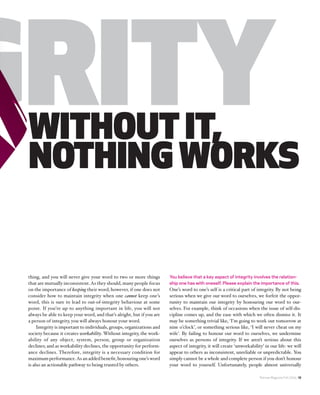
![Integrity, Morality and Ethics, Defined
Integrity: A state or condition of being whole, complete, unbroken,
unimpaired, sound, in perfect condition.
Morality: In a given society, in a given era of that society, morality
is the generally-accepted standards of what is desirable and unde-
sirable; of right and wrong conduct, and what is considered by that
society as good or bad behaviour of a person, group or entity.
Ethics: In a given group, ethics is the agreed upon standards of
what is desirable and undesirable; of right and wrong conduct; of
what is considered by that group as good and bad behaviour of a
person, group or entity that is a member of the group, and may
include defined bases for discipline, including exclusion.
ascribe the mess in their lives resulting from out-of-integrity excess of a 300 per cent increase in output, with essentially no
behaviour to some justification or rationalization. increase in inputs. And our people are happier.
Your Ontological Law of Integrity says that integrity has a criti- Objects and systems can also have integrity. Please explain.
cal effect on business: increased performance. How does Integrity for objects and systems is a matter of the components that
integrity translate into performance? make up the object or system and the relationship between those
As I’ve said, integrity is a necessary condition for maximum per- components. Three critical aspects are their design, the implemen-
formance. That is, if something is in integrity – is whole, complete, tation of the design and the use to which the object or system is put.
unbroken – it has maximum workability. But because it takes more If an object or system is to have maximum opportunity for perform-
than workability (a product of integrity) alone to realize maximum ance, it must have integrity in each of these aspects. The design
performance, integrity is not a sufficient condition for maximum must be capable of fulfilling the purpose for which it was designed
performance. The proposition is that if you violate the Law of – for example, to provide transportation or flotation. In addition, to
Integrity, the opportunity-set for your performance will shrink and have integrity the implementation of the design must be whole and
therefore your actual performance is likely to suffer. As with the complete; and finally the use of the object or system must have
gravity analogy, this is just a plain fact: if you violate the Law of integrity. If any of these three aspects is not present, the object or
Gravity without a parachute, you will suffer severe consequences. system will be ‘out-of-integrity’, its workability will be compro-
We argue that if you respect the Law of Integrity you will experi- mised and its opportunity for performance will be reduced. For
ence enormous increases in performance, both in your organiza- example, if a 300-pound man attempts to use a life preserver
tion and in your life. designed for a 50-pound child, he is in big trouble
This distinction – between the integrity of design, the integrity
You believe that the effects of out-of-integrity behaviour are of implementation and the integrity of use – has proven to be of
significantly more damaging than most people believe. Please enormous value to me and my colleagues in running SSRN. Of
discuss. course, any large computer system is going to have issues, and
People tend to view integrity as a virtue that is ‘nice to have’, but thinking about the source of problems as due to potential failures
not as something that is directly related to performance. They fail of integrity of design, integrity of implementation or integrity of
to link the difficulties in their lives or in their organizations to out- use has resulted in enormous increases in productivity for us.
of-integrity behaviour. But the increases in performance that are
possible by focusing on integrity are huge: I’m not talking about a What are the costs of dealing with an object, person or entity
10 per cent increase in output or productivity – it’s more like 100 that is out-of-integrity?
to 500 per cent. At my organization [the Social Science Research Consider the experience of dealing with an object that lacks
Network (SSRN)] after a year and a half of implementing these integrity, such as a car. When one or more of its components is
notions, our CEO Greg Gordon will tell you that we’ve seen in missing or malfunctioning, it becomes unreliable and unpre-
18 / Rotman Magazine Fall 2009](https://image.slidesharecdn.com/integrity-withoutitnothingworks-120629063305-phpapp02/85/Integrity-without-it-nothing-works-4-320.jpg)
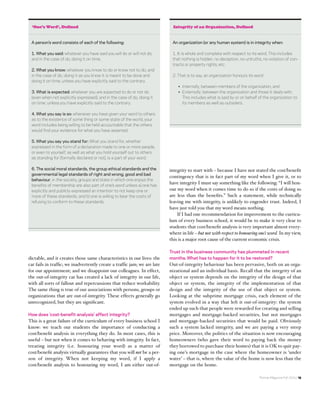
![Causes of the ‘Veil of Invisibility’ Around Integrity
1. “Integrity is a virtue” appears to you as a threat to be avoided (like it was when you were a
For most people and organizations, integrity exists as a virtue rather child) rather than simply a challenge to be dealt with, you will find it dif-
than as a necessary condition for performance. When held as a virtue ficult to maintain your integrity. When not keeping their word, most
rather than as a factor of production, integrity is easily sacrificed when people choose the apparent short-term gain of hiding that they will
it appears that a person or organization must do so to succeed. For not keep their word. Thus out of fear we are blinded to (and therefore
many people, virtue is valued only to the degree that it engenders the mistakenly forfeit) the power and respect that accrues from
admiration of others, and as such it is easily sacrificed especially when acknowledging that one will not keep one’s word or that one has
it would not be noticed or can be rationalized. Sacrificing integrity as a not kept one’s word.
virtue seems no different than sacrificing courteousness, or new sinks
in the men’s room. 5. Integrity is not seen as a factor of production
This leads people to make up false causes and unfounded rationaliza-
2. Self deception about being out-of-integrity tions as the source(s) of failure, which in turn conceals the violations of
People are mostly unaware that they have not kept their word. All the Law of Integrity as the source of the reduction of the opportunity
they see is the ‘reason’, rationalization or excuse for not keeping their for performance that results in failure.
word. In fact, people systematically deceive themselves about who
they have been and what they have done. As Chris Argyris con- 6. Not doing a cost/benefit analysis on giving one’s word
cludes: “Put simply, people consistently act inconsistently, unaware of When giving their word, most people do not consider fully what it will
the contradiction between their espoused theory and their theory-in- take to keep that word. That is, people do not do a cost/benefit analy-
use, between the way they think they are acting and the way they sis on giving their word. In effect, when giving their word, most people
really act.” Because people cannot see their out-of-integrity behav- are merely sincere (well-meaning) or placating someone, and don’t
iour, it is impossible for them to see the cause of the unworkability in even think about what it will take to keep their word. Simply put, this
their lives and organizations – the direct result of their own violations failure to do a cost/benefit analysis on giving one’s word is irresponsi-
of the Law of Integrity. ble. Irresponsible giving of one’s word is a major source of the mess
left in the lives of people and organizations. People generally do not
3. The belief that integrity is keeping one’s word see the giving of their word as: “I am going to make this happen,” but if
The belief that integrity is keeping one’s word – period – leaves no way you are not doing this you will be out-of-integrity Generally people
to maintain integrity when this is not possible, or when it is inappropri- give their word intending to keep it. That is, they are merely sincere. If
ate, or when one simply chooses not to keep one’s word. This leads to anything makes it difficult to deliver, then they provide reasons
concealing not keeping one’s word, which adds to the veil of invisibility instead of results.
about the impact of violations of the Law of Integrity.
7. Doing a cost/benefit analysis on honouring one’s word
4. Fear of acknowledging that you will not be keeping your word Conversely, people almost universally apply cost/benefit analysis to
When maintaining your integrity (i.e., acknowledging that you are not honouring their word. Treating integrity as a matter of cost/ benefit
going to keep your word and cleaning up the mess that results) analysis guarantees that you will not be a person of integrity.
Putting the system back in order is deceptively simple: people checked out as planned. Unfortunately, the front desk staff wasn’t
have to start honouring their word. If they do, trust will materialize able to find the couple another room in the city, so they failed to
almost instantly. The interesting thing about it is that you actually keep their word. But they did honour it: they took a small dining
create trust more rapidly if you fail to keep your word but you hon- room in the hotel, put in some cots and pillows and bedding and
our it, because this is always so surprising to people. If you’re made a bedroom out of it. In the end, the family rated this as one of
straight with people – “I told you that I’d have this report done a their outstanding service experiences.
month from now, but I know now that I’m not going to be able to Honouring one’s word is truly an amazing phenomenon, and
and I apologize, but I’ll get it to you in a month and a half. Let’s have my colleagues and I are eager for people to implement it in their
a talk about what I can do to clean up the mess I have caused for lives and in their organizations. As with the Law of Gravity, the end
you.” If I then get the report to you in a month and a half, our rela- result is guaranteed.
tionship will be strengthened; but if I simply don’t keep my original
word, trust will be lost. Michael Jensen is the Jesse Isidor Straus Professor of Business Administration,
There are great examples of service failures that have turned Emeritus at Harvard Business School and a senior advisor at The Monitor Group. He
out positive. In one study by Bitner, Booms and Tetrault [pub- is the founder and chairman of the Social Science Research Network, which brings
“Tomorrow’s Research Today” to people worldwide. This interview is based on his
lished in The Journal of Marketing], a husband and wife had a
paper, “Integrity: A Positive Model that Incorporates the Normative Phenomena
reservation for a hotel room. They arrived at the hotel, it was com- of Morality, Ethics and Legality”, co-written with Werner Erhard and Steve
pletely filled through no fault of the hotel – people just hadn’t Zaffron. The paper can be downloaded at http://ssrn.com/abstract=920625
20 / Rotman Magazine Fall 2009](https://image.slidesharecdn.com/integrity-withoutitnothingworks-120629063305-phpapp02/85/Integrity-without-it-nothing-works-6-320.jpg)

1) Integrity is defined as a state of being whole, complete, unbroken and sound. It is a purely positive concept and has nothing to do with morality or ethics. 2) For an individual to have integrity, their word must be whole and complete by honoring their commitments through keeping their word or promptly admitting when they cannot and addressing any issues caused. 3) Integrity is important for optimal performance of individuals, groups, and organizations as it creates "workability." Without integrity, performance declines. Maintaining integrity also helps build trust.


