University Institute of Lisbon (ISCTE-IUL) is a
public university established in 1972.
Pursuing teaching, research and community
service activities, it plays a major role in
educating qualified specialists and personnel,
whose cultural, scientific and technical skills
enable them to contribute to sustainable
development both at the national and the
global level. The strategic objectives of
ISCTE - University Institute of Lisbon are:
innovation, quality, internationalization and
development of an entrepreneurial culture.
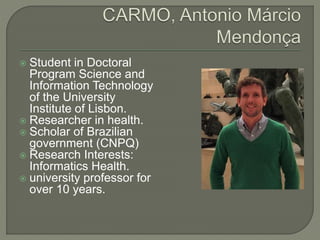
 Student in Doctoral
Program Science and
Information Technology
of the University
Institute of Lisbon.
 Researcher in health.
 Scholar of Brazilian
government (CNPQ)
 Research Interests:
Informatics Health.
 university professor for
over 10 years.
 Research lines on the area of smart
sensors, virtual measurement
systems and instrumentation network.
Much of his current research on area
of biomedical engineering focuses on
non-invasive and unobtrusive vital
signs and environmental monitoring,
ubiquitous computing, sensor
networking, intelligent processing of
biomedical data for health status and
instrumental activity estimation,
computational intelligence
implementation on biomedical
measurement channel modeling,
pattern recognition and classification.
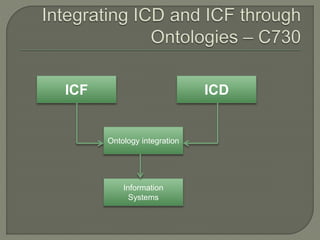
ICF
Information
Systems
Ontology integration
ICD
Methontology Ontology: developed by the
Artificial Intelligence Laboratory of the
Politechnic University of Madrid
to create integration between ICF and
ICD
Protégé software
to provide Web Ontology Language
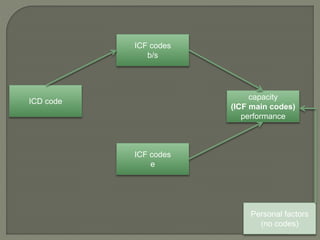
ICD code
capacity
(ICF main codes)
performance
ICF codes
e
ICF codes
b/s
Personal factors
(no codes)
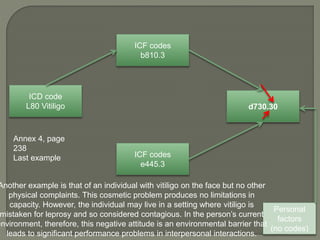
ICD code
L80 Vitiligo d730.30
ICF codes
e445.3
ICF codes
b810.3
Personal
factors
(no codes)
Annex 4, page
238
Last example
Another example is that of an individual with vitiligo on the face but no other
physical complaints. This cosmetic problem produces no limitations in
capacity. However, the individual may live in a setting where vitiligo is
mistaken for leprosy and so considered contagious. In the person’s current
environment, therefore, this negative attitude is an environmental barrier that
leads to significant performance problems in interpersonal interactions.
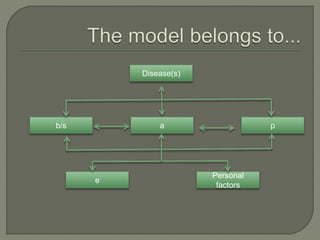
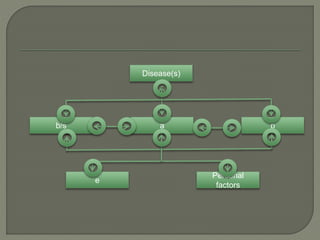
Disease(s)
pab/s
Personal
factors
e
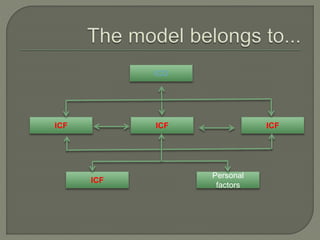
ICD
ICFICFICF
Personal
factors
ICF
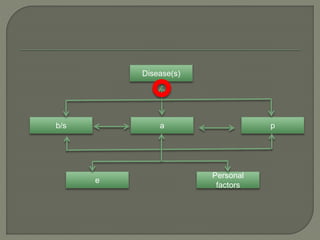
Disease(s)
pab/s
Personal
factors
e
Disease(s)
pab/s
Personal
factors
e
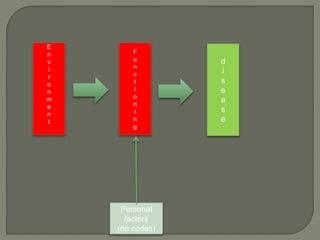
E
n
v
i
r
o
n
m
e
n
t
F
u
n
c
t
i
o
n
i
n
g
d
i
s
e
a
s
e
Personal
factors
(no codes)
E
n
v
i
r
o
n
m
e
n
t
F
u
n
c
t
i
o
n
i
n
g
d
i
s
e
a
s
e
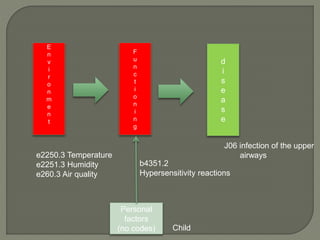
Personal
factors
(no codes) Child
e2250.3 Temperature
e2251.3 Humidity
e260.3 Air quality
b4351.2
Hypersensitivity reactions
J06 infection of the upper
airways
E
n
v
i
r
o
n
m
e
n
t
F
u
n
c
t
i
o
n
i
n
g
d
i
s
e
a
s
e
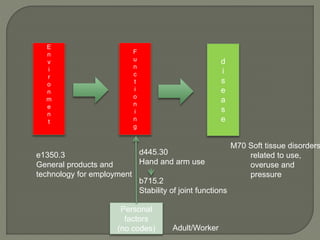
Personal
factors
(no codes) Adult/Worker
e1350.3
General products and
technology for employment
d445.30
Hand and arm use
b715.2
Stability of joint functions
M70 Soft tissue disorders
related to use,
overuse and
pressure
Ontologies are ways to solve interoperability
and integration between systems and
standarts.
Through ontologies, it is possible to manage
the knowlege, what is more than manage
data.
A Functional Health Big Data
Information System is needed!
Antonio Márcio:
antoniomarciom@hotmail.com
Eduardo:
edusantana@usp.br

Integrando CID e CIF