ISO 17024 compliant
academic tutor certification scheme
INTED 2014 – Valencia, Spain
Stéphane Jacquemart
Jean Menthonnex
Didier Blanc
European project – LLL Programme
Leonardo da Vinci Transfer of Innovation CERTITUDE
(10-2012 to 09-2014)
• http://www.tutor-certification.eu
• To develop an academic tutor certification scheme in
line with the requirements of ISO 17024
ISO 17024 :Conformity assessment -- General requirements for bodies
operating certification of persons
11 March 2014 2
Definitions
Certification scheme: by definition employs third-party attestation,
it contains, following (ISO 17024)
• scope of certification, job and task description, required
competences, prerequisites, code of conduct
• criteria for initial certification and recertification, assessment
methods for initial certification and recertification, surveillance
methods, examiners requirements
Academic tutor:
• Works in initial or vocational education and training organisations as a
teacher
• Supports youngsters and adults during working periods of internship,
apprenticeship or mobility
11 March 2014 3
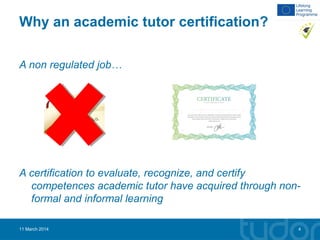
Why an academic tutor certification?
A non regulated job…
A certification to evaluate, recognize, and certify
competences academic tutor have acquired through non-
formal and informal learning
11 March 2014 4
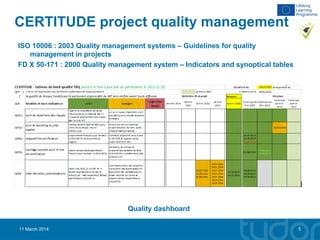
CERTITUDE project quality management
ISO 10006 : 2003 Quality management systems – Guidelines for quality
management in projects
FD X 50-171 : 2000 Quality management system – Indicators and synoptical tables
Quality dashboard
11 March 2014 5
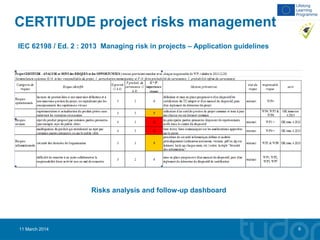
CERTITUDE project risks management
IEC 62198 / Ed. 2 : 2013 Managing risk in projects – Application guidelines
Risks analysis and follow-up dashboard
11 March 2014 6
What has been done (Oct 2012 – now)
• Academic tutor certification scheme
• Developed and based on ISO 17024, with a competence grid
(Aug 2013)
• Commented and validated (Nov 2013) – by 24 interested parties
member of a certification scheme committee
• Currently in testing phases 4 and 5, since 1 Feb 2014 until end
of May with academic tutors and with certification bodies
11 March 2014 7
COMPETENCE GRID (extract)
8
Competence
Socialize the
learner
Competence
Socialize the
learner
Sub-
competence
Sub-
competence
Sub-
competence
Establish the
learner profile
Sub-
competence
Establish the
learner profile
Practice Control Excellence
Establish the
profile in
terms of
knowledge,
skills and
attitudes
Establish the
profile and
identify
learner’s
development
axes taking
into account
the internship
context
Based on a
diagnosis,
highlights the
learner’s
potential and
possible
future
difficulties
[…] […] […]
Maturity level
11 March 2014
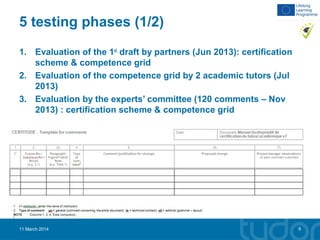
5 testing phases (1/2)
1. Evaluation of the 1st
draft by partners (Jun 2013): certification
scheme & competence grid
2. Evaluation of the competence grid by 2 academic tutors (Jul
2013)
3. Evaluation by the experts’ committee (120 comments – Nov
2013) : certification scheme & competence grid
11 March 2014 9
5 testing phases (2/2)
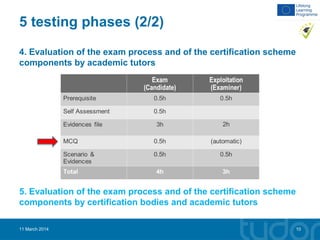
4. Evaluation of the exam process and of the certification scheme
components by academic tutors
5. Evaluation of the exam process and of the certification scheme
components by certification bodies and academic tutors
11 March 2014 10
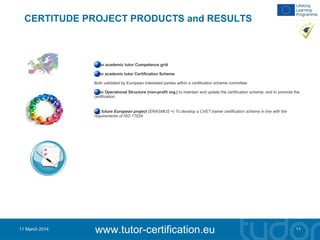
CERTITUDE PROJECT PRODUCTS and RESULTS
An academic tutor Competence grid
An academic tutor Certification Scheme
Both validated by European interested parties within a certification scheme committee
An Operational Structure (non-profit org.) to maintain and update the certification scheme, and to promote the
certification
A future European project (ERASMUS +) To develop a CVET trainer certification scheme in line with the
requirements of ISO 17024
11
www.tutor-certification.eu11 March 2014
Thank you for your attention!
Stephane.jacquemart@tudor.lu
Public Research Centre Henri Tudor
www.tudor.lu
• This project has been funded with support from the European Commission. This
communication reflects the views only of the author, and the Commission cannot be held
responsible for any use which may be made of the information contained therein.
11 March 2014 12

Inted 2014 jacquemart certitude

  • 1.
    ISO 17024 compliant academictutor certification scheme INTED 2014 – Valencia, Spain Stéphane Jacquemart Jean Menthonnex Didier Blanc
  • 2.
    European project –LLL Programme Leonardo da Vinci Transfer of Innovation CERTITUDE (10-2012 to 09-2014) • http://www.tutor-certification.eu • To develop an academic tutor certification scheme in line with the requirements of ISO 17024 ISO 17024 :Conformity assessment -- General requirements for bodies operating certification of persons 11 March 2014 2
  • 3.
    Definitions Certification scheme: bydefinition employs third-party attestation, it contains, following (ISO 17024) • scope of certification, job and task description, required competences, prerequisites, code of conduct • criteria for initial certification and recertification, assessment methods for initial certification and recertification, surveillance methods, examiners requirements Academic tutor: • Works in initial or vocational education and training organisations as a teacher • Supports youngsters and adults during working periods of internship, apprenticeship or mobility 11 March 2014 3
  • 4.
    Why an academictutor certification? A non regulated job… A certification to evaluate, recognize, and certify competences academic tutor have acquired through non- formal and informal learning 11 March 2014 4
  • 5.
    CERTITUDE project qualitymanagement ISO 10006 : 2003 Quality management systems – Guidelines for quality management in projects FD X 50-171 : 2000 Quality management system – Indicators and synoptical tables Quality dashboard 11 March 2014 5
  • 6.
    CERTITUDE project risksmanagement IEC 62198 / Ed. 2 : 2013 Managing risk in projects – Application guidelines Risks analysis and follow-up dashboard 11 March 2014 6
  • 7.
    What has beendone (Oct 2012 – now) • Academic tutor certification scheme • Developed and based on ISO 17024, with a competence grid (Aug 2013) • Commented and validated (Nov 2013) – by 24 interested parties member of a certification scheme committee • Currently in testing phases 4 and 5, since 1 Feb 2014 until end of May with academic tutors and with certification bodies 11 March 2014 7
  • 8.
    COMPETENCE GRID (extract) 8 Competence Socializethe learner Competence Socialize the learner Sub- competence Sub- competence Sub- competence Establish the learner profile Sub- competence Establish the learner profile Practice Control Excellence Establish the profile in terms of knowledge, skills and attitudes Establish the profile and identify learner’s development axes taking into account the internship context Based on a diagnosis, highlights the learner’s potential and possible future difficulties […] […] […] Maturity level 11 March 2014
  • 9.
    5 testing phases(1/2) 1. Evaluation of the 1st draft by partners (Jun 2013): certification scheme & competence grid 2. Evaluation of the competence grid by 2 academic tutors (Jul 2013) 3. Evaluation by the experts’ committee (120 comments – Nov 2013) : certification scheme & competence grid 11 March 2014 9
  • 10.
    5 testing phases(2/2) 4. Evaluation of the exam process and of the certification scheme components by academic tutors 5. Evaluation of the exam process and of the certification scheme components by certification bodies and academic tutors 11 March 2014 10
  • 11.
    CERTITUDE PROJECT PRODUCTSand RESULTS An academic tutor Competence grid An academic tutor Certification Scheme Both validated by European interested parties within a certification scheme committee An Operational Structure (non-profit org.) to maintain and update the certification scheme, and to promote the certification A future European project (ERASMUS +) To develop a CVET trainer certification scheme in line with the requirements of ISO 17024 11 www.tutor-certification.eu11 March 2014
  • 12.
    Thank you foryour attention! Stephane.jacquemart@tudor.lu Public Research Centre Henri Tudor www.tudor.lu • This project has been funded with support from the European Commission. This communication reflects the views only of the author, and the Commission cannot be held responsible for any use which may be made of the information contained therein. 11 March 2014 12

Editor's Notes

  • #3 Certification scheme committee: it is a committee composed of European stakeholders representing tutors, public and private training organizations, personal certifications bodies, research centres, financing bodies and public authorities. The experts’ committee is open to interested parties who have an interest to recognize and to valorise academic tutors’ competences. 8.1 There shall be a certification scheme for each category of certification. 8.2 A certification scheme shall contain the following elements: scope of certification; job and task description; required competence; abilities (when applicable); prerequisites (when applicable); code of conduct (when applicable). NOTE 1 A code of conduct describes the ethical or personal behaviour required by the scheme. NOTE 2 Abilities can include physical capabilities such as vision, hearing and mobility. 8.3 A certification scheme shall include the following certification process requirements: criteria for initial certification and recertification; assessment methods for initial certification and recertification; surveillance methods and criteria (if applicable); criteria for suspending and withdrawing certification; criteria for changing the scope or level of certification (if applicable)
  • #4 The certification will contribute to the tutors’ validation of non-formal and informal learning. Competences acquired by non-formal and informal learning will be assessed following an examination process defined in the certification scheme manual. The certification will contribute to the transparency, evaluation, and recognition of tutors’ competences and qualifications. The certification needs to be remotely accessible, reproducible, usable by accredited certification bodies and approved by market players and stakeholders.
  • #6 10006 The international standard used to manage the project is ISO 10006:2003 [2]. This international standard is a guidance document. It has been chosen because it is applicable to any kind of projects, whatever their complexity, scale, and duration. ISO 10006:2003 has also been chosen to propose partners a same systematic approach to ensure that the stated and implied needs of customers, certification bodies, academic tutors, and VET schools, are understood and met. As the project seeks to attract interested parties to participate to the certification scheme development, this approach is also used to understand and evaluate their needs. The guidance for quality management of projects in this International Standard is based on eight quality management principles (see ISO 9000:2000, 0.2): a) customer focus; b) leadership; c) involvement of people; d) process approach; e) system approach to management; f) continual improvement; g) factual approach to decision making; h) mutually beneficial supplier relationships
  • #7 10006 The international standard used to manage the project is ISO 10006:2003 [2]. This international standard is a guidance document. It has been chosen because it is applicable to any kind of projects, whatever their complexity, scale, and duration. ISO 10006:2003 has also been chosen to propose partners a same systematic approach to ensure that the stated and implied needs of customers, certification bodies, academic tutors, and VET schools, are understood and met. As the project seeks to attract interested parties to participate to the certification scheme development, this approach is also used to understand and evaluate their needs.