INSULATION
(Part of basement and floor construction)
6. Insulating Materials 1
total 49
Thermal Insulation
 The instability of supply of traditional energy supplies in the past few
years and the high cost of alternative ones has had one positive effect on
the industrial nations of the world – a realization of the importance of
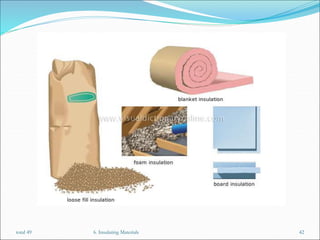
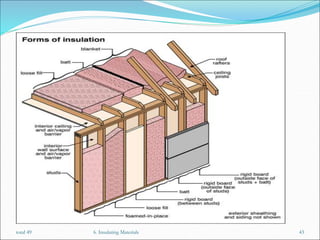
conservation.
 Heat Transfer: From WARM to COOL
In buildings, where the ideal situation is to have a relatively
stable temperature, two situations arise.
 In winter; energy must be used to maintain a comfortable
temperature. Without proper insulation heat is lost to the colder
outside air.
 In summer; temperatures are usually higher outside than inside, the
building interior must be cooled to keep it comfortable. The less
insulation that is used, the greater are the cost for air-conditioning.
6. Insulating Materials 2
total 49
Thermal Properties
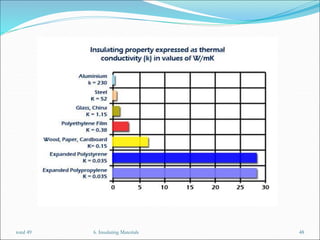
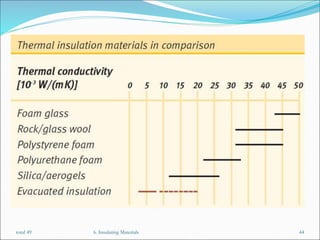
Thermal Conductivity (k)
 It is the term used to indicate the amount of heat that will pass through a
unit of area of a material at a temperature difference of one degree.
 The lower the “k” value, the better the insulation qualities of the material.
Units; US: (Btu.in) / (h.ft2.oF)
Metric: W / (m.oC)
Conductance (c)
 It indicates the amount of heat that passes through a given thickness of
material;
 Conductance= thermal conductivity / thickness
Units; US: Btu / (h.ft2.oF)
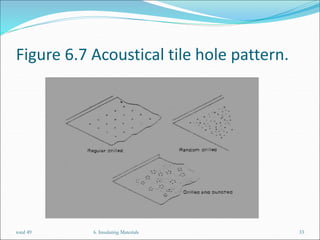
Metric: W/ (m2.oC)
6. Insulating Materials 3
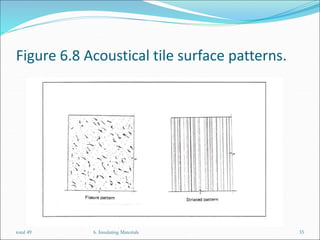
total 49
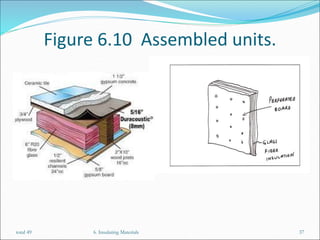
Example:
Determination of Thermal Conductivity Coefficient for
Different Wall Systems (TS EN ISO 8990)
6. Insulating Materials 4
1 Cold Chamber
2 Freeze Fan
3 Thermo- Couples (3 unit) [cold chamber]
4 Thermo- couples (9 unit) [Surface]
5 Wall specimen (1.2 x 1.2 m)
6 Thermo- couples (9 unit) [Surface]
7 Hot Chamber
8 Thermo- Couples (3 unit) [hot chamber]
9 Heather Fan
total 49
Thermal Resistance (RSI for metric unit, R for US units)
 It is that property of a material that resist the flow of heat
through the material. It is the reciprocal of conductance;
R= 1/c
Thermal Transmittance (U)
 It is the amount of heat that passes through all the
materials in a system. It is the reciprocal of the total
resistance;
U= 1/Rt
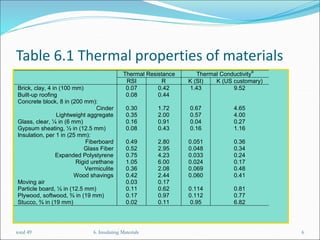
 Table 1 lists a few of the common materials and their thermal
properties;
6. Insulating Materials 5
total 49
Table 6.1 Thermal properties of materials
Thermal Resistance Thermal Conductivity
a
RSI R K (SI) K (US customary)
Brick, clay, 4 in (100 mm) 0.07 0.42 1.43 9.52
Built-up roofing 0.08 0.44
Concrete block, 8 in (200 mm):
Cinder 0.30 1.72 0.67 4.65
Lightweight aggregate 0.35 2.00 0.57 4.00
Glass, clear, ¼ in (6 mm) 0.16 0.91 0.04 0.27
Gypsum sheating, ½ in (12.5 mm) 0.08 0.43 0.16 1.16
Insulation, per 1 in (25 mm):
Fiberboard 0.49 2.80 0.051 0.36
Glass Fiber 0.52 2.95 0.048 0.34
Expanded Polystyrene 0.75 4.23 0.033 0.24
Rigid urethane 1.05 6.00 0.024 0.17
Vermiculite 0.36 2.08 0.069 0.48
Wood shavings 0.42 2.44 0.060 0.41
Moving air 0.03 0.17
Particle board, ½ in (12.5 mm) 0.11 0.62 0.114 0.81
Plywood, softwood, ¾ in (19 mm) 0.17 0.97 0.112 0.77
Stucco, ¾ in (19 mm) 0.02 0.11 0.95 6.82
6. Insulating Materials 6
total 49
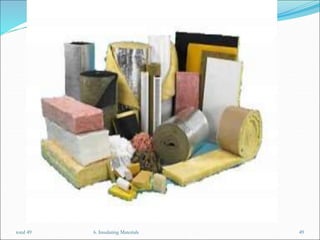
Kinds Of Thermal Insulation
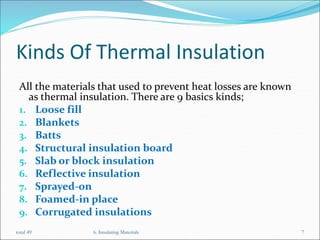
All the materials that used to prevent heat losses are known
as thermal insulation. There are 9 basics kinds;
1. Loose fill
2. Blankets
3. Batts
4. Structural insulation board
5. Slab or block insulation
6. Reflective insulation
7. Sprayed-on
8. Foamed-in place
9. Corrugated insulations
6. Insulating Materials 7
total 49
Kinds Of Thermal Insulation
1. Loose Fill
 Usually it is bulky and can be divided into two main types;
 Fibrous
 Granular
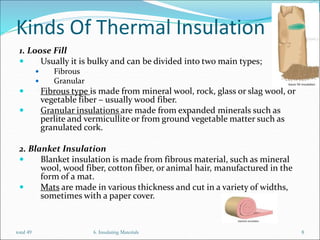
 Fibrous type is made from mineral wool, rock, glass or slag wool, or
vegetable fiber – usually wood fiber.
 Granular insulations are made from expanded minerals such as
perlite and vermicullite or from ground vegetable matter such as
granulated cork.
2. Blanket Insulation
 Blanket insulation is made from fibrous material, such as mineral
wool, wood fiber, cotton fiber, or animal hair, manufactured in the
form of a mat.
 Mats are made in various thickness and cut in a variety of widths,
sometimes with a paper cover.
6. Insulating Materials 8
total 49
Kinds Of Thermal Insulation
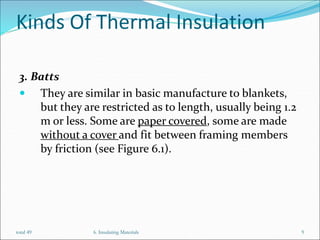
3. Batts
 They are similar in basic manufacture to blankets,
but they are restricted as to length, usually being 1.2
m or less. Some are paper covered, some are made
without a cover and fit between framing members
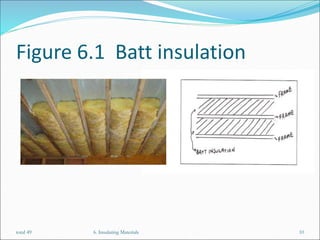
by friction (see Figure 6.1).
6. Insulating Materials 9
total 49
Figure 6.1 Batt insulation
6. Insulating Materials 10
total 49
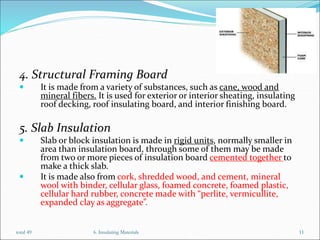
4. Structural Framing Board
 It is made from a variety of substances, such as cane, wood and
mineral fibers. It is used for exterior or interior sheating, insulating
roof decking, roof insulating board, and interior finishing board.
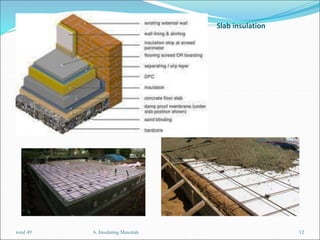
5. Slab Insulation
 Slab or block insulation is made in rigid units, normally smaller in
area than insulation board, through some of them may be made
from two or more pieces of insulation board cemented together to
make a thick slab.
 It is made also from cork, shredded wood, and cement, mineral
wool with binder, cellular glass, foamed concrete, foamed plastic,
cellular hard rubber, concrete made with “perlite, vermicullite,
expanded clay as aggregate”.
6. Insulating Materials 11
total 49
Slab insulation
total 49 6. Insulating Materials 12
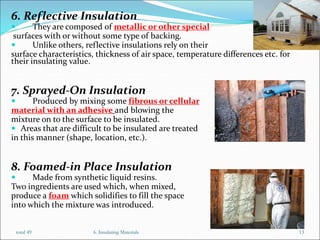
6. Reflective Insulation
 They are composed of metallic or other special
surfaces with or without some type of backing.
 Unlike others, reflective insulations rely on their
surface characteristics, thickness of air space, temperature differences etc. for
their insulating value.
7. Sprayed-On Insulation
 Produced by mixing some fibrous or cellular
material with an adhesive and blowing the
mixture on to the surface to be insulated.
 Areas that are difficult to be insulated are treated
in this manner (shape, location, etc.).
8. Foamed-in Place Insulation
 Made from synthetic liquid resins.
Two ingredients are used which, when mixed,
produce a foam which solidifies to fill the space
into which the mixture was introduced.
6. Insulating Materials 13
total 49
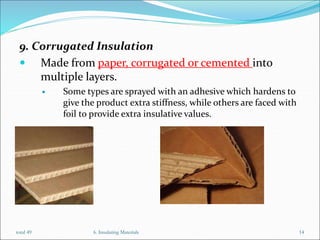
9. Corrugated Insulation
 Made from paper, corrugated or cemented into
multiple layers.
 Some types are sprayed with an adhesive which hardens to
give the product extra stiffness, while others are faced with
foil to provide extra insulative values.
6. Insulating Materials 14
total 49
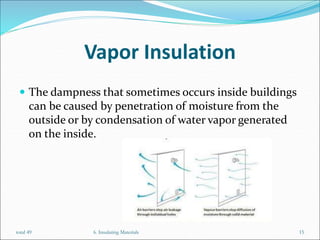
Vapor Insulation
 The dampness that sometimes occurs inside buildings
can be caused by penetration of moisture from the
outside or by condensation of water vapor generated
on the inside.
6. Insulating Materials 15
total 49
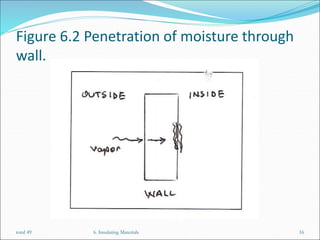
Figure 6.2 Penetration of moisture through
wall.
6. Insulating Materials 16
total 49
Vapor Barriers:
 They are materials which effectively retard or
stop the flow of warm, moisture-laden air from
inside a building outward through walls, ceiling,
and floors to the colder, dryer outside
atmosphere.
6. Insulating Materials 17
total 49
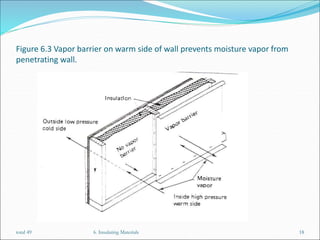
Figure 6.3 Vapor barrier on warm side of wall prevents moisture vapor from
penetrating wall.
6. Insulating Materials 18
total 49
Vapor Barriers
 Without a vapor barrier, warm, moist air, flowing outward
through a wall, ceiling or floor could cool to the extend that
some of the vapor would condense out as water and collect
within the wall, etc., to the eventual detriment of the material
in the structure.
 Vapor barriers should be installed on the warm side of the
insulation and present a continuous, impervious surface to the
vapor pressure from within the building.
 Materials for vapor barrier include;
 Polyethylene film
 Asphalt coated kraft paper
 Wax coated kraft paper
 Aluminium metal foil sheets
 Paint coatings
6. Insulating Materials 19
total 49
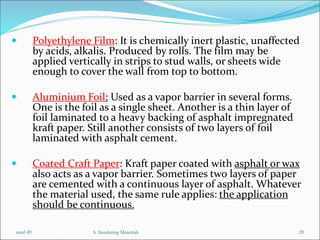
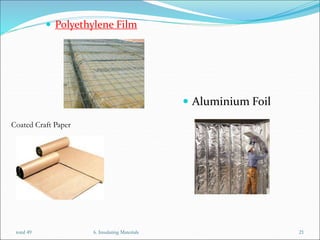
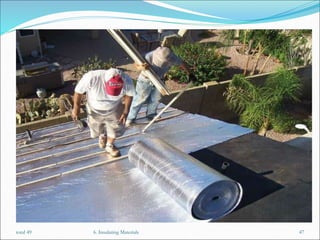
 Polyethylene Film: It is chemically inert plastic, unaffected
by acids, alkalis. Produced by rolls. The film may be
applied vertically in strips to stud walls, or sheets wide
enough to cover the wall from top to bottom.
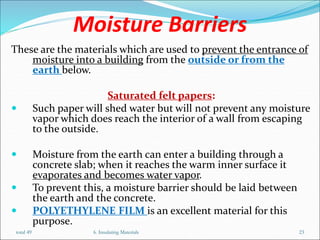
 Aluminium Foil: Used as a vapor barrier in several forms.
One is the foil as a single sheet. Another is a thin layer of
foil laminated to a heavy backing of asphalt impregnated
kraft paper. Still another consists of two layers of foil
laminated with asphalt cement.
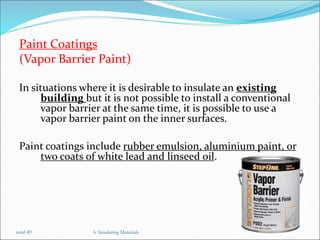
 Coated Craft Paper: Kraft paper coated with asphalt or wax
also acts as a vapor barrier. Sometimes two layers of paper
are cemented with a continuous layer of asphalt. Whatever
the material used, the same rule applies: the application
should be continuous.
6. Insulating Materials 20
total 49
 Polyethylene Film
total 49 6. Insulating Materials 21
 Aluminium Foil
Coated Craft Paper
Paint Coatings
(Vapor Barrier Paint)
In situations where it is desirable to insulate an existing
building but it is not possible to install a conventional
vapor barrier at the same time, it is possible to use a
vapor barrier paint on the inner surfaces.
Paint coatings include rubber emulsion, aluminium paint, or
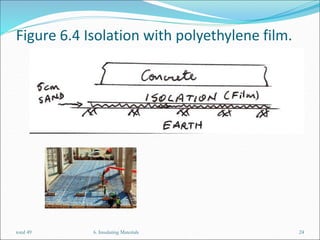
two coats of white lead and linseed oil.
6. Insulating Materials 22
total 49
Moisture Barriers
These are the materials which are used to prevent the entrance of
moisture into a building from the outside or from the
earth below.
Saturated felt papers:
 Such paper will shed water but will not prevent any moisture
vapor which does reach the interior of a wall from escaping
to the outside.
 Moisture from the earth can enter a building through a
concrete slab; when it reaches the warm inner surface it
evaporates and becomes water vapor.
 To prevent this, a moisture barrier should be laid between
the earth and the concrete.
 POLYETHYLENE FILM is an excellent material for this
purpose.
total 49 6. Insulating Materials 23
Figure 6.4 Isolation with polyethylene film.
6. Insulating Materials 24
total 49
 If wire mesh reinforcement is used, it is laid over the
film before the slab is poured.
 In any case, great care must be taken to see that, the
barrier is not broken during the preparation for the
concrete pour.
6. Insulating Materials 25
total 49
Acoustical Materials
Sound control is necessary in order to;
 Improving hearing conditions and reduce unwanted noise in any
given room
 To control the transmission of sound from one room to another
through walls, floors, and ceilings.
Sound Mechanics:
 Sound travels through the air as waves, in the form of small pressure
changes occuring regularly above and below the normal
atmospheric pressure.
 The average variation in pressure in a sound wave, above and below
the normal, is called SOUND PRESSURE. It is related to the
loudness of a sound.
 The loudness or strength of a sound – its intensity is measured in
DECIBELS (dB).
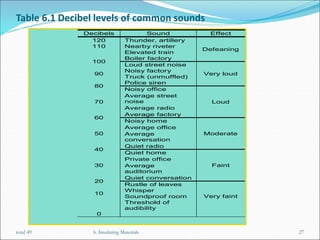
 Table 10.1 charts the decibal levels of a number of common sounds.
6. Insulating Materials 26
total 49
Table 6.1 Decibel levels of common sounds
Decibels Sound Effect
120 Thunder, artillery
Defeaning
110 Nearby riveter
Elevated train
100
Boiler factory
Loud street noise
Very loud
90
Noisy factory
Truck (unmuffled)
80
Police siren
Noisy office
Loud
70
Average street
noise
Average radio
60
Average factory
Noisy home
Moderate
50
Average office
Average
conversation
40
Quiet radio
Quiet home
Faint
30
Private office
Average
auditorium
20
Quiet conversation
Rustle of leaves
Very faint
10
Whisper
Soundproof room
Threshold of
audibility
0
6. Insulating Materials 27
total 49
Sound Control
 The fraction of sound energy absorbed by a material at a specific
frequency, during each sound wave reflection, is called the
SOUND ABSORPTION COEFFICIENT of that surface.
 Most sounds contain a range of frequencies, it is necessary to use
an average of the absorption coefficient when considering sound
absorption.
 To obtain that average, it has been customary to average four (4)
coefficient from 250 to 2000 Hz inclusive and call the result the
NOISE-REDUCTION COEFFICIENT (NRC), which is expressed as a
percentage.
 For example glass, concrete and masonry would have an NRC
rating of 0.05 or less. Some other materials might have a rating of
0.90 or better.
6. Insulating Materials 28
total 49
Sound Control
Acoustical materials can be classified into 3 groups:
 Acoustical tiles
 Assembled accoustical units
 Sprayed-on accoustical materials
Acoustıcal Tiles
 They are made from wood, cane, or asbestos fibers, matted and bonded
into sheets of various thickness (5-32 mm).
 The sheets are cut into tiles of several sizes. Edges may be square cut, or
tongue-and-grooved.
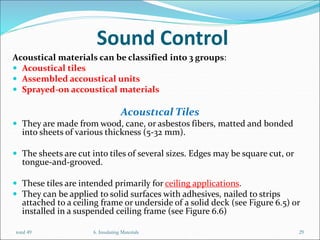
 These tiles are intended primarily for ceiling applications.
 They can be applied to solid surfaces with adhesives, nailed to strips
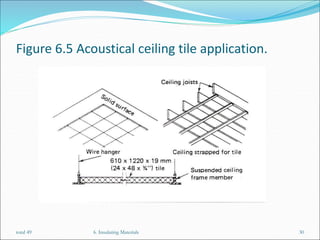
attached to a ceiling frame or underside of a solid deck (see Figure 6.5) or
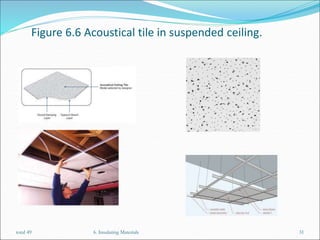
installed in a suspended ceiling frame (see Figure 6.6)
6. Insulating Materials 29
total 49
Figure 6.5 Acoustical ceiling tile application.
6. Insulating Materials 30
total 49
Figure 6.6 Acoustical tile in suspended ceiling.
6. Insulating Materials 31
total 49
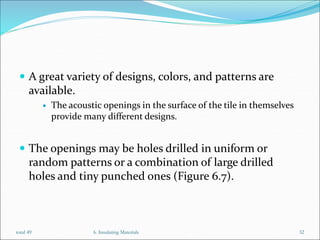
 A great variety of designs, colors, and patterns are
available.
 The acoustic openings in the surface of the tile in themselves
provide many different designs.
 The openings may be holes drilled in uniform or
random patterns or a combination of large drilled
holes and tiny punched ones (Figure 6.7).
6. Insulating Materials 32
total 49
Figure 6.7 Acoustical tile hole pattern.
6. Insulating Materials 33
total 49
Figure 6.8 Acoustical tile surface patterns.
6. Insulating Materials 35
total 49
rockwool
 They are made of several types of minerals which are fused together at
high temperature and dispersed into organic fiber by a centrifugal force
spin process.
 Fire safety
 Easy to handle and apply
 Thermal, acoustic insulation
Assembled Units
 Assembled units usually consist of some type of sound-absorbing
material such as a rock-wool or glass-fiber blanket fastened to an
acoustically transparen facing.
 This facing is generally some type of rigid board, such as hardboard or
asbestos board, or a metal sheet.
 The faces are perforated to allow the penetration of sound waves
(Figure 6.10).
6. Insulating Materials 36
total 49
Figure 6.10 Assembled units.
6. Insulating Materials 37
total 49
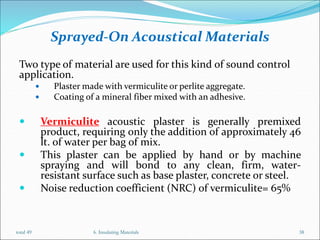
Sprayed-On Acoustical Materials
Two type of material are used for this kind of sound control
application.
 Plaster made with vermiculite or perlite aggregate.
 Coating of a mineral fiber mixed with an adhesive.
 Vermiculite acoustic plaster is generally premixed
product, requiring only the addition of approximately 46
lt. of water per bag of mix.
 This plaster can be applied by hand or by machine
spraying and will bond to any clean, firm, water-
resistant surface such as base plaster, concrete or steel.
 Noise reduction coefficient (NRC) of vermiculite= 65%
6. Insulating Materials 38
total 49
Perlite acoustical plaster is usually mixed on the job, using
calcined gypsum as the binder.
 It can be applied by hand or by machine. Sound reduction
properties of perlite plaster are approximately same as those of
vermiculite.
Mineral fibers
 Acoustical treatment with mineral fiber involves the use of
specially prepared mineral wool or asbestos fibers and an
adhesive to hold them to the surface (in most areas, there are
stringent safety requirements which place restrictions on the
use of such materials as asbestos fiber containing toxic dusts).
 NRC= 0.85-0.90
total 49 6. Insulating Materials 39
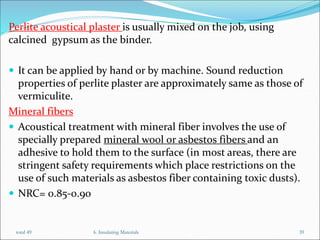
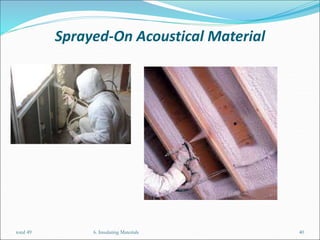
Sprayed-On Acoustical Material
total 49 6. Insulating Materials 40
6. Insulating Materials 41
total 49
6. Insulating Materials 42
total 49
6. Insulating Materials 43
total 49
6. Insulating Materials 44
total 49
6. Insulating Materials 45
total 49
6. Insulating Materials 46
total 49
6. Insulating Materials 47
total 49
6. Insulating Materials 48
total 49
6. Insulating Materials 49
total 49

Insulating Materials used in construction

  • 1.
    INSULATION (Part of basementand floor construction) 6. Insulating Materials 1 total 49
  • 2.
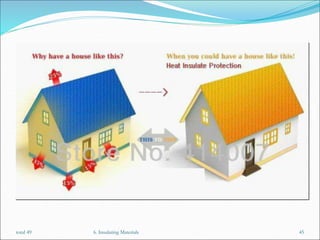
    Thermal Insulation  Theinstability of supply of traditional energy supplies in the past few years and the high cost of alternative ones has had one positive effect on the industrial nations of the world – a realization of the importance of conservation.  Heat Transfer: From WARM to COOL In buildings, where the ideal situation is to have a relatively stable temperature, two situations arise.  In winter; energy must be used to maintain a comfortable temperature. Without proper insulation heat is lost to the colder outside air.  In summer; temperatures are usually higher outside than inside, the building interior must be cooled to keep it comfortable. The less insulation that is used, the greater are the cost for air-conditioning. 6. Insulating Materials 2 total 49
  • 3.
    Thermal Properties Thermal Conductivity(k)  It is the term used to indicate the amount of heat that will pass through a unit of area of a material at a temperature difference of one degree.  The lower the “k” value, the better the insulation qualities of the material. Units; US: (Btu.in) / (h.ft2.oF) Metric: W / (m.oC) Conductance (c)  It indicates the amount of heat that passes through a given thickness of material;  Conductance= thermal conductivity / thickness Units; US: Btu / (h.ft2.oF) Metric: W/ (m2.oC) 6. Insulating Materials 3 total 49
  • 4.
    Example: Determination of ThermalConductivity Coefficient for Different Wall Systems (TS EN ISO 8990) 6. Insulating Materials 4 1 Cold Chamber 2 Freeze Fan 3 Thermo- Couples (3 unit) [cold chamber] 4 Thermo- couples (9 unit) [Surface] 5 Wall specimen (1.2 x 1.2 m) 6 Thermo- couples (9 unit) [Surface] 7 Hot Chamber 8 Thermo- Couples (3 unit) [hot chamber] 9 Heather Fan total 49
  • 5.
    Thermal Resistance (RSIfor metric unit, R for US units)  It is that property of a material that resist the flow of heat through the material. It is the reciprocal of conductance; R= 1/c Thermal Transmittance (U)  It is the amount of heat that passes through all the materials in a system. It is the reciprocal of the total resistance; U= 1/Rt  Table 1 lists a few of the common materials and their thermal properties; 6. Insulating Materials 5 total 49
  • 6.
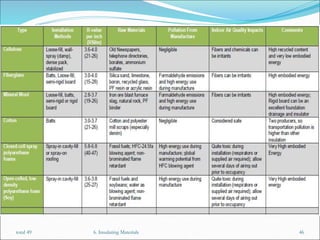
    Table 6.1 Thermalproperties of materials Thermal Resistance Thermal Conductivity a RSI R K (SI) K (US customary) Brick, clay, 4 in (100 mm) 0.07 0.42 1.43 9.52 Built-up roofing 0.08 0.44 Concrete block, 8 in (200 mm): Cinder 0.30 1.72 0.67 4.65 Lightweight aggregate 0.35 2.00 0.57 4.00 Glass, clear, ¼ in (6 mm) 0.16 0.91 0.04 0.27 Gypsum sheating, ½ in (12.5 mm) 0.08 0.43 0.16 1.16 Insulation, per 1 in (25 mm): Fiberboard 0.49 2.80 0.051 0.36 Glass Fiber 0.52 2.95 0.048 0.34 Expanded Polystyrene 0.75 4.23 0.033 0.24 Rigid urethane 1.05 6.00 0.024 0.17 Vermiculite 0.36 2.08 0.069 0.48 Wood shavings 0.42 2.44 0.060 0.41 Moving air 0.03 0.17 Particle board, ½ in (12.5 mm) 0.11 0.62 0.114 0.81 Plywood, softwood, ¾ in (19 mm) 0.17 0.97 0.112 0.77 Stucco, ¾ in (19 mm) 0.02 0.11 0.95 6.82 6. Insulating Materials 6 total 49
  • 7.
    Kinds Of ThermalInsulation All the materials that used to prevent heat losses are known as thermal insulation. There are 9 basics kinds; 1. Loose fill 2. Blankets 3. Batts 4. Structural insulation board 5. Slab or block insulation 6. Reflective insulation 7. Sprayed-on 8. Foamed-in place 9. Corrugated insulations 6. Insulating Materials 7 total 49
  • 8.
    Kinds Of ThermalInsulation 1. Loose Fill  Usually it is bulky and can be divided into two main types;  Fibrous  Granular  Fibrous type is made from mineral wool, rock, glass or slag wool, or vegetable fiber – usually wood fiber.  Granular insulations are made from expanded minerals such as perlite and vermicullite or from ground vegetable matter such as granulated cork. 2. Blanket Insulation  Blanket insulation is made from fibrous material, such as mineral wool, wood fiber, cotton fiber, or animal hair, manufactured in the form of a mat.  Mats are made in various thickness and cut in a variety of widths, sometimes with a paper cover. 6. Insulating Materials 8 total 49
  • 9.
    Kinds Of ThermalInsulation 3. Batts  They are similar in basic manufacture to blankets, but they are restricted as to length, usually being 1.2 m or less. Some are paper covered, some are made without a cover and fit between framing members by friction (see Figure 6.1). 6. Insulating Materials 9 total 49
  • 10.
    Figure 6.1 Battinsulation 6. Insulating Materials 10 total 49
  • 11.
    4. Structural FramingBoard  It is made from a variety of substances, such as cane, wood and mineral fibers. It is used for exterior or interior sheating, insulating roof decking, roof insulating board, and interior finishing board. 5. Slab Insulation  Slab or block insulation is made in rigid units, normally smaller in area than insulation board, through some of them may be made from two or more pieces of insulation board cemented together to make a thick slab.  It is made also from cork, shredded wood, and cement, mineral wool with binder, cellular glass, foamed concrete, foamed plastic, cellular hard rubber, concrete made with “perlite, vermicullite, expanded clay as aggregate”. 6. Insulating Materials 11 total 49
  • 12.
    Slab insulation total 496. Insulating Materials 12
  • 13.
    6. Reflective Insulation They are composed of metallic or other special surfaces with or without some type of backing.  Unlike others, reflective insulations rely on their surface characteristics, thickness of air space, temperature differences etc. for their insulating value. 7. Sprayed-On Insulation  Produced by mixing some fibrous or cellular material with an adhesive and blowing the mixture on to the surface to be insulated.  Areas that are difficult to be insulated are treated in this manner (shape, location, etc.). 8. Foamed-in Place Insulation  Made from synthetic liquid resins. Two ingredients are used which, when mixed, produce a foam which solidifies to fill the space into which the mixture was introduced. 6. Insulating Materials 13 total 49
  • 14.
    9. Corrugated Insulation Made from paper, corrugated or cemented into multiple layers.  Some types are sprayed with an adhesive which hardens to give the product extra stiffness, while others are faced with foil to provide extra insulative values. 6. Insulating Materials 14 total 49
  • 15.
    Vapor Insulation  Thedampness that sometimes occurs inside buildings can be caused by penetration of moisture from the outside or by condensation of water vapor generated on the inside. 6. Insulating Materials 15 total 49
  • 16.
    Figure 6.2 Penetrationof moisture through wall. 6. Insulating Materials 16 total 49
  • 17.
    Vapor Barriers:  Theyare materials which effectively retard or stop the flow of warm, moisture-laden air from inside a building outward through walls, ceiling, and floors to the colder, dryer outside atmosphere. 6. Insulating Materials 17 total 49
  • 18.
    Figure 6.3 Vaporbarrier on warm side of wall prevents moisture vapor from penetrating wall. 6. Insulating Materials 18 total 49
  • 19.
    Vapor Barriers  Withouta vapor barrier, warm, moist air, flowing outward through a wall, ceiling or floor could cool to the extend that some of the vapor would condense out as water and collect within the wall, etc., to the eventual detriment of the material in the structure.  Vapor barriers should be installed on the warm side of the insulation and present a continuous, impervious surface to the vapor pressure from within the building.  Materials for vapor barrier include;  Polyethylene film  Asphalt coated kraft paper  Wax coated kraft paper  Aluminium metal foil sheets  Paint coatings 6. Insulating Materials 19 total 49
  • 20.
     Polyethylene Film:It is chemically inert plastic, unaffected by acids, alkalis. Produced by rolls. The film may be applied vertically in strips to stud walls, or sheets wide enough to cover the wall from top to bottom.  Aluminium Foil: Used as a vapor barrier in several forms. One is the foil as a single sheet. Another is a thin layer of foil laminated to a heavy backing of asphalt impregnated kraft paper. Still another consists of two layers of foil laminated with asphalt cement.  Coated Craft Paper: Kraft paper coated with asphalt or wax also acts as a vapor barrier. Sometimes two layers of paper are cemented with a continuous layer of asphalt. Whatever the material used, the same rule applies: the application should be continuous. 6. Insulating Materials 20 total 49
  • 21.
     Polyethylene Film total49 6. Insulating Materials 21  Aluminium Foil Coated Craft Paper
  • 22.
    Paint Coatings (Vapor BarrierPaint) In situations where it is desirable to insulate an existing building but it is not possible to install a conventional vapor barrier at the same time, it is possible to use a vapor barrier paint on the inner surfaces. Paint coatings include rubber emulsion, aluminium paint, or two coats of white lead and linseed oil. 6. Insulating Materials 22 total 49
  • 23.
    Moisture Barriers These arethe materials which are used to prevent the entrance of moisture into a building from the outside or from the earth below. Saturated felt papers:  Such paper will shed water but will not prevent any moisture vapor which does reach the interior of a wall from escaping to the outside.  Moisture from the earth can enter a building through a concrete slab; when it reaches the warm inner surface it evaporates and becomes water vapor.  To prevent this, a moisture barrier should be laid between the earth and the concrete.  POLYETHYLENE FILM is an excellent material for this purpose. total 49 6. Insulating Materials 23
  • 24.
    Figure 6.4 Isolationwith polyethylene film. 6. Insulating Materials 24 total 49
  • 25.
     If wiremesh reinforcement is used, it is laid over the film before the slab is poured.  In any case, great care must be taken to see that, the barrier is not broken during the preparation for the concrete pour. 6. Insulating Materials 25 total 49
  • 26.
    Acoustical Materials Sound controlis necessary in order to;  Improving hearing conditions and reduce unwanted noise in any given room  To control the transmission of sound from one room to another through walls, floors, and ceilings. Sound Mechanics:  Sound travels through the air as waves, in the form of small pressure changes occuring regularly above and below the normal atmospheric pressure.  The average variation in pressure in a sound wave, above and below the normal, is called SOUND PRESSURE. It is related to the loudness of a sound.  The loudness or strength of a sound – its intensity is measured in DECIBELS (dB).  Table 10.1 charts the decibal levels of a number of common sounds. 6. Insulating Materials 26 total 49
  • 27.
    Table 6.1 Decibellevels of common sounds Decibels Sound Effect 120 Thunder, artillery Defeaning 110 Nearby riveter Elevated train 100 Boiler factory Loud street noise Very loud 90 Noisy factory Truck (unmuffled) 80 Police siren Noisy office Loud 70 Average street noise Average radio 60 Average factory Noisy home Moderate 50 Average office Average conversation 40 Quiet radio Quiet home Faint 30 Private office Average auditorium 20 Quiet conversation Rustle of leaves Very faint 10 Whisper Soundproof room Threshold of audibility 0 6. Insulating Materials 27 total 49
  • 28.
    Sound Control  Thefraction of sound energy absorbed by a material at a specific frequency, during each sound wave reflection, is called the SOUND ABSORPTION COEFFICIENT of that surface.  Most sounds contain a range of frequencies, it is necessary to use an average of the absorption coefficient when considering sound absorption.  To obtain that average, it has been customary to average four (4) coefficient from 250 to 2000 Hz inclusive and call the result the NOISE-REDUCTION COEFFICIENT (NRC), which is expressed as a percentage.  For example glass, concrete and masonry would have an NRC rating of 0.05 or less. Some other materials might have a rating of 0.90 or better. 6. Insulating Materials 28 total 49
  • 29.
    Sound Control Acoustical materialscan be classified into 3 groups:  Acoustical tiles  Assembled accoustical units  Sprayed-on accoustical materials Acoustıcal Tiles  They are made from wood, cane, or asbestos fibers, matted and bonded into sheets of various thickness (5-32 mm).  The sheets are cut into tiles of several sizes. Edges may be square cut, or tongue-and-grooved.  These tiles are intended primarily for ceiling applications.  They can be applied to solid surfaces with adhesives, nailed to strips attached to a ceiling frame or underside of a solid deck (see Figure 6.5) or installed in a suspended ceiling frame (see Figure 6.6) 6. Insulating Materials 29 total 49
  • 30.
    Figure 6.5 Acousticalceiling tile application. 6. Insulating Materials 30 total 49
  • 31.
    Figure 6.6 Acousticaltile in suspended ceiling. 6. Insulating Materials 31 total 49
  • 32.
     A greatvariety of designs, colors, and patterns are available.  The acoustic openings in the surface of the tile in themselves provide many different designs.  The openings may be holes drilled in uniform or random patterns or a combination of large drilled holes and tiny punched ones (Figure 6.7). 6. Insulating Materials 32 total 49
  • 33.
    Figure 6.7 Acousticaltile hole pattern. 6. Insulating Materials 33 total 49
  • 34.
    Figure 6.8 Acousticaltile surface patterns. 6. Insulating Materials 35 total 49
  • 35.
    rockwool  They aremade of several types of minerals which are fused together at high temperature and dispersed into organic fiber by a centrifugal force spin process.  Fire safety  Easy to handle and apply  Thermal, acoustic insulation Assembled Units  Assembled units usually consist of some type of sound-absorbing material such as a rock-wool or glass-fiber blanket fastened to an acoustically transparen facing.  This facing is generally some type of rigid board, such as hardboard or asbestos board, or a metal sheet.  The faces are perforated to allow the penetration of sound waves (Figure 6.10). 6. Insulating Materials 36 total 49
  • 36.
    Figure 6.10 Assembledunits. 6. Insulating Materials 37 total 49
  • 37.
    Sprayed-On Acoustical Materials Twotype of material are used for this kind of sound control application.  Plaster made with vermiculite or perlite aggregate.  Coating of a mineral fiber mixed with an adhesive.  Vermiculite acoustic plaster is generally premixed product, requiring only the addition of approximately 46 lt. of water per bag of mix.  This plaster can be applied by hand or by machine spraying and will bond to any clean, firm, water- resistant surface such as base plaster, concrete or steel.  Noise reduction coefficient (NRC) of vermiculite= 65% 6. Insulating Materials 38 total 49
  • 38.
    Perlite acoustical plasteris usually mixed on the job, using calcined gypsum as the binder.  It can be applied by hand or by machine. Sound reduction properties of perlite plaster are approximately same as those of vermiculite. Mineral fibers  Acoustical treatment with mineral fiber involves the use of specially prepared mineral wool or asbestos fibers and an adhesive to hold them to the surface (in most areas, there are stringent safety requirements which place restrictions on the use of such materials as asbestos fiber containing toxic dusts).  NRC= 0.85-0.90 total 49 6. Insulating Materials 39
  • 39.
    Sprayed-On Acoustical Material total49 6. Insulating Materials 40
  • 40.
  • 41.
  • 42.
  • 43.
  • 44.
  • 45.
  • 46.
  • 47.
  • 48.