Outline
Location
Where the InsularCortex is
located within the brain?
Dysfunctions
Three studies involved
with the Insula.
1
Function
General overview of
the functions.
2 3
Studies
What happens when the
Insula is dysfunctional?
4
Quiz!
Questions about the
slideshow content.
5
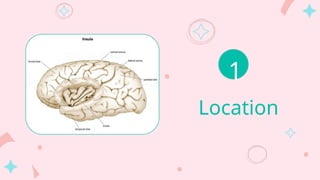
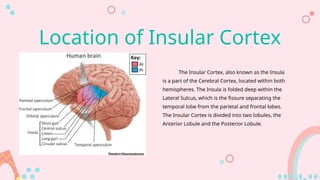
Location of InsularCortex
The Insular Cortex, also known as the Insula
is a part of the Cerebral Cortex, located within both
hemispheres. The Insula is folded deep within the
Lateral Sulcus, which is the fissure separating the
temporal lobe from the parietal and frontal lobes.
The Insular Cortex is divided into two lobules, the
Anterior Lobule and the Posterior Lobule.
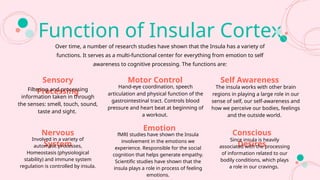
Function of InsularCortex
Sensory
Processing
Filtering and processing
information taken in through
the senses: smell, touch, sound,
taste and sight.
Self Awareness
The insula works with other brain
regions in playing a large role in our
sense of self, our self-awareness and
how we perceive our bodies, feelings
and the outside world.
Motor Control
Hand-eye coordination, speech
articulation and physical function of the
gastrointestinal tract. Controls blood
pressure and heart beat at beginning of
a workout.
Nervous
System
Involved in a variety of
automatic processes,
Homeostasis (physiological
stability) and immune system
regulation is controlled by insula.
Emotion
fMRI studies have shown the Insula
involvement in the emotions we
experience. Responsible for the social
cognition that helps generate empathy.
Scientific studies have shown that the
insula plays a role in process of feeling
emotions.
Over time, a number of research studies have shown that the Insula has a variety of
functions. It serves as a multi-functional center for everything from emotion to self
awareness to cognitive processing. The functions are:
Conscious
Desires
Since insula is heavily
associated with the processing
of information related to our
bodily conditions, which plays
a role in our cravings.
Sensory
Problems
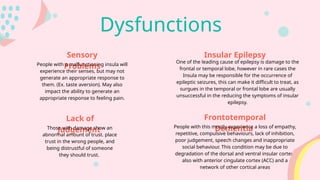
Dysfunctions
Insular Epilepsy
Lack of
Judgement
Frontotemporal
Dementia
Peoplewith a malfunctioning insula will
experience their senses, but may not
generate an appropriate response to
them. (Ex. taste aversion). May also
impact the ability to generate an
appropriate response to feeling pain.
One of the leading cause of epilepsy is damage to the
frontal or temporal lobe, however in rare cases the
Insula may be responsible for the occurrence of
epileptic seizures, this can make it difficult to treat, as
surgues in the temporal or frontal lobe are usually
unsuccessful in the reducing the symptoms of insular
epilepsy.
Those with damage show an
abnormal amount of trust. place
trust in the wrong people, and
being distrustful of someone
they should trust.
People with this mostly experience a loss of empathy,
repetitive, compulsive behaviours, lack of inhibition,
poor judgement, speech changes and inappropriate
social behaviour. This condition may be due to
degradation of the dorsal and ventral insular cortex,
also with anterior cingulate cortex (ACC) and a
network of other cortical areas
Study 1
Dronkers
(1996)
● Highlightsthe insulas use in speech
● Lesions in the brain of 25 stroke patients with
apraxia of speech were analysed
● Brains were overlapped to determine
common damage areas
● Only region with 100% overlap was in the
precentral gyrus of the insula
● They did the same with stroke patients
without apraxia of speech and found it
unharmed
● They therefore asserted that the insula had a
significant effect on the processing of
language
11.
Study 2
Harris &Fiske (2006)
● Examines the role of the brain in prejudice
● 22 Princeton students were sampled
● Randomly allocated into 2 different groups
● Both groups were shown images related to distinct emotions
● One group was only shown objects and one was shown people
● They observed the changes in the brain in a fMRI
● Found that for most images of humans the medial prefrontal cortex
activated.
● For objects and crucially the people who were expected to cause the most
discomfort eg: the homeless and addicts, it didn’t activate.
● The insula was activated instead
● Demonstrates the influence the insula has on visual processing and
emotion
12.
Study 3
Wagner (2009)
●Examines the role of different parts of the brain on Anorexia
● Put 16 women who recovered from Anorexia and 16 control
women under an fMRI
● Measured reactions to pleasant tastes (10% sucrose) and
neutral ones (distilled water)
● They were then asked to rate the pleasantness of the taste
● The individuals who had anorexia exhibited significantly
lower activation of the insula,
● As opposed to the control, there was no correlation between
the activation of the insula and their ratings
● Results indicate that a change in the insula can alter
perceptions of taste and can cause Anorexia because of it
True or False
Trueor False: Decision making is a function associated with the Insular
Cortex.
True or False: Seizures can occur due to damage in the Insular Cortex.
True or False: The Insular Cortex is located between the occipital and
frontal lobes
True or False: In the study by Harris & Fiske (2006), they used mainly CAT
scans to determine the directions of the participants brains
True or False: With a damaged Insula, people may have taste aversion.
15.
Thinking Question:
Based onthe functions of the Insular Cortex, how do you
think it is realistically used on a day to day basis?