INSTRUCTION
MANUAL
Unit project
1. Reflect on the instructions and use your
own words to write them down.
2. In pairs to check the instruction manual.
3. How the structure allows you to see the
big picture.
* When writing your own rules try to follow
a similar format.
 You want to make the text quick and easy
to understand.
Your tense and tone should default to
present tense, active voice, and be pithy,
or quick.
FOR EXAMPLE
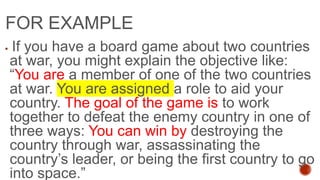
 If you have a board game about two countries
at war, you might explain the objective like:
“You are a member of one of the two countries
at war. You are assigned a role to aid your
country. The goal of the game is to work
together to defeat the enemy country in one of
three ways: You can win by destroying the
country through war, assassinating the
country’s leader, or being the first country to go
into space.”
USE THE SECOND PERSON (YOU)
Instead of saying “When a player…” or “The player…”
Try saying “When you…” as much as possible.
When describing what certain objects or tokens may do
for a player, you can use “The player…” if it makes
more sense.
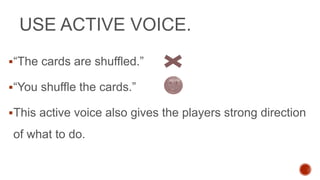
USE ACTIVE VOICE.
“The cards are shuffled.”
“You shuffle the cards.”
This active voice also gives the players strong direction
of what to do.
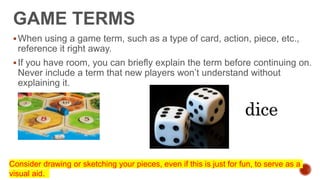
GAME TERMS
When using a game term, such as a type of card, action, piece, etc.,
reference it right away.
If you have room, you can briefly explain the term before continuing on.
Never include a term that new players won’t understand without
explaining it.
dice
Consider drawing or sketching your pieces, even if this is just for fun, to serve as a
visual aid.
EXPLAIN THE CONCEPT OR
GOAL OF THE GAME.
Give your players a preview and overview of how the game
works. You may even want to start with a brief summary of
the game or the game world's history. It should be brief and
help players understand the objective that follows.
• Your instructions should work like a book or story. You start with
a table of contents. After that you may have a preface or
forward, something that outlines your game. This can be your
objective. When explaining the rules and different parts of the
game’s flow, do it in the order that it will happen. It should follow
a beginning, middle, and end.
• You'll also want to include a brief section early on that details
how many players can play, and the age range.
•Explain the setup before you explain the start of
play so that players can set up the board. When
the players finish reading about the setup, the next
section should explain how to start playing.
Following, you will have a style of play.
FOR EXAMPLE,
if you have a turned based game, next
explain how the turns work. If the turns lead
to combat, you will next explain combat and
the components of that.
CONSIDER INCLUDING
STRATEGY TIPS.
Sometimes the descriptions of the rules or how the board is setup
can seem hard to understand. In order to avoid players becoming
disinterested, help your players by including some tips on strategy.
List any and all special scenarios that might otherwise confuse the
player. Include strategic methods for winning in the scenario. This
step can either be really quick and easy; or it can be the bulk of your
explanation, depending on how your game works.
ANY EXTRAS OR POSSIBLE
GAME VARIANTS?
If your game can be played alternate ways, list the alternate ways.
Don’t clump all your instructions into block paragraphs. Use bullet
points when you can. Break up the text with a visual aid if possible.
Format your pages so that people
can easily read the instructions.
READ OVER YOUR GAME INSTRUCTIONS.
•Do you not explain the objective well enough?
•Are you using second person and active voice
consistently?
•Do you understand how the setup, turns, and winning
work?
•Your instructions should be easy to understand so
people can play your game as soon as possible.
<=5 students/group
Goal/outcome
How many participants
Outcomes: teamwork, communication, …
Rough ideas
materials/terms
instruction manual_Board Game.pptx

instruction manual_Board Game.pptx

  • 1.
  • 2.
    1. Reflect onthe instructions and use your own words to write them down. 2. In pairs to check the instruction manual. 3. How the structure allows you to see the big picture. * When writing your own rules try to follow a similar format.
  • 3.
     You wantto make the text quick and easy to understand. Your tense and tone should default to present tense, active voice, and be pithy, or quick.
  • 4.
    FOR EXAMPLE  Ifyou have a board game about two countries at war, you might explain the objective like: “You are a member of one of the two countries at war. You are assigned a role to aid your country. The goal of the game is to work together to defeat the enemy country in one of three ways: You can win by destroying the country through war, assassinating the country’s leader, or being the first country to go into space.”
  • 5.
    USE THE SECONDPERSON (YOU) Instead of saying “When a player…” or “The player…” Try saying “When you…” as much as possible. When describing what certain objects or tokens may do for a player, you can use “The player…” if it makes more sense.
  • 6.
    USE ACTIVE VOICE. “Thecards are shuffled.” “You shuffle the cards.” This active voice also gives the players strong direction of what to do.
  • 7.
    GAME TERMS When usinga game term, such as a type of card, action, piece, etc., reference it right away. If you have room, you can briefly explain the term before continuing on. Never include a term that new players won’t understand without explaining it. dice Consider drawing or sketching your pieces, even if this is just for fun, to serve as a visual aid.
  • 8.
    EXPLAIN THE CONCEPTOR GOAL OF THE GAME. Give your players a preview and overview of how the game works. You may even want to start with a brief summary of the game or the game world's history. It should be brief and help players understand the objective that follows.
  • 9.
    • Your instructionsshould work like a book or story. You start with a table of contents. After that you may have a preface or forward, something that outlines your game. This can be your objective. When explaining the rules and different parts of the game’s flow, do it in the order that it will happen. It should follow a beginning, middle, and end. • You'll also want to include a brief section early on that details how many players can play, and the age range.
  • 10.
    •Explain the setupbefore you explain the start of play so that players can set up the board. When the players finish reading about the setup, the next section should explain how to start playing. Following, you will have a style of play.
  • 11.
    FOR EXAMPLE, if youhave a turned based game, next explain how the turns work. If the turns lead to combat, you will next explain combat and the components of that.
  • 12.
    CONSIDER INCLUDING STRATEGY TIPS. Sometimesthe descriptions of the rules or how the board is setup can seem hard to understand. In order to avoid players becoming disinterested, help your players by including some tips on strategy. List any and all special scenarios that might otherwise confuse the player. Include strategic methods for winning in the scenario. This step can either be really quick and easy; or it can be the bulk of your explanation, depending on how your game works.
  • 13.
    ANY EXTRAS ORPOSSIBLE GAME VARIANTS? If your game can be played alternate ways, list the alternate ways. Don’t clump all your instructions into block paragraphs. Use bullet points when you can. Break up the text with a visual aid if possible. Format your pages so that people can easily read the instructions.
  • 14.
    READ OVER YOURGAME INSTRUCTIONS. •Do you not explain the objective well enough? •Are you using second person and active voice consistently? •Do you understand how the setup, turns, and winning work? •Your instructions should be easy to understand so people can play your game as soon as possible.
  • 15.
    <=5 students/group Goal/outcome How manyparticipants Outcomes: teamwork, communication, … Rough ideas materials/terms