UNIT II
INPUT AND OUTPUT DEVICES
INPUT DEVICES
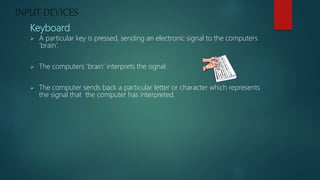
Keyboard
 A particular key is pressed, sending an electronic signal to the computers
‘brain’.
 The computers ‘brain’ interprets the signal.
 The computer sends back a particular letter or character which represents
the signal that the computer has interpreted.
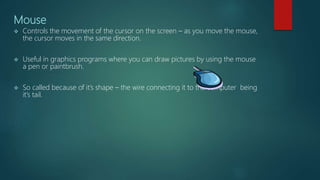
Mouse
 Controls the movement of the cursor on the screen – as you move the mouse,
the cursor moves in the same direction.
 Useful in graphics programs where you can draw pictures by using the mouse
a pen or paintbrush.
 So called because of it’s shape – the wire connecting it to the computer being
it’s tail.
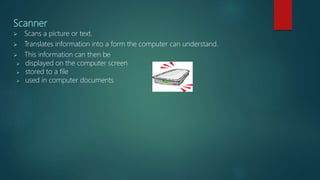
Scanner
 Scans a picture or text.
 Translates information into a form the computer can understand.
 This information can then be
 displayed on the computer screen
 stored to a file
 used in computer documents
OUTPUT DEVICES
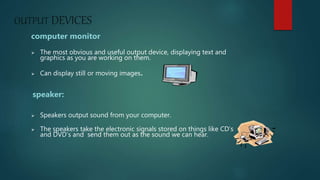
computer monitor
 The most obvious and useful output device, displaying text and
graphics as you are working on them.
 Can display still or moving images.
speaker:
 Speakers output sound from your computer.
 The speakers take the electronic signals stored on things like CD’s
and DVD’s and send them out as the sound we can hear.
Secondary storage device
Zip / Jaz Disks
 Similar to floppy disks
• They are removable
Their platters are made of a hard material
• Can operate at higher speeds than floppies.
 Newer standards hold more data
• Most people have outgrown floppy disks
Floppy Disk
 Floppy disks are similar to hard disks
 Because the medium is “floppy”, the disks cannot operate at the same speeds as a
hard disk.
 Floppy disks are older technology which haven’t received a lot of attention since
the late 1980s.
 Many computers today do not even come with floppy disk drives anymore.
OPTICAL DISK
 Optical disks are very much like hard disks.
 Hard disks store information using magnetic material
- Bits are stored by changing the magnetic properties of the magnetic material
- Bits are read by picking up the tiny magnetic field with a read head.
 Optical disks store information as pits in a physical medium
- A laser is used to determine if a pit is present or not.
CD ROM
CD Roms use the same technology as audio Compact Discs.
 A master disc is created.
 Copies of the disc are created through a pressing process
 The discs are aluminum sandwiched between plastic
 CDs are single sided.
CD-RW
 CD-RW is similar to CD-R
 The main difference is that the dye can be made reflective again
through an erase process
 In this way, CD-RW discs can be written many times
 Too much erasing, and the dye starts to fade.
DVD
 Each side of a DVD can contain 2 layers, doubling the amount of data that can
stored.
 One layer is semi-transparent. The laser can be focused “through” that layer
onto the second layer
 If you took the track off of a single layer of a DVD and stretched it out into a
straight line, it would be 7.5 miles long!.
 If you did the same with a double layer, double sided disc, the track would
stretch to over 30 miles!
DVD-R and DVD-RW
 These two technologies are still relatively new and still fairly
 DVD-R and DVD-RW use similar techniques as CD-R and CD-RW
 A dye layer is used for data writing
 The dye layer in DVD-RW is erasable

INPUT AND OUTPUT DEVICE

  • 1.
    UNIT II INPUT ANDOUTPUT DEVICES
  • 2.
    INPUT DEVICES Keyboard  Aparticular key is pressed, sending an electronic signal to the computers ‘brain’.  The computers ‘brain’ interprets the signal.  The computer sends back a particular letter or character which represents the signal that the computer has interpreted.
  • 3.
    Mouse  Controls themovement of the cursor on the screen – as you move the mouse, the cursor moves in the same direction.  Useful in graphics programs where you can draw pictures by using the mouse a pen or paintbrush.  So called because of it’s shape – the wire connecting it to the computer being it’s tail.
  • 4.
    Scanner  Scans apicture or text.  Translates information into a form the computer can understand.  This information can then be  displayed on the computer screen  stored to a file  used in computer documents
  • 5.
    OUTPUT DEVICES computer monitor The most obvious and useful output device, displaying text and graphics as you are working on them.  Can display still or moving images. speaker:  Speakers output sound from your computer.  The speakers take the electronic signals stored on things like CD’s and DVD’s and send them out as the sound we can hear.
  • 6.
    Secondary storage device Zip/ Jaz Disks  Similar to floppy disks • They are removable Their platters are made of a hard material • Can operate at higher speeds than floppies.  Newer standards hold more data • Most people have outgrown floppy disks
  • 7.
    Floppy Disk  Floppydisks are similar to hard disks  Because the medium is “floppy”, the disks cannot operate at the same speeds as a hard disk.  Floppy disks are older technology which haven’t received a lot of attention since the late 1980s.  Many computers today do not even come with floppy disk drives anymore.
  • 8.
    OPTICAL DISK  Opticaldisks are very much like hard disks.  Hard disks store information using magnetic material - Bits are stored by changing the magnetic properties of the magnetic material - Bits are read by picking up the tiny magnetic field with a read head.  Optical disks store information as pits in a physical medium - A laser is used to determine if a pit is present or not.
  • 9.
    CD ROM CD Romsuse the same technology as audio Compact Discs.  A master disc is created.  Copies of the disc are created through a pressing process  The discs are aluminum sandwiched between plastic  CDs are single sided.
  • 10.
    CD-RW  CD-RW issimilar to CD-R  The main difference is that the dye can be made reflective again through an erase process  In this way, CD-RW discs can be written many times  Too much erasing, and the dye starts to fade.
  • 11.
    DVD  Each sideof a DVD can contain 2 layers, doubling the amount of data that can stored.  One layer is semi-transparent. The laser can be focused “through” that layer onto the second layer  If you took the track off of a single layer of a DVD and stretched it out into a straight line, it would be 7.5 miles long!.  If you did the same with a double layer, double sided disc, the track would stretch to over 30 miles!
  • 12.
    DVD-R and DVD-RW These two technologies are still relatively new and still fairly  DVD-R and DVD-RW use similar techniques as CD-R and CD-RW  A dye layer is used for data writing  The dye layer in DVD-RW is erasable