INNOVA TION FOR DEVELOPMENT:
CONVERTING KNOWLEDGE TO VALUE


SUMMARY REPORT
              Paris 28 - 30 January 2009


                             UNESCO
                     FORUM
                 on Higher Education
                            Research
                                and
                         Knowledge,

                         OECD,
                          IDRC
The authors are responsible for the choice and the presentation of the facts contained in
       this publication and for the opinions expressed therein, which are not necessarily those of
       UNESCO or the OECD and do not commit these Organizations.

       The designation employed and the presentation of material throughout this publication
       do not imply the expression of any opinion whatsoever on the part of UNESCO or OECD
       concerning the legal status of any country, city or area of it authorities, or concerning the
       delimitation of its frontiers or boundaries.


       Published by the United Nations Educational,
       Scientific and Cultural Organization
       7, place de Fontenoy
       75352 Paris 07 SP

       Design: Sabine Lebeau
       Editing: Pauline Harvey
       Editorial assistance: Emmanuelle Aubertel

       The International Workshop was coordinated by the Members
       of the Workshop’s Organizing Committee:
       Fred Gault (IDRC/OECD).
       Tony Marjoram (UNESCO).
       Jean Woo (IDRC).
       Gang Zhang (OECD).
       Erika Kraemer-Mbula (Rapporteur General).


       © UNESCO 2009
       Printed in France


ED-2009/WS/35
CONTENTS

Foreword	                                                                         III
Tony Marjoram, Programme Specialist
Engineering Sciences Programme
Division of Basic and Engineering Sciences
Natural Sciences Sector, UNESCO
Mary-Louise Kearney, Director
UNESCO Forum on Higher Education Research and Knowledge
            Key statements by:	                                                   VI
            Walter R. Erdelen,
            Assistant Director-General for Natural Sciences,
            UNESCO
            Pier Carlo Padoan,
            Deputy Secretary General, ����
                                      OECD
            J. Stanley Metcalfe,
            Professor of Political Economy,
            Manchester University and Cambridge University
            Dominique Foray,
            Chair, CEMI, Director, EPFL


Part I. 	 Introduction	                                                            1

Part II.	 Views from the Workshop	                                                 3

Part III.	 Report of the Rapporteur General	                                       7
            Erika Kraemer-Mbula
            Science and Technology Policy Research (SPRU), University of Sussex
            CENTRIM, University of Brighton
            Institute for Economic Research on Innovation
            Tshwane University of Technology (TUT)


Part IV.	 Annexes	                                                                18
            Introductory remarks
            Address by Walter R. Erdelen	                                         18
            Assistant Director-General for Natural Sciences, UNESCO
            Address by Pier Carlo Padoan	                                         22
            Deputy Secretary General, OECD


                                                                                        •         
Contents


                              Keynote presentations	                                                                   26
                              Enterprise, innovation and evolutionary economic growth	                                 26
                              J. Stanley Metcalfe
                              Professor of Political Economy,
                              Manchester University and Cambridge University
                              Knowledge policy for development	                                                        32
                              Dominique Foray
                              Chair of Economics and Management of Innovation (CEMI)
                              Director, College of Management of Technology (EPFL)
                              Swiss Federal Institute of Technology in Lausanne (EPFL)


               List of online Powerpoint presentations	                                                               40

               Agenda		                                                                                               41

               List of speakers and contributors 	                                                                    44


               Further contacts:
               OECD and OECD Innovation Strategy:
               Miriam Koreen (Miriam.Koreen@oecd.org).
               OECD Development Assistance Committee:
               Kaori Mikamoto (Kaori.Mikamoto@oecd.org).
               UNESCO Science and Innovation Activity:
               Tony Marjoram (t.marjoram@unesco.org).


II         •   Innovation for development: Converting knowledge to value  •  OECD – UNESCO International Workshop
FOREWORD
The UNESCO Forum on Higher Education, Research and Knowledge is pleased to present
the Summary Report, with the Organisation for Economic Co-operation and Development
(OECD), of the International Workshop, Innovation for Development: Converting
Knowledge to Value, held at the OECD, Paris, from 28 to 30 January 2009. The Workshop
was co-hosted by the OECD and the UNESCO Forum on Higher Education, Research
and Knowledge; in partnership with and with financial support from the International
Development Research Centre (IDRC), Canada; and the Swedish International Development
Cooperation Agency (Sida), Sweden.

This Workshop was organised in the context of the OECD Innovation Strategy (IS) work to
develop inputs into the development aspects of the OECD Innovation Strategy (www.oecd.
org/innovation/strategy). The Workshop follows, and is partly developed from, an earlier
Experts’ Workshop on Science, Technology, Innovation and Development, held at the
Manchester Institute of Innovation Research, February 2008, United Kingdom.

A rich and diverse collection of presentations and discussions on the theme of ‘I����������
                                                                                 nnovation
for Social and Economic Development’ was featured, with particular reference to
developing and least-developed countries (LDC’s), raising a series of issues and challenges
and an Innovation Action Agenda for development. ����������������������������������
                                                    Key issues and challenges arising
at the Workshop included the need for: (i) partnerships and networks; (ii) studies and
research; (iii) information publication and dissemination; (iv) human and institutional
capacity-building to support and promote innovation, and (v) a wider awareness, public
and policy understanding and integration of innovation into the development process.

Recurrent themes arising in the Workshop, which consisted of specialist experts in
social and economic development as well as innovation, related to the importance of
knowledge application and innovation in development, and the facts that this process
takes place in diverse, heterogenous situations, and that innovation is itself diverse and
cross-cutting. The importance of, and need to, enhance recognition of innovation for
development in policy-making was also repeatedly emphasized, and the need for policy
coherence and strategic planning. The necessity for more focus at the local-level was also
frequently mentioned, the generation, transfer and application of local knowledge, and the
exchange of information sharing and learning from experiences worldwide. To address
these recurrent themes, the need for enhanced innovation indicators and information,
human and institutional capacity and capacity-building were widely regarded as of vital
importance in the way ahead. The need to emphasize these issues during, and as a means
to surmount, the current economic crisis and unsettled economic environment were also
common themes at the Workshop.


                                                                                              •         III
It is also appropriate and important to situate this activity in relation to the aims of
               the UNESCO Forum and, thus, to contextualize the specific issues related to research,
               innovation and higher education across all regions of the world today. The UNESCO
               Forum focuses on the role and status of national research systems and on regional and
               international trends in this domain in relation to the challenges posed by the Knowledge
               Society of the twenty-first century. Located at UNESCO and supported by the Swedish
               International Development Agency (Sida), the UNESCO Forum provides a platform for
               researchers, policy-makers and relevant stakeholders to engage critically with the key
               elements underpinning research systems: (i) policy trends; (ii) infrastructure;
               (iii) human capacity and (iv) investment. This project has assured follow-up action for
               two major UNESCO world conferences, the 1998 World Conference on Higher Education,
               “Higher education in the twenty-first century” and the 1999 World Conference on Science,
               “Science for the twenty-first century”.

               Since 2001, the UNESCO Forum has consolidated its efforts to bridge research and policy
               in a number of ways through facilitating and broadening the space for critical debate
               and through revisiting the established and dominant views so as to reconceptualize
               future directions. To date, its various components for attaining these goals:
               (i) mobilizing experts; (ii) stimulating global and regional debate;(iii) producing
               and disseminating research; (iv) promoting strategic partnerships; (v) facilitating
               communication, and (vi) strengthening the systemic approach have yielded creditable
               results. The UNESCO Forum believes that it is central to reaffirm the importance of
               research at the current moment given the rapid developments since 2000 in knowledge
               production and management and their ramifications for social change and progress.
               Research on systems of research, innovation and higher education has become, therefore,
               even more crucial and is now well recognized as a major field of enquiry for international
               organizations, charged with advising their Member States about the questions involved.
               In this regard, the OECD, IDRC, the World Bank, and other important stakeholders are key
               partners of the UNESCO Forum.

               The UNESCO Forum pursues a systemic approach to the analysis of research so as to
               address strengths and weaknesses, as well as specific issues and concerns, in a critical
               manner. This work will embrace research in both industrialized and emerging contexts,
               as well as researchers whether reputed or at the beginning of their careers. The central
               objective is to promote ongoing research and to place significant results in the public
               eye. Consequently, research may be more original, innovative and effective, thus leading
               towards more sustainable human development. Today, unprecedented emphasis is being
               placed on research as the key motor for advancing the knowledge society and its offspring,
               the knowledge economy. Consequently, research on innovation has moved high on the
               priority agendas for governments, for their specialized agencies and bodies devoted to this
               area, and for higher education institutions. Thus, mapping and analyzing their systems
               has become essential in order to acquire an understanding of their functioning and,
               therefore, future requirements.


IV         •   Innovation for development: Converting knowledge to value  •  OECD – UNESCO International Workshop
Foreword


The OECD context for the discussions reported herein is principally the development of a
forward-looking “Innovation Strategy” by that Organisation, which is due to be completed
by mid-2010 and presented to ministers. The current economic crisis in which our world
finds itself means that this OECD Innovation Strategy is more sorely awaited than could
possibly have been when the work was launched in 2007.

The International Workshop’s Organizing Committee consisted of Fred Gault (IDRC/
OECD), Tony Marjoram (UNESCO), ��������������������������������������������
       ��������������������������������������������������������������������
                                    Jean Woo (IDRC) and Gang Zhang (OECD). This
Committee and the UNESCO Forum would like to thank all those who supported,
contributed to and participated in this Workshop for their dedicated efforts to
conceptualize, organize and present this activity, ensuring a very rich and thoughtful
Workshop and Summary Report. In this regard, particular thanks are due to Erika
Kraemer-Mbula, the Rapporteur General who helped tie together the diverse threads of the
Workshop. The outcomes of this Workshop are intended to provide fresh insights for the
innovation and development communities, policy-makers and the wider higher education
and research communities alike, as they confront and address the challenges facing
development, and promoting the knowledge societies and economies of the twenty-first
century.


                       Tony Marjoram, Programme Specialist,
                       Engineering Sciences Programme,
                       Division of Basic and Engineering Sciences,
                       Natural Sciences Sector, UNESCO.


                       Mary-Louise Kearney, Director,
                       Forum Secretariat,
                       UNESCO Forum for Higher Education, Research and Knowledge.


                                           The UNESCO Forum on Higher Education, Research and Knowledge   •         
Key statements at the Workshop


               Walter R. Erdelen
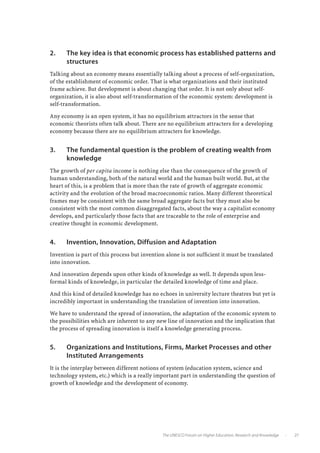
               Science, engineering, technology and innovation not only underpin development, but
               are also essential for addressing the eight UN Millennium Development Goals (MDGs),
               especially ‘extreme poverty and hunger eradication’. Innovation is not just about high-
               tech, but includes all levels of technology in all sorts of places – such as pumps for water
               supply and irrigation in African villages. One of the main challenges we face is that
               engineering, science, technology and innovation are often overlooked in the development
               process, and are hardly mentioned in Poverty Reduction Strategy Papers (PRSPs) and
               broader development policies. What can we do to address this situation?


               Pier Carlo Padoan
               We have to think about innovation in developing countries. Not just for its own sake
               but especially as an instrument, as a strategy to rebuild the sustainable growth and
               development mechanism after this crisis. And the OECD Innovation Strategy itself is
               being influenced by this challenge. Let us not forget that, without determined efforts, two
               casualties of the crisis will be innovation efforts and innovation spending, as governments
               are pressed to provide short-term relief and support to financial systems, and development
               resources. Innovation for development is a critical issue at a critical time.


               J. Stanley Metcalfe
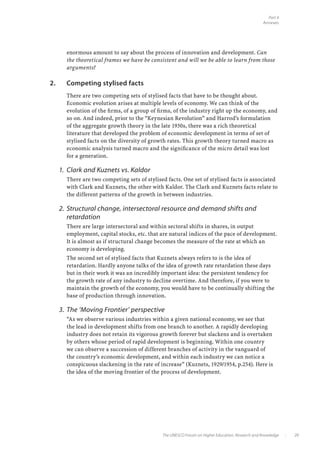
               One of the main lessons of history is that innovation is the only sustainable route out of
               poverty. Innovation and development are both focused on changing economic activity
               and behaviour. It is the openness of an economy to novelty that is its most important
               attribute, the foundation of its developmental potential. The fundamental question is,
               “How is economic and social wealth created from knowledge?” The broader question
               is to try to understand the multiple connexions between innovation and economic
               development. Fundamental questions in innovation systems are the connexions between
               the component parts. How adaptable is the ecology to forming different innovation
               systems and changing innovation systems? The importance is not ecology itself but the
               connexions which turn parts of the ecology into an effective system of innovation –
               connexions are at the centre of innovation policy.


VI         •
Key statements at the Workshop


Dominique Foray
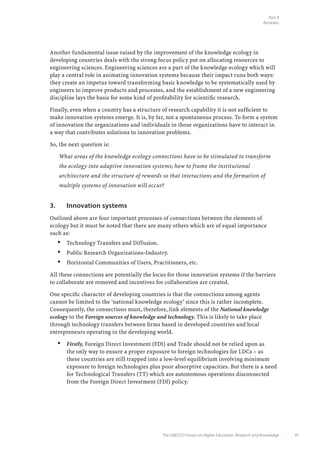
Not only has access to foreign knowledge in developing and least developed countries has
not increased that much through Foreign Direct Investment (FDI) and Trade linkages, but
the extent to which these economies have benefited from this exposure is limited by weak
absorptive capacities. The main message that can be drawn from this is that different
countries face different challenges in terms of innovation and knowledge policy. It is
therefore crucial for those countries to re-appropriate the process of deciding in what
science and technology areas the greatest advances should be sought. In least developed
countries (LDCs), innovations are incremental, cumulative and mostly informal (without
RD), developed mainly in ‘traditional’ sectors or in services not qualified as ‘high tech’.
The most important innovations for LDCs reside in the discovery process of what
the countries should do in terms of specialization in industry and service.


                                              The UNESCO Forum on Higher Education, Research and Knowledge    •         VII
Part 1
Introduction


The Workshop brought together ���������������� 130 participants – thirty-five innovation
                                 a total of some ���� ������������� �� �����������������������
specialists and practitioners and ninety-five observers and delegates from twenty-four OECD
Member countries, thirty-six from UNESCO Member States, including seven participants
from African countries: Cameroon, Egypt, Ghana, Kenya, Mozambique, Senegal and South
Africa.

The Workshop examined the role of innovation for development and the ways in which
knowledge and research and development (RD), especially in science, engineering and
technology, contribute to innovation. Particular reference was given to social and economic
development addressing basic needs and the Millennium Development Goals (MDGs) in
developing countries – with emphasis on Africa and least developed countries (LDCs). The
following issues, challenges and an Action Agenda for Innovation were identified, and the
need for international organizations with related interests such as OECD and UNESCO to
work more closely together to promote innovation.


I.	   Innovation for development:
      Issues, challenges and action agenda for innovation
Innovation relates to the introduction of a new idea, product or process to a user or user-
group, and refers particularly to the transfer and application of knowledge, RD and
information in science and engineering, often embodied or embedded in technology.
Innovation is a social and economic as well as a technical process, and knowledge or
technology transferred does not need to be absolutely new, nor does it consist only of
‘formal’ knowledge. Innovation more commonly involves incremental rather than radical
change, based on engineering research, design, development and ‘learning by doing’, rather
than scientific research. The ‘linear model of innovation’, from science to society, is seen
increasingly as an obsolete simplistic representation of a complex reality. Knowledge and
technology transfer is a fascinating process, where a successful innovation in one location
may not necessarily transfer to another.

Innovation is the engine of social and economic development, in both developed and
developing countries. Innovation is a vitally important area of study and learning, the more
so because it is often overlooked in the development process. There is an urgent need for
case studies of good practice in innovation, of what are the issues and challenges facing
innovation and innovators, to develop partnerships to share and network this information
with decision-takers, policy-makers, and to build human and institutional innovation
capacity through education and training. In order to achieve this there is a particular need to
get innovation onto the ‘Development Agenda’, into the development process and to promote
cooperation between developed and developing countries.


                                             The UNESCO Forum on Higher Education, Research and Knowledge   •         
II.	 In order to address these issues, an action agenda for
                   innovation includes the following
                       Partnerships and networks, including ‘Networks of Excellence’, should be
                       developed and supported to promote cooperation, production and sharing of
                       information and promotion of innovation.

                       Studies and research indicators monitoring evaluation of innovation are
                       required to provide evidence-based case studies of good practice, success stories
                       and lessons learnt, and the factors promoting and impeding innovation, including
                       policy effectiveness.

                       Information publication and dissemination is needed to promote the
                       sharing and exchange of studies and research on innovation at the practitioner,
                       programme and policy levels, including examples of case studies, guidelines,
                       strategies, policy instruments and frameworks.

                       Human and institutional capacity needs assessment and capacity-building is
                       required to promote innovation at the practitioner, programme and policy levels.

                       Promotion of a wider awareness and public understanding of innovation at
                       the practitioner, programme and policy levels is required to get innovation more
                       effectively onto the Development Agenda, into Development Plans and Poverty
                       Reduction Strategy Papers (PRSPs), and into the Development Process.


         •   Innovation for development: Converting knowledge to value  •  OECD – UNESCO International Workshop
Part 2
Views from the workshop


                                                                                          Fred Gault
                                                                 Member of the Management Team,
                                                                        OECD Innovation Strategy,
                                                                        Visiting Fellow at the IDRC

                                                                                       Gang Zhang
                                                                         Principal Administrator,
                                          OECD Directorate for Science, Technology and Industry


I.	   Introduction
The main purpose of the OECD-UNESCO “International Workshop on Innovation for
Development: Converting Knowledge to Value” was to discuss issues relating to innovation
for development, and to discuss and agree areas and activities for future cooperation.
Representatives of relevant international organizations took part in the Workshop, including
the World Bank, the United Nations Conference on Trade and Development (UNCTAD),
the European Union (EU), the African Development Bank (ADB) and the New Partnership
for Africa’s Development (NEPAD), as well as important development agencies including
the International Development Research Centre (IDRC), Canada, the Swedish International
Development Agency (Sida), Sweden, the Japanese International Co-operation Agency (JICA),
Japan and the German Technical Cooperation (GTZ), Germany. The Workshop was part
of a broader OECD-UNESCO cooperative initiative, and also formed a contribution to the
development of the OECD Innovation Strategy.

(www.oecd.org/sti/innovation) (www.oecd.org/sti/innovation/development)

The Workshop was opened by Walter R. Erdelen, Assistant Director-General, UNESCO
and Pier Carlo Padoan, Deputy Secretary General, OECD. Both stressed the importance
of innovation being part of the development agenda. Walter Erdelen emphasized the
importance of innovation in underpinning civilization, development and addressing the UN
Millennium Development Goals (MDGs). The UNESCO Assistant Director-General discussed
the instruments and drivers related to achieving the MDGs in the context of macroeconomic
development and micro-level technological applications – innovations to address basic
needs by promoting access to knowledge and resources. Policy drivers and instruments
promoting innovation for development and addressing the MDGs include Poverty Reduction
Strategy Papers (PRSPs); science, engineering, technology and innovation policies; economic
and financial policies that encourage innovation; and the linkages between innovation and
development policies. Pier Carlo Padoan cited the financial and economic crisis facing the
world and the OECD strategic response to it, and also warned of the damaging effect of the


                                            The UNESCO Forum on Higher Education, Research and Knowledge   •         
current crisis on risk-taking behaviour needed for entrepreneurship and innovation, and
              therefore for the economy to recover. The OECD Deputy Secretary General reminded the
              participants that it was innovation in financial services, and the rapid and global diffusion
              of the resulting products, that had caused the current crisis when these products lost
              value. Pier Carlo Padoan emphasized the importance of the concepts and definitions in the
              Oslo Manual (OECD/Eurostat 2005) that are needed to guide the discussion, and reminded
              the participants that the drafting of the Annex in that Manual, that interpreted its use in
              the development context, was coordinated by the UNESCO Institute of Statistics (UIS), a
              related area of cooperation between OECD and UNESCO.


              II.	 Theory, conceptual and analytical frameworks,
                   and field experience revisited
              The first day of the Workshop was devoted to reviewing and taking stock of theories,
              conceptual and analytical frameworks for understanding the core issues around
              enterprise, innovation, knowledge, development and growth, while exploring some
              examples of initiatives that had worked well, and others that had been less effective.
              Emerging from this was recognition that both innovation and development imply change,
              and that it was important and useful to underline the connection between these two terms
              and concepts. Participants further acknowledged the usefulness of knowledge exchange
              between the innovation and development communities. It was also emphasized the
              importance and usefulness of sharing innovation analysis, policy studies and experience
              of OECD Member countries with developing countries. This led to a plea for more active
              knowledge brokerage and the building of a community of practice in innovation for
              development.

              A review of the Sussex Manifesto, “Science and Technology to Developing Countries
              during the Second Development Decade”, published in 1970, and the presentation of
              field experience from Microsoft innovation projects in India provided complementary
              views of how innovation could improve the lives of people in developing countries. This
              led to discussion of the ultimate objectives of innovation in development, such as: (i)
              economic growth; (ii) structural change, and (iii) reduction of poverty and inequality.
              The discussion also reinforced the importance of addressing ethical and equity issues of
              innovation for development.

              The need for statistical indicators was a recurring theme in the discussion, along with
              the need to include reference to science, engineering, technology and innovation into
              development policy at the highest level. Indicators of innovation and development had
              to be sufficiently disaggregated to see the behaviour of the outliers, the risk-takers –
              innovators and innovative entrepreneurs and their success and failure in complex systems.
              The NEPAD Office of Science and Technology, South Africa, which works on measuring
              innovation in nineteen countries with a view to influencing policy in African countries
              and in the African Union (AU), provided an example of this approach.

              In the context of the current financial and economic crisis, the discussion highlighted
              that risk-taking was even more important in the present state of economic turbulence. It


         •   Innovation for development: Converting knowledge to value  •  OECD – UNESCO International Workshop
Part 2
                                                                                Views from the workshop


was pointed out that the turbulence also had implications for literacy and skills, as the
capacity to learn and to acquire new skills in a changing environment was more important
than in a stable one, where the skills that had served the community for generations could
be handed on without a need for new learning and flexible response to change.


III.	 Promoting technology diffusion, knowledge transfer
      and innovation in developing countries
The second day focused on exploring innovation strategies of developing countries,
including non-technological innovation, and the flow of knowledge between developed
and developing countries and between developing countries. The importance of local
development activities, driven from the ‘bottom up’ and supported by long-term
innovation and development policies was stressed, as was the need to include the informal
economy. One advantage of locally driven initiatives was that they could easily include
the informal economy. It was also emphasized that ����������������������������������
                                                    innovation most commonly involves
incremental rather than radical change, and is based on engineering research, design,
development and ‘learning by doing’, rather than scientific research, with the ‘linear
model of innovation’, from science to society, being seen increasingly as a simplistic
representation of a complex reality.

The issue of local markets, whether formal or informal, led to discussion of the
importance of incremental innovation, of consumer-initiated innovation, and of user-
developed innovation in small firms, using existing technologies to deliver products to
the market. While the importance of the entrepreneur was recognized, the issue of skill
development and the need to revise the curricula of institutions of learning to teach and
promote entrepreneurial skills and risk-taking were also highlighted in the discussion.
Other learning issues included efforts by firms to develop the workforce so that new
initiatives could be undertaken. At the policy level, the discussion focused on questions
about how to develop innovation policies, and what concrete steps were necessary to
integrate science, engineering, technology and innovation more closely into development
policy. Suggestions proposed the need to include reference to science, engineering,
technology and innovation in the Poverty Reduction Strategy Papers (PRSPs), adding
innovation to the agenda of the OECD Development Assistance Committee (DAC), and
giving appropriate focus to innovation in development in the OECD Innovation Strategy.
There was also a suggestion that a meeting of ministers of science and technology in West
Africa (Ghana was suggested) should take place to discuss innovation and other issues
arising from the Workshop.

In terms of technology diffusion, it was pointed out that technology diffusion from foreign
multinational enterprises to local firms through trade and investment cannot be taken
for granted. Rather, it requires absorptive capacity of local firms, and mobility of local
employees, in addition to openness to trade and policies to induce foreign investors to
bring appropriate technology to developing countries. As technology markets are either
non-existent or work very poorly in developing countries, market intermediation agencies
have an especially important role in identifying the technology needs and in bridging the


                                             The UNESCO Forum on Higher Education, Research and Knowledge   •         
gap between supply and demand for technology solutions in poor countries. This need for
              market intermediation may be addressed through public-private partnership.

              The discussion of the second day helped also identify priorities for future research. The
              need for case studies was a recurring theme, along with the need for country reports
              conducted to the same standards as those of the OECD, both to share the knowledge of
              how such reports are done and to benefit from a result that can be compared with those
              of developed countries. The World Bank had a framework for conducting and reporting
              case studies that could be shared, and a need was identified for case studies in countries
              at different stages of development – to assess which characteristics were common and
              which changed with the stage of development. In view of the importance of innovation
              using existing technology to serve local needs in developing countries, more research on
              incremental innovation is also required. However, this type of research is difficult because
              of lack of micro-data from developing countries (see Endnote 1). User innovation has been
              studied in developed countries, and this is seen to be an important part of the innovation
              process that could play an even more important role in the development context.


              IV.	 Action plans and the way forward
              The third day focused the discussion on conclusions and suggestions for future work
              and cooperation. The Rapporteur’s Report reflects the enormous amount of substantive
              discussion that took place during the first two days of the Workshop. Background papers,
              the Rapporteur’s Report, and additional material would be disseminated through the
              Final Proceedings and the Workshop website. Other means of dissemination were under
              consideration as, for example, some of the material could be developed and used for
              teaching purposes.

              In the short-term, the OECD and UNESCO agreed to develop cooperation on innovation
              for development, in conjunction with the World Bank, UNCTAD and other international
              organizations, and particularly with international development agencies such as Sida and
              IDRC, to help develop country reviews of innovation activity and policy in developing
              countries. Sida and IDRC indicated a particular interest in the support of country reviews
              and related activities. Also linking to the OECD Innovation Strategy, activities related to
              developing countries would be considered such as the designing of innovation strategies,
              the exchange and provision of policy advice, and the development of innovation indicators
              relevant to developing countries, building upon the work of OECD, UNESCO and the
              NEPAD Office of Science and Technology. Human and institutional capacity and capital-
              building and policy learning would also be considered as development issues relating to
              the global challenges of food, water, energy, infectious diseases and climate change.


              Endnote 1
              In the Oslo Manual, there are three levels of novelty for an innovation, the lowest of which is new to the firm. In spite of
              the requirement that this be ‘new or significantly improved’, there was almost certainly a wealth of data in OECD Member
              countries on what amounted to incremental innovation. While the micro-data could be analysed, the question was
              whether it would lead to insights that could be applied in developing countries.


         •   Innovation for development: Converting knowledge to value  •  OECD – UNESCO International Workshop
Part 3
Report of the Rapporteur General


                                                                           Erika Kraemer-Mbula
                                                                           SPRU, University of Sussex,
                                                                      CENTRIM, University of Brighton,
                                                      Institute for Economic Research on Innovation,
                                                             Tshwane University of Technology (TUT)


I. 	 Introduction
This Report discusses key issues that cut across different sessions and discussions which took
place during the Workshop’s debates. (See Endnote 2). The following major recurrent themes
fall into eight areas:
      1. Innovation-driven development in an unsettled environment.
      2. Heterogeneity.
      3. Cross-cutting nature of innovation.
      4. Policy coherence.
      5. Learning from other experiences.
      6. Measuring innovation activities in developing countries and least developed countries
         (LDCs).
      7. Focus at the local-level; and
      8. Generation of local knowledge and knowledge transfer.

Based on these interconnected themes, some challenges and recommendations have been
drawn for three different actors, the: (i) policy-makers; (ii) international community and
donors; and (iii) research community.


II.	 Recurrent themes

1.	      Innovation-driven development in an unsettled environment
The first sessions set up the global scene in which innovation takes place, and highlighted
the strong but complex relationship between innovation and economic development. The
concept of development is based on evolutionary economics, and development is seen as the
process of structural change of the economic system. Development was thus defined as a
constant process of change, with innovation identified as the critical driver of that change.


                                               The UNESCO Forum on Higher Education, Research and Knowledge   •         
Innovation however retained its more colloquial use and definition as the ability to solve
              problems. Innovation has the potential to affect development in many ways. It does not
              simply improve productivity in firms, it can also improve the way public services (such as
              health and education) are provided to the population and thus have a more direct impact
              on poverty.

                  •    Firstly, it was highlighted that innovation currently needs to be considered in the
                       global environment of economic recession. The economic downturn we are now
                       facing has inevitable effects on the investment decisions of global economic actors,
                       bringing higher uncertainty and risk aversion. At the same time, the economic
                       crisis provides an opportunity and an incentive to improve efficiency and develop
                       innovative cost-effective solutions in both developed and developing countries.
                       Innovation was identified as a key driver of productivity and sustainable growth. In
                       the current context of economic crisis, strong innovative performance becomes more
                       important than ever.
                       Macroeconomic instability was identified as a highly influential factor that shapes
                       decisions firms make to invest in human capital (HC), RD, and other inputs to
                       innovation. However, it was pointed out that it is at the level of the enterprise – rather
                       than at the aggregated level – where innovative activities need to be studied. It
                       is at the level of the firms where the self-discovery and identification of national
                       competences can be examined. It was argued that instability seems to be the norm
                       rather than the exception in the contemporary global economic environment.
                       Therefore, discussions about innovation strategy must seriously consider issues
                       related to turbulence and macro-instability because they affect the development of
                       innovators in the context of persistent instability. Innovation strategies should not be
                       developed under assumptions of stability.

                  •    Secondly, the global scene is characterized by growing inequality among countries.
                       That is, the gap between growth rates of countries is diverging. Growing divergence
                       between low-income (LICs), medium-income (MICs), and high-income countries
                       (HICs) implies the need for different approaches to the promotion of innovation. It
                       was stressed that the generic one size, does not fit all, and that different countries call
                       for different challenges in terms of policies to promote innovation and technological
                       knowledge.

              The theoretical insights corroborated the need to use a framework that acknowledges
              instability and heterogeneity as the contexts in which innovation and development take
              place. In summary, innovation strategies must take account of the global economy, its
              instability, and the significant inequalities between and within developing countries.


         •   Innovation for development: Converting knowledge to value  •  OECD – UNESCO International Workshop
Part 3
                                                                             Report of the Rapporteur General


2.	       Heterogeneity
Heterogeneity arose as a major recurrent theme during the proceedings. It was agreed
that diversity across countries, regions, sectors, and firms needs to be addressed,
acknowledged, and welcomed to advance the way we think about innovation strategies.

      •   Heterogeneity needs to be tackled at the national level because development occurs
          differently even within economies. Innovations are not homogeneously spread across
          all sectors of the economy, firms, or regions. Differential patterns of innovation thus
          associate with different growth in different parts of the economy. It is important
          to acknowledge the differential growth drives structural change and therefore
          development.
      •   Particular emphasis was put on the need to avoid straightforward recipes that
          consider countries as homogeneous. There are particularities that prevail
          in developing countries and LDCs – a larger presence of traditional sectors,
          agriculture, and the informal economy. However, even the proportions of these
          sectors (i.e. percentage of employment in the informal economy) largely vary
          across developing countries. This requires substantially different approaches
          to innovation strategies, and different institutions must play a major role in the
          innovation system. There was a general call to pay attention to context, history, path
          dependency, cultural considerations, and existing political regimes of individual
          countries in the process of designing innovation strategies.
      •   Heterogeneity was also discussed in relation to Foreign Direct Investment (FDI).
          The ability of FDI to contribute, or not, to innovative strategies in developing
          countries is also highly dependent on the context, needs, and local competencies of
          the domestic economy. The examples provided described the effects of FDI, which are
          highly variably across countries, sectors, and firms.

3.	       Cross-cutting nature of innovation
Innovation was considered as the ability to solve problems and overcome existing
bottlenecks in developing countries. High-impact innovations in developing countries can
affect aspects such as health service (e.g. HIV and malaria), infrastructure (e.g. electricity
and transport), and agriculture. It was generally agreed that innovation strategies must
be considered broadly, in relation to the development of human welfare, not solely in
connection to industrial production – such as health, transportation, and other non-
industry/non-production related bottlenecks.

The inclusion of science, technology, and innovation (STI) issues in the poverty reduction
strategy papers (PRSPs) of developing countries was regarded as a major priority. In
connection to this topic, the importance of defining areas and priorities with international
donors and partners was considered key to providing effective support to overall
development goals. It was pointed out that international organizations, agencies, and
governments need to be on common ground to promote innovation at the many levels of
innovative activity.


                                                 The UNESCO Forum on Higher Education, Research and Knowledge    •         
The role of higher education and knowledge brokers was seen as crucial to transmit
               information among fields to various actors. A diversity of knowledge is necessary to
               effectively address the cross-cutting nature of innovation and exploit its full potential
               in various dimensions. In connection with this point, a relevant comment was made
               in relation to the terminology used by knowledge brokers. It is important to adapt
               research findings and academic advances to the language used in policy, and to package
               information in an effective way to get the message across to policy-makers.


               4. 	     Policy coherence
               The theoretical framework depicted economies as overarching systems where many
               innovation systems coexist, develop, and disappear. In this sense, the theoretical
               contributions distinguished between the components of the innovation system (innovation
               ecology) and the linkages among these components. Both elements (components and
               linkages) need to be coordinated and reinforced within and across innovation systems.
               In relation to this point, it was stressed that although actions need to be coherent to the
               context where they are applied, they must also be based on sound theory.

               Policy coherence was a widely discussed topic. It was generally agreed by participants that
               innovation policies need to include other policies not necessarily related to technology, but
               to other developmental policies with the ultimate goal of reducing poverty and achieving
               sustainable development. This requires broad coordination across policy departments.

               Achieving policy coherence was linked to the ability of policy-makers to attain the
               necessary knowledge to make positive decisions in relation to innovation. To do that,
               policy-makers need to:
                   •    Understand the importance of committing themselves to an open innovation system,
                        due to the fact that it is impossible to forecast the long-term future direction of
                        innovation.
                   •    Create the conditions upon which innovation can succeed, rather than trying to pick
                        winners; and,
                   •    Understand the local environment, both the ongoing ‘undiscovered’ innovative
                        activities and the local demand for innovations.

               Adequate knowledge for coherent policy-making can be obtained by three major means:
                   1. By including all stakeholders in innovation strategies at an early stage of the design
                      of local, effective, and coherent policies.
                   2. By going through knowledge brokers, those agents that help bridge the difference
                      between the policy research and the policy-makers. Knowledge brokers meaning
                      for example international organizations – and researchers, consultants, and science
                      journalists who can package information obtained from research according to
                      the needs of policy-makers in appropriate time horizons. Their role is increasing
                      in importance, especially in developing countries. There is very little research on
                      the interaction between ‘research on innovation policy’ and ‘decision-making on
                      innovation’ at the policy level.


10         •   Innovation for development: Converting knowledge to value  •  OECD – UNESCO International Workshop
Part 3
                                                                                  Report of the Rapporteur General


      •       By ensuring that policy experimentation provides feedback into the innovation
              system to allow systemic learning that leads to progress. For this purpose,
              monitoring and evaluation are crucial for the process of advancement of innovation
              systems. The results of monitoring and evaluation exercises need to be fed into
              innovation systems to be useful.

During the discussions stress was made also on the importance of distinguishing
between short- and long-term impacts. The direction of innovation strategies needs to
be addressed by the governments at an early stage, by having open discussion with all
stakeholders to direct the strategy toward issues that have longer and larger positive
impact on society.

However, coherence is not permanent, and because innovation is defined as problem
solving, the problems and their sequence change over time. Therefore, the innovation
system changes, and with it so does the need for innovation policies. It is important to keep
innovation systems open to change (Schumpeter’s ‘creative destruction’).


5.	           Learning from other experiences
The importance of learning from successful and less successful cases was emphasized
during the Workshop. However, some of the previous concerns were also reflected in
relation to this topic:
      •       Heterogeneity: How to produce measurements that are comparable over time across
              countries; and,
      •       Complexity and crossing-cutting nature of innovation: How to package the extensive
              knowledge necessary to tackle the complexity of innovation in a way that is useful for
              policy-making.

          There were two main proposals to tackle these issues:
          •    Dedicate more effort to producing in-depth case studies to deal with complexity and
               wide impact of innovation activities; and
          •    Improve the exchange of information across stakeholders, including among
               governments in developing countries and the international community.

Some commentators challenged the conventional idea of learning as a passive process
of experience accumulation, both at the level of the firm and policy-making. It was
highlighted that learning in developing countries requires an effort and needs to be
deliberate. The idea of innovation is not simply about learning how to do something
better but how to do something differently. In relation to this, there is extensive literature
that points out that learning processes can be managed effectively to provoke and direct
active learning both at the level of the firm and at the level of designing innovation
strategies.


                                                      The UNESCO Forum on Higher Education, Research and Knowledge    •         11
6.	      Measuring innovation activities in developing countries and LDCs
               The need to develop adequate measures for innovation activities in developing countries
               was repeatedly highlighted as critical. There is an urgent and critical need to advance our
               understanding of the dynamic changes that are taking place in developing economies
               – not only innovation activities but also the impact of innovation on various aspects.
               There was a strong call for data and the development of indicators. However, this exercise
               needs to be aligned and done in conjunction with a more evolved understanding of what
               innovation is in developing countries.

               There is a divergence in the way developing countries [for example, in Africa, the
               NEPAD-ASTII (African Science, Technology and Innovation Indicators Initiative] need
               to measure their innovative activities. Most indicators of innovation that are comparable
               internationally are pushing the direction of the measurements toward the global frontier-
               level of innovation. However, much of the recent literature indicates that innovation in
               developing countries tends to be: (i) incremental; (ii) informal; and (iii) mostly below the
               technology frontier. As a consequence, incremental innovations in developing countries
               and LDCs are not captured by existing measurement schemes.

               Measuring innovation in the informal sector arose as a critical matter. The importance of
               understanding the informal economy is often disregarded although it accounts for a large
               proportion of employment in developing countries and LDCs. Research on innovation
               dynamics in the informal economy is needed to inform policy.

               In addition, there was a call to measure skills formation that is taking place outside formal
               systems of education. There is a tendency to identify human capital (HC) with formal
               education. However, a great deal of human capital creation and human competences take
               place in the workplace, in many cases as a consequence of deliberate and explicit efforts
               and investments in the context of the firm. It is important that these practices are captured
               in innovation surveys in developing countries.

               Finally, an important point was made in relation to the gender dimension. Particularly
               in developing countries, the needs and challenges of males and females for innovation
               are rather different. It is important to improve the gender disaggregation of innovation
               activities, and new statistics need to include this aspect.


               7.	       Focus at the local level
               Most participants strongly encouraged innovation strategies to be focused at the local level
               in the context of developing countries, because local entrepreneurs and local users are
               best suited to understand the needs and possibilities of innovation. This aspect was also
               identified as a major challenge in technology-transfer processes.

               The demand side of technology and innovation was highly stressed, in addition to
               the conventional focus on the supply side. Identifying the local demand for certain
               technologies was seen crucial, although a difficult task.


12         •   Innovation for development: Converting knowledge to value  •  OECD – UNESCO International Workshop
Part 3
                                                                          Report of the Rapporteur General


Many comments pointed out that it is important to first understand what innovation
activities and competencies exist at the local levels to effectively energize local
entrepreneurs and institutions. Focusing at the local level can be a crucial element in
identifying cost-effective solutions and innovations that are already taking place or can
be shaped through joint learning with international organizations and donors.

The task of identifying unrecognized innovations by local entrepreneurs in developing
regions was described as essential but daunting. Some examples were used to depict the
large amount of existing cost-effective solutions to local bottlenecks in health services,
infrastructure, and malnutrition – the full potential of which remain unexploited. One
of the proposals to deal with this problem was to stimulate dialogue across the actors of
local innovation systems and to feed these dialogues into international partnerships with
donors and knowledge transfer activities. There needs to be wider collaboration between
education, the formal sector, the informal sector, local NGOs, and donors to promote
sustainable development.


8. 	   Generation of local knowledge and knowledge transfer
Innovation strategies need to be put in a wider perspective, not only in terms of
promoting innovative activities but also in terms of creating, deepening, and extending
domestic capacities and competencies to innovate. The need to develop local competences
was widely discussed as a key issue – not only technical competencies but also
managerial and organizational competencies at the firm and policy-making levels. The
generation of competencies was seen as a decisive requirement for successful technology
transfer.

In relation to this, the role of skills and capabilities was seen as crucial, although
not sufficient, because of the need to go through the process of learning to convert
knowledge into successful innovation. Nevertheless, even when the process of learning
and knowledge conversion occurs, the translation of those capabilities into value very
much depends on the existence of well-functioning markets. One of the problems in
developing countries and LDCs is that the linkages between knowledge systems and
commercialization are very weak, which hampers the conversion of local knowledge into
competencies and value.

The generation of local knowledge raised a wide debate although common ground was
found regarding certain aspects:
   •   First, the importance of user-initiated innovation was seen to be of great
       importance. As mentioned above, local users were recognized as best suited to
       understand the needs and possibilities of innovation.
   •   Second, there was discussion about ways of exploiting and protecting indigenous
       knowledge through Intellectual Property Rights (IPRs). The examples provided in
       relation to this particular issue were not conclusive because in different contexts
       and sectors (IPRs) can be of use while not in others – linking again to the issue of
       heterogeneity.


                                              The UNESCO Forum on Higher Education, Research and Knowledge    •         13
•    Third, learning and sharing information was stressed as a key mechanism not
                        only to knowledge and technology transfer but also to the generation of new
                        knowledge. The concept of knowledge transfer might be understood as joint
                        learning (experimenting together to solve local problems) – some examples on the
                        effectiveness of joint learning were provided for South Africa and Ghana.
                   •    Fourth, human capital (HC) and capabilities were central in this discussion. Many
                        commentators questioned the ways universities and learning is currently structured
                        to solve the problems of the poor, including the informal sector. How do you give
                        autonomy in universities to change the curricula and promote needed research in
                        developing countries?

               The transfer of knowledge and technology was widely discussed. Conventional views on
               FDI and technology transfer were largely challenged by the participants, with the aim to
               better fit the context of developing countries and LDCs.
                   1. Conventional views on FDI and technology transfer focus on RD and other formal
                      mechanisms. However, commentators raised the need to take into consideration
                      unrecorded and incremental types of knowledge creation and transfer. These
                      are hardly captured in FDI and technology studies related to FDI and technology
                      transfer, although they are important mechanisms of innovation in developing
                      economies.
                   2. North-South transfer of knowledge is important but there is an urgency to expand
                      our views on knowledge flows by paying attention to the growing importance of
                      South-South (especially for non-high-tech innovations because they share similar
                      needs) and South-North knowledge flows (how subsidiaries in some developing
                      countries have become increasingly connected in a constructive and contributive
                      way to the knowledge networks of MNCs in the North). Even in the few cases where
                      South-South and South-North knowledge flows have been studied, the evidence is
                      limited to emerging and transition economies. Very little work has been done on
                      other developing countries and least developed countries (LDCs).
                   3. Concerns were raised about the underestimation of the huge contribution of
                      knowledge transfer in non-manufacturing sectors (e.g. health and agriculture and
                      the extractive, utilities, and services industries). These sectors are important to
                      consider in innovation strategy design exercises because for LDCs the contribution
                      of these non-manufacturing sectors and services is growing at a much faster rate
                      in terms of value added than the manufacturing sectors. These sectors work in
                      very different ways from manufacturing; therefore, issues on innovation policy and
                      strategy are likely to be correspondently different.

               Finally, spillovers are commonly considered as ‘accidental’ in the literature and research,
               and perhaps more attention should be placed on ‘purposeful’ efforts on knowledge
               sharing that can be managed and deliberately developed. It was commented that much
               of the knowledge transfer is in fact knowledge sharing – more reciprocal exchange
               of knowledge among actors that have different types of knowledge. The question is:
               How do we help domestic companies in developing countries generate the knowledge and
               competences that will enable them to access the knowledge that will maximize their benefit from
               international collaboration?


14         •   Innovation for development: Converting knowledge to value  •  OECD – UNESCO International Workshop
Part 3
                                                                             Report of the Rapporteur General


III.	 Challenges and conclusions

1. 	 For policy-makers
   1. Policy for innovation needs to take account of other policies that are not necessarily
      related to technology but to development strategy – such as the MDGs for poverty
      reduction; and energy. This type of problem-solving requires serious efforts including
      a multidisciplinary approach.
   2. Identifying direction for innovation. It is important for policy-makers in developing
      countries to have short-, medium-, and long-term vision for innovation strategies. In
      relation to this, innovation strategies need also to be developed locally with a global
      vision.
   3. Promoting innovation strategies that recognize value and impact beyond mere
      financial returns (such as social and environmental value). In so doing policy-makers
      need to target interventions toward:
       •    Informal economy: given the duality of economies in developing countries we cannot
            restrict innovation strategies to the formal aspects of innovation.
       •    Building innovation competencies: this includes not only formal education but also
            learning within business enterprises, management, and policy-making skills
   4. Facilitating the conditions in which innovation can translate into value. Because
      the linkages between knowledge systems and commercialization of knowledge in
      developing countries are very weak, governments can help improve or even generate
      markets (for example, as in Thailand).

2. 	       For the international community and donors
   1. Getting innovation at the centre of the agenda. There is a need for larger coordination
      of the efforts of international organizations and donors in fostering innovation.
      Support to innovation needs to be mainstreamed in bilateral cooperation. A main
      challenge remains in integrating innovation into general budgets and in instituting
      collaboration among international donors. To achieve this, better communication
      among agencies is necessary.
   2. Strengthening local partnerships and international linkages. It is important for
      international donors to identify local players with relevant knowledge to support cost-
      effective innovations, e.g. the identification of ‘innovations below the radar’ with the
      support of local actors (e.g. local non-governmental organizations (NGOs).
   3. Engaging the foreign private sector with local actors to convert knowledge into value
      (from MNCs to rural communities), which also needs to be matched with local
      domestic efforts in competence building.
   4. Replacing the concept of knowledge transfer by joint learning, knowledge sharing, and
      bidirectional reciprocal learning. It is important to understand joint learning as joint
      experimentation to solve local problems.


                                                 The UNESCO Forum on Higher Education, Research and Knowledge    •         15
5. Ensuring the positive impact of the diffusion of foreign knowledge for developing
                      countries. There is a need to link issues related to FDI, IPRs, generation of
                      capabilities, and technology transfer.

               3. 	       For the research community
                   1. Facilitating the identification of the value of innovation for developing countries. It is
                      important to recognize the role of both engineering and social sciences in developing
                      innovation-related solutions for developing countries. The research community needs
                      to devote efforts to:
                      •    Provide evidence-based advice on complex issues related to innovation. It is
                           important to produce research outputs that deal with complexity but at the same
                           time fit into the time schedules of policy-making.
                      •    Focus on developing case studies, as well as useful metrics for issues characteristic
                           of developing countries. In relation to this, urgent advances are needed in relation
                           to the particular dynamics in developing countries based on informal, unrecorded,
                           and incremental innovations.
                      •    Need to involve users of innovation and technology in providing feedback and even
                           leading innovation.
                   2. Facilitate shaping the direction and vision of innovation strategy.
                      •    Package information in a comprehensive way that can feed into policy-making; in
                           this aspect the role of information and knowledge brokers is particularly important.
                      •    Adapt the terminology to fit into various dimensions of development; innovation is a
                           cross-cutting issue.
                   3. Fostering transparency and engaging stakeholders in dialogue on policy issues from
                      an early stage – ‘bottom up’ approach. As for instance to include a gender dimension
                      in innovation-related research.


               IV. 	 The way forward
               The way forward included building on the networks resulting from the Workshop, and
               engaging with the OECD through the work of its appropriate Committees and with the
               relevant sectors of UNESCO. In terms of the development of Innovation Strategies,
               participants indicated that there is a need for work on: (i) guidelines for developing innovation
               strategies; (ii) seeking and using policy advice, and (iii) developing and using indicators of
               innovation that are relevant to developing countries. It is of extreme importance to continue
               the dialogues on values, equity, and gender.

               Discussions during the proceedings illustrated the need for knowledge brokers and for
               applications relevant to development from existing OECD and UNESCO projects and
               activities. An example project is the micro-data analysis of innovation data that could be
               used to examine incremental innovation with a view to establishing findings that might be
               applicable in countries where this is the dominant mode of innovation.


16         •   Innovation for development: Converting knowledge to value  •  OECD – UNESCO International Workshop
Part 3
                                                                                     Report of the Rapporteur General


Finally, there was the suggestion that ways should be explored regarding how the knowledge
of how the OECD ‘Country Reviews of Innovation Policy’ are conducted might be shared
with other international organizations such as UNESCO, the World Bank and others, to
develop reviews of countries outside of OECD Members to the same standard as the existing
reports. This would promote policy-learning and lead to more informed discussion of
innovation in development.


Endnote 2
This Report was commissioned by IDRC, Canada, one of the co-organizing partners of the OECD-UNESCO Workshop. This
draft report will be provided as a background document for the expert meeting organized by the Development Co-
operation Directorate, OECD, “Innovating Out of Poverty”, 6 and 7 April 2009. It is Not for Quotation without IDRC’s
Permission.


                                                         The UNESCO Forum on Higher Education, Research and Knowledge    •         17
Part 4 • Annexes
           Annexe 1
           Introductory remarks

                                                                                             Address by Walter R. Erdelen
                                                                                   Assistant Director-General for Natural Sciences
                                                                                                                          UNESCO


           Deputy Secretary-General, Pier Carlo Padoan,
           Excellencies,
           Distinguished Colleagues,
           Speakers, Participants and Sponsoring Organizations,
           Ladies and Gentlemen,

           On behalf of UNESCO, I would first like to welcome you all to this International Workshop on
           Innovation for Development: Converting Knowledge to Value.

           Joseph Schumpeter defined innovation in 1934 as the introduction of a new good or quality of
           a good, new method of production, new market, new source of raw materials or new mode of
           organization, which are new to consumers or producers, but not necessarily absolutely new or
           science-based. Innovation as a term began broad, narrowed with specific reference to science
           and technology, and has expanded in recent years to include services, organization, education
           and so on. This wider perspective on innovation is reflected in the 2005 edition of the Oslo
           Manual on innovation, which now includes marketing and organizational innovation.

           In the present context we are thinking particularly of ‘technological innovation’ – as a multi-
           factor process that refers particularly to the introduction of technology that is new to a user
           or user-group. Innovation is not just about high-tech, but includes all levels of technology in
           all sorts of places – such as pumps for water supply and irrigation in African villages.

           Innovation is based on knowledge in science, engineering and technology and underpins
           sustainable development. If we think of the stone, bronze and iron ‘ages’, or of the Egyptian,
           Khmer, Mayan, and Roman Civilizations, of steam and steel, of roads, aircraft and electricity,
           of communications, information and modern society – we think of technology and of
           innovation. As Sheikh Ahmed Zaki Yamani (former OPEC oil minister) said in 1973 “The
           Stone Age Didn’t End Because We Ran Out of Stones”.

           Science, engineering, technology and innovation not only underpin development, but are
           also essential for addressing the eight UN Millennium Development Goals (MDGs), especially
           poverty eradication. Unfortunately, while this may be recognized in theory, it often seems to
           be forgotten in practice.

           Despite the importance of innovation and the transfer of technology, it is only since the
           1970s that interest has focused on the role of knowledge and innovation in development.


18         •   Innovation for development: Converting knowledge to value  •  OECD – UNESCO International Workshop
Part 4
                                                                                                Annexes


This followed increasing interest in Joseph Schumpeter, the ‘economist of innovation’
– who was the first to emphasize the importance of innovation in economic development,
and the importance of entrepreneurs as the agents of innovation. More recent interest in
innovation also reflects increasing interest in knowledge-based societies and economies,
in developed and developing countries.

This has been emphasized in recent meetings and reports. These include the African
Union Summit of Heads of State and Government in 2007 on “Scientific Research,
Technology and Innovation for Africa’s Socio-economic Development”, the UN Millennium
Project Task Force report on “Innovation: Applying Knowledge in Development” and the
Commission for Africa’s Report, “Our Common Interest”.

This Workshop follows the UNESCO Expert Workshop on Science and Technology,
Innovation and Development, held at the Manchester Institute of Innovation Research
in February 2008, the International Conference on Innovation for Development, held at
UNESCO in May 2007 (co-organized with Technology Innovation International – the main
international organization for innovation and technology transfer professionals) and the
Global Forum on Building Science, Technology, and Innovation Capacity for Sustainable
Growth and Poverty Reduction, held at the World Bank in Washington in February 2007.
This Workshop forms part of the work of the OECD Innovation Strategy, and follows
the OECD and World Bank joint Conference on Innovation and Sustainable Growth in a
Globalized World, held in November 2008.

Innovation is vital in addressing the Millennium Development Goals (MDGS), at two
levels:
   1. Macroeconomic and infrastructure development.
   2. Micro-level direct applications.

At the macro-level, innovation promotes social, economic, industrial and infrastructure
development, and associated growth and poverty reduction. At the micro-level, direct
applications and the innovation of technology address basic needs in water supply,
sanitation, housing, food production, energy, transport, communications, enterprise
development, income generation and job creation.

It is important to recognize that poverty is mainly a reflection of the limited access
of people to knowledge and resources with which to address such basic needs. The
introduction of technology to the poor is complicated by limited financial resources
– so improved access to knowledge needs to be supported by the availability of financial
resources, such as through the provision of microfinance. In the context of enterprise
development, income generation and job creation, it is also important to recognize that
many small-, medium- and larger-enterprises are based on technology and innovation.

Microfinance is therefore vital in enterprise development, particularly at the micro and
small-business levels. With the potential impact of the economic crisis on the poorest
people in developing countries, such support will be of particular importance.

Innovation is essentially a social process, and needs policies, planning, management
and promotion. How do we drive innovation for development? In developed countries


                                             The UNESCO Forum on Higher Education, Research and Knowledge   •         19
this involves established ‘policy drivers’ – including professionals and professional
               groups, organizations and institutions, journals, policy papers and the like. But who and
               what drives innovation policy in developing countries, especially in the least developed
               countries (LDCS), to address basic needs and the Millennium Development Goals (MDGs)?

               Policy drivers and instruments promoting innovation for development and addressing the
               MDGs include:
                   •    Poverty Reduction Strategy Papers (PRSPs), and associated implementation
                        strategies, targets and benchmarks.
                   •    Science, engineering, technology and innovation policies.
                   •    Economic and financial policies that encourage innovation.
                   •    Linkages between innovation and the development process.

               One of the main problems here is that engineering and science, technology and innovation
               are often overlooked in the development process, and are hardly mentioned in PRSPs
               and broader development policies. What can we do to address this situation? Engineers,
               scientists and the innovation community need to get more involved in driving policy, to
               emphasise the important role of engineering, science and technology in development and
               inclusion in economic, financial and development policies and planning.

               Recently we have witnessed a move by many developing countries towards science,
               technology and innovation. The African Union (AU) Summit of Heads of State and
               Government that I mentioned earlier adopted what is known as the Consolidated Plan of
               Action (CPA) which is focused on issues of STI policies. The Summit called upon UNESCO
               to assist in the implementation of this Plan. In response to this call, UNESCO launched
               an STI policy initiative that is currently being implemented. UNESCO is supporting the
               review of STI systems in twenty countries with the objective of formulating new STI
               policies for development. UNESCO is also coordinating the efforts of the entire UN system
               through the UN ST Cluster for the support of African Union AU/NEPAD. The most recent
               example is the approval of the Tanzanian STI programme which was entrusted to UNESCO
               in cooperation with UNIDO.

               The Arab Heads of States and Governments in their recent Summit in the state of Kuwait,
               19 and 20 January 2009, adopted a “Plan of Action on Science, Technology and Innovation
               for Development”, which was prepared by UNESCO in cooperation with the Arab League.
               Moreover, UNESCO is currently conducting an STI survey in Central America with the aim
               of contributing to the development of a sub-regional strategy.

               UNESCO is not only working on innovation policies, but also assisting in implementing
               these policies. For example, UNESCO in cooperation with the International Association of
               Science Parks (IASP) and the World Technopolis Association (WTA) is building capacities
               in the area of development and management of science parks and incubators. In addition
               to training programmes in this field, UNESCO is currently assisting certain countries to
               establish national science parks to promote innovation through reinforced university-
               industry partnerships, thus gearing RD efforts towards economic development.


20         •   Innovation for development: Converting knowledge to value  •  OECD – UNESCO International Workshop
Part 4
                                                                                                Annexes


   Ladies and Gentlemen,

We need to get innovation more onto the Development Agenda and that is one of the main
overall objectives of this Workshop. This Workshop is something of an innovation in itself:

   “Linking UNESCO and OECD in an activity that is central to both our mandates in
   science and economic development. We look forward to the development of activity and
   cooperation in this area”.

This Workshop will examine ways in which knowledge contributes to innovation,
especially in developing countries. This includes knowledge produced through formal
RD and informal sources that can be combined to produce value in the introduction of a
new good or quality of a good, a new method of production, a new market, a new source of
raw materials or new mode of organization.

Topics covered include the use of knowledge, science, technology and innovation for
development, non-technological innovation, knowledge sharing between developed,
developing and emerging economies and related intellectual property issues, conclusions
and recommendations for action.

It is intended that our discussions help promote innovation by:
   •   Enhanced formulation, presentation of innovation policy, planning and
       management;
   •   Better targeted innovation to help address global challenges such as the MDGs and
       mitigating global climate change; and
   •   Human and institutional capacity-building and networking to promote innovation
       (for example with Technology Innovation International).

As mentioned, this is an Action-Oriented Workshop, and we look forward to the
production of outcomes including proposals promoting innovation for development that
we can communicate to development agencies, inputs to the OECD Innovation Strategy
and further cooperation between UNESCO and OECD, hopefully including cooperation
on the Innovation Strategy itself. I look forward to a successful outcome and Report of the
Workshop, and to developing this cooperation and activity.

In conclusion, I would like to thank the Organizers – the Organisation for Economic
Cooperation and Development (OECD) Directorate for Science Technology and Industry
and my Colleagues at UNESCO, Basic and Engineering Science Division, Natural
Sciences Sector for their support. I would also like to thank the OECD, the International
Development Research Centre (IDRC), Canada, and the UNESCO Forum for Higher
Education, Research and Knowledge, in turn supported by the Swedish International
Development Agency (Sida). Finally, I would like to thank all of you, the speakers and
participants, for your individual contributions in making this into a productive and
successful Workshop.


Thank you.


                                             The UNESCO Forum on Higher Education, Research and Knowledge   •         21
Annexe 2
               Introductory remarks


                                                                                              Address by Pier Carlo Padoan
                                                                                                         Deputy Secretary General
                                                                                                                           OECD


               This joint OECD-UNESCO Workshop on Innovation for Development: Converting
               Knowledge to Value was developed by OECD and UNESCO with the IDRC, supported
               financially by the OECD, the IDRC and the UNESCO Forum for Higher Education, Research
               and Knowledge which is supported by the Swedish International Development Agency
               (Sida).

               The discussions you will have at this Workshop are influenced by the Oslo Manual (OM)
               – an evolving and widening concept of innovation.

               The OECD, in collaboration with Eurostat, has spent years on the definition of innovation
               and on guidelines for the measurement and analysis of the activity of innovation. The first
               Oslo Manual, published in 1992, codified knowledge developed in the 70s and the 80s on
               technological product and process innovation in manufacturing. It was revised in 1997
               to cover the whole economy, and especially services, but it still dealt with technological
               product and process innovation. By the time of the 3rd edition in 2005, the manual
               reflected the systems view of innovation, dropped the word ‘technological’ and added two
               components to the definition: new industrial organization or practices; and, new markets,
               or a greater share of existing markets.

               The evolution of the Oslo Manual and the testing of the concepts through surveys such
               as the European Union (EU) Community Innovation Surveys (CIS) have resulted in a
               common language for these discussions on innovation at the OECD.

               The 3rd edition of the Oslo Manual is also unique because it includes an Annex which
               interprets the manual for use in developing countries and provides a bridge which is
               important to this Workshop. That Annex was proposed by Latin American observer
               countries and its production was coordinated by the UNESCO Institute of Statistics. OECD
               and UNESCO have worked together before – OECD and UNESCO collaboration has a
               history!

               The current financial and economic crisis, of course, has very much changed the context
               for our thinking on innovation. Indeed, when the crisis will be over, things will not be as
               they were. And this is where your work and input is extremely important. We have to think
               about innovation in developing countries. Not just for its own sake but especially as an


22         •   Innovation for development: Converting knowledge to value  •  OECD – UNESCO International Workshop
Part 4
                                                                                                Annexes


instrument, as a strategy to rebuild the sustainable growth and development mechanism
after this crisis. And the OECD innovation strategy itself is being influenced by this
challenge. So let me go back to my main points which are to elaborate a little bit on the
notion of innovation.

Against that context, and turning to the content of the Workshop, I am particularly
pleased to see the emphasis on knowledge, and the ‘conversion of knowledge to value’ as
part of the innovation process.

Innovation connects knowledge to markets and we are all preoccupied with markets
as we deal with the biggest recession in decades, a recession which could be blamed on
innovation in financial services, followed by rapid diffusion of the new products and the
subsequent collapse of financial markets as the products lost value. Innovation is not
always good and it is not always technological.

However, innovation is needed for growth both in the developed and developing countries.
We have an opportunity now to help countries innovate out of the recession by providing
them with tools and analysis. This is one of the roles of the OECD Innovation Strategy
which was launched in 2007 and will report in 2010. Meanwhile we are producing an
interim report to the OECD Council addressing the immediate problem of the recession
and this workshop contributes to that.

While tested tools to improve the innovation process, and the development of new tools
and analyses are important, so also is discussion of the challenges of how to make
innovation work better in different societies with different resources. Today we have, in
this OECD Conference Centre, experts from developed and developing countries and we
will look at technological and non-technological innovation and at the flow of knowledge
that contributes to economic development.

Knowledge can come from research and development in physical sciences and
engineering, but it can also come from RD in the social sciences about how to manage
knowledge, to transmit it, to absorb it and to convert it to value.

Of course, knowledge does not always come from RD. There is a lot of work on knowledge
that results from ‘learning by doing’ and ‘by using’. There is knowledge that is indigenous
that can be combined with knowledge from other sources to create value, not least in the
form of new products and processes. We have to take all of this into account, especially
when looking at innovation in the context of a developing country where the technologies
may not be easily transferred because they are protected by the owners, or because the
absorptive capacity to receive the knowledge has not yet been established.

The human aspect of innovation is fundamental. Innovation systems cannot function well
without good institutions of education and health. There is also a need for government
framework conditions that facilitate innovation, but, ideally, also help to manage the risk
of economic and social damage resulting from the activity of innovation.

Let us not forget that without determined efforts, two casualties of the crisis will be
innovation efforts, innovation spending, as governments are pressed to provide short-
term relief and support to financial systems, and development resources. So, we will have


                                             The UNESCO Forum on Higher Education, Research and Knowledge   •         23
to find a way that, coping with the crisis, does not destroy or badly damage the two key
               issues we are here to discuss: innovation and development as part of one view. And may I
               take this opportunity to encourage you to take into your deliberations these elements and
               elaborate from scratch, because we need to know much more than we do, on how those two
               dimensions are being affected by the crisis.

               Returning briefly to the innovation in financial services and the damage that it has caused,
               Roger Altman, writing in the current issue of Foreign Affairs, observes that: “This damage
               has put the American model of free-market capitalism under a cloud. The financial system
               is seen as having collapsed; and the regulatory framework, as having spectacularly failed
               to curb widespread abuses and corruption”. He goes on to say that this “crisis reflects the
               greatest regulatory failure in modern history”. Powerful words and an incentive not just
               to think about new products and processes, new management practices and organization,
               and new markets, but also about the role of public institutions in providing the conditions
               that protect our societies from undesirable impacts of innovation.

               Again, in the context of the crisis, think of the damage to risk taking attitudes the crisis
               is producing. We will have to redesign institutions not just in terms of putting financial
               resources into good financial innovation, but also establishing a set of incentives and
               supporting institutions in a way that risk taking and innovation propensity is not
               weakened too much. The OECD has decided to redirect most of its work to tackle the
               several aspects that the crisis is challenging. And we are organizing our work around two
               pillars.

               One pillar is what we call the global regulatory environment which goes beyond
               financial regulation but also of course includes that and brings in issues such as
               corporate governance, transparency and competition. All elements are linked directly
               or indirectly to innovation. Think of the relationship between competition, environment
               and innovation. The other pillar is about how to restore or redefine long term growth.
               There is a lot of talk about moving towards knowledge driven growth, green growth.
               Certainly, whether we like it or not, the crisis is an opportunity for change. Governments
               are very much back in the story in several forms as they become owners of financial
               institutions, are providing subsidies and are taking the lead in investment activities. There
               are opportunities for looking at public investment as a new driver out of the recession.
               The content of what governments do will be at least as important as the size of their
               intervention.

               So what can we say about what is appropriate and what is useful in an innovation and
               development framework? How can we exploit this unique moment of governments coming
               back into the scene so strongly and being requested to do so because markets simply
               cannot take the lead anymore? So, again, allow me to encourage discussions along these
               lines. And this, of course, implies that governments and institutions themselves have to
               change. They have to innovate themselves to deal with a new environment – as national
               institutions are, in a way less and less able to deal with innovation on their own today.
               So there is a double challenge: there are more public institutions around but we need to
               change the way the public works in these areas.


24         •   Innovation for development: Converting knowledge to value  •  OECD – UNESCO International Workshop
Part 4
                                                                                                  Annexes


The last twenty years have seen a globalization of our economies and global competition
for food, energy and water, all of which are linked. There is also competition for the
highly- qualified people that make innovation happen. No longer is innovation a national
issue. It is global. No longer is it just a technological issue, it depends on government
policies, culture and history and the insights of the social as well as the physical sciences.

The global dimension is important. The role of international organizations is to provide
advice, comparisons of best practices, to think out of the box and to find out how we can
help governments to deal with new institutions.

The OECD Innovation Strategy, to which this Workshop will contribute, is one of the
ways the OECD works to help countries deal with a global and complex system in order to
manage sustainable productivity growth.

Growth is needed to pay for social benefits. In a world of climate change and other
environmental challenges, it has to be sustainable. And, in OECD Member countries,
the aging population and the low birth-rates require increased productivity as the path
to growth. These factors are not universal. There are developing countries with young
populations and young people without work. We cannot afford to waste human resources
at a time when the planet which is under threat and starvation prevents the ‘bottom
billion’ from contributing to the world economy.

The OECD is conducting work on:
   •   Climate change.
   •   Infectious diseases.
   •   Migration; and,
   •   Water and sanitation.

All of these activities can benefit from innovation and move us closer to achieving the
Millennium Development Goals (MDGS), but this requires hard work, support from donor
agencies, and your input.

One of your challenges is to provide insight into how innovation helps achieve the
Millennium Development Goals (MDGs). From your deliberations we look for findings
and recommendations that we can act upon, where ‘WE’ meaning the OECD, UNESCO,
and other International Organizations represented here. Innovation for development is a
critical issue at a critical time. Over the next three days, you can make a difference and I
look forward to the results.


                                               The UNESCO Forum on Higher Education, Research and Knowledge   •         25
Annexe 3
               Keynote presentation
               Enterprise, innovation and evolutionary economic growth


                                                                                                          J. Stanley Metcalfe
                                                                                                 Professor of Political Economy
                                                                             University of Manchester and Cambridge University


               I.	      Introductory remarks
               The connexion between growth and development is the very heart of the complexity of an
               economic system, of the relationship between knowledge and economic development. The
               fundamental question is: How is economic and social wealth created from knowledge?

               The broader purpose is to try to understand the multiple connexions between innovation
               and economic development.

               Because innovation is always about changing economic activity and behaviour and
               development is about changing economic activity and behaviour.

               What frame of thought can be used to uncover some of these complexities?


               1.	      Four observations
                     1. Speak against an excessive macroeconomic framework. The aggregate economy
                        is not the place to start to understand the relationship between innovation and
                        economic development. The macro can only help explain average behaviour. Yet the
                        dynamics of development depend upon non-average behaviour.
                     2. There can be no discussion of representative agent or representative agency to
                        understand the connexion between innovation and enterprise, because enterprise is
                        a non-representative behaviour by definition.
                     3. These averages and the variations around them are restless. They have their own
                        internal dynamic and change.
                     4. The fundamental issue is the interplay between knowledge and development.
                        Knowledge plays on development and development plays on knowledge. Therefore
                        it is not right to think of a course of process from knowledge to development but
                        equally this course of process is working the other way. There is no sensible way to
                        think of knowledge as an aggregate or of equilibrium for human knowledge. The
                        growth of human knowing is a quintessentially out of equilibrium phenomenon.


26         •   Innovation for development: Converting knowledge to value  •  OECD – UNESCO International Workshop
2.	   The key idea is that economic process has established patterns and
      structures
Talking about an economy means essentially talking about a process of self-organization,
of the establishment of economic order. That is what organizations and their instituted
frame achieve. But development is about changing that order. It is not only about self-
organization, it is also about self-transformation of the economic system: development is
self-transformation.

Any economy is an open system, it has no equilibrium attractors in the sense that
economic theorists often talk about. There are no equilibrium attracters for a developing
economy because there are no equilibrium attracters for knowledge.


3.	   The fundamental question is the problem of creating wealth from
      knowledge
The growth of per capita income is nothing else than the consequence of the growth of
human understanding, both of the natural world and the human built world. But, at the
heart of this, is a problem that is more than the rate of growth of aggregate economic
activity and the evolution of the broad macroeconomic ratios. Many different theoretical
frames may be consistent with the same broad aggregate facts but they must also be
consistent with the most common disaggregated facts, about the way a capitalist economy
develops, and particularly those facts that are traceable to the role of enterprise and
creative thought in economic development.


4.	   Invention, Innovation, Diffusion and Adaptation
Invention is part of this process but invention alone is not sufficient it must be translated
into innovation.

And innovation depends upon other kinds of knowledge as well. It depends upon less-
formal kinds of knowledge, in particular the detailed knowledge of time and place.

And this kind of detailed knowledge has no echoes in university lecture theatres but yet is
incredibly important in understanding the translation of invention into innovation.

We have to understand the spread of innovation, the adaptation of the economic system to
the possibilities which are inherent to any new line of innovation and the implication that
the process of spreading innovation is itself a knowledge generating process.


5.	   Organizations and Institutions, Firms, Market Processes and other
      Instituted Arrangements
It is the interplay between different notions of system (education system, science and
technology system, etc.) which is a really important part in understanding the question of
growth of knowledge and the development of economy.


                                              The UNESCO Forum on Higher Education, Research and Knowledge   •         27
II.	 What kinds of growth and development framework?

               1.	      Evolutionary growth and development
                        Three evolutionary themes:

                     1.	 Heterogeneity of growth rates
                        Any economy grows as it develops. But it is the heterogeneity of the growth rates in
                        economy which matters not their uniformity. The relationship between innovation
                        and differential growth needs to be explained. How is it that better innovations
                        come to increase their relative importance in the economic structure? If they are
                        increasing their relative importance, they are growing more quickly than the rest of
                        the economy. Therefore, a fundamental problem is the problem of why individual
                        growth rates differ and how they are coordinated.

                     2.	 Order and organization but no equilibrium
                        It is not very helpful to think of growth as converging to an equilibrium process
                        precisely because if knowledge cannot be in equilibrium how can the economy
                        be an equilibrium? What sense could be made of the idea that knowledge is in
                        equilibrium? What would it mean? This brings up a paradox at the centre of the
                        nature of a modern capitalist economy. The presence of economic order depends
                        upon the existence of stabilizing forces, those forces which would give coherence
                        and durability to patterns of organization. But the development of the system
                        depends to a degree upon instability in the sense that its development depends
                        upon its ‘being open to invasion’ by novelty. Purely stable systems are clearly
                        incapable of developing; they are locked into a fixed pattern of activities. If the
                        present order cannot be invaded by novelty there can be no development through
                        innovation.
                        It is the openness of an economy to invasion of novelty that is its most important
                        attribute, the foundation of its developmental potential. Therefore, the question to
                        be asked is not only how the economic order is rendered stable but how is the order
                        made unstable? How are we to bring together these ideas of instability and stability
                        in the process of economic development?
                        This is Schumpeter’s argument; it’s also Alfred Marshall’s argument. In his
                        Principles of Economics he states: “knowledge and organization are our most
                        powerful engines of production”, knowledge and order as we might put it. But
                        knowledge and order are continuingly revised by the development of knowledge

                     3.	 Compatibility with a vast diversity of micro evidence
                        Many other scholars and disciplines provide an important insight and information
                        into the process of economic development and its connexion with innovation.
                        The frameworks have to be able to connect with the questions that economic
                        historians ask, with what the historians of technology have to say, and with what
                        the management theorists and so on have to say. All of those literatures have an


28         •   Innovation for development: Converting knowledge to value  •  OECD – UNESCO International Workshop
Part 4
                                                                                                  Annexes


        enormous amount to say about the process of innovation and development. Can
        the theoretical frames we have be consistent and will we be able to learn from those
        arguments?

2.	     Competing stylised facts
        There are two competing sets of stylised facts that have to be thought about.
        Economic evolution arises at multiple levels of economy. We can think of the
        evolution of the firms, of a group of firms, of the industry right up the economy, and
        so on. And indeed, prior to the “Keynesian Revolution” and Harrod’s formulation
        of the aggregate growth theory in the late 1930s, there was a rich theoretical
        literature that developed the problem of economic development in terms of set of
        stylised facts on the diversity of growth rates. This growth theory turned macro as
        economic analysis turned macro and the significance of the micro detail was lost
        for a generation.

      1.	 Clark and Kuznets vs. Kaldor
        There are two competing sets of stylised facts. One set of stylised facts is associated
        with Clark and Kuznets, the other with Kaldor. The Clark and Kuznets facts relate to
        the different patterns of the growth in between industries.

      2.	 Structural change, intersectoral resource and demand shifts and
          retardation
        There are large intersectoral and within sectoral shifts in shares, in output
        employment, capital stocks, etc. that are natural indices of the pace of development.
        It is almost as if structural change becomes the measure of the rate at which an
        economy is developing.
        The second set of stylised facts that Kuznets always refers to is the idea of
        retardation. Hardly anyone talks of the idea of growth rate retardation these days
        but in their work it was an incredibly important idea: the persistent tendency for
        the growth rate of any industry to decline overtime. And therefore, if you were to
        maintain the growth of the economy, you would have to be continually shifting the
        base of production through innovation.

      3.	 The ‘Moving Frontier’ perspective
        “As we observe various industries within a given national economy, we see that
        the lead in development shifts from one branch to another. A rapidly developing
        industry does not retain its vigorous growth forever but slackens and is overtaken
        by others whose period of rapid development is beginning. Within one country
        we can observe a succession of different branches of activity in the vanguard of
        the country’s economic development, and within each industry we can notice a
        conspicuous slackening in the rate of increase” (Kuznets, 1929/1954, p.254). Here is
        the idea of the moving frontier of the process of development.


                                               The UNESCO Forum on Higher Education, Research and Knowledge   •         29
4.	 Kaldor’s stylised facts
                        By contrast Nicholas Kaldor’s famous stylised facts are a very different kind. They
                        refer to the rough constancy of aggregate growth rates overtime and the constancy
                        of several key economic ratios. Much of modern macro growth economic theory has
                        been about explaining or trying to be consistent with those stable aggregate ratios
                        like the capital output ratio, the share of profit, and so on.
                        And all this has led to a style of reasoning in terms of proportional growth or
                        semi-stationary growth. A stationary state in which the relative components of
                        the economy never change in relative importance cannot be an economy which is
                        developing. There is a need for a completely different framework which brings on
                        board the Clark and Kuznets stylized facts about the differential patterns of growth
                        and structural change.
                        It is very important to recognize that structural change itself induces different
                        patterns of innovation. Different patterns of innovation lead to the different
                        growth of different parts of the economy which leads to structural change. And
                        those structural changes feedback to redevelop and change the conditions under
                        which innovation takes place in the economy. It is sensible to think of this as an
                        autocatalytic process in which progress generates progress, structural change
                        generates structural change. It is what Schumpeter meant when he wrote about
                        ‘development from within’, and what Frank Knight referred to as a ‘self-exciting
                        system’. The more we aggregate, the more we hide the evidence of this process of
                        economic evolution.
                        Therefore, the fundamental question is again why growth rates are different,
                        not why they are uniform and stable. In the relationship between innovation
                        and economic development, the outliers, the deviant behaviours are extremely
                        important because they are doing the work of changing the structure of the
                        economy. It is the sectors which deviate significantly from the average which should
                        command our attention.

               3.	      Elements of evolutionary growth
                     1.	 Different income elasticities of demand, link productivity growth to
                         structural change
                        In any economy where innovation is to be important, the role of demand and the
                        differential rates of growth of demand, in different sectors, need to be understood.

                     2.	 Sharp inter-industry differences in conditions of technical progress

                     3.	 Rates of technical progress related to rates of investment in
                         improvement of existing capacity and adding new capacity
                        Rates of technological progress and innovation are closely related to rates of
                        investment, both in term of the improvement of the existing capacity and of course
                        of adding new best practice capacity in the economy. Investment is an extremely
                        important matter. It means that, at the micro- level, rates of productive growth are
                        mutually interdependent.


30         •   Innovation for development: Converting knowledge to value  •  OECD – UNESCO International Workshop
Part 4
                                                                                             Annexes


4.	 Different rates of progress imply structural change
  The fundamental point is that different rates of progress imply structural change.
  Those structural changes imply different rates of technical progress which feedback
  on the system.
  Structural change is not understandable without talking about innovation, nor is
  innovation comprehensive without talking about structural change.

5.	 Eternal verities: productivity, thrift, enterprise, adaptation
  The Eternal Verities have to be remembered: (i) productivity and (ii) thrift, and
  then two others, (i) enterprise and (ii) adaptation. These last two cannot be thought
  of in a macroeconomic sense.

6.	 The Innovation Systems Perspective
 •	 Innovation is a market-based phenomenon
    Innovation and invention are not the same things. Innovation is a market-based
    phenomenon. If market phenomena are not working properly, innovations, which
    are embedded in them, will not be working properly either. Therefore, innovation
    systems involve much more than innovation systems.
 •	 Innovation ecologies and innovation systems
    In the early generation of innovation systems research, it was a natural tendency to
    be describing what the innovations systems are, not asking the question: Where do
    systems of innovation come from? How do innovation systems grow? How do they
    decline, how do they disappear? Because a developing economy does not rely only
    on one innovation system but needs many different innovation systems; and the
    balance of the innovation systems needs to be changing overtime.
  Actual innovation systems chase problem sequences. Innovation is a problem;
  innovation is about solving problems. Solving a problem simply creates a new
  one. Therefore it is about sequences of innovations not single innovations. As the
  problem sequence changes, so the system of innovation changes, and each new
  system involves different people, different expertise, different organization.
  The fundamental problem in innovation systems is the connexion between the
  component parts. How adaptable is the ecology to forming different innovation
  systems and changing innovation systems? The importance is not ecology itself
  but the connexion which turn parts of the ecology into an effective system of
  innovation. This problem of who connects to whom is at the centre of innovation
  policy.
 •	 Keeping the system open
    It is fundamental requirement to keep the system open to the possibilities of
    change: creative destruction in innovation systems is what is needed.


                                          The UNESCO Forum on Higher Education, Research and Knowledge   •         31
Annexe 4
               Keynote presentation
               Knowledge policy for development


                                                                                                             Dominique Foray
                                                                     Chair of Economics and Managment of Innovation (CEMI)
                                                                       Director, College of Management of Technology (EPFL)
                                                                      Swiss Federal Institute of Technology in Lausanne (EPFL)


               Introduction
               This presentation will address four points concerning innovation and development.


               I.	       Different countries, different policies
               This first point highlights the great heterogeneity among developing economies.


               1.	       Middle-income countries (MICs)
               The development of middle-income countries is clearly catching up in terms of innovation
               and knowledge access through an increasing exposure to foreign technologies – through
               Foreign Direct Investment and Trade and the role of a highly-skilled diaspora and at the
               same time through an improvement of their absorptive capacities.

               In the MICs, the increasing exposure to foreign technology [through Foreign Direct
               Investment (FDI) and Trade] is co-evolving with the increase dissemination and spillovers
               of these technologies within the whole domestic economy. The increased multinational
               activity in those countries is sufficiently high to offset potential declines in imitative
               activity.


               2.	       Low-income countries (LICs)
               Things are completely different in the case of low-income countries. Empirical evidence
               suggests that the various channels by which countries are exposed to foreign technologies
               are far less powerful:
                     •   Foreign Direct Investment (FDI) remains at a very low level (less than 1 per cent of
                         GDP) and the share of FDI in low-income countries capital formation is low as well.
                     •   The ratio high tech product import/GDP is also very low; LICs remain marginal
                         players in the world market for high tech goods.


32         •   Innovation for development: Converting knowledge to value  •  OECD – UNESCO International Workshop
•   Finally, having a licensing-based strategy to acquire technology to complement or
       substitute FDI has proved not to be extremely efficient.

These countries have not really succeeded in improving their absorptive capacities.

The way in which these countries make use of foreign technologies is qualified as a
“Passive approach and limited effort to leverage the technology imported by foreign firms
operating on their soil” (World Bank, 2008).

Consequently, not only access to foreign knowledge has not increased that much through
FDI and Trade but the extent to which these economies have benefited from this exposure
is limited by weak absorptive capacities.

From this argument a main message can be drawn: Different Countries means Different
Challenges in terms of innovation and knowledge policy.

In an emerging, middle-income economy, the challenge appears directed towards the quite
traditional, backing winners, industrial science and technology policy bringing also to the
forefront the importance of engineering and design skills and accumulating ‘experience’
in particular.

In a low-income economy, challenges are completely different. Policies have to cope with
entirely ‘disarticulated’ knowledge systems.

The following points address innovation problems concerning these kinds of countries.


II.	 What model of innovation?
Even if LDC’s could benefit from ‘plugging’ some of their activities into the global market,
innovations which really matter are not those which are export-oriented but those
undertaken by local entrepreneurs to address local needs. ‘Local’ here may mean a large
fraction of the world population.

These countries are small countries (small refers here not to the size of GDP but to the
relative size of the sectors that could potentially benefit from technological spillovers from
innovation) and have weak absorptive capacity. This means that the export-oriented RD
carried out in these countries will too easily spill out of the country and benefit external
firms and consumers rather than the local economy. So the types of innovation that must
be strongly supported are those done by local entrepreneurs to serve local demand so that
the locally generated spillovers from the RD are likely to end up within the domestic
economy.

Innovation should be widely distributed over the whole spectrum of economic activities
that is to say across sectors (not only high tech) and across various types of innovations
(not just formal RD). In LDCs, innovations are incremental, cumulative and mostly
informal (without RD), developed mainly in ‘traditional’ sectors or in services
not qualified as ‘high tech’. Although mostly dealing with low-tech activities, these
innovations are generating local spillovers and will ultimately impact the productivity of a
wide range of sectors in the local economy.


                                              The UNESCO Forum on Higher Education, Research and Knowledge   •         33
Information and communication technologies (ICTs) as the major general purpose
               technology (GPT) of our time are a good example. The way a GPT foster economy-wide
               growth is not simply, and not mainly, by innovation taking place just in the GPT itself;
               rather, growth will occur when a wide range of sectors adopt the advancing GPT, and
               as a consequence improve their own technology. The key issue, therefore, in ‘secondary
               countries’ (countries that are not at the frontier of the GPT) is how to allocate RD and
               other innovative inputs so as to lever the growth potential of the prevalent GPT.

               The key point is not that ICT in and of itself causes growth, but rather that ‘innovative
               complementarities’ in the adopting sectors allow economy-wide growth to take place.
               These types of innovation complementarities (adoption, local innovations in traditional
               sectors) may well be less overtly innovative, and therefore may not be deemed as worthy
               of support or encouragement, and yet they ultimately constitute the key to economic
               growth.

               Any innovation policy in LDC’s case should, therefore, pay attention to these issues. It
               should not aim just at increasing total RD, but to do so in a way that encourages local
               innovation and local spillovers rather than global RD and external leakages, develops
               absorptive capacity, and ultimately impacts the productivity of a wide range of sectors in
               the local economy.


               III.	 Discovering relevant areas for advancing science and
                     technology
               Countries need to develop a vision and implement a strategy about where they want to be
               positioned in the knowledge economy.

               Some years ago, Charles Enos (1998) argued and demonstrated that in many least
               developed countries (LDCs) there is a shift in the locus of decision-making concerning the
               future direction of economies, from local authorities to foreign assistance bodies and as a
               consequence the choice of science and technology areas to be pursued is primarily based
               upon the effects of such choices on the developed countries.

               It is therefore crucial for those countries to re-appropriate the process of deciding in what
               science and technology areas the greatest advances should be sought. But this process is
               primarily a discovery process, involving entrepreneurs who are best placed to discover
               the specialization. And it is a public policy issue here to create more incentives for those
               entrepreneurs who are taking the risk of experimenting in new activities.

               The most important innovations for LDCs are not purely technical but in fact reside in
               these ‘discovery processes’ of what the country should do in terms of specialization in
               industry and service.


34         •   Innovation for development: Converting knowledge to value  •  OECD – UNESCO International Workshop
Part 4
                                                                                                    Annexes


IV.	 Knowledge ecology and innovation systems
Paul A. David and J. Stanley Metcalfe (2008) developed the distinction between the
knowledge ecology and the innovation systems.

Knowledge Ecology is a set of institutions, organizations, disciplines that are involved
in the production, dissemination and use of knowledge – it determines the conditions of
existence of the relevant and useful knowledge in innovative activities.

What makes this concept very important is the difference between the Knowledge Ecology
and the Innovations Systems.

Innovation Systems must not be taken for granted. They are not single, monolithic nor
highly durable innovation systems. They emerge, or not, when the elements of the ecology
interact to further the innovation process.

      “In a healthy economy there would be countless numbers of specialized innovation
      systems generated at the micro-level; systems that are born and decay as new
      innovation problems are posed and solved”.
                                                       (David and Metcalfe, K4G Expert Group).

Consequently, innovation systems are an emerging property of interactions among the
elements of the ecology which develop for the purposes of solving specific innovation
problems.

This is a distinction of fundamental importance for policy-making. There are two
fundamental dimensions in the Knowledge Ecology policy:
      •   The first dimension is developing and maintaining the knowledge ecology, and
      •   The second dimension is improving the chance of innovation systems being formed
          from the knowledge ecology.


1.	       Knowledge ecology: developing and maintaining the knowledge
          ecology
Knowledge ecology involves the set of institutions that enable the: (1) Production,
(2) Access, and (3) Transmission/Use, and (4) Measurement of Knowledge for learning and
innovation.

      •   Production of knowledge and technologies that are needed in developing countries
          and have no market in the developed world raises the first big issue. In this case,
          multi-part pricing will not work, because there is no rich country market in which
          to earn back the cost of RD. In such cases, incentive mechanisms are needed
          like mechanisms and instruments to encourage governments and firms to the
          development of research capacities, and, on top of that, to create conditions for low-
          cost research activities in the country.


                                                 The UNESCO Forum on Higher Education, Research and Knowledge   •         35
•   Access to new knowledge, is the second big issue, once it has been produced, it has
                         a particular meaning in a developing economy’s context. New knowledge that is
                         essential in both the developed and developing worlds is produced for rich markets
                         but is not accessible to LDCs since very few people (firms) in these countries can
                         afford to pay patented prices for that knowledge. Typically this is the case of some
                         GPTs-related knowledge which forms the building blocks for further development
                         of applications. The crux of the issue is that this knowledge must be sold in the
                         developed world at a price that provides a return to RD, while being made
                         available at or near marginal cost in poor countries. Here are many mechanisms as
                         the multipart pricing issue based on Ramsey pricing.
                     •   Transmission and use of knowledge is the third function. ‘Knowledge’ as such – and
                         the institutional framework devised to ‘optimize production and accesses’ are
                         almost useless in the absence of some other critical resources. In other words, the
                         proposition ‘knowledge is available at zero marginal costs’ does not imply anything
                         about the cost of using the knowledge. Very often knowledge is usable together with
                         resources available only at positive and often very high cost. For example, to be
                         used effectively knowledge needs educated people.
                     •   Measurement of knowledge is finally a key ingredient of the knowledge ecology.
                         Without measurement activities leading to the production of indicators and the
                         regular collection of systematic data, the knowledge ecology is hardly visible and
                         policies have no way to track progress, assess structural transformations and
                         compare performance. So policies will abandon the field. “Science and Technology
                         (ST) indicators and data are, therefore, needed to make the knowledge ecology
                         more visible so that policy-makers can ‘grip it’ in order to design and bring
                         innovative policy responses to science and technology issues” (Gault, 2008).


               2.	       Knowledge ecology: improving the chances of innovation systems
                         being formed from the ecology
               The development of research capacities ‘at home’ is of course a central issue of the
               development of the knowledge ecology; which raises both quantitative and qualitative
               challenges.

               The building and expansion of a strong public research sector is an issue that must be
               addressed in different ways according to the stage of development. It is the local selection,
               assimilation and adaptation of knowledge that is central.

               While in the LDCs, the priority is to take an initial step in the building of research
               infrastructure through the creation and development of government laboratories, the
               issue is different for catching up countries. Here the relative weight between government
               laboratories and research universities as RD performers has to start shifting
               progressively. Research universities become central at some stage of development because
               research universities generate human capital (HC) and knowledge which is not the case for
               government laboratories.


36         •   Innovation for development: Converting knowledge to value  •  OECD – UNESCO International Workshop
Part 4
                                                                                                   Annexes


Another fundamental issue raised by the improvement of the knowledge ecology in
developing countries deals with the strong focus policy put on allocating resources to
engineering sciences. Engineering sciences are a part of the knowledge ecology which will
play a central role in animating innovation systems because their impact runs both ways:
they create an impetus toward transforming basic knowledge to be systematically used by
engineers to improve products and processes, and the establishment of a new engineering
discipline lays the basis for some kind of profitability for scientific research.

Finally, even when a country has a structure of research capability it is not sufficient to
make innovation systems emerge. It is, by far, not a spontaneous process. To form a system
of innovation the organizations and individuals in those organizations have to interact in
a way that contributes solutions to innovation problems.

So, the next question is:

      What areas of the knowledge ecology connections have to be stimulated to transform
      the ecology into adaptive innovation systems; how to frame the institutional
      architecture and the structure of rewards so that interactions and the formation of
      multiple systems of innovation will occur?


3.	       Innovation systems
Outlined above are four important processes of connections between the elements of
ecology but it must be noted that there are many others which are of equal importance
such as:
      •   Technology Transfers and Diffusion.
      •   Public Research Organizations-Industry.
      •   Horizontal Communities of Users, Practitioners, etc.

All these connections are potentially the locus for those innovation systems if the barriers
to collaborate are removed and incentives for collaboration are created.

One specific character of developing countries is that the connections among agents
cannot be limited to the ‘national knowledge ecology’ since this is rather incomplete.
Consequently, the connections must, therefore, link elements of the National knowledge
ecology to the Foreign sources of knowledge and technology. This is likely to take place
through technology transfers between firms based in developed countries and local
entrepreneurs operating in the developing world.

      •   Firstly, Foreign Direct Investment (FDI) and Trade should not be relied upon as
          the only way to ensure a proper exposure to foreign technologies for LDCs – as
          these countries are still trapped into a low-level equilibrium involving minimum
          exposure to foreign technologies plus poor absorptive capacities. But there is a need
          for Technological Transfers (TT) which are autonomous operations disconnected
          from the Foreign Direct Investment (FDI) policy.


                                                The UNESCO Forum on Higher Education, Research and Knowledge   •         37
•    Secondly, it is an extremely difficult task to link up the right demand and the right
                        supply. The right demand side is about local entrepreneurs addressing local needs.
                        The right supply side is rather difficult to target in the rich countries. What kinds of
                        firms could be considered as ‘incentives’ to supply the technologies?
                   •    Thirdly, the complexity and difficulties of TT operations make it necessary to
                        use ‘specialized agents’ which have accumulated experiences in TT’s operations.
                        Such agents are specialized in linking public donors, private firms and local
                        entrepreneurial activities to ensure the effectiveness and efficiency of the operation.
                        As a specialized entity, the specialized agent will compensate for the critical
                        deficit of institutional mechanisms both in the less-developed economy and the
                        developed country. These agents are needed to address all problems arising from
                        the management of Technology Transfers (TT) as a main operation.

               The above-mentioned are three crucial potential connections which can give rise to
               innovation systems if proper incentives are created and barriers removed.


               V.	 Conclusion
               Novel ways of conceptualizing innovation processes and systems are only interesting if
               they open the way to new insights.

               The aforesaid framework presented – involving a key distinction between the knowledge
               ecology and innovation systems – allows us to define the involvement of three categories
               of policy responsibilities as follows:

                   1. Involves supporting the process of entrepreneurial search and discovery of the
                      relevant areas for advancing science and technology.
                   2. Involves developing the knowledge ecology to ensure that this ‘ecology of research
                      organization and knowledge’ is sufficiently rich and diverse so that all areas of
                      relevant knowledge are covered by research expertise.
                   3. Involves responsibility of improving the chances of the innovation system being
                      formed from the ecology – this is a problem that largely concerns collaboration
                      between the barriers and incentives to find solutions to innovation problems.


38         •   Innovation for development: Converting knowledge to value  •  OECD – UNESCO International Workshop
On-line PowerPoint presentations
           http://www.oecd.org/document/18/0,3343,en_2649_34273_42161490_1_1_1_1,00.html


               1. Martin BELL: “Scope and Focus on Discussion”.

               2. Adrian ELY: “Innovation, Sustainability, Development: A New Manifesto”.

               3. Dominique FORAY: “Knowledge Policy for Development”.

               4. Fred GAULT: “Next Steps”.

               5. Ari KOKKO: “Facilitating North-South and South-South Knowledge Sharing:
                  Conditions for Enhanced Knowledge Flows”.

               6. Koffi Marc KOUAKOU: “Innovation and Science and Technology for Development: Key
                  Issues”.

               7. Erika KRAEMER-MBULA: “What has been Learned, the Recurring Themes”.

               8. Kiyoto KUROKAWA: “Innovation for Rural Development by OVOP (One Village, One
                  Product) Movement”. Implications from Japan and Thailand.

               9. Marcelino LUCAS: “Do We in Developing Countries Need IP Regulations? Where do We
                  Stand on this Debate?”

               10. Rasigan MAHARAJH: “Innovation Strategies in Developing Countries”.

               11. J. Stanley METCALFE: “Enterprise, Innovation and Evolutionary Economic Growth”.

               12. Geoff OLDHAM: “Linking Policy Research with Innovation Policy Making: the Role of
                   Intermediary Organisations”.

               13. Kentaro TOYAMA: “The Value of Formal Research in Global Development”.


           Further contacts:
           OECD and OECD Innovation Strategy: Miriam Koreen (Miriam.Koreen@oecd.org).
           OECD Development Assistance Committee: Kaori Mikamoto (Kaori.Mikamoto@oecd.org).
           UNESCO Science and Innovation Activity: Tony Marjoram (t.marjoram@unesco.org).


40         •   Innovation for development: Converting knowledge to value  •  OECD – UNESCO International Workshop
Agenda

                         Wednesday, 28 January 2009
09:30	    Registration
	         Opening
10:00	    Chair: Tony Marjoram, UNESCO.
	         Welcome Addresses:
          Walter R. Erdelen, Assistant Director-General, UNESCO.
          Pier Carlo Padoan, Deputy Secretary General, OECD.

Session 1: 	Knowledge and development
11:00	    Chair: Naser Faruqui, (IDRC), Canada.
11:05	    Dominique Foray, Chair of Economics and Management of Innovation (CEMI),
          College of Management of Technology (EPFL),
          Swiss Federal Institute of Technology in Lausanne (EPFL), Switzerland.
          Overview: The Economics of Knowledge: Applications for Development
11:45	    J. Stanley Metcalfe, University of Manchester, UK.
          Overview: Enterprise, Innovation and Evolutionary Economic Growth
12:25	    Discussant: Ronnie Ramlogan, University of Manchester, UK.
12:40	    Discussion.

Session 2:	 Innovation and ST for development
14:30 	   Chair: Jeff Dayton-Johnson, Development Centre (OECD).
14:35 	   Adrian Ely, STEPS Centre, UK.
          Overview: Innovation, Sustainability, and Development: A New Manifesto
          The Current Process and Expectations.
15:15 	   Kentaro Toyama, Microsoft, India.
          Overview: The Value of Formal Research in Global Development.
16:25 	   Geoff Oldham, University of Sussex, UK.
          Related Experience: Linking Policy Research with Innovation Policy-Making:
          The Role of Intermediary Organizations.
16:40	    Discussant: Koffi Marc Kouakou, African Development Bank (ADB).
16:55	    Discussion.
18:00 	   Adjourn.


                                           The UNESCO Forum on Higher Education, Research and Knowledge   •         41
Thursday, 29 January 2009
               Session 3:	 Non-technological innovation: Cases from developing and
                              emerging economies
               09:30	         Chair: Tomas Kjellqvist, Swedish International Development Cooperation
                              Agency (Sida), Sweden.

               09:35	         Rasigan Maharajh, Institute for Economic Research on Innovation,
                              Tshwane University of Technology, South Africa.
                              Overview: Innovation Strategies in Developing Countries.

               09:50	         Watu Wamae, Development Policy and Practice, Open University (OU), UK.
                              Overview: Enhancing the Role of Knowledge and Innovation for Development.

               10:05	         Kiyoto Kurokawa, Development Research Institute,
                              Japan International Cooperation Agency (JICA), Japan.
                              Related Experience: Innovation for Rural Development by OVOP Movement:
                              implications from Japan and Thailand.

               10:20	         Discussion.

               11:15	         Discussant Michael Kahn, Professor, National Research Foundation, and
                              Research and Innovation Associates, South Africa.

               11:30	         Discussion.

               Session 4:	 RD, South-North AND North-South knowledge sharing,
                              IP issues in developing and emerging economies
               14:30	         Chair: Dirk Pilat, Head of Science and Technology Policy Division (OECD).

               14:35	         Ari Kokko, Stockholm School of Economics, Sweden.
                              Overview: Facilitating North-South Knowledge Sharing: Conditions for
                              Enhanced Knowledge Flows.

               15:00	         Marcelino Lucas, Ministry of Science and Technology, Mozambique.
                              Related Experience: Do we in Developing Countries need IP Regulations?
                              Where do We Stand on this Debate?

               15:15	         Discussant: Martin Bell, University of Sussex, UK.

               15:30	         Discussion.

               18:00 	        Adjourn.


42         •   Innovation for development: Converting knowledge to value  •  OECD – UNESCO International Workshop
Agenda


                         Friday, 30 January 2009
Session 5: 	Findings and actions
09:30	   Chair: James Wilsdon, UK Royal Society.

09:35	   Rapporteur: Erika Kraemer-Mbula, SPRU ������������������������������
                                                Science and Technology Policy
         Research����������������������������
                 , University of Sussex, UK.
         What has been Learned, the Recurring Themes.

09:55	   Discussion of the substantive issues of the Workshop.

11:45	   Presentation on Next Steps: Fred Gault, Workshop Organizing Committee.

12:00	   Discussion and Consensus on What Happens Next.

12:45	   Closing Address: Richard H. Carey, Director, Development Co-operation
         Directorate (OECD).

13:00	   Adjourn.


                                           The UNESCO Forum on Higher Education, Research and Knowledge   •         43
List of speakers and contributors

           Martin Bell                                                              Iain Gillespie
           Honorary Fellow and Professor Emeritus,                                  Head of Science and Technology Policy Division,
           SPRU Science and Technology Policy Research,                             Directorate for Science, Technology and Industry,
           University of Sussex,                                                    OECD,
           Brighton BN1 9QE, UK.                                                    2, rue André Pascal,
                                                                                    F-75775 Paris Cedex 16, France.
           Richard H. Carey
           Director,                                                                Michael Kahn
           Development Co-operation Directorate,                                    Visiting Fellow,
           OECD,                                                                    National Research Foundation,
           2, rue André Pascal,                                                     PO Box 2600,
           F-75775 Paris Cedex 16, France.                                          PRETORIA 0001,
                                                                                    South Africa.
           Jeff Dayton-Johnson
           Head of the Latin America and Caribbean Desk,                            Tomas Kjellqvist
           Development Centre,                                                      Deputy Director,
           OECD,                                                                    Swedish International Development Agency (Sida),
           2, rue An�����������
                    dré Pascal,                                                     Valhallavägen 199,
           F-75775 Paris Cedex 16, France.                                          105 25 �����������
                                                                                           Stockholm��
                                                                                                     ,
                                                                                    Sweden.
           Adrian Ely
           STEPS Centre Member,                                                     Ari Kokko
           SPRU Research Fellow  Lecturer,                                         Professor
           SPRU, Science and Technology Policy,                                     European Institute of Japanese Studies,
           Freeman Centre,                                                          Stockholm School of Economics,
           University of Sussex,                                                    S-113 83 Stockholm,
           Brighton BN1 9QE, UK.                                                    Sweden.

           Naser Faruqui                                                            Koffi Marc Kouakou
           Senior Program Officer,                                                  Technical Assistant,
           IDRC,                                                                    Statistics Department,
           150 Kent Street,                                                         African Development Bank,
           Ottawa, ON, Canada,                                                      B.P. 323, 1002 Tunis, Belvedère,
           K1P 0B2.                                                                 Tu������
                                                                                       nisia.

           Dominique Foray                                                          Erika Kraemer-Mbula
           Chair of Economics and Management of                                     Research Officer,
           Innovation (CEMI),                                                       SPRU, Centre for Research in Innovation
           College of the Management of Technology,                                 Management,
           Ecole Polytechnique Fédérale de Lausanne,                                SPRU, Freeman Center,
           (EPFL), 1015 Lausanne,                                                   University of Sussex,
           Switzerland.                                                             Brighton, BN1 9RH, UK.


44         •   Innovation for development: Converting knowledge to value  •  OECD – UNESCO International Workshop
List of speakers and contributors


Kiyoto Kurokawa                                        Dirk Pilat
Research Fellow,                                       Head of Structural Policy Division,
JICA Research Institute,                               Directorate for Science, Technology and
10-5 Ichigaya Honmuracho, Shinjuku-ku,                 Industry,
Tokyo 162-8433,                                        OECD,
Japan.                                                 2, rue André Pascal,
                                                       F-75775 Paris Cedex 16, France.
Marcelino Lucas
Director of Planning Statistics and Cooperation,       Ronnie Ramlogan
Ministry of Science and Technology,                    Centre for Research on Innovation and
Maputo,                                                Competition,
Mozambique.                                            The University of Manchester,
                                                       Oxford Road,
Rasigan Maharajh
                                                       Manchester, M13 9PL, UK.
Chief Director,
Institute for Economic Research on Innovation,         Kentaro Toyama
Tshwane University of Technology (TUT),                Assistant Managing Director,
159 Skinner Street,                                    Technology for Emerging Markets,
Pretoria, 0001,                                        Microsoft Research Lab India Private Limited,
South Africa.                                          “Scientia”, 196/36, 2nd Main,
                                                       Sadashivnagar, Bangalore – 560 080, India.
J. Stanley Metcalfe
Professor of Political Economy,                        Watu Wamae
The University of Manchester,                          Research Associate,
Oxford Road,                                           Development Policy and Practice,
Manchester, M13 9PL,                                   The Open University,
UK.                                                    Walton Hall,
                                                       Milton Keynes, MK7 6AA, ���
                                                                               UK.
Geof����� Oldham
    frey ������
Honorary Professor,                                    James Wilsdon
SPRU, Science and Technology Policy Research,          Director of the Science Policy Centre at the
Freeman Centre,                                        Royal Society,
University of Sussex,                                  The Royal Society,
Brighton, BN1 9QE,                                     6-9 Carlton House Terrace,
UK.                                                    London SW1Y 5AG, UK.


With the special cooperation of:

OECD
                                                   Gang Zhang
Pier Carlo Padoan                                  Principal Administrator,
Deputy Secretary General,                          OECD Directorate for Science, Technology
OECD,                                              and Industry,
2, rue A������������
        ndré Pascal,                               2, rue André Pa�����
                                                                  scal,
F-75775 Paris Cedex 16, France.                    F-75775 Paris Cedex 16, France.


                                            The UNESCO Forum on Higher Education, Research and Knowledge       •         45
IDRC                                                                   UNESCO FORUM
               Fred Gault                                                             Mary-Louise Kearney
               Member of the Management Team,                                         Director,
               OECD Innovation Strategy,                                              Forum Secretariat,
               Visiting Fellow at the IDRC,                                           UNESCO Forum on Higher Education,
               150 Kent Street,                                                       Research and Knowledge,
               Ottawa, ON, Canada.                                                    Division of Higher Education
               K1P 0B2.                                                               7, place de Fontenoy,
                                                                                      753 52 Paris 07 SP, France.
               Jean Woo
               Programme Officer,                                                     Emmanuelle Aubertel
               Innovation, Policy and Science,                                        Consu������
                                                                                             ltant,
               IDRC,                                                                  Forum Secretariat,
               150 Kent Street                                                        UNESCO Forum on Higher Education,
               Ottawa, ON, Canada.                                                    Research and Knowledge,
               K1P 0B2.                                                               Division of Higher Education,
                                                                                      7, place de Fontenoy,
               UNESCO                                                                 753 52 Paris 07 SP, France.
               Sector for Natural Sciences
               Walter R. Erdelen
               Assist������������������������������������������
                      ant Director-General for Natural Sciences,
               UNESCO,
               1, rue Miollis,
               75732 Paris Cedex 15, France.

               Tony Marjoram
               Senior Programme Specialist,
               Responsible for the Engineering Sciences
               Programme,
               Division of Basic and Engineering Sciences,
               1, rue Miollis,
               75732 Paris Cedex 15, France.
                                     �������

               Françoise Lee
               Assistant,
               Division of Basic and Engineering Sciences,
               1, rue Miollis,
               75732 Paris Ce�������
                               dex 15,
               France.


46         •   Innovation for development: Converting knowledge to value  •  OECD – UNESCO International Workshop
FURTHER INFORMATION :

Dr Tony Marjoram,
Ms Françoise Lee,
Engineering Sciences Programme,
Division of Basic and Engineering Sciences,
Natural Sciences Sector,
UNESCO
7 place de Fontenoy,
75007 Paris,
France

t.marjoram@unesco.org
f.lee @unesco.org

                                              Graphic design: MH Design  33 (0) 1 48 43 27 56 - © UNESCO 2009

Innovation for Development: Converting Knowledge to Value – Summary Report

  • 1.
    INNOVA TION FORDEVELOPMENT: CONVERTING KNOWLEDGE TO VALUE SUMMARY REPORT Paris 28 - 30 January 2009 UNESCO FORUM on Higher Education Research and Knowledge, OECD, IDRC
  • 4.
    The authors areresponsible for the choice and the presentation of the facts contained in this publication and for the opinions expressed therein, which are not necessarily those of UNESCO or the OECD and do not commit these Organizations. The designation employed and the presentation of material throughout this publication do not imply the expression of any opinion whatsoever on the part of UNESCO or OECD concerning the legal status of any country, city or area of it authorities, or concerning the delimitation of its frontiers or boundaries. Published by the United Nations Educational, Scientific and Cultural Organization 7, place de Fontenoy 75352 Paris 07 SP Design: Sabine Lebeau Editing: Pauline Harvey Editorial assistance: Emmanuelle Aubertel The International Workshop was coordinated by the Members of the Workshop’s Organizing Committee: Fred Gault (IDRC/OECD). Tony Marjoram (UNESCO). Jean Woo (IDRC). Gang Zhang (OECD). Erika Kraemer-Mbula (Rapporteur General). © UNESCO 2009 Printed in France ED-2009/WS/35
  • 5.
    CONTENTS Foreword III Tony Marjoram, Programme Specialist Engineering Sciences Programme Division of Basic and Engineering Sciences Natural Sciences Sector, UNESCO Mary-Louise Kearney, Director UNESCO Forum on Higher Education Research and Knowledge Key statements by: VI Walter R. Erdelen, Assistant Director-General for Natural Sciences, UNESCO Pier Carlo Padoan, Deputy Secretary General, ���� OECD J. Stanley Metcalfe, Professor of Political Economy, Manchester University and Cambridge University Dominique Foray, Chair, CEMI, Director, EPFL Part I. Introduction 1 Part II. Views from the Workshop 3 Part III. Report of the Rapporteur General 7 Erika Kraemer-Mbula Science and Technology Policy Research (SPRU), University of Sussex CENTRIM, University of Brighton Institute for Economic Research on Innovation Tshwane University of Technology (TUT) Part IV. Annexes 18 Introductory remarks Address by Walter R. Erdelen 18 Assistant Director-General for Natural Sciences, UNESCO Address by Pier Carlo Padoan 22 Deputy Secretary General, OECD •         
  • 6.
    Contents Keynote presentations 26 Enterprise, innovation and evolutionary economic growth 26 J. Stanley Metcalfe Professor of Political Economy, Manchester University and Cambridge University Knowledge policy for development 32 Dominique Foray Chair of Economics and Management of Innovation (CEMI) Director, College of Management of Technology (EPFL) Swiss Federal Institute of Technology in Lausanne (EPFL) List of online Powerpoint presentations 40 Agenda 41 List of speakers and contributors 44 Further contacts: OECD and OECD Innovation Strategy: Miriam Koreen (Miriam.Koreen@oecd.org). OECD Development Assistance Committee: Kaori Mikamoto (Kaori.Mikamoto@oecd.org). UNESCO Science and Innovation Activity: Tony Marjoram (t.marjoram@unesco.org). II         • Innovation for development: Converting knowledge to value  •  OECD – UNESCO International Workshop
  • 7.
    FOREWORD The UNESCO Forumon Higher Education, Research and Knowledge is pleased to present the Summary Report, with the Organisation for Economic Co-operation and Development (OECD), of the International Workshop, Innovation for Development: Converting Knowledge to Value, held at the OECD, Paris, from 28 to 30 January 2009. The Workshop was co-hosted by the OECD and the UNESCO Forum on Higher Education, Research and Knowledge; in partnership with and with financial support from the International Development Research Centre (IDRC), Canada; and the Swedish International Development Cooperation Agency (Sida), Sweden. This Workshop was organised in the context of the OECD Innovation Strategy (IS) work to develop inputs into the development aspects of the OECD Innovation Strategy (www.oecd. org/innovation/strategy). The Workshop follows, and is partly developed from, an earlier Experts’ Workshop on Science, Technology, Innovation and Development, held at the Manchester Institute of Innovation Research, February 2008, United Kingdom. A rich and diverse collection of presentations and discussions on the theme of ‘I���������� nnovation for Social and Economic Development’ was featured, with particular reference to developing and least-developed countries (LDC’s), raising a series of issues and challenges and an Innovation Action Agenda for development. ���������������������������������� Key issues and challenges arising at the Workshop included the need for: (i) partnerships and networks; (ii) studies and research; (iii) information publication and dissemination; (iv) human and institutional capacity-building to support and promote innovation, and (v) a wider awareness, public and policy understanding and integration of innovation into the development process. Recurrent themes arising in the Workshop, which consisted of specialist experts in social and economic development as well as innovation, related to the importance of knowledge application and innovation in development, and the facts that this process takes place in diverse, heterogenous situations, and that innovation is itself diverse and cross-cutting. The importance of, and need to, enhance recognition of innovation for development in policy-making was also repeatedly emphasized, and the need for policy coherence and strategic planning. The necessity for more focus at the local-level was also frequently mentioned, the generation, transfer and application of local knowledge, and the exchange of information sharing and learning from experiences worldwide. To address these recurrent themes, the need for enhanced innovation indicators and information, human and institutional capacity and capacity-building were widely regarded as of vital importance in the way ahead. The need to emphasize these issues during, and as a means to surmount, the current economic crisis and unsettled economic environment were also common themes at the Workshop. •         III
  • 8.
    It is alsoappropriate and important to situate this activity in relation to the aims of the UNESCO Forum and, thus, to contextualize the specific issues related to research, innovation and higher education across all regions of the world today. The UNESCO Forum focuses on the role and status of national research systems and on regional and international trends in this domain in relation to the challenges posed by the Knowledge Society of the twenty-first century. Located at UNESCO and supported by the Swedish International Development Agency (Sida), the UNESCO Forum provides a platform for researchers, policy-makers and relevant stakeholders to engage critically with the key elements underpinning research systems: (i) policy trends; (ii) infrastructure; (iii) human capacity and (iv) investment. This project has assured follow-up action for two major UNESCO world conferences, the 1998 World Conference on Higher Education, “Higher education in the twenty-first century” and the 1999 World Conference on Science, “Science for the twenty-first century”. Since 2001, the UNESCO Forum has consolidated its efforts to bridge research and policy in a number of ways through facilitating and broadening the space for critical debate and through revisiting the established and dominant views so as to reconceptualize future directions. To date, its various components for attaining these goals: (i) mobilizing experts; (ii) stimulating global and regional debate;(iii) producing and disseminating research; (iv) promoting strategic partnerships; (v) facilitating communication, and (vi) strengthening the systemic approach have yielded creditable results. The UNESCO Forum believes that it is central to reaffirm the importance of research at the current moment given the rapid developments since 2000 in knowledge production and management and their ramifications for social change and progress. Research on systems of research, innovation and higher education has become, therefore, even more crucial and is now well recognized as a major field of enquiry for international organizations, charged with advising their Member States about the questions involved. In this regard, the OECD, IDRC, the World Bank, and other important stakeholders are key partners of the UNESCO Forum. The UNESCO Forum pursues a systemic approach to the analysis of research so as to address strengths and weaknesses, as well as specific issues and concerns, in a critical manner. This work will embrace research in both industrialized and emerging contexts, as well as researchers whether reputed or at the beginning of their careers. The central objective is to promote ongoing research and to place significant results in the public eye. Consequently, research may be more original, innovative and effective, thus leading towards more sustainable human development. Today, unprecedented emphasis is being placed on research as the key motor for advancing the knowledge society and its offspring, the knowledge economy. Consequently, research on innovation has moved high on the priority agendas for governments, for their specialized agencies and bodies devoted to this area, and for higher education institutions. Thus, mapping and analyzing their systems has become essential in order to acquire an understanding of their functioning and, therefore, future requirements. IV         • Innovation for development: Converting knowledge to value  •  OECD – UNESCO International Workshop
  • 9.
    Foreword The OECD contextfor the discussions reported herein is principally the development of a forward-looking “Innovation Strategy” by that Organisation, which is due to be completed by mid-2010 and presented to ministers. The current economic crisis in which our world finds itself means that this OECD Innovation Strategy is more sorely awaited than could possibly have been when the work was launched in 2007. The International Workshop’s Organizing Committee consisted of Fred Gault (IDRC/ OECD), Tony Marjoram (UNESCO), �������������������������������������������� �������������������������������������������������������������������� Jean Woo (IDRC) and Gang Zhang (OECD). This Committee and the UNESCO Forum would like to thank all those who supported, contributed to and participated in this Workshop for their dedicated efforts to conceptualize, organize and present this activity, ensuring a very rich and thoughtful Workshop and Summary Report. In this regard, particular thanks are due to Erika Kraemer-Mbula, the Rapporteur General who helped tie together the diverse threads of the Workshop. The outcomes of this Workshop are intended to provide fresh insights for the innovation and development communities, policy-makers and the wider higher education and research communities alike, as they confront and address the challenges facing development, and promoting the knowledge societies and economies of the twenty-first century. Tony Marjoram, Programme Specialist, Engineering Sciences Programme, Division of Basic and Engineering Sciences, Natural Sciences Sector, UNESCO. Mary-Louise Kearney, Director, Forum Secretariat, UNESCO Forum for Higher Education, Research and Knowledge. The UNESCO Forum on Higher Education, Research and Knowledge •         
  • 10.
    Key statements atthe Workshop Walter R. Erdelen Science, engineering, technology and innovation not only underpin development, but are also essential for addressing the eight UN Millennium Development Goals (MDGs), especially ‘extreme poverty and hunger eradication’. Innovation is not just about high- tech, but includes all levels of technology in all sorts of places – such as pumps for water supply and irrigation in African villages. One of the main challenges we face is that engineering, science, technology and innovation are often overlooked in the development process, and are hardly mentioned in Poverty Reduction Strategy Papers (PRSPs) and broader development policies. What can we do to address this situation? Pier Carlo Padoan We have to think about innovation in developing countries. Not just for its own sake but especially as an instrument, as a strategy to rebuild the sustainable growth and development mechanism after this crisis. And the OECD Innovation Strategy itself is being influenced by this challenge. Let us not forget that, without determined efforts, two casualties of the crisis will be innovation efforts and innovation spending, as governments are pressed to provide short-term relief and support to financial systems, and development resources. Innovation for development is a critical issue at a critical time. J. Stanley Metcalfe One of the main lessons of history is that innovation is the only sustainable route out of poverty. Innovation and development are both focused on changing economic activity and behaviour. It is the openness of an economy to novelty that is its most important attribute, the foundation of its developmental potential. The fundamental question is, “How is economic and social wealth created from knowledge?” The broader question is to try to understand the multiple connexions between innovation and economic development. Fundamental questions in innovation systems are the connexions between the component parts. How adaptable is the ecology to forming different innovation systems and changing innovation systems? The importance is not ecology itself but the connexions which turn parts of the ecology into an effective system of innovation – connexions are at the centre of innovation policy. VI         •
  • 11.
    Key statements atthe Workshop Dominique Foray Not only has access to foreign knowledge in developing and least developed countries has not increased that much through Foreign Direct Investment (FDI) and Trade linkages, but the extent to which these economies have benefited from this exposure is limited by weak absorptive capacities. The main message that can be drawn from this is that different countries face different challenges in terms of innovation and knowledge policy. It is therefore crucial for those countries to re-appropriate the process of deciding in what science and technology areas the greatest advances should be sought. In least developed countries (LDCs), innovations are incremental, cumulative and mostly informal (without RD), developed mainly in ‘traditional’ sectors or in services not qualified as ‘high tech’. The most important innovations for LDCs reside in the discovery process of what the countries should do in terms of specialization in industry and service. The UNESCO Forum on Higher Education, Research and Knowledge •         VII
  • 12.
    Part 1 Introduction The Workshopbrought together ���������������� 130 participants – thirty-five innovation a total of some ���� ������������� �� ����������������������� specialists and practitioners and ninety-five observers and delegates from twenty-four OECD Member countries, thirty-six from UNESCO Member States, including seven participants from African countries: Cameroon, Egypt, Ghana, Kenya, Mozambique, Senegal and South Africa. The Workshop examined the role of innovation for development and the ways in which knowledge and research and development (RD), especially in science, engineering and technology, contribute to innovation. Particular reference was given to social and economic development addressing basic needs and the Millennium Development Goals (MDGs) in developing countries – with emphasis on Africa and least developed countries (LDCs). The following issues, challenges and an Action Agenda for Innovation were identified, and the need for international organizations with related interests such as OECD and UNESCO to work more closely together to promote innovation. I. Innovation for development: Issues, challenges and action agenda for innovation Innovation relates to the introduction of a new idea, product or process to a user or user- group, and refers particularly to the transfer and application of knowledge, RD and information in science and engineering, often embodied or embedded in technology. Innovation is a social and economic as well as a technical process, and knowledge or technology transferred does not need to be absolutely new, nor does it consist only of ‘formal’ knowledge. Innovation more commonly involves incremental rather than radical change, based on engineering research, design, development and ‘learning by doing’, rather than scientific research. The ‘linear model of innovation’, from science to society, is seen increasingly as an obsolete simplistic representation of a complex reality. Knowledge and technology transfer is a fascinating process, where a successful innovation in one location may not necessarily transfer to another. Innovation is the engine of social and economic development, in both developed and developing countries. Innovation is a vitally important area of study and learning, the more so because it is often overlooked in the development process. There is an urgent need for case studies of good practice in innovation, of what are the issues and challenges facing innovation and innovators, to develop partnerships to share and network this information with decision-takers, policy-makers, and to build human and institutional innovation capacity through education and training. In order to achieve this there is a particular need to get innovation onto the ‘Development Agenda’, into the development process and to promote cooperation between developed and developing countries. The UNESCO Forum on Higher Education, Research and Knowledge •         
  • 13.
    II. In orderto address these issues, an action agenda for innovation includes the following Partnerships and networks, including ‘Networks of Excellence’, should be developed and supported to promote cooperation, production and sharing of information and promotion of innovation. Studies and research indicators monitoring evaluation of innovation are required to provide evidence-based case studies of good practice, success stories and lessons learnt, and the factors promoting and impeding innovation, including policy effectiveness. Information publication and dissemination is needed to promote the sharing and exchange of studies and research on innovation at the practitioner, programme and policy levels, including examples of case studies, guidelines, strategies, policy instruments and frameworks. Human and institutional capacity needs assessment and capacity-building is required to promote innovation at the practitioner, programme and policy levels. Promotion of a wider awareness and public understanding of innovation at the practitioner, programme and policy levels is required to get innovation more effectively onto the Development Agenda, into Development Plans and Poverty Reduction Strategy Papers (PRSPs), and into the Development Process.          • Innovation for development: Converting knowledge to value  •  OECD – UNESCO International Workshop
  • 14.
    Part 2 Views fromthe workshop Fred Gault Member of the Management Team, OECD Innovation Strategy, Visiting Fellow at the IDRC Gang Zhang Principal Administrator, OECD Directorate for Science, Technology and Industry I. Introduction The main purpose of the OECD-UNESCO “International Workshop on Innovation for Development: Converting Knowledge to Value” was to discuss issues relating to innovation for development, and to discuss and agree areas and activities for future cooperation. Representatives of relevant international organizations took part in the Workshop, including the World Bank, the United Nations Conference on Trade and Development (UNCTAD), the European Union (EU), the African Development Bank (ADB) and the New Partnership for Africa’s Development (NEPAD), as well as important development agencies including the International Development Research Centre (IDRC), Canada, the Swedish International Development Agency (Sida), Sweden, the Japanese International Co-operation Agency (JICA), Japan and the German Technical Cooperation (GTZ), Germany. The Workshop was part of a broader OECD-UNESCO cooperative initiative, and also formed a contribution to the development of the OECD Innovation Strategy. (www.oecd.org/sti/innovation) (www.oecd.org/sti/innovation/development) The Workshop was opened by Walter R. Erdelen, Assistant Director-General, UNESCO and Pier Carlo Padoan, Deputy Secretary General, OECD. Both stressed the importance of innovation being part of the development agenda. Walter Erdelen emphasized the importance of innovation in underpinning civilization, development and addressing the UN Millennium Development Goals (MDGs). The UNESCO Assistant Director-General discussed the instruments and drivers related to achieving the MDGs in the context of macroeconomic development and micro-level technological applications – innovations to address basic needs by promoting access to knowledge and resources. Policy drivers and instruments promoting innovation for development and addressing the MDGs include Poverty Reduction Strategy Papers (PRSPs); science, engineering, technology and innovation policies; economic and financial policies that encourage innovation; and the linkages between innovation and development policies. Pier Carlo Padoan cited the financial and economic crisis facing the world and the OECD strategic response to it, and also warned of the damaging effect of the The UNESCO Forum on Higher Education, Research and Knowledge •         
  • 15.
    current crisis onrisk-taking behaviour needed for entrepreneurship and innovation, and therefore for the economy to recover. The OECD Deputy Secretary General reminded the participants that it was innovation in financial services, and the rapid and global diffusion of the resulting products, that had caused the current crisis when these products lost value. Pier Carlo Padoan emphasized the importance of the concepts and definitions in the Oslo Manual (OECD/Eurostat 2005) that are needed to guide the discussion, and reminded the participants that the drafting of the Annex in that Manual, that interpreted its use in the development context, was coordinated by the UNESCO Institute of Statistics (UIS), a related area of cooperation between OECD and UNESCO. II. Theory, conceptual and analytical frameworks, and field experience revisited The first day of the Workshop was devoted to reviewing and taking stock of theories, conceptual and analytical frameworks for understanding the core issues around enterprise, innovation, knowledge, development and growth, while exploring some examples of initiatives that had worked well, and others that had been less effective. Emerging from this was recognition that both innovation and development imply change, and that it was important and useful to underline the connection between these two terms and concepts. Participants further acknowledged the usefulness of knowledge exchange between the innovation and development communities. It was also emphasized the importance and usefulness of sharing innovation analysis, policy studies and experience of OECD Member countries with developing countries. This led to a plea for more active knowledge brokerage and the building of a community of practice in innovation for development. A review of the Sussex Manifesto, “Science and Technology to Developing Countries during the Second Development Decade”, published in 1970, and the presentation of field experience from Microsoft innovation projects in India provided complementary views of how innovation could improve the lives of people in developing countries. This led to discussion of the ultimate objectives of innovation in development, such as: (i) economic growth; (ii) structural change, and (iii) reduction of poverty and inequality. The discussion also reinforced the importance of addressing ethical and equity issues of innovation for development. The need for statistical indicators was a recurring theme in the discussion, along with the need to include reference to science, engineering, technology and innovation into development policy at the highest level. Indicators of innovation and development had to be sufficiently disaggregated to see the behaviour of the outliers, the risk-takers – innovators and innovative entrepreneurs and their success and failure in complex systems. The NEPAD Office of Science and Technology, South Africa, which works on measuring innovation in nineteen countries with a view to influencing policy in African countries and in the African Union (AU), provided an example of this approach. In the context of the current financial and economic crisis, the discussion highlighted that risk-taking was even more important in the present state of economic turbulence. It          • Innovation for development: Converting knowledge to value  •  OECD – UNESCO International Workshop
  • 16.
    Part 2 Views from the workshop was pointed out that the turbulence also had implications for literacy and skills, as the capacity to learn and to acquire new skills in a changing environment was more important than in a stable one, where the skills that had served the community for generations could be handed on without a need for new learning and flexible response to change. III. Promoting technology diffusion, knowledge transfer and innovation in developing countries The second day focused on exploring innovation strategies of developing countries, including non-technological innovation, and the flow of knowledge between developed and developing countries and between developing countries. The importance of local development activities, driven from the ‘bottom up’ and supported by long-term innovation and development policies was stressed, as was the need to include the informal economy. One advantage of locally driven initiatives was that they could easily include the informal economy. It was also emphasized that ���������������������������������� innovation most commonly involves incremental rather than radical change, and is based on engineering research, design, development and ‘learning by doing’, rather than scientific research, with the ‘linear model of innovation’, from science to society, being seen increasingly as a simplistic representation of a complex reality. The issue of local markets, whether formal or informal, led to discussion of the importance of incremental innovation, of consumer-initiated innovation, and of user- developed innovation in small firms, using existing technologies to deliver products to the market. While the importance of the entrepreneur was recognized, the issue of skill development and the need to revise the curricula of institutions of learning to teach and promote entrepreneurial skills and risk-taking were also highlighted in the discussion. Other learning issues included efforts by firms to develop the workforce so that new initiatives could be undertaken. At the policy level, the discussion focused on questions about how to develop innovation policies, and what concrete steps were necessary to integrate science, engineering, technology and innovation more closely into development policy. Suggestions proposed the need to include reference to science, engineering, technology and innovation in the Poverty Reduction Strategy Papers (PRSPs), adding innovation to the agenda of the OECD Development Assistance Committee (DAC), and giving appropriate focus to innovation in development in the OECD Innovation Strategy. There was also a suggestion that a meeting of ministers of science and technology in West Africa (Ghana was suggested) should take place to discuss innovation and other issues arising from the Workshop. In terms of technology diffusion, it was pointed out that technology diffusion from foreign multinational enterprises to local firms through trade and investment cannot be taken for granted. Rather, it requires absorptive capacity of local firms, and mobility of local employees, in addition to openness to trade and policies to induce foreign investors to bring appropriate technology to developing countries. As technology markets are either non-existent or work very poorly in developing countries, market intermediation agencies have an especially important role in identifying the technology needs and in bridging the The UNESCO Forum on Higher Education, Research and Knowledge •         
  • 17.
    gap between supplyand demand for technology solutions in poor countries. This need for market intermediation may be addressed through public-private partnership. The discussion of the second day helped also identify priorities for future research. The need for case studies was a recurring theme, along with the need for country reports conducted to the same standards as those of the OECD, both to share the knowledge of how such reports are done and to benefit from a result that can be compared with those of developed countries. The World Bank had a framework for conducting and reporting case studies that could be shared, and a need was identified for case studies in countries at different stages of development – to assess which characteristics were common and which changed with the stage of development. In view of the importance of innovation using existing technology to serve local needs in developing countries, more research on incremental innovation is also required. However, this type of research is difficult because of lack of micro-data from developing countries (see Endnote 1). User innovation has been studied in developed countries, and this is seen to be an important part of the innovation process that could play an even more important role in the development context. IV. Action plans and the way forward The third day focused the discussion on conclusions and suggestions for future work and cooperation. The Rapporteur’s Report reflects the enormous amount of substantive discussion that took place during the first two days of the Workshop. Background papers, the Rapporteur’s Report, and additional material would be disseminated through the Final Proceedings and the Workshop website. Other means of dissemination were under consideration as, for example, some of the material could be developed and used for teaching purposes. In the short-term, the OECD and UNESCO agreed to develop cooperation on innovation for development, in conjunction with the World Bank, UNCTAD and other international organizations, and particularly with international development agencies such as Sida and IDRC, to help develop country reviews of innovation activity and policy in developing countries. Sida and IDRC indicated a particular interest in the support of country reviews and related activities. Also linking to the OECD Innovation Strategy, activities related to developing countries would be considered such as the designing of innovation strategies, the exchange and provision of policy advice, and the development of innovation indicators relevant to developing countries, building upon the work of OECD, UNESCO and the NEPAD Office of Science and Technology. Human and institutional capacity and capital- building and policy learning would also be considered as development issues relating to the global challenges of food, water, energy, infectious diseases and climate change. Endnote 1 In the Oslo Manual, there are three levels of novelty for an innovation, the lowest of which is new to the firm. In spite of the requirement that this be ‘new or significantly improved’, there was almost certainly a wealth of data in OECD Member countries on what amounted to incremental innovation. While the micro-data could be analysed, the question was whether it would lead to insights that could be applied in developing countries.          • Innovation for development: Converting knowledge to value  •  OECD – UNESCO International Workshop
  • 18.
    Part 3 Report ofthe Rapporteur General Erika Kraemer-Mbula SPRU, University of Sussex, CENTRIM, University of Brighton, Institute for Economic Research on Innovation, Tshwane University of Technology (TUT) I. Introduction This Report discusses key issues that cut across different sessions and discussions which took place during the Workshop’s debates. (See Endnote 2). The following major recurrent themes fall into eight areas: 1. Innovation-driven development in an unsettled environment. 2. Heterogeneity. 3. Cross-cutting nature of innovation. 4. Policy coherence. 5. Learning from other experiences. 6. Measuring innovation activities in developing countries and least developed countries (LDCs). 7. Focus at the local-level; and 8. Generation of local knowledge and knowledge transfer. Based on these interconnected themes, some challenges and recommendations have been drawn for three different actors, the: (i) policy-makers; (ii) international community and donors; and (iii) research community. II. Recurrent themes 1. Innovation-driven development in an unsettled environment The first sessions set up the global scene in which innovation takes place, and highlighted the strong but complex relationship between innovation and economic development. The concept of development is based on evolutionary economics, and development is seen as the process of structural change of the economic system. Development was thus defined as a constant process of change, with innovation identified as the critical driver of that change. The UNESCO Forum on Higher Education, Research and Knowledge •         
  • 19.
    Innovation however retainedits more colloquial use and definition as the ability to solve problems. Innovation has the potential to affect development in many ways. It does not simply improve productivity in firms, it can also improve the way public services (such as health and education) are provided to the population and thus have a more direct impact on poverty. • Firstly, it was highlighted that innovation currently needs to be considered in the global environment of economic recession. The economic downturn we are now facing has inevitable effects on the investment decisions of global economic actors, bringing higher uncertainty and risk aversion. At the same time, the economic crisis provides an opportunity and an incentive to improve efficiency and develop innovative cost-effective solutions in both developed and developing countries. Innovation was identified as a key driver of productivity and sustainable growth. In the current context of economic crisis, strong innovative performance becomes more important than ever. Macroeconomic instability was identified as a highly influential factor that shapes decisions firms make to invest in human capital (HC), RD, and other inputs to innovation. However, it was pointed out that it is at the level of the enterprise – rather than at the aggregated level – where innovative activities need to be studied. It is at the level of the firms where the self-discovery and identification of national competences can be examined. It was argued that instability seems to be the norm rather than the exception in the contemporary global economic environment. Therefore, discussions about innovation strategy must seriously consider issues related to turbulence and macro-instability because they affect the development of innovators in the context of persistent instability. Innovation strategies should not be developed under assumptions of stability. • Secondly, the global scene is characterized by growing inequality among countries. That is, the gap between growth rates of countries is diverging. Growing divergence between low-income (LICs), medium-income (MICs), and high-income countries (HICs) implies the need for different approaches to the promotion of innovation. It was stressed that the generic one size, does not fit all, and that different countries call for different challenges in terms of policies to promote innovation and technological knowledge. The theoretical insights corroborated the need to use a framework that acknowledges instability and heterogeneity as the contexts in which innovation and development take place. In summary, innovation strategies must take account of the global economy, its instability, and the significant inequalities between and within developing countries.          • Innovation for development: Converting knowledge to value  •  OECD – UNESCO International Workshop
  • 20.
    Part 3 Report of the Rapporteur General 2. Heterogeneity Heterogeneity arose as a major recurrent theme during the proceedings. It was agreed that diversity across countries, regions, sectors, and firms needs to be addressed, acknowledged, and welcomed to advance the way we think about innovation strategies. • Heterogeneity needs to be tackled at the national level because development occurs differently even within economies. Innovations are not homogeneously spread across all sectors of the economy, firms, or regions. Differential patterns of innovation thus associate with different growth in different parts of the economy. It is important to acknowledge the differential growth drives structural change and therefore development. • Particular emphasis was put on the need to avoid straightforward recipes that consider countries as homogeneous. There are particularities that prevail in developing countries and LDCs – a larger presence of traditional sectors, agriculture, and the informal economy. However, even the proportions of these sectors (i.e. percentage of employment in the informal economy) largely vary across developing countries. This requires substantially different approaches to innovation strategies, and different institutions must play a major role in the innovation system. There was a general call to pay attention to context, history, path dependency, cultural considerations, and existing political regimes of individual countries in the process of designing innovation strategies. • Heterogeneity was also discussed in relation to Foreign Direct Investment (FDI). The ability of FDI to contribute, or not, to innovative strategies in developing countries is also highly dependent on the context, needs, and local competencies of the domestic economy. The examples provided described the effects of FDI, which are highly variably across countries, sectors, and firms. 3. Cross-cutting nature of innovation Innovation was considered as the ability to solve problems and overcome existing bottlenecks in developing countries. High-impact innovations in developing countries can affect aspects such as health service (e.g. HIV and malaria), infrastructure (e.g. electricity and transport), and agriculture. It was generally agreed that innovation strategies must be considered broadly, in relation to the development of human welfare, not solely in connection to industrial production – such as health, transportation, and other non- industry/non-production related bottlenecks. The inclusion of science, technology, and innovation (STI) issues in the poverty reduction strategy papers (PRSPs) of developing countries was regarded as a major priority. In connection to this topic, the importance of defining areas and priorities with international donors and partners was considered key to providing effective support to overall development goals. It was pointed out that international organizations, agencies, and governments need to be on common ground to promote innovation at the many levels of innovative activity. The UNESCO Forum on Higher Education, Research and Knowledge •         
  • 21.
    The role ofhigher education and knowledge brokers was seen as crucial to transmit information among fields to various actors. A diversity of knowledge is necessary to effectively address the cross-cutting nature of innovation and exploit its full potential in various dimensions. In connection with this point, a relevant comment was made in relation to the terminology used by knowledge brokers. It is important to adapt research findings and academic advances to the language used in policy, and to package information in an effective way to get the message across to policy-makers. 4. Policy coherence The theoretical framework depicted economies as overarching systems where many innovation systems coexist, develop, and disappear. In this sense, the theoretical contributions distinguished between the components of the innovation system (innovation ecology) and the linkages among these components. Both elements (components and linkages) need to be coordinated and reinforced within and across innovation systems. In relation to this point, it was stressed that although actions need to be coherent to the context where they are applied, they must also be based on sound theory. Policy coherence was a widely discussed topic. It was generally agreed by participants that innovation policies need to include other policies not necessarily related to technology, but to other developmental policies with the ultimate goal of reducing poverty and achieving sustainable development. This requires broad coordination across policy departments. Achieving policy coherence was linked to the ability of policy-makers to attain the necessary knowledge to make positive decisions in relation to innovation. To do that, policy-makers need to: • Understand the importance of committing themselves to an open innovation system, due to the fact that it is impossible to forecast the long-term future direction of innovation. • Create the conditions upon which innovation can succeed, rather than trying to pick winners; and, • Understand the local environment, both the ongoing ‘undiscovered’ innovative activities and the local demand for innovations. Adequate knowledge for coherent policy-making can be obtained by three major means: 1. By including all stakeholders in innovation strategies at an early stage of the design of local, effective, and coherent policies. 2. By going through knowledge brokers, those agents that help bridge the difference between the policy research and the policy-makers. Knowledge brokers meaning for example international organizations – and researchers, consultants, and science journalists who can package information obtained from research according to the needs of policy-makers in appropriate time horizons. Their role is increasing in importance, especially in developing countries. There is very little research on the interaction between ‘research on innovation policy’ and ‘decision-making on innovation’ at the policy level. 10         • Innovation for development: Converting knowledge to value  •  OECD – UNESCO International Workshop
  • 22.
    Part 3 Report of the Rapporteur General • By ensuring that policy experimentation provides feedback into the innovation system to allow systemic learning that leads to progress. For this purpose, monitoring and evaluation are crucial for the process of advancement of innovation systems. The results of monitoring and evaluation exercises need to be fed into innovation systems to be useful. During the discussions stress was made also on the importance of distinguishing between short- and long-term impacts. The direction of innovation strategies needs to be addressed by the governments at an early stage, by having open discussion with all stakeholders to direct the strategy toward issues that have longer and larger positive impact on society. However, coherence is not permanent, and because innovation is defined as problem solving, the problems and their sequence change over time. Therefore, the innovation system changes, and with it so does the need for innovation policies. It is important to keep innovation systems open to change (Schumpeter’s ‘creative destruction’). 5. Learning from other experiences The importance of learning from successful and less successful cases was emphasized during the Workshop. However, some of the previous concerns were also reflected in relation to this topic: • Heterogeneity: How to produce measurements that are comparable over time across countries; and, • Complexity and crossing-cutting nature of innovation: How to package the extensive knowledge necessary to tackle the complexity of innovation in a way that is useful for policy-making. There were two main proposals to tackle these issues: • Dedicate more effort to producing in-depth case studies to deal with complexity and wide impact of innovation activities; and • Improve the exchange of information across stakeholders, including among governments in developing countries and the international community. Some commentators challenged the conventional idea of learning as a passive process of experience accumulation, both at the level of the firm and policy-making. It was highlighted that learning in developing countries requires an effort and needs to be deliberate. The idea of innovation is not simply about learning how to do something better but how to do something differently. In relation to this, there is extensive literature that points out that learning processes can be managed effectively to provoke and direct active learning both at the level of the firm and at the level of designing innovation strategies. The UNESCO Forum on Higher Education, Research and Knowledge •         11
  • 23.
    6. Measuring innovation activities in developing countries and LDCs The need to develop adequate measures for innovation activities in developing countries was repeatedly highlighted as critical. There is an urgent and critical need to advance our understanding of the dynamic changes that are taking place in developing economies – not only innovation activities but also the impact of innovation on various aspects. There was a strong call for data and the development of indicators. However, this exercise needs to be aligned and done in conjunction with a more evolved understanding of what innovation is in developing countries. There is a divergence in the way developing countries [for example, in Africa, the NEPAD-ASTII (African Science, Technology and Innovation Indicators Initiative] need to measure their innovative activities. Most indicators of innovation that are comparable internationally are pushing the direction of the measurements toward the global frontier- level of innovation. However, much of the recent literature indicates that innovation in developing countries tends to be: (i) incremental; (ii) informal; and (iii) mostly below the technology frontier. As a consequence, incremental innovations in developing countries and LDCs are not captured by existing measurement schemes. Measuring innovation in the informal sector arose as a critical matter. The importance of understanding the informal economy is often disregarded although it accounts for a large proportion of employment in developing countries and LDCs. Research on innovation dynamics in the informal economy is needed to inform policy. In addition, there was a call to measure skills formation that is taking place outside formal systems of education. There is a tendency to identify human capital (HC) with formal education. However, a great deal of human capital creation and human competences take place in the workplace, in many cases as a consequence of deliberate and explicit efforts and investments in the context of the firm. It is important that these practices are captured in innovation surveys in developing countries. Finally, an important point was made in relation to the gender dimension. Particularly in developing countries, the needs and challenges of males and females for innovation are rather different. It is important to improve the gender disaggregation of innovation activities, and new statistics need to include this aspect. 7. Focus at the local level Most participants strongly encouraged innovation strategies to be focused at the local level in the context of developing countries, because local entrepreneurs and local users are best suited to understand the needs and possibilities of innovation. This aspect was also identified as a major challenge in technology-transfer processes. The demand side of technology and innovation was highly stressed, in addition to the conventional focus on the supply side. Identifying the local demand for certain technologies was seen crucial, although a difficult task. 12         • Innovation for development: Converting knowledge to value  •  OECD – UNESCO International Workshop
  • 24.
    Part 3 Report of the Rapporteur General Many comments pointed out that it is important to first understand what innovation activities and competencies exist at the local levels to effectively energize local entrepreneurs and institutions. Focusing at the local level can be a crucial element in identifying cost-effective solutions and innovations that are already taking place or can be shaped through joint learning with international organizations and donors. The task of identifying unrecognized innovations by local entrepreneurs in developing regions was described as essential but daunting. Some examples were used to depict the large amount of existing cost-effective solutions to local bottlenecks in health services, infrastructure, and malnutrition – the full potential of which remain unexploited. One of the proposals to deal with this problem was to stimulate dialogue across the actors of local innovation systems and to feed these dialogues into international partnerships with donors and knowledge transfer activities. There needs to be wider collaboration between education, the formal sector, the informal sector, local NGOs, and donors to promote sustainable development. 8. Generation of local knowledge and knowledge transfer Innovation strategies need to be put in a wider perspective, not only in terms of promoting innovative activities but also in terms of creating, deepening, and extending domestic capacities and competencies to innovate. The need to develop local competences was widely discussed as a key issue – not only technical competencies but also managerial and organizational competencies at the firm and policy-making levels. The generation of competencies was seen as a decisive requirement for successful technology transfer. In relation to this, the role of skills and capabilities was seen as crucial, although not sufficient, because of the need to go through the process of learning to convert knowledge into successful innovation. Nevertheless, even when the process of learning and knowledge conversion occurs, the translation of those capabilities into value very much depends on the existence of well-functioning markets. One of the problems in developing countries and LDCs is that the linkages between knowledge systems and commercialization are very weak, which hampers the conversion of local knowledge into competencies and value. The generation of local knowledge raised a wide debate although common ground was found regarding certain aspects: • First, the importance of user-initiated innovation was seen to be of great importance. As mentioned above, local users were recognized as best suited to understand the needs and possibilities of innovation. • Second, there was discussion about ways of exploiting and protecting indigenous knowledge through Intellectual Property Rights (IPRs). The examples provided in relation to this particular issue were not conclusive because in different contexts and sectors (IPRs) can be of use while not in others – linking again to the issue of heterogeneity. The UNESCO Forum on Higher Education, Research and Knowledge •         13
  • 25.
    Third, learning and sharing information was stressed as a key mechanism not only to knowledge and technology transfer but also to the generation of new knowledge. The concept of knowledge transfer might be understood as joint learning (experimenting together to solve local problems) – some examples on the effectiveness of joint learning were provided for South Africa and Ghana. • Fourth, human capital (HC) and capabilities were central in this discussion. Many commentators questioned the ways universities and learning is currently structured to solve the problems of the poor, including the informal sector. How do you give autonomy in universities to change the curricula and promote needed research in developing countries? The transfer of knowledge and technology was widely discussed. Conventional views on FDI and technology transfer were largely challenged by the participants, with the aim to better fit the context of developing countries and LDCs. 1. Conventional views on FDI and technology transfer focus on RD and other formal mechanisms. However, commentators raised the need to take into consideration unrecorded and incremental types of knowledge creation and transfer. These are hardly captured in FDI and technology studies related to FDI and technology transfer, although they are important mechanisms of innovation in developing economies. 2. North-South transfer of knowledge is important but there is an urgency to expand our views on knowledge flows by paying attention to the growing importance of South-South (especially for non-high-tech innovations because they share similar needs) and South-North knowledge flows (how subsidiaries in some developing countries have become increasingly connected in a constructive and contributive way to the knowledge networks of MNCs in the North). Even in the few cases where South-South and South-North knowledge flows have been studied, the evidence is limited to emerging and transition economies. Very little work has been done on other developing countries and least developed countries (LDCs). 3. Concerns were raised about the underestimation of the huge contribution of knowledge transfer in non-manufacturing sectors (e.g. health and agriculture and the extractive, utilities, and services industries). These sectors are important to consider in innovation strategy design exercises because for LDCs the contribution of these non-manufacturing sectors and services is growing at a much faster rate in terms of value added than the manufacturing sectors. These sectors work in very different ways from manufacturing; therefore, issues on innovation policy and strategy are likely to be correspondently different. Finally, spillovers are commonly considered as ‘accidental’ in the literature and research, and perhaps more attention should be placed on ‘purposeful’ efforts on knowledge sharing that can be managed and deliberately developed. It was commented that much of the knowledge transfer is in fact knowledge sharing – more reciprocal exchange of knowledge among actors that have different types of knowledge. The question is: How do we help domestic companies in developing countries generate the knowledge and competences that will enable them to access the knowledge that will maximize their benefit from international collaboration? 14         • Innovation for development: Converting knowledge to value  •  OECD – UNESCO International Workshop
  • 26.
    Part 3 Report of the Rapporteur General III. Challenges and conclusions 1. For policy-makers 1. Policy for innovation needs to take account of other policies that are not necessarily related to technology but to development strategy – such as the MDGs for poverty reduction; and energy. This type of problem-solving requires serious efforts including a multidisciplinary approach. 2. Identifying direction for innovation. It is important for policy-makers in developing countries to have short-, medium-, and long-term vision for innovation strategies. In relation to this, innovation strategies need also to be developed locally with a global vision. 3. Promoting innovation strategies that recognize value and impact beyond mere financial returns (such as social and environmental value). In so doing policy-makers need to target interventions toward: • Informal economy: given the duality of economies in developing countries we cannot restrict innovation strategies to the formal aspects of innovation. • Building innovation competencies: this includes not only formal education but also learning within business enterprises, management, and policy-making skills 4. Facilitating the conditions in which innovation can translate into value. Because the linkages between knowledge systems and commercialization of knowledge in developing countries are very weak, governments can help improve or even generate markets (for example, as in Thailand). 2. For the international community and donors 1. Getting innovation at the centre of the agenda. There is a need for larger coordination of the efforts of international organizations and donors in fostering innovation. Support to innovation needs to be mainstreamed in bilateral cooperation. A main challenge remains in integrating innovation into general budgets and in instituting collaboration among international donors. To achieve this, better communication among agencies is necessary. 2. Strengthening local partnerships and international linkages. It is important for international donors to identify local players with relevant knowledge to support cost- effective innovations, e.g. the identification of ‘innovations below the radar’ with the support of local actors (e.g. local non-governmental organizations (NGOs). 3. Engaging the foreign private sector with local actors to convert knowledge into value (from MNCs to rural communities), which also needs to be matched with local domestic efforts in competence building. 4. Replacing the concept of knowledge transfer by joint learning, knowledge sharing, and bidirectional reciprocal learning. It is important to understand joint learning as joint experimentation to solve local problems. The UNESCO Forum on Higher Education, Research and Knowledge •         15
  • 27.
    5. Ensuring thepositive impact of the diffusion of foreign knowledge for developing countries. There is a need to link issues related to FDI, IPRs, generation of capabilities, and technology transfer. 3. For the research community 1. Facilitating the identification of the value of innovation for developing countries. It is important to recognize the role of both engineering and social sciences in developing innovation-related solutions for developing countries. The research community needs to devote efforts to: • Provide evidence-based advice on complex issues related to innovation. It is important to produce research outputs that deal with complexity but at the same time fit into the time schedules of policy-making. • Focus on developing case studies, as well as useful metrics for issues characteristic of developing countries. In relation to this, urgent advances are needed in relation to the particular dynamics in developing countries based on informal, unrecorded, and incremental innovations. • Need to involve users of innovation and technology in providing feedback and even leading innovation. 2. Facilitate shaping the direction and vision of innovation strategy. • Package information in a comprehensive way that can feed into policy-making; in this aspect the role of information and knowledge brokers is particularly important. • Adapt the terminology to fit into various dimensions of development; innovation is a cross-cutting issue. 3. Fostering transparency and engaging stakeholders in dialogue on policy issues from an early stage – ‘bottom up’ approach. As for instance to include a gender dimension in innovation-related research. IV. The way forward The way forward included building on the networks resulting from the Workshop, and engaging with the OECD through the work of its appropriate Committees and with the relevant sectors of UNESCO. In terms of the development of Innovation Strategies, participants indicated that there is a need for work on: (i) guidelines for developing innovation strategies; (ii) seeking and using policy advice, and (iii) developing and using indicators of innovation that are relevant to developing countries. It is of extreme importance to continue the dialogues on values, equity, and gender. Discussions during the proceedings illustrated the need for knowledge brokers and for applications relevant to development from existing OECD and UNESCO projects and activities. An example project is the micro-data analysis of innovation data that could be used to examine incremental innovation with a view to establishing findings that might be applicable in countries where this is the dominant mode of innovation. 16         • Innovation for development: Converting knowledge to value  •  OECD – UNESCO International Workshop
  • 28.
    Part 3 Report of the Rapporteur General Finally, there was the suggestion that ways should be explored regarding how the knowledge of how the OECD ‘Country Reviews of Innovation Policy’ are conducted might be shared with other international organizations such as UNESCO, the World Bank and others, to develop reviews of countries outside of OECD Members to the same standard as the existing reports. This would promote policy-learning and lead to more informed discussion of innovation in development. Endnote 2 This Report was commissioned by IDRC, Canada, one of the co-organizing partners of the OECD-UNESCO Workshop. This draft report will be provided as a background document for the expert meeting organized by the Development Co- operation Directorate, OECD, “Innovating Out of Poverty”, 6 and 7 April 2009. It is Not for Quotation without IDRC’s Permission. The UNESCO Forum on Higher Education, Research and Knowledge •         17
  • 29.
    Part 4 • Annexes Annexe 1 Introductory remarks Address by Walter R. Erdelen Assistant Director-General for Natural Sciences UNESCO Deputy Secretary-General, Pier Carlo Padoan, Excellencies, Distinguished Colleagues, Speakers, Participants and Sponsoring Organizations, Ladies and Gentlemen, On behalf of UNESCO, I would first like to welcome you all to this International Workshop on Innovation for Development: Converting Knowledge to Value. Joseph Schumpeter defined innovation in 1934 as the introduction of a new good or quality of a good, new method of production, new market, new source of raw materials or new mode of organization, which are new to consumers or producers, but not necessarily absolutely new or science-based. Innovation as a term began broad, narrowed with specific reference to science and technology, and has expanded in recent years to include services, organization, education and so on. This wider perspective on innovation is reflected in the 2005 edition of the Oslo Manual on innovation, which now includes marketing and organizational innovation. In the present context we are thinking particularly of ‘technological innovation’ – as a multi- factor process that refers particularly to the introduction of technology that is new to a user or user-group. Innovation is not just about high-tech, but includes all levels of technology in all sorts of places – such as pumps for water supply and irrigation in African villages. Innovation is based on knowledge in science, engineering and technology and underpins sustainable development. If we think of the stone, bronze and iron ‘ages’, or of the Egyptian, Khmer, Mayan, and Roman Civilizations, of steam and steel, of roads, aircraft and electricity, of communications, information and modern society – we think of technology and of innovation. As Sheikh Ahmed Zaki Yamani (former OPEC oil minister) said in 1973 “The Stone Age Didn’t End Because We Ran Out of Stones”. Science, engineering, technology and innovation not only underpin development, but are also essential for addressing the eight UN Millennium Development Goals (MDGs), especially poverty eradication. Unfortunately, while this may be recognized in theory, it often seems to be forgotten in practice. Despite the importance of innovation and the transfer of technology, it is only since the 1970s that interest has focused on the role of knowledge and innovation in development. 18         • Innovation for development: Converting knowledge to value  •  OECD – UNESCO International Workshop
  • 30.
    Part 4 Annexes This followed increasing interest in Joseph Schumpeter, the ‘economist of innovation’ – who was the first to emphasize the importance of innovation in economic development, and the importance of entrepreneurs as the agents of innovation. More recent interest in innovation also reflects increasing interest in knowledge-based societies and economies, in developed and developing countries. This has been emphasized in recent meetings and reports. These include the African Union Summit of Heads of State and Government in 2007 on “Scientific Research, Technology and Innovation for Africa’s Socio-economic Development”, the UN Millennium Project Task Force report on “Innovation: Applying Knowledge in Development” and the Commission for Africa’s Report, “Our Common Interest”. This Workshop follows the UNESCO Expert Workshop on Science and Technology, Innovation and Development, held at the Manchester Institute of Innovation Research in February 2008, the International Conference on Innovation for Development, held at UNESCO in May 2007 (co-organized with Technology Innovation International – the main international organization for innovation and technology transfer professionals) and the Global Forum on Building Science, Technology, and Innovation Capacity for Sustainable Growth and Poverty Reduction, held at the World Bank in Washington in February 2007. This Workshop forms part of the work of the OECD Innovation Strategy, and follows the OECD and World Bank joint Conference on Innovation and Sustainable Growth in a Globalized World, held in November 2008. Innovation is vital in addressing the Millennium Development Goals (MDGS), at two levels: 1. Macroeconomic and infrastructure development. 2. Micro-level direct applications. At the macro-level, innovation promotes social, economic, industrial and infrastructure development, and associated growth and poverty reduction. At the micro-level, direct applications and the innovation of technology address basic needs in water supply, sanitation, housing, food production, energy, transport, communications, enterprise development, income generation and job creation. It is important to recognize that poverty is mainly a reflection of the limited access of people to knowledge and resources with which to address such basic needs. The introduction of technology to the poor is complicated by limited financial resources – so improved access to knowledge needs to be supported by the availability of financial resources, such as through the provision of microfinance. In the context of enterprise development, income generation and job creation, it is also important to recognize that many small-, medium- and larger-enterprises are based on technology and innovation. Microfinance is therefore vital in enterprise development, particularly at the micro and small-business levels. With the potential impact of the economic crisis on the poorest people in developing countries, such support will be of particular importance. Innovation is essentially a social process, and needs policies, planning, management and promotion. How do we drive innovation for development? In developed countries The UNESCO Forum on Higher Education, Research and Knowledge •         19
  • 31.
    this involves established‘policy drivers’ – including professionals and professional groups, organizations and institutions, journals, policy papers and the like. But who and what drives innovation policy in developing countries, especially in the least developed countries (LDCS), to address basic needs and the Millennium Development Goals (MDGs)? Policy drivers and instruments promoting innovation for development and addressing the MDGs include: • Poverty Reduction Strategy Papers (PRSPs), and associated implementation strategies, targets and benchmarks. • Science, engineering, technology and innovation policies. • Economic and financial policies that encourage innovation. • Linkages between innovation and the development process. One of the main problems here is that engineering and science, technology and innovation are often overlooked in the development process, and are hardly mentioned in PRSPs and broader development policies. What can we do to address this situation? Engineers, scientists and the innovation community need to get more involved in driving policy, to emphasise the important role of engineering, science and technology in development and inclusion in economic, financial and development policies and planning. Recently we have witnessed a move by many developing countries towards science, technology and innovation. The African Union (AU) Summit of Heads of State and Government that I mentioned earlier adopted what is known as the Consolidated Plan of Action (CPA) which is focused on issues of STI policies. The Summit called upon UNESCO to assist in the implementation of this Plan. In response to this call, UNESCO launched an STI policy initiative that is currently being implemented. UNESCO is supporting the review of STI systems in twenty countries with the objective of formulating new STI policies for development. UNESCO is also coordinating the efforts of the entire UN system through the UN ST Cluster for the support of African Union AU/NEPAD. The most recent example is the approval of the Tanzanian STI programme which was entrusted to UNESCO in cooperation with UNIDO. The Arab Heads of States and Governments in their recent Summit in the state of Kuwait, 19 and 20 January 2009, adopted a “Plan of Action on Science, Technology and Innovation for Development”, which was prepared by UNESCO in cooperation with the Arab League. Moreover, UNESCO is currently conducting an STI survey in Central America with the aim of contributing to the development of a sub-regional strategy. UNESCO is not only working on innovation policies, but also assisting in implementing these policies. For example, UNESCO in cooperation with the International Association of Science Parks (IASP) and the World Technopolis Association (WTA) is building capacities in the area of development and management of science parks and incubators. In addition to training programmes in this field, UNESCO is currently assisting certain countries to establish national science parks to promote innovation through reinforced university- industry partnerships, thus gearing RD efforts towards economic development. 20         • Innovation for development: Converting knowledge to value  •  OECD – UNESCO International Workshop
  • 32.
    Part 4 Annexes Ladies and Gentlemen, We need to get innovation more onto the Development Agenda and that is one of the main overall objectives of this Workshop. This Workshop is something of an innovation in itself: “Linking UNESCO and OECD in an activity that is central to both our mandates in science and economic development. We look forward to the development of activity and cooperation in this area”. This Workshop will examine ways in which knowledge contributes to innovation, especially in developing countries. This includes knowledge produced through formal RD and informal sources that can be combined to produce value in the introduction of a new good or quality of a good, a new method of production, a new market, a new source of raw materials or new mode of organization. Topics covered include the use of knowledge, science, technology and innovation for development, non-technological innovation, knowledge sharing between developed, developing and emerging economies and related intellectual property issues, conclusions and recommendations for action. It is intended that our discussions help promote innovation by: • Enhanced formulation, presentation of innovation policy, planning and management; • Better targeted innovation to help address global challenges such as the MDGs and mitigating global climate change; and • Human and institutional capacity-building and networking to promote innovation (for example with Technology Innovation International). As mentioned, this is an Action-Oriented Workshop, and we look forward to the production of outcomes including proposals promoting innovation for development that we can communicate to development agencies, inputs to the OECD Innovation Strategy and further cooperation between UNESCO and OECD, hopefully including cooperation on the Innovation Strategy itself. I look forward to a successful outcome and Report of the Workshop, and to developing this cooperation and activity. In conclusion, I would like to thank the Organizers – the Organisation for Economic Cooperation and Development (OECD) Directorate for Science Technology and Industry and my Colleagues at UNESCO, Basic and Engineering Science Division, Natural Sciences Sector for their support. I would also like to thank the OECD, the International Development Research Centre (IDRC), Canada, and the UNESCO Forum for Higher Education, Research and Knowledge, in turn supported by the Swedish International Development Agency (Sida). Finally, I would like to thank all of you, the speakers and participants, for your individual contributions in making this into a productive and successful Workshop. Thank you. The UNESCO Forum on Higher Education, Research and Knowledge •         21
  • 33.
    Annexe 2 Introductory remarks Address by Pier Carlo Padoan Deputy Secretary General OECD This joint OECD-UNESCO Workshop on Innovation for Development: Converting Knowledge to Value was developed by OECD and UNESCO with the IDRC, supported financially by the OECD, the IDRC and the UNESCO Forum for Higher Education, Research and Knowledge which is supported by the Swedish International Development Agency (Sida). The discussions you will have at this Workshop are influenced by the Oslo Manual (OM) – an evolving and widening concept of innovation. The OECD, in collaboration with Eurostat, has spent years on the definition of innovation and on guidelines for the measurement and analysis of the activity of innovation. The first Oslo Manual, published in 1992, codified knowledge developed in the 70s and the 80s on technological product and process innovation in manufacturing. It was revised in 1997 to cover the whole economy, and especially services, but it still dealt with technological product and process innovation. By the time of the 3rd edition in 2005, the manual reflected the systems view of innovation, dropped the word ‘technological’ and added two components to the definition: new industrial organization or practices; and, new markets, or a greater share of existing markets. The evolution of the Oslo Manual and the testing of the concepts through surveys such as the European Union (EU) Community Innovation Surveys (CIS) have resulted in a common language for these discussions on innovation at the OECD. The 3rd edition of the Oslo Manual is also unique because it includes an Annex which interprets the manual for use in developing countries and provides a bridge which is important to this Workshop. That Annex was proposed by Latin American observer countries and its production was coordinated by the UNESCO Institute of Statistics. OECD and UNESCO have worked together before – OECD and UNESCO collaboration has a history! The current financial and economic crisis, of course, has very much changed the context for our thinking on innovation. Indeed, when the crisis will be over, things will not be as they were. And this is where your work and input is extremely important. We have to think about innovation in developing countries. Not just for its own sake but especially as an 22         • Innovation for development: Converting knowledge to value  •  OECD – UNESCO International Workshop
  • 34.
    Part 4 Annexes instrument, as a strategy to rebuild the sustainable growth and development mechanism after this crisis. And the OECD innovation strategy itself is being influenced by this challenge. So let me go back to my main points which are to elaborate a little bit on the notion of innovation. Against that context, and turning to the content of the Workshop, I am particularly pleased to see the emphasis on knowledge, and the ‘conversion of knowledge to value’ as part of the innovation process. Innovation connects knowledge to markets and we are all preoccupied with markets as we deal with the biggest recession in decades, a recession which could be blamed on innovation in financial services, followed by rapid diffusion of the new products and the subsequent collapse of financial markets as the products lost value. Innovation is not always good and it is not always technological. However, innovation is needed for growth both in the developed and developing countries. We have an opportunity now to help countries innovate out of the recession by providing them with tools and analysis. This is one of the roles of the OECD Innovation Strategy which was launched in 2007 and will report in 2010. Meanwhile we are producing an interim report to the OECD Council addressing the immediate problem of the recession and this workshop contributes to that. While tested tools to improve the innovation process, and the development of new tools and analyses are important, so also is discussion of the challenges of how to make innovation work better in different societies with different resources. Today we have, in this OECD Conference Centre, experts from developed and developing countries and we will look at technological and non-technological innovation and at the flow of knowledge that contributes to economic development. Knowledge can come from research and development in physical sciences and engineering, but it can also come from RD in the social sciences about how to manage knowledge, to transmit it, to absorb it and to convert it to value. Of course, knowledge does not always come from RD. There is a lot of work on knowledge that results from ‘learning by doing’ and ‘by using’. There is knowledge that is indigenous that can be combined with knowledge from other sources to create value, not least in the form of new products and processes. We have to take all of this into account, especially when looking at innovation in the context of a developing country where the technologies may not be easily transferred because they are protected by the owners, or because the absorptive capacity to receive the knowledge has not yet been established. The human aspect of innovation is fundamental. Innovation systems cannot function well without good institutions of education and health. There is also a need for government framework conditions that facilitate innovation, but, ideally, also help to manage the risk of economic and social damage resulting from the activity of innovation. Let us not forget that without determined efforts, two casualties of the crisis will be innovation efforts, innovation spending, as governments are pressed to provide short- term relief and support to financial systems, and development resources. So, we will have The UNESCO Forum on Higher Education, Research and Knowledge •         23
  • 35.
    to find away that, coping with the crisis, does not destroy or badly damage the two key issues we are here to discuss: innovation and development as part of one view. And may I take this opportunity to encourage you to take into your deliberations these elements and elaborate from scratch, because we need to know much more than we do, on how those two dimensions are being affected by the crisis. Returning briefly to the innovation in financial services and the damage that it has caused, Roger Altman, writing in the current issue of Foreign Affairs, observes that: “This damage has put the American model of free-market capitalism under a cloud. The financial system is seen as having collapsed; and the regulatory framework, as having spectacularly failed to curb widespread abuses and corruption”. He goes on to say that this “crisis reflects the greatest regulatory failure in modern history”. Powerful words and an incentive not just to think about new products and processes, new management practices and organization, and new markets, but also about the role of public institutions in providing the conditions that protect our societies from undesirable impacts of innovation. Again, in the context of the crisis, think of the damage to risk taking attitudes the crisis is producing. We will have to redesign institutions not just in terms of putting financial resources into good financial innovation, but also establishing a set of incentives and supporting institutions in a way that risk taking and innovation propensity is not weakened too much. The OECD has decided to redirect most of its work to tackle the several aspects that the crisis is challenging. And we are organizing our work around two pillars. One pillar is what we call the global regulatory environment which goes beyond financial regulation but also of course includes that and brings in issues such as corporate governance, transparency and competition. All elements are linked directly or indirectly to innovation. Think of the relationship between competition, environment and innovation. The other pillar is about how to restore or redefine long term growth. There is a lot of talk about moving towards knowledge driven growth, green growth. Certainly, whether we like it or not, the crisis is an opportunity for change. Governments are very much back in the story in several forms as they become owners of financial institutions, are providing subsidies and are taking the lead in investment activities. There are opportunities for looking at public investment as a new driver out of the recession. The content of what governments do will be at least as important as the size of their intervention. So what can we say about what is appropriate and what is useful in an innovation and development framework? How can we exploit this unique moment of governments coming back into the scene so strongly and being requested to do so because markets simply cannot take the lead anymore? So, again, allow me to encourage discussions along these lines. And this, of course, implies that governments and institutions themselves have to change. They have to innovate themselves to deal with a new environment – as national institutions are, in a way less and less able to deal with innovation on their own today. So there is a double challenge: there are more public institutions around but we need to change the way the public works in these areas. 24         • Innovation for development: Converting knowledge to value  •  OECD – UNESCO International Workshop
  • 36.
    Part 4 Annexes The last twenty years have seen a globalization of our economies and global competition for food, energy and water, all of which are linked. There is also competition for the highly- qualified people that make innovation happen. No longer is innovation a national issue. It is global. No longer is it just a technological issue, it depends on government policies, culture and history and the insights of the social as well as the physical sciences. The global dimension is important. The role of international organizations is to provide advice, comparisons of best practices, to think out of the box and to find out how we can help governments to deal with new institutions. The OECD Innovation Strategy, to which this Workshop will contribute, is one of the ways the OECD works to help countries deal with a global and complex system in order to manage sustainable productivity growth. Growth is needed to pay for social benefits. In a world of climate change and other environmental challenges, it has to be sustainable. And, in OECD Member countries, the aging population and the low birth-rates require increased productivity as the path to growth. These factors are not universal. There are developing countries with young populations and young people without work. We cannot afford to waste human resources at a time when the planet which is under threat and starvation prevents the ‘bottom billion’ from contributing to the world economy. The OECD is conducting work on: • Climate change. • Infectious diseases. • Migration; and, • Water and sanitation. All of these activities can benefit from innovation and move us closer to achieving the Millennium Development Goals (MDGS), but this requires hard work, support from donor agencies, and your input. One of your challenges is to provide insight into how innovation helps achieve the Millennium Development Goals (MDGs). From your deliberations we look for findings and recommendations that we can act upon, where ‘WE’ meaning the OECD, UNESCO, and other International Organizations represented here. Innovation for development is a critical issue at a critical time. Over the next three days, you can make a difference and I look forward to the results. The UNESCO Forum on Higher Education, Research and Knowledge •         25
  • 37.
    Annexe 3 Keynote presentation Enterprise, innovation and evolutionary economic growth J. Stanley Metcalfe Professor of Political Economy University of Manchester and Cambridge University I. Introductory remarks The connexion between growth and development is the very heart of the complexity of an economic system, of the relationship between knowledge and economic development. The fundamental question is: How is economic and social wealth created from knowledge? The broader purpose is to try to understand the multiple connexions between innovation and economic development. Because innovation is always about changing economic activity and behaviour and development is about changing economic activity and behaviour. What frame of thought can be used to uncover some of these complexities? 1. Four observations 1. Speak against an excessive macroeconomic framework. The aggregate economy is not the place to start to understand the relationship between innovation and economic development. The macro can only help explain average behaviour. Yet the dynamics of development depend upon non-average behaviour. 2. There can be no discussion of representative agent or representative agency to understand the connexion between innovation and enterprise, because enterprise is a non-representative behaviour by definition. 3. These averages and the variations around them are restless. They have their own internal dynamic and change. 4. The fundamental issue is the interplay between knowledge and development. Knowledge plays on development and development plays on knowledge. Therefore it is not right to think of a course of process from knowledge to development but equally this course of process is working the other way. There is no sensible way to think of knowledge as an aggregate or of equilibrium for human knowledge. The growth of human knowing is a quintessentially out of equilibrium phenomenon. 26         • Innovation for development: Converting knowledge to value  •  OECD – UNESCO International Workshop
  • 38.
    2. The key idea is that economic process has established patterns and structures Talking about an economy means essentially talking about a process of self-organization, of the establishment of economic order. That is what organizations and their instituted frame achieve. But development is about changing that order. It is not only about self- organization, it is also about self-transformation of the economic system: development is self-transformation. Any economy is an open system, it has no equilibrium attractors in the sense that economic theorists often talk about. There are no equilibrium attracters for a developing economy because there are no equilibrium attracters for knowledge. 3. The fundamental question is the problem of creating wealth from knowledge The growth of per capita income is nothing else than the consequence of the growth of human understanding, both of the natural world and the human built world. But, at the heart of this, is a problem that is more than the rate of growth of aggregate economic activity and the evolution of the broad macroeconomic ratios. Many different theoretical frames may be consistent with the same broad aggregate facts but they must also be consistent with the most common disaggregated facts, about the way a capitalist economy develops, and particularly those facts that are traceable to the role of enterprise and creative thought in economic development. 4. Invention, Innovation, Diffusion and Adaptation Invention is part of this process but invention alone is not sufficient it must be translated into innovation. And innovation depends upon other kinds of knowledge as well. It depends upon less- formal kinds of knowledge, in particular the detailed knowledge of time and place. And this kind of detailed knowledge has no echoes in university lecture theatres but yet is incredibly important in understanding the translation of invention into innovation. We have to understand the spread of innovation, the adaptation of the economic system to the possibilities which are inherent to any new line of innovation and the implication that the process of spreading innovation is itself a knowledge generating process. 5. Organizations and Institutions, Firms, Market Processes and other Instituted Arrangements It is the interplay between different notions of system (education system, science and technology system, etc.) which is a really important part in understanding the question of growth of knowledge and the development of economy. The UNESCO Forum on Higher Education, Research and Knowledge •         27
  • 39.
    II. What kindsof growth and development framework? 1. Evolutionary growth and development Three evolutionary themes: 1. Heterogeneity of growth rates Any economy grows as it develops. But it is the heterogeneity of the growth rates in economy which matters not their uniformity. The relationship between innovation and differential growth needs to be explained. How is it that better innovations come to increase their relative importance in the economic structure? If they are increasing their relative importance, they are growing more quickly than the rest of the economy. Therefore, a fundamental problem is the problem of why individual growth rates differ and how they are coordinated. 2. Order and organization but no equilibrium It is not very helpful to think of growth as converging to an equilibrium process precisely because if knowledge cannot be in equilibrium how can the economy be an equilibrium? What sense could be made of the idea that knowledge is in equilibrium? What would it mean? This brings up a paradox at the centre of the nature of a modern capitalist economy. The presence of economic order depends upon the existence of stabilizing forces, those forces which would give coherence and durability to patterns of organization. But the development of the system depends to a degree upon instability in the sense that its development depends upon its ‘being open to invasion’ by novelty. Purely stable systems are clearly incapable of developing; they are locked into a fixed pattern of activities. If the present order cannot be invaded by novelty there can be no development through innovation. It is the openness of an economy to invasion of novelty that is its most important attribute, the foundation of its developmental potential. Therefore, the question to be asked is not only how the economic order is rendered stable but how is the order made unstable? How are we to bring together these ideas of instability and stability in the process of economic development? This is Schumpeter’s argument; it’s also Alfred Marshall’s argument. In his Principles of Economics he states: “knowledge and organization are our most powerful engines of production”, knowledge and order as we might put it. But knowledge and order are continuingly revised by the development of knowledge 3. Compatibility with a vast diversity of micro evidence Many other scholars and disciplines provide an important insight and information into the process of economic development and its connexion with innovation. The frameworks have to be able to connect with the questions that economic historians ask, with what the historians of technology have to say, and with what the management theorists and so on have to say. All of those literatures have an 28         • Innovation for development: Converting knowledge to value  •  OECD – UNESCO International Workshop
  • 40.
    Part 4 Annexes enormous amount to say about the process of innovation and development. Can the theoretical frames we have be consistent and will we be able to learn from those arguments? 2. Competing stylised facts There are two competing sets of stylised facts that have to be thought about. Economic evolution arises at multiple levels of economy. We can think of the evolution of the firms, of a group of firms, of the industry right up the economy, and so on. And indeed, prior to the “Keynesian Revolution” and Harrod’s formulation of the aggregate growth theory in the late 1930s, there was a rich theoretical literature that developed the problem of economic development in terms of set of stylised facts on the diversity of growth rates. This growth theory turned macro as economic analysis turned macro and the significance of the micro detail was lost for a generation. 1. Clark and Kuznets vs. Kaldor There are two competing sets of stylised facts. One set of stylised facts is associated with Clark and Kuznets, the other with Kaldor. The Clark and Kuznets facts relate to the different patterns of the growth in between industries. 2. Structural change, intersectoral resource and demand shifts and retardation There are large intersectoral and within sectoral shifts in shares, in output employment, capital stocks, etc. that are natural indices of the pace of development. It is almost as if structural change becomes the measure of the rate at which an economy is developing. The second set of stylised facts that Kuznets always refers to is the idea of retardation. Hardly anyone talks of the idea of growth rate retardation these days but in their work it was an incredibly important idea: the persistent tendency for the growth rate of any industry to decline overtime. And therefore, if you were to maintain the growth of the economy, you would have to be continually shifting the base of production through innovation. 3. The ‘Moving Frontier’ perspective “As we observe various industries within a given national economy, we see that the lead in development shifts from one branch to another. A rapidly developing industry does not retain its vigorous growth forever but slackens and is overtaken by others whose period of rapid development is beginning. Within one country we can observe a succession of different branches of activity in the vanguard of the country’s economic development, and within each industry we can notice a conspicuous slackening in the rate of increase” (Kuznets, 1929/1954, p.254). Here is the idea of the moving frontier of the process of development. The UNESCO Forum on Higher Education, Research and Knowledge •         29
  • 41.
    4. Kaldor’s stylisedfacts By contrast Nicholas Kaldor’s famous stylised facts are a very different kind. They refer to the rough constancy of aggregate growth rates overtime and the constancy of several key economic ratios. Much of modern macro growth economic theory has been about explaining or trying to be consistent with those stable aggregate ratios like the capital output ratio, the share of profit, and so on. And all this has led to a style of reasoning in terms of proportional growth or semi-stationary growth. A stationary state in which the relative components of the economy never change in relative importance cannot be an economy which is developing. There is a need for a completely different framework which brings on board the Clark and Kuznets stylized facts about the differential patterns of growth and structural change. It is very important to recognize that structural change itself induces different patterns of innovation. Different patterns of innovation lead to the different growth of different parts of the economy which leads to structural change. And those structural changes feedback to redevelop and change the conditions under which innovation takes place in the economy. It is sensible to think of this as an autocatalytic process in which progress generates progress, structural change generates structural change. It is what Schumpeter meant when he wrote about ‘development from within’, and what Frank Knight referred to as a ‘self-exciting system’. The more we aggregate, the more we hide the evidence of this process of economic evolution. Therefore, the fundamental question is again why growth rates are different, not why they are uniform and stable. In the relationship between innovation and economic development, the outliers, the deviant behaviours are extremely important because they are doing the work of changing the structure of the economy. It is the sectors which deviate significantly from the average which should command our attention. 3. Elements of evolutionary growth 1. Different income elasticities of demand, link productivity growth to structural change In any economy where innovation is to be important, the role of demand and the differential rates of growth of demand, in different sectors, need to be understood. 2. Sharp inter-industry differences in conditions of technical progress 3. Rates of technical progress related to rates of investment in improvement of existing capacity and adding new capacity Rates of technological progress and innovation are closely related to rates of investment, both in term of the improvement of the existing capacity and of course of adding new best practice capacity in the economy. Investment is an extremely important matter. It means that, at the micro- level, rates of productive growth are mutually interdependent. 30         • Innovation for development: Converting knowledge to value  •  OECD – UNESCO International Workshop
  • 42.
    Part 4 Annexes 4. Different rates of progress imply structural change The fundamental point is that different rates of progress imply structural change. Those structural changes imply different rates of technical progress which feedback on the system. Structural change is not understandable without talking about innovation, nor is innovation comprehensive without talking about structural change. 5. Eternal verities: productivity, thrift, enterprise, adaptation The Eternal Verities have to be remembered: (i) productivity and (ii) thrift, and then two others, (i) enterprise and (ii) adaptation. These last two cannot be thought of in a macroeconomic sense. 6. The Innovation Systems Perspective • Innovation is a market-based phenomenon Innovation and invention are not the same things. Innovation is a market-based phenomenon. If market phenomena are not working properly, innovations, which are embedded in them, will not be working properly either. Therefore, innovation systems involve much more than innovation systems. • Innovation ecologies and innovation systems In the early generation of innovation systems research, it was a natural tendency to be describing what the innovations systems are, not asking the question: Where do systems of innovation come from? How do innovation systems grow? How do they decline, how do they disappear? Because a developing economy does not rely only on one innovation system but needs many different innovation systems; and the balance of the innovation systems needs to be changing overtime. Actual innovation systems chase problem sequences. Innovation is a problem; innovation is about solving problems. Solving a problem simply creates a new one. Therefore it is about sequences of innovations not single innovations. As the problem sequence changes, so the system of innovation changes, and each new system involves different people, different expertise, different organization. The fundamental problem in innovation systems is the connexion between the component parts. How adaptable is the ecology to forming different innovation systems and changing innovation systems? The importance is not ecology itself but the connexion which turn parts of the ecology into an effective system of innovation. This problem of who connects to whom is at the centre of innovation policy. • Keeping the system open It is fundamental requirement to keep the system open to the possibilities of change: creative destruction in innovation systems is what is needed. The UNESCO Forum on Higher Education, Research and Knowledge •         31
  • 43.
    Annexe 4 Keynote presentation Knowledge policy for development Dominique Foray Chair of Economics and Managment of Innovation (CEMI) Director, College of Management of Technology (EPFL) Swiss Federal Institute of Technology in Lausanne (EPFL) Introduction This presentation will address four points concerning innovation and development. I. Different countries, different policies This first point highlights the great heterogeneity among developing economies. 1. Middle-income countries (MICs) The development of middle-income countries is clearly catching up in terms of innovation and knowledge access through an increasing exposure to foreign technologies – through Foreign Direct Investment and Trade and the role of a highly-skilled diaspora and at the same time through an improvement of their absorptive capacities. In the MICs, the increasing exposure to foreign technology [through Foreign Direct Investment (FDI) and Trade] is co-evolving with the increase dissemination and spillovers of these technologies within the whole domestic economy. The increased multinational activity in those countries is sufficiently high to offset potential declines in imitative activity. 2. Low-income countries (LICs) Things are completely different in the case of low-income countries. Empirical evidence suggests that the various channels by which countries are exposed to foreign technologies are far less powerful: • Foreign Direct Investment (FDI) remains at a very low level (less than 1 per cent of GDP) and the share of FDI in low-income countries capital formation is low as well. • The ratio high tech product import/GDP is also very low; LICs remain marginal players in the world market for high tech goods. 32         • Innovation for development: Converting knowledge to value  •  OECD – UNESCO International Workshop
  • 44.
    Finally, having a licensing-based strategy to acquire technology to complement or substitute FDI has proved not to be extremely efficient. These countries have not really succeeded in improving their absorptive capacities. The way in which these countries make use of foreign technologies is qualified as a “Passive approach and limited effort to leverage the technology imported by foreign firms operating on their soil” (World Bank, 2008). Consequently, not only access to foreign knowledge has not increased that much through FDI and Trade but the extent to which these economies have benefited from this exposure is limited by weak absorptive capacities. From this argument a main message can be drawn: Different Countries means Different Challenges in terms of innovation and knowledge policy. In an emerging, middle-income economy, the challenge appears directed towards the quite traditional, backing winners, industrial science and technology policy bringing also to the forefront the importance of engineering and design skills and accumulating ‘experience’ in particular. In a low-income economy, challenges are completely different. Policies have to cope with entirely ‘disarticulated’ knowledge systems. The following points address innovation problems concerning these kinds of countries. II. What model of innovation? Even if LDC’s could benefit from ‘plugging’ some of their activities into the global market, innovations which really matter are not those which are export-oriented but those undertaken by local entrepreneurs to address local needs. ‘Local’ here may mean a large fraction of the world population. These countries are small countries (small refers here not to the size of GDP but to the relative size of the sectors that could potentially benefit from technological spillovers from innovation) and have weak absorptive capacity. This means that the export-oriented RD carried out in these countries will too easily spill out of the country and benefit external firms and consumers rather than the local economy. So the types of innovation that must be strongly supported are those done by local entrepreneurs to serve local demand so that the locally generated spillovers from the RD are likely to end up within the domestic economy. Innovation should be widely distributed over the whole spectrum of economic activities that is to say across sectors (not only high tech) and across various types of innovations (not just formal RD). In LDCs, innovations are incremental, cumulative and mostly informal (without RD), developed mainly in ‘traditional’ sectors or in services not qualified as ‘high tech’. Although mostly dealing with low-tech activities, these innovations are generating local spillovers and will ultimately impact the productivity of a wide range of sectors in the local economy. The UNESCO Forum on Higher Education, Research and Knowledge •         33
  • 45.
    Information and communicationtechnologies (ICTs) as the major general purpose technology (GPT) of our time are a good example. The way a GPT foster economy-wide growth is not simply, and not mainly, by innovation taking place just in the GPT itself; rather, growth will occur when a wide range of sectors adopt the advancing GPT, and as a consequence improve their own technology. The key issue, therefore, in ‘secondary countries’ (countries that are not at the frontier of the GPT) is how to allocate RD and other innovative inputs so as to lever the growth potential of the prevalent GPT. The key point is not that ICT in and of itself causes growth, but rather that ‘innovative complementarities’ in the adopting sectors allow economy-wide growth to take place. These types of innovation complementarities (adoption, local innovations in traditional sectors) may well be less overtly innovative, and therefore may not be deemed as worthy of support or encouragement, and yet they ultimately constitute the key to economic growth. Any innovation policy in LDC’s case should, therefore, pay attention to these issues. It should not aim just at increasing total RD, but to do so in a way that encourages local innovation and local spillovers rather than global RD and external leakages, develops absorptive capacity, and ultimately impacts the productivity of a wide range of sectors in the local economy. III. Discovering relevant areas for advancing science and technology Countries need to develop a vision and implement a strategy about where they want to be positioned in the knowledge economy. Some years ago, Charles Enos (1998) argued and demonstrated that in many least developed countries (LDCs) there is a shift in the locus of decision-making concerning the future direction of economies, from local authorities to foreign assistance bodies and as a consequence the choice of science and technology areas to be pursued is primarily based upon the effects of such choices on the developed countries. It is therefore crucial for those countries to re-appropriate the process of deciding in what science and technology areas the greatest advances should be sought. But this process is primarily a discovery process, involving entrepreneurs who are best placed to discover the specialization. And it is a public policy issue here to create more incentives for those entrepreneurs who are taking the risk of experimenting in new activities. The most important innovations for LDCs are not purely technical but in fact reside in these ‘discovery processes’ of what the country should do in terms of specialization in industry and service. 34         • Innovation for development: Converting knowledge to value  •  OECD – UNESCO International Workshop
  • 46.
    Part 4 Annexes IV. Knowledge ecology and innovation systems Paul A. David and J. Stanley Metcalfe (2008) developed the distinction between the knowledge ecology and the innovation systems. Knowledge Ecology is a set of institutions, organizations, disciplines that are involved in the production, dissemination and use of knowledge – it determines the conditions of existence of the relevant and useful knowledge in innovative activities. What makes this concept very important is the difference between the Knowledge Ecology and the Innovations Systems. Innovation Systems must not be taken for granted. They are not single, monolithic nor highly durable innovation systems. They emerge, or not, when the elements of the ecology interact to further the innovation process. “In a healthy economy there would be countless numbers of specialized innovation systems generated at the micro-level; systems that are born and decay as new innovation problems are posed and solved”. (David and Metcalfe, K4G Expert Group). Consequently, innovation systems are an emerging property of interactions among the elements of the ecology which develop for the purposes of solving specific innovation problems. This is a distinction of fundamental importance for policy-making. There are two fundamental dimensions in the Knowledge Ecology policy: • The first dimension is developing and maintaining the knowledge ecology, and • The second dimension is improving the chance of innovation systems being formed from the knowledge ecology. 1. Knowledge ecology: developing and maintaining the knowledge ecology Knowledge ecology involves the set of institutions that enable the: (1) Production, (2) Access, and (3) Transmission/Use, and (4) Measurement of Knowledge for learning and innovation. • Production of knowledge and technologies that are needed in developing countries and have no market in the developed world raises the first big issue. In this case, multi-part pricing will not work, because there is no rich country market in which to earn back the cost of RD. In such cases, incentive mechanisms are needed like mechanisms and instruments to encourage governments and firms to the development of research capacities, and, on top of that, to create conditions for low- cost research activities in the country. The UNESCO Forum on Higher Education, Research and Knowledge •         35
  • 47.
    Access to new knowledge, is the second big issue, once it has been produced, it has a particular meaning in a developing economy’s context. New knowledge that is essential in both the developed and developing worlds is produced for rich markets but is not accessible to LDCs since very few people (firms) in these countries can afford to pay patented prices for that knowledge. Typically this is the case of some GPTs-related knowledge which forms the building blocks for further development of applications. The crux of the issue is that this knowledge must be sold in the developed world at a price that provides a return to RD, while being made available at or near marginal cost in poor countries. Here are many mechanisms as the multipart pricing issue based on Ramsey pricing. • Transmission and use of knowledge is the third function. ‘Knowledge’ as such – and the institutional framework devised to ‘optimize production and accesses’ are almost useless in the absence of some other critical resources. In other words, the proposition ‘knowledge is available at zero marginal costs’ does not imply anything about the cost of using the knowledge. Very often knowledge is usable together with resources available only at positive and often very high cost. For example, to be used effectively knowledge needs educated people. • Measurement of knowledge is finally a key ingredient of the knowledge ecology. Without measurement activities leading to the production of indicators and the regular collection of systematic data, the knowledge ecology is hardly visible and policies have no way to track progress, assess structural transformations and compare performance. So policies will abandon the field. “Science and Technology (ST) indicators and data are, therefore, needed to make the knowledge ecology more visible so that policy-makers can ‘grip it’ in order to design and bring innovative policy responses to science and technology issues” (Gault, 2008). 2. Knowledge ecology: improving the chances of innovation systems being formed from the ecology The development of research capacities ‘at home’ is of course a central issue of the development of the knowledge ecology; which raises both quantitative and qualitative challenges. The building and expansion of a strong public research sector is an issue that must be addressed in different ways according to the stage of development. It is the local selection, assimilation and adaptation of knowledge that is central. While in the LDCs, the priority is to take an initial step in the building of research infrastructure through the creation and development of government laboratories, the issue is different for catching up countries. Here the relative weight between government laboratories and research universities as RD performers has to start shifting progressively. Research universities become central at some stage of development because research universities generate human capital (HC) and knowledge which is not the case for government laboratories. 36         • Innovation for development: Converting knowledge to value  •  OECD – UNESCO International Workshop
  • 48.
    Part 4 Annexes Another fundamental issue raised by the improvement of the knowledge ecology in developing countries deals with the strong focus policy put on allocating resources to engineering sciences. Engineering sciences are a part of the knowledge ecology which will play a central role in animating innovation systems because their impact runs both ways: they create an impetus toward transforming basic knowledge to be systematically used by engineers to improve products and processes, and the establishment of a new engineering discipline lays the basis for some kind of profitability for scientific research. Finally, even when a country has a structure of research capability it is not sufficient to make innovation systems emerge. It is, by far, not a spontaneous process. To form a system of innovation the organizations and individuals in those organizations have to interact in a way that contributes solutions to innovation problems. So, the next question is: What areas of the knowledge ecology connections have to be stimulated to transform the ecology into adaptive innovation systems; how to frame the institutional architecture and the structure of rewards so that interactions and the formation of multiple systems of innovation will occur? 3. Innovation systems Outlined above are four important processes of connections between the elements of ecology but it must be noted that there are many others which are of equal importance such as: • Technology Transfers and Diffusion. • Public Research Organizations-Industry. • Horizontal Communities of Users, Practitioners, etc. All these connections are potentially the locus for those innovation systems if the barriers to collaborate are removed and incentives for collaboration are created. One specific character of developing countries is that the connections among agents cannot be limited to the ‘national knowledge ecology’ since this is rather incomplete. Consequently, the connections must, therefore, link elements of the National knowledge ecology to the Foreign sources of knowledge and technology. This is likely to take place through technology transfers between firms based in developed countries and local entrepreneurs operating in the developing world. • Firstly, Foreign Direct Investment (FDI) and Trade should not be relied upon as the only way to ensure a proper exposure to foreign technologies for LDCs – as these countries are still trapped into a low-level equilibrium involving minimum exposure to foreign technologies plus poor absorptive capacities. But there is a need for Technological Transfers (TT) which are autonomous operations disconnected from the Foreign Direct Investment (FDI) policy. The UNESCO Forum on Higher Education, Research and Knowledge •         37
  • 49.
    Secondly, it is an extremely difficult task to link up the right demand and the right supply. The right demand side is about local entrepreneurs addressing local needs. The right supply side is rather difficult to target in the rich countries. What kinds of firms could be considered as ‘incentives’ to supply the technologies? • Thirdly, the complexity and difficulties of TT operations make it necessary to use ‘specialized agents’ which have accumulated experiences in TT’s operations. Such agents are specialized in linking public donors, private firms and local entrepreneurial activities to ensure the effectiveness and efficiency of the operation. As a specialized entity, the specialized agent will compensate for the critical deficit of institutional mechanisms both in the less-developed economy and the developed country. These agents are needed to address all problems arising from the management of Technology Transfers (TT) as a main operation. The above-mentioned are three crucial potential connections which can give rise to innovation systems if proper incentives are created and barriers removed. V. Conclusion Novel ways of conceptualizing innovation processes and systems are only interesting if they open the way to new insights. The aforesaid framework presented – involving a key distinction between the knowledge ecology and innovation systems – allows us to define the involvement of three categories of policy responsibilities as follows: 1. Involves supporting the process of entrepreneurial search and discovery of the relevant areas for advancing science and technology. 2. Involves developing the knowledge ecology to ensure that this ‘ecology of research organization and knowledge’ is sufficiently rich and diverse so that all areas of relevant knowledge are covered by research expertise. 3. Involves responsibility of improving the chances of the innovation system being formed from the ecology – this is a problem that largely concerns collaboration between the barriers and incentives to find solutions to innovation problems. 38         • Innovation for development: Converting knowledge to value  •  OECD – UNESCO International Workshop
  • 50.
    On-line PowerPoint presentations http://www.oecd.org/document/18/0,3343,en_2649_34273_42161490_1_1_1_1,00.html 1. Martin BELL: “Scope and Focus on Discussion”. 2. Adrian ELY: “Innovation, Sustainability, Development: A New Manifesto”. 3. Dominique FORAY: “Knowledge Policy for Development”. 4. Fred GAULT: “Next Steps”. 5. Ari KOKKO: “Facilitating North-South and South-South Knowledge Sharing: Conditions for Enhanced Knowledge Flows”. 6. Koffi Marc KOUAKOU: “Innovation and Science and Technology for Development: Key Issues”. 7. Erika KRAEMER-MBULA: “What has been Learned, the Recurring Themes”. 8. Kiyoto KUROKAWA: “Innovation for Rural Development by OVOP (One Village, One Product) Movement”. Implications from Japan and Thailand. 9. Marcelino LUCAS: “Do We in Developing Countries Need IP Regulations? Where do We Stand on this Debate?” 10. Rasigan MAHARAJH: “Innovation Strategies in Developing Countries”. 11. J. Stanley METCALFE: “Enterprise, Innovation and Evolutionary Economic Growth”. 12. Geoff OLDHAM: “Linking Policy Research with Innovation Policy Making: the Role of Intermediary Organisations”. 13. Kentaro TOYAMA: “The Value of Formal Research in Global Development”. Further contacts: OECD and OECD Innovation Strategy: Miriam Koreen (Miriam.Koreen@oecd.org). OECD Development Assistance Committee: Kaori Mikamoto (Kaori.Mikamoto@oecd.org). UNESCO Science and Innovation Activity: Tony Marjoram (t.marjoram@unesco.org). 40         • Innovation for development: Converting knowledge to value  •  OECD – UNESCO International Workshop
  • 51.
    Agenda Wednesday, 28 January 2009 09:30 Registration Opening 10:00 Chair: Tony Marjoram, UNESCO. Welcome Addresses: Walter R. Erdelen, Assistant Director-General, UNESCO. Pier Carlo Padoan, Deputy Secretary General, OECD. Session 1: Knowledge and development 11:00 Chair: Naser Faruqui, (IDRC), Canada. 11:05 Dominique Foray, Chair of Economics and Management of Innovation (CEMI), College of Management of Technology (EPFL), Swiss Federal Institute of Technology in Lausanne (EPFL), Switzerland. Overview: The Economics of Knowledge: Applications for Development 11:45 J. Stanley Metcalfe, University of Manchester, UK. Overview: Enterprise, Innovation and Evolutionary Economic Growth 12:25 Discussant: Ronnie Ramlogan, University of Manchester, UK. 12:40 Discussion. Session 2: Innovation and ST for development 14:30 Chair: Jeff Dayton-Johnson, Development Centre (OECD). 14:35 Adrian Ely, STEPS Centre, UK. Overview: Innovation, Sustainability, and Development: A New Manifesto The Current Process and Expectations. 15:15 Kentaro Toyama, Microsoft, India. Overview: The Value of Formal Research in Global Development. 16:25 Geoff Oldham, University of Sussex, UK. Related Experience: Linking Policy Research with Innovation Policy-Making: The Role of Intermediary Organizations. 16:40 Discussant: Koffi Marc Kouakou, African Development Bank (ADB). 16:55 Discussion. 18:00 Adjourn. The UNESCO Forum on Higher Education, Research and Knowledge •         41
  • 52.
    Thursday, 29 January2009 Session 3: Non-technological innovation: Cases from developing and emerging economies 09:30 Chair: Tomas Kjellqvist, Swedish International Development Cooperation Agency (Sida), Sweden. 09:35 Rasigan Maharajh, Institute for Economic Research on Innovation, Tshwane University of Technology, South Africa. Overview: Innovation Strategies in Developing Countries. 09:50 Watu Wamae, Development Policy and Practice, Open University (OU), UK. Overview: Enhancing the Role of Knowledge and Innovation for Development. 10:05 Kiyoto Kurokawa, Development Research Institute, Japan International Cooperation Agency (JICA), Japan. Related Experience: Innovation for Rural Development by OVOP Movement: implications from Japan and Thailand. 10:20 Discussion. 11:15 Discussant Michael Kahn, Professor, National Research Foundation, and Research and Innovation Associates, South Africa. 11:30 Discussion. Session 4: RD, South-North AND North-South knowledge sharing, IP issues in developing and emerging economies 14:30 Chair: Dirk Pilat, Head of Science and Technology Policy Division (OECD). 14:35 Ari Kokko, Stockholm School of Economics, Sweden. Overview: Facilitating North-South Knowledge Sharing: Conditions for Enhanced Knowledge Flows. 15:00 Marcelino Lucas, Ministry of Science and Technology, Mozambique. Related Experience: Do we in Developing Countries need IP Regulations? Where do We Stand on this Debate? 15:15 Discussant: Martin Bell, University of Sussex, UK. 15:30 Discussion. 18:00 Adjourn. 42         • Innovation for development: Converting knowledge to value  •  OECD – UNESCO International Workshop
  • 53.
    Agenda Friday, 30 January 2009 Session 5: Findings and actions 09:30 Chair: James Wilsdon, UK Royal Society. 09:35 Rapporteur: Erika Kraemer-Mbula, SPRU ������������������������������ Science and Technology Policy Research���������������������������� , University of Sussex, UK. What has been Learned, the Recurring Themes. 09:55 Discussion of the substantive issues of the Workshop. 11:45 Presentation on Next Steps: Fred Gault, Workshop Organizing Committee. 12:00 Discussion and Consensus on What Happens Next. 12:45 Closing Address: Richard H. Carey, Director, Development Co-operation Directorate (OECD). 13:00 Adjourn. The UNESCO Forum on Higher Education, Research and Knowledge •         43
  • 54.
    List of speakersand contributors Martin Bell Iain Gillespie Honorary Fellow and Professor Emeritus, Head of Science and Technology Policy Division, SPRU Science and Technology Policy Research, Directorate for Science, Technology and Industry, University of Sussex, OECD, Brighton BN1 9QE, UK. 2, rue André Pascal, F-75775 Paris Cedex 16, France. Richard H. Carey Director, Michael Kahn Development Co-operation Directorate, Visiting Fellow, OECD, National Research Foundation, 2, rue André Pascal, PO Box 2600, F-75775 Paris Cedex 16, France. PRETORIA 0001, South Africa. Jeff Dayton-Johnson Head of the Latin America and Caribbean Desk, Tomas Kjellqvist Development Centre, Deputy Director, OECD, Swedish International Development Agency (Sida), 2, rue An����������� dré Pascal, Valhallavägen 199, F-75775 Paris Cedex 16, France. 105 25 ����������� Stockholm�� , Sweden. Adrian Ely STEPS Centre Member, Ari Kokko SPRU Research Fellow Lecturer, Professor SPRU, Science and Technology Policy, European Institute of Japanese Studies, Freeman Centre, Stockholm School of Economics, University of Sussex, S-113 83 Stockholm, Brighton BN1 9QE, UK. Sweden. Naser Faruqui Koffi Marc Kouakou Senior Program Officer, Technical Assistant, IDRC, Statistics Department, 150 Kent Street, African Development Bank, Ottawa, ON, Canada, B.P. 323, 1002 Tunis, Belvedère, K1P 0B2. Tu������ nisia. Dominique Foray Erika Kraemer-Mbula Chair of Economics and Management of Research Officer, Innovation (CEMI), SPRU, Centre for Research in Innovation College of the Management of Technology, Management, Ecole Polytechnique Fédérale de Lausanne, SPRU, Freeman Center, (EPFL), 1015 Lausanne, University of Sussex, Switzerland. Brighton, BN1 9RH, UK. 44         • Innovation for development: Converting knowledge to value  •  OECD – UNESCO International Workshop
  • 55.
    List of speakersand contributors Kiyoto Kurokawa Dirk Pilat Research Fellow, Head of Structural Policy Division, JICA Research Institute, Directorate for Science, Technology and 10-5 Ichigaya Honmuracho, Shinjuku-ku, Industry, Tokyo 162-8433, OECD, Japan. 2, rue André Pascal, F-75775 Paris Cedex 16, France. Marcelino Lucas Director of Planning Statistics and Cooperation, Ronnie Ramlogan Ministry of Science and Technology, Centre for Research on Innovation and Maputo, Competition, Mozambique. The University of Manchester, Oxford Road, Rasigan Maharajh Manchester, M13 9PL, UK. Chief Director, Institute for Economic Research on Innovation, Kentaro Toyama Tshwane University of Technology (TUT), Assistant Managing Director, 159 Skinner Street, Technology for Emerging Markets, Pretoria, 0001, Microsoft Research Lab India Private Limited, South Africa. “Scientia”, 196/36, 2nd Main, Sadashivnagar, Bangalore – 560 080, India. J. Stanley Metcalfe Professor of Political Economy, Watu Wamae The University of Manchester, Research Associate, Oxford Road, Development Policy and Practice, Manchester, M13 9PL, The Open University, UK. Walton Hall, Milton Keynes, MK7 6AA, ��� UK. Geof����� Oldham frey ������ Honorary Professor, James Wilsdon SPRU, Science and Technology Policy Research, Director of the Science Policy Centre at the Freeman Centre, Royal Society, University of Sussex, The Royal Society, Brighton, BN1 9QE, 6-9 Carlton House Terrace, UK. London SW1Y 5AG, UK. With the special cooperation of: OECD Gang Zhang Pier Carlo Padoan Principal Administrator, Deputy Secretary General, OECD Directorate for Science, Technology OECD, and Industry, 2, rue A������������ ndré Pascal, 2, rue André Pa����� scal, F-75775 Paris Cedex 16, France. F-75775 Paris Cedex 16, France. The UNESCO Forum on Higher Education, Research and Knowledge •         45
  • 56.
    IDRC UNESCO FORUM Fred Gault  Mary-Louise Kearney Member of the Management Team, Director, OECD Innovation Strategy, Forum Secretariat, Visiting Fellow at the IDRC, UNESCO Forum on Higher Education, 150 Kent Street, Research and Knowledge, Ottawa, ON, Canada. Division of Higher Education K1P 0B2. 7, place de Fontenoy, 753 52 Paris 07 SP, France. Jean Woo Programme Officer, Emmanuelle Aubertel Innovation, Policy and Science, Consu������ ltant, IDRC, Forum Secretariat, 150 Kent Street UNESCO Forum on Higher Education, Ottawa, ON, Canada. Research and Knowledge, K1P 0B2. Division of Higher Education, 7, place de Fontenoy, UNESCO 753 52 Paris 07 SP, France. Sector for Natural Sciences Walter R. Erdelen Assist������������������������������������������ ant Director-General for Natural Sciences, UNESCO, 1, rue Miollis, 75732 Paris Cedex 15, France. Tony Marjoram Senior Programme Specialist, Responsible for the Engineering Sciences Programme, Division of Basic and Engineering Sciences, 1, rue Miollis, 75732 Paris Cedex 15, France. ������� Françoise Lee Assistant, Division of Basic and Engineering Sciences, 1, rue Miollis, 75732 Paris Ce������� dex 15, France. 46         • Innovation for development: Converting knowledge to value  •  OECD – UNESCO International Workshop
  • 57.
    FURTHER INFORMATION : DrTony Marjoram, Ms Françoise Lee, Engineering Sciences Programme, Division of Basic and Engineering Sciences, Natural Sciences Sector, UNESCO 7 place de Fontenoy, 75007 Paris, France t.marjoram@unesco.org f.lee @unesco.org Graphic design: MH Design 33 (0) 1 48 43 27 56 - © UNESCO 2009