Jim Jagielski
@jimjag
InnerSource 101
(for FinTech/FinServ)
About Me
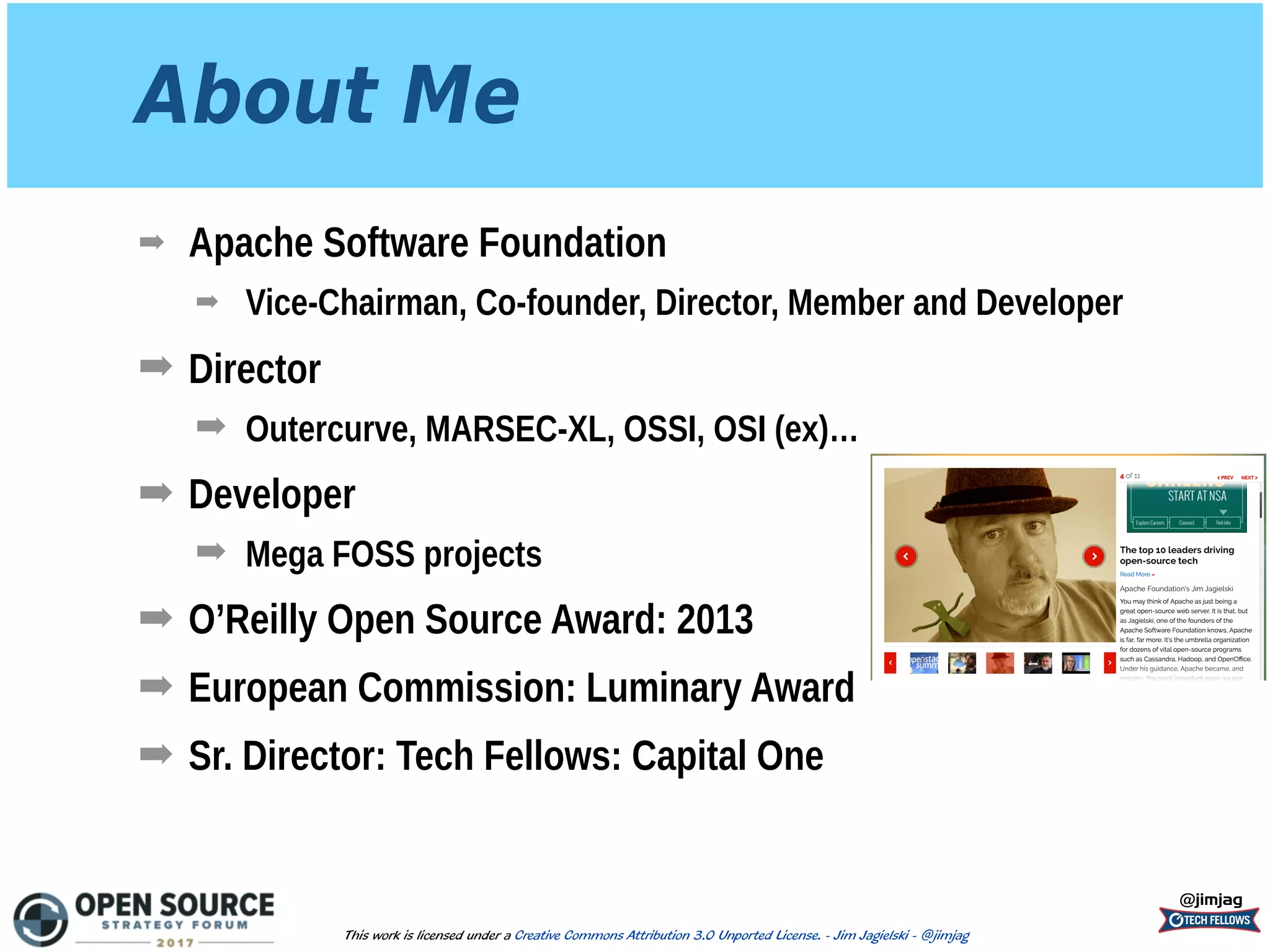
➡ Apache Software Foundation
➡ Vice-Chairman, Co-founder, Director, Member and Developer
➡ Director
➡ Outercurve, MARSEC-XL, OSSI, OSI (ex)…
➡ Developer
➡ Mega FOSS projects
➡ O’Reilly Open Source Award: 2013
➡ European Commission: Luminary Award
➡ Sr. Director: Tech Fellows: Capital One
@jimjag
This work is licensed under a Creative Commons Attribution 3.0 Unported License. - Jim Jagielski - @jimjag
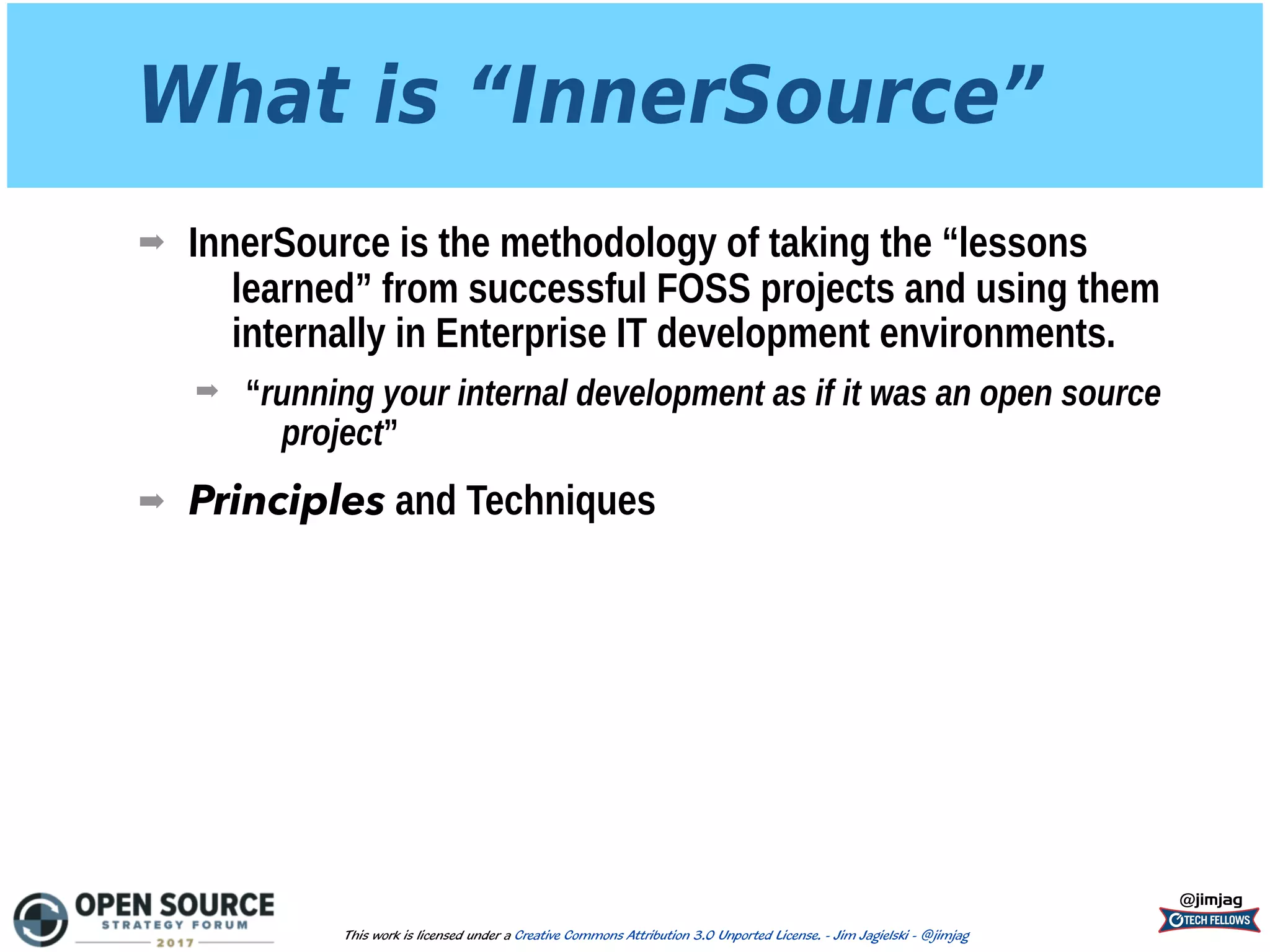
What is “InnerSource”
➡ InnerSource is the methodology of taking the “lessons
learned” from successful FOSS projects and using them
internally in Enterprise IT development environments.
➡ “running your internal development as if it was an open source
project”
➡ Principles and Techniques
@jimjag
This work is licensed under a Creative Commons Attribution 3.0 Unported License. - Jim Jagielski - @jimjag
Why InnerSource?
➡ Drive innovation
➡ Gain efficiencies by leveraging resident talent to its fullest
➡ Develop better software faster through collaboration
➡ Reduce costs through technology standardization and
reuse
➡ Bring products to market faster
➡ Increase developer engagement and innovation through
social creativity
➡ Attract and retain higher quality talent
➡ For FinTech: Stuck in the “old ways” (silos, etc)
@jimjag
This work is licensed under a Creative Commons Attribution 3.0 Unported License. - Jim Jagielski - @jimjag
What is “The Apache Way”
➡ “The Apache Way” relates to how the ASF (and its projects)
work and operate
➡ Basically, the least common denominators on how PMCs
operate (or are expected to operate)
➡ Basic governance principles
@jimjag
This work is licensed under a Creative Commons Attribution 3.0 Unported License. - Jim Jagielski - @jimjag
So why focus on Apache?
➡ The ASF is a 501(c)3, non-profit foundation
➡ Membership-based
➡ Large number of success stories (and some “failures”)
➡ Recognized and acknowledged by peers and press.
➡ The agreed-upon baseline standard for Inner Source
@jimjag
This work is licensed under a Creative Commons Attribution 3.0 Unported License. - Jim Jagielski - @jimjag
Core Values
➡ Meritocracy
➡ Community
➡ Transparency
@jimjag
This work is licensed under a Creative Commons Attribution 3.0 Unported License. - Jim Jagielski - @jimjag
Why Community -> Code
➡ Avoid for new projects, what boot-strapped the Apache
Group in the 1st place
➡ Since we are all volunteers, people’s time and interests
change
➡ A healthy community is “warm and inviting” and
encourages a continued influx of developers
➡ Poisonous people/communities turn people off, and the
project will die
➡ Diversity ensures survivability
➡ End result - better code, long-term code
@jimjag
This work is licensed under a Creative Commons Attribution 3.0 Unported License. - Jim Jagielski - @jimjag
Basic Memes
➡ Meritocracy
➡ Peer-based
➡ Consensus decision making
➡ Collaborative development
➡ Responsible oversight
➡ Individual Participation
@jimjag
This work is licensed under a Creative Commons Attribution 3.0 Unported License. - Jim Jagielski - @jimjag
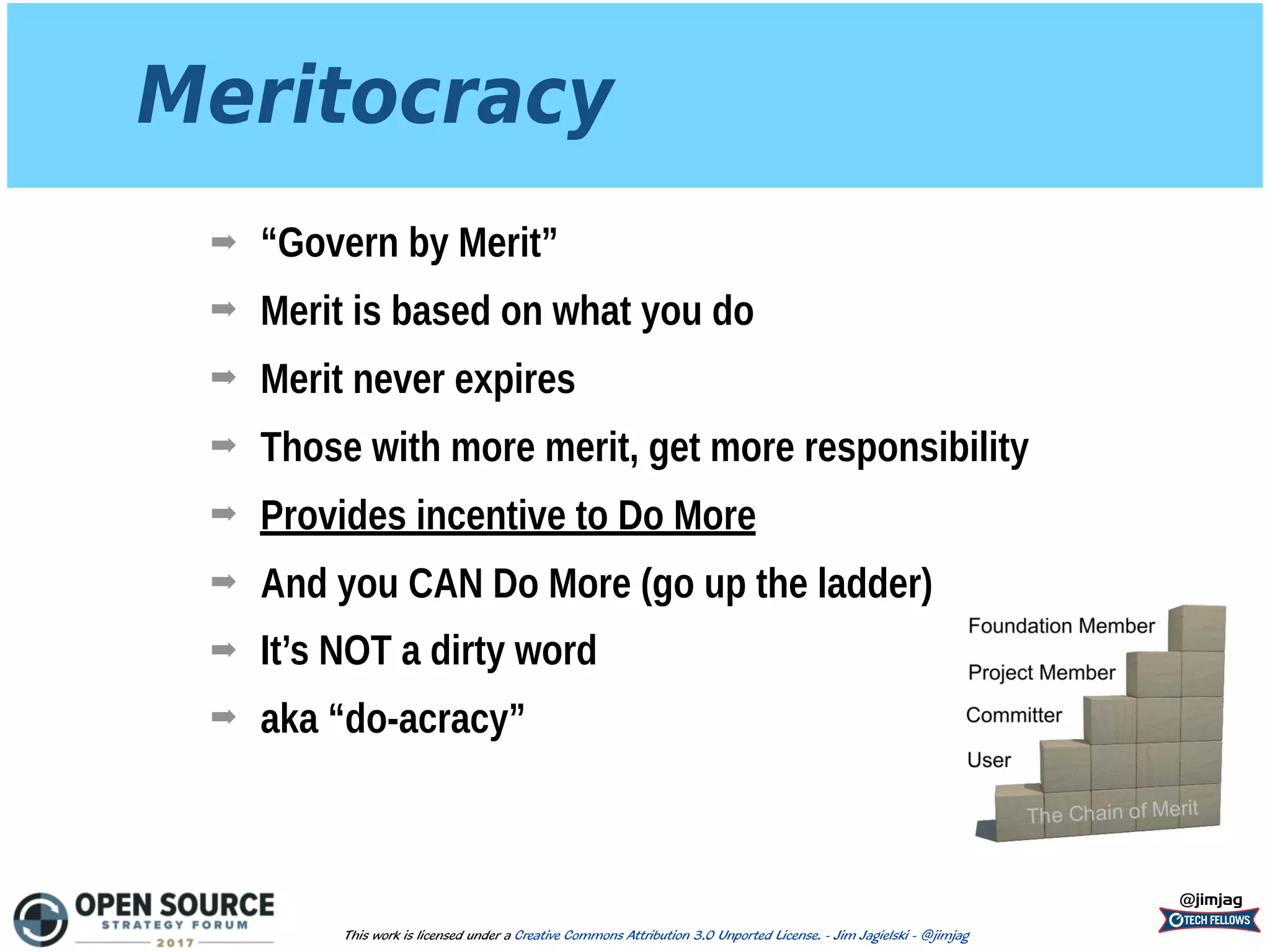
Meritocracy
➡ “Govern by Merit”
➡ Merit is based on what you do
➡ Merit never expires
➡ Those with more merit, get more responsibility
➡ Provides incentive to Do More
➡ And you CAN Do More (go up the ladder)
➡ It’s NOT a dirty word
➡ aka “do-acracy”
@jimjag
This work is licensed under a Creative Commons Attribution 3.0 Unported License. - Jim Jagielski - @jimjag
Peer-based
➡ Developers represent themselves - individuals
➡ Mutual trust and respect
➡ All votes hold the same weight (no BDFL)
➡ Community created code
➡ Healthy communities create healthy code
➡ Poisonous communities don’t
➡ Feel as part of a community
@jimjag
This work is licensed under a Creative Commons Attribution 3.0 Unported License. - Jim Jagielski - @jimjag
Collaborative Development
➡ Transparent and Public
➡ Code is developed by the community
➡ Voting ensures at least 3 active developers
➡ Development done online and on-list
➡ If it didn’t happen on-list, it didn’t happen
@jimjag
This work is licensed under a Creative Commons Attribution 3.0 Unported License. - Jim Jagielski - @jimjag
What is “InnerSource”
➡ InnerSource is the methodology of taking the “lessons
learned” from successful FOSS projects and using them
internally in Enterprise IT development environments.
➡ “running your internal development as if it was an open source
project”
➡ Principles and Techniques
@jimjag
This work is licensed under a Creative Commons Attribution 3.0 Unported License. - Jim Jagielski - @jimjag
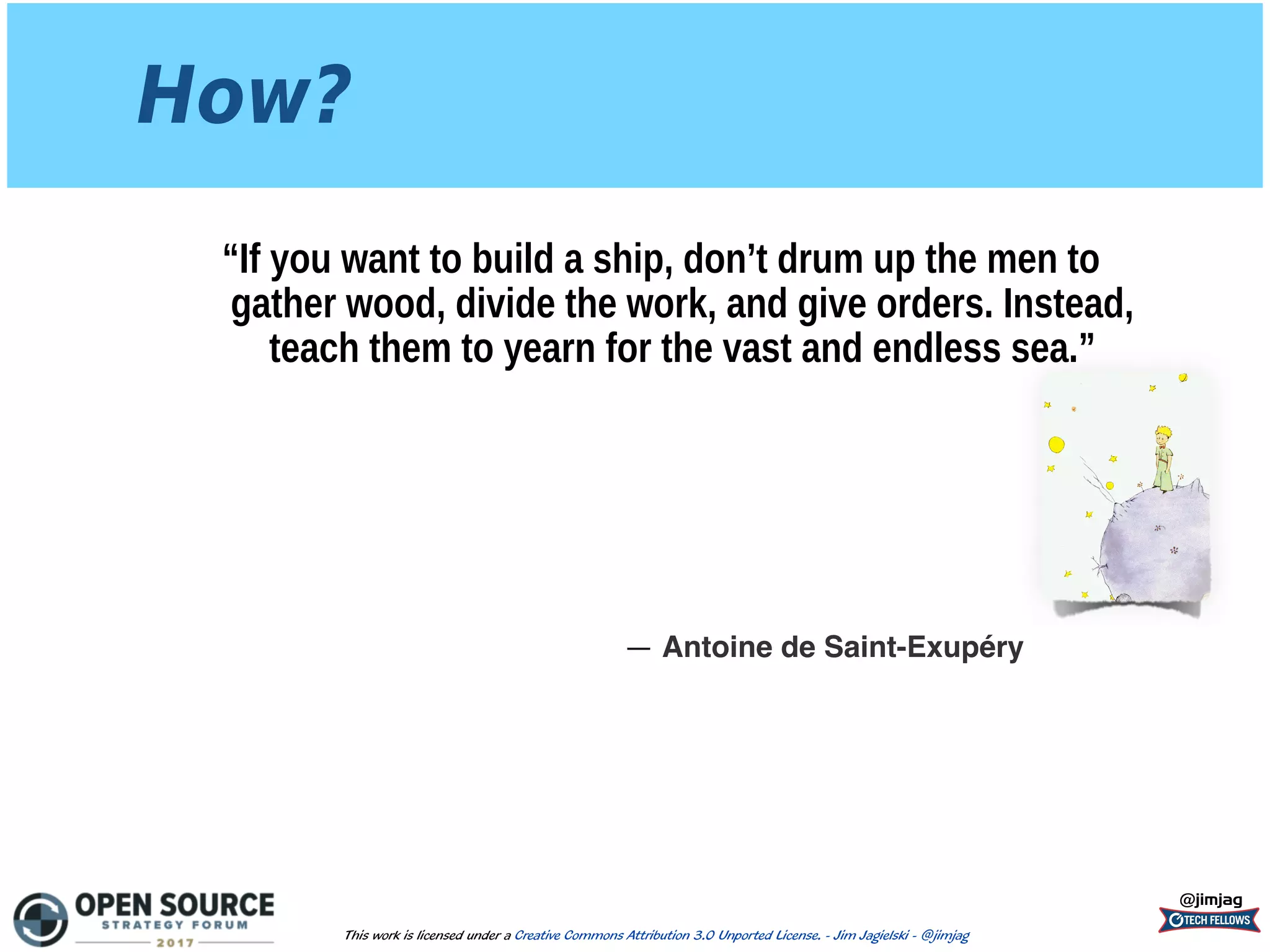
How?
“If you want to build a ship, don’t drum up the men to
gather wood, divide the work, and give orders. Instead,
teach them to yearn for the vast and endless sea.”
@jimjag
This work is licensed under a Creative Commons Attribution 3.0 Unported License. - Jim Jagielski - @jimjag
― Antoine de Saint-Exupéry
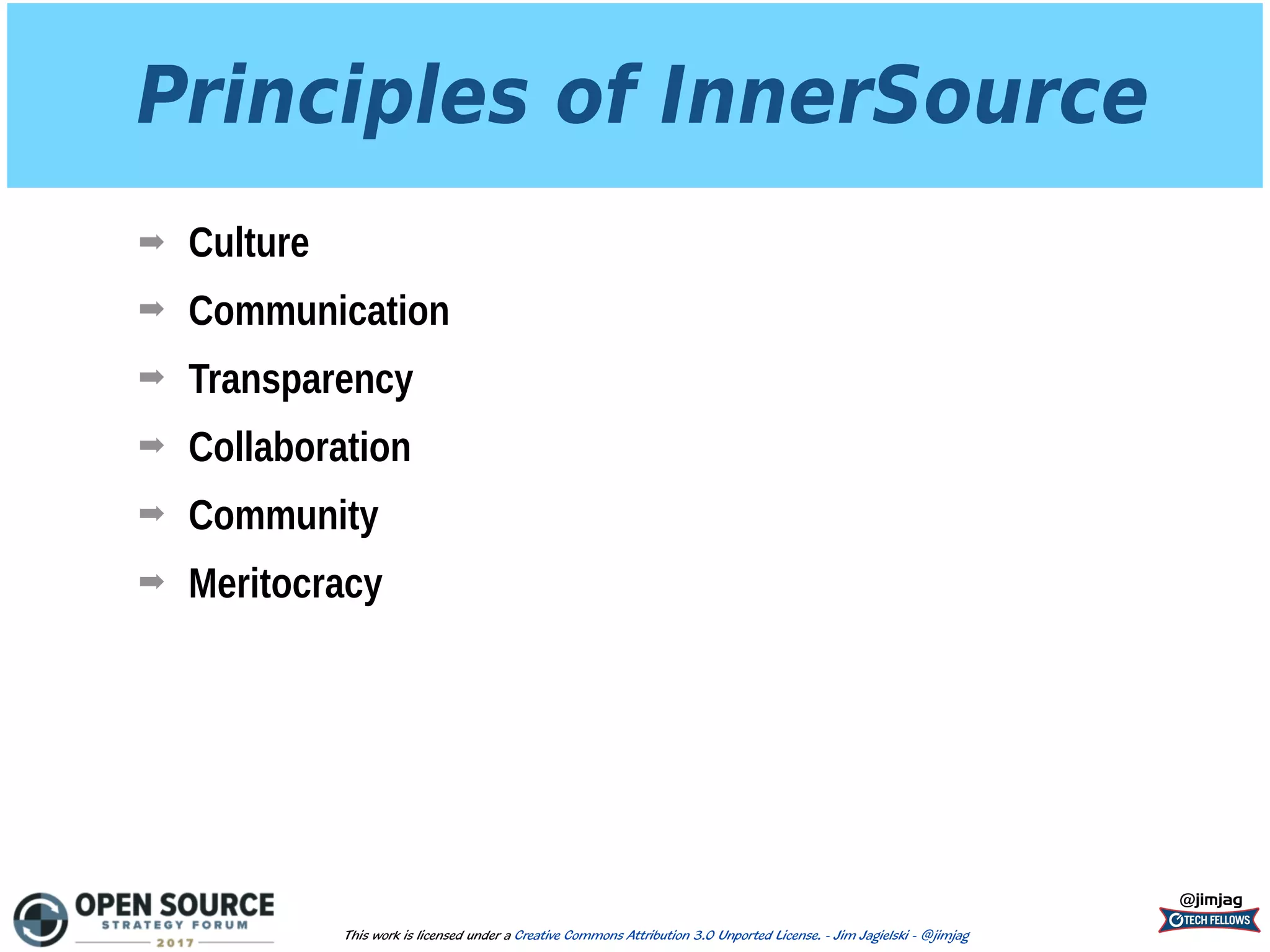
Principles of InnerSource
➡ Culture
➡ Communication
➡ Transparency
➡ Collaboration
➡ Community
➡ Meritocracy
@jimjag
This work is licensed under a Creative Commons Attribution 3.0 Unported License. - Jim Jagielski - @jimjag
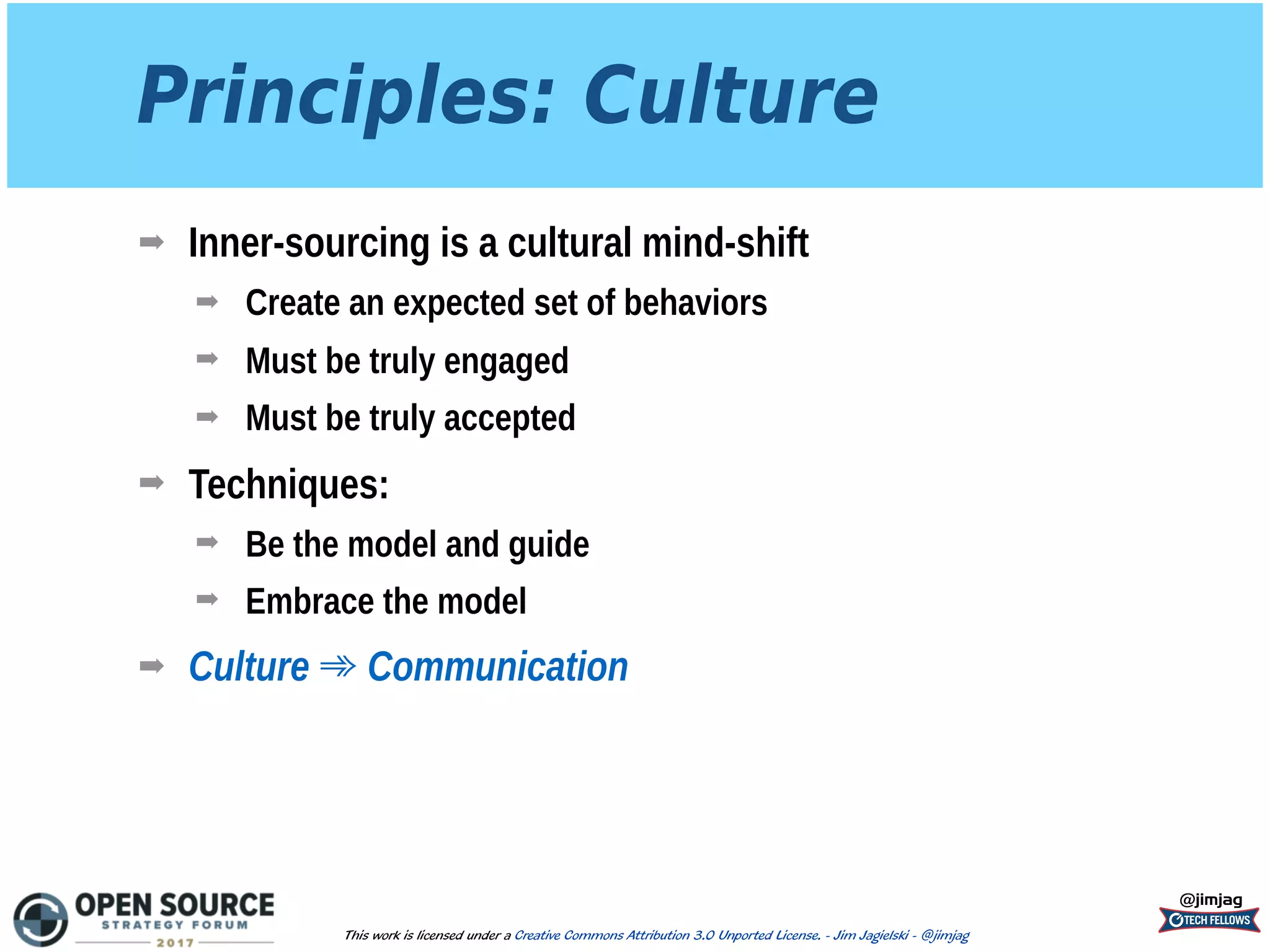
Principles: Culture
➡ Inner-sourcing is a cultural mind-shift
➡ Create an expected set of behaviors
➡ Must be truly engaged
➡ Must be truly accepted
➡ Techniques:
➡ Be the model and guide
➡ Embrace the model
➡ Culture ➾ Communication
@jimjag
This work is licensed under a Creative Commons Attribution 3.0 Unported License. - Jim Jagielski - @jimjag
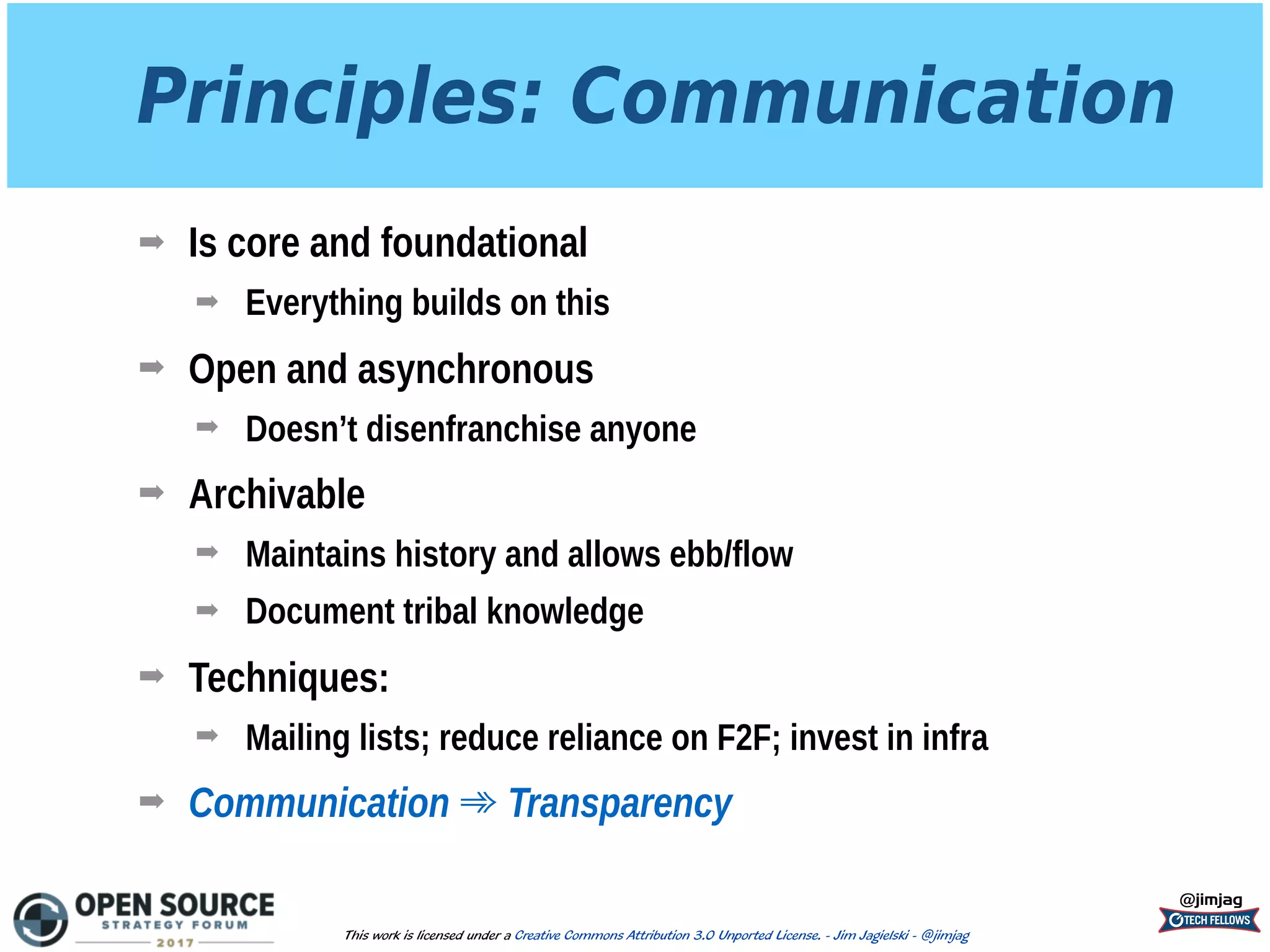
Principles: Communication
➡ Is core and foundational
➡ Everything builds on this
➡ Open and asynchronous
➡ Doesn’t disenfranchise anyone
➡ Archivable
➡ Maintains history and allows ebb/flow
➡ Document tribal knowledge
➡ Techniques:
➡ Mailing lists; reduce reliance on F2F; invest in infra
➡ Communication ➾ Transparency
@jimjag
This work is licensed under a Creative Commons Attribution 3.0 Unported License. - Jim Jagielski - @jimjag
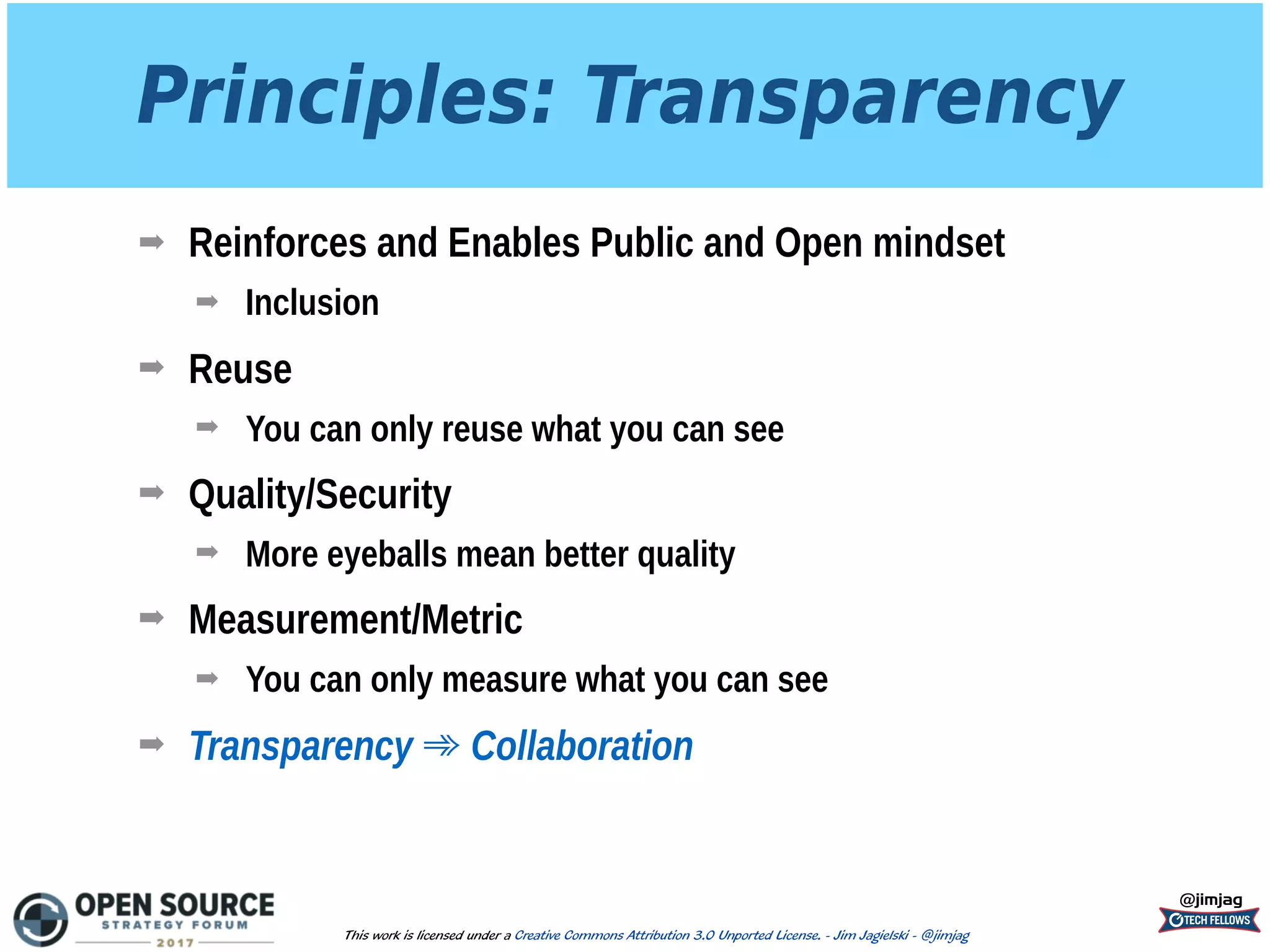
Principles: Transparency
➡ Reinforces and Enables Public and Open mindset
➡ Inclusion
➡ Reuse
➡ You can only reuse what you can see
➡ Quality/Security
➡ More eyeballs mean better quality
➡ Measurement/Metric
➡ You can only measure what you can see
➡ Transparency ➾ Collaboration
@jimjag
This work is licensed under a Creative Commons Attribution 3.0 Unported License. - Jim Jagielski - @jimjag
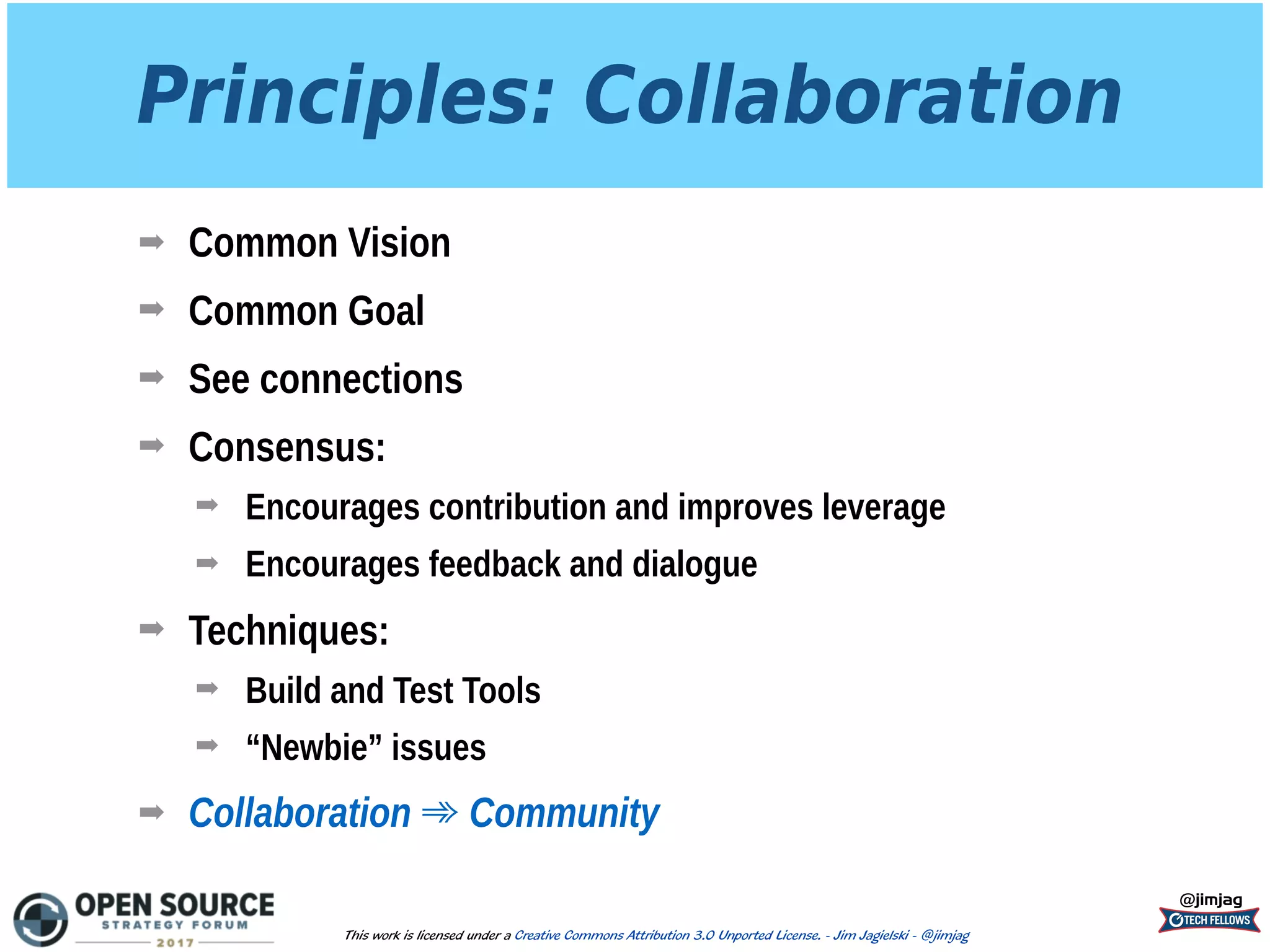
Principles: Collaboration
➡ Common Vision
➡ Common Goal
➡ See connections
➡ Consensus:
➡ Encourages contribution and improves leverage
➡ Encourages feedback and dialogue
➡ Techniques:
➡ Build and Test Tools
➡ “Newbie” issues
➡ Collaboration ➾ Community
@jimjag
This work is licensed under a Creative Commons Attribution 3.0 Unported License. - Jim Jagielski - @jimjag
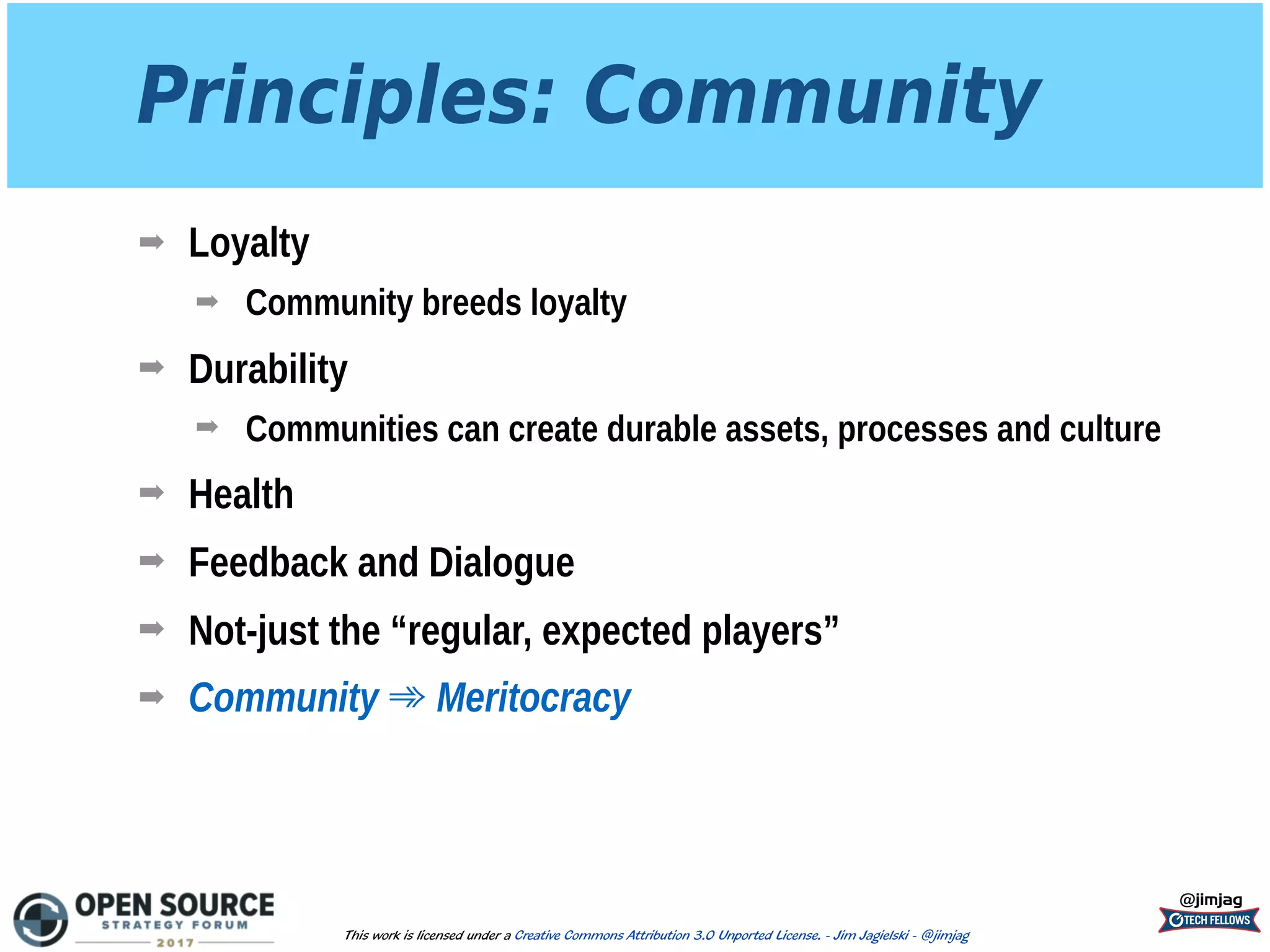
Principles: Community
➡ Loyalty
➡ Community breeds loyalty
➡ Durability
➡ Communities can create durable assets, processes and culture
➡ Health
➡ Feedback and Dialogue
➡ Not-just the “regular, expected players”
➡ Community ➾ Meritocracy
@jimjag
This work is licensed under a Creative Commons Attribution 3.0 Unported License. - Jim Jagielski - @jimjag
Principles: Meritocracy
➡ Technical decisions made by technical experts
➡ Better informed decisions
➡ Role models
➡ Merit provides examples
➡ Earned authority
➡ “Natural” leadership
➡ Known path and “rewards”
➡ Influence and Direction are possible (!(Us vs Them))
➡ Meritocracy ➾ Communication
@jimjag
This work is licensed under a Creative Commons Attribution 3.0 Unported License. - Jim Jagielski - @jimjag
Final Thoughts
➡ Community is not the same as team
➡ self organizing
➡ self identifying
➡ Contribution is work
➡ Community requires investment
➡ Transparency is not a threat
➡ Collaboration means compromise
➡ Driving results means driving consensus
@jimjag
This work is licensed under a Creative Commons Attribution 3.0 Unported License. - Jim Jagielski - @jimjag
Thanks
This work is licensed under a Creative Commons Attribution 3.0 Unported License. - Jim Jagielski - @jimjag
Twitter: @jimjag
Emails:

jim@jaguNET.com

jim@apache.org

jim.jagielski@capitalone.com
http://www.slideshare.net/jimjag/
http://innersourcecommons.org/

InnerSource 101 for FinTech and FinServ

  • 1.
  • 2.
    About Me ➡ ApacheSoftware Foundation ➡ Vice-Chairman, Co-founder, Director, Member and Developer ➡ Director ➡ Outercurve, MARSEC-XL, OSSI, OSI (ex)… ➡ Developer ➡ Mega FOSS projects ➡ O’Reilly Open Source Award: 2013 ➡ European Commission: Luminary Award ➡ Sr. Director: Tech Fellows: Capital One @jimjag This work is licensed under a Creative Commons Attribution 3.0 Unported License. - Jim Jagielski - @jimjag
  • 3.
    What is “InnerSource” ➡InnerSource is the methodology of taking the “lessons learned” from successful FOSS projects and using them internally in Enterprise IT development environments. ➡ “running your internal development as if it was an open source project” ➡ Principles and Techniques @jimjag This work is licensed under a Creative Commons Attribution 3.0 Unported License. - Jim Jagielski - @jimjag
  • 4.
    Why InnerSource? ➡ Driveinnovation ➡ Gain efficiencies by leveraging resident talent to its fullest ➡ Develop better software faster through collaboration ➡ Reduce costs through technology standardization and reuse ➡ Bring products to market faster ➡ Increase developer engagement and innovation through social creativity ➡ Attract and retain higher quality talent ➡ For FinTech: Stuck in the “old ways” (silos, etc) @jimjag This work is licensed under a Creative Commons Attribution 3.0 Unported License. - Jim Jagielski - @jimjag
  • 5.
    What is “TheApache Way” ➡ “The Apache Way” relates to how the ASF (and its projects) work and operate ➡ Basically, the least common denominators on how PMCs operate (or are expected to operate) ➡ Basic governance principles @jimjag This work is licensed under a Creative Commons Attribution 3.0 Unported License. - Jim Jagielski - @jimjag
  • 6.
    So why focuson Apache? ➡ The ASF is a 501(c)3, non-profit foundation ➡ Membership-based ➡ Large number of success stories (and some “failures”) ➡ Recognized and acknowledged by peers and press. ➡ The agreed-upon baseline standard for Inner Source @jimjag This work is licensed under a Creative Commons Attribution 3.0 Unported License. - Jim Jagielski - @jimjag
  • 7.
    Core Values ➡ Meritocracy ➡Community ➡ Transparency @jimjag This work is licensed under a Creative Commons Attribution 3.0 Unported License. - Jim Jagielski - @jimjag
  • 8.
    Why Community ->Code ➡ Avoid for new projects, what boot-strapped the Apache Group in the 1st place ➡ Since we are all volunteers, people’s time and interests change ➡ A healthy community is “warm and inviting” and encourages a continued influx of developers ➡ Poisonous people/communities turn people off, and the project will die ➡ Diversity ensures survivability ➡ End result - better code, long-term code @jimjag This work is licensed under a Creative Commons Attribution 3.0 Unported License. - Jim Jagielski - @jimjag
  • 9.
    Basic Memes ➡ Meritocracy ➡Peer-based ➡ Consensus decision making ➡ Collaborative development ➡ Responsible oversight ➡ Individual Participation @jimjag This work is licensed under a Creative Commons Attribution 3.0 Unported License. - Jim Jagielski - @jimjag
  • 10.
    Meritocracy ➡ “Govern byMerit” ➡ Merit is based on what you do ➡ Merit never expires ➡ Those with more merit, get more responsibility ➡ Provides incentive to Do More ➡ And you CAN Do More (go up the ladder) ➡ It’s NOT a dirty word ➡ aka “do-acracy” @jimjag This work is licensed under a Creative Commons Attribution 3.0 Unported License. - Jim Jagielski - @jimjag
  • 11.
    Peer-based ➡ Developers representthemselves - individuals ➡ Mutual trust and respect ➡ All votes hold the same weight (no BDFL) ➡ Community created code ➡ Healthy communities create healthy code ➡ Poisonous communities don’t ➡ Feel as part of a community @jimjag This work is licensed under a Creative Commons Attribution 3.0 Unported License. - Jim Jagielski - @jimjag
  • 12.
    Collaborative Development ➡ Transparentand Public ➡ Code is developed by the community ➡ Voting ensures at least 3 active developers ➡ Development done online and on-list ➡ If it didn’t happen on-list, it didn’t happen @jimjag This work is licensed under a Creative Commons Attribution 3.0 Unported License. - Jim Jagielski - @jimjag
  • 13.
    What is “InnerSource” ➡InnerSource is the methodology of taking the “lessons learned” from successful FOSS projects and using them internally in Enterprise IT development environments. ➡ “running your internal development as if it was an open source project” ➡ Principles and Techniques @jimjag This work is licensed under a Creative Commons Attribution 3.0 Unported License. - Jim Jagielski - @jimjag
  • 14.
    How? “If you wantto build a ship, don’t drum up the men to gather wood, divide the work, and give orders. Instead, teach them to yearn for the vast and endless sea.” @jimjag This work is licensed under a Creative Commons Attribution 3.0 Unported License. - Jim Jagielski - @jimjag ― Antoine de Saint-Exupéry
  • 15.
    Principles of InnerSource ➡Culture ➡ Communication ➡ Transparency ➡ Collaboration ➡ Community ➡ Meritocracy @jimjag This work is licensed under a Creative Commons Attribution 3.0 Unported License. - Jim Jagielski - @jimjag
  • 16.
    Principles: Culture ➡ Inner-sourcingis a cultural mind-shift ➡ Create an expected set of behaviors ➡ Must be truly engaged ➡ Must be truly accepted ➡ Techniques: ➡ Be the model and guide ➡ Embrace the model ➡ Culture ➾ Communication @jimjag This work is licensed under a Creative Commons Attribution 3.0 Unported License. - Jim Jagielski - @jimjag
  • 17.
    Principles: Communication ➡ Iscore and foundational ➡ Everything builds on this ➡ Open and asynchronous ➡ Doesn’t disenfranchise anyone ➡ Archivable ➡ Maintains history and allows ebb/flow ➡ Document tribal knowledge ➡ Techniques: ➡ Mailing lists; reduce reliance on F2F; invest in infra ➡ Communication ➾ Transparency @jimjag This work is licensed under a Creative Commons Attribution 3.0 Unported License. - Jim Jagielski - @jimjag
  • 18.
    Principles: Transparency ➡ Reinforcesand Enables Public and Open mindset ➡ Inclusion ➡ Reuse ➡ You can only reuse what you can see ➡ Quality/Security ➡ More eyeballs mean better quality ➡ Measurement/Metric ➡ You can only measure what you can see ➡ Transparency ➾ Collaboration @jimjag This work is licensed under a Creative Commons Attribution 3.0 Unported License. - Jim Jagielski - @jimjag
  • 19.
    Principles: Collaboration ➡ CommonVision ➡ Common Goal ➡ See connections ➡ Consensus: ➡ Encourages contribution and improves leverage ➡ Encourages feedback and dialogue ➡ Techniques: ➡ Build and Test Tools ➡ “Newbie” issues ➡ Collaboration ➾ Community @jimjag This work is licensed under a Creative Commons Attribution 3.0 Unported License. - Jim Jagielski - @jimjag
  • 20.
    Principles: Community ➡ Loyalty ➡Community breeds loyalty ➡ Durability ➡ Communities can create durable assets, processes and culture ➡ Health ➡ Feedback and Dialogue ➡ Not-just the “regular, expected players” ➡ Community ➾ Meritocracy @jimjag This work is licensed under a Creative Commons Attribution 3.0 Unported License. - Jim Jagielski - @jimjag
  • 21.
    Principles: Meritocracy ➡ Technicaldecisions made by technical experts ➡ Better informed decisions ➡ Role models ➡ Merit provides examples ➡ Earned authority ➡ “Natural” leadership ➡ Known path and “rewards” ➡ Influence and Direction are possible (!(Us vs Them)) ➡ Meritocracy ➾ Communication @jimjag This work is licensed under a Creative Commons Attribution 3.0 Unported License. - Jim Jagielski - @jimjag
  • 22.
    Final Thoughts ➡ Communityis not the same as team ➡ self organizing ➡ self identifying ➡ Contribution is work ➡ Community requires investment ➡ Transparency is not a threat ➡ Collaboration means compromise ➡ Driving results means driving consensus @jimjag This work is licensed under a Creative Commons Attribution 3.0 Unported License. - Jim Jagielski - @jimjag
  • 23.
    Thanks This work islicensed under a Creative Commons Attribution 3.0 Unported License. - Jim Jagielski - @jimjag Twitter: @jimjag Emails:
 jim@jaguNET.com
 jim@apache.org
 jim.jagielski@capitalone.com http://www.slideshare.net/jimjag/ http://innersourcecommons.org/