Slides prepared by Rose Williams, Binghamton University
Chapter 13
Interfaces and
Inner Classes
© 2006 Pearson Addison-Wesley. All rights reserved 13-2
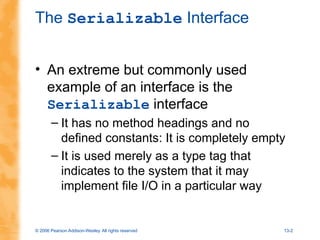
The Serializable Interface
• An extreme but commonly used
example of an interface is the
Serializable interface
– It has no method headings and no
defined constants: It is completely empty
– It is used merely as a type tag that
indicates to the system that it may
implement file I/O in a particular way
© 2006 Pearson Addison-Wesley. All rights reserved 13-3
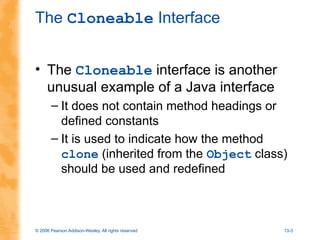
The Cloneable Interface
• The Cloneable interface is another
unusual example of a Java interface
– It does not contain method headings or
defined constants
– It is used to indicate how the method
clone (inherited from the Object class)
should be used and redefined
© 2006 Pearson Addison-Wesley. All rights reserved 13-4
The Cloneable Interface
• The method Object.clone() does a bit-
by-bit copy of the object's data in storage
• If the data is all primitive type data or data of
immutable class types (such as String),
then this is adequate
– This is the simple case
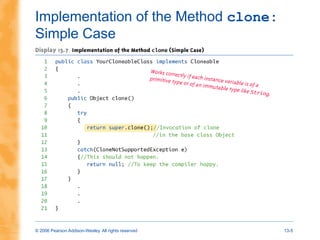
• The following is an example of a simple
class that has no instance variables of a
mutable class type, and no specified base
class
– So the base class is Object
© 2006 Pearson Addison-Wesley. All rights reserved 13-5
Implementation of the Method clone:
Simple Case
© 2006 Pearson Addison-Wesley. All rights reserved 13-6
The Cloneable Interface
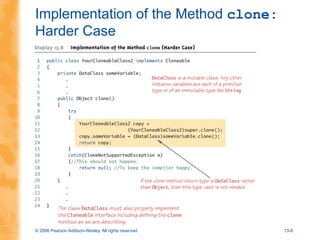
• If the data in the object to be cloned includes
instance variables whose type is a mutable class,
then the simple implementation of clone would
cause a privacy leak
• When implementing the Cloneable interface for a
class like this:
– First invoke the clone method of the base class Object
(or whatever the base class is)
– Then reset the values of any new instance variables
whose types are mutable class types
– This is done by making copies of the instance variables
by invoking their clone methods
© 2006 Pearson Addison-Wesley. All rights reserved 13-7
The Cloneable Interface
• Note that this will work properly only if
the Cloneable interface is
implemented properly for the classes
to which the instance variables belong
– And for the classes to which any of the
instance variables of the above classes
belong, and so on and so forth
• The following shows an example
© 2006 Pearson Addison-Wesley. All rights reserved 13-8
Implementation of the Method clone:
Harder Case
© 2006 Pearson Addison-Wesley. All rights reserved 13-9
Simple Uses of Inner Classes
• Inner (or nested) classes are classes defined within
other classes
– The class that includes the inner class is called the outer
class
• There are four categories of inner classes in Java:
1.Inner classes (non-static)
2.Static inner classes
3.Local classes (defined inside a block of Java
code)
4.Anonymous classes (defined inside a block of
Java code)
© 2006 Pearson Addison-Wesley. All rights reserved 13-10
Simple Uses of Inner Classes
• An inner class definition is a member of the
outer class in the same way that the
instance variables and methods of the outer
class are members
– An inner class is local to the outer class
definition
– The name of an inner class may be reused for
something else outside the outer class definition
– If the inner class is private, then the inner class
cannot be accessed by name outside the
definition of the outer class
© 2006 Pearson Addison-Wesley. All rights reserved 13-11
Simple Uses of Inner Classes
• There are two main advantages to inner
classes
– They can make the outer class more self-
contained since they are defined inside a class
– Both of their methods have access to each
other's private methods and instance variables
• Using an inner class as a helping class is
one of the most useful applications of inner
classes
– If used as a helping class, an inner class should
be marked private
© 2006 Pearson Addison-Wesley. All rights reserved 13-12
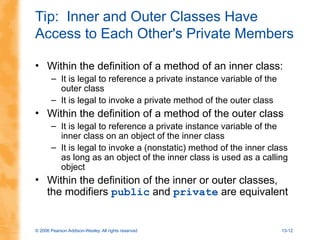
Tip: Inner and Outer Classes Have
Access to Each Other's Private Members
• Within the definition of a method of an inner class:
– It is legal to reference a private instance variable of the
outer class
– It is legal to invoke a private method of the outer class
• Within the definition of a method of the outer class
– It is legal to reference a private instance variable of the
inner class on an object of the inner class
– It is legal to invoke a (nonstatic) method of the inner class
as long as an object of the inner class is used as a calling
object
• Within the definition of the inner or outer classes,
the modifiers public and private are equivalent
© 2006 Pearson Addison-Wesley. All rights reserved 13-13
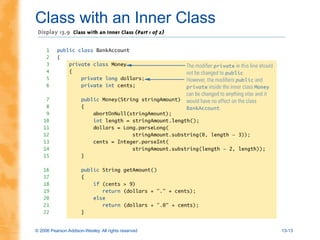
Class with an Inner Class
© 2006 Pearson Addison-Wesley. All rights reserved 13-14
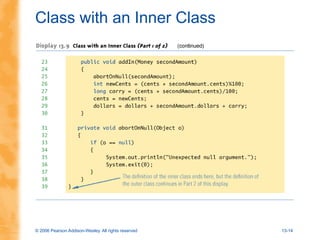
Class with an Inner Class
© 2006 Pearson Addison-Wesley. All rights reserved 13-15
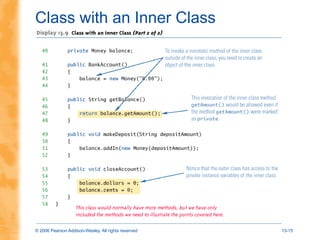
Class with an Inner Class
© 2006 Pearson Addison-Wesley. All rights reserved 13-16
The .class File for an Inner Class
• Compiling any class in Java produces
a .class file named ClassName.class
• Compiling a class with one (or more) inner
classes causes both (or more) classes to be
compiled, and produces two (or more) .class
files
– Such as ClassName.class and
ClassName$InnerClassName.class

Inner classes or nested classes in Java Program

  • 1.
    Slides prepared byRose Williams, Binghamton University Chapter 13 Interfaces and Inner Classes
  • 2.
    © 2006 PearsonAddison-Wesley. All rights reserved 13-2 The Serializable Interface • An extreme but commonly used example of an interface is the Serializable interface – It has no method headings and no defined constants: It is completely empty – It is used merely as a type tag that indicates to the system that it may implement file I/O in a particular way
  • 3.
    © 2006 PearsonAddison-Wesley. All rights reserved 13-3 The Cloneable Interface • The Cloneable interface is another unusual example of a Java interface – It does not contain method headings or defined constants – It is used to indicate how the method clone (inherited from the Object class) should be used and redefined
  • 4.
    © 2006 PearsonAddison-Wesley. All rights reserved 13-4 The Cloneable Interface • The method Object.clone() does a bit- by-bit copy of the object's data in storage • If the data is all primitive type data or data of immutable class types (such as String), then this is adequate – This is the simple case • The following is an example of a simple class that has no instance variables of a mutable class type, and no specified base class – So the base class is Object
  • 5.
    © 2006 PearsonAddison-Wesley. All rights reserved 13-5 Implementation of the Method clone: Simple Case
  • 6.
    © 2006 PearsonAddison-Wesley. All rights reserved 13-6 The Cloneable Interface • If the data in the object to be cloned includes instance variables whose type is a mutable class, then the simple implementation of clone would cause a privacy leak • When implementing the Cloneable interface for a class like this: – First invoke the clone method of the base class Object (or whatever the base class is) – Then reset the values of any new instance variables whose types are mutable class types – This is done by making copies of the instance variables by invoking their clone methods
  • 7.
    © 2006 PearsonAddison-Wesley. All rights reserved 13-7 The Cloneable Interface • Note that this will work properly only if the Cloneable interface is implemented properly for the classes to which the instance variables belong – And for the classes to which any of the instance variables of the above classes belong, and so on and so forth • The following shows an example
  • 8.
    © 2006 PearsonAddison-Wesley. All rights reserved 13-8 Implementation of the Method clone: Harder Case
  • 9.
    © 2006 PearsonAddison-Wesley. All rights reserved 13-9 Simple Uses of Inner Classes • Inner (or nested) classes are classes defined within other classes – The class that includes the inner class is called the outer class • There are four categories of inner classes in Java: 1.Inner classes (non-static) 2.Static inner classes 3.Local classes (defined inside a block of Java code) 4.Anonymous classes (defined inside a block of Java code)
  • 10.
    © 2006 PearsonAddison-Wesley. All rights reserved 13-10 Simple Uses of Inner Classes • An inner class definition is a member of the outer class in the same way that the instance variables and methods of the outer class are members – An inner class is local to the outer class definition – The name of an inner class may be reused for something else outside the outer class definition – If the inner class is private, then the inner class cannot be accessed by name outside the definition of the outer class
  • 11.
    © 2006 PearsonAddison-Wesley. All rights reserved 13-11 Simple Uses of Inner Classes • There are two main advantages to inner classes – They can make the outer class more self- contained since they are defined inside a class – Both of their methods have access to each other's private methods and instance variables • Using an inner class as a helping class is one of the most useful applications of inner classes – If used as a helping class, an inner class should be marked private
  • 12.
    © 2006 PearsonAddison-Wesley. All rights reserved 13-12 Tip: Inner and Outer Classes Have Access to Each Other's Private Members • Within the definition of a method of an inner class: – It is legal to reference a private instance variable of the outer class – It is legal to invoke a private method of the outer class • Within the definition of a method of the outer class – It is legal to reference a private instance variable of the inner class on an object of the inner class – It is legal to invoke a (nonstatic) method of the inner class as long as an object of the inner class is used as a calling object • Within the definition of the inner or outer classes, the modifiers public and private are equivalent
  • 13.
    © 2006 PearsonAddison-Wesley. All rights reserved 13-13 Class with an Inner Class
  • 14.
    © 2006 PearsonAddison-Wesley. All rights reserved 13-14 Class with an Inner Class
  • 15.
    © 2006 PearsonAddison-Wesley. All rights reserved 13-15 Class with an Inner Class
  • 16.
    © 2006 PearsonAddison-Wesley. All rights reserved 13-16 The .class File for an Inner Class • Compiling any class in Java produces a .class file named ClassName.class • Compiling a class with one (or more) inner classes causes both (or more) classes to be compiled, and produces two (or more) .class files – Such as ClassName.class and ClassName$InnerClassName.class