C++ Presentation
Inheritance in C++
Lecture Slide by:- Manan Pasricha
Student of Bachelor of Computer Applications
E-mail id: pasrichamanan81@gmail.com
LinkedIn Profile:- https://www.linkedin.com/in/manan-pasricha-76029818a/
Content
 Inheritance Introduction
 Why and when to use Inheritance?
 Modes of Inheritance
 Types of Inheritance
Inheritance Introduction
The capability of a class to derive properties and characteristics from another class is
called Inheritance. Inheritance is one of the most important feature of Object Oriented
Programming.
Sub Class: The class that inherits properties from another class is called Sub class or Derived
Class.
Super Class: The class whose properties are inherited by sub class is called Base Class or Super
class.
Why and when to use Inheritance?
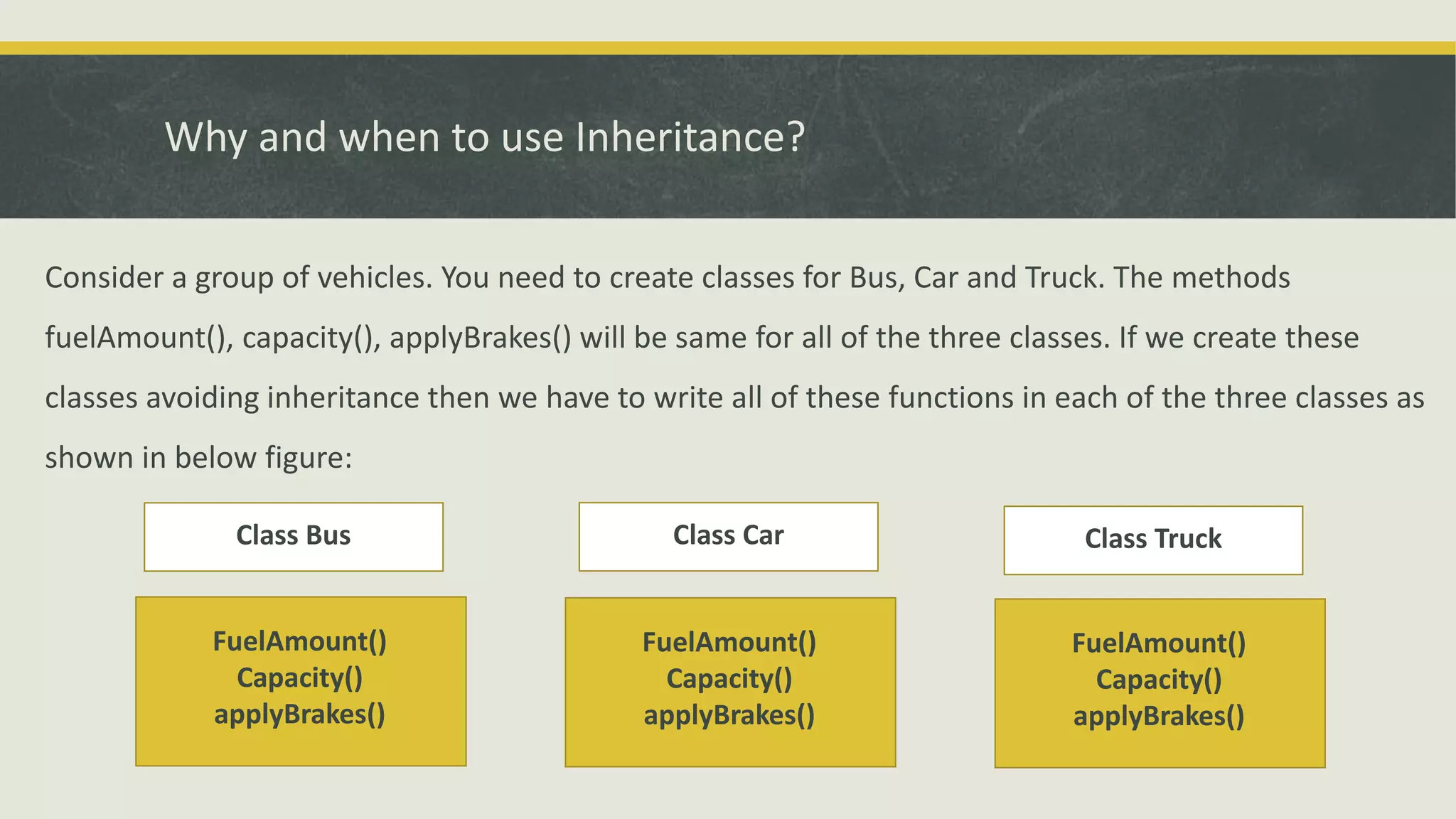
Consider a group of vehicles. You need to create classes for Bus, Car and Truck. The methods
fuelAmount(), capacity(), applyBrakes() will be same for all of the three classes. If we create these
classes avoiding inheritance then we have to write all of these functions in each of the three classes as
shown in below figure:
FuelAmount()
Capacity()
applyBrakes()
FuelAmount()
Capacity()
applyBrakes()
FuelAmount()
Capacity()
applyBrakes()
Class Bus Class Car Class Truck
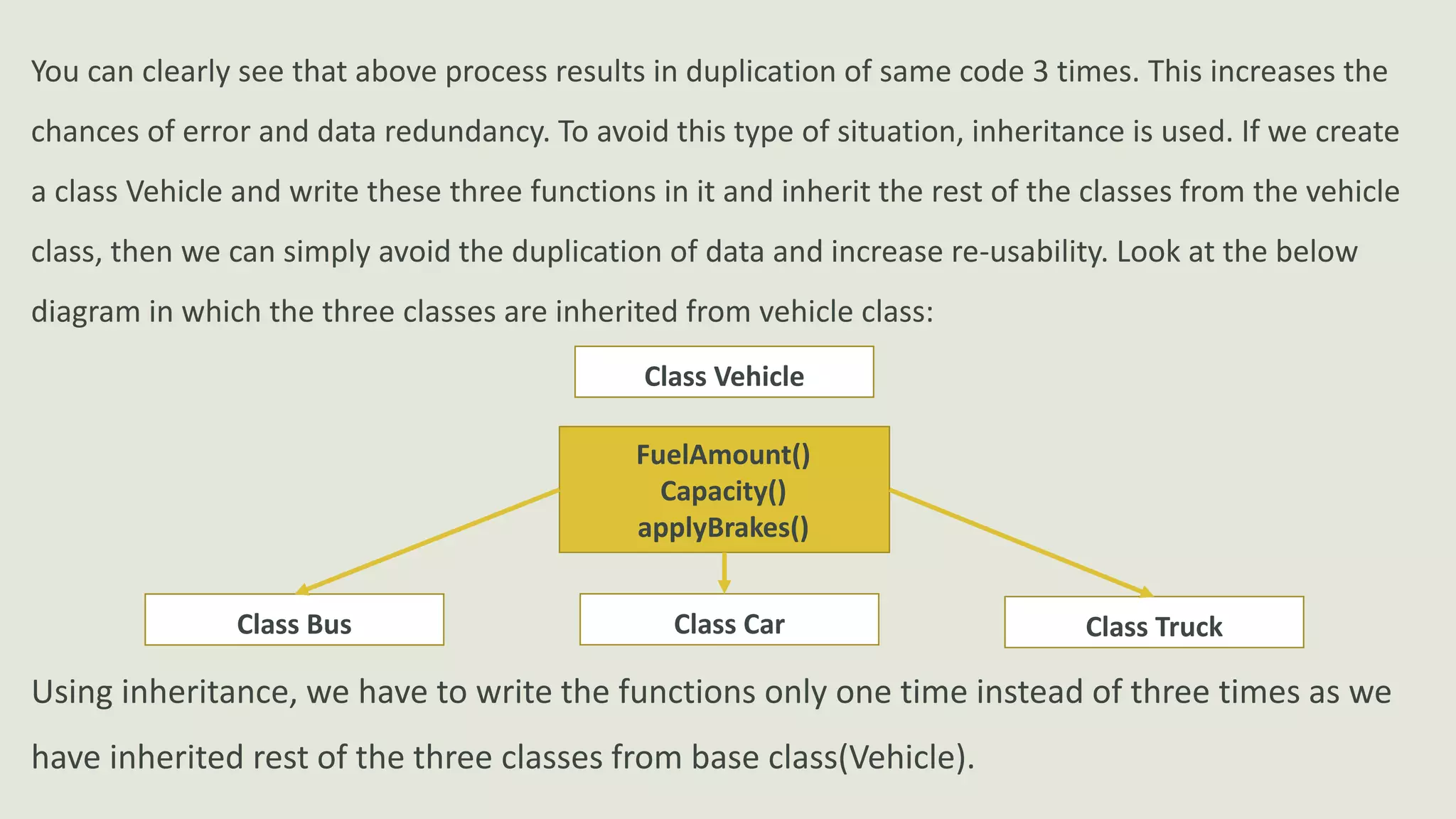
You can clearly see that above process results in duplication of same code 3 times. This increases the
chances of error and data redundancy. To avoid this type of situation, inheritance is used. If we create
a class Vehicle and write these three functions in it and inherit the rest of the classes from the vehicle
class, then we can simply avoid the duplication of data and increase re-usability. Look at the below
diagram in which the three classes are inherited from vehicle class:
FuelAmount()
Capacity()
applyBrakes()
Class Bus Class Car Class Truck
Class Vehicle
Using inheritance, we have to write the functions only one time instead of three times as we
have inherited rest of the three classes from base class(Vehicle).
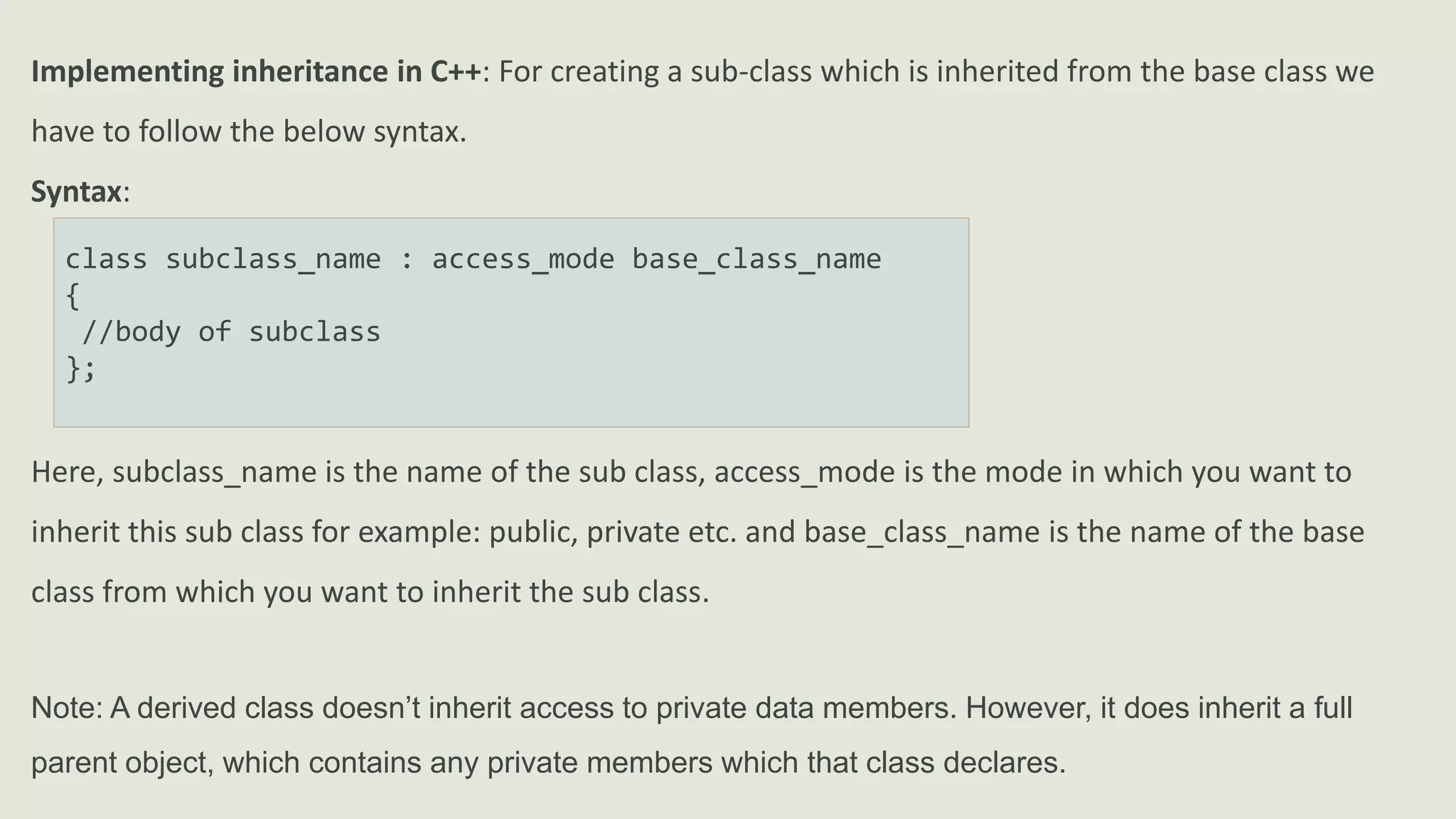
Implementing inheritance in C++: For creating a sub-class which is inherited from the base class we
have to follow the below syntax.
Syntax:
class subclass_name : access_mode base_class_name
{
//body of subclass
};
Here, subclass_name is the name of the sub class, access_mode is the mode in which you want to
inherit this sub class for example: public, private etc. and base_class_name is the name of the base
class from which you want to inherit the sub class.
Note: A derived class doesn’t inherit access to private data members. However, it does inherit a full
parent object, which contains any private members which that class declares.
Modes of Inheritance
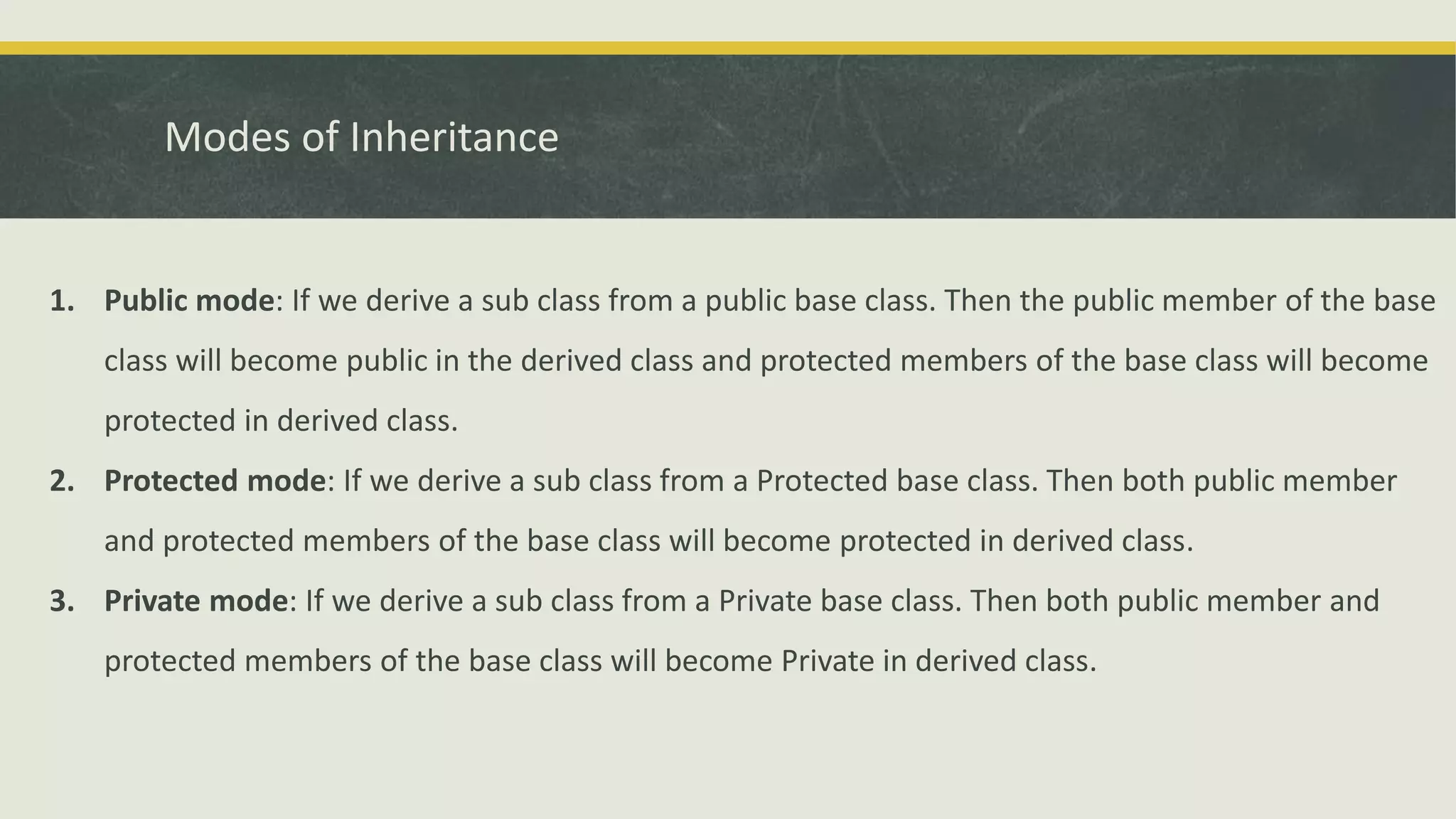
1. Public mode: If we derive a sub class from a public base class. Then the public member of the base
class will become public in the derived class and protected members of the base class will become
protected in derived class.
2. Protected mode: If we derive a sub class from a Protected base class. Then both public member
and protected members of the base class will become protected in derived class.
3. Private mode: If we derive a sub class from a Private base class. Then both public member and
protected members of the base class will become Private in derived class.
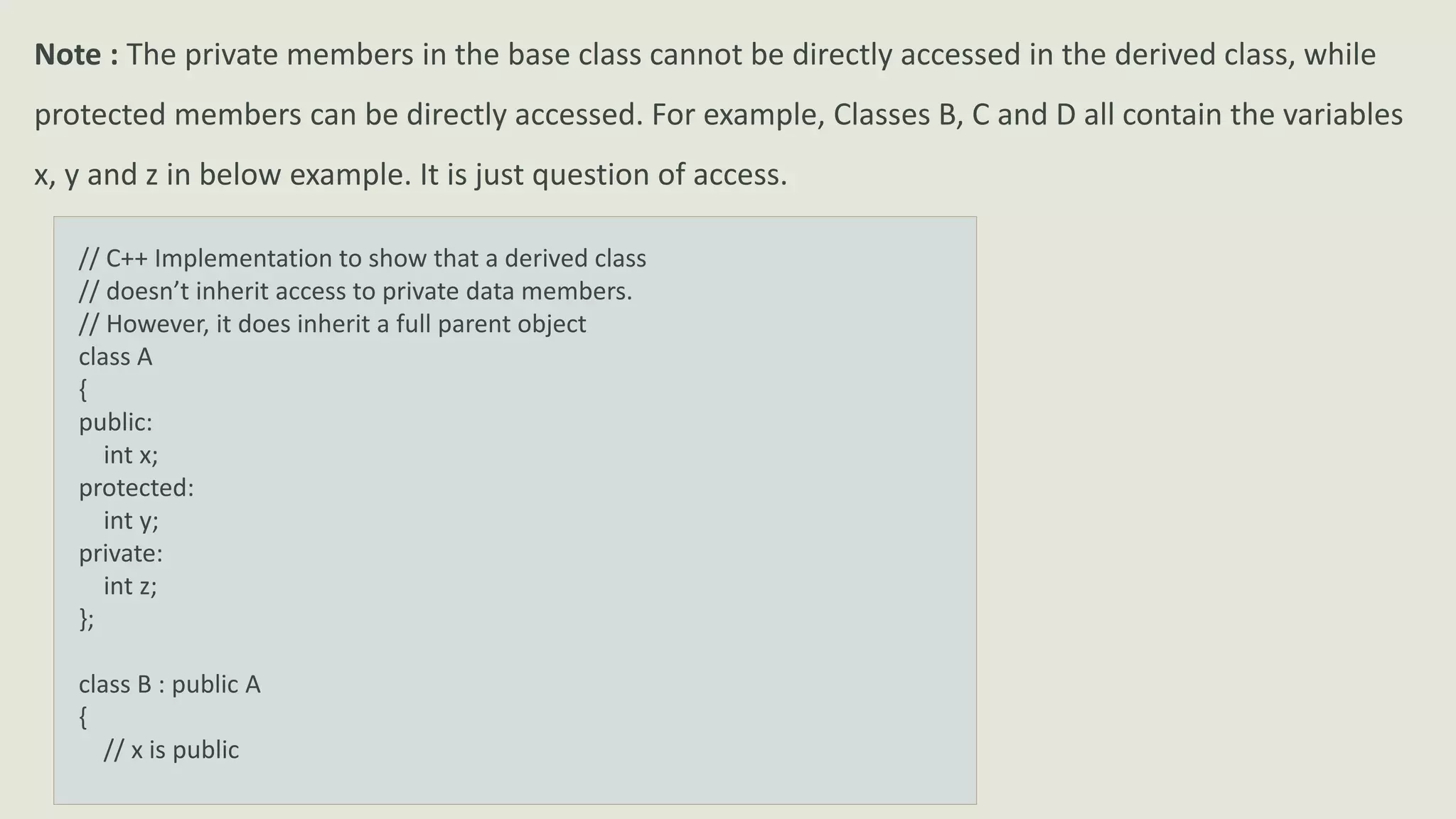
Note : The private members in the base class cannot be directly accessed in the derived class, while
protected members can be directly accessed. For example, Classes B, C and D all contain the variables
x, y and z in below example. It is just question of access.
// C++ Implementation to show that a derived class
// doesn’t inherit access to private data members.
// However, it does inherit a full parent object
class A
{
public:
int x;
protected:
int y;
private:
int z;
};
class B : public A
{
// x is public
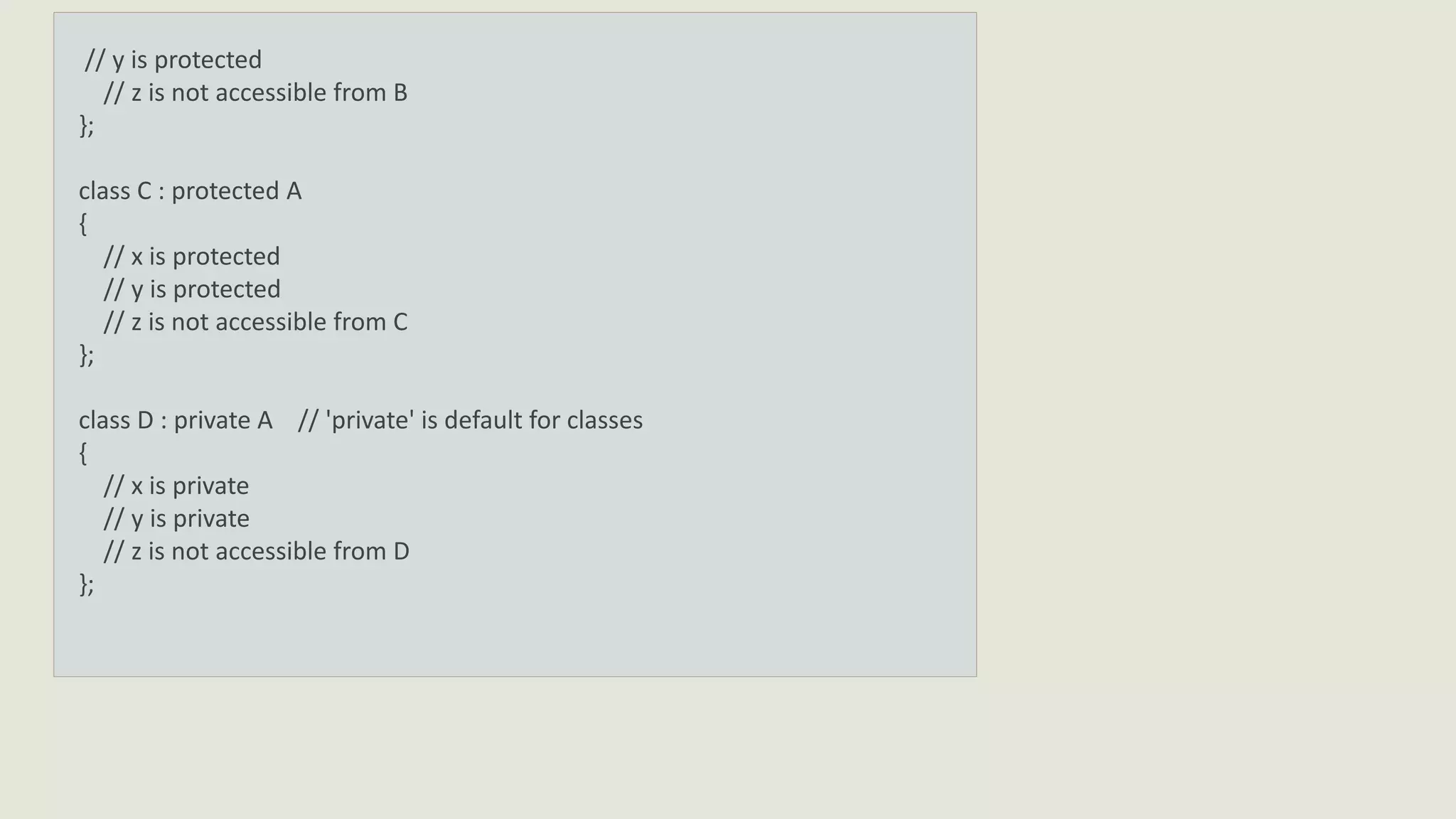
// y is protected
// z is not accessible from B
};
class C : protected A
{
// x is protected
// y is protected
// z is not accessible from C
};
class D : private A // 'private' is default for classes
{
// x is private
// y is private
// z is not accessible from D
};
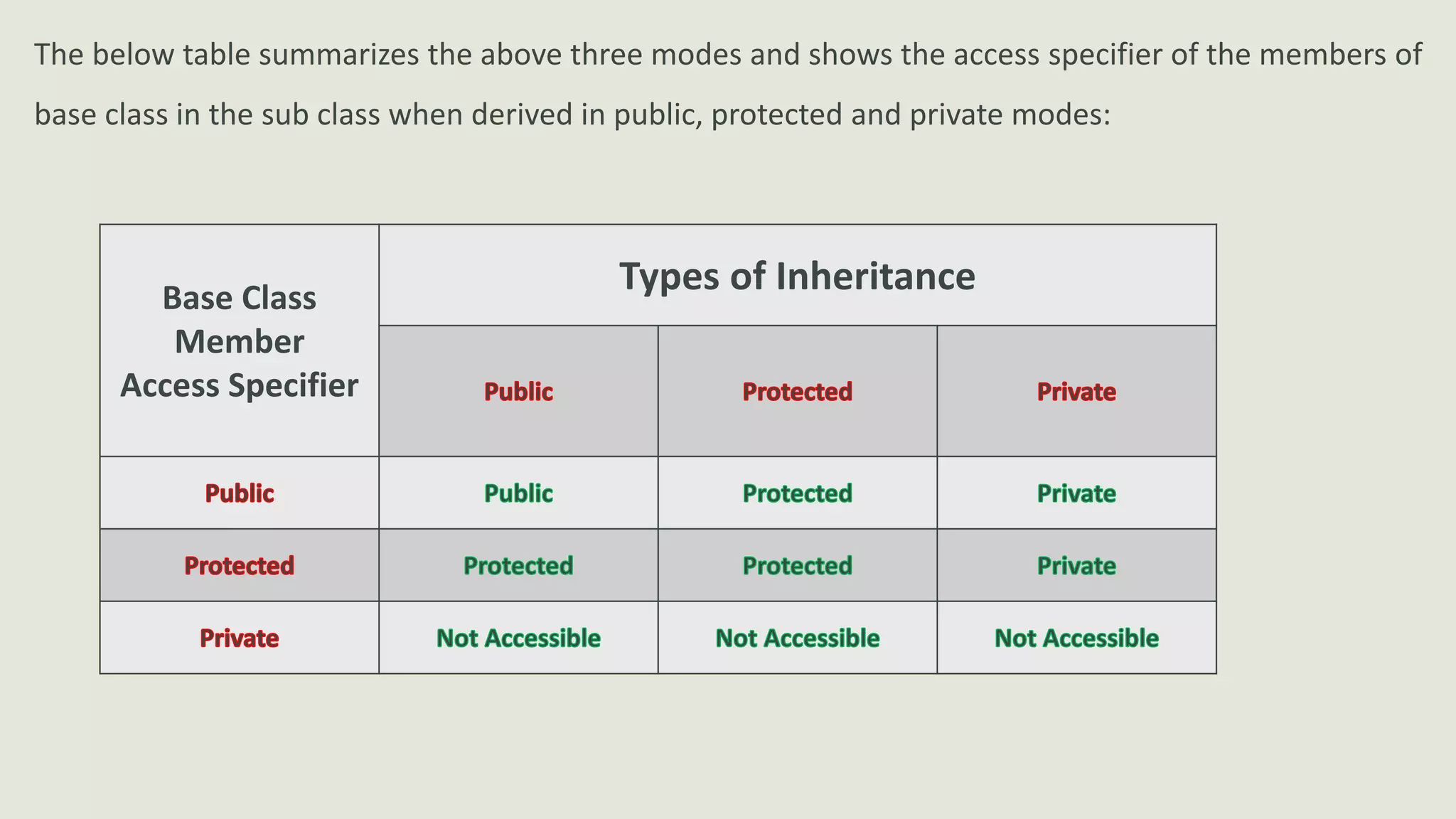
The below table summarizes the above three modes and shows the access specifier of the members of
base class in the sub class when derived in public, protected and private modes:
Base Class
Member
Access Specifier
Types of Inheritance
 Single Inheritance
 Multiple Inheritance
 Multilevel Inheritance
 Hierarchical Inheritance
 Hybrid Inheritance
 Multipath Inheritance
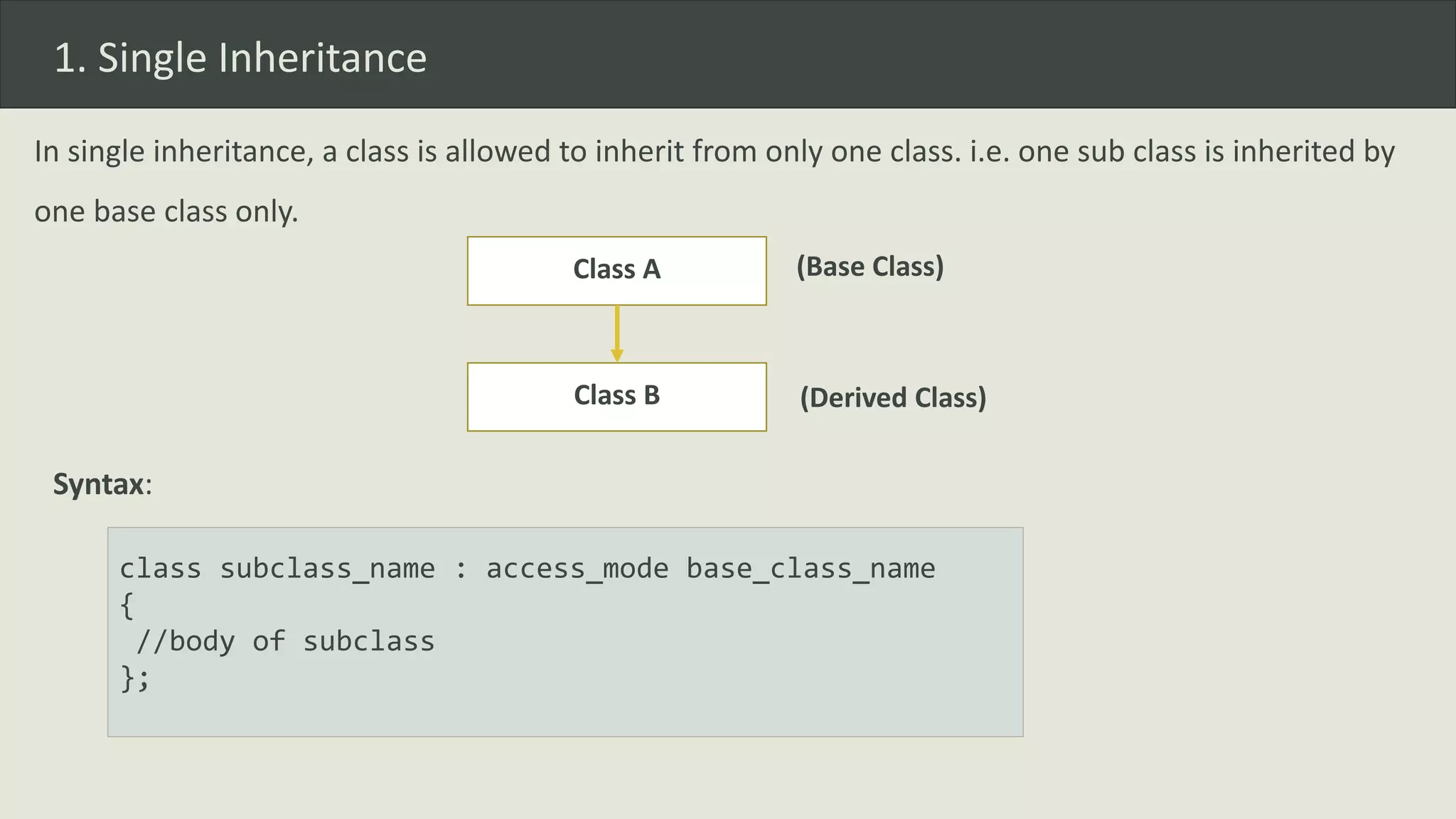
1. Single Inheritance
In single inheritance, a class is allowed to inherit from only one class. i.e. one sub class is inherited by
one base class only.
Class A
Class B
(Base Class)
(Derived Class)
Syntax:
class subclass_name : access_mode base_class_name
{
//body of subclass
};
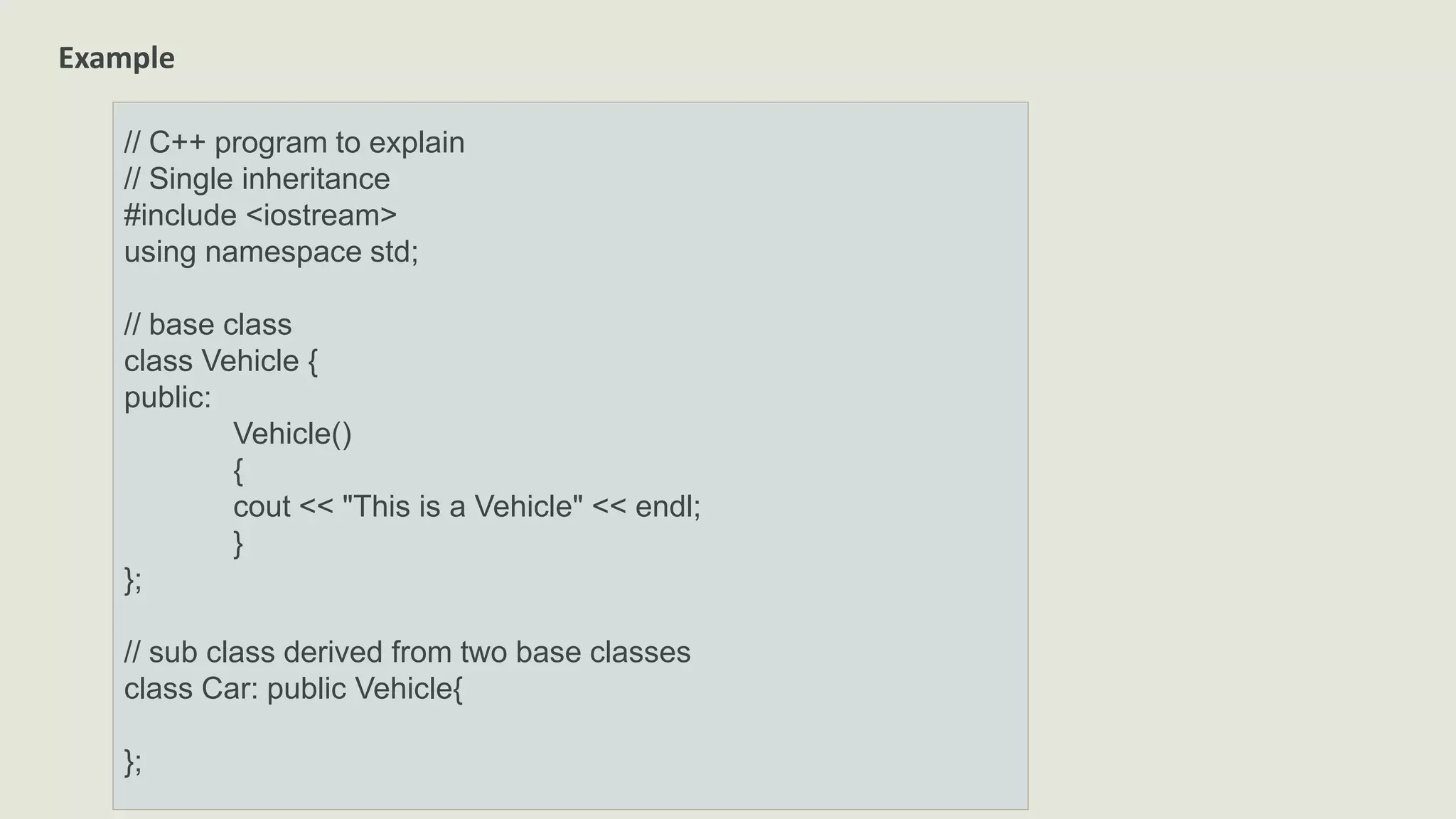
Example
// C++ program to explain
// Single inheritance
#include <iostream>
using namespace std;
// base class
class Vehicle {
public:
Vehicle()
{
cout << "This is a Vehicle" << endl;
}
};
// sub class derived from two base classes
class Car: public Vehicle{
};
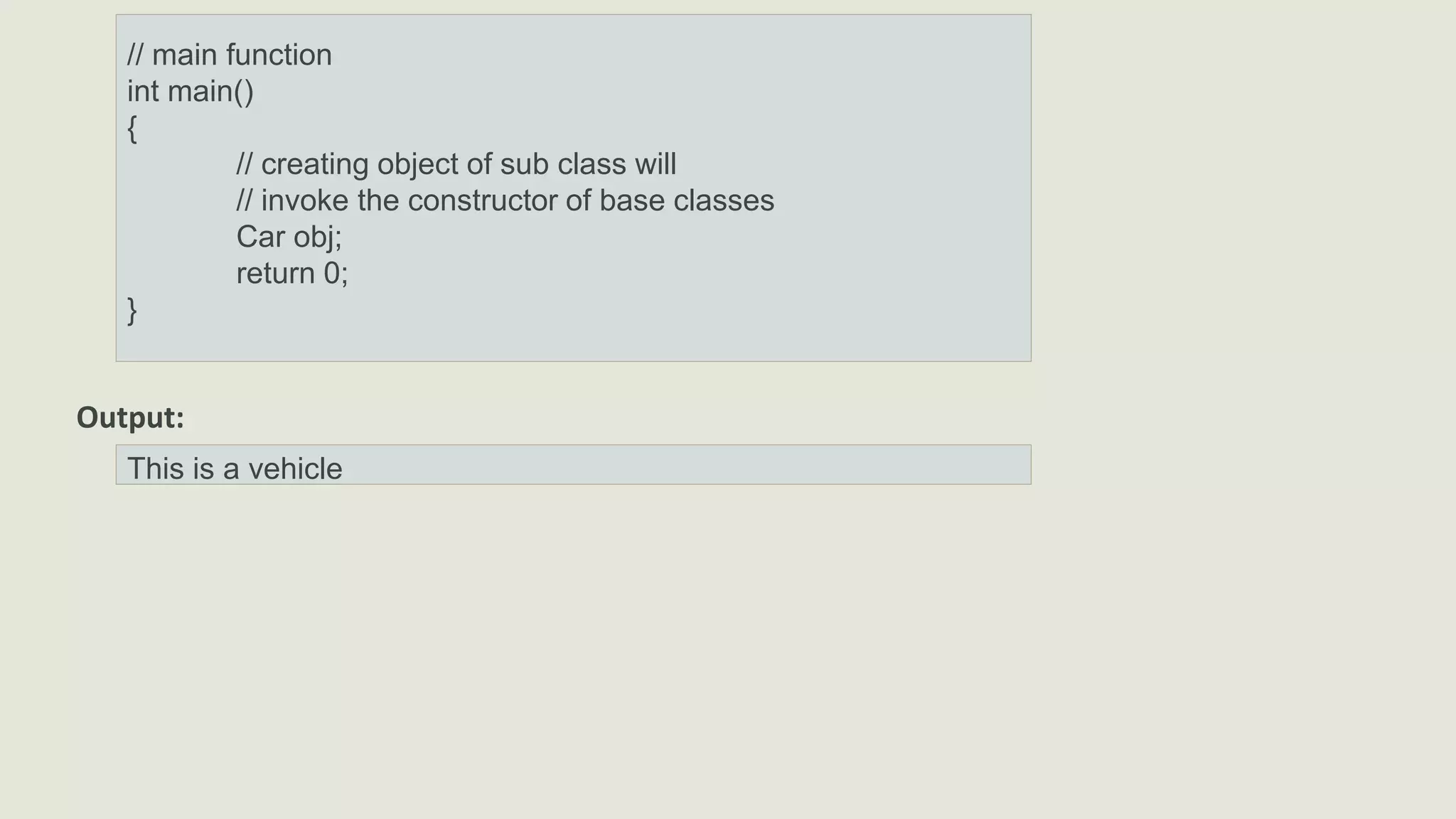
// main function
int main()
{
// creating object of sub class will
// invoke the constructor of base classes
Car obj;
return 0;
}
Output:
This is a vehicle
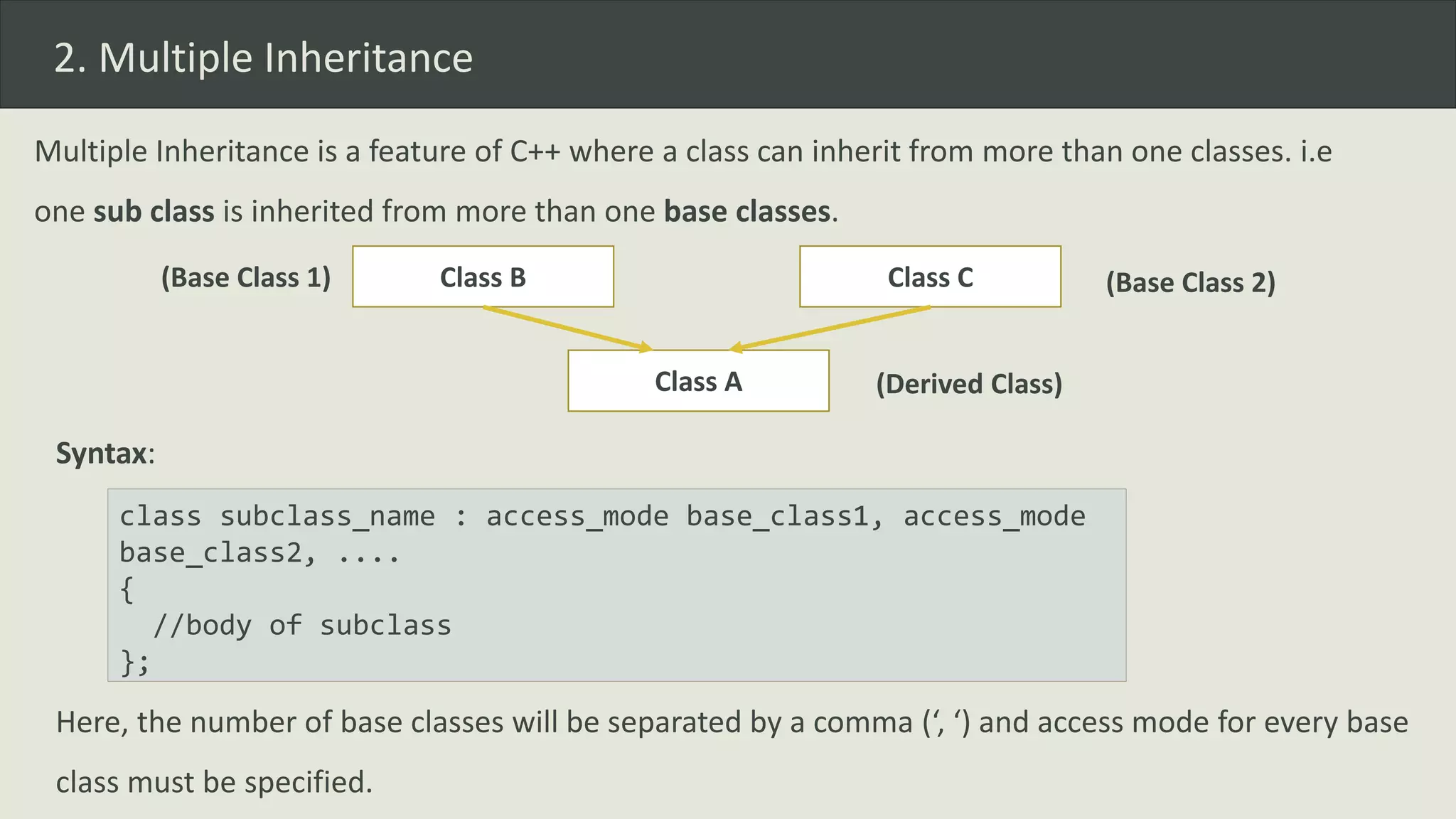
2. Multiple Inheritance
Multiple Inheritance is a feature of C++ where a class can inherit from more than one classes. i.e
one sub class is inherited from more than one base classes.
Syntax:
class subclass_name : access_mode base_class1, access_mode
base_class2, ....
{
//body of subclass
};
Class C
Class A
(Base Class 2)
(Derived Class)
Class B(Base Class 1)
Here, the number of base classes will be separated by a comma (‘, ‘) and access mode for every base
class must be specified.
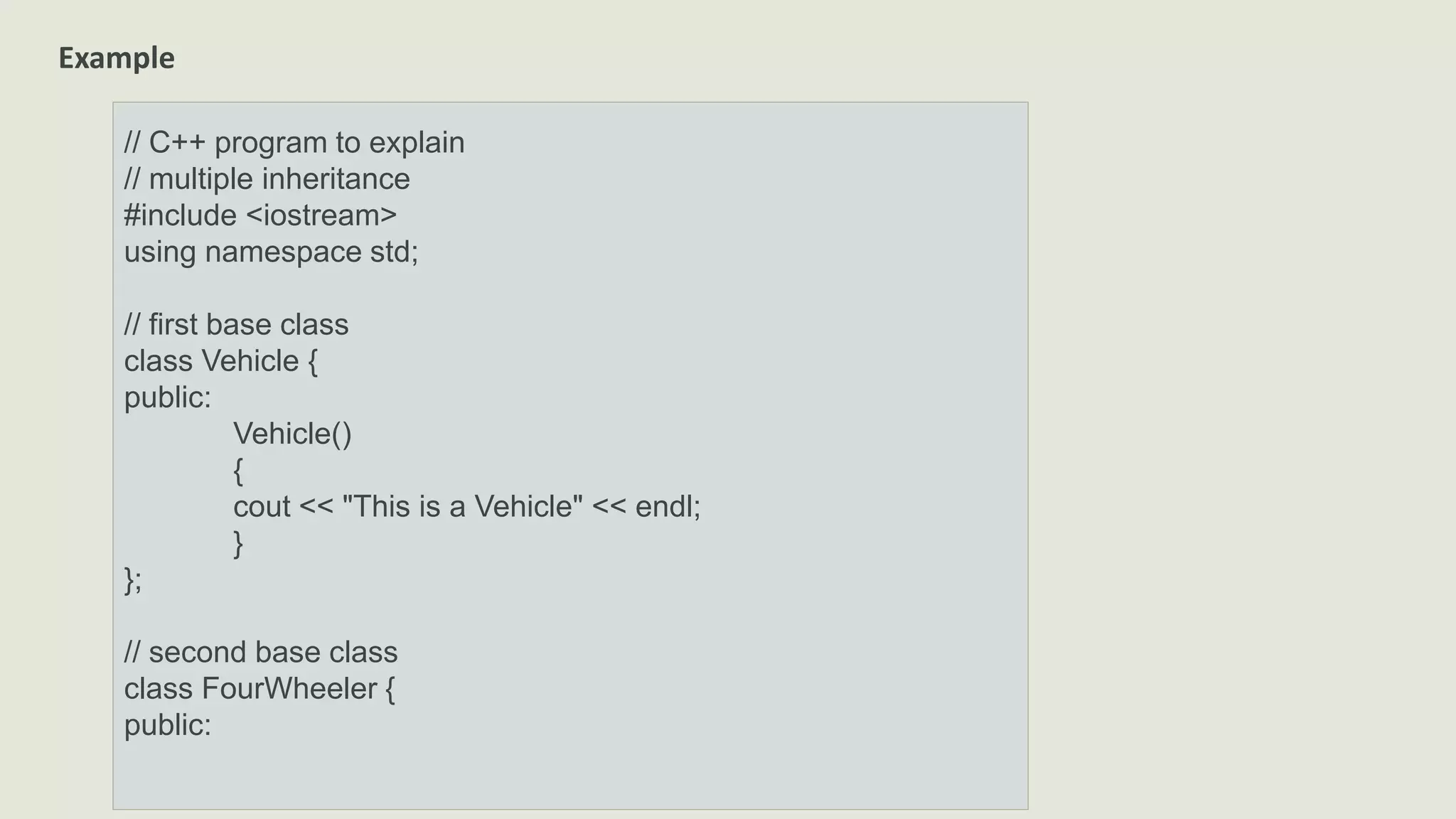
Example
// C++ program to explain
// multiple inheritance
#include <iostream>
using namespace std;
// first base class
class Vehicle {
public:
Vehicle()
{
cout << "This is a Vehicle" << endl;
}
};
// second base class
class FourWheeler {
public:
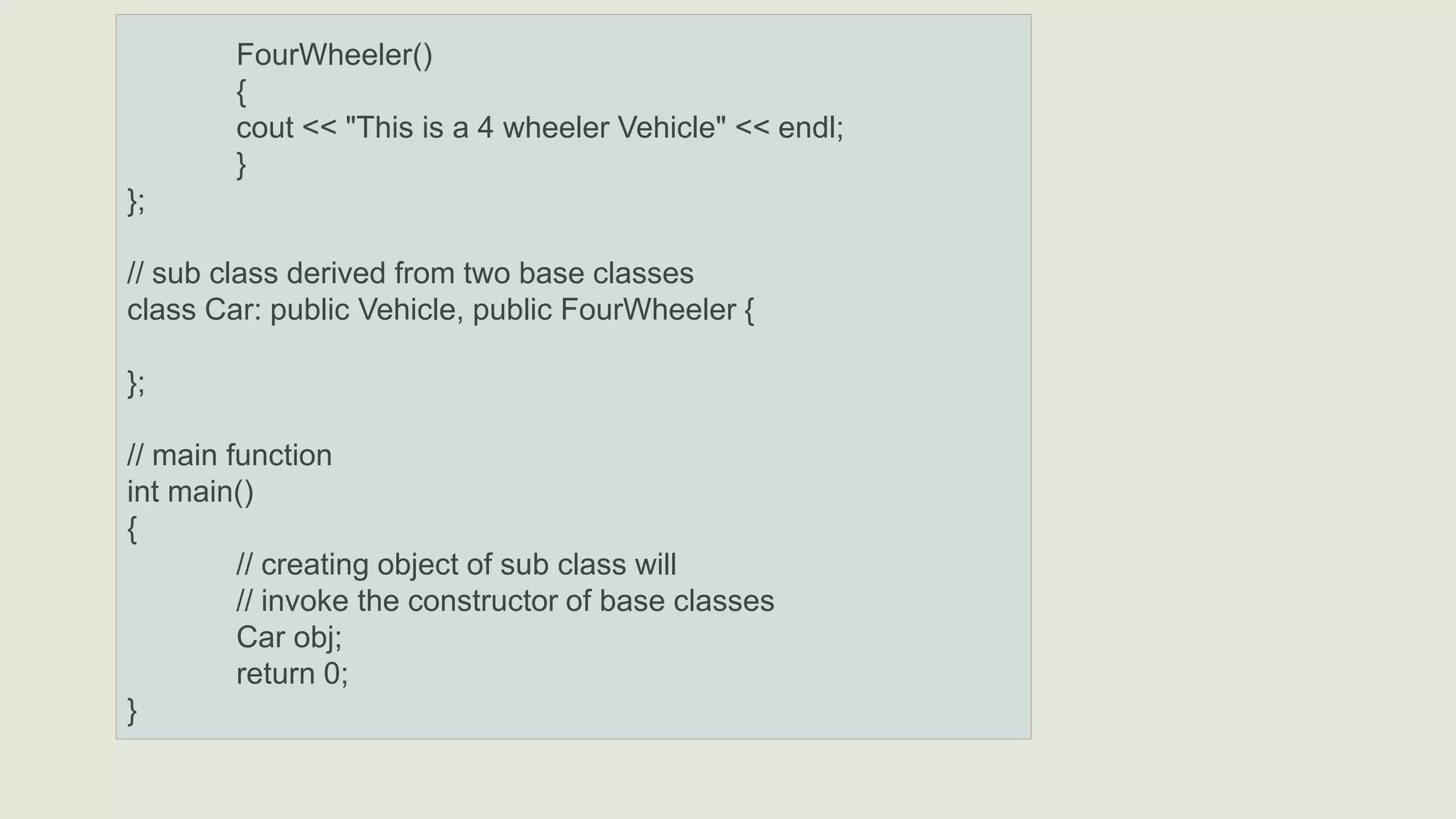
FourWheeler()
{
cout << "This is a 4 wheeler Vehicle" << endl;
}
};
// sub class derived from two base classes
class Car: public Vehicle, public FourWheeler {
};
// main function
int main()
{
// creating object of sub class will
// invoke the constructor of base classes
Car obj;
return 0;
}
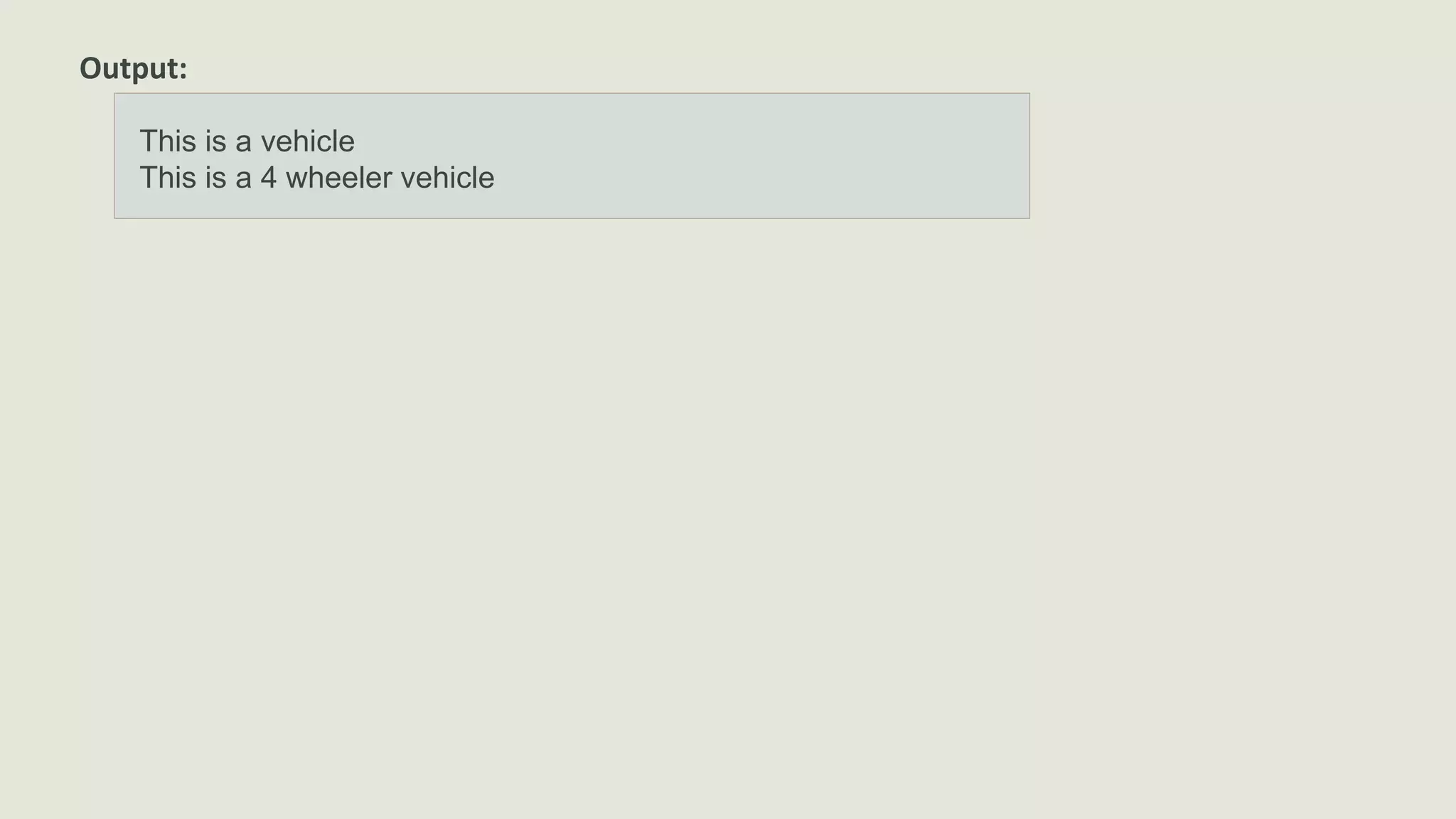
Output:
This is a vehicle
This is a 4 wheeler vehicle
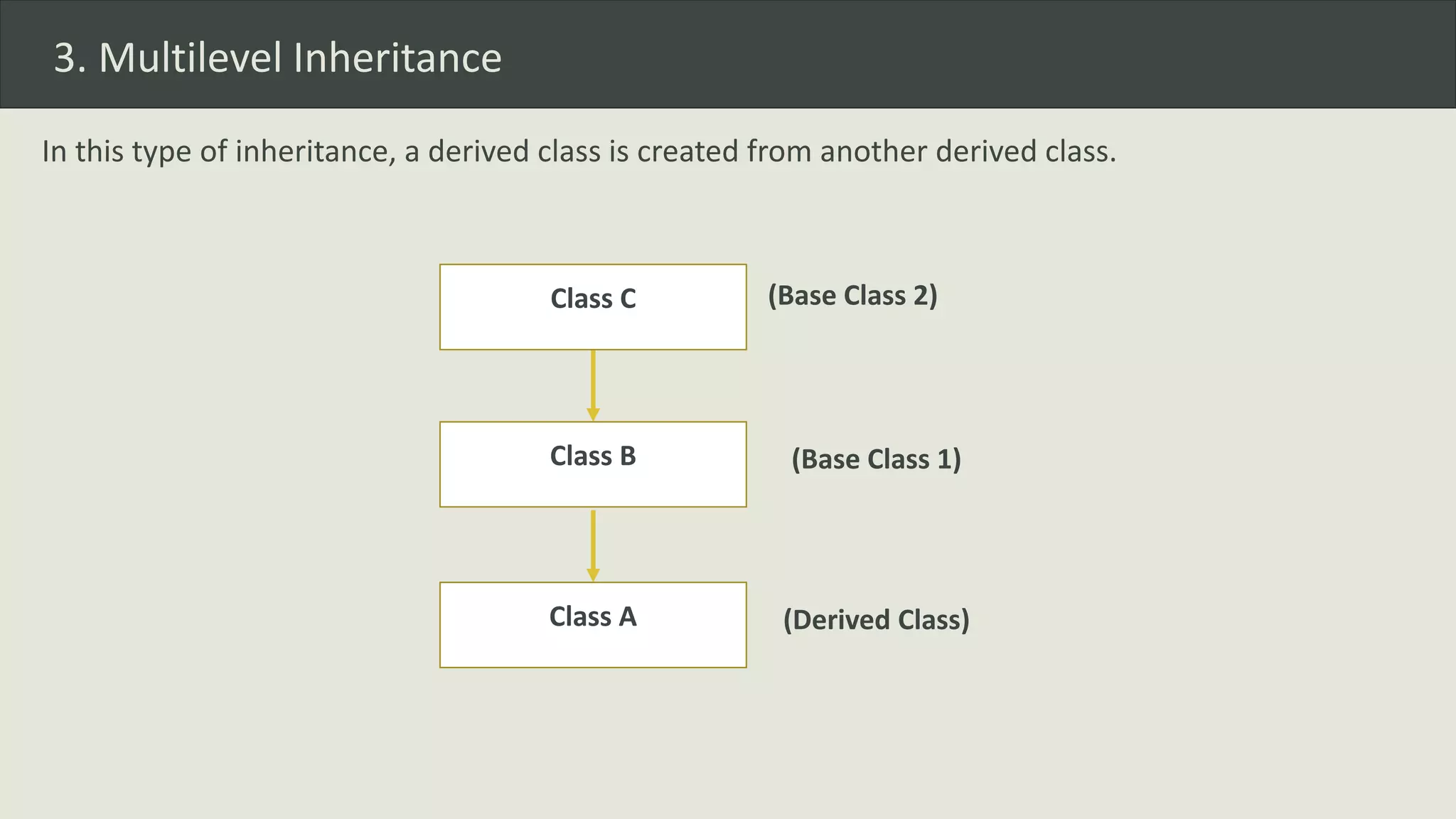
3. Multilevel Inheritance
In this type of inheritance, a derived class is created from another derived class.
Class C
Class B
(Base Class 2)
(Base Class 1)
Class A (Derived Class)
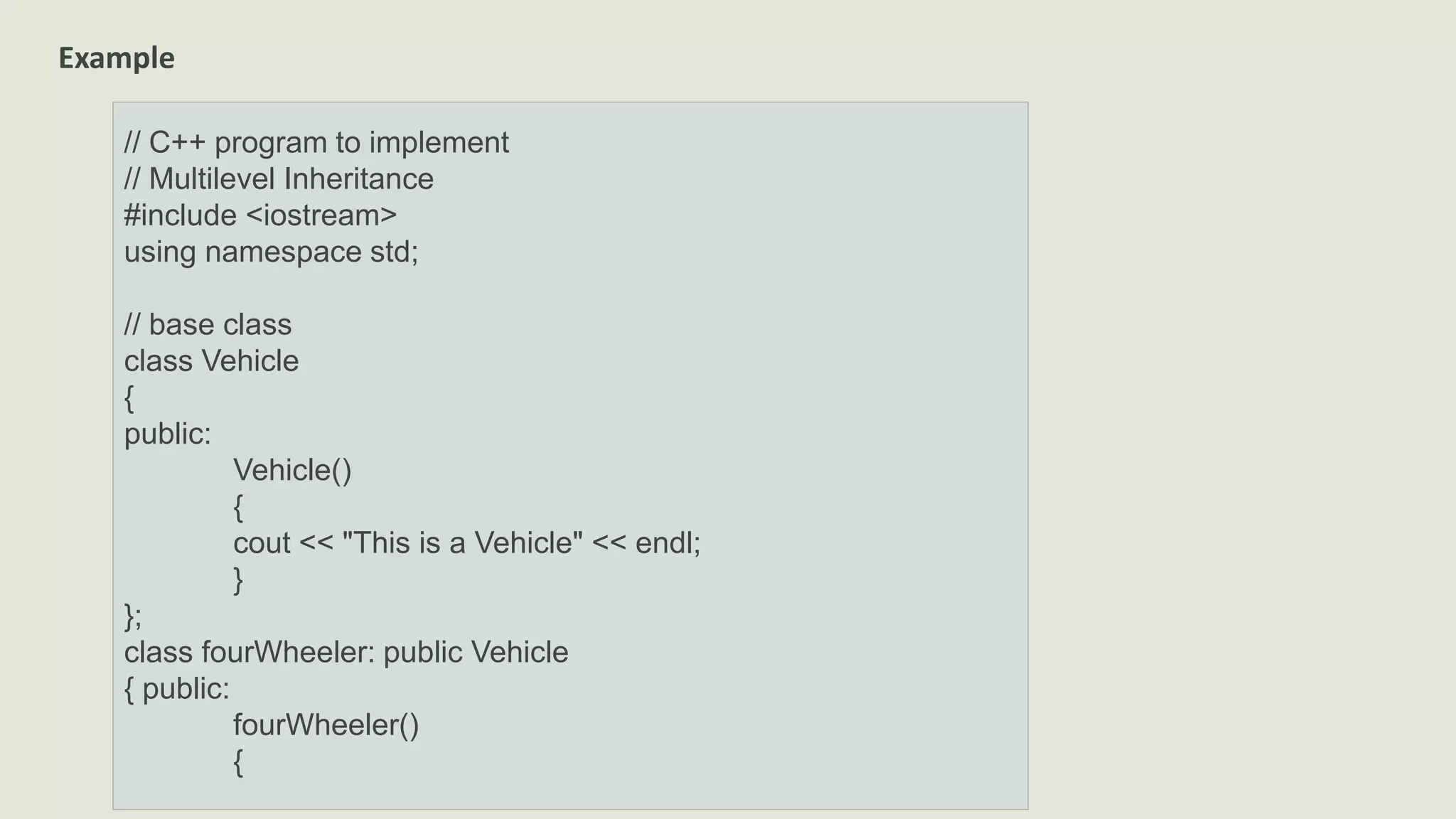
Example
// C++ program to implement
// Multilevel Inheritance
#include <iostream>
using namespace std;
// base class
class Vehicle
{
public:
Vehicle()
{
cout << "This is a Vehicle" << endl;
}
};
class fourWheeler: public Vehicle
{ public:
fourWheeler()
{
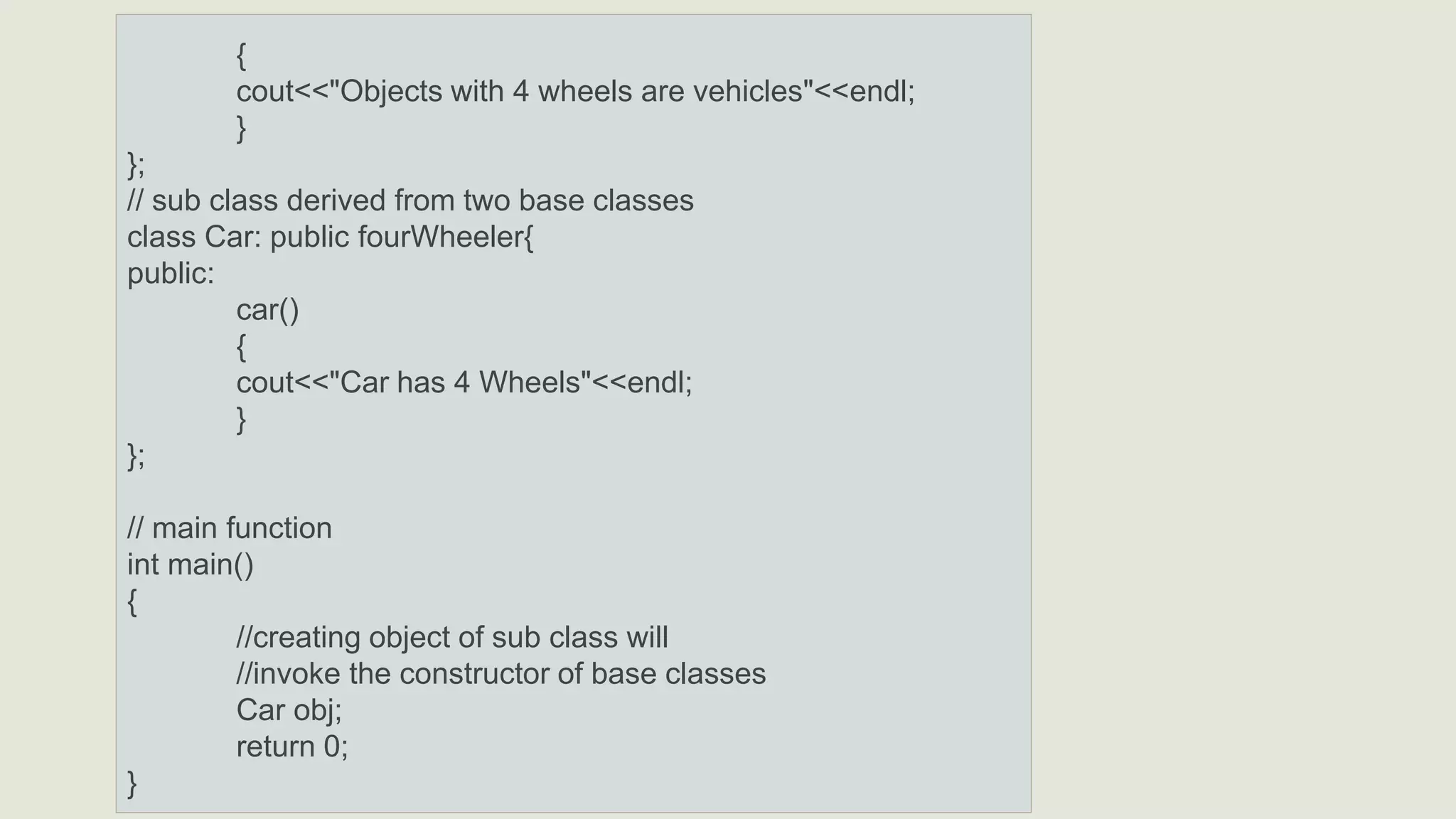
{
cout<<"Objects with 4 wheels are vehicles"<<endl;
}
};
// sub class derived from two base classes
class Car: public fourWheeler{
public:
car()
{
cout<<"Car has 4 Wheels"<<endl;
}
};
// main function
int main()
{
//creating object of sub class will
//invoke the constructor of base classes
Car obj;
return 0;
}
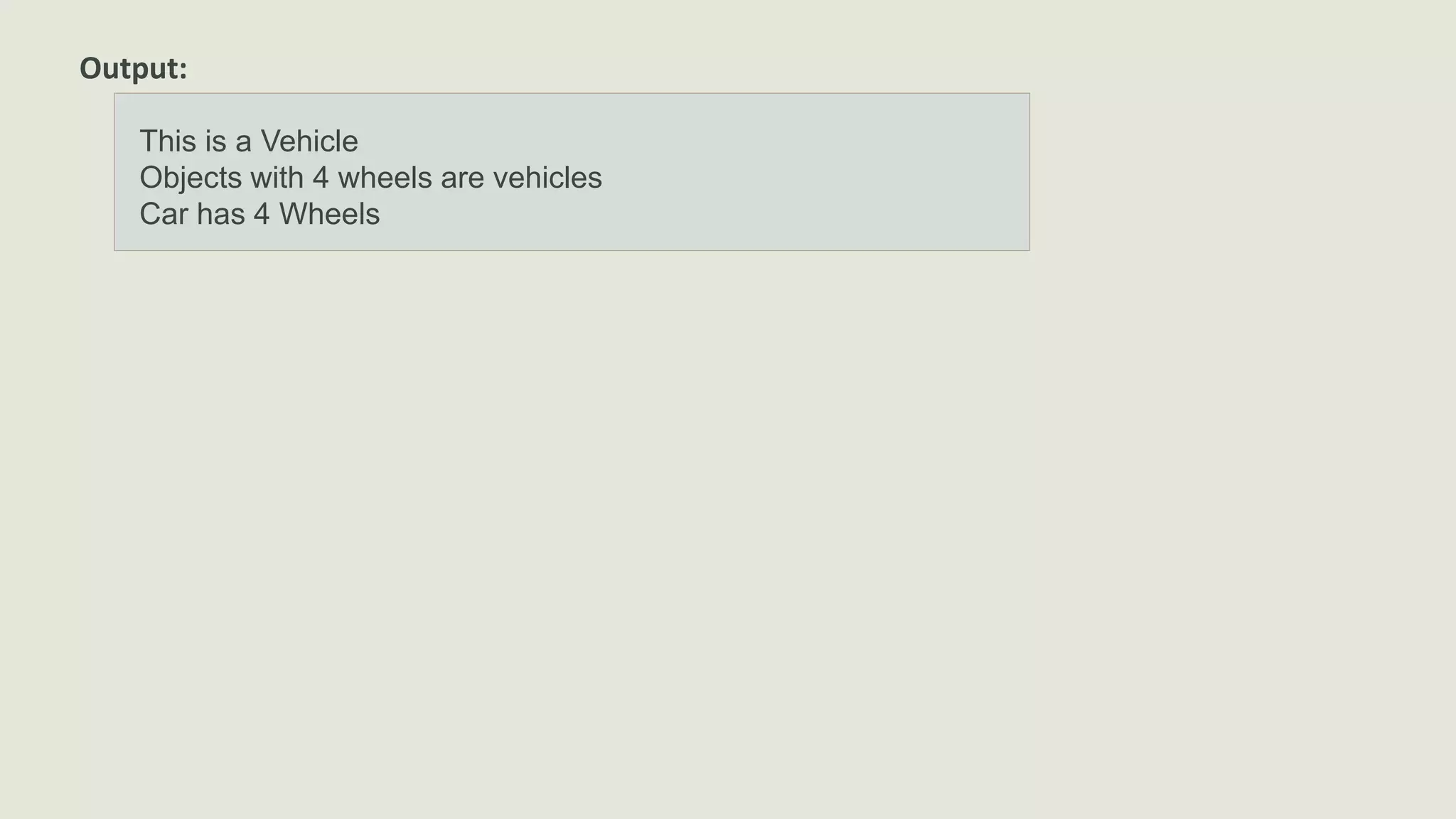
Output:
This is a Vehicle
Objects with 4 wheels are vehicles
Car has 4 Wheels
4. Hierarchical Inheritance
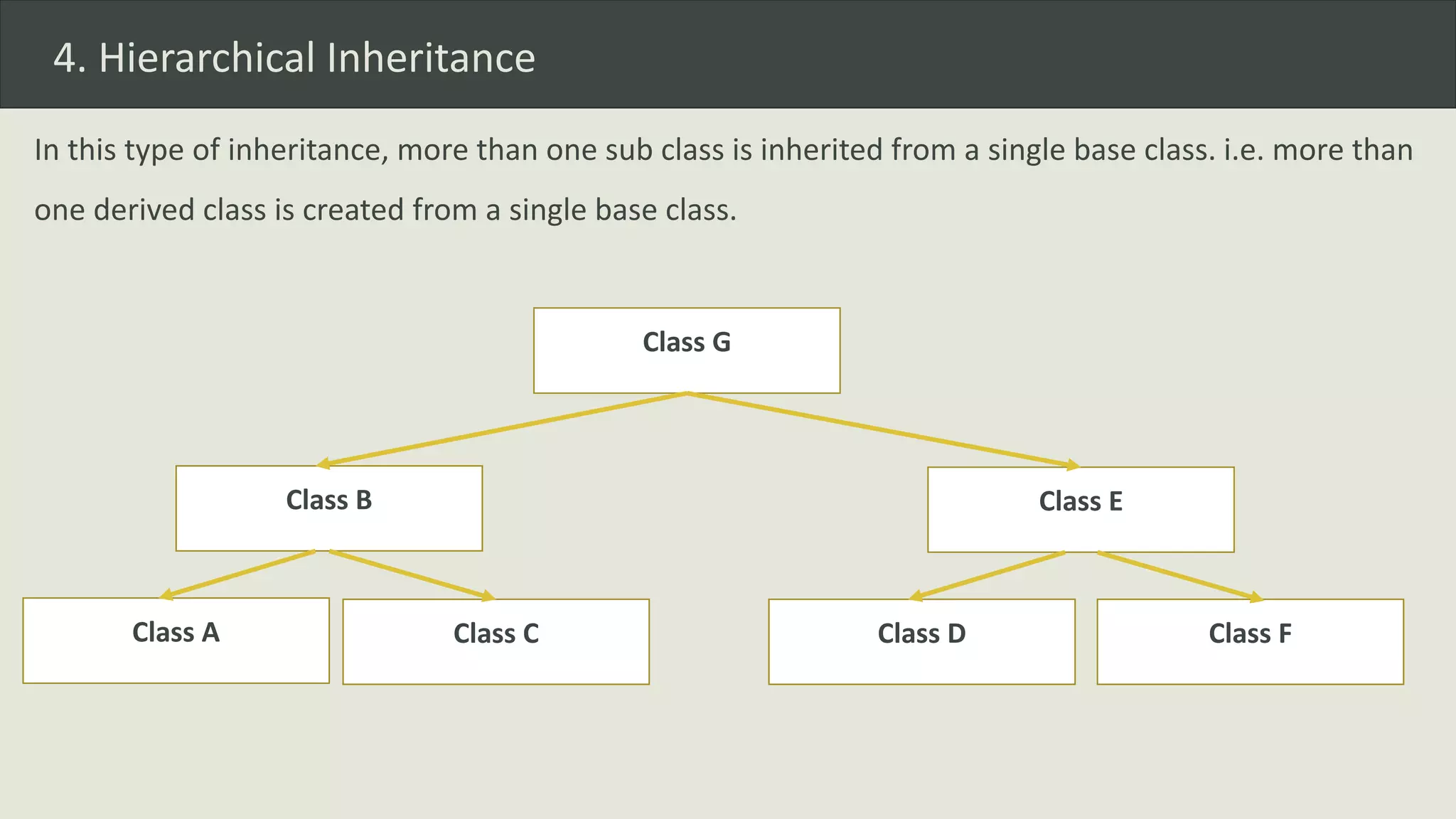
In this type of inheritance, more than one sub class is inherited from a single base class. i.e. more than
one derived class is created from a single base class.
Class G
Class B
Class DClass C Class FClass A
Class E
Example
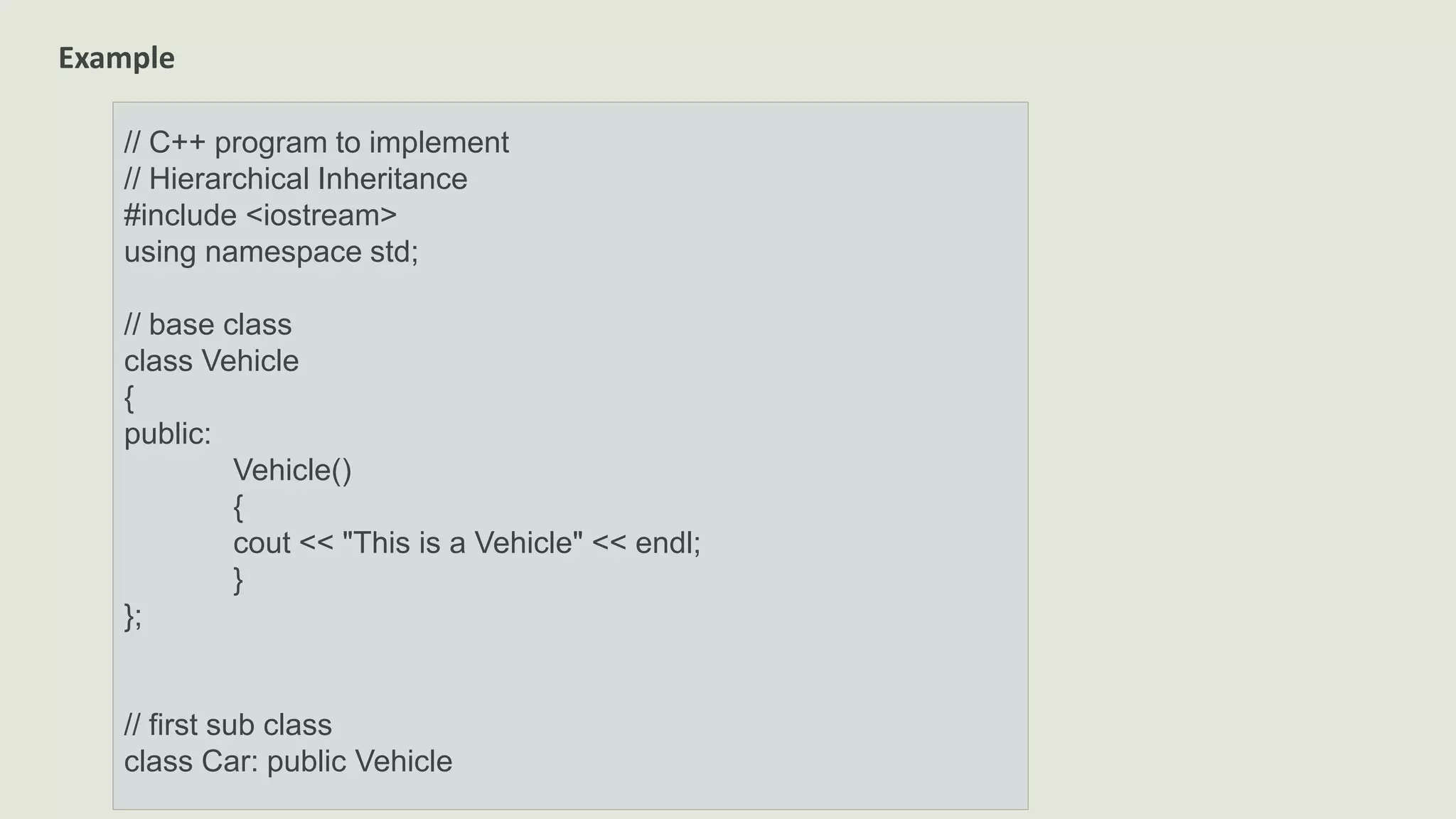
// C++ program to implement
// Hierarchical Inheritance
#include <iostream>
using namespace std;
// base class
class Vehicle
{
public:
Vehicle()
{
cout << "This is a Vehicle" << endl;
}
};
// first sub class
class Car: public Vehicle
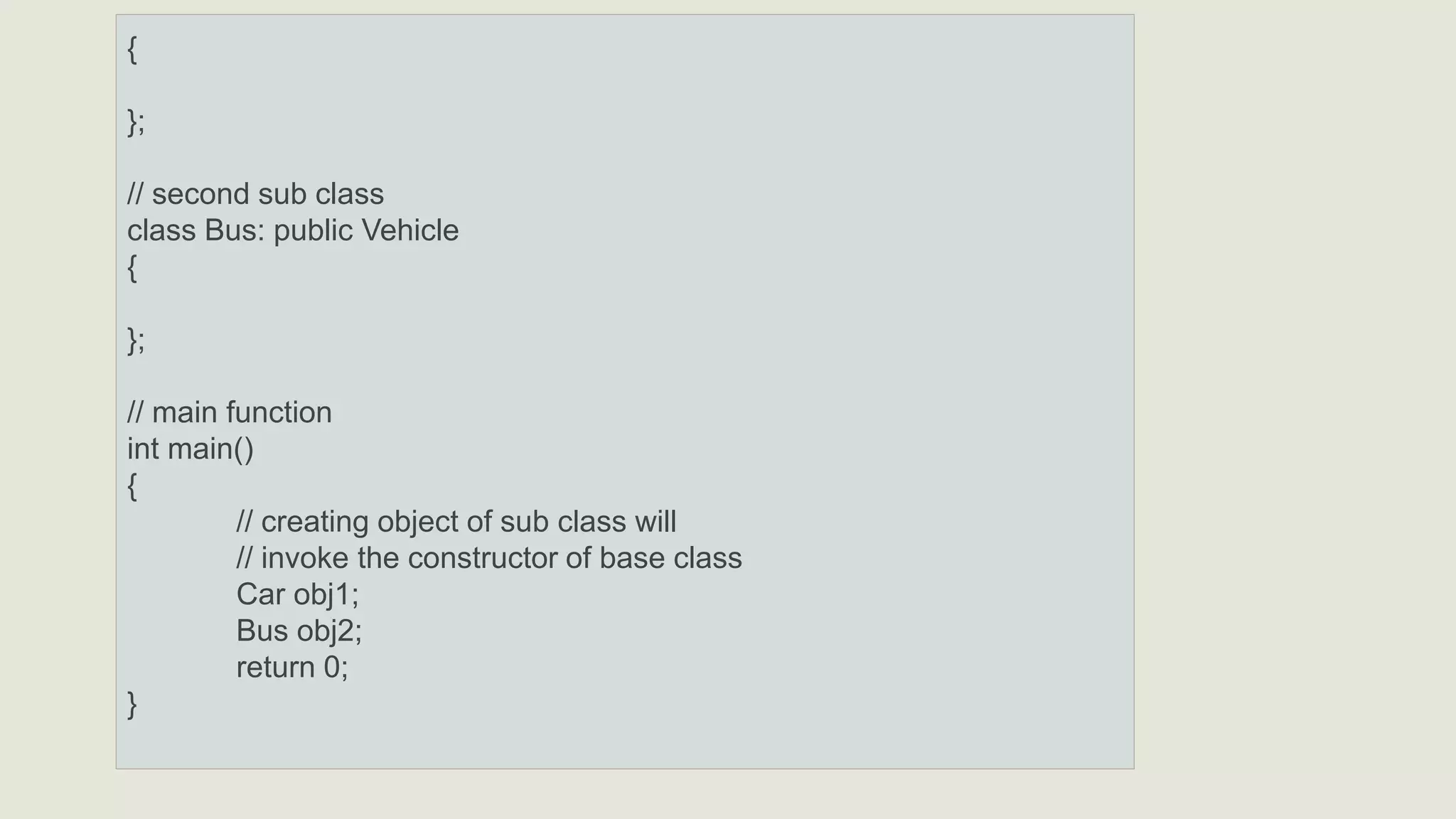
{
};
// second sub class
class Bus: public Vehicle
{
};
// main function
int main()
{
// creating object of sub class will
// invoke the constructor of base class
Car obj1;
Bus obj2;
return 0;
}
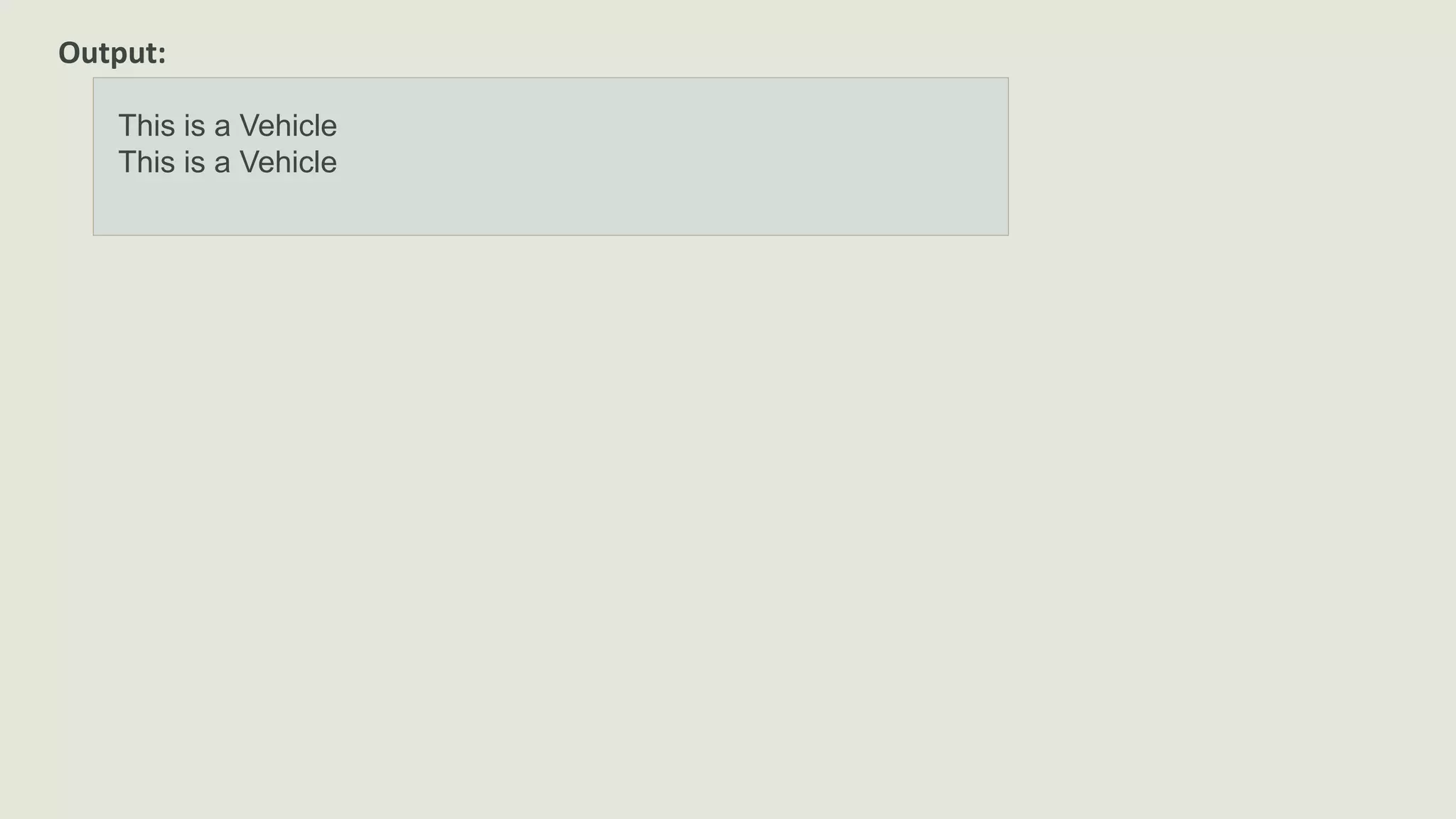
Output:
This is a Vehicle
This is a Vehicle
5. Hybrid Inheritance
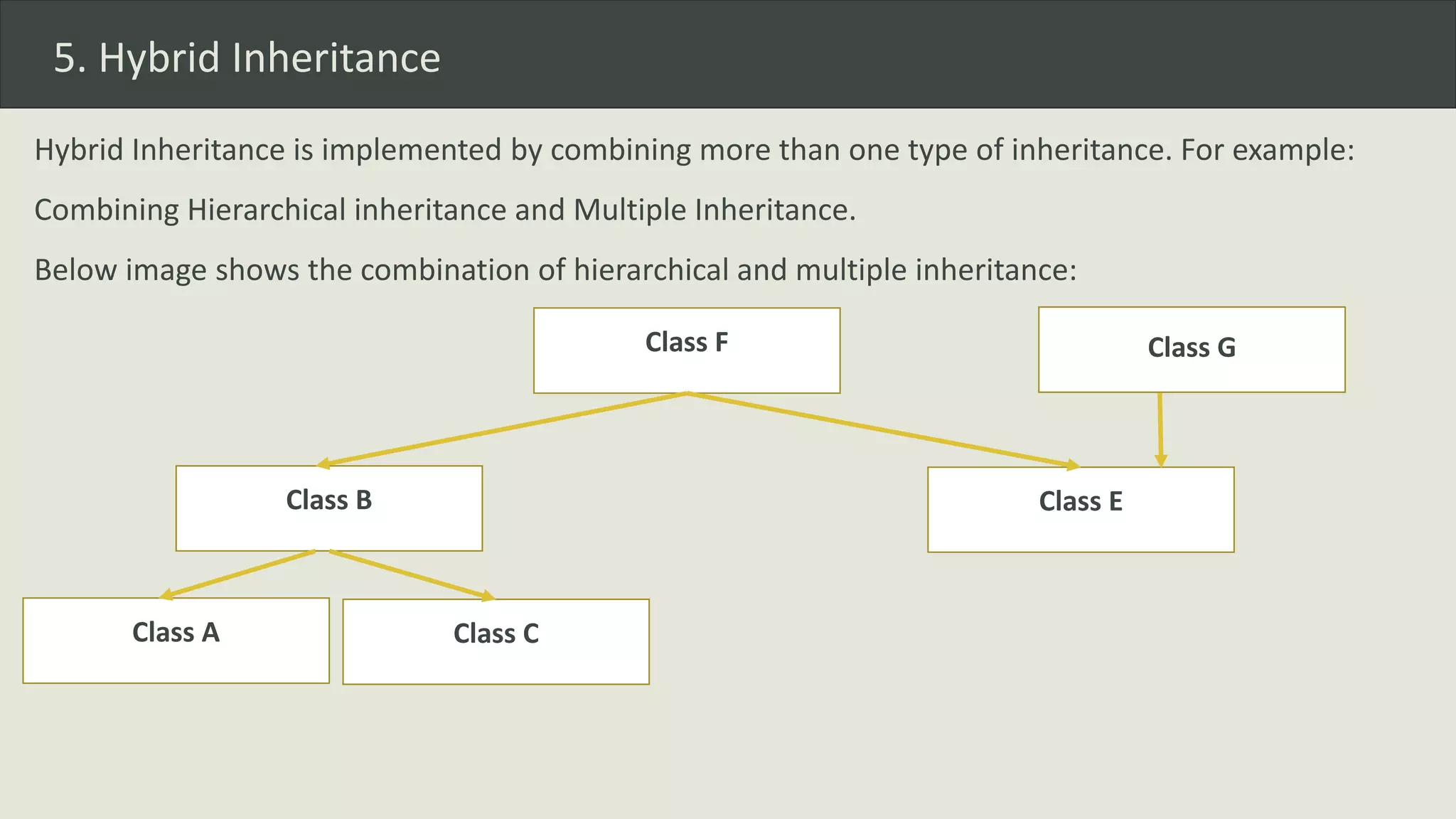
Hybrid Inheritance is implemented by combining more than one type of inheritance. For example:
Combining Hierarchical inheritance and Multiple Inheritance.
Below image shows the combination of hierarchical and multiple inheritance:
Class F
Class B
Class G
Class CClass A
Class E
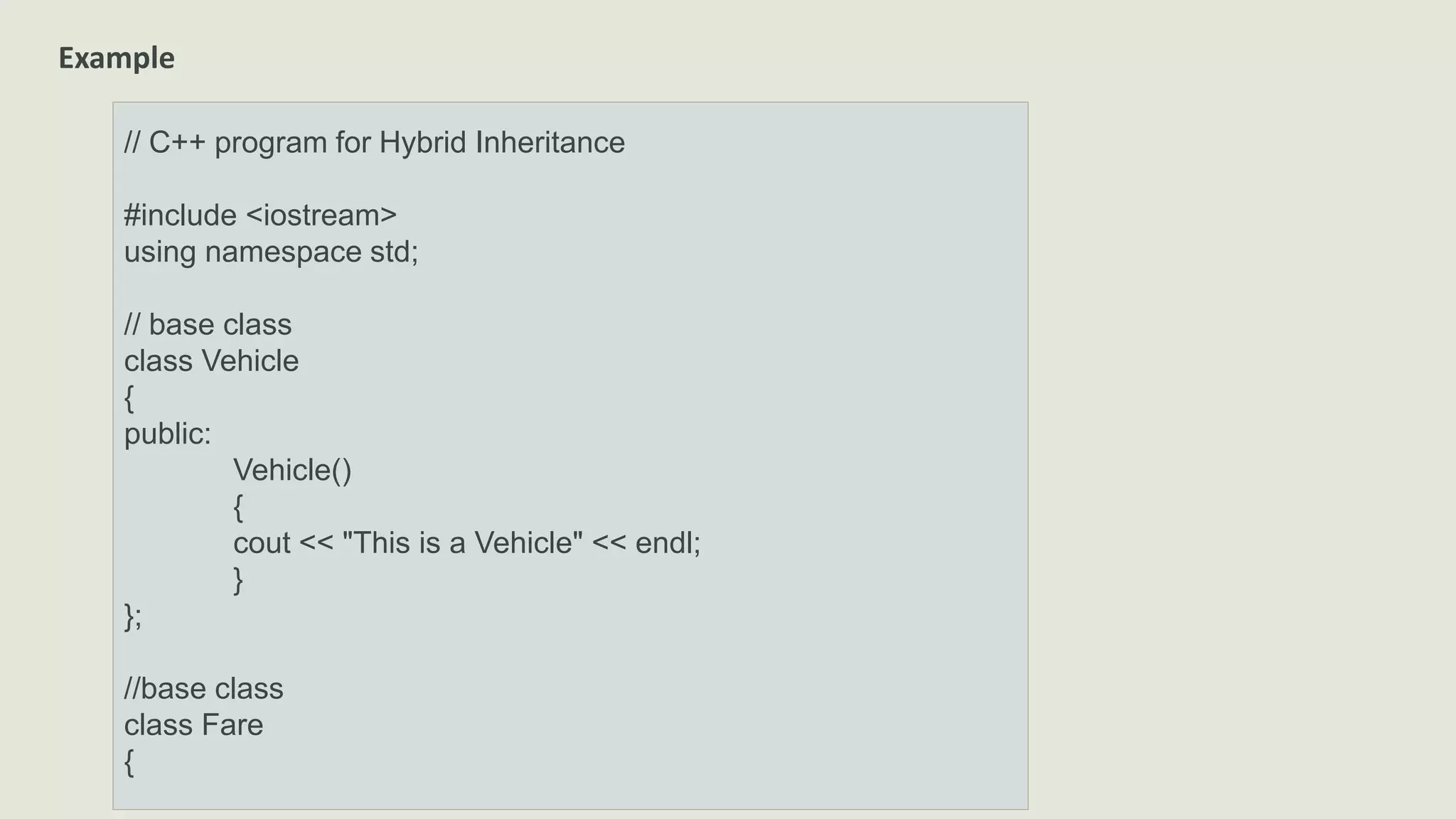
Example
// C++ program for Hybrid Inheritance
#include <iostream>
using namespace std;
// base class
class Vehicle
{
public:
Vehicle()
{
cout << "This is a Vehicle" << endl;
}
};
//base class
class Fare
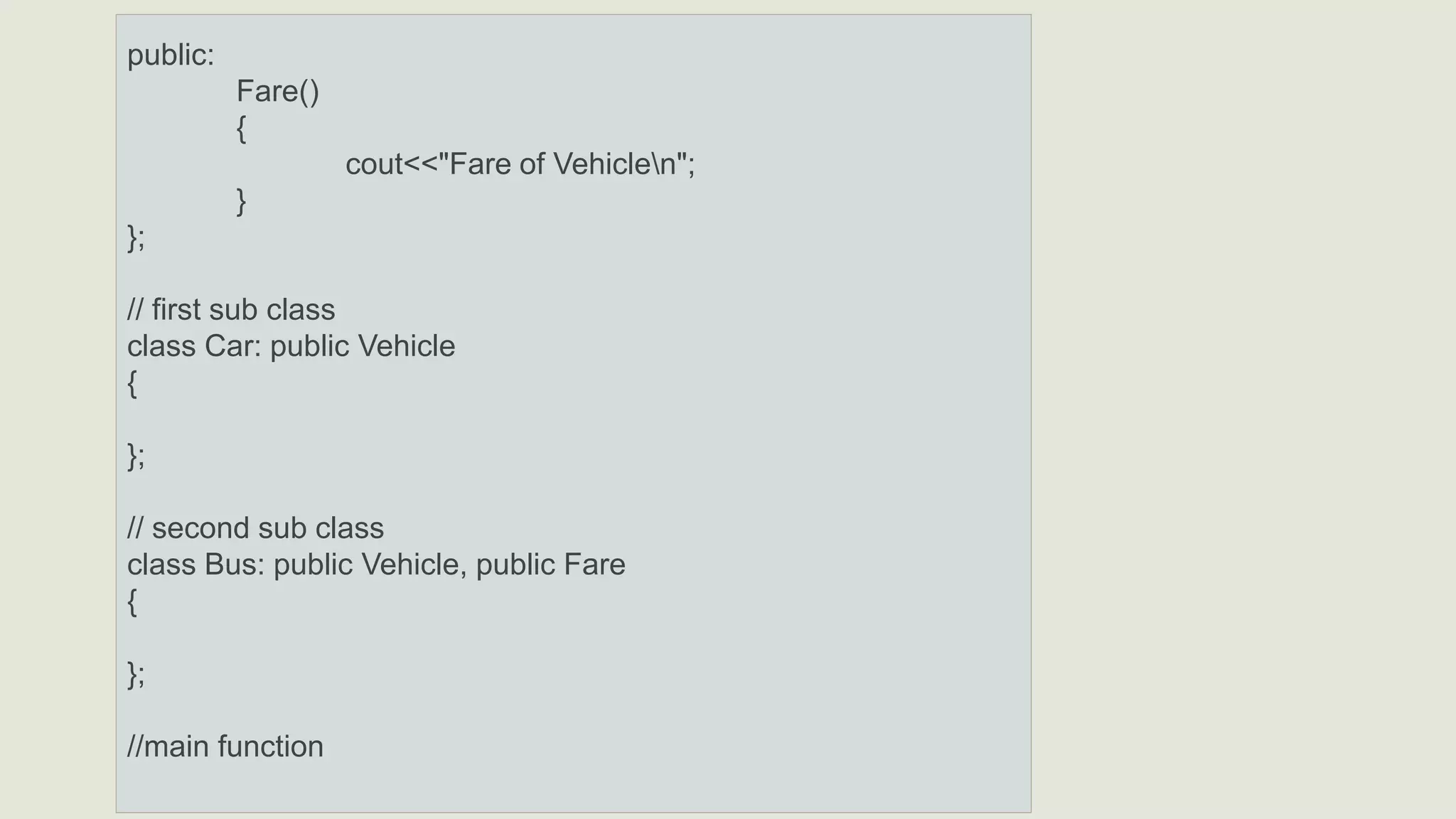
{
public:
Fare()
{
cout<<"Fare of Vehiclen";
}
};
// first sub class
class Car: public Vehicle
{
};
// second sub class
class Bus: public Vehicle, public Fare
{
};
//main function
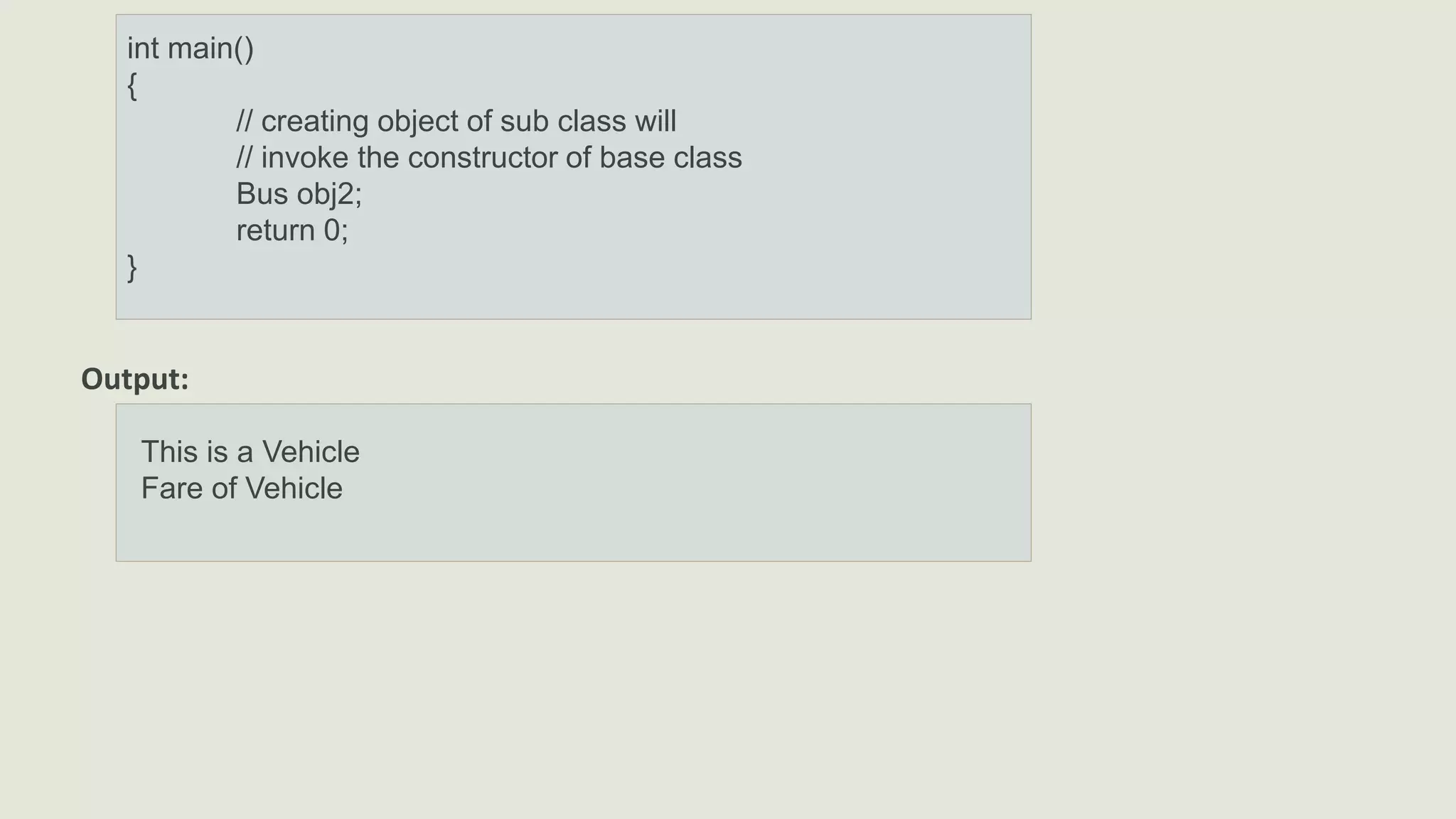
int main()
{
// creating object of sub class will
// invoke the constructor of base class
Bus obj2;
return 0;
}
Output:
This is a Vehicle
Fare of Vehicle
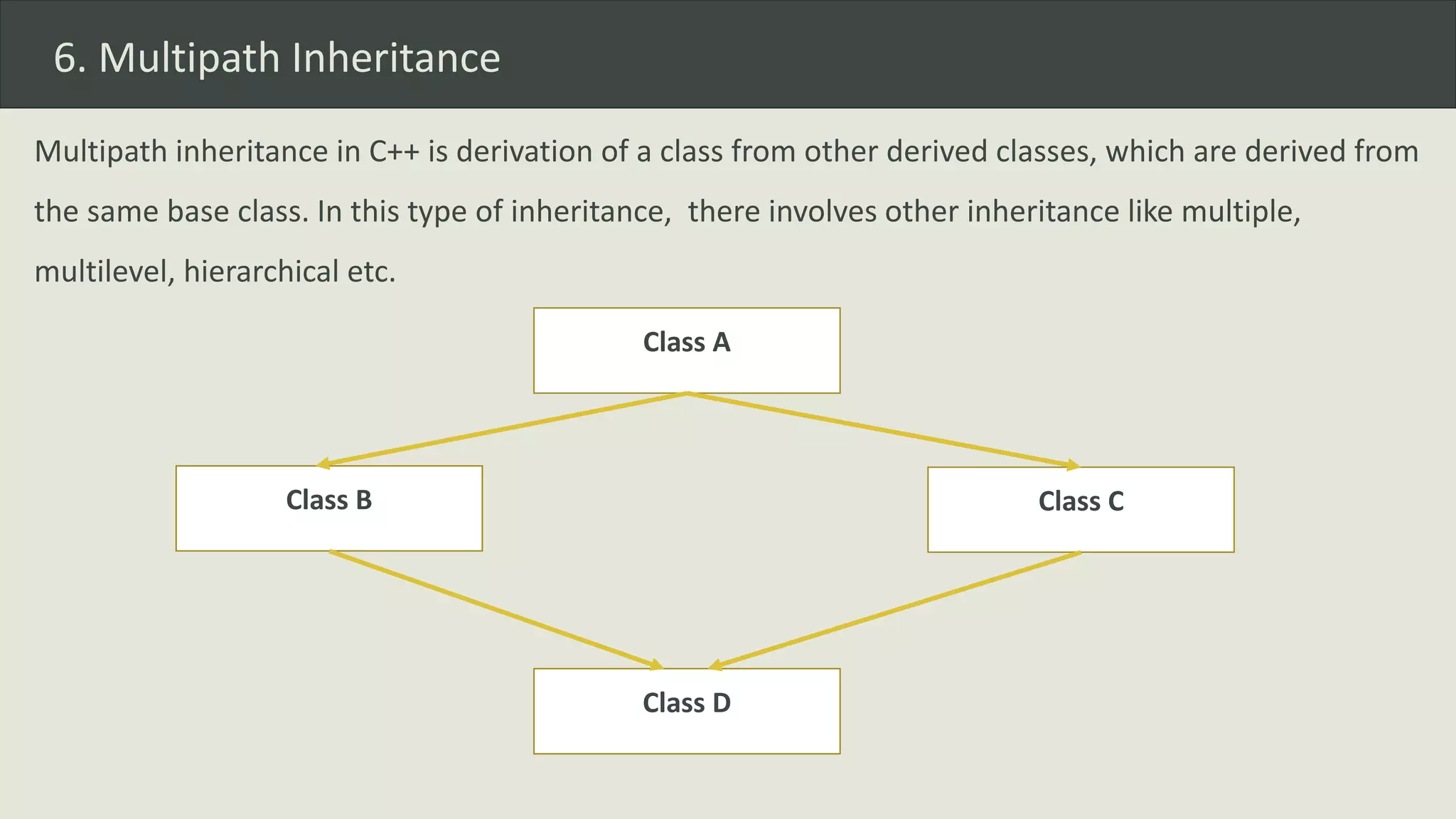
6. Multipath Inheritance
Multipath inheritance in C++ is derivation of a class from other derived classes, which are derived from
the same base class. In this type of inheritance, there involves other inheritance like multiple,
multilevel, hierarchical etc.
Class A
Class B Class C
Class D
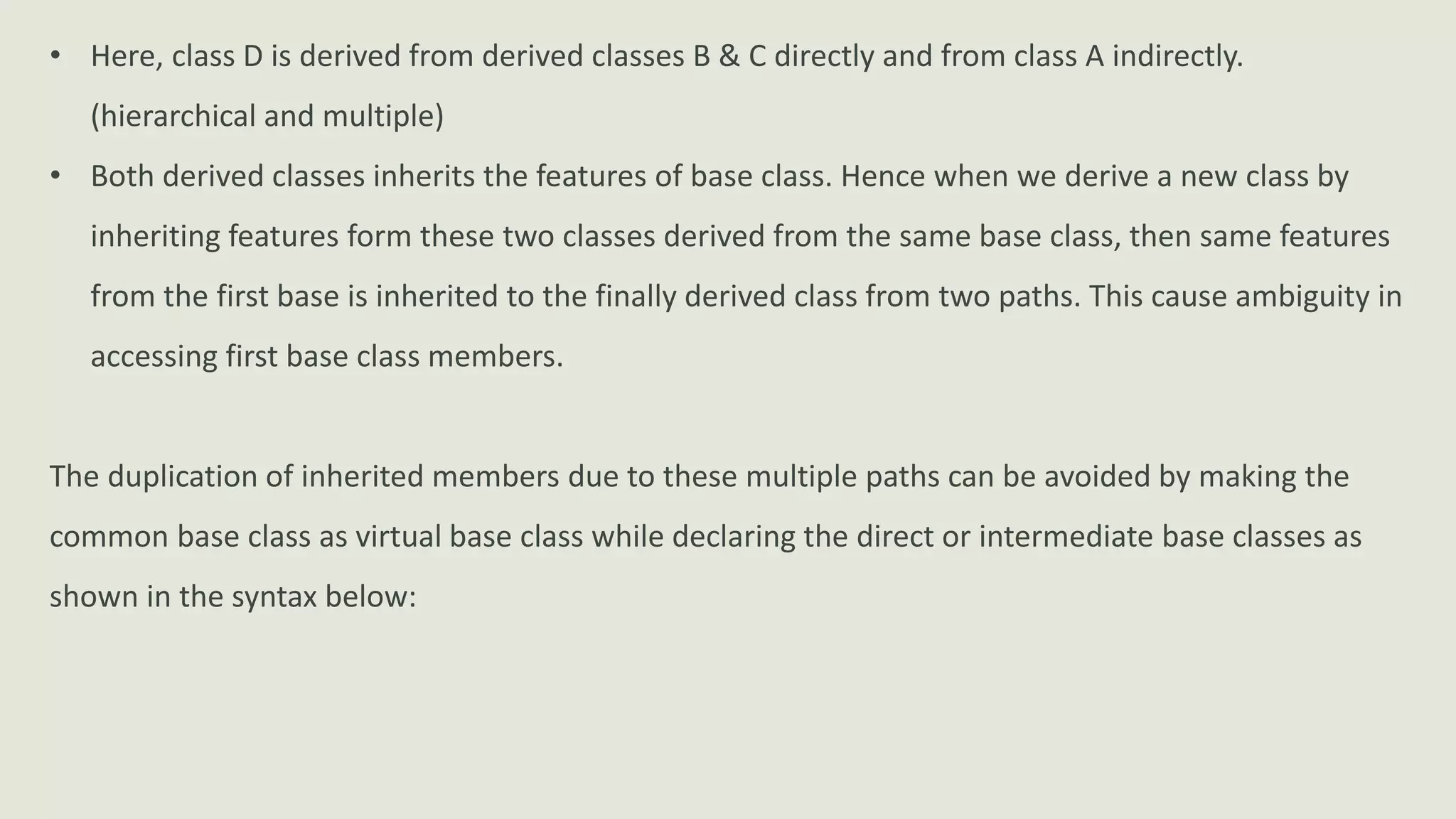
• Here, class D is derived from derived classes B & C directly and from class A indirectly.
(hierarchical and multiple)
• Both derived classes inherits the features of base class. Hence when we derive a new class by
inheriting features form these two classes derived from the same base class, then same features
from the first base is inherited to the finally derived class from two paths. This cause ambiguity in
accessing first base class members.
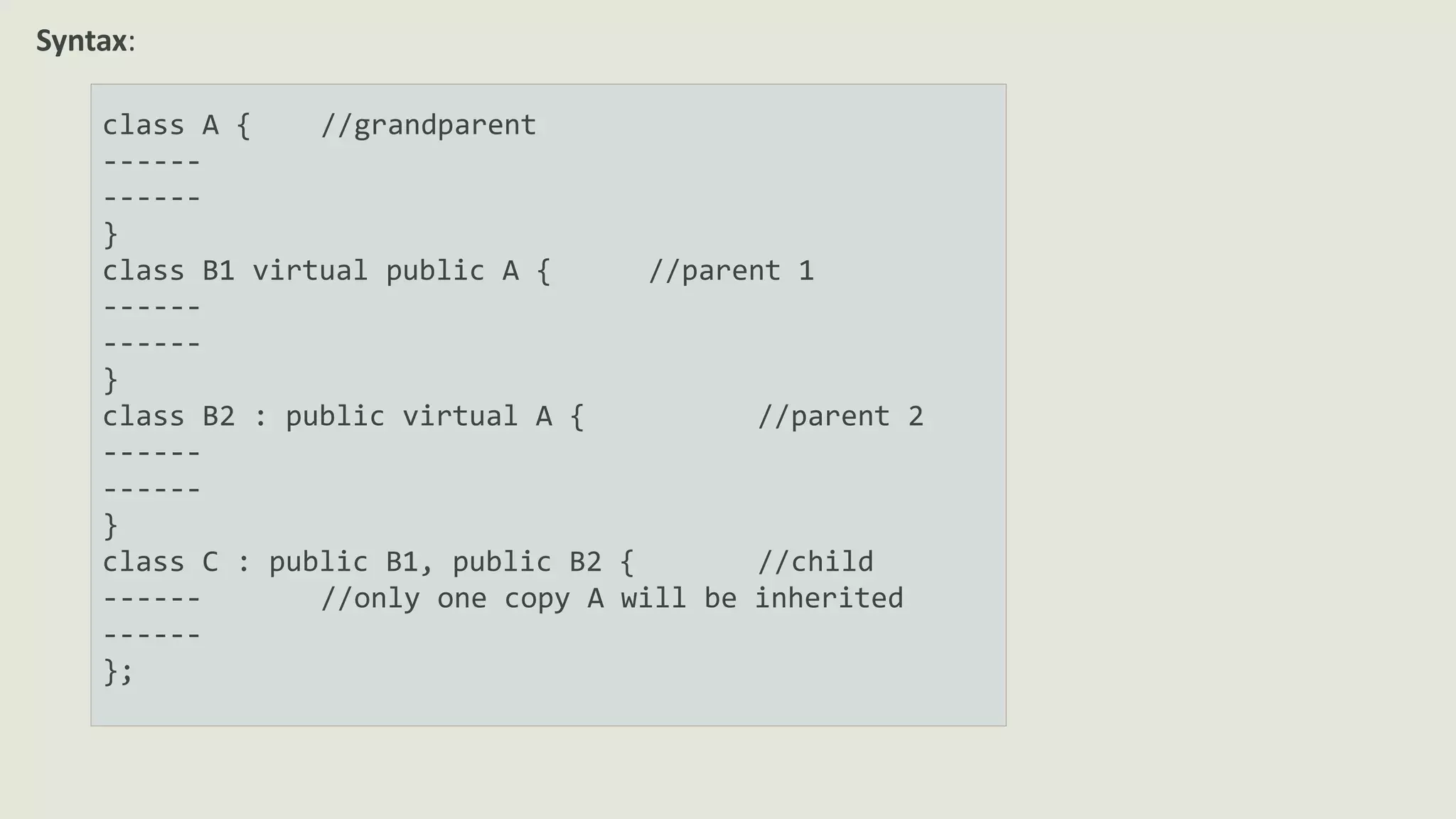
The duplication of inherited members due to these multiple paths can be avoided by making the
common base class as virtual base class while declaring the direct or intermediate base classes as
shown in the syntax below:
Syntax:
class A { //grandparent
------
------
}
class B1 virtual public A { //parent 1
------
------
}
class B2 : public virtual A { //parent 2
------
------
}
class C : public B1, public B2 { //child
------ //only one copy A will be inherited
------
};
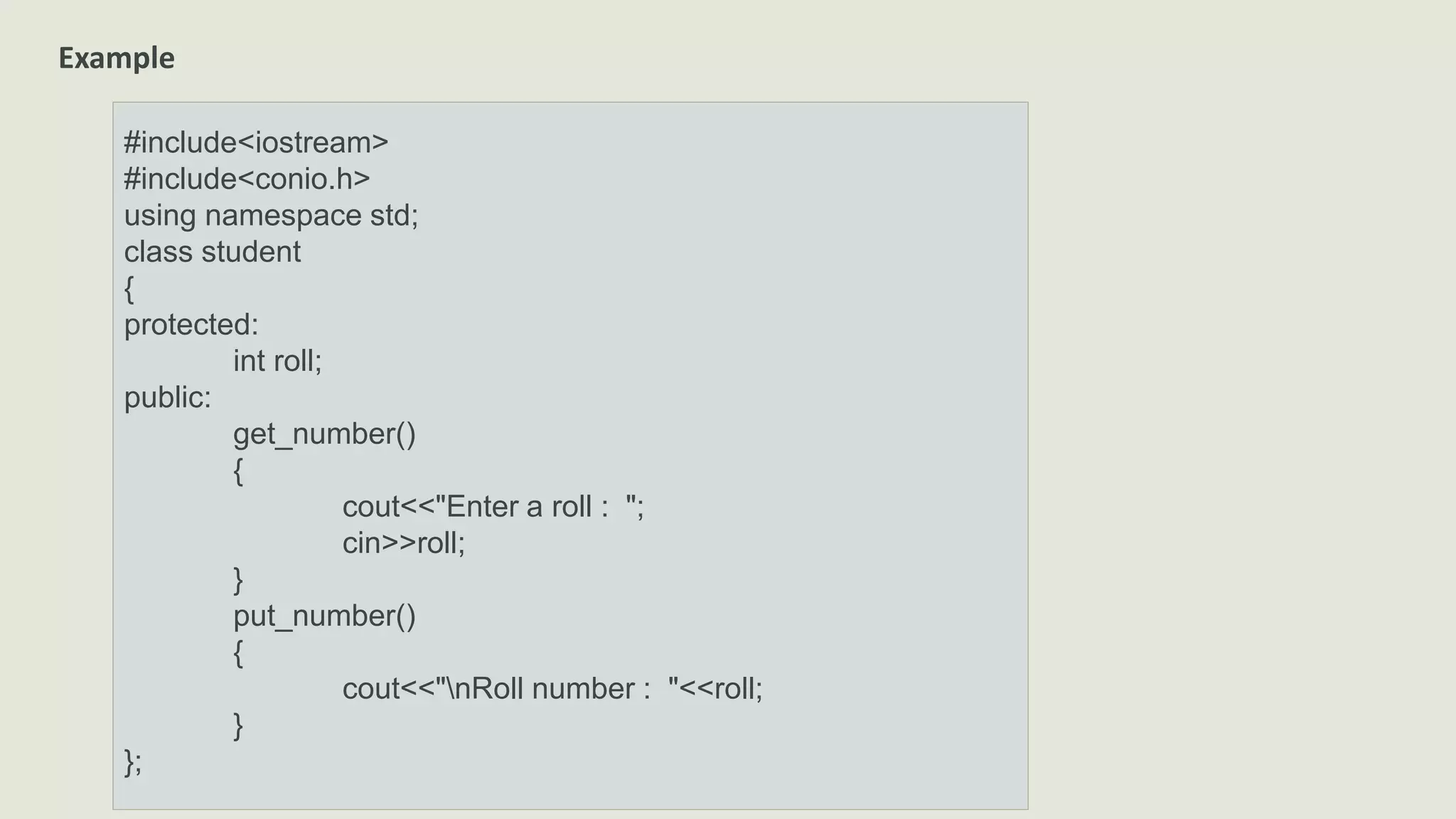
Example
#include<iostream>
#include<conio.h>
using namespace std;
class student
{
protected:
int roll;
public:
get_number()
{
cout<<"Enter a roll : ";
cin>>roll;
}
put_number()
{
cout<<"nRoll number : "<<roll;
}
};
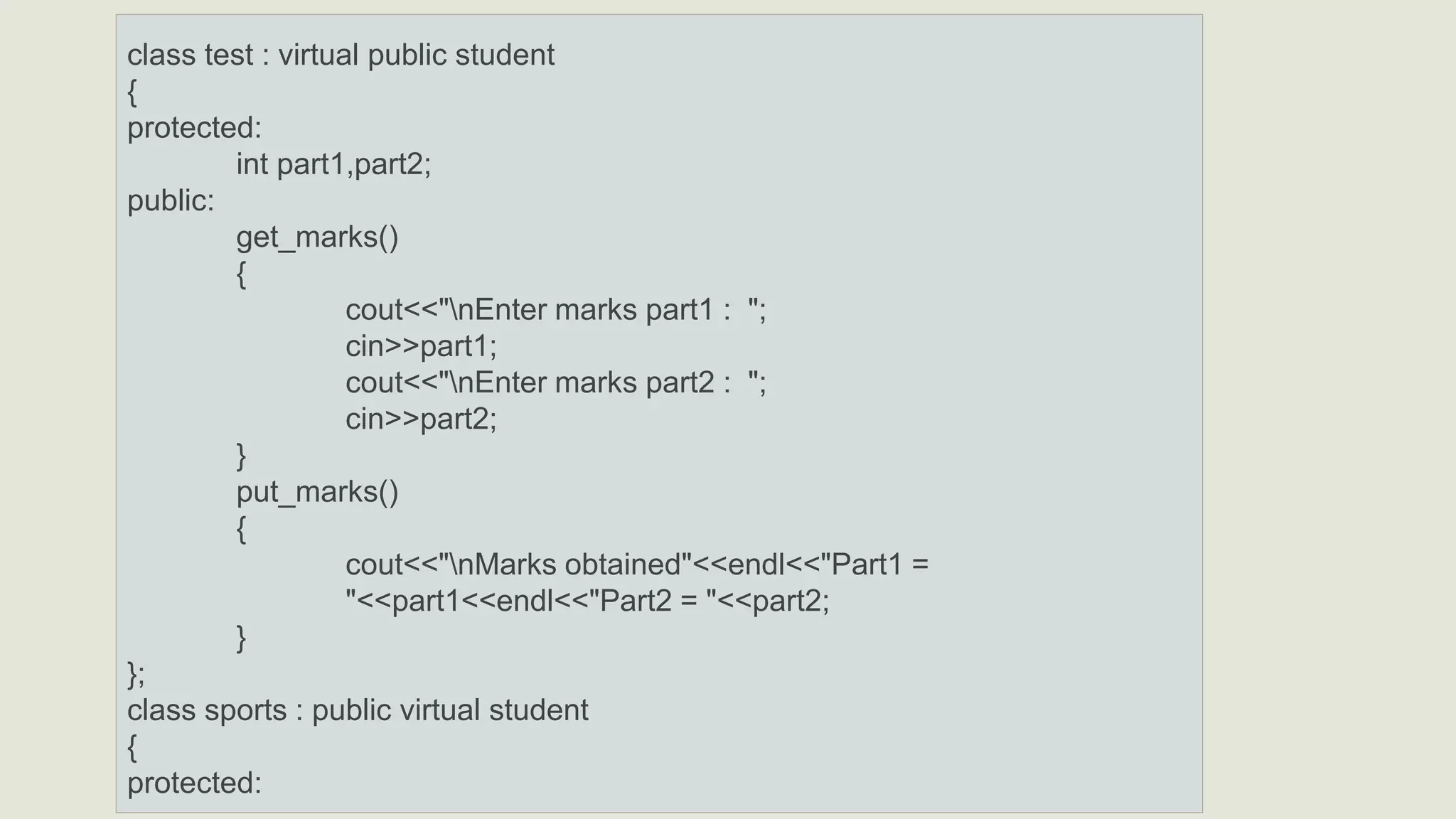
class test : virtual public student
{
protected:
int part1,part2;
public:
get_marks()
{
cout<<"nEnter marks part1 : ";
cin>>part1;
cout<<"nEnter marks part2 : ";
cin>>part2;
}
put_marks()
{
cout<<"nMarks obtained"<<endl<<"Part1 =
"<<part1<<endl<<"Part2 = "<<part2;
}
};
class sports : public virtual student
{
protected:
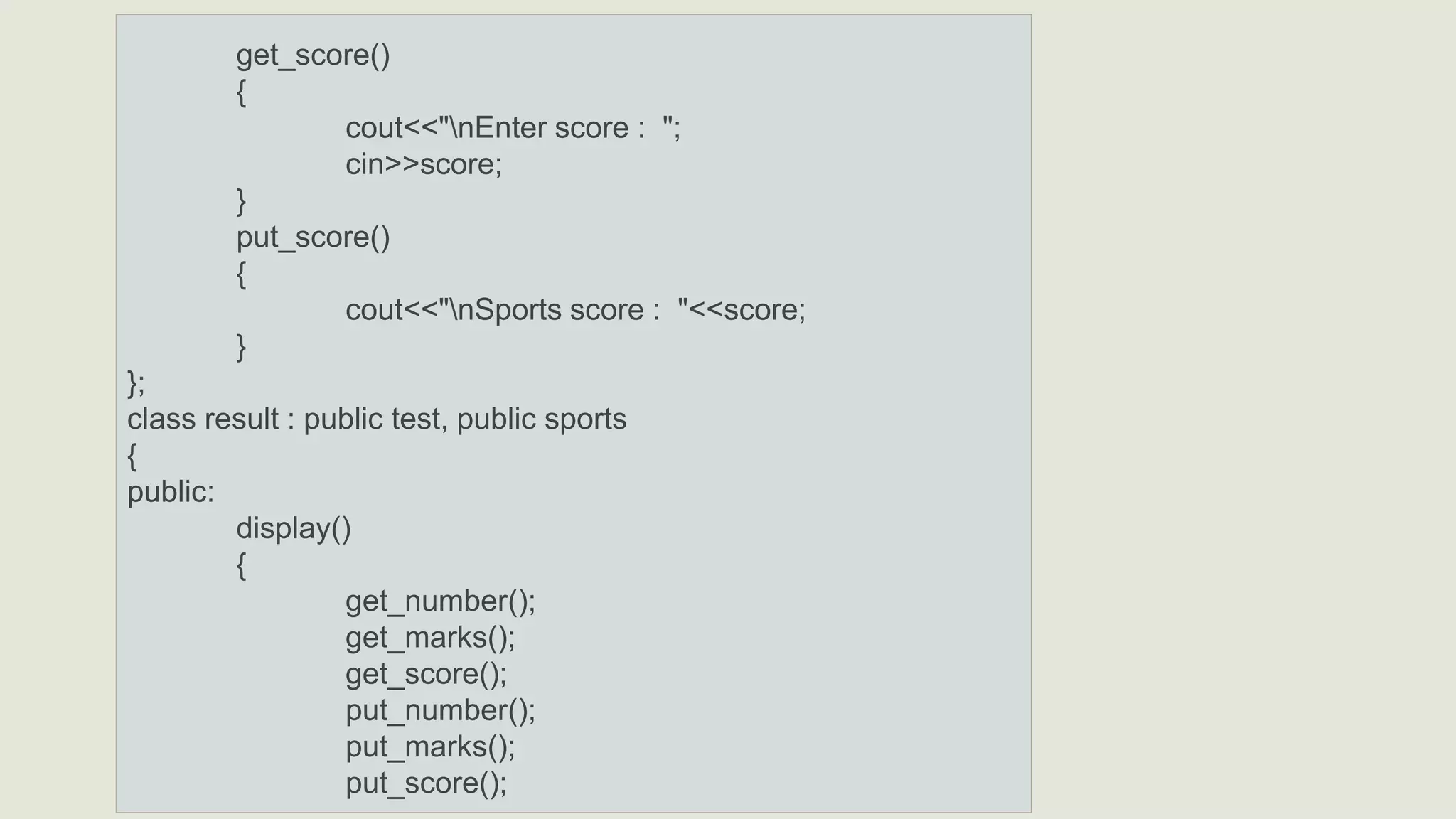
get_score()
{
cout<<"nEnter score : ";
cin>>score;
}
put_score()
{
cout<<"nSports score : "<<score;
}
};
class result : public test, public sports
{
public:
display()
{
get_number();
get_marks();
get_score();
put_number();
put_marks();
put_score();
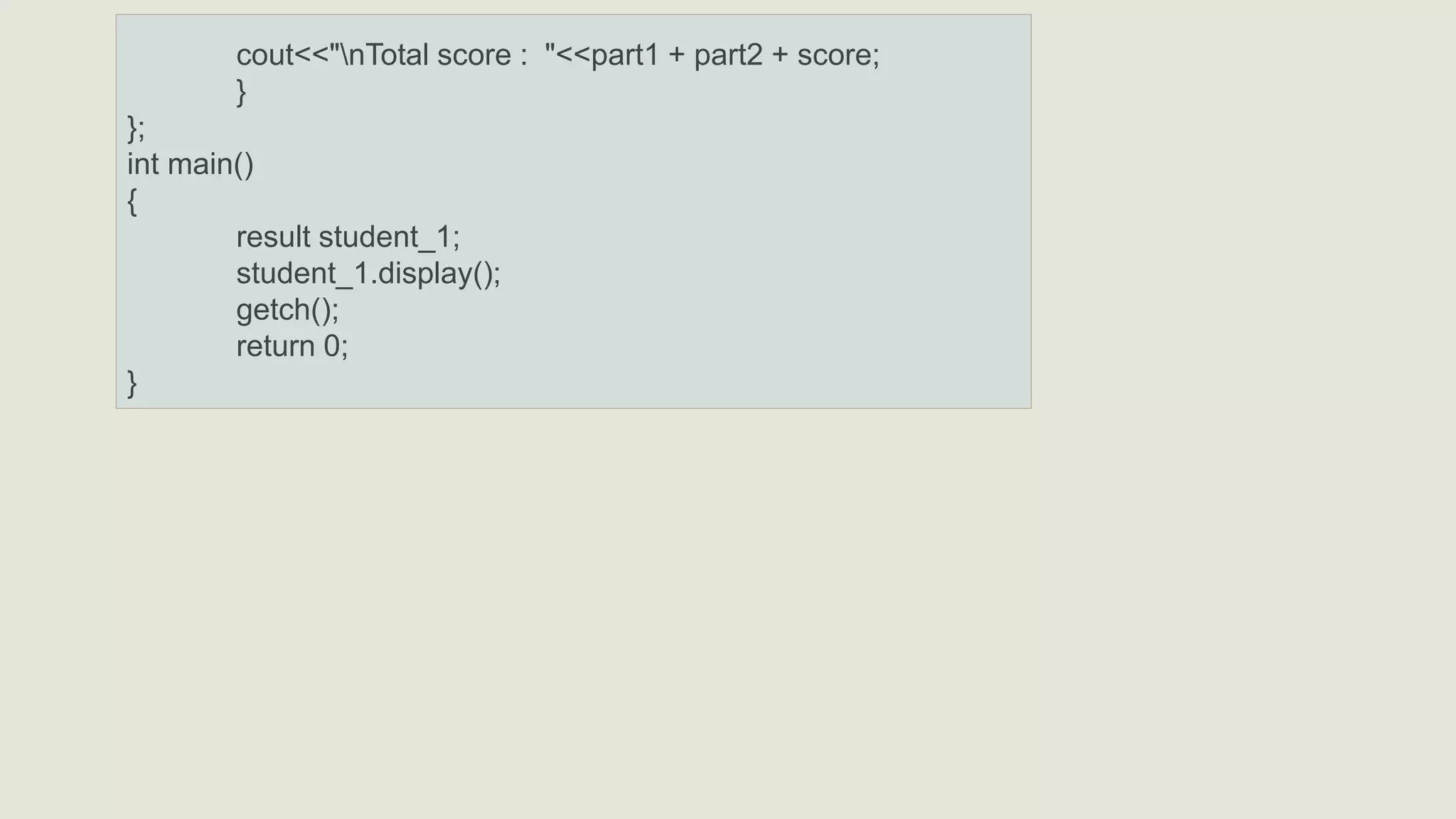
cout<<"nTotal score : "<<part1 + part2 + score;
}
};
int main()
{
result student_1;
student_1.display();
getch();
return 0;
}
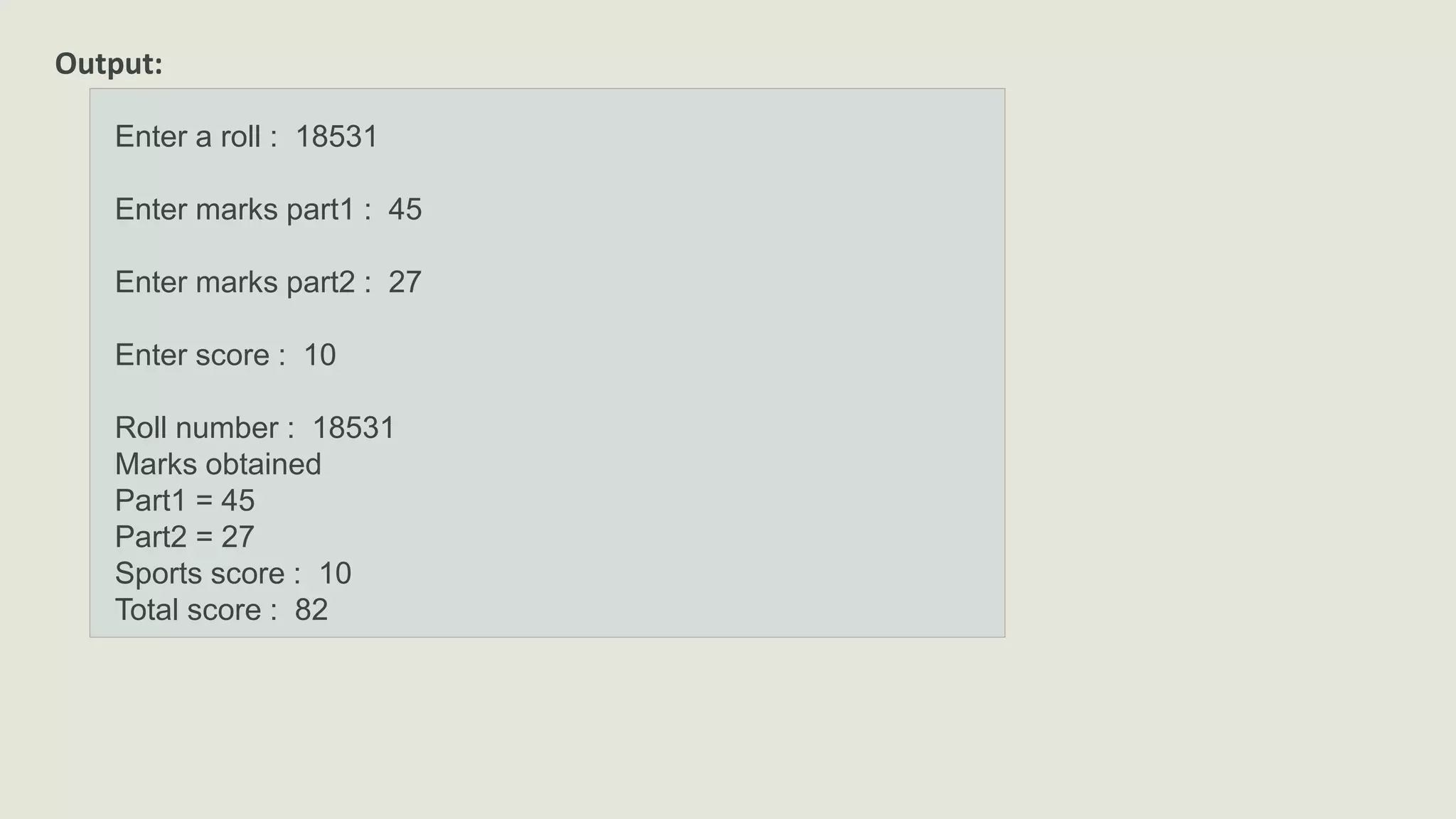
Output:
Enter a roll : 18531
Enter marks part1 : 45
Enter marks part2 : 27
Enter score : 10
Roll number : 18531
Marks obtained
Part1 = 45
Part2 = 27
Sports score : 10
Total score : 82
Thanks for watching
Lecture Slide by:- Manan Pasricha
Student of Bachelor of Computer Applications
E-mail id: pasrichamanan81@gmail.com
LinkedIn Profile:- https://www.linkedin.com/in/manan-
pasricha-76029818a/
Content taken from:-
https://www.geeksforgeeks.org/inheritance-in-c/
https://blog.miyozinc.com/core-tutorials/cpp/cpp-
multipath-inheritance/
E Balagarusamy
And Self Knowlegde
Inheritance in c++ by Manan Pasricha

  • 1.
    C++ Presentation Inheritance inC++ Lecture Slide by:- Manan Pasricha Student of Bachelor of Computer Applications E-mail id: pasrichamanan81@gmail.com LinkedIn Profile:- https://www.linkedin.com/in/manan-pasricha-76029818a/
  • 2.
    Content  Inheritance Introduction Why and when to use Inheritance?  Modes of Inheritance  Types of Inheritance

  • 3.
    Inheritance Introduction The capabilityof a class to derive properties and characteristics from another class is called Inheritance. Inheritance is one of the most important feature of Object Oriented Programming. Sub Class: The class that inherits properties from another class is called Sub class or Derived Class. Super Class: The class whose properties are inherited by sub class is called Base Class or Super class.
  • 4.
    Why and whento use Inheritance? Consider a group of vehicles. You need to create classes for Bus, Car and Truck. The methods fuelAmount(), capacity(), applyBrakes() will be same for all of the three classes. If we create these classes avoiding inheritance then we have to write all of these functions in each of the three classes as shown in below figure: FuelAmount() Capacity() applyBrakes() FuelAmount() Capacity() applyBrakes() FuelAmount() Capacity() applyBrakes() Class Bus Class Car Class Truck
  • 5.
    You can clearlysee that above process results in duplication of same code 3 times. This increases the chances of error and data redundancy. To avoid this type of situation, inheritance is used. If we create a class Vehicle and write these three functions in it and inherit the rest of the classes from the vehicle class, then we can simply avoid the duplication of data and increase re-usability. Look at the below diagram in which the three classes are inherited from vehicle class: FuelAmount() Capacity() applyBrakes() Class Bus Class Car Class Truck Class Vehicle Using inheritance, we have to write the functions only one time instead of three times as we have inherited rest of the three classes from base class(Vehicle).
  • 6.
    Implementing inheritance inC++: For creating a sub-class which is inherited from the base class we have to follow the below syntax. Syntax: class subclass_name : access_mode base_class_name { //body of subclass }; Here, subclass_name is the name of the sub class, access_mode is the mode in which you want to inherit this sub class for example: public, private etc. and base_class_name is the name of the base class from which you want to inherit the sub class. Note: A derived class doesn’t inherit access to private data members. However, it does inherit a full parent object, which contains any private members which that class declares.
  • 7.
    Modes of Inheritance 1.Public mode: If we derive a sub class from a public base class. Then the public member of the base class will become public in the derived class and protected members of the base class will become protected in derived class. 2. Protected mode: If we derive a sub class from a Protected base class. Then both public member and protected members of the base class will become protected in derived class. 3. Private mode: If we derive a sub class from a Private base class. Then both public member and protected members of the base class will become Private in derived class.
  • 8.
    Note : Theprivate members in the base class cannot be directly accessed in the derived class, while protected members can be directly accessed. For example, Classes B, C and D all contain the variables x, y and z in below example. It is just question of access. // C++ Implementation to show that a derived class // doesn’t inherit access to private data members. // However, it does inherit a full parent object class A { public: int x; protected: int y; private: int z; }; class B : public A { // x is public
  • 9.
    // y isprotected // z is not accessible from B }; class C : protected A { // x is protected // y is protected // z is not accessible from C }; class D : private A // 'private' is default for classes { // x is private // y is private // z is not accessible from D };
  • 10.
    The below tablesummarizes the above three modes and shows the access specifier of the members of base class in the sub class when derived in public, protected and private modes: Base Class Member Access Specifier Types of Inheritance
  • 11.
    Types of Inheritance Single Inheritance  Multiple Inheritance  Multilevel Inheritance  Hierarchical Inheritance  Hybrid Inheritance  Multipath Inheritance
  • 12.
    1. Single Inheritance Insingle inheritance, a class is allowed to inherit from only one class. i.e. one sub class is inherited by one base class only. Class A Class B (Base Class) (Derived Class) Syntax: class subclass_name : access_mode base_class_name { //body of subclass };
  • 13.
    Example // C++ programto explain // Single inheritance #include <iostream> using namespace std; // base class class Vehicle { public: Vehicle() { cout << "This is a Vehicle" << endl; } }; // sub class derived from two base classes class Car: public Vehicle{ };
  • 14.
    // main function intmain() { // creating object of sub class will // invoke the constructor of base classes Car obj; return 0; } Output: This is a vehicle
  • 15.
    2. Multiple Inheritance MultipleInheritance is a feature of C++ where a class can inherit from more than one classes. i.e one sub class is inherited from more than one base classes. Syntax: class subclass_name : access_mode base_class1, access_mode base_class2, .... { //body of subclass }; Class C Class A (Base Class 2) (Derived Class) Class B(Base Class 1) Here, the number of base classes will be separated by a comma (‘, ‘) and access mode for every base class must be specified.
  • 16.
    Example // C++ programto explain // multiple inheritance #include <iostream> using namespace std; // first base class class Vehicle { public: Vehicle() { cout << "This is a Vehicle" << endl; } }; // second base class class FourWheeler { public:
  • 17.
    FourWheeler() { cout << "Thisis a 4 wheeler Vehicle" << endl; } }; // sub class derived from two base classes class Car: public Vehicle, public FourWheeler { }; // main function int main() { // creating object of sub class will // invoke the constructor of base classes Car obj; return 0; }
  • 18.
    Output: This is avehicle This is a 4 wheeler vehicle
  • 19.
    3. Multilevel Inheritance Inthis type of inheritance, a derived class is created from another derived class. Class C Class B (Base Class 2) (Base Class 1) Class A (Derived Class)
  • 20.
    Example // C++ programto implement // Multilevel Inheritance #include <iostream> using namespace std; // base class class Vehicle { public: Vehicle() { cout << "This is a Vehicle" << endl; } }; class fourWheeler: public Vehicle { public: fourWheeler() {
  • 21.
    { cout<<"Objects with 4wheels are vehicles"<<endl; } }; // sub class derived from two base classes class Car: public fourWheeler{ public: car() { cout<<"Car has 4 Wheels"<<endl; } }; // main function int main() { //creating object of sub class will //invoke the constructor of base classes Car obj; return 0; }
  • 22.
    Output: This is aVehicle Objects with 4 wheels are vehicles Car has 4 Wheels
  • 23.
    4. Hierarchical Inheritance Inthis type of inheritance, more than one sub class is inherited from a single base class. i.e. more than one derived class is created from a single base class. Class G Class B Class DClass C Class FClass A Class E
  • 24.
    Example // C++ programto implement // Hierarchical Inheritance #include <iostream> using namespace std; // base class class Vehicle { public: Vehicle() { cout << "This is a Vehicle" << endl; } }; // first sub class class Car: public Vehicle
  • 25.
    { }; // second subclass class Bus: public Vehicle { }; // main function int main() { // creating object of sub class will // invoke the constructor of base class Car obj1; Bus obj2; return 0; }
  • 26.
    Output: This is aVehicle This is a Vehicle
  • 27.
    5. Hybrid Inheritance HybridInheritance is implemented by combining more than one type of inheritance. For example: Combining Hierarchical inheritance and Multiple Inheritance. Below image shows the combination of hierarchical and multiple inheritance: Class F Class B Class G Class CClass A Class E
  • 28.
    Example // C++ programfor Hybrid Inheritance #include <iostream> using namespace std; // base class class Vehicle { public: Vehicle() { cout << "This is a Vehicle" << endl; } }; //base class class Fare {
  • 29.
    public: Fare() { cout<<"Fare of Vehiclen"; } }; //first sub class class Car: public Vehicle { }; // second sub class class Bus: public Vehicle, public Fare { }; //main function
  • 30.
    int main() { // creatingobject of sub class will // invoke the constructor of base class Bus obj2; return 0; } Output: This is a Vehicle Fare of Vehicle
  • 31.
    6. Multipath Inheritance Multipathinheritance in C++ is derivation of a class from other derived classes, which are derived from the same base class. In this type of inheritance, there involves other inheritance like multiple, multilevel, hierarchical etc. Class A Class B Class C Class D
  • 32.
    • Here, classD is derived from derived classes B & C directly and from class A indirectly. (hierarchical and multiple) • Both derived classes inherits the features of base class. Hence when we derive a new class by inheriting features form these two classes derived from the same base class, then same features from the first base is inherited to the finally derived class from two paths. This cause ambiguity in accessing first base class members. The duplication of inherited members due to these multiple paths can be avoided by making the common base class as virtual base class while declaring the direct or intermediate base classes as shown in the syntax below:
  • 33.
    Syntax: class A {//grandparent ------ ------ } class B1 virtual public A { //parent 1 ------ ------ } class B2 : public virtual A { //parent 2 ------ ------ } class C : public B1, public B2 { //child ------ //only one copy A will be inherited ------ };
  • 34.
    Example #include<iostream> #include<conio.h> using namespace std; classstudent { protected: int roll; public: get_number() { cout<<"Enter a roll : "; cin>>roll; } put_number() { cout<<"nRoll number : "<<roll; } };
  • 35.
    class test :virtual public student { protected: int part1,part2; public: get_marks() { cout<<"nEnter marks part1 : "; cin>>part1; cout<<"nEnter marks part2 : "; cin>>part2; } put_marks() { cout<<"nMarks obtained"<<endl<<"Part1 = "<<part1<<endl<<"Part2 = "<<part2; } }; class sports : public virtual student { protected:
  • 36.
    get_score() { cout<<"nEnter score :"; cin>>score; } put_score() { cout<<"nSports score : "<<score; } }; class result : public test, public sports { public: display() { get_number(); get_marks(); get_score(); put_number(); put_marks(); put_score();
  • 37.
    cout<<"nTotal score :"<<part1 + part2 + score; } }; int main() { result student_1; student_1.display(); getch(); return 0; }
  • 38.
    Output: Enter a roll: 18531 Enter marks part1 : 45 Enter marks part2 : 27 Enter score : 10 Roll number : 18531 Marks obtained Part1 = 45 Part2 = 27 Sports score : 10 Total score : 82
  • 39.
    Thanks for watching LectureSlide by:- Manan Pasricha Student of Bachelor of Computer Applications E-mail id: pasrichamanan81@gmail.com LinkedIn Profile:- https://www.linkedin.com/in/manan- pasricha-76029818a/ Content taken from:- https://www.geeksforgeeks.org/inheritance-in-c/ https://blog.miyozinc.com/core-tutorials/cpp/cpp- multipath-inheritance/ E Balagarusamy And Self Knowlegde