INHERITANCE
Prof. K. Adisesha
Learning Outcomes
 Introduction
 Defining Inheritance
 Need of Inheritance
 Visibility mode
 Types of Inheritance
 Virtual Base Classes
2
Introduction
Inheritance
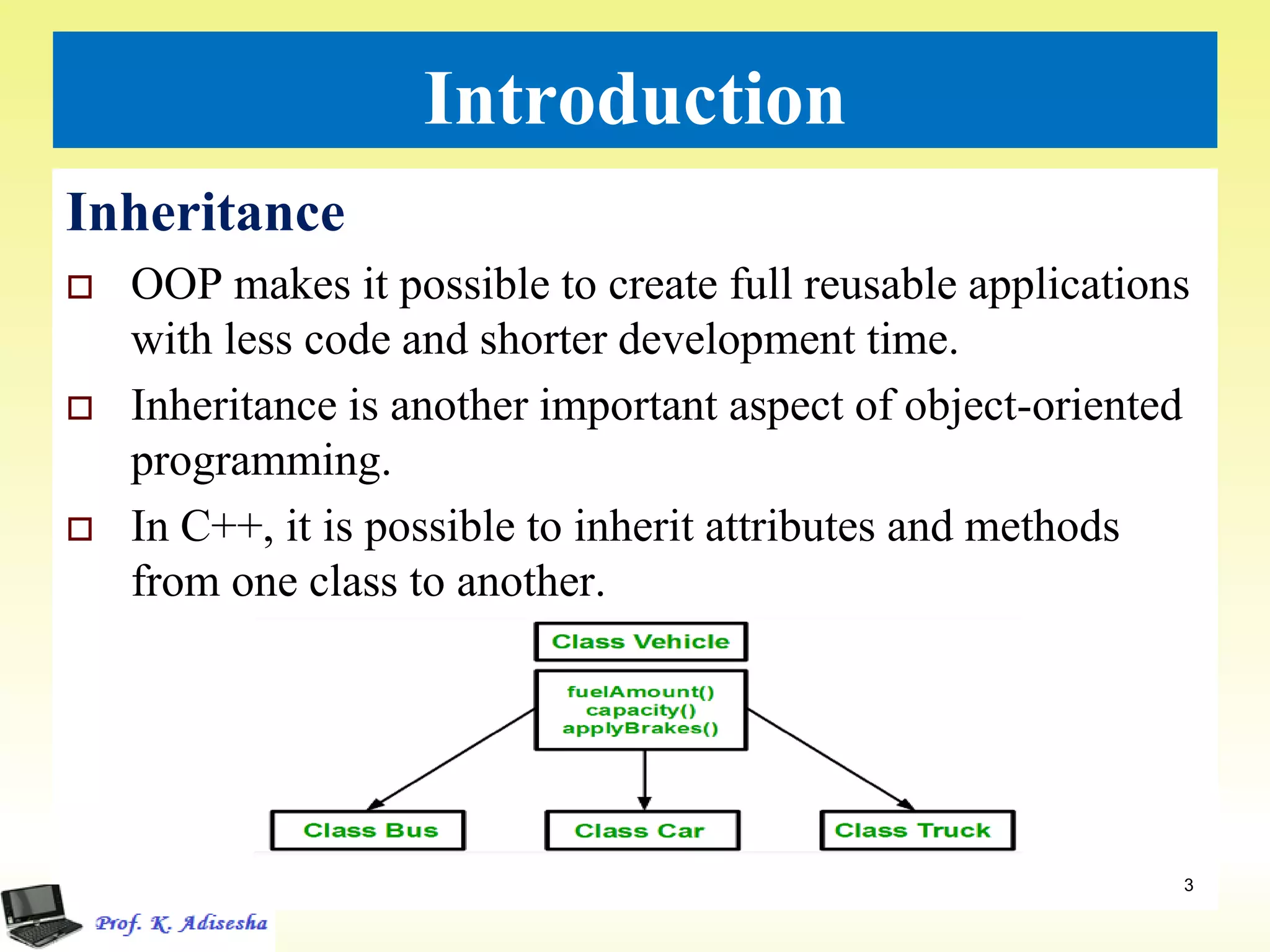
 OOP makes it possible to create full reusable applications
with less code and shorter development time.
 Inheritance is another important aspect of object-oriented
programming.
 In C++, it is possible to inherit attributes and methods
from one class to another.
3
Inheritance
Inheritance:
 Inheritance is the capability of one class to inherit
properties from another class.
 Base Class:
 It is the class whose properties are inherited by another
class.
 It is also called Super class.
 Derived Class:
 The class inherits the properties from base class.
 It is also called Sub class
4
Inheritance
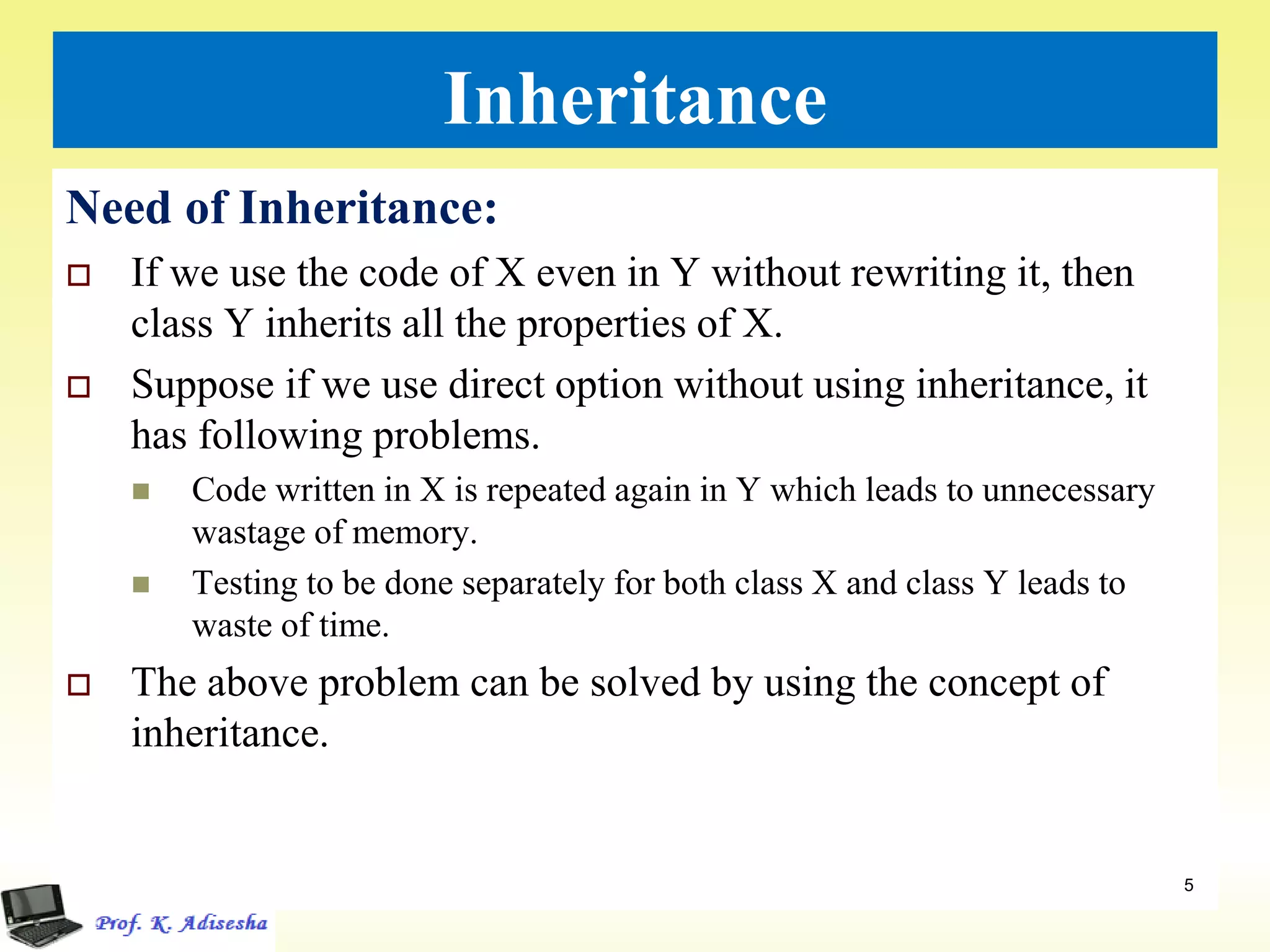
Need of Inheritance:
 If we use the code of X even in Y without rewriting it, then
class Y inherits all the properties of X.
 Suppose if we use direct option without using inheritance, it
has following problems.
 Code written in X is repeated again in Y which leads to unnecessary
wastage of memory.
 Testing to be done separately for both class X and class Y leads to
waste of time.
 The above problem can be solved by using the concept of
inheritance.
5
Inheritance
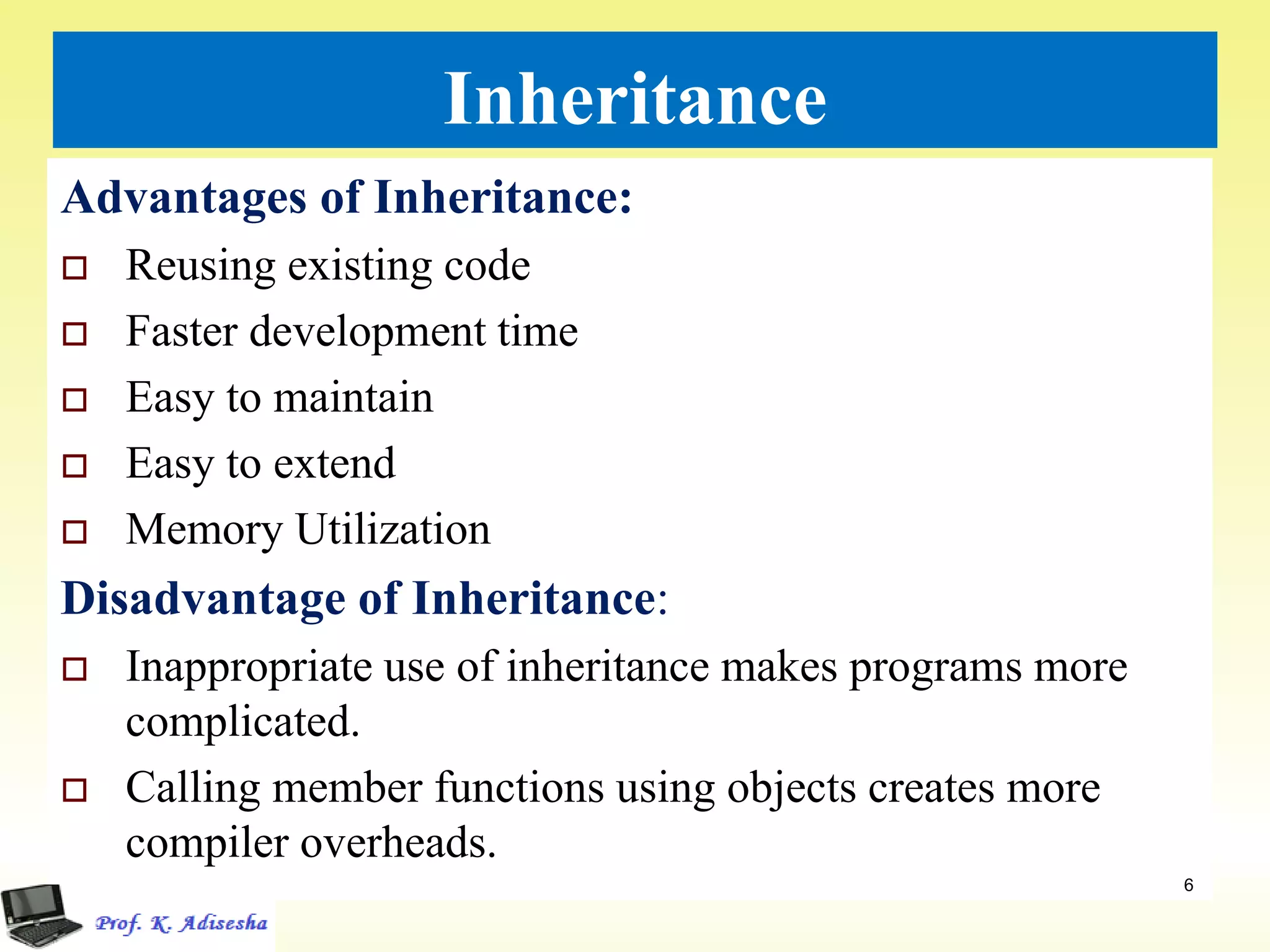
Advantages of Inheritance:
 Reusing existing code
 Faster development time
 Easy to maintain
 Easy to extend
 Memory Utilization
Disadvantage of Inheritance:
 Inappropriate use of inheritance makes programs more
complicated.
 Calling member functions using objects creates more
compiler overheads.
6
Inheritance
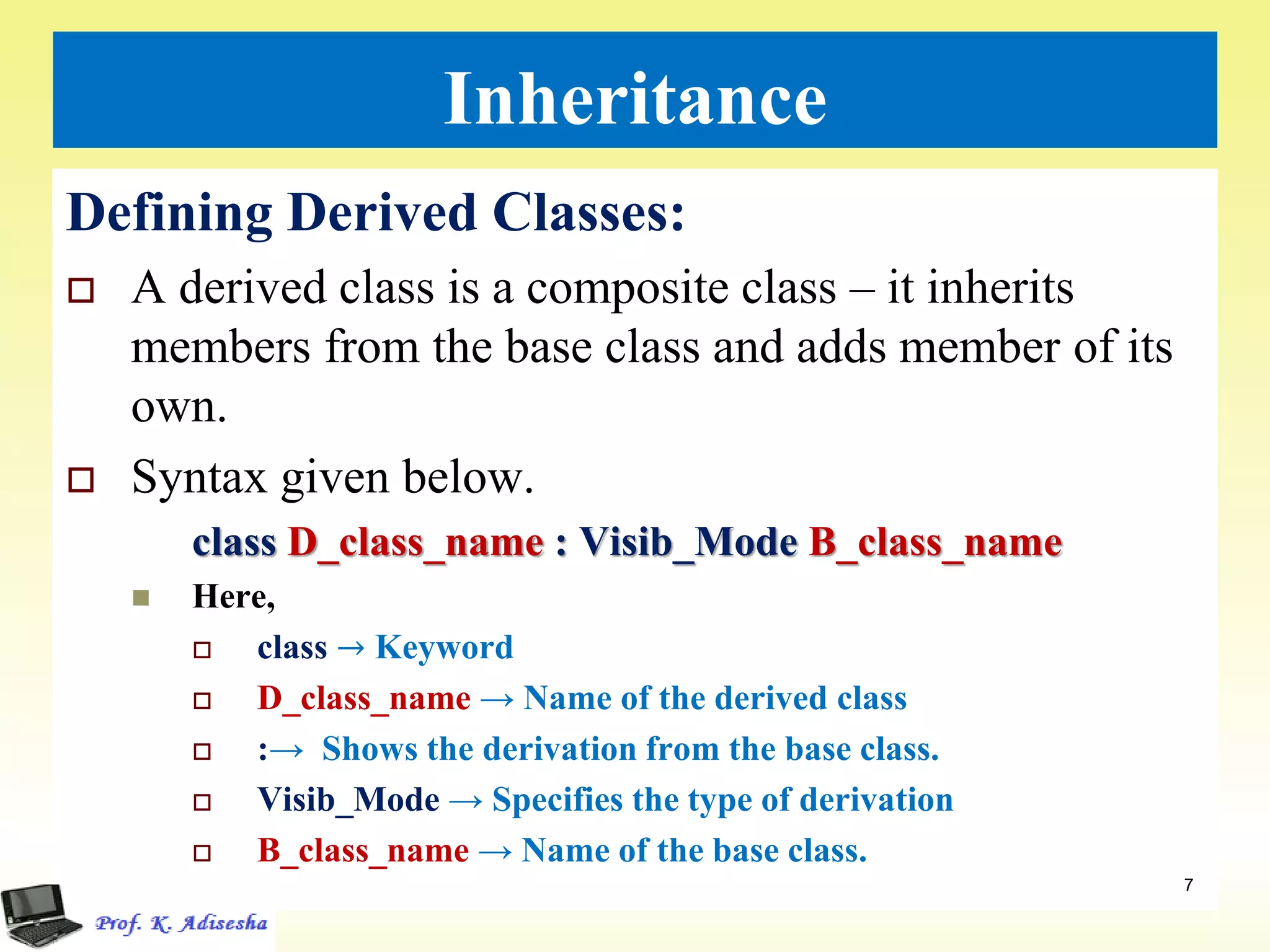
Defining Derived Classes:
 A derived class is a composite class – it inherits
members from the base class and adds member of its
own.
 Syntax given below.
class D_class_name : Visib_Mode B_class_name
 Here,
 class → Keyword
 D_class_name → Name of the derived class
 :→ Shows the derivation from the base class.
 Visib_Mode → Specifies the type of derivation
 B_class_name → Name of the base class.
7
Inheritance
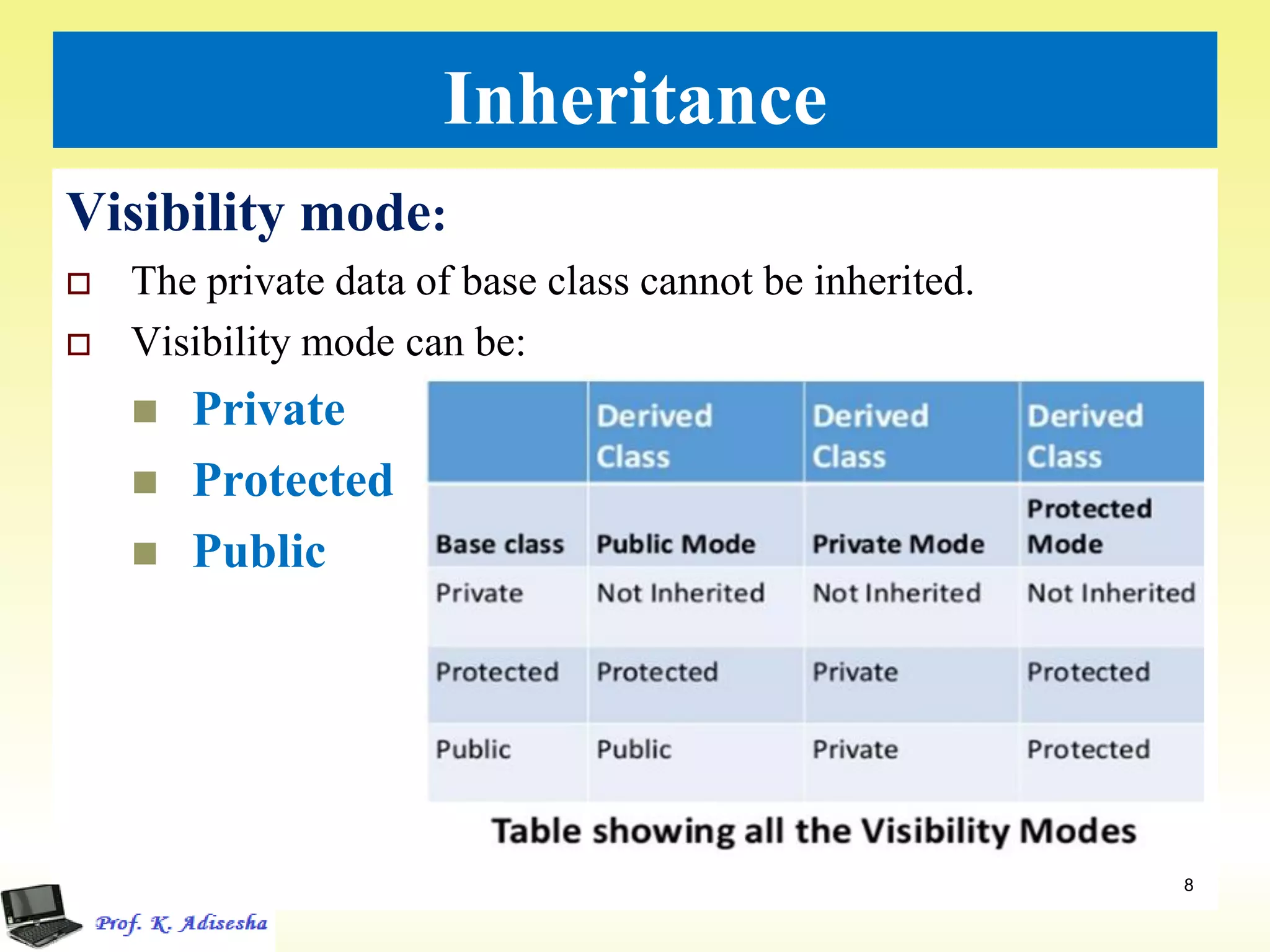
Visibility mode:
 The private data of base class cannot be inherited.
 Visibility mode can be:
 Private
 Protected
 Public
8
Visibility mode
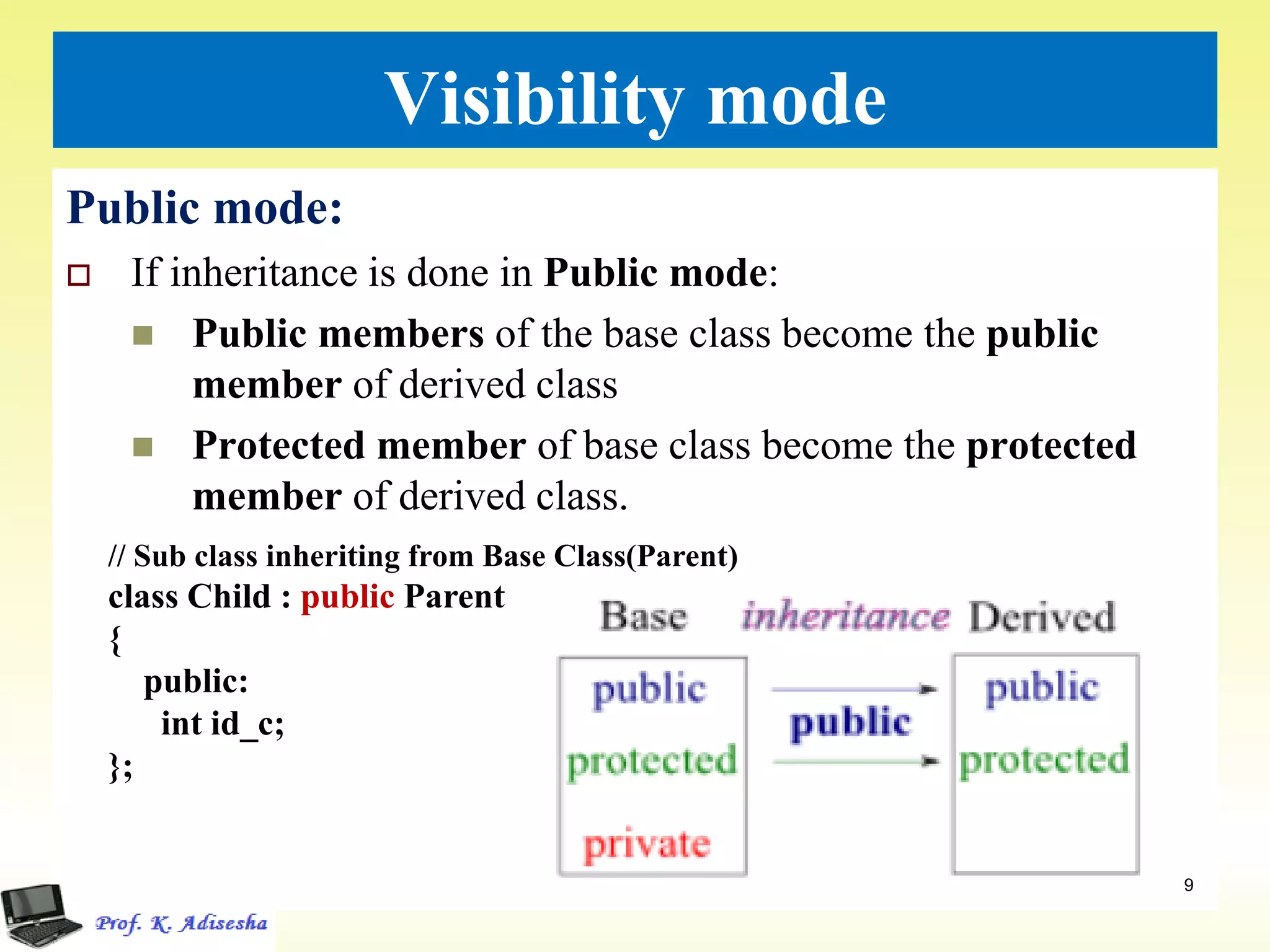
Public mode:
 If inheritance is done in Public mode:
 Public members of the base class become the public
member of derived class
 Protected member of base class become the protected
member of derived class.
9
// Sub class inheriting from Base Class(Parent)
class Child : public Parent
{
public:
int id_c;
};
Visibility mode
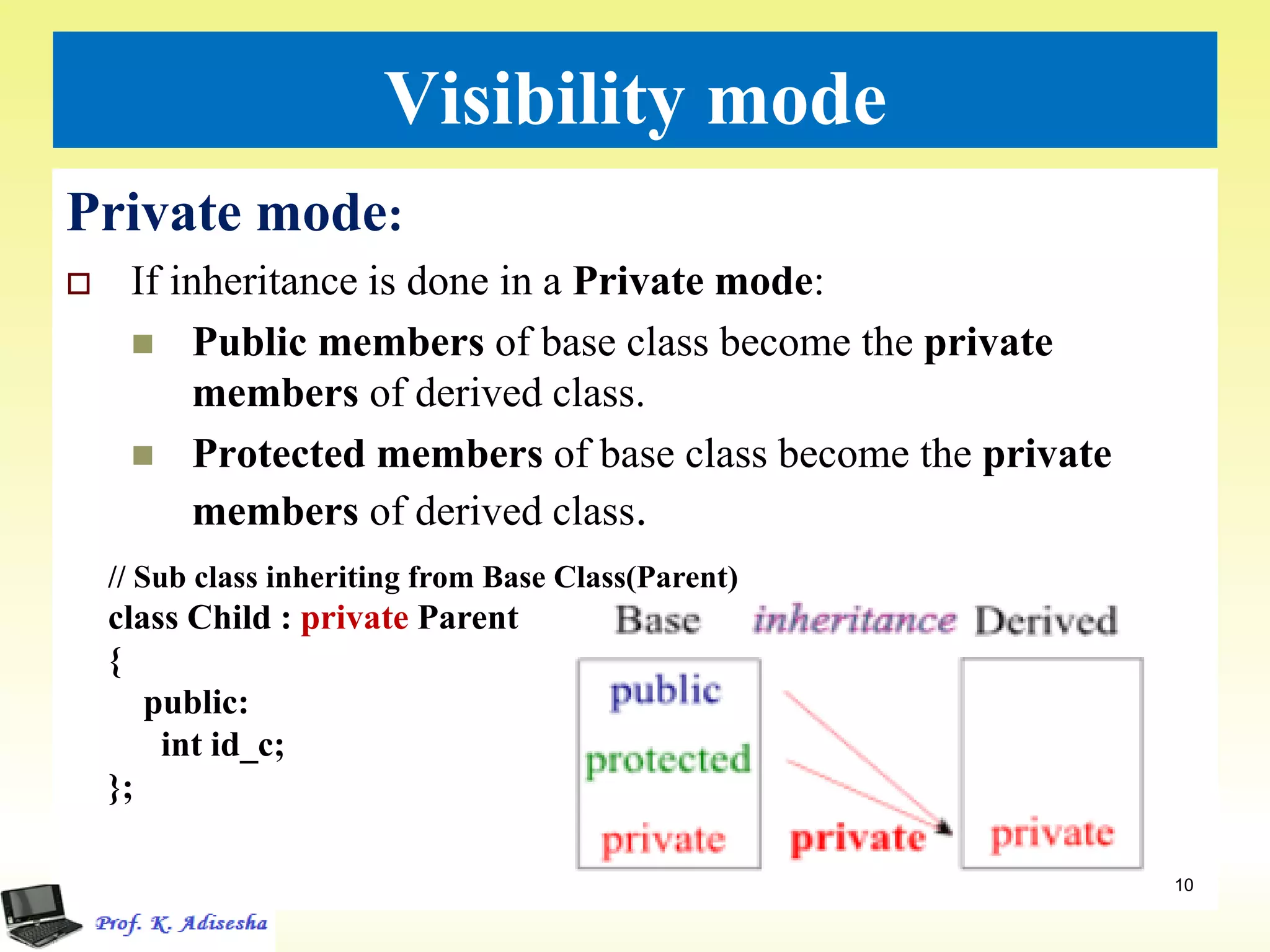
Private mode:
 If inheritance is done in a Private mode:
 Public members of base class become the private
members of derived class.
 Protected members of base class become the private
members of derived class.
10
// Sub class inheriting from Base Class(Parent)
class Child : private Parent
{
public:
int id_c;
};
Visibility mode
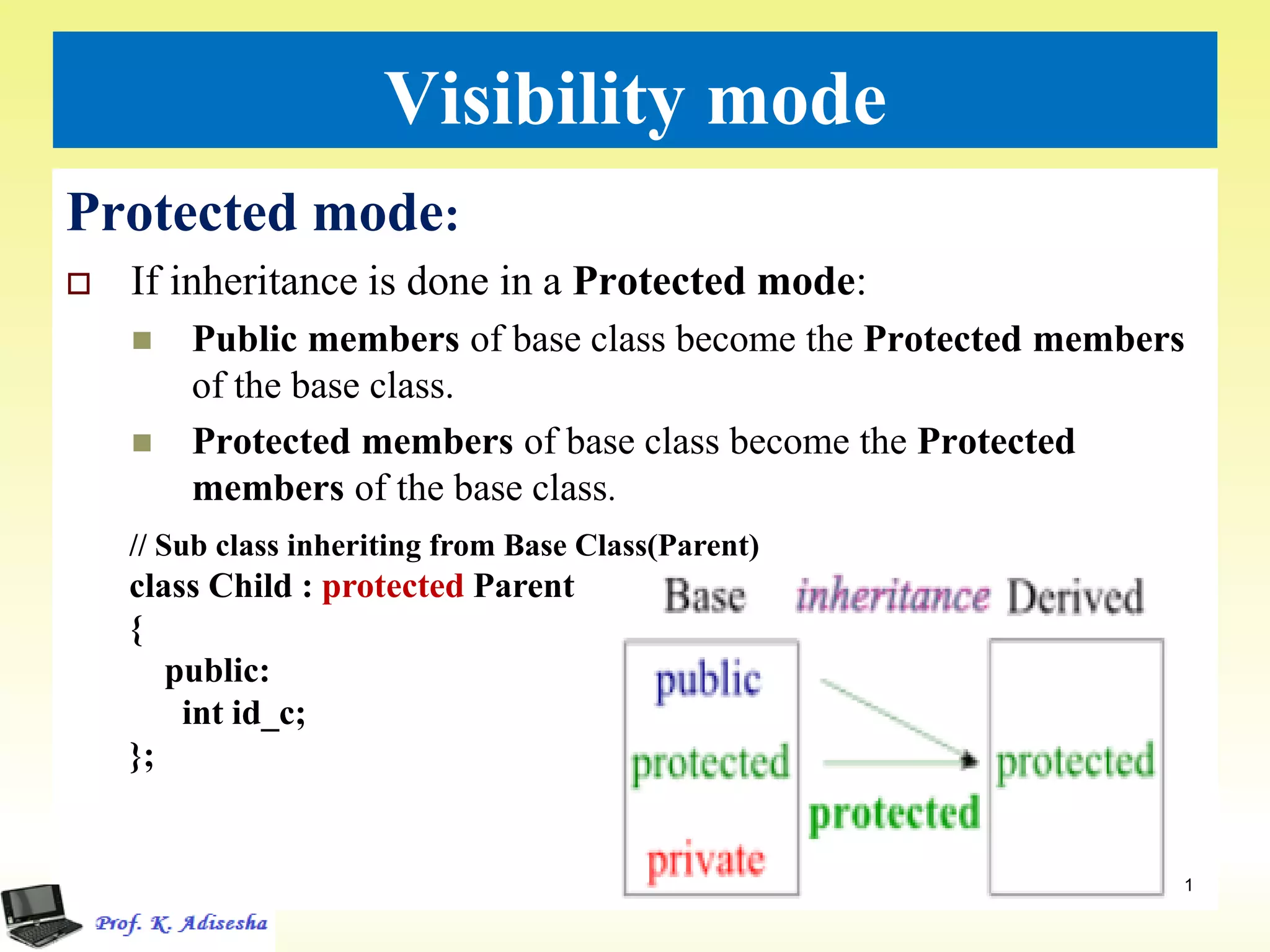
Protected mode:
 If inheritance is done in a Protected mode:
 Public members of base class become the Protected members
of the base class.
 Protected members of base class become the Protected
members of the base class.
11
// Sub class inheriting from Base Class(Parent)
class Child : protected Parent
{
public:
int id_c;
};
Types of Inheritance
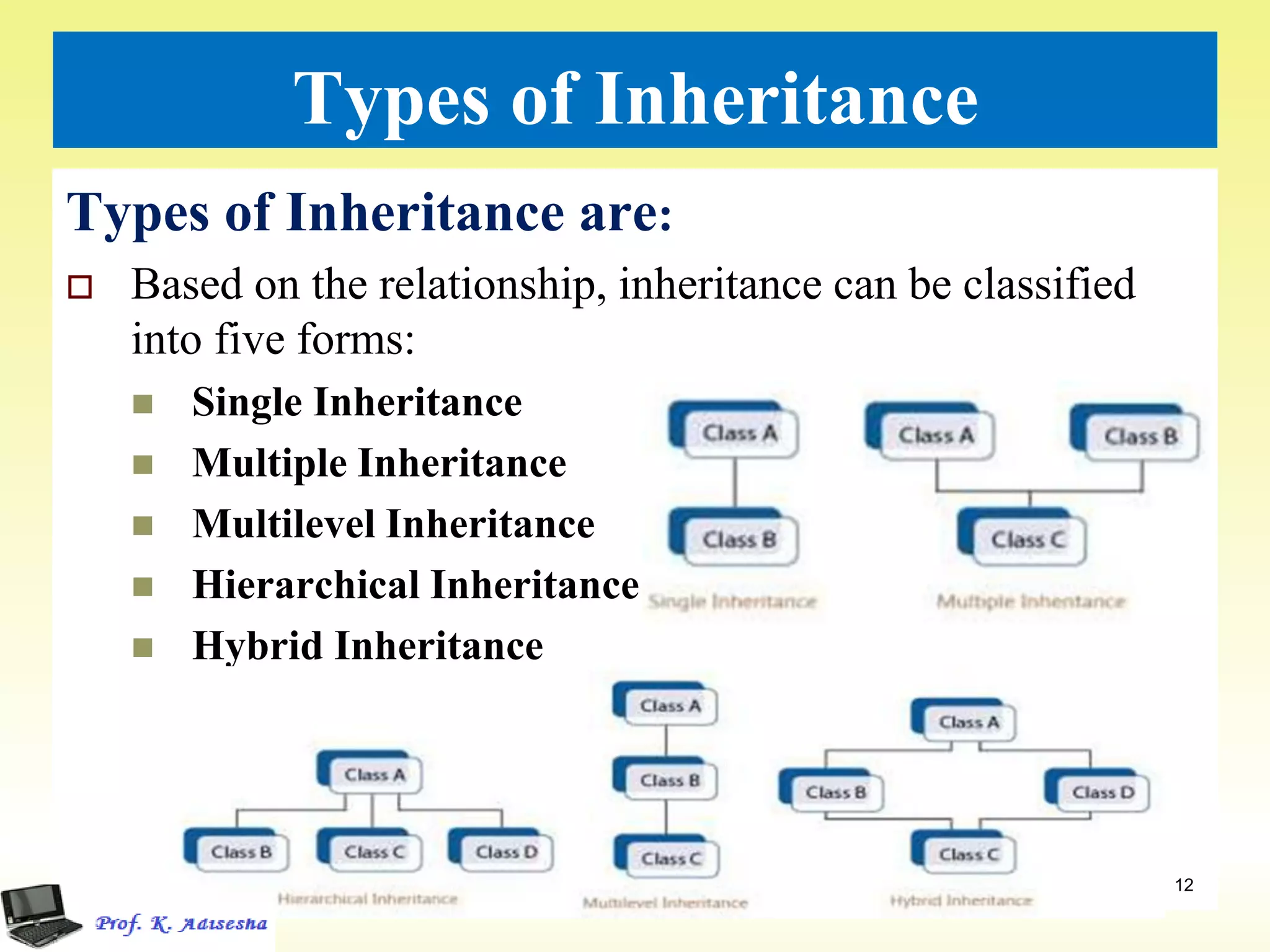
Types of Inheritance are:
 Based on the relationship, inheritance can be classified
into five forms:
 Single Inheritance
 Multiple Inheritance
 Multilevel Inheritance
 Hierarchical Inheritance
 Hybrid Inheritance
12
Types of Inheritance
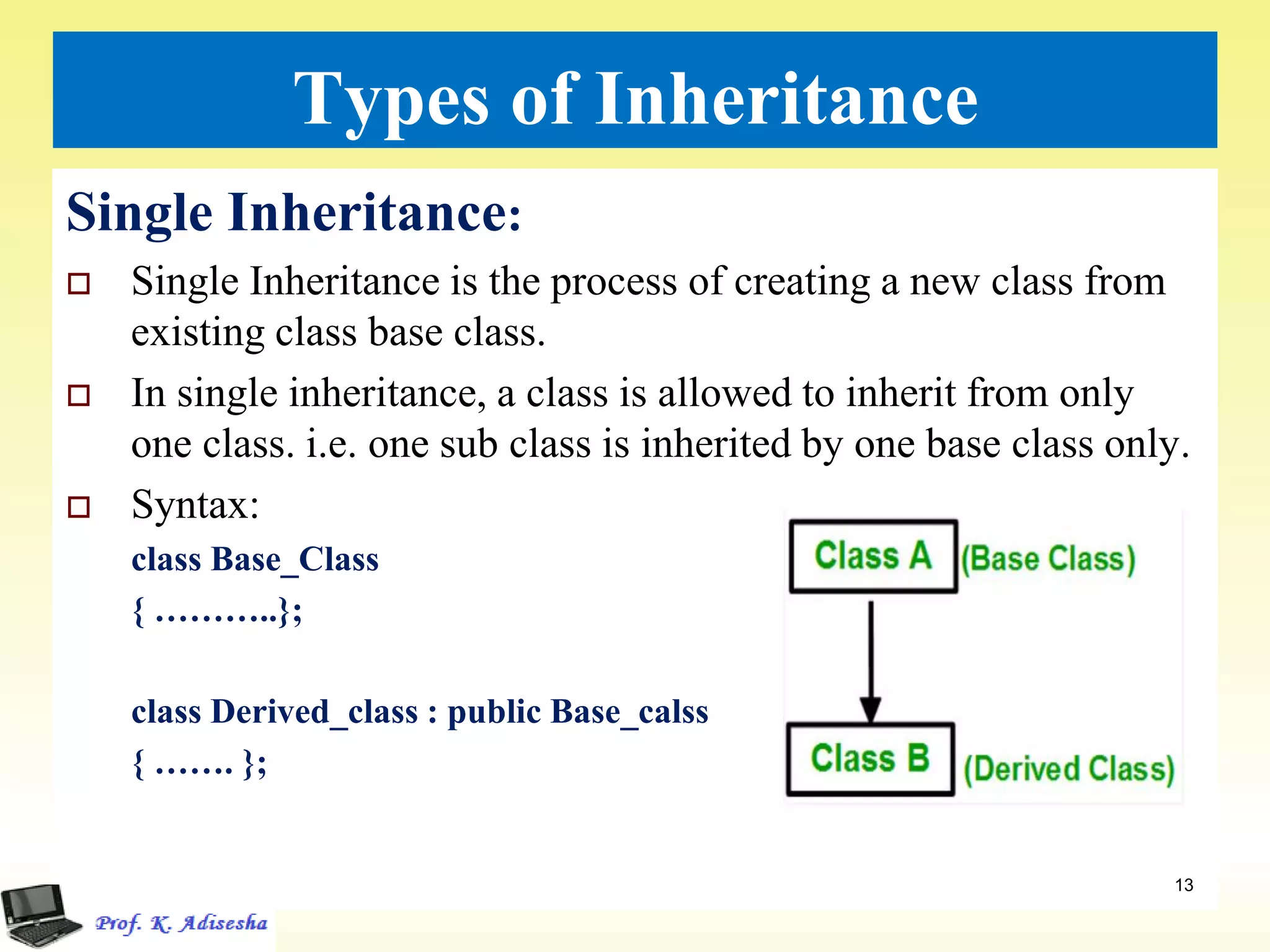
Single Inheritance:
 Single Inheritance is the process of creating a new class from
existing class base class.
 In single inheritance, a class is allowed to inherit from only
one class. i.e. one sub class is inherited by one base class only.
 Syntax:
class Base_Class
{ ………..};
class Derived_class : public Base_calss
{ ……. };
13
Types of Inheritance
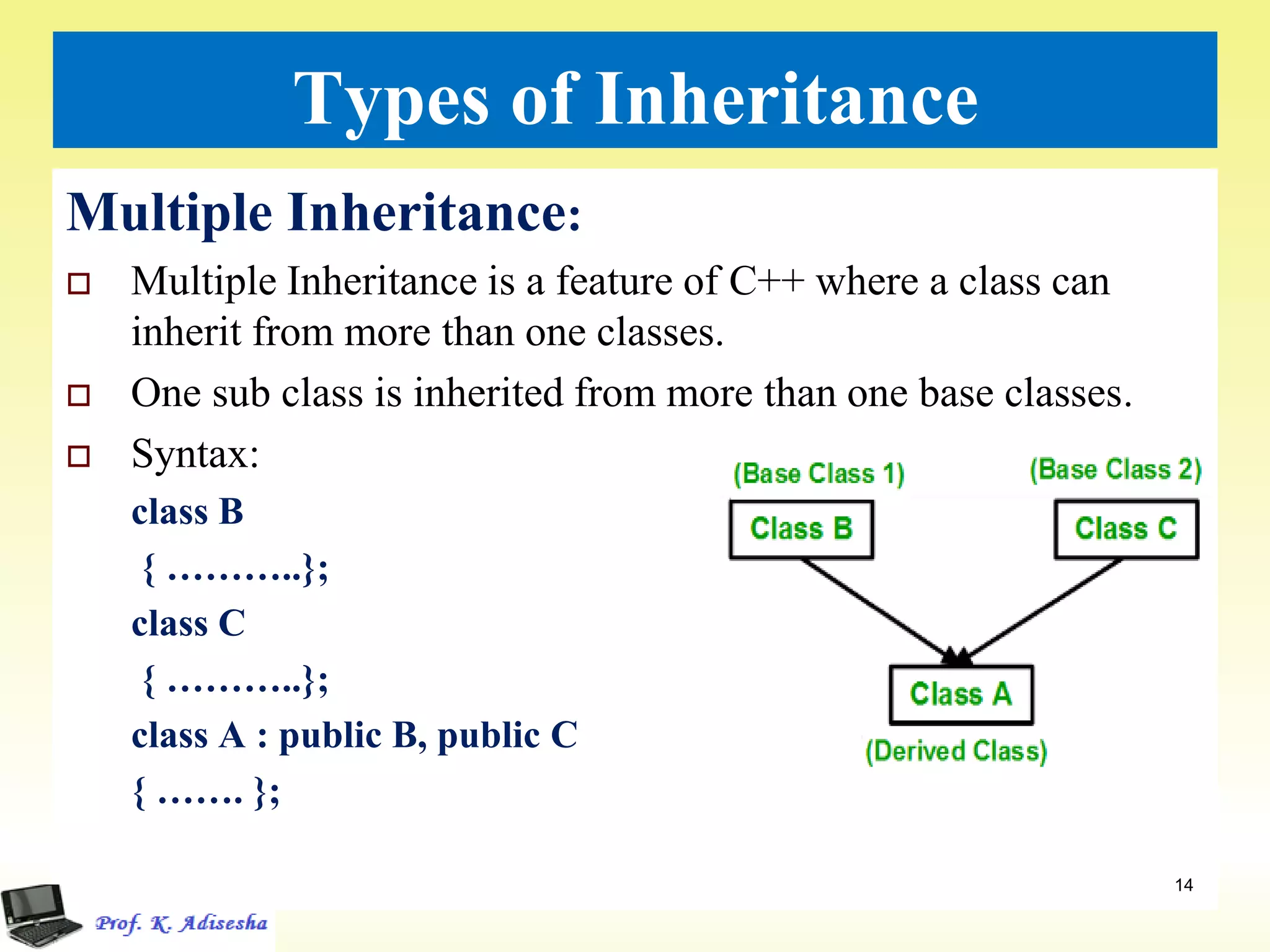
Multiple Inheritance:
 Multiple Inheritance is a feature of C++ where a class can
inherit from more than one classes.
 One sub class is inherited from more than one base classes.
 Syntax:
class B
{ ………..};
class C
{ ………..};
class A : public B, public C
{ ……. };
14
Types of Inheritance
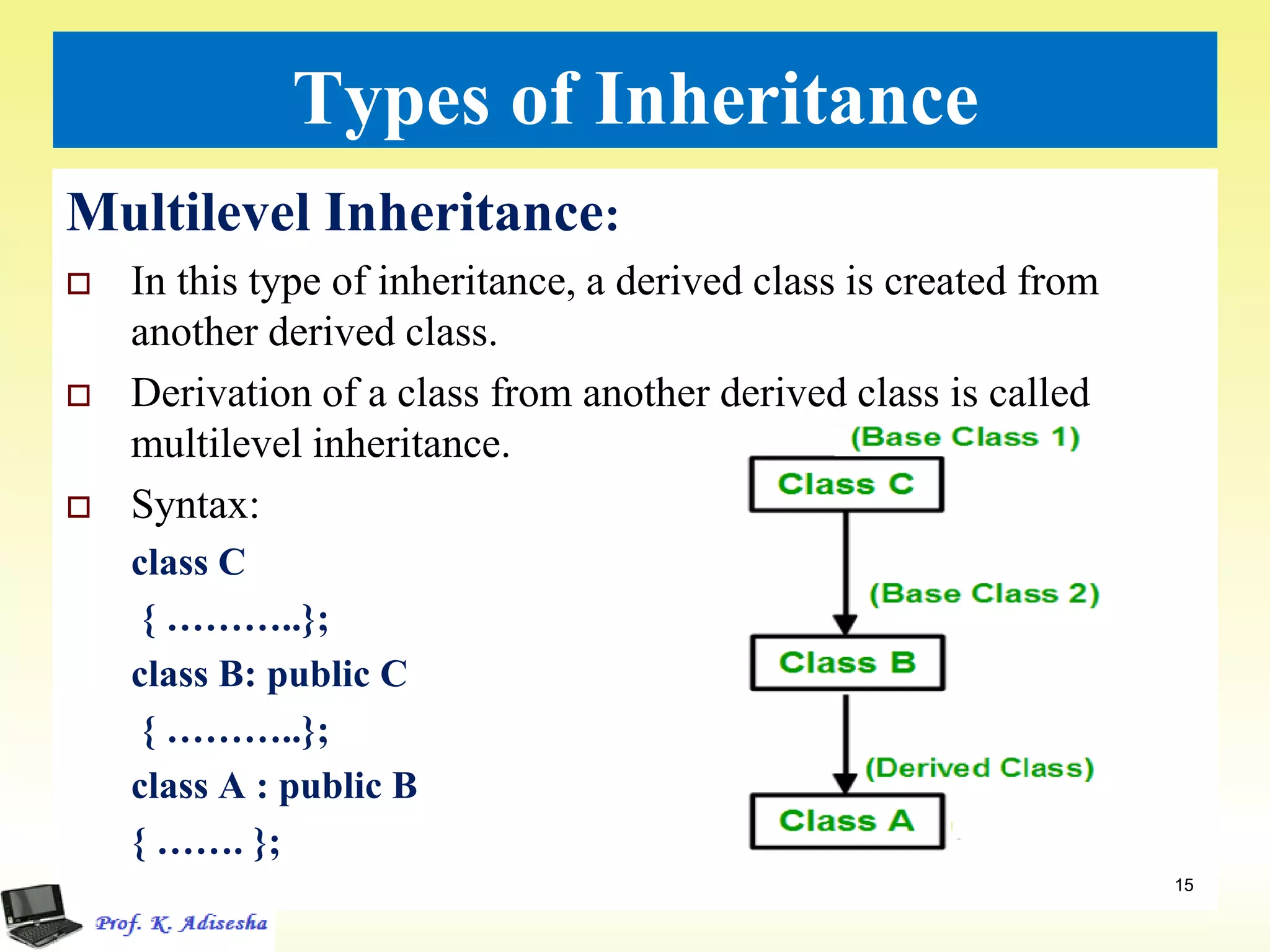
Multilevel Inheritance:
 In this type of inheritance, a derived class is created from
another derived class.
 Derivation of a class from another derived class is called
multilevel inheritance.
 Syntax:
class C
{ ………..};
class B: public C
{ ………..};
class A : public B
{ ……. };
15
Types of Inheritance
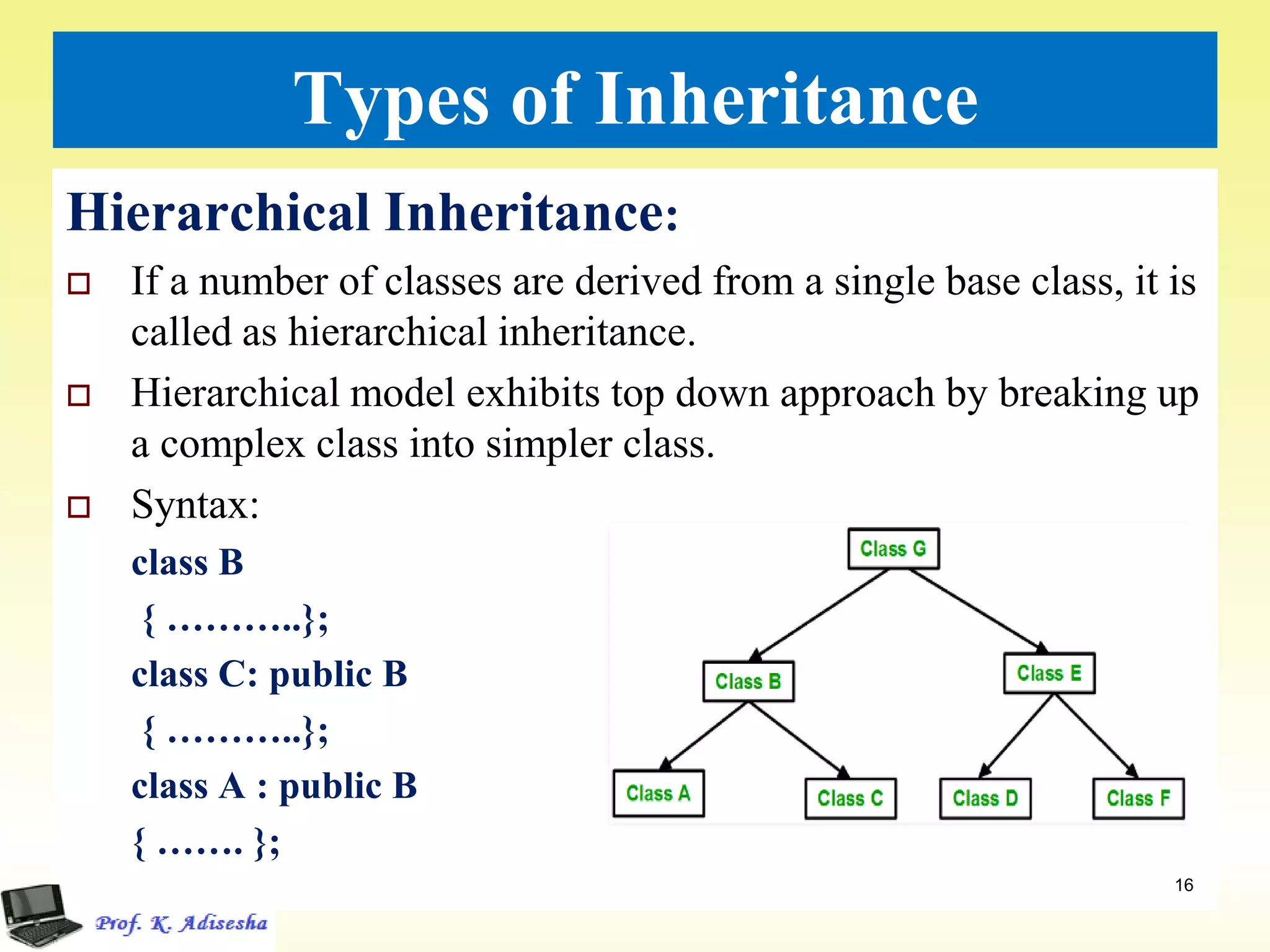
Hierarchical Inheritance:
 If a number of classes are derived from a single base class, it is
called as hierarchical inheritance.
 Hierarchical model exhibits top down approach by breaking up
a complex class into simpler class.
 Syntax:
class B
{ ………..};
class C: public B
{ ………..};
class A : public B
{ ……. };
16
Types of Inheritance
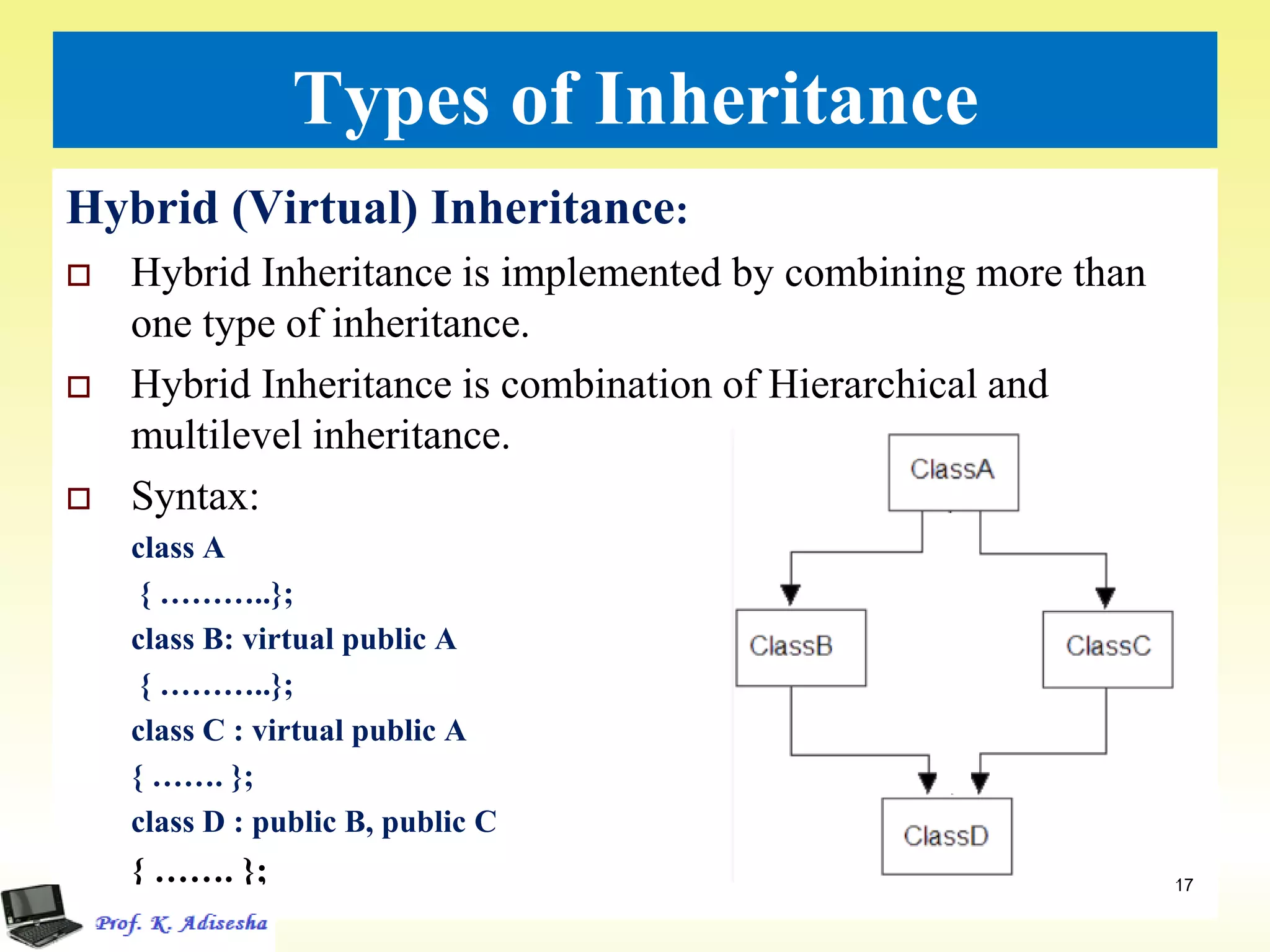
Hybrid (Virtual) Inheritance:
 Hybrid Inheritance is implemented by combining more than
one type of inheritance.
 Hybrid Inheritance is combination of Hierarchical and
multilevel inheritance.
 Syntax:
class A
{ ………..};
class B: virtual public A
{ ………..};
class C : virtual public A
{ ……. };
class D : public B, public C
{ ……. }; 17
Virtual Base Classes
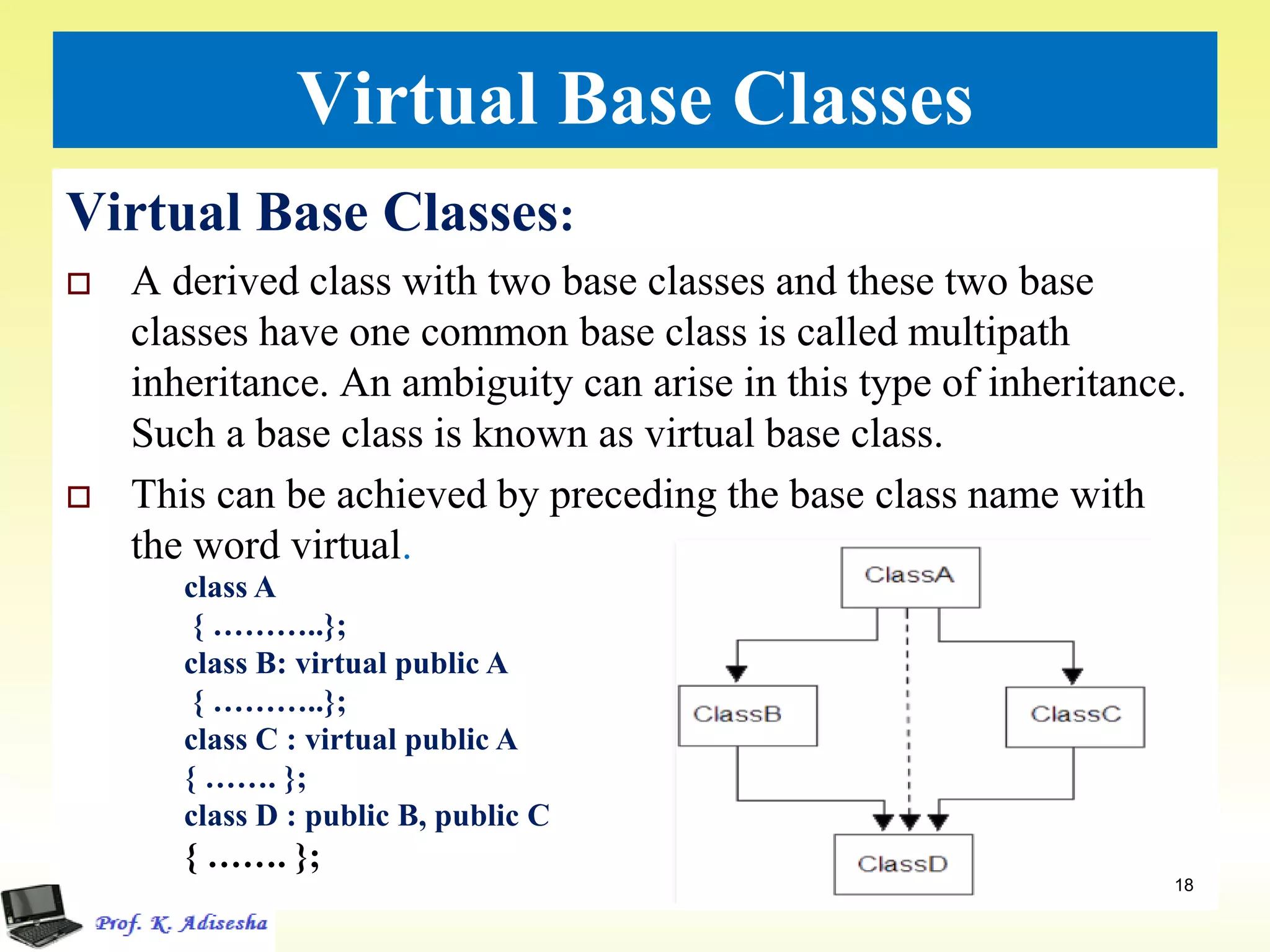
Virtual Base Classes:
 A derived class with two base classes and these two base
classes have one common base class is called multipath
inheritance. An ambiguity can arise in this type of inheritance.
Such a base class is known as virtual base class.
 This can be achieved by preceding the base class name with
the word virtual.
18
class A
{ ………..};
class B: virtual public A
{ ………..};
class C : virtual public A
{ ……. };
class D : public B, public C
{ ……. };
Constructors
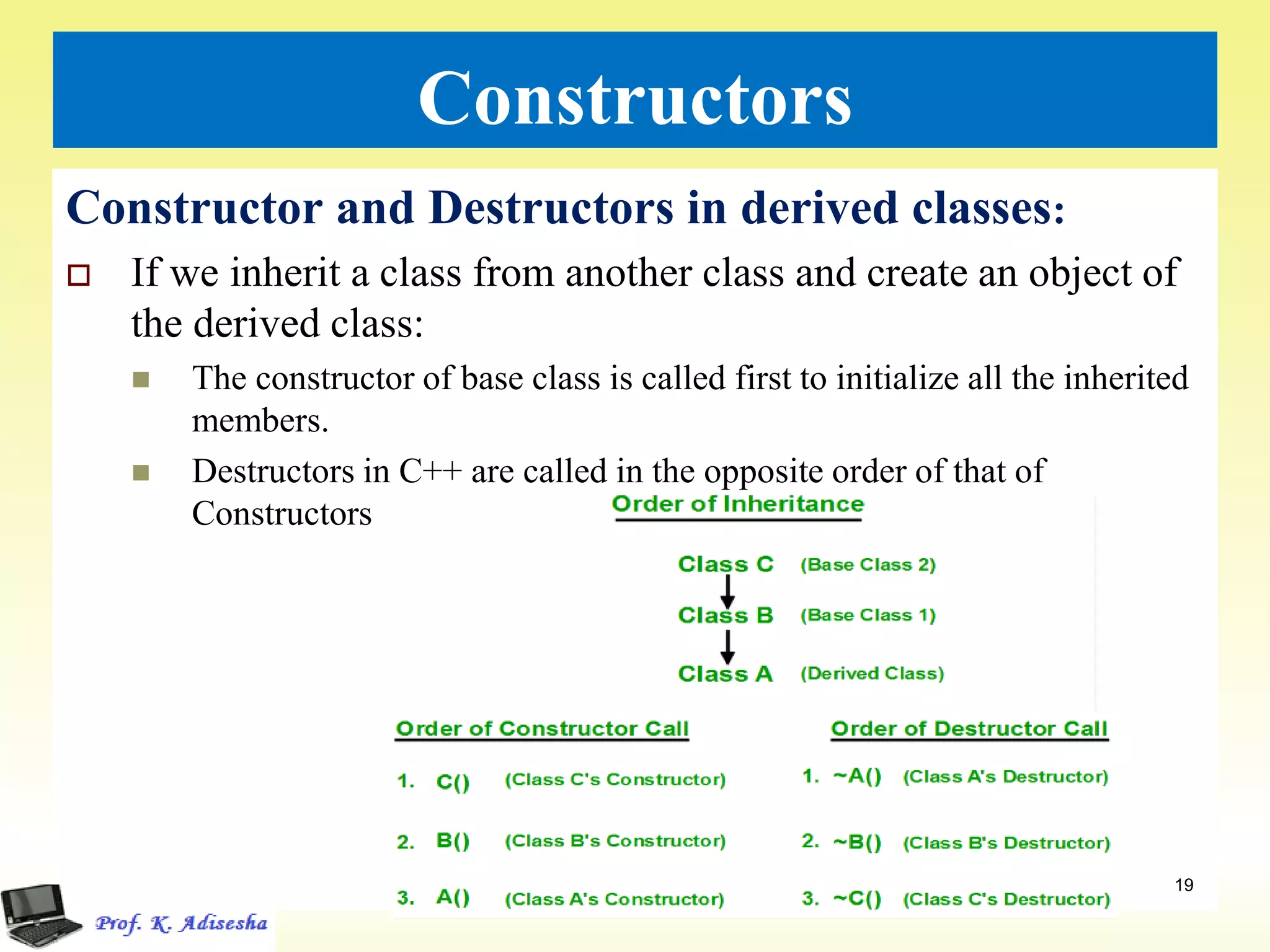
Constructor and Destructors in derived classes:
 If we inherit a class from another class and create an object of
the derived class:
 The constructor of base class is called first to initialize all the inherited
members.
 Destructors in C++ are called in the opposite order of that of
Constructors
19
Constructors
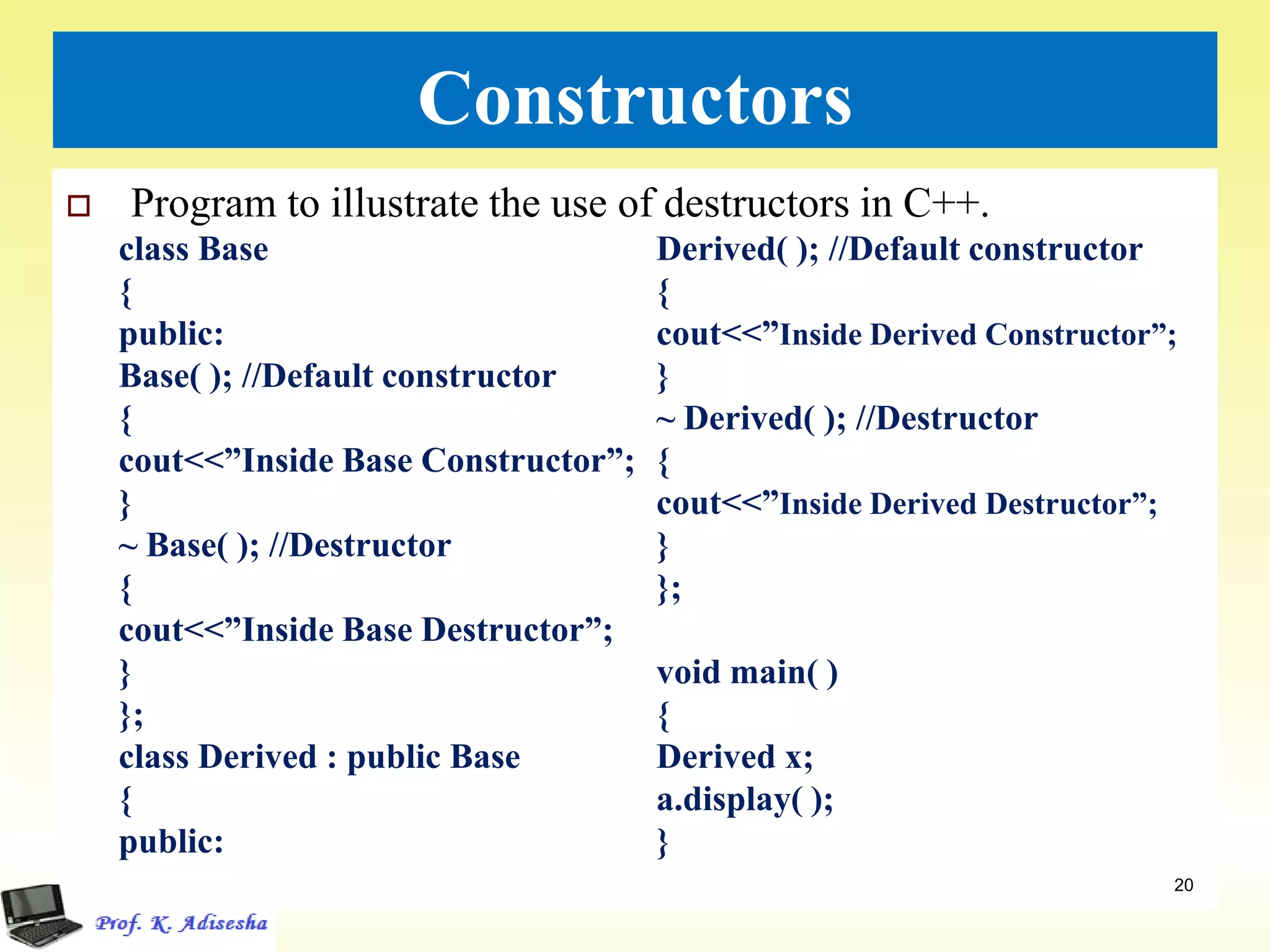
 Program to illustrate the use of destructors in C++.
20
class Base
{
public:
Base( ); //Default constructor
{
cout<<”Inside Base Constructor”;
}
~ Base( ); //Destructor
{
cout<<”Inside Base Destructor”;
}
};
class Derived : public Base
{
public:
Derived( ); //Default constructor
{
cout<<”Inside Derived Constructor”;
}
~ Derived( ); //Destructor
{
cout<<”Inside Derived Destructor”;
}
};
void main( )
{
Derived x;
a.display( );
}
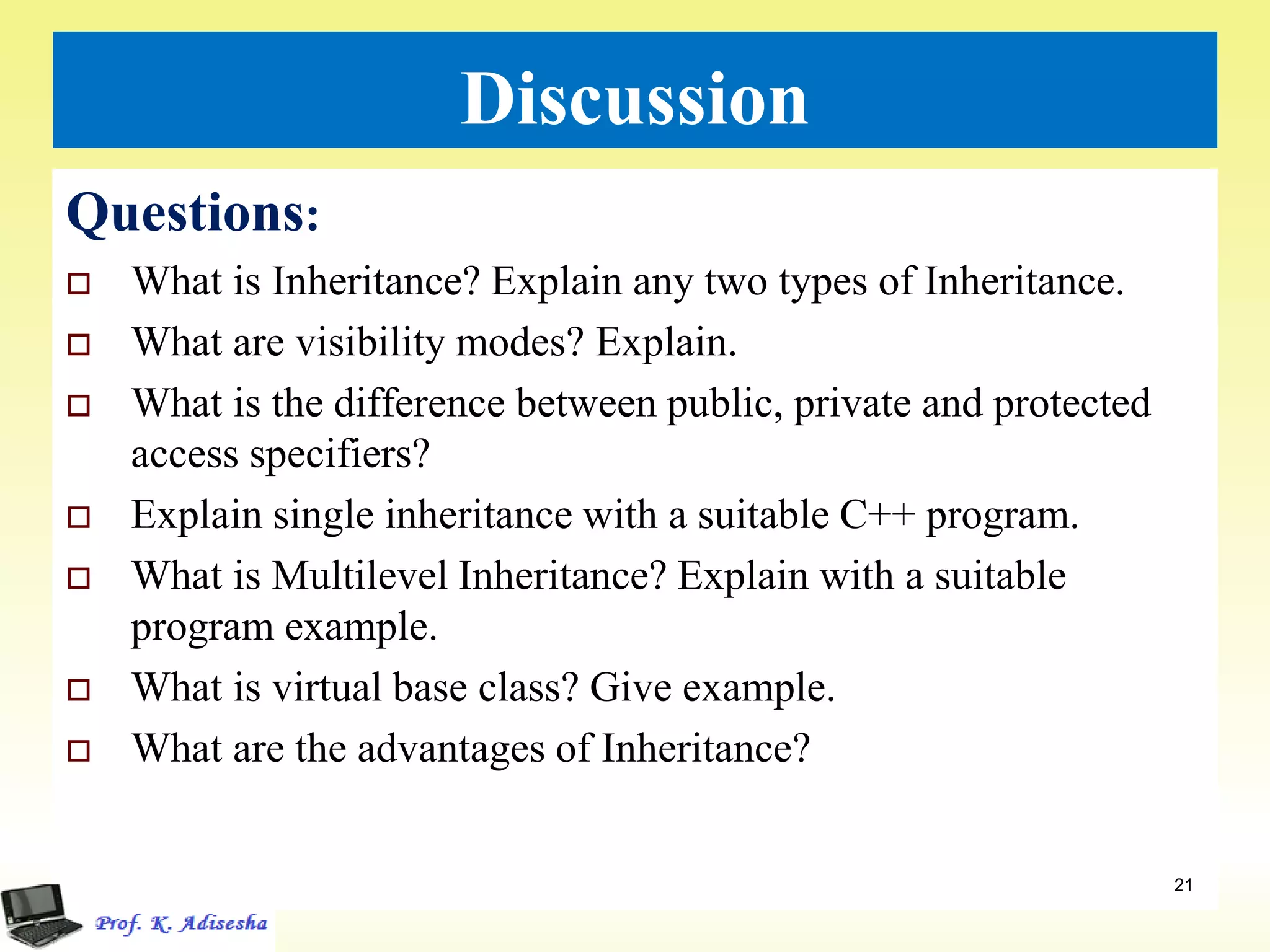
Discussion
Questions:
 What is Inheritance? Explain any two types of Inheritance.
 What are visibility modes? Explain.
 What is the difference between public, private and protected
access specifiers?
 Explain single inheritance with a suitable C++ program.
 What is Multilevel Inheritance? Explain with a suitable
program example.
 What is virtual base class? Give example.
 What are the advantages of Inheritance?
21

Inheritance

  • 1.
  • 2.
    Learning Outcomes  Introduction Defining Inheritance  Need of Inheritance  Visibility mode  Types of Inheritance  Virtual Base Classes 2
  • 3.
    Introduction Inheritance  OOP makesit possible to create full reusable applications with less code and shorter development time.  Inheritance is another important aspect of object-oriented programming.  In C++, it is possible to inherit attributes and methods from one class to another. 3
  • 4.
    Inheritance Inheritance:  Inheritance isthe capability of one class to inherit properties from another class.  Base Class:  It is the class whose properties are inherited by another class.  It is also called Super class.  Derived Class:  The class inherits the properties from base class.  It is also called Sub class 4
  • 5.
    Inheritance Need of Inheritance: If we use the code of X even in Y without rewriting it, then class Y inherits all the properties of X.  Suppose if we use direct option without using inheritance, it has following problems.  Code written in X is repeated again in Y which leads to unnecessary wastage of memory.  Testing to be done separately for both class X and class Y leads to waste of time.  The above problem can be solved by using the concept of inheritance. 5
  • 6.
    Inheritance Advantages of Inheritance: Reusing existing code  Faster development time  Easy to maintain  Easy to extend  Memory Utilization Disadvantage of Inheritance:  Inappropriate use of inheritance makes programs more complicated.  Calling member functions using objects creates more compiler overheads. 6
  • 7.
    Inheritance Defining Derived Classes: A derived class is a composite class – it inherits members from the base class and adds member of its own.  Syntax given below. class D_class_name : Visib_Mode B_class_name  Here,  class → Keyword  D_class_name → Name of the derived class  :→ Shows the derivation from the base class.  Visib_Mode → Specifies the type of derivation  B_class_name → Name of the base class. 7
  • 8.
    Inheritance Visibility mode:  Theprivate data of base class cannot be inherited.  Visibility mode can be:  Private  Protected  Public 8
  • 9.
    Visibility mode Public mode: If inheritance is done in Public mode:  Public members of the base class become the public member of derived class  Protected member of base class become the protected member of derived class. 9 // Sub class inheriting from Base Class(Parent) class Child : public Parent { public: int id_c; };
  • 10.
    Visibility mode Private mode: If inheritance is done in a Private mode:  Public members of base class become the private members of derived class.  Protected members of base class become the private members of derived class. 10 // Sub class inheriting from Base Class(Parent) class Child : private Parent { public: int id_c; };
  • 11.
    Visibility mode Protected mode: If inheritance is done in a Protected mode:  Public members of base class become the Protected members of the base class.  Protected members of base class become the Protected members of the base class. 11 // Sub class inheriting from Base Class(Parent) class Child : protected Parent { public: int id_c; };
  • 12.
    Types of Inheritance Typesof Inheritance are:  Based on the relationship, inheritance can be classified into five forms:  Single Inheritance  Multiple Inheritance  Multilevel Inheritance  Hierarchical Inheritance  Hybrid Inheritance 12
  • 13.
    Types of Inheritance SingleInheritance:  Single Inheritance is the process of creating a new class from existing class base class.  In single inheritance, a class is allowed to inherit from only one class. i.e. one sub class is inherited by one base class only.  Syntax: class Base_Class { ………..}; class Derived_class : public Base_calss { ……. }; 13
  • 14.
    Types of Inheritance MultipleInheritance:  Multiple Inheritance is a feature of C++ where a class can inherit from more than one classes.  One sub class is inherited from more than one base classes.  Syntax: class B { ………..}; class C { ………..}; class A : public B, public C { ……. }; 14
  • 15.
    Types of Inheritance MultilevelInheritance:  In this type of inheritance, a derived class is created from another derived class.  Derivation of a class from another derived class is called multilevel inheritance.  Syntax: class C { ………..}; class B: public C { ………..}; class A : public B { ……. }; 15
  • 16.
    Types of Inheritance HierarchicalInheritance:  If a number of classes are derived from a single base class, it is called as hierarchical inheritance.  Hierarchical model exhibits top down approach by breaking up a complex class into simpler class.  Syntax: class B { ………..}; class C: public B { ………..}; class A : public B { ……. }; 16
  • 17.
    Types of Inheritance Hybrid(Virtual) Inheritance:  Hybrid Inheritance is implemented by combining more than one type of inheritance.  Hybrid Inheritance is combination of Hierarchical and multilevel inheritance.  Syntax: class A { ………..}; class B: virtual public A { ………..}; class C : virtual public A { ……. }; class D : public B, public C { ……. }; 17
  • 18.
    Virtual Base Classes VirtualBase Classes:  A derived class with two base classes and these two base classes have one common base class is called multipath inheritance. An ambiguity can arise in this type of inheritance. Such a base class is known as virtual base class.  This can be achieved by preceding the base class name with the word virtual. 18 class A { ………..}; class B: virtual public A { ………..}; class C : virtual public A { ……. }; class D : public B, public C { ……. };
  • 19.
    Constructors Constructor and Destructorsin derived classes:  If we inherit a class from another class and create an object of the derived class:  The constructor of base class is called first to initialize all the inherited members.  Destructors in C++ are called in the opposite order of that of Constructors 19
  • 20.
    Constructors  Program toillustrate the use of destructors in C++. 20 class Base { public: Base( ); //Default constructor { cout<<”Inside Base Constructor”; } ~ Base( ); //Destructor { cout<<”Inside Base Destructor”; } }; class Derived : public Base { public: Derived( ); //Default constructor { cout<<”Inside Derived Constructor”; } ~ Derived( ); //Destructor { cout<<”Inside Derived Destructor”; } }; void main( ) { Derived x; a.display( ); }
  • 21.
    Discussion Questions:  What isInheritance? Explain any two types of Inheritance.  What are visibility modes? Explain.  What is the difference between public, private and protected access specifiers?  Explain single inheritance with a suitable C++ program.  What is Multilevel Inheritance? Explain with a suitable program example.  What is virtual base class? Give example.  What are the advantages of Inheritance? 21