Chapter 8


Interface


            http://www.java2all.com
Interface


            http://www.java2all.com
Interfaces are similar to abstract classes, but
differ in their functionality.

   In interfaces, none of the methods are
implemented means interfaces defines methods
without body.

    Interfaces are syntactically similar to classes, but
they lack instance variables, and their methods are
declared without any body.
    But, it can contain final variables, which must
be initialized with values.
                                             http://www.java2all.com
Once it is defined, any number of classes can
implement an interface.
      One class can implement any number of
interfaces

     If we are implementing an interface in a class
we must implement all the methods defined in the
interface as well as a class can also implement its
own methods.

     Interfaces add most of the functionality that is
required for many applications which would
normally resort to using multiple inheritance in C+
+.                                           http://www.java2all.com
Defining Interface


                     http://www.java2all.com
Syntax :

[Access-specifier] interface interface-name
{
     Access-specifier return-type method-
name(parameter-list);
     final type var1=value;
}


                                          http://www.java2all.com
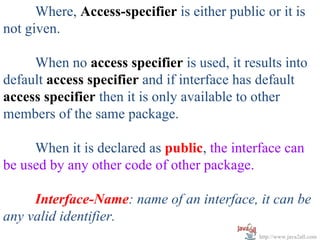
Where, Access-specifier is either public or it is
not given.

     When no access specifier is used, it results into
default access specifier and if interface has default
access specifier then it is only available to other
members of the same package.

        When it is declared as public, the interface can
be used by any other code of other package.
       
        Interface-Name: name of an interface, it can be 
any valid identifier. 
                                              http://www.java2all.com
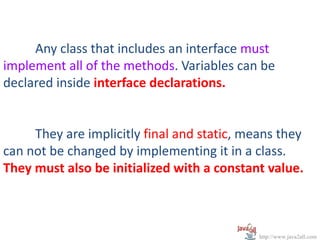
Any class that includes an interface must
implement all of the methods. Variables can be
declared inside interface declarations.


     They are implicitly final and static, means they
can not be changed by implementing it in a class.
They must also be initialized with a constant value.


                                             http://www.java2all.com
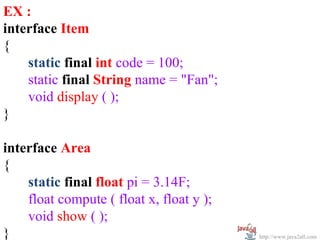
EX :
interface Item
{
    static final int code = 100;
    static final String name = "Fan";
    void display ( );
}

interface Area
{
    static final float pi = 3.14F;
    float compute ( float x, float y );
    void show ( );
}                                         http://www.java2all.com
Implementing Interface


                   http://www.java2all.com
Once an interface has been defined, one or
more classes can implement that interface.

      To implement an interface, include the
implements clause in a class definition, and then
create the methods declared by the interface.

     The general form of a class that includes the
implements clause looks like this:

      Access-specifier class classname [extends
superclass] [implements interface, [, interface..]]
{ // class body }
                                             http://www.java2all.com
If a class implements from more than one
interface, names are separated by comma.

      If a class implements two interfaces that declare
the same method, then the same method will be used
by clients of either interface.

     The methods that implement an interface must
be declared as public.

      The type-signature of implementing method
must match exactly the type signature specified in the
interface.
                                             http://www.java2all.com
interface religion
{
   String city = new String("Amritsar");
   void greet();
   void pray();
}

class gs implements religion
{
   public void greet()
   {
     System.out.println("We greet - ABCD");
   }
   public void pray()
   {
     System.out.println("We pray at " + city + " XYZ ");
   }
}
class iface1                                         Output :
{
   public static void main(String args[])
   {
     gs sikh = new gs();                             We greet - ABCD
     sikh.greet();
     sikh.pray();
                                                     We pray at Amritsar XYZ
   }
}
                                                                    http://www.java2all.com
Implementing interface having common
function name
 interface i1
{
   void disp();
}
interface i2
{
   void disp();
}
 class c implements i1, i2
{
   public void disp()
   {
     System.out.println("This is display .. ");
   }
}                                                 Output :
 class iface7
{
   public static void main(String args[])
   {                                              This is display ..
     c cobj = new c();

        cobj.disp();
    }
}                                                                      http://www.java2all.com
Note :


      When implementing an interface method, it must
be declared as public. It is possible for classes that
implement interfaces to define additional members of
their own.


                                            http://www.java2all.com
Partial Implementation of Interface :

      If we want to implement an interface in a class
we have to implement all the methods defined in the
interface.

      But if a class implements an interface but does
not fully implement the method defined by that
interface, then that class must be declared as
abstract.


                                             http://www.java2all.com
interface i1
{
   void disp1();                                   Output :
   void disp2();
}
abstract class c1 implements i1
{                                                  This is display of 1
   public void disp1()
   {
                                                   This is display of 2
     System.out.println("This is display of 1");
   }
}
class c2 extends c1
{
   public void disp2()
   {
     System.out.println("This is display of 2");
   }
}
class iface
{
   public static void main(String args[])
   {
     c2 c2obj = new c2();
     c2obj.disp1();
     c2obj.disp2();
   }
}                                                                   http://www.java2all.com
Interface Variable


                     http://www.java2all.com
Accessing interface variable :


      One can declare variable as object references
that uses an interface rather than a class type.


      When you call a method through one of these
references, the correct version will be called based on
the actual instance of the interface being referred to.

                                             http://www.java2all.com
nterface AreaCal
{
  final double pi = 3.14;
  double areacalculation(double r);
}

class Circle implements AreaCal
{
   public double areacalculation(double r)
   {
     double ar;
     ar = pi*r*r;                              Output :
     return ar;
   }
}                                              Area of Circle is : 329.89625
class iface3
{
   public static void main(String args[])
   {
     double area;
     AreaCal ac = new Circle();
     area = ac.areacalculation(10.25);
     System.out.println("Area of Circle is : " + area);
   }
}

                                                                        http://www.java2all.com
Here variable ac is declared to be of the interface
type AreaCal,it was assigned an instance of circle.

     Although ac can be used to access the
reacalculation() method,it cannot access any other
members of the client class.

      An interface reference variable only has
knowledge of the method declared by its interface
declaration.


                                             http://www.java2all.com
Extending Interface


                      http://www.java2all.com
Extending interfaces :

      One interface can inherit another by use of the
keyword extends. The syntax is the same as for
inheriting classes.

      When a class implements an interface that
inherits another interface, It must provide
implementation of all methods defined within the
interface inheritance.

Note : Any class that implements an interface must
implement all methods defined by that interface,
including any that inherited from other interfaces.
                                              http://www.java2all.com
interface if1
{
   void dispi1();
}
interface if2 extends if1
{
   void dispi2();
}
class cls1 implements if2
                                                    Output :
{
   public void dispi1()
   {                                                This is display of i1
     System.out.println("This is display of i1");
   }                                                This is display of i2
   public void dispi2()
   {
     System.out.println("This is display of i2");
   }
}
public class Ext_iface
{
   public static void main(String args[])
   {
     cls1 c1obj = new cls1();

     c1obj.dispi1();
     c1obj.dispi2();
}}                                                              http://www.java2all.com
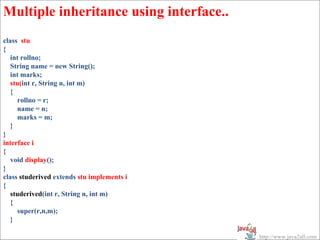
Multiple inheritance using interface..
class stu
{
   int rollno;
   String name = new String();
   int marks;
   stu(int r, String n, int m)
   {
     rollno = r;
     name = n;
     marks = m;
   }
}
interface i
{
   void display();
}
class studerived extends stu implements i
{
   studerived(int r, String n, int m)
   {
     super(r,n,m);
   }

                                            http://www.java2all.com
public void display()
  {
    System.out.println("Displaying student details .. ");
    System.out.println("Rollno = " + rollno);
    System.out.println("Name = " + name);
    System.out.println("Marks = " + marks);
  }
}

public class Multi_inhe_demo
{
  public static void main(String args[])
  {
    studerived obj = new studerived(1912, "Ram", 75);
    obj.display();
  }

}
                                        Output :

                                        Displaying student details ..
                                        Rollno = 1912
                                        Name = Ram
                                        Marks = 75
                                                                    http://www.java2all.com
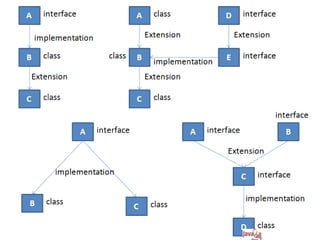
We can make various forms of interface
implementation as below


                                     http://www.java2all.com
http://www.java2all.com

Interface

  • 1.
    Chapter 8 Interface http://www.java2all.com
  • 2.
    Interface http://www.java2all.com
  • 3.
    Interfaces are similarto abstract classes, but differ in their functionality. In interfaces, none of the methods are implemented means interfaces defines methods without body. Interfaces are syntactically similar to classes, but they lack instance variables, and their methods are declared without any body. But, it can contain final variables, which must be initialized with values. http://www.java2all.com
  • 4.
    Once it isdefined, any number of classes can implement an interface. One class can implement any number of interfaces If we are implementing an interface in a class we must implement all the methods defined in the interface as well as a class can also implement its own methods. Interfaces add most of the functionality that is required for many applications which would normally resort to using multiple inheritance in C+ +. http://www.java2all.com
  • 5.
    Defining Interface http://www.java2all.com
  • 6.
    Syntax : [Access-specifier] interfaceinterface-name { Access-specifier return-type method- name(parameter-list); final type var1=value; } http://www.java2all.com
  • 7.
    Where, Access-specifier iseither public or it is not given. When no access specifier is used, it results into default access specifier and if interface has default access specifier then it is only available to other members of the same package. When it is declared as public, the interface can be used by any other code of other package.         Interface-Name: name of an interface, it can be  any valid identifier.  http://www.java2all.com
  • 8.
    Any class thatincludes an interface must implement all of the methods. Variables can be declared inside interface declarations. They are implicitly final and static, means they can not be changed by implementing it in a class. They must also be initialized with a constant value. http://www.java2all.com
  • 9.
    EX : interface Item { static final int code = 100; static final String name = "Fan"; void display ( ); } interface Area { static final float pi = 3.14F; float compute ( float x, float y ); void show ( ); } http://www.java2all.com
  • 10.
    Implementing Interface http://www.java2all.com
  • 11.
    Once an interfacehas been defined, one or more classes can implement that interface. To implement an interface, include the implements clause in a class definition, and then create the methods declared by the interface. The general form of a class that includes the implements clause looks like this: Access-specifier class classname [extends superclass] [implements interface, [, interface..]] { // class body } http://www.java2all.com
  • 12.
    If a classimplements from more than one interface, names are separated by comma. If a class implements two interfaces that declare the same method, then the same method will be used by clients of either interface. The methods that implement an interface must be declared as public. The type-signature of implementing method must match exactly the type signature specified in the interface. http://www.java2all.com
  • 13.
    interface religion { String city = new String("Amritsar"); void greet(); void pray(); } class gs implements religion { public void greet() { System.out.println("We greet - ABCD"); } public void pray() { System.out.println("We pray at " + city + " XYZ "); } } class iface1 Output : { public static void main(String args[]) { gs sikh = new gs(); We greet - ABCD sikh.greet(); sikh.pray(); We pray at Amritsar XYZ } } http://www.java2all.com
  • 14.
    Implementing interface havingcommon function name interface i1 { void disp(); } interface i2 { void disp(); } class c implements i1, i2 { public void disp() { System.out.println("This is display .. "); } } Output : class iface7 { public static void main(String args[]) { This is display .. c cobj = new c(); cobj.disp(); } } http://www.java2all.com
  • 15.
    Note : When implementing an interface method, it must be declared as public. It is possible for classes that implement interfaces to define additional members of their own. http://www.java2all.com
  • 16.
    Partial Implementation ofInterface : If we want to implement an interface in a class we have to implement all the methods defined in the interface. But if a class implements an interface but does not fully implement the method defined by that interface, then that class must be declared as abstract. http://www.java2all.com
  • 17.
    interface i1 { void disp1(); Output : void disp2(); } abstract class c1 implements i1 { This is display of 1 public void disp1() { This is display of 2 System.out.println("This is display of 1"); } } class c2 extends c1 { public void disp2() { System.out.println("This is display of 2"); } } class iface { public static void main(String args[]) { c2 c2obj = new c2(); c2obj.disp1(); c2obj.disp2(); } } http://www.java2all.com
  • 18.
    Interface Variable http://www.java2all.com
  • 19.
    Accessing interface variable: One can declare variable as object references that uses an interface rather than a class type. When you call a method through one of these references, the correct version will be called based on the actual instance of the interface being referred to. http://www.java2all.com
  • 20.
    nterface AreaCal { final double pi = 3.14; double areacalculation(double r); } class Circle implements AreaCal { public double areacalculation(double r) { double ar; ar = pi*r*r; Output : return ar; } } Area of Circle is : 329.89625 class iface3 { public static void main(String args[]) { double area; AreaCal ac = new Circle(); area = ac.areacalculation(10.25); System.out.println("Area of Circle is : " + area); } } http://www.java2all.com
  • 21.
    Here variable acis declared to be of the interface type AreaCal,it was assigned an instance of circle. Although ac can be used to access the reacalculation() method,it cannot access any other members of the client class. An interface reference variable only has knowledge of the method declared by its interface declaration. http://www.java2all.com
  • 22.
    Extending Interface http://www.java2all.com
  • 23.
    Extending interfaces : One interface can inherit another by use of the keyword extends. The syntax is the same as for inheriting classes. When a class implements an interface that inherits another interface, It must provide implementation of all methods defined within the interface inheritance. Note : Any class that implements an interface must implement all methods defined by that interface, including any that inherited from other interfaces. http://www.java2all.com
  • 24.
    interface if1 { void dispi1(); } interface if2 extends if1 { void dispi2(); } class cls1 implements if2 Output : { public void dispi1() { This is display of i1 System.out.println("This is display of i1"); } This is display of i2 public void dispi2() { System.out.println("This is display of i2"); } } public class Ext_iface { public static void main(String args[]) { cls1 c1obj = new cls1(); c1obj.dispi1(); c1obj.dispi2(); }} http://www.java2all.com
  • 25.
    Multiple inheritance usinginterface.. class stu { int rollno; String name = new String(); int marks; stu(int r, String n, int m) { rollno = r; name = n; marks = m; } } interface i { void display(); } class studerived extends stu implements i { studerived(int r, String n, int m) { super(r,n,m); } http://www.java2all.com
  • 26.
    public void display() { System.out.println("Displaying student details .. "); System.out.println("Rollno = " + rollno); System.out.println("Name = " + name); System.out.println("Marks = " + marks); } } public class Multi_inhe_demo { public static void main(String args[]) { studerived obj = new studerived(1912, "Ram", 75); obj.display(); } } Output : Displaying student details .. Rollno = 1912 Name = Ram Marks = 75 http://www.java2all.com
  • 27.
    We can makevarious forms of interface implementation as below http://www.java2all.com
  • 28.

Editor's Notes

  • #18 White Space Characters
  • #19 White Space Characters
  • #24 White Space Characters