
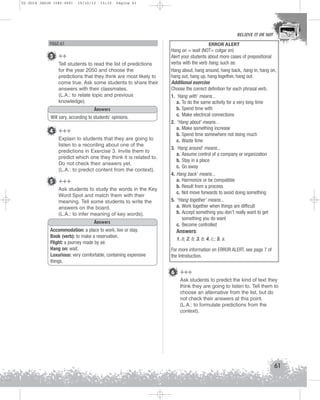
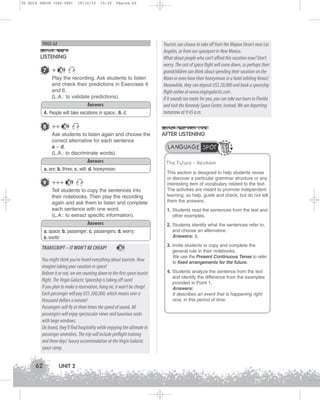
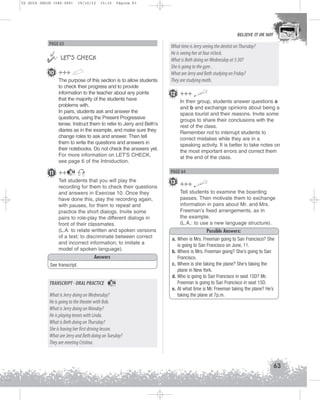
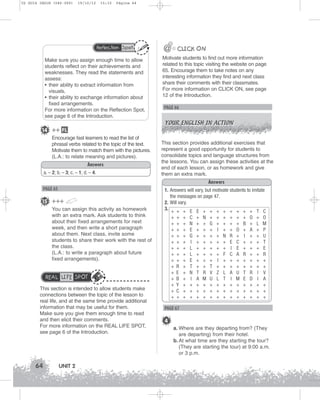

INTRO GUIA ING1M (001-021)

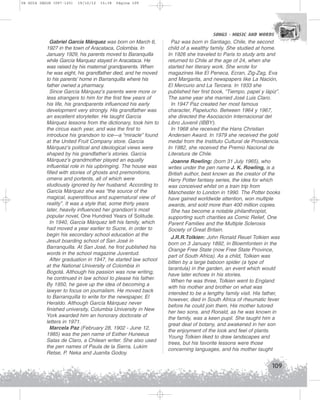
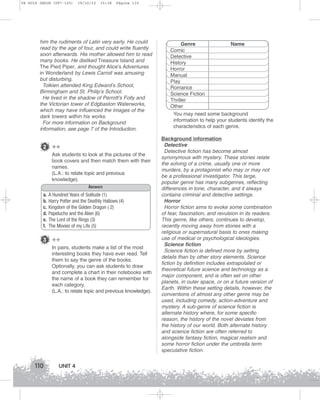
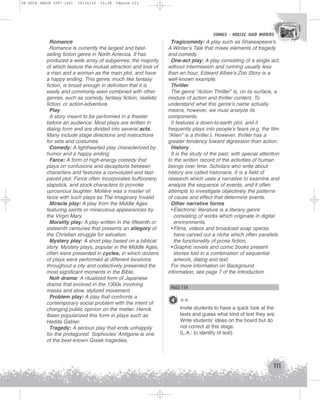
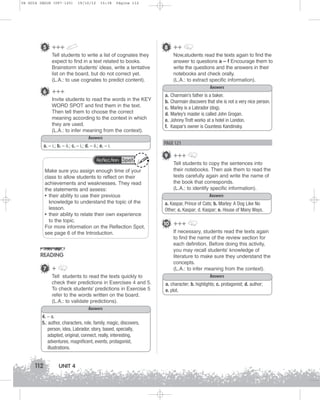
23/10/12

14:42

Página 1

GUÍA DIDÁCTICA DEL DOCENTE - INCLUYE TEXTO DEL ESTUDIANTE

Inglés

º

Medio

Lina Alvarado Jantus
Teacher of English
Instituto Profesional Chileno-Británico
INTRO GUIA ING1M (001-021)

19/10/12

15:16

Página 2

© Teens Club 1º Medio
Original text

Lina Alvarado Jantus
Teacher of English.
Instituto Profesional Chileno-Británico.

2010 Ediciones R&B ®
Nº de Inscripción: 183.657
ISBN: 978-956-8694-07-4
Reimpresión:
2011 Ediciones R&B ®
Nº de Inscripción: 183.657
ISBN: 978-956-8694-07-4
2012 Ediciones R&B ®
Nº de Inscripción: 183.657
ISBN: 978-956-8694-07-4
2013 Ediciones R&B ®
Nº de Inscripción: 183.657
ISBN: 978-956-8694-07-4
Original illustrations
Design

Ediciones R&B ®
Ediciones R&B ®

Publisher
Designed by
Cover designed by
Layout by
Proofreading
Illustrations
Production
Recording Producer
Photos

Gloria Caro Opazo
Cristina Sepúlveda Aravena
Thomas Connelly/Jolanta Polk
Fernando Santander Tiozzo
Ediciones R&B
Rodrigo González Díaz
Archivos Ediciones R&B

All rights reserved; no part of this publication may be reproduced, stored in a retrieval system,
transmitted in any form, or by any means, electronic, mechanical, photocopying, recording, or
otherwise, without the prior written permission of the publisher.
La materialidad y fabricación de este texto está certificado por el IDIEM - Universidad de Chile.
INTRO GUIA ING1M (001-021)

19/10/12

15:16

Página 3

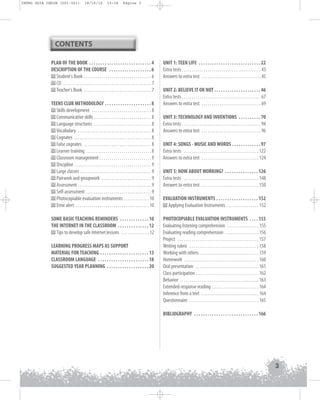
CONTENTS
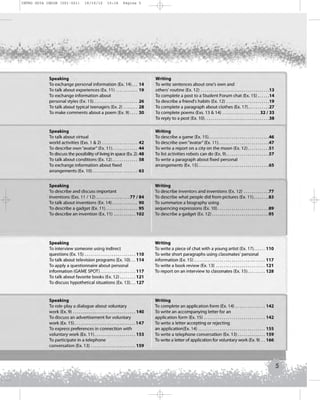
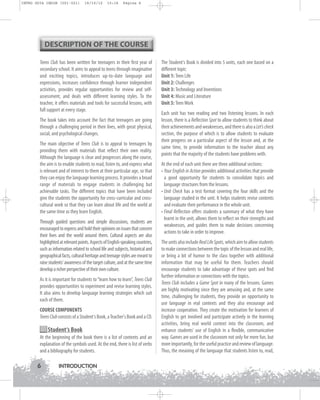
PLAN OF THE BOOK . . . . . . . . . . . . . . . . . . . . . . . . . . . . 4
DESCRIPTION OF THE COURSE . . . . . . . . . . . . . . . . . . . 6
Student's Book . . . . . . . . . . . . . . . . . . . . . . . . . . . . . . . . . . 6
CD . . . . . . . . . . . . . . . . . . . . . . . . . . . . . . . . . . . . . . . . . . . . . 7
Teacher's Book . . . . . . . . . . . . . . . . . . . . . . . . . . . . . . . . . . 7
TEENS CLUB METHODOLOGY . . . . . . . . . . . . . . . . . . . . . 8
Skills development . . . . . . . . . . . . . . . . . . . . . . . . . . . . . . 8
Communicative skills . . . . . . . . . . . . . . . . . . . . . . . . . . . . . 8
Language structures . . . . . . . . . . . . . . . . . . . . . . . . . . . . . 8
Vocabulary . . . . . . . . . . . . . . . . . . . . . . . . . . . . . . . . . . . . . 8
Cognates . . . . . . . . . . . . . . . . . . . . . . . . . . . . . . . . . . . . . . . 8
False cognates . . . . . . . . . . . . . . . . . . . . . . . . . . . . . . . . . . 8
Learner training . . . . . . . . . . . . . . . . . . . . . . . . . . . . . . . . . 8
Classroom management . . . . . . . . . . . . . . . . . . . . . . . . . . 9
Discipline . . . . . . . . . . . . . . . . . . . . . . . . . . . . . . . . . . . . . . . 9
Large classes . . . . . . . . . . . . . . . . . . . . . . . . . . . . . . . . . . . . 9
Pairwork and groupwork . . . . . . . . . . . . . . . . . . . . . . . . . 9
Assessment . . . . . . . . . . . . . . . . . . . . . . . . . . . . . . . . . . . . . 9
Self-assessment . . . . . . . . . . . . . . . . . . . . . . . . . . . . . . . . . 9
Photocopiable evaluation instruments . . . . . . . . . . . . . 10
Error alert . . . . . . . . . . . . . . . . . . . . . . . . . . . . . . . . . . . . . 10
SOME BASIC TEACHING REMINDERS . . . . . . . . . . . . . 10
THE INTERNET IN THE CLASSROOM . . . . . . . . . . . . . . 12
Tips to develop safe Internet lessons . . . . . . . . . . . . . . 12
LEARNING PROGRESS MAPS AS SUPPORT
MATERIAL FOR TEACHING . . . . . . . . . . . . . . . . . . . . . . 13
CLASSROOM LANGUAGE . . . . . . . . . . . . . . . . . . . . . . . 18
SUGGESTED YEAR PLANNING . . . . . . . . . . . . . . . . . . . 20

UNIT 1: TEEN LIFE . . . . . . . . . . . . . . . . . . . . . . . . . . . . 22
Extra tests . . . . . . . . . . . . . . . . . . . . . . . . . . . . . . . . . . . . . . . . 43
Answers to extra test . . . . . . . . . . . . . . . . . . . . . . . . . . . . . . 45
UNIT 2: BELIEVE IT OR NOT . . . . . . . . . . . . . . . . . . . . . 46
Extra tests . . . . . . . . . . . . . . . . . . . . . . . . . . . . . . . . . . . . . . . . 67
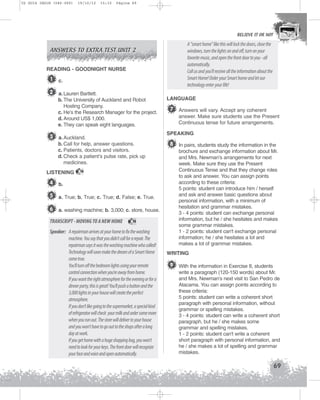
Answers to extra test . . . . . . . . . . . . . . . . . . . . . . . . . . . . . . 69
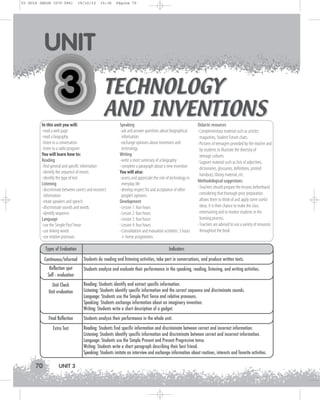
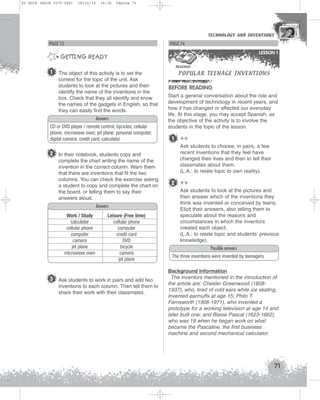
UNIT 3: TECHNOLOGY AND INVENTIONS . . . . . . . . . . 70
Extra tests . . . . . . . . . . . . . . . . . . . . . . . . . . . . . . . . . . . . . . . . 94
Answers to extra test . . . . . . . . . . . . . . . . . . . . . . . . . . . . . . 96
UNIT 4: SONGS - MUSIC AND WORDS . . . . . . . . . . . . . 97
Extra tests . . . . . . . . . . . . . . . . . . . . . . . . . . . . . . . . . . . . . . 122
Answers to extra test . . . . . . . . . . . . . . . . . . . . . . . . . . . . . 124
UNIT 5: HOW ABOUT WORKING? . . . . . . . . . . . . . . . 126
Extra tests . . . . . . . . . . . . . . . . . . . . . . . . . . . . . . . . . . . . . . 148
Answers to extra test . . . . . . . . . . . . . . . . . . . . . . . . . . . . . 150
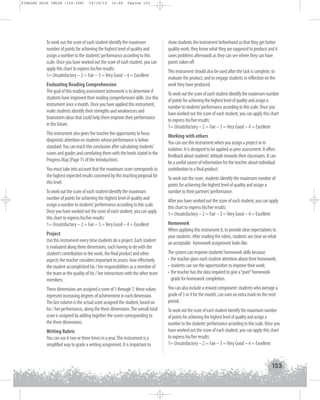
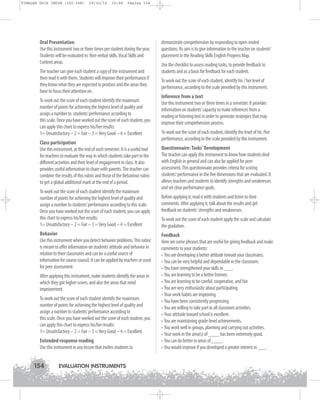
EVALUATION INSTRUMENTS . . . . . . . . . . . . . . . . . . . 152
Applying Evaluation Instruments . . . . . . . . . . . . . . . . 152
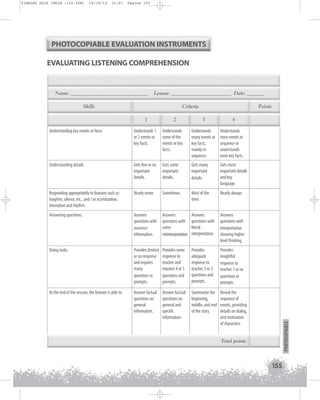
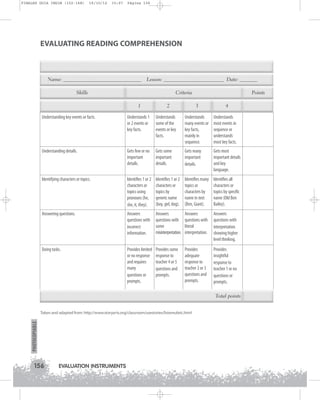
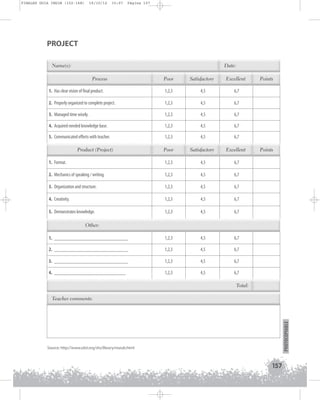
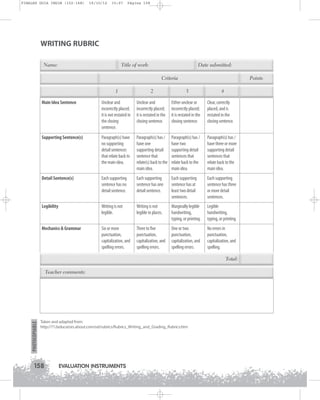
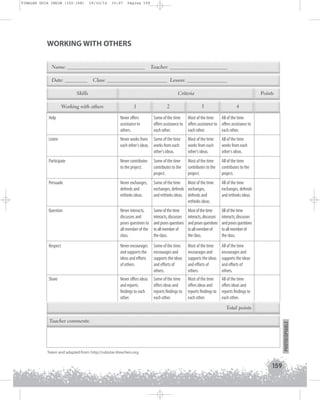
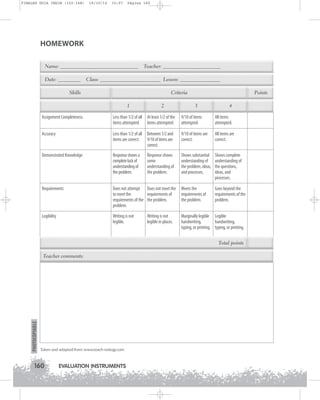
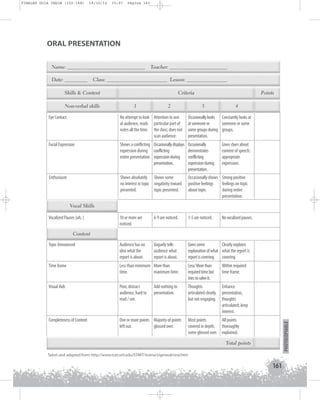
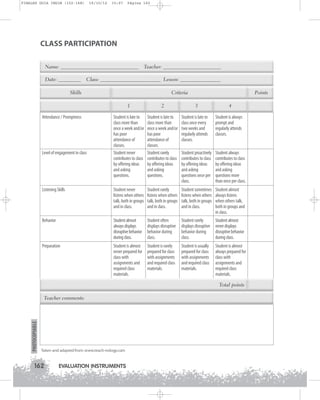
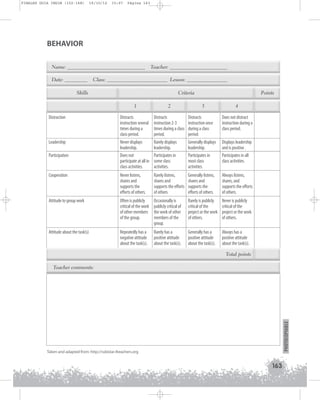
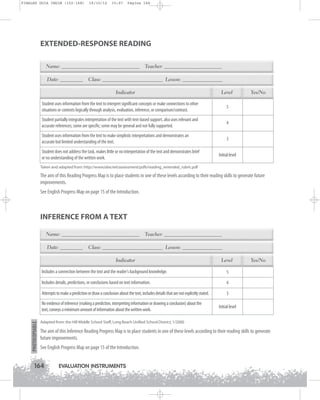
PHOTOCOPIABLE EVALUATION INSTRUMENTS . . . . 155
Evaluating listening comprehension . . . . . . . . . . . . . . . . 155
Evaluating reading comprehension . . . . . . . . . . . . . . . . . 156
Project . . . . . . . . . . . . . . . . . . . . . . . . . . . . . . . . . . . . . . . . . 157
Writing rubric . . . . . . . . . . . . . . . . . . . . . . . . . . . . . . . . . . . 158
Working with others . . . . . . . . . . . . . . . . . . . . . . . . . . . . . . 159
Homework . . . . . . . . . . . . . . . . . . . . . . . . . . . . . . . . . . . . . . 160
Oral presentation . . . . . . . . . . . . . . . . . . . . . . . . . . . . . . . . 161
Class participation . . . . . . . . . . . . . . . . . . . . . . . . . . . . . . . . 162
Behavior . . . . . . . . . . . . . . . . . . . . . . . . . . . . . . . . . . . . . . . . 163
Extended-response reading . . . . . . . . . . . . . . . . . . . . . . . . 164
Inference from a text . . . . . . . . . . . . . . . . . . . . . . . . . . . . . 164
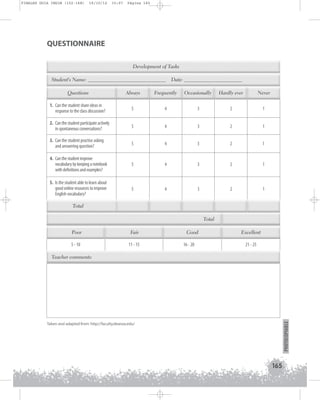
Questionnaire . . . . . . . . . . . . . . . . . . . . . . . . . . . . . . . . . . . 165
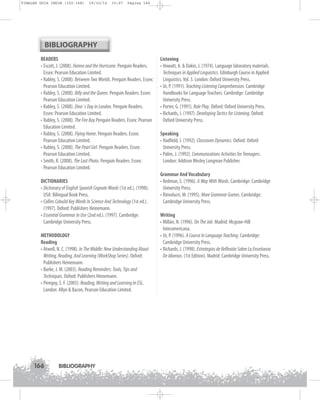
BIBLIOGRAPHY . . . . . . . . . . . . . . . . . . . . . . . . . . . . . 166

3
INTRO GUIA ING1M (001-021)

4

19/10/12

15:16

Página 4
INTRO GUIA ING1M (001-021)

19/10/12

15:16

Página 5

5
INTRO GUIA ING1M (001-021)

19/10/12

15:16

Página 6

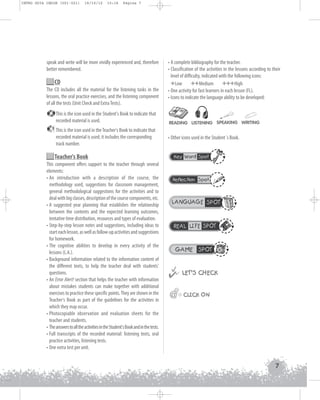
DESCRIPTION OF THE COURSE
Teens Club has been written for teenagers in their first year of
secondary school. It aims to appeal to teens through imaginative
and exciting topics, introduces up-to-date language and
expressions, increases confidence through learner independent
activities, provides regular opportunities for review and selfassessment, and deals with different learning styles. To the
teacher, it offers materials and tools for successful lessons, with
full support at every stage.
The book takes into account the fact that teenagers are going
through a challenging period in their lives, with great physical,
social, and psychological changes.
The main objective of Teens Club is to appeal to teenagers by
providing them with materials that reflect their own reality.
Although the language is clear and progresses along the course,
the aim is to enable students to read, listen to, and express what
is relevant and of interest to them at their particular age, so that
they can enjoy the language learning process. It provides a broad
range of materials to engage students in challenging but
achievable tasks. The different topics that have been included
give the students the opportunity for cross-curricular and crosscultural work so that they can learn about life and the world at
the same time as they learn English.
Through guided questions and simple discussions, students are
encouraged to express and hold their opinions on issues that concern
their lives and the world around them. Cultural aspects are also
highlighted at relevant points. Aspects of English-speaking countries,
such as information related to school life and subjects, historical and
geographical facts, cultural heritage and teenage styles are meant to
raise students' awareness of the target culture, and at the same time
develop a richer perspective of their own culture.
As it is important for students to “learn how to learn”, Teens Club
provides opportunities to experiment and revise learning styles.
It also aims to develop language learning strategies which suit
each of them.
COURSE COMPONENTS
Teens Club consists of a Student's Book, a Teacher's Book and a CD.

Student‘s Book
At the beginning of the book there is a list of contents and an
explanation of the symbols used. At the end, there is list of verbs
and a bibliography for students.

6

INTRODUCTION

The Student's Book is divided into 5 units, each one based on a
different topic:
Unit 1: Teen Life
Unit 2: Challenges
Unit 3: Technology and Inventions
Unit 4: Music and Literature
Unit 5: Teen Work
Each unit has two reading and two listening lessons. In each
lesson, there is a Reflection Spot to allow students to think about
their achievements and weaknesses, and there is also a Let's check
section, the purpose of which is to allow students to evaluate
their progress on a particular aspect of the lesson and, at the
same time, to provide information to the teacher about any
points that the majority of the students have problems with.
At the end of each unit there are three additional sections:
• Your English in Action provides additional activities that provide
a good opportunity for students to consolidate topics and
language structures from the lessons.
• Unit Check has a test format covering the four skills and the
language studied in the unit. It helps students revise contents
and evaluate their performance in the whole unit.
• Final Reflection offers students a summary of what they have
learnt in the unit, allows them to reflect on their strengths and
weaknesses, and guides them to make decisions concerning
actions to take in order to improve.
The units also include Real Life Spots, which aim to allow students
to make connections between the topic of the lesson and real life,
or bring a bit of humor to the class together with additional
information that may be useful for them. Teachers should
encourage students to take advantage of these spots and find
further information or connections with the topics.
Teens Club includes a Game Spot in many of the lessons. Games
are highly motivating since they are amusing and, at the same
time, challenging for students, they provide an opportunity to
use language in real contexts and they also encourage and
increase cooperation. They create the motivation for learners of
English to get involved and participate actively in the learning
activities, bring real world context into the classroom, and
enhance students' use of English in a flexible, communicative
way. Games are used in the classroom not only for mere fun, but
more importantly, for the useful practice and review of language.
Thus, the meaning of the language that students listen to, read,
INTRO GUIA ING1M (001-021)

19/10/12

15:16

Página 7

speak and write will be more vividly experienced and, therefore
better remembered.

CD
The CD includes all the material for the listening tasks in the
lessons, the oral practice exercises, and the listening component
of all the tests (Unit Check and Extra Tests).
This is the icon used in the Student's Book to indicate that
recorded material is used.
1

This is the icon used in the Teacher's Book to indicate that
recorded material is used; it includes the corresponding
track number.

Teacher's Book
This component offers support to the teacher through several
elements:
• An introduction with a description of the course, the
methodology used, suggestions for classroom management,
general methodological suggestions for the activities and to
deal with big classes, description of the course components, etc.
• A suggested year planning that establishes the relationship
between the contents and the expected learning outcomes,
tentative time distribution, resources and types of evaluation.
• Step-by-step lesson notes and suggestions, including ideas to
start each lesson, as well as follow-up activities and suggestions
for homework.
• The cognitive abilities to develop in every activity of the
lessons (L.A.).
• Background information related to the information content of
the different texts, to help the teacher deal with students'
questions.
• An Error Alert! section that helps the teacher with information
about mistakes students can make together with additional
exercises to practice these specific points. They are shown in the
Teacher's Book as part of the guidelines for the activities in
which they may occur.
• Photocopiable observation and evaluation sheets for the
teacher and students.
• The answers to all the activities in the Student's Book and in the tests.
• Full transcripts of the recorded material: listening texts, oral
practice activities, listening tests.
• One extra test per unit.

• A complete bibliography for the teacher.
• Classification of the activities in the lessons according to their
level of difficulty, indicated with the following icons:
+Low ++Medium +++High
• One activity for fast learners in each lesson (FL).
• Icons to indicate the language ability to be developed:

READING LISTENING SPEAKING WRITING

• Other icons used in the Student´s Book.
Key Word Spot

Reflection Spot

LANGUAGE SPOT

REAL LIFE SPOT

GAME SPOT


 LET’S CHECK
@

@@ CLICK ON

7
INTRO GUIA ING1M (001-021)

19/10/12

15:16

Página 8

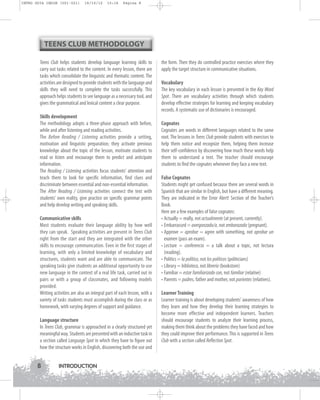
TEENS CLUB METHODOLOGY
Teens Club helps students develop language learning skills to
carry out tasks related to the content. In every lesson, there are
tasks which consolidate the linguistic and thematic content. The
activities are designed to provide students with the language and
skills they will need to complete the tasks successfully. This
approach helps students to see language as a necessary tool, and
gives the grammatical and lexical content a clear purpose.
Skills development
The methodology adopts a three-phase approach with before,
while and after listening and reading activities.
The Before Reading / Listening activities provide a setting,
motivation and linguistic preparation; they activate previous
knowledge about the topic of the lesson, motivate students to
read or listen and encourage them to predict and anticipate
information.
The Reading / Listening activities focus students' attention and
teach them to look for specific information, find clues and
discriminate between essential and non-essential information.
The After Reading / Listening activities connect the text with
students' own reality, give practice on specific grammar points
and help develop writing and speaking skills.
Communicative skills
Most students evaluate their language ability by how well
they can speak. Speaking activities are present in Teens Club
right from the start and they are integrated with the other
skills to encourage communication. Even in the first stages of
learning, with only a limited knowledge of vocabulary and
structures, students want and are able to communicate. The
speaking tasks give students an additional opportunity to use
new language in the context of a real life task, carried out in
pairs or with a group of classmates, and following models
provided.
Writing activities are also an integral part of each lesson, with a
variety of tasks students must accomplish during the class or as
homework, with varying degrees of support and guidance.
Language structure
In Teens Club, grammar is approached in a clearly structured yet
meaningful way. Students are presented with an inductive task in
a section called Language Spot in which they have to figure out
how the structure works in English, discovering both the use and

8

INTRODUCTION

the form. Then they do controlled practice exercises where they
apply the target structure in communicative situations.
Vocabulary
The key vocabulary in each lesson is presented in the Key Word
Spot. There are vocabulary activities through which students
develop effective strategies for learning and keeping vocabulary
records. A systematic use of dictionaries is encouraged.
Cognates
Cognates are words in different languages related to the same
root. The lessons in Teens Club provide students with exercises to
help them notice and recognize them, helping them increase
their self-confidence by discovering how much these words help
them to understand a text. The teacher should encourage
students to find the cognates whenever they face a new text.
False Cognates
Students might get confused because there are several words in
Spanish that are similar in English, but have a different meaning.
They are indicated in the Error Alert! Section of the Teacher’s
Book.
Here are a few examples of false cognates:
• Actually = really, not actualmente (at present, currently).
• Embarrassed = avergonzado/a, not embarazada (pregnant).
• Approve = aprobar = agree with something, not aprobar un
examen (pass an exam).
• Lecture = conferencia = a talk about a topic, not lectura
(reading).
• Politics = la política, not los políticos (politicians)
• Library = biblioteca, not librería (bookstore)
• Familiar = estar familiarizado con, not familiar (relative)
• Parents = padres, father and mother, not parientes (relatives).
Learner Training
Learner training is about developing students' awareness of how
they learn and how they develop their learning strategies to
become more effective and independent learners. Teachers
should encourage students to analyze their learning process,
making them think about the problems they have faced and how
they could improve their performance. This is supported in Teens
Club with a section called Reflection Spot.
INTRO GUIA ING1M (001-021)

19/10/12

15:16

Página 9

Classroom management
In most cases the teacher is the only direct contact that students
have with English. Therefore, it is important that the teacher tries
to communicate with the students in English as much as possible.
Teachers can also use gestures or mime to help understanding.
Instructions for all the activities in Teens Club are given clearly and
simply, and teachers should encourage students to read and
interpret them on their own, and support them whenever
necessary through demonstration and examples.
Discipline
Teenage students are going through a difficult period of
development in their lives, so the teacher might face discipline
problems, disruptive behavior, or unwillingness to do the tasks
they are assigned.
One of the reasons for bad discipline is usually students' inability
to cope with the tasks. To avoid these problems, two preventive
strategies are suggested:
• Careful planning. Students realize there is a purpose which
keeps their attention on the task.
• Clear instructions. Instructions must be given clearly and
assertively, including time limits whenever possible, so that
students know what to do and when they should finish the task.
Large classes
Large mixed-ability classes are a reality teachers have to face
every day. Grouping is one technique that is used to reduce the
negative effects of this situation. When the class is divided into
smaller units, many learning activities can be undertaken. This
implies a different role for the teacher; this does not mean that he
/ she will become less active in the classroom, but that he / she
will not be the center of the activities. Teachers who monitor,
encourage and participate in different classroom groups are even
more active than traditional teachers.
By re-organizing the classroom to allow more opportunities for
communicative interactions and activities, students will be in a
better position to practice and acquire the foreign language.
Pairwork and groupwork
One of the ways of giving students the time they require to
practice a language in class is by forming groups or pairs. This
helps teachers to individualize their learners, provides
opportunities for sharing experiences and it may also help

teachers to accommodate learner differences by varying
student roles.
Teachers must bear in mind that this type of work encourages
students to share their skills and knowledge, and to learn from
each other. It also increases students' involvement and active
participation, and develops positive attitudes.
It is important to share with students the importance of these
activities that give them an opportunity to reinforce social and
communicative skills required to work with other people.
The teacher should take an active role in group and pair
formation, and students should take different roles each time.
Assessment
Assessment is one of the most valuable sources of information
about what is happening in the classroom. The involvement of
the students in this process makes their attitudes towards their
learning change significantly and they start to feel more
responsible for their progress.
In Teens Club, assessment is ongoing. The teacher assesses
continuously, in every activity, in every lesson, to see how far a
student is making progress in line with the objectives. He / she
uses the information obtained to help students with specific
problems. In each lesson there is one activity to evaluate one
particular aspect of that lesson, in the section called Let's
Check.
There is also an overall assessment, periodically, at the end of
each unit, with a test format, the Unit Check, which includes
evaluation activities of all the skills and language studied in the
unit. Teachers should encourage students to correct and mark
their Unit Check themselves, either on their own or in small
groups. Finally, at the very end of each unit there is a Final
Reflection section, which guides students to analyze their
performance in the whole unit. All these forms of assessment
complement each other.
Self-assessment
In Teens Club, self-assessment takes place in each lesson, so that
students have the opportunity to reflect on their progress and
their main problems. This type of assessment helps students to
become more efficient learners, as well as make them feel more
responsible for their own learning.
This is done lesson by lesson through the Reflection Spot, where
students are asked to think about their abilities to perform the

9
INTRO GUIA ING1M (001-021)

19/10/12

15:16

Página 10

tasks, how well they did and the difficulties they encountered. In
the Let's Check and Unit Check sections, students evaluate
themselves to become aware of their progress and in the Final
Reflection section they analyze their performance and make
decisions concerning steps they can take to improve.
Photocopiable Evaluation Instruments
The Teacher's Book offers a selection of rubrics and evaluation
sheets that the teacher can use in different situations, with
different purposes and with different students. The labels and
criteria can be adapted to the class situation, the topics covered,
the number of students, etc. They can be used by the teacher to
evaluate students, or by students to evaluate themselves and / or
their peers. As with all evaluation instances, these must be used

to inform the teacher and students of the progress made, the
areas that need revision and the level of achievement of learning
goals. The teacher may use the results of these evaluation
instances as part of the final mark of students; students must be
informed of the system applied. The teacher must give students
the instrument so that they can analyze it, draw conclusions and
make decisions.
Error Alert
Teens Club provides the teacher with help in connection with
common mistakes students might make, together with
additional exercises to practice these specific points. They are
shown in the Teacher's Book as part of the guidelines for the
activities in which they may occur.

SOME BASIC TEACHING REMINDERS
• Start every lesson in a way that focuses everyone's attention.
This creates expectation and prepares students for what is to
come. For example, with books closed, write the topic of the
lesson on the board and ask some questions about it, show a
poster / picture related to the lesson, ask who can remember
what they did the previous class, etc.
• Students should not open their books until everyone is paying
attention.
• End an activity before students get bored with it. Equally, do not
hurry students or end the activity too soon if they are obviously
enjoying it.
• Ask students their opinion.
• Don't assume that if one student says he or she understands,
everyone else does.
• Ask (elicit) rather than tell. Students get bored of listening to
the teacher explaining. Someone in the class will probably
know the answer.
• Don't ask students to explain difficult things, such as definitions
of words, in English.
• Don't interrupt students during pair / group speaking activities to
correct their English. It is better to note the main, common
mistakes, put them on the board and correct them with the class at
the end.

10

INTRODUCTION

• Don't insist on 100% accuracy all the time. Mistakes are a
normal part of the learning process, and a valuable source of
information for the teacher.
• Give praise and encouragement, especially to the weaker
students. Write positive comments on their work. Let them
know what they are doing well, as well as what they need to
improve.
• Remember that you are the main motivator in the classroom!

Some methodological suggestions for skill
development
Developing listening skills
• Follow the organization of activities into before, while and
after listening.
• Before listening:
- Introduce and get students involved in the topic of the text.
Elicit what they know about it and help them relate it to their
own experiences. Make use of the illustrations provided and /
or use your own.
- Use this introduction of the topic to present key vocabulary
and structures, and write them on the board.
INTRO GUIA ING1M (001-021)

19/10/12

15:16

Página 11

- Invite students to predict the content and to formulate
hypotheses of what will appear in the text.
- Do these activities quickly and take advantage of the interest
created to continue with the listening activities.
• Listening:
- Play the recording once or twice for students to check their
predictions and hypotheses. Accept other information they may
have gathered, but do not go into detail at this stage, just
concentrate on the general idea.
- Remind students of cognate words, which they can identify more
easily when they listen, and which help comprehension and
consequent task realization.
- Read and clarify instructions with the class, and do the different
listening activities one by one, concentrating on the task
assigned and checking answers after each successive listening.
Every time students listen to the text, they should have a clear
purpose and task, provided in the instructions, which will help
them focus their attention and identify the information required.
- Help students recognize different supporting elements in the
spoken texts: intonation, voice pitch, pauses, emphasis,
background noise, etc.

experiences. Make use of the illustrations provided and / or use
your own.
- Use this introduction of the topic to present key vocabulary and
structures, and write them on the board.
- Invite students to predict the content and to formulate
hypotheses of what will appear in the text.
- Always ask students to take a quick look at the text and identify
the cognate words and the words they already know. This will
help them formulate more informed hypotheses and also help
them feel less insecure when facing a new text.
- Draw students' attention to the structure of the text: layout,
punctuation, titles, subtitles, etc., to identify the type of text they
will be reading, all of which will also provide clues that will help
them understand the text.
- Do these activities quickly and take advantage of the interest
created to continue with the reading activities.

Developing reading skills
• Follow the organization of activities into before, while and after
reading.

• Reading:
- First, ask students to read the text quickly to check their
predictions and hypotheses. Accept other information they
may have gathered, but do not go into details at this stage,
just concentrate on the general idea.
- Remind students of cognates words, which they can
identify easily, and which help comprehension and
consequent task realization. Present false cognates if there are
any in the text.
- Read and clarify instructions with the class, and do the different
reading activities one by one, concentrating on the task assigned
and checking answers after each successive reading. Every time
students read the text, they should have a clear purpose and
task, provided in the instructions, which will help them focus
their attention and identify the information required.
- Help students recognize different supporting elements in the
written texts: text organization, reference markers, letter
types, graphic support, punctuation marks, illustrations, etc.
- Remind students of some general characteristics of text
organization: main ideas are usually at the beginning of each
paragraph, connectors give important clues -and indicates
addition, but, however indicate contradiction, because
indicates a reason, or indicates alternatives, etc.

• Before reading:
- Introduce and get students involved in the topic of the text. Elicit
what they know about it and help them relate it to their own

• After reading:
- Help students summarize the text orally and / or in writing
using the models provided.

• After listening:
- Help students summarize the text orally and / or in writing using
the models provided.
- Encourage reinforcement of vocabulary and grammar that
appeared in the text, always using the context and providing
further examples or similar contexts.
- Discuss the topic of the lesson, help students reflect on the
contents and highlight the values presented, making them
notice the connections with their own reality.
- Make students evaluate their own performance in the lesson.
a. Did their predictions help them understand the text?
b. How did they do in the different listening activities?
c. What new words, expressions or structures did they learn in
this lesson? Can they use them in other situations?

11
INTRO GUIA ING1M (001-021)

19/10/12

15:16

Página 12

- Encourage reinforcement of vocabulary and grammar that
appeared in the text, always using the context and providing
further examples or similar contexts.
- Discuss the topic of the lesson, help students reflect on the
contents and highlight the values presented, making them notice
the connections with their own reality.
- Make use of the activities for fast learners (FL) or of Your English in
Action in the Student's Book and of the Extra Tests in the Teacher's
Book to provide further practice in a freer context, either for the
whole class or for with faster, keener students. Invite them to
make comments on the contents and share them with the rest of
the class.
- Encourage students to make use of the Reflections section to
evaluate their own performance in the lesson.
Developing oral expression
• At the beginning of the course, prepare a poster / posters with the
class, showing the expressions they must use as part of the classroom
interaction. You may use different colors to classify them into:
a. Greetings: Good morning, good afternoon, hello, hi, good-bye,
bye. How are you today? I'm (not) very well, thank you. And you?
Teach them to address you as Mr. / Miss / Mrs. plus your surname.
b. Asking for help or clarification: How do you say / spell /
pronounce ...?, Can you help me, please? Can you repeat,
please? Can you play the recording again, please? Can I / we use

the dictionary / the computer? Can I work with ...? Can you tell /
give me ...?
c. Expressing feelings: I'm sorry / happy / impressed / tired / ill
/ worried. I'd be happy to ... . I like ... . I don't like ... . I liked ... . I
didn't like ... .
• Encourage students to use English to do the different speaking
activities that show comprehension.
• Choose relevant parts of the listening texts, especially dialogs, for
students to listen to, repeat, try to memorize and present in front of
the class.
• Create a positive atmosphere in the classroom to facilitate students'
participation in oral exchanges.
Developing written expression
• Always provide a model for students to follow. Go from simple,
strictly guided activities to more complex ones: just words that
students use to fill in blanks, or exercises in which they put words in
order to form sentences, short answers to simple questions, using a
pattern given and substituting some elements, etc.
• Make students aware of punctuation marks and connectors to be
used.
• Check written work while walking around the classroom, by
collecting notebooks, or by providing the correct versions on the
board or on a transparency.

THE INTERNET IN THE CLASSROOM
Nowadays, in the era of information revolution and the widespread
use of the Internet in almost all spheres of life, this tool can serve as
a teaching medium, a rich source of materials of any kind and also
as a basis for lessons instead of texts from the course book only.

people from different parts of the world and therefore practice their
English in a meaningful and motivating way.

Internet -assisted lessons may supplement teaching by adding an
additional dimension to the classroom. Students can use it to gather
information on different topics or search for additional exercises to
practice a particular language item.

@@ CLICK ON

The Internet gives great possibilities for students to work with
materials they choose themselves and offers an attractive and
interactive learning environment.
This is achieved by the use of communication tools such as e-mail,
chat or forum groups, which students can use to communicate with

12

INTRODUCTION

This icon indicates a digital resource used / suggested for an activity.

@

Tips to develop safe Internet lessons
• Never start lessons by having students use search engines on
their own.
• Ask students to find specific information, not just surf the web.
• Always tell students to write down the URLs of the sites they use
for reports in a bibliography format.
• Try to preview sites before students visit them.
INTRO GUIA ING1M (001-021)

19/10/12

15:16

Página 13

LEARNING PROGRESS MAPS AS SUPPORT MATERIAL FOR TEACHING 11
What we have in common makes us human. Our differences make
us individuals. In a classroom where there is very little or no
differentiated teaching only the similarities among students seem
to be the focus of attention. In a differentiated class the common
areas are acknowledged and exploited, and the differences among
students also become important elements in the teaching –
learning process.
Carol Ann Tomlinson 12

The Chilean Ministry of Education has presented the community
with a new curricular tool, the Learning Progress Maps. It is
possible that teachers may have a lot of information about them,
from different and probably more complete sources than those
provided here 13. This brief and concise document does not intend
to be exhaustive nor replace any of those sources. It only intends
to present the Maps in a particularly specific context, that of a
very specific training in evaluation for learning, as it is in that area
that they can be very useful in the different steps of that training.
This is a brief introduction to the Maps that considers the
inclusion principle that guides them, the way in which they are
presented, an example and some details to understand their
pedagogical and evaluative usefulness. Rather than theoretical or
conceptual details, special importance is given to the elements
that facilitate their use by teachers.
Introduction
The Learning Progress Maps have been developed to show
teachers, students and parents the way in which learning
progresses along school life, and especially the expected direction
for each of the areas of the curriculum. They are neither a new
curriculum nor a curricular alternative, but are based on the
existing Curricular Framework. Their objective is to describe the
types of learning promoted by the Fundamental Objectives and
the Obligatory Minimum Contents, and to indicate the
characteristics of their development from 5th Year of Primary
Education to 4th year of Secondary Education. The Maps can be

used in the day to day classroom work to establish the students’
position, their differences and their learning needs. Once this
reflection and awareness task is done, it is possible to design a
variety of teaching strategies to cater for the students’ needs.
Learning progression and diversity
Children’s learning – as shown every day in the teaching process
- shows progressive development as they move up from one level
to the next. Older students generally know more about a subject
and show more complex cognitive abilities than younger
students; when comparing abilities and knowledge of a 4th Media
student with those of a 1st Básica student, it can easily be noticed
that the former is much more competent than the latter in all the
learning areas. Between these two students, who represent the
extreme levels of achievement during the school cycle, it is
possible to distinguish several intermediate stages.
On the other hand, children in a particular level make use of
different abilities to understand the same topic, and have
different ways to explain what they understand. There is
progression not only from one level to the next; it is normal that
in the same class students are at different levels and show
different degrees of understanding and achievement of the
required abilities.
However, not all students progress in the expected direction.
Inadequate attention to differences can produce delay in the
students’ learning. This delay, in turn, has a cumulative effect, it
tends to increase in the upper levels, and when this happens, its
effects are more difficult to revert. Therefore, it is important to
clearly understand the state of students’ learning.
The Learning Progress Maps are a supporting instrument to
diagnose achievement and differences among students to help
them move on in their school work according to the expected
outcomes promoted by the national curriculum; they offer
common criteria and language to observe learning.

11

Document prepared by the Unidad de Currículum y Evaluación, Ministry of Education, Chile, 2007.
Tomlinson, Carol Ann, Estrategias para Trabajar con la Diversidad en el Aula, Editorial Paidós, Madrid, 2005.
13
The full Maps are published in the web site of the Unidad de Currículum y Evaluación, www.curriculum-mineduc.cl.
Please note that this document has been translated directly from the document prepared by the Unidad de Currículum y Evaluación of the Ministry of Education;
the superscript references have been kept the same as in the original document.
12

13
INTRO GUIA ING1M (001-021)

19/10/12

15:16

Página 14

Evaluation for Learning in Practice
It is important to distinguish Evaluation for Learning as a
particular model that is different from the traditional
interpretations of evaluation. Here is a summary of its main
characteristics. In this conception, evaluation:
• Is considered an intrinsic part of teaching and learning.
• Requires that teachers share with their students the learning
achievements expected from them.
• Helps students know and identify the standards they must
reach.
• Involves students in their own evaluation.
• Provides feedback that tells students what they have to do, step
by step, to improve their performance.
• Assumes that every student can improve his / her performance.
• Involves both teachers and students in the analysis and
reflection on the data provided by the evaluation.
This model contrasts with the type of evaluation that, in practice,
means adding evaluation procedures or tests at the end of the
programmed units of work. These procedures or tests are separable
and independent from the teaching of the unit. The feedback is to
get a mark. Although, according to this model, evaluation is a
teachers’ issue (the State, for example, does not get involved), it
tends to have a summative rather than formative objective.
However, the term formative can have several interpretations: very
often it only means that evaluation is frequent in a period of time
and has been planned together with the teaching. In this sense
formative evaluation does not necessarily consider all the features
identified as characteristic of Evaluation for Learning. Evaluation
can be formative because it helps the teacher identify areas where
more explanation or training are needed. From the point of view
of students, although their final mark and the comments written
on the margins of their work may signal their weak and strong
points, they do not give them clues as to how to progress towards
the achievement of more and better learning.
The concept of learning underlying this model is another
distinctive feature. Today’s approach to learning suggests that,
eventually, it is the students themselves who are responsible for
their own learning (nobody can learn for them). Consequently,
Evaluation for Learning must necessarily involve students in the

14

INTRODUCTION

evaluation process so as to provide information on their
performance and guide their efforts to improve. An important
part of this information is the feedback the teacher gives
students, but another part must be the result of the direct
participation of students in this process through self-evaluation.
In the context of promoting life-time learning, it is more and
more important to develop in the students the capacity to know
how much they have learnt and the ability to guide and manage
their own learning.
So, what actually happens in the classroom when evaluation is
used to improve learning? To begin with the more obvious
aspects, the teachers are involved in the collection of information
about their students’ learning and must motivate them to revise
their work critically and constructively.
The methods to obtain information about the learning are well
known and they are mainly:
• To observe students and listen to them when they reason and
describe their work.
• To ask students open questions, inviting them to explore their
ideas and reasoning.
• To propose ideas that require students to use certain abilities or
to apply ideas.
• To ask students to communicate their ideas not only in writing
but also through drawings, artefacts, actions, dramatisations
and concept maps.
• To discuss key words and analyse how they must be used.
Of course, teachers can collect this information through the
methods identified above, and then use it to improve learning. The
use of this information requires that teachers and students make
decisions and act: they must decide on the next steps in the
learning process and help students to get started. It is of the utmost
importance to remember that it is students who must do the work;
consequently, by being more involved in the process, students will
better understand how to extend and improve their learning. A
plan that involves students in the judgement of their own work instead of being passive to face their teachers' judgement - has
higher probabilities of raising learning and achievement standards.
INTRO GUIA ING1M (001-021)

19/10/12

15:16

Página 15

This is a different conception of feedback. The food the teacher
offers is a reflection of the objective to reach, of the standard or
goal towards which the student must aim at and which, in this
way, constitutes a point of comparison for his / her work. The role
of the teacher – and what constitutes the core of teaching – is to
provide students with the skills and strategies required to take
the steps they need to improve their own learning.
Key Principles of Evaluation for Learning
Evaluation is a process that allows the collection of evidence on
the learning achieved by the students at a given moment. The
object of the evaluation is the work produced by the student,
never the student.
• The key dimensions of learning from the point of view of the
learning area and the learning level of students constitute the
criteria used for the evaluation of learning.

What Learning Progress Maps are

• The criteria must be shared with students so that they know and
understand them, and can then direct their work accordingly.
• Self-evaluation and peer-evaluation must be done using preestablished criteria. If this does not happen their validity will be
questionable, because different individuals naturally evaluate
according to their own personal criteria.
• It must be remembered that evaluation necessarily involves
value judgements. This happens when a teacher assigns a
numerical qualification to a student’s test, and also when
concepts are used, for example poor or excellent to indicate a
student’s level of achievement at a certain moment.
• The teacher must take responsibility for the evaluation
instruments he / she develops and uses with the students; this
means that he / she must make sure that they really let him /
her collect information about the learning outcomes defined in
the pre-established evaluation criteria.

What Learning Progress Maps are not

They are materials for each area of the curriculum that describe the
usual road followed by students in their learning. They assume that
progress is the result of maturity and exposure to learning
opportunities in specific stages of school life.

They do not state that learning is lineal (a sum of specific learnings)
nor do they propose an exact description of the learning progress that
all students experience.

They express knowledge and abilities, that is to say, the competences
that students typically reach at certain moments of their school life.

They are not an expression of all the knowledge and abilities students
can achieve in a specific level.

They indicate what we value as learning goals and the sequence in
which they are achieved; they provide a framework to monitor
progress and communicate results.

They are not a new curriculum and they do not assume that all the
students in the same class should be in the same level of learning.

They are presented as concrete descriptions of learning and offer
examples of possible achievements in each level.

They are not checklists for test correction.

They provide a guiding framework for teaching: they let users
elaborate evaluation tasks that will indicate the level of each student,
and organise teaching strategies accordingly.

They are not an instrument to classify students and they do not
support a specific teaching model to achieve learning.

15
INTRO GUIA ING1M (001-021)

19/10/12

15:16

Página 16

How many LPMs have been prepared?
Each area of the curriculum has sub-divisions that represent
topics or abilities that must be developed during school life. A
Map has been designed for each of them.
English
Our country’s active participation in different areas of the
international sphere, together with the changes produced by
globalisation, make the learning of English essential to
successfully face the demands of society in the XXI century.
Learning English is a challenging and attractive activity at any age,
but particularly for young people who see it as a tool to access
information and technology and as a means of communication with
other realities and cultures. Learning English or any other foreign
language, contributes to the understanding of the mother tongue,
and at the same time it widens the opportunities to access
information in other areas of study.
Presentation of the Maps
The Maps are organised in seven levels that cover students’
learning life from the 1st year of Primary Education to the 4th
year of Secondary Education. Each level describes the expected
learning outcome for two school years. For example, level 1
corresponds approximately to the 1st and 2nd Básico, Level 2 to
the next two years, and so on. The last level (7) describes a
student whose outcome when finishing school is “outstanding”.
All this information can be found in the web site of the Unidad de
Currículum y Evaluación, www.curriculum-mineduc.cl.
Relevant aspects of the Reading Map
In concordance with the curricular emphasis aimed at the
development of the abilities and the use of language with the
purpose of acquiring information and gainning access to other
cultures and technological advances, grammar is not the focus of
attention of the Reading Map. Its role as a facilitator of
understanding and communication is acknowledged, but the role
of grammar will become more evident in the Writing Map.
The Reading Map emphasises the importance of working with
authentic texts as early as possible; their degree of complexity
increases as students move from one level to the next. By the end

16

INTRODUCTION

of their secondary school education students should be able to
read authentic texts of intermediate complexity, which implies
beginning their learning using simple authentic texts.
The Reading Map does not reject the use of the mother tongue as
a resource to monitor learning when the situation requires that
the students show evidence of comprehension and interpretation
rather than oral production. It is a well-known fact that students
of a foreign language can understand much more than they can
express orally or in writing. For this reason, the answers to the
tasks presented as examples in the Map are in Spanish. This does
not mean that students are not allowed to express
comprehension in English or that there is an intention to work
these abilities separately.
In the following pages you will find the Reading Progress Map. It
begins with a synthetic presentation of all the level. Then, each level
is presented in detail, beginning with its description, some examples
of performance that illustrate how that level of learning can be
recognised and one or two examples of work done by students of
subsidised schools, with the teacher’s comments that justify what
criteria is used to decide that the student is “within” the level. In an
appendix, you can find the complete version of the tasks from which
students’ work was collected. In the case of English, there is a
description of an initial level, before level 3, that describes a starting
situation of knowledge of this language, which can be a useful point
of reference to describe the learning of children who do not reach
level 3 by the end of 6th Básico. No examples of students’work at this
level are included.
Reading Progress Map
The aim of the English curriculum is to get students to use and
apply the language in different tasks that imply they can
understand oral and written texts, and solve simple
communicative situations orally or in writing. From this point of
view, four English Learning Maps have been designed, around the
following linguistic abilities:
• Reading
• Listening
• Writing
• Oral Expression
INTRO GUIA ING1M (001-021)

19/10/12

15:16

Página 17

The Maps of English have been designed using the international
standards of the Common European Framework (CEF) for
teaching, learning and evaluating languages, and those of the
Association of Language Testers of Europe (ALTE). CEF level A2 and
ALTE 1 (Waystage User) are associated with Level 4, which
describes the expected learning achieved by the majority of
students by the end of 8th year Básico; Level B1 and ALTE 2
(Threshold user) are associated with Level 6, which describes the
expected learning achieved by the majority of students by the
end of 4th Medio.
To describe progress in reading comprehension, the Reading Map
is organized around two dimensions:
a. Text-types. In this dimension the progression is given by the
complexity of the topics the students read about and the
complexity of the language used in the texts. There is

progression from concrete to abstract topics, and from
language expressed in simple sentences to language
expressed in compound sentences of intermediate complexity.
b. Reading abilities. This dimension includes students’
capacity to extract specific information, to infer information
and to show global comprehension of what they have read.
The Map describes how these reading abilities become more
complex from one level to the next, also in relationship with
the increasing complexity of the texts read.
In the light of these dimensions, the Map describes a student’s
reading comprehension progress, from the ability to identify some
highlighted information, to make simple inferences and state the
main topic of a very short, simple text (in level 3), to end up being
able to reach a higher level of inference and a deeper understanding
of linguistically and conceptually more complex texts. (level 6).

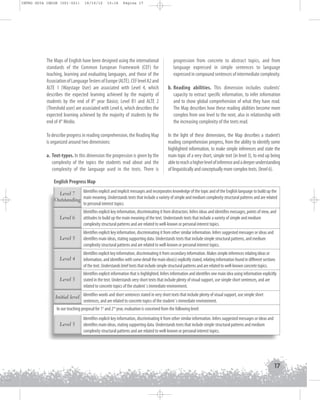
English Progress Map
Identifies explicit and implicit messages and incorporates knowledge of the topic and of the English language to build up the
Level 7
Outstanding main meaning. Understands texts that include a variety of simple and medium complexity structural patterns and are related
to personal interest topics.
Level 6

Identifies explicit key information, discriminating it from distractors. Infers ideas and identifies messages, points of view, and
attitudes to build up the main meaning of the text. Understands texts that include a variety of simple and medium
complexity structural patterns and are related to well-known or personal interest topics.

Level 5

Identifies explicit key information, discriminating it from other similar information. Infers suggested messages or ideas and
identifies main ideas, stating supporting data. Understands texts that include simple structural patterns, and medium
complexity structural patterns and are related to well-known or personal interest topics.

Level 4

Identifies explicit key information, discriminating it from secondary information. Makes simple inferences relating ideas or
information, and identifies with some detail the main idea(s) explicitly stated, relating information found in different sections
of the text. Understands brief texts that include simple structural patterns and are related to well-known concrete topics.

Level 3

Identifies explicit information that is highlighted. Infers information and identifies one main idea using information explicitly
stated in the text. Understands very short texts that include plenty of visual support, use simple short sentences, and are
related to concrete topics of the student´s immediate environment.

Initial level Identifies words and short sentences stated in very short texts that include plenty of visual support, use simple short
sentences, and are related to concrete topics of the student´s immediate environment.
In our teaching proposal for 1st and 2nd year, evaluation is conceived from the following level:
Level 5

Identifies explicit key information, discriminating it from other similar information. Infers suggested messages or ideas and
identifies main ideas, stating supporting data. Understands texts that include simple structural patterns and medium
complexity structural patterns and are related to well-known or personal interest topics.

17
INTRO GUIA ING1M (001-021)

19/10/12

15:16

Página 18

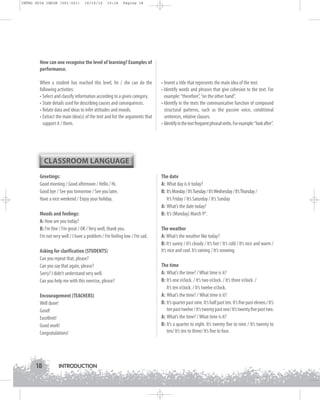
How can one recognise the level of learning? Examples of
performance.
When a student has reached this level, he / she can do the
following activities:
• Select and classify information according to a given category.
• State details used for describing causes and consequences.
• Relate data and ideas to infer attitudes and moods.
• Extract the main idea(s) of the text and list the arguments that
support it / them.

• Invent a title that represents the main idea of the text.
• Identify words and phrases that give cohesion to the text. For
example: “therefore”, “on the other hand”.
• Identify in the texts the communicative function of compound
structural patterns, such as the passive voice, conditional
sentences, relative clauses.
• Identify in the text frequent phrasal verbs. For example: “look after”.

CLASSROOM LANGUAGE
Greetings:
Good morning / Good afternoon / Hello / Hi.
Good bye / See you tomorrow / See you later.
Have a nice weekend / Enjoy your holiday.
Moods and feelings:
A: How are you today?
B: I’m fine / I’m great / OK / Very well, thank you.
I’m not very well / I have a problem / I’m feeling low / I’m sad.
Asking for clarification (STUDENTS)
Can you repeat that, please?
Can you say that again, please?
Sorry? I didn’t understand very well.
Can you help me with this exercise, please?
Encouragement (TEACHERS)
Well done!
Good!
Excellent!
Good work!
Congratulations!

18

INTRODUCTION

The date
A: What day is it today?
B: It’s Monday / It’s Tuesday / It’s Wednesday / It’s Thursday /
It’s Friday / It’s Saturday / It’s Sunday
A: What’s the date today?
B: It’s (Monday) March 9th.
The weather
A: What’s the weather like today?
B: It’s sunny / It’s cloudy / It’s hot / It’s cold / It’s nice and warm /
It’s nice and cool. It’s raining / It’s snowing.
The time
A: What’s the time? / What time is it?
B: It’s one o’clock. / It’s two o’clock. / It’s three o’clock. /
It’s ten o’clock. / It’s twelve o’clock.
A: What’s the time? / What time is it?
B: It’s quarter past nine. It’s half past ten. It’s five past eleven./ It’s
ten past twelve / It’s twenty past one/ It’s twenty five past two.
A: What’s the time? / What time is it?
B: It’s a quarter to eight. It’s twenty five to nine / It’s twenty to
ten/ It’s ten to three/ It’s five to four.
INTRO GUIA ING1M (001-021)

19/10/12

15:16

Página 19

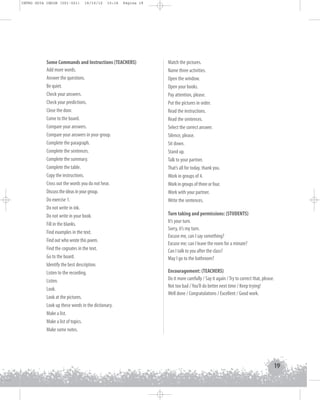
Some Commands and Instructions (TEACHERS)
Add more words.
Answer the questions.
Be quiet.
Check your answers.
Check your predictions.
Close the door.
Come to the board.
Compare your answers.
Compare your answers in your group.
Complete the paragraph.
Complete the sentences.
Complete the summary.
Complete the table.
Copy the instructions.
Cross out the words you do not hear.
Discuss the ideas in your group.
Do exercise 1.
Do not write in ink.
Do not write in your book.
Fill in the blanks.
Find examples in the text.
Find out who wrote this poem.
Find the cognates in the text.
Go to the board.
Identify the best description.
Listen to the recording.
Listen.
Look.
Look at the pictures.
Look up these words in the dictionary.
Make a list.
Make a list of topics.
Make some notes.

Match the pictures.
Name three activities.
Open the window.
Open your books.
Pay attention, please.
Put the pictures in order.
Read the instructions.
Read the sentences.
Select the correct answer.
Silence, please.
Sit down.
Stand up.
Talk to your partner.
That’s all for today, thank you.
Work in groups of 4.
Work in groups of three or four.
Work with your partner.
Write the sentences.
Turn taking and permissions: (STUDENTS)
It’s your turn.
Sorry, it’s my turn.
Excuse me, can I say something?
Excuse me; can I leave the room for a minute?
Can I talk to you after the class?
May I go to the bathroom?
Encouragement: (TEACHERS)
Do it more carefully / Say it again / Try to correct that, please.
Not too bad / You’ll do better next time / Keep trying!
Well done / Congratulations / Excellent / Good work.

19
INTRO GUIA ING1M (001-021)

19/10/12

15:16

Página 20

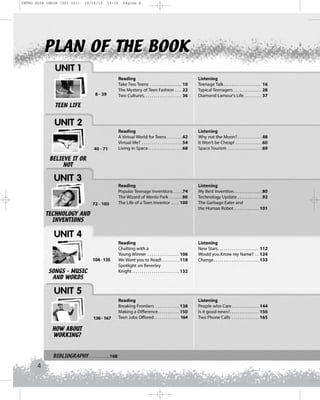
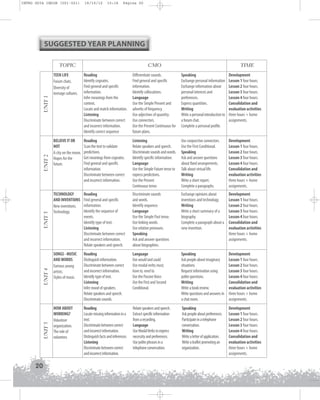
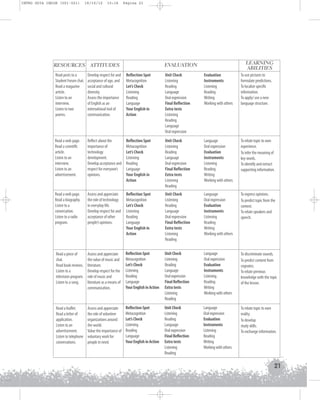
SUGGESTED YEAR PLANNING
CMO

UNIT 5

UNIT 4

UNIT 3

UNIT 2

UNIT 1

TOPIC

20

TIME

TEEN LIFE
Forum chats.
Diversity of
teenage cultures.

Reading
Identify cognates.
Find general and specific
information.
Infer meanings from the
context.
Locate and match information.
Listening
Discriminate between correct
and incorrect information.
Identify correct sequence

Differentiate sounds.
Find general and specific
information.
Identify collocations.
Language
Use the Simple Present and
adverbs of frequency.
Use adjectives of quantity.
Use connectors.
Use the Present Continuous for
future plans.

Speaking
Exchange personal information
Exchange information about
personal interests and
preferences.
Express quantities.
Writing
Write a personal introduction to
a forum chat.
Complete a personal profile.

Development
Lesson 1 four hours.
Lesson 2 four hours.
Lesson 3 four hours.
Lesson 4 four hours.
Consolidation and
evaluation activities
three hours + home
assignments.

BELIEVE IT OR
NOT
A city on the moon.
Hopes for the
future.

Reading
Scan the text to validate
predictions.
Get meanings from cognates.
Find general and specific
information.
Discriminate between correct
and incorrect information.

Listening
Relate speakers and speech.
Discriminate sounds and words.
Identify specific information.
Language
Use the Simple Future tense to
express predictions.
Use the Present
Continuous tense.

Use conjunctive connectors.
Use the First Conditional.
Speaking
Ask and answer questions
about fixed arrangements.
Talk about virtual life.
Writing
Write a short report.
Complete a paragraphs.

Development
Lesson 1 four hours.
Lesson 2 four hours.
Lesson 3 four hours.
Lesson 4 four hours.
Consolidation and
evaluation activities
three hours + home
assignments.

TECHNOLOGY
AND INVENTIONS
New inventions.
Technology.

Reading
Find general and specific
information.
Identify the sequence of
events.
Identify type of text.
Listening
Discriminate between correct
and incorrect information.
Relate speakers and speech.

Discriminate sounds
and words.
Identify sequence.
Language
Use the Simple Past tense.
Use linking words.
Use relative pronouns.
Speaking
Ask and answer questions
about biographies.

Exchange opinions about
inventions and technology.
Writing
Write a short summary of a
biography.
Complete a paragraph about a
new invention.

Development
Lesson 1 four hours.
Lesson 2 four hours.
Lesson 3 four hours.
Lesson 4 four hours.
Consolidation and
evaluation activities
three hours + home
assignments.

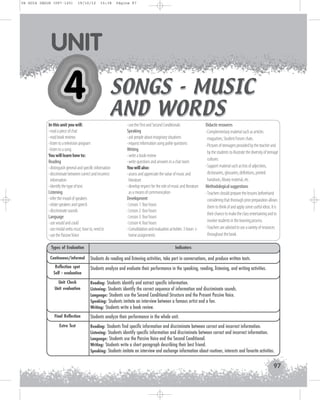
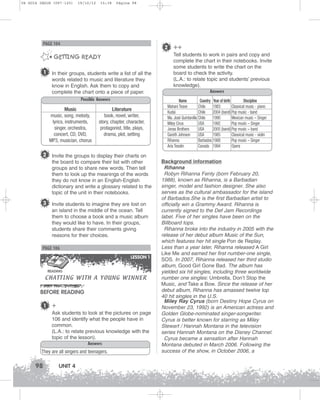
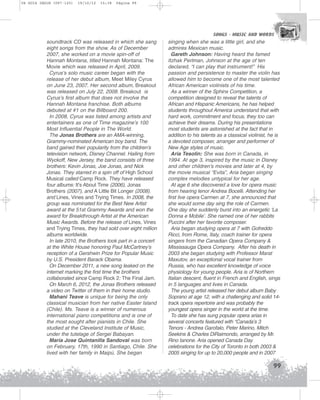
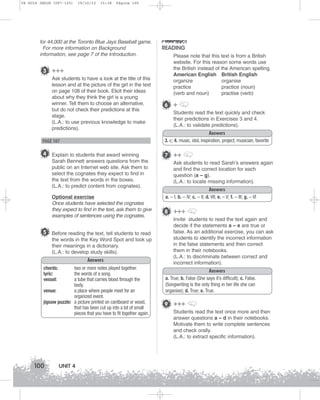
SONGS - MUSIC
AND WORDS
Famous young
artists.
Styles of music.

Reading
Distinguish information.
Discriminate between correct
and incorrect information.
Identify type of text.
Listening
Infer mood of speakers.
Relate speakers and speech.
Discriminate sounds.

Language
Use would and could.
Use modal verbs must,
have to, need to.
Use the Passive Voice.
Use the First and Second
Conditional.

Speaking
Ask people about imaginary
situations.
Request information using
polite questions.
Writing
Write a book review.
Write questions and answers in
a chat room.

Development
Lesson 1 four hours.
Lesson 2 four hours.
Lesson 3 four hours.
Lesson 4 four hours.
Consolidation and
evaluation activities
three hours + home
assignments.

HOW ABOUT
WORKING?
Volunteer
organization.
The role of
volunteer.

Reading
Locate missing information in a
text.
Discriminate between correct
and incorrect information.
Distinguish facts and inferences.
Listening
Discriminate between correct
and incorrect information.

Relate speakers and speech.
Extract specific information
from a recording.
Language
Use Modal Verbs to express
necessity and preferences.
Use polite phrases in a
telephone conversation.

Speaking
Ask people about preferences.
Participate in a telephone
conversation.
Writing
Write a letter of application.
Write a leaflet promoting an
organization.

Development
Lesson 1 four hours.
Lesson 2 four hours.
Lesson 3 four hours.
Lesson 4 four hours.
Consolidation and
evaluation activities
three hours + home
assignments.
INTRO GUIA ING1M (001-021)

19/10/12

15:16

Página 21

LEARNING
ABILITIES

EVALUATION

RESOURCES ATTITUDES
Read posts to a
Student Forum chat.
Read a magazine
article.
Listen to an
interview.
Listen to two
poems.

Develop respect for and
acceptance of age, and
social and cultural
diversity.
Assess the importance
of English as an
international tool of
communication.

Reflection Spot
Metacognition
Let’s Check
Listening
Reading
Language
Your English in
Action

Unit Check
Listening
Reading
Language
Oral expression
Final Reflection
Extra tests
Listening
Reading
Language
Oral expression

Evaluation
Instruments
Listening
Reading
Writing
Working with others

To use pictures to
formulate predictions.
To localize specific
information.
To apply/ use a new
language structure.

Read a web page.
Read a scientific
article.
Listen to an
interview.
Listen to an
advertisement.

Reflect about the
importance of
technology
development.
Develop acceptance and
respect for everyone’s
opinions.

Reflection Spot
Metacognition
Let’s Check
Listening
Reading
Language
Your English in
Action

Unit Check
Listening
Reading
Language
Oral expression
Final Reflection
Extra tests
Listening
Reading

Language
Oral expression
Evaluation
Instruments
Listening
Reading
Writing
Working with others

To relate topic to own
experience.
To infer the meaning of
key words.
To identify and extract
supporting information.

Read a web page.
Read a biography.
Listen to a
conversation.
Listen to a radio
program.

Assess and appreciate
the role of technology
in everyday life.
Develop respect for and
acceptance of other
people’s opinions.

Reflection Spot
Metacognition
Let’s Check
Listening
Reading
Language
Your English in
Action

Unit Check
Listening
Reading
Language
Oral expression
Final Reflection
Extra tests
Listening
Reading

Language
Oral expression
Evaluation
Instruments
Listening
Reading
Writing
Working with others

To express opinions.
To predict topic from the
context.
To relate speakers and
speech.

Read a piece of
chat.
Read book reviews.
Listen to a
television program.
Listen to a song.

Assess and appreciate
the value of music and
literature.
Develop respect for the
role of music and
literature as a means of
communication.

Reflection Spot
Metacognition
Let’s Check
Listening
Reading
Language
Your English in Action

Unit Check
Listening
Reading
Language
Oral expression
Final Reflection
Extra tests
Listening
Reading

Language
Oral expression
Evaluation
Instruments
Listening
Reading
Writing
Working with others

To discriminate sounds.
To predict content from
cognates.
To relate previous
knowledge with the topic
of the lesson.

Read a leaflet.
Read a letter of
application.
Listen to an
advertisement.
Listen to telephone
conversations.

Assess and appreciate
the role of volunteer
organizations around
the world.
Value the importance of
voluntary work for
people in need.

Reflection Spot
Metacognition
Let’s Check
Listening
Reading
Language
Your English in Action

Unit Check
Listening
Reading
Language
Oral expression
Final Reflection
Extra tests
Listening
Reading

Language
Oral expression
Evaluation
Instruments
Listening
Reading
Writing
Working with others

To relate topic to own
reality.
To develop
study skills.
To exchange information.

21
U1 GUIA ING1M (022-045).qxd

19/10/12

15:18

Página 22

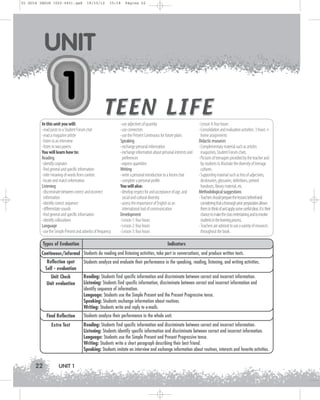
UNIT
TEEN LIFE

In this unit you will:
· read posts to a Student Forum chat
· read a magazine article
· listen to an interview
· listen to two poems
You will learn how to:
Reading
· identify cognates
· find general and specific information
· infer meaning of words from context
· locate and match information
Listening
· discriminate between correct and incorrect
information
· identify correct sequence
· differentiate sounds
· find general and specific information
· identify collocations
Language
· use the Simple Present and adverbs of frequency
Types of Evaluation

· use adjectives of quantity
· use connectors
· use the Present Continuous for future plans
Speaking
· exchange personal information
· exchange information about personal interests and
preferences
· express quantities
Writing
· write a personal introduction to a forum chat
· complete a personal profile
You will also:
· develop respect for and acceptance of age, and
social and cultural diversity
· assess the importance of English as an
international tool of communication
Development
· Lesson 1: four hours
· Lesson 2: four hours
· Lesson 3: four hours

· Lesson 4: four hours
· Consolidation and evaluation activities: 3 hours +
home assignments
Didactic resources
· Complementary material such as articles
magazines, Student Forum chats.
· Pictures of teenagers provided by the teacher and
by students to illustrate the diversity of teenage
cultures.
· Supporting material such as lists of adjectives,
dictionaries, glossaries, definitions, printed
handouts, library material, etc.
Methodological suggestions
· Teachers should prepare the lessons beforehand
considering that a thorough prior preparation allows
them to think of and apply some useful ideas. It is their
chance to make the class entertaining and to involve
students in the learning process.
· Teachers are advised to use a variety of resources
throughout the book.

Indicators

Continuous/informal Students do reading and listening activities, take part in conversations, and produce written texts.
Reflection spot
Self - evaluation
Unit Check
Unit evaluation

Final Reflection
Extra Test

22

UNIT 1

Students analyze and evaluate their performance in the speaking, reading, listening, and writing activities.

Reading: Students find specific information and discriminate between correct and incorrect information.
Listening: Students find specific information, discriminate between correct and incorrect information and
identify sequence of information.
Language: Students use the Simple Present and the Present Progressive tense.
Speaking: Students exchange information about routines.
Writing: Students write and reply to e-mails.
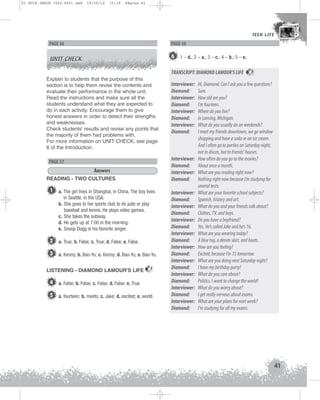
Students analyze their performance in the whole unit.

Reading: Students find specific information and discriminate between correct and incorrect information.
Listening: Students identify specific information and discriminate between correct and incorrect information.
Language: Students use the Simple Present and Present Progressive tense.
Writing: Students write a short paragraph describing their best friend.
Speaking: Students imitate an interview and exchange information about routines, interests and favorite activities.
U1 GUIA ING1M (022-045).qxd

19/10/12

15:18

Página 23

TEEN LIFE
TEEN LIFE

PAGE 8

2 +

GETTING READY
1

Introduce the topic of the unit reading the
title aloud. Then invite some students to
read what the young people on page 9 say
about being a teenager and ask them if they
agree or not.

2 Invite students to work in groups talking
about “being a teenager”. Encourage them
to make some notes and come to an
agreement. Then ask one member of each
group to share their comments with the rest
of the class.

3 First, ask students to copy the chart into their
notebooks. Then motivate them to interview
six of their classmates about their interests
and preferences in order to complete the
chart. Elicit students’ ideas about graphs and
then explain that they will have to present the
results for each item in a graph. You may
also give one example on the board.

PAGE 10
LESSON 1
READING

TAKE TWO TEENS

BEFORE READING
1

+
Draw students’ attention to the pictures and
then ask them to answer the questions in
pairs. Check their answers orally.
(L.A.: to use pictures to formulate
predictions).

Answers
a. Between 13 and 18 years old.
b. They are from different parts of the world.
c. They are: acting in a play, answering questions,
chatting and doing sports.
d. They are wearing costumes, sport and casual clothes.

Brainstorm aspects and activities that are
typical of teenagers in Chile and all over the
world. Invite students to write a list of them
in their notebooks and then write some
examples on the board.
(L.A.: to relate topic with personal reality).
Possible answers
hang out with friends; listen to music; play video
games; chat with friends; watch movies; play sports;
wear the same kind of clothes; surf the Internet.

3 ++
Ask students to choose the picture they
think best represents a typical Chilean
teenager. Ask them to support their ideas
and then to come to an agreement.
(L.A.: to relate pictures with personal
experiences).

4 +++
Explain to students that they are going to
read two posts from a Students Forum chat.
Invite them to make predictions about the
two students’ way of life.
(L.A.: to use general knowledge to formulate
predictions).

5 ++
Tell students to look at the text and find all
the cognates. Then ask what information
they can deduce from them. You can ask
them to write the cognates on the board, but
do not check what students can deduce
from them at this stage.
(L.A.: to identify cognates through
scanning).
Answers
forum, different, traditional, TV, music, computer, chat,
cyber cafe, culture, kilometers, fan, Internet, rest,
sports.

23
U1 GUIA ING1M (022-045).qxd

19/10/12

15:18

Página 24

ERROR ALERT
Cognates are words in different languages related to the
same root, ex.: education (English) / educación (Spanish)
Students might get confused because there are also
several words in Spanish that are similar in English, but
have a different meaning. These words are called False
Cognates.
Exercise: Read the words in the list. Identify the false
cognates in it.
actual / embarrassed / familiar / introduce / lecture /
notice / parents / realize
Answers:
The false cognates are:
Actual = real, not actual (present).
Examples: The actual cost was higher than expected.
Does anyone know her present address?
Embarrassed = avergozado/a, not embarazada
(pregnant).
Examples: She's embarrassed about her height. My
sister is pregnant with her first child.
Familiar = conocido, familiarizado, not familiar
(relative).
Examples: His face looks familiar to me. We saw most
of our relatives at the party.
Lecture = charla, not lectura (reading).
Examples: He gave a lecture on endangered species in
Chile. You can understand everything from the first
reading.
Notice = aviso, anuncio, not noticia (news).
Examples: Have you seen the notice on the board? The
news of the earthquake arrived two days later.
Parents = padres, not parientes (relatives).
Her parents got married very young. Most of my
relatives live in Santiago.
Realize = darse cuenta, comprender, not realizar
(carry out).
Example: I realized who he was.
For more information on ERROR ALERT, see page 7 of
the Introduction.

6 ++
Invite students to read the words in the Key
Word Spot and then find their definitions in
an English-English dictionary.
(L.A.: to develop study skills).

24

UNIT 1

Answers
Amish: member of an Anabaptist Christian denomination.
newbie: slang term for a newcomer to online gaming or
an Internet activity.
link: a connection between two or more people or things.
soaps: (also soap opera) a story which is broadcast
everyday or several times a week on television or radio.

PAGE 12

READING
7 +
Ask students to read the text quickly to
check their predictions in Exercise 4.
Explain to them that it is not necessary for
them to understand every single word. They
only have to get the general meaning of the
text in order to check if their predictions
were right.
(L.A: to validate predictions).
Answers
The students do not have similar ways of life.

8 ++
Now, invite your students to read the text
again carefully, and then answer the
questions (a – e) in their notebooks. Check
their answers orally or ask some students to
write the answers on the board.
(L.A.: to localize specific information).
a.
b.
c.
d.
e.

Answers
No, they are not typical teenagers because they live
in very different ways.
Josh 95 is American and Pink Sunshine is Australian.
Yes, he does, because he can go to a cyber cafe and
be in contact with the rest of the world.
She has e-lessons. She studies through the Internet.
Yes, it is. Because it is the way they can be in
contact with people from all around the world.
U1 GUIA ING1M (022-045).qxd

19/10/12

15:18

Página 25

TEEN LIFE
TEEN LIFE

9 ++
Make students copy the chart into their
notebooks and then complete it with
information from the text. Invite some of
them to write and complete the chart on the
board to check their answers.
(L.A.: to extract specific information).
Answers

information that is true for them. Then ask
them to answer questions a. and b.
Invite some of the students to share their
answers with their classmates.
(L.A.: to relate topic to personal experiences).
Answers
Will vary

LANGUAGE SPOT

Name

Josh 95

Pink Sunshine

Always

Wear traditional
clothes

Watch soaps
or movies

Go shopping
in the city

Read

Hardly ever

Use a computer

Meet friends

Never

Watch TV or
listen to music

Go to school

Likes /
Loves

Chat with
other people

Chat with
other people

Often

10 +++
Ask students to read the text once more
before completing the sentences in their
notebooks. Check their answers orally.
(L.A.: to identify specific information).
Possible answers
a. Josh95 and Pink Sunshine’s lives are similar because
they both live in a very different way others teenagers
do but they both like to know about people from all
over the world. They both live on a farm and they use
the Internet to communicate with other teens.
b. Josh95 and Pink Sunshine’s lives are different
because Josh is Amish and never watches TV or
listens to music, but he goes to school. Pink
Sunshine never goes to school but she always
watches TV or listens to music.

PAGE 13

AFTER READING

Habitual activities and frequency adverbs
This section is designed to help students revise
or discover a particular grammar structure or an
interesting item of vocabulary related to the text.
The activities are meant to promote independent
learning, so help, guide and check, but do not
enunciate the answers.
1. Ask students to read and analyze the
sentences from the text.
2. Now, students answer questions a. – c. Help
them to identify what kind of actions the
sentences express, the tense that was used
and the words that help to identify the
frequency in which the action was performed.
Answers: a. - iii.; b. – iii.; c. always, every,
never
3. Invite students to copy and complete the
general rule in their notebooks.
Answers:
We use the Simple Present tense to talk
about activities that are habitual.
We use words such as always, never,
every…, to express the frequency of the
activity.
4. Encourage students to revise the text again
and find other examples of this structure. Invite
them to write the examples in their notebooks
and underline the frequency adverb. You may
organize a class competition and offer a prize
to the student who identifies all the examples.
Answers:
I never watch TV or listen to music.
I always watch soaps or movies.
I hardly ever meet friends or go to parties.

11 ++
Tell the students to add a column to the
chart in Exercise 9, and to complete it with

25
U1 GUIA ING1M (022-045).qxd

19/10/12

15:18

Página 26

12 +

Reflection Spot

Refer students to the LANGUAGE SPOT to
write sentences about their and their
partner’s habitual activities. Invite some of
the students to write the sentences on the
board to check the answers.
(L.A.: to apply/ use a new language
structure).
Answers
Will vary

Assign enough time of your class to allow
students to reflect on their achievements and
weaknesses. They read the statements and
reflect about:
• their ability to exchange personal
information
• their ability to write about themselves
For more information on the Reflection Spot,
see page 6 of the Introduction.

16 +++

PAGE 14

13 ++

Motivate students to read the two posts and
answer them in their notebooks. Invite them
to compare their answers in their groups.
(L.A.: to give personal information in
writing).

1

In pairs, students listen and then repeat the
conversation.
(L.A.: to imitate intonation/pronunciation
patterns).

TRANSCRIPT ORAL PRACTICE
Diana:
Steve:
Diana:
Steve:
Diana:
Steve:
Diana:

1

Hi, my name's Diana. What's your name?
Hi, I'm Steve. Nice to meet you.
How old are you, Steve. And, where do you come from?
I'm 14, and I come from Canada.
What do you like doing in your free time?
I always do sports or visit my friends. And you?
I often do sports too, and I always chat on the
Internet with people from all over the world.

Answers
Will vary

PAGE 15

17

15 ++
Encourage students to complete the post to
introduce themselves to a Forum Chat.
Motivate them to be creative and write as if
they were chatting. You can assign this
activity as homework and check it orally the
next class
(L.A.: to express personal information).

26

UNIT 1

FL

Invite fast learners to read the posts again
and then answer the questions. Motivate
them to support their answers and
encourage them to share their conclusions
with the rest of their classmates. You can
organize a debate and then ask students to
come to an agreement.
(L.A.: to relate topic to personal reality / to
consolidate content of the lesson).

14 +++
Motivate students to replace the parts
underlined with information that is true for
them and then role-play the conversation in
front of their classmates.
(L.A.: to ask for and give personal
information).

+++

Answers
Will vary


 LET’S CHECK
18 The purpose of this section is to allow
students to check their progress and to
provide information to the teacher about any
points that the majority of students have
problems with. Make sure they understand
what they are expected to do and give them
enough time to answer individually. Then
U1 GUIA ING1M (022-045).qxd

19/10/12

15:18

Página 27

TEEN LIFE
TEEN LIFE

check on the board to allow students to
correct their work and assign a mark
according to the scale.
For more information on LET'S CHECK, see
page 6 of the Introduction.
Answers
Will vary. Accept any coherent ideas. For example: I
always swim in the swimming pool in summer. I hardly
ever eat hamburgers or junk food. I never sleep on my
stomach. I sometimes talk to my friends on my cell
phone. I usually play computer games in the evening.

REAL LIFE SPOT
This section is intended to allow students to make
connections between the topic of the lesson and
real life, and at the same time provide additional
information that may be useful for them.
Make sure you give enough time to read and then
elicit their comments.
For more information on the REAL LIFE SPOT,
see page 6 of the Introduction.

LESSON 2

TEENAGE TALK

BEFORE LISTENING
1

2 ++
Now, in pairs, students make a list of other
words related to teenagers. Check orally.
(L.A: to relate previous knowledge to the topic).
Answers
Will vary

PAGE 16

LISTENING

Answers
COMPUTERS / FASHION / FRIENDS / MUSIC / PARTIES
/ SPORTS / VIDEOGAMES
+ + + + + + + + N + + + + S +
+ + + + + + + + O S + + E + +
S E M A G O E D I V P I + + +
+ + + + + + + + H + T O + + +
+ + + + + + + + S R + + R + +
+ + + S + + + + A + + + + T +
+ + + + R + + P F + + + + + S
+ + + + + E + + + + + + + + +
+ + + + + + T + + + + + + + +
+ + + + + + + U + + + + + + +
F R I E N D S M P + + + + + +
+ + + + + + + U + M + + + + +
+ + + + + + + S + + O + + + +
+ + + + + + + I + + + C + + +
+ + + + + + + C + + + + + + +

+
Brainstorm students’ ideas about things or
activities that are related to teen culture.
Motivate them to find seven words related
to this topic in the Word Search puzzle. You
can divide the class into groups or pairs and
organize a competition, setting a time limit.
(L.A.: to use previous knowledge to
understand new vocabulary).

3 +++
Draw students’ attention to the photo and
ask them to answer the questions in their
groups. Invite one member of each group to
share their answers with the rest of their
classmates.
(L.A.: to infer information from pictures).
Answers
Will vary according to students’ ideas.

4 +++
Have students read the words in the Key
Word Spot and then identify their meanings
in the list. Allow them to use bilingual or
monolingual dictionaries if necessary.
(L.A.: to infer meaning from the context).
Answers
a. fed up; b. look forward to; c. wool

27
U1 GUIA ING1M (022-045).qxd

19/10/12

15:18

Página 28

Answers
look for a girlfriend (1); play the drums (3); talk about
music (2); wear a nice jacket (4)

PAGE 17

LISTENING
5 +

8 +++

2

Tell students that they are going to listen to
an interview with the boy in the photo.
Explain that this first time they don’t need to
pay attention to details. They must only get
the general content to check their
predictions in Exercise 3.
(L.A.: to validate predictions).
Answers
a. Yes, he does.
b. He’s from Chicago, in the USA.
c. He likes skateboarding, playing the guitar and
listening to music.
d. He cares about the environment.

6 ++

2

Students listen to the interview once more
and identify the correct alternative for each
sentence.
(L.A: to identify correct words).
Answers
a. friends; b. The Amazing Life of Birds; c. older;
d. homework; e. one week.
Reflection Spot

Make sure you assign enough time of your
class to allow students to reflect on their
achievements and weaknesses. They read
the statements and assess:
• their ability to use visuals to make
predictions
• their ability to distinguish sounds
For more information on the Reflection Spot,
see page 6 of the Introduction.

7 ++

2

Play the recording again. Ask students to
listen and match lists A and B. Then,
encourage them to find the correct picture
for each collocation.
(L.A.: to identify collocations / to relate text
and pictures).

28

UNIT 1

2

Play the recording again. This time,
students must listen and discriminate
between correct and incorrect information. If
necessary, play the recording again for
them to correct the false statements.
Alternatively, you can ask keener students
to do this and then to share their answers
with the rest of the class.
(L.A.: to discriminate between correct and
incorrect information).
Answers
a. False (he lives in a suburb of Chicago). b. False (he
goes skateboarding). c. False (he goes to the movies
once or twice a month). d. False (he is reading a book
about birds). e. True (and he also likes Spanish and
computer sciences). f. False (he is not looking for a
girlfriend). g. True.

TRANSCRIPT - TEENAGE TALK

2

Presenter: Danny Evans is 16, and lives in a suburb of
Chicago. Danny, what do you usually do on
weekends?
Danny:
I always go skateboarding and I play the drums. I
also often listen to music with my friends. And
we go to clubs every Saturday night.
Presenter: How often do you go to the movies?
Danny:
Once or twice a month.
Presenter: What are you reading right now?
Danny:
A great book called The Amazing Life of Birds, by
Gary Paulsen.
Presenter: What are your favorite subjects at school?
Danny:
History, Spanish and computer science.
Presenter: What do you and your friends talk about?
Danny:
Girls, sports and music.
Presenter: Do you have a girlfriend?
Danny:
No; all the girls like older boys, because they have
cars, and jobs and money. Anyway, I’m not
looking for a girlfriend.
Presenter: What are you wearing today?
Danny:
I’m wearing a fleece jacket, jeans and sneakers.
U1 GUIA ING1M (022-045).qxd

19/10/12

15:18

Página 29

TEEN LIFE
TEEN LIFE

Presenter:
Danny:
Presenter:
Danny:

How are you feeling?
I’m fed up with homework.
What are you doing on your next vacation?
I’m spending a week with my cousins in the
country. I can’t wait!
Presenter: What kind of things do you really care about?
Danny:
I think the environment is really important. We
must stop the destruction of our planet!
PAGE 18

9 +
Refer students to the LANGUAGE SPOT to
copy and complete the dialogs using the
Simple Present or the Present Progressive
of the verbs in brackets. Then ask them to
relate each dialog with a picture.
(L.A.: to apply a language structure).
Answers
a. does, do, He / She plays. (3)
b. is, doing, is organizing. (2)
c. do, eat, drink (1)

AFTER LISTENING
LANGUAGE SPOT
The Present Progressive for future plans
This section is designed to help students revise
or discover a particular grammar structure or an
interesting item of vocabulary related to the text.
The activities are meant to promote independent
learning, so help, guide and check, but do not
enunciate the answers.
1. Students read the questions and answers from
the interview carefully.
2. Help them identify which exchange talks about
an event that is happening now and which
exchange talks about future plans.
Answers:
a.- a.; b. – b.; c. – ii.
3. Now students copy and complete the general
rule in their notebook.
Answers:
We use the Present Progressive to talk about
temporary events and about what is happening
now.
We can also use the Present Progressive to
talk about future plans and arrangements.

ERROR ALERT
Present Progressive: I’m wearing a uniform / He is reading
a book (NOT: I wearing a uniform / He reading a book)
Exercise: Use the prompts to write sentences in the
Present Progressive tense.
a. Anna / cook / the meal.
b. Bill / play / chess / his friends.
c. Diana / sleep / her best friend’s house.
d. Nick and Jill / swim / the pool.
e. Bob / read / a novel.
f. Jim and Sheila / have / dinner.
g. My parents / watch / a movie.
h. Ann / help / her mother.
i. The plane / take off.
j. Tina and Margaret / travel / around the world.
For more information on ERROR ALERT, see page 7 of
the Introduction.

4. Invite your students to speculate about two
more plans that Danny may have and then
write sentences in their notebooks. Check their
answers orally.
Answers:
Will vary. Accept any coherent ideas, such as:
Danny is visiting his family on Saturday; Danny
is riding a horse tomorrow morning; Danny is
doing sports on the weekend, etc.

29
U1 GUIA ING1M (022-045).qxd

19/10/12

15:18

Página 30

PAGE 19

GAME SPOT

10 ++

3

In groups, students complete the extract
from the interview in their notebooks. Then
play the recording and ask them to compare
their answers.
(L.A.: to ask and give information).
Answers
See transcript.

TRANSCRIPT ORAL PRACTICE
Presenter:
Leo:
Presenter:
Leo:
Presenter:
Leo:
Presenter:
Leo:
Presenter:
Leo:

3

How often do you go to the movies?
Once or twice a month.
What are you reading right now?
A great book called The Golden Compass.
What are your favorite subjects at school?
Drama, Spanish and computer science.
What do you and your friends talk about?
Sports and music.
What are you doing next weekend?
We are playing football and going to a birthday
party.

11 +++
Ask students to ask and answer the
questions in the interview with their
partners. Then encourage them to practice
and act it in front of their classmates.
Motivate them to participate actively in this
kind of activities, which are, in most cases,
the only opportunity they have to use
English.
(L.A.: to ask for and give information).

12 +
Using the information from the interview,
students complete the description of their
partners in their notebooks. Choose some
of them to read the descriptions aloud to
provide a model for their classmates. You
can also assign this activity for homework.
(L.A.: to consolidate content of the lesson).

30

UNIT 1

PLAY THE DON’T ANSWER BACK GAME
This game guarantees confusion and lots of
laughter in the classroom (perfect for teenagers!).
a.
Ask students to write down questions like
those in the interview and in Exercise 10.
b.
Form groups of six students and sit them in
a circle.
c.d.e. Write a question on the board.
Example: What’s your name?
Explain that the aim for each student is to
give the answer to the question asked to
the student before. To help explain this, get
a student to ask you a question (ex: Have
you got a sister?), don’t answer this
question but tell your name (answering the
question written on the board).
f.g. Start the game. Each player has 3 lives. If
he/she doesn’t answer the correct question,
or he/she hesitates for too long, he /she
loses a life. The winner/s is / are the player/s
with most lives at the end of the time limit.
For more information on the GAME SPOT, see
page 7 of the Introduction.

PAGE 20


 LET’S CHECK
13 The purpose of this section is to allow
students to check their progress and to
provide information to the teacher about any
points that the majority of students have
problems with. Make sure they understand
what they are expected to do and give them
enough time to answer individually. Then
check on the board to allow students to
correct their work and assign a mark
according to the scale.
For more information on LET'S CHECK, see
page 6 of the Introduction.
U1 GUIA ING1M (022-045).qxd

19/10/12

15:18

Página 31

TEEN LIFE
TEEN LIFE

Answers
The questions should be the same, but the answers will
vary, according to students' ideas. Make sure they are
coherent and use the correct language form.
a. What are you doing on Saturday morning? I'm / We
are …ing … .
b. What are you and your friends doing on your next
vacations? We are …ing … .
c. What clothes are you wearing for the birthday party?
I'm wearing ____.

14 ++ FL
Motivate keener students to unscramble the
words related to clothes and then match
them to the correct picture. Invite them to
share their answer with the rest of the class.
(L.A.: to consolidate vocabulary / to relate
words and pictures).
Answers
a. jacket (3); b. jeans (5); c. sneakers (8); d. top (6);
e. boots (1); f. t-shirt (7); g. shirt (2); h. skirt (4)

PAGE 21

15 +++
In pairs, students take turns to describe the
pictures, saying what the people are doing.
Select some students to describe the
pictures aloud in order to check the answers.
(L.A.: to describe pictures / to use a
language structure).
1.
2.
3.
4.
5.
6.

Answers
The girl is reading a magazine.
The boy is watching TV.
The boy is playing basketball.
The girls are talking about boyfriends / fashion /
music, etc.
The girl is wearing smart clothes.
The boy is playing video games.

REAL LIFE SPOT
The objective of this section is to provide a bit of
humor to the class. Anyway, all the jokes and
cartoons are related to the topic of the lesson.
Give students some time to read and then invite
them to share their comments to make sure they
understood the joke. At this point, you may allow
the use of Spanish to check comprehension.
For more information on the REAL LIFE SPOT,
see page 6 of the Introduction.

PAGE 22
LESSON 3

THE MYSTERY OF TEEN FASHION

READING

BEFORE READING
1

+
You can introduce the topic of the lesson
starting a conversation about teen fashion.
Elicit students’ ideas about this issue and
make notes on the board. Then ask the
students to look at the pictures and describe
the clothes the teens are wearing. Finally,
ask their opinion about the style they like
most.
(L.A.: to express opinions / to relate topic
with own reality).

2 ++
Motivate students to find out if they are
fashion victims. Tell them to answer the
questions honestly, calculate their scores
and then compare the results with their
partners or in their groups. Take advantage
of the activity to start a general conversation
about the relation between fashion trends
and teenagers.
(L.A.: to relate topic to personal
experiences).
Answers
Will vary.

31
U1 GUIA ING1M (022-045).qxd

19/10/12

15:18

Página 32

PAGE 24

3 +++
Tell students to read statements a – d and
then choose the ones they think are true.
Do not check answers at this point.
(L.A.: to use previous knowledge to
formulate predictions).

READING
6 +
Students read the text quickly and confirm
or correct their choices in Exercise 3.
Remind them that this first reading is only to
validate their predictions; it is not necessary
to understand every single word.
(L.A.: to validate predictions).

PAGE 23

4 +
Ask students to take a look at the text and
identify all the cognates they can find.
Check orally or ask some students to write
the list of cognates on the board. Remind
them that this first reading must be very
quick, only to find key words that may help
them understand the text.
(L.A.: to identify cognates through
scanning).

Answers
All the statements are true.

7 ++
Now the students must read the article
carefully and answer the questions in their
notebooks. You can ask some students to
read their answers aloud to check the
exercise.
(L.A.: to identify specific information).

Answers
fascinating, neon, colored, common, bands, accessories,
dictates, companies, specialize, hours, television,
different, style, influence, pop culture, shows, music,
celebrities, impact, millions, dollars, identify.

a.
b.

ERROR ALERT

c.
d.

False cognates
Notice = see, observe, pay attention (NOT: noticia)
For more information on ERROR ALERT, see page 7 of
the Introduction.

5 ++
Draw students’ attention to the words in the
Key Word Spot and tell them to find their
definitions in column A. Then ask them to
identify their synonyms in column B.
(L.A.: to infer meaning of key words).
Answers
bare: not covered by any clothes; naked
household: connected with the house; domestic
track down: to find something; detect
trend: a general style; tendency

32

UNIT 1

Answers
Neon-colored hair; pierced tongues; bare stomachs.
They travel all over the world and watch thousands
of hours of movies and television.
Pop culture.
They spend millions of dollars.

8 +++
Students read the text again to insert
sentences a – d back in it. Guide them to
find the textual clues that may help them,
for example: if it is a question, if it is a
reason, an additional idea, etc.
(L.A.: to localize missing information).
Answers
(1) – d.; (2) – c.; (3) – a.; (4) – b.

9 ++
Ask students to read the article again if
necessary, and form collocations with the
words in columns A and B. Then make
them relate three of the collocations with a
picture below.
(L.A.: to infer meaning of words from the
context ; to relate words and visuals).
U1 GUIA ING1M (022-045).qxd

19/10/12

15:18

Página 33

TEEN LIFE
TEEN LIFE

Answers
a. – v. (3); b. – iii. (1); c. – i. (2); d. – iv.; e. – ii.; f. – vi.

LANGUAGE SPOT
Expressing quantity

10 ++
Tell students to copy the chart into their
notebooks and then complete it with
information from the text. You can copy the
chart on the board and then ask some
students to complete it to allow the class to
check their answers. You can also assign
this exercise as homework.
(L.A.: to extract specific information).
Answers
Parts of the body Entertainment Household items
tongue

TV shows

safety pins

stomachs

movies

rubber bands

hair

music

ankle

magazines

PAGE 25

11 +++
Invite your students to read the text once
more and find words in it that correspond to
descriptions a – e. Read the descriptions
aloud and analyze them carefully. Draw
students’ attention to the kind (or category)
of word that they should look for in each
case.
(L.A.: to infer meaning from the context).
Answers
a. (adjective) cool; b. (noun) trend spotter; c. (noun)
accessories; d. (noun) influence; e. (adverb) steadily.

Remember that this section is designed to help
students revise or discover a particular grammar
structure or an interesting item of vocabulary
related to the text.
The activities are meant to promote independent
learning, so help, guide and check, but do not tell
them the answers.
1. Ask students to read the sentences from the
text, paying special attention to the words in
bold.
2. Guide them to identify what the words in bold
express in each sentence.
Answers: b.
3. Now, students copy and complete the general
rule in their notebooks. Draw students’
attention to the Note in the Language Spot,
and make sure they know the difference
between Countable and Uncountable Nouns.
Answers:
We use words such as a lot of, a few, some,
many, to express a quantity.
4. Now students go back to the text and identify
all the sentences that express quantity. Ask
them to copy the sentences in their notebooks
and underline the words used to express
quantity.
Answers:
Companies trend spotters watch a lot of hours
of movies and television.
A lot of TV shows, music, movies, magazines
and celebrities have a huge impact on teen
style.
Clothing companies spend a lot of money
trying to identify the next hot trend.

AFTER READING
12 +
Ask the class to form groups of four or five
students to talk about clothes and
accessories they wear. Explain that they
can use the questions provided to guide the
conversation.
(L.A.: to relate topic to own reality).

33
U1 GUIA ING1M (022-045).qxd

19/10/12

15:18

Página 34

PAGE 26

ERROR ALERT
Countable Nouns
Countable nouns are easy to recognize. They are
things that we can count. Countable nouns can be
singular or plural.
Uncountable Nouns
Uncountable nouns are substances, concepts, etc. that we
cannot divide into separate elements. We cannot “count”
them. We usually treat uncountable nouns as singular.
Countable
Uncountable
dollar
money
song
music
suitcase
luggage
table
furniture
battery
electricity
bottle
wine
report
information
tip
advice
journey
travel
job
work
view
scenery
Sometimes, the same noun can be countable and
uncountable, often with a change of meaning.
Examples:
Countable

Noun

Uncountable

There are two hairs
in my coffee!

Hair

I don’t have
much hair.

There are two lights
in our bedroom.

Light

There’s too
much light!

Shhhhh! I thought
I heard a noise.

Noise

It’s difficult to work
when there is too
much noise.

Have you got
a paper to read?

Paper

I want to draw a
picture. Have you
got some paper?

Our house has
seven rooms.

Room

Is there room for
me to sit here?

Additional exercise:
Decide whether you have to use much or many.
a. _______ cars
f. _______ numbers
b. _______ music
g. _______ money
c. _______ pictures
h. _______ tea
d. _______ flowers
i. _______ girls
e. _______ milk
j. _______ pencils
For more information on ERROR ALERT, see page 7 of
the Introduction.

34

UNIT 1

13 +
Refer students to the LANGUAGE SPOT to
complete what the two teenagers say. Invite
some of them to write the correct sentences
on the board to allow the rest to check their
answers.
(L.A.: to apply a new language structure).
Answers
Anne: much, a lot of, a lot of, much.
Malcom:a lot of, a few, a few, some, some, much, a few.
Reflection Spot

The purpose of this activity is to help
students reflect on their learning process
and to raise students’ awareness of how
they develop their own learning strategies to
become more effective learners. They
should work on their own but you may help
and guide the work when necessary.
Students read the statements and assess:
• their ability to exchange personal
information.
• their ability to express quantities.
For more information on the Reflection Spot,
see page 6 of the Introduction.

14 ++
Play the recording and ask students to listen
and read at the same time.
(L.A.: to imitate intonation patterns).

TRANSCRIPT ORAL PRACTICE

4

A: Can you describe what you are wearing?
B: I'm wearing a long black skirt, a black T-shirt and black
boots. I'm also wearing black eyeliner, black nail varnish
and black lipstick.
A: What do you call your style?
B: I am a Goth.
A: What about the accessories?
B: I wear only a few accessories, like hair pins, and I have
some piercings.
A: Do you spend a lot of money on clothes?
B: No; I don't have many clothes and I usually get them from
a second hand shop.
U1 GUIA ING1M (022-045).qxd

19/10/12

15:18

Página 35

TEEN LIFE
TEEN LIFE

15 +++


18 ++ FL

Now ask students to work in pairs replacing
the parts underlined in the dialog with facts
that are true for them. Then ask students to
practice the dialog imitating the recording.
You can play it again, if necessary.
Encourage some pairs to act it out in front
of the class to provide a model for their
classmates.
(L.A.: to express and give information / to
relate topic to own reality).

 LET’S CHECK

16 The purpose of this section is to allow
students to check their progress and to
provide information to the teacher about any
points that the majority of students have
problems with. Make sure they understand
what they are expected to do and give them
enough time to answer individually. Then
check on the board to allow students to
correct their work and assign themselves a
mark according to the scale.
For more information on LET'S CHECK, see
page 6 of the Introduction.
Answers
a. some; b. a few; c. many; d. a lot of, some, a few;
e. much, a few.

PAGE 27

17 +++
Motivate students to copy and complete the
paragraph in their notebooks, using the
information they collected in Exercise 14.
You can also assign this exercise as
homework and invite some students to read
their work aloud the next class.
(L.A.: to consolidate content of the lesson).
Answers
Will vary.

Motivate fast learners to invent three more
questions to add to the quiz in Exercise 2.
Then invite them to ask the questions to
their partners.
(L.A.: to consolidate content of the lesson).

REAL LIFE SPOT
This section is intended to allow students to make
connections between the topic of the lesson and
the real life, and at the same time provide
additional information that may be useful for them.
Make sure you give them enough time to read
and then elicit their comments.
For more information on the REAL LIFE SPOT,
see page 6 of the Introduction.

PAGE 28
LESSON 4
LISTENING

TYPICAL TEENAGERS

BEFORE LISTENING
1

+
Start the lesson by drawing students’
attention to the pictures and tell them to find
the relationship with the comments (a – d)
You can also ask students if they can
identify themselves in any of the situations.
(L.A.: to relate visuals and written text).

Answers
1 – a.; 2 – b.; 3 – d.; 4 – c.

2 ++
Ask students to revise the comments in
Exercise 1 and identify the topics that
represent a source of conflict with their
parents. Then invite them to form groups and
compare their answers with their partners.
(L.A.: to relate topic to own reality).
Answers
Will vary.

35
U1 GUIA ING1M (022-045).qxd

19/10/12

15:19

Página 36

PAGE 29

3 ++
Explain to your students that they are going
to listen to two poems related to the title of
the lesson. Ask them to read it and choose
the alternative they think is correct.
(L.A.: to use titles to formulate predictions).
Do not check answers at this point.

4 +++
Draw students’ attention to the words in the
Key Word Spot. Tell them to look them up in
a dictionary and then copy them in their
notebooks. Check orally.
(L.A.: to apply study skills).
folks:
fume:
mean:
swear:
unfair:
utterly:

Answers
members of your family, especially your parents.
to be very angry about something.
angry.
to use rude or offensive language.
unjust.
totally, very.

ERROR ALERT
Draw students’ attention to the difference between the
/i:/ sound, as in leave, and the /I/ sound, as in live.
Exercise: Listen to the following word pairs. Repeat
them, being careful to make the distinction between the
two sounds.
pit / Pete; bitch / beach; living / leaving; gin / Jean; bid
/ bead; pick / peak; mid / mead; lick / leak; grin / green
Tongue twister:
Does Jim still steal Jill’s jeans?
For more information on ERROR ALERT, see page 7 of
the Introduction.

7 ++

5

Tell students to read the sentences. Play the
recording of the second poem and ask them
to number the phrases in the order they
hear them. They then listen to the poem
once more to check their answers.
(L.A.: to identify the sequence of
information).
Answers
c.; e.; b.; d.; a.

LISTENING
5 +

8 +++

5

Play the recording. Ask students to listen
and check their predictions in Exercise 3.
(L.A.: to validate predictions).
Answers
b.

6 ++

5

Play the recording of the first poem again.
Tell students to choose the alternative they
think is correct. Check on the board.
(L.A.: to identify the words said and relate
them to their written form).
Answers
sleepy; on end; leave; think; swear; reeling; be; living.

36

UNIT 1

5

Ask students to read the comments in
Exercise 1 again. Then play the recording
again and tell them to identify the topics that
are mentioned. You can encourage
advanced learners to also identify how the
topics are mentioned in the poem. For
example: That music is too loud / their
music cracks the ceiling; You sleep too
much / sleepy; You spend too much on the
phone / They talk for hours on end; Your
room is a mess / They’ll leave their room
a mess
(L.A.: to identify general information).
Answers
All of them are mentioned in the poem.
U1 GUIA ING1M (022-045).qxd

19/10/12

15:19

Página 37

TEEN LIFE
TEEN LIFE

TRANSCRIPT - COMPLAINTS

5

Happy, sad, sleepy, mean,
Feelings often change,
A common act of a typical teen,
I find it rather strange.
Talking to a friend, or sending them a text,
They talk for hours on end, what’ll they think of next
They’ll leave their room a mess
And give cleaning it a miss,
But yes, I must confess
To also doing this
They think their folks are ancient,
And utterly unfair, the result is to ignore them
Before they start to swear.
Their music cracks the ceiling,
And makes their parents fume,
Emotions always reeling
And more time in their room.
Being a teen may be pretty bad,
But from experience I can tell,
It’s much worse for mum and dad,
For them it’s living hell!

PAGE 30

AFTER LISTENING
9 +++
Tell students to work in pairs to complete
the dialog with facts that are true for them.
Let them know that several possibilities are
correct.
Students can also practice the dialogue as
homework and act it the next class.
(L.A.: to express facts / opinions /
information).
Possible Answers
A: Do you recognize yourself in the poem?
B: Yes, because my feelings often change, I talk to
friends for hours, and my room is a mess. What
about you?
A: Well, I don’t recognize myself because my room is
always tidy, I don’t think my parents are ancient
and my music is never too loud.

Getting Older
When you cannot find your pencil
And your purse has gone astray.
When you’re feeling rather tired
For it has been a hectic day.
When the morning comes too quickly
And you just can’t cope with rush;
When everyone is shouting
And you’d rather have some hush.
Perhaps you’re getting older,
For this happens we are told,
But no, this isn’t how it is
You’re only thirteen years old!

37
U1 GUIA ING1M (022-045).qxd

19/10/12

15:19

Página 38

LANGUAGE SPOT
Addition, alternative and contrast
This section is designed to help students revise
or discover a particular grammar structure or an
interesting item of vocabulary related to the text.
The activities are meant to promote independent
learning, so help, guide and check, but do not tell
them the answers.
1. Students revise the examples from the poem,
paying special attention to the words in bold.
2. Students identify:
a. the word that introduces an additional idea
b. the word that introduces an alternative idea
c. what concept the word but introduces
Answers:
a. and; b. or; c. a contrast
3. Now, students copy and complete the general
rules in their notebooks.
Answers:
We use but when we want to express a
contrast between two ideas.
We use and when we want to express
additional ideas.
We use or when we want to express
alternative ideas.
4. Provide transcripts of the poems to your
students. You can photocopy them or you can
write them on the board. Then ask the
students to copy all the sentences that include
the words in the Language Spot, and to
identify what they express.
Answers:
Poem 1:
They’ll leave their room a mess and give
cleaning it a miss, (addition)
They think their folks are ancient, and utterly
unfair (addition)
Poem 2:
When you cannot find your pencil and your
purse has gone astray. (addition)
When the morning comes too quickly and you
just can’t cope with rush; (addition)
When everyone is shouting and you’d rather
have some hush. (addition)
For this happens we are told, but no, this isn’t
how it is. (contrast)

38

UNIT 1

PAGE 31

10 +
Refer students to the LANGUAGE SPOT to
combine the pairs of sentences. Invite some
students to write their sentences on the
board to check the exercise.
(L.A.: to use / apply a new language
structure).
a.
b.
c.
d.

Answers
Teenagers sleep a lot but they are always sleepy,
anyway.
Teenagers don’t talk with their parents but they talk
a lot with their friends.
Teenagers like music and sports.
Teenagers like to be with friends or to spend a lot of
time in their rooms.

11 +++

6

Provide the transcripts of the poems or write
them on the board. Play the recording
several times. In pairs, students choose the
part of the poem they like most. Then
motivate them to memorize and say it in
front of the class.
(L.A.: to imitate intonation pattern).

GAME SPOT
Encourage students to read the clues and try to
solve the crossword with words from the first
poem they listened to. Allow use of dictionaries if
necessary.
Answers:
Across: 2. hell, 6. confess, 8. unfair, 9. mess
Down: 1. ceiling, 3. folks, 4. ancient, 5. teen,
7. friend
For more information on the GAME SPOT, see
page 6 of the Introduction.
U1 GUIA ING1M (022-045).qxd

19/10/12

15:19

Página 39

TEEN LIFE
TEEN LIFE

PAGE 32


 LET’S CHECK
12 The purpose of this section is to allow
students to check their progress and to
provide information to the teacher about any
points that the majority of students have
problems with. Make sure they understand
what they are expected to do and give them
enough time to answer individually. Then
check on the board to allow students to
correct their work and assign themselves a
mark according to the scale.
For more information on LET'S CHECK, see
page 6 of the Introduction.
Answers
a. or; b. and; c. but; d. but; e. and.

13 ++
Read the words in the box with the class and
check that students understand their
meaning. Ask them to use the words to
complete the verses of the poem in their
notebooks.
afraid = feeling fear / temeroso/a; ashamed =
feeling shame or embarrassment /
avergonzado/a; blunt = very direct / muy
franco/a; bold = brave and confident / audaz;
brave = courageous / valiente; loud = making
a lot of noise / bullicioso/a; quiet = tending
not to talk very much / callado/a; shy =
nervous or embarrassed about meeting and
speaking to other people / tímido/a.
(L.A.: to use vocabulary related to the topic).
Answers
TURN UP THE VOLUME
Liz Boyatt
I need to be bold,
I need to be loud,
I need to be blunt,
I need to be brave.
I can’t be shy,
I can’t keep quiet,
I can’t be ashamed,
I can’t be afraid,
I can’t be anyone but myself.

PAGE 33

14 +++
Now tell students to think about feelings,
ideas or actions related with teenagers.
Then ask them to copy and complete the
poem in their notebooks and then share
their work in their groups. You can ask the
class to choose the best poems and
display them in a visible place of the
classroom. If you want, you can provide
the original poem, for students to compare
with their versions.
(L.A.: to consolidate topic of the lesson).
Answers
I AM
James Born
I am love in the face of hate,
I am kindness in the face of ridicule,
I am strength in the face of adversity,
I am patience in the face of the mule.
I will not run away from fear,
I will not run and hide.
I am bravery, I am pride,
I will make a difference in this world, big or small.
That is my promise to me, my promise to all.

15 ++
Motivate students to read the first poem
again and find phrases or sentences to
describe each picture.
(L.A.: to relate text and visuals).
Possible Answers
Picture 1: Talking to a friend / They talk for hours on end.
Picture 2: Sending them a text,
Picture 3: Their music cracks the ceiling
Picture 4: They’ll leave their room a mess, And give
cleaning it a miss
Picture 5: Happy, sad, sleepy, mean / And more time in
their room.
Picture 6: Talking to a friend / They talk for hours on end.

39
U1 GUIA ING1M (022-045).qxd

19/10/12

15:19

Página 40

16 +++ FL
Encourage fast learners to find three
sentences in the poems they have seen in
this lesson that describe a typical teenager.
Ask them to write them on a nice piece of
paper and add illustrations. Display their
work in the classroom.
(L.A.: to express opinions and connect topic
to own reality).

PAGE 34
YOUR ENGLISH IN ACTION

A:
B:
A:
B:
A:
B:
A:
B:
A:
B:
A:
B:

Answers
What do you generally do on Friday evenings?
I usually go to the movies.
How are you feeling right now?
I’m tired. I have so much homework.
What are your favorite subjects at school?
I like Spanish and Math.
What are you doing next weekend?
I am doing sports and going to a disco with my
friends.
What are you wearing today?
I’m wearing jeans, sneakers and a fleece jacket.
What do you like to do with your friends?
I like to go skating, going to parties and doing sports.

3 Students must read the interview about this
This section provides additional exercises that
represent a good opportunity for students to
consolidate topics and language structures of the
lessons. You can assign these activities at the
end of each lesson, or as homework and give
them an extra mark.

1

Tell students to search for information about
someone that has a very unusual life, and
to write a personal introduction about him /
her to a Student Chat Forum, like the ones
in Lesson 1.
Answers

Will vary.

2 Explain to students that they must refer to
the interview in Lesson 2 to write a
complete interview using the prompts given.
You can also ask them to do this task in
pairs and then to role-play the interview in
front of the class.

40

UNIT 1

very extreme new fashion, and then
complete the paragraph.
Answers
Sonia’s favorite clothes and accessories are pink mini
skirts, pink tops, platform boots, false
eyelashes, glitter and pink lipstick.
She likes them because she thinks she looks really
cool, but her mother doesn t like the way she looks
or dresses.
To get money to buy her clothes and accessories she
has a weekend job in a supermarket.

PAGE 35

4 Motivate students to find out if they can be
considered “typical teenagers”. Tell them to
answer the quiz and calculate the scores.
Then ask them to compare their results with
their classmates, and elicit their comments.
Answers
Will vary according to students’ scores.
U1 GUIA ING1M (022-045).qxd

19/10/12

15:19

Página 41

TEEN LIFE
TEEN LIFE

PAGE 36

PAGE 38

UNIT CHECK

6 1 – d.; 2 – a.; 3 – c.; 4 – b.; 5 – e.
TRANSCRIPT: DIAMOND LAMOUR’S LIFE

Explain to students that the purpose of this
section is to help them revise the contents and
evaluate their performance in the whole unit.
Read the instructions and make sure all the
students understand what they are expected to
do in each activity. Encourage them to give
honest answers in order to detect their strengths
and weaknesses.
Check students’ results and revise any points that
the majority of them had problems with.
For more information on UNIT CHECK, see page
6 of the Introduction.

Interviewer:
Diamond:
Interviewer:
Diamond:

PAGE 37
Answers
READING - TWO CULTURES

1

a. The girl lives in Shanghai, in China. The boy lives
in Seattle, in the USA.
b. She goes to her sports club to do judo or play
baseball and tennis. He plays video games.
c. She takes the subway.
d. He gets up at 7:00 in the morning.
e. Snoop Dogg is his favorite singer.

2 a. True; b. False; c. True; d. False; e. False.
3 a. Kenny; b. Bao-Yu; c. Kenny; d. Bao-Yu; e. Bao-Yu.
LISTENING - DIAMOND LAMOUR'S LIFE

Interviewer:
Diamond:
Interviewer:
Diamond:
Interviewer:
Diamond:
Interviewer:
Diamond:

7

4 a. False; b. False; c. False; d. False; e. True.
5 a. fourteen; b. meets; c. Jake; d. excited; e. world.

Interviewer:
Diamond:
Interviewer:
Diamond:
Interviewer:
Diamond:
Interviewer:
Diamond:
Interviewer:
Diamond:
Interviewer:
Diamond:
Interviewer:
Diamond:
Interviewer:
Diamond:
Interviewer:
Diamond:

7

Hi, Diamond. Can I ask you a few questions?
Sure.
How old are you?
I’m fourteen.
Where do you live?
In Lansing, Michigan.
What do you usually do on weekends?
I meet my friends downtown, we go window
shopping and have a soda or an ice cream.
And I often go to parties on Saturday night,
not to discos, but to friends’ houses.
How often do you go to the movies?
About once a month.
What are you reading right now?
Nothing right now because I’m studying for
several tests.
What are your favorite school subjects?
Spanish, history and art.
What do you and your friends talk about?
Clothes, TV, and boys.
Do you have a boyfriend?
Yes. He’s called Jake and he’s 16.
What are you wearing today?
A blue top, a denim skirt, and boots.
How are you feeling?
Excited, because I’m 15 tomorrow.
What are you doing next Saturday night?
I have my birthday party!
What do you care about?
Politics. I want to change the world!
What do you worry about?
I get really nervous about exams.
What are your plans for next week?
I‘m studying for all my exams.

41
U1 GUIA ING1M (022-045).qxd

19/10/12

15:19

Página 42

LANGUAGE

7 A: What do you do on weekends?
B: I go out with friends.
A: What do you do with your friends?
B: We talk about sports and music.
A: Are you reading a book at the moment?
B: Yes. I am reading Harry Potter.
A: What are you doing on Friday night?
B: I am watching a movie on TV.

8 Will vary. Accept any coherent answer.
SPEAKING

9 In pairs, students use the questions in
Exercises 1 and 7 to exchange personal
information. Make sure that they change
roles. You can assign a mark according to
these criteria:
5 points: student can introduce him / her
self and ask and answer basic questions
about personal information, with a minimum
of hesitation and grammar mistakes.
4 – 3 points: student can exchange
personal information, but hesitates and
makes some grammar mistakes.
2 – 1 points: student can’t exchange
personal information, hesitates a lot and
makes a lot of grammar mistakes.
WRITING

10 Students read and reply to Bao-Yu or
Kenny’s posts, giving information that is true
for them. You can assign a mark according
to these criteria:
5 points: student can write a coherent short
paragraph with personal information,
without spelling or grammar mistakes.
3 – 4 points: student can write a short
paragraph in a coherent way, but makes
some spelling and / or grammar mistakes.
1 – 2 points: student can’t write a coherent
short paragraph with personal information,
and makes a lot of spelling and grammar
mistakes.

42

UNIT 1

PAGE 39
FINAL REFLECTION

The purpose of this section is to allow students
to reflect on their strengths and weaknesses.
Make sure all students understand what they
are expected to do and give them enough time
to answer the questions. Encourage students
to give honest answers and show interest in
their results.
For more information on FINAL REFLECTION,
see page 6 of the Introduction.
U1 GUIA ING1M (022-045).qxd

19/10/12

15:19

Página 43

TEEN LIFE
TEEN LIFE

EXTRA TEST UNIT 1
READING - THE STUDENTS’ MAIL

Dear friends:
Hi! I’m Dora. I’m 14 and I study at Liceo Superior
in Necochea, Argentina. I
like to chat with students all around the world to
learn more about their
culture and way of life. I like listening to music and
reading. At this
moment, I’m reading a very interesting novel, Worl
d Without End.
Please write to me! I can write in English and, of
course, in Spanish!

in Brazil. I’m interested
Hello! I’m Ariel. I’m 15 and I’m from Porto Alegre,
es and computers. I
in all sports, especially soccer, and I love video gam
of the world, so I
would like to have cyber friends from different parts
hope someone writes to me.

at a secondary school in
Hello friends! My name is Enzo and I’m a student
in the afternoon. I
Quito, Ecuador. I’m 13. I go to school five days a week
I want to have friends
start lessons at 1 p.m. and return home at 6 p.m.
from other countries.
to the movies and
I have many hobbies, I like playing sports, going
play the drums in my
having fun with my friends. I also love music – I
school band and sometimes I sing!

Hi! I’m Rachel, It’s good to meet you. I’m from Denv
er, Colorado, in the
USA. I’m 16 years old and I like to play tennis and
basketball. I also like to
write poems and listen to music. I would like to get
cyber friends from
abroad.
Please write to me, I am waiting for your mails!

1

Take a look at the texts. What are the students doing?
a.
b.
c.
d.

1 pt.

Asking for advice.
Introducing themselves.
Talking about their families.
Telling a story.

2 Read the texts again and answer these questions.
a.
b.
c.
d.
e.

5 pts.

Why do the students write the posts?
Do they have similar interests and lives?
Who is the oldest?
Who is the youngest?
Which continents are they from?

3 Read the texts once more and complete this chart.
Name

Country

4 pts.

Interests

43
U1 GUIA ING1M (022-045).qxd

19/10/12

15:19

Página 44

LISTENING - TEENAGERS IN THE STREET

4

Listen to the recording. What is the person who asks the questions doing?

1 pt.

a. Doing a survey.
b. Interviewing people.
c. Reading a piece of news.

5

5 pts.

Listen to the recording again. Are these statements true or false?
a.
b.
c.
d.
e.

6

The teens are students at an Elementary School.
They usually study on weekends.
The boy likes going to the cinema.
The girl is reading a novel.
The boy is looking for a girlfriend.
4 pts.

Listen to the recording again and choose the best alternative.
a.
b.
c.
d.

On Saturdays, I usually go shopping / do the shopping.
I play basketball / baseball. I'm on the school team.
I prefer to rent DVDs / CDs and stay at home.
Many / most girls like older boys.

LANGUAGE

7 Choose the right form for each sentence.
a.
b.
c.
d.
e.
f.
g.
h.
i.
j.

5 pts.

Gregory can’t talk to you now; he has / is having a shower.
I wash / am washing my clothes every Thursday.
They are playing / play tennis on Wednesdays.
Don’t talk to me! I watch / am watching this movie.
Astronauts do / are doing experiments every morning.
She is taking / takes the dog for a walk every afternoon.
I don’t like / am not liking Leonardo DiCaprio.
We are having / have lunch at 1.00 on Sundays.
My mother bakes / is baking a cake for my father’s birthday.
I listen / am listening to my favorite singer’s latest album.

SPEAKING

8 In pairs, role-play an interview like that in the recording. Exchange information about

5 pts.

routines, interests and favorite activities.
WRITING

9 Use the information from exercise 8 to write a short paragraph describing your best

5 pts.

friend’s interests and favorite activities.
35 pts.
TOTAL
0 - 12
Keep trying!

44

UNIT 1

13 - 21
Good!

22 - 29
Very good!

30 - 35
Excellent!
U1 GUIA ING1M (022-045).qxd

19/10/12

15:19

Página 45

TEEN LIFE
TEEN LIFE

ANSWERS TO EXTRA TEST UNIT 1

Interviewer:
Girl:
Interviewer:
Girl:

What are you reading right now?
I’m reading the latest Harry Potter novel.
What do you and your friends talk about?
We talk about clothes and music, TV programs,
…and boys, of course!
Boy:
We always talk about sports, sports and sports.
Interviewer: Would you like to have a girlfriend?
Boy:
I’d like to, but most girls like older boys. We’ll
have to wait!
Interviewer: Thank you very much. Here, have a copy of the
first issue of our magazine…

READING - STUDENTS' MAILS

1 b.
2 a. Because they want to have friends from
b.
c.
d.
e.

all over the world.
Yes, they do.
Rachel is the oldest.
Enzo is the youngest.
They’re from North / South America.

LANGUAGE

7 a. is having; b. wash; c. play; d. am

3
Name
Dora
Ariel
Enzo
Rachel

Country
Argentina
Brazil
Ecuador
USA

watching; e. do; f. takes; g. don’t like;
h. have; i. is baking; j. am listening

Interests
Listening to music; reading
Sports; video games; computers
Sports; movies; music
Sports, writing; music

LISTENING - TEENAGERS IN THE STREET

4 a.
5 a. False. b. False. c. False. d. True. e. False.
6 a. go. b. baseball. c. DVDs. d. Most
TRANSCRIPT - TEENAGERS IN THE STREET

8

Interviewer: Excuse me. Can I ask you a few questions? I’m
doing a survey for a new teen’s magazine…
Teenagers: Sure!
Interviewer: Are you students?
Boy:
Yes, at Brentwood High School.
Interviewer: What do you usually do on weekends?
Girl:
On Saturdays, I usually go shopping and then I
like to visit friends or go to parties.
Boy:
I play baseball. I’m on the school team. On
Saturday nights, I meet my friends and we
usually go to parties.
Interviewer: How often do you go to the cinema?
Girl:
Very often; about two or three times a month.
Interviewer: What about you?
Boy:
I never go to the cinema. I prefer to rent DVDs
and stay at home.

SPEAKING

8 In pairs, students role-play a survey and
8

exchange personal information. You can
assign a mark according to these criteria:
5 points: student can introduce him / herself
and ask and answer basic questions about
personal information, with a minimum of
hesitation and grammar mistakes.
3 – 4 points: student can exchange
personal information, but hesitates and
makes some grammar mistakes.
1 – 2 points: student can’t exchange
personal information, hesitates a lot and
makes a lot of grammar mistakes.
WRITING

9 Students use the information from Exercise 8
to write a paragraph about their partners’
interests and favorite activities. You can
assign a mark according to these criteria:
5 points: student can write a coherent short
paragraph with personal information, without
spelling or grammar mistakes.
3 – 4 points: student can write a short
paragraph in a coherent way, but makes
some spelling and / or grammar mistakes.
1 – 2 points: student can’t write a coherent
short paragraph with personal information,
and makes a lot of spelling and grammar
mistakes.

45
U2 GUIA ING1M (046-069)

19/10/12

15:32

Página 46

UNIT
BELIEVE IT OR NOT

In this unit you will:
· read a web page
· read a scientific article
· listen to an interview
· listen to an advertisement
You will learn how to:
Reading
· scan the text to validate predictions
· use cognates to get the general meaning
· find general and specific information
· discriminate between correct and incorrect
information
Listening
· relate speakers and speech
· discriminate sounds and words
· identify specific information
Language
· use the Simple Future tense to express predictions
· use the Present Continuous tense to talk about
Types of Evaluation

fixed arrangements
· use conjunctive connectors
· use the First Conditional
Speaking
· ask and answer questions about fixed arrangements
· talk about virtual life
Writing
· write a short report
· complete a paragraph about life in the future
You will also:
· reflect about the importance of technology
development
· develop acceptance of and respect for everyone’s
opinions
Development
· Lesson 1: four hours
· Lesson 2: four hours
· Lesson 3: four hours
· Lesson 4: four hours

· Consolidation and evaluation activities: 3 hours
+ home assignments
Didactic resources
· Complementary material such as articles
magazines, Student Forum chats.
· Pictures of teenagers provided by the teacher
and by students to illustrate the diversity of
teenager cultures.
· Support material such as lists of adjectives,
dictionaries, glossaries, definitions, printed
handouts, library material, etc.
Methodological suggestions
· Teachers should prepare the lessons beforehand
considering that thorough prior preparation allows
them to think of and apply some useful ideas. It is
their chance to make the class entertaining and to
involve students in the learning process.
· Teachers are advised to use a variety of resources
throughout the book.

Indicators

Continuous/informal Students do reading and listening activities, take part in conversations, and produce written texts.
Reflection spot
Self - evaluation
Unit Check
Unit evaluation

Final Reflection
Extra Test

46

UNIT 2

Students analyze their performance in the speaking, reading, listening, and writing activities.

Reading: Students identify specific information and discriminate between correct and incorrect information.
Listening: Students identify the correct sequence of events and discriminate sounds.
Language: Students use the Future Tense and connectors although and besides.
Speaking: Students exchange information about fixed future arrangements.
Writing: Students write a short paragraph about a city on the moon.
Students analyze their performance in the whole unit.

Reading: Students identify the type of text, find specific information and discriminate between correct and incorrect information.
Listening: Students identify specific information and discriminate between correct and incorrect information.
Language: Students use the Present Perfect tense to complete a paragraph.
Writing: Students write a short paragraph about their plans and hopes for the future.
Speaking: Students exchange information about their past experiences.
U2 GUIA ING1M (046-069)

19/10/12

15:32

Página 47

BELIEVE IT OR NOT

PAGE 40

2 ++

GETTING READY
1

Introduce the unit telling students to look at
the pictures and decide which ones show
real life and which ones show virtual life.

Motivate students to write a list of things
that they would like to have in a virtual
world. Encourage some of them to share
their lists with their classmates and elicit
their comments.
(L.A.: to relate topic to own reality).

Answers

Answers

There are only two pictures that show real life, the first
one (on the left) and the fourth (second line, on the right).

2 Ask your students to think if it is possible to
live a virtual life, and how.
Possible Answers
Yes, it is possible to have a virtual life through the Internet.

3 Invite students to think about what they
think life will be like in 50 years time, and
then choose the predictions they think will
come true. Ask some of them to share their
comments with their classmates.
Answers
Will vary, according to students’ predictions.

3 ++
Tell students to have a look at the text they
are going to read and decide what type of
text it is. Do not check the answers at this
stage.
(L.A.: to identify type of text from visuals).

4 +++
In their notebooks, students make a list of
cognates they expect to find in a text related
to a virtual world. Do not check their
answers at this point.
(L.A.: to predict content from previous
knowledge).
Answers
Will vary according to students’ predictions.

PAGE 42
LESSON 1

A VIRTUAL WORLD FOR TEENS

READING

BEFORE READING
1

Will vary.

5 +++
Ask students to study the words in the Key
Word Spot. Tell them to match them with
their meaning (a – c).
(L.A.: to infer the meaning of key words).
Answers
encourage: c.; gathering: a.; skyscraper: b.

+
Tell students to look at the pictures. Explain
to them that they all show virtual life. Ask
them to choose the virtual world activities
they would like to do.
(L.A.: to relate topic to own reality).
Answers

Will vary according to students’ choices.

47
U2 GUIA ING1M (046-069)

19/10/12

15:32

Página 48

PAGE 43

PAGE 44

READING

@

@@ CLICK ON
Recommend students to find more interesting
information about the text visiting the website
mentioned.
At this point you may need to share some
additional information about Internet safety rules
with students.
For more information on CLICK ON, see page
12 of the Introduction.
Background information
Teenagers nowadays are extremely technical
and generally ahead of their parents in this area.
They know how to access all the information they
need online. Possibly they own a personal
computer, or have access to an unmonitored
computer at school or a friend’s house.
Parental monitoring and restrictions can be
resented. Comment with your students about
Internet rules firmly and convince them that it is
out of concern for their safety. Tell them that the
news often reports incidents of innocent
youngsters who have been led into danger
through the misuse of the Internet, with
sometimes horrific results. Let your students be
aware of the dangers. Suggest to them that if
they know about a friend who is in touch with a
stranger, and arranging secret meetings, they
should tell someone in authority without feeling
they are telling tales.
Tell them to be careful with what they say.
Finally, it’s worth mentioning that everyone,
including children, must be extra cautious with
what they write in emails. What may have been
meant as a harmless joke or an amusing remark
can be misunderstood or misused by a third
party who can forward it to a number of people
causing misunderstanding and embarrassment.
And this is true of all internet communication, not
just email.
For more information on Background
information see page 7 of the Introduction.

48

UNIT 2

6 +
Ask students to read the text quickly and
check their predictions in Exercises 3 and 4.
(L.A.: to validate predictions).
Answers
2. b.
3. globe, virtual, created, ideas, imagination,
international, create, digital, 3D, socializing, video,
program, adventure, company, founded, technology,
residents, unique, global, community, separate,
version, adults, interact, occasionally, special,
educational, projects, type, events, modest, entire,
region, park, computer, basic, level, islands, simple,
tutorial, appears, guide, controls, problems,
experienced, visit, page.

7 ++
Now, tell students to read the text carefully.
Ask them to give each paragraph (I – V) a
title (a – e). Check their answers orally.
(L.A.: to identify general information).
Answers
I. – c.; II. – e.; III. – d.; IV. – b.; V: - a.

8 ++
Ask students to read the text again
and find the required information a – d
(L.A.: to extract specific information).
Answers
a. learn, play, create a digital self, make their ideas
come true.
b. fly through a 3D landscape, build skyscrapers and
virtual vehicles, have virtual land.
c. chat, socialize, exchange ideas, make friends.
d. skyscrapers, virtual vehicles.

9 +++
Now students read the text again and
decide if the statements a – e are true
or false.
(L.A.: to discriminate between correct and
incorrect information).
U2 GUIA ING1M (046-069)

19/10/12

15:32

Página 49

BELIEVE IT OR NOT

Answers
a. true; b. false; c. true; d. true; e. false.

10 +++
Invite students to correct the false
sentences in Exercise 9 in their notebooks.
(L.A.: to identify and extract supporting
information).
Answers
b. It’s not a computer game. It’s a place where teens
can meet and make friends, exchange ideas
and create.
e. You don’t have to pay if you sign up for a basic level.
The basic level accounts are free.

AFTER READING
11 +++
In pairs, students think about the
characteristics they would like to create for
their own “avatar”. Encourage them to write
their ideas in their notebooks using the
pattern in the book, and then compare with
other students.
(L.A.: to relate topic to their own reality).
Answers
Will vary.
Reflection Spot

The purpose of this activity is to help
students reflect on their learning process
and to raise students’ awareness of how
they develop their own learning strategies to
become more effective learners. They
should work on their own but you may help
and guide the work when necessary.
Students read the statements and assess:
• their ability to connect the topic of the
lesson to their own reality.
• their ability to talk about a topic and
explain the reasons of their choices.
For more information on the Reflection Spot,
see page 6 of the Introduction.

PAGE 45

LANGUAGE SPOT
Connectors besides, although
This section is designed to help students revise
or discover a particular grammar structure or an
interesting item of vocabulary related to the text.
The activities are meant to promote independent
learning, so help, guide and check, but do not
enunciate them the answers.
1. Students find sentences a. and b. in the text.
Draw their attention to the words in bold.
2. Students read the other examples, again
paying special attention to the words in bold.
3. Help them identify which of the words in bold
expresses a concessive idea.
Answers:
a. although
4. Now help them identify what the other word
expresses.
Answers:
b. besides expresses an additional idea.
5. Students copy and complete the general rule
in their notebooks.
We can use words such as although and
besides to join two sentences together. We
use besides when we want to express an
additional idea. We use although when we
want to introduce a concession.
6. The students read the text again to find more
examples. Encourage them to identify the
addition or the concession. You can write this
example on the board:
( + ) addition
( / ) concession
Besides flying through a changing landscape,
chatting and socializing with other teens, ( + )
they can build anything from skyscrapers to
virtual vehicles.
( / ) Although it provides the technology , the
residents are the ones who really help shape
the world.
Answers
Teen Second Life is an international gathering
place for teens between the ages of 13 - 17 to
make friends and exchange ideas. Besides
this ( + ), they can learn, play and create.
Only teens between the ages of 13 and 17 are
allowed ( / ) (although there is a separate
version of Second Life for adults).

49
U2 GUIA ING1M (046-069)

19/10/12

15:32

Página 50

ERROR ALERT
Draw students’ attention to the note in the LANGUAGE
SPOT. Remind them not to mistake the connector
besides for the preposition beside.
Additional exercise
Complete these sentences with beside or besides, as
it corresponds.
a. He’s too busy to go to Japan; _______ he doesn’t
speak Japanese.
b. Come and sit _______ me.
c. Have you seen my pen? I left it on the table
_______ the window.
d. I don’t like to go out to; _______ its very cold today.
e. I can’t help you with your homework. _______ it’s
too late.
Encourage students to find more examples in the text
and then copy them in their notebooks, identifying
each case.
Answers:
Besides (making friends and exchanging ideas), they
can play, learn and create. (addition)
Having land in Second Life allows you to build, display
and store your virtual creations; besides, you can also
host events and businesses. (addition)
For more information on ERROR ALERT, see page 7 of
the Introduction.

TRANSCRIPT ORAL PRACTICE

9

A: Do you know what you do in Second Life? Can you
explain it to me?
B: Sure! First of all, you have to create an avatar.
A: An avatar? What is that?
B: It is a digital self, a sort of virtual personality. With this,
you can chat and socialize with other teens from all over
the world.
A: Really? It sounds amazing! Tell me more!
B: Besides socializing with other teens, you can also build
things like skyscrapers and even virtual vehicles!
A: Are you sure that the other players are all teenagers?
B: This game is for people between 13 and 17, although
adults have their own version.
A: Mm. I’m not sure; I think I prefer the real world!
14 ++
Encourage students to practice the dialog in
Exercise 13 in pairs, imitating the recording.
Then, invite them to role-play it in front of the
class.
(L.A.: to role-play a communicative situation).

15 +++
You can assign this exercise as homework
for next class. Explain to students that, in
pairs, they have to think about a game they
like to play. Then in their notebooks, they
write a dialog like the one in Exercise 13,
exchanging information about the game.
(L.A: to consolidate vocabulary and
language).

12 ++
Ask students to copy and complete the
paragraph in their notebooks using besides
or although.
(L.A.: to use a new language structure).
Answers

Answers

besides, although, besides, although.
Will vary.

PAGE 46

13 +++


9

In their notebooks, students copy and
complete the dialog using information from
the text. Then play the recording to allow
them to check their answers.
(L.A.: to use vocabulary related to the topic).
Answers
See transcript.

50

UNIT 2

 LET’S CHECK
16 The purpose of this section is to allow
students to check their progress and to
provide information to the teacher about any
points that the majority of students have
problems with. Make sure they understand
what they are expected to do and give them
enough time to answer individually. Then
U2 GUIA ING1M (046-069)

19/10/12

15:32

Página 51

BELIEVE IT OR NOT

check on the board to allow students to
correct their work and assign a mark
according to the scale.
In pairs, students role-play the dialog they
wrote. Ask students to evaluate their
classmates’ performance using the
guidelines on page 46.
For more information on LET'S CHECK, see
page 6 of the Introduction.

PAGE 48
LESSON 2
LISTENING

BEFORE LISTENING
1

PAGE 47

17 ++
Motivate students to think about what their
own “avatar” would be like. Ask them to
write about the virtual personality they
would like to have. Instruct them to use their
ideas in Exercises 1 and 2, information from
the text and also their imagination. Next
class, invite some students to share their
work with their classmates
(L.A.: to write a paragraph about virtual life).
Answers

WHY NOT THE MOON?

+
Start the lesson asking students to identify
the pictures. If you find that they have
difficulties with the words, help with prompts
or give them the words in random order for
them to match them with the pictures. Then
tell them to find the words in the Word
Search Puzzle
1. PLANET
2. ASTRONAUT.
3. ROBOT
4. SUN
5. MOON
6. MARS
7. SPACECRAFT
8. STAR
(L.A.: to activate vocabulary related to the
topic of the lesson).
Answers

Will vary.

18 + FL
Motivate fast learners to make a drawing in
their notebooks to illustrate their virtual
personalities. You can also ask them to
draw on a piece of cardboard and display
the drawings in the classroom.
(L.A.: to relate text and pictures).
Answers
Will vary.

REAL LIFE SPOT
This section is intended to allow students make
connections between the topic of the lesson and
real life, and at the same time provide additional
information that may be useful for them.
Make sure you give them enough time to read
and then elicit their comments.
For more information on the REAL LIFE SPOT,
see page 6 of the Introduction.

T +
+ U
++
++
++
++
++
MO
++
++
++
+ L
P +
++
++

+
+
A
+
+
+
+
O
+
+
A
+
+
+
+

+
+
+
N
+
+
+
N
+
N
T
O
B
O
R

+
+
+
+
O
+
+
+
E
+
+
+
S
+
+

+
+
+
+
+
R
+
T
+
+
+
R
+
+
+

+
+
+
+
+
+
T
+
+
+
A
+
+
+
+

+
+
+
+
+
+
+
S
+
M
+
+
+
+
+

+
+
+
+
+
+
+
+
A
+
+
+
+
+
+

+
+
+
+
+
+
+
+
+
+
+
+
+
+
+

T
F
A
R
C
E
C
A
P
S
+
+
+
+
+

+
+
+
+
R
+
+
+
+
+
+
+
+
+
+

+
+
+
+
+
A
+
+
+
+
+
+
+
+
+

+
+
+
+
+
+
T
N
U
S
+
+
+
+
+

+
+
+
+
+
+
+
S
+
+
+
+
+
+
+

2 ++
Students answer the questions in pairs.
Check their answers orally.
(L.A.: to relate topic to previous knowledge).
Answers
Will vary, according to students’ opinions.

51
U2 GUIA ING1M (046-069)

19/10/12

15:32

Página 52

PAGE 49

5 ++

3 ++
Ask students to name one positive and one
negative thing about living in space. Invite
some of them to write their answers on
the board.
(L.A.: to relate topic to previous knowledge).
Answers
Will vary.

4 ++
Explain to students that they are going to
listen to an interview with three experts
about NASA plans to build a city on the
Moon. Ask them to choose three
alternatives to guess who they are. Do not
check their answers at this point.
(L.A.: to use previous knowledge to make
predictions).
You may need some background
information about this topic to share with the
students.
Background information
NASA announced plans to establish a base on
the Moon and make it into a permanent city by
2024. Crews of four astronauts are expected to
work on the base, a week at a time, beginning
around 2020.
To cover the costs, NASA is planning to keep its
current budget of $17 billion and use the money
saved by scrapping the space shuttle program.
The space agency plans to coordinate commercial
and international assistance with the program. It
consulted 13 space agencies from different
countries while formulating the initial plan.
One of the main goals of the project is to
establish a stepping-off point for human
exploration and colonization of Mars.
For more information on Background
information see page 7 of the Introduction.
Taken from: http://news.cnet.com/2300-11397_36140867-1.html

52

UNIT 2

Ask students to look up the meaning of the
words in the Key Word Spot in a dictionary.
(L.A.: to develop study skills).
Answers
crew: all the people working on a ship, plane, etc.
launch: to send something such as a spacecraft into
space.
mild:
not severe or harsh / not extreme.
sunlit: receiving light from the sun.
supplies: the things such as food, medicines, fuel, etc.
that are needed by a group of people.

LISTENING
6 +

10

Ask students to listen to the recording and
check their predictions in Exercise 4.
(L.A.: to validate predictions).
Answers
A lunar scientist, a professor, an astronaut.

7 ++

10

Play the first part of the recording. Tell
students to listen and identify the profession
of the people.
(L.A.: to identify specific information).
Answers
a. Paul Spudis, lunar scientist; b. Stella Mc Curdy,
professor; c. Michael Clifford, astronaut.

8 ++

10

Play the second part of the recording. Ask
students to listen and choose the best
answer for each question.
(L.A.: to identify specific information).
Answers
a. – iii.; b. – ii.; c. – i.; d. – ii.
U2 GUIA ING1M (046-069)

19/10/12

15:32

Página 53

BELIEVE IT OR NOT

PAGE 50

9 ++

10

Play the final part of the recording again.
Tell students to listen and identify the year
each country is planning to put a man on
the Moon.
You can read the years aloud first, to help
students recognize them when they listen:
2014: two thousand and fourteen or twenty
fourteen.
2020: two thousand and twenty or twenty
twenty.
2124: two thousand and twenty four or
twenty one twenty four.
2030: two thousand and thirty or twenty thirty.
2034: two thousand and thirty four or twenty
thirty four.
2040: two thousand and forty or twenty forty.
(L.A.: to extract specific information)

Mr. Clifford: The U.S. space agency is going to construct
spacecrafts that will take people and supplies to
the Moon.
Interviewer: Mr. Clifford, how long will people be able to stay
on the Moon?
Mr. Clifford: About six months.
Mr. Spudis: Besides, crews of four astronauts will work on
the base, a week at a time.
Interviewer: Ms. McCurdy, are there any more countries
interested in living on the Moon?
Ms. McCurdy: Russia wants to put a base on the moon by
2020 and China plans to put a man on the
Moon by 2024, followed by Japan in 2030.
Interviewer: Mr. Spudis, are you planning to take holidays on
the Moon?
Mr. Spudis: Well, that would be really nice!
Adapted from:
http://www.onpointradio.org/shows/2006/12/20061211_a_main.asp

Answers
China – 2024; Japan – 2030; Russia - 2020

10 +++

AFTER LISTENING
GAME SPOT

10

Tell students to identify who said statements
a – c. Then play the recording once more to
allow them to check their answers.
(L.A.: to identify speakers in a conversation).
Answers
a. Mrs. Mc. Curdy; b. Mr. Clifford; c. Mr. Spudis

TRANSCRIPT - WHY NOT THE MOON?

10

Interviewer: NASA announced this week that it is establishing
a base on the Moon and will make it into a
permanent city by 2024. Today we will talk about
this with lunar scientist Paul Spudis, with
professor Stella McCurdy, and with NASA
astronaut Michael R. Clifford. Mr. Spudis, the
obvious first question: Why the moon?
Mr. Spudis: Why not? It’s only three days from the earth.
Interviewer: Ms. McCurdy, where are you going to build the
base?
Ms. McCurdy: I think the South Pole is the best option because its
weather is mild and almost permanently sunlit.
Interviewer: Mr. Clifford, are astronauts prepared to live on
the Moon?

Remember that games are highly motivating since
they are amusing and at the same time
challenging for students. They employ language in
real contexts and they also encourage and
increase cooperation.
They motivate learners of English to get involved
and participate actively in the learning activities,
bring the real world context into the classroom,
and enhance students’ use of English in a flexible,
communicative way.
Remember that games are used not only for mere
fun, but more importantly, for the useful practice
and review of language lessons. Thus, the
meaning of the language students listen to, read,
speak and write will be more vividly experienced
and, therefore, better remembered.
Encourage your students to find out how many
words related to space they can remember.
Explain that they must look at the pictures and
write the words using the letters in the sun just
once. Invite some students to write the words on
the board to check this exercise.
For more information on the GAME SPOT, see
page 6 of the Introduction.

53
U2 GUIA ING1M (046-069)

19/10/12

15:32

Página 54

Answers
1. SUNLIT. 2. SUPPLIES. 3. NASA. 4. CREW.
5. LAUNCH. 6. MOON.

PAGE 51

LANGUAGE SPOT
The future
This section is designed to help students revise
or discover a particular grammar structure or any
interesting item of vocabulary related to the text.
The activities are meant to promote independent
learning, so help, guide and check, but do not tell
them the answers.
1. Students revise the examples from the text.
2. Students identify which of the sentences gives
information about
a. future events and predictions
b. plans and intentions
c. fixed future arrangements
Answers: a. – c.; b. – a.; c. – c.
3. Students copy and complete the general rule
in their notebooks.
a. We use the Simple Future to give
information about future events and
predictions.
b. We use the Present Continuous to give
information about plans and intentions
and fixed future arrangements.
4. Students now identify what the future tense
expresses in sentences a – g.
Answers:
a. future arrangement; prediction; b. future
event; c. future plan; d. future event;
e. prediction; f. future event.

ERROR ALERT
The Present Continuous Tense is also used to express
actions and events that are happening at the moment.
(Example: I’m reading a book)
Additional exercise
Read the following sentences. Identify which ones refer
to events that are happening now, and which of them
refer to future fixed arrangements. Write N (now) or F
(future).
a. Lauren can’t talk to you now. She’s having lunch.
b. I can’t help you. I’m studying for the test.
c. My mother is arriving on the next bus from Santiago.
d. Susan is baking a cake for tea.
e. My brother is playing football on Saturday.
For more information on ERROR ALERT, see page 7 of
the Introduction.

11 ++
Refer students to the LANGUAGE SPOT.
Ask them to choose the correct alternative for
each sentence. Check the answers orally.
(L.A.: to use a new language structure).
Answers
a. I m playing basketball at 5:30.
b. Do you think it will snow tomorrow?
c. I think I ll buy a new cap.
d. I am not working tomorrow. We can go
shopping if you like.
e. Yes, we re visiting my grandmother.
f. I m helping Marcy with her homework after
school today.
g. My sister is getting married next month. We will
have a party at home.

12 +++
In their groups, students write a short report
about the city on the Moon. Instruct them to
include information from the interview and
any other facts that they find interesting.
Encourage your students to collect
supporting materials such as: illustrations,
photos, more information, etc. and present
their report to their classmates. Organize a
class competition and give a prize for the
best performance.
(L.A.: to organize ideas to write a report).

54

UNIT 2
U2 GUIA ING1M (046-069)

19/10/12

15:32

Página 55


 LET’S CHECK

Answers
Will vary.
Reflection Spot

The purpose of this activity is to help
students reflect on their learning process
and to raise students’ awareness of how
they develop their own learning strategies to
become more effective learners. They
should work on their own but you may help
and guide the work when necessary.
Students read the statements and assess:
• their ability to write a short report about
the topic of an interview.
• their ability to express and support their
opinions.
For more information on the Reflection
Spot, see page 6 of the Introduction.

PAGE 52

13 +++

11

BELIEVE IT OR NOT

14 The purpose of this section is to allow
students to check their progress and to
provide information to the teacher about any
points that the majority of students have
problems with. Make sure they understand
what they are expected to do and give them
enough time to answer individually. Then
check on the board to allow students to
correct their work and assign a mark
according to the scale.
The students copy and complete the
sentences with the words in the box.
For more information on LET'S CHECK, see
page 6 of the Introduction.
Answers
a. robot; b. agency; c. operate; d. equipment;
e. trip; f. spacecrafts; g. colonization; h. objective;
i. location; j. astronaut

PAGE 53

In pairs, students put the dialog between
Susan and Simon in order and copy it in
their notebooks. Then play the recording
and ask them to listen and check.
Play the recording with pauses for students to
practice the dialog. Invite some pairs to roleplay the dialog in front of their classmates.
(L.A.: to use a new language structure).
Answers

Motivate fast learners to try the quiz and
see how much they know about the solar
system. Ask them to check the answers with
their classmates.
(L.A.: to relate topic and previous knowledge).
Answers
a. – iii.; b. - i.; c. - ii.; d. - i.; e. – i.; f. – ii.

See transcript.

TRANSCRIPT - ORAL PRACTICE

15 ++ FL

11

Susan: What are you doing tomorrow, Simon?
Simon: Tomorrow morning I am meeting my best friend. I’m
having lunch with her, and then in the afternoon we’re
going to the cinema. How about you?
Susan: I don’t know exactly. Perhaps I’ll visit my grandmother
in the morning and then I’ll study for the math test.
Simon: When are we having the math test?
Susan: Next Monday, after the first break.
Simon: Well, in that case, I’ll call my friend immediately. I’m
studying with you tomorrow. I think I’ll get better results!

You may need some additional information on this
topic.
Background information
The solar system is our Sun and everything that
travels around it. Our solar system is elliptical in
shape. The Sun is in the center of the solar system.
Our solar system is always in motion. Eight known
planets and their moons, along with comets,
asteroids, and other space objects orbit the Sun.
The Sun is the biggest object in our solar system. It
contains more than 99% of the solar system’s mass.
Astronomers think the solar system is more than 4
billion years old.

55
U2 GUIA ING1M (046-069)

19/10/12

15:32

Página 56

Astronomers are now finding new objects far, far
from the Sun which they call dwarf planets. Pluto,
which was once called a planet, is now called a
dwarf planet.
The Sun is our closest star. It is a member of the
Milky Way galaxy. The Sun is a yellow dwarf star,
which means it is a medium size star. It is believed
to be over 4 billion years old. The Sun spins slowly
on its axis as it revolves around the galaxy.
The center, or core, of the Sun is very hot. A
process called “nuclear fusion” takes place there.
Nuclear fusion produces a lot of energy. Some of
this energy travels out into space as heat and light.
Some of it arrives at Earth. Streams of gas particles
known as the solar wind also flow out from the Sun.
A planet is a large space object which revolves
around a star. It also reflects that star’s light. Eight
planets have been discovered in our solar system.
Mercury, Venus, Earth, and Mars are the planets
closest to the Sun. They are called the inner
planets. The inner planets are made up mostly of
rock. The outer planets are Jupiter, Saturn, Uranus,
and Neptune. Jupiter, Saturn, Uranus, and Neptune
are large balls of gases with rings around them. All
eight planets travel around the Sun in a different
orbit. In its orbit, there are not many other objects
like the planet.
Dwarf planets like Pluto, are objects that are similar
to planets except that they orbit the Sun in areas
where there are many similar objects.
Mercury is the smallest planet in our solar system.
Mercury is about the same size as our Moon. It is
very close to the Sun. Mercury travels around the
Sun faster than any other planet. It was named after
Mercury, the swift messenger of the gods in ancient
Roman mythology. Mercury can only be seen from
Earth just before sunrise or just after sunset, but not
in the middle of the night. That is because Mercury
always appears near the Sun when viewed from
Earth. Mercury has a very thin atmosphere. Humans
would not be able to live there. The surface of
Mercury has holes in it where objects such as
meteorites and asteroids crashed into it.
Venus and Earth are almost the same size. Venus
is the closest planet to Earth, but it does not have
oceans or human life like Earth. Venus gets so hot
during the day that it could melt a lead cannonball.
The temperature rises to 484 degrees Celsius on
the side facing the Sun. Venus has very thick,
rapidly spinning clouds which cover its surface.

56

UNIT 2

These clouds hold heat in. That is why Venus gets
so hot. These clouds also reflect sunlight. That is
why Venus appears so bright to us here on Earth.
There are constant thunderstorms in these clouds.
Venus has several large inactive volcanoes. Much of
the surface is covered by old lava flows from these
volcanoes. Venus is unusual because it rotates in a
direction opposite that of all of the other planets.
Venus spins very slowly as it orbits the Sun.
Earth is the third closest planet to the Sun. It has
an atmosphere made up of many different gases,
but mainly it is nitrogen and oxygen. The
atmosphere gives us air to breathe. The Earth
orbits around the Sun. It takes one year to go
around the Sun one complete time. The Earth also
rotates, or spins, on its axis. It takes one day to
spin around one complete time. The Earth’s axis is
not straight up and down, but tilted a little bit. This
tilt is responsible for us having seasons. Otherwise,
the temperature would be pretty much the same all
year long.
The temperature on Mars can be very, very cold.
On its warmest day, Mars can still be a very cold
place. At the top and bottom of the planet are poles
just like on Earth. During the Martian winter, ice
caps can be seen at the poles. Mars has many
craters which were formed by meteorites or asteroids
hitting it. Mars also has some of the tallest volcanoes
and some of the deepest valleys in our solar system.
Mars has two moons, Phobos and Deimos, which
have unusual shapes. Scientists think these potatoshaped moons were once asteroids captured by
Mars’ gravitational pull.
Jupiter is a large gas planet whose clouds change
colors daily. This planet is made mostly of hydrogen
and helium gases. Jupiter gives off two times more
heat than it gets from the Sun. It shines very brightly
in the night sky for nine months of the year when it
is closest to Earth. Pictures taken by space probes
have shown thin rings around Jupiter. Jupiter has
forty-nine named moons (and may have as many as
63!). One of Jupiter’s moons, Io, has active
volcanoes on it. Areas on Io that are near the
volcanoes are very, very hot.
Saturn is a very large gas planet which spins very
rapidly on its axis. It spins so fast that it flattens out
the top and the bottom of the planet. Saturn’s
atmosphere has winds which can blow at over 1,800
kilometers per hour. The white spots on Saturn are
believed to be powerful storms. Saturn is
U2 GUIA ING1M (046-069)

19/10/12

15:32

Página 57

BELIEVE IT OR NOT

surrounded by over 1,000 rings made of ice and
dust. Some of the rings are very thin and some are
very thick. Scientists believe that the particles came
from the destruction of moons circling the planet.
Saturn has at least 52 moons. Some of these
moons orbit the planet within the rings, creating
gaps in the rings.
Uranus tilts over so far on its axis that it rotates on
its side. Because of this, its poles are sometimes
pointed almost directly at the Sun. Uranus’
atmosphere is made up of hydrogen, helium, and
methane. The temperature in the upper atmosphere
is very cold. The cold methane gas is what gives
Uranus its blue-green color. The rapid rotation of
Uranus causes winds up to 600 kilometers per hour
to blow in its atmosphere. Uranus has 27 named
moons. Some of these moons are less than 100
kilometers wide and black as coal.
Neptune and Uranus are very much alike. They are
both large gas planets that look like big blue-green
balls in the sky. Neptune has winds in its
atmosphere which blow at over 2,000 kilometers per
hour. This planet has large, dark circles on its
surface which astronomers believe to be storms.
Neptune has two thick and two thin rings which
surround it. Neptune also has thirteen known
moons. Four of these moons orbit the planet within
the rings. One of Neptune’s moons, Triton, orbits the
planet in a direction opposite to Neptune’s other
moons. Neptune is the farthest planet from the Sun.
For more information on Background
information, see page 7 of the Introduction.
Taken from: Astronomy for kids (n.d.) Retrieved June 15,
2012, from: http://www.kidsastronomy.com/solar_system.htm/

REAL LIFE SPOT
The objective of this section is to provide a bit of
humor to the class. All the jokes and cartoons
are related to the topic of the lesson. Give
students some time to read and then invite them
to share their comments to make sure they
understood the joke. At this point, you may allow
the use of Spanish to check comprehension.
For more information on the REAL LIFE SPOT,
see page 6 of the Introduction.

PAGE 54
LESSON 3
READING

VIRTUAL ME?

BEFORE READING
1

+
Introduce the topic of the lesson with a
general conversation among students. Ask
them if they think it is possible to predict the
future, and elicit their comments. Then
motivate them to read the famous
predictions (a – g) in pairs, and match them
with the person who made them
(i – vi). Check the answers orally.
(L.A.: to relate topic to previous knowledge).
Answers

a. – v.; b. – i-; c. – iv.; d. – vi.; e. – ii.; f. – iii.; g. – vii.

2 ++
Tell students to find the words in the Key
Word Spot in the text and then choose the
correct meaning for them.
(L.A.: to infer the meaning of key words
from the context).
Answers
a. – i.; b. – ii.; c. – ii.; d. – ii.

PAGE 55

3 +++
Invite students to read the text quickly and
identify all the cognates. Tell them to predict
what the text is about. Do not check their
answers at this point.
(L.A.: to formulate predictions from
cognates).

4 +
Ask students to have a look at the text and
identify where it was taken from.
(L.A.: to identify the origin of a text).

57
U2 GUIA ING1M (046-069)

19/10/12

15:32

Página 58

8 +++

READING
5 +
Students read the text quickly and check
their predictions in exercises 3 and 4.
(L.A.: to validate predictions).
Answers
3. a.
Cognates: cyber, robots, optional, accent,
computer, engineer, family, artificial, intelligence,
planned, voice, use, creation, company, different,
personalities, producing, educational, animated,
interacts, details, conversation, related, courses,
university, technology, quarter, regularly, class,
students, prefer, moving, install, project, clients,
multimedia, systems, science, million, expansion,
article, estimates, billion, virtual, services, grammar,
logical, inference, verbs, adjectives.
4. c.

6 ++
Ask students to read the text again
carefully. Tell them to put the sentences
(a – e) back into blanks (1) – (5).
(L.A.: to locate missing information).
Answers
a. – (5); b. – (1); c. – (4); d. – (3); e. – (2)

7 ++
Ask students to read the text again and
decide if the statements a – f are true or
false.
(L.A.: to discriminate between correct and
incorrect information).
Answers
a. False (Shahin Magsoudi is the computer engineer
who created Robot Hosting). b. True. c. False (The
robots remember personal details and course related
information). d. True. e. True. f. True.

58

UNIT 2

Students read the text once more to find
the answer to questions a – e.
(L.A.: to extract specific information).
Answers
a. Because they have artificial intelligence.
b. No, they have more than 20 different personalities
and appearances.
c. They were created for educational purposes.
d. They can talk about class times and rooms, and also
about class topics.
e. He is a computer engineer who is the creator of
these virtual robots.

PAGE 57

AFTER READING
9 ++
Ask students to write a list of activities or
areas in which they think robots can be
very useful. Invite them to share their
comments with their classmates.
(L.A.: to relate topic with own reality).
Answers
Will vary.
U2 GUIA ING1M (046-069)

19/10/12

15:32

Página 59

BELIEVE IT OR NOT

LANGUAGE SPOT
The First Conditional
This section is designed to help students revise
or discover a particular grammar structure or any
interesting item of vocabulary related to the text.
The activities are meant to promote independent
learning, so help, guide and check, but do not
enunciate them the answers.
1. Students revise the sentences from the text
and other examples.
2. They answer the questions.
Answers:
a. two; b. the ones that refer to a condition
begin with if; the others refer to a
consequence; c. if; d. no.
3. Students read the general rule and choose the
correct alternative.
We use the First Conditional to talk about
future events that are likely to happen. The if
clause expresses a condition, and the future
clause expresses the consequence or result.
Note: The future clause can also contain other
modal verbs such as can and must.
4. Students use the information in the text to
complete the conditional sentences.
Answers:
a. they log on to the Robot Hosting site; b. you
want to buy one.

PAGE 58

11 ++

12

Ask students to copy and complete the
dialog with words and phrases from the
box. Then play the recording to allow them
to check their answers.
(L.A.: to use vocabulary related to the
topic).
Answers
See transcript.

TRANSCRIPT - ORAL PRACTICE

12

A: Do you think that in the future people will have robots at
home?
B: Sure! I believe that robots will be as common as personal
computers. They will even operate them!
A: Amazing! What other things will personal robots do?
B: Well, to begin with, they will be part of home
entertainment centers.They will sing and dance.
A: Will they tell jokes too?
B: Yes, but, just like humans, they won’t always be funny!
A: Sounds great! What problems do you think there will be?
B: I think some people will lose their jobs and bad people will
create criminal robots!
12 ++
Ask students to look at the pictures. Then in
their notebooks, tell them to write complete
sentences to answer the questions.
(L.A.: to relate topic to own reality).

10 +

Possible Answers

Refer students to the LANGUAGE SPOT.
Tell them to copy and complete the
sentences in their notebooks using the First
Conditional.
(L.A.: to use a new language structure).

a.
b.
d.
e.

We will be very happy.
I’ll be late for school / I’ll run all the way.
We will get wet / I’ll stay at home.
I’ll enjoy it very much.

Answers
a.
b.
c.
d.
e.

If you don’t hurry, we will be late!
Mark will be very happy if he passes his exam.
If Henry fails his exam, he will not be very happy.
If you stay up all night, you will be very tired.
If Rick drives too fast, he will have an accident.

59
U2 GUIA ING1M (046-069)

19/10/12

15:32

Página 60

13 +++ FL

REAL LIFE SPOT

Invite students to ask some of their
classmates the questions in Exercise 12
and add three more questions. Explain to
them that they must copy and complete the
chart in their notebooks and take notes of
their answers. Encourage some students
to report the results of this mini-survey to
their classmates.
(L.A.: to ask and answer questions / to do a
survey).
Answers
Will vary, according to students’ answers.

Remember that this section is intended to allow
students to make connections between the topic
of the lesson and real life, and at the same time
provide additional information that may be
useful for them.
Make sure you give them enough time to read
and then elicit their comments.
For more information on the REAL LIFE SPOT,
see page 6 of the Introduction.

PAGE 60
LESSON 4

PAGE 59


 LET’S CHECK

LISTENING

1

14 The purpose of this section is to allow
students to check their progress and to
provide information to the teacher about any
points that the majority of students have
problems with. Make sure they understand
what they are expected to do and give them
enough time to answer individually. Then
check on the board to allow students to
correct their work and assign a mark
according to the scale.
Students copy and complete the sentences
in their notebooks, using the First
Conditional.
For more information on LET'S CHECK,
see page 6 of the Introduction.

60

go, will buy.
goes, will lose.
don’t wear, will catch.
take, will feel.
doesn’t rain, will go.

UNIT 2

+
Introduce the topic of the lesson telling
students to imagine what their life will be
like in 50 years’ time. Ask them to copy and
complete the chart in their notebooks and
then ask their partners.
(L.A.: to relate topic to own reality).
Answers

Will vary.

2 ++
Invite students to look at the picture in pairs
and identify the things that belong to a city
of the future. You can organize a class
competition, offering a prize to the fastest
pair. When the time is up, check the
answers orally.
(L.A.: to relate topic to previous knowledge).

Answers
a.
b.
c.
d.
e.

IT WON’T BE CHEAP!

Answers
a.
b.
c.
d.
e.
f.

A robot is sweeping the streets.
There are surveillance cameras.
People are wearing strange clothes.
Buses are flying.
A boy is talking on a cell phone.
A tourism agency is offering holidays on the Moon.
U2 GUIA ING1M (046-069)

19/10/12

15:32

Página 61

BELIEVE IT OR NOT

PAGE 61

3 ++
Tell students to read the list of predictions
for the year 2050 and choose the
predictions that they think are most likely to
come true. Ask some students to share their
answers with their classmates.
(L.A.: to relate topic and previous
knowledge).
Answers
Will vary, according to students’ opinions.

4 +++
Explain to students that they are going to
listen to a recording about one of the
predictions in Exercise 3. Invite them to
predict which one they think it is related to.
Do not check their answers yet.
(L.A.: to predict content from the context).

5 +++
Ask students to study the words in the Key
Word Spot and match them with their
meaning. Tell some students to write the
answers on the board.
(L.A.: to infer meaning of key words).
Answers
Accommodation: a place to work, live or stay.
Book (verb): to make a reservation.
Flight: a journey made by air.
Hang on: wait.
Luxurious: very comfortable, containing expensive
things.

ERROR ALERT
Hang on = wait (NOT= colgar en)
Alert your students about more cases of prepositional
verbs with the verb hang, such as:
Hang about, hang around, hang back, hang in, hang on,
hang out, hang up, hang together, hang out.
Additional exercise
Choose the correct definition for each phrasal verb.
1. ‘Hang with’ means...
a. To do the same activity for a very long time
b. Spend time with
c. Make electrical connections
2. “Hang about’ means…
a. Make something increase
b. Spend time somewhere not doing much
c. Waste time
3. ‘Hang around’ means...
a. Assume control of a company or organization
b. Stay in a place
c. Go away
4. Hang back’ means...
a. Harmonize or be compatible
b. Result from a process
c. Not move forwards to avoid doing something
5. “Hang together’ means...
a. Work together when things are difficult
b. Accept something you don’t really want to get
something you do want
c. Become controlled

Answers:
1. b; 2. b; 3. b; 4. c.; 5. a.
For more information on ERROR ALERT, see page 7 of
the Introduction.

6 +++
Ask students to predict the kind of text they
think they are going to listen to. Tell them to
choose an alternative from the list, but do
not check their answers at this point.
(L.A.: to formulate predictions from the
context).

61
U2 GUIA ING1M (046-069)

19/10/12

15:32

Página 62

PAGE 62

LISTENING
7 +

13

Play the recording. Ask students to listen
and check their predictions in Exercises 4
and 6.
(L.A.: to validate predictions).
Answers
4. People will take vacations in space.; 6. d.

8 ++

13

Ask students to listen again and choose the
correct alternative for each sentence
a – d.
(L.A.: to discriminate words).
Answers

13

Tell students to copy the sentences into
their notebooks. Then play the recording
again and ask them to listen and complete
each sentence with one word.
(L.A.: to extract specific information).
Answers
a. space; b. passenger; c. passengers; d. worry;
e. exotic

TRANSCRIPT – IT WON’T BE CHEAP!

13

You might think you've heard everything about tourism. Now
imagine taking your vacation in space!
Believe it or not, we are counting down to the first space tourist
flight. The Virgin Galactic Spaceship is taking off soon!
If you plan to make a reservation, hang on, it won’t be cheap!
Each passenger will pay U$S 200,000, which means over a
thousand dollars a minute!
Passengers will fly at three times the speed of sound. All
passengers will enjoy spectacular views and luxurious seats
with large windows.
On board, they’ll find hospitality while enjoying the ultimate in
passenger amenities. The trip will include preflight training
and three days’ luxury accommodation at the Virgin Galactic
space camp.

62

UNIT 2

AFTER LISTENING
LANGUAGE SPOT
The Future – Revision

a. are; b. three; c. will; d. honeymoon.

9 +++

Tourists can choose to take off from the Mojave Desert near Los
Angeles, or from our spaceport in New Mexico.
What about people who can’t afford this vacation now? Don’t
worry. The cost of space flight will come down, so perhaps their
grandchildren can think about spending their vacation on the
Moon or even have their honeymoon in a hotel orbiting Venus!
Meanwhile, they can deposit U$S 20,000 and book a spaceship
flight online at www.virgingalactic.com .
If it sounds too exotic for you, you can take our tours to Florida
and visit the Kennedy Space Center, instead. We are departing
tomorrow at 9:45 a.m.

This section is designed to help students revise
or discover a particular grammar structure or any
interesting item of vocabulary related to the text.
The activities are meant to promote independent
learning, so help, guide and check, but do not tell
them the answers.
1. Students read the sentences from the text and
other examples.
2. Students identify what the sentences refer to,
and choose an alternative.
Answers: b.
3. Invite students to copy and complete the
general rule in their notebooks.
We use the Present Continuous Tense to refer
to fixed arrangements for the future.
4. Students analyze the sentence from the text
and identify the difference from the examples
provided in Point 1.
Answers:
It describes an event that is happening right
now, in this period of time.
U2 GUIA ING1M (046-069)

19/10/12

15:32

Página 63

BELIEVE IT OR NOT

PAGE 63


 LET’S CHECK
10 +++
The purpose of this section is to allow students
to check their progress and to provide
information to the teacher about any points
that the majority of the students have
problems with.
In pairs, students ask and answer the
questions, using the Present Progressive
tense. Instruct them to refer to Jerry and Beth’s
diaries as in the example, and make sure they
change roles to ask and answer. Then tell
them to write the questions and answers in
their notebooks. Do not check the answers yet.
For more information on LET'S CHECK,
see page 6 of the Introduction.

11 ++

What time is Jerry seeing the dentist on Thursday?
He is seeing her at four o’clock.
What is Beth doing on Wednesday at 5:30?
She is going to the gym .
What are Jerry and Beth studying on Friday?
They are studying math.
12 +++
In their group, students answer questions a
and b and exchange opinions about being a
space tourist and their reasons. Invite some
groups to share their conclusions with the
rest of the class.
Remember not to interrupt students to
correct mistakes while they are in a
speaking activity. It is better to take notes on
the most important errors and correct them
at the end of the class.

PAGE 64

14

Tell students that you will play the
recording for them to check their questions
and answers in Exercise 10. Once they
have done this, play the recording again,
with pauses, for them to repeat and
practice the short dialogs. Invite some
pairs to role-play the different dialogs in
front of their classmates.
(L.A: to relate written and spoken versions
of a text; to discriminate between correct
and incorrect information; to imitate a
model of spoken language).
Answers
See transcript.

TRANSCRIPT - ORAL PRACTICE

14

What is Jerry doing on Wednesday?
He is going to the theater with Bob.
What is Jerry doing on Monday?
He is playing tennis with Linda.
What is Beth doing on Thursday?
She is having her first driving lesson.
What are Jerry and Beth doing on Tuesday?
They are meeting Cristina.

13 +++
Tell students to examine the boarding
passes. Then motivate them to exchange
information in pairs about Mr. and Mrs.
Freeman’s fixed arrangements, as in
the example.
(L.A.: to use a new language structure).
Possible Answers:
a. When is Mrs. Freeman going to San Francisco? She
is going to San Francisco on June, 11.
b. Where is Mrs. Freeman going? She’s going to San
Francisco.
c. Where is she taking the plane? She’s taking the
plane in New York.
d. Who is going to San Francisco in seat 15D? Mr.
Freeman is going to San Francisco in seat 15D.
e. At what time is Mr. Freeman taking the plane? He’s
taking the plane at 7p.m.

63
U2 GUIA ING1M (046-069)

19/10/12

15:32

Página 64

Reflection Spot

Make sure you assign enough time to allow
students reflect on their achievements and
weaknesses. They read the statements and
assess:
• their ability to extract information from
visuals.
• their ability to exchange information about
fixed arrangements.
For more information on the Reflection Spot,
see page 6 of the Introduction.

14 ++

FL

Encourage fast learners to read the list of
phrasal verbs related to the topic of the text.
Motivate them to match them with the pictures.
(L.A.: to relate meaning and pictures).
Answers
a. – 2; b. – 3; c. – 1; d. – 4.

@

@@ CLICK ON
Motivate students to find out more information
related to this topic visiting the website on page
65. Encourage them to take notes on any
interesting information they find and next class
share their comments with their classmates.
For more information on CLICK ON, see page
12 of the Introduction.

PAGE 66
YOUR ENGLISH IN ACTION

This section provides additional exercises that
represent a good opportunity for students to
consolidate topics and language structures from
the lessons. You can assign these activities at the
end of each lesson, or as homework and give
them an extra mark.
Answers

PAGE 65

15 +++
You can assign this activity as homework
with an extra mark. Ask students to think
about their fixed arrangements for next
week, and then write a short paragraph
about them. Next class, invite some
students to share their work with the rest of
the class.
(L.A.: to write a paragraph about future
fixed arrangements).

1. Answers will vary, but motivate students to imitate
the messages on page 47.
2. Will vary.
3. + + + E E + + + + + + + + T C
+
+
+
+
+
+
+
+
+
+
+
+
+
+

REAL LIFE SPOT
This section is intended to allow students make
connections between the topic of the lesson to
real life, and at the same time provide additional
information that may be useful for them.
Make sure you give them enough time to read
and then elicit their comments.
For more information on the REAL LIFE SPOT,
see page 6 of the Introduction.

64

UNIT 2

+
+
+
+
+
+
+
+
R
E
B
Y
C
+

+
+
+
+
+
+
+
+
+
+
+
+
+
+

C
N
E
G
I
L
L
E
T
N
I
+
+
+

+
+
+
+
+
+
+
+
+
T
A
+
+
+

N
+
+
+
+
+
+
+
+
R
M
+
+
+

+
G
+
+
+
+
+
+
T
V
U
+
+
+

+
+
I
+
+
+
+
I
+
Z
L
+
+
+

+
+
+
N
+
+
F
+
+
L
T
+
+
+

+
+
+
R
E
I
C
+
+
A
I
+
+
+

+
+
O
+
C
E
A
+
+
U
M
+
+
+

+
B
+
I
+
+
R
+
+
T
E
+
+
+

O
+
A
+
+
+
+
+
+
R
D
+
+
+

+
L
+
+
+
+
+
+
+
I
I
+
+
+

O
M
P
U
T
E
R
+
+
V
A
+
+
+

PAGE 67

4
a. Where are they departing from? (They
are departing) from their hotel.
b. At what time are they starting the tour?
(They are starting the tour) at 9:00 a.m.
or 3 p.m.
U2 GUIA ING1M (046-069)

19/10/12

15:32

Página 65

BELIEVE IT OR NOT

c. At what time are they returning to the
hotel? (They are returning) at 12:30 p.m.
or 6:30 p.m.
d. What places are they visiting? (They are
visiting) the Civic Center, the Moneda
Palace, the Cathedral, the Museum of
National History and the Central Post
Office, Santa Lucía Hill, Parque Forestal
and the Fine Arts Museum.
e. Where is the tour finishing? (The tour
is finishing) at the Los Graneros del
Alba village.

2 a. False; b. False; c. False; d. True;
e. True.

3 a. 10; b. rockets; c. glass; d. pills; e. Mars,
Mercury, Pluto.
LISTENING - SPACE TOURISM

15

4 a. expensive; b. safer; c. colonizing;
d. will; e. dream.

5 a. space; b. robots; c. temperature;

PAGE 68

d. Moon; e. Humans.

UNIT CHECK

6 e.; d.; b.; c; a.

Explain to students that the purpose of this
section is to help them revise the contents and
evaluate their performance in the whole unit.
Read the instructions and make sure all the
students understand what they are expected to
do in each activity. Encourage them to give
honest answers in order to detect their strengths
and weaknesses.
Check students’ results and revise any points
that the majority of them had problems with.
For more information on UNIT CHECK, see page
6 of the Introduction.
Answers
READING - LIVING IN SPACE

1

PAGE 69

a. They will work and live in settlements
that will allow people to lead a normal
life.
b.They will stay for six months.
c. By the end of the century there will be
permanent settlements on the Moon.
d.They will take water from a large ice lake
on the Moon.
e. Life is going to be easier than living on a
space station.

TRANSCRIPT - SPACE TOURISM

15

Interviewer: Dr. Graham, what can you tell us about this
crazy idea of vacations in space?
Dr. Graham: Well, tourist agencies are offering a new kind of
adventure vacation – visit a space-station, check
into a space hotel and even take a spacewalk!
That is a very expensive kind of vacation, but
when space tourism becomes cheaper, ordinary
people will be able to afford them.
Interviewer: How many people will want to risk their lives
when there is a chance of not coming back?
Dr. Graham: But it’s just the beginning! Flights will
definitely become safer.
Interviewer: What do you think about colonizing Mars?
Dr. Graham: The European Space Agency has started a new
project that will send robots to explore the Red
Planet but it will be a long time before there is
a colony on Mars, or even on the Moon.
Interviewer: Will it be easy to live in space?
Dr. Graham: Definitely not. On the Moon, the temperature
rises to more than 100°C and falls to less than
-100°C, and it’s not much better on Mars.
Interviewer: Dr. Graham, do you think we will live on the
Moon one day?
Dr. Graham: Believe it or not, humans will definitely live on
other planets one day. It may sound strange,
but we have to remember that air travel once
seemed to be an impossible dream.

65
U2 GUIA ING1M (046-069)

19/10/12

15:32

Página 66

PAGE 70
LANGUAGE

7 a. will live; b. is sending; c. are going;
d. are visiting; e. won’t wear.

8 a. I don’t want to see that movie. Besides,
it’s too late.
b.Although Iris hates studying math, she
always gets good marks.
c. Although Jim studied a lot, he failed the
exam.
d.Although my sister is eighteen, she can’t
drive our father’s car.
e. Walking the dog is lots of fun. Besides, it’s
good for your health.
SPEAKING

9 In pairs, students exchange information
about their fixed arrangements for next
week. Make sure they use the Present
Continuous tense and that they change
roles to ask and answer. You can assign a
mark according to these criteria:
5 points: student can introduce him / herself
and ask and answer basic questions about
personal information, with a minimum of
hesitation and grammar mistakes.
3 - 4 points: student can exchange personal
information, but he / she hesitates and
makes some grammar mistakes.
1 - 2 points: student can't exchange personal
information; he / she hesitates a lot and
makes a lot of grammar mistakes.

66

UNIT 2

WRITING

10 The students write a paragraph (120-150
words) about how they imagine a city on the
moon. You can assign a mark according to
these criteria:
5 points: student can write a coherent short
paragraph with personal information, without
grammar or spelling mistakes.
3 - 4 points: student can write a coherent
short paragraph, but he / she makes some
grammar and spelling mistakes.
1 - 2 points: student can't write a coherent
short paragraph with personal information,
and he / she makes a lot of spelling and
grammar mistakes.

PAGE 71
FINAL REFLECTION

The purpose of this section is to allow students
reflect on their strengths and weaknesses. Make
sure all students understand what they are
expected to do and give them enough time to
answer the questions. Encourage students to give
honest answers and show interest in their results.
For more information on FINAL REFLECTION,
see page 6 of the Introduction.
U2 GUIA ING1M (046-069)

19/10/12

15:32

Página 67

EXTRA TEST UNIT 2

BELIEVE IT OR NOT

READING - GOODNIGHT NURSE

http://idealog.co.nz/magazine/november-december-2007/now/goodnight-nurse
By Lauren Bartlett

FINALLY, A NURSE WHO DOESN’T COMPLAIN: A ROBOT
The engineers are merging new computer software with a robot from Samsung to create a robot nurse capable of carrying out simple tasks such as reading a
bar-coded medication list and giving it to a patient.
The robot can recognize faces, speak multiple languages, and talk with other robots through airwaves, and it doesn’t complain about the job.
“It’s an interesting combination of electrical and computer science, together with psychology,” says Dr Santokh Singh, the research manager for the project at
the University of Auckland.
The university hopes the robot will alleviate nurses. By using a wireless network to connect groups of robots to a central server cluster, nursebots could be
cheaper too—around $1,000 each.
The robots are intended only as an aid to the nursing industry, but while the robot will be able to respond sympathetically to
patients, it’s no substitute for Florence Nightingale.
Their brains can make decisions, such as calling for help in emergencies or answering questions. These special nurses can
recognize patients, doctors and visitors. Their arms and hands are able to check a patient’s pulse rate and pick up medicines.
Robots can also communicate with patients and know what is best for them. They are able to communicate with doctors,
nurses and patients in eight different languages.
“Human nurses have no need to fear for their jobs yet,” says Shahin Maghsoudi of Robot-Hosting. “The robots are just designed to
make their job easier.”
Adapted from: Bartlett, L. (2007, October 31) Goodnight nurse. Idealog Nº 12. Retrieved March 20, 2012, from: http://www.idealog.co.nz/magazine/12/goodnight-nurse

1

Have a look at the text and choose the best answer. What type of text is it?
a. An encyclopedia article.
b. An advertisement.
c. A scientific article.

2 Read the text again and answer these questions.
a.
b.
c.
d.
e.

5 pts.

Who wrote the article?
Who is collaborating to make the nursebots?
Who is Santokh Singh?
How much could the nursebots cost?
How many languages can the robots speak?

3 Read the text once more. Find the following information:
a.
b.
c.
d.

1 pt.

4 pts.

City in which the project is being carried out: ___________________________
Decisions that robots can make: _____________, ______________________
People that robots can recognize: ___________, ___________, ___________
Actions that robots can do with their arms: ____________, _______________

67
U2 GUIA ING1M (046-069)

19/10/12

15:32

Página 68

LISTENING

4

1 pt.

a.
b.
c.
d.

Listen to the recording. What type of text is it?
An interview.
An advertisement.
A dialog.
A lecture.
Listen to the recording again. Are these statements true or false?
Technology will create smart homes.
You will turn off the lights by remote control.
The refrigerator will check your food.
You will need special keys to open the front door.
The smart home will choose your favorite music.

5 pts.

a.
b.
c.
d.
e.

Listen to the recording once more and complete these sentences.
a. The repairman says it was the ________ who called.
b. The ________ lights in your house will create the perfect atmosphere.
c. The ________ will deliver to your ________ .

4 pts.

5

6

LANGUAGE

7 Write five sentences about your arrangements for next week.
a.
b.
c.
d.
e.

5 pts.

_______________________________________________________________
_______________________________________________________________
_______________________________________________________________
_______________________________________________________________
_______________________________________________________________

SPEAKING

8 Mr. and Mrs. Newman
are from Scotland.
They are visiting San
Pedro de Atacama
next week. Look at the
brochure of their visit
and, in pairs,
exchange questions
and answers about the
information that
it contains.
WRITING

Duration: 4 days / 3 nights
Date: December 31, 2008
2 nights in San Pedro de
Atacama; one night in Calama,
visiting Chuquicamata.

Itinerary:
Day 1: Reception and transfer to San Pedro de Ataca
ma
from Calama airport.
Day 2: Breakfast in hotel. 08.00: departure from hotel
Visit to the town of Toconao and Bell Tower of Saint .
Lucas. From there we will continue our journey to the
Atacama Salt Flats and the Flamingos National Reser
ve.
Time of arrival in San Pedro: 19.00.
Day 3: 04.00: departure from hotel. 07.00: arriva at
the Geysers of El Tatio. We then continue to Caspalna,
the Pukará of Lasana, the petroglyphs in the Valley of
the Loa River, and the church and village of Chiu-Chiu.
Time of arrival in Calama: 16.00.
Day 4: Free morning. 14:00 hrs. Transfer to the world
’s
largest open-pit mine (Chuquicamata). During the visit
it will be possible to observe the extraction of copp
and its production process. Transfer to the airport. er
End of our services.

5 pts.

5 pts.

9 With the information in Exercise 8, write a short paragraph (100-150 words) about Mr.
35 pts.
TOTAL

and Mrs. Newman’s planned trip.
0 - 12
Keep trying!

68

UNIT 2

13 - 21
Good!

22 - 29
Very good!

30 - 35
Excellent!
U2 GUIA ING1M (046-069)

19/10/12

15:32

Página 69

BELIEVE IT OR NOT

ANSWERS TO EXTRA TEST UNIT 2

READING - GOODNIGHT NURSE

1

c.

2 a. Lauren Bartlett.
b. The University of Auckland and Robot
Hosting Company.
c. He’s the Research Manager for the project.
d. Around US$ 1,000.
e. They can speak eight languages.

b. Call for help, answer questions.
c. Patients, doctors and visitors.
d. Check a patient’s pulse rate, pick up
medicines.
16

4 b.
5 a. True; b. True; c. True; d. False; e. True.
6 a. washing machine; b. 3,000; c. store, house.
TRANSCRIPT - MOVING TO A NEW HOME

LANGUAGE

7 Answers will vary. Accept any coherent
answer. Make sure students use the Present
Continuous tense for future arrangements.
SPEAKING

3 a. Auckland.

LISTENING

A smart home like this will lock the doors, close the
windows, turn the lights on and off, turn on your
favorite music, and open the front door to you - all
automatically.
Call us and you'll receive all the information about the
Smart Home! Order your Smart home and let our
technology enter your life!

16

Speaker: A repairman arrives at your home to fix the washing
machine. You say that you didn't call for a repair. The
repairman says it was the washing machine who called!
Technology will soon make the dream of a Smart Home
come true.
You'll turn off the bedroom lights using your remote
control connection when you're away from home.
If you want the right atmosphere for the evening or for a
dinner party, this is great! You'll push a button and the
3,000 lights in your house will create the perfect
atmosphere.
If you don't like going to the supermarket, a special kind
of refrigerator will check your milk and order some more
when you run out. The store will deliver to your house
and you won't have to go out to the shops after a long
day at work.
If you get home with a huge shopping bag, you won't
need to look for your keys. The front door will recognize
your face and voice and open automatically.

8 In pairs, students study the information in the
brochure and exchange information about Mr.
and Mrs. Newman’s arrangements for next
week. Make sure they use the Present
Continuous Tense and that they change roles
to ask and answer. You can assign points
according to these criteria:
5 points: student can introduce him / herself
and ask and answer basic questions about
personal information, with a minimum of
hesitation and grammar mistakes.
3 - 4 points: student can exchange personal
information, but he / she hesitates and makes
some grammar mistakes.
1 - 2 points: student can't exchange personal
information; he / she hesitates a lot and
makes a lot of grammar mistakes.
WRITING

9 With the information in Exercise 8, students
write a paragraph (120-150 words) about Mr.
and Mrs. Newman’s next visit to San Pedro de
Atacama. You can assign points according to
these criteria:
5 points: student can write a coherent short
paragraph with personal information, without
grammar or spelling mistakes.
3 - 4 points: student can write a coherent short
paragraph, but he / she makes some
grammar and spelling mistakes.
1 - 2 points: student can't write a coherent
short paragraph with personal information, and
he / she makes a lot of spelling and grammar
mistakes.

69
U3 GUIA ING1M (070-096)

19/10/12

UNIT

15:36

TECHNOLOGY
AND INVENTIONS

In this unit you will:
· read a web page
· read a biography
· listen to a conversation
· listen to a radio program
You will learn how to:
Reading
· find general and specific information
· identify the sequence of events
· identify the type of text
Listening
· discriminate between correct and incorrect
information
· relate speakers and speech
· discriminate sounds and words
· identify sequence
Language
· use the Simple Past Tense
· use linking words
· use relative pronouns
Types of Evaluation
Continuous/informal
Reflection spot
Self - evaluation
Unit Check
Unit evaluation

Final Reflection
Extra Test

70

UNIT 3

Página 70

Speaking
· ask and answer questions about biographical
information
· exchange opinions about inventions and
technology
Writing
· write a short summary of a biography
· complete a paragraph about a new invention
You will also:
· assess and appreciate the role of technology in
everyday life
· develop respect for and acceptance of other
people’s opinions
Development
· Lesson 1: four hours
· Lesson 2: four hours
· Lesson 3: four hours
· Lesson 4: four hours
· Consolidation and evaluation activities: 3 hours
+ home assignments

Didactic resources
· Complementary material such as articles
magazines, Student Forum chats.
· Pictures of teenagers provided by the teacher and
by students to illustrate the diversity of
teenage cultures.
· Support material such as lists of adjectives,
dictionaries, glossaries, definitions, printed
handouts, library material, etc.
Methodological suggestions
· Teachers should prepare the lessons beforehand
considering that thorough prior preparation
allows them to think of and apply some useful
ideas. It is their chance to make the class
entertaining and to involve students in the
learning process.
· Teachers are advised to use a variety of resources
throughout the book.

Indicators

Students do reading and listening activities, take part in conversations, and produce written texts.

Students analyze and evaluate their performance in the speaking, reading, listening, and writing activities.
Reading: Students identify and extract specific information.
Listening: Students identify specific information and the correct sequence and discriminate sounds.
Language: Students use the Simple Past Tense and relative pronouns.
Speaking: Students exchange information about an imaginary invention.
Writing: Students write a short description of a gadget.
Students analyze their performance in the whole unit.

Reading: Students find specific information and discriminate between correct and incorrect information.
Listening: Students identify specific information and discriminate between correct and incorrect information.
Language: Students use the Simple Present and Present Progressive tense.
Writing: Students write a short paragraph describing their best friend.
Speaking: Students imitate an interview and exchange information about routines, interests and favorite activities.
U3 GUIA ING1M (070-096)

19/10/12

15:36

Página 71

TECHNOLOGY AND INVENTIONS

PAGE 72

PAGE 74
LESSON 1

GETTING READY

POPULAR TEENAGE INVENTIONS

READING

1

The object of this activity is to set the
context for the topic of the unit. Ask
students to look at the pictures and then
identify the name of the inventions in the
box. Check that they all identify and know
the names of the gadgets in English, so that
they can easily find the words.
Answers

CD or DVD player / remote control; bycicles; cellular
phone; microwave oven; jet plane; personal computer;
digital camera; credit card; calculator.

2 In their notebook, students copy and
complete the chart writing the name of the
invention in the correct column. Warn them
that there are inventions that fit the two
columns. You can check the exercise asking
a student to copy and complete the chart on
the board, or telling them to say their
answers aloud.
Answers
Work / Study
calculator
cellular phone
computer
camera
jet plane
microwave oven

Leisure (Free time)
cellular phone
computer
credit card
DVD
bicycle
camera
jet plane

3 Ask students to work in pairs and add two
inventions to each column. Then tell them to
share their work with their classmates.

BEFORE READING
Start a general conversation about the role and
development of technology in recent years, and
how it has changed or affected our everyday
life. At this stage, you may accept Spanish, as
the objective of the activity is to involve the
students in the topic of the lesson.

1

++
Ask students to choose, in pairs, a few
recent inventions that they feel have
changed their lives and then to tell their
classmates about them.
(L.A.: to relate topic to own reality).

2 ++
Ask students to look at the pictures and
then answer which of the inventions they
think was invented or conceived by teens.
Elicit their answers, also telling them to
speculate about the reasons and
circumstances in which the inventors
created each object.
(L.A.: to relate topic and students’ previous
knowledge).
Possible answers
The three inventions were invented by teenagers.
Background Information
The inventors mentioned in the introduction of
the article are: Chester Greenwood (18581937), who, tired of cold ears while ice skating,
invented earmuffs at age 15; Philo T.
Farnsworth (1906-1971), who invented a
prototype for a working television at age 14 and
later built one; and Blaise Pascal (1623-1662),
who was 19 when he began work on what
became the Pascaline, the first business
machine and second mechanical calculator.

71
U3 GUIA ING1M (070-096)

19/10/12

15:36

Página 72

If it is possible, you may also recommend your
students to search the Internet and find
additional information at:
For more information on Background
information see page 7 of the Introduction.
Adapted from: Fascinating facts about the invention of
Earmuffs by Chester Greenwood in 1873. Retrieved
February 16, 2012, from:
http://www.ideafinder.com/history/inventions/earmuff.htm
Fascinating facts about the invention of the television
by Philo T. Farnsworth in 1927.(n.d.) Retrieved
February 15, 2012, from:
http://www.ideafinder.com/history/inventions/television.htm
Redin, J. (n.d.) A Brief History of Mechanical Calculators.
Retrieved February 14, 2012, from:
http://www.xnumber.com/xnumber/mechanical3.htm

Answers
to hit your open hands together several times
to show that you approve of or have enjoyed
something. (aplaudir)
Skill:
a particular ability or type of ability.
(habilidad, capacidad)
Tool:
an instrument that you hold in your hand and
use for making or repairing things.
(herramienta)
Launch: to start an activity, especially an organized
one. (lanzar, comenzar)
Clap:

Optional activity
Ask students to give examples to illustrate each
word in the Key Word Spot, mime them if they
are actions, or write sentences using them, in
order to check they have understood their
meaning correctly.

3 +++
Explain to your students that they are going
to read about two young inventors whose
creativity is making life a little easier for
others. Ask them to have a look at the
pictures and then choose the correct name
for each invention. You can guide the
exercise asking students to describe what
they see in the pictures and what they think
the object is useful for. Once they have
identified the inventions, they can choose a
name for each from the list. Do not check
their answers at this stage.
(L.A.: to infer meaning from visuals).

4 ++
Tell students to study the words in the Key
Word Spot and then look them up in a
dictionary. Remind them that this is a very
important activity before they face any reading
task, even in Spanish. Make sure you devote
enough time to allow students to understand
the meaning of the words. It may also be a
good idea to make the students complete a
glossary in their notebooks, including the
Spanish translation for each word an example
and a drawing, when applicable.
(L.A.: to develop study skills).

5 +++
Tell students to identify the cognates in the
text and then choose the alternatives they
think are correct. Again, reinforce the idea
that cognates are very useful to help set the
context for the reading comprehension tasks.
You may also ask students to anticipate a list
of cognates they think they will find according
to the topic of the lesson, and then check
their predictions skimming the text.
(L.A.: to use cognates to predict content).
Cognates: I.: invent, electronic, music,
ideas, company, manufactures, inventions,
prototype, model, final, product, patent,
invention. II.: animal, memorize,
programming, problem, site, final, product,
memorization, enter, data, vocabulary,
history, science, information, generates,
test, program, inventors, invent.

PAGE 76

READING
6 +
Students read the text quickly and check
their predictions in Exercises 3 and 5.
(L.A.: to validate predictions).

72

UNIT 3
U3 GUIA ING1M (070-096)

19/10/12

15:36

Página 73

TECHNOLOGY AND INVENTIONS

Answers
3., 1. d. Quizlet, 2. b. Hands on hand-clap game, 5. c.; d.

7 ++
Students read the text again, this time more
carefully, and choose the best alternative to
complete the sentences. Ask them to note
the words in the text that help them decide
on their answers and check the exercise
orally.
(L.A.: to identify specific information).
Answers
a. - ii.; b. – i.; c. – iii.; d. – ii.; e. – ii.

8 ++
Now students read the text again to identify
the correct sequence of events for each
invention. It may be a good idea to read the
sentences aloud and tell students to decide
the logical order of the events. They can
write the sequences on the board and then
check reading the text.
(L.A.: to identify the sequence of events).
Answers
a.: iv.; i.; ii.; v.; iii.; b.: iv.; iii.; ii.; i.
Optional activity
Ask students to identify and extract the
sentences in the text that illustrate the sequence
of events described in the exercise.

PAGE 77

Answers
a. It stands for By Kids for Kids. It’s an acronym.
b. It is a model of the final product.
c. You can enter vocabulary words, history dates,
science facts.
d. To look at everyday life and invent something to
improve it.
ERROR ALERT
Stand for = mean, represent; express indirectly by an
image, form, or model; be a symbol; denote or connote.
(NOT: the act of standing)
For more information on ERROR ALERT, see page 7 of
the Introduction.
Background information:
An acronym is a word formed from the first
initials of several words. Newsgroups, chat rooms,
and e-mail have spawned a rich set of acronyms
and abbreviations for common phrases. An
acronym is pronounced as if it were a word rather
than just a series of individual letters.
Additional exercises
1. Identify the words that formed these acronyms.
a. ASAP, b. BTW, c. FWIW, d. FYI, e. IMO,
f. LOL, g. TIA
Answers: a. As Soon As Possible; b. By The
Way; c. For What It’s Worth; d. For Your
Information; e. In My Opinion; f. Laughing Out
Loud; g. Thanks In Advance
2. Write a list of acronyms that are familiar and
used in everyday life.
Possible answers: UNICEF, ANFP, UNESCO,
CD, DVD, MP3, laser, sonar, PSU, etc.
For more information on Background
information see page 7 of the Introduction.

9 +++
Tell students to read the text once more and
then answer the questions in their
notebooks. Ask some students to read their
answers aloud and make sure all the class
get the correct answers.
(L.A.: to extract specific information).

AFTER READING
10 +++
Motivate students to reflect about the text
they have read, talking about the motives
and circumstances in which both inventors
created their objects. Then invite them to
share their comments with their classmates.
Encourage students to express and listen to
everybody’s opinions with respect.
(L.A.: to express opinions).

73
U3 GUIA ING1M (070-096)

19/10/12

15:36

Página 74

Answers
Will vary.

11 +++

17

Encourage students to work in pairs and use
the information from Exercise 10 to complete
the dialog with their own ideas. Invite
students to listen to the recording and check
their answers. Explain that they have to
check the general meaning, as there is not
one single correct answer.
(L.A.: to express opinions).
Answers
See transcript.

TRANSCRIPT ORAL PRACTICE

17

A: Which of the two inventions do you like the most?
B: I like the clap game.
A: Why?
B: Because I think it’s very useful for children who don’t have
friends to play with. Do you agree?
A: No. I think the other one is better.
B: Why do you say that?
A: Well, because, in my opinion, it really helps you to study
and revise for tests.
12 +++
Ask students to form groups of four and
choose an inventor. Explain to them that
they can use the library, encyclopedias, etc.
or they can visit the website
www.invent.org., and choose one of the
inventors listed there. (In that case, they
must go to the “Hall of Fame” link, far left,
and search by inventor or invention.)
Tell students they must write a short
paragraph and prepare a brief presentation
about the inventor or the invention they chose.
Encourage them to include information about
the origin of the idea and to list the steps the
inventor took to go from idea to reality.
Motivate the groups to add visual material to
illustrate the presentations.
Do not interrupt students’ presentations to
correct the information or their English. Take
notes of the most important mistakes and,
at the end of the session, start a general

74

UNIT 3

conversation reflecting on the points that
students should reinforce / practice more to
improve in the future. You may also ask
each group to assess their classmates’
performances and assign an extra mark,
according to their self and peer evaluation.
(L.A.: to give an oral presentation).
Reflection Spot

Make sure you assign enough time to allow
students to reflect on their achievements
and weaknesses. They read the statements
and assess:
• their ability to search for information in
order to prepare a presentation.
• their ability to give an oral presentation.
For more information on the Reflection Spot,
see page 6 of the Introduction.

13 +++
The objective of this activity is to allow
students to relate the topic of the lesson to
their own reality, and at the same time
practice their oral skills applying the new
structures they have learned, in a fun and
relaxed atmosphere. Ask students to think of
an invention that would make life easier,
name and describe it to their partners. Then
invite them to change roles.
(L.A.: to describe a device/gadget).

14 ++
Motivate students to make a drawing of the
inventions they/their partners described in
Exercise 13. Encourage them to show their
drawings to their classmates and then
display them in a visible place in the
classroom.
(L.A.: to relate text and visuals).
U3 GUIA ING1M (070-096)

19/10/12

15:36

Página 75

TECHNOLOGY AND INVENTIONS

Answers

PAGE 78

LANGUAGE SPOT
Because
Remind students that this section is designed to
help them revise or discover a particular
grammar structure or an interesting item of
vocabulary related to the text.
Always keep in mind that the activities are
meant to promote independent learning, so
help, guide and check, but do not tell them the
answers.
1. Students revise the sentences from the text
and other examples paying special attention
to the word in bold. Tell them to compare
the sentences and find the similarities
among them.
2. Now, students analyze each sentence and
answer the questions. If necessary, analyze
each alternative aloud and make sure they
understand the differences clearly.
Answers:
a. Two; b. ii.
3. Invite students to copy and complete the
general rule in their notebooks,
Answers:
We can use the word because to join two
ideas that express a reason and a cause. We
use because to introduce the sentence that
expresses the reason.

15 ++
Using the information from the LANGUAGE
SPOT, students join the sentences. Ask
them to write each sentence twice,
changing the order of the clauses, as in the
example. Draw students’ attention to the
use of the comma in each case, according
to the location of the connector.
(L.A.: to apply a new language structure).

a. The children can’t go to the beach because it’s too
cold. / Because it’s too cold, the children can’t go to
the beach.
b. Paul’s car didn’t start because the battery was dead. /
Because the battery was dead, Paul’s car didn’t start.
c. My sister got up very early because she wanted to
revise for a test. / Because she wanted to revise for a
test, my sister got up very early.
d. I can’t eat that huge sandwich because I need to lose
weight. / Because I need to lose weight, I can’t eat
that huge sandwich.
e. Debbie is learning Italian because she is traveling to
Rome next year. / Because she is traveling to Rome
next year, Debbie is learning Italian.

PAGE 79

16 +++ FL
Faster students complete the five sentences
in their notebooks using the connector they
learned in the LANGUAGE SPOT following
the example. Encourage them to be
creative and invite some students to write
their sentences on the board; make sure
all of them can check their answers.
(L.A.: to use a new language structure).
Answers
Will vary.


 LET’S CHECK
17
The purpose of this section is to allow
students to check their progress and to
provide information to the teacher about any
points that the majority of students have
problems with. Make sure they understand
what they are expected to do and give them
enough time to answer individually. Then
check on the board to allow students to
correct their work and assign themselves a
mark according to the scale.
For more information on LET'S CHECK, see
page 6 of the Introduction.

75
U3 GUIA ING1M (070-096)

19/10/12

15:36

Página 76

Answers
a. Because Jim was hot and tired, he sat under a tree in
the garden. /Jim sat under a tree in the garden
because he was hot and tired.
b. Because she was very thirsty, my mother drank some
tea. / My mother drank some tea because she was
very thirsty.
c. Susan hurried up because she was late for school. /
Because she was late for school, Susan hurried up.
d. Because the weather is cold, my father is wearing a
heavy coat. / My father is wearing a heavy coat
because the weather is cold.
e. Dan can’t reach the top shelf because he isn’t very
tall. / Because he isn’t very tall, Dan can’t reach the
top shelf.
f. Children can easily identify Italy on a map because it
has the shape of a boot. / Because it has the shape of
a boot, children can easily identify Italy on a map.
g. My sister has a sore throat because she shouted
loudly at the game. / Because she shouted loudly at
the game, my sister has a sore throat.
h. Helen is putting on her nicest dress because she is
going to a party. / Because she is going to a party,
Helen is putting on her nicest dress.

REAL LIFE SPOT
The objective of this section is to provide a bit of
humor to the class. All the jokes and cartoons are
related to the topic of the lesson. Give students
some time to read and then invite them to share
their comments to make sure they understood
the joke. At this point, you may allow the use of
Spanish to check comprehension.
For more information on the REAL LIFE SPOT,
see page 6 of the Introduction.

PAGE 80
LESSON 2
LISTENING

MY BEST INVENTION

BEFORE LISTENING
1

+
The objective of this activity is to get
students involved in the topic of the lesson,

76

UNIT 3

and at the same time recall their previous
knowledge about it. They may not know the
word gadget, so it may be a good idea to
write it on the word and brainstorm students’
ideas about its meaning.
A gadget is a small tool or device that does
something useful (aparato, artilugio).
(L.A.: to infer information from the context).
Answers
Will vary

2 ++
Explain to students that they are going to
listen to a recording about inventions. Ask
them to predict the topic of the recording
you will play. Do not provide the correct
answer at this stage.
(L.A.: to predict topic from the context).

3 ++
Before playing the recording, it is very
important that students know the meaning
of the new words they will hear. Ask them to
read the words in the Key Word Spot and
then match them with their pictures. Allow
the use of dictionaries if necessary.
(L.A.: to infer meaning from visuals).
Answers
Octopus – 4 – pulpo
Screw – 5 – tornillo
Sketch – 1 – dibujo en borrador
Switch – 3 – interruptor
Tire – 2 – neumático

Optional activity
Once they understand the meaning of each word
in the Key Word Spot, you can ask your students
to predict why the words will appear in the
recording.
You may also tell them to relate the name of the
lesson and the key words to predict the content
of the recording.
U3 GUIA ING1M (070-096)

19/10/12

15:36

Página 77

TECHNOLOGY AND INVENTIONS

Answers
a. ceilings; b. cups; c. posted; d. 4000; e. finding; f. hide

PAGE 81

LISTENING
4 +

18

Ask students to listen to the recording and
check their predictions in Exercise 2.
Remind students that this first time they only
have to focus their attention on the general
content of the recording. They do not need
to concentrate on details or on specific
information.
(L.A.: to validate predictions).
Answers
b.

5 ++

18

Now, students listen to the recording again
and focus their attention on the content.
Another alternative to this exercise would be
to ask students to choose the correct
alternative first, and then check while
listening to the recording.
(L.A.: to recognize general information).
Answers
c.

6 ++

18

Before playing the recording again, read the
list of names aloud. Tell students they now
have to identify what kind of inventions the
kids are talking about. Play the recording
and ask students to match each speaker
with the invention.
(L.A.: to relate speakers and speech).
Answers
Brian – f.; Jen – d.

7 +++

18

Students listen to the recording again. Ask
them to focus their attention on the
alternatives and choose the correct one for
each sentence. Before playing the
recording, read the sentences aloud,
drawing students’ attention to the different
pronunciation of the alternatives.
(L.A.: to discriminate sounds and words).

ERROR ALERT
/æ/ and /A/ sounds
/æ/ as in cap is pronounced with lips stretched to the
sides.
/A/ as in cup is pronounced with lips in a neutral
position, slightly separated.
For more information on ERROR ALERT, see page 7 of
the Introduction.
Additional exercise
Repeat each pair of words, paying special
attention to the different pronunciation of the
vowel sound.
bad
= bud
drag = drug
ran
= run
damp = dump
tab
= tub
began = begun
track = truck
stand = stunned
bag
= bug
raffle = ruffle
ban
= bun
rat
= rut
back = buck
jazz
= just
drank = drunk

8 ++

18

Invite your students to copy the sentences
into their notebooks. Then play the
recording once more to allow them to match
each speaker with what they say.
(L.A.: to relate speakers and speech).
Answers
a. ii.; v.; iii.; iv.; vi.; i.; b. i. Brian; ii. Jen.; iii. Brian;
iv. Jen; v. Jen; vi. The teacher.

TRANSCRIPT - MY BEST INVENTION

18

Teacher: Silence, please. Let’s share ideas. Brian, what can you
tell us?
Brian: I invented Suction Tires to ride up walls and ceilings
because I wanted to take bike riding to new heights.
Teacher: Where did you get the idea?
Brian: In our science class we learned that an octopus has
eight arms with a bunch of suction cups that can stick
to almost anything and then I got the idea to attach
suction cups to my bike tires to ride on walls. After a
lot of different designs, I managed to keep the suction
cups attached to the tires with glue and screws.

77
U3 GUIA ING1M (070-096)

19/10/12

15:36

Página 78

Teacher: What are you going to do with your creation?
Brian: I made the final sketch and I posted my idea at
InventNow.org. I hope that, soon enough, we can ride
up walls!
Teacher: What about you, Jen?
Jen:
I invented Hide-N-Seek 4000 because I needed a
challenge.
Teacher: Tell us about it.
Jen:
I always thought that a robot with eyes could be really
good at finding things, so I designed a robot to play
Hide-N-Seek.
Teacher: Very interesting; how does it do that?
Jen:
My robot can use its arms to push back curtains and
branches of trees. It also needs to hide, so I added a
switch that changes it from a seeker to a hider.
Teacher: What materials did you use?
Jen:
I used a computer, an old camera and a filing cabinet
to design Hide-N- Seek 4000 and I also posted my idea
at InventNow.org.
Reflection Spot

Once they have evaluated their classmates,
make sure you assign enough time to allow
students to reflect on their own
achievements and weaknesses. They read
the statements and assess:
• their ability to discriminate sounds and
words in a recording.
• their ability to relate speakers and their
speech in a recording.
For more information on the Reflection Spot,
see page 6 of the Introduction.

PAGE 82

AFTER LISTENING
9 +++
Form groups of four students and tell them
to talk about the recording. Ask them to
answer the questions and take notes in their
notebooks. Then tell the groups to appoint
one member to read their comments aloud
and organize a general conversation about
the topic. If there are students who like to

78

UNIT 3

invent things, you can ask them to share
their experience with the rest of the class.
(L.A.: to express opinions).
Answers
Will vary, according to students’ own ideas and opinions.

LANGUAGE SPOT
The Simple Past
Remind students that this section is designed to
help them revise or discover a particular grammar
structure or an interesting item of vocabulary
related to the text.
Always keep in mind that the activities are meant
to promote independent learning, so help, guide
and check, but do not tell them the answers.
1. Invite students to revise the sentences from
the text.
2. Tell them to read carefully and then answer the
questions.
Answers:
a. - i. ; b. the Simple Past tense.
3. Students must copy and complete the rule in
their notebooks. Invite one student to copy the
rule on the board to allow the rest to check it.
We use the Simple Past tense to talk about
events that happened in the past and are
finished now.
4. Invite students to revise the exercises from the
listening section and identify all the sentences
in the Simple Past Tense they can find. Then
ask them to copy the sentences in their
notebooks. Check orally.
Answers:
Exercise 7:
a. I invented Suction Tires to ride up walls and
ceilings.
b. That gave me the idea to attach suction
cups.
c. I posted my idea at InventNow.org.
e. I thought that a robot could be good at
finding things.
Exercise 8:
b. I added a switch.
c. I made a final sketch.
d. I needed a new challenge.
e. I used a computer.
U3 GUIA ING1M (070-096)

19/10/12

15:36

Página 79

Background information
We can often identify the Simple Past tense by
the use of signal words such as: yesterday, a
month ago, last summer, in … (month, year), etc.
For more information on Background
information, see page 7 of the Introduction.
ERROR ALERT
To make the past tense form of most regular verbs we
simply add -ed at the end.
Examples: walked, danced, arrived, etc.
Irregular verbs are not that simple. We sometimes need
a dictionary to help us write the different forms of
irregular verbs.
For more information on ERROR ALERT, see page 7 of
the Introduction.
Additional exercise
Change the verb in each sentence to its past tense
form and write it in the blank. You may refer to a
dictionary or to a list of verbs.
1. I _________ all my homework at school.(do)
2. She _________ of a better way to do it.(think)
3. Sam _________ us to lock the doors.(remind)
4. They _________ their names on the list.
(put )
5. Who _________ my new jacket?(see)
6. We never _________ his real name.(know)

TECHNOLOGY AND INVENTIONS

PAGE 83

11 +++
The students to look at the pictures on page
83, and write complete sentences about
what these people did yesterday using the
verbs in the box. Invite some students to
write the sentences on the board and make
sure they all check their answers. If
necessary, help them identify the irregular
verbs and provide their Past Tense forms.
(L.A.: to use a new language structure).
Answers
Yesterd a y
1. Anna danced all night.
2. Ben went to France.
3. Bob swam in the ocean.
4. Charles cooked lunch.
5. Emily and Eddie saw Titanic on TV.
6. Gina talked to her friend.
7. Jill and Nick had a picnic.
8. Kim wrote a letter.
9. Maggie played the piano.
10. Nick sang at the theater.
11. Philip drove his car.
12. Sheila rode her pony.
13. Sue and Tom bought some new clothes.
14. Terry caught rabbits.
15. Vincent went to London.

10 ++
Students must read the paragraph and
complete it with the Simple Past tense of
the verbs in brackets.
(L.A.: to apply a new language structure).
Answers
In 1824, when he was 15, Louis Braille invented a
way for blind people to read. His personal experience
was very important.
He became blind at the age of 3; when he was 12,
he went to a school for the blind in Paris. When a
soldier called Charles Barbier visited the school, he
told Louis about something called “night-writing”.
During the next three years, Louis simplified the system
and finally developed the Braille system of reading.

PAGE 84

12 ++

19

Students work in pairs and fill in the blanks
in the dialog. Let them know how important
it is that they read the whole text first, then
sentence by sentence, so that they can
make use of all the textual clues that can
give them information on the missing
word(s). It is also important to remind them
to make use of everything they have done
so far in this lesson.
(L.A.: to make use of textual clues and
previous knowledge; to relate written and
oral version of a text).
Answers
See transcript.

79
U3 GUIA ING1M (070-096)

19/10/12

TRANSCRIPT ORAL PRACTICE

15:36

Página 80

19

Teacher: What can you tell us about your invention?
Molly: I invented the Karate Glove, to chop through
anything from cement blocks to a minibus!
Teacher: Where did you get the idea?
Molly: I saw people chopping through blocks in movies
and I wondered how I could do that. After
karate class one day, I saw some workers
tearing up the street with a super-powerful
jackhammer. It was tough enough for concrete,
so that gave me the idea!
Teacher: What did you do next?
Molly: I added a power switch and I made the final sketch.
Teacher: What are you planning to do with your creation?
Molly: Submit my idea to the Gallery at InventNow.org.
13 +++

19

Students listen to the recording again and
practice the dialog in pairs to role-play it in
front of their classmates. You can organize
a class competition and ask students to
choose the best performance of the dialog.
(L.A.: to imitate a pattern of intonation and
pronunciation).


 LET’S CHECK

14 The purpose of this section is to allow
students to check their progress and to
provide information to the teacher about any
points that the majority of students have
problems with. Make sure they understand
what they are expected to do and give them
enough time to answer individually. Then,
check on the board to allow students to
correct their work and assign themselves a
mark according to the scale.
Students must copy and complete the
paragraph with the Simple Past tense of the
verbs in the box. Again, remind them that it
is very important to identify the kind of verb
(regular / irregular) to decide which form
they are going to use in each case.
For more information on LET'S CHECK, see
page 6 of the Introduction.

80

UNIT 3

Answers
Krysta Morlan was 16 when she invented the
waterbike. She got the idea when she was doing
exercises in the pool. Krysta had spent a lot of time in
hospital and needed to recover her strength. She loved
bicycles, but hadn’t ridden for a long time, so the new
waterbike helped her to workout; besides, she invited
her friends and they had a lot of fun in the pool.

PAGE 85

15 +++ FL
It may also be a good idea to assign this
activity as homework or as a mini-project,
with an extra mark for the whole class.
Form groups of four students and ask them
to think about a funny invention they would
like to create.
Encourage them to draw a sketch and write
a short description of it, like the one in the
recording. Devote the next class to the
presentations. You may also prepare copies
of the peer-evaluation sheet and ask
students to evaluate their classmates’ work.
(L.A.: to relate topic to students’ own reality).
Reflection Spot

Once they have evaluated their classmates,
make sure you assign enough time to allow
students to reflect on their own
achievements and weaknesses. They read
the statements and assess:
• their ability to draw a sketch and to
describe an invention.
• their ability to write a description of an
invention.
For more information on the Reflection Spot,
see page 6 of the Introduction.
U3 GUIA ING1M (070-096)

19/10/12

15:36

Página 81

TECHNOLOGY AND INVENTIONS

GAME SPOT

PAGE 86
LESSON 3

Games are highly motivating since they are
amusing and at the same time challenging for
students. They employ language in real contexts
and they also encourage and increase cooperation.
They motivate learners of English to get involved
and participate actively in the learning activities,
bring the real world context into the classroom, and
enhance students’ use of English in a flexible,
communicative way.
Remember that games are used not only for mere
fun, but more importantly, for the useful practice
and review of language lessons. Thus, the meaning
of the language students listen to, read, speak and
write will be more vividly experienced and,
therefore, better remembered. Explain to students
that the list a – i includes some of the inventions
that have been submitted to the Gallery at
InventNow.org. Tell them to look at the pictures and
find a name for them in the list. Motivate them to
find clues that help them identify the name of the
invention. If possible, encourage students to visit
the website and find other funny inventions that
have been submitted.
For more information on the GAME SPOT, see
page 6 of the Introduction.

Answers
1. Super Heat Dress 2. Camera Glasses
3. Electric-Heat Shirt 4. Mouse Thermometer
5. Space Center 6. Gaming Tree House

16 FL
Encourage fast learners to read the
descriptions and then find the name of each
invention in the list in the GAME SPOT.
This activity represents a more advanced
step in which fast students must relate a
description with a name, without the help of
a visual clue. Again, tell students to pay
special attention to the words that may
represent clues. Ask them to share their
answer with the rest of the class.
(L.A.: to infer meaning from titles).
Answers
a. Space Center; b. Sklurfboard; c. Super Heat Dress;
d. The Book Sorter; e. Electric Heat Shirt.

THE WIZARD OF MENLO PARK

READING

BEFORE READING
Before starting the lesson and while students still
have their books closed, brainstorm the most
important inventions in history. Ask students the
name of the inventions they considered changed
people’s life and also the name of the inventors.
Write them on the board.

1

+
Form groups of four students and ask them
to write a list of the most famous inventions
that changed people’s life.
Then invite the groups to share their lists
with the rest of the class and finally,
organize a general conversation so that
students can reach an agreement to appoint
the most important invention in history.
(L.A.: to relate previous knowledge with the
topic of the lesson).
Answers

Will vary.

2 ++
Invite the students to look at the pictures
and identify the names in the list (a – f)
Then encourage them to find the name of
the inventors in the box.
(L.A.: to relate text and visuals).
Answers
a. – 4 – Blaise Pascal; b. – 1 – Wilbur and Orville
Wright; c. – 5 – James Watt; d. – 2 – Thomas A. Edison;
e. – 3 – Johannes Guttenberg; f. – 6 – Filo T. Farnsworth
Background information
Filo T. Farnsworth was fifteen years old, and a
high-school student, when he read of the
research being carried out in the Soviet Union by
Boris Rosing on transmitting moving images by
electricity. He quickly designed a schematic
drawing of the required system. Farnsworth
entered Brigham Young University the next year

81
U3 GUIA ING1M (070-096)

19/10/12

15:36

Página 82

and remained there for two years until the death
of his father. A San Francisco banker named
William H. Crocker built a laboratory for
Farnsworth so that he could continue his
research into the practical development of his
television system.
Wright Brothers: In 1899, after Wilbur Wright
had written a letter of request to the Smithsonian
Institution for information about flight
experiments, the Wright Brothers designed their
first aircraft: a small, biplane glider flown as a kite
to test their solution for controlling the craft by
wing warping. Wing warping is a method of
arching the wingtips slightly to control the
aircraft’s rolling motion and balance.
Over the next three years, Wilbur and his
brother Orville designed a series of gliders which
would be flown in both unmanned (as kites) and
piloted flights. They recognized that control of the
flying aircraft would be the most crucial and
hardest problem to solve.
In 1900, the Wrights successfully tested their new
50-pound biplane glider with its 17-foot wingspan
and wing-warping mechanism at Kitty Hawk, in
both unmanned and piloted flights. In fact, it was
the first piloted glider. Based upon the results, the
Wright Brothers planned to refine the controls and
landing gear, and build a bigger glider.
Blaise Pascal: At the age of 14 Blaise Pascal
started to accompany his father. Soon, by the
time he was 16, Pascal presented a single piece
of paper which contained a number of projective
geometry theorems, including Pascal’s mystic
hexagon.
Blaise had his first work, Essay on Conic
Sections published in February 1640.
He invented the first digital calculator to help his
father with his work collecting taxes. He worked
on it for three years, between 1642 and 1645.
The device, called the Pascaline, resembled a
mechanical calculator of the 1940s. This, almost
certainly, makes Pascal the second person to
invent a mechanical calculator, for Schickard had
manufactured one in 1624.
Johannes Gutenberg was a German
goldsmith and printer who is credited with being
the first European to use movable type printing,
in around 1439, and the global inventor of the
mechanical printing press. His major work, the
Gutenberg Bible (also known as the 42-line

82

UNIT 3

Bible), has been acclaimed for its high aesthetic
and technical quality.
James Watt was a Scottish inventor and
mechanical engineer whose improvements to the
steam engine were fundamental to the changes
brought by the Industrial Revolution both in
Britain and in the world.
For more information on Background
information, see page 7 of the Introduction.
Taken from: http://en.wikipedia.org/wiki

3 ++
Tell the students that they are going to read
about one of the most famous inventors in
history. Invite them to guess his / her name,
according to their choice in Exercise 1. Do
not correct answers at this stage.
(L.A.: to use previous knowledge to
predict topic).
Reflection Spot

The purpose of this activity is to help
students reflect on their learning process
and to raise students’ awareness of how
they develop their own learning strategies to
become more effective learners. They
should work on their own but you may help
and guide the work when necessary.
Students read the statements and assess:
• their ability to relate the topic of the lesson
with their previous knowledge.
• their ability to use their previous knowledge
to make predictions.
For more information on the Reflection Spot,
see page 6 of the Introduction.

4 +++
Again, remind students that this activity is very
important to face any reading text. The
cognates they can identify will be very helpful to
prepare for the reading tasks and to get the
general meaning of text. Invite the students to
read the text quickly and find the cognates in it.
Then ask them to identify their relationship with
the topic of the text. Check the list of cognates
inviting a student to read his / her list aloud, but
do not check their predictions at this stage
(L.A.: to use cognates to make predictions).
U3 GUIA ING1M (070-096)

19/10/12

15:36

Página 83

Cognates: February, adult, fruits,
vegetables, devoured, dictionary, science,
practical, obtained, telegraph, operators,
civil, finally, authentic, invention, automatic
repeater, transmitted, signals, stations,
patented, initial, version, idea, hours,
projects, received, patent, constructed,
electric, voice, disaster, quadruple,
transmitter, progress, laboratory, moved,
phonograph, invented, incandescent, firm,
general, corporation, responsible, creating.

PAGE 87

5 +++
Students read the words in the Key Word
Spot and find them in the text. They must
choose the correct meaning for each word.
For this activity, it is very important that
students understand clearly the context in
which each word has been used, and then
decide the most logical meaning. An easy
way to demonstrate this is to replace the
word for each meaning and check if it fits.
(L.A.: to infer meaning from the context).
Answers
a. - ii.; b. – i.; c. – i.; d. – ii.; e. – ii.

READING
6 +
Invite students to read the text on page 88
quickly and check their predictions in
Exercises 3 and 4. Reinforce the idea that
this first time is only to validate / correct
what they predicted before reading the text.
It is not necessary for them to understand
every single word.
(L.A.: to validate predictions through
skimming).

TECHNOLOGY AND INVENTIONS

7 ++
Students read the text again, this time more
carefully, to identify the kind of text it is.
Before doing the exercise, brainstorm
students’ ideas (it may be in Spanish) about
the characteristics and differences of the
different kinds of texts enumerated, to help
them find the correct answer.
(L.A.: to identify kind of text).
Answers
c.
Background information
A short story is a work of fiction that is usually
written in prose, usually in narrative format.
A biography (from the Greek words bíos
meaning “life”, and gráphein meaning “to write”) is
a description of someone’s life, usually published
in the form of a book or essay, or an in some
other form, such as a film.
An autobiography (auto, meaning “self”, giving
self-biography) is a biography by the same person
it is about.
A biography is more than a list of impersonal
facts (education, work, relationships and death), it
also portrays the subject’s experience of those
events. Unlike a profile or curriculum vitae
(resume), a biography presents the subject’s
story, highlighting various aspects of his her life,
including intimate details of experiences, and may
include an analysis of the subject’s personality.
A work is biographical if it covers all of a
person’s life. As such, biographical works are
usually non-fiction. Together, all biographical
works form the genre known as biography, in
literature, film, and other forms of media.
For more information on Background
information, see page 7 of the Introduction.

Answers
3. Thomas A. Edison, 4. These cognates indicate that
the text is about a person who developed inventions:
science, practical, telegraph, operators, invention,
automatic repeater, transmitted, signals, stations,
patented, projects, patent, constructed, electric, voice,
transmitter, laboratory, phonograph, invented.

83
U3 GUIA ING1M (070-096)

19/10/12

15:36

Página 84

8 ++
Invite students to read the text once more
and then decide if the statements are true or
false. Once students have decided which
statements are false, ask them to write the
correct sentences in their notebooks. Invite
some students to read their answers aloud to
check the exercise.
(L.A.: to discriminate between correct and
incorrect information).
Answers
a. True; b. True; c. False (Edison never patented the initial
version of this idea) d. True; e. True f. False (He didn’t die
alone, his wife Mina was by his side).

9 +++
Tell students to copy and complete the time
line of Thomas Edison’s life in their
notebooks.
(L.A.: to identify the sequence of events).
1847:
1859:
1862:
1863:
1874:
1876:
1877:
1879:
1892:
1900:
1930:

Answers
He was born on February 11, in Ohio, USA.
He started his own business selling fruit and
vegetables.
He obtained a job replacing a telegraph operator.
He invented the “automatic repeater”.
He opened his first laboratory in Newark, New
Jersey.
He moved his laboratory to Menlo Park.
He invented the first phonograph.
He invented the first incandescent light bulb.
His company became the General Electric
Corporation.
He began to slow down.
He obtained his 1093rd (last) patent when he

was 83.
1931: He died on October 18, in New Jersey.

PAGE 89

AFTER READING
10 +++
Ask students to work in pairs to prepare a
summary of Edison’s biography using the
information in the time line in Exercise 9.

84

UNIT 3

Motivate them to write a coherent piece of
writing, and to connect their ideas with
sequencing words such as: before, after,
then, etc. and to use other textual
references like who; where; which, etc.
You may assign this activity as homework,
giving an extra mark for it. The following
class, ask students to read their work aloud. It
would also be a good idea to prepare copies
of the Writing Rubric (page 158 of this book)
and ask students to evaluate themselves or to
evaluate their classmates.
(L.A.: to write a biography).
Possible Answers
Thomas A. Edison was born on February 11, 1847, in
Ohio, USA. In 1859 he started his own business selling
fruits and vegetables. In 1862, he obtained a job
replacing a telegraph operator. In 1863, he invented the
“automatic repeater” which was a disaster. In 1874,
Thomas Edison opened his first laboratory in Newark,
and he then moved to Menlo Park.
In 1877 he invented the first phonograph and a year
later he invented the incandescent light bulb.
By 1892, his company had become a great firm, which
was the General Electric Corporation.
In 1900, Edison began to slow down. He obtained his
last patent in 1930, when he was 83, and he died on
October 18, 193.
U3 GUIA ING1M (070-096)

19/10/12

15:36

Página 85

TECHNOLOGY AND INVENTIONS

LANGUAGE SPOT
Relative pronouns
Remind students that this section is designed to
help them revise or discover a particular
grammar structure or an interesting item of
vocabulary related to the text.
Always keep in mind that the activities are meant
to promote independent learning, so help, guide
and check, but do not tell them the answers.
1. Students revise the sentences from the text.
Draw their attention to the words in bold in
each sentence.
2. Help students to identify what the words in
bold introduce to the sentences in Point 1, and
what kind of information they are related to.
Answers:
a. i.; b. who – person, which – object; when –
time; where – place.
3. Ask students to copy and complete the
general rule in their notebooks.
Answers:
a. We use who when we want to add
information about a person.
b. We use which when we want to add
information about an object.
c. We use where when we want to add
information about a place.
d. We use when when we want to add
information about time.
4. Once they have finished Activity 3, students go
back to the reading text and find three
sentences that contain a relative pronoun. Ask
them also to identify what the relative
pronouns refer to.
Answers:
1. At 16, he finally came up with his first
authentic invention, an automatic repeater
which transmitted telegraph signals
between stations. (object: the automatic
repeater)
2. Shortly before passing away, he awoke and
whispered to his wife Mina who was by his
side:”It is very beautiful over there”. (person:
Edison’s wife, Mina)

11 ++
Tell students to join the sentences in A and
B using the correct relative pronoun.
(L.A.: to apply a new language structure).
Answers
a. Thomas Alva Edison was an important inventor who
invented the incandescent light bulb.
b. Edison invented the “automatic repeater” which
transmitted telegraph signals between stations.
c. Edison got his first patent for an electric voice –
recording machine which was a disaster.

PAGE 90

12 +++
Students must use their own ideas to
complete the sentences using the correct
relative pronoun. Invite some students to
write their sentences on the board and make
sure that the rest check their answers.
(L.A.: to use a new language structure).
Answers
Will vary according to students' ideas, but check that
they use the correct relative pronoun:
a. who. b. where / which. c. when. d. where. e. who.

13 +++

20

In pairs, students complete the dialog on
Edison’s biography and then they check with
the recording. Draw students’ attention to
what kind of information they are expected
to supply in each blank. For example, in the
first one the question begins with who, so
they must complete it with the name of a
person. They can copy and complete the
dialog in their notebook.
Play the recording again, with pauses. Ask
students to listen to it and practice the dialog
with their partners. Invite some pairs to roleplay it in front of their classmates. Remember
not to interrupt students while they are doing
speaking activities to correct them. It is better
to take notes of the most important mistakes
and devote some time at the end of the class
to correct them in general.
(L.A.: to exchange biographical information).
Answers
See transcript.

85
U3 GUIA ING1M (070-096)

19/10/12

TRANSCRIPT - ORAL PRACTICE

15:36

Página 86

A: Who was Thomas Alva Edison?
B: He was an American inventor who developed many
devices that changed modern life.
A: And what important inventions did he develop?
B: He invented the phonograph and the electric light bulb,
among other things.
A: Do you know how many inventions he patented?
B: Over a thousand inventions, I think.
A: In what area were his main contributions?
B: His main contributions were in the area of
telecommunications.
14 +++ FL
You can assign this consolidation activity to
fast learners or as homework with an extra
mark for the whole class. Students must
work in pairs and find information about a
famous inventor. Then with the information
they collect, they must write and role-play a
dialog like the one in Exercise 13.
Encourage them to be creative and look for
interesting information to share.
(L.A: to consolidate topic and language
structures).
Answers
Will vary according to students’ information.


 LET’S CHECK
15 The purpose of this section is to allow
students to check their progress and to
provide information to the teacher about
any points that the majority of the students
have problems with. Make sure they
understand what they are expected to do
and give them enough time to answer
individually. Then check on the board to
allow students to correct their work and
assign themselves a mark according to
the scale.
Students must complete the paragraph with
words from the box. Again, before starting
the exercise, invite students to analyze the
kind of information that is required in each

86

UNIT 3

blank (a verb, a noun, a proper noun, an
adjective, etc.)
(L.A.: to use vocabulary related to the topic
of the lesson).
For more information on LET'S CHECK, see
page 6 of the Introduction.

20

Answers
THE INVENTION OF THE BARBIE DOLL
Perhaps one of the most famous toys in American history
is the Barbie doll. Along with co-founding the company
Mattel, woman inventor Ruth Handler also designed
the doll that became an American cultural icon.
She had always seen her daughter playing with paper
dolls, so she invented a grown-up, three-dimensional doll
that girls could use to act out their dreams.
Mrs. Handler named her new invention after the
nickname of her daughter Barbara.
After the Toy Fair in 1959, Barbie became an instant
sensation.
To this day, the Barbie doll invention remains one of
Mattel’s best-selling products.

PAGE 91

REAL LIFE SPOT
This section is intended to allow students to make
connections between the topic of the lesson and
real life, and at the same time provide additional
information that may be useful for them.
Make sure you give them enough time to read,
and then elicit their comments.
For more information on the REAL LIFE SPOT,
see page 6 of the Introduction.

@

@@ CLICK ON
If possible, encourage your students to visit the
website, and take notes about some interesting
information they find. Next class, you may ask
some of them to read their notes and share the
information. You may also visit the site yourself,
and take notes of any funny or strange facts.
For more information on CLICK ON, see page
12 of the Introduction.
U3 GUIA ING1M (070-096)

19/10/12

15:36

Página 87

TECHNOLOGY AND INVENTIONS

PAGE 92
LESSON 4
LISTENING

TECHNOLOGY UPDATE

BEFORE LISTENING
1

+
Invite students to work in groups thinking
about possible inventions that do not exist
yet but they think they need and will exist in
the future.
(L.A.: to relate the topic to students’ own
reality).

2 ++

LISTENING
5 +

21

Play the recording to allow students to
check their predictions in Exercises 3 and 4.
Give clear instructions to your students to
concentrate on the general information that
will give them the clues to identify the name
and function of each gadget.
(L.A.: to validate predictions).
Answers
3. a. C - pen - picture 5; b. TIVO - picture 2; c. Thought
control remote - picture 4.
4. a. TiVo; b. Thought control remote; c. C-pen;
d. Thought control remote

6 ++

Invite the groups to appoint a member who
will share their comments with their
classmates, giving reasons for their choices.
Take notes on the board and ask students
to reach an agreement on the best and
most useful idea for the future.
(L.A.: to exchange opinions).
Answers
Will vary.

3 ++
Invite students to look at the pictures of
three new gadgets and then match them
with their names. Do not check at this stage.
(L.A.: to infer meaning from visuals).

PAGE 93

4 +++
Once they have chosen the names,
brainstorm the uses students would give to
each gadget. You can make a chart on board
and take notes of the student’s ideas. Then
ask them to copy sentences
a – d into their notebooks and then complete
them with the name of the corresponding
gadget according to the function they think
they have. Do not check at this stage.
(L.A.: to infer meaning from visuals).

21

Students listen to the recording again and
number the gadgets as they are mentioned.
(L.A.: to identify the sequence of information).
Answers
a. 2; b. 3; c. 1

7 +++

21

Students listen to the recording again to
decide which of the statements are true and
which are false. This time, they have to
concentrate on details to identify the incorrect
information that each sentence may contain.
An alternative exercise would be to ask
students to predict the answers and then
check with the recording.
(L.A.: to discriminate between correct and
incorrect information).
Answers
a. False; b. True; c. False; d. False; e. True; f. True
Optional exercise
Additionally, you can ask students to correct the
false sentences in Exercise 7.
Answers:
a. With TiVo, you can see action as it happens in
slow motion.
c. The C-pen looks like a highlighter pen, but it is
a small portable scanner.
d. The C-pen can store up to 3,000 pages of text.

87
U3 GUIA ING1M (070-096)

8 +++

19/10/12

15:36

Página 88

21

Tell students to copy the sentences in their
notebooks. Then they listen to the recording
again and write the name of the
corresponding gadget.
Again, you can transform this exercise and
ask students to write the name they think is
correct and then check with the recording.
In this case, ask them to give reasons for
their choices.
Example:
a. TiVo is paradise for sports lovers because
people who watch sports events on TV
like to replay or see things in slow motion.
b. Thought Control Remote understands
what you think; it can understand
people's thoughts.
c. C-pen can always be with you because it
is portable.
d. C-pen can store a lot of information; it
can store up to 3,000 pages of text.
e. TiVo allows you to replay all the actions;
replay is something you do with movies
or recordings.
f. Thought Control Remote shows your
commands through the cursor; Thought
Control Remote sends your commands to
the computer and the cursor obeys.
(L.A.: to identify specific information).
Answers
a. TiVo; b. Thought Control Remote; c. C-pen; d. C-pen;
e. TiVo; f. Thought Control Remote

88

UNIT 3

TRANSCRIPT - TECHNOLOGY UPDATE

21

Presenter: And now, Jim Mc Bride, in our section Technology
update. What do you have for us today, Jim?
Jim:
I have three gadgets that will surprise you. The
first is Tivo. Tivo is a remote control system that
allows you to interact with live TV.
Presenter: Interact with TV? Explain that, please.
Jim:
When watching TV, you can pause, replay or see
all the action, as it happens, in slow motion.
When you go back to normal viewing, the TV will
continue from the point where you left off.
Presenter: It sounds like paradise for sports lovers! What else
do you have?
Jim:
The second gadget today is the C-pen pocket
scanner. With it, you will never have to search the
streets for a photocopy store again.
Presenter: Do you mean it is like a portable photocopier
machine?
Jim:
Exactly. Although it looks like a highlighter pen, it
is a small portable scanner that can read and
memorize a text line-by-line and then transfer it
directly to your PC. Besides, it can store up to 3,000
pages of text.
Presenter: Wow! And what is the last gadget for today?
Jim:
How would you like a computer that understands
your thoughts and acts upon them?
Presenter: I can’t even imagine that although I know it is
possible.
Jim:
Believe it or not, it is. With this device, you don’t
need a mouse or a keyboard; you just think of the
command that you want to give the computer and
the cursor moves where you want it to.
Presenter: This is the ideal gadget for people who are
physically disadvantaged. For example, … (fade)
U3 GUIA ING1M (070-096)

19/10/12

15:36

Página 89

TECHNOLOGY AND INVENTIONS

PAGE 94

AFTER LISTENING
LANGUAGE SPOT
Linking words
Remind students that this section is designed to
help them revise or discover a particular
grammar structure or an interesting item of
vocabulary related to the text.
Always keep in mind that the activities are meant to
promote independent learning, so help, guide and
check, but do not tell them the answers.
1. Students read the sentences. Draw their
attention to the words in bold.
2. Tell students to identify what the words in bold
express and choose an alternative from the
list. To do this task, it is very important that
they can first identify the two parts in each
sentence and then decide what they express.
Answers:
a. contrast
3. Once they have checked the answer, students
copy and complete the rule in their notebooks.
Linking words like although, however, while
and though indicate a relationship of contrast
between ideas.
Although and though are generally placed at
the beginning of a supporting idea.
However goes at the beginning of the second
sentence and is followed by a comma.
While is placed either at the beginning or in
the middle of two main clauses expressing
contrasting ideas.

ERROR ALERT
Linking words are extremely important since they
indicate the relationship between ideas. Connectors can
be grouped according to meaning.
For example, while, however, and although all indicate
contrast or qualification. However, they are different types
of words, and require different punctuation.
For more information on ERROR ALERT, see page 7 of
the Introduction.

Additional exercise
Relate these two sentences using
although / though, while, and however.
They all indicate contrast. They are different
types of words.

Answers
a. Although / though they all indicate contrast, they are
different types of words.
b. They are different types of words, while they all
indicate contrast.
c. They are all different types of words. However, they
all indicate contrast.

9 ++
Refer students to the LANGUAGE SPOT
to complete the sentences in their
notebooks. Invite some of them to write
their sentences on the board to check their
answers.
(L.A.: to apply a new language structure).
Answers
a. Although / though, b. However, c. while,
d. Although / though

Reflection Spot

The purpose of this activity is to help
students reflect on their learning process
and to raise students’ awareness of how
they develop their own learning strategies to
become more effective learners. They
should work on their own but you can help
and guide the work when necessary.
Students read the statements and assess:
• their ability to use linking words to
combine ideas.
• their ability to identify what linking words
express.
For more information on the Reflection Spot,
see page 6 of the Introduction.

89
U3 GUIA ING1M (070-096)

19/10/12

15:36

Página 90

illustrate it. Explain that they can use the
information in Exercise 10 to help them.
Next class, students must read their
descriptions in their groups. The other
students must make a drawing as they
listen to the description and then compare
their drawings to find the most similar to the
original one.
(L.A.: to consolidate language and
vocabulary).

PAGE 95

10 +++

22

The objective of this activity is to allow
students to apply vocabulary and language
structures from the lesson to a real context.
Tell students to copy and complete the
description of a new invention in their
notebooks and to make a drawing to
illustrate it. Then invite them to form groups
and compare their descriptions and
drawings.
Finally, play the recording to allow the
students to check their work.
(L.A.: to consolidate language and
vocabulary).

Answers
Will vary.

PAGE 96

GAME SPOT

Answers
See transcript.

TRANSCRIPT - ORAL PRACTICE

22

Speaker: This gadget is called CyberBug. It allows you to listen
to people's conversations. It has a microphone and
an amplifier, and a small headphone. Besides, it is
very cheap and portable. You can put it in your bag
and take it to work or even to the gym! With it, you
can hear conversations between people although
they are up to 50 meters away!
11 +++
Group competition! Play the recording and
make the students practice saying the
description. Then ask them to repeat it in
their groups and choose the best imitator of
the recording.
(L.A.: to imitate a pattern of intonation and
pronunciation).
Optional exercise
Organize a further competition among the
winners of each group, to select the best imitator
of the class.

12 +++ FL
You can assign this activity to fast learners or
as homework for the whole class. Ask
students to write a description of a new gadget
on a piece of cardboard and a drawing to

90

UNIT 3

Games are highly motivating since they are
amusing and at the same time challenging for the
students. They employ language in real contexts
and they also encourage and increase cooperation.
They motivate learners of English to get involved
and participate actively in the learning activities,
bring real world context into the classroom, and
enhance students’ use of English in a flexible,
communicative way.
Remember that games are used not only for mere
fun, but more importantly, for the useful practice
and review of language lessons. Thus, the meaning
of the language students listen to, read, speak and
write will be more vividly experienced and,
therefore, better remembered. Students must
choose an everyday object, make notes and then
describe it to their partners without naming the
object. The partner must guess what the object is.
They can describe the objects in the pictures, or
they can choose others.
For more information on the GAME SPOT, see
page 6 of the Introduction.


 LET’S CHECK
13 The purpose of this section is to allow
students to check their progress and to
provide information to the teacher about any
points that the majority of students have
problems with. Make sure they understand
U3 GUIA ING1M (070-096)

19/10/12

15:36

Página 91

what they are expected to do and give them
enough time to answer individually. Then
check on the board to allow students to
correct their work and assign themselves a
mark according to the scale.
Students must choose a gadget from the box
and write a short description of it (100 – 120
words). Make sure they include all the
necessary information, such as: the use of the
gadget, the components it has, if it is
affordable or not, its advantages and
disadvantages, the people who may find it
useful, etc.
You can prepare copies of the Writing
Rubric to allow students to evaluate
themselves, or their peers.
For more information on LET'S CHECK, see
page 6 of the Introduction.

PAGE 97

REAL LIFE SPOT
This section is intended to allow students to make
connections between the topic of the lesson and
real life, and at the same time provide additional
information that may be useful for them.
Ask the students to try to solve the crossword
puzzle and find out how many words from the
lesson they can identify.
For more information on the REAL LIFE SPOT,
see page 6 of the Introduction.
Answers
Across: 1. gadget; 4. remote control; 5. PC; 7. scanner;
8. keyboard
Down: 2. television; 3. screen; 6. mouse

PAGE 98
YOUR ENGLISH IN ACTION

This section provides additional exercises that
represent a good opportunity for students to
consolidate topics and language structures of the
lessons. You can assign these activities at the
end of each lesson, or as homework and give
them an extra mark.

TECHNOLOGY AND INVENTIONS

1

Students must look for information about the
inventions in the box and then complete the
fact file in their notebooks.

Possible Answers
Name of invention: Bicycle.
Name of inventor: Kirkpatrick MacMillan.
Place:
Scotland.
Year: 1939
Additional information:
Name of invention: Bikini.
Name of inventor: Louis Reard
Place:
France
Year: 1949.
Additional information: It took its name from the
Bikini islands.
Name of invention: Glasses.
Name of inventor: Galileo.
Place:
Italy.
Year: 1609.
Additional information: Galileo used them first to observe
the universe, and that was the beginning of Astronomy.
Name of invention: Kites.
Name of inventor: Unknown.
Place:
China.
Year: 2800 BC.
Additional information: After its appearance in Chila,
the kite migrated to Japan, Korea, Thailand, Burma
(Myanmar), India, Arabia and North Africa.
Name of invention: Telescope.
Name of inventor: Hans Lippershey.
Place:
Netherlands. Year: 1608.
Additional information: Niccolo Zucchi is credited with
constructing the first reflecting telescope in 1616. In
1668, Isaac Newton designed and improved the reflecting
telescope that bears his name, the Newtonian reflector.
Name of invention: Umbrella.
Name of inventor: Unknown.
Place:
Ancient Egypt. Year: Unknown.
Additional information: In Egypt, the parasol is found
in various shapes. In some instances, it is depicted as a
faellum, a fan of palm leaves or colored feathers fixed
on a long handle, resembling those now carried behind
the Pope in processions.

2 Read the instructions aloud and make sure
all students understand what they are
expected to do. Once they have completed
the task, invite them to share their work with
their classmates and make them choose the
best invention.
Display the sketches in a visible place in the
classroom.

91
U3 GUIA ING1M (070-096)

19/10/12

15:36

Página 92

b. He has designed bunkers, tree houses, robots and
caffeinated cereal.
c. He thinks it is a constructive activity.
d. By playing video games.

Answers
Will vary.

PAGE 99

3 To do this task, the students have to look for
information in books, encyclopedias, the
Internet, etc. and then complete the timeline
of the most important XX century inventions.
Draw the timeline on the board for students
to correct their work.
Answers
1900 - automobile; 1901 - vacuum cleaner;
1902 - electric typewriter; 1903 - airplane;
1911 - refrigerator; 1920 - credit card; 1927 - television;
1940 - Velcro; 1956 - liquid paper; 1973 - Internet;
1980 - CD; 1983 - cell phone; 1986 - MP3; 1995 - DVD;
2005 - You Tube; 2005 - Facebook

3 a. His garage.
b. The glove.
c. Six hours every weekend.
d. An electric boat powered by solar panels.

PAGE 101

4 a. ii, b. ii, c. ii., d. ii, e. i.
LISTENING – THE GARBAGE EATER AND
THE HUMAN ROBOT 23

5 a.
6 a. 2,000; b. five; c. work; d. made

4 The students must choose one of the
inventions from the time line in Exercise 3
and look for information about its inventor to
write his / her biography like the one of
Thomas Alva Edison. Ask them to prepare
an oral presentation to share their work with
their classmates.
UNIT CHECK

Answers
READING – THE LIFE OF A TEEN INVENTOR
c.

2 a. They require pieces of trash and drugstore supplies.
UNIT 3


The garbage
eater


change garbage into drugs or
alcohol
change garbage into human or
animal
clean the house
help with homework

PAGE 102

Explain to students that the purpose of this section
is to help them revise the contents and evaluate
their performance in the whole unit. Read the
instructions and make sure all the students
understand what they are expected to do in each
activity. Encourage them to give honest answers in
order to detect their strengths and weaknesses.
Check students’ results and revise any points that
the majority of them had problems with.
For more information on UNIT CHECK, see page
6 of the Introduction.

92

can can’t

The human
robot

PAGE 100

1

7

8 b. – e. – a. – d. – f. – c.
TRANSCRIPT - THE GARBAGE EATER AND
23
THE HUMAN ROBOT
Teacher:
Michael:
Teacher:
Michael:

So, Michael, what can you tell us about your sketch?
The Garbage Eater-2000 is an easier way to recycle.
How does it work?
First you decide how many pieces you need the
eater to suck up. Then you type in what you want
the garbage to turn into. Next, hammers inside the
machine pound the garbage 2,000 times in five
minutes and two rods melt the garbage at a
temperature of 2,000 degrees. Now the machine reshapes the garbage into the shape you wanted,
and it also spray paints it and forms the texture on
the outside. Finally the object wanted is produced.
U3 GUIA ING1M (070-096)

19/10/12

15:36

Página 93

TECHNOLOGY AND INVENTIONS

Teacher: Any special rules for the Garbage Eater-2000?
Michael: The Garbage-Eater 2000 can't change garbage into
human or animal, and it can't change garbage into
drugs or alcohol. You can't type in any swear words,
or foul language, or suck in any item that is not
garbage; it may cause the machine to break down.
Teacher: Thanks, Michael. Lydia, tell us about your work.
Lydia: This is a robot that looks just like a real human being.
I made one that looks just like me.
Teacher: Why do you think it's a useful device?
Lydia: Think of all the possible actions that this human sized
robot can do! It can help you with your homework, do
your chores, and even clean your house for you.
Besides, it looks very real. It is coated with paint, and
made out of old parts of toys, cars, and more!
LANGUAGE

9 a. invented; b. thought; c. developed; d. worked;
e. had to

10 a. Carla visited Argentina where she bought a lovely
leather bag.
b. This is the museum where there is an Egyptian
mummy.
c. We visited the castle where Ann Boleyn was
executed.
d. Those are the students who got the highest marks.
e. I didn’t like the film which you recommended.
SPEAKING

11 In pairs, students exchange information
about an imaginary invention. Make sure
they exchange information about its name,
where they got the idea, the materials they
used and why it is useful.
You can assign points according to these
criteria:
7 - 8 points:student can ask and answer
complete questions about the topic, with
correct pronunciation, no hesitations and
without grammar mistakes.
5 - 6: student can ask and answer complete
questions about the topic, with correct
pronunciation, and a minimum of hesitations
and grammar mistakes.
3 - 4 points: student can exchange
information about the topic with acceptable

pronunciation but hesitates and makes
grammar mistakes.
1 - 2 points: student can't exchange
information about the topic, pronunciation
interferes with comprehension, hesitates a lot
and makes a lot of grammar mistakes.
WRITING

12 Students must write a description (120 – 150
words) of a gadget or device they find useful
for everyday life. They must include
information about its function and the reason
it is useful for them. It is important that they
combine their ideas with linking words they
have seen in the unit, such as: however,
although, while.
You can assign points according to these
criteria:
7 - 8 points: student can write a coherent
short paragraph about the topic, using
correct textual references and without
grammar or spelling mistakes.
5 - 6 points: student can write a coherent
short paragraph about the topic, using a few
textual references and with a minimum of
grammar or spelling mistakes.
3 - 4 points: student can write a coherent
short paragraph about the topic, but he / she
makes no use of textual references and
makes some grammar and spelling mistakes.
1 - 2 points: student can't write a coherent
short paragraph about the topic and he / she
makes a lot of spelling and grammar
mistakes.

PAGE 103
FINAL REFLECTION

The purpose of this section is to allow students to
reflect on their strengths and weaknesses. Make
sure all students understand what they are
expected to do and give them enough time to
answer the questions. Encourage students to give
honest answers and show interest in their results.
For more information on FINAL REFLECTION,
see page 6 of the Introduction.

93
U3 GUIA ING1M (070-096)

19/10/12

15:36

Página 94

EXTRA TEST UNIT 3
READING - A NEW HYBRID ENGINE

A NEW HYBRID ENGINE
Next week at the Inventors Showcase in San
Diego, Santana High School senior Josh
Wesolowski plans to unveil an invention he hopes
will hold an answer to the energy riddle.
Constructed from an old lawn-mower engine, the
“hybrid” engine runs on four different types of
fuel: gasoline, propane, methanol and hydrogen.
“I built this engine to simply prove that it’s not
difficult to run any engine on many different
fuels,” the inventor said.
The machine is simplistic in appearance but
performs a unique function – alternating
between four very different fuel sources with the
flip of a switch, all while the motor is running.
Gas is used first because methanol, an alcoholic

1

substance similar to ethanol, lacks the punch
needed to heat the engine for full ignition.
Wesolowski will demonstrate that process to the
judges at the Inventors Showcase.
The project started more than a year ago as part
of an effort by Santana High School to find
methods of producing hydrogen fuel.
Jacob Bagnell, an automotive teacher who also
taught Wesolowski’s father and older brother,
donated the lawn-mower motor for the
machine.
He assisted Wesolowski in bringing his idea to life
and said the young inventor worked hard
to apply complicated scientific principles to
his project.

Wesolowski, 17, got the idea for hydrogen energy
while he was in the sixth grade, when he learned
that magnesium could combust water.
Wesolowski said hydrogen fuel may provide U.S.
motorists a means of alternative energy for their
vehicles without having to eliminate the cars
they love.
The public can start viewing the new invention at
9 a.m., next Thursday. The Awards ceremony
starts at 6 p.m., and admission is free.
Adapted from: Desmond, D. (2008, May 10) Teen
inventor plans to unveil hybrid engine. U-T San Diego.
Retrieved January 15, 2012, from:
http://www.utsandiego.com/uniontrib/20080510/news_
1ez10engine.html

Read the text and answer these questions.
a. When and where does Josh Wesolowski plan to show his new invention?
b. What did he use to make his machine?
c. Why did he create his invention?
d. What does the machine do?
e. Who donated the materials for the invention?

2 Read the text again. Choose the best alternative to finish each sentence.
a. Josh Wesolowski is
i. one of the youngest students in his school.
ii. one of the oldest students in his school.
iii. a university student.
b. The “hybrid” engine uses different types of fuel:
i. gasoline, propane, methanol and hydrogen.
ii. gasoline, methanol and hydrogen.
iii. gasoline, propane, and hydrogen.
c. Methanol is very similar to
i. gasoline.
ii. ethanol.
iii. propane.
d. The project started because the inventor
i. was bored.
ii. found an old lawn mower.
iii. participated in a school project.

94

UNIT 3

5 pt.

10 pts.,
2 pts. each
U3 GUIA ING1M (070-096)

19/10/12

15:36

Página 95

TECHNOLOGY AND INVENTIONS

e. The public who want to see the new invention
i. have to pay a fee to enter the exhibition.
ii. don’t need to pay to enter the exhibition.
iii. have to wait for the awards ceremony to see the invention.
LISTENING - TWO NEW GAMES

3

5 pts.

a.
b.
c.
d.
e.

Listen to the recording. Who said these sentences, Speaker 1 or Speaker 2?
_______: A player catches the ball.
_______: All you need is a ball.
_______: The referee can also call timeouts.
_______: They have one more game.
_______: The teams rush to the ball.

a.
b.
c.
d.
e.

Listen again and choose the correct alternative.
You start out with four / two people on the middle line.
There are three / thirteen privates, four / fourteen Snipers.
The game starts with two / four players in each team.
The quarters are ten / fifteen minutes long.
You have two / four timeouts in the game.

4

10 pts.,
2 pts. each

LANGUAGE

5 Fill in the blanks in these sentences with the Simple Past form of the verb in brackets.
a. Beth ________ (arrive) just before the film ________ (start)
b. Geoff ________ (not find) his parents at the airport, so he ________ (get) very
nervous.
c. The jazz singer ________ (sing) an old blues song and ________ (play) a
beautiful melody.
d. Sophie ________ (get) a new job as a receptionist; she ________ (not like) to
work as a teacher.
e We ________ (go) down to the beach as soon as the rain ________ (stop).

10 pts.,
2 pts. each

SPEAKING

6 Choose an everyday object and describe it to your partner but don’t name it. Tell

8 pts.

him/her about its shape, its functions, its components, etc., so that your partner
guesses what the object is. Then change roles.
WRITING

7 Write a short description of an imaginary invention. Include information about its

8 pts.

name, where you got the idea, the materials you used to make it and why it is useful
in everyday life.
56 pts.
TOTAL
0 - 13
Keep trying!

14 - 28
Good!

29 - 43
Very good!

44 - 56
Excellent!

95
U3 GUIA ING1M (070-096)

19/10/12

15:36

Página 96

ANSWERS TO EXTRA TEST UNIT 3

LANGUAGE

5 a. arrived, started b. didn’t find, got c. sang,
played d. got, didn’t like e. went, stopped.

READING - A NEW HYBRID ENGINE

1

a. Next week at the Inventors Showcase in
San Diego.
b. He used an old lawn-mower engine.
c. To prove that it’s not difficult to run any
engine on many different fuels.
d. It performs a unique function – alternating
between four very different fuel sources.
e. Jacob Bagnell donated the lawn-mower
motor for the machine.

SPEAKING

6 In pairs, students exchange information about an
everyday object. Make sure they exchange all
the necessary information to guess what object it
is. You can assign points according to these
criteria:
7 - 8 points: student can ask and answer
complete questions about the topic, with correct
pronunciation, no hesitations and without
grammar mistakes.
5 - 6: student can ask and answer complete
questions about the topic, with correct
pronunciation, and a minimum of hesitations and
grammar mistakes.
3 - 4 points: student can exchange information
about the topic with acceptable pronunciation but
hesitates and makes grammar mistakes.
1 - 2 points: student can't exchange information
about the topic, pronunciation interferes with
comprehension, hesitates a lot and makes a lot
of grammar mistakes.

2 a. – ii.; b. – i.; c. – ii.; d. – iii.; e. – ii.
LISTENING - TWO NEW GAMES

24

3 Speaker 1: a.; d., Speaker 2: b.; c.; e.
4 a. two; b. three, four; c. four; d. ten; e. four
TRANSCRIPT - TWO NEW GAMES

24

Speaker 1: War Ball is a game that combines football with war.
You start out with two people on the middle line, and
then a player catches the ball and starts running.
There is a base instead of a touchdown zone, so when
a player gets a touchdown they are actually winning a
war. All the other players hide behind objects on the
field. The positions are General, Soldiers, Snipers and
Privates. There are three Privates, four Snipers, five
Soldiers and one General. The player who gets to 40
points in one hour or who has the most points wins! If
there is a tie, then they have one more game. And all
the darts are foam so they won't hurt if you get hit.
Speaker 2: This sport is a mix of two very popular sports: football
and soccer. All you need is a ball. The objective of the
game is to kick the ball into the goal. There are ten
people in a team. The game starts with four players in
each team on each side, with the round ball in the
center of the field. The game starts and the teams rush
to the ball. The aim is to get the most goals by the end
of the 4th quarter. The quarters are ten minutes long.
You have four timeouts in the game. The timeouts are
one and a half minutes long. The referee can also call
timeouts.

96

UNIT 3

WRITING

7

Students must write a description (120 - 150
words) of an imaginary gadget or device. They
must include information about its name, its
function and the reason it's useful for them. It is
important that they combine their ideas with
linking words they have seen in the unit, such as
however, although, while. You can assign points
according to these criteria:
7 - 8 points:student can write a coherent
description providing the required information,
using correct textual references and linking words,
and without grammar or spelling mistakes.
5 - 6 points: student can write a coherent
description providing the required information,
using a few textual references and linking words,
and with a minimum of grammar or spelling
mistakes.
3 - 4 points: student can write a coherent
description providing some of the required
information, but he / she makes no use of textual
references and linking words, and makes some
grammar and spelling mistakes.
1 - 2 points: student can't write a coherent
description and he / she makes a lot of spelling
and grammar mistakes.
U4 GUIA ING1M (097-125)

19/10/12

15:38

UNIT

SONGS - MUSIC
AND WORDS

In this unit you will:
· read a piece of chat
· read book reviews
· listen to a television program
· listen to a song
You will learn how to:
Reading
· distinguish general and specific information
· discriminate between correct and incorrect
information
· identify the type of text
Listening
· infer the mood of speakers
· relate speakers and speech
· discriminate sounds
Language
· use would and could
· use modal verbs must, have to, need to
· use the Passive Voice
Types of Evaluation
Continuous/informal
Reflection spot
Self - evaluation
Unit Check
Unit evaluation

Final Reflection
Extra Test

Página 97

· use the First and Second Conditionals
Speaking
· ask people about imaginary situations
· request information using polite questions
Writing
· write a book review
· write questions and answers in a chat room
You will also:
· assess and appreciate the value of music and
literature
· develop respect for the role of music and literature
as a means of communication
Development
· Lesson 1: four hours
· Lesson 2: four hours
· Lesson 3: four hours
· Lesson 4: four hours
· Consolidation and evaluation activities: 3 hours +
home assignments

Didactic resources
· Complementary material such as articles
magazines, Student Forum chats.
· Pictures of teenagers provided by the teacher and
by the students to illustrate the diversity of teenage
cultures.
· Support material such as lists of adjectives,
dictionaries, glossaries, definitions, printed
handouts, library material, etc.
Methodological suggestions
· Teachers should prepare the lessons beforehand
considering that thorough prior preparation allows
them to think of and apply some useful ideas. It is
their chance to make the class entertaining and to
involve students in the learning process.
· Teachers are advised to use a variety of resources
throughout the book.

Indicators

Students do reading and listening activities, take part in conversations, and produce written texts.

Students analyze and evaluate their performance in the speaking, reading, listening, and writing activities.
Reading: Students identify and extract specific information.
Listening: Students identify the correct sequence of information and discriminate sounds.
Language: Students use the Second Conditional Structure and the Present Passive Voice.
Speaking: Students imitate an interview between a famous artist and a fan.
Writing: Students write a book review.
Students analyze their performance in the whole unit.

Reading: Students find specific information and discriminate between correct and incorrect information.
Listening: Students identify specific information and discriminate between correct and incorrect information.
Language: Students use the Passive Voice and the Second Conditional.
Writing: Students write a short paragraph describing their best friend.
Speaking: Students imitate an interview and exchange information about routines, interests and favorite activities.

97
U4 GUIA ING1M (097-125)

19/10/12

15:38

Página 98

PAGE 104

2 ++

GETTING READY
1

In their groups, students write a list of all the
words related to music and literature they
know in English. Ask them to copy and
complete the chart onto a piece of paper.
Possible Answers
Music
music, song, melody,
lyrics, instruments,
singer, orchestra,
concert, CD, DVD,
MP3, musician, chorus

Literature
book, novel, writer,
story, chapter, character,
protagonist, title, plays,
drama, plot, setting

Tell students to work in pairs and copy and
complete the chart in their notebooks. Invite
some students to write the chart on the
board to check the activity.
(L.A.: to relate topic and students’ previous
knowledge).
Answers
Name
Country Year of birth
Discipline
Mahani Teave
Chile
1983
Classical music - piano
Kudai
Chile
2004 (band) Pop music - band
Ma. José Quintanilla Chile
1990
Mexican music – Singer
Miley Cirus
USA
1992
Pop music – Singer
Jonas Brothers
USA
2005 (band) Pop music – band
Gareth Johnson
USA
1985
Classical music - violin
Rihanna
Barbados 1988
Pop music – Singer
Aria Tesolin
Canada 1994
Opera

2 Invite the groups to display their charts on
the board to compare their list with other
groups and to share new words. Then tell
them to look up the meanings of the words
they do not know in an English-English
dictionary and write a glossary related to the
topic of the unit in their notebooks.

3 Invite students to imagine they are lost on
an island in the middle of the ocean. Tell
them to choose a book and a music album
they would like to have. In their groups,
students share their comments giving
reasons for their choices.

PAGE 106
LESSON 1

CHATTING WITH A YOUNG WINNER
READING

BEFORE READING
1

+
Ask students to look at the pictures on page
106 and identify what the people have in
common.
(L.A.: to relate previous knowledge with the
topic of the lesson).
Answers

They are all singers and teenagers.

98

UNIT 4

Background information
Rihanna
Robyn Rihanna Fenty (born February 20,
1988), known as Rihanna, is a Barbadian
singer, model and fashion designer. She also
serves as the cultural ambassador for the island
of Barbados.She is the first Barbadian artist to
officially win a Grammy Award. Rihanna is
currently signed to the Def Jam Recordings
label. Five of her singles have been on the
Billboard tops.
Rihanna broke into the industry in 2005 with the
release of her debut album Music of the Sun,
which features her hit single Pon de Replay.
Less than a year later, Rihanna released A Girl
Like Me and earned her first number-one single,
SOS. In 2007, Rihanna released her third studio
album, Good Girl Gone Bad. The album has
yielded six hit singles, including three worldwide
number one singles: Umbrella, Don’t Stop the
Music, and Take a Bow. Since the release of her
debut album, Rihanna has amassed twelve top
40 hit singles in the U.S.
Miley Ray Cyrus (born Destiny Hope Cyrus on
November 23, 1992) is an American actress and
Golden Globe-nominated singer-songwriter.
Cyrus is better known for starring as Miley
Stewart / Hannah Montana in the television
series Hannah Montana on the Disney Channel.
Cyrus became a sensation after Hannah
Montana debuted in March 2006. Following the
success of the show, in October 2006, a
U4 GUIA ING1M (097-125)

19/10/12

15:38

Página 99

SONGS - MUSIC AND WORDS

soundtrack CD was released in which she sang
eight songs from the show. As of December
2007, she worked on a movie spin-off of
Hannah Montana, titled Hannah Montana: The
Movie which was released in April, 2009.
Cyrus’s solo music career began with the
release of her debut album, Meet Miley Cyrus
on June 23, 2007. Her second album, Breakout
was released on July 22, 2008. Breakout is
Cyrus’s first album that does not involve the
Hannah Montana franchise. Both albums
debuted at #1 on the Billboard 200.
In 2008, Cyrus was listed among artists and
entertainers as one of Time magazine’s 100
Most Influential People in The World.
The Jonas Brothers are an AMA-winning,
Grammy-nominated American boy band. The
band gained their popularity from the children’s
television network, Disney Channel. Hailing from
Wyckoff, New Jersey, the band consists of three
brothers: Kevin Jonas, Joe Jonas, and Nick
Jonas. They starred in a spin off of High School
Musical called Camp Rock. They have released
four albums: It’s About Time (2006), Jonas
Brothers (2007), and A Little Bit Longer (2008).
and Lines, Vines and Trying Times. In 2008, the
group was nominated for the Best New Artist
award at the 51st Grammy Awards and won the
award for Breakthrough Artist at the American
Music Awards. Before the release of Lines, Vines
and Trying Times, they had sold over eight million
albums worldwide.
In late 2010, the Brothers took part in a concert
at the White House honoring Paul McCartney's
reception of a Gershwin Prize for Popular Music
by U.S. President Barack Obama.
On December 2011, a new song leaked on the
internet marking the first time the brothers
collaborated since Camp Rock 2: The Final Jam.
On March 6, 2012, the Jonas Brothers released
a video on Twitter of them in their home studio.
Mahani Teave is unique for being the only
classical musician from her native Easter Island
(Chile). Ms. Teave is a winner of numerous
international piano competitions and is one of
the most sought after pianists in Chile. She
studied at the Cleveland Institute of Music,
under the tutelage of Sergei Babayan.
María Jose Quintanilla Sandoval was born
on February, 17th, 1990 in Santiago, Chile. She
lived with her family in Maipú. She began

singing when she was a little girl, and she
admires Mexican music.
Gareth Johnson: Having heard the famed
Itzhak Perlman, Johnson at the age of ten
declared, “I can play that instrument!” His
passion and persistence to master the violin has
allowed him to become one of the most talented
African American violinists of his time.
As a winner of the Sphinx Competition, a
competition designed to reveal the talents of
African and Hispanic Americans, he has helped
students throughout America understand that with
hard work, commitment and focus, they too can
achieve their dreams. During his presentations
most students are astonished at the fact that in
addition to his talents as a classical violinist, he is
a devoted composer, arranger and performer of
New Age styles of music.
Aria Tesolin: She was born in Canada, in
1994. At age 3, inspired by the music in Disney
and other children’s movies and later at 4, by
the movie musical “Evita”, Aria began singing
complex melodies untypical for her age.
At age 6 she discovered a love for opera music
from hearing tenor Andrea Bocelli. Attending her
first live opera Carmen at 7, she announced that
she would some day sing the role of Carmen.
One day she suddenly burst into an energetic ‘La
Donna e Mobile’. She named one of her rabbits
Puccini after her favorite composer.
Aria began studying opera at 7 with Gofreddo
Ricci, from Rome, Italy, coach trainer for opera
singers from the Canadian Opera Company 
Mississauga Opera Company. After his death in
2003 she began studying with Professor Marat
Maxutov, an exceptional vocal trainer from
Russia, who has excellent knowledge of voice
physiology for young people. Aria is of Northern
Italian descent, fluent in French and English, sings
in 5 languages and lives in Canada.
The young artist released her debut album Baby
Soprano at age 12, with a challenging and solid 14track opera repertoire and was probably the
youngest opera singer in the world at the time.
To date she has sung popular opera arias in
several concerts featured with “Canada’s 3
Tenors - Andrea Garofalo, Peter Marino, Mitch
Seekins  Charles DiRaimondo, arranged by Mr.
Rino Ianone. Aria opened Canada Day
celebrations for the City of Toronto in both 2003 
2005 singing for up to 20,000 people and in 2007

99
U4 GUIA ING1M (097-125)

19/10/12

15:38

Página 100

for 44,000 at the Toronto Blue Jays Baseball game.
For more information on Background
information, see page 7 of the Introduction.

3 +++
Ask students to have a look at the title of this
lesson and at the picture of the girl in the text
on page 108 of their book. Elicit their ideas
about why they think the girl is a young
winner. Tell them to choose an alternative,
but do not check their predictions at this
stage.
(L.A.: to use previous knowledge to make
predictions).

READING
Please note that this text is from a British
website. For this reason some words use
the British instead of the American spelling.
American English British English
organize
organise
practice
practice (noun)
(verb and noun)
practise (verb)

6 +
Students read the text quickly and check
their predictions in Exercises 3 and 4.
(L.A.: to validate predictions).

PAGE 107

Answers
3. c; 4. music, idol, inspiration, project, musician, favorite

4 Explain to students that award winning

7 ++

Sarah Bennett answers questions from the
public on an Internet web site. Ask them to
select the cognates they expect to find in
the text from the words in the boxes.
(L.A.: to predict content from cognates).
Optional exercise
Once students have selected the cognates
they expect to find in the text, ask them to give
examples of sentences using the cognates.

5 Before reading the text, tell students to read
the words in the Key Word Spot and look up
their meanings in a dictionary.
(L.A.: to develop study skills).
Answers
chords:
lyric:
vessel:

two or more notes played together.
the words of a song.
a tube that carries blood through the
body.
venue:
a place where people meet for an
organized event.
jigsaw puzzle: a picture printed on cardboard or wood,
that has been cut up into a lot of small
pieces that you have to fit together again.

100

UNIT 4

Ask students to read Sarah’s answers again
and find the correct location for each
question (a – g).
(L.A.: to locate missing information).
Answers
a. – I; b. – IV; c. – II; d. VII; e. – V; f. – III; g. – VI

8 +++
Invite students to read the text again and
decide if the statements a – e are true or
false. As an additional exercise, you can ask
students to identify the incorrect information
in the false statements and then correct
them in their notebooks.
(L.A.: to discriminate between correct and
incorrect information).
Answers
a. True; b. False (She says it’s difficult); c. False.
(Songwriting is the only thing in her life she can
organise); d. True; e. True.

9 +++
Students read the text once more and then
answer questions a – d in their notebooks.
Motivate them to write complete sentences
and check orally.
(L.A.: to extract specific information).
U4 GUIA ING1M (097-125)

19/10/12

15:38

Página 101

SONGS - MUSIC AND WORDS

a.
b.
c.
d.

Possible answers
6,500 people went to see Sarah at Exeter.
They are free events where people can sing.
Sarah would like to play at the Albert Hall one day.
In the future, Sarah would like to work in a project
like Live Aid.

PAGE 109

AFTER READING
10 ++
In their groups, students talk about the text
they read. Tell them to think of three more
questions to ask Sarah in the chat and invite
some students to share their questions with
their classmates. As an optional activity, you
can ask students to take notes of the
questions. If possible, as homework,
encourage students to visit the website:
http://www.bbc.co.uk/blast/music/people/sarah_
bennett.shtml and find the answers.

Answers:
Indirect questions are more polite, longer
forms of normal questions. Indirect questions
are formed by two parts: a polite expression,
like Could you tell me, What do you think,
and a question which has no subject / verb
inversion or does not use an auxiliary, like a
direct question.
4. Once they have completed the rule, the
students go back to the text and copy all the
questions in their notebooks. Then they turn
the direct questions into indirect ones, and the
indirect questions into direct ones.
Answers:
a. How hard is it to write a song?
b. Could you tell me what you think of first –
the music or the lyrics?
c. What should I do?
d. Can you tell me what your dream project is?
e. Could you tell me where you get the
inspiration for your lyrics?
f. Who are your music idols?
g. Can you tell me who your favorite
musician is?

LANGUAGE SPOT
Indirect questions
Remind students that this section is designed to
help them revise or discover a particular
grammar structure or any interesting item of
vocabulary related to the text.
Always keep in mind that the activities are meant to
promote independent learning, so help, guide and
check, but do not tell them the answers.
1. Students read the questions from the text.
2. They analyze and compare questions a – c
with questions d - g. Guide them to identify the
answers to questions i – v.
Answers:
i. – a., b., c..g.; ii. – d., e., f.; iii. – indirect
questions are more polite; iv. – they are
shorter than indirect questions; v. – they are
longer than direct questions.
3. Students copy and complete the general rule
in their notebooks.

ERROR ALERT
Indirect questions do not use the auxiliary verb do in
the main question. For example:
- When does the next train arrive? - Direct question
- Do you know when the next train arrives? - Indirect
question
- Do you know when does the next train arrive? - Incorrect
For more information on ERROR ALERT, see page 7 of
the Introduction.
Additional exercise
Transform these direct questions into indirect questions,
using a polite expression.
a. What is your name?
b. Why do you want this job?
c. How much do you earn?
d. How soon can you start?
e. When did you see the advertisement?
f. Where do you live?
g. Which newspaper did you see the advertisement in?
h. Who gave you my name?

101
U4 GUIA ING1M (097-125)

19/10/12

15:38

Página 102

Answers
Could you tell me what your name is?
Can you tell me why you want this job?
Would you mind telling me how much you earn?
Can you tell me how soon you can start?
Could you tell me when you saw the advertisement?
Can I ask you where you live?
Can I ask you which newspaper you saw the
advertisement in?
h. Could you tell me who gave you my name?
a.
b.
c.
d.
e.
f.
g.

11 ++

PAGE 110

13 ++
Students use their questions from Exercise
10 and transform them into polite
questions. Ask them to write the sentences
in their notebooks. Invite some students to
write them on the board to allow the rest to
check the activity.
(L.A.: to use a new language structure).
Reflection Spot

25

Refer students to the LANGUAGE SPOT
and tell them to put the words in order to
make polite questions. Then ask them to
write also the corresponding direct
questions. Play the recording to allow
students to check their answers
(L.A.: to apply a new language structure).
Answers
See transcript

TRANSCRIPT – ORAL PRACTICE

25

a. I wonder if you could give me some information.
Could you give me some information?
b. What time is it?
Could you tell me what time it is?
c. Do you know where I can buy a map?
Where can I buy a map?
d. I’d like to know where I can change some money.
Where can I change some money?
e. Can you tell me where I can find a pharmacy?
Where can I find a pharmacy?

The purpose of this activity is to help
students reflect on their learning process
and to raise students’ awareness of how
they develop their own learning strategies to
become more effective learners. They
should work on their own but you may help
and guide the work when necessary.
Students read the statements and assess:
• their ability to make polite questions.
• their ability to use polite questions in a
conversation.
For more information on the Reflection Spot,
see page 6 of the Introduction.

14 +++
In pairs, students use the polite expressions
in the bubbles to write a short interview
using indirect questions.
(L.A.: to apply a language structure to a
communicative situation).
Answers
Will vary.

12 +++

25

Students listen to the recording again and
practice saying the questions. Then in
pairs, they take turns to say a direct
question and the corresponding indirect
question.
(L.A.: to imitate a model of pronunciation).

102

UNIT 4

15

+++
Encourage students to role-play the
interview they wrote. You can supply
copies of the Oral Presentation Rubric
(page - of this bak) and ask the rest to
evaluate their classmates’ performance.
(L.A.: to role-play a communicative
situation).
U4 GUIA ING1M (097-125)

19/10/12

15:38

Página 103


 LET’S CHECK
16 The purpose of this section is to allow
students to check their progress and to
provide information to the teacher about any
points that the majority of students have
problems with. Make sure they understand
what they are expected to do and give them
enough time to answer individually. Then
check on the board to allow students to
correct their work and assign themselves a
mark according to the scale.
Students must use the polite expressions in
the box to transform questions a – e into
indirect questions.
Answers
Any of the expressions +
a. …when the next train arrives?
b. …what time the museum closes?
c. …how hard it is to be an artist?
d. …when you wrote your first story?
e. … if we can hear your latest song?

17

SONGS - MUSIC AND WORDS

PAGE 111

REAL LIFE SPOT
This section is intended to allow students to make
connections between the topic of the lesson and
real life, and at the same time provide additional
information that may be useful for them.
Make sure you give them enough time to read
and then elicit their comments.
For more information on the REAL LIFE SPOT,
see page 6 of the Introduction.

@

@@ CLICK ON
Motivate students to visit the website indicated at
the bottom of page 111 to find more information
on the topic of the REAL LIFE SPOT.
For more information on CLICK ON, see page
12 of the Introduction.

PAGE 112
LESSON 2

+++ FL

LISTENING

You can assign this activity to fast learners
or as homework for whole class. Invite
your students to think about a famous
young artist they would like to chat with. In
their notebooks, ask them to write a short
piece of chat like the one in the text, with
the questions they would like to ask and
the artist’s answers.
(L.A.: to exchange information in a chat
room).
Answers
Will vary.

18 +
If you assigned Exercise 17 as homework,
next class encourage students to show their
work to their classmates. Organize a general
conversation about the importance of being
capable of exchanging information on the
Internet, and the usefulness of English as a
general means of communication.
(L.A.: to relate content to students’ own reality).

NEW STARS

BEFORE LISTENING
Draw students’ attention to the pictures. Elicit
students’ ideas about what they see in them.

1

+
Explain to students that these are all names of
radio or TV programs (according to their location
in one of the pictures) and they are all related to
music. Students work in pairs and write a list of
radio and TV programs related to music that they
know. The share it with other pairs. Invite some
students to write their lists on the board.
(L.A.: to relate previous knowledge to the
topic of the lesson).

Answers
Will vary, according to students’ own lists.

103
U4 GUIA ING1M (097-125)

19/10/12

15:38

Página 104

2 ++

5 ++

Read the title of the lesson aloud and
brainstorm students’ ideas about what they
think it is. Write the ideas on the board but
do not correct at this stage.
(L.A.: to predict content from titles).

3 +++
Ask students to read the words in the Key
Word Spot and then identify their meanings
in the list (a – e). You may also tell students
to predict or guess the meanings and then
check their answers with a dictionary.
(L.A.: to infer meaning from the context).
Answers
audience: c.; coach: b.; contestant: a.; fit: e.; pretend: d.

26

Tell students to listen and identify where the
text was taken from.
(L.A.: to identify the origin of a text).
Answers
c.

6 ++

26

Students listen to the recording again, this
time with the objective of identifying each
speaker’s job in the academy. Draw
students’ attention to the personal
introduction of each speaker.
(L.A.: to relate speakers and speech).
Answers
a. – iii.; b. – i.; c. – ii.

Reflection Spot

The purpose of this activity is to help students
reflect on their learning process and to raise
students’ awareness of how they develop their
own learning strategies to become more
effective learners. They should work on their
own but you can help and guide the work
when necessary.
The students read the statements and assess:
• their ability to apply study skills.
• their ability to infer the meaning of new words.
For more information on the Reflection Spot,
see page 6 of the Introduction.

PAGE 113

LISTENING
4 +

26

Students to listen to the recording and
check their predictions in Exercise 2.
Remind your students that they don’t need
to understand every single word. This first
time they should concentrate on the general
meaning, just to check or correct their
predictions.
(L.A.: to validate predictions).
Answers
a.

104

UNIT 4

7 ++

26

Ask students to listen to the recording
again and choose the correct alternative.
(L.A.: to discriminate sounds and words).
Answers
a. sing; b. leave; c. great; d. cool; e. feeling
ERROR ALERT
Pay special attention to the different pronunciation of
these sounds:
th / o / and s /s/
For more information on ERROR ALERT, see page 7 of
the Introduction.
Additional exercise
a. Read and repeat these pairs of words.
thick - sick
think - sink
path - pass
mouth - mouse
b. Think of more examples and complete the chart.
/ o/
thick
think
mouth
path

/s/
sick
sink
mouse
pass
U4 GUIA ING1M (097-125)

19/10/12

15:38

Página 105

SONGS - MUSIC AND WORDS

TRANSCRIPT - NEW STARS

Possible Answers
/ o/
thunder
thief
thanks
thought
thin
through
math

/s/
say
set
sing
so
some
sum
mass

PAGE 114

8 +++

26

Tell students to copy the sentences into
their notebooks. As they listen, they must
write the name of the speaker in the
provided spaces. An optional exercise
would be to invite students to read each
sentence carefully, predict the speakers
and then check with the recording. You
may guide students to predict correctly,
according to the content of each sentence.
(Example: the director is the person who is
in charge of talking about the rules and
general information; the voice coach talks
about singing; the songwriting coach talks
about lyrics and composing)
(L.A.: to relate speakers and speech).
Answers
a. Adam; b. Spencer; c. Adam; d. Savannah;
e. Spencer; f. Savannah.

9 +++

26

Spencer: Hello, everybody. I’m Spencer, the Director. I’d like
to welcome you and wish you success. You will
spend three months with us, at the New Stars
music academy. Here, you will learn to sing and
compose, and each week you will perform one of
your own songs on a TV show. The audience will
vote for them by phone. If you get the lowest
number of votes you will leave the program. You
must obey our rules and attend all your classes.
Our coaches are great and they will teach you to
develop your talents. Any questions for them?
Girl:
Can you tell me how you will make stars of us?
Savannah: I’m Savannah, your voice coach. You have to know
that everyone here can sing, but not everyone can
sing like a star. My job here is to help you to find
your special voice, but you need to work hard. If
you do that, you will stay with us till the end.
Boy:
I’d like to know how you get the music to fit the lyrics.
Adam:
Hi, my name’s Adam and I’m your songwriting
coach. Songwriting is cool, but not everyone has
to be a composer. You don’t need to be a poet; the
important thing is to fit the words to the music.
Most of our contestants do it, and they say that
performing their own songs is a great feeling.
Director: Any more questions? Anyone?

AFTER LISTENING
10 ++

26

Ask students to listen to the recording once
more to match the answers (i – iv) and the
questions (a – d). Again, you can change
the order of the activity, encouraging the
students to predict their answers and then
check with the recording.
(L.A.: to identify specific information).
Answers
a. – iii.; b. – i.; c. – iv.; d. – ii.

In their groups, students answer the
questions and then share answers with
another group. Encourage the use of
English as much as possible, as for the
majority of the students these are the only
occasions on which they can practice.
Remember not to interrupt to correct them
while they are speaking. It’s better to talk
about the most important general mistakes
at the end of the activity or the class. Invite
some groups to report their answers to the
rest of the class.
(L.A.: to relate topic to own reality).

105
U4 GUIA ING1M (097-125)

19/10/12

15:38

Página 106

PAGE 115

LANGUAGE SPOT
Need to, don’t need to, must
Remind students that this section is designed to
help them revise or discover a particular
grammar structure or an interesting item of
vocabulary related to the text.
Always keep in mind that the activities are
meant to promote independent learning, so help,
guide and check, but do not tell them the
answers.
1. Ask the students to read the sentences from
the text.
2. Help them discover what the sentences
express and ask them to relate this to the
verbs used.
Answers:
a. obligation; b. obligation; c. necessity;
d. no necessity

ERROR ALERT
As stated in the NOTE of the Language Spot:
have to = must
don’t have to = don’t need to.
For more information on ERROR ALERT, see page 7 of
the Introduction.
Additional exercise
Use must, have to, mustn’t or not have to in the
following sentences.
a. Jack __________ (go) home early today. He has got
homework.
b. Children __________ (play) with cleaning liquids.
c. We __________ (go) now. It’s already midnight!
d. Peter __________ (arrive) to work at 8:00 every
day.
e. You __________ (do) the cleaning today. I’ve
already done it.
f. We __________ (hurry). We’re on time.

11 +++
Encourage your students to write
sentences in their notebooks using the
verbs in the LANGUAGE SPOT and the
clues in the box as shown in the example.
Invite some of them to write their
sentences on the board to allow the rest to
check the exercise.
(L.A.: to apply a new language structure).
Answers

3. The students copy and complete the general
rule in their notebooks.
We use must to express an obligation, and
need to / don’t need to to express a
necessity / no necessity.
4. Motivate the students to recall the
conversation they listened to. Ask them to
write three more sentences using the verbs in
the LANGUAGE SPOT.
Possible answers:
The audience must vote by phone.
You don’t need to know how to sing and
compose.
If you get the lowest number of votes you
must leave the program.
You don’t need to sing like a star.

Will vary. Accept all coherent sentences.


 LET’S CHECK
12 The purpose of this section is to allow
students to check their progress and to
provide information to the teacher about
any points that the majority of students
have problems with. Make sure they
understand what they are expected to do
and give them enough time to answer
individually. Then check on the board to
allow students to correct their work and
assign a mark according to the scale.
Ask students to complete the sentences
with facts that are true for them.
For more information on LET'S CHECK, see
page 6 of the Introduction.

106

UNIT 4
U4 GUIA ING1M (097-125)

19/10/12

15:38

Página 107

SONGS - MUSIC AND WORDS

Possible Answers
a. I’ve got to go now. I must arrive home early.
b. You have got a lot of games. You don’t need to
buy more.
c. He is a very rich man. He doesn’t need to work.
d. My mother doesn’t feel well. She needs to rest. / She
must call the doctor.
e. I’ve got a message for you. You must call Susan.

PAGE 116

13 ++

27

In pairs, students complete the dialog using
the clues in the boxes. Then play the
recording and ask them to check their
answers.
(L.A.: to exchange information).
Answers
See transcript.

TRANSCRIPT – ORAL PRACTICE

27

A: Hi! Can I ask you a few questions? I’m new here, you see.
B: Sure! What do you need to know?
A: Well, I’d like to know how long we’re going to stay here.
B: We’ll stay here for six weeks, and then we’ll learn to sing and
compose.
A: How about the rules?
B: We must obey their rules and attend all the classes.
A: Tell me about our coaches.
B: They are great! They help us to develop our talents, but we
need to work hard.
14 +++

27

The students listen to the recording again.
Then they practice and role-play the dialog
with a partner in front of the class.
(L.A.: to imitate a model of pronunciation
and intonation).

PAGE 117

GAME SPOT
Games are highly motivating since they are
amusing and at the same time challenging for the
students. They employ language in real contexts
and they also encourage and increase cooperation.
They create the motivation for learners of English to
get involved and participate actively in the learning
activities, bring the real world context into the
classroom, and enhance students’ use of English in
a flexible, communicative way.
Remember that games are used not only for mere
fun, but more importantly, for the useful practice and
review of language lessons. Thus, the meaning of
the language students listen to, read, speak and
write will be more vividly experienced and,
therefore, better remembered.
Read the instructions aloud and motivate the
students to apply the Truth Questionnaire to two of
their classmates.
For more information on the GAME SPOT, see
page 6 of the Introduction.

Answers
Will vary.

15 +++ FL
You can assign this activity to fast learners
or for homework for the whole class. With
the information they collected when
applying the questionnaire, students must
write two short paragraphs about their
classmates’ answers.
Invite students to read the paragraphs they
wrote to a classmate. You may also supply
copies of the Writing Rubric and ask the
students to assess their partner’s work.
(L.A.: to write a short report).

REAL LIFE SPOT
The objective of this section is to provide a bit of
humor to the class. Anyway, all the jokes and
cartoons are related to the topic of the lesson. Give
students some time to read and then invite them to
share their comments to make sure they
understood the joke. At this point, you may allow
the use of Spanish to check comprehension.
For more information on the REAL LIFE SPOT, see
page 6 of the Introduction.

107
U4 GUIA ING1M (097-125)

19/10/12

15:38

Página 108

PAGE 118
LESSON 3

WE WANT YOU TO READ!

READING

BEFORE READING
1

+
Draw students’ attention to the people in
the pictures. Elicit their ideas about what
these people have in common. Make them
relate the title of the lesson to the pictures
and ask them to predict the general topic
of the lesson.
(L.A.: to use previous knowledge to predict
topic).
Answers

The people in the pictures are all famous writers.
The general topic of the lesson is literature.
Background information
Isabel Allende: Chilean writer; she was born
on August 2, 1942. She worked as a journalist
in Chile from 1964 to 1974, and in Venezuela
from 1975 to 1984.
As an author she has published articles in
newspapers and magazines in America and
Europe, and taught literature at the University of
Virginia, Charlottesville , Montclair College, New
Jersey and University of California, Berkeley.
Her most important novels are:
- The House of the Spirits, (novel) Spain 1982.
- Of Love and Shadows, (novel) Spain 1984.
- Eva Luna, (novel) Spain 1985.
- Stories of Eva Luna, (short stories) Spain 1989.
- The Infinite Plan, (novel) Spain 1991.
- Paula, (novel) Spain 1994.
- Aphrodite (recipes, stories and other
aphrodisiacs) Spain 1997.
- Daughter of Fortune, (novel) Spain 1999.
- Portrait in Sepia, (novel) Spain 2000.
- The City of the Beasts (young adult novel)
Spain 2002.
- My Invented Country, (novel) Spain 2003.
- Kingdom of the Golden Dragon, (young adult
novel) Spain 2003.
- Forest of the Pygmies, (young adult novel) 2005.

108

UNIT 4

- Zorro, (novel) Spain 2005.
- Inés of My Soul, (novel) Spain 2006.
- The Sum of Our Days, (novel) Spain 2007.
- The Island Beneath the Sea (2010)
- Maya's Notebook (2011)
Alberto Fuguet: Alberto Fuguet was born in
Santiago, Chile, but he lived in Encino,
California until he was 13. He is a graduate of
the Universidad de Chile’s School of Journalism.
In 1999 Time called Fuguet one of the 50 most
important Latin Americans for the next
millennium. In 2003, he was featured on the
cover of the international edition of Newsweek
magazine to represent a new generation of
Latino writers.
Fuguet currently heads the program in
Contemporary Audiovisual Culture at the
Universidad Alberto Hurtado’s School of Journalism
in Santiago. He also writes for the newspaper El
Mercurio and is at work on two new projects: the
film Perdidos and the book Missing.
Fuguet’s work is characterized by a United
States / Chilean hybridity, with constant crossreferences to the popular cultures of the two
nations. In 1996 he co-edited (with Sergio
Gómez) the anthology McOndo, whose title
combined McDonalds with Macondo, the
fictional town created by Gabriel García
Márquez. McOndo represented popular culture
while largely rejecting the use of magical realism
in contemporary Latin American fiction.
Fuguet’s other books are the short story
collections Sobredosis and Cortos; the novels
Mala onda, Por favor, Rebobinar, Tinta roja and
Las películas de mi vida; and the non-fiction
collection Primera parte. Mala onda, which
narrates a week in the life of a Santiago
teenager in 1980, has received wide acclaim.
Tinta roja has been made into a film. Las
películas de mi vida is a semi-autobiographical
novel about a Chilean seismologist who grew up
in California and later returned to Chile. Its
protagonist recounts his life with references to
movies he has watched. Some of Fuguet’s
work, including Mala onda and Las películas de
mi vida, have been translated into English and
published in the United States.
2007 saw the release of Road Story, a graphic
novel illustrated by Gonzalo Martínez based on
one of the stories in Cortos.
U4 GUIA ING1M (097-125)

19/10/12

15:38

Página 109

SONGS - MUSIC AND WORDS

Gabriel García Márquez was born on March 6,
1927 in the town of Aracataca, Colombia. In
January 1929, his parents moved to Baranquilla
while García Marquez stayed in Aracataca. He
was raised by his maternal grandparents. When
he was eight, his grandfather died, and he moved
to his parents’ home in Barranquilla where his
father owned a pharmacy.
Since García Márquez’s parents were more or
less strangers to him for the first few years of
his life, his grandparents influenced his early
development very strongly. His grandfather was
an excellent storyteller. He taught García
Márquez lessons from the dictionary, took him to
the circus each year, and was the first to
introduce his grandson to ice—a “miracle” found
at the United Fruit Company store. García
Márquez’s political and ideological views were
shaped by his grandfather’s stories. García
Márquez’s grandmother played an equally
influential role in his upbringing. The house was
filled with stories of ghosts and premonitions,
omens and portents, all of which were
studiously ignored by her husband. According to
García Márquez she was “the source of the
magical, superstitious and supernatural view of
reality”. It was a style that, some thirty years
later, heavily influenced her grandson’s most
popular novel, One Hundred Years of Solitude.
In 1940, García Márquez left his family, which
had moved a year earlier to Sucre, in order to
begin his secondary school education at the
Jesuit boarding school of San José in
Barranquilla. At San José, he first published his
words in the school magazine Juventud.
After graduation in 1947, he started law school
at the National University of Colombia in
Bogotá. Although his passion was now writing,
he continued in law school to please his father.
By 1950, he gave up the idea of becoming a
lawyer to focus on journalism. He moved back
to Barranquilla to write for the newspaper, El
Heraldo. Although García Márquez never
finished university, Columbia University in New
York awarded him an honorary doctorate of
letters in 1971.
Marcela Paz (February 28, 1902 - June 12,
1985) was the pen name of Esther Huneeus
Salas de Claro, a Chilean writer. She also used
the pen names of Paula de la Sierra, Lukim
Retse, P. Neka and Juanita Godoy.

Paz was born in Santiago, Chile, the second
child of a wealthy family. She studied at home.
In 1926 she traveled to Paris to study arts and
returned to Chile at the age of 24, when she
started her literary work. She wrote for
magazines like El Peneca, Ecran, Zig-Zag, Eva
and Margarita, and newspapers like La Nación,
El Mercurio and La Tercera. In 1933 she
published her first book, “Tiempo, papel y lápiz”.
The same year she married José Luis Claro.
In 1947 Paz created her most famous
character, Papelucho. Between 1964 y 1967,
she directed the Asociación Internacional del
Libro Juvenil (IBBY).
In 1968 she received the Hans Christian
Andersen Award. In 1979 she received the gold
medal from the Instituto Cultural de Providencia.
In 1982, she received the Premio Nacional de
Literatura de Chile.
Joanne Rowling: (born 31 July 1965), who
writes under the pen name J. K. Rowling, is a
British author, best known as the creator of the
Harry Potter fantasy series, the idea for which
was conceived whilst on a train trip from
Manchester to London in 1990. The Potter books
have gained worldwide attention, won multiple
awards, and sold more than 400 million copies.
She has become a notable philanthropist,
supporting such charities as Comic Relief, One
Parent Families and the Multiple Sclerosis
Society of Great Britain.
J.R.R.Tolkien: John Ronald Reuel Tolkien was
born on 3 January 1892, in Bloemfontein in the
Orange Free State (now Free State Province,
part of South Africa). As a child, Tolkien was
bitten by a large baboon spider (a type of
tarantula) in the garden, an event which would
have later echoes in his stories.
When he was three, Tolkien went to England
with his mother and brother on what was
intended to be a lengthy family visit. His father,
however, died in South Africa of rheumatic fever
before he could join them. His mother tutored
her two sons, and Ronald, as he was known in
the family, was a keen pupil. She taught him a
great deal of botany, and awakened in her son
the enjoyment of the look and feel of plants.
Young Tolkien liked to draw landscapes and
trees, but his favorite lessons were those
concerning languages, and his mother taught

109
U4 GUIA ING1M (097-125)

19/10/12

15:38

Página 110

him the rudiments of Latin very early. He could
read by the age of four, and could write fluently
soon afterwards. His mother allowed him to read
many books. He disliked Treasure Island and
The Pied Piper, and thought Alice’s Adventures
in Wonderland by Lewis Carroll was amusing
but disturbing.
Tolkien attended King Edward’s School,
Birmingham and St. Philip’s School.
He lived in the shadow of Perrott’s Folly and
the Victorian tower of Edgbaston Waterworks,
which may have influenced the images of the
dark towers within his works.
For more information on Background
information, see page 7 of the Introduction.

2 ++
Ask students to look at the pictures of the
book covers and then match them with their
names.
(L.A.: to relate topic and previous
knowledge).
Answers
a.
b.
c.
d.
e.
f.

A Hundred Years of Solitude (1)
Harry Potter and the Deathly Hallows (4)
Kingdom of the Golden Dragon ( 2)
Papelucho and the Alien (6)
The Lord of the Rings (3)
The Movies of my Life (5)

3 ++
In pairs, students make a list of the most
interesting books they have ever read. Tell
them to say the genre of the books.
Optionally, you can ask students to draw
and complete a chart in their notebooks with
the name of a book they can remember for
each category.
(L.A.: to relate topic and previous knowledge).

110

UNIT 4

Genre
Name
Comic
Detective
History
Horror
Manual
Play
Romance
Science Fiction
Thriller
Other
You may need some background
information to help your students identify the
characteristics of each genre.
Background information
Detective
Detective fiction has become almost
synonymous with mystery. These stories relate
the solving of a crime, usually one or more
murders, by a protagonist who may or may not
be a professional investigator. This large,
popular genre has many subgenres, reflecting
differences in tone, character, and it always
contains criminal and detective settings.
Horror
Horror fiction aims to evoke some combination
of fear, fascination, and revulsion in its readers.
This genre, like others, continues to develop,
recently moving away from stories with a
religious or supernatural basis to ones making
use of medical or psychological ideologies.
Science fiction
Science fiction is defined more by setting
details than by other story elements. Science
fiction by definition includes extrapolated or
theoretical future science and technology as a
major component, and is often set on other
planets, in outer space, or on a future version of
Earth. Within these setting details, however, the
conventions of almost any other genre may be
used, including comedy, action-adventure and
mystery. A sub-genre of science fiction is
alternate history where, for some specific
reason, the history of the novel deviates from
the history of our world. Both alternate history
and science fiction are often referred to
alongside fantasy fiction, magical realism and
some horror fiction under the umbrella term
speculative fiction.
U4 GUIA ING1M (097-125)

19/10/12

15:38

Página 111

SONGS - MUSIC AND WORDS

Romance
Romance is currently the largest and bestselling fiction genre in North America. It has
produced a wide array of subgenres, the majority
of which feature the mutual attraction and love of
a man and a woman as the main plot, and have
a happy ending. This genre, much like fantasy
fiction, is broad enough in definition that it is
easily and commonly seen combined with other
genres, such as comedy, fantasy fiction, realistic
fiction, or action-adventure.
Play
A story meant to be performed in a theater
before an audience. Most plays are written in
dialog form and are divided into several acts.
Many include stage directions and instructions
for sets and costumes.
Comedy: A lighthearted play characterized by
humor and a happy ending.
Farce: A form of high-energy comedy that
plays on confusions and deceptions between
characters and features a convoluted and fastpaced plot. Farce often incorporates buffoonery,
slapstick, and stock characters to provoke
uproarious laughter. Molière was a master of
farce with such plays as The Imaginary Invalid.
Miracle play: A play from the Middle Ages
featuring saints or miraculous appearances by
the Virgin Mary.
Morality play: A play written in the fifteenth or
sixteenth centuries that presents an allegory of
the Christian struggle for salvation.
Mystery play: A short play based on a biblical
story. Mystery plays, popular in the Middle Ages,
often were presented in cycles, in which dozens
of plays were performed at different locations
throughout a city and collectively presented the
most significant moments in the Bible.
Noh drama: A ritualized form of Japanese
drama that evolved in the 1300s involving
masks and slow, stylized movement.
Problem play: A play that confronts a
contemporary social problem with the intent of
changing public opinion on the matter. Henrik
Ibsen popularized this form in plays such as
Hedda Gabler.
Tragedy: A serious play that ends unhappily
for the protagonist. Sophocles’ Antigone is one
of the best-known Greek tragedies.

Tragicomedy: A play such as Shakespeare’s
A Winter’s Tale that mixes elements of tragedy
and comedy.
One-act play: A play consisting of a single act,
without intermission and running usually less
than an hour. Edward Albee’s Zoo Story is a
well-known example.
Thriller
The genre “Action Thriller” is, on its surface, a
mixture of action and thriller content. To
understand what this genre’s name actually
means, however, we must analyze its
components.
It features a down-to-earth plot, and it
frequently plays into people’s fears (e.g. the film
“Alien” is a thriller.). However, thriller has a
greater tendency toward digression than action.
History
It is the study of the past, with special attention
to the written record of the activities of human
beings over time. Scholars who write about
history are called historians. It is a field of
research which uses a narrative to examine and
analyze the sequence of events, and it often
attempts to investigate objectively the patterns
of cause and effect that determine events.
Other narrative forms
• Electronic literature is a literary genre
consisting of works which originate in digital
environments.
• Films, videos and broadcast soap operas
have carved out a niche which often parallels
the functionality of prose fiction.
• Graphic novels and comic books present
stories told in a combination of sequential
artwork, dialog and text.
For more information on Background
information, see page 7 of the Introduction.

PAGE 119

4 ++
Invite students to have a quick look at the
texts and guess what kind of text they are.
Write students’ ideas on the board but do
not correct at this stage.
(L.A.: to identify of text).

111
U4 GUIA ING1M (097-125)

19/10/12

15:38

Página 112

5 +++

8 ++

Tell students to write a list of cognates they
expect to find in a text related to books.
Brainstorm students’ ideas, write a tentative
list on the board, but do not correct yet.
(L.A.: to use cognates to predict content).

6 +++
Invite students to read the words in the KEY
WORD SPOT and find them in the text.
Then tell them to choose the correct
meaning according to the context in which
they are used.
(L.A.: to infer meaning from the context).
Answers
a. – i.; b. – ii.; c. – i.; d. – ii.; e. – i.
Reflection Spot

Make sure you assign enough time of your
class to allow students to reflect on their
achievements and weaknesses. They read
the statements and assess:
• their ability to use their previous
knowledge to understand the topic of the
lesson.
• their ability to relate their own experience
to the topic.
For more information on the Reflection Spot,
see page 6 of the Introduction.

READING
7 +
Tell students to read the texts quickly to
check their predictions in Exercises 4 and 5.
To check students' predictions in Exercise 5
refer to the words written on the board.
(L.A.: to validate predictions).
Answers
4. – a.
5.: author, characters, role, family, magic, discovers,
person, idea, Labrador, story, based, specially,
adapted, original, connect, really, interesting,
adventures, magnificent, events, protagonist,
illustrations.

112

UNIT 4

Now,students read the texts again to find the
answer to questions a – f Encourage them to
write the questions and the answers in their
notebooks and check orally.
(L.A.: to extract specific information).
Answers
a.
b.
c.
d.
e.
f.

Charmain’s father is a baker.
Charmain discovers that she is not a very nice person.
Marley is a Labrador (dog).
Marley’s master is called John Grogan.
Johnny Trott works at a hotel in London.
Kaspar’s owner is Countess Kandinsky.

PAGE 121

9 +++
Tell students to copy the sentences into
their notebooks. Then ask them to read the
texts carefully again and write the name of
the book that corresponds.
(L.A.: to identify specific information).
Answers
a. Kaspar, Prince of Cats; b. Marley: A Dog Like No
Other; c. Kaspar; d. Kaspar; e. House of Many Ways.

10 +++
If necessary, students read the texts again
to find the name of the review section for
each definition. Before doing this activity,
you may recall students’ knowledge of
literature to make sure they understand the
concepts.
(L.A.: to infer meaning from the context).
Answers
a. character; b. highlights; c. protagonist; d. author;
e. plot.
U4 GUIA ING1M (097-125)

19/10/12

15:38

Página 113

SONGS - MUSIC AND WORDS

PAGE 122

11 ++
Invite your students to copy and complete
the fact file into their notebooks with
information from the reviews. Copy the chart
on the board and ask some students to
complete it, to allow the rest to check.
(L.A.: to extract specific information).
Answers
Name of Book
House of
Many Ways
Marley: A Dog
Like No Other
Kaspar,
Prince of Cats

Author
Diana Wynne
Jones
John Grogan
Michael
Morpurgo

Characters
Chairman
Marley, John,
Jenny
Johnny Trott,
Countess
Kandinsky,
LizzieBeth

AFTER READING
12 +++
In groups, students compare their lists from
Exercise 3 and exchange information about
their preferences in literature. Choose some
students to report their answers to their
classmates. You can also organize a short
survey to discover your students’ favorite
book, genre and author (to relate content of
the text on their own reality).

13 +++
The first part of this activity can be assigned
as homework. Ask students to think of a
book they have recently read and write a
review for it like those in the reading texts.
Next class, organize a group game. Tell
students to read the reviews in their groups
without saying the name of the books, and
see if their classmates can guess the
names.
(L.A.: to write a short review).

LANGUAGE SPOT
Passive Voice – Present Tense
Remind students that this section is designed to
help them revise or discover a particular
grammar structure or an interesting item of
vocabulary related to the text.
Always keep in mind that the activities are meant to
promote independent learning, so help, guide and
check, but do not tell them the answers.
1. Students revise the sentences from the text.
2. Tell students to answer questions a. – c.
Answers:
a. a. a story; b. a dog; c. a name.
b. at the beginning of the sentences.
c. that the subject does not perform the action.
It receives the effect of it.
3. In their notebooks, students copy and
complete the general rule.
Answers:
We use the Passive Voice when we want to
draw the attention to the person/thing that
received the effect of the action, more than to
the person who executed the action.
The Present Simple Passive is formed with the
present tense of the verb to be
+ the participle of a main verb.

ERROR ALERT
The Passive Voice is generally used when the subject of the
sentence is indefinite, general, or unimportant. In the
sentence: They mine coal in Pennsylvania, the subject is
so indefinite that it is not clear what is meant by they. It
might mean the miners, the people, or the companies.
These sentences are improved by putting the verb in the
Passive Voice (Coal is mined in Pennsylvania).
The Passive Voice is also used when what is done is
more important than the doer of the action. The Passive
Voice is generally used when you want to emphasize the
receiver rather than the doer.
For more information on ERROR ALERT, see page 7 of
the Introduction.

113
U4 GUIA ING1M (097-125)

19/10/12

15:38

Página 114

Additional exercise
Write these sentences in the Passive Voice. Add by…
where necessary.
a. Children open the door all the time.
b. We set the table every night.
c. People pay a lot of money in taxes.
d. People wear white shoes in summer.
e. They don’t help you.
f. They open the book at the beginning of the class.
g. You do not write the letter.
h. They build houses for poor people.
i. Does the police officer catch thieves?

Refer students to the LANGUAGE SPOT.
Tell them to order the words to form
sentences in the Passive Voice. Additionally,
you may ask your students to write three
more examples of the structure in their
notebooks and then invite some students to
read them aloud.
(L.A.: to apply a new language structure).
Answers
a. This title is designed to advertise the new website.
b. Those books are printed on recycled paper.
c. Our website is visited by thousands of people.
28

Motivate students to match the first part of
the sentences (a - e) with the second part
(i - v) to form famous sayings. Then play the
recording and ask the students to check their
answers. If necessary, invite some students
to write the sayings on the board to be sure
they all check their answers.
(L.A.: to use a new language structure).
Answers
a. – v.; b. – i.; c. – iii.; d. – ii.; e. – iv.

PAGE 123

16 +++

28

Play the recording again. Tell students to
listen and imitate the way the sayings are
delivered. Then ask students to work in
pairs taking turns to say the beginnings and
the endings of each saying. Invite some

114

TRANSCRIPT - ORAL PRACTICE

28

a. A kind word is never wasted.
b. Everyday is a gift, that's why it is called the present.
c. God's laughter is heard when birds sing.
d. Opportunity is always dressed in work clothes.
e. People are known by the company they keep.
17 +++ FL

14 ++

15 ++

pairs to say the quotations aloud, to provide
a model to their classmates.
(L.A.: to imitate a model of intonation and
pronunciation).

UNIT 4

Tell fast learners analyze the sayings in
Exercise 15 and answer the questions.
Additionally, you can ask the students to
find similar expressions in Spanish, and
write both of them on the board and in their
notebooks.
(L.A.: to exchange opinions).
Answers
a.
b.
c.
d.

They are all expressed in the Passive Voice.
Will vary.
Will vary.
Dime con quién andas y te diré quién eres.


 LET’S CHECK
18 The purpose of this section is to allow
students to check their progress and to
provide information to the teacher about any
points that the majority of students have
problems with. Make sure they understand
what they are expected to do and give them
enough time to answer individually. Then
check on the board to allow students to
correct their work and assign themselves a
mark according to the scale.
Students complete the sentences with the
Simple Present Passive of the verbs
in brackets.
For more information on LET'S CHECK, see
page 6 of the Introduction.
Answers
a. are written; b. are drawn; c. is used;
d. are sold; e. are bought
U4 GUIA ING1M (097-125)

19/10/12

15:38

Página 115

SONGS - MUSIC AND WORDS

REAL LIFE SPOT
This section is intended to allow students to make
connections between the topic of the lesson and
real life, and at the same time provide additional
information that may be useful for them.
Make sure you give them enough time to read
and then elicit their comments.
For more information on the REAL LIFE SPOT,
see page 6 of the Introduction.

PAGE 124
LESSON 4

WOULD YOU KNOW MY NAME?

LISTENING

BEFORE LISTENING
1

++
Motivate students to work in pairs, solve the
crossword and find out how much they know
about music. When they have finished, elicit
their ideas about the relationship between the
name of the lesson and the topic.
(L.A.: to relate topic and previous knowledge).
Answers

Across: 2. (rhythm), 3. (music), 6. (solo)
Down: 1. (lyrics), 3. (musician), 4. (chorus), 5. (song)

2 +
Ask students to copy and complete the chart
in their notebooks with the names of bands
and singers they know according to the kind
of music they interpret. Then invite them to
compare their work with other groups.
(L.A.: to relate topic and previous knowledge).
Answers
Will vary.

PAGE 125

3 +++
Draw students’ attention to the man in the
photo. Ask them to answer the questions in
pairs.
(L.A.: to infer information from visuals).

Background information
Eric Patrick Clapton (born 30 March 1945) is an
English blues-rock guitarist, singer, songwriter
and composer. He is probably most famous for
his mastery of the Stratocaster guitar. Clapton
has entered the Rock and Roll Hall of Fame as a
member of The Yardbirds, of Cream, and as a
solo performer. Often viewed by critics and fans
alike as one of the greatest guitarists of all time,
Clapton was ranked fourth in Rolling Stone
magazine’s list of the “100 Greatest Guitarists of
All Time” and #53 on their list of the Immortals:
100 Greatest Artists of All Time.
Although Clapton has varied his musical style
throughout his career, it has always remained
grounded in the Blues. Yet, in spite of this focus,
he is credited as an innovator in a wide variety of
genres. These include blues-rock (with John
Mayall  the Bluesbreakers and The Yardbirds)
and psychedelic rock (with Cream). Additionally,
Clapton’s chart success was not limited to the
Blues, with chart-toppers in Delta blues (Me and
Mr. Johnson), pop (“Change the World”) and
reggae (Bob Marley’s “I Shot the Sheriff”). One of
his most successful recordings was the hit love
song “Layla,” which he played with the band
Derek and the Dominos.
For more information on Background
information see page 7 of the Introduction.

4 ++
Explain to students that they are going to
listen to a recording related to this singer.
Motivate them to predict what kind of text it
is. Do not correct at this stage.
(L.A.: to make predictions from the context).

5 ++
Before listening, ask students to look up
the words in the Key Word Spot in a
dictionary.
(L.A.: to develop study skills).
Answers
beg: to ask for something, especially in an anxious way.
belong: to be in the right or suitable place.
bend: to move an arm or a leg, so that it is no longer
straight.
heaven: the place believed to be the home of God where
good people go when they die.
knee: the joint between the top and bottom parts of
the leg.

115
U4 GUIA ING1M (097-125)

19/10/12

15:38

Página 116

TRANSCRIPT - WOULD YOU KNOW MY 29
NAME? (ERIC CLAPTON, SUNG BY RODRIGO GONZÁLEZ)

LISTENING
6 +

29

Ask students to listen to the recording and
check their prediction in Exercise 4.
(L.A.: to validate predictions).
Answers
a.

7 ++

29

Ask students to listen again and choose the
best answer for each question. Explain that
more than paying attention to specific words
or sounds, they should concentrate on the
general atmosphere of the song, so that
they can identify its mood and objective.
(L.A.: to infer mood of speaker).
Answers

Would you know my name if I saw you in heaven?
Would it be the same if I saw you in heaven?
I must be strong and carry on
‘Cause I know I don’t belong here in heaven.
Would you hold my hand if I saw you in heaven?
Would you help me stand if I saw you in heaven?
I’ll find my way through night and day
‘Cause I know I just can’t stay here in heaven.
Time can bring you down, time can bend your knees;
Time can break your heart, have you begging, please,
Begging, please.
Beyond the door there’s peace, for sure,
And I know there’ll be no more tears in heaven.
Would you know my name if I saw you in heaven?
Would it be the same if I saw you in heaven?
I must be strong and carry on
‘Cause I know I don’t belong here in heaven.

a. iii; b. ii.

8 ++

29

AFTER LISTENING

Read the words in the boxes aloud with
students. Tell them that for this activity they
have to listen carefully to identify which of
the words are mentioned. Play the recording
once or twice.
(L.A.: to discriminate sounds and words).
Answers
day, hand, heart, know, name, stay, strong, time,
tears, way

PAGE 126

9 +++

29

Tell students to copy the sentences into
their notebooks. Then play the recording
again and ask them to complete them.
(L.A. to extract specific information).
Answers
a. know, heaven; b. help, heaven; c. find, d. time, heart;
e. know, tears.

116

UNIT 4

10 +++
Students form groups of four, answer
questions a. – c. and talk about the song they
have listened to. Invite them to share their
answers with the rest of their classmates.
(L.A.: to exchange opinions).
Answers
a. The situation that the song describes is a father asking
a question to his son who is dead and in heaven.
b. It is an imaginary situation: the father and the son
together in heaven.
c. A father is singing to his son.
Background information
Tears in Heaven” is a ballad written by Eric
Clapton and Will Jennings about the pain Clapton
felt following the 1991 death of his four-year-old son,
Conor, who fell from a 53rd-story window in his
mother’s friend’s New York City condominium. By all
accounts, the death was simply a tragic accident,
and Clapton was distraught for months afterwards.
This song is one of Clapton’s most successful,
reaching #2 on the Billboard Hot 100 singles chart
in the U.S. The song also spent three weeks at #1
on the American adult contemporary chart in 1992.
Clapton wrote the song with Will Jennings, who
U4 GUIA ING1M (097-125)

19/10/12

15:38

Página 117

SONGS - MUSIC AND WORDS

was reluctant at first to help him with such a
personal song.
Clapton stopped playing it in 2004, as well as the
song “My Father’s Eyes”.
“I didn’t feel the loss anymore, which is so much a
part of performing those songs. I really have to
connect with the feelings that were there when I
wrote them. They’re kind of gone and I really don’t
want them to come back, particularly. My life is
different now. They probably just need a rest and
maybe I’ll introduce them for a much more
detached point of view.”
For more information on Background information,
see page 7 of the Introduction.

LANGUAGE SPOT
Hypothetical situations
Remind students that this section is designed to
help them revise or discover a particular
grammar structure or any interesting item of
vocabulary related to the text.
Always keep in mind that the activities are meant to
promote independent learning, so help, guide and
check, but do not tell them the answers.
1. Students read the sentences from the song
and other examples.
2. Help them find the answers to questions a. and b.
Answers:
a. two ; b. iii.
3. Ask students to copy and complete the rule in
their notebooks.
When we talk about situations that are only
hypothetical, and their results, we use a verb
structure called the Second Conditional.
It consists of If + Simple Past tense in the
condition+ would + base form of a verb in the
result.
We use if to introduce the condition and
would with the result.
4. Students go back to Unit 2, Lesson 3, page
57, and compare the First and the Second
Conditional.
Answers:
a. They both contain two clauses in a sentence;
In both, If is used to introduce the condition.
b. The First Conditional refers to possible
future situations. The Second Conditional
refers to hypothetical situations, which are not
very likely to happen. Both structures use
different tenses in their clauses.

PAGE 127

11 ++
Ask students to read each situation
carefully, and then use the Second
Conditional to express them as in the given
example. Help them recognize which is the
condition and which is the result in each
situation, so that they can apply the
structure correctly. Explain to them that the
order of the clauses is not important.
(L.A.: to use a new language structure).
Answers
a. Tom would go to the concert if he had money for
the ticket.
b. If I understood Math, I would help my sister.
c. If we spoke Chinese, we would talk to the new student.
d. If I was / were 18, I would drive my father’s car.
e. If she didn’t live abroad, my grandmother would
visit us.

ERROR ALERT
The Second Conditional (also called Conditional type 2)
is a structure used for talking about unreal situations in
the present or in the future. — things which don’t or
won’t happen.
Additional exercise
Match the beginnings and endings of the sentences.
Identify which of them are hypothetical situations and why.
a. If I was less busy
i. I’ll give him your phone
number.
b. If I stay late at work ii. I’d meet you for lunch.
c. I will get bored
iii. I’ll take a taxi.
d. We’ll be home by six iv. I’ll finish the project.
e. If I see Jack
v. I could buy a nice jacket.
f. If I were you
vi. if the train’s on time.
g. If I saved $5,000
vii. if I go to that party.
a month
h. If it’s raining in the
viii. I’d get a new job.
morning
Answers:
a. – ii.; b. – iv.; c. – vii.; d. – vi.; e. – i.; f. – viii.;
g. – v.; h. – iii.
For more information on ERROR ALERT, see page 7 of
the Introduction.

117
U4 GUIA ING1M (097-125)

12 ++

19/10/12

15:38

Página 118

PAGE 128

30

Motivate students to copy and complete the
dialog in their notebooks. Read all the
questions aloud and guide them to discover
what kind of situations they are (they are all
hypothetical). Then play the recording and
tell the students to compare their answers.
(L.A.: to use a language structure in a
communicative situation).
Answers
See transcript.
30

Andy:
Beth:
Andy:
Beth:
Andy:
Beth:
Andy:

If you could choose a place, where would you be now?
I would be on a tropical island.
If you could go to that island, how would you get there?
I would travel by plane.
If you could go with someone, who would you invite?
I would invite my best friend to go with me.
If you could take only one thing with you, what would
you take?
Beth: I would take my favorite book.
Andy: If you could decide, how long would you stay there?
Beth: I would stay at least a month!
30

Play the recording again. Students listen
and practice the dialog answering with their
own ideas. Encourage them to role-play the
conversation in front of the class. You can
assign a prize or an extra mark for the best
presentations.
(L.A.: to role-play a communicative situation).

14 +++
Motivate students to use the structure they
have learnt in an everyday situation. Tell
them to copy the chart on page 127 into
their notebooks. Then ask them to interview
three students using the questions in
Exercise 12 and complete the chart with the
information they collect.
(L.A.: to use a new language structure).
Answers
Will vary.

118

With the information from the chart, tell keener
students to write a paragraph about one of the
interviews they did. Explain that they can
follow the pattern provided. You can assign
this activity in class or assign it for
homework for the whole class.
(L.A.: to write a short report).
Answers
Will vary.

TRANSCRIPT – ORAL PRACTICE

13 +++

15 +++ FL

UNIT 4

16 ++
Invite the students to share their reports in
their groups
(L.A.: to give an oral report).

GAME SPOT
Games are highly motivating since they are
amusing and at the same time challenging for
students. They employ language in real contexts
and they also encourage and increase
cooperation.
They motivate learners of English to get involved
and participate actively in the learning activities,
bring the real world context into the classroom,
and enhance students’ use of English in a flexible,
communicative way.
Remember that games are used not only for mere
fun, but more importantly, for the useful practice
and review of language lessons. Thus, the
meaning of the language students listen to, read,
speak and write will be more vividly experienced
and, therefore, better remembered.
Ask students to form groups of four or five and
then ask and answer questions about the
imaginary situations in the pictures. Invite a group
to play in front of the class to provide a model for
their classmates.
For more information on the GAME SPOT, see
page 6 of the Introduction.
U4 GUIA ING1M (097-125)

19/10/12

15:39

Página 119

SONGS - MUSIC AND WORDS

Reflection Spot

Make sure you assign enough time to allow
students to reflect on their achievements
and weaknesses. They read the statements
and assess:
• their ability to apply a new structure to an
everyday situation.
• their ability to play games with their
classmates.
For more information on the Reflection Spot,
see page 6 of the Introduction.


 LET’S CHECK
17 The purpose of this section is to allow
students to check their progress and to
provide information to the teacher about any
points that the majority of students have
problems with. Make sure they understand
what they are expected to do and give them
enough time to answer individually. Then
check on the board to allow students to
correct their work and assign themselves a
mark according to the scale.
Students read the sentences and choose the
correct alternative. Remind them to pay
special attention to the verb tenses, so that
they can recognize hypothetical situations.
For more information on LET'S CHECK, see
page 6 of the Introduction.
Answers
a. will; b. were; c. isn’t: d. will; e. were; f. will; g. knew;
h. refuses; i. wouldn’t; j. can.

PAGE 129

REAL LIFE SPOT
This section is intended to allow students to make
connections between the topic of the lesson and
real life, and at the same time provide additional
information that may be useful for them.
Make sure you give them enough time to read
and then elicit their comments.
For more information on the REAL LIFE SPOT,
see page 6 of the Introduction.

@

@@ CLICK ON
If possible, encourage your students to visit the
web site suggested at the bottom of page 129
and play the game about the lives and
relationships of four teenagers.
For more information on CLICK ON, see page
12 of the Introduction.

PAGE 130
YOUR ENGLISH IN ACTION

This section provides additional exercises that
represent a good opportunity for students to
consolidate topics and language structures of the
lessons. You can assign these activities at the
end of each lesson, or as homework and give
them an extra mark.

1

In pairs, students agree on a very famous
singer / composer they would like to chat
with and write a set of questions. Then, they
collect information from magazines and
newspapers to find the answers to their
questions. As a final stage, they practice
and act out the interview in front of their
classmates.
Answers

Will vary.

2 Tell students that they must imagine they
are participating at the New Stars TV show.
From there, they have to write an e-mail to
a friend or to their parents describing their
experiences at the academy. Explain to
them that they must include information
about duties, activities, the coaches and any
other interesting points they may want to
write about.
Answers
Will vary.

119
U4 GUIA ING1M (097-125)

19/10/12

15:39

Página 120

PAGE 131

PAGE 132

3 Students must copy and complete the chart

UNIT CHECK

about famous books in their notebooks.
Answers
Name
Harry Potter and
the Goblet of Fire

Author
J.K. Rowling

Sandokan, the
Tiger of Malaysia
Romeo and Juliet

Emilio Salgari
William
Shakespeare
J. Verne

20,000 Leagues
under the Sea
J.R.R. Tolkien
The Lord of
the Rings
Marcela Paz
Papelucho
Little Women Louise May Alcott
Narnia Chronicles
The Iliad
Sinbad the sailor
The Call of the Wild

C.S. Lewis
Homero
unknown
Jack London

Oliver Twist
The Hound of
the Baskervilles

Charles Dickens
A.C. Doyle

Adventures of
Huckleberry Finn

Mark Twain

Characters
Harry Potter,
Hermione, Prof.
Dumbledore
Sandokan
Romeo and Juliet
Captain Nemo
Lebolas,
Papelucho
Jo, Beth,
May, Laurie
Lion, wizard
Achilles, Hector
Sinbad
Buck, John
Thornton
Oliver
Charles
Baskerville,
Dr. Mortimer
Huck Finn, Tom

4 Students make a word map for music in
their notebooks. Encourage them to use not
only words from this unit but to add as
many words as they know about the topic.
You can also ask students to draw their
word maps on a piece of cardboard, add
some illustrations and display them in a
visible place in the classroom.
Possible Answers
Professions: musician, violinist, pianist, guitarist,
composer, singer, orchestra director.
Instruments: piano, violin, guitar, flute, triangle, saxophone,
oboe, tuba, drums, trumpet, cello trombone, bass.
Styles: pop, classic, opera, rock and roll, heavy metal,
blues, jazz, mariachi, folk, grunge, twist, disco, electronic,
rap, reggaeton, reggae, salsa, cumbia, mambo, tango.
Famous songs: will vary.
People: will vary.

120

UNIT 4

Explain to students that the purpose of this
section is to help them revise the contents and
evaluate their performance in the whole unit.
Read the instructions and make sure all the
students understand what they are expected to
do in each activity. Encourage them to give
honest answers in order to detect their strengths
and weaknesses.
Check students’ results and revise any points that
the majority of them had problems with.
For more information on UNIT CHECK, see page
6 of the Introduction.

PAGE 133
Answers
READING - SPOT LIGHT ON BEVERLEY
KNIGHT

1

a. She is a singer and a composer.
b. She started singing when she was a teenager.
c. She takes her inspiration from events that happen
to her.
d. No, she doesn’t.
e. She thinks Alicia Keys is a great artist.

2 a. British; b. two very important awards;
c. once a day.

3 a. the church; b. best artist, best album; c. birthday
party for a local radio station; d. Nirvana, Coldplay; e.
drama club, dance classes.
LISTENING - CHANGE

31

4 a. die; b. change; c. fall; d. get; e. losses
5 d.; c.; b.; a.; e.
6 a. face / heart, b. love
U4 GUIA ING1M (097-125)

19/10/12

15:39

Página 121

SONGS - MUSIC AND WORDS

TRANSCRIPT - CHANGE (TRACY CHAPMAN
SUNG BY MINERVA CARRIZO)

31

If you knew that you would die today,
Saw the face of God and love,
Would you change? Would you change?
If you knew that love can break your heart
When you’re down so low you cannot fall
Would you change? Would you change?
How bad, how good does it need to get?
How many losses? How much regret?
What chain reaction would cause an effect?
Makes you turn around,
Makes you try to explain,
Makes you forgive and forget,
Makes you change? Makes you change?
If you knew that you would be alone,
Knowing right, being wrong,
Would you change? Would you change?
PAGE 134
LANGUAGE

7 a. – ii.; b. – i.; c. – v.; d. – iii.; e. – iv.
8 a. The Eiffel Tower is situated in France.
b. The Harry Potter series is written by J.K. Rowling.
c. 32 pieces are used in a game of chess.
d. Cold milk is served with tea in England.
SPEAKING

9 In pairs, students role-play and interview
between a fan and a famous artist. Make
sure they use direct and indirect questions
as well as the First and Second Conditional.
You can assign points according to these
criteria:
8 - 10 points: student can ask and answer
complete questions about the topic, with
correct pronunciation, no hesitations and
without grammar mistakes.
5 - 7 points: student can ask and answer
complete questions about the topic, with
correct pronunciation, and a minimum of
hesitations and grammar mistakes.

3 - 4 points: student can exchange
information about the topic with acceptable
pronunciation but hesitates and makes
grammar mistakes.
1 - 2 points: student can't exchange
information about the topic, pronunciation
interferes with comprehension, hesitates a
lot and makes a lot of grammar mistakes.
WRITING

10 Students choose a book they have recently
read and write a review of it. Explain to
them they must include information about
the author, the main characters, the plot and
any other important information they
consider of interest.
You can assign points according to these
criteria:
7 - 8 points: student can write a coherent
review, including the required information,
using correct textual references and without
grammar or spelling mistakes.
5 - 6 points: student can write a coherent
review, including most of the required
information, using a few textual references
and with a minimum of grammar or spelling
mistakes.
3 - 4 points: student can write a coherent
review, including some of the required
information, but he / she makes no use of
textual references and makes some
grammar and spelling mistakes.
1 - 2 points: student can't write a coherent
review, does not include the required
information, and he / she makes a lot of
spelling and grammar mistakes.

PAGE 135
FINAL REFLECTION

The purpose of this section is to allow students to
reflect on their strengths and weaknesses. Make
sure all students understand what they are
expected to do and give them enough time to
answer the questions. Encourage students to give
honest answers and show interest in their results.
For more information on FINAL REFLECTION,
see page 6 of the Introduction.

121
U4 GUIA ING1M (097-125)

19/10/12

15:39

Página 122

EXTRA TEST UNIT 4
READING - A BOOK REVIEW

THE FAMOUS FIVE’S SURVIVAL GUIDE
Author
It’s written by the Famous Five - who were
created by famous author Enid Blyton, back in the
1940s!
Publication date
Out now
Characters
The Famous Five are back! This time we catch up
with a mystery back in 1959, with a lost treasure
- the Royal Dragon of Siam.
There’s Julian, who’s very sensible, Dick, who likes
gadgets and huge bits of chocolate cake, Anne,
who prefers preparing picnics to getting dirty and
George, short for Georgina, who’s always getting
into scrapes.
And of course, don’t forget Timmy the dog, who’s got
a brilliant knack for helping the kids find vital clues.

1

Plot
Time for another adventure with lots of ginger
beer and plenty of fantastic scrapes!
A mysterious reporter turns up at Uncle Quentin’s
house asking about a shipwreck that happened years
ago - and in which a precious jewel had been lost.
Of course, this sparks a huge adventure for the
Famous Five - with secret rooms, spooky towers,
a train drama and dangerous camping.
Great guides
This book is written through diary extracts from the
four kids, plus their drawings, photos and graphics
of clues that they find on their exciting adventure.
And as well as the story, the book includes useful
advice on topics such as code breaking, using a
compass, building an escape raft, first aid,
camping, and much more.

Read the text and complete the fact file.

And it’s left for you to actually solve the mystery
yourself by following the clues included in the book.
Highlights
Using the decoder to reveal the real message in a
long-lost letter is really cool, plus George’s escape
from capture is VERY dramatic.
And, as the book is written in the style of the
Famous Five, it’s quite funny!
Any weak bits?
Sometimes you can’t decide whether to skip to
the next bit of the story to find out what is
happening or read the guides - but this is a good
thing really!
This is a great book for boys and girls. If you read
the story, the adventure advice will be something
you can dip into again and again.

5 pt.

Name
Author
Date of publication
Time setting
Characters

2 Read the text again. Are these statements true or false?
a.
b.
c.
d.
e.

3 Read the text once more. Answer these questions.
a.
b.
c.
d.
e.

122

5 pts.

The plot is about finding a treasure.
George is a boy who is always getting into trouble.
The Famous Five are five kids.
The story gives the reader clues to solve the mystery.
The book includes two different kinds of texts.

What’s the name of the lost treasure?
How was the treasure lost?
Why is the dog important?
What is the most dramatic moment of the story?
Who is the story written for?

UNIT 4

5 pts.
U4 GUIA ING1M (097-125)

19/10/12

15:39

Página 123

SONGS - MUSIC AND WORDS

LISTENING - DISCUSSING THE RULES

4
a.
b.
c.
d.
e.

Listen to the recording. Choose the correct alternative for each sentence.
I wouldn’t / couldn’t get to the meeting.
We’ll stay here for three months / weeks.
Each week we will perform one of our own songs on a radio / TV show.
If you get the highest / lowest number of votes…
Performing my own songs will be a great feeling / filling.

5 pts.

5

Listen to the recording again. Number the questions in the order you hear them.
a. Are there any rules?
d. What else would you like to know?
b. Can I ask you a few questions?
e. What happens if we can't sing like stars?
c. Can you explain that, please?
f. What would you like to know?

6 pts.

6

Listen to the recording once more. Complete each sentence with one word.
a. I’m _______________ here.
c. Our _______________ are great!
b. We must obey all the rules and
d. Everyone here can ____________.
attend all the ____________.

4 pts.

LANGUAGE

7 Transform these direct questions into indirect questions. Use different openings.
a. Where do you live?
b. Where can I find a pharmacy?

8 Write these sentences in the Passive Voice.
a.
b.
c.
d.

4 pts.

Meteorologists make the weather forecast every day.
Many people use Facebook as a communication tool.
People buy a lot of things through the Internet nowadays.
We print our books on recycled paper.

9 Complete these sentences using the Second Conditional.
a.
b.
c.
d.

4 pts.

c. What time does the bus arrive?
d. Who is your favorite artist?

People __________ (buy) our books if they ____________ (be)cheaper.
If the computer ___________ (crash) again, we ___________ (call) an engineer.
If I ___________ (not like) my teacher, I __________ (leave) this course.
If paper _____________ (be) cheaper, we __________ (print) more catalogues.

8 pts.,
2 pts. each

SPEAKING

10 With your partner, take turns to exchange information about what you would do in two

10 pts.

imaginary situations. You can choose from these suggestions or use four of your
own ideas.
• see a ghost • meet your favorite music star • travel to space
WRITING

11 Imagine you are a famous music / TV star and you are chatting with a fan. Write the
answers to these questions.
a. When and where did you start singing / acting?
b. How difficult is it to write a song / act in a play, movie, etc.?
c. Who are your idols?
0 - 20
21 - 37
d. What is your dream project?
Keep trying!
Good!

10 pts.

66 pts.
TOTAL
38 - 54
Very good!

55 - 66
Excellent!

123
U4 GUIA ING1M (097-125)

19/10/12

15:39

Página 124

ANSWERS TO EXTRA TEST UNIT 4

TRANSCRIPT - DISUSSING THE RULES

READING - A BOOK REVIEW

1
Name

The Famous Five’s
Survival Guide
Author
Enid Blyton
Date of publication Out now
Time setting
1959
Characters
Julian, Dick, Ann,
Georgina, Timmy

2 a. True; b. False; c. False; d. True; e. True
3 a. The Royal Dragon of Siam; b. In a
shipwreck; c. Because it helps the kids to
find vital clues; d. George’s escape from
capture; e. It’s written for boys and girls.
LISTENING - DISCUSSING THE RULES

4 a. couldn’t; b. months; c. TV;
d. lowest; e. feeling.

5 b.; f; c.; a.; e.; d.
6 a. new; b. classes; c. coaches; d. sing.

124

UNIT 4

32

32

A: Hi! Can I ask you a few questions? I’m new here, and I couldn’t
get to the meeting with the Director on time, you see.
B: What would you like to know?
A: I’d like to know how long we’re going to stay here.
B: We’ll stay here for three months, more or less, if you don’t
have to leave earlier.
A: Can you explain that, please?
B: Well, you know we are here to learn to sing and compose
and each week we will perform one of our own songs on a
TV show. The audience will vote for them by phone. If you
get the lowest number of votes you will leave the program.
A: Are there any rules?
B: We must obey all the rules and attend all the classes.
A: I wonder how they will make music stars of us.
B: Let me tell you, our coaches are great! They will help us to
develop our talents, but we need to work hard. They promised
we will work together. We have to do that to stay till the end.
A: What happens if we can’t sing like stars?
B: I think everyone here can sing, and their job is just to help
us find our special voice.
A: For me, the most difficult thing is to get the music to fit the
lyrics.
B: Eddie, our songwriting coach, said that we don’t need to be
poets. The important thing is to fit the words to the music,
and that most of the participants can do that. What else
would you like to know?
A: Oh, that’s all, thanks! I’m sure that even if I stay here for only
a week, performing my own songs will be a great feeling.
U4 GUIA ING1M (097-125)

19/10/12

15:39

Página 125

SONGS - MUSIC AND WORDS

LANGUAGE

7 Possible answers:
a. Can you tell me where you live?
b.Can you tell me where I can find a
pharmacy?
c. Do you know what time the bus arrives?
d.Would you mind telling me who your
favorite artist is?

8 a. Weather forecasts are made by
meteorologists every day.
b. Facebook is used as a communication
tool.
c. Nowadays, a lot of things are bought
through the Internet.
d. Our books are printed on recycled paper.

9 a. would buy, were; b. crashed, would call;
c. didn’t like, would leave; d. were, would
print.
SPEAKING

10 In pairs, students exchange information

WRITING

11 Students imagine they are famous artists
chatting with fans on their website,
answering their questions. Encourage them
to provide complete answers to the fans'
questions.
You can assign points according to these
criteria.
9 - 10 points: student can write coherent
answers, including the required information,
using correct textual references and without
grammar or spelling mistakes.
6 - 8 points: student can write coherent
answers, including most of the required
information, using a few textual references
and with a minimum of grammar or spelling
mistakes.
3 - 5 points: student can write coherent
answers, including some of the required
information, but he / she makes no use of
textual references and makes some
grammar and spelling mistakes.
1 - 2 points: student can't write coherent
answers, does not include the required
information, and he / she makes a lot of
spelling and grammar mistakes.

about two imaginary situations. Make sure
they take turns to ask and answer questions
and that they use the Second Conditional
correctly.
You can assign points according to these
criteria:
8 - 10 points: student can ask and answer
questions about the situation, with correct
pronunciation, no hesitations and without
grammar mistakes.
5 - 7: student can ask and answer questions
about the situation, with correct
pronunciation, and a minimum of hesitations
and grammar mistakes.
3 - 4 points: student can ask and answer
some questions about the situation with
acceptable pronunciation but hesitates and
makes grammar mistakes.
1 - 2 points: student can't ask and answer
questions about the situation, pronunciation
interferes with comprehension, hesitates a
lot and makes a lot of grammar mistakes.

125
U5 GUIA ING1M (126-151)

19/10/12

UNIT

15:41

Página 126

HOW ABOUT
WORKING?

In this unit you will:
· read a leaflet
· read a letter of application
· listen to an advertisement
· listen to telephone conversations
You will learn how to:
Reading
· locate missing information in a text
· discriminate between correct and incorrect
information
· distinguish facts and inferences
Listening
· discriminate between correct and incorrect
information
· relate speakers and speech
· extract specific information from a recording
Language
· use Modal Verbs to express necessity
· use Modal Verbs to express preferences
· use polite phrases in a telephone conversation

Speaking
· ask people about preferences
· participate in a telephone conversation
Writing
· write a letter of application
· write a leaflet promoting an organization
You will also:
· assess and appreciate the role of volunteer
organizations around the world
· value the importance of voluntary work for
people in need
Development
· Lesson 1: four hours
· Lesson 2: four hours
· Lesson 3: four hours
· Lesson 4: four hours
· Consolidation and evaluation activities: 3 hours
+ home assignments

Types of evaluation

Didactic resources
· Complementary material such as articles
magazines, Student Forum chats.
· Pictures of teenagers provided by the teacher and
by the students to illustrate the diversity of
teenage cultures.
· Support material such as lists of adjectives,
dictionaries, glossaries, definitions, printed
handouts, library material, etc.
Methodological suggestions
· Teachers should prepare the lessons beforehand
considering that thorough prior preparation
allows them to think of and apply some useful
ideas. It is their chance to make the class
entertaining and to involve students in the
learning process.
· Teachers are advised to use a variety of resources
throughout the book.

Indicators

Continuous / informal Students do reading and listening activities, take part in conversations, and produce written texts.
Reflection spot
Self - evaluation
Unit Check
Unit evaluation

Final Reflection
Extra Test

126

UNIT 5

Students analyze and evaluate their performance in the speaking, reading, listening, and writing activities.
Reading: Students identify general information and discriminate between correct and incorrect information.
Listening: Students identify specific information, relate speakers to their speeches and discriminate between correct and incorrect information.
Language: Students use modal verbs to give advice and recommendations.
Speaking: Students imitate a telephone conversation to apply for a job.
Writing: Students write a letter applying for a volunteer organization.
Students analyze their performance in the whole unit.

Reading: Students identify specific information and discriminate between correct and incorrect information and between facts and inferences.
Listening: students identify the correct sequence of information and discriminate between correct and incorrect information.
Language: Students use Modal verbs to refer to future situations and to express necessity, obligation and impossibility.
Writing: Students write a leaflet promoting a volunteer organization.
Speaking: Students role-play a telephone conversation.
U5 GUIA ING1M (126-151)

19/10/12

15:41

Página 127

HOW ABOUT WORKING?
HOW ABOUT WORKING?

PAGE 136

GETTING READY
1

Invite students to look at the pictures and
then answer the questions. Encourage them
to speculate what information they can
extract from the visuals.
Answers

a. Young people working.
b. They are all young.
c. They are working as volunteers for international
organizations.

2 Ask students to choose the phrases in the
box that they think can be related to
voluntary work. Organize a general
conversation about the fields to which each
phrase can be applied. Elicit examples and
write some on the board.
Answers
another perspective; a helping hand; community
support; great opportunity; rewarding experience;
understanding local cultures; working teams.

3 In pairs, students complete the chart with
information on volunteer organizations in
Chile. Invite some students to complete the
chart on the board.
Answers
Will vary.

Background information
United Planet
It builds houses for Chile’s poorest families;
teaches English to students; provides daycare
for homeless children and supports the sick in
local hospitals.
All Languages Abroad
It offers the chance to volunteer in selected
locations around the world helping the local
community. These volunteer programs are not
just fun and interesting but very rewarding and
meaningful for the local people.
Mondo Challenge
Volunteer Teaching
It works mainly in three rural schools, with pupils
aged from 4 to 14 from the villages of Monte
Grande, Paihuano and Pisco Elqui. Volunteers
help raise the level of English in the area, as well
as teaching sports to the children.
Voluntarios de la Esperanza (VE)
Volunteer work in Chile to fight poverty and
child abuse. Volunteers in Santiago work daily in
orphanages, community centers and schools,
organizing larger scale projects in education,
sports, and fundraising throughout Santiago.
Former volunteers continue their service through
a global network currently functioning in North
America, South America, and Europe.
WorldTeach
It offers opportunities for volunteers to make a
meaningful contribution to education by living
and teaching in developing countries.
Cultural Embrace
It provides an outstanding opportunity to
volunteer in Latin America by choosing to join
one of its volunteer projects. It offers projects in
Argentina, Brazil, Chile, Costa Rica, Ecuador,
Guatemala, Mexico, and Peru. Projects include
working at orphanages, wildlife conservation,
construction work, and many more.
Global Vision International
After a comprehensive training period,
activities include exploration and trekking on the
Ice Caps of the Argentinean Andes, lake
traversing by kayak, surveying the Andean
Condor, recording mammal species and
assisting local rangers and scientists in the field.
For more information on Background information,
see page 7 of the Introduction.

127
U5 GUIA ING1M (126-151)

19/10/12

15:41

Página 128

PAGE 138
LESSON 1
READING

BREAKING FRONTIERS

BEFORE READING
1

+
Students answer the questions in groups.
Encourage them to start a conversation
about the pros / cons of working during
vacations. Listen attentively to their answers
and ask them to reach a general
agreement.
(L.A.: to relate topic to own reality).
Answers

5 ++
Once they have written the list of cognates,
invite students to read the words in the Key
Word Spot and match them with their
synonyms. Allow the use of dictionaries if
necessary. Additionally, you can ask
students to give you examples in which
these words are used in a text about jobs.
(L.A.: to develop study skills).
Answers
abroad - a.; support - b.; insurance - c.;
developing - d.; placement - e.

READING
6 +
Students read the text quickly and check
their predictions in Exercises 3 and 4.
(L.A.: to validate predictions).

Will vary.

2 ++
In pairs, students make a list of
characteristics they think a teen job has.
Brainstorm ideas and get different students
to write them on the board.
(L.A.: to relate topic and previous knowledge).
Possible Answers
temporary; part time; not qualified;
not very well paid; flexible.

3 ++
Ask students to have a look at the text they
are going to read and say what kind of text it
is. Do not check answers at this stage.
(L.A.: to predict kind of text from visuals).

4 +++
In their notebooks, students write a list of
cognates they expect to find in a text about
jobs. Make sure students do not read the
text yet.
(L.A.: to predict content from cognates).

Answers
3. a.
4. unique, international, organization, volunteers, organize,
programs, particular, emphasis, education, community,
opportunity, important, local, Latin America, included,
experience, cultures, different, gain, cost, family,
medical, constant, period, information, interests.

7 ++
Tell students to read the text again. Ask
them to fill in the blanks with a word from
the boxes.
(L.A.: to locate missing information).
Answers
a. support; b. opportunity; c. contribution;
d. locations; e. projects; f. communities; g. contribute;
h. host; i. airfare; j. pocket; k. application; l. volunteer

PAGE 140

8 +++
Ask students to read the text carefully again
and decide if the statements are true or false.
Then ask your students to correct the false
statements in their notebooks.
(L.A.: to discriminate between correct and
incorrect information).

128

UNIT 5
U5 GUIA ING1M (126-151)

19/10/12

15:41

Página 129

HOW ABOUT WORKING?
HOW ABOUT WORKING?

Answers
a. False (It works with volunteers).; b. True;
c. False (It offers two kinds of programs: short term and
long term); d. True; e. False (They must be between 17
and 24); f. False (Volunteers need to speak English);
g. True; h. True; i. False (Volunteers must send letters and
forms); j. False (Volunteers must apply at least six months
in advance).

AFTER READING

LANGUAGE SPOT
Obligation and necessity
Remind students that this section is designed to
help them revise or discover a particular
grammar structure or an interesting item of
vocabulary related to the text.
Always keep in mind that the activities are meant to
promote independent learning, so help, guide and
check, but do not tell them the answers.
1. Students read the sentences from the text.
Draw their attention to the words in bold.

9 +++
In their groups, students talk about the text
they have just read. Invite them to answer the
questions and then share their reflections with
another group. Invite some groups to report
their answers to their classmates.
(L.A.: to relate topic and own reality).
Answers
Will vary, according to students’ opinions.

Reflection Spot

The purpose of this activity is to help
students reflect on their learning process
and to raise students’ awareness of how
they develop their own learning strategies to
become more effective learners. They
should work on their own but you can help
and guide the work when necessary.
Students read the statements and assess:
• their ability to relate the topic to their own
reality.
• their ability to give and support their opinions.
For more information on the Reflection Spot,
see page 6 of the Introduction.

2. With information they can infer from the
sentences, students answer the questions.
Answers:
a. a.; b.; d.; e., b. c., c. must, have to, need to
3. In their notebooks, students copy and
complete the general rule.
We can express obligation and necessity by
using certain verbs.
We use need to to express necessity.
We can use must or have to to express
obligation.
4. Once they have completed the rule, students go
back to the text and rewrite the instructions in the
How to apply section using the verbs they have
studied in the LANGUAGE SPOT.
Answers:
• You must fill out an application form.
• You have to write an accompanying letter.
• You need to give information about your
skills, abilities, and interests.
• You need to say why you think you would be
a successful volunteer.
• You have to apply at least six months in
advance of the date you want to volunteer.
• You must mail your letter and completed form to...

129
U5 GUIA ING1M (126-151)

19/10/12

15:41

Página 130

PAGE 141

10 ++
Tell students they must choose one of the
verbs in the LANGUAGE SPOT to complete
the sentences in their notebooks. Then they
must identify what each sentence
expresses.
(L.A.: to apply a new language structure).
Answers
a. need to (necessity); b. must (obligation; it’s a law);
c. need to (necessity); d. need to (necessity);
e. must (obligation, it’s a law)

11 ++
Ask students to match the sentences in
column A with the replies in column B, and
then write the complete exchanges in their
notebooks. Invite some students to write
them on the board.
(L.A.: to use a new language structure).
Answers
a. – vi.; b. – v.; c. – i.; d. – ii.; e. – iv.; f. – iii.

12 +++

33

In pairs, students complete the dialog with
the phrases in the box. Then play the
recording to allow them to check their
answers.
(L.A.: to exchange information).
Answers
See transcript.

TRANSCRIPT - ORAL PRACTICE
A:
B:
A:
B:

33

What are you planning to do this summer?
I’m going to do some voluntary work.
How interesting! I’d like to do the same.
Then, you have to fill in an application form and write an
accompanying letter.
A: A letter? What must I say in it?
B: You must explain what kind of work you would like and
where you would like to go. You must also include
information about your skills, abilities and interests, and
the reasons why you want to be a volunteer.

130

UNIT 5

A:
B:
A:
B:

Do I need to speak English?
Yes, it’s absolutely necessary.
Oh! How exciting! I think I’m going to work this summer.
I’m sorry, you can’t. You should apply at least three months
before the date you want to start.

PAGE 142

13 +++

33

Play the recording again. Ask students to
listen and practice the dialog with their
partners. Encourage them to role-play it in
front of their classmates.
(L.A.: to role-play a communicative
situation).

14 ++
Explain to your students that the form on
page 142 is the Amigos de las Americas
application form. Ask them to copy it into
their notebooks and then fill it in with their
personal information. Check answers orally,
asking different students to read what they
wrote in each section.
(L.A: to complete an application form).
Answers
Will vary, according to students’ personal information.

15 +++
Once they have completed the application
form, tell students to imagine they want to
join Amigos de las Americas during their
vacation. Tell them to write an
accompanying letter for the application form.
Remind them to include all the information
that is required in the instructive brochure.
(L.A.: to write a letter of application).

16 ++
Motivate students to form collocations related
to the topic of the lesson matching the verbs
in box A with the phrases in box B.
(L.A.: to identify collocations related to
the topic).
U5 GUIA ING1M (126-151)

19/10/12

15:41

Página 131

HOW ABOUT WORKING?
HOW ABOUT WORKING?

Answers
be young and single; complete an application form;
give constant support; make an important contribution;
organize international projects; pay for your food; speak
English; stay with a local family; work in teams; write a
letter.

PAGE 143

17

+++
Encourage students to choose five
collocations from Exercise 16 and write five
sentences with them using the verbs in the
LANGUAGE SPOT.
(L.A.: to consolidate language and
vocabulary of the lesson).

REAL LIFE SPOT
This section is intended to allow students to
make connections between the topic of the
lesson and real life, and at the same time provide
additional information that may be useful for
them.
Make sure you give them enough time to read
and then elicit their comments.
For more information on the REAL LIFE SPOT,
see page 6 of the Introduction.

PAGE 144
LESSON 2
LISTENING

Answers
Will vary.


 LET’S CHECK
18 The purpose of this section is to allow
students to check their progress and to
provide information to the teacher about any
points that the majority of students have
problems with. Make sure they understand
what they are expected to do and give them
enough time to answer individually. Then
check on the board to allow students to
correct their work and assign themselves a
mark according to the scale.
Ask students to choose must / (have to) /
need to to complete the sentences.
For more information on LET'S CHECK, see
page 6 of the Introduction.
Answers
a. need to; b. need to; c. have to; d. must; e. have to;
f. must; g. need to; h. must; i. must; j. have to

PEOPLE WHO CARE

BEFORE LISTENING
1

+
Students work in groups and answer the
questions. Ask them to take notes and then
compare answers with other groups. Invite
some groups to report their answers to the
rest of the class.
(L.A.: to relate topic and own reality).
Answers

Will vary.

2 ++
Ask students to copy and complete the
chart in their notebooks.
(L.A.: to relate topic and previous
knowledge).
Possible Answers
Positive aspects of
doing voluntary work
Socially rewarding
Can make a contribution
Can help people
Knowing other cultures

Negative aspects of
doing voluntary work
Don’t receive salary
Sometimes they are
far from home
Not very good conditions
Living with another family

131
U5 GUIA ING1M (126-151)

19/10/12

15:41

Página 132

3 Copy the chart on the board and brainstorm

8 ++

students’ ideas to complete it.
Invite students to share their lists in their
groups. Encourage them to exchange
opinions, supporting their choices.
(L.A.: to exchange opinions related to the
topic).

Ask students to listen to the recording again
and number the sentences (a – e) in the
order they hear them.
(L.A.: to identify the sequence of
information).
Answers
e.; d.; a.; b.; c.

PAGE 145

9

4 +

5 ++
Ask students to read the words in the Key
Word Spot and match them with their
Spanish equivalent.
(L.A.: to infer meaning from the context).
Answers
helping hand- b.; non-profit making - c.;
worth achieving - a.

LISTENING
34

Ask students to listen to the recording and
check their prediction in Exercise 4.
(L.A.: to validate predictions).
Answers
c.

7 ++

34

Students listen and check if the positive and
negative aspects in their lists from Exercise
2 are mentioned in the recording.
(L.A.: to identify specific information).
Answers
Will vary, according to students’ predictions

132

UNIT 5

34

If necessary, play the recording again.
Students listen and decide if the statements
are true or false. Optionally, you can ask
your students to decide if the sentences are
true or false and then play the recording to
check their answers.
(L.A.: to discriminate between correct and
incorrect information).

Explain to students that they are going to
listen to a recording about voluntary work.
Ask them to predict what kind of text they
are going to listen to. Do not check their
answers at this stage.
(L.A.: to make predictions from the context).

6 +

34

Answers
a. True; b. False; c. False; d. False; e. False; f. False;
g. True.

10

34

Ask students to try and correct the false
statements. Then play the recording again
for them to complete their corrections.
Answers
b. It has 2,500 volunteers; c. Volunteers receive nothing
in return; d. There are also options near some of the
world’s largest urban centers; e. VW welcomes
volunteers of all educational backgrounds; f. VW sends
out hundreds of volunteers every week.

PAGE 146

11 +++

34

Ask students to identify the name of the
activities in the pictures. Then play the
recording once more. Tell students to listen
and identify which of the activities are
mentioned in the recording.
(L.A.: to relate text and visuals; to identify
specific information).
U5 GUIA ING1M (126-151)

19/10/12

15:41

Página 133

HOW ABOUT WORKING?
HOW ABOUT WORKING?

Answers
Picture 1: Teach people ( ); Picture 2: Visit a website
(X); Picture 3: Lend a helping hand ( ) Picture 4:
Make a profit (X); Picture 5: Distribute medication ( );
Picture 6: Build houses (X).

AFTER LISTENING
LANGUAGE SPOT
Expressing possibility

TRANSCRIPT - PEOPLE WHO CARE

34

VW is a non-profit-making organization dedicated to making
the world a better place for all. We rely on the dedication of
our 2500 volunteers that lend a helping hand wherever people
may need - it may be cleaning up after natural disasters,
distributing food and medication or teaching children and
adults to read and write.
So why shouldn’t you be interested in joining us?
1. Work and not get paid! You must be joking! No, we’re
not. The truth is that you will work long, hard hours and
receive nothing in return. But perhaps you may find helping
people more rewarding than any salary.
2. Spend a year away from civilization. There are options
for those who feel adventurous enough but we also have
vacancies in other locations near some of the world’s
largest urban centers.
3. It’s too much effort. It’s true that it’s not the easiest thing
in the world to do. But most things in life that are worth
achieving require a little effort.
4. So you only want graduates. That is simply not true. We
welcome volunteers of all educational backgrounds and
provide training in specialist areas for anyone showing
interest. You may have the chance to acquire skills you
never dreamed of.
5. You can’t tell me that one person is going to make a
difference. That might be true, but with the hundreds of
other volunteers we send out weekly, you can be sure it
makes a big difference.
Convinced it isn’t for you? Well, give us a ring on 222-0987
and we’ll try harder.
Vw, for people who care!

Remind students that this section is designed to
help them revise or discover a particular
grammar structure or any interesting item of
vocabulary related to the text.
Always keep in mind that the activities are
meant to promote independent learning, so help,
guide and check, but do not tell them the
answers.
1. Students read the sentences from the
recording. Tell them to pay special attention to
the words in bold.
2. Help them identify what the sentences
express. Ask them to choose an alternative.
Answers: b.
3. In their notebooks, students copy and
complete the general rule.
May and might are synonyms and are
commonly used to express probable events
in the future.
Note: We use may when something is likely
to happen and might when something is
rather less probable to happen.
4. Ask students to work in pairs. Play the
recording once more and invite them to write
two sentences about things that are likely to
happen if they join VW.
Possible answers:
You may help people.
You may clean up after a natural disaster.
You may distribute food and medication.
You may teach children and adults to read
and write.
You may find helping people more rewarding
than any salary.
You may work near an urban center.
You may feel tired.
You may learn new things.
You may make a difference.

133
U5 GUIA ING1M (126-151)

19/10/12

15:41

Página 134

PAGE 147

14 +++

12 ++
Encourage students to rewrite sentences
a – g using may or might, as in the
example. Guide them to find the difference
in using may / might referring them to the
note in the LANGUAGE SPOT.
(L.A.: to use a new language structure).
Answers
a. I might see you tomorrow.
b. Ann might forget to book the tickets.
c. It may snow today.
d. David may work till late today.
e. Mary may not be at home tomorrow.
f. They might go away for the weekend.
g. You might be right.

13 ++

35

Students work in pairs and complete the
dialogs using may / might and the words in
the box. Then they listen to the recording
and check their answers.
(L.A.: to use a new language structure).
Answers
See transcript

TRANSCRIPT – ORAL PRACTICE

35

A: Where are you going on vacation?
B: I’m not sure. I may go to the south.
A: What are you doing on the weekend?
B: I don’t know. I might go camping, but the weather forecast
is not good.
A: When will you see Ann again?
B: I’m not sure. I might see her next week; it’s unlikely.
A: How are you getting home after the theater?
B: I don’t know. I may call a taxi.
A: What are you doing with the money you won?
B: I haven’t decided yet. I might get a new car, but the one I
like is very expensive.

134

UNIT 5

35

Ask students to listen and practice the
dialogs in Exercise 12 with a partner. Then
invite them to choose two and role-play
them in front of their classmates.
(L.A.: to role-play a communicative situation).

15 +++
In their groups, the students reflect on the
recording they have heard and answer the
questions. Then motivate them to compare
their answers with other groups.
(L.A.: to exchange opinions).

PAGE 148


 LET’S CHECK
16 The purpose of this section is to allow
students to check their progress and to
provide information to the teacher about
any points that the majority of students
have problems with. Make sure they
understand what they are expected to do
and give them enough time to answer
individually. Then check on the board to
allow students to correct their work and
assign themselves a mark according to the
scale.
Ask students to complete these sentences
with a suitable verb from the box. They
must also use may /may not or
might/mightn’t according to the probability
that the event will happen.
For more information on LET'S CHECK,
see page 6 of the Introduction.
Answers
a. may shine., b. may bite., c. might meet.,
d. may buy., e. might erupt., f. may win.,
g. may be., h. might catch., i. may feel., j. might see.
U5 GUIA ING1M (126-151)

19/10/12

15:41

Página 135

HOW ABOUT WORKING?
HOW ABOUT WORKING?

PAGE 149

17 +++
Ask students to form groups of four.
Motivate them to prepare an advertisement
like the one in the recording, giving Five
Good Reasons why People Should
Consider Voluntary Work. Explain to them
that they can use the ideas from the
recording and also from their lists in
Exercise 2. Ask them to get ready to read
their advertisement to the class. You can
assign this activity as homework or as a
mini-project with an extra mark.
Reflection Spot

The purpose of this activity is to help
students reflect on their learning process and
to raise students’ awareness of how they
develop their own learning strategies to
become more effective learners. They should
work on their own but you can help and
guide the work when necessary.
Students read the statements and assess:
• their ability to give reasons and support
their opinions about voluntary work.
• their ability to write a text advertising
voluntary work.
For more information on the Reflection Spot,
see page 6 of the Introduction.

GAME SPOT
Games are highly motivating since they are
amusing and at the same time challenging for
students. They employ language in real contexts
and they also encourage and increase
cooperation.
They motivate learners of English to get involved
and participate actively in the learning activities,
bring the real world context into the classroom,
and enhance students’ use of English in a flexible,
communicative way.
Remember that games are used not only for mere
fun, but more importantly, for the useful practice
and review of language lessons. Thus, the
meaning of the language students listen to, read,
speak and write will be more vividly experienced
and, therefore, better remembered.
Explain to students what they must do and then
read the instructions carefully. Make sure they all
understand before they start playing.
For more information on the GAME SPOT, see
page 6 of the Introduction.

PAGE 150
LESSON 3

MAKING A DIFFERENCE

READING

18 +++
Encourage students to write their
advertisement on a nice piece of paper,
add some art work and display it in the
classroom. Next class, organize a class
competition and ask students to assess
their classmates work’s. Assign a reward to
the winning group.
(L.A.: to make a graphic advertisement).

BEFORE READING
1

+
Ask students to work in pairs and answer the
questions. Tell them to take notes in their
notebooks and then compare answers with
other pairs. Invite some pairs to share their
comments with the rest of the class.
(L.A.: to relate topic to own reality).
Answers

Will vary.

135
U5 GUIA ING1M (126-151)

19/10/12

15:41

Página 136

2 ++
Tell students to form groups of four. In their
groups, they make a list of the type of
information they would include in a letter of
application. Ask them to write the list in
their notebooks and then compare with
other groups.
(L.A.: to relate topic to previous knowledge).

3 ++
Explain to students that they are going to
read two letters of applications for the Amigos
de las Americas programs. Ask them to read
sentences a – c and guess if the information
is true or false. Do not check at this stage.
(L.A.: to make predictions from the context).

4 +++
Ask students to choose the cognates they
think they will find in a letter of application
for a job. Make sure they don’t read the
text to do this exercise.
(L.A.: to use cognates to predict content).

5 ++
Tell students to read the words in the Key
Word Spot and find them in the text. Then
they must look up their meanings in a
dictionary, before starting to read the text.
(L.A.: to develop study skills).
Answers
airfare: the money you pay to travel by plane.
get along with: to have a friendly relationship with
somebody.
raise: to increase the amount or level of something.
settlement: a place where people have come to live
and make their homes.
strengthen: to become stronger.

PAGE 152

READING
6 +
Students read the letters quickly to check
their predictions in Exercises 3 and 4.
(L.A.: to validate predictions).

136

UNIT 5

Answers
3. a. No; b. No; c. No
4. contribution, cost, difference, exercise, information,
member, motivation, multicultural, native, opportunity,
organization, politics, program, project, term, volunteer.

7 ++
Invite students to read the first letter again.
Ask them to match the labels
(a – j) with the corresponding sections of
the letter (i – x).
(L.A.: to identify general information).
Answers
a. - ii.; b. - x.; c. - ix.; d. - iv.; e. - vi.; f. - vii.; g. - v.;
h. - viii; i. - iii.; j. - i.

8 +++
Tell students to read the second letter
again. Ask them to identify items a – j from
Exercise 7 that are included in the letter.
(L.A.: to identify specific information).
Answers
All of them are mentioned.

9 ++
Students now read the two letters again
and use the information in them to
complete the chart in their notebooks. You
can copy the chart on the board and invite
some students to complete it.
(L.A.: to extract specific information).
Answers
Topic
Name
Age
Nationality
Address

Applicant 1
Sandra Duran
17
Chilean
Manuel Rodriguez 815,
Osorno, Chile
Occupation High school student
Languages Spanish, English
Places
Puerto Madryn,
Rio Negro, Argentina
to travel
Ocean animals,
Interests
scuba diving

Applicant 2
Thomas Carlyle
16
American
53 Mill Lane,
Cincinatti, Ohio, USA
High school student
English, Spanish
Latin America
History,
Pre-Spanish cultures
U5 GUIA ING1M (126-151)

19/10/12

15:41

Página 137

HOW ABOUT WORKING?
HOW ABOUT WORKING?

10 +++
If necessary, students read the two letters
once more and then decide if the
sentences, are facts or inferences.
Optionally, you can ask students to decide
first and then check while reading. Make
sure they all clearly understand the
difference between a fact and an inference.
(See Background information). Once they
have answered, elicit their answers and
ask them to explain the reasons for their
choices.
(L.A.: to distinguish facts and inferences).
a.
b.
c.
d.
e.
f.
g.
h.

Answers
F: “what I like most is to be in contact with nature.”
I: the information can be derived from “I enjoy
working as a volunteer at our local organization.”
I: it derives from: “I’ve always wanted to visit
Patagonia.”
I: it derives from: “I’m confident I will be able to raise
the money.”
I: it derives from: “first, I’d rather work as a volunteer
for a time.”
F: “I would like to be a politician one day.”
I: it derives from: “The possibility to visit some Maya
or Inca ruins is very motivating.”
F: “I’ve already raised the money.”

Background Information
The term fact refers to something that actually
exists or can be verified.
Inference is the process of deriving a
conclusion not only based on facts but also
based on human perceptions, logic, statistical
methods etc.
Additional exercise
Read the paragraph. Circle whether each
statement is an inference or a fact.
You probably know that humans have red blood.
So do other mammals. But other kinds of creatures
have a different color of blood. Insects have yellow
blood, and the blood of the lobster is blue.
Fact Inference
a) Humans have red blood.
•
•
•
b) Frogs do not have red blood.
•
•
•
c) Lobsters have blue blood.
•
•
d) Bees have yellow blood.

Answers: a. fact; b. inference; c. fact; d.
inference
For more information on Background information,
see page 7 of the Introduction.

PAGE 153

AFTER READING
LANGUAGE SPOT
Expressing preferences
Remind students that this section is designed to
help them revise or discover a particular
grammar structure or an interesting item of
vocabulary related to the text.
Always keep in mind that the activities are meant to
promote independent learning, so help, guide and
check, but do not tell them the answers.
1. Ask students to read the sentences from the text,
paying special attention to the words in bold.
2. Help them choose the correct alternative to
replace the words in bold in sentences a – c.
Answers: b.
3. In their notebooks, they copy and complete the
general rule.
Answers:
When expressing a preference, we can use
would rather as an alternative to would
prefer to, followed by an infinitive without to.
Would rather is very common in spoken
English and is often abbreviated to ‘d rather.
4. Students go back to the letters and find all the
sentences that express a preference. They
rewrite them using would rather.
Answers:
I’d rather be in contact with nature.
I’d rather apply for a short-term program.
I’d rather apply for a long-term program.

11 ++

36

Students answer the questions using
’d rather / ’d prefer to. Ask them to write the
questions and the answers in their
notebooks. Then play the recording to allow
the students to compare with their answers.
(L.A.: to use a new language structure).

137
U5 GUIA ING1M (126-151)

19/10/12

15:41

Página 138

Answers

GAME SPOT

See transcript.

TRANSCRIPT – ORAL PRACTICE

36

A: What kind of program would you join?
B: I’d prefer to join the short-term program.
A: What kind of work would you do?
B: I’d rather work teaching people to read and write.
A: What country would you apply for?
B: I’d prefer to apply for a place in a Latin American country.
A: Would you prefer to stay away from civilization?
B: I’d rather stay near a city.
A: Would you prefer to visit Patagonia or an Inca settlement?
B: I’d prefer to visit Patagonia.
PAGE 154


 LET’S CHECK
12 The purpose of this section is to allow
students to check their progress and to
provide information to the teacher about
any points that the majority of students
have problems with. Make sure they
understand what they are expected to do
and give them enough time to answer
individually. Then check on the board to
allow students to correct their work and
assign themselves a mark according to the
scale.
Tell students to imagine that they want to
do some voluntary work this summer.
They must read the advertisements and
write a letter of application to one of the
organizations. Before starting the letter,
remind students their letters must include
all the sections as in the reading texts and
also contain all the required information.
You may use the Writing Rubric to assign a
mark, or you can supply copies of it and
ask students to evaluate their classmates’
work.
For more information on LET'S CHECK, see
page 6 of the Introduction.

138

UNIT 5

Games are highly motivating since they are
amusing and at the same time challenging for
students. They employ language in real contexts
and they also encourage and increase cooperation.
They motivate learners of English to get involved
and participate actively in the learning activities,
bring the real world context into the classroom, and
enhance students’ use of English in a flexible,
communicative way.
Remember that games are used not only for mere
fun, but more importantly, for the useful practice
and review of language lessons. Thus, the meaning
of the language students listen to, read, speak and
write will be more vividly experienced and,
therefore, better remembered.
In groups, students complete the web with words
related to voluntary work. Explain to them that they
can use the vocabulary from the lesson or words
they already know.
Set a time limit. The group which has completed
more words is the winner.
For more information on the GAME SPOT, see
page 6 of the Introduction.

Answers
Will vary.

PAGE 155

13 Motivate students to imagine they are the
directors of a volunteer organization.
Encourage them to write a letter accepting
or refusing the application they wrote in
Exercise 12, giving reasons for their
decision. You can assign this activity as
homework. Next class, you can invite some
students to read their letters to the rest of
the class and listen to their comments.
(L.A.: to consolidate language and
vocabulary).
U5 GUIA ING1M (126-151)

19/10/12

15:41

Página 139

HOW ABOUT WORKING?
HOW ABOUT WORKING?

REAL LIFE SPOT
This section is intended to allow students to make
connections between the topic of the lesson and
real life, and at the same time provide additional
information that may be useful for them.
Make sure you give them enough time to read
and then elicit their comments.
For more information on the REAL LIFE SPOT,
see page 6 of the Introduction.

@

@@ CLICK ON
If possible, motivate your students to visit the
website suggested at the bottom of page 155,
and find more information related to the topic of
the lesson. Next class, invite those who have
visited the site to share their comments with
their classmates.
For more information on CLICK ON, see page
12 of the Introduction.

PAGE 156
LESSON 4
LISTENING

IS IT GOOD NEWS?

BEFORE LISTENING
1

+
You can do this activity while students still
have their books closed. In order to
prepare them for the listening activities,
ask students to work in pairs and write a
list of useful phrases they need when
talking on the phone. You may ask them to
write two different lists: one for expressions
used in an informal conversation, and the
other with more formal or business
expressions. If necessary, allow them to
give examples in Spanish and then find the
translation. Elicit their answers and write
some examples on the board.
(L.A.: to relate topic to previous
knowledge).

Possible Answers
Answering the phone: Hello? (informal), – Thank you
for calling XXX – XX speaking – How may I help you?,
– How can I help you?
Introducing yourself to the caller: Hi, it’s XXX
(informal) – Hello, this is XXX calling – Hi, this is XXX
from the accountant’s office – Hi, this is XXX speaking.
Asking to speak with someone: Is XXX in? (informal)
– Is Mrs XXXX there, please? – Can I talk to Mrs XXX,
please? – May I speak with Mr XXX, please? – I’d like
to speak to Mrs XXX, please – Would Dr XXX be
available? – Is XXX around? (informal).
Connecting someone: Just a sec, I’ll go and get her
(informal) – I’ll just get him (informal) – Hang on a
second (informal) – Please hold the line – I’ll put you
through to her office – One moment, please – I’m
sorry but her line is engaged at the moment – Would
you like to call back later? – Bear with me, please –
All of our operators are busy at this moment – Please
hold the line – I’m sorry, but she’s not available at the
moment.
Taking a message for someone: Would you like to
leave a message? – Who’s calling, please? – I’ll let her
know you called – I’ll make sure she gets the
message – May I take a message? – Can I take a
message? – Would you like to leave a message?

2 ++
Ask students to open their books and match
the phrases in column A with their function
in column B.
(L.A.: to relate topic to previous knowledge).
Answers
a. – iii.; b. – ii.; c. – i.; d. – vii.; e. – v.; f. – iv.; g. vi.

3 ++
Explain to your students that they are going
to listen to two telephone conversations.
Ask them to guess the phrases in
Exercises 1 and 2 that they think will hear.
Do not check at this stage.
(L.A.: to make predictions from the
context).

139
U5 GUIA ING1M (126-151)

19/10/12

15:41

Página 140

4 +++

6 ++

Tell students to read the words in the Key
Word Spot and choose their Spanish
equivalent from the list.
(L.A.: to infer meaning of key words).
Answers
actually = realmente
application = postulaci n
apply = postular
form = formulario

ERROR ALERT
There are literally thousands of words that are the
same or similar in appearance in English and Spanish,
and have the same meaning in both languages
(“cognates”). There are also, however, many instances
where appearances are deceiving and words that look
alike are quite different in meaning (“false cognates”).
False cognates are pairs of words in the same or different
languages that are similar in form but have different
meanings. That is, they appear to be or are sometimes
considered cognates when, in fact, they are not.
Additional exercise
The following list includes some of the most common
false cognates, also known as “false friends”. Look up
their real meaning in a dictionary and write the list in
your notebook.
actual, assist, college, disgrace, disgust, embarrassed, exit, firm,
grocery, idiom, introduce, large, lecture, library, molest, sane,
sensible, sympathetic, success,
For more information on ERROR ALERT, see page 7 of
the Introduction.

PAGE 157

LISTENING
5 +

Ask students to listen and check their
predictions in Exercise 3.
(L.A.: to validate predictions).
Answers
b.; c.; d.; e.; f.

140

UNIT 5

Tell students to copy the sentences in their
notebooks. Ask them to listen again and
write the name of the speaker, Janet, Steve
or Carol, next to each sentence. Check the
exercise orally.
(L.A.: to identify speakers).
Answers
a. Steve; b. Janet; c. Steve; d. Janet; e. Carol; f. Carol

7 ++

37

Ask students to listen to the recording
again and number the sentences in the
order they hear them.
(L.A.: to identify the sequence of events).
Answers
c.; f.; a.; e.; d.; b.

8 +++

37

Tell students to copy the extracts from the
conversations in their notebooks. Then
play the recording once more and ask
them to complete the dialogs.
(L.A.: to extract specific information).
Answers
a. Steve: Hello?
Janet: Hi, can I speak with Steve, please?
b. Janet: So, you’ll be 17 by the time you travel.
Steve: Well, actually no-I ll be 16.
c. Carol: Hello? Carol Saunders speaking.
Janet: Hi, Carol. This is Janet Clark.
d. Janet: You didn’t complete the back of the form
with your medical details, Carol.
Carol: Oh! I m terribly sorry!

9 +++

37

37

37

If necessary, students listen to the
conversations once more and then answer
the questions. Invite two students to share
their answers with their classmates to
allow the rest to check the exercise.
(L.A.: to identify specific information).
Answers
a. Steve is not 17; Carol didn’t send her medical detail.
b. Steve will apply next year again; Carol will send her
medical details as soon as possible.
U5 GUIA ING1M (126-151)

19/10/12

15:41

Página 141

HOW ABOUT WORKING?
HOW ABOUT WORKING?

TRANSCRIPT – IS IT GOOD NEWS?

37

I.
Steve Hello?
Janet: Hi, can I speak with Steve, please? This is Janet, from
Breaking Frontiers, and I’m calling about his application.
Steve: Oh, hello, this is Steve speaking. Is it good news?
Janet: I’m afraid we can’t say yet. There are one or two points
I want to check with you. Can we do it now?
Steve: Yes, of course. Is something not clear?
Janet: You say that you’ve done similar work before. Can you
tell me when and where?
Steve: Sure! I went to the north with a group from my school last
summer, to help people build and repair their houses.
Janet: Right. And one more thing: the form says you’re 16 –
when’s your birthday?
Steve: In January.
Janet: So, you’ll be 17 by the time you travel.
Steve: Well…actually no – I’ll be 16.
Janet: Oh, dear. I’m so sorry, Steve. I’m afraid you have to be
17 to join us, so you’d better apply again next year.
Steve: Yes, I will. Thank you. Bye!
II.
Carol: Hello, Carol Saunders speaking.
Janet: Hi, Carol. This is Janet Clark and I’m ringing from
Breaking Frontiers.
Carol: Oh, hello, Janet.
Janet: Many thanks for your application – I think it’s a very
strong one. I just need to check one thing with you.
Carol: Yes, of course.
Janet: You see, you didn’t complete the back of the form with
your medical details, Carol.
Carol: Oh! I’m terribly sorry! I never even looked at the back
of the form. Is it too late to do it now?
Janet: No, but our doctors have to check your medical details
to see if it’s OK for you to join us, and we can’t give you
a place before they say yes. So, let us have your
medical details immediately, and we’ll get back to you
one or two days after we receive them.
Carol: Thank you ever so much. I’ll send them to you right away!

PAGE 158

AFTER LISTENING
LANGUAGE SPOT
Obligation, necessity, impossibility
Remind students that this section is designed to
help them revise or discover a particular grammar
structure or an interesting item of vocabulary
related to the text.
Always keep in mind that the activities are meant to
promote independent learning, so help, guide and
check, but do not tell them the answers.
1. Students read the sentences from the
recording. Draw their attention to the words in
bold.
2. Guide them to discover which of these
sentences expresses
a. A prohibition: a.; d., b. A need: b., c. An
obligation: c.; e.
3. Tell students to copy and complete the general
rule in their notebooks.
Answers:
We use can’t, need to and have to to
express impossibility, necessity and
obligation.
We use need to to say that it is necessary to
do something and have to when it is
obligatory to do something.
We use can’t to express that we are not capable
of doing something, or that something is prohibited.
4. In groups, students collect information about
the conversations they listened to and they
write two more sentences using the verbs in
the LANGUAGE SPOT.
Answers: will vary. Accept any coherent
sentence related to the recording..

141
U5 GUIA ING1M (126-151)

19/10/12

15:41

Página 142

ERROR ALERT
Do not have to vs. Must not
Do not have to = Do not need to. It means that
someone is not required to do something.
Must not means that you are prohibited from doing
something.
For more information on ERROR ALERT, see page 7 of
the Introduction.
Additional exercise
Complete the sentences with have to or do not have to.
a. You ______ hurry up. You can’t be late on your
first day.
b. You ______ give back the book yet. I haven’t finished
mine yet.
c. She is overweight. She ______ do some exercise.
d. He ______ study so hard. The test is not very difficult.
e. She ______ run. The class begins at 6:00 and it’s
only 5:30.

10 ++
Using the verbs in the LANGUAGE
FOCUS, students complete the sentences
in their notebooks. Invite some students to
write the sentences on the board to allow
the rest to check their answers.
(L.A.: to apply a new language structure).
Answers
a. have to; b. have to; c. need to; d. have to; e. can’t; f.
can’t; g. can’t; h. needs to

PAGE 159

11 ++

12 +++

See transcript.

UNIT 5

38

Students listen to the recording and
practice the conversation with their
partners. Encourage them to role-play it in
front of the class.
(L.A.: to role-play a communicative
situation).

13 +++
As homework, ask students to work in
pairs and write a similar dialog with their
own ideas. Next class, motivate them to
role-play it in front of their classmates. You
can assign an extra mark to this activity.
(L.A.: to consolidate language and
vocabulary).
Answers

Answers

38

Martha:Hello?
David: Hi, can I speak with Martha, please? I’m ringing from
Young Volunteers about her application.
Martha:Oh, this is Martha speaking. Is it good news?
David: I’m afraid I can’t say yet. There’s one point I want to
check with you over the phone. Is that all right?
Martha:Yes, of course. Is something not clear?
David: You didn’t complete the back of the form with details
about your education.
Martha:Oh! I’m terribly sorry!
David: You have to send us this information immediately
and we’ll get back to you quickly.
Martha:Thank you so much. I’ll do it right now!

38

Ask students to complete the telephone
conversation in pairs. Then play the
recording and tell them to compare their
answers.
(L.A.: to use language and vocabulary
related to the topic).

142

TRANSCRIPT – ORAL PRACTICE

Will vary.
U5 GUIA ING1M (126-151)

19/10/12

15:41

Página 143

HOW ABOUT WORKING?
HOW ABOUT WORKING?

Reflection Spot

The purpose of this activity is to help students
reflect on their learning process and to raise
students’ awareness of how they develop their
own learning strategies to become more
effective learners. They should work on their
own but you can help and guide the work
when necessary.
Students read the statements and assess:
• their ability to use polite phrases in a
telephone conversation.
• their ability to role-play a telephone
conversation.
For more information on the Reflection Spot,
see page 6 of the Introduction.


 LET’S CHECK
14 The purpose of this section is to allow
students to check their progress and to
provide information to the teacher about
any points that the majority of students
have problems with. Make sure they
understand what they are expected to do
and give them enough time to answer
individually. Then check on the board to
allow students to correct their work and
assign themselves a mark according to the
scale.
Students must choose the correct
alternative to complete the sentences with
need to, have to or can’t.
For more information on LET'S CHECK,
see page 6 of the Introduction.
Answers
a. have to; b. need to; c. have to; d. can’t; e. can’t;
f. can’t; g. need to; h. has to; i. can’t; j. needs to.

PAGE 160

15 ++
Tell students to copy the chart in their
notebooks and then to complete it
classifying the expressions under the
corresponding labels. Copy the chart on
the board and invite some students to
complete it to allow the rest to check their
answers.
(L.A.: to consolidate vocabulary).
Answers
Introducing Asking who Asking to Connecting Informing
yourself
is calling speak to
someone is
someone
not available
This is
Can I ask
May I
Can you
I’m afraid
Sylvia. who is calling, speak to
hold a
he is not
please? Alan, please? moment? available at
the moment.
This is
Excuse me, Can I speak Can you Mrs. Davies
George
who is this? to Benjamin, hold the is out at the
speaking.
please?
line?
moment.
Is Jake in? I’ll put you Mr. Jackson
through.
isn’t in
right now.

Offering
to take a
message
Could I take
a message?

Would you
like to leave
a message?

16 ++ FL
Encourage fast learners to add one more
phrase to each category in the chart.
(L.A.: to consolidate vocabulary).
Answers
Will vary.

17 +++
As homework, ask students to work in
pairs and write short conversations for
situations a. – c. Tell them to practice the
conversations at home and get ready to
role-play one of the conversations in front
of their classmates.
(L.A.: to role-play a communicative
situation).

143
U5 GUIA ING1M (126-151)

19/10/12

15:41

Página 144

PAGE 161

GAME SPOT
Games are highly motivating since they are
amusing and at the same time challenging for the
students. They employ language in real contexts
and they also encourage and increase cooperation.
They motivate learners of English to get involved
and participate actively in the learning activities,
bring the real world context into the classroom, and
enhance students’ use of English in a flexible,
communicative way.
Remember that games are used not only for mere
fun, but more importantly, for the useful practice
and review of language lessons. Thus, the meaning
of the language students listen to, read, speak and
write will be more vividly experienced and,
therefore, better remembered.
Ask students to form groups of six or eight members.
Read the instructions aloud and make sure they
understand clearly what the game consists on. If
necessary, explain the rules in Spanish.
Finally, tell students to reflect on the last question
and ask each group to share their comments with
their classmates.
For more information on the GAME SPOT, see
page 6 of the Introduction.

Background information
In the game variously known as Chinese
whispers, Telephone Gossip, Arab Phone (from
the French Le téléphone arabe), Russian
Scandal, and Stille Post (Silent Post), the first
player whispers a phrase or sentence to the next
player. Each player successively whispers what
that player believes he or she heard to the next.
The last player announces the statement to the
entire group. Errors typically accumulate in the
retellings, so the statement announced by the last
player differs significantly, and often amusingly,
from the one uttered by the first. The game is
often played by children as a party game or in the
playground. It is often invoked as a metaphor for
cumulative error, especially the inaccuracies as
rumors or gossip spread, or, more generally, for
the unreliability of human recollection.

144

UNIT 5

In the United States, “Telephone” is the most
common name for the game. The name “Chinese
whispers” reflects the former stereotype in
Europe of the Chinese language as being
incomprehensible. It is little-used in the United
States and may be considered offensive. It
remains the common British name for the game.
The game has no winner: the entertainment
comes from comparing the original and final
messages. Intermediate messages may also be
compared; some messages will be
unrecognizable after only a few steps.
As well as providing amusement, the game
can have educational value. It shows how easily
information can become corrupted by indirect
communication. The game has been used in
schools to simulate the spread of gossip and
supposed harmful effects. It can also be used
for older or adult learners of a foreign language,
where the challenge of speaking
comprehensibly, and understanding, is more
difficult because of the low volume, and hence a
greater mastery of the fine points of
pronunciation is required.
An apocryphal example from World War I of a
message being sent down the trench line is
Send reinforcements, we’re going to
advance which became Send three and
fourpence, we’re going to a dance (three and
fourpence is three shillings and four pence in
old British money).
For more information on Background
information, see page 7 of the Introduction.

REAL LIFE SPOT
The objective of this section is to provide a bit of
humor to the class. All the jokes and cartoons
are related to the topic of the lesson. Give
students some time to read and then invite them
to share their comments to make sure they
understood the joke. At this point, you may allow
the use of Spanish to check comprehension.
For more information on the REAL LIFE SPOT,
see page 6 of the Introduction.
U5 GUIA ING1M (126-151)

19/10/12

15:41

Página 145

HOW ABOUT WORKING?
HOW ABOUT WORKING?

PAGE 162
YOUR ENGLISH IN ACTION

3 Explain to students that they are going to
play “Fortune Teller”. They work in pairs,
choose five pictures and their partners will
tell them what they mean, as in the
example. Make sure students change roles
and take turns to ask and answer
questions. Monitor the activity, but do not
take part or interrupt correcting mistakes. It
is better to take notes and talk about them
at the end of the class.

This section provides additional exercises that
represent a good opportunity for students to
consolidate topics and language structures from
the lessons. You can assign these activities at
the end of each lesson, or as homework and
give them an extra mark.

1

Explain to students that this is a real
application form to an international
volunteer organization. They must
complete it as if they were really applying
to a program. You can copy the form on
the board or prepare a transparency, and
then invite a student to complete it.

Answers
Will vary according to students’ personal information.

PAGE 163

2 In pairs, students must prepare a leaflet.
Read the instructions aloud and make sure
they understand what they have to do.
a. Students must find information about
three volunteer organizations that offer
work for teens.
b. They must write a short text like the one
in Lesson 1 to explain the objectives of
each organization.
c. They must choose one of them and
prepare a leaflet promoting the
organization. Ideally, they should add
pictures or some visual material.
d. Display students’ works in a visible place
in the classroom.

PAGE 164
UNIT CHECK

Explain to students that the purpose of this
section is to help them revise the contents and
evaluate their performance in the whole unit.
Read the instructions and make sure all the
students understand what they are expected to
do in each activity. Encourage them to give
honest answers in order to detect their strengths
and weaknesses.
Check students’ results and revise any points
that the majority of them had problems with.
For more information on UNIT CHECK, see
page 6 of the Introduction.

PAGE 165
Answers
READING - TEEN JOBS OFFERED

1

b.

2 a. – III; b. – IV; c. – I; d. – II; e. – V
3 a. True; b. False; c. False; d. True; e. False
LISTENING - TWO PHONE CALLS

39

4 c.
5 a. Stella; b. Chris; c. Stella; d. Chris; e. Jennifer;
f. Chris.

145
U5 GUIA ING1M (126-151)

19/10/12

15:41

Página 146

PAGE 166

6

a. False; b. False; c. False; d. False

TRANSCRIPT – TWO PHONE CALLS
I.
Stella:
Chris:
Stella:

39

Hello. Can I speak to Chris, please?
This is Chris speaking.
This is Stella Rawlings. I’m ringing from Children Aid
about your application to join one of our programs.
Oh, hi, Stella.
Many thanks for your application, Chris. It’s a very
good one, but there are a couple of points I’d like to
check with you. Can we do it now?
Sure.
You say you’ve been on a similar program before.
That’s right. I went with a group from my school to
help people repair their houses.
So you are an experienced builder…
I can’t say that, but I learned some skills.
The other thing. You said on the form that you
weren’t free until July 20th. You know the program
you want to join starts on July 12th, don’t you?
Yes, and I’ve already spoken to my teachers and
they say I can miss a week of school. They think
these kinds of programs are great opportunities, so
I can leave on the date the program starts. Are
there any places left?
Yes, fortunately there are two and one of them is
for you now. Congratulations! Now you need to
start your money raising.

Chris:
Stella:

Chris:
Stella:
Chris:
Stella:
Chris:
Stella:

Chris:

Stella:

II.
Jennifer:
Stella:
Jennifer:
Stella:

Hello?
Hello, can I speak to Jennifer, please?
Speaking.
This is Stella Rawlings, from Children Aid. I’m
ringing about your application.
Jennifer: Is it good news?
Stella: There is one point I need to check. On your form, it
says that you’re 16. When is your birthday,
Jennifer?
Jennifer: In December.
Stella: So you’ll be 17 then.

146

UNIT 5

Jennifer: Well, actually I’ll be 16.
Stella: Oh, I’m so sorry. You have to be 17 to join, and the
program starts in November. We hope that you’ll
apply again next year.
Jennifer: Sure, I will. Thank you.

LANGUAGE

7
arrive ask chew go have leave
look at thank wear write
a. If you want to find a job, you have to read
the newspaper ads.
b. You can’t arrive late for an interview.
c. You need to write a good CV.
d. You can’t wear jeans when you go to a
job interview.
e. You have to thank the interviewer at the
end of the interview.
SPEAKING

8 In pairs, students role-play a telephone
conversation about an application for a job.
Make sure they use not only the correct
expressions according to each stage, but
the vocabulary related to the topic.
You can assign points according to these
criteria:
7 - 8 points: student can ask and answer
complete questions about the topic, with
correct pronunciation, no hesitations and
without grammar mistakes.
5 – 6: student can ask and answer
complete questions about the topic, with
correct pronunciation, and a minimum of
hesitations and grammar mistakes.
3 – 4 points: student can exchange
information about the topic with acceptable
pronunciation but hesitates and makes
grammar mistakes.
1 – 2 points: student can’t exchange
information about the topic, pronunciation
interferes with comprehension, hesitates a
lot and makes a lot of grammar mistakes.
U5 GUIA ING1M (126-151)

19/10/12

15:41

Página 147

HOW ABOUT WORKING?
HOW ABOUT WORKING?

WRITING

9 Students read the personal information in
Catalina Lopez’s file and then write her
letter of application to an international
organization.
You can assign points according to these
criteria:
7 - 8 points: student can write a coherent
letter of application, including the required
information, using correct textual
references and without grammar or
spelling mistakes.
5 – 6 points: student can write a coherent
letter of application, including most of the
required information, using a few textual
references and with a minimum of
grammar or spelling mistakes.
3 – 4 points: student can write a coherent
letter of application, including some of the
required information, but he / she makes
no use of textual references and makes
some grammar and spelling mistakes.
1 – 2 points: student can’t write a coherent
letter of application, does not include the
required information, and he / she makes a
lot of spelling and grammar mistakes.

PAGE 167
FINAL REFLECTION

The purpose of this section is to allow students
to reflect on their strengths and weaknesses.
Make sure all students understand what they
are expected to do and give them enough time
to answer the questions. Encourage students to
give honest answers and show interest in their
results.
For more information on FINAL REFLECTION,
see page 6 of the Introduction.

147
U5 GUIA ING1M (126-151)

19/10/12

15:41

Página 148

EXTRA TEST UNIT 5
READING - SHARING EXPERIENCES
ding things I
Working at the local restaurant was one of the most rewar
any and all of my
have ever done in my life. I had full license to implement
started up a
ideas in order to market and publicize the business. We
e in nearby tourist
delivery service, put up fliers and spoke directly to peopl
more) in the short
spots, etc. The profits increased by about 200% (if not
attention that all volunteers
amount of time of my stay. This is due to the
ue.
paid during this time. Hopefully the hard work will contin

“

a
Lizzie Lee, Short-Term Quest Volunteer, Guatemal

“

“

”

I volunteered in Cusco, Peru for six weeks during the summer of 2008
and it was the kind of experience that I could not possibly obtain any
other way. I worked at a rehabilitation center for young people with
drug and alcohol addictions. Working with the psychologist, I had the
opportunity to be a part of the rehabilitation process, helping conduct
interviews, psychological assessments, and group meetings.
Logan Nealis, Short-Term Quest Volunteer, Peru

1

”

My quest in Chile was an amazing one
! Although you definitely need
flexibility due to the demands of each
classroom environment and
resources, I was able to visit and spe
ak in several different classrooms
(grade 4 through university level) and
at various different schools. My host
family was wonderful! This was wha
t I was most worried about, as I had
never stayed with a host family befo
re. We will, for sure, be friends forever.
I will continue to participate in hum
anitarian work here in the USA until
I
am able to set out on another project
with United Planet.
Cynthia Castaldo, Short-Term Que
st Volunteer, Chile

“

for
This experience was definitely a great new experience
beautify the
me! Not only did I get to work to help
environment, I also experienced the real culture of Costa
Rica by living with a host family. I even went to the beach
the
in my spare time and swam in the ocean! This trip was
perfect balance between hard work and fun!!
Erica Hsu, Short-Term Quest Volunteer, Costa Rica

Read the text and answer these questions.
a. Who worked as a psychologist’s assistant?
b. Who could balance work and fun?
c. Who is going to continue working as a volunteer?
d. Who could put into practice all of his / her ideas?

2 Read the text again. Are these statements true or false?
a.
b.
c.
d.

”

”

4 pts.

4 pts.

Profits didn’t increase very much during Lizzie’s stay in Guatemala.
Logan Nealis worked with young people in risk situations.
It was Cynthia Castaldo’s first experience with a host family.
Erica Hsu didn’t like her experience.

3 Read the text once more. Which of these sentences are facts (F) and which are

4 pts.

inferences (I)?
a. Lizzie Lee will continue working hard.
b. Logan Nealis’ experience could not be repeated.
c. Cynthia Castaldo didn’t visit pre-school students.
d. Erica Hsu worked in an environmental project.
LISTENING - VOLUNTEER JOBS FOR STUDENTS AND TEENS

4
a.
b.
c.
d.

148

Listen to the recording. Number the sentences in the order you hear them.
All volunteers play an integral role.
Habitat offers basic shared accommodation.
Volunteering can also help you gain new skills.
An associate will contact you.

UNIT 5

5 pts.
U5 GUIA ING1M (126-151)

19/10/12

15:41

Página 149

HOW ABOUT WORKING?
HOW ABOUT WORKING?

5

Listen again. Match the beginnings in column A (a - d) with the endings in
column B (i - v).
A
a. Habitat for Humanity
b. All volunteer applications
c. If you are interested in becoming a
volunteer
d. For any further questions

6
a.
b.
c.
d.
e.

5 pts.

B
i. are carefully screened.
ii. needs short term volunteers.
iii. please download an application form.
iv. please contact the Volunteer
Program Manager

Listen to the recording once more. Are these statements true or false?
Habitat for Humanity needs volunteers below 16.
Habitat for Humanity accepts only local volunteers.
Foreign volunteers need a special visa.
If you want to join a program, you must send a letter.
You can contact the Program Manager by e-mail or by phone.

5 pts.

LANGUAGE

7 Use one of the modal verbs in brackets to fill each gap.
a.
b.
c.
d.

4 pts.

They (can / might) ______________ be away for the weekend but I’m not sure.
It is probable he (might / may) ______________ go to Sheffield.
Probably, tomorrow (might / may) ______________ be a cooler day.
You (may / might) ______________ be right but it is not very probable.

8 Complete these sentences expressing preferences and using expressions from the box.

3 pts.

walk home / send an e-mail / stay at home / travel before / drink water
a. Would you like to go out for dinner tonight? No, ___________________
b. Do you want some orange juice? I ___________________
c. Will you phone me? I ___________________

9 Write three sentences expressing a. a necessity, b. an obligation, and c. an impossibility.

3 pts.

SPEAKING

10 In pairs, choose one of these situations and role-play a telephone conversation.

10 pts.

a. You want to invite your friend to the cinema.
b. You want to apply for a temporary job.
WRITING

11 Write a short leaflet promoting a volunteer organization that offers works for teens.

10 pts.

Explain the objectives, the kinds of programs, the way the applicants can apply and
any other useful information.
56 pts.
TOTAL
0 - 15
Keep trying!

16 - 30
Good!

31 - 45
Very good!

46 - 56
Excellent!

149
U5 GUIA ING1M (126-151)

19/10/12

15:41

Página 150

ANSWERS TO EXTRA TEST UNIT 5

READING - SHARING EXPERIENCES

1 a. Logan Nealis; b. Erica Hsu; c. Cynthia
Castaldo; d. Lizzie Lee.

2 a. False; b. True; c. True; d. False.
3 a. fact; b. inference; c. inference; d. inference.
LISTENING - VOLUNTEER
JOBS FOR STUDENTS AND TEENS

40

4 c.; a.; b.; d.
5 a. – ii; b. – i.; c. – iii.; d. – iv.
6 a. false; b. false; c. true; d. false; e. true.
TRANSCRIPT – VOLUNTEER JOBS
FOR STUDENTS AND TEENS

40

Speaker 1: Sometimes, there’s something more important in
a job than money. Volunteering can also help you
gain new skills, improve your resume, and—
most importantly— help you decide what you
really want to do when you graduate.
Speaker 2: Habitat for Humanity needs short term
volunteers, aged 16 and up, to assist with various
projects at the International Headquarters located
in Americus, Georgia. Volunteering at Habitat is a
unique experience that will enable you to develop
your skills in different areas. All volunteers play an
integral role in every aspect of the project, from
administration to construction.
Speaker 3: Volunteers who are not from the local area may
qualify for shared housing and a small meal
allowance. Habitat offers basic shared
accommodation in various houses located near
the headquarters for volunteers working in
Americus, Georgia.

150

UNIT 5

Speaker 1: All volunteer applications are carefully screened to
see if your skills match the project opportunities
you specify and for all open volunteer
opportunities. If your skills match an opportunity,
an associate will contact you to conduct an initial
phone interview to find out more about your
suitability, and to discuss where you would be
best suited in the organization.
Speaker 2: International volunteers coming to Habitat
Headquarters from outside of the United States
need a B1 business visa.
Speaker 3: If you are interested in becoming a volunteer at
Habitat Headquarters, please download an
application form and return it to:
Habitat for Humanity International
Attn: Volunteer Program Manager
121 Habitat St
Americus, Georgia 31709
Speaker 1: If you have any further questions regarding the
Volunteer program at Habitat for Humanity
International, please contact the Volunteer
Program Manager at:
volunteer@habitat.org or phone
(800) 422 - 4828.
LANGUAGE

7 a. might, b. may, c. may, d. may.
8 a. I’d rather stay at home.
b. I’d rather drink water.
c. I’d rather send an e-mail.

9 Will vary. Accept any coherent answer.
U5 GUIA ING1M (126-151)

19/10/12

15:41

Página 151

HOW ABOUT WORKING?
HOW ABOUT WORKING?

SPEAKING

10 You can assign points according to these
criteria:
8 - 10 points: student can participate in a
telephone conversation about the topic, with
correct pronunciation, no hesitations and
without grammar mistakes.
5 – 6: student can participate in a telephone
conversation about the topic, with correct
pronunciation, and a minimum of hesitations
and grammar mistakes.
3 – 4 points: student can participate in a
telephone conversation about the topic with
acceptable pronunciation but hesitates and
makes grammar mistakes.
1 – 2 points: student can’t participate in a
telephone conversation about the topic;
pronunciation interferes with
comprehension, hesitates a lot and makes a
lot of grammar mistakes.
WRITING

11 You can assign points according to
these criteria:
8 - 10 points: student can write a coherent
leaflet, including the required information,
using correct textual references and without
grammar or spelling mistakes.
5 – 7 points: student can write a coherent
leaflet, including most of the required
information, using a few textual references
and with a minimum of grammar or spelling
mistakes.
3 - 4 points: student can write a coherent
leaflet, including some of the required
information, but he / she makes no use of
textual references and makes some
grammar and spelling mistakes.
1 - 2 points: student can't write a coherent
leaflet, does not include the required
information, and he / she makes a lot of
spelling and grammar mistakes.

151
FINALES GUIA ING1M (152-168)

19/10/12

15:06

Página 152

EVALUATION INSTRUMENTS
These are assessment tools you can use to measure students’ work.
They are scoring guides to evaluate a student’s performance based on
the sum of a full range of criteria rather than a single numerical score.
The evaluation instruments provided here include:
• Rubrics.
• Questionnaires.
• Observation sheets.
These instruments differ from traditional methods of assessment in
that they examine students in the process of learning, clearly
showing them how their work is being evaluated. They
communicate detailed explanations of what excellence is
throughout a task and provide clear teaching directives.
The instruments’strength is their specificity, which means that
individual students can fall between levels, attaining some but not
all standards in a higher level. While scores can be translated into
final grades, we must remind students that not every score “counts.”
These instruments are meant, to inform and improve teachers’
instruction while giving students the feedback they need to learn
and grow.
These instruments can also be used in peer assessment and then
used to provide feedback.
Prior to assessment, the evaluation instruments can be used to
communicate expectations to students. During the assessment
phase, they are used to easily score a subjective matter.
After an instrument is scored, it should be given back to students to
communicate them their grade and their strengths and weaknesses.
Students can use them to see the correlation between effort and
achievement. Sharing the instruments with students is vital as the
feedback empowers students to evaluate their own work.
Advantages of using a variety of instruments:
• Teachers can improve their direct instruction by providing focus,
emphasis, and attention to details as a model for students.
• Students get explicit guidelines of teacher expectations.
• Students can use the instruments to develop their abilities.
• Teachers can reuse these instruments for various activities.
• Complex products or behaviours can be examined efficiently.
• They are criterion referenced, rather than norm referenced: (“Did
the student meet the criteria for level 4?”rather than “How well
did this student do compared to other students?).
• Ratings can be done by students to assess their own work, or by
others (peers, teachers, instructors, U.T.P. people, etc.).

152

EVALUATION INSTRUMENTS

Applying Evaluation Instruments
The evaluation instruments provided can be used for the following
purposes:
Self- assessment
Give copies to students and ask them to assess their own progress
on a task. This should not count toward a grade. The point is to help
students learn more and produce better final products. Always give
them time to revise their work after assessing themselves.
Peer assessment
This takes some getting used to. Emphasise the fact that peerassessment, is also intended to help everyone do better work. You can
then see how accurate their feedback is, and you can ask for evidence
that supports their opinions when their assessments don’t match
yours. Giving time for revision after peer-assessment is crucial.
Teacher assessment
When you assess student work, use the same instruments that
were used for self- and peer-assessment. When you hand the
marked instrument back with the students’work, they will know
what they did well and what they need to improve.
To use the evaluation instruments provided in this section:
• Identify the maximum number of points for achieving the highest
level of quality and assign a number to the students’performance.
The gradations increase/decrease in 1 point.
• The last column shows the actual score assigned to this particular
student, based on his / her performance. The overall total score is
assigned by adding together the scores.
Once you have worked out students’scores, you can express them in
gradations. Gradations are the descriptive levels of quality starting
with the worst quality up to the best quality.
Always keep in mind that, however you use them, the idea is to
support and to evaluate student learning.
Here is a description of each of the evaluation instruments:
Evaluating Listening Comprehension
Use this instrument two or three times in a semester to assess
where students rank within the four categories and to determine
where the strengths and weaknesses of the class lie. After applying
the instrument, ask students to get in groups and analyse their
results. As a class, discuss important points that may help improve
listening skills.
FINALES GUIA ING1M (152-168)

19/10/12

15:06

Página 153

To work out the score of each student identify the maximum
number of points for achieving the highest level of quality and
assign a number to the students’performance according to this
scale. Once you have worked out the score of each student, you can
apply this chart to express his/her results:
1= Unsatisfactory – 2 = Fair – 3 = Very Good – 4 = Excellent
Evaluating Reading Comprehension
The goal of this reading assessment instrument is to determine if
students have improved their reading comprehension skills. Use this
instrument once a month. Once you have applied this instrument,
make students identify their strengths and weaknesses and
brainstorm ideas that could help them improve their performance
in the future.
This instrument also gives the teacher the opportunity to focus
diagnostic attention on students whose performance is below
standard. You can reach this conclusion after calculating students’
scores and grades and correlating them with the levels stated in the
Progress Map (Page 15 of the Introduction).
You must take into account that the maximum score corresponds to
the highest expected results conceived by this teaching proposal for
this level.
To work out the score of each student identify the maximum
number of points for achieving the highest level of quality and
assign a number to students’performance according to this scale.
Once you have worked out the score of each student, you can apply
this chart to express his/her results:
1= Unsatisfactory – 2 = Fair – 3 = Very Good – 4 = Excellent
Project
Use this instrument every time students do a project. Each student
is evaluated along three dimensions, each having to do with the
student’s contribution to the work, the final product and other
aspects the teacher considers important to assess: how effectively
the student accomplished his / her responsibilities as a member of
the team or the quality of his / her interactions with the other team
members.
These dimensions are assigned a score of 1 through 7; these values
represent increasing degrees of achievement in each dimension.
The last column is the actual score assigned the student, based on
his / her performance, along the three dimensions. The overall total
score is assigned by adding together the scores corresponding to
the three dimensions.
Writing Rubric
You can use it two or three times in a year. This instrument is a
simplified way to grade a writing assignment. It is important to

show students the instrument beforehand so that they get better
quality work; they know what they are supposed to produce and it
saves problems afterwards as they can see where they can have
points taken off.
This instrument should also be used after the task is complete, to
evaluate the product, and to engage students in reflection on the
work they have produced.
To work out the score of each student identify the maximum number
of points for achieving the highest level of quality and assign a
number to students’performance according to this scale. Once you
have worked out the score of each student, you can apply this chart
to express his/her results:
1= Unsatisfactory – 2 = Fair – 3 = Very Good – 4 = Excellent
Working with others
You can use this instrument when you assign a project or in
isolation. It is designed to be applied as peer assessment. It offers
feedback about students’attitude towards their classmates. It can
be a useful source of information for the teacher about individual
contribution to a final product.
To work out the score, students identify the maximum number of
points for achieving the highest level of quality and assign a
number to their partners’performance.
After you have worked out the score of each student, you can apply
this chart to express his/her results:
1= Unsatisfactory – 2 = Fair – 3 = Very Good – 4 = Excellent
Homework
When applying this instrument it, to provide clear expectations to
your students. After reading the rubric, students are clear on what
an acceptable homework assignment looks like.
The system can improve students’homework skills because
• the teacher gives each student attention about their homework;
• students can see the opportunities to improve their work;
• the teacher has the data required to give a “pure”homework
grade for homework completion.
You can also include a reward component: students who average a
grade of 3 or 4 for the month, can earn an extra mark on the next
period.
To work out the score of each student identify the maximum number
of points for achieving the highest level of quality and assign a
number to the students’performance according to this scale. Once you
have worked out the score of each student, you can apply this chart
to express his/her results:
1= Unsatisfactory – 2 = Fair – 3 = Very Good – 4 = Excellent

153
FINALES GUIA ING1M (152-168)

19/10/12

15:06

Página 154

Oral Presentation
Use this instrument two or three times per student during the year.
Students will be evaluated in: Non-verbal skills, Vocal Skills and
Content areas.
The teacher can give each student a copy of the instrument and
then read it with them. Students will improve their performance if
they know what they are expected to produce and the areas they
have to focus their attention on.
To work out the score of each student identify the maximum
number of points for achieving the highest level of quality and
assign a number to students’performance according to
this scale. Once you have worked out the score of each student, you
can apply this chart to express his/her results:
1= Unsatisfactory – 2 = Fair – 3 = Very Good – 4 = Excellent
Class participation
Use this instrument, at the end of each semester. It is a useful tool
for teachers to evaluate the way in which students take part in the
different activities and their level of engagement in class. It also
provides useful information to share with parents. The teacher can
combine the results of this rubric and those of the Behaviour rubric
to get a global additional mark at the end of a period.
To work out the score of each student identify the maximum
number of points for achieving the highest level of quality and
assign a number to students’performance according to this scale.
Once you have worked out the score of each student, you can apply
this chart to express his/her results:
1= Unsatisfactory – 2 = Fair – 3 = Very Good – 4 = Excellent
Behavior
Use this instrument when you detect behavior problems. This rubric
is meant to offer information on students’attitude and behavior in
relation to their classmates and can be a useful source of
information for course council. It can be applied by teachers or used
for peer assessment.
After applying this instrument, make students identify the areas in
which they got higher scores, and also the areas that need
improvement.
To work out the score of each student identify the maximum
number of points for achieving the highest level of quality and
assign a number to students’performance according to
this scale. Once you have worked out the score of each student, you
can apply this chart to express his/her results:
1= Unsatisfactory – 2 = Fair – 3 = Very Good – 4 = Excellent
Extended-response reading
Use this instrument in any lesson that invites students to

154

EVALUATION INSTRUMENTS

demonstrate comprehension by responding to open-ended
questions. Its aim is to give information to the teacher on students’
placement in the Reading Skills English Progress Map.
Use the checklist to assess reading tasks, to provide feedback to
students and as a basis for feedback for each student.
To work out the score of each student, identify his / her level of
performance, according to the scale provided by this instrument.
Inference from a text
Use this instrument two or three times in a semester. It provides
information on students’capacity to make inferences from a
reading or listening text in order to generate strategies that may
improve their comprehension process.
To work out the score of each student, identify the level of his /her
performance, according to the scale provided by this instrument.
Questionnaire: Tasks' Development
The teacher can apply this instrument to know how students deal
with English in general and can also be applied for peer
assessment. This questionnaire provides criteria for scoring
students' performance in the five dimensions that are evaluated. It
allows teachers and students to identify strengths and weaknesses
and set clear performance goals.
Before applying it, read it with students and listen to their
comments. After applying it, talk about the results and get
feedback on students' strengths and weaknesses.
To work out the score of each student apply the scale and calculate
the gradation.
Feedback
Here are some phrases that are useful for giving feedback and make
comments to your students:
• You are developing a better attitude toward your classmates.
• You can be very helpful and dependable in the classroom.
• You have strengthened your skills in ___.
• You are learning to be a better listener.
• You are learning to be careful, cooperative, and fair.
• You are very enthusiastic about participating.
• Your work habits are improving.
• You have been consistently progressing.
• You are willing to take part in all classroom activities.
• Your attitude toward school is excellent.
• You are maintaining grade-level achievements.
• You work well in groups, planning and carrying out activities.
• Your work in the area(s) of ____ has been extremely good.
• You can do better in areas of ____.
• You would improve if you developed a greater interest in ___.
FINALES GUIA ING1M (152-168)

19/10/12

15:07

Página 155

PHOTOCOPIABLE EVALUATION INSTRUMENTS
EVALUATING LISTENING COMPREHENSION

Name: _______________________________

Lesson: ________________________ Date: _______

Skills

Criteria
1

2

Points
3

4

Understands 1
or 2 events or
key facts.

Understands
some of the
events or key
facts.

Understands
many events or
key facts,
mainly in
sequence.

Understands
most events in
sequence or
understands
most key facts.

Understanding details.

Gets few or no
important
details.

Gets some
important
details.

Gets many
important
details.

Gets most
important details
and key
language.

Responding appropriately to features such as:
laughter, silence, etc., and / or accentuation,
intonation and rhythm.

Nearly never.

Sometimes.

Most of the
time.

Nearly always.

Answering questions.

Answers
questions with
incorrect
information.

Answers
questions with
some
misinterpretation.

Answers
questions with
literal
interpretation.

Answers
questions with
interpretation
showing higher
level thinking.

Doing tasks.

Provides limited
or no response
and requires
many
questions or
prompts.

Provides some
response to
teacher and
requires 4 or 5
questions and
prompts.

Provides
adequate
response to
teacher 2 or 3
questions and
prompts.

Provides
insightful
response to
teacher 1 or no
questions or
prompts.

At the end of the session, the listener is able to:

Answer factual
questions on
general
information.

Answer factual
questions on
general and
specific
information.

Summarize the
beginning,
middle, and end
of the story.

Reveal the
sequence of
events, providing
details on dialog,
and motivation
of characters.

PHOTOCOPIABLE

Understanding key events or facts.

Total points

155
FINALES GUIA ING1M (152-168)

19/10/12

15:07

Página 156

EVALUATING READING COMPREHENSION

Name: _______________________________

Lesson: ________________________ Date: _______

Skills

Criteria
1

2

Points
3

4

Understanding key events or facts.

Understands 1
or 2 events or
key facts.

Understands
some of the
events or key
facts.

Understands
many events or
key facts,
mainly in
sequence.

Understands
most events in
sequence or
understands
most key facts.

Understanding details.

Gets few or no
important
details.

Gets some
important
details.

Gets many
important
details.

Gets most
important details
and key
language.

Identifying characters or topics.

Identifies 1 or 2
characters or
topics using
pronouns (he,
she, it, they).

Identifies 1 or 2
characters or
topics by
generic name
(boy, girl, dog).

Identifies many
topics or
characters by
name in text
(Ben, Giant).

Identifies all
characters or
topics by specific
name (Old Ben
Bailey).

Answering questions.

Answers
questions with
incorrect
information.

Answers
questions with
some
misinterpretation.

Answers
questions with
literal
interpretation.

Answers
questions with
interpretation
showing higher
level thinking.

Doing tasks.

Provides limited
or no response
and requires
many
questions or
prompts.

Provides some
response to
teacher 4 or 5
questions and
prompts.

Provides
adequate
response to
teacher 2 or 3
questions and
prompts.

Provides
insightful
response to
teacher 1 or no
questions or
prompts.
Total points

PHOTOCOPIABLE

Taken and adapted from: http://www.storyarts.org/classroom/usestories/listenrubric.html

156

EVALUATION INSTRUMENTS
FINALES GUIA ING1M (152-168)

19/10/12

15:07

Página 157

PROJECT
Name(s):

Date:
Process

Poor

Satisfactory

Excellent

1. Has clear vision of final product.

1,2,3

4,5

6,7

2. Properly organized to complete project.

1,2,3

4,5

6,7

3. Managed time wisely.

1,2,3

4,5

6,7

4. Acquired needed knowledge base.

1,2,3

4,5

6,7

5. Communicated efforts with teacher.

1,2,3

4,5

6,7

Poor

Satisfactory

Excellent

1. Format.

1,2,3

4,5

6,7

2. Mechanics of speaking / writing.

1,2,3

4,5

6,7

3. Organization and structure.

1,2,3

4,5

6,7

4. Creativity.

1,2,3

4,5

6,7

5. Demonstrates knowledge.

1,2,3

4,5

6,7

1. _____________________________

1,2,3

4,5

6,7

2. _____________________________

1,2,3

4,5

6,7

3. _____________________________

1,2,3

4,5

6,7

4. ____________________________

1,2,3

4,5

6,7

Product (Project)

Points

Points

Other:

Total:

PHOTOCOPIABLE

Teacher comments:

Source: http://www.sdst.org/shs/library/resrub.html

157
FINALES GUIA ING1M (152-168)

19/10/12

15:07

Página 158

WRITING RUBRIC
Name:

Title of work:

Date submitted:
Criteria

Points

1

2

3

4

Main Idea Sentence

Unclear and
incorrectly placed;
it is not restated in
the closing
sentence.

Unclear and
incorrectly placed;
it is restated in the
closing sentence.

Either unclear or
incorrectly placed;
it is restated in the
closing sentence.

Clear, correctly
placed, and is
restated in the
closing sentence.

Supporting Sentence(s)

Paragraph(s) have
no supporting
detail sentences
that relate back to
the main idea.

Paragraph(s) has /
have one
supporting detail
sentence that
relate(s) back to the
main idea.

Paragraph(s) has /
have two
supporting detail
sentences that
relate back to the
main idea.

Paragraph(s) has /
have three or more
supporting detail
sentences that
relate back to the
main idea.

Detail Sentence(s)

Each supporting
sentence has no
detail sentence.

Each supporting
sentence has one
detail sentence.

Each supporting
sentence has at
least two detail
sentences.

Each supporting
sentence has three
or more detail
sentences.

Legibility

Writing is not
legible.

Writing is not
legible in places.

Marginally legible
handwriting,
typing, or printing.

Legible
handwriting,
typing, or printing.

Mechanics  Grammar

Six or more
punctuation,
capitalization, and
spelling errors.

Three to five
punctuation,
capitalization, and
spelling errors.

One or two
punctuation,
capitalization, and
spelling errors.

No errors in
punctuation,
capitalization, and
spelling.
Total:

PHOTOCOPIABLE

Teacher comments:

Taken and adapted from:
http://712educators.about.com/od/rubrics/Rubrics_Writing_and_Grading_Rubrics.htm

158

EVALUATION INSTRUMENTS
FINALES GUIA ING1M (152-168)

19/10/12

15:07

Página 159

WORKING WITH OTHERS
Name: _______________________________
Date: _________

Teacher: _______________________

Class: ________________________ Lesson: ________________

Skills
Working with others

Criteria
1

2

Points
3

4

All of the time
Some of the time Most of the time
offers assistance to offers assistance to offers assistance to
each other.
each other.
each other.

Help

Never offers
assistance to
others.

Listen

Never works from Some of the time
each other's ideas. works from each
other's ideas.

Most of the time
works from each
other's ideas.

All of the time
works from each
other's ideas.

Participate

Never contributes
to the project.

Some of the time
contributes to the
project.

Most of the time
contributes to the
project.

All of the time
contributes to the
project.

Persuade

Never exchanges,
defends and
rethinks ideas.

Some of the time Most of the time
exchanges, defends exchanges,
and rethinks ideas. defends and
rethinks ideas.

All of the time
exchanges, defends
and rethinks ideas.

Question

Never interacts,
discusses and
poses questions to
all member of the
class.

Some of the time
interacts, discusses
and poses questions
to all member of
the class.

Most of the time
interacts, discusses
and poses questions
to all member of
the class.

All of the time
interacts, discusses
and poses questions
to all member of
the class.

Respect

Never encourages
and supports the
ideas and efforts
of others.

Some of the time
encourages and
supports the ideas
and efforts of
others.

Most of the time
encourages and
supports the ideas
and efforts of
others.

All of the time
encourages and
supports the ideas
and efforts of
others.

Share

Never offers ideas
and reports
findings to each
other.

Some of the time
offers ideas and
reports findings to
each other.

Most of the time
offers ideas and
reports findings to
each other.

All of the time
offers ideas and
reports findings to
each other.
Total points

PHOTOCOPIABLE

Teacher comments:

Taken and adapted from: http://rubistar.4teachers.org

159
FINALES GUIA ING1M (152-168)

19/10/12

15:07

Página 160

HOMEWORK
Name: _______________________________
Date: _________

Teacher: _______________________

Class: ________________________ Lesson: ________________

Skills

Criteria
1

2

Points
3

4

Assignment Completeness

Less than 1/2 of all At least 1/2 of the
items attempted. items attempted.

9/10 of items
attempted.

All items
attempted.

Accuracy

Less than 1/2 of all Between 1/2 and
items are correct. 9/10 of items are
correct.

9/10 of items are
correct.

All items are
correct.

Demonstrated Knowledge

Response shows a
complete lack of
understanding of
the problem.

Shows substantial
understanding of
the problem, ideas,
and processes.

Shows complete
understanding of
the questions,
ideas, and
processes.

Requirements

Does not attempt Does not meet the
to meet the
requirements of
requirements of the the problem.
problem.

Meets the
requirements of
the problem.

Goes beyond the
requirements of the
problem.

Legibility

Writing is not
legible.

Marginally legible Legible
handwriting,
handwriting,
typing, or printing. typing, or printing.

Response shows
some
understanding of
the problem.

Writing is not
legible in places.

Total points

PHOTOCOPIABLE

Teacher comments:

Taken and adapted from: www.teach-nology.com

160

EVALUATION INSTRUMENTS
FINALES GUIA ING1M (152-168)

19/10/12

15:07

Página 161

ORAL PRESENTATION
Name: _______________________________
Date: _________

Teacher: _______________________

Class: ________________________ Lesson: ________________

Skills  Content
Non-verbal skills

Criteria
1

2

Points
3

4

Eye Contact

No attempt to look Attention to one
at audience, reads particular part of
notes all the time. the class; does not
scan audience.

Occasionally looks Constantly looks at
someone or some
at someone or
some groups during groups.
presentation.

Facial Expression

Shows a conflicting Occasionally displays
expression during conflicting
entire presentation. expression during
presentation.

Occasionally
demonstrates
conflicting
expression during
presentation.

Enthusiasm

Shows absolutely Shows some
no interest in topic negativity toward
presented.
topic presented.

Occasionally shows Strong positive
positive feelings
feelings on topic
about topic.
during entire
presentation.

10 or more are
noticed.

6-9 are noticed.

1-5 are noticed.

Topic Announced

Audience has no
idea what the
report is about.

Vaguely tells
audience what
report is about.

Clearly explains
Gives some
explanation of what what the report is
report is covering. covering.

Time frame

Less than minimum More than
time.
maximum time.

Visual Aids

Poor, distract
audience, hard to
read / see.

Completeness of Content

One or more points Majority of points
left out.
glossed over.

Gives clues about
content of speech;
appropriate
expression.

Vocal Skills
Vocalized Pauses (uh, )

No vocalised pauses.

Content

Within required
time frame.

Thoughts
articulated clearly,
but not engaging.

Enhance
presentation,
thoughts
articulated; keep
interest.

Most points
All points
covered in depth, thoroughly
some glossed over. explained.

PHOTOCOPIABLE

Add nothing to
presentation.

Less/ More than
required time but
tries to solve it.

Total points
Taken and adapted from: http://www.tcet.unt.edu/START/instruct/general/oral.htm

161
FINALES GUIA ING1M (152-168)

19/10/12

15:07

Página 162

CLASS PARTICIPATION
Name: _______________________________
Date: _________

Teacher: _______________________

Class: ________________________ Lesson: ________________

Skills

Criteria
1

2

Student is late to
class more than
once a week and/or
has poor
attendance of
classes.
Student never
contributes to class
by offering ideas
and asking
questions.

Student is late to
class more than
once a week and/or
has poor
attendance of
classes.
Student rarely
contributes to class
by offering ideas
and asking
questions.

Listening Skills

Student never
listens when others
talk, both in groups
and in class.

Behavior

Preparation

Points
3

4

Level of engagement in class

Student is late to
class once every
two weeks and
regularly attends
classes.

Student is always
prompt and
regularly attends
classes.

Student proactively
contributes to class
by offering ideas
and asking
questions once per
class.

Student always
contributes to class
by offering ideas
and asking
questions more
than once per class.

Student rarely
listens when others
talk, both in groups
and in class.

Student sometimes
listens when others
talk, both in groups
and in class.

Student almost
always listens
when others talk,
both in groups and
in class.

Student almost
always displays
disruptive behavior
during class.

Attendance / Promptness

Student often
displays disruptive
behavior during
class.

Student rarely
displays disruptive
behavior during
class.

Student almost
never displays
disruptive behavior
during class.

Student is almost
never prepared for
class with
assignments and
required class
materials.

Student is rarely
prepared for class
with assignments
and required class
materials.

Student is usually
prepared for class
with assignments
and required class
materials.

Student is almost
always prepared for
class with
assignments and
required class
materials.
Total points

PHOTOCOPIABLE

Teacher comments:

Taken and adapted from: www.teach-nology.com

162

EVALUATION INSTRUMENTS
FINALES GUIA ING1M (152-168)

19/10/12

15:07

Página 163

BEHAVIOR
Name: _______________________________
Date: _________

Teacher: _______________________

Class: ________________________ Lesson: ________________

Skills

Criteria

Points

1

2

Distraction

Distracts
instruction several
times during a
class period.

Distracts
instruction 2-3
times during a class
period.

Distracts
instruction once
during a class
period.

Does not distract
instruction during a
class period.

Leadership

Never displays
leadership.
Does not
participate at all in
class activities.

Rarely displays
leadership.
Participates in
some class
activities.

Generally displays
leadership.
Participates in
most class
activities.

Displays leadership
and is positive .
Participates in all
class activities.

Cooperation

Never listens,
shares and
supports the
efforts of others.

Rarely listens,
shares and
supports the efforts
of others.

Generally listens,
shares and
supports the
efforts of others.

Always listens,
shares, and
supports the efforts
of others.

Attitude to group work

Often is publicly
critical of the work
of other members
of the group.

Occasionally is
publicly critical of
the work of other
members of the
group.

Rarely is publicly
critical of the
project or the work
of others.

Never is publicly
critical of the
project or the work
of others.

Attitude about the task(s)

Repeatedly has a
negative attitude
about the task(s).

Rarely has a
positive attitude
about the task(s).

Generally has a
positive attitude
about the task(s).

Always has a
positive attitude
about the task(s).

Participation

3

4

Total points

PHOTOCOPIABLE

Teacher comments:

Taken and adapted from: http://rubistar.4teachers.org

163
FINALES GUIA ING1M (152-168)

19/10/12

15:07

Página 164

EXTENDED-RESPONSE READING
Name: _______________________________
Date: _________

Teacher: _______________________

Class: ________________________ Lesson: ________________
Indicator

Level

Student uses information from the text to interpret significant concepts or make connections to other
situations or contexts logically through analysis, evaluation, inference, or comparison/contrast.

5

Student partially integrates interpretation of the text with text-based support, also uses relevant and
accurate references; some are specific; some may be general and not fully supported.

4

Student uses information from the text to make simplistic interpretations and demonstrates an
accurate but limited understanding of the text.

Yes/No

3

Student does not address the task, makes little or no interpretation of the text and demonstrates brief
or no understanding of the written work.

Initial level

Taken and adapted from: http://www.isbe.net/assessment/pdfs/reading_extended_rubric.pdf

The aim of this Reading Progress Map is to place students in one of these levels according to their reading skills to generate future
improvements.
See English Progress Map on page 15 of the Introduction.

INFERENCE FROM A TEXT
Name: _______________________________
Date: _________

Teacher: _______________________

Class: ________________________ Lesson: ________________
Indicator

Level

Includes a connection between the text and the reader's background knowledge.

5

Includes details, predictions, or conclusions based on text information.

4

Attempts to make a prediction or draw a conclusion about the text, includes details that are not explicitly stated.

3

No evidence of inference (making a prediction, interpreting information or drawing a conclusion) about the
text, conveys a minimum amount of information about the written work.

PHOTOCOPIABLE

Yes/No

Initial level

Adapted from: the Hill Middle School Staff, Long Beach Unified School District, 1/2000

The aim of this Inference Reading Progress Map is to place students in one of these levels according to their reading skills to generate
future improvements.
See English Progress Map on page 15 of the Introduction.

164

EVALUATION INSTRUMENTS
FINALES GUIA ING1M (152-168)

19/10/12

15:07

Página 165

QUESTIONNAIRE
Development of Tasks
Student's Name: _______________________________

Date: _______________________

Questions

Always

Frequently

Occasionally

Hardly ever

Never

1. Can the student share ideas in
response to the class discussion?

5

4

3

2

1

2. Can the student participate actively
in spontaneous conversations?

5

4

3

2

1

3. Can the student practise asking
and answering question?

5

4

3

2

1

4. Can the student improve
vocabulary by keeping a notebook
with definitions and examples?

5

4

3

2

1

5. Is the student able to learn about
good online resources to improve
English vocabulary?

5

4

3

2

1

Total
Total
Poor

Fair

5 - 10

11 - 15

Good
16 - 20

Excellent
21 - 25

PHOTOCOPIABLE

Teacher comments:

Taken and adapted from: http://faculty.deanza.edu/

165
FINALES GUIA ING1M (152-168)

19/10/12

15:07

Página 166

BIBLIOGRAPHY
READERS
• Escott, J. (2008). Hanna and the Hurricane. Penguin Readers.
Essex: Pearson Education Limited.
• Rabley, S. (2008). Between Two Worlds. Penguin Readers. Essex:
Pearson Education Limited.
• Rabley, S. (2008). Billy and the Queen. Penguin Readers. Essex:
Pearson Education Limited.
• Rabley, S. (2008). Dino´s Day in London. Penguin Readers.
Essex: Pearson Education Limited.
• Rabley, S. (2008). The Fire Boy.Penguin Readers. Essex: Pearson
Education Limited.
• Rabley, S. (2008). Flying Home. Penguin Readers. Essex:
Pearson Education Limited.
• Rabley, S. (2008). The Pearl Girl. Penguin Readers. Essex:
Pearson Education Limited.
• Smith, R. (2008). The Last Photo. Penguin Readers. Essex:
Pearson Education Limited.
DICTIONARIES
• Dictionary of English Spanish Cognate Words (1st ed.). (1998).
USA: Bilingual Book Press.
• Collins Cobuild Key Words In Science And Technology (1st ed.).
(1997). Oxford: Publishers Heinemann.
• Essential Grammar In Use (2nd ed.). (1997). Cambridge:
Cambridge University Press.
METHODOLOGY
Reading
• Atwell, N. C. (1998). In The Middle: New Understanding About
Writing, Reading, And Learning (WorkShop Series). Oxford:
Publishers Heinemann.
• Burke, J. M. (2003). Reading Reminders: Tools, Tips and
Techniques. Oxford: Publishers Heinemann.
• Peregoy, S. F. (2005). Reading, Writing and Learning In ESL.
London: Allyn  Bacon, Pearson Education Limited.

166

BIBLIOGRAPHY

Listening
• Howatt, A.  Dakin, J. (1974). Language laboratory materials.
Techniques in Applied Linguistics. Edinburgh Course in Applied
Linguistics. Vol. 3. London: Oxford University Press.
• Ur, P. (1991). Teaching Listening Comprehension. Cambridge
Handbooks for Language Teachers. Cambridge: Cambridge
University Press.
• Porter, G. (1991). Role Play. Oxford: Oxford University Press.
• Richards, J. (1997). Developing Tactics for Listening. Oxford:
Oxford University Press.
Speaking
• Hadfield, J. (1992). Classroom Dynamics. Oxford: Oxford
University Press.
• Palim, J. (1992). Communications Activities for Teenagers.
London: Addison Wesley Longman Publisher.
Grammar And Vocabulary
• Redman, S. (1996). A Way With Words. Cambridge: Cambridge
University Press.
• Rinvolucri, M. (1995). More Grammar Games. Cambridge:
Cambridge University Press.
Writing
• Millán, N. (1996). On The Job. Madrid: Mcgraw-Hill
Interamericana.
• Ur, P. (1996). A Course In Language Teaching. Cambridge:
Cambridge University Press.
• Richards, J. (1998). Estrategias de Reflexión Sobre La Enseñanza
De Idiomas. (1st Edition). Madrid: Cambridge University Press.
FINALES GUIA ING1M (152-168)

19/10/12

15:07

Página 167

EXTRA SUPPORTING MATERIAL
The following web pages and books have been selected as
support and extra activities for teachers.
Listening comprehension:
Students learn better by listening to songs, videos or audio
recordings. So, it is advisable to work in pairs or small groups and
do not forget the three stages (before, while and after listening).
As a consolidation activity and if the text is appropriate, ask
them to sing together.
• http://www2.gol.com/users/johnm/song-lyrics.htm
• http://www.isabelperez.com/songs.htm
• http://www.musicalenglishlessons.org/popsongs/index.htm
• http://www.saberingles.com.ar/songs/57.html
• Richards, J. (2204). Interchange. Class Audio (3rd. ed.)
Cambridge: Cambridge University Press.
• Hewitt, I. (1998). Edutainment: How to Teach Language With
Fun  Games (Paperback). Illinois:Delta Systems Co Inc; Bk  CD
edition.
• Claire, E.  Haynes, J. (1994). Classroom Teacher's ESL Survival
Kit No 1, (Paperback). London: Pearson Education Limited.
• Hadfield, J.  C. (2002). Simple Listening Activities. Oxford:
Oxford University Press.
Reading comprehension:
Students need to read in a wide variety of genres: narrative,
informational, procedural, biographical, persuasive, poetic; the
texts will become part of their background knowledge, providing
textual information to help them to draw conclusions and
interpret facts. When working with them, try to follow the usual
steps of before, while and after reading, and don't forget to give
students positive feedback on their work.
• http://www.abcteach.com/directory/reading
_comprehension/grades_24/informational/
• http://www.breakingnewsenglish.com/0805/080506cyclone.html
• Peregory, S.  Boyle, O. (2005). Reading, Writing and Learning
in ESL: A Resource Book for K-12 Teachers (3rd ed.). London:
Pearson Education Limited.
• Atwell, N. (1998). In the Middle: New Understanding about
Writing, Reading, and Learning (Workshop Series). Oxford:
Publishers Heinemann.

• Burke, J. (2003). Reading Reminders: Tools, Tips, and Techniques.
Portsmouth: Boynton/Cook, Publishers Heinemann.
Speaking
For a successful English speaking lesson it is recommended to
show pictures to the class and elicit students' ideas about them
by asking and answering questions. Role playing dialogs and
drills may help them to pay attention to the pronunciation and
intonation of words. Give students plenty and different ways of
practicing and encourage them to speak as much as they can.
• http://www.proteacher.com/070001.shtml
• http://iteslj.org/c/games.html
• Klippel, F. (1984). Keep Talking: Communicative Fluency Activities
for Language Teaching (Cambridge Handbooks for Language
Teachers). Cambridge: Cambridge University Press.
• Hadfield, J. (2000). Communication Games Intermediate.
London: Pearson Education Limited.
• Hancock, M. (1995). Pronunciation Games. Cambridge:
Cambridge University Press.
Writing
Writing is one of the most difficult tasks for students of English
as a foreign language, so it is advisable to offer interesting topics
that make them want to write.
• http://esl.about.com/library/lessons/bl_guided_writing.htm
• http://www.readingrockets.org/article/5608
• http://esl.about.com/library/lessons/blwrite
_informalletter.htm
• http://www.englishclub.com/esl-articles/200004.htm
• http://esl.about.com/library/lessons/bl_guided_writing.htm
• Hadfield, J.  C. (2000). Simple Writing Activities, Oxford Basics
series. Oxford: Oxford University Press.
• Turkenink, C. (1998). Choices, Writing Projects for Students of
ESL. Cambridge: Cambridge University Press, 1999.

167
FINALES GUIA ING1M (152-168)

19/10/12

15:07

Página 168

Inglés i° medio (gdd)

  • 1.
    INTRO GUIA ING1M(001-021) 23/10/12 14:42 Página 1 GUÍA DIDÁCTICA DEL DOCENTE - INCLUYE TEXTO DEL ESTUDIANTE Inglés º Medio Lina Alvarado Jantus Teacher of English Instituto Profesional Chileno-Británico
  • 2.
    INTRO GUIA ING1M(001-021) 19/10/12 15:16 Página 2 © Teens Club 1º Medio Original text Lina Alvarado Jantus Teacher of English. Instituto Profesional Chileno-Británico. 2010 Ediciones R&B ® Nº de Inscripción: 183.657 ISBN: 978-956-8694-07-4 Reimpresión: 2011 Ediciones R&B ® Nº de Inscripción: 183.657 ISBN: 978-956-8694-07-4 2012 Ediciones R&B ® Nº de Inscripción: 183.657 ISBN: 978-956-8694-07-4 2013 Ediciones R&B ® Nº de Inscripción: 183.657 ISBN: 978-956-8694-07-4 Original illustrations Design Ediciones R&B ® Ediciones R&B ® Publisher Designed by Cover designed by Layout by Proofreading Illustrations Production Recording Producer Photos Gloria Caro Opazo Cristina Sepúlveda Aravena Cristina Sepúlveda Aravena Cristina Sepúlveda Aravena Thomas Connelly/Jolanta Polk Fernando Santander Tiozzo Ediciones R&B Rodrigo González Díaz Archivos Ediciones R&B All rights reserved; no part of this publication may be reproduced, stored in a retrieval system, transmitted in any form, or by any means, electronic, mechanical, photocopying, recording, or otherwise, without the prior written permission of the publisher. La materialidad y fabricación de este texto está certificado por el IDIEM - Universidad de Chile.
  • 3.
    INTRO GUIA ING1M(001-021) 19/10/12 15:16 Página 3 CONTENTS PLAN OF THE BOOK . . . . . . . . . . . . . . . . . . . . . . . . . . . . 4 DESCRIPTION OF THE COURSE . . . . . . . . . . . . . . . . . . . 6 Student's Book . . . . . . . . . . . . . . . . . . . . . . . . . . . . . . . . . . 6 CD . . . . . . . . . . . . . . . . . . . . . . . . . . . . . . . . . . . . . . . . . . . . . 7 Teacher's Book . . . . . . . . . . . . . . . . . . . . . . . . . . . . . . . . . . 7 TEENS CLUB METHODOLOGY . . . . . . . . . . . . . . . . . . . . . 8 Skills development . . . . . . . . . . . . . . . . . . . . . . . . . . . . . . 8 Communicative skills . . . . . . . . . . . . . . . . . . . . . . . . . . . . . 8 Language structures . . . . . . . . . . . . . . . . . . . . . . . . . . . . . 8 Vocabulary . . . . . . . . . . . . . . . . . . . . . . . . . . . . . . . . . . . . . 8 Cognates . . . . . . . . . . . . . . . . . . . . . . . . . . . . . . . . . . . . . . . 8 False cognates . . . . . . . . . . . . . . . . . . . . . . . . . . . . . . . . . . 8 Learner training . . . . . . . . . . . . . . . . . . . . . . . . . . . . . . . . . 8 Classroom management . . . . . . . . . . . . . . . . . . . . . . . . . . 9 Discipline . . . . . . . . . . . . . . . . . . . . . . . . . . . . . . . . . . . . . . . 9 Large classes . . . . . . . . . . . . . . . . . . . . . . . . . . . . . . . . . . . . 9 Pairwork and groupwork . . . . . . . . . . . . . . . . . . . . . . . . . 9 Assessment . . . . . . . . . . . . . . . . . . . . . . . . . . . . . . . . . . . . . 9 Self-assessment . . . . . . . . . . . . . . . . . . . . . . . . . . . . . . . . . 9 Photocopiable evaluation instruments . . . . . . . . . . . . . 10 Error alert . . . . . . . . . . . . . . . . . . . . . . . . . . . . . . . . . . . . . 10 SOME BASIC TEACHING REMINDERS . . . . . . . . . . . . . 10 THE INTERNET IN THE CLASSROOM . . . . . . . . . . . . . . 12 Tips to develop safe Internet lessons . . . . . . . . . . . . . . 12 LEARNING PROGRESS MAPS AS SUPPORT MATERIAL FOR TEACHING . . . . . . . . . . . . . . . . . . . . . . 13 CLASSROOM LANGUAGE . . . . . . . . . . . . . . . . . . . . . . . 18 SUGGESTED YEAR PLANNING . . . . . . . . . . . . . . . . . . . 20 UNIT 1: TEEN LIFE . . . . . . . . . . . . . . . . . . . . . . . . . . . . 22 Extra tests . . . . . . . . . . . . . . . . . . . . . . . . . . . . . . . . . . . . . . . . 43 Answers to extra test . . . . . . . . . . . . . . . . . . . . . . . . . . . . . . 45 UNIT 2: BELIEVE IT OR NOT . . . . . . . . . . . . . . . . . . . . . 46 Extra tests . . . . . . . . . . . . . . . . . . . . . . . . . . . . . . . . . . . . . . . . 67 Answers to extra test . . . . . . . . . . . . . . . . . . . . . . . . . . . . . . 69 UNIT 3: TECHNOLOGY AND INVENTIONS . . . . . . . . . . 70 Extra tests . . . . . . . . . . . . . . . . . . . . . . . . . . . . . . . . . . . . . . . . 94 Answers to extra test . . . . . . . . . . . . . . . . . . . . . . . . . . . . . . 96 UNIT 4: SONGS - MUSIC AND WORDS . . . . . . . . . . . . . 97 Extra tests . . . . . . . . . . . . . . . . . . . . . . . . . . . . . . . . . . . . . . 122 Answers to extra test . . . . . . . . . . . . . . . . . . . . . . . . . . . . . 124 UNIT 5: HOW ABOUT WORKING? . . . . . . . . . . . . . . . 126 Extra tests . . . . . . . . . . . . . . . . . . . . . . . . . . . . . . . . . . . . . . 148 Answers to extra test . . . . . . . . . . . . . . . . . . . . . . . . . . . . . 150 EVALUATION INSTRUMENTS . . . . . . . . . . . . . . . . . . . 152 Applying Evaluation Instruments . . . . . . . . . . . . . . . . 152 PHOTOCOPIABLE EVALUATION INSTRUMENTS . . . . 155 Evaluating listening comprehension . . . . . . . . . . . . . . . . 155 Evaluating reading comprehension . . . . . . . . . . . . . . . . . 156 Project . . . . . . . . . . . . . . . . . . . . . . . . . . . . . . . . . . . . . . . . . 157 Writing rubric . . . . . . . . . . . . . . . . . . . . . . . . . . . . . . . . . . . 158 Working with others . . . . . . . . . . . . . . . . . . . . . . . . . . . . . . 159 Homework . . . . . . . . . . . . . . . . . . . . . . . . . . . . . . . . . . . . . . 160 Oral presentation . . . . . . . . . . . . . . . . . . . . . . . . . . . . . . . . 161 Class participation . . . . . . . . . . . . . . . . . . . . . . . . . . . . . . . . 162 Behavior . . . . . . . . . . . . . . . . . . . . . . . . . . . . . . . . . . . . . . . . 163 Extended-response reading . . . . . . . . . . . . . . . . . . . . . . . . 164 Inference from a text . . . . . . . . . . . . . . . . . . . . . . . . . . . . . 164 Questionnaire . . . . . . . . . . . . . . . . . . . . . . . . . . . . . . . . . . . 165 BIBLIOGRAPHY . . . . . . . . . . . . . . . . . . . . . . . . . . . . . 166 3
  • 4.
    INTRO GUIA ING1M(001-021) 4 19/10/12 15:16 Página 4
  • 5.
    INTRO GUIA ING1M(001-021) 19/10/12 15:16 Página 5 5
  • 6.
    INTRO GUIA ING1M(001-021) 19/10/12 15:16 Página 6 DESCRIPTION OF THE COURSE Teens Club has been written for teenagers in their first year of secondary school. It aims to appeal to teens through imaginative and exciting topics, introduces up-to-date language and expressions, increases confidence through learner independent activities, provides regular opportunities for review and selfassessment, and deals with different learning styles. To the teacher, it offers materials and tools for successful lessons, with full support at every stage. The book takes into account the fact that teenagers are going through a challenging period in their lives, with great physical, social, and psychological changes. The main objective of Teens Club is to appeal to teenagers by providing them with materials that reflect their own reality. Although the language is clear and progresses along the course, the aim is to enable students to read, listen to, and express what is relevant and of interest to them at their particular age, so that they can enjoy the language learning process. It provides a broad range of materials to engage students in challenging but achievable tasks. The different topics that have been included give the students the opportunity for cross-curricular and crosscultural work so that they can learn about life and the world at the same time as they learn English. Through guided questions and simple discussions, students are encouraged to express and hold their opinions on issues that concern their lives and the world around them. Cultural aspects are also highlighted at relevant points. Aspects of English-speaking countries, such as information related to school life and subjects, historical and geographical facts, cultural heritage and teenage styles are meant to raise students' awareness of the target culture, and at the same time develop a richer perspective of their own culture. As it is important for students to “learn how to learn”, Teens Club provides opportunities to experiment and revise learning styles. It also aims to develop language learning strategies which suit each of them. COURSE COMPONENTS Teens Club consists of a Student's Book, a Teacher's Book and a CD. Student‘s Book At the beginning of the book there is a list of contents and an explanation of the symbols used. At the end, there is list of verbs and a bibliography for students. 6 INTRODUCTION The Student's Book is divided into 5 units, each one based on a different topic: Unit 1: Teen Life Unit 2: Challenges Unit 3: Technology and Inventions Unit 4: Music and Literature Unit 5: Teen Work Each unit has two reading and two listening lessons. In each lesson, there is a Reflection Spot to allow students to think about their achievements and weaknesses, and there is also a Let's check section, the purpose of which is to allow students to evaluate their progress on a particular aspect of the lesson and, at the same time, to provide information to the teacher about any points that the majority of the students have problems with. At the end of each unit there are three additional sections: • Your English in Action provides additional activities that provide a good opportunity for students to consolidate topics and language structures from the lessons. • Unit Check has a test format covering the four skills and the language studied in the unit. It helps students revise contents and evaluate their performance in the whole unit. • Final Reflection offers students a summary of what they have learnt in the unit, allows them to reflect on their strengths and weaknesses, and guides them to make decisions concerning actions to take in order to improve. The units also include Real Life Spots, which aim to allow students to make connections between the topic of the lesson and real life, or bring a bit of humor to the class together with additional information that may be useful for them. Teachers should encourage students to take advantage of these spots and find further information or connections with the topics. Teens Club includes a Game Spot in many of the lessons. Games are highly motivating since they are amusing and, at the same time, challenging for students, they provide an opportunity to use language in real contexts and they also encourage and increase cooperation. They create the motivation for learners of English to get involved and participate actively in the learning activities, bring real world context into the classroom, and enhance students' use of English in a flexible, communicative way. Games are used in the classroom not only for mere fun, but more importantly, for the useful practice and review of language. Thus, the meaning of the language that students listen to, read,
  • 7.
    INTRO GUIA ING1M(001-021) 19/10/12 15:16 Página 7 speak and write will be more vividly experienced and, therefore better remembered. CD The CD includes all the material for the listening tasks in the lessons, the oral practice exercises, and the listening component of all the tests (Unit Check and Extra Tests). This is the icon used in the Student's Book to indicate that recorded material is used. 1 This is the icon used in the Teacher's Book to indicate that recorded material is used; it includes the corresponding track number. Teacher's Book This component offers support to the teacher through several elements: • An introduction with a description of the course, the methodology used, suggestions for classroom management, general methodological suggestions for the activities and to deal with big classes, description of the course components, etc. • A suggested year planning that establishes the relationship between the contents and the expected learning outcomes, tentative time distribution, resources and types of evaluation. • Step-by-step lesson notes and suggestions, including ideas to start each lesson, as well as follow-up activities and suggestions for homework. • The cognitive abilities to develop in every activity of the lessons (L.A.). • Background information related to the information content of the different texts, to help the teacher deal with students' questions. • An Error Alert! section that helps the teacher with information about mistakes students can make together with additional exercises to practice these specific points. They are shown in the Teacher's Book as part of the guidelines for the activities in which they may occur. • Photocopiable observation and evaluation sheets for the teacher and students. • The answers to all the activities in the Student's Book and in the tests. • Full transcripts of the recorded material: listening texts, oral practice activities, listening tests. • One extra test per unit. • A complete bibliography for the teacher. • Classification of the activities in the lessons according to their level of difficulty, indicated with the following icons: +Low ++Medium +++High • One activity for fast learners in each lesson (FL). • Icons to indicate the language ability to be developed: READING LISTENING SPEAKING WRITING • Other icons used in the Student´s Book. Key Word Spot Reflection Spot LANGUAGE SPOT REAL LIFE SPOT GAME SPOT LET’S CHECK @ @@ CLICK ON 7
  • 8.
    INTRO GUIA ING1M(001-021) 19/10/12 15:16 Página 8 TEENS CLUB METHODOLOGY Teens Club helps students develop language learning skills to carry out tasks related to the content. In every lesson, there are tasks which consolidate the linguistic and thematic content. The activities are designed to provide students with the language and skills they will need to complete the tasks successfully. This approach helps students to see language as a necessary tool, and gives the grammatical and lexical content a clear purpose. Skills development The methodology adopts a three-phase approach with before, while and after listening and reading activities. The Before Reading / Listening activities provide a setting, motivation and linguistic preparation; they activate previous knowledge about the topic of the lesson, motivate students to read or listen and encourage them to predict and anticipate information. The Reading / Listening activities focus students' attention and teach them to look for specific information, find clues and discriminate between essential and non-essential information. The After Reading / Listening activities connect the text with students' own reality, give practice on specific grammar points and help develop writing and speaking skills. Communicative skills Most students evaluate their language ability by how well they can speak. Speaking activities are present in Teens Club right from the start and they are integrated with the other skills to encourage communication. Even in the first stages of learning, with only a limited knowledge of vocabulary and structures, students want and are able to communicate. The speaking tasks give students an additional opportunity to use new language in the context of a real life task, carried out in pairs or with a group of classmates, and following models provided. Writing activities are also an integral part of each lesson, with a variety of tasks students must accomplish during the class or as homework, with varying degrees of support and guidance. Language structure In Teens Club, grammar is approached in a clearly structured yet meaningful way. Students are presented with an inductive task in a section called Language Spot in which they have to figure out how the structure works in English, discovering both the use and 8 INTRODUCTION the form. Then they do controlled practice exercises where they apply the target structure in communicative situations. Vocabulary The key vocabulary in each lesson is presented in the Key Word Spot. There are vocabulary activities through which students develop effective strategies for learning and keeping vocabulary records. A systematic use of dictionaries is encouraged. Cognates Cognates are words in different languages related to the same root. The lessons in Teens Club provide students with exercises to help them notice and recognize them, helping them increase their self-confidence by discovering how much these words help them to understand a text. The teacher should encourage students to find the cognates whenever they face a new text. False Cognates Students might get confused because there are several words in Spanish that are similar in English, but have a different meaning. They are indicated in the Error Alert! Section of the Teacher’s Book. Here are a few examples of false cognates: • Actually = really, not actualmente (at present, currently). • Embarrassed = avergonzado/a, not embarazada (pregnant). • Approve = aprobar = agree with something, not aprobar un examen (pass an exam). • Lecture = conferencia = a talk about a topic, not lectura (reading). • Politics = la política, not los políticos (politicians) • Library = biblioteca, not librería (bookstore) • Familiar = estar familiarizado con, not familiar (relative) • Parents = padres, father and mother, not parientes (relatives). Learner Training Learner training is about developing students' awareness of how they learn and how they develop their learning strategies to become more effective and independent learners. Teachers should encourage students to analyze their learning process, making them think about the problems they have faced and how they could improve their performance. This is supported in Teens Club with a section called Reflection Spot.
  • 9.
    INTRO GUIA ING1M(001-021) 19/10/12 15:16 Página 9 Classroom management In most cases the teacher is the only direct contact that students have with English. Therefore, it is important that the teacher tries to communicate with the students in English as much as possible. Teachers can also use gestures or mime to help understanding. Instructions for all the activities in Teens Club are given clearly and simply, and teachers should encourage students to read and interpret them on their own, and support them whenever necessary through demonstration and examples. Discipline Teenage students are going through a difficult period of development in their lives, so the teacher might face discipline problems, disruptive behavior, or unwillingness to do the tasks they are assigned. One of the reasons for bad discipline is usually students' inability to cope with the tasks. To avoid these problems, two preventive strategies are suggested: • Careful planning. Students realize there is a purpose which keeps their attention on the task. • Clear instructions. Instructions must be given clearly and assertively, including time limits whenever possible, so that students know what to do and when they should finish the task. Large classes Large mixed-ability classes are a reality teachers have to face every day. Grouping is one technique that is used to reduce the negative effects of this situation. When the class is divided into smaller units, many learning activities can be undertaken. This implies a different role for the teacher; this does not mean that he / she will become less active in the classroom, but that he / she will not be the center of the activities. Teachers who monitor, encourage and participate in different classroom groups are even more active than traditional teachers. By re-organizing the classroom to allow more opportunities for communicative interactions and activities, students will be in a better position to practice and acquire the foreign language. Pairwork and groupwork One of the ways of giving students the time they require to practice a language in class is by forming groups or pairs. This helps teachers to individualize their learners, provides opportunities for sharing experiences and it may also help teachers to accommodate learner differences by varying student roles. Teachers must bear in mind that this type of work encourages students to share their skills and knowledge, and to learn from each other. It also increases students' involvement and active participation, and develops positive attitudes. It is important to share with students the importance of these activities that give them an opportunity to reinforce social and communicative skills required to work with other people. The teacher should take an active role in group and pair formation, and students should take different roles each time. Assessment Assessment is one of the most valuable sources of information about what is happening in the classroom. The involvement of the students in this process makes their attitudes towards their learning change significantly and they start to feel more responsible for their progress. In Teens Club, assessment is ongoing. The teacher assesses continuously, in every activity, in every lesson, to see how far a student is making progress in line with the objectives. He / she uses the information obtained to help students with specific problems. In each lesson there is one activity to evaluate one particular aspect of that lesson, in the section called Let's Check. There is also an overall assessment, periodically, at the end of each unit, with a test format, the Unit Check, which includes evaluation activities of all the skills and language studied in the unit. Teachers should encourage students to correct and mark their Unit Check themselves, either on their own or in small groups. Finally, at the very end of each unit there is a Final Reflection section, which guides students to analyze their performance in the whole unit. All these forms of assessment complement each other. Self-assessment In Teens Club, self-assessment takes place in each lesson, so that students have the opportunity to reflect on their progress and their main problems. This type of assessment helps students to become more efficient learners, as well as make them feel more responsible for their own learning. This is done lesson by lesson through the Reflection Spot, where students are asked to think about their abilities to perform the 9
  • 10.
    INTRO GUIA ING1M(001-021) 19/10/12 15:16 Página 10 tasks, how well they did and the difficulties they encountered. In the Let's Check and Unit Check sections, students evaluate themselves to become aware of their progress and in the Final Reflection section they analyze their performance and make decisions concerning steps they can take to improve. Photocopiable Evaluation Instruments The Teacher's Book offers a selection of rubrics and evaluation sheets that the teacher can use in different situations, with different purposes and with different students. The labels and criteria can be adapted to the class situation, the topics covered, the number of students, etc. They can be used by the teacher to evaluate students, or by students to evaluate themselves and / or their peers. As with all evaluation instances, these must be used to inform the teacher and students of the progress made, the areas that need revision and the level of achievement of learning goals. The teacher may use the results of these evaluation instances as part of the final mark of students; students must be informed of the system applied. The teacher must give students the instrument so that they can analyze it, draw conclusions and make decisions. Error Alert Teens Club provides the teacher with help in connection with common mistakes students might make, together with additional exercises to practice these specific points. They are shown in the Teacher's Book as part of the guidelines for the activities in which they may occur. SOME BASIC TEACHING REMINDERS • Start every lesson in a way that focuses everyone's attention. This creates expectation and prepares students for what is to come. For example, with books closed, write the topic of the lesson on the board and ask some questions about it, show a poster / picture related to the lesson, ask who can remember what they did the previous class, etc. • Students should not open their books until everyone is paying attention. • End an activity before students get bored with it. Equally, do not hurry students or end the activity too soon if they are obviously enjoying it. • Ask students their opinion. • Don't assume that if one student says he or she understands, everyone else does. • Ask (elicit) rather than tell. Students get bored of listening to the teacher explaining. Someone in the class will probably know the answer. • Don't ask students to explain difficult things, such as definitions of words, in English. • Don't interrupt students during pair / group speaking activities to correct their English. It is better to note the main, common mistakes, put them on the board and correct them with the class at the end. 10 INTRODUCTION • Don't insist on 100% accuracy all the time. Mistakes are a normal part of the learning process, and a valuable source of information for the teacher. • Give praise and encouragement, especially to the weaker students. Write positive comments on their work. Let them know what they are doing well, as well as what they need to improve. • Remember that you are the main motivator in the classroom! Some methodological suggestions for skill development Developing listening skills • Follow the organization of activities into before, while and after listening. • Before listening: - Introduce and get students involved in the topic of the text. Elicit what they know about it and help them relate it to their own experiences. Make use of the illustrations provided and / or use your own. - Use this introduction of the topic to present key vocabulary and structures, and write them on the board.
  • 11.
    INTRO GUIA ING1M(001-021) 19/10/12 15:16 Página 11 - Invite students to predict the content and to formulate hypotheses of what will appear in the text. - Do these activities quickly and take advantage of the interest created to continue with the listening activities. • Listening: - Play the recording once or twice for students to check their predictions and hypotheses. Accept other information they may have gathered, but do not go into detail at this stage, just concentrate on the general idea. - Remind students of cognate words, which they can identify more easily when they listen, and which help comprehension and consequent task realization. - Read and clarify instructions with the class, and do the different listening activities one by one, concentrating on the task assigned and checking answers after each successive listening. Every time students listen to the text, they should have a clear purpose and task, provided in the instructions, which will help them focus their attention and identify the information required. - Help students recognize different supporting elements in the spoken texts: intonation, voice pitch, pauses, emphasis, background noise, etc. experiences. Make use of the illustrations provided and / or use your own. - Use this introduction of the topic to present key vocabulary and structures, and write them on the board. - Invite students to predict the content and to formulate hypotheses of what will appear in the text. - Always ask students to take a quick look at the text and identify the cognate words and the words they already know. This will help them formulate more informed hypotheses and also help them feel less insecure when facing a new text. - Draw students' attention to the structure of the text: layout, punctuation, titles, subtitles, etc., to identify the type of text they will be reading, all of which will also provide clues that will help them understand the text. - Do these activities quickly and take advantage of the interest created to continue with the reading activities. Developing reading skills • Follow the organization of activities into before, while and after reading. • Reading: - First, ask students to read the text quickly to check their predictions and hypotheses. Accept other information they may have gathered, but do not go into details at this stage, just concentrate on the general idea. - Remind students of cognates words, which they can identify easily, and which help comprehension and consequent task realization. Present false cognates if there are any in the text. - Read and clarify instructions with the class, and do the different reading activities one by one, concentrating on the task assigned and checking answers after each successive reading. Every time students read the text, they should have a clear purpose and task, provided in the instructions, which will help them focus their attention and identify the information required. - Help students recognize different supporting elements in the written texts: text organization, reference markers, letter types, graphic support, punctuation marks, illustrations, etc. - Remind students of some general characteristics of text organization: main ideas are usually at the beginning of each paragraph, connectors give important clues -and indicates addition, but, however indicate contradiction, because indicates a reason, or indicates alternatives, etc. • Before reading: - Introduce and get students involved in the topic of the text. Elicit what they know about it and help them relate it to their own • After reading: - Help students summarize the text orally and / or in writing using the models provided. • After listening: - Help students summarize the text orally and / or in writing using the models provided. - Encourage reinforcement of vocabulary and grammar that appeared in the text, always using the context and providing further examples or similar contexts. - Discuss the topic of the lesson, help students reflect on the contents and highlight the values presented, making them notice the connections with their own reality. - Make students evaluate their own performance in the lesson. a. Did their predictions help them understand the text? b. How did they do in the different listening activities? c. What new words, expressions or structures did they learn in this lesson? Can they use them in other situations? 11
  • 12.
    INTRO GUIA ING1M(001-021) 19/10/12 15:16 Página 12 - Encourage reinforcement of vocabulary and grammar that appeared in the text, always using the context and providing further examples or similar contexts. - Discuss the topic of the lesson, help students reflect on the contents and highlight the values presented, making them notice the connections with their own reality. - Make use of the activities for fast learners (FL) or of Your English in Action in the Student's Book and of the Extra Tests in the Teacher's Book to provide further practice in a freer context, either for the whole class or for with faster, keener students. Invite them to make comments on the contents and share them with the rest of the class. - Encourage students to make use of the Reflections section to evaluate their own performance in the lesson. Developing oral expression • At the beginning of the course, prepare a poster / posters with the class, showing the expressions they must use as part of the classroom interaction. You may use different colors to classify them into: a. Greetings: Good morning, good afternoon, hello, hi, good-bye, bye. How are you today? I'm (not) very well, thank you. And you? Teach them to address you as Mr. / Miss / Mrs. plus your surname. b. Asking for help or clarification: How do you say / spell / pronounce ...?, Can you help me, please? Can you repeat, please? Can you play the recording again, please? Can I / we use the dictionary / the computer? Can I work with ...? Can you tell / give me ...? c. Expressing feelings: I'm sorry / happy / impressed / tired / ill / worried. I'd be happy to ... . I like ... . I don't like ... . I liked ... . I didn't like ... . • Encourage students to use English to do the different speaking activities that show comprehension. • Choose relevant parts of the listening texts, especially dialogs, for students to listen to, repeat, try to memorize and present in front of the class. • Create a positive atmosphere in the classroom to facilitate students' participation in oral exchanges. Developing written expression • Always provide a model for students to follow. Go from simple, strictly guided activities to more complex ones: just words that students use to fill in blanks, or exercises in which they put words in order to form sentences, short answers to simple questions, using a pattern given and substituting some elements, etc. • Make students aware of punctuation marks and connectors to be used. • Check written work while walking around the classroom, by collecting notebooks, or by providing the correct versions on the board or on a transparency. THE INTERNET IN THE CLASSROOM Nowadays, in the era of information revolution and the widespread use of the Internet in almost all spheres of life, this tool can serve as a teaching medium, a rich source of materials of any kind and also as a basis for lessons instead of texts from the course book only. people from different parts of the world and therefore practice their English in a meaningful and motivating way. Internet -assisted lessons may supplement teaching by adding an additional dimension to the classroom. Students can use it to gather information on different topics or search for additional exercises to practice a particular language item. @@ CLICK ON The Internet gives great possibilities for students to work with materials they choose themselves and offers an attractive and interactive learning environment. This is achieved by the use of communication tools such as e-mail, chat or forum groups, which students can use to communicate with 12 INTRODUCTION This icon indicates a digital resource used / suggested for an activity. @ Tips to develop safe Internet lessons • Never start lessons by having students use search engines on their own. • Ask students to find specific information, not just surf the web. • Always tell students to write down the URLs of the sites they use for reports in a bibliography format. • Try to preview sites before students visit them.
  • 13.
    INTRO GUIA ING1M(001-021) 19/10/12 15:16 Página 13 LEARNING PROGRESS MAPS AS SUPPORT MATERIAL FOR TEACHING 11 What we have in common makes us human. Our differences make us individuals. In a classroom where there is very little or no differentiated teaching only the similarities among students seem to be the focus of attention. In a differentiated class the common areas are acknowledged and exploited, and the differences among students also become important elements in the teaching – learning process. Carol Ann Tomlinson 12 The Chilean Ministry of Education has presented the community with a new curricular tool, the Learning Progress Maps. It is possible that teachers may have a lot of information about them, from different and probably more complete sources than those provided here 13. This brief and concise document does not intend to be exhaustive nor replace any of those sources. It only intends to present the Maps in a particularly specific context, that of a very specific training in evaluation for learning, as it is in that area that they can be very useful in the different steps of that training. This is a brief introduction to the Maps that considers the inclusion principle that guides them, the way in which they are presented, an example and some details to understand their pedagogical and evaluative usefulness. Rather than theoretical or conceptual details, special importance is given to the elements that facilitate their use by teachers. Introduction The Learning Progress Maps have been developed to show teachers, students and parents the way in which learning progresses along school life, and especially the expected direction for each of the areas of the curriculum. They are neither a new curriculum nor a curricular alternative, but are based on the existing Curricular Framework. Their objective is to describe the types of learning promoted by the Fundamental Objectives and the Obligatory Minimum Contents, and to indicate the characteristics of their development from 5th Year of Primary Education to 4th year of Secondary Education. The Maps can be used in the day to day classroom work to establish the students’ position, their differences and their learning needs. Once this reflection and awareness task is done, it is possible to design a variety of teaching strategies to cater for the students’ needs. Learning progression and diversity Children’s learning – as shown every day in the teaching process - shows progressive development as they move up from one level to the next. Older students generally know more about a subject and show more complex cognitive abilities than younger students; when comparing abilities and knowledge of a 4th Media student with those of a 1st Básica student, it can easily be noticed that the former is much more competent than the latter in all the learning areas. Between these two students, who represent the extreme levels of achievement during the school cycle, it is possible to distinguish several intermediate stages. On the other hand, children in a particular level make use of different abilities to understand the same topic, and have different ways to explain what they understand. There is progression not only from one level to the next; it is normal that in the same class students are at different levels and show different degrees of understanding and achievement of the required abilities. However, not all students progress in the expected direction. Inadequate attention to differences can produce delay in the students’ learning. This delay, in turn, has a cumulative effect, it tends to increase in the upper levels, and when this happens, its effects are more difficult to revert. Therefore, it is important to clearly understand the state of students’ learning. The Learning Progress Maps are a supporting instrument to diagnose achievement and differences among students to help them move on in their school work according to the expected outcomes promoted by the national curriculum; they offer common criteria and language to observe learning. 11 Document prepared by the Unidad de Currículum y Evaluación, Ministry of Education, Chile, 2007. Tomlinson, Carol Ann, Estrategias para Trabajar con la Diversidad en el Aula, Editorial Paidós, Madrid, 2005. 13 The full Maps are published in the web site of the Unidad de Currículum y Evaluación, www.curriculum-mineduc.cl. Please note that this document has been translated directly from the document prepared by the Unidad de Currículum y Evaluación of the Ministry of Education; the superscript references have been kept the same as in the original document. 12 13
  • 14.
    INTRO GUIA ING1M(001-021) 19/10/12 15:16 Página 14 Evaluation for Learning in Practice It is important to distinguish Evaluation for Learning as a particular model that is different from the traditional interpretations of evaluation. Here is a summary of its main characteristics. In this conception, evaluation: • Is considered an intrinsic part of teaching and learning. • Requires that teachers share with their students the learning achievements expected from them. • Helps students know and identify the standards they must reach. • Involves students in their own evaluation. • Provides feedback that tells students what they have to do, step by step, to improve their performance. • Assumes that every student can improve his / her performance. • Involves both teachers and students in the analysis and reflection on the data provided by the evaluation. This model contrasts with the type of evaluation that, in practice, means adding evaluation procedures or tests at the end of the programmed units of work. These procedures or tests are separable and independent from the teaching of the unit. The feedback is to get a mark. Although, according to this model, evaluation is a teachers’ issue (the State, for example, does not get involved), it tends to have a summative rather than formative objective. However, the term formative can have several interpretations: very often it only means that evaluation is frequent in a period of time and has been planned together with the teaching. In this sense formative evaluation does not necessarily consider all the features identified as characteristic of Evaluation for Learning. Evaluation can be formative because it helps the teacher identify areas where more explanation or training are needed. From the point of view of students, although their final mark and the comments written on the margins of their work may signal their weak and strong points, they do not give them clues as to how to progress towards the achievement of more and better learning. The concept of learning underlying this model is another distinctive feature. Today’s approach to learning suggests that, eventually, it is the students themselves who are responsible for their own learning (nobody can learn for them). Consequently, Evaluation for Learning must necessarily involve students in the 14 INTRODUCTION evaluation process so as to provide information on their performance and guide their efforts to improve. An important part of this information is the feedback the teacher gives students, but another part must be the result of the direct participation of students in this process through self-evaluation. In the context of promoting life-time learning, it is more and more important to develop in the students the capacity to know how much they have learnt and the ability to guide and manage their own learning. So, what actually happens in the classroom when evaluation is used to improve learning? To begin with the more obvious aspects, the teachers are involved in the collection of information about their students’ learning and must motivate them to revise their work critically and constructively. The methods to obtain information about the learning are well known and they are mainly: • To observe students and listen to them when they reason and describe their work. • To ask students open questions, inviting them to explore their ideas and reasoning. • To propose ideas that require students to use certain abilities or to apply ideas. • To ask students to communicate their ideas not only in writing but also through drawings, artefacts, actions, dramatisations and concept maps. • To discuss key words and analyse how they must be used. Of course, teachers can collect this information through the methods identified above, and then use it to improve learning. The use of this information requires that teachers and students make decisions and act: they must decide on the next steps in the learning process and help students to get started. It is of the utmost importance to remember that it is students who must do the work; consequently, by being more involved in the process, students will better understand how to extend and improve their learning. A plan that involves students in the judgement of their own work instead of being passive to face their teachers' judgement - has higher probabilities of raising learning and achievement standards.
  • 15.
    INTRO GUIA ING1M(001-021) 19/10/12 15:16 Página 15 This is a different conception of feedback. The food the teacher offers is a reflection of the objective to reach, of the standard or goal towards which the student must aim at and which, in this way, constitutes a point of comparison for his / her work. The role of the teacher – and what constitutes the core of teaching – is to provide students with the skills and strategies required to take the steps they need to improve their own learning. Key Principles of Evaluation for Learning Evaluation is a process that allows the collection of evidence on the learning achieved by the students at a given moment. The object of the evaluation is the work produced by the student, never the student. • The key dimensions of learning from the point of view of the learning area and the learning level of students constitute the criteria used for the evaluation of learning. What Learning Progress Maps are • The criteria must be shared with students so that they know and understand them, and can then direct their work accordingly. • Self-evaluation and peer-evaluation must be done using preestablished criteria. If this does not happen their validity will be questionable, because different individuals naturally evaluate according to their own personal criteria. • It must be remembered that evaluation necessarily involves value judgements. This happens when a teacher assigns a numerical qualification to a student’s test, and also when concepts are used, for example poor or excellent to indicate a student’s level of achievement at a certain moment. • The teacher must take responsibility for the evaluation instruments he / she develops and uses with the students; this means that he / she must make sure that they really let him / her collect information about the learning outcomes defined in the pre-established evaluation criteria. What Learning Progress Maps are not They are materials for each area of the curriculum that describe the usual road followed by students in their learning. They assume that progress is the result of maturity and exposure to learning opportunities in specific stages of school life. They do not state that learning is lineal (a sum of specific learnings) nor do they propose an exact description of the learning progress that all students experience. They express knowledge and abilities, that is to say, the competences that students typically reach at certain moments of their school life. They are not an expression of all the knowledge and abilities students can achieve in a specific level. They indicate what we value as learning goals and the sequence in which they are achieved; they provide a framework to monitor progress and communicate results. They are not a new curriculum and they do not assume that all the students in the same class should be in the same level of learning. They are presented as concrete descriptions of learning and offer examples of possible achievements in each level. They are not checklists for test correction. They provide a guiding framework for teaching: they let users elaborate evaluation tasks that will indicate the level of each student, and organise teaching strategies accordingly. They are not an instrument to classify students and they do not support a specific teaching model to achieve learning. 15
  • 16.
    INTRO GUIA ING1M(001-021) 19/10/12 15:16 Página 16 How many LPMs have been prepared? Each area of the curriculum has sub-divisions that represent topics or abilities that must be developed during school life. A Map has been designed for each of them. English Our country’s active participation in different areas of the international sphere, together with the changes produced by globalisation, make the learning of English essential to successfully face the demands of society in the XXI century. Learning English is a challenging and attractive activity at any age, but particularly for young people who see it as a tool to access information and technology and as a means of communication with other realities and cultures. Learning English or any other foreign language, contributes to the understanding of the mother tongue, and at the same time it widens the opportunities to access information in other areas of study. Presentation of the Maps The Maps are organised in seven levels that cover students’ learning life from the 1st year of Primary Education to the 4th year of Secondary Education. Each level describes the expected learning outcome for two school years. For example, level 1 corresponds approximately to the 1st and 2nd Básico, Level 2 to the next two years, and so on. The last level (7) describes a student whose outcome when finishing school is “outstanding”. All this information can be found in the web site of the Unidad de Currículum y Evaluación, www.curriculum-mineduc.cl. Relevant aspects of the Reading Map In concordance with the curricular emphasis aimed at the development of the abilities and the use of language with the purpose of acquiring information and gainning access to other cultures and technological advances, grammar is not the focus of attention of the Reading Map. Its role as a facilitator of understanding and communication is acknowledged, but the role of grammar will become more evident in the Writing Map. The Reading Map emphasises the importance of working with authentic texts as early as possible; their degree of complexity increases as students move from one level to the next. By the end 16 INTRODUCTION of their secondary school education students should be able to read authentic texts of intermediate complexity, which implies beginning their learning using simple authentic texts. The Reading Map does not reject the use of the mother tongue as a resource to monitor learning when the situation requires that the students show evidence of comprehension and interpretation rather than oral production. It is a well-known fact that students of a foreign language can understand much more than they can express orally or in writing. For this reason, the answers to the tasks presented as examples in the Map are in Spanish. This does not mean that students are not allowed to express comprehension in English or that there is an intention to work these abilities separately. In the following pages you will find the Reading Progress Map. It begins with a synthetic presentation of all the level. Then, each level is presented in detail, beginning with its description, some examples of performance that illustrate how that level of learning can be recognised and one or two examples of work done by students of subsidised schools, with the teacher’s comments that justify what criteria is used to decide that the student is “within” the level. In an appendix, you can find the complete version of the tasks from which students’ work was collected. In the case of English, there is a description of an initial level, before level 3, that describes a starting situation of knowledge of this language, which can be a useful point of reference to describe the learning of children who do not reach level 3 by the end of 6th Básico. No examples of students’work at this level are included. Reading Progress Map The aim of the English curriculum is to get students to use and apply the language in different tasks that imply they can understand oral and written texts, and solve simple communicative situations orally or in writing. From this point of view, four English Learning Maps have been designed, around the following linguistic abilities: • Reading • Listening • Writing • Oral Expression
  • 17.
    INTRO GUIA ING1M(001-021) 19/10/12 15:16 Página 17 The Maps of English have been designed using the international standards of the Common European Framework (CEF) for teaching, learning and evaluating languages, and those of the Association of Language Testers of Europe (ALTE). CEF level A2 and ALTE 1 (Waystage User) are associated with Level 4, which describes the expected learning achieved by the majority of students by the end of 8th year Básico; Level B1 and ALTE 2 (Threshold user) are associated with Level 6, which describes the expected learning achieved by the majority of students by the end of 4th Medio. To describe progress in reading comprehension, the Reading Map is organized around two dimensions: a. Text-types. In this dimension the progression is given by the complexity of the topics the students read about and the complexity of the language used in the texts. There is progression from concrete to abstract topics, and from language expressed in simple sentences to language expressed in compound sentences of intermediate complexity. b. Reading abilities. This dimension includes students’ capacity to extract specific information, to infer information and to show global comprehension of what they have read. The Map describes how these reading abilities become more complex from one level to the next, also in relationship with the increasing complexity of the texts read. In the light of these dimensions, the Map describes a student’s reading comprehension progress, from the ability to identify some highlighted information, to make simple inferences and state the main topic of a very short, simple text (in level 3), to end up being able to reach a higher level of inference and a deeper understanding of linguistically and conceptually more complex texts. (level 6). English Progress Map Identifies explicit and implicit messages and incorporates knowledge of the topic and of the English language to build up the Level 7 Outstanding main meaning. Understands texts that include a variety of simple and medium complexity structural patterns and are related to personal interest topics. Level 6 Identifies explicit key information, discriminating it from distractors. Infers ideas and identifies messages, points of view, and attitudes to build up the main meaning of the text. Understands texts that include a variety of simple and medium complexity structural patterns and are related to well-known or personal interest topics. Level 5 Identifies explicit key information, discriminating it from other similar information. Infers suggested messages or ideas and identifies main ideas, stating supporting data. Understands texts that include simple structural patterns, and medium complexity structural patterns and are related to well-known or personal interest topics. Level 4 Identifies explicit key information, discriminating it from secondary information. Makes simple inferences relating ideas or information, and identifies with some detail the main idea(s) explicitly stated, relating information found in different sections of the text. Understands brief texts that include simple structural patterns and are related to well-known concrete topics. Level 3 Identifies explicit information that is highlighted. Infers information and identifies one main idea using information explicitly stated in the text. Understands very short texts that include plenty of visual support, use simple short sentences, and are related to concrete topics of the student´s immediate environment. Initial level Identifies words and short sentences stated in very short texts that include plenty of visual support, use simple short sentences, and are related to concrete topics of the student´s immediate environment. In our teaching proposal for 1st and 2nd year, evaluation is conceived from the following level: Level 5 Identifies explicit key information, discriminating it from other similar information. Infers suggested messages or ideas and identifies main ideas, stating supporting data. Understands texts that include simple structural patterns and medium complexity structural patterns and are related to well-known or personal interest topics. 17
  • 18.
    INTRO GUIA ING1M(001-021) 19/10/12 15:16 Página 18 How can one recognise the level of learning? Examples of performance. When a student has reached this level, he / she can do the following activities: • Select and classify information according to a given category. • State details used for describing causes and consequences. • Relate data and ideas to infer attitudes and moods. • Extract the main idea(s) of the text and list the arguments that support it / them. • Invent a title that represents the main idea of the text. • Identify words and phrases that give cohesion to the text. For example: “therefore”, “on the other hand”. • Identify in the texts the communicative function of compound structural patterns, such as the passive voice, conditional sentences, relative clauses. • Identify in the text frequent phrasal verbs. For example: “look after”. CLASSROOM LANGUAGE Greetings: Good morning / Good afternoon / Hello / Hi. Good bye / See you tomorrow / See you later. Have a nice weekend / Enjoy your holiday. Moods and feelings: A: How are you today? B: I’m fine / I’m great / OK / Very well, thank you. I’m not very well / I have a problem / I’m feeling low / I’m sad. Asking for clarification (STUDENTS) Can you repeat that, please? Can you say that again, please? Sorry? I didn’t understand very well. Can you help me with this exercise, please? Encouragement (TEACHERS) Well done! Good! Excellent! Good work! Congratulations! 18 INTRODUCTION The date A: What day is it today? B: It’s Monday / It’s Tuesday / It’s Wednesday / It’s Thursday / It’s Friday / It’s Saturday / It’s Sunday A: What’s the date today? B: It’s (Monday) March 9th. The weather A: What’s the weather like today? B: It’s sunny / It’s cloudy / It’s hot / It’s cold / It’s nice and warm / It’s nice and cool. It’s raining / It’s snowing. The time A: What’s the time? / What time is it? B: It’s one o’clock. / It’s two o’clock. / It’s three o’clock. / It’s ten o’clock. / It’s twelve o’clock. A: What’s the time? / What time is it? B: It’s quarter past nine. It’s half past ten. It’s five past eleven./ It’s ten past twelve / It’s twenty past one/ It’s twenty five past two. A: What’s the time? / What time is it? B: It’s a quarter to eight. It’s twenty five to nine / It’s twenty to ten/ It’s ten to three/ It’s five to four.
  • 19.
    INTRO GUIA ING1M(001-021) 19/10/12 15:16 Página 19 Some Commands and Instructions (TEACHERS) Add more words. Answer the questions. Be quiet. Check your answers. Check your predictions. Close the door. Come to the board. Compare your answers. Compare your answers in your group. Complete the paragraph. Complete the sentences. Complete the summary. Complete the table. Copy the instructions. Cross out the words you do not hear. Discuss the ideas in your group. Do exercise 1. Do not write in ink. Do not write in your book. Fill in the blanks. Find examples in the text. Find out who wrote this poem. Find the cognates in the text. Go to the board. Identify the best description. Listen to the recording. Listen. Look. Look at the pictures. Look up these words in the dictionary. Make a list. Make a list of topics. Make some notes. Match the pictures. Name three activities. Open the window. Open your books. Pay attention, please. Put the pictures in order. Read the instructions. Read the sentences. Select the correct answer. Silence, please. Sit down. Stand up. Talk to your partner. That’s all for today, thank you. Work in groups of 4. Work in groups of three or four. Work with your partner. Write the sentences. Turn taking and permissions: (STUDENTS) It’s your turn. Sorry, it’s my turn. Excuse me, can I say something? Excuse me; can I leave the room for a minute? Can I talk to you after the class? May I go to the bathroom? Encouragement: (TEACHERS) Do it more carefully / Say it again / Try to correct that, please. Not too bad / You’ll do better next time / Keep trying! Well done / Congratulations / Excellent / Good work. 19
  • 20.
    INTRO GUIA ING1M(001-021) 19/10/12 15:16 Página 20 SUGGESTED YEAR PLANNING CMO UNIT 5 UNIT 4 UNIT 3 UNIT 2 UNIT 1 TOPIC 20 TIME TEEN LIFE Forum chats. Diversity of teenage cultures. Reading Identify cognates. Find general and specific information. Infer meanings from the context. Locate and match information. Listening Discriminate between correct and incorrect information. Identify correct sequence Differentiate sounds. Find general and specific information. Identify collocations. Language Use the Simple Present and adverbs of frequency. Use adjectives of quantity. Use connectors. Use the Present Continuous for future plans. Speaking Exchange personal information Exchange information about personal interests and preferences. Express quantities. Writing Write a personal introduction to a forum chat. Complete a personal profile. Development Lesson 1 four hours. Lesson 2 four hours. Lesson 3 four hours. Lesson 4 four hours. Consolidation and evaluation activities three hours + home assignments. BELIEVE IT OR NOT A city on the moon. Hopes for the future. Reading Scan the text to validate predictions. Get meanings from cognates. Find general and specific information. Discriminate between correct and incorrect information. Listening Relate speakers and speech. Discriminate sounds and words. Identify specific information. Language Use the Simple Future tense to express predictions. Use the Present Continuous tense. Use conjunctive connectors. Use the First Conditional. Speaking Ask and answer questions about fixed arrangements. Talk about virtual life. Writing Write a short report. Complete a paragraphs. Development Lesson 1 four hours. Lesson 2 four hours. Lesson 3 four hours. Lesson 4 four hours. Consolidation and evaluation activities three hours + home assignments. TECHNOLOGY AND INVENTIONS New inventions. Technology. Reading Find general and specific information. Identify the sequence of events. Identify type of text. Listening Discriminate between correct and incorrect information. Relate speakers and speech. Discriminate sounds and words. Identify sequence. Language Use the Simple Past tense. Use linking words. Use relative pronouns. Speaking Ask and answer questions about biographies. Exchange opinions about inventions and technology. Writing Write a short summary of a biography. Complete a paragraph about a new invention. Development Lesson 1 four hours. Lesson 2 four hours. Lesson 3 four hours. Lesson 4 four hours. Consolidation and evaluation activities three hours + home assignments. SONGS - MUSIC AND WORDS Famous young artists. Styles of music. Reading Distinguish information. Discriminate between correct and incorrect information. Identify type of text. Listening Infer mood of speakers. Relate speakers and speech. Discriminate sounds. Language Use would and could. Use modal verbs must, have to, need to. Use the Passive Voice. Use the First and Second Conditional. Speaking Ask people about imaginary situations. Request information using polite questions. Writing Write a book review. Write questions and answers in a chat room. Development Lesson 1 four hours. Lesson 2 four hours. Lesson 3 four hours. Lesson 4 four hours. Consolidation and evaluation activities three hours + home assignments. HOW ABOUT WORKING? Volunteer organization. The role of volunteer. Reading Locate missing information in a text. Discriminate between correct and incorrect information. Distinguish facts and inferences. Listening Discriminate between correct and incorrect information. Relate speakers and speech. Extract specific information from a recording. Language Use Modal Verbs to express necessity and preferences. Use polite phrases in a telephone conversation. Speaking Ask people about preferences. Participate in a telephone conversation. Writing Write a letter of application. Write a leaflet promoting an organization. Development Lesson 1 four hours. Lesson 2 four hours. Lesson 3 four hours. Lesson 4 four hours. Consolidation and evaluation activities three hours + home assignments.
  • 21.
    INTRO GUIA ING1M(001-021) 19/10/12 15:16 Página 21 LEARNING ABILITIES EVALUATION RESOURCES ATTITUDES Read posts to a Student Forum chat. Read a magazine article. Listen to an interview. Listen to two poems. Develop respect for and acceptance of age, and social and cultural diversity. Assess the importance of English as an international tool of communication. Reflection Spot Metacognition Let’s Check Listening Reading Language Your English in Action Unit Check Listening Reading Language Oral expression Final Reflection Extra tests Listening Reading Language Oral expression Evaluation Instruments Listening Reading Writing Working with others To use pictures to formulate predictions. To localize specific information. To apply/ use a new language structure. Read a web page. Read a scientific article. Listen to an interview. Listen to an advertisement. Reflect about the importance of technology development. Develop acceptance and respect for everyone’s opinions. Reflection Spot Metacognition Let’s Check Listening Reading Language Your English in Action Unit Check Listening Reading Language Oral expression Final Reflection Extra tests Listening Reading Language Oral expression Evaluation Instruments Listening Reading Writing Working with others To relate topic to own experience. To infer the meaning of key words. To identify and extract supporting information. Read a web page. Read a biography. Listen to a conversation. Listen to a radio program. Assess and appreciate the role of technology in everyday life. Develop respect for and acceptance of other people’s opinions. Reflection Spot Metacognition Let’s Check Listening Reading Language Your English in Action Unit Check Listening Reading Language Oral expression Final Reflection Extra tests Listening Reading Language Oral expression Evaluation Instruments Listening Reading Writing Working with others To express opinions. To predict topic from the context. To relate speakers and speech. Read a piece of chat. Read book reviews. Listen to a television program. Listen to a song. Assess and appreciate the value of music and literature. Develop respect for the role of music and literature as a means of communication. Reflection Spot Metacognition Let’s Check Listening Reading Language Your English in Action Unit Check Listening Reading Language Oral expression Final Reflection Extra tests Listening Reading Language Oral expression Evaluation Instruments Listening Reading Writing Working with others To discriminate sounds. To predict content from cognates. To relate previous knowledge with the topic of the lesson. Read a leaflet. Read a letter of application. Listen to an advertisement. Listen to telephone conversations. Assess and appreciate the role of volunteer organizations around the world. Value the importance of voluntary work for people in need. Reflection Spot Metacognition Let’s Check Listening Reading Language Your English in Action Unit Check Listening Reading Language Oral expression Final Reflection Extra tests Listening Reading Language Oral expression Evaluation Instruments Listening Reading Writing Working with others To relate topic to own reality. To develop study skills. To exchange information. 21
  • 22.
    U1 GUIA ING1M(022-045).qxd 19/10/12 15:18 Página 22 UNIT TEEN LIFE In this unit you will: · read posts to a Student Forum chat · read a magazine article · listen to an interview · listen to two poems You will learn how to: Reading · identify cognates · find general and specific information · infer meaning of words from context · locate and match information Listening · discriminate between correct and incorrect information · identify correct sequence · differentiate sounds · find general and specific information · identify collocations Language · use the Simple Present and adverbs of frequency Types of Evaluation · use adjectives of quantity · use connectors · use the Present Continuous for future plans Speaking · exchange personal information · exchange information about personal interests and preferences · express quantities Writing · write a personal introduction to a forum chat · complete a personal profile You will also: · develop respect for and acceptance of age, and social and cultural diversity · assess the importance of English as an international tool of communication Development · Lesson 1: four hours · Lesson 2: four hours · Lesson 3: four hours · Lesson 4: four hours · Consolidation and evaluation activities: 3 hours + home assignments Didactic resources · Complementary material such as articles magazines, Student Forum chats. · Pictures of teenagers provided by the teacher and by students to illustrate the diversity of teenage cultures. · Supporting material such as lists of adjectives, dictionaries, glossaries, definitions, printed handouts, library material, etc. Methodological suggestions · Teachers should prepare the lessons beforehand considering that a thorough prior preparation allows them to think of and apply some useful ideas. It is their chance to make the class entertaining and to involve students in the learning process. · Teachers are advised to use a variety of resources throughout the book. Indicators Continuous/informal Students do reading and listening activities, take part in conversations, and produce written texts. Reflection spot Self - evaluation Unit Check Unit evaluation Final Reflection Extra Test 22 UNIT 1 Students analyze and evaluate their performance in the speaking, reading, listening, and writing activities. Reading: Students find specific information and discriminate between correct and incorrect information. Listening: Students find specific information, discriminate between correct and incorrect information and identify sequence of information. Language: Students use the Simple Present and the Present Progressive tense. Speaking: Students exchange information about routines. Writing: Students write and reply to e-mails. Students analyze their performance in the whole unit. Reading: Students find specific information and discriminate between correct and incorrect information. Listening: Students identify specific information and discriminate between correct and incorrect information. Language: Students use the Simple Present and Present Progressive tense. Writing: Students write a short paragraph describing their best friend. Speaking: Students imitate an interview and exchange information about routines, interests and favorite activities.
  • 23.
    U1 GUIA ING1M(022-045).qxd 19/10/12 15:18 Página 23 TEEN LIFE TEEN LIFE PAGE 8 2 + GETTING READY 1 Introduce the topic of the unit reading the title aloud. Then invite some students to read what the young people on page 9 say about being a teenager and ask them if they agree or not. 2 Invite students to work in groups talking about “being a teenager”. Encourage them to make some notes and come to an agreement. Then ask one member of each group to share their comments with the rest of the class. 3 First, ask students to copy the chart into their notebooks. Then motivate them to interview six of their classmates about their interests and preferences in order to complete the chart. Elicit students’ ideas about graphs and then explain that they will have to present the results for each item in a graph. You may also give one example on the board. PAGE 10 LESSON 1 READING TAKE TWO TEENS BEFORE READING 1 + Draw students’ attention to the pictures and then ask them to answer the questions in pairs. Check their answers orally. (L.A.: to use pictures to formulate predictions). Answers a. Between 13 and 18 years old. b. They are from different parts of the world. c. They are: acting in a play, answering questions, chatting and doing sports. d. They are wearing costumes, sport and casual clothes. Brainstorm aspects and activities that are typical of teenagers in Chile and all over the world. Invite students to write a list of them in their notebooks and then write some examples on the board. (L.A.: to relate topic with personal reality). Possible answers hang out with friends; listen to music; play video games; chat with friends; watch movies; play sports; wear the same kind of clothes; surf the Internet. 3 ++ Ask students to choose the picture they think best represents a typical Chilean teenager. Ask them to support their ideas and then to come to an agreement. (L.A.: to relate pictures with personal experiences). 4 +++ Explain to students that they are going to read two posts from a Students Forum chat. Invite them to make predictions about the two students’ way of life. (L.A.: to use general knowledge to formulate predictions). 5 ++ Tell students to look at the text and find all the cognates. Then ask what information they can deduce from them. You can ask them to write the cognates on the board, but do not check what students can deduce from them at this stage. (L.A.: to identify cognates through scanning). Answers forum, different, traditional, TV, music, computer, chat, cyber cafe, culture, kilometers, fan, Internet, rest, sports. 23
  • 24.
    U1 GUIA ING1M(022-045).qxd 19/10/12 15:18 Página 24 ERROR ALERT Cognates are words in different languages related to the same root, ex.: education (English) / educación (Spanish) Students might get confused because there are also several words in Spanish that are similar in English, but have a different meaning. These words are called False Cognates. Exercise: Read the words in the list. Identify the false cognates in it. actual / embarrassed / familiar / introduce / lecture / notice / parents / realize Answers: The false cognates are: Actual = real, not actual (present). Examples: The actual cost was higher than expected. Does anyone know her present address? Embarrassed = avergozado/a, not embarazada (pregnant). Examples: She's embarrassed about her height. My sister is pregnant with her first child. Familiar = conocido, familiarizado, not familiar (relative). Examples: His face looks familiar to me. We saw most of our relatives at the party. Lecture = charla, not lectura (reading). Examples: He gave a lecture on endangered species in Chile. You can understand everything from the first reading. Notice = aviso, anuncio, not noticia (news). Examples: Have you seen the notice on the board? The news of the earthquake arrived two days later. Parents = padres, not parientes (relatives). Her parents got married very young. Most of my relatives live in Santiago. Realize = darse cuenta, comprender, not realizar (carry out). Example: I realized who he was. For more information on ERROR ALERT, see page 7 of the Introduction. 6 ++ Invite students to read the words in the Key Word Spot and then find their definitions in an English-English dictionary. (L.A.: to develop study skills). 24 UNIT 1 Answers Amish: member of an Anabaptist Christian denomination. newbie: slang term for a newcomer to online gaming or an Internet activity. link: a connection between two or more people or things. soaps: (also soap opera) a story which is broadcast everyday or several times a week on television or radio. PAGE 12 READING 7 + Ask students to read the text quickly to check their predictions in Exercise 4. Explain to them that it is not necessary for them to understand every single word. They only have to get the general meaning of the text in order to check if their predictions were right. (L.A: to validate predictions). Answers The students do not have similar ways of life. 8 ++ Now, invite your students to read the text again carefully, and then answer the questions (a – e) in their notebooks. Check their answers orally or ask some students to write the answers on the board. (L.A.: to localize specific information). a. b. c. d. e. Answers No, they are not typical teenagers because they live in very different ways. Josh 95 is American and Pink Sunshine is Australian. Yes, he does, because he can go to a cyber cafe and be in contact with the rest of the world. She has e-lessons. She studies through the Internet. Yes, it is. Because it is the way they can be in contact with people from all around the world.
  • 25.
    U1 GUIA ING1M(022-045).qxd 19/10/12 15:18 Página 25 TEEN LIFE TEEN LIFE 9 ++ Make students copy the chart into their notebooks and then complete it with information from the text. Invite some of them to write and complete the chart on the board to check their answers. (L.A.: to extract specific information). Answers information that is true for them. Then ask them to answer questions a. and b. Invite some of the students to share their answers with their classmates. (L.A.: to relate topic to personal experiences). Answers Will vary LANGUAGE SPOT Name Josh 95 Pink Sunshine Always Wear traditional clothes Watch soaps or movies Go shopping in the city Read Hardly ever Use a computer Meet friends Never Watch TV or listen to music Go to school Likes / Loves Chat with other people Chat with other people Often 10 +++ Ask students to read the text once more before completing the sentences in their notebooks. Check their answers orally. (L.A.: to identify specific information). Possible answers a. Josh95 and Pink Sunshine’s lives are similar because they both live in a very different way others teenagers do but they both like to know about people from all over the world. They both live on a farm and they use the Internet to communicate with other teens. b. Josh95 and Pink Sunshine’s lives are different because Josh is Amish and never watches TV or listens to music, but he goes to school. Pink Sunshine never goes to school but she always watches TV or listens to music. PAGE 13 AFTER READING Habitual activities and frequency adverbs This section is designed to help students revise or discover a particular grammar structure or an interesting item of vocabulary related to the text. The activities are meant to promote independent learning, so help, guide and check, but do not enunciate the answers. 1. Ask students to read and analyze the sentences from the text. 2. Now, students answer questions a. – c. Help them to identify what kind of actions the sentences express, the tense that was used and the words that help to identify the frequency in which the action was performed. Answers: a. - iii.; b. – iii.; c. always, every, never 3. Invite students to copy and complete the general rule in their notebooks. Answers: We use the Simple Present tense to talk about activities that are habitual. We use words such as always, never, every…, to express the frequency of the activity. 4. Encourage students to revise the text again and find other examples of this structure. Invite them to write the examples in their notebooks and underline the frequency adverb. You may organize a class competition and offer a prize to the student who identifies all the examples. Answers: I never watch TV or listen to music. I always watch soaps or movies. I hardly ever meet friends or go to parties. 11 ++ Tell the students to add a column to the chart in Exercise 9, and to complete it with 25
  • 26.
    U1 GUIA ING1M(022-045).qxd 19/10/12 15:18 Página 26 12 + Reflection Spot Refer students to the LANGUAGE SPOT to write sentences about their and their partner’s habitual activities. Invite some of the students to write the sentences on the board to check the answers. (L.A.: to apply/ use a new language structure). Answers Will vary Assign enough time of your class to allow students to reflect on their achievements and weaknesses. They read the statements and reflect about: • their ability to exchange personal information • their ability to write about themselves For more information on the Reflection Spot, see page 6 of the Introduction. 16 +++ PAGE 14 13 ++ Motivate students to read the two posts and answer them in their notebooks. Invite them to compare their answers in their groups. (L.A.: to give personal information in writing). 1 In pairs, students listen and then repeat the conversation. (L.A.: to imitate intonation/pronunciation patterns). TRANSCRIPT ORAL PRACTICE Diana: Steve: Diana: Steve: Diana: Steve: Diana: 1 Hi, my name's Diana. What's your name? Hi, I'm Steve. Nice to meet you. How old are you, Steve. And, where do you come from? I'm 14, and I come from Canada. What do you like doing in your free time? I always do sports or visit my friends. And you? I often do sports too, and I always chat on the Internet with people from all over the world. Answers Will vary PAGE 15 17 15 ++ Encourage students to complete the post to introduce themselves to a Forum Chat. Motivate them to be creative and write as if they were chatting. You can assign this activity as homework and check it orally the next class (L.A.: to express personal information). 26 UNIT 1 FL Invite fast learners to read the posts again and then answer the questions. Motivate them to support their answers and encourage them to share their conclusions with the rest of their classmates. You can organize a debate and then ask students to come to an agreement. (L.A.: to relate topic to personal reality / to consolidate content of the lesson). 14 +++ Motivate students to replace the parts underlined with information that is true for them and then role-play the conversation in front of their classmates. (L.A.: to ask for and give personal information). +++ Answers Will vary LET’S CHECK 18 The purpose of this section is to allow students to check their progress and to provide information to the teacher about any points that the majority of students have problems with. Make sure they understand what they are expected to do and give them enough time to answer individually. Then
  • 27.
    U1 GUIA ING1M(022-045).qxd 19/10/12 15:18 Página 27 TEEN LIFE TEEN LIFE check on the board to allow students to correct their work and assign a mark according to the scale. For more information on LET'S CHECK, see page 6 of the Introduction. Answers Will vary. Accept any coherent ideas. For example: I always swim in the swimming pool in summer. I hardly ever eat hamburgers or junk food. I never sleep on my stomach. I sometimes talk to my friends on my cell phone. I usually play computer games in the evening. REAL LIFE SPOT This section is intended to allow students to make connections between the topic of the lesson and real life, and at the same time provide additional information that may be useful for them. Make sure you give enough time to read and then elicit their comments. For more information on the REAL LIFE SPOT, see page 6 of the Introduction. LESSON 2 TEENAGE TALK BEFORE LISTENING 1 2 ++ Now, in pairs, students make a list of other words related to teenagers. Check orally. (L.A: to relate previous knowledge to the topic). Answers Will vary PAGE 16 LISTENING Answers COMPUTERS / FASHION / FRIENDS / MUSIC / PARTIES / SPORTS / VIDEOGAMES + + + + + + + + N + + + + S + + + + + + + + + O S + + E + + S E M A G O E D I V P I + + + + + + + + + + + H + T O + + + + + + + + + + + S R + + R + + + + + S + + + + A + + + + T + + + + + R + + P F + + + + + S + + + + + E + + + + + + + + + + + + + + + T + + + + + + + + + + + + + + + U + + + + + + + F R I E N D S M P + + + + + + + + + + + + + U + M + + + + + + + + + + + + S + + O + + + + + + + + + + + I + + + C + + + + + + + + + + C + + + + + + + + Brainstorm students’ ideas about things or activities that are related to teen culture. Motivate them to find seven words related to this topic in the Word Search puzzle. You can divide the class into groups or pairs and organize a competition, setting a time limit. (L.A.: to use previous knowledge to understand new vocabulary). 3 +++ Draw students’ attention to the photo and ask them to answer the questions in their groups. Invite one member of each group to share their answers with the rest of their classmates. (L.A.: to infer information from pictures). Answers Will vary according to students’ ideas. 4 +++ Have students read the words in the Key Word Spot and then identify their meanings in the list. Allow them to use bilingual or monolingual dictionaries if necessary. (L.A.: to infer meaning from the context). Answers a. fed up; b. look forward to; c. wool 27
  • 28.
    U1 GUIA ING1M(022-045).qxd 19/10/12 15:18 Página 28 Answers look for a girlfriend (1); play the drums (3); talk about music (2); wear a nice jacket (4) PAGE 17 LISTENING 5 + 8 +++ 2 Tell students that they are going to listen to an interview with the boy in the photo. Explain that this first time they don’t need to pay attention to details. They must only get the general content to check their predictions in Exercise 3. (L.A.: to validate predictions). Answers a. Yes, he does. b. He’s from Chicago, in the USA. c. He likes skateboarding, playing the guitar and listening to music. d. He cares about the environment. 6 ++ 2 Students listen to the interview once more and identify the correct alternative for each sentence. (L.A: to identify correct words). Answers a. friends; b. The Amazing Life of Birds; c. older; d. homework; e. one week. Reflection Spot Make sure you assign enough time of your class to allow students to reflect on their achievements and weaknesses. They read the statements and assess: • their ability to use visuals to make predictions • their ability to distinguish sounds For more information on the Reflection Spot, see page 6 of the Introduction. 7 ++ 2 Play the recording again. Ask students to listen and match lists A and B. Then, encourage them to find the correct picture for each collocation. (L.A.: to identify collocations / to relate text and pictures). 28 UNIT 1 2 Play the recording again. This time, students must listen and discriminate between correct and incorrect information. If necessary, play the recording again for them to correct the false statements. Alternatively, you can ask keener students to do this and then to share their answers with the rest of the class. (L.A.: to discriminate between correct and incorrect information). Answers a. False (he lives in a suburb of Chicago). b. False (he goes skateboarding). c. False (he goes to the movies once or twice a month). d. False (he is reading a book about birds). e. True (and he also likes Spanish and computer sciences). f. False (he is not looking for a girlfriend). g. True. TRANSCRIPT - TEENAGE TALK 2 Presenter: Danny Evans is 16, and lives in a suburb of Chicago. Danny, what do you usually do on weekends? Danny: I always go skateboarding and I play the drums. I also often listen to music with my friends. And we go to clubs every Saturday night. Presenter: How often do you go to the movies? Danny: Once or twice a month. Presenter: What are you reading right now? Danny: A great book called The Amazing Life of Birds, by Gary Paulsen. Presenter: What are your favorite subjects at school? Danny: History, Spanish and computer science. Presenter: What do you and your friends talk about? Danny: Girls, sports and music. Presenter: Do you have a girlfriend? Danny: No; all the girls like older boys, because they have cars, and jobs and money. Anyway, I’m not looking for a girlfriend. Presenter: What are you wearing today? Danny: I’m wearing a fleece jacket, jeans and sneakers.
  • 29.
    U1 GUIA ING1M(022-045).qxd 19/10/12 15:18 Página 29 TEEN LIFE TEEN LIFE Presenter: Danny: Presenter: Danny: How are you feeling? I’m fed up with homework. What are you doing on your next vacation? I’m spending a week with my cousins in the country. I can’t wait! Presenter: What kind of things do you really care about? Danny: I think the environment is really important. We must stop the destruction of our planet! PAGE 18 9 + Refer students to the LANGUAGE SPOT to copy and complete the dialogs using the Simple Present or the Present Progressive of the verbs in brackets. Then ask them to relate each dialog with a picture. (L.A.: to apply a language structure). Answers a. does, do, He / She plays. (3) b. is, doing, is organizing. (2) c. do, eat, drink (1) AFTER LISTENING LANGUAGE SPOT The Present Progressive for future plans This section is designed to help students revise or discover a particular grammar structure or an interesting item of vocabulary related to the text. The activities are meant to promote independent learning, so help, guide and check, but do not enunciate the answers. 1. Students read the questions and answers from the interview carefully. 2. Help them identify which exchange talks about an event that is happening now and which exchange talks about future plans. Answers: a.- a.; b. – b.; c. – ii. 3. Now students copy and complete the general rule in their notebook. Answers: We use the Present Progressive to talk about temporary events and about what is happening now. We can also use the Present Progressive to talk about future plans and arrangements. ERROR ALERT Present Progressive: I’m wearing a uniform / He is reading a book (NOT: I wearing a uniform / He reading a book) Exercise: Use the prompts to write sentences in the Present Progressive tense. a. Anna / cook / the meal. b. Bill / play / chess / his friends. c. Diana / sleep / her best friend’s house. d. Nick and Jill / swim / the pool. e. Bob / read / a novel. f. Jim and Sheila / have / dinner. g. My parents / watch / a movie. h. Ann / help / her mother. i. The plane / take off. j. Tina and Margaret / travel / around the world. For more information on ERROR ALERT, see page 7 of the Introduction. 4. Invite your students to speculate about two more plans that Danny may have and then write sentences in their notebooks. Check their answers orally. Answers: Will vary. Accept any coherent ideas, such as: Danny is visiting his family on Saturday; Danny is riding a horse tomorrow morning; Danny is doing sports on the weekend, etc. 29
  • 30.
    U1 GUIA ING1M(022-045).qxd 19/10/12 15:18 Página 30 PAGE 19 GAME SPOT 10 ++ 3 In groups, students complete the extract from the interview in their notebooks. Then play the recording and ask them to compare their answers. (L.A.: to ask and give information). Answers See transcript. TRANSCRIPT ORAL PRACTICE Presenter: Leo: Presenter: Leo: Presenter: Leo: Presenter: Leo: Presenter: Leo: 3 How often do you go to the movies? Once or twice a month. What are you reading right now? A great book called The Golden Compass. What are your favorite subjects at school? Drama, Spanish and computer science. What do you and your friends talk about? Sports and music. What are you doing next weekend? We are playing football and going to a birthday party. 11 +++ Ask students to ask and answer the questions in the interview with their partners. Then encourage them to practice and act it in front of their classmates. Motivate them to participate actively in this kind of activities, which are, in most cases, the only opportunity they have to use English. (L.A.: to ask for and give information). 12 + Using the information from the interview, students complete the description of their partners in their notebooks. Choose some of them to read the descriptions aloud to provide a model for their classmates. You can also assign this activity for homework. (L.A.: to consolidate content of the lesson). 30 UNIT 1 PLAY THE DON’T ANSWER BACK GAME This game guarantees confusion and lots of laughter in the classroom (perfect for teenagers!). a. Ask students to write down questions like those in the interview and in Exercise 10. b. Form groups of six students and sit them in a circle. c.d.e. Write a question on the board. Example: What’s your name? Explain that the aim for each student is to give the answer to the question asked to the student before. To help explain this, get a student to ask you a question (ex: Have you got a sister?), don’t answer this question but tell your name (answering the question written on the board). f.g. Start the game. Each player has 3 lives. If he/she doesn’t answer the correct question, or he/she hesitates for too long, he /she loses a life. The winner/s is / are the player/s with most lives at the end of the time limit. For more information on the GAME SPOT, see page 7 of the Introduction. PAGE 20 LET’S CHECK 13 The purpose of this section is to allow students to check their progress and to provide information to the teacher about any points that the majority of students have problems with. Make sure they understand what they are expected to do and give them enough time to answer individually. Then check on the board to allow students to correct their work and assign a mark according to the scale. For more information on LET'S CHECK, see page 6 of the Introduction.
  • 31.
    U1 GUIA ING1M(022-045).qxd 19/10/12 15:18 Página 31 TEEN LIFE TEEN LIFE Answers The questions should be the same, but the answers will vary, according to students' ideas. Make sure they are coherent and use the correct language form. a. What are you doing on Saturday morning? I'm / We are …ing … . b. What are you and your friends doing on your next vacations? We are …ing … . c. What clothes are you wearing for the birthday party? I'm wearing ____. 14 ++ FL Motivate keener students to unscramble the words related to clothes and then match them to the correct picture. Invite them to share their answer with the rest of the class. (L.A.: to consolidate vocabulary / to relate words and pictures). Answers a. jacket (3); b. jeans (5); c. sneakers (8); d. top (6); e. boots (1); f. t-shirt (7); g. shirt (2); h. skirt (4) PAGE 21 15 +++ In pairs, students take turns to describe the pictures, saying what the people are doing. Select some students to describe the pictures aloud in order to check the answers. (L.A.: to describe pictures / to use a language structure). 1. 2. 3. 4. 5. 6. Answers The girl is reading a magazine. The boy is watching TV. The boy is playing basketball. The girls are talking about boyfriends / fashion / music, etc. The girl is wearing smart clothes. The boy is playing video games. REAL LIFE SPOT The objective of this section is to provide a bit of humor to the class. Anyway, all the jokes and cartoons are related to the topic of the lesson. Give students some time to read and then invite them to share their comments to make sure they understood the joke. At this point, you may allow the use of Spanish to check comprehension. For more information on the REAL LIFE SPOT, see page 6 of the Introduction. PAGE 22 LESSON 3 THE MYSTERY OF TEEN FASHION READING BEFORE READING 1 + You can introduce the topic of the lesson starting a conversation about teen fashion. Elicit students’ ideas about this issue and make notes on the board. Then ask the students to look at the pictures and describe the clothes the teens are wearing. Finally, ask their opinion about the style they like most. (L.A.: to express opinions / to relate topic with own reality). 2 ++ Motivate students to find out if they are fashion victims. Tell them to answer the questions honestly, calculate their scores and then compare the results with their partners or in their groups. Take advantage of the activity to start a general conversation about the relation between fashion trends and teenagers. (L.A.: to relate topic to personal experiences). Answers Will vary. 31
  • 32.
    U1 GUIA ING1M(022-045).qxd 19/10/12 15:18 Página 32 PAGE 24 3 +++ Tell students to read statements a – d and then choose the ones they think are true. Do not check answers at this point. (L.A.: to use previous knowledge to formulate predictions). READING 6 + Students read the text quickly and confirm or correct their choices in Exercise 3. Remind them that this first reading is only to validate their predictions; it is not necessary to understand every single word. (L.A.: to validate predictions). PAGE 23 4 + Ask students to take a look at the text and identify all the cognates they can find. Check orally or ask some students to write the list of cognates on the board. Remind them that this first reading must be very quick, only to find key words that may help them understand the text. (L.A.: to identify cognates through scanning). Answers All the statements are true. 7 ++ Now the students must read the article carefully and answer the questions in their notebooks. You can ask some students to read their answers aloud to check the exercise. (L.A.: to identify specific information). Answers fascinating, neon, colored, common, bands, accessories, dictates, companies, specialize, hours, television, different, style, influence, pop culture, shows, music, celebrities, impact, millions, dollars, identify. a. b. ERROR ALERT c. d. False cognates Notice = see, observe, pay attention (NOT: noticia) For more information on ERROR ALERT, see page 7 of the Introduction. 5 ++ Draw students’ attention to the words in the Key Word Spot and tell them to find their definitions in column A. Then ask them to identify their synonyms in column B. (L.A.: to infer meaning of key words). Answers bare: not covered by any clothes; naked household: connected with the house; domestic track down: to find something; detect trend: a general style; tendency 32 UNIT 1 Answers Neon-colored hair; pierced tongues; bare stomachs. They travel all over the world and watch thousands of hours of movies and television. Pop culture. They spend millions of dollars. 8 +++ Students read the text again to insert sentences a – d back in it. Guide them to find the textual clues that may help them, for example: if it is a question, if it is a reason, an additional idea, etc. (L.A.: to localize missing information). Answers (1) – d.; (2) – c.; (3) – a.; (4) – b. 9 ++ Ask students to read the article again if necessary, and form collocations with the words in columns A and B. Then make them relate three of the collocations with a picture below. (L.A.: to infer meaning of words from the context ; to relate words and visuals).
  • 33.
    U1 GUIA ING1M(022-045).qxd 19/10/12 15:18 Página 33 TEEN LIFE TEEN LIFE Answers a. – v. (3); b. – iii. (1); c. – i. (2); d. – iv.; e. – ii.; f. – vi. LANGUAGE SPOT Expressing quantity 10 ++ Tell students to copy the chart into their notebooks and then complete it with information from the text. You can copy the chart on the board and then ask some students to complete it to allow the class to check their answers. You can also assign this exercise as homework. (L.A.: to extract specific information). Answers Parts of the body Entertainment Household items tongue TV shows safety pins stomachs movies rubber bands hair music ankle magazines PAGE 25 11 +++ Invite your students to read the text once more and find words in it that correspond to descriptions a – e. Read the descriptions aloud and analyze them carefully. Draw students’ attention to the kind (or category) of word that they should look for in each case. (L.A.: to infer meaning from the context). Answers a. (adjective) cool; b. (noun) trend spotter; c. (noun) accessories; d. (noun) influence; e. (adverb) steadily. Remember that this section is designed to help students revise or discover a particular grammar structure or an interesting item of vocabulary related to the text. The activities are meant to promote independent learning, so help, guide and check, but do not tell them the answers. 1. Ask students to read the sentences from the text, paying special attention to the words in bold. 2. Guide them to identify what the words in bold express in each sentence. Answers: b. 3. Now, students copy and complete the general rule in their notebooks. Draw students’ attention to the Note in the Language Spot, and make sure they know the difference between Countable and Uncountable Nouns. Answers: We use words such as a lot of, a few, some, many, to express a quantity. 4. Now students go back to the text and identify all the sentences that express quantity. Ask them to copy the sentences in their notebooks and underline the words used to express quantity. Answers: Companies trend spotters watch a lot of hours of movies and television. A lot of TV shows, music, movies, magazines and celebrities have a huge impact on teen style. Clothing companies spend a lot of money trying to identify the next hot trend. AFTER READING 12 + Ask the class to form groups of four or five students to talk about clothes and accessories they wear. Explain that they can use the questions provided to guide the conversation. (L.A.: to relate topic to own reality). 33
  • 34.
    U1 GUIA ING1M(022-045).qxd 19/10/12 15:18 Página 34 PAGE 26 ERROR ALERT Countable Nouns Countable nouns are easy to recognize. They are things that we can count. Countable nouns can be singular or plural. Uncountable Nouns Uncountable nouns are substances, concepts, etc. that we cannot divide into separate elements. We cannot “count” them. We usually treat uncountable nouns as singular. Countable Uncountable dollar money song music suitcase luggage table furniture battery electricity bottle wine report information tip advice journey travel job work view scenery Sometimes, the same noun can be countable and uncountable, often with a change of meaning. Examples: Countable Noun Uncountable There are two hairs in my coffee! Hair I don’t have much hair. There are two lights in our bedroom. Light There’s too much light! Shhhhh! I thought I heard a noise. Noise It’s difficult to work when there is too much noise. Have you got a paper to read? Paper I want to draw a picture. Have you got some paper? Our house has seven rooms. Room Is there room for me to sit here? Additional exercise: Decide whether you have to use much or many. a. _______ cars f. _______ numbers b. _______ music g. _______ money c. _______ pictures h. _______ tea d. _______ flowers i. _______ girls e. _______ milk j. _______ pencils For more information on ERROR ALERT, see page 7 of the Introduction. 34 UNIT 1 13 + Refer students to the LANGUAGE SPOT to complete what the two teenagers say. Invite some of them to write the correct sentences on the board to allow the rest to check their answers. (L.A.: to apply a new language structure). Answers Anne: much, a lot of, a lot of, much. Malcom:a lot of, a few, a few, some, some, much, a few. Reflection Spot The purpose of this activity is to help students reflect on their learning process and to raise students’ awareness of how they develop their own learning strategies to become more effective learners. They should work on their own but you may help and guide the work when necessary. Students read the statements and assess: • their ability to exchange personal information. • their ability to express quantities. For more information on the Reflection Spot, see page 6 of the Introduction. 14 ++ Play the recording and ask students to listen and read at the same time. (L.A.: to imitate intonation patterns). TRANSCRIPT ORAL PRACTICE 4 A: Can you describe what you are wearing? B: I'm wearing a long black skirt, a black T-shirt and black boots. I'm also wearing black eyeliner, black nail varnish and black lipstick. A: What do you call your style? B: I am a Goth. A: What about the accessories? B: I wear only a few accessories, like hair pins, and I have some piercings. A: Do you spend a lot of money on clothes? B: No; I don't have many clothes and I usually get them from a second hand shop.
  • 35.
    U1 GUIA ING1M(022-045).qxd 19/10/12 15:18 Página 35 TEEN LIFE TEEN LIFE 15 +++ 18 ++ FL Now ask students to work in pairs replacing the parts underlined in the dialog with facts that are true for them. Then ask students to practice the dialog imitating the recording. You can play it again, if necessary. Encourage some pairs to act it out in front of the class to provide a model for their classmates. (L.A.: to express and give information / to relate topic to own reality). LET’S CHECK 16 The purpose of this section is to allow students to check their progress and to provide information to the teacher about any points that the majority of students have problems with. Make sure they understand what they are expected to do and give them enough time to answer individually. Then check on the board to allow students to correct their work and assign themselves a mark according to the scale. For more information on LET'S CHECK, see page 6 of the Introduction. Answers a. some; b. a few; c. many; d. a lot of, some, a few; e. much, a few. PAGE 27 17 +++ Motivate students to copy and complete the paragraph in their notebooks, using the information they collected in Exercise 14. You can also assign this exercise as homework and invite some students to read their work aloud the next class. (L.A.: to consolidate content of the lesson). Answers Will vary. Motivate fast learners to invent three more questions to add to the quiz in Exercise 2. Then invite them to ask the questions to their partners. (L.A.: to consolidate content of the lesson). REAL LIFE SPOT This section is intended to allow students to make connections between the topic of the lesson and the real life, and at the same time provide additional information that may be useful for them. Make sure you give them enough time to read and then elicit their comments. For more information on the REAL LIFE SPOT, see page 6 of the Introduction. PAGE 28 LESSON 4 LISTENING TYPICAL TEENAGERS BEFORE LISTENING 1 + Start the lesson by drawing students’ attention to the pictures and tell them to find the relationship with the comments (a – d) You can also ask students if they can identify themselves in any of the situations. (L.A.: to relate visuals and written text). Answers 1 – a.; 2 – b.; 3 – d.; 4 – c. 2 ++ Ask students to revise the comments in Exercise 1 and identify the topics that represent a source of conflict with their parents. Then invite them to form groups and compare their answers with their partners. (L.A.: to relate topic to own reality). Answers Will vary. 35
  • 36.
    U1 GUIA ING1M(022-045).qxd 19/10/12 15:19 Página 36 PAGE 29 3 ++ Explain to your students that they are going to listen to two poems related to the title of the lesson. Ask them to read it and choose the alternative they think is correct. (L.A.: to use titles to formulate predictions). Do not check answers at this point. 4 +++ Draw students’ attention to the words in the Key Word Spot. Tell them to look them up in a dictionary and then copy them in their notebooks. Check orally. (L.A.: to apply study skills). folks: fume: mean: swear: unfair: utterly: Answers members of your family, especially your parents. to be very angry about something. angry. to use rude or offensive language. unjust. totally, very. ERROR ALERT Draw students’ attention to the difference between the /i:/ sound, as in leave, and the /I/ sound, as in live. Exercise: Listen to the following word pairs. Repeat them, being careful to make the distinction between the two sounds. pit / Pete; bitch / beach; living / leaving; gin / Jean; bid / bead; pick / peak; mid / mead; lick / leak; grin / green Tongue twister: Does Jim still steal Jill’s jeans? For more information on ERROR ALERT, see page 7 of the Introduction. 7 ++ 5 Tell students to read the sentences. Play the recording of the second poem and ask them to number the phrases in the order they hear them. They then listen to the poem once more to check their answers. (L.A.: to identify the sequence of information). Answers c.; e.; b.; d.; a. LISTENING 5 + 8 +++ 5 Play the recording. Ask students to listen and check their predictions in Exercise 3. (L.A.: to validate predictions). Answers b. 6 ++ 5 Play the recording of the first poem again. Tell students to choose the alternative they think is correct. Check on the board. (L.A.: to identify the words said and relate them to their written form). Answers sleepy; on end; leave; think; swear; reeling; be; living. 36 UNIT 1 5 Ask students to read the comments in Exercise 1 again. Then play the recording again and tell them to identify the topics that are mentioned. You can encourage advanced learners to also identify how the topics are mentioned in the poem. For example: That music is too loud / their music cracks the ceiling; You sleep too much / sleepy; You spend too much on the phone / They talk for hours on end; Your room is a mess / They’ll leave their room a mess (L.A.: to identify general information). Answers All of them are mentioned in the poem.
  • 37.
    U1 GUIA ING1M(022-045).qxd 19/10/12 15:19 Página 37 TEEN LIFE TEEN LIFE TRANSCRIPT - COMPLAINTS 5 Happy, sad, sleepy, mean, Feelings often change, A common act of a typical teen, I find it rather strange. Talking to a friend, or sending them a text, They talk for hours on end, what’ll they think of next They’ll leave their room a mess And give cleaning it a miss, But yes, I must confess To also doing this They think their folks are ancient, And utterly unfair, the result is to ignore them Before they start to swear. Their music cracks the ceiling, And makes their parents fume, Emotions always reeling And more time in their room. Being a teen may be pretty bad, But from experience I can tell, It’s much worse for mum and dad, For them it’s living hell! PAGE 30 AFTER LISTENING 9 +++ Tell students to work in pairs to complete the dialog with facts that are true for them. Let them know that several possibilities are correct. Students can also practice the dialogue as homework and act it the next class. (L.A.: to express facts / opinions / information). Possible Answers A: Do you recognize yourself in the poem? B: Yes, because my feelings often change, I talk to friends for hours, and my room is a mess. What about you? A: Well, I don’t recognize myself because my room is always tidy, I don’t think my parents are ancient and my music is never too loud. Getting Older When you cannot find your pencil And your purse has gone astray. When you’re feeling rather tired For it has been a hectic day. When the morning comes too quickly And you just can’t cope with rush; When everyone is shouting And you’d rather have some hush. Perhaps you’re getting older, For this happens we are told, But no, this isn’t how it is You’re only thirteen years old! 37
  • 38.
    U1 GUIA ING1M(022-045).qxd 19/10/12 15:19 Página 38 LANGUAGE SPOT Addition, alternative and contrast This section is designed to help students revise or discover a particular grammar structure or an interesting item of vocabulary related to the text. The activities are meant to promote independent learning, so help, guide and check, but do not tell them the answers. 1. Students revise the examples from the poem, paying special attention to the words in bold. 2. Students identify: a. the word that introduces an additional idea b. the word that introduces an alternative idea c. what concept the word but introduces Answers: a. and; b. or; c. a contrast 3. Now, students copy and complete the general rules in their notebooks. Answers: We use but when we want to express a contrast between two ideas. We use and when we want to express additional ideas. We use or when we want to express alternative ideas. 4. Provide transcripts of the poems to your students. You can photocopy them or you can write them on the board. Then ask the students to copy all the sentences that include the words in the Language Spot, and to identify what they express. Answers: Poem 1: They’ll leave their room a mess and give cleaning it a miss, (addition) They think their folks are ancient, and utterly unfair (addition) Poem 2: When you cannot find your pencil and your purse has gone astray. (addition) When the morning comes too quickly and you just can’t cope with rush; (addition) When everyone is shouting and you’d rather have some hush. (addition) For this happens we are told, but no, this isn’t how it is. (contrast) 38 UNIT 1 PAGE 31 10 + Refer students to the LANGUAGE SPOT to combine the pairs of sentences. Invite some students to write their sentences on the board to check the exercise. (L.A.: to use / apply a new language structure). a. b. c. d. Answers Teenagers sleep a lot but they are always sleepy, anyway. Teenagers don’t talk with their parents but they talk a lot with their friends. Teenagers like music and sports. Teenagers like to be with friends or to spend a lot of time in their rooms. 11 +++ 6 Provide the transcripts of the poems or write them on the board. Play the recording several times. In pairs, students choose the part of the poem they like most. Then motivate them to memorize and say it in front of the class. (L.A.: to imitate intonation pattern). GAME SPOT Encourage students to read the clues and try to solve the crossword with words from the first poem they listened to. Allow use of dictionaries if necessary. Answers: Across: 2. hell, 6. confess, 8. unfair, 9. mess Down: 1. ceiling, 3. folks, 4. ancient, 5. teen, 7. friend For more information on the GAME SPOT, see page 6 of the Introduction.
  • 39.
    U1 GUIA ING1M(022-045).qxd 19/10/12 15:19 Página 39 TEEN LIFE TEEN LIFE PAGE 32 LET’S CHECK 12 The purpose of this section is to allow students to check their progress and to provide information to the teacher about any points that the majority of students have problems with. Make sure they understand what they are expected to do and give them enough time to answer individually. Then check on the board to allow students to correct their work and assign themselves a mark according to the scale. For more information on LET'S CHECK, see page 6 of the Introduction. Answers a. or; b. and; c. but; d. but; e. and. 13 ++ Read the words in the box with the class and check that students understand their meaning. Ask them to use the words to complete the verses of the poem in their notebooks. afraid = feeling fear / temeroso/a; ashamed = feeling shame or embarrassment / avergonzado/a; blunt = very direct / muy franco/a; bold = brave and confident / audaz; brave = courageous / valiente; loud = making a lot of noise / bullicioso/a; quiet = tending not to talk very much / callado/a; shy = nervous or embarrassed about meeting and speaking to other people / tímido/a. (L.A.: to use vocabulary related to the topic). Answers TURN UP THE VOLUME Liz Boyatt I need to be bold, I need to be loud, I need to be blunt, I need to be brave. I can’t be shy, I can’t keep quiet, I can’t be ashamed, I can’t be afraid, I can’t be anyone but myself. PAGE 33 14 +++ Now tell students to think about feelings, ideas or actions related with teenagers. Then ask them to copy and complete the poem in their notebooks and then share their work in their groups. You can ask the class to choose the best poems and display them in a visible place of the classroom. If you want, you can provide the original poem, for students to compare with their versions. (L.A.: to consolidate topic of the lesson). Answers I AM James Born I am love in the face of hate, I am kindness in the face of ridicule, I am strength in the face of adversity, I am patience in the face of the mule. I will not run away from fear, I will not run and hide. I am bravery, I am pride, I will make a difference in this world, big or small. That is my promise to me, my promise to all. 15 ++ Motivate students to read the first poem again and find phrases or sentences to describe each picture. (L.A.: to relate text and visuals). Possible Answers Picture 1: Talking to a friend / They talk for hours on end. Picture 2: Sending them a text, Picture 3: Their music cracks the ceiling Picture 4: They’ll leave their room a mess, And give cleaning it a miss Picture 5: Happy, sad, sleepy, mean / And more time in their room. Picture 6: Talking to a friend / They talk for hours on end. 39
  • 40.
    U1 GUIA ING1M(022-045).qxd 19/10/12 15:19 Página 40 16 +++ FL Encourage fast learners to find three sentences in the poems they have seen in this lesson that describe a typical teenager. Ask them to write them on a nice piece of paper and add illustrations. Display their work in the classroom. (L.A.: to express opinions and connect topic to own reality). PAGE 34 YOUR ENGLISH IN ACTION A: B: A: B: A: B: A: B: A: B: A: B: Answers What do you generally do on Friday evenings? I usually go to the movies. How are you feeling right now? I’m tired. I have so much homework. What are your favorite subjects at school? I like Spanish and Math. What are you doing next weekend? I am doing sports and going to a disco with my friends. What are you wearing today? I’m wearing jeans, sneakers and a fleece jacket. What do you like to do with your friends? I like to go skating, going to parties and doing sports. 3 Students must read the interview about this This section provides additional exercises that represent a good opportunity for students to consolidate topics and language structures of the lessons. You can assign these activities at the end of each lesson, or as homework and give them an extra mark. 1 Tell students to search for information about someone that has a very unusual life, and to write a personal introduction about him / her to a Student Chat Forum, like the ones in Lesson 1. Answers Will vary. 2 Explain to students that they must refer to the interview in Lesson 2 to write a complete interview using the prompts given. You can also ask them to do this task in pairs and then to role-play the interview in front of the class. 40 UNIT 1 very extreme new fashion, and then complete the paragraph. Answers Sonia’s favorite clothes and accessories are pink mini skirts, pink tops, platform boots, false eyelashes, glitter and pink lipstick. She likes them because she thinks she looks really cool, but her mother doesn t like the way she looks or dresses. To get money to buy her clothes and accessories she has a weekend job in a supermarket. PAGE 35 4 Motivate students to find out if they can be considered “typical teenagers”. Tell them to answer the quiz and calculate the scores. Then ask them to compare their results with their classmates, and elicit their comments. Answers Will vary according to students’ scores.
  • 41.
    U1 GUIA ING1M(022-045).qxd 19/10/12 15:19 Página 41 TEEN LIFE TEEN LIFE PAGE 36 PAGE 38 UNIT CHECK 6 1 – d.; 2 – a.; 3 – c.; 4 – b.; 5 – e. TRANSCRIPT: DIAMOND LAMOUR’S LIFE Explain to students that the purpose of this section is to help them revise the contents and evaluate their performance in the whole unit. Read the instructions and make sure all the students understand what they are expected to do in each activity. Encourage them to give honest answers in order to detect their strengths and weaknesses. Check students’ results and revise any points that the majority of them had problems with. For more information on UNIT CHECK, see page 6 of the Introduction. Interviewer: Diamond: Interviewer: Diamond: PAGE 37 Answers READING - TWO CULTURES 1 a. The girl lives in Shanghai, in China. The boy lives in Seattle, in the USA. b. She goes to her sports club to do judo or play baseball and tennis. He plays video games. c. She takes the subway. d. He gets up at 7:00 in the morning. e. Snoop Dogg is his favorite singer. 2 a. True; b. False; c. True; d. False; e. False. 3 a. Kenny; b. Bao-Yu; c. Kenny; d. Bao-Yu; e. Bao-Yu. LISTENING - DIAMOND LAMOUR'S LIFE Interviewer: Diamond: Interviewer: Diamond: Interviewer: Diamond: Interviewer: Diamond: 7 4 a. False; b. False; c. False; d. False; e. True. 5 a. fourteen; b. meets; c. Jake; d. excited; e. world. Interviewer: Diamond: Interviewer: Diamond: Interviewer: Diamond: Interviewer: Diamond: Interviewer: Diamond: Interviewer: Diamond: Interviewer: Diamond: Interviewer: Diamond: Interviewer: Diamond: 7 Hi, Diamond. Can I ask you a few questions? Sure. How old are you? I’m fourteen. Where do you live? In Lansing, Michigan. What do you usually do on weekends? I meet my friends downtown, we go window shopping and have a soda or an ice cream. And I often go to parties on Saturday night, not to discos, but to friends’ houses. How often do you go to the movies? About once a month. What are you reading right now? Nothing right now because I’m studying for several tests. What are your favorite school subjects? Spanish, history and art. What do you and your friends talk about? Clothes, TV, and boys. Do you have a boyfriend? Yes. He’s called Jake and he’s 16. What are you wearing today? A blue top, a denim skirt, and boots. How are you feeling? Excited, because I’m 15 tomorrow. What are you doing next Saturday night? I have my birthday party! What do you care about? Politics. I want to change the world! What do you worry about? I get really nervous about exams. What are your plans for next week? I‘m studying for all my exams. 41
  • 42.
    U1 GUIA ING1M(022-045).qxd 19/10/12 15:19 Página 42 LANGUAGE 7 A: What do you do on weekends? B: I go out with friends. A: What do you do with your friends? B: We talk about sports and music. A: Are you reading a book at the moment? B: Yes. I am reading Harry Potter. A: What are you doing on Friday night? B: I am watching a movie on TV. 8 Will vary. Accept any coherent answer. SPEAKING 9 In pairs, students use the questions in Exercises 1 and 7 to exchange personal information. Make sure that they change roles. You can assign a mark according to these criteria: 5 points: student can introduce him / her self and ask and answer basic questions about personal information, with a minimum of hesitation and grammar mistakes. 4 – 3 points: student can exchange personal information, but hesitates and makes some grammar mistakes. 2 – 1 points: student can’t exchange personal information, hesitates a lot and makes a lot of grammar mistakes. WRITING 10 Students read and reply to Bao-Yu or Kenny’s posts, giving information that is true for them. You can assign a mark according to these criteria: 5 points: student can write a coherent short paragraph with personal information, without spelling or grammar mistakes. 3 – 4 points: student can write a short paragraph in a coherent way, but makes some spelling and / or grammar mistakes. 1 – 2 points: student can’t write a coherent short paragraph with personal information, and makes a lot of spelling and grammar mistakes. 42 UNIT 1 PAGE 39 FINAL REFLECTION The purpose of this section is to allow students to reflect on their strengths and weaknesses. Make sure all students understand what they are expected to do and give them enough time to answer the questions. Encourage students to give honest answers and show interest in their results. For more information on FINAL REFLECTION, see page 6 of the Introduction.
  • 43.
    U1 GUIA ING1M(022-045).qxd 19/10/12 15:19 Página 43 TEEN LIFE TEEN LIFE EXTRA TEST UNIT 1 READING - THE STUDENTS’ MAIL Dear friends: Hi! I’m Dora. I’m 14 and I study at Liceo Superior in Necochea, Argentina. I like to chat with students all around the world to learn more about their culture and way of life. I like listening to music and reading. At this moment, I’m reading a very interesting novel, Worl d Without End. Please write to me! I can write in English and, of course, in Spanish! in Brazil. I’m interested Hello! I’m Ariel. I’m 15 and I’m from Porto Alegre, es and computers. I in all sports, especially soccer, and I love video gam of the world, so I would like to have cyber friends from different parts hope someone writes to me. at a secondary school in Hello friends! My name is Enzo and I’m a student in the afternoon. I Quito, Ecuador. I’m 13. I go to school five days a week I want to have friends start lessons at 1 p.m. and return home at 6 p.m. from other countries. to the movies and I have many hobbies, I like playing sports, going play the drums in my having fun with my friends. I also love music – I school band and sometimes I sing! Hi! I’m Rachel, It’s good to meet you. I’m from Denv er, Colorado, in the USA. I’m 16 years old and I like to play tennis and basketball. I also like to write poems and listen to music. I would like to get cyber friends from abroad. Please write to me, I am waiting for your mails! 1 Take a look at the texts. What are the students doing? a. b. c. d. 1 pt. Asking for advice. Introducing themselves. Talking about their families. Telling a story. 2 Read the texts again and answer these questions. a. b. c. d. e. 5 pts. Why do the students write the posts? Do they have similar interests and lives? Who is the oldest? Who is the youngest? Which continents are they from? 3 Read the texts once more and complete this chart. Name Country 4 pts. Interests 43
  • 44.
    U1 GUIA ING1M(022-045).qxd 19/10/12 15:19 Página 44 LISTENING - TEENAGERS IN THE STREET 4 Listen to the recording. What is the person who asks the questions doing? 1 pt. a. Doing a survey. b. Interviewing people. c. Reading a piece of news. 5 5 pts. Listen to the recording again. Are these statements true or false? a. b. c. d. e. 6 The teens are students at an Elementary School. They usually study on weekends. The boy likes going to the cinema. The girl is reading a novel. The boy is looking for a girlfriend. 4 pts. Listen to the recording again and choose the best alternative. a. b. c. d. On Saturdays, I usually go shopping / do the shopping. I play basketball / baseball. I'm on the school team. I prefer to rent DVDs / CDs and stay at home. Many / most girls like older boys. LANGUAGE 7 Choose the right form for each sentence. a. b. c. d. e. f. g. h. i. j. 5 pts. Gregory can’t talk to you now; he has / is having a shower. I wash / am washing my clothes every Thursday. They are playing / play tennis on Wednesdays. Don’t talk to me! I watch / am watching this movie. Astronauts do / are doing experiments every morning. She is taking / takes the dog for a walk every afternoon. I don’t like / am not liking Leonardo DiCaprio. We are having / have lunch at 1.00 on Sundays. My mother bakes / is baking a cake for my father’s birthday. I listen / am listening to my favorite singer’s latest album. SPEAKING 8 In pairs, role-play an interview like that in the recording. Exchange information about 5 pts. routines, interests and favorite activities. WRITING 9 Use the information from exercise 8 to write a short paragraph describing your best 5 pts. friend’s interests and favorite activities. 35 pts. TOTAL 0 - 12 Keep trying! 44 UNIT 1 13 - 21 Good! 22 - 29 Very good! 30 - 35 Excellent!
  • 45.
    U1 GUIA ING1M(022-045).qxd 19/10/12 15:19 Página 45 TEEN LIFE TEEN LIFE ANSWERS TO EXTRA TEST UNIT 1 Interviewer: Girl: Interviewer: Girl: What are you reading right now? I’m reading the latest Harry Potter novel. What do you and your friends talk about? We talk about clothes and music, TV programs, …and boys, of course! Boy: We always talk about sports, sports and sports. Interviewer: Would you like to have a girlfriend? Boy: I’d like to, but most girls like older boys. We’ll have to wait! Interviewer: Thank you very much. Here, have a copy of the first issue of our magazine… READING - STUDENTS' MAILS 1 b. 2 a. Because they want to have friends from b. c. d. e. all over the world. Yes, they do. Rachel is the oldest. Enzo is the youngest. They’re from North / South America. LANGUAGE 7 a. is having; b. wash; c. play; d. am 3 Name Dora Ariel Enzo Rachel Country Argentina Brazil Ecuador USA watching; e. do; f. takes; g. don’t like; h. have; i. is baking; j. am listening Interests Listening to music; reading Sports; video games; computers Sports; movies; music Sports, writing; music LISTENING - TEENAGERS IN THE STREET 4 a. 5 a. False. b. False. c. False. d. True. e. False. 6 a. go. b. baseball. c. DVDs. d. Most TRANSCRIPT - TEENAGERS IN THE STREET 8 Interviewer: Excuse me. Can I ask you a few questions? I’m doing a survey for a new teen’s magazine… Teenagers: Sure! Interviewer: Are you students? Boy: Yes, at Brentwood High School. Interviewer: What do you usually do on weekends? Girl: On Saturdays, I usually go shopping and then I like to visit friends or go to parties. Boy: I play baseball. I’m on the school team. On Saturday nights, I meet my friends and we usually go to parties. Interviewer: How often do you go to the cinema? Girl: Very often; about two or three times a month. Interviewer: What about you? Boy: I never go to the cinema. I prefer to rent DVDs and stay at home. SPEAKING 8 In pairs, students role-play a survey and 8 exchange personal information. You can assign a mark according to these criteria: 5 points: student can introduce him / herself and ask and answer basic questions about personal information, with a minimum of hesitation and grammar mistakes. 3 – 4 points: student can exchange personal information, but hesitates and makes some grammar mistakes. 1 – 2 points: student can’t exchange personal information, hesitates a lot and makes a lot of grammar mistakes. WRITING 9 Students use the information from Exercise 8 to write a paragraph about their partners’ interests and favorite activities. You can assign a mark according to these criteria: 5 points: student can write a coherent short paragraph with personal information, without spelling or grammar mistakes. 3 – 4 points: student can write a short paragraph in a coherent way, but makes some spelling and / or grammar mistakes. 1 – 2 points: student can’t write a coherent short paragraph with personal information, and makes a lot of spelling and grammar mistakes. 45
  • 46.
    U2 GUIA ING1M(046-069) 19/10/12 15:32 Página 46 UNIT BELIEVE IT OR NOT In this unit you will: · read a web page · read a scientific article · listen to an interview · listen to an advertisement You will learn how to: Reading · scan the text to validate predictions · use cognates to get the general meaning · find general and specific information · discriminate between correct and incorrect information Listening · relate speakers and speech · discriminate sounds and words · identify specific information Language · use the Simple Future tense to express predictions · use the Present Continuous tense to talk about Types of Evaluation fixed arrangements · use conjunctive connectors · use the First Conditional Speaking · ask and answer questions about fixed arrangements · talk about virtual life Writing · write a short report · complete a paragraph about life in the future You will also: · reflect about the importance of technology development · develop acceptance of and respect for everyone’s opinions Development · Lesson 1: four hours · Lesson 2: four hours · Lesson 3: four hours · Lesson 4: four hours · Consolidation and evaluation activities: 3 hours + home assignments Didactic resources · Complementary material such as articles magazines, Student Forum chats. · Pictures of teenagers provided by the teacher and by students to illustrate the diversity of teenager cultures. · Support material such as lists of adjectives, dictionaries, glossaries, definitions, printed handouts, library material, etc. Methodological suggestions · Teachers should prepare the lessons beforehand considering that thorough prior preparation allows them to think of and apply some useful ideas. It is their chance to make the class entertaining and to involve students in the learning process. · Teachers are advised to use a variety of resources throughout the book. Indicators Continuous/informal Students do reading and listening activities, take part in conversations, and produce written texts. Reflection spot Self - evaluation Unit Check Unit evaluation Final Reflection Extra Test 46 UNIT 2 Students analyze their performance in the speaking, reading, listening, and writing activities. Reading: Students identify specific information and discriminate between correct and incorrect information. Listening: Students identify the correct sequence of events and discriminate sounds. Language: Students use the Future Tense and connectors although and besides. Speaking: Students exchange information about fixed future arrangements. Writing: Students write a short paragraph about a city on the moon. Students analyze their performance in the whole unit. Reading: Students identify the type of text, find specific information and discriminate between correct and incorrect information. Listening: Students identify specific information and discriminate between correct and incorrect information. Language: Students use the Present Perfect tense to complete a paragraph. Writing: Students write a short paragraph about their plans and hopes for the future. Speaking: Students exchange information about their past experiences.
  • 47.
    U2 GUIA ING1M(046-069) 19/10/12 15:32 Página 47 BELIEVE IT OR NOT PAGE 40 2 ++ GETTING READY 1 Introduce the unit telling students to look at the pictures and decide which ones show real life and which ones show virtual life. Motivate students to write a list of things that they would like to have in a virtual world. Encourage some of them to share their lists with their classmates and elicit their comments. (L.A.: to relate topic to own reality). Answers Answers There are only two pictures that show real life, the first one (on the left) and the fourth (second line, on the right). 2 Ask your students to think if it is possible to live a virtual life, and how. Possible Answers Yes, it is possible to have a virtual life through the Internet. 3 Invite students to think about what they think life will be like in 50 years time, and then choose the predictions they think will come true. Ask some of them to share their comments with their classmates. Answers Will vary, according to students’ predictions. 3 ++ Tell students to have a look at the text they are going to read and decide what type of text it is. Do not check the answers at this stage. (L.A.: to identify type of text from visuals). 4 +++ In their notebooks, students make a list of cognates they expect to find in a text related to a virtual world. Do not check their answers at this point. (L.A.: to predict content from previous knowledge). Answers Will vary according to students’ predictions. PAGE 42 LESSON 1 A VIRTUAL WORLD FOR TEENS READING BEFORE READING 1 Will vary. 5 +++ Ask students to study the words in the Key Word Spot. Tell them to match them with their meaning (a – c). (L.A.: to infer the meaning of key words). Answers encourage: c.; gathering: a.; skyscraper: b. + Tell students to look at the pictures. Explain to them that they all show virtual life. Ask them to choose the virtual world activities they would like to do. (L.A.: to relate topic to own reality). Answers Will vary according to students’ choices. 47
  • 48.
    U2 GUIA ING1M(046-069) 19/10/12 15:32 Página 48 PAGE 43 PAGE 44 READING @ @@ CLICK ON Recommend students to find more interesting information about the text visiting the website mentioned. At this point you may need to share some additional information about Internet safety rules with students. For more information on CLICK ON, see page 12 of the Introduction. Background information Teenagers nowadays are extremely technical and generally ahead of their parents in this area. They know how to access all the information they need online. Possibly they own a personal computer, or have access to an unmonitored computer at school or a friend’s house. Parental monitoring and restrictions can be resented. Comment with your students about Internet rules firmly and convince them that it is out of concern for their safety. Tell them that the news often reports incidents of innocent youngsters who have been led into danger through the misuse of the Internet, with sometimes horrific results. Let your students be aware of the dangers. Suggest to them that if they know about a friend who is in touch with a stranger, and arranging secret meetings, they should tell someone in authority without feeling they are telling tales. Tell them to be careful with what they say. Finally, it’s worth mentioning that everyone, including children, must be extra cautious with what they write in emails. What may have been meant as a harmless joke or an amusing remark can be misunderstood or misused by a third party who can forward it to a number of people causing misunderstanding and embarrassment. And this is true of all internet communication, not just email. For more information on Background information see page 7 of the Introduction. 48 UNIT 2 6 + Ask students to read the text quickly and check their predictions in Exercises 3 and 4. (L.A.: to validate predictions). Answers 2. b. 3. globe, virtual, created, ideas, imagination, international, create, digital, 3D, socializing, video, program, adventure, company, founded, technology, residents, unique, global, community, separate, version, adults, interact, occasionally, special, educational, projects, type, events, modest, entire, region, park, computer, basic, level, islands, simple, tutorial, appears, guide, controls, problems, experienced, visit, page. 7 ++ Now, tell students to read the text carefully. Ask them to give each paragraph (I – V) a title (a – e). Check their answers orally. (L.A.: to identify general information). Answers I. – c.; II. – e.; III. – d.; IV. – b.; V: - a. 8 ++ Ask students to read the text again and find the required information a – d (L.A.: to extract specific information). Answers a. learn, play, create a digital self, make their ideas come true. b. fly through a 3D landscape, build skyscrapers and virtual vehicles, have virtual land. c. chat, socialize, exchange ideas, make friends. d. skyscrapers, virtual vehicles. 9 +++ Now students read the text again and decide if the statements a – e are true or false. (L.A.: to discriminate between correct and incorrect information).
  • 49.
    U2 GUIA ING1M(046-069) 19/10/12 15:32 Página 49 BELIEVE IT OR NOT Answers a. true; b. false; c. true; d. true; e. false. 10 +++ Invite students to correct the false sentences in Exercise 9 in their notebooks. (L.A.: to identify and extract supporting information). Answers b. It’s not a computer game. It’s a place where teens can meet and make friends, exchange ideas and create. e. You don’t have to pay if you sign up for a basic level. The basic level accounts are free. AFTER READING 11 +++ In pairs, students think about the characteristics they would like to create for their own “avatar”. Encourage them to write their ideas in their notebooks using the pattern in the book, and then compare with other students. (L.A.: to relate topic to their own reality). Answers Will vary. Reflection Spot The purpose of this activity is to help students reflect on their learning process and to raise students’ awareness of how they develop their own learning strategies to become more effective learners. They should work on their own but you may help and guide the work when necessary. Students read the statements and assess: • their ability to connect the topic of the lesson to their own reality. • their ability to talk about a topic and explain the reasons of their choices. For more information on the Reflection Spot, see page 6 of the Introduction. PAGE 45 LANGUAGE SPOT Connectors besides, although This section is designed to help students revise or discover a particular grammar structure or an interesting item of vocabulary related to the text. The activities are meant to promote independent learning, so help, guide and check, but do not enunciate them the answers. 1. Students find sentences a. and b. in the text. Draw their attention to the words in bold. 2. Students read the other examples, again paying special attention to the words in bold. 3. Help them identify which of the words in bold expresses a concessive idea. Answers: a. although 4. Now help them identify what the other word expresses. Answers: b. besides expresses an additional idea. 5. Students copy and complete the general rule in their notebooks. We can use words such as although and besides to join two sentences together. We use besides when we want to express an additional idea. We use although when we want to introduce a concession. 6. The students read the text again to find more examples. Encourage them to identify the addition or the concession. You can write this example on the board: ( + ) addition ( / ) concession Besides flying through a changing landscape, chatting and socializing with other teens, ( + ) they can build anything from skyscrapers to virtual vehicles. ( / ) Although it provides the technology , the residents are the ones who really help shape the world. Answers Teen Second Life is an international gathering place for teens between the ages of 13 - 17 to make friends and exchange ideas. Besides this ( + ), they can learn, play and create. Only teens between the ages of 13 and 17 are allowed ( / ) (although there is a separate version of Second Life for adults). 49
  • 50.
    U2 GUIA ING1M(046-069) 19/10/12 15:32 Página 50 ERROR ALERT Draw students’ attention to the note in the LANGUAGE SPOT. Remind them not to mistake the connector besides for the preposition beside. Additional exercise Complete these sentences with beside or besides, as it corresponds. a. He’s too busy to go to Japan; _______ he doesn’t speak Japanese. b. Come and sit _______ me. c. Have you seen my pen? I left it on the table _______ the window. d. I don’t like to go out to; _______ its very cold today. e. I can’t help you with your homework. _______ it’s too late. Encourage students to find more examples in the text and then copy them in their notebooks, identifying each case. Answers: Besides (making friends and exchanging ideas), they can play, learn and create. (addition) Having land in Second Life allows you to build, display and store your virtual creations; besides, you can also host events and businesses. (addition) For more information on ERROR ALERT, see page 7 of the Introduction. TRANSCRIPT ORAL PRACTICE 9 A: Do you know what you do in Second Life? Can you explain it to me? B: Sure! First of all, you have to create an avatar. A: An avatar? What is that? B: It is a digital self, a sort of virtual personality. With this, you can chat and socialize with other teens from all over the world. A: Really? It sounds amazing! Tell me more! B: Besides socializing with other teens, you can also build things like skyscrapers and even virtual vehicles! A: Are you sure that the other players are all teenagers? B: This game is for people between 13 and 17, although adults have their own version. A: Mm. I’m not sure; I think I prefer the real world! 14 ++ Encourage students to practice the dialog in Exercise 13 in pairs, imitating the recording. Then, invite them to role-play it in front of the class. (L.A.: to role-play a communicative situation). 15 +++ You can assign this exercise as homework for next class. Explain to students that, in pairs, they have to think about a game they like to play. Then in their notebooks, they write a dialog like the one in Exercise 13, exchanging information about the game. (L.A: to consolidate vocabulary and language). 12 ++ Ask students to copy and complete the paragraph in their notebooks using besides or although. (L.A.: to use a new language structure). Answers Answers besides, although, besides, although. Will vary. PAGE 46 13 +++ 9 In their notebooks, students copy and complete the dialog using information from the text. Then play the recording to allow them to check their answers. (L.A.: to use vocabulary related to the topic). Answers See transcript. 50 UNIT 2 LET’S CHECK 16 The purpose of this section is to allow students to check their progress and to provide information to the teacher about any points that the majority of students have problems with. Make sure they understand what they are expected to do and give them enough time to answer individually. Then
  • 51.
    U2 GUIA ING1M(046-069) 19/10/12 15:32 Página 51 BELIEVE IT OR NOT check on the board to allow students to correct their work and assign a mark according to the scale. In pairs, students role-play the dialog they wrote. Ask students to evaluate their classmates’ performance using the guidelines on page 46. For more information on LET'S CHECK, see page 6 of the Introduction. PAGE 48 LESSON 2 LISTENING BEFORE LISTENING 1 PAGE 47 17 ++ Motivate students to think about what their own “avatar” would be like. Ask them to write about the virtual personality they would like to have. Instruct them to use their ideas in Exercises 1 and 2, information from the text and also their imagination. Next class, invite some students to share their work with their classmates (L.A.: to write a paragraph about virtual life). Answers WHY NOT THE MOON? + Start the lesson asking students to identify the pictures. If you find that they have difficulties with the words, help with prompts or give them the words in random order for them to match them with the pictures. Then tell them to find the words in the Word Search Puzzle 1. PLANET 2. ASTRONAUT. 3. ROBOT 4. SUN 5. MOON 6. MARS 7. SPACECRAFT 8. STAR (L.A.: to activate vocabulary related to the topic of the lesson). Answers Will vary. 18 + FL Motivate fast learners to make a drawing in their notebooks to illustrate their virtual personalities. You can also ask them to draw on a piece of cardboard and display the drawings in the classroom. (L.A.: to relate text and pictures). Answers Will vary. REAL LIFE SPOT This section is intended to allow students make connections between the topic of the lesson and real life, and at the same time provide additional information that may be useful for them. Make sure you give them enough time to read and then elicit their comments. For more information on the REAL LIFE SPOT, see page 6 of the Introduction. T + + U ++ ++ ++ ++ ++ MO ++ ++ ++ + L P + ++ ++ + + A + + + + O + + A + + + + + + + N + + + N + N T O B O R + + + + O + + + E + + + S + + + + + + + R + T + + + R + + + + + + + + + T + + + A + + + + + + + + + + + S + M + + + + + + + + + + + + + A + + + + + + + + + + + + + + + + + + + + + T F A R C E C A P S + + + + + + + + + R + + + + + + + + + + + + + + + A + + + + + + + + + + + + + + + T N U S + + + + + + + + + + + + S + + + + + + + 2 ++ Students answer the questions in pairs. Check their answers orally. (L.A.: to relate topic to previous knowledge). Answers Will vary, according to students’ opinions. 51
  • 52.
    U2 GUIA ING1M(046-069) 19/10/12 15:32 Página 52 PAGE 49 5 ++ 3 ++ Ask students to name one positive and one negative thing about living in space. Invite some of them to write their answers on the board. (L.A.: to relate topic to previous knowledge). Answers Will vary. 4 ++ Explain to students that they are going to listen to an interview with three experts about NASA plans to build a city on the Moon. Ask them to choose three alternatives to guess who they are. Do not check their answers at this point. (L.A.: to use previous knowledge to make predictions). You may need some background information about this topic to share with the students. Background information NASA announced plans to establish a base on the Moon and make it into a permanent city by 2024. Crews of four astronauts are expected to work on the base, a week at a time, beginning around 2020. To cover the costs, NASA is planning to keep its current budget of $17 billion and use the money saved by scrapping the space shuttle program. The space agency plans to coordinate commercial and international assistance with the program. It consulted 13 space agencies from different countries while formulating the initial plan. One of the main goals of the project is to establish a stepping-off point for human exploration and colonization of Mars. For more information on Background information see page 7 of the Introduction. Taken from: http://news.cnet.com/2300-11397_36140867-1.html 52 UNIT 2 Ask students to look up the meaning of the words in the Key Word Spot in a dictionary. (L.A.: to develop study skills). Answers crew: all the people working on a ship, plane, etc. launch: to send something such as a spacecraft into space. mild: not severe or harsh / not extreme. sunlit: receiving light from the sun. supplies: the things such as food, medicines, fuel, etc. that are needed by a group of people. LISTENING 6 + 10 Ask students to listen to the recording and check their predictions in Exercise 4. (L.A.: to validate predictions). Answers A lunar scientist, a professor, an astronaut. 7 ++ 10 Play the first part of the recording. Tell students to listen and identify the profession of the people. (L.A.: to identify specific information). Answers a. Paul Spudis, lunar scientist; b. Stella Mc Curdy, professor; c. Michael Clifford, astronaut. 8 ++ 10 Play the second part of the recording. Ask students to listen and choose the best answer for each question. (L.A.: to identify specific information). Answers a. – iii.; b. – ii.; c. – i.; d. – ii.
  • 53.
    U2 GUIA ING1M(046-069) 19/10/12 15:32 Página 53 BELIEVE IT OR NOT PAGE 50 9 ++ 10 Play the final part of the recording again. Tell students to listen and identify the year each country is planning to put a man on the Moon. You can read the years aloud first, to help students recognize them when they listen: 2014: two thousand and fourteen or twenty fourteen. 2020: two thousand and twenty or twenty twenty. 2124: two thousand and twenty four or twenty one twenty four. 2030: two thousand and thirty or twenty thirty. 2034: two thousand and thirty four or twenty thirty four. 2040: two thousand and forty or twenty forty. (L.A.: to extract specific information) Mr. Clifford: The U.S. space agency is going to construct spacecrafts that will take people and supplies to the Moon. Interviewer: Mr. Clifford, how long will people be able to stay on the Moon? Mr. Clifford: About six months. Mr. Spudis: Besides, crews of four astronauts will work on the base, a week at a time. Interviewer: Ms. McCurdy, are there any more countries interested in living on the Moon? Ms. McCurdy: Russia wants to put a base on the moon by 2020 and China plans to put a man on the Moon by 2024, followed by Japan in 2030. Interviewer: Mr. Spudis, are you planning to take holidays on the Moon? Mr. Spudis: Well, that would be really nice! Adapted from: http://www.onpointradio.org/shows/2006/12/20061211_a_main.asp Answers China – 2024; Japan – 2030; Russia - 2020 10 +++ AFTER LISTENING GAME SPOT 10 Tell students to identify who said statements a – c. Then play the recording once more to allow them to check their answers. (L.A.: to identify speakers in a conversation). Answers a. Mrs. Mc. Curdy; b. Mr. Clifford; c. Mr. Spudis TRANSCRIPT - WHY NOT THE MOON? 10 Interviewer: NASA announced this week that it is establishing a base on the Moon and will make it into a permanent city by 2024. Today we will talk about this with lunar scientist Paul Spudis, with professor Stella McCurdy, and with NASA astronaut Michael R. Clifford. Mr. Spudis, the obvious first question: Why the moon? Mr. Spudis: Why not? It’s only three days from the earth. Interviewer: Ms. McCurdy, where are you going to build the base? Ms. McCurdy: I think the South Pole is the best option because its weather is mild and almost permanently sunlit. Interviewer: Mr. Clifford, are astronauts prepared to live on the Moon? Remember that games are highly motivating since they are amusing and at the same time challenging for students. They employ language in real contexts and they also encourage and increase cooperation. They motivate learners of English to get involved and participate actively in the learning activities, bring the real world context into the classroom, and enhance students’ use of English in a flexible, communicative way. Remember that games are used not only for mere fun, but more importantly, for the useful practice and review of language lessons. Thus, the meaning of the language students listen to, read, speak and write will be more vividly experienced and, therefore, better remembered. Encourage your students to find out how many words related to space they can remember. Explain that they must look at the pictures and write the words using the letters in the sun just once. Invite some students to write the words on the board to check this exercise. For more information on the GAME SPOT, see page 6 of the Introduction. 53
  • 54.
    U2 GUIA ING1M(046-069) 19/10/12 15:32 Página 54 Answers 1. SUNLIT. 2. SUPPLIES. 3. NASA. 4. CREW. 5. LAUNCH. 6. MOON. PAGE 51 LANGUAGE SPOT The future This section is designed to help students revise or discover a particular grammar structure or any interesting item of vocabulary related to the text. The activities are meant to promote independent learning, so help, guide and check, but do not tell them the answers. 1. Students revise the examples from the text. 2. Students identify which of the sentences gives information about a. future events and predictions b. plans and intentions c. fixed future arrangements Answers: a. – c.; b. – a.; c. – c. 3. Students copy and complete the general rule in their notebooks. a. We use the Simple Future to give information about future events and predictions. b. We use the Present Continuous to give information about plans and intentions and fixed future arrangements. 4. Students now identify what the future tense expresses in sentences a – g. Answers: a. future arrangement; prediction; b. future event; c. future plan; d. future event; e. prediction; f. future event. ERROR ALERT The Present Continuous Tense is also used to express actions and events that are happening at the moment. (Example: I’m reading a book) Additional exercise Read the following sentences. Identify which ones refer to events that are happening now, and which of them refer to future fixed arrangements. Write N (now) or F (future). a. Lauren can’t talk to you now. She’s having lunch. b. I can’t help you. I’m studying for the test. c. My mother is arriving on the next bus from Santiago. d. Susan is baking a cake for tea. e. My brother is playing football on Saturday. For more information on ERROR ALERT, see page 7 of the Introduction. 11 ++ Refer students to the LANGUAGE SPOT. Ask them to choose the correct alternative for each sentence. Check the answers orally. (L.A.: to use a new language structure). Answers a. I m playing basketball at 5:30. b. Do you think it will snow tomorrow? c. I think I ll buy a new cap. d. I am not working tomorrow. We can go shopping if you like. e. Yes, we re visiting my grandmother. f. I m helping Marcy with her homework after school today. g. My sister is getting married next month. We will have a party at home. 12 +++ In their groups, students write a short report about the city on the Moon. Instruct them to include information from the interview and any other facts that they find interesting. Encourage your students to collect supporting materials such as: illustrations, photos, more information, etc. and present their report to their classmates. Organize a class competition and give a prize for the best performance. (L.A.: to organize ideas to write a report). 54 UNIT 2
  • 55.
    U2 GUIA ING1M(046-069) 19/10/12 15:32 Página 55 LET’S CHECK Answers Will vary. Reflection Spot The purpose of this activity is to help students reflect on their learning process and to raise students’ awareness of how they develop their own learning strategies to become more effective learners. They should work on their own but you may help and guide the work when necessary. Students read the statements and assess: • their ability to write a short report about the topic of an interview. • their ability to express and support their opinions. For more information on the Reflection Spot, see page 6 of the Introduction. PAGE 52 13 +++ 11 BELIEVE IT OR NOT 14 The purpose of this section is to allow students to check their progress and to provide information to the teacher about any points that the majority of students have problems with. Make sure they understand what they are expected to do and give them enough time to answer individually. Then check on the board to allow students to correct their work and assign a mark according to the scale. The students copy and complete the sentences with the words in the box. For more information on LET'S CHECK, see page 6 of the Introduction. Answers a. robot; b. agency; c. operate; d. equipment; e. trip; f. spacecrafts; g. colonization; h. objective; i. location; j. astronaut PAGE 53 In pairs, students put the dialog between Susan and Simon in order and copy it in their notebooks. Then play the recording and ask them to listen and check. Play the recording with pauses for students to practice the dialog. Invite some pairs to roleplay the dialog in front of their classmates. (L.A.: to use a new language structure). Answers Motivate fast learners to try the quiz and see how much they know about the solar system. Ask them to check the answers with their classmates. (L.A.: to relate topic and previous knowledge). Answers a. – iii.; b. - i.; c. - ii.; d. - i.; e. – i.; f. – ii. See transcript. TRANSCRIPT - ORAL PRACTICE 15 ++ FL 11 Susan: What are you doing tomorrow, Simon? Simon: Tomorrow morning I am meeting my best friend. I’m having lunch with her, and then in the afternoon we’re going to the cinema. How about you? Susan: I don’t know exactly. Perhaps I’ll visit my grandmother in the morning and then I’ll study for the math test. Simon: When are we having the math test? Susan: Next Monday, after the first break. Simon: Well, in that case, I’ll call my friend immediately. I’m studying with you tomorrow. I think I’ll get better results! You may need some additional information on this topic. Background information The solar system is our Sun and everything that travels around it. Our solar system is elliptical in shape. The Sun is in the center of the solar system. Our solar system is always in motion. Eight known planets and their moons, along with comets, asteroids, and other space objects orbit the Sun. The Sun is the biggest object in our solar system. It contains more than 99% of the solar system’s mass. Astronomers think the solar system is more than 4 billion years old. 55
  • 56.
    U2 GUIA ING1M(046-069) 19/10/12 15:32 Página 56 Astronomers are now finding new objects far, far from the Sun which they call dwarf planets. Pluto, which was once called a planet, is now called a dwarf planet. The Sun is our closest star. It is a member of the Milky Way galaxy. The Sun is a yellow dwarf star, which means it is a medium size star. It is believed to be over 4 billion years old. The Sun spins slowly on its axis as it revolves around the galaxy. The center, or core, of the Sun is very hot. A process called “nuclear fusion” takes place there. Nuclear fusion produces a lot of energy. Some of this energy travels out into space as heat and light. Some of it arrives at Earth. Streams of gas particles known as the solar wind also flow out from the Sun. A planet is a large space object which revolves around a star. It also reflects that star’s light. Eight planets have been discovered in our solar system. Mercury, Venus, Earth, and Mars are the planets closest to the Sun. They are called the inner planets. The inner planets are made up mostly of rock. The outer planets are Jupiter, Saturn, Uranus, and Neptune. Jupiter, Saturn, Uranus, and Neptune are large balls of gases with rings around them. All eight planets travel around the Sun in a different orbit. In its orbit, there are not many other objects like the planet. Dwarf planets like Pluto, are objects that are similar to planets except that they orbit the Sun in areas where there are many similar objects. Mercury is the smallest planet in our solar system. Mercury is about the same size as our Moon. It is very close to the Sun. Mercury travels around the Sun faster than any other planet. It was named after Mercury, the swift messenger of the gods in ancient Roman mythology. Mercury can only be seen from Earth just before sunrise or just after sunset, but not in the middle of the night. That is because Mercury always appears near the Sun when viewed from Earth. Mercury has a very thin atmosphere. Humans would not be able to live there. The surface of Mercury has holes in it where objects such as meteorites and asteroids crashed into it. Venus and Earth are almost the same size. Venus is the closest planet to Earth, but it does not have oceans or human life like Earth. Venus gets so hot during the day that it could melt a lead cannonball. The temperature rises to 484 degrees Celsius on the side facing the Sun. Venus has very thick, rapidly spinning clouds which cover its surface. 56 UNIT 2 These clouds hold heat in. That is why Venus gets so hot. These clouds also reflect sunlight. That is why Venus appears so bright to us here on Earth. There are constant thunderstorms in these clouds. Venus has several large inactive volcanoes. Much of the surface is covered by old lava flows from these volcanoes. Venus is unusual because it rotates in a direction opposite that of all of the other planets. Venus spins very slowly as it orbits the Sun. Earth is the third closest planet to the Sun. It has an atmosphere made up of many different gases, but mainly it is nitrogen and oxygen. The atmosphere gives us air to breathe. The Earth orbits around the Sun. It takes one year to go around the Sun one complete time. The Earth also rotates, or spins, on its axis. It takes one day to spin around one complete time. The Earth’s axis is not straight up and down, but tilted a little bit. This tilt is responsible for us having seasons. Otherwise, the temperature would be pretty much the same all year long. The temperature on Mars can be very, very cold. On its warmest day, Mars can still be a very cold place. At the top and bottom of the planet are poles just like on Earth. During the Martian winter, ice caps can be seen at the poles. Mars has many craters which were formed by meteorites or asteroids hitting it. Mars also has some of the tallest volcanoes and some of the deepest valleys in our solar system. Mars has two moons, Phobos and Deimos, which have unusual shapes. Scientists think these potatoshaped moons were once asteroids captured by Mars’ gravitational pull. Jupiter is a large gas planet whose clouds change colors daily. This planet is made mostly of hydrogen and helium gases. Jupiter gives off two times more heat than it gets from the Sun. It shines very brightly in the night sky for nine months of the year when it is closest to Earth. Pictures taken by space probes have shown thin rings around Jupiter. Jupiter has forty-nine named moons (and may have as many as 63!). One of Jupiter’s moons, Io, has active volcanoes on it. Areas on Io that are near the volcanoes are very, very hot. Saturn is a very large gas planet which spins very rapidly on its axis. It spins so fast that it flattens out the top and the bottom of the planet. Saturn’s atmosphere has winds which can blow at over 1,800 kilometers per hour. The white spots on Saturn are believed to be powerful storms. Saturn is
  • 57.
    U2 GUIA ING1M(046-069) 19/10/12 15:32 Página 57 BELIEVE IT OR NOT surrounded by over 1,000 rings made of ice and dust. Some of the rings are very thin and some are very thick. Scientists believe that the particles came from the destruction of moons circling the planet. Saturn has at least 52 moons. Some of these moons orbit the planet within the rings, creating gaps in the rings. Uranus tilts over so far on its axis that it rotates on its side. Because of this, its poles are sometimes pointed almost directly at the Sun. Uranus’ atmosphere is made up of hydrogen, helium, and methane. The temperature in the upper atmosphere is very cold. The cold methane gas is what gives Uranus its blue-green color. The rapid rotation of Uranus causes winds up to 600 kilometers per hour to blow in its atmosphere. Uranus has 27 named moons. Some of these moons are less than 100 kilometers wide and black as coal. Neptune and Uranus are very much alike. They are both large gas planets that look like big blue-green balls in the sky. Neptune has winds in its atmosphere which blow at over 2,000 kilometers per hour. This planet has large, dark circles on its surface which astronomers believe to be storms. Neptune has two thick and two thin rings which surround it. Neptune also has thirteen known moons. Four of these moons orbit the planet within the rings. One of Neptune’s moons, Triton, orbits the planet in a direction opposite to Neptune’s other moons. Neptune is the farthest planet from the Sun. For more information on Background information, see page 7 of the Introduction. Taken from: Astronomy for kids (n.d.) Retrieved June 15, 2012, from: http://www.kidsastronomy.com/solar_system.htm/ REAL LIFE SPOT The objective of this section is to provide a bit of humor to the class. All the jokes and cartoons are related to the topic of the lesson. Give students some time to read and then invite them to share their comments to make sure they understood the joke. At this point, you may allow the use of Spanish to check comprehension. For more information on the REAL LIFE SPOT, see page 6 of the Introduction. PAGE 54 LESSON 3 READING VIRTUAL ME? BEFORE READING 1 + Introduce the topic of the lesson with a general conversation among students. Ask them if they think it is possible to predict the future, and elicit their comments. Then motivate them to read the famous predictions (a – g) in pairs, and match them with the person who made them (i – vi). Check the answers orally. (L.A.: to relate topic to previous knowledge). Answers a. – v.; b. – i-; c. – iv.; d. – vi.; e. – ii.; f. – iii.; g. – vii. 2 ++ Tell students to find the words in the Key Word Spot in the text and then choose the correct meaning for them. (L.A.: to infer the meaning of key words from the context). Answers a. – i.; b. – ii.; c. – ii.; d. – ii. PAGE 55 3 +++ Invite students to read the text quickly and identify all the cognates. Tell them to predict what the text is about. Do not check their answers at this point. (L.A.: to formulate predictions from cognates). 4 + Ask students to have a look at the text and identify where it was taken from. (L.A.: to identify the origin of a text). 57
  • 58.
    U2 GUIA ING1M(046-069) 19/10/12 15:32 Página 58 8 +++ READING 5 + Students read the text quickly and check their predictions in exercises 3 and 4. (L.A.: to validate predictions). Answers 3. a. Cognates: cyber, robots, optional, accent, computer, engineer, family, artificial, intelligence, planned, voice, use, creation, company, different, personalities, producing, educational, animated, interacts, details, conversation, related, courses, university, technology, quarter, regularly, class, students, prefer, moving, install, project, clients, multimedia, systems, science, million, expansion, article, estimates, billion, virtual, services, grammar, logical, inference, verbs, adjectives. 4. c. 6 ++ Ask students to read the text again carefully. Tell them to put the sentences (a – e) back into blanks (1) – (5). (L.A.: to locate missing information). Answers a. – (5); b. – (1); c. – (4); d. – (3); e. – (2) 7 ++ Ask students to read the text again and decide if the statements a – f are true or false. (L.A.: to discriminate between correct and incorrect information). Answers a. False (Shahin Magsoudi is the computer engineer who created Robot Hosting). b. True. c. False (The robots remember personal details and course related information). d. True. e. True. f. True. 58 UNIT 2 Students read the text once more to find the answer to questions a – e. (L.A.: to extract specific information). Answers a. Because they have artificial intelligence. b. No, they have more than 20 different personalities and appearances. c. They were created for educational purposes. d. They can talk about class times and rooms, and also about class topics. e. He is a computer engineer who is the creator of these virtual robots. PAGE 57 AFTER READING 9 ++ Ask students to write a list of activities or areas in which they think robots can be very useful. Invite them to share their comments with their classmates. (L.A.: to relate topic with own reality). Answers Will vary.
  • 59.
    U2 GUIA ING1M(046-069) 19/10/12 15:32 Página 59 BELIEVE IT OR NOT LANGUAGE SPOT The First Conditional This section is designed to help students revise or discover a particular grammar structure or any interesting item of vocabulary related to the text. The activities are meant to promote independent learning, so help, guide and check, but do not enunciate them the answers. 1. Students revise the sentences from the text and other examples. 2. They answer the questions. Answers: a. two; b. the ones that refer to a condition begin with if; the others refer to a consequence; c. if; d. no. 3. Students read the general rule and choose the correct alternative. We use the First Conditional to talk about future events that are likely to happen. The if clause expresses a condition, and the future clause expresses the consequence or result. Note: The future clause can also contain other modal verbs such as can and must. 4. Students use the information in the text to complete the conditional sentences. Answers: a. they log on to the Robot Hosting site; b. you want to buy one. PAGE 58 11 ++ 12 Ask students to copy and complete the dialog with words and phrases from the box. Then play the recording to allow them to check their answers. (L.A.: to use vocabulary related to the topic). Answers See transcript. TRANSCRIPT - ORAL PRACTICE 12 A: Do you think that in the future people will have robots at home? B: Sure! I believe that robots will be as common as personal computers. They will even operate them! A: Amazing! What other things will personal robots do? B: Well, to begin with, they will be part of home entertainment centers.They will sing and dance. A: Will they tell jokes too? B: Yes, but, just like humans, they won’t always be funny! A: Sounds great! What problems do you think there will be? B: I think some people will lose their jobs and bad people will create criminal robots! 12 ++ Ask students to look at the pictures. Then in their notebooks, tell them to write complete sentences to answer the questions. (L.A.: to relate topic to own reality). 10 + Possible Answers Refer students to the LANGUAGE SPOT. Tell them to copy and complete the sentences in their notebooks using the First Conditional. (L.A.: to use a new language structure). a. b. d. e. We will be very happy. I’ll be late for school / I’ll run all the way. We will get wet / I’ll stay at home. I’ll enjoy it very much. Answers a. b. c. d. e. If you don’t hurry, we will be late! Mark will be very happy if he passes his exam. If Henry fails his exam, he will not be very happy. If you stay up all night, you will be very tired. If Rick drives too fast, he will have an accident. 59
  • 60.
    U2 GUIA ING1M(046-069) 19/10/12 15:32 Página 60 13 +++ FL REAL LIFE SPOT Invite students to ask some of their classmates the questions in Exercise 12 and add three more questions. Explain to them that they must copy and complete the chart in their notebooks and take notes of their answers. Encourage some students to report the results of this mini-survey to their classmates. (L.A.: to ask and answer questions / to do a survey). Answers Will vary, according to students’ answers. Remember that this section is intended to allow students to make connections between the topic of the lesson and real life, and at the same time provide additional information that may be useful for them. Make sure you give them enough time to read and then elicit their comments. For more information on the REAL LIFE SPOT, see page 6 of the Introduction. PAGE 60 LESSON 4 PAGE 59 LET’S CHECK LISTENING 1 14 The purpose of this section is to allow students to check their progress and to provide information to the teacher about any points that the majority of students have problems with. Make sure they understand what they are expected to do and give them enough time to answer individually. Then check on the board to allow students to correct their work and assign a mark according to the scale. Students copy and complete the sentences in their notebooks, using the First Conditional. For more information on LET'S CHECK, see page 6 of the Introduction. 60 go, will buy. goes, will lose. don’t wear, will catch. take, will feel. doesn’t rain, will go. UNIT 2 + Introduce the topic of the lesson telling students to imagine what their life will be like in 50 years’ time. Ask them to copy and complete the chart in their notebooks and then ask their partners. (L.A.: to relate topic to own reality). Answers Will vary. 2 ++ Invite students to look at the picture in pairs and identify the things that belong to a city of the future. You can organize a class competition, offering a prize to the fastest pair. When the time is up, check the answers orally. (L.A.: to relate topic to previous knowledge). Answers a. b. c. d. e. IT WON’T BE CHEAP! Answers a. b. c. d. e. f. A robot is sweeping the streets. There are surveillance cameras. People are wearing strange clothes. Buses are flying. A boy is talking on a cell phone. A tourism agency is offering holidays on the Moon.
  • 61.
    U2 GUIA ING1M(046-069) 19/10/12 15:32 Página 61 BELIEVE IT OR NOT PAGE 61 3 ++ Tell students to read the list of predictions for the year 2050 and choose the predictions that they think are most likely to come true. Ask some students to share their answers with their classmates. (L.A.: to relate topic and previous knowledge). Answers Will vary, according to students’ opinions. 4 +++ Explain to students that they are going to listen to a recording about one of the predictions in Exercise 3. Invite them to predict which one they think it is related to. Do not check their answers yet. (L.A.: to predict content from the context). 5 +++ Ask students to study the words in the Key Word Spot and match them with their meaning. Tell some students to write the answers on the board. (L.A.: to infer meaning of key words). Answers Accommodation: a place to work, live or stay. Book (verb): to make a reservation. Flight: a journey made by air. Hang on: wait. Luxurious: very comfortable, containing expensive things. ERROR ALERT Hang on = wait (NOT= colgar en) Alert your students about more cases of prepositional verbs with the verb hang, such as: Hang about, hang around, hang back, hang in, hang on, hang out, hang up, hang together, hang out. Additional exercise Choose the correct definition for each phrasal verb. 1. ‘Hang with’ means... a. To do the same activity for a very long time b. Spend time with c. Make electrical connections 2. “Hang about’ means… a. Make something increase b. Spend time somewhere not doing much c. Waste time 3. ‘Hang around’ means... a. Assume control of a company or organization b. Stay in a place c. Go away 4. Hang back’ means... a. Harmonize or be compatible b. Result from a process c. Not move forwards to avoid doing something 5. “Hang together’ means... a. Work together when things are difficult b. Accept something you don’t really want to get something you do want c. Become controlled Answers: 1. b; 2. b; 3. b; 4. c.; 5. a. For more information on ERROR ALERT, see page 7 of the Introduction. 6 +++ Ask students to predict the kind of text they think they are going to listen to. Tell them to choose an alternative from the list, but do not check their answers at this point. (L.A.: to formulate predictions from the context). 61
  • 62.
    U2 GUIA ING1M(046-069) 19/10/12 15:32 Página 62 PAGE 62 LISTENING 7 + 13 Play the recording. Ask students to listen and check their predictions in Exercises 4 and 6. (L.A.: to validate predictions). Answers 4. People will take vacations in space.; 6. d. 8 ++ 13 Ask students to listen again and choose the correct alternative for each sentence a – d. (L.A.: to discriminate words). Answers 13 Tell students to copy the sentences into their notebooks. Then play the recording again and ask them to listen and complete each sentence with one word. (L.A.: to extract specific information). Answers a. space; b. passenger; c. passengers; d. worry; e. exotic TRANSCRIPT – IT WON’T BE CHEAP! 13 You might think you've heard everything about tourism. Now imagine taking your vacation in space! Believe it or not, we are counting down to the first space tourist flight. The Virgin Galactic Spaceship is taking off soon! If you plan to make a reservation, hang on, it won’t be cheap! Each passenger will pay U$S 200,000, which means over a thousand dollars a minute! Passengers will fly at three times the speed of sound. All passengers will enjoy spectacular views and luxurious seats with large windows. On board, they’ll find hospitality while enjoying the ultimate in passenger amenities. The trip will include preflight training and three days’ luxury accommodation at the Virgin Galactic space camp. 62 UNIT 2 AFTER LISTENING LANGUAGE SPOT The Future – Revision a. are; b. three; c. will; d. honeymoon. 9 +++ Tourists can choose to take off from the Mojave Desert near Los Angeles, or from our spaceport in New Mexico. What about people who can’t afford this vacation now? Don’t worry. The cost of space flight will come down, so perhaps their grandchildren can think about spending their vacation on the Moon or even have their honeymoon in a hotel orbiting Venus! Meanwhile, they can deposit U$S 20,000 and book a spaceship flight online at www.virgingalactic.com . If it sounds too exotic for you, you can take our tours to Florida and visit the Kennedy Space Center, instead. We are departing tomorrow at 9:45 a.m. This section is designed to help students revise or discover a particular grammar structure or any interesting item of vocabulary related to the text. The activities are meant to promote independent learning, so help, guide and check, but do not tell them the answers. 1. Students read the sentences from the text and other examples. 2. Students identify what the sentences refer to, and choose an alternative. Answers: b. 3. Invite students to copy and complete the general rule in their notebooks. We use the Present Continuous Tense to refer to fixed arrangements for the future. 4. Students analyze the sentence from the text and identify the difference from the examples provided in Point 1. Answers: It describes an event that is happening right now, in this period of time.
  • 63.
    U2 GUIA ING1M(046-069) 19/10/12 15:32 Página 63 BELIEVE IT OR NOT PAGE 63 LET’S CHECK 10 +++ The purpose of this section is to allow students to check their progress and to provide information to the teacher about any points that the majority of the students have problems with. In pairs, students ask and answer the questions, using the Present Progressive tense. Instruct them to refer to Jerry and Beth’s diaries as in the example, and make sure they change roles to ask and answer. Then tell them to write the questions and answers in their notebooks. Do not check the answers yet. For more information on LET'S CHECK, see page 6 of the Introduction. 11 ++ What time is Jerry seeing the dentist on Thursday? He is seeing her at four o’clock. What is Beth doing on Wednesday at 5:30? She is going to the gym . What are Jerry and Beth studying on Friday? They are studying math. 12 +++ In their group, students answer questions a and b and exchange opinions about being a space tourist and their reasons. Invite some groups to share their conclusions with the rest of the class. Remember not to interrupt students to correct mistakes while they are in a speaking activity. It is better to take notes on the most important errors and correct them at the end of the class. PAGE 64 14 Tell students that you will play the recording for them to check their questions and answers in Exercise 10. Once they have done this, play the recording again, with pauses, for them to repeat and practice the short dialogs. Invite some pairs to role-play the different dialogs in front of their classmates. (L.A: to relate written and spoken versions of a text; to discriminate between correct and incorrect information; to imitate a model of spoken language). Answers See transcript. TRANSCRIPT - ORAL PRACTICE 14 What is Jerry doing on Wednesday? He is going to the theater with Bob. What is Jerry doing on Monday? He is playing tennis with Linda. What is Beth doing on Thursday? She is having her first driving lesson. What are Jerry and Beth doing on Tuesday? They are meeting Cristina. 13 +++ Tell students to examine the boarding passes. Then motivate them to exchange information in pairs about Mr. and Mrs. Freeman’s fixed arrangements, as in the example. (L.A.: to use a new language structure). Possible Answers: a. When is Mrs. Freeman going to San Francisco? She is going to San Francisco on June, 11. b. Where is Mrs. Freeman going? She’s going to San Francisco. c. Where is she taking the plane? She’s taking the plane in New York. d. Who is going to San Francisco in seat 15D? Mr. Freeman is going to San Francisco in seat 15D. e. At what time is Mr. Freeman taking the plane? He’s taking the plane at 7p.m. 63
  • 64.
    U2 GUIA ING1M(046-069) 19/10/12 15:32 Página 64 Reflection Spot Make sure you assign enough time to allow students reflect on their achievements and weaknesses. They read the statements and assess: • their ability to extract information from visuals. • their ability to exchange information about fixed arrangements. For more information on the Reflection Spot, see page 6 of the Introduction. 14 ++ FL Encourage fast learners to read the list of phrasal verbs related to the topic of the text. Motivate them to match them with the pictures. (L.A.: to relate meaning and pictures). Answers a. – 2; b. – 3; c. – 1; d. – 4. @ @@ CLICK ON Motivate students to find out more information related to this topic visiting the website on page 65. Encourage them to take notes on any interesting information they find and next class share their comments with their classmates. For more information on CLICK ON, see page 12 of the Introduction. PAGE 66 YOUR ENGLISH IN ACTION This section provides additional exercises that represent a good opportunity for students to consolidate topics and language structures from the lessons. You can assign these activities at the end of each lesson, or as homework and give them an extra mark. Answers PAGE 65 15 +++ You can assign this activity as homework with an extra mark. Ask students to think about their fixed arrangements for next week, and then write a short paragraph about them. Next class, invite some students to share their work with the rest of the class. (L.A.: to write a paragraph about future fixed arrangements). 1. Answers will vary, but motivate students to imitate the messages on page 47. 2. Will vary. 3. + + + E E + + + + + + + + T C + + + + + + + + + + + + + + REAL LIFE SPOT This section is intended to allow students make connections between the topic of the lesson to real life, and at the same time provide additional information that may be useful for them. Make sure you give them enough time to read and then elicit their comments. For more information on the REAL LIFE SPOT, see page 6 of the Introduction. 64 UNIT 2 + + + + + + + + R E B Y C + + + + + + + + + + + + + + + C N E G I L L E T N I + + + + + + + + + + + + T A + + + N + + + + + + + + R M + + + + G + + + + + + T V U + + + + + I + + + + I + Z L + + + + + + N + + F + + L T + + + + + + R E I C + + A I + + + + + O + C E A + + U M + + + + B + I + + R + + T E + + + O + A + + + + + + R D + + + + L + + + + + + + I I + + + O M P U T E R + + V A + + + PAGE 67 4 a. Where are they departing from? (They are departing) from their hotel. b. At what time are they starting the tour? (They are starting the tour) at 9:00 a.m. or 3 p.m.
  • 65.
    U2 GUIA ING1M(046-069) 19/10/12 15:32 Página 65 BELIEVE IT OR NOT c. At what time are they returning to the hotel? (They are returning) at 12:30 p.m. or 6:30 p.m. d. What places are they visiting? (They are visiting) the Civic Center, the Moneda Palace, the Cathedral, the Museum of National History and the Central Post Office, Santa Lucía Hill, Parque Forestal and the Fine Arts Museum. e. Where is the tour finishing? (The tour is finishing) at the Los Graneros del Alba village. 2 a. False; b. False; c. False; d. True; e. True. 3 a. 10; b. rockets; c. glass; d. pills; e. Mars, Mercury, Pluto. LISTENING - SPACE TOURISM 15 4 a. expensive; b. safer; c. colonizing; d. will; e. dream. 5 a. space; b. robots; c. temperature; PAGE 68 d. Moon; e. Humans. UNIT CHECK 6 e.; d.; b.; c; a. Explain to students that the purpose of this section is to help them revise the contents and evaluate their performance in the whole unit. Read the instructions and make sure all the students understand what they are expected to do in each activity. Encourage them to give honest answers in order to detect their strengths and weaknesses. Check students’ results and revise any points that the majority of them had problems with. For more information on UNIT CHECK, see page 6 of the Introduction. Answers READING - LIVING IN SPACE 1 PAGE 69 a. They will work and live in settlements that will allow people to lead a normal life. b.They will stay for six months. c. By the end of the century there will be permanent settlements on the Moon. d.They will take water from a large ice lake on the Moon. e. Life is going to be easier than living on a space station. TRANSCRIPT - SPACE TOURISM 15 Interviewer: Dr. Graham, what can you tell us about this crazy idea of vacations in space? Dr. Graham: Well, tourist agencies are offering a new kind of adventure vacation – visit a space-station, check into a space hotel and even take a spacewalk! That is a very expensive kind of vacation, but when space tourism becomes cheaper, ordinary people will be able to afford them. Interviewer: How many people will want to risk their lives when there is a chance of not coming back? Dr. Graham: But it’s just the beginning! Flights will definitely become safer. Interviewer: What do you think about colonizing Mars? Dr. Graham: The European Space Agency has started a new project that will send robots to explore the Red Planet but it will be a long time before there is a colony on Mars, or even on the Moon. Interviewer: Will it be easy to live in space? Dr. Graham: Definitely not. On the Moon, the temperature rises to more than 100°C and falls to less than -100°C, and it’s not much better on Mars. Interviewer: Dr. Graham, do you think we will live on the Moon one day? Dr. Graham: Believe it or not, humans will definitely live on other planets one day. It may sound strange, but we have to remember that air travel once seemed to be an impossible dream. 65
  • 66.
    U2 GUIA ING1M(046-069) 19/10/12 15:32 Página 66 PAGE 70 LANGUAGE 7 a. will live; b. is sending; c. are going; d. are visiting; e. won’t wear. 8 a. I don’t want to see that movie. Besides, it’s too late. b.Although Iris hates studying math, she always gets good marks. c. Although Jim studied a lot, he failed the exam. d.Although my sister is eighteen, she can’t drive our father’s car. e. Walking the dog is lots of fun. Besides, it’s good for your health. SPEAKING 9 In pairs, students exchange information about their fixed arrangements for next week. Make sure they use the Present Continuous tense and that they change roles to ask and answer. You can assign a mark according to these criteria: 5 points: student can introduce him / herself and ask and answer basic questions about personal information, with a minimum of hesitation and grammar mistakes. 3 - 4 points: student can exchange personal information, but he / she hesitates and makes some grammar mistakes. 1 - 2 points: student can't exchange personal information; he / she hesitates a lot and makes a lot of grammar mistakes. 66 UNIT 2 WRITING 10 The students write a paragraph (120-150 words) about how they imagine a city on the moon. You can assign a mark according to these criteria: 5 points: student can write a coherent short paragraph with personal information, without grammar or spelling mistakes. 3 - 4 points: student can write a coherent short paragraph, but he / she makes some grammar and spelling mistakes. 1 - 2 points: student can't write a coherent short paragraph with personal information, and he / she makes a lot of spelling and grammar mistakes. PAGE 71 FINAL REFLECTION The purpose of this section is to allow students reflect on their strengths and weaknesses. Make sure all students understand what they are expected to do and give them enough time to answer the questions. Encourage students to give honest answers and show interest in their results. For more information on FINAL REFLECTION, see page 6 of the Introduction.
  • 67.
    U2 GUIA ING1M(046-069) 19/10/12 15:32 Página 67 EXTRA TEST UNIT 2 BELIEVE IT OR NOT READING - GOODNIGHT NURSE http://idealog.co.nz/magazine/november-december-2007/now/goodnight-nurse By Lauren Bartlett FINALLY, A NURSE WHO DOESN’T COMPLAIN: A ROBOT The engineers are merging new computer software with a robot from Samsung to create a robot nurse capable of carrying out simple tasks such as reading a bar-coded medication list and giving it to a patient. The robot can recognize faces, speak multiple languages, and talk with other robots through airwaves, and it doesn’t complain about the job. “It’s an interesting combination of electrical and computer science, together with psychology,” says Dr Santokh Singh, the research manager for the project at the University of Auckland. The university hopes the robot will alleviate nurses. By using a wireless network to connect groups of robots to a central server cluster, nursebots could be cheaper too—around $1,000 each. The robots are intended only as an aid to the nursing industry, but while the robot will be able to respond sympathetically to patients, it’s no substitute for Florence Nightingale. Their brains can make decisions, such as calling for help in emergencies or answering questions. These special nurses can recognize patients, doctors and visitors. Their arms and hands are able to check a patient’s pulse rate and pick up medicines. Robots can also communicate with patients and know what is best for them. They are able to communicate with doctors, nurses and patients in eight different languages. “Human nurses have no need to fear for their jobs yet,” says Shahin Maghsoudi of Robot-Hosting. “The robots are just designed to make their job easier.” Adapted from: Bartlett, L. (2007, October 31) Goodnight nurse. Idealog Nº 12. Retrieved March 20, 2012, from: http://www.idealog.co.nz/magazine/12/goodnight-nurse 1 Have a look at the text and choose the best answer. What type of text is it? a. An encyclopedia article. b. An advertisement. c. A scientific article. 2 Read the text again and answer these questions. a. b. c. d. e. 5 pts. Who wrote the article? Who is collaborating to make the nursebots? Who is Santokh Singh? How much could the nursebots cost? How many languages can the robots speak? 3 Read the text once more. Find the following information: a. b. c. d. 1 pt. 4 pts. City in which the project is being carried out: ___________________________ Decisions that robots can make: _____________, ______________________ People that robots can recognize: ___________, ___________, ___________ Actions that robots can do with their arms: ____________, _______________ 67
  • 68.
    U2 GUIA ING1M(046-069) 19/10/12 15:32 Página 68 LISTENING 4 1 pt. a. b. c. d. Listen to the recording. What type of text is it? An interview. An advertisement. A dialog. A lecture. Listen to the recording again. Are these statements true or false? Technology will create smart homes. You will turn off the lights by remote control. The refrigerator will check your food. You will need special keys to open the front door. The smart home will choose your favorite music. 5 pts. a. b. c. d. e. Listen to the recording once more and complete these sentences. a. The repairman says it was the ________ who called. b. The ________ lights in your house will create the perfect atmosphere. c. The ________ will deliver to your ________ . 4 pts. 5 6 LANGUAGE 7 Write five sentences about your arrangements for next week. a. b. c. d. e. 5 pts. _______________________________________________________________ _______________________________________________________________ _______________________________________________________________ _______________________________________________________________ _______________________________________________________________ SPEAKING 8 Mr. and Mrs. Newman are from Scotland. They are visiting San Pedro de Atacama next week. Look at the brochure of their visit and, in pairs, exchange questions and answers about the information that it contains. WRITING Duration: 4 days / 3 nights Date: December 31, 2008 2 nights in San Pedro de Atacama; one night in Calama, visiting Chuquicamata. Itinerary: Day 1: Reception and transfer to San Pedro de Ataca ma from Calama airport. Day 2: Breakfast in hotel. 08.00: departure from hotel Visit to the town of Toconao and Bell Tower of Saint . Lucas. From there we will continue our journey to the Atacama Salt Flats and the Flamingos National Reser ve. Time of arrival in San Pedro: 19.00. Day 3: 04.00: departure from hotel. 07.00: arriva at the Geysers of El Tatio. We then continue to Caspalna, the Pukará of Lasana, the petroglyphs in the Valley of the Loa River, and the church and village of Chiu-Chiu. Time of arrival in Calama: 16.00. Day 4: Free morning. 14:00 hrs. Transfer to the world ’s largest open-pit mine (Chuquicamata). During the visit it will be possible to observe the extraction of copp and its production process. Transfer to the airport. er End of our services. 5 pts. 5 pts. 9 With the information in Exercise 8, write a short paragraph (100-150 words) about Mr. 35 pts. TOTAL and Mrs. Newman’s planned trip. 0 - 12 Keep trying! 68 UNIT 2 13 - 21 Good! 22 - 29 Very good! 30 - 35 Excellent!
  • 69.
    U2 GUIA ING1M(046-069) 19/10/12 15:32 Página 69 BELIEVE IT OR NOT ANSWERS TO EXTRA TEST UNIT 2 READING - GOODNIGHT NURSE 1 c. 2 a. Lauren Bartlett. b. The University of Auckland and Robot Hosting Company. c. He’s the Research Manager for the project. d. Around US$ 1,000. e. They can speak eight languages. b. Call for help, answer questions. c. Patients, doctors and visitors. d. Check a patient’s pulse rate, pick up medicines. 16 4 b. 5 a. True; b. True; c. True; d. False; e. True. 6 a. washing machine; b. 3,000; c. store, house. TRANSCRIPT - MOVING TO A NEW HOME LANGUAGE 7 Answers will vary. Accept any coherent answer. Make sure students use the Present Continuous tense for future arrangements. SPEAKING 3 a. Auckland. LISTENING A smart home like this will lock the doors, close the windows, turn the lights on and off, turn on your favorite music, and open the front door to you - all automatically. Call us and you'll receive all the information about the Smart Home! Order your Smart home and let our technology enter your life! 16 Speaker: A repairman arrives at your home to fix the washing machine. You say that you didn't call for a repair. The repairman says it was the washing machine who called! Technology will soon make the dream of a Smart Home come true. You'll turn off the bedroom lights using your remote control connection when you're away from home. If you want the right atmosphere for the evening or for a dinner party, this is great! You'll push a button and the 3,000 lights in your house will create the perfect atmosphere. If you don't like going to the supermarket, a special kind of refrigerator will check your milk and order some more when you run out. The store will deliver to your house and you won't have to go out to the shops after a long day at work. If you get home with a huge shopping bag, you won't need to look for your keys. The front door will recognize your face and voice and open automatically. 8 In pairs, students study the information in the brochure and exchange information about Mr. and Mrs. Newman’s arrangements for next week. Make sure they use the Present Continuous Tense and that they change roles to ask and answer. You can assign points according to these criteria: 5 points: student can introduce him / herself and ask and answer basic questions about personal information, with a minimum of hesitation and grammar mistakes. 3 - 4 points: student can exchange personal information, but he / she hesitates and makes some grammar mistakes. 1 - 2 points: student can't exchange personal information; he / she hesitates a lot and makes a lot of grammar mistakes. WRITING 9 With the information in Exercise 8, students write a paragraph (120-150 words) about Mr. and Mrs. Newman’s next visit to San Pedro de Atacama. You can assign points according to these criteria: 5 points: student can write a coherent short paragraph with personal information, without grammar or spelling mistakes. 3 - 4 points: student can write a coherent short paragraph, but he / she makes some grammar and spelling mistakes. 1 - 2 points: student can't write a coherent short paragraph with personal information, and he / she makes a lot of spelling and grammar mistakes. 69
  • 70.
    U3 GUIA ING1M(070-096) 19/10/12 UNIT 15:36 TECHNOLOGY AND INVENTIONS In this unit you will: · read a web page · read a biography · listen to a conversation · listen to a radio program You will learn how to: Reading · find general and specific information · identify the sequence of events · identify the type of text Listening · discriminate between correct and incorrect information · relate speakers and speech · discriminate sounds and words · identify sequence Language · use the Simple Past Tense · use linking words · use relative pronouns Types of Evaluation Continuous/informal Reflection spot Self - evaluation Unit Check Unit evaluation Final Reflection Extra Test 70 UNIT 3 Página 70 Speaking · ask and answer questions about biographical information · exchange opinions about inventions and technology Writing · write a short summary of a biography · complete a paragraph about a new invention You will also: · assess and appreciate the role of technology in everyday life · develop respect for and acceptance of other people’s opinions Development · Lesson 1: four hours · Lesson 2: four hours · Lesson 3: four hours · Lesson 4: four hours · Consolidation and evaluation activities: 3 hours + home assignments Didactic resources · Complementary material such as articles magazines, Student Forum chats. · Pictures of teenagers provided by the teacher and by students to illustrate the diversity of teenage cultures. · Support material such as lists of adjectives, dictionaries, glossaries, definitions, printed handouts, library material, etc. Methodological suggestions · Teachers should prepare the lessons beforehand considering that thorough prior preparation allows them to think of and apply some useful ideas. It is their chance to make the class entertaining and to involve students in the learning process. · Teachers are advised to use a variety of resources throughout the book. Indicators Students do reading and listening activities, take part in conversations, and produce written texts. Students analyze and evaluate their performance in the speaking, reading, listening, and writing activities. Reading: Students identify and extract specific information. Listening: Students identify specific information and the correct sequence and discriminate sounds. Language: Students use the Simple Past Tense and relative pronouns. Speaking: Students exchange information about an imaginary invention. Writing: Students write a short description of a gadget. Students analyze their performance in the whole unit. Reading: Students find specific information and discriminate between correct and incorrect information. Listening: Students identify specific information and discriminate between correct and incorrect information. Language: Students use the Simple Present and Present Progressive tense. Writing: Students write a short paragraph describing their best friend. Speaking: Students imitate an interview and exchange information about routines, interests and favorite activities.
  • 71.
    U3 GUIA ING1M(070-096) 19/10/12 15:36 Página 71 TECHNOLOGY AND INVENTIONS TECHNOLOGY AND INVENTIONS PAGE 72 PAGE 74 LESSON 1 GETTING READY POPULAR TEENAGE INVENTIONS READING 1 The object of this activity is to set the context for the topic of the unit. Ask students to look at the pictures and then identify the name of the inventions in the box. Check that they all identify and know the names of the gadgets in English, so that they can easily find the words. Answers CD or DVD player / remote control; bycicles; cellular phone; microwave oven; jet plane; personal computer; digital camera; credit card; calculator. 2 In their notebook, students copy and complete the chart writing the name of the invention in the correct column. Warn them that there are inventions that fit the two columns. You can check the exercise asking a student to copy and complete the chart on the board, or telling them to say their answers aloud. Answers Work / Study calculator cellular phone computer camera jet plane microwave oven Leisure (Free time) cellular phone computer credit card DVD bicycle camera jet plane 3 Ask students to work in pairs and add two inventions to each column. Then tell them to share their work with their classmates. BEFORE READING Start a general conversation about the role and development of technology in recent years, and how it has changed or affected our everyday life. At this stage, you may accept Spanish, as the objective of the activity is to involve the students in the topic of the lesson. 1 ++ Ask students to choose, in pairs, a few recent inventions that they feel have changed their lives and then to tell their classmates about them. (L.A.: to relate topic to own reality). 2 ++ Ask students to look at the pictures and then answer which of the inventions they think was invented or conceived by teens. Elicit their answers, also telling them to speculate about the reasons and circumstances in which the inventors created each object. (L.A.: to relate topic and students’ previous knowledge). Possible answers The three inventions were invented by teenagers. Background Information The inventors mentioned in the introduction of the article are: Chester Greenwood (18581937), who, tired of cold ears while ice skating, invented earmuffs at age 15; Philo T. Farnsworth (1906-1971), who invented a prototype for a working television at age 14 and later built one; and Blaise Pascal (1623-1662), who was 19 when he began work on what became the Pascaline, the first business machine and second mechanical calculator. 71
  • 72.
    U3 GUIA ING1M(070-096) 19/10/12 15:36 Página 72 If it is possible, you may also recommend your students to search the Internet and find additional information at: For more information on Background information see page 7 of the Introduction. Adapted from: Fascinating facts about the invention of Earmuffs by Chester Greenwood in 1873. Retrieved February 16, 2012, from: http://www.ideafinder.com/history/inventions/earmuff.htm Fascinating facts about the invention of the television by Philo T. Farnsworth in 1927.(n.d.) Retrieved February 15, 2012, from: http://www.ideafinder.com/history/inventions/television.htm Redin, J. (n.d.) A Brief History of Mechanical Calculators. Retrieved February 14, 2012, from: http://www.xnumber.com/xnumber/mechanical3.htm Answers to hit your open hands together several times to show that you approve of or have enjoyed something. (aplaudir) Skill: a particular ability or type of ability. (habilidad, capacidad) Tool: an instrument that you hold in your hand and use for making or repairing things. (herramienta) Launch: to start an activity, especially an organized one. (lanzar, comenzar) Clap: Optional activity Ask students to give examples to illustrate each word in the Key Word Spot, mime them if they are actions, or write sentences using them, in order to check they have understood their meaning correctly. 3 +++ Explain to your students that they are going to read about two young inventors whose creativity is making life a little easier for others. Ask them to have a look at the pictures and then choose the correct name for each invention. You can guide the exercise asking students to describe what they see in the pictures and what they think the object is useful for. Once they have identified the inventions, they can choose a name for each from the list. Do not check their answers at this stage. (L.A.: to infer meaning from visuals). 4 ++ Tell students to study the words in the Key Word Spot and then look them up in a dictionary. Remind them that this is a very important activity before they face any reading task, even in Spanish. Make sure you devote enough time to allow students to understand the meaning of the words. It may also be a good idea to make the students complete a glossary in their notebooks, including the Spanish translation for each word an example and a drawing, when applicable. (L.A.: to develop study skills). 5 +++ Tell students to identify the cognates in the text and then choose the alternatives they think are correct. Again, reinforce the idea that cognates are very useful to help set the context for the reading comprehension tasks. You may also ask students to anticipate a list of cognates they think they will find according to the topic of the lesson, and then check their predictions skimming the text. (L.A.: to use cognates to predict content). Cognates: I.: invent, electronic, music, ideas, company, manufactures, inventions, prototype, model, final, product, patent, invention. II.: animal, memorize, programming, problem, site, final, product, memorization, enter, data, vocabulary, history, science, information, generates, test, program, inventors, invent. PAGE 76 READING 6 + Students read the text quickly and check their predictions in Exercises 3 and 5. (L.A.: to validate predictions). 72 UNIT 3
  • 73.
    U3 GUIA ING1M(070-096) 19/10/12 15:36 Página 73 TECHNOLOGY AND INVENTIONS TECHNOLOGY AND INVENTIONS Answers 3., 1. d. Quizlet, 2. b. Hands on hand-clap game, 5. c.; d. 7 ++ Students read the text again, this time more carefully, and choose the best alternative to complete the sentences. Ask them to note the words in the text that help them decide on their answers and check the exercise orally. (L.A.: to identify specific information). Answers a. - ii.; b. – i.; c. – iii.; d. – ii.; e. – ii. 8 ++ Now students read the text again to identify the correct sequence of events for each invention. It may be a good idea to read the sentences aloud and tell students to decide the logical order of the events. They can write the sequences on the board and then check reading the text. (L.A.: to identify the sequence of events). Answers a.: iv.; i.; ii.; v.; iii.; b.: iv.; iii.; ii.; i. Optional activity Ask students to identify and extract the sentences in the text that illustrate the sequence of events described in the exercise. PAGE 77 Answers a. It stands for By Kids for Kids. It’s an acronym. b. It is a model of the final product. c. You can enter vocabulary words, history dates, science facts. d. To look at everyday life and invent something to improve it. ERROR ALERT Stand for = mean, represent; express indirectly by an image, form, or model; be a symbol; denote or connote. (NOT: the act of standing) For more information on ERROR ALERT, see page 7 of the Introduction. Background information: An acronym is a word formed from the first initials of several words. Newsgroups, chat rooms, and e-mail have spawned a rich set of acronyms and abbreviations for common phrases. An acronym is pronounced as if it were a word rather than just a series of individual letters. Additional exercises 1. Identify the words that formed these acronyms. a. ASAP, b. BTW, c. FWIW, d. FYI, e. IMO, f. LOL, g. TIA Answers: a. As Soon As Possible; b. By The Way; c. For What It’s Worth; d. For Your Information; e. In My Opinion; f. Laughing Out Loud; g. Thanks In Advance 2. Write a list of acronyms that are familiar and used in everyday life. Possible answers: UNICEF, ANFP, UNESCO, CD, DVD, MP3, laser, sonar, PSU, etc. For more information on Background information see page 7 of the Introduction. 9 +++ Tell students to read the text once more and then answer the questions in their notebooks. Ask some students to read their answers aloud and make sure all the class get the correct answers. (L.A.: to extract specific information). AFTER READING 10 +++ Motivate students to reflect about the text they have read, talking about the motives and circumstances in which both inventors created their objects. Then invite them to share their comments with their classmates. Encourage students to express and listen to everybody’s opinions with respect. (L.A.: to express opinions). 73
  • 74.
    U3 GUIA ING1M(070-096) 19/10/12 15:36 Página 74 Answers Will vary. 11 +++ 17 Encourage students to work in pairs and use the information from Exercise 10 to complete the dialog with their own ideas. Invite students to listen to the recording and check their answers. Explain that they have to check the general meaning, as there is not one single correct answer. (L.A.: to express opinions). Answers See transcript. TRANSCRIPT ORAL PRACTICE 17 A: Which of the two inventions do you like the most? B: I like the clap game. A: Why? B: Because I think it’s very useful for children who don’t have friends to play with. Do you agree? A: No. I think the other one is better. B: Why do you say that? A: Well, because, in my opinion, it really helps you to study and revise for tests. 12 +++ Ask students to form groups of four and choose an inventor. Explain to them that they can use the library, encyclopedias, etc. or they can visit the website www.invent.org., and choose one of the inventors listed there. (In that case, they must go to the “Hall of Fame” link, far left, and search by inventor or invention.) Tell students they must write a short paragraph and prepare a brief presentation about the inventor or the invention they chose. Encourage them to include information about the origin of the idea and to list the steps the inventor took to go from idea to reality. Motivate the groups to add visual material to illustrate the presentations. Do not interrupt students’ presentations to correct the information or their English. Take notes of the most important mistakes and, at the end of the session, start a general 74 UNIT 3 conversation reflecting on the points that students should reinforce / practice more to improve in the future. You may also ask each group to assess their classmates’ performances and assign an extra mark, according to their self and peer evaluation. (L.A.: to give an oral presentation). Reflection Spot Make sure you assign enough time to allow students to reflect on their achievements and weaknesses. They read the statements and assess: • their ability to search for information in order to prepare a presentation. • their ability to give an oral presentation. For more information on the Reflection Spot, see page 6 of the Introduction. 13 +++ The objective of this activity is to allow students to relate the topic of the lesson to their own reality, and at the same time practice their oral skills applying the new structures they have learned, in a fun and relaxed atmosphere. Ask students to think of an invention that would make life easier, name and describe it to their partners. Then invite them to change roles. (L.A.: to describe a device/gadget). 14 ++ Motivate students to make a drawing of the inventions they/their partners described in Exercise 13. Encourage them to show their drawings to their classmates and then display them in a visible place in the classroom. (L.A.: to relate text and visuals).
  • 75.
    U3 GUIA ING1M(070-096) 19/10/12 15:36 Página 75 TECHNOLOGY AND INVENTIONS TECHNOLOGY AND INVENTIONS Answers PAGE 78 LANGUAGE SPOT Because Remind students that this section is designed to help them revise or discover a particular grammar structure or an interesting item of vocabulary related to the text. Always keep in mind that the activities are meant to promote independent learning, so help, guide and check, but do not tell them the answers. 1. Students revise the sentences from the text and other examples paying special attention to the word in bold. Tell them to compare the sentences and find the similarities among them. 2. Now, students analyze each sentence and answer the questions. If necessary, analyze each alternative aloud and make sure they understand the differences clearly. Answers: a. Two; b. ii. 3. Invite students to copy and complete the general rule in their notebooks, Answers: We can use the word because to join two ideas that express a reason and a cause. We use because to introduce the sentence that expresses the reason. 15 ++ Using the information from the LANGUAGE SPOT, students join the sentences. Ask them to write each sentence twice, changing the order of the clauses, as in the example. Draw students’ attention to the use of the comma in each case, according to the location of the connector. (L.A.: to apply a new language structure). a. The children can’t go to the beach because it’s too cold. / Because it’s too cold, the children can’t go to the beach. b. Paul’s car didn’t start because the battery was dead. / Because the battery was dead, Paul’s car didn’t start. c. My sister got up very early because she wanted to revise for a test. / Because she wanted to revise for a test, my sister got up very early. d. I can’t eat that huge sandwich because I need to lose weight. / Because I need to lose weight, I can’t eat that huge sandwich. e. Debbie is learning Italian because she is traveling to Rome next year. / Because she is traveling to Rome next year, Debbie is learning Italian. PAGE 79 16 +++ FL Faster students complete the five sentences in their notebooks using the connector they learned in the LANGUAGE SPOT following the example. Encourage them to be creative and invite some students to write their sentences on the board; make sure all of them can check their answers. (L.A.: to use a new language structure). Answers Will vary. LET’S CHECK 17 The purpose of this section is to allow students to check their progress and to provide information to the teacher about any points that the majority of students have problems with. Make sure they understand what they are expected to do and give them enough time to answer individually. Then check on the board to allow students to correct their work and assign themselves a mark according to the scale. For more information on LET'S CHECK, see page 6 of the Introduction. 75
  • 76.
    U3 GUIA ING1M(070-096) 19/10/12 15:36 Página 76 Answers a. Because Jim was hot and tired, he sat under a tree in the garden. /Jim sat under a tree in the garden because he was hot and tired. b. Because she was very thirsty, my mother drank some tea. / My mother drank some tea because she was very thirsty. c. Susan hurried up because she was late for school. / Because she was late for school, Susan hurried up. d. Because the weather is cold, my father is wearing a heavy coat. / My father is wearing a heavy coat because the weather is cold. e. Dan can’t reach the top shelf because he isn’t very tall. / Because he isn’t very tall, Dan can’t reach the top shelf. f. Children can easily identify Italy on a map because it has the shape of a boot. / Because it has the shape of a boot, children can easily identify Italy on a map. g. My sister has a sore throat because she shouted loudly at the game. / Because she shouted loudly at the game, my sister has a sore throat. h. Helen is putting on her nicest dress because she is going to a party. / Because she is going to a party, Helen is putting on her nicest dress. REAL LIFE SPOT The objective of this section is to provide a bit of humor to the class. All the jokes and cartoons are related to the topic of the lesson. Give students some time to read and then invite them to share their comments to make sure they understood the joke. At this point, you may allow the use of Spanish to check comprehension. For more information on the REAL LIFE SPOT, see page 6 of the Introduction. PAGE 80 LESSON 2 LISTENING MY BEST INVENTION BEFORE LISTENING 1 + The objective of this activity is to get students involved in the topic of the lesson, 76 UNIT 3 and at the same time recall their previous knowledge about it. They may not know the word gadget, so it may be a good idea to write it on the word and brainstorm students’ ideas about its meaning. A gadget is a small tool or device that does something useful (aparato, artilugio). (L.A.: to infer information from the context). Answers Will vary 2 ++ Explain to students that they are going to listen to a recording about inventions. Ask them to predict the topic of the recording you will play. Do not provide the correct answer at this stage. (L.A.: to predict topic from the context). 3 ++ Before playing the recording, it is very important that students know the meaning of the new words they will hear. Ask them to read the words in the Key Word Spot and then match them with their pictures. Allow the use of dictionaries if necessary. (L.A.: to infer meaning from visuals). Answers Octopus – 4 – pulpo Screw – 5 – tornillo Sketch – 1 – dibujo en borrador Switch – 3 – interruptor Tire – 2 – neumático Optional activity Once they understand the meaning of each word in the Key Word Spot, you can ask your students to predict why the words will appear in the recording. You may also tell them to relate the name of the lesson and the key words to predict the content of the recording.
  • 77.
    U3 GUIA ING1M(070-096) 19/10/12 15:36 Página 77 TECHNOLOGY AND INVENTIONS TECHNOLOGY AND INVENTIONS Answers a. ceilings; b. cups; c. posted; d. 4000; e. finding; f. hide PAGE 81 LISTENING 4 + 18 Ask students to listen to the recording and check their predictions in Exercise 2. Remind students that this first time they only have to focus their attention on the general content of the recording. They do not need to concentrate on details or on specific information. (L.A.: to validate predictions). Answers b. 5 ++ 18 Now, students listen to the recording again and focus their attention on the content. Another alternative to this exercise would be to ask students to choose the correct alternative first, and then check while listening to the recording. (L.A.: to recognize general information). Answers c. 6 ++ 18 Before playing the recording again, read the list of names aloud. Tell students they now have to identify what kind of inventions the kids are talking about. Play the recording and ask students to match each speaker with the invention. (L.A.: to relate speakers and speech). Answers Brian – f.; Jen – d. 7 +++ 18 Students listen to the recording again. Ask them to focus their attention on the alternatives and choose the correct one for each sentence. Before playing the recording, read the sentences aloud, drawing students’ attention to the different pronunciation of the alternatives. (L.A.: to discriminate sounds and words). ERROR ALERT /æ/ and /A/ sounds /æ/ as in cap is pronounced with lips stretched to the sides. /A/ as in cup is pronounced with lips in a neutral position, slightly separated. For more information on ERROR ALERT, see page 7 of the Introduction. Additional exercise Repeat each pair of words, paying special attention to the different pronunciation of the vowel sound. bad = bud drag = drug ran = run damp = dump tab = tub began = begun track = truck stand = stunned bag = bug raffle = ruffle ban = bun rat = rut back = buck jazz = just drank = drunk 8 ++ 18 Invite your students to copy the sentences into their notebooks. Then play the recording once more to allow them to match each speaker with what they say. (L.A.: to relate speakers and speech). Answers a. ii.; v.; iii.; iv.; vi.; i.; b. i. Brian; ii. Jen.; iii. Brian; iv. Jen; v. Jen; vi. The teacher. TRANSCRIPT - MY BEST INVENTION 18 Teacher: Silence, please. Let’s share ideas. Brian, what can you tell us? Brian: I invented Suction Tires to ride up walls and ceilings because I wanted to take bike riding to new heights. Teacher: Where did you get the idea? Brian: In our science class we learned that an octopus has eight arms with a bunch of suction cups that can stick to almost anything and then I got the idea to attach suction cups to my bike tires to ride on walls. After a lot of different designs, I managed to keep the suction cups attached to the tires with glue and screws. 77
  • 78.
    U3 GUIA ING1M(070-096) 19/10/12 15:36 Página 78 Teacher: What are you going to do with your creation? Brian: I made the final sketch and I posted my idea at InventNow.org. I hope that, soon enough, we can ride up walls! Teacher: What about you, Jen? Jen: I invented Hide-N-Seek 4000 because I needed a challenge. Teacher: Tell us about it. Jen: I always thought that a robot with eyes could be really good at finding things, so I designed a robot to play Hide-N-Seek. Teacher: Very interesting; how does it do that? Jen: My robot can use its arms to push back curtains and branches of trees. It also needs to hide, so I added a switch that changes it from a seeker to a hider. Teacher: What materials did you use? Jen: I used a computer, an old camera and a filing cabinet to design Hide-N- Seek 4000 and I also posted my idea at InventNow.org. Reflection Spot Once they have evaluated their classmates, make sure you assign enough time to allow students to reflect on their own achievements and weaknesses. They read the statements and assess: • their ability to discriminate sounds and words in a recording. • their ability to relate speakers and their speech in a recording. For more information on the Reflection Spot, see page 6 of the Introduction. PAGE 82 AFTER LISTENING 9 +++ Form groups of four students and tell them to talk about the recording. Ask them to answer the questions and take notes in their notebooks. Then tell the groups to appoint one member to read their comments aloud and organize a general conversation about the topic. If there are students who like to 78 UNIT 3 invent things, you can ask them to share their experience with the rest of the class. (L.A.: to express opinions). Answers Will vary, according to students’ own ideas and opinions. LANGUAGE SPOT The Simple Past Remind students that this section is designed to help them revise or discover a particular grammar structure or an interesting item of vocabulary related to the text. Always keep in mind that the activities are meant to promote independent learning, so help, guide and check, but do not tell them the answers. 1. Invite students to revise the sentences from the text. 2. Tell them to read carefully and then answer the questions. Answers: a. - i. ; b. the Simple Past tense. 3. Students must copy and complete the rule in their notebooks. Invite one student to copy the rule on the board to allow the rest to check it. We use the Simple Past tense to talk about events that happened in the past and are finished now. 4. Invite students to revise the exercises from the listening section and identify all the sentences in the Simple Past Tense they can find. Then ask them to copy the sentences in their notebooks. Check orally. Answers: Exercise 7: a. I invented Suction Tires to ride up walls and ceilings. b. That gave me the idea to attach suction cups. c. I posted my idea at InventNow.org. e. I thought that a robot could be good at finding things. Exercise 8: b. I added a switch. c. I made a final sketch. d. I needed a new challenge. e. I used a computer.
  • 79.
    U3 GUIA ING1M(070-096) 19/10/12 15:36 Página 79 Background information We can often identify the Simple Past tense by the use of signal words such as: yesterday, a month ago, last summer, in … (month, year), etc. For more information on Background information, see page 7 of the Introduction. ERROR ALERT To make the past tense form of most regular verbs we simply add -ed at the end. Examples: walked, danced, arrived, etc. Irregular verbs are not that simple. We sometimes need a dictionary to help us write the different forms of irregular verbs. For more information on ERROR ALERT, see page 7 of the Introduction. Additional exercise Change the verb in each sentence to its past tense form and write it in the blank. You may refer to a dictionary or to a list of verbs. 1. I _________ all my homework at school.(do) 2. She _________ of a better way to do it.(think) 3. Sam _________ us to lock the doors.(remind) 4. They _________ their names on the list. (put ) 5. Who _________ my new jacket?(see) 6. We never _________ his real name.(know) TECHNOLOGY AND INVENTIONS TECHNOLOGY AND INVENTIONS PAGE 83 11 +++ The students to look at the pictures on page 83, and write complete sentences about what these people did yesterday using the verbs in the box. Invite some students to write the sentences on the board and make sure they all check their answers. If necessary, help them identify the irregular verbs and provide their Past Tense forms. (L.A.: to use a new language structure). Answers Yesterd a y 1. Anna danced all night. 2. Ben went to France. 3. Bob swam in the ocean. 4. Charles cooked lunch. 5. Emily and Eddie saw Titanic on TV. 6. Gina talked to her friend. 7. Jill and Nick had a picnic. 8. Kim wrote a letter. 9. Maggie played the piano. 10. Nick sang at the theater. 11. Philip drove his car. 12. Sheila rode her pony. 13. Sue and Tom bought some new clothes. 14. Terry caught rabbits. 15. Vincent went to London. 10 ++ Students must read the paragraph and complete it with the Simple Past tense of the verbs in brackets. (L.A.: to apply a new language structure). Answers In 1824, when he was 15, Louis Braille invented a way for blind people to read. His personal experience was very important. He became blind at the age of 3; when he was 12, he went to a school for the blind in Paris. When a soldier called Charles Barbier visited the school, he told Louis about something called “night-writing”. During the next three years, Louis simplified the system and finally developed the Braille system of reading. PAGE 84 12 ++ 19 Students work in pairs and fill in the blanks in the dialog. Let them know how important it is that they read the whole text first, then sentence by sentence, so that they can make use of all the textual clues that can give them information on the missing word(s). It is also important to remind them to make use of everything they have done so far in this lesson. (L.A.: to make use of textual clues and previous knowledge; to relate written and oral version of a text). Answers See transcript. 79
  • 80.
    U3 GUIA ING1M(070-096) 19/10/12 TRANSCRIPT ORAL PRACTICE 15:36 Página 80 19 Teacher: What can you tell us about your invention? Molly: I invented the Karate Glove, to chop through anything from cement blocks to a minibus! Teacher: Where did you get the idea? Molly: I saw people chopping through blocks in movies and I wondered how I could do that. After karate class one day, I saw some workers tearing up the street with a super-powerful jackhammer. It was tough enough for concrete, so that gave me the idea! Teacher: What did you do next? Molly: I added a power switch and I made the final sketch. Teacher: What are you planning to do with your creation? Molly: Submit my idea to the Gallery at InventNow.org. 13 +++ 19 Students listen to the recording again and practice the dialog in pairs to role-play it in front of their classmates. You can organize a class competition and ask students to choose the best performance of the dialog. (L.A.: to imitate a pattern of intonation and pronunciation). LET’S CHECK 14 The purpose of this section is to allow students to check their progress and to provide information to the teacher about any points that the majority of students have problems with. Make sure they understand what they are expected to do and give them enough time to answer individually. Then, check on the board to allow students to correct their work and assign themselves a mark according to the scale. Students must copy and complete the paragraph with the Simple Past tense of the verbs in the box. Again, remind them that it is very important to identify the kind of verb (regular / irregular) to decide which form they are going to use in each case. For more information on LET'S CHECK, see page 6 of the Introduction. 80 UNIT 3 Answers Krysta Morlan was 16 when she invented the waterbike. She got the idea when she was doing exercises in the pool. Krysta had spent a lot of time in hospital and needed to recover her strength. She loved bicycles, but hadn’t ridden for a long time, so the new waterbike helped her to workout; besides, she invited her friends and they had a lot of fun in the pool. PAGE 85 15 +++ FL It may also be a good idea to assign this activity as homework or as a mini-project, with an extra mark for the whole class. Form groups of four students and ask them to think about a funny invention they would like to create. Encourage them to draw a sketch and write a short description of it, like the one in the recording. Devote the next class to the presentations. You may also prepare copies of the peer-evaluation sheet and ask students to evaluate their classmates’ work. (L.A.: to relate topic to students’ own reality). Reflection Spot Once they have evaluated their classmates, make sure you assign enough time to allow students to reflect on their own achievements and weaknesses. They read the statements and assess: • their ability to draw a sketch and to describe an invention. • their ability to write a description of an invention. For more information on the Reflection Spot, see page 6 of the Introduction.
  • 81.
    U3 GUIA ING1M(070-096) 19/10/12 15:36 Página 81 TECHNOLOGY AND INVENTIONS TECHNOLOGY AND INVENTIONS GAME SPOT PAGE 86 LESSON 3 Games are highly motivating since they are amusing and at the same time challenging for students. They employ language in real contexts and they also encourage and increase cooperation. They motivate learners of English to get involved and participate actively in the learning activities, bring the real world context into the classroom, and enhance students’ use of English in a flexible, communicative way. Remember that games are used not only for mere fun, but more importantly, for the useful practice and review of language lessons. Thus, the meaning of the language students listen to, read, speak and write will be more vividly experienced and, therefore, better remembered. Explain to students that the list a – i includes some of the inventions that have been submitted to the Gallery at InventNow.org. Tell them to look at the pictures and find a name for them in the list. Motivate them to find clues that help them identify the name of the invention. If possible, encourage students to visit the website and find other funny inventions that have been submitted. For more information on the GAME SPOT, see page 6 of the Introduction. Answers 1. Super Heat Dress 2. Camera Glasses 3. Electric-Heat Shirt 4. Mouse Thermometer 5. Space Center 6. Gaming Tree House 16 FL Encourage fast learners to read the descriptions and then find the name of each invention in the list in the GAME SPOT. This activity represents a more advanced step in which fast students must relate a description with a name, without the help of a visual clue. Again, tell students to pay special attention to the words that may represent clues. Ask them to share their answer with the rest of the class. (L.A.: to infer meaning from titles). Answers a. Space Center; b. Sklurfboard; c. Super Heat Dress; d. The Book Sorter; e. Electric Heat Shirt. THE WIZARD OF MENLO PARK READING BEFORE READING Before starting the lesson and while students still have their books closed, brainstorm the most important inventions in history. Ask students the name of the inventions they considered changed people’s life and also the name of the inventors. Write them on the board. 1 + Form groups of four students and ask them to write a list of the most famous inventions that changed people’s life. Then invite the groups to share their lists with the rest of the class and finally, organize a general conversation so that students can reach an agreement to appoint the most important invention in history. (L.A.: to relate previous knowledge with the topic of the lesson). Answers Will vary. 2 ++ Invite the students to look at the pictures and identify the names in the list (a – f) Then encourage them to find the name of the inventors in the box. (L.A.: to relate text and visuals). Answers a. – 4 – Blaise Pascal; b. – 1 – Wilbur and Orville Wright; c. – 5 – James Watt; d. – 2 – Thomas A. Edison; e. – 3 – Johannes Guttenberg; f. – 6 – Filo T. Farnsworth Background information Filo T. Farnsworth was fifteen years old, and a high-school student, when he read of the research being carried out in the Soviet Union by Boris Rosing on transmitting moving images by electricity. He quickly designed a schematic drawing of the required system. Farnsworth entered Brigham Young University the next year 81
  • 82.
    U3 GUIA ING1M(070-096) 19/10/12 15:36 Página 82 and remained there for two years until the death of his father. A San Francisco banker named William H. Crocker built a laboratory for Farnsworth so that he could continue his research into the practical development of his television system. Wright Brothers: In 1899, after Wilbur Wright had written a letter of request to the Smithsonian Institution for information about flight experiments, the Wright Brothers designed their first aircraft: a small, biplane glider flown as a kite to test their solution for controlling the craft by wing warping. Wing warping is a method of arching the wingtips slightly to control the aircraft’s rolling motion and balance. Over the next three years, Wilbur and his brother Orville designed a series of gliders which would be flown in both unmanned (as kites) and piloted flights. They recognized that control of the flying aircraft would be the most crucial and hardest problem to solve. In 1900, the Wrights successfully tested their new 50-pound biplane glider with its 17-foot wingspan and wing-warping mechanism at Kitty Hawk, in both unmanned and piloted flights. In fact, it was the first piloted glider. Based upon the results, the Wright Brothers planned to refine the controls and landing gear, and build a bigger glider. Blaise Pascal: At the age of 14 Blaise Pascal started to accompany his father. Soon, by the time he was 16, Pascal presented a single piece of paper which contained a number of projective geometry theorems, including Pascal’s mystic hexagon. Blaise had his first work, Essay on Conic Sections published in February 1640. He invented the first digital calculator to help his father with his work collecting taxes. He worked on it for three years, between 1642 and 1645. The device, called the Pascaline, resembled a mechanical calculator of the 1940s. This, almost certainly, makes Pascal the second person to invent a mechanical calculator, for Schickard had manufactured one in 1624. Johannes Gutenberg was a German goldsmith and printer who is credited with being the first European to use movable type printing, in around 1439, and the global inventor of the mechanical printing press. His major work, the Gutenberg Bible (also known as the 42-line 82 UNIT 3 Bible), has been acclaimed for its high aesthetic and technical quality. James Watt was a Scottish inventor and mechanical engineer whose improvements to the steam engine were fundamental to the changes brought by the Industrial Revolution both in Britain and in the world. For more information on Background information, see page 7 of the Introduction. Taken from: http://en.wikipedia.org/wiki 3 ++ Tell the students that they are going to read about one of the most famous inventors in history. Invite them to guess his / her name, according to their choice in Exercise 1. Do not correct answers at this stage. (L.A.: to use previous knowledge to predict topic). Reflection Spot The purpose of this activity is to help students reflect on their learning process and to raise students’ awareness of how they develop their own learning strategies to become more effective learners. They should work on their own but you may help and guide the work when necessary. Students read the statements and assess: • their ability to relate the topic of the lesson with their previous knowledge. • their ability to use their previous knowledge to make predictions. For more information on the Reflection Spot, see page 6 of the Introduction. 4 +++ Again, remind students that this activity is very important to face any reading text. The cognates they can identify will be very helpful to prepare for the reading tasks and to get the general meaning of text. Invite the students to read the text quickly and find the cognates in it. Then ask them to identify their relationship with the topic of the text. Check the list of cognates inviting a student to read his / her list aloud, but do not check their predictions at this stage (L.A.: to use cognates to make predictions).
  • 83.
    U3 GUIA ING1M(070-096) 19/10/12 15:36 Página 83 Cognates: February, adult, fruits, vegetables, devoured, dictionary, science, practical, obtained, telegraph, operators, civil, finally, authentic, invention, automatic repeater, transmitted, signals, stations, patented, initial, version, idea, hours, projects, received, patent, constructed, electric, voice, disaster, quadruple, transmitter, progress, laboratory, moved, phonograph, invented, incandescent, firm, general, corporation, responsible, creating. PAGE 87 5 +++ Students read the words in the Key Word Spot and find them in the text. They must choose the correct meaning for each word. For this activity, it is very important that students understand clearly the context in which each word has been used, and then decide the most logical meaning. An easy way to demonstrate this is to replace the word for each meaning and check if it fits. (L.A.: to infer meaning from the context). Answers a. - ii.; b. – i.; c. – i.; d. – ii.; e. – ii. READING 6 + Invite students to read the text on page 88 quickly and check their predictions in Exercises 3 and 4. Reinforce the idea that this first time is only to validate / correct what they predicted before reading the text. It is not necessary for them to understand every single word. (L.A.: to validate predictions through skimming). TECHNOLOGY AND INVENTIONS TECHNOLOGY AND INVENTIONS 7 ++ Students read the text again, this time more carefully, to identify the kind of text it is. Before doing the exercise, brainstorm students’ ideas (it may be in Spanish) about the characteristics and differences of the different kinds of texts enumerated, to help them find the correct answer. (L.A.: to identify kind of text). Answers c. Background information A short story is a work of fiction that is usually written in prose, usually in narrative format. A biography (from the Greek words bíos meaning “life”, and gráphein meaning “to write”) is a description of someone’s life, usually published in the form of a book or essay, or an in some other form, such as a film. An autobiography (auto, meaning “self”, giving self-biography) is a biography by the same person it is about. A biography is more than a list of impersonal facts (education, work, relationships and death), it also portrays the subject’s experience of those events. Unlike a profile or curriculum vitae (resume), a biography presents the subject’s story, highlighting various aspects of his her life, including intimate details of experiences, and may include an analysis of the subject’s personality. A work is biographical if it covers all of a person’s life. As such, biographical works are usually non-fiction. Together, all biographical works form the genre known as biography, in literature, film, and other forms of media. For more information on Background information, see page 7 of the Introduction. Answers 3. Thomas A. Edison, 4. These cognates indicate that the text is about a person who developed inventions: science, practical, telegraph, operators, invention, automatic repeater, transmitted, signals, stations, patented, projects, patent, constructed, electric, voice, transmitter, laboratory, phonograph, invented. 83
  • 84.
    U3 GUIA ING1M(070-096) 19/10/12 15:36 Página 84 8 ++ Invite students to read the text once more and then decide if the statements are true or false. Once students have decided which statements are false, ask them to write the correct sentences in their notebooks. Invite some students to read their answers aloud to check the exercise. (L.A.: to discriminate between correct and incorrect information). Answers a. True; b. True; c. False (Edison never patented the initial version of this idea) d. True; e. True f. False (He didn’t die alone, his wife Mina was by his side). 9 +++ Tell students to copy and complete the time line of Thomas Edison’s life in their notebooks. (L.A.: to identify the sequence of events). 1847: 1859: 1862: 1863: 1874: 1876: 1877: 1879: 1892: 1900: 1930: Answers He was born on February 11, in Ohio, USA. He started his own business selling fruit and vegetables. He obtained a job replacing a telegraph operator. He invented the “automatic repeater”. He opened his first laboratory in Newark, New Jersey. He moved his laboratory to Menlo Park. He invented the first phonograph. He invented the first incandescent light bulb. His company became the General Electric Corporation. He began to slow down. He obtained his 1093rd (last) patent when he was 83. 1931: He died on October 18, in New Jersey. PAGE 89 AFTER READING 10 +++ Ask students to work in pairs to prepare a summary of Edison’s biography using the information in the time line in Exercise 9. 84 UNIT 3 Motivate them to write a coherent piece of writing, and to connect their ideas with sequencing words such as: before, after, then, etc. and to use other textual references like who; where; which, etc. You may assign this activity as homework, giving an extra mark for it. The following class, ask students to read their work aloud. It would also be a good idea to prepare copies of the Writing Rubric (page 158 of this book) and ask students to evaluate themselves or to evaluate their classmates. (L.A.: to write a biography). Possible Answers Thomas A. Edison was born on February 11, 1847, in Ohio, USA. In 1859 he started his own business selling fruits and vegetables. In 1862, he obtained a job replacing a telegraph operator. In 1863, he invented the “automatic repeater” which was a disaster. In 1874, Thomas Edison opened his first laboratory in Newark, and he then moved to Menlo Park. In 1877 he invented the first phonograph and a year later he invented the incandescent light bulb. By 1892, his company had become a great firm, which was the General Electric Corporation. In 1900, Edison began to slow down. He obtained his last patent in 1930, when he was 83, and he died on October 18, 193.
  • 85.
    U3 GUIA ING1M(070-096) 19/10/12 15:36 Página 85 TECHNOLOGY AND INVENTIONS TECHNOLOGY AND INVENTIONS LANGUAGE SPOT Relative pronouns Remind students that this section is designed to help them revise or discover a particular grammar structure or an interesting item of vocabulary related to the text. Always keep in mind that the activities are meant to promote independent learning, so help, guide and check, but do not tell them the answers. 1. Students revise the sentences from the text. Draw their attention to the words in bold in each sentence. 2. Help students to identify what the words in bold introduce to the sentences in Point 1, and what kind of information they are related to. Answers: a. i.; b. who – person, which – object; when – time; where – place. 3. Ask students to copy and complete the general rule in their notebooks. Answers: a. We use who when we want to add information about a person. b. We use which when we want to add information about an object. c. We use where when we want to add information about a place. d. We use when when we want to add information about time. 4. Once they have finished Activity 3, students go back to the reading text and find three sentences that contain a relative pronoun. Ask them also to identify what the relative pronouns refer to. Answers: 1. At 16, he finally came up with his first authentic invention, an automatic repeater which transmitted telegraph signals between stations. (object: the automatic repeater) 2. Shortly before passing away, he awoke and whispered to his wife Mina who was by his side:”It is very beautiful over there”. (person: Edison’s wife, Mina) 11 ++ Tell students to join the sentences in A and B using the correct relative pronoun. (L.A.: to apply a new language structure). Answers a. Thomas Alva Edison was an important inventor who invented the incandescent light bulb. b. Edison invented the “automatic repeater” which transmitted telegraph signals between stations. c. Edison got his first patent for an electric voice – recording machine which was a disaster. PAGE 90 12 +++ Students must use their own ideas to complete the sentences using the correct relative pronoun. Invite some students to write their sentences on the board and make sure that the rest check their answers. (L.A.: to use a new language structure). Answers Will vary according to students' ideas, but check that they use the correct relative pronoun: a. who. b. where / which. c. when. d. where. e. who. 13 +++ 20 In pairs, students complete the dialog on Edison’s biography and then they check with the recording. Draw students’ attention to what kind of information they are expected to supply in each blank. For example, in the first one the question begins with who, so they must complete it with the name of a person. They can copy and complete the dialog in their notebook. Play the recording again, with pauses. Ask students to listen to it and practice the dialog with their partners. Invite some pairs to roleplay it in front of their classmates. Remember not to interrupt students while they are doing speaking activities to correct them. It is better to take notes of the most important mistakes and devote some time at the end of the class to correct them in general. (L.A.: to exchange biographical information). Answers See transcript. 85
  • 86.
    U3 GUIA ING1M(070-096) 19/10/12 TRANSCRIPT - ORAL PRACTICE 15:36 Página 86 A: Who was Thomas Alva Edison? B: He was an American inventor who developed many devices that changed modern life. A: And what important inventions did he develop? B: He invented the phonograph and the electric light bulb, among other things. A: Do you know how many inventions he patented? B: Over a thousand inventions, I think. A: In what area were his main contributions? B: His main contributions were in the area of telecommunications. 14 +++ FL You can assign this consolidation activity to fast learners or as homework with an extra mark for the whole class. Students must work in pairs and find information about a famous inventor. Then with the information they collect, they must write and role-play a dialog like the one in Exercise 13. Encourage them to be creative and look for interesting information to share. (L.A: to consolidate topic and language structures). Answers Will vary according to students’ information. LET’S CHECK 15 The purpose of this section is to allow students to check their progress and to provide information to the teacher about any points that the majority of the students have problems with. Make sure they understand what they are expected to do and give them enough time to answer individually. Then check on the board to allow students to correct their work and assign themselves a mark according to the scale. Students must complete the paragraph with words from the box. Again, before starting the exercise, invite students to analyze the kind of information that is required in each 86 UNIT 3 blank (a verb, a noun, a proper noun, an adjective, etc.) (L.A.: to use vocabulary related to the topic of the lesson). For more information on LET'S CHECK, see page 6 of the Introduction. 20 Answers THE INVENTION OF THE BARBIE DOLL Perhaps one of the most famous toys in American history is the Barbie doll. Along with co-founding the company Mattel, woman inventor Ruth Handler also designed the doll that became an American cultural icon. She had always seen her daughter playing with paper dolls, so she invented a grown-up, three-dimensional doll that girls could use to act out their dreams. Mrs. Handler named her new invention after the nickname of her daughter Barbara. After the Toy Fair in 1959, Barbie became an instant sensation. To this day, the Barbie doll invention remains one of Mattel’s best-selling products. PAGE 91 REAL LIFE SPOT This section is intended to allow students to make connections between the topic of the lesson and real life, and at the same time provide additional information that may be useful for them. Make sure you give them enough time to read, and then elicit their comments. For more information on the REAL LIFE SPOT, see page 6 of the Introduction. @ @@ CLICK ON If possible, encourage your students to visit the website, and take notes about some interesting information they find. Next class, you may ask some of them to read their notes and share the information. You may also visit the site yourself, and take notes of any funny or strange facts. For more information on CLICK ON, see page 12 of the Introduction.
  • 87.
    U3 GUIA ING1M(070-096) 19/10/12 15:36 Página 87 TECHNOLOGY AND INVENTIONS TECHNOLOGY AND INVENTIONS PAGE 92 LESSON 4 LISTENING TECHNOLOGY UPDATE BEFORE LISTENING 1 + Invite students to work in groups thinking about possible inventions that do not exist yet but they think they need and will exist in the future. (L.A.: to relate the topic to students’ own reality). 2 ++ LISTENING 5 + 21 Play the recording to allow students to check their predictions in Exercises 3 and 4. Give clear instructions to your students to concentrate on the general information that will give them the clues to identify the name and function of each gadget. (L.A.: to validate predictions). Answers 3. a. C - pen - picture 5; b. TIVO - picture 2; c. Thought control remote - picture 4. 4. a. TiVo; b. Thought control remote; c. C-pen; d. Thought control remote 6 ++ Invite the groups to appoint a member who will share their comments with their classmates, giving reasons for their choices. Take notes on the board and ask students to reach an agreement on the best and most useful idea for the future. (L.A.: to exchange opinions). Answers Will vary. 3 ++ Invite students to look at the pictures of three new gadgets and then match them with their names. Do not check at this stage. (L.A.: to infer meaning from visuals). PAGE 93 4 +++ Once they have chosen the names, brainstorm the uses students would give to each gadget. You can make a chart on board and take notes of the student’s ideas. Then ask them to copy sentences a – d into their notebooks and then complete them with the name of the corresponding gadget according to the function they think they have. Do not check at this stage. (L.A.: to infer meaning from visuals). 21 Students listen to the recording again and number the gadgets as they are mentioned. (L.A.: to identify the sequence of information). Answers a. 2; b. 3; c. 1 7 +++ 21 Students listen to the recording again to decide which of the statements are true and which are false. This time, they have to concentrate on details to identify the incorrect information that each sentence may contain. An alternative exercise would be to ask students to predict the answers and then check with the recording. (L.A.: to discriminate between correct and incorrect information). Answers a. False; b. True; c. False; d. False; e. True; f. True Optional exercise Additionally, you can ask students to correct the false sentences in Exercise 7. Answers: a. With TiVo, you can see action as it happens in slow motion. c. The C-pen looks like a highlighter pen, but it is a small portable scanner. d. The C-pen can store up to 3,000 pages of text. 87
  • 88.
    U3 GUIA ING1M(070-096) 8 +++ 19/10/12 15:36 Página 88 21 Tell students to copy the sentences in their notebooks. Then they listen to the recording again and write the name of the corresponding gadget. Again, you can transform this exercise and ask students to write the name they think is correct and then check with the recording. In this case, ask them to give reasons for their choices. Example: a. TiVo is paradise for sports lovers because people who watch sports events on TV like to replay or see things in slow motion. b. Thought Control Remote understands what you think; it can understand people's thoughts. c. C-pen can always be with you because it is portable. d. C-pen can store a lot of information; it can store up to 3,000 pages of text. e. TiVo allows you to replay all the actions; replay is something you do with movies or recordings. f. Thought Control Remote shows your commands through the cursor; Thought Control Remote sends your commands to the computer and the cursor obeys. (L.A.: to identify specific information). Answers a. TiVo; b. Thought Control Remote; c. C-pen; d. C-pen; e. TiVo; f. Thought Control Remote 88 UNIT 3 TRANSCRIPT - TECHNOLOGY UPDATE 21 Presenter: And now, Jim Mc Bride, in our section Technology update. What do you have for us today, Jim? Jim: I have three gadgets that will surprise you. The first is Tivo. Tivo is a remote control system that allows you to interact with live TV. Presenter: Interact with TV? Explain that, please. Jim: When watching TV, you can pause, replay or see all the action, as it happens, in slow motion. When you go back to normal viewing, the TV will continue from the point where you left off. Presenter: It sounds like paradise for sports lovers! What else do you have? Jim: The second gadget today is the C-pen pocket scanner. With it, you will never have to search the streets for a photocopy store again. Presenter: Do you mean it is like a portable photocopier machine? Jim: Exactly. Although it looks like a highlighter pen, it is a small portable scanner that can read and memorize a text line-by-line and then transfer it directly to your PC. Besides, it can store up to 3,000 pages of text. Presenter: Wow! And what is the last gadget for today? Jim: How would you like a computer that understands your thoughts and acts upon them? Presenter: I can’t even imagine that although I know it is possible. Jim: Believe it or not, it is. With this device, you don’t need a mouse or a keyboard; you just think of the command that you want to give the computer and the cursor moves where you want it to. Presenter: This is the ideal gadget for people who are physically disadvantaged. For example, … (fade)
  • 89.
    U3 GUIA ING1M(070-096) 19/10/12 15:36 Página 89 TECHNOLOGY AND INVENTIONS TECHNOLOGY AND INVENTIONS PAGE 94 AFTER LISTENING LANGUAGE SPOT Linking words Remind students that this section is designed to help them revise or discover a particular grammar structure or an interesting item of vocabulary related to the text. Always keep in mind that the activities are meant to promote independent learning, so help, guide and check, but do not tell them the answers. 1. Students read the sentences. Draw their attention to the words in bold. 2. Tell students to identify what the words in bold express and choose an alternative from the list. To do this task, it is very important that they can first identify the two parts in each sentence and then decide what they express. Answers: a. contrast 3. Once they have checked the answer, students copy and complete the rule in their notebooks. Linking words like although, however, while and though indicate a relationship of contrast between ideas. Although and though are generally placed at the beginning of a supporting idea. However goes at the beginning of the second sentence and is followed by a comma. While is placed either at the beginning or in the middle of two main clauses expressing contrasting ideas. ERROR ALERT Linking words are extremely important since they indicate the relationship between ideas. Connectors can be grouped according to meaning. For example, while, however, and although all indicate contrast or qualification. However, they are different types of words, and require different punctuation. For more information on ERROR ALERT, see page 7 of the Introduction. Additional exercise Relate these two sentences using although / though, while, and however. They all indicate contrast. They are different types of words. Answers a. Although / though they all indicate contrast, they are different types of words. b. They are different types of words, while they all indicate contrast. c. They are all different types of words. However, they all indicate contrast. 9 ++ Refer students to the LANGUAGE SPOT to complete the sentences in their notebooks. Invite some of them to write their sentences on the board to check their answers. (L.A.: to apply a new language structure). Answers a. Although / though, b. However, c. while, d. Although / though Reflection Spot The purpose of this activity is to help students reflect on their learning process and to raise students’ awareness of how they develop their own learning strategies to become more effective learners. They should work on their own but you can help and guide the work when necessary. Students read the statements and assess: • their ability to use linking words to combine ideas. • their ability to identify what linking words express. For more information on the Reflection Spot, see page 6 of the Introduction. 89
  • 90.
    U3 GUIA ING1M(070-096) 19/10/12 15:36 Página 90 illustrate it. Explain that they can use the information in Exercise 10 to help them. Next class, students must read their descriptions in their groups. The other students must make a drawing as they listen to the description and then compare their drawings to find the most similar to the original one. (L.A.: to consolidate language and vocabulary). PAGE 95 10 +++ 22 The objective of this activity is to allow students to apply vocabulary and language structures from the lesson to a real context. Tell students to copy and complete the description of a new invention in their notebooks and to make a drawing to illustrate it. Then invite them to form groups and compare their descriptions and drawings. Finally, play the recording to allow the students to check their work. (L.A.: to consolidate language and vocabulary). Answers Will vary. PAGE 96 GAME SPOT Answers See transcript. TRANSCRIPT - ORAL PRACTICE 22 Speaker: This gadget is called CyberBug. It allows you to listen to people's conversations. It has a microphone and an amplifier, and a small headphone. Besides, it is very cheap and portable. You can put it in your bag and take it to work or even to the gym! With it, you can hear conversations between people although they are up to 50 meters away! 11 +++ Group competition! Play the recording and make the students practice saying the description. Then ask them to repeat it in their groups and choose the best imitator of the recording. (L.A.: to imitate a pattern of intonation and pronunciation). Optional exercise Organize a further competition among the winners of each group, to select the best imitator of the class. 12 +++ FL You can assign this activity to fast learners or as homework for the whole class. Ask students to write a description of a new gadget on a piece of cardboard and a drawing to 90 UNIT 3 Games are highly motivating since they are amusing and at the same time challenging for the students. They employ language in real contexts and they also encourage and increase cooperation. They motivate learners of English to get involved and participate actively in the learning activities, bring real world context into the classroom, and enhance students’ use of English in a flexible, communicative way. Remember that games are used not only for mere fun, but more importantly, for the useful practice and review of language lessons. Thus, the meaning of the language students listen to, read, speak and write will be more vividly experienced and, therefore, better remembered. Students must choose an everyday object, make notes and then describe it to their partners without naming the object. The partner must guess what the object is. They can describe the objects in the pictures, or they can choose others. For more information on the GAME SPOT, see page 6 of the Introduction. LET’S CHECK 13 The purpose of this section is to allow students to check their progress and to provide information to the teacher about any points that the majority of students have problems with. Make sure they understand
  • 91.
    U3 GUIA ING1M(070-096) 19/10/12 15:36 Página 91 what they are expected to do and give them enough time to answer individually. Then check on the board to allow students to correct their work and assign themselves a mark according to the scale. Students must choose a gadget from the box and write a short description of it (100 – 120 words). Make sure they include all the necessary information, such as: the use of the gadget, the components it has, if it is affordable or not, its advantages and disadvantages, the people who may find it useful, etc. You can prepare copies of the Writing Rubric to allow students to evaluate themselves, or their peers. For more information on LET'S CHECK, see page 6 of the Introduction. PAGE 97 REAL LIFE SPOT This section is intended to allow students to make connections between the topic of the lesson and real life, and at the same time provide additional information that may be useful for them. Ask the students to try to solve the crossword puzzle and find out how many words from the lesson they can identify. For more information on the REAL LIFE SPOT, see page 6 of the Introduction. Answers Across: 1. gadget; 4. remote control; 5. PC; 7. scanner; 8. keyboard Down: 2. television; 3. screen; 6. mouse PAGE 98 YOUR ENGLISH IN ACTION This section provides additional exercises that represent a good opportunity for students to consolidate topics and language structures of the lessons. You can assign these activities at the end of each lesson, or as homework and give them an extra mark. TECHNOLOGY AND INVENTIONS TECHNOLOGY AND INVENTIONS 1 Students must look for information about the inventions in the box and then complete the fact file in their notebooks. Possible Answers Name of invention: Bicycle. Name of inventor: Kirkpatrick MacMillan. Place: Scotland. Year: 1939 Additional information: Name of invention: Bikini. Name of inventor: Louis Reard Place: France Year: 1949. Additional information: It took its name from the Bikini islands. Name of invention: Glasses. Name of inventor: Galileo. Place: Italy. Year: 1609. Additional information: Galileo used them first to observe the universe, and that was the beginning of Astronomy. Name of invention: Kites. Name of inventor: Unknown. Place: China. Year: 2800 BC. Additional information: After its appearance in Chila, the kite migrated to Japan, Korea, Thailand, Burma (Myanmar), India, Arabia and North Africa. Name of invention: Telescope. Name of inventor: Hans Lippershey. Place: Netherlands. Year: 1608. Additional information: Niccolo Zucchi is credited with constructing the first reflecting telescope in 1616. In 1668, Isaac Newton designed and improved the reflecting telescope that bears his name, the Newtonian reflector. Name of invention: Umbrella. Name of inventor: Unknown. Place: Ancient Egypt. Year: Unknown. Additional information: In Egypt, the parasol is found in various shapes. In some instances, it is depicted as a faellum, a fan of palm leaves or colored feathers fixed on a long handle, resembling those now carried behind the Pope in processions. 2 Read the instructions aloud and make sure all students understand what they are expected to do. Once they have completed the task, invite them to share their work with their classmates and make them choose the best invention. Display the sketches in a visible place in the classroom. 91
  • 92.
    U3 GUIA ING1M(070-096) 19/10/12 15:36 Página 92 b. He has designed bunkers, tree houses, robots and caffeinated cereal. c. He thinks it is a constructive activity. d. By playing video games. Answers Will vary. PAGE 99 3 To do this task, the students have to look for information in books, encyclopedias, the Internet, etc. and then complete the timeline of the most important XX century inventions. Draw the timeline on the board for students to correct their work. Answers 1900 - automobile; 1901 - vacuum cleaner; 1902 - electric typewriter; 1903 - airplane; 1911 - refrigerator; 1920 - credit card; 1927 - television; 1940 - Velcro; 1956 - liquid paper; 1973 - Internet; 1980 - CD; 1983 - cell phone; 1986 - MP3; 1995 - DVD; 2005 - You Tube; 2005 - Facebook 3 a. His garage. b. The glove. c. Six hours every weekend. d. An electric boat powered by solar panels. PAGE 101 4 a. ii, b. ii, c. ii., d. ii, e. i. LISTENING – THE GARBAGE EATER AND THE HUMAN ROBOT 23 5 a. 6 a. 2,000; b. five; c. work; d. made 4 The students must choose one of the inventions from the time line in Exercise 3 and look for information about its inventor to write his / her biography like the one of Thomas Alva Edison. Ask them to prepare an oral presentation to share their work with their classmates. UNIT CHECK Answers READING – THE LIFE OF A TEEN INVENTOR c. 2 a. They require pieces of trash and drugstore supplies. UNIT 3 The garbage eater change garbage into drugs or alcohol change garbage into human or animal clean the house help with homework PAGE 102 Explain to students that the purpose of this section is to help them revise the contents and evaluate their performance in the whole unit. Read the instructions and make sure all the students understand what they are expected to do in each activity. Encourage them to give honest answers in order to detect their strengths and weaknesses. Check students’ results and revise any points that the majority of them had problems with. For more information on UNIT CHECK, see page 6 of the Introduction. 92 can can’t The human robot PAGE 100 1 7 8 b. – e. – a. – d. – f. – c. TRANSCRIPT - THE GARBAGE EATER AND 23 THE HUMAN ROBOT Teacher: Michael: Teacher: Michael: So, Michael, what can you tell us about your sketch? The Garbage Eater-2000 is an easier way to recycle. How does it work? First you decide how many pieces you need the eater to suck up. Then you type in what you want the garbage to turn into. Next, hammers inside the machine pound the garbage 2,000 times in five minutes and two rods melt the garbage at a temperature of 2,000 degrees. Now the machine reshapes the garbage into the shape you wanted, and it also spray paints it and forms the texture on the outside. Finally the object wanted is produced.
  • 93.
    U3 GUIA ING1M(070-096) 19/10/12 15:36 Página 93 TECHNOLOGY AND INVENTIONS TECHNOLOGY AND INVENTIONS Teacher: Any special rules for the Garbage Eater-2000? Michael: The Garbage-Eater 2000 can't change garbage into human or animal, and it can't change garbage into drugs or alcohol. You can't type in any swear words, or foul language, or suck in any item that is not garbage; it may cause the machine to break down. Teacher: Thanks, Michael. Lydia, tell us about your work. Lydia: This is a robot that looks just like a real human being. I made one that looks just like me. Teacher: Why do you think it's a useful device? Lydia: Think of all the possible actions that this human sized robot can do! It can help you with your homework, do your chores, and even clean your house for you. Besides, it looks very real. It is coated with paint, and made out of old parts of toys, cars, and more! LANGUAGE 9 a. invented; b. thought; c. developed; d. worked; e. had to 10 a. Carla visited Argentina where she bought a lovely leather bag. b. This is the museum where there is an Egyptian mummy. c. We visited the castle where Ann Boleyn was executed. d. Those are the students who got the highest marks. e. I didn’t like the film which you recommended. SPEAKING 11 In pairs, students exchange information about an imaginary invention. Make sure they exchange information about its name, where they got the idea, the materials they used and why it is useful. You can assign points according to these criteria: 7 - 8 points:student can ask and answer complete questions about the topic, with correct pronunciation, no hesitations and without grammar mistakes. 5 - 6: student can ask and answer complete questions about the topic, with correct pronunciation, and a minimum of hesitations and grammar mistakes. 3 - 4 points: student can exchange information about the topic with acceptable pronunciation but hesitates and makes grammar mistakes. 1 - 2 points: student can't exchange information about the topic, pronunciation interferes with comprehension, hesitates a lot and makes a lot of grammar mistakes. WRITING 12 Students must write a description (120 – 150 words) of a gadget or device they find useful for everyday life. They must include information about its function and the reason it is useful for them. It is important that they combine their ideas with linking words they have seen in the unit, such as: however, although, while. You can assign points according to these criteria: 7 - 8 points: student can write a coherent short paragraph about the topic, using correct textual references and without grammar or spelling mistakes. 5 - 6 points: student can write a coherent short paragraph about the topic, using a few textual references and with a minimum of grammar or spelling mistakes. 3 - 4 points: student can write a coherent short paragraph about the topic, but he / she makes no use of textual references and makes some grammar and spelling mistakes. 1 - 2 points: student can't write a coherent short paragraph about the topic and he / she makes a lot of spelling and grammar mistakes. PAGE 103 FINAL REFLECTION The purpose of this section is to allow students to reflect on their strengths and weaknesses. Make sure all students understand what they are expected to do and give them enough time to answer the questions. Encourage students to give honest answers and show interest in their results. For more information on FINAL REFLECTION, see page 6 of the Introduction. 93
  • 94.
    U3 GUIA ING1M(070-096) 19/10/12 15:36 Página 94 EXTRA TEST UNIT 3 READING - A NEW HYBRID ENGINE A NEW HYBRID ENGINE Next week at the Inventors Showcase in San Diego, Santana High School senior Josh Wesolowski plans to unveil an invention he hopes will hold an answer to the energy riddle. Constructed from an old lawn-mower engine, the “hybrid” engine runs on four different types of fuel: gasoline, propane, methanol and hydrogen. “I built this engine to simply prove that it’s not difficult to run any engine on many different fuels,” the inventor said. The machine is simplistic in appearance but performs a unique function – alternating between four very different fuel sources with the flip of a switch, all while the motor is running. Gas is used first because methanol, an alcoholic 1 substance similar to ethanol, lacks the punch needed to heat the engine for full ignition. Wesolowski will demonstrate that process to the judges at the Inventors Showcase. The project started more than a year ago as part of an effort by Santana High School to find methods of producing hydrogen fuel. Jacob Bagnell, an automotive teacher who also taught Wesolowski’s father and older brother, donated the lawn-mower motor for the machine. He assisted Wesolowski in bringing his idea to life and said the young inventor worked hard to apply complicated scientific principles to his project. Wesolowski, 17, got the idea for hydrogen energy while he was in the sixth grade, when he learned that magnesium could combust water. Wesolowski said hydrogen fuel may provide U.S. motorists a means of alternative energy for their vehicles without having to eliminate the cars they love. The public can start viewing the new invention at 9 a.m., next Thursday. The Awards ceremony starts at 6 p.m., and admission is free. Adapted from: Desmond, D. (2008, May 10) Teen inventor plans to unveil hybrid engine. U-T San Diego. Retrieved January 15, 2012, from: http://www.utsandiego.com/uniontrib/20080510/news_ 1ez10engine.html Read the text and answer these questions. a. When and where does Josh Wesolowski plan to show his new invention? b. What did he use to make his machine? c. Why did he create his invention? d. What does the machine do? e. Who donated the materials for the invention? 2 Read the text again. Choose the best alternative to finish each sentence. a. Josh Wesolowski is i. one of the youngest students in his school. ii. one of the oldest students in his school. iii. a university student. b. The “hybrid” engine uses different types of fuel: i. gasoline, propane, methanol and hydrogen. ii. gasoline, methanol and hydrogen. iii. gasoline, propane, and hydrogen. c. Methanol is very similar to i. gasoline. ii. ethanol. iii. propane. d. The project started because the inventor i. was bored. ii. found an old lawn mower. iii. participated in a school project. 94 UNIT 3 5 pt. 10 pts., 2 pts. each
  • 95.
    U3 GUIA ING1M(070-096) 19/10/12 15:36 Página 95 TECHNOLOGY AND INVENTIONS TECHNOLOGY AND INVENTIONS e. The public who want to see the new invention i. have to pay a fee to enter the exhibition. ii. don’t need to pay to enter the exhibition. iii. have to wait for the awards ceremony to see the invention. LISTENING - TWO NEW GAMES 3 5 pts. a. b. c. d. e. Listen to the recording. Who said these sentences, Speaker 1 or Speaker 2? _______: A player catches the ball. _______: All you need is a ball. _______: The referee can also call timeouts. _______: They have one more game. _______: The teams rush to the ball. a. b. c. d. e. Listen again and choose the correct alternative. You start out with four / two people on the middle line. There are three / thirteen privates, four / fourteen Snipers. The game starts with two / four players in each team. The quarters are ten / fifteen minutes long. You have two / four timeouts in the game. 4 10 pts., 2 pts. each LANGUAGE 5 Fill in the blanks in these sentences with the Simple Past form of the verb in brackets. a. Beth ________ (arrive) just before the film ________ (start) b. Geoff ________ (not find) his parents at the airport, so he ________ (get) very nervous. c. The jazz singer ________ (sing) an old blues song and ________ (play) a beautiful melody. d. Sophie ________ (get) a new job as a receptionist; she ________ (not like) to work as a teacher. e We ________ (go) down to the beach as soon as the rain ________ (stop). 10 pts., 2 pts. each SPEAKING 6 Choose an everyday object and describe it to your partner but don’t name it. Tell 8 pts. him/her about its shape, its functions, its components, etc., so that your partner guesses what the object is. Then change roles. WRITING 7 Write a short description of an imaginary invention. Include information about its 8 pts. name, where you got the idea, the materials you used to make it and why it is useful in everyday life. 56 pts. TOTAL 0 - 13 Keep trying! 14 - 28 Good! 29 - 43 Very good! 44 - 56 Excellent! 95
  • 96.
    U3 GUIA ING1M(070-096) 19/10/12 15:36 Página 96 ANSWERS TO EXTRA TEST UNIT 3 LANGUAGE 5 a. arrived, started b. didn’t find, got c. sang, played d. got, didn’t like e. went, stopped. READING - A NEW HYBRID ENGINE 1 a. Next week at the Inventors Showcase in San Diego. b. He used an old lawn-mower engine. c. To prove that it’s not difficult to run any engine on many different fuels. d. It performs a unique function – alternating between four very different fuel sources. e. Jacob Bagnell donated the lawn-mower motor for the machine. SPEAKING 6 In pairs, students exchange information about an everyday object. Make sure they exchange all the necessary information to guess what object it is. You can assign points according to these criteria: 7 - 8 points: student can ask and answer complete questions about the topic, with correct pronunciation, no hesitations and without grammar mistakes. 5 - 6: student can ask and answer complete questions about the topic, with correct pronunciation, and a minimum of hesitations and grammar mistakes. 3 - 4 points: student can exchange information about the topic with acceptable pronunciation but hesitates and makes grammar mistakes. 1 - 2 points: student can't exchange information about the topic, pronunciation interferes with comprehension, hesitates a lot and makes a lot of grammar mistakes. 2 a. – ii.; b. – i.; c. – ii.; d. – iii.; e. – ii. LISTENING - TWO NEW GAMES 24 3 Speaker 1: a.; d., Speaker 2: b.; c.; e. 4 a. two; b. three, four; c. four; d. ten; e. four TRANSCRIPT - TWO NEW GAMES 24 Speaker 1: War Ball is a game that combines football with war. You start out with two people on the middle line, and then a player catches the ball and starts running. There is a base instead of a touchdown zone, so when a player gets a touchdown they are actually winning a war. All the other players hide behind objects on the field. The positions are General, Soldiers, Snipers and Privates. There are three Privates, four Snipers, five Soldiers and one General. The player who gets to 40 points in one hour or who has the most points wins! If there is a tie, then they have one more game. And all the darts are foam so they won't hurt if you get hit. Speaker 2: This sport is a mix of two very popular sports: football and soccer. All you need is a ball. The objective of the game is to kick the ball into the goal. There are ten people in a team. The game starts with four players in each team on each side, with the round ball in the center of the field. The game starts and the teams rush to the ball. The aim is to get the most goals by the end of the 4th quarter. The quarters are ten minutes long. You have four timeouts in the game. The timeouts are one and a half minutes long. The referee can also call timeouts. 96 UNIT 3 WRITING 7 Students must write a description (120 - 150 words) of an imaginary gadget or device. They must include information about its name, its function and the reason it's useful for them. It is important that they combine their ideas with linking words they have seen in the unit, such as however, although, while. You can assign points according to these criteria: 7 - 8 points:student can write a coherent description providing the required information, using correct textual references and linking words, and without grammar or spelling mistakes. 5 - 6 points: student can write a coherent description providing the required information, using a few textual references and linking words, and with a minimum of grammar or spelling mistakes. 3 - 4 points: student can write a coherent description providing some of the required information, but he / she makes no use of textual references and linking words, and makes some grammar and spelling mistakes. 1 - 2 points: student can't write a coherent description and he / she makes a lot of spelling and grammar mistakes.
  • 97.
    U4 GUIA ING1M(097-125) 19/10/12 15:38 UNIT SONGS - MUSIC AND WORDS In this unit you will: · read a piece of chat · read book reviews · listen to a television program · listen to a song You will learn how to: Reading · distinguish general and specific information · discriminate between correct and incorrect information · identify the type of text Listening · infer the mood of speakers · relate speakers and speech · discriminate sounds Language · use would and could · use modal verbs must, have to, need to · use the Passive Voice Types of Evaluation Continuous/informal Reflection spot Self - evaluation Unit Check Unit evaluation Final Reflection Extra Test Página 97 · use the First and Second Conditionals Speaking · ask people about imaginary situations · request information using polite questions Writing · write a book review · write questions and answers in a chat room You will also: · assess and appreciate the value of music and literature · develop respect for the role of music and literature as a means of communication Development · Lesson 1: four hours · Lesson 2: four hours · Lesson 3: four hours · Lesson 4: four hours · Consolidation and evaluation activities: 3 hours + home assignments Didactic resources · Complementary material such as articles magazines, Student Forum chats. · Pictures of teenagers provided by the teacher and by the students to illustrate the diversity of teenage cultures. · Support material such as lists of adjectives, dictionaries, glossaries, definitions, printed handouts, library material, etc. Methodological suggestions · Teachers should prepare the lessons beforehand considering that thorough prior preparation allows them to think of and apply some useful ideas. It is their chance to make the class entertaining and to involve students in the learning process. · Teachers are advised to use a variety of resources throughout the book. Indicators Students do reading and listening activities, take part in conversations, and produce written texts. Students analyze and evaluate their performance in the speaking, reading, listening, and writing activities. Reading: Students identify and extract specific information. Listening: Students identify the correct sequence of information and discriminate sounds. Language: Students use the Second Conditional Structure and the Present Passive Voice. Speaking: Students imitate an interview between a famous artist and a fan. Writing: Students write a book review. Students analyze their performance in the whole unit. Reading: Students find specific information and discriminate between correct and incorrect information. Listening: Students identify specific information and discriminate between correct and incorrect information. Language: Students use the Passive Voice and the Second Conditional. Writing: Students write a short paragraph describing their best friend. Speaking: Students imitate an interview and exchange information about routines, interests and favorite activities. 97
  • 98.
    U4 GUIA ING1M(097-125) 19/10/12 15:38 Página 98 PAGE 104 2 ++ GETTING READY 1 In their groups, students write a list of all the words related to music and literature they know in English. Ask them to copy and complete the chart onto a piece of paper. Possible Answers Music music, song, melody, lyrics, instruments, singer, orchestra, concert, CD, DVD, MP3, musician, chorus Literature book, novel, writer, story, chapter, character, protagonist, title, plays, drama, plot, setting Tell students to work in pairs and copy and complete the chart in their notebooks. Invite some students to write the chart on the board to check the activity. (L.A.: to relate topic and students’ previous knowledge). Answers Name Country Year of birth Discipline Mahani Teave Chile 1983 Classical music - piano Kudai Chile 2004 (band) Pop music - band Ma. José Quintanilla Chile 1990 Mexican music – Singer Miley Cirus USA 1992 Pop music – Singer Jonas Brothers USA 2005 (band) Pop music – band Gareth Johnson USA 1985 Classical music - violin Rihanna Barbados 1988 Pop music – Singer Aria Tesolin Canada 1994 Opera 2 Invite the groups to display their charts on the board to compare their list with other groups and to share new words. Then tell them to look up the meanings of the words they do not know in an English-English dictionary and write a glossary related to the topic of the unit in their notebooks. 3 Invite students to imagine they are lost on an island in the middle of the ocean. Tell them to choose a book and a music album they would like to have. In their groups, students share their comments giving reasons for their choices. PAGE 106 LESSON 1 CHATTING WITH A YOUNG WINNER READING BEFORE READING 1 + Ask students to look at the pictures on page 106 and identify what the people have in common. (L.A.: to relate previous knowledge with the topic of the lesson). Answers They are all singers and teenagers. 98 UNIT 4 Background information Rihanna Robyn Rihanna Fenty (born February 20, 1988), known as Rihanna, is a Barbadian singer, model and fashion designer. She also serves as the cultural ambassador for the island of Barbados.She is the first Barbadian artist to officially win a Grammy Award. Rihanna is currently signed to the Def Jam Recordings label. Five of her singles have been on the Billboard tops. Rihanna broke into the industry in 2005 with the release of her debut album Music of the Sun, which features her hit single Pon de Replay. Less than a year later, Rihanna released A Girl Like Me and earned her first number-one single, SOS. In 2007, Rihanna released her third studio album, Good Girl Gone Bad. The album has yielded six hit singles, including three worldwide number one singles: Umbrella, Don’t Stop the Music, and Take a Bow. Since the release of her debut album, Rihanna has amassed twelve top 40 hit singles in the U.S. Miley Ray Cyrus (born Destiny Hope Cyrus on November 23, 1992) is an American actress and Golden Globe-nominated singer-songwriter. Cyrus is better known for starring as Miley Stewart / Hannah Montana in the television series Hannah Montana on the Disney Channel. Cyrus became a sensation after Hannah Montana debuted in March 2006. Following the success of the show, in October 2006, a
  • 99.
    U4 GUIA ING1M(097-125) 19/10/12 15:38 Página 99 SONGS - MUSIC AND WORDS SONGS - MUSIC AND WORDS soundtrack CD was released in which she sang eight songs from the show. As of December 2007, she worked on a movie spin-off of Hannah Montana, titled Hannah Montana: The Movie which was released in April, 2009. Cyrus’s solo music career began with the release of her debut album, Meet Miley Cyrus on June 23, 2007. Her second album, Breakout was released on July 22, 2008. Breakout is Cyrus’s first album that does not involve the Hannah Montana franchise. Both albums debuted at #1 on the Billboard 200. In 2008, Cyrus was listed among artists and entertainers as one of Time magazine’s 100 Most Influential People in The World. The Jonas Brothers are an AMA-winning, Grammy-nominated American boy band. The band gained their popularity from the children’s television network, Disney Channel. Hailing from Wyckoff, New Jersey, the band consists of three brothers: Kevin Jonas, Joe Jonas, and Nick Jonas. They starred in a spin off of High School Musical called Camp Rock. They have released four albums: It’s About Time (2006), Jonas Brothers (2007), and A Little Bit Longer (2008). and Lines, Vines and Trying Times. In 2008, the group was nominated for the Best New Artist award at the 51st Grammy Awards and won the award for Breakthrough Artist at the American Music Awards. Before the release of Lines, Vines and Trying Times, they had sold over eight million albums worldwide. In late 2010, the Brothers took part in a concert at the White House honoring Paul McCartney's reception of a Gershwin Prize for Popular Music by U.S. President Barack Obama. On December 2011, a new song leaked on the internet marking the first time the brothers collaborated since Camp Rock 2: The Final Jam. On March 6, 2012, the Jonas Brothers released a video on Twitter of them in their home studio. Mahani Teave is unique for being the only classical musician from her native Easter Island (Chile). Ms. Teave is a winner of numerous international piano competitions and is one of the most sought after pianists in Chile. She studied at the Cleveland Institute of Music, under the tutelage of Sergei Babayan. María Jose Quintanilla Sandoval was born on February, 17th, 1990 in Santiago, Chile. She lived with her family in Maipú. She began singing when she was a little girl, and she admires Mexican music. Gareth Johnson: Having heard the famed Itzhak Perlman, Johnson at the age of ten declared, “I can play that instrument!” His passion and persistence to master the violin has allowed him to become one of the most talented African American violinists of his time. As a winner of the Sphinx Competition, a competition designed to reveal the talents of African and Hispanic Americans, he has helped students throughout America understand that with hard work, commitment and focus, they too can achieve their dreams. During his presentations most students are astonished at the fact that in addition to his talents as a classical violinist, he is a devoted composer, arranger and performer of New Age styles of music. Aria Tesolin: She was born in Canada, in 1994. At age 3, inspired by the music in Disney and other children’s movies and later at 4, by the movie musical “Evita”, Aria began singing complex melodies untypical for her age. At age 6 she discovered a love for opera music from hearing tenor Andrea Bocelli. Attending her first live opera Carmen at 7, she announced that she would some day sing the role of Carmen. One day she suddenly burst into an energetic ‘La Donna e Mobile’. She named one of her rabbits Puccini after her favorite composer. Aria began studying opera at 7 with Gofreddo Ricci, from Rome, Italy, coach trainer for opera singers from the Canadian Opera Company Mississauga Opera Company. After his death in 2003 she began studying with Professor Marat Maxutov, an exceptional vocal trainer from Russia, who has excellent knowledge of voice physiology for young people. Aria is of Northern Italian descent, fluent in French and English, sings in 5 languages and lives in Canada. The young artist released her debut album Baby Soprano at age 12, with a challenging and solid 14track opera repertoire and was probably the youngest opera singer in the world at the time. To date she has sung popular opera arias in several concerts featured with “Canada’s 3 Tenors - Andrea Garofalo, Peter Marino, Mitch Seekins Charles DiRaimondo, arranged by Mr. Rino Ianone. Aria opened Canada Day celebrations for the City of Toronto in both 2003 2005 singing for up to 20,000 people and in 2007 99
  • 100.
    U4 GUIA ING1M(097-125) 19/10/12 15:38 Página 100 for 44,000 at the Toronto Blue Jays Baseball game. For more information on Background information, see page 7 of the Introduction. 3 +++ Ask students to have a look at the title of this lesson and at the picture of the girl in the text on page 108 of their book. Elicit their ideas about why they think the girl is a young winner. Tell them to choose an alternative, but do not check their predictions at this stage. (L.A.: to use previous knowledge to make predictions). READING Please note that this text is from a British website. For this reason some words use the British instead of the American spelling. American English British English organize organise practice practice (noun) (verb and noun) practise (verb) 6 + Students read the text quickly and check their predictions in Exercises 3 and 4. (L.A.: to validate predictions). PAGE 107 Answers 3. c; 4. music, idol, inspiration, project, musician, favorite 4 Explain to students that award winning 7 ++ Sarah Bennett answers questions from the public on an Internet web site. Ask them to select the cognates they expect to find in the text from the words in the boxes. (L.A.: to predict content from cognates). Optional exercise Once students have selected the cognates they expect to find in the text, ask them to give examples of sentences using the cognates. 5 Before reading the text, tell students to read the words in the Key Word Spot and look up their meanings in a dictionary. (L.A.: to develop study skills). Answers chords: lyric: vessel: two or more notes played together. the words of a song. a tube that carries blood through the body. venue: a place where people meet for an organized event. jigsaw puzzle: a picture printed on cardboard or wood, that has been cut up into a lot of small pieces that you have to fit together again. 100 UNIT 4 Ask students to read Sarah’s answers again and find the correct location for each question (a – g). (L.A.: to locate missing information). Answers a. – I; b. – IV; c. – II; d. VII; e. – V; f. – III; g. – VI 8 +++ Invite students to read the text again and decide if the statements a – e are true or false. As an additional exercise, you can ask students to identify the incorrect information in the false statements and then correct them in their notebooks. (L.A.: to discriminate between correct and incorrect information). Answers a. True; b. False (She says it’s difficult); c. False. (Songwriting is the only thing in her life she can organise); d. True; e. True. 9 +++ Students read the text once more and then answer questions a – d in their notebooks. Motivate them to write complete sentences and check orally. (L.A.: to extract specific information).
  • 101.
    U4 GUIA ING1M(097-125) 19/10/12 15:38 Página 101 SONGS - MUSIC AND WORDS SONGS - MUSIC AND WORDS a. b. c. d. Possible answers 6,500 people went to see Sarah at Exeter. They are free events where people can sing. Sarah would like to play at the Albert Hall one day. In the future, Sarah would like to work in a project like Live Aid. PAGE 109 AFTER READING 10 ++ In their groups, students talk about the text they read. Tell them to think of three more questions to ask Sarah in the chat and invite some students to share their questions with their classmates. As an optional activity, you can ask students to take notes of the questions. If possible, as homework, encourage students to visit the website: http://www.bbc.co.uk/blast/music/people/sarah_ bennett.shtml and find the answers. Answers: Indirect questions are more polite, longer forms of normal questions. Indirect questions are formed by two parts: a polite expression, like Could you tell me, What do you think, and a question which has no subject / verb inversion or does not use an auxiliary, like a direct question. 4. Once they have completed the rule, the students go back to the text and copy all the questions in their notebooks. Then they turn the direct questions into indirect ones, and the indirect questions into direct ones. Answers: a. How hard is it to write a song? b. Could you tell me what you think of first – the music or the lyrics? c. What should I do? d. Can you tell me what your dream project is? e. Could you tell me where you get the inspiration for your lyrics? f. Who are your music idols? g. Can you tell me who your favorite musician is? LANGUAGE SPOT Indirect questions Remind students that this section is designed to help them revise or discover a particular grammar structure or any interesting item of vocabulary related to the text. Always keep in mind that the activities are meant to promote independent learning, so help, guide and check, but do not tell them the answers. 1. Students read the questions from the text. 2. They analyze and compare questions a – c with questions d - g. Guide them to identify the answers to questions i – v. Answers: i. – a., b., c..g.; ii. – d., e., f.; iii. – indirect questions are more polite; iv. – they are shorter than indirect questions; v. – they are longer than direct questions. 3. Students copy and complete the general rule in their notebooks. ERROR ALERT Indirect questions do not use the auxiliary verb do in the main question. For example: - When does the next train arrive? - Direct question - Do you know when the next train arrives? - Indirect question - Do you know when does the next train arrive? - Incorrect For more information on ERROR ALERT, see page 7 of the Introduction. Additional exercise Transform these direct questions into indirect questions, using a polite expression. a. What is your name? b. Why do you want this job? c. How much do you earn? d. How soon can you start? e. When did you see the advertisement? f. Where do you live? g. Which newspaper did you see the advertisement in? h. Who gave you my name? 101
  • 102.
    U4 GUIA ING1M(097-125) 19/10/12 15:38 Página 102 Answers Could you tell me what your name is? Can you tell me why you want this job? Would you mind telling me how much you earn? Can you tell me how soon you can start? Could you tell me when you saw the advertisement? Can I ask you where you live? Can I ask you which newspaper you saw the advertisement in? h. Could you tell me who gave you my name? a. b. c. d. e. f. g. 11 ++ PAGE 110 13 ++ Students use their questions from Exercise 10 and transform them into polite questions. Ask them to write the sentences in their notebooks. Invite some students to write them on the board to allow the rest to check the activity. (L.A.: to use a new language structure). Reflection Spot 25 Refer students to the LANGUAGE SPOT and tell them to put the words in order to make polite questions. Then ask them to write also the corresponding direct questions. Play the recording to allow students to check their answers (L.A.: to apply a new language structure). Answers See transcript TRANSCRIPT – ORAL PRACTICE 25 a. I wonder if you could give me some information. Could you give me some information? b. What time is it? Could you tell me what time it is? c. Do you know where I can buy a map? Where can I buy a map? d. I’d like to know where I can change some money. Where can I change some money? e. Can you tell me where I can find a pharmacy? Where can I find a pharmacy? The purpose of this activity is to help students reflect on their learning process and to raise students’ awareness of how they develop their own learning strategies to become more effective learners. They should work on their own but you may help and guide the work when necessary. Students read the statements and assess: • their ability to make polite questions. • their ability to use polite questions in a conversation. For more information on the Reflection Spot, see page 6 of the Introduction. 14 +++ In pairs, students use the polite expressions in the bubbles to write a short interview using indirect questions. (L.A.: to apply a language structure to a communicative situation). Answers Will vary. 12 +++ 25 Students listen to the recording again and practice saying the questions. Then in pairs, they take turns to say a direct question and the corresponding indirect question. (L.A.: to imitate a model of pronunciation). 102 UNIT 4 15 +++ Encourage students to role-play the interview they wrote. You can supply copies of the Oral Presentation Rubric (page - of this bak) and ask the rest to evaluate their classmates’ performance. (L.A.: to role-play a communicative situation).
  • 103.
    U4 GUIA ING1M(097-125) 19/10/12 15:38 Página 103 LET’S CHECK 16 The purpose of this section is to allow students to check their progress and to provide information to the teacher about any points that the majority of students have problems with. Make sure they understand what they are expected to do and give them enough time to answer individually. Then check on the board to allow students to correct their work and assign themselves a mark according to the scale. Students must use the polite expressions in the box to transform questions a – e into indirect questions. Answers Any of the expressions + a. …when the next train arrives? b. …what time the museum closes? c. …how hard it is to be an artist? d. …when you wrote your first story? e. … if we can hear your latest song? 17 SONGS - MUSIC AND WORDS SONGS - MUSIC AND WORDS PAGE 111 REAL LIFE SPOT This section is intended to allow students to make connections between the topic of the lesson and real life, and at the same time provide additional information that may be useful for them. Make sure you give them enough time to read and then elicit their comments. For more information on the REAL LIFE SPOT, see page 6 of the Introduction. @ @@ CLICK ON Motivate students to visit the website indicated at the bottom of page 111 to find more information on the topic of the REAL LIFE SPOT. For more information on CLICK ON, see page 12 of the Introduction. PAGE 112 LESSON 2 +++ FL LISTENING You can assign this activity to fast learners or as homework for whole class. Invite your students to think about a famous young artist they would like to chat with. In their notebooks, ask them to write a short piece of chat like the one in the text, with the questions they would like to ask and the artist’s answers. (L.A.: to exchange information in a chat room). Answers Will vary. 18 + If you assigned Exercise 17 as homework, next class encourage students to show their work to their classmates. Organize a general conversation about the importance of being capable of exchanging information on the Internet, and the usefulness of English as a general means of communication. (L.A.: to relate content to students’ own reality). NEW STARS BEFORE LISTENING Draw students’ attention to the pictures. Elicit students’ ideas about what they see in them. 1 + Explain to students that these are all names of radio or TV programs (according to their location in one of the pictures) and they are all related to music. Students work in pairs and write a list of radio and TV programs related to music that they know. The share it with other pairs. Invite some students to write their lists on the board. (L.A.: to relate previous knowledge to the topic of the lesson). Answers Will vary, according to students’ own lists. 103
  • 104.
    U4 GUIA ING1M(097-125) 19/10/12 15:38 Página 104 2 ++ 5 ++ Read the title of the lesson aloud and brainstorm students’ ideas about what they think it is. Write the ideas on the board but do not correct at this stage. (L.A.: to predict content from titles). 3 +++ Ask students to read the words in the Key Word Spot and then identify their meanings in the list (a – e). You may also tell students to predict or guess the meanings and then check their answers with a dictionary. (L.A.: to infer meaning from the context). Answers audience: c.; coach: b.; contestant: a.; fit: e.; pretend: d. 26 Tell students to listen and identify where the text was taken from. (L.A.: to identify the origin of a text). Answers c. 6 ++ 26 Students listen to the recording again, this time with the objective of identifying each speaker’s job in the academy. Draw students’ attention to the personal introduction of each speaker. (L.A.: to relate speakers and speech). Answers a. – iii.; b. – i.; c. – ii. Reflection Spot The purpose of this activity is to help students reflect on their learning process and to raise students’ awareness of how they develop their own learning strategies to become more effective learners. They should work on their own but you can help and guide the work when necessary. The students read the statements and assess: • their ability to apply study skills. • their ability to infer the meaning of new words. For more information on the Reflection Spot, see page 6 of the Introduction. PAGE 113 LISTENING 4 + 26 Students to listen to the recording and check their predictions in Exercise 2. Remind your students that they don’t need to understand every single word. This first time they should concentrate on the general meaning, just to check or correct their predictions. (L.A.: to validate predictions). Answers a. 104 UNIT 4 7 ++ 26 Ask students to listen to the recording again and choose the correct alternative. (L.A.: to discriminate sounds and words). Answers a. sing; b. leave; c. great; d. cool; e. feeling ERROR ALERT Pay special attention to the different pronunciation of these sounds: th / o / and s /s/ For more information on ERROR ALERT, see page 7 of the Introduction. Additional exercise a. Read and repeat these pairs of words. thick - sick think - sink path - pass mouth - mouse b. Think of more examples and complete the chart. / o/ thick think mouth path /s/ sick sink mouse pass
  • 105.
    U4 GUIA ING1M(097-125) 19/10/12 15:38 Página 105 SONGS - MUSIC AND WORDS SONGS - MUSIC AND WORDS TRANSCRIPT - NEW STARS Possible Answers / o/ thunder thief thanks thought thin through math /s/ say set sing so some sum mass PAGE 114 8 +++ 26 Tell students to copy the sentences into their notebooks. As they listen, they must write the name of the speaker in the provided spaces. An optional exercise would be to invite students to read each sentence carefully, predict the speakers and then check with the recording. You may guide students to predict correctly, according to the content of each sentence. (Example: the director is the person who is in charge of talking about the rules and general information; the voice coach talks about singing; the songwriting coach talks about lyrics and composing) (L.A.: to relate speakers and speech). Answers a. Adam; b. Spencer; c. Adam; d. Savannah; e. Spencer; f. Savannah. 9 +++ 26 Spencer: Hello, everybody. I’m Spencer, the Director. I’d like to welcome you and wish you success. You will spend three months with us, at the New Stars music academy. Here, you will learn to sing and compose, and each week you will perform one of your own songs on a TV show. The audience will vote for them by phone. If you get the lowest number of votes you will leave the program. You must obey our rules and attend all your classes. Our coaches are great and they will teach you to develop your talents. Any questions for them? Girl: Can you tell me how you will make stars of us? Savannah: I’m Savannah, your voice coach. You have to know that everyone here can sing, but not everyone can sing like a star. My job here is to help you to find your special voice, but you need to work hard. If you do that, you will stay with us till the end. Boy: I’d like to know how you get the music to fit the lyrics. Adam: Hi, my name’s Adam and I’m your songwriting coach. Songwriting is cool, but not everyone has to be a composer. You don’t need to be a poet; the important thing is to fit the words to the music. Most of our contestants do it, and they say that performing their own songs is a great feeling. Director: Any more questions? Anyone? AFTER LISTENING 10 ++ 26 Ask students to listen to the recording once more to match the answers (i – iv) and the questions (a – d). Again, you can change the order of the activity, encouraging the students to predict their answers and then check with the recording. (L.A.: to identify specific information). Answers a. – iii.; b. – i.; c. – iv.; d. – ii. In their groups, students answer the questions and then share answers with another group. Encourage the use of English as much as possible, as for the majority of the students these are the only occasions on which they can practice. Remember not to interrupt to correct them while they are speaking. It’s better to talk about the most important general mistakes at the end of the activity or the class. Invite some groups to report their answers to the rest of the class. (L.A.: to relate topic to own reality). 105
  • 106.
    U4 GUIA ING1M(097-125) 19/10/12 15:38 Página 106 PAGE 115 LANGUAGE SPOT Need to, don’t need to, must Remind students that this section is designed to help them revise or discover a particular grammar structure or an interesting item of vocabulary related to the text. Always keep in mind that the activities are meant to promote independent learning, so help, guide and check, but do not tell them the answers. 1. Ask the students to read the sentences from the text. 2. Help them discover what the sentences express and ask them to relate this to the verbs used. Answers: a. obligation; b. obligation; c. necessity; d. no necessity ERROR ALERT As stated in the NOTE of the Language Spot: have to = must don’t have to = don’t need to. For more information on ERROR ALERT, see page 7 of the Introduction. Additional exercise Use must, have to, mustn’t or not have to in the following sentences. a. Jack __________ (go) home early today. He has got homework. b. Children __________ (play) with cleaning liquids. c. We __________ (go) now. It’s already midnight! d. Peter __________ (arrive) to work at 8:00 every day. e. You __________ (do) the cleaning today. I’ve already done it. f. We __________ (hurry). We’re on time. 11 +++ Encourage your students to write sentences in their notebooks using the verbs in the LANGUAGE SPOT and the clues in the box as shown in the example. Invite some of them to write their sentences on the board to allow the rest to check the exercise. (L.A.: to apply a new language structure). Answers 3. The students copy and complete the general rule in their notebooks. We use must to express an obligation, and need to / don’t need to to express a necessity / no necessity. 4. Motivate the students to recall the conversation they listened to. Ask them to write three more sentences using the verbs in the LANGUAGE SPOT. Possible answers: The audience must vote by phone. You don’t need to know how to sing and compose. If you get the lowest number of votes you must leave the program. You don’t need to sing like a star. Will vary. Accept all coherent sentences. LET’S CHECK 12 The purpose of this section is to allow students to check their progress and to provide information to the teacher about any points that the majority of students have problems with. Make sure they understand what they are expected to do and give them enough time to answer individually. Then check on the board to allow students to correct their work and assign a mark according to the scale. Ask students to complete the sentences with facts that are true for them. For more information on LET'S CHECK, see page 6 of the Introduction. 106 UNIT 4
  • 107.
    U4 GUIA ING1M(097-125) 19/10/12 15:38 Página 107 SONGS - MUSIC AND WORDS SONGS - MUSIC AND WORDS Possible Answers a. I’ve got to go now. I must arrive home early. b. You have got a lot of games. You don’t need to buy more. c. He is a very rich man. He doesn’t need to work. d. My mother doesn’t feel well. She needs to rest. / She must call the doctor. e. I’ve got a message for you. You must call Susan. PAGE 116 13 ++ 27 In pairs, students complete the dialog using the clues in the boxes. Then play the recording and ask them to check their answers. (L.A.: to exchange information). Answers See transcript. TRANSCRIPT – ORAL PRACTICE 27 A: Hi! Can I ask you a few questions? I’m new here, you see. B: Sure! What do you need to know? A: Well, I’d like to know how long we’re going to stay here. B: We’ll stay here for six weeks, and then we’ll learn to sing and compose. A: How about the rules? B: We must obey their rules and attend all the classes. A: Tell me about our coaches. B: They are great! They help us to develop our talents, but we need to work hard. 14 +++ 27 The students listen to the recording again. Then they practice and role-play the dialog with a partner in front of the class. (L.A.: to imitate a model of pronunciation and intonation). PAGE 117 GAME SPOT Games are highly motivating since they are amusing and at the same time challenging for the students. They employ language in real contexts and they also encourage and increase cooperation. They create the motivation for learners of English to get involved and participate actively in the learning activities, bring the real world context into the classroom, and enhance students’ use of English in a flexible, communicative way. Remember that games are used not only for mere fun, but more importantly, for the useful practice and review of language lessons. Thus, the meaning of the language students listen to, read, speak and write will be more vividly experienced and, therefore, better remembered. Read the instructions aloud and motivate the students to apply the Truth Questionnaire to two of their classmates. For more information on the GAME SPOT, see page 6 of the Introduction. Answers Will vary. 15 +++ FL You can assign this activity to fast learners or for homework for the whole class. With the information they collected when applying the questionnaire, students must write two short paragraphs about their classmates’ answers. Invite students to read the paragraphs they wrote to a classmate. You may also supply copies of the Writing Rubric and ask the students to assess their partner’s work. (L.A.: to write a short report). REAL LIFE SPOT The objective of this section is to provide a bit of humor to the class. Anyway, all the jokes and cartoons are related to the topic of the lesson. Give students some time to read and then invite them to share their comments to make sure they understood the joke. At this point, you may allow the use of Spanish to check comprehension. For more information on the REAL LIFE SPOT, see page 6 of the Introduction. 107
  • 108.
    U4 GUIA ING1M(097-125) 19/10/12 15:38 Página 108 PAGE 118 LESSON 3 WE WANT YOU TO READ! READING BEFORE READING 1 + Draw students’ attention to the people in the pictures. Elicit their ideas about what these people have in common. Make them relate the title of the lesson to the pictures and ask them to predict the general topic of the lesson. (L.A.: to use previous knowledge to predict topic). Answers The people in the pictures are all famous writers. The general topic of the lesson is literature. Background information Isabel Allende: Chilean writer; she was born on August 2, 1942. She worked as a journalist in Chile from 1964 to 1974, and in Venezuela from 1975 to 1984. As an author she has published articles in newspapers and magazines in America and Europe, and taught literature at the University of Virginia, Charlottesville , Montclair College, New Jersey and University of California, Berkeley. Her most important novels are: - The House of the Spirits, (novel) Spain 1982. - Of Love and Shadows, (novel) Spain 1984. - Eva Luna, (novel) Spain 1985. - Stories of Eva Luna, (short stories) Spain 1989. - The Infinite Plan, (novel) Spain 1991. - Paula, (novel) Spain 1994. - Aphrodite (recipes, stories and other aphrodisiacs) Spain 1997. - Daughter of Fortune, (novel) Spain 1999. - Portrait in Sepia, (novel) Spain 2000. - The City of the Beasts (young adult novel) Spain 2002. - My Invented Country, (novel) Spain 2003. - Kingdom of the Golden Dragon, (young adult novel) Spain 2003. - Forest of the Pygmies, (young adult novel) 2005. 108 UNIT 4 - Zorro, (novel) Spain 2005. - Inés of My Soul, (novel) Spain 2006. - The Sum of Our Days, (novel) Spain 2007. - The Island Beneath the Sea (2010) - Maya's Notebook (2011) Alberto Fuguet: Alberto Fuguet was born in Santiago, Chile, but he lived in Encino, California until he was 13. He is a graduate of the Universidad de Chile’s School of Journalism. In 1999 Time called Fuguet one of the 50 most important Latin Americans for the next millennium. In 2003, he was featured on the cover of the international edition of Newsweek magazine to represent a new generation of Latino writers. Fuguet currently heads the program in Contemporary Audiovisual Culture at the Universidad Alberto Hurtado’s School of Journalism in Santiago. He also writes for the newspaper El Mercurio and is at work on two new projects: the film Perdidos and the book Missing. Fuguet’s work is characterized by a United States / Chilean hybridity, with constant crossreferences to the popular cultures of the two nations. In 1996 he co-edited (with Sergio Gómez) the anthology McOndo, whose title combined McDonalds with Macondo, the fictional town created by Gabriel García Márquez. McOndo represented popular culture while largely rejecting the use of magical realism in contemporary Latin American fiction. Fuguet’s other books are the short story collections Sobredosis and Cortos; the novels Mala onda, Por favor, Rebobinar, Tinta roja and Las películas de mi vida; and the non-fiction collection Primera parte. Mala onda, which narrates a week in the life of a Santiago teenager in 1980, has received wide acclaim. Tinta roja has been made into a film. Las películas de mi vida is a semi-autobiographical novel about a Chilean seismologist who grew up in California and later returned to Chile. Its protagonist recounts his life with references to movies he has watched. Some of Fuguet’s work, including Mala onda and Las películas de mi vida, have been translated into English and published in the United States. 2007 saw the release of Road Story, a graphic novel illustrated by Gonzalo Martínez based on one of the stories in Cortos.
  • 109.
    U4 GUIA ING1M(097-125) 19/10/12 15:38 Página 109 SONGS - MUSIC AND WORDS SONGS - MUSIC AND WORDS Gabriel García Márquez was born on March 6, 1927 in the town of Aracataca, Colombia. In January 1929, his parents moved to Baranquilla while García Marquez stayed in Aracataca. He was raised by his maternal grandparents. When he was eight, his grandfather died, and he moved to his parents’ home in Barranquilla where his father owned a pharmacy. Since García Márquez’s parents were more or less strangers to him for the first few years of his life, his grandparents influenced his early development very strongly. His grandfather was an excellent storyteller. He taught García Márquez lessons from the dictionary, took him to the circus each year, and was the first to introduce his grandson to ice—a “miracle” found at the United Fruit Company store. García Márquez’s political and ideological views were shaped by his grandfather’s stories. García Márquez’s grandmother played an equally influential role in his upbringing. The house was filled with stories of ghosts and premonitions, omens and portents, all of which were studiously ignored by her husband. According to García Márquez she was “the source of the magical, superstitious and supernatural view of reality”. It was a style that, some thirty years later, heavily influenced her grandson’s most popular novel, One Hundred Years of Solitude. In 1940, García Márquez left his family, which had moved a year earlier to Sucre, in order to begin his secondary school education at the Jesuit boarding school of San José in Barranquilla. At San José, he first published his words in the school magazine Juventud. After graduation in 1947, he started law school at the National University of Colombia in Bogotá. Although his passion was now writing, he continued in law school to please his father. By 1950, he gave up the idea of becoming a lawyer to focus on journalism. He moved back to Barranquilla to write for the newspaper, El Heraldo. Although García Márquez never finished university, Columbia University in New York awarded him an honorary doctorate of letters in 1971. Marcela Paz (February 28, 1902 - June 12, 1985) was the pen name of Esther Huneeus Salas de Claro, a Chilean writer. She also used the pen names of Paula de la Sierra, Lukim Retse, P. Neka and Juanita Godoy. Paz was born in Santiago, Chile, the second child of a wealthy family. She studied at home. In 1926 she traveled to Paris to study arts and returned to Chile at the age of 24, when she started her literary work. She wrote for magazines like El Peneca, Ecran, Zig-Zag, Eva and Margarita, and newspapers like La Nación, El Mercurio and La Tercera. In 1933 she published her first book, “Tiempo, papel y lápiz”. The same year she married José Luis Claro. In 1947 Paz created her most famous character, Papelucho. Between 1964 y 1967, she directed the Asociación Internacional del Libro Juvenil (IBBY). In 1968 she received the Hans Christian Andersen Award. In 1979 she received the gold medal from the Instituto Cultural de Providencia. In 1982, she received the Premio Nacional de Literatura de Chile. Joanne Rowling: (born 31 July 1965), who writes under the pen name J. K. Rowling, is a British author, best known as the creator of the Harry Potter fantasy series, the idea for which was conceived whilst on a train trip from Manchester to London in 1990. The Potter books have gained worldwide attention, won multiple awards, and sold more than 400 million copies. She has become a notable philanthropist, supporting such charities as Comic Relief, One Parent Families and the Multiple Sclerosis Society of Great Britain. J.R.R.Tolkien: John Ronald Reuel Tolkien was born on 3 January 1892, in Bloemfontein in the Orange Free State (now Free State Province, part of South Africa). As a child, Tolkien was bitten by a large baboon spider (a type of tarantula) in the garden, an event which would have later echoes in his stories. When he was three, Tolkien went to England with his mother and brother on what was intended to be a lengthy family visit. His father, however, died in South Africa of rheumatic fever before he could join them. His mother tutored her two sons, and Ronald, as he was known in the family, was a keen pupil. She taught him a great deal of botany, and awakened in her son the enjoyment of the look and feel of plants. Young Tolkien liked to draw landscapes and trees, but his favorite lessons were those concerning languages, and his mother taught 109
  • 110.
    U4 GUIA ING1M(097-125) 19/10/12 15:38 Página 110 him the rudiments of Latin very early. He could read by the age of four, and could write fluently soon afterwards. His mother allowed him to read many books. He disliked Treasure Island and The Pied Piper, and thought Alice’s Adventures in Wonderland by Lewis Carroll was amusing but disturbing. Tolkien attended King Edward’s School, Birmingham and St. Philip’s School. He lived in the shadow of Perrott’s Folly and the Victorian tower of Edgbaston Waterworks, which may have influenced the images of the dark towers within his works. For more information on Background information, see page 7 of the Introduction. 2 ++ Ask students to look at the pictures of the book covers and then match them with their names. (L.A.: to relate topic and previous knowledge). Answers a. b. c. d. e. f. A Hundred Years of Solitude (1) Harry Potter and the Deathly Hallows (4) Kingdom of the Golden Dragon ( 2) Papelucho and the Alien (6) The Lord of the Rings (3) The Movies of my Life (5) 3 ++ In pairs, students make a list of the most interesting books they have ever read. Tell them to say the genre of the books. Optionally, you can ask students to draw and complete a chart in their notebooks with the name of a book they can remember for each category. (L.A.: to relate topic and previous knowledge). 110 UNIT 4 Genre Name Comic Detective History Horror Manual Play Romance Science Fiction Thriller Other You may need some background information to help your students identify the characteristics of each genre. Background information Detective Detective fiction has become almost synonymous with mystery. These stories relate the solving of a crime, usually one or more murders, by a protagonist who may or may not be a professional investigator. This large, popular genre has many subgenres, reflecting differences in tone, character, and it always contains criminal and detective settings. Horror Horror fiction aims to evoke some combination of fear, fascination, and revulsion in its readers. This genre, like others, continues to develop, recently moving away from stories with a religious or supernatural basis to ones making use of medical or psychological ideologies. Science fiction Science fiction is defined more by setting details than by other story elements. Science fiction by definition includes extrapolated or theoretical future science and technology as a major component, and is often set on other planets, in outer space, or on a future version of Earth. Within these setting details, however, the conventions of almost any other genre may be used, including comedy, action-adventure and mystery. A sub-genre of science fiction is alternate history where, for some specific reason, the history of the novel deviates from the history of our world. Both alternate history and science fiction are often referred to alongside fantasy fiction, magical realism and some horror fiction under the umbrella term speculative fiction.
  • 111.
    U4 GUIA ING1M(097-125) 19/10/12 15:38 Página 111 SONGS - MUSIC AND WORDS SONGS - MUSIC AND WORDS Romance Romance is currently the largest and bestselling fiction genre in North America. It has produced a wide array of subgenres, the majority of which feature the mutual attraction and love of a man and a woman as the main plot, and have a happy ending. This genre, much like fantasy fiction, is broad enough in definition that it is easily and commonly seen combined with other genres, such as comedy, fantasy fiction, realistic fiction, or action-adventure. Play A story meant to be performed in a theater before an audience. Most plays are written in dialog form and are divided into several acts. Many include stage directions and instructions for sets and costumes. Comedy: A lighthearted play characterized by humor and a happy ending. Farce: A form of high-energy comedy that plays on confusions and deceptions between characters and features a convoluted and fastpaced plot. Farce often incorporates buffoonery, slapstick, and stock characters to provoke uproarious laughter. Molière was a master of farce with such plays as The Imaginary Invalid. Miracle play: A play from the Middle Ages featuring saints or miraculous appearances by the Virgin Mary. Morality play: A play written in the fifteenth or sixteenth centuries that presents an allegory of the Christian struggle for salvation. Mystery play: A short play based on a biblical story. Mystery plays, popular in the Middle Ages, often were presented in cycles, in which dozens of plays were performed at different locations throughout a city and collectively presented the most significant moments in the Bible. Noh drama: A ritualized form of Japanese drama that evolved in the 1300s involving masks and slow, stylized movement. Problem play: A play that confronts a contemporary social problem with the intent of changing public opinion on the matter. Henrik Ibsen popularized this form in plays such as Hedda Gabler. Tragedy: A serious play that ends unhappily for the protagonist. Sophocles’ Antigone is one of the best-known Greek tragedies. Tragicomedy: A play such as Shakespeare’s A Winter’s Tale that mixes elements of tragedy and comedy. One-act play: A play consisting of a single act, without intermission and running usually less than an hour. Edward Albee’s Zoo Story is a well-known example. Thriller The genre “Action Thriller” is, on its surface, a mixture of action and thriller content. To understand what this genre’s name actually means, however, we must analyze its components. It features a down-to-earth plot, and it frequently plays into people’s fears (e.g. the film “Alien” is a thriller.). However, thriller has a greater tendency toward digression than action. History It is the study of the past, with special attention to the written record of the activities of human beings over time. Scholars who write about history are called historians. It is a field of research which uses a narrative to examine and analyze the sequence of events, and it often attempts to investigate objectively the patterns of cause and effect that determine events. Other narrative forms • Electronic literature is a literary genre consisting of works which originate in digital environments. • Films, videos and broadcast soap operas have carved out a niche which often parallels the functionality of prose fiction. • Graphic novels and comic books present stories told in a combination of sequential artwork, dialog and text. For more information on Background information, see page 7 of the Introduction. PAGE 119 4 ++ Invite students to have a quick look at the texts and guess what kind of text they are. Write students’ ideas on the board but do not correct at this stage. (L.A.: to identify of text). 111
  • 112.
    U4 GUIA ING1M(097-125) 19/10/12 15:38 Página 112 5 +++ 8 ++ Tell students to write a list of cognates they expect to find in a text related to books. Brainstorm students’ ideas, write a tentative list on the board, but do not correct yet. (L.A.: to use cognates to predict content). 6 +++ Invite students to read the words in the KEY WORD SPOT and find them in the text. Then tell them to choose the correct meaning according to the context in which they are used. (L.A.: to infer meaning from the context). Answers a. – i.; b. – ii.; c. – i.; d. – ii.; e. – i. Reflection Spot Make sure you assign enough time of your class to allow students to reflect on their achievements and weaknesses. They read the statements and assess: • their ability to use their previous knowledge to understand the topic of the lesson. • their ability to relate their own experience to the topic. For more information on the Reflection Spot, see page 6 of the Introduction. READING 7 + Tell students to read the texts quickly to check their predictions in Exercises 4 and 5. To check students' predictions in Exercise 5 refer to the words written on the board. (L.A.: to validate predictions). Answers 4. – a. 5.: author, characters, role, family, magic, discovers, person, idea, Labrador, story, based, specially, adapted, original, connect, really, interesting, adventures, magnificent, events, protagonist, illustrations. 112 UNIT 4 Now,students read the texts again to find the answer to questions a – f Encourage them to write the questions and the answers in their notebooks and check orally. (L.A.: to extract specific information). Answers a. b. c. d. e. f. Charmain’s father is a baker. Charmain discovers that she is not a very nice person. Marley is a Labrador (dog). Marley’s master is called John Grogan. Johnny Trott works at a hotel in London. Kaspar’s owner is Countess Kandinsky. PAGE 121 9 +++ Tell students to copy the sentences into their notebooks. Then ask them to read the texts carefully again and write the name of the book that corresponds. (L.A.: to identify specific information). Answers a. Kaspar, Prince of Cats; b. Marley: A Dog Like No Other; c. Kaspar; d. Kaspar; e. House of Many Ways. 10 +++ If necessary, students read the texts again to find the name of the review section for each definition. Before doing this activity, you may recall students’ knowledge of literature to make sure they understand the concepts. (L.A.: to infer meaning from the context). Answers a. character; b. highlights; c. protagonist; d. author; e. plot.
  • 113.
    U4 GUIA ING1M(097-125) 19/10/12 15:38 Página 113 SONGS - MUSIC AND WORDS SONGS - MUSIC AND WORDS PAGE 122 11 ++ Invite your students to copy and complete the fact file into their notebooks with information from the reviews. Copy the chart on the board and ask some students to complete it, to allow the rest to check. (L.A.: to extract specific information). Answers Name of Book House of Many Ways Marley: A Dog Like No Other Kaspar, Prince of Cats Author Diana Wynne Jones John Grogan Michael Morpurgo Characters Chairman Marley, John, Jenny Johnny Trott, Countess Kandinsky, LizzieBeth AFTER READING 12 +++ In groups, students compare their lists from Exercise 3 and exchange information about their preferences in literature. Choose some students to report their answers to their classmates. You can also organize a short survey to discover your students’ favorite book, genre and author (to relate content of the text on their own reality). 13 +++ The first part of this activity can be assigned as homework. Ask students to think of a book they have recently read and write a review for it like those in the reading texts. Next class, organize a group game. Tell students to read the reviews in their groups without saying the name of the books, and see if their classmates can guess the names. (L.A.: to write a short review). LANGUAGE SPOT Passive Voice – Present Tense Remind students that this section is designed to help them revise or discover a particular grammar structure or an interesting item of vocabulary related to the text. Always keep in mind that the activities are meant to promote independent learning, so help, guide and check, but do not tell them the answers. 1. Students revise the sentences from the text. 2. Tell students to answer questions a. – c. Answers: a. a. a story; b. a dog; c. a name. b. at the beginning of the sentences. c. that the subject does not perform the action. It receives the effect of it. 3. In their notebooks, students copy and complete the general rule. Answers: We use the Passive Voice when we want to draw the attention to the person/thing that received the effect of the action, more than to the person who executed the action. The Present Simple Passive is formed with the present tense of the verb to be + the participle of a main verb. ERROR ALERT The Passive Voice is generally used when the subject of the sentence is indefinite, general, or unimportant. In the sentence: They mine coal in Pennsylvania, the subject is so indefinite that it is not clear what is meant by they. It might mean the miners, the people, or the companies. These sentences are improved by putting the verb in the Passive Voice (Coal is mined in Pennsylvania). The Passive Voice is also used when what is done is more important than the doer of the action. The Passive Voice is generally used when you want to emphasize the receiver rather than the doer. For more information on ERROR ALERT, see page 7 of the Introduction. 113
  • 114.
    U4 GUIA ING1M(097-125) 19/10/12 15:38 Página 114 Additional exercise Write these sentences in the Passive Voice. Add by… where necessary. a. Children open the door all the time. b. We set the table every night. c. People pay a lot of money in taxes. d. People wear white shoes in summer. e. They don’t help you. f. They open the book at the beginning of the class. g. You do not write the letter. h. They build houses for poor people. i. Does the police officer catch thieves? Refer students to the LANGUAGE SPOT. Tell them to order the words to form sentences in the Passive Voice. Additionally, you may ask your students to write three more examples of the structure in their notebooks and then invite some students to read them aloud. (L.A.: to apply a new language structure). Answers a. This title is designed to advertise the new website. b. Those books are printed on recycled paper. c. Our website is visited by thousands of people. 28 Motivate students to match the first part of the sentences (a - e) with the second part (i - v) to form famous sayings. Then play the recording and ask the students to check their answers. If necessary, invite some students to write the sayings on the board to be sure they all check their answers. (L.A.: to use a new language structure). Answers a. – v.; b. – i.; c. – iii.; d. – ii.; e. – iv. PAGE 123 16 +++ 28 Play the recording again. Tell students to listen and imitate the way the sayings are delivered. Then ask students to work in pairs taking turns to say the beginnings and the endings of each saying. Invite some 114 TRANSCRIPT - ORAL PRACTICE 28 a. A kind word is never wasted. b. Everyday is a gift, that's why it is called the present. c. God's laughter is heard when birds sing. d. Opportunity is always dressed in work clothes. e. People are known by the company they keep. 17 +++ FL 14 ++ 15 ++ pairs to say the quotations aloud, to provide a model to their classmates. (L.A.: to imitate a model of intonation and pronunciation). UNIT 4 Tell fast learners analyze the sayings in Exercise 15 and answer the questions. Additionally, you can ask the students to find similar expressions in Spanish, and write both of them on the board and in their notebooks. (L.A.: to exchange opinions). Answers a. b. c. d. They are all expressed in the Passive Voice. Will vary. Will vary. Dime con quién andas y te diré quién eres. LET’S CHECK 18 The purpose of this section is to allow students to check their progress and to provide information to the teacher about any points that the majority of students have problems with. Make sure they understand what they are expected to do and give them enough time to answer individually. Then check on the board to allow students to correct their work and assign themselves a mark according to the scale. Students complete the sentences with the Simple Present Passive of the verbs in brackets. For more information on LET'S CHECK, see page 6 of the Introduction. Answers a. are written; b. are drawn; c. is used; d. are sold; e. are bought
  • 115.
    U4 GUIA ING1M(097-125) 19/10/12 15:38 Página 115 SONGS - MUSIC AND WORDS SONGS - MUSIC AND WORDS REAL LIFE SPOT This section is intended to allow students to make connections between the topic of the lesson and real life, and at the same time provide additional information that may be useful for them. Make sure you give them enough time to read and then elicit their comments. For more information on the REAL LIFE SPOT, see page 6 of the Introduction. PAGE 124 LESSON 4 WOULD YOU KNOW MY NAME? LISTENING BEFORE LISTENING 1 ++ Motivate students to work in pairs, solve the crossword and find out how much they know about music. When they have finished, elicit their ideas about the relationship between the name of the lesson and the topic. (L.A.: to relate topic and previous knowledge). Answers Across: 2. (rhythm), 3. (music), 6. (solo) Down: 1. (lyrics), 3. (musician), 4. (chorus), 5. (song) 2 + Ask students to copy and complete the chart in their notebooks with the names of bands and singers they know according to the kind of music they interpret. Then invite them to compare their work with other groups. (L.A.: to relate topic and previous knowledge). Answers Will vary. PAGE 125 3 +++ Draw students’ attention to the man in the photo. Ask them to answer the questions in pairs. (L.A.: to infer information from visuals). Background information Eric Patrick Clapton (born 30 March 1945) is an English blues-rock guitarist, singer, songwriter and composer. He is probably most famous for his mastery of the Stratocaster guitar. Clapton has entered the Rock and Roll Hall of Fame as a member of The Yardbirds, of Cream, and as a solo performer. Often viewed by critics and fans alike as one of the greatest guitarists of all time, Clapton was ranked fourth in Rolling Stone magazine’s list of the “100 Greatest Guitarists of All Time” and #53 on their list of the Immortals: 100 Greatest Artists of All Time. Although Clapton has varied his musical style throughout his career, it has always remained grounded in the Blues. Yet, in spite of this focus, he is credited as an innovator in a wide variety of genres. These include blues-rock (with John Mayall the Bluesbreakers and The Yardbirds) and psychedelic rock (with Cream). Additionally, Clapton’s chart success was not limited to the Blues, with chart-toppers in Delta blues (Me and Mr. Johnson), pop (“Change the World”) and reggae (Bob Marley’s “I Shot the Sheriff”). One of his most successful recordings was the hit love song “Layla,” which he played with the band Derek and the Dominos. For more information on Background information see page 7 of the Introduction. 4 ++ Explain to students that they are going to listen to a recording related to this singer. Motivate them to predict what kind of text it is. Do not correct at this stage. (L.A.: to make predictions from the context). 5 ++ Before listening, ask students to look up the words in the Key Word Spot in a dictionary. (L.A.: to develop study skills). Answers beg: to ask for something, especially in an anxious way. belong: to be in the right or suitable place. bend: to move an arm or a leg, so that it is no longer straight. heaven: the place believed to be the home of God where good people go when they die. knee: the joint between the top and bottom parts of the leg. 115
  • 116.
    U4 GUIA ING1M(097-125) 19/10/12 15:38 Página 116 TRANSCRIPT - WOULD YOU KNOW MY 29 NAME? (ERIC CLAPTON, SUNG BY RODRIGO GONZÁLEZ) LISTENING 6 + 29 Ask students to listen to the recording and check their prediction in Exercise 4. (L.A.: to validate predictions). Answers a. 7 ++ 29 Ask students to listen again and choose the best answer for each question. Explain that more than paying attention to specific words or sounds, they should concentrate on the general atmosphere of the song, so that they can identify its mood and objective. (L.A.: to infer mood of speaker). Answers Would you know my name if I saw you in heaven? Would it be the same if I saw you in heaven? I must be strong and carry on ‘Cause I know I don’t belong here in heaven. Would you hold my hand if I saw you in heaven? Would you help me stand if I saw you in heaven? I’ll find my way through night and day ‘Cause I know I just can’t stay here in heaven. Time can bring you down, time can bend your knees; Time can break your heart, have you begging, please, Begging, please. Beyond the door there’s peace, for sure, And I know there’ll be no more tears in heaven. Would you know my name if I saw you in heaven? Would it be the same if I saw you in heaven? I must be strong and carry on ‘Cause I know I don’t belong here in heaven. a. iii; b. ii. 8 ++ 29 AFTER LISTENING Read the words in the boxes aloud with students. Tell them that for this activity they have to listen carefully to identify which of the words are mentioned. Play the recording once or twice. (L.A.: to discriminate sounds and words). Answers day, hand, heart, know, name, stay, strong, time, tears, way PAGE 126 9 +++ 29 Tell students to copy the sentences into their notebooks. Then play the recording again and ask them to complete them. (L.A. to extract specific information). Answers a. know, heaven; b. help, heaven; c. find, d. time, heart; e. know, tears. 116 UNIT 4 10 +++ Students form groups of four, answer questions a. – c. and talk about the song they have listened to. Invite them to share their answers with the rest of their classmates. (L.A.: to exchange opinions). Answers a. The situation that the song describes is a father asking a question to his son who is dead and in heaven. b. It is an imaginary situation: the father and the son together in heaven. c. A father is singing to his son. Background information Tears in Heaven” is a ballad written by Eric Clapton and Will Jennings about the pain Clapton felt following the 1991 death of his four-year-old son, Conor, who fell from a 53rd-story window in his mother’s friend’s New York City condominium. By all accounts, the death was simply a tragic accident, and Clapton was distraught for months afterwards. This song is one of Clapton’s most successful, reaching #2 on the Billboard Hot 100 singles chart in the U.S. The song also spent three weeks at #1 on the American adult contemporary chart in 1992. Clapton wrote the song with Will Jennings, who
  • 117.
    U4 GUIA ING1M(097-125) 19/10/12 15:38 Página 117 SONGS - MUSIC AND WORDS SONGS - MUSIC AND WORDS was reluctant at first to help him with such a personal song. Clapton stopped playing it in 2004, as well as the song “My Father’s Eyes”. “I didn’t feel the loss anymore, which is so much a part of performing those songs. I really have to connect with the feelings that were there when I wrote them. They’re kind of gone and I really don’t want them to come back, particularly. My life is different now. They probably just need a rest and maybe I’ll introduce them for a much more detached point of view.” For more information on Background information, see page 7 of the Introduction. LANGUAGE SPOT Hypothetical situations Remind students that this section is designed to help them revise or discover a particular grammar structure or any interesting item of vocabulary related to the text. Always keep in mind that the activities are meant to promote independent learning, so help, guide and check, but do not tell them the answers. 1. Students read the sentences from the song and other examples. 2. Help them find the answers to questions a. and b. Answers: a. two ; b. iii. 3. Ask students to copy and complete the rule in their notebooks. When we talk about situations that are only hypothetical, and their results, we use a verb structure called the Second Conditional. It consists of If + Simple Past tense in the condition+ would + base form of a verb in the result. We use if to introduce the condition and would with the result. 4. Students go back to Unit 2, Lesson 3, page 57, and compare the First and the Second Conditional. Answers: a. They both contain two clauses in a sentence; In both, If is used to introduce the condition. b. The First Conditional refers to possible future situations. The Second Conditional refers to hypothetical situations, which are not very likely to happen. Both structures use different tenses in their clauses. PAGE 127 11 ++ Ask students to read each situation carefully, and then use the Second Conditional to express them as in the given example. Help them recognize which is the condition and which is the result in each situation, so that they can apply the structure correctly. Explain to them that the order of the clauses is not important. (L.A.: to use a new language structure). Answers a. Tom would go to the concert if he had money for the ticket. b. If I understood Math, I would help my sister. c. If we spoke Chinese, we would talk to the new student. d. If I was / were 18, I would drive my father’s car. e. If she didn’t live abroad, my grandmother would visit us. ERROR ALERT The Second Conditional (also called Conditional type 2) is a structure used for talking about unreal situations in the present or in the future. — things which don’t or won’t happen. Additional exercise Match the beginnings and endings of the sentences. Identify which of them are hypothetical situations and why. a. If I was less busy i. I’ll give him your phone number. b. If I stay late at work ii. I’d meet you for lunch. c. I will get bored iii. I’ll take a taxi. d. We’ll be home by six iv. I’ll finish the project. e. If I see Jack v. I could buy a nice jacket. f. If I were you vi. if the train’s on time. g. If I saved $5,000 vii. if I go to that party. a month h. If it’s raining in the viii. I’d get a new job. morning Answers: a. – ii.; b. – iv.; c. – vii.; d. – vi.; e. – i.; f. – viii.; g. – v.; h. – iii. For more information on ERROR ALERT, see page 7 of the Introduction. 117
  • 118.
    U4 GUIA ING1M(097-125) 12 ++ 19/10/12 15:38 Página 118 PAGE 128 30 Motivate students to copy and complete the dialog in their notebooks. Read all the questions aloud and guide them to discover what kind of situations they are (they are all hypothetical). Then play the recording and tell the students to compare their answers. (L.A.: to use a language structure in a communicative situation). Answers See transcript. 30 Andy: Beth: Andy: Beth: Andy: Beth: Andy: If you could choose a place, where would you be now? I would be on a tropical island. If you could go to that island, how would you get there? I would travel by plane. If you could go with someone, who would you invite? I would invite my best friend to go with me. If you could take only one thing with you, what would you take? Beth: I would take my favorite book. Andy: If you could decide, how long would you stay there? Beth: I would stay at least a month! 30 Play the recording again. Students listen and practice the dialog answering with their own ideas. Encourage them to role-play the conversation in front of the class. You can assign a prize or an extra mark for the best presentations. (L.A.: to role-play a communicative situation). 14 +++ Motivate students to use the structure they have learnt in an everyday situation. Tell them to copy the chart on page 127 into their notebooks. Then ask them to interview three students using the questions in Exercise 12 and complete the chart with the information they collect. (L.A.: to use a new language structure). Answers Will vary. 118 With the information from the chart, tell keener students to write a paragraph about one of the interviews they did. Explain that they can follow the pattern provided. You can assign this activity in class or assign it for homework for the whole class. (L.A.: to write a short report). Answers Will vary. TRANSCRIPT – ORAL PRACTICE 13 +++ 15 +++ FL UNIT 4 16 ++ Invite the students to share their reports in their groups (L.A.: to give an oral report). GAME SPOT Games are highly motivating since they are amusing and at the same time challenging for students. They employ language in real contexts and they also encourage and increase cooperation. They motivate learners of English to get involved and participate actively in the learning activities, bring the real world context into the classroom, and enhance students’ use of English in a flexible, communicative way. Remember that games are used not only for mere fun, but more importantly, for the useful practice and review of language lessons. Thus, the meaning of the language students listen to, read, speak and write will be more vividly experienced and, therefore, better remembered. Ask students to form groups of four or five and then ask and answer questions about the imaginary situations in the pictures. Invite a group to play in front of the class to provide a model for their classmates. For more information on the GAME SPOT, see page 6 of the Introduction.
  • 119.
    U4 GUIA ING1M(097-125) 19/10/12 15:39 Página 119 SONGS - MUSIC AND WORDS SONGS - MUSIC AND WORDS Reflection Spot Make sure you assign enough time to allow students to reflect on their achievements and weaknesses. They read the statements and assess: • their ability to apply a new structure to an everyday situation. • their ability to play games with their classmates. For more information on the Reflection Spot, see page 6 of the Introduction. LET’S CHECK 17 The purpose of this section is to allow students to check their progress and to provide information to the teacher about any points that the majority of students have problems with. Make sure they understand what they are expected to do and give them enough time to answer individually. Then check on the board to allow students to correct their work and assign themselves a mark according to the scale. Students read the sentences and choose the correct alternative. Remind them to pay special attention to the verb tenses, so that they can recognize hypothetical situations. For more information on LET'S CHECK, see page 6 of the Introduction. Answers a. will; b. were; c. isn’t: d. will; e. were; f. will; g. knew; h. refuses; i. wouldn’t; j. can. PAGE 129 REAL LIFE SPOT This section is intended to allow students to make connections between the topic of the lesson and real life, and at the same time provide additional information that may be useful for them. Make sure you give them enough time to read and then elicit their comments. For more information on the REAL LIFE SPOT, see page 6 of the Introduction. @ @@ CLICK ON If possible, encourage your students to visit the web site suggested at the bottom of page 129 and play the game about the lives and relationships of four teenagers. For more information on CLICK ON, see page 12 of the Introduction. PAGE 130 YOUR ENGLISH IN ACTION This section provides additional exercises that represent a good opportunity for students to consolidate topics and language structures of the lessons. You can assign these activities at the end of each lesson, or as homework and give them an extra mark. 1 In pairs, students agree on a very famous singer / composer they would like to chat with and write a set of questions. Then, they collect information from magazines and newspapers to find the answers to their questions. As a final stage, they practice and act out the interview in front of their classmates. Answers Will vary. 2 Tell students that they must imagine they are participating at the New Stars TV show. From there, they have to write an e-mail to a friend or to their parents describing their experiences at the academy. Explain to them that they must include information about duties, activities, the coaches and any other interesting points they may want to write about. Answers Will vary. 119
  • 120.
    U4 GUIA ING1M(097-125) 19/10/12 15:39 Página 120 PAGE 131 PAGE 132 3 Students must copy and complete the chart UNIT CHECK about famous books in their notebooks. Answers Name Harry Potter and the Goblet of Fire Author J.K. Rowling Sandokan, the Tiger of Malaysia Romeo and Juliet Emilio Salgari William Shakespeare J. Verne 20,000 Leagues under the Sea J.R.R. Tolkien The Lord of the Rings Marcela Paz Papelucho Little Women Louise May Alcott Narnia Chronicles The Iliad Sinbad the sailor The Call of the Wild C.S. Lewis Homero unknown Jack London Oliver Twist The Hound of the Baskervilles Charles Dickens A.C. Doyle Adventures of Huckleberry Finn Mark Twain Characters Harry Potter, Hermione, Prof. Dumbledore Sandokan Romeo and Juliet Captain Nemo Lebolas, Papelucho Jo, Beth, May, Laurie Lion, wizard Achilles, Hector Sinbad Buck, John Thornton Oliver Charles Baskerville, Dr. Mortimer Huck Finn, Tom 4 Students make a word map for music in their notebooks. Encourage them to use not only words from this unit but to add as many words as they know about the topic. You can also ask students to draw their word maps on a piece of cardboard, add some illustrations and display them in a visible place in the classroom. Possible Answers Professions: musician, violinist, pianist, guitarist, composer, singer, orchestra director. Instruments: piano, violin, guitar, flute, triangle, saxophone, oboe, tuba, drums, trumpet, cello trombone, bass. Styles: pop, classic, opera, rock and roll, heavy metal, blues, jazz, mariachi, folk, grunge, twist, disco, electronic, rap, reggaeton, reggae, salsa, cumbia, mambo, tango. Famous songs: will vary. People: will vary. 120 UNIT 4 Explain to students that the purpose of this section is to help them revise the contents and evaluate their performance in the whole unit. Read the instructions and make sure all the students understand what they are expected to do in each activity. Encourage them to give honest answers in order to detect their strengths and weaknesses. Check students’ results and revise any points that the majority of them had problems with. For more information on UNIT CHECK, see page 6 of the Introduction. PAGE 133 Answers READING - SPOT LIGHT ON BEVERLEY KNIGHT 1 a. She is a singer and a composer. b. She started singing when she was a teenager. c. She takes her inspiration from events that happen to her. d. No, she doesn’t. e. She thinks Alicia Keys is a great artist. 2 a. British; b. two very important awards; c. once a day. 3 a. the church; b. best artist, best album; c. birthday party for a local radio station; d. Nirvana, Coldplay; e. drama club, dance classes. LISTENING - CHANGE 31 4 a. die; b. change; c. fall; d. get; e. losses 5 d.; c.; b.; a.; e. 6 a. face / heart, b. love
  • 121.
    U4 GUIA ING1M(097-125) 19/10/12 15:39 Página 121 SONGS - MUSIC AND WORDS SONGS - MUSIC AND WORDS TRANSCRIPT - CHANGE (TRACY CHAPMAN SUNG BY MINERVA CARRIZO) 31 If you knew that you would die today, Saw the face of God and love, Would you change? Would you change? If you knew that love can break your heart When you’re down so low you cannot fall Would you change? Would you change? How bad, how good does it need to get? How many losses? How much regret? What chain reaction would cause an effect? Makes you turn around, Makes you try to explain, Makes you forgive and forget, Makes you change? Makes you change? If you knew that you would be alone, Knowing right, being wrong, Would you change? Would you change? PAGE 134 LANGUAGE 7 a. – ii.; b. – i.; c. – v.; d. – iii.; e. – iv. 8 a. The Eiffel Tower is situated in France. b. The Harry Potter series is written by J.K. Rowling. c. 32 pieces are used in a game of chess. d. Cold milk is served with tea in England. SPEAKING 9 In pairs, students role-play and interview between a fan and a famous artist. Make sure they use direct and indirect questions as well as the First and Second Conditional. You can assign points according to these criteria: 8 - 10 points: student can ask and answer complete questions about the topic, with correct pronunciation, no hesitations and without grammar mistakes. 5 - 7 points: student can ask and answer complete questions about the topic, with correct pronunciation, and a minimum of hesitations and grammar mistakes. 3 - 4 points: student can exchange information about the topic with acceptable pronunciation but hesitates and makes grammar mistakes. 1 - 2 points: student can't exchange information about the topic, pronunciation interferes with comprehension, hesitates a lot and makes a lot of grammar mistakes. WRITING 10 Students choose a book they have recently read and write a review of it. Explain to them they must include information about the author, the main characters, the plot and any other important information they consider of interest. You can assign points according to these criteria: 7 - 8 points: student can write a coherent review, including the required information, using correct textual references and without grammar or spelling mistakes. 5 - 6 points: student can write a coherent review, including most of the required information, using a few textual references and with a minimum of grammar or spelling mistakes. 3 - 4 points: student can write a coherent review, including some of the required information, but he / she makes no use of textual references and makes some grammar and spelling mistakes. 1 - 2 points: student can't write a coherent review, does not include the required information, and he / she makes a lot of spelling and grammar mistakes. PAGE 135 FINAL REFLECTION The purpose of this section is to allow students to reflect on their strengths and weaknesses. Make sure all students understand what they are expected to do and give them enough time to answer the questions. Encourage students to give honest answers and show interest in their results. For more information on FINAL REFLECTION, see page 6 of the Introduction. 121
  • 122.
    U4 GUIA ING1M(097-125) 19/10/12 15:39 Página 122 EXTRA TEST UNIT 4 READING - A BOOK REVIEW THE FAMOUS FIVE’S SURVIVAL GUIDE Author It’s written by the Famous Five - who were created by famous author Enid Blyton, back in the 1940s! Publication date Out now Characters The Famous Five are back! This time we catch up with a mystery back in 1959, with a lost treasure - the Royal Dragon of Siam. There’s Julian, who’s very sensible, Dick, who likes gadgets and huge bits of chocolate cake, Anne, who prefers preparing picnics to getting dirty and George, short for Georgina, who’s always getting into scrapes. And of course, don’t forget Timmy the dog, who’s got a brilliant knack for helping the kids find vital clues. 1 Plot Time for another adventure with lots of ginger beer and plenty of fantastic scrapes! A mysterious reporter turns up at Uncle Quentin’s house asking about a shipwreck that happened years ago - and in which a precious jewel had been lost. Of course, this sparks a huge adventure for the Famous Five - with secret rooms, spooky towers, a train drama and dangerous camping. Great guides This book is written through diary extracts from the four kids, plus their drawings, photos and graphics of clues that they find on their exciting adventure. And as well as the story, the book includes useful advice on topics such as code breaking, using a compass, building an escape raft, first aid, camping, and much more. Read the text and complete the fact file. And it’s left for you to actually solve the mystery yourself by following the clues included in the book. Highlights Using the decoder to reveal the real message in a long-lost letter is really cool, plus George’s escape from capture is VERY dramatic. And, as the book is written in the style of the Famous Five, it’s quite funny! Any weak bits? Sometimes you can’t decide whether to skip to the next bit of the story to find out what is happening or read the guides - but this is a good thing really! This is a great book for boys and girls. If you read the story, the adventure advice will be something you can dip into again and again. 5 pt. Name Author Date of publication Time setting Characters 2 Read the text again. Are these statements true or false? a. b. c. d. e. 3 Read the text once more. Answer these questions. a. b. c. d. e. 122 5 pts. The plot is about finding a treasure. George is a boy who is always getting into trouble. The Famous Five are five kids. The story gives the reader clues to solve the mystery. The book includes two different kinds of texts. What’s the name of the lost treasure? How was the treasure lost? Why is the dog important? What is the most dramatic moment of the story? Who is the story written for? UNIT 4 5 pts.
  • 123.
    U4 GUIA ING1M(097-125) 19/10/12 15:39 Página 123 SONGS - MUSIC AND WORDS SONGS - MUSIC AND WORDS LISTENING - DISCUSSING THE RULES 4 a. b. c. d. e. Listen to the recording. Choose the correct alternative for each sentence. I wouldn’t / couldn’t get to the meeting. We’ll stay here for three months / weeks. Each week we will perform one of our own songs on a radio / TV show. If you get the highest / lowest number of votes… Performing my own songs will be a great feeling / filling. 5 pts. 5 Listen to the recording again. Number the questions in the order you hear them. a. Are there any rules? d. What else would you like to know? b. Can I ask you a few questions? e. What happens if we can't sing like stars? c. Can you explain that, please? f. What would you like to know? 6 pts. 6 Listen to the recording once more. Complete each sentence with one word. a. I’m _______________ here. c. Our _______________ are great! b. We must obey all the rules and d. Everyone here can ____________. attend all the ____________. 4 pts. LANGUAGE 7 Transform these direct questions into indirect questions. Use different openings. a. Where do you live? b. Where can I find a pharmacy? 8 Write these sentences in the Passive Voice. a. b. c. d. 4 pts. Meteorologists make the weather forecast every day. Many people use Facebook as a communication tool. People buy a lot of things through the Internet nowadays. We print our books on recycled paper. 9 Complete these sentences using the Second Conditional. a. b. c. d. 4 pts. c. What time does the bus arrive? d. Who is your favorite artist? People __________ (buy) our books if they ____________ (be)cheaper. If the computer ___________ (crash) again, we ___________ (call) an engineer. If I ___________ (not like) my teacher, I __________ (leave) this course. If paper _____________ (be) cheaper, we __________ (print) more catalogues. 8 pts., 2 pts. each SPEAKING 10 With your partner, take turns to exchange information about what you would do in two 10 pts. imaginary situations. You can choose from these suggestions or use four of your own ideas. • see a ghost • meet your favorite music star • travel to space WRITING 11 Imagine you are a famous music / TV star and you are chatting with a fan. Write the answers to these questions. a. When and where did you start singing / acting? b. How difficult is it to write a song / act in a play, movie, etc.? c. Who are your idols? 0 - 20 21 - 37 d. What is your dream project? Keep trying! Good! 10 pts. 66 pts. TOTAL 38 - 54 Very good! 55 - 66 Excellent! 123
  • 124.
    U4 GUIA ING1M(097-125) 19/10/12 15:39 Página 124 ANSWERS TO EXTRA TEST UNIT 4 TRANSCRIPT - DISUSSING THE RULES READING - A BOOK REVIEW 1 Name The Famous Five’s Survival Guide Author Enid Blyton Date of publication Out now Time setting 1959 Characters Julian, Dick, Ann, Georgina, Timmy 2 a. True; b. False; c. False; d. True; e. True 3 a. The Royal Dragon of Siam; b. In a shipwreck; c. Because it helps the kids to find vital clues; d. George’s escape from capture; e. It’s written for boys and girls. LISTENING - DISCUSSING THE RULES 4 a. couldn’t; b. months; c. TV; d. lowest; e. feeling. 5 b.; f; c.; a.; e.; d. 6 a. new; b. classes; c. coaches; d. sing. 124 UNIT 4 32 32 A: Hi! Can I ask you a few questions? I’m new here, and I couldn’t get to the meeting with the Director on time, you see. B: What would you like to know? A: I’d like to know how long we’re going to stay here. B: We’ll stay here for three months, more or less, if you don’t have to leave earlier. A: Can you explain that, please? B: Well, you know we are here to learn to sing and compose and each week we will perform one of our own songs on a TV show. The audience will vote for them by phone. If you get the lowest number of votes you will leave the program. A: Are there any rules? B: We must obey all the rules and attend all the classes. A: I wonder how they will make music stars of us. B: Let me tell you, our coaches are great! They will help us to develop our talents, but we need to work hard. They promised we will work together. We have to do that to stay till the end. A: What happens if we can’t sing like stars? B: I think everyone here can sing, and their job is just to help us find our special voice. A: For me, the most difficult thing is to get the music to fit the lyrics. B: Eddie, our songwriting coach, said that we don’t need to be poets. The important thing is to fit the words to the music, and that most of the participants can do that. What else would you like to know? A: Oh, that’s all, thanks! I’m sure that even if I stay here for only a week, performing my own songs will be a great feeling.
  • 125.
    U4 GUIA ING1M(097-125) 19/10/12 15:39 Página 125 SONGS - MUSIC AND WORDS SONGS - MUSIC AND WORDS LANGUAGE 7 Possible answers: a. Can you tell me where you live? b.Can you tell me where I can find a pharmacy? c. Do you know what time the bus arrives? d.Would you mind telling me who your favorite artist is? 8 a. Weather forecasts are made by meteorologists every day. b. Facebook is used as a communication tool. c. Nowadays, a lot of things are bought through the Internet. d. Our books are printed on recycled paper. 9 a. would buy, were; b. crashed, would call; c. didn’t like, would leave; d. were, would print. SPEAKING 10 In pairs, students exchange information WRITING 11 Students imagine they are famous artists chatting with fans on their website, answering their questions. Encourage them to provide complete answers to the fans' questions. You can assign points according to these criteria. 9 - 10 points: student can write coherent answers, including the required information, using correct textual references and without grammar or spelling mistakes. 6 - 8 points: student can write coherent answers, including most of the required information, using a few textual references and with a minimum of grammar or spelling mistakes. 3 - 5 points: student can write coherent answers, including some of the required information, but he / she makes no use of textual references and makes some grammar and spelling mistakes. 1 - 2 points: student can't write coherent answers, does not include the required information, and he / she makes a lot of spelling and grammar mistakes. about two imaginary situations. Make sure they take turns to ask and answer questions and that they use the Second Conditional correctly. You can assign points according to these criteria: 8 - 10 points: student can ask and answer questions about the situation, with correct pronunciation, no hesitations and without grammar mistakes. 5 - 7: student can ask and answer questions about the situation, with correct pronunciation, and a minimum of hesitations and grammar mistakes. 3 - 4 points: student can ask and answer some questions about the situation with acceptable pronunciation but hesitates and makes grammar mistakes. 1 - 2 points: student can't ask and answer questions about the situation, pronunciation interferes with comprehension, hesitates a lot and makes a lot of grammar mistakes. 125
  • 126.
    U5 GUIA ING1M(126-151) 19/10/12 UNIT 15:41 Página 126 HOW ABOUT WORKING? In this unit you will: · read a leaflet · read a letter of application · listen to an advertisement · listen to telephone conversations You will learn how to: Reading · locate missing information in a text · discriminate between correct and incorrect information · distinguish facts and inferences Listening · discriminate between correct and incorrect information · relate speakers and speech · extract specific information from a recording Language · use Modal Verbs to express necessity · use Modal Verbs to express preferences · use polite phrases in a telephone conversation Speaking · ask people about preferences · participate in a telephone conversation Writing · write a letter of application · write a leaflet promoting an organization You will also: · assess and appreciate the role of volunteer organizations around the world · value the importance of voluntary work for people in need Development · Lesson 1: four hours · Lesson 2: four hours · Lesson 3: four hours · Lesson 4: four hours · Consolidation and evaluation activities: 3 hours + home assignments Types of evaluation Didactic resources · Complementary material such as articles magazines, Student Forum chats. · Pictures of teenagers provided by the teacher and by the students to illustrate the diversity of teenage cultures. · Support material such as lists of adjectives, dictionaries, glossaries, definitions, printed handouts, library material, etc. Methodological suggestions · Teachers should prepare the lessons beforehand considering that thorough prior preparation allows them to think of and apply some useful ideas. It is their chance to make the class entertaining and to involve students in the learning process. · Teachers are advised to use a variety of resources throughout the book. Indicators Continuous / informal Students do reading and listening activities, take part in conversations, and produce written texts. Reflection spot Self - evaluation Unit Check Unit evaluation Final Reflection Extra Test 126 UNIT 5 Students analyze and evaluate their performance in the speaking, reading, listening, and writing activities. Reading: Students identify general information and discriminate between correct and incorrect information. Listening: Students identify specific information, relate speakers to their speeches and discriminate between correct and incorrect information. Language: Students use modal verbs to give advice and recommendations. Speaking: Students imitate a telephone conversation to apply for a job. Writing: Students write a letter applying for a volunteer organization. Students analyze their performance in the whole unit. Reading: Students identify specific information and discriminate between correct and incorrect information and between facts and inferences. Listening: students identify the correct sequence of information and discriminate between correct and incorrect information. Language: Students use Modal verbs to refer to future situations and to express necessity, obligation and impossibility. Writing: Students write a leaflet promoting a volunteer organization. Speaking: Students role-play a telephone conversation.
  • 127.
    U5 GUIA ING1M(126-151) 19/10/12 15:41 Página 127 HOW ABOUT WORKING? HOW ABOUT WORKING? PAGE 136 GETTING READY 1 Invite students to look at the pictures and then answer the questions. Encourage them to speculate what information they can extract from the visuals. Answers a. Young people working. b. They are all young. c. They are working as volunteers for international organizations. 2 Ask students to choose the phrases in the box that they think can be related to voluntary work. Organize a general conversation about the fields to which each phrase can be applied. Elicit examples and write some on the board. Answers another perspective; a helping hand; community support; great opportunity; rewarding experience; understanding local cultures; working teams. 3 In pairs, students complete the chart with information on volunteer organizations in Chile. Invite some students to complete the chart on the board. Answers Will vary. Background information United Planet It builds houses for Chile’s poorest families; teaches English to students; provides daycare for homeless children and supports the sick in local hospitals. All Languages Abroad It offers the chance to volunteer in selected locations around the world helping the local community. These volunteer programs are not just fun and interesting but very rewarding and meaningful for the local people. Mondo Challenge Volunteer Teaching It works mainly in three rural schools, with pupils aged from 4 to 14 from the villages of Monte Grande, Paihuano and Pisco Elqui. Volunteers help raise the level of English in the area, as well as teaching sports to the children. Voluntarios de la Esperanza (VE) Volunteer work in Chile to fight poverty and child abuse. Volunteers in Santiago work daily in orphanages, community centers and schools, organizing larger scale projects in education, sports, and fundraising throughout Santiago. Former volunteers continue their service through a global network currently functioning in North America, South America, and Europe. WorldTeach It offers opportunities for volunteers to make a meaningful contribution to education by living and teaching in developing countries. Cultural Embrace It provides an outstanding opportunity to volunteer in Latin America by choosing to join one of its volunteer projects. It offers projects in Argentina, Brazil, Chile, Costa Rica, Ecuador, Guatemala, Mexico, and Peru. Projects include working at orphanages, wildlife conservation, construction work, and many more. Global Vision International After a comprehensive training period, activities include exploration and trekking on the Ice Caps of the Argentinean Andes, lake traversing by kayak, surveying the Andean Condor, recording mammal species and assisting local rangers and scientists in the field. For more information on Background information, see page 7 of the Introduction. 127
  • 128.
    U5 GUIA ING1M(126-151) 19/10/12 15:41 Página 128 PAGE 138 LESSON 1 READING BREAKING FRONTIERS BEFORE READING 1 + Students answer the questions in groups. Encourage them to start a conversation about the pros / cons of working during vacations. Listen attentively to their answers and ask them to reach a general agreement. (L.A.: to relate topic to own reality). Answers 5 ++ Once they have written the list of cognates, invite students to read the words in the Key Word Spot and match them with their synonyms. Allow the use of dictionaries if necessary. Additionally, you can ask students to give you examples in which these words are used in a text about jobs. (L.A.: to develop study skills). Answers abroad - a.; support - b.; insurance - c.; developing - d.; placement - e. READING 6 + Students read the text quickly and check their predictions in Exercises 3 and 4. (L.A.: to validate predictions). Will vary. 2 ++ In pairs, students make a list of characteristics they think a teen job has. Brainstorm ideas and get different students to write them on the board. (L.A.: to relate topic and previous knowledge). Possible Answers temporary; part time; not qualified; not very well paid; flexible. 3 ++ Ask students to have a look at the text they are going to read and say what kind of text it is. Do not check answers at this stage. (L.A.: to predict kind of text from visuals). 4 +++ In their notebooks, students write a list of cognates they expect to find in a text about jobs. Make sure students do not read the text yet. (L.A.: to predict content from cognates). Answers 3. a. 4. unique, international, organization, volunteers, organize, programs, particular, emphasis, education, community, opportunity, important, local, Latin America, included, experience, cultures, different, gain, cost, family, medical, constant, period, information, interests. 7 ++ Tell students to read the text again. Ask them to fill in the blanks with a word from the boxes. (L.A.: to locate missing information). Answers a. support; b. opportunity; c. contribution; d. locations; e. projects; f. communities; g. contribute; h. host; i. airfare; j. pocket; k. application; l. volunteer PAGE 140 8 +++ Ask students to read the text carefully again and decide if the statements are true or false. Then ask your students to correct the false statements in their notebooks. (L.A.: to discriminate between correct and incorrect information). 128 UNIT 5
  • 129.
    U5 GUIA ING1M(126-151) 19/10/12 15:41 Página 129 HOW ABOUT WORKING? HOW ABOUT WORKING? Answers a. False (It works with volunteers).; b. True; c. False (It offers two kinds of programs: short term and long term); d. True; e. False (They must be between 17 and 24); f. False (Volunteers need to speak English); g. True; h. True; i. False (Volunteers must send letters and forms); j. False (Volunteers must apply at least six months in advance). AFTER READING LANGUAGE SPOT Obligation and necessity Remind students that this section is designed to help them revise or discover a particular grammar structure or an interesting item of vocabulary related to the text. Always keep in mind that the activities are meant to promote independent learning, so help, guide and check, but do not tell them the answers. 1. Students read the sentences from the text. Draw their attention to the words in bold. 9 +++ In their groups, students talk about the text they have just read. Invite them to answer the questions and then share their reflections with another group. Invite some groups to report their answers to their classmates. (L.A.: to relate topic and own reality). Answers Will vary, according to students’ opinions. Reflection Spot The purpose of this activity is to help students reflect on their learning process and to raise students’ awareness of how they develop their own learning strategies to become more effective learners. They should work on their own but you can help and guide the work when necessary. Students read the statements and assess: • their ability to relate the topic to their own reality. • their ability to give and support their opinions. For more information on the Reflection Spot, see page 6 of the Introduction. 2. With information they can infer from the sentences, students answer the questions. Answers: a. a.; b.; d.; e., b. c., c. must, have to, need to 3. In their notebooks, students copy and complete the general rule. We can express obligation and necessity by using certain verbs. We use need to to express necessity. We can use must or have to to express obligation. 4. Once they have completed the rule, students go back to the text and rewrite the instructions in the How to apply section using the verbs they have studied in the LANGUAGE SPOT. Answers: • You must fill out an application form. • You have to write an accompanying letter. • You need to give information about your skills, abilities, and interests. • You need to say why you think you would be a successful volunteer. • You have to apply at least six months in advance of the date you want to volunteer. • You must mail your letter and completed form to... 129
  • 130.
    U5 GUIA ING1M(126-151) 19/10/12 15:41 Página 130 PAGE 141 10 ++ Tell students they must choose one of the verbs in the LANGUAGE SPOT to complete the sentences in their notebooks. Then they must identify what each sentence expresses. (L.A.: to apply a new language structure). Answers a. need to (necessity); b. must (obligation; it’s a law); c. need to (necessity); d. need to (necessity); e. must (obligation, it’s a law) 11 ++ Ask students to match the sentences in column A with the replies in column B, and then write the complete exchanges in their notebooks. Invite some students to write them on the board. (L.A.: to use a new language structure). Answers a. – vi.; b. – v.; c. – i.; d. – ii.; e. – iv.; f. – iii. 12 +++ 33 In pairs, students complete the dialog with the phrases in the box. Then play the recording to allow them to check their answers. (L.A.: to exchange information). Answers See transcript. TRANSCRIPT - ORAL PRACTICE A: B: A: B: 33 What are you planning to do this summer? I’m going to do some voluntary work. How interesting! I’d like to do the same. Then, you have to fill in an application form and write an accompanying letter. A: A letter? What must I say in it? B: You must explain what kind of work you would like and where you would like to go. You must also include information about your skills, abilities and interests, and the reasons why you want to be a volunteer. 130 UNIT 5 A: B: A: B: Do I need to speak English? Yes, it’s absolutely necessary. Oh! How exciting! I think I’m going to work this summer. I’m sorry, you can’t. You should apply at least three months before the date you want to start. PAGE 142 13 +++ 33 Play the recording again. Ask students to listen and practice the dialog with their partners. Encourage them to role-play it in front of their classmates. (L.A.: to role-play a communicative situation). 14 ++ Explain to your students that the form on page 142 is the Amigos de las Americas application form. Ask them to copy it into their notebooks and then fill it in with their personal information. Check answers orally, asking different students to read what they wrote in each section. (L.A: to complete an application form). Answers Will vary, according to students’ personal information. 15 +++ Once they have completed the application form, tell students to imagine they want to join Amigos de las Americas during their vacation. Tell them to write an accompanying letter for the application form. Remind them to include all the information that is required in the instructive brochure. (L.A.: to write a letter of application). 16 ++ Motivate students to form collocations related to the topic of the lesson matching the verbs in box A with the phrases in box B. (L.A.: to identify collocations related to the topic).
  • 131.
    U5 GUIA ING1M(126-151) 19/10/12 15:41 Página 131 HOW ABOUT WORKING? HOW ABOUT WORKING? Answers be young and single; complete an application form; give constant support; make an important contribution; organize international projects; pay for your food; speak English; stay with a local family; work in teams; write a letter. PAGE 143 17 +++ Encourage students to choose five collocations from Exercise 16 and write five sentences with them using the verbs in the LANGUAGE SPOT. (L.A.: to consolidate language and vocabulary of the lesson). REAL LIFE SPOT This section is intended to allow students to make connections between the topic of the lesson and real life, and at the same time provide additional information that may be useful for them. Make sure you give them enough time to read and then elicit their comments. For more information on the REAL LIFE SPOT, see page 6 of the Introduction. PAGE 144 LESSON 2 LISTENING Answers Will vary. LET’S CHECK 18 The purpose of this section is to allow students to check their progress and to provide information to the teacher about any points that the majority of students have problems with. Make sure they understand what they are expected to do and give them enough time to answer individually. Then check on the board to allow students to correct their work and assign themselves a mark according to the scale. Ask students to choose must / (have to) / need to to complete the sentences. For more information on LET'S CHECK, see page 6 of the Introduction. Answers a. need to; b. need to; c. have to; d. must; e. have to; f. must; g. need to; h. must; i. must; j. have to PEOPLE WHO CARE BEFORE LISTENING 1 + Students work in groups and answer the questions. Ask them to take notes and then compare answers with other groups. Invite some groups to report their answers to the rest of the class. (L.A.: to relate topic and own reality). Answers Will vary. 2 ++ Ask students to copy and complete the chart in their notebooks. (L.A.: to relate topic and previous knowledge). Possible Answers Positive aspects of doing voluntary work Socially rewarding Can make a contribution Can help people Knowing other cultures Negative aspects of doing voluntary work Don’t receive salary Sometimes they are far from home Not very good conditions Living with another family 131
  • 132.
    U5 GUIA ING1M(126-151) 19/10/12 15:41 Página 132 3 Copy the chart on the board and brainstorm 8 ++ students’ ideas to complete it. Invite students to share their lists in their groups. Encourage them to exchange opinions, supporting their choices. (L.A.: to exchange opinions related to the topic). Ask students to listen to the recording again and number the sentences (a – e) in the order they hear them. (L.A.: to identify the sequence of information). Answers e.; d.; a.; b.; c. PAGE 145 9 4 + 5 ++ Ask students to read the words in the Key Word Spot and match them with their Spanish equivalent. (L.A.: to infer meaning from the context). Answers helping hand- b.; non-profit making - c.; worth achieving - a. LISTENING 34 Ask students to listen to the recording and check their prediction in Exercise 4. (L.A.: to validate predictions). Answers c. 7 ++ 34 Students listen and check if the positive and negative aspects in their lists from Exercise 2 are mentioned in the recording. (L.A.: to identify specific information). Answers Will vary, according to students’ predictions 132 UNIT 5 34 If necessary, play the recording again. Students listen and decide if the statements are true or false. Optionally, you can ask your students to decide if the sentences are true or false and then play the recording to check their answers. (L.A.: to discriminate between correct and incorrect information). Explain to students that they are going to listen to a recording about voluntary work. Ask them to predict what kind of text they are going to listen to. Do not check their answers at this stage. (L.A.: to make predictions from the context). 6 + 34 Answers a. True; b. False; c. False; d. False; e. False; f. False; g. True. 10 34 Ask students to try and correct the false statements. Then play the recording again for them to complete their corrections. Answers b. It has 2,500 volunteers; c. Volunteers receive nothing in return; d. There are also options near some of the world’s largest urban centers; e. VW welcomes volunteers of all educational backgrounds; f. VW sends out hundreds of volunteers every week. PAGE 146 11 +++ 34 Ask students to identify the name of the activities in the pictures. Then play the recording once more. Tell students to listen and identify which of the activities are mentioned in the recording. (L.A.: to relate text and visuals; to identify specific information).
  • 133.
    U5 GUIA ING1M(126-151) 19/10/12 15:41 Página 133 HOW ABOUT WORKING? HOW ABOUT WORKING? Answers Picture 1: Teach people ( ); Picture 2: Visit a website (X); Picture 3: Lend a helping hand ( ) Picture 4: Make a profit (X); Picture 5: Distribute medication ( ); Picture 6: Build houses (X). AFTER LISTENING LANGUAGE SPOT Expressing possibility TRANSCRIPT - PEOPLE WHO CARE 34 VW is a non-profit-making organization dedicated to making the world a better place for all. We rely on the dedication of our 2500 volunteers that lend a helping hand wherever people may need - it may be cleaning up after natural disasters, distributing food and medication or teaching children and adults to read and write. So why shouldn’t you be interested in joining us? 1. Work and not get paid! You must be joking! No, we’re not. The truth is that you will work long, hard hours and receive nothing in return. But perhaps you may find helping people more rewarding than any salary. 2. Spend a year away from civilization. There are options for those who feel adventurous enough but we also have vacancies in other locations near some of the world’s largest urban centers. 3. It’s too much effort. It’s true that it’s not the easiest thing in the world to do. But most things in life that are worth achieving require a little effort. 4. So you only want graduates. That is simply not true. We welcome volunteers of all educational backgrounds and provide training in specialist areas for anyone showing interest. You may have the chance to acquire skills you never dreamed of. 5. You can’t tell me that one person is going to make a difference. That might be true, but with the hundreds of other volunteers we send out weekly, you can be sure it makes a big difference. Convinced it isn’t for you? Well, give us a ring on 222-0987 and we’ll try harder. Vw, for people who care! Remind students that this section is designed to help them revise or discover a particular grammar structure or any interesting item of vocabulary related to the text. Always keep in mind that the activities are meant to promote independent learning, so help, guide and check, but do not tell them the answers. 1. Students read the sentences from the recording. Tell them to pay special attention to the words in bold. 2. Help them identify what the sentences express. Ask them to choose an alternative. Answers: b. 3. In their notebooks, students copy and complete the general rule. May and might are synonyms and are commonly used to express probable events in the future. Note: We use may when something is likely to happen and might when something is rather less probable to happen. 4. Ask students to work in pairs. Play the recording once more and invite them to write two sentences about things that are likely to happen if they join VW. Possible answers: You may help people. You may clean up after a natural disaster. You may distribute food and medication. You may teach children and adults to read and write. You may find helping people more rewarding than any salary. You may work near an urban center. You may feel tired. You may learn new things. You may make a difference. 133
  • 134.
    U5 GUIA ING1M(126-151) 19/10/12 15:41 Página 134 PAGE 147 14 +++ 12 ++ Encourage students to rewrite sentences a – g using may or might, as in the example. Guide them to find the difference in using may / might referring them to the note in the LANGUAGE SPOT. (L.A.: to use a new language structure). Answers a. I might see you tomorrow. b. Ann might forget to book the tickets. c. It may snow today. d. David may work till late today. e. Mary may not be at home tomorrow. f. They might go away for the weekend. g. You might be right. 13 ++ 35 Students work in pairs and complete the dialogs using may / might and the words in the box. Then they listen to the recording and check their answers. (L.A.: to use a new language structure). Answers See transcript TRANSCRIPT – ORAL PRACTICE 35 A: Where are you going on vacation? B: I’m not sure. I may go to the south. A: What are you doing on the weekend? B: I don’t know. I might go camping, but the weather forecast is not good. A: When will you see Ann again? B: I’m not sure. I might see her next week; it’s unlikely. A: How are you getting home after the theater? B: I don’t know. I may call a taxi. A: What are you doing with the money you won? B: I haven’t decided yet. I might get a new car, but the one I like is very expensive. 134 UNIT 5 35 Ask students to listen and practice the dialogs in Exercise 12 with a partner. Then invite them to choose two and role-play them in front of their classmates. (L.A.: to role-play a communicative situation). 15 +++ In their groups, the students reflect on the recording they have heard and answer the questions. Then motivate them to compare their answers with other groups. (L.A.: to exchange opinions). PAGE 148 LET’S CHECK 16 The purpose of this section is to allow students to check their progress and to provide information to the teacher about any points that the majority of students have problems with. Make sure they understand what they are expected to do and give them enough time to answer individually. Then check on the board to allow students to correct their work and assign themselves a mark according to the scale. Ask students to complete these sentences with a suitable verb from the box. They must also use may /may not or might/mightn’t according to the probability that the event will happen. For more information on LET'S CHECK, see page 6 of the Introduction. Answers a. may shine., b. may bite., c. might meet., d. may buy., e. might erupt., f. may win., g. may be., h. might catch., i. may feel., j. might see.
  • 135.
    U5 GUIA ING1M(126-151) 19/10/12 15:41 Página 135 HOW ABOUT WORKING? HOW ABOUT WORKING? PAGE 149 17 +++ Ask students to form groups of four. Motivate them to prepare an advertisement like the one in the recording, giving Five Good Reasons why People Should Consider Voluntary Work. Explain to them that they can use the ideas from the recording and also from their lists in Exercise 2. Ask them to get ready to read their advertisement to the class. You can assign this activity as homework or as a mini-project with an extra mark. Reflection Spot The purpose of this activity is to help students reflect on their learning process and to raise students’ awareness of how they develop their own learning strategies to become more effective learners. They should work on their own but you can help and guide the work when necessary. Students read the statements and assess: • their ability to give reasons and support their opinions about voluntary work. • their ability to write a text advertising voluntary work. For more information on the Reflection Spot, see page 6 of the Introduction. GAME SPOT Games are highly motivating since they are amusing and at the same time challenging for students. They employ language in real contexts and they also encourage and increase cooperation. They motivate learners of English to get involved and participate actively in the learning activities, bring the real world context into the classroom, and enhance students’ use of English in a flexible, communicative way. Remember that games are used not only for mere fun, but more importantly, for the useful practice and review of language lessons. Thus, the meaning of the language students listen to, read, speak and write will be more vividly experienced and, therefore, better remembered. Explain to students what they must do and then read the instructions carefully. Make sure they all understand before they start playing. For more information on the GAME SPOT, see page 6 of the Introduction. PAGE 150 LESSON 3 MAKING A DIFFERENCE READING 18 +++ Encourage students to write their advertisement on a nice piece of paper, add some art work and display it in the classroom. Next class, organize a class competition and ask students to assess their classmates work’s. Assign a reward to the winning group. (L.A.: to make a graphic advertisement). BEFORE READING 1 + Ask students to work in pairs and answer the questions. Tell them to take notes in their notebooks and then compare answers with other pairs. Invite some pairs to share their comments with the rest of the class. (L.A.: to relate topic to own reality). Answers Will vary. 135
  • 136.
    U5 GUIA ING1M(126-151) 19/10/12 15:41 Página 136 2 ++ Tell students to form groups of four. In their groups, they make a list of the type of information they would include in a letter of application. Ask them to write the list in their notebooks and then compare with other groups. (L.A.: to relate topic to previous knowledge). 3 ++ Explain to students that they are going to read two letters of applications for the Amigos de las Americas programs. Ask them to read sentences a – c and guess if the information is true or false. Do not check at this stage. (L.A.: to make predictions from the context). 4 +++ Ask students to choose the cognates they think they will find in a letter of application for a job. Make sure they don’t read the text to do this exercise. (L.A.: to use cognates to predict content). 5 ++ Tell students to read the words in the Key Word Spot and find them in the text. Then they must look up their meanings in a dictionary, before starting to read the text. (L.A.: to develop study skills). Answers airfare: the money you pay to travel by plane. get along with: to have a friendly relationship with somebody. raise: to increase the amount or level of something. settlement: a place where people have come to live and make their homes. strengthen: to become stronger. PAGE 152 READING 6 + Students read the letters quickly to check their predictions in Exercises 3 and 4. (L.A.: to validate predictions). 136 UNIT 5 Answers 3. a. No; b. No; c. No 4. contribution, cost, difference, exercise, information, member, motivation, multicultural, native, opportunity, organization, politics, program, project, term, volunteer. 7 ++ Invite students to read the first letter again. Ask them to match the labels (a – j) with the corresponding sections of the letter (i – x). (L.A.: to identify general information). Answers a. - ii.; b. - x.; c. - ix.; d. - iv.; e. - vi.; f. - vii.; g. - v.; h. - viii; i. - iii.; j. - i. 8 +++ Tell students to read the second letter again. Ask them to identify items a – j from Exercise 7 that are included in the letter. (L.A.: to identify specific information). Answers All of them are mentioned. 9 ++ Students now read the two letters again and use the information in them to complete the chart in their notebooks. You can copy the chart on the board and invite some students to complete it. (L.A.: to extract specific information). Answers Topic Name Age Nationality Address Applicant 1 Sandra Duran 17 Chilean Manuel Rodriguez 815, Osorno, Chile Occupation High school student Languages Spanish, English Places Puerto Madryn, Rio Negro, Argentina to travel Ocean animals, Interests scuba diving Applicant 2 Thomas Carlyle 16 American 53 Mill Lane, Cincinatti, Ohio, USA High school student English, Spanish Latin America History, Pre-Spanish cultures
  • 137.
    U5 GUIA ING1M(126-151) 19/10/12 15:41 Página 137 HOW ABOUT WORKING? HOW ABOUT WORKING? 10 +++ If necessary, students read the two letters once more and then decide if the sentences, are facts or inferences. Optionally, you can ask students to decide first and then check while reading. Make sure they all clearly understand the difference between a fact and an inference. (See Background information). Once they have answered, elicit their answers and ask them to explain the reasons for their choices. (L.A.: to distinguish facts and inferences). a. b. c. d. e. f. g. h. Answers F: “what I like most is to be in contact with nature.” I: the information can be derived from “I enjoy working as a volunteer at our local organization.” I: it derives from: “I’ve always wanted to visit Patagonia.” I: it derives from: “I’m confident I will be able to raise the money.” I: it derives from: “first, I’d rather work as a volunteer for a time.” F: “I would like to be a politician one day.” I: it derives from: “The possibility to visit some Maya or Inca ruins is very motivating.” F: “I’ve already raised the money.” Background Information The term fact refers to something that actually exists or can be verified. Inference is the process of deriving a conclusion not only based on facts but also based on human perceptions, logic, statistical methods etc. Additional exercise Read the paragraph. Circle whether each statement is an inference or a fact. You probably know that humans have red blood. So do other mammals. But other kinds of creatures have a different color of blood. Insects have yellow blood, and the blood of the lobster is blue. Fact Inference a) Humans have red blood. • • • b) Frogs do not have red blood. • • • c) Lobsters have blue blood. • • d) Bees have yellow blood. Answers: a. fact; b. inference; c. fact; d. inference For more information on Background information, see page 7 of the Introduction. PAGE 153 AFTER READING LANGUAGE SPOT Expressing preferences Remind students that this section is designed to help them revise or discover a particular grammar structure or an interesting item of vocabulary related to the text. Always keep in mind that the activities are meant to promote independent learning, so help, guide and check, but do not tell them the answers. 1. Ask students to read the sentences from the text, paying special attention to the words in bold. 2. Help them choose the correct alternative to replace the words in bold in sentences a – c. Answers: b. 3. In their notebooks, they copy and complete the general rule. Answers: When expressing a preference, we can use would rather as an alternative to would prefer to, followed by an infinitive without to. Would rather is very common in spoken English and is often abbreviated to ‘d rather. 4. Students go back to the letters and find all the sentences that express a preference. They rewrite them using would rather. Answers: I’d rather be in contact with nature. I’d rather apply for a short-term program. I’d rather apply for a long-term program. 11 ++ 36 Students answer the questions using ’d rather / ’d prefer to. Ask them to write the questions and the answers in their notebooks. Then play the recording to allow the students to compare with their answers. (L.A.: to use a new language structure). 137
  • 138.
    U5 GUIA ING1M(126-151) 19/10/12 15:41 Página 138 Answers GAME SPOT See transcript. TRANSCRIPT – ORAL PRACTICE 36 A: What kind of program would you join? B: I’d prefer to join the short-term program. A: What kind of work would you do? B: I’d rather work teaching people to read and write. A: What country would you apply for? B: I’d prefer to apply for a place in a Latin American country. A: Would you prefer to stay away from civilization? B: I’d rather stay near a city. A: Would you prefer to visit Patagonia or an Inca settlement? B: I’d prefer to visit Patagonia. PAGE 154 LET’S CHECK 12 The purpose of this section is to allow students to check their progress and to provide information to the teacher about any points that the majority of students have problems with. Make sure they understand what they are expected to do and give them enough time to answer individually. Then check on the board to allow students to correct their work and assign themselves a mark according to the scale. Tell students to imagine that they want to do some voluntary work this summer. They must read the advertisements and write a letter of application to one of the organizations. Before starting the letter, remind students their letters must include all the sections as in the reading texts and also contain all the required information. You may use the Writing Rubric to assign a mark, or you can supply copies of it and ask students to evaluate their classmates’ work. For more information on LET'S CHECK, see page 6 of the Introduction. 138 UNIT 5 Games are highly motivating since they are amusing and at the same time challenging for students. They employ language in real contexts and they also encourage and increase cooperation. They motivate learners of English to get involved and participate actively in the learning activities, bring the real world context into the classroom, and enhance students’ use of English in a flexible, communicative way. Remember that games are used not only for mere fun, but more importantly, for the useful practice and review of language lessons. Thus, the meaning of the language students listen to, read, speak and write will be more vividly experienced and, therefore, better remembered. In groups, students complete the web with words related to voluntary work. Explain to them that they can use the vocabulary from the lesson or words they already know. Set a time limit. The group which has completed more words is the winner. For more information on the GAME SPOT, see page 6 of the Introduction. Answers Will vary. PAGE 155 13 Motivate students to imagine they are the directors of a volunteer organization. Encourage them to write a letter accepting or refusing the application they wrote in Exercise 12, giving reasons for their decision. You can assign this activity as homework. Next class, you can invite some students to read their letters to the rest of the class and listen to their comments. (L.A.: to consolidate language and vocabulary).
  • 139.
    U5 GUIA ING1M(126-151) 19/10/12 15:41 Página 139 HOW ABOUT WORKING? HOW ABOUT WORKING? REAL LIFE SPOT This section is intended to allow students to make connections between the topic of the lesson and real life, and at the same time provide additional information that may be useful for them. Make sure you give them enough time to read and then elicit their comments. For more information on the REAL LIFE SPOT, see page 6 of the Introduction. @ @@ CLICK ON If possible, motivate your students to visit the website suggested at the bottom of page 155, and find more information related to the topic of the lesson. Next class, invite those who have visited the site to share their comments with their classmates. For more information on CLICK ON, see page 12 of the Introduction. PAGE 156 LESSON 4 LISTENING IS IT GOOD NEWS? BEFORE LISTENING 1 + You can do this activity while students still have their books closed. In order to prepare them for the listening activities, ask students to work in pairs and write a list of useful phrases they need when talking on the phone. You may ask them to write two different lists: one for expressions used in an informal conversation, and the other with more formal or business expressions. If necessary, allow them to give examples in Spanish and then find the translation. Elicit their answers and write some examples on the board. (L.A.: to relate topic to previous knowledge). Possible Answers Answering the phone: Hello? (informal), – Thank you for calling XXX – XX speaking – How may I help you?, – How can I help you? Introducing yourself to the caller: Hi, it’s XXX (informal) – Hello, this is XXX calling – Hi, this is XXX from the accountant’s office – Hi, this is XXX speaking. Asking to speak with someone: Is XXX in? (informal) – Is Mrs XXXX there, please? – Can I talk to Mrs XXX, please? – May I speak with Mr XXX, please? – I’d like to speak to Mrs XXX, please – Would Dr XXX be available? – Is XXX around? (informal). Connecting someone: Just a sec, I’ll go and get her (informal) – I’ll just get him (informal) – Hang on a second (informal) – Please hold the line – I’ll put you through to her office – One moment, please – I’m sorry but her line is engaged at the moment – Would you like to call back later? – Bear with me, please – All of our operators are busy at this moment – Please hold the line – I’m sorry, but she’s not available at the moment. Taking a message for someone: Would you like to leave a message? – Who’s calling, please? – I’ll let her know you called – I’ll make sure she gets the message – May I take a message? – Can I take a message? – Would you like to leave a message? 2 ++ Ask students to open their books and match the phrases in column A with their function in column B. (L.A.: to relate topic to previous knowledge). Answers a. – iii.; b. – ii.; c. – i.; d. – vii.; e. – v.; f. – iv.; g. vi. 3 ++ Explain to your students that they are going to listen to two telephone conversations. Ask them to guess the phrases in Exercises 1 and 2 that they think will hear. Do not check at this stage. (L.A.: to make predictions from the context). 139
  • 140.
    U5 GUIA ING1M(126-151) 19/10/12 15:41 Página 140 4 +++ 6 ++ Tell students to read the words in the Key Word Spot and choose their Spanish equivalent from the list. (L.A.: to infer meaning of key words). Answers actually = realmente application = postulaci n apply = postular form = formulario ERROR ALERT There are literally thousands of words that are the same or similar in appearance in English and Spanish, and have the same meaning in both languages (“cognates”). There are also, however, many instances where appearances are deceiving and words that look alike are quite different in meaning (“false cognates”). False cognates are pairs of words in the same or different languages that are similar in form but have different meanings. That is, they appear to be or are sometimes considered cognates when, in fact, they are not. Additional exercise The following list includes some of the most common false cognates, also known as “false friends”. Look up their real meaning in a dictionary and write the list in your notebook. actual, assist, college, disgrace, disgust, embarrassed, exit, firm, grocery, idiom, introduce, large, lecture, library, molest, sane, sensible, sympathetic, success, For more information on ERROR ALERT, see page 7 of the Introduction. PAGE 157 LISTENING 5 + Ask students to listen and check their predictions in Exercise 3. (L.A.: to validate predictions). Answers b.; c.; d.; e.; f. 140 UNIT 5 Tell students to copy the sentences in their notebooks. Ask them to listen again and write the name of the speaker, Janet, Steve or Carol, next to each sentence. Check the exercise orally. (L.A.: to identify speakers). Answers a. Steve; b. Janet; c. Steve; d. Janet; e. Carol; f. Carol 7 ++ 37 Ask students to listen to the recording again and number the sentences in the order they hear them. (L.A.: to identify the sequence of events). Answers c.; f.; a.; e.; d.; b. 8 +++ 37 Tell students to copy the extracts from the conversations in their notebooks. Then play the recording once more and ask them to complete the dialogs. (L.A.: to extract specific information). Answers a. Steve: Hello? Janet: Hi, can I speak with Steve, please? b. Janet: So, you’ll be 17 by the time you travel. Steve: Well, actually no-I ll be 16. c. Carol: Hello? Carol Saunders speaking. Janet: Hi, Carol. This is Janet Clark. d. Janet: You didn’t complete the back of the form with your medical details, Carol. Carol: Oh! I m terribly sorry! 9 +++ 37 37 37 If necessary, students listen to the conversations once more and then answer the questions. Invite two students to share their answers with their classmates to allow the rest to check the exercise. (L.A.: to identify specific information). Answers a. Steve is not 17; Carol didn’t send her medical detail. b. Steve will apply next year again; Carol will send her medical details as soon as possible.
  • 141.
    U5 GUIA ING1M(126-151) 19/10/12 15:41 Página 141 HOW ABOUT WORKING? HOW ABOUT WORKING? TRANSCRIPT – IS IT GOOD NEWS? 37 I. Steve Hello? Janet: Hi, can I speak with Steve, please? This is Janet, from Breaking Frontiers, and I’m calling about his application. Steve: Oh, hello, this is Steve speaking. Is it good news? Janet: I’m afraid we can’t say yet. There are one or two points I want to check with you. Can we do it now? Steve: Yes, of course. Is something not clear? Janet: You say that you’ve done similar work before. Can you tell me when and where? Steve: Sure! I went to the north with a group from my school last summer, to help people build and repair their houses. Janet: Right. And one more thing: the form says you’re 16 – when’s your birthday? Steve: In January. Janet: So, you’ll be 17 by the time you travel. Steve: Well…actually no – I’ll be 16. Janet: Oh, dear. I’m so sorry, Steve. I’m afraid you have to be 17 to join us, so you’d better apply again next year. Steve: Yes, I will. Thank you. Bye! II. Carol: Hello, Carol Saunders speaking. Janet: Hi, Carol. This is Janet Clark and I’m ringing from Breaking Frontiers. Carol: Oh, hello, Janet. Janet: Many thanks for your application – I think it’s a very strong one. I just need to check one thing with you. Carol: Yes, of course. Janet: You see, you didn’t complete the back of the form with your medical details, Carol. Carol: Oh! I’m terribly sorry! I never even looked at the back of the form. Is it too late to do it now? Janet: No, but our doctors have to check your medical details to see if it’s OK for you to join us, and we can’t give you a place before they say yes. So, let us have your medical details immediately, and we’ll get back to you one or two days after we receive them. Carol: Thank you ever so much. I’ll send them to you right away! PAGE 158 AFTER LISTENING LANGUAGE SPOT Obligation, necessity, impossibility Remind students that this section is designed to help them revise or discover a particular grammar structure or an interesting item of vocabulary related to the text. Always keep in mind that the activities are meant to promote independent learning, so help, guide and check, but do not tell them the answers. 1. Students read the sentences from the recording. Draw their attention to the words in bold. 2. Guide them to discover which of these sentences expresses a. A prohibition: a.; d., b. A need: b., c. An obligation: c.; e. 3. Tell students to copy and complete the general rule in their notebooks. Answers: We use can’t, need to and have to to express impossibility, necessity and obligation. We use need to to say that it is necessary to do something and have to when it is obligatory to do something. We use can’t to express that we are not capable of doing something, or that something is prohibited. 4. In groups, students collect information about the conversations they listened to and they write two more sentences using the verbs in the LANGUAGE SPOT. Answers: will vary. Accept any coherent sentence related to the recording.. 141
  • 142.
    U5 GUIA ING1M(126-151) 19/10/12 15:41 Página 142 ERROR ALERT Do not have to vs. Must not Do not have to = Do not need to. It means that someone is not required to do something. Must not means that you are prohibited from doing something. For more information on ERROR ALERT, see page 7 of the Introduction. Additional exercise Complete the sentences with have to or do not have to. a. You ______ hurry up. You can’t be late on your first day. b. You ______ give back the book yet. I haven’t finished mine yet. c. She is overweight. She ______ do some exercise. d. He ______ study so hard. The test is not very difficult. e. She ______ run. The class begins at 6:00 and it’s only 5:30. 10 ++ Using the verbs in the LANGUAGE FOCUS, students complete the sentences in their notebooks. Invite some students to write the sentences on the board to allow the rest to check their answers. (L.A.: to apply a new language structure). Answers a. have to; b. have to; c. need to; d. have to; e. can’t; f. can’t; g. can’t; h. needs to PAGE 159 11 ++ 12 +++ See transcript. UNIT 5 38 Students listen to the recording and practice the conversation with their partners. Encourage them to role-play it in front of the class. (L.A.: to role-play a communicative situation). 13 +++ As homework, ask students to work in pairs and write a similar dialog with their own ideas. Next class, motivate them to role-play it in front of their classmates. You can assign an extra mark to this activity. (L.A.: to consolidate language and vocabulary). Answers Answers 38 Martha:Hello? David: Hi, can I speak with Martha, please? I’m ringing from Young Volunteers about her application. Martha:Oh, this is Martha speaking. Is it good news? David: I’m afraid I can’t say yet. There’s one point I want to check with you over the phone. Is that all right? Martha:Yes, of course. Is something not clear? David: You didn’t complete the back of the form with details about your education. Martha:Oh! I’m terribly sorry! David: You have to send us this information immediately and we’ll get back to you quickly. Martha:Thank you so much. I’ll do it right now! 38 Ask students to complete the telephone conversation in pairs. Then play the recording and tell them to compare their answers. (L.A.: to use language and vocabulary related to the topic). 142 TRANSCRIPT – ORAL PRACTICE Will vary.
  • 143.
    U5 GUIA ING1M(126-151) 19/10/12 15:41 Página 143 HOW ABOUT WORKING? HOW ABOUT WORKING? Reflection Spot The purpose of this activity is to help students reflect on their learning process and to raise students’ awareness of how they develop their own learning strategies to become more effective learners. They should work on their own but you can help and guide the work when necessary. Students read the statements and assess: • their ability to use polite phrases in a telephone conversation. • their ability to role-play a telephone conversation. For more information on the Reflection Spot, see page 6 of the Introduction. LET’S CHECK 14 The purpose of this section is to allow students to check their progress and to provide information to the teacher about any points that the majority of students have problems with. Make sure they understand what they are expected to do and give them enough time to answer individually. Then check on the board to allow students to correct their work and assign themselves a mark according to the scale. Students must choose the correct alternative to complete the sentences with need to, have to or can’t. For more information on LET'S CHECK, see page 6 of the Introduction. Answers a. have to; b. need to; c. have to; d. can’t; e. can’t; f. can’t; g. need to; h. has to; i. can’t; j. needs to. PAGE 160 15 ++ Tell students to copy the chart in their notebooks and then to complete it classifying the expressions under the corresponding labels. Copy the chart on the board and invite some students to complete it to allow the rest to check their answers. (L.A.: to consolidate vocabulary). Answers Introducing Asking who Asking to Connecting Informing yourself is calling speak to someone is someone not available This is Can I ask May I Can you I’m afraid Sylvia. who is calling, speak to hold a he is not please? Alan, please? moment? available at the moment. This is Excuse me, Can I speak Can you Mrs. Davies George who is this? to Benjamin, hold the is out at the speaking. please? line? moment. Is Jake in? I’ll put you Mr. Jackson through. isn’t in right now. Offering to take a message Could I take a message? Would you like to leave a message? 16 ++ FL Encourage fast learners to add one more phrase to each category in the chart. (L.A.: to consolidate vocabulary). Answers Will vary. 17 +++ As homework, ask students to work in pairs and write short conversations for situations a. – c. Tell them to practice the conversations at home and get ready to role-play one of the conversations in front of their classmates. (L.A.: to role-play a communicative situation). 143
  • 144.
    U5 GUIA ING1M(126-151) 19/10/12 15:41 Página 144 PAGE 161 GAME SPOT Games are highly motivating since they are amusing and at the same time challenging for the students. They employ language in real contexts and they also encourage and increase cooperation. They motivate learners of English to get involved and participate actively in the learning activities, bring the real world context into the classroom, and enhance students’ use of English in a flexible, communicative way. Remember that games are used not only for mere fun, but more importantly, for the useful practice and review of language lessons. Thus, the meaning of the language students listen to, read, speak and write will be more vividly experienced and, therefore, better remembered. Ask students to form groups of six or eight members. Read the instructions aloud and make sure they understand clearly what the game consists on. If necessary, explain the rules in Spanish. Finally, tell students to reflect on the last question and ask each group to share their comments with their classmates. For more information on the GAME SPOT, see page 6 of the Introduction. Background information In the game variously known as Chinese whispers, Telephone Gossip, Arab Phone (from the French Le téléphone arabe), Russian Scandal, and Stille Post (Silent Post), the first player whispers a phrase or sentence to the next player. Each player successively whispers what that player believes he or she heard to the next. The last player announces the statement to the entire group. Errors typically accumulate in the retellings, so the statement announced by the last player differs significantly, and often amusingly, from the one uttered by the first. The game is often played by children as a party game or in the playground. It is often invoked as a metaphor for cumulative error, especially the inaccuracies as rumors or gossip spread, or, more generally, for the unreliability of human recollection. 144 UNIT 5 In the United States, “Telephone” is the most common name for the game. The name “Chinese whispers” reflects the former stereotype in Europe of the Chinese language as being incomprehensible. It is little-used in the United States and may be considered offensive. It remains the common British name for the game. The game has no winner: the entertainment comes from comparing the original and final messages. Intermediate messages may also be compared; some messages will be unrecognizable after only a few steps. As well as providing amusement, the game can have educational value. It shows how easily information can become corrupted by indirect communication. The game has been used in schools to simulate the spread of gossip and supposed harmful effects. It can also be used for older or adult learners of a foreign language, where the challenge of speaking comprehensibly, and understanding, is more difficult because of the low volume, and hence a greater mastery of the fine points of pronunciation is required. An apocryphal example from World War I of a message being sent down the trench line is Send reinforcements, we’re going to advance which became Send three and fourpence, we’re going to a dance (three and fourpence is three shillings and four pence in old British money). For more information on Background information, see page 7 of the Introduction. REAL LIFE SPOT The objective of this section is to provide a bit of humor to the class. All the jokes and cartoons are related to the topic of the lesson. Give students some time to read and then invite them to share their comments to make sure they understood the joke. At this point, you may allow the use of Spanish to check comprehension. For more information on the REAL LIFE SPOT, see page 6 of the Introduction.
  • 145.
    U5 GUIA ING1M(126-151) 19/10/12 15:41 Página 145 HOW ABOUT WORKING? HOW ABOUT WORKING? PAGE 162 YOUR ENGLISH IN ACTION 3 Explain to students that they are going to play “Fortune Teller”. They work in pairs, choose five pictures and their partners will tell them what they mean, as in the example. Make sure students change roles and take turns to ask and answer questions. Monitor the activity, but do not take part or interrupt correcting mistakes. It is better to take notes and talk about them at the end of the class. This section provides additional exercises that represent a good opportunity for students to consolidate topics and language structures from the lessons. You can assign these activities at the end of each lesson, or as homework and give them an extra mark. 1 Explain to students that this is a real application form to an international volunteer organization. They must complete it as if they were really applying to a program. You can copy the form on the board or prepare a transparency, and then invite a student to complete it. Answers Will vary according to students’ personal information. PAGE 163 2 In pairs, students must prepare a leaflet. Read the instructions aloud and make sure they understand what they have to do. a. Students must find information about three volunteer organizations that offer work for teens. b. They must write a short text like the one in Lesson 1 to explain the objectives of each organization. c. They must choose one of them and prepare a leaflet promoting the organization. Ideally, they should add pictures or some visual material. d. Display students’ works in a visible place in the classroom. PAGE 164 UNIT CHECK Explain to students that the purpose of this section is to help them revise the contents and evaluate their performance in the whole unit. Read the instructions and make sure all the students understand what they are expected to do in each activity. Encourage them to give honest answers in order to detect their strengths and weaknesses. Check students’ results and revise any points that the majority of them had problems with. For more information on UNIT CHECK, see page 6 of the Introduction. PAGE 165 Answers READING - TEEN JOBS OFFERED 1 b. 2 a. – III; b. – IV; c. – I; d. – II; e. – V 3 a. True; b. False; c. False; d. True; e. False LISTENING - TWO PHONE CALLS 39 4 c. 5 a. Stella; b. Chris; c. Stella; d. Chris; e. Jennifer; f. Chris. 145
  • 146.
    U5 GUIA ING1M(126-151) 19/10/12 15:41 Página 146 PAGE 166 6 a. False; b. False; c. False; d. False TRANSCRIPT – TWO PHONE CALLS I. Stella: Chris: Stella: 39 Hello. Can I speak to Chris, please? This is Chris speaking. This is Stella Rawlings. I’m ringing from Children Aid about your application to join one of our programs. Oh, hi, Stella. Many thanks for your application, Chris. It’s a very good one, but there are a couple of points I’d like to check with you. Can we do it now? Sure. You say you’ve been on a similar program before. That’s right. I went with a group from my school to help people repair their houses. So you are an experienced builder… I can’t say that, but I learned some skills. The other thing. You said on the form that you weren’t free until July 20th. You know the program you want to join starts on July 12th, don’t you? Yes, and I’ve already spoken to my teachers and they say I can miss a week of school. They think these kinds of programs are great opportunities, so I can leave on the date the program starts. Are there any places left? Yes, fortunately there are two and one of them is for you now. Congratulations! Now you need to start your money raising. Chris: Stella: Chris: Stella: Chris: Stella: Chris: Stella: Chris: Stella: II. Jennifer: Stella: Jennifer: Stella: Hello? Hello, can I speak to Jennifer, please? Speaking. This is Stella Rawlings, from Children Aid. I’m ringing about your application. Jennifer: Is it good news? Stella: There is one point I need to check. On your form, it says that you’re 16. When is your birthday, Jennifer? Jennifer: In December. Stella: So you’ll be 17 then. 146 UNIT 5 Jennifer: Well, actually I’ll be 16. Stella: Oh, I’m so sorry. You have to be 17 to join, and the program starts in November. We hope that you’ll apply again next year. Jennifer: Sure, I will. Thank you. LANGUAGE 7 arrive ask chew go have leave look at thank wear write a. If you want to find a job, you have to read the newspaper ads. b. You can’t arrive late for an interview. c. You need to write a good CV. d. You can’t wear jeans when you go to a job interview. e. You have to thank the interviewer at the end of the interview. SPEAKING 8 In pairs, students role-play a telephone conversation about an application for a job. Make sure they use not only the correct expressions according to each stage, but the vocabulary related to the topic. You can assign points according to these criteria: 7 - 8 points: student can ask and answer complete questions about the topic, with correct pronunciation, no hesitations and without grammar mistakes. 5 – 6: student can ask and answer complete questions about the topic, with correct pronunciation, and a minimum of hesitations and grammar mistakes. 3 – 4 points: student can exchange information about the topic with acceptable pronunciation but hesitates and makes grammar mistakes. 1 – 2 points: student can’t exchange information about the topic, pronunciation interferes with comprehension, hesitates a lot and makes a lot of grammar mistakes.
  • 147.
    U5 GUIA ING1M(126-151) 19/10/12 15:41 Página 147 HOW ABOUT WORKING? HOW ABOUT WORKING? WRITING 9 Students read the personal information in Catalina Lopez’s file and then write her letter of application to an international organization. You can assign points according to these criteria: 7 - 8 points: student can write a coherent letter of application, including the required information, using correct textual references and without grammar or spelling mistakes. 5 – 6 points: student can write a coherent letter of application, including most of the required information, using a few textual references and with a minimum of grammar or spelling mistakes. 3 – 4 points: student can write a coherent letter of application, including some of the required information, but he / she makes no use of textual references and makes some grammar and spelling mistakes. 1 – 2 points: student can’t write a coherent letter of application, does not include the required information, and he / she makes a lot of spelling and grammar mistakes. PAGE 167 FINAL REFLECTION The purpose of this section is to allow students to reflect on their strengths and weaknesses. Make sure all students understand what they are expected to do and give them enough time to answer the questions. Encourage students to give honest answers and show interest in their results. For more information on FINAL REFLECTION, see page 6 of the Introduction. 147
  • 148.
    U5 GUIA ING1M(126-151) 19/10/12 15:41 Página 148 EXTRA TEST UNIT 5 READING - SHARING EXPERIENCES ding things I Working at the local restaurant was one of the most rewar any and all of my have ever done in my life. I had full license to implement started up a ideas in order to market and publicize the business. We e in nearby tourist delivery service, put up fliers and spoke directly to peopl more) in the short spots, etc. The profits increased by about 200% (if not attention that all volunteers amount of time of my stay. This is due to the ue. paid during this time. Hopefully the hard work will contin “ a Lizzie Lee, Short-Term Quest Volunteer, Guatemal “ “ ” I volunteered in Cusco, Peru for six weeks during the summer of 2008 and it was the kind of experience that I could not possibly obtain any other way. I worked at a rehabilitation center for young people with drug and alcohol addictions. Working with the psychologist, I had the opportunity to be a part of the rehabilitation process, helping conduct interviews, psychological assessments, and group meetings. Logan Nealis, Short-Term Quest Volunteer, Peru 1 ” My quest in Chile was an amazing one ! Although you definitely need flexibility due to the demands of each classroom environment and resources, I was able to visit and spe ak in several different classrooms (grade 4 through university level) and at various different schools. My host family was wonderful! This was wha t I was most worried about, as I had never stayed with a host family befo re. We will, for sure, be friends forever. I will continue to participate in hum anitarian work here in the USA until I am able to set out on another project with United Planet. Cynthia Castaldo, Short-Term Que st Volunteer, Chile “ for This experience was definitely a great new experience beautify the me! Not only did I get to work to help environment, I also experienced the real culture of Costa Rica by living with a host family. I even went to the beach the in my spare time and swam in the ocean! This trip was perfect balance between hard work and fun!! Erica Hsu, Short-Term Quest Volunteer, Costa Rica Read the text and answer these questions. a. Who worked as a psychologist’s assistant? b. Who could balance work and fun? c. Who is going to continue working as a volunteer? d. Who could put into practice all of his / her ideas? 2 Read the text again. Are these statements true or false? a. b. c. d. ” ” 4 pts. 4 pts. Profits didn’t increase very much during Lizzie’s stay in Guatemala. Logan Nealis worked with young people in risk situations. It was Cynthia Castaldo’s first experience with a host family. Erica Hsu didn’t like her experience. 3 Read the text once more. Which of these sentences are facts (F) and which are 4 pts. inferences (I)? a. Lizzie Lee will continue working hard. b. Logan Nealis’ experience could not be repeated. c. Cynthia Castaldo didn’t visit pre-school students. d. Erica Hsu worked in an environmental project. LISTENING - VOLUNTEER JOBS FOR STUDENTS AND TEENS 4 a. b. c. d. 148 Listen to the recording. Number the sentences in the order you hear them. All volunteers play an integral role. Habitat offers basic shared accommodation. Volunteering can also help you gain new skills. An associate will contact you. UNIT 5 5 pts.
  • 149.
    U5 GUIA ING1M(126-151) 19/10/12 15:41 Página 149 HOW ABOUT WORKING? HOW ABOUT WORKING? 5 Listen again. Match the beginnings in column A (a - d) with the endings in column B (i - v). A a. Habitat for Humanity b. All volunteer applications c. If you are interested in becoming a volunteer d. For any further questions 6 a. b. c. d. e. 5 pts. B i. are carefully screened. ii. needs short term volunteers. iii. please download an application form. iv. please contact the Volunteer Program Manager Listen to the recording once more. Are these statements true or false? Habitat for Humanity needs volunteers below 16. Habitat for Humanity accepts only local volunteers. Foreign volunteers need a special visa. If you want to join a program, you must send a letter. You can contact the Program Manager by e-mail or by phone. 5 pts. LANGUAGE 7 Use one of the modal verbs in brackets to fill each gap. a. b. c. d. 4 pts. They (can / might) ______________ be away for the weekend but I’m not sure. It is probable he (might / may) ______________ go to Sheffield. Probably, tomorrow (might / may) ______________ be a cooler day. You (may / might) ______________ be right but it is not very probable. 8 Complete these sentences expressing preferences and using expressions from the box. 3 pts. walk home / send an e-mail / stay at home / travel before / drink water a. Would you like to go out for dinner tonight? No, ___________________ b. Do you want some orange juice? I ___________________ c. Will you phone me? I ___________________ 9 Write three sentences expressing a. a necessity, b. an obligation, and c. an impossibility. 3 pts. SPEAKING 10 In pairs, choose one of these situations and role-play a telephone conversation. 10 pts. a. You want to invite your friend to the cinema. b. You want to apply for a temporary job. WRITING 11 Write a short leaflet promoting a volunteer organization that offers works for teens. 10 pts. Explain the objectives, the kinds of programs, the way the applicants can apply and any other useful information. 56 pts. TOTAL 0 - 15 Keep trying! 16 - 30 Good! 31 - 45 Very good! 46 - 56 Excellent! 149
  • 150.
    U5 GUIA ING1M(126-151) 19/10/12 15:41 Página 150 ANSWERS TO EXTRA TEST UNIT 5 READING - SHARING EXPERIENCES 1 a. Logan Nealis; b. Erica Hsu; c. Cynthia Castaldo; d. Lizzie Lee. 2 a. False; b. True; c. True; d. False. 3 a. fact; b. inference; c. inference; d. inference. LISTENING - VOLUNTEER JOBS FOR STUDENTS AND TEENS 40 4 c.; a.; b.; d. 5 a. – ii; b. – i.; c. – iii.; d. – iv. 6 a. false; b. false; c. true; d. false; e. true. TRANSCRIPT – VOLUNTEER JOBS FOR STUDENTS AND TEENS 40 Speaker 1: Sometimes, there’s something more important in a job than money. Volunteering can also help you gain new skills, improve your resume, and— most importantly— help you decide what you really want to do when you graduate. Speaker 2: Habitat for Humanity needs short term volunteers, aged 16 and up, to assist with various projects at the International Headquarters located in Americus, Georgia. Volunteering at Habitat is a unique experience that will enable you to develop your skills in different areas. All volunteers play an integral role in every aspect of the project, from administration to construction. Speaker 3: Volunteers who are not from the local area may qualify for shared housing and a small meal allowance. Habitat offers basic shared accommodation in various houses located near the headquarters for volunteers working in Americus, Georgia. 150 UNIT 5 Speaker 1: All volunteer applications are carefully screened to see if your skills match the project opportunities you specify and for all open volunteer opportunities. If your skills match an opportunity, an associate will contact you to conduct an initial phone interview to find out more about your suitability, and to discuss where you would be best suited in the organization. Speaker 2: International volunteers coming to Habitat Headquarters from outside of the United States need a B1 business visa. Speaker 3: If you are interested in becoming a volunteer at Habitat Headquarters, please download an application form and return it to: Habitat for Humanity International Attn: Volunteer Program Manager 121 Habitat St Americus, Georgia 31709 Speaker 1: If you have any further questions regarding the Volunteer program at Habitat for Humanity International, please contact the Volunteer Program Manager at: volunteer@habitat.org or phone (800) 422 - 4828. LANGUAGE 7 a. might, b. may, c. may, d. may. 8 a. I’d rather stay at home. b. I’d rather drink water. c. I’d rather send an e-mail. 9 Will vary. Accept any coherent answer.
  • 151.
    U5 GUIA ING1M(126-151) 19/10/12 15:41 Página 151 HOW ABOUT WORKING? HOW ABOUT WORKING? SPEAKING 10 You can assign points according to these criteria: 8 - 10 points: student can participate in a telephone conversation about the topic, with correct pronunciation, no hesitations and without grammar mistakes. 5 – 6: student can participate in a telephone conversation about the topic, with correct pronunciation, and a minimum of hesitations and grammar mistakes. 3 – 4 points: student can participate in a telephone conversation about the topic with acceptable pronunciation but hesitates and makes grammar mistakes. 1 – 2 points: student can’t participate in a telephone conversation about the topic; pronunciation interferes with comprehension, hesitates a lot and makes a lot of grammar mistakes. WRITING 11 You can assign points according to these criteria: 8 - 10 points: student can write a coherent leaflet, including the required information, using correct textual references and without grammar or spelling mistakes. 5 – 7 points: student can write a coherent leaflet, including most of the required information, using a few textual references and with a minimum of grammar or spelling mistakes. 3 - 4 points: student can write a coherent leaflet, including some of the required information, but he / she makes no use of textual references and makes some grammar and spelling mistakes. 1 - 2 points: student can't write a coherent leaflet, does not include the required information, and he / she makes a lot of spelling and grammar mistakes. 151
  • 152.
    FINALES GUIA ING1M(152-168) 19/10/12 15:06 Página 152 EVALUATION INSTRUMENTS These are assessment tools you can use to measure students’ work. They are scoring guides to evaluate a student’s performance based on the sum of a full range of criteria rather than a single numerical score. The evaluation instruments provided here include: • Rubrics. • Questionnaires. • Observation sheets. These instruments differ from traditional methods of assessment in that they examine students in the process of learning, clearly showing them how their work is being evaluated. They communicate detailed explanations of what excellence is throughout a task and provide clear teaching directives. The instruments’strength is their specificity, which means that individual students can fall between levels, attaining some but not all standards in a higher level. While scores can be translated into final grades, we must remind students that not every score “counts.” These instruments are meant, to inform and improve teachers’ instruction while giving students the feedback they need to learn and grow. These instruments can also be used in peer assessment and then used to provide feedback. Prior to assessment, the evaluation instruments can be used to communicate expectations to students. During the assessment phase, they are used to easily score a subjective matter. After an instrument is scored, it should be given back to students to communicate them their grade and their strengths and weaknesses. Students can use them to see the correlation between effort and achievement. Sharing the instruments with students is vital as the feedback empowers students to evaluate their own work. Advantages of using a variety of instruments: • Teachers can improve their direct instruction by providing focus, emphasis, and attention to details as a model for students. • Students get explicit guidelines of teacher expectations. • Students can use the instruments to develop their abilities. • Teachers can reuse these instruments for various activities. • Complex products or behaviours can be examined efficiently. • They are criterion referenced, rather than norm referenced: (“Did the student meet the criteria for level 4?”rather than “How well did this student do compared to other students?). • Ratings can be done by students to assess their own work, or by others (peers, teachers, instructors, U.T.P. people, etc.). 152 EVALUATION INSTRUMENTS Applying Evaluation Instruments The evaluation instruments provided can be used for the following purposes: Self- assessment Give copies to students and ask them to assess their own progress on a task. This should not count toward a grade. The point is to help students learn more and produce better final products. Always give them time to revise their work after assessing themselves. Peer assessment This takes some getting used to. Emphasise the fact that peerassessment, is also intended to help everyone do better work. You can then see how accurate their feedback is, and you can ask for evidence that supports their opinions when their assessments don’t match yours. Giving time for revision after peer-assessment is crucial. Teacher assessment When you assess student work, use the same instruments that were used for self- and peer-assessment. When you hand the marked instrument back with the students’work, they will know what they did well and what they need to improve. To use the evaluation instruments provided in this section: • Identify the maximum number of points for achieving the highest level of quality and assign a number to the students’performance. The gradations increase/decrease in 1 point. • The last column shows the actual score assigned to this particular student, based on his / her performance. The overall total score is assigned by adding together the scores. Once you have worked out students’scores, you can express them in gradations. Gradations are the descriptive levels of quality starting with the worst quality up to the best quality. Always keep in mind that, however you use them, the idea is to support and to evaluate student learning. Here is a description of each of the evaluation instruments: Evaluating Listening Comprehension Use this instrument two or three times in a semester to assess where students rank within the four categories and to determine where the strengths and weaknesses of the class lie. After applying the instrument, ask students to get in groups and analyse their results. As a class, discuss important points that may help improve listening skills.
  • 153.
    FINALES GUIA ING1M(152-168) 19/10/12 15:06 Página 153 To work out the score of each student identify the maximum number of points for achieving the highest level of quality and assign a number to the students’performance according to this scale. Once you have worked out the score of each student, you can apply this chart to express his/her results: 1= Unsatisfactory – 2 = Fair – 3 = Very Good – 4 = Excellent Evaluating Reading Comprehension The goal of this reading assessment instrument is to determine if students have improved their reading comprehension skills. Use this instrument once a month. Once you have applied this instrument, make students identify their strengths and weaknesses and brainstorm ideas that could help them improve their performance in the future. This instrument also gives the teacher the opportunity to focus diagnostic attention on students whose performance is below standard. You can reach this conclusion after calculating students’ scores and grades and correlating them with the levels stated in the Progress Map (Page 15 of the Introduction). You must take into account that the maximum score corresponds to the highest expected results conceived by this teaching proposal for this level. To work out the score of each student identify the maximum number of points for achieving the highest level of quality and assign a number to students’performance according to this scale. Once you have worked out the score of each student, you can apply this chart to express his/her results: 1= Unsatisfactory – 2 = Fair – 3 = Very Good – 4 = Excellent Project Use this instrument every time students do a project. Each student is evaluated along three dimensions, each having to do with the student’s contribution to the work, the final product and other aspects the teacher considers important to assess: how effectively the student accomplished his / her responsibilities as a member of the team or the quality of his / her interactions with the other team members. These dimensions are assigned a score of 1 through 7; these values represent increasing degrees of achievement in each dimension. The last column is the actual score assigned the student, based on his / her performance, along the three dimensions. The overall total score is assigned by adding together the scores corresponding to the three dimensions. Writing Rubric You can use it two or three times in a year. This instrument is a simplified way to grade a writing assignment. It is important to show students the instrument beforehand so that they get better quality work; they know what they are supposed to produce and it saves problems afterwards as they can see where they can have points taken off. This instrument should also be used after the task is complete, to evaluate the product, and to engage students in reflection on the work they have produced. To work out the score of each student identify the maximum number of points for achieving the highest level of quality and assign a number to students’performance according to this scale. Once you have worked out the score of each student, you can apply this chart to express his/her results: 1= Unsatisfactory – 2 = Fair – 3 = Very Good – 4 = Excellent Working with others You can use this instrument when you assign a project or in isolation. It is designed to be applied as peer assessment. It offers feedback about students’attitude towards their classmates. It can be a useful source of information for the teacher about individual contribution to a final product. To work out the score, students identify the maximum number of points for achieving the highest level of quality and assign a number to their partners’performance. After you have worked out the score of each student, you can apply this chart to express his/her results: 1= Unsatisfactory – 2 = Fair – 3 = Very Good – 4 = Excellent Homework When applying this instrument it, to provide clear expectations to your students. After reading the rubric, students are clear on what an acceptable homework assignment looks like. The system can improve students’homework skills because • the teacher gives each student attention about their homework; • students can see the opportunities to improve their work; • the teacher has the data required to give a “pure”homework grade for homework completion. You can also include a reward component: students who average a grade of 3 or 4 for the month, can earn an extra mark on the next period. To work out the score of each student identify the maximum number of points for achieving the highest level of quality and assign a number to the students’performance according to this scale. Once you have worked out the score of each student, you can apply this chart to express his/her results: 1= Unsatisfactory – 2 = Fair – 3 = Very Good – 4 = Excellent 153
  • 154.
    FINALES GUIA ING1M(152-168) 19/10/12 15:06 Página 154 Oral Presentation Use this instrument two or three times per student during the year. Students will be evaluated in: Non-verbal skills, Vocal Skills and Content areas. The teacher can give each student a copy of the instrument and then read it with them. Students will improve their performance if they know what they are expected to produce and the areas they have to focus their attention on. To work out the score of each student identify the maximum number of points for achieving the highest level of quality and assign a number to students’performance according to this scale. Once you have worked out the score of each student, you can apply this chart to express his/her results: 1= Unsatisfactory – 2 = Fair – 3 = Very Good – 4 = Excellent Class participation Use this instrument, at the end of each semester. It is a useful tool for teachers to evaluate the way in which students take part in the different activities and their level of engagement in class. It also provides useful information to share with parents. The teacher can combine the results of this rubric and those of the Behaviour rubric to get a global additional mark at the end of a period. To work out the score of each student identify the maximum number of points for achieving the highest level of quality and assign a number to students’performance according to this scale. Once you have worked out the score of each student, you can apply this chart to express his/her results: 1= Unsatisfactory – 2 = Fair – 3 = Very Good – 4 = Excellent Behavior Use this instrument when you detect behavior problems. This rubric is meant to offer information on students’attitude and behavior in relation to their classmates and can be a useful source of information for course council. It can be applied by teachers or used for peer assessment. After applying this instrument, make students identify the areas in which they got higher scores, and also the areas that need improvement. To work out the score of each student identify the maximum number of points for achieving the highest level of quality and assign a number to students’performance according to this scale. Once you have worked out the score of each student, you can apply this chart to express his/her results: 1= Unsatisfactory – 2 = Fair – 3 = Very Good – 4 = Excellent Extended-response reading Use this instrument in any lesson that invites students to 154 EVALUATION INSTRUMENTS demonstrate comprehension by responding to open-ended questions. Its aim is to give information to the teacher on students’ placement in the Reading Skills English Progress Map. Use the checklist to assess reading tasks, to provide feedback to students and as a basis for feedback for each student. To work out the score of each student, identify his / her level of performance, according to the scale provided by this instrument. Inference from a text Use this instrument two or three times in a semester. It provides information on students’capacity to make inferences from a reading or listening text in order to generate strategies that may improve their comprehension process. To work out the score of each student, identify the level of his /her performance, according to the scale provided by this instrument. Questionnaire: Tasks' Development The teacher can apply this instrument to know how students deal with English in general and can also be applied for peer assessment. This questionnaire provides criteria for scoring students' performance in the five dimensions that are evaluated. It allows teachers and students to identify strengths and weaknesses and set clear performance goals. Before applying it, read it with students and listen to their comments. After applying it, talk about the results and get feedback on students' strengths and weaknesses. To work out the score of each student apply the scale and calculate the gradation. Feedback Here are some phrases that are useful for giving feedback and make comments to your students: • You are developing a better attitude toward your classmates. • You can be very helpful and dependable in the classroom. • You have strengthened your skills in ___. • You are learning to be a better listener. • You are learning to be careful, cooperative, and fair. • You are very enthusiastic about participating. • Your work habits are improving. • You have been consistently progressing. • You are willing to take part in all classroom activities. • Your attitude toward school is excellent. • You are maintaining grade-level achievements. • You work well in groups, planning and carrying out activities. • Your work in the area(s) of ____ has been extremely good. • You can do better in areas of ____. • You would improve if you developed a greater interest in ___.
  • 155.
    FINALES GUIA ING1M(152-168) 19/10/12 15:07 Página 155 PHOTOCOPIABLE EVALUATION INSTRUMENTS EVALUATING LISTENING COMPREHENSION Name: _______________________________ Lesson: ________________________ Date: _______ Skills Criteria 1 2 Points 3 4 Understands 1 or 2 events or key facts. Understands some of the events or key facts. Understands many events or key facts, mainly in sequence. Understands most events in sequence or understands most key facts. Understanding details. Gets few or no important details. Gets some important details. Gets many important details. Gets most important details and key language. Responding appropriately to features such as: laughter, silence, etc., and / or accentuation, intonation and rhythm. Nearly never. Sometimes. Most of the time. Nearly always. Answering questions. Answers questions with incorrect information. Answers questions with some misinterpretation. Answers questions with literal interpretation. Answers questions with interpretation showing higher level thinking. Doing tasks. Provides limited or no response and requires many questions or prompts. Provides some response to teacher and requires 4 or 5 questions and prompts. Provides adequate response to teacher 2 or 3 questions and prompts. Provides insightful response to teacher 1 or no questions or prompts. At the end of the session, the listener is able to: Answer factual questions on general information. Answer factual questions on general and specific information. Summarize the beginning, middle, and end of the story. Reveal the sequence of events, providing details on dialog, and motivation of characters. PHOTOCOPIABLE Understanding key events or facts. Total points 155
  • 156.
    FINALES GUIA ING1M(152-168) 19/10/12 15:07 Página 156 EVALUATING READING COMPREHENSION Name: _______________________________ Lesson: ________________________ Date: _______ Skills Criteria 1 2 Points 3 4 Understanding key events or facts. Understands 1 or 2 events or key facts. Understands some of the events or key facts. Understands many events or key facts, mainly in sequence. Understands most events in sequence or understands most key facts. Understanding details. Gets few or no important details. Gets some important details. Gets many important details. Gets most important details and key language. Identifying characters or topics. Identifies 1 or 2 characters or topics using pronouns (he, she, it, they). Identifies 1 or 2 characters or topics by generic name (boy, girl, dog). Identifies many topics or characters by name in text (Ben, Giant). Identifies all characters or topics by specific name (Old Ben Bailey). Answering questions. Answers questions with incorrect information. Answers questions with some misinterpretation. Answers questions with literal interpretation. Answers questions with interpretation showing higher level thinking. Doing tasks. Provides limited or no response and requires many questions or prompts. Provides some response to teacher 4 or 5 questions and prompts. Provides adequate response to teacher 2 or 3 questions and prompts. Provides insightful response to teacher 1 or no questions or prompts. Total points PHOTOCOPIABLE Taken and adapted from: http://www.storyarts.org/classroom/usestories/listenrubric.html 156 EVALUATION INSTRUMENTS
  • 157.
    FINALES GUIA ING1M(152-168) 19/10/12 15:07 Página 157 PROJECT Name(s): Date: Process Poor Satisfactory Excellent 1. Has clear vision of final product. 1,2,3 4,5 6,7 2. Properly organized to complete project. 1,2,3 4,5 6,7 3. Managed time wisely. 1,2,3 4,5 6,7 4. Acquired needed knowledge base. 1,2,3 4,5 6,7 5. Communicated efforts with teacher. 1,2,3 4,5 6,7 Poor Satisfactory Excellent 1. Format. 1,2,3 4,5 6,7 2. Mechanics of speaking / writing. 1,2,3 4,5 6,7 3. Organization and structure. 1,2,3 4,5 6,7 4. Creativity. 1,2,3 4,5 6,7 5. Demonstrates knowledge. 1,2,3 4,5 6,7 1. _____________________________ 1,2,3 4,5 6,7 2. _____________________________ 1,2,3 4,5 6,7 3. _____________________________ 1,2,3 4,5 6,7 4. ____________________________ 1,2,3 4,5 6,7 Product (Project) Points Points Other: Total: PHOTOCOPIABLE Teacher comments: Source: http://www.sdst.org/shs/library/resrub.html 157
  • 158.
    FINALES GUIA ING1M(152-168) 19/10/12 15:07 Página 158 WRITING RUBRIC Name: Title of work: Date submitted: Criteria Points 1 2 3 4 Main Idea Sentence Unclear and incorrectly placed; it is not restated in the closing sentence. Unclear and incorrectly placed; it is restated in the closing sentence. Either unclear or incorrectly placed; it is restated in the closing sentence. Clear, correctly placed, and is restated in the closing sentence. Supporting Sentence(s) Paragraph(s) have no supporting detail sentences that relate back to the main idea. Paragraph(s) has / have one supporting detail sentence that relate(s) back to the main idea. Paragraph(s) has / have two supporting detail sentences that relate back to the main idea. Paragraph(s) has / have three or more supporting detail sentences that relate back to the main idea. Detail Sentence(s) Each supporting sentence has no detail sentence. Each supporting sentence has one detail sentence. Each supporting sentence has at least two detail sentences. Each supporting sentence has three or more detail sentences. Legibility Writing is not legible. Writing is not legible in places. Marginally legible handwriting, typing, or printing. Legible handwriting, typing, or printing. Mechanics Grammar Six or more punctuation, capitalization, and spelling errors. Three to five punctuation, capitalization, and spelling errors. One or two punctuation, capitalization, and spelling errors. No errors in punctuation, capitalization, and spelling. Total: PHOTOCOPIABLE Teacher comments: Taken and adapted from: http://712educators.about.com/od/rubrics/Rubrics_Writing_and_Grading_Rubrics.htm 158 EVALUATION INSTRUMENTS
  • 159.
    FINALES GUIA ING1M(152-168) 19/10/12 15:07 Página 159 WORKING WITH OTHERS Name: _______________________________ Date: _________ Teacher: _______________________ Class: ________________________ Lesson: ________________ Skills Working with others Criteria 1 2 Points 3 4 All of the time Some of the time Most of the time offers assistance to offers assistance to offers assistance to each other. each other. each other. Help Never offers assistance to others. Listen Never works from Some of the time each other's ideas. works from each other's ideas. Most of the time works from each other's ideas. All of the time works from each other's ideas. Participate Never contributes to the project. Some of the time contributes to the project. Most of the time contributes to the project. All of the time contributes to the project. Persuade Never exchanges, defends and rethinks ideas. Some of the time Most of the time exchanges, defends exchanges, and rethinks ideas. defends and rethinks ideas. All of the time exchanges, defends and rethinks ideas. Question Never interacts, discusses and poses questions to all member of the class. Some of the time interacts, discusses and poses questions to all member of the class. Most of the time interacts, discusses and poses questions to all member of the class. All of the time interacts, discusses and poses questions to all member of the class. Respect Never encourages and supports the ideas and efforts of others. Some of the time encourages and supports the ideas and efforts of others. Most of the time encourages and supports the ideas and efforts of others. All of the time encourages and supports the ideas and efforts of others. Share Never offers ideas and reports findings to each other. Some of the time offers ideas and reports findings to each other. Most of the time offers ideas and reports findings to each other. All of the time offers ideas and reports findings to each other. Total points PHOTOCOPIABLE Teacher comments: Taken and adapted from: http://rubistar.4teachers.org 159
  • 160.
    FINALES GUIA ING1M(152-168) 19/10/12 15:07 Página 160 HOMEWORK Name: _______________________________ Date: _________ Teacher: _______________________ Class: ________________________ Lesson: ________________ Skills Criteria 1 2 Points 3 4 Assignment Completeness Less than 1/2 of all At least 1/2 of the items attempted. items attempted. 9/10 of items attempted. All items attempted. Accuracy Less than 1/2 of all Between 1/2 and items are correct. 9/10 of items are correct. 9/10 of items are correct. All items are correct. Demonstrated Knowledge Response shows a complete lack of understanding of the problem. Shows substantial understanding of the problem, ideas, and processes. Shows complete understanding of the questions, ideas, and processes. Requirements Does not attempt Does not meet the to meet the requirements of requirements of the the problem. problem. Meets the requirements of the problem. Goes beyond the requirements of the problem. Legibility Writing is not legible. Marginally legible Legible handwriting, handwriting, typing, or printing. typing, or printing. Response shows some understanding of the problem. Writing is not legible in places. Total points PHOTOCOPIABLE Teacher comments: Taken and adapted from: www.teach-nology.com 160 EVALUATION INSTRUMENTS
  • 161.
    FINALES GUIA ING1M(152-168) 19/10/12 15:07 Página 161 ORAL PRESENTATION Name: _______________________________ Date: _________ Teacher: _______________________ Class: ________________________ Lesson: ________________ Skills Content Non-verbal skills Criteria 1 2 Points 3 4 Eye Contact No attempt to look Attention to one at audience, reads particular part of notes all the time. the class; does not scan audience. Occasionally looks Constantly looks at someone or some at someone or some groups during groups. presentation. Facial Expression Shows a conflicting Occasionally displays expression during conflicting entire presentation. expression during presentation. Occasionally demonstrates conflicting expression during presentation. Enthusiasm Shows absolutely Shows some no interest in topic negativity toward presented. topic presented. Occasionally shows Strong positive positive feelings feelings on topic about topic. during entire presentation. 10 or more are noticed. 6-9 are noticed. 1-5 are noticed. Topic Announced Audience has no idea what the report is about. Vaguely tells audience what report is about. Clearly explains Gives some explanation of what what the report is report is covering. covering. Time frame Less than minimum More than time. maximum time. Visual Aids Poor, distract audience, hard to read / see. Completeness of Content One or more points Majority of points left out. glossed over. Gives clues about content of speech; appropriate expression. Vocal Skills Vocalized Pauses (uh, ) No vocalised pauses. Content Within required time frame. Thoughts articulated clearly, but not engaging. Enhance presentation, thoughts articulated; keep interest. Most points All points covered in depth, thoroughly some glossed over. explained. PHOTOCOPIABLE Add nothing to presentation. Less/ More than required time but tries to solve it. Total points Taken and adapted from: http://www.tcet.unt.edu/START/instruct/general/oral.htm 161
  • 162.
    FINALES GUIA ING1M(152-168) 19/10/12 15:07 Página 162 CLASS PARTICIPATION Name: _______________________________ Date: _________ Teacher: _______________________ Class: ________________________ Lesson: ________________ Skills Criteria 1 2 Student is late to class more than once a week and/or has poor attendance of classes. Student never contributes to class by offering ideas and asking questions. Student is late to class more than once a week and/or has poor attendance of classes. Student rarely contributes to class by offering ideas and asking questions. Listening Skills Student never listens when others talk, both in groups and in class. Behavior Preparation Points 3 4 Level of engagement in class Student is late to class once every two weeks and regularly attends classes. Student is always prompt and regularly attends classes. Student proactively contributes to class by offering ideas and asking questions once per class. Student always contributes to class by offering ideas and asking questions more than once per class. Student rarely listens when others talk, both in groups and in class. Student sometimes listens when others talk, both in groups and in class. Student almost always listens when others talk, both in groups and in class. Student almost always displays disruptive behavior during class. Attendance / Promptness Student often displays disruptive behavior during class. Student rarely displays disruptive behavior during class. Student almost never displays disruptive behavior during class. Student is almost never prepared for class with assignments and required class materials. Student is rarely prepared for class with assignments and required class materials. Student is usually prepared for class with assignments and required class materials. Student is almost always prepared for class with assignments and required class materials. Total points PHOTOCOPIABLE Teacher comments: Taken and adapted from: www.teach-nology.com 162 EVALUATION INSTRUMENTS
  • 163.
    FINALES GUIA ING1M(152-168) 19/10/12 15:07 Página 163 BEHAVIOR Name: _______________________________ Date: _________ Teacher: _______________________ Class: ________________________ Lesson: ________________ Skills Criteria Points 1 2 Distraction Distracts instruction several times during a class period. Distracts instruction 2-3 times during a class period. Distracts instruction once during a class period. Does not distract instruction during a class period. Leadership Never displays leadership. Does not participate at all in class activities. Rarely displays leadership. Participates in some class activities. Generally displays leadership. Participates in most class activities. Displays leadership and is positive . Participates in all class activities. Cooperation Never listens, shares and supports the efforts of others. Rarely listens, shares and supports the efforts of others. Generally listens, shares and supports the efforts of others. Always listens, shares, and supports the efforts of others. Attitude to group work Often is publicly critical of the work of other members of the group. Occasionally is publicly critical of the work of other members of the group. Rarely is publicly critical of the project or the work of others. Never is publicly critical of the project or the work of others. Attitude about the task(s) Repeatedly has a negative attitude about the task(s). Rarely has a positive attitude about the task(s). Generally has a positive attitude about the task(s). Always has a positive attitude about the task(s). Participation 3 4 Total points PHOTOCOPIABLE Teacher comments: Taken and adapted from: http://rubistar.4teachers.org 163
  • 164.
    FINALES GUIA ING1M(152-168) 19/10/12 15:07 Página 164 EXTENDED-RESPONSE READING Name: _______________________________ Date: _________ Teacher: _______________________ Class: ________________________ Lesson: ________________ Indicator Level Student uses information from the text to interpret significant concepts or make connections to other situations or contexts logically through analysis, evaluation, inference, or comparison/contrast. 5 Student partially integrates interpretation of the text with text-based support, also uses relevant and accurate references; some are specific; some may be general and not fully supported. 4 Student uses information from the text to make simplistic interpretations and demonstrates an accurate but limited understanding of the text. Yes/No 3 Student does not address the task, makes little or no interpretation of the text and demonstrates brief or no understanding of the written work. Initial level Taken and adapted from: http://www.isbe.net/assessment/pdfs/reading_extended_rubric.pdf The aim of this Reading Progress Map is to place students in one of these levels according to their reading skills to generate future improvements. See English Progress Map on page 15 of the Introduction. INFERENCE FROM A TEXT Name: _______________________________ Date: _________ Teacher: _______________________ Class: ________________________ Lesson: ________________ Indicator Level Includes a connection between the text and the reader's background knowledge. 5 Includes details, predictions, or conclusions based on text information. 4 Attempts to make a prediction or draw a conclusion about the text, includes details that are not explicitly stated. 3 No evidence of inference (making a prediction, interpreting information or drawing a conclusion) about the text, conveys a minimum amount of information about the written work. PHOTOCOPIABLE Yes/No Initial level Adapted from: the Hill Middle School Staff, Long Beach Unified School District, 1/2000 The aim of this Inference Reading Progress Map is to place students in one of these levels according to their reading skills to generate future improvements. See English Progress Map on page 15 of the Introduction. 164 EVALUATION INSTRUMENTS
  • 165.
    FINALES GUIA ING1M(152-168) 19/10/12 15:07 Página 165 QUESTIONNAIRE Development of Tasks Student's Name: _______________________________ Date: _______________________ Questions Always Frequently Occasionally Hardly ever Never 1. Can the student share ideas in response to the class discussion? 5 4 3 2 1 2. Can the student participate actively in spontaneous conversations? 5 4 3 2 1 3. Can the student practise asking and answering question? 5 4 3 2 1 4. Can the student improve vocabulary by keeping a notebook with definitions and examples? 5 4 3 2 1 5. Is the student able to learn about good online resources to improve English vocabulary? 5 4 3 2 1 Total Total Poor Fair 5 - 10 11 - 15 Good 16 - 20 Excellent 21 - 25 PHOTOCOPIABLE Teacher comments: Taken and adapted from: http://faculty.deanza.edu/ 165
  • 166.
    FINALES GUIA ING1M(152-168) 19/10/12 15:07 Página 166 BIBLIOGRAPHY READERS • Escott, J. (2008). Hanna and the Hurricane. Penguin Readers. Essex: Pearson Education Limited. • Rabley, S. (2008). Between Two Worlds. Penguin Readers. Essex: Pearson Education Limited. • Rabley, S. (2008). Billy and the Queen. Penguin Readers. Essex: Pearson Education Limited. • Rabley, S. (2008). Dino´s Day in London. Penguin Readers. Essex: Pearson Education Limited. • Rabley, S. (2008). The Fire Boy.Penguin Readers. Essex: Pearson Education Limited. • Rabley, S. (2008). Flying Home. Penguin Readers. Essex: Pearson Education Limited. • Rabley, S. (2008). The Pearl Girl. Penguin Readers. Essex: Pearson Education Limited. • Smith, R. (2008). The Last Photo. Penguin Readers. Essex: Pearson Education Limited. DICTIONARIES • Dictionary of English Spanish Cognate Words (1st ed.). (1998). USA: Bilingual Book Press. • Collins Cobuild Key Words In Science And Technology (1st ed.). (1997). Oxford: Publishers Heinemann. • Essential Grammar In Use (2nd ed.). (1997). Cambridge: Cambridge University Press. METHODOLOGY Reading • Atwell, N. C. (1998). In The Middle: New Understanding About Writing, Reading, And Learning (WorkShop Series). Oxford: Publishers Heinemann. • Burke, J. M. (2003). Reading Reminders: Tools, Tips and Techniques. Oxford: Publishers Heinemann. • Peregoy, S. F. (2005). Reading, Writing and Learning In ESL. London: Allyn Bacon, Pearson Education Limited. 166 BIBLIOGRAPHY Listening • Howatt, A. Dakin, J. (1974). Language laboratory materials. Techniques in Applied Linguistics. Edinburgh Course in Applied Linguistics. Vol. 3. London: Oxford University Press. • Ur, P. (1991). Teaching Listening Comprehension. Cambridge Handbooks for Language Teachers. Cambridge: Cambridge University Press. • Porter, G. (1991). Role Play. Oxford: Oxford University Press. • Richards, J. (1997). Developing Tactics for Listening. Oxford: Oxford University Press. Speaking • Hadfield, J. (1992). Classroom Dynamics. Oxford: Oxford University Press. • Palim, J. (1992). Communications Activities for Teenagers. London: Addison Wesley Longman Publisher. Grammar And Vocabulary • Redman, S. (1996). A Way With Words. Cambridge: Cambridge University Press. • Rinvolucri, M. (1995). More Grammar Games. Cambridge: Cambridge University Press. Writing • Millán, N. (1996). On The Job. Madrid: Mcgraw-Hill Interamericana. • Ur, P. (1996). A Course In Language Teaching. Cambridge: Cambridge University Press. • Richards, J. (1998). Estrategias de Reflexión Sobre La Enseñanza De Idiomas. (1st Edition). Madrid: Cambridge University Press.
  • 167.
    FINALES GUIA ING1M(152-168) 19/10/12 15:07 Página 167 EXTRA SUPPORTING MATERIAL The following web pages and books have been selected as support and extra activities for teachers. Listening comprehension: Students learn better by listening to songs, videos or audio recordings. So, it is advisable to work in pairs or small groups and do not forget the three stages (before, while and after listening). As a consolidation activity and if the text is appropriate, ask them to sing together. • http://www2.gol.com/users/johnm/song-lyrics.htm • http://www.isabelperez.com/songs.htm • http://www.musicalenglishlessons.org/popsongs/index.htm • http://www.saberingles.com.ar/songs/57.html • Richards, J. (2204). Interchange. Class Audio (3rd. ed.) Cambridge: Cambridge University Press. • Hewitt, I. (1998). Edutainment: How to Teach Language With Fun Games (Paperback). Illinois:Delta Systems Co Inc; Bk CD edition. • Claire, E. Haynes, J. (1994). Classroom Teacher's ESL Survival Kit No 1, (Paperback). London: Pearson Education Limited. • Hadfield, J. C. (2002). Simple Listening Activities. Oxford: Oxford University Press. Reading comprehension: Students need to read in a wide variety of genres: narrative, informational, procedural, biographical, persuasive, poetic; the texts will become part of their background knowledge, providing textual information to help them to draw conclusions and interpret facts. When working with them, try to follow the usual steps of before, while and after reading, and don't forget to give students positive feedback on their work. • http://www.abcteach.com/directory/reading _comprehension/grades_24/informational/ • http://www.breakingnewsenglish.com/0805/080506cyclone.html • Peregory, S. Boyle, O. (2005). Reading, Writing and Learning in ESL: A Resource Book for K-12 Teachers (3rd ed.). London: Pearson Education Limited. • Atwell, N. (1998). In the Middle: New Understanding about Writing, Reading, and Learning (Workshop Series). Oxford: Publishers Heinemann. • Burke, J. (2003). Reading Reminders: Tools, Tips, and Techniques. Portsmouth: Boynton/Cook, Publishers Heinemann. Speaking For a successful English speaking lesson it is recommended to show pictures to the class and elicit students' ideas about them by asking and answering questions. Role playing dialogs and drills may help them to pay attention to the pronunciation and intonation of words. Give students plenty and different ways of practicing and encourage them to speak as much as they can. • http://www.proteacher.com/070001.shtml • http://iteslj.org/c/games.html • Klippel, F. (1984). Keep Talking: Communicative Fluency Activities for Language Teaching (Cambridge Handbooks for Language Teachers). Cambridge: Cambridge University Press. • Hadfield, J. (2000). Communication Games Intermediate. London: Pearson Education Limited. • Hancock, M. (1995). Pronunciation Games. Cambridge: Cambridge University Press. Writing Writing is one of the most difficult tasks for students of English as a foreign language, so it is advisable to offer interesting topics that make them want to write. • http://esl.about.com/library/lessons/bl_guided_writing.htm • http://www.readingrockets.org/article/5608 • http://esl.about.com/library/lessons/blwrite _informalletter.htm • http://www.englishclub.com/esl-articles/200004.htm • http://esl.about.com/library/lessons/bl_guided_writing.htm • Hadfield, J. C. (2000). Simple Writing Activities, Oxford Basics series. Oxford: Oxford University Press. • Turkenink, C. (1998). Choices, Writing Projects for Students of ESL. Cambridge: Cambridge University Press, 1999. 167
  • 168.
    FINALES GUIA ING1M(152-168) 19/10/12 15:07 Página 168